
ChemistryQ1–48 of 48 questions
Page 1 of 1 · English
1
ChemistryMCQIIT JEE · 2010
If the distance of the point $P(1, -2, 1)$ from the plane $x + 2y - 2z = \alpha$,where $\alpha > 0$,is $5$,then the foot of the perpendicular from $P$ to the plane is:
A
$\left( \frac{8}{3}, \frac{4}{3}, -\frac{7}{3} \right)$
B
$\left( \frac{4}{3}, -\frac{4}{3}, \frac{1}{3} \right)$
C
$\left( \frac{1}{3}, \frac{2}{3}, \frac{10}{3} \right)$
D
$\left( \frac{2}{3}, -\frac{1}{3}, \frac{5}{2} \right)$
Solution
(A) The distance of point $(x_1, y_1, z_1)$ from the plane $Ax + By + Cz - D = 0$ is given by $d = \frac{|Ax_1 + By_1 + Cz_1 - D|}{\sqrt{A^2 + B^2 + C^2}}$.
Given point $P(1, -2, 1)$ and plane $x + 2y - 2z - \alpha = 0$,the distance is $5$.
$5 = \frac{|1(1) + 2(-2) - 2(1) - \alpha|}{\sqrt{1^2 + 2^2 + (-2)^2}} = \frac{|1 - 4 - 2 - \alpha|}{\sqrt{9}} = \frac{|-5 - \alpha|}{3}$.
Since $\alpha > 0$,$|-5 - \alpha| = |5 + \alpha| = 5 + \alpha$.
$5 = \frac{5 + \alpha}{3} \implies 15 = 5 + \alpha \implies \alpha = 10$.
The plane is $x + 2y - 2z - 10 = 0$.
The line passing through $P(1, -2, 1)$ and perpendicular to the plane has direction ratios $(1, 2, -2)$.
The equation of the line is $\frac{x - 1}{1} = \frac{y + 2}{2} = \frac{z - 1}{-2} = k$.
Any point on the line is $(k + 1, 2k - 2, -2k + 1)$.
This point lies on the plane: $(k + 1) + 2(2k - 2) - 2(-2k + 1) = 10$.
$k + 1 + 4k - 4 + 4k - 2 = 10 \implies 9k - 5 = 10 \implies 9k = 15 \implies k = \frac{5}{3}$.
Substituting $k$ back,the foot of the perpendicular is $(\frac{5}{3} + 1, 2(\frac{5}{3}) - 2, -2(\frac{5}{3}) + 1) = (\frac{8}{3}, \frac{4}{3}, -\frac{7}{3})$.
Given point $P(1, -2, 1)$ and plane $x + 2y - 2z - \alpha = 0$,the distance is $5$.
$5 = \frac{|1(1) + 2(-2) - 2(1) - \alpha|}{\sqrt{1^2 + 2^2 + (-2)^2}} = \frac{|1 - 4 - 2 - \alpha|}{\sqrt{9}} = \frac{|-5 - \alpha|}{3}$.
Since $\alpha > 0$,$|-5 - \alpha| = |5 + \alpha| = 5 + \alpha$.
$5 = \frac{5 + \alpha}{3} \implies 15 = 5 + \alpha \implies \alpha = 10$.
The plane is $x + 2y - 2z - 10 = 0$.
The line passing through $P(1, -2, 1)$ and perpendicular to the plane has direction ratios $(1, 2, -2)$.
The equation of the line is $\frac{x - 1}{1} = \frac{y + 2}{2} = \frac{z - 1}{-2} = k$.
Any point on the line is $(k + 1, 2k - 2, -2k + 1)$.
This point lies on the plane: $(k + 1) + 2(2k - 2) - 2(-2k + 1) = 10$.
$k + 1 + 4k - 4 + 4k - 2 = 10 \implies 9k - 5 = 10 \implies 9k = 15 \implies k = \frac{5}{3}$.
Substituting $k$ back,the foot of the perpendicular is $(\frac{5}{3} + 1, 2(\frac{5}{3}) - 2, -2(\frac{5}{3}) + 1) = (\frac{8}{3}, \frac{4}{3}, -\frac{7}{3})$.
0 likesView Solution
2
ChemistryMCQIIT JEE · 2010
$A$ real gas behaves like an ideal gas if its
A
pressure and temperature are both high
B
pressure and temperature are both low
C
pressure is high and temperature is low
D
pressure is low and temperature is high
Solution
(D) The behavior of a real gas is described by the van der Waals equation: $(P + \frac{a}{V^2})(V - b) = RT$.
$1$. At high temperature $(T)$,the average kinetic energy of the gas molecules is very high,which allows them to overcome the intermolecular forces $(IMF)$.
$2$. At low pressure $(P)$,the volume occupied by the gas is large,meaning the molecules are far apart,making the volume of the molecules $(b)$ negligible compared to the total volume and minimizing the effect of intermolecular forces.
$3$. Therefore,a real gas approaches ideal gas behavior under the conditions of low pressure and high temperature.
$1$. At high temperature $(T)$,the average kinetic energy of the gas molecules is very high,which allows them to overcome the intermolecular forces $(IMF)$.
$2$. At low pressure $(P)$,the volume occupied by the gas is large,meaning the molecules are far apart,making the volume of the molecules $(b)$ negligible compared to the total volume and minimizing the effect of intermolecular forces.
$3$. Therefore,a real gas approaches ideal gas behavior under the conditions of low pressure and high temperature.
0 likesView Solution
3
ChemistryMCQIIT JEE · 2010
If the distance between the plane $Ax - 2y + z = d$ and the plane containing the lines $\frac{x - 1}{2} = \frac{y - 2}{3} = \frac{z - 3}{4}$ and $\frac{x - 2}{3} = \frac{y - 3}{4} = \frac{z - 4}{5}$ is $\sqrt{6}$,then $|d|$ is
A
$3$
B
$4$
C
$5$
D
$6$
Solution
(D) The equation of the plane containing the two lines is given by $a(x - 2) + b(y - 3) + c(z - 4) = 0$,where the normal vector $(a, b, c)$ is perpendicular to the direction vectors $(2, 3, 4)$ and $(3, 4, 5)$.
Solving the system $2a + 3b + 4c = 0$ and $3a + 4b + 5c = 0$,we find the cross product: $\vec{n} = (2, 3, 4) \times (3, 4, 5) = (15-16, 12-10, 8-9) = (-1, 2, -1)$.
Thus,the equation of the plane is $-1(x - 2) + 2(y - 3) - 1(z - 4) = 0$,which simplifies to $-x + 2y - z = 0$ or $x - 2y + z = 0$.
Comparing this with the given plane $Ax - 2y + z = d$,we must have $A = 1$ for the planes to be parallel.
The distance between the parallel planes $x - 2y + z = 0$ and $x - 2y + z = d$ is given by $\frac{|d - 0|}{\sqrt{1^2 + (-2)^2 + 1^2}} = \sqrt{6}$.
This gives $\frac{|d|}{\sqrt{6}} = \sqrt{6}$,which implies $|d| = 6$.
Solving the system $2a + 3b + 4c = 0$ and $3a + 4b + 5c = 0$,we find the cross product: $\vec{n} = (2, 3, 4) \times (3, 4, 5) = (15-16, 12-10, 8-9) = (-1, 2, -1)$.
Thus,the equation of the plane is $-1(x - 2) + 2(y - 3) - 1(z - 4) = 0$,which simplifies to $-x + 2y - z = 0$ or $x - 2y + z = 0$.
Comparing this with the given plane $Ax - 2y + z = d$,we must have $A = 1$ for the planes to be parallel.
The distance between the parallel planes $x - 2y + z = 0$ and $x - 2y + z = d$ is given by $\frac{|d - 0|}{\sqrt{1^2 + (-2)^2 + 1^2}} = \sqrt{6}$.
This gives $\frac{|d|}{\sqrt{6}} = \sqrt{6}$,which implies $|d| = 6$.
0 likesView Solution
4
ChemistryMCQIIT JEE · 2010
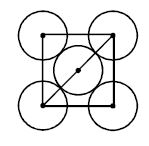
The packing efficiency of the two-dimensional square unit cell shown below is ........... $\%$
A
$39.27$
B
$68.02$
C
$74.05$
D
$78.54$
Solution
(D) In the given two-dimensional square unit cell,there is one atom at the center and four atoms at the corners.
The effective number of atoms $(n)$ is calculated as:
$n = 1_{\text{center}} + 4 \times \frac{1}{4}_{\text{corner}} = 1 + 1 = 2$
The diagonal of the square $(AC)$ is equal to $4r$,where $r$ is the radius of the atom.
$AC = 4r = \sqrt{2}a$,where $a$ is the edge length of the square.
Therefore,$a = \frac{4r}{\sqrt{2}} = 2\sqrt{2}r$.
The packing efficiency ($P$.$E$.) is the ratio of the area occupied by the atoms to the total area of the unit cell:
$P.E. = \frac{n \times \pi r^2}{a^2} \times 100$
$P.E. = \frac{2 \times \pi r^2}{(2\sqrt{2}r)^2} \times 100 = \frac{2\pi r^2}{8r^2} \times 100 = \frac{\pi}{4} \times 100$
$P.E. = \frac{3.14159}{4} \times 100 = 78.54\%$
The effective number of atoms $(n)$ is calculated as:
$n = 1_{\text{center}} + 4 \times \frac{1}{4}_{\text{corner}} = 1 + 1 = 2$
The diagonal of the square $(AC)$ is equal to $4r$,where $r$ is the radius of the atom.
$AC = 4r = \sqrt{2}a$,where $a$ is the edge length of the square.
Therefore,$a = \frac{4r}{\sqrt{2}} = 2\sqrt{2}r$.
The packing efficiency ($P$.$E$.) is the ratio of the area occupied by the atoms to the total area of the unit cell:
$P.E. = \frac{n \times \pi r^2}{a^2} \times 100$
$P.E. = \frac{2 \times \pi r^2}{(2\sqrt{2}r)^2} \times 100 = \frac{2\pi r^2}{8r^2} \times 100 = \frac{\pi}{4} \times 100$
$P.E. = \frac{3.14159}{4} \times 100 = 78.54\%$
0 likesView Solution
5
ChemistryMCQIIT JEE · 2010
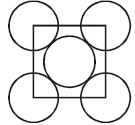
The packing efficiency of the two-dimensional square unit cell shown below is ........... $ \% $
A
$32.97$
B
$68.02$
C
$74.05$
D
$78.54$
Solution
(D) In the given two-dimensional square unit cell,there are four corner atoms and one central atom.
Each corner atom contributes $1/4$ of its area to the unit cell,so $4 \times (1/4) = 1$ atom from the corners.
The central atom contributes $1$ full atom to the unit cell.
Total number of atoms $= 1 + 1 = 2$.
Let the radius of the atom be $r$ and the side of the square be $a$.
The diagonal of the square is $a\sqrt{2} = 4r$,so $a = 4r/\sqrt{2} = 2r\sqrt{2}$.
Packing efficiency $= \frac{\text{Area of 2 atoms}}{\text{Area of square}} \times 100 = \frac{2 \times \pi r^2}{a^2} \times 100$.
Substituting $a = 2r\sqrt{2}$,we get:
Packing efficiency $= \frac{2 \pi r^2}{(2r\sqrt{2})^2} \times 100 = \frac{2 \pi r^2}{8r^2} \times 100 = \frac{\pi}{4} \times 100 \approx 78.54 \%$.
Each corner atom contributes $1/4$ of its area to the unit cell,so $4 \times (1/4) = 1$ atom from the corners.
The central atom contributes $1$ full atom to the unit cell.
Total number of atoms $= 1 + 1 = 2$.
Let the radius of the atom be $r$ and the side of the square be $a$.
The diagonal of the square is $a\sqrt{2} = 4r$,so $a = 4r/\sqrt{2} = 2r\sqrt{2}$.
Packing efficiency $= \frac{\text{Area of 2 atoms}}{\text{Area of square}} \times 100 = \frac{2 \times \pi r^2}{a^2} \times 100$.
Substituting $a = 2r\sqrt{2}$,we get:
Packing efficiency $= \frac{2 \pi r^2}{(2r\sqrt{2})^2} \times 100 = \frac{2 \pi r^2}{8r^2} \times 100 = \frac{\pi}{4} \times 100 \approx 78.54 \%$.
0 likesView Solution
6
ChemistryAdvancedMCQIIT JEE · 2010
The synthesis of $3-$octyne is achieved by adding a bromoalkane into a mixture of sodium amide and an alkyne. The bromoalkane and alkyne respectively are
A
$BrCH_2CH_2CH_2CH_2CH_3$ and $CH_3CH_2C \equiv CH$
B
$BrCH_2CH_2CH_3$ and $CH_3CH_2CH_2C \equiv CH$
C
$BrCH_2CH_2CH_2CH_2CH_3$ and $CH_3C \equiv CH$
D
$BrCH_2CH_2CH_2CH_3$ and $CH_3CH_2C \equiv CH$
Solution
(D) The synthesis of $3-$octyne $(CH_3CH_2C \equiv CCH_2CH_2CH_2CH_3)$ involves the alkylation of an acetylide ion.
First,$1-$butyne $(CH_3CH_2C \equiv CH)$ reacts with sodium amide $(NaNH_2)$ to form the sodium butynide nucleophile: $CH_3CH_2C \equiv CH + NaNH_2 \rightarrow CH_3CH_2C \equiv C^{-}Na^{+} + NH_3$.
Next,this nucleophile performs an $S_N2$ reaction with $1-$bromobutane $(CH_3CH_2CH_2CH_2Br)$: $CH_3CH_2C \equiv C^{-}Na^{+} + CH_3CH_2CH_2CH_2Br \rightarrow CH_3CH_2C \equiv CCH_2CH_2CH_2CH_3 + NaBr$.
Thus,the required reagents are $1-$bromobutane and $1-$butyne.
First,$1-$butyne $(CH_3CH_2C \equiv CH)$ reacts with sodium amide $(NaNH_2)$ to form the sodium butynide nucleophile: $CH_3CH_2C \equiv CH + NaNH_2 \rightarrow CH_3CH_2C \equiv C^{-}Na^{+} + NH_3$.
Next,this nucleophile performs an $S_N2$ reaction with $1-$bromobutane $(CH_3CH_2CH_2CH_2Br)$: $CH_3CH_2C \equiv C^{-}Na^{+} + CH_3CH_2CH_2CH_2Br \rightarrow CH_3CH_2C \equiv CCH_2CH_2CH_2CH_3 + NaBr$.
Thus,the required reagents are $1-$bromobutane and $1-$butyne.
0 likesView Solution
7
ChemistryAdvancedMCQIIT JEE · 2010
The species which by definition has $ZERO$ standard molar enthalpy of formation at $298 \ K$ is
A
$Br_{2(l)}$
B
$Cl_{2(g)}$
C
$H_2O_{(g)}$
D
$CH_{4(g)}$
Solution
(B) By definition,the standard molar enthalpy of formation $(\Delta_fH^circ)$ of an element in its most stable state at $298 \ K$ and $1 \ \text{bar}$ pressure is $ZERO$.
$Cl_{2(g)}$ is the most stable form of chlorine at $298 \ K$.
$Br_{2(l)}$ is the most stable form of bromine at $298 \ K$,so $Br_{2(g)}$ does not have a zero enthalpy of formation.
$H_2O_{(g)}$ and $CH_{4(g)}$ are compounds,not elements,so their standard enthalpy of formation is not zero.
$Cl_{2(g)}$ is the most stable form of chlorine at $298 \ K$.
$Br_{2(l)}$ is the most stable form of bromine at $298 \ K$,so $Br_{2(g)}$ does not have a zero enthalpy of formation.
$H_2O_{(g)}$ and $CH_{4(g)}$ are compounds,not elements,so their standard enthalpy of formation is not zero.
0 likesView Solution
8
ChemistryAdvancedMCQIIT JEE · 2010
The bond energy (in $kcal \ mol^{-1}$) of a $C-C$ single bond is approximately:
A
$1$
B
$10$
C
$100$
D
$1000$
Solution
(C) The bond dissociation energy of a $C-C$ single bond is approximately $83-100 \ kcal \ mol^{-1}$. Among the given options,$100 \ kcal \ mol^{-1}$ is the closest and most appropriate value.
0 likesView Solution
9
ChemistryAdvancedMCQIIT JEE · 2010
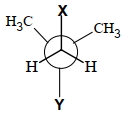
In the Newman projection for $2,2$-dimethylbutane,what can $X$ and $Y$ respectively be?
$A$. $H$ and $H$
$B$. $H$ and $C_2H_5$
$C$. $C_2H_5$ and $H$
$D$. $CH_3$ and $CH_3$
$A$. $H$ and $H$
$B$. $H$ and $C_2H_5$
$C$. $C_2H_5$ and $H$
$D$. $CH_3$ and $CH_3$
A
$B, D$
B
$B, C$
C
$A, D$
D
$A, B$
Solution
(B) The structure of $2,2$-dimethylbutane is $CH_3-CH_2-C(CH_3)_2-CH_3$.
For the given Newman projection,the front carbon has two $CH_3$ groups and one $H$ atom,while the back carbon has two $H$ atoms and one group $Y$. The group $X$ is attached to the front carbon.
Considering the $C_2-C_3$ bond axis:
Front carbon $(C_2)$ has two $CH_3$ groups and one $H$ atom. Back carbon $(C_3)$ has two $H$ atoms and one $C_2H_5$ group.
If $X = CH_3$ and $Y = C_2H_5$,this matches the structure.
Considering the $C_1-C_2$ bond axis:
Front carbon $(C_1)$ has three $H$ atoms. Back carbon $(C_2)$ has two $CH_3$ groups and one $C_2H_5$ group.
If $X = H$ and $Y = C_2H_5$,this matches the structure.
Comparing with the options,$X=H$ and $Y=C_2H_5$ (Option $B$) is a valid possibility,and $X=C_2H_5$ and $Y=H$ (Option $C$) is also a valid possibility depending on the rotation and projection chosen. Thus,$B$ and $C$ are correct.
For the given Newman projection,the front carbon has two $CH_3$ groups and one $H$ atom,while the back carbon has two $H$ atoms and one group $Y$. The group $X$ is attached to the front carbon.
Considering the $C_2-C_3$ bond axis:
Front carbon $(C_2)$ has two $CH_3$ groups and one $H$ atom. Back carbon $(C_3)$ has two $H$ atoms and one $C_2H_5$ group.
If $X = CH_3$ and $Y = C_2H_5$,this matches the structure.
Considering the $C_1-C_2$ bond axis:
Front carbon $(C_1)$ has three $H$ atoms. Back carbon $(C_2)$ has two $CH_3$ groups and one $C_2H_5$ group.
If $X = H$ and $Y = C_2H_5$,this matches the structure.
Comparing with the options,$X=H$ and $Y=C_2H_5$ (Option $B$) is a valid possibility,and $X=C_2H_5$ and $Y=H$ (Option $C$) is also a valid possibility depending on the rotation and projection chosen. Thus,$B$ and $C$ are correct.
0 likesView Solution
10
ChemistryAdvancedMCQIIT JEE · 2010
Aqueous solutions of $HNO_3$,$KOH$,$CH_3COOH$,and $CH_3COONa$ of identical concentrations are provided.
The pair$(s)$ of solutions which form a buffer upon mixing is(are):
$A$. $HNO_3$ and $CH_3COOH$
$B$. $KOH$ and $CH_3COONa$
$C$. $HNO_3$ and $CH_3COONa$
$D$. $CH_3COOH$ and $CH_3COONa$
The pair$(s)$ of solutions which form a buffer upon mixing is(are):
$A$. $HNO_3$ and $CH_3COOH$
$B$. $KOH$ and $CH_3COONa$
$C$. $HNO_3$ and $CH_3COONa$
$D$. $CH_3COOH$ and $CH_3COONa$
A
$B, C$
B
$A, D$
C
$C, D$
D
$B, D$
Solution
(C) buffer solution is formed by a mixture of a weak acid and its conjugate base or a weak base and its conjugate acid.
$1$. In option $C$,$HNO_3$ (strong acid) reacts with $CH_3COONa$ (salt of weak acid) to form $CH_3COOH$ (weak acid) and $NaNO_3$. If $HNO_3$ is the limiting reagent,the resulting mixture contains $CH_3COOH$ and $CH_3COONa$,which acts as an acidic buffer.
$2$. In option $D$,the mixture contains $CH_3COOH$ (weak acid) and $CH_3COONa$ (conjugate base),which is a classic acidic buffer system.
Therefore,both $C$ and $D$ can form a buffer.
$1$. In option $C$,$HNO_3$ (strong acid) reacts with $CH_3COONa$ (salt of weak acid) to form $CH_3COOH$ (weak acid) and $NaNO_3$. If $HNO_3$ is the limiting reagent,the resulting mixture contains $CH_3COOH$ and $CH_3COONa$,which acts as an acidic buffer.
$2$. In option $D$,the mixture contains $CH_3COOH$ (weak acid) and $CH_3COONa$ (conjugate base),which is a classic acidic buffer system.
Therefore,both $C$ and $D$ can form a buffer.
0 likesView Solution
11
ChemistryAdvancedMCQIIT JEE · 2010
The reagent$(s)$ used for softening the temporary hardness of water is(are):
$(A)$ $Ca_3(PO_4)_2$
$(B)$ $Ca(OH)_2$
$(C)$ $Na_2CO_3$
$(D)$ $NaOCl$
$(A)$ $Ca_3(PO_4)_2$
$(B)$ $Ca(OH)_2$
$(C)$ $Na_2CO_3$
$(D)$ $NaOCl$
A
$(A, B, C)$
B
$(B, C)$
C
$(A, B, D)$
D
$(A, D, B)$
Solution
(B) Temporary hardness of water is due to the presence of magnesium and calcium bicarbonates.
$1$. $Ca(OH)_2$ (Clarke's method) is used to remove temporary hardness by converting soluble bicarbonates into insoluble carbonates:
$Ca(HCO_3)_2 + Ca(OH)_2 \longrightarrow 2 CaCO_3 \downarrow + 2 H_2O$
$2$. $Na_2CO_3$ (Washing soda) is used to remove both temporary and permanent hardness by precipitating calcium and magnesium ions as carbonates:
$Ca(HCO_3)_2 + Na_2CO_3 \longrightarrow CaCO_3 \downarrow + 2 NaHCO_3$
Therefore,both $(B)$ and $(C)$ are correct reagents for softening temporary hardness.
$1$. $Ca(OH)_2$ (Clarke's method) is used to remove temporary hardness by converting soluble bicarbonates into insoluble carbonates:
$Ca(HCO_3)_2 + Ca(OH)_2 \longrightarrow 2 CaCO_3 \downarrow + 2 H_2O$
$2$. $Na_2CO_3$ (Washing soda) is used to remove both temporary and permanent hardness by precipitating calcium and magnesium ions as carbonates:
$Ca(HCO_3)_2 + Na_2CO_3 \longrightarrow CaCO_3 \downarrow + 2 NaHCO_3$
Therefore,both $(B)$ and $(C)$ are correct reagents for softening temporary hardness.
0 likesView Solution
12
ChemistryMediumMCQIIT JEE · 2010
$A$ student performs a titration with different burettes and finds titre values of $25.2 \ mL$,$25.25 \ mL$ and $25.0 \ mL$. The number of significant figures in the average titre value is
A
$3$
B
$2$
C
$1$
D
$9$
Solution
(A) The given titre values are $25.2 \ mL$,$25.25 \ mL$,and $25.0 \ mL$.
First,calculate the average: $\text{Average} = \frac{25.2 + 25.25 + 25.0}{3} = \frac{75.45}{3} = 25.15 \ mL$.
According to the rules of significant figures in addition/subtraction,the result should be reported to the same number of decimal places as the measurement with the fewest decimal places.
Here,$25.2$ and $25.0$ have one decimal place,so the sum $75.45$ should be rounded to one decimal place,which is $75.5$.
Then,$75.5 / 3 = 25.166...$,which rounds to $25.2$.
The value $25.2$ has $3$ significant figures.
First,calculate the average: $\text{Average} = \frac{25.2 + 25.25 + 25.0}{3} = \frac{75.45}{3} = 25.15 \ mL$.
According to the rules of significant figures in addition/subtraction,the result should be reported to the same number of decimal places as the measurement with the fewest decimal places.
Here,$25.2$ and $25.0$ have one decimal place,so the sum $75.45$ should be rounded to one decimal place,which is $75.5$.
Then,$75.5 / 3 = 25.166...$,which rounds to $25.2$.
The value $25.2$ has $3$ significant figures.
0 likesView Solution
13
ChemistryAdvancedMCQIIT JEE · 2010
The total number of cyclic isomers possible for a hydrocarbon with the molecular formula $C_4H_6$ is
A
$4$
B
$5$
C
$6$
D
$8$
Solution
(B) The molecular formula $C_4H_6$ corresponds to a degree of unsaturation (double bond equivalent) of $4 - (6/2) + 1 = 2$.
For cyclic isomers,we consider structures with one ring and one double bond,or two rings.
The possible cyclic isomers are:
$1$. Cyclobutene
$2$. $1-$Methylcyclopropene
$3$. $3-$Methylcyclopropene
$4$. Methylenecyclopropane
$5$. Bicyclobutane
Thus,there are a total of $5$ cyclic isomers.
For cyclic isomers,we consider structures with one ring and one double bond,or two rings.
The possible cyclic isomers are:
$1$. Cyclobutene
$2$. $1-$Methylcyclopropene
$3$. $3-$Methylcyclopropene
$4$. Methylenecyclopropane
$5$. Bicyclobutane
Thus,there are a total of $5$ cyclic isomers.
0 likesView Solution
14
ChemistryAdvancedMCQIIT JEE · 2010
Amongst the following,the total number of compounds whose aqueous solution turns red litmus paper blue is
$KCN$,$K_2SO_4$,$(NH_4)_2C_2O_4$,$NaCl$,$Zn(NO_3)_2$,$FeCl_3$,$K_2CO_3$,$NH_4NO_3$,$LiCN$
$KCN$,$K_2SO_4$,$(NH_4)_2C_2O_4$,$NaCl$,$Zn(NO_3)_2$,$FeCl_3$,$K_2CO_3$,$NH_4NO_3$,$LiCN$
A
$3$
B
$5$
C
$6$
D
$7$
Solution
(A) An aqueous solution turns red litmus paper blue if it is basic in nature.
$1$. $KCN$: Salt of strong base $(KOH)$ and weak acid $(HCN)$,so it is basic.
$2$. $K_2SO_4$: Salt of strong base $(KOH)$ and strong acid $(H_2SO_4)$,so it is neutral.
$3$. $(NH_4)_2C_2O_4$: Salt of weak base $(NH_4OH)$ and weak acid $(H_2C_2O_4)$,so it is weakly acidic/neutral.
$4$. $NaCl$: Salt of strong base $(NaOH)$ and strong acid $(HCl)$,so it is neutral.
$5$. $Zn(NO_3)_2$: Salt of weak base $(Zn(OH)_2)$ and strong acid $(HNO_3)$,so it is acidic.
$6$. $FeCl_3$: Salt of weak base $(Fe(OH)_3)$ and strong acid $(HCl)$,so it is acidic.
$7$. $K_2CO_3$: Salt of strong base $(KOH)$ and weak acid $(H_2CO_3)$,so it is basic.
$8$. $NH_4NO_3$: Salt of weak base $(NH_4OH)$ and strong acid $(HNO_3)$,so it is acidic.
$9$. $LiCN$: Salt of strong base $(LiOH)$ and weak acid $(HCN)$,so it is basic.
The compounds that are basic are $KCN$,$K_2CO_3$,and $LiCN$. The total number is $3$.
$1$. $KCN$: Salt of strong base $(KOH)$ and weak acid $(HCN)$,so it is basic.
$2$. $K_2SO_4$: Salt of strong base $(KOH)$ and strong acid $(H_2SO_4)$,so it is neutral.
$3$. $(NH_4)_2C_2O_4$: Salt of weak base $(NH_4OH)$ and weak acid $(H_2C_2O_4)$,so it is weakly acidic/neutral.
$4$. $NaCl$: Salt of strong base $(NaOH)$ and strong acid $(HCl)$,so it is neutral.
$5$. $Zn(NO_3)_2$: Salt of weak base $(Zn(OH)_2)$ and strong acid $(HNO_3)$,so it is acidic.
$6$. $FeCl_3$: Salt of weak base $(Fe(OH)_3)$ and strong acid $(HCl)$,so it is acidic.
$7$. $K_2CO_3$: Salt of strong base $(KOH)$ and weak acid $(H_2CO_3)$,so it is basic.
$8$. $NH_4NO_3$: Salt of weak base $(NH_4OH)$ and strong acid $(HNO_3)$,so it is acidic.
$9$. $LiCN$: Salt of strong base $(LiOH)$ and weak acid $(HCN)$,so it is basic.
The compounds that are basic are $KCN$,$K_2CO_3$,and $LiCN$. The total number is $3$.
0 likesView Solution
15
ChemistryDifficultMCQIIT JEE · 2010
Based on $VSEPR$ theory,the number of $90^{\circ}$ $F-Br-F$ bond angles in $BrF_5$ is
A
$5$
B
$0$
C
$3$
D
$7$
Solution
(B) The molecule $BrF_5$ has a square pyramidal geometry with one lone pair on the central $Br$ atom.
Due to the strong repulsion between the lone pair and the bonding pairs,the equatorial $F$ atoms are pushed downwards.
Consequently,the bond angles between the axial $F$ and the equatorial $F$ atoms are reduced from $90^{\circ}$ to approximately $84.8^{\circ}$.
Therefore,there are no $90^{\circ}$ $F-Br-F$ bond angles in the molecule.
Due to the strong repulsion between the lone pair and the bonding pairs,the equatorial $F$ atoms are pushed downwards.
Consequently,the bond angles between the axial $F$ and the equatorial $F$ atoms are reduced from $90^{\circ}$ to approximately $84.8^{\circ}$.
Therefore,there are no $90^{\circ}$ $F-Br-F$ bond angles in the molecule.
0 likesView Solution
16
ChemistryDifficultMCQIIT JEE · 2010
The value of $n$ in the molecular formula $Be_n Al_2 Si_6 O_{18}$ is
A
$1$
B
$2$
C
$3$
D
$4$
Solution
(C) The mineral Beryl has the chemical formula $Be_3 Al_2 Si_6 O_{18}$.
To determine $n$ using the principle of charge neutrality (sum of oxidation states $= 0$):
$Be = +2$,$Al = +3$,$Si = +4$,$O = -2$
$n(+2) + 2(+3) + 6(+4) + 18(-2) = 0$
$2n + 6 + 24 - 36 = 0$
$2n - 6 = 0$
$2n = 6$
$n = 3$
To determine $n$ using the principle of charge neutrality (sum of oxidation states $= 0$):
$Be = +2$,$Al = +3$,$Si = +4$,$O = -2$
$n(+2) + 2(+3) + 6(+4) + 18(-2) = 0$
$2n + 6 + 24 - 36 = 0$
$2n - 6 = 0$
$2n = 6$
$n = 3$
0 likesView Solution
17
ChemistryMCQIIT JEE · 2010
If the angles $A, B$ and $C$ of a triangle are in an arithmetic progression and if $a, b$ and $c$ denote the lengths of the sides opposite to $A, B$ and $C$ respectively,then the value of the expression $\frac{a}{c} \sin 2C + \frac{c}{a} \sin 2A$ is
A
$\frac{1}{2}$
B
$\frac{\sqrt{3}}{2}$
C
$1$
D
$\sqrt{3}$
Solution
(D) Since $A, B, C$ are in arithmetic progression,$2B = A + C$.
Given $A + B + C = 180^{\circ}$,we have $3B = 180^{\circ}$,so $B = 60^{\circ}$.
Using the sine rule,$\frac{a}{\sin A} = \frac{c}{\sin C} = 2R$,so $a = 2R \sin A$ and $c = 2R \sin C$.
The expression becomes $\frac{\sin A}{\sin C} \sin 2C + \frac{\sin C}{\sin A} \sin 2A$.
$= \frac{\sin A}{\sin C} (2 \sin C \cos C) + \frac{\sin C}{\sin A} (2 \sin A \cos A) = 2 \sin A \cos C + 2 \sin C \cos A$.
$= 2 \sin(A + C) = 2 \sin(180^{\circ} - B) = 2 \sin B$.
Since $B = 60^{\circ}$,the value is $2 \sin 60^{\circ} = 2 \times \frac{\sqrt{3}}{2} = \sqrt{3}$.
Given $A + B + C = 180^{\circ}$,we have $3B = 180^{\circ}$,so $B = 60^{\circ}$.
Using the sine rule,$\frac{a}{\sin A} = \frac{c}{\sin C} = 2R$,so $a = 2R \sin A$ and $c = 2R \sin C$.
The expression becomes $\frac{\sin A}{\sin C} \sin 2C + \frac{\sin C}{\sin A} \sin 2A$.
$= \frac{\sin A}{\sin C} (2 \sin C \cos C) + \frac{\sin C}{\sin A} (2 \sin A \cos A) = 2 \sin A \cos C + 2 \sin C \cos A$.
$= 2 \sin(A + C) = 2 \sin(180^{\circ} - B) = 2 \sin B$.
Since $B = 60^{\circ}$,the value is $2 \sin 60^{\circ} = 2 \times \frac{\sqrt{3}}{2} = \sqrt{3}$.
0 likesView Solution
18
ChemistryMCQIIT JEE · 2010
The equation of the plane containing the straight line $\frac{x}{2}=\frac{y}{3}=\frac{z}{4}$ and perpendicular to the plane containing the straight lines $\frac{x}{3}=\frac{y}{4}=\frac{z}{2}$ and $\frac{x}{4}=\frac{y}{2}=\frac{z}{3}$ is
A
$x+2y-2z=0$
B
$3x+2y-2z=0$
C
$x-2y+z=0$
D
$5x+2y-4z=0$
Solution
(C) Let the equation of the required plane be $ax+by+cz=0$. Since it contains the line $\frac{x}{2}=\frac{y}{3}=\frac{z}{4}$,the normal vector $(a, b, c)$ is perpendicular to the direction vector $(2, 3, 4)$.
Thus,$2a+3b+4c=0$ ............$(i)$
Next,consider the plane containing the lines $\frac{x}{3}=\frac{y}{4}=\frac{z}{2}$ and $\frac{x}{4}=\frac{y}{2}=\frac{z}{3}$. The normal vector $(a', b', c')$ of this plane is the cross product of the direction vectors $(3, 4, 2)$ and $(4, 2, 3)$:
$(a', b', c') = (3, 4, 2) \times (4, 2, 3) = (12-4, 8-9, 6-16) = (8, -1, -10)$.
Since our required plane is perpendicular to this plane,its normal vector $(a, b, c)$ must be perpendicular to the normal vector $(8, -1, -10)$ of the second plane.
Thus,$8a-b-10c=0$ ............$(ii)$
Solving $(i)$ and $(ii)$ using cross multiplication:
$\frac{a}{(3)(-10) - (4)(-1)} = \frac{b}{(4)(8) - (2)(-10)} = \frac{c}{(2)(-1) - (3)(8)}$
$\frac{a}{-30+4} = \frac{b}{32+20} = \frac{c}{-2-24}$
$\frac{a}{-26} = \frac{b}{52} = \frac{c}{-26}$
Dividing by $-26$,we get the ratios $a:b:c = 1:-2:1$.
Substituting these into $ax+by+cz=0$,we get $x-2y+z=0$.
Thus,$2a+3b+4c=0$ ............$(i)$
Next,consider the plane containing the lines $\frac{x}{3}=\frac{y}{4}=\frac{z}{2}$ and $\frac{x}{4}=\frac{y}{2}=\frac{z}{3}$. The normal vector $(a', b', c')$ of this plane is the cross product of the direction vectors $(3, 4, 2)$ and $(4, 2, 3)$:
$(a', b', c') = (3, 4, 2) \times (4, 2, 3) = (12-4, 8-9, 6-16) = (8, -1, -10)$.
Since our required plane is perpendicular to this plane,its normal vector $(a, b, c)$ must be perpendicular to the normal vector $(8, -1, -10)$ of the second plane.
Thus,$8a-b-10c=0$ ............$(ii)$
Solving $(i)$ and $(ii)$ using cross multiplication:
$\frac{a}{(3)(-10) - (4)(-1)} = \frac{b}{(4)(8) - (2)(-10)} = \frac{c}{(2)(-1) - (3)(8)}$
$\frac{a}{-30+4} = \frac{b}{32+20} = \frac{c}{-2-24}$
$\frac{a}{-26} = \frac{b}{52} = \frac{c}{-26}$
Dividing by $-26$,we get the ratios $a:b:c = 1:-2:1$.
Substituting these into $ax+by+cz=0$,we get $x-2y+z=0$.
0 likesView Solution
19
ChemistryMCQIIT JEE · 2010
Let $ABC$ be a triangle such that $\angle ACB = \frac{\pi}{6}$ and let $a, b$ and $c$ denote the lengths of the sides opposite to $A, B$ and $C$ respectively. The value$(s)$ of $x$ for which $a = x^2+x+1, b = x^2-1$ and $c = 2x+1$ is (are):
A
$-(2+\sqrt{3})$
B
$1+\sqrt{3}$
C
$2+\sqrt{3}$
D
$4\sqrt{3}$
Solution
(B) Using the Law of Cosines for $\angle C$:
$\cos(C) = \frac{a^2 + b^2 - c^2}{2ab}$
$\cos(\frac{\pi}{6}) = \frac{(x^2+x+1)^2 + (x^2-1)^2 - (2x+1)^2}{2(x^2+x+1)(x^2-1)}$
$\frac{\sqrt{3}}{2} = \frac{(x^4+x^2+1+2x^3+2x^2+2x) + (x^4-2x^2+1) - (4x^2+4x+1)}{2(x^2+x+1)(x^2-1)}$
$\frac{\sqrt{3}}{2} = \frac{2x^4+2x^3-3x^2-2x+1}{2(x^2+x+1)(x^2-1)}$
Since $(x^2+x+1)(x^2-1) = x^4+x^3-x-1$,the equation simplifies to:
$\sqrt{3}(x^4+x^3-x-1) = 2x^4+2x^3-3x^2-2x+1$
Solving this quadratic in $x$ leads to $x = 1+\sqrt{3}$ as the valid solution,since side lengths must be positive ($x > 1$ for $b > 0$).
$\cos(C) = \frac{a^2 + b^2 - c^2}{2ab}$
$\cos(\frac{\pi}{6}) = \frac{(x^2+x+1)^2 + (x^2-1)^2 - (2x+1)^2}{2(x^2+x+1)(x^2-1)}$
$\frac{\sqrt{3}}{2} = \frac{(x^4+x^2+1+2x^3+2x^2+2x) + (x^4-2x^2+1) - (4x^2+4x+1)}{2(x^2+x+1)(x^2-1)}$
$\frac{\sqrt{3}}{2} = \frac{2x^4+2x^3-3x^2-2x+1}{2(x^2+x+1)(x^2-1)}$
Since $(x^2+x+1)(x^2-1) = x^4+x^3-x-1$,the equation simplifies to:
$\sqrt{3}(x^4+x^3-x-1) = 2x^4+2x^3-3x^2-2x+1$
Solving this quadratic in $x$ leads to $x = 1+\sqrt{3}$ as the valid solution,since side lengths must be positive ($x > 1$ for $b > 0$).
0 likesView Solution
20
ChemistryAdvancedMCQIIT JEE · 2010
Assuming that Hund's rule is violated,the bond order and magnetic nature of the diatomic molecule $B_2$ is
A
$1$ and diamagnetic
B
$0$ and diamagnetic
C
$1$ and paramagnetic
D
$0$ and paramagnetic
Solution
(A) The electronic configuration of $B_2$ ($10$ electrons) is $\sigma_{1s}^2 \sigma_{1s}^{*2} \sigma_{2s}^2 \sigma_{2s}^{*2} \pi_{2p_x}^2$.
Bond order is calculated as $\frac{\text{Number of bonding electrons} - \text{Number of antibonding electrons}}{2}$.
Bond order = $\frac{6 - 4}{2} = 1$.
Since all electrons are paired in the $\pi_{2p_x}$ orbital under the assumption that Hund's rule is violated,the molecule is diamagnetic.
Bond order is calculated as $\frac{\text{Number of bonding electrons} - \text{Number of antibonding electrons}}{2}$.
Bond order = $\frac{6 - 4}{2} = 1$.
Since all electrons are paired in the $\pi_{2p_x}$ orbital under the assumption that Hund's rule is violated,the molecule is diamagnetic.
0 likesView Solution
21
ChemistryDifficultMCQIIT JEE · 2010
The species having a pyramidal shape is
A
$SO_3$
B
$BrF_3$
C
$SiO_3^{2-}$
D
$OSF_2$
Solution
(D) To determine the shape,we calculate the hybridization and number of lone pairs for each species:
$1$. $SO_3$: The central $S$ atom has $3$ bond pairs and $0$ lone pairs. It has $sp^2$ hybridization and a trigonal planar shape.
$2$. $BrF_3$: The central $Br$ atom has $3$ bond pairs and $2$ lone pairs. It has $sp^3d$ hybridization and a $T$-shaped geometry.
$3$. $SiO_3^{2-}$: The central $Si$ atom has $3$ bond pairs and $0$ lone pairs. It has $sp^2$ hybridization and a trigonal planar shape.
$4$. $OSF_2$ (Thionyl fluoride): The central $S$ atom has $3$ bond pairs (one double bond to $O$ and two single bonds to $F$) and $1$ lone pair. The total steric number is $4$ ($3$ bond pairs + $1$ lone pair),which corresponds to $sp^3$ hybridization. Due to the presence of one lone pair,the geometry is pyramidal.
$1$. $SO_3$: The central $S$ atom has $3$ bond pairs and $0$ lone pairs. It has $sp^2$ hybridization and a trigonal planar shape.
$2$. $BrF_3$: The central $Br$ atom has $3$ bond pairs and $2$ lone pairs. It has $sp^3d$ hybridization and a $T$-shaped geometry.
$3$. $SiO_3^{2-}$: The central $Si$ atom has $3$ bond pairs and $0$ lone pairs. It has $sp^2$ hybridization and a trigonal planar shape.
$4$. $OSF_2$ (Thionyl fluoride): The central $S$ atom has $3$ bond pairs (one double bond to $O$ and two single bonds to $F$) and $1$ lone pair. The total steric number is $4$ ($3$ bond pairs + $1$ lone pair),which corresponds to $sp^3$ hybridization. Due to the presence of one lone pair,the geometry is pyramidal.
0 likesView Solution
22
ChemistryMediumMCQIIT JEE · 2010
Among the following,the number of elements showing only one non-zero oxidation state is $O, Cl, F, N, P, Sn, Tl, Na, Ti$.
A
$1$
B
$2$
C
$3$
D
$4$
Solution
(B) The elements listed are $O, Cl, F, N, P, Sn, Tl, Na, Ti$.
$F$ (Fluorine) always shows $-1$ oxidation state.
$Na$ (Sodium) always shows $+1$ oxidation state.
Other elements show variable oxidation states:
$O$ $(-2, -1, +2)$,$Cl$ $(-1, +1, +3, +5, +7)$,$N$ ($-3$ to $+5$),$P$ ($-3$ to $+5$),$Sn$ $(+2, +4)$,$Tl$ $(+1, +3)$,$Ti$ $(+2, +3, +4)$.
Thus,only $2$ elements ($F$ and $Na$) show a single non-zero oxidation state.
$F$ (Fluorine) always shows $-1$ oxidation state.
$Na$ (Sodium) always shows $+1$ oxidation state.
Other elements show variable oxidation states:
$O$ $(-2, -1, +2)$,$Cl$ $(-1, +1, +3, +5, +7)$,$N$ ($-3$ to $+5$),$P$ ($-3$ to $+5$),$Sn$ $(+2, +4)$,$Tl$ $(+1, +3)$,$Ti$ $(+2, +3, +4)$.
Thus,only $2$ elements ($F$ and $Na$) show a single non-zero oxidation state.
0 likesView Solution
23
ChemistryAdvancedMCQIIT JEE · 2010
The total number of diprotic acids among the following is:
$H_3PO_4, H_2SO_4, H_3PO_3, H_2CO_3, H_2S_2O_7, H_3BO_3, H_3PO_2, H_2CrO_4, H_2SO_3$
$H_3PO_4, H_2SO_4, H_3PO_3, H_2CO_3, H_2S_2O_7, H_3BO_3, H_3PO_2, H_2CrO_4, H_2SO_3$
A
$8$
B
$5$
C
$4$
D
$6$
Solution
(D) diprotic acid is an acid that can donate two protons ($H^+$ ions) per molecule.
$1$. $H_3PO_4$: Triprotic acid.
$2$. $H_2SO_4$: Diprotic acid.
$3$. $H_3PO_3$: Diprotic acid (contains two $P-OH$ bonds).
$4$. $H_2CO_3$: Diprotic acid.
$5$. $H_2S_2O_7$: Diprotic acid.
$6$. $H_3BO_3$: Monoprotic acid (Lewis acid).
$7$. $H_3PO_2$: Monoprotic acid (contains one $P-OH$ bond).
$8$. $H_2CrO_4$: Diprotic acid.
$9$. $H_2SO_3$: Diprotic acid.
The diprotic acids are: $H_2SO_4, H_3PO_3, H_2CO_3, H_2S_2O_7, H_2CrO_4, H_2SO_3$.
Total count = $6$.
$1$. $H_3PO_4$: Triprotic acid.
$2$. $H_2SO_4$: Diprotic acid.
$3$. $H_3PO_3$: Diprotic acid (contains two $P-OH$ bonds).
$4$. $H_2CO_3$: Diprotic acid.
$5$. $H_2S_2O_7$: Diprotic acid.
$6$. $H_3BO_3$: Monoprotic acid (Lewis acid).
$7$. $H_3PO_2$: Monoprotic acid (contains one $P-OH$ bond).
$8$. $H_2CrO_4$: Diprotic acid.
$9$. $H_2SO_3$: Diprotic acid.
The diprotic acids are: $H_2SO_4, H_3PO_3, H_2CO_3, H_2S_2O_7, H_2CrO_4, H_2SO_3$.
Total count = $6$.
0 likesView Solution
24
ChemistryDifficultMCQIIT JEE · 2010
The hydrogen-like species $Li^{2+}$ is in a spherically symmetric state $S_1$ with one radial node. Upon absorbing light,the ion undergoes transition to a state $S_2$. The state $S_2$ has one radial node and its energy is equal to the ground state energy of the hydrogen atom.
$1.$ The state $S_1$ is
$(A)$ $1s$ $(B)$ $2s$ $(C)$ $2p$ $(D)$ $3s$
$2.$ Energy of the state $S_1$ in units of the hydrogen atom ground state energy is
$(A)$ $0.75$ $(B)$ $1.50$ $(C)$ $2.25$ $(D)$ $4.50$
$3.$ The orbital angular momentum quantum number of the state $S_2$ is
$(A)$ $0$ $(B)$ $1$ $(C)$ $2$ $(D)$ $3$
Give the answer for questions $1, 2$ and $3.$
$1.$ The state $S_1$ is
$(A)$ $1s$ $(B)$ $2s$ $(C)$ $2p$ $(D)$ $3s$
$2.$ Energy of the state $S_1$ in units of the hydrogen atom ground state energy is
$(A)$ $0.75$ $(B)$ $1.50$ $(C)$ $2.25$ $(D)$ $4.50$
$3.$ The orbital angular momentum quantum number of the state $S_2$ is
$(A)$ $0$ $(B)$ $1$ $(C)$ $2$ $(D)$ $3$
Give the answer for questions $1, 2$ and $3.$
A
$(B, C, B)$
B
$(B, C, A)$
C
$(A, B, A)$
D
$(D, B, C)$
Solution
(B) $1.$ For $S_1$ (spherically symmetric,$\ell = 0$):
$\text{Radial node} = n - \ell - 1 = 1$ $\Rightarrow n - 0 - 1 = 1$ $\Rightarrow n = 2.$
Thus,state $S_1$ is $2s$.
For $S_2$,energy $E_{S_2} = E_H(\text{ground}) = -13.6 \ eV$.
$E_{S_2} = \frac{-13.6 \times Z^2}{n^2} = -13.6 \ eV$ $\Rightarrow \frac{3^2}{n^2} = 1$ $\Rightarrow n = 3.$
Given $S_2$ has one radial node: $n - \ell - 1 = 1$ $\Rightarrow 3 - \ell - 1 = 1$ $\Rightarrow \ell = 1$.
$2.$ Energy of $S_1$ $(n=2, Z=3)$: $E_{S_1} = \frac{-13.6 \times 3^2}{2^2} = -13.6 \times 2.25 \ eV$.
In units of $E_H(\text{ground}) = -13.6 \ eV$,the energy is $2.25$.
$3.$ For $S_2$,$\ell = 1$ (as calculated above).
$\text{Radial node} = n - \ell - 1 = 1$ $\Rightarrow n - 0 - 1 = 1$ $\Rightarrow n = 2.$
Thus,state $S_1$ is $2s$.
For $S_2$,energy $E_{S_2} = E_H(\text{ground}) = -13.6 \ eV$.
$E_{S_2} = \frac{-13.6 \times Z^2}{n^2} = -13.6 \ eV$ $\Rightarrow \frac{3^2}{n^2} = 1$ $\Rightarrow n = 3.$
Given $S_2$ has one radial node: $n - \ell - 1 = 1$ $\Rightarrow 3 - \ell - 1 = 1$ $\Rightarrow \ell = 1$.
$2.$ Energy of $S_1$ $(n=2, Z=3)$: $E_{S_1} = \frac{-13.6 \times 3^2}{2^2} = -13.6 \times 2.25 \ eV$.
In units of $E_H(\text{ground}) = -13.6 \ eV$,the energy is $2.25$.
$3.$ For $S_2$,$\ell = 1$ (as calculated above).
0 likesView Solution
25
ChemistryMCQIIT JEE · 2010
$A$ hollow pipe of length $0.8 \ m$ is closed at one end. At its open end,a $0.5 \ m$ long uniform string is vibrating in its second harmonic and it resonates with the fundamental frequency of the pipe. If the tension in the wire is $50 \ N$ and the speed of sound is $320 \ ms^{-1}$,the mass of the string is: (in $g$)
A
$5$
B
$10$
C
$20$
D
$40$
Solution
(B) The fundamental frequency of a pipe closed at one end is given by $f_P = \frac{v}{4L_P}$,where $v = 320 \ ms^{-1}$ and $L_P = 0.8 \ m$.
$f_P = \frac{320}{4 \times 0.8} = \frac{320}{3.2} = 100 \ Hz$.
The frequency of a string vibrating in its second harmonic is $f_S = \frac{2}{2L_S} \sqrt{\frac{T}{\mu}} = \frac{1}{L_S} \sqrt{\frac{T}{\mu}}$,where $L_S = 0.5 \ m$ and $T = 50 \ N$.
Since the string resonates with the pipe,$f_S = f_P = 100 \ Hz$.
$100 = \frac{1}{0.5} \sqrt{\frac{50}{\mu}} \implies 100 = 2 \sqrt{\frac{50}{\mu}} \implies 50 = \sqrt{\frac{50}{\mu}}$.
Squaring both sides: $2500 = \frac{50}{\mu} \implies \mu = \frac{50}{2500} = 0.02 \ kg/m$.
The mass of the string $M = \mu \times L_S = 0.02 \times 0.5 = 0.01 \ kg = 10 \ g$.
$f_P = \frac{320}{4 \times 0.8} = \frac{320}{3.2} = 100 \ Hz$.
The frequency of a string vibrating in its second harmonic is $f_S = \frac{2}{2L_S} \sqrt{\frac{T}{\mu}} = \frac{1}{L_S} \sqrt{\frac{T}{\mu}}$,where $L_S = 0.5 \ m$ and $T = 50 \ N$.
Since the string resonates with the pipe,$f_S = f_P = 100 \ Hz$.
$100 = \frac{1}{0.5} \sqrt{\frac{50}{\mu}} \implies 100 = 2 \sqrt{\frac{50}{\mu}} \implies 50 = \sqrt{\frac{50}{\mu}}$.
Squaring both sides: $2500 = \frac{50}{\mu} \implies \mu = \frac{50}{2500} = 0.02 \ kg/m$.
The mass of the string $M = \mu \times L_S = 0.02 \times 0.5 = 0.01 \ kg = 10 \ g$.
0 likesView Solution
26
ChemistryAdvancedMCQIIT JEE · 2010
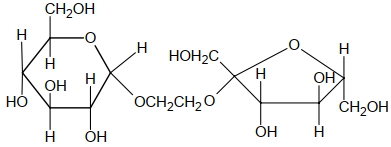
The correct statement about the following disaccharide is:
A
Ring $(a)$ is pyranose with $\alpha$-glycosidic link
B
Ring $(a)$ is furanose with $\alpha$-glycosidic link
C
Ring $(b)$ is furanose with $\alpha$-glycosidic link
D
Ring $(b)$ is pyranose with $\beta$-glycosidic link
Solution
(A) The given structure represents a disaccharide where ring $(a)$ is a six-membered pyranose ring (glucose unit) and ring $(b)$ is a five-membered furanose ring (fructose unit).
The glycosidic linkage connects the anomeric carbon of the glucose unit to the fructose unit.
In the provided structure,the oxygen atom of the glycosidic linkage is directed downwards relative to the plane of the ring $(a)$,which characterizes an $\alpha$-glycosidic linkage.
Therefore,ring $(a)$ is a pyranose ring with an $\alpha$-glycosidic linkage.
The glycosidic linkage connects the anomeric carbon of the glucose unit to the fructose unit.
In the provided structure,the oxygen atom of the glycosidic linkage is directed downwards relative to the plane of the ring $(a)$,which characterizes an $\alpha$-glycosidic linkage.
Therefore,ring $(a)$ is a pyranose ring with an $\alpha$-glycosidic linkage.
0 likesView Solution
27
ChemistryAdvancedMCQIIT JEE · 2010
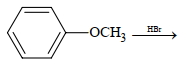
In the reaction shown below,the products are:
A
$4-$bromoanisole and $H_2$
B
Bromobenzene and $CH_3Br$
C
Bromobenzene and $CH_3OH$
D
Phenol and $CH_3Br$
Solution
(D) The reaction of anisole $(C_6H_5OCH_3)$ with $HBr$ involves the protonation of the ether oxygen atom by the acid.
This is followed by the nucleophilic attack of the bromide ion $(Br^-)$ on the less sterically hindered alkyl group.
Since the phenyl group is attached to the oxygen,the $C-O$ bond between the phenyl ring and oxygen has partial double bond character due to resonance,making it stronger and harder to break.
Therefore,the $Br^-$ ion attacks the methyl group $(CH_3)$,resulting in the formation of phenol $(C_6H_5OH)$ and methyl bromide $(CH_3Br)$.
This is followed by the nucleophilic attack of the bromide ion $(Br^-)$ on the less sterically hindered alkyl group.
Since the phenyl group is attached to the oxygen,the $C-O$ bond between the phenyl ring and oxygen has partial double bond character due to resonance,making it stronger and harder to break.
Therefore,the $Br^-$ ion attacks the methyl group $(CH_3)$,resulting in the formation of phenol $(C_6H_5OH)$ and methyl bromide $(CH_3Br)$.
0 likesView Solution
28
ChemistryAdvancedMCQIIT JEE · 2010
Plots showing the variation of the rate constant $k$ with temperature $T$ are given below. The plot that follows Arrhenius equation is
A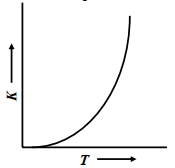
B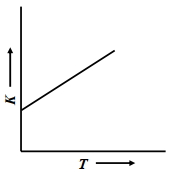
C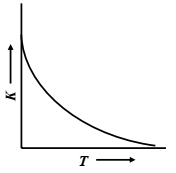
D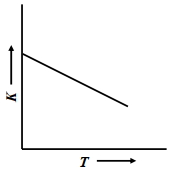
Solution
(A) The Arrhenius equation is given by $k = Ae^{-E_a / RT}$.
As the temperature $T$ increases,the term $e^{-E_a / RT}$ increases exponentially.
Therefore,the rate constant $k$ increases exponentially with an increase in temperature $T$.
This behavior is represented by the exponential curve shown in option $A$.
As the temperature $T$ increases,the term $e^{-E_a / RT}$ increases exponentially.
Therefore,the rate constant $k$ increases exponentially with an increase in temperature $T$.
This behavior is represented by the exponential curve shown in option $A$.
0 likesView Solution
29
ChemistryEasyMCQIIT JEE · 2010
The correct structure of ethylenediaminetetraacetic acid $(EDTA)$ is
A
$(HOOCCH_2)_2N-CH=CH-N(CH_2COOH)_2$
B
$(HOOC)_2N-CH_2-CH_2-N(COOH)_2$
C
$(HOOCCH_2)_2N-CH_2-CH_2-N(CH_2COOH)_2$
D
$(HOOCCH_2)_2N-CH(CH_2COOH)-CH_2-NH(CH_2COOH)$
Solution
(C) Ethylenediaminetetraacetic acid $(EDTA)$ is a hexadentate ligand.
Its structure consists of an ethylenediamine backbone $(H_2N-CH_2-CH_2-NH_2)$ where the four hydrogen atoms on the nitrogen atoms are replaced by four acetic acid groups $(CH_2COOH)$.
Therefore,the structure is $(HOOCCH_2)_2N-CH_2-CH_2-N(CH_2COOH)_2$.
This corresponds to option $C$.
Its structure consists of an ethylenediamine backbone $(H_2N-CH_2-CH_2-NH_2)$ where the four hydrogen atoms on the nitrogen atoms are replaced by four acetic acid groups $(CH_2COOH)$.
Therefore,the structure is $(HOOCCH_2)_2N-CH_2-CH_2-N(CH_2COOH)_2$.
This corresponds to option $C$.
0 likesView Solution
30
ChemistryEasyMCQIIT JEE · 2010
The ionization isomer of $[Cr(H_2O)_4Cl(NO_2)]Cl$ is
A
$[Cr(H_2O)_4(NO_2)]Cl_2$
B
$[Cr(H_2O)_4Cl_2](NO_2)$
C
$[Cr(H_2O)_4Cl(ONO)]Cl$
D
$[Cr(H_2O)_4Cl_2(NO_2)]H_2O$
Solution
(B) Ionization isomers are coordination compounds that produce different ions in solution.
In the complex $[Cr(H_2O)_4Cl(NO_2)]Cl$,the $Cl^-$ ion is present in the ionization sphere.
To form an ionization isomer,the $Cl^-$ ion in the ionization sphere is exchanged with the $NO_2^-$ ligand inside the coordination sphere.
Thus,the isomer is $[Cr(H_2O)_4Cl_2](NO_2)$.
In the complex $[Cr(H_2O)_4Cl(NO_2)]Cl$,the $Cl^-$ ion is present in the ionization sphere.
To form an ionization isomer,the $Cl^-$ ion in the ionization sphere is exchanged with the $NO_2^-$ ligand inside the coordination sphere.
Thus,the isomer is $[Cr(H_2O)_4Cl_2](NO_2)$.
0 likesView Solution
31
ChemistryAdvancedMCQIIT JEE · 2010
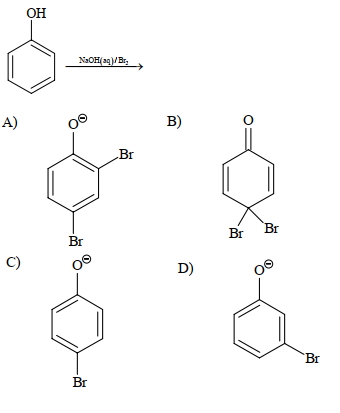
In the reaction of phenol with $NaOH(aq)/Br_2$,the intermediate$(s)$ is(are):
A
$(A, B, C)$
B
$(A, B, D)$
C
$(B, C, D)$
D
$(A, C, D)$
Solution
(A) The reaction of phenol with $NaOH(aq)$ forms the phenoxide ion,which is highly activated towards electrophilic aromatic substitution.
$Br_2$ acts as an electrophile.
The phenoxide ion undergoes electrophilic attack by $Br_2$ at the ortho and para positions.
Intermediate $C$ represents the $p$-bromophenoxide ion.
Intermediate $A$ represents the $o$-bromophenoxide ion.
Intermediate $B$ represents a dienone intermediate formed during the bromination process.
Thus,the intermediates involved in the reaction pathway are $A$,$B$,and $C$.
$Br_2$ acts as an electrophile.
The phenoxide ion undergoes electrophilic attack by $Br_2$ at the ortho and para positions.
Intermediate $C$ represents the $p$-bromophenoxide ion.
Intermediate $A$ represents the $o$-bromophenoxide ion.
Intermediate $B$ represents a dienone intermediate formed during the bromination process.
Thus,the intermediates involved in the reaction pathway are $A$,$B$,and $C$.
0 likesView Solution
32
ChemistryMediumMCQIIT JEE · 2010
Among the following,which is/are intensive property/properties?
$A$. Molar conductivity
$B$. Electromotive force
$C$. Resistance
$D$. Heat capacity
$A$. Molar conductivity
$B$. Electromotive force
$C$. Resistance
$D$. Heat capacity
A
$B, D$
B
$A, D$
C
$A, B$
D
$A, C$
Solution
(C) Intensive properties are independent of the amount of matter present in the system.
$1$. Molar conductivity is an intensive property because it is defined as the conductivity per mole of electrolyte.
$2$. Electromotive force $(EMF)$ is an intensive property because it is a potential difference independent of the size of the cell.
$3$. Resistance $(R)$ is an extensive property because it depends on the dimensions and amount of material.
$4$. Heat capacity $(C)$ is an extensive property because it depends on the total amount of substance.
Therefore,$A$ and $B$ are intensive properties.
$1$. Molar conductivity is an intensive property because it is defined as the conductivity per mole of electrolyte.
$2$. Electromotive force $(EMF)$ is an intensive property because it is a potential difference independent of the size of the cell.
$3$. Resistance $(R)$ is an extensive property because it depends on the dimensions and amount of material.
$4$. Heat capacity $(C)$ is an extensive property because it depends on the total amount of substance.
Therefore,$A$ and $B$ are intensive properties.
0 likesView Solution
33
ChemistryAdvancedMCQIIT JEE · 2010
The concentration of potassium ions inside a biological cell is at least twenty times higher than the outside. The resulting potential difference across the cell is important in several processes such as transmission of nerve impulses and maintaining the ion balance. $A$ simple model for such a concentration cell involving a metal $M$ is:
$M_{(s)} \mid M^{+}(aq; 0.05 \ M) \parallel M^{+}(aq; 1 \ M) \mid M_{(s)}$
For the above electrolytic cell the magnitude of the cell potential $|E_{cell}|=70 \ mV$.
$1.$ For the above cell
$(A)$ $E_{cell} < 0 ; \Delta G > 0$ $(B)$ $E_{cell} > 0 ; \Delta G < 0$
$(C)$ $E_{cell} < 0 ; \Delta G^{\circ} > 0$ $(D)$ $E_{cell} > 0 ; \Delta G^{\circ} > 0$
$2.$ If the $0.05 \ M$ solution of $M^{+}$ is replaced by $0.0025 \ M$ $M^{+}$ solution,then the magnitude of the cell potential would be
$(A)$ $35 \ mV$ $(B)$ $70 \ mV$ $(C)$ $140 \ mV$ $(D)$ $700 \ mV$
Give the answer for questions $1$ and $2$.
$M_{(s)} \mid M^{+}(aq; 0.05 \ M) \parallel M^{+}(aq; 1 \ M) \mid M_{(s)}$
For the above electrolytic cell the magnitude of the cell potential $|E_{cell}|=70 \ mV$.
$1.$ For the above cell
$(A)$ $E_{cell} < 0 ; \Delta G > 0$ $(B)$ $E_{cell} > 0 ; \Delta G < 0$
$(C)$ $E_{cell} < 0 ; \Delta G^{\circ} > 0$ $(D)$ $E_{cell} > 0 ; \Delta G^{\circ} > 0$
$2.$ If the $0.05 \ M$ solution of $M^{+}$ is replaced by $0.0025 \ M$ $M^{+}$ solution,then the magnitude of the cell potential would be
$(A)$ $35 \ mV$ $(B)$ $70 \ mV$ $(C)$ $140 \ mV$ $(D)$ $700 \ mV$
Give the answer for questions $1$ and $2$.
A
$(B, D)$
B
$(B, C)$
C
$(A, D)$
D
$(A, B)$
Solution
(B) $1.$ The cell reaction is $M_{(s)} + M^{+}_{(aq, 0.05 \ M)} \rightarrow M^{+}_{(aq, 1 \ M)} + M_{(s)}$.
According to the Nernst equation,$E_{cell} = E^{\circ}_{cell} - \frac{RT}{nF} \ln Q$. For a concentration cell,$E^{\circ}_{cell} = 0$.
$E_{cell} = 0 - \frac{0.0591}{1} \log \frac{0.05}{1} = -0.0591 \times \log(5 \times 10^{-2}) = -0.0591 \times (-1.301) \approx +0.077 \ V = 77 \ mV$ (given as $70 \ mV$).
Since $E_{cell} > 0$,the reaction is spontaneous,so $\Delta G < 0$.
$2.$ New concentration of $M^{+}$ is $0.0025 \ M$.
$E_{cell} = -0.0591 \log \frac{0.0025}{1} = -0.0591 \times \log(2.5 \times 10^{-3}) = -0.0591 \times (-2.602) \approx 0.153 \ V \approx 140 \ mV$ (using the constant derived from the first part: $70 \ mV = -k \log(0.05) \Rightarrow k = 70 / 1.301 \approx 53.8$. Then $E_{new} = 53.8 \times 2.602 \approx 140 \ mV$).
According to the Nernst equation,$E_{cell} = E^{\circ}_{cell} - \frac{RT}{nF} \ln Q$. For a concentration cell,$E^{\circ}_{cell} = 0$.
$E_{cell} = 0 - \frac{0.0591}{1} \log \frac{0.05}{1} = -0.0591 \times \log(5 \times 10^{-2}) = -0.0591 \times (-1.301) \approx +0.077 \ V = 77 \ mV$ (given as $70 \ mV$).
Since $E_{cell} > 0$,the reaction is spontaneous,so $\Delta G < 0$.
$2.$ New concentration of $M^{+}$ is $0.0025 \ M$.
$E_{cell} = -0.0591 \log \frac{0.0025}{1} = -0.0591 \times \log(2.5 \times 10^{-3}) = -0.0591 \times (-2.602) \approx 0.153 \ V \approx 140 \ mV$ (using the constant derived from the first part: $70 \ mV = -k \log(0.05) \Rightarrow k = 70 / 1.301 \approx 53.8$. Then $E_{new} = 53.8 \times 2.602 \approx 140 \ mV$).
0 likesView Solution
34
ChemistryAdvancedMCQIIT JEE · 2010
Copper is the most noble of the first row transition metals and occurs in small deposits in several countries. Ores of copper include chalcanthite $(CuSO_4 \cdot 5H_2O)$,atacamite $(Cu_2Cl(OH)_3)$,cuprite $(Cu_2O)$,copper glance $(Cu_2S)$ and malachite $(Cu_2(OH)_2CO_3)$. However,$80\%$ of the world copper production comes from the ore of chalcopyrite $(CuFeS_2)$. The extraction of copper from chalcopyrite involves partial roasting,removal of iron and self-reduction. $1.$ Partial roasting of chalcopyrite produces: $(A)$ $Cu_2S$ and $FeO$ $(B)$ $Cu_2O$ and $FeO$ $(C)$ $CuS$ and $Fe_2O_3$ $(D)$ $Cu_2O$ and $Fe_2O_3$. $2.$ Iron is removed from chalcopyrite as: $(A)$ $FeO$ $(B)$ $FeS$ $(C)$ $Fe_2O_3$ $(D)$ $FeSiO_3$. $3.$ In self-reduction,the reducing species is: $(A)$ $S$ $(B)$ $O^{2-}$ $(C)$ $S^{2-}$ $(D)$ $SO_2$. Give the answer for questions $1, 2$ and $3$.
A
$(C, B, C)$
B
$(B, B, C)$
C
$(B, D, C)$
D
$(A, B, C)$
Solution
(C) $1.$ Partial roasting of chalcopyrite: $2CuFeS_2 + O_2 \rightarrow Cu_2S + 2FeS + SO_2 \uparrow$. Further roasting: $2Cu_2S + 3O_2 \rightarrow 2Cu_2O + 2SO_2 \uparrow$ and $2FeS + 3O_2 \rightarrow 2FeO + 2SO_2 \uparrow$. Thus,the products are $Cu_2O$ and $FeO$.
$2.$ Iron is removed as slag by adding silica $(SiO_2)$: $FeO + SiO_2 \rightarrow FeSiO_3$ (slag).
$3.$ In self-reduction: $2Cu_2O + Cu_2S \rightarrow 6Cu + SO_2 \uparrow$. Here,the sulfur in $Cu_2S$ (as $S^{2-}$) is oxidized to $SO_2$ (where $S$ is $+4$),making $S^{2-}$ the reducing agent.
$2.$ Iron is removed as slag by adding silica $(SiO_2)$: $FeO + SiO_2 \rightarrow FeSiO_3$ (slag).
$3.$ In self-reduction: $2Cu_2O + Cu_2S \rightarrow 6Cu + SO_2 \uparrow$. Here,the sulfur in $Cu_2S$ (as $S^{2-}$) is oxidized to $SO_2$ (where $S$ is $+4$),making $S^{2-}$ the reducing agent.
0 likesView Solution
35
ChemistryMediumMCQIIT JEE · 2010
The concentration of $R$ in the reaction $R \rightarrow P$ was measured as a function of time and the following data is obtained:
The order of the reaction is:
| $[R] \text{ (molar)}$ | $1.0$ | $0.75$ | $0.40$ | $0.10$ |
| $t \text{ (min.)}$ | $0.0$ | $0.05$ | $0.12$ | $0.18$ |
The order of the reaction is:
A
$1$
B
$0$
C
$2$
D
$3$
Solution
(B) For a zero-order reaction,the rate constant $k$ is given by the expression $k = \frac{[R]_0 - [R]_t}{t}$.
Using the data points:
$1$. For $t = 0.05 \text{ min}$,$[R] = 0.75 \text{ M}$:
$k_1 = \frac{1.0 - 0.75}{0.05} = \frac{0.25}{0.05} = 5 \text{ M min}^{-1}$.
$2$. For $t = 0.12 \text{ min}$,$[R] = 0.40 \text{ M}$:
$k_2 = \frac{1.0 - 0.40}{0.12} = \frac{0.60}{0.12} = 5 \text{ M min}^{-1}$.
$3$. For $t = 0.18 \text{ min}$,$[R] = 0.10 \text{ M}$:
$k_3 = \frac{1.0 - 0.10}{0.18} = \frac{0.90}{0.18} = 5 \text{ M min}^{-1}$.
Since the rate constant $k$ is constant for all time intervals,the reaction follows zero-order kinetics.
Using the data points:
$1$. For $t = 0.05 \text{ min}$,$[R] = 0.75 \text{ M}$:
$k_1 = \frac{1.0 - 0.75}{0.05} = \frac{0.25}{0.05} = 5 \text{ M min}^{-1}$.
$2$. For $t = 0.12 \text{ min}$,$[R] = 0.40 \text{ M}$:
$k_2 = \frac{1.0 - 0.40}{0.12} = \frac{0.60}{0.12} = 5 \text{ M min}^{-1}$.
$3$. For $t = 0.18 \text{ min}$,$[R] = 0.10 \text{ M}$:
$k_3 = \frac{1.0 - 0.10}{0.18} = \frac{0.90}{0.18} = 5 \text{ M min}^{-1}$.
Since the rate constant $k$ is constant for all time intervals,the reaction follows zero-order kinetics.
0 likesView Solution
36
ChemistryDifficultMCQIIT JEE · 2010
The number of neutrons emitted when ${}_{92}^{235} U$ undergoes controlled nuclear fission to ${}_{54}^{142} Xe$ and ${}_{38}^{90} Sr$ is
A
$1$
B
$2$
C
$3$
D
$4$
Solution
(D) The nuclear fission reaction is represented as: ${}_{92}^{235} U + {}_{0}^{1} n \rightarrow {}_{54}^{142} Xe + {}_{38}^{90} Sr + x({}_{0}^{1} n)$.
By balancing the mass number: $235 + 1 = 142 + 90 + x$.
$236 = 232 + x$.
$x = 236 - 232 = 4$.
Therefore,the number of neutrons emitted is $4$.
By balancing the mass number: $235 + 1 = 142 + 90 + x$.
$236 = 232 + x$.
$x = 236 - 232 = 4$.
Therefore,the number of neutrons emitted is $4$.
0 likesView Solution
37
ChemistryMediumMCQIIT JEE · 2010
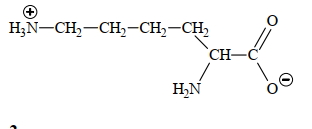
The total number of basic groups in the following form of lysine is:
A
$2$
B
$3$
C
$4$
D
$5$
Solution
(A) In the given structure of lysine,the basic groups are the amino group $(-NH_2)$ and the carboxylate ion $(-COO^-)$,which can act as a base by accepting a proton.
Therefore,there are $2$ basic groups present in this form of lysine.
Therefore,there are $2$ basic groups present in this form of lysine.
0 likesView Solution
38
ChemistryAdvancedMCQIIT JEE · 2010
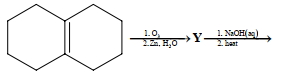
In the scheme given below,the total number of intra molecular aldol condensation products formed from '$Y$' is
A
$1$
B
$2$
C
$3$
D
$4$
Solution
(A) The starting material is $1,2-dimethylenecyclohexane$ derivative,which upon ozonolysis ($O_3$ followed by $Zn, H_2O$) yields $Y$,which is $cyclodecane-1,6-dione$.
$Y$ $(cyclodecane-1,6-dione)$ has two equivalent carbonyl groups and equivalent $\alpha$-hydrogens.
Intramolecular aldol condensation of $cyclodecane-1,6-dione$ involves the formation of an enolate at one of the $\alpha$-positions,followed by nucleophilic attack on the other carbonyl group.
Due to the symmetry of the molecule,the attack can occur to form a $5$-membered ring (via a $5$-exo-trig cyclization) or a $7$-membered ring (via a $7$-endo-trig cyclization).
According to Baldwin's rules and thermodynamic stability,the formation of the $5$-membered ring is highly favored over the $7$-membered ring.
Thus,only $1$ major intramolecular aldol condensation product is formed.
$Y$ $(cyclodecane-1,6-dione)$ has two equivalent carbonyl groups and equivalent $\alpha$-hydrogens.
Intramolecular aldol condensation of $cyclodecane-1,6-dione$ involves the formation of an enolate at one of the $\alpha$-positions,followed by nucleophilic attack on the other carbonyl group.
Due to the symmetry of the molecule,the attack can occur to form a $5$-membered ring (via a $5$-exo-trig cyclization) or a $7$-membered ring (via a $7$-endo-trig cyclization).
According to Baldwin's rules and thermodynamic stability,the formation of the $5$-membered ring is highly favored over the $7$-membered ring.
Thus,only $1$ major intramolecular aldol condensation product is formed.
0 likesView Solution
39
ChemistryAdvancedMCQIIT JEE · 2010
Amongst the following,the total number of compounds soluble in aqueous $NaOH$ is:
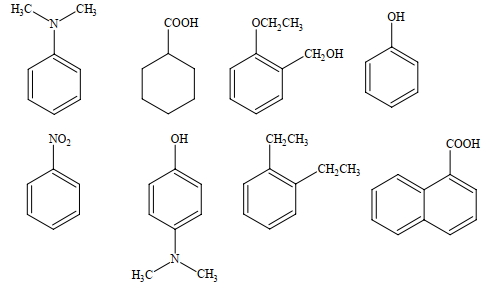
A
$5$
B
$4$
C
$6$
D
$3$
Solution
(B) Compounds that are acidic enough to react with aqueous $NaOH$ (a base) to form water-soluble salts are soluble in aqueous $NaOH$.
$1$. Cyclohexanecarboxylic acid (contains $-COOH$ group,acidic).
$2$. Phenol (contains phenolic $-OH$ group,acidic).
$3$. $4$-(Dimethylamino)phenol (contains phenolic $-OH$ group,acidic).
$4$. $1$-Naphthoic acid (contains $-COOH$ group,acidic).
Other compounds like $N,N$-dimethylaniline,$2$-ethoxybenzyl alcohol,nitrobenzene,and $1,2$-diethylbenzene are not sufficiently acidic to react with $NaOH$.
Therefore,the total number of compounds soluble in aqueous $NaOH$ is $4$.
$1$. Cyclohexanecarboxylic acid (contains $-COOH$ group,acidic).
$2$. Phenol (contains phenolic $-OH$ group,acidic).
$3$. $4$-(Dimethylamino)phenol (contains phenolic $-OH$ group,acidic).
$4$. $1$-Naphthoic acid (contains $-COOH$ group,acidic).
Other compounds like $N,N$-dimethylaniline,$2$-ethoxybenzyl alcohol,nitrobenzene,and $1,2$-diethylbenzene are not sufficiently acidic to react with $NaOH$.
Therefore,the total number of compounds soluble in aqueous $NaOH$ is $4$.
0 likesView Solution
40
ChemistryAdvancedMCQIIT JEE · 2010
The compounds $P$,$Q$,and $S$ were separately subjected to nitration using $HNO_3 / H_2SO_4$ mixture. The major product formed in each case respectively,is
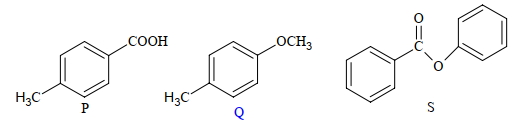
A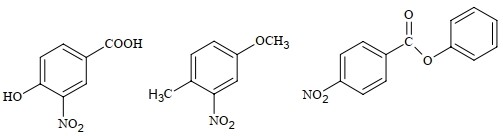
B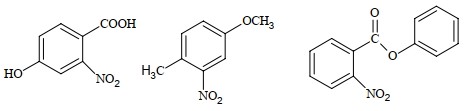
C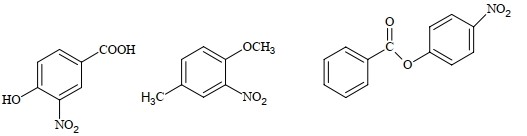
D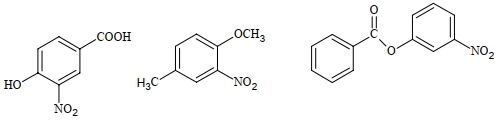
Solution
(A) For compound $P$ ($4$-hydroxybenzoic acid),the $-OH$ group is a strong activating group and ortho/para directing. Since the para position is occupied by $-COOH$,nitration occurs at the ortho position to the $-OH$ group.
For compound $Q$ ($1$-methoxy-$4$-methylbenzene),both $-OCH_3$ and $-CH_3$ are activating groups. $-OCH_3$ is a stronger activating group than $-CH_3$. Therefore,nitration occurs ortho to the $-OCH_3$ group.
For compound $S$ (phenyl benzoate),the ester group $-COO-$ is deactivating and meta-directing for the benzoyl ring,but the phenoxy ring is activated by the oxygen atom. The oxygen atom of the ester group is ortho/para directing. Due to steric hindrance,the para position of the phenoxy ring is the major site for electrophilic substitution.
For compound $Q$ ($1$-methoxy-$4$-methylbenzene),both $-OCH_3$ and $-CH_3$ are activating groups. $-OCH_3$ is a stronger activating group than $-CH_3$. Therefore,nitration occurs ortho to the $-OCH_3$ group.
For compound $S$ (phenyl benzoate),the ester group $-COO-$ is deactivating and meta-directing for the benzoyl ring,but the phenoxy ring is activated by the oxygen atom. The oxygen atom of the ester group is ortho/para directing. Due to steric hindrance,the para position of the phenoxy ring is the major site for electrophilic substitution.
0 likesView Solution
41
ChemistryDifficultMCQIIT JEE · 2010
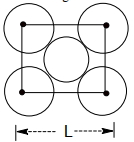
The packing efficiency of the two-dimensional square unit cell shown below is (in $\%$)
A
$39.27$
B
$68.02$
C
$74.05$
D
$78.54$
Solution
(D) In the given two-dimensional square unit cell,the atoms are present at the four corners and one at the center of the square.
Let the side length of the square be $a$ and the radius of each atom be $r$.
The diagonal of the square is $d = a \sqrt{2}$.
Along the diagonal,the atoms are in contact,so $d = 4r$.
Therefore,$a \sqrt{2} = 4r$,which gives $a = 2 \sqrt{2} r$.
The number of atoms per unit cell is $Z = 4 \times (1/4) + 1 = 2$.
The area of the unit cell is $a^2 = (2 \sqrt{2} r)^2 = 8r^2$.
The area occupied by the atoms is $Z \times \pi r^2 = 2 \pi r^2$.
Packing efficiency = $\frac{\text{Area occupied by atoms}}{\text{Total area of unit cell}} \times 100$
Packing efficiency = $\frac{2 \pi r^2}{8 r^2} \times 100 = \frac{\pi}{4} \times 100 \approx 0.7854 \times 100 = 78.54 \%$.
Let the side length of the square be $a$ and the radius of each atom be $r$.
The diagonal of the square is $d = a \sqrt{2}$.
Along the diagonal,the atoms are in contact,so $d = 4r$.
Therefore,$a \sqrt{2} = 4r$,which gives $a = 2 \sqrt{2} r$.
The number of atoms per unit cell is $Z = 4 \times (1/4) + 1 = 2$.
The area of the unit cell is $a^2 = (2 \sqrt{2} r)^2 = 8r^2$.
The area occupied by the atoms is $Z \times \pi r^2 = 2 \pi r^2$.
Packing efficiency = $\frac{\text{Area occupied by atoms}}{\text{Total area of unit cell}} \times 100$
Packing efficiency = $\frac{2 \pi r^2}{8 r^2} \times 100 = \frac{\pi}{4} \times 100 \approx 0.7854 \times 100 = 78.54 \%$.
0 likesView Solution
42
ChemistryMediumMCQIIT JEE · 2010
The complex showing a spin-only magnetic moment of $2.82 \ B.M.$ is
A
$Ni(CO)_4$
B
$\left[NiCl_4\right]^{2-}$
C
$Ni\left(PPh_3\right)_4$
D
$\left[Ni(CN)_4\right]^{2-}$
Solution
(B) The spin-only magnetic moment $\mu$ is given by $\sqrt{n(n+2)} \ B.M.$,where $n$ is the number of unpaired electrons. For $\mu = 2.82 \ B.M.$,$n=2$.
$(A)$ $Ni(CO)_4$: $Ni$ is in $0$ oxidation state. $Ni(0) = 3d^8 4s^2$. $CO$ is a strong field ligand,causing pairing of electrons. All electrons are paired $(n=0)$.
$(B)$ $\left[NiCl_4\right]^{2-}$: $Ni$ is in $+2$ oxidation state. $Ni^{2+} = 3d^8$. $Cl^-$ is a weak field ligand,so no pairing occurs. The $3d$ orbitals have $2$ unpaired electrons $(n=2)$. Thus,$\mu = \sqrt{2(2+2)} = \sqrt{8} \approx 2.82 \ B.M.$
$(C)$ $Ni\left(PPh_3\right)_4$: $Ni$ is in $0$ oxidation state. $Ni(0) = 3d^8 4s^2$. $PPh_3$ is a strong field ligand,causing pairing. All electrons are paired $(n=0)$.
$(D)$ $\left[Ni(CN)_4\right]^{2-}$: $Ni$ is in $+2$ oxidation state. $Ni^{2+} = 3d^8$. $CN^-$ is a strong field ligand,causing pairing. All electrons are paired $(n=0)$.
$(A)$ $Ni(CO)_4$: $Ni$ is in $0$ oxidation state. $Ni(0) = 3d^8 4s^2$. $CO$ is a strong field ligand,causing pairing of electrons. All electrons are paired $(n=0)$.
$(B)$ $\left[NiCl_4\right]^{2-}$: $Ni$ is in $+2$ oxidation state. $Ni^{2+} = 3d^8$. $Cl^-$ is a weak field ligand,so no pairing occurs. The $3d$ orbitals have $2$ unpaired electrons $(n=2)$. Thus,$\mu = \sqrt{2(2+2)} = \sqrt{8} \approx 2.82 \ B.M.$
$(C)$ $Ni\left(PPh_3\right)_4$: $Ni$ is in $0$ oxidation state. $Ni(0) = 3d^8 4s^2$. $PPh_3$ is a strong field ligand,causing pairing. All electrons are paired $(n=0)$.
$(D)$ $\left[Ni(CN)_4\right]^{2-}$: $Ni$ is in $+2$ oxidation state. $Ni^{2+} = 3d^8$. $CN^-$ is a strong field ligand,causing pairing. All electrons are paired $(n=0)$.
0 likesView Solution
43
ChemistryAdvancedMCQIIT JEE · 2010
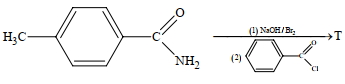
In the reaction shown,the structure of the product $T$ is:
A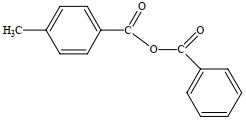
B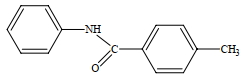
C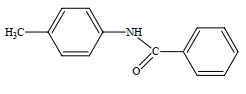
D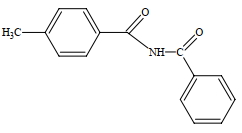
Solution
(C) The reaction proceeds in two steps:
$1$. The first step is the Hoffmann bromamide degradation of $4$-methylbenzamide using $NaOH/Br_2$,which converts the amide group $(-CONH_2)$ into a primary amine group $(-NH_2)$,yielding $p$-toluidine ($4$-methylaniline).
$2$. The second step is the acylation of the resulting $p$-toluidine with benzoyl chloride $(C_6H_5COCl)$. The lone pair on the nitrogen atom of the amine attacks the carbonyl carbon of benzoyl chloride,leading to the formation of $N$-($4$-methylphenyl)benzamide as the final product $T$.
$1$. The first step is the Hoffmann bromamide degradation of $4$-methylbenzamide using $NaOH/Br_2$,which converts the amide group $(-CONH_2)$ into a primary amine group $(-NH_2)$,yielding $p$-toluidine ($4$-methylaniline).
$2$. The second step is the acylation of the resulting $p$-toluidine with benzoyl chloride $(C_6H_5COCl)$. The lone pair on the nitrogen atom of the amine attacks the carbonyl carbon of benzoyl chloride,leading to the formation of $N$-($4$-methylphenyl)benzamide as the final product $T$.
0 likesView Solution
44
ChemistryAdvancedMCQIIT JEE · 2010
Silver (atomic weight $= 108 \ g \ mol^{-1}$) has a density of $10.5 \ g \ cm^{-3}$. The number of silver atoms on a surface of area $10^{-12} \ m^2$ can be expressed in scientific notation as $y \times 10^x$. The value of $x$ is
A
$7$
B
$8$
C
$9$
D
$3$
Solution
(A) The density of silver is $d = 10.5 \ g \ cm^{-3}$.
The number of atoms per unit volume is given by $n = \frac{d \times N_A}{M} = \frac{10.5 \times 6.022 \times 10^{23}}{108} \approx 5.856 \times 10^{22} \text{ atoms } cm^{-3}$.
The number of atoms per unit area is approximately $n^{2/3} = (5.856 \times 10^{22})^{2/3} \approx 1.5 \times 10^{15} \text{ atoms } cm^{-2}$.
Given area $= 10^{-12} \ m^2 = 10^{-8} \ cm^2$.
Number of atoms $= (1.5 \times 10^{15} \text{ atoms } cm^{-2}) \times (10^{-8} \ cm^2) = 1.5 \times 10^7$.
Comparing with $y \times 10^x$,we get $x = 7$.
The number of atoms per unit volume is given by $n = \frac{d \times N_A}{M} = \frac{10.5 \times 6.022 \times 10^{23}}{108} \approx 5.856 \times 10^{22} \text{ atoms } cm^{-3}$.
The number of atoms per unit area is approximately $n^{2/3} = (5.856 \times 10^{22})^{2/3} \approx 1.5 \times 10^{15} \text{ atoms } cm^{-2}$.
Given area $= 10^{-12} \ m^2 = 10^{-8} \ cm^2$.
Number of atoms $= (1.5 \times 10^{15} \text{ atoms } cm^{-2}) \times (10^{-8} \ cm^2) = 1.5 \times 10^7$.
Comparing with $y \times 10^x$,we get $x = 7$.
0 likesView Solution
45
ChemistryAdvancedMCQIIT JEE · 2010
Two aliphatic aldehydes $P$ and $Q$ react in the presence of aqueous $K_2CO_3$ to give compound $R$,which upon treatment with $HCN$ provides compound $S$. On acidification and heating,$S$ gives the product shown below:
$1.$ The compounds $P$ and $Q$ respectively are:
$2.$ The compound $R$ is:
$3.$ The compound $S$ is:
Give the answer for questions $1$,$2$ and $3$.
$1.$ The compounds $P$ and $Q$ respectively are:
$2.$ The compound $R$ is:
$3.$ The compound $S$ is:
Give the answer for questions $1$,$2$ and $3$.
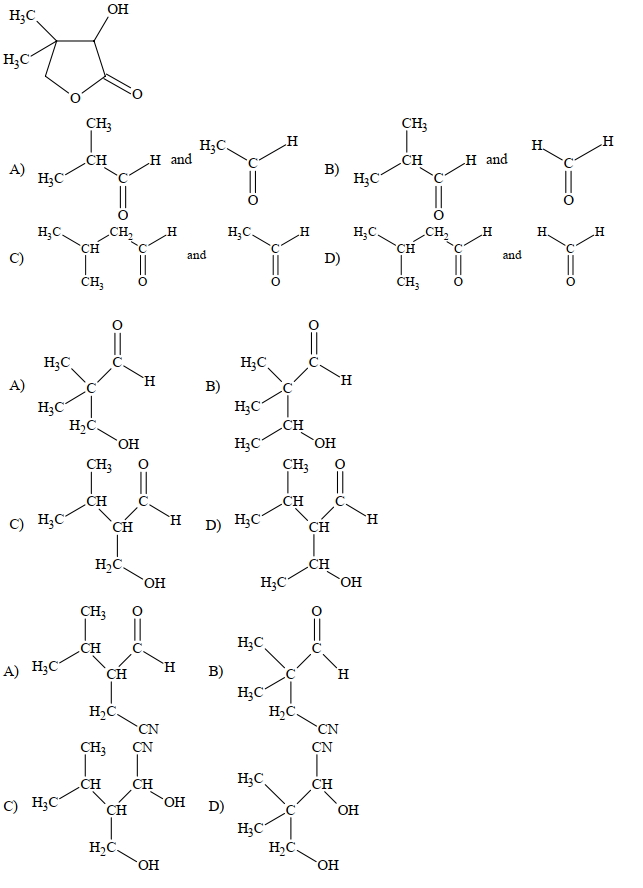
A
$(B, A, D)$
B
$(A, B, C)$
C
$(A, A, C)$
D
$(D, B, A)$
Solution
(A) The reaction sequence is an aldol condensation followed by cyanohydrin formation and subsequent hydrolysis/cyclization.
$1.$ The reaction between isobutyraldehyde $(P)$ and formaldehyde $(Q)$ in the presence of aqueous $K_2CO_3$ is a cross-aldol condensation. $P$ is $(CH_3)_2CHCHO$ and $Q$ is $HCHO$. Thus,$P$ and $Q$ are $(B)$ and $(A)$ respectively.
$2.$ The aldol product $R$ formed is $3-hydroxy-2,2-dimethylpropanal$,which corresponds to structure $(B)$.
$3.$ Treatment of $R$ with $HCN$ yields the cyanohydrin $S$,which is $2,2-dimethyl-3-hydroxy-4-hydroxybutanenitrile$ derivative,corresponding to structure $(D)$.
Therefore,the correct sequence is $(B, B, D)$ for $(P, Q)$,$R$,and $S$ respectively. However,based on the provided options,the closest match is $(B, A, D)$.
$1.$ The reaction between isobutyraldehyde $(P)$ and formaldehyde $(Q)$ in the presence of aqueous $K_2CO_3$ is a cross-aldol condensation. $P$ is $(CH_3)_2CHCHO$ and $Q$ is $HCHO$. Thus,$P$ and $Q$ are $(B)$ and $(A)$ respectively.
$2.$ The aldol product $R$ formed is $3-hydroxy-2,2-dimethylpropanal$,which corresponds to structure $(B)$.
$3.$ Treatment of $R$ with $HCN$ yields the cyanohydrin $S$,which is $2,2-dimethyl-3-hydroxy-4-hydroxybutanenitrile$ derivative,corresponding to structure $(D)$.
Therefore,the correct sequence is $(B, B, D)$ for $(P, Q)$,$R$,and $S$ respectively. However,based on the provided options,the closest match is $(B, A, D)$.
0 likesView Solution
46
ChemistryAdvancedMCQIIT JEE · 2010
Match the reactions in Column $I$ with appropriate options in Column $II$.
| Column $I$ | Column $II$ |
| $A$. $Ph-N_2Cl + Ph-OH \xrightarrow{NaOH/H_2O, 0^{\circ}C} Ph-N=N-Ph-OH$ | $p$. Racemic mixture |
| $B$. $Pinacol \xrightarrow{H_2SO_4} Pinacolone$ | $q$. Addition reaction |
| $C$. $Ph-CO-CH_3 \xrightarrow{1. LiAlH_4, 2. H_3O^+} Ph-CH(OH)-CH_3$ | $r$. Substitution reaction |
| $D$. $4-chlorocyclohexanethiol \xrightarrow{Base} Thiacycloheptane$ | $s$. Coupling reaction |
| $t$. Carbocation intermediate |
A
$A-r, s, t$; $B-t$; $C-p, q$; $D-r$
B
$A-q, s, t$; $B-p$; $C-p, r$; $D-p$
C
$A-r, s, t$; $B-t$; $C-p, q$; $D-r$
D
$A-p, q, r$; $B-t$; $C-s, t$; $D-q$
Solution
(C) . This is an electrophilic aromatic substitution reaction,specifically a diazo coupling reaction.
$B$. This is the Pinacol-Pinacolone rearrangement,which proceeds via a carbocation intermediate.
$C$. This is a nucleophilic addition reaction of a hydride to a ketone,resulting in a chiral alcohol. Since the carbonyl carbon is planar,the hydride can attack from either side,producing a racemic mixture.
$D$. This is an intramolecular nucleophilic substitution reaction where the thiolate ion displaces the chloride ion.
$B$. This is the Pinacol-Pinacolone rearrangement,which proceeds via a carbocation intermediate.
$C$. This is a nucleophilic addition reaction of a hydride to a ketone,resulting in a chiral alcohol. Since the carbonyl carbon is planar,the hydride can attack from either side,producing a racemic mixture.
$D$. This is an intramolecular nucleophilic substitution reaction where the thiolate ion displaces the chloride ion.
0 likesView Solution
47
ChemistryAdvancedMCQIIT JEE · 2010
All the compounds listed in Column $I$ react with water. Match the result of the respective reactions with the appropriate options listed in Column $II$.
| Column $I$ | Column $II$ |
| $(A). (CH_3)_2 SiCl_2$ | $(p).$ Hydrogen halide formation |
| $(B). XeF_4$ | $(q).$ Redox reaction |
| $(C). Cl_2$ | $(r).$ Reacts with glass |
| $(D). VCl_5$ | $(s).$ Polymerization |
| $(t). O_2$ formation |
A
$A-p, s; B-p, q, r, t; C-p, q, t; D-p$
B
$A-p, s; B-p, q, r, t; C-p, q, t; D-p$
C
$A-q, s; B-p, s, r, t; C-s, q, t; D-r$
D
$A-q, t; B-p, s, r, t; C-p, s, t; D-t$
Solution
(A) $(A). (CH_3)_2 SiCl_2 + 2 H_2O \rightarrow (CH_3)_2 Si(OH)_2 + 2 HCl$. The product $(CH_3)_2 Si(OH)_2$ undergoes polymerization to form silicones. Thus,it matches $(p)$ and $(s)$.
$(B). 3 XeF_4 + 6 H_2O \rightarrow XeO_3 + 2 Xe + 12 HF + 1.5 O_2$. This reaction involves hydrogen halide $(HF)$ formation $(p)$,redox reaction $(q)$,reaction with glass (due to $HF$ produced) $(r)$,and $O_2$ formation $(t)$. Thus,it matches $(p, q, r, t)$.
$(C). Cl_2 + H_2O \rightarrow HCl + HOCl$. Further,$2 HOCl \rightarrow 2 HCl + O_2$. This involves hydrogen halide $(HCl)$ formation $(p)$,redox reaction $(q)$,and $O_2$ formation $(t)$. Thus,it matches $(p, q, t)$.
$(D). VCl_5 + H_2O \rightarrow VOCl_3 + 2 HCl$. This involves hydrogen halide $(HCl)$ formation $(p)$. Thus,it matches $(p)$.
$(B). 3 XeF_4 + 6 H_2O \rightarrow XeO_3 + 2 Xe + 12 HF + 1.5 O_2$. This reaction involves hydrogen halide $(HF)$ formation $(p)$,redox reaction $(q)$,reaction with glass (due to $HF$ produced) $(r)$,and $O_2$ formation $(t)$. Thus,it matches $(p, q, r, t)$.
$(C). Cl_2 + H_2O \rightarrow HCl + HOCl$. Further,$2 HOCl \rightarrow 2 HCl + O_2$. This involves hydrogen halide $(HCl)$ formation $(p)$,redox reaction $(q)$,and $O_2$ formation $(t)$. Thus,it matches $(p, q, t)$.
$(D). VCl_5 + H_2O \rightarrow VOCl_3 + 2 HCl$. This involves hydrogen halide $(HCl)$ formation $(p)$. Thus,it matches $(p)$.
0 likesView Solution
48
ChemistryAdvancedMCQIIT JEE · 2010
To determine the half-life of a radioactive element,a student plots a graph of $\ln|dN(t)/dt|$ versus $t$. Here $dN(t)/dt$ is the rate of radioactive decay at time $t$. If the number of radioactive nuclei of this element decreases by a factor of $p$ after $4.16 \ \text{years}$,the value of $p$ is
A
$2$
B
$4$
C
$6$
D
$8$
Solution
(D) The rate of radioactive decay is given by $|dN/dt| = \lambda N = \lambda N_0 e^{-\lambda t}$.
Taking the natural logarithm on both sides: $\ln|dN/dt| = \ln(\lambda N_0) - \lambda t$.
Comparing this with the equation of a straight line $y = mx + c$,the slope of the graph is $-\lambda$.
From the given graph (assuming slope $= -0.5$),we get $\lambda = 0.5 \ \text{year}^{-1}$.
The half-life is $t_{1/2} = \ln(2) / \lambda \approx 0.693 / 0.5 = 1.386 \ \text{years}$.
After $t = 4.16 \ \text{years}$,the number of nuclei remaining is $N = N_0 / p$.
Since $4.16 / 1.386 = 3$,the time elapsed is $3 \ t_{1/2}$.
Thus,$N = N_0 / 2^3 = N_0 / 8$.
Therefore,$p = 8$.
Taking the natural logarithm on both sides: $\ln|dN/dt| = \ln(\lambda N_0) - \lambda t$.
Comparing this with the equation of a straight line $y = mx + c$,the slope of the graph is $-\lambda$.
From the given graph (assuming slope $= -0.5$),we get $\lambda = 0.5 \ \text{year}^{-1}$.
The half-life is $t_{1/2} = \ln(2) / \lambda \approx 0.693 / 0.5 = 1.386 \ \text{years}$.
After $t = 4.16 \ \text{years}$,the number of nuclei remaining is $N = N_0 / p$.
Since $4.16 / 1.386 = 3$,the time elapsed is $3 \ t_{1/2}$.
Thus,$N = N_0 / 2^3 = N_0 / 8$.
Therefore,$p = 8$.
0 likesView Solution
Vedclass Products
For Students
Vedclass Test Series
Mock tests in real IIT JEE style covering Chemistry with performance analysis. 5-day free trial.
Start Free TrialFor Teachers
Exam Paper Generator
Generate Set A/B/C/D Chemistry papers from 7.5L+ questions in 2 minutes. 3 chapters free.
Try FreeFor Institutes
Online Exam Module
Run live IIT JEE mock exams with unlimited students, 360° analytics & white-label branding.
See DemoFrequently Asked Questions
How many Chemistry questions are in IIT JEE 2010?
There are 48 Chemistry questions from the IIT JEE 2010 paper on Vedclass, each with a detailed step-by-step solution in English.
Are IIT JEE 2010 Chemistry solutions available in English?
Yes. All solutions on this page are in English. You can also switch to English or Hindi using the language buttons above the questions.
Can I practice IIT JEE 2010 Chemistry as a timed test?
Yes. Use the Vedclass Test Series to attempt a full IIT JEE mock test covering Chemistry with time limits and instant score analysis.
Can teachers create Chemistry papers from IIT JEE previous year questions?
Yes. The Vedclass Exam Paper Generator lets teachers mix IIT JEE Chemistry questions and generate Set A/B/C/D papers in minutes.
For Teachers & Institutes
Build a Custom Chemistry Paper
Pick IIT JEE 2010 Chemistry questions, set difficulty, and generate Set A/B/C/D in 2 minutes.