
MathematicsQ1–28 of 28 questions
Page 1 of 1 · English
1
MathematicsDifficultMCQIIT JEE · 2005
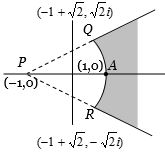
$PQ$ and $PR$ are two infinite rays. $QAR$ is an arc. $A$ point lying in the shaded region,excluding the boundary,satisfies:
A
$|z - 1| > 2; |\arg (z - 1)| < \frac{\pi }{4}$
B
$|z - 1| > 2; |\arg (z - 1)| < \frac{\pi }{2}$
C
$|z + 1| > 2; |\arg (z + 1)| < \frac{\pi }{4}$
D
$|z + 1| > 2; |\arg (z + 1)| < \frac{\pi }{2}$
Solution
(C) The vertex of the rays $PQ$ and $PR$ is at $P(-1, 0)$,which corresponds to the complex number $z_0 = -1$.
The ray $PQ$ passes through $(-1 + \sqrt{2}, \sqrt{2}i)$,so its angle with the real axis is $\arg(z - (-1)) = \arg(z + 1) = \tan^{-1}(\frac{\sqrt{2}}{\sqrt{2}}) = \frac{\pi}{4}$.
The ray $PR$ passes through $(-1 + \sqrt{2}, -\sqrt{2}i)$,so its angle is $\arg(z + 1) = -\frac{\pi}{4}$.
The shaded region lies between these rays,so $|\arg(z + 1)| < \frac{\pi}{4}$.
The arc $QAR$ is part of a circle centered at $P(-1, 0)$. The distance from $P(-1, 0)$ to $A(1, 0)$ is $|1 - (-1)| = 2$. Thus,the radius of the circle is $2$.
The shaded region is outside this circle,so $|z - (-1)| > 2$,which is $|z + 1| > 2$.
Therefore,the conditions are $|z + 1| > 2$ and $|\arg(z + 1)| < \frac{\pi}{4}$.
The ray $PQ$ passes through $(-1 + \sqrt{2}, \sqrt{2}i)$,so its angle with the real axis is $\arg(z - (-1)) = \arg(z + 1) = \tan^{-1}(\frac{\sqrt{2}}{\sqrt{2}}) = \frac{\pi}{4}$.
The ray $PR$ passes through $(-1 + \sqrt{2}, -\sqrt{2}i)$,so its angle is $\arg(z + 1) = -\frac{\pi}{4}$.
The shaded region lies between these rays,so $|\arg(z + 1)| < \frac{\pi}{4}$.
The arc $QAR$ is part of a circle centered at $P(-1, 0)$. The distance from $P(-1, 0)$ to $A(1, 0)$ is $|1 - (-1)| = 2$. Thus,the radius of the circle is $2$.
The shaded region is outside this circle,so $|z - (-1)| > 2$,which is $|z + 1| > 2$.
Therefore,the conditions are $|z + 1| > 2$ and $|\arg(z + 1)| < \frac{\pi}{4}$.
0 likesView Solution
2
MathematicsDifficultMCQIIT JEE · 2005
If $\omega$ is a cube root of unity but not equal to $1$,then the minimum value of $|a + b\omega + c\omega^2|$ (where $a, b, c$ are integers but not all equal) is
A
$0$
B
$\frac{\sqrt{3}}{2}$
C
$1$
D
$2$
Solution
(C) Let $y = |a + b\omega + c\omega^2|$.
For $y$ to be minimum,$y^2$ must be minimum.
$y^2 = |a + b\omega + c\omega^2|^2 = (a + b\omega + c\omega^2)(a + b\bar{\omega} + c\bar{\omega}^2)$.
Using $\omega^2 = \bar{\omega}$ and $\omega = \bar{\omega}^2$,we get $y^2 = a^2 + b^2 + c^2 - ab - bc - ca$.
This can be written as $y^2 = \frac{1}{2}[(a - b)^2 + (b - c)^2 + (c - a)^2]$.
Since $a, b, c$ are integers and not all equal,the minimum value occurs when two variables are equal and the third differs by $1$ (e.g.,$a=0, b=0, c=1$).
Substituting these values,$y^2 = \frac{1}{2}[(0-0)^2 + (0-1)^2 + (1-0)^2] = \frac{1}{2}[0 + 1 + 1] = 1$.
Thus,the minimum value of $y$ is $\sqrt{1} = 1$.
For $y$ to be minimum,$y^2$ must be minimum.
$y^2 = |a + b\omega + c\omega^2|^2 = (a + b\omega + c\omega^2)(a + b\bar{\omega} + c\bar{\omega}^2)$.
Using $\omega^2 = \bar{\omega}$ and $\omega = \bar{\omega}^2$,we get $y^2 = a^2 + b^2 + c^2 - ab - bc - ca$.
This can be written as $y^2 = \frac{1}{2}[(a - b)^2 + (b - c)^2 + (c - a)^2]$.
Since $a, b, c$ are integers and not all equal,the minimum value occurs when two variables are equal and the third differs by $1$ (e.g.,$a=0, b=0, c=1$).
Substituting these values,$y^2 = \frac{1}{2}[(0-0)^2 + (0-1)^2 + (1-0)^2] = \frac{1}{2}[0 + 1 + 1] = 1$.
Thus,the minimum value of $y$ is $\sqrt{1} = 1$.
0 likesView Solution
3
MathematicsMediumMCQIIT JEE · 2005
If $\alpha, \beta$ are the roots of $ax^2 + bx + c = 0$ and $\alpha + \beta, \alpha^2 + \beta^2, \alpha^3 + \beta^3$ are in $G.P.$,where $\Delta = b^2 - 4ac$,then:
A
$\Delta \neq 0$
B
$b\Delta = 0$
C
$cb \neq 0$
D
$c\Delta = 0$
0 likesView Solution
4
MathematicsDifficultMCQIIT JEE · 2005
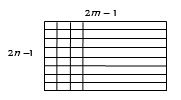
There is a rectangular sheet of dimension $(2m - 1) \times (2n - 1)$,(where $m > 0, n > 0$). It has been divided into squares of unit area by drawing lines perpendicular to the sides. Find the number of rectangles having sides of odd unit length.
A
$(m + n + 1)^2$
B
$mn(m + 1)(n + 1)$
C
$4^{m + n - 2}$
D
$m^2n^2$
Solution
(D) rectangle is formed by choosing two horizontal lines and two vertical lines.
Let the horizontal lines be $y_0, y_1, \dots, y_{2n-1}$ and vertical lines be $x_0, x_1, \dots, x_{2m-1}$.
$A$ rectangle has odd side lengths if the difference between the indices of the chosen lines is odd.
For the horizontal side,we need to choose two lines $y_i, y_j$ such that $|i - j|$ is odd. This means one index must be even and the other must be odd.
In the set ${0, 1, \dots, 2n-1}$,there are $n$ even numbers ${0, 2, \dots, 2n-2}$ and $n$ odd numbers ${1, 3, \dots, 2n-1}$.
The number of ways to choose one even and one odd index is $n \times n = n^2$.
Similarly,for the vertical side,the number of ways to choose two lines such that the difference is odd is $m \times m = m^2$.
Therefore,the total number of rectangles with odd side lengths is $m^2 \times n^2 = m^2n^2$.
Let the horizontal lines be $y_0, y_1, \dots, y_{2n-1}$ and vertical lines be $x_0, x_1, \dots, x_{2m-1}$.
$A$ rectangle has odd side lengths if the difference between the indices of the chosen lines is odd.
For the horizontal side,we need to choose two lines $y_i, y_j$ such that $|i - j|$ is odd. This means one index must be even and the other must be odd.
In the set ${0, 1, \dots, 2n-1}$,there are $n$ even numbers ${0, 2, \dots, 2n-2}$ and $n$ odd numbers ${1, 3, \dots, 2n-1}$.
The number of ways to choose one even and one odd index is $n \times n = n^2$.
Similarly,for the vertical side,the number of ways to choose two lines such that the difference is odd is $m \times m = m^2$.
Therefore,the total number of rectangles with odd side lengths is $m^2 \times n^2 = m^2n^2$.
0 likesView Solution
5
MathematicsDifficultMCQIIT JEE · 2005
The value of $\binom{30}{0}\binom{30}{10} - \binom{30}{1}\binom{30}{11} + \binom{30}{2}\binom{30}{12} - ....... + \binom{30}{20}\binom{30}{30}$ is:
A
$^{60}C_{20}$
B
$^{30}C_{10}$
C
$^{60}C_{30}$
D
$^{40}C_{30}$
Solution
(B) We know that the given expression is the coefficient of $x^{20}$ in the product of two binomial expansions.
Consider $(1-x)^{30} = \sum_{r=0}^{30} (-1)^r \binom{30}{r} x^r = \binom{30}{0} - \binom{30}{1}x + \binom{30}{2}x^2 - ....... + \binom{30}{20}x^{20} - ....... + \binom{30}{30}x^{30}$.
Consider $(x+1)^{30} = \sum_{k=0}^{30} \binom{30}{k} x^{30-k} = \binom{30}{0}x^{30} + \binom{30}{1}x^{29} + ....... + \binom{30}{10}x^{20} + ....... + \binom{30}{30}$.
The given expression is the coefficient of $x^{20}$ in the product $(1-x)^{30}(x+1)^{30} = (1-x^2)^{30}$.
In the expansion of $(1-x^2)^{30} = \sum_{k=0}^{30} \binom{30}{k} (-x^2)^k = \sum_{k=0}^{30} \binom{30}{k} (-1)^k x^{2k}$.
To find the coefficient of $x^{20}$,we set $2k = 20$,which gives $k = 10$.
The coefficient is $\binom{30}{10} (-1)^{10} = \binom{30}{10}$.
Consider $(1-x)^{30} = \sum_{r=0}^{30} (-1)^r \binom{30}{r} x^r = \binom{30}{0} - \binom{30}{1}x + \binom{30}{2}x^2 - ....... + \binom{30}{20}x^{20} - ....... + \binom{30}{30}x^{30}$.
Consider $(x+1)^{30} = \sum_{k=0}^{30} \binom{30}{k} x^{30-k} = \binom{30}{0}x^{30} + \binom{30}{1}x^{29} + ....... + \binom{30}{10}x^{20} + ....... + \binom{30}{30}$.
The given expression is the coefficient of $x^{20}$ in the product $(1-x)^{30}(x+1)^{30} = (1-x^2)^{30}$.
In the expansion of $(1-x^2)^{30} = \sum_{k=0}^{30} \binom{30}{k} (-x^2)^k = \sum_{k=0}^{30} \binom{30}{k} (-1)^k x^{2k}$.
To find the coefficient of $x^{20}$,we set $2k = 20$,which gives $k = 10$.
The coefficient is $\binom{30}{10} (-1)^{10} = \binom{30}{10}$.
0 likesView Solution
6
MathematicsDifficultMCQIIT JEE · 2005
If $\cos(\alpha - \beta) = 1$ and $\cos(\alpha + \beta) = \frac{1}{e}$,where $-\pi < \alpha, \beta < \pi$,then the total number of ordered pairs $(\alpha, \beta)$ is:
A
$0$
B
$1$
C
$2$
D
$4$
Solution
(D) Given $\cos(\alpha - \beta) = 1$ and $-\pi < \alpha, \beta < \pi$.
Since $-\pi < \alpha < \pi$ and $-\pi < \beta < \pi$,we have $-2\pi < \alpha - \beta < 2\pi$.
The equation $\cos(\alpha - \beta) = 1$ implies $\alpha - \beta = 0$,so $\alpha = \beta$.
Substituting $\alpha = \beta$ into the second equation,we get $\cos(\alpha + \alpha) = \cos(2\alpha) = \frac{1}{e}$.
Since $-\pi < \alpha < \pi$,we have $-2\pi < 2\alpha < 2\pi$.
In the interval $(-2\pi, 2\pi)$,the equation $\cos(2\alpha) = \frac{1}{e}$ has solutions where $\cos(x) = \frac{1}{e}$ for $x \in (-2\pi, 2\pi)$.
Since $0 < \frac{1}{e} < 1$,there are two solutions for $2\alpha$ in $(0, 2\pi)$ and two solutions in $(-2\pi, 0)$.
Thus,there are $4$ distinct values for $\alpha$,and since $\alpha = \beta$,there are $4$ ordered pairs $(\alpha, \beta)$.
Since $-\pi < \alpha < \pi$ and $-\pi < \beta < \pi$,we have $-2\pi < \alpha - \beta < 2\pi$.
The equation $\cos(\alpha - \beta) = 1$ implies $\alpha - \beta = 0$,so $\alpha = \beta$.
Substituting $\alpha = \beta$ into the second equation,we get $\cos(\alpha + \alpha) = \cos(2\alpha) = \frac{1}{e}$.
Since $-\pi < \alpha < \pi$,we have $-2\pi < 2\alpha < 2\pi$.
In the interval $(-2\pi, 2\pi)$,the equation $\cos(2\alpha) = \frac{1}{e}$ has solutions where $\cos(x) = \frac{1}{e}$ for $x \in (-2\pi, 2\pi)$.
Since $0 < \frac{1}{e} < 1$,there are two solutions for $2\alpha$ in $(0, 2\pi)$ and two solutions in $(-2\pi, 0)$.
Thus,there are $4$ distinct values for $\alpha$,and since $\alpha = \beta$,there are $4$ ordered pairs $(\alpha, \beta)$.
0 likesView Solution
7
MathematicsEasyMCQIIT JEE · 2005
Which of the following is true in a triangle $ABC$?
A
$(b + c)\sin \frac{B - C}{2} = 2a\cos \frac{A}{2}$
B
$(b + c)\cos \frac{A}{2} = 2a\sin \frac{B - C}{2}$
C
$(b - c)\cos \frac{A}{2} = a\sin \frac{B - C}{2}$
D
$(b - c)\sin \frac{B - C}{2} = 2a\cos \frac{A}{2}$
Solution
(C) Using the Sine Rule,we have $\frac{a}{\sin A} = \frac{b}{\sin B} = \frac{c}{\sin C} = k$.
Thus,$a = k\sin A$,$b = k\sin B$,and $c = k\sin C$.
Consider the expression $\frac{b - c}{a} = \frac{\sin B - \sin C}{\sin A}$.
Using the sum-to-product formula,$\sin B - \sin C = 2\sin \frac{B - C}{2} \cos \frac{B + C}{2}$.
Since $A + B + C = \pi$,we have $\frac{B + C}{2} = \frac{\pi}{2} - \frac{A}{2}$,so $\cos \frac{B + C}{2} = \sin \frac{A}{2}$.
Also,$\sin A = 2\sin \frac{A}{2} \cos \frac{A}{2}$.
Substituting these into the expression:
$\frac{b - c}{a} = \frac{2\sin \frac{B - C}{2} \sin \frac{A}{2}}{2\sin \frac{A}{2} \cos \frac{A}{2}} = \frac{\sin \frac{B - C}{2}}{\cos \frac{A}{2}}$.
Rearranging gives $(b - c)\cos \frac{A}{2} = a\sin \frac{B - C}{2}$.
Thus,$a = k\sin A$,$b = k\sin B$,and $c = k\sin C$.
Consider the expression $\frac{b - c}{a} = \frac{\sin B - \sin C}{\sin A}$.
Using the sum-to-product formula,$\sin B - \sin C = 2\sin \frac{B - C}{2} \cos \frac{B + C}{2}$.
Since $A + B + C = \pi$,we have $\frac{B + C}{2} = \frac{\pi}{2} - \frac{A}{2}$,so $\cos \frac{B + C}{2} = \sin \frac{A}{2}$.
Also,$\sin A = 2\sin \frac{A}{2} \cos \frac{A}{2}$.
Substituting these into the expression:
$\frac{b - c}{a} = \frac{2\sin \frac{B - C}{2} \sin \frac{A}{2}}{2\sin \frac{A}{2} \cos \frac{A}{2}} = \frac{\sin \frac{B - C}{2}}{\cos \frac{A}{2}}$.
Rearranging gives $(b - c)\cos \frac{A}{2} = a\sin \frac{B - C}{2}$.
0 likesView Solution
8
MathematicsDifficultMCQIIT JEE · 2005
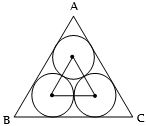
The area of the equilateral triangle which contains three coins of unit radius is
A
$6 + 4\sqrt{3} \; \text{sq. units}$
B
$8 + \sqrt{3} \; \text{sq. units}$
C
$4 + \frac{7\sqrt{3}}{2} \; \text{sq. units}$
D
$12 + 2\sqrt{3} \; \text{sq. units}$
Solution
(A) Let the radius of each coin be $r = 1$. The centers of the three coins form an equilateral triangle with side length $2r = 2$.
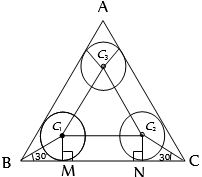
Let the vertices of the large equilateral triangle be $A, B, C$ and the centers of the coins be $C_1, C_2, C_3$.
The distance from a vertex (e.g.,$B$) to the projection of the center of the nearest coin $(M)$ on the side $BC$ is given by $BM = r \cot(30^\circ) = 1 \times \sqrt{3} = \sqrt{3}$.
The distance between the centers of the two base coins is $MN = 2r = 2$.
By symmetry,the side length $s$ of the large equilateral triangle is $s = BM + MN + NC = \sqrt{3} + 2 + \sqrt{3} = 2 + 2\sqrt{3} = 2(1 + \sqrt{3})$.
The area of an equilateral triangle with side $s$ is given by $\frac{\sqrt{3}}{4} s^2$.
Area $= \frac{\sqrt{3}}{4} [2(1 + \sqrt{3})]^2 = \frac{\sqrt{3}}{4} \times 4(1 + \sqrt{3})^2 = \sqrt{3}(1 + 3 + 2\sqrt{3}) = \sqrt{3}(4 + 2\sqrt{3}) = 4\sqrt{3} + 6 \; \text{sq. units}$.
Let the vertices of the large equilateral triangle be $A, B, C$ and the centers of the coins be $C_1, C_2, C_3$.
The distance from a vertex (e.g.,$B$) to the projection of the center of the nearest coin $(M)$ on the side $BC$ is given by $BM = r \cot(30^\circ) = 1 \times \sqrt{3} = \sqrt{3}$.
The distance between the centers of the two base coins is $MN = 2r = 2$.
By symmetry,the side length $s$ of the large equilateral triangle is $s = BM + MN + NC = \sqrt{3} + 2 + \sqrt{3} = 2 + 2\sqrt{3} = 2(1 + \sqrt{3})$.
The area of an equilateral triangle with side $s$ is given by $\frac{\sqrt{3}}{4} s^2$.
Area $= \frac{\sqrt{3}}{4} [2(1 + \sqrt{3})]^2 = \frac{\sqrt{3}}{4} \times 4(1 + \sqrt{3})^2 = \sqrt{3}(1 + 3 + 2\sqrt{3}) = \sqrt{3}(4 + 2\sqrt{3}) = 4\sqrt{3} + 6 \; \text{sq. units}$.
0 likesView Solution
9
MathematicsDifficultMCQIIT JEE · 2005
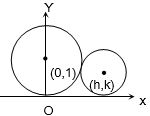
The locus of the centre of the circle which touches the circle ${x^2} + {(y - 1)^2} = 1$ externally and also touches the $x$-axis is
A
$\{ (x, y) : {x^2} + {(y - 1)^2} = 4\} \cup \{ (x, y) : y < 0\} $
B
$\{ (x, y) : {x^2} = 4y\} \cup \{ (0, y) : y < 0\} $
C
$\{ (x, y) : {x^2} = y\} \cup \{ (0, y) : y < 0\} $
D
$\{ (x, y) : {x^2} = 4y\} \cup \{ (x, y) : y < 0\} $
Solution
(B) Let the centre of the circle be $(h, k)$ and its radius be $r$. Since the circle touches the $x$-axis,the radius $r = |k|$.
Since the circle touches the circle ${x^2} + {(y - 1)^2} = 1$ (centre $(0, 1)$,radius $1$) externally,the distance between their centres is equal to the sum of their radii:
$\sqrt {{{(h - 0)}^2} + {{(k - 1)}^2}} = 1 + |k|$
Squaring both sides:
${h^2} + {(k - 1)^2} = {(1 + |k|)^2}$
${h^2} + {k^2} - 2k + 1 = 1 + 2|k| + {k^2}$
${h^2} = 2k + 2|k|$
Case $1$: If $k > 0$,then $|k| = k$,so ${h^2} = 2k + 2k = 4k$. Thus,the locus is ${x^2} = 4y$ for $y > 0$.
Case $2$: If $k < 0$,then $|k| = -k$,so ${h^2} = 2k - 2k = 0$. Thus,the locus is $x = 0$ for $y < 0$.
Combining these,the locus is $\{ (x, y) : {x^2} = 4y, y > 0\} \cup \{ (0, y) : y < 0\}$.
Since the circle touches the circle ${x^2} + {(y - 1)^2} = 1$ (centre $(0, 1)$,radius $1$) externally,the distance between their centres is equal to the sum of their radii:
$\sqrt {{{(h - 0)}^2} + {{(k - 1)}^2}} = 1 + |k|$
Squaring both sides:
${h^2} + {(k - 1)^2} = {(1 + |k|)^2}$
${h^2} + {k^2} - 2k + 1 = 1 + 2|k| + {k^2}$
${h^2} = 2k + 2|k|$
Case $1$: If $k > 0$,then $|k| = k$,so ${h^2} = 2k + 2k = 4k$. Thus,the locus is ${x^2} = 4y$ for $y > 0$.
Case $2$: If $k < 0$,then $|k| = -k$,so ${h^2} = 2k - 2k = 0$. Thus,the locus is $x = 0$ for $y < 0$.
Combining these,the locus is $\{ (x, y) : {x^2} = 4y, y > 0\} \cup \{ (0, y) : y < 0\}$.
0 likesView Solution
10
MathematicsDifficultMCQIIT JEE · 2005
The tangent to the parabola $y = x^2 + 6$ at the point $(1, 7)$ touches the circle $x^2 + y^2 + 16x + 12y + c = 0$ at which point?
A
$(-6, -9)$
B
$(-13, -9)$
C
$(-6, -7)$
D
$(13, 7)$
Solution
(C) The equation of the tangent to the parabola $y = x^2 + 6$ at $(1, 7)$ is given by $\frac{1}{2}(y + 7) = x(1) + 6$.
Simplifying this,we get $y + 7 = 2x + 12$,which implies $y = 2x + 5$ $(i)$.
This tangent touches the circle $x^2 + y^2 + 16x + 12y + c = 0$ $(ii)$.
Substituting $(i)$ into $(ii)$:
$x^2 + (2x + 5)^2 + 16x + 12(2x + 5) + c = 0$
$x^2 + 4x^2 + 20x + 25 + 16x + 24x + 60 + c = 0$
$5x^2 + 60x + (85 + c) = 0$.
Since the line is tangent,the discriminant must be zero:
$D = (60)^2 - 4(5)(85 + c) = 0$
$3600 - 20(85 + c) = 0$
$180 - (85 + c) = 0 \implies c = 95$.
The quadratic equation becomes $5x^2 + 60x + 180 = 0$,or $x^2 + 12x + 36 = 0$.
$(x + 6)^2 = 0 \implies x = -6$.
Substituting $x = -6$ into $(i)$,$y = 2(-6) + 5 = -7$.
Thus,the point of contact is $(-6, -7)$.
Simplifying this,we get $y + 7 = 2x + 12$,which implies $y = 2x + 5$ $(i)$.
This tangent touches the circle $x^2 + y^2 + 16x + 12y + c = 0$ $(ii)$.
Substituting $(i)$ into $(ii)$:
$x^2 + (2x + 5)^2 + 16x + 12(2x + 5) + c = 0$
$x^2 + 4x^2 + 20x + 25 + 16x + 24x + 60 + c = 0$
$5x^2 + 60x + (85 + c) = 0$.
Since the line is tangent,the discriminant must be zero:
$D = (60)^2 - 4(5)(85 + c) = 0$
$3600 - 20(85 + c) = 0$
$180 - (85 + c) = 0 \implies c = 95$.
The quadratic equation becomes $5x^2 + 60x + 180 = 0$,or $x^2 + 12x + 36 = 0$.
$(x + 6)^2 = 0 \implies x = -6$.
Substituting $x = -6$ into $(i)$,$y = 2(-6) + 5 = -7$.
Thus,the point of contact is $(-6, -7)$.
0 likesView Solution
11
MathematicsEasyMCQIIT JEE · 2005
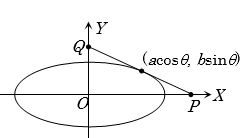
The minimum area of the triangle formed by any tangent to the ellipse $\frac{x^2}{a^2} + \frac{y^2}{b^2} = 1$ with the coordinate axes is
A
$\frac{a^2 + b^2}{2}$
B
$\frac{(a + b)^2}{2}$
C
$ab$
D
$\frac{(a - b)^2}{2}$
Solution
(C) The equation of the tangent to the ellipse $\frac{x^2}{a^2} + \frac{y^2}{b^2} = 1$ at the point $(a \cos \theta, b \sin \theta)$ is given by $\frac{x}{a} \cos \theta + \frac{y}{b} \sin \theta = 1$.
The $x$-intercept of this tangent is found by setting $y = 0$,which gives $P = (\frac{a}{\cos \theta}, 0)$.
The $y$-intercept of this tangent is found by setting $x = 0$,which gives $Q = (0, \frac{b}{\sin \theta})$.
The area of the triangle $OPQ$ formed by the tangent and the coordinate axes is $A = \frac{1}{2} \times |x_P| \times |y_Q| = \frac{1}{2} \left| \frac{a}{\cos \theta} \right| \left| \frac{b}{\sin \theta} \right| = \frac{ab}{|2 \sin \theta \cos \theta|} = \frac{ab}{|\sin 2\theta|}$.
Since the minimum value of $|\sin 2\theta|$ is $1$ (when $2\theta = 90^\circ$ or $270^\circ$),the minimum area is $ab$.
The $x$-intercept of this tangent is found by setting $y = 0$,which gives $P = (\frac{a}{\cos \theta}, 0)$.
The $y$-intercept of this tangent is found by setting $x = 0$,which gives $Q = (0, \frac{b}{\sin \theta})$.
The area of the triangle $OPQ$ formed by the tangent and the coordinate axes is $A = \frac{1}{2} \times |x_P| \times |y_Q| = \frac{1}{2} \left| \frac{a}{\cos \theta} \right| \left| \frac{b}{\sin \theta} \right| = \frac{ab}{|2 \sin \theta \cos \theta|} = \frac{ab}{|\sin 2\theta|}$.
Since the minimum value of $|\sin 2\theta|$ is $1$ (when $2\theta = 90^\circ$ or $270^\circ$),the minimum area is $ab$.
0 likesView Solution
12
MathematicsEasyMCQIIT JEE · 2005
If $S$ is a set of polynomials $P(x)$ of degree $\le 2$ such that $P(0) = 0$,$P(1) = 1$,and $P'(x) > 0$ for all $x \in (0, 1)$,then which of the following describes $S$?
A
$S = \emptyset$
B
$S = \{ax + (1 - a)x^2 : a \in (0, \infty)\}$
C
$S = \{ax + (1 - a)x^2 : a \in \mathbb{R}\}$
D
$S = \{ax + (1 - a)x^2 : a \in (0, 2)\}$
Solution
(D) Let $P(x) = bx^2 + ax + c$.
Given $P(0) = 0$,we have $c = 0$.
Given $P(1) = 1$,we have $a + b = 1$,which implies $b = 1 - a$.
Thus,$P(x) = (1 - a)x^2 + ax$.
The derivative is $P'(x) = 2(1 - a)x + a$.
We are given $P'(x) > 0$ for all $x \in (0, 1)$.
At $x = 0$,$P'(0) = a > 0$.
At $x = 1$,$P'(1) = 2(1 - a) + a = 2 - a > 0$,which implies $a < 2$.
Since $P'(x)$ is a linear function,if it is positive at the endpoints of the interval $(0, 1)$,it is positive for all $x \in (0, 1)$.
Thus,$0 < a < 2$.
Therefore,$S = \{ax + (1 - a)x^2 : a \in (0, 2)\}$.
Given $P(0) = 0$,we have $c = 0$.
Given $P(1) = 1$,we have $a + b = 1$,which implies $b = 1 - a$.
Thus,$P(x) = (1 - a)x^2 + ax$.
The derivative is $P'(x) = 2(1 - a)x + a$.
We are given $P'(x) > 0$ for all $x \in (0, 1)$.
At $x = 0$,$P'(0) = a > 0$.
At $x = 1$,$P'(1) = 2(1 - a) + a = 2 - a > 0$,which implies $a < 2$.
Since $P'(x)$ is a linear function,if it is positive at the endpoints of the interval $(0, 1)$,it is positive for all $x \in (0, 1)$.
Thus,$0 < a < 2$.
Therefore,$S = \{ax + (1 - a)x^2 : a \in (0, 2)\}$.
0 likesView Solution
13
MathematicsDifficultMCQIIT JEE · 2005
If $A = \begin{bmatrix} 1 & 0 & 0 \\ 0 & 1 & 1 \\ 0 & -2 & 4 \end{bmatrix}$ and $I = \begin{bmatrix} 1 & 0 & 0 \\ 0 & 1 & 0 \\ 0 & 0 & 1 \end{bmatrix}$,and $A^{-1} = \frac{1}{6}[A^2 + cA + dI]$ where $c, d \in R$,then the pair of values $(c, d)$ is:
A
$(6, 11)$
B
$(6, -11)$
C
$(-6, 11)$
D
$(-6, -11)$
Solution
(C) Given $A = \begin{bmatrix} 1 & 0 & 0 \\ 0 & 1 & 1 \\ 0 & -2 & 4 \end{bmatrix}$.
First,we find the characteristic equation of $A$. The characteristic polynomial is $|A - \lambda I| = 0$.
$|A - \lambda I| = \begin{vmatrix} 1-\lambda & 0 & 0 \\ 0 & 1-\lambda & 1 \\ 0 & -2 & 4-\lambda \end{vmatrix} = (1-\lambda) [(1-\lambda)(4-\lambda) + 2] = (1-\lambda) [\lambda^2 - 5\lambda + 6] = 0$.
So,$\lambda^3 - 6\lambda^2 + 11\lambda - 6 = 0$.
By Cayley-Hamilton theorem,$A^3 - 6A^2 + 11A - 6I = 0$.
Multiplying by $A^{-1}$,we get $A^2 - 6A + 11I - 6A^{-1} = 0$.
$6A^{-1} = A^2 - 6A + 11I$.
$A^{-1} = \frac{1}{6}[A^2 - 6A + 11I]$.
Comparing this with $A^{-1} = \frac{1}{6}[A^2 + cA + dI]$,we get $c = -6$ and $d = 11$.
Thus,the pair $(c, d) = (-6, 11)$.
First,we find the characteristic equation of $A$. The characteristic polynomial is $|A - \lambda I| = 0$.
$|A - \lambda I| = \begin{vmatrix} 1-\lambda & 0 & 0 \\ 0 & 1-\lambda & 1 \\ 0 & -2 & 4-\lambda \end{vmatrix} = (1-\lambda) [(1-\lambda)(4-\lambda) + 2] = (1-\lambda) [\lambda^2 - 5\lambda + 6] = 0$.
So,$\lambda^3 - 6\lambda^2 + 11\lambda - 6 = 0$.
By Cayley-Hamilton theorem,$A^3 - 6A^2 + 11A - 6I = 0$.
Multiplying by $A^{-1}$,we get $A^2 - 6A + 11I - 6A^{-1} = 0$.
$6A^{-1} = A^2 - 6A + 11I$.
$A^{-1} = \frac{1}{6}[A^2 - 6A + 11I]$.
Comparing this with $A^{-1} = \frac{1}{6}[A^2 + cA + dI]$,we get $c = -6$ and $d = 11$.
Thus,the pair $(c, d) = (-6, 11)$.
0 likesView Solution
14
MathematicsDifficultMCQIIT JEE · 2005
If $P = \begin{bmatrix} \frac{\sqrt{3}}{2} & \frac{1}{2} \\ -\frac{1}{2} & \frac{\sqrt{3}}{2} \end{bmatrix}$,$A = \begin{bmatrix} 1 & 1 \\ 0 & 1 \end{bmatrix}$ and $Q = PAP^T$,then $P^T(Q^{2005})P$ is equal to
A
$\begin{bmatrix} 1 & 2005 \\ 0 & 1 \end{bmatrix}$
B
$\begin{bmatrix} \frac{\sqrt{3}}{2} & 2005 \\ 1 & 0 \end{bmatrix}$
C
$\begin{bmatrix} 1 & 2005 \\ \frac{\sqrt{3}}{2} & 1 \end{bmatrix}$
D
$\begin{bmatrix} 1 & \frac{\sqrt{3}}{2} \\ 0 & 2005 \end{bmatrix}$
Solution
(A) Given $Q = PAP^T$. Note that $P$ is an orthogonal matrix,so $PP^T = I$ and $P^T = P^{-1}$.
We want to compute $X = P^T Q^{2005} P$.
Since $Q = PAP^T$,we have $Q^n = (PAP^T)(PAP^T)...(PAP^T) = PA^n P^T$.
Substituting this into the expression:
$X = P^T (PA^{2005}P^T) P$
$X = (P^T P) A^{2005} (P^T P)$
Since $P^T P = I$,we get $X = I A^{2005} I = A^{2005}$.
Given $A = \begin{bmatrix} 1 & 1 \\ 0 & 1 \end{bmatrix}$,we use the property of this specific matrix: $A^n = \begin{bmatrix} 1 & n \\ 0 & 1 \end{bmatrix}$.
Thus,$A^{2005} = \begin{bmatrix} 1 & 2005 \\ 0 & 1 \end{bmatrix}$.
Therefore,the correct option is $A$.
We want to compute $X = P^T Q^{2005} P$.
Since $Q = PAP^T$,we have $Q^n = (PAP^T)(PAP^T)...(PAP^T) = PA^n P^T$.
Substituting this into the expression:
$X = P^T (PA^{2005}P^T) P$
$X = (P^T P) A^{2005} (P^T P)$
Since $P^T P = I$,we get $X = I A^{2005} I = A^{2005}$.
Given $A = \begin{bmatrix} 1 & 1 \\ 0 & 1 \end{bmatrix}$,we use the property of this specific matrix: $A^n = \begin{bmatrix} 1 & n \\ 0 & 1 \end{bmatrix}$.
Thus,$A^{2005} = \begin{bmatrix} 1 & 2005 \\ 0 & 1 \end{bmatrix}$.
Therefore,the correct option is $A$.
0 likesView Solution
15
MathematicsDifficultMCQIIT JEE · 2005
If $a, b, c$ are three non-zero,non-coplanar vectors and $b_1 = b - \frac{b \cdot a}{|a|^2} a$,$b_2 = b + \frac{b \cdot a}{|a|^2} a$,$c_2 = c - \frac{c \cdot a}{|a|^2} a - \frac{c \cdot b_1}{|b_1|^2} b_1$,$c_3 = c - \frac{c \cdot a}{|a|^2} a - \frac{c \cdot b_2}{|b_2|^2} b_2$,and $c_4 = a - \frac{c \cdot a}{|a|^2} a$. Then which of the following is a set of mutually orthogonal vectors?
A
$\{a, b_1, c_1\}$
B
$\{a, b_1, c_2\}$
C
$\{a, b_2, c_3\}$
D
$\{a, b_2, c_4\}$
Solution
(B) The given vectors are constructed using the Gram-Schmidt orthogonalization process.
For the set $\{a, b_1, c_2\}$:
$1$. $a \cdot b_1 = a \cdot (b - \frac{b \cdot a}{|a|^2} a) = a \cdot b - \frac{b \cdot a}{|a|^2} (a \cdot a) = a \cdot b - b \cdot a = 0$. Thus,$a \perp b_1$.
$2$. $a \cdot c_2 = a \cdot (c - \frac{c \cdot a}{|a|^2} a - \frac{c \cdot b_1}{|b_1|^2} b_1) = a \cdot c - \frac{c \cdot a}{|a|^2} (a \cdot a) - \frac{c \cdot b_1}{|b_1|^2} (a \cdot b_1) = a \cdot c - c \cdot a - 0 = 0$. Thus,$a \perp c_2$.
$3$. $b_1 \cdot c_2 = b_1 \cdot (c - \frac{c \cdot a}{|a|^2} a - \frac{c \cdot b_1}{|b_1|^2} b_1) = b_1 \cdot c - \frac{c \cdot a}{|a|^2} (b_1 \cdot a) - \frac{c \cdot b_1}{|b_1|^2} (b_1 \cdot b_1) = b_1 \cdot c - 0 - c \cdot b_1 = 0$. Thus,$b_1 \perp c_2$.
Since all pairs are orthogonal,the set $\{a, b_1, c_2\}$ is a set of mutually orthogonal vectors.
Therefore,option $(b)$ is the correct answer.
For the set $\{a, b_1, c_2\}$:
$1$. $a \cdot b_1 = a \cdot (b - \frac{b \cdot a}{|a|^2} a) = a \cdot b - \frac{b \cdot a}{|a|^2} (a \cdot a) = a \cdot b - b \cdot a = 0$. Thus,$a \perp b_1$.
$2$. $a \cdot c_2 = a \cdot (c - \frac{c \cdot a}{|a|^2} a - \frac{c \cdot b_1}{|b_1|^2} b_1) = a \cdot c - \frac{c \cdot a}{|a|^2} (a \cdot a) - \frac{c \cdot b_1}{|b_1|^2} (a \cdot b_1) = a \cdot c - c \cdot a - 0 = 0$. Thus,$a \perp c_2$.
$3$. $b_1 \cdot c_2 = b_1 \cdot (c - \frac{c \cdot a}{|a|^2} a - \frac{c \cdot b_1}{|b_1|^2} b_1) = b_1 \cdot c - \frac{c \cdot a}{|a|^2} (b_1 \cdot a) - \frac{c \cdot b_1}{|b_1|^2} (b_1 \cdot b_1) = b_1 \cdot c - 0 - c \cdot b_1 = 0$. Thus,$b_1 \perp c_2$.
Since all pairs are orthogonal,the set $\{a, b_1, c_2\}$ is a set of mutually orthogonal vectors.
Therefore,option $(b)$ is the correct answer.
0 likesView Solution
16
MathematicsDifficultMCQIIT JEE · 2005
If $X$ and $Y$ are two non-empty sets where $f: X \to Y$ is a function defined such that $f(C) = \{f(x) : x \in C\}$ for $C \subseteq X$ and $f^{-1}(D) = \{x : f(x) \in D\}$ for $D \subseteq Y$,then for any $A \subseteq X$ and $B \subseteq Y$,which of the following is true?
A
$f^{-1}(f(A)) = A$
B
$f^{-1}(f(A)) = A$ only if $f$ is surjective
C
$f(f^{-1}(B)) = B$ only if $B \subseteq f(X)$
D
$f(f^{-1}(B)) = B$
Solution
(C) For any subset $A \subseteq X$,we have $A \subseteq f^{-1}(f(A))$. Equality $f^{-1}(f(A)) = A$ holds if and only if $f$ is injective.
For any subset $B \subseteq Y$,we have $f(f^{-1}(B)) = B \cap f(X)$.
Therefore,$f(f^{-1}(B)) = B$ holds if and only if $B \subseteq f(X)$.
Thus,option $(c)$ is correct.
For any subset $B \subseteq Y$,we have $f(f^{-1}(B)) = B \cap f(X)$.
Therefore,$f(f^{-1}(B)) = B$ holds if and only if $B \subseteq f(X)$.
Thus,option $(c)$ is correct.
0 likesView Solution
17
MathematicsEasyMCQIIT JEE · 2005
If $f(x) = \begin{cases} x, & \text{when } x \text{ is rational} \\ 0, & \text{when } x \text{ is irrational} \end{cases}$ and $g(x) = \begin{cases} 0, & \text{when } x \text{ is rational} \\ x, & \text{when } x \text{ is irrational} \end{cases}$,then $(f - g)$ is:
A
One-one onto
B
One-one not onto
C
Not one-one but onto
D
Not one-one not onto
Solution
(A) Let $h(x) = (f - g)(x)$.
For $x \in \mathbb{Q}$,$h(x) = f(x) - g(x) = x - 0 = x$.
For $x \notin \mathbb{Q}$,$h(x) = f(x) - g(x) = 0 - x = -x$.
Thus,$h(x) = \begin{cases} x, & x \in \mathbb{Q} \\ -x, & x \notin \mathbb{Q} \end{cases}$.
To check if $h(x)$ is one-one: Let $h(x_1) = h(x_2)$. If $x_1, x_2 \in \mathbb{Q}$,then $x_1 = x_2$. If $x_1, x_2 \notin \mathbb{Q}$,then $-x_1 = -x_2 \implies x_1 = x_2$. If $x_1 \in \mathbb{Q}$ and $x_2 \notin \mathbb{Q}$,then $x_1 = -x_2$,which is possible (e.g.,$x_1 = 1, x_2 = -1$,but $-1$ is rational,so this case is restricted). Since $h(x)$ maps every real number to a unique value,it is one-one.
To check if $h(x)$ is onto: For any $y \in \mathbb{R}$,if $y \in \mathbb{Q}$,$h(y) = y$. If $y \notin \mathbb{Q}$,$h(-y) = -(-y) = y$. Thus,for every $y \in \mathbb{R}$,there exists an $x$ such that $h(x) = y$. Hence,it is onto.
For $x \in \mathbb{Q}$,$h(x) = f(x) - g(x) = x - 0 = x$.
For $x \notin \mathbb{Q}$,$h(x) = f(x) - g(x) = 0 - x = -x$.
Thus,$h(x) = \begin{cases} x, & x \in \mathbb{Q} \\ -x, & x \notin \mathbb{Q} \end{cases}$.
To check if $h(x)$ is one-one: Let $h(x_1) = h(x_2)$. If $x_1, x_2 \in \mathbb{Q}$,then $x_1 = x_2$. If $x_1, x_2 \notin \mathbb{Q}$,then $-x_1 = -x_2 \implies x_1 = x_2$. If $x_1 \in \mathbb{Q}$ and $x_2 \notin \mathbb{Q}$,then $x_1 = -x_2$,which is possible (e.g.,$x_1 = 1, x_2 = -1$,but $-1$ is rational,so this case is restricted). Since $h(x)$ maps every real number to a unique value,it is one-one.
To check if $h(x)$ is onto: For any $y \in \mathbb{R}$,if $y \in \mathbb{Q}$,$h(y) = y$. If $y \notin \mathbb{Q}$,$h(-y) = -(-y) = y$. Thus,for every $y \in \mathbb{R}$,there exists an $x$ such that $h(x) = y$. Hence,it is onto.
0 likesView Solution
18
MathematicsMediumMCQIIT JEE · 2005
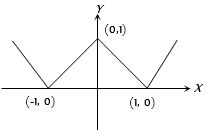
$f(x) = ||x| - 1|$ is not differentiable at
A
$0$
B
$\pm 1, 0$
C
$1$
D
$\pm 1$
Solution
(B) The function is defined as $f(x) = ||x| - 1|$.
We can break this down based on the sign of the inner expression:
$f(x) = \begin{cases} |x| - 1, & |x| - 1 \ge 0 \\ -(|x| - 1), & |x| - 1 < 0 \end{cases}$
$f(x) = \begin{cases} |x| - 1, & |x| \ge 1 \\ 1 - |x|, & |x| < 1 \end{cases}$
This can be further expanded for different intervals of $x$:
$f(x) = \begin{cases} -x - 1, & x \le -1 \\ x + 1, & -1 < x < 0 \\ 1 - x, & 0 \le x < 1 \\ x - 1, & x \ge 1 \end{cases}$
$A$ function is not differentiable at points where there are sharp corners (cusps) in its graph.
By observing the graph,the function has sharp corners at $x = -1$,$x = 0$,and $x = 1$.
Therefore,$f(x)$ is not differentiable at $x \in \{-1, 0, 1\}$.
We can break this down based on the sign of the inner expression:
$f(x) = \begin{cases} |x| - 1, & |x| - 1 \ge 0 \\ -(|x| - 1), & |x| - 1 < 0 \end{cases}$
$f(x) = \begin{cases} |x| - 1, & |x| \ge 1 \\ 1 - |x|, & |x| < 1 \end{cases}$
This can be further expanded for different intervals of $x$:
$f(x) = \begin{cases} -x - 1, & x \le -1 \\ x + 1, & -1 < x < 0 \\ 1 - x, & 0 \le x < 1 \\ x - 1, & x \ge 1 \end{cases}$
$A$ function is not differentiable at points where there are sharp corners (cusps) in its graph.
By observing the graph,the function has sharp corners at $x = -1$,$x = 0$,and $x = 1$.
Therefore,$f(x)$ is not differentiable at $x \in \{-1, 0, 1\}$.
0 likesView Solution
19
MathematicsDifficultMCQIIT JEE · 2005
If $f(x)$ is a twice differentiable polynomial function such that $f(1) = 1, f(2) = 4, f(3) = 9$,then:
A
$f''(x) = 2, \forall x \in R$
B
There exists at least one $x \in (1, 3)$ such that $f''(x) = 2$
C
There exists at least one $x \in (2, 3)$ such that $f'(x) = 5 = f''(x)$
D
There exists at least one $x \in (1, 2)$ such that $f(x) = 3$
Solution
(B) Let $g(x) = f(x) - x^2$.
Since $f(1) = 1, f(2) = 4, f(3) = 9$,we have $g(1) = 1 - 1^2 = 0$,$g(2) = 4 - 2^2 = 0$,and $g(3) = 9 - 3^2 = 0$.
Thus,$g(x)$ has at least $3$ real roots at $x = 1, 2, 3$.
By Rolle's Theorem,$g'(x)$ has at least one root in $(1, 2)$ and at least one root in $(2, 3)$,meaning $g'(x)$ has at least $2$ roots in $(1, 3)$.
Applying Rolle's Theorem again to $g'(x)$,$g''(x)$ must have at least $1$ root in $(1, 3)$.
Since $g(x) = f(x) - x^2$,we have $g'(x) = f'(x) - 2x$ and $g''(x) = f''(x) - 2$.
Since $g''(c) = 0$ for some $c \in (1, 3)$,it follows that $f''(c) - 2 = 0$,or $f''(c) = 2$ for at least one $c \in (1, 3)$.
Since $f(1) = 1, f(2) = 4, f(3) = 9$,we have $g(1) = 1 - 1^2 = 0$,$g(2) = 4 - 2^2 = 0$,and $g(3) = 9 - 3^2 = 0$.
Thus,$g(x)$ has at least $3$ real roots at $x = 1, 2, 3$.
By Rolle's Theorem,$g'(x)$ has at least one root in $(1, 2)$ and at least one root in $(2, 3)$,meaning $g'(x)$ has at least $2$ roots in $(1, 3)$.
Applying Rolle's Theorem again to $g'(x)$,$g''(x)$ must have at least $1$ root in $(1, 3)$.
Since $g(x) = f(x) - x^2$,we have $g'(x) = f'(x) - 2x$ and $g''(x) = f''(x) - 2$.
Since $g''(c) = 0$ for some $c \in (1, 3)$,it follows that $f''(c) - 2 = 0$,or $f''(c) = 2$ for at least one $c \in (1, 3)$.
0 likesView Solution
20
MathematicsDifficultMCQIIT JEE · 2005
If $f(x)$ is a differentiable function such that $f: R \to R$ and $f\left( \frac{1}{n} \right) = 0$ for all $n \ge 1, n \in I$,then:
A
$f(x) = 0$ for all $x \in (0, 1)$
B
$f(0) = 0$ and $f'(0) = 0$
C
$f(0) = 0$ but $f'(0)$ may or may not be $0$
D
$|f(x)| \le 1$ for all $x \in (0, 1)$
Solution
(B) Given that $f\left( \frac{1}{n} \right) = 0$ for all $n \in \{1, 2, 3, \dots\}$.
Since $f(x)$ is continuous (as it is differentiable),we have $f(0) = \lim_{n \to \infty} f\left( \frac{1}{n} \right) = 0$.
Now,consider the sequence $x_n = \frac{1}{n}$. We have $f(x_n) = 0$ and $f(0) = 0$.
By the definition of the derivative at $x = 0$:
$f'(0) = \lim_{x \to 0} \frac{f(x) - f(0)}{x - 0} = \lim_{n \to \infty} \frac{f(1/n) - f(0)}{1/n - 0} = \lim_{n \to \infty} \frac{0 - 0}{1/n} = 0$.
Thus,$f(0) = 0$ and $f'(0) = 0$.
Since $f(x)$ is continuous (as it is differentiable),we have $f(0) = \lim_{n \to \infty} f\left( \frac{1}{n} \right) = 0$.
Now,consider the sequence $x_n = \frac{1}{n}$. We have $f(x_n) = 0$ and $f(0) = 0$.
By the definition of the derivative at $x = 0$:
$f'(0) = \lim_{x \to 0} \frac{f(x) - f(0)}{x - 0} = \lim_{n \to \infty} \frac{f(1/n) - f(0)}{1/n - 0} = \lim_{n \to \infty} \frac{0 - 0}{1/n} = 0$.
Thus,$f(0) = 0$ and $f'(0) = 0$.
0 likesView Solution
21
MathematicsMediumMCQIIT JEE · 2005
The integral value $\int_{-2}^{0} [x^3 + 3x^2 + 3x + 3 + (x + 1)\cos(x + 1)] \, dx$ is
A
$2$
B
$4$
C
$0$
D
$8$
Solution
(B) Let $I = \int_{-2}^{0} [x^3 + 3x^2 + 3x + 3 + (x + 1)\cos(x + 1)] \, dx$.
Substitute $t = x + 1$,so $dt = dx$.
When $x = -2$,$t = -1$. When $x = 0$,$t = 1$.
Also,$x^3 + 3x^2 + 3x + 3 = (x+1)^3 + 2 = t^3 + 2$.
Thus,$I = \int_{-1}^{1} [t^3 + 2 + t\cos(t)] \, dt$.
We can split this into $I = \int_{-1}^{1} t^3 \, dt + \int_{-1}^{1} 2 \, dt + \int_{-1}^{1} t\cos(t) \, dt$.
Since $t^3$ and $t\cos(t)$ are odd functions,their integrals over the symmetric interval $[-1, 1]$ are $0$.
Therefore,$I = 0 + \int_{-1}^{1} 2 \, dt + 0 = [2t]_{-1}^{1} = 2(1 - (-1)) = 2(2) = 4$.
Substitute $t = x + 1$,so $dt = dx$.
When $x = -2$,$t = -1$. When $x = 0$,$t = 1$.
Also,$x^3 + 3x^2 + 3x + 3 = (x+1)^3 + 2 = t^3 + 2$.
Thus,$I = \int_{-1}^{1} [t^3 + 2 + t\cos(t)] \, dt$.
We can split this into $I = \int_{-1}^{1} t^3 \, dt + \int_{-1}^{1} 2 \, dt + \int_{-1}^{1} t\cos(t) \, dt$.
Since $t^3$ and $t\cos(t)$ are odd functions,their integrals over the symmetric interval $[-1, 1]$ are $0$.
Therefore,$I = 0 + \int_{-1}^{1} 2 \, dt + 0 = [2t]_{-1}^{1} = 2(1 - (-1)) = 2(2) = 4$.
0 likesView Solution
22
MathematicsDifficultMCQIIT JEE · 2005
If $\int_{\sin x}^1 {{t^2}f(t)\;dt = 1 - \sin x} $,$x \in \left( {0,\frac{\pi }{2}} \right)$,then $f\left( {\frac{1}{{\sqrt 3 }}} \right)$ is equal to:
A
$3$
B
$\frac{1}{3}$
C
$\frac{1}{{\sqrt 3 }}$
D
$\sqrt{3}$
Solution
(A) Given the equation: $\int_{\sin x}^1 {t^2}f(t) dt = 1 - \sin x$.
Applying the Leibniz integral rule to differentiate both sides with respect to $x$:
$\frac{d}{dx} \left( \int_{\sin x}^1 {t^2}f(t) dt \right) = \frac{d}{dx} (1 - \sin x)$.
Using the Fundamental Theorem of Calculus,the derivative of $\int_{g(x)}^a h(t) dt$ is $-h(g(x)) \cdot g'(x)$.
So,$-(\sin x)^2 f(\sin x) \cdot \cos x = -\cos x$.
Since $x \in (0, \frac{\pi}{2})$,$\cos x \neq 0$,we can divide both sides by $-\cos x$:
$(\sin x)^2 f(\sin x) = 1$.
Thus,$f(\sin x) = \frac{1}{\sin^2 x}$.
Replacing $\sin x$ with $t$,we get $f(t) = \frac{1}{t^2}$.
Therefore,$f\left( \frac{1}{\sqrt{3}} \right) = \frac{1}{(1/\sqrt{3})^2} = \frac{1}{1/3} = 3$.
Applying the Leibniz integral rule to differentiate both sides with respect to $x$:
$\frac{d}{dx} \left( \int_{\sin x}^1 {t^2}f(t) dt \right) = \frac{d}{dx} (1 - \sin x)$.
Using the Fundamental Theorem of Calculus,the derivative of $\int_{g(x)}^a h(t) dt$ is $-h(g(x)) \cdot g'(x)$.
So,$-(\sin x)^2 f(\sin x) \cdot \cos x = -\cos x$.
Since $x \in (0, \frac{\pi}{2})$,$\cos x \neq 0$,we can divide both sides by $-\cos x$:
$(\sin x)^2 f(\sin x) = 1$.
Thus,$f(\sin x) = \frac{1}{\sin^2 x}$.
Replacing $\sin x$ with $t$,we get $f(t) = \frac{1}{t^2}$.
Therefore,$f\left( \frac{1}{\sqrt{3}} \right) = \frac{1}{(1/\sqrt{3})^2} = \frac{1}{1/3} = 3$.
0 likesView Solution
23
MathematicsDifficultMCQIIT JEE · 2005
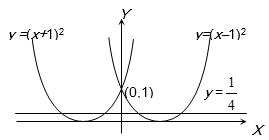
The area bounded by the curves $y = (x + 1)^2$,$y = (x - 1)^2$ and the line $y = \frac{1}{4}$ is
A
$1/6$
B
$2/3$
C
$1/4$
D
$1/3$
Solution
(D) The curves are $y = (x + 1)^2$ and $y = (x - 1)^2$. The line is $y = \frac{1}{4}$.
By symmetry,the area is twice the area bounded by $y = (x - 1)^2$,the $y$-axis $(x=0)$,and the line $y = \frac{1}{4}$ in the region $x \ge 0$.
For $y = (x - 1)^2$,we have $x - 1 = \pm \sqrt{y}$,so $x = 1 \pm \sqrt{y}$. Since we are considering the right branch,$x = 1 - \sqrt{y}$ for $x \in [0, 1]$.
The intersection of $y = (x - 1)^2$ and $y = \frac{1}{4}$ gives $(x - 1)^2 = \frac{1}{4}$,so $x - 1 = -1/2$ (as $x < 1$),which means $x = 1/2$.
The area $A = 2 \int_{1/4}^{1} (1 - \sqrt{y}) dy$ is incorrect based on the graph. The correct integral for the region bounded by $y = (x - 1)^2$,$x=0$,and $y=1/4$ is $\int_{0}^{1/2} (1/4 - (x-1)^2) dx + \int_{1/2}^{1} (1/4 - 0) dx$ is not right.
Let's use horizontal strips: The area is $2 \int_{1/4}^{1} (1 - \sqrt{y}) dy = 2 [y - \frac{2}{3} y^{3/2}]_{1/4}^{1} = 2 [(1 - 2/3) - (1/4 - \frac{2}{3} \cdot \frac{1}{8})] = 2 [1/3 - (1/4 - 1/12)] = 2 [1/3 - 2/12] = 2 [1/3 - 1/6] = 2 [1/6] = 1/3$ sq. units.
By symmetry,the area is twice the area bounded by $y = (x - 1)^2$,the $y$-axis $(x=0)$,and the line $y = \frac{1}{4}$ in the region $x \ge 0$.
For $y = (x - 1)^2$,we have $x - 1 = \pm \sqrt{y}$,so $x = 1 \pm \sqrt{y}$. Since we are considering the right branch,$x = 1 - \sqrt{y}$ for $x \in [0, 1]$.
The intersection of $y = (x - 1)^2$ and $y = \frac{1}{4}$ gives $(x - 1)^2 = \frac{1}{4}$,so $x - 1 = -1/2$ (as $x < 1$),which means $x = 1/2$.
The area $A = 2 \int_{1/4}^{1} (1 - \sqrt{y}) dy$ is incorrect based on the graph. The correct integral for the region bounded by $y = (x - 1)^2$,$x=0$,and $y=1/4$ is $\int_{0}^{1/2} (1/4 - (x-1)^2) dx + \int_{1/2}^{1} (1/4 - 0) dx$ is not right.
Let's use horizontal strips: The area is $2 \int_{1/4}^{1} (1 - \sqrt{y}) dy = 2 [y - \frac{2}{3} y^{3/2}]_{1/4}^{1} = 2 [(1 - 2/3) - (1/4 - \frac{2}{3} \cdot \frac{1}{8})] = 2 [1/3 - (1/4 - 1/12)] = 2 [1/3 - 2/12] = 2 [1/3 - 1/6] = 2 [1/6] = 1/3$ sq. units.
0 likesView Solution
24
MathematicsDifficultMCQIIT JEE · 2005
If $xdy = y(dx + ydy), y > 0$ and $y(1) = 1,$ then $y(-3)$ is equal to
A
$1$
B
$3$
C
$5$
D
$-1$
Solution
(B) Given the differential equation $xdy = y(dx + ydy)$.
Dividing both sides by $y^2$,we get $\frac{xdy - ydx}{y^2} = dy$.
This can be written as $-d(\frac{x}{y}) = dy$.
Integrating both sides,we get $-\frac{x}{y} = y + C$,which simplifies to $\frac{x}{y} + y = C$.
Given $y(1) = 1$,substituting $x=1$ and $y=1$ gives $\frac{1}{1} + 1 = C$,so $C = 2$.
The equation becomes $\frac{x}{y} + y = 2$,or $x + y^2 = 2y$,which is $y^2 - 2y + x = 0$.
For $x = -3$,the equation is $y^2 - 2y - 3 = 0$.
Factoring the quadratic,we get $(y - 3)(y + 1) = 0$.
Thus,$y = 3$ or $y = -1$.
Since the condition $y > 0$ is given,we have $y = 3$.
Dividing both sides by $y^2$,we get $\frac{xdy - ydx}{y^2} = dy$.
This can be written as $-d(\frac{x}{y}) = dy$.
Integrating both sides,we get $-\frac{x}{y} = y + C$,which simplifies to $\frac{x}{y} + y = C$.
Given $y(1) = 1$,substituting $x=1$ and $y=1$ gives $\frac{1}{1} + 1 = C$,so $C = 2$.
The equation becomes $\frac{x}{y} + y = 2$,or $x + y^2 = 2y$,which is $y^2 - 2y + x = 0$.
For $x = -3$,the equation is $y^2 - 2y - 3 = 0$.
Factoring the quadratic,we get $(y - 3)(y + 1) = 0$.
Thus,$y = 3$ or $y = -1$.
Since the condition $y > 0$ is given,we have $y = 3$.
0 likesView Solution
25
MathematicsDifficultMCQIIT JEE · 2005
$(x^2 + y^2)dy = xy dx$. If $y(x_0) = e$ and $y(1) = 1$,then the value of $x_0$ is:
A
$\sqrt{3}e$
B
$\sqrt{e^2 - \frac{1}{2}}$
C
$\sqrt{\frac{e^2 - 1}{2}}$
D
$\sqrt{\frac{e^2 + 1}{2}}$
Solution
(A) Given the differential equation $(x^2 + y^2)dy = xy dx$.
Rearranging the terms,we get $x^2 dy + y^2 dy = xy dx$.
$x^2 dy - xy dx = -y^2 dy$.
Dividing by $xy^2$,we get $\frac{x dy - y dx}{y^2} = -\frac{dy}{x}$.
This is equivalent to $d(\frac{x}{y}) = -\frac{dy}{x}$ (Note: The standard form is $x dy - y dx = x^2 d(\frac{y}{x})$ or $y dx - x dy = y^2 d(\frac{x}{y})$).
Let us rewrite: $x^2 dy = xy dx - y^2 dy = y(x dx - y dy)$ is not correct. Let's use substitution $y = vx$,$dy = v dx + x dv$.
$(x^2 + v^2 x^2)(v dx + x dv) = x(vx) dx$.
$x^2(1 + v^2)(v dx + x dv) = vx^2 dx$.
$(1 + v^2)(v dx + x dv) = v dx$.
$v dx + x dv + v^3 dx + v^2 x dv = v dx$.
$x dv(1 + v^2) = -v^3 dx$.
$\frac{1 + v^2}{v^3} dv = -\frac{dx}{x}$.
Integrating both sides: $\int (v^{-3} + v^{-1}) dv = -\int \frac{dx}{x}$.
$-\frac{1}{2v^2} + \ln|v| = -\ln|x| + C$.
$-\frac{x^2}{2y^2} + \ln|\frac{y}{x}| = -\ln|x| + C$.
$-\frac{x^2}{2y^2} + \ln|y| - \ln|x| = -\ln|x| + C$.
$-\frac{x^2}{2y^2} + \ln|y| = C$.
Given $y(1) = 1$,so $-\frac{1^2}{2(1)^2} + \ln(1) = C \implies C = -\frac{1}{2}$.
So,$-\frac{x^2}{2y^2} + \ln|y| = -\frac{1}{2}$.
For $y(x_0) = e$,$-\frac{x_0^2}{2e^2} + \ln(e) = -\frac{1}{2}$.
$-\frac{x_0^2}{2e^2} + 1 = -\frac{1}{2}$.
$-\frac{x_0^2}{2e^2} = -\frac{3}{2}$.
$x_0^2 = 3e^2 \implies x_0 = \sqrt{3}e$.
Rearranging the terms,we get $x^2 dy + y^2 dy = xy dx$.
$x^2 dy - xy dx = -y^2 dy$.
Dividing by $xy^2$,we get $\frac{x dy - y dx}{y^2} = -\frac{dy}{x}$.
This is equivalent to $d(\frac{x}{y}) = -\frac{dy}{x}$ (Note: The standard form is $x dy - y dx = x^2 d(\frac{y}{x})$ or $y dx - x dy = y^2 d(\frac{x}{y})$).
Let us rewrite: $x^2 dy = xy dx - y^2 dy = y(x dx - y dy)$ is not correct. Let's use substitution $y = vx$,$dy = v dx + x dv$.
$(x^2 + v^2 x^2)(v dx + x dv) = x(vx) dx$.
$x^2(1 + v^2)(v dx + x dv) = vx^2 dx$.
$(1 + v^2)(v dx + x dv) = v dx$.
$v dx + x dv + v^3 dx + v^2 x dv = v dx$.
$x dv(1 + v^2) = -v^3 dx$.
$\frac{1 + v^2}{v^3} dv = -\frac{dx}{x}$.
Integrating both sides: $\int (v^{-3} + v^{-1}) dv = -\int \frac{dx}{x}$.
$-\frac{1}{2v^2} + \ln|v| = -\ln|x| + C$.
$-\frac{x^2}{2y^2} + \ln|\frac{y}{x}| = -\ln|x| + C$.
$-\frac{x^2}{2y^2} + \ln|y| - \ln|x| = -\ln|x| + C$.
$-\frac{x^2}{2y^2} + \ln|y| = C$.
Given $y(1) = 1$,so $-\frac{1^2}{2(1)^2} + \ln(1) = C \implies C = -\frac{1}{2}$.
So,$-\frac{x^2}{2y^2} + \ln|y| = -\frac{1}{2}$.
For $y(x_0) = e$,$-\frac{x_0^2}{2e^2} + \ln(e) = -\frac{1}{2}$.
$-\frac{x_0^2}{2e^2} + 1 = -\frac{1}{2}$.
$-\frac{x_0^2}{2e^2} = -\frac{3}{2}$.
$x_0^2 = 3e^2 \implies x_0 = \sqrt{3}e$.
0 likesView Solution
26
MathematicsDifficultMCQIIT JEE · 2005
If $y \cos x + x \cos y = \pi$,then $y''(0)$ is
A
$1$
B
$\pi$
C
$0$
D
$-\pi$
Solution
(B) Given the equation: $y \cos x + x \cos y = \pi$.
At $x = 0$,we have $y \cos(0) + 0 \cos y = \pi$,which implies $y = \pi$.
Differentiating both sides with respect to $x$:
$-y \sin x + y' \cos x + \cos y - x \sin y \cdot y' = 0$.
At $x = 0$ and $y = \pi$:
$-(\pi) \sin(0) + y'(0) \cos(0) + \cos(\pi) - 0 \sin(\pi) \cdot y'(0) = 0$.
$0 + y'(0) \cdot 1 - 1 - 0 = 0 \implies y'(0) = 1$.
Now,differentiate the first derivative expression again:
$-y' \sin x - y \cos x + y'' \cos x - y' \sin x - \sin y \cdot y' - x(\cos y \cdot (y')^2 + \sin y \cdot y'') - \sin y \cdot y' = 0$.
Substitute $x = 0, y = \pi, y' = 1$:
$-1 \cdot 0 - \pi \cdot 1 + y''(0) \cdot 1 - 1 \cdot 0 - 0 - 0 - 0 = 0$.
$-\pi + y''(0) = 0 \implies y''(0) = \pi$.
At $x = 0$,we have $y \cos(0) + 0 \cos y = \pi$,which implies $y = \pi$.
Differentiating both sides with respect to $x$:
$-y \sin x + y' \cos x + \cos y - x \sin y \cdot y' = 0$.
At $x = 0$ and $y = \pi$:
$-(\pi) \sin(0) + y'(0) \cos(0) + \cos(\pi) - 0 \sin(\pi) \cdot y'(0) = 0$.
$0 + y'(0) \cdot 1 - 1 - 0 = 0 \implies y'(0) = 1$.
Now,differentiate the first derivative expression again:
$-y' \sin x - y \cos x + y'' \cos x - y' \sin x - \sin y \cdot y' - x(\cos y \cdot (y')^2 + \sin y \cdot y'') - \sin y \cdot y' = 0$.
Substitute $x = 0, y = \pi, y' = 1$:
$-1 \cdot 0 - \pi \cdot 1 + y''(0) \cdot 1 - 1 \cdot 0 - 0 - 0 - 0 = 0$.
$-\pi + y''(0) = 0 \implies y''(0) = \pi$.
0 likesView Solution
27
MathematicsDifficultMCQIIT JEE · 2005
In a throw of a dice,the probability of getting a $1$ in an even number of throws is:
A
$\frac{5}{36}$
B
$\frac{5}{11}$
C
$\frac{6}{11}$
D
$\frac{1}{6}$
Solution
(B) Let $p$ be the probability of getting a $1$ in a single throw,so $p = \frac{1}{6}$.
Let $q$ be the probability of not getting a $1$,so $q = 1 - \frac{1}{6} = \frac{5}{6}$.
We want to find the probability of getting a $1$ for the first time on an even throw (i.e.,$2^{nd}, 4^{th}, 6^{th}, \dots$ throw).
The probability is given by the sum of the infinite geometric series:
$P = qp + q^3p + q^5p + \dots$
This is a geometric series with first term $a = qp = \frac{5}{6} \times \frac{1}{6} = \frac{5}{36}$ and common ratio $r = q^2 = (\frac{5}{6})^2 = \frac{25}{36}$.
The sum of an infinite geometric series is $S = \frac{a}{1 - r}$.
$P = \frac{\frac{5}{36}}{1 - \frac{25}{36}} = \frac{\frac{5}{36}}{\frac{36 - 25}{36}} = \frac{5}{36} \times \frac{36}{11} = \frac{5}{11}$.
Let $q$ be the probability of not getting a $1$,so $q = 1 - \frac{1}{6} = \frac{5}{6}$.
We want to find the probability of getting a $1$ for the first time on an even throw (i.e.,$2^{nd}, 4^{th}, 6^{th}, \dots$ throw).
The probability is given by the sum of the infinite geometric series:
$P = qp + q^3p + q^5p + \dots$
This is a geometric series with first term $a = qp = \frac{5}{6} \times \frac{1}{6} = \frac{5}{36}$ and common ratio $r = q^2 = (\frac{5}{6})^2 = \frac{25}{36}$.
The sum of an infinite geometric series is $S = \frac{a}{1 - r}$.
$P = \frac{\frac{5}{36}}{1 - \frac{25}{36}} = \frac{\frac{5}{36}}{\frac{36 - 25}{36}} = \frac{5}{36} \times \frac{36}{11} = \frac{5}{11}$.
0 likesView Solution
28
MathematicsDifficultMCQIIT JEE · 2005
$A$ plane is at a unit distance from the origin. It cuts the coordinate axes at $P, Q,$ and $R$ respectively. If the locus of the centroid of the $\Delta PQR$ is $\frac{1}{x^2} + \frac{1}{y^2} + \frac{1}{z^2} = k$,then $k =$
A
$3$
B
$9$
C
$2$
D
$1$
Solution
(B) Let the equation of the plane be $\frac{x}{a} + \frac{y}{b} + \frac{z}{c} = 1$.
Since the plane is at a unit distance from the origin $(0, 0, 0)$,the perpendicular distance $d$ is given by $d = \frac{|-1|}{\sqrt{\frac{1}{a^2} + \frac{1}{b^2} + \frac{1}{c^2}}} = 1$.
Squaring both sides,we get $\frac{1}{a^2} + \frac{1}{b^2} + \frac{1}{c^2} = 1$ ... $(i)$.
The coordinates of the points $P, Q,$ and $R$ are $(a, 0, 0), (0, b, 0),$ and $(0, 0, c)$ respectively.
The centroid $(x, y, z)$ of $\Delta PQR$ is given by $x = \frac{a+0+0}{3} = \frac{a}{3}$,$y = \frac{0+b+0}{3} = \frac{b}{3}$,and $z = \frac{0+0+c}{3} = \frac{c}{3}$.
Thus,$a = 3x, b = 3y, c = 3z$.
Substituting these into equation $(i)$,we get $\frac{1}{(3x)^2} + \frac{1}{(3y)^2} + \frac{1}{(3z)^2} = 1$.
This simplifies to $\frac{1}{9x^2} + \frac{1}{9y^2} + \frac{1}{9z^2} = 1$,which implies $\frac{1}{x^2} + \frac{1}{y^2} + \frac{1}{z^2} = 9$.
Comparing this with the given locus $\frac{1}{x^2} + \frac{1}{y^2} + \frac{1}{z^2} = k$,we find $k = 9$.
Since the plane is at a unit distance from the origin $(0, 0, 0)$,the perpendicular distance $d$ is given by $d = \frac{|-1|}{\sqrt{\frac{1}{a^2} + \frac{1}{b^2} + \frac{1}{c^2}}} = 1$.
Squaring both sides,we get $\frac{1}{a^2} + \frac{1}{b^2} + \frac{1}{c^2} = 1$ ... $(i)$.
The coordinates of the points $P, Q,$ and $R$ are $(a, 0, 0), (0, b, 0),$ and $(0, 0, c)$ respectively.
The centroid $(x, y, z)$ of $\Delta PQR$ is given by $x = \frac{a+0+0}{3} = \frac{a}{3}$,$y = \frac{0+b+0}{3} = \frac{b}{3}$,and $z = \frac{0+0+c}{3} = \frac{c}{3}$.
Thus,$a = 3x, b = 3y, c = 3z$.
Substituting these into equation $(i)$,we get $\frac{1}{(3x)^2} + \frac{1}{(3y)^2} + \frac{1}{(3z)^2} = 1$.
This simplifies to $\frac{1}{9x^2} + \frac{1}{9y^2} + \frac{1}{9z^2} = 1$,which implies $\frac{1}{x^2} + \frac{1}{y^2} + \frac{1}{z^2} = 9$.
Comparing this with the given locus $\frac{1}{x^2} + \frac{1}{y^2} + \frac{1}{z^2} = k$,we find $k = 9$.
0 likesView Solution
Vedclass Products
For Students
Vedclass Test Series
Mock tests in real IIT JEE style covering Mathematics with performance analysis. 5-day free trial.
Start Free TrialFor Teachers
Exam Paper Generator
Generate Set A/B/C/D Mathematics papers from 7.5L+ questions in 2 minutes. 3 chapters free.
Try FreeFor Institutes
Online Exam Module
Run live IIT JEE mock exams with unlimited students, 360° analytics & white-label branding.
See DemoFrequently Asked Questions
How many Mathematics questions are in IIT JEE 2005?
There are 28 Mathematics questions from the IIT JEE 2005 paper on Vedclass, each with a detailed step-by-step solution in English.
Are IIT JEE 2005 Mathematics solutions available in English?
Yes. All solutions on this page are in English. You can also switch to English or Hindi using the language buttons above the questions.
Can I practice IIT JEE 2005 Mathematics as a timed test?
Yes. Use the Vedclass Test Series to attempt a full IIT JEE mock test covering Mathematics with time limits and instant score analysis.
Can teachers create Mathematics papers from IIT JEE previous year questions?
Yes. The Vedclass Exam Paper Generator lets teachers mix IIT JEE Mathematics questions and generate Set A/B/C/D papers in minutes.
For Teachers & Institutes
Build a Custom Mathematics Paper
Pick IIT JEE 2005 Mathematics questions, set difficulty, and generate Set A/B/C/D in 2 minutes.