
MathematicsQ1–23 of 23 questions
Page 1 of 1 · English
1
MathematicsEasyMCQIIT JEE · 1996
Resolve the following expression into partial fractions: $\frac{x + 1}{(x - 1)(x - 2)(x - 3)}$
A
$\frac{1}{x - 1} + \frac{3}{x - 2} + \frac{1}{x - 3}$
B
$-\frac{3}{x - 1} + \frac{1}{x - 2} + \frac{2}{x - 3}$
C
$\frac{1}{x - 1} - \frac{3}{x - 2} + \frac{2}{x - 3}$
D
None of these
Solution
(C) Let $\frac{x + 1}{(x - 1)(x - 2)(x - 3)} = \frac{A}{x - 1} + \frac{B}{x - 2} + \frac{C}{x - 3}$.
Multiplying both sides by $(x - 1)(x - 2)(x - 3)$,we get:
$x + 1 = A(x - 2)(x - 3) + B(x - 1)(x - 3) + C(x - 1)(x - 2)$.
For $x = 1$: $1 + 1 = A(1 - 2)(1 - 3)$ $\Rightarrow 2 = A(-1)(-2)$ $\Rightarrow 2 = 2A$ $\Rightarrow A = 1$.
For $x = 2$: $2 + 1 = B(2 - 1)(2 - 3)$ $\Rightarrow 3 = B(1)(-1)$ $\Rightarrow 3 = -B$ $\Rightarrow B = -3$.
For $x = 3$: $3 + 1 = C(3 - 1)(3 - 2)$ $\Rightarrow 4 = C(2)(1)$ $\Rightarrow 4 = 2C$ $\Rightarrow C = 2$.
Therefore,the partial fraction decomposition is $\frac{1}{x - 1} - \frac{3}{x - 2} + \frac{2}{x - 3}$.
Multiplying both sides by $(x - 1)(x - 2)(x - 3)$,we get:
$x + 1 = A(x - 2)(x - 3) + B(x - 1)(x - 3) + C(x - 1)(x - 2)$.
For $x = 1$: $1 + 1 = A(1 - 2)(1 - 3)$ $\Rightarrow 2 = A(-1)(-2)$ $\Rightarrow 2 = 2A$ $\Rightarrow A = 1$.
For $x = 2$: $2 + 1 = B(2 - 1)(2 - 3)$ $\Rightarrow 3 = B(1)(-1)$ $\Rightarrow 3 = -B$ $\Rightarrow B = -3$.
For $x = 3$: $3 + 1 = C(3 - 1)(3 - 2)$ $\Rightarrow 4 = C(2)(1)$ $\Rightarrow 4 = 2C$ $\Rightarrow C = 2$.
Therefore,the partial fraction decomposition is $\frac{1}{x - 1} - \frac{3}{x - 2} + \frac{2}{x - 3}$.
0 likesView Solution
2
MathematicsDifficultMCQIIT JEE · 1996
For positive integers $n_1, n_2$, the value of the expression $(1 + i)^{n_1} + (1 + i^3)^{n_1} + (1 + i^5)^{n_2} + (1 + i^7)^{n_2}$, where $i = \sqrt{-1}$, is a real number if and only if:
A
$n_1 = n_2 + 1$
B
$n_1 = n_2 - 1$
C
$n_1 = n_2$
D
$n_1 > 0, n_2 > 0$
Solution
(D) Given the expression: $(1 + i)^{n_1} + (1 + i^3)^{n_1} + (1 + i^5)^{n_2} + (1 + i^7)^{n_2}$.
Since $i^3 = -i$, $i^5 = i$, and $i^7 = -i$, the expression becomes:
$(1 + i)^{n_1} + (1 - i)^{n_1} + (1 + i)^{n_2} + (1 - i)^{n_2}$.
Let $z = (1 + i)^{n} + (1 - i)^{n}$.
Using the polar form $1 + i = \sqrt{2} e^{i\pi/4}$ and $1 - i = \sqrt{2} e^{-i\pi/4}$, we get:
$z = (\sqrt{2})^n (e^{in\pi/4} + e^{-in\pi/4}) = 2^{n/2} \cdot 2 \cos(n\pi/4) = 2^{n/2+1} \cos(n\pi/4)$.
Since $2^{n/2+1} \cos(n\pi/4)$ is always a real number for any positive integer $n$, the sum of two such terms is also always real.
Therefore, the expression is a real number for all positive integers $n_1$ and $n_2$.
Since $i^3 = -i$, $i^5 = i$, and $i^7 = -i$, the expression becomes:
$(1 + i)^{n_1} + (1 - i)^{n_1} + (1 + i)^{n_2} + (1 - i)^{n_2}$.
Let $z = (1 + i)^{n} + (1 - i)^{n}$.
Using the polar form $1 + i = \sqrt{2} e^{i\pi/4}$ and $1 - i = \sqrt{2} e^{-i\pi/4}$, we get:
$z = (\sqrt{2})^n (e^{in\pi/4} + e^{-in\pi/4}) = 2^{n/2} \cdot 2 \cos(n\pi/4) = 2^{n/2+1} \cos(n\pi/4)$.
Since $2^{n/2+1} \cos(n\pi/4)$ is always a real number for any positive integer $n$, the sum of two such terms is also always real.
Therefore, the expression is a real number for all positive integers $n_1$ and $n_2$.
0 likesView Solution
3
MathematicsMediumMCQIIT JEE · 1996
The value of the expression $1.(2 - \omega )(2 - {\omega ^2}) + 2.(3 - \omega )(3 - {\omega ^2}) + ....... + (n - 1).(n - \omega )(n - {\omega ^2}),$ where $\omega$ is an imaginary cube root of unity,is
A
$\frac{1}{2}(n - 1)n({n^2} + 3n + 4)$
B
$\frac{1}{4}(n - 1)n({n^2} + 3n + 4)$
C
$\frac{1}{2}(n + 1)n({n^2} + 3n + 4)$
D
$\frac{1}{4}(n + 1)n({n^2} + 3n + 4)$
Solution
(B) The $r^{th}$ term of the given series is $T_r = r[(r + 1) - \omega][(r + 1) - \omega^2]$.
Since $1 + \omega + \omega^2 = 0$,we have $\omega + \omega^2 = -1$ and $\omega^3 = 1$.
$T_r = r[(r + 1)^2 - (\omega + \omega^2)(r + 1) + \omega^3] = r[(r + 1)^2 + (r + 1) + 1] = r[r^2 + 2r + 1 + r + 1 + 1] = r(r^2 + 3r + 3) = r^3 + 3r^2 + 3r$.
The sum of the series is $S = \sum_{r=1}^{n-1} (r^3 + 3r^2 + 3r)$.
$S = \sum_{r=1}^{n-1} r^3 + 3 \sum_{r=1}^{n-1} r^2 + 3 \sum_{r=1}^{n-1} r$.
$S = [\frac{(n-1)n}{2}]^2 + 3 \cdot \frac{(n-1)n(2n-2+1)}{6} + 3 \cdot \frac{(n-1)n}{2}$.
$S = \frac{(n-1)^2 n^2}{4} + \frac{(n-1)n(2n-1)}{2} + \frac{3(n-1)n}{2}$.
$S = \frac{(n-1)n}{4} [(n-1)n + 2(2n-1) + 6] = \frac{(n-1)n}{4} [n^2 - n + 4n - 2 + 6] = \frac{1}{4}(n-1)n(n^2 + 3n + 4)$.
Since $1 + \omega + \omega^2 = 0$,we have $\omega + \omega^2 = -1$ and $\omega^3 = 1$.
$T_r = r[(r + 1)^2 - (\omega + \omega^2)(r + 1) + \omega^3] = r[(r + 1)^2 + (r + 1) + 1] = r[r^2 + 2r + 1 + r + 1 + 1] = r(r^2 + 3r + 3) = r^3 + 3r^2 + 3r$.
The sum of the series is $S = \sum_{r=1}^{n-1} (r^3 + 3r^2 + 3r)$.
$S = \sum_{r=1}^{n-1} r^3 + 3 \sum_{r=1}^{n-1} r^2 + 3 \sum_{r=1}^{n-1} r$.
$S = [\frac{(n-1)n}{2}]^2 + 3 \cdot \frac{(n-1)n(2n-2+1)}{6} + 3 \cdot \frac{(n-1)n}{2}$.
$S = \frac{(n-1)^2 n^2}{4} + \frac{(n-1)n(2n-1)}{2} + \frac{3(n-1)n}{2}$.
$S = \frac{(n-1)n}{4} [(n-1)n + 2(2n-1) + 6] = \frac{(n-1)n}{4} [n^2 - n + 4n - 2 + 6] = \frac{1}{4}(n-1)n(n^2 + 3n + 4)$.
0 likesView Solution
4
MathematicsDifficultMCQIIT JEE · 1996
For any odd integer $n \ge 1$,${n^3} - {(n - 1)^3} + \dots + {( - 1)^{n - 1}}{1^3} = $
A
$\frac{1}{2}{(n - 1)^2}(2n - 1)$
B
$\frac{1}{4}{(n - 1)^2}(2n - 1)$
C
$\frac{1}{2}{(n + 1)^2}(2n - 1)$
D
$\frac{1}{4}{(n + 1)^2}(2n - 1)$
Solution
(D) Let $S = {n^3} - {(n - 1)^3} + {(n - 2)^3} - {(n - 3)^3} + \dots + {1^3}$.
Since $n$ is odd,the last term is ${1^3}$.
We can write $S = \sum_{k=1}^{n} k^3 - 2 \sum_{k=1}^{(n-1)/2} (2k)^3$.
Using the formula $\sum_{k=1}^{m} k^3 = \left[ \frac{m(m+1)}{2} \right]^2$,we get:
$S = \left[ \frac{n(n+1)}{2} \right]^2 - 2 \times 8 \sum_{k=1}^{(n-1)/2} k^3$
$S = \frac{n^2(n+1)^2}{4} - 16 \left[ \frac{\frac{n-1}{2} (\frac{n-1}{2} + 1)}{2} \right]^2$
$S = \frac{n^2(n+1)^2}{4} - 16 \left[ \frac{(n-1)(n+1)}{8} \right]^2$
$S = \frac{n^2(n+1)^2}{4} - 16 \frac{(n-1)^2(n+1)^2}{64}$
$S = \frac{n^2(n+1)^2}{4} - \frac{(n-1)^2(n+1)^2}{4}$
$S = \frac{(n+1)^2}{4} [n^2 - (n-1)^2]$
$S = \frac{(n+1)^2}{4} [n^2 - (n^2 - 2n + 1)]$
$S = \frac{(n+1)^2}{4} (2n - 1)$.
Since $n$ is odd,the last term is ${1^3}$.
We can write $S = \sum_{k=1}^{n} k^3 - 2 \sum_{k=1}^{(n-1)/2} (2k)^3$.
Using the formula $\sum_{k=1}^{m} k^3 = \left[ \frac{m(m+1)}{2} \right]^2$,we get:
$S = \left[ \frac{n(n+1)}{2} \right]^2 - 2 \times 8 \sum_{k=1}^{(n-1)/2} k^3$
$S = \frac{n^2(n+1)^2}{4} - 16 \left[ \frac{\frac{n-1}{2} (\frac{n-1}{2} + 1)}{2} \right]^2$
$S = \frac{n^2(n+1)^2}{4} - 16 \left[ \frac{(n-1)(n+1)}{8} \right]^2$
$S = \frac{n^2(n+1)^2}{4} - 16 \frac{(n-1)^2(n+1)^2}{64}$
$S = \frac{n^2(n+1)^2}{4} - \frac{(n-1)^2(n+1)^2}{4}$
$S = \frac{(n+1)^2}{4} [n^2 - (n-1)^2]$
$S = \frac{(n+1)^2}{4} [n^2 - (n^2 - 2n + 1)]$
$S = \frac{(n+1)^2}{4} (2n - 1)$.
0 likesView Solution
5
MathematicsEasyMCQIIT JEE · 1996
Let $P(n)$ denote the statement that $n^2 + n$ is odd. It is seen that $P(n) \Rightarrow P(n + 1)$. $P(n)$ is true for all:
A
$n > 1$
B
$n$
C
$n > 2$
D
None of these
Solution
(D) The statement $P(n)$ is $n^2 + n$ is odd.
We can write $n^2 + n = n(n + 1)$.
Since $n$ and $n + 1$ are consecutive integers,one of them must be even and the other must be odd.
The product of an even number and an odd number is always even.
Therefore,$n^2 + n$ is always even for all natural numbers $n$.
Since the statement claims $n^2 + n$ is odd,the statement $P(n)$ is false for all $n \in \mathbb{N}$.
Thus,there is no $n$ for which $P(n)$ is true.
Hence,the correct option is $(d)$.
We can write $n^2 + n = n(n + 1)$.
Since $n$ and $n + 1$ are consecutive integers,one of them must be even and the other must be odd.
The product of an even number and an odd number is always even.
Therefore,$n^2 + n$ is always even for all natural numbers $n$.
Since the statement claims $n^2 + n$ is odd,the statement $P(n)$ is false for all $n \in \mathbb{N}$.
Thus,there is no $n$ for which $P(n)$ is true.
Hence,the correct option is $(d)$.
0 likesView Solution
6
MathematicsMediumMCQIIT JEE · 1996
The general value of $\theta$ satisfying the equation $\tan^2 \theta + \sec 2\theta = 1$ is
A
$m\pi, n\pi + \frac{\pi}{3}$
B
$m\pi, n\pi \pm \frac{\pi}{3}$
C
$m\pi, n\pi \pm \frac{\pi}{6}$
D
None of these
Solution
(B) Given equation: $\tan^2 \theta + \sec 2\theta = 1$.
Using the identity $\sec 2\theta = \frac{1 + \tan^2 \theta}{1 - \tan^2 \theta}$,the equation becomes:
$\tan^2 \theta + \frac{1 + \tan^2 \theta}{1 - \tan^2 \theta} = 1$.
Let $x = \tan^2 \theta$. Then $x + \frac{1+x}{1-x} = 1$.
$x(1-x) + 1 + x = 1 - x$
$x - x^2 + 1 + x = 1 - x$
$3x - x^2 = 0 \Rightarrow x(3 - x) = 0$.
So,$\tan^2 \theta = 0$ or $\tan^2 \theta = 3$.
If $\tan^2 \theta = 0$,then $\tan \theta = 0 \Rightarrow \theta = m\pi$ for any integer $m$.
If $\tan^2 \theta = 3$,then $\tan \theta = \pm \sqrt{3} \Rightarrow \theta = n\pi \pm \frac{\pi}{3}$ for any integer $n$.
Thus,the general solution is $\theta = m\pi, n\pi \pm \frac{\pi}{3}$.
Using the identity $\sec 2\theta = \frac{1 + \tan^2 \theta}{1 - \tan^2 \theta}$,the equation becomes:
$\tan^2 \theta + \frac{1 + \tan^2 \theta}{1 - \tan^2 \theta} = 1$.
Let $x = \tan^2 \theta$. Then $x + \frac{1+x}{1-x} = 1$.
$x(1-x) + 1 + x = 1 - x$
$x - x^2 + 1 + x = 1 - x$
$3x - x^2 = 0 \Rightarrow x(3 - x) = 0$.
So,$\tan^2 \theta = 0$ or $\tan^2 \theta = 3$.
If $\tan^2 \theta = 0$,then $\tan \theta = 0 \Rightarrow \theta = m\pi$ for any integer $m$.
If $\tan^2 \theta = 3$,then $\tan \theta = \pm \sqrt{3} \Rightarrow \theta = n\pi \pm \frac{\pi}{3}$ for any integer $n$.
Thus,the general solution is $\theta = m\pi, n\pi \pm \frac{\pi}{3}$.
0 likesView Solution
7
MathematicsMediumMCQIIT JEE · 1996
In a triangle $ABC,$ $a:b:c = 4:5:6$. The ratio of the radius of the circumcircle to that of the incircle is
A
$\frac{16}{9}$
B
$\frac{16}{7}$
C
$\frac{11}{7}$
D
$\frac{7}{16}$
Solution
(B) Given $a:b:c = 4:5:6$. Let $a = 4k, b = 5k, c = 6k$.
Semi-perimeter $s = \frac{a+b+c}{2} = \frac{4k+5k+6k}{2} = \frac{15k}{2}$.
Area of triangle $\Delta = \sqrt{s(s-a)(s-b)(s-c)} = \sqrt{\frac{15k}{2}(\frac{15k}{2}-4k)(\frac{15k}{2}-5k)(\frac{15k}{2}-6k)} = \sqrt{\frac{15k}{2} \cdot \frac{7k}{2} \cdot \frac{5k}{2} \cdot \frac{3k}{2}} = \frac{15k^2\sqrt{7}}{4}$.
Circumradius $R = \frac{abc}{4\Delta} = \frac{(4k)(5k)(6k)}{4 \cdot \frac{15k^2\sqrt{7}}{4}} = \frac{120k^3}{15k^2\sqrt{7}} = \frac{8k}{\sqrt{7}}$.
Inradius $r = \frac{\Delta}{s} = \frac{15k^2\sqrt{7}/4}{15k/2} = \frac{k\sqrt{7}}{2}$.
Ratio $\frac{R}{r} = \frac{8k/\sqrt{7}}{k\sqrt{7}/2} = \frac{8}{\sqrt{7}} \cdot \frac{2}{\sqrt{7}} = \frac{16}{7}$.
Semi-perimeter $s = \frac{a+b+c}{2} = \frac{4k+5k+6k}{2} = \frac{15k}{2}$.
Area of triangle $\Delta = \sqrt{s(s-a)(s-b)(s-c)} = \sqrt{\frac{15k}{2}(\frac{15k}{2}-4k)(\frac{15k}{2}-5k)(\frac{15k}{2}-6k)} = \sqrt{\frac{15k}{2} \cdot \frac{7k}{2} \cdot \frac{5k}{2} \cdot \frac{3k}{2}} = \frac{15k^2\sqrt{7}}{4}$.
Circumradius $R = \frac{abc}{4\Delta} = \frac{(4k)(5k)(6k)}{4 \cdot \frac{15k^2\sqrt{7}}{4}} = \frac{120k^3}{15k^2\sqrt{7}} = \frac{8k}{\sqrt{7}}$.
Inradius $r = \frac{\Delta}{s} = \frac{15k^2\sqrt{7}/4}{15k/2} = \frac{k\sqrt{7}}{2}$.
Ratio $\frac{R}{r} = \frac{8k/\sqrt{7}}{k\sqrt{7}/2} = \frac{8}{\sqrt{7}} \cdot \frac{2}{\sqrt{7}} = \frac{16}{7}$.
0 likesView Solution
8
MathematicsDifficultMCQIIT JEE · 1996
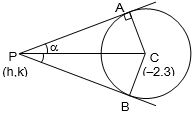
The angle between a pair of tangents drawn from a point $P$ to the circle ${x^2} + {y^2} + 4x - 6y + 9{\sin ^2}\alpha + 13{\cos ^2}\alpha = 0$ is $2\alpha$. The equation of the locus of the point $P$ is
A
${x^2} + {y^2} + 4x - 6y + 4 = 0$
B
${x^2} + {y^2} + 4x - 6y - 9 = 0$
C
${x^2} + {y^2} + 4x - 6y - 4 = 0$
D
${x^2} + {y^2} + 4x - 6y + 9 = 0$
Solution
(D) The equation of the circle is ${x^2} + {y^2} + 4x - 6y + 9{\sin ^2}\alpha + 13{\cos ^2}\alpha = 0$.
Comparing with ${x^2} + {y^2} + 2gx + 2fy + c = 0$,we have $g = 2, f = -3, c = 9{\sin ^2}\alpha + 13{\cos ^2}\alpha$.
The centre is $C(-g, -f) = (-2, 3)$.
The radius $r = \sqrt{g^2 + f^2 - c} = \sqrt{4 + 9 - (9{\sin ^2}\alpha + 13{\cos ^2}\alpha)} = \sqrt{13 - 9{\sin ^2}\alpha - 13{\cos ^2}\alpha} = \sqrt{13(1 - {\cos ^2}\alpha) - 9{\sin ^2}\alpha} = \sqrt{13{\sin ^2}\alpha - 9{\sin ^2}\alpha} = \sqrt{4{\sin ^2}\alpha} = 2\sin \alpha$.
Let $P(h, k)$ be a point on the locus. The angle between the tangents is $2\alpha$,so $\angle APC = \alpha$.
In the right-angled triangle $\triangle PAC$,$\sin \alpha = \frac{AC}{PC} = \frac{r}{PC} = \frac{2\sin \alpha}{\sqrt{(h + 2)^2 + (k - 3)^2}}$.
Thus,$\sqrt{(h + 2)^2 + (k - 3)^2} = 2$.
Squaring both sides,$(h + 2)^2 + (k - 3)^2 = 4$.
Expanding,$h^2 + 4h + 4 + k^2 - 6k + 9 = 4$,which simplifies to $h^2 + k^2 + 4h - 6k + 9 = 0$.
Replacing $(h, k)$ with $(x, y)$,the locus is ${x^2} + {y^2} + 4x - 6y + 9 = 0$.
Comparing with ${x^2} + {y^2} + 2gx + 2fy + c = 0$,we have $g = 2, f = -3, c = 9{\sin ^2}\alpha + 13{\cos ^2}\alpha$.
The centre is $C(-g, -f) = (-2, 3)$.
The radius $r = \sqrt{g^2 + f^2 - c} = \sqrt{4 + 9 - (9{\sin ^2}\alpha + 13{\cos ^2}\alpha)} = \sqrt{13 - 9{\sin ^2}\alpha - 13{\cos ^2}\alpha} = \sqrt{13(1 - {\cos ^2}\alpha) - 9{\sin ^2}\alpha} = \sqrt{13{\sin ^2}\alpha - 9{\sin ^2}\alpha} = \sqrt{4{\sin ^2}\alpha} = 2\sin \alpha$.
Let $P(h, k)$ be a point on the locus. The angle between the tangents is $2\alpha$,so $\angle APC = \alpha$.
In the right-angled triangle $\triangle PAC$,$\sin \alpha = \frac{AC}{PC} = \frac{r}{PC} = \frac{2\sin \alpha}{\sqrt{(h + 2)^2 + (k - 3)^2}}$.
Thus,$\sqrt{(h + 2)^2 + (k - 3)^2} = 2$.
Squaring both sides,$(h + 2)^2 + (k - 3)^2 = 4$.
Expanding,$h^2 + 4h + 4 + k^2 - 6k + 9 = 4$,which simplifies to $h^2 + k^2 + 4h - 6k + 9 = 0$.
Replacing $(h, k)$ with $(x, y)$,the locus is ${x^2} + {y^2} + 4x - 6y + 9 = 0$.
0 likesView Solution
9
MathematicsDifficultMCQIIT JEE · 1996
The intercept on the line $y = x$ by the circle $x^2 + y^2 - 2x = 0$ is $AB$. The equation of the circle with $AB$ as a diameter is:
A
$x^2 + y^2 - x - y = 0$
B
$x^2 + y^2 - 2x - y = 0$
C
$x^2 + y^2 - x + y = 0$
D
$x^2 + y^2 + x - y = 0$
Solution
(A) The equation of any circle passing through the intersection of the circle $x^2 + y^2 - 2x = 0$ and the line $y - x = 0$ is given by the family of circles equation:
$x^2 + y^2 - 2x + \lambda(y - x) = 0$
$x^2 + y^2 - (2 + \lambda)x + \lambda y = 0$
The center of this circle is $\left( \frac{2 + \lambda}{2}, -\frac{\lambda}{2} \right)$.
Since $AB$ is the diameter,the center of the circle must lie on the line $y = x$.
Substituting the center coordinates into $y = x$:
$-\frac{\lambda}{2} = \frac{2 + \lambda}{2}
-\lambda = 2 + \lambda
2\lambda = -2
\lambda = -1$
Substituting $\lambda = -1$ back into the family equation:
$x^2 + y^2 - (2 - 1)x - 1y = 0$
$x^2 + y^2 - x - y = 0$.
$x^2 + y^2 - 2x + \lambda(y - x) = 0$
$x^2 + y^2 - (2 + \lambda)x + \lambda y = 0$
The center of this circle is $\left( \frac{2 + \lambda}{2}, -\frac{\lambda}{2} \right)$.
Since $AB$ is the diameter,the center of the circle must lie on the line $y = x$.
Substituting the center coordinates into $y = x$:
$-\frac{\lambda}{2} = \frac{2 + \lambda}{2}
-\lambda = 2 + \lambda
2\lambda = -2
\lambda = -1$
Substituting $\lambda = -1$ back into the family equation:
$x^2 + y^2 - (2 - 1)x - 1y = 0$
$x^2 + y^2 - x - y = 0$.
0 likesView Solution
10
MathematicsDifficultMCQIIT JEE · 1996
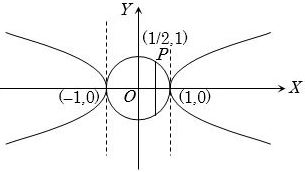
An ellipse has eccentricity $\frac{1}{2}$ and one focus at the point $P\left( \frac{1}{2}, 1 \right)$. Its one directrix is the common tangent nearer to the point $P$, to the circle $x^2 + y^2 = 1$ and the hyperbola $x^2 - y^2 = 1$. The equation of the ellipse in the standard form is:
A
$\frac{(x - 1/3)^2}{1/9} + \frac{(y - 1)^2}{1/12} = 1$
B
$\frac{(x - 1/3)^2}{1/9} + \frac{(y + 1)^2}{1/12} = 1$
C
$\frac{(x - 1/3)^2}{1/9} - \frac{(y - 1)^2}{1/12} = 1$
D
$\frac{(x - 1/3)^2}{1/9} - \frac{(y + 1)^2}{1/12} = 1$
Solution
(A) The common tangents to the circle $x^2 + y^2 = 1$ and the hyperbola $x^2 - y^2 = 1$ are $x = 1$ and $x = -1$.
Out of these, $x = 1$ is nearer to the point $P\left( \frac{1}{2}, 1 \right)$.
Thus, the directrix of the required ellipse is $x = 1$.
Let $Q(x, y)$ be any point on the ellipse.
By the definition of an ellipse, the distance from the focus $P$ is $QP = e \times (\text{distance from directrix})$.
$QP = \sqrt{(x - 1/2)^2 + (y - 1)^2}$ and the distance from the directrix $x = 1$ is $|x - 1|$.
Given $e = 1/2$, we have $\sqrt{(x - 1/2)^2 + (y - 1)^2} = \frac{1}{2} |x - 1|$.
Squaring both sides: $(x - 1/2)^2 + (y - 1)^2 = \frac{1}{4}(x - 1)^2$.
$x^2 - x + 1/4 + (y - 1)^2 = \frac{1}{4}(x^2 - 2x + 1)$.
$x^2 - x + 1/4 + (y - 1)^2 = \frac{1}{4}x^2 - \frac{1}{2}x + 1/4$.
$\frac{3}{4}x^2 - \frac{1}{2}x + (y - 1)^2 = 0$.
Multiply by $4/3$: $x^2 - \frac{2}{3}x + \frac{4}{3}(y - 1)^2 = 0$.
$(x^2 - \frac{2}{3}x + 1/9) + \frac{4}{3}(y - 1)^2 = 1/9$.
$(x - 1/3)^2 + \frac{4}{3}(y - 1)^2 = 1/9$.
Dividing by $1/9$: $\frac{(x - 1/3)^2}{1/9} + \frac{(y - 1)^2}{1/12} = 1$.
Out of these, $x = 1$ is nearer to the point $P\left( \frac{1}{2}, 1 \right)$.
Thus, the directrix of the required ellipse is $x = 1$.
Let $Q(x, y)$ be any point on the ellipse.
By the definition of an ellipse, the distance from the focus $P$ is $QP = e \times (\text{distance from directrix})$.
$QP = \sqrt{(x - 1/2)^2 + (y - 1)^2}$ and the distance from the directrix $x = 1$ is $|x - 1|$.
Given $e = 1/2$, we have $\sqrt{(x - 1/2)^2 + (y - 1)^2} = \frac{1}{2} |x - 1|$.
Squaring both sides: $(x - 1/2)^2 + (y - 1)^2 = \frac{1}{4}(x - 1)^2$.
$x^2 - x + 1/4 + (y - 1)^2 = \frac{1}{4}(x^2 - 2x + 1)$.
$x^2 - x + 1/4 + (y - 1)^2 = \frac{1}{4}x^2 - \frac{1}{2}x + 1/4$.
$\frac{3}{4}x^2 - \frac{1}{2}x + (y - 1)^2 = 0$.
Multiply by $4/3$: $x^2 - \frac{2}{3}x + \frac{4}{3}(y - 1)^2 = 0$.
$(x^2 - \frac{2}{3}x + 1/9) + \frac{4}{3}(y - 1)^2 = 1/9$.
$(x - 1/3)^2 + \frac{4}{3}(y - 1)^2 = 1/9$.
Dividing by $1/9$: $\frac{(x - 1/3)^2}{1/9} + \frac{(y - 1)^2}{1/12} = 1$.
0 likesView Solution
11
MathematicsMediumMCQIIT JEE · 1996
$\mathop {\lim }\limits_{x \to 0} {\left( {\frac{{1 + 5{x^2}}}{{1 + 3{x^2}}}} \right)^{1/{x^2}}} = $
A
$e^2$
B
$e$
C
$e^{-2}$
D
$e^{-1}$
Solution
(A) We use the standard limit formula: $\mathop {\lim }\limits_{x \to 0} (1 + f(x))^{1/g(x)} = e^{\mathop {\lim }\limits_{x \to 0} \frac{f(x)}{g(x)}}$.
Given the expression $\mathop {\lim }\limits_{x \to 0} {\left( {\frac{{1 + 5{x^2}}}{{1 + 3{x^2}}}} \right)^{1/{x^2}}}$,we can rewrite the base as $1 + \left( \frac{1 + 5x^2}{1 + 3x^2} - 1 \right) = 1 + \frac{2x^2}{1 + 3x^2}$.
Thus,the limit becomes $e^{\mathop {\lim }\limits_{x \to 0} \frac{1}{x^2} \cdot \frac{2x^2}{1 + 3x^2}}$.
Simplifying the exponent: $\mathop {\lim }\limits_{x \to 0} \frac{2}{1 + 3x^2} = \frac{2}{1 + 0} = 2$.
Therefore,the result is $e^2$.
Given the expression $\mathop {\lim }\limits_{x \to 0} {\left( {\frac{{1 + 5{x^2}}}{{1 + 3{x^2}}}} \right)^{1/{x^2}}}$,we can rewrite the base as $1 + \left( \frac{1 + 5x^2}{1 + 3x^2} - 1 \right) = 1 + \frac{2x^2}{1 + 3x^2}$.
Thus,the limit becomes $e^{\mathop {\lim }\limits_{x \to 0} \frac{1}{x^2} \cdot \frac{2x^2}{1 + 3x^2}}$.
Simplifying the exponent: $\mathop {\lim }\limits_{x \to 0} \frac{2}{1 + 3x^2} = \frac{2}{1 + 0} = 2$.
Therefore,the result is $e^2$.
0 likesView Solution
12
MathematicsAdvancedMCQIIT JEE · 1996
Let $n$ and $k$ be positive integers such that $n \ge \frac{k(k + 1)}{2}$. The number of solutions $(x_1, x_2, ..., x_k)$ where $x_1 \ge 1, x_2 \ge 2, ..., x_k \ge k$ are all integers,satisfying $x_1 + x_2 + ... + x_k = n$,is
A
$^mC_{k-1}$
B
$^mC_{k+1}$
C
$^mC_k$
D
None of these (where $m = \frac{1}{2}(2n - k^2 + k - 2)$)
Solution
(A) The number of solutions to $x_1 + x_2 + ... + x_k = n$ with $x_i \ge i$ is the coefficient of $t^n$ in the product $(t^1 + t^2 + ...) (t^2 + t^3 + ...) ... (t^k + t^{k+1} + ...)$.
This is the coefficient of $t^n$ in $t^{1+2+...+k} (1 + t + t^2 + ...)^k$.
Let $r = 1 + 2 + ... + k = \frac{k(k+1)}{2}$.
The expression becomes the coefficient of $t^{n-r}$ in $(1-t)^{-k}$.
Using the binomial expansion $(1-t)^{-k} = \sum_{j=0}^{\infty} \binom{k+j-1}{k-1} t^j$,the coefficient of $t^{n-r}$ is $\binom{k+(n-r)-1}{k-1}$.
Let $m = k + n - r - 1 = k + n - \frac{k(k+1)}{2} - 1 = \frac{2k + 2n - k^2 - k - 2}{2} = \frac{2n - k^2 + k - 2}{2}$.
Thus,the number of solutions is $\binom{m}{k-1}$.
This is the coefficient of $t^n$ in $t^{1+2+...+k} (1 + t + t^2 + ...)^k$.
Let $r = 1 + 2 + ... + k = \frac{k(k+1)}{2}$.
The expression becomes the coefficient of $t^{n-r}$ in $(1-t)^{-k}$.
Using the binomial expansion $(1-t)^{-k} = \sum_{j=0}^{\infty} \binom{k+j-1}{k-1} t^j$,the coefficient of $t^{n-r}$ is $\binom{k+(n-r)-1}{k-1}$.
Let $m = k + n - r - 1 = k + n - \frac{k(k+1)}{2} - 1 = \frac{2k + 2n - k^2 - k - 2}{2} = \frac{2n - k^2 + k - 2}{2}$.
Thus,the number of solutions is $\binom{m}{k-1}$.
0 likesView Solution
13
MathematicsDifficultMCQIIT JEE · 1996
Resolve $\frac{x + 1}{(x - 1)(x - 2)(x - 3)}$ into partial fractions.
A
$\frac{1}{x - 1} + \frac{3}{x - 2} + \frac{1}{x - 3}$
B
$-\frac{1}{x - 1} + \frac{3}{x - 2} - \frac{2}{x - 3}$
C
$\frac{1}{x - 1} - \frac{3}{x - 2} + \frac{2}{x - 3}$
D
None of these
Solution
(C) Let $\frac{x + 1}{(x - 1)(x - 2)(x - 3)} = \frac{A}{x - 1} + \frac{B}{x - 2} + \frac{C}{x - 3}$.
Multiplying both sides by $(x - 1)(x - 2)(x - 3)$,we get:
$x + 1 = A(x - 2)(x - 3) + B(x - 1)(x - 3) + C(x - 1)(x - 2)$.
For $x = 1$: $1 + 1 = A(1 - 2)(1 - 3) \implies 2 = A(-1)(-2) \implies 2 = 2A \implies A = 1$.
For $x = 2$: $2 + 1 = B(2 - 1)(2 - 3) \implies 3 = B(1)(-1) \implies 3 = -B \implies B = -3$.
For $x = 3$: $3 + 1 = C(3 - 1)(3 - 2) \implies 4 = C(2)(1) \implies 4 = 2C \implies C = 2$.
Thus,the partial fraction is $\frac{1}{x - 1} - \frac{3}{x - 2} + \frac{2}{x - 3}$.
Multiplying both sides by $(x - 1)(x - 2)(x - 3)$,we get:
$x + 1 = A(x - 2)(x - 3) + B(x - 1)(x - 3) + C(x - 1)(x - 2)$.
For $x = 1$: $1 + 1 = A(1 - 2)(1 - 3) \implies 2 = A(-1)(-2) \implies 2 = 2A \implies A = 1$.
For $x = 2$: $2 + 1 = B(2 - 1)(2 - 3) \implies 3 = B(1)(-1) \implies 3 = -B \implies B = -3$.
For $x = 3$: $3 + 1 = C(3 - 1)(3 - 2) \implies 4 = C(2)(1) \implies 4 = 2C \implies C = 2$.
Thus,the partial fraction is $\frac{1}{x - 1} - \frac{3}{x - 2} + \frac{2}{x - 3}$.
0 likesView Solution
14
MathematicsDifficultMCQIIT JEE · 1996
If $b$ and $c$ are any two non-collinear unit vectors and $a$ is any vector,then $(a \cdot b)b + (a \cdot c)c + \frac{a \cdot (b \times c)}{|b \times c|} (b \times c) = $
A
$a$
B
$b$
C
$c$
D
$0$
Solution
(A) Let $b$ and $c$ be two non-collinear unit vectors. Since they are non-collinear,$b, c,$ and $k = \frac{b \times c}{|b \times c|}$ form an orthonormal basis for the space $\mathbb{R}^3$.
Any vector $a$ can be expressed as a linear combination of these basis vectors:
$a = (a \cdot b)b + (a \cdot c)c + (a \cdot k)k$
Substituting $k = \frac{b \times c}{|b \times c|}$ into the expression,we get:
$a = (a \cdot b)b + (a \cdot c)c + \left(a \cdot \frac{b \times c}{|b \times c|}\right) \frac{b \times c}{|b \times c|}$
However,the term in the question is $\frac{a \cdot (b \times c)}{|b \times c|} (b \times c)$.
Note that $\frac{a \cdot (b \times c)}{|b \times c|} (b \times c) = (a \cdot k) (|b \times c| k) = (a \cdot k) (\sin \alpha) k$,where $\alpha$ is the angle between $b$ and $c$.
Since $|b \times c| = \sin \alpha$,the expression simplifies to:
$(a \cdot b)b + (a \cdot c)c + (a \cdot k)k = a$.
Any vector $a$ can be expressed as a linear combination of these basis vectors:
$a = (a \cdot b)b + (a \cdot c)c + (a \cdot k)k$
Substituting $k = \frac{b \times c}{|b \times c|}$ into the expression,we get:
$a = (a \cdot b)b + (a \cdot c)c + \left(a \cdot \frac{b \times c}{|b \times c|}\right) \frac{b \times c}{|b \times c|}$
However,the term in the question is $\frac{a \cdot (b \times c)}{|b \times c|} (b \times c)$.
Note that $\frac{a \cdot (b \times c)}{|b \times c|} (b \times c) = (a \cdot k) (|b \times c| k) = (a \cdot k) (\sin \alpha) k$,where $\alpha$ is the angle between $b$ and $c$.
Since $|b \times c| = \sin \alpha$,the expression simplifies to:
$(a \cdot b)b + (a \cdot c)c + (a \cdot k)k = a$.
0 likesView Solution
15
MathematicsDifficultMCQIIT JEE · 1996
If $f$ is an even function defined on the interval $(-5, 5),$ then four real values of $x$ satisfying the equation $f(x) = f\left( \frac{x + 1}{x + 2} \right)$ are
A
$\frac{-3 - \sqrt{5}}{2}, \frac{-3 + \sqrt{5}}{2}, \frac{3 - \sqrt{5}}{2}, \frac{3 + \sqrt{5}}{2}$
B
$\frac{-5 + \sqrt{3}}{2}, \frac{-3 + \sqrt{5}}{2}, \frac{3 + \sqrt{5}}{2}, \frac{3 - \sqrt{5}}{2}$
C
$\frac{3 - \sqrt{5}}{2}, \frac{3 + \sqrt{5}}{2}, \frac{-3 - \sqrt{5}}{2}, \frac{5 + \sqrt{3}}{2}$
D
$-3 - \sqrt{5}, -3 + \sqrt{5}, 3 - \sqrt{5}, 3 + \sqrt{5}$
Solution
(A) Since $f$ is an even function,$f(-x) = f(x)$ for all $x \in (-5, 5).$
Given $f(x) = f\left( \frac{x + 1}{x + 2} \right).$
Since $f(x) = f(-x)$,the equation $f(x) = f\left( \frac{x + 1}{x + 2} \right)$ is satisfied if $x = \frac{x + 1}{x + 2}$ or if $-x = \frac{x + 1}{x + 2}.$
Case $1$: $x = \frac{x + 1}{x + 2} \Rightarrow x^2 + 2x = x + 1 \Rightarrow x^2 + x - 1 = 0.$
Using the quadratic formula,$x = \frac{-1 \pm \sqrt{1 - 4(1)(-1)}}{2} = \frac{-1 \pm \sqrt{5}}{2}.$
Case $2$: $-x = \frac{x + 1}{x + 2} \Rightarrow -x^2 - 2x = x + 1 \Rightarrow x^2 + 3x + 1 = 0.$
Using the quadratic formula,$x = \frac{-3 \pm \sqrt{9 - 4(1)(1)}}{2} = \frac{-3 \pm \sqrt{5}}{2}.$
Thus,the four values are $\frac{-1 \pm \sqrt{5}}{2}$ and $\frac{-3 \pm \sqrt{5}}{2}.$ Note: The provided options suggest the intended roots are $\frac{3 \pm \sqrt{5}}{2}$ and $\frac{-3 \pm \sqrt{5}}{2}$ based on the equation $f(x) = f\left( \frac{-x+1}{-x+2} \right)$ logic.
Given $f(x) = f\left( \frac{x + 1}{x + 2} \right).$
Since $f(x) = f(-x)$,the equation $f(x) = f\left( \frac{x + 1}{x + 2} \right)$ is satisfied if $x = \frac{x + 1}{x + 2}$ or if $-x = \frac{x + 1}{x + 2}.$
Case $1$: $x = \frac{x + 1}{x + 2} \Rightarrow x^2 + 2x = x + 1 \Rightarrow x^2 + x - 1 = 0.$
Using the quadratic formula,$x = \frac{-1 \pm \sqrt{1 - 4(1)(-1)}}{2} = \frac{-1 \pm \sqrt{5}}{2}.$
Case $2$: $-x = \frac{x + 1}{x + 2} \Rightarrow -x^2 - 2x = x + 1 \Rightarrow x^2 + 3x + 1 = 0.$
Using the quadratic formula,$x = \frac{-3 \pm \sqrt{9 - 4(1)(1)}}{2} = \frac{-3 \pm \sqrt{5}}{2}.$
Thus,the four values are $\frac{-1 \pm \sqrt{5}}{2}$ and $\frac{-3 \pm \sqrt{5}}{2}.$ Note: The provided options suggest the intended roots are $\frac{3 \pm \sqrt{5}}{2}$ and $\frac{-3 \pm \sqrt{5}}{2}$ based on the equation $f(x) = f\left( \frac{-x+1}{-x+2} \right)$ logic.
0 likesView Solution
16
MathematicsDifficultMCQIIT JEE · 1996
If $f(x) = \sin^2 x + \sin^2(x + \frac{\pi}{3}) + \cos x \cos(x + \frac{\pi}{3})$ and $g(\frac{5}{4}) = 1$,then $(g \circ f)(x) = $
A
$-2$
B
$-1$
C
$2$
D
$1$
Solution
(D) Given $f(x) = \sin^2 x + \sin^2(x + \frac{\pi}{3}) + \cos x \cos(x + \frac{\pi}{3})$.
Using the identity $\sin^2 \theta = \frac{1 - \cos 2\theta}{2}$,we get:
$f(x) = \frac{1 - \cos 2x}{2} + \frac{1 - \cos(2x + \frac{2\pi}{3})}{2} + \cos x \cos(x + \frac{\pi}{3})$
$f(x) = 1 - \frac{1}{2} [\cos 2x + \cos(2x + \frac{2\pi}{3})] + \cos x \cos(x + \frac{\pi}{3})$
Using $\cos A + \cos B = 2 \cos(\frac{A+B}{2}) \cos(\frac{A-B}{2})$:
$f(x) = 1 - \frac{1}{2} [2 \cos(2x + \frac{\pi}{3}) \cos(-\frac{\pi}{3})] + \cos x \cos(x + \frac{\pi}{3})$
Since $\cos(\frac{\pi}{3}) = \frac{1}{2}$,we have:
$f(x) = 1 - \frac{1}{2} \cos(2x + \frac{\pi}{3}) + \cos x \cos(x + \frac{\pi}{3})$
Using $2 \cos A \cos B = \cos(A+B) + \cos(A-B)$:
$f(x) = 1 - \frac{1}{2} \cos(2x + \frac{\pi}{3}) + \frac{1}{2} [\cos(2x + \frac{\pi}{3}) + \cos(-\frac{\pi}{3})]$
$f(x) = 1 + \frac{1}{2} \cos(\frac{\pi}{3}) = 1 + \frac{1}{2} \cdot \frac{1}{2} = 1 + \frac{1}{4} = \frac{5}{4}$.
Since $f(x) = \frac{5}{4}$ for all $x \in R$,then $(g \circ f)(x) = g(f(x)) = g(\frac{5}{4})$.
Given $g(\frac{5}{4}) = 1$,therefore $(g \circ f)(x) = 1$.
Using the identity $\sin^2 \theta = \frac{1 - \cos 2\theta}{2}$,we get:
$f(x) = \frac{1 - \cos 2x}{2} + \frac{1 - \cos(2x + \frac{2\pi}{3})}{2} + \cos x \cos(x + \frac{\pi}{3})$
$f(x) = 1 - \frac{1}{2} [\cos 2x + \cos(2x + \frac{2\pi}{3})] + \cos x \cos(x + \frac{\pi}{3})$
Using $\cos A + \cos B = 2 \cos(\frac{A+B}{2}) \cos(\frac{A-B}{2})$:
$f(x) = 1 - \frac{1}{2} [2 \cos(2x + \frac{\pi}{3}) \cos(-\frac{\pi}{3})] + \cos x \cos(x + \frac{\pi}{3})$
Since $\cos(\frac{\pi}{3}) = \frac{1}{2}$,we have:
$f(x) = 1 - \frac{1}{2} \cos(2x + \frac{\pi}{3}) + \cos x \cos(x + \frac{\pi}{3})$
Using $2 \cos A \cos B = \cos(A+B) + \cos(A-B)$:
$f(x) = 1 - \frac{1}{2} \cos(2x + \frac{\pi}{3}) + \frac{1}{2} [\cos(2x + \frac{\pi}{3}) + \cos(-\frac{\pi}{3})]$
$f(x) = 1 + \frac{1}{2} \cos(\frac{\pi}{3}) = 1 + \frac{1}{2} \cdot \frac{1}{2} = 1 + \frac{1}{4} = \frac{5}{4}$.
Since $f(x) = \frac{5}{4}$ for all $x \in R$,then $(g \circ f)(x) = g(f(x)) = g(\frac{5}{4})$.
Given $g(\frac{5}{4}) = 1$,therefore $(g \circ f)(x) = 1$.
0 likesView Solution
17
MathematicsEasyMCQIIT JEE · 1996
If $x{e^{xy}} = y + {\sin ^2}x$,then at $x = 0$,$\frac{dy}{dx} = $
A
$-1$
B
$-2$
C
$1$
D
$2$
Solution
(C) Given the equation $x{e^{xy}} = y + {\sin ^2}x$.
When $x = 0$,substituting into the equation gives $0 \cdot {e^0} = y + {\sin ^2}(0)$,which implies $y = 0$.
Differentiating both sides with respect to $x$ using the product rule and chain rule:
$\frac{d}{dx}(x{e^{xy}}) = \frac{d}{dx}(y + {\sin ^2}x)$
${e^{xy}} + x{e^{xy}} \cdot \frac{d}{dx}(xy) = \frac{dy}{dx} + 2\sin x \cos x$
${e^{xy}} + x{e^{xy}} \left( y + x \frac{dy}{dx} \right) = \frac{dy}{dx} + \sin(2x)$
Substituting $x = 0$ and $y = 0$ into the differentiated equation:
${e^0} + 0 \cdot {e^0} (0 + 0 \cdot \frac{dy}{dx}) = \frac{dy}{dx} + \sin(0)$
$1 + 0 = \frac{dy}{dx} + 0$
Therefore,$\frac{dy}{dx} = 1$.
When $x = 0$,substituting into the equation gives $0 \cdot {e^0} = y + {\sin ^2}(0)$,which implies $y = 0$.
Differentiating both sides with respect to $x$ using the product rule and chain rule:
$\frac{d}{dx}(x{e^{xy}}) = \frac{d}{dx}(y + {\sin ^2}x)$
${e^{xy}} + x{e^{xy}} \cdot \frac{d}{dx}(xy) = \frac{dy}{dx} + 2\sin x \cos x$
${e^{xy}} + x{e^{xy}} \left( y + x \frac{dy}{dx} \right) = \frac{dy}{dx} + \sin(2x)$
Substituting $x = 0$ and $y = 0$ into the differentiated equation:
${e^0} + 0 \cdot {e^0} (0 + 0 \cdot \frac{dy}{dx}) = \frac{dy}{dx} + \sin(0)$
$1 + 0 = \frac{dy}{dx} + 0$
Therefore,$\frac{dy}{dx} = 1$.
0 likesView Solution
18
MathematicsDifficultMCQIIT JEE · 1996
If for non-zero $x,$ $af(x) + bf\left( {\frac{1}{x}} \right) = \frac{1}{x} - 5,$ where $a \ne b,$ then $\int_1^2 {f(x)\,dx = } $
A
$\frac{1}{{({a^2} + {b^2})}}\left[ {a\log 2 - 5a + \frac{7}{2}b} \right]$
B
$\frac{1}{{({a^2} - {b^2})}}\left[ {a\log 2 - 5a + \frac{7}{2}b} \right]$
C
$\frac{1}{{({a^2} - {b^2})}}\left[ {a\log 2 - 5a - \frac{7}{2}b} \right]$
D
$\frac{1}{{({a^2} + {b^2})}}\left[ {a\log 2 - 5a - \frac{7}{2}b} \right]$
Solution
(B) Given the equation: $af(x) + bf\left( {\frac{1}{x}} \right) = \frac{1}{x} - 5$ ... $(i)$
Replacing $x$ with $\frac{1}{x}$ in $(i)$,we get: $af\left( {\frac{1}{x}} \right) + bf(x) = x - 5$ ... $(ii)$
To eliminate $f\left( {\frac{1}{x}} \right)$,multiply $(i)$ by $a$ and $(ii)$ by $b$:
$a^2 f(x) + ab f\left( {\frac{1}{x}} \right) = \frac{a}{x} - 5a$
$b^2 f(x) + ab f\left( {\frac{1}{x}} \right) = bx - 5b$
Subtracting the second from the first: $(a^2 - b^2) f(x) = \frac{a}{x} - bx - 5a + 5b$
Integrating both sides from $1$ to $2$:
$(a^2 - b^2) \int_1^2 f(x) dx = \int_1^2 \left( \frac{a}{x} - bx - 5(a - b) \right) dx$
$= \left[ a \log |x| - \frac{b x^2}{2} - 5(a - b)x \right]_1^2$
$= \left( a \log 2 - \frac{b(4)}{2} - 5(a - b)(2) \right) - \left( a \log 1 - \frac{b(1)}{2} - 5(a - b)(1) \right)$
$= a \log 2 - 2b - 10a + 10b - 0 + \frac{b}{2} + 5a - 5b$
$= a \log 2 - 5a + \frac{7}{2}b$
Thus,$\int_1^2 f(x) dx = \frac{1}{a^2 - b^2} \left[ a \log 2 - 5a + \frac{7}{2}b \right]$.
Replacing $x$ with $\frac{1}{x}$ in $(i)$,we get: $af\left( {\frac{1}{x}} \right) + bf(x) = x - 5$ ... $(ii)$
To eliminate $f\left( {\frac{1}{x}} \right)$,multiply $(i)$ by $a$ and $(ii)$ by $b$:
$a^2 f(x) + ab f\left( {\frac{1}{x}} \right) = \frac{a}{x} - 5a$
$b^2 f(x) + ab f\left( {\frac{1}{x}} \right) = bx - 5b$
Subtracting the second from the first: $(a^2 - b^2) f(x) = \frac{a}{x} - bx - 5a + 5b$
Integrating both sides from $1$ to $2$:
$(a^2 - b^2) \int_1^2 f(x) dx = \int_1^2 \left( \frac{a}{x} - bx - 5(a - b) \right) dx$
$= \left[ a \log |x| - \frac{b x^2}{2} - 5(a - b)x \right]_1^2$
$= \left( a \log 2 - \frac{b(4)}{2} - 5(a - b)(2) \right) - \left( a \log 1 - \frac{b(1)}{2} - 5(a - b)(1) \right)$
$= a \log 2 - 2b - 10a + 10b - 0 + \frac{b}{2} + 5a - 5b$
$= a \log 2 - 5a + \frac{7}{2}b$
Thus,$\int_1^2 f(x) dx = \frac{1}{a^2 - b^2} \left[ a \log 2 - 5a + \frac{7}{2}b \right]$.
0 likesView Solution
19
MathematicsMediumMCQIIT JEE · 1996
The function $L(x) = \int_1^x \frac{dt}{t}$ satisfies the equation
A
$L(x + y) = L(x) + L(y)$
B
$L\left( \frac{x}{y} \right) = L(x) + L(y)$
C
$L(xy) = L(x) + L(y)$
D
None of these
Solution
(C) Given the function $L(x) = \int_1^x \frac{1}{t} dt$.
Evaluating the integral,we get $L(x) = [\ln |t|]_1^x$.
$L(x) = \ln |x| - \ln |1| = \ln |x|$.
Now,consider $L(xy) = \ln |xy| = \ln |x| + \ln |y|$.
Since $L(x) = \ln |x|$ and $L(y) = \ln |y|$,we have $L(xy) = L(x) + L(y)$.
Thus,the correct option is $C$.
Evaluating the integral,we get $L(x) = [\ln |t|]_1^x$.
$L(x) = \ln |x| - \ln |1| = \ln |x|$.
Now,consider $L(xy) = \ln |xy| = \ln |x| + \ln |y|$.
Since $L(x) = \ln |x|$ and $L(y) = \ln |y|$,we have $L(xy) = L(x) + L(y)$.
Thus,the correct option is $C$.
0 likesView Solution
20
MathematicsDifficultMCQIIT JEE · 1996
$A$ non-zero vector $a$ is parallel to the line of intersection of the plane determined by the vectors $i, i + j$ and the plane determined by the vectors $i - j, i + k.$ The angle between $a$ and the vector $i - 2j + 2k$ is
A
$\frac{\pi}{4}$ or $\frac{3\pi}{4}$
B
$\frac{2\pi}{4}$ or $\frac{3\pi}{4}$
C
$\frac{\pi}{2}$ or $\frac{3\pi}{2}$
D
None of these
Solution
(A) The plane containing vectors $i$ and $i + j$ has a normal vector $n_1 = i \times (i + j) = i \times i + i \times j = 0 + k = k.$ The equation of this plane is $r \cdot k = 0,$ which implies $z = 0.$
The plane containing vectors $i - j$ and $i + k$ has a normal vector $n_2 = (i - j) \times (i + k) = i \times i + i \times k - j \times i - j \times k = 0 - j + k - i = -i - j + k.$ The equation of this plane is $r \cdot (-i - j + k) = 0,$ which implies $-x - y + z = 0$ or $x + y - z = 0.$
The vector $a$ is parallel to the line of intersection of these two planes,so $a$ must be parallel to the cross product of the normals $n_1$ and $n_2$: $v = n_1 \times n_2 = k \times (-i - j + k) = -(k \times i) - (k \times j) + (k \times k) = -j + i + 0 = i - j.$
Thus,$a$ is parallel to $i - j.$
Let $\theta$ be the angle between $a = i - j$ and $b = i - 2j + 2k.$
$\cos \theta = \frac{a \cdot b}{|a| |b|} = \frac{(1)(1) + (-1)(-2) + (0)(2)}{\sqrt{1^2 + (-1)^2} \sqrt{1^2 + (-2)^2 + 2^2}} = \frac{1 + 2}{\sqrt{2} \sqrt{1 + 4 + 4}} = \frac{3}{\sqrt{2} \cdot 3} = \frac{1}{\sqrt{2}}.$
Since $a$ can be in the direction of $i - j$ or $-(i - j)$,the angle $\theta$ satisfies $\cos \theta = \pm \frac{1}{\sqrt{2}}.$
Therefore,$\theta = \frac{\pi}{4}$ or $\theta = \frac{3\pi}{4}$.
The plane containing vectors $i - j$ and $i + k$ has a normal vector $n_2 = (i - j) \times (i + k) = i \times i + i \times k - j \times i - j \times k = 0 - j + k - i = -i - j + k.$ The equation of this plane is $r \cdot (-i - j + k) = 0,$ which implies $-x - y + z = 0$ or $x + y - z = 0.$
The vector $a$ is parallel to the line of intersection of these two planes,so $a$ must be parallel to the cross product of the normals $n_1$ and $n_2$: $v = n_1 \times n_2 = k \times (-i - j + k) = -(k \times i) - (k \times j) + (k \times k) = -j + i + 0 = i - j.$
Thus,$a$ is parallel to $i - j.$
Let $\theta$ be the angle between $a = i - j$ and $b = i - 2j + 2k.$
$\cos \theta = \frac{a \cdot b}{|a| |b|} = \frac{(1)(1) + (-1)(-2) + (0)(2)}{\sqrt{1^2 + (-1)^2} \sqrt{1^2 + (-2)^2 + 2^2}} = \frac{1 + 2}{\sqrt{2} \sqrt{1 + 4 + 4}} = \frac{3}{\sqrt{2} \cdot 3} = \frac{1}{\sqrt{2}}.$
Since $a$ can be in the direction of $i - j$ or $-(i - j)$,the angle $\theta$ satisfies $\cos \theta = \pm \frac{1}{\sqrt{2}}.$
Therefore,$\theta = \frac{\pi}{4}$ or $\theta = \frac{3\pi}{4}$.
0 likesView Solution
21
MathematicsDifficultMCQIIT JEE · 1996
Let $f(x) = [x]\sin \left( \frac{\pi}{[x + 1]} \right)$,where $[.]$ denotes the greatest integer function. The domain of $f$ is and the points of discontinuity of $f$ in the domain are
A
$\left\{ x \in R \mid x \notin [ - 1, 0) \right\}, I - \{ 0 \}$
B
$\left\{ x \in R \mid x \notin [1, 0) \right\}, I - \{ 0 \}$
C
$\left\{ x \in R \mid x \notin [ - 1, 0) \right\}, I - \{ 0 \}$
D
None of these
Solution
(C) The function $f(x) = [x]\sin \left( \frac{\pi}{[x + 1]} \right)$ is defined if $[x + 1] \neq 0$.
Since $[x + 1] = 0$ for $0 \le x + 1 < 1$,which implies $-1 \le x < 0$,the domain of $f$ is $R - [-1, 0)$.
Thus,the domain is $\left\{ x \in R \mid x \notin [-1, 0) \right\}$.
The function $[x]$ is discontinuous at all integers $I$.
For $x \in I$,$f(x)$ is discontinuous unless the product $[x]\sin \left( \frac{\pi}{[x + 1]} \right)$ is continuous.
At $x = 0$,$f(0) = [0]\sin \left( \frac{\pi}{[1]} \right) = 0$.
For $x \to 0^+$,$[x] = 0$,so $f(x) = 0 \cdot \sin \left( \frac{\pi}{1} \right) = 0$.
Thus,$f$ is continuous at $x = 0$.
For other integers $n \in I \setminus \{0\}$,the function remains discontinuous.
Therefore,the set of points of discontinuity is $I - \{0\}$.
Since $[x + 1] = 0$ for $0 \le x + 1 < 1$,which implies $-1 \le x < 0$,the domain of $f$ is $R - [-1, 0)$.
Thus,the domain is $\left\{ x \in R \mid x \notin [-1, 0) \right\}$.
The function $[x]$ is discontinuous at all integers $I$.
For $x \in I$,$f(x)$ is discontinuous unless the product $[x]\sin \left( \frac{\pi}{[x + 1]} \right)$ is continuous.
At $x = 0$,$f(0) = [0]\sin \left( \frac{\pi}{[1]} \right) = 0$.
For $x \to 0^+$,$[x] = 0$,so $f(x) = 0 \cdot \sin \left( \frac{\pi}{1} \right) = 0$.
Thus,$f$ is continuous at $x = 0$.
For other integers $n \in I \setminus \{0\}$,the function remains discontinuous.
Therefore,the set of points of discontinuity is $I - \{0\}$.
0 likesView Solution
22
MathematicsDifficultMCQIIT JEE · 1996
For $n > 0,$ $\int_0^{2\pi } {\frac{{x{{\sin }^{2n}}x}}{{{{\sin }^{2n}}x + {{\cos }^{2n}}x}}\,dx = } $
A
${\pi ^{ - 1}}$
B
$\pi $
C
${\pi ^{ - 2}}$
D
${\pi ^2}$
Solution
(D) Let $I = \int_0^{2\pi } {\frac{{x{{\sin }^{2n}}x}}{{{{\sin }^{2n}}x + {{\cos }^{2n}}x}}dx} $.
Using the property $\int_0^a {f(x)dx = \int_0^a {f(a - x)dx} }$,we have:
$I = \int_0^{2\pi } {\frac{{(2\pi - x){{\sin }^{2n}}(2\pi - x)}}{{{{\sin }^{2n}}(2\pi - x) + {{\cos }^{2n}}(2\pi - x)}}dx} $
$I = \int_0^{2\pi } {\frac{{(2\pi - x){{\sin }^{2n}}x}}{{{{\sin }^{2n}}x + {{\cos }^{2n}}x}}dx} $
Adding the two expressions for $I$:
$2I = \int_0^{2\pi } {\frac{{2\pi {{\sin }^{2n}}x}}{{{{\sin }^{2n}}x + {{\cos }^{2n}}x}}dx} $
$I = \pi \int_0^{2\pi } {\frac{{{{\sin }^{2n}}x}}{{{{\sin }^{2n}}x + {{\cos }^{2n}}x}}dx} $
Using the property $\int_0^{2a} {f(x)dx = 2\int_0^a {f(x)dx} }$ if $f(2a-x) = f(x)$:
$I = 2\pi \int_0^{\pi } {\frac{{{{\sin }^{2n}}x}}{{{{\sin }^{2n}}x + {{\cos }^{2n}}x}}dx} $
$I = 4\pi \int_0^{\pi /2} {\frac{{{{\sin }^{2n}}x}}{{{{\sin }^{2n}}x + {{\cos }^{2n}}x}}dx} $ (Equation $i$)
Similarly,$I = 4\pi \int_0^{\pi /2} {\frac{{{{\cos }^{2n}}x}}{{{{\sin }^{2n}}x + {{\cos }^{2n}}x}}dx} $ (Equation $ii$)
Adding $(i)$ and $(ii)$:
$2I = 4\pi \int_0^{\pi /2} {1 dx} = 4\pi \left( \frac{\pi }{2} \right) = 2{\pi ^2}$
Therefore,$I = {\pi ^2}$.
Using the property $\int_0^a {f(x)dx = \int_0^a {f(a - x)dx} }$,we have:
$I = \int_0^{2\pi } {\frac{{(2\pi - x){{\sin }^{2n}}(2\pi - x)}}{{{{\sin }^{2n}}(2\pi - x) + {{\cos }^{2n}}(2\pi - x)}}dx} $
$I = \int_0^{2\pi } {\frac{{(2\pi - x){{\sin }^{2n}}x}}{{{{\sin }^{2n}}x + {{\cos }^{2n}}x}}dx} $
Adding the two expressions for $I$:
$2I = \int_0^{2\pi } {\frac{{2\pi {{\sin }^{2n}}x}}{{{{\sin }^{2n}}x + {{\cos }^{2n}}x}}dx} $
$I = \pi \int_0^{2\pi } {\frac{{{{\sin }^{2n}}x}}{{{{\sin }^{2n}}x + {{\cos }^{2n}}x}}dx} $
Using the property $\int_0^{2a} {f(x)dx = 2\int_0^a {f(x)dx} }$ if $f(2a-x) = f(x)$:
$I = 2\pi \int_0^{\pi } {\frac{{{{\sin }^{2n}}x}}{{{{\sin }^{2n}}x + {{\cos }^{2n}}x}}dx} $
$I = 4\pi \int_0^{\pi /2} {\frac{{{{\sin }^{2n}}x}}{{{{\sin }^{2n}}x + {{\cos }^{2n}}x}}dx} $ (Equation $i$)
Similarly,$I = 4\pi \int_0^{\pi /2} {\frac{{{{\cos }^{2n}}x}}{{{{\sin }^{2n}}x + {{\cos }^{2n}}x}}dx} $ (Equation $ii$)
Adding $(i)$ and $(ii)$:
$2I = 4\pi \int_0^{\pi /2} {1 dx} = 4\pi \left( \frac{\pi }{2} \right) = 2{\pi ^2}$
Therefore,$I = {\pi ^2}$.
0 likesView Solution
23
MathematicsDifficultMCQIIT JEE · 1996
For the three events $A, B$ and $C$,$P$ (exactly one of the events $A$ or $B$ occurs) = $P$ (exactly one of the events $B$ or $C$ occurs) = $P$ (exactly one of the events $C$ or $A$ occurs) = $p$ and $P$ (all the three events occur simultaneously) = $p^2$,where $0 < p < 1/2$. Then the probability of at least one of the three events $A, B$ and $C$ occurring is
A
$\frac{3p + 2p^2}{2}$
B
$\frac{p + 3p^2}{4}$
C
$\frac{p + 3p^2}{2}$
D
$\frac{3p + 2p^2}{4}$
Solution
(A) We know that $P$ (exactly one of $A$ or $B$ occurs) = $P(A) + P(B) - 2P(A \cap B) = p$ ..... $(i)$
Similarly,$P(B) + P(C) - 2P(B \cap C) = p$ ..... $(ii)$
and $P(C) + P(A) - 2P(C \cap A) = p$ ..... $(iii)$
Adding $(i), (ii)$ and $(iii)$,we get $2[P(A) + P(B) + P(C)] - 2[P(A \cap B) + P(B \cap C) + P(C \cap A)] = 3p$
Therefore,$P(A) + P(B) + P(C) - [P(A \cap B) + P(B \cap C) + P(C \cap A)] = \frac{3p}{2}$ ..... $(iv)$
We are given $P(A \cap B \cap C) = p^2$ ..... $(v)$
The probability of at least one of the three events $A, B$ and $C$ occurring is given by the inclusion-exclusion principle:
$P(A \cup B \cup C) = P(A) + P(B) + P(C) - [P(A \cap B) + P(B \cap C) + P(C \cap A)] + P(A \cap B \cap C)$
Substituting $(iv)$ and $(v)$ into the expression:
$P(A \cup B \cup C) = \frac{3p}{2} + p^2 = \frac{3p + 2p^2}{2}$
Similarly,$P(B) + P(C) - 2P(B \cap C) = p$ ..... $(ii)$
and $P(C) + P(A) - 2P(C \cap A) = p$ ..... $(iii)$
Adding $(i), (ii)$ and $(iii)$,we get $2[P(A) + P(B) + P(C)] - 2[P(A \cap B) + P(B \cap C) + P(C \cap A)] = 3p$
Therefore,$P(A) + P(B) + P(C) - [P(A \cap B) + P(B \cap C) + P(C \cap A)] = \frac{3p}{2}$ ..... $(iv)$
We are given $P(A \cap B \cap C) = p^2$ ..... $(v)$
The probability of at least one of the three events $A, B$ and $C$ occurring is given by the inclusion-exclusion principle:
$P(A \cup B \cup C) = P(A) + P(B) + P(C) - [P(A \cap B) + P(B \cap C) + P(C \cap A)] + P(A \cap B \cap C)$
Substituting $(iv)$ and $(v)$ into the expression:
$P(A \cup B \cup C) = \frac{3p}{2} + p^2 = \frac{3p + 2p^2}{2}$
0 likesView Solution
Vedclass Products
For Students
Vedclass Test Series
Mock tests in real IIT JEE style covering Mathematics with performance analysis. 5-day free trial.
Start Free TrialFor Teachers
Exam Paper Generator
Generate Set A/B/C/D Mathematics papers from 7.5L+ questions in 2 minutes. 3 chapters free.
Try FreeFor Institutes
Online Exam Module
Run live IIT JEE mock exams with unlimited students, 360° analytics & white-label branding.
See DemoFrequently Asked Questions
How many Mathematics questions are in IIT JEE 1996?
There are 23 Mathematics questions from the IIT JEE 1996 paper on Vedclass, each with a detailed step-by-step solution in English.
Are IIT JEE 1996 Mathematics solutions available in English?
Yes. All solutions on this page are in English. You can also switch to English or Hindi using the language buttons above the questions.
Can I practice IIT JEE 1996 Mathematics as a timed test?
Yes. Use the Vedclass Test Series to attempt a full IIT JEE mock test covering Mathematics with time limits and instant score analysis.
Can teachers create Mathematics papers from IIT JEE previous year questions?
Yes. The Vedclass Exam Paper Generator lets teachers mix IIT JEE Mathematics questions and generate Set A/B/C/D papers in minutes.
For Teachers & Institutes
Build a Custom Mathematics Paper
Pick IIT JEE 1996 Mathematics questions, set difficulty, and generate Set A/B/C/D in 2 minutes.