
PhysicsQ1–11 of 11 questions
Page 1 of 1 · English
1
PhysicsMediumMCQIIT JEE · 1996
If the distance between the earth and the sun becomes half its present value,the number of days in a year would have been
A
$64.5$
B
$129$
C
$182.5$
D
$730$
Solution
(B) According to Kepler's third law,the square of the orbital period $(T)$ is proportional to the cube of the semi-major axis $(r)$,i.e.,$T^2 \propto r^3$.
Let $T_1 = 365$ days and $r_1$ be the present distance.
Given $r_2 = \frac{1}{2} r_1$.
Then,$\left( \frac{T_2}{T_1} \right)^2 = \left( \frac{r_2}{r_1} \right)^3 = \left( \frac{1}{2} \right)^3 = \frac{1}{8}$.
Taking the square root on both sides,$\frac{T_2}{T_1} = \sqrt{\frac{1}{8}} = \frac{1}{2\sqrt{2}}$.
Therefore,$T_2 = \frac{T_1}{2\sqrt{2}} = \frac{365}{2 \times 1.414} \approx \frac{365}{2.828} \approx 129$ days.
Let $T_1 = 365$ days and $r_1$ be the present distance.
Given $r_2 = \frac{1}{2} r_1$.
Then,$\left( \frac{T_2}{T_1} \right)^2 = \left( \frac{r_2}{r_1} \right)^3 = \left( \frac{1}{2} \right)^3 = \frac{1}{8}$.
Taking the square root on both sides,$\frac{T_2}{T_1} = \sqrt{\frac{1}{8}} = \frac{1}{2\sqrt{2}}$.
Therefore,$T_2 = \frac{T_1}{2\sqrt{2}} = \frac{365}{2 \times 1.414} \approx \frac{365}{2.828} \approx 129$ days.
0 likesView Solution
2
PhysicsDifficultMCQIIT JEE · 1996
The extension in a string obeying Hooke's law is $x$. The speed of sound in the stretched string is $v$. If the extension in the string is increased to $1.5x$,the speed of sound will be (in $,v$)
A
$1.22$
B
$0.61$
C
$1.50$
D
$0.75$
Solution
(A) The speed of sound in a stretched string is given by the formula $v = \sqrt{\frac{T}{\mu}}$,where $T$ is the tension in the string and $\mu$ is the mass per unit length.
According to Hooke's law,the tension $T$ in a string is directly proportional to the extension $x$,so $T \propto x$.
Substituting this into the velocity formula,we get $v \propto \sqrt{x}$.
Let the initial speed be $v_1 = v$ at extension $x_1 = x$,and the new speed be $v_2$ at extension $x_2 = 1.5x$.
Then,$\frac{v_2}{v_1} = \sqrt{\frac{x_2}{x_1}} = \sqrt{\frac{1.5x}{x}} = \sqrt{1.5}$.
Calculating the value,$\sqrt{1.5} \approx 1.22$.
Therefore,$v_2 = 1.22 \,v$.
According to Hooke's law,the tension $T$ in a string is directly proportional to the extension $x$,so $T \propto x$.
Substituting this into the velocity formula,we get $v \propto \sqrt{x}$.
Let the initial speed be $v_1 = v$ at extension $x_1 = x$,and the new speed be $v_2$ at extension $x_2 = 1.5x$.
Then,$\frac{v_2}{v_1} = \sqrt{\frac{x_2}{x_1}} = \sqrt{\frac{1.5x}{x}} = \sqrt{1.5}$.
Calculating the value,$\sqrt{1.5} \approx 1.22$.
Therefore,$v_2 = 1.22 \,v$.
0 likesView Solution
3
PhysicsEasyMCQIIT JEE · 1996
The temperature of an ideal gas is increased from $120 \ K$ to $480 \ K.$ If at $120 \ K,$ the root mean square velocity of the gas molecules is $v,$ at $480 \ K$ it becomes
A
$4v$
B
$2v$
C
$v/2$
D
$v/4$
Solution
(B) The root mean square velocity $(v_{rms})$ of an ideal gas is given by the formula $v_{rms} = \sqrt{\frac{3RT}{M}}.$
Since $R$ (universal gas constant) and $M$ (molar mass) are constants,we have $v_{rms} \propto \sqrt{T}.$
Given initial temperature $T_1 = 120 \ K$ and initial velocity $v_1 = v.$
Final temperature $T_2 = 480 \ K.$
Using the ratio: $\frac{v_2}{v_1} = \sqrt{\frac{T_2}{T_1}}.$
Substituting the values: $\frac{v_2}{v} = \sqrt{\frac{480}{120}} = \sqrt{4} = 2.$
Therefore,$v_2 = 2v.$
Since $R$ (universal gas constant) and $M$ (molar mass) are constants,we have $v_{rms} \propto \sqrt{T}.$
Given initial temperature $T_1 = 120 \ K$ and initial velocity $v_1 = v.$
Final temperature $T_2 = 480 \ K.$
Using the ratio: $\frac{v_2}{v_1} = \sqrt{\frac{T_2}{T_1}}.$
Substituting the values: $\frac{v_2}{v} = \sqrt{\frac{480}{120}} = \sqrt{4} = 2.$
Therefore,$v_2 = 2v.$
0 likesView Solution
4
PhysicsMediumMCQIIT JEE · 1996
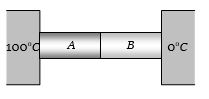
Two metal cubes $A$ and $B$ of the same size are arranged as shown in the figure. The extreme ends of the combination are maintained at the indicated temperatures. The arrangement is thermally insulated. The coefficients of thermal conductivity of $A$ and $B$ are $300 \; W/m^{\circ}C$ and $200 \; W/m^{\circ}C$,respectively. After steady state is reached,the temperature of the interface will be ...... $^{\circ}C$.
A
$45$
B
$90$
C
$30$
D
$60$
Solution
(D) In the steady state,the rate of heat flow through cube $A$ must be equal to the rate of heat flow through cube $B$.
Let $T$ be the temperature of the interface.
The rate of heat flow $H$ is given by $H = \frac{KA(T_1 - T_2)}{L}$.
Since the cubes have the same size,their cross-sectional area $A$ and length $L$ are equal.
For cube $A$: $H_A = \frac{K_A A (100 - T)}{L}$
For cube $B$: $H_B = \frac{K_B A (T - 0)}{L}$
Equating $H_A = H_B$:
$\frac{K_A A (100 - T)}{L} = \frac{K_B A (T - 0)}{L}$
$K_A (100 - T) = K_B T$
$300(100 - T) = 200T$
$3(100 - T) = 2T$
$300 - 3T = 2T$
$5T = 300$
$T = 60^{\circ}C$
Thus,the temperature of the interface is $60^{\circ}C$.
Let $T$ be the temperature of the interface.
The rate of heat flow $H$ is given by $H = \frac{KA(T_1 - T_2)}{L}$.
Since the cubes have the same size,their cross-sectional area $A$ and length $L$ are equal.
For cube $A$: $H_A = \frac{K_A A (100 - T)}{L}$
For cube $B$: $H_B = \frac{K_B A (T - 0)}{L}$
Equating $H_A = H_B$:
$\frac{K_A A (100 - T)}{L} = \frac{K_B A (T - 0)}{L}$
$K_A (100 - T) = K_B T$
$300(100 - T) = 200T$
$3(100 - T) = 2T$
$300 - 3T = 2T$
$5T = 300$
$T = 60^{\circ}C$
Thus,the temperature of the interface is $60^{\circ}C$.
0 likesView Solution
5
PhysicsEasyMCQIIT JEE · 1996
The magnitude of electric field $E$ in the annular region of a charged cylindrical capacitor:
A
Is same throughout
B
Is higher near the outer cylinder than near the inner cylinder
C
Varies as $1/r$,where $r$ is the distance from the axis
D
Varies as $1/r^2$,where $r$ is the distance from the axis
Solution
(C) For a cylindrical capacitor with inner radius $a$ and outer radius $b$,the electric field $E$ at a distance $r$ (where $a < r < b$) from the axis is determined using Gauss's Law.
Consider a Gaussian surface in the form of a cylinder of radius $r$ and length $L$.
The total charge enclosed is $q = \lambda L$,where $\lambda$ is the linear charge density.
According to Gauss's Law,$\oint E \cdot dA = \frac{q_{enclosed}}{\varepsilon_0}$.
$E(2\pi r L) = \frac{\lambda L}{\varepsilon_0}$.
Thus,$E = \frac{\lambda}{2\pi \varepsilon_0 r}$.
This shows that the magnitude of the electric field $E$ varies inversely with the distance $r$ from the axis,i.e.,$E \propto 1/r$.
Consider a Gaussian surface in the form of a cylinder of radius $r$ and length $L$.
The total charge enclosed is $q = \lambda L$,where $\lambda$ is the linear charge density.
According to Gauss's Law,$\oint E \cdot dA = \frac{q_{enclosed}}{\varepsilon_0}$.
$E(2\pi r L) = \frac{\lambda L}{\varepsilon_0}$.
Thus,$E = \frac{\lambda}{2\pi \varepsilon_0 r}$.
This shows that the magnitude of the electric field $E$ varies inversely with the distance $r$ from the axis,i.e.,$E \propto 1/r$.
0 likesView Solution
6
PhysicsEasyMCQIIT JEE · 1996
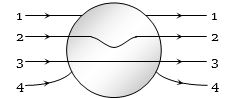
$A$ metallic solid sphere is placed in a uniform electric field. The lines of force follow the path$(s)$ shown in the figure as:
A
$1$
B
$2$
C
$3$
D
$4$
Solution
(D) The electric field lines must be perpendicular to the surface of a conductor at every point. Inside a metallic conductor,the electric field is zero. Therefore,the field lines cannot pass through the sphere; they must terminate on the surface and emerge from the other side,always maintaining a perpendicular orientation to the surface. Path $4$ correctly depicts this behavior,where the lines bend to meet the surface of the sphere normally.
0 likesView Solution
7
PhysicsDifficultMCQIIT JEE · 1996
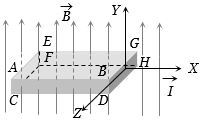
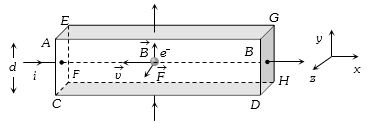
$A$ metallic block carrying current $I$ is subjected to a uniform magnetic induction $\overrightarrow{B}$ as shown in the figure. The moving charges experience a force $\overrightarrow{F}$ given by ........... which results in the lowering of the potential of the face ........ Assume the speed of the carriers to be $v$.
A
$evB\,\hat{k}$,$ABCD$
B
$evB\,\hat{k}$,$EFGH$
C
$-evB\,\hat{k}$,$ABCD$
D
$-evB\,\hat{k}$,$EFGH$
Solution
(A) Since the block is metallic,the charge carriers are electrons. For a current $I$ along the positive $x$-axis,the electrons move along the negative $x$-axis,i.e.,$\overrightarrow{v} = -v\hat{i}$.
The magnetic field is along the $y$-axis,i.e.,$\overrightarrow{B} = B\hat{j}$.
The Lorentz force is given by $\overrightarrow{F} = q(\overrightarrow{v} \times \overrightarrow{B})$.
Substituting the values,$\overrightarrow{F} = (-e)(-v\hat{i} \times B\hat{j}) = evB(\hat{i} \times \hat{j}) = evB\hat{k}$.
Since the force on the electrons is in the positive $z$-direction,they accumulate on the face $ABCD$ (as per the coordinate system shown in the figure). The accumulation of negative charges on face $ABCD$ results in the lowering of its potential.
The magnetic field is along the $y$-axis,i.e.,$\overrightarrow{B} = B\hat{j}$.
The Lorentz force is given by $\overrightarrow{F} = q(\overrightarrow{v} \times \overrightarrow{B})$.
Substituting the values,$\overrightarrow{F} = (-e)(-v\hat{i} \times B\hat{j}) = evB(\hat{i} \times \hat{j}) = evB\hat{k}$.
Since the force on the electrons is in the positive $z$-direction,they accumulate on the face $ABCD$ (as per the coordinate system shown in the figure). The accumulation of negative charges on face $ABCD$ results in the lowering of its potential.
0 likesView Solution
8
PhysicsMediumMCQIIT JEE · 1996
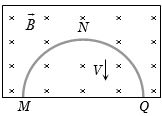
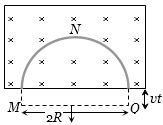
$A$ thin semicircular conducting ring of radius $R$ is falling with its plane vertical in a horizontal magnetic induction $B$. At the position $MNQ$,the speed of the ring is $V$ and the potential difference developed across the ring is
A
Zero
B
$B V \pi R^2 / 2$ and $M$ is at higher potential
C
$\pi R B V$ and $Q$ is at higher potential
D
$2 R B V$ and $Q$ is at higher potential
Solution
(D) The induced electromotive force $(emf)$ in a conductor moving in a magnetic field is given by the motional $emf$ formula $e = B l v$,where $l$ is the effective length of the conductor perpendicular to the velocity and the magnetic field.
For a semicircular ring of radius $R$ moving with velocity $V$ perpendicular to a uniform magnetic field $B$,the effective length $l$ between the ends $M$ and $Q$ is the diameter of the semicircle,which is $2R$.
Therefore,the induced $emf$ is $e = B(2R)V = 2RBV$.
According to Lenz's law,the induced current will oppose the change in magnetic flux. As the ring moves out of the magnetic field,the flux through the loop decreases. To oppose this,the induced current will create a magnetic field in the same direction as the external field (into the page). By the right-hand rule,this corresponds to a current flowing from $M$ to $Q$ through the ring,making $Q$ the higher potential point.
For a semicircular ring of radius $R$ moving with velocity $V$ perpendicular to a uniform magnetic field $B$,the effective length $l$ between the ends $M$ and $Q$ is the diameter of the semicircle,which is $2R$.
Therefore,the induced $emf$ is $e = B(2R)V = 2RBV$.
According to Lenz's law,the induced current will oppose the change in magnetic flux. As the ring moves out of the magnetic field,the flux through the loop decreases. To oppose this,the induced current will create a magnetic field in the same direction as the external field (into the page). By the right-hand rule,this corresponds to a current flowing from $M$ to $Q$ through the ring,making $Q$ the higher potential point.
0 likesView Solution
9
PhysicsDifficultMCQIIT JEE · 1996
The binding energy of deuteron $_1^2H$ is $1.112 \, MeV$ per nucleon and an $\alpha$-particle $_2^4He$ has a binding energy of $7.047 \, MeV$ per nucleon. Then in the fusion reaction $_1^2H + _1^2H \to _2^4He + Q$,the energy $Q$ released is ........ $MeV$.
A
$1$
B
$11.9$
C
$23.8$
D
$931$
Solution
(C) The binding energy of a nucleus is given by the product of the number of nucleons and the binding energy per nucleon.
For the reactant,two deuterons $(1^2H)$ are involved. Each deuteron has $2$ nucleons.
Total binding energy of two deuterons $= 2 \times (2 \times 1.112 \, MeV) = 4 \times 1.112 \, MeV = 4.448 \, MeV$.
For the product,one $\alpha$-particle $(2^4He)$ is formed. It has $4$ nucleons.
Total binding energy of one $\alpha$-particle $= 4 \times 7.047 \, MeV = 28.188 \, MeV$.
The energy released $Q$ in the fusion reaction is the difference between the total binding energy of the products and the total binding energy of the reactants.
$Q = 28.188 \, MeV - 4.448 \, MeV = 23.74 \, MeV$.
Rounding to the nearest provided option,$Q \approx 23.8 \, MeV$.
For the reactant,two deuterons $(1^2H)$ are involved. Each deuteron has $2$ nucleons.
Total binding energy of two deuterons $= 2 \times (2 \times 1.112 \, MeV) = 4 \times 1.112 \, MeV = 4.448 \, MeV$.
For the product,one $\alpha$-particle $(2^4He)$ is formed. It has $4$ nucleons.
Total binding energy of one $\alpha$-particle $= 4 \times 7.047 \, MeV = 28.188 \, MeV$.
The energy released $Q$ in the fusion reaction is the difference between the total binding energy of the products and the total binding energy of the reactants.
$Q = 28.188 \, MeV - 4.448 \, MeV = 23.74 \, MeV$.
Rounding to the nearest provided option,$Q \approx 23.8 \, MeV$.
0 likesView Solution
10
PhysicsEasyMCQIIT JEE · 1996
Holes are charge carriers in
A
Intrinsic semiconductors
B
Ionic solids
C
$P-$ type semiconductors
D
Both $(a)$ and $(c)$
Solution
(D) In intrinsic semiconductors,both electrons and holes act as charge carriers due to thermal excitation.
In $P-$ type semiconductors,holes are the majority charge carriers.
Therefore,holes are charge carriers in both intrinsic and $P-$ type semiconductors.
Thus,the correct option is $(d)$.
In $P-$ type semiconductors,holes are the majority charge carriers.
Therefore,holes are charge carriers in both intrinsic and $P-$ type semiconductors.
Thus,the correct option is $(d)$.
0 likesView Solution
11
PhysicsEasyMCQIIT JEE · 1996
Which of the following form$(s)$ a virtual and erect image for all positions of the object?
A
Convex lens
B
Concave lens
C
Convex mirror
D
Both $(b)$ and $(c)$
Solution
(D) concave lens is a diverging lens that always forms a virtual,erect,and diminished image for any position of the object placed in front of it.
Similarly,a convex mirror is a diverging mirror that always forms a virtual,erect,and diminished image for any position of the object placed in front of it.
Therefore,both the concave lens and the convex mirror satisfy the given condition.
Thus,the correct option is $(d)$.
Similarly,a convex mirror is a diverging mirror that always forms a virtual,erect,and diminished image for any position of the object placed in front of it.
Therefore,both the concave lens and the convex mirror satisfy the given condition.
Thus,the correct option is $(d)$.
0 likesView Solution
Vedclass Products
For Students
Vedclass Test Series
Mock tests in real IIT JEE style covering Physics with performance analysis. 5-day free trial.
Start Free TrialFor Teachers
Exam Paper Generator
Generate Set A/B/C/D Physics papers from 7.5L+ questions in 2 minutes. 3 chapters free.
Try FreeFor Institutes
Online Exam Module
Run live IIT JEE mock exams with unlimited students, 360° analytics & white-label branding.
See DemoFrequently Asked Questions
How many Physics questions are in IIT JEE 1996?
There are 11 Physics questions from the IIT JEE 1996 paper on Vedclass, each with a detailed step-by-step solution in English.
Are IIT JEE 1996 Physics solutions available in English?
Yes. All solutions on this page are in English. You can also switch to English or Hindi using the language buttons above the questions.
Can I practice IIT JEE 1996 Physics as a timed test?
Yes. Use the Vedclass Test Series to attempt a full IIT JEE mock test covering Physics with time limits and instant score analysis.
Can teachers create Physics papers from IIT JEE previous year questions?
Yes. The Vedclass Exam Paper Generator lets teachers mix IIT JEE Physics questions and generate Set A/B/C/D papers in minutes.
For Teachers & Institutes
Build a Custom Physics Paper
Pick IIT JEE 1996 Physics questions, set difficulty, and generate Set A/B/C/D in 2 minutes.