
MathematicsQ1–28 of 28 questions
Page 1 of 1 · English
1
MathematicsMediumMCQIIT JEE · 1986
The real part of $(1 - \cos \theta + 2i\sin \theta )^{-1}$ is
A
$\frac{1}{3 + 5\cos \theta }$
B
$\frac{1}{5 - 3\cos \theta }$
C
$\frac{1}{3 - 5\cos \theta }$
D
$\frac{1}{5 + 3\cos \theta }$
Solution
(D) Let $z = (1 - \cos \theta ) + i(2\sin \theta )$. We want the real part of $z^{-1} = \frac{1}{z}$.
Using trigonometric identities,$1 - \cos \theta = 2\sin^2(\frac{\theta}{2})$ and $2\sin \theta = 4\sin(\frac{\theta}{2})\cos(\frac{\theta}{2})$.
So,$z = 2\sin(\frac{\theta}{2}) [\sin(\frac{\theta}{2}) + 2i\cos(\frac{\theta}{2})]$.
Then,$z^{-1} = \frac{1}{2\sin(\frac{\theta}{2})} \cdot \frac{1}{\sin(\frac{\theta}{2}) + 2i\cos(\frac{\theta}{2})}$.
Multiply numerator and denominator by the conjugate $\sin(\frac{\theta}{2}) - 2i\cos(\frac{\theta}{2})$:
$z^{-1} = \frac{1}{2\sin(\frac{\theta}{2})} \cdot \frac{\sin(\frac{\theta}{2}) - 2i\cos(\frac{\theta}{2})}{\sin^2(\frac{\theta}{2}) + 4\cos^2(\frac{\theta}{2})}$.
The real part is $\frac{\sin(\frac{\theta}{2})}{2\sin(\frac{\theta}{2}) [\sin^2(\frac{\theta}{2}) + 4\cos^2(\frac{\theta}{2})]} = \frac{1}{2[\sin^2(\frac{\theta}{2}) + 4\cos^2(\frac{\theta}{2})]}$.
Using $\sin^2(\frac{\theta}{2}) = \frac{1 - \cos \theta}{2}$ and $\cos^2(\frac{\theta}{2}) = \frac{1 + \cos \theta}{2}$:
Real part $= \frac{1}{2[\frac{1 - \cos \theta}{2} + 4(\frac{1 + \cos \theta}{2})]} = \frac{1}{1 - \cos \theta + 4 + 4\cos \theta} = \frac{1}{5 + 3\cos \theta }$.
Using trigonometric identities,$1 - \cos \theta = 2\sin^2(\frac{\theta}{2})$ and $2\sin \theta = 4\sin(\frac{\theta}{2})\cos(\frac{\theta}{2})$.
So,$z = 2\sin(\frac{\theta}{2}) [\sin(\frac{\theta}{2}) + 2i\cos(\frac{\theta}{2})]$.
Then,$z^{-1} = \frac{1}{2\sin(\frac{\theta}{2})} \cdot \frac{1}{\sin(\frac{\theta}{2}) + 2i\cos(\frac{\theta}{2})}$.
Multiply numerator and denominator by the conjugate $\sin(\frac{\theta}{2}) - 2i\cos(\frac{\theta}{2})$:
$z^{-1} = \frac{1}{2\sin(\frac{\theta}{2})} \cdot \frac{\sin(\frac{\theta}{2}) - 2i\cos(\frac{\theta}{2})}{\sin^2(\frac{\theta}{2}) + 4\cos^2(\frac{\theta}{2})}$.
The real part is $\frac{\sin(\frac{\theta}{2})}{2\sin(\frac{\theta}{2}) [\sin^2(\frac{\theta}{2}) + 4\cos^2(\frac{\theta}{2})]} = \frac{1}{2[\sin^2(\frac{\theta}{2}) + 4\cos^2(\frac{\theta}{2})]}$.
Using $\sin^2(\frac{\theta}{2}) = \frac{1 - \cos \theta}{2}$ and $\cos^2(\frac{\theta}{2}) = \frac{1 + \cos \theta}{2}$:
Real part $= \frac{1}{2[\frac{1 - \cos \theta}{2} + 4(\frac{1 + \cos \theta}{2})]} = \frac{1}{1 - \cos \theta + 4 + 4\cos \theta} = \frac{1}{5 + 3\cos \theta }$.
0 likesView Solution
2
MathematicsDifficultMCQIIT JEE · 1986
If ${z_1}$ and ${z_2}$ are complex numbers such that ${z_1} \neq {z_2}$ and $|{z_1}| = |{z_2}|$. If ${z_1}$ has a positive real part and ${z_2}$ has a negative imaginary part,then $\frac{{z_1 + z_2}}{{z_1 - z_2}}$ may be
A
Purely imaginary
B
Real and positive
C
Real and negative
D
None of these
Solution
(A) Let ${z_1} = a + ib$ and ${z_2} = c - id$,where $a > 0$ and $d > 0$.
Given $|{z_1}| = |{z_2}|$,we have ${a^2} + {b^2} = {c^2} + {d^2}$.
Let $w = \frac{{z_1 + z_2}}{{z_1 - z_2}}$.
Then $\bar{w} = \frac{{\bar{z_1} + \bar{z_2}}}{{\bar{z_1} - \bar{z_2}}}$.
Since $|{z_1}| = |{z_2}| = r$,we have $\bar{z_1} = \frac{r^2}{z_1}$ and $\bar{z_2} = \frac{r^2}{z_2}$.
Substituting these,$\bar{w} = \frac{{\frac{r^2}{z_1} + \frac{r^2}{z_2}}}{{\frac{r^2}{z_1} - \frac{r^2}{z_2}}} = \frac{{z_2 + z_1}}{{z_2 - z_1}} = -\frac{{z_1 + z_2}}{{z_1 - z_2}} = -w$.
Since $\bar{w} = -w$,the complex number $w$ is purely imaginary.
For example,let ${z_1} = 2 + i$ and ${z_2} = 1 - 2i$.
Then $\frac{{z_1 + z_2}}{{z_1 - z_2}} = \frac{{3 - i}}{{1 + 3i}} = \frac{{(3 - i)(1 - 3i)}}{{1^2 + 3^2}} = \frac{{3 - 9i - i - 3}}{{10}} = \frac{{-10i}}{{10}} = -i$,which is purely imaginary.
Given $|{z_1}| = |{z_2}|$,we have ${a^2} + {b^2} = {c^2} + {d^2}$.
Let $w = \frac{{z_1 + z_2}}{{z_1 - z_2}}$.
Then $\bar{w} = \frac{{\bar{z_1} + \bar{z_2}}}{{\bar{z_1} - \bar{z_2}}}$.
Since $|{z_1}| = |{z_2}| = r$,we have $\bar{z_1} = \frac{r^2}{z_1}$ and $\bar{z_2} = \frac{r^2}{z_2}$.
Substituting these,$\bar{w} = \frac{{\frac{r^2}{z_1} + \frac{r^2}{z_2}}}{{\frac{r^2}{z_1} - \frac{r^2}{z_2}}} = \frac{{z_2 + z_1}}{{z_2 - z_1}} = -\frac{{z_1 + z_2}}{{z_1 - z_2}} = -w$.
Since $\bar{w} = -w$,the complex number $w$ is purely imaginary.
For example,let ${z_1} = 2 + i$ and ${z_2} = 1 - 2i$.
Then $\frac{{z_1 + z_2}}{{z_1 - z_2}} = \frac{{3 - i}}{{1 + 3i}} = \frac{{(3 - i)(1 - 3i)}}{{1^2 + 3^2}} = \frac{{3 - 9i - i - 3}}{{10}} = \frac{{-10i}}{{10}} = -i$,which is purely imaginary.
0 likesView Solution
3
MathematicsDifficultMCQIIT JEE · 1986
If $z = x + iy$,then the area of the triangle whose vertices are the points $z$,$iz$,and $z + iz$ is
A
$2|z|^2$
B
$\frac{1}{2}|z|^2$
C
$|z|^2$
D
$\frac{3}{2}|z|^2$
Solution
(B) Let $z = x + iy$. The vertices of the triangle are $z = (x, y)$,$iz = (-y, x)$,and $z + iz = (x - y, x + y)$.
The area $A$ of a triangle with vertices $(x_1, y_1)$,$(x_2, y_2)$,and $(x_3, y_3)$ is given by $A = \frac{1}{2} |x_1(y_2 - y_3) + x_2(y_3 - y_1) + x_3(y_1 - y_2)|$.
Substituting the coordinates:
$A = \frac{1}{2} |x(x - (x + y)) + (-y)((x + y) - y) + (x - y)(y - x)|$
$A = \frac{1}{2} |x(-y) - y(x) + (x - y)(-(x - y))|$
$A = \frac{1}{2} |-xy - xy - (x - y)^2|$
$A = \frac{1}{2} |-2xy - (x^2 - 2xy + y^2)|$
$A = \frac{1}{2} |-2xy - x^2 + 2xy - y^2|$
$A = \frac{1}{2} |-x^2 - y^2| = \frac{1}{2} (x^2 + y^2) = \frac{1}{2} |z|^2$.
The area $A$ of a triangle with vertices $(x_1, y_1)$,$(x_2, y_2)$,and $(x_3, y_3)$ is given by $A = \frac{1}{2} |x_1(y_2 - y_3) + x_2(y_3 - y_1) + x_3(y_1 - y_2)|$.
Substituting the coordinates:
$A = \frac{1}{2} |x(x - (x + y)) + (-y)((x + y) - y) + (x - y)(y - x)|$
$A = \frac{1}{2} |x(-y) - y(x) + (x - y)(-(x - y))|$
$A = \frac{1}{2} |-xy - xy - (x - y)^2|$
$A = \frac{1}{2} |-2xy - (x^2 - 2xy + y^2)|$
$A = \frac{1}{2} |-2xy - x^2 + 2xy - y^2|$
$A = \frac{1}{2} |-x^2 - y^2| = \frac{1}{2} (x^2 + y^2) = \frac{1}{2} |z|^2$.
0 likesView Solution
4
MathematicsMediumMCQIIT JEE · 1986
If one of the roots of the equations $x^2 + ax + b = 0$ and $x^2 + bx + a = 0$ is common,then the numerical value of $(a + b)$ is
A
$0$
B
$-1$
C
$2$
D
$5$
Solution
(B) Let $\alpha$ be the common root of the equations $x^2 + ax + b = 0$ and $x^2 + bx + a = 0$.
Then,$\alpha^2 + a\alpha + b = 0$ and $\alpha^2 + b\alpha + a = 0$.
Subtracting the two equations,we get $(\alpha^2 + a\alpha + b) - (\alpha^2 + b\alpha + a) = 0$.
$(a - b)\alpha + (b - a) = 0$.
$(a - b)\alpha = (a - b)$.
Assuming $a \neq b$,we get $\alpha = 1$.
Substituting $\alpha = 1$ into the first equation: $(1)^2 + a(1) + b = 0$.
$1 + a + b = 0$.
Therefore,$a + b = -1$.
Then,$\alpha^2 + a\alpha + b = 0$ and $\alpha^2 + b\alpha + a = 0$.
Subtracting the two equations,we get $(\alpha^2 + a\alpha + b) - (\alpha^2 + b\alpha + a) = 0$.
$(a - b)\alpha + (b - a) = 0$.
$(a - b)\alpha = (a - b)$.
Assuming $a \neq b$,we get $\alpha = 1$.
Substituting $\alpha = 1$ into the first equation: $(1)^2 + a(1) + b = 0$.
$1 + a + b = 0$.
Therefore,$a + b = -1$.
0 likesView Solution
5
MathematicsMediumMCQIIT JEE · 1986
$A$ box contains $2$ white balls,$3$ black balls,and $4$ red balls. In how many ways can $3$ balls be drawn from the box if at least one black ball is to be included in the draw?
A
$64$
B
$45$
C
$46$
D
None of these
Solution
(A) The total number of balls in the box is $2 + 3 + 4 = 9$.
We need to select $3$ balls such that at least one is black.
This can be calculated by subtracting the number of ways to select $3$ balls with no black balls from the total number of ways to select $3$ balls.
Total ways to select $3$ balls from $9$ is $^{9}C_{3} = \frac{9 \times 8 \times 7}{3 \times 2 \times 1} = 84$.
Number of ways to select $3$ balls such that no black ball is chosen (i.e.,selecting from the $2$ white and $4$ red balls,total $6$ non-black balls) is $^{6}C_{3} = \frac{6 \times 5 \times 4}{3 \times 2 \times 1} = 20$.
Therefore,the number of ways to select at least one black ball is $84 - 20 = 64$.
We need to select $3$ balls such that at least one is black.
This can be calculated by subtracting the number of ways to select $3$ balls with no black balls from the total number of ways to select $3$ balls.
Total ways to select $3$ balls from $9$ is $^{9}C_{3} = \frac{9 \times 8 \times 7}{3 \times 2 \times 1} = 84$.
Number of ways to select $3$ balls such that no black ball is chosen (i.e.,selecting from the $2$ white and $4$ red balls,total $6$ non-black balls) is $^{6}C_{3} = \frac{6 \times 5 \times 4}{3 \times 2 \times 1} = 20$.
Therefore,the number of ways to select at least one black ball is $84 - 20 = 64$.
0 likesView Solution
6
MathematicsDifficultMCQIIT JEE · 1986
If ${C_r}$ stands for $^n{C_r}$,the sum of the series $\frac{{2(n/2)!(n/2)!}}{{n!}}[C_0^2 - 2C_1^2 + 3C_2^2 - ..... + {( - 1)^n}(n + 1)C_n^2]$,where $n$ is an even positive integer,is
A
$0$
B
${( - 1)^{n/2}}(n + 1)$
C
${( - 1)^n}(n + 2)$
D
${( - 1)^{n/2}}(n + 2)$
Solution
(D) Let $S = \sum_{r=0}^{n} (-1)^r (r+1) C_r^2$.
We know that $\sum_{r=0}^{n} (-1)^r C_r^2 = (-1)^{n/2} \frac{n!}{(n/2)!(n/2)!}$ for even $n$.
Also,$\sum_{r=0}^{n} (-1)^r r C_r^2 = (-1)^{n/2} \frac{n}{2} \frac{n!}{(n/2)!(n/2)!}$.
Thus,$S = \sum_{r=0}^{n} (-1)^r C_r^2 + \sum_{r=0}^{n} (-1)^r r C_r^2$.
$S = (-1)^{n/2} \frac{n!}{(n/2)!(n/2)!} + (-1)^{n/2} \frac{n}{2} \frac{n!}{(n/2)!(n/2)!}$.
$S = (-1)^{n/2} \frac{n!}{(n/2)!(n/2)!} (1 + n/2) = (-1)^{n/2} \frac{n!}{(n/2)!(n/2)!} \frac{n+2}{2}$.
Multiplying by the coefficient $\frac{2(n/2)!(n/2)!}{n!}$,we get:
$\frac{2(n/2)!(n/2)!}{n!} \times (-1)^{n/2} \frac{n!}{(n/2)!(n/2)!} \frac{n+2}{2} = (-1)^{n/2}(n+2)$.
We know that $\sum_{r=0}^{n} (-1)^r C_r^2 = (-1)^{n/2} \frac{n!}{(n/2)!(n/2)!}$ for even $n$.
Also,$\sum_{r=0}^{n} (-1)^r r C_r^2 = (-1)^{n/2} \frac{n}{2} \frac{n!}{(n/2)!(n/2)!}$.
Thus,$S = \sum_{r=0}^{n} (-1)^r C_r^2 + \sum_{r=0}^{n} (-1)^r r C_r^2$.
$S = (-1)^{n/2} \frac{n!}{(n/2)!(n/2)!} + (-1)^{n/2} \frac{n}{2} \frac{n!}{(n/2)!(n/2)!}$.
$S = (-1)^{n/2} \frac{n!}{(n/2)!(n/2)!} (1 + n/2) = (-1)^{n/2} \frac{n!}{(n/2)!(n/2)!} \frac{n+2}{2}$.
Multiplying by the coefficient $\frac{2(n/2)!(n/2)!}{n!}$,we get:
$\frac{2(n/2)!(n/2)!}{n!} \times (-1)^{n/2} \frac{n!}{(n/2)!(n/2)!} \frac{n+2}{2} = (-1)^{n/2}(n+2)$.
0 likesView Solution
7
MathematicsMediumMCQIIT JEE · 1986
All points lying inside the triangle formed by the points $(1, 3)$,$(5, 0)$,and $(-1, 2)$ satisfy which of the following inequalities?
A
$3x + 2y \ge 0$
B
$2x + y - 13 \le 0$
C
$2x - 3y - 12 \le 0$
D
All the above
Solution
(D) To determine which inequality is satisfied by the interior points of the triangle,we check the vertices $(1, 3)$,$(5, 0)$,and $(-1, 2)$ for each inequality.
For $3x + 2y \ge 0$:
$(1, 3) \implies 3(1) + 2(3) = 9 > 0$
$(5, 0) \implies 3(5) + 2(0) = 15 > 0$
$(-1, 2) \implies 3(-1) + 2(2) = 1 > 0$
Since all vertices satisfy the inequality,the interior points also satisfy it.
For $2x + y - 13 \le 0$:
$(1, 3) \implies 2(1) + 3 - 13 = -8 \le 0$
$(5, 0) \implies 2(5) + 0 - 13 = -3 \le 0$
$(-1, 2) \implies 2(-1) + 2 - 13 = -13 \le 0$
Since all vertices satisfy the inequality,the interior points also satisfy it.
For $2x - 3y - 12 \le 0$:
$(1, 3) \implies 2(1) - 3(3) - 12 = -19 \le 0$
$(5, 0) \implies 2(5) - 3(0) - 12 = -2 \le 0$
$(-1, 2) \implies 2(-1) - 3(2) - 12 = -20 \le 0$
Since all vertices satisfy the inequality,the interior points also satisfy it.
Therefore,all the given inequalities are satisfied.
For $3x + 2y \ge 0$:
$(1, 3) \implies 3(1) + 2(3) = 9 > 0$
$(5, 0) \implies 3(5) + 2(0) = 15 > 0$
$(-1, 2) \implies 3(-1) + 2(2) = 1 > 0$
Since all vertices satisfy the inequality,the interior points also satisfy it.
For $2x + y - 13 \le 0$:
$(1, 3) \implies 2(1) + 3 - 13 = -8 \le 0$
$(5, 0) \implies 2(5) + 0 - 13 = -3 \le 0$
$(-1, 2) \implies 2(-1) + 2 - 13 = -13 \le 0$
Since all vertices satisfy the inequality,the interior points also satisfy it.
For $2x - 3y - 12 \le 0$:
$(1, 3) \implies 2(1) - 3(3) - 12 = -19 \le 0$
$(5, 0) \implies 2(5) - 3(0) - 12 = -2 \le 0$
$(-1, 2) \implies 2(-1) - 3(2) - 12 = -20 \le 0$
Since all vertices satisfy the inequality,the interior points also satisfy it.
Therefore,all the given inequalities are satisfied.
0 likesView Solution
8
MathematicsDifficultMCQIIT JEE · 1986
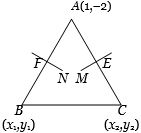
The equations of the perpendicular bisectors of the sides $AB$ and $AC$ of a triangle $ABC$ are $x - y + 5 = 0$ and $x + 2y = 0$ respectively. If the point $A$ is $(1, -2)$,then the equation of line $BC$ is
A
$23x + 14y - 40 = 0$
B
$14x - 23y + 40 = 0$
C
$23x - 14y + 40 = 0$
D
$14x + 23y - 40 = 0$
Solution
(D) The perpendicular bisectors of the sides of a triangle intersect at the circumcenter $O$.
Since the perpendicular bisectors of $AB$ and $AC$ are $x - y + 5 = 0$ and $x + 2y = 0$,their intersection point $O$ is found by solving these equations:
$x - y = -5$ and $x + 2y = 0$.
Subtracting the equations,we get $-3y = -5$,so $y = \frac{5}{3}$.
Then $x = -2y = -\frac{10}{3}$.
Thus,the circumcenter $O$ is $(-\frac{10}{3}, \frac{5}{3})$.
Since $O$ is the circumcenter,$OA = OB = OC$.
Let $B = (x_1, y_1)$. The reflection of $A(1, -2)$ about the line $x - y + 5 = 0$ gives $B$.
The formula for the reflection of $(x_0, y_0)$ about $ax + by + c = 0$ is $\frac{x - x_0}{a} = \frac{y - y_0}{b} = -2 \frac{ax_0 + by_0 + c}{a^2 + b^2}$.
For $A(1, -2)$ and $x - y + 5 = 0$:
$\frac{x_1 - 1}{1} = \frac{y_1 + 2}{-1} = -2 \frac{1 - (-2) + 5}{1^2 + (-1)^2} = -2 \frac{8}{2} = -8$.
So,$x_1 - 1 = -8 \implies x_1 = -7$ and $y_1 + 2 = 8 \implies y_1 = 6$. Thus,$B = (-7, 6)$.
Similarly,for $C(x_2, y_2)$,the reflection of $A(1, -2)$ about $x + 2y = 0$:
$\frac{x_2 - 1}{1} = \frac{y_2 + 2}{2} = -2 \frac{1 + 2(-2)}{1^2 + 2^2} = -2 \frac{-3}{5} = \frac{6}{5}$.
So,$x_2 - 1 = \frac{6}{5} \implies x_2 = \frac{11}{5}$ and $y_2 + 2 = \frac{12}{5} \implies y_2 = \frac{2}{5}$. Thus,$C = (\frac{11}{5}, \frac{2}{5})$.
The equation of line $BC$ passing through $(-7, 6)$ and $(\frac{11}{5}, \frac{2}{5})$ is:
$y - 6 = \frac{\frac{2}{5} - 6}{\frac{11}{5} - (-7)} (x - (-7)) = \frac{-\frac{28}{5}}{\frac{46}{5}} (x + 7) = -\frac{14}{23} (x + 7)$.
$23(y - 6) = -14(x + 7) \implies 23y - 138 = -14x - 98 \implies 14x + 23y - 40 = 0$.
Since the perpendicular bisectors of $AB$ and $AC$ are $x - y + 5 = 0$ and $x + 2y = 0$,their intersection point $O$ is found by solving these equations:
$x - y = -5$ and $x + 2y = 0$.
Subtracting the equations,we get $-3y = -5$,so $y = \frac{5}{3}$.
Then $x = -2y = -\frac{10}{3}$.
Thus,the circumcenter $O$ is $(-\frac{10}{3}, \frac{5}{3})$.
Since $O$ is the circumcenter,$OA = OB = OC$.
Let $B = (x_1, y_1)$. The reflection of $A(1, -2)$ about the line $x - y + 5 = 0$ gives $B$.
The formula for the reflection of $(x_0, y_0)$ about $ax + by + c = 0$ is $\frac{x - x_0}{a} = \frac{y - y_0}{b} = -2 \frac{ax_0 + by_0 + c}{a^2 + b^2}$.
For $A(1, -2)$ and $x - y + 5 = 0$:
$\frac{x_1 - 1}{1} = \frac{y_1 + 2}{-1} = -2 \frac{1 - (-2) + 5}{1^2 + (-1)^2} = -2 \frac{8}{2} = -8$.
So,$x_1 - 1 = -8 \implies x_1 = -7$ and $y_1 + 2 = 8 \implies y_1 = 6$. Thus,$B = (-7, 6)$.
Similarly,for $C(x_2, y_2)$,the reflection of $A(1, -2)$ about $x + 2y = 0$:
$\frac{x_2 - 1}{1} = \frac{y_2 + 2}{2} = -2 \frac{1 + 2(-2)}{1^2 + 2^2} = -2 \frac{-3}{5} = \frac{6}{5}$.
So,$x_2 - 1 = \frac{6}{5} \implies x_2 = \frac{11}{5}$ and $y_2 + 2 = \frac{12}{5} \implies y_2 = \frac{2}{5}$. Thus,$C = (\frac{11}{5}, \frac{2}{5})$.
The equation of line $BC$ passing through $(-7, 6)$ and $(\frac{11}{5}, \frac{2}{5})$ is:
$y - 6 = \frac{\frac{2}{5} - 6}{\frac{11}{5} - (-7)} (x - (-7)) = \frac{-\frac{28}{5}}{\frac{46}{5}} (x + 7) = -\frac{14}{23} (x + 7)$.
$23(y - 6) = -14(x + 7) \implies 23y - 138 = -14x - 98 \implies 14x + 23y - 40 = 0$.
0 likesView Solution
9
MathematicsMediumMCQIIT JEE · 1986
The locus of a point $P$ which divides the line joining $(1, 0)$ and $(2\cos \theta, 2\sin \theta)$ internally in the ratio $2 : 3$ for all $\theta$ is a
A
Straight line
B
Circle
C
Pair of straight lines
D
Parabola
Solution
(B) Let the coordinates of the point $P(h, k)$ divide the line segment joining $(1, 0)$ and $(2\cos \theta, 2\sin \theta)$ in the ratio $2 : 3$.
Using the section formula,we have:
$h = \frac{2(2\cos \theta) + 3(1)}{2 + 3} = \frac{4\cos \theta + 3}{5}$
$k = \frac{2(2\sin \theta) + 3(0)}{2 + 3} = \frac{4\sin \theta}{5}$
From these,we get:
$\cos \theta = \frac{5h - 3}{4}$ and $\sin \theta = \frac{5k}{4}$
Using the identity $\cos^2 \theta + \sin^2 \theta = 1$,we substitute the values:
$\left(\frac{5h - 3}{4}\right)^2 + \left(\frac{5k}{4}\right)^2 = 1$
$(5h - 3)^2 + (5k)^2 = 16$
Replacing $(h, k)$ with $(x, y)$,the locus is $(5x - 3)^2 + (5y)^2 = 16$,which represents a circle.
Using the section formula,we have:
$h = \frac{2(2\cos \theta) + 3(1)}{2 + 3} = \frac{4\cos \theta + 3}{5}$
$k = \frac{2(2\sin \theta) + 3(0)}{2 + 3} = \frac{4\sin \theta}{5}$
From these,we get:
$\cos \theta = \frac{5h - 3}{4}$ and $\sin \theta = \frac{5k}{4}$
Using the identity $\cos^2 \theta + \sin^2 \theta = 1$,we substitute the values:
$\left(\frac{5h - 3}{4}\right)^2 + \left(\frac{5k}{4}\right)^2 = 1$
$(5h - 3)^2 + (5k)^2 = 16$
Replacing $(h, k)$ with $(x, y)$,the locus is $(5x - 3)^2 + (5y)^2 = 16$,which represents a circle.
0 likesView Solution
10
MathematicsEasyMCQIIT JEE · 1986
The equation of the line passing through the points of intersection of the circles $3x^2 + 3y^2 - 2x + 12y - 9 = 0$ and $x^2 + y^2 + 6x + 2y - 15 = 0$ is
A
$10x - 3y - 18 = 0$
B
$10x + 3y - 18 = 0$
C
$10x + 3y + 18 = 0$
D
None of these
Solution
(A) The equation of the common chord of two circles $S_1 = 0$ and $S_2 = 0$ is given by $S_1 - S_2 = 0$.
First,write the equations in the form $x^2 + y^2 + 2gx + 2fy + c = 0$.
The first circle is $3x^2 + 3y^2 - 2x + 12y - 9 = 0$. Dividing by $3$,we get $x^2 + y^2 - \frac{2}{3}x + 4y - 3 = 0$ $(S_1)$.
The second circle is $x^2 + y^2 + 6x + 2y - 15 = 0$ $(S_2)$.
The common chord is $S_1 - S_2 = 0$:
$(x^2 + y^2 - \frac{2}{3}x + 4y - 3) - (x^2 + y^2 + 6x + 2y - 15) = 0$
$(-\frac{2}{3} - 6)x + (4 - 2)y + (-3 + 15) = 0$
$-\frac{20}{3}x + 2y + 12 = 0$
Multiplying by $-3$,we get $20x - 6y - 36 = 0$,which simplifies to $10x - 3y - 18 = 0$.
First,write the equations in the form $x^2 + y^2 + 2gx + 2fy + c = 0$.
The first circle is $3x^2 + 3y^2 - 2x + 12y - 9 = 0$. Dividing by $3$,we get $x^2 + y^2 - \frac{2}{3}x + 4y - 3 = 0$ $(S_1)$.
The second circle is $x^2 + y^2 + 6x + 2y - 15 = 0$ $(S_2)$.
The common chord is $S_1 - S_2 = 0$:
$(x^2 + y^2 - \frac{2}{3}x + 4y - 3) - (x^2 + y^2 + 6x + 2y - 15) = 0$
$(-\frac{2}{3} - 6)x + (4 - 2)y + (-3 + 15) = 0$
$-\frac{20}{3}x + 2y + 12 = 0$
Multiplying by $-3$,we get $20x - 6y - 36 = 0$,which simplifies to $10x - 3y - 18 = 0$.
0 likesView Solution
11
MathematicsDifficultMCQIIT JEE · 1986
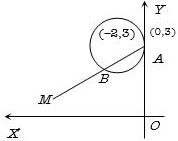
$A$ chord $AB$ is drawn from the point $A(0,3)$ on the circle $x^2 + 4x + (y - 3)^2 = 0$. If the point $M$ lies on the chord such that $AM = 2AB$,then the locus of point $M$ is:
A
Straight line
B
Circle
C
Parabola
D
None of these
Solution
(B) Let the coordinates of point $M$ be $(h, k)$.
Given $A = (0, 3)$ and $M = (h, k)$. Since $M$ lies on the line segment $AB$ such that $AM = 2AB$,point $B$ is the midpoint of $AM$.
Thus,the coordinates of $B$ are $\left( \frac{h+0}{2}, \frac{k+3}{2} \right) = \left( \frac{h}{2}, \frac{k+3}{2} \right)$.
Since $B$ lies on the circle $x^2 + 4x + (y - 3)^2 = 0$,we substitute the coordinates of $B$ into the circle equation:
$\left( \frac{h}{2} \right)^2 + 4\left( \frac{h}{2} \right) + \left( \frac{k+3}{2} - 3 \right)^2 = 0$
$\Rightarrow \frac{h^2}{4} + 2h + \left( \frac{k-3}{2} \right)^2 = 0$
$\Rightarrow \frac{h^2}{4} + 2h + \frac{(k-3)^2}{4} = 0$
Multiplying by $4$,we get $h^2 + 8h + (k-3)^2 = 0$,which simplifies to $h^2 + k^2 + 8h - 6k + 9 = 0$.
Replacing $(h, k)$ with $(x, y)$,the locus is $x^2 + y^2 + 8x - 6y + 9 = 0$,which represents a circle.
Given $A = (0, 3)$ and $M = (h, k)$. Since $M$ lies on the line segment $AB$ such that $AM = 2AB$,point $B$ is the midpoint of $AM$.
Thus,the coordinates of $B$ are $\left( \frac{h+0}{2}, \frac{k+3}{2} \right) = \left( \frac{h}{2}, \frac{k+3}{2} \right)$.
Since $B$ lies on the circle $x^2 + 4x + (y - 3)^2 = 0$,we substitute the coordinates of $B$ into the circle equation:
$\left( \frac{h}{2} \right)^2 + 4\left( \frac{h}{2} \right) + \left( \frac{k+3}{2} - 3 \right)^2 = 0$
$\Rightarrow \frac{h^2}{4} + 2h + \left( \frac{k-3}{2} \right)^2 = 0$
$\Rightarrow \frac{h^2}{4} + 2h + \frac{(k-3)^2}{4} = 0$
Multiplying by $4$,we get $h^2 + 8h + (k-3)^2 = 0$,which simplifies to $h^2 + k^2 + 8h - 6k + 9 = 0$.
Replacing $(h, k)$ with $(x, y)$,the locus is $x^2 + y^2 + 8x - 6y + 9 = 0$,which represents a circle.
0 likesView Solution
12
MathematicsDifficultMCQIIT JEE · 1986
If $\frac{1 + 3p}{3}, \frac{1 - p}{4}$ and $\frac{1 - 2p}{2}$ are the probabilities of three mutually exclusive events,then the set of all values of $p$ is
A
$\frac{1}{3} \le p \le \frac{1}{2}$
B
$\frac{1}{3} < p < \frac{1}{2}$
C
$\frac{1}{2} \le p \le \frac{2}{3}$
D
$\frac{1}{2} < p < \frac{2}{3}$
Solution
(A) Since $\frac{1 + 3p}{3}, \frac{1 - p}{4}$ and $\frac{1 - 2p}{2}$ are the probabilities of three events,each probability must lie in the interval $[0, 1]$.
$1$) $0 \le \frac{1 + 3p}{3} \le 1 \Rightarrow 0 \le 1 + 3p \le 3 \Rightarrow -1 \le 3p \le 2 \Rightarrow -\frac{1}{3} \le p \le \frac{2}{3}$
$2$) $0 \le \frac{1 - p}{4} \le 1 \Rightarrow 0 \le 1 - p \le 4 \Rightarrow -1 \le -p \le 3 \Rightarrow -3 \le p \le 1$
$3$) $0 \le \frac{1 - 2p}{2} \le 1 \Rightarrow 0 \le 1 - 2p \le 2 \Rightarrow -1 \le -2p \le 1 \Rightarrow -\frac{1}{2} \le p \le \frac{1}{2}$
For mutually exclusive events,the sum of probabilities must be $\le 1$:
$\frac{1 + 3p}{3} + \frac{1 - p}{4} + \frac{1 - 2p}{2} \le 1$
Multiply by $12$: $4(1 + 3p) + 3(1 - p) + 6(1 - 2p) \le 12$
$4 + 12p + 3 - 3p + 6 - 12p \le 12$
$13 - 3p \le 12 \Rightarrow -3p \le -1 \Rightarrow p \ge \frac{1}{3}$
Taking the intersection of all conditions:
$p \in [-\frac{1}{3}, \frac{2}{3}] \cap [-3, 1] \cap [-\frac{1}{2}, \frac{1}{2}] \cap [\frac{1}{3}, \infty)$
Intersection is $\frac{1}{3} \le p \le \frac{1}{2}$.
$1$) $0 \le \frac{1 + 3p}{3} \le 1 \Rightarrow 0 \le 1 + 3p \le 3 \Rightarrow -1 \le 3p \le 2 \Rightarrow -\frac{1}{3} \le p \le \frac{2}{3}$
$2$) $0 \le \frac{1 - p}{4} \le 1 \Rightarrow 0 \le 1 - p \le 4 \Rightarrow -1 \le -p \le 3 \Rightarrow -3 \le p \le 1$
$3$) $0 \le \frac{1 - 2p}{2} \le 1 \Rightarrow 0 \le 1 - 2p \le 2 \Rightarrow -1 \le -2p \le 1 \Rightarrow -\frac{1}{2} \le p \le \frac{1}{2}$
For mutually exclusive events,the sum of probabilities must be $\le 1$:
$\frac{1 + 3p}{3} + \frac{1 - p}{4} + \frac{1 - 2p}{2} \le 1$
Multiply by $12$: $4(1 + 3p) + 3(1 - p) + 6(1 - 2p) \le 12$
$4 + 12p + 3 - 3p + 6 - 12p \le 12$
$13 - 3p \le 12 \Rightarrow -3p \le -1 \Rightarrow p \ge \frac{1}{3}$
Taking the intersection of all conditions:
$p \in [-\frac{1}{3}, \frac{2}{3}] \cap [-3, 1] \cap [-\frac{1}{2}, \frac{1}{2}] \cap [\frac{1}{3}, \infty)$
Intersection is $\frac{1}{3} \le p \le \frac{1}{2}$.
0 likesView Solution
13
MathematicsDifficultMCQIIT JEE · 1986
The value of $\sum\limits_{k = 1}^6 {\left( {\sin \frac{{2\pi k}}{7} - i\cos \frac{{2\pi k}}{7}} \right)} $ is
A
$-1$
B
$0$
C
$-i$
D
$i$
Solution
(D) Let $z = \cos \frac{{2\pi }}{7} + i\sin \frac{{2\pi }}{7}$. By De Moivre's theorem,${z^k} = \cos \frac{{2\pi k}}{7} + i\sin \frac{{2\pi k}}{7}$.
The given sum is $S = \sum\limits_{k = 1}^6 {\left( {\sin \frac{{2\pi k}}{7} - i\cos \frac{{2\pi k}}{7}} \right)}$.
We can rewrite the term inside the sum as: $\sin \frac{{2\pi k}}{7} - i\cos \frac{{2\pi k}}{7} = -i \left( \cos \frac{{2\pi k}}{7} + i\sin \frac{{2\pi k}}{7} \right) = -i z^k$.
Thus,$S = -i \sum\limits_{k = 1}^6 z^k = -i (z + z^2 + z^3 + z^4 + z^5 + z^6)$.
Since $z$ is a $7^{th}$ root of unity ($z^7 = 1$ and $z \neq 1$),the sum of all $7^{th}$ roots of unity is $1 + z + z^2 + z^3 + z^4 + z^5 + z^6 = 0$.
Therefore,$\sum\limits_{k = 1}^6 z^k = -1$.
Substituting this into the expression for $S$,we get $S = -i(-1) = i$.
The given sum is $S = \sum\limits_{k = 1}^6 {\left( {\sin \frac{{2\pi k}}{7} - i\cos \frac{{2\pi k}}{7}} \right)}$.
We can rewrite the term inside the sum as: $\sin \frac{{2\pi k}}{7} - i\cos \frac{{2\pi k}}{7} = -i \left( \cos \frac{{2\pi k}}{7} + i\sin \frac{{2\pi k}}{7} \right) = -i z^k$.
Thus,$S = -i \sum\limits_{k = 1}^6 z^k = -i (z + z^2 + z^3 + z^4 + z^5 + z^6)$.
Since $z$ is a $7^{th}$ root of unity ($z^7 = 1$ and $z \neq 1$),the sum of all $7^{th}$ roots of unity is $1 + z + z^2 + z^3 + z^4 + z^5 + z^6 = 0$.
Therefore,$\sum\limits_{k = 1}^6 z^k = -1$.
Substituting this into the expression for $S$,we get $S = -i(-1) = i$.
0 likesView Solution
14
MathematicsDifficultMCQIIT JEE · 1986
$3\left[ \sin^4\left( \frac{3\pi}{2} - \alpha \right) + \sin^4(3\pi + \alpha) \right] - 2\left[ \sin^6\left( \frac{\pi}{2} + \alpha \right) + \sin^6(5\pi - \alpha) \right] = $
A
$0$
B
$1$
C
$3$
D
$\sin 4\alpha + \sin 6\alpha$
Solution
(B) Given expression: $3\left[ \sin^4\left( \frac{3\pi}{2} - \alpha \right) + \sin^4(3\pi + \alpha) \right] - 2\left[ \sin^6\left( \frac{\pi}{2} + \alpha \right) + \sin^6(5\pi - \alpha) \right]$
Using trigonometric reduction formulas:
$\sin(\frac{3\pi}{2} - \alpha) = -\cos \alpha$,$\sin(3\pi + \alpha) = -\sin \alpha$,$\sin(\frac{\pi}{2} + \alpha) = \cos \alpha$,$\sin(5\pi - \alpha) = \sin \alpha$
Substituting these values:
$= 3\left[ (-\cos \alpha)^4 + (-\sin \alpha)^4 \right] - 2\left[ (\cos \alpha)^6 + (\sin \alpha)^6 \right]$
$= 3(\cos^4 \alpha + \sin^4 \alpha) - 2(\cos^6 \alpha + \sin^6 \alpha)$
Using identities $\sin^4 \alpha + \cos^4 \alpha = 1 - 2\sin^2 \alpha \cos^2 \alpha$ and $\sin^6 \alpha + \cos^6 \alpha = 1 - 3\sin^2 \alpha \cos^2 \alpha$:
$= 3(1 - 2\sin^2 \alpha \cos^2 \alpha) - 2(1 - 3\sin^2 \alpha \cos^2 \alpha)$
$= 3 - 6\sin^2 \alpha \cos^2 \alpha - 2 + 6\sin^2 \alpha \cos^2 \alpha$
$= 3 - 2 = 1$
Using trigonometric reduction formulas:
$\sin(\frac{3\pi}{2} - \alpha) = -\cos \alpha$,$\sin(3\pi + \alpha) = -\sin \alpha$,$\sin(\frac{\pi}{2} + \alpha) = \cos \alpha$,$\sin(5\pi - \alpha) = \sin \alpha$
Substituting these values:
$= 3\left[ (-\cos \alpha)^4 + (-\sin \alpha)^4 \right] - 2\left[ (\cos \alpha)^6 + (\sin \alpha)^6 \right]$
$= 3(\cos^4 \alpha + \sin^4 \alpha) - 2(\cos^6 \alpha + \sin^6 \alpha)$
Using identities $\sin^4 \alpha + \cos^4 \alpha = 1 - 2\sin^2 \alpha \cos^2 \alpha$ and $\sin^6 \alpha + \cos^6 \alpha = 1 - 3\sin^2 \alpha \cos^2 \alpha$:
$= 3(1 - 2\sin^2 \alpha \cos^2 \alpha) - 2(1 - 3\sin^2 \alpha \cos^2 \alpha)$
$= 3 - 6\sin^2 \alpha \cos^2 \alpha - 2 + 6\sin^2 \alpha \cos^2 \alpha$
$= 3 - 2 = 1$
0 likesView Solution
15
MathematicsMediumMCQIIT JEE · 1986
Which of the following conditions allows for the existence of a triangle $ABC$?
A
$b \sin A = a, A < \frac{\pi}{2}$
B
$b \sin A > a, A > \frac{\pi}{2}$
C
$b \sin A > a, A < \frac{\pi}{2}$
D
None of these
Solution
(A) Using the Law of Sines,we have $\frac{\sin A}{a} = \frac{\sin B}{b}$,which implies $a \sin B = b \sin A$.
From option $(A)$,$b \sin A = a$,so $a \sin B = a$,which gives $\sin B = 1$,meaning $B = \frac{\pi}{2}$.
Since $A < \frac{\pi}{2}$,the sum of angles $A + B < \pi$,so the triangle $ABC$ is possible.
From option $(B)$,$b \sin A > a$,which implies $a \sin B > a$,or $\sin B > 1$,which is impossible.
Similarly,for option $(C)$,$b \sin A > a$ leads to $\sin B > 1$,which is also impossible.
From option $(A)$,$b \sin A = a$,so $a \sin B = a$,which gives $\sin B = 1$,meaning $B = \frac{\pi}{2}$.
Since $A < \frac{\pi}{2}$,the sum of angles $A + B < \pi$,so the triangle $ABC$ is possible.
From option $(B)$,$b \sin A > a$,which implies $a \sin B > a$,or $\sin B > 1$,which is impossible.
Similarly,for option $(C)$,$b \sin A > a$ leads to $\sin B > 1$,which is also impossible.
0 likesView Solution
16
MathematicsMediumMCQIIT JEE · 1986
The intercept of a line between the coordinate axes is divided by the point $(-5, 4)$ in the ratio $1 : 2$. The equation of the line will be:
A
$5x - 8y + 60 = 0$
B
$8x - 5y + 60 = 0$
C
$2x - 5y + 30 = 0$
D
None of these
Solution
(B) Let the intercepts of the line on the $x$-axis and $y$-axis be $a$ and $b$ respectively. The coordinates of the points are $A(a, 0)$ and $B(0, b)$.
Given that the point $P(-5, 4)$ divides the line segment $AB$ in the ratio $1 : 2$.
Using the section formula,the coordinates of $P$ are given by $\left( \frac{1 \cdot 0 + 2 \cdot a}{1 + 2}, \frac{1 \cdot b + 2 \cdot 0}{1 + 2} \right) = \left( \frac{2a}{3}, \frac{b}{3} \right)$.
Equating the coordinates,we get $\frac{2a}{3} = -5 \implies a = -\frac{15}{2}$ and $\frac{b}{3} = 4 \implies b = 12$.
The intercept form of the line is $\frac{x}{a} + \frac{y}{b} = 1$.
Substituting the values,we get $\frac{x}{-15/2} + \frac{y}{12} = 1 \implies -\frac{2x}{15} + \frac{y}{12} = 1$.
Multiplying by $60$,we get $-8x + 5y = 60$,which simplifies to $8x - 5y + 60 = 0$.
Given that the point $P(-5, 4)$ divides the line segment $AB$ in the ratio $1 : 2$.
Using the section formula,the coordinates of $P$ are given by $\left( \frac{1 \cdot 0 + 2 \cdot a}{1 + 2}, \frac{1 \cdot b + 2 \cdot 0}{1 + 2} \right) = \left( \frac{2a}{3}, \frac{b}{3} \right)$.
Equating the coordinates,we get $\frac{2a}{3} = -5 \implies a = -\frac{15}{2}$ and $\frac{b}{3} = 4 \implies b = 12$.
The intercept form of the line is $\frac{x}{a} + \frac{y}{b} = 1$.
Substituting the values,we get $\frac{x}{-15/2} + \frac{y}{12} = 1 \implies -\frac{2x}{15} + \frac{y}{12} = 1$.
Multiplying by $60$,we get $-8x + 5y = 60$,which simplifies to $8x - 5y + 60 = 0$.
0 likesView Solution
17
MathematicsMediumMCQIIT JEE · 1986
The coordinates of the vertices of a quadrilateral are $(2, -1)$,$(0, 2)$,$(2, 3)$,and $(4, 0)$. The angle between its diagonals is:
A
$90^o$
B
$0^o$
C
$\tan^{-1}(2)$
D
$\tan^{-1}\left(\frac{1}{2}\right)$
Solution
(C) Let the vertices be $A(2, -1)$,$B(0, 2)$,$C(2, 3)$,and $D(4, 0)$.
The diagonals are $AC$ and $BD$.
The slope of diagonal $AC$ $(m_1)$ is $\frac{3 - (-1)}{2 - 2} = \frac{4}{0} = \infty$ (vertical line).
The slope of diagonal $BD$ $(m_2)$ is $\frac{0 - 2}{4 - 0} = \frac{-2}{4} = -\frac{1}{2}$.
Since one diagonal is vertical,the angle $\theta$ between the diagonals is given by $\tan \theta = |\frac{1}{m_2}| = |\frac{1}{-1/2}| = 2$.
Therefore,$\theta = \tan^{-1}(2)$.
The diagonals are $AC$ and $BD$.
The slope of diagonal $AC$ $(m_1)$ is $\frac{3 - (-1)}{2 - 2} = \frac{4}{0} = \infty$ (vertical line).
The slope of diagonal $BD$ $(m_2)$ is $\frac{0 - 2}{4 - 0} = \frac{-2}{4} = -\frac{1}{2}$.
Since one diagonal is vertical,the angle $\theta$ between the diagonals is given by $\tan \theta = |\frac{1}{m_2}| = |\frac{1}{-1/2}| = 2$.
Therefore,$\theta = \tan^{-1}(2)$.
0 likesView Solution
18
MathematicsDifficultMCQIIT JEE · 1986
$A$ student appears for tests $I, II$ and $III$. The student is successful if he passes either in tests $I$ and $II$ or tests $I$ and $III$. The probabilities of the student passing in tests $I, II, III$ are $p, q$ and $\frac{1}{2}$ respectively. If the probability that the student is successful is $\frac{1}{2}$,then
A
$p = 1, q = 0$
B
$p = \frac{2}{3}, q = \frac{1}{2}$
C
There are infinitely many values of $p$ and $q$
D
All of the above
Solution
(D) Let $A, B$ and $C$ be the events that the student passes tests $I, II$ and $III$ respectively. The student is successful if he passes in $(I \text{ and } II)$ or $(I \text{ and } III)$.
This is represented by the event $(A \cap B) \cup (A \cap C)$.
Using the inclusion-exclusion principle,$P((A \cap B) \cup (A \cap C)) = P(A \cap B) + P(A \cap C) - P(A \cap B \cap C)$.
Since the events are independent,$P(A \cap B) = P(A)P(B) = pq$,$P(A \cap C) = P(A)P(C) = p(\frac{1}{2})$,and $P(A \cap B \cap C) = P(A)P(B)P(C) = pq(\frac{1}{2})$.
Thus,the probability of success is $pq + \frac{p}{2} - \frac{pq}{2} = \frac{pq}{2} + \frac{p}{2} = \frac{p}{2}(q + 1)$.
Given the probability of success is $\frac{1}{2}$,we have $\frac{p}{2}(q + 1) = \frac{1}{2}$,which simplifies to $p(q + 1) = 1$.
If $p=1$,then $1+q=1 \Rightarrow q=0$. If $p=\frac{2}{3}$,then $\frac{2}{3}(q+1)=1 \Rightarrow q+1=\frac{3}{2} \Rightarrow q=\frac{1}{2}$.
Since there are multiple pairs $(p, q)$ satisfying $p(q+1)=1$,there are infinitely many values for $p$ and $q$. Thus,all options $A, B$ and $C$ are correct.
This is represented by the event $(A \cap B) \cup (A \cap C)$.
Using the inclusion-exclusion principle,$P((A \cap B) \cup (A \cap C)) = P(A \cap B) + P(A \cap C) - P(A \cap B \cap C)$.
Since the events are independent,$P(A \cap B) = P(A)P(B) = pq$,$P(A \cap C) = P(A)P(C) = p(\frac{1}{2})$,and $P(A \cap B \cap C) = P(A)P(B)P(C) = pq(\frac{1}{2})$.
Thus,the probability of success is $pq + \frac{p}{2} - \frac{pq}{2} = \frac{pq}{2} + \frac{p}{2} = \frac{p}{2}(q + 1)$.
Given the probability of success is $\frac{1}{2}$,we have $\frac{p}{2}(q + 1) = \frac{1}{2}$,which simplifies to $p(q + 1) = 1$.
If $p=1$,then $1+q=1 \Rightarrow q=0$. If $p=\frac{2}{3}$,then $\frac{2}{3}(q+1)=1 \Rightarrow q+1=\frac{3}{2} \Rightarrow q=\frac{1}{2}$.
Since there are multiple pairs $(p, q)$ satisfying $p(q+1)=1$,there are infinitely many values for $p$ and $q$. Thus,all options $A, B$ and $C$ are correct.
0 likesView Solution
19
MathematicsMediumMCQIIT JEE · 1986
$\left| {\begin{array}{*{20}{c}}{a + b}&{a + 2b}&{a + 3b}\\{a + 2b}&{a + 3b}&{a + 4b}\\{a + 4b}&{a + 5b}&{a + 6b}\end{array}} \right| = $
A
$a^2 + b^2 + c^2 - 3abc$
B
$3ab$
C
$3a + 5b$
D
$0$
Solution
(D) Let $\Delta = \left| {\begin{array}{*{20}{c}}{a + b}&{a + 2b}&{a + 3b}\\{a + 2b}&{a + 3b}&{a + 4b}\\{a + 4b}&{a + 5b}&{a + 6b}\end{array}} \right|$.
Applying the row operations $R_2 \to R_2 - R_1$ and $R_3 \to R_3 - R_2$:
$R_2 - R_1 = (a+2b)-(a+b) = b, (a+3b)-(a+2b) = b, (a+4b)-(a+3b) = b$.
$R_3 - R_2 = (a+4b)-(a+2b) = 2b, (a+5b)-(a+3b) = 2b, (a+6b)-(a+4b) = 2b$.
Thus,$\Delta = \left| {\begin{array}{*{20}{c}}{a + b}&{a + 2b}&{a + 3b}\\b&b&b\\2b&2b&2b\end{array}} \right|$.
Since $R_2$ and $R_3$ are proportional (specifically,$R_3 = 2R_2$),the determinant is $0$.
Alternatively,by substituting $a = 1$ and $b = 1$,the determinant becomes $\left| {\begin{array}{*{20}{c}}2&3&4\\3&4&5\\5&6&7\end{array}} \right| = 2(28-30) - 3(21-25) + 4(18-20) = 2(-2) - 3(-4) + 4(-2) = -4 + 12 - 8 = 0$.
Applying the row operations $R_2 \to R_2 - R_1$ and $R_3 \to R_3 - R_2$:
$R_2 - R_1 = (a+2b)-(a+b) = b, (a+3b)-(a+2b) = b, (a+4b)-(a+3b) = b$.
$R_3 - R_2 = (a+4b)-(a+2b) = 2b, (a+5b)-(a+3b) = 2b, (a+6b)-(a+4b) = 2b$.
Thus,$\Delta = \left| {\begin{array}{*{20}{c}}{a + b}&{a + 2b}&{a + 3b}\\b&b&b\\2b&2b&2b\end{array}} \right|$.
Since $R_2$ and $R_3$ are proportional (specifically,$R_3 = 2R_2$),the determinant is $0$.
Alternatively,by substituting $a = 1$ and $b = 1$,the determinant becomes $\left| {\begin{array}{*{20}{c}}2&3&4\\3&4&5\\5&6&7\end{array}} \right| = 2(28-30) - 3(21-25) + 4(18-20) = 2(-2) - 3(-4) + 4(-2) = -4 + 12 - 8 = 0$.
0 likesView Solution
20
MathematicsMediumMCQIIT JEE · 1986
The determinant $\left| \begin{array}{ccc} a & b & a\alpha + b \\ b & c & b\alpha + c \\ a\alpha + b & b\alpha + c & 0 \end{array} \right| = 0$,if $a, b, c$ are in
A
$A. P.$
B
$G. P.$
C
$H. P.$
D
None of these
Solution
(B) Let $\Delta = \left| \begin{array}{ccc} a & b & a\alpha + b \\ b & c & b\alpha + c \\ a\alpha + b & b\alpha + c & 0 \end{array} \right|$.
Applying the row operation $R_3 \to R_3 - \alpha R_1 - R_2$:
$\Delta = \left| \begin{array}{ccc} a & b & a\alpha + b \\ b & c & b\alpha + c \\ 0 & 0 & -(a\alpha^2 + 2b\alpha + c) \end{array} \right|$.
Expanding along the third row $(R_3)$:
$\Delta = -(a\alpha^2 + 2b\alpha + c) \cdot \left| \begin{array}{cc} a & b \\ b & c \end{array} \right| = -(a\alpha^2 + 2b\alpha + c)(ac - b^2) = (b^2 - ac)(a\alpha^2 + 2b\alpha + c)$.
For $\Delta = 0$,we must have $b^2 - ac = 0$ or $a\alpha^2 + 2b\alpha + c = 0$.
The condition $b^2 - ac = 0$ implies $b^2 = ac$,which means $a, b, c$ are in $G.P.$
Applying the row operation $R_3 \to R_3 - \alpha R_1 - R_2$:
$\Delta = \left| \begin{array}{ccc} a & b & a\alpha + b \\ b & c & b\alpha + c \\ 0 & 0 & -(a\alpha^2 + 2b\alpha + c) \end{array} \right|$.
Expanding along the third row $(R_3)$:
$\Delta = -(a\alpha^2 + 2b\alpha + c) \cdot \left| \begin{array}{cc} a & b \\ b & c \end{array} \right| = -(a\alpha^2 + 2b\alpha + c)(ac - b^2) = (b^2 - ac)(a\alpha^2 + 2b\alpha + c)$.
For $\Delta = 0$,we must have $b^2 - ac = 0$ or $a\alpha^2 + 2b\alpha + c = 0$.
The condition $b^2 - ac = 0$ implies $b^2 = ac$,which means $a, b, c$ are in $G.P.$
0 likesView Solution
21
MathematicsEasyMCQIIT JEE · 1986
The principal value of ${\sin ^{ - 1}}\left[ {\sin \left( {\frac{{2\pi }}{3}} \right)} \right]$ is
A
$-\frac{2\pi}{3}$
B
$\frac{2\pi}{3}$
C
$\frac{4\pi}{3}$
D
$\frac{\pi}{3}$
Solution
(D) The principal value branch of ${\sin^{-1}}(x)$ is $[-\frac{\pi}{2}, \frac{\pi}{2}]$.
Since $\frac{2\pi}{3}$ does not lie in the interval $[-\frac{\pi}{2}, \frac{\pi}{2}]$,we simplify the expression.
We know that $\sin(\pi - \theta) = \sin(\theta)$.
Therefore,$\sin(\frac{2\pi}{3}) = \sin(\pi - \frac{\pi}{3}) = \sin(\frac{\pi}{3})$.
Now,${\sin^{-1}}[\sin(\frac{2\pi}{3})] = {\sin^{-1}}[\sin(\frac{\pi}{3})]$.
Since $\frac{\pi}{3} \in [-\frac{\pi}{2}, \frac{\pi}{2}]$,the value is $\frac{\pi}{3}$.
Since $\frac{2\pi}{3}$ does not lie in the interval $[-\frac{\pi}{2}, \frac{\pi}{2}]$,we simplify the expression.
We know that $\sin(\pi - \theta) = \sin(\theta)$.
Therefore,$\sin(\frac{2\pi}{3}) = \sin(\pi - \frac{\pi}{3}) = \sin(\frac{\pi}{3})$.
Now,${\sin^{-1}}[\sin(\frac{2\pi}{3})] = {\sin^{-1}}[\sin(\frac{\pi}{3})]$.
Since $\frac{\pi}{3} \in [-\frac{\pi}{2}, \frac{\pi}{2}]$,the value is $\frac{\pi}{3}$.
0 likesView Solution
22
MathematicsMediumMCQIIT JEE · 1986
If $a, b, c$ are three non-coplanar vectors,then $\frac{a \cdot (b \times c)}{c \times a \cdot b} + \frac{b \cdot (a \times c)}{c \cdot (a \times b)} = $
A
$0$
B
$2$
C
$-2$
D
None of these
Solution
(A) The scalar triple product is defined as $[a, b, c] = a \cdot (b \times c)$.
Given that $a, b, c$ are non-coplanar,$[a, b, c] \neq 0$.
We know the properties of scalar triple products: $[c, a, b] = [a, b, c]$ and $[b, a, c] = -[a, b, c]$.
Substituting these into the expression:
$\frac{a \cdot (b \times c)}{c \times a \cdot b} + \frac{b \cdot (a \times c)}{c \cdot (a \times b)} = \frac{[a, b, c]}{[c, a, b]} + \frac{[b, a, c]}{[c, a, b]}$
$= \frac{[a, b, c]}{[a, b, c]} + \frac{-[a, b, c]}{[a, b, c]}$
$= 1 - 1 = 0$.
Given that $a, b, c$ are non-coplanar,$[a, b, c] \neq 0$.
We know the properties of scalar triple products: $[c, a, b] = [a, b, c]$ and $[b, a, c] = -[a, b, c]$.
Substituting these into the expression:
$\frac{a \cdot (b \times c)}{c \times a \cdot b} + \frac{b \cdot (a \times c)}{c \cdot (a \times b)} = \frac{[a, b, c]}{[c, a, b]} + \frac{[b, a, c]}{[c, a, b]}$
$= \frac{[a, b, c]}{[a, b, c]} + \frac{-[a, b, c]}{[a, b, c]}$
$= 1 - 1 = 0$.
0 likesView Solution
23
MathematicsDifficultMCQIIT JEE · 1986
If the points whose position vectors are $3i - 2j - k,$ $2i + 3j - 4k,$ $-i + j + 2k,$ and $4i + 5j + \lambda k$ lie on a plane,then $\lambda = $
A
$-\frac{146}{17}$
B
$\frac{146}{17}$
C
$-\frac{17}{146}$
D
$\frac{17}{146}$
Solution
(A) Let the position vectors of the points be $\vec{a} = 3i - 2j - k,$ $\vec{b} = 2i + 3j - 4k,$ $\vec{c} = -i + j + 2k,$ and $\vec{d} = 4i + 5j + \lambda k.$
Since the four points are coplanar,the scalar triple product of the vectors $(\vec{b}-\vec{a}),$ $(\vec{c}-\vec{a}),$ and $(\vec{d}-\vec{a})$ must be zero.
$\vec{b}-\vec{a} = (2-3)i + (3-(-2))j + (-4-(-1))k = -i + 5j - 3k$
$\vec{c}-\vec{a} = (-1-3)i + (1-(-2))j + (2-(-1))k = -4i + 3j + 3k$
$\vec{d}-\vec{a} = (4-3)i + (5-(-2))j + (\lambda-(-1))k = i + 7j + (\lambda+1)k$
For coplanarity,the determinant of these vectors is zero:
$\begin{vmatrix} -1 & 5 & -3 \\ -4 & 3 & 3 \\ 1 & 7 & \lambda+1 \end{vmatrix} = 0$
$-1(3(\lambda+1) - 21) - 5(-4(\lambda+1) - 3) - 3(-28 - 3) = 0$
$-1(3\lambda + 3 - 21) - 5(-4\lambda - 4 - 3) - 3(-31) = 0$
$-3\lambda + 18 + 20\lambda + 35 + 93 = 0$
$17\lambda + 146 = 0$
$\lambda = -\frac{146}{17}$
Since the four points are coplanar,the scalar triple product of the vectors $(\vec{b}-\vec{a}),$ $(\vec{c}-\vec{a}),$ and $(\vec{d}-\vec{a})$ must be zero.
$\vec{b}-\vec{a} = (2-3)i + (3-(-2))j + (-4-(-1))k = -i + 5j - 3k$
$\vec{c}-\vec{a} = (-1-3)i + (1-(-2))j + (2-(-1))k = -4i + 3j + 3k$
$\vec{d}-\vec{a} = (4-3)i + (5-(-2))j + (\lambda-(-1))k = i + 7j + (\lambda+1)k$
For coplanarity,the determinant of these vectors is zero:
$\begin{vmatrix} -1 & 5 & -3 \\ -4 & 3 & 3 \\ 1 & 7 & \lambda+1 \end{vmatrix} = 0$
$-1(3(\lambda+1) - 21) - 5(-4(\lambda+1) - 3) - 3(-28 - 3) = 0$
$-1(3\lambda + 3 - 21) - 5(-4\lambda - 4 - 3) - 3(-31) = 0$
$-3\lambda + 18 + 20\lambda + 35 + 93 = 0$
$17\lambda + 146 = 0$
$\lambda = -\frac{146}{17}$
0 likesView Solution
24
MathematicsDifficultMCQIIT JEE · 1986
If three non-zero vectors are $a = a_1 i + a_2 j + a_3 k,$ $b = b_1 i + b_2 j + b_3 k$ and $c = c_1 i + c_2 j + c_3 k.$ If $c$ is the unit vector perpendicular to the vectors $a$ and $b$ and the angle between $a$ and $b$ is $\frac{\pi}{6},$ then $\left| \begin{array}{ccc} a_1 & a_2 & a_3 \\ b_1 & b_2 & b_3 \\ c_1 & c_2 & c_3 \end{array} \right|^2$ is equal to
A
$0$
B
$\frac{3(\Sigma a_1^2)(\Sigma b_1^2)(\Sigma c_1^2)}{4}$
C
$1$
D
$\frac{(\Sigma a_1^2)(\Sigma b_1^2)}{4}$
Solution
(D) Given that $c$ is a unit vector,$|c| = 1,$ so $|c|^2 = c_1^2 + c_2^2 + c_3^2 = 1$ .....$(i)$
Since $c \perp a$ and $c \perp b,$ we have $c \cdot a = 0$ and $c \cdot b = 0.$
This implies $a_1 c_1 + a_2 c_2 + a_3 c_3 = 0$ .....$(ii)$
and $b_1 c_1 + b_2 c_2 + b_3 c_3 = 0$ .....$(iii)$
The angle between $a$ and $b$ is $\frac{\pi}{6},$ so $a \cdot b = |a||b| \cos(\frac{\pi}{6}) = |a||b| \frac{\sqrt{3}}{2}.$
Squaring both sides,$(a \cdot b)^2 = |a|^2 |b|^2 \frac{3}{4} \Rightarrow (a_1 b_1 + a_2 b_2 + a_3 b_3)^2 = \frac{3}{4} (\Sigma a_1^2)(\Sigma b_1^2)$ .....$(iv)$
Let $D = \left| \begin{array}{ccc} a_1 & a_2 & a_3 \\ b_1 & b_2 & b_3 \\ c_1 & c_2 & c_3 \end{array} \right|.$ Then $D^2 = \left| \begin{array}{ccc} a_1 & a_2 & a_3 \\ b_1 & b_2 & b_3 \\ c_1 & c_2 & c_3 \end{array} \right| \left| \begin{array}{ccc} a_1 & a_2 & a_3 \\ b_1 & b_2 & b_3 \\ c_1 & c_2 & c_3 \end{array} \right| = \left| \begin{array}{ccc} a \cdot a & a \cdot b & a \cdot c \\ b \cdot a & b \cdot b & b \cdot c \\ c \cdot a & c \cdot b & c \cdot c \end{array} \right|.$
Using the conditions $a \cdot c = 0,$ $b \cdot c = 0,$ and $c \cdot c = 1,$ we get $D^2 = \left| \begin{array}{ccc} |a|^2 & a \cdot b & 0 \\ a \cdot b & |b|^2 & 0 \\ 0 & 0 & 1 \end{array} \right| = |a|^2 |b|^2 - (a \cdot b)^2.$
Substituting $(a \cdot b)^2 = \frac{3}{4} |a|^2 |b|^2,$ we get $D^2 = |a|^2 |b|^2 - \frac{3}{4} |a|^2 |b|^2 = \frac{1}{4} |a|^2 |b|^2 = \frac{(\Sigma a_1^2)(\Sigma b_1^2)}{4}.$
Since $c \perp a$ and $c \perp b,$ we have $c \cdot a = 0$ and $c \cdot b = 0.$
This implies $a_1 c_1 + a_2 c_2 + a_3 c_3 = 0$ .....$(ii)$
and $b_1 c_1 + b_2 c_2 + b_3 c_3 = 0$ .....$(iii)$
The angle between $a$ and $b$ is $\frac{\pi}{6},$ so $a \cdot b = |a||b| \cos(\frac{\pi}{6}) = |a||b| \frac{\sqrt{3}}{2}.$
Squaring both sides,$(a \cdot b)^2 = |a|^2 |b|^2 \frac{3}{4} \Rightarrow (a_1 b_1 + a_2 b_2 + a_3 b_3)^2 = \frac{3}{4} (\Sigma a_1^2)(\Sigma b_1^2)$ .....$(iv)$
Let $D = \left| \begin{array}{ccc} a_1 & a_2 & a_3 \\ b_1 & b_2 & b_3 \\ c_1 & c_2 & c_3 \end{array} \right|.$ Then $D^2 = \left| \begin{array}{ccc} a_1 & a_2 & a_3 \\ b_1 & b_2 & b_3 \\ c_1 & c_2 & c_3 \end{array} \right| \left| \begin{array}{ccc} a_1 & a_2 & a_3 \\ b_1 & b_2 & b_3 \\ c_1 & c_2 & c_3 \end{array} \right| = \left| \begin{array}{ccc} a \cdot a & a \cdot b & a \cdot c \\ b \cdot a & b \cdot b & b \cdot c \\ c \cdot a & c \cdot b & c \cdot c \end{array} \right|.$
Using the conditions $a \cdot c = 0,$ $b \cdot c = 0,$ and $c \cdot c = 1,$ we get $D^2 = \left| \begin{array}{ccc} |a|^2 & a \cdot b & 0 \\ a \cdot b & |b|^2 & 0 \\ 0 & 0 & 1 \end{array} \right| = |a|^2 |b|^2 - (a \cdot b)^2.$
Substituting $(a \cdot b)^2 = \frac{3}{4} |a|^2 |b|^2,$ we get $D^2 = |a|^2 |b|^2 - \frac{3}{4} |a|^2 |b|^2 = \frac{1}{4} |a|^2 |b|^2 = \frac{(\Sigma a_1^2)(\Sigma b_1^2)}{4}.$
0 likesView Solution
25
MathematicsMediumMCQIIT JEE · 1986
Let $[x]$ denote the greatest integer less than or equal to $x$. If $f(x) = [x \sin \pi x]$,then $f(x)$ is
A
Continuous at $x = 0$
B
Continuous in $(-1, 0)$
C
Differentiable in $(-1, 1)$
D
All the above
Solution
(D) For the interval $-1 \le x \le 1$,consider the function $g(x) = x \sin \pi x$.
Since $\sin \pi x$ has the same sign as $x$ for $x \in (-1, 1)$,the product $x \sin \pi x$ is always non-negative.
Specifically,for $x \in (-1, 1)$,$0 \le x \sin \pi x < 1$.
Therefore,the greatest integer function $[x \sin \pi x] = 0$ for all $x \in [-1, 1]$.
Since $f(x) = 0$ is a constant function on the interval $[-1, 1]$,it is continuous everywhere in this interval,including at $x = 0$ and in the sub-interval $(-1, 0)$.
Furthermore,a constant function is differentiable everywhere,so $f(x)$ is differentiable in $(-1, 1)$.
Thus,all the given statements are correct.
Since $\sin \pi x$ has the same sign as $x$ for $x \in (-1, 1)$,the product $x \sin \pi x$ is always non-negative.
Specifically,for $x \in (-1, 1)$,$0 \le x \sin \pi x < 1$.
Therefore,the greatest integer function $[x \sin \pi x] = 0$ for all $x \in [-1, 1]$.
Since $f(x) = 0$ is a constant function on the interval $[-1, 1]$,it is continuous everywhere in this interval,including at $x = 0$ and in the sub-interval $(-1, 0)$.
Furthermore,a constant function is differentiable everywhere,so $f(x)$ is differentiable in $(-1, 1)$.
Thus,all the given statements are correct.
0 likesView Solution
26
MathematicsDifficultMCQIIT JEE · 1986
$\int {\frac{{{{\sin }^8}x - {{\cos }^8}x}}{{1 - 2{{\sin }^2}x{{\cos }^2}x}}\;dx} = $
A
$\sin 2x + c$
B
$-\frac{1}{2}\sin 2x + c$
C
$\frac{1}{2}\sin 2x + c$
D
$-\sin 2x + c$
Solution
(B) Let $I = \int {\frac{{{{\sin }^8}x - {{\cos }^8}x}}{{1 - 2{{\sin }^2}x{{\cos }^2}x}}\;dx}$.
We know that $1 = (\sin^2 x + \cos^2 x)^2 = \sin^4 x + \cos^4 x + 2\sin^2 x \cos^2 x$,so the denominator $1 - 2\sin^2 x \cos^2 x = \sin^4 x + \cos^4 x$.
Thus,$I = \int {\frac{{(\sin^4 x - \cos^4 x)(\sin^4 x + \cos^4 x)}}{{\sin^4 x + \cos^4 x}}\;dx}$.
$I = \int {(\sin^4 x - \cos^4 x)\,dx}$.
Using the identity $a^2 - b^2 = (a-b)(a+b)$,we have $\sin^4 x - \cos^4 x = (\sin^2 x - \cos^2 x)(\sin^2 x + \cos^2 x)$.
Since $\sin^2 x + \cos^2 x = 1$,the integral becomes $I = \int {(\sin^2 x - \cos^2 x)\,dx}$.
Using the identity $\cos 2x = \cos^2 x - \sin^2 x$,we have $\sin^2 x - \cos^2 x = -\cos 2x$.
Therefore,$I = \int {-\cos 2x\,dx} = -\frac{\sin 2x}{2} + c$.
We know that $1 = (\sin^2 x + \cos^2 x)^2 = \sin^4 x + \cos^4 x + 2\sin^2 x \cos^2 x$,so the denominator $1 - 2\sin^2 x \cos^2 x = \sin^4 x + \cos^4 x$.
Thus,$I = \int {\frac{{(\sin^4 x - \cos^4 x)(\sin^4 x + \cos^4 x)}}{{\sin^4 x + \cos^4 x}}\;dx}$.
$I = \int {(\sin^4 x - \cos^4 x)\,dx}$.
Using the identity $a^2 - b^2 = (a-b)(a+b)$,we have $\sin^4 x - \cos^4 x = (\sin^2 x - \cos^2 x)(\sin^2 x + \cos^2 x)$.
Since $\sin^2 x + \cos^2 x = 1$,the integral becomes $I = \int {(\sin^2 x - \cos^2 x)\,dx}$.
Using the identity $\cos 2x = \cos^2 x - \sin^2 x$,we have $\sin^2 x - \cos^2 x = -\cos 2x$.
Therefore,$I = \int {-\cos 2x\,dx} = -\frac{\sin 2x}{2} + c$.
0 likesView Solution
27
MathematicsMediumMCQIIT JEE · 1986
The solution of the differential equation $x \frac{dy}{dx} = y(\log y - \log x + 1)$ is
A
$y = x e^{cx}$
B
$y + x e^{cx} = 0$
C
$y + e^x = 0$
D
None of these
Solution
(A) Given the differential equation $x \frac{dy}{dx} = y(\log y - \log x + 1)$.
Dividing by $x$,we get $\frac{dy}{dx} = \frac{y}{x} (\log(\frac{y}{x}) + 1)$.
This is a homogeneous differential equation.
Let $v = \frac{y}{x}$,so $y = vx$ and $\frac{dy}{dx} = v + x \frac{dv}{dx}$.
Substituting these into the equation: $v + x \frac{dv}{dx} = v(\log v + 1)$.
$v + x \frac{dv}{dx} = v \log v + v$.
$x \frac{dv}{dx} = v \log v$.
Separating the variables: $\frac{dv}{v \log v} = \frac{dx}{x}$.
Integrating both sides: $\int \frac{dv}{v \log v} = \int \frac{dx}{x}$.
Let $u = \log v$,then $du = \frac{1}{v} dv$. The integral becomes $\int \frac{du}{u} = \log x + C$.
$\log(\log v) = \log x + \log c = \log(cx)$.
Taking the exponential of both sides: $\log v = cx$.
Since $v = \frac{y}{x}$,we have $\log(\frac{y}{x}) = cx$.
Therefore,$\frac{y}{x} = e^{cx}$,which implies $y = x e^{cx}$.
Dividing by $x$,we get $\frac{dy}{dx} = \frac{y}{x} (\log(\frac{y}{x}) + 1)$.
This is a homogeneous differential equation.
Let $v = \frac{y}{x}$,so $y = vx$ and $\frac{dy}{dx} = v + x \frac{dv}{dx}$.
Substituting these into the equation: $v + x \frac{dv}{dx} = v(\log v + 1)$.
$v + x \frac{dv}{dx} = v \log v + v$.
$x \frac{dv}{dx} = v \log v$.
Separating the variables: $\frac{dv}{v \log v} = \frac{dx}{x}$.
Integrating both sides: $\int \frac{dv}{v \log v} = \int \frac{dx}{x}$.
Let $u = \log v$,then $du = \frac{1}{v} dv$. The integral becomes $\int \frac{du}{u} = \log x + C$.
$\log(\log v) = \log x + \log c = \log(cx)$.
Taking the exponential of both sides: $\log v = cx$.
Since $v = \frac{y}{x}$,we have $\log(\frac{y}{x}) = cx$.
Therefore,$\frac{y}{x} = e^{cx}$,which implies $y = x e^{cx}$.
0 likesView Solution
28
MathematicsMediumMCQIIT JEE · 1986
The differential coefficient of ${\sec ^{ - 1}}\left( \frac{1}{{2{x^2} - 1}} \right)$ with respect to $\sqrt {1 - {x^2}} $ at $x = \frac{1}{2}$ is:
A
$2$
B
$4$
C
$6$
D
$1$
Solution
(B) Let ${y_1} = {\sec ^{ - 1}}\left( \frac{1}{{2{x^2} - 1}} \right)$ and ${y_2} = \sqrt {1 - {x^2}} $.
Using the substitution $x = \cos \theta$,we have ${y_1} = {\sec ^{ - 1}}\left( \frac{1}{{2\cos^2 \theta - 1}} \right) = {\sec ^{ - 1}}(\sec 2\theta) = 2\theta = 2\cos^{-1}x$.
Now,differentiate ${y_1}$ with respect to $x$: $\frac{{d{y_1}}}{{dx}} = 2 \times \left( -\frac{1}{\sqrt{1-x^2}} \right) = -\frac{2}{\sqrt{1-x^2}}$.
Differentiate ${y_2}$ with respect to $x$: $\frac{{d{y_2}}}{{dx}} = \frac{1}{2\sqrt{1-x^2}} \times (-2x) = -\frac{x}{\sqrt{1-x^2}}$.
Therefore,the differential coefficient is $\frac{{d{y_1}}}{{d{y_2}}} = \frac{d{y_1}/dx}{d{y_2}/dx} = \frac{-2/\sqrt{1-x^2}}{-x/\sqrt{1-x^2}} = \frac{2}{x}$.
At $x = \frac{1}{2}$,$\frac{{d{y_1}}}{{d{y_2}}} = \frac{2}{1/2} = 4$.
Using the substitution $x = \cos \theta$,we have ${y_1} = {\sec ^{ - 1}}\left( \frac{1}{{2\cos^2 \theta - 1}} \right) = {\sec ^{ - 1}}(\sec 2\theta) = 2\theta = 2\cos^{-1}x$.
Now,differentiate ${y_1}$ with respect to $x$: $\frac{{d{y_1}}}{{dx}} = 2 \times \left( -\frac{1}{\sqrt{1-x^2}} \right) = -\frac{2}{\sqrt{1-x^2}}$.
Differentiate ${y_2}$ with respect to $x$: $\frac{{d{y_2}}}{{dx}} = \frac{1}{2\sqrt{1-x^2}} \times (-2x) = -\frac{x}{\sqrt{1-x^2}}$.
Therefore,the differential coefficient is $\frac{{d{y_1}}}{{d{y_2}}} = \frac{d{y_1}/dx}{d{y_2}/dx} = \frac{-2/\sqrt{1-x^2}}{-x/\sqrt{1-x^2}} = \frac{2}{x}$.
At $x = \frac{1}{2}$,$\frac{{d{y_1}}}{{d{y_2}}} = \frac{2}{1/2} = 4$.
0 likesView Solution
Vedclass Products
For Students
Vedclass Test Series
Mock tests in real IIT JEE style covering Mathematics with performance analysis. 5-day free trial.
Start Free TrialFor Teachers
Exam Paper Generator
Generate Set A/B/C/D Mathematics papers from 7.5L+ questions in 2 minutes. 3 chapters free.
Try FreeFor Institutes
Online Exam Module
Run live IIT JEE mock exams with unlimited students, 360° analytics & white-label branding.
See DemoFrequently Asked Questions
How many Mathematics questions are in IIT JEE 1986?
There are 28 Mathematics questions from the IIT JEE 1986 paper on Vedclass, each with a detailed step-by-step solution in English.
Are IIT JEE 1986 Mathematics solutions available in English?
Yes. All solutions on this page are in English. You can also switch to English or Hindi using the language buttons above the questions.
Can I practice IIT JEE 1986 Mathematics as a timed test?
Yes. Use the Vedclass Test Series to attempt a full IIT JEE mock test covering Mathematics with time limits and instant score analysis.
Can teachers create Mathematics papers from IIT JEE previous year questions?
Yes. The Vedclass Exam Paper Generator lets teachers mix IIT JEE Mathematics questions and generate Set A/B/C/D papers in minutes.
For Teachers & Institutes
Build a Custom Mathematics Paper
Pick IIT JEE 1986 Mathematics questions, set difficulty, and generate Set A/B/C/D in 2 minutes.