
PhysicsQ1–12 of 12 questions
Page 1 of 1 · English
1
PhysicsMediumMCQIIT JEE · 1986
Dimensions of which pair are the same? Identify the pair.
A
Torque and work
B
Angular momentum and work
C
Energy and Young's modulus
D
None of the above
Solution
(A) The dimensional formula for Torque is $[ML^2T^{-2}]$.
The dimensional formula for Work is $[ML^2T^{-2}]$.
Since both have the same dimensional formula,the correct pair is Torque and Work.
Therefore,the correct option is $A$.
The dimensional formula for Work is $[ML^2T^{-2}]$.
Since both have the same dimensional formula,the correct pair is Torque and Work.
Therefore,the correct option is $A$.
0 likesView Solution
2
PhysicsEasyMCQIIT JEE · 1986
$A$ ball hits the floor and rebounds after an inelastic collision. In this case:
A
The momentum of the ball just after the collision is the same as that just before the collision.
B
The mechanical energy of the ball remains the same in the collision.
C
The total momentum of the ball and the earth is conserved.
D
The total energy of the ball and the earth is conserved.
Solution
(C) In an inelastic collision,the kinetic energy of the ball is not conserved as some of it is converted into other forms of energy like heat or sound.
However,for the system consisting of the ball and the Earth,there is no external force acting on the system during the collision.
According to the law of conservation of momentum,in the absence of an external force,the total momentum of the system remains constant.
Therefore,the total momentum of the ball and the Earth is conserved.
However,for the system consisting of the ball and the Earth,there is no external force acting on the system during the collision.
According to the law of conservation of momentum,in the absence of an external force,the total momentum of the system remains constant.
Therefore,the total momentum of the ball and the Earth is conserved.
0 likesView Solution
3
PhysicsEasyMCQIIT JEE · 1986
The atmosphere is held to the earth by
A
Winds
B
Gravity
C
Clouds
D
None of the above
Solution
(B) The atmosphere consists of various gas molecules that possess mass.
According to Newton's law of universal gravitation,a gravitational force acts between the earth and these gas molecules.
This gravitational force pulls the gas molecules toward the center of the earth,preventing them from escaping into space.
Therefore,the atmosphere is held to the earth primarily due to gravity.
Thus,the correct option is $B.$
According to Newton's law of universal gravitation,a gravitational force acts between the earth and these gas molecules.
This gravitational force pulls the gas molecules toward the center of the earth,preventing them from escaping into space.
Therefore,the atmosphere is held to the earth primarily due to gravity.
Thus,the correct option is $B.$
0 likesView Solution
4
PhysicsMediumMCQIIT JEE · 1986
One mole of an ideal monoatomic gas $(\gamma = 5/3)$ is mixed with one mole of a diatomic gas $(\gamma = 7/5).$ What is $\gamma$ for the mixture? $\gamma$ denotes the ratio of specific heat at constant pressure to that at constant volume.
A
$3/2$
B
$23/15$
C
$35/23$
D
$4/3$
Solution
(A) For a mixture of gases,the adiabatic index $\gamma_{\text{mix}}$ is given by the formula:
$\gamma_{\text{mix}} = \frac{n_1 C_{p,1} + n_2 C_{p,2}}{n_1 C_{v,1} + n_2 C_{v,2}}$
Alternatively,using the relation $C_v = \frac{R}{\gamma - 1}$,we have:
$\gamma_{\text{mix}} = \frac{n_1 + n_2}{\frac{n_1}{\gamma_1 - 1} + \frac{n_2}{\gamma_2 - 1}}$
Given $n_1 = 1, \gamma_1 = 5/3$ and $n_2 = 1, \gamma_2 = 7/5$:
$\gamma_{\text{mix}} = \frac{1 + 1}{\frac{1}{5/3 - 1} + \frac{1}{7/5 - 1}} = \frac{2}{\frac{1}{2/3} + \frac{1}{2/5}} = \frac{2}{3/2 + 5/2} = \frac{2}{8/2} = \frac{2}{4} = 1/2$ (Wait,re-calculating).
Correct calculation:
$C_{v,1} = \frac{R}{5/3 - 1} = \frac{3R}{2}$,$C_{v,2} = \frac{R}{7/5 - 1} = \frac{5R}{2}$.
$C_{v,\text{mix}} = \frac{n_1 C_{v,1} + n_2 C_{v,2}}{n_1 + n_2} = \frac{1(1.5R) + 1(2.5R)}{2} = 2R$.
$C_{p,\text{mix}} = C_{v,\text{mix}} + R = 2R + R = 3R$.
$\gamma_{\text{mix}} = \frac{C_{p,\text{mix}}}{C_{v,\text{mix}}} = \frac{3R}{2R} = 1.5 = 3/2$.
$\gamma_{\text{mix}} = \frac{n_1 C_{p,1} + n_2 C_{p,2}}{n_1 C_{v,1} + n_2 C_{v,2}}$
Alternatively,using the relation $C_v = \frac{R}{\gamma - 1}$,we have:
$\gamma_{\text{mix}} = \frac{n_1 + n_2}{\frac{n_1}{\gamma_1 - 1} + \frac{n_2}{\gamma_2 - 1}}$
Given $n_1 = 1, \gamma_1 = 5/3$ and $n_2 = 1, \gamma_2 = 7/5$:
$\gamma_{\text{mix}} = \frac{1 + 1}{\frac{1}{5/3 - 1} + \frac{1}{7/5 - 1}} = \frac{2}{\frac{1}{2/3} + \frac{1}{2/5}} = \frac{2}{3/2 + 5/2} = \frac{2}{8/2} = \frac{2}{4} = 1/2$ (Wait,re-calculating).
Correct calculation:
$C_{v,1} = \frac{R}{5/3 - 1} = \frac{3R}{2}$,$C_{v,2} = \frac{R}{7/5 - 1} = \frac{5R}{2}$.
$C_{v,\text{mix}} = \frac{n_1 C_{v,1} + n_2 C_{v,2}}{n_1 + n_2} = \frac{1(1.5R) + 1(2.5R)}{2} = 2R$.
$C_{p,\text{mix}} = C_{v,\text{mix}} + R = 2R + R = 3R$.
$\gamma_{\text{mix}} = \frac{C_{p,\text{mix}}}{C_{v,\text{mix}}} = \frac{3R}{2R} = 1.5 = 3/2$.
0 likesView Solution
5
PhysicsDifficultMCQIIT JEE · 1986
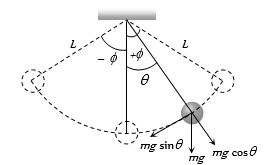
$A$ simple pendulum of length $L$ and mass (bob) $M$ is oscillating in a plane about a vertical line between angular limits $-\varphi$ and $+\varphi$. For an angular displacement $\theta$ $(|\theta| < \varphi)$,the tension in the string and the velocity of the bob are $T$ and $v$ respectively. Which of the following relations hold good under the above conditions?
A
$T \cos \theta = Mg$
B
$T - Mg \cos \theta = \frac{Mv^2}{L}$
C
The magnitude of the tangential acceleration of the bob $|a_T| = g \sin \theta$
D
Both $(b)$ and $(c)$
Solution
(D) For a simple pendulum oscillating in a vertical plane,the forces acting on the bob are the tension $T$ in the string (directed towards the pivot) and the gravitational force $Mg$ (directed vertically downwards).
$1$. Radial direction: The net force towards the center of the circular path is the centripetal force,which is given by $\frac{Mv^2}{L}$. The radial component of the gravitational force is $Mg \cos \theta$ (acting away from the pivot). Thus,the net radial force is $T - Mg \cos \theta$. Equating these,we get $T - Mg \cos \theta = \frac{Mv^2}{L}$. This matches option $(b)$.
$2$. Tangential direction: The component of the gravitational force acting tangentially to the path is $Mg \sin \theta$. According to Newton's second law,$F_T = Ma_T$,so $Mg \sin \theta = Ma_T$. Therefore,the magnitude of the tangential acceleration is $|a_T| = g \sin \theta$. This matches option $(c)$.
Since both $(b)$ and $(c)$ are correct,the correct option is $(d)$.
$1$. Radial direction: The net force towards the center of the circular path is the centripetal force,which is given by $\frac{Mv^2}{L}$. The radial component of the gravitational force is $Mg \cos \theta$ (acting away from the pivot). Thus,the net radial force is $T - Mg \cos \theta$. Equating these,we get $T - Mg \cos \theta = \frac{Mv^2}{L}$. This matches option $(b)$.
$2$. Tangential direction: The component of the gravitational force acting tangentially to the path is $Mg \sin \theta$. According to Newton's second law,$F_T = Ma_T$,so $Mg \sin \theta = Ma_T$. Therefore,the magnitude of the tangential acceleration is $|a_T| = g \sin \theta$. This matches option $(c)$.
Since both $(b)$ and $(c)$ are correct,the correct option is $(d)$.
0 likesView Solution
6
PhysicsMediumMCQIIT JEE · 1986
$A$ thin uniform circular disc of mass $M$ and radius $R$ is rotating in a horizontal plane about an axis passing through its centre and perpendicular to its plane with an angular velocity $\omega$. Another disc of same dimension but of mass $M/4$ is placed gently on the first disc coaxially. The angular velocity of the system now is
A
$2\omega / 5$
B
$2\omega / \sqrt{5}$
C
$4\omega / 5$
D
$4\omega / \sqrt{5}$
Solution
(C) Since there is no external torque acting on the system,the angular momentum is conserved.
$L_i = L_f$
$I_1 \omega_1 = I_2 \omega_2$
For the first disc,the moment of inertia is $I_1 = \frac{1}{2} M R^2$ and angular velocity is $\omega_1 = \omega$.
When the second disc of mass $M/4$ is placed coaxially,the new moment of inertia of the system is $I_2 = I_1 + I_{disc2} = \frac{1}{2} M R^2 + \frac{1}{2} (M/4) R^2$.
$I_2 = \frac{1}{2} M R^2 + \frac{1}{8} M R^2 = \frac{4+1}{8} M R^2 = \frac{5}{8} M R^2$.
Using the conservation of angular momentum:
$\frac{1}{2} M R^2 \cdot \omega = \frac{5}{8} M R^2 \cdot \omega_2$
$\omega_2 = \frac{1/2}{5/8} \omega = \frac{1}{2} \cdot \frac{8}{5} \omega = \frac{4}{5} \omega$.
$L_i = L_f$
$I_1 \omega_1 = I_2 \omega_2$
For the first disc,the moment of inertia is $I_1 = \frac{1}{2} M R^2$ and angular velocity is $\omega_1 = \omega$.
When the second disc of mass $M/4$ is placed coaxially,the new moment of inertia of the system is $I_2 = I_1 + I_{disc2} = \frac{1}{2} M R^2 + \frac{1}{2} (M/4) R^2$.
$I_2 = \frac{1}{2} M R^2 + \frac{1}{8} M R^2 = \frac{4+1}{8} M R^2 = \frac{5}{8} M R^2$.
Using the conservation of angular momentum:
$\frac{1}{2} M R^2 \cdot \omega = \frac{5}{8} M R^2 \cdot \omega_2$
$\omega_2 = \frac{1/2}{5/8} \omega = \frac{1}{2} \cdot \frac{8}{5} \omega = \frac{4}{5} \omega$.
0 likesView Solution
7
PhysicsMediumMCQIIT JEE · 1986
Two small spheres each having the charge $+Q$ are suspended by insulating threads of length $L$ from a hook. This arrangement is taken into space where there is no gravitational effect. Then the angle between the two suspensions and the tension in each will be:
A
$180^\circ, \frac{1}{4\pi \varepsilon_0} \frac{Q^2}{(2L)^2}$
B
$90^\circ, \frac{1}{4\pi \varepsilon_0} \frac{Q^2}{L^2}$
C
$180^\circ, \frac{1}{4\pi \varepsilon_0} \frac{Q^2}{2L^2}$
D
$180^\circ, \frac{1}{4\pi \varepsilon_0} \frac{Q^2}{L^2}$
Solution
(A) In the absence of gravity,the only force acting on the spheres is the electrostatic repulsive force between them.
Since both spheres have the same charge $+Q$,they repel each other.
To maximize the distance between them and reach an equilibrium position,the threads will stretch out in opposite directions,forming a straight line.
Thus,the angle between the two threads is $180^\circ$.
The distance between the two charges is $r = L + L = 2L$.
According to Coulomb's law,the electrostatic force $F$ between them is $F = \frac{1}{4\pi \varepsilon_0} \frac{Q \cdot Q}{(2L)^2} = \frac{1}{4\pi \varepsilon_0} \frac{Q^2}{(2L)^2}$.
This force is equal to the tension $T$ in each thread.
Since both spheres have the same charge $+Q$,they repel each other.
To maximize the distance between them and reach an equilibrium position,the threads will stretch out in opposite directions,forming a straight line.
Thus,the angle between the two threads is $180^\circ$.
The distance between the two charges is $r = L + L = 2L$.
According to Coulomb's law,the electrostatic force $F$ between them is $F = \frac{1}{4\pi \varepsilon_0} \frac{Q \cdot Q}{(2L)^2} = \frac{1}{4\pi \varepsilon_0} \frac{Q^2}{(2L)^2}$.
This force is equal to the tension $T$ in each thread.

0 likesView Solution
8
PhysicsMediumMCQIIT JEE · 1986
Two thin long parallel wires separated by a distance $b$ are carrying a current $i$ $A$ each. The magnitude of the force per unit length exerted by one wire on the other is
A
$\frac{\mu_0 i^2}{b^2}$
B
$\frac{\mu_0 i^2}{2\pi b}$
C
$\frac{\mu_0 i}{2\pi b}$
D
$\frac{\mu_0 i}{2\pi b^2}$
Solution
(B) The magnetic field $B$ produced by one wire at a distance $b$ is given by the formula: $B = \frac{\mu_0 i}{2\pi b}$.
According to the Lorentz force law,the force $F$ on a length $L$ of the second wire carrying current $i$ in this magnetic field is $F = i L B \sin(\theta)$.
Since the wires are parallel,the angle $\theta = 90^\circ$,so $\sin(90^\circ) = 1$.
Therefore,the force per unit length $f = \frac{F}{L} = i B$.
Substituting the value of $B$,we get $f = i \left( \frac{\mu_0 i}{2\pi b} \right) = \frac{\mu_0 i^2}{2\pi b}$.
According to the Lorentz force law,the force $F$ on a length $L$ of the second wire carrying current $i$ in this magnetic field is $F = i L B \sin(\theta)$.
Since the wires are parallel,the angle $\theta = 90^\circ$,so $\sin(90^\circ) = 1$.
Therefore,the force per unit length $f = \frac{F}{L} = i B$.
Substituting the value of $B$,we get $f = i \left( \frac{\mu_0 i}{2\pi b} \right) = \frac{\mu_0 i^2}{2\pi b}$.
0 likesView Solution
9
PhysicsEasyMCQIIT JEE · 1986
The mass number of a nucleus is
A
Always less than its atomic number
B
Always more than its atomic number
C
Always equal to its atomic number
D
Sometimes more than and sometimes equal to its atomic number
Solution
(D) The mass number $(A)$ is the sum of the number of protons $(Z)$ and neutrons $(N)$ in a nucleus,so $A = Z + N$.
For the hydrogen nucleus $(_{1}^{1}H)$,the number of protons is $1$ and the number of neutrons is $0$,so the mass number is $1$,which is equal to the atomic number $(A = Z)$.
For all other nuclei,the number of neutrons is at least $1$ or more,making the mass number greater than the atomic number $(A > Z)$.
Therefore,the mass number is sometimes equal to and sometimes greater than the atomic number.
For the hydrogen nucleus $(_{1}^{1}H)$,the number of protons is $1$ and the number of neutrons is $0$,so the mass number is $1$,which is equal to the atomic number $(A = Z)$.
For all other nuclei,the number of neutrons is at least $1$ or more,making the mass number greater than the atomic number $(A > Z)$.
Therefore,the mass number is sometimes equal to and sometimes greater than the atomic number.
0 likesView Solution
10
PhysicsMediumMCQIIT JEE · 1986
Some radioactive nucleus may emit
A
Only one $\alpha, \beta$ or $\gamma$ at a time
B
All the three $\alpha, \beta$ and $\gamma$ one after another
C
All the three $\alpha, \beta$ and $\gamma$ simultaneously
D
Only $\alpha$ and $\beta$ simultaneously
Solution
(A) radioactive nucleus undergoes decay by emitting either an $\alpha$-particle or a $\beta$-particle at a given time.
It is physically impossible for a single nucleus to emit both $\alpha$ and $\beta$ particles simultaneously.
However,$\gamma$-rays are often emitted as a result of the nucleus transitioning from an excited state to a lower energy state following the emission of an $\alpha$ or $\beta$ particle.
Therefore,at any single instant,a nucleus emits only one type of particle ($\alpha$ or $\beta$),which may be accompanied by $\gamma$-radiation.
It is physically impossible for a single nucleus to emit both $\alpha$ and $\beta$ particles simultaneously.
However,$\gamma$-rays are often emitted as a result of the nucleus transitioning from an excited state to a lower energy state following the emission of an $\alpha$ or $\beta$ particle.
Therefore,at any single instant,a nucleus emits only one type of particle ($\alpha$ or $\beta$),which may be accompanied by $\gamma$-radiation.
0 likesView Solution
11
PhysicsEasyMCQIIT JEE · 1986
$A$ converging lens is used to form an image on a screen. When the upper half of the lens is covered by an opaque screen,
A
Half the image will disappear
B
Complete image will be formed of same intensity
C
Half image will be formed of same intensity
D
Complete image will be formed of decreased intensity
Solution
(D) When the upper half of the lens is covered,the light rays from the object still pass through the remaining lower half of the lens.
Since every point on the object sends light rays to all parts of the lens,the lower half of the lens is sufficient to form the complete image of the object at the same position.
However,because the total amount of light passing through the lens is reduced (as half of the aperture is blocked),the intensity of the image decreases.
Therefore,the complete image is formed,but with decreased intensity.
Since every point on the object sends light rays to all parts of the lens,the lower half of the lens is sufficient to form the complete image of the object at the same position.
However,because the total amount of light passing through the lens is reduced (as half of the aperture is blocked),the intensity of the image decreases.
Therefore,the complete image is formed,but with decreased intensity.
0 likesView Solution
12
PhysicsDifficultMCQIIT JEE · 1986
In Young's double slit experiment,the two slits act as coherent sources of equal amplitude $A$ and wavelength $\lambda$. In another experiment with the same setup,the two slits are of equal amplitude $A$ and wavelength $\lambda$ but are incoherent. The ratio of the intensity of light at the mid-point of the screen in the first case to that in the second case is
A
$1 : 2$
B
$2 : 1$
C
$4 : 1$
D
$1 : 1$
Solution
(B) For coherent sources,the resultant intensity is given by $I = I_1 + I_2 + 2\sqrt{I_1 I_2} \cos \phi$.
At the central point,the path difference is zero,so $\phi = 0$. Given $I_1 = I_2 = I_0$,the intensity for coherent sources is $I_{coh} = I_0 + I_0 + 2\sqrt{I_0 I_0} \cos(0) = 4I_0$.
For incoherent sources,the phase difference $\phi$ varies randomly with time,so the average value of $\cos \phi$ is $0$.
Thus,the resultant intensity for incoherent sources is $I_{incoh} = I_1 + I_2 = I_0 + I_0 = 2I_0$.
The ratio of the intensities is $\frac{I_{coh}}{I_{incoh}} = \frac{4I_0}{2I_0} = \frac{2}{1}$.
At the central point,the path difference is zero,so $\phi = 0$. Given $I_1 = I_2 = I_0$,the intensity for coherent sources is $I_{coh} = I_0 + I_0 + 2\sqrt{I_0 I_0} \cos(0) = 4I_0$.
For incoherent sources,the phase difference $\phi$ varies randomly with time,so the average value of $\cos \phi$ is $0$.
Thus,the resultant intensity for incoherent sources is $I_{incoh} = I_1 + I_2 = I_0 + I_0 = 2I_0$.
The ratio of the intensities is $\frac{I_{coh}}{I_{incoh}} = \frac{4I_0}{2I_0} = \frac{2}{1}$.
0 likesView Solution
Vedclass Products
For Students
Vedclass Test Series
Mock tests in real IIT JEE style covering Physics with performance analysis. 5-day free trial.
Start Free TrialFor Teachers
Exam Paper Generator
Generate Set A/B/C/D Physics papers from 7.5L+ questions in 2 minutes. 3 chapters free.
Try FreeFor Institutes
Online Exam Module
Run live IIT JEE mock exams with unlimited students, 360° analytics & white-label branding.
See DemoFrequently Asked Questions
How many Physics questions are in IIT JEE 1986?
There are 12 Physics questions from the IIT JEE 1986 paper on Vedclass, each with a detailed step-by-step solution in English.
Are IIT JEE 1986 Physics solutions available in English?
Yes. All solutions on this page are in English. You can also switch to English or Hindi using the language buttons above the questions.
Can I practice IIT JEE 1986 Physics as a timed test?
Yes. Use the Vedclass Test Series to attempt a full IIT JEE mock test covering Physics with time limits and instant score analysis.
Can teachers create Physics papers from IIT JEE previous year questions?
Yes. The Vedclass Exam Paper Generator lets teachers mix IIT JEE Physics questions and generate Set A/B/C/D papers in minutes.
For Teachers & Institutes
Build a Custom Physics Paper
Pick IIT JEE 1986 Physics questions, set difficulty, and generate Set A/B/C/D in 2 minutes.