
MathematicsQ1–24 of 24 questions
Page 1 of 1 · English
1
MathematicsEasyMCQIIT JEE · 1980
The values of $x$ and $y$ satisfying the equation $\frac{(1 + i)x - 2i}{3 + i} + \frac{(2 - 3i)y + i}{3 - i} = i$ are
A
$x = -1, y = 3$
B
$x = 3, y = -1$
C
$x = 0, y = 1$
D
$x = 1, y = 0$
Solution
(B) Given equation: $\frac{(1 + i)x - 2i}{3 + i} + \frac{(2 - 3i)y + i}{3 - i} = i$
Multiply by the common denominator $(3+i)(3-i) = 9 - i^2 = 10$:
$((1 + i)x - 2i)(3 - i) + ((2 - 3i)y + i)(3 + i) = 10i$
$(3x - ix + 3ix - i^2x - 6i + 2i^2) + (6y + 2iy - 9iy - 3i^2y + 3i + i^2) = 10i$
$(3x - ix + 3ix + x - 6i - 2) + (6y + 2iy - 9iy + 3y + 3i - 1) = 10i$
$(4x + 2ix - 6i - 2) + (9y - 7iy + 3i - 1) = 10i$
$(4x + 9y - 3) + i(2x - 7y - 3) = 10i$
Equating real and imaginary parts:
Real part: $4x + 9y - 3 = 0 \implies 4x + 9y = 3$
Imaginary part: $2x - 7y - 3 = 10 \implies 2x - 7y = 13$
Solving the system:
From $2x - 7y = 13$,$x = \frac{13 + 7y}{2}$.
Substitute into $4x + 9y = 3$: $2(13 + 7y) + 9y = 3 \implies 26 + 14y + 9y = 3 \implies 23y = -23 \implies y = -1$.
Then $x = \frac{13 + 7(-1)}{2} = \frac{6}{2} = 3$.
Thus,$x = 3$ and $y = -1$.
Multiply by the common denominator $(3+i)(3-i) = 9 - i^2 = 10$:
$((1 + i)x - 2i)(3 - i) + ((2 - 3i)y + i)(3 + i) = 10i$
$(3x - ix + 3ix - i^2x - 6i + 2i^2) + (6y + 2iy - 9iy - 3i^2y + 3i + i^2) = 10i$
$(3x - ix + 3ix + x - 6i - 2) + (6y + 2iy - 9iy + 3y + 3i - 1) = 10i$
$(4x + 2ix - 6i - 2) + (9y - 7iy + 3i - 1) = 10i$
$(4x + 9y - 3) + i(2x - 7y - 3) = 10i$
Equating real and imaginary parts:
Real part: $4x + 9y - 3 = 0 \implies 4x + 9y = 3$
Imaginary part: $2x - 7y - 3 = 10 \implies 2x - 7y = 13$
Solving the system:
From $2x - 7y = 13$,$x = \frac{13 + 7y}{2}$.
Substitute into $4x + 9y = 3$: $2(13 + 7y) + 9y = 3 \implies 26 + 14y + 9y = 3 \implies 23y = -23 \implies y = -1$.
Then $x = \frac{13 + 7(-1)}{2} = \frac{6}{2} = 3$.
Thus,$x = 3$ and $y = -1$.
0 likesView Solution
2
MathematicsDifficultMCQIIT JEE · 1980
The interior angles of a polygon are in $A.P.$ If the smallest angle is $120^o$ and the common difference is $5^o$,then the number of sides is
A
$8$
B
$10$
C
$9$
D
$6$
Solution
(C) Let the number of sides of the polygon be $n$.
The sum of the interior angles of a polygon with $n$ sides is $(n - 2) \times 180^o$.
Since the angles are in $A.P.$ with first term $a = 120^o$ and common difference $d = 5^o$,the sum of the angles is given by $\frac{n}{2}[2a + (n - 1)d]$.
Equating the two expressions:
$\frac{n}{2}[2(120) + (n - 1)5] = (n - 2)180$
$n[240 + 5n - 5] = 360(n - 2)$
$5n^2 + 235n = 360n - 720$
$5n^2 - 125n + 720 = 0$
Dividing by $5$:
$n^2 - 25n + 144 = 0$
$(n - 9)(n - 16) = 0$
So,$n = 9$ or $n = 16$.
If $n = 16$,the largest angle is $T_{16} = a + 15d = 120^o + 15(5^o) = 120^o + 75^o = 195^o$.
Since an interior angle of a convex polygon must be less than $180^o$,$n = 16$ is rejected.
Therefore,the number of sides is $n = 9$.
The sum of the interior angles of a polygon with $n$ sides is $(n - 2) \times 180^o$.
Since the angles are in $A.P.$ with first term $a = 120^o$ and common difference $d = 5^o$,the sum of the angles is given by $\frac{n}{2}[2a + (n - 1)d]$.
Equating the two expressions:
$\frac{n}{2}[2(120) + (n - 1)5] = (n - 2)180$
$n[240 + 5n - 5] = 360(n - 2)$
$5n^2 + 235n = 360n - 720$
$5n^2 - 125n + 720 = 0$
Dividing by $5$:
$n^2 - 25n + 144 = 0$
$(n - 9)(n - 16) = 0$
So,$n = 9$ or $n = 16$.
If $n = 16$,the largest angle is $T_{16} = a + 15d = 120^o + 15(5^o) = 120^o + 75^o = 195^o$.
Since an interior angle of a convex polygon must be less than $180^o$,$n = 16$ is rejected.
Therefore,the number of sides is $n = 9$.
0 likesView Solution
3
MathematicsMediumMCQIIT JEE · 1980
Both the roots of the given equation $(x - a)(x - b) + (x - b)(x - c) + (x - c)(x - a) = 0$ are always
A
Positive
B
Negative
C
Real
D
Imaginary
Solution
(C) The given equation is $(x - a)(x - b) + (x - b)(x - c) + (x - c)(x - a) = 0$.
Expanding the terms,we get:
$(x^2 - (a+b)x + ab) + (x^2 - (b+c)x + bc) + (x^2 - (c+a)x + ca) = 0$.
Combining like terms,we obtain the quadratic equation:
$3x^2 - 2(a + b + c)x + (ab + bc + ca) = 0$.
For a quadratic equation $Ax^2 + Bx + C = 0$,the discriminant is $D = B^2 - 4AC$.
Here,$A = 3$,$B = -2(a + b + c)$,and $C = (ab + bc + ca)$.
$D = [-2(a + b + c)]^2 - 4(3)(ab + bc + ca)$
$D = 4(a^2 + b^2 + c^2 + 2ab + 2bc + 2ca) - 12(ab + bc + ca)$
$D = 4(a^2 + b^2 + c^2 - ab - bc - ca)$
$D = 2[2a^2 + 2b^2 + 2c^2 - 2ab - 2bc - 2ca]$
$D = 2[(a-b)^2 + (b-c)^2 + (c-a)^2]$.
Since the sum of squares of real numbers is always non-negative,$D \ge 0$.
Therefore,the roots are always real.
Expanding the terms,we get:
$(x^2 - (a+b)x + ab) + (x^2 - (b+c)x + bc) + (x^2 - (c+a)x + ca) = 0$.
Combining like terms,we obtain the quadratic equation:
$3x^2 - 2(a + b + c)x + (ab + bc + ca) = 0$.
For a quadratic equation $Ax^2 + Bx + C = 0$,the discriminant is $D = B^2 - 4AC$.
Here,$A = 3$,$B = -2(a + b + c)$,and $C = (ab + bc + ca)$.
$D = [-2(a + b + c)]^2 - 4(3)(ab + bc + ca)$
$D = 4(a^2 + b^2 + c^2 + 2ab + 2bc + 2ca) - 12(ab + bc + ca)$
$D = 4(a^2 + b^2 + c^2 - ab - bc - ca)$
$D = 2[2a^2 + 2b^2 + 2c^2 - 2ab - 2bc - 2ca]$
$D = 2[(a-b)^2 + (b-c)^2 + (c-a)^2]$.
Since the sum of squares of real numbers is always non-negative,$D \ge 0$.
Therefore,the roots are always real.
0 likesView Solution
4
MathematicsDifficultMCQIIT JEE · 1980
If ${x^2} + px + 1$ is a factor of the expression $a{x^3} + bx + c$,then
A
${a^2} + {c^2} = - ab$
B
${a^2} - {c^2} = - ab$
C
${a^2} - {c^2} = ab$
D
None of these
Solution
(C) Given that ${x^2} + px + 1$ is a factor of $a{x^3} + bx + c$,we can write:
$a{x^3} + bx + c = (x^2 + px + 1)(ax + k)$
where $k$ is a constant.
Expanding the right side:
$a{x^3} + bx + c = ax^3 + (ap + k)x^2 + (p k + a)x + k$
Comparing the coefficients of like powers of $x$ on both sides:
Coefficient of $x^2$: $ap + k = 0 \Rightarrow k = -ap$
Coefficient of $x$: $pk + a = b$
Constant term: $k = c$
Substituting $k = c$ into $k = -ap$,we get $c = -ap \Rightarrow p = -c/a$.
Substituting $p = -c/a$ and $k = c$ into $pk + a = b$:
$(-c/a)(c) + a = b$
$-c^2/a + a = b$
$a^2 - c^2 = ab$.
$a{x^3} + bx + c = (x^2 + px + 1)(ax + k)$
where $k$ is a constant.
Expanding the right side:
$a{x^3} + bx + c = ax^3 + (ap + k)x^2 + (p k + a)x + k$
Comparing the coefficients of like powers of $x$ on both sides:
Coefficient of $x^2$: $ap + k = 0 \Rightarrow k = -ap$
Coefficient of $x$: $pk + a = b$
Constant term: $k = c$
Substituting $k = c$ into $k = -ap$,we get $c = -ap \Rightarrow p = -c/a$.
Substituting $p = -c/a$ and $k = c$ into $pk + a = b$:
$(-c/a)(c) + a = b$
$-c^2/a + a = b$
$a^2 - c^2 = ab$.
0 likesView Solution
5
MathematicsMediumMCQIIT JEE · 1980
$^{47}C_4 + \sum_{r=1}^5 {}^{52-r}C_3 = $
A
$^{47}C_6$
B
$^{52}C_5$
C
$^{52}C_4$
D
\text{None of these}
Solution
(C) We use the Pascal's identity: $^{n}C_{r} + ^{n}C_{r-1} = ^{n+1}C_{r}$.
The given expression is $S = ^{47}C_4 + \sum_{r=1}^5 {}^{52-r}C_3$.
Expanding the summation:
$S = ^{47}C_4 + (^{51}C_3 + ^{50}C_3 + ^{49}C_3 + ^{48}C_3 + ^{47}C_3)$.
Rearranging terms:
$S = (^{47}C_4 + ^{47}C_3) + ^{48}C_3 + ^{49}C_3 + ^{50}C_3 + ^{51}C_3$.
Using $^{n}C_{r} + ^{n}C_{r-1} = ^{n+1}C_{r}$:
$^{47}C_4 + ^{47}C_3 = ^{48}C_4$.
Now,$S = (^{48}C_4 + ^{48}C_3) + ^{49}C_3 + ^{50}C_3 + ^{51}C_3$.
Using the identity again:
$^{48}C_4 + ^{48}C_3 = ^{49}C_4$.
Continuing this process:
$S = (^{49}C_4 + ^{49}C_3) + ^{50}C_3 + ^{51}C_3 = ^{50}C_4 + ^{50}C_3 + ^{51}C_3$.
$S = (^{50}C_4 + ^{50}C_3) + ^{51}C_3 = ^{51}C_4 + ^{51}C_3$.
$S = ^{52}C_4$.
Thus,the correct option is $C$.
The given expression is $S = ^{47}C_4 + \sum_{r=1}^5 {}^{52-r}C_3$.
Expanding the summation:
$S = ^{47}C_4 + (^{51}C_3 + ^{50}C_3 + ^{49}C_3 + ^{48}C_3 + ^{47}C_3)$.
Rearranging terms:
$S = (^{47}C_4 + ^{47}C_3) + ^{48}C_3 + ^{49}C_3 + ^{50}C_3 + ^{51}C_3$.
Using $^{n}C_{r} + ^{n}C_{r-1} = ^{n+1}C_{r}$:
$^{47}C_4 + ^{47}C_3 = ^{48}C_4$.
Now,$S = (^{48}C_4 + ^{48}C_3) + ^{49}C_3 + ^{50}C_3 + ^{51}C_3$.
Using the identity again:
$^{48}C_4 + ^{48}C_3 = ^{49}C_4$.
Continuing this process:
$S = (^{49}C_4 + ^{49}C_3) + ^{50}C_3 + ^{51}C_3 = ^{50}C_4 + ^{50}C_3 + ^{51}C_3$.
$S = (^{50}C_4 + ^{50}C_3) + ^{51}C_3 = ^{51}C_4 + ^{51}C_3$.
$S = ^{52}C_4$.
Thus,the correct option is $C$.
0 likesView Solution
6
MathematicsMediumMCQIIT JEE · 1980
Ten different letters of an alphabet are given. Words with five letters are formed from these given letters. The number of words which have at least one letter repeated is
A
$69760$
B
$30240$
C
$99748$
D
None of these
Solution
(A) The total number of words of $5$ letters that can be formed using $10$ different letters (with repetition allowed) is $10^5 = 100000$.
The number of words in which no letter is repeated is given by the permutation formula $^{10}P_5 = 10 \times 9 \times 8 \times 7 \times 6 = 30240$.
The number of words with at least one letter repeated is equal to the total number of words minus the number of words with no letter repeated.
Required number of words $= 100000 - 30240 = 69760$.
The number of words in which no letter is repeated is given by the permutation formula $^{10}P_5 = 10 \times 9 \times 8 \times 7 \times 6 = 30240$.
The number of words with at least one letter repeated is equal to the total number of words minus the number of words with no letter repeated.
Required number of words $= 100000 - 30240 = 69760$.
0 likesView Solution
7
MathematicsEasyMCQIIT JEE · 1980
Which is larger: $99^{50} + 100^{50}$ or $101^{50}$?
A
$99^{50} + 100^{50}$
B
Both are equal
C
$101^{50}$
D
None of these
Solution
(C) Using the Binomial Theorem,we expand $101^{50}$ and $99^{50}$ around $100$:
$101^{50} = (100 + 1)^{50} = 100^{50} + 50 \times 100^{49} + \frac{50 \times 49}{2} \times 100^{48} + \dots$ $(i)$
$99^{50} = (100 - 1)^{50} = 100^{50} - 50 \times 100^{49} + \frac{50 \times 49}{2} \times 100^{48} - \dots$ $(ii)$
Subtracting $(ii)$ from $(i)$:
$101^{50} - 99^{50} = 2 \times (50 \times 100^{49} + \frac{50 \times 49 \times 48}{6} \times 100^{47} + \dots)$
Since the right side is clearly greater than $100^{50}$,we have:
$101^{50} - 99^{50} > 100^{50}$
Therefore,$101^{50} > 100^{50} + 99^{50}$.
$101^{50} = (100 + 1)^{50} = 100^{50} + 50 \times 100^{49} + \frac{50 \times 49}{2} \times 100^{48} + \dots$ $(i)$
$99^{50} = (100 - 1)^{50} = 100^{50} - 50 \times 100^{49} + \frac{50 \times 49}{2} \times 100^{48} - \dots$ $(ii)$
Subtracting $(ii)$ from $(i)$:
$101^{50} - 99^{50} = 2 \times (50 \times 100^{49} + \frac{50 \times 49 \times 48}{6} \times 100^{47} + \dots)$
Since the right side is clearly greater than $100^{50}$,we have:
$101^{50} - 99^{50} > 100^{50}$
Therefore,$101^{50} > 100^{50} + 99^{50}$.
0 likesView Solution
8
MathematicsMediumMCQIIT JEE · 1980
If $A = \sin^2 \theta + \cos^4 \theta$,then for all real values of $\theta$:
A
$1 \le A \le 2$
B
$\frac{3}{4} \le A \le 1$
C
$\frac{13}{16} \le A \le 1$
D
$\frac{3}{4} \le A \le \frac{13}{16}$
Solution
(B) Given $A = \sin^2 \theta + \cos^4 \theta$.
Since $\cos^2 \theta \le 1$,we have $\cos^4 \theta \le \cos^2 \theta$.
Therefore,$A = \sin^2 \theta + \cos^4 \theta \le \sin^2 \theta + \cos^2 \theta = 1$.
Thus,$A \le 1$.
Now,express $A$ in terms of $\cos^2 \theta$:
$A = (1 - \cos^2 \theta) + \cos^4 \theta = \cos^4 \theta - \cos^2 \theta + 1$.
Let $x = \cos^2 \theta$,where $0 \le x \le 1$.
Then $A = x^2 - x + 1 = (x - \frac{1}{2})^2 + \frac{3}{4}$.
Since $(x - \frac{1}{2})^2 \ge 0$,the minimum value is $\frac{3}{4}$ when $x = \frac{1}{2}$.
Thus,$\frac{3}{4} \le A \le 1$.
Since $\cos^2 \theta \le 1$,we have $\cos^4 \theta \le \cos^2 \theta$.
Therefore,$A = \sin^2 \theta + \cos^4 \theta \le \sin^2 \theta + \cos^2 \theta = 1$.
Thus,$A \le 1$.
Now,express $A$ in terms of $\cos^2 \theta$:
$A = (1 - \cos^2 \theta) + \cos^4 \theta = \cos^4 \theta - \cos^2 \theta + 1$.
Let $x = \cos^2 \theta$,where $0 \le x \le 1$.
Then $A = x^2 - x + 1 = (x - \frac{1}{2})^2 + \frac{3}{4}$.
Since $(x - \frac{1}{2})^2 \ge 0$,the minimum value is $\frac{3}{4}$ when $x = \frac{1}{2}$.
Thus,$\frac{3}{4} \le A \le 1$.
0 likesView Solution
9
MathematicsMediumMCQIIT JEE · 1980
If $\alpha + \beta - \gamma = \pi ,$ then ${\sin ^2}\alpha + {\sin ^2}\beta - {\sin ^2}\gamma = $
A
$2\sin \alpha \sin \beta \cos \gamma $
B
$2\cos \alpha \cos \beta \cos \gamma $
C
$2\sin \alpha \sin \beta \sin \gamma $
D
None of these
Solution
(A) Given $\alpha + \beta - \gamma = \pi ,$ so $\gamma = \alpha + \beta - \pi .$
Consider the expression $E = \sin^2 \alpha + \sin^2 \beta - \sin^2 \gamma .$
Using the identity $\sin^2 A - \sin^2 B = \sin(A - B)\sin(A + B),$
$E = \sin^2 \alpha + \sin(\beta - \gamma)\sin(\beta + \gamma).$
Since $\beta - \gamma = \pi - \alpha,$ we have $\sin(\beta - \gamma) = \sin(\pi - \alpha) = \sin \alpha.$
Also,$\beta + \gamma = \beta + (\alpha + \beta - \pi) = \alpha + 2\beta - \pi.$
Alternatively,using $\gamma = \alpha + \beta - \pi,$
$E = \sin^2 \alpha + \sin^2 \beta - \sin^2(\alpha + \beta - \pi) = \sin^2 \alpha + \sin^2 \beta - \sin^2(\alpha + \beta).$
Using $\sin^2 A - \sin^2 B = \sin(A-B)\sin(A+B),$
$E = \sin^2 \alpha - \sin(\alpha + \beta - \beta)\sin(\alpha + \beta + \beta) = \sin^2 \alpha - \sin \alpha \sin(\alpha + 2\beta).$
$E = \sin \alpha [\sin \alpha - \sin(\alpha + 2\beta)].$
Using $\sin C - \sin D = 2\cos(\frac{C+D}{2})\sin(\frac{C-D}{2}),$
$E = \sin \alpha [2\cos(\alpha + \beta)\sin(-\beta)] = -2\sin \alpha \sin \beta \cos(\alpha + \beta).$
Since $\alpha + \beta = \pi + \gamma,$ $\cos(\alpha + \beta) = \cos(\pi + \gamma) = -\cos \gamma.$
Therefore,$E = -2\sin \alpha \sin \beta (-\cos \gamma) = 2\sin \alpha \sin \beta \cos \gamma.$
Consider the expression $E = \sin^2 \alpha + \sin^2 \beta - \sin^2 \gamma .$
Using the identity $\sin^2 A - \sin^2 B = \sin(A - B)\sin(A + B),$
$E = \sin^2 \alpha + \sin(\beta - \gamma)\sin(\beta + \gamma).$
Since $\beta - \gamma = \pi - \alpha,$ we have $\sin(\beta - \gamma) = \sin(\pi - \alpha) = \sin \alpha.$
Also,$\beta + \gamma = \beta + (\alpha + \beta - \pi) = \alpha + 2\beta - \pi.$
Alternatively,using $\gamma = \alpha + \beta - \pi,$
$E = \sin^2 \alpha + \sin^2 \beta - \sin^2(\alpha + \beta - \pi) = \sin^2 \alpha + \sin^2 \beta - \sin^2(\alpha + \beta).$
Using $\sin^2 A - \sin^2 B = \sin(A-B)\sin(A+B),$
$E = \sin^2 \alpha - \sin(\alpha + \beta - \beta)\sin(\alpha + \beta + \beta) = \sin^2 \alpha - \sin \alpha \sin(\alpha + 2\beta).$
$E = \sin \alpha [\sin \alpha - \sin(\alpha + 2\beta)].$
Using $\sin C - \sin D = 2\cos(\frac{C+D}{2})\sin(\frac{C-D}{2}),$
$E = \sin \alpha [2\cos(\alpha + \beta)\sin(-\beta)] = -2\sin \alpha \sin \beta \cos(\alpha + \beta).$
Since $\alpha + \beta = \pi + \gamma,$ $\cos(\alpha + \beta) = \cos(\pi + \gamma) = -\cos \gamma.$
Therefore,$E = -2\sin \alpha \sin \beta (-\cos \gamma) = 2\sin \alpha \sin \beta \cos \gamma.$
0 likesView Solution
10
MathematicsDifficultMCQIIT JEE · 1980
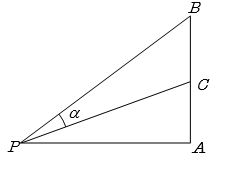
$AB$ is a vertical tower. The point $A$ is on the ground and $C$ is the middle point of $AB$. The part $CB$ subtends an angle $\alpha$ at a point $P$ on the ground. If $AP = n \cdot AB$,then the correct relation is:
A
$n = (n^2 + 1)\tan \alpha$
B
$n = (2n^2 - 1)\tan \alpha$
C
$n^2 = (2n^2 + 1)\tan \alpha$
D
$n = (2n^2 + 1)\tan \alpha$
Solution
(D) Let $AB = h$. Since $C$ is the midpoint of $AB$,$AC = \frac{h}{2}$ and $CB = \frac{h}{2}$.
Given $AP = n \cdot AB = nh$.
In $\triangle PAC$,$\tan(\angle APC) = \frac{AC}{AP} = \frac{h/2}{nh} = \frac{1}{2n}$.
In $\triangle PAB$,$\tan(\angle APB) = \frac{AB}{AP} = \frac{h}{nh} = \frac{1}{n}$.
We know $\alpha = \angle APB - \angle APC$.
Therefore,$\tan \alpha = \tan(\angle APB - \angle APC) = \frac{\tan(\angle APB) - \tan(\angle APC)}{1 + \tan(\angle APB) \cdot \tan(\angle APC)}$.
Substituting the values: $\tan \alpha = \frac{\frac{1}{n} - \frac{1}{2n}}{1 + (\frac{1}{n})(\frac{1}{2n})} = \frac{\frac{1}{2n}}{1 + \frac{1}{2n^2}} = \frac{\frac{1}{2n}}{\frac{2n^2 + 1}{2n^2}} = \frac{1}{2n} \cdot \frac{2n^2}{2n^2 + 1} = \frac{n}{2n^2 + 1}$.
Thus,$n = (2n^2 + 1)\tan \alpha$.
Given $AP = n \cdot AB = nh$.
In $\triangle PAC$,$\tan(\angle APC) = \frac{AC}{AP} = \frac{h/2}{nh} = \frac{1}{2n}$.
In $\triangle PAB$,$\tan(\angle APB) = \frac{AB}{AP} = \frac{h}{nh} = \frac{1}{n}$.
We know $\alpha = \angle APB - \angle APC$.
Therefore,$\tan \alpha = \tan(\angle APB - \angle APC) = \frac{\tan(\angle APB) - \tan(\angle APC)}{1 + \tan(\angle APB) \cdot \tan(\angle APC)}$.
Substituting the values: $\tan \alpha = \frac{\frac{1}{n} - \frac{1}{2n}}{1 + (\frac{1}{n})(\frac{1}{2n})} = \frac{\frac{1}{2n}}{1 + \frac{1}{2n^2}} = \frac{\frac{1}{2n}}{\frac{2n^2 + 1}{2n^2}} = \frac{1}{2n} \cdot \frac{2n^2}{2n^2 + 1} = \frac{n}{2n^2 + 1}$.
Thus,$n = (2n^2 + 1)\tan \alpha$.
0 likesView Solution
11
MathematicsEasyMCQIIT JEE · 1980
$A$ line $L$ is perpendicular to the line $5x - y = 1$ and the area of the triangle formed by the line $L$ and the coordinate axes is $5$. The equation of the line $L$ is
A
$x + 5y = 5$
B
$x + 5y = \pm 5\sqrt{2}$
C
$x - 5y = 5$
D
$x - 5y = 5\sqrt{2}$
Solution
(B) The given line is $5x - y = 1$.
Any line perpendicular to $5x - y = 1$ is of the form $x + 5y = k$.
Writing this in intercept form: $\frac{x}{k} + \frac{y}{k/5} = 1$.
The intercepts on the coordinate axes are $a = k$ and $b = k/5$.
The area of the triangle formed by the line and the coordinate axes is given by $\frac{1}{2} |ab| = 5$.
Substituting the values: $\frac{1}{2} |k \cdot \frac{k}{5}| = 5$.
$|k^2| = 50$,which implies $k = \pm \sqrt{50} = \pm 5\sqrt{2}$.
Therefore,the equation of the line $L$ is $x + 5y = \pm 5\sqrt{2}$.
Any line perpendicular to $5x - y = 1$ is of the form $x + 5y = k$.
Writing this in intercept form: $\frac{x}{k} + \frac{y}{k/5} = 1$.
The intercepts on the coordinate axes are $a = k$ and $b = k/5$.
The area of the triangle formed by the line and the coordinate axes is given by $\frac{1}{2} |ab| = 5$.
Substituting the values: $\frac{1}{2} |k \cdot \frac{k}{5}| = 5$.
$|k^2| = 50$,which implies $k = \pm \sqrt{50} = \pm 5\sqrt{2}$.
Therefore,the equation of the line $L$ is $x + 5y = \pm 5\sqrt{2}$.
0 likesView Solution
12
MathematicsEasyMCQIIT JEE · 1980
Given the four lines with equations $x + 2y = 3,$ $3x + 4y = 7,$ $2x + 3y = 4,$ and $4x + 5y = 6,$ these lines are:
A
Concurrent
B
Perpendicular
C
The sides of a rectangle
D
None of these
Solution
(D) The equations of the lines are:
$L_1: x + 2y - 3 = 0$
$L_2: 3x + 4y - 7 = 0$
$L_3: 2x + 3y - 4 = 0$
$L_4: 4x + 5y - 6 = 0$
First,check for parallel lines by comparing slopes $(m = -A/B)$:
$m_1 = -1/2, m_2 = -3/4, m_3 = -2/3, m_4 = -4/5$.
Since no slopes are equal,no two lines are parallel. Thus,they cannot form a rectangle.
Next,check for concurrency for any three lines. For $L_1, L_2, L_3$:
$\Delta = \begin{vmatrix} 1 & 2 & -3 \\ 3 & 4 & -7 \\ 2 & 3 & -4 \end{vmatrix} = 1(-16 + 21) - 2(-12 + 14) - 3(9 - 8) = 5 - 4 - 3 = -2 \neq 0$.
Since the determinant is not zero,the lines are not concurrent.
Therefore,the correct option is $D$.
$L_1: x + 2y - 3 = 0$
$L_2: 3x + 4y - 7 = 0$
$L_3: 2x + 3y - 4 = 0$
$L_4: 4x + 5y - 6 = 0$
First,check for parallel lines by comparing slopes $(m = -A/B)$:
$m_1 = -1/2, m_2 = -3/4, m_3 = -2/3, m_4 = -4/5$.
Since no slopes are equal,no two lines are parallel. Thus,they cannot form a rectangle.
Next,check for concurrency for any three lines. For $L_1, L_2, L_3$:
$\Delta = \begin{vmatrix} 1 & 2 & -3 \\ 3 & 4 & -7 \\ 2 & 3 & -4 \end{vmatrix} = 1(-16 + 21) - 2(-12 + 14) - 3(9 - 8) = 5 - 4 - 3 = -2 \neq 0$.
Since the determinant is not zero,the lines are not concurrent.
Therefore,the correct option is $D$.
0 likesView Solution
13
MathematicsMediumMCQIIT JEE · 1980
$A$ square is inscribed in the circle $x^2 + y^2 - 2x + 4y + 3 = 0$,whose sides are parallel to the coordinate axes. One vertex of the square is
A
$(1 + \sqrt{2}, -2)$
B
$(1 - \sqrt{2}, -2)$
C
$(1, -2 + \sqrt{2})$
D
None of these
Solution
(D) The equation of the circle is $x^2 + y^2 - 2x + 4y + 3 = 0$.
Comparing this with the general form $x^2 + y^2 + 2gx + 2fy + c = 0$,we get $g = -1$ and $f = 2$.
The center of the circle is $(-g, -f) = (1, -2)$ and the radius $r = \sqrt{g^2 + f^2 - c} = \sqrt{(-1)^2 + 2^2 - 3} = \sqrt{1 + 4 - 3} = \sqrt{2}$.
Since the sides of the square are parallel to the coordinate axes,the vertices of the square are at a distance $r$ from the center along the diagonals.
The vertices are $(1 \pm r \cos(45^\circ), -2 \pm r \sin(45^\circ)) = (1 \pm \sqrt{2} \cdot \frac{1}{\sqrt{2}}, -2 \pm \sqrt{2} \cdot \frac{1}{\sqrt{2}}) = (1 \pm 1, -2 \pm 1)$.
The vertices are $(2, -1), (0, -1), (0, -3), (2, -3)$.
Comparing these with the given options,none of the options match the calculated vertices.
Therefore,the correct option is $(d)$.
Comparing this with the general form $x^2 + y^2 + 2gx + 2fy + c = 0$,we get $g = -1$ and $f = 2$.
The center of the circle is $(-g, -f) = (1, -2)$ and the radius $r = \sqrt{g^2 + f^2 - c} = \sqrt{(-1)^2 + 2^2 - 3} = \sqrt{1 + 4 - 3} = \sqrt{2}$.
Since the sides of the square are parallel to the coordinate axes,the vertices of the square are at a distance $r$ from the center along the diagonals.
The vertices are $(1 \pm r \cos(45^\circ), -2 \pm r \sin(45^\circ)) = (1 \pm \sqrt{2} \cdot \frac{1}{\sqrt{2}}, -2 \pm \sqrt{2} \cdot \frac{1}{\sqrt{2}}) = (1 \pm 1, -2 \pm 1)$.
The vertices are $(2, -1), (0, -1), (0, -3), (2, -3)$.
Comparing these with the given options,none of the options match the calculated vertices.
Therefore,the correct option is $(d)$.
0 likesView Solution
14
MathematicsEasyMCQIIT JEE · 1980
The area of the circle whose centre is at $(1, 2)$ and which passes through the point $(4, 6)$ is
A
$5\pi$
B
$10\pi$
C
$25\pi$
D
None of these
Solution
(C) The radius $r$ of the circle is the distance between the centre $(1, 2)$ and the point $(4, 6)$ on the circle.
Using the distance formula,$r = \sqrt{(4 - 1)^2 + (6 - 2)^2}$.
$r = \sqrt{3^2 + 4^2} = \sqrt{9 + 16} = \sqrt{25} = 5$.
The area of the circle is given by the formula $A = \pi r^2$.
Substituting $r = 5$,we get $A = \pi (5)^2 = 25\pi \text{ sq. units}$.
Using the distance formula,$r = \sqrt{(4 - 1)^2 + (6 - 2)^2}$.
$r = \sqrt{3^2 + 4^2} = \sqrt{9 + 16} = \sqrt{25} = 5$.
The area of the circle is given by the formula $A = \pi r^2$.
Substituting $r = 5$,we get $A = \pi (5)^2 = 25\pi \text{ sq. units}$.
0 likesView Solution
15
MathematicsEasyMCQIIT JEE · 1980
$\mathop {\lim }\limits_{x \to 0} \frac{{x({2^x} - 1)}}{{1 - \cos x}} = $
A
$0$
B
$\log 4$
C
$\log 2$
D
$\text{None of these}$
Solution
(B) Given limit: $L = \mathop {\lim }\limits_{x \to 0} \frac{{x({2^x} - 1)}}{{1 - \cos x}}$
Using the standard limits $\mathop {\lim }\limits_{x \to 0} \frac{{{2^x} - 1}}{x} = \log 2$ and $1 - \cos x = 2\sin^2(\frac{x}{2})$:
$L = \mathop {\lim }\limits_{x \to 0} \frac{{x({2^x} - 1)}}{{2\sin^2(\frac{x}{2})}}$
$L = \mathop {\lim }\limits_{x \to 0} \left( \frac{{{2^x} - 1}}{x} \right) \cdot \left( \frac{x^2}{2\sin^2(\frac{x}{2})} \right)$
$L = (\log 2) \cdot \mathop {\lim }\limits_{x \to 0} \frac{1}{2 \left( \frac{\sin(x/2)}{x} \right)^2}$
Since $\mathop {\lim }\limits_{x \to 0} \frac{\sin(x/2)}{x/2} = 1$,we have $\mathop {\lim }\limits_{x \to 0} \frac{\sin(x/2)}{x} = \frac{1}{2}$:
$L = (\log 2) \cdot \frac{1}{2 \cdot (1/2)^2} = (\log 2) \cdot \frac{1}{2 \cdot (1/4)} = (\log 2) \cdot 2 = 2\log 2 = \log 4$.
Using the standard limits $\mathop {\lim }\limits_{x \to 0} \frac{{{2^x} - 1}}{x} = \log 2$ and $1 - \cos x = 2\sin^2(\frac{x}{2})$:
$L = \mathop {\lim }\limits_{x \to 0} \frac{{x({2^x} - 1)}}{{2\sin^2(\frac{x}{2})}}$
$L = \mathop {\lim }\limits_{x \to 0} \left( \frac{{{2^x} - 1}}{x} \right) \cdot \left( \frac{x^2}{2\sin^2(\frac{x}{2})} \right)$
$L = (\log 2) \cdot \mathop {\lim }\limits_{x \to 0} \frac{1}{2 \left( \frac{\sin(x/2)}{x} \right)^2}$
Since $\mathop {\lim }\limits_{x \to 0} \frac{\sin(x/2)}{x/2} = 1$,we have $\mathop {\lim }\limits_{x \to 0} \frac{\sin(x/2)}{x} = \frac{1}{2}$:
$L = (\log 2) \cdot \frac{1}{2 \cdot (1/2)^2} = (\log 2) \cdot \frac{1}{2 \cdot (1/4)} = (\log 2) \cdot 2 = 2\log 2 = \log 4$.
0 likesView Solution
16
MathematicsEasyMCQIIT JEE · 1980
The two events $A$ and $B$ have probabilities $0.25$ and $0.50$ respectively. The probability that both $A$ and $B$ occur simultaneously is $0.14$. Then the probability that neither $A$ nor $B$ occurs is
A
$0.39$
B
$0.25$
C
$0.904$
D
None of these
Solution
(A) Given: $P(A) = 0.25$,$P(B) = 0.50$,and $P(A \cap B) = 0.14$.
We need to find the probability that neither $A$ nor $B$ occurs,which is $P(A^c \cap B^c)$.
By De Morgan's Law,$P(A^c \cap B^c) = P((A \cup B)^c) = 1 - P(A \cup B)$.
Using the Addition Theorem of Probability,$P(A \cup B) = P(A) + P(B) - P(A \cap B)$.
$P(A \cup B) = 0.25 + 0.50 - 0.14 = 0.61$.
Therefore,$P(A^c \cap B^c) = 1 - 0.61 = 0.39$.
We need to find the probability that neither $A$ nor $B$ occurs,which is $P(A^c \cap B^c)$.
By De Morgan's Law,$P(A^c \cap B^c) = P((A \cup B)^c) = 1 - P(A \cup B)$.
Using the Addition Theorem of Probability,$P(A \cup B) = P(A) + P(B) - P(A \cap B)$.
$P(A \cup B) = 0.25 + 0.50 - 0.14 = 0.61$.
Therefore,$P(A^c \cap B^c) = 1 - 0.61 = 0.39$.
0 likesView Solution
17
MathematicsEasyMCQIIT JEE · 1980
The probability of happening an event $A$ is $0.5$ and that of $B$ is $0.3$. If $A$ and $B$ are mutually exclusive events,then the probability of happening neither $A$ nor $B$ is
A
$0.6$
B
$0.2$
C
$0.21$
D
None of these
Solution
(B) Given that $P(A) = 0.5$ and $P(B) = 0.3$.
Since $A$ and $B$ are mutually exclusive events,$P(A \cap B) = 0$.
The probability of happening neither $A$ nor $B$ is $P(\overline{A} \cap \overline{B})$.
By De Morgan's Law,$P(\overline{A} \cap \overline{B}) = P(\overline{A \cup B}) = 1 - P(A \cup B)$.
For mutually exclusive events,$P(A \cup B) = P(A) + P(B) = 0.5 + 0.3 = 0.8$.
Therefore,the required probability is $1 - 0.8 = 0.2$.
Since $A$ and $B$ are mutually exclusive events,$P(A \cap B) = 0$.
The probability of happening neither $A$ nor $B$ is $P(\overline{A} \cap \overline{B})$.
By De Morgan's Law,$P(\overline{A} \cap \overline{B}) = P(\overline{A \cup B}) = 1 - P(A \cup B)$.
For mutually exclusive events,$P(A \cup B) = P(A) + P(B) = 0.5 + 0.3 = 0.8$.
Therefore,the required probability is $1 - 0.8 = 0.2$.
0 likesView Solution
18
MathematicsDifficultMCQIIT JEE · 1980
If $A = \sin^2 x + \cos^4 x$,then for all real $x :$
A
$1 \le A \le 2$
B
$\frac{13}{16} \le A \le 1$
C
$\frac{3}{4} \le A \le 1$
D
$\frac{3}{4} \le A \le \frac{13}{16}$
Solution
(C) Given $A = \sin^2 x + \cos^4 x$.
Let $t = \sin^2 x$,then $0 \le t \le 1$. Since $\cos^2 x = 1 - \sin^2 x = 1 - t$,we have $\cos^4 x = (1 - t)^2$.
Substituting these into the expression for $A$:
$A = t + (1 - t)^2 = t + 1 - 2t + t^2 = t^2 - t + 1$.
This is a quadratic expression in $t$ where $t \in [0, 1]$.
The vertex of the parabola $f(t) = t^2 - t + 1$ is at $t = -(-1)/(2 \times 1) = 1/2$.
Since $1/2$ is within the interval $[0, 1]$,the minimum value is $f(1/2) = (1/2)^2 - (1/2) + 1 = 1/4 - 1/2 + 1 = 3/4$.
The maximum value occurs at the boundaries $t=0$ or $t=1$:
$f(0) = 0^2 - 0 + 1 = 1$.
$f(1) = 1^2 - 1 + 1 = 1$.
Thus,the range of $A$ is $\frac{3}{4} \le A \le 1$.
Let $t = \sin^2 x$,then $0 \le t \le 1$. Since $\cos^2 x = 1 - \sin^2 x = 1 - t$,we have $\cos^4 x = (1 - t)^2$.
Substituting these into the expression for $A$:
$A = t + (1 - t)^2 = t + 1 - 2t + t^2 = t^2 - t + 1$.
This is a quadratic expression in $t$ where $t \in [0, 1]$.
The vertex of the parabola $f(t) = t^2 - t + 1$ is at $t = -(-1)/(2 \times 1) = 1/2$.
Since $1/2$ is within the interval $[0, 1]$,the minimum value is $f(1/2) = (1/2)^2 - (1/2) + 1 = 1/4 - 1/2 + 1 = 3/4$.
The maximum value occurs at the boundaries $t=0$ or $t=1$:
$f(0) = 0^2 - 0 + 1 = 1$.
$f(1) = 1^2 - 1 + 1 = 1$.
Thus,the range of $A$ is $\frac{3}{4} \le A \le 1$.
0 likesView Solution
19
MathematicsMediumMCQIIT JEE · 1980
The equation of the circle passing through the points of intersection of the circles $x^2 + y^2 - 6x + 8 = 0$ and $x^2 + y^2 - 6 = 0$ and the point $(1, 1)$ is:
A
$x^2 + y^2 - 6x + 4 = 0$
B
$x^2 + y^2 - 3x + 1 = 0$
C
$x^2 + y^2 - 4y + 2 = 0$
D
None of these
Solution
(B) The equation of a circle passing through the intersection of two circles $S_1 = 0$ and $S_2 = 0$ is given by $S_1 + \lambda S_2 = 0$.
Here,$S_1 = x^2 + y^2 - 6x + 8 = 0$ and $S_2 = x^2 + y^2 - 6 = 0$.
The family of circles is $(x^2 + y^2 - 6x + 8) + \lambda(x^2 + y^2 - 6) = 0$.
Since the circle passes through the point $(1, 1)$,we substitute $x = 1$ and $y = 1$ into the equation:
$(1^2 + 1^2 - 6(1) + 8) + \lambda(1^2 + 1^2 - 6) = 0$
$(1 + 1 - 6 + 8) + \lambda(1 + 1 - 6) = 0$
$4 + \lambda(-4) = 0$
$4 - 4\lambda = 0 \implies \lambda = 1$.
Substituting $\lambda = 1$ back into the family equation:
$(x^2 + y^2 - 6x + 8) + 1(x^2 + y^2 - 6) = 0$
$2x^2 + 2y^2 - 6x + 2 = 0$
Dividing by $2$,we get $x^2 + y^2 - 3x + 1 = 0$.
Here,$S_1 = x^2 + y^2 - 6x + 8 = 0$ and $S_2 = x^2 + y^2 - 6 = 0$.
The family of circles is $(x^2 + y^2 - 6x + 8) + \lambda(x^2 + y^2 - 6) = 0$.
Since the circle passes through the point $(1, 1)$,we substitute $x = 1$ and $y = 1$ into the equation:
$(1^2 + 1^2 - 6(1) + 8) + \lambda(1^2 + 1^2 - 6) = 0$
$(1 + 1 - 6 + 8) + \lambda(1 + 1 - 6) = 0$
$4 + \lambda(-4) = 0$
$4 - 4\lambda = 0 \implies \lambda = 1$.
Substituting $\lambda = 1$ back into the family equation:
$(x^2 + y^2 - 6x + 8) + 1(x^2 + y^2 - 6) = 0$
$2x^2 + 2y^2 - 6x + 2 = 0$
Dividing by $2$,we get $x^2 + y^2 - 3x + 1 = 0$.
0 likesView Solution
20
MathematicsDifficultMCQIIT JEE · 1980
$\left| {\begin{array}{*{20}{c}}{{b^2} + {c^2}}&{{a^2}}&{{a^2}}\\{{b^2}}&{{c^2} + {a^2}}&{{b^2}}\\{{c^2}}&{{c^2}}&{{a^2} + {b^2}}\end{array}} \right| = $
A
$abc$
B
$4abc$
C
$4{a^2}{b^2}{c^2}$
D
${a^2}{b^2}{c^2}$
Solution
(C) Let $\Delta = \left| {\begin{array}{*{20}{c}}{{b^2} + {c^2}}&{{a^2}}&{{a^2}}\\{{b^2}}&{{c^2} + {a^2}}&{{b^2}}\\{{c^2}}&{{c^2}}&{{a^2} + {b^2}}\end{array}} \right|$.
Apply the operation ${R_1} \to {R_1} - ({R_2} + {R_3})$:
$\Delta = \left| {\begin{array}{*{20}{c}}{-2{c^2}}&{-2{c^2}}&{0}\\{{b^2}}&{{c^2} + {a^2}}&{{b^2}}\\{{c^2}}&{{c^2}}&{{a^2} + {b^2}}\end{array}} \right|$.
Alternatively,taking common factors from columns or rows:
$\Delta = 2{a^2}{b^2}{c^2} \left| {\begin{array}{*{20}{c}}{\frac{{{b^2} + {c^2}}}{{{a^2}}}}&1&1\\1&{\frac{{{c^2} + {a^2}}}{{{b^2}}}}&1\\1&1&{\frac{{{a^2} + {b^2}}}{{{c^2}}}}\end{array}} \right|$.
By simplifying the determinant,we get:
$\Delta = 4{a^2}{b^2}{c^2}$.
Trick: Put $a=1, b=1, c=1$ is not ideal as options might overlap. Let $a=1, b=2, c=3$:
$\Delta = \left| {\begin{array}{*{20}{c}}{13}&1&1\\4&10&4\\9&9&5\end{array}} \right| = 13(50-36) - 1(20-36) + 1(36-90) = 13(14) + 16 - 54 = 182 + 16 - 54 = 144$.
Checking options: $4{a^2}{b^2}{c^2} = 4(1)^2(2)^2(3)^2 = 4 \times 1 \times 4 \times 9 = 144$. Hence,option $C$ is correct.
Apply the operation ${R_1} \to {R_1} - ({R_2} + {R_3})$:
$\Delta = \left| {\begin{array}{*{20}{c}}{-2{c^2}}&{-2{c^2}}&{0}\\{{b^2}}&{{c^2} + {a^2}}&{{b^2}}\\{{c^2}}&{{c^2}}&{{a^2} + {b^2}}\end{array}} \right|$.
Alternatively,taking common factors from columns or rows:
$\Delta = 2{a^2}{b^2}{c^2} \left| {\begin{array}{*{20}{c}}{\frac{{{b^2} + {c^2}}}{{{a^2}}}}&1&1\\1&{\frac{{{c^2} + {a^2}}}{{{b^2}}}}&1\\1&1&{\frac{{{a^2} + {b^2}}}{{{c^2}}}}\end{array}} \right|$.
By simplifying the determinant,we get:
$\Delta = 4{a^2}{b^2}{c^2}$.
Trick: Put $a=1, b=1, c=1$ is not ideal as options might overlap. Let $a=1, b=2, c=3$:
$\Delta = \left| {\begin{array}{*{20}{c}}{13}&1&1\\4&10&4\\9&9&5\end{array}} \right| = 13(50-36) - 1(20-36) + 1(36-90) = 13(14) + 16 - 54 = 182 + 16 - 54 = 144$.
Checking options: $4{a^2}{b^2}{c^2} = 4(1)^2(2)^2(3)^2 = 4 \times 1 \times 4 \times 9 = 144$. Hence,option $C$ is correct.
0 likesView Solution
21
MathematicsMediumMCQIIT JEE · 1980
$\int \sqrt{1 + \sin \frac{x}{2}} \, dx = $
A
$4\left( \cos \frac{x}{4} - \sin \frac{x}{4} \right) + c$
B
$-4\left( \cos \frac{x}{4} + \sin \frac{x}{4} \right) + c$
C
$4\left( \sin \frac{x}{4} - \cos \frac{x}{4} \right) + c$
D
$4\left( \sin \frac{x}{4} + \cos \frac{x}{4} \right) + c$
Solution
(C) We know that $1 = \sin^2 \frac{x}{4} + \cos^2 \frac{x}{4}$ and $\sin \frac{x}{2} = 2 \sin \frac{x}{4} \cos \frac{x}{4}$.
Substituting these into the integral,we get:
$\int \sqrt{\sin^2 \frac{x}{4} + \cos^2 \frac{x}{4} + 2 \sin \frac{x}{4} \cos \frac{x}{4}} \, dx$
$= \int \sqrt{(\sin \frac{x}{4} + \cos \frac{x}{4})^2} \, dx$
$= \int (\sin \frac{x}{4} + \cos \frac{x}{4}) \, dx$
$= -4 \cos \frac{x}{4} + 4 \sin \frac{x}{4} + c$
$= 4(\sin \frac{x}{4} - \cos \frac{x}{4}) + c$.
Substituting these into the integral,we get:
$\int \sqrt{\sin^2 \frac{x}{4} + \cos^2 \frac{x}{4} + 2 \sin \frac{x}{4} \cos \frac{x}{4}} \, dx$
$= \int \sqrt{(\sin \frac{x}{4} + \cos \frac{x}{4})^2} \, dx$
$= \int (\sin \frac{x}{4} + \cos \frac{x}{4}) \, dx$
$= -4 \cos \frac{x}{4} + 4 \sin \frac{x}{4} + c$
$= 4(\sin \frac{x}{4} - \cos \frac{x}{4}) + c$.
0 likesView Solution
22
MathematicsEasyMCQIIT JEE · 1980
The probability of an event $A$ happening in one trial is $0.4$. The probability that the event $A$ happens at least once in three independent trials is
A
$0.94$
B
$0.784$
C
$0.90$
D
$0.22$
Solution
(B) Given,the probability of event $A$ occurring in one trial is $P(A) = 0.4$.
Therefore,the probability of event $A$ not occurring in one trial is $P(\bar{A}) = 1 - 0.4 = 0.6$.
For $n = 3$ independent trials,the probability that event $A$ does not happen at all is $P(\text{none}) = (P(\bar{A}))^3 = (0.6)^3 = 0.216$.
The probability that event $A$ happens at least once is given by $P(\text{at least once}) = 1 - P(\text{none})$.
$P(\text{at least once}) = 1 - 0.216 = 0.784$.
Therefore,the probability of event $A$ not occurring in one trial is $P(\bar{A}) = 1 - 0.4 = 0.6$.
For $n = 3$ independent trials,the probability that event $A$ does not happen at all is $P(\text{none}) = (P(\bar{A}))^3 = (0.6)^3 = 0.216$.
The probability that event $A$ happens at least once is given by $P(\text{at least once}) = 1 - P(\text{none})$.
$P(\text{at least once}) = 1 - 0.216 = 0.784$.
0 likesView Solution
23
MathematicsDifficultMCQIIT JEE · 1980
Let $y = \sqrt{\frac{(x + 1)(x - 3)}{(x - 2)}}$. Then,the set of all real values of $x$ for which $y$ takes real values is:
A
$[-1, 2) \cup [3, \infty)$
B
$[-1, 3] \cup (2, \infty)$
C
$[1, 2) \cup [3, \infty)$
D
None of these
Solution
(A) For $y$ to be a real value,the expression under the square root must be non-negative:
$\frac{(x + 1)(x - 3)}{(x - 2)} \ge 0$
We use the sign scheme (Wavy Curve Method) for the expression $f(x) = \frac{(x + 1)(x - 3)}{(x - 2)}$.
The critical points are $x = -1, 2, 3$.
Testing the intervals:
$1$. For $x \in (-1, 2)$,let $x = 0$: $\frac{(1)(-3)}{(-2)} = \frac{3}{2} > 0$ (Valid).
$2$. For $x \in [3, \infty)$,let $x = 4$: $\frac{(5)(1)}{(2)} = \frac{5}{2} > 0$ (Valid).
$3$. At $x = -1$,$y = 0$ (Valid).
$4$. At $x = 3$,$y = 0$ (Valid).
$5$. At $x = 2$,the expression is undefined.
Combining these,the solution is $x \in [-1, 2) \cup [3, \infty)$.
$\frac{(x + 1)(x - 3)}{(x - 2)} \ge 0$
We use the sign scheme (Wavy Curve Method) for the expression $f(x) = \frac{(x + 1)(x - 3)}{(x - 2)}$.
The critical points are $x = -1, 2, 3$.
Testing the intervals:
$1$. For $x \in (-1, 2)$,let $x = 0$: $\frac{(1)(-3)}{(-2)} = \frac{3}{2} > 0$ (Valid).
$2$. For $x \in [3, \infty)$,let $x = 4$: $\frac{(5)(1)}{(2)} = \frac{5}{2} > 0$ (Valid).
$3$. At $x = -1$,$y = 0$ (Valid).
$4$. At $x = 3$,$y = 0$ (Valid).
$5$. At $x = 2$,the expression is undefined.
Combining these,the solution is $x \in [-1, 2) \cup [3, \infty)$.
0 likesView Solution
24
MathematicsMediumMCQIIT JEE · 1980
If $y = \frac{5x}{\sqrt[3]{(1 - x)^2}} + \cos^2(2x + 1)$,then $\frac{dy}{dx} = $
A
$\frac{5(3 - x)}{3(1 - x)^{5/3}} - 2\sin(4x + 2)$
B
$\frac{5(3 - x)}{3(1 - x)^{2/3}} - 2\sin(4x + 4)$
C
$\frac{5(3 - x)}{3(1 - x)^{2/3}} - 2\sin(2x + 1)$
D
None of these
Solution
(A) Given $y = 5x(1 - x)^{-2/3} + \cos^2(2x + 1)$.
Applying the product rule and chain rule:
$\frac{dy}{dx} = 5 \left[ (1 - x)^{-2/3} + x \cdot \left( -\frac{2}{3} \right)(1 - x)^{-5/3}(-1) \right] + 2\cos(2x + 1)(-\sin(2x + 1))(2)$.
$\frac{dy}{dx} = 5(1 - x)^{-2/3} + \frac{10x}{3(1 - x)^{5/3}} - 4\cos(2x + 1)\sin(2x + 1)$.
Using $2\sin\theta\cos\theta = \sin(2\theta)$,we have $4\cos(2x + 1)\sin(2x + 1) = 2\sin(4x + 2)$.
$\frac{dy}{dx} = \frac{5(1 - x) + \frac{10x}{3}}{(1 - x)^{5/3}} - 2\sin(4x + 2) = \frac{5 - 5x + \frac{10x}{3}}{(1 - x)^{5/3}} - 2\sin(4x + 2)$.
$\frac{dy}{dx} = \frac{5(3 - 3x + 2x)}{3(1 - x)^{5/3}} - 2\sin(4x + 2) = \frac{5(3 - x)}{3(1 - x)^{5/3}} - 2\sin(4x + 2)$.
Applying the product rule and chain rule:
$\frac{dy}{dx} = 5 \left[ (1 - x)^{-2/3} + x \cdot \left( -\frac{2}{3} \right)(1 - x)^{-5/3}(-1) \right] + 2\cos(2x + 1)(-\sin(2x + 1))(2)$.
$\frac{dy}{dx} = 5(1 - x)^{-2/3} + \frac{10x}{3(1 - x)^{5/3}} - 4\cos(2x + 1)\sin(2x + 1)$.
Using $2\sin\theta\cos\theta = \sin(2\theta)$,we have $4\cos(2x + 1)\sin(2x + 1) = 2\sin(4x + 2)$.
$\frac{dy}{dx} = \frac{5(1 - x) + \frac{10x}{3}}{(1 - x)^{5/3}} - 2\sin(4x + 2) = \frac{5 - 5x + \frac{10x}{3}}{(1 - x)^{5/3}} - 2\sin(4x + 2)$.
$\frac{dy}{dx} = \frac{5(3 - 3x + 2x)}{3(1 - x)^{5/3}} - 2\sin(4x + 2) = \frac{5(3 - x)}{3(1 - x)^{5/3}} - 2\sin(4x + 2)$.
0 likesView Solution
Vedclass Products
For Students
Vedclass Test Series
Mock tests in real IIT JEE style covering Mathematics with performance analysis. 5-day free trial.
Start Free TrialFor Teachers
Exam Paper Generator
Generate Set A/B/C/D Mathematics papers from 7.5L+ questions in 2 minutes. 3 chapters free.
Try FreeFor Institutes
Online Exam Module
Run live IIT JEE mock exams with unlimited students, 360° analytics & white-label branding.
See DemoFrequently Asked Questions
How many Mathematics questions are in IIT JEE 1980?
There are 24 Mathematics questions from the IIT JEE 1980 paper on Vedclass, each with a detailed step-by-step solution in English.
Are IIT JEE 1980 Mathematics solutions available in English?
Yes. All solutions on this page are in English. You can also switch to English or Hindi using the language buttons above the questions.
Can I practice IIT JEE 1980 Mathematics as a timed test?
Yes. Use the Vedclass Test Series to attempt a full IIT JEE mock test covering Mathematics with time limits and instant score analysis.
Can teachers create Mathematics papers from IIT JEE previous year questions?
Yes. The Vedclass Exam Paper Generator lets teachers mix IIT JEE Mathematics questions and generate Set A/B/C/D papers in minutes.
For Teachers & Institutes
Build a Custom Mathematics Paper
Pick IIT JEE 1980 Mathematics questions, set difficulty, and generate Set A/B/C/D in 2 minutes.