
ChemistryQ1–21 of 21 questions
Page 1 of 1 · English
1
ChemistryMediumMCQIIT JEE · 1980
Element $x$ is strongly electropositive and $y$ is strongly electronegative. Both elements are univalent. The compound formed from their combination will be:
A
$xy$
B
$x^-y^+$
C
$x_2y$
D
$xy_2$
Solution
(A) Since $x$ is strongly electropositive and univalent,it forms a cation $x^+$.
Since $y$ is strongly electronegative and univalent,it forms an anion $y^-$.
The combination of $x^+$ and $y^-$ results in the formation of an ionic compound with the formula $xy$.
Since $y$ is strongly electronegative and univalent,it forms an anion $y^-$.
The combination of $x^+$ and $y^-$ results in the formation of an ionic compound with the formula $xy$.
1 likesView Solution
2
ChemistryEasyMCQIIT JEE · 1980
The number of electrons involved in the bond formation of $N_2$ molecule is:
A
$2$
B
$4$
C
$6$
D
$10$
Solution
(C) In the $N_2$ molecule,the two nitrogen atoms are connected by a triple bond.
Each nitrogen atom contributes $3$ electrons to the bond formation.
Therefore,the total number of electrons involved in the bond formation is $3 + 3 = 6$ electrons.
Each nitrogen atom contributes $3$ electrons to the bond formation.
Therefore,the total number of electrons involved in the bond formation is $3 + 3 = 6$ electrons.
0 likesView Solution
3
ChemistryEasyMCQIIT JEE · 1980
Which of the following compounds are covalent?
A
$H_2$
B
$CaO$
C
$KCl$
D
$Na_2S$
Solution
(A) covalent bond is formed by the sharing of electrons between atoms,typically between non-metals.
$H_2$ consists of two hydrogen atoms sharing a pair of electrons,making it a covalent molecule.
$CaO$,$KCl$,and $Na_2S$ are ionic compounds formed by the electrostatic attraction between metal cations and non-metal anions.
Therefore,the correct option is $A$.
$H_2$ consists of two hydrogen atoms sharing a pair of electrons,making it a covalent molecule.
$CaO$,$KCl$,and $Na_2S$ are ionic compounds formed by the electrostatic attraction between metal cations and non-metal anions.
Therefore,the correct option is $A$.
0 likesView Solution
4
ChemistryMCQIIT JEE · 1980
The bond order of individual carbon-carbon bonds in benzene is
A
One
B
Two
C
Between $1$ and $2$
D
One and two alternately
Solution
(C) In benzene $(C_6H_6)$,the carbon atoms are arranged in a hexagonal ring with alternating single and double bonds.
Due to the phenomenon of resonance,the $\pi$-electrons are delocalized over the entire ring.
As a result,all carbon-carbon bonds are equivalent,and the bond order is the average of a single bond $(1)$ and a double bond $(2)$,which is $1.5$.
Therefore,the bond order of individual carbon-carbon bonds in benzene is between $1$ and $2$.
Due to the phenomenon of resonance,the $\pi$-electrons are delocalized over the entire ring.
As a result,all carbon-carbon bonds are equivalent,and the bond order is the average of a single bond $(1)$ and a double bond $(2)$,which is $1.5$.
Therefore,the bond order of individual carbon-carbon bonds in benzene is between $1$ and $2$.
0 likesView Solution
5
ChemistryMediumMCQIIT JEE · 1980
Select the compound from the following which dissolves in water.
A
$CCl_4$
B
$CS_2$
C
$CHCl_3$
D
$C_2H_5OH$
Solution
(D) $C_2H_5OH$ (ethanol) is a polar molecule that contains an $-OH$ group.
It can form intermolecular hydrogen bonds with water molecules,which makes it soluble in water.
In contrast,$CCl_4$,$CS_2$,and $CHCl_3$ are non-polar or weakly polar organic solvents that do not form hydrogen bonds with water and are therefore insoluble.
It can form intermolecular hydrogen bonds with water molecules,which makes it soluble in water.
In contrast,$CCl_4$,$CS_2$,and $CHCl_3$ are non-polar or weakly polar organic solvents that do not form hydrogen bonds with water and are therefore insoluble.
0 likesView Solution
6
ChemistryEasyMCQIIT JEE · 1980
Which of the following is the weakest base?
A
$NaOH$
B
$Ca(OH)_2$
C
$NH_4OH$
D
$KOH$
Solution
(C) $NH_4OH$ is a weak base because it undergoes partial dissociation in aqueous solution,producing a low concentration of $OH^{-}$ ions compared to strong bases like $NaOH$,$KOH$,and $Ca(OH)_2$,which dissociate completely. Therefore,$NH_4OH$ is the weakest base among the given options.
0 likesView Solution
7
ChemistryMediumMCQIIT JEE · 1980
When $P_4$ reacts with caustic soda,the products are $PH_3$ and $NaH_2PO_2$. This reaction is an example of
A
Oxidation
B
Reduction
C
Oxidation and reduction (Redox)
D
Neutralization
Solution
(C) The reaction is: $P_4 + 3NaOH + 3H_2O \to 3NaH_2PO_2 + PH_3$.
In this reaction,the oxidation state of phosphorus $(P)$ changes from $0$ in $P_4$ to $-3$ in $PH_3$ (reduction) and to $+1$ in $NaH_2PO_2$ (oxidation).
Since both oxidation and reduction occur simultaneously,it is a disproportionation reaction,which is a type of redox reaction.
In this reaction,the oxidation state of phosphorus $(P)$ changes from $0$ in $P_4$ to $-3$ in $PH_3$ (reduction) and to $+1$ in $NaH_2PO_2$ (oxidation).
Since both oxidation and reduction occur simultaneously,it is a disproportionation reaction,which is a type of redox reaction.
0 likesView Solution
8
ChemistryMCQIIT JEE · 1980
Which of the following is the weakest base?
A
$NaOH$
B
$KOH$
C
$Ca(OH)_2$
D
$Zn(OH)_2$
Solution
(D) The strength of a base depends on its ability to release $OH^-$ ions in an aqueous solution.
$NaOH$,$KOH$,and $Ca(OH)_2$ are strong bases as they are alkali or alkaline earth metal hydroxides that dissociate completely in water.
$Zn(OH)_2$ is an amphoteric hydroxide,meaning it acts as a very weak base and also exhibits acidic properties.
Therefore,$Zn(OH)_2$ is the weakest base among the given options.
$NaOH$,$KOH$,and $Ca(OH)_2$ are strong bases as they are alkali or alkaline earth metal hydroxides that dissociate completely in water.
$Zn(OH)_2$ is an amphoteric hydroxide,meaning it acts as a very weak base and also exhibits acidic properties.
Therefore,$Zn(OH)_2$ is the weakest base among the given options.
0 likesView Solution
9
ChemistryMCQIIT JEE · 1980
The colour of hydrogen is
A
Black
B
Yellow
C
Orange
D
Colourless
Solution
(D) Normal hydrogen gas is colourless at $STP$ conditions.
If an electric discharge is passed through hydrogen gas at low pressure,it emits a characteristic light blue glow.
If an electric discharge is passed through hydrogen gas at low pressure,it emits a characteristic light blue glow.
0 likesView Solution
10
ChemistryMCQIIT JEE · 1980
$HCl$ is added to the following oxides,which one would give $H_2O_2$?
A
$MnO_2$
B
$PbO_2$
C
$BaO_2$
D
None of these
Solution
(C) The reaction of hydrated barium peroxide with dilute hydrochloric acid is a standard laboratory method for the preparation of hydrogen peroxide.
$BaO_2 \cdot 8H_2O(s) + 2HCl(aq) \to BaCl_2(aq) + H_2O_2(aq) + 8H_2O(l)$
Among the given options,only $BaO_2$ reacts with $HCl$ to produce $H_2O_2$.
$BaO_2 \cdot 8H_2O(s) + 2HCl(aq) \to BaCl_2(aq) + H_2O_2(aq) + 8H_2O(l)$
Among the given options,only $BaO_2$ reacts with $HCl$ to produce $H_2O_2$.
0 likesView Solution
11
ChemistryMediumMCQIIT JEE · 1980
$HCl$ is added to the following oxides. Which one would give $H_2O_2$?
A
$MnO_2$
B
$PbO_2$
C
$BaO$
D
None of these
Solution
(D) $MnO_2$,$PbO_2$,and $BaO$ do not produce $H_2O_2$ when reacted with $HCl$.
$MnO_2$ reacts with $HCl$ to produce $MnCl_2$,$Cl_2$,and $H_2O$.
$PbO_2$ reacts with $HCl$ to produce $PbCl_2$,$Cl_2$,and $H_2O$.
$BaO$ reacts with $HCl$ to produce $BaCl_2$ and $H_2O$.
$H_2O_2$ is typically prepared by the action of acids on hydrated barium peroxide $(BaO_2 \cdot 8H_2O)$,not on $BaO$ or other oxides listed.
$MnO_2$ reacts with $HCl$ to produce $MnCl_2$,$Cl_2$,and $H_2O$.
$PbO_2$ reacts with $HCl$ to produce $PbCl_2$,$Cl_2$,and $H_2O$.
$BaO$ reacts with $HCl$ to produce $BaCl_2$ and $H_2O$.
$H_2O_2$ is typically prepared by the action of acids on hydrated barium peroxide $(BaO_2 \cdot 8H_2O)$,not on $BaO$ or other oxides listed.
0 likesView Solution
12
ChemistryMediumMCQIIT JEE · 1980
The colour of hydrogen is
A
Black
B
Yellow
C
Orange
D
None of these
Solution
(D) Hydrogen is a colourless,odourless,and tasteless gas.
0 likesView Solution
13
ChemistryMediumMCQIIT JEE · 1980
Calcium is obtained by
A
Roasting of lime stone
B
Reduction of $CaCl_2$ with carbon
C
Electrolysis of a solution of $CaCl_2$ in water
D
Electrolysis of molten $CaCl_2$
Solution
(D) The correct answer is $D$.
Calcium is an alkaline earth metal,which is highly reactive and cannot be obtained by carbon reduction.
It is extracted by the electrolysis of molten $CaCl_2$ (fused salt) because electrolysis of aqueous $CaCl_2$ would result in the evolution of hydrogen gas at the cathode instead of calcium metal.
At the cathode: $Ca^{+2} + 2e^{-} \to Ca$
At the anode: $2Cl^{-} \to Cl_2 + 2e^{-}$
Calcium is an alkaline earth metal,which is highly reactive and cannot be obtained by carbon reduction.
It is extracted by the electrolysis of molten $CaCl_2$ (fused salt) because electrolysis of aqueous $CaCl_2$ would result in the evolution of hydrogen gas at the cathode instead of calcium metal.
At the cathode: $Ca^{+2} + 2e^{-} \to Ca$
At the anode: $2Cl^{-} \to Cl_2 + 2e^{-}$
0 likesView Solution
14
ChemistryMediumMCQIIT JEE · 1980
White phosphorus reacts with caustic soda. The products are $PH_3$ and $NaH_2PO_2$. This reaction is an example of
A
Oxidation
B
Reduction
C
Oxidation and reduction
D
Neutralisation
Solution
(C) The chemical reaction is: $P_4 + 3NaOH + 3H_2O \rightarrow PH_3 + 3NaH_2PO_2$.
In this reaction,the oxidation state of phosphorus changes from $0$ in $P_4$ to $-3$ in $PH_3$ (reduction) and to $+1$ in $NaH_2PO_2$ (oxidation).
Since the same element is simultaneously oxidized and reduced,this is a disproportionation reaction,which is a type of redox reaction involving both oxidation and reduction.
In this reaction,the oxidation state of phosphorus changes from $0$ in $P_4$ to $-3$ in $PH_3$ (reduction) and to $+1$ in $NaH_2PO_2$ (oxidation).
Since the same element is simultaneously oxidized and reduced,this is a disproportionation reaction,which is a type of redox reaction involving both oxidation and reduction.
0 likesView Solution
15
ChemistryMediumMCQIIT JEE · 1980
The main constituent of marsh gas is:
A
$C_2H_2$
B
$CH_4$
C
$H_2S$
D
$CO$
Solution
(B) Marsh gas is formed by the anaerobic decomposition of organic matter in wetlands and swamps.
It primarily consists of methane $(CH_4)$,which is the simplest alkane.
Therefore,the correct option is $(B)$.
It primarily consists of methane $(CH_4)$,which is the simplest alkane.
Therefore,the correct option is $(B)$.
0 likesView Solution
16
ChemistryMediumMCQIIT JEE · 1980
The bond order of individual carbon-carbon bonds in benzene is
A
One
B
Two
C
Between one and two
D
One and two,alternately
Solution
(C) The bond order of individual carbon-carbon bonds in benzene is $1.5$,which is between $1$ and $2$.
This is due to the resonance structure of $C_6H_6$.
In the benzene molecule,the $\pi$-electrons are delocalized over the entire ring.
Each carbon-carbon bond in benzene is equivalent,and the bond order is calculated as the average of the single and double bonds in the resonance structures,which is $(1+2)/2 = 1.5$.
This is due to the resonance structure of $C_6H_6$.
In the benzene molecule,the $\pi$-electrons are delocalized over the entire ring.
Each carbon-carbon bond in benzene is equivalent,and the bond order is calculated as the average of the single and double bonds in the resonance structures,which is $(1+2)/2 = 1.5$.
0 likesView Solution
17
ChemistryMediumMCQIIT JEE · 1980
Which one of the following dissolves in hot concentrated $NaOH$ solution?
A
$Fe$
B
$Zn$
C
$Cu$
D
$Ag$
Solution
(B) $Zn$ is an amphoteric metal. It reacts with hot concentrated $NaOH$ solution to form sodium zincate and hydrogen gas.
$Zn + 2NaOH \xrightarrow{\text{heat}} Na_2ZnO_2 + H_2$
$Zn + 2NaOH \xrightarrow{\text{heat}} Na_2ZnO_2 + H_2$
0 likesView Solution
18
ChemistryMCQIIT JEE · 1980
$A$ wall is made up of two layers $A$ and $B$. The thickness of the two layers is the same,but materials are different. The thermal conductivity of $A$ is double than that of $B$. In thermal equilibrium,the temperature difference between the two ends is $36\,^{\circ}C$. Then the difference of temperature at the two surfaces of $A$ will be......... $^{\circ}C$
A
$6$
B
$12$
C
$18$
D
$24$
Solution
(B) Let the thickness of each layer be $x$ and the thermal conductivity of layer $B$ be $K$. Then the thermal conductivity of layer $A$ is $2K$.
In steady state,the rate of heat flow $H$ through both layers is the same.
$H = \frac{Q}{t} = \frac{K_A A \Delta T_A}{x} = \frac{K_B A \Delta T_B}{x}$
Since the cross-sectional area $A$ and thickness $x$ are the same for both layers,we have:
$K_A \Delta T_A = K_B \Delta T_B$
$(2K) \Delta T_A = (K) \Delta T_B$
$\Delta T_B = 2 \Delta T_A$
The total temperature difference is given as $\Delta T_A + \Delta T_B = 36\,^{\circ}C$.
Substituting $\Delta T_B = 2 \Delta T_A$ into the equation:
$\Delta T_A + 2 \Delta T_A = 36\,^{\circ}C$
$3 \Delta T_A = 36\,^{\circ}C$
$\Delta T_A = 12\,^{\circ}C$
Therefore,the temperature difference across layer $A$ is $12\,^{\circ}C$.
In steady state,the rate of heat flow $H$ through both layers is the same.
$H = \frac{Q}{t} = \frac{K_A A \Delta T_A}{x} = \frac{K_B A \Delta T_B}{x}$
Since the cross-sectional area $A$ and thickness $x$ are the same for both layers,we have:
$K_A \Delta T_A = K_B \Delta T_B$
$(2K) \Delta T_A = (K) \Delta T_B$
$\Delta T_B = 2 \Delta T_A$
The total temperature difference is given as $\Delta T_A + \Delta T_B = 36\,^{\circ}C$.
Substituting $\Delta T_B = 2 \Delta T_A$ into the equation:
$\Delta T_A + 2 \Delta T_A = 36\,^{\circ}C$
$3 \Delta T_A = 36\,^{\circ}C$
$\Delta T_A = 12\,^{\circ}C$
Therefore,the temperature difference across layer $A$ is $12\,^{\circ}C$.
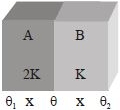
0 likesView Solution
19
ChemistryMCQIIT JEE · 1980
Which of the following is the weakest base?
A
$NaOH$
B
$Ca(OH)_2$
C
$NH_4OH$
D
$KOH$
Solution
(C) The strength of a base depends on its ability to dissociate into $OH^-$ ions in an aqueous solution.
$NaOH$,$KOH$,and $Ca(OH)_2$ are strong bases because they dissociate almost completely in water.
$NH_4OH$ (ammonium hydroxide) is a weak base because it undergoes partial dissociation in water,represented by the equilibrium: $NH_4OH \rightleftharpoons NH_4^+ + OH^-$.
Therefore,$NH_4OH$ is the weakest base among the given options.
$NaOH$,$KOH$,and $Ca(OH)_2$ are strong bases because they dissociate almost completely in water.
$NH_4OH$ (ammonium hydroxide) is a weak base because it undergoes partial dissociation in water,represented by the equilibrium: $NH_4OH \rightleftharpoons NH_4^+ + OH^-$.
Therefore,$NH_4OH$ is the weakest base among the given options.
0 likesView Solution
20
ChemistryEasyMCQIIT JEE · 1980
One of the constituents of German silver is:
A
$Ag$
B
$Cu$
C
$Mg$
D
$Al$
Solution
(B) German silver is an alloy that consists of copper $(Cu)$,zinc $(Zn)$,and nickel $(Ni)$.
Specifically,its composition is approximately $Cu = 60\%$,$Zn = 20\%$,and $Ni = 20\%$.
Therefore,$Cu$ is one of the constituents of German silver.
Specifically,its composition is approximately $Cu = 60\%$,$Zn = 20\%$,and $Ni = 20\%$.
Therefore,$Cu$ is one of the constituents of German silver.
0 likesView Solution
21
ChemistryMediumMCQIIT JEE · 1980
Which compound is soluble in water?
A
$CS_2$
B
$C_2H_5OH$
C
$CCl_4$
D
$CHCl_3$
Solution
(B) The correct answer is $(B)$.
$C_2H_5OH$ (ethanol) is soluble in water because it can form hydrogen bonds with water molecules.
$CS_2$,$CCl_4$,and $CHCl_3$ are non-polar or weakly polar organic solvents that do not form hydrogen bonds with water,making them insoluble.
$C_2H_5OH$ (ethanol) is soluble in water because it can form hydrogen bonds with water molecules.
$CS_2$,$CCl_4$,and $CHCl_3$ are non-polar or weakly polar organic solvents that do not form hydrogen bonds with water,making them insoluble.
0 likesView Solution
Vedclass Products
For Students
Vedclass Test Series
Mock tests in real IIT JEE style covering Chemistry with performance analysis. 5-day free trial.
Start Free TrialFor Teachers
Exam Paper Generator
Generate Set A/B/C/D Chemistry papers from 7.5L+ questions in 2 minutes. 3 chapters free.
Try FreeFor Institutes
Online Exam Module
Run live IIT JEE mock exams with unlimited students, 360° analytics & white-label branding.
See DemoFrequently Asked Questions
How many Chemistry questions are in IIT JEE 1980?
There are 21 Chemistry questions from the IIT JEE 1980 paper on Vedclass, each with a detailed step-by-step solution in English.
Are IIT JEE 1980 Chemistry solutions available in English?
Yes. All solutions on this page are in English. You can also switch to English or Hindi using the language buttons above the questions.
Can I practice IIT JEE 1980 Chemistry as a timed test?
Yes. Use the Vedclass Test Series to attempt a full IIT JEE mock test covering Chemistry with time limits and instant score analysis.
Can teachers create Chemistry papers from IIT JEE previous year questions?
Yes. The Vedclass Exam Paper Generator lets teachers mix IIT JEE Chemistry questions and generate Set A/B/C/D papers in minutes.
For Teachers & Institutes
Build a Custom Chemistry Paper
Pick IIT JEE 1980 Chemistry questions, set difficulty, and generate Set A/B/C/D in 2 minutes.