
PhysicsQ1–8 of 8 questions
Page 1 of 1 · English
1
PhysicsMediumMCQIIT JEE · 1980
$A$ ship of mass $3 \times 10^7 \, kg$ initially at rest is pulled by a force of $5 \times 10^4 \, N$ through a distance of $3 \, m$. Assuming that the resistance due to water is negligible,the speed of the ship is ........... $m/s$.
A
$1.5$
B
$60$
C
$0.1$
D
$5$
Solution
(C) Given: Mass $m = 3 \times 10^7 \, kg$,Force $F = 5 \times 10^4 \, N$,Distance $s = 3 \, m$,Initial velocity $u = 0$.
According to Newton's second law,acceleration $a = \frac{F}{m} = \frac{5 \times 10^4}{3 \times 10^7} = \frac{5}{3} \times 10^{-3} \, m/s^2$.
Using the kinematic equation $v^2 - u^2 = 2as$:
$v^2 = 0^2 + 2 \times \left( \frac{5 \times 10^4}{3 \times 10^7} \right) \times 3$.
$v^2 = 2 \times \left( \frac{5}{3} \times 10^{-3} \right) \times 3 = 10 \times 10^{-3} = 10^{-2}$.
$v = \sqrt{10^{-2}} = 0.1 \, m/s$.
According to Newton's second law,acceleration $a = \frac{F}{m} = \frac{5 \times 10^4}{3 \times 10^7} = \frac{5}{3} \times 10^{-3} \, m/s^2$.
Using the kinematic equation $v^2 - u^2 = 2as$:
$v^2 = 0^2 + 2 \times \left( \frac{5 \times 10^4}{3 \times 10^7} \right) \times 3$.
$v^2 = 2 \times \left( \frac{5}{3} \times 10^{-3} \right) \times 3 = 10 \times 10^{-3} = 10^{-2}$.
$v = \sqrt{10^{-2}} = 0.1 \, m/s$.
0 likesView Solution
2
PhysicsMediumMCQIIT JEE · 1980
$A$ block of mass $2 \, kg$ rests on a rough inclined plane making an angle of $30^\circ$ with the horizontal. The coefficient of static friction between the block and the plane is $0.7$. The frictional force on the block is ....... $N$.
A
$9.8$
B
$0.7 \times 9.8 \times \sqrt{3}$
C
$9.8 \times \sqrt{3}$
D
$0.8 \times 9.8$
Solution
(A) The component of the weight acting down the inclined plane is $F_{applied} = mg \sin \theta = 2 \times 9.8 \times \sin 30^\circ = 2 \times 9.8 \times 0.5 = 9.8 \, N$.
The limiting friction is given by $F_l = \mu_s N = \mu_s mg \cos \theta$.
$F_l = 0.7 \times 2 \times 9.8 \times \cos 30^\circ = 0.7 \times 19.6 \times \frac{\sqrt{3}}{2} \approx 11.88 \, N$.
Since the applied force $(9.8 \, N)$ is less than the limiting friction $(11.88 \, N)$,the block remains at rest.
Therefore,the static frictional force is equal to the component of the weight acting down the plane,which is $9.8 \, N$.
The limiting friction is given by $F_l = \mu_s N = \mu_s mg \cos \theta$.
$F_l = 0.7 \times 2 \times 9.8 \times \cos 30^\circ = 0.7 \times 19.6 \times \frac{\sqrt{3}}{2} \approx 11.88 \, N$.
Since the applied force $(9.8 \, N)$ is less than the limiting friction $(11.88 \, N)$,the block remains at rest.
Therefore,the static frictional force is equal to the component of the weight acting down the plane,which is $9.8 \, N$.
0 likesView Solution
3
PhysicsMediumMCQIIT JEE · 1980
Two masses of $1 \,g$ and $4 \,g$ are moving with equal kinetic energies. The ratio of the magnitudes of their linear momenta is
A
$4:1$
B
$\sqrt{2}:1$
C
$1:2$
D
$1:16$
Solution
(C) The relationship between linear momentum $P$,mass $m$,and kinetic energy $E$ is given by $P = \sqrt{2mE}$.
Since the kinetic energies $E$ are equal for both masses,we have $P \propto \sqrt{m}$.
Therefore,the ratio of their linear momenta is $\frac{P_1}{P_2} = \sqrt{\frac{m_1}{m_2}}$.
Substituting the given values $m_1 = 1 \,g$ and $m_2 = 4 \,g$,we get $\frac{P_1}{P_2} = \sqrt{\frac{1}{4}} = \frac{1}{2}$.
Thus,the ratio is $1:2$.
Since the kinetic energies $E$ are equal for both masses,we have $P \propto \sqrt{m}$.
Therefore,the ratio of their linear momenta is $\frac{P_1}{P_2} = \sqrt{\frac{m_1}{m_2}}$.
Substituting the given values $m_1 = 1 \,g$ and $m_2 = 4 \,g$,we get $\frac{P_1}{P_2} = \sqrt{\frac{1}{4}} = \frac{1}{2}$.
Thus,the ratio is $1:2$.
0 likesView Solution
4
PhysicsDifficultMCQIIT JEE · 1980
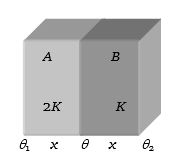
$A$ wall is made up of two layers $A$ and $B$. The thickness of the two layers is the same,but materials are different. The thermal conductivity of $A$ is double that of $B$. In thermal equilibrium,the temperature difference between the two ends is $36^{\circ}C$. Then the difference of temperature at the two surfaces of $A$ will be ....... $^{\circ}C$
A
$6$
B
$12$
C
$18$
D
$24$
Solution
(B) Let the thickness of each layer be $x$. Let the thermal conductivity of $B$ be $K$,then the thermal conductivity of $A$ is $2K$.
In steady state,the rate of heat flow through both layers is the same.
Rate of heat flow $H = \frac{KA(\Delta T)}{x}$.
For layer $A$: $H_A = \frac{(2K)A(\theta_1 - \theta)}{x}$.
For layer $B$: $H_B = \frac{KA(\theta - \theta_2)}{x}$.
Since $H_A = H_B$,we have:
$\frac{2KA(\theta_1 - \theta)}{x} = \frac{KA(\theta - \theta_2)}{x}$
$2(\theta_1 - \theta) = (\theta - \theta_2)$
Let $\Delta T_A = (\theta_1 - \theta)$ and $\Delta T_B = (\theta - \theta_2)$.
Then $2\Delta T_A = \Delta T_B$.
We are given the total temperature difference $\Delta T_A + \Delta T_B = 36^{\circ}C$.
Substituting $\Delta T_B = 2\Delta T_A$ into the equation:
$\Delta T_A + 2\Delta T_A = 36^{\circ}C$
$3\Delta T_A = 36^{\circ}C$
$\Delta T_A = 12^{\circ}C$.
Thus,the temperature difference across layer $A$ is $12^{\circ}C$.
In steady state,the rate of heat flow through both layers is the same.
Rate of heat flow $H = \frac{KA(\Delta T)}{x}$.
For layer $A$: $H_A = \frac{(2K)A(\theta_1 - \theta)}{x}$.
For layer $B$: $H_B = \frac{KA(\theta - \theta_2)}{x}$.
Since $H_A = H_B$,we have:
$\frac{2KA(\theta_1 - \theta)}{x} = \frac{KA(\theta - \theta_2)}{x}$
$2(\theta_1 - \theta) = (\theta - \theta_2)$
Let $\Delta T_A = (\theta_1 - \theta)$ and $\Delta T_B = (\theta - \theta_2)$.
Then $2\Delta T_A = \Delta T_B$.
We are given the total temperature difference $\Delta T_A + \Delta T_B = 36^{\circ}C$.
Substituting $\Delta T_B = 2\Delta T_A$ into the equation:
$\Delta T_A + 2\Delta T_A = 36^{\circ}C$
$3\Delta T_A = 36^{\circ}C$
$\Delta T_A = 12^{\circ}C$.
Thus,the temperature difference across layer $A$ is $12^{\circ}C$.
0 likesView Solution
5
PhysicsMediumMCQIIT JEE · 1980
Each of the properties of sound listed in column $A$ primarily depends on one of the quantities in column $B$. Choose the matching pairs from the two columns.
Column $A$ | Column $B$
Pitch | Waveform
Quality | Frequency
Loudness | Intensity
Column $A$ | Column $B$
Pitch | Waveform
Quality | Frequency
Loudness | Intensity
A
Pitch-waveform,Quality-frequency,Loudness-intensity
B
Pitch-frequency,Quality-waveform,Loudness-intensity
C
Pitch-intensity,Quality-waveform,Loudness-frequency
D
Pitch-waveform,Quality-intensity,Loudness-frequency
Solution
(B) The pitch of a sound is primarily determined by its frequency. Higher frequency results in higher pitch.
The quality (or timbre) of a sound is determined by the waveform,which depends on the presence of overtones and harmonics.
The loudness of a sound is primarily determined by its intensity,which is related to the amplitude of the sound wave.
Therefore,the correct matching is: Pitch-frequency,Quality-waveform,Loudness-intensity.
Correct Option: $B$
The quality (or timbre) of a sound is determined by the waveform,which depends on the presence of overtones and harmonics.
The loudness of a sound is primarily determined by its intensity,which is related to the amplitude of the sound wave.
Therefore,the correct matching is: Pitch-frequency,Quality-waveform,Loudness-intensity.
Correct Option: $B$
0 likesView Solution
6
PhysicsMediumMCQIIT JEE · 1980
The temperature coefficient of resistance for a wire is $0.00125\,^{\circ}C^{-1}$. At $300\,K$ its resistance is $1\,\Omega$. The temperature at which the resistance becomes $2\,\Omega$ is .......... $K$.
A
$1154$
B
$1100$
C
$1400$
D
$1127$
Solution
(B) The resistance of a conductor at temperature $t$ is given by $R_t = R_0(1 + \alpha \Delta t)$,where $R_0$ is the resistance at $0\,^{\circ}C$ and $\Delta t$ is the temperature change from $0\,^{\circ}C$.
Given: $\alpha = 0.00125\,^{\circ}C^{-1}$,$R_1 = 1\,\Omega$ at $T_1 = 300\,K$ $(t_1 = 27\,^{\circ}C)$,and $R_2 = 2\,\Omega$ at $T_2 = ?$.
Using the formula $R_2 = R_1[1 + \alpha(t_2 - t_1)]$:
$2 = 1[1 + 0.00125(t_2 - 27)]$
$2 - 1 = 0.00125(t_2 - 27)$
$1 = 0.00125(t_2 - 27)$
$t_2 - 27 = \frac{1}{0.00125} = 800$
$t_2 = 800 + 27 = 827\,^{\circ}C$
Converting to Kelvin: $T_2 = 827 + 273 = 1100\,K$.
Given: $\alpha = 0.00125\,^{\circ}C^{-1}$,$R_1 = 1\,\Omega$ at $T_1 = 300\,K$ $(t_1 = 27\,^{\circ}C)$,and $R_2 = 2\,\Omega$ at $T_2 = ?$.
Using the formula $R_2 = R_1[1 + \alpha(t_2 - t_1)]$:
$2 = 1[1 + 0.00125(t_2 - 27)]$
$2 - 1 = 0.00125(t_2 - 27)$
$1 = 0.00125(t_2 - 27)$
$t_2 - 27 = \frac{1}{0.00125} = 800$
$t_2 = 800 + 27 = 827\,^{\circ}C$
Converting to Kelvin: $T_2 = 827 + 273 = 1100\,K$.
0 likesView Solution
7
PhysicsEasyMCQIIT JEE · 1980
When light is refracted from air into glass,
A
Its wavelength and frequency both increase
B
Its wavelength increases but frequency remains unchanged
C
Its wavelength decreases but frequency remains unchanged
D
Its wavelength and frequency both decrease
Solution
(C) When light travels from one medium to another,its frequency $(f)$ remains constant because it depends on the source of the light.
The speed of light $(v)$ in a medium is given by $v = f \lambda$,where $\lambda$ is the wavelength.
Since the refractive index of glass $(\mu_g)$ is greater than that of air $(\mu_a)$,the speed of light decreases when it enters the glass $(v_g < v_a)$.
Because $v = f \lambda$ and $f$ is constant,the decrease in speed $(v)$ must result in a decrease in wavelength $(\lambda)$.
Therefore,the wavelength decreases while the frequency remains unchanged.
The speed of light $(v)$ in a medium is given by $v = f \lambda$,where $\lambda$ is the wavelength.
Since the refractive index of glass $(\mu_g)$ is greater than that of air $(\mu_a)$,the speed of light decreases when it enters the glass $(v_g < v_a)$.
Because $v = f \lambda$ and $f$ is constant,the decrease in speed $(v)$ must result in a decrease in wavelength $(\lambda)$.
Therefore,the wavelength decreases while the frequency remains unchanged.
0 likesView Solution
8
PhysicsMediumMCQIIT JEE · 1980
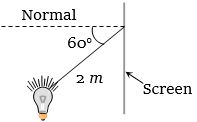
An electric bulb illuminates a plane surface. The intensity of illumination on the surface at a point $2 \ m$ away from the bulb is $5 \times 10^{-4} \ phot$ $(lumen/cm^2)$. The line joining the bulb to the point makes an angle of $60^{\circ}$ with the normal to the surface. The intensity of the bulb in candela is
A
$40\sqrt{3}$
B
$40$
C
$20$
D
$40 \times 10^{-4}$
Solution
(B) The intensity of illumination $I$ on a surface is given by the formula: $I = \frac{L \cos \theta}{r^2}$,where $L$ is the luminous intensity of the source in candela,$r$ is the distance,and $\theta$ is the angle with the normal.
Given:
$I = 5 \times 10^{-4} \ phot = 5 \times 10^{-4} \ lumen/cm^2 = 5 \times 10^{-4} \times 10^4 \ lumen/m^2 = 5 \ lumen/m^2$.
$r = 2 \ m$.
$\theta = 60^{\circ}$.
Rearranging the formula to find $L$:
$L = \frac{I \times r^2}{\cos \theta}$.
Substituting the values:
$L = \frac{5 \times 2^2}{\cos 60^{\circ}} = \frac{5 \times 4}{0.5} = \frac{20}{0.5} = 40 \ candela$.
Thus,the correct option is $B$.
Given:
$I = 5 \times 10^{-4} \ phot = 5 \times 10^{-4} \ lumen/cm^2 = 5 \times 10^{-4} \times 10^4 \ lumen/m^2 = 5 \ lumen/m^2$.
$r = 2 \ m$.
$\theta = 60^{\circ}$.
Rearranging the formula to find $L$:
$L = \frac{I \times r^2}{\cos \theta}$.
Substituting the values:
$L = \frac{5 \times 2^2}{\cos 60^{\circ}} = \frac{5 \times 4}{0.5} = \frac{20}{0.5} = 40 \ candela$.
Thus,the correct option is $B$.
0 likesView Solution
Vedclass Products
For Students
Vedclass Test Series
Mock tests in real IIT JEE style covering Physics with performance analysis. 5-day free trial.
Start Free TrialFor Teachers
Exam Paper Generator
Generate Set A/B/C/D Physics papers from 7.5L+ questions in 2 minutes. 3 chapters free.
Try FreeFor Institutes
Online Exam Module
Run live IIT JEE mock exams with unlimited students, 360° analytics & white-label branding.
See DemoFrequently Asked Questions
How many Physics questions are in IIT JEE 1980?
There are 8 Physics questions from the IIT JEE 1980 paper on Vedclass, each with a detailed step-by-step solution in English.
Are IIT JEE 1980 Physics solutions available in English?
Yes. All solutions on this page are in English. You can also switch to English or Hindi using the language buttons above the questions.
Can I practice IIT JEE 1980 Physics as a timed test?
Yes. Use the Vedclass Test Series to attempt a full IIT JEE mock test covering Physics with time limits and instant score analysis.
Can teachers create Physics papers from IIT JEE previous year questions?
Yes. The Vedclass Exam Paper Generator lets teachers mix IIT JEE Physics questions and generate Set A/B/C/D papers in minutes.
For Teachers & Institutes
Build a Custom Physics Paper
Pick IIT JEE 1980 Physics questions, set difficulty, and generate Set A/B/C/D in 2 minutes.