
PhysicsQ1–23 of 23 questions
Page 1 of 1 · English
1
PhysicsEasyMCQGUJCET · 2013
In an $RC$ $AC$ circuit,the maximum voltage and maximum current are $100 \ V$ and $1.1 \ A$ respectively. If $X_{C} = 60 \ \Omega$ and $R = 80 \ \Omega$,then the power consumed in the circuit will be . . . . . . . (in $W$)
A
$176.0$
B
$44.0$
C
$88.0$
D
$22.0$
Solution
(B) The power consumed in an $AC$ circuit is given by $P = V_{rms} I_{rms} \cos \phi$.
Given: $V_{m} = 100 \ V$,$I_{m} = 1.1 \ A$,$X_{C} = 60 \ \Omega$,$R = 80 \ \Omega$.
The impedance $Z$ is calculated as $Z = \sqrt{R^{2} + X_{C}^{2}} = \sqrt{80^{2} + 60^{2}} = \sqrt{6400 + 3600} = \sqrt{10000} = 100 \ \Omega$.
The power factor is $\cos \phi = \frac{R}{Z} = \frac{80}{100} = 0.8$.
The $rms$ values are $V_{rms} = \frac{V_{m}}{\sqrt{2}}$ and $I_{rms} = \frac{I_{m}}{\sqrt{2}}$.
Substituting these into the power formula:
$P = \left(\frac{100}{\sqrt{2}}\right) \times \left(\frac{1.1}{\sqrt{2}}\right) \times 0.8$
$P = \frac{100 \times 1.1}{2} \times 0.8$
$P = 50 \times 1.1 \times 0.8 = 55 \times 0.8 = 44.0 \ W$.
Given: $V_{m} = 100 \ V$,$I_{m} = 1.1 \ A$,$X_{C} = 60 \ \Omega$,$R = 80 \ \Omega$.
The impedance $Z$ is calculated as $Z = \sqrt{R^{2} + X_{C}^{2}} = \sqrt{80^{2} + 60^{2}} = \sqrt{6400 + 3600} = \sqrt{10000} = 100 \ \Omega$.
The power factor is $\cos \phi = \frac{R}{Z} = \frac{80}{100} = 0.8$.
The $rms$ values are $V_{rms} = \frac{V_{m}}{\sqrt{2}}$ and $I_{rms} = \frac{I_{m}}{\sqrt{2}}$.
Substituting these into the power formula:
$P = \left(\frac{100}{\sqrt{2}}\right) \times \left(\frac{1.1}{\sqrt{2}}\right) \times 0.8$
$P = \frac{100 \times 1.1}{2} \times 0.8$
$P = 50 \times 1.1 \times 0.8 = 55 \times 0.8 = 44.0 \ W$.
0 likesView Solution
2
PhysicsEasyMCQGUJCET · 2013
$A$ resistor of resistance $30 \Omega$, an inductor of reactance $10 \Omega$, and a capacitor of reactance $10 \Omega$ are connected in series to an $AC$ voltage source $V = 300 \sqrt{2} \sin(\omega t)$. The current in the circuit is . . . . . . (in $\text{ A}$)
A
$10$
B
$30$
C
$20$
D
$100$
Solution
(A) The given $AC$ voltage source is $V = 300 \sqrt{2} \sin(\omega t)$.
The peak voltage is $V_m = 300 \sqrt{2} \text{ V}$.
The $RMS$ voltage is $V_{rms} = \frac{V_m}{\sqrt{2}} = 300 \text{ V}$.
The impedance $Z$ of an $LCR$ series circuit is given by $Z = \sqrt{R^2 + (X_L - X_C)^2}$.
Given $R = 30 \Omega$, $X_L = 10 \Omega$, and $X_C = 10 \Omega$.
$Z = \sqrt{30^2 + (10 - 10)^2} = \sqrt{30^2 + 0^2} = 30 \Omega$.
The $RMS$ current $I_{rms}$ is given by $I_{rms} = \frac{V_{rms}}{Z}$.
$I_{rms} = \frac{300}{30} = 10 \text{ A}$.
The peak voltage is $V_m = 300 \sqrt{2} \text{ V}$.
The $RMS$ voltage is $V_{rms} = \frac{V_m}{\sqrt{2}} = 300 \text{ V}$.
The impedance $Z$ of an $LCR$ series circuit is given by $Z = \sqrt{R^2 + (X_L - X_C)^2}$.
Given $R = 30 \Omega$, $X_L = 10 \Omega$, and $X_C = 10 \Omega$.
$Z = \sqrt{30^2 + (10 - 10)^2} = \sqrt{30^2 + 0^2} = 30 \Omega$.
The $RMS$ current $I_{rms}$ is given by $I_{rms} = \frac{V_{rms}}{Z}$.
$I_{rms} = \frac{300}{30} = 10 \text{ A}$.
0 likesView Solution
3
PhysicsEasyMCQGUJCET · 2013
If the capacitance of a pure capacitor in a $DC$ circuit is $1 \ F$,then what will be its capacitive reactance?
A
Zero
B
$1 \ \Omega$
C
Infinite
D
$-2$
Solution
(C) The correct option is $C$.
In a $DC$ circuit,the frequency $v = 0 \ Hz$.
The angular frequency is given by $\omega = 2 \pi v = 2 \pi \times 0 = 0 \ rad/s$.
The capacitive reactance $X_C$ is given by the formula $X_C = \frac{1}{\omega C}$.
Substituting the values,we get $X_C = \frac{1}{0 \times 1} = \frac{1}{0} = \infty$.
Therefore,the capacitive reactance of a capacitor in a $DC$ circuit is infinite,meaning it acts as an open circuit.
In a $DC$ circuit,the frequency $v = 0 \ Hz$.
The angular frequency is given by $\omega = 2 \pi v = 2 \pi \times 0 = 0 \ rad/s$.
The capacitive reactance $X_C$ is given by the formula $X_C = \frac{1}{\omega C}$.
Substituting the values,we get $X_C = \frac{1}{0 \times 1} = \frac{1}{0} = \infty$.
Therefore,the capacitive reactance of a capacitor in a $DC$ circuit is infinite,meaning it acts as an open circuit.
0 likesView Solution
4
PhysicsEasyMCQGUJCET · 2013
Current flowing through the cell and potential difference between its two poles obtained by observations are given in the table below. The internal resistance of the cell is $r$.
Find the $emf$ $(\varepsilon)$ of the cell used in the experiment. (in $V$)
| Order | $V \ (V)$ | $I \ (A)$ |
|---|---|---|
| $1$ | $1.0$ | $0.08$ |
| $2$ | $0.5$ | $0.18$ |
| $3$ | $0.8$ | $0.12$ |
Find the $emf$ $(\varepsilon)$ of the cell used in the experiment. (in $V$)
A
$2.5$
B
$1.4$
C
$2$
D
$1.5$
Solution
(B) The relationship between terminal potential difference $(V)$, $emf$ $(\varepsilon)$, current $(I)$, and internal resistance $(r)$ is given by: $V = \varepsilon - Ir$.
Rearranging, we get: $\varepsilon = V + Ir$.
Using the values from the first two rows of the table:
For row $1$: $\varepsilon = 1.0 + 0.08r \quad (1)$
For row $2$: $\varepsilon = 0.5 + 0.18r \quad (2)$
Equating $(1)$ and $(2)$: $1.0 + 0.08r = 0.5 + 0.18r$.
Rearranging terms: $1.0 - 0.5 = 0.18r - 0.08r$.
$0.5 = 0.1r$, which gives $r = 5 \ \Omega$.
Substituting $r = 5 \ \Omega$ into equation $(1)$: $\varepsilon = 1.0 + 0.08(5) = 1.0 + 0.4 = 1.4 \ V$.
Rearranging, we get: $\varepsilon = V + Ir$.
Using the values from the first two rows of the table:
For row $1$: $\varepsilon = 1.0 + 0.08r \quad (1)$
For row $2$: $\varepsilon = 0.5 + 0.18r \quad (2)$
Equating $(1)$ and $(2)$: $1.0 + 0.08r = 0.5 + 0.18r$.
Rearranging terms: $1.0 - 0.5 = 0.18r - 0.08r$.
$0.5 = 0.1r$, which gives $r = 5 \ \Omega$.
Substituting $r = 5 \ \Omega$ into equation $(1)$: $\varepsilon = 1.0 + 0.08(5) = 1.0 + 0.4 = 1.4 \ V$.
0 likesView Solution
5
PhysicsEasyMCQGUJCET · 2013
Four identical resistors are connected in series with a battery,dissipating $20 \ W$ of power. What will be the power dissipated if the same resistors are connected in parallel to the same battery (in $W$)?
A
$320$
B
$5$
C
$100$
D
$80$
Solution
(A) Let the resistance of each resistor be $R$ and the battery voltage be $V$.
In a series connection,the equivalent resistance is $R_s = 4R$.
The power dissipated in series is $P_s = \frac{V^2}{R_s} = \frac{V^2}{4R} = 20 \ W$.
From this,we find $\frac{V^2}{R} = 20 \times 4 = 80 \ W$.
In a parallel connection,the equivalent resistance is $R_p = \frac{R}{4}$.
The power dissipated in parallel is $P_p = \frac{V^2}{R_p} = \frac{V^2}{R/4} = 4 \times \frac{V^2}{R}$.
Substituting the value of $\frac{V^2}{R}$,we get $P_p = 4 \times 80 \ W = 320 \ W$.
In a series connection,the equivalent resistance is $R_s = 4R$.
The power dissipated in series is $P_s = \frac{V^2}{R_s} = \frac{V^2}{4R} = 20 \ W$.
From this,we find $\frac{V^2}{R} = 20 \times 4 = 80 \ W$.
In a parallel connection,the equivalent resistance is $R_p = \frac{R}{4}$.
The power dissipated in parallel is $P_p = \frac{V^2}{R_p} = \frac{V^2}{R/4} = 4 \times \frac{V^2}{R}$.
Substituting the value of $\frac{V^2}{R}$,we get $P_p = 4 \times 80 \ W = 320 \ W$.
0 likesView Solution
6
PhysicsEasyMCQGUJCET · 2013
You are given $10$ resistors each of resistance $1 \ \Omega$. First,they are connected to obtain the possible minimum resistance. Then,they are connected to obtain the possible maximum resistance. The ratio of minimum and maximum resistance is . . . . . . .
A
$\frac{1}{100}$
B
$\frac{1}{50}$
C
$\frac{1}{1000}$
D
$\frac{1}{10}$
Solution
(A) For $n$ resistors each of resistance $R$ connected in parallel,the minimum resistance is given by $R_{\min} = \frac{R}{n}$.
Given $R = 1 \ \Omega$ and $n = 10$,we have $R_{\min} = \frac{1}{10} \ \Omega$.
For $n$ resistors connected in series,the maximum resistance is given by $R_{\max} = nR$.
Thus,$R_{\max} = 10 \times 1 = 10 \ \Omega$.
The ratio of minimum to maximum resistance is $\frac{R_{\min}}{R_{\max}} = \frac{1/10}{10} = \frac{1}{100}$.
Given $R = 1 \ \Omega$ and $n = 10$,we have $R_{\min} = \frac{1}{10} \ \Omega$.
For $n$ resistors connected in series,the maximum resistance is given by $R_{\max} = nR$.
Thus,$R_{\max} = 10 \times 1 = 10 \ \Omega$.
The ratio of minimum to maximum resistance is $\frac{R_{\min}}{R_{\max}} = \frac{1/10}{10} = \frac{1}{100}$.
0 likesView Solution
7
PhysicsEasyMCQGUJCET · 2013
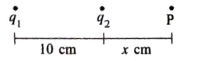
Two point unlike charges having magnitudes $+16 \mu C$ and $-9 \mu C$ are separated by a distance of $10 \ cm$ in air. The resultant electric field will be zero at a distance of . . . . . . from the $-9 \mu C$ charge. (in $cm$)
A
$40$
B
$20$
C
$10$
D
$30$
Solution
(D) Given: $q_1 = +16 \mu C$,$q_2 = -9 \mu C$,distance $d = 10 \ cm$.
Let the point where the resultant electric field is zero be at a distance $x$ from the $-9 \mu C$ charge. Since the charges are unlike,the null point lies outside the region between the charges,closer to the charge with the smaller magnitude.
At the null point,the magnitude of the electric field due to $q_1$ must equal the magnitude of the electric field due to $q_2$.
$E_1 = E_2$
$\frac{k |q_1|}{(d + x)^2} = \frac{k |q_2|}{x^2}$
$\frac{16}{(10 + x)^2} = \frac{9}{x^2}$
Taking the square root on both sides:
$\frac{4}{10 + x} = \frac{3}{x}$
$4x = 3(10 + x)$
$4x = 30 + 3x$
$x = 30 \ cm$
Thus,the resultant electric field is zero at a distance of $30 \ cm$ from the $-9 \mu C$ charge.
Let the point where the resultant electric field is zero be at a distance $x$ from the $-9 \mu C$ charge. Since the charges are unlike,the null point lies outside the region between the charges,closer to the charge with the smaller magnitude.
At the null point,the magnitude of the electric field due to $q_1$ must equal the magnitude of the electric field due to $q_2$.
$E_1 = E_2$
$\frac{k |q_1|}{(d + x)^2} = \frac{k |q_2|}{x^2}$
$\frac{16}{(10 + x)^2} = \frac{9}{x^2}$
Taking the square root on both sides:
$\frac{4}{10 + x} = \frac{3}{x}$
$4x = 3(10 + x)$
$4x = 30 + 3x$
$x = 30 \ cm$
Thus,the resultant electric field is zero at a distance of $30 \ cm$ from the $-9 \mu C$ charge.
0 likesView Solution
8
PhysicsEasyMCQGUJCET · 2013
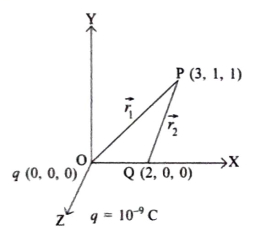
$A$ charge $10^{-9} \ C$ is located at the origin of a coordinate system and another charge $Q$ at $(2, 0, 0) \ m$. If the $Y$-component of the electric field at $(3, 1, 1) \ m$ is zero,calculate the value of $Q$.
A
$-0.43 \times 10^{-9} \ C$
B
$-0.1424 \times 10^{-9} \ C$
C
$-4.3 \times 10^{-9} \ C$
D
None of these.
Solution
(B) Let the charge at the origin be $q = 10^{-9} \ C$ and the charge at $(2, 0, 0) \ m$ be $Q$.
Let point $P$ be $(3, 1, 1) \ m$.
The position vector of $P$ relative to the origin $O(0, 0, 0)$ is $\vec{r}_1 = (3 - 0)\hat{i} + (1 - 0)\hat{j} + (1 - 0)\hat{k} = 3\hat{i} + \hat{j} + \hat{k}$.
The magnitude is $r_1 = |\vec{r}_1| = \sqrt{3^2 + 1^2 + 1^2} = \sqrt{11} \ m$.
The position vector of $P$ relative to the charge $Q$ at $(2, 0, 0)$ is $\vec{r}_2 = (3 - 2)\hat{i} + (1 - 0)\hat{j} + (1 - 0)\hat{k} = \hat{i} + \hat{j} + \hat{k}$.
The magnitude is $r_2 = |\vec{r}_2| = \sqrt{1^2 + 1^2 + 1^2} = \sqrt{3} \ m$.
The total electric field at $P$ is $\vec{E} = \vec{E}_1 + \vec{E}_2 = \frac{kq}{r_1^3}\vec{r}_1 + \frac{kQ}{r_2^3}\vec{r}_2$.
The $Y$-component of the electric field is $E_y = \frac{kq}{r_1^3}(y_1) + \frac{kQ}{r_2^3}(y_2) = 0$.
Substituting the values: $k \left[ \frac{10^{-9} \times 1}{(\sqrt{11})^3} + \frac{Q \times 1}{(\sqrt{3})^3} \right] = 0$.
$\frac{Q}{3\sqrt{3}} = -\frac{10^{-9}}{11\sqrt{11}}$.
$Q = -10^{-9} \times \frac{3\sqrt{3}}{11\sqrt{11}} = -10^{-9} \times \left( \frac{3}{11} \right)^{1.5} \approx -0.1424 \times 10^{-9} \ C$.
Let point $P$ be $(3, 1, 1) \ m$.
The position vector of $P$ relative to the origin $O(0, 0, 0)$ is $\vec{r}_1 = (3 - 0)\hat{i} + (1 - 0)\hat{j} + (1 - 0)\hat{k} = 3\hat{i} + \hat{j} + \hat{k}$.
The magnitude is $r_1 = |\vec{r}_1| = \sqrt{3^2 + 1^2 + 1^2} = \sqrt{11} \ m$.
The position vector of $P$ relative to the charge $Q$ at $(2, 0, 0)$ is $\vec{r}_2 = (3 - 2)\hat{i} + (1 - 0)\hat{j} + (1 - 0)\hat{k} = \hat{i} + \hat{j} + \hat{k}$.
The magnitude is $r_2 = |\vec{r}_2| = \sqrt{1^2 + 1^2 + 1^2} = \sqrt{3} \ m$.
The total electric field at $P$ is $\vec{E} = \vec{E}_1 + \vec{E}_2 = \frac{kq}{r_1^3}\vec{r}_1 + \frac{kQ}{r_2^3}\vec{r}_2$.
The $Y$-component of the electric field is $E_y = \frac{kq}{r_1^3}(y_1) + \frac{kQ}{r_2^3}(y_2) = 0$.
Substituting the values: $k \left[ \frac{10^{-9} \times 1}{(\sqrt{11})^3} + \frac{Q \times 1}{(\sqrt{3})^3} \right] = 0$.
$\frac{Q}{3\sqrt{3}} = -\frac{10^{-9}}{11\sqrt{11}}$.
$Q = -10^{-9} \times \frac{3\sqrt{3}}{11\sqrt{11}} = -10^{-9} \times \left( \frac{3}{11} \right)^{1.5} \approx -0.1424 \times 10^{-9} \ C$.
0 likesView Solution
9
PhysicsEasyMCQGUJCET · 2013
The force between two point charges placed in a material medium of dielectric constant $K$ is $F$. If the material is removed,then the force between them becomes . . . . . . .
A
$F \sqrt{ K }$
B
$FK$
C
$\frac{F}{\sqrt{K}}$
D
$\frac{ F }{ K }$
Solution
(B) The force between two point charges in a medium is given by $F_{\text{medium}} = \frac{F_{\text{air}}}{K}$,where $F_{\text{air}}$ is the force between the same charges in a vacuum (or air) and $K$ is the dielectric constant of the medium.
Given that the force in the medium is $F$,we have $F = \frac{F_{\text{air}}}{K}$.
To find the force when the material is removed (i.e.,the force in air),we rearrange the equation:
$F_{\text{air}} = F \times K$.
Therefore,the force becomes $FK$.
Given that the force in the medium is $F$,we have $F = \frac{F_{\text{air}}}{K}$.
To find the force when the material is removed (i.e.,the force in air),we rearrange the equation:
$F_{\text{air}} = F \times K$.
Therefore,the force becomes $FK$.
0 likesView Solution
10
PhysicsEasyMCQGUJCET · 2013
If the flux associated with a coil of $60$ turns varies at the rate of $1 \text{ Wb/hour}$,the induced emf is . . . . . . .
A
$\frac{1}{3600} \text{ V}$
B
$1 \text{ V}$
C
$\frac{1}{60} \text{ V}$
D
$0 \text{ V}$
Solution
(C) Given: Number of turns $N = 60$.
Rate of change of magnetic flux $\frac{d\phi}{dt} = 1 \text{ Wb/hour}$.
Convert the rate into $SI$ units (Weber per second): $\frac{d\phi}{dt} = \frac{1}{3600} \text{ Wb/s}$.
According to Faraday's law of electromagnetic induction,the magnitude of induced emf is given by $|\varepsilon| = N \left| \frac{d\phi}{dt} \right|$.
Substituting the values: $|\varepsilon| = 60 \times \frac{1}{3600} \text{ V}$.
$|\varepsilon| = \frac{1}{60} \text{ V}$.
Rate of change of magnetic flux $\frac{d\phi}{dt} = 1 \text{ Wb/hour}$.
Convert the rate into $SI$ units (Weber per second): $\frac{d\phi}{dt} = \frac{1}{3600} \text{ Wb/s}$.
According to Faraday's law of electromagnetic induction,the magnitude of induced emf is given by $|\varepsilon| = N \left| \frac{d\phi}{dt} \right|$.
Substituting the values: $|\varepsilon| = 60 \times \frac{1}{3600} \text{ V}$.
$|\varepsilon| = \frac{1}{60} \text{ V}$.
0 likesView Solution
11
PhysicsEasyMCQGUJCET · 2013
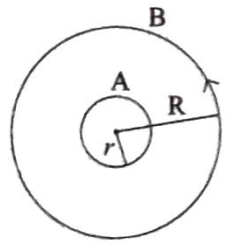
$O$ is the centre of two coplanar concentric circular conductors,$A$ and $B$,of radii $r$ and $R$ respectively as shown in the figure. Here $r \ll R$. The mutual inductance of the system of the conductors can be given by . . . . . . .
A
$\frac{\mu_0 \pi r}{2 R}$
B
$\frac{\mu_0 R^2}{\pi r}$
C
$\frac{\mu_0 \pi R^2}{2 r}$
D
$\frac{\mu_0 \pi r^2}{2 R}$
Solution
(D) When we pass a current $I$ through the outer loop of radius $R$,the magnetic field at the centre is given by:
$B_{\text{center}} = \frac{\mu_0 I}{2 R}$
Since $r \ll R$,the magnetic field $B$ is approximately uniform over the area of the smaller loop $A$.
The magnetic flux $\phi$ associated with the smaller loop is:
$\phi = B \cdot A = \left( \frac{\mu_0 I}{2 R} \right) \times (\pi r^2)$
$\phi = \frac{\mu_0 I \pi r^2}{2 R}$
The mutual inductance $M$ is defined as the ratio of the magnetic flux $\phi$ through the secondary coil to the current $I$ in the primary coil:
$M = \frac{\phi}{I} = \frac{\mu_0 \pi r^2}{2 R}$
$B_{\text{center}} = \frac{\mu_0 I}{2 R}$
Since $r \ll R$,the magnetic field $B$ is approximately uniform over the area of the smaller loop $A$.
The magnetic flux $\phi$ associated with the smaller loop is:
$\phi = B \cdot A = \left( \frac{\mu_0 I}{2 R} \right) \times (\pi r^2)$
$\phi = \frac{\mu_0 I \pi r^2}{2 R}$
The mutual inductance $M$ is defined as the ratio of the magnetic flux $\phi$ through the secondary coil to the current $I$ in the primary coil:
$M = \frac{\phi}{I} = \frac{\mu_0 \pi r^2}{2 R}$
0 likesView Solution
12
PhysicsEasyMCQGUJCET · 2013
$A$ bulb of $800 \text{ W}$ electrical power has an efficiency of $3 \%$. It is kept at the centre of a sphere of diameter $20 \text{ cm}$. The force exerted on its surface by the electromagnetic $(EM)$ wave is . . . . . . .
A
$8 \times 10^{-12} \text{ N}$
B
$8 \times 10^{-8} \text{ N}$
C
$8 \times 10^{-10} \text{ N}$
D
$8 \times 10^{-6} \text{ N}$
Solution
(B) The electrical power of the bulb is $P_{elec} = 800 \text{ W}$.
The efficiency of the bulb is $\eta = 3 \% = 0.03$.
The radiant power (energy emitted per second) is $P_{rad} = P_{elec} \times \eta = 800 \times 0.03 = 24 \text{ J/s}$.
The force exerted by an electromagnetic wave on a surface that absorbs it is given by $F = \frac{P_{rad}}{c}$,where $c = 3 \times 10^8 \text{ m/s}$ is the speed of light.
Substituting the values: $F = \frac{24}{3 \times 10^8} \text{ N}$.
$F = 8 \times 10^{-8} \text{ N}$.
Thus,the correct option is $B$.
The efficiency of the bulb is $\eta = 3 \% = 0.03$.
The radiant power (energy emitted per second) is $P_{rad} = P_{elec} \times \eta = 800 \times 0.03 = 24 \text{ J/s}$.
The force exerted by an electromagnetic wave on a surface that absorbs it is given by $F = \frac{P_{rad}}{c}$,where $c = 3 \times 10^8 \text{ m/s}$ is the speed of light.
Substituting the values: $F = \frac{24}{3 \times 10^8} \text{ N}$.
$F = 8 \times 10^{-8} \text{ N}$.
Thus,the correct option is $B$.
0 likesView Solution
13
PhysicsEasyMCQGUJCET · 2013
An electron microscope uses which property of the electron?
A
Wave nature
B
Negative electric charge
C
Spin frequency
D
None of these
Solution
(A) The electron microscope operates on the principle of the wave nature of electrons.
According to the de Broglie hypothesis,moving electrons are associated with a wave,known as matter waves.
The wavelength of these matter waves is given by $\lambda = \frac{h}{p}$,where $h$ is Planck's constant and $p$ is the momentum of the electron.
Because the wavelength of electrons is much smaller than that of visible light,electron microscopes can achieve much higher resolution than optical microscopes.
Therefore,the correct option is $(A)$.
According to the de Broglie hypothesis,moving electrons are associated with a wave,known as matter waves.
The wavelength of these matter waves is given by $\lambda = \frac{h}{p}$,where $h$ is Planck's constant and $p$ is the momentum of the electron.
Because the wavelength of electrons is much smaller than that of visible light,electron microscopes can achieve much higher resolution than optical microscopes.
Therefore,the correct option is $(A)$.
0 likesView Solution
14
PhysicsEasyMCQGUJCET · 2013
Which frequency of microwave is used by a microwave oven to cook food (in $GHz$)?
A
$0.5051$
B
$0.501$
C
$0.651$
D
$0.915$
Solution
(D) Microwave ovens operate by using electromagnetic waves to excite water molecules in food. The standard frequency commonly used for domestic microwave ovens is $2.45 \text{ GHz}$. However,among the provided options,$0.915 \text{ GHz}$ is a frequency also allocated for industrial,scientific,and medical $(ISM)$ applications,including specific types of microwave heating. Given the choices,$0.915 \text{ GHz}$ is the correct answer.
0 likesView Solution
15
PhysicsEasyMCQGUJCET · 2013
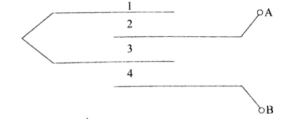
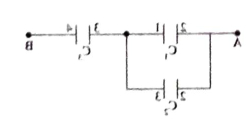
In the figure,the area of each plate is $A$ and the distance between consecutive plates is $d$. What is the effective capacitance between points $A$ and $B$?
A
$\frac{2}{3} \frac{A \varepsilon_0}{d}$
B
$\frac{3}{2} \frac{A \varepsilon_0}{d}$
C
$\frac{A \varepsilon_0}{d}$
D
None of the above.
Solution
(A) The given system consists of four plates. Let the capacitance of each pair of adjacent plates be $C = \frac{A \varepsilon_0}{d}$.
Based on the circuit diagram,plates $1$ and $3$ are connected together,and plates $2$ and $4$ are connected to terminals $A$ and $B$ respectively.
This forms two capacitors in parallel (between plates $1-2$ and $3-2$) which are then in series with a third capacitor (between plates $3-4$).
Let $C_1$ be the capacitance between plates $1$ and $2$,$C_2$ between $3$ and $2$,and $C_3$ between $3$ and $4$. Thus,$C_1 = C_2 = C_3 = C$.
The parallel combination of $C_1$ and $C_2$ gives $C' = C_1 + C_2 = C + C = 2C$.
This $C'$ is in series with $C_3$. The equivalent capacitance $C_{eq}$ is given by:
$C_{eq} = \frac{C' \cdot C_3}{C' + C_3} = \frac{(2C) \cdot C}{2C + C} = \frac{2C^2}{3C} = \frac{2}{3}C$.
Substituting $C = \frac{A \varepsilon_0}{d}$,we get $C_{eq} = \frac{2}{3} \frac{A \varepsilon_0}{d}$.
Based on the circuit diagram,plates $1$ and $3$ are connected together,and plates $2$ and $4$ are connected to terminals $A$ and $B$ respectively.
This forms two capacitors in parallel (between plates $1-2$ and $3-2$) which are then in series with a third capacitor (between plates $3-4$).
Let $C_1$ be the capacitance between plates $1$ and $2$,$C_2$ between $3$ and $2$,and $C_3$ between $3$ and $4$. Thus,$C_1 = C_2 = C_3 = C$.
The parallel combination of $C_1$ and $C_2$ gives $C' = C_1 + C_2 = C + C = 2C$.
This $C'$ is in series with $C_3$. The equivalent capacitance $C_{eq}$ is given by:
$C_{eq} = \frac{C' \cdot C_3}{C' + C_3} = \frac{(2C) \cdot C}{2C + C} = \frac{2C^2}{3C} = \frac{2}{3}C$.
Substituting $C = \frac{A \varepsilon_0}{d}$,we get $C_{eq} = \frac{2}{3} \frac{A \varepsilon_0}{d}$.
0 likesView Solution
16
PhysicsEasyMCQGUJCET · 2013
Two metallic spheres of radii $a$ and $b$ are placed far away from each other and are connected by a thin conducting wire. The total charge on them is $Q$. Calculate the potential of each sphere.
A
$\frac{k Q}{a-b}$
B
$k Q \left(\frac{b}{a}\right)$
C
$\frac{k Q}{a+b}$
D
$k Q \left(\frac{a}{b}\right)$
Solution
(C) Let the potentials of the spheres with radii $a$ and $b$ be $V_a$ and $V_b$ respectively,and the charges on them be $Q_a$ and $Q_b$.
Since the two spheres are connected by a conducting wire,they must be at the same potential:
$V_a = V_b$
$\frac{k Q_a}{a} = \frac{k Q_b}{b}$
$\frac{Q_a}{Q_b} = \frac{a}{b}$
Using the property of ratios,$\frac{Q_a}{Q_a + Q_b} = \frac{a}{a + b}$.
Since the total charge $Q_a + Q_b = Q$,we have:
$Q_a = \frac{a Q}{a + b}$ and $Q_b = \frac{b Q}{a + b}$.
Now,calculating the potential $V$ of each sphere:
$V = V_a = V_b = \frac{k Q_a}{a} = \frac{k}{a} \left( \frac{a Q}{a + b} \right) = \frac{k Q}{a + b}$.
Since the two spheres are connected by a conducting wire,they must be at the same potential:
$V_a = V_b$
$\frac{k Q_a}{a} = \frac{k Q_b}{b}$
$\frac{Q_a}{Q_b} = \frac{a}{b}$
Using the property of ratios,$\frac{Q_a}{Q_a + Q_b} = \frac{a}{a + b}$.
Since the total charge $Q_a + Q_b = Q$,we have:
$Q_a = \frac{a Q}{a + b}$ and $Q_b = \frac{b Q}{a + b}$.
Now,calculating the potential $V$ of each sphere:
$V = V_a = V_b = \frac{k Q_a}{a} = \frac{k}{a} \left( \frac{a Q}{a + b} \right) = \frac{k Q}{a + b}$.
0 likesView Solution
17
PhysicsEasyMCQGUJCET · 2013
The electric potential at any point $(x, y, z)$ (all in meters) in space is given by $V = 5x^2$ volt. The electric field at the point $(1, 2, 3) \text{ m}$ is $\overrightarrow{E} = $ . . . . . . $\text{N/C}$.
A
$1\hat{i} + 2\hat{j} + 3\hat{k}$
B
$-20\hat{j}$
C
$-30\hat{k}$
D
$-10\hat{i}$
Solution
(D) The relation between electric field $\overrightarrow{E}$ and electric potential $V$ is given by $\overrightarrow{E} = -\nabla V = -\left( \frac{\partial V}{\partial x}\hat{i} + \frac{\partial V}{\partial y}\hat{j} + \frac{\partial V}{\partial z}\hat{k} \right)$.
Given $V = 5x^2$.
Calculating the partial derivatives:
$\frac{\partial V}{\partial x} = \frac{d}{dx}(5x^2) = 10x$
$\frac{\partial V}{\partial y} = 0$
$\frac{\partial V}{\partial z} = 0$
Thus,$\overrightarrow{E} = -(10x)\hat{i} = -10x\hat{i} \text{ N/C}$.
At the point $(1, 2, 3) \text{ m}$,substituting $x = 1$:
$\overrightarrow{E} = -10(1)\hat{i} = -10\hat{i} \text{ N/C}$.
Therefore,the correct option is $D$.
Given $V = 5x^2$.
Calculating the partial derivatives:
$\frac{\partial V}{\partial x} = \frac{d}{dx}(5x^2) = 10x$
$\frac{\partial V}{\partial y} = 0$
$\frac{\partial V}{\partial z} = 0$
Thus,$\overrightarrow{E} = -(10x)\hat{i} = -10x\hat{i} \text{ N/C}$.
At the point $(1, 2, 3) \text{ m}$,substituting $x = 1$:
$\overrightarrow{E} = -10(1)\hat{i} = -10\hat{i} \text{ N/C}$.
Therefore,the correct option is $D$.
0 likesView Solution
18
PhysicsEasyMCQGUJCET · 2013
$A$ domain in a ferromagnetic substance is in the form of a cube of side length $2 \mu m$. It contains $4 \times 10^{14}$ atoms and each atomic dipole has a moment of $16 \times 10^{-24} \text{ A m}^2$. The magnetization of the domain is . . . . . . .
A
$8 \times 10^4 \text{ A m}^{-1}$
B
$7.2 \times 10^4 \text{ A m}^{-1}$
C
$3.6 \times 10^4 \text{ A m}^{-1}$
D
$64 \times 10^4 \text{ A m}^{-1}$
Solution
(A) Magnetization $(M)$ is defined as the net magnetic moment per unit volume.
$M = \frac{M_{\text{net}}}{V}$
Given:
Number of atoms $(N)$ = $4 \times 10^{14}$
Magnetic moment of each atom $(m)$ = $16 \times 10^{-24} \text{ A m}^2$
Side length of the cube $(a)$ = $2 \mu m = 2 \times 10^{-6} \text{ m}$
Volume of the cube $(V)$ = $a^3 = (2 \times 10^{-6})^3 = 8 \times 10^{-18} \text{ m}^3$
Total magnetic moment $(M_{\text{net}})$ = $N \times m = (4 \times 10^{14}) \times (16 \times 10^{-24}) = 64 \times 10^{-10} \text{ A m}^2$
Now,calculating magnetization:
$M = \frac{64 \times 10^{-10}}{8 \times 10^{-18}}$
$M = 8 \times 10^8 \times 10^{-4} = 8 \times 10^4 \text{ A m}^{-1}$
$M = \frac{M_{\text{net}}}{V}$
Given:
Number of atoms $(N)$ = $4 \times 10^{14}$
Magnetic moment of each atom $(m)$ = $16 \times 10^{-24} \text{ A m}^2$
Side length of the cube $(a)$ = $2 \mu m = 2 \times 10^{-6} \text{ m}$
Volume of the cube $(V)$ = $a^3 = (2 \times 10^{-6})^3 = 8 \times 10^{-18} \text{ m}^3$
Total magnetic moment $(M_{\text{net}})$ = $N \times m = (4 \times 10^{14}) \times (16 \times 10^{-24}) = 64 \times 10^{-10} \text{ A m}^2$
Now,calculating magnetization:
$M = \frac{64 \times 10^{-10}}{8 \times 10^{-18}}$
$M = 8 \times 10^8 \times 10^{-4} = 8 \times 10^4 \text{ A m}^{-1}$
0 likesView Solution
19
PhysicsEasyMCQGUJCET · 2013
$A$ bar magnet is oscillating in the earth's magnetic field with a time period $T$. If a similar magnet with the same mass and volume has a magnetic dipole moment which is $9$ times that of this magnet,then its time period will be . . . . . . .
A
$\frac{T}{6}$
B
$\frac{T}{9}$
C
$\frac{T}{3}$
D
$\frac{T}{2}$
Solution
(C) The time period $T$ of a bar magnet oscillating in a magnetic field is given by the formula: $T = 2\pi \sqrt{\frac{I}{MB}}$,where $I$ is the moment of inertia,$M$ is the magnetic dipole moment,and $B$ is the magnetic field strength.
Since the mass and volume are the same,the moment of inertia $I$ remains constant.
For the new magnet,the magnetic dipole moment $M' = 9M$.
The new time period $T'$ is given by: $T' = 2\pi \sqrt{\frac{I}{M'B}} = 2\pi \sqrt{\frac{I}{9MB}}$.
Simplifying this,we get: $T' = \frac{1}{\sqrt{9}} \times 2\pi \sqrt{\frac{I}{MB}} = \frac{1}{3} T$.
Therefore,the new time period is $\frac{T}{3}$.
Since the mass and volume are the same,the moment of inertia $I$ remains constant.
For the new magnet,the magnetic dipole moment $M' = 9M$.
The new time period $T'$ is given by: $T' = 2\pi \sqrt{\frac{I}{M'B}} = 2\pi \sqrt{\frac{I}{9MB}}$.
Simplifying this,we get: $T' = \frac{1}{\sqrt{9}} \times 2\pi \sqrt{\frac{I}{MB}} = \frac{1}{3} T$.
Therefore,the new time period is $\frac{T}{3}$.
0 likesView Solution
20
PhysicsEasyMCQGUJCET · 2013
The magnetic field due to a current-carrying circular loop of radius $6 \ cm$ at a point on the axis at a distance of $8 \ cm$ from the centre is $216 \ \mu T$. Then the magnetic field at the centre of the ring is $\dots \ \mu T$.
A
$432$
B
$1000$
C
$500$
D
$250$
Solution
(B) The magnetic field on the axis of a circular loop is given by: $B_{\text{axis}} = \frac{\mu_0 I a^2}{2(a^2 + x^2)^{3/2}}$
The magnetic field at the centre of the loop is given by: $B_{\text{centre}} = \frac{\mu_0 I}{2a}$
Taking the ratio of the two fields:
$\frac{B_{\text{centre}}}{B_{\text{axis}}} = \frac{\mu_0 I}{2a} \times \frac{2(a^2 + x^2)^{3/2}}{\mu_0 I a^2} = \frac{(a^2 + x^2)^{3/2}}{a^3}$
Given $a = 6 \ cm$ and $x = 8 \ cm$:
$\frac{B_{\text{centre}}}{B_{\text{axis}}} = \frac{(6^2 + 8^2)^{3/2}}{6^3} = \frac{(36 + 64)^{3/2}}{216} = \frac{(100)^{3/2}}{216} = \frac{1000}{216}$
Given $B_{\text{axis}} = 216 \ \mu T$:
$B_{\text{centre}} = 216 \times \frac{1000}{216} = 1000 \ \mu T$.
The magnetic field at the centre of the loop is given by: $B_{\text{centre}} = \frac{\mu_0 I}{2a}$
Taking the ratio of the two fields:
$\frac{B_{\text{centre}}}{B_{\text{axis}}} = \frac{\mu_0 I}{2a} \times \frac{2(a^2 + x^2)^{3/2}}{\mu_0 I a^2} = \frac{(a^2 + x^2)^{3/2}}{a^3}$
Given $a = 6 \ cm$ and $x = 8 \ cm$:
$\frac{B_{\text{centre}}}{B_{\text{axis}}} = \frac{(6^2 + 8^2)^{3/2}}{6^3} = \frac{(36 + 64)^{3/2}}{216} = \frac{(100)^{3/2}}{216} = \frac{1000}{216}$
Given $B_{\text{axis}} = 216 \ \mu T$:
$B_{\text{centre}} = 216 \times \frac{1000}{216} = 1000 \ \mu T$.
0 likesView Solution
21
PhysicsEasyMCQGUJCET · 2013
$A$ current of $10 \text{ A}$ flows through a horizontal straight wire $A$ with both ends rigidly fixed. Wire $B$ is placed directly above and parallel to $A$. The weight per unit length of wire $B$ is $40 \times 10^{-3} \text{ N/m}$ and it carries a current of $20 \text{ A}$. Find the distance of wire $B$ from wire $A$ so that wire $B$ remains at rest. Also,state the direction of current flowing through it.
A
$\frac{1}{3} \times 10^{-3} \text{ m}$,both are in same direction
B
$\frac{1}{2} \times 10^{-3} \text{ m}$,both are in opposite direction
C
$2 \times 10^{-3} \text{ m}$,both are in same direction
D
$1 \times 10^{-3} \text{ m}$,both are in opposite direction
Solution
(D) The magnetic force per unit length between two parallel wires is given by $\frac{F}{l} = \frac{\mu_0 I_1 I_2}{2 \pi y}$.
For wire $B$ to remain at rest,the upward magnetic force must balance the downward gravitational force (weight per unit length).
$\frac{F}{l} = \text{weight per unit length} = 40 \times 10^{-3} \text{ N/m}$.
Substituting the values: $40 \times 10^{-3} = \frac{4 \pi \times 10^{-7} \times 10 \times 20}{2 \pi \times y}$.
Simplifying the equation: $40 \times 10^{-3} = \frac{2 \times 10^{-7} \times 200}{y}$.
$40 \times 10^{-3} = \frac{400 \times 10^{-7}}{y}$.
$y = \frac{400 \times 10^{-7}}{40 \times 10^{-3}} = 10 \times 10^{-4} = 10^{-3} \text{ m}$.
Since the magnetic force must be upward (repulsive) to counteract gravity,the currents must flow in opposite directions.
For wire $B$ to remain at rest,the upward magnetic force must balance the downward gravitational force (weight per unit length).
$\frac{F}{l} = \text{weight per unit length} = 40 \times 10^{-3} \text{ N/m}$.
Substituting the values: $40 \times 10^{-3} = \frac{4 \pi \times 10^{-7} \times 10 \times 20}{2 \pi \times y}$.
Simplifying the equation: $40 \times 10^{-3} = \frac{2 \times 10^{-7} \times 200}{y}$.
$40 \times 10^{-3} = \frac{400 \times 10^{-7}}{y}$.
$y = \frac{400 \times 10^{-7}}{40 \times 10^{-3}} = 10 \times 10^{-4} = 10^{-3} \text{ m}$.
Since the magnetic force must be upward (repulsive) to counteract gravity,the currents must flow in opposite directions.
0 likesView Solution
22
PhysicsEasyMCQGUJCET · 2013
The force between two long parallel wires is $F$ when each one of them carries a certain current $I$. If the current in each is halved,the force between them would be . . . . . . .
A
$\frac{F}{2}$
B
$2F$
C
$\frac{F}{4}$
D
$4F$
Solution
(C) The force per unit length between two long parallel wires carrying currents $I_1$ and $I_2$ separated by a distance $y$ is given by the formula:
$F = \frac{\mu_0 I_1 I_2}{2 \pi y}$
Given that both wires carry the same current $I$,the initial force is:
$F = \frac{\mu_0 I^2}{2 \pi y}$
If the current in each wire is halved,the new current becomes $I' = \frac{I}{2}$.
The new force $F'$ is:
$F' = \frac{\mu_0 (I/2) (I/2)}{2 \pi y} = \frac{\mu_0 I^2}{4 \cdot 2 \pi y}$
Substituting the original force $F$ into this equation:
$F' = \frac{1}{4} F$
Therefore,the force becomes $\frac{F}{4}$.
$F = \frac{\mu_0 I_1 I_2}{2 \pi y}$
Given that both wires carry the same current $I$,the initial force is:
$F = \frac{\mu_0 I^2}{2 \pi y}$
If the current in each wire is halved,the new current becomes $I' = \frac{I}{2}$.
The new force $F'$ is:
$F' = \frac{\mu_0 (I/2) (I/2)}{2 \pi y} = \frac{\mu_0 I^2}{4 \cdot 2 \pi y}$
Substituting the original force $F$ into this equation:
$F' = \frac{1}{4} F$
Therefore,the force becomes $\frac{F}{4}$.
0 likesView Solution
23
PhysicsEasyMCQGUJCET · 2013
The value of the average density of a nucleus is $\qquad$ times that of water.
A
$2.3 \times 10^{19}$
B
$2.3 \times 10^{14}$
C
$2.3 \times 10^{17}$
D
$2.3 \times 10^{12}$
Solution
(B) The average density of a nucleus is approximately $\rho_{n} = 2.3 \times 10^{17} \ kg/m^{3}$.
The density of water is $\rho_{w} = 10^{3} \ kg/m^{3}$.
To find the ratio,we divide the density of the nucleus by the density of water:
$\text{Ratio} = \frac{\rho_{n}}{\rho_{w}} = \frac{2.3 \times 10^{17} \ kg/m^{3}}{10^{3} \ kg/m^{3}} = 2.3 \times 10^{14}$.
Therefore,the density of the nucleus is $2.3 \times 10^{14}$ times that of water.
The density of water is $\rho_{w} = 10^{3} \ kg/m^{3}$.
To find the ratio,we divide the density of the nucleus by the density of water:
$\text{Ratio} = \frac{\rho_{n}}{\rho_{w}} = \frac{2.3 \times 10^{17} \ kg/m^{3}}{10^{3} \ kg/m^{3}} = 2.3 \times 10^{14}$.
Therefore,the density of the nucleus is $2.3 \times 10^{14}$ times that of water.
0 likesView Solution
Vedclass Products
For Students
Vedclass Test Series
Mock tests in real GUJCET style covering Physics with performance analysis. 5-day free trial.
Start Free TrialFor Teachers
Exam Paper Generator
Generate Set A/B/C/D Physics papers from 7.5L+ questions in 2 minutes. 3 chapters free.
Try FreeFor Institutes
Online Exam Module
Run live GUJCET mock exams with unlimited students, 360° analytics & white-label branding.
See DemoFrequently Asked Questions
How many Physics questions are in GUJCET 2013?
There are 23 Physics questions from the GUJCET 2013 paper on Vedclass, each with a detailed step-by-step solution in English.
Are GUJCET 2013 Physics solutions available in English?
Yes. All solutions on this page are in English. You can also switch to English or Hindi using the language buttons above the questions.
Can I practice GUJCET 2013 Physics as a timed test?
Yes. Use the Vedclass Test Series to attempt a full GUJCET mock test covering Physics with time limits and instant score analysis.
Can teachers create Physics papers from GUJCET previous year questions?
Yes. The Vedclass Exam Paper Generator lets teachers mix GUJCET Physics questions and generate Set A/B/C/D papers in minutes.
For Teachers & Institutes
Build a Custom Physics Paper
Pick GUJCET 2013 Physics questions, set difficulty, and generate Set A/B/C/D in 2 minutes.