
ChemistryQ101–150 of 197 questions
Page 3 of 4 · English
101
ChemistryMCQAP EAMCET · 2014
$KO_2$ exhibits paramagnetic behaviour. This is due to the paramagnetic nature of
A
$KO^{-}$
B
$K^{+}$
C
$O_2$
D
$O_2^{-}$
Solution
(D) In $KO_2$,the potassium ion is $K^{+}$ and the superoxide ion is $O_2^{-}$.
$K^{+}$ has a noble gas configuration and is diamagnetic.
The superoxide ion $O_2^{-}$ has $17$ electrons.
Its molecular orbital electronic configuration is: $\sigma 1s^2, \sigma^* 1s^2, \sigma 2s^2, \sigma^* 2s^2, \sigma 2p_z^2, \pi 2p_x^2 = \pi 2p_y^2, \pi^* 2p_x^2 = \pi^* 2p_y^1$.
Due to the presence of $1$ unpaired electron in the antibonding $\pi^*$ molecular orbital,$O_2^{-}$ is paramagnetic.
$K^{+}$ has a noble gas configuration and is diamagnetic.
The superoxide ion $O_2^{-}$ has $17$ electrons.
Its molecular orbital electronic configuration is: $\sigma 1s^2, \sigma^* 1s^2, \sigma 2s^2, \sigma^* 2s^2, \sigma 2p_z^2, \pi 2p_x^2 = \pi 2p_y^2, \pi^* 2p_x^2 = \pi^* 2p_y^1$.
Due to the presence of $1$ unpaired electron in the antibonding $\pi^*$ molecular orbital,$O_2^{-}$ is paramagnetic.
0 likesView Solution
102
ChemistryMCQAP EAMCET · 2014
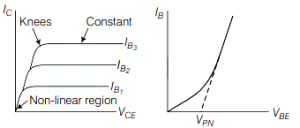
The output characteristics of an $n-p-n$ transistor represent,($I_C=$ collector current,$V_{C E}=$ potential difference between collector and emitter,$I_B=$ base current,$V_{B B}=$ voltage given to base,$V_{B E}=$ the potential difference between base and emitter)
A
changes in $I_C$ as $I_B$ and $V_{B B}$ are changed
B
changes in $I_C$ with changes in $V_{C E}$ ($I_B=$ constant)
C
changes in $I_B$ with changes in $V_{C E}$
D
change in $I_C$ as $V_{B E}$ is changed
Solution
(B) The output characteristics of a transistor in common-emitter configuration are defined as the variation of collector current $(I_C)$ with collector-emitter voltage $(V_{C E})$ while keeping the base current $(I_B)$ constant.
This is represented by the graph of $I_C$ versus $V_{C E}$ for different fixed values of $I_B$.
This is represented by the graph of $I_C$ versus $V_{C E}$ for different fixed values of $I_B$.
0 likesView Solution
103
ChemistryMCQAP EAMCET · 2014
$A$ crystal of intrinsic silicon at room temperature has a carrier concentration of $1.6 \times 10^{16} / m^3$. If the donor concentration level is $4.8 \times 10^{20} / m^3$,then the concentration of holes in the semiconductor is
A
$53 \times 10^{12} / m^3$
B
$4 \times 10^{11} / m^3$
C
$4 \times 10^{12} / m^3$
D
$5.3 \times 10^{11} / m^3$
Solution
(D) Given:
Intrinsic carrier concentration,$n_i = 1.6 \times 10^{16} / m^3$
Donor concentration,$n_e \approx N_D = 4.8 \times 10^{20} / m^3$
According to the law of mass action for semiconductors,the product of electron and hole concentrations is equal to the square of the intrinsic carrier concentration:
$n_e \times n_h = n_i^2$
Substituting the given values:
$4.8 \times 10^{20} \times n_h = (1.6 \times 10^{16})^2$
$4.8 \times 10^{20} \times n_h = 2.56 \times 10^{32}$
$n_h = \frac{2.56 \times 10^{32}}{4.8 \times 10^{20}}$
$n_h = 0.533 \times 10^{12} / m^3 = 5.33 \times 10^{11} / m^3$
Thus,the concentration of holes is approximately $5.3 \times 10^{11} / m^3$.
Intrinsic carrier concentration,$n_i = 1.6 \times 10^{16} / m^3$
Donor concentration,$n_e \approx N_D = 4.8 \times 10^{20} / m^3$
According to the law of mass action for semiconductors,the product of electron and hole concentrations is equal to the square of the intrinsic carrier concentration:
$n_e \times n_h = n_i^2$
Substituting the given values:
$4.8 \times 10^{20} \times n_h = (1.6 \times 10^{16})^2$
$4.8 \times 10^{20} \times n_h = 2.56 \times 10^{32}$
$n_h = \frac{2.56 \times 10^{32}}{4.8 \times 10^{20}}$
$n_h = 0.533 \times 10^{12} / m^3 = 5.33 \times 10^{11} / m^3$
Thus,the concentration of holes is approximately $5.3 \times 10^{11} / m^3$.
0 likesView Solution
104
ChemistryMCQAP EAMCET · 2014
The differential equation of the family of parabolas with vertex at $(0, -1)$ and having axis along the $Y$-axis is
A
$y y^{\prime}+2 x y+1=0$
B
$x y^{\prime}+y+1=0$
C
$x y^{\prime}-2 y-2=0$
D
$x y^{\prime}-y-1=0$
Solution
(C) The equation of the family of parabolas with vertex at $(0, -1)$ and axis along the $Y$-axis is given by:
$x^2 = 4a(y + 1)$ --- $(i)$
Differentiating both sides with respect to $x$,we get:
$2x = 4a y^{\prime}$
$a = \frac{2x}{4y^{\prime}} = \frac{x}{2y^{\prime}}$
Substituting the value of $a$ into equation $(i)$:
$x^2 = 4 \left( \frac{x}{2y^{\prime}} \right) (y + 1)$
$x^2 = \frac{2x}{y^{\prime}} (y + 1)$
Assuming $x \neq 0$,we divide by $x$:
$x = \frac{2(y + 1)}{y^{\prime}}$
$x y^{\prime} = 2y + 2$
$x y^{\prime} - 2y - 2 = 0$
$x^2 = 4a(y + 1)$ --- $(i)$
Differentiating both sides with respect to $x$,we get:
$2x = 4a y^{\prime}$
$a = \frac{2x}{4y^{\prime}} = \frac{x}{2y^{\prime}}$
Substituting the value of $a$ into equation $(i)$:
$x^2 = 4 \left( \frac{x}{2y^{\prime}} \right) (y + 1)$
$x^2 = \frac{2x}{y^{\prime}} (y + 1)$
Assuming $x \neq 0$,we divide by $x$:
$x = \frac{2(y + 1)}{y^{\prime}}$
$x y^{\prime} = 2y + 2$
$x y^{\prime} - 2y - 2 = 0$
0 likesView Solution
105
ChemistryMCQAP EAMCET · 2014
The solution of $\cos y + (x \sin y - 1) \frac{dy}{dx} = 0$ is
A
$x \sec y = \tan y + C$
B
$\tan y - \sec y = Cx$
C
$\tan y + \sec y = Cx$
D
$x \sec y + \tan y = C$
Solution
(A) The given differential equation is $\cos y + (x \sin y - 1) \frac{dy}{dx} = 0$.
Rearranging the terms,we get $(x \sin y - 1) \frac{dy}{dx} = -\cos y$.
Taking the reciprocal,$\frac{dx}{dy} = -\frac{x \sin y - 1}{\cos y} = -x \tan y + \sec y$.
This can be written as $\frac{dx}{dy} + x \tan y = \sec y$.
This is a linear differential equation of the form $\frac{dx}{dy} + Px = Q$,where $P = \tan y$ and $Q = \sec y$.
The integrating factor $(IF)$ is $e^{\int P dy} = e^{\int \tan y dy} = e^{\ln |\sec y|} = \sec y$.
The general solution is given by $x(IF) = \int Q(IF) dy + C$.
Substituting the values,$x \sec y = \int \sec y \cdot \sec y dy + C$.
$x \sec y = \int \sec^2 y dy + C$.
$x \sec y = \tan y + C$.
Rearranging the terms,we get $(x \sin y - 1) \frac{dy}{dx} = -\cos y$.
Taking the reciprocal,$\frac{dx}{dy} = -\frac{x \sin y - 1}{\cos y} = -x \tan y + \sec y$.
This can be written as $\frac{dx}{dy} + x \tan y = \sec y$.
This is a linear differential equation of the form $\frac{dx}{dy} + Px = Q$,where $P = \tan y$ and $Q = \sec y$.
The integrating factor $(IF)$ is $e^{\int P dy} = e^{\int \tan y dy} = e^{\ln |\sec y|} = \sec y$.
The general solution is given by $x(IF) = \int Q(IF) dy + C$.
Substituting the values,$x \sec y = \int \sec y \cdot \sec y dy + C$.
$x \sec y = \int \sec^2 y dy + C$.
$x \sec y = \tan y + C$.
0 likesView Solution
106
ChemistryMCQAP EAMCET · 2014
The angle between the lines $\vec{r}=(2 \hat{i}-3 \hat{j}+\hat{k})+\lambda(\hat{i}+4 \hat{j}+3 \hat{k})$ and $\vec{r}=(\hat{i}-\hat{j}+2 \hat{k})+\mu(\hat{i}+2 \hat{j}-3 \hat{k})$ is
A
$\frac{\pi}{2}$
B
$\cos ^{-1}\left(\frac{9}{\sqrt{91}}\right)$
C
$\cos ^{-1}\left(\frac{7}{\sqrt{84}}\right)$
D
$\frac{\pi}{3}$
Solution
(A) The given lines are in the form $\vec{r} = \vec{a} + \lambda \vec{b}$.
Comparing the given equations,the direction vectors are $\vec{b_1} = \hat{i} + 4 \hat{j} + 3 \hat{k}$ and $\vec{b_2} = \hat{i} + 2 \hat{j} - 3 \hat{k}$.
The angle $\theta$ between two lines with direction vectors $\vec{b_1}$ and $\vec{b_2}$ is given by $\cos \theta = \frac{|\vec{b_1} \cdot \vec{b_2}|}{|\vec{b_1}| |\vec{b_2}|}$.
Calculating the dot product: $\vec{b_1} \cdot \vec{b_2} = (1)(1) + (4)(2) + (3)(-3) = 1 + 8 - 9 = 0$.
Since the dot product is $0$,the angle $\theta$ is $\frac{\pi}{2}$.
Comparing the given equations,the direction vectors are $\vec{b_1} = \hat{i} + 4 \hat{j} + 3 \hat{k}$ and $\vec{b_2} = \hat{i} + 2 \hat{j} - 3 \hat{k}$.
The angle $\theta$ between two lines with direction vectors $\vec{b_1}$ and $\vec{b_2}$ is given by $\cos \theta = \frac{|\vec{b_1} \cdot \vec{b_2}|}{|\vec{b_1}| |\vec{b_2}|}$.
Calculating the dot product: $\vec{b_1} \cdot \vec{b_2} = (1)(1) + (4)(2) + (3)(-3) = 1 + 8 - 9 = 0$.
Since the dot product is $0$,the angle $\theta$ is $\frac{\pi}{2}$.
0 likesView Solution
107
ChemistryMCQAP EAMCET · 2014
Three non-zero non-collinear vectors $\vec{a}, \vec{b}$ and $\vec{c}$ are such that $\vec{a}+3\vec{b}$ is collinear with $\vec{c}$,and $3\vec{b}+2\vec{c}$ is collinear with $\vec{a}$. Then $\vec{a}+3\vec{b}+2\vec{c}$ equals to
A
$0$
B
$2\vec{a}$
C
$3\vec{b}$
D
$4\vec{c}$
Solution
(A) Given that $\vec{a}+3\vec{b}$ is collinear with $\vec{c}$.
Therefore,$\vec{a}+3\vec{b} = \lambda\vec{c}$ for some scalar $\lambda$.
This implies $\vec{a}+3\vec{b}-\lambda\vec{c} = 0$ $(i)$.
Also,$3\vec{b}+2\vec{c}$ is collinear with $\vec{a}$.
Therefore,$3\vec{b}+2\vec{c} = \mu\vec{a}$ for some scalar $\mu$.
This implies $3\vec{b}+2\vec{c}-\mu\vec{a} = 0$ $(ii)$.
From $(i)$,we have $3\vec{b} = \lambda\vec{c} - \vec{a}$.
Substituting this into $(ii)$:
$(\lambda\vec{c} - \vec{a}) + 2\vec{c} - \mu\vec{a} = 0$
$(\lambda+2)\vec{c} - (1+\mu)\vec{a} = 0$.
Since $\vec{a}$ and $\vec{c}$ are non-collinear,their coefficients must be zero.
Thus,$\lambda+2 = 0 \implies \lambda = -2$ and $1+\mu = 0 \implies \mu = -1$.
Substituting $\lambda = -2$ into $(i)$:
$\vec{a}+3\vec{b} - (-2)\vec{c} = 0$
$\vec{a}+3\vec{b}+2\vec{c} = 0$.
Therefore,$\vec{a}+3\vec{b} = \lambda\vec{c}$ for some scalar $\lambda$.
This implies $\vec{a}+3\vec{b}-\lambda\vec{c} = 0$ $(i)$.
Also,$3\vec{b}+2\vec{c}$ is collinear with $\vec{a}$.
Therefore,$3\vec{b}+2\vec{c} = \mu\vec{a}$ for some scalar $\mu$.
This implies $3\vec{b}+2\vec{c}-\mu\vec{a} = 0$ $(ii)$.
From $(i)$,we have $3\vec{b} = \lambda\vec{c} - \vec{a}$.
Substituting this into $(ii)$:
$(\lambda\vec{c} - \vec{a}) + 2\vec{c} - \mu\vec{a} = 0$
$(\lambda+2)\vec{c} - (1+\mu)\vec{a} = 0$.
Since $\vec{a}$ and $\vec{c}$ are non-collinear,their coefficients must be zero.
Thus,$\lambda+2 = 0 \implies \lambda = -2$ and $1+\mu = 0 \implies \mu = -1$.
Substituting $\lambda = -2$ into $(i)$:
$\vec{a}+3\vec{b} - (-2)\vec{c} = 0$
$\vec{a}+3\vec{b}+2\vec{c} = 0$.
0 likesView Solution
108
ChemistryMCQAP EAMCET · 2014
If $\vec{a}, \vec{b}$ and $\vec{c}$ are vectors with magnitudes $2, 3$ and $4$ respectively,then the best upper bound of $|\vec{a}-\vec{b}|^2+|\vec{b}-\vec{c}|^2+|\vec{c}-\vec{a}|^2$ among the given values is
A
$93$
B
$97$
C
$87$
D
$90$
Solution
(C) Given,$|\vec{a}|=2, |\vec{b}|=3$ and $|\vec{c}|=4$.
We know that $|\vec{x}-\vec{y}|^2 = |\vec{x}|^2 + |\vec{y}|^2 - 2(\vec{x} \cdot \vec{y})$.
Therefore,$|\vec{a}-\vec{b}|^2+|\vec{b}-\vec{c}|^2+|\vec{c}-\vec{a}|^2 = (|\vec{a}|^2+|\vec{b}|^2-2\vec{a} \cdot \vec{b}) + (|\vec{b}|^2+|\vec{c}|^2-2\vec{b} \cdot \vec{c}) + (|\vec{c}|^2+|\vec{a}|^2-2\vec{c} \cdot \vec{a})$
$= 2(|\vec{a}|^2+|\vec{b}|^2+|\vec{c}|^2) - 2(\vec{a} \cdot \vec{b} + \vec{b} \cdot \vec{c} + \vec{c} \cdot \vec{a})$.
We also know that $|\vec{a}+\vec{b}+\vec{c}|^2 \geq 0$,which implies $|\vec{a}|^2+|\vec{b}|^2+|\vec{c}|^2 + 2(\vec{a} \cdot \vec{b} + \vec{b} \cdot \vec{c} + \vec{c} \cdot \vec{a}) \geq 0$.
Thus,$-2(\vec{a} \cdot \vec{b} + \vec{b} \cdot \vec{c} + \vec{c} \cdot \vec{a}) \leq |\vec{a}|^2+|\vec{b}|^2+|\vec{c}|^2$.
Substituting this into our expression:
$|\vec{a}-\vec{b}|^2+|\vec{b}-\vec{c}|^2+|\vec{c}-\vec{a}|^2 \leq 2(|\vec{a}|^2+|\vec{b}|^2+|\vec{c}|^2) + (|\vec{a}|^2+|\vec{b}|^2+|\vec{c}|^2) = 3(|\vec{a}|^2+|\vec{b}|^2+|\vec{c}|^2)$.
Substituting the given magnitudes:
$3(2^2+3^2+4^2) = 3(4+9+16) = 3(29) = 87$.
Thus,the upper bound is $87$.
We know that $|\vec{x}-\vec{y}|^2 = |\vec{x}|^2 + |\vec{y}|^2 - 2(\vec{x} \cdot \vec{y})$.
Therefore,$|\vec{a}-\vec{b}|^2+|\vec{b}-\vec{c}|^2+|\vec{c}-\vec{a}|^2 = (|\vec{a}|^2+|\vec{b}|^2-2\vec{a} \cdot \vec{b}) + (|\vec{b}|^2+|\vec{c}|^2-2\vec{b} \cdot \vec{c}) + (|\vec{c}|^2+|\vec{a}|^2-2\vec{c} \cdot \vec{a})$
$= 2(|\vec{a}|^2+|\vec{b}|^2+|\vec{c}|^2) - 2(\vec{a} \cdot \vec{b} + \vec{b} \cdot \vec{c} + \vec{c} \cdot \vec{a})$.
We also know that $|\vec{a}+\vec{b}+\vec{c}|^2 \geq 0$,which implies $|\vec{a}|^2+|\vec{b}|^2+|\vec{c}|^2 + 2(\vec{a} \cdot \vec{b} + \vec{b} \cdot \vec{c} + \vec{c} \cdot \vec{a}) \geq 0$.
Thus,$-2(\vec{a} \cdot \vec{b} + \vec{b} \cdot \vec{c} + \vec{c} \cdot \vec{a}) \leq |\vec{a}|^2+|\vec{b}|^2+|\vec{c}|^2$.
Substituting this into our expression:
$|\vec{a}-\vec{b}|^2+|\vec{b}-\vec{c}|^2+|\vec{c}-\vec{a}|^2 \leq 2(|\vec{a}|^2+|\vec{b}|^2+|\vec{c}|^2) + (|\vec{a}|^2+|\vec{b}|^2+|\vec{c}|^2) = 3(|\vec{a}|^2+|\vec{b}|^2+|\vec{c}|^2)$.
Substituting the given magnitudes:
$3(2^2+3^2+4^2) = 3(4+9+16) = 3(29) = 87$.
Thus,the upper bound is $87$.
0 likesView Solution
109
ChemistryMCQAP EAMCET · 2014
The angle between the lines whose direction cosines are given by the equations $l^2+m^2-n^2=0$ and $l+m+n=0$ is
A
$\frac{\pi}{6}$
B
$\frac{\pi}{4}$
C
$\frac{\pi}{3}$
D
$\frac{\pi}{2}$
Solution
(C) Given,$l^2+m^2-n^2=0$ $(i)$ and $l+m+n=0$ $(ii)$.
From $(ii)$,$n=-(l+m)$. Substituting this into $(i)$:
$l^2+m^2=(-(l+m))^2 = l^2+m^2+2lm$.
This implies $2lm=0$,so $l=0$ or $m=0$.
Case $1$: If $l=0$,then $n=-m$. Since $l^2+m^2+n^2=1$,we have $0^2+m^2+(-m)^2=1 \Rightarrow 2m^2=1 \Rightarrow m=\pm\frac{1}{\sqrt{2}}$. Thus,the direction cosines are $(0, \frac{1}{\sqrt{2}}, -\frac{1}{\sqrt{2}})$ and $(0, -\frac{1}{\sqrt{2}}, \frac{1}{\sqrt{2}})$.
Case $2$: If $m=0$,then $n=-l$. Since $l^2+m^2+n^2=1$,we have $l^2+0^2+(-l)^2=1 \Rightarrow 2l^2=1 \Rightarrow l=\pm\frac{1}{\sqrt{2}}$. Thus,the direction cosines are $(\frac{1}{\sqrt{2}}, 0, -\frac{1}{\sqrt{2}})$ and $(-\frac{1}{\sqrt{2}}, 0, \frac{1}{\sqrt{2}})$.
Let the direction vectors of the two lines be $\vec{a} = (0, \frac{1}{\sqrt{2}}, -\frac{1}{\sqrt{2}})$ and $\vec{b} = (\frac{1}{\sqrt{2}}, 0, -\frac{1}{\sqrt{2}})$.
The angle $\theta$ between the lines is given by $\cos \theta = |l_1l_2 + m_1m_2 + n_1n_2|$.
$\cos \theta = |(0)(\frac{1}{\sqrt{2}}) + (\frac{1}{\sqrt{2}})(0) + (-\frac{1}{\sqrt{2}})(-\frac{1}{\sqrt{2}})| = |0 + 0 + \frac{1}{2}| = \frac{1}{2}$.
Therefore,$\theta = \cos^{-1}(\frac{1}{2}) = \frac{\pi}{3}$.
From $(ii)$,$n=-(l+m)$. Substituting this into $(i)$:
$l^2+m^2=(-(l+m))^2 = l^2+m^2+2lm$.
This implies $2lm=0$,so $l=0$ or $m=0$.
Case $1$: If $l=0$,then $n=-m$. Since $l^2+m^2+n^2=1$,we have $0^2+m^2+(-m)^2=1 \Rightarrow 2m^2=1 \Rightarrow m=\pm\frac{1}{\sqrt{2}}$. Thus,the direction cosines are $(0, \frac{1}{\sqrt{2}}, -\frac{1}{\sqrt{2}})$ and $(0, -\frac{1}{\sqrt{2}}, \frac{1}{\sqrt{2}})$.
Case $2$: If $m=0$,then $n=-l$. Since $l^2+m^2+n^2=1$,we have $l^2+0^2+(-l)^2=1 \Rightarrow 2l^2=1 \Rightarrow l=\pm\frac{1}{\sqrt{2}}$. Thus,the direction cosines are $(\frac{1}{\sqrt{2}}, 0, -\frac{1}{\sqrt{2}})$ and $(-\frac{1}{\sqrt{2}}, 0, \frac{1}{\sqrt{2}})$.
Let the direction vectors of the two lines be $\vec{a} = (0, \frac{1}{\sqrt{2}}, -\frac{1}{\sqrt{2}})$ and $\vec{b} = (\frac{1}{\sqrt{2}}, 0, -\frac{1}{\sqrt{2}})$.
The angle $\theta$ between the lines is given by $\cos \theta = |l_1l_2 + m_1m_2 + n_1n_2|$.
$\cos \theta = |(0)(\frac{1}{\sqrt{2}}) + (\frac{1}{\sqrt{2}})(0) + (-\frac{1}{\sqrt{2}})(-\frac{1}{\sqrt{2}})| = |0 + 0 + \frac{1}{2}| = \frac{1}{2}$.
Therefore,$\theta = \cos^{-1}(\frac{1}{2}) = \frac{\pi}{3}$.
0 likesView Solution
110
ChemistryMCQAP EAMCET · 2014
If the direction cosines of two lines are given by $l+m+n=0$ and $l^2-5m^2+n^2=0$,then the angle between them is
A
$\frac{\pi}{2}$
B
$\frac{\pi}{6}$
C
$\frac{\pi}{4}$
D
$\frac{\pi}{3}$
Solution
(D) Given the equations for the direction cosines $(l, m, n)$ of two lines:
$l+m+n=0 \implies n = -(l+m)$
Substitute $n$ into the second equation $l^2-5m^2+n^2=0$:
$l^2-5m^2+(-l-m)^2 = 0$
$l^2-5m^2+l^2+2lm+m^2 = 0$
$2l^2+2lm-4m^2 = 0$
$l^2+lm-2m^2 = 0$
$(l+2m)(l-m) = 0$
This gives two cases:
Case $1$: $l=m$. Then $n = -(l+m) = -2l$. The direction ratios are $(l, l, -2l)$,which simplifies to $(1, 1, -2)$. The direction cosines are $(\frac{1}{\sqrt{6}}, \frac{1}{\sqrt{6}}, -\frac{2}{\sqrt{6}})$.
Case $2$: $l=-2m$. Then $n = -(-2m+m) = m$. The direction ratios are $(-2m, m, m)$,which simplifies to $(-2, 1, 1)$. The direction cosines are $(-\frac{2}{\sqrt{6}}, \frac{1}{\sqrt{6}}, \frac{1}{\sqrt{6}})$.
Let the two lines have direction cosines $(l_1, m_1, n_1) = (\frac{1}{\sqrt{6}}, \frac{1}{\sqrt{6}}, -\frac{2}{\sqrt{6}})$ and $(l_2, m_2, n_2) = (-\frac{2}{\sqrt{6}}, \frac{1}{\sqrt{6}}, \frac{1}{\sqrt{6}})$.
The cosine of the angle $\theta$ between them is given by:
$\cos \theta = |l_1 l_2 + m_1 m_2 + n_1 n_2|$
$\cos \theta = |(\frac{1}{\sqrt{6}})(-\frac{2}{\sqrt{6}}) + (\frac{1}{\sqrt{6}})(\frac{1}{\sqrt{6}}) + (-\frac{2}{\sqrt{6}})(\frac{1}{\sqrt{6}})|$
$\cos \theta = |-\frac{2}{6} + \frac{1}{6} - \frac{2}{6}| = |-\frac{3}{6}| = \frac{1}{2}$
Since $\cos \theta = \frac{1}{2}$,we have $\theta = 60^{\circ} = \frac{\pi}{3}$.
$l+m+n=0 \implies n = -(l+m)$
Substitute $n$ into the second equation $l^2-5m^2+n^2=0$:
$l^2-5m^2+(-l-m)^2 = 0$
$l^2-5m^2+l^2+2lm+m^2 = 0$
$2l^2+2lm-4m^2 = 0$
$l^2+lm-2m^2 = 0$
$(l+2m)(l-m) = 0$
This gives two cases:
Case $1$: $l=m$. Then $n = -(l+m) = -2l$. The direction ratios are $(l, l, -2l)$,which simplifies to $(1, 1, -2)$. The direction cosines are $(\frac{1}{\sqrt{6}}, \frac{1}{\sqrt{6}}, -\frac{2}{\sqrt{6}})$.
Case $2$: $l=-2m$. Then $n = -(-2m+m) = m$. The direction ratios are $(-2m, m, m)$,which simplifies to $(-2, 1, 1)$. The direction cosines are $(-\frac{2}{\sqrt{6}}, \frac{1}{\sqrt{6}}, \frac{1}{\sqrt{6}})$.
Let the two lines have direction cosines $(l_1, m_1, n_1) = (\frac{1}{\sqrt{6}}, \frac{1}{\sqrt{6}}, -\frac{2}{\sqrt{6}})$ and $(l_2, m_2, n_2) = (-\frac{2}{\sqrt{6}}, \frac{1}{\sqrt{6}}, \frac{1}{\sqrt{6}})$.
The cosine of the angle $\theta$ between them is given by:
$\cos \theta = |l_1 l_2 + m_1 m_2 + n_1 n_2|$
$\cos \theta = |(\frac{1}{\sqrt{6}})(-\frac{2}{\sqrt{6}}) + (\frac{1}{\sqrt{6}})(\frac{1}{\sqrt{6}}) + (-\frac{2}{\sqrt{6}})(\frac{1}{\sqrt{6}})|$
$\cos \theta = |-\frac{2}{6} + \frac{1}{6} - \frac{2}{6}| = |-\frac{3}{6}| = \frac{1}{2}$
Since $\cos \theta = \frac{1}{2}$,we have $\theta = 60^{\circ} = \frac{\pi}{3}$.
0 likesView Solution
111
ChemistryMCQAP EAMCET · 2014
The angle between the lines whose direction cosines satisfy the equations $l+m+n=0$ and $l^2+m^2-n^2=0$ is
A
$\frac{\pi}{6}$
B
$\frac{\pi}{4}$
C
$\frac{\pi}{3}$
D
$\frac{\pi}{2}$
Solution
(C) Given,$l+m+n=0 \implies l = -m-n$ and $l^2+m^2-n^2=0$.
Substituting $l = -m-n$ into the second equation:
$(-m-n)^2 + m^2 - n^2 = 0$
$m^2 + 2mn + n^2 + m^2 - n^2 = 0$
$2m^2 + 2mn = 0$
$2m(m+n) = 0$.
This gives two cases:
Case $1$: If $m=0$,then $l = -n$. The direction ratios are $(-n, 0, n)$,which simplifies to $(-1, 0, 1)$. Let $\vec{v_1} = (-1, 0, 1)$.
Case $2$: If $m+n=0$,then $m = -n$. Substituting into $l = -m-n$,we get $l = -(-n)-n = 0$. The direction ratios are $(0, -n, n)$,which simplifies to $(0, -1, 1)$. Let $\vec{v_2} = (0, -1, 1)$.
The angle $\theta$ between the lines is given by $\cos \theta = \frac{|\vec{v_1} \cdot \vec{v_2}|}{|\vec{v_1}| |\vec{v_2}|}$.
$\vec{v_1} \cdot \vec{v_2} = (-1)(0) + (0)(-1) + (1)(1) = 1$.
$|\vec{v_1}| = \sqrt{(-1)^2 + 0^2 + 1^2} = \sqrt{2}$.
$|\vec{v_2}| = \sqrt{0^2 + (-1)^2 + 1^2} = \sqrt{2}$.
$\cos \theta = \frac{1}{\sqrt{2} \cdot \sqrt{2}} = \frac{1}{2}$.
Therefore,$\theta = \frac{\pi}{3}$.
Substituting $l = -m-n$ into the second equation:
$(-m-n)^2 + m^2 - n^2 = 0$
$m^2 + 2mn + n^2 + m^2 - n^2 = 0$
$2m^2 + 2mn = 0$
$2m(m+n) = 0$.
This gives two cases:
Case $1$: If $m=0$,then $l = -n$. The direction ratios are $(-n, 0, n)$,which simplifies to $(-1, 0, 1)$. Let $\vec{v_1} = (-1, 0, 1)$.
Case $2$: If $m+n=0$,then $m = -n$. Substituting into $l = -m-n$,we get $l = -(-n)-n = 0$. The direction ratios are $(0, -n, n)$,which simplifies to $(0, -1, 1)$. Let $\vec{v_2} = (0, -1, 1)$.
The angle $\theta$ between the lines is given by $\cos \theta = \frac{|\vec{v_1} \cdot \vec{v_2}|}{|\vec{v_1}| |\vec{v_2}|}$.
$\vec{v_1} \cdot \vec{v_2} = (-1)(0) + (0)(-1) + (1)(1) = 1$.
$|\vec{v_1}| = \sqrt{(-1)^2 + 0^2 + 1^2} = \sqrt{2}$.
$|\vec{v_2}| = \sqrt{0^2 + (-1)^2 + 1^2} = \sqrt{2}$.
$\cos \theta = \frac{1}{\sqrt{2} \cdot \sqrt{2}} = \frac{1}{2}$.
Therefore,$\theta = \frac{\pi}{3}$.
0 likesView Solution
112
ChemistryMCQAP EAMCET · 2014
$A$ six-faced unbiased die is thrown twice and the sum of the numbers appearing on the upper face is observed to be $7$. The probability that the number $3$ has appeared at least once is:
A
$1/6$
B
$1/3$
C
$2/3$
D
$5/6$
Solution
(B) Let $S$ be the sample space of outcomes where the sum of the two dice is $7$. The possible outcomes are:
$S = \{(1, 6), (6, 1), (2, 5), (5, 2), (3, 4), (4, 3)\}$
Thus,the total number of outcomes $n(S) = 6$.
Let $E$ be the event that the number $3$ appears at least once.
The outcomes in $E$ are:
$E = \{(3, 4), (4, 3)\}$
Thus,the number of favorable outcomes $n(E) = 2$.
The required probability is $P(E) = \frac{n(E)}{n(S)} = \frac{2}{6} = \frac{1}{3}$.
$S = \{(1, 6), (6, 1), (2, 5), (5, 2), (3, 4), (4, 3)\}$
Thus,the total number of outcomes $n(S) = 6$.
Let $E$ be the event that the number $3$ appears at least once.
The outcomes in $E$ are:
$E = \{(3, 4), (4, 3)\}$
Thus,the number of favorable outcomes $n(E) = 2$.
The required probability is $P(E) = \frac{n(E)}{n(S)} = \frac{2}{6} = \frac{1}{3}$.
0 likesView Solution
113
ChemistryMCQAP EAMCET · 2014
$A$ candidate takes three tests in succession and the probability of passing the first test is $p$. The probability of passing each succeeding test is $p$ if he passes the preceding one,or $\frac{p}{2}$ if he fails the preceding one. The candidate is selected if he passes at least two tests. The probability that the candidate is selected is:
A
$p^2(2-p)$
B
$p(2-p)$
C
$p+p^2+p^3$
D
$p^2(1-p)$
Solution
(A) Let $S$ denote success (pass) and $F$ denote failure (fail). The probability of passing the first test is $P(S_1) = p$,so $P(F_1) = 1-p$.
For subsequent tests,$P(S_{n+1} | S_n) = p$ and $P(S_{n+1} | F_n) = \frac{p}{2}$.
The candidate is selected if they pass at least two tests. The possible favorable outcomes are:
$1$. Pass $I$,Pass $II$,Fail $III$: $p \times p \times (1-p) = p^2(1-p)$
$2$. Pass $I$,Fail $II$,Pass $III$: $p \times (1-p) \times \frac{p}{2} = \frac{p^2(1-p)}{2}$
$3$. Fail $I$,Pass $II$,Pass $III$: $(1-p) \times \frac{p}{2} \times p = \frac{p^2(1-p)}{2}$
$4$. Pass $I$,Pass $II$,Pass $III$: $p \times p \times p = p^3$
Summing these probabilities:
$P = p^2(1-p) + \frac{p^2(1-p)}{2} + \frac{p^2(1-p)}{2} + p^3$
$P = p^2(1-p) + p^2(1-p) + p^3$
$P = 2p^2 - 2p^3 + p^3 = 2p^2 - p^3 = p^2(2-p)$.
For subsequent tests,$P(S_{n+1} | S_n) = p$ and $P(S_{n+1} | F_n) = \frac{p}{2}$.
The candidate is selected if they pass at least two tests. The possible favorable outcomes are:
$1$. Pass $I$,Pass $II$,Fail $III$: $p \times p \times (1-p) = p^2(1-p)$
$2$. Pass $I$,Fail $II$,Pass $III$: $p \times (1-p) \times \frac{p}{2} = \frac{p^2(1-p)}{2}$
$3$. Fail $I$,Pass $II$,Pass $III$: $(1-p) \times \frac{p}{2} \times p = \frac{p^2(1-p)}{2}$
$4$. Pass $I$,Pass $II$,Pass $III$: $p \times p \times p = p^3$
Summing these probabilities:
$P = p^2(1-p) + \frac{p^2(1-p)}{2} + \frac{p^2(1-p)}{2} + p^3$
$P = p^2(1-p) + p^2(1-p) + p^3$
$P = 2p^2 - 2p^3 + p^3 = 2p^2 - p^3 = p^2(2-p)$.
0 likesView Solution
114
ChemistryMCQAP EAMCET · 2014
If $A, B$ and $C$ are mutually exclusive and exhaustive events of a random experiment such that $P(B) = \frac{3}{2} P(A)$ and $P(C) = \frac{1}{2} P(B)$,then $P(A \cup C)$ equals to
A
$\frac{10}{13}$
B
$\frac{3}{13}$
C
$\frac{6}{13}$
D
$\frac{7}{13}$
Solution
(D) Given that $A, B$ and $C$ are mutually exclusive and exhaustive events,we have $P(A) + P(B) + P(C) = 1$.
Given $P(B) = \frac{3}{2} P(A)$ and $P(C) = \frac{1}{2} P(B) = \frac{1}{2} \times \frac{3}{2} P(A) = \frac{3}{4} P(A)$.
Substituting these into the sum equation:
$P(A) + \frac{3}{2} P(A) + \frac{3}{4} P(A) = 1$
$P(A) \left( 1 + \frac{6}{4} + \frac{3}{4} \right) = 1$
$P(A) \left( \frac{4+6+3}{4} \right) = 1$
$\frac{13}{4} P(A) = 1 \implies P(A) = \frac{4}{13}$.
Now,$P(C) = \frac{3}{4} P(A) = \frac{3}{4} \times \frac{4}{13} = \frac{3}{13}$.
Since $A$ and $C$ are mutually exclusive,$P(A \cup C) = P(A) + P(C)$.
$P(A \cup C) = \frac{4}{13} + \frac{3}{13} = \frac{7}{13}$.
Given $P(B) = \frac{3}{2} P(A)$ and $P(C) = \frac{1}{2} P(B) = \frac{1}{2} \times \frac{3}{2} P(A) = \frac{3}{4} P(A)$.
Substituting these into the sum equation:
$P(A) + \frac{3}{2} P(A) + \frac{3}{4} P(A) = 1$
$P(A) \left( 1 + \frac{6}{4} + \frac{3}{4} \right) = 1$
$P(A) \left( \frac{4+6+3}{4} \right) = 1$
$\frac{13}{4} P(A) = 1 \implies P(A) = \frac{4}{13}$.
Now,$P(C) = \frac{3}{4} P(A) = \frac{3}{4} \times \frac{4}{13} = \frac{3}{13}$.
Since $A$ and $C$ are mutually exclusive,$P(A \cup C) = P(A) + P(C)$.
$P(A \cup C) = \frac{4}{13} + \frac{3}{13} = \frac{7}{13}$.
0 likesView Solution
115
ChemistryMCQAP EAMCET · 2014
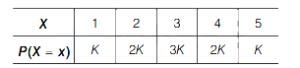
$A$ random variable $X$ has the probability distribution given below. Its variance is
| $X$ | $1$ | $2$ | $3$ | $4$ | $5$ |
|---|---|---|---|---|---|
| $P(X=x)$ | $k$ | $2k$ | $3k$ | $2k$ | $k$ |
A
$\frac{16}{3}$
B
$\frac{4}{3}$
C
$\frac{5}{3}$
D
$\frac{10}{3}$
Solution
(B) For a probability distribution,the sum of probabilities is $1$.
$\Sigma P(X=x) = k + 2k + 3k + 2k + k = 9k = 1 \implies k = \frac{1}{9}$.
The mean $E(X) = \Sigma x_i P(x_i) = (1 \times k) + (2 \times 2k) + (3 \times 3k) + (4 \times 2k) + (5 \times k) = k + 4k + 9k + 8k + 5k = 27k$.
Substituting $k = \frac{1}{9}$,$E(X) = 27 \times \frac{1}{9} = 3$.
The expected value of $X^2$ is $E(X^2) = \Sigma x_i^2 P(x_i) = (1^2 \times k) + (2^2 \times 2k) + (3^2 \times 3k) + (4^2 \times 2k) + (5^2 \times k) = k + 8k + 27k + 32k + 25k = 93k$.
Substituting $k = \frac{1}{9}$,$E(X^2) = 93 \times \frac{1}{9} = \frac{93}{9} = \frac{31}{3}$.
Variance $Var(X) = E(X^2) - [E(X)]^2 = \frac{31}{3} - (3)^2 = \frac{31}{3} - 9 = \frac{31-27}{3} = \frac{4}{3}$.
$\Sigma P(X=x) = k + 2k + 3k + 2k + k = 9k = 1 \implies k = \frac{1}{9}$.
The mean $E(X) = \Sigma x_i P(x_i) = (1 \times k) + (2 \times 2k) + (3 \times 3k) + (4 \times 2k) + (5 \times k) = k + 4k + 9k + 8k + 5k = 27k$.
Substituting $k = \frac{1}{9}$,$E(X) = 27 \times \frac{1}{9} = 3$.
The expected value of $X^2$ is $E(X^2) = \Sigma x_i^2 P(x_i) = (1^2 \times k) + (2^2 \times 2k) + (3^2 \times 3k) + (4^2 \times 2k) + (5^2 \times k) = k + 8k + 27k + 32k + 25k = 93k$.
Substituting $k = \frac{1}{9}$,$E(X^2) = 93 \times \frac{1}{9} = \frac{93}{9} = \frac{31}{3}$.
Variance $Var(X) = E(X^2) - [E(X)]^2 = \frac{31}{3} - (3)^2 = \frac{31}{3} - 9 = \frac{31-27}{3} = \frac{4}{3}$.
0 likesView Solution
116
ChemistryMCQAP EAMCET · 2014
Vapour pressure in $mm \ Hg$ of $0.1 \ mole$ of urea in $180 \ g$ of water at $25^{\circ} C$ is (The vapour pressure of water at $25^{\circ} C$ is $24 \ mm \ Hg$)
A
$2.376$
B
$20.76$
C
$23.76$
D
$24.76$
Solution
(C) According to Raoult's law,the relative lowering of vapour pressure is equal to the mole fraction of the solute.
$n_{\text{urea}} = 0.1 \ mol$
$n_{\text{water}} = \frac{180 \ g}{18 \ g/mol} = 10 \ mol$
Mole fraction of urea $(x_2)$ = $\frac{0.1}{0.1 + 10} = \frac{0.1}{10.1} \approx 0.0099$
Using the formula $\frac{p^{\circ} - p_s}{p^{\circ}} = x_2$:
$\frac{24 - p_s}{24} = \frac{0.1}{10.1}$
$24 - p_s = 24 \times 0.0099 = 0.2376$
$p_s = 24 - 0.2376 = 23.7624 \ mm \ Hg \approx 23.76 \ mm \ Hg$
$n_{\text{urea}} = 0.1 \ mol$
$n_{\text{water}} = \frac{180 \ g}{18 \ g/mol} = 10 \ mol$
Mole fraction of urea $(x_2)$ = $\frac{0.1}{0.1 + 10} = \frac{0.1}{10.1} \approx 0.0099$
Using the formula $\frac{p^{\circ} - p_s}{p^{\circ}} = x_2$:
$\frac{24 - p_s}{24} = \frac{0.1}{10.1}$
$24 - p_s = 24 \times 0.0099 = 0.2376$
$p_s = 24 - 0.2376 = 23.7624 \ mm \ Hg \approx 23.76 \ mm \ Hg$
0 likesView Solution
117
ChemistryMCQAP EAMCET · 2014
The molar mass of a solute $X$ in $g \ mol^{-1}$,if its $1 \%$ solution is isotonic with a $5 \%$ solution of cane sugar (molar mass $= 342 \ g \ mol^{-1}$),is
A
$68.4$
B
$34.2$
C
$136.2$
D
$171.2$
Solution
(A) For isotonic solutions,the osmotic pressures are equal,so $\frac{W_1}{V_1 M_1} = \frac{W_2}{V_2 M_2}$.
Given that the solutions are $1 \%$ and $5 \%$,we have $\frac{W_1}{V_1} = 1 \ g/100 \ mL$ and $\frac{W_2}{V_2} = 5 \ g/100 \ mL$.
Let $M_1$ be the molar mass of solute $X$ and $M_2 = 342 \ g \ mol^{-1}$ be the molar mass of cane sugar.
Substituting the values: $\frac{1}{M_1} = \frac{5}{342}$.
Solving for $M_1$: $M_1 = \frac{342}{5} = 68.4 \ g \ mol^{-1}$.
Given that the solutions are $1 \%$ and $5 \%$,we have $\frac{W_1}{V_1} = 1 \ g/100 \ mL$ and $\frac{W_2}{V_2} = 5 \ g/100 \ mL$.
Let $M_1$ be the molar mass of solute $X$ and $M_2 = 342 \ g \ mol^{-1}$ be the molar mass of cane sugar.
Substituting the values: $\frac{1}{M_1} = \frac{5}{342}$.
Solving for $M_1$: $M_1 = \frac{342}{5} = 68.4 \ g \ mol^{-1}$.
0 likesView Solution
118
ChemistryMCQAP EAMCET · 2014
The oxide of a metal contains $40 \%$ of oxygen. The valency of the metal is $2$. What is the atomic weight of the metal?
A
$24$
B
$13$
C
$40$
D
$36$
Solution
(A) Given,percentage of oxygen $= 40 \%$.
Percentage of metal $= 100 - 40 = 60 \%$.
Valency of metal $= 2$.
Since the valency of the metal is $2$ and the valency of oxygen is $2$,the formula of the oxide is $MO$.
Let the atomic weight of the metal be $M$.
Percentage of oxygen $= \frac{16}{M + 16} \times 100 = 40$.
$1600 = 40(M + 16)$.
$1600 = 40M + 640$.
$40M = 960$.
$M = 24$.
Percentage of metal $= 100 - 40 = 60 \%$.
Valency of metal $= 2$.
Since the valency of the metal is $2$ and the valency of oxygen is $2$,the formula of the oxide is $MO$.
Let the atomic weight of the metal be $M$.
Percentage of oxygen $= \frac{16}{M + 16} \times 100 = 40$.
$1600 = 40(M + 16)$.
$1600 = 40M + 640$.
$40M = 960$.
$M = 24$.
0 likesView Solution
119
ChemistryMCQAP EAMCET · 2014
The ratio of rates of diffusion of gases $X$ and $Y$ is $1:5$ and that of $Y$ and $Z$ is $1:6$. The ratio of rates of diffusion of $Z$ and $X$ is
A
$1:30$
B
$1:6$
C
$30:1$
D
$6:1$
Solution
(C) Given,$\frac{r_X}{r_Y} = \frac{1}{5}$ and $\frac{r_Y}{r_Z} = \frac{1}{6}$.
Multiplying the two ratios:
$\frac{r_X}{r_Y} \times \frac{r_Y}{r_Z} = \frac{1}{5} \times \frac{1}{6} = \frac{1}{30}$.
Thus,$\frac{r_X}{r_Z} = \frac{1}{30}$.
Therefore,the ratio of rates of diffusion of $Z$ and $X$ is $\frac{r_Z}{r_X} = \frac{30}{1}$,which is $30:1$.
Multiplying the two ratios:
$\frac{r_X}{r_Y} \times \frac{r_Y}{r_Z} = \frac{1}{5} \times \frac{1}{6} = \frac{1}{30}$.
Thus,$\frac{r_X}{r_Z} = \frac{1}{30}$.
Therefore,the ratio of rates of diffusion of $Z$ and $X$ is $\frac{r_Z}{r_X} = \frac{30}{1}$,which is $30:1$.
0 likesView Solution
120
ChemistryMCQAP EAMCET · 2014
The number of angular and radial nodes of $4d$ orbital respectively are
A
$3, 1$
B
$1, 2$
C
$3, 0$
D
$2, 1$
Solution
(D) For $4d$ orbital,the principal quantum number $n = 4$ and the azimuthal quantum number $l = 2$.
Number of angular nodes $= l = 2$.
Number of radial nodes $= n - l - 1 = 4 - 2 - 1 = 1$.
Therefore,the number of angular and radial nodes are $2$ and $1$ respectively.
Number of angular nodes $= l = 2$.
Number of radial nodes $= n - l - 1 = 4 - 2 - 1 = 1$.
Therefore,the number of angular and radial nodes are $2$ and $1$ respectively.
0 likesView Solution
121
ChemistryMCQAP EAMCET · 2014
In an atom,the order of increasing energy of electrons with quantum numbers $(i)$ $n=4, l=1$,$(ii)$ $n=4, l=0$,$(iii)$ $n=3, l=2$,and $(iv)$ $n=3, l=1$ is:
A
$iii < i < iv < ii$
B
$ii < iv < i < iii$
C
$i < iii < ii < iv$
D
$iv < ii < iii < i$
Solution
(D) The order of increasing energy is determined using the $(n+l)$ rule. If two orbitals have the same $(n+l)$ value,the orbital with the lower value of $n$ has lower energy.
$(i)$ For $n=4, l=1$,$(n+l) = 4+1 = 5$.
$(ii)$ For $n=4, l=0$,$(n+l) = 4+0 = 4$.
$(iii)$ For $n=3, l=2$,$(n+l) = 3+2 = 5$.
$(iv)$ For $n=3, l=1$,$(n+l) = 3+1 = 4$.
Comparing the values: $(iv)$ and $(ii)$ have $(n+l) = 4$,where $(iv)$ has a lower $n$ value $(3 < 4)$. Thus,energy of $(iv)$ < $(ii)$.
$(i)$ and $(iii)$ have $(n+l) = 5$,where $(iii)$ has a lower $n$ value $(3 < 4)$. Thus,energy of $(iii)$ < $(i)$.
Combining these,the correct order of increasing energy is $(iv) < (ii) < (iii) < (i)$.
$(i)$ For $n=4, l=1$,$(n+l) = 4+1 = 5$.
$(ii)$ For $n=4, l=0$,$(n+l) = 4+0 = 4$.
$(iii)$ For $n=3, l=2$,$(n+l) = 3+2 = 5$.
$(iv)$ For $n=3, l=1$,$(n+l) = 3+1 = 4$.
Comparing the values: $(iv)$ and $(ii)$ have $(n+l) = 4$,where $(iv)$ has a lower $n$ value $(3 < 4)$. Thus,energy of $(iv)$ < $(ii)$.
$(i)$ and $(iii)$ have $(n+l) = 5$,where $(iii)$ has a lower $n$ value $(3 < 4)$. Thus,energy of $(iii)$ < $(i)$.
Combining these,the correct order of increasing energy is $(iv) < (ii) < (iii) < (i)$.
0 likesView Solution
122
ChemistryMCQAP EAMCET · 2014
$Assertion (A)$: van der Waals' forces are responsible for chemisorption. $Reason (R)$: High temperature is favourable for chemisorption. The correct answer is
A
$A$ is false,but $R$ is true
B
Both $A$ and $R$ are correct and $R$ is the correct explanation of $A$
C
Both $A$ and $R$ are correct and $R$ is not the correct explanation of $A$
D
$A$ is true,but $R$ is false
Solution
(A) van der Waals' forces are responsible for physisorption,not chemisorption. Therefore,$Assertion (A)$ is false.
Chemisorption involves the formation of chemical bonds,which requires activation energy. Thus,high temperature is favourable for chemisorption. Therefore,$Reason (R)$ is true.
Hence,the correct option is $A$ is false,but $R$ is true.
Chemisorption involves the formation of chemical bonds,which requires activation energy. Thus,high temperature is favourable for chemisorption. Therefore,$Reason (R)$ is true.
Hence,the correct option is $A$ is false,but $R$ is true.
0 likesView Solution
123
ChemistryMCQAP EAMCET · 2014
What are the substances which mimic the natural chemical messengers?
A
Antibiotics
B
Antagonists
C
Agonists
D
Receptors
Solution
(C) An agonist is a chemical substance that binds to a receptor and activates it to produce a biological response. It mimics the action of natural chemical messengers.
0 likesView Solution
124
ChemistryMCQAP EAMCET · 2014
Steam at $100^{\circ} C$ is passed into $1 \ kg$ of water contained in a calorimeter of water equivalent $0.2 \ kg$ at $9^{\circ} C$ until the temperature of the calorimeter and water in it increases to $90^{\circ} C$. The mass of steam condensed in $kg$ is nearly (specific heat of water $= 1 \ cal/g^{\circ} C$,latent heat of vaporisation $= 540 \ cal/g$)
A
$0.81$
B
$0.18$
C
$0.27$
D
$0.54$
Solution
(B) According to the principle of calorimetry,Heat lost by steam = Heat gained by water and calorimeter.
Let $m$ be the mass of steam condensed in grams.
Heat lost by steam = $m \times L + m \times C_w \times (T_{steam} - T_{final})$
$= m \times 540 + m \times 1 \times (100 - 90) = 550m \ cal$.
Heat gained by water and calorimeter = $(m_{water} + m_{eq}) \times C_w \times (T_{final} - T_{initial})$
$= (1000 \ g + 200 \ g) \times 1 \times (90 - 9) = 1200 \times 81 = 97200 \ cal$.
Equating the two: $550m = 97200$.
$m = \frac{97200}{550} \approx 176.7 \ g$.
Converting to $kg$,$m \approx 0.1767 \ kg$,which is approximately $0.18 \ kg$.
Let $m$ be the mass of steam condensed in grams.
Heat lost by steam = $m \times L + m \times C_w \times (T_{steam} - T_{final})$
$= m \times 540 + m \times 1 \times (100 - 90) = 550m \ cal$.
Heat gained by water and calorimeter = $(m_{water} + m_{eq}) \times C_w \times (T_{final} - T_{initial})$
$= (1000 \ g + 200 \ g) \times 1 \times (90 - 9) = 1200 \times 81 = 97200 \ cal$.
Equating the two: $550m = 97200$.
$m = \frac{97200}{550} \approx 176.7 \ g$.
Converting to $kg$,$m \approx 0.1767 \ kg$,which is approximately $0.18 \ kg$.
0 likesView Solution
125
ChemistryMCQAP EAMCET · 2014
$A$ very small hole in an electric furnace is used for heating metals. The hole nearly acts as a black body. The area of the hole is $200 ~mm^2$. To keep a metal at $727^{\circ} C$,the heat energy flowing through this hole per second,in joules,is $\left(\sigma = 5.67 \times 10^{-8} ~W m^{-2} K^{-4}\right)$.
A
$22.68$
B
$2.268$
C
$1.134$
D
$11.34$
Solution
(D) According to Stefan-Boltzmann Law,the power $P$ radiated by a black body is given by $P = \sigma A T^4$.
Given:
$\sigma = 5.67 \times 10^{-8} ~W m^{-2} K^{-4}$
$A = 200 ~mm^2 = 200 \times 10^{-6} ~m^2$
$T = 727^{\circ} C = 727 + 273 = 1000 ~K$
Substituting these values into the formula:
$P = (5.67 \times 10^{-8}) \times (200 \times 10^{-6}) \times (1000)^4$
$P = 5.67 \times 10^{-8} \times 2 \times 10^{-4} \times 10^{12}$
$P = 5.67 \times 2 \times 10^{-12} \times 10^{12}$
$P = 11.34 ~J/s$.
Given:
$\sigma = 5.67 \times 10^{-8} ~W m^{-2} K^{-4}$
$A = 200 ~mm^2 = 200 \times 10^{-6} ~m^2$
$T = 727^{\circ} C = 727 + 273 = 1000 ~K$
Substituting these values into the formula:
$P = (5.67 \times 10^{-8}) \times (200 \times 10^{-6}) \times (1000)^4$
$P = 5.67 \times 10^{-8} \times 2 \times 10^{-4} \times 10^{12}$
$P = 5.67 \times 2 \times 10^{-12} \times 10^{12}$
$P = 11.34 ~J/s$.
0 likesView Solution
126
ChemistryMCQAP EAMCET · 2014
Five moles of hydrogen initially at $STP$ is compressed adiabatically so that its temperature becomes $673 \, K$. The increase in internal energy of the gas, in kilo joule is $(R=8.3 \, J/mol-K; \gamma=1.4$ for diatomic gas$)$
A
$80.5$
B
$21.55$
C
$41.50$
D
$65.55$
Solution
(C) The change in internal energy $\Delta U$ for an ideal gas in an adiabatic process is given by the formula:
$\Delta U = n C_v \Delta T$
Since $C_v = \frac{R}{\gamma - 1}$, we have:
$\Delta U = n \frac{R}{\gamma - 1} (T_2 - T_1)$
Given values:
$n = 5 \, mol$
$T_1 = 273 \, K$ (at $STP$)
$T_2 = 673 \, K$
$R = 8.3 \, J/mol-K$
$\gamma = 1.4$
Substituting these values into the equation:
$\Delta U = 5 \times \frac{8.3}{1.4 - 1} \times (673 - 273)$
$\Delta U = 5 \times \frac{8.3}{0.4} \times 400$
$\Delta U = 5 \times 8.3 \times 1000$
$\Delta U = 41500 \, J$
Converting to kilo joules:
$\Delta U = 41.50 \, kJ$
$\Delta U = n C_v \Delta T$
Since $C_v = \frac{R}{\gamma - 1}$, we have:
$\Delta U = n \frac{R}{\gamma - 1} (T_2 - T_1)$
Given values:
$n = 5 \, mol$
$T_1 = 273 \, K$ (at $STP$)
$T_2 = 673 \, K$
$R = 8.3 \, J/mol-K$
$\gamma = 1.4$
Substituting these values into the equation:
$\Delta U = 5 \times \frac{8.3}{1.4 - 1} \times (673 - 273)$
$\Delta U = 5 \times \frac{8.3}{0.4} \times 400$
$\Delta U = 5 \times 8.3 \times 1000$
$\Delta U = 41500 \, J$
Converting to kilo joules:
$\Delta U = 41.50 \, kJ$
0 likesView Solution
127
ChemistryMCQAP EAMCET · 2014
The temperature in $K$ at which $\Delta G = 0$ for a given reaction with $\Delta H = -20.5 \ kJ \ mol^{-1}$ and $\Delta S = -50.0 \ J \ K^{-1} \ mol^{-1}$ is:
A
$-410$
B
$410$
C
$2.44$
D
$-2.44$
Solution
(B) The relationship between Gibbs free energy,enthalpy,and entropy is given by the equation: $\Delta G = \Delta H - T \Delta S$
Given that $\Delta G = 0$,the equation becomes: $0 = \Delta H - T \Delta S$
Rearranging for $T$,we get: $T = \frac{\Delta H}{\Delta S}$
Convert $\Delta H$ from $kJ \ mol^{-1}$ to $J \ mol^{-1}$: $\Delta H = -20.5 \times 10^3 \ J \ mol^{-1}$
Substitute the values: $T = \frac{-20.5 \times 10^3 \ J \ mol^{-1}}{-50.0 \ J \ K^{-1} \ mol^{-1}} = 410 \ K$
Given that $\Delta G = 0$,the equation becomes: $0 = \Delta H - T \Delta S$
Rearranging for $T$,we get: $T = \frac{\Delta H}{\Delta S}$
Convert $\Delta H$ from $kJ \ mol^{-1}$ to $J \ mol^{-1}$: $\Delta H = -20.5 \times 10^3 \ J \ mol^{-1}$
Substitute the values: $T = \frac{-20.5 \times 10^3 \ J \ mol^{-1}}{-50.0 \ J \ K^{-1} \ mol^{-1}} = 410 \ K$
0 likesView Solution
128
ChemistryMCQAP EAMCET · 2014
$A$ closed pipe is suddenly opened and changed to an open pipe of the same length. The fundamental frequency of the resulting open pipe is less than that of the $3^{rd}$ harmonic of the earlier closed pipe by $55 ~Hz$. Then,the value of the fundamental frequency of the closed pipe is: (in $~Hz$)
A
$165$
B
$110$
C
$55$
D
$220$
Solution
(C) Let the length of the pipe be $l$ and the speed of sound be $v$.
The fundamental frequency of the closed pipe is $f_c = \frac{v}{4l}$.
The $3^{rd}$ harmonic of the closed pipe is $f_{3c} = 3 \times f_c = \frac{3v}{4l}$.
The fundamental frequency of the open pipe is $f_o = \frac{v}{2l}$.
According to the problem,the fundamental frequency of the open pipe is less than the $3^{rd}$ harmonic of the closed pipe by $55 ~Hz$:
$f_{3c} - f_o = 55 ~Hz$
$\frac{3v}{4l} - \frac{v}{2l} = 55$
$\frac{3v - 2v}{4l} = 55$
$\frac{v}{4l} = 55 ~Hz$.
Since the fundamental frequency of the closed pipe is $f_c = \frac{v}{4l}$,the value is $55 ~Hz$.
The fundamental frequency of the closed pipe is $f_c = \frac{v}{4l}$.
The $3^{rd}$ harmonic of the closed pipe is $f_{3c} = 3 \times f_c = \frac{3v}{4l}$.
The fundamental frequency of the open pipe is $f_o = \frac{v}{2l}$.
According to the problem,the fundamental frequency of the open pipe is less than the $3^{rd}$ harmonic of the closed pipe by $55 ~Hz$:
$f_{3c} - f_o = 55 ~Hz$
$\frac{3v}{4l} - \frac{v}{2l} = 55$
$\frac{3v - 2v}{4l} = 55$
$\frac{v}{4l} = 55 ~Hz$.
Since the fundamental frequency of the closed pipe is $f_c = \frac{v}{4l}$,the value is $55 ~Hz$.
0 likesView Solution
129
ChemistryMCQAP EAMCET · 2014
$A$ wheel which is initially at rest is subjected to a constant angular acceleration about its axis. It rotates through an angle of $15^{\circ}$ in time $t \ s$. The increase in angle through which it rotates in the next $2t \ s$ is (in $^{\circ}$)
A
$90$
B
$120$
C
$30$
D
$45$
Solution
(B) Given that the wheel starts from rest,the initial angular velocity $\omega_0 = 0$. The angular displacement $\theta$ under constant angular acceleration $\alpha$ is given by $\theta = \omega_0 t + \frac{1}{2} \alpha t^2$.
For the first time interval $t$,the angle rotated is $\theta_1 = 15^{\circ}$.
$15^{\circ} = 0 + \frac{1}{2} \alpha t^2 \implies \frac{1}{2} \alpha t^2 = 15^{\circ} \quad \dots(i)$
For the total time interval $(t + 2t) = 3t$,the total angular displacement $\theta_{total}$ is:
$\theta_{total} = \frac{1}{2} \alpha (3t)^2 = \frac{1}{2} \alpha (9t^2) = 9 \left( \frac{1}{2} \alpha t^2 \right)$.
Substituting the value from equation $(i)$:
$\theta_{total} = 9 \times 15^{\circ} = 135^{\circ}$.
The increase in angle in the next $2t \ s$ is $\Delta \theta = \theta_{total} - \theta_1 = 135^{\circ} - 15^{\circ} = 120^{\circ}$.
For the first time interval $t$,the angle rotated is $\theta_1 = 15^{\circ}$.
$15^{\circ} = 0 + \frac{1}{2} \alpha t^2 \implies \frac{1}{2} \alpha t^2 = 15^{\circ} \quad \dots(i)$
For the total time interval $(t + 2t) = 3t$,the total angular displacement $\theta_{total}$ is:
$\theta_{total} = \frac{1}{2} \alpha (3t)^2 = \frac{1}{2} \alpha (9t^2) = 9 \left( \frac{1}{2} \alpha t^2 \right)$.
Substituting the value from equation $(i)$:
$\theta_{total} = 9 \times 15^{\circ} = 135^{\circ}$.
The increase in angle in the next $2t \ s$ is $\Delta \theta = \theta_{total} - \theta_1 = 135^{\circ} - 15^{\circ} = 120^{\circ}$.
0 likesView Solution
130
ChemistryMCQAP EAMCET · 2014
$A$ cannon shell fired breaks into two equal parts at its highest point. One part retraces its path to the cannon with kinetic energy $E_1$,and the kinetic energy of the second part is $E_2$. The relation between $E_1$ and $E_2$ is:
A
$E_2 = 15 E_1$
B
$E_2 = E_1$
C
$E_2 = 4 E_1$
D
$E_2 = 9 E_1$
Solution
(D) Let the mass of the shell be $M$. At the highest point,the velocity of the shell is $v_x = u \cos \theta$. The shell breaks into two equal parts of mass $m = M/2$.
Let the velocity of the first part (which retraces its path) be $v_1 = -u \cos \theta$. By the law of conservation of linear momentum:
$M(u \cos \theta) = m v_1 + m v_2$
$M(u \cos \theta) = (M/2)(-u \cos \theta) + (M/2)v_2$
$u \cos \theta = -0.5 u \cos \theta + 0.5 v_2$
$1.5 u \cos \theta = 0.5 v_2$
$v_2 = 3 u \cos \theta$
The kinetic energy of the first part is $E_1 = \frac{1}{2} (M/2) (u \cos \theta)^2 = \frac{1}{4} M u^2 \cos^2 \theta$.
The kinetic energy of the second part is $E_2 = \frac{1}{2} (M/2) (3 u \cos \theta)^2 = \frac{1}{2} (M/2) (9 u^2 \cos^2 \theta) = \frac{9}{4} M u^2 \cos^2 \theta$.
Comparing $E_1$ and $E_2$:
$E_2 = 9 \times (\frac{1}{4} M u^2 \cos^2 \theta) = 9 E_1$.
Let the velocity of the first part (which retraces its path) be $v_1 = -u \cos \theta$. By the law of conservation of linear momentum:
$M(u \cos \theta) = m v_1 + m v_2$
$M(u \cos \theta) = (M/2)(-u \cos \theta) + (M/2)v_2$
$u \cos \theta = -0.5 u \cos \theta + 0.5 v_2$
$1.5 u \cos \theta = 0.5 v_2$
$v_2 = 3 u \cos \theta$
The kinetic energy of the first part is $E_1 = \frac{1}{2} (M/2) (u \cos \theta)^2 = \frac{1}{4} M u^2 \cos^2 \theta$.
The kinetic energy of the second part is $E_2 = \frac{1}{2} (M/2) (3 u \cos \theta)^2 = \frac{1}{2} (M/2) (9 u^2 \cos^2 \theta) = \frac{9}{4} M u^2 \cos^2 \theta$.
Comparing $E_1$ and $E_2$:
$E_2 = 9 \times (\frac{1}{4} M u^2 \cos^2 \theta) = 9 E_1$.
0 likesView Solution
131
ChemistryMediumMCQAP EAMCET · 2014
The charring of sugar takes place when treated with concentrated $H_2SO_4$. What is the type of reaction involved in it?
A
Dehydration reaction
B
Hydrolysis reaction
C
Addition reaction
D
Disproportionation reaction
Solution
(A) Concentrated $H_2SO_4$ is a powerful dehydrating agent.
When it reacts with sugar $(C_{12}H_{22}O_{11})$,it removes water molecules,leaving behind a black residue of carbon.
This process is known as the charring of sugar.
$C_{12}H_{22}O_{11} \xrightarrow{\text{conc. } H_2SO_4} 12C + 11H_2O$.
When it reacts with sugar $(C_{12}H_{22}O_{11})$,it removes water molecules,leaving behind a black residue of carbon.
This process is known as the charring of sugar.
$C_{12}H_{22}O_{11} \xrightarrow{\text{conc. } H_2SO_4} 12C + 11H_2O$.
0 likesView Solution
132
ChemistryEasyMCQAP EAMCET · 2014
What is $Z$ in the following reaction?
$CH_3-CH_2-CO_2^{\ominus} Na^{\oplus} \stackrel{NaOH / CaO}{\longrightarrow} Z$
$CH_3-CH_2-CO_2^{\ominus} Na^{\oplus} \stackrel{NaOH / CaO}{\longrightarrow} Z$
A
propane
B
$n$-butane
C
ethane
D
ethyne
Solution
(C) The reaction given is a decarboxylation reaction,also known as the soda-lime decarboxylation.
When a sodium salt of a carboxylic acid is heated with soda lime $(NaOH + CaO)$,it loses a molecule of $CO_2$ to form an alkane with one carbon atom less than the parent carboxylic acid.
$CH_3-CH_2-CO_2^{\ominus} Na^{\oplus} + NaOH \xrightarrow{CaO, \Delta} CH_3-CH_3 + Na_2CO_3$
Here,sodium propanoate ($3$ carbons) reacts to form ethane ($2$ carbons).
Therefore,$Z$ is ethane.
When a sodium salt of a carboxylic acid is heated with soda lime $(NaOH + CaO)$,it loses a molecule of $CO_2$ to form an alkane with one carbon atom less than the parent carboxylic acid.
$CH_3-CH_2-CO_2^{\ominus} Na^{\oplus} + NaOH \xrightarrow{CaO, \Delta} CH_3-CH_3 + Na_2CO_3$
Here,sodium propanoate ($3$ carbons) reacts to form ethane ($2$ carbons).
Therefore,$Z$ is ethane.
0 likesView Solution
133
ChemistryMediumMCQAP EAMCET · 2014
Which one of the following has the longest covalent bond distance?
A
$C-C$
B
$C-H$
C
$C-N$
D
$C-O$
Solution
(A) The bond length is defined as the average distance between the centers of the nuclei of two bonded atoms in a molecule. It depends on factors such as atomic size, hybridization, and electronegativity difference.
As the atomic size increases, the bond length generally increases.
Comparing the covalent radii of the atoms involved:
$C-C$ bond length is approximately $154 \ pm$.
$C-H$ bond length is approximately $109 \ pm$.
$C-N$ bond length is approximately $147 \ pm$.
$C-O$ bond length is approximately $143 \ pm$.
Therefore, the $C-C$ bond has the longest bond distance among the given options.
As the atomic size increases, the bond length generally increases.
Comparing the covalent radii of the atoms involved:
$C-C$ bond length is approximately $154 \ pm$.
$C-H$ bond length is approximately $109 \ pm$.
$C-N$ bond length is approximately $147 \ pm$.
$C-O$ bond length is approximately $143 \ pm$.
Therefore, the $C-C$ bond has the longest bond distance among the given options.
0 likesView Solution
134
ChemistryMediumMCQAP EAMCET · 2014
What are the shapes of ethyne and methane?
A
Square planar and linear
B
Tetrahedral and trigonal planar
C
Linear and tetrahedral
D
Trigonal planar and linear
Solution
(C) Ethyne $(C_2H_2)$: The carbon atom is $sp$ hybridized with $2$ $\sigma$-bonds and $0$ lone pairs,resulting in a linear geometry.
Methane $(CH_4)$: The carbon atom is $sp^3$ hybridized with $4$ $\sigma$-bonds and $0$ lone pairs,resulting in a tetrahedral geometry.
Therefore,the shapes are linear and tetrahedral.
Methane $(CH_4)$: The carbon atom is $sp^3$ hybridized with $4$ $\sigma$-bonds and $0$ lone pairs,resulting in a tetrahedral geometry.
Therefore,the shapes are linear and tetrahedral.
0 likesView Solution
135
ChemistryMediumMCQAP EAMCET · 2014
The molecular interactions responsible for hydrogen bonding in $HF$ are:
A
ion-induced dipole
B
dipole-dipole
C
dipole-induced dipole
D
ion-dipole
Solution
(B) hydrogen bond is a special type of dipole-dipole attraction between a hydrogen atom covalently bonded to a highly electronegative atom and another electronegative atom with a lone pair.
In an $HF$ molecule,there is a significant electronegativity difference between $H$ and $F$,which creates a permanent dipole.
Consequently,the interaction between $HF$ molecules is a form of dipole-dipole interaction.
In the gaseous state,several $HF$ molecules polymerize through these $H$-bonding interactions.
In an $HF$ molecule,there is a significant electronegativity difference between $H$ and $F$,which creates a permanent dipole.
Consequently,the interaction between $HF$ molecules is a form of dipole-dipole interaction.
In the gaseous state,several $HF$ molecules polymerize through these $H$-bonding interactions.
0 likesView Solution
136
ChemistryEasyMCQAP EAMCET · 2014
In a reaction,$A + B \rightleftharpoons C + D$,$40 \%$ of $B$ has reacted at equilibrium,when $1 \ mol$ of $A$ was heated with $1 \ mol$ of $B$ in a $10 \ L$ closed vessel. The value of $K_C$ is
A
$0.44$
B
$0.18$
C
$0.22$
D
$0.36$
Solution
(A) The reaction is $A + B \rightleftharpoons C + D$.
Initial moles at $t = 0$: $A = 1 \ mol$,$B = 1 \ mol$,$C = 0 \ mol$,$D = 0 \ mol$.
At equilibrium,$40 \%$ of $B$ has reacted,so $0.4 \ mol$ of $B$ is consumed.
Moles at equilibrium: $A = (1 - 0.4) = 0.6 \ mol$,$B = (1 - 0.4) = 0.6 \ mol$,$C = 0.4 \ mol$,$D = 0.4 \ mol$.
Since the volume is $10 \ L$,the concentrations are $[A] = 0.6/10 = 0.06 \ M$,$[B] = 0.06 \ M$,$[C] = 0.04 \ M$,$[D] = 0.04 \ M$.
$K_C = \frac{[C][D]}{[A][B]} = \frac{0.04 \times 0.04}{0.06 \times 0.06} = \frac{0.0016}{0.0036} = \frac{16}{36} = \frac{4}{9} \approx 0.44$.
Initial moles at $t = 0$: $A = 1 \ mol$,$B = 1 \ mol$,$C = 0 \ mol$,$D = 0 \ mol$.
At equilibrium,$40 \%$ of $B$ has reacted,so $0.4 \ mol$ of $B$ is consumed.
Moles at equilibrium: $A = (1 - 0.4) = 0.6 \ mol$,$B = (1 - 0.4) = 0.6 \ mol$,$C = 0.4 \ mol$,$D = 0.4 \ mol$.
Since the volume is $10 \ L$,the concentrations are $[A] = 0.6/10 = 0.06 \ M$,$[B] = 0.06 \ M$,$[C] = 0.04 \ M$,$[D] = 0.04 \ M$.
$K_C = \frac{[C][D]}{[A][B]} = \frac{0.04 \times 0.04}{0.06 \times 0.06} = \frac{0.0016}{0.0036} = \frac{16}{36} = \frac{4}{9} \approx 0.44$.
0 likesView Solution
137
ChemistryMediumMCQAP EAMCET · 2014
Which one of the following correctly represents the variation of electronegativity $(EN)$ with atomic number $(Z)$ of group $13$ elements?
A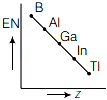
B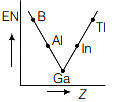
C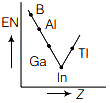
D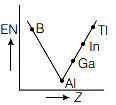
Solution
(D) For group $13$ elements,electronegativity $(EN)$ decreases from $B$ to $Al$ due to the increase in atomic size.
From $Al$ to $Tl$,the electronegativity increases gradually due to the poor shielding effect of $d$ and $f$ orbitals,which increases the effective nuclear charge.
The values of $EN$ (on the Pauling scale) are: $B (2.0)$,$Al (1.5)$,$Ga (1.6)$,$In (1.7)$,and $Tl (1.8)$.
Thus,the correct variation shows a decrease from $B$ to $Al$ followed by an increase from $Al$ to $Tl$.
From $Al$ to $Tl$,the electronegativity increases gradually due to the poor shielding effect of $d$ and $f$ orbitals,which increases the effective nuclear charge.
The values of $EN$ (on the Pauling scale) are: $B (2.0)$,$Al (1.5)$,$Ga (1.6)$,$In (1.7)$,and $Tl (1.8)$.
Thus,the correct variation shows a decrease from $B$ to $Al$ followed by an increase from $Al$ to $Tl$.
0 likesView Solution
138
ChemistryMediumMCQAP EAMCET · 2014
The number of electrons in the valence shell of the central atom of a molecule is $8$. The molecule is
A
$BCl_3$
B
$BeH_2$
C
$SCl_2$
D
$SF_6$
Solution
(C) To determine the number of electrons in the valence shell,we calculate the total number of bonding and lone pairs around the central atom.
In $SCl_2$,the central atom is $S$ (Sulfur).
Sulfur has $6$ valence electrons.
It forms $2$ single bonds with $Cl$ atoms,using $2$ electrons.
Number of lone pairs on $S = \frac{6 - 2}{2} = 2$.
Total electron pairs around $S = 2 \text{ (bonding pairs)} + 2 \text{ (lone pairs)} = 4 \text{ pairs}$.
Total electrons in the valence shell $= 4 \times 2 = 8$ electrons.
Thus,$SCl_2$ follows the octet rule.
In $SCl_2$,the central atom is $S$ (Sulfur).
Sulfur has $6$ valence electrons.
It forms $2$ single bonds with $Cl$ atoms,using $2$ electrons.
Number of lone pairs on $S = \frac{6 - 2}{2} = 2$.
Total electron pairs around $S = 2 \text{ (bonding pairs)} + 2 \text{ (lone pairs)} = 4 \text{ pairs}$.
Total electrons in the valence shell $= 4 \times 2 = 8$ electrons.
Thus,$SCl_2$ follows the octet rule.
0 likesView Solution
139
ChemistryMediumMCQAP EAMCET · 2014
The increasing order of the atomic radius of $Si, S, Na, Mg, Al$ is
A
$S < Si < Al < Mg < Na$
B
$Na < Al < Mg < S < Si$
C
$Na < Mg < Si < Al < S$
D
$Na < Mg < Al < Si < S$
Solution
(A) In the periodic table,as we move from left to right across a period,the effective nuclear charge increases while the number of shells remains the same.
This results in a stronger attraction between the nucleus and the valence electrons,causing the atomic radius to decrease.
All the given elements $(Na, Mg, Al, Si, S)$ belong to the $3^{rd}$ period.
Following the trend of decreasing atomic radius from left to right,the order is $Na > Mg > Al > Si > S$.
Therefore,the increasing order is $S < Si < Al < Mg < Na$.
This results in a stronger attraction between the nucleus and the valence electrons,causing the atomic radius to decrease.
All the given elements $(Na, Mg, Al, Si, S)$ belong to the $3^{rd}$ period.
Following the trend of decreasing atomic radius from left to right,the order is $Na > Mg > Al > Si > S$.
Therefore,the increasing order is $S < Si < Al < Mg < Na$.
0 likesView Solution
140
ChemistryMCQAP EAMCET · 2014
$A$ coil of wire of radius $r$ has $600$ turns and a self-inductance of $108 \ mH$. The self-inductance of a coil with the same radius and $500$ turns is (in $mH$)
A
$80$
B
$75$
C
$108$
D
$90$
Solution
(B) Given: $L_1 = 108 \ mH$,$N_1 = 600$ turns,$N_2 = 500$ turns,and $L_2 = ?$
For a circular coil,the self-inductance $L$ is proportional to the square of the number of turns $N^2$,given by $L = \frac{\mu_0 \pi N^2 r}{2}$.
Since the radius $r$ is the same for both coils,we have the relation:
$\frac{L_1}{L_2} = \left(\frac{N_1}{N_2}\right)^2$
Substituting the given values:
$\frac{108}{L_2} = \left(\frac{600}{500}\right)^2$
$\frac{108}{L_2} = \left(\frac{6}{5}\right)^2 = \frac{36}{25}$
$L_2 = \frac{108 \times 25}{36}$
$L_2 = 3 \times 25 = 75 \ mH$
Thus,the self-inductance of the coil is $75 \ mH$.
For a circular coil,the self-inductance $L$ is proportional to the square of the number of turns $N^2$,given by $L = \frac{\mu_0 \pi N^2 r}{2}$.
Since the radius $r$ is the same for both coils,we have the relation:
$\frac{L_1}{L_2} = \left(\frac{N_1}{N_2}\right)^2$
Substituting the given values:
$\frac{108}{L_2} = \left(\frac{600}{500}\right)^2$
$\frac{108}{L_2} = \left(\frac{6}{5}\right)^2 = \frac{36}{25}$
$L_2 = \frac{108 \times 25}{36}$
$L_2 = 3 \times 25 = 75 \ mH$
Thus,the self-inductance of the coil is $75 \ mH$.
0 likesView Solution
141
ChemistryMCQAP EAMCET · 2014
The cubic equation whose roots are the squares of the roots of $x^3-2x^2+10x-8=0$ is
A
$x^3+16x^2+68x-64=0$
B
$x^3+8x^2+68x-64=0$
C
$x^3+16x^2-68x-64=0$
D
$x^3-16x^2+68x-64=0$
Solution
(A) Let $\alpha, \beta, \gamma$ be the roots of $x^3-2x^2+10x-8=0$.
From Vieta's formulas:
$\alpha+\beta+\gamma = 2$
$\alpha\beta+\beta\gamma+\gamma\alpha = 10$
$\alpha\beta\gamma = 8$
We want the equation with roots $\alpha^2, \beta^2, \gamma^2$.
Sum of new roots: $\alpha^2+\beta^2+\gamma^2 = (\alpha+\beta+\gamma)^2 - 2(\alpha\beta+\beta\gamma+\gamma\alpha) = (2)^2 - 2(10) = 4 - 20 = -16$.
Sum of roots taken two at a time: $\alpha^2\beta^2+\beta^2\gamma^2+\gamma^2\alpha^2 = (\alpha\beta+\beta\gamma+\gamma\alpha)^2 - 2\alpha\beta\gamma(\alpha+\beta+\gamma) = (10)^2 - 2(8)(2) = 100 - 32 = 68$.
Product of new roots: $\alpha^2\beta^2\gamma^2 = (\alpha\beta\gamma)^2 = (8)^2 = 64$.
The required cubic equation is $x^3 - (\text{sum of roots})x^2 + (\text{sum of roots taken two at a time})x - (\text{product of roots}) = 0$.
Substituting the values: $x^3 - (-16)x^2 + 68x - 64 = 0$.
Thus,$x^3+16x^2+68x-64=0$.
From Vieta's formulas:
$\alpha+\beta+\gamma = 2$
$\alpha\beta+\beta\gamma+\gamma\alpha = 10$
$\alpha\beta\gamma = 8$
We want the equation with roots $\alpha^2, \beta^2, \gamma^2$.
Sum of new roots: $\alpha^2+\beta^2+\gamma^2 = (\alpha+\beta+\gamma)^2 - 2(\alpha\beta+\beta\gamma+\gamma\alpha) = (2)^2 - 2(10) = 4 - 20 = -16$.
Sum of roots taken two at a time: $\alpha^2\beta^2+\beta^2\gamma^2+\gamma^2\alpha^2 = (\alpha\beta+\beta\gamma+\gamma\alpha)^2 - 2\alpha\beta\gamma(\alpha+\beta+\gamma) = (10)^2 - 2(8)(2) = 100 - 32 = 68$.
Product of new roots: $\alpha^2\beta^2\gamma^2 = (\alpha\beta\gamma)^2 = (8)^2 = 64$.
The required cubic equation is $x^3 - (\text{sum of roots})x^2 + (\text{sum of roots taken two at a time})x - (\text{product of roots}) = 0$.
Substituting the values: $x^3 - (-16)x^2 + 68x - 64 = 0$.
Thus,$x^3+16x^2+68x-64=0$.
0 likesView Solution
142
ChemistryMCQAP EAMCET · 2014
If $Z_r = \cos \left(\frac{\pi}{2^r}\right) + i \sin \left(\frac{\pi}{2^r}\right)$ for $r = 1, 2, 3, \ldots$,then the product $Z_1 Z_2 Z_3 \ldots \infty$ is equal to:
A
$-2$
B
$1$
C
$2$
D
$-1$
Solution
(D) Given $Z_r = \cos \left(\frac{\pi}{2^r}\right) + i \sin \left(\frac{\pi}{2^r}\right) = e^{i \frac{\pi}{2^r}}$.
Therefore,the product $P = Z_1 Z_2 Z_3 \ldots \infty = e^{i \frac{\pi}{2^1}} \cdot e^{i \frac{\pi}{2^2}} \cdot e^{i \frac{\pi}{2^3}} \ldots$
Using the property of exponents,$P = e^{i \left( \frac{\pi}{2} + \frac{\pi}{4} + \frac{\pi}{8} + \ldots \right)}$.
The exponent is a geometric series with first term $a = \frac{\pi}{2}$ and common ratio $r = \frac{1}{2}$.
The sum of the infinite geometric series is $S = \frac{a}{1 - r} = \frac{\pi/2}{1 - 1/2} = \frac{\pi/2}{1/2} = \pi$.
Thus,$P = e^{i \pi} = \cos \pi + i \sin \pi$.
Since $\cos \pi = -1$ and $\sin \pi = 0$,we get $P = -1 + i(0) = -1$.
Therefore,the product $P = Z_1 Z_2 Z_3 \ldots \infty = e^{i \frac{\pi}{2^1}} \cdot e^{i \frac{\pi}{2^2}} \cdot e^{i \frac{\pi}{2^3}} \ldots$
Using the property of exponents,$P = e^{i \left( \frac{\pi}{2} + \frac{\pi}{4} + \frac{\pi}{8} + \ldots \right)}$.
The exponent is a geometric series with first term $a = \frac{\pi}{2}$ and common ratio $r = \frac{1}{2}$.
The sum of the infinite geometric series is $S = \frac{a}{1 - r} = \frac{\pi/2}{1 - 1/2} = \frac{\pi/2}{1/2} = \pi$.
Thus,$P = e^{i \pi} = \cos \pi + i \sin \pi$.
Since $\cos \pi = -1$ and $\sin \pi = 0$,we get $P = -1 + i(0) = -1$.
0 likesView Solution
143
ChemistryMCQAP EAMCET · 2014
If $x=p+q$,$y=p \omega+q \omega^2$,and $z=p \omega^2+q \omega$,where $\omega$ is a complex cube root of unity,then $xyz$ is equal to:
A
$p^3+q^3$
B
$p^2-pq+q^2$
C
$1+p^3+q^3$
D
$p^3-q^3$
Solution
(A) Given: $x=p+q$,$y=p \omega+q \omega^2$,and $z=p \omega^2+q \omega$.
We need to calculate $xyz = (p+q)(p \omega+q \omega^2)(p \omega^2+q \omega)$.
First,multiply $y$ and $z$:
$yz = (p \omega+q \omega^2)(p \omega^2+q \omega) = p^2 \omega^3 + pq \omega^2 + pq \omega^4 + q^2 \omega^3$.
Since $\omega^3=1$ and $\omega^4=\omega$,we have:
$yz = p^2(1) + pq(\omega^2+\omega) + q^2(1) = p^2 + pq(\omega^2+\omega) + q^2$.
Using the property $1+\omega+\omega^2=0$,we know $\omega+\omega^2=-1$.
So,$yz = p^2 - pq + q^2$.
Now,$xyz = (p+q)(p^2 - pq + q^2)$.
Using the algebraic identity $a^3+b^3 = (a+b)(a^2-ab+b^2)$,we get:
$xyz = p^3+q^3$.
We need to calculate $xyz = (p+q)(p \omega+q \omega^2)(p \omega^2+q \omega)$.
First,multiply $y$ and $z$:
$yz = (p \omega+q \omega^2)(p \omega^2+q \omega) = p^2 \omega^3 + pq \omega^2 + pq \omega^4 + q^2 \omega^3$.
Since $\omega^3=1$ and $\omega^4=\omega$,we have:
$yz = p^2(1) + pq(\omega^2+\omega) + q^2(1) = p^2 + pq(\omega^2+\omega) + q^2$.
Using the property $1+\omega+\omega^2=0$,we know $\omega+\omega^2=-1$.
So,$yz = p^2 - pq + q^2$.
Now,$xyz = (p+q)(p^2 - pq + q^2)$.
Using the algebraic identity $a^3+b^3 = (a+b)(a^2-ab+b^2)$,we get:
$xyz = p^3+q^3$.
0 likesView Solution
144
ChemistryEasyMCQAP EAMCET · 2014
What are $X$ and $Y$ in the following reaction?
$CF_2Cl_2 \stackrel{UV}{\longrightarrow} X + Y$
$CF_2Cl_2 \stackrel{UV}{\longrightarrow} X + Y$
A
$\dot{C}F_2Cl, \dot{Cl}$
B
$^{-}C_2F_4, Cl_2$
C
$\dot{C}FCl_2, \dot{F}$
D
$CCl_2, F_2$
Solution
(A) Chlorofluorocarbons (CFCs),also known as freons,are stable,non-toxic,and non-reactive compounds used in refrigeration and air conditioning.
Due to their long atmospheric lifetime,they eventually reach the stratosphere.
In the stratosphere,they are decomposed by high-energy $UV$ radiation,leading to the formation of chlorine free radicals.
The reaction for dichlorodifluoromethane $(CF_2Cl_2)$ is:
$CF_2Cl_2 \stackrel{hv}{\longrightarrow} \dot{C}F_2Cl + \dot{Cl}$
Thus,the products $X$ and $Y$ are the free radicals $\dot{C}F_2Cl$ and $\dot{Cl}$.
Due to their long atmospheric lifetime,they eventually reach the stratosphere.
In the stratosphere,they are decomposed by high-energy $UV$ radiation,leading to the formation of chlorine free radicals.
The reaction for dichlorodifluoromethane $(CF_2Cl_2)$ is:
$CF_2Cl_2 \stackrel{hv}{\longrightarrow} \dot{C}F_2Cl + \dot{Cl}$
Thus,the products $X$ and $Y$ are the free radicals $\dot{C}F_2Cl$ and $\dot{Cl}$.
0 likesView Solution
145
ChemistryMCQAP EAMCET · 2014
If $\cos x = \tan y$,$\cot y = \tan z$ and $\cot z = \tan x$,then $\sin x$ equals to
A
$\frac{\sqrt{5}+1}{4}$
B
$\frac{\sqrt{5}-1}{4}$
C
$\frac{\sqrt{5}+1}{2}$
D
$\frac{\sqrt{5}-1}{2}$
Solution
(D) Given,$\cos x = \tan y$,$\cot y = \tan z$ and $\cot z = \tan x$.
From the given equations,we have $\tan y = \cos x$ and $\cot y = \frac{1}{\tan y} = \frac{1}{\cos x}$.
Since $\cot y = \tan z$,we have $\tan z = \frac{1}{\cos x}$.
Then $\cot z = \frac{1}{\tan z} = \cos x$.
Given $\cot z = \tan x$,we get $\tan x = \cos x$.
$\Rightarrow \frac{\sin x}{\cos x} = \cos x$
$\Rightarrow \sin x = \cos^2 x$
$\Rightarrow \sin x = 1 - \sin^2 x$
$\Rightarrow \sin^2 x + \sin x - 1 = 0$.
Using the quadratic formula $\sin x = \frac{-b \pm \sqrt{b^2 - 4ac}}{2a}$,we get $\sin x = \frac{-1 \pm \sqrt{1 - 4(1)(-1)}}{2} = \frac{-1 \pm \sqrt{5}}{2}$.
Since $\sin x$ must be positive in the range where $\tan x$ and $\cos x$ are defined as equal,we take the positive root: $\sin x = \frac{\sqrt{5}-1}{2}$.
From the given equations,we have $\tan y = \cos x$ and $\cot y = \frac{1}{\tan y} = \frac{1}{\cos x}$.
Since $\cot y = \tan z$,we have $\tan z = \frac{1}{\cos x}$.
Then $\cot z = \frac{1}{\tan z} = \cos x$.
Given $\cot z = \tan x$,we get $\tan x = \cos x$.
$\Rightarrow \frac{\sin x}{\cos x} = \cos x$
$\Rightarrow \sin x = \cos^2 x$
$\Rightarrow \sin x = 1 - \sin^2 x$
$\Rightarrow \sin^2 x + \sin x - 1 = 0$.
Using the quadratic formula $\sin x = \frac{-b \pm \sqrt{b^2 - 4ac}}{2a}$,we get $\sin x = \frac{-1 \pm \sqrt{1 - 4(1)(-1)}}{2} = \frac{-1 \pm \sqrt{5}}{2}$.
Since $\sin x$ must be positive in the range where $\tan x$ and $\cos x$ are defined as equal,we take the positive root: $\sin x = \frac{\sqrt{5}-1}{2}$.
0 likesView Solution
146
ChemistryMCQAP EAMCET · 2014
$\sec h^{-1}\left(\frac{1}{2}\right)-\operatorname{cosec} h^{-1}\left(\frac{3}{4}\right)$ is equal to
A
$\log _e(3(2+\sqrt{3}))$
B
$\log _e\left(\frac{1+\sqrt{3}}{3}\right)$
C
$\log _e\left(\frac{2+\sqrt{3}}{3}\right)$
D
$\log _e\left(\frac{2-\sqrt{3}}{3}\right)$
Solution
(C) We use the logarithmic forms of inverse hyperbolic functions:
$\sec h^{-1} x = \log _e\left(\frac{1+\sqrt{1-x^2}}{x}\right)$ and $\operatorname{cosec} h^{-1} x = \log _e\left(\frac{1+\sqrt{1+x^2}}{x}\right)$.
Substituting $x = \frac{1}{2}$ in $\sec h^{-1} x$:
$\sec h^{-1}\left(\frac{1}{2}\right) = \log _e\left(\frac{1+\sqrt{1-\frac{1}{4}}}{\frac{1}{2}}\right) = \log _e\left(\frac{1+\frac{\sqrt{3}}{2}}{\frac{1}{2}}\right) = \log _e(2+\sqrt{3})$.
Substituting $x = \frac{3}{4}$ in $\operatorname{cosec} h^{-1} x$:
$\operatorname{cosec} h^{-1}\left(\frac{3}{4}\right) = \log _e\left(\frac{1+\sqrt{1+\frac{9}{16}}}{\frac{3}{4}}\right) = \log _e\left(\frac{1+\frac{5}{4}}{\frac{3}{4}}\right) = \log _e\left(\frac{\frac{9}{4}}{\frac{3}{4}}\right) = \log _e(3)$.
Therefore,$\sec h^{-1}\left(\frac{1}{2}\right) - \operatorname{cosec} h^{-1}\left(\frac{3}{4}\right) = \log _e(2+\sqrt{3}) - \log _e(3) = \log _e\left(\frac{2+\sqrt{3}}{3}\right)$.
$\sec h^{-1} x = \log _e\left(\frac{1+\sqrt{1-x^2}}{x}\right)$ and $\operatorname{cosec} h^{-1} x = \log _e\left(\frac{1+\sqrt{1+x^2}}{x}\right)$.
Substituting $x = \frac{1}{2}$ in $\sec h^{-1} x$:
$\sec h^{-1}\left(\frac{1}{2}\right) = \log _e\left(\frac{1+\sqrt{1-\frac{1}{4}}}{\frac{1}{2}}\right) = \log _e\left(\frac{1+\frac{\sqrt{3}}{2}}{\frac{1}{2}}\right) = \log _e(2+\sqrt{3})$.
Substituting $x = \frac{3}{4}$ in $\operatorname{cosec} h^{-1} x$:
$\operatorname{cosec} h^{-1}\left(\frac{3}{4}\right) = \log _e\left(\frac{1+\sqrt{1+\frac{9}{16}}}{\frac{3}{4}}\right) = \log _e\left(\frac{1+\frac{5}{4}}{\frac{3}{4}}\right) = \log _e\left(\frac{\frac{9}{4}}{\frac{3}{4}}\right) = \log _e(3)$.
Therefore,$\sec h^{-1}\left(\frac{1}{2}\right) - \operatorname{cosec} h^{-1}\left(\frac{3}{4}\right) = \log _e(2+\sqrt{3}) - \log _e(3) = \log _e\left(\frac{2+\sqrt{3}}{3}\right)$.
0 likesView Solution
147
ChemistryMCQAP EAMCET · 2014
If $x$ and $y$ are acute angles such that $\cos x + \cos y = \frac{3}{2}$ and $\sin x + \sin y = \frac{3}{4}$,then $\sin(x+y)$ is equal to
A
$\frac{2}{5}$
B
$\frac{3}{4}$
C
$\frac{3}{5}$
D
$\frac{4}{5}$
Solution
(D) Given,$\cos x + \cos y = \frac{3}{2}$ and $\sin x + \sin y = \frac{3}{4}$.
Using sum-to-product formulas:
$2 \cos \left(\frac{x+y}{2}\right) \cos \left(\frac{x-y}{2}\right) = \frac{3}{2}$ $(1)$
$2 \sin \left(\frac{x+y}{2}\right) \cos \left(\frac{x-y}{2}\right) = \frac{3}{4}$ $(2)$
Dividing equation $(2)$ by equation $(1)$:
$\frac{2 \sin \left(\frac{x+y}{2}\right) \cos \left(\frac{x-y}{2}\right)}{2 \cos \left(\frac{x+y}{2}\right) \cos \left(\frac{x-y}{2}\right)} = \frac{3/4}{3/2}$
$\tan \left(\frac{x+y}{2}\right) = \frac{1}{2}$
Using the identity $\sin(x+y) = \frac{2 \tan \left(\frac{x+y}{2}\right)}{1 + \tan^2 \left(\frac{x+y}{2}\right)}$:
$\sin(x+y) = \frac{2 \times \frac{1}{2}}{1 + (\frac{1}{2})^2} = \frac{1}{1 + \frac{1}{4}} = \frac{1}{\frac{5}{4}} = \frac{4}{5}$.
Using sum-to-product formulas:
$2 \cos \left(\frac{x+y}{2}\right) \cos \left(\frac{x-y}{2}\right) = \frac{3}{2}$ $(1)$
$2 \sin \left(\frac{x+y}{2}\right) \cos \left(\frac{x-y}{2}\right) = \frac{3}{4}$ $(2)$
Dividing equation $(2)$ by equation $(1)$:
$\frac{2 \sin \left(\frac{x+y}{2}\right) \cos \left(\frac{x-y}{2}\right)}{2 \cos \left(\frac{x+y}{2}\right) \cos \left(\frac{x-y}{2}\right)} = \frac{3/4}{3/2}$
$\tan \left(\frac{x+y}{2}\right) = \frac{1}{2}$
Using the identity $\sin(x+y) = \frac{2 \tan \left(\frac{x+y}{2}\right)}{1 + \tan^2 \left(\frac{x+y}{2}\right)}$:
$\sin(x+y) = \frac{2 \times \frac{1}{2}}{1 + (\frac{1}{2})^2} = \frac{1}{1 + \frac{1}{4}} = \frac{1}{\frac{5}{4}} = \frac{4}{5}$.
0 likesView Solution
148
ChemistryMCQAP EAMCET · 2014
The area (in sq. units) of the triangle formed by the lines $x^2-3xy+y^2=0$ and $x+y+1=0$ is
A
$\frac{2}{\sqrt{3}}$
B
$\frac{\sqrt{3}}{2}$
C
$5\sqrt{2}$
D
$\frac{1}{\sqrt{5}}$
Solution
(D) The given pair of lines is $x^2-3xy+y^2=0$. This represents two lines passing through the origin $(0,0)$.
Let the lines be $y=m_1x$ and $y=m_2x$. Then $m_1+m_2=3$ and $m_1m_2=1$.
The area of the triangle formed by the lines $ax^2+2hxy+by^2=0$ and $lx+my+n=0$ is given by the formula:
$\text{Area} = \frac{n^2\sqrt{h^2-ab}}{|am^2-2hlm+bl^2|}$.
Here,$a=1, h=-\frac{3}{2}, b=1, l=1, m=1, n=1$.
Substituting these values:
$\text{Area} = \frac{1^2\sqrt{(-\frac{3}{2})^2-(1)(1)}}{|(1)(1)^2-2(-\frac{3}{2})(1)(1)+(1)(1)^2|}$.
$\text{Area} = \frac{\sqrt{\frac{9}{4}-1}}{|1+3+1|} = \frac{\sqrt{\frac{5}{4}}}{5} = \frac{\frac{\sqrt{5}}{2}}{5} = \frac{\sqrt{5}}{10} = \frac{1}{2\sqrt{5}}$.
Let the lines be $y=m_1x$ and $y=m_2x$. Then $m_1+m_2=3$ and $m_1m_2=1$.
The area of the triangle formed by the lines $ax^2+2hxy+by^2=0$ and $lx+my+n=0$ is given by the formula:
$\text{Area} = \frac{n^2\sqrt{h^2-ab}}{|am^2-2hlm+bl^2|}$.
Here,$a=1, h=-\frac{3}{2}, b=1, l=1, m=1, n=1$.
Substituting these values:
$\text{Area} = \frac{1^2\sqrt{(-\frac{3}{2})^2-(1)(1)}}{|(1)(1)^2-2(-\frac{3}{2})(1)(1)+(1)(1)^2|}$.
$\text{Area} = \frac{\sqrt{\frac{9}{4}-1}}{|1+3+1|} = \frac{\sqrt{\frac{5}{4}}}{5} = \frac{\frac{\sqrt{5}}{2}}{5} = \frac{\sqrt{5}}{10} = \frac{1}{2\sqrt{5}}$.
0 likesView Solution
149
ChemistryMCQAP EAMCET · 2014
If $x^2+\alpha y^2+2 \beta y=a^2$ represents a pair of perpendicular lines,then $\beta$ equals to
A
$4 a$
B
$a$
C
$2a$
D
$3a$
Solution
(B) The given equation is $x^2 + \alpha y^2 + 2 \beta y - a^2 = 0$.
Comparing this with the general equation of a pair of lines $Ax^2 + 2Hxy + By^2 + 2Gx + 2Fy + C = 0$,we get:
$A = 1, B = \alpha, H = 0, G = 0, F = \beta, C = -a^2$.
For the lines to be perpendicular,the condition is $A + B = 0$.
$1 + \alpha = 0 \Rightarrow \alpha = -1$.
For the equation to represent a pair of lines,the determinant condition must be satisfied:
$ABC + 2FGH - AF^2 - BG^2 - CH^2 = 0$.
Substituting the values:
$(1)(\alpha)(-a^2) + 2(\beta)(0)(0) - (1)(\beta)^2 - (\alpha)(0)^2 - (-a^2)(0)^2 = 0$.
$-\alpha a^2 - \beta^2 = 0$.
Since $\alpha = -1$,we have:
$-(-1)a^2 - \beta^2 = 0
$ $\Rightarrow a^2 - \beta^2 = 0
$ $\Rightarrow \beta^2 = a^2
$ $\Rightarrow \beta = a$ (taking the positive root as per options).
Comparing this with the general equation of a pair of lines $Ax^2 + 2Hxy + By^2 + 2Gx + 2Fy + C = 0$,we get:
$A = 1, B = \alpha, H = 0, G = 0, F = \beta, C = -a^2$.
For the lines to be perpendicular,the condition is $A + B = 0$.
$1 + \alpha = 0 \Rightarrow \alpha = -1$.
For the equation to represent a pair of lines,the determinant condition must be satisfied:
$ABC + 2FGH - AF^2 - BG^2 - CH^2 = 0$.
Substituting the values:
$(1)(\alpha)(-a^2) + 2(\beta)(0)(0) - (1)(\beta)^2 - (\alpha)(0)^2 - (-a^2)(0)^2 = 0$.
$-\alpha a^2 - \beta^2 = 0$.
Since $\alpha = -1$,we have:
$-(-1)a^2 - \beta^2 = 0
$ $\Rightarrow a^2 - \beta^2 = 0
$ $\Rightarrow \beta^2 = a^2
$ $\Rightarrow \beta = a$ (taking the positive root as per options).
0 likesView Solution
150
ChemistryMCQAP EAMCET · 2014
Match the following (Take the relative strength of the strongest fundamental forces in nature as $1$):
| List-$I$ (Fundamental forces in nature) | List-$II$ (Relative strength) |
| :--- | :--- |
| $(A)$ Strong nuclear force | $(e)$ $10^{-2}$ |
| $(B)$ Weak nuclear force | $(f)$ $1$ |
| $(C)$ Electromagnetic force | $(g)$ $10^{10}$ |
| $(D)$ Gravitational force | $(h)$ $10^{-13}$ |
| | $(i)$ $10^{-39}$ |
The correct match is:
| List-$I$ (Fundamental forces in nature) | List-$II$ (Relative strength) |
| :--- | :--- |
| $(A)$ Strong nuclear force | $(e)$ $10^{-2}$ |
| $(B)$ Weak nuclear force | $(f)$ $1$ |
| $(C)$ Electromagnetic force | $(g)$ $10^{10}$ |
| $(D)$ Gravitational force | $(h)$ $10^{-13}$ |
| | $(i)$ $10^{-39}$ |
The correct match is:
A
$A-f, B-i, C-e, D-h$
B
$A-f, B-h, C-e, D-h$
C
$A-f, B-h, C-e, D-i$
D
$A-f, B-e, C-h, D-i$
Solution
(C) The relative strengths of the four fundamental forces in nature,taking the strongest (strong nuclear force) as $1$,are as follows:
$1$. Strong nuclear force: Relative strength = $1$ (Matches with $f$)
$2$. Electromagnetic force: Relative strength = $10^{-2}$ (Matches with $e$)
$3$. Weak nuclear force: Relative strength = $10^{-13}$ (Matches with $h$)
$4$. Gravitational force: Relative strength = $10^{-39}$ (Matches with $i$)
Therefore,the correct matching is: $A-f, B-h, C-e, D-i$.
$1$. Strong nuclear force: Relative strength = $1$ (Matches with $f$)
$2$. Electromagnetic force: Relative strength = $10^{-2}$ (Matches with $e$)
$3$. Weak nuclear force: Relative strength = $10^{-13}$ (Matches with $h$)
$4$. Gravitational force: Relative strength = $10^{-39}$ (Matches with $i$)
Therefore,the correct matching is: $A-f, B-h, C-e, D-i$.
0 likesView Solution
Vedclass Products
For Students
Vedclass Test Series
Mock tests in real AP EAMCET style covering Chemistry with performance analysis. 5-day free trial.
Start Free TrialFor Teachers
Exam Paper Generator
Generate Set A/B/C/D Chemistry papers from 7.5L+ questions in 2 minutes. 3 chapters free.
Try FreeFor Institutes
Online Exam Module
Run live AP EAMCET mock exams with unlimited students, 360° analytics & white-label branding.
See DemoFrequently Asked Questions
How many Chemistry questions are in AP EAMCET 2014?
There are 197 Chemistry questions from the AP EAMCET 2014 paper on Vedclass, each with a detailed step-by-step solution in English.
Are AP EAMCET 2014 Chemistry solutions available in English?
Yes. All solutions on this page are in English. You can also switch to English or Hindi using the language buttons above the questions.
Can I practice AP EAMCET 2014 Chemistry as a timed test?
Yes. Use the Vedclass Test Series to attempt a full AP EAMCET mock test covering Chemistry with time limits and instant score analysis.
Can teachers create Chemistry papers from AP EAMCET previous year questions?
Yes. The Vedclass Exam Paper Generator lets teachers mix AP EAMCET Chemistry questions and generate Set A/B/C/D papers in minutes.
For Teachers & Institutes
Build a Custom Chemistry Paper
Pick AP EAMCET 2014 Chemistry questions, set difficulty, and generate Set A/B/C/D in 2 minutes.