
ChemistryQ51–100 of 189 questions
Page 2 of 4 · English
51
ChemistryMCQAP EAMCET · 2011
Which one of the following statements is not correct?
A
Moissan boron is amorphous
B
The reaction between boron and concentrated $HNO_3$ gives $N_2O$
C
Amorphous boron on heating with oxygen forms $B_2O_3$
D
Boron is a non-conductor of electricity
Solution
(B) Boron reacts with concentrated $HNO_3$ to produce orthoboric acid and nitrogen dioxide,not $N_2O$.
The balanced chemical equation is: $B + 3HNO_3 \longrightarrow H_3BO_3 + 3NO_2$.
The balanced chemical equation is: $B + 3HNO_3 \longrightarrow H_3BO_3 + 3NO_2$.
0 likesView Solution
52
ChemistryMCQAP EAMCET · 2011
What is the bond angle in $ClO_2$ (OClO) (in $^{\circ}$)?
A
$90$
B
$118$
C
$105$
D
$111$
Solution
(B) The structure of $ClO_2$ is angular.
In the $ClO_2$ molecule,the central chlorine atom is $sp^3$-hybridized with one unpaired electron.
Due to the presence of the unpaired electron and the lone pair on the chlorine atom,the bond angle is observed to be $118^{\circ}$ and the $Cl-O$ bond length is $1.47 \ \mathring{A}$.
In the $ClO_2$ molecule,the central chlorine atom is $sp^3$-hybridized with one unpaired electron.
Due to the presence of the unpaired electron and the lone pair on the chlorine atom,the bond angle is observed to be $118^{\circ}$ and the $Cl-O$ bond length is $1.47 \ \mathring{A}$.
0 likesView Solution
53
ChemistryMCQAP EAMCET · 2011
If one of the lines in the pair of straight lines given by $4x^2+6xy+ky^2=0$ bisects the angle between the coordinate axes,then $k \in$
A
$\{-2,-10\}$
B
$\{-2,10\}$
C
$\{-10,2\}$
D
$\{2,10\}$
Solution
(C) The general equation of a pair of straight lines passing through the origin is $ax^2+2hxy+by^2=0$.
If one of these lines bisects the angle between the coordinate axes,its equation is $y=x$ or $y=-x$.
Substituting $y=x$ into the equation $ax^2+2hxy+by^2=0$,we get $ax^2+2hx^2+bx^2=0$,which implies $a+2h+b=0$,or $a+b=-2h$. Squaring both sides gives $(a+b)^2=4h^2$.
Similarly,if $y=-x$,we get $ax^2-2hx^2+bx^2=0$,which implies $a-2h+b=0$,or $a+b=2h$. Squaring both sides gives $(a+b)^2=4h^2$.
Thus,the condition for one of the lines to bisect the angle between the axes is $(a+b)^2=4h^2$.
For the given equation $4x^2+6xy+ky^2=0$,we have $a=4$,$2h=6$ (so $h=3$),and $b=k$.
Substituting these values into the condition $(a+b)^2=4h^2$:
$(4+k)^2=4(3)^2$
$(4+k)^2=36$
$4+k = \pm 6$
If $4+k=6$,then $k=2$.
If $4+k=-6$,then $k=-10$.
Therefore,$k \in \{-10, 2\}$.
If one of these lines bisects the angle between the coordinate axes,its equation is $y=x$ or $y=-x$.
Substituting $y=x$ into the equation $ax^2+2hxy+by^2=0$,we get $ax^2+2hx^2+bx^2=0$,which implies $a+2h+b=0$,or $a+b=-2h$. Squaring both sides gives $(a+b)^2=4h^2$.
Similarly,if $y=-x$,we get $ax^2-2hx^2+bx^2=0$,which implies $a-2h+b=0$,or $a+b=2h$. Squaring both sides gives $(a+b)^2=4h^2$.
Thus,the condition for one of the lines to bisect the angle between the axes is $(a+b)^2=4h^2$.
For the given equation $4x^2+6xy+ky^2=0$,we have $a=4$,$2h=6$ (so $h=3$),and $b=k$.
Substituting these values into the condition $(a+b)^2=4h^2$:
$(4+k)^2=4(3)^2$
$(4+k)^2=36$
$4+k = \pm 6$
If $4+k=6$,then $k=2$.
If $4+k=-6$,then $k=-10$.
Therefore,$k \in \{-10, 2\}$.
0 likesView Solution
54
ChemistryMCQAP EAMCET · 2011
If $ax^2+2hxy+by^2+2gx+2fy+c=0$ represents a pair of parallel lines,then $\sqrt{\frac{g^2-ac}{f^2-bc}}$ is equal to
A
$\frac{a}{b}$
B
$\sqrt{\frac{a}{b}}$
C
$\sqrt{\frac{b}{a}}$
D
$\frac{b}{a}$
Solution
(B) The general second-degree equation $ax^2+2hxy+by^2+2gx+2fy+c=0$ represents a pair of parallel lines if $h^2=ab$ and $bg^2=af^2$.
From $h^2=ab$,we have $h=\sqrt{ab}$.
From $bg^2=af^2$,we can write $\frac{g^2}{f^2}=\frac{a}{b}$.
For parallel lines,the condition is $\frac{a}{h}=\frac{h}{b}=\frac{g}{f}$.
Thus,$\frac{g^2}{f^2}=\frac{a^2}{h^2}=\frac{a^2}{ab}=\frac{a}{b}$.
Also,for parallel lines,the distance between them is given by $2\sqrt{\frac{g^2-ac}{a(a+b)}} = 2\sqrt{\frac{f^2-bc}{b(a+b)}}$.
This implies $\frac{g^2-ac}{a} = \frac{f^2-bc}{b}$.
Therefore,$\frac{g^2-ac}{f^2-bc} = \frac{a}{b}$.
Taking the square root on both sides,we get $\sqrt{\frac{g^2-ac}{f^2-bc}} = \sqrt{\frac{a}{b}}$.
From $h^2=ab$,we have $h=\sqrt{ab}$.
From $bg^2=af^2$,we can write $\frac{g^2}{f^2}=\frac{a}{b}$.
For parallel lines,the condition is $\frac{a}{h}=\frac{h}{b}=\frac{g}{f}$.
Thus,$\frac{g^2}{f^2}=\frac{a^2}{h^2}=\frac{a^2}{ab}=\frac{a}{b}$.
Also,for parallel lines,the distance between them is given by $2\sqrt{\frac{g^2-ac}{a(a+b)}} = 2\sqrt{\frac{f^2-bc}{b(a+b)}}$.
This implies $\frac{g^2-ac}{a} = \frac{f^2-bc}{b}$.
Therefore,$\frac{g^2-ac}{f^2-bc} = \frac{a}{b}$.
Taking the square root on both sides,we get $\sqrt{\frac{g^2-ac}{f^2-bc}} = \sqrt{\frac{a}{b}}$.
0 likesView Solution
55
ChemistryMCQAP EAMCET · 2011
If $s$ and $p$ are respectively the sum and the product of the slopes of the lines $3x^2 - 2xy - 15y^2 = 0$,then $s:p$ is equal to
A
$4:3$
B
$2:3$
C
$3:5$
D
$3:4$
Solution
(B) The given equation of the pair of lines is $3x^2 - 2xy - 15y^2 = 0$.
Comparing this with the general equation $ax^2 + 2hxy + by^2 = 0$,we get $a = 3$,$2h = -2$ (so $h = -1$),and $b = -15$.
Let the slopes of the lines be $m_1$ and $m_2$.
The sum of the slopes is $s = m_1 + m_2 = \frac{-2h}{b} = \frac{-2(-1)}{-15} = \frac{2}{-15} = -\frac{2}{15}$.
The product of the slopes is $p = m_1 m_2 = \frac{a}{b} = \frac{3}{-15} = -\frac{3}{15}$.
Therefore,the ratio $s:p = \left(-\frac{2}{15}\right) : \left(-\frac{3}{15}\right) = 2:3$.
Comparing this with the general equation $ax^2 + 2hxy + by^2 = 0$,we get $a = 3$,$2h = -2$ (so $h = -1$),and $b = -15$.
Let the slopes of the lines be $m_1$ and $m_2$.
The sum of the slopes is $s = m_1 + m_2 = \frac{-2h}{b} = \frac{-2(-1)}{-15} = \frac{2}{-15} = -\frac{2}{15}$.
The product of the slopes is $p = m_1 m_2 = \frac{a}{b} = \frac{3}{-15} = -\frac{3}{15}$.
Therefore,the ratio $s:p = \left(-\frac{2}{15}\right) : \left(-\frac{3}{15}\right) = 2:3$.
0 likesView Solution
56
ChemistryMCQAP EAMCET · 2011
If the line $y=2x+c$ is a tangent to the circle $x^2+y^2=5$,then a value of $c$ is
A
$5$
B
$3$
C
$4$
D
$2$
Solution
(A) The given line is $y=2x+c$,which can be written as $2x-y+c=0$.
The equation of the circle is $x^2+y^2=5$,which has center $(0,0)$ and radius $r=\sqrt{5}$.
For a line $Ax+By+C=0$ to be tangent to a circle with center $(h,k)$ and radius $r$,the perpendicular distance from the center to the line must be equal to the radius:
$\frac{|A(h)+B(k)+C|}{\sqrt{A^2+B^2}} = r$
Substituting the values $A=2, B=-1, C=c, h=0, k=0, r=\sqrt{5}$:
$\frac{|2(0)-1(0)+c|}{\sqrt{2^2+(-1)^2}} = \sqrt{5}$
$\frac{|c|}{\sqrt{4+1}} = \sqrt{5}$
$\frac{|c|}{\sqrt{5}} = \sqrt{5}$
$|c| = \sqrt{5} \times \sqrt{5} = 5$
Therefore,$c = \pm 5$.
Comparing with the given options,the value of $c$ is $5$.
The equation of the circle is $x^2+y^2=5$,which has center $(0,0)$ and radius $r=\sqrt{5}$.
For a line $Ax+By+C=0$ to be tangent to a circle with center $(h,k)$ and radius $r$,the perpendicular distance from the center to the line must be equal to the radius:
$\frac{|A(h)+B(k)+C|}{\sqrt{A^2+B^2}} = r$
Substituting the values $A=2, B=-1, C=c, h=0, k=0, r=\sqrt{5}$:
$\frac{|2(0)-1(0)+c|}{\sqrt{2^2+(-1)^2}} = \sqrt{5}$
$\frac{|c|}{\sqrt{4+1}} = \sqrt{5}$
$\frac{|c|}{\sqrt{5}} = \sqrt{5}$
$|c| = \sqrt{5} \times \sqrt{5} = 5$
Therefore,$c = \pm 5$.
Comparing with the given options,the value of $c$ is $5$.
0 likesView Solution
57
ChemistryMCQAP EAMCET · 2011
If the lines $3x + 4y - 14 = 0$ and $6x + 8y + 7 = 0$ are both tangents to a circle,then its radius is
A
$7$
B
$\frac{7}{2}$
C
$\frac{7}{4}$
D
$\frac{7}{6}$
Solution
(C) Given,the lines $3x + 4y - 14 = 0$ and $6x + 8y + 7 = 0$ are both tangents to a circle.
We observe that both lines are parallel.
Dividing the second equation by $2$,we get $3x + 4y + \frac{7}{2} = 0$.
The distance between two parallel lines $ax + by + c_1 = 0$ and $ax + by + c_2 = 0$ is given by $d = \frac{|c_1 - c_2|}{\sqrt{a^2 + b^2}}$.
The diameter of the circle is equal to the distance between these two parallel tangents.
Diameter $= \frac{|-14 - \frac{7}{2}|}{\sqrt{3^2 + 4^2}} = \frac{|-\frac{28}{2} - \frac{7}{2}|}{\sqrt{9 + 16}} = \frac{|-\frac{35}{2}|}{5} = \frac{35}{10} = \frac{7}{2}$.
Therefore,the radius of the circle is $r = \frac{\text{Diameter}}{2} = \frac{7/2}{2} = \frac{7}{4}$.
We observe that both lines are parallel.
Dividing the second equation by $2$,we get $3x + 4y + \frac{7}{2} = 0$.
The distance between two parallel lines $ax + by + c_1 = 0$ and $ax + by + c_2 = 0$ is given by $d = \frac{|c_1 - c_2|}{\sqrt{a^2 + b^2}}$.
The diameter of the circle is equal to the distance between these two parallel tangents.
Diameter $= \frac{|-14 - \frac{7}{2}|}{\sqrt{3^2 + 4^2}} = \frac{|-\frac{28}{2} - \frac{7}{2}|}{\sqrt{9 + 16}} = \frac{|-\frac{35}{2}|}{5} = \frac{35}{10} = \frac{7}{2}$.
Therefore,the radius of the circle is $r = \frac{\text{Diameter}}{2} = \frac{7/2}{2} = \frac{7}{4}$.
0 likesView Solution
58
ChemistryMCQAP EAMCET · 2011
If the circle $x^2+y^2+8x-4y+c=0$ touches the circle $x^2+y^2+2x+4y-11=0$ externally and cuts the circle $x^2+y^2-6x+8y+k=0$ orthogonally,then $k=$
A
-$59$
B
-$19$
C
$19$
D
$59$
Solution
(A) For the first circle $S_1: x^2+y^2+8x-4y+c=0$,the center is $C_1(-4, 2)$ and radius $r_1 = \sqrt{(-4)^2 + 2^2 - c} = \sqrt{20-c}$.
For the second circle $S_2: x^2+y^2+2x+4y-11=0$,the center is $C_2(-1, -2)$ and radius $r_2 = \sqrt{(-1)^2 + (-2)^2 - (-11)} = \sqrt{1+4+11} = 4$.
The distance between centers $C_1$ and $C_2$ is $d = \sqrt{(-4 - (-1))^2 + (2 - (-2))^2} = \sqrt{(-3)^2 + 4^2} = \sqrt{9+16} = 5$.
Since the circles touch externally,$d = r_1 + r_2$,so $5 = \sqrt{20-c} + 4$,which implies $\sqrt{20-c} = 1$,so $20-c = 1$,giving $c = 19$.
The third circle is $S_3: x^2+y^2-6x+8y+k=0$.
Two circles $x^2+y^2+2g_1x+2f_1y+c_1=0$ and $x^2+y^2+2g_2x+2f_2y+c_2=0$ cut orthogonally if $2g_1g_2 + 2f_1f_2 = c_1 + c_2$.
For $S_1$ and $S_3$,we have $g_1=4, f_1=-2, c_1=19$ and $g_3=-3, f_3=4, c_3=k$.
Thus,$2(4)(-3) + 2(-2)(4) = 19 + k$.
$-24 - 16 = 19 + k$,which gives $-40 = 19 + k$,so $k = -59$.
For the second circle $S_2: x^2+y^2+2x+4y-11=0$,the center is $C_2(-1, -2)$ and radius $r_2 = \sqrt{(-1)^2 + (-2)^2 - (-11)} = \sqrt{1+4+11} = 4$.
The distance between centers $C_1$ and $C_2$ is $d = \sqrt{(-4 - (-1))^2 + (2 - (-2))^2} = \sqrt{(-3)^2 + 4^2} = \sqrt{9+16} = 5$.
Since the circles touch externally,$d = r_1 + r_2$,so $5 = \sqrt{20-c} + 4$,which implies $\sqrt{20-c} = 1$,so $20-c = 1$,giving $c = 19$.
The third circle is $S_3: x^2+y^2-6x+8y+k=0$.
Two circles $x^2+y^2+2g_1x+2f_1y+c_1=0$ and $x^2+y^2+2g_2x+2f_2y+c_2=0$ cut orthogonally if $2g_1g_2 + 2f_1f_2 = c_1 + c_2$.
For $S_1$ and $S_3$,we have $g_1=4, f_1=-2, c_1=19$ and $g_3=-3, f_3=4, c_3=k$.
Thus,$2(4)(-3) + 2(-2)(4) = 19 + k$.
$-24 - 16 = 19 + k$,which gives $-40 = 19 + k$,so $k = -59$.
0 likesView Solution
59
ChemistryMCQAP EAMCET · 2011
If the circle $x^2+y^2+8x-4y+c=0$ touches the circle $x^2+y^2+2x+4y-11=0$ externally and cuts the circle $x^2+y^2-6x+8y+k=0$ orthogonally,then $k$ is equal to
A
$59$
B
-$59$
C
$19$
D
-$19$
Solution
(B) Given the circle $S_1: x^2+y^2+8x-4y+c=0$ with center $C_1=(-4, 2)$ and radius $r_1=\sqrt{(-4)^2+2^2-c}=\sqrt{20-c}$.
Given the circle $S_2: x^2+y^2+2x+4y-11=0$ with center $C_2=(-1, -2)$ and radius $r_2=\sqrt{(-1)^2+(-2)^2-(-11)}=\sqrt{1+4+11}=4$.
Since the circles touch externally,the distance between centers $C_1C_2 = r_1+r_2$.
$C_1C_2 = \sqrt{(-4 - (-1))^2 + (2 - (-2))^2} = \sqrt{(-3)^2 + 4^2} = \sqrt{9+16} = 5$.
Thus,$5 = \sqrt{20-c} + 4$ $\Rightarrow \sqrt{20-c} = 1$ $\Rightarrow 20-c = 1$ $\Rightarrow c = 19$.
Now,the circle $S_1$ cuts the circle $S_3: x^2+y^2-6x+8y+k=0$ orthogonally. The condition for orthogonality is $2g_1g_3 + 2f_1f_3 = c_1+c_3$.
For $S_1$,$g_1=4, f_1=-2, c_1=c=19$.
For $S_3$,$g_3=-3, f_3=4, c_3=k$.
$2(4)(-3) + 2(-2)(4) = 19 + k$.
$-24 - 16 = 19 + k$.
$-40 = 19 + k$.
$k = -59$.
Given the circle $S_2: x^2+y^2+2x+4y-11=0$ with center $C_2=(-1, -2)$ and radius $r_2=\sqrt{(-1)^2+(-2)^2-(-11)}=\sqrt{1+4+11}=4$.
Since the circles touch externally,the distance between centers $C_1C_2 = r_1+r_2$.
$C_1C_2 = \sqrt{(-4 - (-1))^2 + (2 - (-2))^2} = \sqrt{(-3)^2 + 4^2} = \sqrt{9+16} = 5$.
Thus,$5 = \sqrt{20-c} + 4$ $\Rightarrow \sqrt{20-c} = 1$ $\Rightarrow 20-c = 1$ $\Rightarrow c = 19$.
Now,the circle $S_1$ cuts the circle $S_3: x^2+y^2-6x+8y+k=0$ orthogonally. The condition for orthogonality is $2g_1g_3 + 2f_1f_3 = c_1+c_3$.
For $S_1$,$g_1=4, f_1=-2, c_1=c=19$.
For $S_3$,$g_3=-3, f_3=4, c_3=k$.
$2(4)(-3) + 2(-2)(4) = 19 + k$.
$-24 - 16 = 19 + k$.
$-40 = 19 + k$.
$k = -59$.
0 likesView Solution
60
ChemistryMCQAP EAMCET · 2011
The point of contact of the circles $x^2+y^2+2x+2y+1=0$ and $x^2+y^2-2x+2y+1=0$ is
A
$(0, 1)$
B
$(0, -1)$
C
$(1, 0)$
D
$(-1, 0)$
Solution
(B) Given equations of circles are:
$S_1 \equiv x^2+y^2+2x+2y+1=0$
$S_2 \equiv x^2+y^2-2x+2y+1=0$
For circle $S_1$,the centre is $C_1 = (-1, -1)$ and radius $r_1 = \sqrt{(-1)^2 + (-1)^2 - 1} = \sqrt{1} = 1$.
For circle $S_2$,the centre is $C_2 = (1, -1)$ and radius $r_2 = \sqrt{(1)^2 + (-1)^2 - 1} = \sqrt{1} = 1$.
The distance between the centres $C_1$ and $C_2$ is $d = \sqrt{(1 - (-1))^2 + (-1 - (-1))^2} = \sqrt{2^2 + 0^2} = 2$.
Since $d = r_1 + r_2 = 1 + 1 = 2$,the circles touch each other externally.
The point of contact is the midpoint of the line segment joining the centres $C_1$ and $C_2$.
Point of contact $= \left( \frac{-1 + 1}{2}, \frac{-1 + (-1)}{2} \right) = (0, -1)$.
$S_1 \equiv x^2+y^2+2x+2y+1=0$
$S_2 \equiv x^2+y^2-2x+2y+1=0$
For circle $S_1$,the centre is $C_1 = (-1, -1)$ and radius $r_1 = \sqrt{(-1)^2 + (-1)^2 - 1} = \sqrt{1} = 1$.
For circle $S_2$,the centre is $C_2 = (1, -1)$ and radius $r_2 = \sqrt{(1)^2 + (-1)^2 - 1} = \sqrt{1} = 1$.
The distance between the centres $C_1$ and $C_2$ is $d = \sqrt{(1 - (-1))^2 + (-1 - (-1))^2} = \sqrt{2^2 + 0^2} = 2$.
Since $d = r_1 + r_2 = 1 + 1 = 2$,the circles touch each other externally.
The point of contact is the midpoint of the line segment joining the centres $C_1$ and $C_2$.
Point of contact $= \left( \frac{-1 + 1}{2}, \frac{-1 + (-1)}{2} \right) = (0, -1)$.
0 likesView Solution
61
ChemistryMCQAP EAMCET · 2011
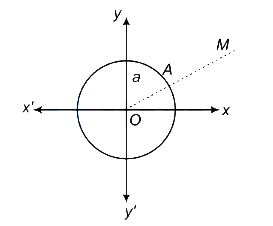
$A$ line segment $AM = a$ moves in the $XOY$ plane such that $AM$ is parallel to the $X$-axis. If $A$ moves along the circle $x^2 + y^2 = a^2$,then the locus of $M$ is
A
$x^2 + y^2 = 4a^2$
B
$x^2 + y^2 = 2ax$
C
$x^2 + y^2 = 2ay$
D
$x^2 + y^2 = 2ax + 2ay$
Solution
(B) Let the coordinates of point $A$ be $(a \cos \theta, a \sin \theta)$ since it lies on the circle $x^2 + y^2 = a^2$.
Since $AM$ is parallel to the $X$-axis and has length $a$,the coordinates of $M$ can be represented as $(x, y) = (a \cos \theta + a, a \sin \theta)$ or $(a \cos \theta - a, a \sin \theta)$.
Considering the case $(x, y) = (a \cos \theta + a, a \sin \theta)$,we have $x - a = a \cos \theta$ and $y = a \sin \theta$.
Squaring and adding these equations:
$(x - a)^2 + y^2 = a^2 \cos^2 \theta + a^2 \sin^2 \theta$
$(x - a)^2 + y^2 = a^2$
$x^2 - 2ax + a^2 + y^2 = a^2$
$x^2 + y^2 = 2ax$.
Similarly,for the other case,we get $x^2 + y^2 = -2ax$.
Since $AM$ is parallel to the $X$-axis and has length $a$,the coordinates of $M$ can be represented as $(x, y) = (a \cos \theta + a, a \sin \theta)$ or $(a \cos \theta - a, a \sin \theta)$.
Considering the case $(x, y) = (a \cos \theta + a, a \sin \theta)$,we have $x - a = a \cos \theta$ and $y = a \sin \theta$.
Squaring and adding these equations:
$(x - a)^2 + y^2 = a^2 \cos^2 \theta + a^2 \sin^2 \theta$
$(x - a)^2 + y^2 = a^2$
$x^2 - 2ax + a^2 + y^2 = a^2$
$x^2 + y^2 = 2ax$.
Similarly,for the other case,we get $x^2 + y^2 = -2ax$.
0 likesView Solution
62
ChemistryMCQAP EAMCET · 2011
If the straight line $y=mx+c$ is parallel to the axis of the parabola $y^2=lx$ and intersects the parabola at $\left(\frac{c^2}{8}, c\right)$,then the length of the latus rectum is
A
$2$
B
$3$
C
$4$
D
$8$
Solution
(D) The equation of the parabola is $y^2=lx$. The axis of this parabola is the $x$-axis,which has the equation $y=0$.
Since the line $y=mx+c$ is parallel to the axis of the parabola $(y=0)$,its slope $m$ must be $0$. Thus,the line is $y=c$.
Given that the point $\left(\frac{c^2}{8}, c\right)$ lies on the parabola $y^2=lx$,it must satisfy the equation:
$c^2 = l \left(\frac{c^2}{8}\right)$
$c^2 = \frac{lc^2}{8}$
Assuming $c \neq 0$,we can divide both sides by $c^2$:
$1 = \frac{l}{8} \Rightarrow l = 8$.
The length of the latus rectum of the parabola $y^2=lx$ is $l$.
Therefore,the length of the latus rectum is $8$.
Since the line $y=mx+c$ is parallel to the axis of the parabola $(y=0)$,its slope $m$ must be $0$. Thus,the line is $y=c$.
Given that the point $\left(\frac{c^2}{8}, c\right)$ lies on the parabola $y^2=lx$,it must satisfy the equation:
$c^2 = l \left(\frac{c^2}{8}\right)$
$c^2 = \frac{lc^2}{8}$
Assuming $c \neq 0$,we can divide both sides by $c^2$:
$1 = \frac{l}{8} \Rightarrow l = 8$.
The length of the latus rectum of the parabola $y^2=lx$ is $l$.
Therefore,the length of the latus rectum is $8$.
0 likesView Solution
63
ChemistryMCQAP EAMCET · 2011
If a chord of the parabola $y^2=4x$ passes through its focus and makes an angle $\theta$ with the $X$-axis,then its length is
A
$4 \cos^2 \theta$
B
$4 \sin^2 \theta$
C
$4 \operatorname{cosec}^2 \theta$
D
$4 \sec^2 \theta$
Solution
(C) Let $P(t^2, 2t)$ be one end of a focal chord $PQ$ of the parabola $y^2=4x$. The coordinates of the other end $Q$ are $(\frac{1}{t^2}, \frac{-2}{t})$,where $tt' = -1$.
Given that the chord makes an angle $\theta$ with the positive direction of the $X$-axis,the slope of the chord is $\tan \theta$.
$\tan \theta = \frac{\frac{-2}{t} - 2t}{\frac{1}{t^2} - t^2} = \frac{-2(t + \frac{1}{t})}{\frac{1-t^4}{t^2}} = \frac{-2(t + \frac{1}{t})}{\frac{(1-t^2)(1+t^2)}{t^2}} = \frac{2t}{t^2-1}$.
Alternatively,using the slope formula for a focal chord with parameter $t$: $\tan \theta = \frac{2}{t - \frac{1}{t}}$.
Thus,$t - \frac{1}{t} = 2 \cot \theta$.
The length of the focal chord $PQ$ is given by $a(t + \frac{1}{t})^2$,where $a=1$.
$PQ = (t + \frac{1}{t})^2 = (t - \frac{1}{t})^2 + 4$.
Substituting $t - \frac{1}{t} = 2 \cot \theta$:
$PQ = (2 \cot \theta)^2 + 4 = 4 \cot^2 \theta + 4 = 4(\cot^2 \theta + 1) = 4 \operatorname{cosec}^2 \theta$.
Given that the chord makes an angle $\theta$ with the positive direction of the $X$-axis,the slope of the chord is $\tan \theta$.
$\tan \theta = \frac{\frac{-2}{t} - 2t}{\frac{1}{t^2} - t^2} = \frac{-2(t + \frac{1}{t})}{\frac{1-t^4}{t^2}} = \frac{-2(t + \frac{1}{t})}{\frac{(1-t^2)(1+t^2)}{t^2}} = \frac{2t}{t^2-1}$.
Alternatively,using the slope formula for a focal chord with parameter $t$: $\tan \theta = \frac{2}{t - \frac{1}{t}}$.
Thus,$t - \frac{1}{t} = 2 \cot \theta$.
The length of the focal chord $PQ$ is given by $a(t + \frac{1}{t})^2$,where $a=1$.
$PQ = (t + \frac{1}{t})^2 = (t - \frac{1}{t})^2 + 4$.
Substituting $t - \frac{1}{t} = 2 \cot \theta$:
$PQ = (2 \cot \theta)^2 + 4 = 4 \cot^2 \theta + 4 = 4(\cot^2 \theta + 1) = 4 \operatorname{cosec}^2 \theta$.
0 likesView Solution
64
ChemistryMCQAP EAMCET · 2011
The eccentricity of the ellipse $x^2+4y^2+2x+16y+13=0$ is
A
$\frac{\sqrt{3}}{2}$
B
$\frac{1}{2}$
C
$\frac{1}{\sqrt{3}}$
D
$\frac{1}{\sqrt{2}}$
Solution
(A) Given the equation of the ellipse: $x^2+4y^2+2x+16y+13=0$.
Rearranging the terms: $(x^2+2x) + 4(y^2+4y) + 13 = 0$.
Completing the squares: $(x^2+2x+1) + 4(y^2+4y+4) + 13 - 1 - 16 = 0$.
$(x+1)^2 + 4(y+2)^2 = 4$.
Dividing by $4$: $\frac{(x+1)^2}{4} + \frac{(y+2)^2}{1} = 1$.
Comparing with the standard form $\frac{X^2}{a^2} + \frac{Y^2}{b^2} = 1$,we get $a^2 = 4$ and $b^2 = 1$.
Since $a^2 > b^2$,the eccentricity $e$ is given by $b^2 = a^2(1 - e^2)$.
$1 = 4(1 - e^2) \Rightarrow 1 = 4 - 4e^2$.
$4e^2 = 3 \Rightarrow e^2 = \frac{3}{4}$.
Thus,$e = \frac{\sqrt{3}}{2}$.
Rearranging the terms: $(x^2+2x) + 4(y^2+4y) + 13 = 0$.
Completing the squares: $(x^2+2x+1) + 4(y^2+4y+4) + 13 - 1 - 16 = 0$.
$(x+1)^2 + 4(y+2)^2 = 4$.
Dividing by $4$: $\frac{(x+1)^2}{4} + \frac{(y+2)^2}{1} = 1$.
Comparing with the standard form $\frac{X^2}{a^2} + \frac{Y^2}{b^2} = 1$,we get $a^2 = 4$ and $b^2 = 1$.
Since $a^2 > b^2$,the eccentricity $e$ is given by $b^2 = a^2(1 - e^2)$.
$1 = 4(1 - e^2) \Rightarrow 1 = 4 - 4e^2$.
$4e^2 = 3 \Rightarrow e^2 = \frac{3}{4}$.
Thus,$e = \frac{\sqrt{3}}{2}$.
0 likesView Solution
65
ChemistryMCQAP EAMCET · 2011
The angle between the asymptotes of the hyperbola $x^2-3y^2=3$ is
A
$\frac{\pi}{6}$
B
$\frac{\pi}{4}$
C
$\frac{\pi}{3}$
D
$\frac{\pi}{2}$
Solution
(C) The given equation of the hyperbola is $x^2-3y^2=3$. Dividing by $3$,we get $\frac{x^2}{3}-\frac{y^2}{1}=1$.
Here,$a^2=3$ and $b^2=1$,so $a=\sqrt{3}$ and $b=1$.
The equations of the asymptotes are $y = \pm \frac{b}{a}x$,which gives $y = \frac{1}{\sqrt{3}}x$ and $y = -\frac{1}{\sqrt{3}}x$.
Let the slopes be $m_1 = \frac{1}{\sqrt{3}}$ and $m_2 = -\frac{1}{\sqrt{3}}$.
The angle $\theta$ between the asymptotes is given by $\tan \theta = \left| \frac{m_1 - m_2}{1 + m_1 m_2} \right|$.
Substituting the values,$\tan \theta = \left| \frac{\frac{1}{\sqrt{3}} - (-\frac{1}{\sqrt{3}})}{1 + (\frac{1}{\sqrt{3}})(-\frac{1}{\sqrt{3}})} \right| = \left| \frac{\frac{2}{\sqrt{3}}}{1 - \frac{1}{3}} \right| = \left| \frac{\frac{2}{\sqrt{3}}}{\frac{2}{3}} \right| = \sqrt{3}$.
Since $\tan \theta = \sqrt{3}$,we have $\theta = \frac{\pi}{3}$.
Here,$a^2=3$ and $b^2=1$,so $a=\sqrt{3}$ and $b=1$.
The equations of the asymptotes are $y = \pm \frac{b}{a}x$,which gives $y = \frac{1}{\sqrt{3}}x$ and $y = -\frac{1}{\sqrt{3}}x$.
Let the slopes be $m_1 = \frac{1}{\sqrt{3}}$ and $m_2 = -\frac{1}{\sqrt{3}}$.
The angle $\theta$ between the asymptotes is given by $\tan \theta = \left| \frac{m_1 - m_2}{1 + m_1 m_2} \right|$.
Substituting the values,$\tan \theta = \left| \frac{\frac{1}{\sqrt{3}} - (-\frac{1}{\sqrt{3}})}{1 + (\frac{1}{\sqrt{3}})(-\frac{1}{\sqrt{3}})} \right| = \left| \frac{\frac{2}{\sqrt{3}}}{1 - \frac{1}{3}} \right| = \left| \frac{\frac{2}{\sqrt{3}}}{\frac{2}{3}} \right| = \sqrt{3}$.
Since $\tan \theta = \sqrt{3}$,we have $\theta = \frac{\pi}{3}$.
0 likesView Solution
66
ChemistryMCQAP EAMCET · 2011
$\lim _{x \rightarrow 8} \frac{\sqrt{1+\sqrt{1+x}}-2}{x-8}$ is equal to
A
$\frac{3}{2}$
B
$\frac{1}{4}$
C
$\frac{1}{24}$
D
$\frac{1}{12}$
Solution
(C) To evaluate the limit $\lim _{x \rightarrow 8} \frac{\sqrt{1+\sqrt{1+x}}-2}{x-8}$,we rationalize the numerator:
$\lim _{x \rightarrow 8} \frac{\sqrt{1+\sqrt{1+x}}-2}{x-8} \times \frac{\sqrt{1+\sqrt{1+x}}+2}{\sqrt{1+\sqrt{1+x}}+2}$
$= \lim _{x \rightarrow 8} \frac{1+\sqrt{1+x}-4}{(x-8)(\sqrt{1+\sqrt{1+x}}+2)}$
$= \lim _{x \rightarrow 8} \frac{\sqrt{1+x}-3}{(x-8)(\sqrt{1+\sqrt{1+x}}+2)}$
Now,rationalize the numerator again:
$= \lim _{x \rightarrow 8} \frac{\sqrt{1+x}-3}{(x-8)(\sqrt{1+\sqrt{1+x}}+2)} \times \frac{\sqrt{1+x}+3}{\sqrt{1+x}+3}$
$= \lim _{x \rightarrow 8} \frac{1+x-9}{(x-8)(\sqrt{1+\sqrt{1+x}}+2)(\sqrt{1+x}+3)}$
$= \lim _{x \rightarrow 8} \frac{x-8}{(x-8)(\sqrt{1+\sqrt{1+x}}+2)(\sqrt{1+x}+3)}$
$= \lim _{x \rightarrow 8} \frac{1}{(\sqrt{1+\sqrt{1+x}}+2)(\sqrt{1+x}+3)}$
Substitute $x = 8$:
$= \frac{1}{(\sqrt{1+\sqrt{9}}+2)(\sqrt{9}+3)} = \frac{1}{(\sqrt{4}+2)(3+3)} = \frac{1}{(2+2)(6)} = \frac{1}{4 \times 6} = \frac{1}{24}$
$\lim _{x \rightarrow 8} \frac{\sqrt{1+\sqrt{1+x}}-2}{x-8} \times \frac{\sqrt{1+\sqrt{1+x}}+2}{\sqrt{1+\sqrt{1+x}}+2}$
$= \lim _{x \rightarrow 8} \frac{1+\sqrt{1+x}-4}{(x-8)(\sqrt{1+\sqrt{1+x}}+2)}$
$= \lim _{x \rightarrow 8} \frac{\sqrt{1+x}-3}{(x-8)(\sqrt{1+\sqrt{1+x}}+2)}$
Now,rationalize the numerator again:
$= \lim _{x \rightarrow 8} \frac{\sqrt{1+x}-3}{(x-8)(\sqrt{1+\sqrt{1+x}}+2)} \times \frac{\sqrt{1+x}+3}{\sqrt{1+x}+3}$
$= \lim _{x \rightarrow 8} \frac{1+x-9}{(x-8)(\sqrt{1+\sqrt{1+x}}+2)(\sqrt{1+x}+3)}$
$= \lim _{x \rightarrow 8} \frac{x-8}{(x-8)(\sqrt{1+\sqrt{1+x}}+2)(\sqrt{1+x}+3)}$
$= \lim _{x \rightarrow 8} \frac{1}{(\sqrt{1+\sqrt{1+x}}+2)(\sqrt{1+x}+3)}$
Substitute $x = 8$:
$= \frac{1}{(\sqrt{1+\sqrt{9}}+2)(\sqrt{9}+3)} = \frac{1}{(\sqrt{4}+2)(3+3)} = \frac{1}{(2+2)(6)} = \frac{1}{4 \times 6} = \frac{1}{24}$
0 likesView Solution
67
ChemistryMCQAP EAMCET · 2011
Which one of the following is not a biopolymer?
A
Cellulose
B
Nylon-$6$
C
Insulin
D
$DNA$
Solution
(B) Polymers that control various life processes in plants and animals are called biopolymers.
Cellulose,insulin,$DNA$,starch,and proteins are examples of biopolymers.
Nylon-$6$ is a synthetic polymer,not a biopolymer.
Cellulose,insulin,$DNA$,starch,and proteins are examples of biopolymers.
Nylon-$6$ is a synthetic polymer,not a biopolymer.
0 likesView Solution
68
ChemistryMCQAP EAMCET · 2011
In a $\triangle ABC$,if $\frac{\cos A}{a} = \frac{\cos B}{b} = \frac{\cos C}{c}$,then $\triangle ABC$ is
A
right angled
B
isosceles right angled
C
equilateral
D
scalene
Solution
(C) Given,$\frac{\cos A}{a} = \frac{\cos B}{b} = \frac{\cos C}{c}$.
By the sine rule,we know that $a = k \sin A$,$b = k \sin B$,and $c = k \sin C$,where $k$ is a constant.
Substituting these in the given equation:
$\frac{\cos A}{k \sin A} = \frac{\cos B}{k \sin B} = \frac{\cos C}{k \sin C}$
$\cot A = \cot B = \cot C$
Since $A, B, C$ are angles of a triangle,$\cot A = \cot B = \cot C$ implies $A = B = C$.
Since all angles are equal to $60^{\circ}$,the triangle is equilateral.
By the sine rule,we know that $a = k \sin A$,$b = k \sin B$,and $c = k \sin C$,where $k$ is a constant.
Substituting these in the given equation:
$\frac{\cos A}{k \sin A} = \frac{\cos B}{k \sin B} = \frac{\cos C}{k \sin C}$
$\cot A = \cot B = \cot C$
Since $A, B, C$ are angles of a triangle,$\cot A = \cot B = \cot C$ implies $A = B = C$.
Since all angles are equal to $60^{\circ}$,the triangle is equilateral.
0 likesView Solution
69
ChemistryMCQAP EAMCET · 2011
In a $\triangle ABC$,if $a \cos^2 \frac{C}{2} + c \cos^2 \frac{A}{2} = \frac{3b}{2}$,then the sides of the triangle are in
A
an arithmetic progression
B
a geometric progression
C
a harmonic progression
D
an arithmetico-geometric progression
Solution
(A) Given: $a \cos^2 \frac{C}{2} + c \cos^2 \frac{A}{2} = \frac{3b}{2}$
Using the half-angle formulas $\cos^2 \frac{C}{2} = \frac{s(s-c)}{ab}$ and $\cos^2 \frac{A}{2} = \frac{s(s-a)}{bc}$:
$a \cdot \frac{s(s-c)}{ab} + c \cdot \frac{s(s-a)}{bc} = \frac{3b}{2}$
$\frac{s(s-c)}{b} + \frac{s(s-a)}{b} = \frac{3b}{2}$
$\frac{s}{b} (s - c + s - a) = \frac{3b}{2}$
Since $2s = a + b + c$,we have $2s - a - c = b$:
$\frac{s}{b} (b) = \frac{3b}{2}$
$s = \frac{3b}{2} \Rightarrow 2s = 3b$
Substituting $2s = a + b + c$:
$a + b + c = 3b$
$a + c = 2b$
Thus,$a, b, c$ are in arithmetic progression.
Using the half-angle formulas $\cos^2 \frac{C}{2} = \frac{s(s-c)}{ab}$ and $\cos^2 \frac{A}{2} = \frac{s(s-a)}{bc}$:
$a \cdot \frac{s(s-c)}{ab} + c \cdot \frac{s(s-a)}{bc} = \frac{3b}{2}$
$\frac{s(s-c)}{b} + \frac{s(s-a)}{b} = \frac{3b}{2}$
$\frac{s}{b} (s - c + s - a) = \frac{3b}{2}$
Since $2s = a + b + c$,we have $2s - a - c = b$:
$\frac{s}{b} (b) = \frac{3b}{2}$
$s = \frac{3b}{2} \Rightarrow 2s = 3b$
Substituting $2s = a + b + c$:
$a + b + c = 3b$
$a + c = 2b$
Thus,$a, b, c$ are in arithmetic progression.
0 likesView Solution
70
ChemistryMCQAP EAMCET · 2011
$\begin{aligned} & A(\alpha, \beta)=\left[\begin{array}{ccc}\cos \alpha & \sin \alpha & 0 \\ -\sin \alpha & \cos \alpha & 0 \\ 0 & 0 & e^\beta\end{array}\right] \\ & \Rightarrow[A(\alpha, \beta)]^{-1}=\end{aligned}$
A
$A(-\alpha, \beta)$
B
$A(-\alpha, -\beta)$
C
$A(\alpha, -\beta)$
D
$A(\alpha, \beta)$
Solution
(B) Given,$A(\alpha, \beta) = \begin{bmatrix} \cos \alpha & \sin \alpha & 0 \\ -\sin \alpha & \cos \alpha & 0 \\ 0 & 0 & e^\beta \end{bmatrix}$.
First,we find the determinant $|A(\alpha, \beta)| = e^\beta (\cos^2 \alpha + \sin^2 \alpha) = e^\beta$.
Next,we find the cofactor matrix $C$:
$C_{11} = e^\beta \cos \alpha, C_{12} = e^\beta \sin \alpha, C_{13} = 0$
$C_{21} = -e^\beta \sin \alpha, C_{22} = e^\beta \cos \alpha, C_{23} = 0$
$C_{31} = 0, C_{32} = 0, C_{33} = \cos^2 \alpha + \sin^2 \alpha = 1$
Thus,$\text{adj}(A(\alpha, \beta)) = C^T = \begin{bmatrix} e^\beta \cos \alpha & -e^\beta \sin \alpha & 0 \\ e^\beta \sin \alpha & e^\beta \cos \alpha & 0 \\ 0 & 0 & 1 \end{bmatrix}$.
Then,$[A(\alpha, \beta)]^{-1} = \frac{1}{|A|} \text{adj}(A) = \frac{1}{e^\beta} \begin{bmatrix} e^\beta \cos \alpha & -e^\beta \sin \alpha & 0 \\ e^\beta \sin \alpha & e^\beta \cos \alpha & 0 \\ 0 & 0 & 1 \end{bmatrix} = \begin{bmatrix} \cos \alpha & -\sin \alpha & 0 \\ \sin \alpha & \cos \alpha & 0 \\ 0 & 0 & e^{-\beta} \end{bmatrix}$.
Comparing this with the original matrix $A(\alpha, \beta)$,we see that $\cos \alpha = \cos(-\alpha)$,$-\sin \alpha = \sin(-\alpha)$,and $e^{-\beta}$ corresponds to the third diagonal element. Thus,the result is $A(-\alpha, -\beta)$.
First,we find the determinant $|A(\alpha, \beta)| = e^\beta (\cos^2 \alpha + \sin^2 \alpha) = e^\beta$.
Next,we find the cofactor matrix $C$:
$C_{11} = e^\beta \cos \alpha, C_{12} = e^\beta \sin \alpha, C_{13} = 0$
$C_{21} = -e^\beta \sin \alpha, C_{22} = e^\beta \cos \alpha, C_{23} = 0$
$C_{31} = 0, C_{32} = 0, C_{33} = \cos^2 \alpha + \sin^2 \alpha = 1$
Thus,$\text{adj}(A(\alpha, \beta)) = C^T = \begin{bmatrix} e^\beta \cos \alpha & -e^\beta \sin \alpha & 0 \\ e^\beta \sin \alpha & e^\beta \cos \alpha & 0 \\ 0 & 0 & 1 \end{bmatrix}$.
Then,$[A(\alpha, \beta)]^{-1} = \frac{1}{|A|} \text{adj}(A) = \frac{1}{e^\beta} \begin{bmatrix} e^\beta \cos \alpha & -e^\beta \sin \alpha & 0 \\ e^\beta \sin \alpha & e^\beta \cos \alpha & 0 \\ 0 & 0 & 1 \end{bmatrix} = \begin{bmatrix} \cos \alpha & -\sin \alpha & 0 \\ \sin \alpha & \cos \alpha & 0 \\ 0 & 0 & e^{-\beta} \end{bmatrix}$.
Comparing this with the original matrix $A(\alpha, \beta)$,we see that $\cos \alpha = \cos(-\alpha)$,$-\sin \alpha = \sin(-\alpha)$,and $e^{-\beta}$ corresponds to the third diagonal element. Thus,the result is $A(-\alpha, -\beta)$.
0 likesView Solution
71
ChemistryMCQAP EAMCET · 2011
$\left|\begin{array}{lll}24 & 25 & 26 \\ 25 & 26 & 27 \\ 26 & 27 & 27\end{array}\right|$ is equal to
A
$0$
B
$-1$
C
$1$
D
$2$
Solution
(C) Let $\Delta = \left|\begin{array}{lll}24 & 25 & 26 \\ 25 & 26 & 27 \\ 26 & 27 & 27\end{array}\right|$.
Applying row operations $R_2 \rightarrow R_2 - R_1$ and $R_3 \rightarrow R_3 - R_2$:
$\Delta = \left|\begin{array}{ccc} 24 & 25 & 26 \\ 1 & 1 & 1 \\ 1 & 1 & 0 \end{array}\right|$.
Expanding along the third row $(R_3)$:
$\Delta = 1(25 - 26) - 1(24 - 26) + 0(24 - 25)$
$\Delta = 1(-1) - 1(-2) + 0$
$\Delta = -1 + 2 = 1$.
Applying row operations $R_2 \rightarrow R_2 - R_1$ and $R_3 \rightarrow R_3 - R_2$:
$\Delta = \left|\begin{array}{ccc} 24 & 25 & 26 \\ 1 & 1 & 1 \\ 1 & 1 & 0 \end{array}\right|$.
Expanding along the third row $(R_3)$:
$\Delta = 1(25 - 26) - 1(24 - 26) + 0(24 - 25)$
$\Delta = 1(-1) - 1(-2) + 0$
$\Delta = -1 + 2 = 1$.
0 likesView Solution
72
ChemistryMCQAP EAMCET · 2011
$(\tan ^{-1} x)^2+(\cot ^{-1} x)^2=\frac{5 \pi^2}{8} \Rightarrow x=$
A
-$1$
B
$1$
C
$0$
D
$\pi \sqrt{\frac{5}{8}}$
Solution
(A) Given equation is $(\tan ^{-1} x)^2+(\cot ^{-1} x)^2=\frac{5 \pi^2}{8}$.
Using the identity $(\tan ^{-1} x + \cot ^{-1} x)^2 = (\tan ^{-1} x)^2 + (\cot ^{-1} x)^2 + 2 \tan ^{-1} x \cot ^{-1} x$,we have:
$(\tan ^{-1} x + \cot ^{-1} x)^2 - 2 \tan ^{-1} x \cot ^{-1} x = \frac{5 \pi^2}{8}$.
Since $\tan ^{-1} x + \cot ^{-1} x = \frac{\pi}{2}$,we substitute this into the equation:
$(\frac{\pi}{2})^2 - 2 \tan ^{-1} x (\frac{\pi}{2} - \tan ^{-1} x) = \frac{5 \pi^2}{8}$.
$\frac{\pi^2}{4} - \pi \tan ^{-1} x + 2(\tan ^{-1} x)^2 = \frac{5 \pi^2}{8}$.
$2(\tan ^{-1} x)^2 - \pi \tan ^{-1} x + \frac{\pi^2}{4} - \frac{5 \pi^2}{8} = 0$.
$2(\tan ^{-1} x)^2 - \pi \tan ^{-1} x - \frac{3 \pi^2}{8} = 0$.
Let $u = \tan ^{-1} x$. Then $2u^2 - \pi u - \frac{3 \pi^2}{8} = 0$.
Using the quadratic formula $u = \frac{-b \pm \sqrt{b^2 - 4ac}}{2a}$:
$u = \frac{\pi \pm \sqrt{\pi^2 - 4(2)(-\frac{3 \pi^2}{8})}}{4} = \frac{\pi \pm \sqrt{\pi^2 + 3 \pi^2}}{4} = \frac{\pi \pm 2 \pi}{4}$.
So,$u = \frac{3 \pi}{4}$ or $u = -\frac{\pi}{4}$.
Since $x = \tan(u)$,we have $x = \tan(\frac{3 \pi}{4}) = -1$ or $x = \tan(-\frac{\pi}{4}) = -1$.
Thus,$x = -1$.
Using the identity $(\tan ^{-1} x + \cot ^{-1} x)^2 = (\tan ^{-1} x)^2 + (\cot ^{-1} x)^2 + 2 \tan ^{-1} x \cot ^{-1} x$,we have:
$(\tan ^{-1} x + \cot ^{-1} x)^2 - 2 \tan ^{-1} x \cot ^{-1} x = \frac{5 \pi^2}{8}$.
Since $\tan ^{-1} x + \cot ^{-1} x = \frac{\pi}{2}$,we substitute this into the equation:
$(\frac{\pi}{2})^2 - 2 \tan ^{-1} x (\frac{\pi}{2} - \tan ^{-1} x) = \frac{5 \pi^2}{8}$.
$\frac{\pi^2}{4} - \pi \tan ^{-1} x + 2(\tan ^{-1} x)^2 = \frac{5 \pi^2}{8}$.
$2(\tan ^{-1} x)^2 - \pi \tan ^{-1} x + \frac{\pi^2}{4} - \frac{5 \pi^2}{8} = 0$.
$2(\tan ^{-1} x)^2 - \pi \tan ^{-1} x - \frac{3 \pi^2}{8} = 0$.
Let $u = \tan ^{-1} x$. Then $2u^2 - \pi u - \frac{3 \pi^2}{8} = 0$.
Using the quadratic formula $u = \frac{-b \pm \sqrt{b^2 - 4ac}}{2a}$:
$u = \frac{\pi \pm \sqrt{\pi^2 - 4(2)(-\frac{3 \pi^2}{8})}}{4} = \frac{\pi \pm \sqrt{\pi^2 + 3 \pi^2}}{4} = \frac{\pi \pm 2 \pi}{4}$.
So,$u = \frac{3 \pi}{4}$ or $u = -\frac{\pi}{4}$.
Since $x = \tan(u)$,we have $x = \tan(\frac{3 \pi}{4}) = -1$ or $x = \tan(-\frac{\pi}{4}) = -1$.
Thus,$x = -1$.
0 likesView Solution
73
ChemistryMCQAP EAMCET · 2011
For $0 < x \leq \pi$,$\sinh ^{-1}(\cot x)$ is equal to
A
$\log \left(\cot \frac{x}{2}\right)$
B
$\log \left(\tan \frac{x}{2}\right)$
C
$\log (1+\cot x)$
D
$\log (1+\tan x)$
Solution
(A) We know that the formula for the inverse hyperbolic sine function is $\sinh ^{-1}(y) = \log \left(y + \sqrt{1 + y^2}\right)$.
Substituting $y = \cot x$ into the formula,we get:
$\sinh ^{-1}(\cot x) = \log \left(\cot x + \sqrt{1 + \cot ^2 x}\right)$
Using the trigonometric identity $1 + \cot ^2 x = \operatorname{cosec}^2 x$,we have:
$= \log \left(\cot x + \sqrt{\operatorname{cosec}^2 x}\right)$
$= \log (\cot x + \operatorname{cosec} x)$
$= \log \left(\frac{\cos x}{\sin x} + \frac{1}{\sin x}\right)$
$= \log \left(\frac{1 + \cos x}{\sin x}\right)$
Using the half-angle identities $1 + \cos x = 2 \cos ^2 \frac{x}{2}$ and $\sin x = 2 \sin \frac{x}{2} \cos \frac{x}{2}$,we get:
$= \log \left(\frac{2 \cos ^2 \frac{x}{2}}{2 \sin \frac{x}{2} \cos \frac{x}{2}}\right)$
$= \log \left(\frac{\cos \frac{x}{2}}{\sin \frac{x}{2}}\right)$
$= \log \left(\cot \frac{x}{2}\right)$.
Substituting $y = \cot x$ into the formula,we get:
$\sinh ^{-1}(\cot x) = \log \left(\cot x + \sqrt{1 + \cot ^2 x}\right)$
Using the trigonometric identity $1 + \cot ^2 x = \operatorname{cosec}^2 x$,we have:
$= \log \left(\cot x + \sqrt{\operatorname{cosec}^2 x}\right)$
$= \log (\cot x + \operatorname{cosec} x)$
$= \log \left(\frac{\cos x}{\sin x} + \frac{1}{\sin x}\right)$
$= \log \left(\frac{1 + \cos x}{\sin x}\right)$
Using the half-angle identities $1 + \cos x = 2 \cos ^2 \frac{x}{2}$ and $\sin x = 2 \sin \frac{x}{2} \cos \frac{x}{2}$,we get:
$= \log \left(\frac{2 \cos ^2 \frac{x}{2}}{2 \sin \frac{x}{2} \cos \frac{x}{2}}\right)$
$= \log \left(\frac{\cos \frac{x}{2}}{\sin \frac{x}{2}}\right)$
$= \log \left(\cot \frac{x}{2}\right)$.
0 likesView Solution
74
ChemistryMCQAP EAMCET · 2011
If $x$ is real,then the value of $\frac{x^2-3x+4}{x^2+3x+4}$ lies in the interval
A
$[\frac{1}{3}, 3]$
B
$[\frac{1}{5}, 5]$
C
$[\frac{1}{6}, 6]$
D
$[\frac{1}{7}, 7]$
Solution
(D) Let $y = \frac{x^2-3x+4}{x^2+3x+4}$.
$y(x^2+3x+4) = x^2-3x+4$
$x^2(y-1) + x(3y+3) + (4y-4) = 0$.
Since $x$ is real,the discriminant $D \geq 0$.
$D = (3y+3)^2 - 4(y-1)(4y-4) \geq 0$.
$9(y+1)^2 - 16(y-1)^2 \geq 0$.
$9(y^2+2y+1) - 16(y^2-2y+1) \geq 0$.
$9y^2 + 18y + 9 - 16y^2 + 32y - 16 \geq 0$.
$-7y^2 + 50y - 7 \geq 0$.
$7y^2 - 50y + 7 \leq 0$.
$(7y-1)(y-7) \leq 0$.
Thus,$\frac{1}{7} \leq y \leq 7$.
$y(x^2+3x+4) = x^2-3x+4$
$x^2(y-1) + x(3y+3) + (4y-4) = 0$.
Since $x$ is real,the discriminant $D \geq 0$.
$D = (3y+3)^2 - 4(y-1)(4y-4) \geq 0$.
$9(y+1)^2 - 16(y-1)^2 \geq 0$.
$9(y^2+2y+1) - 16(y^2-2y+1) \geq 0$.
$9y^2 + 18y + 9 - 16y^2 + 32y - 16 \geq 0$.
$-7y^2 + 50y - 7 \geq 0$.
$7y^2 - 50y + 7 \leq 0$.
$(7y-1)(y-7) \leq 0$.
Thus,$\frac{1}{7} \leq y \leq 7$.
0 likesView Solution
75
ChemistryMCQAP EAMCET · 2011
If $f: R \rightarrow R$ is defined by $f(x) = [\frac{x}{5}]$ for $x \in R$,where $[y]$ denotes the greatest integer not exceeding $y$,then $\{f(x) : |x| < 71\}$ is equal to
A
$\{-14, -13, \ldots, 0, \ldots, 13, 14\}$
B
$\{-14, -13, \ldots, 0, \ldots, 14, 15\}$
C
$\{-15, -14, \ldots, 0, \ldots, 14, 15\}$
D
$\{-15, -14, \ldots, 0, \ldots, 13, 14\}$
Solution
(D) Given $f(x) = [\frac{x}{5}]$. We need to find the range of $f(x)$ for $|x| < 71$.
This is equivalent to $-71 < x < 71$.
Dividing by $5$,we get $-\frac{71}{5} < \frac{x}{5} < \frac{71}{5}$.
This simplifies to $-14.2 < \frac{x}{5} < 14.2$.
Since $f(x) = [\frac{x}{5}]$,the possible integer values for $f(x)$ are the integers in the interval $(-14.2, 14.2)$.
The smallest integer greater than $-14.2$ is $-14$,and the largest integer less than $14.2$ is $14$.
Wait,let us re-evaluate the bounds:
If $x$ is slightly greater than $-71$,say $x = -70.9$,then $f(x) = [\frac{-70.9}{5}] = [-14.18] = -15$.
If $x$ is slightly less than $71$,say $x = 70.9$,then $f(x) = [\frac{70.9}{5}] = [14.18] = 14$.
Thus,the set of values is $\{-15, -14, \ldots, 0, \ldots, 13, 14\}$.
This is equivalent to $-71 < x < 71$.
Dividing by $5$,we get $-\frac{71}{5} < \frac{x}{5} < \frac{71}{5}$.
This simplifies to $-14.2 < \frac{x}{5} < 14.2$.
Since $f(x) = [\frac{x}{5}]$,the possible integer values for $f(x)$ are the integers in the interval $(-14.2, 14.2)$.
The smallest integer greater than $-14.2$ is $-14$,and the largest integer less than $14.2$ is $14$.
Wait,let us re-evaluate the bounds:
If $x$ is slightly greater than $-71$,say $x = -70.9$,then $f(x) = [\frac{-70.9}{5}] = [-14.18] = -15$.
If $x$ is slightly less than $71$,say $x = 70.9$,then $f(x) = [\frac{70.9}{5}] = [14.18] = 14$.
Thus,the set of values is $\{-15, -14, \ldots, 0, \ldots, 13, 14\}$.
0 likesView Solution
76
ChemistryMCQAP EAMCET · 2011
If $f: R \rightarrow R$ is defined by $f(x) = 7 + \cos(5x + 3)$ for $x \in R$,then the period of $f$ is
A
$2\pi$
B
$\pi$
C
$\frac{\pi}{5}$
D
$\frac{2\pi}{5}$
Solution
(D) The function is given by $f(x) = 7 + \cos(5x + 3)$.
We know that the fundamental period of the function $\cos(ax + b)$ is given by $\frac{2\pi}{|a|}$.
Here,$a = 5$.
Therefore,the period of $\cos(5x + 3)$ is $\frac{2\pi}{|5|} = \frac{2\pi}{5}$.
Since adding a constant $7$ to the function does not change its period,the period of $f(x)$ remains $\frac{2\pi}{5}$.
We know that the fundamental period of the function $\cos(ax + b)$ is given by $\frac{2\pi}{|a|}$.
Here,$a = 5$.
Therefore,the period of $\cos(5x + 3)$ is $\frac{2\pi}{|5|} = \frac{2\pi}{5}$.
Since adding a constant $7$ to the function does not change its period,the period of $f(x)$ remains $\frac{2\pi}{5}$.
0 likesView Solution
77
ChemistryMCQAP EAMCET · 2011
If $[x]$ denotes the greatest integer not exceeding $x$ and if the function $f$ defined by $f(x)= \begin{cases} \frac{a+2 \cos x}{x^2} & , x < 0 \\ b \tan \frac{\pi}{[x+4]} & , x \geq 0 \end{cases}$ is continuous at $x=0$,then the ordered pair $(a, b)$ is equal to
A
$(-2, 1)$
B
$(-2, -1)$
C
$(-1, \sqrt{3})$
D
$(-2, -\sqrt{3})$
Solution
(B) For the function $f(x)$ to be continuous at $x=0$,we must have $\lim_{x \rightarrow 0^-} f(x) = \lim_{x \rightarrow 0^+} f(x) = f(0)$.
First,consider the $LHL$: $\lim_{x \rightarrow 0^-} \frac{a+2 \cos x}{x^2}$.
For this limit to exist and be finite,the numerator must approach $0$ as $x \rightarrow 0$. Thus,$a + 2 \cos(0) = 0 \implies a + 2 = 0 \implies a = -2$.
Using the Taylor series expansion for $\cos x = 1 - \frac{x^2}{2!} + \frac{x^4}{4!} - \dots$,we get:
$LHL = \lim_{x \rightarrow 0} \frac{-2 + 2(1 - \frac{x^2}{2} + \dots)}{x^2} = \lim_{x \rightarrow 0} \frac{-x^2}{x^2} = -1$.
Now,consider the $RHL$: $\lim_{x \rightarrow 0^+} b \tan \frac{\pi}{[x+4]}$.
As $x \rightarrow 0^+$,$[x+4] = 4$. So,$RHL = b \tan \frac{\pi}{4} = b(1) = b$.
Since the function is continuous,$LHL = RHL$,which implies $b = -1$.
Thus,the ordered pair $(a, b)$ is $(-2, -1)$.
First,consider the $LHL$: $\lim_{x \rightarrow 0^-} \frac{a+2 \cos x}{x^2}$.
For this limit to exist and be finite,the numerator must approach $0$ as $x \rightarrow 0$. Thus,$a + 2 \cos(0) = 0 \implies a + 2 = 0 \implies a = -2$.
Using the Taylor series expansion for $\cos x = 1 - \frac{x^2}{2!} + \frac{x^4}{4!} - \dots$,we get:
$LHL = \lim_{x \rightarrow 0} \frac{-2 + 2(1 - \frac{x^2}{2} + \dots)}{x^2} = \lim_{x \rightarrow 0} \frac{-x^2}{x^2} = -1$.
Now,consider the $RHL$: $\lim_{x \rightarrow 0^+} b \tan \frac{\pi}{[x+4]}$.
As $x \rightarrow 0^+$,$[x+4] = 4$. So,$RHL = b \tan \frac{\pi}{4} = b(1) = b$.
Since the function is continuous,$LHL = RHL$,which implies $b = -1$.
Thus,the ordered pair $(a, b)$ is $(-2, -1)$.
0 likesView Solution
78
ChemistryMCQAP EAMCET · 2011
If $y=(1+x)(1+x^2)(1+x^4) \dots (1+x^{2^n})$,then $(\frac{dy}{dx})_{x=0}$ is equal to
A
$0$
B
$\frac{1}{2}$
C
$1$
D
$2$
Solution
(C) Given $y = (1+x)(1+x^2)(1+x^4) \dots (1+x^{2^n})$.
Multiply and divide by $(1-x)$:
$y = \frac{(1-x)(1+x)(1+x^2)(1+x^4) \dots (1+x^{2^n})}{1-x}$
Using the identity $(a-b)(a+b) = a^2-b^2$ repeatedly:
$y = \frac{(1-x^2)(1+x^2)(1+x^4) \dots (1+x^{2^n})}{1-x} = \frac{(1-x^4)(1+x^4) \dots (1+x^{2^n})}{1-x} = \dots = \frac{1-x^{2^{n+1}}}{1-x}$
Now,differentiate using the quotient rule $\frac{d}{dx}(\frac{u}{v}) = \frac{vu' - uv'}{v^2}$:
$\frac{dy}{dx} = \frac{(1-x)(-2^{n+1}x^{2^{n+1}-1}) - (1-x^{2^{n+1}})(-1)}{(1-x)^2}$
At $x=0$:
$(\frac{dy}{dx})_{x=0} = \frac{(1-0)(0) - (1-0)(-1)}{(1-0)^2} = \frac{0 + 1}{1} = 1$.
Multiply and divide by $(1-x)$:
$y = \frac{(1-x)(1+x)(1+x^2)(1+x^4) \dots (1+x^{2^n})}{1-x}$
Using the identity $(a-b)(a+b) = a^2-b^2$ repeatedly:
$y = \frac{(1-x^2)(1+x^2)(1+x^4) \dots (1+x^{2^n})}{1-x} = \frac{(1-x^4)(1+x^4) \dots (1+x^{2^n})}{1-x} = \dots = \frac{1-x^{2^{n+1}}}{1-x}$
Now,differentiate using the quotient rule $\frac{d}{dx}(\frac{u}{v}) = \frac{vu' - uv'}{v^2}$:
$\frac{dy}{dx} = \frac{(1-x)(-2^{n+1}x^{2^{n+1}-1}) - (1-x^{2^{n+1}})(-1)}{(1-x)^2}$
At $x=0$:
$(\frac{dy}{dx})_{x=0} = \frac{(1-0)(0) - (1-0)(-1)}{(1-0)^2} = \frac{0 + 1}{1} = 1$.
0 likesView Solution
79
ChemistryMCQAP EAMCET · 2011
If $y=\frac{\log _e x}{x}$ and $z=\log _e x$,then $\frac{d^2 y}{d z^2}+\frac{d y}{d z}$ is equal to
A
$e^{-z}$
B
$2 e^{-z}$
C
$z e^{-z}$
D
$-e^{-z}$
Solution
(D) Given,$y=\frac{\log _e x}{x}$ and $z=\log _e x$.
Since $z=\log _e x$,we have $x=e^z$.
Substituting $x$ in $y$,we get $y=\frac{z}{e^z} = z e^{-z}$.
Now,differentiating $y$ with respect to $z$:
$\frac{d y}{d z} = \frac{d}{d z}(z e^{-z}) = e^{-z} - z e^{-z} = (1-z)e^{-z}$.
Next,differentiating $\frac{d y}{d z}$ with respect to $z$ to find the second derivative:
$\frac{d^2 y}{d z^2} = \frac{d}{d z}((1-z)e^{-z}) = -e^{-z} - (1-z)e^{-z} = (-1-1+z)e^{-z} = (z-2)e^{-z}$.
Finally,calculating the sum:
$\frac{d^2 y}{d z^2} + \frac{d y}{d z} = (z-2)e^{-z} + (1-z)e^{-z} = (z-2+1-z)e^{-z} = -1 \cdot e^{-z} = -e^{-z}$.
Since $z=\log _e x$,we have $x=e^z$.
Substituting $x$ in $y$,we get $y=\frac{z}{e^z} = z e^{-z}$.
Now,differentiating $y$ with respect to $z$:
$\frac{d y}{d z} = \frac{d}{d z}(z e^{-z}) = e^{-z} - z e^{-z} = (1-z)e^{-z}$.
Next,differentiating $\frac{d y}{d z}$ with respect to $z$ to find the second derivative:
$\frac{d^2 y}{d z^2} = \frac{d}{d z}((1-z)e^{-z}) = -e^{-z} - (1-z)e^{-z} = (-1-1+z)e^{-z} = (z-2)e^{-z}$.
Finally,calculating the sum:
$\frac{d^2 y}{d z^2} + \frac{d y}{d z} = (z-2)e^{-z} + (1-z)e^{-z} = (z-2+1-z)e^{-z} = -1 \cdot e^{-z} = -e^{-z}$.
0 likesView Solution
80
ChemistryMCQAP EAMCET · 2011
If $\cos ^{-1}\left(\frac{x^2-y^2}{x^2+y^2}\right)=k$ (a constant),then $\frac{d y}{d x}$ is equal to
A
$\frac{y}{x}$
B
$\frac{x}{y}$
C
$\frac{x^2}{y^2}$
D
$\frac{y^2}{x^2}$
Solution
(A) Given,$\cos ^{-1}\left(\frac{x^2-y^2}{x^2+y^2}\right)=k$
$\Rightarrow \frac{x^2-y^2}{x^2+y^2}=\cos k$
Let $\cos k = C$ (a constant).
Then,$x^2 - y^2 = C(x^2 + y^2)$.
Differentiating both sides with respect to $x$:
$\frac{d}{dx}(x^2 - y^2) = \frac{d}{dx}(C(x^2 + y^2))$
$2x - 2y \frac{dy}{dx} = C(2x + 2y \frac{dy}{dx})$
$x - y \frac{dy}{dx} = C(x + y \frac{dy}{dx})$
$x - Cx = Cy \frac{dy}{dx} + y \frac{dy}{dx}$
$x(1 - C) = y \frac{dy}{dx}(1 + C)$
$\frac{dy}{dx} = \frac{x(1 - C)}{y(1 + C)}$
Since $C = \frac{x^2 - y^2}{x^2 + y^2}$,we substitute back:
$\frac{dy}{dx} = \frac{x(1 - \frac{x^2 - y^2}{x^2 + y^2})}{y(1 + \frac{x^2 - y^2}{x^2 + y^2})} = \frac{x(\frac{x^2 + y^2 - x^2 + y^2}{x^2 + y^2})}{y(\frac{x^2 + y^2 + x^2 - y^2}{x^2 + y^2})} = \frac{x(2y^2)}{y(2x^2)} = \frac{2xy^2}{2x^2y} = \frac{y}{x}$
$\Rightarrow \frac{x^2-y^2}{x^2+y^2}=\cos k$
Let $\cos k = C$ (a constant).
Then,$x^2 - y^2 = C(x^2 + y^2)$.
Differentiating both sides with respect to $x$:
$\frac{d}{dx}(x^2 - y^2) = \frac{d}{dx}(C(x^2 + y^2))$
$2x - 2y \frac{dy}{dx} = C(2x + 2y \frac{dy}{dx})$
$x - y \frac{dy}{dx} = C(x + y \frac{dy}{dx})$
$x - Cx = Cy \frac{dy}{dx} + y \frac{dy}{dx}$
$x(1 - C) = y \frac{dy}{dx}(1 + C)$
$\frac{dy}{dx} = \frac{x(1 - C)}{y(1 + C)}$
Since $C = \frac{x^2 - y^2}{x^2 + y^2}$,we substitute back:
$\frac{dy}{dx} = \frac{x(1 - \frac{x^2 - y^2}{x^2 + y^2})}{y(1 + \frac{x^2 - y^2}{x^2 + y^2})} = \frac{x(\frac{x^2 + y^2 - x^2 + y^2}{x^2 + y^2})}{y(\frac{x^2 + y^2 + x^2 - y^2}{x^2 + y^2})} = \frac{x(2y^2)}{y(2x^2)} = \frac{2xy^2}{2x^2y} = \frac{y}{x}$
0 likesView Solution
81
ChemistryMCQAP EAMCET · 2011
The length of the subtangent at any point $(x_1, y_1)$ on the curve $y=5^x$ is
A
$5^{x_1}$
B
$y_1 5^{x_1}$
C
$\log_e 5$
D
$\frac{1}{\log_e 5}$
Solution
(D) Given the curve $y = 5^x$.
First,find the derivative $\frac{dy}{dx}$:
$\frac{dy}{dx} = \frac{d}{dx}(5^x) = 5^x \log_e 5$.
At the point $(x_1, y_1)$,the slope of the tangent is $\left(\frac{dy}{dx}\right)_{(x_1, y_1)} = 5^{x_1} \log_e 5$.
The length of the subtangent is given by the formula $\left| \frac{y_1}{\frac{dy}{dx}} \right|$.
Substituting the values:
Length of subtangent $= \frac{y_1}{5^{x_1} \log_e 5}$.
Since the point $(x_1, y_1)$ lies on the curve $y = 5^x$,we have $y_1 = 5^{x_1}$.
Therefore,the length of the subtangent $= \frac{5^{x_1}}{5^{x_1} \log_e 5} = \frac{1}{\log_e 5}$.
First,find the derivative $\frac{dy}{dx}$:
$\frac{dy}{dx} = \frac{d}{dx}(5^x) = 5^x \log_e 5$.
At the point $(x_1, y_1)$,the slope of the tangent is $\left(\frac{dy}{dx}\right)_{(x_1, y_1)} = 5^{x_1} \log_e 5$.
The length of the subtangent is given by the formula $\left| \frac{y_1}{\frac{dy}{dx}} \right|$.
Substituting the values:
Length of subtangent $= \frac{y_1}{5^{x_1} \log_e 5}$.
Since the point $(x_1, y_1)$ lies on the curve $y = 5^x$,we have $y_1 = 5^{x_1}$.
Therefore,the length of the subtangent $= \frac{5^{x_1}}{5^{x_1} \log_e 5} = \frac{1}{\log_e 5}$.
0 likesView Solution
82
ChemistryMCQAP EAMCET · 2011
If $f:[2, \infty) \rightarrow B$ defined by $f(x)=x^2-4x+5$ is a bijection,then $B$ is equal to
A
$[0, \infty)$
B
$[1, \infty)$
C
$[4, \infty)$
D
$[5, \infty)$
Solution
(B) Given the function $f(x) = x^2 - 4x + 5$ defined on the domain $[2, \infty)$.
To be a bijection,the codomain $B$ must be equal to the range of the function.
We find the range by analyzing the function's behavior.
First,find the derivative: $f'(x) = 2x - 4$.
Setting $f'(x) = 0$ gives $x = 2$.
For all $x \in [2, \infty)$,$f'(x) \geq 0$,which means the function is monotonically increasing on this interval.
The minimum value occurs at the boundary $x = 2$.
$f(2) = (2)^2 - 4(2) + 5 = 4 - 8 + 5 = 1$.
As $x \to \infty$,$f(x) \to \infty$.
Since the function is continuous and increasing,the range is $[f(2), \infty) = [1, \infty)$.
Therefore,$B = [1, \infty)$.
To be a bijection,the codomain $B$ must be equal to the range of the function.
We find the range by analyzing the function's behavior.
First,find the derivative: $f'(x) = 2x - 4$.
Setting $f'(x) = 0$ gives $x = 2$.
For all $x \in [2, \infty)$,$f'(x) \geq 0$,which means the function is monotonically increasing on this interval.
The minimum value occurs at the boundary $x = 2$.
$f(2) = (2)^2 - 4(2) + 5 = 4 - 8 + 5 = 1$.
As $x \to \infty$,$f(x) \to \infty$.
Since the function is continuous and increasing,the range is $[f(2), \infty) = [1, \infty)$.
Therefore,$B = [1, \infty)$.
0 likesView Solution
83
ChemistryMCQAP EAMCET · 2011
The angle of elevation of a stationary cloud from a point $2500 \ m$ above a lake is $15^{\circ}$ and from the same point the angle of depression of its reflection in the lake is $45^{\circ}$. The height (in metres) of the cloud above the lake,given that $\cot 15^{\circ}=2+\sqrt{3}$,is
A
$2500$
B
$2500 \sqrt{2}$
C
$2500 \sqrt{3}$
D
$5000$
Solution
(C) Let $h = 2500 \ m$ be the height of the observation point above the lake. Let $H$ be the height of the cloud above the lake. The depth of the reflection of the cloud in the lake is also $H$ below the surface of the lake.
The distance of the cloud from the observation point is $H-h$.
The distance of the reflection from the observation point is $H+h$.
Let $d$ be the horizontal distance from the observation point to the point directly below the cloud.
In the triangle formed by the observation point,the cloud,and the point directly below it:
$\cot 15^{\circ} = \frac{d}{H-h} \Rightarrow d = (H-h)(2+\sqrt{3}) \quad \dots(i)$
In the triangle formed by the observation point,the reflection,and the point directly below it:
$\cot 45^{\circ} = \frac{d}{H+h}$ $\Rightarrow 1 = \frac{d}{H+h}$ $\Rightarrow d = H+h \quad \dots(ii)$
Equating $(i)$ and $(ii)$:
$(H-h)(2+\sqrt{3}) = H+h$
$H(2+\sqrt{3}) - h(2+\sqrt{3}) = H+h$
$H(2+\sqrt{3}-1) = h(2+\sqrt{3}+1)$
$H(1+\sqrt{3}) = h(3+\sqrt{3})$
$H = h \frac{\sqrt{3}(\sqrt{3}+1)}{\sqrt{3}+1} = h\sqrt{3}$
Given $h = 2500 \ m$,so $H = 2500\sqrt{3} \ m$.
The distance of the cloud from the observation point is $H-h$.
The distance of the reflection from the observation point is $H+h$.
Let $d$ be the horizontal distance from the observation point to the point directly below the cloud.
In the triangle formed by the observation point,the cloud,and the point directly below it:
$\cot 15^{\circ} = \frac{d}{H-h} \Rightarrow d = (H-h)(2+\sqrt{3}) \quad \dots(i)$
In the triangle formed by the observation point,the reflection,and the point directly below it:
$\cot 45^{\circ} = \frac{d}{H+h}$ $\Rightarrow 1 = \frac{d}{H+h}$ $\Rightarrow d = H+h \quad \dots(ii)$
Equating $(i)$ and $(ii)$:
$(H-h)(2+\sqrt{3}) = H+h$
$H(2+\sqrt{3}) - h(2+\sqrt{3}) = H+h$
$H(2+\sqrt{3}-1) = h(2+\sqrt{3}+1)$
$H(1+\sqrt{3}) = h(3+\sqrt{3})$
$H = h \frac{\sqrt{3}(\sqrt{3}+1)}{\sqrt{3}+1} = h\sqrt{3}$
Given $h = 2500 \ m$,so $H = 2500\sqrt{3} \ m$.
0 likesView Solution
84
ChemistryMCQAP EAMCET · 2011
$\int \frac{1+\cos 4 x}{\cot x-\tan x} d x$ is equal to
A
$-\frac{1}{4} \cos 4 x+C$
B
$\frac{1}{8} \cos 4 x+C$
C
$\frac{1}{4} \sin 4 x+C$
D
$-\frac{1}{8} \cos 4 x+C$
Solution
(D) Let $I = \int \frac{1+\cos 4 x}{\cot x-\tan x} d x$.
Using the identity $1+\cos 4x = 2\cos^2 2x$ and $\cot x - \tan x = \frac{\cos x}{\sin x} - \frac{\sin x}{\cos x} = \frac{\cos^2 x - \sin^2 x}{\sin x \cos x} = \frac{\cos 2x}{\frac{1}{2}\sin 2x} = 2\cot 2x$.
Substituting these into the integral:
$I = \int \frac{2\cos^2 2x}{2\cot 2x} d x = \int \frac{\cos^2 2x}{\frac{\cos 2x}{\sin 2x}} d x = \int \cos 2x \sin 2x d x$.
Multiplying and dividing by $2$:
$I = \frac{1}{2} \int 2\sin 2x \cos 2x d x = \frac{1}{2} \int \sin 4x d x$.
Integrating $\sin 4x$:
$I = \frac{1}{2} \left( -\frac{\cos 4x}{4} \right) + C = -\frac{1}{8} \cos 4x + C$.
Using the identity $1+\cos 4x = 2\cos^2 2x$ and $\cot x - \tan x = \frac{\cos x}{\sin x} - \frac{\sin x}{\cos x} = \frac{\cos^2 x - \sin^2 x}{\sin x \cos x} = \frac{\cos 2x}{\frac{1}{2}\sin 2x} = 2\cot 2x$.
Substituting these into the integral:
$I = \int \frac{2\cos^2 2x}{2\cot 2x} d x = \int \frac{\cos^2 2x}{\frac{\cos 2x}{\sin 2x}} d x = \int \cos 2x \sin 2x d x$.
Multiplying and dividing by $2$:
$I = \frac{1}{2} \int 2\sin 2x \cos 2x d x = \frac{1}{2} \int \sin 4x d x$.
Integrating $\sin 4x$:
$I = \frac{1}{2} \left( -\frac{\cos 4x}{4} \right) + C = -\frac{1}{8} \cos 4x + C$.
0 likesView Solution
85
ChemistryMCQAP EAMCET · 2011
$\int\left(\sqrt{\frac{a+x}{a-x}}+\sqrt{\frac{a-x}{a+x}}\right) d x$ is equal to
A
$2 \sin ^{-1}\left(\frac{x}{a}\right)+C$
B
$2 a \sin ^{-1}\left(\frac{x}{a}\right)+C$
C
$2 \cos ^{-1}\left(\frac{x}{a}\right)+C$
D
$2 a \cos ^{-1}\left(\frac{x}{a}\right)+C$
Solution
(B) Let $I = \int \left( \sqrt{\frac{a+x}{a-x}} + \sqrt{\frac{a-x}{a+x}} \right) dx$.
Simplify the integrand:
$\sqrt{\frac{a+x}{a-x}} + \sqrt{\frac{a-x}{a+x}} = \frac{a+x + a-x}{\sqrt{(a-x)(a+x)}} = \frac{2a}{\sqrt{a^2-x^2}}$.
Now,$I = \int \frac{2a}{\sqrt{a^2-x^2}} dx$.
Using the standard integral formula $\int \frac{1}{\sqrt{a^2-x^2}} dx = \sin^{-1}\left(\frac{x}{a}\right) + C$,we get:
$I = 2a \sin^{-1}\left(\frac{x}{a}\right) + C$.
Simplify the integrand:
$\sqrt{\frac{a+x}{a-x}} + \sqrt{\frac{a-x}{a+x}} = \frac{a+x + a-x}{\sqrt{(a-x)(a+x)}} = \frac{2a}{\sqrt{a^2-x^2}}$.
Now,$I = \int \frac{2a}{\sqrt{a^2-x^2}} dx$.
Using the standard integral formula $\int \frac{1}{\sqrt{a^2-x^2}} dx = \sin^{-1}\left(\frac{x}{a}\right) + C$,we get:
$I = 2a \sin^{-1}\left(\frac{x}{a}\right) + C$.
0 likesView Solution
86
ChemistryMCQAP EAMCET · 2011
Let $f(0)=1, f(0.5)=\frac{5}{4}, f(1)=2, f(1.5)=\frac{13}{4}$ and $f(2)=5$. Using Simpson's rule,$\int_0^2 f(x) dx$ is equal to
A
$\frac{14}{3}$
B
$\frac{7}{6}$
C
$\frac{14}{9}$
D
$\frac{7}{9}$
Solution
(A) Given the values $f(0)=1, f(0.5)=\frac{5}{4}, f(1)=2, f(1.5)=\frac{13}{4}, f(2)=5$ with $n=4$ intervals.
The step size is $h = \frac{b-a}{n} = \frac{2-0}{4} = 0.5$.
According to Simpson's rule:
$\int_a^b f(x) dx = \frac{h}{3} [ (y_0 + y_4) + 4(y_1 + y_3) + 2(y_2) ]$.
Substituting the values:
$\int_0^2 f(x) dx = \frac{0.5}{3} [ (1 + 5) + 4(\frac{5}{4} + \frac{13}{4}) + 2(2) ]$.
$\int_0^2 f(x) dx = \frac{0.5}{3} [ 6 + 4(\frac{18}{4}) + 4 ]$.
$\int_0^2 f(x) dx = \frac{0.5}{3} [ 6 + 18 + 4 ] = \frac{0.5}{3} [ 28 ] = \frac{14}{3}$.
The step size is $h = \frac{b-a}{n} = \frac{2-0}{4} = 0.5$.
According to Simpson's rule:
$\int_a^b f(x) dx = \frac{h}{3} [ (y_0 + y_4) + 4(y_1 + y_3) + 2(y_2) ]$.
Substituting the values:
$\int_0^2 f(x) dx = \frac{0.5}{3} [ (1 + 5) + 4(\frac{5}{4} + \frac{13}{4}) + 2(2) ]$.
$\int_0^2 f(x) dx = \frac{0.5}{3} [ 6 + 4(\frac{18}{4}) + 4 ]$.
$\int_0^2 f(x) dx = \frac{0.5}{3} [ 6 + 18 + 4 ] = \frac{0.5}{3} [ 28 ] = \frac{14}{3}$.
0 likesView Solution
87
ChemistryMCQAP EAMCET · 2011
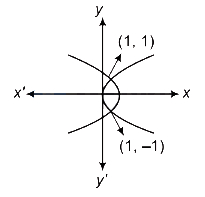
The area (in square units) of the region bounded by the curves $x=y^2$ and $x=3-2y^2$ is
A
$\frac{3}{2}$
B
$2$
C
$3$
D
$4$
Solution
(D) Given curves are $x=y^2$ and $x=3-2y^2$.
To find the points of intersection,set $y^2 = 3-2y^2$.
$3y^2 = 3 \Rightarrow y^2 = 1 \Rightarrow y = \pm 1$.
Thus,the points of intersection are $(1, 1)$ and $(1, -1)$.
The region is symmetric about the $x$-axis.
Required area $= 2 \int_0^1 (x_{right} - x_{left}) dy = 2 \int_0^1 ((3-2y^2) - y^2) dy$.
$= 2 \int_0^1 (3-3y^2) dy = 6 \int_0^1 (1-y^2) dy$.
$= 6 [y - \frac{y^3}{3}]_0^1 = 6 (1 - \frac{1}{3}) = 6 (\frac{2}{3}) = 4$ square units.
To find the points of intersection,set $y^2 = 3-2y^2$.
$3y^2 = 3 \Rightarrow y^2 = 1 \Rightarrow y = \pm 1$.
Thus,the points of intersection are $(1, 1)$ and $(1, -1)$.
The region is symmetric about the $x$-axis.
Required area $= 2 \int_0^1 (x_{right} - x_{left}) dy = 2 \int_0^1 ((3-2y^2) - y^2) dy$.
$= 2 \int_0^1 (3-3y^2) dy = 6 \int_0^1 (1-y^2) dy$.
$= 6 [y - \frac{y^3}{3}]_0^1 = 6 (1 - \frac{1}{3}) = 6 (\frac{2}{3}) = 4$ square units.
0 likesView Solution
88
ChemistryMCQAP EAMCET · 2011
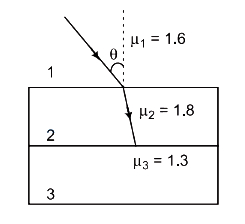
$A$ ray of light refracts from medium $1$ into a thin layer of medium $2$,crosses the layer,and is incident at the critical angle on the interface between medium $2$ and $3$ as shown in the figure. If the angle of incidence of the ray is $\theta$,the value of $\theta$ is
A
$\sin ^{-1}\left(\frac{8}{9}\right)$
B
$\sin ^{-1}\left(\frac{13}{18}\right)$
C
$\sin ^{-1}\left(\frac{13}{16}\right)$
D
$\sin ^{-1}\left(\frac{8}{13}\right)$
Solution
(C) According to Snell's Law at the interface between medium $2$ and $3$,the ray is incident at the critical angle $C$. Therefore,$\sin C = \frac{\mu_3}{\mu_2} = \frac{1.3}{1.8}$.
Since the angle of refraction at the first interface is $r$,and the ray is incident at the critical angle at the second interface,we have $r = C$.
Applying Snell's Law at the first interface between medium $1$ and $2$:
$\mu_1 \sin \theta = \mu_2 \sin r$
Substituting $\sin r = \sin C = \frac{1.3}{1.8}$:
$1.6 \times \sin \theta = 1.8 \times \left(\frac{1.3}{1.8}\right)$
$1.6 \times \sin \theta = 1.3$
$\sin \theta = \frac{1.3}{1.6} = \frac{13}{16}$
$\theta = \sin ^{-1}\left(\frac{13}{16}\right)$
Since the angle of refraction at the first interface is $r$,and the ray is incident at the critical angle at the second interface,we have $r = C$.
Applying Snell's Law at the first interface between medium $1$ and $2$:
$\mu_1 \sin \theta = \mu_2 \sin r$
Substituting $\sin r = \sin C = \frac{1.3}{1.8}$:
$1.6 \times \sin \theta = 1.8 \times \left(\frac{1.3}{1.8}\right)$
$1.6 \times \sin \theta = 1.3$
$\sin \theta = \frac{1.3}{1.6} = \frac{13}{16}$
$\theta = \sin ^{-1}\left(\frac{13}{16}\right)$
0 likesView Solution
89
ChemistryMCQAP EAMCET · 2011
The volume in $mL$ of $0.1 M$ solution of $NaOH$ required to completely neutralize $100 \ mL$ of $0.3 M$ solution of $H_3PO_3$ is:
A
$60$
B
$600$
C
$300$
D
$30$
Solution
(B) Phosphorous acid $(H_3PO_3)$ is a dibasic acid,meaning its n-factor is $2$.
For neutralization,the number of equivalents of acid must equal the number of equivalents of base: $N_1V_1 = N_2V_2$.
Normality $(N)$ is calculated as $Molarity \times n\text{-factor}$.
For $H_3PO_3$: $N = 0.3 \ M \times 2 = 0.6 \ N$.
For $NaOH$: $N = 0.1 \ M \times 1 = 0.1 \ N$.
Using the equation: $0.1 \ N \times V_{NaOH} = 0.6 \ N \times 100 \ mL$.
$V_{NaOH} = \frac{0.6 \times 100}{0.1} = 600 \ mL$.
For neutralization,the number of equivalents of acid must equal the number of equivalents of base: $N_1V_1 = N_2V_2$.
Normality $(N)$ is calculated as $Molarity \times n\text{-factor}$.
For $H_3PO_3$: $N = 0.3 \ M \times 2 = 0.6 \ N$.
For $NaOH$: $N = 0.1 \ M \times 1 = 0.1 \ N$.
Using the equation: $0.1 \ N \times V_{NaOH} = 0.6 \ N \times 100 \ mL$.
$V_{NaOH} = \frac{0.6 \times 100}{0.1} = 600 \ mL$.
0 likesView Solution
90
ChemistryMCQAP EAMCET · 2011
In which of the following reactions is hydrogen gas not liberated?
A
Reaction of fused $NaOH$ with $C$
B
Reaction of $NaOH$ with sulphur
C
Heating the concentrated $NaOH$ with $Si$
D
Reaction of zinc with $NaOH$
Solution
(B) In the reaction of $NaOH$ with sulphur,sodium sulphide $(Na_2S)$ and sodium thiosulphate $(Na_2S_2O_3)$ are formed along with water $(H_2O)$,but no hydrogen gas is liberated.
$4S + 6NaOH \rightarrow 2Na_2S + Na_2S_2O_3 + 3H_2O$
In other options:
$1$. $2NaOH + C \rightarrow Na_2CO_3 + 2H_2$
$2$. $Si + 2NaOH + H_2O \rightarrow Na_2SiO_3 + 2H_2$
$3$. $Zn + 2NaOH \rightarrow Na_2ZnO_2 + H_2$
$4S + 6NaOH \rightarrow 2Na_2S + Na_2S_2O_3 + 3H_2O$
In other options:
$1$. $2NaOH + C \rightarrow Na_2CO_3 + 2H_2$
$2$. $Si + 2NaOH + H_2O \rightarrow Na_2SiO_3 + 2H_2$
$3$. $Zn + 2NaOH \rightarrow Na_2ZnO_2 + H_2$
0 likesView Solution
91
ChemistryMCQAP EAMCET · 2011
In a $p-n$ junction diode,the thickness of the depletion layer is $2 \times 10^{-6} ~m$ and the barrier potential is $0.3 ~V$. The intensity of the electric field at the junction is:
A
$0.6 \times 10^{-6} ~Vm^{-1}$ from $n$ to $p$ side
B
$0.6 \times 10^{-6} ~Vm^{-1}$ from $p$ to $n$ side
C
$1.5 \times 10^5 ~Vm^{-1}$ from $n$ to $p$ side
D
$1.5 \times 10^5 ~Vm^{-1}$ from $p$ to $n$ side
Solution
(C) Given: Barrier potential,$V = 0.3 ~V$.
Thickness of depletion layer,$d = 2 \times 10^{-6} ~m$.
The electric field $E$ is given by the relation $E = \frac{V}{d}$.
Substituting the values: $E = \frac{0.3}{2 \times 10^{-6}} = 0.15 \times 10^6 = 1.5 \times 10^5 ~V/m$.
In a $p-n$ junction,the depletion layer is formed by the diffusion of electrons from the $n$-side to the $p$-side and holes from the $p$-side to the $n$-side. This creates a positive charge on the $n$-side and a negative charge on the $p$-side. Therefore,the electric field is directed from the $n$-side to the $p$-side.
Thickness of depletion layer,$d = 2 \times 10^{-6} ~m$.
The electric field $E$ is given by the relation $E = \frac{V}{d}$.
Substituting the values: $E = \frac{0.3}{2 \times 10^{-6}} = 0.15 \times 10^6 = 1.5 \times 10^5 ~V/m$.
In a $p-n$ junction,the depletion layer is formed by the diffusion of electrons from the $n$-side to the $p$-side and holes from the $p$-side to the $n$-side. This creates a positive charge on the $n$-side and a negative charge on the $p$-side. Therefore,the electric field is directed from the $n$-side to the $p$-side.
0 likesView Solution
92
ChemistryMCQAP EAMCET · 2011
If $y=y(x)$ is the solution of the differential equation $\left(\frac{2+\sin x}{y+1}\right) \frac{d y}{d x}+\cos x=0$ with $y(0)=1$,then $y\left(\frac{\pi}{2}\right)$ is equal to
A
$\frac{1}{3}$
B
$\frac{2}{3}$
C
$1$
D
$\frac{4}{3}$
Solution
(A) Given differential equation is $\left(\frac{2+\sin x}{y+1}\right) \frac{d y}{d x}+\cos x=0$.
Separating the variables,we get $\frac{d y}{y+1} = -\frac{\cos x}{2+\sin x} d x$.
Integrating both sides,we have $\int \frac{d y}{y+1} = -\int \frac{\cos x}{2+\sin x} d x$.
Let $2+\sin x = t$,then $\cos x dx = dt$.
Thus,$\ln|y+1| = -\ln|2+\sin x| + C$.
This simplifies to $\ln|y+1| + \ln|2+\sin x| = C$,or $(y+1)(2+\sin x) = C'$.
Given $y(0)=1$,we substitute $x=0$ and $y=1$: $(1+1)(2+\sin 0) = C' \Rightarrow 2(2) = C' \Rightarrow C'=4$.
So,the equation is $(y+1)(2+\sin x) = 4$.
At $x=\frac{\pi}{2}$,we have $(y(\frac{\pi}{2})+1)(2+\sin \frac{\pi}{2}) = 4$.
$(y(\frac{\pi}{2})+1)(2+1) = 4$.
$3(y(\frac{\pi}{2})+1) = 4 \Rightarrow y(\frac{\pi}{2})+1 = \frac{4}{3}$.
$y(\frac{\pi}{2}) = \frac{4}{3} - 1 = \frac{1}{3}$.
Separating the variables,we get $\frac{d y}{y+1} = -\frac{\cos x}{2+\sin x} d x$.
Integrating both sides,we have $\int \frac{d y}{y+1} = -\int \frac{\cos x}{2+\sin x} d x$.
Let $2+\sin x = t$,then $\cos x dx = dt$.
Thus,$\ln|y+1| = -\ln|2+\sin x| + C$.
This simplifies to $\ln|y+1| + \ln|2+\sin x| = C$,or $(y+1)(2+\sin x) = C'$.
Given $y(0)=1$,we substitute $x=0$ and $y=1$: $(1+1)(2+\sin 0) = C' \Rightarrow 2(2) = C' \Rightarrow C'=4$.
So,the equation is $(y+1)(2+\sin x) = 4$.
At $x=\frac{\pi}{2}$,we have $(y(\frac{\pi}{2})+1)(2+\sin \frac{\pi}{2}) = 4$.
$(y(\frac{\pi}{2})+1)(2+1) = 4$.
$3(y(\frac{\pi}{2})+1) = 4 \Rightarrow y(\frac{\pi}{2})+1 = \frac{4}{3}$.
$y(\frac{\pi}{2}) = \frac{4}{3} - 1 = \frac{1}{3}$.
0 likesView Solution
93
ChemistryMCQAP EAMCET · 2011
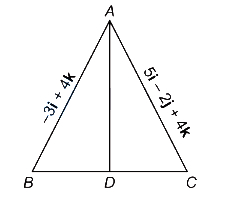
If the vectors $\vec{AB} = -3\hat{i} + 4\hat{k}$ and $\vec{AC} = 5\hat{i} - 2\hat{j} + 4\hat{k}$ are the sides of a $\triangle ABC$,then the length of the median through $A$ is
A
$\sqrt{14}$
B
$\sqrt{18}$
C
$\sqrt{25}$
D
$\sqrt{29}$
Solution
(B) Let $D$ be the midpoint of side $BC$. The median through $A$ is the vector $\vec{AD}$.
Since $D$ is the midpoint of $BC$,the position vector of $D$ relative to $A$ is given by the average of the vectors $\vec{AB}$ and $\vec{AC}$:
$\vec{AD} = \frac{1}{2}(\vec{AB} + \vec{AC})$
$\vec{AD} = \frac{1}{2}((-3\hat{i} + 4\hat{k}) + (5\hat{i} - 2\hat{j} + 4\hat{k}))$
$\vec{AD} = \frac{1}{2}(2\hat{i} - 2\hat{j} + 8\hat{k}) = \hat{i} - \hat{j} + 4\hat{k}$
The length of the median $\vec{AD}$ is the magnitude of the vector $\vec{AD}$:
$|\vec{AD}| = \sqrt{(1)^2 + (-1)^2 + (4)^2}$
$|\vec{AD}| = \sqrt{1 + 1 + 16} = \sqrt{18}$
Since $D$ is the midpoint of $BC$,the position vector of $D$ relative to $A$ is given by the average of the vectors $\vec{AB}$ and $\vec{AC}$:
$\vec{AD} = \frac{1}{2}(\vec{AB} + \vec{AC})$
$\vec{AD} = \frac{1}{2}((-3\hat{i} + 4\hat{k}) + (5\hat{i} - 2\hat{j} + 4\hat{k}))$
$\vec{AD} = \frac{1}{2}(2\hat{i} - 2\hat{j} + 8\hat{k}) = \hat{i} - \hat{j} + 4\hat{k}$
The length of the median $\vec{AD}$ is the magnitude of the vector $\vec{AD}$:
$|\vec{AD}| = \sqrt{(1)^2 + (-1)^2 + (4)^2}$
$|\vec{AD}| = \sqrt{1 + 1 + 16} = \sqrt{18}$
0 likesView Solution
94
ChemistryMCQAP EAMCET · 2011
If $|a|=1, |b|=2$ and the angle between $a$ and $b$ is $120^{\circ}$,then ${(a+3b) \times (3a-b)}^2$ is equal to
A
$425$
B
$375$
C
$325$
D
$300$
Solution
(D) Given: $|a|=1, |b|=2$ and the angle $\theta = 120^{\circ}$.
We need to evaluate the expression ${(a+3b) \times (3a-b)}^2$.
First,expand the cross product inside the brackets:
$(a+3b) \times (3a-b) = a \times (3a) - a \times b + (3b) \times (3a) - (3b) \times b$
Since $a \times a = 0$ and $b \times b = 0$,we have:
$= 0 - (a \times b) + 9(b \times a) - 0$
Using the property $b \times a = -(a \times b)$,we get:
$= -(a \times b) - 9(a \times b) = -10(a \times b)$
Now,square the magnitude:
${-10(a \times b)}^2 = 100 |a \times b|^2$
Using the formula $|a \times b| = |a||b| \sin \theta$:
$|a \times b| = 1 \times 2 \times \sin(120^{\circ}) = 2 \times \frac{\sqrt{3}}{2} = \sqrt{3}$
Therefore,$100 |a \times b|^2 = 100 \times (\sqrt{3})^2 = 100 \times 3 = 300$.
We need to evaluate the expression ${(a+3b) \times (3a-b)}^2$.
First,expand the cross product inside the brackets:
$(a+3b) \times (3a-b) = a \times (3a) - a \times b + (3b) \times (3a) - (3b) \times b$
Since $a \times a = 0$ and $b \times b = 0$,we have:
$= 0 - (a \times b) + 9(b \times a) - 0$
Using the property $b \times a = -(a \times b)$,we get:
$= -(a \times b) - 9(a \times b) = -10(a \times b)$
Now,square the magnitude:
${-10(a \times b)}^2 = 100 |a \times b|^2$
Using the formula $|a \times b| = |a||b| \sin \theta$:
$|a \times b| = 1 \times 2 \times \sin(120^{\circ}) = 2 \times \frac{\sqrt{3}}{2} = \sqrt{3}$
Therefore,$100 |a \times b|^2 = 100 \times (\sqrt{3})^2 = 100 \times 3 = 300$.
0 likesView Solution
95
ChemistryMCQAP EAMCET · 2011
The magnitude of the projection of the vector $\vec{a} = 4\hat{i} - 3\hat{j} + 2\hat{k}$ on the line which makes equal angles with the coordinate axes is
A
$\sqrt{2}$
B
$\sqrt{3}$
C
$\frac{1}{\sqrt{3}}$
D
$\frac{1}{\sqrt{2}}$
Solution
(B) Let the unit vector along the line be $\hat{v}$. Since the line makes equal angles $\alpha$ with the coordinate axes,its direction cosines are $\cos \alpha, \cos \alpha, \cos \alpha$.
We know that $\cos^2 \alpha + \cos^2 \alpha + \cos^2 \alpha = 1$,which implies $3\cos^2 \alpha = 1$,so $\cos \alpha = \pm \frac{1}{\sqrt{3}}$.
Thus,the unit vector along the line is $\hat{v} = \pm \frac{1}{\sqrt{3}}(\hat{i} + \hat{j} + \hat{k})$.
The projection of vector $\vec{a} = 4\hat{i} - 3\hat{j} + 2\hat{k}$ on the line is given by the magnitude of the dot product $\vec{a} \cdot \hat{v}$.
$|\vec{a} \cdot \hat{v}| = |(4\hat{i} - 3\hat{j} + 2\hat{k}) \cdot \pm \frac{1}{\sqrt{3}}(\hat{i} + \hat{j} + \hat{k})|$
$= |\pm \frac{1}{\sqrt{3}}(4 - 3 + 2)| = |\pm \frac{3}{\sqrt{3}}| = \sqrt{3}$.
We know that $\cos^2 \alpha + \cos^2 \alpha + \cos^2 \alpha = 1$,which implies $3\cos^2 \alpha = 1$,so $\cos \alpha = \pm \frac{1}{\sqrt{3}}$.
Thus,the unit vector along the line is $\hat{v} = \pm \frac{1}{\sqrt{3}}(\hat{i} + \hat{j} + \hat{k})$.
The projection of vector $\vec{a} = 4\hat{i} - 3\hat{j} + 2\hat{k}$ on the line is given by the magnitude of the dot product $\vec{a} \cdot \hat{v}$.
$|\vec{a} \cdot \hat{v}| = |(4\hat{i} - 3\hat{j} + 2\hat{k}) \cdot \pm \frac{1}{\sqrt{3}}(\hat{i} + \hat{j} + \hat{k})|$
$= |\pm \frac{1}{\sqrt{3}}(4 - 3 + 2)| = |\pm \frac{3}{\sqrt{3}}| = \sqrt{3}$.
0 likesView Solution
96
ChemistryMCQAP EAMCET · 2011
If the angles made by a straight line with the coordinate axes are $\alpha, \frac{\pi}{2}-\alpha, \beta$,then $\beta$ is equal to
A
$0$
B
$\frac{\pi}{6}$
C
$\frac{\pi}{2}$
D
$\pi$
Solution
(C) Let the direction angles of the line be $\alpha_1, \alpha_2, \alpha_3$. We are given $\alpha_1 = \alpha$,$\alpha_2 = \frac{\pi}{2} - \alpha$,and $\alpha_3 = \beta$.
The property of direction cosines states that $\cos^2 \alpha_1 + \cos^2 \alpha_2 + \cos^2 \alpha_3 = 1$.
Substituting the given values:
$\cos^2 \alpha + \cos^2 \left(\frac{\pi}{2} - \alpha\right) + \cos^2 \beta = 1$
Since $\cos \left(\frac{\pi}{2} - \alpha\right) = \sin \alpha$,the equation becomes:
$\cos^2 \alpha + \sin^2 \alpha + \cos^2 \beta = 1$
Using the identity $\cos^2 \alpha + \sin^2 \alpha = 1$,we get:
$1 + \cos^2 \beta = 1$
$\cos^2 \beta = 0$
$\cos \beta = 0$
Therefore,$\beta = \frac{\pi}{2}$.
The property of direction cosines states that $\cos^2 \alpha_1 + \cos^2 \alpha_2 + \cos^2 \alpha_3 = 1$.
Substituting the given values:
$\cos^2 \alpha + \cos^2 \left(\frac{\pi}{2} - \alpha\right) + \cos^2 \beta = 1$
Since $\cos \left(\frac{\pi}{2} - \alpha\right) = \sin \alpha$,the equation becomes:
$\cos^2 \alpha + \sin^2 \alpha + \cos^2 \beta = 1$
Using the identity $\cos^2 \alpha + \sin^2 \alpha = 1$,we get:
$1 + \cos^2 \beta = 1$
$\cos^2 \beta = 0$
$\cos \beta = 0$
Therefore,$\beta = \frac{\pi}{2}$.
0 likesView Solution
97
ChemistryMCQAP EAMCET · 2011
The polar equation of the line perpendicular to the line $\sin \theta - \cos \theta = \frac{1}{r}$ and passing through the point $\left(2, \frac{\pi}{6}\right)$ is
A
$\sin \theta + \cos \theta = \frac{\sqrt{3} + 1}{r}$
B
$\sin \theta - \cos \theta = \frac{\sqrt{3} + 1}{r}$
C
$\sin \theta + \cos \theta = \frac{\sqrt{3} - 1}{r}$
D
$\cos \theta - \sin \theta = \frac{\sqrt{3}}{r}$
Solution
(A) Given polar equation of the line is $\sin \theta - \cos \theta = \frac{1}{r}$.
Multiplying by $r$,we get $r \sin \theta - r \cos \theta = 1$.
In Cartesian coordinates,$x = r \cos \theta$ and $y = r \sin \theta$,so the equation becomes $y - x = 1$ or $x - y + 1 = 0$.
The slope of this line is $m_1 = 1$.
The line perpendicular to this line will have a slope $m_2 = -\frac{1}{m_1} = -1$.
The equation of a line with slope $-1$ is $x + y = k$.
This line passes through the point $\left(2, \frac{\pi}{6}\right)$.
Converting this point to Cartesian coordinates:
$x = 2 \cos \left(\frac{\pi}{6}\right) = 2 \cdot \frac{\sqrt{3}}{2} = \sqrt{3}$
$y = 2 \sin \left(\frac{\pi}{6}\right) = 2 \cdot \frac{1}{2} = 1$
Substituting $(\sqrt{3}, 1)$ into $x + y = k$,we get $k = \sqrt{3} + 1$.
Thus,the Cartesian equation is $x + y = \sqrt{3} + 1$.
Converting back to polar form:
$r \cos \theta + r \sin \theta = \sqrt{3} + 1$
$\sin \theta + \cos \theta = \frac{\sqrt{3} + 1}{r}$.
Multiplying by $r$,we get $r \sin \theta - r \cos \theta = 1$.
In Cartesian coordinates,$x = r \cos \theta$ and $y = r \sin \theta$,so the equation becomes $y - x = 1$ or $x - y + 1 = 0$.
The slope of this line is $m_1 = 1$.
The line perpendicular to this line will have a slope $m_2 = -\frac{1}{m_1} = -1$.
The equation of a line with slope $-1$ is $x + y = k$.
This line passes through the point $\left(2, \frac{\pi}{6}\right)$.
Converting this point to Cartesian coordinates:
$x = 2 \cos \left(\frac{\pi}{6}\right) = 2 \cdot \frac{\sqrt{3}}{2} = \sqrt{3}$
$y = 2 \sin \left(\frac{\pi}{6}\right) = 2 \cdot \frac{1}{2} = 1$
Substituting $(\sqrt{3}, 1)$ into $x + y = k$,we get $k = \sqrt{3} + 1$.
Thus,the Cartesian equation is $x + y = \sqrt{3} + 1$.
Converting back to polar form:
$r \cos \theta + r \sin \theta = \sqrt{3} + 1$
$\sin \theta + \cos \theta = \frac{\sqrt{3} + 1}{r}$.
0 likesView Solution
98
ChemistryMCQAP EAMCET · 2011
$A$ class has $15$ boys and $5$ girls. Suppose $3$ students are selected at random from the class. The probability that there are $2$ boys and $1$ girl is
A
$\frac{35}{76}$
B
$\frac{35}{38}$
C
$\frac{7}{76}$
D
$\frac{35}{72}$
Solution
(A) Total number of students = $15 + 5 = 20$.
Number of ways to select $3$ students out of $20$ is $^{20}C_3 = \frac{20 \times 19 \times 18}{3 \times 2 \times 1} = 1140$.
Number of ways to select $2$ boys out of $15$ is $^{15}C_2 = \frac{15 \times 14}{2 \times 1} = 105$.
Number of ways to select $1$ girl out of $5$ is $^5C_1 = 5$.
Required probability = $\frac{^{15}C_2 \times ^5C_1}{^{20}C_3} = \frac{105 \times 5}{1140} = \frac{525}{1140} = \frac{35}{76}$.
Number of ways to select $3$ students out of $20$ is $^{20}C_3 = \frac{20 \times 19 \times 18}{3 \times 2 \times 1} = 1140$.
Number of ways to select $2$ boys out of $15$ is $^{15}C_2 = \frac{15 \times 14}{2 \times 1} = 105$.
Number of ways to select $1$ girl out of $5$ is $^5C_1 = 5$.
Required probability = $\frac{^{15}C_2 \times ^5C_1}{^{20}C_3} = \frac{105 \times 5}{1140} = \frac{525}{1140} = \frac{35}{76}$.
0 likesView Solution
99
ChemistryMCQAP EAMCET · 2011
Seven white balls and three black balls are randomly arranged in a row. The probability that no two black balls are placed adjacently is
A
$\frac{1}{2}$
B
$\frac{7}{15}$
C
$\frac{2}{15}$
D
$\frac{1}{3}$
Solution
(B) Total number of ways to arrange $7$ white balls and $3$ black balls in a row is $\frac{10!}{7!3!} = \frac{10 \times 9 \times 8}{3 \times 2 \times 1} = 120$.
To ensure no two black balls are adjacent,we place the $7$ white balls first,creating $8$ possible gaps (including ends) where the $3$ black balls can be placed.
The number of ways to choose $3$ gaps out of $8$ is $\binom{8}{3} = \frac{8 \times 7 \times 6}{3 \times 2 \times 1} = 56$.
The required probability is $\frac{\binom{8}{3}}{\binom{10}{3}} = \frac{56}{120} = \frac{7}{15}$.
To ensure no two black balls are adjacent,we place the $7$ white balls first,creating $8$ possible gaps (including ends) where the $3$ black balls can be placed.
The number of ways to choose $3$ gaps out of $8$ is $\binom{8}{3} = \frac{8 \times 7 \times 6}{3 \times 2 \times 1} = 56$.
The required probability is $\frac{\binom{8}{3}}{\binom{10}{3}} = \frac{56}{120} = \frac{7}{15}$.
0 likesView Solution
100
ChemistryMCQAP EAMCET · 2011
The number of unit cells present in $39 \ g$ of potassium if it crystallizes as body-centered cubic $(BCC)$ is ($N = \text{Avogadro number}$,$\text{At. wt. of potassium} = 39$).
A
$\frac{N}{4}$
B
$\frac{N}{2}$
C
$\frac{N}{3}$
D
$N$
Solution
(B) Potassium crystallizes in a $BCC$ system.
Number of moles of potassium $= \frac{39 \ g}{39 \ g/mol} = 1 \ mol$.
Total number of atoms $= 1 \ mol \times N = N \ \text{atoms}$.
In a $BCC$ unit cell,the number of atoms per unit cell is $2$.
Therefore,the number of unit cells $= \frac{\text{Total number of atoms}}{2} = \frac{N}{2}$.
Number of moles of potassium $= \frac{39 \ g}{39 \ g/mol} = 1 \ mol$.
Total number of atoms $= 1 \ mol \times N = N \ \text{atoms}$.
In a $BCC$ unit cell,the number of atoms per unit cell is $2$.
Therefore,the number of unit cells $= \frac{\text{Total number of atoms}}{2} = \frac{N}{2}$.
0 likesView Solution
Vedclass Products
For Students
Vedclass Test Series
Mock tests in real AP EAMCET style covering Chemistry with performance analysis. 5-day free trial.
Start Free TrialFor Teachers
Exam Paper Generator
Generate Set A/B/C/D Chemistry papers from 7.5L+ questions in 2 minutes. 3 chapters free.
Try FreeFor Institutes
Online Exam Module
Run live AP EAMCET mock exams with unlimited students, 360° analytics & white-label branding.
See DemoFrequently Asked Questions
How many Chemistry questions are in AP EAMCET 2011?
There are 189 Chemistry questions from the AP EAMCET 2011 paper on Vedclass, each with a detailed step-by-step solution in English.
Are AP EAMCET 2011 Chemistry solutions available in English?
Yes. All solutions on this page are in English. You can also switch to English or Hindi using the language buttons above the questions.
Can I practice AP EAMCET 2011 Chemistry as a timed test?
Yes. Use the Vedclass Test Series to attempt a full AP EAMCET mock test covering Chemistry with time limits and instant score analysis.
Can teachers create Chemistry papers from AP EAMCET previous year questions?
Yes. The Vedclass Exam Paper Generator lets teachers mix AP EAMCET Chemistry questions and generate Set A/B/C/D papers in minutes.
For Teachers & Institutes
Build a Custom Chemistry Paper
Pick AP EAMCET 2011 Chemistry questions, set difficulty, and generate Set A/B/C/D in 2 minutes.