
ChemistryQ101–150 of 195 questions
Page 3 of 4 · English
101
ChemistryMCQAP EAMCET · 2007
The refractive index of the material of a double convex lens is $1.5$ and its focal length is $5 ~cm$. If the radii of curvature are equal,the value of the radius of curvature (in $cm$) is
A
$5.0$
B
$6.5$
C
$8.0$
D
$9.5$
Solution
(A) The lens maker's formula is given by $\frac{1}{f} = (\mu - 1) \left( \frac{1}{R_1} - \frac{1}{R_2} \right)$.
For a double convex lens,the radii of curvature are $R_1 = R$ and $R_2 = -R$.
Given $f = 5 ~cm$ and $\mu = 1.5$.
Substituting these values into the formula:
$\frac{1}{5} = (1.5 - 1) \left( \frac{1}{R} - \frac{1}{-R} \right)$
$\frac{1}{5} = 0.5 \times \left( \frac{1}{R} + \frac{1}{R} \right)$
$\frac{1}{5} = 0.5 \times \frac{2}{R}$
$\frac{1}{5} = \frac{1}{R}$
Therefore,$R = 5 ~cm$.
For a double convex lens,the radii of curvature are $R_1 = R$ and $R_2 = -R$.
Given $f = 5 ~cm$ and $\mu = 1.5$.
Substituting these values into the formula:
$\frac{1}{5} = (1.5 - 1) \left( \frac{1}{R} - \frac{1}{-R} \right)$
$\frac{1}{5} = 0.5 \times \left( \frac{1}{R} + \frac{1}{R} \right)$
$\frac{1}{5} = 0.5 \times \frac{2}{R}$
$\frac{1}{5} = \frac{1}{R}$
Therefore,$R = 5 ~cm$.
0 likesView Solution
102
ChemistryMCQAP EAMCET · 2007
In an $n$-type semiconductor,the Fermi energy level lies
A
in the forbidden energy gap nearer to the conduction band
B
in the forbidden energy gap nearer to the valence band
C
in the middle of forbidden energy gap
D
outside the forbidden energy gap
Solution
(A) In an $n$-type semiconductor,the majority charge carriers are electrons,which are provided by donor impurity atoms.
These donor energy levels are located just below the conduction band.
As the temperature increases,these electrons are excited into the conduction band.
Consequently,the Fermi energy level shifts upward and lies in the forbidden energy gap,but closer to the conduction band.
These donor energy levels are located just below the conduction band.
As the temperature increases,these electrons are excited into the conduction band.
Consequently,the Fermi energy level shifts upward and lies in the forbidden energy gap,but closer to the conduction band.
0 likesView Solution
103
ChemistryMCQAP EAMCET · 2007
The differential equation obtained by eliminating the arbitrary constants $a$ and $b$ from $xy = ae^x + be^{-x}$ is
A
$x \frac{d^2 y}{dx^2} + 2 \frac{dy}{dx} - xy = 0$
B
$\frac{d^2 y}{dx^2} + 2y \frac{dy}{dx} - xy = 0$
C
$x \frac{d^2 y}{dx^2} + 2 \frac{dy}{dx} + xy = 0$
D
$\frac{d^2 y}{dx^2} + \frac{dy}{dx} - xy = 0$
Solution
(A) Given equation: $xy = ae^x + be^{-x}$ $(1)$
Differentiating with respect to $x$ using the product rule on the left side:
$x \frac{dy}{dx} + y = ae^x - be^{-x}$ $(2)$
Differentiating again with respect to $x$:
$x \frac{d^2 y}{dx^2} + \frac{dy}{dx} + \frac{dy}{dx} = ae^x + be^{-x}$
$x \frac{d^2 y}{dx^2} + 2 \frac{dy}{dx} = ae^x + be^{-x}$
From equation $(1)$,we know that $ae^x + be^{-x} = xy$. Substituting this into the equation:
$x \frac{d^2 y}{dx^2} + 2 \frac{dy}{dx} = xy$
Rearranging the terms,we get:
$x \frac{d^2 y}{dx^2} + 2 \frac{dy}{dx} - xy = 0$
Differentiating with respect to $x$ using the product rule on the left side:
$x \frac{dy}{dx} + y = ae^x - be^{-x}$ $(2)$
Differentiating again with respect to $x$:
$x \frac{d^2 y}{dx^2} + \frac{dy}{dx} + \frac{dy}{dx} = ae^x + be^{-x}$
$x \frac{d^2 y}{dx^2} + 2 \frac{dy}{dx} = ae^x + be^{-x}$
From equation $(1)$,we know that $ae^x + be^{-x} = xy$. Substituting this into the equation:
$x \frac{d^2 y}{dx^2} + 2 \frac{dy}{dx} = xy$
Rearranging the terms,we get:
$x \frac{d^2 y}{dx^2} + 2 \frac{dy}{dx} - xy = 0$
0 likesView Solution
104
ChemistryMCQAP EAMCET · 2007
The solution of $\frac{dy}{dx} = \frac{y^2}{xy - x^2}$ is
A
$e^{y/x} = kx$
B
$e^{y/x} = ky$
C
$e^{x/y} = kx$
D
$e^{-y/x} = ky$
Solution
(B) Given the homogeneous differential equation: $\frac{dy}{dx} = \frac{y^2}{xy - x^2}$.
Divide numerator and denominator by $x^2$: $\frac{dy}{dx} = \frac{(y/x)^2}{(y/x) - 1}$.
Let $v = y/x$,then $y = vx$ and $\frac{dy}{dx} = v + x\frac{dv}{dx}$.
Substituting these into the equation: $v + x\frac{dv}{dx} = \frac{v^2}{v - 1}$.
$x\frac{dv}{dx} = \frac{v^2}{v - 1} - v = \frac{v^2 - v^2 + v}{v - 1} = \frac{v}{v - 1}$.
Separating variables: $\frac{v - 1}{v} dv = \frac{dx}{x}$.
$(1 - \frac{1}{v}) dv = \frac{dx}{x}$.
Integrating both sides: $\int (1 - \frac{1}{v}) dv = \int \frac{dx}{x}$.
$v - \ln|v| = \ln|x| + C$.
$v = \ln|x| + \ln|v| + C = \ln|xv| + C = \ln|y| + C$.
Since $v = y/x$,we have $y/x = \ln|y| + C$.
Taking exponential on both sides: $e^{y/x} = e^{\ln|y| + C} = e^C \cdot y$.
Let $e^C = k$,then $e^{y/x} = ky$.
Divide numerator and denominator by $x^2$: $\frac{dy}{dx} = \frac{(y/x)^2}{(y/x) - 1}$.
Let $v = y/x$,then $y = vx$ and $\frac{dy}{dx} = v + x\frac{dv}{dx}$.
Substituting these into the equation: $v + x\frac{dv}{dx} = \frac{v^2}{v - 1}$.
$x\frac{dv}{dx} = \frac{v^2}{v - 1} - v = \frac{v^2 - v^2 + v}{v - 1} = \frac{v}{v - 1}$.
Separating variables: $\frac{v - 1}{v} dv = \frac{dx}{x}$.
$(1 - \frac{1}{v}) dv = \frac{dx}{x}$.
Integrating both sides: $\int (1 - \frac{1}{v}) dv = \int \frac{dx}{x}$.
$v - \ln|v| = \ln|x| + C$.
$v = \ln|x| + \ln|v| + C = \ln|xv| + C = \ln|y| + C$.
Since $v = y/x$,we have $y/x = \ln|y| + C$.
Taking exponential on both sides: $e^{y/x} = e^{\ln|y| + C} = e^C \cdot y$.
Let $e^C = k$,then $e^{y/x} = ky$.
0 likesView Solution
105
ChemistryMCQAP EAMCET · 2007
Four numbers are chosen at random from $\{1, 2, 3, \ldots, 40\}$. The probability that they are not consecutive is:
A
$\frac{1}{2470}$
B
$\frac{4}{7969}$
C
$\frac{2469}{2470}$
D
$\frac{7965}{7969}$
Solution
(C) Total ways to choose $4$ numbers from $40$ is $^{40}C_4 = \frac{40 \times 39 \times 38 \times 37}{4 \times 3 \times 2 \times 1} = 91390$.
Number of ways to choose $4$ consecutive numbers is $37$ (i.e.,$\{1,2,3,4\}, \{2,3,4,5\}, \ldots, \{37,38,39,40\}$).
Probability that the $4$ numbers are consecutive is $P(C) = \frac{37}{91390} = \frac{1}{2470}$.
Probability that they are not consecutive is $1 - P(C) = 1 - \frac{1}{2470} = \frac{2469}{2470}$.
Number of ways to choose $4$ consecutive numbers is $37$ (i.e.,$\{1,2,3,4\}, \{2,3,4,5\}, \ldots, \{37,38,39,40\}$).
Probability that the $4$ numbers are consecutive is $P(C) = \frac{37}{91390} = \frac{1}{2470}$.
Probability that they are not consecutive is $1 - P(C) = 1 - \frac{1}{2470} = \frac{2469}{2470}$.
0 likesView Solution
106
ChemistryMCQAP EAMCET · 2007
$A$ bag contains $6$ white and $4$ black balls. Two balls are drawn at random. The probability that they are of the same colour is:
A
$1/15$
B
$2/5$
C
$4/15$
D
$7/15$
Solution
(D) Total number of balls $= 6 + 4 = 10$.
Number of ways to select $2$ balls out of $10 = {}^{10}C_2 = \frac{10 \times 9}{2 \times 1} = 45$.
Number of ways to select $2$ white balls from $6 = {}^{6}C_2 = \frac{6 \times 5}{2 \times 1} = 15$.
Number of ways to select $2$ black balls from $4 = {}^{4}C_2 = \frac{4 \times 3}{2 \times 1} = 6$.
Total favorable outcomes $= 15 + 6 = 21$.
$\therefore$ The required probability $= \frac{21}{45} = \frac{7}{15}$.
Number of ways to select $2$ balls out of $10 = {}^{10}C_2 = \frac{10 \times 9}{2 \times 1} = 45$.
Number of ways to select $2$ white balls from $6 = {}^{6}C_2 = \frac{6 \times 5}{2 \times 1} = 15$.
Number of ways to select $2$ black balls from $4 = {}^{4}C_2 = \frac{4 \times 3}{2 \times 1} = 6$.
Total favorable outcomes $= 15 + 6 = 21$.
$\therefore$ The required probability $= \frac{21}{45} = \frac{7}{15}$.
0 likesView Solution
107
ChemistryMCQAP EAMCET · 2007
If $A$ and $B$ are mutually exclusive events with $P(B) \neq 1$,then $P(A \mid \bar{B})$ is equal to (Here $\bar{B}$ is the complement of the event $B$)
A
$\frac{1}{P(B)}$
B
$\frac{1}{1-P(B)}$
C
$\frac{P(A)}{P(B)}$
D
$\frac{P(A)}{1-P(B)}$
Solution
(D) Given that $A$ and $B$ are mutually exclusive events,so $A \cap B = \phi$,which implies $P(A \cap B) = 0$.
By the definition of conditional probability,$P(A \mid \bar{B}) = \frac{P(A \cap \bar{B})}{P(\bar{B})}$.
Since $A = (A \cap B) \cup (A \cap \bar{B})$ and these are disjoint,$P(A) = P(A \cap B) + P(A \cap \bar{B})$.
Thus,$P(A \cap \bar{B}) = P(A) - P(A \cap B) = P(A) - 0 = P(A)$.
Also,$P(\bar{B}) = 1 - P(B)$.
Therefore,$P(A \mid \bar{B}) = \frac{P(A)}{1 - P(B)}$.
By the definition of conditional probability,$P(A \mid \bar{B}) = \frac{P(A \cap \bar{B})}{P(\bar{B})}$.
Since $A = (A \cap B) \cup (A \cap \bar{B})$ and these are disjoint,$P(A) = P(A \cap B) + P(A \cap \bar{B})$.
Thus,$P(A \cap \bar{B}) = P(A) - P(A \cap B) = P(A) - 0 = P(A)$.
Also,$P(\bar{B}) = 1 - P(B)$.
Therefore,$P(A \mid \bar{B}) = \frac{P(A)}{1 - P(B)}$.
0 likesView Solution
108
ChemistryMCQAP EAMCET · 2007
The mean and standard deviation of a binomial variate $X$ are $4$ and $\sqrt{3}$ respectively. Then $P(X \geq 1)$ is equal to
A
$1-\left(\frac{1}{4}\right)^{16}$
B
$1-\left(\frac{3}{4}\right)^{16}$
C
$1-\left(\frac{2}{3}\right)^{16}$
D
$1-\left(\frac{1}{3}\right)^{16}$
Solution
(B) For a binomial distribution,the mean is given by $np = 4$ and the variance is $\sigma^2 = npq = (\sqrt{3})^2 = 3$.
Dividing the variance by the mean,we get $\frac{npq}{np} = \frac{3}{4}$,which implies $q = \frac{3}{4}$.
Since $p + q = 1$,we have $p = 1 - \frac{3}{4} = \frac{1}{4}$.
Substituting $p = \frac{1}{4}$ into $np = 4$,we get $n \times \frac{1}{4} = 4$,so $n = 16$.
We need to find $P(X \geq 1)$. Using the complement rule,$P(X \geq 1) = 1 - P(X = 0)$.
For a binomial distribution,$P(X = k) = \binom{n}{k} p^k q^{n-k}$.
Thus,$P(X = 0) = \binom{16}{0} (\frac{1}{4})^0 (\frac{3}{4})^{16} = (\frac{3}{4})^{16}$.
Therefore,$P(X \geq 1) = 1 - (\frac{3}{4})^{16}$.
Dividing the variance by the mean,we get $\frac{npq}{np} = \frac{3}{4}$,which implies $q = \frac{3}{4}$.
Since $p + q = 1$,we have $p = 1 - \frac{3}{4} = \frac{1}{4}$.
Substituting $p = \frac{1}{4}$ into $np = 4$,we get $n \times \frac{1}{4} = 4$,so $n = 16$.
We need to find $P(X \geq 1)$. Using the complement rule,$P(X \geq 1) = 1 - P(X = 0)$.
For a binomial distribution,$P(X = k) = \binom{n}{k} p^k q^{n-k}$.
Thus,$P(X = 0) = \binom{16}{0} (\frac{1}{4})^0 (\frac{3}{4})^{16} = (\frac{3}{4})^{16}$.
Therefore,$P(X \geq 1) = 1 - (\frac{3}{4})^{16}$.
0 likesView Solution
109
ChemistryMCQAP EAMCET · 2007
Assertion $(A)$: Equal moles of different substances contain the same number of constituent particles.
Reason $(R)$: Equal weights of different substances contain the same number of constituent particles.
The correct answer is
Reason $(R)$: Equal weights of different substances contain the same number of constituent particles.
The correct answer is
A
Both $(A)$ and $(R)$ are true and $(R)$ is the correct explanation of $(A)$
B
Both $(A)$ and $(R)$ are true but $(R)$ is not the correct explanation of $(A)$
C
$(A)$ is true,but $(R)$ is false
D
$(A)$ is false but $(R)$ is true
Solution
(C) By definition,$1$ mole of any substance contains $6.022 \times 10^{23}$ constituent particles (Avogadro's number). Thus,equal moles of different substances contain the same number of constituent particles. So,Assertion $(A)$ is true.
However,the number of particles in a given weight depends on the molar mass of the substance $(n = \frac{w}{M})$. Since different substances have different molar masses,equal weights of different substances will contain different numbers of moles and,consequently,different numbers of constituent particles. So,Reason $(R)$ is false.
However,the number of particles in a given weight depends on the molar mass of the substance $(n = \frac{w}{M})$. Since different substances have different molar masses,equal weights of different substances will contain different numbers of moles and,consequently,different numbers of constituent particles. So,Reason $(R)$ is false.
0 likesView Solution
110
ChemistryMCQAP EAMCET · 2007
$138 \ g$ of ethyl alcohol is mixed with $72 \ g$ of water. The ratio of mole fraction of alcohol to water is
A
$3: 4$
B
$1: 2$
C
$1: 4$
D
$1: 1$
Solution
(A) Number of moles of ethyl alcohol $(C_2H_5OH)$ $= \frac{138 \ g}{46 \ g/mol} = 3 \ mol$.
Number of moles of water $(H_2O)$ $= \frac{72 \ g}{18 \ g/mol} = 4 \ mol$.
Mole fraction of alcohol $(X_{C_2H_5OH})$ $= \frac{3}{3+4} = \frac{3}{7}$.
Mole fraction of water $(X_{H_2O})$ $= \frac{4}{3+4} = \frac{4}{7}$.
The ratio of mole fraction of alcohol to water is $\frac{X_{C_2H_5OH}}{X_{H_2O}} = \frac{3/7}{4/7} = \frac{3}{4}$.
Number of moles of water $(H_2O)$ $= \frac{72 \ g}{18 \ g/mol} = 4 \ mol$.
Mole fraction of alcohol $(X_{C_2H_5OH})$ $= \frac{3}{3+4} = \frac{3}{7}$.
Mole fraction of water $(X_{H_2O})$ $= \frac{4}{3+4} = \frac{4}{7}$.
The ratio of mole fraction of alcohol to water is $\frac{X_{C_2H_5OH}}{X_{H_2O}} = \frac{3/7}{4/7} = \frac{3}{4}$.
0 likesView Solution
111
ChemistryMCQAP EAMCET · 2007
$A$ certain mass of a gas occupies a volume of $2 \ L$ at $STP$. To what temperature must the gas be heated to double its volume,keeping the pressure constant?
A
$100 \ K$
B
$273 \ K$
C
$273^{\circ} C$
D
$546^{\circ} C$
Solution
(C) According to Charles's Law,at constant pressure,$\frac{V_1}{T_1} = \frac{V_2}{T_2}$.
Given: $V_1 = 2 \ L$,$T_1 = 273 \ K$ (at $STP$),$V_2 = 4 \ L$ (doubled volume).
Substituting the values: $\frac{2}{273} = \frac{4}{T_2}$.
$T_2 = \frac{273 \times 4}{2} = 546 \ K$.
Converting to Celsius: $546 - 273 = 273^{\circ} C$.
Given: $V_1 = 2 \ L$,$T_1 = 273 \ K$ (at $STP$),$V_2 = 4 \ L$ (doubled volume).
Substituting the values: $\frac{2}{273} = \frac{4}{T_2}$.
$T_2 = \frac{273 \times 4}{2} = 546 \ K$.
Converting to Celsius: $546 - 273 = 273^{\circ} C$.
0 likesView Solution
112
ChemistryEasyMCQAP EAMCET · 2007
The wavelength of a spectral line emitted by a hydrogen atom in the Lyman series is $\frac{16}{15 R} \ cm$. What is the value of $n_2$? $(R = \text{Rydberg constant})$
A
$2$
B
$3$
C
$4$
D
$1$
Solution
(C) For the Lyman series,the Rydberg formula is given by: $\frac{1}{\lambda} = R \left[ \frac{1}{1^2} - \frac{1}{n_2^2} \right]$.
Given $\lambda = \frac{16}{15 R}$,so $\frac{1}{\lambda} = \frac{15 R}{16}$.
Substituting this into the formula: $\frac{15 R}{16} = R \left[ 1 - \frac{1}{n_2^2} \right]$.
Dividing both sides by $R$: $\frac{15}{16} = 1 - \frac{1}{n_2^2}$.
Rearranging the terms: $\frac{1}{n_2^2} = 1 - \frac{15}{16} = \frac{1}{16}$.
Therefore,$n_2^2 = 16$,which gives $n_2 = 4$.
Given $\lambda = \frac{16}{15 R}$,so $\frac{1}{\lambda} = \frac{15 R}{16}$.
Substituting this into the formula: $\frac{15 R}{16} = R \left[ 1 - \frac{1}{n_2^2} \right]$.
Dividing both sides by $R$: $\frac{15}{16} = 1 - \frac{1}{n_2^2}$.
Rearranging the terms: $\frac{1}{n_2^2} = 1 - \frac{15}{16} = \frac{1}{16}$.
Therefore,$n_2^2 = 16$,which gives $n_2 = 4$.
0 likesView Solution
113
ChemistryMCQAP EAMCET · 2007
The maximum number of sub-levels,orbitals and electrons in $N$ shell of an atom are respectively
A
$4, 12, 32$
B
$4, 16, 30$
C
$4, 16, 32$
D
$4, 32, 64$
Solution
(C) For $N$ shell,the principal quantum number $(n) = 4$.
The number of sub-levels (sub-shells) is equal to $n$,which is $4$.
The number of orbitals is given by $n^2 = 4^2 = 16$.
The number of electrons is given by $2n^2 = 2 \times 4^2 = 32$.
Therefore,the values are $4, 16, 32$.
The number of sub-levels (sub-shells) is equal to $n$,which is $4$.
The number of orbitals is given by $n^2 = 4^2 = 16$.
The number of electrons is given by $2n^2 = 2 \times 4^2 = 32$.
Therefore,the values are $4, 16, 32$.
0 likesView Solution
114
ChemistryMCQAP EAMCET · 2007
Which of the following biomolecules acts as specific catalysts in biological reactions?
A
Carbohydrates
B
Lipids
C
Vitamins
D
Enzymes
Solution
(D) Enzymes are biological catalysts. They are highly specific in nature and catalyze various biological reactions within living organisms.
0 likesView Solution
115
ChemistryMCQAP EAMCET · 2007
Assertion $(A)$: $A$ catalyst increases the rate of a reaction.
Reason $(R)$: In the presence of a catalyst,the activation energy of the reaction increases.
The correct answer is
Reason $(R)$: In the presence of a catalyst,the activation energy of the reaction increases.
The correct answer is
A
Both $(A)$ and $(R)$ are true and $(R)$ is the correct explanation of $(A)$
B
Both $(A)$ and $(R)$ are true but $(R)$ is not the correct explanation of $(A)$
C
$(A)$ is true,but $(R)$ is not true
D
$(A)$ is not true,but $(R)$ is true
Solution
(C) catalyst increases the rate of a reaction by providing an alternative pathway with lower activation energy.
Therefore,the assertion $(A)$ is true because the rate of reaction increases.
However,the reason $(R)$ is false because the activation energy of the reaction decreases in the presence of a catalyst,not increases.
Therefore,the assertion $(A)$ is true because the rate of reaction increases.
However,the reason $(R)$ is false because the activation energy of the reaction decreases in the presence of a catalyst,not increases.
0 likesView Solution
116
ChemistryMCQAP EAMCET · 2007
$A$ black body radiates energy at the rate of $E \text{ W/m}^2$ at a high temperature $T \text{ K}$. When the temperature is reduced to $\left(\frac{T}{2}\right) \text{ K}$,the radiant energy is
A
$\frac{E}{2}$
B
$2 E$
C
$\frac{E}{4}$
D
$\frac{E}{16}$
Solution
(D) According to Stefan-Boltzmann law,the radiant energy $E$ emitted by a black body is directly proportional to the fourth power of its absolute temperature $T$.
Mathematically,$E \propto T^4$.
Let $E_1 = E$ at temperature $T_1 = T$.
Let $E_2$ be the radiant energy at temperature $T_2 = \frac{T}{2}$.
Using the ratio formula: $\frac{E_2}{E_1} = \left(\frac{T_2}{T_1}\right)^4$.
Substituting the values: $\frac{E_2}{E} = \left(\frac{T/2}{T}\right)^4 = \left(\frac{1}{2}\right)^4$.
Therefore,$E_2 = \frac{E}{16}$.
Mathematically,$E \propto T^4$.
Let $E_1 = E$ at temperature $T_1 = T$.
Let $E_2$ be the radiant energy at temperature $T_2 = \frac{T}{2}$.
Using the ratio formula: $\frac{E_2}{E_1} = \left(\frac{T_2}{T_1}\right)^4$.
Substituting the values: $\frac{E_2}{E} = \left(\frac{T/2}{T}\right)^4 = \left(\frac{1}{2}\right)^4$.
Therefore,$E_2 = \frac{E}{16}$.
0 likesView Solution
117
ChemistryMCQAP EAMCET · 2007
$A$ clock which keeps correct time at $20^{\circ} C$,is subjected to $40^{\circ} C$. If the coefficient of linear expansion of the pendulum is $12 \times 10^{-6} /{ }^{\circ} C$,how much time will it gain or lose per day?
A
$10.3 \ s/\text{day}$
B
$20.6 \ s/\text{day}$
C
$5 \ s/\text{day}$
D
$20 \ \text{min}/\text{day}$
Solution
(A) The time period of a simple pendulum is given by $T = 2\pi \sqrt{\frac{l}{g}}$.
Taking the differential,the fractional change in time period is $\frac{\Delta T}{T} = \frac{1}{2} \frac{\Delta l}{l} = \frac{1}{2} \alpha \Delta \theta$.
Given $\alpha = 12 \times 10^{-6} /{ }^{\circ} C$ and $\Delta \theta = 40^{\circ} C - 20^{\circ} C = 20^{\circ} C$.
Substituting the values: $\frac{\Delta T}{T} = \frac{1}{2} \times 12 \times 10^{-6} \times 20 = 120 \times 10^{-6} = 1.2 \times 10^{-4}$.
The time lost or gained per day is $\Delta T = \frac{\Delta T}{T} \times T_{day}$.
Since $T_{day} = 24 \times 60 \times 60 = 86400 \ s$,we have $\Delta T = 1.2 \times 10^{-4} \times 86400 = 10.368 \ s$.
Rounding to the nearest value,the clock loses $10.3 \ s/\text{day}$.
Taking the differential,the fractional change in time period is $\frac{\Delta T}{T} = \frac{1}{2} \frac{\Delta l}{l} = \frac{1}{2} \alpha \Delta \theta$.
Given $\alpha = 12 \times 10^{-6} /{ }^{\circ} C$ and $\Delta \theta = 40^{\circ} C - 20^{\circ} C = 20^{\circ} C$.
Substituting the values: $\frac{\Delta T}{T} = \frac{1}{2} \times 12 \times 10^{-6} \times 20 = 120 \times 10^{-6} = 1.2 \times 10^{-4}$.
The time lost or gained per day is $\Delta T = \frac{\Delta T}{T} \times T_{day}$.
Since $T_{day} = 24 \times 60 \times 60 = 86400 \ s$,we have $\Delta T = 1.2 \times 10^{-4} \times 86400 = 10.368 \ s$.
Rounding to the nearest value,the clock loses $10.3 \ s/\text{day}$.
0 likesView Solution
118
ChemistryMCQAP EAMCET · 2007
Two cylinders $A$ and $B$ fitted with pistons contain equal number of moles of an ideal monoatomic gas at $400 ~K$. The piston of $A$ is free to move while that of $B$ is held fixed. Same amount of heat energy is given to the gas in each cylinder. If the rise in temperature of the gas in $A$ is $42 ~K$,the rise in temperature of the gas in $B$ is (in $~K$)
A
$21$
B
$35$
C
$42$
D
$70$
Solution
(D) For an ideal monoatomic gas,the molar heat capacity at constant pressure is $C_P = \frac{5}{2}R$ and at constant volume is $C_V = \frac{3}{2}R$.
For cylinder $A$ (isobaric process),the heat supplied is $Q = n C_P \Delta T_A$.
Given $n$ is the same,$Q = n \times \frac{5}{2}R \times 42 = 105 nR$.
For cylinder $B$ (isochoric process),the heat supplied is $Q = n C_V \Delta T_B$.
Since the heat supplied is the same,$n C_P \Delta T_A = n C_V \Delta T_B$.
$\frac{5}{2}R \times 42 = \frac{3}{2}R \times \Delta T_B$.
$5 \times 42 = 3 \times \Delta T_B$.
$\Delta T_B = \frac{210}{3} = 70 ~K$.
For cylinder $A$ (isobaric process),the heat supplied is $Q = n C_P \Delta T_A$.
Given $n$ is the same,$Q = n \times \frac{5}{2}R \times 42 = 105 nR$.
For cylinder $B$ (isochoric process),the heat supplied is $Q = n C_V \Delta T_B$.
Since the heat supplied is the same,$n C_P \Delta T_A = n C_V \Delta T_B$.
$\frac{5}{2}R \times 42 = \frac{3}{2}R \times \Delta T_B$.
$5 \times 42 = 3 \times \Delta T_B$.
$\Delta T_B = \frac{210}{3} = 70 ~K$.
0 likesView Solution
119
ChemistryMCQAP EAMCET · 2007
Two cylinders $A$ and $B$ fitted with pistons,contain equal number of moles of an ideal monoatomic gas at $400 ~K$. The piston of $A$ is free to move while that of $B$ is held fixed. Same amount of heat energy is given to the gas in each cylinder. If the rise in temperature of the gas in $A$ is $42 ~K$,the rise in temperature of the gas in $B$ is $(\gamma = 5/3)$. (in $~K$)
A
$25.2$
B
$35$
C
$42$
D
$70$
Solution
(D) For cylinder $B$ (fixed piston,isochoric process): $\Delta Q = n C_v \Delta T_B = n (\frac{3R}{2}) \Delta T_B$.
For cylinder $A$ (free piston,isobaric process): $\Delta Q = n C_p \Delta T_A = n (\frac{5R}{2}) \Delta T_A$.
Since the heat supplied $\Delta Q$ is the same for both: $n (\frac{3R}{2}) \Delta T_B = n (\frac{5R}{2}) \Delta T_A$.
Given $\Delta T_A = 42 ~K$,we have: $3 \Delta T_B = 5 \times 42$.
$\Delta T_B = \frac{210}{3} = 70 ~K$.
For cylinder $A$ (free piston,isobaric process): $\Delta Q = n C_p \Delta T_A = n (\frac{5R}{2}) \Delta T_A$.
Since the heat supplied $\Delta Q$ is the same for both: $n (\frac{3R}{2}) \Delta T_B = n (\frac{5R}{2}) \Delta T_A$.
Given $\Delta T_A = 42 ~K$,we have: $3 \Delta T_B = 5 \times 42$.
$\Delta T_B = \frac{210}{3} = 70 ~K$.
0 likesView Solution
120
ChemistryMCQAP EAMCET · 2007
Temperature of cold junction in a thermocouple is $10^{\circ} C$ and neutral temperature is $270^{\circ} C$,then the temperature of inversion is (in $^{\circ} C$)
A
$540$
B
$530$
C
$280$
D
$260$
Solution
(B) The relationship between the temperature of inversion $(T_i)$,neutral temperature $(T_n)$,and the temperature of the cold junction $(T_0)$ in a thermocouple is given by the formula:
$T_n = \frac{T_i + T_0}{2}$
Rearranging this formula to solve for the temperature of inversion $(T_i)$:
$T_i = 2T_n - T_0$
Given values are:
$T_0 = 10^{\circ} C$
$T_n = 270^{\circ} C$
Substituting these values into the equation:
$T_i = 2 \times 270^{\circ} C - 10^{\circ} C$
$T_i = 540^{\circ} C - 10^{\circ} C$
$T_i = 530^{\circ} C$
$T_n = \frac{T_i + T_0}{2}$
Rearranging this formula to solve for the temperature of inversion $(T_i)$:
$T_i = 2T_n - T_0$
Given values are:
$T_0 = 10^{\circ} C$
$T_n = 270^{\circ} C$
Substituting these values into the equation:
$T_i = 2 \times 270^{\circ} C - 10^{\circ} C$
$T_i = 540^{\circ} C - 10^{\circ} C$
$T_i = 530^{\circ} C$
0 likesView Solution
121
ChemistryMCQAP EAMCET · 2007
The temperature of the system decreases in the process of
A
free expansion
B
adiabatic expansion
C
isothermal expansion
D
isothermal compression
Solution
(B) In an adiabatic process,the system is thermally insulated from its surroundings,meaning $Q = 0$.
According to the first law of thermodynamics,$\Delta U = Q - W$.
Since $Q = 0$,we have $\Delta U = -W$.
In an expansion process,the gas does work on the surroundings,so $W > 0$.
Therefore,$\Delta U = -W < 0$,which means the internal energy of the system decreases.
Since the internal energy of an ideal gas is directly proportional to its temperature $(U \propto T)$,a decrease in internal energy results in a decrease in the temperature of the system.
According to the first law of thermodynamics,$\Delta U = Q - W$.
Since $Q = 0$,we have $\Delta U = -W$.
In an expansion process,the gas does work on the surroundings,so $W > 0$.
Therefore,$\Delta U = -W < 0$,which means the internal energy of the system decreases.
Since the internal energy of an ideal gas is directly proportional to its temperature $(U \propto T)$,a decrease in internal energy results in a decrease in the temperature of the system.
0 likesView Solution
122
ChemistryMCQAP EAMCET · 2007
The decreasing order of bond dissociation energies of $C-C$,$C-H$,and $H-H$ bonds is:
A
$H-H > C-H > C-C$
B
$C-C > C-H > H-H$
C
$C-H > C-C > H-H$
D
$C-C > H-H > C-H$
Solution
(A) The bond dissociation energies are approximately as follows:
$H-H \approx 436 \ kJ/mol$
$C-H \approx 413 \ kJ/mol$
$C-C \approx 348 \ kJ/mol$
Therefore,the decreasing order is $H-H > C-H > C-C$.
$H-H \approx 436 \ kJ/mol$
$C-H \approx 413 \ kJ/mol$
$C-C \approx 348 \ kJ/mol$
Therefore,the decreasing order is $H-H > C-H > C-C$.
0 likesView Solution
123
ChemistryEasyMCQAP EAMCET · 2007
Calculate the enthalpy of formation of ethylene $(C_2H_4)$ from the following data:
$I. C_{(graphite)} + O_{2(g)} \rightarrow CO_{2(g)}; \Delta H = -393.5 \ kJ$
$II. H_{2(g)} + \frac{1}{2}O_{2(g)} \rightarrow H_2O_{(l)}; \Delta H = -286.2 \ kJ$
$III. C_2H_{4(g)} + 3O_{2(g)} \rightarrow 2CO_{2(g)} + 2H_2O_{(l)}; \Delta H = -1410.8 \ kJ$ (in $kJ$)
$I. C_{(graphite)} + O_{2(g)} \rightarrow CO_{2(g)}; \Delta H = -393.5 \ kJ$
$II. H_{2(g)} + \frac{1}{2}O_{2(g)} \rightarrow H_2O_{(l)}; \Delta H = -286.2 \ kJ$
$III. C_2H_{4(g)} + 3O_{2(g)} \rightarrow 2CO_{2(g)} + 2H_2O_{(l)}; \Delta H = -1410.8 \ kJ$ (in $kJ$)
A
$54.1$
B
$44.8$
C
$51.4$
D
$48.4$
Solution
(C) The formation reaction of ethylene is: $2C_{(graphite)} + 2H_{2(g)} \rightarrow C_2H_{4(g)}$
Using Hess's Law,the enthalpy of formation is given by: $\Delta H_f = 2 \times \Delta H_I + 2 \times \Delta H_{II} - \Delta H_{III}$
Substituting the given values:
$\Delta H_f = 2(-393.5 \ kJ) + 2(-286.2 \ kJ) - (-1410.8 \ kJ)$
$\Delta H_f = -787.0 \ kJ - 572.4 \ kJ + 1410.8 \ kJ$
$\Delta H_f = 51.4 \ kJ$
Using Hess's Law,the enthalpy of formation is given by: $\Delta H_f = 2 \times \Delta H_I + 2 \times \Delta H_{II} - \Delta H_{III}$
Substituting the given values:
$\Delta H_f = 2(-393.5 \ kJ) + 2(-286.2 \ kJ) - (-1410.8 \ kJ)$
$\Delta H_f = -787.0 \ kJ - 572.4 \ kJ + 1410.8 \ kJ$
$\Delta H_f = 51.4 \ kJ$
0 likesView Solution
124
ChemistryMCQAP EAMCET · 2007
Some physical constants are given in List-$I$ and their dimensional formulae are given in List-$II$. Match the following:
The correct answer is:
| List-$I$ | List-$II$ |
| $(1)$ Planck's constant | $(i)$ $[ML^{-1} T^{-2}]$ |
| $(2)$ Gravitational constant | (ii) $[ML^{-1} T^{-1}]$ |
| $(3)$ Bulk modulus | (iii) $[ML^2 T^{-1}]$ |
| $(4)$ Coefficient of viscosity | (iv) $[M^{-1} L^3 T^{-2}]$ |
The correct answer is:
A
(iv) (iii) (ii) $(i)$
B
(ii) $(i)$ (iii) (iv)
C
(iii) (ii) $(i)$ (iv)
D
(iii) (iv) $(i)$ (ii)
Solution
(D) $(1)$ Planck's constant: $E = h\nu \implies [h] = [E]/[\nu] = [ML^2 T^{-2}] / [T^{-1}] = [ML^2 T^{-1}]$. This matches (iii).
$(2)$ Gravitational constant: $F = G(m_1 m_2)/r^2 \implies [G] = [Fr^2]/[M^2] = [MLT^{-2}][L^2]/[M^2] = [M^{-1} L^3 T^{-2}]$. This matches (iv).
$(3)$ Bulk modulus: $B = \text{Stress} / \text{Strain} = [ML^{-1} T^{-2}] / [1] = [ML^{-1} T^{-2}]$. This matches $(i)$.
$(4)$ Coefficient of viscosity: $F = \eta A (dv/dx) \implies [\eta] = [F] / ([A][dv/dx]) = [MLT^{-2}] / ([L^2][LT^{-1}/L]) = [ML^{-1} T^{-1}]$. This matches (ii).
Therefore,the correct matching is $(1)$-(iii),$(2)$-(iv),$(3)$-$(i)$,$(4)$-(ii). Hence,option $(d)$ is correct.
$(2)$ Gravitational constant: $F = G(m_1 m_2)/r^2 \implies [G] = [Fr^2]/[M^2] = [MLT^{-2}][L^2]/[M^2] = [M^{-1} L^3 T^{-2}]$. This matches (iv).
$(3)$ Bulk modulus: $B = \text{Stress} / \text{Strain} = [ML^{-1} T^{-2}] / [1] = [ML^{-1} T^{-2}]$. This matches $(i)$.
$(4)$ Coefficient of viscosity: $F = \eta A (dv/dx) \implies [\eta] = [F] / ([A][dv/dx]) = [MLT^{-2}] / ([L^2][LT^{-1}/L]) = [ML^{-1} T^{-1}]$. This matches (ii).
Therefore,the correct matching is $(1)$-(iii),$(2)$-(iv),$(3)$-$(i)$,$(4)$-(ii). Hence,option $(d)$ is correct.
0 likesView Solution
125
ChemistryMCQAP EAMCET · 2007
In Huygen's eyepiece,
A
the cross wires are outside the eyepiece
B
condition for achromatism is satisfied
C
condition for minimum spherical aberration is not satisfied
D
the image formed by the objective is a virtual image
Solution
(B) The Huygen eyepiece is designed to minimize aberrations. It satisfies the condition for achromatism (elimination of chromatic aberration) by placing the two plano-convex lenses at a distance equal to half the sum of their focal lengths. It also satisfies the condition for minimum spherical aberration.
0 likesView Solution
126
ChemistryMCQAP EAMCET · 2007
$A$ whistle of frequency $540 \ Hz$ rotates in a horizontal circle of radius $2 \ m$ at an angular speed of $15 \ rad/s$. What is the highest frequency heard by a listener at rest with respect to the centre of the circle (in $Hz$)? (Velocity of sound in air $= 330 \ m/s$)
A
$590$
B
$594$
C
$598$
D
$602$
Solution
(B) The velocity of the source $v_s$ is given by $v_s = r \omega$.
Given $r = 2 \ m$ and $\omega = 15 \ rad/s$,we have $v_s = 2 \times 15 = 30 \ m/s$.
The listener is at the center,so the source moves towards the listener when its velocity vector points directly at the center.
The highest frequency $f'$ heard by a stationary listener is given by the Doppler effect formula for a source moving towards the listener:
$f' = f \left( \frac{v}{v - v_s} \right)$
Substituting the given values:
$f' = 540 \left( \frac{330}{330 - 30} \right) = 540 \left( \frac{330}{300} \right) = 540 \times 1.1 = 594 \ Hz$.
Given $r = 2 \ m$ and $\omega = 15 \ rad/s$,we have $v_s = 2 \times 15 = 30 \ m/s$.
The listener is at the center,so the source moves towards the listener when its velocity vector points directly at the center.
The highest frequency $f'$ heard by a stationary listener is given by the Doppler effect formula for a source moving towards the listener:
$f' = f \left( \frac{v}{v - v_s} \right)$
Substituting the given values:
$f' = 540 \left( \frac{330}{330 - 30} \right) = 540 \left( \frac{330}{300} \right) = 540 \times 1.1 = 594 \ Hz$.
0 likesView Solution
127
ChemistryMCQAP EAMCET · 2007
$A$ segment of wire vibrates with a fundamental frequency of $450 ~Hz$ under a tension of $9 ~kg-wt$. The tension at which the fundamental frequency of the same wire becomes $900 ~Hz$ is
A
$36 ~kg-wt$
B
$27 ~kg-wt$
C
$18 ~kg-wt$
D
$72 ~kg-wt$
Solution
(A) The fundamental frequency $f$ of a vibrating wire is given by the formula: $f = \frac{1}{2L} \sqrt{\frac{T}{\mu}}$,where $T$ is the tension and $\mu$ is the linear mass density.
Since the wire is the same,$L$ and $\mu$ are constant,so $f \propto \sqrt{T}$.
Therefore,we can write the ratio: $\frac{f_2}{f_1} = \sqrt{\frac{T_2}{T_1}}$.
Given $f_1 = 450 ~Hz$,$T_1 = 9 ~kg-wt$,and $f_2 = 900 ~Hz$.
Substituting the values: $\frac{900}{450} = \sqrt{\frac{T_2}{9}}$.
$2 = \sqrt{\frac{T_2}{9}}$.
Squaring both sides: $4 = \frac{T_2}{9}$.
$T_2 = 4 \times 9 = 36 ~kg-wt$.
Since the wire is the same,$L$ and $\mu$ are constant,so $f \propto \sqrt{T}$.
Therefore,we can write the ratio: $\frac{f_2}{f_1} = \sqrt{\frac{T_2}{T_1}}$.
Given $f_1 = 450 ~Hz$,$T_1 = 9 ~kg-wt$,and $f_2 = 900 ~Hz$.
Substituting the values: $\frac{900}{450} = \sqrt{\frac{T_2}{9}}$.
$2 = \sqrt{\frac{T_2}{9}}$.
Squaring both sides: $4 = \frac{T_2}{9}$.
$T_2 = 4 \times 9 = 36 ~kg-wt$.
0 likesView Solution
128
ChemistryMCQAP EAMCET · 2007
$A$ bucket filled with water is tied to a rope of length $0.5 ~m$ and is rotated in a circular path in a vertical plane. The minimum velocity it should have at the lowest point of the circle so that the water does not spill is,$(g = 10 ~m/s^2)$.
A
$\sqrt{5} ~m/s$
B
$\sqrt{10} ~m/s$
C
$5 ~m/s$
D
$2\sqrt{5} ~m/s$
Solution
(C) For the water not to spill out of the bucket at the highest point,the velocity at the highest point must be at least $\sqrt{gR}$.
Using the principle of conservation of energy between the lowest point $(v_L)$ and the highest point $(v_H)$:
$\frac{1}{2}mv_L^2 = \frac{1}{2}mv_H^2 + mg(2R)$
$v_L^2 = v_H^2 + 4gR$
Since $v_H = \sqrt{gR}$,we have $v_L^2 = gR + 4gR = 5gR$.
$v_L = \sqrt{5gR}$
Substituting the given values $g = 10 ~m/s^2$ and $R = 0.5 ~m$:
$v_L = \sqrt{5 \times 10 \times 0.5} = \sqrt{25} = 5 ~m/s$.
Using the principle of conservation of energy between the lowest point $(v_L)$ and the highest point $(v_H)$:
$\frac{1}{2}mv_L^2 = \frac{1}{2}mv_H^2 + mg(2R)$
$v_L^2 = v_H^2 + 4gR$
Since $v_H = \sqrt{gR}$,we have $v_L^2 = gR + 4gR = 5gR$.
$v_L = \sqrt{5gR}$
Substituting the given values $g = 10 ~m/s^2$ and $R = 0.5 ~m$:
$v_L = \sqrt{5 \times 10 \times 0.5} = \sqrt{25} = 5 ~m/s$.
0 likesView Solution
129
ChemistryMCQAP EAMCET · 2007
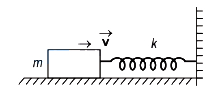
$A$ block of mass $m=25 \ kg$ sliding on a smooth horizontal surface with a velocity $v=3 \ ms^{-1}$ meets a spring of spring constant $k=100 \ N/m$ fixed at one end as shown in the figure. The maximum compression of the spring and the velocity of the block as it returns to the original position are respectively:
A
$1.5 \ m, -3 \ ms^{-1}$
B
$1.5 \ m, 0.01 \ ms^{-1}$
C
$1.0 \ m, 3 \ ms^{-1}$
D
$0.5 \ m, 2 \ ms^{-1}$
Solution
(A) When the block strikes the spring,the kinetic energy of the block is converted into the potential energy of the spring. By the law of conservation of energy:
$\frac{1}{2} m v^2 = \frac{1}{2} k x^2$
where $x$ is the maximum compression in the spring.
$x = \sqrt{\frac{m v^2}{k}} = \sqrt{\frac{25 \times (3)^2}{100}} = \sqrt{\frac{225}{100}} = \frac{15}{10} = 1.5 \ m$.
When the block returns to the original position,the potential energy stored in the spring is completely converted back into the kinetic energy of the block. Since the surface is smooth (no friction),energy is conserved. The magnitude of the velocity remains the same,but the direction is reversed.
Thus,the velocity of the block is $v = -3 \ ms^{-1}$.
$\frac{1}{2} m v^2 = \frac{1}{2} k x^2$
where $x$ is the maximum compression in the spring.
$x = \sqrt{\frac{m v^2}{k}} = \sqrt{\frac{25 \times (3)^2}{100}} = \sqrt{\frac{225}{100}} = \frac{15}{10} = 1.5 \ m$.
When the block returns to the original position,the potential energy stored in the spring is completely converted back into the kinetic energy of the block. Since the surface is smooth (no friction),energy is conserved. The magnitude of the velocity remains the same,but the direction is reversed.
Thus,the velocity of the block is $v = -3 \ ms^{-1}$.
0 likesView Solution
130
ChemistryMCQAP EAMCET · 2007
An organic compound '$X$' on treatment with pyridinium chlorochromate $(PCC)$ in dichloromethane gives compound '$Y$'. Compound '$Y$' reacts with $I_2$ and alkali to form triiodomethane. The compound '$X$' is
A
$C_2H_5OH$
B
$CH_3CHO$
C
$CH_3COCH_3$
D
$CH_3COOH$
Solution
(A) $1$. Pyridinium chlorochromate $(PCC)$ is a mild oxidizing agent that oxidizes primary alcohols to aldehydes and secondary alcohols to ketones.
$2$. The compound '$Y$' gives a positive iodoform test (reacts with $I_2$ and alkali to form triiodomethane,$CHI_3$),which indicates that '$Y$' must contain a $CH_3CO-$ group or be ethanol $(C_2H_5OH)$ which oxidizes to acetaldehyde $(CH_3CHO)$.
$3$. Ethanol $(C_2H_5OH)$ on oxidation with $PCC$ gives acetaldehyde $(CH_3CHO)$.
$4$. Acetaldehyde $(CH_3CHO)$ reacts with $I_2$ and $NaOH$ to give $CHI_3$ (iodoform).
$5$. The reaction sequence is:
$C_2H_5OH + [O] \xrightarrow{PCC \text{ in } CH_2Cl_2} CH_3CHO$
$CH_3CHO + 4NaOH + 3I_2 \rightarrow CHI_3 + HCOONa + 3H_2O + 3NaI$
$6$. Thus,'$X$' is $C_2H_5OH$.
$2$. The compound '$Y$' gives a positive iodoform test (reacts with $I_2$ and alkali to form triiodomethane,$CHI_3$),which indicates that '$Y$' must contain a $CH_3CO-$ group or be ethanol $(C_2H_5OH)$ which oxidizes to acetaldehyde $(CH_3CHO)$.
$3$. Ethanol $(C_2H_5OH)$ on oxidation with $PCC$ gives acetaldehyde $(CH_3CHO)$.
$4$. Acetaldehyde $(CH_3CHO)$ reacts with $I_2$ and $NaOH$ to give $CHI_3$ (iodoform).
$5$. The reaction sequence is:
$C_2H_5OH + [O] \xrightarrow{PCC \text{ in } CH_2Cl_2} CH_3CHO$
$CH_3CHO + 4NaOH + 3I_2 \rightarrow CHI_3 + HCOONa + 3H_2O + 3NaI$
$6$. Thus,'$X$' is $C_2H_5OH$.
0 likesView Solution
131
ChemistryMCQAP EAMCET · 2007
$A$ rifle of $20 ~kg$ mass can fire $4$ bullets per second. The mass of each bullet is $35 \times 10^{-3} ~kg$ and its final velocity is $400 ~ms^{-1}$. What force must be applied on the rifle so that it does not move backwards while firing the bullets (in $~N$)?
A
$80$
B
$28$
C
$-112$
D
$56$
Solution
(D) The force exerted by the bullets on the rifle is equal to the rate of change of momentum of the bullets.
Given:
Mass of rifle,$M = 20 ~kg$
Number of bullets per second,$n = 4$
Mass of each bullet,$m = 35 \times 10^{-3} ~kg$
Velocity of each bullet,$v = 400 ~ms^{-1}$
The force exerted by the bullets on the rifle (recoil force) is given by:
$F_{recoil} = n \times (m \times v)$
$F_{recoil} = 4 \times (35 \times 10^{-3} ~kg) \times (400 ~ms^{-1})$
$F_{recoil} = 4 \times 35 \times 0.4 = 56 ~N$
To prevent the rifle from moving backwards,an equal and opposite force must be applied on the rifle.
Therefore,the required force is $56 ~N$ in the forward direction.
Given:
Mass of rifle,$M = 20 ~kg$
Number of bullets per second,$n = 4$
Mass of each bullet,$m = 35 \times 10^{-3} ~kg$
Velocity of each bullet,$v = 400 ~ms^{-1}$
The force exerted by the bullets on the rifle (recoil force) is given by:
$F_{recoil} = n \times (m \times v)$
$F_{recoil} = 4 \times (35 \times 10^{-3} ~kg) \times (400 ~ms^{-1})$
$F_{recoil} = 4 \times 35 \times 0.4 = 56 ~N$
To prevent the rifle from moving backwards,an equal and opposite force must be applied on the rifle.
Therefore,the required force is $56 ~N$ in the forward direction.
0 likesView Solution
132
ChemistryMediumMCQAP EAMCET · 2007
Which of the following is not tetrahedral?
A
$BF_4^{-}$
B
$NH_4^{+}$
C
$CO_3^{2-}$
D
$SO_4^{2-}$
Solution
(C) In the $CO_3^{2-}$ ion,the central $C$ atom undergoes $sp^2$ hybridization,resulting in a trigonal planar geometry.
In contrast,$BF_4^{-}$,$NH_4^{+}$,and $SO_4^{2-}$ all involve $sp^3$ hybridization of the central atom,which gives them a tetrahedral structure.
In contrast,$BF_4^{-}$,$NH_4^{+}$,and $SO_4^{2-}$ all involve $sp^3$ hybridization of the central atom,which gives them a tetrahedral structure.
0 likesView Solution
133
ChemistryMediumMCQAP EAMCET · 2007
Among the following,which is water insoluble?
A
Sodium fluoride
B
Potassium fluoride
C
Beryllium fluoride
D
Magnesium fluoride
Solution
(D) The fluorides of alkaline earth metals,except for $BeF_2$,are generally insoluble in water due to their high lattice energy compared to their hydration energy.
Among the given options,$NaF$ and $KF$ are alkali metal fluorides and are soluble in water.
$BeF_2$ is covalent and soluble in water.
$MgF_2$ is an alkaline earth metal fluoride that is insoluble in water.
Among the given options,$NaF$ and $KF$ are alkali metal fluorides and are soluble in water.
$BeF_2$ is covalent and soluble in water.
$MgF_2$ is an alkaline earth metal fluoride that is insoluble in water.
0 likesView Solution
134
ChemistryMediumMCQAP EAMCET · 2007
The equilibrium constant for the reaction $SO_{2(g)} + \frac{1}{2} O_{2(g)} \rightleftharpoons SO_{3(g)}$ is $5 \times 10^{-2} \ atm^{-1/2}$. The equilibrium constant of the reaction $2 SO_{3(g)} \rightleftharpoons 2 SO_{2(g)} + O_{2(g)}$ would be
A
$100 \ atm$
B
$200 \ atm$
C
$4 \times 10^2 \ atm$
D
$6.25 \times 10^4 \ atm$
Solution
(C) For the reaction $SO_{2(g)} + \frac{1}{2} O_{2(g)} \rightleftharpoons SO_{3(g)}$,the equilibrium constant is $K_1 = 5 \times 10^{-2}$.
For the reaction $2 SO_{3(g)} \rightleftharpoons 2 SO_{2(g)} + O_{2(g)}$,we observe that the reaction is the reverse of the first reaction multiplied by a factor of $2$.
Therefore,the new equilibrium constant $K_2$ is given by $K_2 = \frac{1}{K_1^2}$.
Substituting the value of $K_1$:
$K_2 = \frac{1}{(5 \times 10^{-2})^2} = \frac{1}{25 \times 10^{-4}} = \frac{10^4}{25} = 400 = 4 \times 10^2$.
For the reaction $2 SO_{3(g)} \rightleftharpoons 2 SO_{2(g)} + O_{2(g)}$,we observe that the reaction is the reverse of the first reaction multiplied by a factor of $2$.
Therefore,the new equilibrium constant $K_2$ is given by $K_2 = \frac{1}{K_1^2}$.
Substituting the value of $K_1$:
$K_2 = \frac{1}{(5 \times 10^{-2})^2} = \frac{1}{25 \times 10^{-4}} = \frac{10^4}{25} = 400 = 4 \times 10^2$.
0 likesView Solution
135
ChemistryMediumMCQAP EAMCET · 2007
An oxide of an element is a gas and dissolves in water to give an acidic solution. The element belongs to:
A
$II$ group
B
$IV$ group
C
$VIII$ group
D
Zero group
Solution
(B) Non-metallic oxides are generally acidic in nature. Carbon is a non-metal belonging to group $14$ ($IVA$ group).
$C + O_2 \longrightarrow CO_2$
$CO_2 + H_2O \longrightarrow H_2CO_3$ (Carbonic acid)
Since $CO_2$ is a gas and forms an acidic solution,the element belongs to group $IV$ $(IVA)$.
$C + O_2 \longrightarrow CO_2$
$CO_2 + H_2O \longrightarrow H_2CO_3$ (Carbonic acid)
Since $CO_2$ is a gas and forms an acidic solution,the element belongs to group $IV$ $(IVA)$.
0 likesView Solution
136
ChemistryMCQAP EAMCET · 2007
If $\alpha$ and $\beta$ are the roots of the equation $ax^2+bx+c=0$ and the equation having roots $\frac{1-\alpha}{\alpha}$ and $\frac{1-\beta}{\beta}$ is $px^2+qx+r=0$,then $r=$
A
$a+2b$
B
$ab+bc+ca$
C
$a+b+c$
D
$abc$
Solution
(C) Given that $\alpha$ and $\beta$ are the roots of $ax^2+bx+c=0$.
Then,$\alpha+\beta = -\frac{b}{a}$ and $\alpha\beta = \frac{c}{a}$.
The roots of the new equation are $\gamma = \frac{1-\alpha}{\alpha} = \frac{1}{\alpha}-1$ and $\delta = \frac{1-\beta}{\beta} = \frac{1}{\beta}-1$.
The new equation is $x^2 - (\gamma+\delta)x + \gamma\delta = 0$.
Sum of roots: $\gamma+\delta = (\frac{1}{\alpha}-1) + (\frac{1}{\beta}-1) = \frac{\alpha+\beta}{\alpha\beta} - 2 = \frac{-b/a}{c/a} - 2 = -\frac{b}{c} - 2 = -\frac{b+2c}{c}$.
Product of roots: $\gamma\delta = (\frac{1}{\alpha}-1)(\frac{1}{\beta}-1) = \frac{1}{\alpha\beta} - (\frac{1}{\alpha}+\frac{1}{\beta}) + 1 = \frac{1}{\alpha\beta} - \frac{\alpha+\beta}{\alpha\beta} + 1 = \frac{a}{c} - \frac{-b/a}{c/a} + 1 = \frac{a}{c} + \frac{b}{c} + 1 = \frac{a+b+c}{c}$.
The equation is $x^2 - (-\frac{b+2c}{c})x + \frac{a+b+c}{c} = 0$.
Multiplying by $c$,we get $cx^2 + (b+2c)x + (a+b+c) = 0$.
Comparing with $px^2+qx+r=0$,we find $r = a+b+c$.
Then,$\alpha+\beta = -\frac{b}{a}$ and $\alpha\beta = \frac{c}{a}$.
The roots of the new equation are $\gamma = \frac{1-\alpha}{\alpha} = \frac{1}{\alpha}-1$ and $\delta = \frac{1-\beta}{\beta} = \frac{1}{\beta}-1$.
The new equation is $x^2 - (\gamma+\delta)x + \gamma\delta = 0$.
Sum of roots: $\gamma+\delta = (\frac{1}{\alpha}-1) + (\frac{1}{\beta}-1) = \frac{\alpha+\beta}{\alpha\beta} - 2 = \frac{-b/a}{c/a} - 2 = -\frac{b}{c} - 2 = -\frac{b+2c}{c}$.
Product of roots: $\gamma\delta = (\frac{1}{\alpha}-1)(\frac{1}{\beta}-1) = \frac{1}{\alpha\beta} - (\frac{1}{\alpha}+\frac{1}{\beta}) + 1 = \frac{1}{\alpha\beta} - \frac{\alpha+\beta}{\alpha\beta} + 1 = \frac{a}{c} - \frac{-b/a}{c/a} + 1 = \frac{a}{c} + \frac{b}{c} + 1 = \frac{a+b+c}{c}$.
The equation is $x^2 - (-\frac{b+2c}{c})x + \frac{a+b+c}{c} = 0$.
Multiplying by $c$,we get $cx^2 + (b+2c)x + (a+b+c) = 0$.
Comparing with $px^2+qx+r=0$,we find $r = a+b+c$.
0 likesView Solution
137
ChemistryMCQAP EAMCET · 2007
If $\frac{3x}{(x-a)(x-b)} = \frac{2}{x-a} + \frac{1}{x-b}$,then $a:b$ is equal to
A
$1:2$
B
$-2:1$
C
$1:3$
D
$3:1$
Solution
(B) Given,$\frac{3x}{(x-a)(x-b)} = \frac{2}{x-a} + \frac{1}{x-b}$
Multiplying both sides by $(x-a)(x-b)$,we get:
$3x = 2(x-b) + 1(x-a)$
$3x = 2x - 2b + x - a$
$3x = 3x - (a + 2b)$
Comparing the constant terms on both sides:
$0 = -(a + 2b)$
$a + 2b = 0$
$a = -2b$
Therefore,$\frac{a}{b} = -2$,which means $a:b = -2:1$.
Multiplying both sides by $(x-a)(x-b)$,we get:
$3x = 2(x-b) + 1(x-a)$
$3x = 2x - 2b + x - a$
$3x = 3x - (a + 2b)$
Comparing the constant terms on both sides:
$0 = -(a + 2b)$
$a + 2b = 0$
$a = -2b$
Therefore,$\frac{a}{b} = -2$,which means $a:b = -2:1$.
0 likesView Solution
138
ChemistryMCQAP EAMCET · 2007
The number of ways of arranging $8$ men and $4$ women around a circular table such that no two women can sit together is
A
$8!$
B
$4!$
C
$8! 4!$
D
$7! \times {}^{8}P_{4}$
Solution
(D) First,arrange the $8$ men around a circular table. The number of ways to arrange $n$ objects in a circle is $(n-1)!$. So,the number of ways to arrange $8$ men is $(8-1)! = 7!$.
This arrangement creates $8$ gaps between the men.
To ensure no two women sit together,we must place the $4$ women in these $8$ gaps.
The number of ways to choose and arrange $4$ women in $8$ gaps is given by the permutation formula ${}^{8}P_{4}$.
Therefore,the total number of ways is $7! \times {}^{8}P_{4}$.
This arrangement creates $8$ gaps between the men.
To ensure no two women sit together,we must place the $4$ women in these $8$ gaps.
The number of ways to choose and arrange $4$ women in $8$ gaps is given by the permutation formula ${}^{8}P_{4}$.
Therefore,the total number of ways is $7! \times {}^{8}P_{4}$.
0 likesView Solution
139
ChemistryMCQAP EAMCET · 2007
If a polygon of $n$ sides has $275$ diagonals,then $n$ is equal to
A
$25$
B
$35$
C
$20$
D
$15$
Solution
(A) The number of diagonals in a polygon of $n$ sides is given by the formula $\frac{n(n-3)}{2}$.
Given that the number of diagonals is $275$,we have:
$\frac{n(n-3)}{2} = 275$
$n(n-3) = 550$
$n^2 - 3n - 550 = 0$
Factoring the quadratic equation:
$n^2 - 25n + 22n - 550 = 0$
$n(n - 25) + 22(n - 25) = 0$
$(n - 25)(n + 22) = 0$
This gives $n = 25$ or $n = -22$.
Since the number of sides $n$ must be positive,we have $n = 25$.
Given that the number of diagonals is $275$,we have:
$\frac{n(n-3)}{2} = 275$
$n(n-3) = 550$
$n^2 - 3n - 550 = 0$
Factoring the quadratic equation:
$n^2 - 25n + 22n - 550 = 0$
$n(n - 25) + 22(n - 25) = 0$
$(n - 25)(n + 22) = 0$
This gives $n = 25$ or $n = -22$.
Since the number of sides $n$ must be positive,we have $n = 25$.
0 likesView Solution
140
ChemistryMCQAP EAMCET · 2007
If $\theta$ lies in the first quadrant and $5 \tan \theta = 4$,then $\frac{5 \sin \theta - 3 \cos \theta}{\sin \theta + 2 \cos \theta}$ is equal to
A
$\frac{5}{14}$
B
$\frac{3}{14}$
C
$\frac{1}{14}$
D
$0$
Solution
(A) Given,$5 \tan \theta = 4$.
Dividing the numerator and denominator of the expression by $\cos \theta$,we get:
$\frac{5 \sin \theta - 3 \cos \theta}{\sin \theta + 2 \cos \theta} = \frac{5 \frac{\sin \theta}{\cos \theta} - 3}{\frac{\sin \theta}{\cos \theta} + 2}$
Since $\tan \theta = \frac{4}{5}$,substitute this value into the expression:
$= \frac{5(\frac{4}{5}) - 3}{(\frac{4}{5}) + 2}$
$= \frac{4 - 3}{\frac{4 + 10}{5}}$
$= \frac{1}{\frac{14}{5}} = \frac{5}{14}$
Dividing the numerator and denominator of the expression by $\cos \theta$,we get:
$\frac{5 \sin \theta - 3 \cos \theta}{\sin \theta + 2 \cos \theta} = \frac{5 \frac{\sin \theta}{\cos \theta} - 3}{\frac{\sin \theta}{\cos \theta} + 2}$
Since $\tan \theta = \frac{4}{5}$,substitute this value into the expression:
$= \frac{5(\frac{4}{5}) - 3}{(\frac{4}{5}) + 2}$
$= \frac{4 - 3}{\frac{4 + 10}{5}}$
$= \frac{1}{\frac{14}{5}} = \frac{5}{14}$
0 likesView Solution
141
ChemistryMCQAP EAMCET · 2007
If $\sin A + \sin B = \sqrt{3}(\cos B - \cos A)$,then $\sin 3A + \sin 3B$ is equal to:
A
$0$
B
$2$
C
$1$
D
$-1$
Solution
(A) Given,$\sin A + \sin B = \sqrt{3}(\cos B - \cos A)$.
Rearranging the terms,we get $\sin A + \sqrt{3} \cos A = \sqrt{3} \cos B - \sin B$.
Dividing both sides by $2$,we get $\frac{1}{2} \sin A + \frac{\sqrt{3}}{2} \cos A = \frac{\sqrt{3}}{2} \cos B - \frac{1}{2} \sin B$.
Using the identity $\sin(x+y) = \sin x \cos y + \cos x \sin y$ and $\sin(x-y) = \sin x \cos y - \cos x \sin y$,we have:
$\sin(A + \frac{\pi}{3}) = \sin(\frac{\pi}{3} - B)$.
This implies $A + \frac{\pi}{3} = \frac{\pi}{3} - B$,which simplifies to $A = -B$ or $A + B = 0$.
Now,we need to find the value of $\sin 3A + \sin 3B$.
Since $A = -B$,then $3A = -3B$.
Therefore,$\sin 3A + \sin 3B = \sin(-3B) + \sin 3B = -\sin 3B + \sin 3B = 0$.
Rearranging the terms,we get $\sin A + \sqrt{3} \cos A = \sqrt{3} \cos B - \sin B$.
Dividing both sides by $2$,we get $\frac{1}{2} \sin A + \frac{\sqrt{3}}{2} \cos A = \frac{\sqrt{3}}{2} \cos B - \frac{1}{2} \sin B$.
Using the identity $\sin(x+y) = \sin x \cos y + \cos x \sin y$ and $\sin(x-y) = \sin x \cos y - \cos x \sin y$,we have:
$\sin(A + \frac{\pi}{3}) = \sin(\frac{\pi}{3} - B)$.
This implies $A + \frac{\pi}{3} = \frac{\pi}{3} - B$,which simplifies to $A = -B$ or $A + B = 0$.
Now,we need to find the value of $\sin 3A + \sin 3B$.
Since $A = -B$,then $3A = -3B$.
Therefore,$\sin 3A + \sin 3B = \sin(-3B) + \sin 3B = -\sin 3B + \sin 3B = 0$.
0 likesView Solution
142
ChemistryMCQAP EAMCET · 2007
If $\cos (A-B)=3/5$ and $\tan A \tan B=2$,then which one of the following is true?
A
$\sin (A+B)=1/5$
B
$\sin (A+B)=-1/5$
C
$\cos (A-B)=1/5$
D
$\cos (A+B)=-1/5$
Solution
(D) Given,$\cos (A-B)=3/5$ and $\tan A \tan B=2$.
We know that $\tan A \tan B = \frac{\sin A \sin B}{\cos A \cos B} = 2$.
Applying componendo and dividendo:
$\frac{\cos A \cos B + \sin A \sin B}{\cos A \cos B - \sin A \sin B} = \frac{1+2}{1-2}$.
This simplifies to $\frac{\cos (A-B)}{\cos (A+B)} = \frac{3}{-1}$.
Substituting $\cos (A-B) = 3/5$:
$\frac{3/5}{\cos (A+B)} = -3$.
$\cos (A+B) = \frac{3/5}{-3} = -1/5$.
We know that $\tan A \tan B = \frac{\sin A \sin B}{\cos A \cos B} = 2$.
Applying componendo and dividendo:
$\frac{\cos A \cos B + \sin A \sin B}{\cos A \cos B - \sin A \sin B} = \frac{1+2}{1-2}$.
This simplifies to $\frac{\cos (A-B)}{\cos (A+B)} = \frac{3}{-1}$.
Substituting $\cos (A-B) = 3/5$:
$\frac{3/5}{\cos (A+B)} = -3$.
$\cos (A+B) = \frac{3/5}{-3} = -1/5$.
0 likesView Solution
143
ChemistryMCQAP EAMCET · 2007
The area (in square units) of the triangle formed by the points with polar coordinates $(1, 0)$,$(2, \frac{\pi}{3})$,and $(3, \frac{2\pi}{3})$ is
A
$\frac{11\sqrt{3}}{4}$
B
$\frac{5\sqrt{3}}{4}$
C
$\frac{5}{4}$
D
$\frac{11}{4}$
Solution
(B) The area of a triangle with vertices in polar coordinates $(r_1, \theta_1)$,$(r_2, \theta_2)$,and $(r_3, \theta_3)$ is given by $\frac{1}{2} |r_1 r_2 \sin(\theta_2 - \theta_1) + r_2 r_3 \sin(\theta_3 - \theta_2) + r_3 r_1 \sin(\theta_1 - \theta_3)|$.
Substituting the given values $(1, 0)$,$(2, \frac{\pi}{3})$,and $(3, \frac{2\pi}{3})$:
Area $= \frac{1}{2} |(1)(2) \sin(\frac{\pi}{3} - 0) + (2)(3) \sin(\frac{2\pi}{3} - \frac{\pi}{3}) + (3)(1) \sin(0 - \frac{2\pi}{3})|$
$= \frac{1}{2} |2 \sin(\frac{\pi}{3}) + 6 \sin(\frac{\pi}{3}) + 3 \sin(-\frac{2\pi}{3})|$
$= \frac{1}{2} |2(\frac{\sqrt{3}}{2}) + 6(\frac{\sqrt{3}}{2}) + 3(-\frac{\sqrt{3}}{2})|$
$= \frac{1}{2} |\sqrt{3} + 3\sqrt{3} - \frac{3\sqrt{3}}{2}|$
$= \frac{1}{2} |4\sqrt{3} - 1.5\sqrt{3}| = \frac{1}{2} |2.5\sqrt{3}| = \frac{5\sqrt{3}}{4} \text{ sq units}$.
Substituting the given values $(1, 0)$,$(2, \frac{\pi}{3})$,and $(3, \frac{2\pi}{3})$:
Area $= \frac{1}{2} |(1)(2) \sin(\frac{\pi}{3} - 0) + (2)(3) \sin(\frac{2\pi}{3} - \frac{\pi}{3}) + (3)(1) \sin(0 - \frac{2\pi}{3})|$
$= \frac{1}{2} |2 \sin(\frac{\pi}{3}) + 6 \sin(\frac{\pi}{3}) + 3 \sin(-\frac{2\pi}{3})|$
$= \frac{1}{2} |2(\frac{\sqrt{3}}{2}) + 6(\frac{\sqrt{3}}{2}) + 3(-\frac{\sqrt{3}}{2})|$
$= \frac{1}{2} |\sqrt{3} + 3\sqrt{3} - \frac{3\sqrt{3}}{2}|$
$= \frac{1}{2} |4\sqrt{3} - 1.5\sqrt{3}| = \frac{1}{2} |2.5\sqrt{3}| = \frac{5\sqrt{3}}{4} \text{ sq units}$.
0 likesView Solution
144
ChemistryMCQAP EAMCET · 2007
If the lines $x^2+2xy-35y^2-4x+44y-12=0$ and $5x+\lambda y-8=0$ are concurrent,then the value of $\lambda$ is
A
$0$
B
$1$
C
$-1$
D
$2$
Solution
(D) The given equation of the pair of lines is $x^2+2xy-35y^2-4x+44y-12=0$.
Comparing this with the general form $ax^2+2hxy+by^2+2gx+2fy+c=0$,we get $a=1, h=1, b=-35, g=-2, f=22, c=-12$.
The point of intersection $(x_0, y_0)$ of the pair of lines is given by the formula:
$x_0 = \frac{hf-bg}{ab-h^2} = \frac{(1)(22)-(-35)(-2)}{(1)(-35)-(1)^2} = \frac{22-70}{-35-1} = \frac{-48}{-36} = \frac{4}{3}$
$y_0 = \frac{gh-af}{ab-h^2} = \frac{(-2)(1)-(1)(22)}{(1)(-35)-(1)^2} = \frac{-2-22}{-36} = \frac{-24}{-36} = \frac{2}{3}$
Since the lines are concurrent,the point $(\frac{4}{3}, \frac{2}{3})$ must satisfy the line $5x+\lambda y-8=0$.
$5(\frac{4}{3}) + \lambda(\frac{2}{3}) - 8 = 0$
$\frac{20}{3} + \frac{2\lambda}{3} - 8 = 0$
Multiply by $3$: $20 + 2\lambda - 24 = 0$
$2\lambda - 4 = 0$
$2\lambda = 4$
$\lambda = 2$
Comparing this with the general form $ax^2+2hxy+by^2+2gx+2fy+c=0$,we get $a=1, h=1, b=-35, g=-2, f=22, c=-12$.
The point of intersection $(x_0, y_0)$ of the pair of lines is given by the formula:
$x_0 = \frac{hf-bg}{ab-h^2} = \frac{(1)(22)-(-35)(-2)}{(1)(-35)-(1)^2} = \frac{22-70}{-35-1} = \frac{-48}{-36} = \frac{4}{3}$
$y_0 = \frac{gh-af}{ab-h^2} = \frac{(-2)(1)-(1)(22)}{(1)(-35)-(1)^2} = \frac{-2-22}{-36} = \frac{-24}{-36} = \frac{2}{3}$
Since the lines are concurrent,the point $(\frac{4}{3}, \frac{2}{3})$ must satisfy the line $5x+\lambda y-8=0$.
$5(\frac{4}{3}) + \lambda(\frac{2}{3}) - 8 = 0$
$\frac{20}{3} + \frac{2\lambda}{3} - 8 = 0$
Multiply by $3$: $20 + 2\lambda - 24 = 0$
$2\lambda - 4 = 0$
$2\lambda = 4$
$\lambda = 2$
0 likesView Solution
145
ChemistryMediumMCQAP EAMCET · 2007
The $IUPAC$ name of the compound $(CH_3)_2CH-CH=CH-CH(OH)-CH_3$ is
A
$5-$methyl-hex$-3-$en$-2-$ol
B
$2-$methyl-hex$-3-$en$-5-$ol
C
$2-$hydroxy$-5-$methyl$-3-$hexene
D
$5-$hydroxy$-2-$methyl$-3-$hexene
Solution
(A) $1$. Identify the longest carbon chain containing the principal functional group $(-OH)$ and the double bond $(C=C)$. The chain has $6$ carbon atoms,so the parent alkane is hexane.
$2$. Number the chain from the end that gives the lowest possible locant to the principal functional group $(-OH)$. Numbering from right to left,the $-OH$ group is at position $2$.
$3$. The double bond starts at carbon $3$,so it is a hex-$3$-ene derivative.
$4$. There is a methyl group $(-CH_3)$ at position $5$.
$5$. Combining these,the $IUPAC$ name is $5$-methylhex-$3$-en-$2$-ol.
$2$. Number the chain from the end that gives the lowest possible locant to the principal functional group $(-OH)$. Numbering from right to left,the $-OH$ group is at position $2$.
$3$. The double bond starts at carbon $3$,so it is a hex-$3$-ene derivative.
$4$. There is a methyl group $(-CH_3)$ at position $5$.
$5$. Combining these,the $IUPAC$ name is $5$-methylhex-$3$-en-$2$-ol.
0 likesView Solution
146
ChemistryEasyMCQAP EAMCET · 2007
The chemical formula of feldspar is
A
$KAlSi_3O_8$
B
$Na_3AlF_6$
C
$NaAlO_2$
D
$K_2SO_4 \cdot Al_2(SO_4)_3 \cdot 4Al(OH)_3$
Solution
(A) Feldspar is a group of rock-forming tectosilicate minerals that make up about $41\%$ of the Earth's continental crust. The general chemical formula for potassium feldspar (orthoclase) is $KAlSi_3O_8$.
0 likesView Solution
147
ChemistryMCQAP EAMCET · 2007
The mass of a planet is half that of the earth and the radius of the planet is one-fourth that of earth. If we plan to send an artificial satellite from the planet,the escape velocity will be,(escape velocity on earth $v_e = 11 \ km \ s^{-1}$) (in $km \ s^{-1}$)
A
$11$
B
$5.5$
C
$15.55$
D
$7.78$
Solution
(C) The formula for escape velocity is given by $v_e = \sqrt{\frac{2GM}{R}}$.
Let $M_e$ and $R_e$ be the mass and radius of the Earth,and $M_p$ and $R_p$ be the mass and radius of the planet.
Given: $M_p = \frac{M_e}{2}$ and $R_p = \frac{R_e}{4}$.
The escape velocity on the planet $v_p$ is given by $v_p = \sqrt{\frac{2GM_p}{R_p}}$.
Taking the ratio of escape velocities: $\frac{v_p}{v_e} = \sqrt{\frac{M_p}{M_e} \times \frac{R_e}{R_p}}$.
Substituting the values: $\frac{v_p}{v_e} = \sqrt{\frac{1/2}{1} \times \frac{1}{1/4}} = \sqrt{\frac{1}{2} \times 4} = \sqrt{2}$.
Therefore,$v_p = v_e \times \sqrt{2} = 11 \times 1.414 = 15.55 \ km \ s^{-1}$.
Let $M_e$ and $R_e$ be the mass and radius of the Earth,and $M_p$ and $R_p$ be the mass and radius of the planet.
Given: $M_p = \frac{M_e}{2}$ and $R_p = \frac{R_e}{4}$.
The escape velocity on the planet $v_p$ is given by $v_p = \sqrt{\frac{2GM_p}{R_p}}$.
Taking the ratio of escape velocities: $\frac{v_p}{v_e} = \sqrt{\frac{M_p}{M_e} \times \frac{R_e}{R_p}}$.
Substituting the values: $\frac{v_p}{v_e} = \sqrt{\frac{1/2}{1} \times \frac{1}{1/4}} = \sqrt{\frac{1}{2} \times 4} = \sqrt{2}$.
Therefore,$v_p = v_e \times \sqrt{2} = 11 \times 1.414 = 15.55 \ km \ s^{-1}$.
0 likesView Solution
148
ChemistryMediumMCQAP EAMCET · 2007
Identify '$B$' in the following reaction:
$CH_2=CH_2 + HCl$ $\xrightarrow{\text{anhy. } AlCl_3} A$ $\xrightarrow{2[H]}$ $\xrightarrow{Zn-Cu / C_2H_5OH} B + HCl$
$CH_2=CH_2 + HCl$ $\xrightarrow{\text{anhy. } AlCl_3} A$ $\xrightarrow{2[H]}$ $\xrightarrow{Zn-Cu / C_2H_5OH} B + HCl$
A
$CH_4$
B
$C_2H_6$
C
$C_2H_5Cl$
D
$C_2H_5OH$
Solution
(B) Step $1$: The reaction of ethene $(CH_2=CH_2)$ with $HCl$ in the presence of anhydrous $AlCl_3$ yields chloroethane $(CH_3CH_2Cl)$ as product $A$.
$CH_2=CH_2 + HCl \rightarrow CH_3CH_2Cl$ $(A)$
Step $2$: The reduction of alkyl halides using $Zn-Cu$ couple in the presence of ethanol $(C_2H_5OH)$ is a standard method to obtain alkanes.
$CH_3CH_2Cl + 2[H] \xrightarrow{Zn-Cu / C_2H_5OH} CH_3CH_3$ $(B)$ $+ HCl$
Thus,$B$ is ethane $(C_2H_6)$.
$CH_2=CH_2 + HCl \rightarrow CH_3CH_2Cl$ $(A)$
Step $2$: The reduction of alkyl halides using $Zn-Cu$ couple in the presence of ethanol $(C_2H_5OH)$ is a standard method to obtain alkanes.
$CH_3CH_2Cl + 2[H] \xrightarrow{Zn-Cu / C_2H_5OH} CH_3CH_3$ $(B)$ $+ HCl$
Thus,$B$ is ethane $(C_2H_6)$.
0 likesView Solution
149
ChemistryEasyMCQAP EAMCET · 2007
Which of the following is an example of an interstitial hydride?
A
$NH_3$
B
$CH_4$
C
$ZnH_2$
D
$H_2O$
Solution
(C) $ZnH_2$ is an example of an interstitial (metallic) hydride.
$NH_3$,$CH_4$,and $H_2O$ are examples of covalent (molecular) hydrides.
$NH_3$,$CH_4$,and $H_2O$ are examples of covalent (molecular) hydrides.
0 likesView Solution
150
ChemistryMediumMCQAP EAMCET · 2007
Assertion $(A)$ : $NaCl$ is less soluble in heavy water than in ordinary water.
Reason $(R)$ : Dielectric constant of ordinary water is more than that of heavy water.
The correct answer is
Reason $(R)$ : Dielectric constant of ordinary water is more than that of heavy water.
The correct answer is
A
Both $(A)$ and $(R)$ are true and $(R)$ is the correct explanation of $(A)$
B
Both $(A)$ and $(R)$ are true but $(R)$ is not the correct explanation of $(A)$
C
$(A)$ is true,but $(R)$ is not true
D
$(A)$ is not true,but $(R)$ is true
Solution
(A) The solubility of an ionic compound like $NaCl$ depends on the dielectric constant of the solvent.
Higher dielectric constant leads to better solvation of ions,which increases solubility.
The dielectric constant of ordinary water $(H_2O)$ is approximately $81$,while that of heavy water $(D_2O)$ is approximately $80$.
Since the dielectric constant of ordinary water is higher,$NaCl$ is more soluble in ordinary water and less soluble in heavy water.
Therefore,both $(A)$ and $(R)$ are true and $(R)$ is the correct explanation of $(A)$.
Higher dielectric constant leads to better solvation of ions,which increases solubility.
The dielectric constant of ordinary water $(H_2O)$ is approximately $81$,while that of heavy water $(D_2O)$ is approximately $80$.
Since the dielectric constant of ordinary water is higher,$NaCl$ is more soluble in ordinary water and less soluble in heavy water.
Therefore,both $(A)$ and $(R)$ are true and $(R)$ is the correct explanation of $(A)$.
0 likesView Solution
Vedclass Products
For Students
Vedclass Test Series
Mock tests in real AP EAMCET style covering Chemistry with performance analysis. 5-day free trial.
Start Free TrialFor Teachers
Exam Paper Generator
Generate Set A/B/C/D Chemistry papers from 7.5L+ questions in 2 minutes. 3 chapters free.
Try FreeFor Institutes
Online Exam Module
Run live AP EAMCET mock exams with unlimited students, 360° analytics & white-label branding.
See DemoFrequently Asked Questions
How many Chemistry questions are in AP EAMCET 2007?
There are 195 Chemistry questions from the AP EAMCET 2007 paper on Vedclass, each with a detailed step-by-step solution in English.
Are AP EAMCET 2007 Chemistry solutions available in English?
Yes. All solutions on this page are in English. You can also switch to English or Hindi using the language buttons above the questions.
Can I practice AP EAMCET 2007 Chemistry as a timed test?
Yes. Use the Vedclass Test Series to attempt a full AP EAMCET mock test covering Chemistry with time limits and instant score analysis.
Can teachers create Chemistry papers from AP EAMCET previous year questions?
Yes. The Vedclass Exam Paper Generator lets teachers mix AP EAMCET Chemistry questions and generate Set A/B/C/D papers in minutes.
For Teachers & Institutes
Build a Custom Chemistry Paper
Pick AP EAMCET 2007 Chemistry questions, set difficulty, and generate Set A/B/C/D in 2 minutes.