
ChemistryQ51–100 of 195 questions
Page 2 of 4 · English
51
ChemistryMCQAP EAMCET · 2007
An object of mass $2m$ is projected with a speed of $100 \ m/s$ at an angle $\theta = \sin^{-1}(3/5)$ to the horizontal. At the highest point,the object breaks into two pieces of same mass $m$ and the first one comes to rest. The distance between the point of projection and the point of landing of the bigger piece (in metre) is (Given,$g = 10 \ m/s^2$)
A
$3840$
B
$1280$
C
$1440$
D
$960$
Solution
(C) The initial horizontal velocity of the object is $u_x = u \cos \theta$. Given $\sin \theta = 3/5$,then $\cos \theta = 4/5$. So,$u_x = 100 \times (4/5) = 80 \ m/s$.
The horizontal range $R$ of the projectile is $R = \frac{u^2 \sin 2\theta}{g} = \frac{2 u^2 \sin \theta \cos \theta}{g} = \frac{2 \times 100^2 \times (3/5) \times (4/5)}{10} = 960 \ m$.
The horizontal distance to the highest point is $R/2 = 480 \ m$.
At the highest point,the momentum is conserved. The initial momentum is $P_i = (2m) u_x = (2m)(80) = 160m$.
After the explosion,the first piece $(m)$ comes to rest $(v_1 = 0)$,so $P_f = m(0) + m(v_2) = m v_2$.
Equating $P_i = P_f$,we get $160m = m v_2$,so $v_2 = 160 \ m/s$.
The second piece travels from the highest point with horizontal velocity $160 \ m/s$ for the remaining time of flight $t = \frac{u \sin \theta}{g} = \frac{100 \times (3/5)}{10} = 6 \ s$.
The additional horizontal distance covered by the second piece is $d = v_2 \times t = 160 \times 6 = 960 \ m$.
The total distance from the point of projection is $R/2 + d = 480 + 960 = 1440 \ m$.
The horizontal range $R$ of the projectile is $R = \frac{u^2 \sin 2\theta}{g} = \frac{2 u^2 \sin \theta \cos \theta}{g} = \frac{2 \times 100^2 \times (3/5) \times (4/5)}{10} = 960 \ m$.
The horizontal distance to the highest point is $R/2 = 480 \ m$.
At the highest point,the momentum is conserved. The initial momentum is $P_i = (2m) u_x = (2m)(80) = 160m$.
After the explosion,the first piece $(m)$ comes to rest $(v_1 = 0)$,so $P_f = m(0) + m(v_2) = m v_2$.
Equating $P_i = P_f$,we get $160m = m v_2$,so $v_2 = 160 \ m/s$.
The second piece travels from the highest point with horizontal velocity $160 \ m/s$ for the remaining time of flight $t = \frac{u \sin \theta}{g} = \frac{100 \times (3/5)}{10} = 6 \ s$.
The additional horizontal distance covered by the second piece is $d = v_2 \times t = 160 \times 6 = 960 \ m$.
The total distance from the point of projection is $R/2 + d = 480 + 960 = 1440 \ m$.
0 likesView Solution
52
ChemistryMCQAP EAMCET · 2007
The magnitude of maximum acceleration is $\pi$ times that of maximum velocity of a simple harmonic oscillator. The time period of the oscillator in seconds is
A
$4$
B
$2$
C
$1$
D
$0.5$
Solution
(B) The maximum acceleration of a simple harmonic oscillator is given by $a_{max} = \omega^2 A$,where $\omega$ is the angular frequency and $A$ is the amplitude.
The maximum velocity is given by $v_{max} = \omega A$.
According to the problem,the magnitude of maximum acceleration is $\pi$ times the maximum velocity:
$a_{max} = \pi \cdot v_{max}$
$\omega^2 A = \pi \cdot \omega A$
Dividing both sides by $\omega A$ (assuming $\omega, A \neq 0$):
$\omega = \pi$
Since the angular frequency $\omega = \frac{2\pi}{T}$,where $T$ is the time period:
$\frac{2\pi}{T} = \pi$
$T = \frac{2\pi}{\pi} = 2 \ s$
Therefore,the time period of the oscillator is $2 \ s$.
The maximum velocity is given by $v_{max} = \omega A$.
According to the problem,the magnitude of maximum acceleration is $\pi$ times the maximum velocity:
$a_{max} = \pi \cdot v_{max}$
$\omega^2 A = \pi \cdot \omega A$
Dividing both sides by $\omega A$ (assuming $\omega, A \neq 0$):
$\omega = \pi$
Since the angular frequency $\omega = \frac{2\pi}{T}$,where $T$ is the time period:
$\frac{2\pi}{T} = \pi$
$T = \frac{2\pi}{\pi} = 2 \ s$
Therefore,the time period of the oscillator is $2 \ s$.
0 likesView Solution
53
ChemistryMCQAP EAMCET · 2007
Which of the following statements is correct?
A
Silicon doped with boron is an $n$-type semiconductor
B
Silicon doped with arsenic is a $p$-type semiconductor
C
Metals are good conductors of electricity
D
Electrical conductivity of semiconductors decreases with increasing temperature
Solution
(C) Metals are good conductors of electricity due to the presence of free electrons.
Electrical conductivity of semiconductors increases with an increase in temperature.
Silicon doped with boron (Group $13$) is a $p$-type semiconductor.
Silicon doped with arsenic (Group $15$) is an $n$-type semiconductor.
Therefore,option $C$ is the correct statement.
Electrical conductivity of semiconductors increases with an increase in temperature.
Silicon doped with boron (Group $13$) is a $p$-type semiconductor.
Silicon doped with arsenic (Group $15$) is an $n$-type semiconductor.
Therefore,option $C$ is the correct statement.
0 likesView Solution
54
ChemistryEasyMCQAP EAMCET · 2007
The calorific value of producer gas is low because of:
A
high percentage of $N_2$
B
low percentage of $CO_2$
C
high percentage of $CO$
D
low percentage of $N_2$
Solution
(A) Producer gas is a mixture of $CO$ and $N_2$.
Its calorific value is low primarily due to the high percentage of non-combustible nitrogen $(N_2)$ gas present in the mixture.
Its calorific value is low primarily due to the high percentage of non-combustible nitrogen $(N_2)$ gas present in the mixture.
0 likesView Solution
55
ChemistryMCQAP EAMCET · 2007
The formula of the product formed when sodium thiosulphate solution is added to silver bromide is:
A
$Ag_2S_2O_3$
B
$Ag_2S$
C
$Na_3[Ag(S_2O_3)_2]$
D
$Ag_3[Na(S_2O_3)_2]$
Solution
(C) When sodium thiosulphate solution is added to silver bromide $(AgBr)$,it dissolves to form a soluble complex called sodium argentothiosulphate.
The chemical reaction is:
$AgBr(s) + 2Na_2S_2O_3(aq) \longrightarrow Na_3[Ag(S_2O_3)_2](aq) + NaBr(aq)$
Thus,the formula of the product formed is $Na_3[Ag(S_2O_3)_2]$.
The chemical reaction is:
$AgBr(s) + 2Na_2S_2O_3(aq) \longrightarrow Na_3[Ag(S_2O_3)_2](aq) + NaBr(aq)$
Thus,the formula of the product formed is $Na_3[Ag(S_2O_3)_2]$.
0 likesView Solution
56
ChemistryMCQAP EAMCET · 2007
Which of the following is not a peroxy acid?
A
Perphosphoric acid
B
Pernitric acid
C
Perdisulphuric acid
D
Perchloric acid
Solution
(D) peroxy acid contains an $-O-O-$ linkage in its structure.
$1$. Perphosphoric acid $(H_3PO_5)$ contains a peroxy linkage.
$2$. Pernitric acid $(HNO_4)$ contains a peroxy linkage.
$3$. Perdisulphuric acid $(H_2S_2O_8)$ contains a peroxy linkage.
$4$. Perchloric acid $(HClO_4)$ does not contain a peroxy linkage; it is an oxoacid of chlorine where chlorine is in the $+7$ oxidation state.
$1$. Perphosphoric acid $(H_3PO_5)$ contains a peroxy linkage.
$2$. Pernitric acid $(HNO_4)$ contains a peroxy linkage.
$3$. Perdisulphuric acid $(H_2S_2O_8)$ contains a peroxy linkage.
$4$. Perchloric acid $(HClO_4)$ does not contain a peroxy linkage; it is an oxoacid of chlorine where chlorine is in the $+7$ oxidation state.
0 likesView Solution
57
ChemistryMCQAP EAMCET · 2007
Which one of the following noble gases is used in miner's cap lamps?
A
Helium
B
Neon
C
Argon
D
Krypton
Solution
(D) $Krypton$ is used in miner's cap lamps because it provides a high-intensity light source suitable for underground mining conditions.
0 likesView Solution
58
ChemistryMCQAP EAMCET · 2007
If a polygon of $n$ sides has $275$ diagonals,then $n$ is equal to
A
$25$
B
$35$
C
$20$
D
$15$
Solution
(A) polygon of $n$ sides has the number of diagonals given by the formula: $\frac{n(n-3)}{2} = 275$.
Multiplying by $2$,we get $n(n-3) = 550$.
$n^2 - 3n - 550 = 0$.
Factoring the quadratic equation: $n^2 - 25n + 22n - 550 = 0$.
$n(n - 25) + 22(n - 25) = 0$.
$(n - 25)(n + 22) = 0$.
Since the number of sides $n$ must be positive,$n = 25$ (as $n = -22$ is not possible).
Multiplying by $2$,we get $n(n-3) = 550$.
$n^2 - 3n - 550 = 0$.
Factoring the quadratic equation: $n^2 - 25n + 22n - 550 = 0$.
$n(n - 25) + 22(n - 25) = 0$.
$(n - 25)(n + 22) = 0$.
Since the number of sides $n$ must be positive,$n = 25$ (as $n = -22$ is not possible).
0 likesView Solution
59
ChemistryMCQAP EAMCET · 2007
If $a, b, c$ are in $AP$,and $b-a, c-b, a$ are in $GP$,then $a: b: c$ is
A
$1: 2: 3$
B
$1: 3: 5$
C
$2: 3: 4$
D
$1: 2: 4$
Solution
(A) Since $a, b, c$ are in $AP$,we have $2b = a + c$,which implies $c - b = b - a$.
Given that $b-a, c-b, a$ are in $GP$,the square of the middle term equals the product of the extremes: $(c-b)^2 = (b-a)a$.
Substituting $c-b = b-a$ into the equation,we get $(b-a)^2 = (b-a)a$.
Assuming $b \neq a$,we divide by $(b-a)$ to get $b-a = a$,which simplifies to $b = 2a$.
Substituting $b = 2a$ into $2b = a + c$,we get $2(2a) = a + c$,so $4a = a + c$,which means $c = 3a$.
Thus,the ratio $a: b: c = a: 2a: 3a = 1: 2: 3$.
Given that $b-a, c-b, a$ are in $GP$,the square of the middle term equals the product of the extremes: $(c-b)^2 = (b-a)a$.
Substituting $c-b = b-a$ into the equation,we get $(b-a)^2 = (b-a)a$.
Assuming $b \neq a$,we divide by $(b-a)$ to get $b-a = a$,which simplifies to $b = 2a$.
Substituting $b = 2a$ into $2b = a + c$,we get $2(2a) = a + c$,so $4a = a + c$,which means $c = 3a$.
Thus,the ratio $a: b: c = a: 2a: 3a = 1: 2: 3$.
0 likesView Solution
60
ChemistryMCQAP EAMCET · 2007
If $S_n = 1^3 + 2^3 + \ldots + n^3$ and $T_n = 1 + 2 + \ldots + n$,then
A
$S_n = T_{n^3}$
B
$S_n = T_{n^2}$
C
$S_n = T_n^2$
D
$S_n = T_n^3$
Solution
(C) Given,$S_n = 1^3 + 2^3 + \ldots + n^3 = \sum_{k=1}^{n} k^3$.
Also,$T_n = 1 + 2 + \ldots + n = \sum_{k=1}^{n} k$.
We know the formula for the sum of cubes of the first $n$ natural numbers is $S_n = \left[\frac{n(n+1)}{2}\right]^2$.
The sum of the first $n$ natural numbers is $T_n = \frac{n(n+1)}{2}$.
Substituting $T_n$ into the expression for $S_n$,we get $S_n = (T_n)^2$.
Therefore,$S_n = T_n^2$.
Also,$T_n = 1 + 2 + \ldots + n = \sum_{k=1}^{n} k$.
We know the formula for the sum of cubes of the first $n$ natural numbers is $S_n = \left[\frac{n(n+1)}{2}\right]^2$.
The sum of the first $n$ natural numbers is $T_n = \frac{n(n+1)}{2}$.
Substituting $T_n$ into the expression for $S_n$,we get $S_n = (T_n)^2$.
Therefore,$S_n = T_n^2$.
0 likesView Solution
61
ChemistryMCQAP EAMCET · 2007
$\frac{\tan 80^{\circ}-\tan 10^{\circ}}{\tan 70^{\circ}}$ is equal to
A
$0$
B
$1$
C
$2$
D
$3$
Solution
(C) We know that $\tan(A-B) = \frac{\tan A - \tan B}{1 + \tan A \tan B}$.
Therefore,$\tan A - \tan B = \tan(A-B)(1 + \tan A \tan B)$.
Substituting $A = 80^{\circ}$ and $B = 10^{\circ}$:
$\tan 80^{\circ} - \tan 10^{\circ} = \tan(80^{\circ}-10^{\circ})(1 + \tan 80^{\circ} \tan 10^{\circ}) = \tan 70^{\circ}(1 + \tan 80^{\circ} \tan 10^{\circ})$.
Now,$\frac{\tan 80^{\circ}-\tan 10^{\circ}}{\tan 70^{\circ}} = \frac{\tan 70^{\circ}(1 + \tan 80^{\circ} \tan 10^{\circ})}{\tan 70^{\circ}} = 1 + \tan 80^{\circ} \tan 10^{\circ}$.
Since $\tan 80^{\circ} = \cot 10^{\circ}$,we have $1 + \cot 10^{\circ} \tan 10^{\circ} = 1 + 1 = 2$.
Therefore,$\tan A - \tan B = \tan(A-B)(1 + \tan A \tan B)$.
Substituting $A = 80^{\circ}$ and $B = 10^{\circ}$:
$\tan 80^{\circ} - \tan 10^{\circ} = \tan(80^{\circ}-10^{\circ})(1 + \tan 80^{\circ} \tan 10^{\circ}) = \tan 70^{\circ}(1 + \tan 80^{\circ} \tan 10^{\circ})$.
Now,$\frac{\tan 80^{\circ}-\tan 10^{\circ}}{\tan 70^{\circ}} = \frac{\tan 70^{\circ}(1 + \tan 80^{\circ} \tan 10^{\circ})}{\tan 70^{\circ}} = 1 + \tan 80^{\circ} \tan 10^{\circ}$.
Since $\tan 80^{\circ} = \cot 10^{\circ}$,we have $1 + \cot 10^{\circ} \tan 10^{\circ} = 1 + 1 = 2$.
0 likesView Solution
62
ChemistryMCQAP EAMCET · 2007
The angle between the line joining the points $(1, -2)$ and $(3, 2)$ and the line $x + 2y - 7 = 0$ is
A
$\pi$
B
$\pi / 2$
C
$\pi / 3$
D
$\pi / 6$
Solution
(B) Let the points be $A(1, -2)$ and $B(3, 2)$.
The slope $m_1$ of the line passing through $A$ and $B$ is given by $m_1 = \frac{y_2 - y_1}{x_2 - x_1} = \frac{2 - (-2)}{3 - 1} = \frac{4}{2} = 2$.
The equation of the second line is $x + 2y - 7 = 0$,which can be written as $2y = -x + 7$ or $y = -\frac{1}{2}x + \frac{7}{2}$.
The slope $m_2$ of this line is $-\frac{1}{2}$.
Now,calculate the product of the slopes: $m_1 \times m_2 = 2 \times (-\frac{1}{2}) = -1$.
Since the product of the slopes is $-1$,the two lines are perpendicular to each other.
Therefore,the angle between the lines is $\frac{\pi}{2}$.
The slope $m_1$ of the line passing through $A$ and $B$ is given by $m_1 = \frac{y_2 - y_1}{x_2 - x_1} = \frac{2 - (-2)}{3 - 1} = \frac{4}{2} = 2$.
The equation of the second line is $x + 2y - 7 = 0$,which can be written as $2y = -x + 7$ or $y = -\frac{1}{2}x + \frac{7}{2}$.
The slope $m_2$ of this line is $-\frac{1}{2}$.
Now,calculate the product of the slopes: $m_1 \times m_2 = 2 \times (-\frac{1}{2}) = -1$.
Since the product of the slopes is $-1$,the two lines are perpendicular to each other.
Therefore,the angle between the lines is $\frac{\pi}{2}$.
0 likesView Solution
63
ChemistryMCQAP EAMCET · 2007
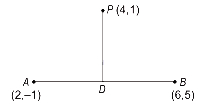
If $A(2,-1)$ and $B(6,5)$ are two points,the ratio in which the foot of the perpendicular from $P(4,1)$ to $AB$ divides $AB$ is:
A
$8: 15$
B
$5: 8$
C
$-5: 8$
D
$-8: 5$
Solution
(B) Let the line $AB$ pass through $A(2,-1)$ and $B(6,5)$. The slope of $AB$ is $m = \frac{5 - (-1)}{6 - 2} = \frac{6}{4} = \frac{3}{2}$.
The equation of line $AB$ is $y - (-1) = \frac{3}{2}(x - 2)$,which simplifies to $2y + 2 = 3x - 6$,or $3x - 2y - 8 = 0$.
The line $PD$ is perpendicular to $AB$ and passes through $P(4,1)$. The slope of $PD$ is $-\frac{1}{m} = -\frac{2}{3}$.
The equation of $PD$ is $y - 1 = -\frac{2}{3}(x - 4)$,which simplifies to $3y - 3 = -2x + 8$,or $2x + 3y - 11 = 0$.
Let $D$ divide $AB$ in the ratio $k:1$. The coordinates of $D$ are $\left(\frac{6k+2}{k+1}, \frac{5k-1}{k+1}\right)$.
Since $D$ lies on $PD$ $(2x + 3y - 11 = 0)$,we have $2\left(\frac{6k+2}{k+1}\right) + 3\left(\frac{5k-1}{k+1}\right) - 11 = 0$.
$12k + 4 + 15k - 3 - 11(k + 1) = 0$.
$27k + 1 - 11k - 11 = 0$.
$16k - 10 = 0 \Rightarrow k = \frac{10}{16} = \frac{5}{8}$.
Thus,the ratio is $5:8$.
The equation of line $AB$ is $y - (-1) = \frac{3}{2}(x - 2)$,which simplifies to $2y + 2 = 3x - 6$,or $3x - 2y - 8 = 0$.
The line $PD$ is perpendicular to $AB$ and passes through $P(4,1)$. The slope of $PD$ is $-\frac{1}{m} = -\frac{2}{3}$.
The equation of $PD$ is $y - 1 = -\frac{2}{3}(x - 4)$,which simplifies to $3y - 3 = -2x + 8$,or $2x + 3y - 11 = 0$.
Let $D$ divide $AB$ in the ratio $k:1$. The coordinates of $D$ are $\left(\frac{6k+2}{k+1}, \frac{5k-1}{k+1}\right)$.
Since $D$ lies on $PD$ $(2x + 3y - 11 = 0)$,we have $2\left(\frac{6k+2}{k+1}\right) + 3\left(\frac{5k-1}{k+1}\right) - 11 = 0$.
$12k + 4 + 15k - 3 - 11(k + 1) = 0$.
$27k + 1 - 11k - 11 = 0$.
$16k - 10 = 0 \Rightarrow k = \frac{10}{16} = \frac{5}{8}$.
Thus,the ratio is $5:8$.
0 likesView Solution
64
ChemistryMCQAP EAMCET · 2007
If the lines $x^2+2xy-35y^2-4x+44y-12=0$ and $5x+\lambda y-8=0$ are concurrent,then $\lambda$ equals
A
$0$
B
$1$
C
$-1$
D
$2$
Solution
(D) The given equation of the pair of lines is $x^2+2xy-35y^2-4x+44y-12=0$.
Factoring the quadratic expression,we get $(x+7y-6)(x-5y+2)=0$.
This represents two lines: $L_1: x+7y-6=0$ and $L_2: x-5y+2=0$.
The third line is $L_3: 5x+\lambda y-8=0$.
For the three lines to be concurrent,the determinant of their coefficients must be zero:
$\begin{vmatrix} 1 & 7 & -6 \\ 1 & -5 & 2 \\ 5 & \lambda & -8 \end{vmatrix} = 0$
Expanding the determinant:
$1(40-2\lambda) - 7(-8-10) - 6(\lambda+25) = 0$
$40 - 2\lambda + 126 - 6\lambda - 150 = 0$
$16 - 8\lambda = 0$
$8\lambda = 16$
$\lambda = 2$
Factoring the quadratic expression,we get $(x+7y-6)(x-5y+2)=0$.
This represents two lines: $L_1: x+7y-6=0$ and $L_2: x-5y+2=0$.
The third line is $L_3: 5x+\lambda y-8=0$.
For the three lines to be concurrent,the determinant of their coefficients must be zero:
$\begin{vmatrix} 1 & 7 & -6 \\ 1 & -5 & 2 \\ 5 & \lambda & -8 \end{vmatrix} = 0$
Expanding the determinant:
$1(40-2\lambda) - 7(-8-10) - 6(\lambda+25) = 0$
$40 - 2\lambda + 126 - 6\lambda - 150 = 0$
$16 - 8\lambda = 0$
$8\lambda = 16$
$\lambda = 2$
0 likesView Solution
65
ChemistryMCQAP EAMCET · 2007
In order to eliminate the first degree terms from the equation $2x^2+4xy+5y^2-4x-22y+7=0$,the point to which the origin is to be shifted is
A
$(1, -3)$
B
$(2, 3)$
C
$(-2, 3)$
D
$(1, 3)$
Solution
(C) The given equation is $2x^2+4xy+5y^2-4x-22y+7=0$.
Comparing this with the general second-degree equation $ax^2+2hxy+by^2+2gx+2fy+c=0$,we get $a=2, h=2, b=5, g=-2, f=-11, c=7$.
To eliminate the first-degree terms,the origin $(0,0)$ must be shifted to the point $(h', k')$ given by the intersection of the partial derivatives $\frac{\partial f}{\partial x} = 0$ and $\frac{\partial f}{\partial y} = 0$.
$\frac{\partial f}{\partial x} = 4x+4y-4 = 0 \implies x+y=1$
$\frac{\partial f}{\partial y} = 4x+10y-22 = 0 \implies 2x+5y=11$
Solving these equations:
From the first equation,$x = 1-y$.
Substituting into the second: $2(1-y)+5y=11 \implies 2-2y+5y=11 \implies 3y=9 \implies y=3$.
Then $x = 1-3 = -2$.
Thus,the origin is shifted to $(-2, 3)$.
Comparing this with the general second-degree equation $ax^2+2hxy+by^2+2gx+2fy+c=0$,we get $a=2, h=2, b=5, g=-2, f=-11, c=7$.
To eliminate the first-degree terms,the origin $(0,0)$ must be shifted to the point $(h', k')$ given by the intersection of the partial derivatives $\frac{\partial f}{\partial x} = 0$ and $\frac{\partial f}{\partial y} = 0$.
$\frac{\partial f}{\partial x} = 4x+4y-4 = 0 \implies x+y=1$
$\frac{\partial f}{\partial y} = 4x+10y-22 = 0 \implies 2x+5y=11$
Solving these equations:
From the first equation,$x = 1-y$.
Substituting into the second: $2(1-y)+5y=11 \implies 2-2y+5y=11 \implies 3y=9 \implies y=3$.
Then $x = 1-3 = -2$.
Thus,the origin is shifted to $(-2, 3)$.
0 likesView Solution
66
ChemistryMCQAP EAMCET · 2007
In order to eliminate the first degree terms from the equation $2x^2 + 4xy + 5y^2 - 4x - 22y + 7 = 0$,the point to which the origin is to be shifted is:
A
$(1, -3)$
B
$(2, 3)$
C
$(-2, 3)$
D
$(1, 3)$
Solution
(C) The given equation is $2x^2 + 4xy + 5y^2 - 4x - 22y + 7 = 0$.
Comparing this with the general second-degree equation $ax^2 + 2hxy + by^2 + 2gx + 2fy + c = 0$,we get $a = 2, h = 2, b = 5, g = -2, f = -11, c = 7$.
To eliminate the first-degree terms,the origin $(0, 0)$ must be shifted to the point $(h_0, k_0)$ given by the intersection of the partial derivatives $\frac{\partial f}{\partial x} = 0$ and $\frac{\partial f}{\partial y} = 0$.
These are given by the formulas:
$h_0 = \frac{hf - bg}{ab - h^2} = \frac{(2)(-11) - (5)(-2)}{(2)(5) - (2)^2} = \frac{-22 + 10}{10 - 4} = \frac{-12}{6} = -2$
$k_0 = \frac{gh - af}{ab - h^2} = \frac{(-2)(2) - (2)(-11)}{(2)(5) - (2)^2} = \frac{-4 + 22}{10 - 4} = \frac{18}{6} = 3$
Thus,the origin should be shifted to the point $(-2, 3)$.
Comparing this with the general second-degree equation $ax^2 + 2hxy + by^2 + 2gx + 2fy + c = 0$,we get $a = 2, h = 2, b = 5, g = -2, f = -11, c = 7$.
To eliminate the first-degree terms,the origin $(0, 0)$ must be shifted to the point $(h_0, k_0)$ given by the intersection of the partial derivatives $\frac{\partial f}{\partial x} = 0$ and $\frac{\partial f}{\partial y} = 0$.
These are given by the formulas:
$h_0 = \frac{hf - bg}{ab - h^2} = \frac{(2)(-11) - (5)(-2)}{(2)(5) - (2)^2} = \frac{-22 + 10}{10 - 4} = \frac{-12}{6} = -2$
$k_0 = \frac{gh - af}{ab - h^2} = \frac{(-2)(2) - (2)(-11)}{(2)(5) - (2)^2} = \frac{-4 + 22}{10 - 4} = \frac{18}{6} = 3$
Thus,the origin should be shifted to the point $(-2, 3)$.
0 likesView Solution
67
ChemistryMCQAP EAMCET · 2007
If the lines $x^2+2xy-35y^2-4x+44y-12=0$ and $5x+\lambda y-8=0$ are concurrent,then the value of $\lambda$ is
A
$0$
B
$1$
C
$-1$
D
$2$
Solution
(D) The given equation of the pair of lines is $x^2+2xy-35y^2-4x+44y-12=0$.
Comparing this with the general form $ax^2+2hxy+by^2+2gx+2fy+c=0$,we get $a=1, h=1, b=-35, g=-2, f=22, c=-12$.
The point of intersection $(x_0, y_0)$ of the pair of lines is given by the formula:
$x_0 = \frac{hf-bg}{ab-h^2} = \frac{(1)(22)-(-35)(-2)}{(1)(-35)-(1)^2} = \frac{22-70}{-35-1} = \frac{-48}{-36} = \frac{4}{3}$
$y_0 = \frac{gh-af}{ab-h^2} = \frac{(-2)(1)-(1)(22)}{(1)(-35)-(1)^2} = \frac{-2-22}{-36} = \frac{-24}{-36} = \frac{2}{3}$
Since the lines are concurrent,the point $(\frac{4}{3}, \frac{2}{3})$ must satisfy the line $5x+\lambda y-8=0$.
$5(\frac{4}{3}) + \lambda(\frac{2}{3}) - 8 = 0$
$\frac{20}{3} + \frac{2\lambda}{3} - 8 = 0$
Multiply by $3$: $20 + 2\lambda - 24 = 0$
$2\lambda - 4 = 0$
$2\lambda = 4$
$\lambda = 2$
Comparing this with the general form $ax^2+2hxy+by^2+2gx+2fy+c=0$,we get $a=1, h=1, b=-35, g=-2, f=22, c=-12$.
The point of intersection $(x_0, y_0)$ of the pair of lines is given by the formula:
$x_0 = \frac{hf-bg}{ab-h^2} = \frac{(1)(22)-(-35)(-2)}{(1)(-35)-(1)^2} = \frac{22-70}{-35-1} = \frac{-48}{-36} = \frac{4}{3}$
$y_0 = \frac{gh-af}{ab-h^2} = \frac{(-2)(1)-(1)(22)}{(1)(-35)-(1)^2} = \frac{-2-22}{-36} = \frac{-24}{-36} = \frac{2}{3}$
Since the lines are concurrent,the point $(\frac{4}{3}, \frac{2}{3})$ must satisfy the line $5x+\lambda y-8=0$.
$5(\frac{4}{3}) + \lambda(\frac{2}{3}) - 8 = 0$
$\frac{20}{3} + \frac{2\lambda}{3} - 8 = 0$
Multiply by $3$: $20 + 2\lambda - 24 = 0$
$2\lambda - 4 = 0$
$2\lambda = 4$
$\lambda = 2$
0 likesView Solution
68
ChemistryMCQAP EAMCET · 2007
The angle between the pair of straight lines formed by joining the points of intersection of $x^2+y^2=4$ and $y=3x+c$ to the origin is a right angle. Then $c^2$ is equal to
A
$20$
B
$13$
C
$1/5$
D
$5$
Solution
(A) The equation of the circle is $x^2+y^2=4$ and the line is $y=3x+c$,which can be written as $\frac{y-3x}{c}=1$.
To find the equation of the pair of lines joining the origin to the intersection points,we homogenize the circle equation:
$x^2+y^2=4(1)^2$
$x^2+y^2=4\left(\frac{y-3x}{c}\right)^2$
$c^2(x^2+y^2)=4(y^2+9x^2-6xy)$
$c^2x^2+c^2y^2=4y^2+36x^2-24xy$
$(c^2-36)x^2+24xy+(c^2-4)y^2=0$
Since the lines are perpendicular,the sum of the coefficients of $x^2$ and $y^2$ must be zero:
$(c^2-36)+(c^2-4)=0$
$2c^2-40=0$
$2c^2=40$
$c^2=20$
To find the equation of the pair of lines joining the origin to the intersection points,we homogenize the circle equation:
$x^2+y^2=4(1)^2$
$x^2+y^2=4\left(\frac{y-3x}{c}\right)^2$
$c^2(x^2+y^2)=4(y^2+9x^2-6xy)$
$c^2x^2+c^2y^2=4y^2+36x^2-24xy$
$(c^2-36)x^2+24xy+(c^2-4)y^2=0$
Since the lines are perpendicular,the sum of the coefficients of $x^2$ and $y^2$ must be zero:
$(c^2-36)+(c^2-4)=0$
$2c^2-40=0$
$2c^2=40$
$c^2=20$
0 likesView Solution
69
ChemistryMCQAP EAMCET · 2007
The angle between the pair of straight lines formed by joining the points of intersection of $x^2+y^2=4$ and $y=3x+c$ to the origin is a right angle. Then $c^2$ is equal to
A
$20$
B
$13$
C
$1/5$
D
$5$
Solution
(A) The equation of the circle is $x^2+y^2=4$ and the line is $y=3x+c$,which can be written as $\frac{y-3x}{c}=1$.
Homogenizing the equation of the circle using the line equation:
$x^2+y^2=4\left(\frac{y-3x}{c}\right)^2$
$c^2(x^2+y^2)=4(y^2+9x^2-6xy)$
$c^2x^2+c^2y^2=4y^2+36x^2-24xy$
$(c^2-36)x^2+24xy+(c^2-4)y^2=0$
Since the lines are perpendicular,the sum of the coefficients of $x^2$ and $y^2$ must be zero:
$(c^2-36)+(c^2-4)=0$
$2c^2-40=0$
$2c^2=40$
$c^2=20$
Homogenizing the equation of the circle using the line equation:
$x^2+y^2=4\left(\frac{y-3x}{c}\right)^2$
$c^2(x^2+y^2)=4(y^2+9x^2-6xy)$
$c^2x^2+c^2y^2=4y^2+36x^2-24xy$
$(c^2-36)x^2+24xy+(c^2-4)y^2=0$
Since the lines are perpendicular,the sum of the coefficients of $x^2$ and $y^2$ must be zero:
$(c^2-36)+(c^2-4)=0$
$2c^2-40=0$
$2c^2=40$
$c^2=20$
0 likesView Solution
70
ChemistryMCQAP EAMCET · 2007
The equation of the circle of radius $3$ that lies in the fourth quadrant and touches the lines $x=0$ and $y=0$ is
A
$x^2+y^2-6x+6y+9=0$
B
$x^2+y^2-6x-6y+9=0$
C
$x^2+y^2+6x-6y+9=0$
D
$x^2+y^2+6x+6y+9=0$
Solution
(A) Given,radius $r = 3$.
Since the circle lies in the fourth quadrant and touches both coordinate axes ($x=0$ and $y=0$),its center must be at $(3, -3)$.
The standard equation of a circle is $(x-h)^2 + (y-k)^2 = r^2$.
Substituting $h=3$,$k=-3$,and $r=3$:
$(x-3)^2 + (y-(-3))^2 = 3^2$
$(x-3)^2 + (y+3)^2 = 9$
$x^2 - 6x + 9 + y^2 + 6y + 9 = 9$
$x^2 + y^2 - 6x + 6y + 9 = 0$.
Since the circle lies in the fourth quadrant and touches both coordinate axes ($x=0$ and $y=0$),its center must be at $(3, -3)$.
The standard equation of a circle is $(x-h)^2 + (y-k)^2 = r^2$.
Substituting $h=3$,$k=-3$,and $r=3$:
$(x-3)^2 + (y-(-3))^2 = 3^2$
$(x-3)^2 + (y+3)^2 = 9$
$x^2 - 6x + 9 + y^2 + 6y + 9 = 9$
$x^2 + y^2 - 6x + 6y + 9 = 0$.
0 likesView Solution
71
ChemistryMCQAP EAMCET · 2007
The inverse point of $(1,2)$ with respect to the circle $x^2+y^2-4x-6y+9=0$ is
A
$(0,0)$
B
$(1,0)$
C
$(0,1)$
D
$(1,1)$
Solution
(C) The inverse point of $P(x_1, y_1)$ with respect to a circle $S=0$ is the foot of the perpendicular from the center of the circle to the polar of $P$ with respect to the circle,or more generally,the point $P'$ such that $P, P'$ are collinear with the center and $CP \cdot CP' = r^2$.
Given circle: $x^2+y^2-4x-6y+9=0$. Center $C = (2,3)$,radius $r = \sqrt{2^2+3^2-9} = \sqrt{4+9-9} = 2$.
Polar of $P(1,2)$ w.r.t. the circle is $x(1)+y(2)-2(x+1)-3(y+2)+9=0$.
Simplifying: $x+2y-2x-2-3y-6+9=0$ $\Rightarrow -x-y+1=0$ $\Rightarrow x+y-1=0$.
The inverse point $P'(x', y')$ lies on the line $CP$ and satisfies $CP \cdot CP' = r^2$.
Line $CP$ passes through $(2,3)$ and $(1,2)$,so its equation is $y-3 = \frac{2-3}{1-2}(x-2)$ $\Rightarrow y-3 = x-2$ $\Rightarrow y=x+1$.
Intersection of $x+y-1=0$ and $y=x+1$: $x+(x+1)-1=0$ $\Rightarrow 2x=0$ $\Rightarrow x=0, y=1$.
Thus,the inverse point is $(0,1)$.
Given circle: $x^2+y^2-4x-6y+9=0$. Center $C = (2,3)$,radius $r = \sqrt{2^2+3^2-9} = \sqrt{4+9-9} = 2$.
Polar of $P(1,2)$ w.r.t. the circle is $x(1)+y(2)-2(x+1)-3(y+2)+9=0$.
Simplifying: $x+2y-2x-2-3y-6+9=0$ $\Rightarrow -x-y+1=0$ $\Rightarrow x+y-1=0$.
The inverse point $P'(x', y')$ lies on the line $CP$ and satisfies $CP \cdot CP' = r^2$.
Line $CP$ passes through $(2,3)$ and $(1,2)$,so its equation is $y-3 = \frac{2-3}{1-2}(x-2)$ $\Rightarrow y-3 = x-2$ $\Rightarrow y=x+1$.
Intersection of $x+y-1=0$ and $y=x+1$: $x+(x+1)-1=0$ $\Rightarrow 2x=0$ $\Rightarrow x=0, y=1$.
Thus,the inverse point is $(0,1)$.
0 likesView Solution
72
ChemistryMCQAP EAMCET · 2007
The condition for the coaxial system $x^2+y^2+2\lambda x+c=0$,where $\lambda$ is a parameter and $c$ is a constant,to have distinct limiting points,is
A
$c=0$
B
$c < 0$
C
$c=-1$
D
$c>0$
Solution
(D) The general equation of a coaxial system of circles is given by $x^2+y^2+2\lambda x+c=0$.
Limiting points are the centers of the circles of radius zero in the system.
Setting the radius $r = \sqrt{g^2+f^2-c} = 0$,we get $\sqrt{\lambda^2-c} = 0$,which implies $\lambda^2 = c$.
For the limiting points to be distinct and real,we must have $\lambda^2 > 0$,which implies $c > 0$.
Thus,the condition for the system to have distinct limiting points is $c > 0$.
Limiting points are the centers of the circles of radius zero in the system.
Setting the radius $r = \sqrt{g^2+f^2-c} = 0$,we get $\sqrt{\lambda^2-c} = 0$,which implies $\lambda^2 = c$.
For the limiting points to be distinct and real,we must have $\lambda^2 > 0$,which implies $c > 0$.
Thus,the condition for the system to have distinct limiting points is $c > 0$.
0 likesView Solution
73
ChemistryMCQAP EAMCET · 2007
For the parabola $y^2+6y-2x+5=0$:
$(I)$ The vertex is $(-2,-3)$
$(II)$ The directrix is $y+3=0$
Which of the following is correct?
$(I)$ The vertex is $(-2,-3)$
$(II)$ The directrix is $y+3=0$
Which of the following is correct?
A
Both $I$ and $II$ are true
B
$I$ is true,$II$ is false
C
$I$ is false,$II$ is true
D
Both $I$ and $II$ are false
Solution
(B) Given equation of the parabola is $y^2+6y-2x+5=0$.
Completing the square for $y$:
$y^2+6y+9-9-2x+5=0$
$(y+3)^2-4-2x=0$
$(y+3)^2=2(x+2)$.
Comparing this with the standard form $(y-k)^2=4a(x-h)$,we get:
Vertex $(h, k) = (-2, -3)$. Thus,statement $(I)$ is true.
Here,$4a=2$,so $a=\frac{1}{2}$.
The directrix of the parabola $(y-k)^2=4a(x-h)$ is given by $x=h-a$.
$x = -2 - \frac{1}{2} = -\frac{5}{2}$.
$2x+5=0$. Thus,statement $(II)$ is false.
Therefore,$I$ is true and $II$ is false.
Completing the square for $y$:
$y^2+6y+9-9-2x+5=0$
$(y+3)^2-4-2x=0$
$(y+3)^2=2(x+2)$.
Comparing this with the standard form $(y-k)^2=4a(x-h)$,we get:
Vertex $(h, k) = (-2, -3)$. Thus,statement $(I)$ is true.
Here,$4a=2$,so $a=\frac{1}{2}$.
The directrix of the parabola $(y-k)^2=4a(x-h)$ is given by $x=h-a$.
$x = -2 - \frac{1}{2} = -\frac{5}{2}$.
$2x+5=0$. Thus,statement $(II)$ is false.
Therefore,$I$ is true and $II$ is false.
0 likesView Solution
74
ChemistryMCQAP EAMCET · 2007
The coefficient of $x^k$ in the expansion of $\frac{1-2x-x^2}{e^{-x}}$ is
A
$\frac{1-k-k^2}{k!}$
B
$\frac{k^2+1}{k!}$
C
$\frac{1-k}{k!}$
D
$\frac{1}{k!}$
Solution
(A) We have $\frac{1-2x-x^2}{e^{-x}} = (1-2x-x^2)e^x$.
Expanding $e^x$ as $\sum_{n=0}^{\infty} \frac{x^n}{n!}$,we get:
$(1-2x-x^2) \sum_{n=0}^{\infty} \frac{x^n}{n!} = \sum_{n=0}^{\infty} \frac{x^n}{n!} - 2 \sum_{n=0}^{\infty} \frac{x^{n+1}}{n!} - \sum_{n=0}^{\infty} \frac{x^{n+2}}{n!}$.
To find the coefficient of $x^k$,we look at the terms where the power of $x$ is $k$:
$1$. From $\sum \frac{x^n}{n!}$,the coefficient is $\frac{1}{k!}$.
$2$. From $-2 \sum \frac{x^{n+1}}{n!}$,we set $n+1=k \implies n=k-1$,so the coefficient is $-\frac{2}{(k-1)!}$.
$3$. From $-\sum \frac{x^{n+2}}{n!}$,we set $n+2=k \implies n=k-2$,so the coefficient is $-\frac{1}{(k-2)!}$.
Summing these,the coefficient of $x^k$ is $\frac{1}{k!} - \frac{2}{(k-1)!} - \frac{1}{(k-2)!}$.
Multiplying the terms to have a common denominator $k!$:
$\frac{1}{k!} - \frac{2k}{k!} - \frac{k(k-1)}{k!} = \frac{1-2k-(k^2-k)}{k!} = \frac{1-2k-k^2+k}{k!} = \frac{1-k-k^2}{k!}$.
Expanding $e^x$ as $\sum_{n=0}^{\infty} \frac{x^n}{n!}$,we get:
$(1-2x-x^2) \sum_{n=0}^{\infty} \frac{x^n}{n!} = \sum_{n=0}^{\infty} \frac{x^n}{n!} - 2 \sum_{n=0}^{\infty} \frac{x^{n+1}}{n!} - \sum_{n=0}^{\infty} \frac{x^{n+2}}{n!}$.
To find the coefficient of $x^k$,we look at the terms where the power of $x$ is $k$:
$1$. From $\sum \frac{x^n}{n!}$,the coefficient is $\frac{1}{k!}$.
$2$. From $-2 \sum \frac{x^{n+1}}{n!}$,we set $n+1=k \implies n=k-1$,so the coefficient is $-\frac{2}{(k-1)!}$.
$3$. From $-\sum \frac{x^{n+2}}{n!}$,we set $n+2=k \implies n=k-2$,so the coefficient is $-\frac{1}{(k-2)!}$.
Summing these,the coefficient of $x^k$ is $\frac{1}{k!} - \frac{2}{(k-1)!} - \frac{1}{(k-2)!}$.
Multiplying the terms to have a common denominator $k!$:
$\frac{1}{k!} - \frac{2k}{k!} - \frac{k(k-1)}{k!} = \frac{1-2k-(k^2-k)}{k!} = \frac{1-2k-k^2+k}{k!} = \frac{1-k-k^2}{k!}$.
0 likesView Solution
75
ChemistryMCQAP EAMCET · 2007
If $a_k$ is the coefficient of $x^k$ in the expansion of $(1+x+x^2)^n$ for $k=0, 1, 2, \ldots, 2n$,then $a_1+2a_2+3a_3+\ldots+2na_{2n}$ is equal to
A
$-a_0$
B
$3^n$
C
$n \cdot 3^{n+1}$
D
$n \cdot 3^n$
Solution
(D) We have,$(1+x+x^2)^n = a_0 + a_1x + a_2x^2 + a_3x^3 + \ldots + a_{2n}x^{2n}$.
On differentiating both sides with respect to $x$,we get:
$n(1+x+x^2)^{n-1}(1+2x) = a_1 + 2a_2x + 3a_3x^2 + \ldots + 2na_{2n}x^{2n-1}$.
Now,putting $x=1$ in the above equation,we get:
$n(1+1+1)^{n-1}(1+2(1)) = a_1 + 2a_2 + 3a_3 + \ldots + 2na_{2n}$.
$n(3)^{n-1}(3) = a_1 + 2a_2 + 3a_3 + \ldots + 2na_{2n}$.
Therefore,$a_1 + 2a_2 + 3a_3 + \ldots + 2na_{2n} = n \cdot 3^n$.
On differentiating both sides with respect to $x$,we get:
$n(1+x+x^2)^{n-1}(1+2x) = a_1 + 2a_2x + 3a_3x^2 + \ldots + 2na_{2n}x^{2n-1}$.
Now,putting $x=1$ in the above equation,we get:
$n(1+1+1)^{n-1}(1+2(1)) = a_1 + 2a_2 + 3a_3 + \ldots + 2na_{2n}$.
$n(3)^{n-1}(3) = a_1 + 2a_2 + 3a_3 + \ldots + 2na_{2n}$.
Therefore,$a_1 + 2a_2 + 3a_3 + \ldots + 2na_{2n} = n \cdot 3^n$.
0 likesView Solution
76
ChemistryMCQAP EAMCET · 2007
The value of $k$,if $(1,2)$ and $(k,-1)$ are conjugate points with respect to the ellipse $2x^2 + 3y^2 = 6$ is:
A
$2$
B
$4$
C
$6$
D
$8$
Solution
(C) The given equation of the ellipse is $2x^2 + 3y^2 = 6$,which can be written as $\frac{x^2}{3} + \frac{y^2}{2} = 1$.
Two points $(x_1, y_1)$ and $(x_2, y_2)$ are conjugate with respect to the ellipse $\frac{x^2}{a^2} + \frac{y^2}{b^2} = 1$ if $\frac{x_1 x_2}{a^2} + \frac{y_1 y_2}{b^2} = 1$.
Here,$(x_1, y_1) = (1, 2)$,$(x_2, y_2) = (k, -1)$,$a^2 = 3$,and $b^2 = 2$.
Substituting these values into the condition:
$\frac{(1)(k)}{3} + \frac{(2)(-1)}{2} = 1$
$\frac{k}{3} - 1 = 1$
$\frac{k}{3} = 2$
$k = 6$.
Two points $(x_1, y_1)$ and $(x_2, y_2)$ are conjugate with respect to the ellipse $\frac{x^2}{a^2} + \frac{y^2}{b^2} = 1$ if $\frac{x_1 x_2}{a^2} + \frac{y_1 y_2}{b^2} = 1$.
Here,$(x_1, y_1) = (1, 2)$,$(x_2, y_2) = (k, -1)$,$a^2 = 3$,and $b^2 = 2$.
Substituting these values into the condition:
$\frac{(1)(k)}{3} + \frac{(2)(-1)}{2} = 1$
$\frac{k}{3} - 1 = 1$
$\frac{k}{3} = 2$
$k = 6$.
0 likesView Solution
77
ChemistryMCQAP EAMCET · 2007
If the line $lx + my = 1$ is a normal to the hyperbola $\frac{x^2}{a^2} - \frac{y^2}{b^2} = 1$,then $\frac{a^2}{l^2} - \frac{b^2}{m^2}$ is equal to
A
$a^2 - b^2$
B
$a^2 + b^2$
C
$(a^2 + b^2)^2$
D
$(a^2 - b^2)^2$
Solution
(C) The equation of the normal to the hyperbola $\frac{x^2}{a^2} - \frac{y^2}{b^2} = 1$ at the point $(a \sec \theta, b \tan \theta)$ is given by $\frac{ax}{\sec \theta} + \frac{by}{\tan \theta} = a^2 + b^2$.
Comparing this with the given line $lx + my = 1$,we can rewrite the normal equation as $\frac{a \cos \theta}{a^2 + b^2} x + \frac{b \cot \theta}{a^2 + b^2} y = 1$.
Thus,$l = \frac{a \cos \theta}{a^2 + b^2}$ and $m = \frac{b \cot \theta}{a^2 + b^2}$.
Now,$\frac{a^2}{l^2} - \frac{b^2}{m^2} = \frac{a^2 (a^2 + b^2)^2}{a^2 \cos^2 \theta} - \frac{b^2 (a^2 + b^2)^2}{b^2 \cot^2 \theta}$.
$= (a^2 + b^2)^2 (\sec^2 \theta - \tan^2 \theta)$.
Since $\sec^2 \theta - \tan^2 \theta = 1$,we get $\frac{a^2}{l^2} - \frac{b^2}{m^2} = (a^2 + b^2)^2$.
Comparing this with the given line $lx + my = 1$,we can rewrite the normal equation as $\frac{a \cos \theta}{a^2 + b^2} x + \frac{b \cot \theta}{a^2 + b^2} y = 1$.
Thus,$l = \frac{a \cos \theta}{a^2 + b^2}$ and $m = \frac{b \cot \theta}{a^2 + b^2}$.
Now,$\frac{a^2}{l^2} - \frac{b^2}{m^2} = \frac{a^2 (a^2 + b^2)^2}{a^2 \cos^2 \theta} - \frac{b^2 (a^2 + b^2)^2}{b^2 \cot^2 \theta}$.
$= (a^2 + b^2)^2 (\sec^2 \theta - \tan^2 \theta)$.
Since $\sec^2 \theta - \tan^2 \theta = 1$,we get $\frac{a^2}{l^2} - \frac{b^2}{m^2} = (a^2 + b^2)^2$.
0 likesView Solution
78
ChemistryMCQAP EAMCET · 2007
If $f(x) = \begin{cases} \frac{\sin(1+[x])}{[x]}, & \text{for } [x] \neq 0 \\ 0, & \text{for } [x] = 0 \end{cases}$ where $[x]$ denotes the greatest integer not exceeding $x$,then $\lim_{x \rightarrow 0^{-}} f(x)$ is equal to
A
$-1$
B
$0$
C
$1$
D
$2$
Solution
(B) We are given the function $f(x) = \begin{cases} \frac{\sin(1+[x])}{[x]}, & [x] \neq 0 \\ 0, & [x] = 0 \end{cases}$.
To find $\lim_{x \rightarrow 0^{-}} f(x)$,we consider values of $x$ slightly less than $0$.
For $x \in (-1, 0)$,the greatest integer function $[x] = -1$.
Therefore,$\lim_{x \rightarrow 0^{-}} f(x) = \lim_{x \rightarrow 0^{-}} \frac{\sin(1+[x])}{[x]}$.
Substituting $[x] = -1$,we get $\frac{\sin(1-1)}{-1} = \frac{\sin(0)}{-1} = \frac{0}{-1} = 0$.
To find $\lim_{x \rightarrow 0^{-}} f(x)$,we consider values of $x$ slightly less than $0$.
For $x \in (-1, 0)$,the greatest integer function $[x] = -1$.
Therefore,$\lim_{x \rightarrow 0^{-}} f(x) = \lim_{x \rightarrow 0^{-}} \frac{\sin(1+[x])}{[x]}$.
Substituting $[x] = -1$,we get $\frac{\sin(1-1)}{-1} = \frac{\sin(0)}{-1} = \frac{0}{-1} = 0$.
0 likesView Solution
79
ChemistryMCQAP EAMCET · 2007
If $f(x) = \begin{cases} x-5, & \text{for } x \leq 1 \\ 4x^2-9, & \text{for } 1 < x < 2 \\ 3x+4, & \text{for } x \geq 2 \end{cases}$,then $f^{\prime}(2^{+})$ is equal to
A
$0$
B
$2$
C
$3$
D
$4$
Solution
(C) Given,$f(x) = \begin{cases} x-5 & \text{for } x \leq 1 \\ 4x^2-9 & \text{for } 1 < x < 2 \\ 3x+4 & \text{for } x \geq 2 \end{cases}$
To find the right-hand derivative $f^{\prime}(2^{+})$,we use the definition:
$f^{\prime}(2^{+}) = \lim_{h \to 0^{+}} \frac{f(2+h) - f(2)}{h}$
For $x \geq 2$,$f(x) = 3x+4$.
Thus,$f(2) = 3(2) + 4 = 10$.
$f^{\prime}(2^{+}) = \lim_{h \to 0^{+}} \frac{3(2+h) + 4 - 10}{h}$
$= \lim_{h \to 0^{+}} \frac{6 + 3h + 4 - 10}{h}$
$= \lim_{h \to 0^{+}} \frac{3h}{h}$
$= 3$
To find the right-hand derivative $f^{\prime}(2^{+})$,we use the definition:
$f^{\prime}(2^{+}) = \lim_{h \to 0^{+}} \frac{f(2+h) - f(2)}{h}$
For $x \geq 2$,$f(x) = 3x+4$.
Thus,$f(2) = 3(2) + 4 = 10$.
$f^{\prime}(2^{+}) = \lim_{h \to 0^{+}} \frac{3(2+h) + 4 - 10}{h}$
$= \lim_{h \to 0^{+}} \frac{6 + 3h + 4 - 10}{h}$
$= \lim_{h \to 0^{+}} \frac{3h}{h}$
$= 3$
0 likesView Solution
80
ChemistryMCQAP EAMCET · 2007
Which of the following is a biodegradable polymer?
A
Polythene
B
Bakelite
C
$PHBV$
D
$PVC$
Solution
(C) Polyhydroxy butyrate-$co$-$\beta$-hydroxy valerate $(PHBV)$ is a biodegradable polymer.
0 likesView Solution
81
ChemistryMCQAP EAMCET · 2007
If two angles of $\triangle ABC$ are $45^{\circ}$ and $60^{\circ}$,then the ratio of the smallest side to the greatest side is:
A
$(\sqrt{3}-1) : 1$
B
$\sqrt{3} : \sqrt{2}$
C
$1 : \sqrt{3}$
D
$(\sqrt{3}-1) : \sqrt{2}$
Solution
(A) Let the angles of $\triangle ABC$ be $A = 45^{\circ}$,$B = 60^{\circ}$,and $C = 180^{\circ} - (45^{\circ} + 60^{\circ}) = 75^{\circ}$.
Since the side opposite to the smallest angle is the smallest side and the side opposite to the greatest angle is the greatest side,the smallest side is $a$ (opposite to $45^{\circ}$) and the greatest side is $c$ (opposite to $75^{\circ}$).
Using the Sine Rule,$\frac{a}{\sin A} = \frac{c}{\sin C}$,so the ratio $\frac{a}{c} = \frac{\sin 45^{\circ}}{\sin 75^{\circ}}$.
We know $\sin 45^{\circ} = \frac{1}{\sqrt{2}}$ and $\sin 75^{\circ} = \sin(45^{\circ} + 30^{\circ}) = \sin 45^{\circ} \cos 30^{\circ} + \cos 45^{\circ} \sin 30^{\circ} = \frac{1}{\sqrt{2}} \cdot \frac{\sqrt{3}}{2} + \frac{1}{\sqrt{2}} \cdot \frac{1}{2} = \frac{\sqrt{3}+1}{2\sqrt{2}}$.
Therefore,the ratio is $\frac{1/\sqrt{2}}{(\sqrt{3}+1)/(2\sqrt{2})} = \frac{2}{\sqrt{3}+1}$.
Rationalizing the denominator: $\frac{2(\sqrt{3}-1)}{(\sqrt{3}+1)(\sqrt{3}-1)} = \frac{2(\sqrt{3}-1)}{3-1} = \frac{2(\sqrt{3}-1)}{2} = \sqrt{3}-1$.
Thus,the ratio is $(\sqrt{3}-1) : 1$.
Since the side opposite to the smallest angle is the smallest side and the side opposite to the greatest angle is the greatest side,the smallest side is $a$ (opposite to $45^{\circ}$) and the greatest side is $c$ (opposite to $75^{\circ}$).
Using the Sine Rule,$\frac{a}{\sin A} = \frac{c}{\sin C}$,so the ratio $\frac{a}{c} = \frac{\sin 45^{\circ}}{\sin 75^{\circ}}$.
We know $\sin 45^{\circ} = \frac{1}{\sqrt{2}}$ and $\sin 75^{\circ} = \sin(45^{\circ} + 30^{\circ}) = \sin 45^{\circ} \cos 30^{\circ} + \cos 45^{\circ} \sin 30^{\circ} = \frac{1}{\sqrt{2}} \cdot \frac{\sqrt{3}}{2} + \frac{1}{\sqrt{2}} \cdot \frac{1}{2} = \frac{\sqrt{3}+1}{2\sqrt{2}}$.
Therefore,the ratio is $\frac{1/\sqrt{2}}{(\sqrt{3}+1)/(2\sqrt{2})} = \frac{2}{\sqrt{3}+1}$.
Rationalizing the denominator: $\frac{2(\sqrt{3}-1)}{(\sqrt{3}+1)(\sqrt{3}-1)} = \frac{2(\sqrt{3}-1)}{3-1} = \frac{2(\sqrt{3}-1)}{2} = \sqrt{3}-1$.
Thus,the ratio is $(\sqrt{3}-1) : 1$.
0 likesView Solution
82
ChemistryMCQAP EAMCET · 2007
In $\triangle ABC$,$(a+b+c)\left(\tan \frac{A}{2}+\tan \frac{B}{2}\right)$ is equal to
A
$2c \cot \frac{C}{2}$
B
$2a \cot \frac{A}{2}$
C
$2b \cot \frac{B}{2}$
D
$\tan \frac{C}{2}$
Solution
(A) We know that $a+b+c = 2s$,where $s$ is the semi-perimeter of the triangle.
Using the identity $\tan \frac{A}{2} = \frac{\Delta}{s(s-a)}$ is incorrect; the correct identity is $\tan \frac{A}{2} = \sqrt{\frac{(s-b)(s-c)}{s(s-a)}}$.
However,a simpler approach is using $\tan \frac{A}{2} = \frac{r}{s-a}$.
Thus,$(a+b+c)\left(\tan \frac{A}{2}+\tan \frac{B}{2}\right) = 2s \left(\frac{r}{s-a} + \frac{r}{s-b}\right)$.
$= 2sr \left(\frac{s-b+s-a}{(s-a)(s-b)}\right) = 2sr \left(\frac{c}{(s-a)(s-b)}\right)$.
Since $r = \sqrt{\frac{(s-a)(s-b)(s-c)}{s}}$,we have $r^2 = \frac{(s-a)(s-b)(s-c)}{s}$.
Substituting this,the expression simplifies to $2c \cot \frac{C}{2}$.
Using the identity $\tan \frac{A}{2} = \frac{\Delta}{s(s-a)}$ is incorrect; the correct identity is $\tan \frac{A}{2} = \sqrt{\frac{(s-b)(s-c)}{s(s-a)}}$.
However,a simpler approach is using $\tan \frac{A}{2} = \frac{r}{s-a}$.
Thus,$(a+b+c)\left(\tan \frac{A}{2}+\tan \frac{B}{2}\right) = 2s \left(\frac{r}{s-a} + \frac{r}{s-b}\right)$.
$= 2sr \left(\frac{s-b+s-a}{(s-a)(s-b)}\right) = 2sr \left(\frac{c}{(s-a)(s-b)}\right)$.
Since $r = \sqrt{\frac{(s-a)(s-b)(s-c)}{s}}$,we have $r^2 = \frac{(s-a)(s-b)(s-c)}{s}$.
Substituting this,the expression simplifies to $2c \cot \frac{C}{2}$.
0 likesView Solution
83
ChemistryMCQAP EAMCET · 2007
In $\triangle ABC$,with usual notation,observe the two statements given below:
$(I)$ $r r_1 r_2 r_3 = \Delta^2$
$(II)$ $r_1 r_2 + r_2 r_3 + r_3 r_1 = s^2$
Which of the following is correct?
$(I)$ $r r_1 r_2 r_3 = \Delta^2$
$(II)$ $r_1 r_2 + r_2 r_3 + r_3 r_1 = s^2$
Which of the following is correct?
A
Both $I$ and $II$ are true
B
$I$ is true,$II$ is false
C
$I$ is false,$II$ is true
D
Both $I$ and $II$ are false
Solution
(A) We know the standard properties of a triangle where $\Delta$ is the area,$s$ is the semi-perimeter,and $r, r_1, r_2, r_3$ are the inradius and exradii respectively.
For statement $(I)$: The product of the inradius and the three exradii is given by $r r_1 r_2 r_3 = \frac{\Delta}{s} \cdot \frac{\Delta}{s-a} \cdot \frac{\Delta}{s-b} \cdot \frac{\Delta}{s-c} = \frac{\Delta^4}{s(s-a)(s-b)(s-c)}$. Since $\Delta^2 = s(s-a)(s-b)(s-c)$,we have $r r_1 r_2 r_3 = \frac{\Delta^4}{\Delta^2} = \Delta^2$. Thus,$(I)$ is true.
For statement $(II)$: The sum of the products of the exradii taken two at a time is $r_1 r_2 + r_2 r_3 + r_3 r_1 = s^2$. This is a standard identity in triangle geometry. Thus,$(II)$ is true.
Therefore,both statements are true.
For statement $(I)$: The product of the inradius and the three exradii is given by $r r_1 r_2 r_3 = \frac{\Delta}{s} \cdot \frac{\Delta}{s-a} \cdot \frac{\Delta}{s-b} \cdot \frac{\Delta}{s-c} = \frac{\Delta^4}{s(s-a)(s-b)(s-c)}$. Since $\Delta^2 = s(s-a)(s-b)(s-c)$,we have $r r_1 r_2 r_3 = \frac{\Delta^4}{\Delta^2} = \Delta^2$. Thus,$(I)$ is true.
For statement $(II)$: The sum of the products of the exradii taken two at a time is $r_1 r_2 + r_2 r_3 + r_3 r_1 = s^2$. This is a standard identity in triangle geometry. Thus,$(II)$ is true.
Therefore,both statements are true.
0 likesView Solution
84
ChemistryMCQAP EAMCET · 2007
If $A$ is a square matrix such that $A(\operatorname{adj} A) = \begin{bmatrix} 4 & 0 & 0 \\ 0 & 4 & 0 \\ 0 & 0 & 4 \end{bmatrix}$,then $\operatorname{det}(\operatorname{adj} A)$ is equal to
A
$4$
B
$16$
C
$64$
D
$256$
Solution
(B) Given $A(\operatorname{adj} A) = \begin{bmatrix} 4 & 0 & 0 \\ 0 & 4 & 0 \\ 0 & 0 & 4 \end{bmatrix}$.
Taking the determinant on both sides,we get $|A(\operatorname{adj} A)| = \begin{vmatrix} 4 & 0 & 0 \\ 0 & 4 & 0 \\ 0 & 0 & 4 \end{vmatrix}$.
Using the property $|AB| = |A||B|$,we have $|A| |\operatorname{adj} A| = 4^3 = 64$.
We know that $|\operatorname{adj} A| = |A|^{n-1}$,where $n$ is the order of the matrix. Here $n = 3$,so $|\operatorname{adj} A| = |A|^{3-1} = |A|^2$.
Substituting this into the equation,we get $|A| \cdot |A|^2 = 64$,which implies $|A|^3 = 64$.
Thus,$|A| = 4$.
Finally,$|\operatorname{adj} A| = |A|^2 = 4^2 = 16$.
Taking the determinant on both sides,we get $|A(\operatorname{adj} A)| = \begin{vmatrix} 4 & 0 & 0 \\ 0 & 4 & 0 \\ 0 & 0 & 4 \end{vmatrix}$.
Using the property $|AB| = |A||B|$,we have $|A| |\operatorname{adj} A| = 4^3 = 64$.
We know that $|\operatorname{adj} A| = |A|^{n-1}$,where $n$ is the order of the matrix. Here $n = 3$,so $|\operatorname{adj} A| = |A|^{3-1} = |A|^2$.
Substituting this into the equation,we get $|A| \cdot |A|^2 = 64$,which implies $|A|^3 = 64$.
Thus,$|A| = 4$.
Finally,$|\operatorname{adj} A| = |A|^2 = 4^2 = 16$.
0 likesView Solution
85
ChemistryMCQAP EAMCET · 2007
The number of non-trivial solutions of the system $x-y+z=0, x+2y-z=0, 2x+y+3z=0$ is
A
$0$
B
$1$
C
$2$
D
$3$
Solution
(A) The given system of linear equations is homogeneous,which can be written in matrix form $AX = O$ as:
$\begin{bmatrix} 1 & -1 & 1 \\ 1 & 2 & -1 \\ 2 & 1 & 3 \end{bmatrix} \begin{bmatrix} x \\ y \\ z \end{bmatrix} = \begin{bmatrix} 0 \\ 0 \\ 0 \end{bmatrix}$
For a homogeneous system $AX = O$,non-trivial solutions exist if and only if the determinant of the coefficient matrix $A$ is zero,i.e.,$|A| = 0$.
Let us calculate the determinant $|A|$:
$|A| = \begin{vmatrix} 1 & -1 & 1 \\ 1 & 2 & -1 \\ 2 & 1 & 3 \end{vmatrix}$
$|A| = 1(2 \times 3 - (-1) \times 1) - (-1)(1 \times 3 - (-1) \times 2) + 1(1 \times 1 - 2 \times 2)$
$|A| = 1(6 + 1) + 1(3 + 2) + 1(1 - 4)$
$|A| = 7 + 5 - 3 = 9$
Since $|A| = 9 \neq 0$,the matrix $A$ is non-singular.
$A$ homogeneous system with a non-singular coefficient matrix has only the trivial solution $(x=0, y=0, z=0)$.
Therefore,the number of non-trivial solutions is $0$.
$\begin{bmatrix} 1 & -1 & 1 \\ 1 & 2 & -1 \\ 2 & 1 & 3 \end{bmatrix} \begin{bmatrix} x \\ y \\ z \end{bmatrix} = \begin{bmatrix} 0 \\ 0 \\ 0 \end{bmatrix}$
For a homogeneous system $AX = O$,non-trivial solutions exist if and only if the determinant of the coefficient matrix $A$ is zero,i.e.,$|A| = 0$.
Let us calculate the determinant $|A|$:
$|A| = \begin{vmatrix} 1 & -1 & 1 \\ 1 & 2 & -1 \\ 2 & 1 & 3 \end{vmatrix}$
$|A| = 1(2 \times 3 - (-1) \times 1) - (-1)(1 \times 3 - (-1) \times 2) + 1(1 \times 1 - 2 \times 2)$
$|A| = 1(6 + 1) + 1(3 + 2) + 1(1 - 4)$
$|A| = 7 + 5 - 3 = 9$
Since $|A| = 9 \neq 0$,the matrix $A$ is non-singular.
$A$ homogeneous system with a non-singular coefficient matrix has only the trivial solution $(x=0, y=0, z=0)$.
Therefore,the number of non-trivial solutions is $0$.
0 likesView Solution
86
ChemistryMCQAP EAMCET · 2007
If $\left[\begin{array}{rrr}1 & 2 & x \\ 4 & -1 & 7 \\ 2 & 4 & -6\end{array}\right]$ is a singular matrix,then $x$ is equal to
A
$0$
B
$1$
C
$-3$
D
$3$
Solution
(C) matrix $A$ is singular if its determinant is zero,i.e.,$|A| = 0$.
Given $A = \left[\begin{array}{rrr}1 & 2 & x \\ 4 & -1 & 7 \\ 2 & 4 & -6\end{array}\right]$.
Calculating the determinant along the first row:
$|A| = 1((-1)(-6) - (7)(4)) - 2((4)(-6) - (7)(2)) + x((4)(4) - (-1)(2)) = 0$
$|A| = 1(6 - 28) - 2(-24 - 14) + x(16 + 2) = 0$
$|A| = 1(-22) - 2(-38) + x(18) = 0$
$-22 + 76 + 18x = 0$
$54 + 18x = 0$
$18x = -54$
$x = -3$
Given $A = \left[\begin{array}{rrr}1 & 2 & x \\ 4 & -1 & 7 \\ 2 & 4 & -6\end{array}\right]$.
Calculating the determinant along the first row:
$|A| = 1((-1)(-6) - (7)(4)) - 2((4)(-6) - (7)(2)) + x((4)(4) - (-1)(2)) = 0$
$|A| = 1(6 - 28) - 2(-24 - 14) + x(16 + 2) = 0$
$|A| = 1(-22) - 2(-38) + x(18) = 0$
$-22 + 76 + 18x = 0$
$54 + 18x = 0$
$18x = -54$
$x = -3$
0 likesView Solution
87
ChemistryMCQAP EAMCET · 2007
$\operatorname{sech}^{-1}(\sin \theta)$ is equal to
A
$\log \tan \frac{\theta}{2}$
B
$\log \sin \frac{\theta}{2}$
C
$\log \cos \frac{\theta}{2}$
D
$\log \cot \frac{\theta}{2}$
Solution
(D) Let $y = \operatorname{sech}^{-1}(\sin \theta)$.
Then,$\operatorname{sech} y = \sin \theta$.
Since $\operatorname{sech} y = \frac{1}{\cosh y}$,we have $\cosh y = \frac{1}{\sin \theta} = \operatorname{cosec} \theta$.
Using the logarithmic form of the inverse hyperbolic cosine function,$\cosh^{-1}(x) = \log(x + \sqrt{x^2 - 1})$.
Substituting $x = \operatorname{cosec} \theta$,we get:
$y = \log(\operatorname{cosec} \theta + \sqrt{\operatorname{cosec}^2 \theta - 1})$.
Since $\operatorname{cosec}^2 \theta - 1 = \cot^2 \theta$,we have:
$y = \log(\operatorname{cosec} \theta + \cot \theta)$.
Using the trigonometric identities $\operatorname{cosec} \theta = \frac{1}{\sin \theta} = \frac{1}{2 \sin(\theta/2) \cos(\theta/2)}$ and $\cot \theta = \frac{\cos \theta}{\sin \theta} = \frac{\cos^2(\theta/2) - \sin^2(\theta/2)}{2 \sin(\theta/2) \cos(\theta/2)}$,we simplify:
$\operatorname{cosec} \theta + \cot \theta = \frac{1 + \cos \theta}{\sin \theta} = \frac{2 \cos^2(\theta/2)}{2 \sin(\theta/2) \cos(\theta/2)} = \cot(\theta/2)$.
Thus,$y = \log(\cot(\theta/2))$.
Then,$\operatorname{sech} y = \sin \theta$.
Since $\operatorname{sech} y = \frac{1}{\cosh y}$,we have $\cosh y = \frac{1}{\sin \theta} = \operatorname{cosec} \theta$.
Using the logarithmic form of the inverse hyperbolic cosine function,$\cosh^{-1}(x) = \log(x + \sqrt{x^2 - 1})$.
Substituting $x = \operatorname{cosec} \theta$,we get:
$y = \log(\operatorname{cosec} \theta + \sqrt{\operatorname{cosec}^2 \theta - 1})$.
Since $\operatorname{cosec}^2 \theta - 1 = \cot^2 \theta$,we have:
$y = \log(\operatorname{cosec} \theta + \cot \theta)$.
Using the trigonometric identities $\operatorname{cosec} \theta = \frac{1}{\sin \theta} = \frac{1}{2 \sin(\theta/2) \cos(\theta/2)}$ and $\cot \theta = \frac{\cos \theta}{\sin \theta} = \frac{\cos^2(\theta/2) - \sin^2(\theta/2)}{2 \sin(\theta/2) \cos(\theta/2)}$,we simplify:
$\operatorname{cosec} \theta + \cot \theta = \frac{1 + \cos \theta}{\sin \theta} = \frac{2 \cos^2(\theta/2)}{2 \sin(\theta/2) \cos(\theta/2)} = \cot(\theta/2)$.
Thus,$y = \log(\cot(\theta/2))$.
0 likesView Solution
88
ChemistryMCQAP EAMCET · 2007
The value of $x$,where $x>0$ and $\tan \left(\sec ^{-1}\left(\frac{1}{x}\right)\right)=\sin \left(\tan ^{-1} 2\right)$ is
A
$\sqrt{5}$
B
$\frac{\sqrt{5}}{3}$
C
$1$
D
$2/3$
Solution
(B) Given equation: $\tan \left(\sec ^{-1}\left(\frac{1}{x}\right)\right)=\sin \left(\tan ^{-1} 2\right)$.
First,simplify the left side: Let $\theta = \sec^{-1}(\frac{1}{x})$,then $\sec \theta = \frac{1}{x}$,which implies $\cos \theta = x$. Since $\tan^2 \theta = \sec^2 \theta - 1$,we have $\tan \theta = \sqrt{(\frac{1}{x})^2 - 1} = \frac{\sqrt{1-x^2}}{x}$.
Next,simplify the right side: Let $\phi = \tan^{-1}(2)$,then $\tan \phi = 2$. Using the identity $\sin(\tan^{-1} y) = \frac{y}{\sqrt{1+y^2}}$,we get $\sin \phi = \frac{2}{\sqrt{1+2^2}} = \frac{2}{\sqrt{5}}$.
Equating both sides: $\frac{\sqrt{1-x^2}}{x} = \frac{2}{\sqrt{5}}$.
Squaring both sides: $\frac{1-x^2}{x^2} = \frac{4}{5}$.
$5(1-x^2) = 4x^2 \Rightarrow 5 - 5x^2 = 4x^2 \Rightarrow 9x^2 = 5 \Rightarrow x^2 = \frac{5}{9}$.
Since $x>0$,we have $x = \frac{\sqrt{5}}{3}$.
First,simplify the left side: Let $\theta = \sec^{-1}(\frac{1}{x})$,then $\sec \theta = \frac{1}{x}$,which implies $\cos \theta = x$. Since $\tan^2 \theta = \sec^2 \theta - 1$,we have $\tan \theta = \sqrt{(\frac{1}{x})^2 - 1} = \frac{\sqrt{1-x^2}}{x}$.
Next,simplify the right side: Let $\phi = \tan^{-1}(2)$,then $\tan \phi = 2$. Using the identity $\sin(\tan^{-1} y) = \frac{y}{\sqrt{1+y^2}}$,we get $\sin \phi = \frac{2}{\sqrt{1+2^2}} = \frac{2}{\sqrt{5}}$.
Equating both sides: $\frac{\sqrt{1-x^2}}{x} = \frac{2}{\sqrt{5}}$.
Squaring both sides: $\frac{1-x^2}{x^2} = \frac{4}{5}$.
$5(1-x^2) = 4x^2 \Rightarrow 5 - 5x^2 = 4x^2 \Rightarrow 9x^2 = 5 \Rightarrow x^2 = \frac{5}{9}$.
Since $x>0$,we have $x = \frac{\sqrt{5}}{3}$.
0 likesView Solution
89
ChemistryMCQAP EAMCET · 2007
If $f: R \rightarrow R$ is defined by $f(x) = \frac{1}{2 - \cos 3x}$ for each $x \in R$,then the range of $f$ is
A
$(1/3, 1)$
B
$[1/3, 1]$
C
$(1, 2)$
D
$[1, 2]$
Solution
(B) Given,$f(x) = \frac{1}{2 - \cos 3x}$.
We know that for any $x \in R$,$-1 \leq \cos 3x \leq 1$.
Multiplying by $-1$,we get $-1 \leq -\cos 3x \leq 1$.
Adding $2$ to all parts,we get $2 - 1 \leq 2 - \cos 3x \leq 2 + 1$,which simplifies to $1 \leq 2 - \cos 3x \leq 3$.
Taking the reciprocal,the inequality signs reverse: $\frac{1}{3} \leq \frac{1}{2 - \cos 3x} \leq \frac{1}{1}$.
Thus,$\frac{1}{3} \leq f(x) \leq 1$.
Therefore,the range of $f$ is $[1/3, 1]$.
We know that for any $x \in R$,$-1 \leq \cos 3x \leq 1$.
Multiplying by $-1$,we get $-1 \leq -\cos 3x \leq 1$.
Adding $2$ to all parts,we get $2 - 1 \leq 2 - \cos 3x \leq 2 + 1$,which simplifies to $1 \leq 2 - \cos 3x \leq 3$.
Taking the reciprocal,the inequality signs reverse: $\frac{1}{3} \leq \frac{1}{2 - \cos 3x} \leq \frac{1}{1}$.
Thus,$\frac{1}{3} \leq f(x) \leq 1$.
Therefore,the range of $f$ is $[1/3, 1]$.
0 likesView Solution
90
ChemistryMCQAP EAMCET · 2007
If $f: R \rightarrow R$ and $g: R \rightarrow R$ are defined by $f(x)=x-[x]$ and $g(x)=[x]$ for $x \in R$,where $[x]$ is the greatest integer not exceeding $x$,then for every $x \in R, f(g(x))$ is equal to
A
$x$
B
$0$
C
$f(x)$
D
$g(x)$
Solution
(B) Given,$f(x) = x - [x]$ and $g(x) = [x]$ for $x \in R$.
We need to find the value of $f(g(x))$.
By substituting $g(x)$ into $f(x)$,we get:
$f(g(x)) = f([x])$.
Since $f(x) = x - [x]$,substituting $[x]$ for $x$ gives:
$f([x]) = [x] - [[x]]$.
Since $[x]$ is an integer,the greatest integer function of an integer is the integer itself,i.e.,$[[x]] = [x]$.
Therefore,$f([x]) = [x] - [x] = 0$.
Thus,for every $x \in R, f(g(x)) = 0$.
We need to find the value of $f(g(x))$.
By substituting $g(x)$ into $f(x)$,we get:
$f(g(x)) = f([x])$.
Since $f(x) = x - [x]$,substituting $[x]$ for $x$ gives:
$f([x]) = [x] - [[x]]$.
Since $[x]$ is an integer,the greatest integer function of an integer is the integer itself,i.e.,$[[x]] = [x]$.
Therefore,$f([x]) = [x] - [x] = 0$.
Thus,for every $x \in R, f(g(x)) = 0$.
0 likesView Solution
91
ChemistryMCQAP EAMCET · 2007
If $Q$ denotes the set of all rational numbers and $f\left(\frac{p}{q}\right)=\sqrt{p^2-q^2}$ for any $\frac{p}{q} \in Q$,then observe the following statements.
$I$. $f\left(\frac{p}{q}\right)$ is real for each $\frac{p}{q} \in Q$
$II$. $f\left(\frac{p}{q}\right)$ is a complex number for each $\frac{p}{q} \in Q$.
Which of the following is correct?
$I$. $f\left(\frac{p}{q}\right)$ is real for each $\frac{p}{q} \in Q$
$II$. $f\left(\frac{p}{q}\right)$ is a complex number for each $\frac{p}{q} \in Q$.
Which of the following is correct?
A
Both $I$ and $II$ are true
B
$I$ is true,$II$ is false
C
$I$ is false,$II$ is true
D
Both $I$ and $II$ are false
Solution
(D) Given,$f\left(\frac{p}{q}\right)=\sqrt{p^2-q^2}$ for $\frac{p}{q} \in Q$.
If we take $\frac{p}{q} = \frac{1}{2}$,then $p=1$ and $q=2$.
$f\left(\frac{1}{2}\right) = \sqrt{1^2 - 2^2} = \sqrt{1 - 4} = \sqrt{-3} = i\sqrt{3}$.
Since $\sqrt{-3}$ is not a real number,statement $I$ is false.
Since $\sqrt{-3}$ is a complex number,statement $II$ is true for this specific case,but the statement says it is complex for *each* $\frac{p}{q} \in Q$. If we take $\frac{p}{q} = \frac{2}{1}$,then $f(2) = \sqrt{2^2 - 1^2} = \sqrt{3}$,which is a real number (and every real number is also a complex number).
However,if the question implies $f$ must be defined for all rational numbers,the function is not well-defined as a real-valued function. Given the options,$I$ is false because it is not real for all $p < q$,and $II$ is false because it is not complex for all cases (it is real for $p \ge q$). Thus,both are false.
If we take $\frac{p}{q} = \frac{1}{2}$,then $p=1$ and $q=2$.
$f\left(\frac{1}{2}\right) = \sqrt{1^2 - 2^2} = \sqrt{1 - 4} = \sqrt{-3} = i\sqrt{3}$.
Since $\sqrt{-3}$ is not a real number,statement $I$ is false.
Since $\sqrt{-3}$ is a complex number,statement $II$ is true for this specific case,but the statement says it is complex for *each* $\frac{p}{q} \in Q$. If we take $\frac{p}{q} = \frac{2}{1}$,then $f(2) = \sqrt{2^2 - 1^2} = \sqrt{3}$,which is a real number (and every real number is also a complex number).
However,if the question implies $f$ must be defined for all rational numbers,the function is not well-defined as a real-valued function. Given the options,$I$ is false because it is not real for all $p < q$,and $II$ is false because it is not complex for all cases (it is real for $p \ge q$). Thus,both are false.
0 likesView Solution
92
ChemistryMCQAP EAMCET · 2007
The lengths of tangent,subtangent,normal,and subnormal for the curve $y=x^2+x-1$ at $(1,1)$ are $A, B, C$,and $D$ respectively. Then their increasing order is:
A
$B, D, A, C$
B
$B, A, C, D$
C
$A, B, C, D$
D
$B, A, D, C$
Solution
(D) Given the curve $y=x^2+x-1$ and the point $(x_1, y_1) = (1, 1)$.
First,find the derivative $\frac{dy}{dx} = 2x + 1$.
At the point $(1, 1)$,the slope $m = \frac{dy}{dx} = 2(1) + 1 = 3$.
Now,calculate the lengths:
$1$. Length of tangent $A = \left|\frac{y_1 \sqrt{1+m^2}}{m}\right| = \left|\frac{1 \cdot \sqrt{1+3^2}}{3}\right| = \frac{\sqrt{10}}{3} \approx \frac{3.16}{3} \approx 1.05$.
$2$. Length of subtangent $B = \left|\frac{y_1}{m}\right| = \left|\frac{1}{3}\right| = \frac{1}{3} \approx 0.33$.
$3$. Length of normal $C = \left|y_1 \sqrt{1+m^2}\right| = |1 \cdot \sqrt{1+3^2}| = \sqrt{10} \approx 3.16$.
$4$. Length of subnormal $D = |y_1 m| = |1 \cdot 3| = 3$.
Comparing the values: $B = 0.33$,$A \approx 1.05$,$D = 3$,$C \approx 3.16$.
Thus,the increasing order is $B, A, D, C$.
First,find the derivative $\frac{dy}{dx} = 2x + 1$.
At the point $(1, 1)$,the slope $m = \frac{dy}{dx} = 2(1) + 1 = 3$.
Now,calculate the lengths:
$1$. Length of tangent $A = \left|\frac{y_1 \sqrt{1+m^2}}{m}\right| = \left|\frac{1 \cdot \sqrt{1+3^2}}{3}\right| = \frac{\sqrt{10}}{3} \approx \frac{3.16}{3} \approx 1.05$.
$2$. Length of subtangent $B = \left|\frac{y_1}{m}\right| = \left|\frac{1}{3}\right| = \frac{1}{3} \approx 0.33$.
$3$. Length of normal $C = \left|y_1 \sqrt{1+m^2}\right| = |1 \cdot \sqrt{1+3^2}| = \sqrt{10} \approx 3.16$.
$4$. Length of subnormal $D = |y_1 m| = |1 \cdot 3| = 3$.
Comparing the values: $B = 0.33$,$A \approx 1.05$,$D = 3$,$C \approx 3.16$.
Thus,the increasing order is $B, A, D, C$.
0 likesView Solution
93
ChemistryMCQAP EAMCET · 2007
The condition for the function $f(x)=x^3+p x^2+q x+r$ $(x \in R)$ to have no extreme value is
A
$p^2 < 3 q$
B
$2 p^2 < q$
C
$p^2 < \frac{1}{4} q$
D
$p^2 > 3 q$
Solution
(A) function $f(x)$ has no extreme value if its derivative $f^{\prime}(x)$ does not change sign,which means $f^{\prime}(x)$ is either always non-negative or always non-positive.
Given $f(x) = x^3 + p x^2 + q x + r$.
The derivative is $f^{\prime}(x) = 3x^2 + 2px + q$.
For $f(x)$ to have no extreme value,$f^{\prime}(x)$ must not have distinct real roots.
This implies the discriminant $D \le 0$.
The discriminant of the quadratic $3x^2 + 2px + q$ is $D = (2p)^2 - 4(3)(q) = 4p^2 - 12q$.
Setting $D \le 0$:
$4p^2 - 12q \le 0$
$4p^2 \le 12q$
$p^2 \le 3q$.
Since the options provided represent the strict inequality condition for the derivative to be strictly monotonic,the correct condition is $p^2 < 3q$.
Given $f(x) = x^3 + p x^2 + q x + r$.
The derivative is $f^{\prime}(x) = 3x^2 + 2px + q$.
For $f(x)$ to have no extreme value,$f^{\prime}(x)$ must not have distinct real roots.
This implies the discriminant $D \le 0$.
The discriminant of the quadratic $3x^2 + 2px + q$ is $D = (2p)^2 - 4(3)(q) = 4p^2 - 12q$.
Setting $D \le 0$:
$4p^2 - 12q \le 0$
$4p^2 \le 12q$
$p^2 \le 3q$.
Since the options provided represent the strict inequality condition for the derivative to be strictly monotonic,the correct condition is $p^2 < 3q$.
0 likesView Solution
94
ChemistryMCQAP EAMCET · 2007
Observe the statements given below :
Assertion $(A)$ : $f(x)=x e^{-x}$ has the maximum at $x=1$
Reason $(R)$ : $f^{\prime}(1)=0$ and $f^{\prime \prime}(1) < 0$
Which of the following is correct?
Assertion $(A)$ : $f(x)=x e^{-x}$ has the maximum at $x=1$
Reason $(R)$ : $f^{\prime}(1)=0$ and $f^{\prime \prime}(1) < 0$
Which of the following is correct?
A
Both $(A)$ and $(R)$ are true and $(R)$ is the correct reason for $(A)$
B
Both $(A)$ and $(R)$ are true,but $(R)$ is not the correct reason for $(A)$
C
$(A)$ is true,$(R)$ is false
D
$(A)$ is false,$(R)$ is true
Solution
(A) Given function is $f(x) = x e^{-x}$.
First,we find the first derivative: $f^{\prime}(x) = (1)e^{-x} + x(-e^{-x}) = e^{-x}(1-x)$.
Setting $f^{\prime}(x) = 0$,we get $1-x = 0$,which implies $x = 1$.
Next,we find the second derivative: $f^{\prime \prime}(x) = -e^{-x}(1-x) + e^{-x}(-1) = e^{-x}(x-1-1) = e^{-x}(x-2)$.
Evaluating at $x=1$: $f^{\prime \prime}(1) = e^{-1}(1-2) = -e^{-1} = -\frac{1}{e}$.
Since $f^{\prime \prime}(1) < 0$,the function has a local maximum at $x=1$.
Thus,both Assertion $(A)$ and Reason $(R)$ are true,and $(R)$ is the correct explanation for $(A)$.
First,we find the first derivative: $f^{\prime}(x) = (1)e^{-x} + x(-e^{-x}) = e^{-x}(1-x)$.
Setting $f^{\prime}(x) = 0$,we get $1-x = 0$,which implies $x = 1$.
Next,we find the second derivative: $f^{\prime \prime}(x) = -e^{-x}(1-x) + e^{-x}(-1) = e^{-x}(x-1-1) = e^{-x}(x-2)$.
Evaluating at $x=1$: $f^{\prime \prime}(1) = e^{-1}(1-2) = -e^{-1} = -\frac{1}{e}$.
Since $f^{\prime \prime}(1) < 0$,the function has a local maximum at $x=1$.
Thus,both Assertion $(A)$ and Reason $(R)$ are true,and $(R)$ is the correct explanation for $(A)$.
0 likesView Solution
95
ChemistryMCQAP EAMCET · 2007
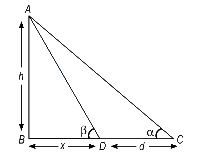
The angle of elevation of an object from a point $P$ on the level ground is $\alpha$. Moving $d$ metres on the ground towards the object,the angle of elevation is found to be $\beta$. Then the height (in metres) of the object is
A
$d \tan \alpha$
B
$d \cot \beta$
C
$\frac{d}{\cot \alpha+\cot \beta}$
D
$\frac{d}{\cot \alpha-\cot \beta}$
Solution
(D) Let the height of the object be $h$.
In $\triangle ABC$,we have $\tan \alpha = \frac{h}{x+d}$,which implies $x+d = h \cot \alpha$ $(i)$.
In $\triangle ABD$,we have $\tan \beta = \frac{h}{x}$,which implies $x = h \cot \beta$ (ii).
Substituting the value of $x$ from (ii) into $(i)$,we get:
$h \cot \beta + d = h \cot \alpha$
$d = h \cot \alpha - h \cot \beta$
$d = h(\cot \alpha - \cot \beta)$
$h = \frac{d}{\cot \alpha - \cot \beta}$
In $\triangle ABC$,we have $\tan \alpha = \frac{h}{x+d}$,which implies $x+d = h \cot \alpha$ $(i)$.
In $\triangle ABD$,we have $\tan \beta = \frac{h}{x}$,which implies $x = h \cot \beta$ (ii).
Substituting the value of $x$ from (ii) into $(i)$,we get:
$h \cot \beta + d = h \cot \alpha$
$d = h \cot \alpha - h \cot \beta$
$d = h(\cot \alpha - \cot \beta)$
$h = \frac{d}{\cot \alpha - \cot \beta}$
0 likesView Solution
96
ChemistryMCQAP EAMCET · 2007
If $\int \frac{e^x-1}{e^x+1} d x=f(x)+c$,then $f(x)$ is equal to
A
$2 \log \left(e^x+1\right)$
B
$\log \left(e^{2 x}-1\right)$
C
$2 \log \left(e^x+1\right)-x$
D
$\log \left(e^{2 x}+1\right)$
Solution
(C) We have the integral $I = \int \frac{e^x-1}{e^x+1} d x$.
We can rewrite the integrand as $\frac{e^x-1}{e^x+1} = \frac{2e^x - (e^x+1)}{e^x+1} = \frac{2e^x}{e^x+1} - 1$.
Now,integrating term by term,we get $I = \int \frac{2e^x}{e^x+1} d x - \int 1 d x$.
For the first part,let $u = e^x+1$,then $du = e^x d x$.
Thus,$\int \frac{2e^x}{e^x+1} d x = 2 \log |e^x+1|$.
Therefore,$I = 2 \log (e^x+1) - x + c$.
Comparing this with $f(x)+c$,we find $f(x) = 2 \log (e^x+1) - x$.
We can rewrite the integrand as $\frac{e^x-1}{e^x+1} = \frac{2e^x - (e^x+1)}{e^x+1} = \frac{2e^x}{e^x+1} - 1$.
Now,integrating term by term,we get $I = \int \frac{2e^x}{e^x+1} d x - \int 1 d x$.
For the first part,let $u = e^x+1$,then $du = e^x d x$.
Thus,$\int \frac{2e^x}{e^x+1} d x = 2 \log |e^x+1|$.
Therefore,$I = 2 \log (e^x+1) - x + c$.
Comparing this with $f(x)+c$,we find $f(x) = 2 \log (e^x+1) - x$.
0 likesView Solution
97
ChemistryMCQAP EAMCET · 2007
$\int \tan ^{-1}\left(\sqrt{\frac{1-x}{1+x}}\right) d x$ is equal to
A
$\frac{1}{2}\left(x \cos ^{-1} x-\sqrt{1-x^2}\right)+c$
B
$\frac{1}{2}\left(x \cos ^{-1} x+\sqrt{1-x^2}\right)+c$
C
$\frac{1}{2}\left(x \sin ^{-1} x-\sqrt{1-x^2}\right)+c$
D
$\frac{1}{2}\left(x \sin ^{-1} x+\sqrt{1-x^2}\right)+c$
Solution
(A) Let $I = \int \tan ^{-1} \sqrt{\frac{1-x}{1+x}} d x$.
Substitute $x = \cos 2\theta$,so $dx = -2\sin 2\theta d\theta$.
Then $\sqrt{\frac{1-x}{1+x}} = \sqrt{\frac{1-\cos 2\theta}{1+\cos 2\theta}} = \sqrt{\frac{2\sin^2 \theta}{2\cos^2 \theta}} = \tan \theta$.
Thus,$I = \int \theta (-2\sin 2\theta) d\theta = -2 \int \theta \sin 2\theta d\theta$.
Using integration by parts: $I = -2 \left[ \theta \left( -\frac{\cos 2\theta}{2} \right) - \int 1 \cdot \left( -\frac{\cos 2\theta}{2} \right) d\theta \right] = \theta \cos 2\theta - \int \cos 2\theta d\theta = \theta \cos 2\theta - \frac{\sin 2\theta}{2} + c$.
Since $x = \cos 2\theta$,then $\theta = \frac{1}{2} \cos^{-1} x$ and $\sin 2\theta = \sqrt{1-x^2}$.
Substituting these back: $I = \frac{1}{2} x \cos^{-1} x - \frac{1}{2} \sqrt{1-x^2} + c = \frac{1}{2} \left( x \cos^{-1} x - \sqrt{1-x^2} \right) + c$.
Substitute $x = \cos 2\theta$,so $dx = -2\sin 2\theta d\theta$.
Then $\sqrt{\frac{1-x}{1+x}} = \sqrt{\frac{1-\cos 2\theta}{1+\cos 2\theta}} = \sqrt{\frac{2\sin^2 \theta}{2\cos^2 \theta}} = \tan \theta$.
Thus,$I = \int \theta (-2\sin 2\theta) d\theta = -2 \int \theta \sin 2\theta d\theta$.
Using integration by parts: $I = -2 \left[ \theta \left( -\frac{\cos 2\theta}{2} \right) - \int 1 \cdot \left( -\frac{\cos 2\theta}{2} \right) d\theta \right] = \theta \cos 2\theta - \int \cos 2\theta d\theta = \theta \cos 2\theta - \frac{\sin 2\theta}{2} + c$.
Since $x = \cos 2\theta$,then $\theta = \frac{1}{2} \cos^{-1} x$ and $\sin 2\theta = \sqrt{1-x^2}$.
Substituting these back: $I = \frac{1}{2} x \cos^{-1} x - \frac{1}{2} \sqrt{1-x^2} + c = \frac{1}{2} \left( x \cos^{-1} x - \sqrt{1-x^2} \right) + c$.
0 likesView Solution
98
ChemistryMCQAP EAMCET · 2007
If $f(t) = \int_{-t}^t \frac{e^{-|x|}}{2} dx$,then $\lim_{t \rightarrow \infty} f(t)$ is equal to:
A
$1$
B
$\frac{1}{2}$
C
$0$
D
$-1$
Solution
(A) Given $f(t) = \int_{-t}^t \frac{e^{-|x|}}{2} dx$.
Since the integrand $\frac{e^{-|x|}}{2}$ is an even function,we can write:
$f(t) = 2 \int_0^t \frac{e^{-x}}{2} dx = \int_0^t e^{-x} dx$.
Evaluating the integral:
$f(t) = [-e^{-x}]_0^t = -e^{-t} - (-e^0) = 1 - e^{-t}$.
Now,taking the limit as $t \rightarrow \infty$:
$\lim_{t \rightarrow \infty} f(t) = \lim_{t \rightarrow \infty} (1 - e^{-t}) = 1 - 0 = 1$.
Since the integrand $\frac{e^{-|x|}}{2}$ is an even function,we can write:
$f(t) = 2 \int_0^t \frac{e^{-x}}{2} dx = \int_0^t e^{-x} dx$.
Evaluating the integral:
$f(t) = [-e^{-x}]_0^t = -e^{-t} - (-e^0) = 1 - e^{-t}$.
Now,taking the limit as $t \rightarrow \infty$:
$\lim_{t \rightarrow \infty} f(t) = \lim_{t \rightarrow \infty} (1 - e^{-t}) = 1 - 0 = 1$.
0 likesView Solution
99
ChemistryMCQAP EAMCET · 2007
$\int_0^{2 \pi} \sin^6 x \cos^5 x \, dx$ is equal to
A
$2 \pi$
B
$\pi / 2$
C
$0$
D
$-\pi$
Solution
(C) Let $I = \int_0^{2 \pi} \sin^6 x \cos^5 x \, dx$.
Using the property $\int_0^{2a} f(x) \, dx = 2 \int_0^a f(x) \, dx$ if $f(2a-x) = f(x)$:
Here,$f(x) = \sin^6 x \cos^5 x$.
$f(2 \pi - x) = \sin^6(2 \pi - x) \cos^5(2 \pi - x) = (-\sin x)^6 (\cos x)^5 = \sin^6 x \cos^5 x = f(x)$.
So,$I = 2 \int_0^{\pi} \sin^6 x \cos^5 x \, dx$.
Now,using the property $\int_0^a f(x) \, dx = 0$ if $f(a-x) = -f(x)$:
Let $g(x) = \sin^6 x \cos^5 x$.
$g(\pi - x) = \sin^6(\pi - x) \cos^5(\pi - x) = (\sin x)^6 (-\cos x)^5 = -\sin^6 x \cos^5 x = -g(x)$.
Since $g(\pi - x) = -g(x)$,the integral $\int_0^{\pi} \sin^6 x \cos^5 x \, dx = 0$.
Therefore,$I = 2 \times 0 = 0$.
Using the property $\int_0^{2a} f(x) \, dx = 2 \int_0^a f(x) \, dx$ if $f(2a-x) = f(x)$:
Here,$f(x) = \sin^6 x \cos^5 x$.
$f(2 \pi - x) = \sin^6(2 \pi - x) \cos^5(2 \pi - x) = (-\sin x)^6 (\cos x)^5 = \sin^6 x \cos^5 x = f(x)$.
So,$I = 2 \int_0^{\pi} \sin^6 x \cos^5 x \, dx$.
Now,using the property $\int_0^a f(x) \, dx = 0$ if $f(a-x) = -f(x)$:
Let $g(x) = \sin^6 x \cos^5 x$.
$g(\pi - x) = \sin^6(\pi - x) \cos^5(\pi - x) = (\sin x)^6 (-\cos x)^5 = -\sin^6 x \cos^5 x = -g(x)$.
Since $g(\pi - x) = -g(x)$,the integral $\int_0^{\pi} \sin^6 x \cos^5 x \, dx = 0$.
Therefore,$I = 2 \times 0 = 0$.
0 likesView Solution
100
ChemistryMCQAP EAMCET · 2007
The area (in square unit) of the region enclosed by the curves $y=x^2$ and $y=x^3$ is
A
$\frac{1}{12}$
B
$\frac{1}{6}$
C
$\frac{1}{3}$
D
$1$
Solution
(A) The given curves are $y=x^2$ and $y=x^3$.
To find the intersection points,set $x^2 = x^3$,which implies $x^2(1-x) = 0$.
Thus,the curves intersect at $x=0$ and $x=1$.
In the interval $[0, 1]$,$x^2 \ge x^3$.
The area $A$ is given by the integral:
$A = \int_0^1 (x^2 - x^3) dx$
$A = \left[ \frac{x^3}{3} - \frac{x^4}{4} \right]_0^1$
$A = \left( \frac{1}{3} - \frac{1}{4} \right) - (0 - 0)$
$A = \frac{4-3}{12} = \frac{1}{12} \text{ sq unit}$.
To find the intersection points,set $x^2 = x^3$,which implies $x^2(1-x) = 0$.
Thus,the curves intersect at $x=0$ and $x=1$.
In the interval $[0, 1]$,$x^2 \ge x^3$.
The area $A$ is given by the integral:
$A = \int_0^1 (x^2 - x^3) dx$
$A = \left[ \frac{x^3}{3} - \frac{x^4}{4} \right]_0^1$
$A = \left( \frac{1}{3} - \frac{1}{4} \right) - (0 - 0)$
$A = \frac{4-3}{12} = \frac{1}{12} \text{ sq unit}$.
0 likesView Solution
Vedclass Products
For Students
Vedclass Test Series
Mock tests in real AP EAMCET style covering Chemistry with performance analysis. 5-day free trial.
Start Free TrialFor Teachers
Exam Paper Generator
Generate Set A/B/C/D Chemistry papers from 7.5L+ questions in 2 minutes. 3 chapters free.
Try FreeFor Institutes
Online Exam Module
Run live AP EAMCET mock exams with unlimited students, 360° analytics & white-label branding.
See DemoFrequently Asked Questions
How many Chemistry questions are in AP EAMCET 2007?
There are 195 Chemistry questions from the AP EAMCET 2007 paper on Vedclass, each with a detailed step-by-step solution in English.
Are AP EAMCET 2007 Chemistry solutions available in English?
Yes. All solutions on this page are in English. You can also switch to English or Hindi using the language buttons above the questions.
Can I practice AP EAMCET 2007 Chemistry as a timed test?
Yes. Use the Vedclass Test Series to attempt a full AP EAMCET mock test covering Chemistry with time limits and instant score analysis.
Can teachers create Chemistry papers from AP EAMCET previous year questions?
Yes. The Vedclass Exam Paper Generator lets teachers mix AP EAMCET Chemistry questions and generate Set A/B/C/D papers in minutes.
For Teachers & Institutes
Build a Custom Chemistry Paper
Pick AP EAMCET 2007 Chemistry questions, set difficulty, and generate Set A/B/C/D in 2 minutes.