
BiologyQ1–56 of 56 questions
Page 1 of 1 · English
1
BiologyMediumMCQAIIMS · 2001
Who proposed the Binomial Nomenclature System?
A
Whittaker
B
Mendel
C
Carolus Linnaeus
D
Tippo
Solution
(C) The Binomial Nomenclature System was proposed by Carolus Linnaeus.
This system provides a distinct scientific name to each organism,consisting of two components: the generic name (genus) and the specific epithet (species).
This system provides a distinct scientific name to each organism,consisting of two components: the generic name (genus) and the specific epithet (species).
0 likesView Solution
2
BiologyMediumMCQAIIMS · 2001
Which of the following is an incorrect combination?
A
Haemocyanin - Prawn
B
Haemoglobin in mammals - $RBC$
C
Haemoglobin in plasma - Pheretima
D
Haemozoin - Plasmodium cytoplasm
Solution
(D) The correct answer is $D$.
Haemozoin is a toxic substance produced by the parasite $Plasmodium$ during the digestion of haemoglobin in the host's $RBC$s.
It is released into the blood plasma upon the rupture of the infected $RBC$s,causing the characteristic chills and high fever associated with malaria.
Therefore,stating it is found in the $Plasmodium$ cytoplasm is incorrect.
Haemozoin is a toxic substance produced by the parasite $Plasmodium$ during the digestion of haemoglobin in the host's $RBC$s.
It is released into the blood plasma upon the rupture of the infected $RBC$s,causing the characteristic chills and high fever associated with malaria.
Therefore,stating it is found in the $Plasmodium$ cytoplasm is incorrect.
0 likesView Solution
3
BiologyEasyMCQAIIMS · 2001
Powdery mildews of crops are caused by
A
Bacteria
B
Ascomycetes
C
Phycomycetes
D
Basidiomycetes
Solution
(B) Powdery mildew diseases are characterized by the presence of fungal mycelium,conidiophores,and conidia appearing as white powdery patches on the host plant surface.
These diseases are caused by fungi belonging to the class $Ascomycetes$ (specifically the order $Erysiphales$).
These diseases are caused by fungi belonging to the class $Ascomycetes$ (specifically the order $Erysiphales$).
0 likesView Solution
4
BiologyMediumMCQAIIMS · 2001
In $Spirogyra$,during the germination of the zygospore,how many haploid nuclei take part in the formation of a new filament?
A
One
B
Two
C
Three
D
Four
Solution
(A) The zygospore in $Spirogyra$ undergoes zygotic meiosis to produce $4$ haploid nuclei.
Out of these $4$ haploid nuclei,$3$ nuclei degenerate.
Only $1$ haploid nucleus remains functional and takes part in the germination process to form a new filament.
Out of these $4$ haploid nuclei,$3$ nuclei degenerate.
Only $1$ haploid nucleus remains functional and takes part in the germination process to form a new filament.
0 likesView Solution
5
BiologyMediumMCQAIIMS · 2001
The $Funaria$ gametophyte is:
A
Dioecious and autoecious
B
Monoecious and autoecious
C
Dioecious and heteroecious
D
Monoecious and heteroecious
Solution
(B) The $Funaria$ gametophyte is monoecious and autoecious.
$Monoecious$ means that both male (antheridia) and female (archegonia) sex organs are borne on the same plant body.
$Autoecious$ refers to the condition where the male and female sex organs are present on the same individual plant,specifically on different branches of the same gametophyte.
$Monoecious$ means that both male (antheridia) and female (archegonia) sex organs are borne on the same plant body.
$Autoecious$ refers to the condition where the male and female sex organs are present on the same individual plant,specifically on different branches of the same gametophyte.
0 likesView Solution
6
BiologyEasyMCQAIIMS · 2001
$Cuscuta$ is a
A
Total stem parasite
B
Partial root parasite
C
Saprophyte
D
Partial saprophyte
Solution
(A) $Cuscuta$ is a total stem parasite. These plants do not possess chlorophyll and therefore cannot perform photosynthesis. They derive their nutrition entirely from the host plant's stem by developing specialized structures called haustoria,which penetrate the host's tissues to absorb water and nutrients.
0 likesView Solution
7
BiologyEasyMCQAIIMS · 2001
Locomotory organs in $Taenia$ are called
A
Setae
B
Parapodia
C
Flagella
D
None of these
Solution
(D) $Taenia$ (tapeworm) is an endoparasite that lives in the intestine of its host.
Due to its parasitic mode of life,it does not require active movement to search for food or escape predators.
Therefore,specialized locomotory organs are completely absent in $Taenia$.
Due to its parasitic mode of life,it does not require active movement to search for food or escape predators.
Therefore,specialized locomotory organs are completely absent in $Taenia$.
0 likesView Solution
8
BiologyMediumMCQAIIMS · 2001
Class $Crustacea$ has which of the following features?
A
Cephalothorax,biramous appendages and gills
B
Cephalothorax,book lungs and chitinous exoskeleton
C
Head and thorax,book lungs and chitinous exoskeleton
D
Head and thorax,biramous appendages and book lungs
Solution
(A) The class $Crustacea$ belongs to the phylum $Arthropoda$.
Key characteristics of $Crustacea$ include the fusion of the head and thorax into a $Cephalothorax$,the presence of $biramous$ (two-branched) appendages,and respiration primarily through $gills$.
Common examples include prawns,lobsters,and crabs.
Therefore,option $A$ is the correct description.
Key characteristics of $Crustacea$ include the fusion of the head and thorax into a $Cephalothorax$,the presence of $biramous$ (two-branched) appendages,and respiration primarily through $gills$.
Common examples include prawns,lobsters,and crabs.
Therefore,option $A$ is the correct description.
0 likesView Solution
9
BiologyMediumMCQAIIMS · 2001
Which of the following classifications is correct?
A
$Mollusca - Bivalvia - Pila$
B
$Annelida - Hirudinea - Silver fish$
C
$Mollusca - Cephalopoda - Octopus$
D
$Arthropoda - Arachnida - Grasshopper$
Solution
(C) The correct classification is $Mollusca - Cephalopoda - Octopus$.
$Pila$ belongs to the class $Gastropoda$ of the phylum $Mollusca$.
$Silver fish$ is an insect belonging to the phylum $Arthropoda$,not $Annelida$.
$Grasshopper$ belongs to the class $Insecta$ of the phylum $Arthropoda$,not $Arachnida$.
$Pila$ belongs to the class $Gastropoda$ of the phylum $Mollusca$.
$Silver fish$ is an insect belonging to the phylum $Arthropoda$,not $Annelida$.
$Grasshopper$ belongs to the class $Insecta$ of the phylum $Arthropoda$,not $Arachnida$.
0 likesView Solution
10
BiologyEasyMCQAIIMS · 2001
Aristotle's lantern is found in
A
Jelly fish
B
Sea anemone
C
Sea lily
D
Sea urchin
Solution
(D) $Aristotle's$ lantern is a five-toothed masticatory apparatus present surrounding the mouth.
It is used by the sea urchin for feeding.
The presence of $Aristotle's$ lantern is a characteristic feature of the class $Echinoidea$.
It is used by the sea urchin for feeding.
The presence of $Aristotle's$ lantern is a characteristic feature of the class $Echinoidea$.
0 likesView Solution
11
BiologyMediumMCQAIIMS · 2001
Which one of the following is a flightless bird?
A
Passer
B
Corvus
C
Aptenodytes
D
Pavo cristatus
Solution
(C) $Aptenodytes$ (commonly known as the penguin) is a flightless bird.
$Passer$ (sparrow),$Corvus$ (crow),and $Pavo$ $cristatus$ (peacock) are all birds capable of flight.
$Passer$ (sparrow),$Corvus$ (crow),and $Pavo$ $cristatus$ (peacock) are all birds capable of flight.
0 likesView Solution
12
BiologyMediumMCQAIIMS · 2001
Epiphytes like $Vanda$ develop a special layer of absorptive tissue called $velamen$,consisting of $4$ or $5$ layers of long polygonal cells. $Velamen$ is formed by:
A
Absorbing roots
B
Stem
C
Clinging roots
D
Hanging roots
Solution
(D) $Velamen$ is a specialized,spongy,multi-layered epidermis found in the aerial or hanging roots of epiphytic plants like $Vanda$.
These roots hang freely in the air and are not attached to the soil.
The $velamen$ tissue is hygroscopic in nature,which allows the plant to absorb moisture directly from the humid atmosphere and rain,compensating for the lack of soil contact.
These roots hang freely in the air and are not attached to the soil.
The $velamen$ tissue is hygroscopic in nature,which allows the plant to absorb moisture directly from the humid atmosphere and rain,compensating for the lack of soil contact.
0 likesView Solution
13
BiologyMediumMCQAIIMS · 2001
Name the family having $(9)+1$ arrangement of stamens.
A
Solanaceae
B
Asteraceae
C
Liliaceae
D
Fabaceae
Solution
(D) In the family $Fabaceae$,the androecium consists of $10$ stamens which are diadelphous.
These stamens are arranged in a $(9)+1$ pattern,where $9$ stamens are fused together to form a bundle,and $1$ stamen remains free.
These stamens are arranged in a $(9)+1$ pattern,where $9$ stamens are fused together to form a bundle,and $1$ stamen remains free.
0 likesView Solution
14
BiologyEasyMCQAIIMS · 2001
Porous wood contains mainly
A
Fibres
B
Vessels
C
Tracheids
D
Solid secretions
Solution
(B) Porous wood is a characteristic feature of angiosperms (hardwood).
It is called 'porous' because it contains a large number of vessels,which appear as pores in the cross-section of the wood.
Therefore,the correct answer is $B$ (Vessels).
It is called 'porous' because it contains a large number of vessels,which appear as pores in the cross-section of the wood.
Therefore,the correct answer is $B$ (Vessels).
0 likesView Solution
15
BiologyEasyMCQAIIMS · 2001
Spindle fibres are made up of
A
Proteins
B
Cellulose
C
Lipids
D
Pectin
Solution
(A) Spindle fibres are composed of microtubules,which are structural components of the cytoskeleton.
These microtubules are primarily made up of a protein called tubulin.
Therefore,spindle fibres are proteinaceous in nature.
These microtubules are primarily made up of a protein called tubulin.
Therefore,spindle fibres are proteinaceous in nature.
0 likesView Solution
16
BiologyEasyMCQAIIMS · 2001
In the rainy season,wooden doors swell up due to:
A
Imbibition
B
Absorption
C
Diffusion
D
Endosmosis
Solution
(A) During the rainy season,the atmospheric humidity is high. Wooden doors absorb water molecules from the air through the process of $Imbibition$. $Imbibition$ is a special type of diffusion where water is absorbed by solids (colloids),causing them to increase in volume and swell up.
0 likesView Solution
17
BiologyMediumMCQAIIMS · 2001
Blackman's law of limiting factor is applied to
A
Growth
B
Respiration
C
Transpiration
D
Photosynthesis
Solution
(D) The law of limiting factor was proposed by Blackman in $1905$.
He stated that when a process is conditioned by a number of separate factors,the rate of the process is limited by the pace of the slowest factor.
This law is specifically applied to the process of photosynthesis,where factors like light intensity,$CO_2$ concentration,and temperature act as limiting factors.
He stated that when a process is conditioned by a number of separate factors,the rate of the process is limited by the pace of the slowest factor.
This law is specifically applied to the process of photosynthesis,where factors like light intensity,$CO_2$ concentration,and temperature act as limiting factors.
0 likesView Solution
18
BiologyMediumMCQAIIMS · 2001
Which cell organelle is required in photorespiration?
A
Chloroplast
B
Mitochondria
C
Peroxisome
D
All the above
Solution
(D) Photorespiration is a complex metabolic pathway that involves the cooperation of three distinct cell organelles:
$1$. $Chloroplast$: Where the initial reaction occurs involving $RuBisCO$ and $O_2$.
$2$. $Peroxisome$: Where the glycolate pathway continues.
$3$. $Mitochondria$: Where glycine is converted to serine, releasing $CO_2$.
Therefore, all three organelles are required for the process to complete.
$1$. $Chloroplast$: Where the initial reaction occurs involving $RuBisCO$ and $O_2$.
$2$. $Peroxisome$: Where the glycolate pathway continues.
$3$. $Mitochondria$: Where glycine is converted to serine, releasing $CO_2$.
Therefore, all three organelles are required for the process to complete.
0 likesView Solution
19
BiologyMediumMCQAIIMS · 2001
The high-energy bonds of $ATP$ are between
A
$C-C$
B
$C-O$
C
$C-N$
D
$O-P$
Solution
(D) $ATP$ (Adenosine Triphosphate) consists of an adenine base,a ribose sugar,and three phosphate groups.
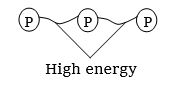
The high-energy bonds in $ATP$ are the phosphoanhydride bonds that link the phosphate groups together.
These bonds are specifically located between the oxygen atom of one phosphate group and the phosphorus atom of the adjacent phosphate group ($O-P$ bonds).
Therefore,the high-energy bonds are $O-P$ bonds.
The high-energy bonds in $ATP$ are the phosphoanhydride bonds that link the phosphate groups together.
These bonds are specifically located between the oxygen atom of one phosphate group and the phosphorus atom of the adjacent phosphate group ($O-P$ bonds).
Therefore,the high-energy bonds are $O-P$ bonds.
0 likesView Solution
20
BiologyMediumMCQAIIMS · 2001
The glycolate metabolism occurs in
A
Lysosomes
B
Ribosomes
C
Glyoxysomes
D
Peroxisomes
Solution
(D) The metabolism of glycolate,also known as the photorespiratory pathway or $C_2$ cycle,occurs in three different cell organelles: chloroplasts,peroxisomes,and mitochondria.
Among the given options,peroxisomes are the primary site where glycolate is oxidized to glyoxylate by the enzyme glycolate oxidase.
Among the given options,peroxisomes are the primary site where glycolate is oxidized to glyoxylate by the enzyme glycolate oxidase.
0 likesView Solution
21
BiologyMediumMCQAIIMS · 2001
Which of the following causes delaying of senescence?
A
Cytokinins
B
Auxins
C
Gibberellins
D
Ascorbic acid
Solution
(A) Cytokinins are known to promote cell division and delay the process of senescence in plants.
When green leaves are treated with a cytokinin solution,they retain their chlorophyll and remain green for a longer period.
This phenomenon,where cytokinins delay the aging or senescence of leaves,is specifically known as the $Richmond-Lang$ effect.
When green leaves are treated with a cytokinin solution,they retain their chlorophyll and remain green for a longer period.
This phenomenon,where cytokinins delay the aging or senescence of leaves,is specifically known as the $Richmond-Lang$ effect.
0 likesView Solution
22
BiologyEasyMCQAIIMS · 2001
The toxic substances are detoxified in the human body by:
A
Lungs
B
Kidneys
C
Liver
D
Stomach
Solution
(C) The $Liver$ is the primary organ responsible for detoxification in the human body.
It processes blood coming from the digestive tract and neutralizes harmful substances, drugs, and toxins, converting them into less harmful compounds that can be excreted from the body.
It processes blood coming from the digestive tract and neutralizes harmful substances, drugs, and toxins, converting them into less harmful compounds that can be excreted from the body.
0 likesView Solution
23
BiologyMediumMCQAIIMS · 2001
The respiratory centre in the brain which controls inspiration and expiration is situated in
A
Medulla oblongata
B
Cerebellum
C
Hypothalamus
D
Pericardium
Solution
(A) Breathing is regulated by specialized centers in the brainstem.
$1$. The respiratory rhythm center is primarily located in the medulla oblongata region of the brain.
$2$. This center is responsible for the regulation of the respiratory rhythm,specifically controlling inspiration and expiration.
$3$. Additionally,a pneumotaxic center present in the pons region of the brain can moderate the functions of the respiratory rhythm center.
$4$. Therefore,the primary control for inspiration and expiration is situated in the medulla oblongata.
$1$. The respiratory rhythm center is primarily located in the medulla oblongata region of the brain.
$2$. This center is responsible for the regulation of the respiratory rhythm,specifically controlling inspiration and expiration.
$3$. Additionally,a pneumotaxic center present in the pons region of the brain can moderate the functions of the respiratory rhythm center.
$4$. Therefore,the primary control for inspiration and expiration is situated in the medulla oblongata.
0 likesView Solution
24
BiologyAdvancedMCQAIIMS · 2001
Blood pressure increases and heart rate decreases in response to
A
Exercise
B
Hemorrhage
C
Exposure to high altitude
D
Increased intracranial pressure
Solution
(D) The correct answer is $D$.
When intracranial pressure increases,it leads to a condition known as the Cushing reflex.
This reflex is characterized by an increase in systemic blood pressure to maintain cerebral perfusion pressure against the elevated intracranial pressure.
Simultaneously,the stimulation of the baroreceptors and the vagus nerve in response to the high blood pressure causes a reflex bradycardia,which is a decrease in heart rate.
When intracranial pressure increases,it leads to a condition known as the Cushing reflex.
This reflex is characterized by an increase in systemic blood pressure to maintain cerebral perfusion pressure against the elevated intracranial pressure.
Simultaneously,the stimulation of the baroreceptors and the vagus nerve in response to the high blood pressure causes a reflex bradycardia,which is a decrease in heart rate.
0 likesView Solution
25
BiologyMediumMCQAIIMS · 2001
Astragalus and calcaneum are present in
A
Fore limb
B
Hind limb
C
Scapula
D
Clavicle
Solution
(B) The $Astragalus$ (also known as the $talus$) and $calcaneum$ (heel bone) are tarsal bones found in the ankle region of the $Hind$ limb of humans and other mammals. These bones are part of the tarsus, which consists of $7$ bones in total.
0 likesView Solution
26
BiologyMediumMCQAIIMS · 2001
If a frog's brain is crushed,even then its leg moves upon pinpointing. This is called:
A
Simple reflex
B
Conditional reflex
C
Neurotransmitter function
D
Autonomic nerve condition
Solution
(A) reflex is a spontaneous,automatic,and mechanical response to a stimulus that occurs without the animal's conscious will. Even if the brain is destroyed,the spinal cord remains intact,which is responsible for mediating simple reflex actions. Therefore,the leg movement in response to a stimulus is an example of a simple reflex.
0 likesView Solution
27
BiologyMediumMCQAIIMS · 2001
Acromegaly results after adolescence due to excess production of one of the following hormones:
A
Prolactin
B
Thyroxin
C
Insulin
D
$STH$
Solution
(D) Acromegaly is a condition that occurs due to the hypersecretion of $STH$ (Somatotropic Hormone or Growth Hormone) in adults after adolescence.
It is characterized by the abnormal growth of bones,particularly in the limbs,lower jaw,and facial features,often resulting in a gorilla-like appearance,kyphosis (hunchback),and a protruding bony ridge over the eyes.
It is characterized by the abnormal growth of bones,particularly in the limbs,lower jaw,and facial features,often resulting in a gorilla-like appearance,kyphosis (hunchback),and a protruding bony ridge over the eyes.
0 likesView Solution
28
BiologyEasyMCQAIIMS · 2001
Pollinia is found in which of the following plant families?
A
Asteraceae
B
Myrtaceae
C
Malvaceae
D
Asclepiadaceae
Solution
(D) The correct answer is $D$. In the family $Asclepiadaceae$ (now often classified under $Apocynaceae$),all the microspores within a single sporangium are fused together to form a single,cohesive mass known as a $pollinium$ (plural: $pollinia$). This specialized structure facilitates cross-pollination by insects.
0 likesView Solution
29
BiologyMediumMCQAIIMS · 2001
Desert can be converted into greenland by
A
Oxylophytes
B
Psammophytes
C
Halophytes
D
Tropical trees
Solution
(B) The correct answer is $B$.
Psammophytes are plants that are adapted to grow in sandy soils or shifting sand dunes.
Since deserts are primarily composed of sand,the introduction and cultivation of psammophytes can help stabilize the sand,improve soil structure,and initiate the process of ecological succession,eventually leading to the conversion of desert areas into greenlands.
Psammophytes are plants that are adapted to grow in sandy soils or shifting sand dunes.
Since deserts are primarily composed of sand,the introduction and cultivation of psammophytes can help stabilize the sand,improve soil structure,and initiate the process of ecological succession,eventually leading to the conversion of desert areas into greenlands.
0 likesView Solution
30
BiologyMediumMCQAIIMS · 2001
In green plants,cell elongation in the internodal regions is caused by which of the following?
A
Indole Acetic Acid
B
Cytokinin
C
Gibberellin
D
Ethylene
Solution
(C) Gibberellins are a group of plant growth regulators that are primarily responsible for stem elongation and internodal growth in plants.
They promote the elongation of internodes in genetically dwarf plants (rosette plants) by stimulating cell division and cell elongation.
Therefore,$Gibberellin$ is the correct answer for internodal elongation.
They promote the elongation of internodes in genetically dwarf plants (rosette plants) by stimulating cell division and cell elongation.
Therefore,$Gibberellin$ is the correct answer for internodal elongation.
0 likesView Solution
31
BiologyMediumMCQAIIMS · 2001
Which of the following inhibits leaf abscission?
A
$GA_3$
B
$NAA$
C
Ethylene
D
Zeatin
Solution
(B) Auxins,such as $NAA$ (Naphthalene Acetic Acid),are known to inhibit leaf abscission by preventing the formation of the abscission layer at the base of the petiole. While ethylene promotes abscission,auxins act as antagonists to this process in young leaves and fruits,thereby delaying the shedding process.
0 likesView Solution
32
BiologyMediumMCQAIIMS · 2001
Which of the following is less general in characters as compared to genus?
A
Species
B
Division
C
Class
D
Family
Solution
(A) In the taxonomic hierarchy,the categories are arranged from the highest (most general) to the lowest (most specific) level: Kingdom > Phylum/Division > Class > Order > Family > Genus > Species.
As we move from higher to lower categories,the number of shared characters increases,meaning the group becomes 'less general' and 'more specific'.
Since 'Species' is the lowest taxonomic category,it possesses the most specific characters and is the least general compared to all other categories,including 'Genus'.
As we move from higher to lower categories,the number of shared characters increases,meaning the group becomes 'less general' and 'more specific'.
Since 'Species' is the lowest taxonomic category,it possesses the most specific characters and is the least general compared to all other categories,including 'Genus'.
0 likesView Solution
33
BiologyMediumMCQAIIMS · 2001
Assertion : Mosses are evolved from algae.
Reason : Protonema of mosses is similar to some green algae.
Reason : Protonema of mosses is similar to some green algae.
A
If both Assertion and Reason are correct and the Reason is a correct explanation of the Assertion.
B
If both Assertion and Reason are correct but Reason is not a correct explanation of the Assertion.
C
If the Assertion is correct but Reason is incorrect.
D
If both the Assertion and Reason are incorrect.
Solution
(A) Mosses,which belong to the group $Bryophytes$,are considered to have evolved from green algae.
The evidence for this evolutionary link is supported by the fact that the $Protonema$ stage of mosses is filamentous and resembles the thallus structure of certain green algae,such as $Chara$ or $Ulothrix$.
Therefore,both the assertion and the reason are correct,and the reason provides a valid explanation for the evolutionary origin of mosses.
The evidence for this evolutionary link is supported by the fact that the $Protonema$ stage of mosses is filamentous and resembles the thallus structure of certain green algae,such as $Chara$ or $Ulothrix$.
Therefore,both the assertion and the reason are correct,and the reason provides a valid explanation for the evolutionary origin of mosses.
0 likesView Solution
34
BiologyMediumMCQAIIMS · 2001
Assertion: Cartilage and bone are rigid connective tissues.
Reason: Blood is a connective tissue.
Reason: Blood is a connective tissue.
A
If both Assertion and Reason are correct and the Reason is a correct explanation of the Assertion.
B
If both Assertion and Reason are correct but Reason is not a correct explanation of the Assertion.
C
If the Assertion is correct but Reason is incorrect.
D
If the Assertion is incorrect but the Reason is correct.
Solution
(D) The Assertion is incorrect because while bone is a rigid connective tissue,cartilage is a semi-rigid or flexible connective tissue,not a rigid one. The Reason is correct because blood is indeed a specialized fluid connective tissue that transports nutrients,gases,and waste products throughout the body. Since the Assertion is false and the Reason is true,the correct option is $D$.
0 likesView Solution
35
BiologyMediumMCQAIIMS · 2001
Assertion : Power house of cell is mitochondria.
Reason : $ATP$ is produced in mitochondria.
Reason : $ATP$ is produced in mitochondria.
A
If both Assertion and Reason are correct but Reason is not a correct explanation of the Assertion.
B
If both Assertion and Reason are correct and the Reason is a correct explanation of the Assertion.
C
If the Assertion is correct but Reason is incorrect.
D
If both the Assertion and Reason are incorrect.
Solution
(B) Mitochondria are known as the power house of the cell because they are the sites of aerobic respiration.
They produce a large amount of energy in the form of $ATP$ (Adenosine Triphosphate) through the process of oxidative phosphorylation.
Since the production of $ATP$ is the direct reason why mitochondria are termed the power house,the Reason correctly explains the Assertion.
They produce a large amount of energy in the form of $ATP$ (Adenosine Triphosphate) through the process of oxidative phosphorylation.
Since the production of $ATP$ is the direct reason why mitochondria are termed the power house,the Reason correctly explains the Assertion.
0 likesView Solution
36
BiologyEasyMCQAIIMS · 2001
Assertion: Cell wall is not found in animal cells.
Reason: Animal cells are covered by a cell membrane.
Reason: Animal cells are covered by a cell membrane.
A
If both Assertion and Reason are correct and the Reason is a correct explanation of the Assertion.
B
If both Assertion and Reason are correct but Reason is not a correct explanation of the Assertion.
C
If the Assertion is correct but Reason is incorrect.
D
If both the Assertion and Reason are incorrect.
Solution
(B) Animal cells are covered by a semipermeable plasma membrane (cell membrane).
Cell wall is absent in animal cells because the cell wall is a rigid structure that would be incompatible with the way in which an animal moves and grows.
While both statements are factually correct,the presence of a cell membrane is a universal feature of all cells (including plant cells which also have a cell wall) and does not explain why animal cells specifically lack a cell wall.
Therefore,the Reason is not the correct explanation for the Assertion.
Cell wall is absent in animal cells because the cell wall is a rigid structure that would be incompatible with the way in which an animal moves and grows.
While both statements are factually correct,the presence of a cell membrane is a universal feature of all cells (including plant cells which also have a cell wall) and does not explain why animal cells specifically lack a cell wall.
Therefore,the Reason is not the correct explanation for the Assertion.
0 likesView Solution
37
BiologyMediumMCQAIIMS · 2001
Assertion : Scurvy is caused by deficiency of vitamin.
Reason : Deficiency of ascorbic acid causes scurvy.
Reason : Deficiency of ascorbic acid causes scurvy.
A
If both Assertion and Reason are correct and the Reason is a correct explanation of the Assertion.
B
If both Assertion and Reason are correct but Reason is not a correct explanation of the Assertion.
C
If the Assertion is correct but Reason is incorrect.
D
If both the Assertion and Reason are incorrect.
Solution
(A) Scurvy is a disease caused by the deficiency of vitamin $C$ (ascorbic acid).
Since ascorbic acid is a vitamin,the assertion that scurvy is caused by a vitamin deficiency is correct.
The reason specifically identifies that the deficiency of ascorbic acid leads to scurvy,which directly explains why the deficiency of this specific vitamin causes the disease.
Therefore,both the assertion and reason are correct,and the reason is the correct explanation of the assertion.
Since ascorbic acid is a vitamin,the assertion that scurvy is caused by a vitamin deficiency is correct.
The reason specifically identifies that the deficiency of ascorbic acid leads to scurvy,which directly explains why the deficiency of this specific vitamin causes the disease.
Therefore,both the assertion and reason are correct,and the reason is the correct explanation of the assertion.
0 likesView Solution
38
BiologyMediumMCQAIIMS · 2001
Assertion : During physiology of excretion,deamination does not take place in liver.
Reason : Deamination is a process to make use of excess of amino acids which cannot be incorporated into protoplasm.
Reason : Deamination is a process to make use of excess of amino acids which cannot be incorporated into protoplasm.
A
If both Assertion and Reason are correct and the Reason is a correct explanation of the Assertion.
B
If both Assertion and Reason are correct but Reason is not a correct explanation of the Assertion.
C
If the Assertion is correct but Reason is incorrect.
D
If both the Assertion and Reason are incorrect.
Solution
(D) Deamination is the process of removing an amino group $(-NH_2)$ from an amino acid,resulting in the formation of a keto acid and the release of ammonia $(NH_3)$.
This process primarily occurs in the liver,where the toxic ammonia is subsequently converted into urea via the urea cycle.
Therefore,the Assertion is incorrect because deamination does take place in the liver.
The Reason is correct as it accurately describes the biological purpose of deamination,which is to utilize excess amino acids that cannot be stored or incorporated into the protoplasm.
This process primarily occurs in the liver,where the toxic ammonia is subsequently converted into urea via the urea cycle.
Therefore,the Assertion is incorrect because deamination does take place in the liver.
The Reason is correct as it accurately describes the biological purpose of deamination,which is to utilize excess amino acids that cannot be stored or incorporated into the protoplasm.
0 likesView Solution
39
BiologyEasyMCQAIIMS · 2001
The development of a sporophyte without fertilization from the vegetative cells of the gametophyte is called:
A
Zygospory
B
Aplanospory
C
Apospory
D
Apogamy
Solution
(D) The development of a sporophyte directly from the vegetative cells of the gametophyte without the fusion of gametes (fertilization) is known as $Apogamy$.
In contrast,$Apospory$ is the development of a gametophyte directly from the vegetative cells of the sporophyte without meiosis.
Therefore,the correct term for the given definition is $Apogamy$.
In contrast,$Apospory$ is the development of a gametophyte directly from the vegetative cells of the sporophyte without meiosis.
Therefore,the correct term for the given definition is $Apogamy$.
0 likesView Solution
40
BiologyEasyMCQAIIMS · 2001
Gemmule formation in sponges is helpful in
A
Parthenogenesis
B
Sexual reproduction
C
Only dissemination
D
Asexual reproduction
Solution
(D) Gemmule formation is a specialized method of asexual reproduction observed in sponges (Porifera).
These are internal buds that act as perennating structures,allowing the organism to survive unfavorable environmental conditions.
When conditions become favorable,the gemmules germinate to form new sponge individuals.
Therefore,it is a type of asexual reproduction.
These are internal buds that act as perennating structures,allowing the organism to survive unfavorable environmental conditions.
When conditions become favorable,the gemmules germinate to form new sponge individuals.
Therefore,it is a type of asexual reproduction.
0 likesView Solution
41
BiologyMediumMCQAIIMS · 2001
Cessation of menstrual cycle in the human female is known as
A
Ovulation
B
Puberty
C
Menopause
D
Maturation
Solution
(C) In human females,the menstrual cycle typically begins at puberty (menarche) and ceases around the age of $45$ to $50$ years. The permanent cessation of the menstrual cycle is termed as menopause. This marks the end of the reproductive phase in a woman's life.
0 likesView Solution
42
BiologyMediumMCQAIIMS · 2001
Mirabilis jalapa is a good example of
A
Complete dominance
B
Plastid inheritance
C
Both $(a)$ and $(b)$
D
None of the above
Solution
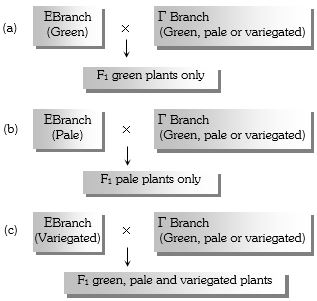
(B) The phenomenon of plastid inheritance (also known as cytoplasmic or extranuclear inheritance) is observed in the four-o'clock plant, $Mirabilis \text{ } jalapa$. In this plant, the color of the leaves is determined by the plastids present in the cytoplasm of the egg cell. Since the egg cell contributes the majority of the cytoplasm to the zygote, the phenotype of the offspring is determined by the maternal parent's plastids. The provided image illustrates this, showing that the phenotype of the $F_1$ generation depends on the type of branch (green, pale, or variegated) from which the egg was derived.
0 likesView Solution
43
BiologyMediumMCQAIIMS · 2001
Discontinuous variations are:
A
Mutations
B
Acquired characters
C
Essential features
D
Nonessential features
Solution
(A) Discontinuous variations are those that appear suddenly in a population and are not connected by intermediate forms.
These variations are primarily caused by $Mutations$,which are sudden,heritable changes in the $DNA$ sequence.
Unlike continuous variations (which show a range of phenotypes),discontinuous variations result in distinct,clear-cut categories.
Therefore,the correct option is $A$.
These variations are primarily caused by $Mutations$,which are sudden,heritable changes in the $DNA$ sequence.
Unlike continuous variations (which show a range of phenotypes),discontinuous variations result in distinct,clear-cut categories.
Therefore,the correct option is $A$.
0 likesView Solution
44
BiologyEasyMCQAIIMS · 2001
The largest cranial capacity was found in:
A
Neanderthal man
B
Cro-Magnon man
C
Java ape man
D
Peking man
Solution
(B) The cranial capacity of different human ancestors is as follows:
$1$. Neanderthal man: Approximately $1400-1500 \ cc$.
$2$. Cro-Magnon man: Approximately $1600 \ cc$.
$3$. Java ape man (Homo erectus erectus): Approximately $900 \ cc$.
$4$. Peking man (Homo erectus pekinensis): Approximately $1050 \ cc$.
Among the given options,Cro-Magnon man had the largest cranial capacity,which is estimated to be around $1600 \ cc$.
$1$. Neanderthal man: Approximately $1400-1500 \ cc$.
$2$. Cro-Magnon man: Approximately $1600 \ cc$.
$3$. Java ape man (Homo erectus erectus): Approximately $900 \ cc$.
$4$. Peking man (Homo erectus pekinensis): Approximately $1050 \ cc$.
Among the given options,Cro-Magnon man had the largest cranial capacity,which is estimated to be around $1600 \ cc$.
0 likesView Solution
45
BiologyMediumMCQAIIMS · 2001
Adaptation of a species is its
A
Ecdysis
B
Metamorphosis
C
Acquired character
D
Hereditary character
Solution
(D) Adaptation refers to the evolutionary process whereby a population becomes better suited to its habitat. These adaptations are genetically determined traits that are passed down from generation to generation. Therefore,an adaptation is a hereditary character that enhances the survival and reproductive success of an organism in a specific environment.
0 likesView Solution
46
BiologyEasyMCQAIIMS · 2001
Which of the following is required in genetic engineering?
A
$DNA$ polymerase
B
$RNA$ polymerase
C
Plasmid
D
Ribosome
Solution
(C) Genetic engineering,also known as recombinant $DNA$ technology,involves the manipulation of $DNA$ to create new combinations of genetic material. $A$ $Plasmid$ is a small,circular,extrachromosomal $DNA$ molecule found in bacteria that is widely used as a vector to carry foreign $DNA$ into a host cell. Therefore,it is an essential tool in genetic engineering.
0 likesView Solution
47
BiologyMediumMCQAIIMS · 2001
Immobilised enzymes are generally used for bioreactors in
A
Batch process
B
Digestive process
C
Activation process
D
Continuous process
Solution
(D) Immobilisation of enzymes is the process of fixing an enzyme to or enclosing it in a solid support.
This technique is used to protect the enzyme from deactivation and proteolysis,maintain enzyme purity,allow for easy recovery of the enzyme after the reaction,and facilitate the use of the enzyme in a continuous process.
Therefore,immobilised enzymes are primarily used in continuous bioreactor systems to ensure long-term productivity and cost-effectiveness.
This technique is used to protect the enzyme from deactivation and proteolysis,maintain enzyme purity,allow for easy recovery of the enzyme after the reaction,and facilitate the use of the enzyme in a continuous process.
Therefore,immobilised enzymes are primarily used in continuous bioreactor systems to ensure long-term productivity and cost-effectiveness.
0 likesView Solution
48
BiologyMediumMCQAIIMS · 2001
Deforestation has an alarming effect on
A
Increase in grazing area
B
Sunlight
C
Weed control
D
Soil erosion or desertification of habitat
Solution
(D) Deforestation involves the removal of forest cover,which exposes the soil to direct wind and water action.
This leads to increased soil erosion,as the roots of trees are no longer present to bind the soil particles.
Furthermore,the loss of vegetation cover reduces moisture retention and nutrient cycling,eventually leading to the desertification of the habitat.
Therefore,the correct option is $D$.
This leads to increased soil erosion,as the roots of trees are no longer present to bind the soil particles.
Furthermore,the loss of vegetation cover reduces moisture retention and nutrient cycling,eventually leading to the desertification of the habitat.
Therefore,the correct option is $D$.
0 likesView Solution
49
BiologyMediumMCQAIIMS · 2001
The ecosystem consists of
A
Producers
B
Consumers
C
Decomposers
D
All of these
Solution
(D) An ecosystem is a functional unit of nature where living organisms interact among themselves and also with the surrounding physical environment.
It consists of both biotic and abiotic components.
The biotic components include producers (plants),consumers (animals),and decomposers (microorganisms).
Therefore,all the given options are part of the ecosystem.
It consists of both biotic and abiotic components.
The biotic components include producers (plants),consumers (animals),and decomposers (microorganisms).
Therefore,all the given options are part of the ecosystem.
0 likesView Solution
50
BiologyEasyMCQAIIMS · 2001
Which of the following plants yields the drug belladonna?
A
Atropa belladonna
B
Papaver somniferum
C
Acacia arabica
D
Phoenix sylvestris
Solution
(A) The drug belladonna is obtained from the plant $Atropa$ $belladonna$.
It belongs to the family $Solanaceae$.
This plant contains alkaloids like atropine,hyoscyamine,and scopolamine,which have medicinal properties.
It belongs to the family $Solanaceae$.
This plant contains alkaloids like atropine,hyoscyamine,and scopolamine,which have medicinal properties.
0 likesView Solution
51
BiologyEasyMCQAIIMS · 2001
$A$ clove represents a
A
Terminal bud
B
Accessory bud
C
Flower bud
D
Vegetative bud
Solution
(C) The clove $(Syzygium\, aromaticum)$ belongs to the Myrtaceae family.
It is obtained from the dried flower bud of the plant.
It is obtained from the dried flower bud of the plant.
0 likesView Solution
52
BiologyMediumMCQAIIMS · 2001
The abundance of a species population within its habitat is called
A
Niche density
B
Absolute density
C
Relative density
D
Regional density
Solution
(B) The number of individuals of a species per unit area or volume is known as population density. When this refers to the total number of individuals of a species in a specific habitat,it is called absolute density. However,in ecological studies,the term 'abundance' is often used to describe the population density of a species within its habitat. Among the given options,absolute density is the standard ecological term for the total count of individuals of a species in a given area.
0 likesView Solution
53
BiologyMediumMCQAIIMS · 2001
Assertion : Many plants are propagated vegetatively even though they bear seeds.
Reason : Potatoes multiply by tubers,apple by cutting etc.
Reason : Potatoes multiply by tubers,apple by cutting etc.
A
If the Assertion is correct but Reason is incorrect.
B
If both Assertion and Reason are correct but Reason is not a correct explanation of the Assertion.
C
If both Assertion and Reason are correct and the Reason is a correct explanation of the Assertion.
D
If both the Assertion and Reason are incorrect.
Solution
(C) Vegetative propagation is a form of asexual reproduction where new plants are formed from vegetative parts like buds,tubers,rhizomes,roots,stems,or leaves.
Many plants that produce seeds are also propagated vegetatively because it allows for the production of clones that are genetically identical to the parent plant and often results in faster growth.
Potatoes are indeed propagated by stem tubers,which contain 'eyes' (buds) that develop into new plants.
Apples are commonly propagated by stem cuttings or grafting to ensure the offspring retain the desirable traits of the parent tree.
Since both the assertion and the reason are factually correct,and the reason provides specific examples of vegetative propagation that support the assertion,the reason is a correct explanation.
Many plants that produce seeds are also propagated vegetatively because it allows for the production of clones that are genetically identical to the parent plant and often results in faster growth.
Potatoes are indeed propagated by stem tubers,which contain 'eyes' (buds) that develop into new plants.
Apples are commonly propagated by stem cuttings or grafting to ensure the offspring retain the desirable traits of the parent tree.
Since both the assertion and the reason are factually correct,and the reason provides specific examples of vegetative propagation that support the assertion,the reason is a correct explanation.
0 likesView Solution
54
BiologyEasyMCQAIIMS · 2001
Meroblastic cleavage refers to which type of division of egg?
A
Complete
B
Spiral
C
Incomplete
D
Horizontal
Solution
(C) Meroblastic cleavage is a type of cleavage where the division of the egg is incomplete or partial. This occurs in eggs with a large amount of yolk,such as those of birds and reptiles,where the cleavage furrow does not penetrate the entire egg cytoplasm.
0 likesView Solution
55
BiologyMediumMCQAIIMS · 2001
Assertion : $Plasmodium$ $vivax$ is responsible for malaria.
Reason : Malaria is caused by polluted water.
Reason : Malaria is caused by polluted water.
A
If both Assertion and Reason are correct and the Reason is a correct explanation of the Assertion.
B
If both Assertion and Reason are correct but Reason is not a correct explanation of the Assertion.
C
If the Assertion is correct but Reason is incorrect.
D
If both the Assertion and Reason are incorrect.
Solution
(C) The Assertion is correct because $Plasmodium$ $vivax$ is a protozoan parasite that causes malaria in humans.
The Reason is incorrect because malaria is not caused by polluted water; it is a vector-borne disease transmitted by the bite of an infected female $Anopheles$ mosquito.
Therefore,the correct option is $C$.
The Reason is incorrect because malaria is not caused by polluted water; it is a vector-borne disease transmitted by the bite of an infected female $Anopheles$ mosquito.
Therefore,the correct option is $C$.
0 likesView Solution
56
BiologyMediumMCQAIIMS · 2001
Assertion : Plasmids are extrachromosomal $DNA$.
Reason : Plasmids are found in bacteria and are useful in genetic engineering.
Reason : Plasmids are found in bacteria and are useful in genetic engineering.
A
If both Assertion and Reason are correct and the Reason is a correct explanation of the Assertion.
B
If both Assertion and Reason are correct but Reason is not a correct explanation of the Assertion.
C
If the Assertion is correct but Reason is incorrect.
D
If both the Assertion and Reason are incorrect.
Solution
(A) Plasmids are small,circular,double-stranded $DNA$ molecules that are distinct from a cell's chromosomal $DNA$.
They are naturally found in bacteria and some eukaryotes.
Because they can replicate independently and carry specific genes,they are widely used as vectors in recombinant $DNA$ technology (genetic engineering) to transfer foreign genes into host cells.
Both the assertion and the reason are correct,and the reason explains why plasmids are significant in the context of their biological nature and utility.
They are naturally found in bacteria and some eukaryotes.
Because they can replicate independently and carry specific genes,they are widely used as vectors in recombinant $DNA$ technology (genetic engineering) to transfer foreign genes into host cells.
Both the assertion and the reason are correct,and the reason explains why plasmids are significant in the context of their biological nature and utility.
0 likesView Solution
Vedclass Products
For Students
Vedclass Test Series
Mock tests in real AIIMS style covering Biology with performance analysis. 5-day free trial.
Start Free TrialFor Teachers
Exam Paper Generator
Generate Set A/B/C/D Biology papers from 7.5L+ questions in 2 minutes. 3 chapters free.
Try FreeFor Institutes
Online Exam Module
Run live AIIMS mock exams with unlimited students, 360° analytics & white-label branding.
See DemoFrequently Asked Questions
How many Biology questions are in AIIMS 2001?
There are 56 Biology questions from the AIIMS 2001 paper on Vedclass, each with a detailed step-by-step solution in English.
Are AIIMS 2001 Biology solutions available in English?
Yes. All solutions on this page are in English. You can also switch to English or Hindi using the language buttons above the questions.
Can I practice AIIMS 2001 Biology as a timed test?
Yes. Use the Vedclass Test Series to attempt a full AIIMS mock test covering Biology with time limits and instant score analysis.
Can teachers create Biology papers from AIIMS previous year questions?
Yes. The Vedclass Exam Paper Generator lets teachers mix AIIMS Biology questions and generate Set A/B/C/D papers in minutes.
For Teachers & Institutes
Build a Custom Biology Paper
Pick AIIMS 2001 Biology questions, set difficulty, and generate Set A/B/C/D in 2 minutes.