
PhysicsQ1–53 of 53 questions
Page 1 of 1 · English
1
PhysicsMediumMCQAIIMS · 2001
Which of the following pairs does not have similar dimensions?
A
Stress and pressure
B
Angle and strain
C
Tension and surface tension
D
Planck's constant and angular momentum
Solution
(C) The dimensions of the given pairs are as follows:
$1$. Stress and pressure: Both have dimensions $[ML^{-1}T^{-2}]$.
$2$. Angle and strain: Both are dimensionless quantities $[M^0L^0T^0]$.
$3$. Tension and surface tension: Tension is a force with dimensions $[MLT^{-2}]$,while surface tension is force per unit length with dimensions $[MT^{-2}]$. Thus,they do not have similar dimensions.
$4$. Planck's constant and angular momentum: Both have dimensions $[ML^2T^{-1}]$.
Therefore,the pair that does not have similar dimensions is Tension and surface tension.
$1$. Stress and pressure: Both have dimensions $[ML^{-1}T^{-2}]$.
$2$. Angle and strain: Both are dimensionless quantities $[M^0L^0T^0]$.
$3$. Tension and surface tension: Tension is a force with dimensions $[MLT^{-2}]$,while surface tension is force per unit length with dimensions $[MT^{-2}]$. Thus,they do not have similar dimensions.
$4$. Planck's constant and angular momentum: Both have dimensions $[ML^2T^{-1}]$.
Therefore,the pair that does not have similar dimensions is Tension and surface tension.
0 likesView Solution
2
PhysicsMediumMCQAIIMS · 2001
$A$ body $A$ starts from rest with an acceleration $a_1$. After $2$ seconds,another body $B$ starts from rest with an acceleration $a_2$. If they travel equal distances in the $5$th second after the start of $A$,then the ratio $a_1:a_2$ is equal to
A
$5:9$
B
$5:7$
C
$9:5$
D
$9:7$
Solution
(A) The distance traveled by an object in the $n$th second is given by $S_n = u + \frac{a}{2}(2n - 1)$.
For body $A$,the distance traveled in the $5$th second is $S_{A,5} = 0 + \frac{a_1}{2}(2 \times 5 - 1) = \frac{9a_1}{2}$.
Body $B$ starts $2$ seconds after $A$. Therefore,the $5$th second after the start of $A$ corresponds to the $(5 - 2) = 3$rd second of motion for body $B$.
The distance traveled by body $B$ in its $3$rd second is $S_{B,3} = 0 + \frac{a_2}{2}(2 \times 3 - 1) = \frac{5a_2}{2}$.
Given that these distances are equal: $\frac{9a_1}{2} = \frac{5a_2}{2}$.
Simplifying this,we get $9a_1 = 5a_2$,which implies $\frac{a_1}{a_2} = \frac{5}{9}$.
For body $A$,the distance traveled in the $5$th second is $S_{A,5} = 0 + \frac{a_1}{2}(2 \times 5 - 1) = \frac{9a_1}{2}$.
Body $B$ starts $2$ seconds after $A$. Therefore,the $5$th second after the start of $A$ corresponds to the $(5 - 2) = 3$rd second of motion for body $B$.
The distance traveled by body $B$ in its $3$rd second is $S_{B,3} = 0 + \frac{a_2}{2}(2 \times 3 - 1) = \frac{5a_2}{2}$.
Given that these distances are equal: $\frac{9a_1}{2} = \frac{5a_2}{2}$.
Simplifying this,we get $9a_1 = 5a_2$,which implies $\frac{a_1}{a_2} = \frac{5}{9}$.
1 likesView Solution
3
PhysicsEasyMCQAIIMS · 2001
The velocity of a bullet is reduced from $200\,m/s$ to $100\,m/s$ while travelling through a wooden block of thickness $10\,cm$. Assuming the retardation to be uniform,the retardation will be:
A
$10 \times 10^4\,m/s^2$
B
$12 \times 10^4\,m/s^2$
C
$13.5 \times 10^4\,m/s^2$
D
$15 \times 10^4\,m/s^2$
Solution
(D) Given: Initial velocity $u = 200\,m/s$,Final velocity $v = 100\,m/s$,Displacement $s = 10\,cm = 0.1\,m$.
Using the third equation of motion: $v^2 = u^2 + 2as$.
Substituting the values: $(100)^2 = (200)^2 + 2 \times a \times 0.1$.
$10000 = 40000 + 0.2a$.
$0.2a = 10000 - 40000 = -30000$.
$a = -30000 / 0.2 = -150000\,m/s^2 = -15 \times 10^4\,m/s^2$.
The retardation is the magnitude of negative acceleration,which is $15 \times 10^4\,m/s^2$.
Using the third equation of motion: $v^2 = u^2 + 2as$.
Substituting the values: $(100)^2 = (200)^2 + 2 \times a \times 0.1$.
$10000 = 40000 + 0.2a$.
$0.2a = 10000 - 40000 = -30000$.
$a = -30000 / 0.2 = -150000\,m/s^2 = -15 \times 10^4\,m/s^2$.
The retardation is the magnitude of negative acceleration,which is $15 \times 10^4\,m/s^2$.
0 likesView Solution
4
PhysicsEasyMCQAIIMS · 2001
$A$ mass $m$ is attached to a string and revolves in a vertical circle. What is the tension in the string when the mass is at the lowest position?
A
$\frac{mv^2}{r}$
B
$\frac{mv^2}{r} - mg$
C
$\frac{mv^2}{r} + mg$
D
$mg$
Solution
(C) At the lowest position of a vertical circle,two forces act on the mass $m$: the tension $T$ acting upwards towards the center and the weight $mg$ acting downwards.
According to Newton's second law,the net force providing the centripetal acceleration is $T - mg = \frac{mv^2}{r}$.
Rearranging this equation to solve for tension $T$,we get $T = \frac{mv^2}{r} + mg$.
According to Newton's second law,the net force providing the centripetal acceleration is $T - mg = \frac{mv^2}{r}$.
Rearranging this equation to solve for tension $T$,we get $T = \frac{mv^2}{r} + mg$.
0 likesView Solution
5
PhysicsEasyMCQAIIMS · 2001
When two surfaces are coated with a lubricant,then they
A
Stick to each other
B
Slide upon each other
C
Roll upon each other
D
None of these
Solution
(B) When a lubricant is applied between two surfaces,it forms a thin layer that fills the irregularities of the surfaces.
This reduces the direct contact between the surfaces and decreases the coefficient of friction.
As a result,the surfaces can easily slide over each other with minimal resistance.
This reduces the direct contact between the surfaces and decreases the coefficient of friction.
As a result,the surfaces can easily slide over each other with minimal resistance.
0 likesView Solution
6
PhysicsEasyMCQAIIMS · 2001
$A$ force of $(3\,\hat i + 4\,\hat j) \, N$ acts on a body and displaces it by $(3\,\hat i + 4\,\hat j) \, m$. The work done by the force is .............. $J$.
A
$10$
B
$12$
C
$16$
D
$25$
Solution
(D) The work done $W$ by a constant force $\overrightarrow{F}$ during a displacement $\overrightarrow{s}$ is given by the dot product of the force and displacement vectors:
$W = \overrightarrow{F} \cdot \overrightarrow{s}$
Given:
$\overrightarrow{F} = (3\,\hat{i} + 4\,\hat{j}) \, N$
$\overrightarrow{s} = (3\,\hat{i} + 4\,\hat{j}) \, m$
Substituting the values:
$W = (3\,\hat{i} + 4\,\hat{j}) \cdot (3\,\hat{i} + 4\,\hat{j})$
Using the dot product property $\hat{i} \cdot \hat{i} = 1$,$\hat{j} \cdot \hat{j} = 1$,and $\hat{i} \cdot \hat{j} = 0$:
$W = (3 \times 3) + (4 \times 4)$
$W = 9 + 16$
$W = 25 \, J$
$W = \overrightarrow{F} \cdot \overrightarrow{s}$
Given:
$\overrightarrow{F} = (3\,\hat{i} + 4\,\hat{j}) \, N$
$\overrightarrow{s} = (3\,\hat{i} + 4\,\hat{j}) \, m$
Substituting the values:
$W = (3\,\hat{i} + 4\,\hat{j}) \cdot (3\,\hat{i} + 4\,\hat{j})$
Using the dot product property $\hat{i} \cdot \hat{i} = 1$,$\hat{j} \cdot \hat{j} = 1$,and $\hat{i} \cdot \hat{j} = 0$:
$W = (3 \times 3) + (4 \times 4)$
$W = 9 + 16$
$W = 25 \, J$
0 likesView Solution
7
PhysicsEasyMCQAIIMS · 2001
$A$ gun fires a bullet of mass $50 \, g$ with a velocity of $30 \, m/s$. Because of this,the gun is pushed back with a velocity of $1 \, m/s$. The mass of the gun is .......... $kg$.
A
$15$
B
$30$
C
$1.5$
D
$20$
Solution
(C) According to the law of conservation of linear momentum,the total momentum before firing is equal to the total momentum after firing.
Initial momentum of the system (gun + bullet) = $0$.
Final momentum = $m_G v_G + m_B v_B = 0$.
Therefore,the magnitude of the momentum of the gun equals the magnitude of the momentum of the bullet: $m_G v_G = m_B v_B$.
Given:
Mass of bullet $(m_B)$ = $50 \, g = 0.05 \, kg$.
Velocity of bullet $(v_B)$ = $30 \, m/s$.
Velocity of gun $(v_G)$ = $1 \, m/s$.
$m_G = \frac{m_B v_B}{v_G} = \frac{0.05 \times 30}{1} = 1.5 \, kg$.
Initial momentum of the system (gun + bullet) = $0$.
Final momentum = $m_G v_G + m_B v_B = 0$.
Therefore,the magnitude of the momentum of the gun equals the magnitude of the momentum of the bullet: $m_G v_G = m_B v_B$.
Given:
Mass of bullet $(m_B)$ = $50 \, g = 0.05 \, kg$.
Velocity of bullet $(v_B)$ = $30 \, m/s$.
Velocity of gun $(v_G)$ = $1 \, m/s$.
$m_G = \frac{m_B v_B}{v_G} = \frac{0.05 \times 30}{1} = 1.5 \, kg$.
0 likesView Solution
8
PhysicsMediumMCQAIIMS · 2001
$A$ metal ball of mass $2 \,kg$ moving with a velocity of $36 \,km/h$ has a head-on collision with a stationary ball of mass $3 \,kg$. If after the collision,the two balls move together,the loss in kinetic energy due to the collision is ........ $J$.
A
$40$
B
$60$
C
$100$
D
$140$
Solution
(B) Initial velocity of the first ball,$u_1 = 36 \,km/h = 36 \times \frac{5}{18} = 10 \,m/s$.
Initial velocity of the second ball,$u_2 = 0 \,m/s$.
Masses are $m_1 = 2 \,kg$ and $m_2 = 3 \,kg$.
By the law of conservation of linear momentum,$m_1 u_1 + m_2 u_2 = (m_1 + m_2)V$,where $V$ is the common velocity after the collision.
$2 \times 10 + 3 \times 0 = (2 + 3)V \implies 20 = 5V \implies V = 4 \,m/s$.
Initial kinetic energy,$K_i = \frac{1}{2} m_1 u_1^2 + \frac{1}{2} m_2 u_2^2 = \frac{1}{2} \times 2 \times (10)^2 + 0 = 100 \,J$.
Final kinetic energy,$K_f = \frac{1}{2} (m_1 + m_2) V^2 = \frac{1}{2} \times 5 \times (4)^2 = \frac{1}{2} \times 5 \times 16 = 40 \,J$.
Loss in kinetic energy,$\Delta K = K_i - K_f = 100 - 40 = 60 \,J$.
Initial velocity of the second ball,$u_2 = 0 \,m/s$.
Masses are $m_1 = 2 \,kg$ and $m_2 = 3 \,kg$.
By the law of conservation of linear momentum,$m_1 u_1 + m_2 u_2 = (m_1 + m_2)V$,where $V$ is the common velocity after the collision.
$2 \times 10 + 3 \times 0 = (2 + 3)V \implies 20 = 5V \implies V = 4 \,m/s$.
Initial kinetic energy,$K_i = \frac{1}{2} m_1 u_1^2 + \frac{1}{2} m_2 u_2^2 = \frac{1}{2} \times 2 \times (10)^2 + 0 = 100 \,J$.
Final kinetic energy,$K_f = \frac{1}{2} (m_1 + m_2) V^2 = \frac{1}{2} \times 5 \times (4)^2 = \frac{1}{2} \times 5 \times 16 = 40 \,J$.
Loss in kinetic energy,$\Delta K = K_i - K_f = 100 - 40 = 60 \,J$.
0 likesView Solution
9
PhysicsMediumMCQAIIMS · 2001
The escape velocity from the earth is about $11 \, km/s$. The escape velocity from a planet having twice the radius and the same mean density as the earth is ......... $km/s$.
A
$22$
B
$11$
C
$5.5$
D
$15.5$
Solution
(A) The formula for escape velocity is given by $v_e = \sqrt{\frac{2GM}{R}}$.
Since mass $M = \text{density} (\rho) \times \text{volume} = \rho \times \frac{4}{3}\pi R^3$,we can substitute $M$ into the formula:
$v_e = \sqrt{\frac{2G(\rho \cdot \frac{4}{3}\pi R^3)}{R}} = \sqrt{\frac{8}{3}\pi G \rho} \cdot R$.
Given that the mean density $\rho$ is constant,we find that $v_e \propto R$.
If the radius of the planet is twice that of the earth $(R' = 2R)$,then the new escape velocity $v_e'$ will be:
$v_e' = 2 \times v_e = 2 \times 11 \, km/s = 22 \, km/s$.
Since mass $M = \text{density} (\rho) \times \text{volume} = \rho \times \frac{4}{3}\pi R^3$,we can substitute $M$ into the formula:
$v_e = \sqrt{\frac{2G(\rho \cdot \frac{4}{3}\pi R^3)}{R}} = \sqrt{\frac{8}{3}\pi G \rho} \cdot R$.
Given that the mean density $\rho$ is constant,we find that $v_e \propto R$.
If the radius of the planet is twice that of the earth $(R' = 2R)$,then the new escape velocity $v_e'$ will be:
$v_e' = 2 \times v_e = 2 \times 11 \, km/s = 22 \, km/s$.
0 likesView Solution
10
PhysicsMediumMCQAIIMS · 2001
If $x$ longitudinal strain is produced in a wire of Young's modulus $y,$ then energy stored in the material of the wire per unit volume is
A
$y{x^2}$
B
$2y{x^2}$
C
$\frac{1}{2}{y^2}x$
D
$\frac{1}{2}y{x^2}$
Solution
(D) The energy stored per unit volume $(u)$ in a stretched wire is given by the formula:
$u = \frac{1}{2} \times \text{Stress} \times \text{Strain}$
Since Young's modulus $y = \frac{\text{Stress}}{\text{Strain}}$,we have $\text{Stress} = y \times \text{Strain}$.
Substituting the given strain $x$ into the equation:
$u = \frac{1}{2} \times (y \times x) \times x$
$u = \frac{1}{2} y x^2$
$u = \frac{1}{2} \times \text{Stress} \times \text{Strain}$
Since Young's modulus $y = \frac{\text{Stress}}{\text{Strain}}$,we have $\text{Stress} = y \times \text{Strain}$.
Substituting the given strain $x$ into the equation:
$u = \frac{1}{2} \times (y \times x) \times x$
$u = \frac{1}{2} y x^2$
0 likesView Solution
11
PhysicsMediumMCQAIIMS · 2001
$A$ spherical drop of water has a radius of $1\, mm$. If the surface tension of water is $70 \times 10^{-3}\, N/m$,the difference of pressure between the inside and outside of the spherical drop is ........ $N/m^2$.
A
$35$
B
$70$
C
$140$
D
$0$
Solution
(C) The excess pressure $\Delta P$ inside a spherical drop is given by the formula $\Delta P = \frac{2T}{R}$.
Given:
Surface tension $T = 70 \times 10^{-3}\, N/m$
Radius $R = 1\, mm = 1 \times 10^{-3}\, m$
Substituting the values:
$\Delta P = \frac{2 \times 70 \times 10^{-3}}{1 \times 10^{-3}}$
$\Delta P = 2 \times 70 = 140\, N/m^2$.
Therefore,the correct option is $C$.
Given:
Surface tension $T = 70 \times 10^{-3}\, N/m$
Radius $R = 1\, mm = 1 \times 10^{-3}\, m$
Substituting the values:
$\Delta P = \frac{2 \times 70 \times 10^{-3}}{1 \times 10^{-3}}$
$\Delta P = 2 \times 70 = 140\, N/m^2$.
Therefore,the correct option is $C$.
0 likesView Solution
12
PhysicsEasyMCQAIIMS · 2001
Which of the following is not a thermodynamic coordinate?
A
$P$
B
$T$
C
$V$
D
$R$
Solution
(D) Thermodynamic coordinates are variables that define the state of a thermodynamic system,such as pressure $(P)$,volume $(V)$,and temperature $(T)$.
$R$ is the universal gas constant,which is a fundamental physical constant and not a variable coordinate of a system's state.
Therefore,the correct option is $(d)$.
$R$ is the universal gas constant,which is a fundamental physical constant and not a variable coordinate of a system's state.
Therefore,the correct option is $(d)$.
1 likesView Solution
13
PhysicsEasyMCQAIIMS · 2001
The colour of a shining bright star is an indication of its
A
Distance from the earth
B
Size
C
Temperature
D
Mass
Solution
(C) According to Wien's displacement law,the wavelength $\lambda_m$ corresponding to the maximum intensity of emission is inversely proportional to the absolute temperature $T$ of the body,given by $\lambda_m T = b$,where $b$ is Wien's constant. Since the colour of a star depends on the wavelength of the light it emits most intensely,the observed colour is a direct indicator of the star's surface temperature.
0 likesView Solution
14
PhysicsMediumMCQAIIMS · 2001
$A$ simple pendulum is executing simple harmonic motion with a time period $T$. If the length of the pendulum is increased by $21\%$,the percentage increase in the time period of the pendulum of increased length is ..... $\%$
A
$10$
B
$21$
C
$30$
D
$50$
Solution
(A) The time period of a simple pendulum is given by $T = 2\pi \sqrt{\frac{l}{g}}$.
This implies $T \propto \sqrt{l}$.
Let the initial length be $l_1 = 100$ units. Then the new length $l_2 = 100 + 21 = 121$ units.
The ratio of the time periods is $\frac{T_2}{T_1} = \sqrt{\frac{l_2}{l_1}} = \sqrt{\frac{121}{100}} = \frac{11}{10} = 1.1$.
Thus,$T_2 = 1.1 T_1$.
The percentage increase in the time period is given by $\frac{T_2 - T_1}{T_1} \times 100 = \frac{1.1 T_1 - T_1}{T_1} \times 100 = 0.1 \times 100 = 10\%$.
Therefore,the correct option is $A$.
This implies $T \propto \sqrt{l}$.
Let the initial length be $l_1 = 100$ units. Then the new length $l_2 = 100 + 21 = 121$ units.
The ratio of the time periods is $\frac{T_2}{T_1} = \sqrt{\frac{l_2}{l_1}} = \sqrt{\frac{121}{100}} = \frac{11}{10} = 1.1$.
Thus,$T_2 = 1.1 T_1$.
The percentage increase in the time period is given by $\frac{T_2 - T_1}{T_1} \times 100 = \frac{1.1 T_1 - T_1}{T_1} \times 100 = 0.1 \times 100 = 10\%$.
Therefore,the correct option is $A$.
0 likesView Solution
15
PhysicsMediumMCQAIIMS · 2001
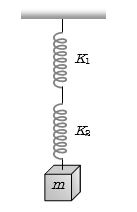
The frequency of oscillation of the spring-mass system shown in the figure is:
A
$\frac{1}{{2\pi }}\sqrt {\frac{K}{m}} $
B
$\frac{1}{{2\pi }}\sqrt {\frac{{({K_1} + {K_2})m}}{{{K_1}{K_2}}}} $
C
$2\pi \sqrt {\frac{K}{m}} $
D
$\frac{1}{{2\pi }}\sqrt {\frac{{{K_1}{K_2}}}{{m({K_1} + {K_2})}}} $
Solution
(D) In the given figure,the two springs with spring constants $K_1$ and $K_2$ are connected in series.
For springs connected in series,the equivalent spring constant $K_{eq}$ is given by the formula:
$\frac{1}{K_{eq}} = \frac{1}{K_1} + \frac{1}{K_2} = \frac{K_1 + K_2}{K_1 K_2}$
Therefore,$K_{eq} = \frac{K_1 K_2}{K_1 + K_2}$.
The frequency of oscillation $f$ for a spring-mass system is given by:
$f = \frac{1}{2\pi} \sqrt{\frac{K_{eq}}{m}}$
Substituting the value of $K_{eq}$ into the frequency formula,we get:
$f = \frac{1}{2\pi} \sqrt{\frac{K_1 K_2}{m(K_1 + K_2)}}$
Thus,the correct option is $(d)$.
For springs connected in series,the equivalent spring constant $K_{eq}$ is given by the formula:
$\frac{1}{K_{eq}} = \frac{1}{K_1} + \frac{1}{K_2} = \frac{K_1 + K_2}{K_1 K_2}$
Therefore,$K_{eq} = \frac{K_1 K_2}{K_1 + K_2}$.
The frequency of oscillation $f$ for a spring-mass system is given by:
$f = \frac{1}{2\pi} \sqrt{\frac{K_{eq}}{m}}$
Substituting the value of $K_{eq}$ into the frequency formula,we get:
$f = \frac{1}{2\pi} \sqrt{\frac{K_1 K_2}{m(K_1 + K_2)}}$
Thus,the correct option is $(d)$.
0 likesView Solution
16
PhysicsMediumMCQAIIMS · 2001
In a sinusoidal wave,the time required for a particular point to move from maximum displacement to zero displacement is $0.170\,s$. The frequency of the wave is .... $Hz$.
A
$1.47$
B
$0.36$
C
$0.73$
D
$2.94$
Solution
(A) In a sinusoidal wave,the motion from maximum displacement (amplitude) to zero displacement corresponds to one-quarter of the total time period $(T)$.
Therefore,the time taken is $t = \frac{T}{4}$.
Since the frequency ($n$ or $f$) is the reciprocal of the time period,$T = \frac{1}{n}$.
Substituting this into the equation,we get $t = \frac{1}{4n}$.
Rearranging for frequency,$n = \frac{1}{4t}$.
Given $t = 0.170\,s$,we calculate $n = \frac{1}{4 \times 0.170} = \frac{1}{0.680} \approx 1.47\,Hz$.
Therefore,the time taken is $t = \frac{T}{4}$.
Since the frequency ($n$ or $f$) is the reciprocal of the time period,$T = \frac{1}{n}$.
Substituting this into the equation,we get $t = \frac{1}{4n}$.
Rearranging for frequency,$n = \frac{1}{4t}$.
Given $t = 0.170\,s$,we calculate $n = \frac{1}{4 \times 0.170} = \frac{1}{0.680} \approx 1.47\,Hz$.
0 likesView Solution
17
PhysicsEasyMCQAIIMS · 2001
Two sound waves having a phase difference of $60^{\circ}$ have a path difference of
A
$2 \lambda$
B
$\lambda / 2$
C
$\lambda / 6$
D
$\lambda / 3$
Solution
(C) The relationship between path difference $(\Delta x)$ and phase difference $(\phi)$ is given by the formula: $\Delta x = \frac{\lambda}{2\pi} \times \phi$.
Given phase difference $\phi = 60^{\circ}$.
Convert the phase difference into radians: $\phi = 60^{\circ} \times \frac{\pi}{180^{\circ}} = \frac{\pi}{3} \text{ radians}$.
Substitute the value of $\phi$ into the formula: $\Delta x = \frac{\lambda}{2\pi} \times \frac{\pi}{3}$.
Simplifying the expression: $\Delta x = \frac{\lambda}{6}$.
Therefore,the path difference is $\lambda / 6$.
Given phase difference $\phi = 60^{\circ}$.
Convert the phase difference into radians: $\phi = 60^{\circ} \times \frac{\pi}{180^{\circ}} = \frac{\pi}{3} \text{ radians}$.
Substitute the value of $\phi$ into the formula: $\Delta x = \frac{\lambda}{2\pi} \times \frac{\pi}{3}$.
Simplifying the expression: $\Delta x = \frac{\lambda}{6}$.
Therefore,the path difference is $\lambda / 6$.
0 likesView Solution
18
PhysicsMediumMCQAIIMS · 2001
The tension in a piano wire is $10 \ N$. What should be the tension in the wire to produce a note of double the frequency (in $N$)?
A
$5$
B
$20$
C
$40$
D
$80$
Solution
(C) The frequency $n$ of a stretched string is given by the formula $n = \frac{1}{2l} \sqrt{\frac{T}{\mu}}$,where $T$ is the tension and $\mu$ is the linear mass density.
Since $l$ and $\mu$ are constant,we have $n \propto \sqrt{T}$.
Therefore,$\frac{n_1}{n_2} = \sqrt{\frac{T_1}{T_2}}$.
Given $n_1 = n$,$n_2 = 2n$,and $T_1 = 10 \ N$.
Substituting these values: $\frac{n}{2n} = \sqrt{\frac{10}{T_2}}$.
$\frac{1}{2} = \sqrt{\frac{10}{T_2}}$.
Squaring both sides: $\frac{1}{4} = \frac{10}{T_2}$.
Thus,$T_2 = 40 \ N$.
Since $l$ and $\mu$ are constant,we have $n \propto \sqrt{T}$.
Therefore,$\frac{n_1}{n_2} = \sqrt{\frac{T_1}{T_2}}$.
Given $n_1 = n$,$n_2 = 2n$,and $T_1 = 10 \ N$.
Substituting these values: $\frac{n}{2n} = \sqrt{\frac{10}{T_2}}$.
$\frac{1}{2} = \sqrt{\frac{10}{T_2}}$.
Squaring both sides: $\frac{1}{4} = \frac{10}{T_2}$.
Thus,$T_2 = 40 \ N$.
0 likesView Solution
19
PhysicsEasyMCQAIIMS · 2001
$A$ is singing a note and at the same time $B$ is singing a note with exactly one-eighth the frequency of the note of $A$. If the energies of the two sounds are equal,the amplitude of the note of $B$ is:
A
Same as that of $A$
B
Twice as that of $A$
C
Four times as that of $A$
D
Eight times as that of $A$
Solution
(D) The energy $E$ of a sound wave is given by the relation $E \propto a^2 n^2$,where $a$ is the amplitude and $n$ is the frequency.
Since the energies of the two sounds are equal,we have $E_A = E_B$.
Therefore,$a_A^2 n_A^2 = a_B^2 n_B^2$.
Given that the frequency of $B$ is one-eighth the frequency of $A$,we have $n_B = \frac{1}{8} n_A$,or $\frac{n_A}{n_B} = 8$.
Rearranging the energy equation: $\frac{a_B^2}{a_A^2} = \frac{n_A^2}{n_B^2}$.
Taking the square root on both sides: $\frac{a_B}{a_A} = \frac{n_A}{n_B} = 8$.
Thus,$a_B = 8 a_A$.
The amplitude of the note of $B$ is eight times that of $A$.
Since the energies of the two sounds are equal,we have $E_A = E_B$.
Therefore,$a_A^2 n_A^2 = a_B^2 n_B^2$.
Given that the frequency of $B$ is one-eighth the frequency of $A$,we have $n_B = \frac{1}{8} n_A$,or $\frac{n_A}{n_B} = 8$.
Rearranging the energy equation: $\frac{a_B^2}{a_A^2} = \frac{n_A^2}{n_B^2}$.
Taking the square root on both sides: $\frac{a_B}{a_A} = \frac{n_A}{n_B} = 8$.
Thus,$a_B = 8 a_A$.
The amplitude of the note of $B$ is eight times that of $A$.
0 likesView Solution
20
PhysicsMediumMCQAIIMS · 2001
The power radiated by a black body is $P$ and it radiates maximum energy at wavelength $\lambda_0$. If the temperature of the black body is now changed so that it radiates maximum energy at wavelength $\frac{3}{4}\lambda_0$,the power radiated by it becomes $nP$. The value of $n$ is
A
$\frac{3}{4}$
B
$\frac{4}{3}$
C
$\frac{81}{256}$
D
$\frac{256}{81}$
Solution
(D) According to $Wien's$ displacement law,$\lambda_{\max} T = \text{constant}$.
Let the initial temperature be $T$ and the final temperature be $T'$.
Given $\lambda_{\max, 1} = \lambda_0$ and $\lambda_{\max, 2} = \frac{3}{4}\lambda_0$.
Using the law: $\lambda_0 T = \left(\frac{3}{4}\lambda_0\right) T' \Rightarrow T' = \frac{4}{3}T$.
According to the $Stefan-Boltzmann$ law,the power radiated by a black body is $P = A \sigma T^4$,which implies $P \propto T^4$.
Therefore,$\frac{P_2}{P_1} = \left(\frac{T'}{T}\right)^4$.
Substituting the values: $n = \left(\frac{4/3 T}{T}\right)^4 = \left(\frac{4}{3}\right)^4 = \frac{256}{81}$.
Let the initial temperature be $T$ and the final temperature be $T'$.
Given $\lambda_{\max, 1} = \lambda_0$ and $\lambda_{\max, 2} = \frac{3}{4}\lambda_0$.
Using the law: $\lambda_0 T = \left(\frac{3}{4}\lambda_0\right) T' \Rightarrow T' = \frac{4}{3}T$.
According to the $Stefan-Boltzmann$ law,the power radiated by a black body is $P = A \sigma T^4$,which implies $P \propto T^4$.
Therefore,$\frac{P_2}{P_1} = \left(\frac{T'}{T}\right)^4$.
Substituting the values: $n = \left(\frac{4/3 T}{T}\right)^4 = \left(\frac{4}{3}\right)^4 = \frac{256}{81}$.
0 likesView Solution
21
PhysicsMediumMCQAIIMS · 2001
In an adiabatic change,the pressure $P$ and temperature $T$ of a monoatomic gas are related by the relation $P \propto T^C$,where $C$ equals
A
$5/3$
B
$2/5$
C
$3/5$
D
$5/2$
Solution
(D) For an adiabatic process,the relationship between pressure $P$ and temperature $T$ is given by $T^\gamma P^{1-\gamma} = \text{constant}$.
Rearranging this,we get $P^{1-\gamma} \propto T^{-\gamma}$,which implies $P \propto T^{-\frac{\gamma}{1-\gamma}}$ or $P \propto T^{\frac{\gamma}{\gamma-1}}$.
Comparing this with the given relation $P \propto T^C$,we find $C = \frac{\gamma}{\gamma-1}$.
For a monoatomic gas,the adiabatic index $\gamma = 5/3$.
Substituting the value of $\gamma$:
$C = \frac{5/3}{5/3 - 1} = \frac{5/3}{2/3} = 5/2$.
Rearranging this,we get $P^{1-\gamma} \propto T^{-\gamma}$,which implies $P \propto T^{-\frac{\gamma}{1-\gamma}}$ or $P \propto T^{\frac{\gamma}{\gamma-1}}$.
Comparing this with the given relation $P \propto T^C$,we find $C = \frac{\gamma}{\gamma-1}$.
For a monoatomic gas,the adiabatic index $\gamma = 5/3$.
Substituting the value of $\gamma$:
$C = \frac{5/3}{5/3 - 1} = \frac{5/3}{2/3} = 5/2$.
0 likesView Solution
22
PhysicsMediumMCQAIIMS · 2001
$A$ black body is heated from $27^oC$ to $127^oC$. The ratio of their energies of radiations emitted will be
A
$3:4$
B
$9:16$
C
$27:64$
D
$81:256$
Solution
(D) According to Stefan-Boltzmann Law,the energy radiated per unit time by a black body is proportional to the fourth power of its absolute temperature: $E \propto T^4$.
Given temperatures in Celsius: $T_1 = 27^oC$ and $T_2 = 127^oC$.
Convert these to Kelvin: $T_1 = 27 + 273 = 300 \ K$ and $T_2 = 127 + 273 = 400 \ K$.
The ratio of the energies emitted is given by: $\frac{E_1}{E_2} = \left( \frac{T_1}{T_2} \right)^4$.
Substituting the values: $\frac{E_1}{E_2} = \left( \frac{300}{400} \right)^4 = \left( \frac{3}{4} \right)^4 = \frac{81}{256}$.
Thus,the ratio is $81:256$.
Given temperatures in Celsius: $T_1 = 27^oC$ and $T_2 = 127^oC$.
Convert these to Kelvin: $T_1 = 27 + 273 = 300 \ K$ and $T_2 = 127 + 273 = 400 \ K$.
The ratio of the energies emitted is given by: $\frac{E_1}{E_2} = \left( \frac{T_1}{T_2} \right)^4$.
Substituting the values: $\frac{E_1}{E_2} = \left( \frac{300}{400} \right)^4 = \left( \frac{3}{4} \right)^4 = \frac{81}{256}$.
Thus,the ratio is $81:256$.
0 likesView Solution
23
PhysicsEasyMCQAIIMS · 2001
$Assertion$ : $A$ rocket moves forward by pushing the surrounding air backwards.
$Reason$ : It derives the necessary thrust to move forward according to Newton's third law of motion.
$Reason$ : It derives the necessary thrust to move forward according to Newton's third law of motion.
A
If both $Assertion$ and $Reason$ are correct and the $Reason$ is a correct explanation of the $Assertion$.
B
If both $Assertion$ and $Reason$ are correct but $Reason$ is not a correct explanation of the $Assertion$.
C
If the $Assertion$ is correct but $Reason$ is incorrect.
D
If both the $Assertion$ and $Reason$ are incorrect.
Solution
(D) The $Assertion$ is incorrect because a rocket does not require surrounding air to move forward. In fact,rockets operate efficiently in the vacuum of space.
The rocket moves forward by ejecting its own fuel combustion products (exhaust gases) at high velocity backwards. According to Newton's third law of motion,the rocket exerts a force on the gases,and the gases exert an equal and opposite reaction force on the rocket,providing the necessary thrust.
Since the $Assertion$ is false and the $Reason$ is a scientifically correct statement regarding the principle of rocket propulsion (Newton's third law),the correct choice is that the $Assertion$ is incorrect but the $Reason$ is correct. However,based on the provided options,if we consider the $Assertion$ false,the most appropriate classification is that the $Assertion$ is incorrect.
The rocket moves forward by ejecting its own fuel combustion products (exhaust gases) at high velocity backwards. According to Newton's third law of motion,the rocket exerts a force on the gases,and the gases exert an equal and opposite reaction force on the rocket,providing the necessary thrust.
Since the $Assertion$ is false and the $Reason$ is a scientifically correct statement regarding the principle of rocket propulsion (Newton's third law),the correct choice is that the $Assertion$ is incorrect but the $Reason$ is correct. However,based on the provided options,if we consider the $Assertion$ false,the most appropriate classification is that the $Assertion$ is incorrect.
0 likesView Solution
24
PhysicsEasyMCQAIIMS · 2001
$A$ constant torque of $31.4 \, Nm$ is exerted on a pivoted wheel. If the angular acceleration of the wheel is $4\pi \, rad/s^2$,then the moment of inertia will be ....... $kg \cdot m^2$.
A
$5.8$
B
$4.5$
C
$5.6$
D
$2.5$
Solution
(D) The relationship between torque $(\tau)$,moment of inertia $(I)$,and angular acceleration $(\alpha)$ is given by the formula: $\tau = I \alpha$.
Given:
Torque $(\tau)$ = $31.4 \, Nm$
Angular acceleration $(\alpha)$ = $4\pi \, rad/s^2$
Using the value of $\pi \approx 3.14$,we have $\alpha = 4 \times 3.14 = 12.56 \, rad/s^2$.
Substituting the values into the formula:
$31.4 = I \times 12.56$
$I = \frac{31.4}{12.56} = 2.5 \, kg \cdot m^2$.
Given:
Torque $(\tau)$ = $31.4 \, Nm$
Angular acceleration $(\alpha)$ = $4\pi \, rad/s^2$
Using the value of $\pi \approx 3.14$,we have $\alpha = 4 \times 3.14 = 12.56 \, rad/s^2$.
Substituting the values into the formula:
$31.4 = I \times 12.56$
$I = \frac{31.4}{12.56} = 2.5 \, kg \cdot m^2$.
0 likesView Solution
25
PhysicsEasyMCQAIIMS · 2001
Bernoulli's principle is based on the law of conservation of
A
mass
B
energy
C
angular momentum
D
linear momentum
Solution
(B) Bernoulli's principle is derived from the work-energy theorem for a flowing fluid.
It states that for an incompressible,non-viscous,and steady flow of a fluid,the sum of pressure energy,kinetic energy,and potential energy per unit volume remains constant along a streamline.
Therefore,it is based on the law of conservation of energy.
It states that for an incompressible,non-viscous,and steady flow of a fluid,the sum of pressure energy,kinetic energy,and potential energy per unit volume remains constant along a streamline.
Therefore,it is based on the law of conservation of energy.
0 likesView Solution
26
PhysicsEasyMCQAIIMS · 2001
$Assertion:$ In adiabatic compression,the internal energy and temperature of the system decrease.
$Reason:$ Adiabatic compression is a slow process.
$Reason:$ Adiabatic compression is a slow process.
A
If both $Assertion$ and $Reason$ are correct and the $Reason$ is a correct explanation of the $Assertion$.
B
If both $Assertion$ and $Reason$ are correct but $Reason$ is not a correct explanation of the $Assertion$.
C
If the $Assertion$ is correct but $Reason$ is incorrect.
D
If both the $Assertion$ and $Reason$ are incorrect.
Solution
(D) In an adiabatic process,the system is thermally insulated from the surroundings,meaning $dQ = 0$.
According to the first law of thermodynamics,$dQ = dU + dW$.
For adiabatic compression,work is done on the system,so $dW < 0$.
This implies $dU = -dW > 0$,which means the internal energy $U$ increases.
Since internal energy of an ideal gas is a function of temperature $(U \propto T)$,the temperature of the system also increases.
Therefore,the $Assertion$ is incorrect.
Adiabatic processes are typically fast processes to ensure no heat exchange occurs with the surroundings.
Therefore,the $Reason$ is also incorrect.
Thus,both $Assertion$ and $Reason$ are incorrect.
According to the first law of thermodynamics,$dQ = dU + dW$.
For adiabatic compression,work is done on the system,so $dW < 0$.
This implies $dU = -dW > 0$,which means the internal energy $U$ increases.
Since internal energy of an ideal gas is a function of temperature $(U \propto T)$,the temperature of the system also increases.
Therefore,the $Assertion$ is incorrect.
Adiabatic processes are typically fast processes to ensure no heat exchange occurs with the surroundings.
Therefore,the $Reason$ is also incorrect.
Thus,both $Assertion$ and $Reason$ are incorrect.
0 likesView Solution
27
PhysicsEasyMCQAIIMS · 2001
$Assertion :$ The isothermal curves intersect each other at a certain point.
$Reason :$ The isothermal change takes place slowly,so,the isothermal curves have very little slope.
$Reason :$ The isothermal change takes place slowly,so,the isothermal curves have very little slope.
A
If both Assertion and Reason are correct and the Reason is a correct explanation of the Assertion.
B
If both Assertion and Reason are correct but Reason is not a correct explanation of the Assertion.
C
If the Assertion is correct but Reason is incorrect.
D
If the Assertion is incorrect but the Reason is correct.
Solution
(D) The $Assertion$ is incorrect. Two isothermal curves for different temperatures cannot intersect each other. If they were to intersect at a point,it would imply that at that specific $(P, V)$ state,the system has two different temperatures simultaneously,which is impossible.
The $Reason$ is correct. An isothermal process is a slow process that allows the system to remain in thermal equilibrium with its surroundings. The slope of an isothermal curve on a $P-V$ diagram is given by $-\frac{dP}{dV} = \frac{P}{V}$. Since $P$ and $V$ are positive,the slope is finite and relatively small compared to adiabatic curves (which have a slope of $\gamma \frac{P}{V}$).
The $Reason$ is correct. An isothermal process is a slow process that allows the system to remain in thermal equilibrium with its surroundings. The slope of an isothermal curve on a $P-V$ diagram is given by $-\frac{dP}{dV} = \frac{P}{V}$. Since $P$ and $V$ are positive,the slope is finite and relatively small compared to adiabatic curves (which have a slope of $\gamma \frac{P}{V}$).
0 likesView Solution
28
PhysicsMediumMCQAIIMS · 2001
Two projectiles are projected at $30^{\circ}$ and $60^{\circ}$ with the horizontal with the same speed. The ratio of the maximum height attained by the two projectiles respectively is:
A
$2: \sqrt{3}$
B
$\sqrt{3}: 1$
C
$1: 3$
D
$1: \sqrt{3}$
Solution
(C) The formula for the maximum height $H$ attained by a projectile is given by $H = \frac{u^2 \sin^2 \theta}{2g}$.
Since both projectiles are projected with the same speed $u$,the ratio of their maximum heights $H_1$ and $H_2$ is given by $\frac{H_1}{H_2} = \frac{\sin^2 \theta_1}{\sin^2 \theta_2}$.
Given $\theta_1 = 30^{\circ}$ and $\theta_2 = 60^{\circ}$,we have $\sin 30^{\circ} = \frac{1}{2}$ and $\sin 60^{\circ} = \frac{\sqrt{3}}{2}$.
Substituting these values,we get $\frac{H_1}{H_2} = \frac{(\sin 30^{\circ})^2}{(\sin 60^{\circ})^2} = \frac{(1/2)^2}{(\sqrt{3}/2)^2} = \frac{1/4}{3/4} = \frac{1}{3}$.
Thus,the ratio is $1:3$.
Since both projectiles are projected with the same speed $u$,the ratio of their maximum heights $H_1$ and $H_2$ is given by $\frac{H_1}{H_2} = \frac{\sin^2 \theta_1}{\sin^2 \theta_2}$.
Given $\theta_1 = 30^{\circ}$ and $\theta_2 = 60^{\circ}$,we have $\sin 30^{\circ} = \frac{1}{2}$ and $\sin 60^{\circ} = \frac{\sqrt{3}}{2}$.
Substituting these values,we get $\frac{H_1}{H_2} = \frac{(\sin 30^{\circ})^2}{(\sin 60^{\circ})^2} = \frac{(1/2)^2}{(\sqrt{3}/2)^2} = \frac{1/4}{3/4} = \frac{1}{3}$.
Thus,the ratio is $1:3$.
0 likesView Solution
29
PhysicsDifficultMCQAIIMS · 2001
According to Hooke's law of elasticity,if stress is increased,then the ratio of stress to strain
A
becomes zero
B
remains constant
C
decreases
D
increases
Solution
(B) Hooke in $1679$ showed experimentally that if strain is small,then the stress is proportional to strain.
The ratio of stress to strain is constant for a given material and is called the modulus of elasticity $E$.
Thus,$E = \frac{\text{stress}}{\text{strain}} = \text{constant}$.
Hence,if stress is increased (within the elastic limit),the ratio of stress to strain remains constant.
The ratio of stress to strain is constant for a given material and is called the modulus of elasticity $E$.
Thus,$E = \frac{\text{stress}}{\text{strain}} = \text{constant}$.
Hence,if stress is increased (within the elastic limit),the ratio of stress to strain remains constant.
0 likesView Solution
30
PhysicsEasyMCQAIIMS · 2001
An electric charge $q$ is placed at the centre of a cube of side $a$. The electric flux through one of its faces will be
A
$\frac{q}{6\varepsilon_0}$
B
$\frac{q}{\varepsilon_0 a^2}$
C
$\frac{q}{4\pi \varepsilon_0 a^2}$
D
$\frac{q}{\varepsilon_0}$
Solution
(A) According to Gauss's theorem,the total electric flux $\phi_{net}$ through a closed surface is given by $\phi_{net} = \frac{q}{\varepsilon_0}$.
Since the charge $q$ is placed at the centre of the cube,the flux is distributed symmetrically through all $6$ faces of the cube.
Therefore,the electric flux through one face of the cube is $\phi_{face} = \frac{\phi_{net}}{6} = \frac{q}{6\varepsilon_0}$.
Since the charge $q$ is placed at the centre of the cube,the flux is distributed symmetrically through all $6$ faces of the cube.
Therefore,the electric flux through one face of the cube is $\phi_{face} = \frac{\phi_{net}}{6} = \frac{q}{6\varepsilon_0}$.
0 likesView Solution
31
PhysicsEasyMCQAIIMS · 2001
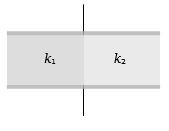
$A$ parallel plate capacitor is filled with two dielectrics as shown in the figure. The area of each plate is $A \; m^2$ and the separation between the plates is $t \; m$. The dielectric constants are $k_1$ and $k_2$ respectively. Its capacitance in farad will be:
A
$\frac{\varepsilon_0 A}{t}(k_1 + k_2)$
B
$\frac{\varepsilon_0 A}{t} \cdot \frac{k_1 + k_2}{2}$
C
$\frac{2\varepsilon_0 A}{t}(k_1 + k_2)$
D
$\frac{\varepsilon_0 A}{t} \cdot \frac{k_1 - k_2}{2}$
Solution
(B) The given arrangement can be considered as two capacitors connected in parallel,each having an area $A/2$ and plate separation $t$.
For the first capacitor with dielectric constant $k_1$,the capacitance is $C_1 = \frac{k_1 \varepsilon_0 (A/2)}{t} = \frac{k_1 \varepsilon_0 A}{2t}$.
For the second capacitor with dielectric constant $k_2$,the capacitance is $C_2 = \frac{k_2 \varepsilon_0 (A/2)}{t} = \frac{k_2 \varepsilon_0 A}{2t}$.
Since they are in parallel,the equivalent capacitance $C = C_1 + C_2$.
$C = \frac{k_1 \varepsilon_0 A}{2t} + \frac{k_2 \varepsilon_0 A}{2t} = \frac{\varepsilon_0 A}{2t}(k_1 + k_2) = \frac{\varepsilon_0 A}{t} \cdot \frac{k_1 + k_2}{2}$.
Thus,the correct option is $B$.
For the first capacitor with dielectric constant $k_1$,the capacitance is $C_1 = \frac{k_1 \varepsilon_0 (A/2)}{t} = \frac{k_1 \varepsilon_0 A}{2t}$.
For the second capacitor with dielectric constant $k_2$,the capacitance is $C_2 = \frac{k_2 \varepsilon_0 (A/2)}{t} = \frac{k_2 \varepsilon_0 A}{2t}$.
Since they are in parallel,the equivalent capacitance $C = C_1 + C_2$.
$C = \frac{k_1 \varepsilon_0 A}{2t} + \frac{k_2 \varepsilon_0 A}{2t} = \frac{\varepsilon_0 A}{2t}(k_1 + k_2) = \frac{\varepsilon_0 A}{t} \cdot \frac{k_1 + k_2}{2}$.
Thus,the correct option is $B$.
0 likesView Solution
32
PhysicsMediumMCQAIIMS · 2001
$A$ cell whose e.m.f. is $2\, V$ and internal resistance is $0.1\,\Omega$ is connected with a resistance of $3.9\,\Omega$. The voltage across the cell terminal will be ................ $V$.
A
$0.50$
B
$1.90$
C
$1.95$
D
$2.00$
Solution
(C) The electromotive force $(E)$ of the cell is $2\, V$.
The internal resistance $(r)$ of the cell is $0.1\,\Omega$.
The external resistance $(R)$ connected is $3.9\,\Omega$.
The total resistance of the circuit is $R_{total} = R + r = 3.9\,\Omega + 0.1\,\Omega = 4.0\,\Omega$.
The current $(I)$ flowing through the circuit is given by Ohm's law: $I = \frac{E}{R + r} = \frac{2\, V}{4.0\,\Omega} = 0.5\, A$.
The terminal voltage $(V)$ across the cell is given by $V = I \times R$.
Substituting the values: $V = 0.5\, A \times 3.9\,\Omega = 1.95\, V$.
The internal resistance $(r)$ of the cell is $0.1\,\Omega$.
The external resistance $(R)$ connected is $3.9\,\Omega$.
The total resistance of the circuit is $R_{total} = R + r = 3.9\,\Omega + 0.1\,\Omega = 4.0\,\Omega$.
The current $(I)$ flowing through the circuit is given by Ohm's law: $I = \frac{E}{R + r} = \frac{2\, V}{4.0\,\Omega} = 0.5\, A$.
The terminal voltage $(V)$ across the cell is given by $V = I \times R$.
Substituting the values: $V = 0.5\, A \times 3.9\,\Omega = 1.95\, V$.
0 likesView Solution
33
PhysicsEasyMCQAIIMS · 2001
The internal resistance of a cell is the resistance of
A
Electrodes of the cell
B
Vessel of the cell
C
Electrolyte used in the cell
D
Material used in the cell
Solution
(C) The internal resistance of a cell is defined as the opposition offered by the electrolyte and the electrodes of the cell to the flow of current through it.
However,the primary contribution to the internal resistance comes from the electrolyte present between the two electrodes.
Therefore,the correct option is $(c)$.
However,the primary contribution to the internal resistance comes from the electrolyte present between the two electrodes.
Therefore,the correct option is $(c)$.
0 likesView Solution
34
PhysicsDifficultMCQAIIMS · 2001
The temperature of the cold junction of a thermocouple is $0\,^oC$ and the temperature of the hot junction is $T\,^oC$. The thermo e.m.f. is given by the relation $E = AT - \frac{1}{2}BT^2$ (where $A = 16$ and $B = 0.08$). The temperature of inversion is ............... $^oC$.
A
$100$
B
$300$
C
$400$
D
$500$
Solution
(C) The thermo e.m.f. $E$ is given by $E = AT - \frac{1}{2}BT^2$.
At the temperature of inversion $(T_i)$,the thermo e.m.f. becomes zero.
Setting $E = 0$:
$0 = AT_i - \frac{1}{2}BT_i^2$
$AT_i = \frac{1}{2}BT_i^2$
$T_i = \frac{2A}{B}$
Given $A = 16$ and $B = 0.08$:
$T_i = \frac{2 \times 16}{0.08} = \frac{32}{0.08} = \frac{3200}{8} = 400\,^oC$.
Therefore,the temperature of inversion is $400\,^oC$.
At the temperature of inversion $(T_i)$,the thermo e.m.f. becomes zero.
Setting $E = 0$:
$0 = AT_i - \frac{1}{2}BT_i^2$
$AT_i = \frac{1}{2}BT_i^2$
$T_i = \frac{2A}{B}$
Given $A = 16$ and $B = 0.08$:
$T_i = \frac{2 \times 16}{0.08} = \frac{32}{0.08} = \frac{3200}{8} = 400\,^oC$.
Therefore,the temperature of inversion is $400\,^oC$.
0 likesView Solution
35
PhysicsEasyMCQAIIMS · 2001
$A$ closely wound flat circular coil of $25$ turns of wire has a diameter of $10\, cm$ and carries a current of $4\, A$. Determine the magnetic flux density at the centre of the coil.
A
$1.679 \times 10^{-5}\, T$
B
$2.028 \times 10^{-4}\, T$
C
$1.257 \times 10^{-3}\, T$
D
$1.512 \times 10^{-6}\, T$
Solution
(C) The magnetic field $B$ at the centre of a circular coil is given by the formula: $B = \frac{\mu_0 n i}{2r}$.
Given:
Number of turns $n = 25$.
Diameter $D = 10\, cm$,so radius $r = 5\, cm = 5 \times 10^{-2}\, m$.
Current $i = 4\, A$.
Permeability of free space $\mu_0 = 4\pi \times 10^{-7}\, T\cdot m/A$.
Substituting the values:
$B = \frac{(4\pi \times 10^{-7}) \times 25 \times 4}{2 \times 5 \times 10^{-2}}$
$B = \frac{4\pi \times 10^{-7} \times 100}{10 \times 10^{-2}}$
$B = 4\pi \times 10^{-7} \times 10^3 = 4\pi \times 10^{-4}\, T$
$B \approx 4 \times 3.14159 \times 10^{-4} = 12.566 \times 10^{-4} = 1.257 \times 10^{-3}\, T$.
Given:
Number of turns $n = 25$.
Diameter $D = 10\, cm$,so radius $r = 5\, cm = 5 \times 10^{-2}\, m$.
Current $i = 4\, A$.
Permeability of free space $\mu_0 = 4\pi \times 10^{-7}\, T\cdot m/A$.
Substituting the values:
$B = \frac{(4\pi \times 10^{-7}) \times 25 \times 4}{2 \times 5 \times 10^{-2}}$
$B = \frac{4\pi \times 10^{-7} \times 100}{10 \times 10^{-2}}$
$B = 4\pi \times 10^{-7} \times 10^3 = 4\pi \times 10^{-4}\, T$
$B \approx 4 \times 3.14159 \times 10^{-4} = 12.566 \times 10^{-4} = 1.257 \times 10^{-3}\, T$.
0 likesView Solution
36
PhysicsEasyMCQAIIMS · 2001
Cyclotron is used to accelerate
A
Electrons
B
Neutrons
C
Positive ions
D
Negative ions
Solution
(C) cyclotron is a device used to accelerate positively charged particles such as protons,deuterons,and alpha particles.
It works on the principle that a positively charged particle can be accelerated to a sufficiently high energy by repeatedly crossing an oscillating electric field,while being guided in a circular path by a strong magnetic field.
Electrons are not accelerated in a cyclotron because their mass is very small,causing them to reach relativistic speeds quickly,which leads to a loss of synchrony with the oscillating electric field.
It works on the principle that a positively charged particle can be accelerated to a sufficiently high energy by repeatedly crossing an oscillating electric field,while being guided in a circular path by a strong magnetic field.
Electrons are not accelerated in a cyclotron because their mass is very small,causing them to reach relativistic speeds quickly,which leads to a loss of synchrony with the oscillating electric field.
0 likesView Solution
37
PhysicsEasyMCQAIIMS · 2001
The coil of a choke in an $AC$ circuit:
A
Increases the current
B
Decreases the current
C
Does not change the current
D
Has high resistance to $DC$ circuit
Solution
(B) The correct answer is $(b)$.
In an $AC$ circuit,a choke coil is essentially an inductor with high inductance and negligible resistance.
It is used to limit or decrease the current in the circuit without significant loss of electrical energy.
Unlike a resistor,which dissipates energy as heat ($I^2R$ loss),an ideal choke coil consumes no power because the phase difference between voltage and current is $90^{\circ}$,resulting in a power factor of $\cos(90^{\circ}) = 0$.
In an $AC$ circuit,a choke coil is essentially an inductor with high inductance and negligible resistance.
It is used to limit or decrease the current in the circuit without significant loss of electrical energy.
Unlike a resistor,which dissipates energy as heat ($I^2R$ loss),an ideal choke coil consumes no power because the phase difference between voltage and current is $90^{\circ}$,resulting in a power factor of $\cos(90^{\circ}) = 0$.
0 likesView Solution
38
PhysicsEasyMCQAIIMS · 2001
In an atomic bomb,the energy is released due to
A
Chain reaction of neutrons and $_{92}U^{235}$
B
Chain reaction of neutrons and $_{92}U^{238}$
C
Chain reaction of neutrons and $_{92}Pu^{240}$
D
Chain reaction of neutrons and $_{92}U^{236}$
Solution
(A) In an atomic bomb,the energy is released due to the uncontrolled chain reaction of neutrons and $_{92}U^{235}$.
The nuclear fission reaction taking place is as follows:
$_{92}U^{235} + _{0}n^{1} \rightarrow _{56}Ba^{141} + _{36}Kr^{92} + 3_{0}n^{1} + Q \text{ (approx. } 200 \text{ MeV energy)}$.
The three neutrons generated in each fission event can react with three other $_{92}U^{235}$ nuclei,which leads to a self-sustaining chain reaction,releasing a massive amount of energy in a very short time.
The nuclear fission reaction taking place is as follows:
$_{92}U^{235} + _{0}n^{1} \rightarrow _{56}Ba^{141} + _{36}Kr^{92} + 3_{0}n^{1} + Q \text{ (approx. } 200 \text{ MeV energy)}$.
The three neutrons generated in each fission event can react with three other $_{92}U^{235}$ nuclei,which leads to a self-sustaining chain reaction,releasing a massive amount of energy in a very short time.
0 likesView Solution
39
PhysicsEasyMCQAIIMS · 2001
When a radioactive substance emits an $\alpha$-particle,its position in the periodic table is lowered by
A
One place
B
Two places
C
Three places
D
Four places
Solution
(B) When a radioactive nucleus emits an $\alpha$-particle $(_{2}He^{4})$,the atomic number $Z$ of the nucleus decreases by $2$ and the mass number $A$ decreases by $4$.
The decay equation is given by: $_{Z}X^{A} \rightarrow _{Z-2}Y^{A-4} + _{2}He^{4}$.
Since the atomic number $Z$ decreases by $2$,the element shifts two places to the left in the periodic table.
The decay equation is given by: $_{Z}X^{A} \rightarrow _{Z-2}Y^{A-4} + _{2}He^{4}$.
Since the atomic number $Z$ decreases by $2$,the element shifts two places to the left in the periodic table.
0 likesView Solution
40
PhysicsEasyMCQAIIMS · 2001
The Fraunhofer spectrum is a
A
Line absorption spectrum
B
Band absorption spectrum
C
Line emission spectrum
D
Band emission spectrum
Solution
(A) The Fraunhofer lines are observed in the solar spectrum.
These lines are formed when the atoms in the cooler outer layers of the Sun (the chromosphere) absorb specific wavelengths of light emitted by the hotter inner layers (the photosphere).
Since these atoms absorb discrete wavelengths,they produce dark lines in the continuous spectrum of the Sun.
Therefore,the Fraunhofer spectrum is a line absorption spectrum.
These lines are formed when the atoms in the cooler outer layers of the Sun (the chromosphere) absorb specific wavelengths of light emitted by the hotter inner layers (the photosphere).
Since these atoms absorb discrete wavelengths,they produce dark lines in the continuous spectrum of the Sun.
Therefore,the Fraunhofer spectrum is a line absorption spectrum.
0 likesView Solution
41
PhysicsEasyMCQAIIMS · 2001
The resolving limit of a healthy human eye is about:
A
$1'$ or $\left( \frac{1}{60} \right)^\circ$
B
$1''$
C
$1^\circ$
D
$\left( \frac{1}{60} \right)''$
Solution
(A) The resolving limit of a healthy human eye is defined as the minimum angle that two distinct points must subtend at the eye to be seen as separate. For a healthy human eye,this limit is approximately $1$ minute of arc,which is denoted as $1'$.
Since $60' = 1^\circ$,it follows that $1' = \left( \frac{1}{60} \right)^\circ$.
Since $60' = 1^\circ$,it follows that $1' = \left( \frac{1}{60} \right)^\circ$.
0 likesView Solution
42
PhysicsEasyMCQAIIMS · 2001
Four lenses of focal length $+ 15\, cm, + 20\, cm, + 150\, cm$ and $+ 250\, cm$ are available for making an astronomical telescope. To produce the largest magnification,the focal length of the eye-piece should be.....$cm$
A
$+ 15$
B
$+ 20$
C
$+ 150$
D
$+ 250$
Solution
(A) The magnification $M$ of an astronomical telescope in normal adjustment is given by the formula $M = -\frac{f_o}{f_e}$,where $f_o$ is the focal length of the objective lens and $f_e$ is the focal length of the eye-piece.
To obtain the largest magnification $M$,the ratio $\frac{f_o}{f_e}$ must be maximized.
This implies that for a given objective lens,the focal length of the eye-piece $f_e$ should be the smallest available value.
Among the given focal lengths $(+ 15\, cm, + 20\, cm, + 150\, cm, + 250\, cm)$,the smallest value is $+ 15\, cm$.
Therefore,the focal length of the eye-piece should be $+ 15\, cm$.
To obtain the largest magnification $M$,the ratio $\frac{f_o}{f_e}$ must be maximized.
This implies that for a given objective lens,the focal length of the eye-piece $f_e$ should be the smallest available value.
Among the given focal lengths $(+ 15\, cm, + 20\, cm, + 150\, cm, + 250\, cm)$,the smallest value is $+ 15\, cm$.
Therefore,the focal length of the eye-piece should be $+ 15\, cm$.
0 likesView Solution
43
PhysicsEasyMCQAIIMS · 2001
The dual nature of light is exhibited by
A
Photoelectric effect
B
Refraction and interference
C
Diffraction and reflection
D
Diffraction and photoelectric effect
Solution
(D) The dual nature of light implies that light exhibits both wave-like and particle-like properties.
Diffraction is a phenomenon that demonstrates the wave nature of light.
The photoelectric effect is a phenomenon that demonstrates the particle nature of light (photons).
Therefore,the combination of diffraction and the photoelectric effect exhibits the dual nature of light.
Thus,the correct option is $D$.
Diffraction is a phenomenon that demonstrates the wave nature of light.
The photoelectric effect is a phenomenon that demonstrates the particle nature of light (photons).
Therefore,the combination of diffraction and the photoelectric effect exhibits the dual nature of light.
Thus,the correct option is $D$.
0 likesView Solution
44
PhysicsEasyMCQAIIMS · 2001
How does the red shift confirm that the universe is expanding?
A
Due to Wien's law
B
Due to Stefan's law
C
Due to Kirchhoff's law
D
Due to Doppler's effect
Solution
(D) The correct answer is $D$.
According to the Doppler effect,when a source of light moves away from an observer,the frequency of the emitted light decreases,which corresponds to an increase in wavelength.
This shift towards longer wavelengths (the red end of the visible spectrum) is known as the red shift.
Since light observed from distant galaxies consistently shows a red shift,it indicates that these galaxies are moving away from us.
This observation provides strong evidence that the universe is expanding.
According to the Doppler effect,when a source of light moves away from an observer,the frequency of the emitted light decreases,which corresponds to an increase in wavelength.
This shift towards longer wavelengths (the red end of the visible spectrum) is known as the red shift.
Since light observed from distant galaxies consistently shows a red shift,it indicates that these galaxies are moving away from us.
This observation provides strong evidence that the universe is expanding.
0 likesView Solution
45
PhysicsEasyMCQAIIMS · 2001
Fraunhofer lines of the solar system are an example of
A
Emission spectrum
B
Emission band spectrum
C
Continuous emission spectrum
D
Line absorption spectrum
Solution
(D) The correct answer is $D$. Fraunhofer lines are produced by the absorption of light rays from the Sun by the gases and vapors present in the solar atmosphere. When white light from the photosphere passes through the cooler chromosphere,the atoms and molecules present in the chromosphere absorb specific wavelengths of light. This process results in the formation of dark lines in the otherwise continuous spectrum of the Sun,which are known as Fraunhofer lines. Therefore,they represent a line absorption spectrum.
0 likesView Solution
46
PhysicsEasyMCQAIIMS · 2001
Assertion: $A$ metallic shield in the form of a hollow shell may be built to block an electric field.
Reason: In a hollow spherical shield,the electric field inside it is zero at every point.
Reason: In a hollow spherical shield,the electric field inside it is zero at every point.
A
If both Assertion and Reason are correct and the Reason is a correct explanation of the Assertion.
B
If both Assertion and Reason are correct but Reason is not a correct explanation of the Assertion.
C
If the Assertion is correct but Reason is incorrect.
D
If both the Assertion and Reason are incorrect.
Solution
(A) According to the principle of electrostatic shielding,the electric field inside a closed metallic conductor is always zero,regardless of any external electric field.
This phenomenon occurs because the free electrons in the metal redistribute themselves on the surface to cancel out the effect of the external field.
Since the electric field inside the hollow shell is zero,it effectively blocks external electric fields from entering the interior region.
Therefore,the Assertion is correct,and the Reason provides the correct physical explanation for why such a shield works.
This phenomenon occurs because the free electrons in the metal redistribute themselves on the surface to cancel out the effect of the external field.
Since the electric field inside the hollow shell is zero,it effectively blocks external electric fields from entering the interior region.
Therefore,the Assertion is correct,and the Reason provides the correct physical explanation for why such a shield works.
0 likesView Solution
47
PhysicsEasyMCQAIIMS · 2001
Assertion: $X-$rays travel with the speed of light.
Reason: $X-$rays are electromagnetic rays.
Reason: $X-$rays are electromagnetic rays.
A
If both Assertion and Reason are correct and the Reason is a correct explanation of the Assertion.
B
If both Assertion and Reason are correct but Reason is not a correct explanation of the Assertion.
C
If the Assertion is correct but Reason is incorrect.
D
If both the Assertion and Reason are incorrect.
Solution
(A) All electromagnetic waves travel at the speed of light $(c \approx 3 \times 10^8 \ m/s)$ in a vacuum.
Since $X-$rays are a part of the electromagnetic spectrum,they are electromagnetic waves.
Therefore,the Assertion is correct because the Reason correctly identifies their nature as electromagnetic waves,which dictates their speed.
Since $X-$rays are a part of the electromagnetic spectrum,they are electromagnetic waves.
Therefore,the Assertion is correct because the Reason correctly identifies their nature as electromagnetic waves,which dictates their speed.
0 likesView Solution
48
PhysicsEasyMCQAIIMS · 2001
Assertion : In a movie, ordinarily $24$ frames are projected per second from one end to the other of the complete film.
Reason : The image formed on the retina of the eye is sustained up to $1/10 \, s$ after the removal of the stimulus.
Reason : The image formed on the retina of the eye is sustained up to $1/10 \, s$ after the removal of the stimulus.
A
If both Assertion and Reason are correct and the Reason is a correct explanation of the Assertion.
B
If both Assertion and Reason are correct but Reason is not a correct explanation of the Assertion.
C
If the Assertion is correct but Reason is incorrect.
D
If both the Assertion and Reason are incorrect.
Solution
(C) The phenomenon where an image persists on the retina after the stimulus is removed is known as persistence of vision.
This persistence of vision lasts for approximately $\frac{1}{16} \, s$.
To perceive motion in a movie, the frame rate must be higher than the reciprocal of the persistence time, which is $16 \, \text{frames per second}$.
Since $24 \, \text{frames per second}$ is greater than $16 \, \text{frames per second}$, the motion appears smooth.
The Reason provided states the persistence time is $1/10 \, s$, which is factually incorrect as it is approximately $1/16 \, s$.
Therefore, the Assertion is correct, but the Reason is incorrect.
This persistence of vision lasts for approximately $\frac{1}{16} \, s$.
To perceive motion in a movie, the frame rate must be higher than the reciprocal of the persistence time, which is $16 \, \text{frames per second}$.
Since $24 \, \text{frames per second}$ is greater than $16 \, \text{frames per second}$, the motion appears smooth.
The Reason provided states the persistence time is $1/10 \, s$, which is factually incorrect as it is approximately $1/16 \, s$.
Therefore, the Assertion is correct, but the Reason is incorrect.
0 likesView Solution
49
PhysicsEasyMCQAIIMS · 2001
Assertion : The blue colour of the sky appears due to the scattering of blue light.
Reason : Blue light has the shortest wavelength in the visible spectrum.
Reason : Blue light has the shortest wavelength in the visible spectrum.
A
If both Assertion and Reason are correct and the Reason is a correct explanation of the Assertion.
B
If both Assertion and Reason are correct but Reason is not a correct explanation of the Assertion.
C
If the Assertion is correct but Reason is incorrect.
D
If both the Assertion and Reason are incorrect.
Solution
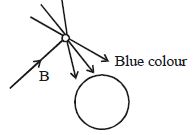
(A) According to Rayleigh's law of scattering, the intensity of scattered light is inversely proportional to the fourth power of its wavelength $(I \propto 1/\lambda^4)$.
Since blue light has a shorter wavelength compared to other colours in the visible spectrum, it is scattered to the maximum extent by the molecules and fine particles in the atmosphere.
Therefore, the blue colour appears to be coming from the sky. Both the Assertion and the Reason are correct, and the Reason is the correct explanation of the Assertion.
Since blue light has a shorter wavelength compared to other colours in the visible spectrum, it is scattered to the maximum extent by the molecules and fine particles in the atmosphere.
Therefore, the blue colour appears to be coming from the sky. Both the Assertion and the Reason are correct, and the Reason is the correct explanation of the Assertion.
0 likesView Solution
50
PhysicsEasyMCQAIIMS · 2001
Assertion: In Young's experiment,the fringe width for dark fringes is different from that for bright fringes.
Reason: In Young's double slit experiment,if the fringes are performed with a source of white light,then only black and bright fringes are observed.
Reason: In Young's double slit experiment,if the fringes are performed with a source of white light,then only black and bright fringes are observed.
A
If both Assertion and Reason are correct and the Reason is a correct explanation of the Assertion.
B
If both Assertion and Reason are correct but Reason is not a correct explanation of the Assertion.
C
If the Assertion is correct but Reason is incorrect.
D
If both the Assertion and Reason are incorrect.
Solution
(D) In Young's double slit experiment,the fringe width is given by $\beta = \frac{\lambda D}{d}$. Since the fringe width depends only on the wavelength $\lambda$,the distance between slits $d$,and the distance to the screen $D$,the fringe width for dark and bright fringes is the same. Thus,the Assertion is incorrect.
When white light is used as a source,the central fringe is white,and the subsequent fringes are coloured because different wavelengths have different fringe widths. Black fringes are not observed in the same way as monochromatic light. Thus,the Reason is also incorrect.
When white light is used as a source,the central fringe is white,and the subsequent fringes are coloured because different wavelengths have different fringe widths. Black fringes are not observed in the same way as monochromatic light. Thus,the Reason is also incorrect.
0 likesView Solution
51
PhysicsMediumMCQAIIMS · 2001
Assertion: ${}_{Z}{X^{A}}$ undergoes $2\alpha$-decays,$2\beta$-decays,and $2\gamma$-decays,and the daughter product is ${}_{Z-2}{X^{A-8}}$.
Reason: In $\alpha$-decays,the mass number decreases by $4$ and the atomic number decreases by $2$. In $\beta$-decays,the mass number remains unchanged,but the atomic number increases by $1$.
Reason: In $\alpha$-decays,the mass number decreases by $4$ and the atomic number decreases by $2$. In $\beta$-decays,the mass number remains unchanged,but the atomic number increases by $1$.
A
If both Assertion and Reason are correct and the Reason is a correct explanation of the Assertion.
B
If both Assertion and Reason are correct but Reason is not a correct explanation of the Assertion.
C
If the Assertion is correct but Reason is incorrect.
D
If both the Assertion and Reason are incorrect.
Solution
(A) Let us analyze the decay process for the parent nucleus ${}_{Z}{X^{A}}$:
$1$. After $2\alpha$-decays: Each $\alpha$-decay reduces the mass number by $4$ and atomic number by $2$. Thus,$2\alpha$-decays result in a change of $\Delta A = -8$ and $\Delta Z = -4$. The product is ${}_{Z-4}{X^{A-8}}$.
$2$. After $2\beta$-decays: Each $\beta^-$-decay increases the atomic number by $1$ while the mass number remains unchanged. Thus,$2\beta$-decays result in $\Delta Z = +2$. The product is ${}_{(Z-4)+2}{X^{A-8}} = {}_{Z-2}{X^{A-8}}$.
$3$. $\gamma$-decays do not change the mass number or atomic number.
Therefore,the final product is indeed ${}_{Z-2}{X^{A-8}}$. The Assertion is correct.
The Reason correctly describes the individual effects of $\alpha$ and $\beta$ decays on the mass and atomic numbers. Thus,the Reason is the correct explanation for the Assertion.
$1$. After $2\alpha$-decays: Each $\alpha$-decay reduces the mass number by $4$ and atomic number by $2$. Thus,$2\alpha$-decays result in a change of $\Delta A = -8$ and $\Delta Z = -4$. The product is ${}_{Z-4}{X^{A-8}}$.
$2$. After $2\beta$-decays: Each $\beta^-$-decay increases the atomic number by $1$ while the mass number remains unchanged. Thus,$2\beta$-decays result in $\Delta Z = +2$. The product is ${}_{(Z-4)+2}{X^{A-8}} = {}_{Z-2}{X^{A-8}}$.
$3$. $\gamma$-decays do not change the mass number or atomic number.
Therefore,the final product is indeed ${}_{Z-2}{X^{A-8}}$. The Assertion is correct.
The Reason correctly describes the individual effects of $\alpha$ and $\beta$ decays on the mass and atomic numbers. Thus,the Reason is the correct explanation for the Assertion.
0 likesView Solution
52
PhysicsMediumMCQAIIMS · 2001
In a circuit,the current lags behind the voltage by a phase difference of $\pi / 2$. The circuit will contain which of the following?
A
Only $R$
B
Only $C$
C
$R$ and $C$
D
Only $L$
Solution
(D) In an alternating current circuit,the phase relationship between voltage and current depends on the components present.
For a purely inductive circuit (containing only an inductor $L$),the voltage leads the current by a phase angle of $\pi / 2$ $(90^{\circ})$,which is equivalent to saying the current lags behind the voltage by $\pi / 2$.
For a purely capacitive circuit (containing only a capacitor $C$),the current leads the voltage by a phase angle of $\pi / 2$ $(90^{\circ})$.
For a purely resistive circuit (containing only a resistor $R$),the current and voltage are in the same phase (phase difference is $0$).
Therefore,since the current lags behind the voltage by $\pi / 2$,the circuit must contain only an inductor $L$.
For a purely inductive circuit (containing only an inductor $L$),the voltage leads the current by a phase angle of $\pi / 2$ $(90^{\circ})$,which is equivalent to saying the current lags behind the voltage by $\pi / 2$.
For a purely capacitive circuit (containing only a capacitor $C$),the current leads the voltage by a phase angle of $\pi / 2$ $(90^{\circ})$.
For a purely resistive circuit (containing only a resistor $R$),the current and voltage are in the same phase (phase difference is $0$).
Therefore,since the current lags behind the voltage by $\pi / 2$,the circuit must contain only an inductor $L$.
0 likesView Solution
53
PhysicsEasyMCQAIIMS · 2001
In Young's double slit experiment,if the slit widths are in the ratio $1:9$,the ratio of the intensity at minima to that at maxima will be:
A
$1:4$
B
$1:9$
C
$1:2$
D
$1:3$
Solution
(A) The intensity of light $I$ is directly proportional to the slit width $w$ $(I \propto w)$.
Given the ratio of slit widths is $w_1 / w_2 = 1 / 9$,the ratio of intensities of the two sources is $I_1 / I_2 = 1 / 9$.
Since intensity $I \propto a^2$ (where $a$ is the amplitude),the ratio of amplitudes is $a_1 / a_2 = \sqrt{I_1 / I_2} = \sqrt{1 / 9} = 1 / 3$.
Let $a_1 = a$ and $a_2 = 3a$.
The ratio of minimum intensity to maximum intensity is given by the formula:
$\frac{I_{\text{min}}}{I_{\text{max}}} = \left( \frac{a_1 - a_2}{a_1 + a_2} \right)^2$
Substituting the values:
$\frac{I_{\text{min}}}{I_{\text{max}}} = \left( \frac{a - 3a}{a + 3a} \right)^2 = \left( \frac{-2a}{4a} \right)^2 = \left( -\frac{1}{2} \right)^2 = \frac{1}{4}$.
Given the ratio of slit widths is $w_1 / w_2 = 1 / 9$,the ratio of intensities of the two sources is $I_1 / I_2 = 1 / 9$.
Since intensity $I \propto a^2$ (where $a$ is the amplitude),the ratio of amplitudes is $a_1 / a_2 = \sqrt{I_1 / I_2} = \sqrt{1 / 9} = 1 / 3$.
Let $a_1 = a$ and $a_2 = 3a$.
The ratio of minimum intensity to maximum intensity is given by the formula:
$\frac{I_{\text{min}}}{I_{\text{max}}} = \left( \frac{a_1 - a_2}{a_1 + a_2} \right)^2$
Substituting the values:
$\frac{I_{\text{min}}}{I_{\text{max}}} = \left( \frac{a - 3a}{a + 3a} \right)^2 = \left( \frac{-2a}{4a} \right)^2 = \left( -\frac{1}{2} \right)^2 = \frac{1}{4}$.
0 likesView Solution
Vedclass Products
For Students
Vedclass Test Series
Mock tests in real AIIMS style covering Physics with performance analysis. 5-day free trial.
Start Free TrialFor Teachers
Exam Paper Generator
Generate Set A/B/C/D Physics papers from 7.5L+ questions in 2 minutes. 3 chapters free.
Try FreeFor Institutes
Online Exam Module
Run live AIIMS mock exams with unlimited students, 360° analytics & white-label branding.
See DemoFrequently Asked Questions
How many Physics questions are in AIIMS 2001?
There are 53 Physics questions from the AIIMS 2001 paper on Vedclass, each with a detailed step-by-step solution in English.
Are AIIMS 2001 Physics solutions available in English?
Yes. All solutions on this page are in English. You can also switch to English or Hindi using the language buttons above the questions.
Can I practice AIIMS 2001 Physics as a timed test?
Yes. Use the Vedclass Test Series to attempt a full AIIMS mock test covering Physics with time limits and instant score analysis.
Can teachers create Physics papers from AIIMS previous year questions?
Yes. The Vedclass Exam Paper Generator lets teachers mix AIIMS Physics questions and generate Set A/B/C/D papers in minutes.
For Teachers & Institutes
Build a Custom Physics Paper
Pick AIIMS 2001 Physics questions, set difficulty, and generate Set A/B/C/D in 2 minutes.