
A English
Young's Double Slit Experiment (YDSE) Questions in English
Class 12 Physics · Wave Optics · Young's Double Slit Experiment (YDSE)
616+
Questions
English
Language
100%
With Solutions
Showing 50 of 616 questions in English
251
EasyMCQ
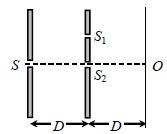
Two ideal slits $S_1$ and $S_2$ are at a distance $d$ apart and are illuminated by light of wavelength $\lambda$ passing through an ideal source slit $S$ placed on the line through $S_2$ as shown. The distance between the plane of the slits and the source slit is $D$. $A$ screen is held at a distance $D$ from the plane of the slits. The minimum value of $d$ for which there is darkness at $O$ is
A
$\sqrt{\frac{3\lambda D}{2}}$
B
$\sqrt{\lambda D}$
C
$\sqrt{\frac{\lambda D}{2}}$
D
$\sqrt{3\lambda D}$
Solution
(C) For darkness at point $O$,the path difference between the light waves reaching $O$ from $S_1$ and $S_2$ must be an odd multiple of $\frac{\lambda}{2}$.
The path taken by light from $S$ to $O$ via $S_2$ is $SO + OS_2 = D + D = 2D$.
The path taken by light from $S$ to $O$ via $S_1$ is $SS_1 + S_1O$. Here,$SS_1 = \sqrt{D^2 + d^2}$ and $S_1O = \sqrt{D^2 + d^2}$.
Thus,the total path via $S_1$ is $2\sqrt{D^2 + d^2}$.
The path difference $\Delta x = 2\sqrt{D^2 + d^2} - 2D$.
For minimum darkness,$\Delta x = \frac{\lambda}{2}$.
$2\sqrt{D^2 + d^2} - 2D = \frac{\lambda}{2} \implies \sqrt{D^2 + d^2} = D + \frac{\lambda}{4}$.
Squaring both sides: $D^2 + d^2 = D^2 + \frac{\lambda D}{2} + \frac{\lambda^2}{16}$.
Since $d \ll D$,we can neglect the $\lambda^2$ term: $d^2 \approx \frac{\lambda D}{2}$.
Therefore,$d = \sqrt{\frac{\lambda D}{2}}$.
The path taken by light from $S$ to $O$ via $S_2$ is $SO + OS_2 = D + D = 2D$.
The path taken by light from $S$ to $O$ via $S_1$ is $SS_1 + S_1O$. Here,$SS_1 = \sqrt{D^2 + d^2}$ and $S_1O = \sqrt{D^2 + d^2}$.
Thus,the total path via $S_1$ is $2\sqrt{D^2 + d^2}$.
The path difference $\Delta x = 2\sqrt{D^2 + d^2} - 2D$.
For minimum darkness,$\Delta x = \frac{\lambda}{2}$.
$2\sqrt{D^2 + d^2} - 2D = \frac{\lambda}{2} \implies \sqrt{D^2 + d^2} = D + \frac{\lambda}{4}$.
Squaring both sides: $D^2 + d^2 = D^2 + \frac{\lambda D}{2} + \frac{\lambda^2}{16}$.
Since $d \ll D$,we can neglect the $\lambda^2$ term: $d^2 \approx \frac{\lambda D}{2}$.
Therefore,$d = \sqrt{\frac{\lambda D}{2}}$.
0 likes
View Solution252
DifficultMCQ
$A$ double slit experiment is performed by using light of wavelength $6000 \, Å$. If the distance of the screen is $1 \, m$ and the slits are $0.1 \, cm$ apart, calculate the angular position of the $10^{th}$ bright fringe.
A
$6 \times 10^{-4} \, rad$
B
$6 \times 10^{-3} \, rad$
C
$6 \times 10^{-5} \, rad$
D
$6 \times 10^{-7} \, rad$
Solution
(B) The condition for the angular position of the $n^{th}$ bright fringe in a double-slit experiment is given by $\theta = \frac{n \lambda}{d}$.
Given:
Wavelength $\lambda = 6000 \, Å = 6000 \times 10^{-10} \, m = 6 \times 10^{-7} \, m$.
Slit separation $d = 0.1 \, cm = 10^{-3} \, m$.
Order of fringe $n = 10$.
Substituting the values into the formula:
$\theta = \frac{10 \times 6 \times 10^{-7}}{10^{-3}}$
$\theta = 60 \times 10^{-4} \, rad$
$\theta = 6 \times 10^{-3} \, rad$.
Given:
Wavelength $\lambda = 6000 \, Å = 6000 \times 10^{-10} \, m = 6 \times 10^{-7} \, m$.
Slit separation $d = 0.1 \, cm = 10^{-3} \, m$.
Order of fringe $n = 10$.
Substituting the values into the formula:
$\theta = \frac{10 \times 6 \times 10^{-7}}{10^{-3}}$
$\theta = 60 \times 10^{-4} \, rad$
$\theta = 6 \times 10^{-3} \, rad$.
0 likes
View Solution253
DifficultMCQ
In Young's double-slit interference experiment,the distance between two sources is $0.1 \ mm$. The distance of the screen from the sources is $20 \ cm$. The wavelength of light used is $5460 \ \mathring{A}$. What is the angular position of the first dark fringe in degrees?
A
$0.08$
B
$0.16$
C
$0.20$
D
$0.32$
Solution
(B) Given: Distance between slits $d = 0.1 \ mm = 10^{-4} \ m$,distance of screen $D = 20 \ cm = 0.2 \ m$,and wavelength $\lambda = 5460 \ \mathring{A} = 5460 \times 10^{-10} \ m$.
For the first dark fringe,the path difference is $\Delta x = \lambda / 2$.
The angular position $\theta$ is given by the relation $d \sin \theta = \Delta x = \lambda / 2$.
Since $\theta$ is very small,$\sin \theta \approx \theta$ (in radians).
$\theta = \frac{\lambda}{2d} = \frac{5460 \times 10^{-10}}{2 \times 10^{-4}} = 2730 \times 10^{-6} \ rad$.
To convert radians to degrees,multiply by $(180 / \pi)$:
$\theta_{deg} = 2730 \times 10^{-6} \times \frac{180}{3.14159} \approx 0.1564^\circ$.
Rounding to two decimal places,we get $\theta \approx 0.16^\circ$.
For the first dark fringe,the path difference is $\Delta x = \lambda / 2$.
The angular position $\theta$ is given by the relation $d \sin \theta = \Delta x = \lambda / 2$.
Since $\theta$ is very small,$\sin \theta \approx \theta$ (in radians).
$\theta = \frac{\lambda}{2d} = \frac{5460 \times 10^{-10}}{2 \times 10^{-4}} = 2730 \times 10^{-6} \ rad$.
To convert radians to degrees,multiply by $(180 / \pi)$:
$\theta_{deg} = 2730 \times 10^{-6} \times \frac{180}{3.14159} \approx 0.1564^\circ$.
Rounding to two decimal places,we get $\theta \approx 0.16^\circ$.
0 likes
View Solution254
MediumMCQ
In a double slit experiment,the angular width of a fringe is found to be $0.2^{\circ}$ on a screen placed $1\, m$ away. The wavelength of light used is $600\, nm$. What will be the angular width of the fringe if the entire experimental apparatus is immersed in water (in $^{\circ}$)? Take the refractive index of water to be $4/3$.
A
$1$
B
$0.15$
C
$2.6$
D
$2$
Solution
(B) The angular fringe width $\theta$ in a double slit experiment is given by the formula $\theta = \frac{\lambda}{d}$,where $\lambda$ is the wavelength of light and $d$ is the slit separation.
When the apparatus is immersed in a medium with refractive index $\mu$,the wavelength of light changes to $\lambda' = \frac{\lambda}{\mu}$.
The new angular width $\theta'$ becomes $\theta' = \frac{\lambda'}{d} = \frac{\lambda}{\mu d} = \frac{\theta}{\mu}$.
Given $\theta = 0.2^{\circ}$ and $\mu = 4/3$,we have $\theta' = \frac{0.2}{4/3} = 0.2 \times \frac{3}{4} = 0.15^{\circ}$.
When the apparatus is immersed in a medium with refractive index $\mu$,the wavelength of light changes to $\lambda' = \frac{\lambda}{\mu}$.
The new angular width $\theta'$ becomes $\theta' = \frac{\lambda'}{d} = \frac{\lambda}{\mu d} = \frac{\theta}{\mu}$.
Given $\theta = 0.2^{\circ}$ and $\mu = 4/3$,we have $\theta' = \frac{0.2}{4/3} = 0.2 \times \frac{3}{4} = 0.15^{\circ}$.
0 likes
View Solution255
DifficultMCQ
In Young's double-slit experiment,the intensity at a point is $1/4$ of the maximum intensity. The angular position of this point is:
A
$sin^{-1}(\lambda/d)$
B
$sin^{-1}(\lambda/2d)$
C
$sin^{-1}(\lambda/3d)$
D
$sin^{-1}(\lambda/4d)$
Solution
(C) The intensity at any point in a double-slit experiment is given by $I = I_{max} \cos^2(\phi/2)$,where $\phi$ is the phase difference.
Given $I = I_{max}/4$,we have $I_{max}/4 = I_{max} \cos^2(\phi/2)$.
This simplifies to $\cos^2(\phi/2) = 1/4$,so $\cos(\phi/2) = 1/2$.
Thus,$\phi/2 = 60^{\circ} = \pi/3$ radians,which means $\phi = 2\pi/3$.
The path difference $\Delta$ is related to the phase difference by $\Delta = (\lambda / 2\pi) \times \phi = (\lambda / 2\pi) \times (2\pi/3) = \lambda/3$.
For small angles,the path difference is also given by $\Delta = d \sin \theta$.
Equating the two expressions for $\Delta$,we get $d \sin \theta = \lambda/3$.
Therefore,$\sin \theta = \lambda/(3d)$,which gives $\theta = sin^{-1}(\lambda/3d)$.
Given $I = I_{max}/4$,we have $I_{max}/4 = I_{max} \cos^2(\phi/2)$.
This simplifies to $\cos^2(\phi/2) = 1/4$,so $\cos(\phi/2) = 1/2$.
Thus,$\phi/2 = 60^{\circ} = \pi/3$ radians,which means $\phi = 2\pi/3$.
The path difference $\Delta$ is related to the phase difference by $\Delta = (\lambda / 2\pi) \times \phi = (\lambda / 2\pi) \times (2\pi/3) = \lambda/3$.
For small angles,the path difference is also given by $\Delta = d \sin \theta$.
Equating the two expressions for $\Delta$,we get $d \sin \theta = \lambda/3$.
Therefore,$\sin \theta = \lambda/(3d)$,which gives $\theta = sin^{-1}(\lambda/3d)$.
0 likes
View Solution256
MediumMCQ
The correct curve between fringe width $\beta$ and the distance between the slits $(d)$ is:
A
B
C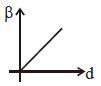
D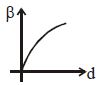
Solution
(B) In Young's double-slit experiment,the fringe width $\beta$ is given by the formula:
$\beta = \frac{\lambda D}{d}$
where $\lambda$ is the wavelength of light,$D$ is the distance between the screen and the slits,and $d$ is the distance between the two slits.
From the formula,it is clear that $\beta \propto \frac{1}{d}$.
This relationship represents a rectangular hyperbola,where $\beta$ decreases as $d$ increases.
Therefore,the correct curve is the one showing a rectangular hyperbola.
$\beta = \frac{\lambda D}{d}$
where $\lambda$ is the wavelength of light,$D$ is the distance between the screen and the slits,and $d$ is the distance between the two slits.
From the formula,it is clear that $\beta \propto \frac{1}{d}$.
This relationship represents a rectangular hyperbola,where $\beta$ decreases as $d$ increases.
Therefore,the correct curve is the one showing a rectangular hyperbola.
0 likes
View Solution257
DifficultMCQ
In $Y.D.S.E$, two slits are made $1 \, mm$ apart and the screen is placed $1 \, m$ away. The fringe separation when light of wavelength $500 \, nm$ is used is:
A
$5 \times 10^{-4} \, m$
B
$2.5 \times 10^{-3} \, m$
C
$2 \times 10^{-4} \, m$
D
$10 \times 10^{-4} \, m$
Solution
(A) The formula for fringe width $(\beta)$ in $Y.D.S.E$ is given by $\beta = \frac{D \lambda}{d}$.
Given values are:
Distance between slits, $d = 1 \, mm = 1 \times 10^{-3} \, m$.
Distance of screen, $D = 1 \, m$.
Wavelength of light, $\lambda = 500 \, nm = 500 \times 10^{-9} \, m = 5 \times 10^{-7} \, m$.
Substituting these values into the formula:
$\beta = \frac{1 \times 5 \times 10^{-7}}{1 \times 10^{-3}} = 5 \times 10^{-4} \, m$.
Given values are:
Distance between slits, $d = 1 \, mm = 1 \times 10^{-3} \, m$.
Distance of screen, $D = 1 \, m$.
Wavelength of light, $\lambda = 500 \, nm = 500 \times 10^{-9} \, m = 5 \times 10^{-7} \, m$.
Substituting these values into the formula:
$\beta = \frac{1 \times 5 \times 10^{-7}}{1 \times 10^{-3}} = 5 \times 10^{-4} \, m$.
0 likes
View Solution258
DifficultMCQ
In $Y.D.S.E$,the ratio of intensity of maxima and minima is $25 : 9$. The ratio of slit width is
A
$18 : 3$
B
$4 : 1$
C
$8 : 1$
D
$16 : 1$
Solution
(D) The intensity $I$ is directly proportional to the width of the slit $w$,i.e.,$I \propto w$. Also,$I \propto A^2$,where $A$ is the amplitude.
Given $\frac{I_{\max}}{I_{\min}} = \frac{25}{9}$.
We know that $\frac{I_{\max}}{I_{\min}} = \frac{(A_1 + A_2)^2}{(A_1 - A_2)^2} = \frac{25}{9}$.
Taking the square root on both sides: $\frac{A_1 + A_2}{A_1 - A_2} = \frac{5}{3}$.
By applying componendo and dividendo: $\frac{A_1}{A_2} = \frac{5+3}{5-3} = \frac{8}{2} = \frac{4}{1}$.
Since the intensity is proportional to the slit width,the ratio of intensities of the two slits is $\frac{I_1}{I_2} = \frac{A_1^2}{A_2^2} = \left(\frac{4}{1}\right)^2 = \frac{16}{1}$.
Therefore,the ratio of the slit widths is $\frac{w_1}{w_2} = \frac{16}{1}$.
Given $\frac{I_{\max}}{I_{\min}} = \frac{25}{9}$.
We know that $\frac{I_{\max}}{I_{\min}} = \frac{(A_1 + A_2)^2}{(A_1 - A_2)^2} = \frac{25}{9}$.
Taking the square root on both sides: $\frac{A_1 + A_2}{A_1 - A_2} = \frac{5}{3}$.
By applying componendo and dividendo: $\frac{A_1}{A_2} = \frac{5+3}{5-3} = \frac{8}{2} = \frac{4}{1}$.
Since the intensity is proportional to the slit width,the ratio of intensities of the two slits is $\frac{I_1}{I_2} = \frac{A_1^2}{A_2^2} = \left(\frac{4}{1}\right)^2 = \frac{16}{1}$.
Therefore,the ratio of the slit widths is $\frac{w_1}{w_2} = \frac{16}{1}$.
0 likes
View Solution259
MediumMCQ
In Young's double-slit experiment,monochromatic light is used to illuminate the two slits $A$ and $B$. Interference fringes are observed on a screen placed in front of the slits. If a thin glass plate is placed normally in the path of the beam coming from slit $A$,then:
A
The fringes will disappear.
B
The fringe width will increase.
C
The fringe width will decrease.
D
There will be no change in fringe width.
Solution
(D) The fringe width $\beta$ in Young's double-slit experiment is given by the formula $\beta = \frac{\lambda D}{d}$,where $\lambda$ is the wavelength of light,$D$ is the distance between the slits and the screen,and $d$ is the distance between the two slits.
When a thin glass plate is placed in the path of one of the beams,it introduces an additional path difference,which causes the entire interference pattern to shift on the screen.
However,the fringe width $\beta$ depends only on the wavelength $\lambda$,the distance $D$,and the slit separation $d$. Since none of these parameters are changed by the introduction of the glass plate,the fringe width remains constant.
When a thin glass plate is placed in the path of one of the beams,it introduces an additional path difference,which causes the entire interference pattern to shift on the screen.
However,the fringe width $\beta$ depends only on the wavelength $\lambda$,the distance $D$,and the slit separation $d$. Since none of these parameters are changed by the introduction of the glass plate,the fringe width remains constant.
0 likes
View Solution260
DifficultMCQ
In a $YDSE$,bichromatic light of wavelengths $\lambda_1 = 400\, nm$ and $\lambda_2 = 560\, nm$ is used. The distance between the slits is $d = 0.1\, mm$ and the distance between the plane of the slits and the screen is $D = 1\, m$. The minimum distance between two successive regions of complete darkness is.....$mm$.
A
$4$
B
$5.6$
C
$14$
D
$28$
Solution
(D) The condition for the $n^{th}$ minima for wavelength $\lambda$ is given by $y_n = (2n-1) \frac{D\lambda}{2d}$.
For two wavelengths to have overlapping dark fringes,their minima must coincide: $(2n-1) \frac{D\lambda_1}{2d} = (2m-1) \frac{D\lambda_2}{2d}$.
This simplifies to $(2n-1) \lambda_1 = (2m-1) \lambda_2$.
Substituting the values: $(2n-1) 400 = (2m-1) 560$.
$\frac{2n-1}{2m-1} = \frac{560}{400} = \frac{7}{5}$.
Thus,the first overlap occurs at $2n-1 = 7$ (i.e.,$n=4$) and $2m-1 = 5$ (i.e.,$m=3$).
The position of this first overlap is $y_1 = 7 \times \frac{1 \times 400 \times 10^{-6}}{2 \times 0.1 \times 10^{-3}} = 14 \times 10^{-3}\, m = 14\, mm$.
The next overlap occurs at the next odd multiple ratio,which is $\frac{21}{15}$ (where $2n-1=21$ and $2m-1=15$).
The position of this second overlap is $y_2 = 21 \times \frac{1 \times 400 \times 10^{-6}}{2 \times 0.1 \times 10^{-3}} = 42\, mm$.
The distance between two successive regions of complete darkness is $y_2 - y_1 = 42\, mm - 14\, mm = 28\, mm$.
For two wavelengths to have overlapping dark fringes,their minima must coincide: $(2n-1) \frac{D\lambda_1}{2d} = (2m-1) \frac{D\lambda_2}{2d}$.
This simplifies to $(2n-1) \lambda_1 = (2m-1) \lambda_2$.
Substituting the values: $(2n-1) 400 = (2m-1) 560$.
$\frac{2n-1}{2m-1} = \frac{560}{400} = \frac{7}{5}$.
Thus,the first overlap occurs at $2n-1 = 7$ (i.e.,$n=4$) and $2m-1 = 5$ (i.e.,$m=3$).
The position of this first overlap is $y_1 = 7 \times \frac{1 \times 400 \times 10^{-6}}{2 \times 0.1 \times 10^{-3}} = 14 \times 10^{-3}\, m = 14\, mm$.
The next overlap occurs at the next odd multiple ratio,which is $\frac{21}{15}$ (where $2n-1=21$ and $2m-1=15$).
The position of this second overlap is $y_2 = 21 \times \frac{1 \times 400 \times 10^{-6}}{2 \times 0.1 \times 10^{-3}} = 42\, mm$.
The distance between two successive regions of complete darkness is $y_2 - y_1 = 42\, mm - 14\, mm = 28\, mm$.
0 likes
View Solution261
MediumMCQ
In a Young's double-slit experiment using a monochromatic source,what is the shape of the interference fringes formed on a screen?
A
Straight line
B
Parabola
C
Hyperbola
D
Circle
Solution
(C) In a Young's double-slit experiment,the path difference between the waves from two slits $S_1$ and $S_2$ to any point $P$ on the screen is given by $\Delta x = S_2P - S_1P = d \sin \theta$.
For a constant path difference,the locus of points $P$ on the screen forms a curve.
The condition for constructive or destructive interference is $\Delta x = n\lambda$ or $\Delta x = (n + 1/2)\lambda$,which implies that the path difference is constant for a given fringe.
The locus of points having a constant difference in distances from two fixed points (the slits) is a hyperbola.
Therefore,the interference fringes formed on the screen are hyperbolic in shape.
For a constant path difference,the locus of points $P$ on the screen forms a curve.
The condition for constructive or destructive interference is $\Delta x = n\lambda$ or $\Delta x = (n + 1/2)\lambda$,which implies that the path difference is constant for a given fringe.
The locus of points having a constant difference in distances from two fixed points (the slits) is a hyperbola.
Therefore,the interference fringes formed on the screen are hyperbolic in shape.
0 likes
View Solution262
DifficultMCQ
In a Young's double-slit experiment,the fringe pattern is observed on a screen placed at a distance $D$. The slits are separated by $d$ and are illuminated by light of wavelength $\lambda$. Find the distance from the central point where the intensity falls to half the maximum intensity.
A
$\frac{\lambda D}{4d}$
B
$\frac{\lambda D}{2d}$
C
$\frac{\lambda D}{d}$
D
$\frac{2}{3} \frac{\lambda D}{d}$
Solution
(A) The intensity at any point in a Young's double-slit experiment is given by $I = I_{\max} \cos^2(\frac{\phi}{2})$,where $\phi$ is the phase difference.
Given that the intensity is half of the maximum intensity,we have $\frac{I_{\max}}{2} = I_{\max} \cos^2(\frac{\phi}{2})$.
This simplifies to $\cos^2(\frac{\phi}{2}) = \frac{1}{2}$,which means $\cos(\frac{\phi}{2}) = \frac{1}{\sqrt{2}}$.
Therefore,$\frac{\phi}{2} = \frac{\pi}{4}$,which gives the phase difference $\phi = \frac{\pi}{2}$.
The path difference $\Delta x$ is related to the phase difference by $\Delta x = \frac{\lambda}{2\pi} \phi$.
Substituting $\phi = \frac{\pi}{2}$,we get $\Delta x = \frac{\lambda}{2\pi} \times \frac{\pi}{2} = \frac{\lambda}{4}$.
The distance $x$ from the central point is given by $x = \frac{\Delta x \cdot D}{d}$.
Substituting the value of $\Delta x$,we get $x = \frac{\lambda D}{4d}$.
Given that the intensity is half of the maximum intensity,we have $\frac{I_{\max}}{2} = I_{\max} \cos^2(\frac{\phi}{2})$.
This simplifies to $\cos^2(\frac{\phi}{2}) = \frac{1}{2}$,which means $\cos(\frac{\phi}{2}) = \frac{1}{\sqrt{2}}$.
Therefore,$\frac{\phi}{2} = \frac{\pi}{4}$,which gives the phase difference $\phi = \frac{\pi}{2}$.
The path difference $\Delta x$ is related to the phase difference by $\Delta x = \frac{\lambda}{2\pi} \phi$.
Substituting $\phi = \frac{\pi}{2}$,we get $\Delta x = \frac{\lambda}{2\pi} \times \frac{\pi}{2} = \frac{\lambda}{4}$.
The distance $x$ from the central point is given by $x = \frac{\Delta x \cdot D}{d}$.
Substituting the value of $\Delta x$,we get $x = \frac{\lambda D}{4d}$.
0 likes
View Solution263
MediumMCQ
When the distance between the slits is increased $4$ times in $YDSE$,the fringe width will
A
increase two times
B
decrease two times
C
increase four times
D
decrease four times
Solution
(D) The formula for fringe width in $YDSE$ is given by $\beta = \frac{\lambda D}{d}$,where $\lambda$ is the wavelength of light,$D$ is the distance between the screen and the slits,and $d$ is the distance between the slits.
From the formula,it is clear that fringe width $\beta$ is inversely proportional to the slit separation $d$,i.e.,$\beta \propto \frac{1}{d}$.
If the distance between the slits is increased $4$ times,the new distance $d' = 4d$.
Therefore,the new fringe width $\beta' = \frac{\lambda D}{d'} = \frac{\lambda D}{4d} = \frac{\beta}{4}$.
Thus,the fringe width decreases $4$ times.
From the formula,it is clear that fringe width $\beta$ is inversely proportional to the slit separation $d$,i.e.,$\beta \propto \frac{1}{d}$.
If the distance between the slits is increased $4$ times,the new distance $d' = 4d$.
Therefore,the new fringe width $\beta' = \frac{\lambda D}{d'} = \frac{\lambda D}{4d} = \frac{\beta}{4}$.
Thus,the fringe width decreases $4$ times.
0 likes
View Solution264
MediumMCQ
In Young's double slit experiment,the distance between slits and the screen is $1.0\,m$ and monochromatic light of $600\,nm$ is being used. $A$ person standing near the slits is looking at the fringe pattern. When the separation between the slits is varied,the interference pattern disappears for a particular distance $d_0$ between the slits. If the angular resolution of the eye is $\frac{1}{60}^o,$ the value of $d_0$ is close to......$mm$
A
$1$
B
$3$
C
$2$
D
$4$
Solution
(C) The interference pattern disappears when the angular separation between the fringes becomes less than the angular resolution of the human eye.
The angular fringe width is given by $\beta_{\theta} = \frac{\lambda}{d}$.
The angular resolution of the eye is $\Delta\theta = \frac{1}{60}^o = \frac{1}{60} \times \frac{\pi}{180} \text{ radians}$.
For the pattern to disappear,the angular fringe width must be equal to the angular resolution of the eye: $\frac{\lambda}{d_0} = \Delta\theta$.
Substituting the values: $d_0 = \frac{\lambda}{\Delta\theta} = \frac{600 \times 10^{-9} \text{ m}}{\frac{1}{60} \times \frac{\pi}{180} \text{ rad}}$.
$d_0 = \frac{600 \times 10^{-9} \times 60 \times 180}{\pi} \approx \frac{6.48 \times 10^{-3}}{3.14} \approx 2.06 \times 10^{-3} \text{ m}$.
Thus,$d_0 \approx 2 \text{ mm}$.
The angular fringe width is given by $\beta_{\theta} = \frac{\lambda}{d}$.
The angular resolution of the eye is $\Delta\theta = \frac{1}{60}^o = \frac{1}{60} \times \frac{\pi}{180} \text{ radians}$.
For the pattern to disappear,the angular fringe width must be equal to the angular resolution of the eye: $\frac{\lambda}{d_0} = \Delta\theta$.
Substituting the values: $d_0 = \frac{\lambda}{\Delta\theta} = \frac{600 \times 10^{-9} \text{ m}}{\frac{1}{60} \times \frac{\pi}{180} \text{ rad}}$.
$d_0 = \frac{600 \times 10^{-9} \times 60 \times 180}{\pi} \approx \frac{6.48 \times 10^{-3}}{3.14} \approx 2.06 \times 10^{-3} \text{ m}$.
Thus,$d_0 \approx 2 \text{ mm}$.
0 likes
View Solution265
DifficultMCQ
In a Young's double-slit experiment with light of wavelength $\lambda$,the separation of slits is $d$ and the distance of the screen is $D$ such that $D >> d >> \lambda$. If the fringe width is $\beta$,the distance from the point of maximum intensity to the point where intensity falls to half of the maximum intensity on either side is:
A
$\frac{\beta}{6}$
B
$\frac{\beta}{3}$
C
$\frac{\beta}{4}$
D
$\frac{\beta}{2}$
Solution
(C) The intensity at any point in a Young's double-slit experiment is given by $I = 4I_0 \cos^2(\frac{\Delta \phi}{2})$,where $I_0$ is the intensity of each individual slit and $\Delta \phi$ is the phase difference.
At the central maximum,the intensity is $I_{max} = 4I_0$.
We want to find the position $y$ where the intensity $I$ falls to half of the maximum intensity,i.e.,$I = \frac{I_{max}}{2} = 2I_0$.
Substituting this into the intensity formula: $2I_0 = 4I_0 \cos^2(\frac{\Delta \phi}{2}) \implies \cos^2(\frac{\Delta \phi}{2}) = \frac{1}{2} \implies \cos(\frac{\Delta \phi}{2}) = \frac{1}{\sqrt{2}}$.
This implies $\frac{\Delta \phi}{2} = \frac{\pi}{4}$,so the phase difference is $\Delta \phi = \frac{\pi}{2}$.
Since the phase difference $\Delta \phi = \frac{2\pi}{\lambda} \Delta x$,we have $\frac{\pi}{2} = \frac{2\pi}{\lambda} \Delta x$,which gives the path difference $\Delta x = \frac{\lambda}{4}$.
For small angles,the path difference is $\Delta x = \frac{dy}{D}$.
Equating the two: $\frac{dy}{D} = \frac{\lambda}{4} \implies y = \frac{\lambda D}{4d}$.
Since the fringe width is $\beta = \frac{\lambda D}{d}$,we substitute this to get $y = \frac{\beta}{4}$.
At the central maximum,the intensity is $I_{max} = 4I_0$.
We want to find the position $y$ where the intensity $I$ falls to half of the maximum intensity,i.e.,$I = \frac{I_{max}}{2} = 2I_0$.
Substituting this into the intensity formula: $2I_0 = 4I_0 \cos^2(\frac{\Delta \phi}{2}) \implies \cos^2(\frac{\Delta \phi}{2}) = \frac{1}{2} \implies \cos(\frac{\Delta \phi}{2}) = \frac{1}{\sqrt{2}}$.
This implies $\frac{\Delta \phi}{2} = \frac{\pi}{4}$,so the phase difference is $\Delta \phi = \frac{\pi}{2}$.
Since the phase difference $\Delta \phi = \frac{2\pi}{\lambda} \Delta x$,we have $\frac{\pi}{2} = \frac{2\pi}{\lambda} \Delta x$,which gives the path difference $\Delta x = \frac{\lambda}{4}$.
For small angles,the path difference is $\Delta x = \frac{dy}{D}$.
Equating the two: $\frac{dy}{D} = \frac{\lambda}{4} \implies y = \frac{\lambda D}{4d}$.
Since the fringe width is $\beta = \frac{\lambda D}{d}$,we substitute this to get $y = \frac{\beta}{4}$.
0 likes
View Solution266
DifficultMCQ
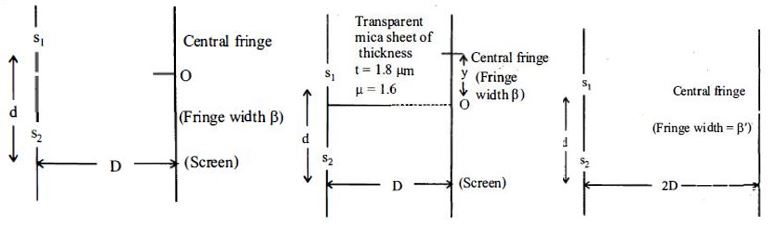
Using monochromatic light of wavelength $\lambda$,an experimentalist sets up the Young's double slit experiment in three ways as shown. If she observes that $y = \beta'$,the wavelength of light used is.....$nm$
A
$520$
B
$540$
C
$560$
D
$580$
Solution
(B) Given the thickness of the mica sheet $t = 1.8 \times 10^{-6} \ m$,refractive index $\mu = 1.6$,and the shift $y = (\mu - 1)t \frac{D}{d}$.
The fringe width in the first case is $\beta = \frac{\lambda D}{d}$.
The fringe width in the third case is $\beta' = \frac{\lambda (2D)}{d} = 2\beta$.
Given the condition $y = \beta'$,we have $(\mu - 1)t \frac{D}{d} = 2 \frac{\lambda D}{d}$.
Simplifying,we get $(\mu - 1)t = 2\lambda$.
Substituting the values: $(1.6 - 1) \times 1.8 \times 10^{-6} = 2\lambda$.
$0.6 \times 1.8 \times 10^{-6} = 2\lambda$.
$1.08 \times 10^{-6} = 2\lambda$.
$\lambda = 0.54 \times 10^{-6} \ m = 540 \ nm$.
The fringe width in the first case is $\beta = \frac{\lambda D}{d}$.
The fringe width in the third case is $\beta' = \frac{\lambda (2D)}{d} = 2\beta$.
Given the condition $y = \beta'$,we have $(\mu - 1)t \frac{D}{d} = 2 \frac{\lambda D}{d}$.
Simplifying,we get $(\mu - 1)t = 2\lambda$.
Substituting the values: $(1.6 - 1) \times 1.8 \times 10^{-6} = 2\lambda$.
$0.6 \times 1.8 \times 10^{-6} = 2\lambda$.
$1.08 \times 10^{-6} = 2\lambda$.
$\lambda = 0.54 \times 10^{-6} \ m = 540 \ nm$.
0 likes
View Solution267
MediumMCQ
In a Young's double slit experiment,the distance between the two identical slits is $6.1$ times larger than the slit width. Then the number of intensity maxima observed within the central maximum of the single slit diffraction pattern is
A
$3$
B
$6$
C
$12$
D
$24$
Solution
(C) The angular width of the central maximum in a single slit diffraction pattern is given by $\theta = \frac{2 \lambda}{b}$,where $b$ is the slit width.
The angular separation between consecutive interference maxima in a Young's double slit experiment is $\Delta \theta = \frac{\lambda}{d}$,where $d$ is the distance between the slits.
The number of interference maxima $n$ that fit within the central diffraction maximum is given by the ratio of the angular width of the central diffraction maximum to the angular separation of the interference fringes:
$n = \frac{2 \lambda / b}{\lambda / d} = \frac{2d}{b}$.
Given that $d = 6.1b$,we substitute this into the equation:
$n = \frac{2 \times (6.1b)}{b} = 12.2$.
Since the number of maxima must be an integer,we consider the maxima that lie strictly within the central diffraction envelope. Thus,$12$ intensity maxima are observed.
The angular separation between consecutive interference maxima in a Young's double slit experiment is $\Delta \theta = \frac{\lambda}{d}$,where $d$ is the distance between the slits.
The number of interference maxima $n$ that fit within the central diffraction maximum is given by the ratio of the angular width of the central diffraction maximum to the angular separation of the interference fringes:
$n = \frac{2 \lambda / b}{\lambda / d} = \frac{2d}{b}$.
Given that $d = 6.1b$,we substitute this into the equation:
$n = \frac{2 \times (6.1b)}{b} = 12.2$.
Since the number of maxima must be an integer,we consider the maxima that lie strictly within the central diffraction envelope. Thus,$12$ intensity maxima are observed.
0 likes
View Solution268
EasyMCQ
This question has Statement-$1$ and Statement-$2$. Of the four choices given after the Statements,choose the one that best describes the two Statements.
Statement-$1$: In Young's double slit experiment,the number of fringes observed in the field of view is small with longer wavelength of light and is large with shorter wavelength of light.
Statement-$2$: In the double slit experiment,the fringe width depends directly on the wavelength of light.
Statement-$1$: In Young's double slit experiment,the number of fringes observed in the field of view is small with longer wavelength of light and is large with shorter wavelength of light.
Statement-$2$: In the double slit experiment,the fringe width depends directly on the wavelength of light.
A
Statement-$1$ is true,Statement-$2$ is true,and Statement-$2$ is the correct explanation of Statement-$1$.
B
Statement-$1$ is false and Statement-$2$ is true.
C
Statement-$1$ is true,Statement-$2$ is true,and Statement-$2$ is not the correct explanation of Statement-$1$.
D
Statement-$1$ is true and Statement-$2$ is false.
Solution
(A) The fringe width $\beta$ in Young's double slit experiment is given by $\beta = \frac{D\lambda}{d}$,where $D$ is the distance to the screen,$d$ is the slit separation,and $\lambda$ is the wavelength.
The number of fringes $N$ that can be observed in a field of view of width $W$ is given by $N = \frac{W}{\beta} = \frac{Wd}{D\lambda}$.
From this relation,$N \propto \frac{1}{\lambda}$. Thus,as the wavelength $\lambda$ increases,the fringe width $\beta$ increases,and the number of fringes $N$ observed in the field of view decreases. Conversely,for a shorter wavelength,the fringe width is smaller,allowing more fringes to be observed.
Therefore,Statement-$1$ is true,Statement-$2$ is true,and Statement-$2$ provides the correct explanation for Statement-$1$.
The number of fringes $N$ that can be observed in a field of view of width $W$ is given by $N = \frac{W}{\beta} = \frac{Wd}{D\lambda}$.
From this relation,$N \propto \frac{1}{\lambda}$. Thus,as the wavelength $\lambda$ increases,the fringe width $\beta$ increases,and the number of fringes $N$ observed in the field of view decreases. Conversely,for a shorter wavelength,the fringe width is smaller,allowing more fringes to be observed.
Therefore,Statement-$1$ is true,Statement-$2$ is true,and Statement-$2$ provides the correct explanation for Statement-$1$.
0 likes
View Solution269
DifficultMCQ
The source that illuminates the double-slit in a 'double-slit interference experiment' emits two distinct monochromatic waves of wavelengths $\lambda_1 = 500\,nm$ and $\lambda_2 = 600\,nm$. Each wavelength produces its own interference pattern on the screen. At the central point,where the path difference is zero,the maxima of both patterns coincide. As one moves away from the central region,the two fringe systems gradually go out of step. The combined fringe system becomes completely indistinct when a maximum of one wavelength coincides with a minimum of the other. This happens when the path difference in $nm$ is:
A
$2000$
B
$3000$
C
$1000$
D
$1500$
Solution
(D) For a wavelength $\lambda$,the condition for the $n$-th maximum is path difference $\Delta x = n\lambda$,and the condition for the $m$-th minimum is path difference $\Delta x = (m + 1/2)\lambda$.
Let the path difference be $\Delta x$. The condition for the interference pattern to be indistinct is that a maximum of $\lambda_1$ coincides with a minimum of $\lambda_2$,or vice versa.
Case $1$: Maximum of $\lambda_1$ coincides with minimum of $\lambda_2$:
$\Delta x = n\lambda_1 = (m + 1/2)\lambda_2$
$n(500) = (m + 1/2)(600)$
$5n = 6m + 3$
For the smallest integer values,if $m = 1$,$5n = 9$ (no integer $n$). If $m = 4$,$5n = 27$ (no). If $m = 1$,$5n = 9$. Let's test values: $5n - 6m = 3$. For $m=1, 5n=9$; $m=2, 5n=15 \Rightarrow n=3$.
Thus,$\Delta x = 3 \times 500 = 1500\,nm$.
Case $2$: Maximum of $\lambda_2$ coincides with minimum of $\lambda_1$:
$\Delta x = n\lambda_2 = (m + 1/2)\lambda_1$
$n(600) = (m + 1/2)(500)$
$6n = 5m + 2.5 \Rightarrow 12n = 10m + 5$.
Since $12n$ is even and $10m+5$ is odd,this case is impossible for integer $n, m$.
Therefore,the first point of indistinctness occurs at $\Delta x = 1500\,nm$.
Let the path difference be $\Delta x$. The condition for the interference pattern to be indistinct is that a maximum of $\lambda_1$ coincides with a minimum of $\lambda_2$,or vice versa.
Case $1$: Maximum of $\lambda_1$ coincides with minimum of $\lambda_2$:
$\Delta x = n\lambda_1 = (m + 1/2)\lambda_2$
$n(500) = (m + 1/2)(600)$
$5n = 6m + 3$
For the smallest integer values,if $m = 1$,$5n = 9$ (no integer $n$). If $m = 4$,$5n = 27$ (no). If $m = 1$,$5n = 9$. Let's test values: $5n - 6m = 3$. For $m=1, 5n=9$; $m=2, 5n=15 \Rightarrow n=3$.
Thus,$\Delta x = 3 \times 500 = 1500\,nm$.
Case $2$: Maximum of $\lambda_2$ coincides with minimum of $\lambda_1$:
$\Delta x = n\lambda_2 = (m + 1/2)\lambda_1$
$n(600) = (m + 1/2)(500)$
$6n = 5m + 2.5 \Rightarrow 12n = 10m + 5$.
Since $12n$ is even and $10m+5$ is odd,this case is impossible for integer $n, m$.
Therefore,the first point of indistinctness occurs at $\Delta x = 1500\,nm$.
0 likes
View Solution270
MediumMCQ
The maximum number of possible interference maxima for slit separation equal to $1.8 \lambda$,where $\lambda$ is the wavelength of light used,in a Young's double slit experiment is
A
zero
B
$3$
C
infinite
D
$5$
Solution
(B) In a Young's double slit experiment,the condition for constructive interference (maxima) is given by $d \sin \theta = n \lambda$,where $d$ is the slit separation,$\lambda$ is the wavelength,and $n$ is the order of the maxima.
Given $d = 1.8 \lambda$,the condition becomes $1.8 \lambda \sin \theta = n \lambda$,which simplifies to $n = 1.8 \sin \theta$.
Since the maximum value of $\sin \theta$ is $1$,the maximum value of $n$ is $1.8 \times 1 = 1.8$.
Thus,the possible integer values for $n$ are $0, \pm 1$.
Therefore,the total number of maxima is $1$ (for $n=0$) $+ 2$ (for $n=1$ and $n=-1$),which equals $3$.
Given $d = 1.8 \lambda$,the condition becomes $1.8 \lambda \sin \theta = n \lambda$,which simplifies to $n = 1.8 \sin \theta$.
Since the maximum value of $\sin \theta$ is $1$,the maximum value of $n$ is $1.8 \times 1 = 1.8$.
Thus,the possible integer values for $n$ are $0, \pm 1$.
Therefore,the total number of maxima is $1$ (for $n=0$) $+ 2$ (for $n=1$ and $n=-1$),which equals $3$.
0 likes
View Solution271
DifficultMCQ
In Young's double slit interference experiment,the slit widths are in the ratio $1 : 25$. Then the ratio of intensity at the maxima and minima in the interference pattern is
A
$3 : 2$
B
$1 : 25$
C
$9 : 4$
D
$1 : 5$
Solution
(C) We know that the ratio of maximum intensity to minimum intensity in an interference pattern is given by:
$\frac{I_{\max}}{I_{\min}} = \frac{(\sqrt{\frac{\omega_1}{\omega_2}} + 1)^2}{(\sqrt{\frac{\omega_1}{\omega_2}} - 1)^2}$
where $\omega_1$ and $\omega_2$ are the widths of the two slits.
Given the ratio of slit widths $\frac{\omega_1}{\omega_2} = \frac{1}{25}$.
Substituting this value into the formula:
$\frac{I_{\max}}{I_{\min}} = \frac{(\sqrt{\frac{1}{25}} + 1)^2}{(\sqrt{\frac{1}{25}} - 1)^2} = \frac{(\frac{1}{5} + 1)^2}{(\frac{1}{5} - 1)^2}$
$\frac{I_{\max}}{I_{\min}} = \frac{(\frac{6}{5})^2}{(\frac{-4}{5})^2} = \frac{\frac{36}{25}}{\frac{16}{25}} = \frac{36}{16} = \frac{9}{4}$
Thus,the ratio of intensity at the maxima and minima is $9 : 4$.
$\frac{I_{\max}}{I_{\min}} = \frac{(\sqrt{\frac{\omega_1}{\omega_2}} + 1)^2}{(\sqrt{\frac{\omega_1}{\omega_2}} - 1)^2}$
where $\omega_1$ and $\omega_2$ are the widths of the two slits.
Given the ratio of slit widths $\frac{\omega_1}{\omega_2} = \frac{1}{25}$.
Substituting this value into the formula:
$\frac{I_{\max}}{I_{\min}} = \frac{(\sqrt{\frac{1}{25}} + 1)^2}{(\sqrt{\frac{1}{25}} - 1)^2} = \frac{(\frac{1}{5} + 1)^2}{(\frac{1}{5} - 1)^2}$
$\frac{I_{\max}}{I_{\min}} = \frac{(\frac{6}{5})^2}{(\frac{-4}{5})^2} = \frac{\frac{36}{25}}{\frac{16}{25}} = \frac{36}{16} = \frac{9}{4}$
Thus,the ratio of intensity at the maxima and minima is $9 : 4$.
0 likes
View Solution272
MediumMCQ
In a Young's double-slit experiment,the slits are placed $0.320 \, mm$ apart. Light of wavelength $\lambda = 500 \, nm$ is incident on the slits. The total number of bright fringes that are observed in the angular range $-30^\circ \le \theta \le 30^\circ$ is:
A
$640$
B
$320$
C
$321$
D
$641$
Solution
(D) The condition for bright fringes is $d \sin \theta = n \lambda$,where $n$ is an integer.
Given $d = 0.320 \, mm = 0.320 \times 10^{-3} \, m$ and $\lambda = 500 \, nm = 500 \times 10^{-9} \, m$.
The maximum path difference at $\theta = 30^\circ$ is $\Delta X_{\max} = d \sin 30^\circ = 0.320 \times 10^{-3} \times 0.5 = 0.16 \times 10^{-3} \, m$.
The maximum order $n$ is given by $n = \frac{\Delta X_{\max}}{\lambda} = \frac{0.16 \times 10^{-3}}{500 \times 10^{-9}} = \frac{0.16 \times 10^6}{500} = 320$.
Since the range is $-30^\circ \le \theta \le 30^\circ$,we observe bright fringes for $n = 0, \pm 1, \pm 2, \dots, \pm 320$.
The total number of bright fringes is $2n + 1 = 2(320) + 1 = 641$.
Given $d = 0.320 \, mm = 0.320 \times 10^{-3} \, m$ and $\lambda = 500 \, nm = 500 \times 10^{-9} \, m$.
The maximum path difference at $\theta = 30^\circ$ is $\Delta X_{\max} = d \sin 30^\circ = 0.320 \times 10^{-3} \times 0.5 = 0.16 \times 10^{-3} \, m$.
The maximum order $n$ is given by $n = \frac{\Delta X_{\max}}{\lambda} = \frac{0.16 \times 10^{-3}}{500 \times 10^{-9}} = \frac{0.16 \times 10^6}{500} = 320$.
Since the range is $-30^\circ \le \theta \le 30^\circ$,we observe bright fringes for $n = 0, \pm 1, \pm 2, \dots, \pm 320$.
The total number of bright fringes is $2n + 1 = 2(320) + 1 = 641$.
0 likes
View Solution273
MediumMCQ
In a Young's double slit experiment with slit separation $0.1\, mm$,one observes a bright fringe at angle $\frac{1}{40}\, rad$ by using light of wavelength $\lambda_1$. When the light of wavelength $\lambda_2$ is used,a bright fringe is seen at the same angle in the same setup. Given that $\lambda_1$ and $\lambda_2$ are in the visible range ($380\, nm$ to $740\, nm$),their values are:
A
$625\, nm, 500\, nm$
B
$380\, nm, 525\, nm$
C
$380\, nm, 500\, nm$
D
$400\, nm, 500\, nm$
Solution
(A) For bright fringes (maxima) in a Young's double slit experiment,the condition is $d \sin \theta = n \lambda$,where $n$ is the order of the fringe.
Since $\theta$ is small,$\sin \theta \approx \theta = \frac{1}{40}\, rad$.
Given $d = 0.1\, mm = 10^{-4}\, m$.
The condition becomes $d \theta = n \lambda$,so $\lambda = \frac{d \theta}{n}$.
Substituting the values: $\lambda = \frac{10^{-4} \times (1/40)}{n} = \frac{10^{-4}}{40n} = \frac{10^{-5}}{4n} = \frac{2500\, nm}{n}$.
For $\lambda$ to be in the visible range ($380\, nm$ to $740\, nm$):
If $n=4$,$\lambda = \frac{2500}{4} = 625\, nm$.
If $n=5$,$\lambda = \frac{2500}{5} = 500\, nm$.
Both $625\, nm$ and $500\, nm$ lie within the visible range. Thus,the wavelengths are $625\, nm$ and $500\, nm$.
Since $\theta$ is small,$\sin \theta \approx \theta = \frac{1}{40}\, rad$.
Given $d = 0.1\, mm = 10^{-4}\, m$.
The condition becomes $d \theta = n \lambda$,so $\lambda = \frac{d \theta}{n}$.
Substituting the values: $\lambda = \frac{10^{-4} \times (1/40)}{n} = \frac{10^{-4}}{40n} = \frac{10^{-5}}{4n} = \frac{2500\, nm}{n}$.
For $\lambda$ to be in the visible range ($380\, nm$ to $740\, nm$):
If $n=4$,$\lambda = \frac{2500}{4} = 625\, nm$.
If $n=5$,$\lambda = \frac{2500}{5} = 500\, nm$.
Both $625\, nm$ and $500\, nm$ lie within the visible range. Thus,the wavelengths are $625\, nm$ and $500\, nm$.
0 likes
View Solution274
DifficultMCQ
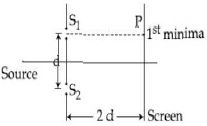
Consider a Young's double slit experiment as shown in the figure. What should be the slit separation $d$ in terms of wavelength $\lambda$ such that the first minima occurs directly in front of the slit $S_1$?
A
$\frac{\lambda}{2(\sqrt{5}-2)}$
B
$\frac{\lambda}{(\sqrt{5}-2)}$
C
$\frac{\lambda}{2(5-\sqrt{2})}$
D
$\frac{\lambda}{(5-\sqrt{2})}$
Solution
(A) For the first minima to occur at point $P$ (directly in front of $S_1$),the path difference between the waves from $S_1$ and $S_2$ must be equal to $\frac{\lambda}{2}$.
The distance from $S_1$ to $P$ is $2d$.
The distance from $S_2$ to $P$ is $\sqrt{(2d)^2 + d^2} = \sqrt{4d^2 + d^2} = \sqrt{5}d$.
The path difference $\Delta x = S_2P - S_1P = \sqrt{5}d - 2d = d(\sqrt{5} - 2)$.
Setting the path difference equal to $\frac{\lambda}{2}$ for the first minima:
$d(\sqrt{5} - 2) = \frac{\lambda}{2}$
Therefore,the slit separation $d$ is:
$d = \frac{\lambda}{2(\sqrt{5} - 2)}$
The distance from $S_1$ to $P$ is $2d$.
The distance from $S_2$ to $P$ is $\sqrt{(2d)^2 + d^2} = \sqrt{4d^2 + d^2} = \sqrt{5}d$.
The path difference $\Delta x = S_2P - S_1P = \sqrt{5}d - 2d = d(\sqrt{5} - 2)$.
Setting the path difference equal to $\frac{\lambda}{2}$ for the first minima:
$d(\sqrt{5} - 2) = \frac{\lambda}{2}$
Therefore,the slit separation $d$ is:
$d = \frac{\lambda}{2(\sqrt{5} - 2)}$
0 likes
View Solution275
MediumMCQ
In a Young's double slit experiment,the path difference,at a certain point on the screen,between two interfering waves is $1/8^{th}$ of the wavelength. The ratio of the intensity at this point to that at the centre of a bright fringe is close to:
A
$0.74$
B
$0.85$
C
$0.94$
D
$0.80$
Solution
(B) The path difference is given by $\Delta x = \frac{\lambda}{8}$.
The phase difference $\phi$ is related to the path difference by $\phi = \frac{2\pi}{\lambda} \Delta x$.
Substituting the value of $\Delta x$,we get $\phi = \frac{2\pi}{\lambda} \times \frac{\lambda}{8} = \frac{\pi}{4}$.
The resultant intensity $I$ at any point is given by $I = I_0 + I_0 + 2\sqrt{I_0 I_0} \cos \phi = 2I_0(1 + \cos \phi)$,where $I_0$ is the intensity of each individual wave.
At the centre of a bright fringe,the phase difference is $0$,so the maximum intensity $I_{max} = 2I_0(1 + \cos 0) = 4I_0$.
At the given point,the intensity $I = 2I_0(1 + \cos(\pi/4)) = 2I_0(1 + \frac{1}{\sqrt{2}})$.
The ratio is $\frac{I}{I_{max}} = \frac{2I_0(1 + 1/\sqrt{2})}{4I_0} = \frac{1 + 0.707}{2} = \frac{1.707}{2} \approx 0.85$.
The phase difference $\phi$ is related to the path difference by $\phi = \frac{2\pi}{\lambda} \Delta x$.
Substituting the value of $\Delta x$,we get $\phi = \frac{2\pi}{\lambda} \times \frac{\lambda}{8} = \frac{\pi}{4}$.
The resultant intensity $I$ at any point is given by $I = I_0 + I_0 + 2\sqrt{I_0 I_0} \cos \phi = 2I_0(1 + \cos \phi)$,where $I_0$ is the intensity of each individual wave.
At the centre of a bright fringe,the phase difference is $0$,so the maximum intensity $I_{max} = 2I_0(1 + \cos 0) = 4I_0$.
At the given point,the intensity $I = 2I_0(1 + \cos(\pi/4)) = 2I_0(1 + \frac{1}{\sqrt{2}})$.
The ratio is $\frac{I}{I_{max}} = \frac{2I_0(1 + 1/\sqrt{2})}{4I_0} = \frac{1 + 0.707}{2} = \frac{1.707}{2} \approx 0.85$.
0 likes
View Solution276
MediumMCQ
In a Young's double slit experiment,the ratio of the slit widths is $4 : 1$. The ratio of the intensity of maxima to minima,close to the central fringe on the screen,will be
A
$9 : 1$
B
$25 : 9$
C
$4 : 1$
D
$16 : 9$
Solution
(A) The intensity of light $I$ is directly proportional to the slit width $w$,so $I_1/I_2 = w_1/w_2 = 4/1$.
Let $I_1 = 4I_0$ and $I_2 = I_0$.
The amplitudes are $a_1 = \sqrt{I_1} = 2\sqrt{I_0}$ and $a_2 = \sqrt{I_2} = \sqrt{I_0}$.
The ratio of maximum to minimum intensity is given by $\frac{I_{\max}}{I_{\min}} = \left( \frac{a_1 + a_2}{a_1 - a_2} \right)^2$.
Substituting the values: $\frac{I_{\max}}{I_{\min}} = \left( \frac{2\sqrt{I_0} + \sqrt{I_0}}{2\sqrt{I_0} - \sqrt{I_0}} \right)^2 = \left( \frac{3\sqrt{I_0}}{\sqrt{I_0}} \right)^2 = (3)^2 = 9/1$.
Let $I_1 = 4I_0$ and $I_2 = I_0$.
The amplitudes are $a_1 = \sqrt{I_1} = 2\sqrt{I_0}$ and $a_2 = \sqrt{I_2} = \sqrt{I_0}$.
The ratio of maximum to minimum intensity is given by $\frac{I_{\max}}{I_{\min}} = \left( \frac{a_1 + a_2}{a_1 - a_2} \right)^2$.
Substituting the values: $\frac{I_{\max}}{I_{\min}} = \left( \frac{2\sqrt{I_0} + \sqrt{I_0}}{2\sqrt{I_0} - \sqrt{I_0}} \right)^2 = \left( \frac{3\sqrt{I_0}}{\sqrt{I_0}} \right)^2 = (3)^2 = 9/1$.
0 likes
View Solution277
MediumMCQ
In a Young's double slit experiment,the angular width of a fringe formed on a distant screen is $0.1 \ radian$. Find the distance between the two slits in $\mu m$,if the wavelength of light used is $6000 \ \mathring{A}$.
A
$12$
B
$3$
C
$6$
D
$601$
Solution
(C) In a Young's double slit experiment $(YDSE)$,the angular width of a fringe $(\beta_{\theta})$ is given by the formula:
$\beta_{\theta} = \frac{\lambda}{d}$
Given:
Angular width $\beta_{\theta} = 0.1 \ radian$
Wavelength $\lambda = 6000 \ \mathring{A} = 6000 \times 10^{-10} \ m = 6 \times 10^{-7} \ m$
We need to find the distance between the slits $(d)$:
$d = \frac{\lambda}{\beta_{\theta}}$
$d = \frac{6 \times 10^{-7} \ m}{0.1}$
$d = 6 \times 10^{-6} \ m$
Since $1 \ \mu m = 10^{-6} \ m$,we have:
$d = 6 \ \mu m$
Therefore,the distance between the two slits is $6 \ \mu m$.
$\beta_{\theta} = \frac{\lambda}{d}$
Given:
Angular width $\beta_{\theta} = 0.1 \ radian$
Wavelength $\lambda = 6000 \ \mathring{A} = 6000 \times 10^{-10} \ m = 6 \times 10^{-7} \ m$
We need to find the distance between the slits $(d)$:
$d = \frac{\lambda}{\beta_{\theta}}$
$d = \frac{6 \times 10^{-7} \ m}{0.1}$
$d = 6 \times 10^{-6} \ m$
Since $1 \ \mu m = 10^{-6} \ m$,we have:
$d = 6 \ \mu m$
Therefore,the distance between the two slits is $6 \ \mu m$.
0 likes
View Solution278
MediumMCQ
In Young's double slit experiment,the width of fringes can be increased if we decrease the
A
separation of slits
B
slit width
C
distance between the slit and the screen
D
wavelength of sources
Solution
(A) The formula for fringe width $\beta$ in Young's double slit experiment is given by $\beta = \frac{\lambda D}{d}$,where $\lambda$ is the wavelength of the light source,$D$ is the distance between the slits and the screen,and $d$ is the separation between the two slits.
From the formula,it is clear that the fringe width $\beta$ is inversely proportional to the slit separation $d$ (i.e.,$\beta \propto \frac{1}{d}$).
Therefore,if we decrease the separation of the slits $(d)$,the fringe width $(\beta)$ will increase.
From the formula,it is clear that the fringe width $\beta$ is inversely proportional to the slit separation $d$ (i.e.,$\beta \propto \frac{1}{d}$).
Therefore,if we decrease the separation of the slits $(d)$,the fringe width $(\beta)$ will increase.
0 likes
View Solution279
MediumMCQ
Which of the following is a true statement if,in Young's double-slit experiment,the separation between the slits is gradually increased?
A
fringe width increases and fringes disappear
B
fringe width decreases and fringes disappear
C
fringes become blurred
D
fringe width remains constant and fringes are more bright
Solution
(B) The fringe width $\beta$ in Young's double-slit experiment is given by the formula $\beta = \frac{\lambda D}{d}$,where $\lambda$ is the wavelength of light,$D$ is the distance between the slits and the screen,and $d$ is the separation between the slits.
As the separation between the slits $d$ is increased,the fringe width $\beta$ decreases.
As $d$ continues to increase,the fringe width becomes so small that the fringes eventually become indistinguishable and disappear.
As the separation between the slits $d$ is increased,the fringe width $\beta$ decreases.
As $d$ continues to increase,the fringe width becomes so small that the fringes eventually become indistinguishable and disappear.
0 likes
View Solution280
MediumMCQ
In an interference pattern,the $(n + 4)^{th}$ blue bright fringe and $n^{th}$ red bright fringe are formed at the same spot. If red and blue light have wavelengths of $7800\,\mathring{A}$ and $5200\,\mathring{A}$ respectively,then the value of $n$ is:
A
$2$
B
$4$
C
$6$
D
$8$
Solution
(D) The condition for the formation of bright fringes in a Young's Double Slit Experiment is given by $y = \frac{n D \lambda}{d}$.
Since the fringes are formed at the same spot,their positions are equal: $y_{\text{blue}} = y_{\text{red}}$.
For the $(n + 4)^{th}$ blue bright fringe: $y_{\text{blue}} = (n + 4) \frac{D \lambda_{\text{blue}}}{d}$.
For the $n^{th}$ red bright fringe: $y_{\text{red}} = n \frac{D \lambda_{\text{red}}}{d}$.
Equating the two: $(n + 4) \lambda_{\text{blue}} = n \lambda_{\text{red}}$.
Substituting the given values: $(n + 4) \times 5200\,\mathring{A} = n \times 7800\,\mathring{A}$.
Dividing both sides by $2600\,\mathring{A}$: $(n + 4) \times 2 = n \times 3$.
$2n + 8 = 3n$.
$n = 8$.
Since the fringes are formed at the same spot,their positions are equal: $y_{\text{blue}} = y_{\text{red}}$.
For the $(n + 4)^{th}$ blue bright fringe: $y_{\text{blue}} = (n + 4) \frac{D \lambda_{\text{blue}}}{d}$.
For the $n^{th}$ red bright fringe: $y_{\text{red}} = n \frac{D \lambda_{\text{red}}}{d}$.
Equating the two: $(n + 4) \lambda_{\text{blue}} = n \lambda_{\text{red}}$.
Substituting the given values: $(n + 4) \times 5200\,\mathring{A} = n \times 7800\,\mathring{A}$.
Dividing both sides by $2600\,\mathring{A}$: $(n + 4) \times 2 = n \times 3$.
$2n + 8 = 3n$.
$n = 8$.
0 likes
View Solution281
MediumMCQ
$A$ beam of electrons is used in $Y.D.S.E.$ The slit width is $d$. When the velocity of the electrons is increased,then:
A
No interference is observed
B
Fringe width increases
C
Fringe width decreases
D
Fringe width remains the same
Solution
(C) The de Broglie wavelength of an electron is given by $\lambda = \frac{h}{mv}$,where $h$ is Planck's constant,$m$ is the mass of the electron,and $v$ is its velocity.
The fringe width $\beta$ in $Y.D.S.E.$ is given by $\beta = \frac{\lambda D}{d}$,where $D$ is the distance between the slits and the screen,and $d$ is the slit separation.
Substituting the expression for $\lambda$ into the fringe width formula,we get $\beta = \frac{hD}{mvd}$.
From this relation,it is clear that $\beta \propto \frac{1}{v}$.
Therefore,when the velocity $v$ of the electrons is increased,the fringe width $\beta$ decreases.
The fringe width $\beta$ in $Y.D.S.E.$ is given by $\beta = \frac{\lambda D}{d}$,where $D$ is the distance between the slits and the screen,and $d$ is the slit separation.
Substituting the expression for $\lambda$ into the fringe width formula,we get $\beta = \frac{hD}{mvd}$.
From this relation,it is clear that $\beta \propto \frac{1}{v}$.
Therefore,when the velocity $v$ of the electrons is increased,the fringe width $\beta$ decreases.
0 likes
View Solution282
MediumMCQ
In $Y.D.S.E.$ using red and blue lights of wavelengths $7800 \, \mathring{A}$ and $5200 \, \mathring{A}$,the $n^{th}$ red fringe coincides with the $(n + 1)^{th}$ blue fringe. The value of $n$ is:
A
$2$
B
$3$
C
$4$
D
$5$
Solution
(A) The condition for the coincidence of the $n^{th}$ fringe of one wavelength with the $(n+1)^{th}$ fringe of another wavelength is given by $n_1 \lambda_1 = n_2 \lambda_2$.
Here,$n_1 = n$,$\lambda_1 = 7800 \, \mathring{A}$,$n_2 = n+1$,and $\lambda_2 = 5200 \, \mathring{A}$.
Substituting the values: $n \times 7800 = (n + 1) \times 5200$.
Dividing both sides by $2600$: $n \times 3 = (n + 1) \times 2$.
$3n = 2n + 2$.
$n = 2$.
Here,$n_1 = n$,$\lambda_1 = 7800 \, \mathring{A}$,$n_2 = n+1$,and $\lambda_2 = 5200 \, \mathring{A}$.
Substituting the values: $n \times 7800 = (n + 1) \times 5200$.
Dividing both sides by $2600$: $n \times 3 = (n + 1) \times 2$.
$3n = 2n + 2$.
$n = 2$.
0 likes
View Solution283
DifficultMCQ
Two slits separated by $4\, mm$ are illuminated by light of wavelength $6000\,\mathring{A}$. What will be the fringe width on a screen placed $2\, m$ away from the slits? (in $mm$)
A
$0.12$
B
$0.3$
C
$3$
D
$4$
Solution
(B) The formula for fringe width $\beta$ in Young's Double Slit Experiment is given by $\beta = \frac{\lambda D}{d}$.
Given values are:
Wavelength $\lambda = 6000\,\mathring{A} = 6000 \times 10^{-10}\, m = 6 \times 10^{-7}\, m$.
Distance between slits $d = 4\, mm = 4 \times 10^{-3}\, m$.
Distance of screen $D = 2\, m$.
Substituting these values into the formula:
$\beta = \frac{6 \times 10^{-7} \times 2}{4 \times 10^{-3}}$
$\beta = \frac{12 \times 10^{-7}}{4 \times 10^{-3}}$
$\beta = 3 \times 10^{-4}\, m$.
Converting meters to millimeters:
$\beta = 3 \times 10^{-4} \times 10^3\, mm = 0.3\, mm$.
Given values are:
Wavelength $\lambda = 6000\,\mathring{A} = 6000 \times 10^{-10}\, m = 6 \times 10^{-7}\, m$.
Distance between slits $d = 4\, mm = 4 \times 10^{-3}\, m$.
Distance of screen $D = 2\, m$.
Substituting these values into the formula:
$\beta = \frac{6 \times 10^{-7} \times 2}{4 \times 10^{-3}}$
$\beta = \frac{12 \times 10^{-7}}{4 \times 10^{-3}}$
$\beta = 3 \times 10^{-4}\, m$.
Converting meters to millimeters:
$\beta = 3 \times 10^{-4} \times 10^3\, mm = 0.3\, mm$.
0 likes
View Solution284
MediumMCQ
The intensity of each source in Young's double slit experiment is $I_0$. The distance between the slits is $d = 5\lambda$,where $\lambda$ is the wavelength of the monochromatic light used. What will be the intensity of light in front of one of the slits on a screen (where the slit and screen are at a distance $D = 10d$)?
A
$\frac{I_0}{2}$
B
$\frac{3}{4}I_0$
C
$2I_0$
D
$I_0$
Solution
(C) In Young's double slit experiment,the intensity at any point on the screen is given by $I = I_1 + I_2 + 2\sqrt{I_1 I_2} \cos(\Delta\phi)$.
Given $I_1 = I_2 = I_0$,the formula becomes $I = 2I_0 + 2I_0 \cos(\Delta\phi) = 4I_0 \cos^2(\frac{\Delta\phi}{2})$.
The position in front of one of the slits corresponds to $y = \frac{d}{2}$.
The path difference $\Delta x$ is given by $\Delta x = d \sin \theta \approx d \tan \theta = d \cdot \frac{y}{D}$.
Substituting $y = \frac{d}{2}$ and $D = 10d$,we get $\Delta x = d \cdot \frac{d/2}{10d} = \frac{d}{20}$.
Given $d = 5\lambda$,the path difference is $\Delta x = \frac{5\lambda}{20} = \frac{\lambda}{4}$.
The phase difference $\Delta\phi$ is $\frac{2\pi}{\lambda} \cdot \Delta x = \frac{2\pi}{\lambda} \cdot \frac{\lambda}{4} = \frac{\pi}{2}$.
Now,the intensity is $I = 2I_0(1 + \cos(\frac{\pi}{2})) = 2I_0(1 + 0) = 2I_0$.
Given $I_1 = I_2 = I_0$,the formula becomes $I = 2I_0 + 2I_0 \cos(\Delta\phi) = 4I_0 \cos^2(\frac{\Delta\phi}{2})$.
The position in front of one of the slits corresponds to $y = \frac{d}{2}$.
The path difference $\Delta x$ is given by $\Delta x = d \sin \theta \approx d \tan \theta = d \cdot \frac{y}{D}$.
Substituting $y = \frac{d}{2}$ and $D = 10d$,we get $\Delta x = d \cdot \frac{d/2}{10d} = \frac{d}{20}$.
Given $d = 5\lambda$,the path difference is $\Delta x = \frac{5\lambda}{20} = \frac{\lambda}{4}$.
The phase difference $\Delta\phi$ is $\frac{2\pi}{\lambda} \cdot \Delta x = \frac{2\pi}{\lambda} \cdot \frac{\lambda}{4} = \frac{\pi}{2}$.
Now,the intensity is $I = 2I_0(1 + \cos(\frac{\pi}{2})) = 2I_0(1 + 0) = 2I_0$.
0 likes
View Solution285
MediumMCQ
In Young's double-slit experiment,the amplitudes of two sources are $3a$ and $a$ respectively. The ratio of intensities of bright and dark fringes will be: (in $: 1$)
A
$3$
B
$9$
C
$2$
D
$4$
Solution
(D) The intensity $I$ of a wave is proportional to the square of its amplitude,$I \propto A^2$.
Given the amplitudes of the two sources are $A_1 = 3a$ and $A_2 = a$.
The maximum intensity $(I_{\max})$ at bright fringes is given by $I_{\max} = (A_1 + A_2)^2 = (3a + a)^2 = (4a)^2 = 16a^2$.
The minimum intensity $(I_{\min})$ at dark fringes is given by $I_{\min} = (A_1 - A_2)^2 = (3a - a)^2 = (2a)^2 = 4a^2$.
The ratio of intensities of bright and dark fringes is $\frac{I_{\max}}{I_{\min}} = \frac{16a^2}{4a^2} = \frac{4}{1}$.
Given the amplitudes of the two sources are $A_1 = 3a$ and $A_2 = a$.
The maximum intensity $(I_{\max})$ at bright fringes is given by $I_{\max} = (A_1 + A_2)^2 = (3a + a)^2 = (4a)^2 = 16a^2$.
The minimum intensity $(I_{\min})$ at dark fringes is given by $I_{\min} = (A_1 - A_2)^2 = (3a - a)^2 = (2a)^2 = 4a^2$.
The ratio of intensities of bright and dark fringes is $\frac{I_{\max}}{I_{\min}} = \frac{16a^2}{4a^2} = \frac{4}{1}$.
0 likes
View Solution286
DifficultMCQ
In $YDSE$,the $Y$-coordinates of the central maxima and the $10^{th}$ maxima are $2 \, cm$ and $5 \, cm$ respectively. When the $YDSE$ apparatus is immersed in a liquid of refractive index $1.5$,what will be the corresponding $Y$-coordinates?
A
$4 \, cm, 7.5 \, cm$
B
$3 \, cm, 6 \, cm$
C
$2 \, cm, 4 \, cm$
D
$4/3 \, cm, 10/3 \, cm$
Solution
(C) The position of the central maxima is independent of the medium,so it remains at $Y = 2 \, cm$.
The fringe width $\beta$ is given by $\beta = \frac{\lambda D}{d}$. When immersed in a liquid of refractive index $n = 1.5$,the wavelength becomes $\lambda' = \frac{\lambda}{n}$.
Thus,the new fringe width $\beta'$ becomes $\beta' = \frac{\beta}{n} = \frac{\beta}{1.5}$.
The initial distance between the central maxima and the $10^{th}$ maxima is $\Delta Y = 5 \, cm - 2 \, cm = 3 \, cm$.
In the liquid,the new distance $\Delta Y'$ is $\Delta Y' = \frac{\Delta Y}{n} = \frac{3 \, cm}{1.5} = 2 \, cm$.
Therefore,the new position of the $10^{th}$ maxima is $Y' = Y_{central} + \Delta Y' = 2 \, cm + 2 \, cm = 4 \, cm$.
The fringe width $\beta$ is given by $\beta = \frac{\lambda D}{d}$. When immersed in a liquid of refractive index $n = 1.5$,the wavelength becomes $\lambda' = \frac{\lambda}{n}$.
Thus,the new fringe width $\beta'$ becomes $\beta' = \frac{\beta}{n} = \frac{\beta}{1.5}$.
The initial distance between the central maxima and the $10^{th}$ maxima is $\Delta Y = 5 \, cm - 2 \, cm = 3 \, cm$.
In the liquid,the new distance $\Delta Y'$ is $\Delta Y' = \frac{\Delta Y}{n} = \frac{3 \, cm}{1.5} = 2 \, cm$.
Therefore,the new position of the $10^{th}$ maxima is $Y' = Y_{central} + \Delta Y' = 2 \, cm + 2 \, cm = 4 \, cm$.
0 likes
View Solution287
DifficultMCQ
In Young's double-slit experiment,the intensity at a point is $(1/4)$ of the maximum intensity. The angular position of this point is:
A
$\sin ^{-1}(\lambda / d)$
B
$\sin ^{-1}(\lambda / 2d)$
C
$\sin ^{-1}(\lambda / 3d)$
D
$\sin ^{-1}(\lambda / 4d)$
Solution
(C) The intensity at any point in a double-slit experiment is given by $I = I_{max} \cos^2(\phi / 2)$,where $\phi$ is the phase difference.
Given $I = I_{max} / 4$,we have $I_{max} / 4 = I_{max} \cos^2(\phi / 2)$.
This simplifies to $\cos^2(\phi / 2) = 1/4$,so $\cos(\phi / 2) = 1/2$.
Thus,$\phi / 2 = 60^{\circ}$ or $\pi / 3$ radians,which means the phase difference $\phi = 120^{\circ}$ or $2\pi / 3$ radians.
The path difference $\Delta$ is related to the phase difference by $\Delta = (\lambda / 2\pi) \times \phi$.
Substituting $\phi = 2\pi / 3$,we get $\Delta = (\lambda / 2\pi) \times (2\pi / 3) = \lambda / 3$.
For small angles,the path difference $\Delta = d \sin \theta$,where $d$ is the slit separation.
Therefore,$d \sin \theta = \lambda / 3$,which gives $\sin \theta = \lambda / (3d)$.
Hence,the angular position is $\theta = \sin ^{-1}(\lambda / 3d)$.
Given $I = I_{max} / 4$,we have $I_{max} / 4 = I_{max} \cos^2(\phi / 2)$.
This simplifies to $\cos^2(\phi / 2) = 1/4$,so $\cos(\phi / 2) = 1/2$.
Thus,$\phi / 2 = 60^{\circ}$ or $\pi / 3$ radians,which means the phase difference $\phi = 120^{\circ}$ or $2\pi / 3$ radians.
The path difference $\Delta$ is related to the phase difference by $\Delta = (\lambda / 2\pi) \times \phi$.
Substituting $\phi = 2\pi / 3$,we get $\Delta = (\lambda / 2\pi) \times (2\pi / 3) = \lambda / 3$.
For small angles,the path difference $\Delta = d \sin \theta$,where $d$ is the slit separation.
Therefore,$d \sin \theta = \lambda / 3$,which gives $\sin \theta = \lambda / (3d)$.
Hence,the angular position is $\theta = \sin ^{-1}(\lambda / 3d)$.
0 likes
View Solution288
MediumMCQ
In $Y.D.S.E.,$ the slits are $0.2 \, cm$ apart and are illuminated by yellow light $(\lambda = 600 \, nm).$ What would be the fringe width on a screen placed $1 \, m$ from the plane of the slits if the whole system is immersed in water of refractive index $\mu = \frac{4}{3}$ (in $, mm$)?
A
$0.225$
B
$2.25$
C
$0.450$
D
$4.5$
Solution
(A) The formula for fringe width in air is $\beta = \frac{\lambda D}{d}$.
Given: Slit separation $d = 0.2 \, cm = 2 \times 10^{-3} \, m$,wavelength $\lambda = 600 \, nm = 600 \times 10^{-9} \, m$,and screen distance $D = 1 \, m$.
First,calculate the fringe width in air: $\beta = \frac{600 \times 10^{-9} \times 1}{2 \times 10^{-3}} = 300 \times 10^{-6} \, m = 0.3 \, mm$.
When the system is immersed in a medium of refractive index $\mu$,the wavelength changes to $\lambda' = \frac{\lambda}{\mu}$,so the new fringe width is $\beta' = \frac{\beta}{\mu}$.
Given $\mu = \frac{4}{3}$,the new fringe width is $\beta' = \frac{0.3}{4/3} = 0.3 \times \frac{3}{4} = 0.225 \, mm$.
Given: Slit separation $d = 0.2 \, cm = 2 \times 10^{-3} \, m$,wavelength $\lambda = 600 \, nm = 600 \times 10^{-9} \, m$,and screen distance $D = 1 \, m$.
First,calculate the fringe width in air: $\beta = \frac{600 \times 10^{-9} \times 1}{2 \times 10^{-3}} = 300 \times 10^{-6} \, m = 0.3 \, mm$.
When the system is immersed in a medium of refractive index $\mu$,the wavelength changes to $\lambda' = \frac{\lambda}{\mu}$,so the new fringe width is $\beta' = \frac{\beta}{\mu}$.
Given $\mu = \frac{4}{3}$,the new fringe width is $\beta' = \frac{0.3}{4/3} = 0.3 \times \frac{3}{4} = 0.225 \, mm$.
0 likes
View Solution289
DifficultMCQ
In $Y.D.S.E.$,how many maxima can be obtained on the screen if the wavelength of light used is $200 \ nm$ and $d = 700 \ nm$?
A
$12$
B
$7$
C
$18$
D
$14$
Solution
(B) The condition for maxima in $Y.D.S.E.$ is given by $d \sin \theta = n \lambda$,where $n$ is the order of the maxima.
For the maximum possible order $n$,we consider the limit $\theta \to 90^{\circ}$,so $\sin \theta \to 1$.
Thus,$n < \frac{d}{\lambda}$.
Given $d = 700 \ nm$ and $\lambda = 200 \ nm$,we have $n < \frac{700}{200} = 3.5$.
The possible integer values for $n$ are $0, \pm 1, \pm 2, \pm 3$.
Total number of maxima $= 2n_{max} + 1 = 2(3) + 1 = 7$.
For the maximum possible order $n$,we consider the limit $\theta \to 90^{\circ}$,so $\sin \theta \to 1$.
Thus,$n < \frac{d}{\lambda}$.
Given $d = 700 \ nm$ and $\lambda = 200 \ nm$,we have $n < \frac{700}{200} = 3.5$.
The possible integer values for $n$ are $0, \pm 1, \pm 2, \pm 3$.
Total number of maxima $= 2n_{max} + 1 = 2(3) + 1 = 7$.
0 likes
View Solution290
MediumMCQ
The Young's double slit experiment is performed in succession using blue light of wavelength $4360 \, \mathring{A}$ and green light of wavelength $5460 \, \mathring{A}$. If the distance of the fourth maximum from the central maximum is $x$,then:
A
$X_{blue} > X_{green}$
B
$X_{blue} < X_{green}$
C
$X_{blue} = X_{green}$
D
$\frac{X_{blue}}{X_{green}} = \frac{5460}{4360}$
Solution
(B) In Young's double slit experiment,the position of the $n^{th}$ bright fringe (maximum) from the central maximum is given by the formula: $x_n = \frac{n \lambda D}{d}$.
Here,$n = 4$ (for the fourth maximum),$D$ is the distance between the slits and the screen,and $d$ is the distance between the two slits.
Since $n$,$D$,and $d$ are constant for both experiments,the position $x$ is directly proportional to the wavelength $\lambda$ $(x \propto \lambda)$.
Given $\lambda_{blue} = 4360 \, \mathring{A}$ and $\lambda_{green} = 5460 \, \mathring{A}$.
Since $\lambda_{blue} < \lambda_{green}$,it follows that $X_{blue} < X_{green}$.
Here,$n = 4$ (for the fourth maximum),$D$ is the distance between the slits and the screen,and $d$ is the distance between the two slits.
Since $n$,$D$,and $d$ are constant for both experiments,the position $x$ is directly proportional to the wavelength $\lambda$ $(x \propto \lambda)$.
Given $\lambda_{blue} = 4360 \, \mathring{A}$ and $\lambda_{green} = 5460 \, \mathring{A}$.
Since $\lambda_{blue} < \lambda_{green}$,it follows that $X_{blue} < X_{green}$.
0 likes
View Solution291
MediumMCQ
In Young's double-slit experiment,if the separation between two narrow slits is doubled,then in order to maintain the same fringe spacing,the distance $D$ of the screen from the slits must be changed to:
A
$D$
B
$D/2$
C
$2D$
D
None of these
Solution
(C) The fringe width $\beta$ in Young's double-slit experiment is given by the formula: $\beta = \frac{\lambda D}{d}$,where $\lambda$ is the wavelength of light,$D$ is the distance between the screen and the slits,and $d$ is the separation between the slits.
To maintain the same fringe spacing $\beta$,the ratio $\frac{D}{d}$ must remain constant.
If the slit separation $d$ is doubled (i.e.,$d' = 2d$),then to keep $\beta$ constant,we must have $\frac{D'}{d'} = \frac{D}{d}$.
Substituting $d' = 2d$,we get $\frac{D'}{2d} = \frac{D}{d}$,which implies $D' = 2D$.
Therefore,the distance $D$ must be doubled.
To maintain the same fringe spacing $\beta$,the ratio $\frac{D}{d}$ must remain constant.
If the slit separation $d$ is doubled (i.e.,$d' = 2d$),then to keep $\beta$ constant,we must have $\frac{D'}{d'} = \frac{D}{d}$.
Substituting $d' = 2d$,we get $\frac{D'}{2d} = \frac{D}{d}$,which implies $D' = 2D$.
Therefore,the distance $D$ must be doubled.
0 likes
View Solution292
MediumMCQ
In the double slit experiment,when a glass plate (refractive index $\mu = 1.5$) of thickness $t$ is introduced in the path of one of the interfering beams (wavelength $\lambda$),the intensity at the position where the central maximum occurred previously remains unchanged. The minimum thickness of the glass plate is
A
$2\lambda$
B
$2\lambda / 3$
C
$\lambda / 3$
D
$\lambda$
Solution
(A) When a glass plate of thickness $t$ and refractive index $\mu$ is introduced in the path of one of the beams,the path difference introduced is $\Delta x = (\mu - 1)t$.
The condition for the intensity to remain unchanged at the position of the original central maximum is that the new path difference must be an integer multiple of the wavelength $\lambda$,such that the phase difference is a multiple of $2\pi$.
For the intensity to remain the same (i.e.,constructive interference),the path difference must be $\Delta x = n\lambda$,where $n = 1, 2, 3, ...$.
Setting the path difference equal to the first order of constructive interference $(n = 1)$:
$(\mu - 1)t = \lambda$
Given $\mu = 1.5$:
$(1.5 - 1)t = \lambda$
$0.5t = \lambda$
$t = 2\lambda$
Thus,the minimum thickness is $2\lambda$.
The condition for the intensity to remain unchanged at the position of the original central maximum is that the new path difference must be an integer multiple of the wavelength $\lambda$,such that the phase difference is a multiple of $2\pi$.
For the intensity to remain the same (i.e.,constructive interference),the path difference must be $\Delta x = n\lambda$,where $n = 1, 2, 3, ...$.
Setting the path difference equal to the first order of constructive interference $(n = 1)$:
$(\mu - 1)t = \lambda$
Given $\mu = 1.5$:
$(1.5 - 1)t = \lambda$
$0.5t = \lambda$
$t = 2\lambda$
Thus,the minimum thickness is $2\lambda$.
0 likes
View Solution293
DifficultMCQ
In $YDSE$,the angular width of a fringe formed on a distant screen is $1^o$. The slit separation is $0.01\,mm$. The wavelength of light is:
A
$0.174\,nm$
B
$0.174\,\mathring{A}$
C
$0.174\,\mu m$
D
$0.174\,mm$
Solution
(C) The angular width of a fringe in $YDSE$ is given by $\beta_{\theta} = \frac{\lambda}{d}$,where $\lambda$ is the wavelength and $d$ is the slit separation.
Given: $\beta_{\theta} = 1^o = \frac{\pi}{180} \text{ radians}$ and $d = 0.01\,mm = 10^{-5}\,m$.
Substituting the values: $\lambda = \beta_{\theta} \times d = \frac{\pi}{180} \times 10^{-5}\,m$.
$\lambda = 0.01745 \times 10^{-5}\,m = 1.745 \times 10^{-7}\,m$.
Converting to micrometers: $\lambda = 0.1745 \times 10^{-6}\,m = 0.1745\,\mu m \approx 0.174\,\mu m$.
Given: $\beta_{\theta} = 1^o = \frac{\pi}{180} \text{ radians}$ and $d = 0.01\,mm = 10^{-5}\,m$.
Substituting the values: $\lambda = \beta_{\theta} \times d = \frac{\pi}{180} \times 10^{-5}\,m$.
$\lambda = 0.01745 \times 10^{-5}\,m = 1.745 \times 10^{-7}\,m$.
Converting to micrometers: $\lambda = 0.1745 \times 10^{-6}\,m = 0.1745\,\mu m \approx 0.174\,\mu m$.
0 likes
View Solution294
MediumMCQ
Two slits are $1 \, mm$ apart from each other and the distance of the screen is $1 \, m$. If illuminated with light of wavelength $5 \times 10^{-7} \, m$,the distance between the $3^{rd}$ dark fringe and the $5^{th}$ bright fringe is......$mm$.
A
$1.2$
B
$0.75$
C
$1.25$
D
$0.625$
Solution
(C) Given: Slit separation $d = 1 \, mm = 10^{-3} \, m$,screen distance $D = 1 \, m$,wavelength $\lambda = 5 \times 10^{-7} \, m$.
The position of the $n^{th}$ bright fringe is given by $y_{bright} = n \frac{D \lambda}{d}$.
For the $5^{th}$ bright fringe $(n=5)$: $y_1 = 5 \frac{D \lambda}{d}$.
The position of the $n^{th}$ dark fringe is given by $y_{dark} = (n - 0.5) \frac{D \lambda}{d}$.
For the $3^{rd}$ dark fringe $(n=3)$: $y_2 = (3 - 0.5) \frac{D \lambda}{d} = 2.5 \frac{D \lambda}{d}$.
The distance between them is $\Delta y = |y_1 - y_2| = |5 - 2.5| \frac{D \lambda}{d} = 2.5 \frac{D \lambda}{d}$.
Substituting the values:
$\Delta y = 2.5 \times \frac{1 \times 5 \times 10^{-7}}{10^{-3}} \, m$
$\Delta y = 2.5 \times 5 \times 10^{-4} \, m = 12.5 \times 10^{-4} \, m = 1.25 \times 10^{-3} \, m = 1.25 \, mm$.
The position of the $n^{th}$ bright fringe is given by $y_{bright} = n \frac{D \lambda}{d}$.
For the $5^{th}$ bright fringe $(n=5)$: $y_1 = 5 \frac{D \lambda}{d}$.
The position of the $n^{th}$ dark fringe is given by $y_{dark} = (n - 0.5) \frac{D \lambda}{d}$.
For the $3^{rd}$ dark fringe $(n=3)$: $y_2 = (3 - 0.5) \frac{D \lambda}{d} = 2.5 \frac{D \lambda}{d}$.
The distance between them is $\Delta y = |y_1 - y_2| = |5 - 2.5| \frac{D \lambda}{d} = 2.5 \frac{D \lambda}{d}$.
Substituting the values:
$\Delta y = 2.5 \times \frac{1 \times 5 \times 10^{-7}}{10^{-3}} \, m$
$\Delta y = 2.5 \times 5 \times 10^{-4} \, m = 12.5 \times 10^{-4} \, m = 1.25 \times 10^{-3} \, m = 1.25 \, mm$.
0 likes
View Solution295
DifficultMCQ
In $YDSE$,the separation between the slits is halved and the distance between the slits and the screen is doubled. The fringe width is
A
unchanged
B
halved
C
doubled
D
four times
Solution
(D) The formula for fringe width in $YDSE$ is given by $\omega = \frac{\lambda D}{d}$,where $\lambda$ is the wavelength,$D$ is the distance between the slits and the screen,and $d$ is the separation between the slits.
Given that the new separation $d' = \frac{d}{2}$ and the new distance $D' = 2D$.
The new fringe width $\omega'$ will be $\omega' = \frac{\lambda D'}{d'} = \frac{\lambda (2D)}{(d/2)} = 4 \times \frac{\lambda D}{d} = 4\omega$.
Therefore,the fringe width becomes $4$ times the original value.
Given that the new separation $d' = \frac{d}{2}$ and the new distance $D' = 2D$.
The new fringe width $\omega'$ will be $\omega' = \frac{\lambda D'}{d'} = \frac{\lambda (2D)}{(d/2)} = 4 \times \frac{\lambda D}{d} = 4\omega$.
Therefore,the fringe width becomes $4$ times the original value.
0 likes
View Solution296
MediumMCQ
Two wavelengths of light $\lambda_1$ and $\lambda_2$ are sent through a Young's double-slit experiment simultaneously. If the third-order bright fringe of $\lambda_1$ coincides with the fourth-order bright fringe of $\lambda_2$,then
A
$\frac{\lambda_1}{\lambda_2} = \frac{4}{3}$
B
$\frac{\lambda_1}{\lambda_2} = \frac{3}{4}$
C
$\frac{\lambda_1}{\lambda_2} = \frac{5}{4}$
D
$\frac{\lambda_1}{\lambda_2} = \frac{4}{5}$
Solution
(A) The position of the $n$-th order bright fringe in a Young's double-slit experiment is given by $y_n = n \lambda \frac{D}{d}$.
For the third-order bright fringe of wavelength $\lambda_1$,the position is $y_1 = 3 \lambda_1 \frac{D}{d}$.
For the fourth-order bright fringe of wavelength $\lambda_2$,the position is $y_2 = 4 \lambda_2 \frac{D}{d}$.
Given that the fringes coincide,we have $y_1 = y_2$.
Therefore,$3 \lambda_1 \frac{D}{d} = 4 \lambda_2 \frac{D}{d}$.
Simplifying the equation,we get $3 \lambda_1 = 4 \lambda_2$.
Thus,the ratio is $\frac{\lambda_1}{\lambda_2} = \frac{4}{3}$.
For the third-order bright fringe of wavelength $\lambda_1$,the position is $y_1 = 3 \lambda_1 \frac{D}{d}$.
For the fourth-order bright fringe of wavelength $\lambda_2$,the position is $y_2 = 4 \lambda_2 \frac{D}{d}$.
Given that the fringes coincide,we have $y_1 = y_2$.
Therefore,$3 \lambda_1 \frac{D}{d} = 4 \lambda_2 \frac{D}{d}$.
Simplifying the equation,we get $3 \lambda_1 = 4 \lambda_2$.
Thus,the ratio is $\frac{\lambda_1}{\lambda_2} = \frac{4}{3}$.
0 likes
View Solution297
EasyMCQ
Two slits are made $1\, mm$ apart and the screen is placed $1\, m$ away. The fringe separation when monochromatic light of wavelength $500\, nm$ is used is
A
$5\times10^{-4}\, m$
B
$2.5\times10^{-3}\, m$
C
$2\times10^{-3}\, m$
D
$10\times10^{-4}\, m$
Solution
(A) The formula for fringe width (fringe separation) in Young's double-slit experiment is given by $\beta = \frac{D \lambda}{d}$.
Given:
Distance between slits,$d = 1\, mm = 1 \times 10^{-3}\, m$.
Distance of the screen,$D = 1\, m$.
Wavelength of light,$\lambda = 500\, nm = 500 \times 10^{-9}\, m = 5 \times 10^{-7}\, m$.
Substituting these values into the formula:
$\beta = \frac{1 \times 5 \times 10^{-7}}{1 \times 10^{-3}} = 5 \times 10^{-4}\, m$.
Thus,the fringe separation is $5 \times 10^{-4}\, m$.
Given:
Distance between slits,$d = 1\, mm = 1 \times 10^{-3}\, m$.
Distance of the screen,$D = 1\, m$.
Wavelength of light,$\lambda = 500\, nm = 500 \times 10^{-9}\, m = 5 \times 10^{-7}\, m$.
Substituting these values into the formula:
$\beta = \frac{1 \times 5 \times 10^{-7}}{1 \times 10^{-3}} = 5 \times 10^{-4}\, m$.
Thus,the fringe separation is $5 \times 10^{-4}\, m$.
0 likes
View Solution298
DifficultMCQ
In Young's double slit experiment,the ratio of intensity of maxima and minima in the interference experiment is $25 : 9$. The ratio of the widths of the two slits is:
A
$16 : 1$
B
$4 : 1$
C
$5 : 3$
D
$8 : 1$
Solution
(A) The ratio of maximum intensity to minimum intensity is given by $\frac{I_{\max}}{I_{\min}} = \left( \frac{A_1 + A_2}{A_1 - A_2} \right)^2 = \frac{25}{9}$.
Taking the square root on both sides,we get $\frac{A_1 + A_2}{A_1 - A_2} = \frac{5}{3}$.
By applying componendo and dividendo,$\frac{A_1}{A_2} = \frac{5+3}{5-3} = \frac{8}{2} = \frac{4}{1}$.
The ratio of the widths of the slits $(w_1/w_2)$ is proportional to the ratio of the squares of their amplitudes $(A_1^2/A_2^2)$.
Therefore,$\frac{w_1}{w_2} = \left( \frac{A_1}{A_2} \right)^2 = \left( \frac{4}{1} \right)^2 = \frac{16}{1}$.
Taking the square root on both sides,we get $\frac{A_1 + A_2}{A_1 - A_2} = \frac{5}{3}$.
By applying componendo and dividendo,$\frac{A_1}{A_2} = \frac{5+3}{5-3} = \frac{8}{2} = \frac{4}{1}$.
The ratio of the widths of the slits $(w_1/w_2)$ is proportional to the ratio of the squares of their amplitudes $(A_1^2/A_2^2)$.
Therefore,$\frac{w_1}{w_2} = \left( \frac{A_1}{A_2} \right)^2 = \left( \frac{4}{1} \right)^2 = \frac{16}{1}$.
0 likes
View Solution299
MediumMCQ
Consider the following statements in the case of Young's double-slit experiment:
$(1)$ $A$ slit is necessary if we use an ordinary extended source of light.
$(2)$ $A$ slit is not necessary if we use an ordinary but well-collimated beam of light.
$(3)$ $A$ slit is not needed if we use a spatially coherent point source of light.
Which of the above statements is true?
$(1)$ $A$ slit is necessary if we use an ordinary extended source of light.
$(2)$ $A$ slit is not necessary if we use an ordinary but well-collimated beam of light.
$(3)$ $A$ slit is not needed if we use a spatially coherent point source of light.
Which of the above statements is true?
A
$(1), (2)$ and $(3)$
B
$(1)$ and $(2)$ only
C
$(2)$ and $(3)$ only
D
$(1)$ and $(3)$ only
Solution
(A) To obtain a stable interference pattern in Young's double-slit experiment,the light sources must be coherent.
$(1)$ An ordinary extended source of light emits waves with random phase differences. $A$ single narrow slit acts as a secondary source,ensuring spatial coherence,which is necessary for interference.
$(2)$ $A$ well-collimated beam of light (like a laser) is inherently coherent. Therefore,the initial slit is not required to establish coherence.
$(3)$ $A$ spatially coherent point source already provides waves with a constant phase relationship. Thus,no additional slit is needed to create coherence.
Since all three statements describe valid conditions for achieving coherence in interference experiments,all statements are correct.
$(1)$ An ordinary extended source of light emits waves with random phase differences. $A$ single narrow slit acts as a secondary source,ensuring spatial coherence,which is necessary for interference.
$(2)$ $A$ well-collimated beam of light (like a laser) is inherently coherent. Therefore,the initial slit is not required to establish coherence.
$(3)$ $A$ spatially coherent point source already provides waves with a constant phase relationship. Thus,no additional slit is needed to create coherence.
Since all three statements describe valid conditions for achieving coherence in interference experiments,all statements are correct.
0 likes
View Solution300
DifficultMCQ
Two sources of light of wavelengths $2500 \,\mathring{A}$ and $3500 \,\mathring{A}$ are used in Young's double slit experiment simultaneously. Which orders of fringes of the two wavelength patterns coincide?
A
$3^{rd}$ order of $1^{st}$ source and $5^{th}$ of the $2^{nd}$
B
$7^{th}$ order of $1^{st}$ source and $5^{th}$ of the $2^{nd}$
C
$5^{th}$ order of $1^{st}$ source and $3^{rd}$ of the $2^{nd}$
D
$5^{th}$ order of $1^{st}$ source and $7^{th}$ of the $2^{nd}$
Solution
(B) In Young's double slit experiment,the position of the $n^{th}$ bright fringe for a wavelength $\lambda$ is given by $y_n = \frac{n \lambda D}{d}$.
For two wavelengths $\lambda_1 = 2500 \,\mathring{A}$ and $\lambda_2 = 3500 \,\mathring{A}$ to coincide at the same position $y$,we have:
$n_1 \lambda_1 = n_2 \lambda_2$
Substituting the given values:
$n_1 \times 2500 = n_2 \times 3500$
$\frac{n_1}{n_2} = \frac{3500}{2500} = \frac{7}{5}$
This implies that the $7^{th}$ order fringe of the $1^{st}$ source $(\lambda_1 = 2500 \,\mathring{A})$ coincides with the $5^{th}$ order fringe of the $2^{nd}$ source $(\lambda_2 = 3500 \,\mathring{A})$.
For two wavelengths $\lambda_1 = 2500 \,\mathring{A}$ and $\lambda_2 = 3500 \,\mathring{A}$ to coincide at the same position $y$,we have:
$n_1 \lambda_1 = n_2 \lambda_2$
Substituting the given values:
$n_1 \times 2500 = n_2 \times 3500$
$\frac{n_1}{n_2} = \frac{3500}{2500} = \frac{7}{5}$
This implies that the $7^{th}$ order fringe of the $1^{st}$ source $(\lambda_1 = 2500 \,\mathring{A})$ coincides with the $5^{th}$ order fringe of the $2^{nd}$ source $(\lambda_2 = 3500 \,\mathring{A})$.
0 likes
View SolutionWave Optics — Young's Double Slit Experiment (YDSE) · Frequently Asked Questions
1Are these Wave Optics questions useful for JEE and NEET?
Yes. All questions in this section are mapped to JEE Main and NEET exam patterns. Previous year questions from JEE Main, NEET, GUJCET and state-level exams are included with full solutions.
2Can I switch to Hindi or Gujarati for these questions?
Yes. Use the language tabs in the hero section or the sidebar to view the same questions and solutions in English, Hindi or Gujarati.
3How do I generate a question paper from this subtopic?
Use the Vedclass Exam Paper Generator — select the chapter and subtopic, set difficulty, and generate Sets A, B, C, D automatically. First 3 chapters of every subject are free.
Vedclass Products
For Students
Vedclass Test Series
Mock tests in real JEE/NEET style with performance analysis. 5-day free trial.
Start Free TrialFor Teachers
Exam Paper Generator
Generate Set A/B/C/D papers from this chapter in 2 minutes. 3 chapters free.
Try FreeFor Institutes
Online Exam Module
Live online exams with unlimited students, 360° analytics & white-label branding.
See DemoFor Teachers & Institutes
Generate a Wave Optics Exam Paper in 2 Minutes
Select subtopic & difficulty — Sets A, B, C, D auto-generated with No Repeat logic.
First 3 chapters of every subject are free — no payment required.