
A English
Single Slit Diffraction of Light Questions in English
Class 12 Physics · Wave Optics · Single Slit Diffraction of Light
276+
Questions
English
Language
100%
With Solutions
Showing 50 of 276 questions in English
151
Medium
Describe the simplest experiments to observe a diffraction pattern.
Solution
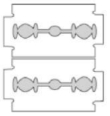
(N/A) $1$. Razor Blade Experiment: Place two razor blades such that their sharp edges are parallel and very close to each other,forming a narrow slit. When you look at a distant light bulb filament through this narrow slit,you will observe bright and dark fringes around the filament due to the diffraction of light.
$2$. Finger Experiment: Bring your fingers very close to each other and look at a distant light source through the narrow gap between them. You will observe a series of diffraction fringes.
$3$. Khadi Cloth Experiment: Look at a distant light bulb through a piece of fine-textured Khadi cloth. The fibers of the cloth act as a diffraction grating,and you will see bright and dark fringes around the light source.
$4$. Pinhole Experiment: Place an opaque screen with a tiny pinhole in front of a monochromatic light source (like a sodium lamp). When the light passes through this pinhole and falls on a distant screen,you will observe a diffraction pattern consisting of bright and dark fringes.
$2$. Finger Experiment: Bring your fingers very close to each other and look at a distant light source through the narrow gap between them. You will observe a series of diffraction fringes.
$3$. Khadi Cloth Experiment: Look at a distant light bulb through a piece of fine-textured Khadi cloth. The fibers of the cloth act as a diffraction grating,and you will see bright and dark fringes around the light source.
$4$. Pinhole Experiment: Place an opaque screen with a tiny pinhole in front of a monochromatic light source (like a sodium lamp). When the light passes through this pinhole and falls on a distant screen,you will observe a diffraction pattern consisting of bright and dark fringes.
0 likes
View Solution152
EasyMCQ
Due to which optical phenomenon do we not see the shadow of an opaque object clearly?
A
Reflection
B
Refraction
C
Diffraction
D
Polarization
Solution
(C) The phenomenon responsible for the blurring of shadows of opaque objects is diffraction.
Diffraction is the bending of light waves around the corners of an obstacle or through an aperture.
When light encounters an opaque object,it does not travel in a perfectly straight line due to its wave nature.
Instead,the light waves bend around the edges of the object,causing the shadow to become fuzzy or blurred at the edges rather than having a sharp,distinct boundary.
Diffraction is the bending of light waves around the corners of an obstacle or through an aperture.
When light encounters an opaque object,it does not travel in a perfectly straight line due to its wave nature.
Instead,the light waves bend around the edges of the object,causing the shadow to become fuzzy or blurred at the edges rather than having a sharp,distinct boundary.
0 likes
View Solution153
Medium
Define diffraction.
Solution
(N/A) Diffraction is the phenomenon of bending of light around the corners of an obstacle or an aperture of the size comparable to the wavelength of light.
When light waves encounter an obstacle or an opening, they do not travel in a perfectly straight line but spread out into the region of the geometrical shadow.
This bending effect is more pronounced when the size of the obstacle or aperture is small, specifically when it is of the order of the wavelength of the incident light $\lambda$.
When light waves encounter an obstacle or an opening, they do not travel in a perfectly straight line but spread out into the region of the geometrical shadow.
This bending effect is more pronounced when the size of the obstacle or aperture is small, specifically when it is of the order of the wavelength of the incident light $\lambda$.
0 likes
View Solution154
EasyMCQ
Write the condition of $n^{th}$ order maximum in diffraction.
A
a sin θ = (2n + $1$)λ/$2$
B
a sin θ = nλ
C
a sin θ = (n + $1$)λ
D
a sin θ = (2n - $1$)λ
Solution
(A) In single slit diffraction,the condition for the $n^{th}$ order secondary maxima is given by the formula:
$a \sin \theta = (2n + 1) \frac{\lambda}{2}$
where:
$a$ is the width of the slit,
$\theta$ is the angle of diffraction,
$\lambda$ is the wavelength of the incident light,
$n$ is an integer $(n = 1, 2, 3, ...)$.
$a \sin \theta = (2n + 1) \frac{\lambda}{2}$
where:
$a$ is the width of the slit,
$\theta$ is the angle of diffraction,
$\lambda$ is the wavelength of the incident light,
$n$ is an integer $(n = 1, 2, 3, ...)$.
0 likes
View Solution155
MediumMCQ
Which scientist discovered the phenomenon of diffraction of light?
A
Francesco Maria Grimaldi
B
Isaac Newton
C
Thomas Young
D
Christiaan Huygens
Solution
(A) The phenomenon of diffraction of light was first observed and described by the Italian scientist $Francesco \text{ } Maria \text{ } Grimaldi$ in the $17^{th}$ century. He coined the term 'diffraction' from the Latin word 'diffringere', meaning 'to break into pieces', to describe how light bends around obstacles.
0 likes
View Solution156
MediumMCQ
On which factor does the number of interference fringes in a given width of a diffraction peak depend?
A
Ratio of slit width to wavelength
B
Ratio of slit separation to slit width
C
Ratio of wavelength to slit separation
D
Ratio of slit width to slit separation
Solution
(B) In a double-slit diffraction experiment,the interference pattern is modulated by the diffraction envelope. The number of interference fringes $n$ within the central diffraction maximum is given by the ratio of the width of the central diffraction maximum to the fringe width of the interference pattern.
The angular width of the central diffraction maximum is $\Delta \theta_{diff} = \frac{2\lambda}{a}$,where $a$ is the slit width.
The angular fringe width of the interference pattern is $\beta_{\theta} = \frac{\lambda}{d}$,where $d$ is the distance between the slits.
The number of interference fringes $n$ is the ratio of these two widths:
$n = \frac{2\lambda / a}{\lambda / d} = \frac{2d}{a}$.
Thus,the number of interference fringes depends on the ratio of the slit separation $d$ to the slit width $a$.
The angular width of the central diffraction maximum is $\Delta \theta_{diff} = \frac{2\lambda}{a}$,where $a$ is the slit width.
The angular fringe width of the interference pattern is $\beta_{\theta} = \frac{\lambda}{d}$,where $d$ is the distance between the slits.
The number of interference fringes $n$ is the ratio of these two widths:
$n = \frac{2\lambda / a}{\lambda / d} = \frac{2d}{a}$.
Thus,the number of interference fringes depends on the ratio of the slit separation $d$ to the slit width $a$.
0 likes
View Solution157
Medium
Why is the diffraction of sound waves more evident in daily experience than that of light waves?
Solution
(A) The condition for significant diffraction is that the size of the obstacle or aperture $(d)$ must be comparable to the wavelength $(\lambda)$ of the wave, i.e., $\frac{\lambda}{d} \approx 1$.
For visible light, the wavelength $\lambda$ is approximately $6 \times 10^{-7} \,m$. Since most obstacles in our daily life are much larger than this (e.g., $d \approx 10^{-1} \,m$ to $1 \,m$), the ratio $\frac{\lambda}{d}$ is extremely small, making diffraction negligible.
For sound waves, the audible frequency range is $20 \,Hz$ to $20,000 \,Hz$. Taking a typical frequency of $332 \,Hz$ and the speed of sound $v = 332 \,m/s$, the wavelength is $\lambda = \frac{v}{f} = \frac{332}{332} = 1 \,m$.
Since the wavelength of sound $(1 \,m)$ is comparable to the size of common obstacles like doors or windows, the ratio $\frac{\lambda}{d}$ is significant, leading to prominent diffraction.
Therefore, we can hear sounds around corners or through doorways, but we cannot see light around them.
For visible light, the wavelength $\lambda$ is approximately $6 \times 10^{-7} \,m$. Since most obstacles in our daily life are much larger than this (e.g., $d \approx 10^{-1} \,m$ to $1 \,m$), the ratio $\frac{\lambda}{d}$ is extremely small, making diffraction negligible.
For sound waves, the audible frequency range is $20 \,Hz$ to $20,000 \,Hz$. Taking a typical frequency of $332 \,Hz$ and the speed of sound $v = 332 \,m/s$, the wavelength is $\lambda = \frac{v}{f} = \frac{332}{332} = 1 \,m$.
Since the wavelength of sound $(1 \,m)$ is comparable to the size of common obstacles like doors or windows, the ratio $\frac{\lambda}{d}$ is significant, leading to prominent diffraction.
Therefore, we can hear sounds around corners or through doorways, but we cannot see light around them.
0 likes
View Solution158
MediumMCQ
Orange light of wavelength $6000 \times 10^{-10} \ m$ illuminates a single slit of width $0.6 \times 10^{-4} \ m$. The maximum possible number of diffraction minima produced on both sides of the central maximum is $........$
A
$198$
B
$156$
C
$147$
D
$187$
Solution
(A) The condition for diffraction minima in a single slit experiment is given by $d \sin \theta = n \lambda$,where $n = \pm 1, \pm 2, \pm 3, \dots$
Since $|\sin \theta| < 1$,we have $n < \frac{d}{\lambda}$.
Given $d = 0.6 \times 10^{-4} \ m = 6 \times 10^{-5} \ m$ and $\lambda = 6000 \times 10^{-10} \ m = 6 \times 10^{-7} \ m$.
Calculating the ratio: $\frac{d}{\lambda} = \frac{6 \times 10^{-5}}{6 \times 10^{-7}} = 100$.
Thus,$n < 100$. The possible integer values for $n$ on one side are $1, 2, \dots, 99$.
Therefore,the number of minima on one side is $99$.
The total number of minima on both sides of the central maximum is $99 + 99 = 198$.
Since $|\sin \theta| < 1$,we have $n < \frac{d}{\lambda}$.
Given $d = 0.6 \times 10^{-4} \ m = 6 \times 10^{-5} \ m$ and $\lambda = 6000 \times 10^{-10} \ m = 6 \times 10^{-7} \ m$.
Calculating the ratio: $\frac{d}{\lambda} = \frac{6 \times 10^{-5}}{6 \times 10^{-7}} = 100$.
Thus,$n < 100$. The possible integer values for $n$ on one side are $1, 2, \dots, 99$.
Therefore,the number of minima on one side is $99$.
The total number of minima on both sides of the central maximum is $99 + 99 = 198$.
0 likes
View Solution159
MediumMCQ
Red light of wavelength $5400 \ \mathring{A}$ from a distant source falls on a slit $0.80 \ mm$ wide. Calculate the distance between the first two dark bands on each side of the central bright band in the diffraction pattern observed on a screen placed $1.4 \ m$ from the slit. (in $mm$)
A
$1.89$
B
$4$
C
$1$
D
$3$
Solution
(A) Given: Wavelength $(\lambda) = 5400 \ \mathring{A} = 5.4 \times 10^{-7} \ m$.
Slit width $(a) = 0.80 \ mm = 8 \times 10^{-4} \ m$.
Distance of screen $(D) = 1.4 \ m$.
The distance between the first two dark bands on each side of the central bright band is equivalent to the width of the central maximum.
The formula for the width of the central maximum is given by $w = \frac{2 \lambda D}{a}$.
Substituting the values: $w = \frac{2 \times 5.4 \times 10^{-7} \times 1.4}{8 \times 10^{-4}}$.
$w = \frac{15.12 \times 10^{-7}}{8 \times 10^{-4}} = 1.89 \times 10^{-3} \ m$.
Converting to $mm$,we get $w = 1.89 \ mm$.
Slit width $(a) = 0.80 \ mm = 8 \times 10^{-4} \ m$.
Distance of screen $(D) = 1.4 \ m$.
The distance between the first two dark bands on each side of the central bright band is equivalent to the width of the central maximum.
The formula for the width of the central maximum is given by $w = \frac{2 \lambda D}{a}$.
Substituting the values: $w = \frac{2 \times 5.4 \times 10^{-7} \times 1.4}{8 \times 10^{-4}}$.
$w = \frac{15.12 \times 10^{-7}}{8 \times 10^{-4}} = 1.89 \times 10^{-3} \ m$.
Converting to $mm$,we get $w = 1.89 \ mm$.
0 likes
View Solution160
DifficultMCQ
Consider the diffraction pattern obtained from the sunlight incident on a pinhole of diameter $0.1 \, \mu m$. If the diameter of the pinhole is slightly increased,it will affect the diffraction pattern such that :
A
its size decreases,and intensity decreases
B
its size increases,and intensity increases
C
its size increases,but intensity decreases
D
its size decreases,but intensity increases
Solution
(D) The angular width of the central diffraction maximum for a circular aperture is given by $\theta \approx \frac{1.22 \lambda}{D}$,where $D$ is the diameter of the pinhole and $\lambda$ is the wavelength of light.
As the diameter $D$ of the pinhole increases,the angular width $\theta$ decreases,which means the size of the diffraction pattern decreases.
Since the total amount of light passing through the pinhole increases as the area of the pinhole increases (area $\propto D^2$),and this light is now concentrated into a smaller area,the intensity of the diffraction pattern increases.
Therefore,the size decreases and the intensity increases.
As the diameter $D$ of the pinhole increases,the angular width $\theta$ decreases,which means the size of the diffraction pattern decreases.
Since the total amount of light passing through the pinhole increases as the area of the pinhole increases (area $\propto D^2$),and this light is now concentrated into a smaller area,the intensity of the diffraction pattern increases.
Therefore,the size decreases and the intensity increases.
0 likes
View Solution161
MediumMCQ
Sodium light of wavelengths $650\, nm$ and $655\, nm$ is used to study diffraction at a single slit of aperture $0.5\, mm$. The distance between the slit and the screen is $2.0\, m$. The separation between the positions of the first maxima of the diffraction pattern obtained in the two cases is $x \times 10^{-5}\, m$. Find the value of $x$.
A
$9$
B
$31$
C
$3$
D
$5$
Solution
(C) For a single slit diffraction,the condition for the $n^{th}$ maxima is given by $a \sin \theta = (n + \frac{1}{2}) \lambda$.
For the first maxima,$n = 1$,so $a \sin \theta = \frac{3 \lambda}{2}$.
Since $\theta$ is very small,$\sin \theta \approx \theta = \frac{y}{L}$,where $y$ is the distance from the central maxima and $L$ is the distance to the screen.
Thus,$y = \frac{3 \lambda L}{2 a}$.
The separation between the first maxima for two wavelengths $\lambda_1 = 650\, nm$ and $\lambda_2 = 655\, nm$ is $\Delta y = y_2 - y_1 = \frac{3 L}{2 a} (\lambda_2 - \lambda_1)$.
Given $L = 2.0\, m$,$a = 0.5\, mm = 0.5 \times 10^{-3}\, m$,$\lambda_1 = 650 \times 10^{-9}\, m$,and $\lambda_2 = 655 \times 10^{-9}\, m$.
$\Delta y = \frac{3 \times 2.0}{2 \times 0.5 \times 10^{-3}} \times (655 - 650) \times 10^{-9}$.
$\Delta y = \frac{6}{10^{-3}} \times 5 \times 10^{-9} = 6 \times 5 \times 10^{-6} = 30 \times 10^{-6} = 3 \times 10^{-5}\, m$.
Comparing with $x \times 10^{-5}\, m$,we get $x = 3$.
For the first maxima,$n = 1$,so $a \sin \theta = \frac{3 \lambda}{2}$.
Since $\theta$ is very small,$\sin \theta \approx \theta = \frac{y}{L}$,where $y$ is the distance from the central maxima and $L$ is the distance to the screen.
Thus,$y = \frac{3 \lambda L}{2 a}$.
The separation between the first maxima for two wavelengths $\lambda_1 = 650\, nm$ and $\lambda_2 = 655\, nm$ is $\Delta y = y_2 - y_1 = \frac{3 L}{2 a} (\lambda_2 - \lambda_1)$.
Given $L = 2.0\, m$,$a = 0.5\, mm = 0.5 \times 10^{-3}\, m$,$\lambda_1 = 650 \times 10^{-9}\, m$,and $\lambda_2 = 655 \times 10^{-9}\, m$.
$\Delta y = \frac{3 \times 2.0}{2 \times 0.5 \times 10^{-3}} \times (655 - 650) \times 10^{-9}$.
$\Delta y = \frac{6}{10^{-3}} \times 5 \times 10^{-9} = 6 \times 5 \times 10^{-6} = 30 \times 10^{-6} = 3 \times 10^{-5}\, m$.
Comparing with $x \times 10^{-5}\, m$,we get $x = 3$.
0 likes
View Solution162
MediumMCQ
Which of the following colourful patterns is due to the diffraction of light?
A
Rainbow
B
White light dispersed using a prism
C
Colours observed on a compact disc
D
Blue colour of the sky
Solution
(C)
Among the given patterns,the colours observed on a compact disc are due to the diffraction of light.
The causes of the other patterns are as follows:
$(a)$ $A$ rainbow occurs because of the refraction,total internal reflection,and dispersion of light.
$(b)$ When white light passes through a prism,the colourful pattern formed is due to the dispersion of light.
$(d)$ The blue colour of the sky is due to the scattering of light.
Among the given patterns,the colours observed on a compact disc are due to the diffraction of light.
The causes of the other patterns are as follows:
$(a)$ $A$ rainbow occurs because of the refraction,total internal reflection,and dispersion of light.
$(b)$ When white light passes through a prism,the colourful pattern formed is due to the dispersion of light.
$(d)$ The blue colour of the sky is due to the scattering of light.
0 likes
View Solution163
DifficultMCQ
Consider diffraction of light through a rectangular slit which is twice as wide as it is high. Which of the following statements is true?
A
The central diffraction peak is wider in the vertical direction than the horizontal direction.
B
The central diffraction peak is wider in the horizontal direction than the vertical direction.
C
The central diffraction peak is equally wide in both horizontal and vertical directions.
D
Width of the central diffraction peak is independent of the wavelength of light used.
Solution
(A) The angular width of the central diffraction maximum for a slit of width $a$ is given by $\theta = \frac{2\lambda}{a}$.
Given that the slit is rectangular with width $w$ and height $h$,where $w = 2h$.
The diffraction pattern is formed by the superposition of diffraction effects in the horizontal and vertical directions.
The angular width in the horizontal direction is $\theta_w = \frac{2\lambda}{w}$ and in the vertical direction is $\theta_h = \frac{2\lambda}{h}$.
Since $w = 2h$,we have $\theta_w = \frac{2\lambda}{2h} = \frac{\lambda}{h}$.
Comparing the two,$\theta_h = \frac{2\lambda}{h}$ and $\theta_w = \frac{\lambda}{h}$,it is clear that $\theta_h > \theta_w$.
Therefore,the central diffraction peak is wider in the vertical direction than in the horizontal direction.
Given that the slit is rectangular with width $w$ and height $h$,where $w = 2h$.
The diffraction pattern is formed by the superposition of diffraction effects in the horizontal and vertical directions.
The angular width in the horizontal direction is $\theta_w = \frac{2\lambda}{w}$ and in the vertical direction is $\theta_h = \frac{2\lambda}{h}$.
Since $w = 2h$,we have $\theta_w = \frac{2\lambda}{2h} = \frac{\lambda}{h}$.
Comparing the two,$\theta_h = \frac{2\lambda}{h}$ and $\theta_w = \frac{\lambda}{h}$,it is clear that $\theta_h > \theta_w$.
Therefore,the central diffraction peak is wider in the vertical direction than in the horizontal direction.
0 likes
View Solution164
EasyMCQ
The phenomenon of diffraction can be exhibited by
A
Infrared waves
B
Microwaves
C
$X$-rays
D
All of these
Solution
(D) The phenomenon of diffraction is a general characteristic of all waves,including electromagnetic waves.
For diffraction to be observable,the size of the aperture or obstacle must be comparable to the wavelength of the incident wave.
Since infrared waves,microwaves,and $X$-rays are all types of electromagnetic waves,they all exhibit diffraction when interacting with appropriate obstacles or apertures.
Therefore,the correct option is $D$.
For diffraction to be observable,the size of the aperture or obstacle must be comparable to the wavelength of the incident wave.
Since infrared waves,microwaves,and $X$-rays are all types of electromagnetic waves,they all exhibit diffraction when interacting with appropriate obstacles or apertures.
Therefore,the correct option is $D$.
0 likes
View Solution165
EasyMCQ
The main difference in the phenomenon of interference and diffraction in light waves is that
A
Diffraction is due to interaction of light from same wavefront,whereas the interference is the interaction of two waves derived from the same source
B
Diffraction is due to interaction of light from the same wave-front whereas interference is the interaction of waves from two isolated sources
C
Diffraction is due to interaction of waves derived from the same source,whereas the interference is the bending of light from the same wavefront
D
Diffraction is caused by reflected waves from a source whereas interference is caused due to refraction of waves from a surface
Solution
(B) .
Interference is the phenomenon resulting from the superposition of waves originating from two distinct,coherent sources.
Diffraction is the phenomenon resulting from the superposition of secondary wavelets originating from different parts of the same wavefront as they pass through an aperture or around an obstacle.
Interference is the phenomenon resulting from the superposition of waves originating from two distinct,coherent sources.
Diffraction is the phenomenon resulting from the superposition of secondary wavelets originating from different parts of the same wavefront as they pass through an aperture or around an obstacle.
0 likes
View Solution166
EasyMCQ
Monochromatic light of wavelength $580 \,nm$ is incident on a slit of width $0.30 \,mm$. The screen is $2 \,m$ from the slit. The width of the central maximum is ........... $\times 10^{-3} \,m$.
A
$3.35$
B
$2.25$
C
$6.20$
D
$7.73$
Solution
(D) The width of the central maximum in a single-slit diffraction pattern is given by the formula: $W = \frac{2D\lambda}{a}$.
Given values are:
$D = 2 \,m$
$\lambda = 580 \,nm = 580 \times 10^{-9} \,m$
$a = 0.30 \,mm = 0.30 \times 10^{-3} \,m$
Substituting these values into the formula:
$W = \frac{2 \times 2 \times 580 \times 10^{-9}}{0.30 \times 10^{-3}}$
$W = \frac{2320 \times 10^{-9}}{0.30 \times 10^{-3}}$
$W = \frac{2320}{0.30} \times 10^{-6} \,m$
$W \approx 7733.33 \times 10^{-6} \,m = 7.73 \times 10^{-3} \,m$.
Thus,the width of the central maximum is $7.73 \times 10^{-3} \,m$.
Given values are:
$D = 2 \,m$
$\lambda = 580 \,nm = 580 \times 10^{-9} \,m$
$a = 0.30 \,mm = 0.30 \times 10^{-3} \,m$
Substituting these values into the formula:
$W = \frac{2 \times 2 \times 580 \times 10^{-9}}{0.30 \times 10^{-3}}$
$W = \frac{2320 \times 10^{-9}}{0.30 \times 10^{-3}}$
$W = \frac{2320}{0.30} \times 10^{-6} \,m$
$W \approx 7733.33 \times 10^{-6} \,m = 7.73 \times 10^{-3} \,m$.
Thus,the width of the central maximum is $7.73 \times 10^{-3} \,m$.
1 likes
View Solution167
MediumMCQ
Why does a $DVD$ store almost $30$ times more information than a $CD$?
A
$DVD$ uses a shorter-wavelength laser of $6350 \,\mathring{A}$,while a $CD$ uses an infrared laser of $7800 \,\mathring{A}$.
B
$CD$ uses a shorter-wavelength laser compared to a $DVD$.
C
$CD$ works on the principle of diffraction.
D
$DVD$ works on the principle of diffraction of light.
Solution
(A) The storage capacity of an optical disc is determined by the size of the pits and lands,which is limited by the diffraction limit of the laser beam used to read/write the data.
According to the diffraction limit,the minimum spot size $d$ is proportional to the wavelength $\lambda$ of the laser $(d \propto \lambda)$.
$A$ $DVD$ uses a red laser with a wavelength of approximately $6350 \,\mathring{A}$,whereas a $CD$ uses an infrared laser with a wavelength of $7800 \,\mathring{A}$.
Since the $DVD$ laser has a shorter wavelength,it can focus on a smaller spot size,allowing for a much higher density of pits and lands on the disc surface.
Consequently,a $DVD$ can store significantly more information (approximately $30$ times more) than a $CD$ of the same physical size.
Therefore,option $(A)$ is the correct explanation.
According to the diffraction limit,the minimum spot size $d$ is proportional to the wavelength $\lambda$ of the laser $(d \propto \lambda)$.
$A$ $DVD$ uses a red laser with a wavelength of approximately $6350 \,\mathring{A}$,whereas a $CD$ uses an infrared laser with a wavelength of $7800 \,\mathring{A}$.
Since the $DVD$ laser has a shorter wavelength,it can focus on a smaller spot size,allowing for a much higher density of pits and lands on the disc surface.
Consequently,a $DVD$ can store significantly more information (approximately $30$ times more) than a $CD$ of the same physical size.
Therefore,option $(A)$ is the correct explanation.
0 likes
View Solution168
EasyMCQ
If a classroom door is open just a small amount, we can hear sounds coming from the room but we can't see what is going on inside the room because
A
Diffraction of sound is easier as its wavelength is large
B
Diffraction of light is easier as its wavelength is small
C
Sound waves can be polarized
D
Light waves can be polarized
Solution
(A) Diffraction is the phenomenon of bending of waves around the corners of an obstacle or aperture. The condition for significant diffraction is that the wavelength of the wave $(\lambda)$ must be comparable to the size of the obstacle or aperture $(a)$.
Sound waves have wavelengths in the range of $0.1 \, m$ to $10 \, m$, which is comparable to the size of a door opening. Therefore, sound waves diffract easily around the edges of the door.
Light waves have very small wavelengths (in the range of $400 \, nm$ to $700 \, nm$). Since the door opening is much larger than the wavelength of light, light does not undergo significant diffraction and travels in a straight line, preventing us from seeing around the corner.
Sound waves have wavelengths in the range of $0.1 \, m$ to $10 \, m$, which is comparable to the size of a door opening. Therefore, sound waves diffract easily around the edges of the door.
Light waves have very small wavelengths (in the range of $400 \, nm$ to $700 \, nm$). Since the door opening is much larger than the wavelength of light, light does not undergo significant diffraction and travels in a straight line, preventing us from seeing around the corner.
0 likes
View Solution169
EasyMCQ
When you look at a clear blue sky, you see tiny specks and hair-like structures floating in your view, called "floaters". This is basically
A
Interference pattern
B
Diffraction pattern
C
Emission spectra
D
Absorption spectra
Solution
(B) The phenomenon of "floaters" is caused by small shadows cast on the retina by debris (such as collagen fibers or cells) floating in the vitreous humor of the eye. When light passes around these tiny particles, it undergoes diffraction. The diffraction patterns formed by these structures are perceived by the brain as floating specks or hair-like shapes. Therefore, this is a diffraction pattern. The correct option is $B$.
0 likes
View Solution170
EasyMCQ
To observe diffraction,the size of an obstacle:
A
Should be of the same order as the wavelength
B
Should be much smaller than the wavelength
C
Has no relation to the wavelength
D
Should be exactly $\frac{\lambda}{2}$
Solution
(A) The correct option is $A$.
Diffraction is the phenomenon of bending of light around the corners of an obstacle or an aperture.
For significant diffraction to occur,the size of the obstacle or the width of the aperture must be comparable to the wavelength $(\lambda)$ of the incident light.
If the obstacle is much larger than the wavelength,the light travels in a straight line,and diffraction is negligible.
Therefore,the size of the obstacle should be of the same order as the wavelength of the light used.
Diffraction is the phenomenon of bending of light around the corners of an obstacle or an aperture.
For significant diffraction to occur,the size of the obstacle or the width of the aperture must be comparable to the wavelength $(\lambda)$ of the incident light.
If the obstacle is much larger than the wavelength,the light travels in a straight line,and diffraction is negligible.
Therefore,the size of the obstacle should be of the same order as the wavelength of the light used.
0 likes
View Solution171
MediumMCQ
Diffraction is more easily noticeable for sound waves than for light waves because sound waves
A
Are high energy waves
B
Are low intensity waves
C
Have longer wavelength
D
Are mechanical in nature
Solution
(C) The condition for significant diffraction is that the size of the obstacle or aperture must be comparable to the wavelength of the wave.
Sound waves have wavelengths in the range of $meters$ to $centimeters$,which is comparable to the size of common objects in our surroundings.
Light waves have very small wavelengths (in the range of $10^{-7} \ m$),which are much smaller than common objects.
Therefore,sound waves bend around obstacles more easily than light waves,making diffraction more noticeable for sound.
Sound waves have wavelengths in the range of $meters$ to $centimeters$,which is comparable to the size of common objects in our surroundings.
Light waves have very small wavelengths (in the range of $10^{-7} \ m$),which are much smaller than common objects.
Therefore,sound waves bend around obstacles more easily than light waves,making diffraction more noticeable for sound.
0 likes
View Solution172
EasyMCQ
In a single-slit diffraction experiment,what is the width of the slit $(b)$ such that $20$ maxima of a double-slit interference pattern are obtained within the central maximum of the diffraction pattern? (Given: Slit separation for the double-slit arrangement $d = 2 \, mm$)
A
$0.05$
B
$0.1$
C
$0.2$
D
$0.4$
Solution
(C) The width of the central maximum in a single-slit diffraction pattern is given by $w = \frac{2D\lambda}{b}$,where $D$ is the distance to the screen,$\lambda$ is the wavelength,and $b$ is the slit width.
The fringe width of a double-slit interference pattern is given by $\beta = \frac{D\lambda}{d}$,where $d$ is the slit separation.
It is given that $20$ maxima of the double-slit pattern lie within the central maximum of the diffraction pattern. The total width occupied by $20$ interference fringes is $20 \times \beta = 20 \frac{D\lambda}{d}$.
Equating the two widths: $20 \frac{D\lambda}{d} = \frac{2D\lambda}{b}$.
Simplifying the equation: $\frac{20}{d} = \frac{2}{b}$.
Rearranging for $b$: $b = \frac{2d}{20} = \frac{d}{10}$.
Given $d = 2 \, mm$,we get $b = \frac{2 \, mm}{10} = 0.2 \, mm$.
The fringe width of a double-slit interference pattern is given by $\beta = \frac{D\lambda}{d}$,where $d$ is the slit separation.
It is given that $20$ maxima of the double-slit pattern lie within the central maximum of the diffraction pattern. The total width occupied by $20$ interference fringes is $20 \times \beta = 20 \frac{D\lambda}{d}$.
Equating the two widths: $20 \frac{D\lambda}{d} = \frac{2D\lambda}{b}$.
Simplifying the equation: $\frac{20}{d} = \frac{2}{b}$.
Rearranging for $b$: $b = \frac{2d}{20} = \frac{d}{10}$.
Given $d = 2 \, mm$,we get $b = \frac{2 \, mm}{10} = 0.2 \, mm$.
0 likes
View Solution173
MediumMCQ
$A$ parallel beam of monochromatic light is incident on a narrow rectangular slit of width $1\,mm$. When the diffraction pattern is seen on a screen placed at a distance of $2\,m$, the width of the principal maxima is found to be $2.5\,mm$. The wavelength of light is $.............\mathring{A}$.
A
$6250$
B
$6200$
C
$5890$
D
$6000$
Solution
$(A)$ The width of the principal maxima in a single-slit diffraction pattern is given by $w = \frac{2\lambda D}{a}$, where $\lambda$ is the wavelength, $D$ is the distance to the screen, and $a$ is the slit width.
Given: $w = 2.5 \times 10^{-3}\,m$, $D = 2\,m$, and $a = 1 \times 10^{-3}\,m$.
Substituting the values into the formula: $2.5 \times 10^{-3} = \frac{2 \times \lambda \times 2}{1 \times 10^{-3}}$.
Solving for $\lambda$: $\lambda = \frac{2.5 \times 10^{-3} \times 10^{-3}}{4} = 0.625 \times 10^{-6}\,m$.
Converting to $\mathring{A}$s: $\lambda = 6.25 \times 10^{-7}\,m = 6250 \times 10^{-10}\,m = 6250\,\mathring{A}$.
Given: $w = 2.5 \times 10^{-3}\,m$, $D = 2\,m$, and $a = 1 \times 10^{-3}\,m$.
Substituting the values into the formula: $2.5 \times 10^{-3} = \frac{2 \times \lambda \times 2}{1 \times 10^{-3}}$.
Solving for $\lambda$: $\lambda = \frac{2.5 \times 10^{-3} \times 10^{-3}}{4} = 0.625 \times 10^{-6}\,m$.
Converting to $\mathring{A}$s: $\lambda = 6.25 \times 10^{-7}\,m = 6250 \times 10^{-10}\,m = 6250\,\mathring{A}$.
0 likes
View Solution174
MediumMCQ
For Bragg's diffraction by a crystal to occur,the $X$-ray of wavelength $\lambda$ and interatomic distance $d$ must satisfy which condition?
A
$\lambda > 2d$
B
$\lambda = 2d$
C
$\lambda \leq 2d$
D
$\lambda < 2d$
Solution
(C) Bragg's law for diffraction by a crystal is given by the equation:
$n\lambda = 2d \sin\theta$
where $n$ is the order of diffraction,$\lambda$ is the wavelength,$d$ is the interatomic distance,and $\theta$ is the glancing angle.
Since the maximum value of $\sin\theta$ is $1$,the equation becomes $n\lambda \leq 2d$.
For the first order of diffraction $(n=1)$,the condition is $\lambda \leq 2d$.
Therefore,for diffraction to occur,the wavelength $\lambda$ must be smaller than or equal to $2d$.
$n\lambda = 2d \sin\theta$
where $n$ is the order of diffraction,$\lambda$ is the wavelength,$d$ is the interatomic distance,and $\theta$ is the glancing angle.
Since the maximum value of $\sin\theta$ is $1$,the equation becomes $n\lambda \leq 2d$.
For the first order of diffraction $(n=1)$,the condition is $\lambda \leq 2d$.
Therefore,for diffraction to occur,the wavelength $\lambda$ must be smaller than or equal to $2d$.
0 likes
View Solution175
EasyMCQ
$A$ single slit of width $a$ is illuminated by a monochromatic light of wavelength $600 \, nm$. The value of $a$ for which the first minimum appears at $\theta = 30^{\circ}$ on the screen will be ........... $\mu m$.
A
$0.6$
B
$1.2$
C
$1.8$
D
$3$
Solution
(B) For the first minimum in a single-slit diffraction pattern, the condition is given by the formula:
$a \sin \theta = n \lambda$
For the first minimum, $n = 1$, so the equation becomes:
$a \sin \theta = \lambda$
Given:
$\lambda = 600 \, nm = 600 \times 10^{-9} \, m$
$\theta = 30^{\circ}$
Substituting the values into the equation:
$a \sin 30^{\circ} = 600 \times 10^{-9} \, m$
Since $\sin 30^{\circ} = 0.5$:
$a \times 0.5 = 600 \times 10^{-9} \, m$
$a = 1200 \times 10^{-9} \, m$
$a = 1.2 \times 10^{-6} \, m$
$a = 1.2 \, \mu m$
$a \sin \theta = n \lambda$
For the first minimum, $n = 1$, so the equation becomes:
$a \sin \theta = \lambda$
Given:
$\lambda = 600 \, nm = 600 \times 10^{-9} \, m$
$\theta = 30^{\circ}$
Substituting the values into the equation:
$a \sin 30^{\circ} = 600 \times 10^{-9} \, m$
Since $\sin 30^{\circ} = 0.5$:
$a \times 0.5 = 600 \times 10^{-9} \, m$
$a = 1200 \times 10^{-9} \, m$
$a = 1.2 \times 10^{-6} \, m$
$a = 1.2 \, \mu m$
0 likes
View Solution176
DifficultMCQ
$A$ parallel beam of monochromatic light of wavelength $5000 \mathring{A}$ is incident normally on a single narrow slit of width $0.001 \text{ mm}$. The light is focused by a convex lens on a screen placed on its focal plane. The first minima will be formed for the angle of diffraction of . . . . . . (degree).
A
$40$
B
$20$
C
$30$
D
$10$
Solution
(C) For the first minima in single slit diffraction,the condition is given by $a \sin \theta = n \lambda$.
For the first minima,$n = 1$,so $a \sin \theta = \lambda$.
Given:
Slit width $a = 0.001 \text{ mm} = 1 \times 10^{-6} \text{ m}$.
Wavelength $\lambda = 5000 \mathring{A} = 5000 \times 10^{-10} \text{ m} = 5 \times 10^{-7} \text{ m}$.
Substituting the values:
$\sin \theta = \frac{\lambda}{a} = \frac{5 \times 10^{-7}}{1 \times 10^{-6}} = 0.5$.
Since $\sin \theta = 0.5$,the angle of diffraction is $\theta = 30^{\circ}$.
For the first minima,$n = 1$,so $a \sin \theta = \lambda$.
Given:
Slit width $a = 0.001 \text{ mm} = 1 \times 10^{-6} \text{ m}$.
Wavelength $\lambda = 5000 \mathring{A} = 5000 \times 10^{-10} \text{ m} = 5 \times 10^{-7} \text{ m}$.
Substituting the values:
$\sin \theta = \frac{\lambda}{a} = \frac{5 \times 10^{-7}}{1 \times 10^{-6}} = 0.5$.
Since $\sin \theta = 0.5$,the angle of diffraction is $\theta = 30^{\circ}$.
0 likes
View Solution177
DifficultMCQ
In a single slit diffraction pattern,a light of wavelength $6000 \mathring A$ is used. The distance between the first and third minima in the diffraction pattern is found to be $3 \text{ mm}$ when the screen is placed $50 \text{ cm}$ away from the slit. The width of the slit is . . . . . . $\times 10^{-4} \text{ m}$.
A
$5$
B
$8$
C
$2$
D
$16$
Solution
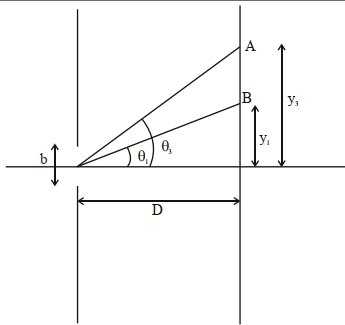
(C) For the $n^{\text{th}}$ minima in a single slit diffraction pattern,the condition is given by:
$b \sin \theta = n \lambda$
Since $\lambda$ is very small,$\sin \theta \approx \tan \theta = \frac{y_n}{D}$.
Thus,the position of the $n^{\text{th}}$ minima is $y_n = \frac{n \lambda D}{b}$.
The position of the first minima $(n=1)$ is $y_1 = \frac{\lambda D}{b}$.
The position of the third minima $(n=3)$ is $y_3 = \frac{3 \lambda D}{b}$.
The distance between the first and third minima is $\Delta y = y_3 - y_1 = \frac{2 \lambda D}{b}$.
Given $\Delta y = 3 \text{ mm} = 3 \times 10^{-3} \text{ m}$,$\lambda = 6000 \mathring A = 6000 \times 10^{-10} \text{ m}$,and $D = 50 \text{ cm} = 0.5 \text{ m}$.
Substituting the values:
$3 \times 10^{-3} = \frac{2 \times 6000 \times 10^{-10} \times 0.5}{b}$
$b = \frac{2 \times 6000 \times 10^{-10} \times 0.5}{3 \times 10^{-3}}$
$b = \frac{6000 \times 10^{-10}}{3 \times 10^{-3}} = 2000 \times 10^{-7} = 2 \times 10^{-4} \text{ m}$.
Therefore,the width of the slit is $2 \times 10^{-4} \text{ m}$. The correct option is $C$.
$b \sin \theta = n \lambda$
Since $\lambda$ is very small,$\sin \theta \approx \tan \theta = \frac{y_n}{D}$.
Thus,the position of the $n^{\text{th}}$ minima is $y_n = \frac{n \lambda D}{b}$.
The position of the first minima $(n=1)$ is $y_1 = \frac{\lambda D}{b}$.
The position of the third minima $(n=3)$ is $y_3 = \frac{3 \lambda D}{b}$.
The distance between the first and third minima is $\Delta y = y_3 - y_1 = \frac{2 \lambda D}{b}$.
Given $\Delta y = 3 \text{ mm} = 3 \times 10^{-3} \text{ m}$,$\lambda = 6000 \mathring A = 6000 \times 10^{-10} \text{ m}$,and $D = 50 \text{ cm} = 0.5 \text{ m}$.
Substituting the values:
$3 \times 10^{-3} = \frac{2 \times 6000 \times 10^{-10} \times 0.5}{b}$
$b = \frac{2 \times 6000 \times 10^{-10} \times 0.5}{3 \times 10^{-3}}$
$b = \frac{6000 \times 10^{-10}}{3 \times 10^{-3}} = 2000 \times 10^{-7} = 2 \times 10^{-4} \text{ m}$.
Therefore,the width of the slit is $2 \times 10^{-4} \text{ m}$. The correct option is $C$.
0 likes
View Solution178
DifficultMCQ
The diffraction pattern of light of wavelength $400 \ nm$ diffracting from a slit of width $0.2 \ mm$ is focused on the focal plane of a convex lens of focal length $100 \ cm$. The width of the $1^{\text{st}}$ secondary maxima will be:
A
$2 \ mm$
B
$2 \ cm$
C
$0.02 \ mm$
D
$0.2 \ mm$
Solution
(A) The width of the $n^{\text{th}}$ secondary maxima in a single-slit diffraction pattern is given by $\beta = \frac{\lambda D}{a}$,where $\lambda$ is the wavelength,$D$ is the distance of the screen (focal length of the lens),and $a$ is the slit width.
Given:
$\lambda = 400 \ nm = 400 \times 10^{-9} \ m$
$a = 0.2 \ mm = 0.2 \times 10^{-3} \ m$
$D = 100 \ cm = 1 \ m$
Substituting the values:
$\text{Width} = \frac{400 \times 10^{-9} \ m \times 1 \ m}{0.2 \times 10^{-3} \ m}$
$= \frac{400}{0.2} \times 10^{-6} \ m$
$= 2000 \times 10^{-6} \ m$
$= 2 \times 10^{-3} \ m = 2 \ mm$.
Given:
$\lambda = 400 \ nm = 400 \times 10^{-9} \ m$
$a = 0.2 \ mm = 0.2 \times 10^{-3} \ m$
$D = 100 \ cm = 1 \ m$
Substituting the values:
$\text{Width} = \frac{400 \times 10^{-9} \ m \times 1 \ m}{0.2 \times 10^{-3} \ m}$
$= \frac{400}{0.2} \times 10^{-6} \ m$
$= 2000 \times 10^{-6} \ m$
$= 2 \times 10^{-3} \ m = 2 \ mm$.
0 likes
View Solution179
DifficultMCQ
$A$ monochromatic light of wavelength $6000 \text{ Å}$ is incident on a single slit of width $0.01 \text{ mm}$. If the diffraction pattern is formed at the focus of a convex lens of focal length $20 \text{ cm}$, the linear width of the central maximum is: (in $\text{ mm}$)
A
$6$
B
$24$
C
$120$
D
$12$
Solution
(B) The linear width of the central maximum in a single-slit diffraction pattern is given by the formula:
$W = \frac{2 \lambda f}{a}$
Where:
$\lambda = 6000 \text{ Å} = 6 \times 10^{-7} \text{ m}$
$a = 0.01 \text{ mm} = 1 \times 10^{-5} \text{ m}$
$f = 20 \text{ cm} = 0.2 \text{ m}$
Substituting the values:
$W = \frac{2 \times (6 \times 10^{-7} \text{ m}) \times (0.2 \text{ m})}{1 \times 10^{-5} \text{ m}}$
$W = \frac{2.4 \times 10^{-7}}{10^{-5}} \text{ m}$
$W = 2.4 \times 10^{-2} \text{ m} = 24 \text{ mm}$
$W = \frac{2 \lambda f}{a}$
Where:
$\lambda = 6000 \text{ Å} = 6 \times 10^{-7} \text{ m}$
$a = 0.01 \text{ mm} = 1 \times 10^{-5} \text{ m}$
$f = 20 \text{ cm} = 0.2 \text{ m}$
Substituting the values:
$W = \frac{2 \times (6 \times 10^{-7} \text{ m}) \times (0.2 \text{ m})}{1 \times 10^{-5} \text{ m}}$
$W = \frac{2.4 \times 10^{-7}}{10^{-5}} \text{ m}$
$W = 2.4 \times 10^{-2} \text{ m} = 24 \text{ mm}$
0 likes
View Solution180
DifficultMCQ
$A$ microwave of wavelength $2.0 \ cm$ falls normally on a slit of width $4.0 \ cm$. The angular spread of the central maxima of the diffraction pattern obtained on a screen $1.5 \ m$ away from the slit,will be: (in $^{\circ}$)
A
$30$
B
$15$
C
$60$
D
$45$
Solution
(C) For the first diffraction minima,the condition is given by $a \sin \theta = n \lambda$. For the first minimum,$n = 1$.
Given: wavelength $\lambda = 2.0 \ cm$ and slit width $a = 4.0 \ cm$.
Substituting the values: $\sin \theta = \frac{\lambda}{a} = \frac{2.0}{4.0} = 0.5$.
Thus,$\theta = \arcsin(0.5) = 30^{\circ}$.
The angular spread of the central maxima is the angle between the first minima on either side of the central maximum,which is $2\theta$.
Therefore,angular spread $= 2 \times 30^{\circ} = 60^{\circ}$.
Given: wavelength $\lambda = 2.0 \ cm$ and slit width $a = 4.0 \ cm$.
Substituting the values: $\sin \theta = \frac{\lambda}{a} = \frac{2.0}{4.0} = 0.5$.
Thus,$\theta = \arcsin(0.5) = 30^{\circ}$.
The angular spread of the central maxima is the angle between the first minima on either side of the central maximum,which is $2\theta$.
Therefore,angular spread $= 2 \times 30^{\circ} = 60^{\circ}$.
0 likes
View Solution181
DifficultMCQ
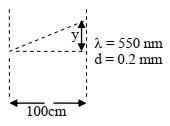
In a single slit diffraction experiment, a parallel beam of green light of wavelength $\lambda = 550 \,nm$ passes through a slit of width $a = 0.20 \,mm$. The transmitted light is collected on a screen at a distance $D = 100 \,cm$ away. The distance of the first-order minima from the central maximum is $x \times 10^{-5} \,m$. The value of $x$ is:
A
$272$
B
$274$
C
$275$
D
$277$
Solution
(C) For a single slit diffraction experiment, the condition for the $n^{th}$ order minima is given by $a \sin \theta = n \lambda$.
For small angles, $\sin \theta \approx \tan \theta = \frac{y}{D}$.
Thus, the distance of the $n^{th}$ minima from the central maximum is $y_n = \frac{n \lambda D}{a}$.
Given: $\lambda = 550 \,nm = 550 \times 10^{-9} \,m$, $a = 0.20 \,mm = 0.20 \times 10^{-3} \,m$, $D = 100 \,cm = 1.0 \,m$, and $n = 1$.
Substituting these values:
$y_1 = \frac{1 \times 550 \times 10^{-9} \times 1.0}{0.20 \times 10^{-3}} \,m$
$y_1 = \frac{550}{0.20} \times 10^{-6} \,m$
$y_1 = 2750 \times 10^{-6} \,m = 275 \times 10^{-5} \,m$.
Comparing this with $x \times 10^{-5} \,m$, we get $x = 275$.
For small angles, $\sin \theta \approx \tan \theta = \frac{y}{D}$.
Thus, the distance of the $n^{th}$ minima from the central maximum is $y_n = \frac{n \lambda D}{a}$.
Given: $\lambda = 550 \,nm = 550 \times 10^{-9} \,m$, $a = 0.20 \,mm = 0.20 \times 10^{-3} \,m$, $D = 100 \,cm = 1.0 \,m$, and $n = 1$.
Substituting these values:
$y_1 = \frac{1 \times 550 \times 10^{-9} \times 1.0}{0.20 \times 10^{-3}} \,m$
$y_1 = \frac{550}{0.20} \times 10^{-6} \,m$
$y_1 = 2750 \times 10^{-6} \,m = 275 \times 10^{-5} \,m$.
Comparing this with $x \times 10^{-5} \,m$, we get $x = 275$.
0 likes
View Solution182
DifficultMCQ
$A$ parallel beam of monochromatic light of wavelength $600 \,nm$ passes through a single slit of $0.4 \,mm$ width. The angular divergence corresponding to the second-order minima would be $...... \times 10^{-3} \,rad$.
A
$6$
B
$8$
C
$5$
D
$9$
Solution
(A) For a single slit diffraction, the condition for $n^{th}$ order minima is given by $b \sin \theta = n \lambda$.
For small angles, $\sin \theta \approx \theta$, so $\theta = \frac{n \lambda}{b}$.
Given: Wavelength $\lambda = 600 \,nm = 600 \times 10^{-9} \,m$, Slit width $b = 0.4 \,mm = 4 \times 10^{-4} \,m$, and order $n = 2$.
The angular position of the second-order minimum is $\theta = \frac{2 \times 600 \times 10^{-9}}{4 \times 10^{-4}} = 3 \times 10^{-3} \,rad$.
The total angular divergence between the second-order minima on both sides of the central maximum is $2\theta$.
Total divergence $= 2 \times (3 \times 10^{-3} \,rad) = 6 \times 10^{-3} \,rad$.
For small angles, $\sin \theta \approx \theta$, so $\theta = \frac{n \lambda}{b}$.
Given: Wavelength $\lambda = 600 \,nm = 600 \times 10^{-9} \,m$, Slit width $b = 0.4 \,mm = 4 \times 10^{-4} \,m$, and order $n = 2$.
The angular position of the second-order minimum is $\theta = \frac{2 \times 600 \times 10^{-9}}{4 \times 10^{-4}} = 3 \times 10^{-3} \,rad$.
The total angular divergence between the second-order minima on both sides of the central maximum is $2\theta$.
Total divergence $= 2 \times (3 \times 10^{-3} \,rad) = 6 \times 10^{-3} \,rad$.
0 likes
View Solution183
DifficultMCQ
Two slits are $1 \,mm$ apart and the screen is located $1 \,m$ away from the slits. $A$ light of wavelength $500 \,nm$ is used. The width of each slit to obtain $10$ maxima of the double slit pattern within the central maximum of the single slit pattern is $\ldots \ldots \ldots \times 10^{-4} \,m$.
A
$1$
B
$2$
C
$3$
D
$5$
Solution
(B) Given: Slit separation $d = 1 \,mm = 10^{-3} \,m$, screen distance $D = 1 \,m$, wavelength $\lambda = 500 \,nm = 5 \times 10^{-7} \,m$.
The width of the central maximum of a single slit diffraction pattern is given by $w = \frac{2 \lambda D}{a}$, where $a$ is the width of each slit.
The fringe width of the double slit interference pattern is $\beta = \frac{\lambda D}{d}$.
We are given that $10$ maxima of the double slit pattern fit within the central maximum of the single slit pattern. The central maximum spans from the first minimum on one side to the first minimum on the other, covering a width of $2 \beta_{total}$ or simply the range of $10$ fringes. Specifically, the condition is $10 \times \beta = \frac{2 \lambda D}{a}$.
Substituting $\beta = \frac{\lambda D}{d}$:
$10 \times \frac{\lambda D}{d} = \frac{2 \lambda D}{a}$
Simplifying the equation:
$\frac{10}{d} = \frac{2}{a}$
$a = \frac{2d}{10} = \frac{d}{5}$
Given $d = 1 \,mm = 10 \times 10^{-4} \,m$:
$a = \frac{10 \times 10^{-4} \,m}{5} = 2 \times 10^{-4} \,m$.
Thus, the value is $2$.
The width of the central maximum of a single slit diffraction pattern is given by $w = \frac{2 \lambda D}{a}$, where $a$ is the width of each slit.
The fringe width of the double slit interference pattern is $\beta = \frac{\lambda D}{d}$.
We are given that $10$ maxima of the double slit pattern fit within the central maximum of the single slit pattern. The central maximum spans from the first minimum on one side to the first minimum on the other, covering a width of $2 \beta_{total}$ or simply the range of $10$ fringes. Specifically, the condition is $10 \times \beta = \frac{2 \lambda D}{a}$.
Substituting $\beta = \frac{\lambda D}{d}$:
$10 \times \frac{\lambda D}{d} = \frac{2 \lambda D}{a}$
Simplifying the equation:
$\frac{10}{d} = \frac{2}{a}$
$a = \frac{2d}{10} = \frac{d}{5}$
Given $d = 1 \,mm = 10 \times 10^{-4} \,m$:
$a = \frac{10 \times 10^{-4} \,m}{5} = 2 \times 10^{-4} \,m$.
Thus, the value is $2$.
0 likes
View Solution184
DifficultMCQ
If the measured angular separation between the second minimum to the left of the central maximum and the third minimum to the right of the central maximum is $30^{\circ}$ in a single slit diffraction pattern recorded using $628 \ nm$ light,then the width of the slit is . . . . . . $\mu m$.
A
$3$
B
$5$
C
$6$
D
$8$
Solution
(C) For a single slit diffraction pattern,the condition for the $n^{th}$ minimum is given by $a \sin \theta = n \lambda$,where $a$ is the slit width,$\lambda$ is the wavelength,and $\theta$ is the angular position.
For the second minimum $(n=2)$,$\sin \theta_1 = \frac{2 \lambda}{a}$.
For the third minimum $(n=3)$,$\sin \theta_2 = \frac{3 \lambda}{a}$.
The total angular separation is $\theta_1 + \theta_2 = 30^{\circ} = \frac{\pi}{6} \text{ radians}$.
Using the small angle approximation,$\sin \theta \approx \theta$ (in radians),we have:
$\theta_1 \approx \frac{2 \lambda}{a}$ and $\theta_2 \approx \frac{3 \lambda}{a}$.
Adding these,we get $\theta_1 + \theta_2 \approx \frac{2 \lambda}{a} + \frac{3 \lambda}{a} = \frac{5 \lambda}{a}$.
Given $\theta_1 + \theta_2 = 30^{\circ} = \frac{\pi}{6} \text{ radians}$,we have $\frac{5 \lambda}{a} = \frac{\pi}{6}$.
Substituting $\lambda = 628 \ nm = 0.628 \ \mu m$:
$a = \frac{5 \times 0.628 \times 6}{\pi} \approx \frac{18.84}{3.14} \approx 6 \ \mu m$.
For the second minimum $(n=2)$,$\sin \theta_1 = \frac{2 \lambda}{a}$.
For the third minimum $(n=3)$,$\sin \theta_2 = \frac{3 \lambda}{a}$.
The total angular separation is $\theta_1 + \theta_2 = 30^{\circ} = \frac{\pi}{6} \text{ radians}$.
Using the small angle approximation,$\sin \theta \approx \theta$ (in radians),we have:
$\theta_1 \approx \frac{2 \lambda}{a}$ and $\theta_2 \approx \frac{3 \lambda}{a}$.
Adding these,we get $\theta_1 + \theta_2 \approx \frac{2 \lambda}{a} + \frac{3 \lambda}{a} = \frac{5 \lambda}{a}$.
Given $\theta_1 + \theta_2 = 30^{\circ} = \frac{\pi}{6} \text{ radians}$,we have $\frac{5 \lambda}{a} = \frac{\pi}{6}$.
Substituting $\lambda = 628 \ nm = 0.628 \ \mu m$:
$a = \frac{5 \times 0.628 \times 6}{\pi} \approx \frac{18.84}{3.14} \approx 6 \ \mu m$.

0 likes
View Solution185
MediumMCQ
In a single slit diffraction experiment, the first minimum for red light $(660 \ nm)$ coincides with the first secondary maximum of some other wavelength $\lambda$. The value of $\lambda$ is $..... \mathring{A}$.
A
$4400$
B
$6600$
C
$2000$
D
$3500$
Solution
(A) For a single slit diffraction experiment, the condition for the $n^{th}$ minimum is given by $a \sin \theta = n \lambda_1$, where $n = 1, 2, 3, ...$.
For the first minimum $(n=1)$, the position is $a \sin \theta = 1 \times \lambda_1 = 660 \ nm$.
The condition for the $m^{th}$ secondary maximum is given by $a \sin \theta = (2m + 1) \frac{\lambda_2}{2}$, where $m = 1, 2, 3, ...$.
For the first secondary maximum $(m=1)$, the position is $a \sin \theta = (2(1) + 1) \frac{\lambda_2}{2} = \frac{3}{2} \lambda_2$.
Since the positions coincide, we equate the two expressions:
$660 \ nm = \frac{3}{2} \lambda_2$.
Solving for $\lambda_2$:
$\lambda_2 = 660 \times \frac{2}{3} = 440 \ nm$.
Converting to $\mathring{A}$s $(\mathring{A})$:
$440 \ nm = 440 \times 10 \mathring{A} = 4400 \mathring{A}$.
For the first minimum $(n=1)$, the position is $a \sin \theta = 1 \times \lambda_1 = 660 \ nm$.
The condition for the $m^{th}$ secondary maximum is given by $a \sin \theta = (2m + 1) \frac{\lambda_2}{2}$, where $m = 1, 2, 3, ...$.
For the first secondary maximum $(m=1)$, the position is $a \sin \theta = (2(1) + 1) \frac{\lambda_2}{2} = \frac{3}{2} \lambda_2$.
Since the positions coincide, we equate the two expressions:
$660 \ nm = \frac{3}{2} \lambda_2$.
Solving for $\lambda_2$:
$\lambda_2 = 660 \times \frac{2}{3} = 440 \ nm$.
Converting to $\mathring{A}$s $(\mathring{A})$:
$440 \ nm = 440 \times 10 \mathring{A} = 4400 \mathring{A}$.
0 likes
View Solution186
EasyMCQ
The waves of $600 \ \mu m$ wavelength are incident normally on a slit of $1.2 \ mm$ width. The value of diffraction angle corresponding to the first minima will be (in radian) -
A
$\frac{\pi}{2}$
B
$\frac{\pi}{6}$
C
$\frac{\pi}{3}$
D
$\frac{\pi}{4}$
Solution
(B) For single slit diffraction,the condition for the $n^{th}$ minima is given by $d \sin \theta = n \lambda$.
For the first minima,$n = 1$,so the condition becomes $d \sin \theta = \lambda$.
Given wavelength $\lambda = 600 \ \mu m = 600 \times 10^{-6} \ m = 6 \times 10^{-4} \ m$.
Given slit width $d = 1.2 \ mm = 1.2 \times 10^{-3} \ m = 12 \times 10^{-4} \ m$.
Substituting the values into the formula: $\sin \theta = \frac{\lambda}{d} = \frac{6 \times 10^{-4}}{12 \times 10^{-4}} = \frac{1}{2}$.
Since $\sin \theta = \frac{1}{2}$,the angle $\theta = \arcsin(0.5) = \frac{\pi}{6} \text{ radians}$.
For the first minima,$n = 1$,so the condition becomes $d \sin \theta = \lambda$.
Given wavelength $\lambda = 600 \ \mu m = 600 \times 10^{-6} \ m = 6 \times 10^{-4} \ m$.
Given slit width $d = 1.2 \ mm = 1.2 \times 10^{-3} \ m = 12 \times 10^{-4} \ m$.
Substituting the values into the formula: $\sin \theta = \frac{\lambda}{d} = \frac{6 \times 10^{-4}}{12 \times 10^{-4}} = \frac{1}{2}$.
Since $\sin \theta = \frac{1}{2}$,the angle $\theta = \arcsin(0.5) = \frac{\pi}{6} \text{ radians}$.
0 likes
View Solution187
DifficultMCQ
$A$ slit of size $0.15 \ cm$ is placed at $2.1 \ m$ from a screen. On illuminating it by a light of wavelength $5 \times 10^{-5} \ cm$,the width of the central maxima will be:
A
$70 \ mm$
B
$0.14 \ mm$
C
$1.4 \ mm$
D
$1.4 \ cm$
Solution
(C) The width of the central maxima in a single-slit diffraction pattern is given by the formula: $W = \frac{2 \lambda D}{a}$.
Given values:
Slit width $a = 0.15 \ cm = 1.5 \times 10^{-3} \ m$.
Distance from screen $D = 2.1 \ m$.
Wavelength $\lambda = 5 \times 10^{-5} \ cm = 5 \times 10^{-7} \ m$.
Substituting these values into the formula:
$W = \frac{2 \times (5 \times 10^{-7} \ m) \times (2.1 \ m)}{1.5 \times 10^{-3} \ m}$.
$W = \frac{21 \times 10^{-7}}{1.5 \times 10^{-3}} \ m$.
$W = 14 \times 10^{-4} \ m = 1.4 \times 10^{-3} \ m = 1.4 \ mm$.
Given values:
Slit width $a = 0.15 \ cm = 1.5 \times 10^{-3} \ m$.
Distance from screen $D = 2.1 \ m$.
Wavelength $\lambda = 5 \times 10^{-5} \ cm = 5 \times 10^{-7} \ m$.
Substituting these values into the formula:
$W = \frac{2 \times (5 \times 10^{-7} \ m) \times (2.1 \ m)}{1.5 \times 10^{-3} \ m}$.
$W = \frac{21 \times 10^{-7}}{1.5 \times 10^{-3}} \ m$.
$W = 14 \times 10^{-4} \ m = 1.4 \times 10^{-3} \ m = 1.4 \ mm$.
0 likes
View Solution188
AdvancedMCQ
$A$ single slit diffraction experiment is performed to determine the slit width using the equation,$\frac{b d}{D} = m \lambda$,where $b$ is the slit width,$D$ is the distance between the slit and the screen,$d$ is the distance between the $m^{\text{th}}$ diffraction maximum and the central maximum,and $\lambda$ is the wavelength. $D$ and $d$ are measured with scales of least count of $1 \ cm$ and $1 \ mm$,respectively. The values of $\lambda$ and $m$ are known precisely to be $600 \ nm$ and $3$,respectively. The absolute error (in $\mu m$) in the value of $b$ estimated using the diffraction maximum that occurs for $m=3$ with $d=5 \ mm$ and $D=1 \ m$ is $.....$
A
$(45.60 \text{ or } 50.50)$
B
$(71.60 \text{ or } 60.50)$
C
$(76.60 \text{ or } 91.50)$
D
$(75.60 \text{ or } 94.50)$
Solution
(D) The slit width is given by $b = \frac{m \lambda D}{d}$.
Given: $m = 3$,$\lambda = 600 \ nm = 600 \times 10^{-6} \ mm$,$D = 1 \ m = 1000 \ mm$,$d = 5 \ mm$.
Least counts: $\Delta D = 1 \ cm = 10 \ mm$,$\Delta d = 1 \ mm$.
Calculating $b$: $b = \frac{3 \times 600 \times 10^{-6} \times 1000}{5} = 0.36 \ mm = 360 \ \mu m$.
Using the method of maximum error: $b_{max} = \frac{m \lambda (D + \Delta D)}{(d - \Delta d)} = \frac{3 \times 600 \times 10^{-6} \times 1010}{4} = 0.4545 \ mm = 454.5 \ \mu m$.
$b_{min} = \frac{m \lambda (D - \Delta D)}{(d + \Delta d)} = \frac{3 \times 600 \times 10^{-6} \times 990}{6} = 0.297 \ mm = 297 \ \mu m$.
Errors: $\Delta b_1 = |454.5 - 360| = 94.5 \ \mu m$ and $\Delta b_2 = |297 - 360| = 63 \ \mu m$.
Using the differential method: $\frac{\Delta b}{b} = \frac{\Delta D}{D} + \frac{\Delta d}{d} = \frac{10}{1000} + \frac{1}{5} = 0.01 + 0.2 = 0.21$.
$\Delta b = 0.21 \times 360 = 75.6 \ \mu m$.
Thus,the possible errors are $75.6 \ \mu m$ or $94.5 \ \mu m$.
Given: $m = 3$,$\lambda = 600 \ nm = 600 \times 10^{-6} \ mm$,$D = 1 \ m = 1000 \ mm$,$d = 5 \ mm$.
Least counts: $\Delta D = 1 \ cm = 10 \ mm$,$\Delta d = 1 \ mm$.
Calculating $b$: $b = \frac{3 \times 600 \times 10^{-6} \times 1000}{5} = 0.36 \ mm = 360 \ \mu m$.
Using the method of maximum error: $b_{max} = \frac{m \lambda (D + \Delta D)}{(d - \Delta d)} = \frac{3 \times 600 \times 10^{-6} \times 1010}{4} = 0.4545 \ mm = 454.5 \ \mu m$.
$b_{min} = \frac{m \lambda (D - \Delta D)}{(d + \Delta d)} = \frac{3 \times 600 \times 10^{-6} \times 990}{6} = 0.297 \ mm = 297 \ \mu m$.
Errors: $\Delta b_1 = |454.5 - 360| = 94.5 \ \mu m$ and $\Delta b_2 = |297 - 360| = 63 \ \mu m$.
Using the differential method: $\frac{\Delta b}{b} = \frac{\Delta D}{D} + \frac{\Delta d}{d} = \frac{10}{1000} + \frac{1}{5} = 0.01 + 0.2 = 0.21$.
$\Delta b = 0.21 \times 360 = 75.6 \ \mu m$.
Thus,the possible errors are $75.6 \ \mu m$ or $94.5 \ \mu m$.
0 likes
View Solution189
EasyMCQ
In a single slit diffraction pattern,identify the incorrect statement from the following.
A
The fringes have unequal width.
B
The fringes have unequal intensity.
C
The fringes have unequal width and unequal intensity.
D
The fringes have equal width and equal intensity.
Solution
(D) In a single slit diffraction pattern,the central maximum is the brightest and widest. As we move away from the center,the intensity of the secondary maxima decreases rapidly. The width of the central maximum is $2\lambda D/a$,while the width of the secondary maxima is $\lambda D/a$. Therefore,the fringes have unequal width and unequal intensity. Option $D$ states that the fringes have equal width and equal intensity,which is incorrect.
0 likes
View Solution190
MediumMCQ
In a single slit diffraction pattern,the distance between the plane of the slit and the screen is $1.3 \ m$. The width of the slit is $0.65 \ mm$ and the second maximum is formed at a distance of $2.6 \ mm$ from the center of the screen. The wavelength of light used is: (in $Å$)
A
$6500$
B
$6000$
C
$5200$
D
$4600$
Solution
(C) For a single slit diffraction pattern,the condition for the $n^{th}$ secondary maximum is given by: $a \sin \theta = (n + \frac{1}{2}) \lambda$,where $a$ is the slit width,$\theta$ is the angle of diffraction,and $\lambda$ is the wavelength.
Since $\theta$ is very small,$\sin \theta \approx \tan \theta = \frac{y}{D}$,where $y$ is the distance from the center and $D$ is the distance to the screen.
For the second maximum,$n = 2$. Thus,$a \frac{y}{D} = (2 + \frac{1}{2}) \lambda = \frac{5}{2} \lambda$.
Given: $a = 0.65 \ mm = 0.65 \times 10^{-3} \ m$,$D = 1.3 \ m$,and $y = 2.6 \ mm = 2.6 \times 10^{-3} \ m$.
Substituting the values: $(0.65 \times 10^{-3}) \times \frac{2.6 \times 10^{-3}}{1.3} = \frac{5}{2} \lambda$.
$(0.65 \times 10^{-3}) \times (2 \times 10^{-3}) = 2.5 \lambda$.
$1.3 \times 10^{-6} = 2.5 \lambda$.
$\lambda = \frac{1.3 \times 10^{-6}}{2.5} = 0.52 \times 10^{-6} \ m = 5200 \ \times 10^{-10} \ m = 5200 \ Å$.
Since $\theta$ is very small,$\sin \theta \approx \tan \theta = \frac{y}{D}$,where $y$ is the distance from the center and $D$ is the distance to the screen.
For the second maximum,$n = 2$. Thus,$a \frac{y}{D} = (2 + \frac{1}{2}) \lambda = \frac{5}{2} \lambda$.
Given: $a = 0.65 \ mm = 0.65 \times 10^{-3} \ m$,$D = 1.3 \ m$,and $y = 2.6 \ mm = 2.6 \times 10^{-3} \ m$.
Substituting the values: $(0.65 \times 10^{-3}) \times \frac{2.6 \times 10^{-3}}{1.3} = \frac{5}{2} \lambda$.
$(0.65 \times 10^{-3}) \times (2 \times 10^{-3}) = 2.5 \lambda$.
$1.3 \times 10^{-6} = 2.5 \lambda$.
$\lambda = \frac{1.3 \times 10^{-6}}{2.5} = 0.52 \times 10^{-6} \ m = 5200 \ \times 10^{-10} \ m = 5200 \ Å$.
0 likes
View Solution191
MediumMCQ
$A$ single slit diffraction pattern is formed with light of wavelength $6384 Å$. The second secondary maximum for this wavelength coincides with the third secondary maximum in the pattern for light of wavelength $\lambda_0$. The value of $\lambda_0$ is (in $Å$)
A
$4242$
B
$4560$
C
$5474$
D
$6384$
Solution
(B) For a single slit diffraction pattern,the condition for secondary maxima is given by $a \sin \theta = (n + \frac{1}{2}) \lambda$,where $n = 1, 2, 3, \dots$ is the order of the secondary maximum.
For the second secondary maximum $(n = 2)$ with wavelength $\lambda_1 = 6384 Å$,the condition is $a \sin \theta = (2 + \frac{1}{2}) \lambda_1 = \frac{5}{2} \lambda_1$.
For the third secondary maximum $(n = 3)$ with wavelength $\lambda_0$,the condition is $a \sin \theta = (3 + \frac{1}{2}) \lambda_0 = \frac{7}{2} \lambda_0$.
Since the positions coincide,we equate the two expressions: $\frac{5}{2} \lambda_1 = \frac{7}{2} \lambda_0$.
This simplifies to $5 \lambda_1 = 7 \lambda_0$.
Substituting $\lambda_1 = 6384 Å$,we get $\lambda_0 = \frac{5 \times 6384}{7} = \frac{31920}{7} = 4560 Å$.
For the second secondary maximum $(n = 2)$ with wavelength $\lambda_1 = 6384 Å$,the condition is $a \sin \theta = (2 + \frac{1}{2}) \lambda_1 = \frac{5}{2} \lambda_1$.
For the third secondary maximum $(n = 3)$ with wavelength $\lambda_0$,the condition is $a \sin \theta = (3 + \frac{1}{2}) \lambda_0 = \frac{7}{2} \lambda_0$.
Since the positions coincide,we equate the two expressions: $\frac{5}{2} \lambda_1 = \frac{7}{2} \lambda_0$.
This simplifies to $5 \lambda_1 = 7 \lambda_0$.
Substituting $\lambda_1 = 6384 Å$,we get $\lambda_0 = \frac{5 \times 6384}{7} = \frac{31920}{7} = 4560 Å$.
0 likes
View Solution192
MediumMCQ
In a single slit diffraction experiment,a slit of width '$a$' is illuminated by light of wavelength '$\lambda$' and the width of the central maxima in the diffraction pattern is measured as '$y$'. When half of the slit is covered and illuminated by light of wavelength $(1.5)\lambda$,the width of the central maximum in the diffraction pattern becomes:
A
$\frac{3}{2} y$
B
$\frac{2}{3} y$
C
$3 y$
D
$\frac{y}{3}$
Solution
(C) The width of the central maximum in a single slit diffraction experiment is given by the formula: $y = \frac{2D\lambda}{a}$,where '$D$' is the distance of the screen from the slit,'$\lambda$' is the wavelength of light,and '$a$' is the width of the slit.
Initially,$y = \frac{2D\lambda}{a}$.
In the second case,the slit width is halved,so the new width is $a' = \frac{a}{2}$.
The new wavelength is $\lambda' = 1.5\lambda = \frac{3}{2}\lambda$.
The new width of the central maximum '$y'$' is given by: $y' = \frac{2D\lambda'}{a'} = \frac{2D(1.5\lambda)}{a/2}$.
Simplifying this,we get: $y' = \frac{2D(3/2\lambda)}{a/2} = \frac{3D\lambda}{a/2} = \frac{6D\lambda}{a}$.
Since $y = \frac{2D\lambda}{a}$,we can substitute this into the expression for $y'$:
$y' = 3 \times (\frac{2D\lambda}{a}) = 3y$.
Therefore,the new width of the central maximum is $3y$.
Initially,$y = \frac{2D\lambda}{a}$.
In the second case,the slit width is halved,so the new width is $a' = \frac{a}{2}$.
The new wavelength is $\lambda' = 1.5\lambda = \frac{3}{2}\lambda$.
The new width of the central maximum '$y'$' is given by: $y' = \frac{2D\lambda'}{a'} = \frac{2D(1.5\lambda)}{a/2}$.
Simplifying this,we get: $y' = \frac{2D(3/2\lambda)}{a/2} = \frac{3D\lambda}{a/2} = \frac{6D\lambda}{a}$.
Since $y = \frac{2D\lambda}{a}$,we can substitute this into the expression for $y'$:
$y' = 3 \times (\frac{2D\lambda}{a}) = 3y$.
Therefore,the new width of the central maximum is $3y$.
0 likes
View Solution193
MediumMCQ
$A$ single slit diffraction pattern is formed with white light. For what wavelength of light the $4^{\text{th}}$ secondary maximum in the diffraction pattern coincides with the $3^{\text{rd}}$ secondary maximum in the pattern of light of wavelength $\lambda$?
A
$\frac{5 \lambda}{7}$
B
$\frac{7 \lambda}{9}$
C
$\frac{3 \lambda}{4}$
D
$\frac{9 \lambda}{13}$
Solution
(B) The condition for the $n^{\text{th}}$ secondary maximum in a single slit diffraction pattern is given by: $a \sin \theta = (n + \frac{1}{2}) \lambda'$,where $n$ is the order of the secondary maximum.
For the $4^{\text{th}}$ secondary maximum of wavelength $\lambda_1$,the condition is: $a \sin \theta_1 = (4 + \frac{1}{2}) \lambda_1 = \frac{9}{2} \lambda_1$.
For the $3^{\text{rd}}$ secondary maximum of wavelength $\lambda$,the condition is: $a \sin \theta_2 = (3 + \frac{1}{2}) \lambda = \frac{7}{2} \lambda$.
Since the maxima coincide,$\theta_1 = \theta_2$,so $a \sin \theta_1 = a \sin \theta_2$.
Equating the two expressions: $\frac{9}{2} \lambda_1 = \frac{7}{2} \lambda$.
Solving for $\lambda_1$: $\lambda_1 = \frac{7}{9} \lambda$.
For the $4^{\text{th}}$ secondary maximum of wavelength $\lambda_1$,the condition is: $a \sin \theta_1 = (4 + \frac{1}{2}) \lambda_1 = \frac{9}{2} \lambda_1$.
For the $3^{\text{rd}}$ secondary maximum of wavelength $\lambda$,the condition is: $a \sin \theta_2 = (3 + \frac{1}{2}) \lambda = \frac{7}{2} \lambda$.
Since the maxima coincide,$\theta_1 = \theta_2$,so $a \sin \theta_1 = a \sin \theta_2$.
Equating the two expressions: $\frac{9}{2} \lambda_1 = \frac{7}{2} \lambda$.
Solving for $\lambda_1$: $\lambda_1 = \frac{7}{9} \lambda$.
0 likes
View Solution194
EasyMCQ
$A$ diffraction pattern is obtained using a beam of red light. If red light is replaced by blue light,then:
A
no change in diffraction pattern.
B
diffraction bands become narrow and crowded together.
C
diffraction bands become broader and farther apart.
D
bands disappear.
Solution
(B) The width of the diffraction bands (or the distance between successive minima/maxima) is given by the formula $\beta = \frac{\lambda D}{a}$.
From this relation,we can see that the band width $\beta$ is directly proportional to the wavelength $\lambda$ of the light used,i.e.,$\beta \propto \lambda$.
We know that the wavelength of blue light is smaller than the wavelength of red light,i.e.,$\lambda_{\text{blue}} < \lambda_{\text{red}}$.
Since $\lambda$ decreases,the band width $\beta$ also decreases.
Therefore,the diffraction bands become narrow and crowded together.
From this relation,we can see that the band width $\beta$ is directly proportional to the wavelength $\lambda$ of the light used,i.e.,$\beta \propto \lambda$.
We know that the wavelength of blue light is smaller than the wavelength of red light,i.e.,$\lambda_{\text{blue}} < \lambda_{\text{red}}$.
Since $\lambda$ decreases,the band width $\beta$ also decreases.
Therefore,the diffraction bands become narrow and crowded together.
0 likes
View Solution195
EasyMCQ
$A$ single slit diffraction pattern is formed with light of wavelength $6195 Å$. The second secondary maximum for this wavelength coincides with the third secondary maximum in the pattern for light of wavelength $\lambda_0$. The value of $\lambda_0$ is (in $Å$)
A
$4180$
B
$4425$
C
$5330$
D
$6235$
Solution
(B) For the $n^{\text{th}}$ secondary maximum in a single slit diffraction pattern,the position is given by $x_n = \frac{(2n+1) \lambda D}{2a}$.
For the second secondary maximum $(n=2)$ with wavelength $\lambda = 6195 Å$,the position is $x_2 = \frac{(2 \times 2 + 1) \lambda D}{2a} = \frac{5 \lambda D}{2a}$.
For the third secondary maximum $(n=3)$ with wavelength $\lambda_0$,the position is $x_3 = \frac{(2 \times 3 + 1) \lambda_0 D}{2a} = \frac{7 \lambda_0 D}{2a}$.
Since the positions coincide,$x_2 = x_3$,which implies $\frac{5 \lambda D}{2a} = \frac{7 \lambda_0 D}{2a}$.
Simplifying this,we get $5 \lambda = 7 \lambda_0$.
Therefore,$\lambda_0 = \frac{5 \lambda}{7} = \frac{5 \times 6195 Å}{7} = 5 \times 885 Å = 4425 Å$.
For the second secondary maximum $(n=2)$ with wavelength $\lambda = 6195 Å$,the position is $x_2 = \frac{(2 \times 2 + 1) \lambda D}{2a} = \frac{5 \lambda D}{2a}$.
For the third secondary maximum $(n=3)$ with wavelength $\lambda_0$,the position is $x_3 = \frac{(2 \times 3 + 1) \lambda_0 D}{2a} = \frac{7 \lambda_0 D}{2a}$.
Since the positions coincide,$x_2 = x_3$,which implies $\frac{5 \lambda D}{2a} = \frac{7 \lambda_0 D}{2a}$.
Simplifying this,we get $5 \lambda = 7 \lambda_0$.
Therefore,$\lambda_0 = \frac{5 \lambda}{7} = \frac{5 \times 6195 Å}{7} = 5 \times 885 Å = 4425 Å$.
0 likes
View Solution196
EasyMCQ
$A$ screen is placed at $50 \ cm$ from a single slit,which is illuminated with light of wavelength $600 \ nm$. If the separation between the $1^{st}$ and $3^{rd}$ minima in the diffraction pattern is $3 \ mm$,then the slit width is: (in $mm$)
A
$0.2$
B
$0.02$
C
$2$
D
$20$
Solution
(A) The position of the $n^{th}$ minima in a single-slit diffraction pattern is given by $x_n = \frac{n D \lambda}{d}$,where $D$ is the distance to the screen,$\lambda$ is the wavelength,and $d$ is the slit width.
Given:
$D = 50 \ cm = 0.5 \ m$
$\lambda = 600 \ nm = 600 \times 10^{-9} \ m$
Separation between $1^{st}$ and $3^{rd}$ minima: $\Delta x = x_3 - x_1 = 3 \ mm = 3 \times 10^{-3} \ m$
Using the formula:
$x_3 - x_1 = (3 - 1) \frac{D \lambda}{d} = \frac{2 D \lambda}{d}$
Rearranging for $d$:
$d = \frac{2 D \lambda}{\Delta x}$
$d = \frac{2 \times 0.5 \times 600 \times 10^{-9}}{3 \times 10^{-3}}$
$d = \frac{600 \times 10^{-9}}{3 \times 10^{-3}} = 200 \times 10^{-6} \ m = 0.2 \ mm$.
Given:
$D = 50 \ cm = 0.5 \ m$
$\lambda = 600 \ nm = 600 \times 10^{-9} \ m$
Separation between $1^{st}$ and $3^{rd}$ minima: $\Delta x = x_3 - x_1 = 3 \ mm = 3 \times 10^{-3} \ m$
Using the formula:
$x_3 - x_1 = (3 - 1) \frac{D \lambda}{d} = \frac{2 D \lambda}{d}$
Rearranging for $d$:
$d = \frac{2 D \lambda}{\Delta x}$
$d = \frac{2 \times 0.5 \times 600 \times 10^{-9}}{3 \times 10^{-3}}$
$d = \frac{600 \times 10^{-9}}{3 \times 10^{-3}} = 200 \times 10^{-6} \ m = 0.2 \ mm$.
0 likes
View Solution197
MediumMCQ
$A$ single slit of width $d$ is illuminated by violet light of wavelength $400 \ nm$ and the width of the diffraction pattern is measured as $Y$. When half of the slit width is covered and illuminated by yellow light of wavelength $600 \ nm$,the width of the diffraction pattern is
A
zero
B
$\frac{Y}{3}$
C
$3 Y$
D
$4 Y$
Solution
(C) The width of the central diffraction maximum is given by $W = \frac{2 \lambda D}{d}$,where $\lambda$ is the wavelength,$D$ is the distance to the screen,and $d$ is the slit width.
Initially,$W = Y = \frac{2 \times 400 \times D}{d}$.
When half the slit is covered,the new slit width $d' = \frac{d}{2}$.
The new wavelength $\lambda' = 600 \ nm$.
The new width $W'$ is given by $W' = \frac{2 \lambda' D}{d'} = \frac{2 \times 600 \times D}{d/2} = \frac{4 \times 600 \times D}{d}$.
Taking the ratio: $\frac{W'}{Y} = \frac{4 \times 600 \times D / d}{2 \times 400 \times D / d} = \frac{2400}{800} = 3$.
Therefore,$W' = 3 Y$.
Initially,$W = Y = \frac{2 \times 400 \times D}{d}$.
When half the slit is covered,the new slit width $d' = \frac{d}{2}$.
The new wavelength $\lambda' = 600 \ nm$.
The new width $W'$ is given by $W' = \frac{2 \lambda' D}{d'} = \frac{2 \times 600 \times D}{d/2} = \frac{4 \times 600 \times D}{d}$.
Taking the ratio: $\frac{W'}{Y} = \frac{4 \times 600 \times D / d}{2 \times 400 \times D / d} = \frac{2400}{800} = 3$.
Therefore,$W' = 3 Y$.
0 likes
View Solution198
DifficultMCQ
Two wavelengths $590 \ nm$ and $596 \ nm$ of sodium light are used one after another to study the diffraction taking place at a single slit of aperture $2.4 \ mm$. The distance between the slit and the screen is $2 \ m$. The separation between the positions of the first secondary maximum of the diffraction pattern obtained in the two cases is:
A
$7.5 \times 10^{-6} \ m$
B
$7.5 \times 10^{-9} \ m$
C
$2.5 \times 10^{-6} \ m$
D
$5.0 \times 10^{-6} \ m$
Solution
(A) The condition for the $n^{th}$ secondary maximum in a single slit diffraction pattern is given by $\sin \theta = (2n + 1) \frac{\lambda}{2a}$.
For the first secondary maximum $(n = 1)$,$\sin \theta = \frac{3\lambda}{2a}$.
Since the angle $\theta$ is very small,$\sin \theta \approx \tan \theta = \frac{x}{D}$,where $x$ is the distance from the central maximum and $D$ is the distance to the screen.
Thus,$x = \frac{3\lambda D}{2a}$.
The separation between the positions of the first secondary maxima for two wavelengths $\lambda_1$ and $\lambda_2$ is $\Delta x = \frac{3D}{2a} (\lambda_2 - \lambda_1)$.
Given: $\lambda_1 = 590 \times 10^{-9} \ m$,$\lambda_2 = 596 \times 10^{-9} \ m$,$D = 2 \ m$,$a = 2.4 \times 10^{-3} \ m$.
Substituting the values:
$\Delta x = \frac{3 \times 2 \times (596 - 590) \times 10^{-9}}{2 \times 2.4 \times 10^{-3}}$
$\Delta x = \frac{6 \times 6 \times 10^{-9}}{4.8 \times 10^{-3}} = \frac{36 \times 10^{-9}}{4.8 \times 10^{-3}} = 7.5 \times 10^{-6} \ m$.
For the first secondary maximum $(n = 1)$,$\sin \theta = \frac{3\lambda}{2a}$.
Since the angle $\theta$ is very small,$\sin \theta \approx \tan \theta = \frac{x}{D}$,where $x$ is the distance from the central maximum and $D$ is the distance to the screen.
Thus,$x = \frac{3\lambda D}{2a}$.
The separation between the positions of the first secondary maxima for two wavelengths $\lambda_1$ and $\lambda_2$ is $\Delta x = \frac{3D}{2a} (\lambda_2 - \lambda_1)$.
Given: $\lambda_1 = 590 \times 10^{-9} \ m$,$\lambda_2 = 596 \times 10^{-9} \ m$,$D = 2 \ m$,$a = 2.4 \times 10^{-3} \ m$.
Substituting the values:
$\Delta x = \frac{3 \times 2 \times (596 - 590) \times 10^{-9}}{2 \times 2.4 \times 10^{-3}}$
$\Delta x = \frac{6 \times 6 \times 10^{-9}}{4.8 \times 10^{-3}} = \frac{36 \times 10^{-9}}{4.8 \times 10^{-3}} = 7.5 \times 10^{-6} \ m$.
0 likes
View Solution199
EasyMCQ
In a diffraction pattern due to a single slit of width '$a$',the first minimum is observed at an angle $30^{\circ}$ when light of wavelength $5000 \text{ Å}$ is incident on the slit. The first secondary maximum is observed at an angle $\left[\sin 30^{\circ} = \frac{1}{2}\right]$
A
$\sin^{-1}\left(\frac{1}{2}\right)$
B
$\sin^{-1}\left(\frac{3}{4}\right)$
C
$\sin^{-1}\left(\frac{1}{4}\right)$
D
$\sin^{-1}\left(\frac{3}{5}\right)$
Solution
(B) For the $n^{\text{th}}$ minimum in a single-slit diffraction pattern,the condition is $a \sin \theta_n = n \lambda$.
For the $n^{\text{th}}$ secondary maximum,the condition is $a \sin \theta_n = (2n + 1) \frac{\lambda}{2}$.
Given for the first minimum $(n=1)$: $a \sin 30^{\circ} = 1 \cdot \lambda \Rightarrow a \cdot \frac{1}{2} = \lambda \Rightarrow a = 2\lambda$.
For the first secondary maximum $(n=1)$: $a \sin \theta = (2(1) + 1) \frac{\lambda}{2} = \frac{3\lambda}{2}$.
Substituting $a = 2\lambda$ into the equation: $(2\lambda) \sin \theta = \frac{3\lambda}{2}$.
$\sin \theta = \frac{3}{4} \Rightarrow \theta = \sin^{-1}\left(\frac{3}{4}\right)$.
For the $n^{\text{th}}$ secondary maximum,the condition is $a \sin \theta_n = (2n + 1) \frac{\lambda}{2}$.
Given for the first minimum $(n=1)$: $a \sin 30^{\circ} = 1 \cdot \lambda \Rightarrow a \cdot \frac{1}{2} = \lambda \Rightarrow a = 2\lambda$.
For the first secondary maximum $(n=1)$: $a \sin \theta = (2(1) + 1) \frac{\lambda}{2} = \frac{3\lambda}{2}$.
Substituting $a = 2\lambda$ into the equation: $(2\lambda) \sin \theta = \frac{3\lambda}{2}$.
$\sin \theta = \frac{3}{4} \Rightarrow \theta = \sin^{-1}\left(\frac{3}{4}\right)$.
0 likes
View Solution200
EasyMCQ
In a single slit diffraction experiment,for a wavelength of light $\lambda$,the half-angular width of the central maxima is $\theta$. For a wavelength of light $p\lambda$,the half-angular width of the central maxima is $q\theta$. What is the ratio of the half-angular widths of the first secondary maxima in the first case to the second case?
A
$p: 1$
B
$q: 1$
C
$p: q$
D
$q: p$
Solution
(B) The half-angular width of the central maxima for a single slit of width $d$ is given by $\theta = \frac{\lambda}{d}$.
For the first case: $\theta = \frac{\lambda}{d} \implies d = \frac{\lambda}{\theta}$.
For the second case: $q\theta = \frac{p\lambda}{d'} \implies d' = \frac{p\lambda}{q\theta}$.
The half-angular width of the $n^{th}$ secondary maxima is given by $\theta_n = \frac{(2n+1)\lambda}{2d}$.
For the first secondary maxima $(n=1)$,$\theta_{s1} = \frac{3\lambda}{2d}$ and $\theta_{s2} = \frac{3(p\lambda)}{2d'}$.
The ratio is $\frac{\theta_{s1}}{\theta_{s2}} = \frac{3\lambda / 2d}{3p\lambda / 2d'} = \frac{1}{d} \cdot \frac{d'}{p} = \frac{d'}{pd}$.
Substituting $d' = \frac{p\lambda}{q\theta}$ and $d = \frac{\lambda}{\theta}$,we get $\frac{\theta_{s1}}{\theta_{s2}} = \frac{p\lambda / q\theta}{p(\lambda / \theta)} = \frac{1}{q}$.
Thus,the ratio is $1:q$,which corresponds to the inverse of the given options if interpreted as $q:1$ or $1:q$. Given the standard form,the ratio of widths is $1:q$.
For the first case: $\theta = \frac{\lambda}{d} \implies d = \frac{\lambda}{\theta}$.
For the second case: $q\theta = \frac{p\lambda}{d'} \implies d' = \frac{p\lambda}{q\theta}$.
The half-angular width of the $n^{th}$ secondary maxima is given by $\theta_n = \frac{(2n+1)\lambda}{2d}$.
For the first secondary maxima $(n=1)$,$\theta_{s1} = \frac{3\lambda}{2d}$ and $\theta_{s2} = \frac{3(p\lambda)}{2d'}$.
The ratio is $\frac{\theta_{s1}}{\theta_{s2}} = \frac{3\lambda / 2d}{3p\lambda / 2d'} = \frac{1}{d} \cdot \frac{d'}{p} = \frac{d'}{pd}$.
Substituting $d' = \frac{p\lambda}{q\theta}$ and $d = \frac{\lambda}{\theta}$,we get $\frac{\theta_{s1}}{\theta_{s2}} = \frac{p\lambda / q\theta}{p(\lambda / \theta)} = \frac{1}{q}$.
Thus,the ratio is $1:q$,which corresponds to the inverse of the given options if interpreted as $q:1$ or $1:q$. Given the standard form,the ratio of widths is $1:q$.
0 likes
View SolutionWave Optics — Single Slit Diffraction of Light · Frequently Asked Questions
1Are these Wave Optics questions useful for JEE and NEET?
Yes. All questions in this section are mapped to JEE Main and NEET exam patterns. Previous year questions from JEE Main, NEET, GUJCET and state-level exams are included with full solutions.
2Can I switch to Hindi or Gujarati for these questions?
Yes. Use the language tabs in the hero section or the sidebar to view the same questions and solutions in English, Hindi or Gujarati.
3How do I generate a question paper from this subtopic?
Use the Vedclass Exam Paper Generator — select the chapter and subtopic, set difficulty, and generate Sets A, B, C, D automatically. First 3 chapters of every subject are free.
Vedclass Products
For Students
Vedclass Test Series
Mock tests in real JEE/NEET style with performance analysis. 5-day free trial.
Start Free TrialFor Teachers
Exam Paper Generator
Generate Set A/B/C/D papers from this chapter in 2 minutes. 3 chapters free.
Try FreeFor Institutes
Online Exam Module
Live online exams with unlimited students, 360° analytics & white-label branding.
See DemoFor Teachers & Institutes
Generate a Wave Optics Exam Paper in 2 Minutes
Select subtopic & difficulty — Sets A, B, C, D auto-generated with No Repeat logic.
First 3 chapters of every subject are free — no payment required.