
A English
Single Slit Diffraction of Light Questions in English
Class 12 Physics · Wave Optics · Single Slit Diffraction of Light
276+
Questions
English
Language
100%
With Solutions
Showing 50 of 276 questions in English
101
MediumMCQ
How will the diffraction pattern change when yellow light is replaced by blue light? The fringe will be :-
A
Wider
B
Narrower
C
Brighter
D
Fainter
Solution
(B) The angular width of the central maximum in a single-slit diffraction pattern is given by $\theta = \frac{2\lambda}{a}$,where $\lambda$ is the wavelength of light and $a$ is the slit width.
From this relation,we see that $\theta \propto \lambda$.
Since the wavelength of blue light $(\lambda_{B})$ is smaller than the wavelength of yellow light $(\lambda_{y})$,i.e.,$\lambda_{B} < \lambda_{y}$.
Therefore,the angular width of the diffraction pattern for blue light will be smaller than that for yellow light,meaning the fringes will become narrower.
From this relation,we see that $\theta \propto \lambda$.
Since the wavelength of blue light $(\lambda_{B})$ is smaller than the wavelength of yellow light $(\lambda_{y})$,i.e.,$\lambda_{B} < \lambda_{y}$.
Therefore,the angular width of the diffraction pattern for blue light will be smaller than that for yellow light,meaning the fringes will become narrower.
0 likes
View Solution102
DifficultMCQ
The first minima due to a single slit diffraction is at $\theta = 30^o$ for a light of wavelength $5000 \, \mathring{A}$. The width of the slit is
A
$5 \times 10^{-5} \, cm$
B
$1.0 \times 10^{-4} \, cm$
C
$2.5 \times 10^{-5} \, cm$
D
$1.25 \times 10^{-5} \, cm$
Solution
(B) For the first minima in single slit diffraction,the condition is given by $a \sin \theta = n \lambda$,where $n = 1$.
Given: $\theta = 30^o$,$\lambda = 5000 \, \mathring{A} = 5000 \times 10^{-10} \, m = 5 \times 10^{-7} \, m$.
Substituting the values into the formula:
$a \sin(30^o) = 1 \times (5 \times 10^{-7} \, m)$
$a \times (0.5) = 5 \times 10^{-7} \, m$
$a = 10 \times 10^{-7} \, m = 10^{-6} \, m$.
Converting the width $a$ into centimeters:
$a = 10^{-6} \, m = 10^{-6} \times 10^2 \, cm = 10^{-4} \, cm$.
Thus,the width of the slit is $1.0 \times 10^{-4} \, cm$.
Given: $\theta = 30^o$,$\lambda = 5000 \, \mathring{A} = 5000 \times 10^{-10} \, m = 5 \times 10^{-7} \, m$.
Substituting the values into the formula:
$a \sin(30^o) = 1 \times (5 \times 10^{-7} \, m)$
$a \times (0.5) = 5 \times 10^{-7} \, m$
$a = 10 \times 10^{-7} \, m = 10^{-6} \, m$.
Converting the width $a$ into centimeters:
$a = 10^{-6} \, m = 10^{-6} \times 10^2 \, cm = 10^{-4} \, cm$.
Thus,the width of the slit is $1.0 \times 10^{-4} \, cm$.
0 likes
View Solution103
DifficultMCQ
$A$ slit of width $a$ is illuminated by red light of wavelength $6500 \, \mathring{A}$. The first minimum will fall at $\theta = 30^{\circ}$ if $a$ is equal to:
A
$3250 \, \mathring{A}$
B
$6.5 \times 10^{-4} \, \text{mm}$
C
$1.3 \, \mu\text{m}$
D
$2.6 \times 10^{-4} \, \text{cm}$
Solution
(C) For single slit diffraction,the condition for the $n^{th}$ minimum is given by $a \sin \theta = n \lambda$.
Given: wavelength $\lambda = 6500 \, \mathring{A} = 6500 \times 10^{-10} \, \text{m}$,angle $\theta = 30^{\circ}$,and for the first minimum,$n = 1$.
Substituting the values into the formula:
$a \sin 30^{\circ} = 1 \times 6500 \, \mathring{A}$
$a \times 0.5 = 6500 \, \mathring{A}$
$a = 13000 \, \mathring{A}$
Converting to micrometers:
$a = 13000 \times 10^{-10} \, \text{m} = 1.3 \times 10^{-6} \, \text{m} = 1.3 \, \mu\text{m}$.
Given: wavelength $\lambda = 6500 \, \mathring{A} = 6500 \times 10^{-10} \, \text{m}$,angle $\theta = 30^{\circ}$,and for the first minimum,$n = 1$.
Substituting the values into the formula:
$a \sin 30^{\circ} = 1 \times 6500 \, \mathring{A}$
$a \times 0.5 = 6500 \, \mathring{A}$
$a = 13000 \, \mathring{A}$
Converting to micrometers:
$a = 13000 \times 10^{-10} \, \text{m} = 1.3 \times 10^{-6} \, \text{m} = 1.3 \, \mu\text{m}$.
0 likes
View Solution104
MediumMCQ
$A$ single slit of width $0.20 \, mm$ is illuminated with light of wavelength $500 \, nm$. The observing screen is placed $80 \, cm$ from the slit. The width of the central bright fringe will be ..... $mm$.
A
$1$
B
$2$
C
$4$
D
$5$
Solution
(C) The width of the central bright fringe in a single-slit diffraction pattern is given by the formula: $w = \frac{2 D \lambda}{a}$.
Given values:
Slit width $(a)$ $= 0.20 \, mm = 0.20 \times 10^{-3} \, m$.
Wavelength $(\lambda)$ $= 500 \, nm = 500 \times 10^{-9} \, m$.
Distance to screen $(D)$ $= 80 \, cm = 0.8 \, m$.
Substituting these values into the formula:
$w = \frac{2 \times 0.8 \times 500 \times 10^{-9}}{0.20 \times 10^{-3}}$
$w = \frac{1.6 \times 500 \times 10^{-9}}{0.20 \times 10^{-3}}$
$w = 8 \times 500 \times 10^{-6} \, m$
$w = 4000 \times 10^{-6} \, m = 4 \times 10^{-3} \, m$.
Converting to millimeters:
$w = 4 \, mm$.
Given values:
Slit width $(a)$ $= 0.20 \, mm = 0.20 \times 10^{-3} \, m$.
Wavelength $(\lambda)$ $= 500 \, nm = 500 \times 10^{-9} \, m$.
Distance to screen $(D)$ $= 80 \, cm = 0.8 \, m$.
Substituting these values into the formula:
$w = \frac{2 \times 0.8 \times 500 \times 10^{-9}}{0.20 \times 10^{-3}}$
$w = \frac{1.6 \times 500 \times 10^{-9}}{0.20 \times 10^{-3}}$
$w = 8 \times 500 \times 10^{-6} \, m$
$w = 4000 \times 10^{-6} \, m = 4 \times 10^{-3} \, m$.
Converting to millimeters:
$w = 4 \, mm$.
0 likes
View Solution105
MediumMCQ
The condition for diffraction is
A
$a/\lambda = 1$
B
$a/\lambda >> 1$
C
$a/\lambda << 1$
D
None of these
Solution
(A) The condition for diffraction is that the size of the aperture or obstacle $(a)$ must be comparable to the wavelength of the incident light $(\lambda)$.
Mathematically,this is expressed as $a \approx \lambda$.
Therefore,the ratio $\frac{a}{\lambda} \approx 1$.
Mathematically,this is expressed as $a \approx \lambda$.
Therefore,the ratio $\frac{a}{\lambda} \approx 1$.
0 likes
View Solution106
EasyMCQ
In a single slit diffraction experiment, the width of the slit is reduced. What happens to the linear width of the principal maxima?
A
decreases but becomes less bright
B
increases but becomes less bright
C
decreases but becomes more bright
D
increases but becomes more bright
Solution
(B) The angular width of the central (principal) maxima in a single slit diffraction experiment is given by $\beta = \frac{2\lambda D}{d}$, where $d$ is the slit width, $\lambda$ is the wavelength, and $D$ is the distance of the screen from the slit.
As the slit width $d$ is reduced, the linear width of the principal maxima increases because the width is inversely proportional to $d$ $(\beta \propto \frac{1}{d})$.
However, as the slit width $d$ decreases, the amount of light passing through the slit decreases, which results in a decrease in the intensity of the diffraction pattern. Therefore, the principal maxima becomes less bright.
As the slit width $d$ is reduced, the linear width of the principal maxima increases because the width is inversely proportional to $d$ $(\beta \propto \frac{1}{d})$.
However, as the slit width $d$ decreases, the amount of light passing through the slit decreases, which results in a decrease in the intensity of the diffraction pattern. Therefore, the principal maxima becomes less bright.
0 likes
View Solution107
EasyMCQ
Light of wavelength $6000 \, \mathring{A}$ is incident on a slit of width $0.30 \, mm$. The screen is placed $2 \, m$ from the slit. Find the position of the first minima.
A
$4 \times 10^{-3} \, m$
B
$4 \times 10^{-4} \, m$
C
$4 \times 10^{-6} \, m$
D
$4 \times 10^{-5} \, m$
Solution
(A) The condition for the $n^{th}$ minima in a single slit diffraction pattern is given by $a \sin \theta = n \lambda$. For small angles,$\sin \theta \approx \tan \theta = \frac{x}{D}$.
Thus,the position of the $n^{th}$ minima is $x = \frac{n \lambda D}{a}$.
Given:
Wavelength $\lambda = 6000 \, \mathring{A} = 6000 \times 10^{-10} \, m = 6 \times 10^{-7} \, m$.
Slit width $a = 0.30 \, mm = 0.30 \times 10^{-3} \, m = 3 \times 10^{-4} \, m$.
Distance $D = 2 \, m$.
For the first minima,$n = 1$.
Substituting the values:
$x = \frac{1 \times 6 \times 10^{-7} \times 2}{3 \times 10^{-4}}$
$x = \frac{12 \times 10^{-7}}{3 \times 10^{-4}}$
$x = 4 \times 10^{-3} \, m$.
Thus,the position of the $n^{th}$ minima is $x = \frac{n \lambda D}{a}$.
Given:
Wavelength $\lambda = 6000 \, \mathring{A} = 6000 \times 10^{-10} \, m = 6 \times 10^{-7} \, m$.
Slit width $a = 0.30 \, mm = 0.30 \times 10^{-3} \, m = 3 \times 10^{-4} \, m$.
Distance $D = 2 \, m$.
For the first minima,$n = 1$.
Substituting the values:
$x = \frac{1 \times 6 \times 10^{-7} \times 2}{3 \times 10^{-4}}$
$x = \frac{12 \times 10^{-7}}{3 \times 10^{-4}}$
$x = 4 \times 10^{-3} \, m$.
0 likes
View Solution108
MediumMCQ
If a narrow slit of width $2 \, mm$ is illuminated by monochromatic light of wavelength $500 \, nm$,then the distance between the first minima on both sides on a screen at a distance of $1 \, m$ is ....... $mm$.
A
$0.5$
B
$1$
C
$5$
D
$10$
Solution
(A) Given: Slit width $a = 2 \, mm = 2 \times 10^{-3} \, m$.
Wavelength $\lambda = 500 \, nm = 500 \times 10^{-9} \, m$.
Distance of screen $D = 1 \, m$.
For single slit diffraction,the position of the $n^{th}$ minima is given by $y_n = \frac{n \lambda D}{a}$.
The distance between the first minima on both sides is the width of the central maximum,which is given by $x = 2y_1 = \frac{2 \lambda D}{a}$.
Substituting the values:
$x = \frac{2 \times (500 \times 10^{-9} \, m) \times (1 \, m)}{2 \times 10^{-3} \, m}$.
$x = 500 \times 10^{-6} \, m = 0.5 \times 10^{-3} \, m = 0.5 \, mm$.
Wavelength $\lambda = 500 \, nm = 500 \times 10^{-9} \, m$.
Distance of screen $D = 1 \, m$.
For single slit diffraction,the position of the $n^{th}$ minima is given by $y_n = \frac{n \lambda D}{a}$.
The distance between the first minima on both sides is the width of the central maximum,which is given by $x = 2y_1 = \frac{2 \lambda D}{a}$.
Substituting the values:
$x = \frac{2 \times (500 \times 10^{-9} \, m) \times (1 \, m)}{2 \times 10^{-3} \, m}$.
$x = 500 \times 10^{-6} \, m = 0.5 \times 10^{-3} \, m = 0.5 \, mm$.
0 likes
View Solution109
MediumMCQ
Light of wavelength $6000 \, \mathring{A}$ is incident on a single slit of width $0.3 \, mm$. The angular position of the first minima will be
A
$2 \times 10^{-3} \, rad$
B
$3 \times 10^{-3} \, rad$
C
$1.8 \times 10^{-3} \, rad$
D
$6 \times 10^{-3} \, rad$
Solution
(A) Given: Wavelength $\lambda = 6000 \, \mathring{A} = 6000 \times 10^{-10} \, m = 6 \times 10^{-7} \, m$.
Slit width $a = 0.3 \, mm = 0.3 \times 10^{-3} \, m = 3 \times 10^{-4} \, m$.
For the first minima in single slit diffraction,the condition is given by $a \sin \theta = n \lambda$.
For the first minima,$n = 1$.
So,$a \sin \theta = \lambda$.
Since $\theta$ is very small,$\sin \theta \approx \theta$.
Therefore,$\theta = \frac{\lambda}{a}$.
Substituting the values: $\theta = \frac{6 \times 10^{-7}}{3 \times 10^{-4}} = 2 \times 10^{-3} \, rad$.
Slit width $a = 0.3 \, mm = 0.3 \times 10^{-3} \, m = 3 \times 10^{-4} \, m$.
For the first minima in single slit diffraction,the condition is given by $a \sin \theta = n \lambda$.
For the first minima,$n = 1$.
So,$a \sin \theta = \lambda$.
Since $\theta$ is very small,$\sin \theta \approx \theta$.
Therefore,$\theta = \frac{\lambda}{a}$.
Substituting the values: $\theta = \frac{6 \times 10^{-7}}{3 \times 10^{-4}} = 2 \times 10^{-3} \, rad$.
0 likes
View Solution110
MediumMCQ
If the width of the slit is $a$,then the value of the first secondary maximum in a single slit diffraction pattern is given by:
A
$a \sin \theta = \frac{\lambda}{2}$
B
$a \cos \theta = \frac{3\lambda}{2}$
C
$a \sin \theta = \lambda$
D
$a \sin \theta = \frac{3\lambda}{2}$
Solution
(D) In a single slit diffraction pattern,the condition for secondary maxima is given by the formula:
$a \sin \theta = (2n + 1) \frac{\lambda}{2}$,where $n = 1, 2, 3, \dots$
For the first secondary maximum,we substitute $n = 1$ into the equation:
$a \sin \theta = (2(1) + 1) \frac{\lambda}{2}$
$a \sin \theta = \frac{3\lambda}{2}$
$a \sin \theta = (2n + 1) \frac{\lambda}{2}$,where $n = 1, 2, 3, \dots$
For the first secondary maximum,we substitute $n = 1$ into the equation:
$a \sin \theta = (2(1) + 1) \frac{\lambda}{2}$
$a \sin \theta = \frac{3\lambda}{2}$
0 likes
View Solution111
DifficultMCQ
Light of wavelength $5000 \, \mathring{A}$ is incident on a single slit such that the angular position of the first minima is $30^\circ$. The width of the slit is:
A
$10^{-3} \, cm$
B
$10^{-4} \, cm$
C
$10^{-5} \, cm$
D
$10^{-2} \, cm$
Solution
(B) For a single slit diffraction,the condition for the $n^{th}$ minima is given by $a \sin \theta = n \lambda$,where $a$ is the slit width,$\theta$ is the angular position,and $\lambda$ is the wavelength.
For the first minima,$n = 1$.
Given: $\lambda = 5000 \, \mathring{A} = 5000 \times 10^{-10} \, m = 5 \times 10^{-7} \, m$ and $\theta = 30^\circ$.
Substituting the values into the formula: $a \sin 30^\circ = 1 \times (5 \times 10^{-7} \, m)$.
Since $\sin 30^\circ = 0.5$,we have $a \times 0.5 = 5 \times 10^{-7} \, m$.
$a = \frac{5 \times 10^{-7}}{0.5} = 10 \times 10^{-7} \, m = 10^{-6} \, m$.
Converting to centimeters: $10^{-6} \, m = 10^{-6} \times 10^2 \, cm = 10^{-4} \, cm$.
For the first minima,$n = 1$.
Given: $\lambda = 5000 \, \mathring{A} = 5000 \times 10^{-10} \, m = 5 \times 10^{-7} \, m$ and $\theta = 30^\circ$.
Substituting the values into the formula: $a \sin 30^\circ = 1 \times (5 \times 10^{-7} \, m)$.
Since $\sin 30^\circ = 0.5$,we have $a \times 0.5 = 5 \times 10^{-7} \, m$.
$a = \frac{5 \times 10^{-7}}{0.5} = 10 \times 10^{-7} \, m = 10^{-6} \, m$.
Converting to centimeters: $10^{-6} \, m = 10^{-6} \times 10^2 \, cm = 10^{-4} \, cm$.
0 likes
View Solution112
MediumMCQ
Light of wavelength $5000 \, \mathring{A}$ is incident on a single slit such that the first minima is formed at a distance $5 \, mm$ from the centre. If the screen is placed $2 \, m$ away,then find the width of the slit in $mm$.
A
$0.2$
B
$2$
C
$0.4$
D
$4$
Solution
(A) The condition for the $n^{th}$ minima in a single slit diffraction pattern is given by $d \sin \theta = n \lambda$.
For small angles,$\sin \theta \approx \tan \theta = \frac{x}{D}$.
Thus,the position of the $n^{th}$ minima is $x = \frac{n \lambda D}{d}$.
Given: $\lambda = 5000 \, \mathring{A} = 5 \times 10^{-7} \, m$,$x = 5 \, mm = 5 \times 10^{-3} \, m$,$D = 2 \, m$,and $n = 1$ for the first minima.
Substituting these values into the formula: $d = \frac{n \lambda D}{x} = \frac{1 \times 5 \times 10^{-7} \times 2}{5 \times 10^{-3}}$.
$d = \frac{10 \times 10^{-7}}{5 \times 10^{-3}} = 2 \times 10^{-4} \, m$.
Converting to $mm$: $d = 2 \times 10^{-4} \times 10^3 \, mm = 0.2 \, mm$.
For small angles,$\sin \theta \approx \tan \theta = \frac{x}{D}$.
Thus,the position of the $n^{th}$ minima is $x = \frac{n \lambda D}{d}$.
Given: $\lambda = 5000 \, \mathring{A} = 5 \times 10^{-7} \, m$,$x = 5 \, mm = 5 \times 10^{-3} \, m$,$D = 2 \, m$,and $n = 1$ for the first minima.
Substituting these values into the formula: $d = \frac{n \lambda D}{x} = \frac{1 \times 5 \times 10^{-7} \times 2}{5 \times 10^{-3}}$.
$d = \frac{10 \times 10^{-7}}{5 \times 10^{-3}} = 2 \times 10^{-4} \, m$.
Converting to $mm$: $d = 2 \times 10^{-4} \times 10^3 \, mm = 0.2 \, mm$.
0 likes
View Solution113
MediumMCQ
$A$ screen is placed at a certain distance from a narrow slit,which is illuminated by a parallel beam of monochromatic light. What will you observe if you scan the screen with the help of a microscope?
A
Equally spaced and equally bright fringes are observed.
B
The whole screen is uniformly illuminated.
C
$A$ bright central fringe bordered on both sides with fringes of rapidly decreasing intensity will be observed.
D
Only one bright fringe is observed at the centre of the screen.
Solution
(C) When a narrow slit is illuminated by a parallel beam of monochromatic light,the light undergoes diffraction.
According to the theory of single-slit diffraction,the intensity distribution on the screen consists of a central maximum (bright fringe) which is the brightest.
On either side of this central maximum,there are secondary maxima and minima.
The intensity of these secondary maxima decreases rapidly as we move away from the center.
Therefore,a bright central fringe bordered on both sides by fringes of rapidly decreasing intensity is observed.
According to the theory of single-slit diffraction,the intensity distribution on the screen consists of a central maximum (bright fringe) which is the brightest.
On either side of this central maximum,there are secondary maxima and minima.
The intensity of these secondary maxima decreases rapidly as we move away from the center.
Therefore,a bright central fringe bordered on both sides by fringes of rapidly decreasing intensity is observed.
0 likes
View Solution114
MediumMCQ
Light of wavelength $550\, nm$ falls normally on a slit of width $22.0 \times 10^{-5}\, cm$. The angular position of the second minima from the central maximum will be (in radians)
A
$\frac{\pi}{8}$
B
$\frac{\pi}{12}$
C
$\frac{\pi}{4}$
D
$\frac{\pi}{6}$
Solution
(D) For single slit diffraction,the condition for the $n^{th}$ minima is given by $a \sin \theta = n\lambda$,where $a$ is the slit width,$\lambda$ is the wavelength,and $\theta$ is the angular position.
Given: $\lambda = 550\, nm = 550 \times 10^{-9}\, m$,$a = 22.0 \times 10^{-5}\, cm = 22.0 \times 10^{-7}\, m$,and $n = 2$ for the second minima.
Substituting the values into the formula:
$a \sin \theta = 2\lambda$
$\sin \theta = \frac{2\lambda}{a} = \frac{2 \times 550 \times 10^{-9}}{22.0 \times 10^{-7}}$
$\sin \theta = \frac{1100 \times 10^{-9}}{22.0 \times 10^{-7}} = \frac{1100}{2200} = 0.5$
Since $\sin \theta = 0.5$,we have $\theta = \arcsin(0.5) = \frac{\pi}{6}\, rad$.
Given: $\lambda = 550\, nm = 550 \times 10^{-9}\, m$,$a = 22.0 \times 10^{-5}\, cm = 22.0 \times 10^{-7}\, m$,and $n = 2$ for the second minima.
Substituting the values into the formula:
$a \sin \theta = 2\lambda$
$\sin \theta = \frac{2\lambda}{a} = \frac{2 \times 550 \times 10^{-9}}{22.0 \times 10^{-7}}$
$\sin \theta = \frac{1100 \times 10^{-9}}{22.0 \times 10^{-7}} = \frac{1100}{2200} = 0.5$
Since $\sin \theta = 0.5$,we have $\theta = \arcsin(0.5) = \frac{\pi}{6}\, rad$.
0 likes
View Solution115
DifficultMCQ
$A$ single slit of width $b$ is illuminated by a coherent monochromatic light of wavelength $\lambda$. If the second and fourth minima in the diffraction pattern at a distance $1\,m$ from the slit are at $3\,cm$ and $6\,cm$ respectively from the central maximum,what is the width of the central maximum in $cm$ (i.e.,distance between the first minimum on either side of the central maximum)?
A
$1.5$
B
$3$
C
$4.5$
D
$6$
Solution
(B) For diffraction at a single slit,the condition for the $n^{\text{th}}$ minimum is given by $b \sin \theta = n \lambda$.
For small angles,$\sin \theta \approx \tan \theta = \frac{x}{D}$,where $x$ is the distance from the central maximum and $D$ is the distance of the screen.
Thus,$x_n = \frac{n \lambda D}{b}$.
Given for $n=2$,$x_2 = 3\,cm$ and for $n=4$,$x_4 = 6\,cm$.
Using the formula: $x_n = n \left( \frac{\lambda D}{b} \right)$.
For $n=2$: $3 = 2 \left( \frac{\lambda D}{b} \right) \Rightarrow \frac{\lambda D}{b} = 1.5\,cm$.
For $n=4$: $6 = 4 \left( \frac{\lambda D}{b} \right) \Rightarrow \frac{\lambda D}{b} = 1.5\,cm$.
The width of the central maximum is the distance between the first minima on either side,which is $w = 2x_1$.
Since $x_1 = 1 \left( \frac{\lambda D}{b} \right) = 1.5\,cm$,the width of the central maximum is $w = 2 \times 1.5 = 3\,cm$.
For small angles,$\sin \theta \approx \tan \theta = \frac{x}{D}$,where $x$ is the distance from the central maximum and $D$ is the distance of the screen.
Thus,$x_n = \frac{n \lambda D}{b}$.
Given for $n=2$,$x_2 = 3\,cm$ and for $n=4$,$x_4 = 6\,cm$.
Using the formula: $x_n = n \left( \frac{\lambda D}{b} \right)$.
For $n=2$: $3 = 2 \left( \frac{\lambda D}{b} \right) \Rightarrow \frac{\lambda D}{b} = 1.5\,cm$.
For $n=4$: $6 = 4 \left( \frac{\lambda D}{b} \right) \Rightarrow \frac{\lambda D}{b} = 1.5\,cm$.
The width of the central maximum is the distance between the first minima on either side,which is $w = 2x_1$.
Since $x_1 = 1 \left( \frac{\lambda D}{b} \right) = 1.5\,cm$,the width of the central maximum is $w = 2 \times 1.5 = 3\,cm$.
0 likes
View Solution116
MediumMCQ
$A$ single slit of width $0.1\, mm$ is illuminated by a parallel beam of light of wavelength $6000\, \mathring{A}$ and diffraction bands are observed on a screen $0.5\, m$ from the slit. The distance of the third dark band from the central bright band is ........ $mm$.
A
$3$
B
$9$
C
$4.5$
D
$1.5$
Solution
(B) Given: Slit width $a = 0.1\, mm = 10^{-4}\, m$.
Wavelength $\lambda = 6000\, \mathring{A} = 6000 \times 10^{-10}\, m = 6 \times 10^{-7}\, m$.
Distance of screen $D = 0.5\, m$.
For the $n^{th}$ dark band in single slit diffraction, the condition is $a \sin \theta = n \lambda$.
For small angles, $\sin \theta \approx \tan \theta = \frac{x}{D}$, where $x$ is the distance from the central bright band.
Thus, $a \left( \frac{x}{D} \right) = n \lambda \implies x = \frac{n \lambda D}{a}$.
For the $3^{rd}$ dark band $(n = 3)$:
$x = \frac{3 \times (6 \times 10^{-7}\, m) \times 0.5\, m}{10^{-4}\, m}$.
$x = \frac{9 \times 10^{-7}}{10^{-4}}\, m = 9 \times 10^{-3}\, m = 9\, mm$.
Wavelength $\lambda = 6000\, \mathring{A} = 6000 \times 10^{-10}\, m = 6 \times 10^{-7}\, m$.
Distance of screen $D = 0.5\, m$.
For the $n^{th}$ dark band in single slit diffraction, the condition is $a \sin \theta = n \lambda$.
For small angles, $\sin \theta \approx \tan \theta = \frac{x}{D}$, where $x$ is the distance from the central bright band.
Thus, $a \left( \frac{x}{D} \right) = n \lambda \implies x = \frac{n \lambda D}{a}$.
For the $3^{rd}$ dark band $(n = 3)$:
$x = \frac{3 \times (6 \times 10^{-7}\, m) \times 0.5\, m}{10^{-4}\, m}$.
$x = \frac{9 \times 10^{-7}}{10^{-4}}\, m = 9 \times 10^{-3}\, m = 9\, mm$.
0 likes
View Solution117
MediumMCQ
In an experiment of single slit diffraction pattern,the first minimum for red light coincides with the first maximum of some other wavelength. If the wavelength of red light is $6600\,\mathring{A}$,then the wavelength of the first maximum will be.....$\mathring{A}$
A
$3300$
B
$4400$
C
$5500$
D
$6600$
Solution
(B) For a single slit diffraction pattern,the condition for the $n^{th}$ minimum is given by $a \sin \theta = n \lambda_1$,where $a$ is the slit width and $\lambda_1$ is the wavelength.
For the first minimum $(n=1)$,$a \sin \theta = \lambda_R = 6600\,\mathring{A}$.
The condition for the $n^{th}$ secondary maximum is $a \sin \theta = (2n + 1) \frac{\lambda_2}{2}$.
For the first secondary maximum $(n=1)$,$a \sin \theta = (2(1) + 1) \frac{\lambda_2}{2} = \frac{3}{2} \lambda_2$.
Since the first minimum of red light coincides with the first secondary maximum of the other wavelength,we equate the two expressions:
$6600 = \frac{3}{2} \lambda_2$.
Solving for $\lambda_2$: $\lambda_2 = \frac{6600 \times 2}{3} = 2200 \times 2 = 4400\,\mathring{A}$.
For the first minimum $(n=1)$,$a \sin \theta = \lambda_R = 6600\,\mathring{A}$.
The condition for the $n^{th}$ secondary maximum is $a \sin \theta = (2n + 1) \frac{\lambda_2}{2}$.
For the first secondary maximum $(n=1)$,$a \sin \theta = (2(1) + 1) \frac{\lambda_2}{2} = \frac{3}{2} \lambda_2$.
Since the first minimum of red light coincides with the first secondary maximum of the other wavelength,we equate the two expressions:
$6600 = \frac{3}{2} \lambda_2$.
Solving for $\lambda_2$: $\lambda_2 = \frac{6600 \times 2}{3} = 2200 \times 2 = 4400\,\mathring{A}$.
0 likes
View Solution118
MediumMCQ
The first diffraction minimum due to the single slit diffraction is seen at $\theta = 30^o$ for a light of wavelength $5000 \,\mathring{A}$ falling perpendicularly on the slit. The width of the slit is
A
$2.5 \times 10^{-5} \,\text{cm}$
B
$1.25 \times 10^{-5} \,\text{cm}$
C
$10 \times 10^{-5} \,\text{cm}$
D
$5 \times 10^{-5} \,\text{cm}$
Solution
(C) For the first diffraction minimum in a single slit experiment, the condition is given by $d \sin \theta = n\lambda$, where $n = 1$ for the first minimum.
Given:
$\lambda = 5000 \,\mathring{A} = 5000 \times 10^{-8} \,\text{cm} = 5 \times 10^{-5} \,\text{cm}$
$\theta = 30^o$
Substituting the values into the formula:
$d \sin 30^o = 5000 \times 10^{-8} \,\text{cm}$
$d \times (1/2) = 5000 \times 10^{-8} \,\text{cm}$
$d = 2 \times 5000 \times 10^{-8} \,\text{cm}$
$d = 10000 \times 10^{-8} \,\text{cm} = 10 \times 10^{-5} \,\text{cm}$
Given:
$\lambda = 5000 \,\mathring{A} = 5000 \times 10^{-8} \,\text{cm} = 5 \times 10^{-5} \,\text{cm}$
$\theta = 30^o$
Substituting the values into the formula:
$d \sin 30^o = 5000 \times 10^{-8} \,\text{cm}$
$d \times (1/2) = 5000 \times 10^{-8} \,\text{cm}$
$d = 2 \times 5000 \times 10^{-8} \,\text{cm}$
$d = 10000 \times 10^{-8} \,\text{cm} = 10 \times 10^{-5} \,\text{cm}$
0 likes
View Solution119
MediumMCQ
$A$ screen is placed $50 \, cm$ from a single slit which is illuminated with $6000 \, \mathring{A}$. If the distance between the first and third minima in the diffraction pattern is $3 \, mm$,what is the width of the slit?
A
$2 \, mm$
B
$0.2 \, mm$
C
$2 \, cm$
D
$2 \, m$
Solution
(B) Given: Distance of screen $D = 50 \, cm = 0.5 \, m$,wavelength $\lambda = 6000 \, \mathring{A} = 600 \times 10^{-9} \, m$,and distance between first and third minima $\Delta y = 3 \, mm = 3 \times 10^{-3} \, m$.
The position of the $n^{th}$ minima in a single slit diffraction pattern is given by $y_n = \frac{n D \lambda}{a}$,where $a$ is the slit width.
The distance between the first $(n=1)$ and third $(n=3)$ minima is:
$\Delta y = y_3 - y_1 = \frac{3 D \lambda}{a} - \frac{1 D \lambda}{a} = \frac{2 D \lambda}{a}$.
Substituting the given values:
$3 \times 10^{-3} = \frac{2 \times 0.5 \times 600 \times 10^{-9}}{a}$.
Solving for $a$:
$a = \frac{2 \times 0.5 \times 600 \times 10^{-9}}{3 \times 10^{-3}} = \frac{600 \times 10^{-9}}{3 \times 10^{-3}} = 200 \times 10^{-6} \, m = 0.2 \times 10^{-3} \, m = 0.2 \, mm$.
The position of the $n^{th}$ minima in a single slit diffraction pattern is given by $y_n = \frac{n D \lambda}{a}$,where $a$ is the slit width.
The distance between the first $(n=1)$ and third $(n=3)$ minima is:
$\Delta y = y_3 - y_1 = \frac{3 D \lambda}{a} - \frac{1 D \lambda}{a} = \frac{2 D \lambda}{a}$.
Substituting the given values:
$3 \times 10^{-3} = \frac{2 \times 0.5 \times 600 \times 10^{-9}}{a}$.
Solving for $a$:
$a = \frac{2 \times 0.5 \times 600 \times 10^{-9}}{3 \times 10^{-3}} = \frac{600 \times 10^{-9}}{3 \times 10^{-3}} = 200 \times 10^{-6} \, m = 0.2 \times 10^{-3} \, m = 0.2 \, mm$.
0 likes
View Solution120
EasyMCQ
For the visibility of a diffraction pattern of a wave of light,the size of the slit or obstacle should be
A
of any order
B
of the order of wavelength
C
very less as compared to wavelength
D
very high as compared to wavelength
Solution
(B) For diffraction to be significant and observable,the size of the aperture (slit) or obstacle must be comparable to the wavelength of the incident light wave. If the size is much larger than the wavelength,the light behaves according to ray optics and diffraction effects are negligible.
0 likes
View Solution121
MediumMCQ
$A$ screen is placed at a distance $50\,cm$ from a single slit,which is illuminated with light of wavelength $690\,nm$. If the distance between the first and third minima is $3.00\,mm$,what is the width of the slit (in $,mm$)?
A
$0.460$
B
$0.230$
C
$0.920$
D
$0.500$
Solution
(B) The position of the $n^{th}$ minima in a single-slit diffraction pattern is given by $x_n = \frac{n D \lambda}{a}$,where $a$ is the slit width.
Given: $D = 50\,cm = 0.5\,m$,$\lambda = 690\,nm = 690 \times 10^{-9}\,m$,and the distance between the first $(n=1)$ and third $(n=3)$ minima is $\Delta x = x_3 - x_1 = 3.00\,mm = 3 \times 10^{-3}\,m$.
Using the formula: $\Delta x = (3 - 1) \frac{D \lambda}{a} = \frac{2 D \lambda}{a}$.
Rearranging for $a$: $a = \frac{2 D \lambda}{\Delta x}$.
Substituting the values: $a = \frac{2 \times 0.5 \times 690 \times 10^{-9}}{3 \times 10^{-3}} = \frac{690 \times 10^{-9}}{3 \times 10^{-3}} = 230 \times 10^{-6}\,m = 0.230\,mm$.
Given: $D = 50\,cm = 0.5\,m$,$\lambda = 690\,nm = 690 \times 10^{-9}\,m$,and the distance between the first $(n=1)$ and third $(n=3)$ minima is $\Delta x = x_3 - x_1 = 3.00\,mm = 3 \times 10^{-3}\,m$.
Using the formula: $\Delta x = (3 - 1) \frac{D \lambda}{a} = \frac{2 D \lambda}{a}$.
Rearranging for $a$: $a = \frac{2 D \lambda}{\Delta x}$.
Substituting the values: $a = \frac{2 \times 0.5 \times 690 \times 10^{-9}}{3 \times 10^{-3}} = \frac{690 \times 10^{-9}}{3 \times 10^{-3}} = 230 \times 10^{-6}\,m = 0.230\,mm$.
0 likes
View Solution122
DifficultMCQ
$A$ narrow slit of width $2 \, mm$ is illuminated by monochromatic light of wavelength $500 \, nm$. The distance between the first minima on either side on a screen at a distance of $1 \, m$ is ........ $mm$.
A
$5$
B
$0.5$
C
$1$
D
$10$
Solution
(B) The condition for the $n^{th}$ minima in single slit diffraction is given by $a \sin \theta = n \lambda$. For small angles,$\sin \theta \approx \theta = \frac{y}{D}$.
Thus,the position of the first minima $(n=1)$ is $y = \frac{\lambda D}{a}$.
The distance between the first minima on either side of the central maximum is $2y = \frac{2 \lambda D}{a}$.
Given: $a = 2 \, mm = 2 \times 10^{-3} \, m$,$\lambda = 500 \, nm = 5 \times 10^{-7} \, m$,and $D = 1 \, m$.
Substituting the values:
$2y = \frac{2 \times (5 \times 10^{-7} \, m) \times (1 \, m)}{2 \times 10^{-3} \, m} = 5 \times 10^{-4} \, m$.
Converting to millimeters: $5 \times 10^{-4} \, m = 0.5 \, mm$.
Thus,the position of the first minima $(n=1)$ is $y = \frac{\lambda D}{a}$.
The distance between the first minima on either side of the central maximum is $2y = \frac{2 \lambda D}{a}$.
Given: $a = 2 \, mm = 2 \times 10^{-3} \, m$,$\lambda = 500 \, nm = 5 \times 10^{-7} \, m$,and $D = 1 \, m$.
Substituting the values:
$2y = \frac{2 \times (5 \times 10^{-7} \, m) \times (1 \, m)}{2 \times 10^{-3} \, m} = 5 \times 10^{-4} \, m$.
Converting to millimeters: $5 \times 10^{-4} \, m = 0.5 \, mm$.
0 likes
View Solution123
MediumMCQ
Consider sunlight incident on a slit of width $10^4 \ \mathring{A}$. The image seen through the slit shall
A
be a fine sharp slit,white colour at the centre
B
a bright slit white at the centre diffusing to zero intensities at the edges
C
a bright slit white at centre diffusing to regions of different colours
D
only be a diffused slit white in colour
Solution
(C) The width of the slit is $a = 10^4 \ \mathring{A} = 1000 \ nm$. The wavelength of visible light ranges from approximately $400 \ nm$ to $700 \ nm$. Since the slit width is comparable to the wavelength of light, diffraction occurs.
In single-slit diffraction, the central maximum is formed at the center for all wavelengths. Since sunlight consists of all colors (white light), all colors overlap at the central maximum, making the center appear white.
As we move away from the center, the position of the minima and secondary maxima depends on the wavelength $(\sin \theta = n\lambda / a)$. Different colors have different wavelengths, so they will diffract by different amounts, leading to the dispersion of colors at the edges of the central bright patch.
In single-slit diffraction, the central maximum is formed at the center for all wavelengths. Since sunlight consists of all colors (white light), all colors overlap at the central maximum, making the center appear white.
As we move away from the center, the position of the minima and secondary maxima depends on the wavelength $(\sin \theta = n\lambda / a)$. Different colors have different wavelengths, so they will diffract by different amounts, leading to the dispersion of colors at the edges of the central bright patch.
0 likes
View Solution124
DifficultMCQ
$A$ slit of width $d$ is illuminated by white light. The first minimum for red light $(\lambda = 6500\,\mathring{A})$ will fall at $\theta = 30^\circ$ when $d$ will be
A
$3200\,\mathring{A}$
B
$6.5 \times 10^{-4}\, \text{mm}$
C
$1.3\, \mu\text{m}$
D
$2.6 \times 10^{-4}\, \text{cm}$
Solution
(C) The condition for the $n^{th}$ minimum in a single-slit diffraction pattern is given by $d \sin \theta = n \lambda$.
For the first minimum,$n = 1$.
Given: $\lambda = 6500\,\mathring{A} = 6500 \times 10^{-10}\, \text{m} = 6.5 \times 10^{-7}\, \text{m}$ and $\theta = 30^\circ$.
Substituting these values into the formula:
$d \sin 30^\circ = 1 \times (6.5 \times 10^{-7}\, \text{m})$
$d \times 0.5 = 6.5 \times 10^{-7}\, \text{m}$
$d = \frac{6.5 \times 10^{-7}}{0.5}\, \text{m} = 13 \times 10^{-7}\, \text{m} = 1.3 \times 10^{-6}\, \text{m}$.
Since $1\, \mu\text{m} = 10^{-6}\, \text{m}$,we have $d = 1.3\, \mu\text{m}$.
For the first minimum,$n = 1$.
Given: $\lambda = 6500\,\mathring{A} = 6500 \times 10^{-10}\, \text{m} = 6.5 \times 10^{-7}\, \text{m}$ and $\theta = 30^\circ$.
Substituting these values into the formula:
$d \sin 30^\circ = 1 \times (6.5 \times 10^{-7}\, \text{m})$
$d \times 0.5 = 6.5 \times 10^{-7}\, \text{m}$
$d = \frac{6.5 \times 10^{-7}}{0.5}\, \text{m} = 13 \times 10^{-7}\, \text{m} = 1.3 \times 10^{-6}\, \text{m}$.
Since $1\, \mu\text{m} = 10^{-6}\, \text{m}$,we have $d = 1.3\, \mu\text{m}$.
0 likes
View Solution125
DifficultMCQ
The first diffraction minima due to a single slit diffraction is at $\theta = 30^o$ for a light of wavelength $5000 \,\mathring{A}$. The width of the slit is
A
$5 \times 10^{-5} \, \text{cm}$
B
$1.0 \times 10^{-4} \, \text{cm}$
C
$2.5 \times 10^{-5} \, \text{cm}$
D
$1.25 \times 10^{-5} \, \text{cm}$
Solution
(B) For a single slit diffraction,the condition for the $n^{th}$ minimum is given by $d \sin \theta = n \lambda$.
For the first minimum,$n = 1$,so the equation becomes $d \sin \theta = \lambda$.
Given: $\lambda = 5000 \,\mathring{A} = 5000 \times 10^{-8} \, \text{cm} = 5 \times 10^{-5} \, \text{cm}$ and $\theta = 30^o$.
Substituting the values: $d \sin 30^o = 5 \times 10^{-5} \, \text{cm}$.
Since $\sin 30^o = 0.5$,we have $d \times 0.5 = 5 \times 10^{-5} \, \text{cm}$.
Therefore,$d = \frac{5 \times 10^{-5}}{0.5} = 10 \times 10^{-5} \, \text{cm} = 1.0 \times 10^{-4} \, \text{cm}$.
For the first minimum,$n = 1$,so the equation becomes $d \sin \theta = \lambda$.
Given: $\lambda = 5000 \,\mathring{A} = 5000 \times 10^{-8} \, \text{cm} = 5 \times 10^{-5} \, \text{cm}$ and $\theta = 30^o$.
Substituting the values: $d \sin 30^o = 5 \times 10^{-5} \, \text{cm}$.
Since $\sin 30^o = 0.5$,we have $d \times 0.5 = 5 \times 10^{-5} \, \text{cm}$.
Therefore,$d = \frac{5 \times 10^{-5}}{0.5} = 10 \times 10^{-5} \, \text{cm} = 1.0 \times 10^{-4} \, \text{cm}$.
0 likes
View Solution126
DifficultMCQ
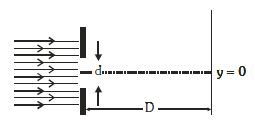
In an experiment,electrons are made to pass through a narrow slit of width $'d'$ comparable to their de-Broglie wavelength. They are detected on a screen at a distance $'D'$ from the slit (see figure). Which of the following graphs can be expected to represent the number of electrons $'N'$ detected as a function of the detector position $'y'$ ($y = 0$ corresponds to the middle of the slit)?
A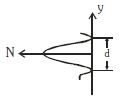
B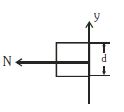
C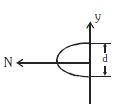
D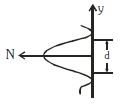
Solution
(A) When electrons pass through a narrow slit of width $'d'$,they undergo diffraction due to their wave nature. The intensity distribution of the diffraction pattern on the screen is given by the single-slit diffraction formula,where the intensity $I$ is proportional to $N$. The central maximum occurs at $y = 0$. The first minima occur at positions given by $y = \pm \frac{\lambda D}{d}$. Since the slit width $'d'$ is comparable to the de-Broglie wavelength $\lambda$,the diffraction pattern is spread out. The graph representing this intensity distribution shows a central peak at $y = 0$ with secondary maxima on either side,which corresponds to the pattern shown in Graph $A$.
0 likes
View Solution127
MediumMCQ
Determine the angular separation between the central maximum and the first-order maxima of the diffraction pattern due to a single slit of width $0.25\, mm$ when light of wavelength $5890\,\mathring{A}$ is incident on it.
A
$3.534\times10^{-3}\, rad$
B
$2.35\times10^{-3}\, rad$
C
$1.47\times10^{-4}\, rad$
D
$15.8\times10^{-3}\, rad$
Solution
(A) For a single slit diffraction pattern,the condition for the $n^{th}$ order secondary maxima is given by $a \sin \theta = (n + \frac{1}{2}) \lambda$,where $n = 1, 2, 3, \dots$.
For the first-order secondary maximum,we set $n = 1$.
Thus,$a \sin \theta = (1 + \frac{1}{2}) \lambda = \frac{3}{2} \lambda$.
Since $\theta$ is very small,$\sin \theta \approx \theta$.
Therefore,$\theta = \frac{3 \lambda}{2 a}$.
Given: $\lambda = 5890 \times 10^{-10}\, m$ and $a = 0.25 \times 10^{-3}\, m$.
Substituting the values: $\theta = \frac{3 \times 5890 \times 10^{-10}}{2 \times 0.25 \times 10^{-3}}$.
$\theta = \frac{17670 \times 10^{-10}}{0.5 \times 10^{-3}} = 35340 \times 10^{-7} = 3.534 \times 10^{-3}\, rad$.
For the first-order secondary maximum,we set $n = 1$.
Thus,$a \sin \theta = (1 + \frac{1}{2}) \lambda = \frac{3}{2} \lambda$.
Since $\theta$ is very small,$\sin \theta \approx \theta$.
Therefore,$\theta = \frac{3 \lambda}{2 a}$.
Given: $\lambda = 5890 \times 10^{-10}\, m$ and $a = 0.25 \times 10^{-3}\, m$.
Substituting the values: $\theta = \frac{3 \times 5890 \times 10^{-10}}{2 \times 0.25 \times 10^{-3}}$.
$\theta = \frac{17670 \times 10^{-10}}{0.5 \times 10^{-3}} = 35340 \times 10^{-7} = 3.534 \times 10^{-3}\, rad$.
0 likes
View Solution128
MediumMCQ
The distance between the first and the sixth minima in the diffraction pattern of a single slit is $0.5 \, mm$. The screen is $0.5 \, m$ away from the slit. If the wavelength of light used is $5000 \, \mathring{A}$,then the slit width will be ....... $mm$.
A
$5$
B
$2.5$
C
$1.25$
D
$1$
Solution
(B) For a single slit diffraction pattern,the position of the $n^{th}$ minimum is given by $y_n = \frac{n \lambda D}{a}$,where $n$ is the order of the minimum,$\lambda$ is the wavelength,$D$ is the distance to the screen,and $a$ is the slit width.
The distance between the $1^{st}$ and $6^{th}$ minima is $\Delta y = y_6 - y_1 = \frac{6 \lambda D}{a} - \frac{1 \lambda D}{a} = \frac{5 \lambda D}{a}$.
Given: $\Delta y = 0.5 \, mm = 0.5 \times 10^{-3} \, m$,$D = 0.5 \, m$,and $\lambda = 5000 \, \mathring{A} = 5000 \times 10^{-10} \, m = 5 \times 10^{-7} \, m$.
Substituting the values into the formula:
$0.5 \times 10^{-3} = \frac{5 \times (5 \times 10^{-7}) \times 0.5}{a}$
Solving for $a$:
$a = \frac{5 \times 5 \times 10^{-7} \times 0.5}{0.5 \times 10^{-3}}$
$a = 25 \times 10^{-4} \, m = 2.5 \times 10^{-3} \, m = 2.5 \, mm$.
The distance between the $1^{st}$ and $6^{th}$ minima is $\Delta y = y_6 - y_1 = \frac{6 \lambda D}{a} - \frac{1 \lambda D}{a} = \frac{5 \lambda D}{a}$.
Given: $\Delta y = 0.5 \, mm = 0.5 \times 10^{-3} \, m$,$D = 0.5 \, m$,and $\lambda = 5000 \, \mathring{A} = 5000 \times 10^{-10} \, m = 5 \times 10^{-7} \, m$.
Substituting the values into the formula:
$0.5 \times 10^{-3} = \frac{5 \times (5 \times 10^{-7}) \times 0.5}{a}$
Solving for $a$:
$a = \frac{5 \times 5 \times 10^{-7} \times 0.5}{0.5 \times 10^{-3}}$
$a = 25 \times 10^{-4} \, m = 2.5 \times 10^{-3} \, m = 2.5 \, mm$.
0 likes
View Solution129
MediumMCQ
$A$ diffraction pattern is obtained using a beam of red light. If the red light is replaced by blue light,then:
A
the diffraction pattern remains unchanged
B
diffraction bands become narrower and crowded together
C
bands become broader and farther apart
D
bands disappear
Solution
(B) The width of the central maximum in a single-slit diffraction pattern is given by $w = \frac{2D \lambda}{a}$,where $D$ is the distance to the screen,$\lambda$ is the wavelength,and $a$ is the slit width.
Since the wavelength of blue light $(\lambda_{blue})$ is smaller than the wavelength of red light $(\lambda_{red})$,the fringe width $w$ is directly proportional to the wavelength $\lambda$.
Therefore,when red light is replaced by blue light,the wavelength decreases,causing the diffraction bands to become narrower and more crowded together.
Since the wavelength of blue light $(\lambda_{blue})$ is smaller than the wavelength of red light $(\lambda_{red})$,the fringe width $w$ is directly proportional to the wavelength $\lambda$.
Therefore,when red light is replaced by blue light,the wavelength decreases,causing the diffraction bands to become narrower and more crowded together.
0 likes
View Solution130
MediumMCQ
How will the diffraction pattern change when yellow light is replaced by blue light? The fringes will be
A
Wider
B
Narrower
C
Brighter
D
Fainter
Solution
(B) The angular width of the central maximum in a single-slit diffraction pattern is given by $\theta = \frac{2\lambda}{a}$,where $\lambda$ is the wavelength of light and $a$ is the slit width.
From this relation,we see that $\theta \propto \lambda$.
Since the wavelength of blue light $(\lambda_B)$ is less than the wavelength of yellow light $(\lambda_Y)$,i.e.,$\lambda_B < \lambda_Y$,the angular width of the diffraction pattern will decrease.
Therefore,the fringes will become narrower.
From this relation,we see that $\theta \propto \lambda$.
Since the wavelength of blue light $(\lambda_B)$ is less than the wavelength of yellow light $(\lambda_Y)$,i.e.,$\lambda_B < \lambda_Y$,the angular width of the diffraction pattern will decrease.
Therefore,the fringes will become narrower.
0 likes
View Solution131
EasyMCQ
In a single slit diffraction experiment,the width of the slit is made double its original width. Then the central maximum of the diffraction pattern will become
A
narrower and fainter
B
narrower and brighter
C
broader and fainter
D
broader and brighter
Solution
(B) The angular width of the central maximum in a single slit diffraction is given by $\theta = \frac{2\lambda}{d}$,where $\lambda$ is the wavelength and $d$ is the slit width.
Since $\theta \propto \frac{1}{d}$,if the slit width $d$ is doubled,the angular width $\theta$ becomes half,meaning the central maximum becomes narrower.
As the width of the central maximum decreases,the energy is concentrated in a smaller area,which increases the intensity of the central maximum,making it brighter.
Since $\theta \propto \frac{1}{d}$,if the slit width $d$ is doubled,the angular width $\theta$ becomes half,meaning the central maximum becomes narrower.
As the width of the central maximum decreases,the energy is concentrated in a smaller area,which increases the intensity of the central maximum,making it brighter.
0 likes
View Solution132
EasyMCQ
The condition for obtaining secondary maxima in the diffraction pattern due to a single slit is:
A
$a \sin \theta = n\lambda$
B
$a \sin \theta = (2n + 1)\frac{\lambda}{2}$
C
$a \sin \theta = (2n - 1)\lambda$
D
$a \sin \theta = \frac{n\lambda}{2}$
Solution
(B) In the diffraction pattern produced by a single slit of width $a$,the condition for minima is given by $a \sin \theta = n\lambda$ (where $n = \pm 1, \pm 2, \dots$).
Secondary maxima occur approximately midway between the minima.
The condition for secondary maxima is given by $a \sin \theta = (2n + 1)\frac{\lambda}{2}$,where $n = 1, 2, 3, \dots$ represents the order of the secondary maxima.
Secondary maxima occur approximately midway between the minima.
The condition for secondary maxima is given by $a \sin \theta = (2n + 1)\frac{\lambda}{2}$,where $n = 1, 2, 3, \dots$ represents the order of the secondary maxima.
0 likes
View Solution133
MediumMCQ
The Fraunhofer diffraction pattern of a single slit is formed in the focal plane of a lens of focal length $1\,m$. The width of the slit is $0.3\,mm$. If the third minimum is formed at a distance of $5\,mm$ from the central maximum, then the wavelength of light will be......$\mathring{A}$
A
$5000$
B
$2500$
C
$7500$
D
$8500$
Solution
(A) For a single slit diffraction, the condition for the $n^{th}$ minimum is given by $a \sin \theta = n \lambda$.
Given that the angle $\theta$ is very small, we can approximate $\sin \theta \approx \tan \theta = \frac{x}{f}$, where $x$ is the distance from the central maximum and $f$ is the focal length.
Substituting this into the condition for the $n^{th}$ minimum: $a \left( \frac{x}{f} \right) = n \lambda$.
For the third minimum, $n = 3$. Given $a = 0.3 \times 10^{-3} \, m$, $x = 5 \times 10^{-3} \, m$, and $f = 1 \, m$.
Rearranging for $\lambda$: $\lambda = \frac{a x}{3 f}$.
$\lambda = \frac{0.3 \times 10^{-3} \times 5 \times 10^{-3}}{3 \times 1} = \frac{1.5 \times 10^{-6}}{3} = 0.5 \times 10^{-6} \, m$.
Converting to $\mathring{A}$: $\lambda = 0.5 \times 10^{-6} \times 10^{10} \, \mathring{A} = 5000 \, \mathring{A}$.
Given that the angle $\theta$ is very small, we can approximate $\sin \theta \approx \tan \theta = \frac{x}{f}$, where $x$ is the distance from the central maximum and $f$ is the focal length.
Substituting this into the condition for the $n^{th}$ minimum: $a \left( \frac{x}{f} \right) = n \lambda$.
For the third minimum, $n = 3$. Given $a = 0.3 \times 10^{-3} \, m$, $x = 5 \times 10^{-3} \, m$, and $f = 1 \, m$.
Rearranging for $\lambda$: $\lambda = \frac{a x}{3 f}$.
$\lambda = \frac{0.3 \times 10^{-3} \times 5 \times 10^{-3}}{3 \times 1} = \frac{1.5 \times 10^{-6}}{3} = 0.5 \times 10^{-6} \, m$.
Converting to $\mathring{A}$: $\lambda = 0.5 \times 10^{-6} \times 10^{10} \, \mathring{A} = 5000 \, \mathring{A}$.
0 likes
View Solution134
EasyMCQ
$A$ diffraction pattern is obtained by using a beam of red light. What will happen if the red light is replaced by blue light?
A
Bands disappear
B
Bands become broader and farther apart
C
No change will take place
D
Diffraction bands become narrow and crowded together
Solution
(D) The width of the diffraction bands in a single-slit diffraction pattern is given by the formula $\beta = \frac{2\lambda D}{a}$,where $\lambda$ is the wavelength of the light,$D$ is the distance of the screen from the slit,and $a$ is the width of the slit.
Since the wavelength of blue light $(\lambda_{blue})$ is smaller than the wavelength of red light $(\lambda_{red})$,the width of the diffraction bands $\beta$ will decrease.
Therefore,when red light is replaced by blue light,the diffraction bands become narrower and more crowded together.
Since the wavelength of blue light $(\lambda_{blue})$ is smaller than the wavelength of red light $(\lambda_{red})$,the width of the diffraction bands $\beta$ will decrease.
Therefore,when red light is replaced by blue light,the diffraction bands become narrower and more crowded together.
0 likes
View Solution135
EasyMCQ
Assertion: $A$ coloured spectrum is seen when we look through a muslin cloth.
Reason: It is due to the diffraction of white light on passing through fine slits.
Reason: It is due to the diffraction of white light on passing through fine slits.
A
Both Assertion and Reason are correct and the Reason is a correct explanation of the Assertion.
B
Both Assertion and Reason are correct but Reason is not a correct explanation of the Assertion.
C
The Assertion is correct but Reason is incorrect.
D
Both the Assertion and Reason are incorrect.
Solution
(A) muslin cloth consists of a fine mesh of threads,creating a large number of tiny,closely spaced slits.
When white light passes through these fine slits,it undergoes diffraction.
Since the diffraction pattern depends on the wavelength of light,different colours are diffracted at different angles.
This separation of white light into its constituent colours results in the observation of a coloured spectrum.
Therefore,both the Assertion and the Reason are correct,and the Reason is the correct explanation of the Assertion.
When white light passes through these fine slits,it undergoes diffraction.
Since the diffraction pattern depends on the wavelength of light,different colours are diffracted at different angles.
This separation of white light into its constituent colours results in the observation of a coloured spectrum.
Therefore,both the Assertion and the Reason are correct,and the Reason is the correct explanation of the Assertion.
0 likes
View Solution136
MediumMCQ
Assertion : When a tiny circular obstacle is placed in the path of light from some distance,a bright spot is seen at the centre of the shadow of the obstacle.
Reason : Destructive interference occurs at the centre of the shadow.
Reason : Destructive interference occurs at the centre of the shadow.
A
If both Assertion and Reason are correct and the Reason is a correct explanation of the Assertion.
B
If both Assertion and Reason are correct but Reason is not a correct explanation of the Assertion.
C
If the Assertion is correct but Reason is incorrect.
D
If both the Assertion and Reason are incorrect.
Solution
(C) When light from a distant source encounters a small circular obstacle,the light waves diffract around the edges of the obstacle.
According to the Huygens-Fresnel principle,every point on the edge of the obstacle acts as a source of secondary wavelets.
These secondary wavelets travel to the centre of the geometric shadow and arrive in phase with each other.
Because they arrive in phase,they undergo constructive interference,resulting in a bright spot at the centre of the shadow,which is known as the Poisson spot or Arago spot.
Therefore,the Assertion is correct,but the Reason is incorrect because constructive interference,not destructive interference,occurs at the centre.
According to the Huygens-Fresnel principle,every point on the edge of the obstacle acts as a source of secondary wavelets.
These secondary wavelets travel to the centre of the geometric shadow and arrive in phase with each other.
Because they arrive in phase,they undergo constructive interference,resulting in a bright spot at the centre of the shadow,which is known as the Poisson spot or Arago spot.
Therefore,the Assertion is correct,but the Reason is incorrect because constructive interference,not destructive interference,occurs at the centre.
0 likes
View Solution137
EasyMCQ
Assertion: The clouds in the sky generally appear to be whitish.
Reason: Diffraction due to clouds is efficient in equal measure at all wavelengths.
Reason: Diffraction due to clouds is efficient in equal measure at all wavelengths.
A
If both Assertion and Reason is a correct explanation of the Assertion.
B
If both Assertion and Reason are correct but Reason is not a correct explanation of the Assertion.
C
If the Assertion is correct but Reason is incorrect.
D
If both the Assertion and Reason are incorrect.
Solution
(C) The Assertion is correct because clouds appear white due to the scattering of light by water droplets.
The size of water droplets in clouds is much larger than the wavelength of visible light.
According to the theory of scattering, when the size of the scattering particle $(a)$ is much larger than the wavelength of light $(\lambda)$, i.e., $a \gg \lambda$, the scattering is independent of the wavelength.
Since all wavelengths of visible light are scattered equally, the combined effect is perceived as white light.
Diffraction is a phenomenon that occurs when light encounters an obstacle or aperture of a size comparable to its wavelength. Since cloud particles are much larger than the wavelength of light, they do not cause significant diffraction of visible light.
Therefore, the Reason is incorrect.
The size of water droplets in clouds is much larger than the wavelength of visible light.
According to the theory of scattering, when the size of the scattering particle $(a)$ is much larger than the wavelength of light $(\lambda)$, i.e., $a \gg \lambda$, the scattering is independent of the wavelength.
Since all wavelengths of visible light are scattered equally, the combined effect is perceived as white light.
Diffraction is a phenomenon that occurs when light encounters an obstacle or aperture of a size comparable to its wavelength. Since cloud particles are much larger than the wavelength of light, they do not cause significant diffraction of visible light.
Therefore, the Reason is incorrect.
0 likes
View Solution138
EasyMCQ
Assertion : Standard optical diffraction gratings cannot be used for discriminating between $X-$ray wavelengths.
Reason : The grating spacing is not of the order of $X-$ray wavelengths.
Reason : The grating spacing is not of the order of $X-$ray wavelengths.
A
If both Assertion and Reason are correct and the Reason is a correct explanation of the Assertion.
B
If both Assertion and Reason are correct but Reason is not a correct explanation of the Assertion.
C
If the Assertion is correct but Reason is incorrect.
D
If both the Assertion and Reason are incorrect.
Solution
(A) For diffraction to occur,the size of the obstacles or the spacing between the slits in a diffraction grating must be of the order of the wavelength of the incident radiation.
The wavelength of $X-$rays is typically in the range of $0.01 \ nm$ to $10 \ nm$.
Standard optical diffraction gratings have a grating spacing (distance between adjacent lines) of the order of $10^3 \ nm$ to $10^4 \ nm$.
Since the grating spacing is much larger than the wavelength of $X-$rays,the diffraction effect is negligible,and these gratings cannot be used to discriminate between $X-$ray wavelengths.
Therefore,both the Assertion and the Reason are correct,and the Reason is the correct explanation of the Assertion.
The wavelength of $X-$rays is typically in the range of $0.01 \ nm$ to $10 \ nm$.
Standard optical diffraction gratings have a grating spacing (distance between adjacent lines) of the order of $10^3 \ nm$ to $10^4 \ nm$.
Since the grating spacing is much larger than the wavelength of $X-$rays,the diffraction effect is negligible,and these gratings cannot be used to discriminate between $X-$ray wavelengths.
Therefore,both the Assertion and the Reason are correct,and the Reason is the correct explanation of the Assertion.
0 likes
View Solution139
MediumMCQ
Assertion : Diffraction takes place for all types of waves,mechanical or non-mechanical,transverse or longitudinal.
Reason : Diffraction effects are perceptible only if the wavelength of the wave is comparable to the dimensions of the diffracting device.
Reason : Diffraction effects are perceptible only if the wavelength of the wave is comparable to the dimensions of the diffracting device.
A
If both Assertion and Reason are correct and the Reason is a correct explanation of the Assertion.
B
If both Assertion and Reason are correct but Reason is not a correct explanation of the Assertion.
C
If the Assertion is correct but Reason is incorrect.
D
If both the Assertion and Reason are incorrect.
Solution
(A) Diffraction is a general characteristic of all types of waves,including mechanical (like sound) and non-mechanical (like light),as well as transverse and longitudinal waves. Thus,the Assertion is correct.
For diffraction to be significant or perceptible,the size of the obstacle or aperture must be of the order of the wavelength of the wave. If the wavelength is much smaller than the obstacle,the wave behaves like a ray and diffraction is negligible. Thus,the Reason is also correct and explains why diffraction is observed in specific conditions. Therefore,the correct option is $A$.
For diffraction to be significant or perceptible,the size of the obstacle or aperture must be of the order of the wavelength of the wave. If the wavelength is much smaller than the obstacle,the wave behaves like a ray and diffraction is negligible. Thus,the Reason is also correct and explains why diffraction is observed in specific conditions. Therefore,the correct option is $A$.
0 likes
View Solution140
MediumMCQ
Visible light of wavelength $6000 \times 10^{-8} \; cm$ falls normally on a single slit and produces a diffraction pattern. It is found that the second diffraction minimum is at $60^{\circ}$ from the central maximum. If the first minimum is produced at $\theta_{1}$,then $\theta_{1}$ is close to.....$^{\circ}$
A
$20$
B
$45$
C
$30$
D
$25$
Solution
(D) For a single slit diffraction,the condition for the $n^{th}$ minimum is given by $a \sin \theta = n \lambda$,where $a$ is the slit width,$\lambda$ is the wavelength,and $n = 1, 2, 3, ...$.
For the second minimum $(n = 2)$,the angle is $\theta_2 = 60^{\circ}$.
Thus,$a \sin 60^{\circ} = 2 \lambda$.
$a \left( \frac{\sqrt{3}}{2} \right) = 2 \lambda \implies \frac{\lambda}{a} = \frac{\sqrt{3}}{4}$.
For the first minimum $(n = 1)$,the condition is $a \sin \theta_1 = 1 \lambda$.
$\sin \theta_1 = \frac{\lambda}{a} = \frac{\sqrt{3}}{4}$.
$\sin \theta_1 \approx \frac{1.732}{4} = 0.433$.
$\theta_1 = \arcsin(0.433) \approx 25.6^{\circ}$.
Rounding to the nearest integer,$\theta_1 \approx 25^{\circ}$.
For the second minimum $(n = 2)$,the angle is $\theta_2 = 60^{\circ}$.
Thus,$a \sin 60^{\circ} = 2 \lambda$.
$a \left( \frac{\sqrt{3}}{2} \right) = 2 \lambda \implies \frac{\lambda}{a} = \frac{\sqrt{3}}{4}$.
For the first minimum $(n = 1)$,the condition is $a \sin \theta_1 = 1 \lambda$.
$\sin \theta_1 = \frac{\lambda}{a} = \frac{\sqrt{3}}{4}$.
$\sin \theta_1 \approx \frac{1.732}{4} = 0.433$.
$\theta_1 = \arcsin(0.433) \approx 25.6^{\circ}$.
Rounding to the nearest integer,$\theta_1 \approx 25^{\circ}$.
0 likes
View Solution141
EasyMCQ
Two slits are made $1 \; mm$ apart and the screen is placed $1 \; m$ away. What should the width of each slit be to obtain $10$ maxima of the double-slit pattern within the central maximum of the single-slit pattern (in $; mm$)? Blue-green light of wavelength $500 \; nm$ is used.
A
$0.1$
B
$0.2$
C
$0.5$
D
$0.05$
Solution
(B) The angular width of the central maximum of a single slit diffraction pattern is given by $2\theta = \frac{2\lambda}{a}$,where $a$ is the slit width.
The angular separation between adjacent maxima in a double-slit interference pattern is $\Delta\theta = \frac{\lambda}{d}$,where $d$ is the distance between the slits.
We are given that $10$ maxima of the double-slit pattern lie within the central maximum of the single-slit pattern. This means the angular width of the central maximum $(2\lambda/a)$ must contain $10$ interference fringes. Since the central maximum spans from $-\lambda/a$ to $+\lambda/a$,the total number of fringes $N$ is given by the condition that the width of $10$ fringes equals the width of the central maximum: $10 \times (\frac{\lambda}{d}) = \frac{2\lambda}{a}$.
Simplifying the equation: $\frac{10}{d} = \frac{2}{a}$.
Given $d = 1 \; mm = 10^{-3} \; m$,we solve for $a$:
$a = \frac{2d}{10} = \frac{d}{5} = \frac{1 \; mm}{5} = 0.2 \; mm$.
The angular separation between adjacent maxima in a double-slit interference pattern is $\Delta\theta = \frac{\lambda}{d}$,where $d$ is the distance between the slits.
We are given that $10$ maxima of the double-slit pattern lie within the central maximum of the single-slit pattern. This means the angular width of the central maximum $(2\lambda/a)$ must contain $10$ interference fringes. Since the central maximum spans from $-\lambda/a$ to $+\lambda/a$,the total number of fringes $N$ is given by the condition that the width of $10$ fringes equals the width of the central maximum: $10 \times (\frac{\lambda}{d}) = \frac{2\lambda}{a}$.
Simplifying the equation: $\frac{10}{d} = \frac{2}{a}$.
Given $d = 1 \; mm = 10^{-3} \; m$,we solve for $a$:
$a = \frac{2d}{10} = \frac{d}{5} = \frac{1 \; mm}{5} = 0.2 \; mm$.
0 likes
View Solution142
Medium
Answer the following questions:
$(a)$ In a single slit diffraction experiment, the width of the slit is made double the original width. How does this affect the size and intensity of the central diffraction band?
$(b)$ In what way is diffraction from each slit related to the interference pattern in a double-slit experiment?
$(c)$ When a tiny circular obstacle is placed in the path of light from a distant source, a bright spot is seen at the centre of the shadow of the obstacle. Explain why?
$(d)$ Two students are separated by a $7 \; m$ partition wall in a room $10 \; m$ high. If both light and sound waves can bend around obstacles, how is it that the students are unable to see each other even though they can converse easily?
$(e)$ Ray optics is based on the assumption that light travels in a straight line. Diffraction effects (observed when light propagates through small apertures/slits or around small obstacles) disprove this assumption. Yet the ray optics assumption is so commonly used in understanding location and several other properties of images in optical instruments. What is the justification?
$(a)$ In a single slit diffraction experiment, the width of the slit is made double the original width. How does this affect the size and intensity of the central diffraction band?
$(b)$ In what way is diffraction from each slit related to the interference pattern in a double-slit experiment?
$(c)$ When a tiny circular obstacle is placed in the path of light from a distant source, a bright spot is seen at the centre of the shadow of the obstacle. Explain why?
$(d)$ Two students are separated by a $7 \; m$ partition wall in a room $10 \; m$ high. If both light and sound waves can bend around obstacles, how is it that the students are unable to see each other even though they can converse easily?
$(e)$ Ray optics is based on the assumption that light travels in a straight line. Diffraction effects (observed when light propagates through small apertures/slits or around small obstacles) disprove this assumption. Yet the ray optics assumption is so commonly used in understanding location and several other properties of images in optical instruments. What is the justification?
Solution
(N/A) In a single slit diffraction experiment, if the width of the slit $(a)$ is doubled, the angular width of the central maximum $(2\lambda/a)$ reduces to half. The intensity of the central maximum is proportional to the square of the slit width $(I \propto a^2)$, so it increases by a factor of $4$.
$(b)$ The interference pattern in a double-slit experiment is the result of the superposition of two waves, but it is modulated by the diffraction pattern produced by each individual slit. The intensity distribution is the product of the interference pattern and the diffraction envelope.
$(c)$ This phenomenon is known as Poisson's spot. Light waves diffract around the edges of the circular obstacle and reach the center of the shadow in phase, resulting in constructive interference that creates a bright spot.
$(d)$ Diffraction is significant only when the wavelength $(\lambda)$ is comparable to the size of the obstacle $(d)$. For light, $\lambda$ is very small $(\sim 500 \; nm)$, so it does not diffract significantly around a wall. For sound, $\lambda$ is in the range of $0.1 \; m$ to $1 \; m$, which is comparable to the size of the wall, allowing it to bend around the obstacle.
$(e)$ The ray optics approximation is valid when the size of the apertures or obstacles is much larger than the wavelength of light. In most optical instruments, the apertures are large enough that diffraction effects are negligible, making the straight-line propagation assumption valid.
$(b)$ The interference pattern in a double-slit experiment is the result of the superposition of two waves, but it is modulated by the diffraction pattern produced by each individual slit. The intensity distribution is the product of the interference pattern and the diffraction envelope.
$(c)$ This phenomenon is known as Poisson's spot. Light waves diffract around the edges of the circular obstacle and reach the center of the shadow in phase, resulting in constructive interference that creates a bright spot.
$(d)$ Diffraction is significant only when the wavelength $(\lambda)$ is comparable to the size of the obstacle $(d)$. For light, $\lambda$ is very small $(\sim 500 \; nm)$, so it does not diffract significantly around a wall. For sound, $\lambda$ is in the range of $0.1 \; m$ to $1 \; m$, which is comparable to the size of the wall, allowing it to bend around the obstacle.
$(e)$ The ray optics approximation is valid when the size of the apertures or obstacles is much larger than the wavelength of light. In most optical instruments, the apertures are large enough that diffraction effects are negligible, making the straight-line propagation assumption valid.
0 likes
View Solution143
EasyMCQ
$A$ parallel beam of light of wavelength $500\; nm$ falls on a narrow slit and the resulting diffraction pattern is observed on a screen $1\;m$ away. It is observed that the first minimum is at a distance of $2.5\;mm$ from the centre of the screen. Find the width of the slit. (in $; mm$)
A
$0.1$
B
$0.2$
C
$0.3$
D
$0.4$
Solution
(B) Given:
Wavelength of light beam,$\lambda = 500\; nm = 500 \times 10^{-9}\; m$
Distance of the screen from the slit,$D = 1\; m$
Distance of the first minimum from the centre of the screen,$x = 2.5\; mm = 2.5 \times 10^{-3}\; m$
For the first minimum in single slit diffraction,the condition is given by $a \sin \theta = n \lambda$,where $a$ is the slit width and $n = 1$.
For small angles,$\sin \theta \approx \tan \theta = \frac{x}{D}$.
Thus,$a \left( \frac{x}{D} \right) = n \lambda$.
Rearranging for slit width $a$:
$a = \frac{n \lambda D}{x} = \frac{1 \times 500 \times 10^{-9} \times 1}{2.5 \times 10^{-3}}$
$a = \frac{500 \times 10^{-9}}{2.5 \times 10^{-3}} = 200 \times 10^{-6}\; m = 0.2 \times 10^{-3}\; m = 0.2\; mm$.
Therefore,the width of the slit is $0.2\; mm$.
Wavelength of light beam,$\lambda = 500\; nm = 500 \times 10^{-9}\; m$
Distance of the screen from the slit,$D = 1\; m$
Distance of the first minimum from the centre of the screen,$x = 2.5\; mm = 2.5 \times 10^{-3}\; m$
For the first minimum in single slit diffraction,the condition is given by $a \sin \theta = n \lambda$,where $a$ is the slit width and $n = 1$.
For small angles,$\sin \theta \approx \tan \theta = \frac{x}{D}$.
Thus,$a \left( \frac{x}{D} \right) = n \lambda$.
Rearranging for slit width $a$:
$a = \frac{n \lambda D}{x} = \frac{1 \times 500 \times 10^{-9} \times 1}{2.5 \times 10^{-3}}$
$a = \frac{500 \times 10^{-9}}{2.5 \times 10^{-3}} = 200 \times 10^{-6}\; m = 0.2 \times 10^{-3}\; m = 0.2\; mm$.
Therefore,the width of the slit is $0.2\; mm$.
0 likes
View Solution144
Easy
In deriving the single slit diffraction pattern,it is stated that the intensity is zero at angles of $\theta = n\lambda / a$,where $a$ is the slit width. Justify this by suitably dividing the slit to bring out the cancellation.
Solution
(N/A) Consider a single slit of width $a$. To find the condition for minima,we divide the slit into $2n$ equal parts.
The path difference between the secondary wavelets from the corresponding points of the upper and lower halves of the slit is $\Delta x = (a/2) \sin \theta$.
For the first minimum,we set the path difference between the top edge and the center of the slit to be $\lambda / 2$. Thus,$(a/2) \sin \theta = \lambda / 2$,which gives $a \sin \theta = \lambda$.
In general,for the $n^{th}$ minimum,we divide the slit into $2n$ equal parts. The path difference between the wavelets from the corresponding points of the two adjacent parts is $\lambda / 2$.
Since every point in the upper half of the slit has a corresponding point in the lower half such that their path difference is $\lambda / 2$,the waves from these pairs interfere destructively.
Consequently,the resultant intensity at these angles $\theta = n\lambda / a$ becomes zero.
The path difference between the secondary wavelets from the corresponding points of the upper and lower halves of the slit is $\Delta x = (a/2) \sin \theta$.
For the first minimum,we set the path difference between the top edge and the center of the slit to be $\lambda / 2$. Thus,$(a/2) \sin \theta = \lambda / 2$,which gives $a \sin \theta = \lambda$.
In general,for the $n^{th}$ minimum,we divide the slit into $2n$ equal parts. The path difference between the wavelets from the corresponding points of the two adjacent parts is $\lambda / 2$.
Since every point in the upper half of the slit has a corresponding point in the lower half such that their path difference is $\lambda / 2$,the waves from these pairs interfere destructively.
Consequently,the resultant intensity at these angles $\theta = n\lambda / a$ becomes zero.
0 likes
View Solution145
Medium
What is diffraction? Who discovered it? What kind of waves exhibit the diffraction phenomenon?
Solution
(N/A) The bending of waves around the corners of an obstacle or through an aperture is called diffraction.
Accurate definition: Diffraction is the physical effect produced by the limited part of a wavefront.
Diffraction was first discovered by the scientist Francesco Maria Grimaldi.
Diffraction occurs in all types of waves,including sound waves,light waves,water waves,and matter waves.
Diffraction depends on the ratio of the wavelength of the wave $\lambda$ to the width of the slit $d$,denoted as $\frac{\lambda}{d}$.
Due to diffraction,light spreads into the geometric shadow region of an opaque object,creating dark and bright fringes.
Optical instruments like telescopes and microscopes have a limit on their resolving power due to diffraction.
The iridescent colours appearing on a $CD$ are due to diffraction effects.
Diffraction is explained by wave theory and is categorized into two types based on the wavefront incident on the slit:
$(i)$ If spherical wavefronts are incident on the slit,it is called Fresnel diffraction.
$(ii)$ If plane wavefronts are incident on the slit,it is called Fraunhofer diffraction.
Accurate definition: Diffraction is the physical effect produced by the limited part of a wavefront.
Diffraction was first discovered by the scientist Francesco Maria Grimaldi.
Diffraction occurs in all types of waves,including sound waves,light waves,water waves,and matter waves.
Diffraction depends on the ratio of the wavelength of the wave $\lambda$ to the width of the slit $d$,denoted as $\frac{\lambda}{d}$.
Due to diffraction,light spreads into the geometric shadow region of an opaque object,creating dark and bright fringes.
Optical instruments like telescopes and microscopes have a limit on their resolving power due to diffraction.
The iridescent colours appearing on a $CD$ are due to diffraction effects.
Diffraction is explained by wave theory and is categorized into two types based on the wavefront incident on the slit:
$(i)$ If spherical wavefronts are incident on the slit,it is called Fresnel diffraction.
$(ii)$ If plane wavefronts are incident on the slit,it is called Fraunhofer diffraction.
0 likes
View Solution146
Medium
"The person standing behind the open door inside the room can hear the voice of the person standing on the other side of the door but they cannot see each other". Give an experiment based on the diffraction for this statement.
Solution
(N/A) The condition for significant diffraction is that the wavelength of the wave $(\lambda)$ must be comparable to the size of the obstacle or aperture $(d)$.
For light, the average wavelength is $\lambda \approx 6 \times 10^{-7} \, m$. The width of a door is $d \approx 1 \, m$. The ratio $\frac{\lambda}{d} \approx 6 \times 10^{-7}$, which is extremely small. Therefore, light waves do not bend significantly around the corners of the door, making the diffraction of light negligible, and the people cannot see each other.
For sound, the frequency of human speech is typically between $100 \, Hz$ and $400 \, Hz$. Taking a frequency of $330 \, Hz$ and the speed of sound $v = 330 \, m/s$, the wavelength is $\lambda = \frac{v}{f} = \frac{330}{330} = 1 \, m$. Since the wavelength $\lambda = 1 \, m$ is comparable to the door width $d = 1 \, m$, the ratio $\frac{\lambda}{d} = 1$. This leads to significant diffraction of sound waves, allowing the sound to bend around the corners of the door and reach the person inside.
For light, the average wavelength is $\lambda \approx 6 \times 10^{-7} \, m$. The width of a door is $d \approx 1 \, m$. The ratio $\frac{\lambda}{d} \approx 6 \times 10^{-7}$, which is extremely small. Therefore, light waves do not bend significantly around the corners of the door, making the diffraction of light negligible, and the people cannot see each other.
For sound, the frequency of human speech is typically between $100 \, Hz$ and $400 \, Hz$. Taking a frequency of $330 \, Hz$ and the speed of sound $v = 330 \, m/s$, the wavelength is $\lambda = \frac{v}{f} = \frac{330}{330} = 1 \, m$. Since the wavelength $\lambda = 1 \, m$ is comparable to the door width $d = 1 \, m$, the ratio $\frac{\lambda}{d} = 1$. This leads to significant diffraction of sound waves, allowing the sound to bend around the corners of the door and reach the person inside.
0 likes
View Solution147
Difficult
Explain diffraction by a single slit.
Solution
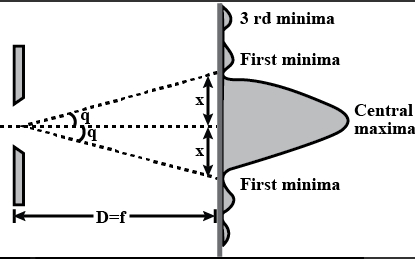
(N/A) As shown in the figure,by placing a monochromatic light source at the focus of a convex lens,the light rays emerging from it become parallel,forming a plane wavefront that is incident on the slit $LN$.
According to Huygens' principle,every point on the plane wavefront within the slit acts as an independent source of secondary spherical wavelets. As these wavelets emerge from the slit,they undergo interference with each other. This superposition results in constructive and destructive interference patterns.
Consequently,a diffraction pattern consisting of bright and dark fringes is obtained on a screen placed at the focal plane of a second convex lens,as illustrated in the figure.
According to Huygens' principle,every point on the plane wavefront within the slit acts as an independent source of secondary spherical wavelets. As these wavelets emerge from the slit,they undergo interference with each other. This superposition results in constructive and destructive interference patterns.
Consequently,a diffraction pattern consisting of bright and dark fringes is obtained on a screen placed at the focal plane of a second convex lens,as illustrated in the figure.
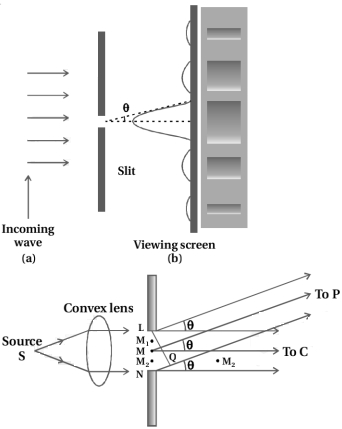
0 likes
View Solution148
Medium
Write the thoughts expressed by Richard Feynman regarding the difference between interference and diffraction.
Solution
(N/A) Richard Feynman noted that almost no one has ever been able to define the difference between interference and diffraction in a completely satisfactory way.
He suggested that it is primarily a matter of usage and terminology,rather than a fundamental physical distinction.
According to his perspective,when we deal with a small number of sources (e.g.,two interfering sources),the resulting phenomenon is typically referred to as interference. Conversely,when we deal with a large number of sources (such as the continuous distribution of wavelets across a slit),the term diffraction is more commonly used.
He suggested that it is primarily a matter of usage and terminology,rather than a fundamental physical distinction.
According to his perspective,when we deal with a small number of sources (e.g.,two interfering sources),the resulting phenomenon is typically referred to as interference. Conversely,when we deal with a large number of sources (such as the continuous distribution of wavelets across a slit),the term diffraction is more commonly used.
0 likes
View Solution149
MediumMCQ
What happens if we close one slit in a Young's double-slit experiment?
A
The interference pattern disappears.
B
$A$ diffraction pattern is formed on the screen.
C
The screen becomes completely dark.
D
The fringe width increases.
Solution
(B) In Young's double-slit experiment,if one of the two slits is closed,the experimental setup effectively becomes a single-slit diffraction experiment.
Since interference requires two coherent sources,the interference pattern will disappear.
Instead,the light passing through the remaining single slit will undergo diffraction,resulting in a diffraction pattern on the screen.
The central maximum of this diffraction pattern will be located on the screen at a point directly in front of the open slit.
Since interference requires two coherent sources,the interference pattern will disappear.
Instead,the light passing through the remaining single slit will undergo diffraction,resulting in a diffraction pattern on the screen.
The central maximum of this diffraction pattern will be located on the screen at a point directly in front of the open slit.
0 likes
View Solution150
Medium
Obtain the formulas for the angular width and linear width of the central maximum in a single-slit diffraction experiment.
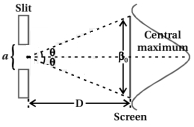
Solution
(N/A) The width of the central maximum is defined as the distance between the first minima on either side of the central maximum.
Let the width of the slit be $a$ and the distance between the slit and the screen be $D$.
For the first minimum on one side of the central maximum,the condition for diffraction is given by $a \sin \theta = \lambda$. Since $\theta$ is very small,$\sin \theta \approx \theta$,so $\theta = \frac{\lambda}{a}$.
Here,$\theta$ represents half the angular width of the central maximum.
Therefore,the total angular width of the central maximum is $2\theta = \frac{2\lambda}{a}$.
Now,for the linear width $\beta_0$,we use the relation between arc length,radius,and angle: $\text{arc} = \text{radius} \times \text{angle}$.
Here,the arc length is $\beta_0$,the radius is $D$,and the angle is $2\theta$.
Thus,$\beta_0 = D \times (2\theta) = D \times \frac{2\lambda}{a}$.
Therefore,the linear width of the central maximum is $\beta_0 = \frac{2D\lambda}{a}$.
Let the width of the slit be $a$ and the distance between the slit and the screen be $D$.
For the first minimum on one side of the central maximum,the condition for diffraction is given by $a \sin \theta = \lambda$. Since $\theta$ is very small,$\sin \theta \approx \theta$,so $\theta = \frac{\lambda}{a}$.
Here,$\theta$ represents half the angular width of the central maximum.
Therefore,the total angular width of the central maximum is $2\theta = \frac{2\lambda}{a}$.
Now,for the linear width $\beta_0$,we use the relation between arc length,radius,and angle: $\text{arc} = \text{radius} \times \text{angle}$.
Here,the arc length is $\beta_0$,the radius is $D$,and the angle is $2\theta$.
Thus,$\beta_0 = D \times (2\theta) = D \times \frac{2\lambda}{a}$.
Therefore,the linear width of the central maximum is $\beta_0 = \frac{2D\lambda}{a}$.
0 likes
View SolutionWave Optics — Single Slit Diffraction of Light · Frequently Asked Questions
1Are these Wave Optics questions useful for JEE and NEET?
Yes. All questions in this section are mapped to JEE Main and NEET exam patterns. Previous year questions from JEE Main, NEET, GUJCET and state-level exams are included with full solutions.
2Can I switch to Hindi or Gujarati for these questions?
Yes. Use the language tabs in the hero section or the sidebar to view the same questions and solutions in English, Hindi or Gujarati.
3How do I generate a question paper from this subtopic?
Use the Vedclass Exam Paper Generator — select the chapter and subtopic, set difficulty, and generate Sets A, B, C, D automatically. First 3 chapters of every subject are free.
Vedclass Products
For Students
Vedclass Test Series
Mock tests in real JEE/NEET style with performance analysis. 5-day free trial.
Start Free TrialFor Teachers
Exam Paper Generator
Generate Set A/B/C/D papers from this chapter in 2 minutes. 3 chapters free.
Try FreeFor Institutes
Online Exam Module
Live online exams with unlimited students, 360° analytics & white-label branding.
See DemoFor Teachers & Institutes
Generate a Wave Optics Exam Paper in 2 Minutes
Select subtopic & difficulty — Sets A, B, C, D auto-generated with No Repeat logic.
First 3 chapters of every subject are free — no payment required.