
A English
Properties of Alpha, Beta and Gamma Rays and Decay Process Questions in English
Class 12 Physics · Nuclei · Properties of Alpha, Beta and Gamma Rays and Decay Process
286+
Questions
English
Language
100%
With Solutions
Showing 50 of 286 questions in English
51
MediumMCQ
Consider the following two statements:
$A.$ The energy spectrum of $\alpha-$ particles emitted in radioactive decay is discrete.
$B.$ The energy spectrum of $\beta-$ particles emitted in radioactive decay is continuous.
$A.$ The energy spectrum of $\alpha-$ particles emitted in radioactive decay is discrete.
$B.$ The energy spectrum of $\beta-$ particles emitted in radioactive decay is continuous.
A
Only $A$ is correct.
B
Only $B$ is correct.
C
$A$ is correct but $B$ is wrong.
D
Both $A$ and $B$ are correct.
Solution
(D) In $\alpha-$ decay,the parent nucleus decays into a daughter nucleus and an $\alpha-$ particle. Due to the conservation of energy and momentum,the $\alpha-$ particle must carry a specific,fixed amount of energy,resulting in a discrete energy spectrum.
In $\beta-$ decay,the energy released is shared between the $\beta-$ particle (electron or positron) and an antineutrino (or neutrino). Since the energy can be shared in infinitely many ways between these two particles,the energy spectrum of the emitted $\beta-$ particles is continuous.
Therefore,statement $A$ is incorrect (as it claims the spectrum is discrete,but $\alpha-$ decay is discrete,wait,let's re-evaluate: $\alpha-$ decay is indeed discrete,so $A$ is correct. $\beta-$ decay is continuous,so $B$ is correct). Both statements are correct.
In $\beta-$ decay,the energy released is shared between the $\beta-$ particle (electron or positron) and an antineutrino (or neutrino). Since the energy can be shared in infinitely many ways between these two particles,the energy spectrum of the emitted $\beta-$ particles is continuous.
Therefore,statement $A$ is incorrect (as it claims the spectrum is discrete,but $\alpha-$ decay is discrete,wait,let's re-evaluate: $\alpha-$ decay is indeed discrete,so $A$ is correct. $\beta-$ decay is continuous,so $B$ is correct). Both statements are correct.
0 likes
View Solution52
EasyMCQ
$A$ radioactive substance emits
A
$\alpha$-rays
B
$\beta$-rays
C
$\gamma$-rays
D
All of these
Solution
(D) Radioactive decay is the process by which an unstable atomic nucleus loses energy by radiation.
During this process,a radioactive substance can emit $\alpha$-particles (helium nuclei),$\beta$-particles (electrons or positrons),and $\gamma$-rays (high-energy electromagnetic radiation).
Therefore,a radioactive substance can emit all of these types of radiation depending on the specific decay mode of the isotope.
Thus,the correct option is $D$.
During this process,a radioactive substance can emit $\alpha$-particles (helium nuclei),$\beta$-particles (electrons or positrons),and $\gamma$-rays (high-energy electromagnetic radiation).
Therefore,a radioactive substance can emit all of these types of radiation depending on the specific decay mode of the isotope.
Thus,the correct option is $D$.
0 likes
View Solution53
MediumMCQ
An atomic nucleus $_{90}^{232}Th$ emits several $\alpha$ and $\beta$ radiations and finally reduces to $_{82}^{208}Pb$. It must have emitted:
A
$4 \alpha$ and $2 \beta$
B
$8 \alpha$ and $24 \beta$
C
$6 \alpha$ and $4 \beta$
D
$4 \alpha$ and $16 \beta$
Solution
(C) Let the number of $\alpha$-particles emitted be $n_{\alpha}$ and the number of $\beta$-particles emitted be $n_{\beta}$.
The change in mass number is due only to $\alpha$-decay:
$n_{\alpha} = \frac{A - A'}{4} = \frac{232 - 208}{4} = \frac{24}{4} = 6$.
The change in atomic number is given by $Z' = Z - 2n_{\alpha} + n_{\beta}$.
Substituting the values: $82 = 90 - 2(6) + n_{\beta}$.
$82 = 90 - 12 + n_{\beta}$.
$82 = 78 + n_{\beta}$.
$n_{\beta} = 82 - 78 = 4$.
Therefore,the nucleus emitted $6 \alpha$ and $4 \beta$ particles.
The change in mass number is due only to $\alpha$-decay:
$n_{\alpha} = \frac{A - A'}{4} = \frac{232 - 208}{4} = \frac{24}{4} = 6$.
The change in atomic number is given by $Z' = Z - 2n_{\alpha} + n_{\beta}$.
Substituting the values: $82 = 90 - 2(6) + n_{\beta}$.
$82 = 90 - 12 + n_{\beta}$.
$82 = 78 + n_{\beta}$.
$n_{\beta} = 82 - 78 = 4$.
Therefore,the nucleus emitted $6 \alpha$ and $4 \beta$ particles.
0 likes
View Solution54
EasyMCQ
In $\beta^-$ decay,which of the following statements is true regarding the daughter nucleus compared to the parent nucleus?
A
The parent and daughter nuclei have the same number of protons.
B
The daughter nucleus has one proton less than the parent nucleus.
C
The daughter nucleus has one proton more than the parent nucleus.
D
The daughter nucleus has one neutron more than the parent nucleus.
Solution
(C) In $\beta^-$ decay,a neutron inside the nucleus transforms into a proton,an electron,and an antineutrino: $n \rightarrow p + e^- + \bar{\nu}_e$.
Since a neutron is converted into a proton,the atomic number $(Z)$ of the daughter nucleus increases by $1$ $(Z_{daughter} = Z_{parent} + 1)$.
Therefore,the daughter nucleus has one proton more than the parent nucleus.
The correct option is $C$.
Since a neutron is converted into a proton,the atomic number $(Z)$ of the daughter nucleus increases by $1$ $(Z_{daughter} = Z_{parent} + 1)$.
Therefore,the daughter nucleus has one proton more than the parent nucleus.
The correct option is $C$.
0 likes
View Solution55
EasyMCQ
$A$ nucleus $_Z^AX$ emits an $\alpha$-particle. The resultant nucleus then emits a ${\beta ^ + }$ particle. What will be the respective atomic number and mass number of the final nucleus?
A
$Z - 3, A - 4$
B
$Z - 1, A - 4$
C
$Z - 2, A - 4$
D
$Z, A - 2$
Solution
(A) $1$. The initial nucleus is $_Z^AX$.
$2$. When it emits an $\alpha$-particle $( _2^4He )$,the atomic number decreases by $2$ and the mass number decreases by $4$. The reaction is: $_Z^AX \to _{Z - 2}^{A - 4}Y + _2^4He$.
$3$. The resultant nucleus $_{Z - 2}^{A - 4}Y$ then emits a ${\beta ^ + }$ particle (positron,$ _{+1}^0e $). During ${\beta ^ + }$ decay,the atomic number decreases by $1$ while the mass number remains unchanged.
$4$. The reaction is: $_{Z - 2}^{A - 4}Y \to _{Z - 3}^{A - 4}Z' + _{+1}^0e$.
$5$. Thus,the final nucleus has an atomic number of $Z - 3$ and a mass number of $A - 4$.
$2$. When it emits an $\alpha$-particle $( _2^4He )$,the atomic number decreases by $2$ and the mass number decreases by $4$. The reaction is: $_Z^AX \to _{Z - 2}^{A - 4}Y + _2^4He$.
$3$. The resultant nucleus $_{Z - 2}^{A - 4}Y$ then emits a ${\beta ^ + }$ particle (positron,$ _{+1}^0e $). During ${\beta ^ + }$ decay,the atomic number decreases by $1$ while the mass number remains unchanged.
$4$. The reaction is: $_{Z - 2}^{A - 4}Y \to _{Z - 3}^{A - 4}Z' + _{+1}^0e$.
$5$. Thus,the final nucleus has an atomic number of $Z - 3$ and a mass number of $A - 4$.
0 likes
View Solution56
MediumMCQ
$1 \text{ Curie}$ is equal to
A
$3 \times 10^{10} \text{ disintegrations/sec}$
B
$3.7 \times 10^7 \text{ disintegrations/sec}$
C
$5 \times 10^7 \text{ disintegrations/sec}$
D
$3.7 \times 10^{10} \text{ disintegrations/sec}$
Solution
(D) The unit of radioactivity is the Curie $(Ci)$.
By definition,$1 \text{ Curie}$ is the amount of radioactive material that produces $3.7 \times 10^{10}$ disintegrations per second.
This value was originally defined based on the activity of $1 \text{ gram}$ of Radium-$226$.
Therefore,$1 \text{ Curie} = 3.7 \times 10^{10} \text{ disintegrations/sec}$.
By definition,$1 \text{ Curie}$ is the amount of radioactive material that produces $3.7 \times 10^{10}$ disintegrations per second.
This value was originally defined based on the activity of $1 \text{ gram}$ of Radium-$226$.
Therefore,$1 \text{ Curie} = 3.7 \times 10^{10} \text{ disintegrations/sec}$.
0 likes
View Solution57
MediumMCQ
In the given nuclear reaction,how many $\alpha$ and $\beta$ particles are emitted in the decay $_{92}X^{235} \to _{82}Y^{207}$?
A
$3 \alpha$ particles and $2 \beta$ particles
B
$4 \alpha$ particles and $3 \beta$ particles
C
$6 \alpha$ particles and $4 \beta$ particles
D
$7 \alpha$ particles and $4 \beta$ particles
Solution
(D) Let the number of $\alpha$ particles emitted be $n_{\alpha}$ and the number of $\beta$ particles emitted be $n_{\beta}$.
The change in mass number is given by $\Delta A = 235 - 207 = 28$.
Since each $\alpha$ particle carries a mass number of $4$,the number of $\alpha$ particles is $n_{\alpha} = \frac{28}{4} = 7$.
The change in atomic number is given by $\Delta Z = 92 - 82 = 10$.
The emission of $n_{\alpha}$ particles decreases the atomic number by $2n_{\alpha} = 2 \times 7 = 14$.
The emission of $n_{\beta}$ particles increases the atomic number by $n_{\beta}$.
Therefore,$92 - 14 + n_{\beta} = 82$.
$78 + n_{\beta} = 82$,which gives $n_{\beta} = 4$.
Thus,$7 \alpha$ particles and $4 \beta$ particles are emitted.
The change in mass number is given by $\Delta A = 235 - 207 = 28$.
Since each $\alpha$ particle carries a mass number of $4$,the number of $\alpha$ particles is $n_{\alpha} = \frac{28}{4} = 7$.
The change in atomic number is given by $\Delta Z = 92 - 82 = 10$.
The emission of $n_{\alpha}$ particles decreases the atomic number by $2n_{\alpha} = 2 \times 7 = 14$.
The emission of $n_{\beta}$ particles increases the atomic number by $n_{\beta}$.
Therefore,$92 - 14 + n_{\beta} = 82$.
$78 + n_{\beta} = 82$,which gives $n_{\beta} = 4$.
Thus,$7 \alpha$ particles and $4 \beta$ particles are emitted.
0 likes
View Solution58
EasyMCQ
The electron emitted in beta radiation originates from
A
Inner orbits of atoms
B
Free electrons existing in nuclei
C
Decay of a neutron in a nucleus
D
Photon escaping from the nucleus
Solution
(C) During $\beta$-decay,a neutron inside the nucleus transforms into a proton,an electron,and an antineutrino. The process is represented as: $n \rightarrow p + e^- + \bar{\nu}_e$. Since the electron is created during this transformation process within the nucleus,it is emitted as beta radiation.
0 likes
View Solution59
EasyMCQ
When a radioactive substance emits an $\alpha$-particle,its position in the periodic table is lowered by
A
One place
B
Two places
C
Three places
D
Four places
Solution
(B) When a radioactive nucleus emits an $\alpha$-particle $(_{2}He^{4})$,the atomic number $Z$ of the nucleus decreases by $2$ and the mass number $A$ decreases by $4$.
The decay equation is given by: $_{Z}X^{A} \rightarrow _{Z-2}Y^{A-4} + _{2}He^{4}$.
Since the atomic number $Z$ decreases by $2$,the element shifts two places to the left in the periodic table.
The decay equation is given by: $_{Z}X^{A} \rightarrow _{Z-2}Y^{A-4} + _{2}He^{4}$.
Since the atomic number $Z$ decreases by $2$,the element shifts two places to the left in the periodic table.
0 likes
View Solution60
EasyMCQ
During negative $\beta$-decay,which of the following processes occurs?
A
Neutron converts into proton
B
Proton converts into neutron
C
Neutron-proton ratio increases
D
None of these
Solution
(A) In negative $\beta$-decay ($\beta^-$ decay),a neutron inside the nucleus transforms into a proton,an electron,and an antineutrino.
The nuclear reaction is given by: $n \rightarrow p + e^- + \bar{\nu}_e$.
As a result of this process,the atomic number $(Z)$ increases by $1$,while the mass number $(A)$ remains constant.
Therefore,the correct process is that a neutron converts into a proton.
The nuclear reaction is given by: $n \rightarrow p + e^- + \bar{\nu}_e$.
As a result of this process,the atomic number $(Z)$ increases by $1$,while the mass number $(A)$ remains constant.
Therefore,the correct process is that a neutron converts into a proton.
0 likes
View Solution61
EasyMCQ
$A$ radioactive nucleus emits a beta particle. The parent and daughter nuclei are
A
Isotopes
B
Isotones
C
Isomers
D
Isobars
Solution
(D) During $\beta$-decay,a neutron in the nucleus converts into a proton and an electron (the $\beta$-particle),which is then emitted.
The process is represented as: $^A_Z X \rightarrow ^A_{Z+1} Y + _{-1}e^0 + \bar{\nu}$.
In this process,the mass number $(A)$ remains constant because the total number of nucleons (protons + neutrons) does not change.
However,the atomic number $(Z)$ increases by $1$.
Since the mass number $(A)$ is the same for both the parent and daughter nuclei,they are called isobars.
The process is represented as: $^A_Z X \rightarrow ^A_{Z+1} Y + _{-1}e^0 + \bar{\nu}$.
In this process,the mass number $(A)$ remains constant because the total number of nucleons (protons + neutrons) does not change.
However,the atomic number $(Z)$ increases by $1$.
Since the mass number $(A)$ is the same for both the parent and daughter nuclei,they are called isobars.
0 likes
View Solution62
EasyMCQ
In which of the following decay processes does the element not change?
A
$\beta$-decay
B
$\alpha$-decay
C
$\gamma$-decay
D
None of these
Solution
(C) In $\gamma$-decay,the nucleus emits a high-energy photon ($\gamma$-ray).
Since a $\gamma$-particle has zero charge and zero mass,the atomic number $(Z)$ and the mass number $(A)$ of the nucleus remain unchanged.
Therefore,the element does not change during $\gamma$-decay.
Since a $\gamma$-particle has zero charge and zero mass,the atomic number $(Z)$ and the mass number $(A)$ of the nucleus remain unchanged.
Therefore,the element does not change during $\gamma$-decay.
0 likes
View Solution63
MediumMCQ
$A$ radioactive nucleus with $Z$ protons and $N$ neutrons emits an $\alpha$-particle,$2\beta^-$-particles,and $2$ gamma rays. The number of protons and neutrons in the nucleus left after the decay,respectively,are:
A
$Z-3, N-1$
B
$Z-2, N-2$
C
$Z-1, N-3$
D
$Z, N-4$
Solution
(D) An $\alpha$-particle is a helium nucleus,represented as $_2^4\text{He}$. When a nucleus emits an $\alpha$-particle,its atomic number $(Z)$ decreases by $2$ and its mass number $(A = Z+N)$ decreases by $4$. Since the mass number is the sum of protons and neutrons,the total number of nucleons decreases by $4$.
$A$ $\beta^-$-particle is an electron,represented as $_{-1}^0\text{e}$. When a nucleus emits a $\beta^-$-particle,its atomic number $(Z)$ increases by $1$,while the mass number remains unchanged.
Given the emission of $1$ $\alpha$-particle and $2$ $\beta^-$-particles:
Change in atomic number $(Z)$: $Z' = Z - 2 + (2 \times 1) = Z$.
Change in mass number $(A)$: $A' = A - 4 + (2 \times 0) = A - 4$.
Since $A = Z + N$,the new number of neutrons $N'$ is given by $N' = A' - Z' = (A - 4) - Z = (Z + N - 4) - Z = N - 4$.
Therefore,the final number of protons is $Z$ and the final number of neutrons is $N - 4$.
$A$ $\beta^-$-particle is an electron,represented as $_{-1}^0\text{e}$. When a nucleus emits a $\beta^-$-particle,its atomic number $(Z)$ increases by $1$,while the mass number remains unchanged.
Given the emission of $1$ $\alpha$-particle and $2$ $\beta^-$-particles:
Change in atomic number $(Z)$: $Z' = Z - 2 + (2 \times 1) = Z$.
Change in mass number $(A)$: $A' = A - 4 + (2 \times 0) = A - 4$.
Since $A = Z + N$,the new number of neutrons $N'$ is given by $N' = A' - Z' = (A - 4) - Z = (Z + N - 4) - Z = N - 4$.
Therefore,the final number of protons is $Z$ and the final number of neutrons is $N - 4$.
0 likes
View Solution64
MediumMCQ
In the disintegration series
$_{92}^{238}U \xrightarrow{\alpha} X \xrightarrow{\beta} _{Z}^{A}Y$
The values of $Z$ and $A$ respectively will be:
$_{92}^{238}U \xrightarrow{\alpha} X \xrightarrow{\beta} _{Z}^{A}Y$
The values of $Z$ and $A$ respectively will be:
A
$92, 236$
B
$88, 230$
C
$90, 234$
D
$91, 234$
Solution
(D) The given disintegration series is $_{92}^{238}U \xrightarrow{\alpha} X \xrightarrow{\beta} _{Z}^{A}Y$.
Step $1$: Alpha $(\alpha)$ decay of $_{92}^{238}U$:
An alpha particle is a helium nucleus $_{2}^{4}He$. When $_{92}^{238}U$ emits an $\alpha$ particle, the atomic number decreases by $2$ and the mass number decreases by $4$.
$_{92}^{238}U \to _{90}^{234}X + _{2}^{4}He$.
So, $X$ is $_{90}^{234}Th$.
Step $2$: Beta $(\beta)$ decay of $_{90}^{234}X$:
A beta particle is an electron $_{ - 1}^{0}e$. When $_{90}^{234}X$ emits a $\beta$ particle, the atomic number increases by $1$ and the mass number remains unchanged.
$_{90}^{234}X \to _{91}^{234}Y + _{ - 1}^{0}e$.
Comparing this with $_{Z}^{A}Y$, we get $Z = 91$ and $A = 234$.
Step $1$: Alpha $(\alpha)$ decay of $_{92}^{238}U$:
An alpha particle is a helium nucleus $_{2}^{4}He$. When $_{92}^{238}U$ emits an $\alpha$ particle, the atomic number decreases by $2$ and the mass number decreases by $4$.
$_{92}^{238}U \to _{90}^{234}X + _{2}^{4}He$.
So, $X$ is $_{90}^{234}Th$.
Step $2$: Beta $(\beta)$ decay of $_{90}^{234}X$:
A beta particle is an electron $_{ - 1}^{0}e$. When $_{90}^{234}X$ emits a $\beta$ particle, the atomic number increases by $1$ and the mass number remains unchanged.
$_{90}^{234}X \to _{91}^{234}Y + _{ - 1}^{0}e$.
Comparing this with $_{Z}^{A}Y$, we get $Z = 91$ and $A = 234$.
0 likes
View Solution65
MediumMCQ
The equation $_{Z}X^{A} \to _{Z+1}Y^{A} + _{-1}e^{0} + \bar{\nu}$ represents:
A
$\beta^{-}$-emission
B
$\alpha$-emission
C
$e^{-}$-capture
D
Fission
Solution
(A) In the given nuclear reaction,$_{Z}X^{A} \to _{Z+1}Y^{A} + _{-1}e^{0} + \bar{\nu}$,the atomic number of the daughter nucleus increases by $1$ $(Z+1)$,while the mass number $A$ remains constant.
This process involves the emission of an electron $(_{-1}e^{0})$ and an antineutrino $(\bar{\nu})$.
This is the characteristic process of $\beta^{-}$-decay,where a neutron inside the nucleus converts into a proton,emitting an electron and an antineutrino.
Therefore,the correct option is $A$.
This process involves the emission of an electron $(_{-1}e^{0})$ and an antineutrino $(\bar{\nu})$.
This is the characteristic process of $\beta^{-}$-decay,where a neutron inside the nucleus converts into a proton,emitting an electron and an antineutrino.
Therefore,the correct option is $A$.
0 likes
View Solution66
EasyMCQ
$A$ radioactive substance emits
A
Electromagnetic radiation
B
Electrons revolving around the nucleus
C
Charged particles
D
Both $(a)$ and $(c)$
Solution
(D) Radioactive substances undergo radioactive decay,which involves the emission of radiation from an unstable nucleus.
This radiation can be in the form of alpha particles (which are charged helium nuclei),beta particles (which are charged electrons or positrons),or gamma rays (which are high-energy electromagnetic radiation).
Since alpha and beta particles are charged particles and gamma rays are electromagnetic radiation,both $(a)$ and $(c)$ are correct.
Therefore,the correct option is $(d)$.
This radiation can be in the form of alpha particles (which are charged helium nuclei),beta particles (which are charged electrons or positrons),or gamma rays (which are high-energy electromagnetic radiation).
Since alpha and beta particles are charged particles and gamma rays are electromagnetic radiation,both $(a)$ and $(c)$ are correct.
Therefore,the correct option is $(d)$.
0 likes
View Solution67
MediumMCQ
If $_{92}U^{238}$ undergoes successively $8 \alpha$-decays and $6 \beta$-decays,then the resulting nucleus is
A
$_{82}U^{206}$
B
$_{82}Pb^{206}$
C
$_{82}U^{210}$
D
$_{82}U^{214}$
Solution
(B) The initial nucleus is $_{92}U^{238}$.
An $\alpha$-decay reduces the mass number $A$ by $4$ and the atomic number $Z$ by $2$.
$A$ $\beta$-decay does not change the mass number $A$ and increases the atomic number $Z$ by $1$.
After $8 \alpha$-decays,the new mass number $A' = 238 - (8 \times 4) = 238 - 32 = 206$.
The new atomic number $Z' = 92 - (8 \times 2) + (6 \times 1) = 92 - 16 + 6 = 82$.
The element with atomic number $82$ is Lead $(Pb)$.
Therefore,the resulting nucleus is $_{82}Pb^{206}$.
An $\alpha$-decay reduces the mass number $A$ by $4$ and the atomic number $Z$ by $2$.
$A$ $\beta$-decay does not change the mass number $A$ and increases the atomic number $Z$ by $1$.
After $8 \alpha$-decays,the new mass number $A' = 238 - (8 \times 4) = 238 - 32 = 206$.
The new atomic number $Z' = 92 - (8 \times 2) + (6 \times 1) = 92 - 16 + 6 = 82$.
The element with atomic number $82$ is Lead $(Pb)$.
Therefore,the resulting nucleus is $_{82}Pb^{206}$.
0 likes
View Solution68
EasyMCQ
The nucleus produced due to $\alpha$-decay of the nucleus $_Z{X^A}$ is
A
$_{Z+2}Y^{A+4}$
B
$_ZY^A$
C
$_{Z-2}Y^{A-4}$
D
$_{Z-4}Y^{A-2}$
Solution
(C) In an $\alpha$-decay process,an unstable nucleus emits an $\alpha$-particle,which is a helium nucleus $(_{2}He^{4})$.
During this process,the atomic number $(Z)$ of the parent nucleus decreases by $2$ and the mass number $(A)$ decreases by $4$.
The decay equation is given by: $_Z{X^A} \rightarrow _{Z-2}{Y^{A-4}} + _{2}He^{4}$.
Therefore,the resulting nucleus is $_{Z-2}Y^{A-4}$.
During this process,the atomic number $(Z)$ of the parent nucleus decreases by $2$ and the mass number $(A)$ decreases by $4$.
The decay equation is given by: $_Z{X^A} \rightarrow _{Z-2}{Y^{A-4}} + _{2}He^{4}$.
Therefore,the resulting nucleus is $_{Z-2}Y^{A-4}$.
0 likes
View Solution69
MediumMCQ
When $_{90}^{228}Th$ transforms to $_{83}^{212}Bi$,the number of emitted $\alpha$- and $\beta$- particles is,respectively:
A
$8\,\alpha, 7\beta$
B
$4\,\alpha, 7\beta$
C
$4\,\alpha, 4\beta$
D
$4\,\alpha, 1\beta$
Solution
(D) Let the number of emitted $\alpha$-particles be $n_{\alpha}$ and the number of emitted $\beta$-particles be $n_{\beta}$.
For the mass number: $228 = 212 + 4n_{\alpha} + 0n_{\beta}$.
$4n_{\alpha} = 228 - 212 = 16$,so $n_{\alpha} = 4$.
For the atomic number: $90 = 83 + 2n_{\alpha} - 1n_{\beta}$.
Substituting $n_{\alpha} = 4$: $90 = 83 + 2(4) - n_{\beta}$.
$90 = 83 + 8 - n_{\beta} = 91 - n_{\beta}$.
$n_{\beta} = 91 - 90 = 1$.
Thus,the number of $\alpha$-particles is $4$ and the number of $\beta$-particles is $1$.
For the mass number: $228 = 212 + 4n_{\alpha} + 0n_{\beta}$.
$4n_{\alpha} = 228 - 212 = 16$,so $n_{\alpha} = 4$.
For the atomic number: $90 = 83 + 2n_{\alpha} - 1n_{\beta}$.
Substituting $n_{\alpha} = 4$: $90 = 83 + 2(4) - n_{\beta}$.
$90 = 83 + 8 - n_{\beta} = 91 - n_{\beta}$.
$n_{\beta} = 91 - 90 = 1$.
Thus,the number of $\alpha$-particles is $4$ and the number of $\beta$-particles is $1$.
0 likes
View Solution70
MediumMCQ
Which of the following processes represents a gamma-decay?
A
$^A{X_Z} + \gamma \to {\,^A}{X_{Z - 1}} + a + b$
B
$^A{X_Z} + {^1}{n_0} \to {\,^{A - 3}}{X_{Z - 2}} + c$
C
$^A{X_Z} \to {\,^A}{X_Z} + \gamma$
D
$^A{X_Z} + {e_{ - 1}} \to {\,^A}{X_{Z - 1}} + g$
Solution
(C) In a gamma-decay process,the nucleus transitions from an excited state to a lower energy state by emitting a gamma-ray photon.
During this process,there is no change in the mass number $A$ or the atomic number $Z$ of the nucleus.
The process is represented as: $^A{X_Z}^* \to {\,^A}{X_Z} + \gamma$.
Therefore,option $(c)$ correctly represents this process.
During this process,there is no change in the mass number $A$ or the atomic number $Z$ of the nucleus.
The process is represented as: $^A{X_Z}^* \to {\,^A}{X_Z} + \gamma$.
Therefore,option $(c)$ correctly represents this process.
0 likes
View Solution71
EasyMCQ
Which of the following rays are not electromagnetic waves?
A
$\gamma$-rays
B
$\beta$-rays
C
Heat rays
D
$X$-rays
Solution
(B) Electromagnetic waves are waves that are created as a result of vibrations between an electric field and a magnetic field. $\gamma$-rays,$X$-rays,and heat rays (infrared radiation) are all part of the electromagnetic spectrum.
$\beta$-rays consist of high-energy,high-speed electrons or positrons emitted by certain types of radioactive nuclei during radioactive decay.
Since $\beta$-rays are streams of charged particles (matter),they are not electromagnetic waves.
$\beta$-rays consist of high-energy,high-speed electrons or positrons emitted by certain types of radioactive nuclei during radioactive decay.
Since $\beta$-rays are streams of charged particles (matter),they are not electromagnetic waves.
0 likes
View Solution72
MediumMCQ
$A$ nucleus with $Z = 92$ emits the following in a sequence: $\alpha, \beta^-, \beta^-, \alpha, \alpha, \alpha, \alpha, \alpha, \beta^-, \beta^-, \alpha, \beta^+, \beta^+, \alpha$. The $Z$ of the resulting nucleus is
A
$74$
B
$76$
C
$78$
D
$82$
Solution
(C) The initial atomic number is $Z = 92$.
Each $\alpha$ decay decreases $Z$ by $2$.
Each $\beta^-$ decay increases $Z$ by $1$.
Each $\beta^+$ decay decreases $Z$ by $1$.
Counting the emissions:
- $\alpha$ particles: $8$ (emitted at positions $1, 4, 5, 6, 7, 8, 11, 14$)
- $\beta^-$ particles: $4$ (emitted at positions $2, 3, 9, 10$)
- $\beta^+$ particles: $2$ (emitted at positions $12, 13$)
Calculation: $Z_{final} = 92 - (8 \times 2) + (4 \times 1) - (2 \times 1) = 92 - 16 + 4 - 2 = 78$.
Each $\alpha$ decay decreases $Z$ by $2$.
Each $\beta^-$ decay increases $Z$ by $1$.
Each $\beta^+$ decay decreases $Z$ by $1$.
Counting the emissions:
- $\alpha$ particles: $8$ (emitted at positions $1, 4, 5, 6, 7, 8, 11, 14$)
- $\beta^-$ particles: $4$ (emitted at positions $2, 3, 9, 10$)
- $\beta^+$ particles: $2$ (emitted at positions $12, 13$)
Calculation: $Z_{final} = 92 - (8 \times 2) + (4 \times 1) - (2 \times 1) = 92 - 16 + 4 - 2 = 78$.
0 likes
View Solution73
EasyMCQ
Radioactive nuclei that are injected into a patient collect at certain sites within their body,undergoing radioactive decay and emitting electromagnetic radiation. These radiations can then be recorded by a detector. This procedure provides an important diagnostic tool called:
A
Gamma camera
B
$CAT$ scan
C
Radiotracer technique
D
Gamma ray spectroscopy
Solution
(C) Radioactive nuclei injected into a patient accumulate at specific sites within the body.
These nuclei undergo radioactive decay and emit electromagnetic radiation (typically gamma rays).
These radiations are detected by external detectors to map the distribution of the tracer.
This diagnostic procedure is known as the Radiotracer technique.
These nuclei undergo radioactive decay and emit electromagnetic radiation (typically gamma rays).
These radiations are detected by external detectors to map the distribution of the tracer.
This diagnostic procedure is known as the Radiotracer technique.
0 likes
View Solution74
EasyMCQ
$A$ radioactive decay chain starts from $_{93}Np^{237}$ and produces $_{90}Th^{229}$ by successive emissions. The emitted particles can be:
A
Two $\alpha$-particles and one $\beta^-$-particle
B
Three $\beta^+$-particles
C
One $\alpha$-particle and two $\beta^+$-particles
D
One $\alpha$-particle and two $\beta^-$-particles
Solution
(A) The radioactive decay process is given by: $_{93}Np^{237} \rightarrow _{90}Th^{229} + n_{\alpha}(_{2}He^{4}) + n_{\beta}(-_{1}e^{0})$.
First,calculate the number of $\alpha$-particles $(n_{\alpha})$: $n_{\alpha} = \frac{237 - 229}{4} = \frac{8}{4} = 2$.
Next,calculate the number of $\beta$-particles $(n_{\beta})$ using the conservation of atomic number: $93 = 90 + 2(2) + n_{\beta}(-1)$.
$93 = 90 + 4 - n_{\beta} \implies 93 = 94 - n_{\beta} \implies n_{\beta} = 1$.
Since $n_{\beta} = 1$ is positive,it represents the emission of one $\beta^-$-particle.
Therefore,the emitted particles are two $\alpha$-particles and one $\beta^-$-particle.
First,calculate the number of $\alpha$-particles $(n_{\alpha})$: $n_{\alpha} = \frac{237 - 229}{4} = \frac{8}{4} = 2$.
Next,calculate the number of $\beta$-particles $(n_{\beta})$ using the conservation of atomic number: $93 = 90 + 2(2) + n_{\beta}(-1)$.
$93 = 90 + 4 - n_{\beta} \implies 93 = 94 - n_{\beta} \implies n_{\beta} = 1$.
Since $n_{\beta} = 1$ is positive,it represents the emission of one $\beta^-$-particle.
Therefore,the emitted particles are two $\alpha$-particles and one $\beta^-$-particle.
0 likes
View Solution75
EasyMCQ
$A$ nucleus decays by ${\beta ^ + }$ emission followed by a gamma emission. If the atomic and mass numbers of the parent nucleus are $Z$ and $A$ respectively, the corresponding numbers for the daughter nucleus are respectively.
A
$Z - 1$ and $A$
B
$Z + 1$ and $A$
C
$Z - 1$ and $A - 1$
D
$Z + 1$ and $A - 1$
Solution
(A) In a ${\beta ^ + }$ decay (positron emission), a proton is converted into a neutron, a positron, and a neutrino. The process is represented as: $_{Z}^{A}X \rightarrow _{Z-1}^{A}Y + _{+1}^{0}e + \nu$.
As a result, the atomic number $Z$ decreases by $1$, while the mass number $A$ remains unchanged.
Subsequently, in a gamma ($\gamma$) emission, the nucleus transitions from an excited state to a lower energy state. This process does not change the atomic number $Z$ or the mass number $A$.
Therefore, the final atomic number is $Z - 1$ and the final mass number is $A$.
As a result, the atomic number $Z$ decreases by $1$, while the mass number $A$ remains unchanged.
Subsequently, in a gamma ($\gamma$) emission, the nucleus transitions from an excited state to a lower energy state. This process does not change the atomic number $Z$ or the mass number $A$.
Therefore, the final atomic number is $Z - 1$ and the final mass number is $A$.
0 likes
View Solution76
MediumMCQ
$_{90}^{232}Th$,an isotope of thorium,decays in ten stages,emitting six $\alpha$-particles and four $\beta$-particles in total. The end product of the decay is:
A
$_{82}^{206}Pb$
B
$_{82}^{209}Pb$
C
$_{82}^{208}Pb$
D
$_{83}^{209}Bi$
Solution
(C) The initial nucleus is $_{90}^{232}Th$.
Each $\alpha$-particle emission reduces the mass number by $4$ and the atomic number by $2$.
Each $\beta$-particle emission increases the atomic number by $1$ and leaves the mass number unchanged.
Let the final nucleus be $_{Z'}^{A'}X$.
The new mass number $A' = A - 4n_{\alpha} = 232 - 4 \times 6 = 232 - 24 = 208$.
The new atomic number $Z' = Z - 2n_{\alpha} + 1n_{\beta} = 90 - 2(6) + 4 = 90 - 12 + 4 = 82$.
The element with atomic number $82$ is Lead $(Pb)$.
Therefore,the end product is $_{82}^{208}Pb$.
Each $\alpha$-particle emission reduces the mass number by $4$ and the atomic number by $2$.
Each $\beta$-particle emission increases the atomic number by $1$ and leaves the mass number unchanged.
Let the final nucleus be $_{Z'}^{A'}X$.
The new mass number $A' = A - 4n_{\alpha} = 232 - 4 \times 6 = 232 - 24 = 208$.
The new atomic number $Z' = Z - 2n_{\alpha} + 1n_{\beta} = 90 - 2(6) + 4 = 90 - 12 + 4 = 82$.
The element with atomic number $82$ is Lead $(Pb)$.
Therefore,the end product is $_{82}^{208}Pb$.
0 likes
View Solution77
MediumMCQ
$A$ nucleus of mass $218\, amu$ in a free state decays to emit an $\alpha$-particle. The kinetic energy of the emitted $\alpha$-particle is $6.7\, MeV$. The recoil energy (in $MeV$) of the daughter nucleus is:
A
$1$
B
$0.5$
C
$0.25$
D
$0.125$
Solution
(D) The decay process is given by: $X^{218} \rightarrow Y^{214} + \alpha^{4}$.
According to the law of conservation of linear momentum,the magnitude of the momentum of the daughter nucleus $(P_d)$ must be equal to the magnitude of the momentum of the $\alpha$-particle $(P_{\alpha})$,i.e.,$P_d = P_{\alpha}$.
The kinetic energy $E$ is related to momentum $P$ and mass $m$ by the formula $E = \frac{P^2}{2m}$,which implies $P = \sqrt{2mE}$.
Thus,$\sqrt{2m_d E_d} = \sqrt{2m_{\alpha} E_{\alpha}}$.
Squaring both sides,we get $m_d E_d = m_{\alpha} E_{\alpha}$.
Therefore,the recoil energy of the daughter nucleus is $E_d = \frac{m_{\alpha} E_{\alpha}}{m_d}$.
Given: $m_{\alpha} = 4\, amu$,$m_d = 218 - 4 = 214\, amu$,and $E_{\alpha} = 6.7\, MeV$.
Substituting the values: $E_d = \frac{4 \times 6.7}{214} = \frac{26.8}{214} = 0.125\, MeV$.
According to the law of conservation of linear momentum,the magnitude of the momentum of the daughter nucleus $(P_d)$ must be equal to the magnitude of the momentum of the $\alpha$-particle $(P_{\alpha})$,i.e.,$P_d = P_{\alpha}$.
The kinetic energy $E$ is related to momentum $P$ and mass $m$ by the formula $E = \frac{P^2}{2m}$,which implies $P = \sqrt{2mE}$.
Thus,$\sqrt{2m_d E_d} = \sqrt{2m_{\alpha} E_{\alpha}}$.
Squaring both sides,we get $m_d E_d = m_{\alpha} E_{\alpha}$.
Therefore,the recoil energy of the daughter nucleus is $E_d = \frac{m_{\alpha} E_{\alpha}}{m_d}$.
Given: $m_{\alpha} = 4\, amu$,$m_d = 218 - 4 = 214\, amu$,and $E_{\alpha} = 6.7\, MeV$.
Substituting the values: $E_d = \frac{4 \times 6.7}{214} = \frac{26.8}{214} = 0.125\, MeV$.
0 likes
View Solution78
MediumMCQ
$_{86}A^{222} \to _{84}B^{210}$. In this reaction,how many $\alpha$ and $\beta$ particles are emitted?
A
$6\alpha, 3\beta$
B
$3\alpha, 4\beta$
C
$4\alpha, 3\beta$
D
$3\alpha, 6\beta$
Solution
(B) Let the number of $\alpha$ particles emitted be $n_{\alpha}$ and the number of $\beta$ particles emitted be $n_{\beta}$.
For the mass number: $222 = 210 + 4n_{\alpha} \implies 4n_{\alpha} = 12 \implies n_{\alpha} = 3$.
For the atomic number: $86 = 84 + 2n_{\alpha} - 1n_{\beta}$.
Substituting $n_{\alpha} = 3$: $86 = 84 + 2(3) - n_{\beta} \implies 86 = 84 + 6 - n_{\beta} \implies 86 = 90 - n_{\beta} \implies n_{\beta} = 4$.
Thus,$3$ $\alpha$ particles and $4$ $\beta$ particles are emitted.
For the mass number: $222 = 210 + 4n_{\alpha} \implies 4n_{\alpha} = 12 \implies n_{\alpha} = 3$.
For the atomic number: $86 = 84 + 2n_{\alpha} - 1n_{\beta}$.
Substituting $n_{\alpha} = 3$: $86 = 84 + 2(3) - n_{\beta} \implies 86 = 84 + 6 - n_{\beta} \implies 86 = 90 - n_{\beta} \implies n_{\beta} = 4$.
Thus,$3$ $\alpha$ particles and $4$ $\beta$ particles are emitted.
0 likes
View Solution79
EasyMCQ
In a radioactive reaction $_{92}X^{232} \to _{82}Y^{204}$,the number of $\alpha$-particles emitted is:
A
$7$
B
$6$
C
$5$
D
$4$
Solution
(A) In a radioactive decay process,the number of $\alpha$-particles emitted is calculated by the change in the mass number divided by $4$.
Let $n_{\alpha}$ be the number of $\alpha$-particles emitted.
The mass number changes from $A = 232$ to $A' = 204$.
The formula for the number of $\alpha$-particles is $n_{\alpha} = \frac{A - A'}{4}$.
Substituting the values: $n_{\alpha} = \frac{232 - 204}{4} = \frac{28}{4} = 7$.
Thus,$7$ $\alpha$-particles are emitted.
Let $n_{\alpha}$ be the number of $\alpha$-particles emitted.
The mass number changes from $A = 232$ to $A' = 204$.
The formula for the number of $\alpha$-particles is $n_{\alpha} = \frac{A - A'}{4}$.
Substituting the values: $n_{\alpha} = \frac{232 - 204}{4} = \frac{28}{4} = 7$.
Thus,$7$ $\alpha$-particles are emitted.
0 likes
View Solution80
DifficultMCQ
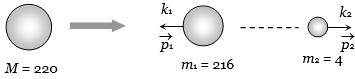
$A$ nucleus with mass number $220$ initially at rest emits an $\alpha$-particle. If the $Q$ value of the reaction is $5.5\, MeV$,calculate the kinetic energy of the $\alpha$-particle in $MeV$.
A
$4.4$
B
$5.4$
C
$5.6$
D
$6.5$
Solution
(B) The $Q$-value of the reaction is the total kinetic energy released,so $K_{\alpha} + K_{D} = Q = 5.5\, MeV$,where $K_{\alpha}$ is the kinetic energy of the $\alpha$-particle and $K_{D}$ is the kinetic energy of the daughter nucleus.
By the law of conservation of linear momentum,the magnitudes of the momenta of the $\alpha$-particle and the daughter nucleus must be equal: $p_{\alpha} = p_{D}$.
Using the relation $K = \frac{p^2}{2m}$,we have $p = \sqrt{2mK}$.
Thus,$\sqrt{2 m_{\alpha} K_{\alpha}} = \sqrt{2 m_{D} K_{D}}$.
Squaring both sides: $m_{\alpha} K_{\alpha} = m_{D} K_{D}$.
Given $m_{\alpha} = 4$ and $m_{D} = 220 - 4 = 216$,we get $4 K_{\alpha} = 216 K_{D}$,which simplifies to $K_{D} = \frac{4}{216} K_{\alpha} = \frac{1}{54} K_{\alpha}$.
Substituting this into the energy equation: $K_{\alpha} + \frac{1}{54} K_{\alpha} = 5.5\, MeV$.
$\frac{55}{54} K_{\alpha} = 5.5\, MeV$.
$K_{\alpha} = 5.5 \times \frac{54}{55} = 0.1 \times 54 = 5.4\, MeV$.
By the law of conservation of linear momentum,the magnitudes of the momenta of the $\alpha$-particle and the daughter nucleus must be equal: $p_{\alpha} = p_{D}$.
Using the relation $K = \frac{p^2}{2m}$,we have $p = \sqrt{2mK}$.
Thus,$\sqrt{2 m_{\alpha} K_{\alpha}} = \sqrt{2 m_{D} K_{D}}$.
Squaring both sides: $m_{\alpha} K_{\alpha} = m_{D} K_{D}$.
Given $m_{\alpha} = 4$ and $m_{D} = 220 - 4 = 216$,we get $4 K_{\alpha} = 216 K_{D}$,which simplifies to $K_{D} = \frac{4}{216} K_{\alpha} = \frac{1}{54} K_{\alpha}$.
Substituting this into the energy equation: $K_{\alpha} + \frac{1}{54} K_{\alpha} = 5.5\, MeV$.
$\frac{55}{54} K_{\alpha} = 5.5\, MeV$.
$K_{\alpha} = 5.5 \times \frac{54}{55} = 0.1 \times 54 = 5.4\, MeV$.
0 likes
View Solution81
MediumMCQ
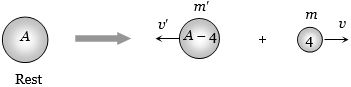
$A$ radioactive nucleus undergoes $\alpha$-emission to form a stable element. What will be the recoil velocity of the daughter nucleus if $V$ is the velocity of $\alpha$-emission and $A$ is the atomic mass of the radioactive nucleus?
A
$\frac{4V}{A - 4}$
B
$\frac{2V}{A - 4}$
C
$\frac{4V}{A + 4}$
D
$\frac{2V}{A + 4}$
Solution
(A) Let the mass of the parent radioactive nucleus be $A$.
After $\alpha$-emission,the mass of the $\alpha$-particle is $4$ and the mass of the daughter nucleus is $(A - 4)$.
Initially,the radioactive nucleus is at rest,so its initial momentum is $0$.
According to the law of conservation of linear momentum:
Initial momentum = Final momentum
$0 = (A - 4)v' + 4V$
Here,$v'$ is the recoil velocity of the daughter nucleus and $V$ is the velocity of the $\alpha$-particle.
$(A - 4)v' = -4V$
The negative sign indicates that the daughter nucleus moves in the opposite direction to the $\alpha$-particle.
The magnitude of the recoil velocity is $v' = \frac{4V}{A - 4}$.
After $\alpha$-emission,the mass of the $\alpha$-particle is $4$ and the mass of the daughter nucleus is $(A - 4)$.
Initially,the radioactive nucleus is at rest,so its initial momentum is $0$.
According to the law of conservation of linear momentum:
Initial momentum = Final momentum
$0 = (A - 4)v' + 4V$
Here,$v'$ is the recoil velocity of the daughter nucleus and $V$ is the velocity of the $\alpha$-particle.
$(A - 4)v' = -4V$
The negative sign indicates that the daughter nucleus moves in the opposite direction to the $\alpha$-particle.
The magnitude of the recoil velocity is $v' = \frac{4V}{A - 4}$.
0 likes
View Solution82
DifficultMCQ
The intensity of gamma radiation from a given source is $I$. On passing through $36 \, mm$ of lead,it is reduced to $\frac{I}{8}$. The thickness of lead which will reduce the intensity to $\frac{I}{2}$ will be......$mm$
A
$18$
B
$12$
C
$6$
D
$9$
Solution
(B) The intensity of radiation passing through a material of thickness $x$ is given by the formula $I' = I e^{-\mu x}$,where $I$ is the initial intensity,$I'$ is the final intensity,and $\mu$ is the absorption coefficient.
From the given data,when $x_1 = 36 \, mm$,the intensity becomes $I' = \frac{I}{8}$.
Substituting these values: $\frac{I}{8} = I e^{-\mu (36)} \implies e^{36\mu} = 8 = 2^3$.
Taking the natural logarithm on both sides: $36\mu = 3 \ln(2) \implies \mu = \frac{3 \ln(2)}{36} = \frac{\ln(2)}{12}$.
Now,we need to find the thickness $x_2$ such that the intensity becomes $I' = \frac{I}{2}$.
Using the formula: $\frac{I}{2} = I e^{-\mu x_2} \implies e^{\mu x_2} = 2$.
Taking the natural logarithm: $\mu x_2 = \ln(2)$.
Substituting the value of $\mu$: $(\frac{\ln(2)}{12}) x_2 = \ln(2)$.
Solving for $x_2$,we get $x_2 = 12 \, mm$.
From the given data,when $x_1 = 36 \, mm$,the intensity becomes $I' = \frac{I}{8}$.
Substituting these values: $\frac{I}{8} = I e^{-\mu (36)} \implies e^{36\mu} = 8 = 2^3$.
Taking the natural logarithm on both sides: $36\mu = 3 \ln(2) \implies \mu = \frac{3 \ln(2)}{36} = \frac{\ln(2)}{12}$.
Now,we need to find the thickness $x_2$ such that the intensity becomes $I' = \frac{I}{2}$.
Using the formula: $\frac{I}{2} = I e^{-\mu x_2} \implies e^{\mu x_2} = 2$.
Taking the natural logarithm: $\mu x_2 = \ln(2)$.
Substituting the value of $\mu$: $(\frac{\ln(2)}{12}) x_2 = \ln(2)$.
Solving for $x_2$,we get $x_2 = 12 \, mm$.
0 likes
View Solution83
MediumMCQ
$A$ radioactive nucleus is initially at rest. It decays by emitting an electron and a neutrino at right angles to each other. The momentum of the electron is $3.2 \times 10^{-23} \ kg \cdot m/s$ and the momentum of the neutrino is $6.4 \times 10^{-23} \ kg \cdot m/s$. What is the direction of the recoil of the nucleus with respect to the direction of the electron?
A
$tan^{-1}(0.5)$
B
$tan^{-1}(2)$
C
$\pi - tan^{-1}(2)$
D
$\frac{\pi}{2} + tan^{-1}(2)$
Solution
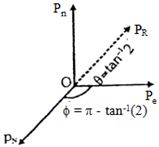
(C) Let the momentum of the electron be $\vec{P_e}$ and the momentum of the neutrino be $\vec{P_n}$. Since they are emitted at right angles,the resultant momentum of the electron and neutrino is $\vec{P_{en}} = \vec{P_e} + \vec{P_n}$.
By the law of conservation of linear momentum,the initial momentum of the nucleus is zero,so the recoil momentum of the nucleus $\vec{P_R}$ must be equal and opposite to the resultant momentum of the electron and neutrino: $\vec{P_R} = -(\vec{P_e} + \vec{P_n})$.
The magnitude of the resultant momentum is $P_{en} = \sqrt{P_e^2 + P_n^2}$.
The angle $\theta$ that the resultant momentum $\vec{P_{en}}$ makes with the electron's momentum $\vec{P_e}$ is given by $\tan \theta = \frac{P_n}{P_e} = \frac{6.4 \times 10^{-23}}{3.2 \times 10^{-23}} = 2$,so $\theta = tan^{-1}(2)$.
Since the recoil momentum $\vec{P_R}$ is in the opposite direction to $\vec{P_{en}}$,the angle $\phi$ that the recoil momentum makes with the electron's momentum is $\phi = \pi - \theta = \pi - tan^{-1}(2)$.
By the law of conservation of linear momentum,the initial momentum of the nucleus is zero,so the recoil momentum of the nucleus $\vec{P_R}$ must be equal and opposite to the resultant momentum of the electron and neutrino: $\vec{P_R} = -(\vec{P_e} + \vec{P_n})$.
The magnitude of the resultant momentum is $P_{en} = \sqrt{P_e^2 + P_n^2}$.
The angle $\theta$ that the resultant momentum $\vec{P_{en}}$ makes with the electron's momentum $\vec{P_e}$ is given by $\tan \theta = \frac{P_n}{P_e} = \frac{6.4 \times 10^{-23}}{3.2 \times 10^{-23}} = 2$,so $\theta = tan^{-1}(2)$.
Since the recoil momentum $\vec{P_R}$ is in the opposite direction to $\vec{P_{en}}$,the angle $\phi$ that the recoil momentum makes with the electron's momentum is $\phi = \pi - \theta = \pi - tan^{-1}(2)$.
0 likes
View Solution84
EasyMCQ
Which spectrum is continuous?
A
$\alpha$-rays
B
$\beta$-rays
C
$\gamma$-rays
D
All of the above
Solution
(B) The spectrum of $\alpha$-particles and $\gamma$-rays is discrete (line spectrum) because they are emitted with specific,fixed energy levels corresponding to the transitions between nuclear energy states.
In contrast,the $\beta$-decay process involves the simultaneous emission of an electron and an antineutrino (or a positron and a neutrino). The energy released in the decay is shared between the $\beta$-particle and the neutrino in a continuous range,resulting in a continuous energy spectrum for $\beta$-rays.
In contrast,the $\beta$-decay process involves the simultaneous emission of an electron and an antineutrino (or a positron and a neutrino). The energy released in the decay is shared between the $\beta$-particle and the neutrino in a continuous range,resulting in a continuous energy spectrum for $\beta$-rays.
0 likes
View Solution85
EasyMCQ
The rate of disintegration of a radioactive sample can be increased by:
A
Increasing the temperature
B
Increasing the pressure
C
Chemical reaction
D
It is not possible
Solution
(D) Radioactive decay is a spontaneous nuclear process that depends only on the nature of the nucleus itself.
It is independent of external physical factors such as temperature,pressure,or chemical environment.
Therefore,the rate of disintegration cannot be increased by any of these external means.
Thus,the correct option is $D$.
It is independent of external physical factors such as temperature,pressure,or chemical environment.
Therefore,the rate of disintegration cannot be increased by any of these external means.
Thus,the correct option is $D$.
0 likes
View Solution86
MediumMCQ
Statement-$1$: $A$ nucleus having energy $E_{1}$ decays by $\beta^{-}$ emission to a daughter nucleus having energy $E_{2}$,but the $\beta^{-}$ rays are emitted with a continuous energy spectrum having an end-point energy $E_{1} - E_{2}$.
Statement-$2$: To conserve energy and momentum in $\beta$ decay,at least three particles must take part in the transformation.
Statement-$2$: To conserve energy and momentum in $\beta$ decay,at least three particles must take part in the transformation.
A
Statement-$1$ is false,Statement-$2$ is true.
B
Statement-$1$ is true,Statement-$2$ is false.
C
Statement-$1$ is true,Statement-$2$ is true; Statement-$2$ is a correct explanation for Statement-$1$.
D
Statement-$1$ is true,Statement-$2$ is true; Statement-$2$ is not a correct explanation for Statement-$1$.
Solution
(C) In $\beta^{-}$ decay,a neutron transforms into a proton,an electron,and an antineutrino $(n \rightarrow p + e^{-} + \bar{\nu}_{e})$.
Statement-$1$ is true because the energy released $(Q = E_{1} - E_{2})$ is shared between the electron and the antineutrino. Since the antineutrino carries away a variable amount of energy,the electron's energy spectrum is continuous,with the maximum (end-point) energy equal to $E_{1} - E_{2}$.
Statement-$2$ is also true. If only two particles were involved,the conservation of energy and momentum would require the electron to have a fixed kinetic energy (a discrete spectrum). The observation of a continuous spectrum confirms the emission of a third,invisible particle (the antineutrino) to satisfy conservation laws.
Thus,Statement-$2$ correctly explains why the energy spectrum in Statement-$1$ is continuous.
Statement-$1$ is true because the energy released $(Q = E_{1} - E_{2})$ is shared between the electron and the antineutrino. Since the antineutrino carries away a variable amount of energy,the electron's energy spectrum is continuous,with the maximum (end-point) energy equal to $E_{1} - E_{2}$.
Statement-$2$ is also true. If only two particles were involved,the conservation of energy and momentum would require the electron to have a fixed kinetic energy (a discrete spectrum). The observation of a continuous spectrum confirms the emission of a third,invisible particle (the antineutrino) to satisfy conservation laws.
Thus,Statement-$2$ correctly explains why the energy spectrum in Statement-$1$ is continuous.
0 likes
View Solution87
EasyMCQ
Alpha particles are
A
$2$ free protons
B
doubly ionised helium atoms
C
helium atoms
D
singly ionised helium atoms
Solution
(B) An alpha particle consists of $2$ protons and $2$ neutrons,which is identical to the nucleus of a helium atom $(^4_2He)$.
Since an alpha particle has no electrons,it is a helium atom that has lost both of its electrons.
Therefore,an alpha particle is a doubly ionised helium atom $(He^{2+})$.
Since an alpha particle has no electrons,it is a helium atom that has lost both of its electrons.
Therefore,an alpha particle is a doubly ionised helium atom $(He^{2+})$.
0 likes
View Solution88
EasyMCQ
In the emission of $\gamma$-rays from a nucleus:
A
The number of neutrons and protons changes.
B
The number of protons and neutrons does not change.
C
Only the number of neutrons changes.
D
Only the number of protons changes.
Solution
(B) The emission of $\gamma$-rays occurs when an excited nucleus transitions to a lower energy state.
During this process, the nucleus releases energy in the form of electromagnetic radiation (photons).
Since $\gamma$-decay involves only the release of energy and not the emission of particles like $\alpha$ or $\beta$ particles, the atomic number $(Z)$ and the mass number $(A)$ remain constant.
Therefore, the number of protons and neutrons in the nucleus does not change.
During this process, the nucleus releases energy in the form of electromagnetic radiation (photons).
Since $\gamma$-decay involves only the release of energy and not the emission of particles like $\alpha$ or $\beta$ particles, the atomic number $(Z)$ and the mass number $(A)$ remain constant.
Therefore, the number of protons and neutrons in the nucleus does not change.
0 likes
View Solution89
EasyMCQ
Radioactivity is a/an ...... process.
A
Irreversible process
B
Spontaneous disintegration process
C
Process unaffected by temperature or pressure
D
All of the above
Solution
(D) Radioactivity is a spontaneous and irreversible process in which an unstable nucleus emits radiation.
This process is purely a nuclear phenomenon and is not affected by external factors such as temperature,pressure,chemical bonding,or physical state.
Therefore,all the given options are correct.
This process is purely a nuclear phenomenon and is not affected by external factors such as temperature,pressure,chemical bonding,or physical state.
Therefore,all the given options are correct.
0 likes
View Solution90
EasyMCQ
At a particular instant,the emissions from a radioactive compound are deflected in a magnetic field. The compound could be emitting which of the following at that instant?
$(i)$ Electrons $(ii)$ Protons $(iii)$ $He^{+2}$ particles $(iv)$ Neutrons
$(i)$ Electrons $(ii)$ Protons $(iii)$ $He^{+2}$ particles $(iv)$ Neutrons
A
$(i), (iii)$
B
$(i), (ii), (iii), (iv)$
C
$(iv)$
D
$(i), (ii), (iii)$
Solution
(D) particle is deflected in a magnetic field only if it carries an electric charge.
$(i)$ Electrons $(e^-)$ are negatively charged particles and will be deflected.
$(ii)$ Protons $(p^+)$ are positively charged particles and will be deflected.
$(iii)$ $He^{+2}$ particles (alpha particles) are positively charged and will be deflected.
$(iv)$ Neutrons are electrically neutral particles and will not be deflected in a magnetic field.
Therefore,the particles that can be deflected are $(i)$,$(ii)$,and $(iii)$.
$(i)$ Electrons $(e^-)$ are negatively charged particles and will be deflected.
$(ii)$ Protons $(p^+)$ are positively charged particles and will be deflected.
$(iii)$ $He^{+2}$ particles (alpha particles) are positively charged and will be deflected.
$(iv)$ Neutrons are electrically neutral particles and will not be deflected in a magnetic field.
Therefore,the particles that can be deflected are $(i)$,$(ii)$,and $(iii)$.
0 likes
View Solution91
EasyMCQ
Which of the following is not emitted during the radioactive decay of a radioactive element?
A
Proton
B
Neutrino
C
Helium nucleus
D
Electron
Solution
(A) During radioactive decay,particles such as alpha particles (helium nuclei),beta particles (electrons or positrons),and gamma rays are emitted. Neutrinos are also emitted during beta decay. Protons are not emitted during standard radioactive decay processes.
0 likes
View Solution92
MediumMCQ
In the nuclear reaction $6C^{11} \rightarrow 5B^{11} + \beta^+ + X$,the particle $X$ is .......
A
Neutron
B
Antineutrino
C
Neutrino
D
Proton
Solution
(C) In $\beta^+$ decay (positron emission),a proton inside the nucleus is converted into a neutron,a positron $(\beta^+)$,and a neutrino $(
u)$.
The reaction is given by: $6C^{11} \rightarrow 5B^{11} + e^+ + \nu$.
Comparing this with the given reaction $6C^{11} \rightarrow 5B^{11} + \beta^+ + X$,we can conclude that the particle $X$ is a neutrino.
u)$.
The reaction is given by: $6C^{11} \rightarrow 5B^{11} + e^+ + \nu$.
Comparing this with the given reaction $6C^{11} \rightarrow 5B^{11} + \beta^+ + X$,we can conclude that the particle $X$ is a neutrino.
0 likes
View Solution93
MediumMCQ
Which of the following can penetrate through an aluminum sheet of $20 \, cm$ thickness?
A
$\alpha$-rays
B
$\beta$-rays
C
$\gamma$-rays
D
Positive rays
Solution
(C) The penetrating power of radiation depends on its nature and energy. $\alpha$-particles are stopped by a thin sheet of paper. $\beta$-particles can be stopped by a few millimeters of aluminum. $\gamma$-rays have the highest penetrating power among the three and can easily pass through a $20 \, cm$ thick aluminum sheet.
0 likes
View Solution94
EasyMCQ
When a neutron decays,it produces . . . . . . .
A
$A$ proton,an electron,and an antineutrino
B
$A$ positron,an electron,and a neutrino
C
$A$ proton,a positron,and a neutrino
D
$A$ proton,$\gamma$-rays,and a neutrino
Solution
(A) free neutron is unstable and undergoes beta-minus decay. The decay process is represented by the equation: $n \to p + e^- + \bar{\nu}_e$.
Thus,a neutron decays into a proton $(p)$,an electron $(e^-)$,and an antineutrino $(\bar{\nu}_e)$.
Thus,a neutron decays into a proton $(p)$,an electron $(e^-)$,and an antineutrino $(\bar{\nu}_e)$.
0 likes
View Solution95
EasyMCQ
During the radioactive decay of a substance,which of the following is $NOT$ emitted?
A
Proton
B
Neutrino
C
Helium nucleus
D
Electron
Solution
(A) Radioactive decay involves the emission of particles from the nucleus to achieve stability. Common emissions include alpha particles (Helium nucleus),beta particles (electrons or positrons),and gamma rays (photons),often accompanied by neutrinos or antineutrinos. Protons are not emitted during standard radioactive decay processes.
0 likes
View Solution96
MediumMCQ
The unit '$rad$' is the correct measure for which of the following?
A
The probability of a photon in a gamma-ray beam producing ions in a target.
B
The energy delivered to a target.
C
The biological effect of radiation.
D
The rate of decay of a radioactive source.
Solution
(B) The unit '$rad$' stands for 'radiation absorbed dose'.
It is a unit of absorbed radiation dose,defined as the absorption of $0.01 \ J$ of energy per kilogram of matter.
Therefore,it measures the energy delivered to a target (specifically,the absorbed dose).
While '$rem$' is used for the biological effect of radiation,'$rad$' specifically quantifies the energy absorbed per unit mass.
It is a unit of absorbed radiation dose,defined as the absorption of $0.01 \ J$ of energy per kilogram of matter.
Therefore,it measures the energy delivered to a target (specifically,the absorbed dose).
While '$rem$' is used for the biological effect of radiation,'$rad$' specifically quantifies the energy absorbed per unit mass.
0 likes
View Solution97
MediumMCQ
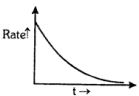
$A$ radioactive nuclide of element $X$ decays to form element $Y$. The graph representing the rate of production of $Y$ in a sample of $X$ is:
A
B
C
D
Solution
(D) The rate of production of element $Y$ is equal to the rate of decay of element $X$. According to the law of radioactive decay,the activity (rate of decay) of a radioactive sample is given by $R = \lambda N$,where $\lambda$ is the decay constant and $N$ is the number of undecayed nuclei at time $t$. Since $N(t) = N_0 e^{-\lambda t}$,the rate of decay is $R(t) = \lambda N_0 e^{-\lambda t}$. This shows that the rate of decay,and consequently the rate of production of the daughter element $Y$,decreases exponentially with time. Therefore,the graph is an exponential decay curve.
0 likes
View Solution98
EasyMCQ
In a radioactive decay process,the atomic number and mass number of the nucleus do not change. Which of the following is emitted during this process?
A
Proton
B
Neutron
C
Electron
D
Photon
Solution
(D) In radioactive decay,when a nucleus transitions from a higher energy state to a lower energy state,it emits electromagnetic radiation in the form of a photon (gamma decay). Since a photon has zero rest mass and zero charge,the atomic number $(Z)$ and the mass number $(A)$ of the nucleus remain unchanged during this process.
0 likes
View Solution99
MediumMCQ
$A$ radioactive element emits two $\beta$-particles and one $\alpha$-particle. The resulting daughter nucleus is ...
A
an isomer of the parent nucleus.
B
an isotone of the parent nucleus.
C
an isotope of the parent nucleus.
D
an isobar of the parent nucleus.
Solution
(C) Let the parent nucleus be represented as $_{Z}^{A}X$.
$1$. Emission of two $\beta$-particles: $_{Z}^{A}X \rightarrow _{Z+2}^{A}Y_1 + 2_{-1}^{0}e + 2\bar{\nu}$. The mass number $A$ remains unchanged, and the atomic number increases by $2$.
$2$. Emission of one $\alpha$-particle: $_{Z+2}^{A}Y_1 \rightarrow _{Z+2-2}^{A-4}Y_2 + _{2}^{4}He$. The mass number decreases by $4$, and the atomic number decreases by $2$.
$3$. The final nucleus is $_{Z}^{A-4}Y_2$.
Since the atomic number $Z$ is the same as the parent nucleus, the resulting daughter nucleus is an isotope of the parent nucleus.
$1$. Emission of two $\beta$-particles: $_{Z}^{A}X \rightarrow _{Z+2}^{A}Y_1 + 2_{-1}^{0}e + 2\bar{\nu}$. The mass number $A$ remains unchanged, and the atomic number increases by $2$.
$2$. Emission of one $\alpha$-particle: $_{Z+2}^{A}Y_1 \rightarrow _{Z+2-2}^{A-4}Y_2 + _{2}^{4}He$. The mass number decreases by $4$, and the atomic number decreases by $2$.
$3$. The final nucleus is $_{Z}^{A-4}Y_2$.
Since the atomic number $Z$ is the same as the parent nucleus, the resulting daughter nucleus is an isotope of the parent nucleus.
0 likes
View Solution100
MediumMCQ
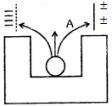
$A$ radioactive source is placed in a uniform electric field. If $\alpha, \beta$,and $\gamma$ particles are emitted,then $\alpha, \beta, \gamma$ particles correspond to which paths respectively?

A
$A, B, C$
B
$A, C, B$
C
$C, A, B$
D
$C, B, A$
Solution
(C) The radioactive source emits three types of radiation: $\alpha$-particles (positively charged),$\beta$-particles (negatively charged),and $\gamma$-rays (neutral).
$1$. $\alpha$-particles are positively charged,so they are attracted towards the negative plate. In the diagram,path $C$ deflects towards the negative plate,so $C$ represents $\alpha$-particles.
$2$. $\beta$-particles are negatively charged,so they are attracted towards the positive plate. In the diagram,path $A$ deflects towards the positive plate,so $A$ represents $\beta$-particles.
$3$. $\gamma$-rays are neutral (no charge),so they pass through the electric field undeflected. In the diagram,path $B$ goes straight,so $B$ represents $\gamma$-rays.
Therefore,the paths for $\alpha, \beta, \gamma$ are $C, A, B$ respectively.
$1$. $\alpha$-particles are positively charged,so they are attracted towards the negative plate. In the diagram,path $C$ deflects towards the negative plate,so $C$ represents $\alpha$-particles.
$2$. $\beta$-particles are negatively charged,so they are attracted towards the positive plate. In the diagram,path $A$ deflects towards the positive plate,so $A$ represents $\beta$-particles.
$3$. $\gamma$-rays are neutral (no charge),so they pass through the electric field undeflected. In the diagram,path $B$ goes straight,so $B$ represents $\gamma$-rays.
Therefore,the paths for $\alpha, \beta, \gamma$ are $C, A, B$ respectively.
0 likes
View SolutionNuclei — Properties of Alpha, Beta and Gamma Rays and Decay Process · Frequently Asked Questions
1Are these Nuclei questions useful for JEE and NEET?
Yes. All questions in this section are mapped to JEE Main and NEET exam patterns. Previous year questions from JEE Main, NEET, GUJCET and state-level exams are included with full solutions.
2Can I switch to Hindi or Gujarati for these questions?
Yes. Use the language tabs in the hero section or the sidebar to view the same questions and solutions in English, Hindi or Gujarati.
3How do I generate a question paper from this subtopic?
Use the Vedclass Exam Paper Generator — select the chapter and subtopic, set difficulty, and generate Sets A, B, C, D automatically. First 3 chapters of every subject are free.
Vedclass Products
For Students
Vedclass Test Series
Mock tests in real JEE/NEET style with performance analysis. 5-day free trial.
Start Free TrialFor Teachers
Exam Paper Generator
Generate Set A/B/C/D papers from this chapter in 2 minutes. 3 chapters free.
Try FreeFor Institutes
Online Exam Module
Live online exams with unlimited students, 360° analytics & white-label branding.
See DemoFor Teachers & Institutes
Generate a Nuclei Exam Paper in 2 Minutes
Select subtopic & difficulty — Sets A, B, C, D auto-generated with No Repeat logic.
First 3 chapters of every subject are free — no payment required.