
A English
Motion of Charged Particle In Magnetic Field Questions in English
Class 12 Physics · Moving Charges and Magnetism · Motion of Charged Particle In Magnetic Field
513+
Questions
English
Language
100%
With Solutions
Showing 13 of 513 questions in English
501
MediumMCQ
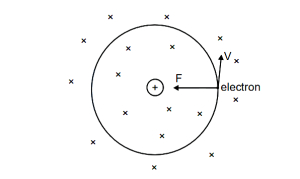
An electron revolves around the nucleus in a circular path with angular momentum $\vec{L}$. $A$ uniform magnetic field $\vec{B}$ is applied perpendicular to the plane of its orbit. If the electron experiences a torque $\vec{\tau}$,then
A
$\vec{\tau} \parallel \vec{L}$
B
$\vec{\tau}$ is anti-parallel to $\vec{L}$
C
$\vec{\tau} \cdot \vec{L} = 0$
D
Angle between $\vec{\tau}$ and $\vec{L}$ is $45^{\circ}$
Solution
(C) The magnetic force on a moving charge is given by $\vec{F} = q(\vec{v} \times \vec{B})$.
Since the magnetic field $\vec{B}$ is perpendicular to the plane of the orbit,the force $\vec{F}$ acts towards the center of the circular path (centripetal force).
The torque $\vec{\tau}$ about the nucleus is given by $\vec{\tau} = \vec{r} \times \vec{F}$.
Since the force $\vec{F}$ is directed towards the center,the position vector $\vec{r}$ and the force vector $\vec{F}$ are collinear (anti-parallel).
Therefore,$\vec{\tau} = \vec{r} \times \vec{F} = 0$.
Since the torque is zero,the dot product of the torque vector with any vector,including the angular momentum vector $\vec{L}$,must be zero: $\vec{\tau} \cdot \vec{L} = 0$.
Since the magnetic field $\vec{B}$ is perpendicular to the plane of the orbit,the force $\vec{F}$ acts towards the center of the circular path (centripetal force).
The torque $\vec{\tau}$ about the nucleus is given by $\vec{\tau} = \vec{r} \times \vec{F}$.
Since the force $\vec{F}$ is directed towards the center,the position vector $\vec{r}$ and the force vector $\vec{F}$ are collinear (anti-parallel).
Therefore,$\vec{\tau} = \vec{r} \times \vec{F} = 0$.
Since the torque is zero,the dot product of the torque vector with any vector,including the angular momentum vector $\vec{L}$,must be zero: $\vec{\tau} \cdot \vec{L} = 0$.
0 likes
View Solution502
EasyMCQ
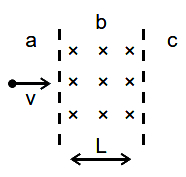
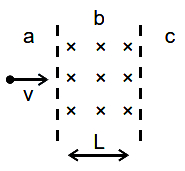
$A$ particle of mass $m$ and charge $q$ moving with velocity $v$ enters region-$b$ from region-$a$ along the normal to the boundary as shown in the figure. Region-$b$ has a uniform magnetic field $B$ perpendicular to the plane of the paper. Also,region-$b$ has length $L$. Choose the correct statements:
A
The particle enters region-$c$ only if $v > \frac{qLB}{m}$
B
The particle enters region-$c$ only if $v < \frac{qLB}{m}$
C
Path of the particle is a circle in region-$b$
D
Time spent in region-$b$ is independent of velocity $v$
Solution
(A, C) The particle enters region-$c$ if the radius of its circular path $R$ is greater than the width $L$ of region-$b$.
Since $R = \frac{mv}{qB}$,the condition for entering region-$c$ is $\frac{mv}{qB} > L$,which implies $v > \frac{qBL}{m}$. Thus,option $A$ is correct.
Since the magnetic field $B$ is uniform and the velocity vector $\vec{v}$ is perpendicular to the magnetic field $\vec{B}$,the magnetic force provides the necessary centripetal force,making the path of the particle circular in region-$b$. Thus,option $C$ is correct.
The time spent in region-$b$ is given by $t = \frac{\theta}{\omega}$,where $\theta$ is the angle subtended by the arc at the center and $\omega = \frac{qB}{m}$ is the angular velocity. Since the angle $\theta$ depends on the radius $R$ (and thus on velocity $v$),the time spent in region-$b$ depends on the velocity $v$. Therefore,option $D$ is incorrect.
Since $R = \frac{mv}{qB}$,the condition for entering region-$c$ is $\frac{mv}{qB} > L$,which implies $v > \frac{qBL}{m}$. Thus,option $A$ is correct.
Since the magnetic field $B$ is uniform and the velocity vector $\vec{v}$ is perpendicular to the magnetic field $\vec{B}$,the magnetic force provides the necessary centripetal force,making the path of the particle circular in region-$b$. Thus,option $C$ is correct.
The time spent in region-$b$ is given by $t = \frac{\theta}{\omega}$,where $\theta$ is the angle subtended by the arc at the center and $\omega = \frac{qB}{m}$ is the angular velocity. Since the angle $\theta$ depends on the radius $R$ (and thus on velocity $v$),the time spent in region-$b$ depends on the velocity $v$. Therefore,option $D$ is incorrect.
0 likes
View Solution503
MediumMCQ
To which of the following quantities,the radius of the circular path of a charged particle moving at right angles to a uniform magnetic field is directly proportional?
A
energy of the particle
B
magnetic field
C
charge of the particle
D
momentum of the particle
Solution
(D) When a charged particle moves with velocity $v$ perpendicular to a uniform magnetic field $B$ (i.e.,$\theta = 90^{\circ}$),it experiences a magnetic Lorentz force $F = qvB$.
This force acts perpendicular to the velocity,providing the necessary centripetal force for circular motion:
$qvB = \frac{mv^2}{r}$
Solving for the radius $r$:
$r = \frac{mv}{qB}$
Since the momentum of the particle is $p = mv$,we can write:
$r = \frac{p}{qB}$
From this expression,it is clear that the radius $r$ is directly proportional to the momentum $p$ of the particle.
Therefore,option $(D)$ is correct.
This force acts perpendicular to the velocity,providing the necessary centripetal force for circular motion:
$qvB = \frac{mv^2}{r}$
Solving for the radius $r$:
$r = \frac{mv}{qB}$
Since the momentum of the particle is $p = mv$,we can write:
$r = \frac{p}{qB}$
From this expression,it is clear that the radius $r$ is directly proportional to the momentum $p$ of the particle.
Therefore,option $(D)$ is correct.
0 likes
View Solution504
EasyMCQ
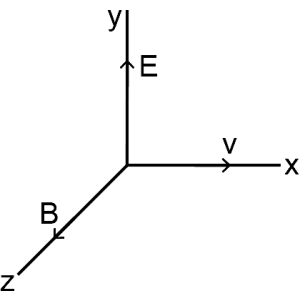
$A$ particle with charge $q$ moves with a velocity $v$ in a direction perpendicular to the directions of uniform electric and magnetic fields,$E$ and $B$ respectively,which are mutually perpendicular to each other. Which one of the following gives the condition for which the particle moves undeflected in its original trajectory?
A
$v=\frac{E}{B}$
B
$v=\frac{B}{E}$
C
$v=\sqrt{\frac{E}{B}}$
D
$v=q \frac{B}{E}$
Solution
(A) According to the question,the charge on the particle is $q$ and its velocity is $v$.
Due to the uniform electric field,the electric force on the particle is $F_{\text{electric}} = qE$.
Due to the uniform magnetic field,the magnetic force on the particle is given by $F_{\text{magnetic}} = q(v \times B)$.
For the particle to move undeflected,the net Lorentz force must be zero,which means the electric force and magnetic force must be equal in magnitude and opposite in direction: $F_{\text{electric}} = F_{\text{magnetic}}$.
Substituting the magnitudes,we get $qE = qvB$.
Solving for velocity,we find $v = \frac{E}{B}$.
Thus,the condition for the particle to move undeflected is $v = \frac{E}{B}$.
Due to the uniform electric field,the electric force on the particle is $F_{\text{electric}} = qE$.
Due to the uniform magnetic field,the magnetic force on the particle is given by $F_{\text{magnetic}} = q(v \times B)$.
For the particle to move undeflected,the net Lorentz force must be zero,which means the electric force and magnetic force must be equal in magnitude and opposite in direction: $F_{\text{electric}} = F_{\text{magnetic}}$.
Substituting the magnitudes,we get $qE = qvB$.
Solving for velocity,we find $v = \frac{E}{B}$.
Thus,the condition for the particle to move undeflected is $v = \frac{E}{B}$.
0 likes
View Solution505
EasyMCQ
$A$ proton of mass $m$ moving with a speed $v$ ($v << c$,where $c$ is the velocity of light in vacuum) completes a circular orbit in time $T$ in a uniform magnetic field. If the speed of the proton is increased to $\sqrt{2}v$,what will be the time needed to complete the circular orbit?
A
$\sqrt{T}$
B
$T$
C
$\frac{T}{\sqrt{2}}$
D
$\frac{T}{2}$
Solution
(B) The time period $T$ of a charged particle moving in a circular path in a uniform magnetic field is given by the formula: $T = \frac{2\pi m}{qB}$.
This formula shows that the time period $T$ depends only on the mass $m$,the charge $q$,and the magnetic field strength $B$.
Since $m$,$q$,and $B$ remain constant,the time period $T$ is independent of the speed $v$ of the proton.
Therefore,even if the speed is increased to $\sqrt{2}v$,the time period will remain $T$.
This formula shows that the time period $T$ depends only on the mass $m$,the charge $q$,and the magnetic field strength $B$.
Since $m$,$q$,and $B$ remain constant,the time period $T$ is independent of the speed $v$ of the proton.
Therefore,even if the speed is increased to $\sqrt{2}v$,the time period will remain $T$.
0 likes
View Solution506
MediumMCQ
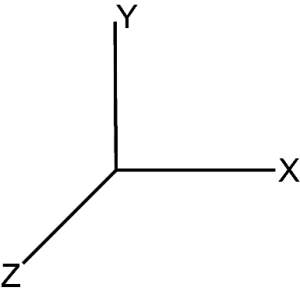
$A$ proton is moving with a uniform velocity of $10^{6} \ m/s$ along the $Y$-axis,under the joint action of a magnetic field along the $Z$-axis and an electric field of magnitude $2 \times 10^{4} \ V/m$ along the negative $X$-axis. If the electric field is switched off,the proton starts moving in a circle. The radius of the circle is nearly: (Given: $\frac{e}{m}$ ratio for proton $= 10^{8} \ C/kg$) (in $m$)
A
$0.5$
B
$0.2$
C
$0.1$
D
$0.05$
Solution
(A) Given:
Velocity of proton $v = 10^{6} \ m/s$ along the $Y$-axis.
Electric field $E = 2 \times 10^{4} \ V/m$ along the negative $X$-axis.
Specific charge $\frac{e}{m} = 10^{8} \ C/kg$.
Since the proton moves with a uniform velocity,the net force on it is zero. Thus,the magnetic force balances the electric force:
$qE = qvB$
$B = \frac{E}{v} = \frac{2 \times 10^{4}}{10^{6}} = 2 \times 10^{-2} \ T$
When the electric field is switched off,the proton moves in a circular path due to the magnetic force acting as the centripetal force:
$R = \frac{mv}{qB} = \frac{v}{(e/m)B}$
$R = \frac{10^{6}}{10^{8} \times 2 \times 10^{-2}}$
$R = \frac{10^{6}}{2 \times 10^{6}} = 0.5 \ m$
Therefore,the radius of the circle is $0.5 \ m$.
Velocity of proton $v = 10^{6} \ m/s$ along the $Y$-axis.
Electric field $E = 2 \times 10^{4} \ V/m$ along the negative $X$-axis.
Specific charge $\frac{e}{m} = 10^{8} \ C/kg$.
Since the proton moves with a uniform velocity,the net force on it is zero. Thus,the magnetic force balances the electric force:
$qE = qvB$
$B = \frac{E}{v} = \frac{2 \times 10^{4}}{10^{6}} = 2 \times 10^{-2} \ T$
When the electric field is switched off,the proton moves in a circular path due to the magnetic force acting as the centripetal force:
$R = \frac{mv}{qB} = \frac{v}{(e/m)B}$
$R = \frac{10^{6}}{10^{8} \times 2 \times 10^{-2}}$
$R = \frac{10^{6}}{2 \times 10^{6}} = 0.5 \ m$
Therefore,the radius of the circle is $0.5 \ m$.
0 likes
View Solution507
MediumMCQ
Two particles,$A$ and $B$,having equal charges,after being accelerated through the same potential difference,enter into a region of uniform magnetic field and the particles describe circular paths of radii $R_{1}$ and $R_{2}$ respectively. The ratio of the masses of $A$ and $B$ is
A
$R_{1} / R_{2}$
B
$(R_{1} / R_{2})^{2}$
C
$(R_{2} / R_{1})^{2}$
D
$\sqrt{R_{1}} / R_{2}$
Solution
(B) The radius $R$ of the circular path followed by a charged particle in a magnetic field is given by $R = \frac{mv}{qB} = \frac{\sqrt{2mK}}{qB}$,where $K$ is the kinetic energy.
Since the particle is accelerated through a potential difference $V$,its kinetic energy is $K = qV$.
Substituting this into the radius formula,we get $R = \frac{\sqrt{2mqV}}{qB} = \frac{1}{B} \sqrt{\frac{2mV}{q}}$.
Given that $q$,$V$,and $B$ are the same for both particles,we have $R \propto \sqrt{m}$.
Therefore,$\frac{R_{1}}{R_{2}} = \sqrt{\frac{m_{A}}{m_{B}}}$.
Squaring both sides,we get $\frac{m_{A}}{m_{B}} = \left(\frac{R_{1}}{R_{2}}\right)^{2}$.
Since the particle is accelerated through a potential difference $V$,its kinetic energy is $K = qV$.
Substituting this into the radius formula,we get $R = \frac{\sqrt{2mqV}}{qB} = \frac{1}{B} \sqrt{\frac{2mV}{q}}$.
Given that $q$,$V$,and $B$ are the same for both particles,we have $R \propto \sqrt{m}$.
Therefore,$\frac{R_{1}}{R_{2}} = \sqrt{\frac{m_{A}}{m_{B}}}$.
Squaring both sides,we get $\frac{m_{A}}{m_{B}} = \left(\frac{R_{1}}{R_{2}}\right)^{2}$.
0 likes
View Solution508
MediumMCQ
$A$ proton of mass $m$ and charge $q$ is moving in a plane with kinetic energy $E$. If there exists a uniform magnetic field $B$,perpendicular to the plane of the motion,the proton will move in a circular path of radius
A
$\frac{2 E m}{q B}$
B
$\frac{\sqrt{2 E m}}{q B}$
C
$\frac{\sqrt{E m}}{2 q B}$
D
$\sqrt{\frac{2 E q}{m B}}$
Solution
(B) Given: Kinetic energy $= E$,Mass $= m$,Magnetic field $= B$,Charge $= q$.
When a charged particle moves perpendicular to a uniform magnetic field,the magnetic force provides the necessary centripetal force for circular motion.
$F_m = qvB$ and $F_c = \frac{mv^2}{r}$.
Equating these,we get $qvB = \frac{mv^2}{r}$,which simplifies to $r = \frac{mv}{qB}$.
We know that kinetic energy $E = \frac{1}{2}mv^2$,so $v = \sqrt{\frac{2E}{m}}$.
Substituting the value of $v$ into the radius formula:
$r = \frac{m}{qB} \sqrt{\frac{2E}{m}} = \frac{\sqrt{m^2} \cdot \sqrt{2E}}{\sqrt{m} \cdot qB} = \frac{\sqrt{2Em}}{qB}$.
When a charged particle moves perpendicular to a uniform magnetic field,the magnetic force provides the necessary centripetal force for circular motion.
$F_m = qvB$ and $F_c = \frac{mv^2}{r}$.
Equating these,we get $qvB = \frac{mv^2}{r}$,which simplifies to $r = \frac{mv}{qB}$.
We know that kinetic energy $E = \frac{1}{2}mv^2$,so $v = \sqrt{\frac{2E}{m}}$.
Substituting the value of $v$ into the radius formula:
$r = \frac{m}{qB} \sqrt{\frac{2E}{m}} = \frac{\sqrt{m^2} \cdot \sqrt{2E}}{\sqrt{m} \cdot qB} = \frac{\sqrt{2Em}}{qB}$.
0 likes
View Solution509
EasyMCQ
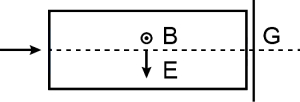
$A$ stream of electrons and protons are directed towards a narrow slit in a screen (see figure). The intervening region has a uniform electric field $E$ (vertically downwards) and a uniform magnetic field $B$ (out of the plane of the figure) as shown. Then:
A
electrons and protons with speed $\frac{|E|}{|B|}$ will pass through the slit
B
protons with speed $|E| /|B|$ will pass through the slit,electrons of the same speed will not
C
neither electrons nor protons will go through the slit irrespective of their speed
D
electrons will always be deflected upwards irrespective of their speed
Solution
(A) For a charged particle moving with velocity $v$ in a region with electric field $E$ and magnetic field $B$,the Lorentz force is $F = q(E + v \times B)$.
For the particle to pass undeflected,the net force must be zero,i.e.,$qE = -q(v \times B)$.
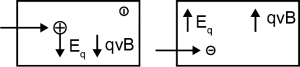
For a proton $(q > 0)$: The electric force $F_E = qE$ is downwards. The magnetic force $F_B = q(v \times B)$ is upwards (using the right-hand rule,$v$ is right,$B$ is out,so $v \times B$ is up). For no deflection,$qE = qvB$,which gives $v = E/B$.
For an electron $(q < 0)$: The electric force $F_E = qE$ is upwards. The magnetic force $F_B = q(v \times B)$ is downwards (since $q$ is negative,the direction of $F_B$ reverses). For no deflection,$|q|E = |q|vB$,which also gives $v = E/B$.
However,the question asks for the behavior of the stream. Since both require the same speed $v = E/B$ to pass undeflected,option $B$ is incorrect as it implies electrons would not pass. Option $A$ is the correct statement.
For the particle to pass undeflected,the net force must be zero,i.e.,$qE = -q(v \times B)$.
For a proton $(q > 0)$: The electric force $F_E = qE$ is downwards. The magnetic force $F_B = q(v \times B)$ is upwards (using the right-hand rule,$v$ is right,$B$ is out,so $v \times B$ is up). For no deflection,$qE = qvB$,which gives $v = E/B$.
For an electron $(q < 0)$: The electric force $F_E = qE$ is upwards. The magnetic force $F_B = q(v \times B)$ is downwards (since $q$ is negative,the direction of $F_B$ reverses). For no deflection,$|q|E = |q|vB$,which also gives $v = E/B$.
However,the question asks for the behavior of the stream. Since both require the same speed $v = E/B$ to pass undeflected,option $B$ is incorrect as it implies electrons would not pass. Option $A$ is the correct statement.
0 likes
View Solution510
MediumMCQ
$A$ charged particle having charge $q$ is moving perpendicularly to a uniform magnetic field with linear speed $v$ on a circular path of radius $R$. The periodic time of revolution of the particle . . . . . . .
A
depends on $v$ but does not depend on $R$.
B
does not depend on $v$ and $R$ both.
C
depends on $R$ but does not depend on $v$.
D
depends on $v$ and $R$ both.
Solution
(B) The magnetic Lorentz force experienced by a charged particle moving in a magnetic field is $F = qvB$.
This magnetic force provides the necessary centripetal force for circular motion: $qvB = \frac{mv^2}{R}$.
Solving for the radius $R$,we get $R = \frac{mv}{qB}$.
The period of revolution $T$ is defined as the time taken to complete one full circle,given by $T = \frac{2\pi R}{v}$.
Substituting the expression for $R$ into the formula for $T$,we get $T = \frac{2\pi}{v} \cdot \frac{mv}{qB} = \frac{2\pi m}{qB}$.
Since $T$ depends only on the mass $m$,charge $q$,and magnetic field $B$,it is independent of both the linear speed $v$ and the radius $R$.
This magnetic force provides the necessary centripetal force for circular motion: $qvB = \frac{mv^2}{R}$.
Solving for the radius $R$,we get $R = \frac{mv}{qB}$.
The period of revolution $T$ is defined as the time taken to complete one full circle,given by $T = \frac{2\pi R}{v}$.
Substituting the expression for $R$ into the formula for $T$,we get $T = \frac{2\pi}{v} \cdot \frac{mv}{qB} = \frac{2\pi m}{qB}$.
Since $T$ depends only on the mass $m$,charge $q$,and magnetic field $B$,it is independent of both the linear speed $v$ and the radius $R$.
0 likes
View Solution511
DifficultMCQ
$A$ $5 \text{ mg}$ particle carrying a charge of $5 \times 10^{-6} \text{ C}$ is moving with a velocity of $(3\hat{i} + 2\hat{k}) \times 10^{-2} \text{ m/s}$ in a region having a magnetic field $\vec{B} = 0.1\hat{k} \text{ Wb/m}^2$. It moves a distance of $\alpha \text{ m}$ along the $\hat{k}$ direction when it completes $5$ revolutions. The value of $\alpha$ is . . . . . . .
A
$3.14$
B
$6.28$
C
$1.57$
D
$12.56$
Solution
(B) The particle undergoes helical motion in a uniform magnetic field.
The velocity component parallel to the magnetic field is $v_\parallel = 2 \times 10^{-2} \text{ m/s}$ (along $\hat{k}$).
The time period of one revolution is $T = \frac{2\pi m}{qB}$.
Given: $m = 5 \text{ mg} = 5 \times 10^{-6} \text{ kg}$,$q = 5 \times 10^{-6} \text{ C}$,$B = 0.1 \text{ T}$.
$T = \frac{2 \times \pi \times 5 \times 10^{-6}}{5 \times 10^{-6} \times 0.1} = \frac{2\pi}{0.1} = 20\pi \text{ s}$.
The pitch of the helix is $p = v_\parallel \times T = (2 \times 10^{-2}) \times (20\pi) = 0.4\pi \text{ m}$.
For $5$ revolutions,the total distance $\alpha$ along the $\hat{k}$ direction is $\alpha = 5 \times p = 5 \times 0.4\pi = 2\pi \text{ m}$.
Using $\pi \approx 3.14$,$\alpha = 2 \times 3.14 = 6.28 \text{ m}$.
The velocity component parallel to the magnetic field is $v_\parallel = 2 \times 10^{-2} \text{ m/s}$ (along $\hat{k}$).
The time period of one revolution is $T = \frac{2\pi m}{qB}$.
Given: $m = 5 \text{ mg} = 5 \times 10^{-6} \text{ kg}$,$q = 5 \times 10^{-6} \text{ C}$,$B = 0.1 \text{ T}$.
$T = \frac{2 \times \pi \times 5 \times 10^{-6}}{5 \times 10^{-6} \times 0.1} = \frac{2\pi}{0.1} = 20\pi \text{ s}$.
The pitch of the helix is $p = v_\parallel \times T = (2 \times 10^{-2}) \times (20\pi) = 0.4\pi \text{ m}$.
For $5$ revolutions,the total distance $\alpha$ along the $\hat{k}$ direction is $\alpha = 5 \times p = 5 \times 0.4\pi = 2\pi \text{ m}$.
Using $\pi \approx 3.14$,$\alpha = 2 \times 3.14 = 6.28 \text{ m}$.
0 likes
View Solution512
DifficultMCQ
$A$ $1 \mu\text{C}$ charge is moving with velocity $\vec{v} = (\hat{i} - 2\hat{j} + 3\hat{k}) \text{ m/s}$ in a region of magnetic field $\vec{B} = (2\hat{i} + 3\hat{j} - 5\hat{k}) \text{ T}$. The magnitude of the force acting on it is $\sqrt{\alpha} \times 10^{-6} \text{ N}$. The value of $\alpha$ is . . . . . . .
A
$152$
B
$171$
C
$350$
D
$450$
Solution
(B) The magnetic force on a moving charge is given by $\vec{F} = q(\vec{v} \times \vec{B})$.
First,calculate the cross product $\vec{v} \times \vec{B}$:
$\vec{v} \times \vec{B} = \begin{vmatrix} \hat{i} & \hat{j} & \hat{k} \\ 1 & -2 & 3 \\ 2 & 3 & -5 \end{vmatrix}$
$= \hat{i}((-2)(-5) - (3)(3)) - \hat{j}((1)(-5) - (3)(2)) + \hat{k}((1)(3) - (-2)(2))$
$= \hat{i}(10 - 9) - \hat{j}(-5 - 6) + \hat{k}(3 + 4)$
$= 1\hat{i} + 11\hat{j} + 7\hat{k}$.
The magnitude of the cross product is $|\vec{v} \times \vec{B}| = \sqrt{1^2 + 11^2 + 7^2} = \sqrt{1 + 121 + 49} = \sqrt{171}$.
Given $q = 1 \mu\text{C} = 10^{-6} \text{ C}$,the force magnitude is $F = |q| |\vec{v} \times \vec{B}| = 10^{-6} \times \sqrt{171} \text{ N}$.
Comparing this with $\sqrt{\alpha} \times 10^{-6} \text{ N}$,we get $\alpha = 171$.
First,calculate the cross product $\vec{v} \times \vec{B}$:
$\vec{v} \times \vec{B} = \begin{vmatrix} \hat{i} & \hat{j} & \hat{k} \\ 1 & -2 & 3 \\ 2 & 3 & -5 \end{vmatrix}$
$= \hat{i}((-2)(-5) - (3)(3)) - \hat{j}((1)(-5) - (3)(2)) + \hat{k}((1)(3) - (-2)(2))$
$= \hat{i}(10 - 9) - \hat{j}(-5 - 6) + \hat{k}(3 + 4)$
$= 1\hat{i} + 11\hat{j} + 7\hat{k}$.
The magnitude of the cross product is $|\vec{v} \times \vec{B}| = \sqrt{1^2 + 11^2 + 7^2} = \sqrt{1 + 121 + 49} = \sqrt{171}$.
Given $q = 1 \mu\text{C} = 10^{-6} \text{ C}$,the force magnitude is $F = |q| |\vec{v} \times \vec{B}| = 10^{-6} \times \sqrt{171} \text{ N}$.
Comparing this with $\sqrt{\alpha} \times 10^{-6} \text{ N}$,we get $\alpha = 171$.
0 likes
View Solution513
MediumMCQ
The charged particle moving in a uniform magnetic field of $(3\hat{i} + 2\hat{j}) \ \text{T}$ has an acceleration $(4\hat{i} - \frac{x}{2}\hat{j}) \ \text{m/s}^2$. The value of $x$ is . . . . . . .
A
$10$
B
$12$
C
$14$
D
$16$
Solution
(B) The magnetic force acting on a charged particle is given by $\vec{F} = q(\vec{v} \times \vec{B})$.
According to Newton's second law,$\vec{F} = m\vec{a}$,so $m\vec{a} = q(\vec{v} \times \vec{B})$.
Since the magnetic force $\vec{F}$ is always perpendicular to the magnetic field $\vec{B}$,the acceleration $\vec{a}$ must also be perpendicular to the magnetic field $\vec{B}$.
Therefore,the dot product of acceleration and magnetic field must be zero: $\vec{a} \cdot \vec{B} = 0$.
Given $\vec{B} = (3\hat{i} + 2\hat{j}) \ \text{T}$ and $\vec{a} = (4\hat{i} - \frac{x}{2}\hat{j}) \ \text{m/s}^2$,we calculate the dot product:
$(4)(3) + (-\frac{x}{2})(2) = 0$
$12 - x = 0$
$x = 12$.
According to Newton's second law,$\vec{F} = m\vec{a}$,so $m\vec{a} = q(\vec{v} \times \vec{B})$.
Since the magnetic force $\vec{F}$ is always perpendicular to the magnetic field $\vec{B}$,the acceleration $\vec{a}$ must also be perpendicular to the magnetic field $\vec{B}$.
Therefore,the dot product of acceleration and magnetic field must be zero: $\vec{a} \cdot \vec{B} = 0$.
Given $\vec{B} = (3\hat{i} + 2\hat{j}) \ \text{T}$ and $\vec{a} = (4\hat{i} - \frac{x}{2}\hat{j}) \ \text{m/s}^2$,we calculate the dot product:
$(4)(3) + (-\frac{x}{2})(2) = 0$
$12 - x = 0$
$x = 12$.
0 likes
View SolutionMoving Charges and Magnetism — Motion of Charged Particle In Magnetic Field · Frequently Asked Questions
1Are these Moving Charges and Magnetism questions useful for JEE and NEET?
Yes. All questions in this section are mapped to JEE Main and NEET exam patterns. Previous year questions from JEE Main, NEET, GUJCET and state-level exams are included with full solutions.
2Can I switch to Hindi or Gujarati for these questions?
Yes. Use the language tabs in the hero section or the sidebar to view the same questions and solutions in English, Hindi or Gujarati.
3How do I generate a question paper from this subtopic?
Use the Vedclass Exam Paper Generator — select the chapter and subtopic, set difficulty, and generate Sets A, B, C, D automatically. First 3 chapters of every subject are free.
Vedclass Products
For Students
Vedclass Test Series
Mock tests in real JEE/NEET style with performance analysis. 5-day free trial.
Start Free TrialFor Teachers
Exam Paper Generator
Generate Set A/B/C/D papers from this chapter in 2 minutes. 3 chapters free.
Try FreeFor Institutes
Online Exam Module
Live online exams with unlimited students, 360° analytics & white-label branding.
See DemoFor Teachers & Institutes
Generate a Moving Charges and Magnetism Exam Paper in 2 Minutes
Select subtopic & difficulty — Sets A, B, C, D auto-generated with No Repeat logic.
First 3 chapters of every subject are free — no payment required.