
A English
Magnetic Moment of Current Carrying Coil Questions in English
Class 12 Physics · Moving Charges and Magnetism · Magnetic Moment of Current Carrying Coil
141+
Questions
English
Language
100%
With Solutions
Showing 38 of 141 questions in English
101
DifficultMCQ
$A$ straight wire carrying a current $I$ is turned into a circular loop. If the magnitude of the magnetic moment associated with it is $M$,then the length of the wire will be
A
$\frac{M \pi}{4 I}$
B
$\left[\frac{4 \pi I}{M}\right]^{\frac{1}{2}}$
C
$\left[\frac{4 M \pi}{I}\right]^{\frac{1}{2}}$
D
$4 \pi MI$
Solution
(C) The magnetic moment $M$ of a circular loop is given by the formula $M = I A$,where $I$ is the current and $A$ is the area of the loop.
For a circular loop of radius $R$,the area is $A = \pi R^2$.
Thus,$M = I (\pi R^2)$.
The length of the wire $L$ forms the circumference of the loop,so $L = 2 \pi R$,which implies $R = \frac{L}{2 \pi}$.
Substituting the value of $R$ into the magnetic moment equation:
$M = I \pi \left( \frac{L}{2 \pi} \right)^2$
$M = I \pi \left( \frac{L^2}{4 \pi^2} \right)$
$M = \frac{I L^2}{4 \pi}$
Rearranging to solve for $L$:
$L^2 = \frac{4 M \pi}{I}$
$L = \sqrt{\frac{4 M \pi}{I}}$ or $\left[ \frac{4 M \pi}{I} \right]^{\frac{1}{2}}$.
For a circular loop of radius $R$,the area is $A = \pi R^2$.
Thus,$M = I (\pi R^2)$.
The length of the wire $L$ forms the circumference of the loop,so $L = 2 \pi R$,which implies $R = \frac{L}{2 \pi}$.
Substituting the value of $R$ into the magnetic moment equation:
$M = I \pi \left( \frac{L}{2 \pi} \right)^2$
$M = I \pi \left( \frac{L^2}{4 \pi^2} \right)$
$M = \frac{I L^2}{4 \pi}$
Rearranging to solve for $L$:
$L^2 = \frac{4 M \pi}{I}$
$L = \sqrt{\frac{4 M \pi}{I}}$ or $\left[ \frac{4 M \pi}{I} \right]^{\frac{1}{2}}$.
0 likes
View Solution102
DifficultMCQ
The magnetic field at the centre of a current carrying circular coil of an area $A$ is $B$. The magnetic moment of the coil is (where $\mu_0$ is the permeability of free space).
A
$\frac{2 B A^{3 / 2}}{\mu_0 \pi^{1 / 2}}$
B
$\frac{B A^2}{\mu_0 \pi}$
C
$\frac{\mu_0 \pi^{1 / 2}}{B A^{3 / 2}}$
D
$\frac{B A^{3 / 2}}{\mu_0 \pi}$
Solution
(A) Let $r$ be the radius of the circular loop.
Since the area $A = \pi r^2$,we have $r = \sqrt{\frac{A}{\pi}}$.
The magnetic field at the centre of a circular loop is given by $B = \frac{\mu_0 I}{2r}$.
Substituting the value of $r$,we get $B = \frac{\mu_0 I}{2 \sqrt{A/\pi}}$.
Solving for current $I$,we get $I = \frac{2B}{\mu_0} \sqrt{\frac{A}{\pi}}$.
The magnetic moment $M$ of the loop is defined as $M = I A$.
Substituting the expression for $I$,we get $M = \left( \frac{2B}{\mu_0} \sqrt{\frac{A}{\pi}} \right) A = \frac{2 B A^{3/2}}{\mu_0 \sqrt{\pi}}$.
Thus,the correct option is $A$.
Since the area $A = \pi r^2$,we have $r = \sqrt{\frac{A}{\pi}}$.
The magnetic field at the centre of a circular loop is given by $B = \frac{\mu_0 I}{2r}$.
Substituting the value of $r$,we get $B = \frac{\mu_0 I}{2 \sqrt{A/\pi}}$.
Solving for current $I$,we get $I = \frac{2B}{\mu_0} \sqrt{\frac{A}{\pi}}$.
The magnetic moment $M$ of the loop is defined as $M = I A$.
Substituting the expression for $I$,we get $M = \left( \frac{2B}{\mu_0} \sqrt{\frac{A}{\pi}} \right) A = \frac{2 B A^{3/2}}{\mu_0 \sqrt{\pi}}$.
Thus,the correct option is $A$.
0 likes
View Solution103
MediumMCQ
Two wires of the same length are used to form a circle and a square. They carry the same current. The ratio of the magnetic moment of the circle to that of the square is:
A
$4: \pi$
B
$2: \pi$
C
$\pi: 4$
D
$\pi: 2$
Solution
(A) Let the length of the wire be $l$. For a square loop,the side of the square is $a = l/4$.
Hence,its magnetic moment is $M_{sq} = i A = i (l/4)^2 = i l^2 / 16$.
For a circular loop,the circumference is $2 \pi r = l$,so the radius is $r = l / (2 \pi)$.
Hence,its magnetic moment is $M_{cir} = i A = i \pi r^2 = i \pi (l / (2 \pi))^2 = i \pi (l^2 / 4 \pi^2) = i l^2 / (4 \pi)$.
The ratio of the magnetic moment of the circle to that of the square is:
$\frac{M_{cir}}{M_{sq}} = \frac{i l^2 / (4 \pi)}{i l^2 / 16} = \frac{16}{4 \pi} = \frac{4}{\pi}$.
Hence,its magnetic moment is $M_{sq} = i A = i (l/4)^2 = i l^2 / 16$.
For a circular loop,the circumference is $2 \pi r = l$,so the radius is $r = l / (2 \pi)$.
Hence,its magnetic moment is $M_{cir} = i A = i \pi r^2 = i \pi (l / (2 \pi))^2 = i \pi (l^2 / 4 \pi^2) = i l^2 / (4 \pi)$.
The ratio of the magnetic moment of the circle to that of the square is:
$\frac{M_{cir}}{M_{sq}} = \frac{i l^2 / (4 \pi)}{i l^2 / 16} = \frac{16}{4 \pi} = \frac{4}{\pi}$.
0 likes
View Solution104
EasyMCQ
The magnetic field at the centre of a current-carrying circular coil of area '$A$' is '$B$'. The magnetic moment of the coil is $(\mu_0 = \text{permeability of free space})$
A
$\frac{2 BA^{3 / 2}}{\mu_0 \sqrt{\pi}}$
B
$\frac{BA^{3 / 2}}{\mu_0 \pi}$
C
$\frac{\mu_0 \sqrt{\pi}}{2 BA^2}$
D
$\frac{2 BA^2}{\mu_0 \sqrt{\pi}}$
Solution
(A) The area of the circular coil is given by $A = \pi R^2$,where $R$ is the radius of the coil.
From this,the radius is $R = \sqrt{\frac{A}{\pi}}$.
The magnetic field at the centre of a circular coil carrying current $I$ is $B = \frac{\mu_0 I}{2 R}$.
Rearranging for current $I$,we get $I = \frac{2 B R}{\mu_0}$.
The magnetic moment $M$ of the coil is defined as $M = I A$.
Substituting the expression for $I$ and $R$ into the formula for $M$:
$M = \left( \frac{2 B R}{\mu_0} \right) A = \frac{2 B A}{\mu_0} \sqrt{\frac{A}{\pi}}$.
Simplifying this,we get $M = \frac{2 B A^{3/2}}{\mu_0 \sqrt{\pi}}$.
From this,the radius is $R = \sqrt{\frac{A}{\pi}}$.
The magnetic field at the centre of a circular coil carrying current $I$ is $B = \frac{\mu_0 I}{2 R}$.
Rearranging for current $I$,we get $I = \frac{2 B R}{\mu_0}$.
The magnetic moment $M$ of the coil is defined as $M = I A$.
Substituting the expression for $I$ and $R$ into the formula for $M$:
$M = \left( \frac{2 B R}{\mu_0} \right) A = \frac{2 B A}{\mu_0} \sqrt{\frac{A}{\pi}}$.
Simplifying this,we get $M = \frac{2 B A^{3/2}}{\mu_0 \sqrt{\pi}}$.
0 likes
View Solution105
MediumMCQ
$A$ current $I$ is flowing in a conductor of length $L$. When it is bent in the form of a circular loop,its magnetic moment will be
A
$\frac{IL}{4 \pi^2}$
B
$4 \pi IL^2$
C
$\frac{4 \pi}{IL^2}$
D
$\frac{IL^2}{4 \pi}$
Solution
(D) The length of the conductor $L$ forms the circumference of the circular loop.
$L = 2 \pi r$,where $r$ is the radius of the loop.
Therefore,$r = \frac{L}{2 \pi}$.
The area $A$ of the circular loop is given by $A = \pi r^2$.
Substituting the value of $r$,we get $A = \pi \left( \frac{L}{2 \pi} \right)^2 = \pi \left( \frac{L^2}{4 \pi^2} \right) = \frac{L^2}{4 \pi}$.
The magnetic moment $M$ of a current-carrying loop is given by $M = I \times A$.
Substituting the value of $A$,we get $M = I \left( \frac{L^2}{4 \pi} \right) = \frac{IL^2}{4 \pi}$.
$L = 2 \pi r$,where $r$ is the radius of the loop.
Therefore,$r = \frac{L}{2 \pi}$.
The area $A$ of the circular loop is given by $A = \pi r^2$.
Substituting the value of $r$,we get $A = \pi \left( \frac{L}{2 \pi} \right)^2 = \pi \left( \frac{L^2}{4 \pi^2} \right) = \frac{L^2}{4 \pi}$.
The magnetic moment $M$ of a current-carrying loop is given by $M = I \times A$.
Substituting the value of $A$,we get $M = I \left( \frac{L^2}{4 \pi} \right) = \frac{IL^2}{4 \pi}$.
0 likes
View Solution106
EasyMCQ
An electron in a circular orbit of radius $0.05 \,nm$ performs $10^{16}$ revolutions per second. What is the magnetic moment due to the rotation of the electron? $(e = 1.6 \times 10^{-19} \,C)$
A
$3.21 \times 10^{-23} \,A-m^2$
B
$2.16 \times 10^{-23} \,A-m^2$
C
$3.21 \times 10^{-22} \,A-m^2$
D
$1.26 \times 10^{-23} \,A-m^2$
Solution
(D) The magnetic moment $M$ of a current loop is given by $M = I \times A$.
Here, the current $I$ due to the revolving electron is $I = qf = ef$, where $f$ is the frequency of revolution.
The area $A$ of the circular orbit is $A = \pi r^2$.
Substituting these into the formula, we get $M = (ef)(\pi r^2)$.
Given: $r = 0.05 \,nm = 0.05 \times 10^{-9} \,m = 5 \times 10^{-11} \,m$, $f = 10^{16} \,Hz$, and $e = 1.6 \times 10^{-19} \,C$.
$M = (1.6 \times 10^{-19} \,C) \times (10^{16} \,s^{-1}) \times (3.14) \times (5 \times 10^{-11} \,m)^2$.
$M = 1.6 \times 10^{-3} \times 3.14 \times 25 \times 10^{-22}$.
$M = 1.6 \times 3.14 \times 25 \times 10^{-25}$.
$M = 125.6 \times 10^{-25} = 1.256 \times 10^{-23} \,A-m^2 \approx 1.26 \times 10^{-23} \,A-m^2$.
Here, the current $I$ due to the revolving electron is $I = qf = ef$, where $f$ is the frequency of revolution.
The area $A$ of the circular orbit is $A = \pi r^2$.
Substituting these into the formula, we get $M = (ef)(\pi r^2)$.
Given: $r = 0.05 \,nm = 0.05 \times 10^{-9} \,m = 5 \times 10^{-11} \,m$, $f = 10^{16} \,Hz$, and $e = 1.6 \times 10^{-19} \,C$.
$M = (1.6 \times 10^{-19} \,C) \times (10^{16} \,s^{-1}) \times (3.14) \times (5 \times 10^{-11} \,m)^2$.
$M = 1.6 \times 10^{-3} \times 3.14 \times 25 \times 10^{-22}$.
$M = 1.6 \times 3.14 \times 25 \times 10^{-25}$.
$M = 125.6 \times 10^{-25} = 1.256 \times 10^{-23} \,A-m^2 \approx 1.26 \times 10^{-23} \,A-m^2$.
0 likes
View Solution107
MediumMCQ
Magnetic field at the centre of a circular loop of area $A$ is $B$. The magnetic moment of the loop will be ($\mu_{0} =$ permeability of free space).
A
$\frac{B A^{\frac{3}{2}}}{\mu_{0} \pi}$
B
$\frac{2 B A^{\frac{3}{2}}}{\mu_{0} \pi^{\frac{1}{2}}}$
C
$\frac{2 B A^{2}}{\mu_{0} \pi}$
D
$\frac{B A^{\frac{3}{2}}}{\mu_{0} \pi^{\frac{1}{2}}}$
Solution
(B) Let $r$ be the radius of the circular loop. The area of the loop is $A = \pi r^{2}$.
Therefore,$r = \sqrt{\frac{A}{\pi}}$.
The magnetic field $B$ at the centre of the circular loop is given by $B = \frac{\mu_{0} I}{2 r}$.
Substituting the value of $r$,we get $B = \frac{\mu_{0} I}{2 \sqrt{\frac{A}{\pi}}}$.
Solving for current $I$,we get $I = \frac{2 B}{\mu_{0}} \sqrt{\frac{A}{\pi}}$.
The magnetic moment $M$ is given by $M = I A$.
Substituting the value of $I$,we get $M = \left( \frac{2 B}{\mu_{0}} \sqrt{\frac{A}{\pi}} \right) A$.
$M = \frac{2 B}{\mu_{0}} \cdot \frac{A^{1/2}}{\pi^{1/2}} \cdot A = \frac{2 B A^{3/2}}{\mu_{0} \pi^{1/2}}$.
Therefore,$r = \sqrt{\frac{A}{\pi}}$.
The magnetic field $B$ at the centre of the circular loop is given by $B = \frac{\mu_{0} I}{2 r}$.
Substituting the value of $r$,we get $B = \frac{\mu_{0} I}{2 \sqrt{\frac{A}{\pi}}}$.
Solving for current $I$,we get $I = \frac{2 B}{\mu_{0}} \sqrt{\frac{A}{\pi}}$.
The magnetic moment $M$ is given by $M = I A$.
Substituting the value of $I$,we get $M = \left( \frac{2 B}{\mu_{0}} \sqrt{\frac{A}{\pi}} \right) A$.
$M = \frac{2 B}{\mu_{0}} \cdot \frac{A^{1/2}}{\pi^{1/2}} \cdot A = \frac{2 B A^{3/2}}{\mu_{0} \pi^{1/2}}$.
0 likes
View Solution108
MediumMCQ
An electron revolving in a circular orbit of radius $r$ with velocity $v$ and frequency $f$ has an orbital magnetic moment $M$. If the frequency of revolution is doubled,then the new magnetic moment will be:
A
$\frac{M}{4}$
B
$2M$
C
$M$
D
$\frac{M}{2}$
Solution
(B) The orbital magnetic moment $M$ of an electron revolving in a circular orbit is given by $M = iA$,where $i$ is the current and $A$ is the area of the orbit.
The current $i$ is given by $i = ef$,where $e$ is the charge of the electron and $f$ is the frequency of revolution.
The area of the circular orbit is $A = \pi r^2$.
Thus,$M = (ef)(\pi r^2)$.
Since $e$,$\pi$,and $r$ are constants,we have $M \propto f$.
If the frequency $f$ is doubled $(f' = 2f)$,the new magnetic moment $M'$ will be $M' = e(2f)(\pi r^2) = 2(ef\pi r^2) = 2M$.
The current $i$ is given by $i = ef$,where $e$ is the charge of the electron and $f$ is the frequency of revolution.
The area of the circular orbit is $A = \pi r^2$.
Thus,$M = (ef)(\pi r^2)$.
Since $e$,$\pi$,and $r$ are constants,we have $M \propto f$.
If the frequency $f$ is doubled $(f' = 2f)$,the new magnetic moment $M'$ will be $M' = e(2f)(\pi r^2) = 2(ef\pi r^2) = 2M$.
0 likes
View Solution109
EasyMCQ
The magnetic moment is $NOT$ associated with
A
accelerated charge.
B
charge moving with constant velocity.
C
stationary charge.
D
retarded charge.
Solution
(C) magnetic moment is generated by the motion of electric charges,which creates a current loop or a magnetic field.
$1$. $A$ stationary charge produces only an electric field and does not create a magnetic field or a magnetic moment.
$2$. $A$ charge moving with constant velocity creates both an electric field and a magnetic field (and thus a magnetic moment).
$3$. Accelerated or retarded charges create time-varying electric and magnetic fields,which also involve magnetic effects.
Therefore,a stationary charge is the only option that does not produce a magnetic moment.
$1$. $A$ stationary charge produces only an electric field and does not create a magnetic field or a magnetic moment.
$2$. $A$ charge moving with constant velocity creates both an electric field and a magnetic field (and thus a magnetic moment).
$3$. Accelerated or retarded charges create time-varying electric and magnetic fields,which also involve magnetic effects.
Therefore,a stationary charge is the only option that does not produce a magnetic moment.
0 likes
View Solution110
EasyMCQ
In a hydrogen atom,the electron moves around the nucleus in an orbit of radius $5 \times 10^{-11} \ m$. Its time period is $1.5 \times 10^{-16} \ s$. The current associated with the electron motion is $........$ (charge of electron is $1.6 \times 10^{-19} \ C$)
A
$1.066 \times 10^{-3} \ A$
B
$1.66 \times 10^{-3} \ A$
C
$1.00 \ \text{A}$
D
$1.81 \times 10^{-3} \ A$
Solution
(A) The electric current $I$ is defined as the rate of flow of charge,given by $I = \frac{q}{t}$.
In the case of an electron revolving in an orbit,the charge $q$ is the elementary charge $e = 1.6 \times 10^{-19} \ C$,and the time $t$ is the time period $T = 1.5 \times 10^{-16} \ s$.
Substituting the values:
$I = \frac{1.6 \times 10^{-19} \ C}{1.5 \times 10^{-16} \ s}$
$I = 1.066 \times 10^{-3} \ A$.
In the case of an electron revolving in an orbit,the charge $q$ is the elementary charge $e = 1.6 \times 10^{-19} \ C$,and the time $t$ is the time period $T = 1.5 \times 10^{-16} \ s$.
Substituting the values:
$I = \frac{1.6 \times 10^{-19} \ C}{1.5 \times 10^{-16} \ s}$
$I = 1.066 \times 10^{-3} \ A$.
0 likes
View Solution111
EasyMCQ
The unit of magnetic moment is . . . . . . .
A
$A \cdot m^2$
B
$A \cdot m^{-1}$
C
$T \cdot J^{-1}$
D
$J \cdot T^{-1}$
Solution
(D) The magnetic moment $M$ of a current loop is given by $M = I \cdot A$,where $I$ is the current and $A$ is the area. The $SI$ unit is $A \cdot m^2$.
Alternatively,for a magnetic dipole in an external magnetic field $B$,the potential energy $U$ is given by $U = -M \cdot B$.
Thus,$M = U / B$.
The unit of energy $U$ is Joule $(J)$ and the unit of magnetic field $B$ is Tesla $(T)$.
Therefore,the unit of magnetic moment is $J \cdot T^{-1}$.
Alternatively,for a magnetic dipole in an external magnetic field $B$,the potential energy $U$ is given by $U = -M \cdot B$.
Thus,$M = U / B$.
The unit of energy $U$ is Joule $(J)$ and the unit of magnetic field $B$ is Tesla $(T)$.
Therefore,the unit of magnetic moment is $J \cdot T^{-1}$.
0 likes
View Solution112
EasyMCQ
$A$ conducting ring of radius $R$ and one turn is formed from a conducting wire of length $L$ and on passing current $I$ the obtained magnetic dipole moment is $m$. If this wire is then converted to a ring of two turns and on passing electric current $I$,the new magnetic dipole moment obtained is . . . . . . .
A
$\frac{m}{2}$
B
$\frac{m}{4}$
C
$2m$
D
$4m$
Solution
(A) The magnetic dipole moment of a current-carrying loop is given by $m = NIA$,where $N$ is the number of turns,$I$ is the current,and $A$ is the area of the loop.
For the first case,$N_1 = 1$,$R_1 = R$,and $A_1 = \pi R^2$. Thus,$m = I \pi R^2$.
When the wire of length $L$ is converted into a ring of $N_2 = 2$ turns,the circumference of the new ring is $2 \times (2 \pi R_2) = L$. Since $L = 2 \pi R$,we have $4 \pi R_2 = 2 \pi R$,which gives $R_2 = \frac{R}{2}$.
The new area is $A_2 = \pi R_2^2 = \pi (\frac{R}{2})^2 = \frac{\pi R^2}{4}$.
The new magnetic dipole moment $m'$ is $m' = N_2 I A_2 = 2 \times I \times \frac{\pi R^2}{4} = \frac{I \pi R^2}{2}$.
Since $m = I \pi R^2$,we get $m' = \frac{m}{2}$.
For the first case,$N_1 = 1$,$R_1 = R$,and $A_1 = \pi R^2$. Thus,$m = I \pi R^2$.
When the wire of length $L$ is converted into a ring of $N_2 = 2$ turns,the circumference of the new ring is $2 \times (2 \pi R_2) = L$. Since $L = 2 \pi R$,we have $4 \pi R_2 = 2 \pi R$,which gives $R_2 = \frac{R}{2}$.
The new area is $A_2 = \pi R_2^2 = \pi (\frac{R}{2})^2 = \frac{\pi R^2}{4}$.
The new magnetic dipole moment $m'$ is $m' = N_2 I A_2 = 2 \times I \times \frac{\pi R^2}{4} = \frac{I \pi R^2}{2}$.
Since $m = I \pi R^2$,we get $m' = \frac{m}{2}$.
0 likes
View Solution113
EasyMCQ
$A$ circular loop having radius $r$,carrying current $I$,produces a magnetic field at the centre of the loop equal to $B$. What will be the magnetic dipole moment of this loop?
A
$\frac{2 \pi B r^3}{\mu_0}$
B
$\frac{\pi B r^3}{\mu_0}$
C
$\frac{4 \pi B r^3}{\mu_0}$
D
$\frac{\pi B r^3}{4 \mu_0}$
Solution
(A) The magnetic dipole moment $M$ of a current loop is given by $M = I A$,where $I$ is the current and $A$ is the area of the loop.
For a circular loop of radius $r$,the area is $A = \pi r^2$.
Thus,$M = I (\pi r^2) \quad \dots(1)$
The magnetic field $B$ at the centre of a circular loop carrying current $I$ is given by $B = \frac{\mu_0 I}{2r}$.
Rearranging this formula to solve for current $I$,we get $I = \frac{2rB}{\mu_0}$.
Substituting the expression for $I$ into equation $(1)$:
$M = \left( \frac{2rB}{\mu_0} \right) (\pi r^2)$
$M = \frac{2 \pi B r^3}{\mu_0}$.
For a circular loop of radius $r$,the area is $A = \pi r^2$.
Thus,$M = I (\pi r^2) \quad \dots(1)$
The magnetic field $B$ at the centre of a circular loop carrying current $I$ is given by $B = \frac{\mu_0 I}{2r}$.
Rearranging this formula to solve for current $I$,we get $I = \frac{2rB}{\mu_0}$.
Substituting the expression for $I$ into equation $(1)$:
$M = \left( \frac{2rB}{\mu_0} \right) (\pi r^2)$
$M = \frac{2 \pi B r^3}{\mu_0}$.
0 likes
View Solution114
EasyMCQ
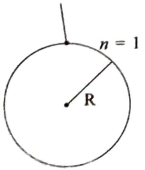
The magnetic field at the centre of a single-turn circular coil of a given length of wire carrying a current $I$ is $B$. If the same wire is bent into a circular coil of two turns and the same current $I$ is passed through it,the new magnetic field at the centre will be:
A
$\frac{B}{2}$
B
$16B$
C
$4B$
D
$\frac{B}{4}$
Solution
(C) Let the total length of the wire be $L$.
For a single-turn coil $(n_1 = 1)$,the circumference is $L = 2\pi R_1$,so $R_1 = \frac{L}{2\pi}$.
The magnetic field at the centre is $B_1 = \frac{\mu_0 I}{2R_1} = \frac{\mu_0 I}{2(L/2\pi)} = \frac{\mu_0 I \pi}{L} = B$.
For a two-turn coil $(n_2 = 2)$,the total length $L = n_2(2\pi R_2) = 2(2\pi R_2) = 4\pi R_2$.
Thus,the new radius is $R_2 = \frac{L}{4\pi} = \frac{R_1}{2}$.
The magnetic field at the centre for $n$ turns is $B_n = \frac{n \mu_0 I}{2R_n}$.
For $n=2$,$B_2 = \frac{2 \mu_0 I}{2R_2} = \frac{\mu_0 I}{R_2}$.
Substituting $R_2 = \frac{R_1}{2}$,we get $B_2 = \frac{\mu_0 I}{R_1/2} = \frac{2 \mu_0 I}{R_1}$.
Since $B = \frac{\mu_0 I}{2R_1}$,we have $\frac{\mu_0 I}{R_1} = 2B$.
Therefore,$B_2 = 2(2B) = 4B$.
For a single-turn coil $(n_1 = 1)$,the circumference is $L = 2\pi R_1$,so $R_1 = \frac{L}{2\pi}$.
The magnetic field at the centre is $B_1 = \frac{\mu_0 I}{2R_1} = \frac{\mu_0 I}{2(L/2\pi)} = \frac{\mu_0 I \pi}{L} = B$.
For a two-turn coil $(n_2 = 2)$,the total length $L = n_2(2\pi R_2) = 2(2\pi R_2) = 4\pi R_2$.
Thus,the new radius is $R_2 = \frac{L}{4\pi} = \frac{R_1}{2}$.
The magnetic field at the centre for $n$ turns is $B_n = \frac{n \mu_0 I}{2R_n}$.
For $n=2$,$B_2 = \frac{2 \mu_0 I}{2R_2} = \frac{\mu_0 I}{R_2}$.
Substituting $R_2 = \frac{R_1}{2}$,we get $B_2 = \frac{\mu_0 I}{R_1/2} = \frac{2 \mu_0 I}{R_1}$.
Since $B = \frac{\mu_0 I}{2R_1}$,we have $\frac{\mu_0 I}{R_1} = 2B$.
Therefore,$B_2 = 2(2B) = 4B$.
0 likes
View Solution115
EasyMCQ
$A$ closely wound solenoid of $1000$ turns and area of cross-section $2 \times 10^{-4} \ m^2$ carrying a current of $5.0 \ A$. The magnetic moment is . . . . . . $A \ m^2$.
A
$4$
B
$3$
C
$2$
D
$1$
Solution
(D) Given:
Number of turns,$N = 1000$
Area of cross-section,$A = 2 \times 10^{-4} \ m^2$
Current,$I = 5.0 \ A$
The magnetic moment $\mu$ of a solenoid is given by the formula:
$\mu = N \cdot I \cdot A$
Substituting the given values:
$\mu = 1000 \times 5.0 \times (2 \times 10^{-4})$
$\mu = 5000 \times 2 \times 10^{-4}$
$\mu = 10000 \times 10^{-4}$
$\mu = 1 \ A \ m^2$
Therefore,the correct option is $D$.
Number of turns,$N = 1000$
Area of cross-section,$A = 2 \times 10^{-4} \ m^2$
Current,$I = 5.0 \ A$
The magnetic moment $\mu$ of a solenoid is given by the formula:
$\mu = N \cdot I \cdot A$
Substituting the given values:
$\mu = 1000 \times 5.0 \times (2 \times 10^{-4})$
$\mu = 5000 \times 2 \times 10^{-4}$
$\mu = 10000 \times 10^{-4}$
$\mu = 1 \ A \ m^2$
Therefore,the correct option is $D$.
0 likes
View Solution116
MediumMCQ
$A$ circular coil of radius $10 \text{ cm}$ and $100$ turns carries a current of $1 \text{ A}$. What is the magnetic moment of the coil?
A
$3.142 \times 10^{4} \text{ A m}^{2}$
B
$10^{4} \text{ A m}^{2}$
C
$3.142 \text{ A m}^{2}$
D
$3 \text{ A m}^{2}$
Solution
(C) Given: Radius of the coil $r = 10 \text{ cm} = 0.1 \text{ m}$.
Number of turns $N = 100$.
Current $I = 1 \text{ A}$.
The magnetic moment $M$ of a current-carrying coil is given by the formula $M = N I A$,where $A$ is the area of the coil.
The area $A = \pi r^{2} = \pi \times (0.1 \text{ m})^{2} = 0.01 \pi \text{ m}^{2}$.
Substituting the values into the formula:
$M = 100 \times 1 \times (0.01 \times 3.142) \text{ A m}^{2}$.
$M = 100 \times 0.03142 \text{ A m}^{2} = 3.142 \text{ A m}^{2}$.
Thus,the magnetic moment of the coil is $3.142 \text{ A m}^{2}$.
Number of turns $N = 100$.
Current $I = 1 \text{ A}$.
The magnetic moment $M$ of a current-carrying coil is given by the formula $M = N I A$,where $A$ is the area of the coil.
The area $A = \pi r^{2} = \pi \times (0.1 \text{ m})^{2} = 0.01 \pi \text{ m}^{2}$.
Substituting the values into the formula:
$M = 100 \times 1 \times (0.01 \times 3.142) \text{ A m}^{2}$.
$M = 100 \times 0.03142 \text{ A m}^{2} = 3.142 \text{ A m}^{2}$.
Thus,the magnetic moment of the coil is $3.142 \text{ A m}^{2}$.
0 likes
View Solution117
EasyMCQ
The magnetic dipole moment of a current loop is independent of
A
magnetic field in which it is lying
B
number of turns
C
area of the loop
D
current in the loop
Solution
(A) The magnetic dipole moment $M$ of a current loop is given by the formula:
$M = NIA$
where:
$N$ is the number of turns in the loop,
$I$ is the current flowing through the loop,
$A$ is the area of the loop.
From this relation,it is evident that the magnetic dipole moment depends only on the properties of the loop itself $(N, I, A)$ and is independent of the external magnetic field in which the loop is placed.
$M = NIA$
where:
$N$ is the number of turns in the loop,
$I$ is the current flowing through the loop,
$A$ is the area of the loop.
From this relation,it is evident that the magnetic dipole moment depends only on the properties of the loop itself $(N, I, A)$ and is independent of the external magnetic field in which the loop is placed.
0 likes
View Solution118
EasyMCQ
Curl the palm of your right hand around the circular wire with the fingers pointing in the direction of current and the thumb gives the direction of the magnetic field. In this case,the upper side of the loop may be thought of as
A
direction of current
B
direction of electric field
C
south pole
D
north pole
Solution
(D) According to the Right-Hand Thumb Rule for a circular current-carrying loop,if the fingers of the right hand are curled in the direction of the current,the thumb points in the direction of the magnetic field lines inside the loop.
If the current flows in an anticlockwise direction when viewed from the top,the magnetic field lines point upwards (towards the observer).
Since magnetic field lines emerge from the North Pole,the face of the loop where the current appears anticlockwise acts as a North Pole.
Conversely,if the current flows in a clockwise direction,the face acts as a South Pole.
Therefore,the upper side of the loop acts as a North Pole if the current is anticlockwise.
If the current flows in an anticlockwise direction when viewed from the top,the magnetic field lines point upwards (towards the observer).
Since magnetic field lines emerge from the North Pole,the face of the loop where the current appears anticlockwise acts as a North Pole.
Conversely,if the current flows in a clockwise direction,the face acts as a South Pole.
Therefore,the upper side of the loop acts as a North Pole if the current is anticlockwise.
0 likes
View Solution119
MediumMCQ
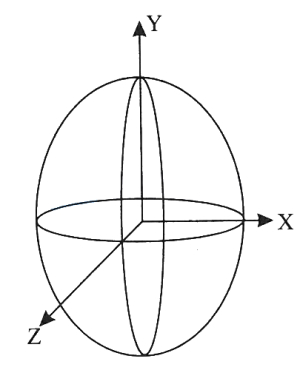
Three rings,each with equal radius '$r$',are placed mutually perpendicular to each other,and each has its centre at the origin of the coordinate system. '$I$' is the current passing through each ring. The magnetic field value at the common centre is
A
zero
B
$(\sqrt{3}-1) \frac{\mu_0 I}{2 \pi r}$
C
$\sqrt{3} \frac{\mu_0 I}{2 r}$
D
$\sqrt{2} \frac{\mu_0 I}{2 r}$
Solution
(C) The magnetic field at the centre of a circular current-carrying ring is given by $B = \frac{\mu_0 I}{2r}$.
Since the three rings are mutually perpendicular and centered at the origin,their magnetic field vectors will be directed along the $x$,$y$,and $z$ axes respectively.
Thus,the magnetic field vectors are:
$\vec{B_1} = \frac{\mu_0 I}{2r} \hat{i}$
$\vec{B_2} = \frac{\mu_0 I}{2r} \hat{j}$
$\vec{B_3} = \frac{\mu_0 I}{2r} \hat{k}$
The resultant magnetic field $\vec{B_0}$ at the origin is the vector sum of these fields:
$\vec{B_0} = \vec{B_1} + \vec{B_2} + \vec{B_3} = \frac{\mu_0 I}{2r} (\hat{i} + \hat{j} + \hat{k})$
The magnitude of the resultant magnetic field is:
$B_0 = |\vec{B_0}| = \frac{\mu_0 I}{2r} \sqrt{1^2 + 1^2 + 1^2}$
$B_0 = \frac{\mu_0 I}{2r} \sqrt{3} = \sqrt{3} \frac{\mu_0 I}{2r}$
Since the three rings are mutually perpendicular and centered at the origin,their magnetic field vectors will be directed along the $x$,$y$,and $z$ axes respectively.
Thus,the magnetic field vectors are:
$\vec{B_1} = \frac{\mu_0 I}{2r} \hat{i}$
$\vec{B_2} = \frac{\mu_0 I}{2r} \hat{j}$
$\vec{B_3} = \frac{\mu_0 I}{2r} \hat{k}$
The resultant magnetic field $\vec{B_0}$ at the origin is the vector sum of these fields:
$\vec{B_0} = \vec{B_1} + \vec{B_2} + \vec{B_3} = \frac{\mu_0 I}{2r} (\hat{i} + \hat{j} + \hat{k})$
The magnitude of the resultant magnetic field is:
$B_0 = |\vec{B_0}| = \frac{\mu_0 I}{2r} \sqrt{1^2 + 1^2 + 1^2}$
$B_0 = \frac{\mu_0 I}{2r} \sqrt{3} = \sqrt{3} \frac{\mu_0 I}{2r}$
0 likes
View Solution120
MediumMCQ
The magnetic moment of an electron moving in a circular orbit of radius $R$ with a time period $T$ is
A
$\frac{2 \pi Re}{T}$
B
$\frac{\pi eR}{T}$
C
$\frac{\pi e R^2}{T}$
D
$\pi R^2 eT$
Solution
(C) The magnetic moment $M$ of a current loop is given by $M = I A$,where $I$ is the current and $A$ is the area of the loop.
For an electron moving in a circular orbit of radius $R$ with time period $T$,the equivalent current $I$ is the charge $e$ flowing per unit time $T$,so $I = \frac{e}{T}$.
The area of the circular orbit is $A = \pi R^2$.
Substituting these values into the formula for magnetic moment,we get $M = I A = \left( \frac{e}{T} \right) (\pi R^2) = \frac{\pi e R^2}{T}$.
For an electron moving in a circular orbit of radius $R$ with time period $T$,the equivalent current $I$ is the charge $e$ flowing per unit time $T$,so $I = \frac{e}{T}$.
The area of the circular orbit is $A = \pi R^2$.
Substituting these values into the formula for magnetic moment,we get $M = I A = \left( \frac{e}{T} \right) (\pi R^2) = \frac{\pi e R^2}{T}$.
0 likes
View Solution121
MediumMCQ
If a current of $15 \,A$ passes through a solenoid of length $25 \,cm$,radius $2 \,cm$ and number of turns $500$,then the magnetic moment of the solenoid is
A
$6 \,J \,T^{-1}$
B
$3 \,J \,T^{-1}$
C
$3 \pi \,J \,T^{-1}$
D
$6 \pi \,J \,T^{-1}$
Solution
(C) The magnetic moment $M$ of a solenoid is given by the formula $M = N \cdot I \cdot A$,where $N$ is the number of turns,$I$ is the current,and $A$ is the cross-sectional area of the solenoid.
Given:
Number of turns $N = 500$
Current $I = 15 \,A$
Radius $r = 2 \,cm = 0.02 \,m$
Area $A = \pi r^2 = \pi (0.02)^2 = 0.0004 \pi \,m^2$
Substituting these values into the formula:
$M = 500 \times 15 \times 0.0004 \pi$
$M = 7500 \times 0.0004 \pi$
$M = 3 \pi \,J \,T^{-1}$
Therefore,the correct option is $C$.
Given:
Number of turns $N = 500$
Current $I = 15 \,A$
Radius $r = 2 \,cm = 0.02 \,m$
Area $A = \pi r^2 = \pi (0.02)^2 = 0.0004 \pi \,m^2$
Substituting these values into the formula:
$M = 500 \times 15 \times 0.0004 \pi$
$M = 7500 \times 0.0004 \pi$
$M = 3 \pi \,J \,T^{-1}$
Therefore,the correct option is $C$.
0 likes
View Solution122
EasyMCQ
$A$ wire of length $L \ m$ carrying a current $I \ A$ is bent in the form of a circle. The magnitude of its magnetic moment is
A
$\frac{L^2 I^2}{4 \pi}$
B
$\frac{L^2 I}{4 \pi}$
C
$\frac{L I}{4 \pi}$
D
$\frac{L I^2}{4 \pi}$
Solution
(B) The magnetic moment $M$ of a current loop is given by the product of the current $I$ and the area $A$ of the loop,$M = I A$.
When a wire of length $L$ is bent into a circle,its circumference is $2 \pi r = L$,which implies the radius $r = \frac{L}{2 \pi}$.
The area of this circular loop is $A = \pi r^2 = \pi \left( \frac{L}{2 \pi} \right)^2 = \frac{L^2}{4 \pi}$.
Substituting the area into the magnetic moment formula,we get $M = I \times \frac{L^2}{4 \pi} = \frac{L^2 I}{4 \pi}$.
When a wire of length $L$ is bent into a circle,its circumference is $2 \pi r = L$,which implies the radius $r = \frac{L}{2 \pi}$.
The area of this circular loop is $A = \pi r^2 = \pi \left( \frac{L}{2 \pi} \right)^2 = \frac{L^2}{4 \pi}$.
Substituting the area into the magnetic moment formula,we get $M = I \times \frac{L^2}{4 \pi} = \frac{L^2 I}{4 \pi}$.
0 likes
View Solution123
DifficultMCQ
$A$ straight wire carrying current $i$ is turned into a circular loop. If the magnitude of the magnetic moment associated with it in $MKS$ units is $M$,the length of the wire will be
A
$4 \pi i M$
B
$\sqrt{\frac{4 \pi M}{i}}$
C
$\sqrt{\frac{4 \pi i}{M}}$
D
$\frac{M \pi}{4 i}$
Solution
(B) Let $l$ be the length of the wire.
When the wire is bent into a circular loop of radius $r$,the circumference is equal to the length of the wire:
$l = 2 \pi r \Rightarrow r = \frac{l}{2 \pi}$
The magnetic dipole moment $M$ of a current loop is given by:
$M = i A$
Substituting the area $A = \pi r^2$:
$M = i \cdot \pi r^2 = i \pi \left( \frac{l}{2 \pi} \right)^2$
$M = i \pi \cdot \frac{l^2}{4 \pi^2} = \frac{i l^2}{4 \pi}$
Rearranging for $l$:
$l^2 = \frac{4 \pi M}{i}$
$l = \sqrt{\frac{4 \pi M}{i}}$
When the wire is bent into a circular loop of radius $r$,the circumference is equal to the length of the wire:
$l = 2 \pi r \Rightarrow r = \frac{l}{2 \pi}$
The magnetic dipole moment $M$ of a current loop is given by:
$M = i A$
Substituting the area $A = \pi r^2$:
$M = i \cdot \pi r^2 = i \pi \left( \frac{l}{2 \pi} \right)^2$
$M = i \pi \cdot \frac{l^2}{4 \pi^2} = \frac{i l^2}{4 \pi}$
Rearranging for $l$:
$l^2 = \frac{4 \pi M}{i}$
$l = \sqrt{\frac{4 \pi M}{i}}$
0 likes
View Solution124
EasyMCQ
Magnetic field at the centre of a circular loop of area $A$ is $B$. Then the magnetic moment of the loop is ($\mu_0$ is the permeability of free space).
A
$\frac{B A^2}{\mu_0 \pi}$
B
$\frac{B A \sqrt{A}}{\mu_0}$
C
$\frac{B A \sqrt{A}}{\mu_0 \pi}$
D
$\frac{2 B A \sqrt{A}}{\mu_0 \sqrt{\pi}}$
Solution
(D) The magnetic field $B$ at the centre of a circular loop of radius $R$ carrying current $i$ is given by:
$B = \frac{\mu_0 i}{2 R}$ ...$(i)$
The magnetic moment $M$ of the loop is given by:
$M = i A$ ...(ii)
From equation $(i)$,we can express the current $i$ as:
$i = \frac{2 B R}{\mu_0}$
Substitute this into equation (ii):
$M = \left( \frac{2 B R}{\mu_0} \right) A$
Since the area of the loop is $A = \pi R^2$,we have $R = \sqrt{\frac{A}{\pi}}$.
Substituting $R$ into the expression for $M$:
$M = \frac{2 B A}{\mu_0} \sqrt{\frac{A}{\pi}}$
$M = \frac{2 B A \sqrt{A}}{\mu_0 \sqrt{\pi}}$
Therefore,the correct option is $D$.
$B = \frac{\mu_0 i}{2 R}$ ...$(i)$
The magnetic moment $M$ of the loop is given by:
$M = i A$ ...(ii)
From equation $(i)$,we can express the current $i$ as:
$i = \frac{2 B R}{\mu_0}$
Substitute this into equation (ii):
$M = \left( \frac{2 B R}{\mu_0} \right) A$
Since the area of the loop is $A = \pi R^2$,we have $R = \sqrt{\frac{A}{\pi}}$.
Substituting $R$ into the expression for $M$:
$M = \frac{2 B A}{\mu_0} \sqrt{\frac{A}{\pi}}$
$M = \frac{2 B A \sqrt{A}}{\mu_0 \sqrt{\pi}}$
Therefore,the correct option is $D$.
0 likes
View Solution125
DifficultMCQ
$A$ charge $q$ is spread uniformly over an isolated ring of radius $R$. The ring is rotated about its natural axis with an angular velocity $\omega$. Magnetic dipole moment of the ring is
A
$\frac{q \omega R^2}{2}$
B
$\frac{q \omega R}{2}$
C
$q \omega R^2$
D
$\frac{q \omega}{2R}$
Solution
(A) The magnetic dipole moment $M$ is given by $M = i A$,where $i$ is the current and $A$ is the area of the ring.
Since the charge $q$ is rotating with angular velocity $\omega$,the time period of one revolution is $T = \frac{2 \pi}{\omega}$.
The equivalent current $i$ is given by $i = \frac{q}{T} = \frac{q \omega}{2 \pi}$.
The area of the ring is $A = \pi R^2$.
Substituting these values into the formula for $M$:
$M = \left( \frac{q \omega}{2 \pi} \right) (\pi R^2) = \frac{1}{2} q \omega R^2$.
Since the charge $q$ is rotating with angular velocity $\omega$,the time period of one revolution is $T = \frac{2 \pi}{\omega}$.
The equivalent current $i$ is given by $i = \frac{q}{T} = \frac{q \omega}{2 \pi}$.
The area of the ring is $A = \pi R^2$.
Substituting these values into the formula for $M$:
$M = \left( \frac{q \omega}{2 \pi} \right) (\pi R^2) = \frac{1}{2} q \omega R^2$.
0 likes
View Solution126
EasyMCQ
$A$ circular loop and a square loop are formed from two wires of same length and cross-section. The same current is passed through them. The ratio of their dipole moments is
A
$4$
B
$\frac{2}{\pi}$
C
$2$
D
$\frac{4}{\pi}$
Solution
(D) Let the length of the wire be $L$.
For the circular loop,the circumference is $2 \pi r = L$,so $r = \frac{L}{2 \pi}$. The area is $A_1 = \pi r^2 = \pi (\frac{L}{2 \pi})^2 = \frac{L^2}{4 \pi}$.
For the square loop,the perimeter is $4a = L$,so $a = \frac{L}{4}$. The area is $A_2 = a^2 = (\frac{L}{4})^2 = \frac{L^2}{16}$.
The magnetic dipole moment is $M = iA$.
Since the current $i$ is the same,the ratio of the dipole moments is $\frac{M_1}{M_2} = \frac{i A_1}{i A_2} = \frac{A_1}{A_2}$.
Substituting the areas: $\frac{M_1}{M_2} = \frac{L^2 / 4 \pi}{L^2 / 16} = \frac{16}{4 \pi} = \frac{4}{\pi}$.
For the circular loop,the circumference is $2 \pi r = L$,so $r = \frac{L}{2 \pi}$. The area is $A_1 = \pi r^2 = \pi (\frac{L}{2 \pi})^2 = \frac{L^2}{4 \pi}$.
For the square loop,the perimeter is $4a = L$,so $a = \frac{L}{4}$. The area is $A_2 = a^2 = (\frac{L}{4})^2 = \frac{L^2}{16}$.
The magnetic dipole moment is $M = iA$.
Since the current $i$ is the same,the ratio of the dipole moments is $\frac{M_1}{M_2} = \frac{i A_1}{i A_2} = \frac{A_1}{A_2}$.
Substituting the areas: $\frac{M_1}{M_2} = \frac{L^2 / 4 \pi}{L^2 / 16} = \frac{16}{4 \pi} = \frac{4}{\pi}$.
0 likes
View Solution127
MediumMCQ
The number of turns of two circular coils $A$ and $B$ are $300$ and $200$ respectively. The magnetic moments of the two coils $A$ and $B$ are in the ratio $1:2$. If the two coils carry equal currents,then the ratio of radii of coils $A$ and $B$ is
A
$2: \sqrt{3}$
B
$2: 3$
C
$1: 2$
D
$1: \sqrt{3}$
Solution
(D) The magnetic moment $M$ of a circular coil is given by the formula $M = NIA$,where $N$ is the number of turns,$I$ is the current,and $A$ is the area of the coil.
Since the coil is circular,the area $A = \pi r^2$,where $r$ is the radius of the coil.
Thus,$M = NI(\pi r^2)$.
Given for coil $A$: $N_A = 300$,$M_A = M_1$,$r_A = r_1$.
Given for coil $B$: $N_B = 200$,$M_B = M_2$,$r_B = r_2$.
We are given $M_A / M_B = 1/2$ and $I_A = I_B = I$.
Taking the ratio of the magnetic moments:
$\frac{M_A}{M_B} = \frac{N_A I_A \pi r_A^2}{N_B I_B \pi r_B^2} = \frac{N_A}{N_B} \cdot \left(\frac{r_A}{r_B}\right)^2$.
Substituting the known values:
$\frac{1}{2} = \frac{300}{200} \cdot \left(\frac{r_A}{r_B}\right)^2$.
$\frac{1}{2} = \frac{3}{2} \cdot \left(\frac{r_A}{r_B}\right)^2$.
$\left(\frac{r_A}{r_B}\right)^2 = \frac{1}{2} \cdot \frac{2}{3} = \frac{1}{3}$.
Therefore,$\frac{r_A}{r_B} = \frac{1}{\sqrt{3}}$.
Since the coil is circular,the area $A = \pi r^2$,where $r$ is the radius of the coil.
Thus,$M = NI(\pi r^2)$.
Given for coil $A$: $N_A = 300$,$M_A = M_1$,$r_A = r_1$.
Given for coil $B$: $N_B = 200$,$M_B = M_2$,$r_B = r_2$.
We are given $M_A / M_B = 1/2$ and $I_A = I_B = I$.
Taking the ratio of the magnetic moments:
$\frac{M_A}{M_B} = \frac{N_A I_A \pi r_A^2}{N_B I_B \pi r_B^2} = \frac{N_A}{N_B} \cdot \left(\frac{r_A}{r_B}\right)^2$.
Substituting the known values:
$\frac{1}{2} = \frac{300}{200} \cdot \left(\frac{r_A}{r_B}\right)^2$.
$\frac{1}{2} = \frac{3}{2} \cdot \left(\frac{r_A}{r_B}\right)^2$.
$\left(\frac{r_A}{r_B}\right)^2 = \frac{1}{2} \cdot \frac{2}{3} = \frac{1}{3}$.
Therefore,$\frac{r_A}{r_B} = \frac{1}{\sqrt{3}}$.
0 likes
View Solution128
EasyMCQ
$A$ circular coil of area $2 \,cm^2$ has $1000$ turns. If the current through the coil is $1 \,A$, then its magnetic moment is (in $\,Am^2$)
A
$4$
B
$0.2$
C
$0.4$
D
$2$
Solution
(B) Given:
Area of coil, $A = 2 \,cm^2 = 2 \times 10^{-4} \,m^2$
Number of turns, $n = 1000$
Current, $I = 1 \,A$
The magnetic moment $M$ of a current-carrying coil is given by the formula:
$M = nIA$
Substituting the given values:
$M = (1000) \times (1) \times (2 \times 10^{-4})$
$M = 10^3 \times 2 \times 10^{-4}$
$M = 2 \times 10^{-1} \,Am^2$
$M = 0.2 \,Am^2$
Therefore, the magnetic moment is $0.2 \,Am^2$.
Area of coil, $A = 2 \,cm^2 = 2 \times 10^{-4} \,m^2$
Number of turns, $n = 1000$
Current, $I = 1 \,A$
The magnetic moment $M$ of a current-carrying coil is given by the formula:
$M = nIA$
Substituting the given values:
$M = (1000) \times (1) \times (2 \times 10^{-4})$
$M = 10^3 \times 2 \times 10^{-4}$
$M = 2 \times 10^{-1} \,Am^2$
$M = 0.2 \,Am^2$
Therefore, the magnetic moment is $0.2 \,Am^2$.
0 likes
View Solution129
EasyMCQ
$A$ current $i$ is flowing through a wire of length $L$. If it is made into a circular loop of one turn,then its magnetic moment is
A
$\frac{L^2 i}{4 \pi}$
B
$\frac{L^2}{4 \pi}$
C
$\frac{4 \pi}{L^2 i}$
D
$4 \pi L^2 i$
Solution
(A) The length of the wire $L$ forms the circumference of the circular loop,so $L = 2 \pi r$,where $r$ is the radius of the loop.
From this,the radius is $r = \frac{L}{2 \pi}$.
The magnetic moment $M$ of a current-carrying loop is given by $M = iA$,where $A$ is the area of the loop.
The area $A = \pi r^2 = \pi \left( \frac{L}{2 \pi} \right)^2 = \pi \left( \frac{L^2}{4 \pi^2} \right) = \frac{L^2}{4 \pi}$.
Substituting this into the formula for magnetic moment,we get $M = i \times \frac{L^2}{4 \pi} = \frac{i L^2}{4 \pi}$.
From this,the radius is $r = \frac{L}{2 \pi}$.
The magnetic moment $M$ of a current-carrying loop is given by $M = iA$,where $A$ is the area of the loop.
The area $A = \pi r^2 = \pi \left( \frac{L}{2 \pi} \right)^2 = \pi \left( \frac{L^2}{4 \pi^2} \right) = \frac{L^2}{4 \pi}$.
Substituting this into the formula for magnetic moment,we get $M = i \times \frac{L^2}{4 \pi} = \frac{i L^2}{4 \pi}$.
0 likes
View Solution130
EasyMCQ
$A$ particle of mass $m$ and charge $Q$ moving with a speed $v$ in a circular path of radius $R$ has a magnetic moment $\mu$. If the mass of the particle is doubled and it maintains the same speed while revolving in the same circular path,then the magnetic moment will be
A
doubled
B
halved
C
tripled
D
unchanged
Solution
(D) The magnetic moment $\mu$ of a particle with charge $Q$ moving in a circular path of radius $R$ with speed $v$ is given by the formula:
$\mu = I A$
Where $I$ is the equivalent current,$I = \frac{Q}{T} = \frac{Q v}{2 \pi R}$,and $A$ is the area of the circular path,$A = \pi R^2$.
Substituting these values,we get:
$\mu = \left( \frac{Q v}{2 \pi R} \right) (\pi R^2) = \frac{Q v R}{2}$
From this expression,it is clear that the magnetic moment $\mu$ depends only on the charge $Q$,speed $v$,and radius $R$.
Since the mass $m$ of the particle does not appear in the formula for the magnetic moment,changing the mass while keeping $Q$,$v$,and $R$ constant will not affect the magnetic moment.
Therefore,the magnetic moment remains unchanged.
$\mu = I A$
Where $I$ is the equivalent current,$I = \frac{Q}{T} = \frac{Q v}{2 \pi R}$,and $A$ is the area of the circular path,$A = \pi R^2$.
Substituting these values,we get:
$\mu = \left( \frac{Q v}{2 \pi R} \right) (\pi R^2) = \frac{Q v R}{2}$
From this expression,it is clear that the magnetic moment $\mu$ depends only on the charge $Q$,speed $v$,and radius $R$.
Since the mass $m$ of the particle does not appear in the formula for the magnetic moment,changing the mass while keeping $Q$,$v$,and $R$ constant will not affect the magnetic moment.
Therefore,the magnetic moment remains unchanged.
0 likes
View Solution131
DifficultMCQ
Magnetic induction at the centre of a circular loop of area $\pi \ m^2$ is $0.1 \ T$. The magnetic moment of the loop is ( $\mu_0 = \text{permeability of air}$ ).
A
$\frac{0.1 \pi}{\mu_0}$
B
$\frac{0.2 \pi}{\mu_0}$
C
$\frac{0.3 \pi}{\mu_0}$
D
$\frac{0.4 \pi}{\mu_0}$
Solution
(B) The magnetic induction $B$ at the centre of a circular loop with $n$ turns and radius $r$ carrying current $i$ is given by:
$B = \frac{\mu_0 n i}{2r}$
From this, we can express the current as:
$i = \frac{2 B r}{\mu_0 n}$
The magnetic moment $M$ of the loop is defined as:
$M = n i A$
Substituting the expression for $i$:
$M = n \left( \frac{2 B r}{\mu_0 n} \right) A = \frac{2 B r A}{\mu_0}$
Given area $A = \pi \ m^2$, we know $A = \pi r^2$, so $\pi r^2 = \pi$, which implies $r = 1 \ m$.
Substituting the values $B = 0.1 \ T$, $r = 1 \ m$, and $A = \pi \ m^2$:
$M = \frac{2 \times 0.1 \times 1 \times \pi}{\mu_0} = \frac{0.2 \pi}{\mu_0}$
$B = \frac{\mu_0 n i}{2r}$
From this, we can express the current as:
$i = \frac{2 B r}{\mu_0 n}$
The magnetic moment $M$ of the loop is defined as:
$M = n i A$
Substituting the expression for $i$:
$M = n \left( \frac{2 B r}{\mu_0 n} \right) A = \frac{2 B r A}{\mu_0}$
Given area $A = \pi \ m^2$, we know $A = \pi r^2$, so $\pi r^2 = \pi$, which implies $r = 1 \ m$.
Substituting the values $B = 0.1 \ T$, $r = 1 \ m$, and $A = \pi \ m^2$:
$M = \frac{2 \times 0.1 \times 1 \times \pi}{\mu_0} = \frac{0.2 \pi}{\mu_0}$
0 likes
View Solution132
EasyMCQ
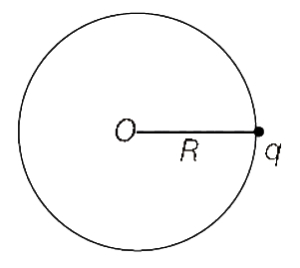
$A$ charged particle (charge $= q$; mass $= m$) is rotating in a circle of radius $R$ with uniform speed $V$. The ratio of its magnetic moment $(\mu)$ to the angular momentum $(L)$ is:
A
$\frac{q}{2m}$
B
$\frac{q}{m}$
C
$\frac{q}{4m}$
D
$\frac{2q}{m}$
Solution
(A) The magnetic moment $(\mu)$ of a current loop is given by $\mu = iA$,where $i$ is the current and $A$ is the area of the loop.
For a particle of charge $q$ moving with speed $V$ in a circle of radius $R$,the time period $T$ is $T = \frac{2\pi R}{V}$.
The equivalent current is $i = \frac{q}{T} = \frac{qV}{2\pi R}$.
The area of the circle is $A = \pi R^2$.
Thus,$\mu = iA = \left(\frac{qV}{2\pi R}\right) \times (\pi R^2) = \frac{qVR}{2}$.
The angular momentum $(L)$ of the particle about the center of the circle is $L = mVR$.
Taking the ratio of magnetic moment to angular momentum:
$\frac{\mu}{L} = \frac{qVR / 2}{mVR} = \frac{q}{2m}$.
For a particle of charge $q$ moving with speed $V$ in a circle of radius $R$,the time period $T$ is $T = \frac{2\pi R}{V}$.
The equivalent current is $i = \frac{q}{T} = \frac{qV}{2\pi R}$.
The area of the circle is $A = \pi R^2$.
Thus,$\mu = iA = \left(\frac{qV}{2\pi R}\right) \times (\pi R^2) = \frac{qVR}{2}$.
The angular momentum $(L)$ of the particle about the center of the circle is $L = mVR$.
Taking the ratio of magnetic moment to angular momentum:
$\frac{\mu}{L} = \frac{qVR / 2}{mVR} = \frac{q}{2m}$.
0 likes
View Solution133
EasyMCQ
$A$ small bar magnet experiences a torque of $0.016 \ Nm$ when placed with its axis at $30^{\circ}$ with an external magnetic field of $0.04 \ T$. If the bar magnet is replaced by a solenoid of cross-sectional area $1 \ cm^2$ and $1000$ turns,having the same magnetic moment as that of the bar magnet,then the current flowing through the solenoid is: (in $A$)
A
$2$
B
$4$
C
$6$
D
$8$
Solution
(D) Given: Torque $\tau = 0.016 \ Nm$,angle $\theta = 30^{\circ}$,and magnetic field $B = 0.04 \ T$.
The torque on a magnetic dipole is given by $\tau = mB \sin \theta$.
Substituting the values: $0.016 = m \times 0.04 \times \sin 30^{\circ}$.
Since $\sin 30^{\circ} = 0.5$,we have $0.016 = m \times 0.04 \times 0.5 = m \times 0.02$.
Thus,the magnetic moment $m = \frac{0.016}{0.02} = 0.8 \ Am^2$.
For a solenoid,the magnetic moment is $m = NIA$.
Given: Area $A = 1 \ cm^2 = 10^{-4} \ m^2$ and number of turns $N = 1000$.
Equating the magnetic moments: $0.8 = 1000 \times I \times 10^{-4}$.
$0.8 = 0.1 \times I$.
Therefore,the current $I = \frac{0.8}{0.1} = 8 \ A$.
The torque on a magnetic dipole is given by $\tau = mB \sin \theta$.
Substituting the values: $0.016 = m \times 0.04 \times \sin 30^{\circ}$.
Since $\sin 30^{\circ} = 0.5$,we have $0.016 = m \times 0.04 \times 0.5 = m \times 0.02$.
Thus,the magnetic moment $m = \frac{0.016}{0.02} = 0.8 \ Am^2$.
For a solenoid,the magnetic moment is $m = NIA$.
Given: Area $A = 1 \ cm^2 = 10^{-4} \ m^2$ and number of turns $N = 1000$.
Equating the magnetic moments: $0.8 = 1000 \times I \times 10^{-4}$.
$0.8 = 0.1 \times I$.
Therefore,the current $I = \frac{0.8}{0.1} = 8 \ A$.
0 likes
View Solution134
MediumMCQ
The ratio of the magnetic field and the magnetic moment at the centre of a current-carrying circular loop is $x$. When both the current and the radius are doubled,the ratio will be:
A
$x / 8$
B
$x / 4$
C
$x / 2$
D
$2 x$
Solution
(A) The magnetic field $B$ at the centre of a circular loop of radius $a$ carrying current $I$ is given by $B = \frac{\mu_0 I}{2a}$.
The magnetic moment $M$ of the loop is given by $M = I A = I(\pi a^2)$.
The ratio $x$ is given by:
$x = \frac{B}{M} = \frac{\mu_0 I}{2a} \times \frac{1}{I \pi a^2} = \frac{\mu_0}{2 \pi a^3}$.
When the current $I$ is doubled $(I' = 2I)$ and the radius $a$ is doubled $(a' = 2a)$,the new ratio $x'$ is:
$x' = \frac{\mu_0}{2 \pi (a')^3} = \frac{\mu_0}{2 \pi (2a)^3} = \frac{\mu_0}{2 \pi (8a^3)} = \frac{1}{8} \left( \frac{\mu_0}{2 \pi a^3} \right) = \frac{x}{8}$.
The magnetic moment $M$ of the loop is given by $M = I A = I(\pi a^2)$.
The ratio $x$ is given by:
$x = \frac{B}{M} = \frac{\mu_0 I}{2a} \times \frac{1}{I \pi a^2} = \frac{\mu_0}{2 \pi a^3}$.
When the current $I$ is doubled $(I' = 2I)$ and the radius $a$ is doubled $(a' = 2a)$,the new ratio $x'$ is:
$x' = \frac{\mu_0}{2 \pi (a')^3} = \frac{\mu_0}{2 \pi (2a)^3} = \frac{\mu_0}{2 \pi (8a^3)} = \frac{1}{8} \left( \frac{\mu_0}{2 \pi a^3} \right) = \frac{x}{8}$.
0 likes
View Solution135
EasyMCQ
An electron in a circular orbit of radius $0.05 \ nm$ performs $10^{16}$ revolutions per second. The magnetic moment due to this rotation of the electron is (in $A \ m^{2}$):
A
$2.16 \times 10^{-23}$
B
$3.21 \times 10^{-22}$
C
$3.21 \times 10^{-24}$
D
$1.26 \times 10^{-23}$
Solution
(D) Given:
Radius $r = 0.05 \ nm = 0.05 \times 10^{-9} \ m$
Frequency $f = 10^{16} \ Hz$ (revolutions per second)
Charge of electron $e = 1.6 \times 10^{-19} \ C$
The magnetic moment $M$ of a current loop is given by $M = I \times A$,where $I$ is the current and $A$ is the area of the loop.
The current $I$ due to the revolving electron is $I = e \times f$.
The area of the circular orbit is $A = \pi r^{2}$.
Substituting these into the formula for magnetic moment:
$M = (e \times f) \times (\pi r^{2})$
$M = (1.6 \times 10^{-19} \ C) \times (10^{16} \ s^{-1}) \times (3.14) \times (0.05 \times 10^{-9} \ m)^{2}$
$M = 1.6 \times 10^{-19} \times 10^{16} \times 3.14 \times 0.0025 \times 10^{-18}$
$M = 1.6 \times 3.14 \times 0.0025 \times 10^{-21} \ m^{2} \cdot C/s$
$M = 0.01256 \times 10^{-21} \ A \ m^{2}$
$M = 1.26 \times 10^{-23} \ A \ m^{2}$
Radius $r = 0.05 \ nm = 0.05 \times 10^{-9} \ m$
Frequency $f = 10^{16} \ Hz$ (revolutions per second)
Charge of electron $e = 1.6 \times 10^{-19} \ C$
The magnetic moment $M$ of a current loop is given by $M = I \times A$,where $I$ is the current and $A$ is the area of the loop.
The current $I$ due to the revolving electron is $I = e \times f$.
The area of the circular orbit is $A = \pi r^{2}$.
Substituting these into the formula for magnetic moment:
$M = (e \times f) \times (\pi r^{2})$
$M = (1.6 \times 10^{-19} \ C) \times (10^{16} \ s^{-1}) \times (3.14) \times (0.05 \times 10^{-9} \ m)^{2}$
$M = 1.6 \times 10^{-19} \times 10^{16} \times 3.14 \times 0.0025 \times 10^{-18}$
$M = 1.6 \times 3.14 \times 0.0025 \times 10^{-21} \ m^{2} \cdot C/s$
$M = 0.01256 \times 10^{-21} \ A \ m^{2}$
$M = 1.26 \times 10^{-23} \ A \ m^{2}$
0 likes
View Solution136
MediumMCQ
$A$ closely wound solenoid of $800$ turns and area of cross section $2.5 \times 10^{-4} \text{ m}^2$ carries a current of $3.0 \text{ A}$. The magnetic moment associated with it is . . . . . . . (in $\text{ JT}^{-1}$)
A
$60$
B
$0.60$
C
$6$
D
$0.06$
Solution
(B) The magnetic moment $m$ of a solenoid is given by the formula $m = N \cdot I \cdot A$.
Here,the number of turns $N = 800$,the current $I = 3.0 \text{ A}$,and the area of cross-section $A = 2.5 \times 10^{-4} \text{ m}^2$.
Substituting these values into the formula:
$m = 800 \times 3.0 \times 2.5 \times 10^{-4}$
$m = 2400 \times 2.5 \times 10^{-4}$
$m = 6000 \times 10^{-4}$
$m = 0.6 \text{ JT}^{-1}$.
Thus,the magnetic moment associated with the solenoid is $0.60 \text{ JT}^{-1}$.
Here,the number of turns $N = 800$,the current $I = 3.0 \text{ A}$,and the area of cross-section $A = 2.5 \times 10^{-4} \text{ m}^2$.
Substituting these values into the formula:
$m = 800 \times 3.0 \times 2.5 \times 10^{-4}$
$m = 2400 \times 2.5 \times 10^{-4}$
$m = 6000 \times 10^{-4}$
$m = 0.6 \text{ JT}^{-1}$.
Thus,the magnetic moment associated with the solenoid is $0.60 \text{ JT}^{-1}$.
0 likes
View Solution137
DifficultMCQ
An insulated wire is wound so that it forms a flat coil with $N = 200$ turns. The radius of the innermost turn is $r_1 = 3\text{ cm}$,and of the outermost turn $r_2 = 6\text{ cm}$. If $20\text{ mA}$ current flows in it,then the magnetic moment will be $\alpha \times 10^{-2}\text{ A.m}^2$. The value of $\alpha$ is . . . . . . .
A
$4.4$
B
$2.64$
C
$3.25$
D
$1.2$
Solution
(B) The magnetic moment $M$ of a coil is given by $M = N I A$. For a flat spiral coil where the turns are uniformly distributed between radii $r_1$ and $r_2$,the effective area $A$ is calculated by integrating the area of each turn: $A = \int_{r_1}^{r_2} \pi r^2 \frac{N}{r_2 - r_1} dr = \frac{N \pi}{r_2 - r_1} [\frac{r^3}{3}]_{r_1}^{r_2} = N \pi \frac{r_2^3 - r_1^3}{3(r_2 - r_1)} = N \pi \frac{r_1^2 + r_1 r_2 + r_2^2}{3}$.
Given $N = 200$,$r_1 = 0.03\text{ m}$,$r_2 = 0.06\text{ m}$,and $I = 20\text{ mA} = 0.02\text{ A}$.
Substituting these values: $M = 200 \times 0.02 \times \pi \times \frac{(0.03)^2 + (0.03)(0.06) + (0.06)^2}{3}$.
$M = 4 \times \pi \times \frac{0.0009 + 0.0018 + 0.0036}{3} = 4 \times \pi \times \frac{0.0063}{3} = 4 \times \pi \times 0.0021 = 0.0084 \times 3.14159 \approx 0.02639\text{ A.m}^2$.
This can be written as $2.639 \times 10^{-2}\text{ A.m}^2$. Rounding to two decimal places,$\alpha = 2.64$.
Given $N = 200$,$r_1 = 0.03\text{ m}$,$r_2 = 0.06\text{ m}$,and $I = 20\text{ mA} = 0.02\text{ A}$.
Substituting these values: $M = 200 \times 0.02 \times \pi \times \frac{(0.03)^2 + (0.03)(0.06) + (0.06)^2}{3}$.
$M = 4 \times \pi \times \frac{0.0009 + 0.0018 + 0.0036}{3} = 4 \times \pi \times \frac{0.0063}{3} = 4 \times \pi \times 0.0021 = 0.0084 \times 3.14159 \approx 0.02639\text{ A.m}^2$.
This can be written as $2.639 \times 10^{-2}\text{ A.m}^2$. Rounding to two decimal places,$\alpha = 2.64$.
0 likes
View Solution138
DifficultMCQ
$A$ $100$-turn closely wound circular coil of radius $5 \text{ cm}$ has a magnetic field of $3.14 \times 10^{-3} \text{ T}$ at its centre. The current flowing through the coil,and the magnitude of the magnetic moment of this coil are,respectively: (Take $\mu_0 = 4\pi \times 10^{-7} \text{ T m/A}$)
A
$2.5 \text{ A}, 20 \text{ A m}^2$
B
$2 \text{ A}, 4 \text{ A m}^2$
C
$2.5 \text{ A}, 2 \text{ A m}^2$
D
$2 \text{ A}, 10 \text{ A m}^2$
Solution
(C) The magnetic field $B$ at the centre of a circular coil is given by $B = \frac{\mu_0 N I}{2r}$.
Given: $B = 3.14 \times 10^{-3} \text{ T}$,$N = 100$,$r = 5 \text{ cm} = 0.05 \text{ m}$,$\mu_0 = 4\pi \times 10^{-7} \text{ T m/A}$.
Substituting the values: $3.14 \times 10^{-3} = \frac{4 \times 3.14 \times 10^{-7} \times 100 \times I}{2 \times 0.05}$.
$3.14 \times 10^{-3} = \frac{4 \times 3.14 \times 10^{-5} \times I}{0.1}$.
$10^{-3} = \frac{4 \times 10^{-5} \times I}{0.1} = 4 \times 10^{-4} \times I$.
$I = \frac{10^{-3}}{4 \times 10^{-4}} = \frac{10}{4} = 2.5 \text{ A}$.
The magnetic moment $M$ is given by $M = N I A = N I (\pi r^2)$.
$M = 100 \times 2.5 \times 3.14 \times (0.05)^2$.
$M = 250 \times 3.14 \times 0.0025 = 1.9625 \approx 2 \text{ A m}^2$.
Thus,the current is $2.5 \text{ A}$ and the magnetic moment is $2 \text{ A m}^2$.
Given: $B = 3.14 \times 10^{-3} \text{ T}$,$N = 100$,$r = 5 \text{ cm} = 0.05 \text{ m}$,$\mu_0 = 4\pi \times 10^{-7} \text{ T m/A}$.
Substituting the values: $3.14 \times 10^{-3} = \frac{4 \times 3.14 \times 10^{-7} \times 100 \times I}{2 \times 0.05}$.
$3.14 \times 10^{-3} = \frac{4 \times 3.14 \times 10^{-5} \times I}{0.1}$.
$10^{-3} = \frac{4 \times 10^{-5} \times I}{0.1} = 4 \times 10^{-4} \times I$.
$I = \frac{10^{-3}}{4 \times 10^{-4}} = \frac{10}{4} = 2.5 \text{ A}$.
The magnetic moment $M$ is given by $M = N I A = N I (\pi r^2)$.
$M = 100 \times 2.5 \times 3.14 \times (0.05)^2$.
$M = 250 \times 3.14 \times 0.0025 = 1.9625 \approx 2 \text{ A m}^2$.
Thus,the current is $2.5 \text{ A}$ and the magnetic moment is $2 \text{ A m}^2$.
0 likes
View SolutionMoving Charges and Magnetism — Magnetic Moment of Current Carrying Coil · Frequently Asked Questions
1Are these Moving Charges and Magnetism questions useful for JEE and NEET?
Yes. All questions in this section are mapped to JEE Main and NEET exam patterns. Previous year questions from JEE Main, NEET, GUJCET and state-level exams are included with full solutions.
2Can I switch to Hindi or Gujarati for these questions?
Yes. Use the language tabs in the hero section or the sidebar to view the same questions and solutions in English, Hindi or Gujarati.
3How do I generate a question paper from this subtopic?
Use the Vedclass Exam Paper Generator — select the chapter and subtopic, set difficulty, and generate Sets A, B, C, D automatically. First 3 chapters of every subject are free.
Vedclass Products
For Students
Vedclass Test Series
Mock tests in real JEE/NEET style with performance analysis. 5-day free trial.
Start Free TrialFor Teachers
Exam Paper Generator
Generate Set A/B/C/D papers from this chapter in 2 minutes. 3 chapters free.
Try FreeFor Institutes
Online Exam Module
Live online exams with unlimited students, 360° analytics & white-label branding.
See DemoFor Teachers & Institutes
Generate a Moving Charges and Magnetism Exam Paper in 2 Minutes
Select subtopic & difficulty — Sets A, B, C, D auto-generated with No Repeat logic.
First 3 chapters of every subject are free — no payment required.