
A English
Magnetic Equipment's (Tangent galvanometer, Vibration magnetometer and Neutral point) Questions in English
Class 12 Physics · Magnetism and Matter · Magnetic Equipment's (Tangent galvanometer, Vibration magnetometer and Neutral point)
192+
Questions
English
Language
100%
With Solutions
Showing 50 of 192 questions in English
1
EasyMCQ
The unit of the reduction factor of a tangent galvanometer is
A
Ampere
B
Gauss
C
Radian
D
None of these
Solution
(A) The principle of a tangent galvanometer is based on the tangent law, which states that $I = K \tan \theta$, where $I$ is the current, $\theta$ is the deflection, and $K$ is the reduction factor.
From this equation, $K = I / \tan \theta$.
Since $\tan \theta$ is a dimensionless quantity, the unit of the reduction factor $K$ is the same as the unit of current $I$.
Therefore, the unit of the reduction factor of a tangent galvanometer is Ampere $(A)$.
From this equation, $K = I / \tan \theta$.
Since $\tan \theta$ is a dimensionless quantity, the unit of the reduction factor $K$ is the same as the unit of current $I$.
Therefore, the unit of the reduction factor of a tangent galvanometer is Ampere $(A)$.
0 likes
View Solution2
EasyMCQ
The tangent galvanometer,when connected in series with a standard resistance,can be used as:
A
An ammeter
B
$A$ voltmeter
C
$A$ wattmeter
D
Both an ammeter and a voltmeter
Solution
(B) tangent galvanometer measures current based on the principle of the tangent law in magnetism. When a galvanometer is connected in series with a high standard resistance,the combination acts as a voltmeter. This is because the high resistance limits the current flowing through the circuit,allowing the device to measure the potential difference across the combination,which is proportional to the current flowing through it according to Ohm's law $(V = IR)$. Therefore,the correct option is $B$.
0 likes
View Solution3
MediumMCQ
At neutral temperature,the thermoelectric power $\left( \frac{dE}{dT} \right)$ has the value:
A
Zero
B
Maximum but negative
C
Maximum but positive
D
Minimum but positive
Solution
(A) The thermoelectric electromotive force $(E)$ in a thermocouple is given by the relation $E = \alpha \theta + \frac{1}{2} \beta \theta^2$,where $\theta$ is the temperature difference between the junctions.
Thermoelectric power is defined as the rate of change of thermoelectric $EMF$ with respect to temperature,given by $P = \frac{dE}{dT}$.
At the neutral temperature $(T_n)$,the thermoelectric $EMF$ reaches its maximum value.
Since the $EMF$ is maximum at the neutral temperature,its derivative with respect to temperature must be zero at that point.
Therefore,$\frac{dE}{dT} = 0$ at the neutral temperature.
Thermoelectric power is defined as the rate of change of thermoelectric $EMF$ with respect to temperature,given by $P = \frac{dE}{dT}$.
At the neutral temperature $(T_n)$,the thermoelectric $EMF$ reaches its maximum value.
Since the $EMF$ is maximum at the neutral temperature,its derivative with respect to temperature must be zero at that point.
Therefore,$\frac{dE}{dT} = 0$ at the neutral temperature.
0 likes
View Solution4
EasyMCQ
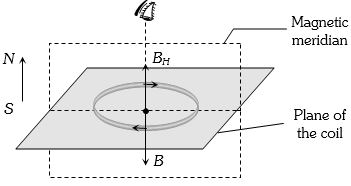
$A$ neutral point is obtained at the centre of a vertical circular coil carrying current. The angle between the plane of the coil and the magnetic meridian is.......$^o$
A
$0$
B
$45$
C
$60$
D
$90$
Solution
(D) The magnetic meridian is a vertical $N-S$ plane,and the Earth's horizontal magnetic field component $(B_H)$ lies within it.
To obtain a neutral point at the centre of the coil,the magnetic field produced by the current in the coil $(B)$ must be equal in magnitude and opposite in direction to the Earth's horizontal magnetic field $(B_H)$.
The magnetic field $(B)$ at the centre of a circular coil is perpendicular to the plane of the coil.
For $(B)$ to be opposite to $(B_H)$,the magnetic field $(B)$ must lie in the magnetic meridian plane.
Since $(B)$ is perpendicular to the plane of the coil,the plane of the coil must be perpendicular to the magnetic meridian plane. Therefore,the angle between the plane of the coil and the magnetic meridian is $90^o$.
To obtain a neutral point at the centre of the coil,the magnetic field produced by the current in the coil $(B)$ must be equal in magnitude and opposite in direction to the Earth's horizontal magnetic field $(B_H)$.
The magnetic field $(B)$ at the centre of a circular coil is perpendicular to the plane of the coil.
For $(B)$ to be opposite to $(B_H)$,the magnetic field $(B)$ must lie in the magnetic meridian plane.
Since $(B)$ is perpendicular to the plane of the coil,the plane of the coil must be perpendicular to the magnetic meridian plane. Therefore,the angle between the plane of the coil and the magnetic meridian is $90^o$.
0 likes
View Solution5
MediumMCQ
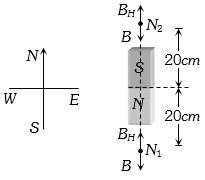
$A$ very small magnet is placed in the magnetic meridian with its south pole pointing north. The null point is obtained $20 \, cm$ away from the centre of the magnet. If the earth's magnetic field (horizontal component) at this point is $0.3 \, gauss$,the magnetic moment of the magnet is:
A
$8.0 \times 10^2 \, e.m.u.$
B
$1.2 \times 10^3 \, e.m.u.$
C
$2.4 \times 10^3 \, e.m.u.$
D
$3.6 \times 10^3 \, e.m.u.$
Solution
(B) When a magnet is placed with its south pole pointing towards the geographic north,the null points are located on the axial line of the magnet.
For a short magnet,the magnetic field $B$ on its axial line at a distance $d$ from its center is given by $B = \frac{2M}{d^3}$,where $M$ is the magnetic moment.
At the null point,the magnetic field of the magnet is equal and opposite to the horizontal component of the Earth's magnetic field $(B_H)$.
Given: $d = 20 \, cm$,$B_H = 0.3 \, gauss$.
Equating the fields: $\frac{2M}{d^3} = B_H$.
Substituting the values: $\frac{2M}{(20)^3} = 0.3$.
$\frac{2M}{8000} = 0.3$.
$2M = 0.3 \times 8000 = 2400$.
$M = 1200 \, e.m.u. = 1.2 \times 10^3 \, e.m.u.$
For a short magnet,the magnetic field $B$ on its axial line at a distance $d$ from its center is given by $B = \frac{2M}{d^3}$,where $M$ is the magnetic moment.
At the null point,the magnetic field of the magnet is equal and opposite to the horizontal component of the Earth's magnetic field $(B_H)$.
Given: $d = 20 \, cm$,$B_H = 0.3 \, gauss$.
Equating the fields: $\frac{2M}{d^3} = B_H$.
Substituting the values: $\frac{2M}{(20)^3} = 0.3$.
$\frac{2M}{8000} = 0.3$.
$2M = 0.3 \times 8000 = 2400$.
$M = 1200 \, e.m.u. = 1.2 \times 10^3 \, e.m.u.$
0 likes
View Solution6
EasyMCQ
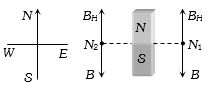
$A$ bar magnet is placed in the north-south direction with its north pole pointing towards the geographic north. In which direction from the center of the magnet will the points of zero magnetic field (neutral points) be located?
A
North and south
B
East and west
C
North-east and south-west
D
North-west and south-east
Solution
(B) When a bar magnet is placed with its north pole pointing towards the geographic north,the magnetic field lines due to the magnet are directed from north to south outside the magnet. The horizontal component of the Earth's magnetic field $(B_H)$ is directed from geographic south to geographic north.
At the equatorial line (broadside-on position) of the magnet,the magnetic field due to the magnet is directed from north to south,which is opposite to the direction of the Earth's horizontal magnetic field.
At certain points on the equatorial line,the magnitude of the magnetic field due to the magnet exactly cancels the horizontal component of the Earth's magnetic field. These points are called neutral points.
Therefore,the neutral points lie on the equatorial line,which corresponds to the east and west directions from the center of the magnet.
At the equatorial line (broadside-on position) of the magnet,the magnetic field due to the magnet is directed from north to south,which is opposite to the direction of the Earth's horizontal magnetic field.
At certain points on the equatorial line,the magnitude of the magnetic field due to the magnet exactly cancels the horizontal component of the Earth's magnetic field. These points are called neutral points.
Therefore,the neutral points lie on the equatorial line,which corresponds to the east and west directions from the center of the magnet.
0 likes
View Solution7
MediumMCQ
In two separate experiments,the neutral points due to two small magnets are at a distance of $r$ and $2r$ in the broadside-on position. The ratio of their magnetic moments will be:
A
$4:1$
B
$1:2$
C
$2:1$
D
$1:8$
Solution
(D) The magnetic field $B$ at a distance $d$ on the equatorial line (broadside-on position) of a short bar magnet is given by $B = \frac{\mu_0}{4\pi} \frac{M}{d^3}$.
At the neutral point,the magnetic field of the magnet is equal and opposite to the horizontal component of the Earth's magnetic field $(B_H)$.
Thus,$\frac{\mu_0}{4\pi} \frac{M_1}{r^3} = B_H$ and $\frac{\mu_0}{4\pi} \frac{M_2}{(2r)^3} = B_H$.
Equating the two expressions: $\frac{M_1}{r^3} = \frac{M_2}{8r^3}$.
Therefore,the ratio of the magnetic moments is $\frac{M_1}{M_2} = \frac{r^3}{8r^3} = \frac{1}{8}$.
At the neutral point,the magnetic field of the magnet is equal and opposite to the horizontal component of the Earth's magnetic field $(B_H)$.
Thus,$\frac{\mu_0}{4\pi} \frac{M_1}{r^3} = B_H$ and $\frac{\mu_0}{4\pi} \frac{M_2}{(2r)^3} = B_H$.
Equating the two expressions: $\frac{M_1}{r^3} = \frac{M_2}{8r^3}$.
Therefore,the ratio of the magnetic moments is $\frac{M_1}{M_2} = \frac{r^3}{8r^3} = \frac{1}{8}$.
0 likes
View Solution8
EasyMCQ
When the $N$-pole of a bar magnet points towards the geographic south and the $S$-pole points towards the geographic north,the null points are located at the:
A
Magnetic axis
B
Magnetic centre
C
Perpendicular bisector of the magnetic axis
D
$N$ and $S$ poles
Solution
(C) When the $N$-pole of a bar magnet points towards the geographic south and the $S$-pole points towards the geographic north,the magnetic field lines of the magnet and the horizontal component of the Earth's magnetic field $(B_H)$ are in the same direction along the axial line.
However,along the equatorial line (the perpendicular bisector of the magnetic axis),the magnetic field of the bar magnet is directed opposite to the Earth's horizontal magnetic field $(B_H)$.
$A$ null point (or neutral point) is defined as a point where the net magnetic field is zero,meaning the magnetic field of the bar magnet is equal in magnitude and opposite in direction to the Earth's horizontal magnetic field.
Therefore,the null points are located on the perpendicular bisector of the magnetic axis.
However,along the equatorial line (the perpendicular bisector of the magnetic axis),the magnetic field of the bar magnet is directed opposite to the Earth's horizontal magnetic field $(B_H)$.
$A$ null point (or neutral point) is defined as a point where the net magnetic field is zero,meaning the magnetic field of the bar magnet is equal in magnitude and opposite in direction to the Earth's horizontal magnetic field.
Therefore,the null points are located on the perpendicular bisector of the magnetic axis.
0 likes
View Solution9
MediumMCQ
$A$ short magnet of magnetic moment $6.75 \, Am^2$ produces a neutral point on its axis. If the horizontal component of the Earth's magnetic field is $5 \times 10^{-5} \, Wb/m^2$, then the distance of the neutral point from the center of the magnet is.....$cm$.
A
$10$
B
$20$
C
$30$
D
$40$
Solution
(C) At the neutral point, the magnetic field produced by the magnet is equal in magnitude and opposite in direction to the horizontal component of the Earth's magnetic field.
For a point on the axial line of a short bar magnet, the magnetic field $B$ is given by:
$B = \frac{\mu_0}{4\pi} \cdot \frac{2M}{d^3}$
Given:
Magnetic moment $M = 6.75 \, Am^2$
Horizontal component of Earth's magnetic field $B_H = 5 \times 10^{-5} \, Wb/m^2$
$\frac{\mu_0}{4\pi} = 10^{-7} \, T \cdot m/A$
Equating the fields:
$10^{-7} \times \frac{2 \times 6.75}{d^3} = 5 \times 10^{-5}$
$\frac{13.5 \times 10^{-7}}{d^3} = 5 \times 10^{-5}$
$d^3 = \frac{13.5 \times 10^{-7}}{5 \times 10^{-5}} = 2.7 \times 10^{-2} = 0.027 \, m^3$
$d = \sqrt[3]{0.027} = 0.3 \, m$
Converting to centimeters: $d = 0.3 \times 100 = 30 \, cm$.
For a point on the axial line of a short bar magnet, the magnetic field $B$ is given by:
$B = \frac{\mu_0}{4\pi} \cdot \frac{2M}{d^3}$
Given:
Magnetic moment $M = 6.75 \, Am^2$
Horizontal component of Earth's magnetic field $B_H = 5 \times 10^{-5} \, Wb/m^2$
$\frac{\mu_0}{4\pi} = 10^{-7} \, T \cdot m/A$
Equating the fields:
$10^{-7} \times \frac{2 \times 6.75}{d^3} = 5 \times 10^{-5}$
$\frac{13.5 \times 10^{-7}}{d^3} = 5 \times 10^{-5}$
$d^3 = \frac{13.5 \times 10^{-7}}{5 \times 10^{-5}} = 2.7 \times 10^{-2} = 0.027 \, m^3$
$d = \sqrt[3]{0.027} = 0.3 \, m$
Converting to centimeters: $d = 0.3 \times 100 = 30 \, cm$.
0 likes
View Solution10
EasyMCQ
$A$ bar magnet is placed on a table along the east-west direction in the Earth's magnetic field. The number of neutral points,where the magnetic field is zero,is
A
$2$
B
$0$
C
$1$
D
$4$
Solution
(B) When a bar magnet is placed with its axis along the east-west direction,its North pole points towards the East (or West) and its South pole points towards the West (or East).
In this configuration,the magnetic field of the magnet and the horizontal component of the Earth's magnetic field $(B_H)$ are perpendicular to each other at all points on the equatorial line of the magnet.
Since the magnetic field of the magnet and the Earth's magnetic field are never in opposite directions along the same line,they cannot cancel each other out to produce a zero magnetic field.
Therefore,there are no neutral points in this orientation.
In this configuration,the magnetic field of the magnet and the horizontal component of the Earth's magnetic field $(B_H)$ are perpendicular to each other at all points on the equatorial line of the magnet.
Since the magnetic field of the magnet and the Earth's magnetic field are never in opposite directions along the same line,they cannot cancel each other out to produce a zero magnetic field.
Therefore,there are no neutral points in this orientation.
0 likes
View Solution11
MediumMCQ
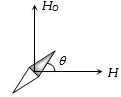
$A$ current-carrying coil is placed with its axis perpendicular to the $N-S$ direction. Let the horizontal component of the Earth's magnetic field be $H_0$ and the magnetic field inside the loop be $H$. If a magnet is suspended inside the loop,it makes an angle $\theta$ with $H$. Then $\theta =$
A
$\tan^{-1}\left(\frac{H_0}{H}\right)$
B
$\tan^{-1}\left(\frac{H}{H_0}\right)$
C
$\csc^{-1}\left(\frac{H}{H_0}\right)$
D
$\cot^{-1}\left(\frac{H_0}{H}\right)$
Solution
(A) In the given case,the magnetic field $H$ produced by the coil and the horizontal component of the Earth's magnetic field $H_0$ are perpendicular to each other.
When a magnetic needle is placed in two mutually perpendicular magnetic fields $H$ and $H_0$,it aligns itself along the resultant magnetic field.
From the geometry of the vector addition,we can form a right-angled triangle where the base is $H$ and the perpendicular side is $H_0$.
The angle $\theta$ that the magnet makes with $H$ is given by the trigonometric relation:
$\tan \theta = \frac{\text{Perpendicular}}{\text{Base}} = \frac{H_0}{H}$
Therefore,$\theta = \tan^{-1}\left(\frac{H_0}{H}\right)$.
When a magnetic needle is placed in two mutually perpendicular magnetic fields $H$ and $H_0$,it aligns itself along the resultant magnetic field.
From the geometry of the vector addition,we can form a right-angled triangle where the base is $H$ and the perpendicular side is $H_0$.
The angle $\theta$ that the magnet makes with $H$ is given by the trigonometric relation:
$\tan \theta = \frac{\text{Perpendicular}}{\text{Base}} = \frac{H_0}{H}$
Therefore,$\theta = \tan^{-1}\left(\frac{H_0}{H}\right)$.
0 likes
View Solution12
EasyMCQ
If magnetic lines of force are drawn by keeping a magnet vertical,then the number of neutral points will be
A
$1$
B
$2$
C
$4$
D
$5$
Solution
(A) Neutral points are points in space where the compass needle does not point in any specific direction. Such points are obtained when the magnetic field due to the magnet and the Earth's magnetic field cancel each other out.
If a magnet is kept vertical,only one pole of the magnet is near the plane of the paper (magnetic meridian).
Consequently,only one point where the resultant magnetic field is zero lies in the plane of the paper.
If a magnet is kept vertical,only one pole of the magnet is near the plane of the paper (magnetic meridian).
Consequently,only one point where the resultant magnetic field is zero lies in the plane of the paper.
0 likes
View Solution13
EasyMCQ
Time period of a freely suspended magnet does not depend upon
A
Length of the magnet
B
Pole strength of the magnet
C
Horizontal component of earth's magnetic field
D
Length of the suspension thread
Solution
(D) The time period $T$ of a freely suspended magnet in a uniform magnetic field is given by the formula:
$T = 2 \pi \sqrt{\frac{I}{MH}}$
Where:
$I$ is the moment of inertia of the magnet about the axis of suspension.
$M$ is the magnetic dipole moment of the magnet.
$H$ is the horizontal component of the Earth's magnetic field.
From the formula,we can see that the time period $T$ depends on the moment of inertia $(I)$,the magnetic moment $(M)$,and the horizontal component of the Earth's magnetic field $(H)$.
It does not depend on the length of the suspension thread. Therefore,option $(d)$ is correct.
$T = 2 \pi \sqrt{\frac{I}{MH}}$
Where:
$I$ is the moment of inertia of the magnet about the axis of suspension.
$M$ is the magnetic dipole moment of the magnet.
$H$ is the horizontal component of the Earth's magnetic field.
From the formula,we can see that the time period $T$ depends on the moment of inertia $(I)$,the magnetic moment $(M)$,and the horizontal component of the Earth's magnetic field $(H)$.
It does not depend on the length of the suspension thread. Therefore,option $(d)$ is correct.
0 likes
View Solution14
EasyMCQ
Magnetic moments of two bar magnets may be compared with the help of
A
Deflection magnetometer
B
Vibration magnetometer
C
Both of the above
D
None of the above
Solution
(C) The magnetic moments of two bar magnets can be compared using a Deflection magnetometer by measuring the deflection of the magnetic needle in different positions (Tan-$A$ or Tan-$B$).
Alternatively,they can be compared using a Vibration magnetometer by measuring the time period of oscillations of the magnets in a uniform magnetic field,where the ratio of magnetic moments is inversely proportional to the square of the time periods $(M_1/M_2 = T_2^2/T_1^2)$.
Alternatively,they can be compared using a Vibration magnetometer by measuring the time period of oscillations of the magnets in a uniform magnetic field,where the ratio of magnetic moments is inversely proportional to the square of the time periods $(M_1/M_2 = T_2^2/T_1^2)$.
0 likes
View Solution15
EasyMCQ
The time period of oscillation of a freely suspended bar magnet with usual notations is given by
A
$T = 2\pi \sqrt{\frac{I}{M B_H}}$
B
$T = 2\pi \sqrt{\frac{M B_H}{I}}$
C
$T = \sqrt{\frac{I}{M B_H}}$
D
$T = 2\pi \sqrt{\frac{B_H}{MI}}$
Solution
(A) freely suspended bar magnet in a uniform magnetic field $B_H$ experiences a restoring torque $\tau = -M B_H \sin \theta$.
For small oscillations,$\sin \theta \approx \theta$,so $\tau = -M B_H \theta$.
The equation of motion is $I \alpha = \tau$,where $I$ is the moment of inertia and $\alpha$ is the angular acceleration.
$I \frac{d^2 \theta}{dt^2} = -M B_H \theta$.
This is the equation of simple harmonic motion $\frac{d^2 \theta}{dt^2} + \omega^2 \theta = 0$,where $\omega^2 = \frac{M B_H}{I}$.
The time period $T$ is given by $T = \frac{2\pi}{\omega} = 2\pi \sqrt{\frac{I}{M B_H}}$.
For small oscillations,$\sin \theta \approx \theta$,so $\tau = -M B_H \theta$.
The equation of motion is $I \alpha = \tau$,where $I$ is the moment of inertia and $\alpha$ is the angular acceleration.
$I \frac{d^2 \theta}{dt^2} = -M B_H \theta$.
This is the equation of simple harmonic motion $\frac{d^2 \theta}{dt^2} + \omega^2 \theta = 0$,where $\omega^2 = \frac{M B_H}{I}$.
The time period $T$ is given by $T = \frac{2\pi}{\omega} = 2\pi \sqrt{\frac{I}{M B_H}}$.
0 likes
View Solution16
EasyMCQ
In the sum and difference method of a vibration magnetometer,the time period is greater if:
A
Similar poles of both magnets are on the same side.
B
Opposite poles of both magnets are on the same side.
C
Both magnets are perpendicular to each other.
D
Nothing can be said.
Solution
(B) In the sum position,the time period is given by $T_S = 2\pi \sqrt{\frac{I_1 + I_2}{(M_1 + M_2)B_H}}$.
In the difference position,the time period is given by $T_d = 2\pi \sqrt{\frac{I_1 + I_2}{(M_1 - M_2)B_H}}$.
Since the denominator in the difference position $(M_1 - M_2)$ is smaller than the denominator in the sum position $(M_1 + M_2)$,the time period $T_d$ is greater than $T_S$.
The difference position occurs when opposite poles of the two magnets are placed on the same side,resulting in a net magnetic moment of $(M_1 - M_2)$.
In the difference position,the time period is given by $T_d = 2\pi \sqrt{\frac{I_1 + I_2}{(M_1 - M_2)B_H}}$.
Since the denominator in the difference position $(M_1 - M_2)$ is smaller than the denominator in the sum position $(M_1 + M_2)$,the time period $T_d$ is greater than $T_S$.
The difference position occurs when opposite poles of the two magnets are placed on the same side,resulting in a net magnetic moment of $(M_1 - M_2)$.
0 likes
View Solution17
MediumMCQ
At a certain place,a magnet makes $30$ oscillations per minute. At another place where the magnetic field is double,its time period will be:
A
$4 \, \text{sec}$
B
$2 \, \text{sec}$
C
$\frac{1}{2} \, \text{sec}$
D
$\sqrt{2} \, \text{sec}$
Solution
(D) The time period of a magnetic dipole oscillating in a magnetic field is given by $T = 2\pi \sqrt{\frac{I}{MB_H}}$.
This implies $T \propto \frac{1}{\sqrt{B_H}}$.
Given at the first place,$n_1 = 30 \, \text{oscillations/min} = 0.5 \, \text{Hz}$.
Thus,the time period $T_1 = \frac{1}{n_1} = \frac{1}{0.5} = 2 \, \text{sec}$.
Let the magnetic field at the first place be $B_H$. Then at the second place,the magnetic field is $2B_H$.
Using the relation $\frac{T_2}{T_1} = \sqrt{\frac{B_{H1}}{B_{H2}}}$,we get:
$T_2 = T_1 \sqrt{\frac{B_H}{2B_H}} = 2 \times \frac{1}{\sqrt{2}} = \sqrt{2} \, \text{sec}$.
This implies $T \propto \frac{1}{\sqrt{B_H}}$.
Given at the first place,$n_1 = 30 \, \text{oscillations/min} = 0.5 \, \text{Hz}$.
Thus,the time period $T_1 = \frac{1}{n_1} = \frac{1}{0.5} = 2 \, \text{sec}$.
Let the magnetic field at the first place be $B_H$. Then at the second place,the magnetic field is $2B_H$.
Using the relation $\frac{T_2}{T_1} = \sqrt{\frac{B_{H1}}{B_{H2}}}$,we get:
$T_2 = T_1 \sqrt{\frac{B_H}{2B_H}} = 2 \times \frac{1}{\sqrt{2}} = \sqrt{2} \, \text{sec}$.
0 likes
View Solution18
EasyMCQ
Vibration magnetometer is used for comparing
A
Magnetic fields
B
Earth's field
C
Magnetic moments
D
All of the above
Solution
(D) vibration magnetometer is a device used to compare the magnetic moments $(M)$ of two magnets and the horizontal components of magnetic fields $(B_H)$.
It operates on the principle that when a freely suspended magnet in a uniform magnetic field is slightly disturbed from its equilibrium position, it performs simple harmonic oscillations about its mean position.
The time period of oscillation is given by $T = 2\pi \sqrt{\frac{I}{MB_H}}$, where $I$ is the moment of inertia of the magnet.
By measuring the time period, one can compare the magnetic moments of different magnets or the strengths of different magnetic fields.
It operates on the principle that when a freely suspended magnet in a uniform magnetic field is slightly disturbed from its equilibrium position, it performs simple harmonic oscillations about its mean position.
The time period of oscillation is given by $T = 2\pi \sqrt{\frac{I}{MB_H}}$, where $I$ is the moment of inertia of the magnet.
By measuring the time period, one can compare the magnetic moments of different magnets or the strengths of different magnetic fields.
0 likes
View Solution19
MediumMCQ
Two magnets of same size and mass make respectively $10$ and $15$ oscillations per minute at a certain place. The ratio of their magnetic moments is
A
$4:9$
B
$9:4$
C
$2:3$
D
$3:2$
Solution
(A) The time period of an oscillating magnet in a magnetic field is given by $T = 2\pi \sqrt{\frac{I}{MB_H}}$,where $I$ is the moment of inertia,$M$ is the magnetic moment,and $B_H$ is the horizontal component of the Earth's magnetic field.
Since the magnets have the same size and mass,their moment of inertia $I$ is the same.
Thus,$T \propto \frac{1}{\sqrt{M}}$,which implies $M \propto \frac{1}{T^2}$.
Given the frequency $f_1 = 10 \text{ oscillations/min}$ and $f_2 = 15 \text{ oscillations/min}$,the time periods are $T_1 = \frac{60}{10} = 6 \text{ s}$ and $T_2 = \frac{60}{15} = 4 \text{ s}$.
The ratio of the magnetic moments is $\frac{M_1}{M_2} = \frac{T_2^2}{T_1^2} = \left(\frac{4}{6}\right)^2 = \left(\frac{2}{3}\right)^2 = \frac{4}{9}$.
Since the magnets have the same size and mass,their moment of inertia $I$ is the same.
Thus,$T \propto \frac{1}{\sqrt{M}}$,which implies $M \propto \frac{1}{T^2}$.
Given the frequency $f_1 = 10 \text{ oscillations/min}$ and $f_2 = 15 \text{ oscillations/min}$,the time periods are $T_1 = \frac{60}{10} = 6 \text{ s}$ and $T_2 = \frac{60}{15} = 4 \text{ s}$.
The ratio of the magnetic moments is $\frac{M_1}{M_2} = \frac{T_2^2}{T_1^2} = \left(\frac{4}{6}\right)^2 = \left(\frac{2}{3}\right)^2 = \frac{4}{9}$.
0 likes
View Solution20
DifficultMCQ
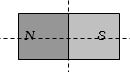
The time period of a magnet is $T$. If it is divided into four equal parts along its axis and perpendicular to its axis as shown,then the time period for each part will be
A
$4T$
B
$T/4$
C
$T/2$
D
$T$
Solution
(C) The time period of an oscillating magnet is given by $T = 2\pi \sqrt{\frac{I}{MB_H}}$,where $I$ is the moment of inertia,$M$ is the magnetic moment,and $B_H$ is the horizontal component of the magnetic field.
When the magnet is cut into four equal parts (two along the axis and two perpendicular to the axis),for each part:
The new pole strength $m' = \frac{m}{2}$ and the new length $l' = \frac{l}{2}$.
The new magnetic moment $M' = m' \times l' = \frac{m}{2} \times \frac{l}{2} = \frac{M}{4}$.
The new mass $w' = \frac{w}{4}$.
The new moment of inertia $I' = \frac{w' (l')^2}{12} = \frac{(w/4) (l/2)^2}{12} = \frac{1}{16} \times \frac{wl^2}{12} = \frac{I}{16}$.
Substituting these into the formula for the new time period $T'$:
$T' = 2\pi \sqrt{\frac{I'}{M'B_H}} = 2\pi \sqrt{\frac{I/16}{(M/4)B_H}} = 2\pi \sqrt{\frac{I}{4MB_H}} = \frac{1}{2} \times 2\pi \sqrt{\frac{I}{MB_H}} = \frac{T}{2}$.
When the magnet is cut into four equal parts (two along the axis and two perpendicular to the axis),for each part:
The new pole strength $m' = \frac{m}{2}$ and the new length $l' = \frac{l}{2}$.
The new magnetic moment $M' = m' \times l' = \frac{m}{2} \times \frac{l}{2} = \frac{M}{4}$.
The new mass $w' = \frac{w}{4}$.
The new moment of inertia $I' = \frac{w' (l')^2}{12} = \frac{(w/4) (l/2)^2}{12} = \frac{1}{16} \times \frac{wl^2}{12} = \frac{I}{16}$.
Substituting these into the formula for the new time period $T'$:
$T' = 2\pi \sqrt{\frac{I'}{M'B_H}} = 2\pi \sqrt{\frac{I/16}{(M/4)B_H}} = 2\pi \sqrt{\frac{I}{4MB_H}} = \frac{1}{2} \times 2\pi \sqrt{\frac{I}{MB_H}} = \frac{T}{2}$.
0 likes
View Solution21
EasyMCQ
When two magnets of equal pole strength and length are placed with their dissimilar poles on the same side,what will be their time period?
A
Zero
B
One second
C
Infinity
D
Any value
Solution
(C) The time period $T$ of a vibration magnetometer for two magnets placed in a magnetic field is given by the formula:
$T = 2\pi \sqrt{\frac{I_1 + I_2}{(M_1 + M_2)B_H}}$ for like poles together,and $T = 2\pi \sqrt{\frac{I_1 + I_2}{(M_1 - M_2)B_H}}$ for dissimilar poles together.
Given that the magnets have equal pole strength and length,their magnetic moments are equal,i.e.,$M_1 = M_2 = M$.
Substituting this into the formula for dissimilar poles:
$T = 2\pi \sqrt{\frac{I_1 + I_2}{(M - M)B_H}} = 2\pi \sqrt{\frac{I_1 + I_2}{0 \cdot B_H}} = 2\pi \sqrt{\infty}$.
Therefore,the time period $T = \infty$.
$T = 2\pi \sqrt{\frac{I_1 + I_2}{(M_1 + M_2)B_H}}$ for like poles together,and $T = 2\pi \sqrt{\frac{I_1 + I_2}{(M_1 - M_2)B_H}}$ for dissimilar poles together.
Given that the magnets have equal pole strength and length,their magnetic moments are equal,i.e.,$M_1 = M_2 = M$.
Substituting this into the formula for dissimilar poles:
$T = 2\pi \sqrt{\frac{I_1 + I_2}{(M - M)B_H}} = 2\pi \sqrt{\frac{I_1 + I_2}{0 \cdot B_H}} = 2\pi \sqrt{\infty}$.
Therefore,the time period $T = \infty$.
0 likes
View Solution22
EasyMCQ
The time period in a vibration magnetometer will be infinity at
A
Magnetic equator
B
Magnetic poles
C
Equator
D
At all places
Solution
(B) The time period $T$ of a vibration magnetometer is given by the formula: $T = 2\pi \sqrt{\frac{I}{MB_H}}$,where $I$ is the moment of inertia,$M$ is the magnetic moment,and $B_H$ is the horizontal component of the Earth's magnetic field.
At the magnetic poles,the horizontal component of the Earth's magnetic field $B_H$ is zero.
Substituting $B_H = 0$ into the formula,we get $T = 2\pi \sqrt{\frac{I}{M \times 0}} = \infty$.
Therefore,the time period becomes infinity at the magnetic poles.
At the magnetic poles,the horizontal component of the Earth's magnetic field $B_H$ is zero.
Substituting $B_H = 0$ into the formula,we get $T = 2\pi \sqrt{\frac{I}{M \times 0}} = \infty$.
Therefore,the time period becomes infinity at the magnetic poles.
0 likes
View Solution23
EasyMCQ
Twists of suspension fibre should be removed in a vibration magnetometer so that:
A
Time period be less
B
Time period be more
C
Magnet may vibrate freely
D
Cannot be said with certainty
Solution
(C) In a vibration magnetometer,the magnet is suspended such that it oscillates under the influence of an external magnetic field. The time period of oscillation is given by $T = 2\pi \sqrt{\frac{I}{MH}}$,where $I$ is the moment of inertia,$M$ is the magnetic moment,and $H$ is the horizontal component of the Earth's magnetic field.
If there are twists in the suspension fibre,an additional restoring torque is introduced due to the elasticity of the fibre. This increases the effective restoring force,which decreases the time period of oscillation.
Therefore,to ensure the magnet oscillates solely due to the magnetic torque (i.e.,to measure the true time period),the twists in the suspension fibre must be removed so that the magnet may vibrate freely without the influence of the fibre's torsional constant.
If there are twists in the suspension fibre,an additional restoring torque is introduced due to the elasticity of the fibre. This increases the effective restoring force,which decreases the time period of oscillation.
Therefore,to ensure the magnet oscillates solely due to the magnetic torque (i.e.,to measure the true time period),the twists in the suspension fibre must be removed so that the magnet may vibrate freely without the influence of the fibre's torsional constant.
0 likes
View Solution24
EasyMCQ
The period of oscillation of a magnet in a vibration magnetometer is $2 \, s$. The period of oscillation of a magnet whose magnetic moment is four times that of the first magnet is ... $s$.
A
$1$
B
$4$
C
$8$
D
$0.5$
Solution
(A) The time period of oscillation of a magnet in a vibration magnetometer is given by the formula $T = 2\pi \sqrt{\frac{I}{MB}}$,where $I$ is the moment of inertia,$M$ is the magnetic moment,and $B$ is the magnetic field.
From this formula,we can see that $T \propto \frac{1}{\sqrt{M}}$.
Therefore,the ratio of the time periods is $\frac{T_1}{T_2} = \sqrt{\frac{M_2}{M_1}}$.
Given $T_1 = 2 \, s$ and $M_2 = 4M_1$.
Substituting these values,we get $\frac{2}{T_2} = \sqrt{\frac{4M_1}{M_1}} = \sqrt{4} = 2$.
Solving for $T_2$,we get $T_2 = \frac{2}{2} = 1 \, s$.
From this formula,we can see that $T \propto \frac{1}{\sqrt{M}}$.
Therefore,the ratio of the time periods is $\frac{T_1}{T_2} = \sqrt{\frac{M_2}{M_1}}$.
Given $T_1 = 2 \, s$ and $M_2 = 4M_1$.
Substituting these values,we get $\frac{2}{T_2} = \sqrt{\frac{4M_1}{M_1}} = \sqrt{4} = 2$.
Solving for $T_2$,we get $T_2 = \frac{2}{2} = 1 \, s$.
0 likes
View Solution25
DifficultMCQ
The moment of inertia of a magnetic needle is $40 \, g \cdot cm^2$ and it has a time period of $3 \, s$ in the Earth's horizontal magnetic field of $3.6 \times 10^{-5} \, Wb/m^2$. Its magnetic moment will be (in $A \cdot m^2$):
A
$0.5$
B
$5$
C
$0.250$
D
$5 \times 10^2$
Solution
(A) The time period of an oscillating magnetic needle is given by $T = 2\pi \sqrt{\frac{I}{MB_H}}$.
Given:
$I = 40 \, g \cdot cm^2 = 40 \times 10^{-3} \, kg \times (10^{-2} \, m)^2 = 40 \times 10^{-7} \, kg \cdot m^2 = 4 \times 10^{-6} \, kg \cdot m^2$.
$T = 3 \, s$.
$B_H = 3.6 \times 10^{-5} \, Wb/m^2$.
Substituting the values into the formula:
$3 = 2\pi \sqrt{\frac{4 \times 10^{-6}}{M \times 3.6 \times 10^{-5}}}$
Squaring both sides:
$9 = 4\pi^2 \left( \frac{4 \times 10^{-6}}{M \times 3.6 \times 10^{-5}} \right)$
Using $\pi^2 \approx 10$:
$9 = 40 \left( \frac{4 \times 10^{-6}}{M \times 3.6 \times 10^{-5}} \right)$
$9 = \frac{160 \times 10^{-6}}{M \times 3.6 \times 10^{-5}}$
$M = \frac{160 \times 10^{-6}}{9 \times 3.6 \times 10^{-5}} = \frac{160 \times 10^{-1}}{32.4} \approx 0.5 \, A \cdot m^2$.
Given:
$I = 40 \, g \cdot cm^2 = 40 \times 10^{-3} \, kg \times (10^{-2} \, m)^2 = 40 \times 10^{-7} \, kg \cdot m^2 = 4 \times 10^{-6} \, kg \cdot m^2$.
$T = 3 \, s$.
$B_H = 3.6 \times 10^{-5} \, Wb/m^2$.
Substituting the values into the formula:
$3 = 2\pi \sqrt{\frac{4 \times 10^{-6}}{M \times 3.6 \times 10^{-5}}}$
Squaring both sides:
$9 = 4\pi^2 \left( \frac{4 \times 10^{-6}}{M \times 3.6 \times 10^{-5}} \right)$
Using $\pi^2 \approx 10$:
$9 = 40 \left( \frac{4 \times 10^{-6}}{M \times 3.6 \times 10^{-5}} \right)$
$9 = \frac{160 \times 10^{-6}}{M \times 3.6 \times 10^{-5}}$
$M = \frac{160 \times 10^{-6}}{9 \times 3.6 \times 10^{-5}} = \frac{160 \times 10^{-1}}{32.4} \approx 0.5 \, A \cdot m^2$.
0 likes
View Solution26
EasyMCQ
Before use,a vibration magnetometer should be set:
A
In the magnetic meridian
B
In the geographical meridian
C
Perpendicular to the magnetic meridian
D
In any position
Solution
(A) vibration magnetometer is used to determine the magnetic moment of a magnet or the horizontal component of the Earth's magnetic field. To ensure that the magnet oscillates under the influence of the Earth's horizontal magnetic field $(B_H)$ alone,the instrument must be set in the magnetic meridian. If it is not aligned with the magnetic meridian,additional forces or torques may act on the magnet,leading to inaccurate measurements.
0 likes
View Solution27
EasyMCQ
If a brass bar is placed on a vibrating magnet, then its time period
A
Decreases
B
Increases
C
Remains unchanged
D
First increases then decreases
Solution
(B) The time period of a vibrating magnet is given by the formula $T = 2\pi \sqrt{\frac{I}{MH}}$, where $I$ is the moment of inertia, $M$ is the magnetic moment, and $H$ is the horizontal component of the Earth's magnetic field.
When a brass bar is placed on the vibrating magnet, the total moment of inertia $(I)$ of the system increases.
Since the time period $T$ is directly proportional to the square root of the moment of inertia $(T \propto \sqrt{I})$, an increase in $I$ leads to an increase in the time period $T$.
Therefore, the time period of the vibrating magnet increases.
When a brass bar is placed on the vibrating magnet, the total moment of inertia $(I)$ of the system increases.
Since the time period $T$ is directly proportional to the square root of the moment of inertia $(T \propto \sqrt{I})$, an increase in $I$ leads to an increase in the time period $T$.
Therefore, the time period of the vibrating magnet increases.
0 likes
View Solution28
MediumMCQ
$A$ magnetic needle is made to vibrate in a uniform magnetic field $H$. Its time period is $T$. If it vibrates in a field of intensity $4H$,its time period will be:
A
$2T$
B
$T/2$
C
$2/T$
D
$T$
Solution
(B) The time period of a magnetic needle vibrating in a uniform magnetic field $B_H$ is given by the formula:
$T = 2\pi \sqrt{\frac{I}{MB_H}}$
where $I$ is the moment of inertia and $M$ is the magnetic moment.
From this relation,we can see that $T \propto \frac{1}{\sqrt{B_H}}$.
Therefore,the ratio of the time periods is:
$\frac{T_1}{T_2} = \sqrt{\frac{B_{H2}}{B_{H1}}}$
Given $B_{H1} = H$ and $B_{H2} = 4H$,we have:
$\frac{T}{T_2} = \sqrt{\frac{4H}{H}} = \sqrt{4} = 2$
$T_2 = \frac{T}{2}$
Thus,the new time period is $T/2$.
$T = 2\pi \sqrt{\frac{I}{MB_H}}$
where $I$ is the moment of inertia and $M$ is the magnetic moment.
From this relation,we can see that $T \propto \frac{1}{\sqrt{B_H}}$.
Therefore,the ratio of the time periods is:
$\frac{T_1}{T_2} = \sqrt{\frac{B_{H2}}{B_{H1}}}$
Given $B_{H1} = H$ and $B_{H2} = 4H$,we have:
$\frac{T}{T_2} = \sqrt{\frac{4H}{H}} = \sqrt{4} = 2$
$T_2 = \frac{T}{2}$
Thus,the new time period is $T/2$.
0 likes
View Solution29
DifficultMCQ
Two bar magnets of the same mass,length,and breadth,but with magnetic moments $M$ and $2M$ respectively,have a time period of $3 \, s$ when placed in the same position (sum position). What will be the time period when they are placed in the different position (difference position)?
A
$\sqrt{3} \, s$
B
$3\sqrt{3} \, s$
C
$3 \, s$
D
$6 \, s$
Solution
(B) The time period of a vibration magnetometer is given by $T = 2\pi \sqrt{\frac{I}{MB_H}}$,where $I$ is the moment of inertia and $M$ is the net magnetic moment.
Since both magnets have the same mass,length,and breadth,their moment of inertia $I$ is the same.
In the sum position,the net magnetic moment is $M_{sum} = M + 2M = 3M$. Given $T_1 = 3 \, s$,we have $3 \propto \frac{1}{\sqrt{3M}}$.
In the difference position,the net magnetic moment is $M_{diff} = 2M - M = M$. Let the new time period be $T_2$.
Thus,$T_2 \propto \frac{1}{\sqrt{M}}$.
Taking the ratio: $\frac{T_2}{T_1} = \sqrt{\frac{3M}{M}} = \sqrt{3}$.
Therefore,$T_2 = 3 \times \sqrt{3} = 3\sqrt{3} \, s$.
Since both magnets have the same mass,length,and breadth,their moment of inertia $I$ is the same.
In the sum position,the net magnetic moment is $M_{sum} = M + 2M = 3M$. Given $T_1 = 3 \, s$,we have $3 \propto \frac{1}{\sqrt{3M}}$.
In the difference position,the net magnetic moment is $M_{diff} = 2M - M = M$. Let the new time period be $T_2$.
Thus,$T_2 \propto \frac{1}{\sqrt{M}}$.
Taking the ratio: $\frac{T_2}{T_1} = \sqrt{\frac{3M}{M}} = \sqrt{3}$.
Therefore,$T_2 = 3 \times \sqrt{3} = 3\sqrt{3} \, s$.
0 likes
View Solution30
EasyMCQ
To compare magnetic moments of two magnets by vibration magnetometer,the 'sum and difference method' is better because:
A
Determination of moment of inertia is not needed,which minimizes the errors.
B
Fewer observations are required.
C
Comparatively fewer calculations are involved.
D
All of the above.
Solution
(D) In the 'sum and difference method' for comparing magnetic moments ($M_1$ and $M_2$) using a vibration magnetometer,the magnets are placed in the same orientation (sum) and opposite orientation (difference).
The ratio is given by $\frac{M_1}{M_2} = \frac{T_2^2 + T_1^2}{T_2^2 - T_1^2}$.
This method is advantageous because:
$1$. The moment of inertia $(I)$ of the magnets does not need to be calculated,which eliminates errors associated with its determination.
$2$. It requires fewer experimental observations compared to other methods.
$3$. The mathematical calculations involved are relatively simpler and fewer in number.
The ratio is given by $\frac{M_1}{M_2} = \frac{T_2^2 + T_1^2}{T_2^2 - T_1^2}$.
This method is advantageous because:
$1$. The moment of inertia $(I)$ of the magnets does not need to be calculated,which eliminates errors associated with its determination.
$2$. It requires fewer experimental observations compared to other methods.
$3$. The mathematical calculations involved are relatively simpler and fewer in number.
0 likes
View Solution31
MediumMCQ
The time period of oscillation of a magnet in a vibration magnetometer is $1.5 \ s$. The time period of oscillation of another magnet similar in size,shape,and mass but having one-fourth magnetic moment than that of the first magnet,oscillating at the same place,will be.....$s$.
A
$0.75$
B
$1.5$
C
$3$
D
$6$
Solution
(C) The time period $T$ of a magnet in a vibration magnetometer is given by the formula $T = 2\pi \sqrt{\frac{I}{MB}}$,where $I$ is the moment of inertia,$M$ is the magnetic moment,and $B$ is the horizontal component of the Earth's magnetic field.
Since the magnets are similar in size,shape,and mass,their moment of inertia $I$ remains the same.
Thus,$T \propto \frac{1}{\sqrt{M}}$.
Given $T_1 = 1.5 \ s$ and $M_2 = \frac{M_1}{4}$.
Using the ratio formula: $\frac{T_1}{T_2} = \sqrt{\frac{M_2}{M_1}}$.
Substituting the values: $\frac{1.5}{T_2} = \sqrt{\frac{M_1/4}{M_1}} = \sqrt{\frac{1}{4}} = \frac{1}{2}$.
Therefore,$T_2 = 1.5 \times 2 = 3 \ s$.
Since the magnets are similar in size,shape,and mass,their moment of inertia $I$ remains the same.
Thus,$T \propto \frac{1}{\sqrt{M}}$.
Given $T_1 = 1.5 \ s$ and $M_2 = \frac{M_1}{4}$.
Using the ratio formula: $\frac{T_1}{T_2} = \sqrt{\frac{M_2}{M_1}}$.
Substituting the values: $\frac{1.5}{T_2} = \sqrt{\frac{M_1/4}{M_1}} = \sqrt{\frac{1}{4}} = \frac{1}{2}$.
Therefore,$T_2 = 1.5 \times 2 = 3 \ s$.
0 likes
View Solution32
MediumMCQ
$A$ bar magnet $A$ of magnetic moment $M_A$ is found to oscillate at a frequency twice that of magnet $B$ of magnetic moment $M_B$ when placed in a vibrating magnetometer. We may say that
A
$M_A = 2M_B$
B
$M_A = 8M_B$
C
$M_A = 4M_B$
D
$M_B = 8M_A$
Solution
(C) The frequency of oscillation $\nu$ of a bar magnet in a vibration magnetometer is given by the formula: $\nu = \frac{1}{2\pi} \sqrt{\frac{MB_H}{I}}$.
Assuming the moment of inertia $I$ is the same for both magnets,we have $\nu \propto \sqrt{M}$.
Given that the frequency of magnet $A$ is twice that of magnet $B$,we have $\nu_A = 2\nu_B$.
Therefore,$\frac{\nu_A}{\nu_B} = \sqrt{\frac{M_A}{M_B}}$.
Substituting the values: $2 = \sqrt{\frac{M_A}{M_B}}$.
Squaring both sides: $4 = \frac{M_A}{M_B}$,which implies $M_A = 4M_B$.
Assuming the moment of inertia $I$ is the same for both magnets,we have $\nu \propto \sqrt{M}$.
Given that the frequency of magnet $A$ is twice that of magnet $B$,we have $\nu_A = 2\nu_B$.
Therefore,$\frac{\nu_A}{\nu_B} = \sqrt{\frac{M_A}{M_B}}$.
Substituting the values: $2 = \sqrt{\frac{M_A}{M_B}}$.
Squaring both sides: $4 = \frac{M_A}{M_B}$,which implies $M_A = 4M_B$.
0 likes
View Solution33
MediumMCQ
Two magnets $A$ and $B$ are identical in mass,length,and breadth but have different magnetic moments. In a vibration magnetometer,if the time period of $B$ is twice the time period of $A$,then the ratio of the magnetic moments $M_A/M_B$ of the magnets will be:
A
$0.5$
B
$2$
C
$4$
D
$0.25$
Solution
(C) The time period $T$ of a magnet in a vibration magnetometer is given by the formula: $T = 2\pi \sqrt{\frac{I}{MB_H}}$,where $I$ is the moment of inertia,$M$ is the magnetic moment,and $B_H$ is the horizontal component of the Earth's magnetic field.
Since the magnets are identical in mass,length,and breadth,their moment of inertia $I$ is the same.
Thus,$T \propto \frac{1}{\sqrt{M}}$,which implies $T^2 \propto \frac{1}{M}$ or $M \propto \frac{1}{T^2}$.
Given that the time period of $B$ is twice the time period of $A$,we have $T_B = 2T_A$.
Therefore,the ratio of the magnetic moments is $\frac{M_A}{M_B} = \left(\frac{T_B}{T_A}\right)^2 = \left(\frac{2T_A}{T_A}\right)^2 = 2^2 = 4$.
Hence,the ratio $M_A/M_B$ is $4$.
Since the magnets are identical in mass,length,and breadth,their moment of inertia $I$ is the same.
Thus,$T \propto \frac{1}{\sqrt{M}}$,which implies $T^2 \propto \frac{1}{M}$ or $M \propto \frac{1}{T^2}$.
Given that the time period of $B$ is twice the time period of $A$,we have $T_B = 2T_A$.
Therefore,the ratio of the magnetic moments is $\frac{M_A}{M_B} = \left(\frac{T_B}{T_A}\right)^2 = \left(\frac{2T_A}{T_A}\right)^2 = 2^2 = 4$.
Hence,the ratio $M_A/M_B$ is $4$.
0 likes
View Solution34
MediumMCQ
$A$ magnet of magnetic moment $M$ oscillating freely in earth's horizontal magnetic field makes $n$ oscillations per minute. If the magnetic moment is quadrupled and the earth's field is doubled,the number of oscillations made per minute would be
A
$\frac{n}{2\sqrt{2}}$
B
$\frac{n}{\sqrt{2}}$
C
$2\sqrt{2} n$
D
$\sqrt{2} n$
Solution
(C) The frequency of oscillation $n$ for a magnet in a horizontal magnetic field $B_H$ is given by the formula: $n = \frac{1}{2\pi} \sqrt{\frac{MB_H}{I}}$,where $M$ is the magnetic moment and $I$ is the moment of inertia.
From this relation,we can see that $n \propto \sqrt{MB_H}$.
Given that the magnetic moment becomes $M' = 4M$ and the magnetic field becomes $B_H' = 2B_H$.
Substituting these values into the proportionality,we get the new frequency $n'$:
$n' \propto \sqrt{M' B_H'} = \sqrt{(4M)(2B_H)} = \sqrt{8MB_H} = 2\sqrt{2} \sqrt{MB_H}$.
Since $n \propto \sqrt{MB_H}$,it follows that $n' = 2\sqrt{2} n$.
From this relation,we can see that $n \propto \sqrt{MB_H}$.
Given that the magnetic moment becomes $M' = 4M$ and the magnetic field becomes $B_H' = 2B_H$.
Substituting these values into the proportionality,we get the new frequency $n'$:
$n' \propto \sqrt{M' B_H'} = \sqrt{(4M)(2B_H)} = \sqrt{8MB_H} = 2\sqrt{2} \sqrt{MB_H}$.
Since $n \propto \sqrt{MB_H}$,it follows that $n' = 2\sqrt{2} n$.
0 likes
View Solution35
EasyMCQ
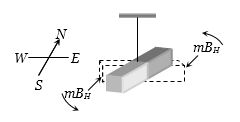
$A$ magnetic needle suspended horizontally by an unspun silk fibre,oscillates in the horizontal plane because of the restoring force originating mainly from
A
The torsion of the silk fibre
B
The force of gravity
C
The horizontal component of earth's magnetic field
D
All the above factors
Solution
(C) When a magnetic needle is suspended horizontally by an unspun silk fibre,it acts as a magnetic dipole in the Earth's magnetic field.
When the needle is slightly displaced from its equilibrium position,it experiences a restoring torque due to the interaction between its magnetic moment $M$ and the horizontal component of the Earth's magnetic field,denoted as $B_H$.
The torque is given by $\tau = M \times B_H = MB_H \sin \theta$.
For small angles,$\sin \theta \approx \theta$,so $\tau \approx MB_H \theta$.
This torque acts to bring the needle back to its equilibrium position,causing it to oscillate in the horizontal plane. The unspun silk fibre is chosen specifically to minimize any torsion,ensuring that the restoring force is primarily due to the Earth's magnetic field.
When the needle is slightly displaced from its equilibrium position,it experiences a restoring torque due to the interaction between its magnetic moment $M$ and the horizontal component of the Earth's magnetic field,denoted as $B_H$.
The torque is given by $\tau = M \times B_H = MB_H \sin \theta$.
For small angles,$\sin \theta \approx \theta$,so $\tau \approx MB_H \theta$.
This torque acts to bring the needle back to its equilibrium position,causing it to oscillate in the horizontal plane. The unspun silk fibre is chosen specifically to minimize any torsion,ensuring that the restoring force is primarily due to the Earth's magnetic field.
0 likes
View Solution36
MediumMCQ
At two places $A$ and $B$,using a vibration magnetometer,a magnet vibrates in a horizontal plane. Its respective periodic times are $2 \ s$ and $3 \ s$. At these places,the Earth's horizontal components are $H_A$ and $H_B$ respectively. Then the ratio between $H_A$ and $H_B$ will be:
A
$9:4$
B
$3:2$
C
$4:9$
D
$2:3$
Solution
(A) The time period of a vibration magnetometer is given by the formula: $T = 2\pi \sqrt{\frac{I}{MH}}$.
Here,$I$ is the moment of inertia and $M$ is the magnetic moment of the magnet,both of which remain constant.
Thus,$T \propto \frac{1}{\sqrt{H}}$,which implies $H \propto \frac{1}{T^2}$.
Given $T_A = 2 \ s$ and $T_B = 3 \ s$,we have the ratio:
$\frac{H_A}{H_B} = \frac{T_B^2}{T_A^2} = \left(\frac{3}{2}\right)^2 = \frac{9}{4}$.
Therefore,the ratio $H_A : H_B$ is $9:4$.
Here,$I$ is the moment of inertia and $M$ is the magnetic moment of the magnet,both of which remain constant.
Thus,$T \propto \frac{1}{\sqrt{H}}$,which implies $H \propto \frac{1}{T^2}$.
Given $T_A = 2 \ s$ and $T_B = 3 \ s$,we have the ratio:
$\frac{H_A}{H_B} = \frac{T_B^2}{T_A^2} = \left(\frac{3}{2}\right)^2 = \frac{9}{4}$.
Therefore,the ratio $H_A : H_B$ is $9:4$.
0 likes
View Solution37
EasyMCQ
The time period of a bar magnet suspended horizontally in the earth's magnetic field and allowed to oscillate:
A
Is directly proportional to the square root of its mass
B
Is directly proportional to its pole strength
C
Is inversely proportional to its magnetic moment
D
Decreases if the length increases but pole strength remains same
Solution
(A) The time period $T$ of a bar magnet oscillating in a uniform magnetic field $B_H$ is given by the formula: $T = 2\pi \sqrt{\frac{I}{MB_H}}$.
Here,$I$ is the moment of inertia of the bar magnet,$M$ is the magnetic moment,and $B_H$ is the horizontal component of the earth's magnetic field.
The moment of inertia $I$ for a rectangular bar magnet of mass $m$,length $l$,and breadth $b$ is given by $I = \frac{m(l^2 + b^2)}{12}$.
Substituting $I$ into the time period formula,we get $T = 2\pi \sqrt{\frac{m(l^2 + b^2)}{12MB_H}}$.
Since $T \propto \sqrt{m}$,the time period is directly proportional to the square root of its mass.
Here,$I$ is the moment of inertia of the bar magnet,$M$ is the magnetic moment,and $B_H$ is the horizontal component of the earth's magnetic field.
The moment of inertia $I$ for a rectangular bar magnet of mass $m$,length $l$,and breadth $b$ is given by $I = \frac{m(l^2 + b^2)}{12}$.
Substituting $I$ into the time period formula,we get $T = 2\pi \sqrt{\frac{m(l^2 + b^2)}{12MB_H}}$.
Since $T \propto \sqrt{m}$,the time period is directly proportional to the square root of its mass.
0 likes
View Solution38
DifficultMCQ
Magnets $A$ and $B$ are geometrically similar,but the magnetic moment of $A$ is twice that of $B$. If $T_1$ and $T_2$ are the time periods of oscillation when their like poles and unlike poles are kept together respectively,then the ratio $\frac{T_1}{T_2}$ will be:
A
$\frac{1}{3}$
B
$\frac{1}{2}$
C
$\frac{1}{\sqrt{3}}$
D
$\sqrt{3}$
Solution
(C) The time period of oscillation for a vibration magnetometer is given by $T = 2\pi \sqrt{\frac{I}{MB_H}}$,where $I$ is the moment of inertia,$M$ is the magnetic moment,and $B_H$ is the horizontal component of the Earth's magnetic field.
For two magnets $A$ and $B$ with moments $M_1 = 2M$ and $M_2 = M$,and moments of inertia $I_1$ and $I_2$,when placed together:
When like poles are together,the effective magnetic moment is $M_{sum} = M_1 + M_2 = 3M$. The time period is $T_1 = 2\pi \sqrt{\frac{I_1 + I_2}{(M_1 + M_2)B_H}}$.
When unlike poles are together,the effective magnetic moment is $M_{diff} = M_1 - M_2 = 2M - M = M$. The time period is $T_2 = 2\pi \sqrt{\frac{I_1 + I_2}{(M_1 - M_2)B_H}}$.
Taking the ratio: $\frac{T_1}{T_2} = \sqrt{\frac{M_1 - M_2}{M_1 + M_2}} = \sqrt{\frac{2M - M}{2M + M}} = \sqrt{\frac{M}{3M}} = \frac{1}{\sqrt{3}}$.
For two magnets $A$ and $B$ with moments $M_1 = 2M$ and $M_2 = M$,and moments of inertia $I_1$ and $I_2$,when placed together:
When like poles are together,the effective magnetic moment is $M_{sum} = M_1 + M_2 = 3M$. The time period is $T_1 = 2\pi \sqrt{\frac{I_1 + I_2}{(M_1 + M_2)B_H}}$.
When unlike poles are together,the effective magnetic moment is $M_{diff} = M_1 - M_2 = 2M - M = M$. The time period is $T_2 = 2\pi \sqrt{\frac{I_1 + I_2}{(M_1 - M_2)B_H}}$.
Taking the ratio: $\frac{T_1}{T_2} = \sqrt{\frac{M_1 - M_2}{M_1 + M_2}} = \sqrt{\frac{2M - M}{2M + M}} = \sqrt{\frac{M}{3M}} = \frac{1}{\sqrt{3}}$.
0 likes
View Solution39
EasyMCQ
$A$ vibration magnetometer works on the principle of
A
Torque acting on the bar magnet
B
Force acting on the bar magnet
C
Both the force and the torque acting on the bar magnet
D
None of these
Solution
(A) vibration magnetometer operates based on the restoring torque acting on a suspended bar magnet in a uniform magnetic field.
When a bar magnet is suspended in a horizontal magnetic field (like the Earth's magnetic field) and slightly displaced from its equilibrium position,a restoring torque $\tau = -MB \sin \theta$ acts on it.
This torque causes the magnet to perform simple harmonic oscillations about the magnetic meridian.
Therefore,the principle is the torque acting on the bar magnet.
When a bar magnet is suspended in a horizontal magnetic field (like the Earth's magnetic field) and slightly displaced from its equilibrium position,a restoring torque $\tau = -MB \sin \theta$ acts on it.
This torque causes the magnet to perform simple harmonic oscillations about the magnetic meridian.
Therefore,the principle is the torque acting on the bar magnet.
0 likes
View Solution40
EasyMCQ
$A$ tangent galvanometer is used to measure:
A
Steady currents
B
Current impulses
C
Magnetic moments of bar magnets
D
Earth's magnetic field
Solution
(A) When a steady current $I$ is passed through the coil of a tangent galvanometer,it produces a magnetic field $B$ at the center of the coil,which is perpendicular to the horizontal component of the Earth's magnetic field $H$.
Under the influence of these two mutually perpendicular magnetic fields,the magnetic needle deflects by an angle $\theta$.
According to the tangent law,$B = H \tan \theta$.
Since $B$ is directly proportional to the current $I$ $(B = kI)$,we get $I = (H/k) \tan \theta$,which means $I \propto \tan \theta$.
Thus,the tangent galvanometer is primarily used to measure steady electric currents.
Under the influence of these two mutually perpendicular magnetic fields,the magnetic needle deflects by an angle $\theta$.
According to the tangent law,$B = H \tan \theta$.
Since $B$ is directly proportional to the current $I$ $(B = kI)$,we get $I = (H/k) \tan \theta$,which means $I \propto \tan \theta$.
Thus,the tangent galvanometer is primarily used to measure steady electric currents.
0 likes
View Solution41
MediumMCQ
$A$ tangent galvanometer has a coil with $50$ turns and a radius equal to $4$ $cm$. $A$ current of $0.1$ $A$ is passing through it. The plane of the coil is set parallel to the earth's magnetic meridian. If the value of the earth's horizontal component of the magnetic field is $7 \times 10^{-5}$ $T$ and $\mu_0 = 4\pi \times 10^{-7}$ $T \cdot m/A$,then the deflection in the galvanometer needle will be.....$^o$
A
$45$
B
$48.2$
C
$50.7$
D
$52.7$
Solution
(B) For a tangent galvanometer,the current $I$ is given by the formula: $I = \frac{2rB_H}{\mu_0 n} \tan \theta$,where $r$ is the radius,$B_H$ is the horizontal component of the earth's magnetic field,$n$ is the number of turns,and $\theta$ is the deflection.
Rearranging for $\tan \theta$: $\tan \theta = \frac{I \mu_0 n}{2r B_H}$.
Given: $I = 0.1$ $A$,$n = 50$,$r = 4$ $cm = 0.04$ $m$,$B_H = 7 \times 10^{-5}$ $T$,and $\mu_0 = 4\pi \times 10^{-7}$ $T \cdot m/A$.
Substituting the values: $\tan \theta = \frac{0.1 \times 4\pi \times 10^{-7} \times 50}{2 \times 0.04 \times 7 \times 10^{-5}}$.
$\tan \theta = \frac{0.1 \times 4 \times 3.14159 \times 10^{-7} \times 50}{0.08 \times 7 \times 10^{-5}} = \frac{6.283 \times 10^{-6}}{0.56 \times 10^{-5}} = \frac{0.6283}{0.56} \approx 1.122$.
Therefore,$\theta = \tan^{-1}(1.122) \approx 48.2^o$.
Rearranging for $\tan \theta$: $\tan \theta = \frac{I \mu_0 n}{2r B_H}$.
Given: $I = 0.1$ $A$,$n = 50$,$r = 4$ $cm = 0.04$ $m$,$B_H = 7 \times 10^{-5}$ $T$,and $\mu_0 = 4\pi \times 10^{-7}$ $T \cdot m/A$.
Substituting the values: $\tan \theta = \frac{0.1 \times 4\pi \times 10^{-7} \times 50}{2 \times 0.04 \times 7 \times 10^{-5}}$.
$\tan \theta = \frac{0.1 \times 4 \times 3.14159 \times 10^{-7} \times 50}{0.08 \times 7 \times 10^{-5}} = \frac{6.283 \times 10^{-6}}{0.56 \times 10^{-5}} = \frac{0.6283}{0.56} \approx 1.122$.
Therefore,$\theta = \tan^{-1}(1.122) \approx 48.2^o$.
0 likes
View Solution42
MediumMCQ
$A$ bar magnet has a magnetic moment equal to $5 \times 10^{-5} \, \text{Wb} \cdot \text{m}$. It is suspended in a magnetic field which has a magnetic induction $B$ equal to $8\pi \times 10^{-4} \, \text{T}$. The magnet vibrates with a period of vibration equal to $15 \, \text{s}$. The moment of inertia of the magnet is:
A
$22.5 \, \text{kg} \cdot \text{m}^2$
B
$11.25 \, \text{kg} \cdot \text{m}^2$
C
$5.62 \, \text{kg} \cdot \text{m}^2$
D
$7.16 \times 10^{-7} \, \text{kg} \cdot \text{m}^2$
Solution
(D) The time period $T$ of a bar magnet oscillating in a magnetic field is given by the formula: $T = 2\pi \sqrt{\frac{I}{MB}}$.
Here,$M = 5 \times 10^{-5} \, \text{Wb} \cdot \text{m}$,$B = 8\pi \times 10^{-4} \, \text{T}$,and $T = 15 \, \text{s}$.
Rearranging the formula to solve for the moment of inertia $I$:
$I = \frac{T^2 MB}{4\pi^2}$.
Substituting the given values:
$I = \frac{(15)^2 \times (5 \times 10^{-5}) \times (8\pi \times 10^{-4})}{4\pi^2}$.
$I = \frac{225 \times 40\pi \times 10^{-9}}{4\pi^2} = \frac{225 \times 10 \times 10^{-9}}{\pi} = \frac{2250 \times 10^{-9}}{3.14159}$.
$I \approx 7.16 \times 10^{-7} \, \text{kg} \cdot \text{m}^2$.
Here,$M = 5 \times 10^{-5} \, \text{Wb} \cdot \text{m}$,$B = 8\pi \times 10^{-4} \, \text{T}$,and $T = 15 \, \text{s}$.
Rearranging the formula to solve for the moment of inertia $I$:
$I = \frac{T^2 MB}{4\pi^2}$.
Substituting the given values:
$I = \frac{(15)^2 \times (5 \times 10^{-5}) \times (8\pi \times 10^{-4})}{4\pi^2}$.
$I = \frac{225 \times 40\pi \times 10^{-9}}{4\pi^2} = \frac{225 \times 10 \times 10^{-9}}{\pi} = \frac{2250 \times 10^{-9}}{3.14159}$.
$I \approx 7.16 \times 10^{-7} \, \text{kg} \cdot \text{m}^2$.
0 likes
View Solution43
EasyMCQ
The number of turns and radius of cross-section of the coil of a tangent galvanometer are doubled. The reduction factor $K$ will be
A
$K$
B
$2K$
C
$4K$
D
$K/4$
Solution
(A) The reduction factor $K$ of a tangent galvanometer is given by the formula: $K = \frac{2R B_H}{\mu_0 N}$,where $R$ is the radius of the coil,$B_H$ is the horizontal component of the Earth's magnetic field,and $N$ is the number of turns.
Given that the new number of turns $N' = 2N$ and the new radius $R' = 2R$.
The new reduction factor $K'$ is: $K' = \frac{2R' B_H}{\mu_0 N'} = \frac{2(2R) B_H}{\mu_0 (2N)} = \frac{2R B_H}{\mu_0 N} = K$.
Therefore,the reduction factor remains unchanged.
Given that the new number of turns $N' = 2N$ and the new radius $R' = 2R$.
The new reduction factor $K'$ is: $K' = \frac{2R' B_H}{\mu_0 N'} = \frac{2(2R) B_H}{\mu_0 (2N)} = \frac{2R B_H}{\mu_0 N} = K$.
Therefore,the reduction factor remains unchanged.
0 likes
View Solution44
DifficultMCQ
Two tangent galvanometers having coils of the same radius are connected in series. $A$ current flowing in them produces deflections of $60^{\circ}$ and $45^{\circ}$ respectively. The ratio of the number of turns in the coils is
A
$4/3$
B
$(\sqrt{3} + 1)/1$
C
$(\sqrt{3} + 1)/(\sqrt{3} - 1)$
D
$\sqrt{3}/1$
Solution
(D) For a tangent galvanometer,the current $I$ is given by $I = K \tan \theta$,where $K = \frac{2rB_H}{\mu_0 n}$.
Since the radius $r$ and horizontal component of Earth's magnetic field $B_H$ are the same for both,$K \propto \frac{1}{n}$.
Thus,$I = \frac{C}{n} \tan \theta$,where $C$ is a constant.
Since the galvanometers are connected in series,the current $I$ is the same for both: $I_1 = I_2$.
Therefore,$\frac{C}{n_1} \tan 60^{\circ} = \frac{C}{n_2} \tan 45^{\circ}$.
$\frac{\sqrt{3}}{n_1} = \frac{1}{n_2}$.
Rearranging the terms,we get $\frac{n_1}{n_2} = \frac{\sqrt{3}}{1}$.
Since the radius $r$ and horizontal component of Earth's magnetic field $B_H$ are the same for both,$K \propto \frac{1}{n}$.
Thus,$I = \frac{C}{n} \tan \theta$,where $C$ is a constant.
Since the galvanometers are connected in series,the current $I$ is the same for both: $I_1 = I_2$.
Therefore,$\frac{C}{n_1} \tan 60^{\circ} = \frac{C}{n_2} \tan 45^{\circ}$.
$\frac{\sqrt{3}}{n_1} = \frac{1}{n_2}$.
Rearranging the terms,we get $\frac{n_1}{n_2} = \frac{\sqrt{3}}{1}$.
0 likes
View Solution45
EasyMCQ
Using a bar magnet $P$,a vibration magnetometer has a time period of $2 \ s$. When a bar $Q$ (identical to $P$ in mass and size) is placed on top of $P$,the time period remains unchanged. Which of the following statements is true?
A
$Q$ is made of non-magnetic material.
B
$Q$ is a bar magnet identical to $P$,and its north pole is placed on top of $P$'s north pole.
C
$Q$ is made of unmagnetized ferromagnetic material.
D
Nothing can be said about $Q$'s properties.
Solution
(B) The time period of a vibration magnetometer is given by $T = 2\pi \sqrt{\frac{I}{MB_H}}$,where $I$ is the moment of inertia,$M$ is the magnetic moment,and $B_H$ is the horizontal component of the Earth's magnetic field.
When bar $Q$ is placed on top of $P$,the new moment of inertia becomes $I' = I + I = 2I$.
For the time period to remain unchanged $(T' = T)$,the new magnetic moment $M'$ must satisfy the relation $T' = 2\pi \sqrt{\frac{2I}{M'B_H}} = 2\pi \sqrt{\frac{I}{MB_H}}$.
Squaring both sides,we get $\frac{2I}{M'} = \frac{I}{M}$,which implies $M' = 2M$.
This indicates that the magnetic moment of the system has doubled,which happens if $Q$ is an identical magnet placed with its poles aligned (north on north,south on south) with $P$.
When bar $Q$ is placed on top of $P$,the new moment of inertia becomes $I' = I + I = 2I$.
For the time period to remain unchanged $(T' = T)$,the new magnetic moment $M'$ must satisfy the relation $T' = 2\pi \sqrt{\frac{2I}{M'B_H}} = 2\pi \sqrt{\frac{I}{MB_H}}$.
Squaring both sides,we get $\frac{2I}{M'} = \frac{I}{M}$,which implies $M' = 2M$.
This indicates that the magnetic moment of the system has doubled,which happens if $Q$ is an identical magnet placed with its poles aligned (north on north,south on south) with $P$.
0 likes
View Solution46
EasyMCQ
The strength of the magnetic field in which the magnet of a vibration magnetometer is oscillating is increased $4$ times its original value. The frequency of oscillation would then become
A
Twice its original value
B
Four times its original value
C
Half its original value
D
One-fourth its original value
Solution
(A) The frequency of oscillation $\nu$ of a vibration magnetometer is given by the formula $\nu = \frac{1}{2\pi} \sqrt{\frac{MB}{I}}$,where $M$ is the magnetic moment,$B$ is the magnetic field strength,and $I$ is the moment of inertia.
From this relation,we can see that $\nu \propto \sqrt{B}$.
Let the initial frequency be $\nu_1$ and the initial magnetic field be $B_1$. Let the final frequency be $\nu_2$ and the final magnetic field be $B_2 = 4B_1$.
Then,$\frac{\nu_2}{\nu_1} = \sqrt{\frac{B_2}{B_1}} = \sqrt{\frac{4B_1}{B_1}} = \sqrt{4} = 2$.
Therefore,$\nu_2 = 2\nu_1$.
The frequency becomes twice its original value.
From this relation,we can see that $\nu \propto \sqrt{B}$.
Let the initial frequency be $\nu_1$ and the initial magnetic field be $B_1$. Let the final frequency be $\nu_2$ and the final magnetic field be $B_2 = 4B_1$.
Then,$\frac{\nu_2}{\nu_1} = \sqrt{\frac{B_2}{B_1}} = \sqrt{\frac{4B_1}{B_1}} = \sqrt{4} = 2$.
Therefore,$\nu_2 = 2\nu_1$.
The frequency becomes twice its original value.
0 likes
View Solution47
DifficultMCQ
$A$ certain amount of current when flowing in a properly set tangent galvanometer,produces a deflection of $45^{\circ}$. If the current is reduced by a factor of $\sqrt{3}$,the deflection would:
A
Decrease by $30^{\circ}$
B
Decrease by $15^{\circ}$
C
Increase by $15^{\circ}$
D
Increase by $30^{\circ}$
Solution
(B) In a tangent galvanometer,the current $I$ is proportional to the tangent of the deflection angle $\theta$,given by $I = K \tan \theta$,where $K$ is the reduction factor.
Given $I_1 \propto \tan \theta_1$ and $I_2 \propto \tan \theta_2$.
We have $\frac{I_1}{I_2} = \frac{\tan \theta_1}{\tan \theta_2}$.
Given $\theta_1 = 45^{\circ}$ and $I_2 = \frac{I_1}{\sqrt{3}}$,so $\frac{I_1}{I_1/\sqrt{3}} = \frac{\tan 45^{\circ}}{\tan \theta_2}$.
This simplifies to $\sqrt{3} = \frac{1}{\tan \theta_2}$,which means $\tan \theta_2 = \frac{1}{\sqrt{3}}$.
Therefore,$\theta_2 = 30^{\circ}$.
The change in deflection is $\theta_1 - \theta_2 = 45^{\circ} - 30^{\circ} = 15^{\circ}$.
Thus,the deflection decreases by $15^{\circ}$.
Given $I_1 \propto \tan \theta_1$ and $I_2 \propto \tan \theta_2$.
We have $\frac{I_1}{I_2} = \frac{\tan \theta_1}{\tan \theta_2}$.
Given $\theta_1 = 45^{\circ}$ and $I_2 = \frac{I_1}{\sqrt{3}}$,so $\frac{I_1}{I_1/\sqrt{3}} = \frac{\tan 45^{\circ}}{\tan \theta_2}$.
This simplifies to $\sqrt{3} = \frac{1}{\tan \theta_2}$,which means $\tan \theta_2 = \frac{1}{\sqrt{3}}$.
Therefore,$\theta_2 = 30^{\circ}$.
The change in deflection is $\theta_1 - \theta_2 = 45^{\circ} - 30^{\circ} = 15^{\circ}$.
Thus,the deflection decreases by $15^{\circ}$.
0 likes
View Solution48
MediumMCQ
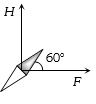
Two mutually perpendicular uniform magnetic fields $F$ and $H$ act on a magnetic needle. The needle makes an angle of $60^\circ$ with the field $F$. Find the ratio $\frac{F}{H}$.
A
$1:2$
B
$2:1$
C
$\sqrt{3}:1$
D
$1:\sqrt{3}$
Solution
(D) When a magnetic needle is placed in two mutually perpendicular magnetic fields $F$ and $H$,it aligns itself along the direction of the resultant magnetic field.
Let the angle made by the needle with the field $F$ be $\theta = 60^\circ$.
From the geometry of the vector components,the tangent of the angle $\theta$ is given by the ratio of the perpendicular component to the base component:
$\tan \theta = \frac{H}{F}$
Substituting the given value $\theta = 60^\circ$:
$\tan 60^\circ = \frac{H}{F}$
Since $\tan 60^\circ = \sqrt{3}$,we have:
$\sqrt{3} = \frac{H}{F}$
Therefore,the ratio $\frac{F}{H}$ is:
$\frac{F}{H} = \frac{1}{\sqrt{3}}$
Thus,the correct option is $(d)$.
Let the angle made by the needle with the field $F$ be $\theta = 60^\circ$.
From the geometry of the vector components,the tangent of the angle $\theta$ is given by the ratio of the perpendicular component to the base component:
$\tan \theta = \frac{H}{F}$
Substituting the given value $\theta = 60^\circ$:
$\tan 60^\circ = \frac{H}{F}$
Since $\tan 60^\circ = \sqrt{3}$,we have:
$\sqrt{3} = \frac{H}{F}$
Therefore,the ratio $\frac{F}{H}$ is:
$\frac{F}{H} = \frac{1}{\sqrt{3}}$
Thus,the correct option is $(d)$.
0 likes
View Solution49
MediumMCQ
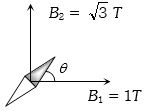
$A$ short magnetic needle is pivoted in a uniform magnetic field of strength $1 \, T$. When another magnetic field of strength $\sqrt{3} \, T$ is applied to the needle in a perpendicular direction,the needle deflects through an angle $\theta$. The value of $\theta$ is: (in $^o$)
A
$30$
B
$45$
C
$90$
D
$60$
Solution
(D) Let the initial magnetic field be $B_1 = 1 \, T$ and the perpendicular magnetic field be $B_2 = \sqrt{3} \, T$.
When a magnetic needle is placed in two mutually perpendicular magnetic fields,it aligns itself along the direction of the resultant magnetic field.
The angle $\theta$ that the needle makes with the direction of $B_1$ is given by the tangent law:
$\tan \theta = \frac{B_2}{B_1}$
Substituting the given values:
$\tan \theta = \frac{\sqrt{3}}{1} = \sqrt{3}$
Since $\tan 60^o = \sqrt{3}$,we have:
$\theta = 60^o$
When a magnetic needle is placed in two mutually perpendicular magnetic fields,it aligns itself along the direction of the resultant magnetic field.
The angle $\theta$ that the needle makes with the direction of $B_1$ is given by the tangent law:
$\tan \theta = \frac{B_2}{B_1}$
Substituting the given values:
$\tan \theta = \frac{\sqrt{3}}{1} = \sqrt{3}$
Since $\tan 60^o = \sqrt{3}$,we have:
$\theta = 60^o$
0 likes
View Solution50
EasyMCQ
$A$ tangent galvanometer is used to measure
A
Charge
B
Angle
C
Current
D
Magnetic intensity
Solution
(C) When a current $I$ is passed through the coil of a tangent galvanometer,a magnetic field $B$ is produced at right angles to the plane of the coil,i.e.,at right angles to the horizontal component of the Earth's magnetic field $H$.
Under the influence of these two crossed magnetic fields $B$ and $H$,the magnetic needle of the galvanometer undergoes a deflection $\theta$,which is governed by the tangent law.
According to the tangent law,the relationship is given by $B = H \tan \theta$.
Since $B \propto I$,we get $I = k \tan \theta$,where $k$ is the reduction factor of the galvanometer.
This clearly indicates that a tangent galvanometer is an instrument used for the measurement of electric current in a circuit.
Under the influence of these two crossed magnetic fields $B$ and $H$,the magnetic needle of the galvanometer undergoes a deflection $\theta$,which is governed by the tangent law.
According to the tangent law,the relationship is given by $B = H \tan \theta$.
Since $B \propto I$,we get $I = k \tan \theta$,where $k$ is the reduction factor of the galvanometer.
This clearly indicates that a tangent galvanometer is an instrument used for the measurement of electric current in a circuit.
0 likes
View SolutionMagnetism and Matter — Magnetic Equipment's (Tangent galvanometer, Vibration magnetometer and Neutral point) · Frequently Asked Questions
1Are these Magnetism and Matter questions useful for JEE and NEET?
Yes. All questions in this section are mapped to JEE Main and NEET exam patterns. Previous year questions from JEE Main, NEET, GUJCET and state-level exams are included with full solutions.
2Can I switch to Hindi or Gujarati for these questions?
Yes. Use the language tabs in the hero section or the sidebar to view the same questions and solutions in English, Hindi or Gujarati.
3How do I generate a question paper from this subtopic?
Use the Vedclass Exam Paper Generator — select the chapter and subtopic, set difficulty, and generate Sets A, B, C, D automatically. First 3 chapters of every subject are free.
Vedclass Products
For Students
Vedclass Test Series
Mock tests in real JEE/NEET style with performance analysis. 5-day free trial.
Start Free TrialFor Teachers
Exam Paper Generator
Generate Set A/B/C/D papers from this chapter in 2 minutes. 3 chapters free.
Try FreeFor Institutes
Online Exam Module
Live online exams with unlimited students, 360° analytics & white-label branding.
See DemoFor Teachers & Institutes
Generate a Magnetism and Matter Exam Paper in 2 Minutes
Select subtopic & difficulty — Sets A, B, C, D auto-generated with No Repeat logic.
First 3 chapters of every subject are free — no payment required.