
A English
Magnetic Equipment's (Tangent galvanometer, Vibration magnetometer and Neutral point) Questions in English
Class 12 Physics · Magnetism and Matter · Magnetic Equipment's (Tangent galvanometer, Vibration magnetometer and Neutral point)
192+
Questions
English
Language
100%
With Solutions
Showing 47 of 192 questions in English
51
MediumMCQ
When $\sqrt{3} \text{ A}$ current is passed in a tangent galvanometer,there is a deflection of $30^{\circ}$. The deflection obtained when $3 \text{ A}$ current is passed is.....$^{\circ}$
A
$30$
B
$45$
C
$60$
D
$75$
Solution
(B) The principle of a tangent galvanometer is given by the relation $i = K \tan \theta$,where $K$ is the reduction factor of the galvanometer.
This implies $i \propto \tan \theta$.
Given: $i_1 = \sqrt{3} \text{ A}$,$\theta_1 = 30^{\circ}$ and $i_2 = 3 \text{ A}$.
Using the ratio formula: $\frac{i_1}{i_2} = \frac{\tan \theta_1}{\tan \theta_2}$.
Substituting the values: $\frac{\sqrt{3}}{3} = \frac{\tan 30^{\circ}}{\tan \theta_2}$.
Since $\tan 30^{\circ} = \frac{1}{\sqrt{3}}$,we have $\frac{1}{\sqrt{3}} = \frac{1/\sqrt{3}}{\tan \theta_2}$.
This simplifies to $\tan \theta_2 = 1$.
Therefore,$\theta_2 = 45^{\circ}$.
This implies $i \propto \tan \theta$.
Given: $i_1 = \sqrt{3} \text{ A}$,$\theta_1 = 30^{\circ}$ and $i_2 = 3 \text{ A}$.
Using the ratio formula: $\frac{i_1}{i_2} = \frac{\tan \theta_1}{\tan \theta_2}$.
Substituting the values: $\frac{\sqrt{3}}{3} = \frac{\tan 30^{\circ}}{\tan \theta_2}$.
Since $\tan 30^{\circ} = \frac{1}{\sqrt{3}}$,we have $\frac{1}{\sqrt{3}} = \frac{1/\sqrt{3}}{\tan \theta_2}$.
This simplifies to $\tan \theta_2 = 1$.
Therefore,$\theta_2 = 45^{\circ}$.
0 likes
View Solution52
DifficultMCQ
The period of oscillations of a magnetic needle in a magnetic field is $1.0 \, s$. If the length of the needle is halved by cutting it,the time period will be.....$s$.
A
$1.0$
B
$0.5$
C
$0.25$
D
$2.0$
Solution
(B) The time period of a magnetic needle oscillating in a magnetic field is given by $T = 2\pi \sqrt{\frac{I}{MB}}$,where $I$ is the moment of inertia,$M$ is the magnetic moment,and $B$ is the magnetic field strength.
For a needle of mass $m$ and length $l$,the moment of inertia is $I = \frac{ml^2}{12}$ and the magnetic moment is $M = q_m \cdot l$,where $q_m$ is the pole strength.
Substituting these,$T = 2\pi \sqrt{\frac{ml^2/12}{q_m \cdot l \cdot B}} = 2\pi \sqrt{\frac{ml}{12 q_m B}}$.
Since $T \propto \sqrt{ml}$,when the needle is cut in half,the new mass $m' = m/2$ and the new length $l' = l/2$. The pole strength $q_m$ remains the same.
Thus,$T' = T \sqrt{\frac{m'l'}{ml}} = T \sqrt{\frac{(m/2)(l/2)}{ml}} = T \sqrt{\frac{1}{4}} = \frac{T}{2}$.
Given $T = 1.0 \, s$,the new time period $T' = \frac{1.0}{2} = 0.5 \, s$.
For a needle of mass $m$ and length $l$,the moment of inertia is $I = \frac{ml^2}{12}$ and the magnetic moment is $M = q_m \cdot l$,where $q_m$ is the pole strength.
Substituting these,$T = 2\pi \sqrt{\frac{ml^2/12}{q_m \cdot l \cdot B}} = 2\pi \sqrt{\frac{ml}{12 q_m B}}$.
Since $T \propto \sqrt{ml}$,when the needle is cut in half,the new mass $m' = m/2$ and the new length $l' = l/2$. The pole strength $q_m$ remains the same.
Thus,$T' = T \sqrt{\frac{m'l'}{ml}} = T \sqrt{\frac{(m/2)(l/2)}{ml}} = T \sqrt{\frac{1}{4}} = \frac{T}{2}$.
Given $T = 1.0 \, s$,the new time period $T' = \frac{1.0}{2} = 0.5 \, s$.
0 likes
View Solution53
EasyMCQ
The time period of a freely suspended magnet is $2 \ s$. If it is broken in length into two equal parts and one part is suspended in the same way,then its time period will be.....$s$.
A
$4$
B
$2$
C
$\sqrt{2}$
D
$1$
Solution
(D) The time period of a freely suspended magnetic dipole is given by $T = 2\pi \sqrt{\frac{I}{MB}}$,where $I$ is the moment of inertia,$M$ is the magnetic moment,and $B$ is the magnetic field.
For a magnet of length $L$,mass $m$,and pole strength $q_m$,the magnetic moment is $M = q_m L$ and the moment of inertia is $I = \frac{mL^2}{12}$.
When the magnet is broken into two equal parts along its length,the new length is $L' = L/2$,the new mass is $m' = m/2$,and the new pole strength remains $q_m$.
The new magnetic moment is $M' = q_m (L/2) = M/2$.
The new moment of inertia is $I' = \frac{(m/2)(L/2)^2}{12} = \frac{mL^2}{8 \times 12} = I/8$.
The new time period $T'$ is $T' = 2\pi \sqrt{\frac{I'}{M'B}} = 2\pi \sqrt{\frac{I/8}{(M/2)B}} = 2\pi \sqrt{\frac{I}{4MB}} = \frac{1}{2} T$.
Given $T = 2 \ s$,the new time period is $T' = \frac{2}{2} = 1 \ s$.
For a magnet of length $L$,mass $m$,and pole strength $q_m$,the magnetic moment is $M = q_m L$ and the moment of inertia is $I = \frac{mL^2}{12}$.
When the magnet is broken into two equal parts along its length,the new length is $L' = L/2$,the new mass is $m' = m/2$,and the new pole strength remains $q_m$.
The new magnetic moment is $M' = q_m (L/2) = M/2$.
The new moment of inertia is $I' = \frac{(m/2)(L/2)^2}{12} = \frac{mL^2}{8 \times 12} = I/8$.
The new time period $T'$ is $T' = 2\pi \sqrt{\frac{I'}{M'B}} = 2\pi \sqrt{\frac{I/8}{(M/2)B}} = 2\pi \sqrt{\frac{I}{4MB}} = \frac{1}{2} T$.
Given $T = 2 \ s$,the new time period is $T' = \frac{2}{2} = 1 \ s$.
0 likes
View Solution54
EasyMCQ
The period of oscillation of a vibration magnetometer depends on which of the following factors? (where $I$ is the moment of inertia of the magnet about the axis of suspension,$M$ is the magnetic moment of the magnet,and $H$ is the external magnetic field.)
A
$I$ and $M$ only
B
$M$ and $H$ only
C
$I$ and $H$ only
D
$I, M$ and $H$ only
Solution
(D) The period of oscillation $T$ for a vibration magnetometer is given by the formula:
$T = 2\pi \sqrt{\frac{I}{MH}}$
where:
$I$ = Moment of inertia of the magnet about the axis of suspension.
$M$ = Magnetic moment of the magnet.
$H$ = External magnetic field.
From the formula,it is clear that the period of oscillation $T$ depends on all three factors: $I$,$M$,and $H$.
$T = 2\pi \sqrt{\frac{I}{MH}}$
where:
$I$ = Moment of inertia of the magnet about the axis of suspension.
$M$ = Magnetic moment of the magnet.
$H$ = External magnetic field.
From the formula,it is clear that the period of oscillation $T$ depends on all three factors: $I$,$M$,and $H$.
0 likes
View Solution55
MediumMCQ
Two short magnets having magnetic moments in the ratio $27 : 8$,when placed on opposite sides of a deflection magnetometer,produce no deflection. If the distance of the weaker magnet is $0.12 \ m$ from the centre of the deflection magnetometer,the distance of the stronger magnet from the centre is.......$m$
A
$0.06$
B
$0.08$
C
$0.12$
D
$0.18$
Solution
(D) For a deflection magnetometer,the condition for no deflection (null point) is given by the balance of magnetic fields: $\frac{M_1}{d_1^3} = \frac{M_2}{d_2^3}$.
Given the ratio of magnetic moments is $\frac{M_1}{M_2} = \frac{27}{8}$.
Let $M_1$ be the stronger magnet and $M_2$ be the weaker magnet. Thus,$d_2 = 0.12 \ m$.
Substituting the values into the formula: $\frac{27}{8} = \left( \frac{d_1}{d_2} \right)^3$.
Taking the cube root on both sides: $\frac{3}{2} = \frac{d_1}{0.12}$.
Solving for $d_1$: $d_1 = \frac{3}{2} \times 0.12 = 1.5 \times 0.12 = 0.18 \ m$.
Given the ratio of magnetic moments is $\frac{M_1}{M_2} = \frac{27}{8}$.
Let $M_1$ be the stronger magnet and $M_2$ be the weaker magnet. Thus,$d_2 = 0.12 \ m$.
Substituting the values into the formula: $\frac{27}{8} = \left( \frac{d_1}{d_2} \right)^3$.
Taking the cube root on both sides: $\frac{3}{2} = \frac{d_1}{0.12}$.
Solving for $d_1$: $d_1 = \frac{3}{2} \times 0.12 = 1.5 \times 0.12 = 0.18 \ m$.
0 likes
View Solution56
MediumMCQ
$A$ magnet makes $40$ oscillations per minute at a place having magnetic field intensity of $0.1 \times 10^{-5} \,T$. At another place,it takes $2.5 \,s$ to complete one vibration. The value of earth's horizontal field at that place is:
A
$0.25 \times 10^{-6} \,T$
B
$0.36 \times 10^{-6} \,T$
C
$0.66 \times 10^{-6} \,T$
D
$1.2 \times 10^{-6} \,T$
Solution
(B) The time period of oscillation of a magnet in a magnetic field is given by $T = 2\pi \sqrt{\frac{I}{M B_H}}$,where $I$ is the moment of inertia and $M$ is the magnetic moment.
This implies $T \propto \frac{1}{\sqrt{B_H}}$,or $B_H \propto \frac{1}{T^2}$.
At the first place,the frequency is $40 \text{ oscillations/min}$,so the time period $T_1 = \frac{60}{40} = 1.5 \,s$. The magnetic field is $(B_H)_1 = 0.1 \times 10^{-5} \,T = 10^{-6} \,T$.
At the second place,the time period $T_2 = 2.5 \,s$.
Using the ratio $\frac{(B_H)_2}{(B_H)_1} = \left( \frac{T_1}{T_2} \right)^2$,we get:
$(B_H)_2 = (B_H)_1 \times \left( \frac{1.5}{2.5} \right)^2$
$(B_H)_2 = 10^{-6} \times \left( \frac{3}{5} \right)^2 = 10^{-6} \times \frac{9}{25} = 10^{-6} \times 0.36 = 0.36 \times 10^{-6} \,T$.
This implies $T \propto \frac{1}{\sqrt{B_H}}$,or $B_H \propto \frac{1}{T^2}$.
At the first place,the frequency is $40 \text{ oscillations/min}$,so the time period $T_1 = \frac{60}{40} = 1.5 \,s$. The magnetic field is $(B_H)_1 = 0.1 \times 10^{-5} \,T = 10^{-6} \,T$.
At the second place,the time period $T_2 = 2.5 \,s$.
Using the ratio $\frac{(B_H)_2}{(B_H)_1} = \left( \frac{T_1}{T_2} \right)^2$,we get:
$(B_H)_2 = (B_H)_1 \times \left( \frac{1.5}{2.5} \right)^2$
$(B_H)_2 = 10^{-6} \times \left( \frac{3}{5} \right)^2 = 10^{-6} \times \frac{9}{25} = 10^{-6} \times 0.36 = 0.36 \times 10^{-6} \,T$.
0 likes
View Solution57
DifficultMCQ
The error in measuring the current with a tangent galvanometer is minimum when the deflection is about $45^o$. (in $^o$)
A
$0$
B
$30$
C
$45$
D
$60$
Solution
(C) In a tangent galvanometer,the current $i$ is given by $i = k \tan \phi$,where $k$ is the reduction factor and $\phi$ is the deflection.
Differentiating both sides with respect to $\phi$,we get $\frac{di}{d\phi} = k \sec^2 \phi$.
Thus,the fractional error is given by $\frac{di}{i} = \frac{k \sec^2 \phi \cdot d\phi}{k \tan \phi} = \frac{d\phi}{\sin \phi \cos \phi}$.
Multiplying the numerator and denominator by $2$,we get $\frac{di}{i} = \frac{2 d\phi}{2 \sin \phi \cos \phi} = \frac{2 d\phi}{\sin 2\phi}$.
For the error $\frac{di}{i}$ to be minimum,$\sin 2\phi$ must be maximum.
The maximum value of $\sin 2\phi$ is $1$,which occurs when $2\phi = 90^o$,or $\phi = 45^o$.
Differentiating both sides with respect to $\phi$,we get $\frac{di}{d\phi} = k \sec^2 \phi$.
Thus,the fractional error is given by $\frac{di}{i} = \frac{k \sec^2 \phi \cdot d\phi}{k \tan \phi} = \frac{d\phi}{\sin \phi \cos \phi}$.
Multiplying the numerator and denominator by $2$,we get $\frac{di}{i} = \frac{2 d\phi}{2 \sin \phi \cos \phi} = \frac{2 d\phi}{\sin 2\phi}$.
For the error $\frac{di}{i}$ to be minimum,$\sin 2\phi$ must be maximum.
The maximum value of $\sin 2\phi$ is $1$,which occurs when $2\phi = 90^o$,or $\phi = 45^o$.
0 likes
View Solution58
EasyMCQ
Before using the tangent galvanometer,its coil is set in
A
Magnetic meridian (or vertically north-south)
B
Perpendicular to magnetic meridian
C
At an angle of $45^\circ$ to magnetic meridian
D
It does not require any setting
Solution
(A) The tangent galvanometer works on the tangent law,which states that $F = H \tan \theta$,where $F$ and $H$ are two uniform magnetic fields at right angles to each other.
One of these fields is the horizontal component of the Earth's magnetic field $(H)$,which acts along the magnetic meridian (North-South direction).
To perform the experiment,the coil of the tangent galvanometer must be placed in the magnetic meridian (vertically North-South) so that the magnetic field produced by the current in the coil is perpendicular to the horizontal component of the Earth's magnetic field.
This alignment ensures that the magnetic needle,which is initially in the magnetic meridian,deflects according to the tangent law when current flows through the coil.
One of these fields is the horizontal component of the Earth's magnetic field $(H)$,which acts along the magnetic meridian (North-South direction).
To perform the experiment,the coil of the tangent galvanometer must be placed in the magnetic meridian (vertically North-South) so that the magnetic field produced by the current in the coil is perpendicular to the horizontal component of the Earth's magnetic field.
This alignment ensures that the magnetic needle,which is initially in the magnetic meridian,deflects according to the tangent law when current flows through the coil.
0 likes
View Solution59
DifficultMCQ
The time period of a thin bar magnet in Earth's magnetic field is $T$. If the magnet is cut into two equal parts perpendicular to its length,the time period of each part in the same field will be
A
$T/2$
B
$T$
C
$\sqrt{2}T$
D
$2T$
Solution
(A) The time period of a bar magnet oscillating in a magnetic field is given by $T = 2\pi \sqrt{\frac{I}{MB}}$,where $I$ is the moment of inertia,$M$ is the magnetic moment,and $B$ is the magnetic field.
When the magnet is cut into two equal parts perpendicular to its length,the new magnetic moment $M' = M/2$ and the new moment of inertia $I' = I/8$ (since $I = \frac{1}{12}mL^2$ and mass $m$ becomes $m/2$,length $L$ becomes $L/2$).
The new time period $T'$ is $T' = 2\pi \sqrt{\frac{I'}{M'B}} = 2\pi \sqrt{\frac{I/8}{(M/2)B}} = 2\pi \sqrt{\frac{I}{4MB}} = \frac{1}{2} \left( 2\pi \sqrt{\frac{I}{MB}} \right) = \frac{T}{2}$.
When the magnet is cut into two equal parts perpendicular to its length,the new magnetic moment $M' = M/2$ and the new moment of inertia $I' = I/8$ (since $I = \frac{1}{12}mL^2$ and mass $m$ becomes $m/2$,length $L$ becomes $L/2$).
The new time period $T'$ is $T' = 2\pi \sqrt{\frac{I'}{M'B}} = 2\pi \sqrt{\frac{I/8}{(M/2)B}} = 2\pi \sqrt{\frac{I}{4MB}} = \frac{1}{2} \left( 2\pi \sqrt{\frac{I}{MB}} \right) = \frac{T}{2}$.
0 likes
View Solution60
MediumMCQ
$A$ magnet freely suspended in a vibration magnetometer makes $10$ oscillations per minute at a place $A$ and $20$ oscillations per minute at a place $B$. If the horizontal component of earth's magnetic field at $A$ is $36 \times 10^{-6} \ T$,then its value at $B$ is
A
$36 \times 10^{-6} \ T$
B
$72 \times 10^{-6} \ T$
C
$144 \times 10^{-6} \ T$
D
$288 \times 10^{-6} \ T$
Solution
(C) The frequency of oscillation $f$ of a magnet in a vibration magnetometer is given by $f = \frac{1}{2\pi} \sqrt{\frac{\mu B_H}{I}}$,where $\mu$ is the magnetic moment,$B_H$ is the horizontal component of the earth's magnetic field,and $I$ is the moment of inertia.
Since $f \propto \sqrt{B_H}$,we have $\frac{f_B}{f_A} = \sqrt{\frac{(B_H)_B}{(B_H)_A}}$.
Given $f_A = 10 \text{ oscillations/min}$ and $f_B = 20 \text{ oscillations/min}$.
Substituting the values: $\frac{20}{10} = \sqrt{\frac{(B_H)_B}{36 \times 10^{-6} \ T}}$.
Squaring both sides: $2^2 = \frac{(B_H)_B}{36 \times 10^{-6} \ T}$.
$4 = \frac{(B_H)_B}{36 \times 10^{-6} \ T}$.
$(B_H)_B = 4 \times 36 \times 10^{-6} \ T = 144 \times 10^{-6} \ T$.
Since $f \propto \sqrt{B_H}$,we have $\frac{f_B}{f_A} = \sqrt{\frac{(B_H)_B}{(B_H)_A}}$.
Given $f_A = 10 \text{ oscillations/min}$ and $f_B = 20 \text{ oscillations/min}$.
Substituting the values: $\frac{20}{10} = \sqrt{\frac{(B_H)_B}{36 \times 10^{-6} \ T}}$.
Squaring both sides: $2^2 = \frac{(B_H)_B}{36 \times 10^{-6} \ T}$.
$4 = \frac{(B_H)_B}{36 \times 10^{-6} \ T}$.
$(B_H)_B = 4 \times 36 \times 10^{-6} \ T = 144 \times 10^{-6} \ T$.
0 likes
View Solution61
MediumMCQ
When $2 \ A$ current is passed through a tangent galvanometer,it gives a deflection of $30^\circ$. For $60^\circ$ deflection,the current must be........$A$.
A
$1$
B
$2\sqrt{3}$
C
$4$
D
$6$
Solution
(D) The current $i$ in a tangent galvanometer is related to the deflection $\phi$ by the formula $i = K \tan \phi$,where $K$ is the reduction factor of the galvanometer.
Therefore,$i \propto \tan \phi$.
Given $i_1 = 2 \ A$ and $\phi_1 = 30^\circ$.
We need to find $i_2$ for $\phi_2 = 60^\circ$.
Using the ratio: $\frac{i_1}{i_2} = \frac{\tan \phi_1}{\tan \phi_2}$.
Substituting the values: $\frac{2}{i_2} = \frac{\tan 30^\circ}{\tan 60^\circ}$.
Since $\tan 30^\circ = \frac{1}{\sqrt{3}}$ and $\tan 60^\circ = \sqrt{3}$,we have $\frac{2}{i_2} = \frac{1/\sqrt{3}}{\sqrt{3}} = \frac{1}{3}$.
Thus,$i_2 = 2 \times 3 = 6 \ A$.
Therefore,$i \propto \tan \phi$.
Given $i_1 = 2 \ A$ and $\phi_1 = 30^\circ$.
We need to find $i_2$ for $\phi_2 = 60^\circ$.
Using the ratio: $\frac{i_1}{i_2} = \frac{\tan \phi_1}{\tan \phi_2}$.
Substituting the values: $\frac{2}{i_2} = \frac{\tan 30^\circ}{\tan 60^\circ}$.
Since $\tan 30^\circ = \frac{1}{\sqrt{3}}$ and $\tan 60^\circ = \sqrt{3}$,we have $\frac{2}{i_2} = \frac{1/\sqrt{3}}{\sqrt{3}} = \frac{1}{3}$.
Thus,$i_2 = 2 \times 3 = 6 \ A$.
0 likes
View Solution62
EasyMCQ
Which of the following statements is not true?
A
While taking readings of a tangent galvanometer,the plane of the coil must be set at right angles to the earth's magnetic meridian.
B
$A$ short magnet is used in a tangent galvanometer since a long magnet would be heavy and may not easily move.
C
Measurements with the tangent galvanometer will be more accurate when the deflection is around $45^\circ$.
D
$A$ tangent galvanometer cannot be used in the polar region.
Solution
(A) The correct statement is that the plane of the coil must be set parallel to the earth's magnetic meridian,not at right angles.
When the plane of the coil is parallel to the magnetic meridian,the magnetic field produced by the coil is perpendicular to the horizontal component of the earth's magnetic field $(B_H)$.
This satisfies the condition for the tangent law,$B = B_H \tan \theta$.
Therefore,the statement in option $A$ is false.
When the plane of the coil is parallel to the magnetic meridian,the magnetic field produced by the coil is perpendicular to the horizontal component of the earth's magnetic field $(B_H)$.
This satisfies the condition for the tangent law,$B = B_H \tan \theta$.
Therefore,the statement in option $A$ is false.
0 likes
View Solution63
MediumMCQ
The period of oscillation of a magnet is $2 \, s$. When it is remagnetised so that the pole strength is $4$ times its original value,its new period will be......$s$.
A
$4$
B
$2$
C
$1$
D
$0.5$
Solution
(C) The time period $T$ of a magnet oscillating in a magnetic field is given by $T = 2\pi \sqrt{\frac{I}{MB}}$,where $I$ is the moment of inertia,$M$ is the magnetic moment,and $B$ is the magnetic field.
Since $M = m \times 2l$ (where $m$ is the pole strength and $2l$ is the length of the magnet),we have $T \propto \frac{1}{\sqrt{M}}$.
Since $M \propto m$,it follows that $T \propto \frac{1}{\sqrt{m}}$.
Given that the pole strength $m$ becomes $4$ times its original value $(m' = 4m)$,the new time period $T'$ is:
$T' = T \times \sqrt{\frac{m}{m'}} = 2 \times \sqrt{\frac{m}{4m}} = 2 \times \sqrt{\frac{1}{4}} = 2 \times \frac{1}{2} = 1 \, s$.
Since $M = m \times 2l$ (where $m$ is the pole strength and $2l$ is the length of the magnet),we have $T \propto \frac{1}{\sqrt{M}}$.
Since $M \propto m$,it follows that $T \propto \frac{1}{\sqrt{m}}$.
Given that the pole strength $m$ becomes $4$ times its original value $(m' = 4m)$,the new time period $T'$ is:
$T' = T \times \sqrt{\frac{m}{m'}} = 2 \times \sqrt{\frac{m}{4m}} = 2 \times \sqrt{\frac{1}{4}} = 2 \times \frac{1}{2} = 1 \, s$.
0 likes
View Solution64
MediumMCQ
When two magnetic moments are compared using the equal distance method,the deflections produced are $45^\circ$ and $30^\circ$. If the lengths of the magnets are in the ratio $1:2$,the ratio of their pole strengths is:
A
$3:1$
B
$3:2$
C
$\sqrt{3}:1$
D
$2\sqrt{3}:1$
Solution
(D) In the deflection magnetometer (equal distance method),the magnetic moment $M$ is proportional to $\tan \theta$. Thus,$\frac{M_1}{M_2} = \frac{\tan \theta_1}{\tan \theta_2}$.
Since magnetic moment $M = m \times L$ (where $m$ is pole strength and $L$ is length),we have $\frac{m_1 L_1}{m_2 L_2} = \frac{\tan \theta_1}{\tan \theta_2}$.
Given $\frac{L_1}{L_2} = \frac{1}{2}$,$\theta_1 = 45^\circ$,and $\theta_2 = 30^\circ$.
Substituting the values: $\frac{m_1}{m_2} \times \frac{1}{2} = \frac{\tan 45^\circ}{\tan 30^\circ} = \frac{1}{1/\sqrt{3}} = \sqrt{3}$.
Therefore,$\frac{m_1}{m_2} = 2\sqrt{3} : 1$.
Since magnetic moment $M = m \times L$ (where $m$ is pole strength and $L$ is length),we have $\frac{m_1 L_1}{m_2 L_2} = \frac{\tan \theta_1}{\tan \theta_2}$.
Given $\frac{L_1}{L_2} = \frac{1}{2}$,$\theta_1 = 45^\circ$,and $\theta_2 = 30^\circ$.
Substituting the values: $\frac{m_1}{m_2} \times \frac{1}{2} = \frac{\tan 45^\circ}{\tan 30^\circ} = \frac{1}{1/\sqrt{3}} = \sqrt{3}$.
Therefore,$\frac{m_1}{m_2} = 2\sqrt{3} : 1$.
0 likes
View Solution65
EasyMCQ
The magnetic needle of a tangent galvanometer is deflected at an angle $30^\circ$ due to a magnet. The horizontal component of Earth's magnetic field $0.34 \times 10^{-4} \, T$ is along the plane of the coil. The magnetic intensity is
A
$1.96 \times 10^{-4} \, T$
B
$1.96 \times 10^{-5} \, T$
C
$1.96 \times 10^{4} \, T$
D
$1.96 \times 10^{5} \, T$
Solution
(B) In a tangent galvanometer,the magnetic field $B$ produced by the coil is related to the horizontal component of the Earth's magnetic field $B_H$ and the deflection angle $\theta$ by the formula:
$B = B_H \tan \theta$
Given:
$B_H = 0.34 \times 10^{-4} \, T$
$\theta = 30^\circ$
Substituting the values:
$B = (0.34 \times 10^{-4}) \times \tan 30^\circ$
Since $\tan 30^\circ = \frac{1}{\sqrt{3}} \approx 0.577$:
$B = 0.34 \times 10^{-4} \times 0.577$
$B \approx 0.196 \times 10^{-4} \, T$
$B = 1.96 \times 10^{-5} \, T$
$B = B_H \tan \theta$
Given:
$B_H = 0.34 \times 10^{-4} \, T$
$\theta = 30^\circ$
Substituting the values:
$B = (0.34 \times 10^{-4}) \times \tan 30^\circ$
Since $\tan 30^\circ = \frac{1}{\sqrt{3}} \approx 0.577$:
$B = 0.34 \times 10^{-4} \times 0.577$
$B \approx 0.196 \times 10^{-4} \, T$
$B = 1.96 \times 10^{-5} \, T$
0 likes
View Solution66
MediumMCQ
In a tangent galvanometer,a current of $0.1 \, A$ produces a deflection of $30^\circ$. The current required to produce a deflection of $60^\circ$ is ...... $A$.
A
$0.2$
B
$0.3$
C
$0.4$
D
$0.5$
Solution
(B) The principle of a tangent galvanometer is given by the formula $I = K \tan \phi$,where $I$ is the current,$K$ is the reduction factor,and $\phi$ is the deflection angle.
Since $K$ is constant for a given galvanometer,we have $I \propto \tan \phi$.
Therefore,the ratio is $\frac{I_1}{I_2} = \frac{\tan \phi_1}{\tan \phi_2}$.
Given $I_1 = 0.1 \, A$,$\phi_1 = 30^\circ$,and $\phi_2 = 60^\circ$.
Substituting the values: $\frac{0.1}{I_2} = \frac{\tan 30^\circ}{\tan 60^\circ}$.
We know $\tan 30^\circ = \frac{1}{\sqrt{3}}$ and $\tan 60^\circ = \sqrt{3}$.
So,$\frac{0.1}{I_2} = \frac{1/\sqrt{3}}{\sqrt{3}} = \frac{1}{3}$.
Thus,$I_2 = 0.1 \times 3 = 0.3 \, A$.
Since $K$ is constant for a given galvanometer,we have $I \propto \tan \phi$.
Therefore,the ratio is $\frac{I_1}{I_2} = \frac{\tan \phi_1}{\tan \phi_2}$.
Given $I_1 = 0.1 \, A$,$\phi_1 = 30^\circ$,and $\phi_2 = 60^\circ$.
Substituting the values: $\frac{0.1}{I_2} = \frac{\tan 30^\circ}{\tan 60^\circ}$.
We know $\tan 30^\circ = \frac{1}{\sqrt{3}}$ and $\tan 60^\circ = \sqrt{3}$.
So,$\frac{0.1}{I_2} = \frac{1/\sqrt{3}}{\sqrt{3}} = \frac{1}{3}$.
Thus,$I_2 = 0.1 \times 3 = 0.3 \, A$.
0 likes
View Solution67
MediumMCQ
$A$ bar magnet is oscillating in the Earth's magnetic field with a period $T$. What happens to its period and motion if its mass is quadrupled?
A
Motion remains $S.H.M.$ with time period $= 2T$
B
Motion remains $S.H.M.$ with time period $= 4T$
C
Motion remains $S.H.M.$ and period remains nearly constant
D
Motion remains $S.H.M.$ with time period $= T/2$
Solution
(A) The time period of a bar magnet oscillating in a magnetic field is given by $T = 2\pi \sqrt{\frac{I}{MB}}$,where $I$ is the moment of inertia,$M$ is the magnetic moment,and $B$ is the magnetic field.
For a bar magnet of mass $m$ and length $l$,the moment of inertia is $I = \frac{ml^2}{12}$.
Substituting this into the formula,we get $T = 2\pi \sqrt{\frac{ml^2}{12MB}}$.
This shows that $T \propto \sqrt{m}$.
If the mass $m$ is quadrupled $(m' = 4m)$,the new time period $T'$ becomes $T' = 2\pi \sqrt{\frac{4ml^2}{12MB}} = 2 \times (2\pi \sqrt{\frac{ml^2}{12MB}}) = 2T$.
The motion remains $S.H.M.$ because the restoring torque $\tau = -MB \sin \theta \approx -MB \theta$ for small oscillations.
For a bar magnet of mass $m$ and length $l$,the moment of inertia is $I = \frac{ml^2}{12}$.
Substituting this into the formula,we get $T = 2\pi \sqrt{\frac{ml^2}{12MB}}$.
This shows that $T \propto \sqrt{m}$.
If the mass $m$ is quadrupled $(m' = 4m)$,the new time period $T'$ becomes $T' = 2\pi \sqrt{\frac{4ml^2}{12MB}} = 2 \times (2\pi \sqrt{\frac{ml^2}{12MB}}) = 2T$.
The motion remains $S.H.M.$ because the restoring torque $\tau = -MB \sin \theta \approx -MB \theta$ for small oscillations.
0 likes
View Solution68
MediumMCQ
$A$ thin rectangular magnet suspended freely has a period of oscillation equal to $T$. Now it is broken into two equal halves (each having half of the original length) and one piece is made to oscillate freely in the same field. If its period of oscillation is $T'$,then the ratio $\frac{T'}{T}$ is
A
$\frac{1}{4}$
B
$\frac{1}{2\sqrt{2}}$
C
$\frac{1}{2}$
D
$2$
Solution
(C) The time period of oscillation of a magnetic dipole in a uniform magnetic field is given by $T = 2\pi \sqrt{\frac{I}{MB}}$,where $I$ is the moment of inertia,$M$ is the magnetic moment,and $B$ is the magnetic field.
For the original magnet of mass $m$ and length $l$,$I = \frac{ml^2}{12}$ and $M = m_s l$ (where $m_s$ is pole strength).
When the magnet is cut into two equal halves along its length,for each piece: mass $m' = \frac{m}{2}$,length $l' = \frac{l}{2}$,and pole strength $m_s' = m_s$.
New moment of inertia $I' = \frac{m' (l')^2}{12} = \frac{(m/2) (l/2)^2}{12} = \frac{1}{8} \left( \frac{ml^2}{12} \right) = \frac{I}{8}$.
New magnetic moment $M' = m_s l' = m_s (l/2) = \frac{M}{2}$.
The new time period $T' = 2\pi \sqrt{\frac{I'}{M'B}} = 2\pi \sqrt{\frac{I/8}{(M/2)B}} = 2\pi \sqrt{\frac{I}{4MB}} = \frac{1}{2} \left( 2\pi \sqrt{\frac{I}{MB}} \right) = \frac{T}{2}$.
Therefore,the ratio $\frac{T'}{T} = \frac{1}{2}$.
For the original magnet of mass $m$ and length $l$,$I = \frac{ml^2}{12}$ and $M = m_s l$ (where $m_s$ is pole strength).
When the magnet is cut into two equal halves along its length,for each piece: mass $m' = \frac{m}{2}$,length $l' = \frac{l}{2}$,and pole strength $m_s' = m_s$.
New moment of inertia $I' = \frac{m' (l')^2}{12} = \frac{(m/2) (l/2)^2}{12} = \frac{1}{8} \left( \frac{ml^2}{12} \right) = \frac{I}{8}$.
New magnetic moment $M' = m_s l' = m_s (l/2) = \frac{M}{2}$.
The new time period $T' = 2\pi \sqrt{\frac{I'}{M'B}} = 2\pi \sqrt{\frac{I/8}{(M/2)B}} = 2\pi \sqrt{\frac{I}{4MB}} = \frac{1}{2} \left( 2\pi \sqrt{\frac{I}{MB}} \right) = \frac{T}{2}$.
Therefore,the ratio $\frac{T'}{T} = \frac{1}{2}$.
0 likes
View Solution69
MediumMCQ
$A$ bar magnet is oscillating in the earth's magnetic field with time period $T.$ If its mass is increased four times,then its time period will be
A
$4 T$
B
$2 T$
C
$T$
D
$T/2$
Solution
(B) The time period $T$ of an oscillating bar magnet in a magnetic field is given by the formula: $T = 2\pi \sqrt{\frac{I}{MB_H}}$.
Here,$I$ is the moment of inertia of the bar magnet,$M$ is the magnetic moment,and $B_H$ is the horizontal component of the earth's magnetic field.
For a rectangular bar magnet of mass $w$,length $L$,and breadth $b$,the moment of inertia is $I = \frac{w(L^2 + b^2)}{12}$.
Since $I \propto w$,we can write $T \propto \sqrt{I} \propto \sqrt{w}$.
If the mass $w$ is increased by a factor of $4$,the new time period $T'$ becomes $T' = T \sqrt{4} = 2T$.
Here,$I$ is the moment of inertia of the bar magnet,$M$ is the magnetic moment,and $B_H$ is the horizontal component of the earth's magnetic field.
For a rectangular bar magnet of mass $w$,length $L$,and breadth $b$,the moment of inertia is $I = \frac{w(L^2 + b^2)}{12}$.
Since $I \propto w$,we can write $T \propto \sqrt{I} \propto \sqrt{w}$.
If the mass $w$ is increased by a factor of $4$,the new time period $T'$ becomes $T' = T \sqrt{4} = 2T$.
0 likes
View Solution70
DifficultMCQ
The length of a magnet is large compared to its width and breadth. The time period of its oscillation in a vibration magnetometer is $2 \, s$. The magnet is cut along its length into three equal parts and these three parts are then placed on each other with their like poles together. The time period of this combination will be
A
$2 \, s$
B
$2/3 \, s$
C
$2\sqrt{3} \, s$
D
$2/\sqrt{3} \, s$
Solution
(B) The time period of a magnet in a vibration magnetometer is given by $T = 2\pi \sqrt{\frac{I}{MB}}$,where $I$ is the moment of inertia and $M$ is the magnetic moment.
Initially,$T = 2 \, s = 2\pi \sqrt{\frac{I}{MB}}$.
When the magnet is cut into three equal parts along its length,for each part,the mass $m' = m/3$ and length $l' = l/3$.
The moment of inertia of each part about the center is $I' = \frac{1}{12} m' (l')^2 = \frac{1}{12} (m/3) (l/3)^2 = \frac{1}{27} I$.
The magnetic moment of each part is $M' = M/3$.
When three such parts are placed on each other,the total moment of inertia $I_s = 3 \times I' = 3 \times (I/27) = I/9$.
The total magnetic moment $M_s = 3 \times M' = 3 \times (M/3) = M$.
The new time period $T_s = 2\pi \sqrt{\frac{I_s}{M_s B}} = 2\pi \sqrt{\frac{I/9}{MB}} = \frac{1}{3} \times 2\pi \sqrt{\frac{I}{MB}} = \frac{T}{3}$.
Substituting $T = 2 \, s$,we get $T_s = 2/3 \, s$.
Initially,$T = 2 \, s = 2\pi \sqrt{\frac{I}{MB}}$.
When the magnet is cut into three equal parts along its length,for each part,the mass $m' = m/3$ and length $l' = l/3$.
The moment of inertia of each part about the center is $I' = \frac{1}{12} m' (l')^2 = \frac{1}{12} (m/3) (l/3)^2 = \frac{1}{27} I$.
The magnetic moment of each part is $M' = M/3$.
When three such parts are placed on each other,the total moment of inertia $I_s = 3 \times I' = 3 \times (I/27) = I/9$.
The total magnetic moment $M_s = 3 \times M' = 3 \times (M/3) = M$.
The new time period $T_s = 2\pi \sqrt{\frac{I_s}{M_s B}} = 2\pi \sqrt{\frac{I/9}{MB}} = \frac{1}{3} \times 2\pi \sqrt{\frac{I}{MB}} = \frac{T}{3}$.
Substituting $T = 2 \, s$,we get $T_s = 2/3 \, s$.
0 likes
View Solution71
DifficultMCQ
$A$ magnet oscillating in a horizontal plane has a time period of $2 \ s$ at a place where the angle of dip is $30^o$ and $3 \ s$ at another place where the angle of dip is $60^o$. The ratio of resultant magnetic fields at the two places is
A
$\frac{4\sqrt{3}}{7}$
B
$\frac{4}{9\sqrt{3}}$
C
$\frac{9}{4\sqrt{3}}$
D
$\frac{9}{\sqrt{3}}$
Solution
(C) The time period of an oscillating magnet in a horizontal plane is given by $T = 2\pi \sqrt{\frac{I}{MB_H}}$,where $B_H = B \cos \phi$ is the horizontal component of the Earth's magnetic field.
Thus,$T \propto \frac{1}{\sqrt{B \cos \phi}}$,which implies $B \propto \frac{1}{T^2 \cos \phi}$.
Given $T_1 = 2 \ s$,$\phi_1 = 30^o$ and $T_2 = 3 \ s$,$\phi_2 = 60^o$.
The ratio of the resultant magnetic fields is $\frac{B_1}{B_2} = \frac{T_2^2 \cos \phi_2}{T_1^2 \cos \phi_1}$.
Substituting the values: $\frac{B_1}{B_2} = \left( \frac{3}{2} \right)^2 \times \frac{\cos 60^o}{\cos 30^o} = \frac{9}{4} \times \frac{1/2}{\sqrt{3}/2} = \frac{9}{4\sqrt{3}}$.
Thus,$T \propto \frac{1}{\sqrt{B \cos \phi}}$,which implies $B \propto \frac{1}{T^2 \cos \phi}$.
Given $T_1 = 2 \ s$,$\phi_1 = 30^o$ and $T_2 = 3 \ s$,$\phi_2 = 60^o$.
The ratio of the resultant magnetic fields is $\frac{B_1}{B_2} = \frac{T_2^2 \cos \phi_2}{T_1^2 \cos \phi_1}$.
Substituting the values: $\frac{B_1}{B_2} = \left( \frac{3}{2} \right)^2 \times \frac{\cos 60^o}{\cos 30^o} = \frac{9}{4} \times \frac{1/2}{\sqrt{3}/2} = \frac{9}{4\sqrt{3}}$.
0 likes
View Solution72
DifficultMCQ
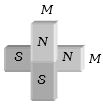
Two identical bar magnets are placed one above the other such that they are mutually perpendicular and bisect each other. The time period of this combination in a horizontal magnetic field is $T$. The time period of each magnet in the same field is
A
$\sqrt{2} \, T$
B
$2^{1/4} \, T$
C
$2^{-1/4} \, T$
D
$2^{-1/2} \, T$
Solution
(C) The time period of a single bar magnet of magnetic moment $M$ and moment of inertia $I$ in a magnetic field $H$ is given by $T' = 2\pi \sqrt{\frac{I}{MH}}$.
For the combination of two identical magnets placed perpendicularly,the total moment of inertia is $I_{total} = I + I = 2I$.
The resultant magnetic moment is $M_{res} = \sqrt{M^2 + M^2} = \sqrt{2}M$.
The time period of the combination is $T = 2\pi \sqrt{\frac{I_{total}}{M_{res}H}} = 2\pi \sqrt{\frac{2I}{\sqrt{2}MH}} = 2\pi \sqrt{\frac{\sqrt{2}I}{MH}}$.
We can write this as $T = 2^{1/4} \times 2\pi \sqrt{\frac{I}{MH}} = 2^{1/4} T'$.
Therefore,$T' = \frac{T}{2^{1/4}} = 2^{-1/4} T$.
For the combination of two identical magnets placed perpendicularly,the total moment of inertia is $I_{total} = I + I = 2I$.
The resultant magnetic moment is $M_{res} = \sqrt{M^2 + M^2} = \sqrt{2}M$.
The time period of the combination is $T = 2\pi \sqrt{\frac{I_{total}}{M_{res}H}} = 2\pi \sqrt{\frac{2I}{\sqrt{2}MH}} = 2\pi \sqrt{\frac{\sqrt{2}I}{MH}}$.
We can write this as $T = 2^{1/4} \times 2\pi \sqrt{\frac{I}{MH}} = 2^{1/4} T'$.
Therefore,$T' = \frac{T}{2^{1/4}} = 2^{-1/4} T$.
0 likes
View Solution73
MediumMCQ
The radius of the coil of a Tangent galvanometer,which has $10$ turns,is $0.1\,m$. The current required to produce a deflection of $60^{\circ}$ $(B_H = 4 \times 10^{-5}\,T)$ is.....$A$
A
$3$
B
$1.1$
C
$2.1$
D
$1.5$
Solution
(B) The principle of a Tangent galvanometer is given by the formula: $B = B_H \tan \theta$,where $B$ is the magnetic field produced by the coil.
Substituting the formula for the magnetic field at the center of a circular coil: $\frac{\mu_0 n i}{2r} = B_H \tan \theta$.
Rearranging for current $i$: $i = \frac{2r B_H \tan \theta}{\mu_0 n}$.
Given values: $r = 0.1\,m$,$n = 10$,$B_H = 4 \times 10^{-5}\,T$,$\theta = 60^{\circ}$,and $\mu_0 = 4\pi \times 10^{-7}\,T\cdot m/A$.
Substituting these values: $i = \frac{2 \times 0.1 \times 4 \times 10^{-5} \times \tan(60^{\circ})}{10 \times 4\pi \times 10^{-7}}$.
Since $\tan(60^{\circ}) = \sqrt{3} \approx 1.732$,we have $i = \frac{0.8 \times 10^{-5} \times 1.732}{4\pi \times 10^{-6}} = \frac{0.8 \times 1.732}{4\pi \times 0.1} \approx 1.1\,A$.
Substituting the formula for the magnetic field at the center of a circular coil: $\frac{\mu_0 n i}{2r} = B_H \tan \theta$.
Rearranging for current $i$: $i = \frac{2r B_H \tan \theta}{\mu_0 n}$.
Given values: $r = 0.1\,m$,$n = 10$,$B_H = 4 \times 10^{-5}\,T$,$\theta = 60^{\circ}$,and $\mu_0 = 4\pi \times 10^{-7}\,T\cdot m/A$.
Substituting these values: $i = \frac{2 \times 0.1 \times 4 \times 10^{-5} \times \tan(60^{\circ})}{10 \times 4\pi \times 10^{-7}}$.
Since $\tan(60^{\circ}) = \sqrt{3} \approx 1.732$,we have $i = \frac{0.8 \times 10^{-5} \times 1.732}{4\pi \times 10^{-6}} = \frac{0.8 \times 1.732}{4\pi \times 0.1} \approx 1.1\,A$.
0 likes
View Solution74
MediumMCQ
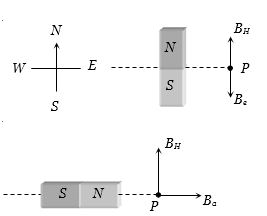
$A$ short bar magnet with its north pole facing north forms a neutral point at $P$ in the horizontal plane. If the magnet is rotated by $90^o$ in the horizontal plane,the net magnetic induction at $P$ is (Horizontal component of earth's magnetic field = $B_H$)
A
$0$
B
$2 B_H$
C
$\frac{\sqrt{5}}{2} B_H$
D
$\sqrt{5} B_H$
Solution
(D) Initially,the neutral point is obtained on the equatorial line of the magnet. At the neutral point,the magnitude of the horizontal component of the Earth's magnetic field $(B_H)$ is equal to the magnetic field due to the bar magnet on its equatorial line $(B_e)$. Thus,$|B_H| = |B_e|$.
When the magnet is rotated by $90^o$,the point $P$ now lies on the axial line of the magnet. The magnetic field due to the bar magnet on its axial line is $B_a = 2 B_e$. Since $B_e = B_H$,we have $B_a = 2 B_H$.
The Earth's horizontal magnetic field $B_H$ remains in the same direction. The net magnetic field $B$ at point $P$ is the vector sum of $B_a$ and $B_H$,which are perpendicular to each other.
Therefore,the net magnetic induction is $B = \sqrt{B_a^2 + B_H^2} = \sqrt{(2 B_H)^2 + B_H^2} = \sqrt{4 B_H^2 + B_H^2} = \sqrt{5} B_H$.
When the magnet is rotated by $90^o$,the point $P$ now lies on the axial line of the magnet. The magnetic field due to the bar magnet on its axial line is $B_a = 2 B_e$. Since $B_e = B_H$,we have $B_a = 2 B_H$.
The Earth's horizontal magnetic field $B_H$ remains in the same direction. The net magnetic field $B$ at point $P$ is the vector sum of $B_a$ and $B_H$,which are perpendicular to each other.
Therefore,the net magnetic induction is $B = \sqrt{B_a^2 + B_H^2} = \sqrt{(2 B_H)^2 + B_H^2} = \sqrt{4 B_H^2 + B_H^2} = \sqrt{5} B_H$.
0 likes
View Solution75
DifficultMCQ
$A$ vibration magnetometer consists of two identical bar magnets placed one over the other such that they are perpendicular and bisect each other. The time period of oscillation in a horizontal magnetic field is ${2^{5/4}} \ s$. One of the magnets is removed and if the other magnet oscillates in the same field,then the time period in seconds is
A
${2^{1/4}}$
B
${2^{1/2}}$
C
$2$
D
${2^{3/4}}$
Solution
(C) The time period of a vibration magnetometer is given by $T = 2\pi \sqrt{\frac{I}{MB_H}}$.
Initially,two identical magnets of magnetic moment $M$ and moment of inertia $I$ are placed perpendicular to each other.
The resultant magnetic moment is $M_1 = \sqrt{M^2 + M^2} = M\sqrt{2}$.
The total moment of inertia is $I_1 = I + I = 2I$.
The initial time period is $T_1 = 2\pi \sqrt{\frac{2I}{M\sqrt{2} B_H}} = 2\pi \sqrt{\frac{\sqrt{2}I}{MB_H}} = 2^{1/4} \cdot 2\pi \sqrt{\frac{I}{MB_H}}$.
Given $T_1 = 2^{5/4} \ s$,we have $2^{5/4} = 2^{1/4} \cdot T_0$,where $T_0 = 2\pi \sqrt{\frac{I}{MB_H}}$ is the time period of a single magnet.
Thus,$T_0 = \frac{2^{5/4}}{2^{1/4}} = 2^1 = 2 \ s$.
When one magnet is removed,the time period of the remaining magnet is $T_2 = T_0 = 2 \ s$.
Initially,two identical magnets of magnetic moment $M$ and moment of inertia $I$ are placed perpendicular to each other.
The resultant magnetic moment is $M_1 = \sqrt{M^2 + M^2} = M\sqrt{2}$.
The total moment of inertia is $I_1 = I + I = 2I$.
The initial time period is $T_1 = 2\pi \sqrt{\frac{2I}{M\sqrt{2} B_H}} = 2\pi \sqrt{\frac{\sqrt{2}I}{MB_H}} = 2^{1/4} \cdot 2\pi \sqrt{\frac{I}{MB_H}}$.
Given $T_1 = 2^{5/4} \ s$,we have $2^{5/4} = 2^{1/4} \cdot T_0$,where $T_0 = 2\pi \sqrt{\frac{I}{MB_H}}$ is the time period of a single magnet.
Thus,$T_0 = \frac{2^{5/4}}{2^{1/4}} = 2^1 = 2 \ s$.
When one magnet is removed,the time period of the remaining magnet is $T_2 = T_0 = 2 \ s$.
0 likes
View Solution76
MediumMCQ
In a vibration magnetometer,the time period of a bar magnet oscillating in the horizontal component of the Earth's magnetic field is $2 \ s$. When a magnet is brought near and parallel to it,the time period reduces to $1 \ s$. The ratio $H/F$ of the horizontal component $H$ and the field $F$ due to the magnet will be:
A
$3$
B
$1/3$
C
$\sqrt{3}$
D
$1/\sqrt{3}$
Solution
(B) The time period of a vibration magnetometer is given by $T = 2\pi \sqrt{\frac{I}{MH}}$,where $I$ is the moment of inertia,$M$ is the magnetic moment,and $H$ is the magnetic field.
Thus,$T \propto \frac{1}{\sqrt{B_{net}}}$,where $B_{net}$ is the net magnetic field.
Initially,$T_1 = 2 \ s$ and $B_{net1} = H$.
When the magnet is brought near and parallel,the net field becomes $B_{net2} = H + F$,and the time period is $T_2 = 1 \ s$.
Taking the ratio: $\frac{T_1}{T_2} = \sqrt{\frac{H+F}{H}}$.
Substituting the values: $\frac{2}{1} = \sqrt{1 + \frac{F}{H}}$.
Squaring both sides: $4 = 1 + \frac{F}{H} \Rightarrow \frac{F}{H} = 3$.
Therefore,the ratio $\frac{H}{F} = \frac{1}{3}$.
Thus,$T \propto \frac{1}{\sqrt{B_{net}}}$,where $B_{net}$ is the net magnetic field.
Initially,$T_1 = 2 \ s$ and $B_{net1} = H$.
When the magnet is brought near and parallel,the net field becomes $B_{net2} = H + F$,and the time period is $T_2 = 1 \ s$.
Taking the ratio: $\frac{T_1}{T_2} = \sqrt{\frac{H+F}{H}}$.
Substituting the values: $\frac{2}{1} = \sqrt{1 + \frac{F}{H}}$.
Squaring both sides: $4 = 1 + \frac{F}{H} \Rightarrow \frac{F}{H} = 3$.
Therefore,the ratio $\frac{H}{F} = \frac{1}{3}$.
0 likes
View Solution77
DifficultMCQ
$A$ magnet is suspended in the magnetic meridian with an untwisted wire. The upper end of the wire is rotated through $180^o$ to deflect the magnet by $30^o$ from the magnetic meridian. When this magnet is replaced by another magnet,the upper end of the wire is rotated through $270^o$ to deflect the magnet $30^o$ from the magnetic meridian. The ratio of the magnetic moments of the magnets is
A
$1:5$
B
$1:8$
C
$5:8$
D
$8:5$
Solution
(C) Let $M_1$ and $M_2$ be the magnetic moments of the magnets and $H$ be the horizontal component of the Earth's magnetic field.
For a magnet in equilibrium,the restoring torque of the wire equals the magnetic torque: $\tau = C\phi = MH \sin \theta$,where $C$ is the restoring couple per unit twist,$\phi$ is the twist angle of the wire,and $\theta$ is the deflection angle.
For the first magnet: $\phi_1 = 180^o - 30^o = 150^o$. Thus,$C(150^o) = M_1 H \sin 30^o$.
For the second magnet: $\phi_2 = 270^o - 30^o = 240^o$. Thus,$C(240^o) = M_2 H \sin 30^o$.
Dividing the two equations: $\frac{M_1}{M_2} = \frac{150^o}{240^o} = \frac{15}{24} = \frac{5}{8}$.
Therefore,the ratio of the magnetic moments is $5:8$.
For a magnet in equilibrium,the restoring torque of the wire equals the magnetic torque: $\tau = C\phi = MH \sin \theta$,where $C$ is the restoring couple per unit twist,$\phi$ is the twist angle of the wire,and $\theta$ is the deflection angle.
For the first magnet: $\phi_1 = 180^o - 30^o = 150^o$. Thus,$C(150^o) = M_1 H \sin 30^o$.
For the second magnet: $\phi_2 = 270^o - 30^o = 240^o$. Thus,$C(240^o) = M_2 H \sin 30^o$.
Dividing the two equations: $\frac{M_1}{M_2} = \frac{150^o}{240^o} = \frac{15}{24} = \frac{5}{8}$.
Therefore,the ratio of the magnetic moments is $5:8$.
0 likes
View Solution78
MediumMCQ
$A$ dip needle vibrates in the vertical plane perpendicular to the magnetic meridian. The time period of vibration is found to be $2$ seconds. The same needle is then allowed to vibrate in the horizontal plane and the time period is again found to be $2$ seconds. Then the angle of dip is.....$^o$
A
$0$
B
$30$
C
$45$
D
$90$
Solution
(C) In the vertical plane perpendicular to the magnetic meridian,the effective magnetic field acting on the needle is the vertical component of the Earth's magnetic field,$B_V$. The time period is given by $T_1 = 2\pi \sqrt{\frac{I}{MB_V}} = 2 \text{ s}$.
In the horizontal plane,the effective magnetic field acting on the needle is the horizontal component of the Earth's magnetic field,$B_H$. The time period is given by $T_2 = 2\pi \sqrt{\frac{I}{MB_H}} = 2 \text{ s}$.
Since $T_1 = T_2$,we have $B_V = B_H$.
The angle of dip $\phi$ is defined by the relation $\tan \phi = \frac{B_V}{B_H}$.
Substituting $B_V = B_H$,we get $\tan \phi = 1$,which implies $\phi = 45^o$.
In the horizontal plane,the effective magnetic field acting on the needle is the horizontal component of the Earth's magnetic field,$B_H$. The time period is given by $T_2 = 2\pi \sqrt{\frac{I}{MB_H}} = 2 \text{ s}$.
Since $T_1 = T_2$,we have $B_V = B_H$.
The angle of dip $\phi$ is defined by the relation $\tan \phi = \frac{B_V}{B_H}$.
Substituting $B_V = B_H$,we get $\tan \phi = 1$,which implies $\phi = 45^o$.
0 likes
View Solution79
DifficultMCQ
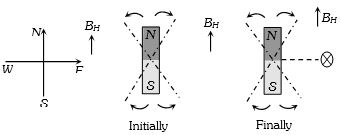
$A$ short magnet oscillates with a time period $0.1 \, s$ at a place where the horizontal magnetic field is $24 \, \mu T$. $A$ downward current of $18 \, A$ is established in a vertical wire $20 \, cm$ east of the magnet. Find the new time period of the oscillator. (in $, s$)
A
$0.1$
B
$0.089$
C
$0.076$
D
$0.057$
Solution
(C) The time period of an oscillating magnet is given by $T = 2\pi \sqrt{\frac{I}{m B_H}}$,where $I$ is the moment of inertia,$m$ is the magnetic moment,and $B_H$ is the horizontal component of the Earth's magnetic field.
Initially,$T = 0.1 \, s$ and $B_H = 24 \, \mu T$.
The magnetic field $B$ produced by a long vertical wire carrying current $i$ at a distance $a$ is $B = \frac{\mu_0}{4\pi} \cdot \frac{2i}{a}$.
Given $i = 18 \, A$ and $a = 20 \, cm = 0.2 \, m$,we have $B = 10^{-7} \cdot \frac{2 \times 18}{0.2} = 18 \times 10^{-6} \, T = 18 \, \mu T$.
Since the wire is to the east and the current is downward,by the right-hand rule,the magnetic field $B$ at the magnet's position points north,in the same direction as $B_H$.
Thus,the new total magnetic field is $B_{net} = B_H + B = 24 \, \mu T + 18 \, \mu T = 42 \, \mu T$.
The new time period $T'$ is given by $T' = 2\pi \sqrt{\frac{I}{m(B_H + B)}}$.
Taking the ratio: $\frac{T'}{T} = \sqrt{\frac{B_H}{B_H + B}} = \sqrt{\frac{24}{24 + 18}} = \sqrt{\frac{24}{42}} = \sqrt{\frac{4}{7}} \approx 0.7559$.
Therefore,$T' = 0.1 \times 0.7559 \approx 0.0756 \, s \approx 0.076 \, s$.
Initially,$T = 0.1 \, s$ and $B_H = 24 \, \mu T$.
The magnetic field $B$ produced by a long vertical wire carrying current $i$ at a distance $a$ is $B = \frac{\mu_0}{4\pi} \cdot \frac{2i}{a}$.
Given $i = 18 \, A$ and $a = 20 \, cm = 0.2 \, m$,we have $B = 10^{-7} \cdot \frac{2 \times 18}{0.2} = 18 \times 10^{-6} \, T = 18 \, \mu T$.
Since the wire is to the east and the current is downward,by the right-hand rule,the magnetic field $B$ at the magnet's position points north,in the same direction as $B_H$.
Thus,the new total magnetic field is $B_{net} = B_H + B = 24 \, \mu T + 18 \, \mu T = 42 \, \mu T$.
The new time period $T'$ is given by $T' = 2\pi \sqrt{\frac{I}{m(B_H + B)}}$.
Taking the ratio: $\frac{T'}{T} = \sqrt{\frac{B_H}{B_H + B}} = \sqrt{\frac{24}{24 + 18}} = \sqrt{\frac{24}{42}} = \sqrt{\frac{4}{7}} \approx 0.7559$.
Therefore,$T' = 0.1 \times 0.7559 \approx 0.0756 \, s \approx 0.076 \, s$.
0 likes
View Solution80
EasyMCQ
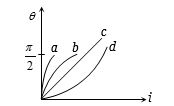
Which curve best represents the relationship between current $i$ and deflection $\theta$ in a tangent galvanometer?
A
$a$
B
$b$
C
$c$
D
$d$
Solution
(B) In a tangent galvanometer,the current $i$ is related to the deflection $\theta$ by the formula: $i = K \tan \theta$,where $K$ is the reduction factor of the galvanometer.
This implies that $\theta = \arctan(i/K)$.
As $i$ increases,$\tan \theta$ increases. For small values of $\theta$,$\tan \theta \approx \theta$,making the graph nearly linear. As $\theta$ approaches $\pi/2$,$\tan \theta$ approaches infinity,meaning the slope of the $\theta$ vs $i$ curve must decrease as $\theta$ increases (the curve bends towards the $i$-axis).
Looking at the provided graph,curve $b$ shows this characteristic behavior where the rate of increase of $\theta$ with respect to $i$ decreases as $\theta$ increases,correctly representing the inverse tangent function shape.
Therefore,the correct option is $b$.
This implies that $\theta = \arctan(i/K)$.
As $i$ increases,$\tan \theta$ increases. For small values of $\theta$,$\tan \theta \approx \theta$,making the graph nearly linear. As $\theta$ approaches $\pi/2$,$\tan \theta$ approaches infinity,meaning the slope of the $\theta$ vs $i$ curve must decrease as $\theta$ increases (the curve bends towards the $i$-axis).
Looking at the provided graph,curve $b$ shows this characteristic behavior where the rate of increase of $\theta$ with respect to $i$ decreases as $\theta$ increases,correctly representing the inverse tangent function shape.
Therefore,the correct option is $b$.
0 likes
View Solution81
MediumMCQ
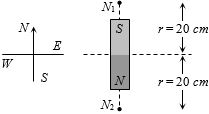
$A$ bar magnet is placed in the magnetic meridian with its south pole pointing towards the geographic north. The neutral point is at a distance of $20 \, cm$ from the center of the magnet. If the horizontal component of the Earth's magnetic field is $B_H = 0.3 \times 10^{-4} \, Wb/m^2$,what is the magnetic moment of the magnet?
A
$9000 \, ab-amp \cdot cm^2$
B
$900 \, ab-amp \cdot cm^2$
C
$1200 \, ab-amp \cdot cm^2$
D
$225 \, ab-amp \cdot cm^2$
Solution
(C) The neutral point for a magnet placed with its south pole pointing towards the geographic north lies on its axial line. The magnetic field due to the magnet at an axial point is given by $B = \frac{\mu_0}{4\pi} \cdot \frac{2Mr}{(r^2 - l^2)^2}$. For a short magnet,this simplifies to $B = \frac{\mu_0}{4\pi} \cdot \frac{2M}{r^3}$.
At the neutral point,the magnetic field of the magnet equals the horizontal component of the Earth's magnetic field $(B_H)$:
$\frac{\mu_0}{4\pi} \cdot \frac{2M}{r^3} = B_H$
Given: $r = 20 \, cm = 0.2 \, m$,$B_H = 0.3 \times 10^{-4} \, T$,and $\frac{\mu_0}{4\pi} = 10^{-7} \, T \cdot m/A$.
Substituting the values:
$10^{-7} \cdot \frac{2M}{(0.2)^3} = 0.3 \times 10^{-4}$
$10^{-7} \cdot \frac{2M}{0.008} = 0.3 \times 10^{-4}$
$2M = 0.3 \times 10^{-4} \times 0.008 \times 10^7$
$2M = 0.3 \times 8 = 2.4$
$M = 1.2 \, A \cdot m^2$.
Since $1 \, A \cdot m^2 = 1000 \, ab-amp \cdot cm^2$,we have:
$M = 1.2 \times 1000 = 1200 \, ab-amp \cdot cm^2$.
At the neutral point,the magnetic field of the magnet equals the horizontal component of the Earth's magnetic field $(B_H)$:
$\frac{\mu_0}{4\pi} \cdot \frac{2M}{r^3} = B_H$
Given: $r = 20 \, cm = 0.2 \, m$,$B_H = 0.3 \times 10^{-4} \, T$,and $\frac{\mu_0}{4\pi} = 10^{-7} \, T \cdot m/A$.
Substituting the values:
$10^{-7} \cdot \frac{2M}{(0.2)^3} = 0.3 \times 10^{-4}$
$10^{-7} \cdot \frac{2M}{0.008} = 0.3 \times 10^{-4}$
$2M = 0.3 \times 10^{-4} \times 0.008 \times 10^7$
$2M = 0.3 \times 8 = 2.4$
$M = 1.2 \, A \cdot m^2$.
Since $1 \, A \cdot m^2 = 1000 \, ab-amp \cdot cm^2$,we have:
$M = 1.2 \times 1000 = 1200 \, ab-amp \cdot cm^2$.
0 likes
View Solution82
DifficultMCQ
Two magnets are placed with their like poles together,and they perform $12$ oscillations in $1$ minute. When they are placed with their unlike poles together,they perform $4$ oscillations in $1$ minute. What is the ratio of the magnetic moments of the magnets?
A
$3 : 1$
B
$1 : 3$
C
$3 : 5$
D
$5 : 4$
Solution
(D) The time period of oscillation for a vibration magnetometer is given by $T = 2\pi \sqrt{\frac{I}{MH}}$.
For the sum of magnetic moments $(M_1 + M_2)$,the time period is $T_s = \frac{60}{12} = 5 \ s$.
For the difference of magnetic moments $(M_1 - M_2)$,the time period is $T_d = \frac{60}{4} = 15 \ s$.
The ratio of magnetic moments is given by $\frac{M_1}{M_2} = \frac{T_d^2 + T_s^2}{T_d^2 - T_s^2}$.
Substituting the values: $\frac{M_1}{M_2} = \frac{15^2 + 5^2}{15^2 - 5^2} = \frac{225 + 25}{225 - 25} = \frac{250}{200} = \frac{5}{4}$.
For the sum of magnetic moments $(M_1 + M_2)$,the time period is $T_s = \frac{60}{12} = 5 \ s$.
For the difference of magnetic moments $(M_1 - M_2)$,the time period is $T_d = \frac{60}{4} = 15 \ s$.
The ratio of magnetic moments is given by $\frac{M_1}{M_2} = \frac{T_d^2 + T_s^2}{T_d^2 - T_s^2}$.
Substituting the values: $\frac{M_1}{M_2} = \frac{15^2 + 5^2}{15^2 - 5^2} = \frac{225 + 25}{225 - 25} = \frac{250}{200} = \frac{5}{4}$.
0 likes
View Solution83
EasyMCQ
$A$ tangent galvanometer shows a deflection of $30^{\circ}$ under the influence of the horizontal component of the Earth's magnetic field,which is $0.34 \times 10^{-4} \, T$. What is the magnetic field of the coil?
A
$1.96 \times 10^{-4} \, T$
B
$1.96 \times 10^{-5} \, T$
C
$1.96 \times 10^{4} \, T$
D
$1.96 \times 10^{5} \, T$
Solution
(B) The principle of a tangent galvanometer is given by the formula: $B = B_H \tan \theta$,where $B$ is the magnetic field produced by the coil,$B_H$ is the horizontal component of the Earth's magnetic field,and $\theta$ is the deflection angle.
Given:
$B_H = 0.34 \times 10^{-4} \, T$
$\theta = 30^{\circ}$
Substituting the values:
$B = (0.34 \times 10^{-4}) \times \tan(30^{\circ})$
Since $\tan(30^{\circ}) = \frac{1}{\sqrt{3}} \approx 0.57735$
$B = 0.34 \times 10^{-4} \times 0.57735$
$B \approx 0.1963 \times 10^{-4} \, T$
$B \approx 1.963 \times 10^{-5} \, T$
Thus,the magnetic field of the coil is $1.96 \times 10^{-5} \, T$.
Given:
$B_H = 0.34 \times 10^{-4} \, T$
$\theta = 30^{\circ}$
Substituting the values:
$B = (0.34 \times 10^{-4}) \times \tan(30^{\circ})$
Since $\tan(30^{\circ}) = \frac{1}{\sqrt{3}} \approx 0.57735$
$B = 0.34 \times 10^{-4} \times 0.57735$
$B \approx 0.1963 \times 10^{-4} \, T$
$B \approx 1.963 \times 10^{-5} \, T$
Thus,the magnetic field of the coil is $1.96 \times 10^{-5} \, T$.
0 likes
View Solution84
MediumMCQ
When a freely suspended magnet is heated,its magnetic moment decreases by $19\%$. What is the percentage change in its time period?
A
$19\%$ increase
B
$11\%$ increase
C
$19\%$ decrease
D
$21\%$ decrease
Solution
(B) The time period $T$ of a freely suspended magnet in a magnetic field $B_H$ is given by $T = 2\pi \sqrt{\frac{I}{MB_H}}$,where $I$ is the moment of inertia and $M$ is the magnetic moment.
From the formula,$T \propto \frac{1}{\sqrt{M}}$.
Let the initial magnetic moment be $M_1 = 100$ and the final magnetic moment be $M_2 = 100 - 19 = 81$.
The ratio of time periods is $\frac{T_2}{T_1} = \sqrt{\frac{M_1}{M_2}} = \sqrt{\frac{100}{81}} = \frac{10}{9}$.
Calculating the percentage change: $\frac{T_2 - T_1}{T_1} \times 100 = (\frac{10}{9} - 1) \times 100 = \frac{1}{9} \times 100 \approx 11.11\%$.
Thus,the time period increases by approximately $11\%$.
From the formula,$T \propto \frac{1}{\sqrt{M}}$.
Let the initial magnetic moment be $M_1 = 100$ and the final magnetic moment be $M_2 = 100 - 19 = 81$.
The ratio of time periods is $\frac{T_2}{T_1} = \sqrt{\frac{M_1}{M_2}} = \sqrt{\frac{100}{81}} = \frac{10}{9}$.
Calculating the percentage change: $\frac{T_2 - T_1}{T_1} \times 100 = (\frac{10}{9} - 1) \times 100 = \frac{1}{9} \times 100 \approx 11.11\%$.
Thus,the time period increases by approximately $11\%$.
0 likes
View Solution85
DifficultMCQ
$A$ magnet makes $20$ and $15$ oscillations in $1$ minute at two places where the angles of dip are $30^{\circ}$ and $60^{\circ}$ respectively. What is the ratio of the total magnetic fields at these two places?
A
$3\sqrt{3} : 8$
B
$16 : 9\sqrt{3}$
C
$4 : 9$
D
$2\sqrt{3} : 9$
Solution
(B) The time period of a magnetic needle oscillating in a magnetic field is given by $T = 2\pi \sqrt{\frac{I}{MB_H}}$,where $B_H = B \cos \phi$ is the horizontal component of the Earth's magnetic field.
Thus,$T = 2\pi \sqrt{\frac{I}{MB \cos \phi}}$,which implies $T \propto \frac{1}{\sqrt{B \cos \phi}}$.
Given $n_1 = 20$ oscillations in $60 \ s$,so $T_1 = \frac{60}{20} = 3 \ s$ at $\phi_1 = 30^{\circ}$.
Given $n_2 = 15$ oscillations in $60 \ s$,so $T_2 = \frac{60}{15} = 4 \ s$ at $\phi_2 = 60^{\circ}$.
Taking the ratio: $\frac{T_1}{T_2} = \sqrt{\frac{B_2 \cos \phi_2}{B_1 \cos \phi_1}} \Rightarrow \frac{3}{4} = \sqrt{\frac{B_2 \cos 60^{\circ}}{B_1 \cos 30^{\circ}}}$.
Squaring both sides: $\frac{9}{16} = \frac{B_2}{B_1} \times \frac{1/2}{\sqrt{3}/2} = \frac{B_2}{B_1} \times \frac{1}{\sqrt{3}}$.
Therefore,$\frac{B_1}{B_2} = \frac{16}{9\sqrt{3}}$.
Thus,$T = 2\pi \sqrt{\frac{I}{MB \cos \phi}}$,which implies $T \propto \frac{1}{\sqrt{B \cos \phi}}$.
Given $n_1 = 20$ oscillations in $60 \ s$,so $T_1 = \frac{60}{20} = 3 \ s$ at $\phi_1 = 30^{\circ}$.
Given $n_2 = 15$ oscillations in $60 \ s$,so $T_2 = \frac{60}{15} = 4 \ s$ at $\phi_2 = 60^{\circ}$.
Taking the ratio: $\frac{T_1}{T_2} = \sqrt{\frac{B_2 \cos \phi_2}{B_1 \cos \phi_1}} \Rightarrow \frac{3}{4} = \sqrt{\frac{B_2 \cos 60^{\circ}}{B_1 \cos 30^{\circ}}}$.
Squaring both sides: $\frac{9}{16} = \frac{B_2}{B_1} \times \frac{1/2}{\sqrt{3}/2} = \frac{B_2}{B_1} \times \frac{1}{\sqrt{3}}$.
Therefore,$\frac{B_1}{B_2} = \frac{16}{9\sqrt{3}}$.
0 likes
View Solution86
MediumMCQ
The time period of a magnet is $2 \, s$. The horizontal component of the Earth's magnetic field is $H$. When an external magnetic field $F$ is applied in the same direction,the new time period becomes $1 \, s$. What is the ratio $H/F$?
A
$3$
B
$1/3$
C
$\sqrt{3}$
D
$1/\sqrt{3}$
Solution
(B) The time period of an oscillating magnet in a magnetic field $B$ is given by $T = 2\pi \sqrt{\frac{I}{MB}}$.
Initially,the magnetic field is $H$,so $T = 2\pi \sqrt{\frac{I}{MH}} = 2 \, s$.
When an external field $F$ is applied in the same direction,the net magnetic field becomes $B_{net} = H + F$.
The new time period is $T' = 2\pi \sqrt{\frac{I}{M(H+F)}} = 1 \, s$.
Taking the ratio: $\frac{T}{T'} = \sqrt{\frac{H+F}{H}} = \sqrt{1 + \frac{F}{H}}$.
Substituting the values: $\frac{2}{1} = \sqrt{1 + \frac{F}{H}} \Rightarrow 4 = 1 + \frac{F}{H} \Rightarrow \frac{F}{H} = 3$.
Therefore,the ratio $\frac{H}{F} = \frac{1}{3}$.
Initially,the magnetic field is $H$,so $T = 2\pi \sqrt{\frac{I}{MH}} = 2 \, s$.
When an external field $F$ is applied in the same direction,the net magnetic field becomes $B_{net} = H + F$.
The new time period is $T' = 2\pi \sqrt{\frac{I}{M(H+F)}} = 1 \, s$.
Taking the ratio: $\frac{T}{T'} = \sqrt{\frac{H+F}{H}} = \sqrt{1 + \frac{F}{H}}$.
Substituting the values: $\frac{2}{1} = \sqrt{1 + \frac{F}{H}} \Rightarrow 4 = 1 + \frac{F}{H} \Rightarrow \frac{F}{H} = 3$.
Therefore,the ratio $\frac{H}{F} = \frac{1}{3}$.
0 likes
View Solution87
EasyMCQ
$A$ magnet is suspended horizontally in the Earth's magnetic field. When it is made to oscillate in a horizontal plane,its time period is $T$. If a wooden block of the same moment of inertia as the magnet is attached to it,what will be the new time period of the system?
A
$T/3$
B
$T/2$
C
$T/\sqrt{2}$
D
$\sqrt{2}T$
Solution
(D) The time period of a magnet oscillating in a horizontal magnetic field is given by $T = 2\pi \sqrt{\frac{I}{MB_H}}$,where $I$ is the moment of inertia,$M$ is the magnetic moment,and $B_H$ is the horizontal component of the Earth's magnetic field.
From the formula,we see that $T \propto \sqrt{I}$.
Initially,the moment of inertia is $I$. When a wooden block of the same moment of inertia $I$ is attached to the magnet,the total moment of inertia of the system becomes $I' = I + I = 2I$.
The new time period $T'$ is given by $T' = 2\pi \sqrt{\frac{I'}{MB_H}} = 2\pi \sqrt{\frac{2I}{MB_H}}$.
Therefore,$T' = \sqrt{2} \times (2\pi \sqrt{\frac{I}{MB_H}}) = \sqrt{2}T$.
From the formula,we see that $T \propto \sqrt{I}$.
Initially,the moment of inertia is $I$. When a wooden block of the same moment of inertia $I$ is attached to the magnet,the total moment of inertia of the system becomes $I' = I + I = 2I$.
The new time period $T'$ is given by $T' = 2\pi \sqrt{\frac{I'}{MB_H}} = 2\pi \sqrt{\frac{2I}{MB_H}}$.
Therefore,$T' = \sqrt{2} \times (2\pi \sqrt{\frac{I}{MB_H}}) = \sqrt{2}T$.
0 likes
View Solution88
MediumMCQ
The needle of a deflection galvanometer shows a deflection of $60^\circ$ due to a short bar magnet at a certain distance in $\tan A$ position. If the distance is doubled,the deflection is
A
$\sin^{-1}\left(\frac{\sqrt{3}}{8}\right)$
B
$\cos^{-1}\left(\frac{\sqrt{3}}{8}\right)$
C
$\tan^{-1}\left(\frac{\sqrt{3}}{8}\right)$
D
$\cot^{-1}\left(\frac{\sqrt{3}}{8}\right)$
Solution
(C) For a short bar magnet in $\tan A$ position,the magnetic field $B$ is given by $B = \frac{\mu_0}{4\pi} \frac{2M}{d^3}$.
In a deflection galvanometer,$B = H \tan \theta$,where $H$ is the horizontal component of Earth's magnetic field.
Thus,$\frac{\mu_0}{4\pi} \frac{2M}{d^3} = H \tan \theta$ ..... $(i)$
When the distance is doubled $(d' = 2d)$,the new deflection $\theta'$ is given by:
$\frac{\mu_0}{4\pi} \frac{2M}{(2d)^3} = H \tan \theta'$ ..... $(ii)$
Dividing equation $(ii)$ by $(i)$:
$\frac{\tan \theta'}{\tan \theta} = \frac{1}{2^3} = \frac{1}{8}$
$\tan \theta' = \frac{\tan 60^\circ}{8} = \frac{\sqrt{3}}{8}$
$\theta' = \tan^{-1}\left(\frac{\sqrt{3}}{8}\right)$
In a deflection galvanometer,$B = H \tan \theta$,where $H$ is the horizontal component of Earth's magnetic field.
Thus,$\frac{\mu_0}{4\pi} \frac{2M}{d^3} = H \tan \theta$ ..... $(i)$
When the distance is doubled $(d' = 2d)$,the new deflection $\theta'$ is given by:
$\frac{\mu_0}{4\pi} \frac{2M}{(2d)^3} = H \tan \theta'$ ..... $(ii)$
Dividing equation $(ii)$ by $(i)$:
$\frac{\tan \theta'}{\tan \theta} = \frac{1}{2^3} = \frac{1}{8}$
$\tan \theta' = \frac{\tan 60^\circ}{8} = \frac{\sqrt{3}}{8}$
$\theta' = \tan^{-1}\left(\frac{\sqrt{3}}{8}\right)$
0 likes
View Solution89
MediumMCQ
$A$ tangent galvanometer shows a deflection of $45^{\circ}$ when a $10 \, mA$ current passes through it. If the horizontal component of the Earth's magnetic field is $3.6 \times 10^{-5} \, T$ and the radius of the coil is $10 \, cm$,find the number of turns in the coil.
A
$5700$
B
$57$
C
$570$
D
$5.7$
Solution
(C) The formula for a tangent galvanometer is $I = K \tan \theta$,where $K = \frac{2r B_H}{\mu_0 n}$.
Given: $I = 10 \, mA = 10 \times 10^{-3} \, A$,$\theta = 45^{\circ}$,$B_H = 3.6 \times 10^{-5} \, T$,$r = 10 \, cm = 0.1 \, m$.
Since $\tan 45^{\circ} = 1$,we have $I = K$,so $n = \frac{2r B_H}{\mu_0 I}$.
Substituting the values: $n = \frac{2 \times 0.1 \times 3.6 \times 10^{-5}}{4\pi \times 10^{-7} \times 10 \times 10^{-3}}$.
$n = \frac{0.72 \times 10^{-5}}{4 \times 3.14159 \times 10^{-10}} = \frac{0.72 \times 10^5}{12.566} \approx 5729.7 / 10 = 573$ (approx $570$ based on standard approximation $\pi \approx 3.14$ and $4\pi \approx 12.56$).
Using $\pi = 3.14$,$n = \frac{0.72 \times 10^{-5}}{12.56 \times 10^{-10}} = \frac{72000}{125.6} \approx 573$. Given the options,$570$ is the correct choice.
Given: $I = 10 \, mA = 10 \times 10^{-3} \, A$,$\theta = 45^{\circ}$,$B_H = 3.6 \times 10^{-5} \, T$,$r = 10 \, cm = 0.1 \, m$.
Since $\tan 45^{\circ} = 1$,we have $I = K$,so $n = \frac{2r B_H}{\mu_0 I}$.
Substituting the values: $n = \frac{2 \times 0.1 \times 3.6 \times 10^{-5}}{4\pi \times 10^{-7} \times 10 \times 10^{-3}}$.
$n = \frac{0.72 \times 10^{-5}}{4 \times 3.14159 \times 10^{-10}} = \frac{0.72 \times 10^5}{12.566} \approx 5729.7 / 10 = 573$ (approx $570$ based on standard approximation $\pi \approx 3.14$ and $4\pi \approx 12.56$).
Using $\pi = 3.14$,$n = \frac{0.72 \times 10^{-5}}{12.56 \times 10^{-10}} = \frac{72000}{125.6} \approx 573$. Given the options,$570$ is the correct choice.
0 likes
View Solution90
MediumMCQ
The magnet of a vibration magnetometer is heated so as to reduce its magnetic moment by $36\%$. By doing this,the periodic time of the magnetometer will
A
Increase by $36\%$
B
Increase by $25\%$
C
Decrease by $25\%$
D
Decrease by $64\%$
Solution
(B) The time period $T$ of a vibration magnetometer is given by the formula $T = 2\pi \sqrt{\frac{I}{MB_H}}$,where $I$ is the moment of inertia,$M$ is the magnetic moment,and $B_H$ is the horizontal component of the Earth's magnetic field.
From the formula,we see that $T \propto \frac{1}{\sqrt{M}}$.
Therefore,the ratio of the time periods is $\frac{T_1}{T_2} = \sqrt{\frac{M_2}{M_1}}$.
Given that the magnetic moment is reduced by $36\%$,if the initial magnetic moment $M_1 = 100$,then the final magnetic moment $M_2 = 100 - 36 = 64$.
Substituting these values,we get $\frac{T_1}{T_2} = \sqrt{\frac{64}{100}} = \frac{8}{10} = 0.8$.
This implies $T_2 = \frac{T_1}{0.8} = 1.25 T_1$.
The percentage increase in the time period is $\frac{T_2 - T_1}{T_1} \times 100\% = (1.25 - 1) \times 100\% = 25\%$.
From the formula,we see that $T \propto \frac{1}{\sqrt{M}}$.
Therefore,the ratio of the time periods is $\frac{T_1}{T_2} = \sqrt{\frac{M_2}{M_1}}$.
Given that the magnetic moment is reduced by $36\%$,if the initial magnetic moment $M_1 = 100$,then the final magnetic moment $M_2 = 100 - 36 = 64$.
Substituting these values,we get $\frac{T_1}{T_2} = \sqrt{\frac{64}{100}} = \frac{8}{10} = 0.8$.
This implies $T_2 = \frac{T_1}{0.8} = 1.25 T_1$.
The percentage increase in the time period is $\frac{T_2 - T_1}{T_1} \times 100\% = (1.25 - 1) \times 100\% = 25\%$.
0 likes
View Solution91
DifficultMCQ
The ratio of magnetic moments of two bar magnets is $13 : 5$. These magnets are held together in a vibration magnetometer and are allowed to oscillate in the Earth's magnetic field. When like poles are together,$15$ oscillations per minute are made. What will be the frequency of oscillation of the system if unlike poles are together? (in $oscillations/min$)
A
$10$
B
$15$
C
$12$
D
$\frac{75}{13}$
Solution
(A) Let the magnetic moments be $M_1$ and $M_2$ such that $\frac{M_1}{M_2} = \frac{13}{5}$.
When like poles are together,the effective magnetic moment is $M_s = M_1 + M_2$ and the frequency is $\nu_s = 15 \text{ oscillations/min}$.
When unlike poles are together,the effective magnetic moment is $M_d = M_1 - M_2$ and the frequency is $\nu_d$.
The frequency of a vibration magnetometer is given by $\nu \propto \sqrt{M}$.
Therefore,$\frac{\nu_s}{\nu_d} = \sqrt{\frac{M_1 + M_2}{M_1 - M_2}}$.
Squaring both sides: $\frac{\nu_s^2}{\nu_d^2} = \frac{M_1 + M_2}{M_1 - M_2} = \frac{13 + 5}{13 - 5} = \frac{18}{8} = \frac{9}{4}$.
Taking the square root: $\frac{\nu_s}{\nu_d} = \frac{3}{2}$.
Given $\nu_s = 15$,we have $\frac{15}{\nu_d} = \frac{3}{2}$.
Solving for $\nu_d$: $\nu_d = \frac{15 \times 2}{3} = 10 \text{ oscillations/min}$.
When like poles are together,the effective magnetic moment is $M_s = M_1 + M_2$ and the frequency is $\nu_s = 15 \text{ oscillations/min}$.
When unlike poles are together,the effective magnetic moment is $M_d = M_1 - M_2$ and the frequency is $\nu_d$.
The frequency of a vibration magnetometer is given by $\nu \propto \sqrt{M}$.
Therefore,$\frac{\nu_s}{\nu_d} = \sqrt{\frac{M_1 + M_2}{M_1 - M_2}}$.
Squaring both sides: $\frac{\nu_s^2}{\nu_d^2} = \frac{M_1 + M_2}{M_1 - M_2} = \frac{13 + 5}{13 - 5} = \frac{18}{8} = \frac{9}{4}$.
Taking the square root: $\frac{\nu_s}{\nu_d} = \frac{3}{2}$.
Given $\nu_s = 15$,we have $\frac{15}{\nu_d} = \frac{3}{2}$.
Solving for $\nu_d$: $\nu_d = \frac{15 \times 2}{3} = 10 \text{ oscillations/min}$.
0 likes
View Solution92
EasyMCQ
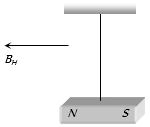
$A$ magnet is suspended horizontally in the earth's magnetic field. When it is displaced and then released,it oscillates in a horizontal plane with a period $T$. If a piece of wood of the same moment of inertia (about the axis of rotation) as the magnet is attached to the magnet,what would the new period of oscillation of the system become?
A
$\frac{T}{3}$
B
$\frac{T}{2}$
C
$\frac{T}{\sqrt{2}}$
D
$T\sqrt{2}$
Solution
(D) The time period of a magnetic dipole oscillating in a uniform magnetic field is given by $T = 2\pi \sqrt{\frac{I}{MB_H}}$,where $I$ is the moment of inertia,$M$ is the magnetic moment,and $B_H$ is the horizontal component of the earth's magnetic field.
Initially,the moment of inertia is $I$. So,$T = 2\pi \sqrt{\frac{I}{MB_H}}$.
When a piece of wood with the same moment of inertia $I$ is attached to the magnet,the new moment of inertia of the system becomes $I' = I + I = 2I$.
The magnetic moment $M$ remains unchanged.
The new time period $T'$ is given by $T' = 2\pi \sqrt{\frac{I'}{MB_H}} = 2\pi \sqrt{\frac{2I}{MB_H}}$.
Comparing this with the initial time period,we get $T' = \sqrt{2} \times (2\pi \sqrt{\frac{I}{MB_H}}) = \sqrt{2}T$.
Initially,the moment of inertia is $I$. So,$T = 2\pi \sqrt{\frac{I}{MB_H}}$.
When a piece of wood with the same moment of inertia $I$ is attached to the magnet,the new moment of inertia of the system becomes $I' = I + I = 2I$.
The magnetic moment $M$ remains unchanged.
The new time period $T'$ is given by $T' = 2\pi \sqrt{\frac{I'}{MB_H}} = 2\pi \sqrt{\frac{2I}{MB_H}}$.
Comparing this with the initial time period,we get $T' = \sqrt{2} \times (2\pi \sqrt{\frac{I}{MB_H}}) = \sqrt{2}T$.
0 likes
View Solution93
DifficultMCQ
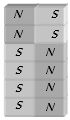
The length of a magnet is large compared to its width and breadth. The time period of its oscillation in a vibration magnetometer is $T$. The magnet is cut along its length into six parts and these parts are then placed together as shown in the figure. The time period of this combination will be
A
$T$
B
$\frac{T}{\sqrt{3}}$
C
$\frac{T}{2\sqrt{3}}$
D
Zero
Solution
(C) The time period of a magnet in a vibration magnetometer is given by $T = 2\pi \sqrt{\frac{I}{MH}}$.
When a magnet of length $L$,mass $m$,and magnetic moment $M$ is cut into $6$ equal parts along its length,each part has a mass $m' = m/6$,length $l' = L/6$,and magnetic moment $M' = M/6$.
The moment of inertia of each part about the center of the original magnet is $I' = \frac{1}{12} m' (l')^2 + m' d^2$. However,considering the standard approximation for such problems where the moment of inertia of each piece is $I_{part} = \frac{I}{6^3}$,the total moment of inertia of the system is $I_{net} = 6 \times \frac{I}{216} = \frac{I}{36}$.
From the figure,there are $2$ magnets oriented in one direction and $4$ magnets in the opposite direction. The net magnetic moment is $M_{net} = \frac{2M}{6} - \frac{4M}{6} = -\frac{2M}{6} = -\frac{M}{3}$. The magnitude is $|M_{net}| = \frac{M}{3}$.
The new time period $T'$ is $T' = 2\pi \sqrt{\frac{I_{net}}{|M_{net}|H}} = 2\pi \sqrt{\frac{I/36}{(M/3)H}} = 2\pi \sqrt{\frac{I}{12MH}} = \frac{1}{\sqrt{12}} \times 2\pi \sqrt{\frac{I}{MH}} = \frac{T}{2\sqrt{3}}$.
When a magnet of length $L$,mass $m$,and magnetic moment $M$ is cut into $6$ equal parts along its length,each part has a mass $m' = m/6$,length $l' = L/6$,and magnetic moment $M' = M/6$.
The moment of inertia of each part about the center of the original magnet is $I' = \frac{1}{12} m' (l')^2 + m' d^2$. However,considering the standard approximation for such problems where the moment of inertia of each piece is $I_{part} = \frac{I}{6^3}$,the total moment of inertia of the system is $I_{net} = 6 \times \frac{I}{216} = \frac{I}{36}$.
From the figure,there are $2$ magnets oriented in one direction and $4$ magnets in the opposite direction. The net magnetic moment is $M_{net} = \frac{2M}{6} - \frac{4M}{6} = -\frac{2M}{6} = -\frac{M}{3}$. The magnitude is $|M_{net}| = \frac{M}{3}$.
The new time period $T'$ is $T' = 2\pi \sqrt{\frac{I_{net}}{|M_{net}|H}} = 2\pi \sqrt{\frac{I/36}{(M/3)H}} = 2\pi \sqrt{\frac{I}{12MH}} = \frac{1}{\sqrt{12}} \times 2\pi \sqrt{\frac{I}{MH}} = \frac{T}{2\sqrt{3}}$.
0 likes
View Solution94
MediumMCQ
$A$ magnetic needle of magnetic moment $6.7 \times 10^{-2} \ Am^2$ and moment of inertia $7.5 \times 10^{-6} \ kgm^2$ is performing simple harmonic oscillations in a magnetic field of $0.01 \ T$. Time taken for $10$ complete oscillations is.....$s$
A
$6.65$
B
$8.89$
C
$6.98$
D
$8.76$
Solution
(A) Given:
Magnetic moment,$M = 6.7 \times 10^{-2} \ Am^2$
Magnetic field,$B = 0.01 \ T$
Moment of inertia,$I = 7.5 \times 10^{-6} \ kgm^2$
The time period $T$ of a magnetic needle performing simple harmonic oscillations is given by:
$T = 2\pi \sqrt{\frac{I}{MB}}$
Substituting the values:
$T = 2\pi \sqrt{\frac{7.5 \times 10^{-6}}{6.7 \times 10^{-2} \times 0.01}}$
$T = 2\pi \sqrt{\frac{7.5 \times 10^{-6}}{6.7 \times 10^{-4}}}$
$T = 2\pi \sqrt{1.1194 \times 10^{-2}}$
$T = 2\pi \times 0.1058 \approx 0.665 \ s$
Time taken for $10$ complete oscillations is:
$t = 10 \times T = 10 \times 0.665 = 6.65 \ s$
Magnetic moment,$M = 6.7 \times 10^{-2} \ Am^2$
Magnetic field,$B = 0.01 \ T$
Moment of inertia,$I = 7.5 \times 10^{-6} \ kgm^2$
The time period $T$ of a magnetic needle performing simple harmonic oscillations is given by:
$T = 2\pi \sqrt{\frac{I}{MB}}$
Substituting the values:
$T = 2\pi \sqrt{\frac{7.5 \times 10^{-6}}{6.7 \times 10^{-2} \times 0.01}}$
$T = 2\pi \sqrt{\frac{7.5 \times 10^{-6}}{6.7 \times 10^{-4}}}$
$T = 2\pi \sqrt{1.1194 \times 10^{-2}}$
$T = 2\pi \times 0.1058 \approx 0.665 \ s$
Time taken for $10$ complete oscillations is:
$t = 10 \times T = 10 \times 0.665 = 6.65 \ s$
0 likes
View Solution95
DifficultMCQ
$A$ vibration magnetometer consists of two identical bar magnets placed one over the other such that they are mutually perpendicular and bisect each other. The time period of oscillation in a horizontal magnetic field is $4 \, s$. If one of the magnets is taken away,find the period of oscillation of the other in the same field (in $s$):-
A
$2^{3/4}$
B
$2^{7/4}$
C
$2^{3/2}$
D
None
Solution
(B) The time period of a vibration magnetometer is given by $T = 2\pi \sqrt{\frac{I}{MB_H}}$,where $I$ is the moment of inertia,$M$ is the magnetic moment,and $B_H$ is the horizontal magnetic field.
For the combination of two identical magnets (each with moment of inertia $I_0$ and magnetic moment $M_0$) placed perpendicularly and bisecting each other:
Total moment of inertia $I_1 = I_0 + I_0 = 2I_0$.
Resultant magnetic moment $M_1 = \sqrt{M_0^2 + M_0^2} = M_0\sqrt{2}$.
Given $T_1 = 4 \, s$,so $4 = 2\pi \sqrt{\frac{2I_0}{M_0\sqrt{2} B_H}} = 2\pi \sqrt{\frac{I_0\sqrt{2}}{M_0 B_H}}$.
When one magnet is removed:
New moment of inertia $I_2 = I_0$.
New magnetic moment $M_2 = M_0$.
New time period $T_2 = 2\pi \sqrt{\frac{I_0}{M_0 B_H}}$.
Taking the ratio:
$\frac{T_1}{T_2} = \frac{2\pi \sqrt{\frac{I_0\sqrt{2}}{M_0 B_H}}}{2\pi \sqrt{\frac{I_0}{M_0 B_H}}} = \sqrt{\sqrt{2}} = 2^{1/4}$.
Therefore,$T_2 = \frac{T_1}{2^{1/4}} = \frac{4}{2^{1/4}} = \frac{2^2}{2^{1/4}} = 2^{2 - 1/4} = 2^{7/4} \, s$.
For the combination of two identical magnets (each with moment of inertia $I_0$ and magnetic moment $M_0$) placed perpendicularly and bisecting each other:
Total moment of inertia $I_1 = I_0 + I_0 = 2I_0$.
Resultant magnetic moment $M_1 = \sqrt{M_0^2 + M_0^2} = M_0\sqrt{2}$.
Given $T_1 = 4 \, s$,so $4 = 2\pi \sqrt{\frac{2I_0}{M_0\sqrt{2} B_H}} = 2\pi \sqrt{\frac{I_0\sqrt{2}}{M_0 B_H}}$.
When one magnet is removed:
New moment of inertia $I_2 = I_0$.
New magnetic moment $M_2 = M_0$.
New time period $T_2 = 2\pi \sqrt{\frac{I_0}{M_0 B_H}}$.
Taking the ratio:
$\frac{T_1}{T_2} = \frac{2\pi \sqrt{\frac{I_0\sqrt{2}}{M_0 B_H}}}{2\pi \sqrt{\frac{I_0}{M_0 B_H}}} = \sqrt{\sqrt{2}} = 2^{1/4}$.
Therefore,$T_2 = \frac{T_1}{2^{1/4}} = \frac{4}{2^{1/4}} = \frac{2^2}{2^{1/4}} = 2^{2 - 1/4} = 2^{7/4} \, s$.
0 likes
View Solution96
DifficultMCQ
$A$ thin rectangular magnet suspended freely has a period of oscillation equal to $T$. Now it is broken into two equal halves (each having half of the original length) and one piece is made to oscillate freely in the same field. If its period of oscillation is $T'$,the ratio $T'/T$ is :-
A
$1/(2\sqrt{2})$
B
$1/2$
C
$2$
D
$1/4$
Solution
(B) The period of oscillation of a magnet in a magnetic field is given by $T = 2\pi \sqrt{\frac{I}{MB}}$,where $I$ is the moment of inertia and $M$ is the magnetic dipole moment.
For the original magnet of mass $m$ and length $\ell$,$I = \frac{m\ell^2}{12}$ and $M = q_m \ell$ (where $q_m$ is pole strength).
When the magnet is cut into two equal halves along its length,the new length is $\ell' = \ell/2$ and the new mass is $m' = m/2$.
The new pole strength $q_m$ remains the same.
New magnetic moment $M' = q_m \ell' = q_m (\ell/2) = M/2$.
New moment of inertia $I' = \frac{m'(\ell')^2}{12} = \frac{(m/2)(\ell/2)^2}{12} = \frac{m\ell^2}{12 \times 8} = I/8$.
The new period of oscillation is $T' = 2\pi \sqrt{\frac{I'}{M'B}} = 2\pi \sqrt{\frac{I/8}{(M/2)B}} = 2\pi \sqrt{\frac{1}{4} \cdot \frac{I}{MB}} = \frac{1}{2} T$.
Therefore,the ratio $T'/T = 1/2$.
For the original magnet of mass $m$ and length $\ell$,$I = \frac{m\ell^2}{12}$ and $M = q_m \ell$ (where $q_m$ is pole strength).
When the magnet is cut into two equal halves along its length,the new length is $\ell' = \ell/2$ and the new mass is $m' = m/2$.
The new pole strength $q_m$ remains the same.
New magnetic moment $M' = q_m \ell' = q_m (\ell/2) = M/2$.
New moment of inertia $I' = \frac{m'(\ell')^2}{12} = \frac{(m/2)(\ell/2)^2}{12} = \frac{m\ell^2}{12 \times 8} = I/8$.
The new period of oscillation is $T' = 2\pi \sqrt{\frac{I'}{M'B}} = 2\pi \sqrt{\frac{I/8}{(M/2)B}} = 2\pi \sqrt{\frac{1}{4} \cdot \frac{I}{MB}} = \frac{1}{2} T$.
Therefore,the ratio $T'/T = 1/2$.
0 likes
View Solution97
DifficultMCQ
Two bar magnets having the same geometry with magnetic moments $M$ and $2M$ are first placed in such a way that their similar poles are on the same side,and their time period of oscillation is $T_{1}$. Now,the polarity of one of the magnets is reversed,and the time period of oscillation becomes $T_{2}$. Then:
A
$T_{1} < T_{2}$
B
$T_{1} = T_{2}$
C
$T_{1} > T_{2}$
D
$T_{2} = \infty$
Solution
(A) The time period of oscillation for a combination of two magnets in a magnetic field $B_{H}$ is given by $T = 2\pi \sqrt{\frac{I_{total}}{M_{total} B_{H}}}$.
Case $1$: When similar poles are on the same side,the effective magnetic moment is $M_{eff} = M + 2M = 3M$. The moment of inertia is $I = I_{1} + I_{2}$.
Thus,$T_{1} = 2\pi \sqrt{\frac{I_{1} + I_{2}}{3M B_{H}}}$.
Case $2$: When the polarity of one magnet is reversed,the effective magnetic moment is $M_{eff} = |2M - M| = M$. The moment of inertia remains $I = I_{1} + I_{2}$.
Thus,$T_{2} = 2\pi \sqrt{\frac{I_{1} + I_{2}}{M B_{H}}}$.
Comparing $T_{1}$ and $T_{2}$,since the denominator in $T_{2}$ is smaller than in $T_{1}$,we have $T_{1} < T_{2}$.
Case $1$: When similar poles are on the same side,the effective magnetic moment is $M_{eff} = M + 2M = 3M$. The moment of inertia is $I = I_{1} + I_{2}$.
Thus,$T_{1} = 2\pi \sqrt{\frac{I_{1} + I_{2}}{3M B_{H}}}$.
Case $2$: When the polarity of one magnet is reversed,the effective magnetic moment is $M_{eff} = |2M - M| = M$. The moment of inertia remains $I = I_{1} + I_{2}$.
Thus,$T_{2} = 2\pi \sqrt{\frac{I_{1} + I_{2}}{M B_{H}}}$.
Comparing $T_{1}$ and $T_{2}$,since the denominator in $T_{2}$ is smaller than in $T_{1}$,we have $T_{1} < T_{2}$.
0 likes
View SolutionMagnetism and Matter — Magnetic Equipment's (Tangent galvanometer, Vibration magnetometer and Neutral point) · Frequently Asked Questions
1Are these Magnetism and Matter questions useful for JEE and NEET?
Yes. All questions in this section are mapped to JEE Main and NEET exam patterns. Previous year questions from JEE Main, NEET, GUJCET and state-level exams are included with full solutions.
2Can I switch to Hindi or Gujarati for these questions?
Yes. Use the language tabs in the hero section or the sidebar to view the same questions and solutions in English, Hindi or Gujarati.
3How do I generate a question paper from this subtopic?
Use the Vedclass Exam Paper Generator — select the chapter and subtopic, set difficulty, and generate Sets A, B, C, D automatically. First 3 chapters of every subject are free.
Vedclass Products
For Students
Vedclass Test Series
Mock tests in real JEE/NEET style with performance analysis. 5-day free trial.
Start Free TrialFor Teachers
Exam Paper Generator
Generate Set A/B/C/D papers from this chapter in 2 minutes. 3 chapters free.
Try FreeFor Institutes
Online Exam Module
Live online exams with unlimited students, 360° analytics & white-label branding.
See DemoFor Teachers & Institutes
Generate a Magnetism and Matter Exam Paper in 2 Minutes
Select subtopic & difficulty — Sets A, B, C, D auto-generated with No Repeat logic.
First 3 chapters of every subject are free — no payment required.