
A English
Equivalent Capacitance of Capacitor connected in Series and Parallel Questions in English
Class 12 Physics · Electric Potential and Capacitance · Equivalent Capacitance of Capacitor connected in Series and Parallel
305+
Questions
English
Language
100%
With Solutions
Showing 5 of 305 questions in English
301
EasyMCQ
Three capacitors $3 \mu F$,$6 \mu F$,and $6 \mu F$ are connected in series to a source of $120 V$. The potential difference,in volts,across the $3 \mu F$ capacitor will be:
A
$24$
B
$30$
C
$40$
D
$60$
Solution
(D) For capacitors connected in series,the equivalent capacitance $C_{eq}$ is given by:
$\frac{1}{C_{eq}} = \frac{1}{C_1} + \frac{1}{C_2} + \frac{1}{C_3}$
$\frac{1}{C_{eq}} = \frac{1}{3} + \frac{1}{6} + \frac{1}{6} = \frac{2+1+1}{6} = \frac{4}{6} = \frac{2}{3} \mu F^{-1}$
So,$C_{eq} = 1.5 \mu F$.
The total charge $q$ flowing through the circuit is:
$q = C_{eq} \times V = 1.5 \mu F \times 120 V = 180 \mu C$.
In a series circuit,the charge on each capacitor is the same. Therefore,the charge on the $3 \mu F$ capacitor is $q = 180 \mu C$.
The potential difference $V_1$ across the $3 \mu F$ capacitor is:
$V_1 = \frac{q}{C_1} = \frac{180 \mu C}{3 \mu F} = 60 V$.
$\frac{1}{C_{eq}} = \frac{1}{C_1} + \frac{1}{C_2} + \frac{1}{C_3}$
$\frac{1}{C_{eq}} = \frac{1}{3} + \frac{1}{6} + \frac{1}{6} = \frac{2+1+1}{6} = \frac{4}{6} = \frac{2}{3} \mu F^{-1}$
So,$C_{eq} = 1.5 \mu F$.
The total charge $q$ flowing through the circuit is:
$q = C_{eq} \times V = 1.5 \mu F \times 120 V = 180 \mu C$.
In a series circuit,the charge on each capacitor is the same. Therefore,the charge on the $3 \mu F$ capacitor is $q = 180 \mu C$.
The potential difference $V_1$ across the $3 \mu F$ capacitor is:
$V_1 = \frac{q}{C_1} = \frac{180 \mu C}{3 \mu F} = 60 V$.
0 likes
View Solution302
MediumMCQ
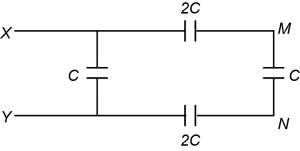
In the adjoining figure,the potential difference between $X$ and $Y$ is $60 \ V$. The potential difference between the points $M$ and $N$ will be: (in $V$)
A
$10$
B
$15$
C
$20$
D
$30$
Solution
(D) Let the potential difference across the capacitor $C$ (connected between $X$ and $Y$) be $V_{XY} = 60 \ V$.
The circuit consists of a capacitor $C$ in parallel with a series combination of capacitors $2C$,$C$,and $2C$.
Since the capacitors $2C$,$C$,and $2C$ are in series,the same charge $q$ flows through them.
The potential difference across the series branch is $V_{XY} = 60 \ V$.
The equivalent capacitance of the series branch is given by:
$\frac{1}{C_{eq}} = \frac{1}{2C} + \frac{1}{C} + \frac{1}{2C} = \frac{1+2+1}{2C} = \frac{4}{2C} = \frac{2}{C}$
So,$C_{eq} = \frac{C}{2}$.
The charge $q$ on each capacitor in the series branch is:
$q = C_{eq} \times V_{XY} = \frac{C}{2} \times 60 \ V = 30C$.
The potential difference between points $M$ and $N$ is the potential difference across the capacitor $C$ located between them.
$V_{MN} = \frac{q}{C} = \frac{30C}{C} = 30 \ V$.
The circuit consists of a capacitor $C$ in parallel with a series combination of capacitors $2C$,$C$,and $2C$.
Since the capacitors $2C$,$C$,and $2C$ are in series,the same charge $q$ flows through them.
The potential difference across the series branch is $V_{XY} = 60 \ V$.
The equivalent capacitance of the series branch is given by:
$\frac{1}{C_{eq}} = \frac{1}{2C} + \frac{1}{C} + \frac{1}{2C} = \frac{1+2+1}{2C} = \frac{4}{2C} = \frac{2}{C}$
So,$C_{eq} = \frac{C}{2}$.
The charge $q$ on each capacitor in the series branch is:
$q = C_{eq} \times V_{XY} = \frac{C}{2} \times 60 \ V = 30C$.
The potential difference between points $M$ and $N$ is the potential difference across the capacitor $C$ located between them.
$V_{MN} = \frac{q}{C} = \frac{30C}{C} = 30 \ V$.
0 likes
View Solution303
MediumMCQ
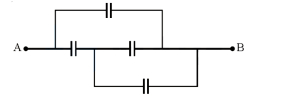
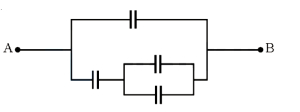
In the figure below,the capacitance of each capacitor is $3 \mu F$. The effective capacitance between $A$ and $B$ is:
A
$\frac{3}{4} \mu F$
B
$3 \mu F$
C
$6 \mu F$
D
$5 \mu F$
Solution
(D) Let the capacitance of each capacitor be $C = 3 \mu F$.
Looking at the circuit,we can identify the arrangement of capacitors.
There are two capacitors in parallel in the middle branch. Their equivalent capacitance is $C_p = C + C = 2C = 2 \times 3 = 6 \mu F$.
This combination is in series with another capacitor $C$ in that same branch. The equivalent capacitance of this branch is $C_s = \frac{C \times C_p}{C + C_p} = \frac{C \times 2C}{C + 2C} = \frac{2C^2}{3C} = \frac{2}{3}C = \frac{2}{3} \times 3 = 2 \mu F$.
Finally,this branch is in parallel with the top capacitor $C$. The total effective capacitance between $A$ and $B$ is $C_{eq} = C + C_s = 3 + 2 = 5 \mu F$.
Looking at the circuit,we can identify the arrangement of capacitors.
There are two capacitors in parallel in the middle branch. Their equivalent capacitance is $C_p = C + C = 2C = 2 \times 3 = 6 \mu F$.
This combination is in series with another capacitor $C$ in that same branch. The equivalent capacitance of this branch is $C_s = \frac{C \times C_p}{C + C_p} = \frac{C \times 2C}{C + 2C} = \frac{2C^2}{3C} = \frac{2}{3}C = \frac{2}{3} \times 3 = 2 \mu F$.
Finally,this branch is in parallel with the top capacitor $C$. The total effective capacitance between $A$ and $B$ is $C_{eq} = C + C_s = 3 + 2 = 5 \mu F$.
0 likes
View Solution304
EasyMCQ
Four capacitors of equal capacitance have an equivalent capacitance $C_1$ when connected in series and an equivalent capacitance $C_2$ when connected in parallel. The ratio $\frac{C_1}{C_2}$ is:
A
$1 / 4$
B
$1 / 16$
C
$1 / 8$
D
$1 / 12$
Solution
(B) Let the capacitance of each capacitor be $C$.
When $4$ capacitors are connected in series,the equivalent capacitance $C_1$ is given by $\frac{1}{C_1} = \frac{1}{C} + \frac{1}{C} + \frac{1}{C} + \frac{1}{C} = \frac{4}{C}$,which implies $C_1 = \frac{C}{4}$.
When $4$ capacitors are connected in parallel,the equivalent capacitance $C_2$ is given by $C_2 = C + C + C + C = 4C$.
Now,the ratio $\frac{C_1}{C_2}$ is calculated as $\frac{C/4}{4C} = \frac{1}{16}$.
When $4$ capacitors are connected in series,the equivalent capacitance $C_1$ is given by $\frac{1}{C_1} = \frac{1}{C} + \frac{1}{C} + \frac{1}{C} + \frac{1}{C} = \frac{4}{C}$,which implies $C_1 = \frac{C}{4}$.
When $4$ capacitors are connected in parallel,the equivalent capacitance $C_2$ is given by $C_2 = C + C + C + C = 4C$.
Now,the ratio $\frac{C_1}{C_2}$ is calculated as $\frac{C/4}{4C} = \frac{1}{16}$.
0 likes
View Solution305
DifficultMCQ
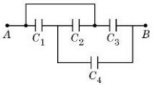
From the circuit given below,the capacitance between terminals $A$ and $B$ is . . . . . . $\mu\text{F}$. (Take $C_1 = C_2 = C_3 = 1\text{ }\mu\text{F}$ and $C_4 = 2\text{ }\mu\text{F}$.)
A
$2$
B
$7/2$
C
$7/3$
D
$5/2$
Solution
(D) Let the potential at $A$ be $V_A$ and at $B$ be $V_B$.
By analyzing the circuit,we see that the wire connecting the node between $C_1$ and $C_2$ to the node between $C_2$ and $C_3$ effectively short-circuits $C_2$.
Thus,the circuit simplifies to $C_1$ and $C_3$ in series,which are in parallel with $C_4$.
However,looking closely at the diagram,$C_1$ and $C_2$ are in series,and this combination is in parallel with $C_4$.
Actually,the circuit shows $C_1$ and $C_2$ in series,and this combination is in parallel with $C_4$. The capacitor $C_3$ is in series with the parallel combination of $(C_1, C_2)$ and $C_4$.
Let $C_{12} = \frac{C_1 C_2}{C_1 + C_2} = \frac{1 \times 1}{1 + 1} = 0.5\text{ }\mu\text{F}$.
Now,$C_{12}$ is in parallel with $C_4$,so $C_{p} = C_{12} + C_4 = 0.5 + 2 = 2.5\text{ }\mu\text{F}$.
Finally,$C_p$ is in series with $C_3$,so $C_{eq} = \frac{C_p C_3}{C_p + C_3} = \frac{2.5 \times 1}{2.5 + 1} = \frac{2.5}{3.5} = \frac{25}{35} = \frac{5}{7}\text{ }\mu\text{F}$.
Wait,re-evaluating the diagram: The wire connects the node after $C_1$ to the node after $C_2$. This means $C_2$ is shorted. The circuit is $C_1$ in series with $C_3$,and $C_4$ is in parallel with the combination of $C_1$ and $C_3$.
$C_{13} = \frac{1 \times 1}{1 + 1} = 0.5\text{ }\mu\text{F}$.
$C_{eq} = C_{13} + C_4 = 0.5 + 2 = 2.5 = 5/2\text{ }\mu\text{F}$.
By analyzing the circuit,we see that the wire connecting the node between $C_1$ and $C_2$ to the node between $C_2$ and $C_3$ effectively short-circuits $C_2$.
Thus,the circuit simplifies to $C_1$ and $C_3$ in series,which are in parallel with $C_4$.
However,looking closely at the diagram,$C_1$ and $C_2$ are in series,and this combination is in parallel with $C_4$.
Actually,the circuit shows $C_1$ and $C_2$ in series,and this combination is in parallel with $C_4$. The capacitor $C_3$ is in series with the parallel combination of $(C_1, C_2)$ and $C_4$.
Let $C_{12} = \frac{C_1 C_2}{C_1 + C_2} = \frac{1 \times 1}{1 + 1} = 0.5\text{ }\mu\text{F}$.
Now,$C_{12}$ is in parallel with $C_4$,so $C_{p} = C_{12} + C_4 = 0.5 + 2 = 2.5\text{ }\mu\text{F}$.
Finally,$C_p$ is in series with $C_3$,so $C_{eq} = \frac{C_p C_3}{C_p + C_3} = \frac{2.5 \times 1}{2.5 + 1} = \frac{2.5}{3.5} = \frac{25}{35} = \frac{5}{7}\text{ }\mu\text{F}$.
Wait,re-evaluating the diagram: The wire connects the node after $C_1$ to the node after $C_2$. This means $C_2$ is shorted. The circuit is $C_1$ in series with $C_3$,and $C_4$ is in parallel with the combination of $C_1$ and $C_3$.
$C_{13} = \frac{1 \times 1}{1 + 1} = 0.5\text{ }\mu\text{F}$.
$C_{eq} = C_{13} + C_4 = 0.5 + 2 = 2.5 = 5/2\text{ }\mu\text{F}$.
0 likes
View SolutionElectric Potential and Capacitance — Equivalent Capacitance of Capacitor connected in Series and Parallel · Frequently Asked Questions
1Are these Electric Potential and Capacitance questions useful for JEE and NEET?
Yes. All questions in this section are mapped to JEE Main and NEET exam patterns. Previous year questions from JEE Main, NEET, GUJCET and state-level exams are included with full solutions.
2Can I switch to Hindi or Gujarati for these questions?
Yes. Use the language tabs in the hero section or the sidebar to view the same questions and solutions in English, Hindi or Gujarati.
3How do I generate a question paper from this subtopic?
Use the Vedclass Exam Paper Generator — select the chapter and subtopic, set difficulty, and generate Sets A, B, C, D automatically. First 3 chapters of every subject are free.
Vedclass Products
For Students
Vedclass Test Series
Mock tests in real JEE/NEET style with performance analysis. 5-day free trial.
Start Free TrialFor Teachers
Exam Paper Generator
Generate Set A/B/C/D papers from this chapter in 2 minutes. 3 chapters free.
Try FreeFor Institutes
Online Exam Module
Live online exams with unlimited students, 360° analytics & white-label branding.
See DemoFor Teachers & Institutes
Generate a Electric Potential and Capacitance Exam Paper in 2 Minutes
Select subtopic & difficulty — Sets A, B, C, D auto-generated with No Repeat logic.
First 3 chapters of every subject are free — no payment required.