
A English
Photoelectric Effect by Lenard and it's Observations Questions in English
Class 12 Physics · Dual Nature of Radiation and matter · Photoelectric Effect by Lenard and it's Observations
172+
Questions
English
Language
100%
With Solutions
Showing 20 of 172 questions in English
151
EasyMCQ
If the frequency of incident radiation is kept constant and the experiment is repeated by using incident light of different intensities,then the stopping potential $(V_{s})$
A
increases with increase in intensity.
B
decreases with increase in intensity.
C
depends upon current.
D
remains same.
Solution
(D) According to Einstein's photoelectric equation,the maximum kinetic energy $(K_{max})$ of emitted photoelectrons is given by $K_{max} = h\nu - \Phi$,where $h$ is Planck's constant,$\nu$ is the frequency of incident radiation,and $\Phi$ is the work function of the metal.
Since the stopping potential $(V_{s})$ is related to the maximum kinetic energy by the relation $eV_{s} = K_{max}$,we have $eV_{s} = h\nu - \Phi$.
This equation shows that the stopping potential $(V_{s})$ depends only on the frequency $(\nu)$ of the incident radiation and the work function $(\Phi)$ of the metal surface.
Intensity of light affects the number of photons incident per unit area per unit time,which in turn affects the number of photoelectrons emitted (photoelectric current),but it does not affect the maximum kinetic energy of the individual photoelectrons.
Therefore,if the frequency $(\nu)$ is kept constant,the stopping potential $(V_{s})$ remains the same regardless of changes in the intensity of the incident light.
Since the stopping potential $(V_{s})$ is related to the maximum kinetic energy by the relation $eV_{s} = K_{max}$,we have $eV_{s} = h\nu - \Phi$.
This equation shows that the stopping potential $(V_{s})$ depends only on the frequency $(\nu)$ of the incident radiation and the work function $(\Phi)$ of the metal surface.
Intensity of light affects the number of photons incident per unit area per unit time,which in turn affects the number of photoelectrons emitted (photoelectric current),but it does not affect the maximum kinetic energy of the individual photoelectrons.
Therefore,if the frequency $(\nu)$ is kept constant,the stopping potential $(V_{s})$ remains the same regardless of changes in the intensity of the incident light.
0 likes
View Solution152
EasyMCQ
Which of the following phenomena exhibits the particle nature of light?
A
Interference
B
Diffraction
C
Polarisation
D
Photoelectric effect
Solution
(D) . Interference is a phenomenon in which two waves of the same frequency superpose to give a resultant intensity different from the sum of their separate intensities. Thus,it cannot exhibit the particle nature of light.
$B$. Diffraction is a phenomenon in which light bends at the sharp edges of an obstacle or an aperture. Thus,it also cannot exhibit the particle nature of light.
$C$. Polarisation of light is a property due to which a light ray,after emerging through a crystal (like tourmaline),has vibrations in a plane perpendicular to its direction of propagation. Thus,it also cannot explain the particle nature of light.
$D$. The Photoelectric effect states that light travels in the form of bundles or packets of energy,called photons. This effect is explained on the basis of the quantum (particle) nature of light. Hence,it clearly explains the particle nature of light.
Therefore,option $D$ is correct.
$B$. Diffraction is a phenomenon in which light bends at the sharp edges of an obstacle or an aperture. Thus,it also cannot exhibit the particle nature of light.
$C$. Polarisation of light is a property due to which a light ray,after emerging through a crystal (like tourmaline),has vibrations in a plane perpendicular to its direction of propagation. Thus,it also cannot explain the particle nature of light.
$D$. The Photoelectric effect states that light travels in the form of bundles or packets of energy,called photons. This effect is explained on the basis of the quantum (particle) nature of light. Hence,it clearly explains the particle nature of light.
Therefore,option $D$ is correct.
0 likes
View Solution153
MediumMCQ
$A$ photoelectric cell is illuminated by a point source of light $1 \ m$ away. When the source is shifted to $2 \ m$,then:
A
each emitted electron carries half the initial energy
B
number of electrons emitted is a quarter of the initial number
C
each emitted electron carries one quarter of the initial energy
D
number of electrons emitted is half the initial number
Solution
(B) The number of photoelectrons emitted per second is directly proportional to the intensity of the incident light.
For a point source of light,the intensity $I$ follows the inverse square law: $I \propto \frac{1}{d^2}$,where $d$ is the distance from the source.
When the distance is doubled $(d' = 2d)$,the new intensity $I'$ becomes $I' = \frac{I}{2^2} = \frac{I}{4}$.
Since the number of photoelectrons emitted is directly proportional to the intensity,the number of photoelectrons emitted becomes one-fourth of the initial number.
The energy of each emitted electron depends on the frequency of the incident light,not on its intensity. Therefore,the energy of each emitted electron remains unchanged.
For a point source of light,the intensity $I$ follows the inverse square law: $I \propto \frac{1}{d^2}$,where $d$ is the distance from the source.
When the distance is doubled $(d' = 2d)$,the new intensity $I'$ becomes $I' = \frac{I}{2^2} = \frac{I}{4}$.
Since the number of photoelectrons emitted is directly proportional to the intensity,the number of photoelectrons emitted becomes one-fourth of the initial number.
The energy of each emitted electron depends on the frequency of the incident light,not on its intensity. Therefore,the energy of each emitted electron remains unchanged.
0 likes
View Solution154
MediumMCQ
When the intensity of incident light increases:
A
photo-current increases
B
photo-current decreases
C
kinetic energy of emitted photoelectrons increases
D
kinetic energy of emitted photoelectrons decreases
Solution
(A) According to Einstein's photoelectric equation,a single incident photon ejects a single electron.
When the intensity of light increases,the number of incident photons per unit area per unit time increases.
Since each photon ejects one electron,the number of emitted photoelectrons increases,which leads to an increase in the photo-current.
The maximum kinetic energy of emitted photoelectrons is given by $K_{\max} = h\nu - \Phi$,where $h\nu$ is the energy of the incident photon and $\Phi$ is the work function.
Since the energy of individual photons does not change with intensity,the maximum kinetic energy of the emitted photoelectrons remains independent of the intensity of incident light.
When the intensity of light increases,the number of incident photons per unit area per unit time increases.
Since each photon ejects one electron,the number of emitted photoelectrons increases,which leads to an increase in the photo-current.
The maximum kinetic energy of emitted photoelectrons is given by $K_{\max} = h\nu - \Phi$,where $h\nu$ is the energy of the incident photon and $\Phi$ is the work function.
Since the energy of individual photons does not change with intensity,the maximum kinetic energy of the emitted photoelectrons remains independent of the intensity of incident light.
0 likes
View Solution155
EasyMCQ
Threshold frequency of which of the following metals does not lie in the ultraviolet region (in the case of the photoelectric effect)?
A
Zinc
B
Magnesium
C
Cadmium
D
Sodium
Solution
(D) The threshold frequency $\nu_0$ is related to the work function $\Phi$ by the equation $\Phi = h\nu_0$,where $h$ is Planck's constant.
Metals like Zinc,Magnesium,and Cadmium have high work functions,meaning their threshold frequencies lie in the ultraviolet $(UV)$ region of the electromagnetic spectrum.
Sodium is an alkali metal with a very low work function (approximately $2.3 \ eV$ to $2.7 \ eV$).
Because of this low work function,the threshold frequency of Sodium lies in the visible region,not the ultraviolet region.
Therefore,the correct option is $D$.
Metals like Zinc,Magnesium,and Cadmium have high work functions,meaning their threshold frequencies lie in the ultraviolet $(UV)$ region of the electromagnetic spectrum.
Sodium is an alkali metal with a very low work function (approximately $2.3 \ eV$ to $2.7 \ eV$).
Because of this low work function,the threshold frequency of Sodium lies in the visible region,not the ultraviolet region.
Therefore,the correct option is $D$.
0 likes
View Solution156
MediumMCQ
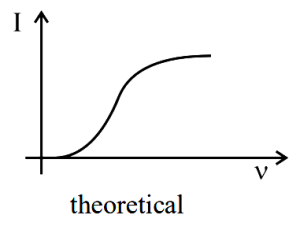
The anode voltage of a photocell is kept fixed. The frequency of the light falling on the cathode is gradually increased. Then the correct graph which shows the variation of photo current $I$ with the frequency $\nu$ of incident light is
A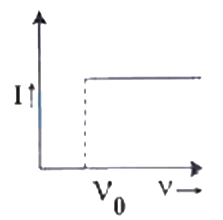
B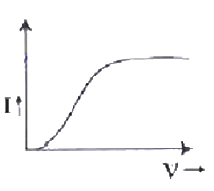
C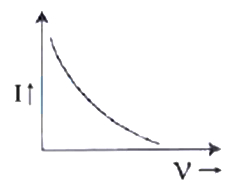
D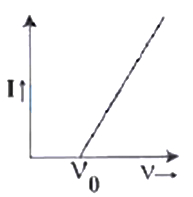
Solution
(A) In the photoelectric effect,the photoelectric current $I$ is directly proportional to the intensity of the incident light,provided the frequency $\nu$ of the incident light is greater than the threshold frequency $\nu_0$.
If the intensity of the incident light is kept constant while the frequency $\nu$ is increased,the number of photons incident per unit time remains constant (since $P = n h \nu$,if power $P$ is constant,$n$ decreases as $\nu$ increases). However,in practical experimental setups,the photoelectric current is independent of the frequency of light as long as $\nu > \nu_0$.
Therefore,the graph of photoelectric current $I$ versus frequency $\nu$ is a horizontal line for $\nu > \nu_0$ and zero for $\nu < \nu_0$. This corresponds to the graph shown in option $A$.
If the intensity of the incident light is kept constant while the frequency $\nu$ is increased,the number of photons incident per unit time remains constant (since $P = n h \nu$,if power $P$ is constant,$n$ decreases as $\nu$ increases). However,in practical experimental setups,the photoelectric current is independent of the frequency of light as long as $\nu > \nu_0$.
Therefore,the graph of photoelectric current $I$ versus frequency $\nu$ is a horizontal line for $\nu > \nu_0$ and zero for $\nu < \nu_0$. This corresponds to the graph shown in option $A$.
0 likes
View Solution157
EasyMCQ
In a photoelectric experiment,if both the intensity and frequency of the incident light are doubled,then the saturation photoelectric current
A
is halved
B
is doubled
C
becomes four times
D
remains constant
Solution
(B) In the photoelectric effect,the saturation photocurrent is directly proportional to the intensity of the incident radiation.
It is independent of the frequency of the incident radiation.
Since the intensity is doubled,the saturation photoelectric current will also be doubled.
The change in frequency does not affect the saturation current.
Therefore,the saturation photoelectric current becomes doubled.
It is independent of the frequency of the incident radiation.
Since the intensity is doubled,the saturation photoelectric current will also be doubled.
The change in frequency does not affect the saturation current.
Therefore,the saturation photoelectric current becomes doubled.
0 likes
View Solution158
EasyMCQ
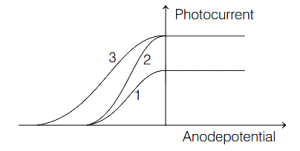
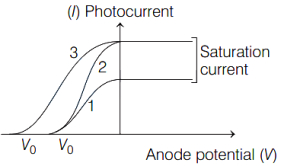
The following graph represents the variation of photocurrent with anode potential for a metal surface. Here $I_{1}, I_{2}$ and $I_{3}$ represent intensities and $\gamma_{1}, \gamma_{2}, \gamma_{3}$ represent frequencies for curves $1, 2$ and $3$ respectively,then
A
$\gamma_{1}=\gamma_{2}$ and $I_{1} \neq I_{2}$
B
$\gamma_{1}=\gamma_{3}$ and $I_{1} \neq I_{3}$
C
$\gamma_{1}=\gamma_{2}$ and $I_{1}=I_{2}$
D
$\gamma_{2}=\gamma_{3}$ and $I_{1}=I_{3}$
Solution
(A) From the graph,we observe that the stopping potential $V_{0}$ is the same for curves $1$ and $2$. However,for curve $3$,the stopping potential is greater in magnitude than that for curves $1$ and $2$.
We know that the stopping potential is given by the relation: $e V_{0} = E_{\max} = h \gamma - \phi_{0}$,where $\phi_{0}$ is the work function of the metal.
Since $V_{0}$ is the same for curves $1$ and $2$,it implies that the incident frequencies are equal,i.e.,$\gamma_{1} = \gamma_{2}$.
For curve $3$,the stopping potential is higher,which means $\gamma_{3} > \gamma_{1} = \gamma_{2}$.
Regarding the saturation current,it depends on the intensity of the incident light. Curves $2$ and $3$ reach the same saturation current,meaning $I_{2} = I_{3}$,while curve $1$ has a lower saturation current,so $I_{1} < I_{2} = I_{3}$.
Therefore,comparing the options,$\gamma_{1} = \gamma_{2}$ and $I_{1} \neq I_{2}$ is the correct statement.
We know that the stopping potential is given by the relation: $e V_{0} = E_{\max} = h \gamma - \phi_{0}$,where $\phi_{0}$ is the work function of the metal.
Since $V_{0}$ is the same for curves $1$ and $2$,it implies that the incident frequencies are equal,i.e.,$\gamma_{1} = \gamma_{2}$.
For curve $3$,the stopping potential is higher,which means $\gamma_{3} > \gamma_{1} = \gamma_{2}$.
Regarding the saturation current,it depends on the intensity of the incident light. Curves $2$ and $3$ reach the same saturation current,meaning $I_{2} = I_{3}$,while curve $1$ has a lower saturation current,so $I_{1} < I_{2} = I_{3}$.
Therefore,comparing the options,$\gamma_{1} = \gamma_{2}$ and $I_{1} \neq I_{2}$ is the correct statement.
0 likes
View Solution159
EasyMCQ
Light of a certain frequency and intensity incident on a photosensitive material causes the photoelectric effect. If both the frequency and intensity are doubled,the photoelectric saturation current becomes
A
halved
B
quadrupled
C
unchanged
D
doubled
Solution
(D) The photoelectric current is directly proportional to the intensity of the incident light,provided the incident frequency is greater than the threshold frequency.
Since the saturation current depends only on the number of photoelectrons emitted per second,which is directly proportional to the intensity of the incident light,doubling the intensity will double the saturation current.
The frequency of the incident light affects the kinetic energy of the emitted photoelectrons,not the number of photoelectrons (saturation current),as long as it remains above the threshold frequency.
Therefore,when the intensity is doubled,the photoelectric saturation current doubles.
Since the saturation current depends only on the number of photoelectrons emitted per second,which is directly proportional to the intensity of the incident light,doubling the intensity will double the saturation current.
The frequency of the incident light affects the kinetic energy of the emitted photoelectrons,not the number of photoelectrons (saturation current),as long as it remains above the threshold frequency.
Therefore,when the intensity is doubled,the photoelectric saturation current doubles.
0 likes
View Solution160
MediumMCQ
The electromagnetic theory of light failed to explain:
A
photoelectric effect
B
polarisation
C
diffraction
D
interference
Solution
(A) The classical electromagnetic theory of light treats light as a continuous wave. According to this theory,the energy of the wave depends on its intensity (amplitude). However,experimental observations of the photoelectric effect show that the emission of electrons depends on the frequency of the incident light,not its intensity. Furthermore,the emission is instantaneous,which contradicts the classical prediction of a time lag for energy absorption. Therefore,the electromagnetic theory of light failed to explain the photoelectric effect.
0 likes
View Solution161
DifficultMCQ
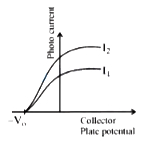
From the following graph of photo-current against collector plate potential,for two different intensities of light $I_{1}$ and $I_{2}$,one can conclude:
A
$I_{1} = I_{2}$
B
$I_{1} > I_{2}$
C
$I_{1} < I_{2}$
D
Comparison is not possible.
Solution
(C) For a fixed frequency of incident light,the saturation photo-current is directly proportional to the intensity of the incident light.
From the given graph,the saturation photo-current for light of intensity $I_{2}$ is higher than that for light of intensity $I_{1}$.
Therefore,we can conclude that $I_{1} < I_{2}$.
From the given graph,the saturation photo-current for light of intensity $I_{2}$ is higher than that for light of intensity $I_{1}$.
Therefore,we can conclude that $I_{1} < I_{2}$.
0 likes
View Solution162
EasyMCQ
Light of wavelength $4000 Å$ is incident on a sodium surface for which the threshold wavelength of photoelectrons is $5420 Å$. The work function of sodium is (in $eV$)
A
$4.58$
B
$2.29$
C
$1.14$
D
$0.57$
Solution
(B) The work function $\phi_0$ of a metal is defined by the threshold wavelength $\lambda_0$ as $\phi_0 = \frac{hc}{\lambda_0}$.
Given the threshold wavelength $\lambda_0 = 5420 Å$.
Using the relation $\phi_0 (\text{in eV}) = \frac{12400}{\lambda_0 (\text{in Å})}$.
Substituting the value: $\phi_0 = \frac{12400}{5420} eV$.
$\phi_0 \approx 2.29 eV$.
Thus,the work function of sodium is $2.29 eV$.
Given the threshold wavelength $\lambda_0 = 5420 Å$.
Using the relation $\phi_0 (\text{in eV}) = \frac{12400}{\lambda_0 (\text{in Å})}$.
Substituting the value: $\phi_0 = \frac{12400}{5420} eV$.
$\phi_0 \approx 2.29 eV$.
Thus,the work function of sodium is $2.29 eV$.
0 likes
View Solution163
MediumMCQ
Photo cells convert
A
light energy into mechanical energy
B
heat energy into electrical energy
C
light energy into electrical energy
D
electrical energy into light energy
Solution
(C) photocell is a device that operates based on the photoelectric effect. In this process,when light (photons) of suitable frequency falls on a photosensitive surface,electrons are emitted. This flow of electrons constitutes an electric current. Therefore,photocells convert light energy into electrical energy.
0 likes
View Solution164
EasyMCQ
Which of the following statements is correct regarding the photoelectric effect?
A
$1$. The electrons are emitted if the emitting surface is at high temperature.
B
$2$. Photoemission occurs if the wavelength is less than a critical value.
C
$3$. The $KE$ of photoelectrons is proportional to the square of the amplitude of incident radiation.
D
$4$. The photoelectric current is proportional to the frequency of incident radiation.
Solution
(B) The photoelectric effect occurs when light of a sufficiently high frequency (or wavelength shorter than the threshold wavelength) strikes a metal surface.
According to Einstein's photoelectric equation, $KE_{max} = h\nu - \Phi$, where $\Phi$ is the work function.
$1$. Thermionic emission occurs at high temperatures, not photoelectric emission.
$2$. Photoemission occurs if the incident wavelength $\lambda$ is less than the threshold wavelength $\lambda_0$ (critical value).
$3$. The $KE$ of photoelectrons depends on the frequency of incident radiation, not the amplitude.
$4$. The photoelectric current is proportional to the intensity of incident radiation, not the frequency.
Therefore, statement $2$ is correct.
According to Einstein's photoelectric equation, $KE_{max} = h\nu - \Phi$, where $\Phi$ is the work function.
$1$. Thermionic emission occurs at high temperatures, not photoelectric emission.
$2$. Photoemission occurs if the incident wavelength $\lambda$ is less than the threshold wavelength $\lambda_0$ (critical value).
$3$. The $KE$ of photoelectrons depends on the frequency of incident radiation, not the amplitude.
$4$. The photoelectric current is proportional to the intensity of incident radiation, not the frequency.
Therefore, statement $2$ is correct.
0 likes
View Solution165
EasyMCQ
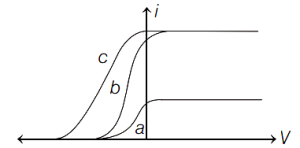
The figure shows the variation of photocurrent $i$ with anode potential $V$ for three different radiations. Let $I_a, I_b$ and $I_c$ be the intensities and $f_a, f_b$ and $f_c$ be the frequencies for the curves $a, b$ and $c$ respectively. Then
A
$f_a=f_b$ and $I_a \neq I_b$
B
$f_a=f_c$ and $I_a=I_c$
C
$f_a=f_b$ and $I_a=I_b$
D
$f_b=f_c$ and $I_b=I_c$
Solution
(A) $1$. The stopping potential $V_0$ is determined by the frequency of the incident radiation $(eV_0 = hf - \phi)$. Curves $a$ and $b$ intersect the $V$-axis at the same point,meaning they have the same stopping potential. Therefore,$f_a = f_b$.
$2$. The saturation current is proportional to the intensity of the incident radiation. Curves $a$ and $b$ have different saturation current levels,which implies $I_a \neq I_b$.
$3$. Thus,the correct relationship is $f_a = f_b$ and $I_a \neq I_b$.
$2$. The saturation current is proportional to the intensity of the incident radiation. Curves $a$ and $b$ have different saturation current levels,which implies $I_a \neq I_b$.
$3$. Thus,the correct relationship is $f_a = f_b$ and $I_a \neq I_b$.
0 likes
View Solution166
EasyMCQ
The wave picture of light has failed to explain which of the following phenomena?
A
Photoelectric effect
B
Interference of light
C
Diffraction of light
D
Polarization of light
Solution
(A) The wave theory of light treats light as a continuous electromagnetic wave. While this model successfully explains phenomena like interference,diffraction,and polarization,it fails to explain the photoelectric effect. In the photoelectric effect,the emission of electrons depends on the frequency of incident light rather than its intensity,which contradicts the classical wave theory. This phenomenon is explained by the particle nature of light,where light consists of discrete packets of energy called photons.
0 likes
View Solution167
MediumMCQ
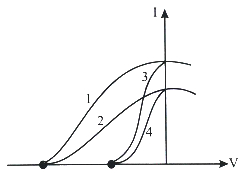
The graph given in the figure shows the variation of photocurrent $(I)$ with the applied voltage $(V)$ for two different materials and for two different intensities of incident radiation. Which of the following pairs of curves represent the same material?
A
$1$ and $3$
B
$1$ and $4$
C
$2$ and $3$
D
$1$ and $2$
Solution
(D) In the photoelectric effect,the stopping potential $(V_0)$ depends only on the material (work function) and the frequency of the incident radiation. For a fixed frequency,the stopping potential is a characteristic of the material.
Looking at the graph,curves $1$ and $2$ intersect the voltage axis at the same point,meaning they have the same stopping potential. Therefore,curves $1$ and $2$ represent the same material.
Similarly,curves $3$ and $4$ intersect the voltage axis at a different,common point,meaning they represent another material with a different work function.
Thus,the pairs that represent the same material are $(1, 2)$ and $(3, 4)$.
Looking at the graph,curves $1$ and $2$ intersect the voltage axis at the same point,meaning they have the same stopping potential. Therefore,curves $1$ and $2$ represent the same material.
Similarly,curves $3$ and $4$ intersect the voltage axis at a different,common point,meaning they represent another material with a different work function.
Thus,the pairs that represent the same material are $(1, 2)$ and $(3, 4)$.
0 likes
View Solution168
EasyMCQ
Consider the two following statements $A$ and $B$, and identify the correct choice given in the answers :
$(A)$ In photovoltaic cells, the photoelectric current produced is not proportional to the intensity of incident light.
$(B)$ In gas-filled photoemissive cells, the velocity of photoelectrons depends on the wavelength of the incident radiation.
$(A)$ In photovoltaic cells, the photoelectric current produced is not proportional to the intensity of incident light.
$(B)$ In gas-filled photoemissive cells, the velocity of photoelectrons depends on the wavelength of the incident radiation.
A
Both $A$ and $B$ are true
B
Both $A$ and $B$ are false
C
$A$ is true but $B$ is false
D
$A$ is false but $B$ is true
Solution
(D) In photovoltaic cells, the photoelectric current produced is directly proportional to the intensity of the incident light. Therefore, statement $A$ is false.
According to Einstein's photoelectric equation, $K_{max} = h\nu - \Phi = \frac{hc}{\lambda} - \Phi$. Since the maximum kinetic energy $K_{max}$ of the photoelectrons depends on the wavelength $\lambda$ of the incident radiation, the velocity of the photoelectrons also depends on the wavelength. Therefore, statement $B$ is true.
According to Einstein's photoelectric equation, $K_{max} = h\nu - \Phi = \frac{hc}{\lambda} - \Phi$. Since the maximum kinetic energy $K_{max}$ of the photoelectrons depends on the wavelength $\lambda$ of the incident radiation, the velocity of the photoelectrons also depends on the wavelength. Therefore, statement $B$ is true.
0 likes
View Solution169
MediumMCQ
$A$ point source of light is used in an experiment of photoelectric effect. If the distance between the source and the photoelectric surface is doubled,which of the following may result?
A
Stopping potential will be halved
B
Photoelectric current will decrease
C
Maximum kinetic energy of photoelectrons will decrease
D
Stopping potential will increase slightly
Solution
(B) The intensity $I$ of light from a point source follows the inverse square law,$I \propto \frac{1}{d^2}$,where $d$ is the distance from the source.
When the distance $d$ is doubled,the intensity $I$ becomes $\frac{1}{4}$ of its original value.
The photoelectric current is directly proportional to the intensity of incident light.
Since the intensity decreases,the number of photons hitting the surface per unit time decreases,resulting in a decrease in the photoelectric current.
Stopping potential and maximum kinetic energy depend on the frequency of the incident light,not on its intensity.
Therefore,the correct result is that the photoelectric current will decrease.
When the distance $d$ is doubled,the intensity $I$ becomes $\frac{1}{4}$ of its original value.
The photoelectric current is directly proportional to the intensity of incident light.
Since the intensity decreases,the number of photons hitting the surface per unit time decreases,resulting in a decrease in the photoelectric current.
Stopping potential and maximum kinetic energy depend on the frequency of the incident light,not on its intensity.
Therefore,the correct result is that the photoelectric current will decrease.
0 likes
View Solution170
MediumMCQ
The distance between a light source and a photoelectric cell is $d$. If the distance is decreased to $\frac{d}{2}$,then:
A
the emission of electrons per second will be four times
B
maximum kinetic energy of photoelectrons will be four times
C
stopping potential will remain the same
D
the emission of electrons per second will be doubled
Solution
(A) The intensity $I$ of light at a distance $r$ from a point source is given by $I = \frac{P}{4\pi r^2}$,so $I \propto \frac{1}{r^2}$.
When the distance is changed from $d$ to $\frac{d}{2}$,the new intensity $I'$ becomes $I' = \frac{1}{(d/2)^2} = 4 \times \frac{1}{d^2} = 4I$.
Since the number of photoelectrons emitted per second is directly proportional to the intensity of incident light,the emission rate becomes $4$ times the original value.
According to Einstein's photoelectric equation,$KE_{max} = h\nu - \phi$,where $\nu$ is the frequency of incident light and $\phi$ is the work function.
Since the frequency $\nu$ remains unchanged,the maximum kinetic energy $(KE_{max})$ and the stopping potential $(V_s)$ remain unchanged,as $eV_s = KE_{max}$.
When the distance is changed from $d$ to $\frac{d}{2}$,the new intensity $I'$ becomes $I' = \frac{1}{(d/2)^2} = 4 \times \frac{1}{d^2} = 4I$.
Since the number of photoelectrons emitted per second is directly proportional to the intensity of incident light,the emission rate becomes $4$ times the original value.
According to Einstein's photoelectric equation,$KE_{max} = h\nu - \phi$,where $\nu$ is the frequency of incident light and $\phi$ is the work function.
Since the frequency $\nu$ remains unchanged,the maximum kinetic energy $(KE_{max})$ and the stopping potential $(V_s)$ remain unchanged,as $eV_s = KE_{max}$.
0 likes
View SolutionDual Nature of Radiation and matter — Photoelectric Effect by Lenard and it's Observations · Frequently Asked Questions
1Are these Dual Nature of Radiation and matter questions useful for JEE and NEET?
Yes. All questions in this section are mapped to JEE Main and NEET exam patterns. Previous year questions from JEE Main, NEET, GUJCET and state-level exams are included with full solutions.
2Can I switch to Hindi or Gujarati for these questions?
Yes. Use the language tabs in the hero section or the sidebar to view the same questions and solutions in English, Hindi or Gujarati.
3How do I generate a question paper from this subtopic?
Use the Vedclass Exam Paper Generator — select the chapter and subtopic, set difficulty, and generate Sets A, B, C, D automatically. First 3 chapters of every subject are free.
Vedclass Products
For Students
Vedclass Test Series
Mock tests in real JEE/NEET style with performance analysis. 5-day free trial.
Start Free TrialFor Teachers
Exam Paper Generator
Generate Set A/B/C/D papers from this chapter in 2 minutes. 3 chapters free.
Try FreeFor Institutes
Online Exam Module
Live online exams with unlimited students, 360° analytics & white-label branding.
See DemoFor Teachers & Institutes
Generate a Dual Nature of Radiation and matter Exam Paper in 2 Minutes
Select subtopic & difficulty — Sets A, B, C, D auto-generated with No Repeat logic.
First 3 chapters of every subject are free — no payment required.