
A English
Photoelectric Effect by Lenard and it's Observations Questions in English
Class 12 Physics · Dual Nature of Radiation and matter · Photoelectric Effect by Lenard and it's Observations
172+
Questions
English
Language
100%
With Solutions
Showing 50 of 172 questions in English
101
MediumMCQ
In Lenard's experiment,what is the effect on the photoelectric current when ultraviolet radiation incident on the cathode is stopped?
A
The current remains constant.
B
The current increases.
C
The current drops to zero.
D
The current decreases but remains non-zero.
Solution
(C) In the photoelectric effect experiment,the emission of photoelectrons from the cathode surface occurs only when incident radiation (such as ultraviolet light) has a frequency greater than the threshold frequency of the metal.
When the incident ultraviolet radiation is stopped,no more photons are striking the cathode surface.
Consequently,the emission of photoelectrons ceases immediately.
Since the photoelectric current is directly proportional to the number of photoelectrons emitted per unit time,the current drops to zero.
When the incident ultraviolet radiation is stopped,no more photons are striking the cathode surface.
Consequently,the emission of photoelectrons ceases immediately.
Since the photoelectric current is directly proportional to the number of photoelectrons emitted per unit time,the current drops to zero.
0 likes
View Solution102
Medium
Define threshold frequency.
Solution
(N/A) The threshold frequency is defined as the minimum frequency of incident radiation (light) required to eject photoelectrons from the surface of a metal.
If the frequency of the incident light is less than the threshold frequency,no photoelectric emission occurs,regardless of the intensity of the light.
It is denoted by the symbol $\nu_0$ and is a characteristic property of the metal surface.
If the frequency of the incident light is less than the threshold frequency,no photoelectric emission occurs,regardless of the intensity of the light.
It is denoted by the symbol $\nu_0$ and is a characteristic property of the metal surface.
0 likes
View Solution103
MediumMCQ
The value of threshold frequency depends on which of the following factors?
A
Intensity of incident light
B
Material of the photosensitive surface
C
Frequency of incident light
D
Potential difference applied
Solution
(B) The threshold frequency ($ \nu_0 $) is defined as the minimum frequency of incident radiation required to eject photoelectrons from a metal surface.
It is a characteristic property of the material of the photosensitive surface.
It depends on the work function ($ \Phi_0 $) of the metal, which is given by the relation $ \Phi_0 = h \nu_0 $, where $ h $ is Planck's constant.
Since the work function is specific to the nature of the material, the threshold frequency depends only on the material of the surface and is independent of the intensity or frequency of the incident light.
It is a characteristic property of the material of the photosensitive surface.
It depends on the work function ($ \Phi_0 $) of the metal, which is given by the relation $ \Phi_0 = h \nu_0 $, where $ h $ is Planck's constant.
Since the work function is specific to the nature of the material, the threshold frequency depends only on the material of the surface and is independent of the intensity or frequency of the incident light.
0 likes
View Solution104
MediumMCQ
For most metals, threshold frequencies lie in which region?
A
Visible region
B
Infrared region
C
Ultraviolet region
D
Radio wave region
Solution
(C) The threshold frequency $( \nu_0)$ is the minimum frequency of incident radiation required to eject electrons from a metal surface.
For most metals, the work function $(\Phi = h \nu_0)$ is relatively high.
This requires incident photons to have high energy, which corresponds to high frequencies.
These frequencies typically fall in the ultraviolet $(UV)$ region of the electromagnetic spectrum.
Therefore, the correct option is $C$.
For most metals, the work function $(\Phi = h \nu_0)$ is relatively high.
This requires incident photons to have high energy, which corresponds to high frequencies.
These frequencies typically fall in the ultraviolet $(UV)$ region of the electromagnetic spectrum.
Therefore, the correct option is $C$.
0 likes
View Solution105
MediumMCQ
For alkali metals, threshold frequencies lie in which region?
A
Visible region
B
Infrared region
C
Ultraviolet region
D
Radio wave region
Solution
(A) The threshold frequency $( \nu_0)$ is the minimum frequency of incident radiation required to eject photoelectrons from a metal surface.
Alkali metals (such as Lithium, Sodium, Potassium, etc.) have very low work functions $( \Phi_0 = h \nu_0)$.
Because their work functions are low, the energy required to eject electrons is small, which corresponds to a lower threshold frequency.
This threshold frequency for alkali metals typically falls within the visible region of the electromagnetic spectrum.
Therefore, visible light is sufficient to cause the photoelectric effect in alkali metals.
Alkali metals (such as Lithium, Sodium, Potassium, etc.) have very low work functions $( \Phi_0 = h \nu_0)$.
Because their work functions are low, the energy required to eject electrons is small, which corresponds to a lower threshold frequency.
This threshold frequency for alkali metals typically falls within the visible region of the electromagnetic spectrum.
Therefore, visible light is sufficient to cause the photoelectric effect in alkali metals.
0 likes
View Solution106
Medium
Give an outline of the experimental study of the photoelectric effect.
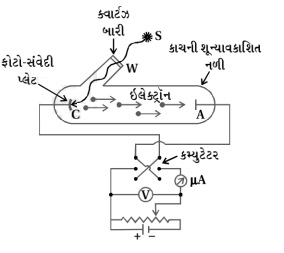
Solution
(N/A) The experimental setup for the study of the photoelectric effect consists of an evacuated glass tube containing two metal plates: a photosensitive emitter plate $(C)$ and a collector plate $(A)$.
A quartz window $(W)$ is sealed on the tube, allowing ultraviolet radiation to pass through and irradiate the photosensitive plate $(C)$.
When monochromatic ultraviolet radiation of sufficiently low wavelength is incident on the cathode $(C)$, electrons are emitted from its surface.
These emitted electrons are attracted by the collector plate $(A)$ maintained at a positive potential relative to $C$, resulting in a flow of current known as the photoelectric current.
The potential difference between $A$ and $C$ can be varied using a potential divider arrangement, and its polarity can be reversed using a commutator.
The potential difference is measured by a voltmeter $(V)$, and the resulting photoelectric current, which is typically in the $\mu A$ range, is measured by a microammeter $(\mu A)$.
By changing the photosensitive material of plate $C$, the threshold frequency and work function can be studied.
The intensity and frequency of the incident radiation can be varied to study their effects on the photoelectric current.
Filters or colored glass of different frequencies can be placed in the path of the incident radiation to study the effect of frequency, and the distance between the light source and plate $C$ can be varied to study the effect of intensity.
A quartz window $(W)$ is sealed on the tube, allowing ultraviolet radiation to pass through and irradiate the photosensitive plate $(C)$.
When monochromatic ultraviolet radiation of sufficiently low wavelength is incident on the cathode $(C)$, electrons are emitted from its surface.
These emitted electrons are attracted by the collector plate $(A)$ maintained at a positive potential relative to $C$, resulting in a flow of current known as the photoelectric current.
The potential difference between $A$ and $C$ can be varied using a potential divider arrangement, and its polarity can be reversed using a commutator.
The potential difference is measured by a voltmeter $(V)$, and the resulting photoelectric current, which is typically in the $\mu A$ range, is measured by a microammeter $(\mu A)$.
By changing the photosensitive material of plate $C$, the threshold frequency and work function can be studied.
The intensity and frequency of the incident radiation can be varied to study their effects on the photoelectric current.
Filters or colored glass of different frequencies can be placed in the path of the incident radiation to study the effect of frequency, and the distance between the light source and plate $C$ can be varied to study the effect of intensity.
0 likes
View Solution107
Difficult
Explain the effect of variation of intensity of incident radiation on photoelectric current.
Solution
(N/A) The collector $(A = \text{anode})$ is kept at a positive potential with respect to the emitter $(C = \text{cathode})$, so that the emitted electrons are attracted toward the collector $A$.
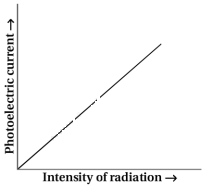
By keeping the frequency of the incident radiation and the potential difference between the collector and emitter constant, the intensity of the incident radiation is varied, and the resulting photoelectric current is measured.
Experimental observations show that the photoelectric current is directly proportional to the intensity of the incident radiation.
This indicates that the number of photoelectrons emitted per second is directly proportional to the intensity of the incident radiation, as shown in the graph.
By keeping the frequency of the incident radiation and the potential difference between the collector and emitter constant, the intensity of the incident radiation is varied, and the resulting photoelectric current is measured.
Experimental observations show that the photoelectric current is directly proportional to the intensity of the incident radiation.
This indicates that the number of photoelectrons emitted per second is directly proportional to the intensity of the incident radiation, as shown in the graph.
0 likes
View Solution108
Medium
Explain the effect of potential on photoelectric current in the experiment of the photoelectric effect.
Solution
(N/A) In the experiment of the photoelectric effect,the collector plate $A$ is kept at a positive potential relative to the emitter.
When the magnitude of the positive potential is increased,the photoelectric current also increases because more electrons are attracted to the collector.
For a particular positive voltage on plate $A$,all emitted electrons reach the collector,and the current reaches its maximum value.
If the collector voltage is increased further beyond this point,the photoelectric current does not increase. This maximum value of current is called the saturation current.
When the collector voltage is sequentially decreased and made negative,a repulsive force acts on the electrons.
As the collector voltage becomes more negative,the repulsive force increases,allowing only the most energetic electrons to reach the collector. Consequently,the collector current decreases rapidly.
The specific value of negative potential at which the photoelectric current becomes zero is known as the cut-off voltage or stopping potential,denoted by $V_{0}$.
Since the energy of electrons emitted from the metal surface varies,the stopping potential provides a measure of the maximum kinetic energy of the photoelectrons.
When the photoelectric current becomes zero,the maximum kinetic energy $(K_{\max})$ of the photoelectrons is equal to the work done by the retarding potential.
Therefore,$K_{\max} = e V_{0}$.
When the magnitude of the positive potential is increased,the photoelectric current also increases because more electrons are attracted to the collector.
For a particular positive voltage on plate $A$,all emitted electrons reach the collector,and the current reaches its maximum value.
If the collector voltage is increased further beyond this point,the photoelectric current does not increase. This maximum value of current is called the saturation current.
When the collector voltage is sequentially decreased and made negative,a repulsive force acts on the electrons.
As the collector voltage becomes more negative,the repulsive force increases,allowing only the most energetic electrons to reach the collector. Consequently,the collector current decreases rapidly.
The specific value of negative potential at which the photoelectric current becomes zero is known as the cut-off voltage or stopping potential,denoted by $V_{0}$.
Since the energy of electrons emitted from the metal surface varies,the stopping potential provides a measure of the maximum kinetic energy of the photoelectrons.
When the photoelectric current becomes zero,the maximum kinetic energy $(K_{\max})$ of the photoelectrons is equal to the work done by the retarding potential.
Therefore,$K_{\max} = e V_{0}$.
0 likes
View Solution109
Difficult
Explain the effect of the frequency of incident radiation in the experiment of the photoelectric effect.
Solution
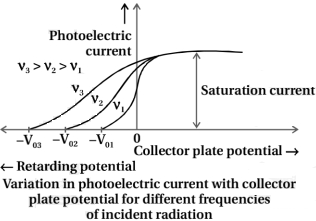
(N/A) The figure shows a graph of the variation of photoelectric current with collector plate potential for different frequencies of incident radiation at a constant intensity.
For different frequencies of incident radiation,the stopping potential value obtained is different,but the saturation current remains the same.
For frequencies $\nu_{3} > \nu_{2} > \nu_{1}$,the corresponding stopping potentials obtained are $V_{03} > V_{02} > V_{01}$.
From this,it can be concluded that when the frequency of incident radiation increases,its energy $[E = h\nu]$ also increases. Hence,the maximum kinetic energy of the emitted photoelectrons depends on the energy (frequency) of the incident radiation.
When the energy of the photoelectrons is higher,a greater retarding voltage (stopping potential) is required to stop them.
For different frequencies of incident radiation,the stopping potential value obtained is different,but the saturation current remains the same.
For frequencies $\nu_{3} > \nu_{2} > \nu_{1}$,the corresponding stopping potentials obtained are $V_{03} > V_{02} > V_{01}$.
From this,it can be concluded that when the frequency of incident radiation increases,its energy $[E = h\nu]$ also increases. Hence,the maximum kinetic energy of the emitted photoelectrons depends on the energy (frequency) of the incident radiation.
When the energy of the photoelectrons is higher,a greater retarding voltage (stopping potential) is required to stop them.
0 likes
View Solution110
Medium
Write the characteristics of the photoelectric effect.
Solution
(N/A) $(i)$ For a given photosensitive substance, when the frequency of incident radiation is greater than the threshold frequency, the photoelectric current is directly proportional to the intensity of light.
$(ii)$ For a given photosensitive substance and frequency of incident radiation, the saturation current is proportional to the intensity of radiation, but the stopping potential is independent of the intensity.
$(iii)$ For a given photosensitive substance, if the frequency is less than the threshold frequency, photoelectric emission will not take place, regardless of the intensity of radiation.
$(iv)$ For a frequency greater than the threshold frequency $(v > v_{0})$, the stopping potential and maximum kinetic energy vary linearly with the frequency of the incident radiation, but they do not depend on the intensity of the radiation.
$(v)$ Photoelectric emission is an instantaneous process, occurring within a time interval of $10^{-9} \,s$ or less.
$(ii)$ For a given photosensitive substance and frequency of incident radiation, the saturation current is proportional to the intensity of radiation, but the stopping potential is independent of the intensity.
$(iii)$ For a given photosensitive substance, if the frequency is less than the threshold frequency, photoelectric emission will not take place, regardless of the intensity of radiation.
$(iv)$ For a frequency greater than the threshold frequency $(v > v_{0})$, the stopping potential and maximum kinetic energy vary linearly with the frequency of the incident radiation, but they do not depend on the intensity of the radiation.
$(v)$ Photoelectric emission is an instantaneous process, occurring within a time interval of $10^{-9} \,s$ or less.
0 likes
View Solution111
Medium
How are the frequency and intensity of incident radiation changed in the experiment of the photoelectric effect?
Solution
(N/A) In the photoelectric effect experiment,the frequency and intensity of incident radiation are controlled as follows:
$1$. Frequency: The frequency of the incident radiation is changed by using different light sources or by using filters that allow only specific wavelengths to pass through. Changing the frequency affects the maximum kinetic energy of the emitted photoelectrons.
$2$. Intensity: The intensity of the incident radiation is changed by varying the distance between the light source and the metal surface (using the inverse square law) or by using neutral density filters to reduce the number of photons per unit area per unit time. Changing the intensity affects the number of photoelectrons emitted per second (photoelectric current).
$1$. Frequency: The frequency of the incident radiation is changed by using different light sources or by using filters that allow only specific wavelengths to pass through. Changing the frequency affects the maximum kinetic energy of the emitted photoelectrons.
$2$. Intensity: The intensity of the incident radiation is changed by varying the distance between the light source and the metal surface (using the inverse square law) or by using neutral density filters to reduce the number of photons per unit area per unit time. Changing the intensity affects the number of photoelectrons emitted per second (photoelectric current).
0 likes
View Solution112
EasyMCQ
The number of photoelectrons emitted varies with which physical quantity?
A
Intensity of incident light
B
Frequency of incident light
C
Work function of the metal
D
Stopping potential
Solution
(A) According to the experimental observations of the photoelectric effect,the number of photoelectrons emitted per second is directly proportional to the intensity of the incident light,provided the frequency of the incident light is above the threshold frequency.
Increasing the intensity means increasing the number of incident photons per unit area per unit time,which results in a higher number of photoelectrons being ejected from the metal surface.
Increasing the intensity means increasing the number of incident photons per unit area per unit time,which results in a higher number of photoelectrons being ejected from the metal surface.
0 likes
View Solution113
Medium
Define saturation current,stopping potential,and cut-off frequency in the context of the photoelectric effect.
Solution
(N/A) $1$. Saturation Current: In the photoelectric effect,as the accelerating potential (anode potential) is increased,the photoelectric current increases. Eventually,a stage is reached where all emitted photoelectrons reach the collector plate. At this point,the current becomes constant and does not increase further with an increase in potential. This maximum constant current is called the saturation current.
$2$. Stopping Potential: For a given frequency of incident radiation,the minimum negative (retarding) potential applied to the anode with respect to the cathode that stops even the most energetic photoelectrons is called the stopping potential or cut-off potential $(V_0)$. At this potential,the photoelectric current becomes zero.
$3$. Cut-off Frequency (Threshold Frequency): For a given photosensitive material,there exists a minimum frequency of incident radiation below which no photoelectric emission takes place,no matter how high the intensity of the radiation is. This minimum frequency is called the threshold frequency or cut-off frequency $(
u_0)$.
$2$. Stopping Potential: For a given frequency of incident radiation,the minimum negative (retarding) potential applied to the anode with respect to the cathode that stops even the most energetic photoelectrons is called the stopping potential or cut-off potential $(V_0)$. At this potential,the photoelectric current becomes zero.
$3$. Cut-off Frequency (Threshold Frequency): For a given photosensitive material,there exists a minimum frequency of incident radiation below which no photoelectric emission takes place,no matter how high the intensity of the radiation is. This minimum frequency is called the threshold frequency or cut-off frequency $(
u_0)$.
0 likes
View Solution114
Medium
Show that wave theory cannot explain fundamental characteristics of photoelectric effect.
Solution
(N/A) Light is an electromagnetic wave consisting of oscillating electric and magnetic fields. Phenomena like interference,diffraction,and polarization are explained well by the wave theory.
According to the wave theory,when light is incident on a metal surface,free electrons absorb radiant energy continuously. As the intensity of incident radiation increases,the amplitude of the electric and magnetic fields increases,leading to more energy absorption by the electrons.
Consequently,the wave theory predicts that the maximum kinetic energy of emitted electrons should increase with the intensity of light. Furthermore,it suggests that a sufficiently intense beam of any frequency should be able to eject electrons,implying that no threshold frequency should exist.
These predictions contradict experimental results. Experiments show that maximum kinetic energy is independent of intensity and that a threshold frequency is required for emission.
Additionally,the wave theory suggests that energy absorption occurs continuously over the wavefront. Since energy is spread over a large number of electrons,the energy absorbed per electron is very small. Calculations estimate that it would take hours for an electron to accumulate enough energy to escape. However,experiments show that electron emission is instantaneous,occurring within $10^{-9} \,s$.
Thus,the wave theory fails to explain the fundamental characteristics of the photoelectric effect.
According to the wave theory,when light is incident on a metal surface,free electrons absorb radiant energy continuously. As the intensity of incident radiation increases,the amplitude of the electric and magnetic fields increases,leading to more energy absorption by the electrons.
Consequently,the wave theory predicts that the maximum kinetic energy of emitted electrons should increase with the intensity of light. Furthermore,it suggests that a sufficiently intense beam of any frequency should be able to eject electrons,implying that no threshold frequency should exist.
These predictions contradict experimental results. Experiments show that maximum kinetic energy is independent of intensity and that a threshold frequency is required for emission.
Additionally,the wave theory suggests that energy absorption occurs continuously over the wavefront. Since energy is spread over a large number of electrons,the energy absorbed per electron is very small. Calculations estimate that it would take hours for an electron to accumulate enough energy to escape. However,experiments show that electron emission is instantaneous,occurring within $10^{-9} \,s$.
Thus,the wave theory fails to explain the fundamental characteristics of the photoelectric effect.
0 likes
View Solution115
Medium
"With increase in frequency of light incident, number of electrons emitted increase" - True or false?
Solution
(B) The statement is $False$.
According to the photoelectric effect, the number of photoelectrons emitted per second is directly proportional to the intensity of the incident light, not its frequency.
The frequency of the incident light determines the kinetic energy of the emitted photoelectrons, provided the frequency is above the threshold frequency $(\nu > \nu_0)$.
Increasing the frequency increases the energy of individual photons, but it does not increase the number of photoelectrons emitted.
According to the photoelectric effect, the number of photoelectrons emitted per second is directly proportional to the intensity of the incident light, not its frequency.
The frequency of the incident light determines the kinetic energy of the emitted photoelectrons, provided the frequency is above the threshold frequency $(\nu > \nu_0)$.
Increasing the frequency increases the energy of individual photons, but it does not increase the number of photoelectrons emitted.
0 likes
View Solution116
Medium
Why is photoelectric current proportional to intensity?
Solution
(N/A) According to Einstein's photoelectric equation,the intensity of incident radiation is defined as the energy incident per unit area per unit time.
In the particle nature of light,intensity is directly proportional to the number of photons incident on the metal surface per unit time.
Since each photon interacts with a single electron,an increase in the number of incident photons (i.e.,an increase in intensity) leads to an increase in the number of photoelectrons emitted from the surface,provided the frequency of incident light is greater than the threshold frequency $(v > v_{0})$.
Therefore,the photoelectric current,which is the rate of flow of these photoelectrons,is directly proportional to the intensity of the incident radiation.
In the particle nature of light,intensity is directly proportional to the number of photons incident on the metal surface per unit time.
Since each photon interacts with a single electron,an increase in the number of incident photons (i.e.,an increase in intensity) leads to an increase in the number of photoelectrons emitted from the surface,provided the frequency of incident light is greater than the threshold frequency $(v > v_{0})$.
Therefore,the photoelectric current,which is the rate of flow of these photoelectrons,is directly proportional to the intensity of the incident radiation.
0 likes
View Solution117
EasyMCQ
What is the intensity of radiation (light)?
A
The energy emitted per unit area per unit time.
B
The frequency of the light wave.
C
The wavelength of the light wave.
D
The speed of the light wave.
Solution
(A) The intensity of radiation (light) is defined as the amount of energy incident per unit area per unit time,perpendicular to the direction of propagation of the wave.
Mathematically,it is given by $I = \frac{E}{A \cdot t}$,where $E$ is the energy,$A$ is the area,and $t$ is the time.
In the context of the photoelectric effect,intensity is directly proportional to the number of photons incident on the surface per unit time.
Mathematically,it is given by $I = \frac{E}{A \cdot t}$,where $E$ is the energy,$A$ is the area,and $t$ is the time.
In the context of the photoelectric effect,intensity is directly proportional to the number of photons incident on the surface per unit time.
0 likes
View Solution118
EasyMCQ
Which phenomena can be explained by using the particle nature of light?
A
Interference
B
Diffraction
C
Photoelectric effect
D
Polarization
Solution
(C) The particle nature of light,represented by photons,explains phenomena where light interacts with matter as discrete packets of energy.
$1$. Interference,diffraction,and polarization are wave phenomena that require the wave nature of light to be explained.
$2$. The photoelectric effect involves the emission of electrons when light hits a metal surface,which can only be explained by considering light as a stream of particles (photons) with energy $E = h
u$.
Therefore,the photoelectric effect is the correct phenomenon explained by the particle nature of light.
$1$. Interference,diffraction,and polarization are wave phenomena that require the wave nature of light to be explained.
$2$. The photoelectric effect involves the emission of electrons when light hits a metal surface,which can only be explained by considering light as a stream of particles (photons) with energy $E = h
u$.
Therefore,the photoelectric effect is the correct phenomenon explained by the particle nature of light.
0 likes
View Solution119
MediumMCQ
Do all the electrons that absorb a photon come out as photoelectrons?
A
Yes,all electrons that absorb a photon are emitted.
B
No,only those electrons are emitted which absorb energy from incident photons,more than their binding energy.
C
Only electrons on the surface are emitted.
D
Only electrons in the interior are emitted.
Solution
(B) No. When a photon interacts with an electron,the electron absorbs the energy of the photon. However,for the electron to be emitted from the metal surface,it must overcome the work function (binding energy) of the metal. If the energy absorbed by the electron is less than the work function,the electron will not be emitted; it will instead lose its energy through collisions with other atoms within the metal and eventually settle back into a lower energy state. Therefore,only those electrons that absorb energy greater than their binding energy are emitted as photoelectrons.
0 likes
View Solution120
MediumMCQ
Light of frequency $1.5$ times the threshold frequency is incident on a photosensitive material. What will be the photoelectric current if the frequency is halved and intensity is doubled?
A
$0$
B
doubled
C
four times
D
one-fourth
Solution
(A) The threshold frequency is denoted by $\nu_0$ and the work function is $\phi_0 = h\nu_0$.
In the first case,the incident frequency is $\nu_1 = 1.5\nu_0$. Since $\nu_1 > \nu_0$,photoelectric emission occurs.
In the second case,the frequency is halved,so the new frequency is $\nu_2 = \frac{1.5\nu_0}{2} = 0.75\nu_0$.
Since the new incident frequency $\nu_2$ is less than the threshold frequency $\nu_0$ $(\nu_2 < \nu_0)$,no photoelectric emission can take place regardless of the intensity of the light.
Therefore,the photoelectric current will be $0$.
In the first case,the incident frequency is $\nu_1 = 1.5\nu_0$. Since $\nu_1 > \nu_0$,photoelectric emission occurs.
In the second case,the frequency is halved,so the new frequency is $\nu_2 = \frac{1.5\nu_0}{2} = 0.75\nu_0$.
Since the new incident frequency $\nu_2$ is less than the threshold frequency $\nu_0$ $(\nu_2 < \nu_0)$,no photoelectric emission can take place regardless of the intensity of the light.
Therefore,the photoelectric current will be $0$.
0 likes
View Solution121
MediumMCQ
In a photoelectric experiment,increasing the intensity of incident light :
A
increases the number of photons incident and also increases the $K.E.$ of the ejected electrons
B
increases the frequency of photons incident and increases the $K.E.$ of the ejected electrons
C
increases the frequency of photons incident and the $K.E.$ of the ejected electrons remains unchanged
D
increases the number of photons incident and the $K.E.$ of the ejected electrons remains unchanged
Solution
(D) $\rightarrow$ Increasing the intensity of incident light corresponds to an increase in the number of photons incident per unit area per unit time.
$\rightarrow$ The kinetic energy $(K.E.)$ of the ejected photoelectrons is determined by the Einstein photoelectric equation: $K.E._{max} = h\nu - \phi$,where $h$ is Planck's constant,$\nu$ is the frequency of incident light,and $\phi$ is the work function of the metal.
$\rightarrow$ Since the kinetic energy depends only on the frequency of the incident light and not on its intensity,increasing the intensity does not change the $K.E.$ of the ejected electrons.
$\rightarrow$ The kinetic energy $(K.E.)$ of the ejected photoelectrons is determined by the Einstein photoelectric equation: $K.E._{max} = h\nu - \phi$,where $h$ is Planck's constant,$\nu$ is the frequency of incident light,and $\phi$ is the work function of the metal.
$\rightarrow$ Since the kinetic energy depends only on the frequency of the incident light and not on its intensity,increasing the intensity does not change the $K.E.$ of the ejected electrons.
0 likes
View Solution122
EasyMCQ
The cathode of a photocell is changed such that the work function changes from $w_1$ to $w_2$ $(w_2 > w_1)$. If the saturation currents before and after the change are $I_1$ and $I_2$ respectively,and all other conditions (such as incident light intensity and frequency) remain unchanged,then (assuming $h
u > w_2$):
u > w_2$):
A
$I_1 = I_2$
B
$I_1 < I_2$
C
$I_1 > I_2$
D
$I_1 < I_2 < 2I_1$
Solution
(A) The saturation current in a photoelectric effect experiment is directly proportional to the number of photoelectrons emitted per unit time.
This number depends on the intensity of the incident light and the quantum efficiency of the material.
Since the intensity of the incident light and the frequency are kept constant,and the condition $h
u > w_2$ is satisfied,photoemission occurs in both cases.
The work function affects the maximum kinetic energy of the emitted electrons,but it does not affect the number of photoelectrons emitted per unit time for a given intensity of incident light.
Therefore,the saturation current remains the same.
Thus,$I_1 = I_2$.
This number depends on the intensity of the incident light and the quantum efficiency of the material.
Since the intensity of the incident light and the frequency are kept constant,and the condition $h
u > w_2$ is satisfied,photoemission occurs in both cases.
The work function affects the maximum kinetic energy of the emitted electrons,but it does not affect the number of photoelectrons emitted per unit time for a given intensity of incident light.
Therefore,the saturation current remains the same.
Thus,$I_1 = I_2$.
0 likes
View Solution123
EasyMCQ
In the photoelectric effect,if a radiation of weak intensity is used instead of a radiation of strong intensity,but of the same suitable frequency,then:
A
The photoelectric effect will be delayed.
B
The photoelectric effect will not take place.
C
The maximum kinetic energy will decrease.
D
The saturation current will decrease.
Solution
(D) The photoelectric effect is an instantaneous process,so it will not be delayed.
Since the frequency of the incident radiation remains the same,the maximum kinetic energy of the emitted photoelectrons remains unchanged.
The saturation current is directly proportional to the intensity of the incident radiation.
Therefore,if the intensity of the radiation is decreased,the number of photoelectrons emitted per unit time decreases,which leads to a decrease in the saturation current.
Thus,the correct option is $D$.
Since the frequency of the incident radiation remains the same,the maximum kinetic energy of the emitted photoelectrons remains unchanged.
The saturation current is directly proportional to the intensity of the incident radiation.
Therefore,if the intensity of the radiation is decreased,the number of photoelectrons emitted per unit time decreases,which leads to a decrease in the saturation current.
Thus,the correct option is $D$.
0 likes
View Solution124
EasyMCQ
Photoelectrons from a metal do not come out with the same energy. The most appropriate explanation is:
A
Some electrons lose energy in the form of heat.
B
The work function of a metal is the average energy required to pull out electrons.
C
Electrons in a metal occupy different energy levels, and the work function is the minimum energy required for an electron in the highest level of the conduction band to escape the metal.
D
For some electrons, a part of the energy gained during an inelastic collision with a photon is spent in overcoming the attractive force of the nucleus.
Solution
(C) According to the photoelectric effect, when light of a suitable frequency falls on a metal surface, electrons are emitted. However, these electrons do not all emerge with the same kinetic energy. This is because electrons inside the metal occupy different energy levels. The work function $(\Phi)$ is defined as the minimum energy required to remove an electron from the highest occupied energy level (Fermi level) of the metal. Electrons located at deeper energy levels require more energy than the work function to escape the surface. Therefore, when a photon of energy $(h\nu)$ is absorbed, the kinetic energy of the emitted electron is given by $K_{max} = h\nu - \Phi$ for electrons at the surface, while electrons from deeper levels emerge with less kinetic energy. Thus, option (C) is the most appropriate explanation.
0 likes
View Solution125
MediumMCQ
From the photoelectric effect experiment, the following observations are made. Identify which of these are correct:
$A.$ The stopping potential depends only on the work function of the metal.
$B.$ The saturation current increases as the intensity of incident light increases.
$C.$ The maximum kinetic energy of a photoelectron depends on the intensity of the incident light.
$D.$ The photoelectric effect can be explained using the wave theory of light.
Choose the correct answer from the options given below:
$A.$ The stopping potential depends only on the work function of the metal.
$B.$ The saturation current increases as the intensity of incident light increases.
$C.$ The maximum kinetic energy of a photoelectron depends on the intensity of the incident light.
$D.$ The photoelectric effect can be explained using the wave theory of light.
Choose the correct answer from the options given below:
A
$B$ only
B
$A, C, D$ only
C
$B, C$ only
D
$A, B, D$ only
Solution
$(A)$ Incorrect. The stopping potential $(V_0)$ depends on both the frequency of incident light ($\nu$) and the work function ($\Phi$) of the metal, given by $eV_0 = h\nu - \Phi$.
$(B)$ Correct. The saturation current is directly proportional to the intensity of the incident light because intensity determines the number of photons, and thus the number of photoelectrons emitted per second.
$(C)$ Incorrect. The maximum kinetic energy $(K_{max})$ of a photoelectron depends only on the frequency of the incident light and the work function of the metal; it is independent of the intensity of light.
$(D)$ Incorrect. The photoelectric effect cannot be explained by the wave theory of light; it requires Einstein's particle theory (photon model) to explain the instantaneous emission and frequency dependence.
$(B)$ Correct. The saturation current is directly proportional to the intensity of the incident light because intensity determines the number of photons, and thus the number of photoelectrons emitted per second.
$(C)$ Incorrect. The maximum kinetic energy $(K_{max})$ of a photoelectron depends only on the frequency of the incident light and the work function of the metal; it is independent of the intensity of light.
$(D)$ Incorrect. The photoelectric effect cannot be explained by the wave theory of light; it requires Einstein's particle theory (photon model) to explain the instantaneous emission and frequency dependence.
0 likes
View Solution126
MediumMCQ
The work functions of Caesium $(Cs)$, Potassium $(K)$, and Sodium $(Na)$ are $2.14\,eV$, $2.30\,eV$, and $2.75\,eV$ respectively. If incident electromagnetic radiation has an incident energy of $2.20\,eV$, which of these photosensitive surfaces may emit photoelectrons?
A
$Na$ only
B
$Cs$ only
C
Both $Na$ and $K$
D
$K$ only
Solution
(B) The condition for photoelectric emission is that the energy of the incident photon $(E)$ must be greater than or equal to the work function $(\Phi_0)$ of the metal surface.
Given incident energy $E = 2.20\,eV$.
Work functions are:
For $Cs$: $\Phi_0 = 2.14\,eV$
For $K$: $\Phi_0 = 2.30\,eV$
For $Na$: $\Phi_0 = 2.75\,eV$
Comparing $E$ with $\Phi_0$:
For $Cs$: $2.20\,eV > 2.14\,eV$ (Emission occurs)
For $K$: $2.20\,eV < 2.30\,eV$ (No emission)
For $Na$: $2.20\,eV < 2.75\,eV$ (No emission)
Therefore, only $Cs$ will emit photoelectrons.
Given incident energy $E = 2.20\,eV$.
Work functions are:
For $Cs$: $\Phi_0 = 2.14\,eV$
For $K$: $\Phi_0 = 2.30\,eV$
For $Na$: $\Phi_0 = 2.75\,eV$
Comparing $E$ with $\Phi_0$:
For $Cs$: $2.20\,eV > 2.14\,eV$ (Emission occurs)
For $K$: $2.20\,eV < 2.30\,eV$ (No emission)
For $Na$: $2.20\,eV < 2.75\,eV$ (No emission)
Therefore, only $Cs$ will emit photoelectrons.
0 likes
View Solution127
DifficultMCQ
$A$ convex lens of focal length $40 \ cm$ forms an image of an extended source of light on a photoelectric cell. $A$ current $I$ is produced. The lens is replaced by another convex lens having the same diameter but focal length $20 \ cm$. The photoelectric current now is:
A
$\frac{I}{2}$
B
$4 \ I$
C
$2 \ I$
D
$I$
Solution
(D) The photoelectric current depends on the number of photons incident on the photoelectric cell per unit time.
Since the lens is used to focus light from an extended source onto the cell,the total amount of light energy (and thus the number of photons) collected by the lens depends on its aperture (diameter).
Given that the diameter of the new lens is the same as the original lens,the amount of light energy intercepted by the lens remains unchanged.
Therefore,the number of photons incident on the photoelectric cell remains the same.
As a result,the photoelectric current $I$ remains unchanged.
Since the lens is used to focus light from an extended source onto the cell,the total amount of light energy (and thus the number of photons) collected by the lens depends on its aperture (diameter).
Given that the diameter of the new lens is the same as the original lens,the amount of light energy intercepted by the lens remains unchanged.
Therefore,the number of photons incident on the photoelectric cell remains the same.
As a result,the photoelectric current $I$ remains unchanged.
0 likes
View Solution128
DifficultMCQ
In a photoelectric effect experiment,light of frequency $1.5$ times the threshold frequency is made to fall on the surface of a photosensitive material. If the frequency is halved and the intensity is doubled,the number of photoelectrons emitted will be:
A
Doubled
B
Quadrupled
C
Zero
D
Halved
Solution
(C) Let the threshold frequency be $f_0$. The initial frequency of incident light is $f_i = 1.5 f_0$.
When the frequency is halved,the new frequency becomes $f' = \frac{1.5 f_0}{2} = 0.75 f_0$.
According to the photoelectric effect,emission only occurs if the incident frequency $f$ is greater than or equal to the threshold frequency $f_0$ $(f \ge f_0)$.
Since $0.75 f_0 < f_0$,the incident light does not have enough energy to eject electrons from the surface,regardless of the intensity.
Therefore,the number of photoelectrons emitted will be zero.
When the frequency is halved,the new frequency becomes $f' = \frac{1.5 f_0}{2} = 0.75 f_0$.
According to the photoelectric effect,emission only occurs if the incident frequency $f$ is greater than or equal to the threshold frequency $f_0$ $(f \ge f_0)$.
Since $0.75 f_0 < f_0$,the incident light does not have enough energy to eject electrons from the surface,regardless of the intensity.
Therefore,the number of photoelectrons emitted will be zero.
0 likes
View Solution129
DifficultMCQ
Which figure shows the correct variation of applied potential difference $(V)$ with photoelectric current $(I)$ at two different intensities of light $(I_1 < I_2)$ of the same wavelength?
A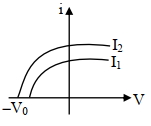
B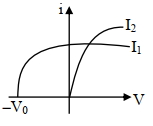
C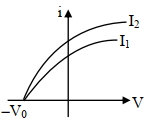
D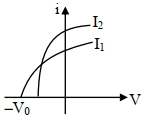
Solution
(C) The photoelectric effect depends on the intensity and frequency of incident light.
Since the incident lights have the same wavelength,their frequencies are identical. Therefore,the maximum kinetic energy of the emitted photoelectrons is the same,which means the stopping potential $(V_0)$ remains the same for both intensities.
Since the intensity $I_2 > I_1$,the number of photoelectrons emitted per unit time is greater for $I_2$ than for $I_1$. Consequently,the saturation current for $I_2$ will be greater than that for $I_1$.
Comparing this with the given figures,Figure $C$ correctly shows that both curves start from the same stopping potential $(-V_0)$ on the negative $V$-axis,and the saturation current for $I_2$ is higher than for $I_1$.
Thus,the correct figure is $C$.
Since the incident lights have the same wavelength,their frequencies are identical. Therefore,the maximum kinetic energy of the emitted photoelectrons is the same,which means the stopping potential $(V_0)$ remains the same for both intensities.
Since the intensity $I_2 > I_1$,the number of photoelectrons emitted per unit time is greater for $I_2$ than for $I_1$. Consequently,the saturation current for $I_2$ will be greater than that for $I_1$.
Comparing this with the given figures,Figure $C$ correctly shows that both curves start from the same stopping potential $(-V_0)$ on the negative $V$-axis,and the saturation current for $I_2$ is higher than for $I_1$.
Thus,the correct figure is $C$.
0 likes
View Solution130
DifficultMCQ
Which of the following phenomena is not explained by the wave nature of light?
$(A)$ Reflection
$(B)$ Diffraction
$(C)$ Photoelectric effect
$(D)$ Interference
$(E)$ Polarization
Choose the most appropriate answer from the options given below:
$(A)$ Reflection
$(B)$ Diffraction
$(C)$ Photoelectric effect
$(D)$ Interference
$(E)$ Polarization
Choose the most appropriate answer from the options given below:
A
$E$ only
B
$C$ only
C
$B, D$ only
D
$A, C$ only
Solution
(B) The wave nature of light successfully explains phenomena such as reflection,refraction,interference,diffraction,and polarization.
However,the photoelectric effect involves the emission of electrons from a metal surface when light of a suitable frequency strikes it. This phenomenon cannot be explained by the wave theory of light because the wave theory suggests that the energy of light depends on intensity,whereas the photoelectric effect depends on the frequency of the incident light.
Therefore,the photoelectric effect provides evidence for the particle nature of light (photons).
However,the photoelectric effect involves the emission of electrons from a metal surface when light of a suitable frequency strikes it. This phenomenon cannot be explained by the wave theory of light because the wave theory suggests that the energy of light depends on intensity,whereas the photoelectric effect depends on the frequency of the incident light.
Therefore,the photoelectric effect provides evidence for the particle nature of light (photons).
0 likes
View Solution131
DifficultMCQ
In a photoelectric experiment,a parallel beam of monochromatic light with power of $200 \ W$ is incident on a perfectly absorbing cathode of work function $6.25 \ eV$. The frequency of light is just above the threshold frequency so that the photoelectrons are emitted with negligible kinetic energy. Assume that the photoelectron emission efficiency is $100 \%$. $A$ potential difference of $500 \ V$ is applied between the cathode and the anode. All the emitted electrons are incident normally on the anode and are absorbed. The anode experiences a force $F = n \times 10^{-4} \ N$ due to the impact of the electrons. The value of $n$ is. . . . .
Mass of the electron $m_e = 9 \times 10^{-31} \ kg$ and $1.0 \ eV = 1.6 \times 10^{-19} \ J$.
Mass of the electron $m_e = 9 \times 10^{-31} \ kg$ and $1.0 \ eV = 1.6 \times 10^{-19} \ J$.
A
$20$
B
$24$
C
$30$
D
$40$
Solution
(B) Given power $P = 200 \ W$ and work function $\phi = 6.25 \ eV$.
Since the frequency is just above the threshold frequency,the initial kinetic energy of photoelectrons is zero.
Energy of one photon $E_1 = h\nu = \phi = 6.25 \ eV = 6.25 \times 1.6 \times 10^{-19} \ J = 10^{-18} \ J$.
Number of photons incident per second $N = P / E_1 = 200 / 10^{-18} = 2 \times 10^{20} \ s^{-1}$.
Since efficiency is $100 \%$,the number of electrons emitted per second is also $N = 2 \times 10^{20} \ s^{-1}$.
When these electrons are accelerated by a potential $V = 500 \ V$,their final kinetic energy $K = eV = 1.6 \times 10^{-19} \times 500 = 8 \times 10^{-17} \ J$.
The momentum of each electron upon impact is $p = \sqrt{2m_eK} = \sqrt{2 \times 9 \times 10^{-31} \times 8 \times 10^{-17}} = \sqrt{144 \times 10^{-48}} = 12 \times 10^{-24} \ kg \ m/s$.
The force exerted on the anode is $F = N \times p = (2 \times 10^{20}) \times (12 \times 10^{-24}) = 24 \times 10^{-4} \ N$.
Comparing with $F = n \times 10^{-4} \ N$,we get $n = 24$.
Since the frequency is just above the threshold frequency,the initial kinetic energy of photoelectrons is zero.
Energy of one photon $E_1 = h\nu = \phi = 6.25 \ eV = 6.25 \times 1.6 \times 10^{-19} \ J = 10^{-18} \ J$.
Number of photons incident per second $N = P / E_1 = 200 / 10^{-18} = 2 \times 10^{20} \ s^{-1}$.
Since efficiency is $100 \%$,the number of electrons emitted per second is also $N = 2 \times 10^{20} \ s^{-1}$.
When these electrons are accelerated by a potential $V = 500 \ V$,their final kinetic energy $K = eV = 1.6 \times 10^{-19} \times 500 = 8 \times 10^{-17} \ J$.
The momentum of each electron upon impact is $p = \sqrt{2m_eK} = \sqrt{2 \times 9 \times 10^{-31} \times 8 \times 10^{-17}} = \sqrt{144 \times 10^{-48}} = 12 \times 10^{-24} \ kg \ m/s$.
The force exerted on the anode is $F = N \times p = (2 \times 10^{20}) \times (12 \times 10^{-24}) = 24 \times 10^{-4} \ N$.
Comparing with $F = n \times 10^{-4} \ N$,we get $n = 24$.
0 likes
View Solution132
MediumMCQ
Given below are two statements: one is labelled as Assertion $A$ and the other is labelled as Reason $R$.
Assertion $A :$ In photoelectric effect,on increasing the intensity of incident light,the stopping potential increases.
Reason $R :$ Increase in intensity of light increases the rate of photoelectrons emitted,provided the frequency of incident light is greater than threshold frequency.
In the light of the above statements,choose the correct answer from the options given below:
Assertion $A :$ In photoelectric effect,on increasing the intensity of incident light,the stopping potential increases.
Reason $R :$ Increase in intensity of light increases the rate of photoelectrons emitted,provided the frequency of incident light is greater than threshold frequency.
In the light of the above statements,choose the correct answer from the options given below:
A
Both $A$ and $R$ are true but $R$ is $\text{NOT}$ the correct explanation of $A$
B
$A$ is false but $R$ is true
C
$A$ is true but $R$ is false
D
Both $A$ and $R$ are true and $R$ is the correct explanation of $A$
Solution
(B) The stopping potential $V_S$ is given by the Einstein's photoelectric equation: $V_S = \frac{h\nu - \phi}{e}$,where $h$ is Planck's constant,$\nu$ is the frequency of incident light,$\phi$ is the work function,and $e$ is the charge of an electron.
From this equation,it is clear that the stopping potential depends only on the frequency of the incident light and the material of the surface (work function). It does not depend on the intensity of the incident light.
Therefore,Assertion $A$ is false.
The intensity of light is defined as the energy incident per unit area per unit time,which is proportional to the number of photons incident per unit time. Increasing the intensity increases the number of photons,which in turn increases the number of photoelectrons emitted per second,provided the frequency is above the threshold frequency. Thus,Reason $R$ is true.
From this equation,it is clear that the stopping potential depends only on the frequency of the incident light and the material of the surface (work function). It does not depend on the intensity of the incident light.
Therefore,Assertion $A$ is false.
The intensity of light is defined as the energy incident per unit area per unit time,which is proportional to the number of photons incident per unit time. Increasing the intensity increases the number of photons,which in turn increases the number of photoelectrons emitted per second,provided the frequency is above the threshold frequency. Thus,Reason $R$ is true.
0 likes
View Solution133
MediumMCQ
Which of the following graphs represents the variation of photoelectric current with the property of light shown on the $x-$axis?
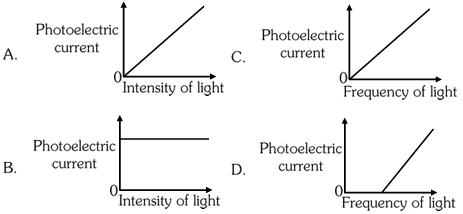
A
$A$ only
B
$A$ and $C$
C
$A$ and $D$
D
$B$ and $D$
Solution
(A) $1$. The photoelectric current $(I)$ is directly proportional to the intensity of incident light,provided the frequency of light is above the threshold frequency. Therefore,the graph $A$ is correct,showing a linear relationship between photoelectric current and intensity.
$2$. The photoelectric current does not depend on the frequency of incident light (as long as it is above the threshold frequency). Once the threshold frequency is reached,the current remains constant with respect to frequency. Therefore,graphs $C$ and $D$ are incorrect.
$2$. The photoelectric current does not depend on the frequency of incident light (as long as it is above the threshold frequency). Once the threshold frequency is reached,the current remains constant with respect to frequency. Therefore,graphs $C$ and $D$ are incorrect.
0 likes
View Solution134
MediumMCQ
Choose the correct option for the given statements:
Statement-$I$: The kinetic energy of photoelectrons emitted by a photosensitive surface depends on the intensity of the incident radiation.
Statement-$II$: In the photoelectric emission process,the maximum kinetic energy of the photoelectrons increases with increasing intensity of the incident light.
Statement-$I$: The kinetic energy of photoelectrons emitted by a photosensitive surface depends on the intensity of the incident radiation.
Statement-$II$: In the photoelectric emission process,the maximum kinetic energy of the photoelectrons increases with increasing intensity of the incident light.
A
Statement $I$ is correct,Statement $II$ is incorrect.
B
Statement $II$ is correct,Statement $I$ is incorrect.
C
Both Statement $I$ and Statement $II$ are correct.
D
Both Statement $I$ and Statement $II$ are incorrect.
Solution
(D) According to Einstein's photoelectric equation,$K_{max} = h\nu - \Phi$,where $h\nu$ is the energy of the incident photon and $\Phi$ is the work function of the metal surface.
The kinetic energy of photoelectrons depends only on the frequency of the incident radiation $(\nu)$ and the work function of the material $(\Phi)$.
Intensity of incident radiation affects the number of photoelectrons emitted per unit time (photoelectric current),but it does not affect the kinetic energy of individual photoelectrons.
Therefore,both Statement-$I$ and Statement-$II$ are incorrect.
The kinetic energy of photoelectrons depends only on the frequency of the incident radiation $(\nu)$ and the work function of the material $(\Phi)$.
Intensity of incident radiation affects the number of photoelectrons emitted per unit time (photoelectric current),but it does not affect the kinetic energy of individual photoelectrons.
Therefore,both Statement-$I$ and Statement-$II$ are incorrect.
0 likes
View Solution135
EasyMCQ
Assertion $(A) :-$ The photoelectrons produced by a monochromatic light beam incident on a metal surface have a spread in their kinetic energies.
Reason $(R) :-$ The work function of the metal varies as a function of depth from the surface.
Reason $(R) :-$ The work function of the metal varies as a function of depth from the surface.
A
Both $(A)$ and $(R)$ are correct but $(R)$ is not the correct explanation of $(A)$
B
$(A)$ is correct but $(R)$ is not correct
C
$(A)$ is incorrect but $(R)$ is correct
D
Both $(A)$ and $(R)$ are correct and $(R)$ is the correct explanation of $(A)$
Solution
(B) The Assertion $(A)$ is correct. When monochromatic light is incident on a metal surface, photoelectrons are emitted with a range of kinetic energies from $0$ to $K_{max} = h\nu - \Phi$. This spread occurs because electrons originating from deeper layers of the metal lose some of their kinetic energy due to collisions with other atoms before escaping the surface.
The Reason $(R)$ is incorrect. The work function $\Phi$ is a property of the metal surface itself, defined as the minimum energy required to remove an electron from the surface. It does not vary with the depth of the electron inside the metal; rather, the energy loss during the escape process causes the observed spread in kinetic energy.
The Reason $(R)$ is incorrect. The work function $\Phi$ is a property of the metal surface itself, defined as the minimum energy required to remove an electron from the surface. It does not vary with the depth of the electron inside the metal; rather, the energy loss during the escape process causes the observed spread in kinetic energy.
0 likes
View Solution136
EasyMCQ
In a photoelectric experiment,if the intensity of incident light is doubled and the frequency is kept slightly greater than threshold frequency,then the saturation photoelectric current
A
remains constant
B
is halved
C
is doubled
D
becomes four times
Solution
(C) In the photoelectric effect,the saturation photoelectric current is directly proportional to the intensity of the incident light,provided the frequency of the incident light is greater than the threshold frequency $(ν > ν_0)$.
Since the intensity of the incident light is doubled,the number of photons incident per unit time also doubles.
Consequently,the number of photoelectrons emitted per unit time doubles,leading to a doubling of the saturation photoelectric current.
Therefore,the correct option is $C$.
Since the intensity of the incident light is doubled,the number of photons incident per unit time also doubles.
Consequently,the number of photoelectrons emitted per unit time doubles,leading to a doubling of the saturation photoelectric current.
Therefore,the correct option is $C$.
0 likes
View Solution137
EasyMCQ
From the photoelectric effect experiment,select the correct statement.
A
Photoelectric effect can be explained using the wave theory of light.
B
The maximum kinetic energy of a photoelectron depends on the intensity of incident light.
C
The stopping potential depends only on the work function of the metal.
D
The saturation current increases as the intensity of incident light increases.
Solution
(D) According to Einstein's photoelectric equation,$K_{max} = h\nu - \Phi_0$,where $K_{max}$ is the maximum kinetic energy,$h\nu$ is the energy of the incident photon,and $\Phi_0$ is the work function of the metal.
$1$. The wave theory of light fails to explain the photoelectric effect because it cannot account for the instantaneous emission of electrons or the existence of a threshold frequency.
$2$. $K_{max}$ depends on the frequency of incident light $(
u)$,not its intensity.
$3$. The stopping potential $(V_s)$ is given by $eV_s = K_{max} = h\nu - \Phi_0$. Thus,it depends on both the frequency of incident light and the work function of the metal.
$4$. The saturation current is directly proportional to the number of photoelectrons emitted per second,which is directly proportional to the intensity of the incident light. Therefore,as intensity increases,the saturation current increases.
$1$. The wave theory of light fails to explain the photoelectric effect because it cannot account for the instantaneous emission of electrons or the existence of a threshold frequency.
$2$. $K_{max}$ depends on the frequency of incident light $(
u)$,not its intensity.
$3$. The stopping potential $(V_s)$ is given by $eV_s = K_{max} = h\nu - \Phi_0$. Thus,it depends on both the frequency of incident light and the work function of the metal.
$4$. The saturation current is directly proportional to the number of photoelectrons emitted per second,which is directly proportional to the intensity of the incident light. Therefore,as intensity increases,the saturation current increases.
0 likes
View Solution138
MediumMCQ
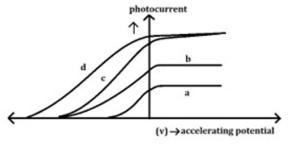
The graph shows the variation of photocurrent with anode potential for four different radiations. Let $I_a, I_b, I_c$ and $I_d$ be the intensities and $f_a, f_b, f_c$ and $f_d$ be the frequencies for the curves $a, b, c$ and $d$ respectively,then
A
$f_{b}>f_{a}, f_{b}=f_{c}, I_{c}=I_{d}$
B
$f_{b}=f_{a}, f_{b}>f_{c}, I_{c}>I_{d}$
C
$f_{b} < f_{a}, f_{b} < f_{c}, I_{c} < I_{d}$
D
$f_{b} \leqslant f_{a}, f_{b}>f_{c}, I_{c}=I_{d}$
Solution
(A) $1$. Frequency $(f)$: The stopping potential $(V_0)$ is the potential at which the photocurrent becomes zero. It is given by $eV_0 = hf - \phi$,where $\phi$ is the work function. $A$ more negative stopping potential indicates a higher frequency of incident radiation.
From the graph,the stopping potentials are $V_{0a} = V_{0b} < V_{0c} < V_{0d}$.
Therefore,$f_a = f_b < f_c < f_d$.
$2$. Intensity $(I)$: The saturation current is directly proportional to the intensity of the incident radiation. From the graph,the saturation currents for curves $c$ and $d$ are equal,while $a$ and $b$ have lower saturation currents.
Thus,$I_c = I_d$ and $I_a < I_b < I_c = I_d$.
Comparing the given options,option $A$ is the most consistent with the relationships derived,specifically $f_b = f_a$ (from $f_a = f_b$) and $I_c = I_d$.
From the graph,the stopping potentials are $V_{0a} = V_{0b} < V_{0c} < V_{0d}$.
Therefore,$f_a = f_b < f_c < f_d$.
$2$. Intensity $(I)$: The saturation current is directly proportional to the intensity of the incident radiation. From the graph,the saturation currents for curves $c$ and $d$ are equal,while $a$ and $b$ have lower saturation currents.
Thus,$I_c = I_d$ and $I_a < I_b < I_c = I_d$.
Comparing the given options,option $A$ is the most consistent with the relationships derived,specifically $f_b = f_a$ (from $f_a = f_b$) and $I_c = I_d$.
0 likes
View Solution139
EasyMCQ
The work functions of Caesium $(Cs)$, Potassium $(K)$, and Sodium $(Na)$ are $2.14 \ eV$, $2.30 \ eV$, and $2.75 \ eV$ respectively. If incident electromagnetic radiation has an incident energy of $2.41 \ eV$, which of these photosensitive surfaces may emit photoelectrons?
A
$Na$ only
B
$K$ only
C
Both $K$ and $Cs$
D
Both $Cs$ and $Na$
Solution
(C) Photoelectric emission occurs only when the energy of the incident photon $(E)$ is greater than or equal to the work function $(\Phi_0)$ of the metal surface.
Given incident energy $E = 2.41 \ eV$.
Work functions are:
For $Cs$: $\Phi_0 = 2.14 \ eV$
For $K$: $\Phi_0 = 2.30 \ eV$
For $Na$: $\Phi_0 = 2.75 \ eV$
Comparing $E$ with $\Phi_0$:
For $Cs$: $2.41 \ eV > 2.14 \ eV$ (Emission occurs)
For $K$: $2.41 \ eV > 2.30 \ eV$ (Emission occurs)
For $Na$: $2.41 \ eV < 2.75 \ eV$ (No emission)
Therefore, both $Cs$ and $K$ surfaces will emit photoelectrons.
Given incident energy $E = 2.41 \ eV$.
Work functions are:
For $Cs$: $\Phi_0 = 2.14 \ eV$
For $K$: $\Phi_0 = 2.30 \ eV$
For $Na$: $\Phi_0 = 2.75 \ eV$
Comparing $E$ with $\Phi_0$:
For $Cs$: $2.41 \ eV > 2.14 \ eV$ (Emission occurs)
For $K$: $2.41 \ eV > 2.30 \ eV$ (Emission occurs)
For $Na$: $2.41 \ eV < 2.75 \ eV$ (No emission)
Therefore, both $Cs$ and $K$ surfaces will emit photoelectrons.
0 likes
View Solution140
EasyMCQ
The number of photoelectrons emitted for light of frequency $v$ (higher than the threshold frequency $v_0$) is proportional to
A
threshold frequency $(v_0)$
B
intensity of light $(I)$
C
frequency of light $(v)$
D
work function $(\phi_0)$
Solution
(B) According to the photoelectric effect,the number of photoelectrons emitted per unit time is directly proportional to the number of incident photons per unit time.
Since the intensity of light $(I)$ is defined as the energy incident per unit area per unit time,and for a given frequency,the energy of each photon is constant $(E = hv)$,the intensity is directly proportional to the number of incident photons.
Therefore,the number of photoelectrons emitted is directly proportional to the intensity of the incident light $(I)$,provided the frequency $v$ is greater than the threshold frequency $v_0$.
Since the intensity of light $(I)$ is defined as the energy incident per unit area per unit time,and for a given frequency,the energy of each photon is constant $(E = hv)$,the intensity is directly proportional to the number of incident photons.
Therefore,the number of photoelectrons emitted is directly proportional to the intensity of the incident light $(I)$,provided the frequency $v$ is greater than the threshold frequency $v_0$.
0 likes
View Solution141
EasyMCQ
In the photoelectric effect,the photocurrent:
A
decreases with an increase in the frequency of the incident photon.
B
increases with an increase in the frequency of the incident photon.
C
does not depend on the frequency of the photon but depends only on the intensity of the incident light.
D
depends on both the intensity and frequency of the incident radiation.
Solution
(C) The photocurrent is independent of the frequency of the incident photon,provided the frequency is above the threshold frequency.
However,when the intensity of the incident light increases,the number of photons incident per unit area per unit time increases.
This leads to an increase in the number of photoelectrons emitted from the metal surface,thereby increasing the photocurrent.
However,when the intensity of the incident light increases,the number of photons incident per unit area per unit time increases.
This leads to an increase in the number of photoelectrons emitted from the metal surface,thereby increasing the photocurrent.
0 likes
View Solution142
EasyMCQ
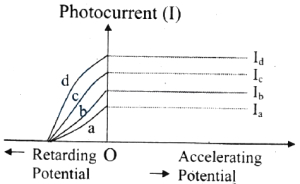
The figure shows the variation of photocurrent with anode potential for four different radiations. Let $I_a, I_b, I_c$ and $I_d$ be the intensities for the curves $a, b, c$ and $d$ respectively $[f_a, f_b, f_c$ and $f_d$ are frequencies respectively].
A
$f_a = f_b > f_c > f_d$ and $I_a = I_b > I_c > I_d$
B
$f_a < f_b > f_c = f_d$ and $I_a = I_b > I_c > I_d$
C
$f_a = f_b = f_c = f_d$ and $I_a < I_b < I_c < I_d$
D
$f_a > f_b > f_c > f_d$ and $I_a = I_b = I_c = I_d$
Solution
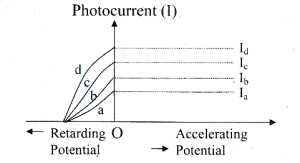
(C) In the photoelectric effect,the stopping potential depends only on the frequency of the incident radiation and the work function of the metal surface. Since all four curves intersect the potential axis at the same point (the same stopping potential),the frequency of all four radiations must be the same. Therefore,$f_a = f_b = f_c = f_d$.
The saturation photocurrent is directly proportional to the intensity of the incident radiation. From the graph,the saturation current values are $I_a < I_b < I_c < I_d$. Therefore,the intensities follow the same order: $I_a < I_b < I_c < I_d$.
The saturation photocurrent is directly proportional to the intensity of the incident radiation. From the graph,the saturation current values are $I_a < I_b < I_c < I_d$. Therefore,the intensities follow the same order: $I_a < I_b < I_c < I_d$.
0 likes
View Solution143
MediumMCQ
Light of frequency $1.5 \nu_0$ (where $\nu_0$ is the threshold frequency) is incident on a photosensitive material. If the frequency is halved and the intensity is doubled,what happens to the photocurrent?
A
quadrupled
B
double
C
half
D
zero
Solution
(D) The threshold frequency of the material is $\nu_0$. The initial frequency of incident light is $\nu_1 = 1.5 \nu_0$. Since $\nu_1 > \nu_0$,photoelectric emission occurs.
When the frequency is halved,the new frequency becomes $\nu_2 = \frac{1.5 \nu_0}{2} = 0.75 \nu_0$.
For photoelectric emission to occur,the incident frequency must be greater than or equal to the threshold frequency $(\nu \ge \nu_0)$.
Since $0.75 \nu_0 < \nu_0$,the new frequency is below the threshold frequency.
Therefore,no photoelectric emission will take place regardless of the intensity of the incident light.
Thus,the photocurrent becomes zero.
When the frequency is halved,the new frequency becomes $\nu_2 = \frac{1.5 \nu_0}{2} = 0.75 \nu_0$.
For photoelectric emission to occur,the incident frequency must be greater than or equal to the threshold frequency $(\nu \ge \nu_0)$.
Since $0.75 \nu_0 < \nu_0$,the new frequency is below the threshold frequency.
Therefore,no photoelectric emission will take place regardless of the intensity of the incident light.
Thus,the photocurrent becomes zero.
0 likes
View Solution144
EasyMCQ
Threshold frequency for a metal is $15 \times 10^{14} \, Hz$. The light of wavelength $6000 \, \text{Å}$ falls on the metal surface. Then photoelectrons [velocity of light in air, $c = 3 \times 10^8 \, m/s$]:
A
come out with zero velocity.
B
come out with velocity $3 \times 10^6 \, m/s$.
C
will not be emitted.
D
are emitted with velocity $c$.
Solution
(C) The threshold frequency of the metal is given as $f_0 = 15 \times 10^{14} \, Hz$.
The frequency of the incident light with wavelength $\lambda = 6000 \, \text{Å} = 6000 \times 10^{-10} \, m$ is calculated as:
$f = \frac{c}{\lambda} = \frac{3 \times 10^8 \, m/s}{6000 \times 10^{-10} \, m} = \frac{3 \times 10^8}{6 \times 10^{-7}} \, Hz = 0.5 \times 10^{15} \, Hz = 5 \times 10^{14} \, Hz$.
Since the frequency of the incident light $(f = 5 \times 10^{14} \, Hz)$ is less than the threshold frequency $(f_0 = 15 \times 10^{14} \, Hz)$, the energy of the incident photons is insufficient to overcome the work function of the metal.
Therefore, no photoelectric emission takes place.
The frequency of the incident light with wavelength $\lambda = 6000 \, \text{Å} = 6000 \times 10^{-10} \, m$ is calculated as:
$f = \frac{c}{\lambda} = \frac{3 \times 10^8 \, m/s}{6000 \times 10^{-10} \, m} = \frac{3 \times 10^8}{6 \times 10^{-7}} \, Hz = 0.5 \times 10^{15} \, Hz = 5 \times 10^{14} \, Hz$.
Since the frequency of the incident light $(f = 5 \times 10^{14} \, Hz)$ is less than the threshold frequency $(f_0 = 15 \times 10^{14} \, Hz)$, the energy of the incident photons is insufficient to overcome the work function of the metal.
Therefore, no photoelectric emission takes place.
0 likes
View Solution145
EasyMCQ
Light of frequency two times the threshold frequency is incident on a photosensitive material. If the incident frequency is made $\left(\frac{1}{3}\right)^{rd}$ and intensity is doubled,then the photoelectric current will
A
increase
B
decrease
C
be zero
D
be halved
Solution
(C) Initial frequency is $v = 2v_0$,where $v_0$ is the threshold frequency.
When the incident frequency is made $\left(\frac{1}{3}\right)^{rd}$,the new frequency becomes $v' = \frac{1}{3} \times 2v_0 = \frac{2}{3}v_0$.
Since $v' < v_0$,the incident light frequency is now less than the threshold frequency required for photoelectric emission.
According to the laws of the photoelectric effect,if the incident frequency is less than the threshold frequency,no photoelectrons are emitted regardless of the intensity of the light.
Therefore,the photoelectric current will be zero.
When the incident frequency is made $\left(\frac{1}{3}\right)^{rd}$,the new frequency becomes $v' = \frac{1}{3} \times 2v_0 = \frac{2}{3}v_0$.
Since $v' < v_0$,the incident light frequency is now less than the threshold frequency required for photoelectric emission.
According to the laws of the photoelectric effect,if the incident frequency is less than the threshold frequency,no photoelectrons are emitted regardless of the intensity of the light.
Therefore,the photoelectric current will be zero.
0 likes
View Solution146
EasyMCQ
On a photosensitive surface, if the intensity of incident radiation is increased, the stopping potential
A
first increases and then decreases
B
increases
C
decreases
D
remains unchanged
Solution
(D) The stopping potential $(V_0)$ is determined by the maximum kinetic energy of the emitted photoelectrons, which is given by Einstein's photoelectric equation: $K_{max} = h\nu - \Phi = eV_0$.
Here, $h$ is Planck's constant, $\nu$ is the frequency of incident radiation, $\Phi$ is the work function of the surface, and $e$ is the charge of an electron.
Since the stopping potential depends only on the frequency of the incident radiation and the nature of the material (work function), it is independent of the intensity of the incident radiation.
Therefore, increasing the intensity of the incident radiation does not change the stopping potential.
Here, $h$ is Planck's constant, $\nu$ is the frequency of incident radiation, $\Phi$ is the work function of the surface, and $e$ is the charge of an electron.
Since the stopping potential depends only on the frequency of the incident radiation and the nature of the material (work function), it is independent of the intensity of the incident radiation.
Therefore, increasing the intensity of the incident radiation does not change the stopping potential.
0 likes
View Solution147
EasyMCQ
In a photoelectric experiment,keeping the frequency of incident radiation and the accelerating potential fixed,if the intensity of incident light is increased,then:
A
photoelectric current decreases
B
kinetic energy of emitted photoelectrons decreases
C
photoelectric current increases
D
kinetic energy of emitted photoelectrons increases
Solution
(C) In the photoelectric effect,the photoelectric current is directly proportional to the intensity of the incident light,provided the frequency is above the threshold frequency. Since the frequency and accelerating potential are kept constant,increasing the intensity of the incident light increases the number of photons incident per unit time,which in turn increases the number of photoelectrons emitted per unit time. Therefore,the photoelectric current increases.
0 likes
View Solution148
EasyMCQ
In the photoelectric effect,the photocurrent:
A
does not depend on the frequency of the photon but depends on the intensity of the incident light.
B
decreases with an increase in the frequency of the incident photon.
C
increases with an increase in the frequency of the incident photon.
D
depends on the intensity of the incident radiation and its frequency.
Solution
(A) In the photoelectric effect,the photocurrent is directly proportional to the number of photoelectrons emitted per unit time.
Since each incident photon ejects at most one photoelectron,the number of photoelectrons emitted depends solely on the number of incident photons per unit time,which is determined by the intensity of the incident light.
The frequency of the incident light determines the kinetic energy of the emitted photoelectrons,provided the frequency is above the threshold frequency,but it does not affect the magnitude of the photocurrent.
Since each incident photon ejects at most one photoelectron,the number of photoelectrons emitted depends solely on the number of incident photons per unit time,which is determined by the intensity of the incident light.
The frequency of the incident light determines the kinetic energy of the emitted photoelectrons,provided the frequency is above the threshold frequency,but it does not affect the magnitude of the photocurrent.
0 likes
View Solution149
EasyMCQ
If the intensity of incident radiation in a photocell is increased, the stopping potential
A
first increases and then decreases.
B
remains unchanged.
C
decreases.
D
increases.
Solution
(B) The stopping potential $(V_0)$ is determined by the maximum kinetic energy of the emitted photoelectrons, which depends on the frequency of the incident radiation, not its intensity.
According to Einstein's photoelectric equation: $K_{max} = h\nu - \Phi_0 = eV_0$.
Since the intensity of light only affects the number of photons incident per unit area per unit time (and thus the number of photoelectrons emitted), it does not change the maximum kinetic energy of the individual electrons.
Therefore, the stopping potential remains unchanged when the intensity is increased.
According to Einstein's photoelectric equation: $K_{max} = h\nu - \Phi_0 = eV_0$.
Since the intensity of light only affects the number of photons incident per unit area per unit time (and thus the number of photoelectrons emitted), it does not change the maximum kinetic energy of the individual electrons.
Therefore, the stopping potential remains unchanged when the intensity is increased.
0 likes
View Solution150
MediumMCQ
Threshold frequency for a metal is $15 \times 10^{14} \,Hz$. The light of wavelength $6000 \text{ Å}$ falls on the metal surface. Which one of the following statements is correct? [velocity of light, $c = 3 \times 10^{8} \,m/s$]
A
photoelectrons are emitted with velocity $c$.
B
photoelectrons come out with velocity $3 \times 10^{6} \,m/s$.
C
photoelectrons come out with zero velocity.
D
photoelectrons will not be emitted.
Solution
(D) The threshold frequency is given as $\nu_{0} = 15 \times 10^{14} \,Hz$.
The threshold wavelength $\lambda_{0}$ is calculated as $\lambda_{0} = \frac{c}{\nu_{0}} = \frac{3 \times 10^{8}}{15 \times 10^{14}} = 0.2 \times 10^{-6} \,m = 2000 \text{ Å}$.
The wavelength of incident light is $\lambda = 6000 \text{ Å}$.
For photoelectric emission to occur, the incident wavelength must be less than or equal to the threshold wavelength $(\lambda \leq \lambda_{0})$.
Since $\lambda = 6000 \text{ Å} > \lambda_{0} = 2000 \text{ Å}$, the energy of the incident photons is less than the work function of the metal.
Therefore, photoelectrons will not be emitted.
The threshold wavelength $\lambda_{0}$ is calculated as $\lambda_{0} = \frac{c}{\nu_{0}} = \frac{3 \times 10^{8}}{15 \times 10^{14}} = 0.2 \times 10^{-6} \,m = 2000 \text{ Å}$.
The wavelength of incident light is $\lambda = 6000 \text{ Å}$.
For photoelectric emission to occur, the incident wavelength must be less than or equal to the threshold wavelength $(\lambda \leq \lambda_{0})$.
Since $\lambda = 6000 \text{ Å} > \lambda_{0} = 2000 \text{ Å}$, the energy of the incident photons is less than the work function of the metal.
Therefore, photoelectrons will not be emitted.
0 likes
View SolutionDual Nature of Radiation and matter — Photoelectric Effect by Lenard and it's Observations · Frequently Asked Questions
1Are these Dual Nature of Radiation and matter questions useful for JEE and NEET?
Yes. All questions in this section are mapped to JEE Main and NEET exam patterns. Previous year questions from JEE Main, NEET, GUJCET and state-level exams are included with full solutions.
2Can I switch to Hindi or Gujarati for these questions?
Yes. Use the language tabs in the hero section or the sidebar to view the same questions and solutions in English, Hindi or Gujarati.
3How do I generate a question paper from this subtopic?
Use the Vedclass Exam Paper Generator — select the chapter and subtopic, set difficulty, and generate Sets A, B, C, D automatically. First 3 chapters of every subject are free.
Vedclass Products
For Students
Vedclass Test Series
Mock tests in real JEE/NEET style with performance analysis. 5-day free trial.
Start Free TrialFor Teachers
Exam Paper Generator
Generate Set A/B/C/D papers from this chapter in 2 minutes. 3 chapters free.
Try FreeFor Institutes
Online Exam Module
Live online exams with unlimited students, 360° analytics & white-label branding.
See DemoFor Teachers & Institutes
Generate a Dual Nature of Radiation and matter Exam Paper in 2 Minutes
Select subtopic & difficulty — Sets A, B, C, D auto-generated with No Repeat logic.
First 3 chapters of every subject are free — no payment required.