
A English
Photoelectric Effect by Lenard and it's Observations Questions in English
Class 12 Physics · Dual Nature of Radiation and matter · Photoelectric Effect by Lenard and it's Observations
172+
Questions
English
Language
100%
With Solutions
Showing 50 of 172 questions in English
51
EasyMCQ
If the intensity of incident light on a metal surface is decreased,then . . . . . .
A
The number of emitted electrons will decrease.
B
The number of emitted electrons will increase.
C
The photoelectric current will increase.
D
None of these.
Solution
(A) The photoelectric current $(I_p)$ is directly proportional to the intensity $(I)$ of the incident light,i.e.,$I_p \propto I$.
Since the number of emitted photoelectrons is directly proportional to the intensity of the incident light,decreasing the intensity $(I)$ leads to a decrease in the number of emitted photoelectrons.
Therefore,the correct option is $A$.
Since the number of emitted photoelectrons is directly proportional to the intensity of the incident light,decreasing the intensity $(I)$ leads to a decrease in the number of emitted photoelectrons.
Therefore,the correct option is $A$.
0 likes
View Solution52
EasyMCQ
In the photoelectric effect,electrons are emitted from a metal surface only when the incident light has a certain minimum . . . . . . .
A
wavelength
B
frequency
C
amplitude
D
angle of incidence
Solution
(B) In the photoelectric effect,the emission of electrons from a metal surface depends on the energy of the incident photons.
According to Einstein's photoelectric equation,the energy of an incident photon is given by $E = h\nu$.
For the emission of electrons to occur,the incident frequency $\nu$ must be greater than or equal to the threshold frequency $\nu_0$ of the metal.
If $\nu < \nu_0$,no photoelectric emission occurs regardless of the intensity or amplitude of the light.
Therefore,a minimum threshold frequency is required for the photoelectric effect to take place.
According to Einstein's photoelectric equation,the energy of an incident photon is given by $E = h\nu$.
For the emission of electrons to occur,the incident frequency $\nu$ must be greater than or equal to the threshold frequency $\nu_0$ of the metal.
If $\nu < \nu_0$,no photoelectric emission occurs regardless of the intensity or amplitude of the light.
Therefore,a minimum threshold frequency is required for the photoelectric effect to take place.
0 likes
View Solution53
EasyMCQ
Which graph represents the relationship between the intensity of incident light on a metal plate and the resulting photoelectric current?
A
B
C
D
Solution
(B) According to the experimental observations of the photoelectric effect,the photoelectric current $i$ is directly proportional to the intensity $I$ of the incident light,provided the frequency of the incident light is above the threshold frequency.
Mathematically,this is expressed as $i \propto I$.
This linear relationship,where the current is zero when the intensity is zero,is represented by a straight line passing through the origin.
Mathematically,this is expressed as $i \propto I$.
This linear relationship,where the current is zero when the intensity is zero,is represented by a straight line passing through the origin.
0 likes
View Solution54
MediumMCQ
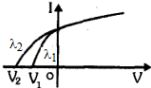
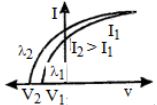
In the given figure,$V$ represents the stopping potential. If $\lambda_1$ and $\lambda_2$ are the wavelengths of the incident light and $|V_2| > |V_1|$,then:
A
$\lambda_1 = \lambda_2$
B
$\lambda_1 > \lambda_2$
C
$\lambda_2 > \lambda_1$
D
None of these
Solution
(B) From the photoelectric equation,the stopping potential $V_s$ is given by $eV_s = h\nu - \phi = \frac{hc}{\lambda} - \phi$.
This implies that the stopping potential is inversely proportional to the wavelength $\lambda$ of the incident light.
Given that $|V_2| > |V_1|$,where $V_2$ and $V_1$ are the stopping potentials corresponding to wavelengths $\lambda_2$ and $\lambda_1$ respectively.
Since $V_s \propto \frac{1}{\lambda}$,a higher stopping potential corresponds to a smaller wavelength.
Therefore,$|V_2| > |V_1| \implies \lambda_2 < \lambda_1$ or $\lambda_1 > \lambda_2$.
This implies that the stopping potential is inversely proportional to the wavelength $\lambda$ of the incident light.
Given that $|V_2| > |V_1|$,where $V_2$ and $V_1$ are the stopping potentials corresponding to wavelengths $\lambda_2$ and $\lambda_1$ respectively.
Since $V_s \propto \frac{1}{\lambda}$,a higher stopping potential corresponds to a smaller wavelength.
Therefore,$|V_2| > |V_1| \implies \lambda_2 < \lambda_1$ or $\lambda_1 > \lambda_2$.
0 likes
View Solution55
MediumMCQ
Which of the following statements is correct in photoelectric emission?
A
Photoelectric current is proportional to the amplitude of light of a given frequency.
B
Photoelectric current is proportional to the intensity of light of frequency above the threshold frequency.
C
Above the threshold frequency, the maximum kinetic energy of photoelectrons is inversely proportional to the wavelength of incident light.
D
The threshold frequency depends on the wavelength of incident light.
Solution
(B) According to the experimental observations of the photoelectric effect:
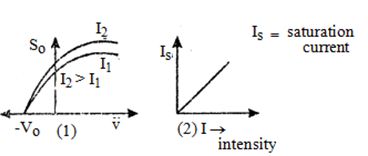
$1$. The photoelectric current $(I_p)$ is directly proportional to the intensity $(I)$ of the incident light, provided the frequency is above the threshold frequency $(v_0)$. This is shown in graph $(2)$.
$2$. The maximum kinetic energy $(K_{max})$ of the emitted photoelectrons is given by Einstein's photoelectric equation: $K_{max} = hv - \Phi_0$, where $h$ is Planck's constant, $v$ is the frequency of incident light, and $\Phi_0$ is the work function of the metal.
$3$. Since $v = c / \lambda$, where $c$ is the speed of light and $\lambda$ is the wavelength, we have $K_{max} = (hc / \lambda) - \Phi_0$. This shows that $K_{max}$ depends on the frequency (or wavelength) of the incident light, not its intensity.
$4$. Option $B$ is correct because the saturation photoelectric current is directly proportional to the intensity of incident light for a fixed frequency above the threshold frequency.
$1$. The photoelectric current $(I_p)$ is directly proportional to the intensity $(I)$ of the incident light, provided the frequency is above the threshold frequency $(v_0)$. This is shown in graph $(2)$.
$2$. The maximum kinetic energy $(K_{max})$ of the emitted photoelectrons is given by Einstein's photoelectric equation: $K_{max} = hv - \Phi_0$, where $h$ is Planck's constant, $v$ is the frequency of incident light, and $\Phi_0$ is the work function of the metal.
$3$. Since $v = c / \lambda$, where $c$ is the speed of light and $\lambda$ is the wavelength, we have $K_{max} = (hc / \lambda) - \Phi_0$. This shows that $K_{max}$ depends on the frequency (or wavelength) of the incident light, not its intensity.
$4$. Option $B$ is correct because the saturation photoelectric current is directly proportional to the intensity of incident light for a fixed frequency above the threshold frequency.
0 likes
View Solution56
MediumMCQ
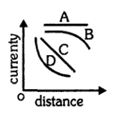
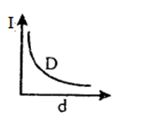
Photoelectric effect is produced by a point source on a small metal plate. Which of the following curves represents the saturation photoelectric current as a function of the distance between the source and the metal?
A
$A$
B
$B$
C
$C$
D
$D$
Solution
(D) The saturation photoelectric current $I_P$ is directly proportional to the number of photoelectrons emitted per unit time,which in turn is proportional to the intensity of incident light.
For a point source,the intensity $I$ of light at a distance $d$ from the source follows the inverse square law,i.e.,$I \propto \frac{1}{d^2}$.
Since the saturation photoelectric current $I_P$ is proportional to the intensity of light falling on the metal plate,we have $I_P \propto I \propto \frac{1}{d^2}$.
This relationship $I_P \propto \frac{1}{d^2}$ represents a curve that decreases rapidly as the distance $d$ increases,which corresponds to curve $D$ in the given graph.
For a point source,the intensity $I$ of light at a distance $d$ from the source follows the inverse square law,i.e.,$I \propto \frac{1}{d^2}$.
Since the saturation photoelectric current $I_P$ is proportional to the intensity of light falling on the metal plate,we have $I_P \propto I \propto \frac{1}{d^2}$.
This relationship $I_P \propto \frac{1}{d^2}$ represents a curve that decreases rapidly as the distance $d$ increases,which corresponds to curve $D$ in the given graph.
0 likes
View Solution57
EasyMCQ
For a given source,with an increase in intensity of incident radiation,the . . . . . .
A
photoelectric current increases.
B
photoelectric current decreases.
C
kinetic energy of emitted photoelectrons increases.
D
kinetic energy of emitted photoelectrons decreases.
Solution
(A) According to the experimental observations of the photoelectric effect,the photoelectric current is directly proportional to the intensity of the incident radiation,provided the frequency of the radiation is above the threshold frequency.
Intensity represents the number of photons incident per unit area per unit time.
As intensity increases,the number of photons striking the metal surface per unit time increases.
Consequently,the number of photoelectrons emitted per unit time increases,which leads to an increase in the photoelectric current.
The kinetic energy of the emitted photoelectrons depends only on the frequency of the incident radiation and the work function of the metal,not on the intensity.
Intensity represents the number of photons incident per unit area per unit time.
As intensity increases,the number of photons striking the metal surface per unit time increases.
Consequently,the number of photoelectrons emitted per unit time increases,which leads to an increase in the photoelectric current.
The kinetic energy of the emitted photoelectrons depends only on the frequency of the incident radiation and the work function of the metal,not on the intensity.
0 likes
View Solution58
MediumMCQ
$A$ photocell is illuminated by a small bright light source placed at a distance of $1 \ m$. When the same light source is placed at a distance of $\frac{1}{2} \ m$,the number of electrons emitted by the photocathode will be:
A
Increase by a factor of $2$.
B
Decrease by a factor of $2$.
C
Increase by a factor of $4$.
D
Decrease by a factor of $4$.
Solution
(C) The intensity of light $I$ is inversely proportional to the square of the distance $d$ from the source,i.e.,$I \propto \frac{1}{d^2}$.
Since the number of photoelectrons emitted is directly proportional to the intensity of incident light,we have $N \propto I$.
Therefore,the ratio of the number of electrons is given by $\frac{N_2}{N_1} = \frac{I_2}{I_1} = \left( \frac{d_1}{d_2} \right)^2$.
Given $d_1 = 1 \ m$ and $d_2 = \frac{1}{2} \ m$,we get:
$\frac{N_2}{N_1} = \left( \frac{1}{1/2} \right)^2 = (2)^2 = 4$.
Thus,the number of emitted electrons increases by a factor of $4$.
Since the number of photoelectrons emitted is directly proportional to the intensity of incident light,we have $N \propto I$.
Therefore,the ratio of the number of electrons is given by $\frac{N_2}{N_1} = \frac{I_2}{I_1} = \left( \frac{d_1}{d_2} \right)^2$.
Given $d_1 = 1 \ m$ and $d_2 = \frac{1}{2} \ m$,we get:
$\frac{N_2}{N_1} = \left( \frac{1}{1/2} \right)^2 = (2)^2 = 4$.
Thus,the number of emitted electrons increases by a factor of $4$.
0 likes
View Solution59
EasyMCQ
What is the phenomenon of the photoelectric effect?
A
Photons are emitted from a metal when it is struck by a beam of electrons.
B
Photons are emitted from the nucleus of an atom under the influence of an electric field.
C
Electrons are emitted from a metal with a constant velocity that depends on the frequency and intensity of the incident light.
D
Electrons are emitted from a metal with velocities not exceeding a certain value, which depends only on the frequency of the incident light.
Solution
(D) The photoelectric effect is the phenomenon where electrons are emitted from a metal surface when light of a suitable frequency is incident on it. The maximum kinetic energy of the emitted electrons depends only on the frequency of the incident light, not its intensity.
The Einstein photoelectric equation is given by: $K_{max} = h\nu - \Phi_0$
Where:
$K_{max}$ is the maximum kinetic energy of the emitted electrons.
$h\nu$ is the energy of the incident photon.
$\Phi_0 = h\nu_0$ is the work function of the metal.
The Einstein photoelectric equation is given by: $K_{max} = h\nu - \Phi_0$
Where:
$K_{max}$ is the maximum kinetic energy of the emitted electrons.
$h\nu$ is the energy of the incident photon.
$\Phi_0 = h\nu_0$ is the work function of the metal.
0 likes
View Solution60
MediumMCQ
The threshold wavelength for the emission of photoelectrons from a material is $5200\, \text{\AA}$. Which of the following monochromatic light sources will cause the emission of photoelectrons from this surface?
A
Light emitted from a $1\, W$ ultraviolet lamp
B
Light emitted from a $50\, W$ ultraviolet lamp
C
Light emitted from a $1\, W$ infrared lamp
D
Both $(A)$ and $(B)$
Solution
(D) For the emission of photoelectrons from a surface, the wavelength of the incident light $\lambda$ must be < or equal to the threshold wavelength $\lambda_0$.
Given, $\lambda_0 = 5200\, \text{\AA}$.
Ultraviolet light has a wavelength range typically between $100\, \text{\AA}$ and $4000\, \text{\AA}$, which is < $5200\, \text{\AA}$.
Infrared light has a wavelength greater than $7000\, \text{\AA}$, which is greater than $5200\, \text{\AA}$.
Therefore, light from an ultraviolet lamp (regardless of power, as power only affects the number of photoelectrons, not the emission condition) will cause emission.
Thus, both $(A)$ and $(B)$ are correct.
Given, $\lambda_0 = 5200\, \text{\AA}$.
Ultraviolet light has a wavelength range typically between $100\, \text{\AA}$ and $4000\, \text{\AA}$, which is < $5200\, \text{\AA}$.
Infrared light has a wavelength greater than $7000\, \text{\AA}$, which is greater than $5200\, \text{\AA}$.
Therefore, light from an ultraviolet lamp (regardless of power, as power only affects the number of photoelectrons, not the emission condition) will cause emission.
Thus, both $(A)$ and $(B)$ are correct.
0 likes
View Solution61
MediumMCQ
Light with a frequency of $1.5$ times the threshold frequency is incident on a photosensitive material. If the frequency is halved and the intensity is doubled,what will be the photoelectric current?
A
One-fourth
B
Doubled
C
Halved
D
Zero
Solution
(D) The threshold frequency is $f_0$. The initial frequency of incident light is $f = 1.5 f_0$.
Since $f > f_0$,photoelectric emission occurs.
Now,the frequency is halved: $f' = \frac{1.5 f_0}{2} = 0.75 f_0$.
For photoelectric emission to occur,the incident frequency must be greater than or equal to the threshold frequency $(f \ge f_0)$.
Since $0.75 f_0 < f_0$,the incident frequency is now below the threshold frequency.
Therefore,no photoelectric emission will take place,regardless of the increase in intensity.
Thus,the photoelectric current will be $0$.
Since $f > f_0$,photoelectric emission occurs.
Now,the frequency is halved: $f' = \frac{1.5 f_0}{2} = 0.75 f_0$.
For photoelectric emission to occur,the incident frequency must be greater than or equal to the threshold frequency $(f \ge f_0)$.
Since $0.75 f_0 < f_0$,the incident frequency is now below the threshold frequency.
Therefore,no photoelectric emission will take place,regardless of the increase in intensity.
Thus,the photoelectric current will be $0$.
0 likes
View Solution62
EasyMCQ
The time taken by a photoelectron to come out after the photon strikes is approximately
A
$10^{-4} \ s$
B
$10^{-10} \ s$
C
$10^{-16} \ s$
D
$10^{-1} \ s$
Solution
(B) According to the experimental observations of the photoelectric effect,the emission of photoelectrons from a metal surface is an instantaneous process. The time lag between the incidence of a photon and the emission of a photoelectron is approximately $10^{-10} \ s$.
0 likes
View Solution63
MediumMCQ
When the distance of a light source from a photocell is $r_1$,the photoelectric current is $I_1$. If the distance is $r_2$,the photoelectric current becomes $I_2$. The ratio $(I_1 : I_2)$ is .....
A
$r_2^2 : r_1^2$
B
$r_2 : r_1$
C
$r_1^2 : r_2^2$
D
$r_1 : r_2$
Solution
(A) The intensity of light $I$ at a distance $r$ from a point source is given by the inverse square law: $I \propto \frac{1}{r^2}$.
Since the photoelectric current $I_p$ is directly proportional to the intensity of incident light,we have $I_p \propto I$.
Therefore,$I_p \propto \frac{1}{r^2}$.
For distance $r_1$,the current is $I_1 \propto \frac{1}{r_1^2}$.
For distance $r_2$,the current is $I_2 \propto \frac{1}{r_2^2}$.
Taking the ratio of the two currents:
$\frac{I_1}{I_2} = \frac{1/r_1^2}{1/r_2^2} = \frac{r_2^2}{r_1^2}$.
Thus,the ratio $(I_1 : I_2)$ is $r_2^2 : r_1^2$.
Since the photoelectric current $I_p$ is directly proportional to the intensity of incident light,we have $I_p \propto I$.
Therefore,$I_p \propto \frac{1}{r^2}$.
For distance $r_1$,the current is $I_1 \propto \frac{1}{r_1^2}$.
For distance $r_2$,the current is $I_2 \propto \frac{1}{r_2^2}$.
Taking the ratio of the two currents:
$\frac{I_1}{I_2} = \frac{1/r_1^2}{1/r_2^2} = \frac{r_2^2}{r_1^2}$.
Thus,the ratio $(I_1 : I_2)$ is $r_2^2 : r_1^2$.
0 likes
View Solution64
MediumMCQ
In the photoelectric effect,assuming the energy of a photon is proportional to its frequency and is completely absorbed by an electron in the metal,the photoelectric current...
A
decreases when the frequency of the incident photon increases.
B
increases when the frequency of the incident photon increases.
C
does not depend on the photon frequency but depends only on the intensity of the incident beam.
D
depends on both the intensity and the frequency of the incident beam.
Solution
(C) The photoelectric current is proportional to the number of photoelectrons emitted per unit time,which is equal to the number of incident photons per unit time (assuming one photon ejects one electron).
The number of photons incident per unit time is given by $\frac{dn}{dt} = \frac{P}{E}$,where $P$ is the power of the incident beam and $E = h\nu$ is the energy of a single photon.
Since power $P = I \times A$ (where $I$ is intensity and $A$ is area),we have $\frac{dn}{dt} = \frac{IA}{h\nu}$.
The photoelectric current $i$ is proportional to the rate of emission of electrons: $i \propto \frac{dn}{dt} = \frac{IA}{h\nu}$.
However,in the standard photoelectric effect,the number of photoelectrons emitted depends only on the number of incident photons (intensity) provided the frequency is above the threshold frequency. The frequency $\nu$ affects the kinetic energy of the electrons,not the number of electrons emitted per unit time for a fixed intensity $I$. Therefore,the photoelectric current is independent of the frequency $\nu$ and depends only on the intensity $I$ of the incident light.
The number of photons incident per unit time is given by $\frac{dn}{dt} = \frac{P}{E}$,where $P$ is the power of the incident beam and $E = h\nu$ is the energy of a single photon.
Since power $P = I \times A$ (where $I$ is intensity and $A$ is area),we have $\frac{dn}{dt} = \frac{IA}{h\nu}$.
The photoelectric current $i$ is proportional to the rate of emission of electrons: $i \propto \frac{dn}{dt} = \frac{IA}{h\nu}$.
However,in the standard photoelectric effect,the number of photoelectrons emitted depends only on the number of incident photons (intensity) provided the frequency is above the threshold frequency. The frequency $\nu$ affects the kinetic energy of the electrons,not the number of electrons emitted per unit time for a fixed intensity $I$. Therefore,the photoelectric current is independent of the frequency $\nu$ and depends only on the intensity $I$ of the incident light.
0 likes
View Solution65
EasyMCQ
$A$ photoelectric cell is illuminated by a point source of light placed at a distance of $1 \ m$. If the source is moved to a distance of $2 \ m$,then:
A
Each emitted electron has one-fourth of the initial energy.
B
The number of emitted electrons is half the initial number.
C
Each emitted electron has half the initial energy.
D
The number of emitted electrons is one-fourth of the initial number.
Solution
(D) The intensity of light $I$ from a point source follows the inverse square law,$I \propto \frac{1}{d^2}$.
The number of photoelectrons emitted per unit time,$\frac{dn}{dt}$,is directly proportional to the intensity of incident light,which in turn is proportional to the number of photons incident on the surface.
Since $I \propto \frac{1}{d^2}$,the number of photoelectrons emitted per unit time is $\frac{dn}{dt} \propto \frac{1}{d^2}$.
When the distance is increased from $d_1 = 1 \ m$ to $d_2 = 2 \ m$,the ratio of the number of emitted electrons is:
$\frac{(\frac{dn}{dt})_2}{(\frac{dn}{dt})_1} = \frac{d_1^2}{d_2^2} = \frac{1^2}{2^2} = \frac{1}{4}$.
Thus,the number of emitted electrons becomes one-fourth of the initial number. The kinetic energy of the emitted electrons depends on the frequency of the incident light,not on the intensity,so the energy remains unchanged.
The number of photoelectrons emitted per unit time,$\frac{dn}{dt}$,is directly proportional to the intensity of incident light,which in turn is proportional to the number of photons incident on the surface.
Since $I \propto \frac{1}{d^2}$,the number of photoelectrons emitted per unit time is $\frac{dn}{dt} \propto \frac{1}{d^2}$.
When the distance is increased from $d_1 = 1 \ m$ to $d_2 = 2 \ m$,the ratio of the number of emitted electrons is:
$\frac{(\frac{dn}{dt})_2}{(\frac{dn}{dt})_1} = \frac{d_1^2}{d_2^2} = \frac{1^2}{2^2} = \frac{1}{4}$.
Thus,the number of emitted electrons becomes one-fourth of the initial number. The kinetic energy of the emitted electrons depends on the frequency of the incident light,not on the intensity,so the energy remains unchanged.
0 likes
View Solution66
EasyMCQ
In a photoelectric cell,the conversion of energy takes place from:
A
Chemical to electrical
B
Magnetic to electrical
C
Light to electrical
D
Mechanical to electrical
Solution
(C) photoelectric cell is a device that converts light energy into electrical energy. When light photons of sufficient energy (greater than the work function of the metal) strike the cathode,electrons are emitted due to the photoelectric effect. These electrons flow through the circuit,creating an electric current. Therefore,the energy conversion is from light to electrical energy.
0 likes
View Solution67
EasyMCQ
Photoelectric effect occurs when ultraviolet rays are incident on a metal plate. It does not occur when which of the following are incident?
A
Infrared rays
B
Soft $X$-rays
C
Gamma rays
D
Hard $X$-rays
Solution
(A) The photoelectric effect occurs when the frequency of incident radiation $v$ is greater than the threshold frequency $v_0$ of the metal.
Ultraviolet $(UV)$ rays have a higher frequency than visible light and infrared rays.
Infrared rays have a lower frequency than $UV$ rays,meaning $v_{IR} < v_{UV}$.
Since the photoelectric effect is triggered by $UV$ rays,the threshold frequency $v_0$ must be less than or equal to $v_{UV}$.
Because $v_{IR} < v_{UV}$,it is possible that $v_{IR} < v_0$,in which case the photoelectric effect will not occur for infrared rays.
$X$-rays and $\gamma$-rays have frequencies much higher than $UV$ rays,so they will definitely cause the photoelectric effect.
Ultraviolet $(UV)$ rays have a higher frequency than visible light and infrared rays.
Infrared rays have a lower frequency than $UV$ rays,meaning $v_{IR} < v_{UV}$.
Since the photoelectric effect is triggered by $UV$ rays,the threshold frequency $v_0$ must be less than or equal to $v_{UV}$.
Because $v_{IR} < v_{UV}$,it is possible that $v_{IR} < v_0$,in which case the photoelectric effect will not occur for infrared rays.
$X$-rays and $\gamma$-rays have frequencies much higher than $UV$ rays,so they will definitely cause the photoelectric effect.
0 likes
View Solution68
EasyMCQ
$A$ photocell is illuminated by a small lamp placed at a distance of $1 \ m$. If the lamp is shifted to a distance of $2 \ m$,then the number of emitted electrons will be:
A
one-fourth of the initial number.
B
one-half of the initial number.
C
four times the initial number.
D
two times the initial number.
Solution
(A) In the photoelectric effect,the number of photoelectrons emitted per second is directly proportional to the intensity of the incident light.
Intensity $(I)$ of light from a point source follows the inverse square law,$I \propto \frac{1}{r^2}$,where $r$ is the distance from the source.
When the distance is increased from $r_1 = 1 \ m$ to $r_2 = 2 \ m$,the intensity becomes $I_2 = I_1 \times (\frac{r_1}{r_2})^2 = I_1 \times (\frac{1}{2})^2 = \frac{I_1}{4}$.
Since the number of emitted photoelectrons is proportional to the intensity,the number of emitted electrons will become one-fourth of the initial number.
Intensity $(I)$ of light from a point source follows the inverse square law,$I \propto \frac{1}{r^2}$,where $r$ is the distance from the source.
When the distance is increased from $r_1 = 1 \ m$ to $r_2 = 2 \ m$,the intensity becomes $I_2 = I_1 \times (\frac{r_1}{r_2})^2 = I_1 \times (\frac{1}{2})^2 = \frac{I_1}{4}$.
Since the number of emitted photoelectrons is proportional to the intensity,the number of emitted electrons will become one-fourth of the initial number.
0 likes
View Solution69
MediumMCQ
The material of the cathode in a photocell is changed such that the work function of the surface changes from $W_1$ to $W_2$ $(W_2 > W_1)$. If the photocurrents emitted before and after changing the cathode surface are $I_1$ and $I_2$ respectively,and $hf > W_2$,then:
A
$I_1 = I_2$
B
$I_1 < I_2$
C
$I_1 > I_2$
D
$I_1 < I_2 < 2I_1$
Solution
(A) The photoelectric current depends only on the intensity of the incident radiation and the number of photons striking the surface per unit time,provided the frequency of the incident light is above the threshold frequency.
The work function $W$ determines the threshold frequency $(W = h
u_0)$,but it does not affect the number of photoelectrons emitted per unit time if the intensity remains constant.
Since $hf > W_2$ (and consequently $hf > W_1$),photoemission occurs in both cases.
Therefore,the photocurrent remains the same,i.e.,$I_1 = I_2$.
The work function $W$ determines the threshold frequency $(W = h
u_0)$,but it does not affect the number of photoelectrons emitted per unit time if the intensity remains constant.
Since $hf > W_2$ (and consequently $hf > W_1$),photoemission occurs in both cases.
Therefore,the photocurrent remains the same,i.e.,$I_1 = I_2$.
0 likes
View Solution70
MediumMCQ
How many times more photons are emitted from a photocell by a source placed at a distance of $1 \ m$ compared to a source placed at a distance of $2 \ m$?
A
$1$
B
$2$
C
$4$
D
$8$
Solution
(C) The intensity $I$ of light from a point source follows the inverse square law,$I \propto \frac{1}{d^2}$,where $d$ is the distance from the source.
Since the number of photoelectrons emitted is directly proportional to the intensity of incident light,we have $N \propto I \propto \frac{1}{d^2}$.
Let $N_1$ be the number of photons at distance $d_1 = 1 \ m$ and $N_2$ be the number of photons at distance $d_2 = 2 \ m$.
Then,$\frac{N_1}{N_2} = \left( \frac{d_2}{d_1} \right)^2$.
Substituting the values: $\frac{N_1}{N_2} = \left( \frac{2}{1} \right)^2 = 4$.
Therefore,$N_1 = 4N_2$,which means the number of photons emitted at $1 \ m$ is $4$ times the number of photons emitted at $2 \ m$.
Since the number of photoelectrons emitted is directly proportional to the intensity of incident light,we have $N \propto I \propto \frac{1}{d^2}$.
Let $N_1$ be the number of photons at distance $d_1 = 1 \ m$ and $N_2$ be the number of photons at distance $d_2 = 2 \ m$.
Then,$\frac{N_1}{N_2} = \left( \frac{d_2}{d_1} \right)^2$.
Substituting the values: $\frac{N_1}{N_2} = \left( \frac{2}{1} \right)^2 = 4$.
Therefore,$N_1 = 4N_2$,which means the number of photons emitted at $1 \ m$ is $4$ times the number of photons emitted at $2 \ m$.
0 likes
View Solution71
EasyMCQ
$A$ photocell employs the photoelectric effect to convert
A
change in the frequency of light into a change in the electric current
B
change in the frequency of light into a change in electric voltage
C
change in the intensity of illumination into a change in photoelectric current
D
change in the intensity of illumination into a change in the work function of the photocathode.
Solution
(C) The photoelectric current is directly proportional to the intensity of the incident light (illumination).
According to the photoelectric effect,when light of a suitable frequency falls on a metal surface,electrons are emitted.
The number of photoelectrons emitted per second is directly proportional to the intensity of the incident radiation.
Therefore,a change in the intensity of illumination results in a corresponding change in the photoelectric current.
According to the photoelectric effect,when light of a suitable frequency falls on a metal surface,electrons are emitted.
The number of photoelectrons emitted per second is directly proportional to the intensity of the incident radiation.
Therefore,a change in the intensity of illumination results in a corresponding change in the photoelectric current.
0 likes
View Solution72
EasyMCQ
The number of photoelectrons emitted for light of a frequency $\nu$ (higher than the threshold frequency $\nu_0$) is proportional to
A
threshold frequency $\nu_0$
B
intensity of light
C
frequency of light $\nu$
D
$\nu - \nu_0$
Solution
(B) According to the photoelectric effect,the number of photoelectrons emitted per unit time is directly proportional to the number of incident photons per unit time.
Since the intensity of light is defined as the energy incident per unit area per unit time,and for a given frequency $\nu$,the energy of each photon is $E = h\nu$ (a constant),the intensity is directly proportional to the number of incident photons.
Therefore,the number of photoelectrons emitted is directly proportional to the intensity of the incident light,provided the frequency $\nu$ is greater than the threshold frequency $\nu_0$.
Since the intensity of light is defined as the energy incident per unit area per unit time,and for a given frequency $\nu$,the energy of each photon is $E = h\nu$ (a constant),the intensity is directly proportional to the number of incident photons.
Therefore,the number of photoelectrons emitted is directly proportional to the intensity of the incident light,provided the frequency $\nu$ is greater than the threshold frequency $\nu_0$.
0 likes
View Solution73
MediumMCQ
When monochromatic radiation of intensity $I$ falls on a metal surface, the number of photoelectrons and their maximum kinetic energy are $N$ and $K$ respectively. If the intensity of radiation is $2I$, the number of emitted electrons and their maximum kinetic energy are respectively
A
$N$ and $2K$
B
$2N$ and $K$
C
$2N$ and $2K$
D
$N$ and $K$
Solution
(B) The number of photoelectrons ejected is directly proportional to the intensity of the incident light. Therefore, if the intensity is doubled from $I$ to $2I$, the number of photoelectrons emitted will also double, becoming $2N$.
Maximum kinetic energy $(K)$ of the photoelectrons is determined by Einstein's photoelectric equation: $K = h\nu - \Phi$, where $h$ is Planck's constant, $\nu$ is the frequency of incident radiation, and $\Phi$ is the work function of the metal.
Since the frequency $\nu$ remains unchanged, the maximum kinetic energy $K$ remains constant regardless of the change in intensity.
Thus, the new values are $2N$ and $K$.
Maximum kinetic energy $(K)$ of the photoelectrons is determined by Einstein's photoelectric equation: $K = h\nu - \Phi$, where $h$ is Planck's constant, $\nu$ is the frequency of incident radiation, and $\Phi$ is the work function of the metal.
Since the frequency $\nu$ remains unchanged, the maximum kinetic energy $K$ remains constant regardless of the change in intensity.
Thus, the new values are $2N$ and $K$.
0 likes
View Solution74
AdvancedMCQ
$10^{-3} \, W$ of $5000 \, \mathring{A}$ light is directed on a photoelectric cell. If the current in the cell is $0.16 \, \mu A$,the percentage of incident photons which produce photoelectrons is .......$\%$
A
$0.4$
B
$0.04$
C
$20$
D
$10$
Solution
(B) The number of photoelectrons emitted per second is given by $\frac{n}{\Delta t} = \frac{I}{e}$.
Given $I = 0.16 \, \mu A = 0.16 \times 10^{-6} \, A$ and $e = 1.6 \times 10^{-19} \, C$.
$\frac{n}{\Delta t} = \frac{0.16 \times 10^{-6}}{1.6 \times 10^{-19}} = 10^{12} \, \text{photons/s}$.
The number of incident photons per second is given by $\frac{N}{\Delta t} = \frac{W \lambda}{hc}$.
Given $W = 10^{-3} \, W$,$\lambda = 5000 \, \mathring{A} = 5 \times 10^{-7} \, m$,$h = 6.63 \times 10^{-34} \, J \cdot s$,and $c = 3 \times 10^8 \, m/s$.
$\frac{N}{\Delta t} = \frac{10^{-3} \times 5 \times 10^{-7}}{6.63 \times 10^{-34} \times 3 \times 10^8} \approx \frac{5 \times 10^{-10}}{19.89 \times 10^{-26}} \approx 0.251 \times 10^{16} = 2.51 \times 10^{15} \, \text{photons/s}$.
Percentage efficiency = $\frac{n/\Delta t}{N/\Delta t} \times 100 = \frac{10^{12}}{2.51 \times 10^{15}} \times 100 \approx 0.04 \%$.
Given $I = 0.16 \, \mu A = 0.16 \times 10^{-6} \, A$ and $e = 1.6 \times 10^{-19} \, C$.
$\frac{n}{\Delta t} = \frac{0.16 \times 10^{-6}}{1.6 \times 10^{-19}} = 10^{12} \, \text{photons/s}$.
The number of incident photons per second is given by $\frac{N}{\Delta t} = \frac{W \lambda}{hc}$.
Given $W = 10^{-3} \, W$,$\lambda = 5000 \, \mathring{A} = 5 \times 10^{-7} \, m$,$h = 6.63 \times 10^{-34} \, J \cdot s$,and $c = 3 \times 10^8 \, m/s$.
$\frac{N}{\Delta t} = \frac{10^{-3} \times 5 \times 10^{-7}}{6.63 \times 10^{-34} \times 3 \times 10^8} \approx \frac{5 \times 10^{-10}}{19.89 \times 10^{-26}} \approx 0.251 \times 10^{16} = 2.51 \times 10^{15} \, \text{photons/s}$.
Percentage efficiency = $\frac{n/\Delta t}{N/\Delta t} \times 100 = \frac{10^{12}}{2.51 \times 10^{15}} \times 100 \approx 0.04 \%$.
0 likes
View Solution75
MediumMCQ
$A$ point source causes the photoelectric effect from a small metal plate. Which of the following curves may represent the saturation photocurrent $(I)$ as a function of the distance $(r)$ between the source and the metal?
A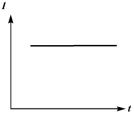
B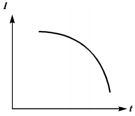
C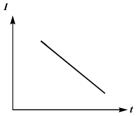
D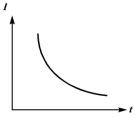
Solution
(D) The intensity of light from a point source at a distance $r$ is given by $I_{light} \propto \frac{1}{r^2}$.
Since the saturation photocurrent is directly proportional to the intensity of the incident light, we have $I \propto I_{light}$.
Therefore, the saturation photocurrent $I$ is inversely proportional to the square of the distance $r$, i.e., $I \propto \frac{1}{r^2}$.
This relationship is represented by a curve that decreases rapidly as $r$ increases, which corresponds to the shape shown in option $D$.
Since the saturation photocurrent is directly proportional to the intensity of the incident light, we have $I \propto I_{light}$.
Therefore, the saturation photocurrent $I$ is inversely proportional to the square of the distance $r$, i.e., $I \propto \frac{1}{r^2}$.
This relationship is represented by a curve that decreases rapidly as $r$ increases, which corresponds to the shape shown in option $D$.
0 likes
View Solution76
MediumMCQ
By increasing the intensity of incident light, keeping the frequency $(v > v_0)$ fixed on the surface of a metal:
A
kinetic energy of the photoelectrons increases
B
number of emitted electrons increases
C
kinetic energy and number of electrons increases
D
no effect
Solution
(B) According to the photoelectric effect, the number of photoelectrons emitted per second is directly proportional to the intensity of the incident light, provided the frequency is above the threshold frequency $(v > v_0)$.
Increasing the intensity means increasing the number of photons incident per unit area per unit time. Since each photon interacts with one electron, the number of emitted photoelectrons increases.
The maximum kinetic energy of the photoelectrons depends only on the frequency of the incident light $(K_{max} = hv - \Phi_0)$. Since the frequency is kept constant, the kinetic energy of each emitted photoelectron remains unchanged.
Therefore, increasing the intensity only increases the number of emitted electrons.
Increasing the intensity means increasing the number of photons incident per unit area per unit time. Since each photon interacts with one electron, the number of emitted photoelectrons increases.
The maximum kinetic energy of the photoelectrons depends only on the frequency of the incident light $(K_{max} = hv - \Phi_0)$. Since the frequency is kept constant, the kinetic energy of each emitted photoelectron remains unchanged.
Therefore, increasing the intensity only increases the number of emitted electrons.
0 likes
View Solution77
MediumMCQ
Monochromatic light with a frequency well above the cutoff frequency is incident on the emitter in a photoelectric effect apparatus. The frequency of the light is then doubled while the intensity is kept constant. How does this affect the photoelectric current?
A
The photoelectric current will increase.
B
The photoelectric current will decrease.
C
The photoelectric current will remain the same.
D
None of these
Solution
(C) In the photoelectric effect,the photoelectric current $(I)$ is directly proportional to the number of photoelectrons emitted per unit time.
This number of emitted photoelectrons is directly proportional to the number of incident photons per unit time (intensity of light).
Since the intensity of the light is kept constant,the number of incident photons per unit time remains unchanged.
Although the frequency of the light is doubled,which increases the kinetic energy of the emitted photoelectrons,it does not change the number of photons incident on the surface.
Therefore,the number of photoelectrons emitted per unit time remains constant,and the photoelectric current remains the same.
This number of emitted photoelectrons is directly proportional to the number of incident photons per unit time (intensity of light).
Since the intensity of the light is kept constant,the number of incident photons per unit time remains unchanged.
Although the frequency of the light is doubled,which increases the kinetic energy of the emitted photoelectrons,it does not change the number of photons incident on the surface.
Therefore,the number of photoelectrons emitted per unit time remains constant,and the photoelectric current remains the same.
0 likes
View Solution78
DifficultMCQ
One milliwatt of light of wavelength $4560 \ \mathring{A}$ is incident on a cesium surface of work function $1.9 \ eV$. Given that the quantum efficiency of photoelectric emission is $0.5\%$. Planck's constant $h = 6.62 \times 10^{-34} \ J \cdot s$,velocity of light $c = 3 \times 10^8 \ m/s$,the corresponding photoelectric current is:
A
$1.856 \times 10^{-6} \ A$
B
$1.856 \times 10^{-7} \ A$
C
$1.856 \times 10^{-5} \ A$
D
$1.856 \times 10^{-4} \ A$
Solution
(A) The power of incident light $P = 1 \ mW = 10^{-3} \ W$. The wavelength $\lambda = 4560 \ \mathring{A} = 4560 \times 10^{-10} \ m$.
First,calculate the number of photons incident per second $(n_p)$:
$n_p = \frac{P}{E_{photon}} = \frac{P \lambda}{hc} = \frac{10^{-3} \times 4560 \times 10^{-10}}{6.62 \times 10^{-34} \times 3 \times 10^8} \approx 2.295 \times 10^{15} \text{ photons/s}$.
The number of photoelectrons emitted per second $(n_e)$ is given by the quantum efficiency $\eta = 0.5\% = 0.005$:
$n_e = \eta \times n_p = 0.005 \times 2.295 \times 10^{15} \approx 1.1475 \times 10^{13} \text{ electrons/s}$.
The photoelectric current $I_p$ is given by $I_p = n_e \times e$,where $e = 1.6 \times 10^{-19} \ C$:
$I_p = 1.1475 \times 10^{13} \times 1.6 \times 10^{-19} \approx 1.836 \times 10^{-6} \ A$.
Rounding to the provided option,the correct value is $1.856 \times 10^{-6} \ A$.
First,calculate the number of photons incident per second $(n_p)$:
$n_p = \frac{P}{E_{photon}} = \frac{P \lambda}{hc} = \frac{10^{-3} \times 4560 \times 10^{-10}}{6.62 \times 10^{-34} \times 3 \times 10^8} \approx 2.295 \times 10^{15} \text{ photons/s}$.
The number of photoelectrons emitted per second $(n_e)$ is given by the quantum efficiency $\eta = 0.5\% = 0.005$:
$n_e = \eta \times n_p = 0.005 \times 2.295 \times 10^{15} \approx 1.1475 \times 10^{13} \text{ electrons/s}$.
The photoelectric current $I_p$ is given by $I_p = n_e \times e$,where $e = 1.6 \times 10^{-19} \ C$:
$I_p = 1.1475 \times 10^{13} \times 1.6 \times 10^{-19} \approx 1.836 \times 10^{-6} \ A$.
Rounding to the provided option,the correct value is $1.856 \times 10^{-6} \ A$.
0 likes
View Solution79
DifficultMCQ
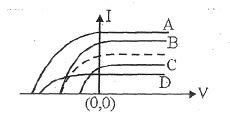
$A$ source of variable potential difference is connected across a photoelectric cell, and the photoelectric current is plotted against the applied potential difference. The graph with the broken line represents the initial curve of current versus applied potential difference. If the frequency of the incident light is increased and its intensity is reduced, which curve now represents the situation?
A
$A$
B
$B$
C
$C$
D
$D$
Solution
(D) $1$. The saturation current is directly proportional to the intensity of the incident light. Since the intensity is reduced, the saturation current must decrease, which means the new curve must lie below the original broken-line curve.
$2$. The stopping potential is directly proportional to the frequency of the incident light $(eV_s = h\nu - \phi)$. Since the frequency is increased, the magnitude of the stopping potential increases (it becomes more negative). This means the curve must intersect the negative potential axis at a point further to the left than the original curve.
$3$. Comparing the options, curve $D$ has a lower saturation current and a larger magnitude of stopping potential compared to the original broken-line curve. Therefore, curve $D$ represents the new situation.
$2$. The stopping potential is directly proportional to the frequency of the incident light $(eV_s = h\nu - \phi)$. Since the frequency is increased, the magnitude of the stopping potential increases (it becomes more negative). This means the curve must intersect the negative potential axis at a point further to the left than the original curve.
$3$. Comparing the options, curve $D$ has a lower saturation current and a larger magnitude of stopping potential compared to the original broken-line curve. Therefore, curve $D$ represents the new situation.
0 likes
View Solution80
DifficultMCQ
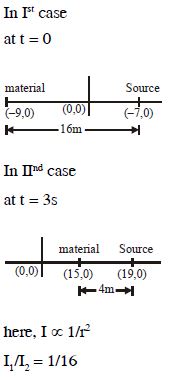
$A$ photosensitive material is at $9\,m$ to the left of the origin and the source of light is at $7\,m$ to the right of the origin along the $x$-axis. The photosensitive material and the source of light start from rest and move,respectively,with $8\widehat{i}\,m/s$ and $4\widehat{i}\,m/s$. The ratio of intensities at $t = 0$ to $t = 3\,s$ as received by the photosensitive material is:
A
$16 : 1$
B
$1 : 16$
C
$2 : 7$
D
$7 : 2$
Solution
(B) At $t = 0$,the position of the photosensitive material is $x_m(0) = -9\,m$ and the position of the source is $x_s(0) = +7\,m$. The distance between them is $r_1 = |7 - (-9)| = 16\,m$.
At $t = 3\,s$,the positions are given by $x = x_0 + vt$.
For the material: $x_m(3) = -9 + (8 \times 3) = -9 + 24 = 15\,m$.
For the source: $x_s(3) = 7 + (4 \times 3) = 7 + 12 = 19\,m$.
The distance between them is $r_2 = |19 - 15| = 4\,m$.
The intensity $I$ of light from a point source follows the inverse square law,$I \propto 1/r^2$.
Therefore,the ratio of intensities is $\frac{I_1}{I_2} = \frac{r_2^2}{r_1^2} = \left(\frac{4}{16}\right)^2 = \left(\frac{1}{4}\right)^2 = \frac{1}{16}$.
At $t = 3\,s$,the positions are given by $x = x_0 + vt$.
For the material: $x_m(3) = -9 + (8 \times 3) = -9 + 24 = 15\,m$.
For the source: $x_s(3) = 7 + (4 \times 3) = 7 + 12 = 19\,m$.
The distance between them is $r_2 = |19 - 15| = 4\,m$.
The intensity $I$ of light from a point source follows the inverse square law,$I \propto 1/r^2$.
Therefore,the ratio of intensities is $\frac{I_1}{I_2} = \frac{r_2^2}{r_1^2} = \left(\frac{4}{16}\right)^2 = \left(\frac{1}{4}\right)^2 = \frac{1}{16}$.
0 likes
View Solution81
DifficultMCQ
$A$ monochromatic beam of light of wavelength $400\,nm$ is incident normally upon a photosensitive surface ($25\%$ reflects and the rest is absorbed). This produces a radiation pressure of $5 \times 10^{-7}\,N/m^2$ on the surface. If $0.1\%$ of the incident photons produce photoelectrons,the corresponding saturation current will be $\dots \mu A$. (Consider the area of the photosensitive surface $= 5\,cm^2$)
A
$0.48$
B
$9.6$
C
$19.2$
D
$12$
Solution
(C) The radiation pressure $P$ exerted by a beam with intensity $I$ is given by $P = \frac{R}{c} I + \frac{A}{c} I$,where $R$ is the reflection coefficient and $A$ is the absorption coefficient. Here,$R = 0.25$ and $A = 0.75$. Since the reflected light exerts $2I/c$ and absorbed light exerts $I/c$,we have:
$P = 0.25 \left(\frac{2I}{c}\right) + 0.75 \left(\frac{I}{c}\right) = \frac{0.5I + 0.75I}{c} = \frac{1.25I}{c}$.
Given $P = 5 \times 10^{-7}\,N/m^2$,we find intensity $I = \frac{P \times c}{1.25} = \frac{5 \times 10^{-7} \times 3 \times 10^8}{1.25} = 120\,W/m^2$.
The number of photons incident per second $n_p = \frac{I \times A_{area}}{E_{photon}} = \frac{I \times A_{area} \times \lambda}{hc}$.
$n_p = \frac{120 \times (5 \times 10^{-4}) \times 400 \times 10^{-9}}{6.63 \times 10^{-34} \times 3 \times 10^8} \approx 1.206 \times 10^{17} \approx 1.2 \times 10^{17}\,s^{-1}$.
Given $0.1\%$ of photons produce electrons,$n_e = 10^{-3} \times 1.2 \times 10^{17} = 1.2 \times 10^{14}\,s^{-1}$.
Saturation current $i_s = n_e \times e = 1.2 \times 10^{14} \times 1.6 \times 10^{-19} = 1.92 \times 10^{-5}\,A = 19.2\,\mu A$.
$P = 0.25 \left(\frac{2I}{c}\right) + 0.75 \left(\frac{I}{c}\right) = \frac{0.5I + 0.75I}{c} = \frac{1.25I}{c}$.
Given $P = 5 \times 10^{-7}\,N/m^2$,we find intensity $I = \frac{P \times c}{1.25} = \frac{5 \times 10^{-7} \times 3 \times 10^8}{1.25} = 120\,W/m^2$.
The number of photons incident per second $n_p = \frac{I \times A_{area}}{E_{photon}} = \frac{I \times A_{area} \times \lambda}{hc}$.
$n_p = \frac{120 \times (5 \times 10^{-4}) \times 400 \times 10^{-9}}{6.63 \times 10^{-34} \times 3 \times 10^8} \approx 1.206 \times 10^{17} \approx 1.2 \times 10^{17}\,s^{-1}$.
Given $0.1\%$ of photons produce electrons,$n_e = 10^{-3} \times 1.2 \times 10^{17} = 1.2 \times 10^{14}\,s^{-1}$.
Saturation current $i_s = n_e \times e = 1.2 \times 10^{14} \times 1.6 \times 10^{-19} = 1.92 \times 10^{-5}\,A = 19.2\,\mu A$.
0 likes
View Solution82
MediumMCQ
Which of the following does not support the wave nature of light?
A
Interference
B
Diffraction
C
Polarization
D
Photoelectric effect
Solution
(D) The $Photoelectric \text{ } effect$ does not support the wave nature of light.
Interference, diffraction, and polarization are phenomena that can be explained by the wave theory of light.
However, the $Photoelectric \text{ } effect$ can only be explained by considering light as a stream of particles, known as photons, which demonstrates the particle nature of light.
Interference, diffraction, and polarization are phenomena that can be explained by the wave theory of light.
However, the $Photoelectric \text{ } effect$ can only be explained by considering light as a stream of particles, known as photons, which demonstrates the particle nature of light.
0 likes
View Solution83
MediumMCQ
$A$ $5\; W$ source emits monochromatic light of wavelength $5000\; Å$. When placed $0.5\; m$ away, it liberates photoelectrons from a photosensitive metallic surface. When the source is moved to a distance of $1.0\; m$, the number of photoelectrons liberated will
A
be reduced by a factor of $4$
B
be reduced by a factor of $2$
C
be reduced by a factor of $8$
D
be reduced by a factor of $16$
Solution
(A) The intensity of light $I$ at a distance $r$ from a point source is given by $I = \frac{P_0}{4 \pi r^2}$, where $P_0$ is the power of the source.
Since the number of photoelectrons liberated per second is directly proportional to the number of photons incident on the surface, and the number of photons is proportional to the intensity of light, we have $N \propto I$.
Therefore, $N \propto \frac{1}{r^2}$.
Given $r_1 = 0.5\; m$ and $r_2 = 1.0\; m$, the ratio of the number of photoelectrons is:
$\frac{N_2}{N_1} = \frac{r_1^2}{r_2^2} = \left( \frac{0.5}{1.0} \right)^2 = \left( \frac{1}{2} \right)^2 = \frac{1}{4}$.
Thus, the number of photoelectrons liberated is reduced by a factor of $4$.
Since the number of photoelectrons liberated per second is directly proportional to the number of photons incident on the surface, and the number of photons is proportional to the intensity of light, we have $N \propto I$.
Therefore, $N \propto \frac{1}{r^2}$.
Given $r_1 = 0.5\; m$ and $r_2 = 1.0\; m$, the ratio of the number of photoelectrons is:
$\frac{N_2}{N_1} = \frac{r_1^2}{r_2^2} = \left( \frac{0.5}{1.0} \right)^2 = \left( \frac{1}{2} \right)^2 = \frac{1}{4}$.
Thus, the number of photoelectrons liberated is reduced by a factor of $4$.
0 likes
View Solution84
MediumMCQ
The curves $(1)$,$(2)$,$(3)$,and $(4)$ show the variation between the applied potential difference $(V)$ and the photoelectric current $(i)$ at two different intensities of light $(I_1 > I_2)$. In which figure is the correct variation shown?
A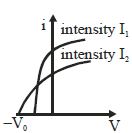
B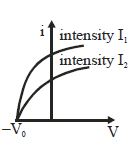
C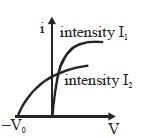
D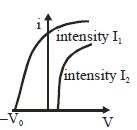
Solution
(B) In the photoelectric effect,the photoelectric current $(i)$ is directly proportional to the intensity of incident light $(I)$ for a fixed frequency of incident radiation.
Given that $I_1 > I_2$,the saturation current for intensity $I_1$ will be greater than that for intensity $I_2$,i.e.,$i_1 > i_2$.
However,the stopping potential $(V_0)$ depends only on the frequency of the incident light and the nature of the material of the photosensitive surface,not on the intensity of the light.
Therefore,both curves must intersect the voltage axis at the same stopping potential $(V_0)$.
Comparing this with the given options,the figure that shows different saturation currents but the same stopping potential is represented by the curve where both lines start from the same point $-V_0$ on the voltage axis.
Given that $I_1 > I_2$,the saturation current for intensity $I_1$ will be greater than that for intensity $I_2$,i.e.,$i_1 > i_2$.
However,the stopping potential $(V_0)$ depends only on the frequency of the incident light and the nature of the material of the photosensitive surface,not on the intensity of the light.
Therefore,both curves must intersect the voltage axis at the same stopping potential $(V_0)$.
Comparing this with the given options,the figure that shows different saturation currents but the same stopping potential is represented by the curve where both lines start from the same point $-V_0$ on the voltage axis.
0 likes
View Solution85
MediumMCQ
$A$ small metal ball is suspended in a uniform electric field with the help of an insulated thread. If a high energy $X-$ray beam falls on the ball,then the ball
A
will be deflected in the direction of the field
B
will be deflected in the direction opposite to the field
C
will not be deflected
D
will oscillate in the field
Solution
(A) When a high energy $X-$ray beam falls on a metallic ball,photoelectrons are emitted from the surface of the ball due to the photoelectric effect.
As the ball loses electrons,it acquires a net positive charge.
Since the ball is placed in a uniform electric field,it experiences an electrostatic force $F = qE$.
Because the charge $q$ is positive,the direction of the force is the same as the direction of the electric field.
Therefore,the ball will be deflected in the direction of the electric field until it reaches a new equilibrium position.
As the ball loses electrons,it acquires a net positive charge.
Since the ball is placed in a uniform electric field,it experiences an electrostatic force $F = qE$.
Because the charge $q$ is positive,the direction of the force is the same as the direction of the electric field.
Therefore,the ball will be deflected in the direction of the electric field until it reaches a new equilibrium position.
0 likes
View Solution86
MediumMCQ
Threshold wavelength for photoelectric emission from a metal surface is $5200\,\mathring{A}$. Photoelectrons will be emitted when this surface is illuminated with monochromatic radiation from:
A
$1\,W$ $IR$ lamp
B
$50\,W$ $UV$ lamp
C
$50\,W$ $IR$ lamp
D
$10\,W$ $IR$ lamp
Solution
(B) The condition for photoelectric emission is that the wavelength of the incident radiation $(\lambda)$ must be less than or equal to the threshold wavelength $(\lambda_0)$.
Given: $\lambda_0 = 5200\,\mathring{A}$.
We know that the wavelength range for $UV$ (Ultraviolet) light is typically $100\,\mathring{A}$ to $4000\,\mathring{A}$,and the wavelength range for $IR$ (Infrared) light is greater than $7000\,\mathring{A}$.
Since the wavelength of $UV$ light is less than $5200\,\mathring{A}$ and the wavelength of $IR$ light is greater than $5200\,\mathring{A}$,only the $UV$ lamp can cause photoelectric emission.
Therefore,the correct option is the $50\,W$ $UV$ lamp.
Given: $\lambda_0 = 5200\,\mathring{A}$.
We know that the wavelength range for $UV$ (Ultraviolet) light is typically $100\,\mathring{A}$ to $4000\,\mathring{A}$,and the wavelength range for $IR$ (Infrared) light is greater than $7000\,\mathring{A}$.
Since the wavelength of $UV$ light is less than $5200\,\mathring{A}$ and the wavelength of $IR$ light is greater than $5200\,\mathring{A}$,only the $UV$ lamp can cause photoelectric emission.
Therefore,the correct option is the $50\,W$ $UV$ lamp.
0 likes
View Solution87
DifficultMCQ
When a monochromatic point source of light is at a distance of $0.2\, m$ from a photoelectric cell,the cut-off voltage and the saturation current are respectively $0.6\, V$ and $18.0\, mA$. If the same source is placed $0.6\, m$ away from the photoelectric cell,then
A
the stopping potential will be $0.2\, V$
B
the stopping potential will be $0.6\, V$
C
the saturation current will be $0.6\, mA$
D
the saturation current will be $2.0\, mA$
Solution
(B, D) The stopping potential (cut-off voltage) depends only on the frequency (or wavelength) of the incident light and is independent of the intensity or the distance of the source from the photoelectric cell. Therefore,the stopping potential remains $0.6\, V$.
The saturation current is directly proportional to the intensity of light. Since the source is a point source,the intensity $I$ follows the inverse square law: $I \propto \frac{1}{d^2}$.
Given the initial distance $d_1 = 0.2\, m$ and initial current $I_1 = 18.0\, mA$,and the new distance $d_2 = 0.6\, m$,the new current $I_2$ is calculated as:
$I_2 = I_1 \times \left(\frac{d_1}{d_2}\right)^2 = 18.0 \times \left(\frac{0.2}{0.6}\right)^2 = 18.0 \times \left(\frac{1}{3}\right)^2 = 18.0 \times \frac{1}{9} = 2.0\, mA$.
Thus,both the stopping potential remains $0.6\, V$ and the saturation current becomes $2.0\, mA$.
The saturation current is directly proportional to the intensity of light. Since the source is a point source,the intensity $I$ follows the inverse square law: $I \propto \frac{1}{d^2}$.
Given the initial distance $d_1 = 0.2\, m$ and initial current $I_1 = 18.0\, mA$,and the new distance $d_2 = 0.6\, m$,the new current $I_2$ is calculated as:
$I_2 = I_1 \times \left(\frac{d_1}{d_2}\right)^2 = 18.0 \times \left(\frac{0.2}{0.6}\right)^2 = 18.0 \times \left(\frac{1}{3}\right)^2 = 18.0 \times \frac{1}{9} = 2.0\, mA$.
Thus,both the stopping potential remains $0.6\, V$ and the saturation current becomes $2.0\, mA$.
0 likes
View Solution88
EasyMCQ
In the photoelectric effect,electrons are ejected from metals if the incident light has a certain minimum:
A
Wavelength
B
Frequency
C
Amplitude
D
Angle of incidence
Solution
(B) In the photoelectric effect,the emission of electrons from a metal surface occurs only when the incident light has a frequency greater than or equal to a specific minimum value. This minimum frequency is known as the threshold frequency $(\nu_0)$. If the frequency of the incident light is less than the threshold frequency,no photoelectric emission occurs,regardless of the intensity of the light.
0 likes
View Solution89
EasyMCQ
Assertion : Kinetic energy of photoelectrons emitted by a photosensitive surface depends upon the intensity of incident photon.
Reason : The ejection of electrons from a metallic surface is possible with a frequency of incident photon below the threshold frequency.
Reason : The ejection of electrons from a metallic surface is possible with a frequency of incident photon below the threshold frequency.
A
If both Assertion and Reason are correct and the Reason is a correct explanation of the Assertion.
B
If both Assertion and Reason are correct but Reason is not a correct explanation of the Assertion.
C
If the Assertion is correct but Reason is incorrect.
D
If both the Assertion and Reason are incorrect.
Solution
(D) The kinetic energy of emitted photoelectrons depends on the frequency of the incident photon, not the intensity. Intensity only determines the number of photoelectrons emitted per unit time.
According to Einstein's photoelectric equation, $K_{max} = h\nu - \Phi_0$, where $\nu$ is the frequency of incident light and $\Phi_0$ is the work function.
Furthermore, the ejection of electrons from a metallic surface is only possible if the frequency of the incident photon is greater than or equal to the threshold frequency $(\nu \ge \nu_0)$.
Therefore, both the Assertion and the Reason are incorrect.
According to Einstein's photoelectric equation, $K_{max} = h\nu - \Phi_0$, where $\nu$ is the frequency of incident light and $\Phi_0$ is the work function.
Furthermore, the ejection of electrons from a metallic surface is only possible if the frequency of the incident photon is greater than or equal to the threshold frequency $(\nu \ge \nu_0)$.
Therefore, both the Assertion and the Reason are incorrect.
0 likes
View Solution90
EasyMCQ
Assertion : The photoelectrons produced by a monochromatic light beam incident on a metal surface have a spread in their kinetic energies.
Reason : The work function of the metal varies as a function of depth from the surface.
Reason : The work function of the metal varies as a function of depth from the surface.
A
If both Assertion and Reason are correct and the Reason is a correct explanation of the Assertion.
B
If both Assertion and Reason are correct but Reason is not a correct explanation of the Assertion.
C
If the Assertion is correct but Reason is incorrect.
D
If both the Assertion and Reason are incorrect.
Solution
(A) Photoelectrons emitted from a metal surface exhibit a range of kinetic energies because electrons within the metal occupy different energy levels within a continuous band structure. When a photon strikes the metal,it transfers its energy to an electron. The energy required to remove an electron from the surface is the work function. Electrons located deeper within the metal require additional energy to reach the surface before they can be emitted,effectively increasing the energy barrier for them. Consequently,electrons emitted from different depths have different kinetic energies. Thus,both the Assertion and the Reason are correct,and the Reason provides a valid explanation for the Assertion.
0 likes
View Solution91
EasyMCQ
Assertion : Photoelectric saturation current increases with the increase in frequency of incident light.
Reason : Energy of incident photons increases with increase in frequency and as a result photoelectric current increases.
Reason : Energy of incident photons increases with increase in frequency and as a result photoelectric current increases.
A
If both Assertion and Reason are correct and the Reason is a correct explanation of the Assertion.
B
If both Assertion and Reason are correct but Reason is not a correct explanation of the Assertion.
C
If the Assertion is correct but Reason is incorrect.
D
If both the Assertion and Reason are incorrect.
Solution
(D) The photoelectric saturation current depends only on the intensity of the incident light,which corresponds to the number of photons incident per unit time.
It is independent of the frequency of the incident light.
Increasing the frequency of incident light increases the kinetic energy of the emitted photoelectrons,but it does not change the number of photoelectrons emitted per unit time.
Therefore,both the Assertion and the Reason are incorrect.
It is independent of the frequency of the incident light.
Increasing the frequency of incident light increases the kinetic energy of the emitted photoelectrons,but it does not change the number of photoelectrons emitted per unit time.
Therefore,both the Assertion and the Reason are incorrect.
0 likes
View Solution92
MediumMCQ
Assertion: The photoelectrons produced by a monochromatic light beam incident on a metal surface have a spread in their kinetic energies.
Reason: The work function of the metal is its characteristic property.
Reason: The work function of the metal is its characteristic property.
A
If both Assertion and Reason are correct and the Reason is a correct explanation of the Assertion.
B
If both Assertion and Reason are correct but Reason is not a correct explanation of the Assertion.
C
If the Assertion is correct but Reason is incorrect.
D
If both the Assertion and Reason are incorrect.
Solution
(B) According to Einstein's photoelectric equation, $K_{max} = h\nu - \Phi$, where $h\nu$ is the energy of the incident photon and $\Phi$ is the work function of the metal.
While the maximum kinetic energy is fixed for a given frequency, photoelectrons are emitted from different depths within the metal surface.
Electrons emitted from deeper layers lose some energy due to collisions before escaping the surface, resulting in a range of kinetic energies from $0$ to $K_{max}$.
Thus, the Assertion is correct.
The work function $\Phi$ is indeed a characteristic property of the metal, making the Reason correct.
However, the Reason does not explain why there is a spread in kinetic energies; the spread is due to the varying depths of emission and subsequent energy loss.
Therefore, both are correct, but the Reason is not the correct explanation of the Assertion.
While the maximum kinetic energy is fixed for a given frequency, photoelectrons are emitted from different depths within the metal surface.
Electrons emitted from deeper layers lose some energy due to collisions before escaping the surface, resulting in a range of kinetic energies from $0$ to $K_{max}$.
Thus, the Assertion is correct.
The work function $\Phi$ is indeed a characteristic property of the metal, making the Reason correct.
However, the Reason does not explain why there is a spread in kinetic energies; the spread is due to the varying depths of emission and subsequent energy loss.
Therefore, both are correct, but the Reason is not the correct explanation of the Assertion.
0 likes
View Solution93
MediumMCQ
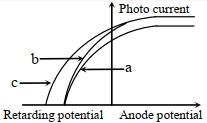
The figure shows a plot of photo current versus anode potential for a photo sensitive surface for three different radiations. Which one of the following is a correct statement?
A
Curves $(b)$ and $(c)$ represent incident radiations of same frequencies having same intensity.
B
Curves $(a)$ and $(b)$ represent incident radiations of same frequencies but of different intensities.
C
Curves $(a)$ and $(b)$ represent incident radiations of different frequencies and different intensities.
D
Curves $(b)$ and $(c)$ represent incident radiations of different frequencies and different intensities.
Solution
(B) In the photoelectric effect,the stopping potential depends on the frequency of the incident radiation,while the saturation current depends on the intensity of the incident radiation.
From the graph,curves $(a)$ and $(b)$ have the same stopping potential (the point where the curve intersects the negative x-axis),which implies they have the same frequency.
However,they have different saturation currents (the plateau value of the photo current),which implies they have different intensities.
Therefore,curves $(a)$ and $(b)$ represent incident radiations of the same frequency but different intensities.
From the graph,curves $(a)$ and $(b)$ have the same stopping potential (the point where the curve intersects the negative x-axis),which implies they have the same frequency.
However,they have different saturation currents (the plateau value of the photo current),which implies they have different intensities.
Therefore,curves $(a)$ and $(b)$ represent incident radiations of the same frequency but different intensities.
0 likes
View Solution94
Medium
Light of intensity $10^{-5} \; W m^{-2}$ falls on a sodium photo-cell of surface area $2 \; cm^2$. Assuming that the top $5$ layers of sodium absorb the incident energy,estimate the time required for photoelectric emission in the wave-picture of radiation. The work function for the metal is given to be about $2 \; eV$. What is the implication of your answer?
Solution
(N/A) Intensity of incident light,$I = 10^{-5} \; W m^{-2}$.
Surface area of a sodium photocell,$A = 2 \; cm^2 = 2 \times 10^{-4} \; m^2$.
Incident power of the light,$P = I \times A = 10^{-5} \times 2 \times 10^{-4} = 2 \times 10^{-9} \; W$.
Work function of the metal,$\phi_0 = 2 \; eV = 2 \times 1.6 \times 10^{-19} = 3.2 \times 10^{-19} \; J$.
Number of layers of sodium that absorb the incident energy,$n = 5$.
The effective atomic area of a sodium atom,$A_e$,is approximately $10^{-20} \; m^2$.
The number of conduction electrons in $n$ layers is $n' = n \times \frac{A}{A_e} = 5 \times \frac{2 \times 10^{-4}}{10^{-20}} = 10^{17}$.
The incident power is uniformly absorbed by all the electrons continuously. The energy absorbed per second per electron is $E = \frac{P}{n'} = \frac{2 \times 10^{-9}}{10^{17}} = 2 \times 10^{-26} \; J/s$.
Time required for photoelectric emission,$t = \frac{\phi_0}{E} = \frac{3.2 \times 10^{-19}}{2 \times 10^{-26}} = 1.6 \times 10^7 \; s \approx 0.507 \; \text{years}$.
The time required for photoelectric emission is nearly half a year,which is not practical. Hence,the wave picture is in disagreement with the experimental observation of instantaneous emission.
Surface area of a sodium photocell,$A = 2 \; cm^2 = 2 \times 10^{-4} \; m^2$.
Incident power of the light,$P = I \times A = 10^{-5} \times 2 \times 10^{-4} = 2 \times 10^{-9} \; W$.
Work function of the metal,$\phi_0 = 2 \; eV = 2 \times 1.6 \times 10^{-19} = 3.2 \times 10^{-19} \; J$.
Number of layers of sodium that absorb the incident energy,$n = 5$.
The effective atomic area of a sodium atom,$A_e$,is approximately $10^{-20} \; m^2$.
The number of conduction electrons in $n$ layers is $n' = n \times \frac{A}{A_e} = 5 \times \frac{2 \times 10^{-4}}{10^{-20}} = 10^{17}$.
The incident power is uniformly absorbed by all the electrons continuously. The energy absorbed per second per electron is $E = \frac{P}{n'} = \frac{2 \times 10^{-9}}{10^{17}} = 2 \times 10^{-26} \; J/s$.
Time required for photoelectric emission,$t = \frac{\phi_0}{E} = \frac{3.2 \times 10^{-19}}{2 \times 10^{-26}} = 1.6 \times 10^7 \; s \approx 0.507 \; \text{years}$.
The time required for photoelectric emission is nearly half a year,which is not practical. Hence,the wave picture is in disagreement with the experimental observation of instantaneous emission.
0 likes
View Solution95
Medium
Define the work function of a metal and write its unit.
Solution
(N/A) The work function of a metal is defined as the minimum amount of energy required by an electron to just escape from the metal surface.
It is a characteristic property of the metal and depends on the nature of the metal and its surface conditions.
The $SI$ unit of work function is the Joule $(J)$,but in atomic and nuclear physics,it is commonly expressed in electron-volt $(eV)$,where $1 \ eV = 1.602 \times 10^{-19} \ J$.
It is a characteristic property of the metal and depends on the nature of the metal and its surface conditions.
The $SI$ unit of work function is the Joule $(J)$,but in atomic and nuclear physics,it is commonly expressed in electron-volt $(eV)$,where $1 \ eV = 1.602 \times 10^{-19} \ J$.
0 likes
View Solution96
Easy
What is a photoelectron?
Solution
(N/A) When a clean metal surface is irradiated with electromagnetic radiation of sufficiently high frequency,electrons are emitted from the metal surface. These emitted electrons are known as photoelectrons. This phenomenon is called the photoelectric effect.
0 likes
View Solution97
Medium
What is the photoelectric effect?
Solution
(N/A) The photoelectric effect is the phenomenon in which electrically charged particles (electrons) are released from or within a material when it absorbs electromagnetic radiation,such as light.
When light of a sufficiently high frequency (above the threshold frequency) falls on a metal surface,it causes the emission of electrons from the surface.
These emitted electrons are known as photoelectrons.
The process is governed by the equation: $K_{max} = h\nu - \Phi$,where $K_{max}$ is the maximum kinetic energy of the emitted photoelectrons,$h$ is Planck's constant,$\nu$ is the frequency of incident light,and $\Phi$ is the work function of the metal.
When light of a sufficiently high frequency (above the threshold frequency) falls on a metal surface,it causes the emission of electrons from the surface.
These emitted electrons are known as photoelectrons.
The process is governed by the equation: $K_{max} = h\nu - \Phi$,where $K_{max}$ is the maximum kinetic energy of the emitted photoelectrons,$h$ is Planck's constant,$\nu$ is the frequency of incident light,and $\Phi$ is the work function of the metal.
0 likes
View Solution98
Medium
Explain Hertz's observation in short.
Solution
(N/A) The photoelectric effect was first observed by the scientist $Hertz$.
$Hertz$ conducted an experimental investigation into the production of electromagnetic waves using spark discharges.
$Hertz$ observed that high-voltage sparks across a detector loop were enhanced when the emitter plate was illuminated by ultraviolet light from an arc lamp.
When light is incident on a metal surface,some electrons near the surface absorb enough energy from the incident radiation to overcome the attraction of positive ions within the metal.
After gaining sufficient energy from the incident light,these electrons escape from the surface of the metal into the surrounding space.
$Hertz$ conducted an experimental investigation into the production of electromagnetic waves using spark discharges.
$Hertz$ observed that high-voltage sparks across a detector loop were enhanced when the emitter plate was illuminated by ultraviolet light from an arc lamp.
When light is incident on a metal surface,some electrons near the surface absorb enough energy from the incident radiation to overcome the attraction of positive ions within the metal.
After gaining sufficient energy from the incident light,these electrons escape from the surface of the metal into the surrounding space.
0 likes
View Solution99
Medium
Describe Hallwach's and Lenard's observations regarding the photoelectric effect in short.
Solution
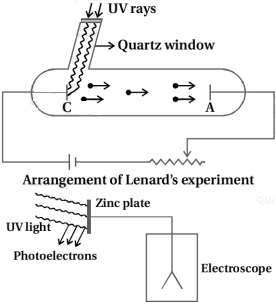
(N/A) Between $1886$ and $1902$,Hallwach and Lenard studied the phenomenon of photoelectric emission.
Lenard's experiment:
As shown in the figure,two metal electrodes are kept at opposite ends inside an evacuated glass tube. One electrode is called the cathode $(C)$ (emitter),which is a photosensitive surface,and the second electrode is called the collector $(A)$. $A$ potential difference is applied between $C$ and $A$.
$A$ quartz window is provided in this tube through which ultraviolet rays are incident on the cathode $(C)$.
When ultraviolet radiation is incident on the cathode $(C)$,photoelectrons are emitted from the surface.
The anode $(A)$ is kept at a positive voltage with respect to the cathode $(C)$,hence it attracts the emitted electrons,resulting in a flow of electrons. Consequently,a current flows in the circuit.
Lenard's experiment:
As shown in the figure,two metal electrodes are kept at opposite ends inside an evacuated glass tube. One electrode is called the cathode $(C)$ (emitter),which is a photosensitive surface,and the second electrode is called the collector $(A)$. $A$ potential difference is applied between $C$ and $A$.
$A$ quartz window is provided in this tube through which ultraviolet rays are incident on the cathode $(C)$.
When ultraviolet radiation is incident on the cathode $(C)$,photoelectrons are emitted from the surface.
The anode $(A)$ is kept at a positive voltage with respect to the cathode $(C)$,hence it attracts the emitted electrons,resulting in a flow of electrons. Consequently,a current flows in the circuit.
0 likes
View Solution100
Medium
Define threshold frequency and on which factor does threshold frequency depend?
Solution
(N/A) The minimum frequency of incident radiation required to eject electrons from a metal surface is called the threshold frequency. It is denoted by $\nu_0$.
The value of the threshold frequency depends solely on the nature of the metal (the work function of the material).
For most metals,such as zinc,cadmium,and magnesium,the threshold frequencies lie in the ultraviolet region,which corresponds to short wavelengths.
For alkali metals,such as lithium,sodium,potassium,caesium,and rubidium,the threshold frequencies lie in the visible region.
The value of the threshold frequency depends solely on the nature of the metal (the work function of the material).
For most metals,such as zinc,cadmium,and magnesium,the threshold frequencies lie in the ultraviolet region,which corresponds to short wavelengths.
For alkali metals,such as lithium,sodium,potassium,caesium,and rubidium,the threshold frequencies lie in the visible region.
0 likes
View SolutionDual Nature of Radiation and matter — Photoelectric Effect by Lenard and it's Observations · Frequently Asked Questions
1Are these Dual Nature of Radiation and matter questions useful for JEE and NEET?
Yes. All questions in this section are mapped to JEE Main and NEET exam patterns. Previous year questions from JEE Main, NEET, GUJCET and state-level exams are included with full solutions.
2Can I switch to Hindi or Gujarati for these questions?
Yes. Use the language tabs in the hero section or the sidebar to view the same questions and solutions in English, Hindi or Gujarati.
3How do I generate a question paper from this subtopic?
Use the Vedclass Exam Paper Generator — select the chapter and subtopic, set difficulty, and generate Sets A, B, C, D automatically. First 3 chapters of every subject are free.
Vedclass Products
For Students
Vedclass Test Series
Mock tests in real JEE/NEET style with performance analysis. 5-day free trial.
Start Free TrialFor Teachers
Exam Paper Generator
Generate Set A/B/C/D papers from this chapter in 2 minutes. 3 chapters free.
Try FreeFor Institutes
Online Exam Module
Live online exams with unlimited students, 360° analytics & white-label branding.
See DemoFor Teachers & Institutes
Generate a Dual Nature of Radiation and matter Exam Paper in 2 Minutes
Select subtopic & difficulty — Sets A, B, C, D auto-generated with No Repeat logic.
First 3 chapters of every subject are free — no payment required.