
A English
Particle Nature of Light : Photon Questions in English
Class 12 Physics · Dual Nature of Radiation and matter · Particle Nature of Light : Photon
228+
Questions
English
Language
100%
With Solutions
Showing 50 of 228 questions in English
101
MediumMCQ
$A$ photon creates an electron-positron pair with equal kinetic energy. If the kinetic energy of each particle is $0.29 \ MeV$,the energy of the photon must be .......... $MeV$.
A
$1.60$
B
$1.63$
C
$2.0$
D
$1.90$
Solution
(A) The process of creating an electron-positron pair by a photon is called $pair \ production$. During this process,the energy of the photon is converted into the rest mass energy of the electron-positron pair and their respective kinetic energies.
The energy of the photon $(E)$ is given by:
$E = (m_e c^2 + K_e) + (m_p c^2 + K_p)$
Where $m_e c^2 = m_p c^2 = 0.51 \ MeV$ is the rest mass energy of an electron/positron,and $K_e = K_p = 0.29 \ MeV$ is the kinetic energy of each particle.
$E = (0.51 \ MeV + 0.29 \ MeV) + (0.51 \ MeV + 0.29 \ MeV)$
$E = 0.80 \ MeV + 0.80 \ MeV = 1.60 \ MeV$.
The energy of the photon $(E)$ is given by:
$E = (m_e c^2 + K_e) + (m_p c^2 + K_p)$
Where $m_e c^2 = m_p c^2 = 0.51 \ MeV$ is the rest mass energy of an electron/positron,and $K_e = K_p = 0.29 \ MeV$ is the kinetic energy of each particle.
$E = (0.51 \ MeV + 0.29 \ MeV) + (0.51 \ MeV + 0.29 \ MeV)$
$E = 0.80 \ MeV + 0.80 \ MeV = 1.60 \ MeV$.
0 likes
View Solution102
DifficultMCQ
$A$ radio station broadcasts at a wavelength of $300 \ m$. If the radiating power of the transmitter is $10 \ kW$,then the number of photons emitted per second is:
A
$1.5 \times 10^{29}$
B
$1.5 \times 10^{31}$
C
$1.5 \times 10^{33}$
D
$1.5 \times 10^{35}$
Solution
(B) Given: Wavelength $\lambda = 300 \ m$,Power $P = 10 \ kW = 10^4 \ W$.
Energy of one photon $E = \frac{hc}{\lambda}$.
The number of photons emitted per second $n = \frac{P}{E} = \frac{P \lambda}{hc}$.
Substituting the values: $n = \frac{10^4 \times 300}{6.63 \times 10^{-34} \times 3 \times 10^8}$.
$n = \frac{3 \times 10^6}{19.89 \times 10^{-26}} \approx 0.1508 \times 10^{32} = 1.508 \times 10^{31}$.
Thus,the number of photons emitted per second is approximately $1.5 \times 10^{31}$.
Energy of one photon $E = \frac{hc}{\lambda}$.
The number of photons emitted per second $n = \frac{P}{E} = \frac{P \lambda}{hc}$.
Substituting the values: $n = \frac{10^4 \times 300}{6.63 \times 10^{-34} \times 3 \times 10^8}$.
$n = \frac{3 \times 10^6}{19.89 \times 10^{-26}} \approx 0.1508 \times 10^{32} = 1.508 \times 10^{31}$.
Thus,the number of photons emitted per second is approximately $1.5 \times 10^{31}$.
0 likes
View Solution103
EasyMCQ
If $n_r$ and $n_b$ are the number of photons emitted per second by a red bulb and a blue bulb of equal power respectively,then:
A
$n_r = n_b$
B
$n_r < n_b$
C
$n_r > n_b$
D
Cannot be determined.
Solution
(C) The power $P$ of a light source is given by $P = n \cdot E$,where $n$ is the number of photons emitted per second and $E = \frac{hc}{\lambda}$ is the energy of a single photon.
Since the power $P$ is the same for both bulbs,we have $n_r E_r = n_b E_b$.
This implies $n_r \left( \frac{hc}{\lambda_r} \right) = n_b \left( \frac{hc}{\lambda_b} \right)$,which simplifies to $\frac{n_r}{\lambda_r} = \frac{n_b}{\lambda_b}$.
Since the wavelength of red light is greater than that of blue light $(\lambda_r > \lambda_b)$,it follows that $n_r > n_b$ to maintain the equality of power.
Therefore,the number of photons emitted by the red bulb is greater than that of the blue bulb.
Since the power $P$ is the same for both bulbs,we have $n_r E_r = n_b E_b$.
This implies $n_r \left( \frac{hc}{\lambda_r} \right) = n_b \left( \frac{hc}{\lambda_b} \right)$,which simplifies to $\frac{n_r}{\lambda_r} = \frac{n_b}{\lambda_b}$.
Since the wavelength of red light is greater than that of blue light $(\lambda_r > \lambda_b)$,it follows that $n_r > n_b$ to maintain the equality of power.
Therefore,the number of photons emitted by the red bulb is greater than that of the blue bulb.
0 likes
View Solution104
DifficultMCQ
The minimum intensity of light that can be perceived by the human eye is $10^{-10} \ W/m^2$. If the area of the pupil is $10^{-6} \ m^2$ and the wavelength of light is $560 \ nm$,approximately how many photons per second enter the eye? (Use $h = 6.6 \times 10^{-34} \ J \cdot s$ and $c = 3 \times 10^8 \ m/s$).
A
$3 \times 10^2$ photons
B
$3 \times 10^3$ photons
C
$3 \times 10^4$ photons
D
$3 \times 10^5$ photons
Solution
(A) The intensity $I$ is given as $10^{-10} \ W/m^2$ and the area $A$ is $10^{-6} \ m^2$.
The power $P$ entering the eye is $P = I \times A = 10^{-10} \times 10^{-6} = 10^{-16} \ W$.
The energy of a single photon is $E = \frac{hc}{\lambda}$.
Given $\lambda = 560 \ nm = 560 \times 10^{-9} \ m$,$h = 6.6 \times 10^{-34} \ J \cdot s$,and $c = 3 \times 10^8 \ m/s$:
$E = \frac{6.6 \times 10^{-34} \times 3 \times 10^8}{560 \times 10^{-9}} = \frac{19.8 \times 10^{-26}}{560 \times 10^{-9}} \approx 3.54 \times 10^{-19} \ J$.
The number of photons per second $n$ is given by $n = \frac{P}{E}$.
$n = \frac{10^{-16}}{3.54 \times 10^{-19}} = \frac{1000}{3.54} \approx 282 \approx 3 \times 10^2$ photons.
The power $P$ entering the eye is $P = I \times A = 10^{-10} \times 10^{-6} = 10^{-16} \ W$.
The energy of a single photon is $E = \frac{hc}{\lambda}$.
Given $\lambda = 560 \ nm = 560 \times 10^{-9} \ m$,$h = 6.6 \times 10^{-34} \ J \cdot s$,and $c = 3 \times 10^8 \ m/s$:
$E = \frac{6.6 \times 10^{-34} \times 3 \times 10^8}{560 \times 10^{-9}} = \frac{19.8 \times 10^{-26}}{560 \times 10^{-9}} \approx 3.54 \times 10^{-19} \ J$.
The number of photons per second $n$ is given by $n = \frac{P}{E}$.
$n = \frac{10^{-16}}{3.54 \times 10^{-19}} = \frac{1000}{3.54} \approx 282 \approx 3 \times 10^2$ photons.
0 likes
View Solution105
EasyMCQ
The relationship between the velocity and frequency of a photon in a vacuum is represented by a ...... .
A
Line parallel to the frequency axis
B
Line parallel to the velocity axis
C
Hyperbola
D
Parabola
Solution
(A) In a vacuum,all electromagnetic waves,including photons,travel at a constant speed $c$,where $c \approx 3 \times 10^8 \ m/s$.
Since the velocity $v = c$ is constant regardless of the frequency $f$,the graph of velocity versus frequency is a horizontal line.
This line is parallel to the frequency axis.
Therefore,the correct option is $A$.
Since the velocity $v = c$ is constant regardless of the frequency $f$,the graph of velocity versus frequency is a horizontal line.
This line is parallel to the frequency axis.
Therefore,the correct option is $A$.
0 likes
View Solution106
EasyMCQ
The wavelength of an electron and a photon are equal. If the energy of the photon is $E$ and the momentum of the electron is $p$,what is the value of $p/E$?
A
$3 \times 10^8$
B
$3.33 \times 10^{-9}$
C
$9.1 \times 10^{-31}$
D
$6.64 \times 10^{-34}$
Solution
(B) For an electron,the de Broglie wavelength is given by $\lambda = \frac{h}{p}$,which implies $p = \frac{h}{\lambda}$.
For a photon,the energy is given by $E = \frac{hc}{\lambda}$.
We are asked to find the ratio $p/E$.
Substituting the expressions for $p$ and $E$:
$\frac{p}{E} = \frac{h/\lambda}{hc/\lambda} = \frac{h}{\lambda} \times \frac{\lambda}{hc} = \frac{1}{c}$.
Given the speed of light $c = 3 \times 10^8 \ m/s$,we have:
$\frac{p}{E} = \frac{1}{3 \times 10^8} = 0.333 \times 10^{-8} = 3.33 \times 10^{-9} \ s/m$.
For a photon,the energy is given by $E = \frac{hc}{\lambda}$.
We are asked to find the ratio $p/E$.
Substituting the expressions for $p$ and $E$:
$\frac{p}{E} = \frac{h/\lambda}{hc/\lambda} = \frac{h}{\lambda} \times \frac{\lambda}{hc} = \frac{1}{c}$.
Given the speed of light $c = 3 \times 10^8 \ m/s$,we have:
$\frac{p}{E} = \frac{1}{3 \times 10^8} = 0.333 \times 10^{-8} = 3.33 \times 10^{-9} \ s/m$.
0 likes
View Solution107
EasyMCQ
$A$ transmitter of $100 \ W$ power emits electromagnetic waves of wavelength $540 \ nm$. How many photons are emitted per second? (Given: $h = 6 \times 10^{-34} \ J \cdot s$,$c = 3 \times 10^8 \ m/s$)
A
$100$
B
$1000$
C
$3 \times 10^{20}$
D
$3 \times 10^{18}$
Solution
(C) The power $P$ of the transmitter is the total energy emitted per second.
Energy of one photon is given by $E = \frac{hc}{\lambda}$.
The number of photons $n$ emitted per second is given by $n = \frac{P}{E} = \frac{P\lambda}{hc}$.
Given: $P = 100 \ W$,$\lambda = 540 \times 10^{-9} \ m$,$h = 6 \times 10^{-34} \ J \cdot s$,$c = 3 \times 10^8 \ m/s$.
Substituting the values: $n = \frac{100 \times 540 \times 10^{-9}}{6 \times 10^{-34} \times 3 \times 10^8}$.
$n = \frac{54000 \times 10^{-9}}{18 \times 10^{-26}} = \frac{5.4 \times 10^4 \times 10^{-9}}{1.8 \times 10^{-25}} = 3 \times 10^{20}$.
Thus,the number of photons emitted per second is $3 \times 10^{20}$.
Energy of one photon is given by $E = \frac{hc}{\lambda}$.
The number of photons $n$ emitted per second is given by $n = \frac{P}{E} = \frac{P\lambda}{hc}$.
Given: $P = 100 \ W$,$\lambda = 540 \times 10^{-9} \ m$,$h = 6 \times 10^{-34} \ J \cdot s$,$c = 3 \times 10^8 \ m/s$.
Substituting the values: $n = \frac{100 \times 540 \times 10^{-9}}{6 \times 10^{-34} \times 3 \times 10^8}$.
$n = \frac{54000 \times 10^{-9}}{18 \times 10^{-26}} = \frac{5.4 \times 10^4 \times 10^{-9}}{1.8 \times 10^{-25}} = 3 \times 10^{20}$.
Thus,the number of photons emitted per second is $3 \times 10^{20}$.
0 likes
View Solution108
MediumMCQ
Light of intensity $10^{-10} \ W/m^2$ and wavelength $5.6 \times 10^{-7} \ m$ is incident on a surface of area $10^{-6} \ m^2$. What is the number of photons incident per second?
A
$100$
B
$200$
C
$300$
D
$400$
Solution
(C) The intensity $I$ is given by $I = \frac{P}{A}$,where $P$ is the power and $A$ is the area.
Power $P = I \times A = \frac{nhc}{t\lambda}$,where $n$ is the number of photons,$h$ is Planck's constant,$c$ is the speed of light,and $t$ is time.
Rearranging for the number of photons per second $(n/t)$:
$\frac{n}{t} = \frac{IA\lambda}{hc}$
Substituting the given values:
$\frac{n}{t} = \frac{10^{-10} \times 10^{-6} \times 5.6 \times 10^{-7}}{6.63 \times 10^{-34} \times 3 \times 10^8}$
$\frac{n}{t} \approx \frac{5.6 \times 10^{-23}}{19.89 \times 10^{-26}} \approx 0.2815 \times 10^3 \approx 281.5$
Rounding to the nearest provided option,the number of photons is $300$.
Power $P = I \times A = \frac{nhc}{t\lambda}$,where $n$ is the number of photons,$h$ is Planck's constant,$c$ is the speed of light,and $t$ is time.
Rearranging for the number of photons per second $(n/t)$:
$\frac{n}{t} = \frac{IA\lambda}{hc}$
Substituting the given values:
$\frac{n}{t} = \frac{10^{-10} \times 10^{-6} \times 5.6 \times 10^{-7}}{6.63 \times 10^{-34} \times 3 \times 10^8}$
$\frac{n}{t} \approx \frac{5.6 \times 10^{-23}}{19.89 \times 10^{-26}} \approx 0.2815 \times 10^3 \approx 281.5$
Rounding to the nearest provided option,the number of photons is $300$.
0 likes
View Solution109
EasyMCQ
The momentum of a photon of energy $1 \, MeV$ in $kg \, m/s$ will be:
A
$5 \times 10^{-22}$
B
$0.33 \times 10^6$
C
$7 \times 10^{-24}$
D
$10^{-22}$
Solution
(A) The energy of the photon is given as $E = 1 \, MeV = 1 \times 10^6 \, eV$.
Converting energy into Joules: $E = 10^6 \times 1.6 \times 10^{-19} \, J = 1.6 \times 10^{-13} \, J$.
The momentum $p$ of a photon is related to its energy $E$ by the formula $p = E/c$,where $c$ is the speed of light $(c \approx 3 \times 10^8 \, m/s)$.
Substituting the values: $p = \frac{1.6 \times 10^{-13} \, J}{3 \times 10^8 \, m/s}$.
$p \approx 0.533 \times 10^{-21} \, kg \, m/s$.
$p \approx 5.33 \times 10^{-22} \, kg \, m/s$.
Rounding to the nearest given option,the correct value is $5 \times 10^{-22} \, kg \, m/s$.
Converting energy into Joules: $E = 10^6 \times 1.6 \times 10^{-19} \, J = 1.6 \times 10^{-13} \, J$.
The momentum $p$ of a photon is related to its energy $E$ by the formula $p = E/c$,where $c$ is the speed of light $(c \approx 3 \times 10^8 \, m/s)$.
Substituting the values: $p = \frac{1.6 \times 10^{-13} \, J}{3 \times 10^8 \, m/s}$.
$p \approx 0.533 \times 10^{-21} \, kg \, m/s$.
$p \approx 5.33 \times 10^{-22} \, kg \, m/s$.
Rounding to the nearest given option,the correct value is $5 \times 10^{-22} \, kg \, m/s$.
0 likes
View Solution110
MediumMCQ
The number of photons emitted from a photocell by a source placed at a distance of $0.5 \ m$ is how many times the number of photons emitted by the same source placed at a distance of $1 \ m$?
A
$1$
B
$2$
C
$4$
D
$1/4$
Solution
(C) The intensity $I$ of light from a point source at a distance $r$ is given by the inverse square law: $I \propto \frac{1}{r^2}$.
Since the number of photons emitted per unit area is proportional to the intensity,the number of photons $N$ incident on the photocell is proportional to the intensity.
Let $N_1$ be the number of photons at distance $r_1 = 0.5 \ m$ and $N_2$ be the number of photons at distance $r_2 = 1 \ m$.
Then,$\frac{N_1}{N_2} = \frac{r_2^2}{r_1^2}$.
Substituting the values: $\frac{N_1}{N_2} = \frac{1^2}{(0.5)^2} = \frac{1}{0.25} = 4$.
Therefore,the number of photons at $0.5 \ m$ is $4$ times the number of photons at $1 \ m$.
Since the number of photons emitted per unit area is proportional to the intensity,the number of photons $N$ incident on the photocell is proportional to the intensity.
Let $N_1$ be the number of photons at distance $r_1 = 0.5 \ m$ and $N_2$ be the number of photons at distance $r_2 = 1 \ m$.
Then,$\frac{N_1}{N_2} = \frac{r_2^2}{r_1^2}$.
Substituting the values: $\frac{N_1}{N_2} = \frac{1^2}{(0.5)^2} = \frac{1}{0.25} = 4$.
Therefore,the number of photons at $0.5 \ m$ is $4$ times the number of photons at $1 \ m$.
0 likes
View Solution111
MediumMCQ
Monochromatic light of frequency $6.0 \times 10^{14} \text{ Hz}$ is produced by a laser. The power emitted is $2 \times 10^{-3} \text{ W}$. The number of photons emitted,on the average,by the source per second is
A
$5 \times 10^{16}$
B
$5 \times 10^{17}$
C
$5 \times 10^{14}$
D
$5 \times 10^{15}$
Solution
(D) The power $P$ of a monochromatic light beam is given by $P = N h \nu$,where $N$ is the number of photons emitted per second,$h$ is Planck's constant,and $\nu$ is the frequency.
Given:
Power $P = 2 \times 10^{-3} \text{ W}$
Frequency $\nu = 6.0 \times 10^{14} \text{ Hz}$
Planck's constant $h \approx 6.63 \times 10^{-34} \text{ J s}$
Energy of one photon $E = h \nu = (6.63 \times 10^{-34}) \times (6.0 \times 10^{14}) \text{ J} \approx 3.978 \times 10^{-19} \text{ J}$.
Number of photons emitted per second $N = P / E$:
$N = \frac{2 \times 10^{-3}}{3.978 \times 10^{-19}} \approx 0.5027 \times 10^{16} \approx 5 \times 10^{15}$ photons per second.
Thus,the correct option is $D$.
Given:
Power $P = 2 \times 10^{-3} \text{ W}$
Frequency $\nu = 6.0 \times 10^{14} \text{ Hz}$
Planck's constant $h \approx 6.63 \times 10^{-34} \text{ J s}$
Energy of one photon $E = h \nu = (6.63 \times 10^{-34}) \times (6.0 \times 10^{14}) \text{ J} \approx 3.978 \times 10^{-19} \text{ J}$.
Number of photons emitted per second $N = P / E$:
$N = \frac{2 \times 10^{-3}}{3.978 \times 10^{-19}} \approx 0.5027 \times 10^{16} \approx 5 \times 10^{15}$ photons per second.
Thus,the correct option is $D$.
0 likes
View Solution112
MediumMCQ
Monochromatic light of wavelength $667 \, nm$ is produced by a helium-neon laser. The power emitted is $9 \, mW$. The number of photons arriving per second on average at a target irradiated by this beam is:
A
$3 \times 10^{16}$
B
$9 \times 10^{15}$
C
$3 \times 10^{19}$
D
$9 \times 10^{17}$
Solution
(A) Given: Wavelength $\lambda = 667 \, nm = 667 \times 10^{-9} \, m$. Power $P = 9 \, mW = 9 \times 10^{-3} \, W$.
Energy of a single photon $E = \frac{hc}{\lambda}$.
Using $h = 6.63 \times 10^{-34} \, J \cdot s$ and $c = 3 \times 10^8 \, m/s$:
$E = \frac{6.63 \times 10^{-34} \times 3 \times 10^8}{667 \times 10^{-9}} \approx 2.98 \times 10^{-19} \, J$.
The number of photons per second $n = \frac{P}{E}$.
$n = \frac{9 \times 10^{-3}}{2.98 \times 10^{-19}} \approx 3.02 \times 10^{16} \approx 3 \times 10^{16}$ photons/sec.
Energy of a single photon $E = \frac{hc}{\lambda}$.
Using $h = 6.63 \times 10^{-34} \, J \cdot s$ and $c = 3 \times 10^8 \, m/s$:
$E = \frac{6.63 \times 10^{-34} \times 3 \times 10^8}{667 \times 10^{-9}} \approx 2.98 \times 10^{-19} \, J$.
The number of photons per second $n = \frac{P}{E}$.
$n = \frac{9 \times 10^{-3}}{2.98 \times 10^{-19}} \approx 3.02 \times 10^{16} \approx 3 \times 10^{16}$ photons/sec.
0 likes
View Solution113
MediumMCQ
$A$ source $S_1$ is producing $10^{15}$ photons per second of wavelength $5000 \; \mathring{A}$. Another source $S_2$ is producing $1.02 \times 10^{15}$ photons per second of wavelength $5100 \; \mathring{A}$. Then,$(\text{power of } S_2) / (\text{power of } S_1)$ is equal to
A
$1$
B
$1.02$
C
$1.04$
D
$0.98$
Solution
(A) For source $S_1$:
Wavelength $\lambda_1 = 5000 \; \mathring{A}$,Number of photons per second $N_1 = 10^{15}$.
Power $P_1 = N_1 \times E_1 = N_1 \times \frac{hc}{\lambda_1}$.
For source $S_2$:
Wavelength $\lambda_2 = 5100 \; \mathring{A}$,Number of photons per second $N_2 = 1.02 \times 10^{15}$.
Power $P_2 = N_2 \times E_2 = N_2 \times \frac{hc}{\lambda_2}$.
Ratio $\frac{P_2}{P_1} = \frac{N_2 \cdot hc / \lambda_2}{N_1 \cdot hc / \lambda_1} = \frac{N_2}{N_1} \times \frac{\lambda_1}{\lambda_2}$.
Substituting the values:
$\frac{P_2}{P_1} = \frac{1.02 \times 10^{15}}{10^{15}} \times \frac{5000}{5100} = 1.02 \times \frac{50}{51} = \frac{1.02}{51} \times 50 = 0.02 \times 50 = 1$.
Thus,the ratio is $1$.
Wavelength $\lambda_1 = 5000 \; \mathring{A}$,Number of photons per second $N_1 = 10^{15}$.
Power $P_1 = N_1 \times E_1 = N_1 \times \frac{hc}{\lambda_1}$.
For source $S_2$:
Wavelength $\lambda_2 = 5100 \; \mathring{A}$,Number of photons per second $N_2 = 1.02 \times 10^{15}$.
Power $P_2 = N_2 \times E_2 = N_2 \times \frac{hc}{\lambda_2}$.
Ratio $\frac{P_2}{P_1} = \frac{N_2 \cdot hc / \lambda_2}{N_1 \cdot hc / \lambda_1} = \frac{N_2}{N_1} \times \frac{\lambda_1}{\lambda_2}$.
Substituting the values:
$\frac{P_2}{P_1} = \frac{1.02 \times 10^{15}}{10^{15}} \times \frac{5000}{5100} = 1.02 \times \frac{50}{51} = \frac{1.02}{51} \times 50 = 0.02 \times 50 = 1$.
Thus,the ratio is $1$.
0 likes
View Solution114
EasyMCQ
Which of the following will have the least value of $\frac{q}{m}$?
A
Electron
B
Proton
C
$\alpha$-particle
D
$\beta$-particle
Solution
(C) The specific charge is defined as the ratio of charge to mass,denoted by $\frac{q}{m}$.
For an electron,$q = e$ and $m = m_e$.
For a proton,$q = e$ and $m = 1836 m_e$.
For an $\alpha$-particle,$q = 2e$ and $m = 4 m_p \approx 7344 m_e$.
For a $\beta$-particle,it is an electron,so $q = e$ and $m = m_e$.
Comparing the ratios:
Electron: $\frac{e}{m_e}$
Proton: $\frac{e}{1836 m_e}$
$\alpha$-particle: $\frac{2e}{7344 m_e} = \frac{e}{3672 m_e}$
$\beta$-particle: $\frac{e}{m_e}$
Since the denominator is largest for the $\alpha$-particle,the value of $\frac{q}{m}$ is the least for the $\alpha$-particle.
For an electron,$q = e$ and $m = m_e$.
For a proton,$q = e$ and $m = 1836 m_e$.
For an $\alpha$-particle,$q = 2e$ and $m = 4 m_p \approx 7344 m_e$.
For a $\beta$-particle,it is an electron,so $q = e$ and $m = m_e$.
Comparing the ratios:
Electron: $\frac{e}{m_e}$
Proton: $\frac{e}{1836 m_e}$
$\alpha$-particle: $\frac{2e}{7344 m_e} = \frac{e}{3672 m_e}$
$\beta$-particle: $\frac{e}{m_e}$
Since the denominator is largest for the $\alpha$-particle,the value of $\frac{q}{m}$ is the least for the $\alpha$-particle.
0 likes
View Solution115
MediumMCQ
Monochromatic light of wavelength $3000 \, \mathring{A}$ is incident on a surface of area $4 \, cm^2$. If the intensity of light is $150 \, mW/m^2$, then the rate at which photons strike the target is:
A
$3 \times 10^{10} \, s^{-1}$
B
$9 \times 10^{13} \, s^{-1}$
C
$7 \times 10^{15} \, s^{-1}$
D
$6 \times 10^{19} \, s^{-1}$
Solution
(B) The rate of photon emission (or incidence) is given by the formula $\frac{n}{t} = \frac{P}{E} = \frac{I \cdot A}{hc/\lambda} = \frac{I \cdot A \cdot \lambda}{hc}$.
Given:
Intensity $I = 150 \, mW/m^2 = 150 \times 10^{-3} \, W/m^2 = 0.15 \, W/m^2$.
Area $A = 4 \, cm^2 = 4 \times 10^{-4} \, m^2$.
Wavelength $\lambda = 3000 \, \mathring{A} = 3000 \times 10^{-10} \, m = 3 \times 10^{-7} \, m$.
Planck's constant $h = 6.63 \times 10^{-34} \, J \cdot s$.
Speed of light $c = 3 \times 10^8 \, m/s$.
Substituting the values:
$\frac{n}{t} = \frac{0.15 \times 4 \times 10^{-4} \times 3 \times 10^{-7}}{6.63 \times 10^{-34} \times 3 \times 10^8}$.
$\frac{n}{t} = \frac{1.8 \times 10^{-10}}{19.89 \times 10^{-26}} \approx 0.0905 \times 10^{16} = 9.05 \times 10^{13} \, s^{-1}$.
Rounding to the nearest option, the rate is $9 \times 10^{13} \, s^{-1}$.
Given:
Intensity $I = 150 \, mW/m^2 = 150 \times 10^{-3} \, W/m^2 = 0.15 \, W/m^2$.
Area $A = 4 \, cm^2 = 4 \times 10^{-4} \, m^2$.
Wavelength $\lambda = 3000 \, \mathring{A} = 3000 \times 10^{-10} \, m = 3 \times 10^{-7} \, m$.
Planck's constant $h = 6.63 \times 10^{-34} \, J \cdot s$.
Speed of light $c = 3 \times 10^8 \, m/s$.
Substituting the values:
$\frac{n}{t} = \frac{0.15 \times 4 \times 10^{-4} \times 3 \times 10^{-7}}{6.63 \times 10^{-34} \times 3 \times 10^8}$.
$\frac{n}{t} = \frac{1.8 \times 10^{-10}}{19.89 \times 10^{-26}} \approx 0.0905 \times 10^{16} = 9.05 \times 10^{13} \, s^{-1}$.
Rounding to the nearest option, the rate is $9 \times 10^{13} \, s^{-1}$.
0 likes
View Solution116
EasyMCQ
Consider a hypothetical annihilation of a stationary electron with a stationary positron. What is the wavelength of the resulting radiation? ($h =$ Planck's constant,$c =$ speed of light,$m_0 =$ rest mass)
A
$\frac{h}{2 m_0 c}$
B
$\frac{h}{m_0 c}$
C
$\frac{2 h}{m_0 c}$
D
$\frac{h}{m_0 c^2}$
Solution
(B) When a stationary electron and a stationary positron annihilate,they produce two photons to conserve both energy and momentum.
Let the energy of each photon be $E = \frac{hc}{\lambda}$.
According to the law of conservation of energy:
$E_1 + E_2 = E_{electron} + E_{positron}$
$\frac{hc}{\lambda} + \frac{hc}{\lambda} = m_0 c^2 + m_0 c^2$
$\frac{2hc}{\lambda} = 2 m_0 c^2$
$\frac{hc}{\lambda} = m_0 c^2$
Solving for $\lambda$:
$\lambda = \frac{h}{m_0 c}$.
Let the energy of each photon be $E = \frac{hc}{\lambda}$.
According to the law of conservation of energy:
$E_1 + E_2 = E_{electron} + E_{positron}$
$\frac{hc}{\lambda} + \frac{hc}{\lambda} = m_0 c^2 + m_0 c^2$
$\frac{2hc}{\lambda} = 2 m_0 c^2$
$\frac{hc}{\lambda} = m_0 c^2$
Solving for $\lambda$:
$\lambda = \frac{h}{m_0 c}$.
0 likes
View Solution117
MediumMCQ
Let $n_r$ and $n_b$ be respectively the number of photons emitted by a red bulb and a blue bulb of equal power in a given time.
A
$n_r = n_b$
B
$n_r < n_b$
C
$n_r > n_b$
D
data insufficient
Solution
(C) The power $P$ of a bulb is given by the total energy emitted per unit time,which is $P = n \cdot E_{photon} = n \cdot \frac{hc}{\lambda}$.
Since both bulbs have equal power $P$ and operate for the same time,the total energy emitted is the same.
Therefore,$n_r \cdot \frac{hc}{\lambda_r} = n_b \cdot \frac{hc}{\lambda_b}$.
This simplifies to $n_r \cdot \frac{1}{\lambda_r} = n_b \cdot \frac{1}{\lambda_b}$,or $n_r = n_b \cdot \frac{\lambda_r}{\lambda_b}$.
We know that the wavelength of red light is greater than the wavelength of blue light,i.e.,$\lambda_r > \lambda_b$.
Since $\frac{\lambda_r}{\lambda_b} > 1$,it follows that $n_r > n_b$.
Since both bulbs have equal power $P$ and operate for the same time,the total energy emitted is the same.
Therefore,$n_r \cdot \frac{hc}{\lambda_r} = n_b \cdot \frac{hc}{\lambda_b}$.
This simplifies to $n_r \cdot \frac{1}{\lambda_r} = n_b \cdot \frac{1}{\lambda_b}$,or $n_r = n_b \cdot \frac{\lambda_r}{\lambda_b}$.
We know that the wavelength of red light is greater than the wavelength of blue light,i.e.,$\lambda_r > \lambda_b$.
Since $\frac{\lambda_r}{\lambda_b} > 1$,it follows that $n_r > n_b$.
0 likes
View Solution118
MediumMCQ
If $h$ is Planck's constant in $SI$ system,the momentum of a photon of wavelength $0.01 \, \mathring{A}$ is:
A
$10^{-2} \, h$
B
$h$
C
$10^2 \, h$
D
$10^{12} \, h$
Solution
(D) The momentum $p$ of a photon is related to its wavelength $\lambda$ by the de Broglie relation: $p = \frac{h}{\lambda}$.
Given the wavelength $\lambda = 0.01 \, \mathring{A} = 0.01 \times 10^{-10} \, m = 10^{-12} \, m$.
Substituting the value of $\lambda$ into the momentum formula:
$p = \frac{h}{10^{-12} \, m} = 10^{12} \, h \, kg \cdot m/s$.
Therefore,the momentum of the photon is $10^{12} \, h$.
Given the wavelength $\lambda = 0.01 \, \mathring{A} = 0.01 \times 10^{-10} \, m = 10^{-12} \, m$.
Substituting the value of $\lambda$ into the momentum formula:
$p = \frac{h}{10^{-12} \, m} = 10^{12} \, h \, kg \cdot m/s$.
Therefore,the momentum of the photon is $10^{12} \, h$.
0 likes
View Solution119
EasyMCQ
$A$ photon of frequency $f$ has a momentum associated with it. If $c$ is the velocity of light,the momentum is:
A
$\frac{hf}{c}$
B
$\frac{hc}{E}$
C
$\frac{hf}{c^2}$
D
$hf$
Solution
(A) The energy $E$ of a photon with frequency $f$ is given by the Planck-Einstein relation: $E = hf$.
According to Einstein's mass-energy equivalence principle,the energy of a photon is also given by $E = mc^2$,where $m$ is the relativistic mass of the photon.
Equating the two expressions for energy: $mc^2 = hf$.
We know that the momentum $p$ of a particle is given by $p = mc$.
Rearranging the energy equation: $mc = \frac{hf}{c}$.
Therefore,the momentum of the photon is $p = \frac{hf}{c}$.
According to Einstein's mass-energy equivalence principle,the energy of a photon is also given by $E = mc^2$,where $m$ is the relativistic mass of the photon.
Equating the two expressions for energy: $mc^2 = hf$.
We know that the momentum $p$ of a particle is given by $p = mc$.
Rearranging the energy equation: $mc = \frac{hf}{c}$.
Therefore,the momentum of the photon is $p = \frac{hf}{c}$.
0 likes
View Solution120
MediumMCQ
The velocity of photons is proportional to (where $\nu=$ frequency)
A
Independent of $\nu$
B
$\sqrt{\nu}$
C
$\nu$
D
$\nu^2$
Solution
(A) Photons are quanta of electromagnetic radiation.
In a vacuum,all electromagnetic waves,including photons,travel at the speed of light,$c = 3 \times 10^8 \ m/s$.
The speed of light in a vacuum is a universal constant and is independent of the frequency $\nu$ or wavelength $\lambda$ of the radiation.
Therefore,the velocity of photons is independent of the frequency $\nu$.
In a vacuum,all electromagnetic waves,including photons,travel at the speed of light,$c = 3 \times 10^8 \ m/s$.
The speed of light in a vacuum is a universal constant and is independent of the frequency $\nu$ or wavelength $\lambda$ of the radiation.
Therefore,the velocity of photons is independent of the frequency $\nu$.
1 likes
View Solution121
MediumMCQ
$A$ scientist claims to have a perfect technique in which he can spontaneously convert an electron completely into energy in the laboratory without any other material required. What is the conclusion about this claim from our current understanding of physics?
A
This is possible because Einstein's equation says that mass and energy are equivalent... it is just very difficult to achieve with electrons
B
This is possible and it is done all the time in the high-energy physics labs.
C
The scientist is almost correct... except that in converting the electron to energy, an electron's anti-particle is produced in the process as well
D
This is not possible because charge conservation would be violated.
Solution
(D) According to the law of conservation of charge, the total electric charge of an isolated system must remain constant. An electron has a charge of $-e$. If it were to convert completely into energy (photons), the final charge would be $0$. This would violate the conservation of charge. To convert an electron into energy, it must annihilate with its antiparticle, the positron (which has a charge of $+e$). The process is: $e^- + e^+ \rightarrow \text{energy}$. Therefore, the claim is impossible because it violates charge conservation.
0 likes
View Solution122
MediumMCQ
$A$ $200\, W$ sodium street lamp emits yellow light of wavelength $0.6\, \mu m$. Assuming it to be $25\%$ efficient in converting electrical energy to light, the number of photons of yellow light it emits per second is:
A
$1.5 \times 10^{20}$
B
$62 \times 10^{20}$
C
$3 \times 10^{19}$
D
$6 \times 10^{18}$
Solution
(A) The total electrical power input is $P_{in} = 200\, W$.
Given the efficiency is $25\%$, the effective power output as light is $P_{out} = 0.25 \times 200\, W = 50\, W$.
The energy of a single photon is given by $E = \frac{hc}{\lambda}$.
If $n$ is the number of photons emitted per second, then the total power is $P_{out} = nE = n \frac{hc}{\lambda}$.
Rearranging for $n$, we get $n = \frac{P_{out} \lambda}{hc}$.
Substituting the values: $n = \frac{50 \times 0.6 \times 10^{-6}}{6.63 \times 10^{-34} \times 3 \times 10^8}$.
$n = \frac{30 \times 10^{-6}}{19.89 \times 10^{-26}} \approx 1.5 \times 10^{20}$ photons per second.
Given the efficiency is $25\%$, the effective power output as light is $P_{out} = 0.25 \times 200\, W = 50\, W$.
The energy of a single photon is given by $E = \frac{hc}{\lambda}$.
If $n$ is the number of photons emitted per second, then the total power is $P_{out} = nE = n \frac{hc}{\lambda}$.
Rearranging for $n$, we get $n = \frac{P_{out} \lambda}{hc}$.
Substituting the values: $n = \frac{50 \times 0.6 \times 10^{-6}}{6.63 \times 10^{-34} \times 3 \times 10^8}$.
$n = \frac{30 \times 10^{-6}}{19.89 \times 10^{-26}} \approx 1.5 \times 10^{20}$ photons per second.
0 likes
View Solution123
MediumMCQ
$A$ Laser light of wavelength $660\,nm$ is used to weld Retina detachment. If a Laser pulse of width $60\,ms$ and power $0.5\,kW$ is used,the approximate number of photons in the pulse are: [Take Planck's constant $h = 6.62 \times 10^{-34}\,Js$]
A
$10^{20}$
B
$10^{18}$
C
$10^{22}$
D
$10^{19}$
Solution
(A) Given: Wavelength $\lambda = 660\,nm = 660 \times 10^{-9}\,m$,Power $P = 0.5\,kW = 0.5 \times 10^3\,W$,Pulse width $t = 60\,ms = 60 \times 10^{-3}\,s$,Planck's constant $h = 6.62 \times 10^{-34}\,Js$,Speed of light $c = 3 \times 10^8\,m/s$.
The total energy $E$ of the pulse is given by $E = P \times t$.
The energy of a single photon is $E_{photon} = \frac{hc}{\lambda}$.
The number of photons $n$ is given by $n = \frac{E}{E_{photon}} = \frac{P \times t \times \lambda}{h \times c}$.
Substituting the values:
$n = \frac{0.5 \times 10^3 \times 60 \times 10^{-3} \times 660 \times 10^{-9}}{6.62 \times 10^{-34} \times 3 \times 10^8}$.
Approximating $6.62 \approx 6.6$:
$n = \frac{0.5 \times 60 \times 660 \times 10^{-9}}{6.6 \times 3 \times 10^{-26}} = \frac{30 \times 660 \times 10^{-9}}{19.8 \times 10^{-26}} \approx \frac{19800 \times 10^{-9}}{19.8 \times 10^{-26}} \approx 1000 \times 10^{17} = 10^{20}$.
Thus,the number of photons is $10^{20}$.
The total energy $E$ of the pulse is given by $E = P \times t$.
The energy of a single photon is $E_{photon} = \frac{hc}{\lambda}$.
The number of photons $n$ is given by $n = \frac{E}{E_{photon}} = \frac{P \times t \times \lambda}{h \times c}$.
Substituting the values:
$n = \frac{0.5 \times 10^3 \times 60 \times 10^{-3} \times 660 \times 10^{-9}}{6.62 \times 10^{-34} \times 3 \times 10^8}$.
Approximating $6.62 \approx 6.6$:
$n = \frac{0.5 \times 60 \times 660 \times 10^{-9}}{6.6 \times 3 \times 10^{-26}} = \frac{30 \times 660 \times 10^{-9}}{19.8 \times 10^{-26}} \approx \frac{19800 \times 10^{-9}}{19.8 \times 10^{-26}} \approx 1000 \times 10^{17} = 10^{20}$.
Thus,the number of photons is $10^{20}$.
0 likes
View Solution124
DifficultMCQ
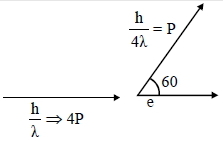
$A$ photon of wavelength $\lambda$ is scattered from an electron,which was at rest. The wavelength shift $\Delta \lambda$ is three times of $\lambda$ and the angle of scattering $\theta$ is $60^o$. The angle at which the electron recoiled is $\phi$. The value of $\tan \phi$ is: (electron speed is much smaller than the speed of light)
A
$0.16$
B
$0.25$
C
$0.22$
D
$0.28$
Solution
(B) Initial momentum of the photon is $P_i = \frac{h}{\lambda}$.
Final wavelength $\lambda' = \lambda + \Delta \lambda = \lambda + 3\lambda = 4\lambda$.
Final momentum of the photon is $P_f = \frac{h}{4\lambda} = \frac{P_i}{4}$. Let $P = P_f = \frac{h}{4\lambda}$,then $P_i = 4P$.
Using conservation of momentum: $\vec{P}_i = \vec{P}_f + \vec{P}_e$,where $\vec{P}_e$ is the momentum of the recoiled electron.
$\vec{P}_e = \vec{P}_i - \vec{P}_f$.
Taking the direction of incident photon as the $x$-axis:
$\vec{P}_i = 4P \hat{i}$.
$\vec{P}_f = P \cos 60^o \hat{i} + P \sin 60^o \hat{j} = P(\frac{1}{2}) \hat{i} + P(\frac{\sqrt{3}}{2}) \hat{j}$.
$\vec{P}_e = (4P - \frac{P}{2}) \hat{i} - \frac{\sqrt{3}P}{2} \hat{j} = \frac{7P}{2} \hat{i} - \frac{\sqrt{3}P}{2} \hat{j}$.
The angle $\phi$ of the recoiled electron is given by $\tan \phi = |\frac{P_{ey}}{P_{ex}}| = \frac{\sqrt{3}P/2}{7P/2} = \frac{\sqrt{3}}{7}$.
$\tan \phi = \frac{1.732}{7} \approx 0.247 \approx 0.25$.
Final wavelength $\lambda' = \lambda + \Delta \lambda = \lambda + 3\lambda = 4\lambda$.
Final momentum of the photon is $P_f = \frac{h}{4\lambda} = \frac{P_i}{4}$. Let $P = P_f = \frac{h}{4\lambda}$,then $P_i = 4P$.
Using conservation of momentum: $\vec{P}_i = \vec{P}_f + \vec{P}_e$,where $\vec{P}_e$ is the momentum of the recoiled electron.
$\vec{P}_e = \vec{P}_i - \vec{P}_f$.
Taking the direction of incident photon as the $x$-axis:
$\vec{P}_i = 4P \hat{i}$.
$\vec{P}_f = P \cos 60^o \hat{i} + P \sin 60^o \hat{j} = P(\frac{1}{2}) \hat{i} + P(\frac{\sqrt{3}}{2}) \hat{j}$.
$\vec{P}_e = (4P - \frac{P}{2}) \hat{i} - \frac{\sqrt{3}P}{2} \hat{j} = \frac{7P}{2} \hat{i} - \frac{\sqrt{3}P}{2} \hat{j}$.
The angle $\phi$ of the recoiled electron is given by $\tan \phi = |\frac{P_{ey}}{P_{ex}}| = \frac{\sqrt{3}P/2}{7P/2} = \frac{\sqrt{3}}{7}$.
$\tan \phi = \frac{1.732}{7} \approx 0.247 \approx 0.25$.
0 likes
View Solution125
MediumMCQ
$A$ $10\, kW$ transmitter emits radio waves of wavelength $500\, m$. The number of photons emitted per second by the transmitter is of the order of
A
$10^{37}$
B
$10^{31}$
C
$10^{25}$
D
$10^{43}$
Solution
(B) The power $P$ of the transmitter is given by $P = n \frac{hc}{\lambda}$,where $n$ is the number of photons emitted per second.
Given:
Power $P = 10\, kW = 10^4\, W$
Wavelength $\lambda = 500\, m$
Planck's constant $h \approx 6.63 \times 10^{-34}\, J\cdot s$
Speed of light $c = 3 \times 10^8\, m/s$
Rearranging the formula for $n$:
$n = \frac{P \lambda}{hc}$
Substituting the values:
$n = \frac{10^4 \times 500}{6.63 \times 10^{-34} \times 3 \times 10^8}$
$n = \frac{5 \times 10^6}{19.89 \times 10^{-26}}$
$n \approx 0.251 \times 10^{32} \approx 2.51 \times 10^{31}$
Therefore,the order of magnitude is $10^{31}$.
Given:
Power $P = 10\, kW = 10^4\, W$
Wavelength $\lambda = 500\, m$
Planck's constant $h \approx 6.63 \times 10^{-34}\, J\cdot s$
Speed of light $c = 3 \times 10^8\, m/s$
Rearranging the formula for $n$:
$n = \frac{P \lambda}{hc}$
Substituting the values:
$n = \frac{10^4 \times 500}{6.63 \times 10^{-34} \times 3 \times 10^8}$
$n = \frac{5 \times 10^6}{19.89 \times 10^{-26}}$
$n \approx 0.251 \times 10^{32} \approx 2.51 \times 10^{31}$
Therefore,the order of magnitude is $10^{31}$.
0 likes
View Solution126
DifficultMCQ
$A$ $2\,mW$ laser operates at a wavelength of $500\,nm.$ The number of photons that will be emitted per second is [Given Planck's constant $h = 6.6 \times 10^{-34}\,Js,$ speed of light $c = 3.0 \times 10^8\,m/s$]
A
$1 \times 10^{16}$
B
$1.5 \times 10^{16}$
C
$2 \times 10^{16}$
D
$5 \times 10^{15}$
Solution
(D) The power $P$ of the laser is given by $P = n \cdot E_{photon},$ where $n$ is the number of photons emitted per second and $E_{photon} = \frac{hc}{\lambda}.$
Given $P = 2\,mW = 2 \times 10^{-3}\,W,$ $\lambda = 500\,nm = 500 \times 10^{-9}\,m,$ $h = 6.6 \times 10^{-34}\,Js,$ and $c = 3.0 \times 10^8\,m/s.$
Rearranging for $n$: $n = \frac{P \cdot \lambda}{h \cdot c}$
Substituting the values:
$n = \frac{2 \times 10^{-3} \times 500 \times 10^{-9}}{6.6 \times 10^{-34} \times 3.0 \times 10^8}$
$n = \frac{1000 \times 10^{-12}}{19.8 \times 10^{-26}}$
$n = \frac{10^{-9}}{19.8 \times 10^{-26}} \approx 0.0505 \times 10^{17} = 5.05 \times 10^{15} \approx 5 \times 10^{15}.$
Thus,the number of photons emitted per second is $5 \times 10^{15}.$
Given $P = 2\,mW = 2 \times 10^{-3}\,W,$ $\lambda = 500\,nm = 500 \times 10^{-9}\,m,$ $h = 6.6 \times 10^{-34}\,Js,$ and $c = 3.0 \times 10^8\,m/s.$
Rearranging for $n$: $n = \frac{P \cdot \lambda}{h \cdot c}$
Substituting the values:
$n = \frac{2 \times 10^{-3} \times 500 \times 10^{-9}}{6.6 \times 10^{-34} \times 3.0 \times 10^8}$
$n = \frac{1000 \times 10^{-12}}{19.8 \times 10^{-26}}$
$n = \frac{10^{-9}}{19.8 \times 10^{-26}} \approx 0.0505 \times 10^{17} = 5.05 \times 10^{15} \approx 5 \times 10^{15}.$
Thus,the number of photons emitted per second is $5 \times 10^{15}.$
0 likes
View Solution127
MediumMCQ
The number of photons emitted by a $10\,W$ bulb in $10\,s,$ if the wavelength of light is $1000\,\mathring{A},$ is:
A
$5.05 \times 10^{20}$
B
$3.03 \times 10^{18}$
C
$5.05 \times 10^{19}$
D
$7.07 \times 10^{14}$
Solution
(A) The total energy $E$ emitted by the bulb is given by $E = P \times t,$ where $P = 10\,W$ and $t = 10\,s.$
$E = 10 \times 10 = 100\,J.$
The energy of a single photon is given by $E_{ph} = \frac{hc}{\lambda}.$
Given $h = 6.63 \times 10^{-34}\,J\cdot s,$ $c = 3 \times 10^8\,m/s,$ and $\lambda = 1000 \times 10^{-10}\,m = 10^{-7}\,m.$
$E_{ph} = \frac{6.63 \times 10^{-34} \times 3 \times 10^8}{10^{-7}} = 19.89 \times 10^{-19}\,J.$
The number of photons $n$ is given by $n = \frac{E}{E_{ph}}.$
$n = \frac{100}{19.89 \times 10^{-19}} \approx 5.027 \times 10^{20}.$
Rounding to the nearest provided option,the correct value is $5.05 \times 10^{20}.$
$E = 10 \times 10 = 100\,J.$
The energy of a single photon is given by $E_{ph} = \frac{hc}{\lambda}.$
Given $h = 6.63 \times 10^{-34}\,J\cdot s,$ $c = 3 \times 10^8\,m/s,$ and $\lambda = 1000 \times 10^{-10}\,m = 10^{-7}\,m.$
$E_{ph} = \frac{6.63 \times 10^{-34} \times 3 \times 10^8}{10^{-7}} = 19.89 \times 10^{-19}\,J.$
The number of photons $n$ is given by $n = \frac{E}{E_{ph}}.$
$n = \frac{100}{19.89 \times 10^{-19}} \approx 5.027 \times 10^{20}.$
Rounding to the nearest provided option,the correct value is $5.05 \times 10^{20}.$
0 likes
View Solution128
EasyMCQ
The value of Planck's constant is
A
$6.63 \times 10^{-34} \; J \cdot s$
B
$6.63 \times 10^{-34} \; kg \cdot m^2 / s$
C
$6.63 \times 10^{-34} \; kg \cdot m^2$
D
$6.63 \times 10^{34} \; J \cdot s$
Solution
(B) Planck's constant $(h)$ relates the energy of a photon to its frequency according to the equation $E = h \nu$.
Since $E$ is measured in Joules $(J)$ and frequency $\nu$ is in $s^{-1}$,the unit of $h$ is $J \cdot s$.
Alternatively,since $E = \text{Force} \times \text{Distance} = (kg \cdot m/s^2) \times m = kg \cdot m^2/s^2$,then $h = E/\nu = (kg \cdot m^2/s^2) / (1/s) = kg \cdot m^2/s$.
The numerical value of Planck's constant is approximately $6.63 \times 10^{-34} \; J \cdot s$ or $6.63 \times 10^{-34} \; kg \cdot m^2/s$.
Comparing this with the given options,option $B$ represents the correct value and units.
Since $E$ is measured in Joules $(J)$ and frequency $\nu$ is in $s^{-1}$,the unit of $h$ is $J \cdot s$.
Alternatively,since $E = \text{Force} \times \text{Distance} = (kg \cdot m/s^2) \times m = kg \cdot m^2/s^2$,then $h = E/\nu = (kg \cdot m^2/s^2) / (1/s) = kg \cdot m^2/s$.
The numerical value of Planck's constant is approximately $6.63 \times 10^{-34} \; J \cdot s$ or $6.63 \times 10^{-34} \; kg \cdot m^2/s$.
Comparing this with the given options,option $B$ represents the correct value and units.
0 likes
View Solution129
MediumMCQ
$A$ $100\,W$ light source is emitting radiation of wavelength $5000\,\mathring{A}$. The rate of emission of photons is of the order of:
A
$10^{40}$
B
$10^{20}$
C
$10^{10}$
D
$10^{5}$
Solution
(B) The power $P$ of the light source is given by $P = n \cdot E_{photon}$,where $n$ is the number of photons emitted per second and $E_{photon} = \frac{hc}{\lambda}$.
Thus,$n = \frac{P \cdot \lambda}{hc}$.
Given: $P = 100\,W$,$\lambda = 5000 \times 10^{-10}\,m$,$h = 6.63 \times 10^{-34}\,J\cdot s$,and $c = 3 \times 10^8\,m/s$.
Substituting the values:
$n = \frac{100 \times 5000 \times 10^{-10}}{6.63 \times 10^{-34} \times 3 \times 10^8}$
$n = \frac{5 \times 10^{-5}}{19.89 \times 10^{-26}} \approx 0.25 \times 10^{21} = 2.5 \times 10^{20}$.
Therefore,the rate of emission of photons is of the order of $10^{20}$.
Thus,$n = \frac{P \cdot \lambda}{hc}$.
Given: $P = 100\,W$,$\lambda = 5000 \times 10^{-10}\,m$,$h = 6.63 \times 10^{-34}\,J\cdot s$,and $c = 3 \times 10^8\,m/s$.
Substituting the values:
$n = \frac{100 \times 5000 \times 10^{-10}}{6.63 \times 10^{-34} \times 3 \times 10^8}$
$n = \frac{5 \times 10^{-5}}{19.89 \times 10^{-26}} \approx 0.25 \times 10^{21} = 2.5 \times 10^{20}$.
Therefore,the rate of emission of photons is of the order of $10^{20}$.
0 likes
View Solution130
EasyMCQ
The photon energy in units of $eV$ for an electromagnetic wave of wavelength $2 \, cm$ is
A
$2.5 \times 10^{-19}$
B
$5.2 \times 10^{16}$
C
$3.2 \times 10^{-16}$
D
$6.2 \times 10^{-5}$
Solution
(D) The energy of a photon is given by the formula $E = \frac{hc}{\lambda}$.
Here,$h = 6.6 \times 10^{-34} \, J \cdot s$,$c = 3 \times 10^{8} \, m/s$,and $\lambda = 2 \, cm = 2 \times 10^{-2} \, m$.
Substituting the values:
$E = \frac{6.6 \times 10^{-34} \times 3 \times 10^{8}}{2 \times 10^{-2}} = 9.9 \times 10^{-24} \, J$.
To convert this energy into $eV$,divide by the charge of an electron $(1.6 \times 10^{-19} \, C)$:
$E = \frac{9.9 \times 10^{-24}}{1.6 \times 10^{-19}} \, eV = 6.1875 \times 10^{-5} \, eV \approx 6.2 \times 10^{-5} \, eV$.
Here,$h = 6.6 \times 10^{-34} \, J \cdot s$,$c = 3 \times 10^{8} \, m/s$,and $\lambda = 2 \, cm = 2 \times 10^{-2} \, m$.
Substituting the values:
$E = \frac{6.6 \times 10^{-34} \times 3 \times 10^{8}}{2 \times 10^{-2}} = 9.9 \times 10^{-24} \, J$.
To convert this energy into $eV$,divide by the charge of an electron $(1.6 \times 10^{-19} \, C)$:
$E = \frac{9.9 \times 10^{-24}}{1.6 \times 10^{-19}} \, eV = 6.1875 \times 10^{-5} \, eV \approx 6.2 \times 10^{-5} \, eV$.
0 likes
View Solution131
MediumMCQ
Light of wavelength $5000 \, \mathring{A}$ falls on a sensitive surface. If the surface has received $10^{-7} \, \text{J}$ of energy,then the number of photons falling on the surface will be:
A
$5 \times 10^{11}$
B
$2.5 \times 10^{11}$
C
$3 \times 10^{11}$
D
None of these
Solution
(B) The energy of a single photon is given by $E_p = \frac{hc}{\lambda}$.
Given: $h = 6.63 \times 10^{-34} \, \text{J s}$,$c = 3 \times 10^8 \, \text{m/s}$,and $\lambda = 5000 \, \mathring{A} = 5000 \times 10^{-10} \, \text{m} = 5 \times 10^{-7} \, \text{m}$.
$E_p = \frac{(6.63 \times 10^{-34}) \times (3 \times 10^8)}{5 \times 10^{-7}} \approx 3.978 \times 10^{-19} \, \text{J} \approx 4 \times 10^{-19} \, \text{J}$.
Let $n$ be the number of photons. The total energy $E_{total} = n \times E_p$.
Given $E_{total} = 10^{-7} \, \text{J}$.
$n = \frac{E_{total}}{E_p} = \frac{10^{-7}}{4 \times 10^{-19}} = 0.25 \times 10^{12} = 2.5 \times 10^{11}$.
Thus,the number of photons is $2.5 \times 10^{11}$.
Given: $h = 6.63 \times 10^{-34} \, \text{J s}$,$c = 3 \times 10^8 \, \text{m/s}$,and $\lambda = 5000 \, \mathring{A} = 5000 \times 10^{-10} \, \text{m} = 5 \times 10^{-7} \, \text{m}$.
$E_p = \frac{(6.63 \times 10^{-34}) \times (3 \times 10^8)}{5 \times 10^{-7}} \approx 3.978 \times 10^{-19} \, \text{J} \approx 4 \times 10^{-19} \, \text{J}$.
Let $n$ be the number of photons. The total energy $E_{total} = n \times E_p$.
Given $E_{total} = 10^{-7} \, \text{J}$.
$n = \frac{E_{total}}{E_p} = \frac{10^{-7}}{4 \times 10^{-19}} = 0.25 \times 10^{12} = 2.5 \times 10^{11}$.
Thus,the number of photons is $2.5 \times 10^{11}$.
0 likes
View Solution132
MediumMCQ
If $5\%$ of the energy supplied to a bulb is irradiated as visible light,how many quanta are emitted per second by a $100 \, W$ lamp? Assume the wavelength of visible light is $5.6 \times 10^{-5} \, cm$.
A
$1.4 \times 10^{19}$
B
$2.0 \times 10^{-4}$
C
$1.4 \times 10^{-19}$
D
$2.0 \times 10^{4}$
Solution
(A) The power supplied to the bulb is $P = 100 \, W = 100 \, J/s$.
Energy radiated as visible light per second is $E = 5\% \text{ of } 100 \, J/s = \frac{5}{100} \times 100 = 5 \, J/s$.
The energy of a single photon is given by $E_{photon} = \frac{hc}{\lambda}$.
Given $\lambda = 5.6 \times 10^{-5} \, cm = 5.6 \times 10^{-7} \, m$,$h = 6.6 \times 10^{-34} \, J \cdot s$,and $c = 3 \times 10^8 \, m/s$.
Let $n$ be the number of photons emitted per second.
Then $n \times E_{photon} = 5 \, J/s$.
$n = \frac{5 \times \lambda}{hc} = \frac{5 \times 5.6 \times 10^{-7}}{(6.6 \times 10^{-34}) \times (3 \times 10^8)}$.
$n = \frac{28 \times 10^{-7}}{19.8 \times 10^{-26}} \approx 1.414 \times 10^{19} \approx 1.4 \times 10^{19}$ photons per second.
Energy radiated as visible light per second is $E = 5\% \text{ of } 100 \, J/s = \frac{5}{100} \times 100 = 5 \, J/s$.
The energy of a single photon is given by $E_{photon} = \frac{hc}{\lambda}$.
Given $\lambda = 5.6 \times 10^{-5} \, cm = 5.6 \times 10^{-7} \, m$,$h = 6.6 \times 10^{-34} \, J \cdot s$,and $c = 3 \times 10^8 \, m/s$.
Let $n$ be the number of photons emitted per second.
Then $n \times E_{photon} = 5 \, J/s$.
$n = \frac{5 \times \lambda}{hc} = \frac{5 \times 5.6 \times 10^{-7}}{(6.6 \times 10^{-34}) \times (3 \times 10^8)}$.
$n = \frac{28 \times 10^{-7}}{19.8 \times 10^{-26}} \approx 1.414 \times 10^{19} \approx 1.4 \times 10^{19}$ photons per second.
0 likes
View Solution133
DifficultMCQ
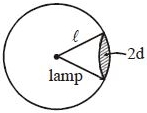
$A$ sensor is exposed for time $t$ to a lamp of power $P$ placed at a distance $l$. The sensor has a circular opening that is $4d$ in diameter. Assuming all energy of the lamp is given off as light,the number of photons entering the sensor if the wavelength of light is $\lambda$ is (given $l >> d$):
A
$\frac{P\lambda d^2 t}{hc l^2}$
B
$\frac{4P\lambda d^2 t}{hc l^2}$
C
$\frac{P\lambda d^2 t}{4hc l^2}$
D
$\frac{P\lambda d^2 t}{16hc l^2}$
Solution
(A) The total energy emitted by the lamp in time $t$ is $E_{total} = P \times t$.
Since the lamp radiates light uniformly in all directions,the intensity at a distance $l$ is $I = \frac{P}{4\pi l^2}$.
The sensor has a circular opening of diameter $4d$,so its radius is $r = 2d$.
The area of the circular opening is $A = \pi r^2 = \pi (2d)^2 = 4\pi d^2$.
The energy $E$ incident on the sensor is $E = I \times A \times t = \left( \frac{P}{4\pi l^2} \right) \times (4\pi d^2) \times t = \frac{P d^2 t}{l^2}$.
If $n$ is the number of photons,then $E = n \times \frac{hc}{\lambda}$.
Equating the two expressions for energy: $n \frac{hc}{\lambda} = \frac{P d^2 t}{l^2}$.
Solving for $n$: $n = \frac{P \lambda d^2 t}{hc l^2}$.
Since the lamp radiates light uniformly in all directions,the intensity at a distance $l$ is $I = \frac{P}{4\pi l^2}$.
The sensor has a circular opening of diameter $4d$,so its radius is $r = 2d$.
The area of the circular opening is $A = \pi r^2 = \pi (2d)^2 = 4\pi d^2$.
The energy $E$ incident on the sensor is $E = I \times A \times t = \left( \frac{P}{4\pi l^2} \right) \times (4\pi d^2) \times t = \frac{P d^2 t}{l^2}$.
If $n$ is the number of photons,then $E = n \times \frac{hc}{\lambda}$.
Equating the two expressions for energy: $n \frac{hc}{\lambda} = \frac{P d^2 t}{l^2}$.
Solving for $n$: $n = \frac{P \lambda d^2 t}{hc l^2}$.
0 likes
View Solution134
DifficultMCQ
Calculate the energy of a photon having wavelength $\lambda = 1000 \, \mathring{A}$ in Joules.
A
$4.96 \times 10^{-19} \, \text{J}$
B
$9.92 \times 10^{-19} \, \text{J}$
C
$19.84 \times 10^{-19} \, \text{J}$
D
$12.4 \, \text{J}$
Solution
(C) The energy of a photon is given by the formula $E = \frac{hc}{\lambda}$.
Using the shortcut formula $E(\text{eV}) = \frac{12400}{\lambda(\mathring{A})}$,we get:
$E = \frac{12400}{1000} \, \text{eV} = 12.4 \, \text{eV}$.
To convert this energy into Joules,we multiply by the charge of an electron $(1.6 \times 10^{-19} \, \text{C})$:
$E = 12.4 \times 1.6 \times 10^{-19} \, \text{J}$.
$E = 19.84 \times 10^{-19} \, \text{J}$.
Using the shortcut formula $E(\text{eV}) = \frac{12400}{\lambda(\mathring{A})}$,we get:
$E = \frac{12400}{1000} \, \text{eV} = 12.4 \, \text{eV}$.
To convert this energy into Joules,we multiply by the charge of an electron $(1.6 \times 10^{-19} \, \text{C})$:
$E = 12.4 \times 1.6 \times 10^{-19} \, \text{J}$.
$E = 19.84 \times 10^{-19} \, \text{J}$.
0 likes
View Solution135
MediumMCQ
The momentum of a photon with energy $20 \, eV$ is
A
$10.0 \times 10^{-27} \, kg \cdot m/s$
B
$10.66 \times 10^{-27} \, kg \cdot m/s$
C
$10.95 \times 10^{-27} \, kg \cdot m/s$
D
$10.2 \times 10^{-27} \, kg \cdot m/s$
Solution
(B) The energy of a photon is given by $E = pc$,where $p$ is the momentum and $c$ is the speed of light.
Thus,the momentum $p = E/c$.
Given $E = 20 \, eV = 20 \times 1.6 \times 10^{-19} \, J = 3.2 \times 10^{-18} \, J$.
The speed of light $c = 3 \times 10^8 \, m/s$.
Substituting these values:
$p = \frac{3.2 \times 10^{-18}}{3 \times 10^8} \, kg \cdot m/s$.
$p = 1.066 \times 10^{-26} \, kg \cdot m/s = 10.66 \times 10^{-27} \, kg \cdot m/s$.
Therefore,the correct option is $B$.
Thus,the momentum $p = E/c$.
Given $E = 20 \, eV = 20 \times 1.6 \times 10^{-19} \, J = 3.2 \times 10^{-18} \, J$.
The speed of light $c = 3 \times 10^8 \, m/s$.
Substituting these values:
$p = \frac{3.2 \times 10^{-18}}{3 \times 10^8} \, kg \cdot m/s$.
$p = 1.066 \times 10^{-26} \, kg \cdot m/s = 10.66 \times 10^{-27} \, kg \cdot m/s$.
Therefore,the correct option is $B$.
0 likes
View Solution136
MediumMCQ
If $E$ and $P$ are the energy and the momentum of a photon respectively,then on reducing the wavelength of the photon:
A
$P$ and $E$ both will decrease
B
$P$ and $E$ both will increase
C
$P$ will increase and $E$ will decrease
D
$P$ will decrease and $E$ will increase
Solution
(B) The energy $E$ of a photon is given by $E = \frac{hc}{\lambda}$,where $h$ is Planck's constant,$c$ is the speed of light,and $\lambda$ is the wavelength.
The momentum $P$ of a photon is given by $P = \frac{h}{\lambda}$.
From these relations,it is clear that both $E$ and $P$ are inversely proportional to the wavelength $\lambda$ ($E \propto \frac{1}{\lambda}$ and $P \propto \frac{1}{\lambda}$).
Therefore,if the wavelength $\lambda$ is reduced,both the energy $E$ and the momentum $P$ will increase.
The momentum $P$ of a photon is given by $P = \frac{h}{\lambda}$.
From these relations,it is clear that both $E$ and $P$ are inversely proportional to the wavelength $\lambda$ ($E \propto \frac{1}{\lambda}$ and $P \propto \frac{1}{\lambda}$).
Therefore,if the wavelength $\lambda$ is reduced,both the energy $E$ and the momentum $P$ will increase.
0 likes
View Solution137
EasyMCQ
Assertion: Mass of a moving photon varies inversely as the wavelength.
Reason: Energy of the particle $= \text{mass} \times (\text{speed of light})^2$
Reason: Energy of the particle $= \text{mass} \times (\text{speed of light})^2$
A
If both Assertion and Reason are correct and the Reason is a correct explanation of the Assertion.
B
If both Assertion and Reason are correct but Reason is not a correct explanation of the Assertion.
C
If the Assertion is correct but Reason is incorrect.
D
If both the Assertion and Reason are incorrect.
Solution
(B) The momentum of a photon is given by $p = \frac{h}{\lambda}$. Since $p = mc$ (where $m$ is the relativistic mass of the photon and $c$ is the speed of light), we have $mc = \frac{h}{\lambda}$, which implies $m = \frac{h}{c\lambda}$. Thus, the mass $m$ of a moving photon is inversely proportional to its wavelength $\lambda$. The Assertion is correct.
The Reason states $E = mc^2$. While this is Einstein's mass-energy equivalence relation, it describes the energy of a particle at rest or the energy equivalent of a mass. It does not explain the relationship between the mass of a photon and its wavelength. Therefore, the Reason is not the correct explanation for the Assertion.
The Reason states $E = mc^2$. While this is Einstein's mass-energy equivalence relation, it describes the energy of a particle at rest or the energy equivalent of a mass. It does not explain the relationship between the mass of a photon and its wavelength. Therefore, the Reason is not the correct explanation for the Assertion.
0 likes
View Solution138
EasyMCQ
Assertion: The energy $(E)$ and momentum $(p)$ of a photon are related by $p = E/c$.
Reason: The photon behaves like a particle.
Reason: The photon behaves like a particle.
A
If both Assertion and Reason are correct and the Reason is a correct explanation of the Assertion.
B
If both Assertion and Reason are correct but Reason is not a correct explanation of the Assertion.
C
If the Assertion is correct but Reason is incorrect.
D
If both the Assertion and Reason are incorrect.
Solution
(A) According to the theory of relativity,the energy of a particle is given by $E^2 = (pc)^2 + (m_0c^2)^2$.
For a photon,the rest mass $m_0$ is $0$.
Therefore,$E^2 = (pc)^2$,which simplifies to $E = pc$ or $p = E/c$.
This relationship is derived specifically from the particle nature of the photon,which allows it to possess momentum despite having no rest mass.
Thus,the Assertion is correct,and the Reason is the correct explanation for the Assertion.
For a photon,the rest mass $m_0$ is $0$.
Therefore,$E^2 = (pc)^2$,which simplifies to $E = pc$ or $p = E/c$.
This relationship is derived specifically from the particle nature of the photon,which allows it to possess momentum despite having no rest mass.
Thus,the Assertion is correct,and the Reason is the correct explanation for the Assertion.
0 likes
View Solution139
MediumMCQ
What is the energy of a photon whose wavelength is $6840\,\mathring{A}$? (in $eV$)
A
$1.81$
B
$3.6$
C
$-13.6$
D
$12.1$
Solution
(A) The energy of a photon is given by the formula $E = \frac{hc}{\lambda}$.
Given:
$h = 6.63 \times 10^{-34} \, J \cdot s$
$c = 3 \times 10^8 \, m/s$
$\lambda = 6840 \times 10^{-10} \, m$
Using the relation $E(eV) = \frac{12400}{\lambda(\mathring{A})}$,we get:
$E = \frac{12400}{6840} \, eV$
$E \approx 1.81 \, eV$.
Given:
$h = 6.63 \times 10^{-34} \, J \cdot s$
$c = 3 \times 10^8 \, m/s$
$\lambda = 6840 \times 10^{-10} \, m$
Using the relation $E(eV) = \frac{12400}{\lambda(\mathring{A})}$,we get:
$E = \frac{12400}{6840} \, eV$
$E \approx 1.81 \, eV$.
0 likes
View Solution140
Difficult
An electron and a proton are detected in a cosmic ray experiment,the first with kinetic energy $10 \; keV$,and the second with $100 \; keV$. Which is faster,the electron or the proton? Obtain the ratio of their speeds. (Electron mass $= 9.11 \times 10^{-31} \; kg$,proton mass $= 1.67 \times 10^{-27} \; kg$,$1 \; eV = 1.60 \times 10^{-19} \; J$)
Solution
(N/A) The electron is faster. The ratio of their speeds is $13.54:1$.
Given:
Mass of the electron,$m_e = 9.11 \times 10^{-31} \; kg$
Mass of the proton,$m_p = 1.67 \times 10^{-27} \; kg$
Kinetic energy of the electron,$E_{Ke} = 10 \; keV = 10^4 \; eV = 1.60 \times 10^{-15} \; J$
Kinetic energy of the proton,$E_{Kp} = 100 \; keV = 10^5 \; eV = 1.60 \times 10^{-14} \; J$
Using the formula for kinetic energy $E_K = \frac{1}{2}mv^2$,the velocity is $v = \sqrt{\frac{2E_K}{m}}$.
For the electron:
$v_e = \sqrt{\frac{2 \times 1.60 \times 10^{-15}}{9.11 \times 10^{-31}}} \approx 5.93 \times 10^7 \; m/s$
For the proton:
$v_p = \sqrt{\frac{2 \times 1.60 \times 10^{-14}}{1.67 \times 10^{-27}}} \approx 4.38 \times 10^6 \; m/s$
Comparing the velocities,$v_e > v_p$,so the electron is faster.
The ratio of their speeds is $\frac{v_e}{v_p} = \frac{5.93 \times 10^7}{4.38 \times 10^6} \approx 13.54$.
Given:
Mass of the electron,$m_e = 9.11 \times 10^{-31} \; kg$
Mass of the proton,$m_p = 1.67 \times 10^{-27} \; kg$
Kinetic energy of the electron,$E_{Ke} = 10 \; keV = 10^4 \; eV = 1.60 \times 10^{-15} \; J$
Kinetic energy of the proton,$E_{Kp} = 100 \; keV = 10^5 \; eV = 1.60 \times 10^{-14} \; J$
Using the formula for kinetic energy $E_K = \frac{1}{2}mv^2$,the velocity is $v = \sqrt{\frac{2E_K}{m}}$.
For the electron:
$v_e = \sqrt{\frac{2 \times 1.60 \times 10^{-15}}{9.11 \times 10^{-31}}} \approx 5.93 \times 10^7 \; m/s$
For the proton:
$v_p = \sqrt{\frac{2 \times 1.60 \times 10^{-14}}{1.67 \times 10^{-27}}} \approx 4.38 \times 10^6 \; m/s$
Comparing the velocities,$v_e > v_p$,so the electron is faster.
The ratio of their speeds is $\frac{v_e}{v_p} = \frac{5.93 \times 10^7}{4.38 \times 10^6} \approx 13.54$.
0 likes
View Solution141
MediumMCQ
Which scientist discarded the postulate of ether?
A
Albert Einstein
B
James Clerk Maxwell
C
Isaac Newton
D
Heinrich Hertz
Solution
(A) The concept of 'ether' was proposed as a medium for the propagation of light waves. However,the Michelson-Morley experiment failed to detect the existence of ether. Albert Einstein,in his theory of special relativity published in $1905$,discarded the need for an ether medium,stating that the speed of light in a vacuum is constant for all inertial observers,regardless of the motion of the source or the observer.
0 likes
View Solution142
Medium
$(a)$ When monochromatic light is incident on a surface separating two media,the reflected and refracted light both have the same frequency as the incident frequency. Explain why?
$(b)$ When light travels from a rarer to a denser medium,the speed decreases. Does the reduction in speed imply a reduction in the energy carried by the light wave?
$(c)$ In the wave picture of light,intensity of light is determined by the square of the amplitude of the wave. What determines the intensity of light in the photon picture of light?
$(b)$ When light travels from a rarer to a denser medium,the speed decreases. Does the reduction in speed imply a reduction in the energy carried by the light wave?
$(c)$ In the wave picture of light,intensity of light is determined by the square of the amplitude of the wave. What determines the intensity of light in the photon picture of light?
Solution
(N/A) Reflection and refraction arise through the interaction of incident light with the atomic constituents of matter. Atoms act as oscillators that take up the frequency of the external agency (incident light),resulting in forced oscillations. Since the frequency of light emitted by a charged oscillator equals its frequency of oscillation,the frequency of reflected and refracted light remains equal to the incident frequency.
$(b)$ No. The energy carried by a wave depends on the amplitude of the wave,not on the speed of wave propagation. Therefore,a reduction in speed does not imply a reduction in energy.
$(c)$ In the photon picture of light,the intensity is determined by the number of photons crossing a unit area per unit time for a given frequency.
$(b)$ No. The energy carried by a wave depends on the amplitude of the wave,not on the speed of wave propagation. Therefore,a reduction in speed does not imply a reduction in energy.
$(c)$ In the photon picture of light,the intensity is determined by the number of photons crossing a unit area per unit time for a given frequency.
0 likes
View Solution143
Medium
Monochromatic light of frequency $6.0 \times 10^{14} \;Hz$ is produced by a laser. The power emitted is $2.0 \times 10^{-3} \;W$.
$(a)$ What is the energy of a photon in the light beam?
$(b)$ How many photons per second,on an average,are emitted by the source?
$(a)$ What is the energy of a photon in the light beam?
$(b)$ How many photons per second,on an average,are emitted by the source?
Solution
(N/A) The energy of each photon is given by $E = h\nu$,where $h = 6.63 \times 10^{-34} \;J \cdot s$ and $\nu = 6.0 \times 10^{14} \;Hz$.
$E = (6.63 \times 10^{-34} \;J \cdot s)(6.0 \times 10^{14} \;Hz) = 3.978 \times 10^{-19} \;J \approx 3.98 \times 10^{-19} \;J$.
$(b)$ If $N$ is the number of photons emitted per second,the total power $P$ is given by $P = N \cdot E$.
Therefore,$N = \frac{P}{E} = \frac{2.0 \times 10^{-3} \;W}{3.978 \times 10^{-19} \;J} \approx 5.03 \times 10^{15} \;\text{photons/s}$.
$E = (6.63 \times 10^{-34} \;J \cdot s)(6.0 \times 10^{14} \;Hz) = 3.978 \times 10^{-19} \;J \approx 3.98 \times 10^{-19} \;J$.
$(b)$ If $N$ is the number of photons emitted per second,the total power $P$ is given by $P = N \cdot E$.
Therefore,$N = \frac{P}{E} = \frac{2.0 \times 10^{-3} \;W}{3.978 \times 10^{-19} \;J} \approx 5.03 \times 10^{15} \;\text{photons/s}$.
0 likes
View Solution144
Medium
Monochromatic light of wavelength $632.8 \; nm$ is produced by a helium-neon laser. The power emitted is $9.42 \; mW$.
$(a)$ Find the energy and momentum of each photon in the light beam.
$(b)$ How many photons per second,on the average,arrive at a target irradiated by this beam? (Assume the beam to have uniform cross-section which is < target area).
$(c)$ How fast does a hydrogen atom have to travel in order to have the same momentum as that of the photon?
$(a)$ Find the energy and momentum of each photon in the light beam.
$(b)$ How many photons per second,on the average,arrive at a target irradiated by this beam? (Assume the beam to have uniform cross-section which is < target area).
$(c)$ How fast does a hydrogen atom have to travel in order to have the same momentum as that of the photon?
Solution
(N/A) Given: Wavelength $\lambda = 632.8 \; nm = 632.8 \times 10^{-9} \; m$,Power $P = 9.42 \; mW = 9.42 \times 10^{-3} \; W$.
$(a)$ Energy of a photon $E = \frac{hc}{\lambda} = \frac{(6.63 \times 10^{-34} \; J \cdot s)(3 \times 10^8 \; m/s)}{632.8 \times 10^{-9} \; m} \approx 3.14 \times 10^{-19} \; J$.
Momentum of a photon $p = \frac{h}{\lambda} = \frac{6.63 \times 10^{-34} \; J \cdot s}{632.8 \times 10^{-9} \; m} \approx 1.05 \times 10^{-27} \; kg \cdot m/s$.
$(b)$ Number of photons per second $N = \frac{P}{E} = \frac{9.42 \times 10^{-3} \; W}{3.14 \times 10^{-19} \; J} = 3 \times 10^{16} \; \text{photons/second}$.
$(c)$ Momentum of a hydrogen atom $p = mv$. Given $p = 1.05 \times 10^{-27} \; kg \cdot m/s$ and mass of hydrogen atom $m \approx 1.67 \times 10^{-27} \; kg$.
$v = \frac{p}{m} = \frac{1.05 \times 10^{-27}}{1.67 \times 10^{-27}} \approx 0.63 \; m/s$.
$(a)$ Energy of a photon $E = \frac{hc}{\lambda} = \frac{(6.63 \times 10^{-34} \; J \cdot s)(3 \times 10^8 \; m/s)}{632.8 \times 10^{-9} \; m} \approx 3.14 \times 10^{-19} \; J$.
Momentum of a photon $p = \frac{h}{\lambda} = \frac{6.63 \times 10^{-34} \; J \cdot s}{632.8 \times 10^{-9} \; m} \approx 1.05 \times 10^{-27} \; kg \cdot m/s$.
$(b)$ Number of photons per second $N = \frac{P}{E} = \frac{9.42 \times 10^{-3} \; W}{3.14 \times 10^{-19} \; J} = 3 \times 10^{16} \; \text{photons/second}$.
$(c)$ Momentum of a hydrogen atom $p = mv$. Given $p = 1.05 \times 10^{-27} \; kg \cdot m/s$ and mass of hydrogen atom $m \approx 1.67 \times 10^{-27} \; kg$.
$v = \frac{p}{m} = \frac{1.05 \times 10^{-27}}{1.67 \times 10^{-27}} \approx 0.63 \; m/s$.
0 likes
View Solution145
EasyMCQ
The energy flux of sunlight reaching the surface of the earth is $1.388 \times 10^{3} \; W/m^{2}$. How many photons (nearly) per square metre are incident on the Earth per second? Assume that the photons in the sunlight have an average wavelength of $550 \; nm$.
A
$9 \times 10^{22} \; \text{photons}/m^{2} \cdot s$
B
$6 \times 10^{22} \; \text{photons}/m^{2} \cdot s$
C
$8 \times 10^{20} \; \text{photons}/m^{2} \cdot s$
D
$4 \times 10^{21} \; \text{photons}/m^{2} \cdot s$
Solution
(D) Given: Energy flux $I = 1.388 \times 10^{3} \; W/m^{2}$, Wavelength $\lambda = 550 \; nm = 550 \times 10^{-9} \; m$.
The energy of a single photon is given by $E = \frac{hc}{\lambda}$.
Using $h = 6.626 \times 10^{-34} \; J \cdot s$ and $c = 3 \times 10^{8} \; m/s$:
$E = \frac{6.626 \times 10^{-34} \times 3 \times 10^{8}}{550 \times 10^{-9}} \approx 3.614 \times 10^{-19} \; J$.
The number of photons $n$ incident per unit area per second is given by $n = \frac{I}{E}$.
$n = \frac{1.388 \times 10^{3}}{3.614 \times 10^{-19}} \approx 3.84 \times 10^{21} \; \text{photons}/m^{2} \cdot s$.
Rounding to the nearest value, we get $n \approx 4 \times 10^{21} \; \text{photons}/m^{2} \cdot s$.
The energy of a single photon is given by $E = \frac{hc}{\lambda}$.
Using $h = 6.626 \times 10^{-34} \; J \cdot s$ and $c = 3 \times 10^{8} \; m/s$:
$E = \frac{6.626 \times 10^{-34} \times 3 \times 10^{8}}{550 \times 10^{-9}} \approx 3.614 \times 10^{-19} \; J$.
The number of photons $n$ incident per unit area per second is given by $n = \frac{I}{E}$.
$n = \frac{1.388 \times 10^{3}}{3.614 \times 10^{-19}} \approx 3.84 \times 10^{21} \; \text{photons}/m^{2} \cdot s$.
Rounding to the nearest value, we get $n \approx 4 \times 10^{21} \; \text{photons}/m^{2} \cdot s$.
0 likes
View Solution146
Easy
$A$ $100 \; W$ sodium lamp radiates energy uniformly in all directions. The lamp is located at the centre of a large sphere that absorbs all the sodium light which is incident on it. The wavelength of the sodium light is $589 \; nm$.
$(a)$ What is the energy per photon associated with the sodium light?
$(b)$ At what rate are the photons delivered to the sphere?
$(a)$ What is the energy per photon associated with the sodium light?
$(b)$ At what rate are the photons delivered to the sphere?
Solution
(N/A) Given: Power $P = 100 \; W$, Wavelength $\lambda = 589 \; nm = 589 \times 10^{-9} \; m$, Planck's constant $h = 6.63 \times 10^{-34} \; J \cdot s$, Speed of light $c = 3 \times 10^8 \; m/s$.
$(a)$ The energy per photon $E$ is given by the formula $E = \frac{hc}{\lambda}$.
Substituting the values: $E = \frac{(6.63 \times 10^{-34} \; J \cdot s) \times (3 \times 10^8 \; m/s)}{589 \times 10^{-9} \; m} \approx 3.376 \times 10^{-19} \; J$.
$(b)$ The rate of delivery of photons $n$ is given by $n = \frac{P}{E}$.
Substituting the values: $n = \frac{100 \; W}{3.376 \times 10^{-19} \; J} \approx 2.96 \times 10^{20} \; \text{photons/second}$.
$(a)$ The energy per photon $E$ is given by the formula $E = \frac{hc}{\lambda}$.
Substituting the values: $E = \frac{(6.63 \times 10^{-34} \; J \cdot s) \times (3 \times 10^8 \; m/s)}{589 \times 10^{-9} \; m} \approx 3.376 \times 10^{-19} \; J$.
$(b)$ The rate of delivery of photons $n$ is given by $n = \frac{P}{E}$.
Substituting the values: $n = \frac{100 \; W}{3.376 \times 10^{-19} \; J} \approx 2.96 \times 10^{20} \; \text{photons/second}$.
0 likes
View Solution147
Easy
Show that the wavelength of electromagnetic radiation is equal to the de Broglie wavelength of its quantum (photon).
Solution
(N/A) The momentum $p$ of a photon is given by the relation $p = E / c$,where $E$ is the energy of the photon and $c$ is the speed of light.
Since the energy of a photon is $E = h \nu$,where $h$ is Planck's constant and $\nu$ is the frequency,we have $p = h \nu / c$.
We know that the speed of light is related to frequency and wavelength by $c = \nu \lambda$,which implies $\lambda = c / \nu$.
Substituting $c / \nu = \lambda$ into the momentum equation,we get $p = h / \lambda$.
Rearranging this gives the de Broglie wavelength formula: $\lambda = h / p$.
Thus,the de Broglie wavelength of a photon is exactly equal to the wavelength of the electromagnetic radiation of which the photon is the quantum.
Since the energy of a photon is $E = h \nu$,where $h$ is Planck's constant and $\nu$ is the frequency,we have $p = h \nu / c$.
We know that the speed of light is related to frequency and wavelength by $c = \nu \lambda$,which implies $\lambda = c / \nu$.
Substituting $c / \nu = \lambda$ into the momentum equation,we get $p = h / \lambda$.
Rearranging this gives the de Broglie wavelength formula: $\lambda = h / p$.
Thus,the de Broglie wavelength of a photon is exactly equal to the wavelength of the electromagnetic radiation of which the photon is the quantum.
0 likes
View Solution148
MediumMCQ
In an accelerator experiment on high-energy collisions of electrons with positrons,a certain event is interpreted as annihilation of an electron-positron pair of total energy $10.2 \; BeV$ into two $\gamma$-rays of equal energy. What is the wavelength associated with each $\gamma$-ray? $(1 \; BeV = 10^9 \; eV)$
A
$6.254 \times 10^{-17} \; m$
B
$4.64 \times 10^{-15} \; m$
C
$2.436 \times 10^{-16} \; m$
D
$4.951 \times 10^{-15} \; m$
Solution
(C) Total energy of the electron-positron pair is $E = 10.2 \; BeV = 10.2 \times 10^9 \; eV$.
Converting this energy into Joules: $E = 10.2 \times 10^9 \times 1.602 \times 10^{-19} \; J = 1.634 \times 10^{-9} \; J$.
Since the pair annihilates into two $\gamma$-rays of equal energy,the energy of each $\gamma$-ray is $E' = E / 2 = 0.817 \times 10^{-9} \; J$.
Using the relation $E' = \frac{hc}{\lambda}$,the wavelength $\lambda$ is given by $\lambda = \frac{hc}{E'}$.
Substituting $h = 6.626 \times 10^{-34} \; Js$ and $c = 3 \times 10^8 \; m/s$:
$\lambda = \frac{6.626 \times 10^{-34} \times 3 \times 10^8}{0.817 \times 10^{-9}} \approx 2.433 \times 10^{-16} \; m$.
Rounding to the provided option,the correct wavelength is $2.436 \times 10^{-16} \; m$.
Converting this energy into Joules: $E = 10.2 \times 10^9 \times 1.602 \times 10^{-19} \; J = 1.634 \times 10^{-9} \; J$.
Since the pair annihilates into two $\gamma$-rays of equal energy,the energy of each $\gamma$-ray is $E' = E / 2 = 0.817 \times 10^{-9} \; J$.
Using the relation $E' = \frac{hc}{\lambda}$,the wavelength $\lambda$ is given by $\lambda = \frac{hc}{E'}$.
Substituting $h = 6.626 \times 10^{-34} \; Js$ and $c = 3 \times 10^8 \; m/s$:
$\lambda = \frac{6.626 \times 10^{-34} \times 3 \times 10^8}{0.817 \times 10^{-9}} \approx 2.433 \times 10^{-16} \; m$.
Rounding to the provided option,the correct wavelength is $2.436 \times 10^{-16} \; m$.
0 likes
View Solution149
Medium
Estimating the following two numbers should be interesting. The first number will tell you why radio engineers do not need to worry much about photons! The second number tells you why our eye can never 'count photons',even in barely detectable light.
$(a)$ The number of photons emitted per second by a Medium wave transmitter of $10\; kW$ power,emitting radiowaves of wavelength $500\; m$.
$(b)$ The number of photons entering the pupil of our eye per second corresponding to the minimum intensity of white light that we humans can perceive $(10^{-10}\; W m^{-2})$. Take the area of the pupil to be about $0.4\; cm^2$,and the average frequency of white light to be about $6 \times 10^{14}\; Hz$.
$(a)$ The number of photons emitted per second by a Medium wave transmitter of $10\; kW$ power,emitting radiowaves of wavelength $500\; m$.
$(b)$ The number of photons entering the pupil of our eye per second corresponding to the minimum intensity of white light that we humans can perceive $(10^{-10}\; W m^{-2})$. Take the area of the pupil to be about $0.4\; cm^2$,and the average frequency of white light to be about $6 \times 10^{14}\; Hz$.
Solution
(N/A) Power of the medium wave transmitter,$P = 10\; kW = 10^4\; W = 10^4\; J/s$.
Hence,energy emitted by the transmitter per second,$E = 10^4\; J$.
Wavelength of the radio wave,$\lambda = 500\; m$.
The energy of a single photon is given by $E_1 = \frac{hc}{\lambda}$.
Where,$h = 6.6 \times 10^{-34}\; Js$ and $c = 3 \times 10^8\; m/s$.
$E_1 = \frac{6.6 \times 10^{-34} \times 3 \times 10^8}{500} = 3.96 \times 10^{-28}\; J$.
Let $n$ be the number of photons emitted per second.
$n = \frac{E}{E_1} = \frac{10^4}{3.96 \times 10^{-28}} \approx 2.525 \times 10^{31} \approx 3 \times 10^{31}$ photons/s.
Since the number of photons is extremely large,the discrete nature of energy can be ignored,and the wave can be treated as continuous.
$(b)$ Intensity of light,$I = 10^{-10}\; W m^{-2}$.
Area of the pupil,$A = 0.4\; cm^2 = 0.4 \times 10^{-4}\; m^2$.
Frequency of white light,$\nu = 6 \times 10^{14}\; Hz$.
Energy of one photon,$E_p = h\nu = 6.6 \times 10^{-34} \times 6 \times 10^{14} = 3.96 \times 10^{-19}\; J$.
Total energy incident on the pupil per second,$E_{total} = I \times A = 10^{-10} \times 0.4 \times 10^{-4} = 4 \times 10^{-15}\; J/s$.
Number of photons entering the pupil per second,$n = \frac{E_{total}}{E_p} = \frac{4 \times 10^{-15}}{3.96 \times 10^{-19}} \approx 1.01 \times 10^4$ photons/s.
This number is large enough that the human eye cannot perceive individual photons.
Hence,energy emitted by the transmitter per second,$E = 10^4\; J$.
Wavelength of the radio wave,$\lambda = 500\; m$.
The energy of a single photon is given by $E_1 = \frac{hc}{\lambda}$.
Where,$h = 6.6 \times 10^{-34}\; Js$ and $c = 3 \times 10^8\; m/s$.
$E_1 = \frac{6.6 \times 10^{-34} \times 3 \times 10^8}{500} = 3.96 \times 10^{-28}\; J$.
Let $n$ be the number of photons emitted per second.
$n = \frac{E}{E_1} = \frac{10^4}{3.96 \times 10^{-28}} \approx 2.525 \times 10^{31} \approx 3 \times 10^{31}$ photons/s.
Since the number of photons is extremely large,the discrete nature of energy can be ignored,and the wave can be treated as continuous.
$(b)$ Intensity of light,$I = 10^{-10}\; W m^{-2}$.
Area of the pupil,$A = 0.4\; cm^2 = 0.4 \times 10^{-4}\; m^2$.
Frequency of white light,$\nu = 6 \times 10^{14}\; Hz$.
Energy of one photon,$E_p = h\nu = 6.6 \times 10^{-34} \times 6 \times 10^{14} = 3.96 \times 10^{-19}\; J$.
Total energy incident on the pupil per second,$E_{total} = I \times A = 10^{-10} \times 0.4 \times 10^{-4} = 4 \times 10^{-15}\; J/s$.
Number of photons entering the pupil per second,$n = \frac{E_{total}}{E_p} = \frac{4 \times 10^{-15}}{3.96 \times 10^{-19}} \approx 1.01 \times 10^4$ photons/s.
This number is large enough that the human eye cannot perceive individual photons.
0 likes
View Solution150
Easy
What is the unit of energy in atomic and nuclear physics? Define it.
Solution
(N/A) The unit of energy in atomic and nuclear physics is the electron volt $(eV)$.
Definition: One electron volt $(1 eV)$ is defined as the amount of kinetic energy gained by a single electron when it is accelerated through a potential difference of $1$ volt.
Mathematically,the relationship between electron volt and Joule is:
$1 eV = 1.602 \times 10^{-19} J$
$1 J = 6.242 \times 10^{18} eV$
Table $11.1$: Work function of some metals
Definition: One electron volt $(1 eV)$ is defined as the amount of kinetic energy gained by a single electron when it is accelerated through a potential difference of $1$ volt.
Mathematically,the relationship between electron volt and Joule is:
$1 eV = 1.602 \times 10^{-19} J$
$1 J = 6.242 \times 10^{18} eV$
Table $11.1$: Work function of some metals
| Metal | Work function $\phi_{0} (eV)$ |
| $Cs$ | $2.14$ |
| $K$ | $2.30$ |
| $Na$ | $2.75$ |
| $Ca$ | $3.20$ |
| $Mo$ | $4.17$ |
| $Pb$ | $4.25$ |
| $Al$ | $4.28$ |
| $Hg$ | $4.49$ |
| $Cu$ | $4.65$ |
| $Ag$ | $4.70$ |
| $Ni$ | $5.15$ |
| $Pt$ | $5.65$ |
0 likes
View SolutionDual Nature of Radiation and matter — Particle Nature of Light : Photon · Frequently Asked Questions
1Are these Dual Nature of Radiation and matter questions useful for JEE and NEET?
Yes. All questions in this section are mapped to JEE Main and NEET exam patterns. Previous year questions from JEE Main, NEET, GUJCET and state-level exams are included with full solutions.
2Can I switch to Hindi or Gujarati for these questions?
Yes. Use the language tabs in the hero section or the sidebar to view the same questions and solutions in English, Hindi or Gujarati.
3How do I generate a question paper from this subtopic?
Use the Vedclass Exam Paper Generator — select the chapter and subtopic, set difficulty, and generate Sets A, B, C, D automatically. First 3 chapters of every subject are free.
Vedclass Products
For Students
Vedclass Test Series
Mock tests in real JEE/NEET style with performance analysis. 5-day free trial.
Start Free TrialFor Teachers
Exam Paper Generator
Generate Set A/B/C/D papers from this chapter in 2 minutes. 3 chapters free.
Try FreeFor Institutes
Online Exam Module
Live online exams with unlimited students, 360° analytics & white-label branding.
See DemoFor Teachers & Institutes
Generate a Dual Nature of Radiation and matter Exam Paper in 2 Minutes
Select subtopic & difficulty — Sets A, B, C, D auto-generated with No Repeat logic.
First 3 chapters of every subject are free — no payment required.