
A English
Particle Nature of Light : Photon Questions in English
Class 12 Physics · Dual Nature of Radiation and matter · Particle Nature of Light : Photon
228+
Questions
English
Language
100%
With Solutions
Showing 49 of 228 questions in English
151
EasyMCQ
$1 \ J$ is equal to how many electron volt?
A
$6.25 \times 10^{18} \ eV$
B
$1.6 \times 10^{-19} \ eV$
C
$1.6 \times 10^{19} \ eV$
D
$6.25 \times 10^{19} \ eV$
Solution
(A) The relationship between Joule $(J)$ and electron volt $(eV)$ is defined by the charge of an electron.
$1 \ eV = 1.6 \times 10^{-19} \ J$.
To find the number of electron volts in $1 \ J$,we rearrange the equation:
$1 \ J = \frac{1}{1.6 \times 10^{-19}} \ eV$.
$1 \ J = \frac{1}{1.6} \times 10^{19} \ eV$.
$1 \ J = 0.625 \times 10^{19} \ eV$.
$1 \ J = 6.25 \times 10^{18} \ eV$.
$1 \ eV = 1.6 \times 10^{-19} \ J$.
To find the number of electron volts in $1 \ J$,we rearrange the equation:
$1 \ J = \frac{1}{1.6 \times 10^{-19}} \ eV$.
$1 \ J = \frac{1}{1.6} \times 10^{19} \ eV$.
$1 \ J = 0.625 \times 10^{19} \ eV$.
$1 \ J = 6.25 \times 10^{18} \ eV$.
0 likes
View Solution152
EasyMCQ
What is called as the quantum of energy? What is its energy?
A
Photon,$E = h\nu$
B
Electron,$E = mc^2$
C
Proton,$E = h/\lambda$
D
Neutron,$E = 1/2 mv^2$
Solution
(A) The smallest discrete packet or bundle of energy is called a quantum of energy. In the case of electromagnetic radiation,this quantum is known as a $Photon$.
The energy of a photon is given by the equation $E = h\nu$,where $h$ is $Planck's$ constant and $\nu$ is the frequency of the radiation.
Alternatively,since $\nu = c/\lambda$,the energy can also be expressed as $E = hc/\lambda$,where $c$ is the speed of light and $\lambda$ is the wavelength.
The energy of a photon is given by the equation $E = h\nu$,where $h$ is $Planck's$ constant and $\nu$ is the frequency of the radiation.
Alternatively,since $\nu = c/\lambda$,the energy can also be expressed as $E = hc/\lambda$,where $c$ is the speed of light and $\lambda$ is the wavelength.
0 likes
View Solution153
Easy
Write the value and unit of Planck's constant.
Solution
(N/A) Planck's constant,denoted by $h$,is a fundamental physical constant that relates the energy of a photon to its frequency.
Its value is approximately $h = 6.626 \times 10^{-34} \ J \cdot s$.
The $SI$ unit of Planck's constant is Joule-second $(J \cdot s)$.
Its value is approximately $h = 6.626 \times 10^{-34} \ J \cdot s$.
The $SI$ unit of Planck's constant is Joule-second $(J \cdot s)$.
0 likes
View Solution154
MediumMCQ
How is the intensity of radiation determined?
A
By the number of photons incident per unit area per unit time.
B
By the energy of each individual photon.
C
By the frequency of the incident radiation.
D
By the wavelength of the incident radiation.
Solution
(A) The intensity of radiation is defined as the amount of energy incident per unit area per unit time.
In terms of the particle nature of light (photons),the intensity is directly proportional to the number of photons incident on a surface per unit area per unit time.
Mathematically,if $N$ photons of frequency $\nu$ are incident on an area $A$ in time $t$,the intensity $I$ is given by $I = \frac{N \cdot h\nu}{A \cdot t}$.
Since $h$ and $\nu$ are constant for a given radiation,the intensity depends on the number of photons $N$ per unit area per unit time.
In terms of the particle nature of light (photons),the intensity is directly proportional to the number of photons incident on a surface per unit area per unit time.
Mathematically,if $N$ photons of frequency $\nu$ are incident on an area $A$ in time $t$,the intensity $I$ is given by $I = \frac{N \cdot h\nu}{A \cdot t}$.
Since $h$ and $\nu$ are constant for a given radiation,the intensity depends on the number of photons $N$ per unit area per unit time.
0 likes
View Solution155
MediumMCQ
Can a quantum of light be associated with a particle?
A
Yes
B
No
C
Only in vacuum
D
Only in matter
Solution
(A) The photoelectric effect revealed an unusual fact: when light interacts with matter,it behaves as if it is composed of discrete quanta. The energy of each quantum is $E = h\nu$.
There are two primary pieces of evidence that light can be associated with a particle:
$(i)$ Einstein derived an important result that a quantum of light possesses a momentum of $p = \frac{h\nu}{c}$,where $h$ is Planck's constant,$\nu$ is the frequency of light,and $c$ is the speed of light. Thus,a quantum of light has both energy $h\nu$ and momentum $\frac{h\nu}{c}$. Consequently,a quantum of light can be associated with a particle,which is called a photon.
$(ii)$ Another piece of evidence to associate a light quantum with a particle was provided by the scientist $A.H. Compton$ in $1924$. He conducted experiments on the scattering of $X$-rays by electrons (Compton scattering).
In $1921$,Einstein was awarded the Nobel Prize for theoretical physics and his explanation of the photoelectric effect.
In $1923$,Millikan was awarded the Nobel Prize for his work on the elementary charge of electrons and his experimental verification of the photoelectric effect.
There are two primary pieces of evidence that light can be associated with a particle:
$(i)$ Einstein derived an important result that a quantum of light possesses a momentum of $p = \frac{h\nu}{c}$,where $h$ is Planck's constant,$\nu$ is the frequency of light,and $c$ is the speed of light. Thus,a quantum of light has both energy $h\nu$ and momentum $\frac{h\nu}{c}$. Consequently,a quantum of light can be associated with a particle,which is called a photon.
$(ii)$ Another piece of evidence to associate a light quantum with a particle was provided by the scientist $A.H. Compton$ in $1924$. He conducted experiments on the scattering of $X$-rays by electrons (Compton scattering).
In $1921$,Einstein was awarded the Nobel Prize for theoretical physics and his explanation of the photoelectric effect.
In $1923$,Millikan was awarded the Nobel Prize for his work on the elementary charge of electrons and his experimental verification of the photoelectric effect.
0 likes
View Solution156
Difficult
Write the characteristics of a photon or how can a photon of electromagnetic radiation be represented?
Solution
(N/A) From the photoelectric effect and Compton effect,the characteristics of a photon can be represented as follows:
$(1)$ During the interaction of radiation with matter,radiation behaves as a particle,which is called a photon.
$(2)$ The energy of each photon is $E = h\nu$ and the momentum of each photon is $p = \frac{h\nu}{c}$.
$(3)$ In a vacuum,the speed of a photon is equal to the speed of light $(c)$.
$(4)$ If $\lambda$ is the wavelength of the radiation and $\nu$ is the frequency of the photon,then the energy of each photon is $E = h\nu = \frac{hc}{\lambda}$ and the momentum is $p = \frac{h\nu}{c} = \frac{h}{\lambda}$. This is independent of intensity.
$(5)$ According to photon theory,if $n$ photons are incident on a unit area per unit time,then the intensity of light $I = nh\nu$,where $h\nu$ is the energy of $1$ photon and $\nu$ is the frequency of the incident light. The energy of a photon does not depend on the intensity of the radiation.
$(6)$ Photons are electrically neutral. They do not get deflected by electric or magnetic fields.
$(7)$ During a photon-particle collision (e.g.,electron-photon collision),total energy and total momentum are conserved. Sometimes,the number of photons may not be conserved,or new photons may be produced.
$(8)$ The effective mass of a photon is $m = \frac{h\nu}{c^2}$. According to Einstein's theory of relativity,$E = mc^2$,therefore $h\nu = mc^2$,which implies $m = \frac{h\nu}{c^2}$.
$(1)$ During the interaction of radiation with matter,radiation behaves as a particle,which is called a photon.
$(2)$ The energy of each photon is $E = h\nu$ and the momentum of each photon is $p = \frac{h\nu}{c}$.
$(3)$ In a vacuum,the speed of a photon is equal to the speed of light $(c)$.
$(4)$ If $\lambda$ is the wavelength of the radiation and $\nu$ is the frequency of the photon,then the energy of each photon is $E = h\nu = \frac{hc}{\lambda}$ and the momentum is $p = \frac{h\nu}{c} = \frac{h}{\lambda}$. This is independent of intensity.
$(5)$ According to photon theory,if $n$ photons are incident on a unit area per unit time,then the intensity of light $I = nh\nu$,where $h\nu$ is the energy of $1$ photon and $\nu$ is the frequency of the incident light. The energy of a photon does not depend on the intensity of the radiation.
$(6)$ Photons are electrically neutral. They do not get deflected by electric or magnetic fields.
$(7)$ During a photon-particle collision (e.g.,electron-photon collision),total energy and total momentum are conserved. Sometimes,the number of photons may not be conserved,or new photons may be produced.
$(8)$ The effective mass of a photon is $m = \frac{h\nu}{c^2}$. According to Einstein's theory of relativity,$E = mc^2$,therefore $h\nu = mc^2$,which implies $m = \frac{h\nu}{c^2}$.
0 likes
View Solution157
EasyMCQ
What is a photon?
A
$A$ particle of matter with mass.
B
$A$ discrete packet of energy of electromagnetic radiation.
C
$A$ type of subatomic particle found in the nucleus.
D
$A$ wave that requires a medium to travel.
Solution
(B) According to the quantum theory of radiation,electromagnetic radiation is not continuous but consists of discrete packets of energy called quanta or photons.
Each photon carries an energy $E = h\nu$,where $h$ is Planck's constant and $\nu$ is the frequency of the radiation.
Photons are massless particles that travel at the speed of light in a vacuum.
Each photon carries an energy $E = h\nu$,where $h$ is Planck's constant and $\nu$ is the frequency of the radiation.
Photons are massless particles that travel at the speed of light in a vacuum.
0 likes
View Solution158
MediumMCQ
What is the energy and momentum of a photon having frequency $v$?
A
Energy = $hv$,Momentum = $hv/c$
B
Energy = $hv$,Momentum = $h/v$
C
Energy = $h/v$,Momentum = $hv/c$
D
Energy = $hv^2$,Momentum = $hv/c^2$
Solution
(A) According to Planck's quantum theory,the energy $E$ of a photon with frequency $v$ is given by $E = hv$,where $h$ is Planck's constant.
From Einstein's mass-energy equivalence and the relation for a photon,the momentum $p$ is given by $p = E/c$.
Substituting $E = hv$ into the momentum equation,we get $p = hv/c$.
From Einstein's mass-energy equivalence and the relation for a photon,the momentum $p$ is given by $p = E/c$.
Substituting $E = hv$ into the momentum equation,we get $p = hv/c$.
0 likes
View Solution159
Easy
Write the equation for the effective mass of a photon.
Solution
(N/A) According to Einstein's mass-energy equivalence,the energy $E$ of a photon is given by $E = mc^2$,where $m$ is the effective mass and $c$ is the speed of light.
Also,the energy of a photon is given by $E = h\nu = \frac{hc}{\lambda}$,where $h$ is Planck's constant,$\nu$ is the frequency,and $\lambda$ is the wavelength.
Equating the two expressions for energy: $mc^2 = \frac{hc}{\lambda}$.
Solving for $m$,we get the effective mass of the photon: $m = \frac{h}{c\lambda} = \frac{h\nu}{c^2}$.
Also,the energy of a photon is given by $E = h\nu = \frac{hc}{\lambda}$,where $h$ is Planck's constant,$\nu$ is the frequency,and $\lambda$ is the wavelength.
Equating the two expressions for energy: $mc^2 = \frac{hc}{\lambda}$.
Solving for $m$,we get the effective mass of the photon: $m = \frac{h}{c\lambda} = \frac{h\nu}{c^2}$.
0 likes
View Solution160
EasyMCQ
What is the relationship between the number of photons and the intensity of radiation?
A
Intensity is directly proportional to the number of photons per unit area per unit time.
B
Intensity is inversely proportional to the number of photons.
C
Intensity is independent of the number of photons.
D
Intensity is proportional to the square of the number of photons.
Solution
(A) The intensity $(I)$ of radiation is defined as the energy incident per unit area per unit time.
For a monochromatic light source,the energy of a single photon is given by $E = h\nu$,where $h$ is Planck's constant and $\nu$ is the frequency.
If $N$ is the number of photons incident on an area $A$ in time $t$,the total energy is $E_{total} = N \cdot h\nu$.
Therefore,the intensity is $I = \frac{E_{total}}{A \cdot t} = \frac{N \cdot h\nu}{A \cdot t}$.
Since $h$,$\nu$,$A$,and $t$ are constants for a given setup,the intensity $I$ is directly proportional to the number of photons $N$ incident per unit area per unit time $(I \propto N)$.
For a monochromatic light source,the energy of a single photon is given by $E = h\nu$,where $h$ is Planck's constant and $\nu$ is the frequency.
If $N$ is the number of photons incident on an area $A$ in time $t$,the total energy is $E_{total} = N \cdot h\nu$.
Therefore,the intensity is $I = \frac{E_{total}}{A \cdot t} = \frac{N \cdot h\nu}{A \cdot t}$.
Since $h$,$\nu$,$A$,and $t$ are constants for a given setup,the intensity $I$ is directly proportional to the number of photons $N$ incident per unit area per unit time $(I \propto N)$.
0 likes
View Solution161
MediumMCQ
What is the velocity of a photon?
A
$3 \times 10^8 \ m/s$
B
$3 \times 10^6 \ m/s$
C
$3 \times 10^5 \ m/s$
D
$0 \ m/s$
Solution
(A) photon is a quantum of electromagnetic radiation. According to the theory of relativity and the properties of electromagnetic waves,all electromagnetic waves travel at the speed of light in a vacuum. The speed of light in a vacuum is denoted by $c$ and is approximately $3 \times 10^8 \ m/s$. Therefore,the velocity of a photon in a vacuum is $3 \times 10^8 \ m/s$.
0 likes
View Solution162
EasyMCQ
What is the charge on a photon?
A
Positive
B
Negative
C
Zero
D
Depends on the frequency
Solution
(C) photon is a quantum of electromagnetic radiation. It is an elementary particle that carries energy and momentum but has no rest mass. Since a photon is electrically neutral,it carries no electric charge. Therefore,the charge on a photon is $0$.
0 likes
View Solution163
Easy
Write the equation for the energy of a photon.
Solution
(N/A) The energy $E$ of a photon is given by the product of Planck's constant $h$ and the frequency of the radiation $\nu$.
The equation is: $E = h\nu$.
Alternatively,since $\nu = c/\lambda$,where $c$ is the speed of light and $\lambda$ is the wavelength,the equation can also be written as: $E = \frac{hc}{\lambda}$.
The equation is: $E = h\nu$.
Alternatively,since $\nu = c/\lambda$,where $c$ is the speed of light and $\lambda$ is the wavelength,the equation can also be written as: $E = \frac{hc}{\lambda}$.
0 likes
View Solution164
Easy
There are materials which absorb photons of shorter wavelength and emit photons of longer wavelength. Can there be stable substances which absorb photons of larger wavelength and emit light of shorter wavelength?
Solution
(N/A) No, in practice, such stable substances cannot be obtained. According to the law of conservation of energy, the energy of an emitted photon $(E_{emit} = hc / \lambda_{emit})$ must be less than or equal to the energy of the absorbed photon $(E_{abs} = hc / \lambda_{abs})$, plus any internal energy the substance might provide. Since $\lambda_{emit} < \lambda_{abs}$ implies $E_{emit} > E_{abs}$, the substance would need to continuously supply its own internal energy to the photons to facilitate this process. For a substance to remain stable, it cannot continuously lose its internal energy in this manner; therefore, such a process is not possible for stable substances.
0 likes
View Solution165
EasyMCQ
There are two sources of light,each emitting with a power of $100 \, W$. One emits $X$-rays of wavelength $1 \, nm$ and the other visible light at $500 \, nm$. Find the ratio of the number of photons of $X$-rays to the photons of visible light of the given wavelength.
A
$1:500$
B
$500:1$
C
$1:250$
D
$250:1$
Solution
(A) The power of radiation is given by $P = \frac{n h c}{t \lambda}$,where $n$ is the number of photons emitted in time $t$.
Let $n'$ be the number of photons emitted per unit time,so $n' = \frac{n}{t}$.
Thus,$P = n' \frac{h c}{\lambda}$,which implies $n' = \frac{P \lambda}{h c}$.
Since $P$,$h$,and $c$ are constant for both sources,we have $n' \propto \lambda$.
Therefore,the ratio of the number of photons is $\frac{n'_1}{n'_2} = \frac{\lambda_1}{\lambda_2}$.
Given $\lambda_1 = 1 \, nm$ and $\lambda_2 = 500 \, nm$.
Substituting the values,$\frac{n'_1}{n'_2} = \frac{1 \, nm}{500 \, nm} = \frac{1}{500}$.
Let $n'$ be the number of photons emitted per unit time,so $n' = \frac{n}{t}$.
Thus,$P = n' \frac{h c}{\lambda}$,which implies $n' = \frac{P \lambda}{h c}$.
Since $P$,$h$,and $c$ are constant for both sources,we have $n' \propto \lambda$.
Therefore,the ratio of the number of photons is $\frac{n'_1}{n'_2} = \frac{\lambda_1}{\lambda_2}$.
Given $\lambda_1 = 1 \, nm$ and $\lambda_2 = 500 \, nm$.
Substituting the values,$\frac{n'_1}{n'_2} = \frac{1 \, nm}{500 \, nm} = \frac{1}{500}$.
0 likes
View Solution166
Medium
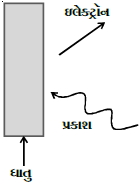
Consider the figure for photoemission. How would you reconcile this with the law of conservation of momentum? Note that light (photons) has momentum in a different direction than the emitted electrons.
Solution
(N/A) When an incident photon is absorbed by the metal surface,its momentum is transferred to the entire metal lattice (the system of atoms).
Since the mass of the metal lattice is extremely large compared to the mass of an electron,the recoil velocity of the lattice is negligible.
The momentum of the incident photon is balanced by the combined momentum of the emitted photoelectron and the recoil momentum of the metal lattice.
Therefore,the total momentum of the system (photon + metal) is conserved in accordance with the law of conservation of momentum.
Since the mass of the metal lattice is extremely large compared to the mass of an electron,the recoil velocity of the lattice is negligible.
The momentum of the incident photon is balanced by the combined momentum of the emitted photoelectron and the recoil momentum of the metal lattice.
Therefore,the total momentum of the system (photon + metal) is conserved in accordance with the law of conservation of momentum.
0 likes
View Solution167
MediumMCQ
Two monochromatic beams $A$ and $B$ of equal intensity $I$ hit a screen. The number of photons hitting the screen by beam $A$ is twice that by beam $B$. What inference can you make about their frequencies?
A
$f_A = 2f_B$
B
$f_A = f_B / 2$
C
$f_A = 4f_B$
D
$f_A = f_B$
Solution
(B) Intensity of light $I$ is given by the formula $I = \frac{n h f}{A t}$,where $n$ is the number of photons,$h$ is Planck's constant,$f$ is the frequency,$A$ is the area,and $t$ is the time.
Let $n' = \frac{n}{A t}$ be the number of photons incident on unit area per unit time.
Thus,$I = n' h f$.
Since the intensity $I$ is the same for both beams,we have $n'_A f_A = n'_B f_B$.
Given that the number of photons from beam $A$ is twice that of beam $B$,we have $n'_A = 2 n'_B$.
Substituting this into the equation: $(2 n'_B) f_A = n'_B f_B$.
Simplifying,we get $2 f_A = f_B$,or $f_A = \frac{f_B}{2}$.
Therefore,the frequency of beam $A$ is half the frequency of beam $B$.
Let $n' = \frac{n}{A t}$ be the number of photons incident on unit area per unit time.
Thus,$I = n' h f$.
Since the intensity $I$ is the same for both beams,we have $n'_A f_A = n'_B f_B$.
Given that the number of photons from beam $A$ is twice that of beam $B$,we have $n'_A = 2 n'_B$.
Substituting this into the equation: $(2 n'_B) f_A = n'_B f_B$.
Simplifying,we get $2 f_A = f_B$,or $f_A = \frac{f_B}{2}$.
Therefore,the frequency of beam $A$ is half the frequency of beam $B$.
0 likes
View Solution168
Easy
In pair annihilation,an electron and a positron destroy each other to produce gamma radiation. How is the momentum conserved?
Solution
(N/A) When an electron and a positron move towards each other with equal speeds,their total momentum is $mv \hat{i} + mv(-\hat{i}) = mv \hat{i} - mv \hat{i} = \vec{0}$.
When these particles annihilate,they produce two $\gamma$-ray photons moving in opposite directions. The total momentum of these photons is $\frac{h}{\lambda} \hat{i} + \frac{h}{\lambda}(-\hat{i}) = \vec{0}$.
Thus,the total momentum remains constant before and after the annihilation process,confirming that momentum is conserved.
When these particles annihilate,they produce two $\gamma$-ray photons moving in opposite directions. The total momentum of these photons is $\frac{h}{\lambda} \hat{i} + \frac{h}{\lambda}(-\hat{i}) = \vec{0}$.
Thus,the total momentum remains constant before and after the annihilation process,confirming that momentum is conserved.
0 likes
View Solution169
MediumMCQ
Two sources of light emit $X$-rays of wavelength $1 \ nm$ and visible light of wavelength $500 \ nm$,respectively. Both sources emit light of the same power $200 \ W$. The ratio of the number of photons emitted per second by the $X$-ray source to the number of photons emitted per second by the visible light source is:
A
$1/500$
B
$500$
C
$250$
D
$1/250$
Solution
(A) The power $P$ of a light source is given by the formula $P = \frac{n E}{t} = \frac{n h c}{\lambda t}$,where $n$ is the number of photons emitted in time $t$,$h$ is Planck's constant,$c$ is the speed of light,and $\lambda$ is the wavelength.
Let $N = n/t$ be the number of photons emitted per second.
Then $P = N \frac{h c}{\lambda}$,which implies $N = \frac{P \lambda}{h c}$.
Since both sources have the same power $P$,the ratio of the number of photons per second is $\frac{N_1}{N_2} = \frac{\lambda_1}{\lambda_2}$.
Given $\lambda_1 = 1 \ nm$ and $\lambda_2 = 500 \ nm$,the ratio is $\frac{N_1}{N_2} = \frac{1}{500}$.
Thus,the correct option is $A$.
Let $N = n/t$ be the number of photons emitted per second.
Then $P = N \frac{h c}{\lambda}$,which implies $N = \frac{P \lambda}{h c}$.
Since both sources have the same power $P$,the ratio of the number of photons per second is $\frac{N_1}{N_2} = \frac{\lambda_1}{\lambda_2}$.
Given $\lambda_1 = 1 \ nm$ and $\lambda_2 = 500 \ nm$,the ratio is $\frac{N_1}{N_2} = \frac{1}{500}$.
Thus,the correct option is $A$.
0 likes
View Solution170
MediumMCQ
Given below are two statements:
Statement-$I$: Two photons having equal linear momenta have equal wavelengths.
Statement-$II$: If the wavelength of a photon is decreased,then the momentum and energy of the photon will also decrease.
In the light of the above statements,choose the correct answer from the options given below.
Statement-$I$: Two photons having equal linear momenta have equal wavelengths.
Statement-$II$: If the wavelength of a photon is decreased,then the momentum and energy of the photon will also decrease.
In the light of the above statements,choose the correct answer from the options given below.
A
Both Statement $I$ and Statement $II$ are true.
B
Statement $I$ is false but Statement $II$ is true.
C
Both Statement $I$ and Statement $II$ are false.
D
Statement $I$ is true but Statement $II$ is false.
Solution
(D) The relationship between the linear momentum $p$ and the wavelength $\lambda$ of a photon is given by the de Broglie relation: $p = \frac{h}{\lambda}$.
Since $h$ (Planck's constant) is a constant,if two photons have equal linear momenta $(p_1 = p_2)$,they must have equal wavelengths $(\lambda_1 = \lambda_2)$. Thus,Statement-$I$ is true.
The energy $E$ of a photon is given by $E = \frac{hc}{\lambda}$.
From the relations $p = \frac{h}{\lambda}$ and $E = \frac{hc}{\lambda}$,it is clear that both momentum $p$ and energy $E$ are inversely proportional to the wavelength $\lambda$. Therefore,if the wavelength $\lambda$ is decreased,both the momentum $p$ and the energy $E$ of the photon will increase. Thus,Statement-$II$ is false.
Since $h$ (Planck's constant) is a constant,if two photons have equal linear momenta $(p_1 = p_2)$,they must have equal wavelengths $(\lambda_1 = \lambda_2)$. Thus,Statement-$I$ is true.
The energy $E$ of a photon is given by $E = \frac{hc}{\lambda}$.
From the relations $p = \frac{h}{\lambda}$ and $E = \frac{hc}{\lambda}$,it is clear that both momentum $p$ and energy $E$ are inversely proportional to the wavelength $\lambda$. Therefore,if the wavelength $\lambda$ is decreased,both the momentum $p$ and the energy $E$ of the photon will increase. Thus,Statement-$II$ is false.
0 likes
View Solution171
MediumMCQ
The number of photons per second on an average emitted by a source of monochromatic light of wavelength $600 \, nm$,when it delivers a power of $3.3 \times 10^{-3} \, W$,is: $(h = 6.6 \times 10^{-34} \, Js)$
A
$10^{18}$
B
$10^{17}$
C
$10^{16}$
D
$10^{15}$
Solution
(C) The power $P$ emitted by a source is given by the product of the number of photons per second $n$ and the energy of a single photon $E = \frac{hc}{\lambda}$.
$P = n \frac{hc}{\lambda} \Rightarrow n = \frac{P \lambda}{hc}$
Given: $P = 3.3 \times 10^{-3} \, W$,$\lambda = 600 \times 10^{-9} \, m$,$h = 6.6 \times 10^{-34} \, Js$,and $c = 3 \times 10^8 \, m/s$.
Substituting the values:
$n = \frac{3.3 \times 10^{-3} \times 600 \times 10^{-9}}{6.6 \times 10^{-34} \times 3 \times 10^8}$
$n = \frac{3.3 \times 600 \times 10^{-12}}{19.8 \times 10^{-26}}$
$n = \frac{1980 \times 10^{-12}}{19.8 \times 10^{-26}} = 100 \times 10^{14} = 10^{16}$
Thus,the number of photons emitted per second is $10^{16}$.
$P = n \frac{hc}{\lambda} \Rightarrow n = \frac{P \lambda}{hc}$
Given: $P = 3.3 \times 10^{-3} \, W$,$\lambda = 600 \times 10^{-9} \, m$,$h = 6.6 \times 10^{-34} \, Js$,and $c = 3 \times 10^8 \, m/s$.
Substituting the values:
$n = \frac{3.3 \times 10^{-3} \times 600 \times 10^{-9}}{6.6 \times 10^{-34} \times 3 \times 10^8}$
$n = \frac{3.3 \times 600 \times 10^{-12}}{19.8 \times 10^{-26}}$
$n = \frac{1980 \times 10^{-12}}{19.8 \times 10^{-26}} = 100 \times 10^{14} = 10^{16}$
Thus,the number of photons emitted per second is $10^{16}$.
0 likes
View Solution172
MediumMCQ
$A$ parallel beam of light of wavelength $900 \, nm$ and intensity $100 \, W/m^2$ is incident on a surface perpendicular to the beam. The number of photons crossing $1 \, cm^2$ area perpendicular to the beam in one second is:
A
$3 \times 10^{16}$
B
$4.5 \times 10^{16}$
C
$4.5 \times 10^{17}$
D
$4.5 \times 10^{20}$
Solution
(B) Given:
Wavelength $\lambda = 900 \times 10^{-9} \, m$
Intensity $I = 100 \, W/m^2$
Area $A = 1 \, cm^2 = 10^{-4} \, m^2$
Time $t = 1 \, s$
The energy crossing the area per second is $P = I \times A = 100 \times 10^{-4} = 10^{-2} \, J/s$.
The energy of a single photon is $E = \frac{hc}{\lambda}$.
The number of photons $n$ crossing the area per second is given by $n = \frac{P}{E} = \frac{P \lambda}{hc}$.
Substituting the values:
$n = \frac{10^{-2} \times 900 \times 10^{-9}}{6.63 \times 10^{-34} \times 3 \times 10^8}$
$n = \frac{9 \times 10^{-9}}{19.89 \times 10^{-26}} \approx 0.452 \times 10^{17} = 4.52 \times 10^{16}$.
Rounding to the nearest option,we get $4.5 \times 10^{16}$.
Wavelength $\lambda = 900 \times 10^{-9} \, m$
Intensity $I = 100 \, W/m^2$
Area $A = 1 \, cm^2 = 10^{-4} \, m^2$
Time $t = 1 \, s$
The energy crossing the area per second is $P = I \times A = 100 \times 10^{-4} = 10^{-2} \, J/s$.
The energy of a single photon is $E = \frac{hc}{\lambda}$.
The number of photons $n$ crossing the area per second is given by $n = \frac{P}{E} = \frac{P \lambda}{hc}$.
Substituting the values:
$n = \frac{10^{-2} \times 900 \times 10^{-9}}{6.63 \times 10^{-34} \times 3 \times 10^8}$
$n = \frac{9 \times 10^{-9}}{19.89 \times 10^{-26}} \approx 0.452 \times 10^{17} = 4.52 \times 10^{16}$.
Rounding to the nearest option,we get $4.5 \times 10^{16}$.
0 likes
View Solution173
AdvancedMCQ
$A$ photon falls through a height of $1 \, km$ in the earth's gravitational field. To calculate the change in its frequency,take its mass to be $h \nu / c^{2}$. The fractional change in frequency $\nu$ is close to
A
$10^{-20}$
B
$10^{-17}$
C
$10^{-13}$
D
$10^{-10}$
Solution
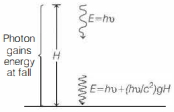
(C) photon of mass $m$ and frequency $\nu$ falls through a height $H$ in the earth's gravitational field.
When the photon falls through the earth's gravitational field,it gains extra energy. Therefore,
Final photon energy = Initial photon energy + Increase in energy
$h \nu' = h \nu + m g H$
Substituting $m = \frac{h \nu}{c^{2}}$,we get:
$h \nu' = h \nu + \left( \frac{h \nu}{c^{2}} \right) g H$
$\nu' = \nu \left( 1 + \frac{g H}{c^{2}} \right)$
So,the fractional change in frequency is:
$\frac{\nu' - \nu}{\nu} = \frac{g H}{c^{2}}$
Given $g = 10 \, m/s^{2}$,$H = 1000 \, m$,and $c = 3 \times 10^{8} \, m/s$:
$\frac{\Delta \nu}{\nu} = \frac{10 \times 1000}{(3 \times 10^{8})^{2}} = \frac{10^{4}}{9 \times 10^{16}} \approx 1.11 \times 10^{-13}$
This value is close to $10^{-13}$.
When the photon falls through the earth's gravitational field,it gains extra energy. Therefore,
Final photon energy = Initial photon energy + Increase in energy
$h \nu' = h \nu + m g H$
Substituting $m = \frac{h \nu}{c^{2}}$,we get:
$h \nu' = h \nu + \left( \frac{h \nu}{c^{2}} \right) g H$
$\nu' = \nu \left( 1 + \frac{g H}{c^{2}} \right)$
So,the fractional change in frequency is:
$\frac{\nu' - \nu}{\nu} = \frac{g H}{c^{2}}$
Given $g = 10 \, m/s^{2}$,$H = 1000 \, m$,and $c = 3 \times 10^{8} \, m/s$:
$\frac{\Delta \nu}{\nu} = \frac{10 \times 1000}{(3 \times 10^{8})^{2}} = \frac{10^{4}}{9 \times 10^{16}} \approx 1.11 \times 10^{-13}$
This value is close to $10^{-13}$.
0 likes
View Solution174
MediumMCQ
An electron and a photon have the same wavelength of $10^{-9} \, m$. If $E$ is the energy of the photon and $p$ is the momentum of the electron,then the magnitude of $E / p$ (in $SI$ unit) is
A
$1.00 \times 10^{-9}$
B
$1.50 \times 10^8$
C
$3.00 \times 10^8$
D
$1.20 \times 10^7$
Solution
(C) For a photon,the energy is given by $E = hf = \frac{hc}{\lambda}$.
For an electron,the momentum is given by $p = \frac{h}{\lambda}$.
Taking the ratio of energy of the photon to the momentum of the electron:
$\frac{E}{p} = \frac{hc / \lambda}{h / \lambda} = c$.
Given that the wavelength $\lambda$ is the same for both the photon and the electron,the ratio depends only on the speed of light $c$.
Substituting the value of $c = 3 \times 10^8 \, m/s$,we get:
$\frac{E}{p} = 3 \times 10^8 \, m/s$.
For an electron,the momentum is given by $p = \frac{h}{\lambda}$.
Taking the ratio of energy of the photon to the momentum of the electron:
$\frac{E}{p} = \frac{hc / \lambda}{h / \lambda} = c$.
Given that the wavelength $\lambda$ is the same for both the photon and the electron,the ratio depends only on the speed of light $c$.
Substituting the value of $c = 3 \times 10^8 \, m/s$,we get:
$\frac{E}{p} = 3 \times 10^8 \, m/s$.
0 likes
View Solution175
AdvancedMCQ
$A$ $160 \,W$ infrared source is radiating light of wavelength $50000 \,\mathring A$ uniformly in all directions. The photon flux at a distance of $1.8 \,m$ is of the order of ............. $m^{-2} s^{-1}$.
A
$10$
B
$10^{10}$
C
$10^{15}$
D
$10^{20}$
Solution
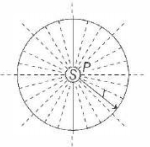
(D) The power of the source is $P = 160 \,W$ and the wavelength is $\lambda = 50000 \,\mathring A = 5 \times 10^{-6} \,m$.
The energy of a single photon is $E = \frac{hc}{\lambda} = \frac{6.63 \times 10^{-34} \times 3 \times 10^8}{5 \times 10^{-6}} \approx 3.98 \times 10^{-20} \,J$.
The number of photons emitted per second by the source is $N = \frac{P}{E} = \frac{160}{3.98 \times 10^{-20}} \approx 4.02 \times 10^{21} \,s^{-1}$.
The photon flux $n$ at a distance $r = 1.8 \,m$ is the number of photons passing through a unit area per second,given by $n = \frac{N}{4 \pi r^2}$.
$n = \frac{4.02 \times 10^{21}}{4 \times 3.14 \times (1.8)^2} = \frac{4.02 \times 10^{21}}{40.69} \approx 0.0988 \times 10^{21} \approx 10^{20} \,m^{-2} s^{-1}$.
Thus,the order of magnitude is $10^{20} \,m^{-2} s^{-1}$.
The energy of a single photon is $E = \frac{hc}{\lambda} = \frac{6.63 \times 10^{-34} \times 3 \times 10^8}{5 \times 10^{-6}} \approx 3.98 \times 10^{-20} \,J$.
The number of photons emitted per second by the source is $N = \frac{P}{E} = \frac{160}{3.98 \times 10^{-20}} \approx 4.02 \times 10^{21} \,s^{-1}$.
The photon flux $n$ at a distance $r = 1.8 \,m$ is the number of photons passing through a unit area per second,given by $n = \frac{N}{4 \pi r^2}$.
$n = \frac{4.02 \times 10^{21}}{4 \times 3.14 \times (1.8)^2} = \frac{4.02 \times 10^{21}}{40.69} \approx 0.0988 \times 10^{21} \approx 10^{20} \,m^{-2} s^{-1}$.
Thus,the order of magnitude is $10^{20} \,m^{-2} s^{-1}$.
0 likes
View Solution176
MediumMCQ
$A$ $160 \,W$ light source is radiating light of wavelength $6200 \,\mathring A$ uniformly in all directions. The photon flux at a distance of $1.8 \,m$ is of the order of .......... $m^{-2} s^{-1}$ (Planck's constant $= 6.63 \times 10^{-34} \,J \cdot s$)
A
$10^2$
B
$10^{12}$
C
$10^{19}$
D
$10^{25}$
Solution
(C) The photon flux is defined as the number of photons passing through a unit area per unit time.
The energy of a single photon is given by $E = \frac{hc}{\lambda}$.
The intensity $I$ at a distance $r$ from a source of power $P$ is $I = \frac{P}{4 \pi r^2}$.
The photon flux $\Phi$ is given by $\Phi = \frac{I}{E} = \frac{P}{4 \pi r^2} \times \frac{\lambda}{hc}$.
Substituting the given values: $P = 160 \,W$,$\lambda = 6200 \times 10^{-10} \,m$,$r = 1.8 \,m$,$h = 6.63 \times 10^{-34} \,J \cdot s$,and $c = 3 \times 10^8 \,m/s$.
$\Phi = \frac{160 \times 6200 \times 10^{-10}}{4 \times 3.14 \times (1.8)^2 \times 6.63 \times 10^{-34} \times 3 \times 10^8}$.
Calculating the value: $\Phi \approx 1.22 \times 10^{19} \,m^{-2} s^{-1}$.
Thus,the order of magnitude is $10^{19} \,m^{-2} s^{-1}$.
The energy of a single photon is given by $E = \frac{hc}{\lambda}$.
The intensity $I$ at a distance $r$ from a source of power $P$ is $I = \frac{P}{4 \pi r^2}$.
The photon flux $\Phi$ is given by $\Phi = \frac{I}{E} = \frac{P}{4 \pi r^2} \times \frac{\lambda}{hc}$.
Substituting the given values: $P = 160 \,W$,$\lambda = 6200 \times 10^{-10} \,m$,$r = 1.8 \,m$,$h = 6.63 \times 10^{-34} \,J \cdot s$,and $c = 3 \times 10^8 \,m/s$.
$\Phi = \frac{160 \times 6200 \times 10^{-10}}{4 \times 3.14 \times (1.8)^2 \times 6.63 \times 10^{-34} \times 3 \times 10^8}$.
Calculating the value: $\Phi \approx 1.22 \times 10^{19} \,m^{-2} s^{-1}$.
Thus,the order of magnitude is $10^{19} \,m^{-2} s^{-1}$.
0 likes
View Solution177
DifficultMCQ
Solar energy is incident normally on the earth's surface at the rate of about $1.4 \, kW m^{-2}$. The distance between the earth and the sun is $1.5 \times 10^{11} \, m$. Energy $E$ and mass $m$ are related by Einstein's equation $E = mc^2$,where $c = 3 \times 10^8 \, m s^{-1}$ is the speed of light in free space. The decrease in the mass of the sun is ........... $\, kg s^{-1}$.
A
$10^9$
B
$10^{30}$
C
$10^{26}$
D
$10^{11}$
Solution
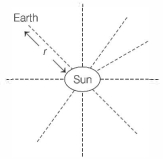
(A) The solar energy is radiated from the sun in all directions,effectively forming a sphere of radius $r = 1.5 \times 10^{11} \, m$.
The total power (energy radiated per second) emitted by the sun is given by the product of the solar constant and the surface area of this sphere:
$P = \Delta E / \Delta t = I \times (4 \pi r^2)$
$P = 1.4 \times 10^3 \, W m^{-2} \times 4 \times 3.14 \times (1.5 \times 10^{11} \, m)^2$
$P \approx 1.4 \times 10^3 \times 4 \times 3.14 \times 2.25 \times 10^{22} \approx 3.96 \times 10^{26} \, J s^{-1}$.
Using Einstein's mass-energy equivalence relation $E = mc^2$,the mass equivalent of the energy radiated per second is:
$\Delta m / \Delta t = P / c^2$
$\Delta m / \Delta t = (3.96 \times 10^{26}) / (3 \times 10^8)^2$
$\Delta m / \Delta t = (3.96 \times 10^{26}) / (9 \times 10^{16})$
$\Delta m / \Delta t \approx 0.44 \times 10^{10} \approx 4.4 \times 10^9 \, kg s^{-1}$.
Rounding to the nearest order of magnitude,the decrease in the mass of the sun is approximately $10^9 \, kg s^{-1}$.
The total power (energy radiated per second) emitted by the sun is given by the product of the solar constant and the surface area of this sphere:
$P = \Delta E / \Delta t = I \times (4 \pi r^2)$
$P = 1.4 \times 10^3 \, W m^{-2} \times 4 \times 3.14 \times (1.5 \times 10^{11} \, m)^2$
$P \approx 1.4 \times 10^3 \times 4 \times 3.14 \times 2.25 \times 10^{22} \approx 3.96 \times 10^{26} \, J s^{-1}$.
Using Einstein's mass-energy equivalence relation $E = mc^2$,the mass equivalent of the energy radiated per second is:
$\Delta m / \Delta t = P / c^2$
$\Delta m / \Delta t = (3.96 \times 10^{26}) / (3 \times 10^8)^2$
$\Delta m / \Delta t = (3.96 \times 10^{26}) / (9 \times 10^{16})$
$\Delta m / \Delta t \approx 0.44 \times 10^{10} \approx 4.4 \times 10^9 \, kg s^{-1}$.
Rounding to the nearest order of magnitude,the decrease in the mass of the sun is approximately $10^9 \, kg s^{-1}$.
0 likes
View Solution178
MediumMCQ
Specific heat of water is $4.2 \, J/g^{\circ}C$. If light of frequency $3 \times 10^9 \, Hz$ is used to heat $400 \, g$ of water from $20^{\circ}C$ to $40^{\circ}C$,the number of photons needed will be:
A
$1.69 \times 10^{29}$
B
$1.69 \times 10^{28}$
C
$2.80 \times 10^4$
D
$2.80 \times 10^5$
Solution
(B) Given:
Specific heat of water,$s = 4.2 \, J/g^{\circ}C$
Mass of water,$m = 400 \, g$
Change in temperature,$\Delta T = 40^{\circ}C - 20^{\circ}C = 20^{\circ}C$
Frequency of light,$\nu = 3 \times 10^9 \, Hz$
Planck's constant,$h = 6.63 \times 10^{-34} \, J \cdot s$
Step $1$: Calculate the total heat energy $(Q)$ required to heat the water:
$Q = m \cdot s \cdot \Delta T$
$Q = 400 \, g \times 4.2 \, J/g^{\circ}C \times 20^{\circ}C = 33600 \, J$
Step $2$: Calculate the energy of a single photon $(E_p)$:
$E_p = h \cdot \nu$
$E_p = 6.63 \times 10^{-34} \, J \cdot s \times 3 \times 10^9 \, Hz = 19.89 \times 10^{-25} \, J$
Step $3$: Calculate the number of photons $(n)$ required:
$n = \frac{Q}{E_p} = \frac{33600}{19.89 \times 10^{-25}}$
$n \approx 1689.29 \times 10^{25} \approx 1.69 \times 10^{28}$
Thus,the number of photons needed is $1.69 \times 10^{28}$.
Specific heat of water,$s = 4.2 \, J/g^{\circ}C$
Mass of water,$m = 400 \, g$
Change in temperature,$\Delta T = 40^{\circ}C - 20^{\circ}C = 20^{\circ}C$
Frequency of light,$\nu = 3 \times 10^9 \, Hz$
Planck's constant,$h = 6.63 \times 10^{-34} \, J \cdot s$
Step $1$: Calculate the total heat energy $(Q)$ required to heat the water:
$Q = m \cdot s \cdot \Delta T$
$Q = 400 \, g \times 4.2 \, J/g^{\circ}C \times 20^{\circ}C = 33600 \, J$
Step $2$: Calculate the energy of a single photon $(E_p)$:
$E_p = h \cdot \nu$
$E_p = 6.63 \times 10^{-34} \, J \cdot s \times 3 \times 10^9 \, Hz = 19.89 \times 10^{-25} \, J$
Step $3$: Calculate the number of photons $(n)$ required:
$n = \frac{Q}{E_p} = \frac{33600}{19.89 \times 10^{-25}}$
$n \approx 1689.29 \times 10^{25} \approx 1.69 \times 10^{28}$
Thus,the number of photons needed is $1.69 \times 10^{28}$.
0 likes
View Solution179
EasyMCQ
How many photons are emitted by a laser source of $5 \times 10^{-3} \,W$ operating at $632.2 \,nm$ in $2 \,s$? The answer is $....... \times 10^{16}$. (Given: $h = 6.63 \times 10^{-34} \,Js$,$c = 3 \times 10^8 \,m/s$)
A
$3.2$
B
$1.6$
C
$4$
D
$0.4$
Solution
(A) The power of the laser source is $P = 5 \times 10^{-3} \,W$. The time duration is $t = 2 \,s$. The wavelength is $\lambda = 632.2 \times 10^{-9} \,m$.
The total energy emitted in time $t$ is $E_{total} = P \times t = 5 \times 10^{-3} \times 2 = 10^{-2} \,J$.
The energy of a single photon is $E_{photon} = \frac{hc}{\lambda} = \frac{6.63 \times 10^{-34} \times 3 \times 10^8}{632.2 \times 10^{-9}} \,J$.
$E_{photon} = \frac{19.89 \times 10^{-26}}{632.2 \times 10^{-9}} \approx 0.03146 \times 10^{-17} \,J = 3.146 \times 10^{-19} \,J$.
The number of photons $n$ is given by $n = \frac{E_{total}}{E_{photon}} = \frac{10^{-2}}{3.146 \times 10^{-19}} \approx 0.3178 \times 10^{17} = 3.178 \times 10^{16}$.
Rounding to the nearest provided option,the value is $3.2 \times 10^{16}$.
The total energy emitted in time $t$ is $E_{total} = P \times t = 5 \times 10^{-3} \times 2 = 10^{-2} \,J$.
The energy of a single photon is $E_{photon} = \frac{hc}{\lambda} = \frac{6.63 \times 10^{-34} \times 3 \times 10^8}{632.2 \times 10^{-9}} \,J$.
$E_{photon} = \frac{19.89 \times 10^{-26}}{632.2 \times 10^{-9}} \approx 0.03146 \times 10^{-17} \,J = 3.146 \times 10^{-19} \,J$.
The number of photons $n$ is given by $n = \frac{E_{total}}{E_{photon}} = \frac{10^{-2}}{3.146 \times 10^{-19}} \approx 0.3178 \times 10^{17} = 3.178 \times 10^{16}$.
Rounding to the nearest provided option,the value is $3.2 \times 10^{16}$.
0 likes
View Solution180
EasyMCQ
What should be the velocity of an electron so that its momentum becomes equal to that of a photon of wavelength $5200 \, \mathring{A}$? (Given: $h = 6.63 \times 10^{-34} \, J \cdot s$, $m_e = 9.1 \times 10^{-31} \, kg$)
A
$700$
B
$1000$
C
$1400$
D
$2800$
Solution
(C) The momentum of a photon is given by $p = \frac{h}{\lambda}$.
Given wavelength $\lambda = 5200 \, \mathring{A} = 5200 \times 10^{-10} \, m$.
The momentum of the electron is $p = m_e v$.
Equating the two momenta: $m_e v = \frac{h}{\lambda}$.
Therefore, $v = \frac{h}{m_e \lambda}$.
Substituting the values: $v = \frac{6.63 \times 10^{-34}}{(9.1 \times 10^{-31}) \times (5200 \times 10^{-10})}$.
$v = \frac{6.63 \times 10^{-34}}{47.32 \times 10^{-22}} \approx 0.1401 \times 10^{-12} \times 10^{22} \approx 1401 \, m/s$.
Rounding to the nearest option, the velocity is $1400 \, m/s$.
Given wavelength $\lambda = 5200 \, \mathring{A} = 5200 \times 10^{-10} \, m$.
The momentum of the electron is $p = m_e v$.
Equating the two momenta: $m_e v = \frac{h}{\lambda}$.
Therefore, $v = \frac{h}{m_e \lambda}$.
Substituting the values: $v = \frac{6.63 \times 10^{-34}}{(9.1 \times 10^{-31}) \times (5200 \times 10^{-10})}$.
$v = \frac{6.63 \times 10^{-34}}{47.32 \times 10^{-22}} \approx 0.1401 \times 10^{-12} \times 10^{22} \approx 1401 \, m/s$.
Rounding to the nearest option, the velocity is $1400 \, m/s$.
0 likes
View Solution181
EasyMCQ
$A$ situation of population inversion is related to
A
Matter wave
B
$ \gamma $-ray
C
$ X $-ray
D
$ LASER $
Solution
(D) The correct option is $(D)$.
Population inversion is a condition in which a system (such as a group of atoms or molecules) exists in a state with more members in an excited energy state than in a lower energy state.
This condition is a fundamental requirement for the process of stimulated emission,which is the underlying principle of $LASER$ (Light Amplification by Stimulated Emission of Radiation) operation.
Population inversion is a condition in which a system (such as a group of atoms or molecules) exists in a state with more members in an excited energy state than in a lower energy state.
This condition is a fundamental requirement for the process of stimulated emission,which is the underlying principle of $LASER$ (Light Amplification by Stimulated Emission of Radiation) operation.
0 likes
View Solution182
EasyMCQ
If the emitted radiation falls in the microwave region,the device is termed as
A
$LASER$
B
$MASER$
C
Both $(a)$ and $(b)$
D
None of these
Solution
(B) The correct answer is $(b)$.
$MASER$ stands for Microwave Amplification by Stimulated Emission of Radiation.
It is a device that produces coherent electromagnetic waves through amplification by stimulated emission of electromagnetic radiation in the microwave region.
$MASER$ stands for Microwave Amplification by Stimulated Emission of Radiation.
It is a device that produces coherent electromagnetic waves through amplification by stimulated emission of electromagnetic radiation in the microwave region.
0 likes
View Solution183
EasyMCQ
The Compton effect supports the fact that
A
$X$-rays are transverse waves
B
$X$-rays have a higher frequency compared to visible light
C
$X$-rays can easily penetrate matter
D
Photons have momentum
Solution
(D) The Compton effect describes the scattering of an $X$-ray photon by a charged particle,usually an electron.
This phenomenon results in a change in the wavelength of the scattered photon,which can only be explained by treating the interaction as a collision between two particles.
Therefore,the Compton effect provides experimental evidence that photons possess momentum,confirming the particle nature of electromagnetic radiation.
This phenomenon results in a change in the wavelength of the scattered photon,which can only be explained by treating the interaction as a collision between two particles.
Therefore,the Compton effect provides experimental evidence that photons possess momentum,confirming the particle nature of electromagnetic radiation.
0 likes
View Solution184
EasyMCQ
If the energy of a photon is $10\,eV$,then its momentum is
A
$5.33 \times 10^{-27}\,kg\,m/s$
B
$5.33 \times 10^{-25}\,kg\,m/s$
C
$5.33 \times 10^{-29}\,kg\,m/s$
D
$5.33 \times 10^{-23}\,kg\,m/s$
Solution
(A) The energy of a photon is given by $E = 10\,eV$.
We know that the momentum $p$ of a photon is related to its energy $E$ by the formula $p = \frac{E}{c}$,where $c$ is the speed of light.
First,convert the energy from $eV$ to Joules: $E = 10 \times 1.6 \times 10^{-19}\,J = 1.6 \times 10^{-18}\,J$.
The speed of light $c = 3 \times 10^8\,m/s$.
Now,calculate the momentum: $p = \frac{1.6 \times 10^{-18}}{3 \times 10^8} = 0.533 \times 10^{-26}\,kg\,m/s$.
This can be written as $p = 5.33 \times 10^{-27}\,kg\,m/s$.
Therefore,the correct option is $A$.
We know that the momentum $p$ of a photon is related to its energy $E$ by the formula $p = \frac{E}{c}$,where $c$ is the speed of light.
First,convert the energy from $eV$ to Joules: $E = 10 \times 1.6 \times 10^{-19}\,J = 1.6 \times 10^{-18}\,J$.
The speed of light $c = 3 \times 10^8\,m/s$.
Now,calculate the momentum: $p = \frac{1.6 \times 10^{-18}}{3 \times 10^8} = 0.533 \times 10^{-26}\,kg\,m/s$.
This can be written as $p = 5.33 \times 10^{-27}\,kg\,m/s$.
Therefore,the correct option is $A$.
0 likes
View Solution185
MediumMCQ
An atom absorbs a photon of wavelength $500\,nm$ and emits another photon of wavelength $600\,nm$. The net energy absorbed by the atom in this process is $n \times 10^{-4}\,eV$. The value of $n$ is ............ [Assume the atom to be stationary during the absorption and emission process] (Take $h = 6.6 \times 10^{-34}\,Js$ and $c = 3 \times 10^8\,m/s$)
A
$4124$
B
$4125$
C
$4123$
D
$4122$
Solution
(B) The net energy absorbed by the atom is given by the difference between the energy of the absorbed photon and the emitted photon.
$E_{\text{net}} = E_{\text{absorbed}} - E_{\text{emitted}} = \frac{hc}{\lambda_1} - \frac{hc}{\lambda_2} = hc \left( \frac{1}{\lambda_1} - \frac{1}{\lambda_2} \right)$
Substituting the given values:
$E_{\text{net}} = (6.6 \times 10^{-34}) \times (3 \times 10^8) \left( \frac{1}{500 \times 10^{-9}} - \frac{1}{600 \times 10^{-9}} \right)$
$E_{\text{net}} = 19.8 \times 10^{-26} \left( \frac{600 - 500}{300000 \times 10^{-18}} \right) = 19.8 \times 10^{-26} \left( \frac{100}{3 \times 10^{-13}} \right)$
$E_{\text{net}} = 19.8 \times 10^{-26} \times 33.33 \times 10^{13} = 6.6 \times 10^{-20}\,J$
To convert this energy into $eV$,divide by $1.6 \times 10^{-19}\,J/eV$:
$E_{\text{net}} = \frac{6.6 \times 10^{-20}}{1.6 \times 10^{-19}} = 4.125 \times 10^{-1}\,eV$
$E_{\text{net}} = 4125 \times 10^{-4}\,eV$
Comparing this with $n \times 10^{-4}\,eV$,we get $n = 4125$.
$E_{\text{net}} = E_{\text{absorbed}} - E_{\text{emitted}} = \frac{hc}{\lambda_1} - \frac{hc}{\lambda_2} = hc \left( \frac{1}{\lambda_1} - \frac{1}{\lambda_2} \right)$
Substituting the given values:
$E_{\text{net}} = (6.6 \times 10^{-34}) \times (3 \times 10^8) \left( \frac{1}{500 \times 10^{-9}} - \frac{1}{600 \times 10^{-9}} \right)$
$E_{\text{net}} = 19.8 \times 10^{-26} \left( \frac{600 - 500}{300000 \times 10^{-18}} \right) = 19.8 \times 10^{-26} \left( \frac{100}{3 \times 10^{-13}} \right)$
$E_{\text{net}} = 19.8 \times 10^{-26} \times 33.33 \times 10^{13} = 6.6 \times 10^{-20}\,J$
To convert this energy into $eV$,divide by $1.6 \times 10^{-19}\,J/eV$:
$E_{\text{net}} = \frac{6.6 \times 10^{-20}}{1.6 \times 10^{-19}} = 4.125 \times 10^{-1}\,eV$
$E_{\text{net}} = 4125 \times 10^{-4}\,eV$
Comparing this with $n \times 10^{-4}\,eV$,we get $n = 4125$.
0 likes
View Solution186
DifficultMCQ
Two sources of light emit with a power of $200 \ W$. The ratio of the number of photons of visible light emitted per second by each source having wavelengths $300 \ nm$ and $500 \ nm$ respectively,will be:
A
$1: 5$
B
$1: 3$
C
$5: 3$
D
$3: 5$
Solution
(D) The power $P$ of a light source is given by $P = n \times E_{photon}$,where $n$ is the number of photons emitted per second and $E_{photon} = \frac{hc}{\lambda}$.
For the first source: $P = n_1 \times \frac{hc}{\lambda_1} = 200 \ W$.
For the second source: $P = n_2 \times \frac{hc}{\lambda_2} = 200 \ W$.
Equating the two expressions: $n_1 \times \frac{hc}{\lambda_1} = n_2 \times \frac{hc}{\lambda_2}$.
This simplifies to $\frac{n_1}{n_2} = \frac{\lambda_1}{\lambda_2}$.
Given $\lambda_1 = 300 \ nm$ and $\lambda_2 = 500 \ nm$,we have $\frac{n_1}{n_2} = \frac{300}{500} = \frac{3}{5}$.
For the first source: $P = n_1 \times \frac{hc}{\lambda_1} = 200 \ W$.
For the second source: $P = n_2 \times \frac{hc}{\lambda_2} = 200 \ W$.
Equating the two expressions: $n_1 \times \frac{hc}{\lambda_1} = n_2 \times \frac{hc}{\lambda_2}$.
This simplifies to $\frac{n_1}{n_2} = \frac{\lambda_1}{\lambda_2}$.
Given $\lambda_1 = 300 \ nm$ and $\lambda_2 = 500 \ nm$,we have $\frac{n_1}{n_2} = \frac{300}{500} = \frac{3}{5}$.
0 likes
View Solution187
DifficultMCQ
Monochromatic light of frequency $6 \times 10^{14} \,Hz$ is produced by a laser. The power emitted is $2 \times 10^{-3} \,W$. How many photons per second on an average are emitted by the source? (Given $h = 6.63 \times 10^{-34} \,Js$)
A
$9 \times 10^{18}$
B
$6 \times 10^{15}$
C
$5 \times 10^{15}$
D
$7 \times 10^{16}$
Solution
(C) The power $P$ emitted by a source is given by the product of the number of photons emitted per second $(n)$ and the energy of a single photon $(E = h\nu)$.
$P = n h \nu$
Rearranging for $n$:
$n = \frac{P}{h \nu}$
Given values:
$P = 2 \times 10^{-3} \,W$
$h = 6.63 \times 10^{-34} \,Js$
$\nu = 6 \times 10^{14} \,Hz$
Substituting the values:
$n = \frac{2 \times 10^{-3}}{6.63 \times 10^{-34} \times 6 \times 10^{14}}$
$n = \frac{2 \times 10^{-3}}{39.78 \times 10^{-20}}$
$n = \frac{2}{39.78} \times 10^{17} \approx 0.05027 \times 10^{17} = 5.027 \times 10^{15} \approx 5 \times 10^{15}$
Thus, the number of photons emitted per second is $5 \times 10^{15}$.
$P = n h \nu$
Rearranging for $n$:
$n = \frac{P}{h \nu}$
Given values:
$P = 2 \times 10^{-3} \,W$
$h = 6.63 \times 10^{-34} \,Js$
$\nu = 6 \times 10^{14} \,Hz$
Substituting the values:
$n = \frac{2 \times 10^{-3}}{6.63 \times 10^{-34} \times 6 \times 10^{14}}$
$n = \frac{2 \times 10^{-3}}{39.78 \times 10^{-20}}$
$n = \frac{2}{39.78} \times 10^{17} \approx 0.05027 \times 10^{17} = 5.027 \times 10^{15} \approx 5 \times 10^{15}$
Thus, the number of photons emitted per second is $5 \times 10^{15}$.
0 likes
View Solution188
MediumMCQ
If $c$ is the velocity of light in free space,the correct statements about photon among the following are:
$A$. The energy of a photon is $E=h v$.
$B$. The velocity of a photon is $c$.
$C$. The momentum of a photon,$p=\frac{h v}{c}$.
$D$. In a photon-electron collision,both total energy and total momentum are conserved.
$E$. Photon possesses positive charge.
Choose the correct answer from the options given below:
$A$. The energy of a photon is $E=h v$.
$B$. The velocity of a photon is $c$.
$C$. The momentum of a photon,$p=\frac{h v}{c}$.
$D$. In a photon-electron collision,both total energy and total momentum are conserved.
$E$. Photon possesses positive charge.
Choose the correct answer from the options given below:
A
$A, B, C$ and $D$ only
B
$A, C$ and $D$ only
C
$A, B, D$ and $E$ only
D
$A$ and $B$ only
Solution
(A) The properties of a photon are as follows:
$1$. The energy of a photon is given by $E = h\nu$,where $h$ is Planck's constant and $\nu$ is the frequency. Thus,statement $A$ is correct.
$2$. $A$ photon travels with the speed of light in free space,which is $c$. Thus,statement $B$ is correct.
$3$. The momentum $p$ of a photon is related to its energy $E$ by $p = E/c$. Substituting $E = h\nu$,we get $p = h\nu/c$. Thus,statement $C$ is correct.
$4$. In any collision,including a photon-electron collision (Compton scattering),both total energy and total momentum are conserved. Thus,statement $D$ is correct.
$5$. $A$ photon is an electrically neutral particle,meaning it has zero charge. Thus,statement $E$ is incorrect.
Therefore,statements $A, B, C,$ and $D$ are correct.
$1$. The energy of a photon is given by $E = h\nu$,where $h$ is Planck's constant and $\nu$ is the frequency. Thus,statement $A$ is correct.
$2$. $A$ photon travels with the speed of light in free space,which is $c$. Thus,statement $B$ is correct.
$3$. The momentum $p$ of a photon is related to its energy $E$ by $p = E/c$. Substituting $E = h\nu$,we get $p = h\nu/c$. Thus,statement $C$ is correct.
$4$. In any collision,including a photon-electron collision (Compton scattering),both total energy and total momentum are conserved. Thus,statement $D$ is correct.
$5$. $A$ photon is an electrically neutral particle,meaning it has zero charge. Thus,statement $E$ is incorrect.
Therefore,statements $A, B, C,$ and $D$ are correct.
0 likes
View Solution189
AdvancedMCQ
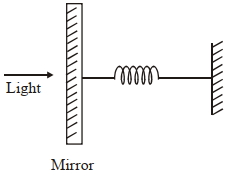
$A$ perfectly reflecting mirror of mass $M$ mounted on a spring constitutes a spring-mass system of angular frequency $\Omega$ such that $\frac{4 \pi M \Omega}{h} = 10^{24} \text{ m}^{-2}$,where $h$ is Planck's constant. $N$ photons of wavelength $\lambda = 8 \pi \times 10^{-6} \text{ m}$ strike the mirror simultaneously at normal incidence such that the mirror gets displaced by $1 \mu\text{m}$. If the value of $N$ is $x \times 10^{12}$,then the value of $x$ is. . . . . . . . [Consider the spring as massless]
A
$0$
B
$1$
C
$2$
D
$3$
Solution
(B) The momentum of one photon is $p = \frac{h}{\lambda}$.
When $N$ photons strike the mirror,the total momentum transferred to the mirror is $\Delta P = 2Np = \frac{2Nh}{\lambda}$.
By the conservation of linear momentum,this impulse imparts an initial velocity $v$ to the mirror of mass $M$ at the equilibrium position:
$Mv = \frac{2Nh}{\lambda} \implies v = \frac{2Nh}{M\lambda}$.
For a spring-mass system,the maximum displacement (amplitude $A$) is related to the velocity at the mean position by $v = A\Omega$.
Given $A = 1 \mu\text{m} = 10^{-6} \text{ m}$,we have:
$A\Omega = \frac{2Nh}{M\lambda} \implies N = \frac{M\Omega A \lambda}{2h}$.
Rearranging the given expression $\frac{4 \pi M \Omega}{h} = 10^{24} \text{ m}^{-2}$,we get $\frac{M\Omega}{h} = \frac{10^{24}}{4\pi} \text{ m}^{-2}$.
Substituting the values:
$N = \left( \frac{10^{24}}{4\pi} \right) \times \frac{A \lambda}{2} = \frac{10^{24}}{4\pi} \times \frac{10^{-6} \times 8\pi \times 10^{-6}}{2}$.
$N = \frac{10^{24} \times 8\pi \times 10^{-12}}{8\pi} = 10^{12}$.
Since $N = x \times 10^{12}$,we find $x = 1$.
When $N$ photons strike the mirror,the total momentum transferred to the mirror is $\Delta P = 2Np = \frac{2Nh}{\lambda}$.
By the conservation of linear momentum,this impulse imparts an initial velocity $v$ to the mirror of mass $M$ at the equilibrium position:
$Mv = \frac{2Nh}{\lambda} \implies v = \frac{2Nh}{M\lambda}$.
For a spring-mass system,the maximum displacement (amplitude $A$) is related to the velocity at the mean position by $v = A\Omega$.
Given $A = 1 \mu\text{m} = 10^{-6} \text{ m}$,we have:
$A\Omega = \frac{2Nh}{M\lambda} \implies N = \frac{M\Omega A \lambda}{2h}$.
Rearranging the given expression $\frac{4 \pi M \Omega}{h} = 10^{24} \text{ m}^{-2}$,we get $\frac{M\Omega}{h} = \frac{10^{24}}{4\pi} \text{ m}^{-2}$.
Substituting the values:
$N = \left( \frac{10^{24}}{4\pi} \right) \times \frac{A \lambda}{2} = \frac{10^{24}}{4\pi} \times \frac{10^{-6} \times 8\pi \times 10^{-6}}{2}$.
$N = \frac{10^{24} \times 8\pi \times 10^{-12}}{8\pi} = 10^{12}$.
Since $N = x \times 10^{12}$,we find $x = 1$.
0 likes
View Solution190
EasyMCQ
The energy $E$ and momentum $p$ of a moving body of mass $m$ are related by a specific equation. Given that $c$ represents the speed of light,identify the correct equation.
A
$E^2 = pc^2 + m^2c^4$
B
$E^2 = pc^2 + m^2c^2$
C
$E^2 = p^2c^2 + m^2c^2$
D
$E^2 = p^2c^2 + m^2c^4$
Solution
(D) According to Einstein's theory of special relativity,the total energy $E$ of a particle with rest mass $m$ and momentum $p$ is given by the relativistic energy-momentum relation.
The total energy is the sum of the kinetic energy and the rest mass energy,expressed as:
$E^2 = (pc)^2 + (mc^2)^2$
Expanding this,we get:
$E^2 = p^2c^2 + m^2c^4$
Dimensional analysis confirms this:
$[E] = [M^1 L^2 T^{-2}]$
$[pc] = [M^1 L^1 T^{-1}] \cdot [L^1 T^{-1}] = [M^1 L^2 T^{-2}]$
$[mc^2] = [M^1] \cdot [L^2 T^{-2}] = [M^1 L^2 T^{-2}]$
Since all terms have the same dimensions,the equation $E^2 = p^2c^2 + m^2c^4$ is dimensionally consistent and physically correct.
The total energy is the sum of the kinetic energy and the rest mass energy,expressed as:
$E^2 = (pc)^2 + (mc^2)^2$
Expanding this,we get:
$E^2 = p^2c^2 + m^2c^4$
Dimensional analysis confirms this:
$[E] = [M^1 L^2 T^{-2}]$
$[pc] = [M^1 L^1 T^{-1}] \cdot [L^1 T^{-1}] = [M^1 L^2 T^{-2}]$
$[mc^2] = [M^1] \cdot [L^2 T^{-2}] = [M^1 L^2 T^{-2}]$
Since all terms have the same dimensions,the equation $E^2 = p^2c^2 + m^2c^4$ is dimensionally consistent and physically correct.
0 likes
View Solution191
MediumMCQ
The ratio of the power of a light source $S_1$ to that of the light source $S_2$ is $2$. $S_1$ is emitting $2 \times 10^{15}$ photons per second at $600 \ nm$. If the wavelength of the source $S_2$ is $300 \ nm$,then the number of photons per second emitted by $S_2$ is . . . . . . $\times 10^{14}$.
A
$7$
B
$6$
C
$5$
D
$2$
Solution
(C) The power $P$ emitted by a source is given by the total energy emitted per unit time.
$P = \frac{N \cdot E_{photon}}{t} = n \cdot \frac{hc}{\lambda}$,where $n$ is the number of photons per second.
Given the ratio of powers $\frac{P_1}{P_2} = 2$.
Using the formula $\frac{P_1}{P_2} = \frac{n_1 \cdot (hc / \lambda_1)}{n_2 \cdot (hc / \lambda_2)} = \frac{n_1 \lambda_2}{n_2 \lambda_1}$.
Substituting the given values: $2 = \frac{(2 \times 10^{15}) \times 300}{n_2 \times 600}$.
$2 = \frac{2 \times 10^{15}}{2 \cdot n_2}$.
$2 = \frac{10^{15}}{n_2}$.
$n_2 = \frac{10^{15}}{2} = 0.5 \times 10^{15} = 5 \times 10^{14}$ photons per second.
$P = \frac{N \cdot E_{photon}}{t} = n \cdot \frac{hc}{\lambda}$,where $n$ is the number of photons per second.
Given the ratio of powers $\frac{P_1}{P_2} = 2$.
Using the formula $\frac{P_1}{P_2} = \frac{n_1 \cdot (hc / \lambda_1)}{n_2 \cdot (hc / \lambda_2)} = \frac{n_1 \lambda_2}{n_2 \lambda_1}$.
Substituting the given values: $2 = \frac{(2 \times 10^{15}) \times 300}{n_2 \times 600}$.
$2 = \frac{2 \times 10^{15}}{2 \cdot n_2}$.
$2 = \frac{10^{15}}{n_2}$.
$n_2 = \frac{10^{15}}{2} = 0.5 \times 10^{15} = 5 \times 10^{14}$ photons per second.
0 likes
View Solution192
EasyMCQ
Which of the following phenomena cannot be explained by the wave theory of light?
A
Reflection of light
B
Diffraction of light
C
Refraction of light
D
Compton effect
Solution
(D) The wave theory of light successfully explains phenomena such as reflection,refraction,interference,and diffraction. However,the Compton effect involves the scattering of photons by electrons,which demonstrates the particle nature of light. Therefore,it cannot be explained by the wave theory.
0 likes
View Solution193
DifficultMCQ
$A$ bulb lamp emits light of mean wavelength of $4500 \mathring A$. The lamp is rated at $150 \text{ W}$ and $8 \%$ of the energy appears as emitted light. How many photons are emitted by the lamp per second?
A
$2.717 \times 10^{18}$
B
$27.17 \times 10^{18}$
C
$3 \times 10^{20}$
D
$3 \times 10^{15}$
Solution
(B) The energy of a single photon is given by $E = \frac{hc}{\lambda}$.
Total power emitted as light is $P = nE$,where $n$ is the number of photons emitted per second.
Thus,$P = \frac{nhc}{\lambda}$,which implies $n = \frac{P \lambda}{hc}$.
The useful power $P$ is $8 \%$ of $150 \text{ W}$,so $P = \frac{8}{100} \times 150 = 12 \text{ W}$.
Using $h = 6.63 \times 10^{-34} \text{ J s}$,$c = 3 \times 10^8 \text{ m/s}$,and $\lambda = 4500 \times 10^{-10} \text{ m}$:
$n = \frac{12 \times 4500 \times 10^{-10}}{6.63 \times 10^{-34} \times 3 \times 10^8}$
$n = \frac{54000 \times 10^{-10}}{19.89 \times 10^{-26}}$
$n \approx 27.15 \times 10^{18} \approx 27.17 \times 10^{18}$ photons per second.
Total power emitted as light is $P = nE$,where $n$ is the number of photons emitted per second.
Thus,$P = \frac{nhc}{\lambda}$,which implies $n = \frac{P \lambda}{hc}$.
The useful power $P$ is $8 \%$ of $150 \text{ W}$,so $P = \frac{8}{100} \times 150 = 12 \text{ W}$.
Using $h = 6.63 \times 10^{-34} \text{ J s}$,$c = 3 \times 10^8 \text{ m/s}$,and $\lambda = 4500 \times 10^{-10} \text{ m}$:
$n = \frac{12 \times 4500 \times 10^{-10}}{6.63 \times 10^{-34} \times 3 \times 10^8}$
$n = \frac{54000 \times 10^{-10}}{19.89 \times 10^{-26}}$
$n \approx 27.15 \times 10^{18} \approx 27.17 \times 10^{18}$ photons per second.
0 likes
View Solution194
DifficultMCQ
$A$ photon has a wavelength of $3 \,nm$. Its momentum and energy, respectively, will be:
$[h = 6.63 \times 10^{-34} \,Js, c = 3 \times 10^8 \,m/s]$
$[h = 6.63 \times 10^{-34} \,Js, c = 3 \times 10^8 \,m/s]$
A
$2.21 \times 10^{-43} \,kg \,m/s; 6.63 \times 10^{-34} \,J$
B
$2.21 \times 10^{-34} \,kg \,m/s; 6.63 \times 10^{-25} \,J$
C
$2.21 \times 10^{-25} \,kg \,m/s; 6.63 \times 10^{-17} \,J$
D
$2.21 \times 10^{-16} \,kg \,m/s; 6.63 \times 10^{-19} \,J$
Solution
(C) The momentum $p$ of a photon is given by the formula $p = \frac{h}{\lambda}$.
Given $h = 6.63 \times 10^{-34} \,Js$ and $\lambda = 3 \,nm = 3 \times 10^{-9} \,m$.
$p = \frac{6.63 \times 10^{-34}}{3 \times 10^{-9}} = 2.21 \times 10^{-25} \,kg \,m/s$.
The energy $E$ of a photon is given by $E = \frac{hc}{\lambda} = pc$.
$E = (2.21 \times 10^{-25} \,kg \,m/s) \times (3 \times 10^8 \,m/s) = 6.63 \times 10^{-17} \,J$.
Given $h = 6.63 \times 10^{-34} \,Js$ and $\lambda = 3 \,nm = 3 \times 10^{-9} \,m$.
$p = \frac{6.63 \times 10^{-34}}{3 \times 10^{-9}} = 2.21 \times 10^{-25} \,kg \,m/s$.
The energy $E$ of a photon is given by $E = \frac{hc}{\lambda} = pc$.
$E = (2.21 \times 10^{-25} \,kg \,m/s) \times (3 \times 10^8 \,m/s) = 6.63 \times 10^{-17} \,J$.
0 likes
View Solution195
EasyMCQ
When a photon enters glass from air,which one of the following quantities does $\underline{\text{NOT}}$ change?
A
Velocity
B
Energy
C
Momentum
D
Wavelength
Solution
(B) The energy of a photon is given by $E = h\nu$,where $h$ is Planck's constant and $\nu$ is the frequency of the photon.
When a photon travels from one medium to another (e.g.,from air to glass),its frequency $\nu$ remains constant because it is determined by the source of the light.
Since $E = h\nu$ and $h$ is a constant,the energy $E$ of the photon does not change.
However,the velocity $v$ of the photon changes as it enters a denser medium,and since $v = \nu \lambda$,the wavelength $\lambda$ also changes.
Momentum $p$ is given by $p = E/c$ (in vacuum) or $p = h/\lambda$,which changes as the wavelength changes.
Therefore,the energy is the quantity that does not change.
When a photon travels from one medium to another (e.g.,from air to glass),its frequency $\nu$ remains constant because it is determined by the source of the light.
Since $E = h\nu$ and $h$ is a constant,the energy $E$ of the photon does not change.
However,the velocity $v$ of the photon changes as it enters a denser medium,and since $v = \nu \lambda$,the wavelength $\lambda$ also changes.
Momentum $p$ is given by $p = E/c$ (in vacuum) or $p = h/\lambda$,which changes as the wavelength changes.
Therefore,the energy is the quantity that does not change.
0 likes
View Solution196
EasyMCQ
Energy of a photon whose frequency is $10^{12} \text{ MHz}$ is
[ Planck's constant,$h = 6.63 \times 10^{-34} \text{ Js}, e = 1.6 \times 10^{-19} \text{ C}$ ]
[ Planck's constant,$h = 6.63 \times 10^{-34} \text{ Js}, e = 1.6 \times 10^{-19} \text{ C}$ ]
A
$4.14 \times 10^3 \text{ keV}$
B
$4.14 \times 10^2 \text{ eV}$
C
$4.14 \times 10^3 \text{ MeV}$
D
$4.14 \times 10^3 \text{ eV}$
Solution
(D) The energy of a photon is given by the formula $E = h\nu$.
Given frequency $\nu = 10^{12} \text{ MHz} = 10^{12} \times 10^6 \text{ Hz} = 10^{18} \text{ Hz}$.
Planck's constant $h = 6.63 \times 10^{-34} \text{ Js}$.
To convert the energy from Joules to electron-volts (eV),we divide by the elementary charge $e = 1.6 \times 10^{-19} \text{ C}$.
$E(\text{eV}) = \frac{h\nu}{e} = \frac{6.63 \times 10^{-34} \times 10^{18}}{1.6 \times 10^{-19}}$.
$E(\text{eV}) = \frac{6.63}{1.6} \times 10^{-34 + 18 + 19} = 4.14375 \times 10^3 \text{ eV}$.
Rounding to significant figures,$E \approx 4.14 \times 10^3 \text{ eV}$.
Given frequency $\nu = 10^{12} \text{ MHz} = 10^{12} \times 10^6 \text{ Hz} = 10^{18} \text{ Hz}$.
Planck's constant $h = 6.63 \times 10^{-34} \text{ Js}$.
To convert the energy from Joules to electron-volts (eV),we divide by the elementary charge $e = 1.6 \times 10^{-19} \text{ C}$.
$E(\text{eV}) = \frac{h\nu}{e} = \frac{6.63 \times 10^{-34} \times 10^{18}}{1.6 \times 10^{-19}}$.
$E(\text{eV}) = \frac{6.63}{1.6} \times 10^{-34 + 18 + 19} = 4.14375 \times 10^3 \text{ eV}$.
Rounding to significant figures,$E \approx 4.14 \times 10^3 \text{ eV}$.
0 likes
View Solution197
EasyMCQ
When light of wavelength $\lambda$ is incident on a photosensitive surface,photons of power $P$ are emitted. The number of photons $n$ emitted in time $t$ is: [$h$ = Planck's constant,$c$ = velocity of light in vacuum]
A
$\frac{hc}{P \lambda t}$
B
$\frac{P \lambda}{htc}$
C
$\frac{P \lambda t}{hc}$
D
$\frac{hP}{\lambda tc}$
Solution
(C) The energy of a single photon is given by $E = \frac{hc}{\lambda}$.
If $n$ photons are emitted in time $t$,the total energy emitted is $E_{total} = n \times \frac{hc}{\lambda}$.
Power $P$ is defined as the total energy emitted per unit time,so $P = \frac{E_{total}}{t} = \frac{nhc}{\lambda t}$.
Rearranging the formula to solve for $n$,we get $n = \frac{P \lambda t}{hc}$.
If $n$ photons are emitted in time $t$,the total energy emitted is $E_{total} = n \times \frac{hc}{\lambda}$.
Power $P$ is defined as the total energy emitted per unit time,so $P = \frac{E_{total}}{t} = \frac{nhc}{\lambda t}$.
Rearranging the formula to solve for $n$,we get $n = \frac{P \lambda t}{hc}$.
0 likes
View Solution198
EasyMCQ
When a photon enters glass from air,which one of the following quantities does not change?
A
Energy
B
Velocity
C
Wavelength
D
Momentum
Solution
(A) The energy of a photon is given by the relation $E = h\nu$,where $h$ is Planck's constant and $\nu$ is the frequency of the photon.
When a photon travels from one medium to another,its frequency $\nu$ remains constant because it is determined by the source of the light.
Since the frequency does not change,the energy $E$ of the photon also remains unchanged.
Conversely,the velocity,wavelength,and momentum of the photon change when it enters a denser medium like glass from air.
When a photon travels from one medium to another,its frequency $\nu$ remains constant because it is determined by the source of the light.
Since the frequency does not change,the energy $E$ of the photon also remains unchanged.
Conversely,the velocity,wavelength,and momentum of the photon change when it enters a denser medium like glass from air.
0 likes
View Solution199
EasyMCQ
Which of the following is not a property of photons?
A
Momentum
B
Energy
C
Charge
D
Velocity
Solution
(C) photon is a quantum of electromagnetic radiation that carries energy and momentum.
It has zero rest mass and zero electric charge.
The energy of a photon is given by $E = h\nu$,where $h$ is Planck's constant and $\nu$ is the frequency.
The momentum of a photon is given by $p = E/c = h/\lambda$.
Photons travel at the speed of light $c$ in a vacuum.
Since a photon is electrically neutral,it does not possess any electric charge.
Therefore,charge is not a property of photons.
It has zero rest mass and zero electric charge.
The energy of a photon is given by $E = h\nu$,where $h$ is Planck's constant and $\nu$ is the frequency.
The momentum of a photon is given by $p = E/c = h/\lambda$.
Photons travel at the speed of light $c$ in a vacuum.
Since a photon is electrically neutral,it does not possess any electric charge.
Therefore,charge is not a property of photons.
0 likes
View SolutionDual Nature of Radiation and matter — Particle Nature of Light : Photon · Frequently Asked Questions
1Are these Dual Nature of Radiation and matter questions useful for JEE and NEET?
Yes. All questions in this section are mapped to JEE Main and NEET exam patterns. Previous year questions from JEE Main, NEET, GUJCET and state-level exams are included with full solutions.
2Can I switch to Hindi or Gujarati for these questions?
Yes. Use the language tabs in the hero section or the sidebar to view the same questions and solutions in English, Hindi or Gujarati.
3How do I generate a question paper from this subtopic?
Use the Vedclass Exam Paper Generator — select the chapter and subtopic, set difficulty, and generate Sets A, B, C, D automatically. First 3 chapters of every subject are free.
Vedclass Products
For Students
Vedclass Test Series
Mock tests in real JEE/NEET style with performance analysis. 5-day free trial.
Start Free TrialFor Teachers
Exam Paper Generator
Generate Set A/B/C/D papers from this chapter in 2 minutes. 3 chapters free.
Try FreeFor Institutes
Online Exam Module
Live online exams with unlimited students, 360° analytics & white-label branding.
See DemoFor Teachers & Institutes
Generate a Dual Nature of Radiation and matter Exam Paper in 2 Minutes
Select subtopic & difficulty — Sets A, B, C, D auto-generated with No Repeat logic.
First 3 chapters of every subject are free — no payment required.