
A English
Einstein's Photoelectric Equation and Energy Quantum of Radiation Questions in English
Class 12 Physics · Dual Nature of Radiation and matter · Einstein's Photoelectric Equation and Energy Quantum of Radiation
736+
Questions
English
Language
100%
With Solutions
Showing 50 of 736 questions in English
301
MediumMCQ
In a photoelectric cell,the wavelength of incident light is changed from $4000 \, \mathring{A}$ to $3600 \, \mathring{A}$. The change in stopping potential will be ............. $V$.
A
$0.14$
B
$0.24$
C
$0.34$
D
$0.44$
Solution
(C) The maximum kinetic energy of photoelectrons is given by Einstein's photoelectric equation: $K_{\max} = \frac{hc}{\lambda} - \phi$,where $\phi$ is the work function.
Since $K_{\max} = eV_s$,we have $V_s = \frac{hc}{e\lambda} - \frac{\phi}{e}$.
For $\lambda_1 = 4000 \, \mathring{A}$,$V_{s1} = \frac{12400}{4000} - \frac{\phi}{e} = 3.1 - \frac{\phi}{e}$ (using $hc \approx 12400 \, \text{eV} \mathring{A}$).
For $\lambda_2 = 3600 \, \mathring{A}$,$V_{s2} = \frac{12400}{3600} - \frac{\phi}{e} \approx 3.444 - \frac{\phi}{e}$.
The change in stopping potential is $\Delta V_s = V_{s2} - V_{s1} = (3.444 - \frac{\phi}{e}) - (3.1 - \frac{\phi}{e}) = 3.444 - 3.1 = 0.344 \, V \approx 0.34 \, V$.
Since $K_{\max} = eV_s$,we have $V_s = \frac{hc}{e\lambda} - \frac{\phi}{e}$.
For $\lambda_1 = 4000 \, \mathring{A}$,$V_{s1} = \frac{12400}{4000} - \frac{\phi}{e} = 3.1 - \frac{\phi}{e}$ (using $hc \approx 12400 \, \text{eV} \mathring{A}$).
For $\lambda_2 = 3600 \, \mathring{A}$,$V_{s2} = \frac{12400}{3600} - \frac{\phi}{e} \approx 3.444 - \frac{\phi}{e}$.
The change in stopping potential is $\Delta V_s = V_{s2} - V_{s1} = (3.444 - \frac{\phi}{e}) - (3.1 - \frac{\phi}{e}) = 3.444 - 3.1 = 0.344 \, V \approx 0.34 \, V$.
0 likes
View Solution302
DifficultMCQ
In the experiment of $P.E.E.$ (Photoelectric Effect), the saturation current is $5\,mA$ and the stopping potential is $10\,V$. If the intensity and frequency of the incident light are both doubled, then what will be the new saturation current $(i_s)$ and stopping potential $(V_s)$?
A
$i_s = 5\,mA$ and $V_s = 10\,V$
B
$i_s = 10\,mA$ and $V_s = 20\,V$
C
$i_s = 5\,mA$ and $V_s > 20\,V$
D
$i_s = 10\,mA$ and $V_s > 20\,V$
Solution
(D) $1$. Saturation current $(i_s)$ is directly proportional to the intensity of incident light. Since the intensity is doubled, the saturation current becomes $2 \times 5\,mA = 10\,mA$.
$2$. Stopping potential $(V_s)$ is given by Einstein's photoelectric equation: $eV_s = h\nu - \Phi$, where $\Phi$ is the work function.
$3$. Initially, $eV_{s1} = h\nu - \Phi = 10\,eV$.
$4$. When frequency is doubled $(2\nu)$, the new stopping potential $V_{s2}$ satisfies $eV_{s2} = h(2\nu) - \Phi = 2h\nu - \Phi$.
$5$. Since $h\nu = 10 + \Phi$, we have $eV_{s2} = 2(10 + \Phi) - \Phi = 20 + 2\Phi - \Phi = 20 + \Phi$.
$6$. Since $\Phi > 0$, it follows that $V_{s2} > 20\,V$.
$7$. Therefore, $i_s = 10\,mA$ and $V_s > 20\,V$.
$2$. Stopping potential $(V_s)$ is given by Einstein's photoelectric equation: $eV_s = h\nu - \Phi$, where $\Phi$ is the work function.
$3$. Initially, $eV_{s1} = h\nu - \Phi = 10\,eV$.
$4$. When frequency is doubled $(2\nu)$, the new stopping potential $V_{s2}$ satisfies $eV_{s2} = h(2\nu) - \Phi = 2h\nu - \Phi$.
$5$. Since $h\nu = 10 + \Phi$, we have $eV_{s2} = 2(10 + \Phi) - \Phi = 20 + 2\Phi - \Phi = 20 + \Phi$.
$6$. Since $\Phi > 0$, it follows that $V_{s2} > 20\,V$.
$7$. Therefore, $i_s = 10\,mA$ and $V_s > 20\,V$.
0 likes
View Solution303
MediumMCQ
An isolated metallic sphere is illuminated by light of $4\,eV$ photon energy. If the work function of the metal is $2\,eV$,then the minimum potential of the sphere so that no photoelectrons are ejected is ................ $V$.
A
$1$
B
$2$
C
$-1$
D
$-2$
Solution
(B) The energy of the incident photon is $E = 4\,eV$.
The work function of the metal is $\phi = 2\,eV$.
For photoemission to occur,the energy of the photon must be greater than or equal to the work function plus the potential energy barrier created by the sphere's potential $V_0$.
For no photoelectrons to be ejected,the condition is $E < \phi + eV_0$.
Substituting the given values: $4\,eV < 2\,eV + eV_0$.
$2\,eV < eV_0$.
Therefore,$V_0 > 2\,V$.
The minimum potential required to stop the emission of photoelectrons is $2\,V$.
The work function of the metal is $\phi = 2\,eV$.
For photoemission to occur,the energy of the photon must be greater than or equal to the work function plus the potential energy barrier created by the sphere's potential $V_0$.
For no photoelectrons to be ejected,the condition is $E < \phi + eV_0$.
Substituting the given values: $4\,eV < 2\,eV + eV_0$.
$2\,eV < eV_0$.
Therefore,$V_0 > 2\,V$.
The minimum potential required to stop the emission of photoelectrons is $2\,V$.
0 likes
View Solution304
EasyMCQ
When light is incident on a surface, photoelectrons are emitted. For photoelectrons:
A
The value of kinetic energy is the same for all.
B
Maximum kinetic energy does not depend on the wavelength of incident light.
C
The value of kinetic energy is equal to or less than a maximum kinetic energy.
D
None of the above.
Solution
(C) According to Einstein's photoelectric equation, $K_{max} = h\nu - \Phi$, where $h\nu$ is the energy of the incident photon and $\Phi$ is the work function of the metal surface.
Photoelectrons are emitted from different depths within the metal surface.
Electrons emitted from the surface have the maximum kinetic energy $(K_{max})$.
Electrons emitted from deeper layers lose some energy due to collisions before escaping the surface.
Therefore, the kinetic energy of emitted photoelectrons ranges from $0$ to $K_{max}$.
Thus, the kinetic energy of any photoelectron is always less than or equal to the maximum kinetic energy $(K \le K_{max})$.
Photoelectrons are emitted from different depths within the metal surface.
Electrons emitted from the surface have the maximum kinetic energy $(K_{max})$.
Electrons emitted from deeper layers lose some energy due to collisions before escaping the surface.
Therefore, the kinetic energy of emitted photoelectrons ranges from $0$ to $K_{max}$.
Thus, the kinetic energy of any photoelectron is always less than or equal to the maximum kinetic energy $(K \le K_{max})$.
0 likes
View Solution305
DifficultMCQ
In a photoelectric effect experiment,$f$ is the frequency of radiations incident on the metal surface and $I$ is the intensity of the incident radiations. Consider the following statements. Which of the following statements are correct?
$(A)$ If $f$ is increased keeping $I$ and work function constant,then the maximum kinetic energy of the photoelectron increases.
$(B)$ If the distance between the cathode and anode is increased,the stopping potential increases.
$(C)$ If $I$ is increased keeping $f$ and work function constant,then the stopping potential remains the same and the saturation current increases.
$(D)$ If the work function is decreased keeping $f$ and $I$ constant,then the stopping potential increases.
$(A)$ If $f$ is increased keeping $I$ and work function constant,then the maximum kinetic energy of the photoelectron increases.
$(B)$ If the distance between the cathode and anode is increased,the stopping potential increases.
$(C)$ If $I$ is increased keeping $f$ and work function constant,then the stopping potential remains the same and the saturation current increases.
$(D)$ If the work function is decreased keeping $f$ and $I$ constant,then the stopping potential increases.
A
$A, B$ and $C$
B
$B, C$ and $D$
C
$A, C$ and $D$
D
Only $A$
Solution
(C) According to Einstein's photoelectric equation,$KE_{\max} = hf - \Phi$,where $\Phi$ is the work function.
Statement $(A)$: Since $KE_{\max} = hf - \Phi$,if $f$ increases,$KE_{\max}$ increases. Thus,$(A)$ is correct.
Statement $(B)$: Stopping potential $V_s$ depends only on the frequency of incident light and the work function of the metal. It is independent of the distance between the cathode and anode. Thus,$(B)$ is incorrect.
Statement $(C)$: Stopping potential $V_s = \frac{KE_{\max}}{e} = \frac{hf - \Phi}{e}$. Since $V_s$ depends only on $f$ and $\Phi$,it remains constant if $I$ is increased. Saturation current is directly proportional to intensity $I$,so it increases. Thus,$(C)$ is correct.
Statement $(D)$: Since $V_s = \frac{hf - \Phi}{e}$,if $\Phi$ is decreased,$V_s$ increases. Thus,$(D)$ is correct.
Therefore,the correct statements are $(A), (C),$ and $(D)$.
Statement $(A)$: Since $KE_{\max} = hf - \Phi$,if $f$ increases,$KE_{\max}$ increases. Thus,$(A)$ is correct.
Statement $(B)$: Stopping potential $V_s$ depends only on the frequency of incident light and the work function of the metal. It is independent of the distance between the cathode and anode. Thus,$(B)$ is incorrect.
Statement $(C)$: Stopping potential $V_s = \frac{KE_{\max}}{e} = \frac{hf - \Phi}{e}$. Since $V_s$ depends only on $f$ and $\Phi$,it remains constant if $I$ is increased. Saturation current is directly proportional to intensity $I$,so it increases. Thus,$(C)$ is correct.
Statement $(D)$: Since $V_s = \frac{hf - \Phi}{e}$,if $\Phi$ is decreased,$V_s$ increases. Thus,$(D)$ is correct.
Therefore,the correct statements are $(A), (C),$ and $(D)$.
0 likes
View Solution306
MediumMCQ
Let $K_1$ be the maximum kinetic energy of photoelectrons emitted by light of wavelength $\lambda_1$ and $K_2$ be the maximum kinetic energy corresponding to wavelength $\lambda_2$. If $\lambda_1 = 2\lambda_2$,then:
A
$2K_1 = K_2$
B
$K_1 = 2K_2$
C
$K_1 < K_2$
D
$K_1 > 2K_2$
Solution
(C) According to Einstein's photoelectric equation,the maximum kinetic energy $K$ is given by $K = \frac{hc}{\lambda} - \phi$,where $\phi$ is the work function of the metal.
For wavelength $\lambda_1$,$K_1 = \frac{hc}{\lambda_1} - \phi$.
For wavelength $\lambda_2$,$K_2 = \frac{hc}{\lambda_2} - \phi$.
Given $\lambda_1 = 2\lambda_2$,we substitute this into the expression for $K_1$:
$K_1 = \frac{hc}{2\lambda_2} - \phi$.
Since $\lambda_1 > \lambda_2$,the energy of the incident photon $\frac{hc}{\lambda_1}$ is less than $\frac{hc}{\lambda_2}$.
Therefore,$K_1 = \frac{hc}{2\lambda_2} - \phi < \frac{hc}{\lambda_2} - \phi = K_2$.
Thus,$K_1 < K_2$.
For wavelength $\lambda_1$,$K_1 = \frac{hc}{\lambda_1} - \phi$.
For wavelength $\lambda_2$,$K_2 = \frac{hc}{\lambda_2} - \phi$.
Given $\lambda_1 = 2\lambda_2$,we substitute this into the expression for $K_1$:
$K_1 = \frac{hc}{2\lambda_2} - \phi$.
Since $\lambda_1 > \lambda_2$,the energy of the incident photon $\frac{hc}{\lambda_1}$ is less than $\frac{hc}{\lambda_2}$.
Therefore,$K_1 = \frac{hc}{2\lambda_2} - \phi < \frac{hc}{\lambda_2} - \phi = K_2$.
Thus,$K_1 < K_2$.
0 likes
View Solution307
MediumMCQ
When a photon of wavelength ${\lambda _1}$ is incident on a metal surface,the speed of the ejected fastest electron is $v_1 \ m/s$. If a photon of wavelength ${\lambda _2}$ is incident on the same metal,the speed of the ejected fastest electron is $v_2 \ m/s$. The value of $v_2^2 - v_1^2$ will be
A
$\frac{{2hc}}{{{m_e}}}\left[ {{\lambda _2} - {\lambda _1}} \right]$
B
$\frac{{2hc}}{{{m_e}}}{\left[ {{\lambda _2} - {\lambda _1}} \right]^2}$
C
$\frac{{2hc}}{{{m_e}}}\left[ {\frac{1}{{{\lambda _2}}} - \frac{1}{{{\lambda _1}}}} \right]$
D
$\frac{{2hc}}{{{m_e}}}{\left[ {\frac{1}{{{\lambda _2}}} - \frac{1}{{{\lambda _1}}}} \right]^2}$
Solution
(C) According to Einstein's photoelectric equation,the maximum kinetic energy of an ejected electron is given by $K_{max} = \frac{1}{2} m_e v^2 = \frac{hc}{\lambda} - \Phi$,where $\Phi$ is the work function of the metal.
For wavelength ${\lambda _1}$:
$\frac{1}{2} m_e v_1^2 = \frac{hc}{\lambda_1} - \Phi$ --- $(1)$
For wavelength ${\lambda _2}$:
$\frac{1}{2} m_e v_2^2 = \frac{hc}{\lambda_2} - \Phi$ --- $(2)$
Subtracting equation $(1)$ from equation $(2)$:
$\frac{1}{2} m_e v_2^2 - \frac{1}{2} m_e v_1^2 = (\frac{hc}{\lambda_2} - \Phi) - (\frac{hc}{\lambda_1} - \Phi)$
$\frac{1}{2} m_e (v_2^2 - v_1^2) = hc (\frac{1}{\lambda_2} - \frac{1}{\lambda_1})$
Multiplying both sides by $\frac{2}{m_e}$:
$v_2^2 - v_1^2 = \frac{2hc}{m_e} [\frac{1}{\lambda_2} - \frac{1}{\lambda_1}]$
For wavelength ${\lambda _1}$:
$\frac{1}{2} m_e v_1^2 = \frac{hc}{\lambda_1} - \Phi$ --- $(1)$
For wavelength ${\lambda _2}$:
$\frac{1}{2} m_e v_2^2 = \frac{hc}{\lambda_2} - \Phi$ --- $(2)$
Subtracting equation $(1)$ from equation $(2)$:
$\frac{1}{2} m_e v_2^2 - \frac{1}{2} m_e v_1^2 = (\frac{hc}{\lambda_2} - \Phi) - (\frac{hc}{\lambda_1} - \Phi)$
$\frac{1}{2} m_e (v_2^2 - v_1^2) = hc (\frac{1}{\lambda_2} - \frac{1}{\lambda_1})$
Multiplying both sides by $\frac{2}{m_e}$:
$v_2^2 - v_1^2 = \frac{2hc}{m_e} [\frac{1}{\lambda_2} - \frac{1}{\lambda_1}]$
0 likes
View Solution308
EasyMCQ
Photoelectric emission occurs only when the incident light has more than a certain minimum
A
Power
B
Wavelength
C
Intensity
D
Frequency
Solution
(D) According to Einstein's photoelectric equation:
$K_{\max} = h\nu - h\nu_0$
Since the maximum kinetic energy $K_{\max}$ must be positive for emission to occur,we have:
$h\nu - h\nu_0 > 0$
$h\nu > h\nu_0$
$\nu > \nu_0$
Therefore,photoelectric emission occurs only when the incident light has a frequency greater than a certain minimum frequency,known as the threshold frequency $(\nu_0)$.
$K_{\max} = h\nu - h\nu_0$
Since the maximum kinetic energy $K_{\max}$ must be positive for emission to occur,we have:
$h\nu - h\nu_0 > 0$
$h\nu > h\nu_0$
$\nu > \nu_0$
Therefore,photoelectric emission occurs only when the incident light has a frequency greater than a certain minimum frequency,known as the threshold frequency $(\nu_0)$.
0 likes
View Solution309
MediumMCQ
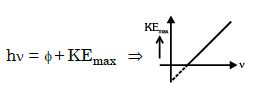
According to Einstein's photoelectric equation, the graph between the kinetic energy of photoelectrons ejected and the frequency of incident radiation is
A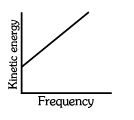
B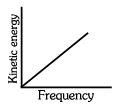
C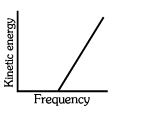
D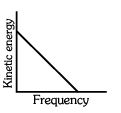
Solution
(C) Einstein's photoelectric equation is given by $K_{max} = h\nu - \phi$, where $K_{max}$ is the maximum kinetic energy of the photoelectrons, $h$ is Planck's constant, $\nu$ is the frequency of incident radiation, and $\phi$ is the work function of the metal.
This equation is of the form $y = mx + c$, where $y = K_{max}$, $x = \nu$, $m = h$ (slope), and $c = -\phi$ (y-intercept).
Since the slope $h$ is positive and the y-intercept $-\phi$ is negative, the graph is a straight line that starts from the x-axis at a threshold frequency $\nu_0 = \phi/h$ and has a positive slope.
Therefore, the graph starts from the x-axis at a positive frequency value.
This equation is of the form $y = mx + c$, where $y = K_{max}$, $x = \nu$, $m = h$ (slope), and $c = -\phi$ (y-intercept).
Since the slope $h$ is positive and the y-intercept $-\phi$ is negative, the graph is a straight line that starts from the x-axis at a threshold frequency $\nu_0 = \phi/h$ and has a positive slope.
Therefore, the graph starts from the x-axis at a positive frequency value.
0 likes
View Solution310
DifficultMCQ
The work functions of metals $A$ and $B$ are in the ratio $1 : 2$. If light of frequencies $f$ and $2f$ are incident on the surfaces of $A$ and $B$ respectively,the ratio of the maximum kinetic energy of photoelectrons emitted will be ($f$ and $2f$ are both frequencies greater than the threshold frequency of metals $A$ and $B$).
A
$1 : 1$
B
$1 : 2$
C
$1 : 3$
D
$1 : 4$
Solution
(B) Let the work function of metal $A$ be $\phi_A = \phi_0$ and metal $B$ be $\phi_B = 2\phi_0$.
According to Einstein's photoelectric equation,the maximum kinetic energy $E_K$ is given by $E_K = h\nu - \phi$.
For metal $A$: $E_{K_A} = hf - \phi_0$.
For metal $B$: $E_{K_B} = h(2f) - 2\phi_0 = 2(hf - \phi_0)$.
Taking the ratio of the maximum kinetic energies:
$\frac{E_{K_A}}{E_{K_B}} = \frac{hf - \phi_0}{2(hf - \phi_0)} = \frac{1}{2}$.
Thus,the ratio is $1 : 2$.
According to Einstein's photoelectric equation,the maximum kinetic energy $E_K$ is given by $E_K = h\nu - \phi$.
For metal $A$: $E_{K_A} = hf - \phi_0$.
For metal $B$: $E_{K_B} = h(2f) - 2\phi_0 = 2(hf - \phi_0)$.
Taking the ratio of the maximum kinetic energies:
$\frac{E_{K_A}}{E_{K_B}} = \frac{hf - \phi_0}{2(hf - \phi_0)} = \frac{1}{2}$.
Thus,the ratio is $1 : 2$.
0 likes
View Solution311
DifficultMCQ
In an experiment on the photoelectric effect,the wavelength of the incident radiation is $\lambda$. The wavelength of the incident radiation is reduced to $\frac{1}{3}$ of the initial value,and the maximum kinetic energy of the photoelectron is observed to be $n$ times the previous value. The threshold wavelength for the metal plate is:
A
$\left( \frac{n - 1}{n - 3} \right) \lambda$
B
$\left( \frac{n}{n - 3} \right) \lambda$
C
$\frac{(n + 1) \lambda}{n - 3}$
D
$\frac{3 \lambda}{n}$
Solution
(A) According to Einstein's photoelectric equation,the maximum kinetic energy $(KE)_{\max}$ is given by:
$(KE)_{\max} = hc \left( \frac{1}{\lambda} - \frac{1}{\lambda_0} \right)$
where $\lambda_0$ is the threshold wavelength.
For the initial case:
$(KE)_1 = hc \left( \frac{1}{\lambda} - \frac{1}{\lambda_0} \right)$ .........$(i)$
When the wavelength is reduced to $\frac{\lambda}{3}$,the new kinetic energy is $n$ times the initial value:
$(KE)_2 = n(KE)_1 = hc \left( \frac{1}{\lambda/3} - \frac{1}{\lambda_0} \right) = hc \left( \frac{3}{\lambda} - \frac{1}{\lambda_0} \right)$ .........$(ii)$
Dividing equation $(ii)$ by equation $(i)$:
$n = \frac{\frac{3}{\lambda} - \frac{1}{\lambda_0}}{\frac{1}{\lambda} - \frac{1}{\lambda_0}} = \frac{\frac{3\lambda_0 - \lambda}{\lambda \lambda_0}}{\frac{\lambda_0 - \lambda}{\lambda \lambda_0}} = \frac{3\lambda_0 - \lambda}{\lambda_0 - \lambda}$
$n(\lambda_0 - \lambda) = 3\lambda_0 - \lambda$
$n\lambda_0 - n\lambda = 3\lambda_0 - \lambda$
$n\lambda_0 - 3\lambda_0 = n\lambda - \lambda$
$\lambda_0(n - 3) = \lambda(n - 1)$
$\lambda_0 = \left( \frac{n - 1}{n - 3} \right) \lambda$
$(KE)_{\max} = hc \left( \frac{1}{\lambda} - \frac{1}{\lambda_0} \right)$
where $\lambda_0$ is the threshold wavelength.
For the initial case:
$(KE)_1 = hc \left( \frac{1}{\lambda} - \frac{1}{\lambda_0} \right)$ .........$(i)$
When the wavelength is reduced to $\frac{\lambda}{3}$,the new kinetic energy is $n$ times the initial value:
$(KE)_2 = n(KE)_1 = hc \left( \frac{1}{\lambda/3} - \frac{1}{\lambda_0} \right) = hc \left( \frac{3}{\lambda} - \frac{1}{\lambda_0} \right)$ .........$(ii)$
Dividing equation $(ii)$ by equation $(i)$:
$n = \frac{\frac{3}{\lambda} - \frac{1}{\lambda_0}}{\frac{1}{\lambda} - \frac{1}{\lambda_0}} = \frac{\frac{3\lambda_0 - \lambda}{\lambda \lambda_0}}{\frac{\lambda_0 - \lambda}{\lambda \lambda_0}} = \frac{3\lambda_0 - \lambda}{\lambda_0 - \lambda}$
$n(\lambda_0 - \lambda) = 3\lambda_0 - \lambda$
$n\lambda_0 - n\lambda = 3\lambda_0 - \lambda$
$n\lambda_0 - 3\lambda_0 = n\lambda - \lambda$
$\lambda_0(n - 3) = \lambda(n - 1)$
$\lambda_0 = \left( \frac{n - 1}{n - 3} \right) \lambda$
0 likes
View Solution312
DifficultMCQ
If in an experiment of photoelectric effect,the wavelength of light is decreased by $60\%$,then $K_{max}$ changes from $5\,eV$ to $17\,eV$. The work function of the metal is ............. $eV$.
A
$1$
B
$2$
C
$3$
D
$4$
Solution
(C) The Einstein's photoelectric equation is given by $K_{max} = \frac{hc}{\lambda} - \phi$.
Initially,$5\,eV = \frac{hc}{\lambda} - \phi$ ..........$(1)$
When the wavelength is decreased by $60\%$,the new wavelength $\lambda' = \lambda - 0.6\lambda = 0.4\lambda = \frac{2}{5}\lambda$.
Substituting this into the equation for the new kinetic energy:
$17\,eV = \frac{hc}{0.4\lambda} - \phi = \frac{2.5hc}{\lambda} - \phi$ ..........$(2)$
From equation $(1)$,we have $\frac{hc}{\lambda} = 5\,eV + \phi$.
Substitute this into equation $(2)$:
$17\,eV = 2.5(5\,eV + \phi) - \phi$
$17\,eV = 12.5\,eV + 2.5\phi - \phi$
$17\,eV - 12.5\,eV = 1.5\phi$
$4.5\,eV = 1.5\phi$
$\phi = \frac{4.5}{1.5}\,eV = 3\,eV$.
Thus,the work function of the metal is $3\,eV$.
Initially,$5\,eV = \frac{hc}{\lambda} - \phi$ ..........$(1)$
When the wavelength is decreased by $60\%$,the new wavelength $\lambda' = \lambda - 0.6\lambda = 0.4\lambda = \frac{2}{5}\lambda$.
Substituting this into the equation for the new kinetic energy:
$17\,eV = \frac{hc}{0.4\lambda} - \phi = \frac{2.5hc}{\lambda} - \phi$ ..........$(2)$
From equation $(1)$,we have $\frac{hc}{\lambda} = 5\,eV + \phi$.
Substitute this into equation $(2)$:
$17\,eV = 2.5(5\,eV + \phi) - \phi$
$17\,eV = 12.5\,eV + 2.5\phi - \phi$
$17\,eV - 12.5\,eV = 1.5\phi$
$4.5\,eV = 1.5\phi$
$\phi = \frac{4.5}{1.5}\,eV = 3\,eV$.
Thus,the work function of the metal is $3\,eV$.
0 likes
View Solution313
DifficultMCQ
$A$ photoelectric surface is illuminated successively by monochromatic light of wavelengths $\lambda$ and $\lambda/2$. If the maximum kinetic energy of the emitted photoelectrons in the second case is three times that in the first case,the work function of the surface is
A
$\frac{hc}{2\lambda}$
B
$\frac{3hc}{\lambda}$
C
$\frac{hc}{3\lambda}$
D
$\frac{hc}{\lambda}$
Solution
(A) According to Einstein's photoelectric equation,the maximum kinetic energy $K$ is given by $K = \frac{hc}{\lambda} - \phi$,where $\phi$ is the work function.
For the first case with wavelength $\lambda$: $K_1 = \frac{hc}{\lambda} - \phi$.
For the second case with wavelength $\lambda/2$: $K_2 = \frac{hc}{\lambda/2} - \phi = \frac{2hc}{\lambda} - \phi$.
Given that $K_2 = 3K_1$,we substitute the expressions:
$\frac{2hc}{\lambda} - \phi = 3 \left( \frac{hc}{\lambda} - \phi \right)$.
Expanding the equation: $\frac{2hc}{\lambda} - \phi = \frac{3hc}{\lambda} - 3\phi$.
Rearranging the terms to solve for $\phi$: $3\phi - \phi = \frac{3hc}{\lambda} - \frac{2hc}{\lambda}$.
$2\phi = \frac{hc}{\lambda}$.
Therefore,$\phi = \frac{hc}{2\lambda}$.
For the first case with wavelength $\lambda$: $K_1 = \frac{hc}{\lambda} - \phi$.
For the second case with wavelength $\lambda/2$: $K_2 = \frac{hc}{\lambda/2} - \phi = \frac{2hc}{\lambda} - \phi$.
Given that $K_2 = 3K_1$,we substitute the expressions:
$\frac{2hc}{\lambda} - \phi = 3 \left( \frac{hc}{\lambda} - \phi \right)$.
Expanding the equation: $\frac{2hc}{\lambda} - \phi = \frac{3hc}{\lambda} - 3\phi$.
Rearranging the terms to solve for $\phi$: $3\phi - \phi = \frac{3hc}{\lambda} - \frac{2hc}{\lambda}$.
$2\phi = \frac{hc}{\lambda}$.
Therefore,$\phi = \frac{hc}{2\lambda}$.
0 likes
View Solution314
MediumMCQ
The work functions of three metals $A, B$ and $C$ are $W_A, W_B$ and $W_C$ respectively. They are in decreasing order $(W_A > W_B > W_C)$. The correct graph between the maximum kinetic energy $E_k$ of the emitted electron and the frequency $v$ of the incident radiation is:
A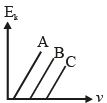
B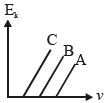
C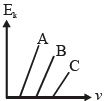
D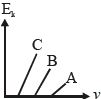
Solution
(B) According to Einstein's photoelectric equation,the maximum kinetic energy $E_k$ of the emitted photoelectrons is given by:
$E_k = hv - W$
where $h$ is Planck's constant,$v$ is the frequency of incident radiation,and $W$ is the work function of the metal.
This equation represents a straight line $y = mx + c$ where the slope $m = h$ is constant for all metals.
Therefore,the graphs for different metals must be parallel straight lines with the same slope.
Given the work functions are in the order $W_A > W_B > W_C$,the threshold frequencies $v_0$ (where $E_k = 0$) follow the same order since $W = hv_0$:
$(v_0)_A > (v_0)_B > (v_0)_C$
This means the x-intercept for metal $A$ is the largest,followed by $B$,and then $C$.
Among the given options,the graph where the lines are parallel and the x-intercepts follow the order $A > B > C$ is the correct one. Based on the provided images,the graph that shows parallel lines with the x-intercepts in the order $A > B > C$ is represented by option $B$.
$E_k = hv - W$
where $h$ is Planck's constant,$v$ is the frequency of incident radiation,and $W$ is the work function of the metal.
This equation represents a straight line $y = mx + c$ where the slope $m = h$ is constant for all metals.
Therefore,the graphs for different metals must be parallel straight lines with the same slope.
Given the work functions are in the order $W_A > W_B > W_C$,the threshold frequencies $v_0$ (where $E_k = 0$) follow the same order since $W = hv_0$:
$(v_0)_A > (v_0)_B > (v_0)_C$
This means the x-intercept for metal $A$ is the largest,followed by $B$,and then $C$.
Among the given options,the graph where the lines are parallel and the x-intercepts follow the order $A > B > C$ is the correct one. Based on the provided images,the graph that shows parallel lines with the x-intercepts in the order $A > B > C$ is represented by option $B$.
0 likes
View Solution315
DifficultMCQ
When a certain metallic surface is illuminated with monochromatic light of wavelength $\lambda$,the stopping potential for photoelectric current is $3V_0$. When the same surface is illuminated with light of wavelength $2\lambda$,the stopping potential is $V_0$. The threshold wavelength for this surface for the photoelectric effect is:
A
$6\lambda$
B
$4\lambda/3$
C
$4\lambda$
D
$8\lambda$
Solution
(C) According to Einstein's photoelectric equation: $\frac{hc}{\lambda} = \phi + eV_s$,where $\phi = \frac{hc}{\lambda_{th}}$ is the work function and $V_s$ is the stopping potential.
For the first case: $\frac{hc}{\lambda} = \frac{hc}{\lambda_{th}} + e(3V_0)$ --- $(1)$
For the second case: $\frac{hc}{2\lambda} = \frac{hc}{\lambda_{th}} + eV_0$ --- $(2)$
Multiply equation $(2)$ by $3$: $\frac{3hc}{2\lambda} = \frac{3hc}{\lambda_{th}} + 3eV_0$ --- $(3)$
Subtract equation $(1)$ from equation $(3)$:
$\frac{3hc}{2\lambda} - \frac{hc}{\lambda} = \frac{3hc}{\lambda_{th}} - \frac{hc}{\lambda_{th}}$
$\frac{hc}{2\lambda} = \frac{2hc}{\lambda_{th}}$
$\frac{1}{2\lambda} = \frac{2}{\lambda_{th}}$
$\lambda_{th} = 4\lambda$.
For the first case: $\frac{hc}{\lambda} = \frac{hc}{\lambda_{th}} + e(3V_0)$ --- $(1)$
For the second case: $\frac{hc}{2\lambda} = \frac{hc}{\lambda_{th}} + eV_0$ --- $(2)$
Multiply equation $(2)$ by $3$: $\frac{3hc}{2\lambda} = \frac{3hc}{\lambda_{th}} + 3eV_0$ --- $(3)$
Subtract equation $(1)$ from equation $(3)$:
$\frac{3hc}{2\lambda} - \frac{hc}{\lambda} = \frac{3hc}{\lambda_{th}} - \frac{hc}{\lambda_{th}}$
$\frac{hc}{2\lambda} = \frac{2hc}{\lambda_{th}}$
$\frac{1}{2\lambda} = \frac{2}{\lambda_{th}}$
$\lambda_{th} = 4\lambda$.
0 likes
View Solution316
DifficultMCQ
$A$ light whose frequency is equal to $6 \times 10^{14} \, Hz$ is incident on a metal whose work function is $2 \, eV$. $[h = 6.63 \times 10^{-34} \, Js, 1 \, eV = 1.6 \times 10^{-19} \, J]$. The maximum kinetic energy of the emitted electrons will be ............ $eV$. (in $.49$)
A
$2$
B
$4$
C
$0$
D
$5$
Solution
(C) The energy of the incident photon is given by $E = h\nu$.
Given: $h = 6.63 \times 10^{-34} \, Js$,$\nu = 6 \times 10^{14} \, Hz$.
$E = (6.63 \times 10^{-34}) \times (6 \times 10^{14}) \, J = 39.78 \times 10^{-20} \, J$.
To convert this energy into $eV$,we divide by $1.6 \times 10^{-19} \, J/eV$:
$E = \frac{39.78 \times 10^{-20}}{1.6 \times 10^{-19}} \, eV = 2.48625 \, eV \approx 2.49 \, eV$.
According to Einstein's photoelectric equation,the maximum kinetic energy $K_{max} = E - \Phi$,where $\Phi$ is the work function.
Given $\Phi = 2 \, eV$.
$K_{max} = 2.49 \, eV - 2 \, eV = 0.49 \, eV$.
Given: $h = 6.63 \times 10^{-34} \, Js$,$\nu = 6 \times 10^{14} \, Hz$.
$E = (6.63 \times 10^{-34}) \times (6 \times 10^{14}) \, J = 39.78 \times 10^{-20} \, J$.
To convert this energy into $eV$,we divide by $1.6 \times 10^{-19} \, J/eV$:
$E = \frac{39.78 \times 10^{-20}}{1.6 \times 10^{-19}} \, eV = 2.48625 \, eV \approx 2.49 \, eV$.
According to Einstein's photoelectric equation,the maximum kinetic energy $K_{max} = E - \Phi$,where $\Phi$ is the work function.
Given $\Phi = 2 \, eV$.
$K_{max} = 2.49 \, eV - 2 \, eV = 0.49 \, eV$.
0 likes
View Solution317
MediumMCQ
When light of wavelength $300 \ nm$ falls on a photoelectric emitter,photoelectrons are just liberated. For another emitter,light of wavelength $600 \ nm$ is just sufficient for liberating photoelectrons. The ratio of the work function of the two emitters is
A
$1 : 2$
B
$2 : 1$
C
$4 : 1$
D
$1 : 4$
Solution
(B) The work function $\phi_0$ of a photoelectric emitter is related to the threshold wavelength $\lambda_0$ by the equation $\phi_0 = \frac{hc}{\lambda_0}$.
Given that the photoelectrons are just liberated,the incident wavelength is equal to the threshold wavelength.
For the first emitter,$\lambda_{01} = 300 \ nm$.
For the second emitter,$\lambda_{02} = 600 \ nm$.
The ratio of the work functions is $\frac{\phi_{01}}{\phi_{02}} = \frac{hc / \lambda_{01}}{hc / \lambda_{02}} = \frac{\lambda_{02}}{\lambda_{01}}$.
Substituting the values: $\frac{\phi_{01}}{\phi_{02}} = \frac{600 \ nm}{300 \ nm} = \frac{2}{1}$.
Thus,the ratio is $2 : 1$.
Given that the photoelectrons are just liberated,the incident wavelength is equal to the threshold wavelength.
For the first emitter,$\lambda_{01} = 300 \ nm$.
For the second emitter,$\lambda_{02} = 600 \ nm$.
The ratio of the work functions is $\frac{\phi_{01}}{\phi_{02}} = \frac{hc / \lambda_{01}}{hc / \lambda_{02}} = \frac{\lambda_{02}}{\lambda_{01}}$.
Substituting the values: $\frac{\phi_{01}}{\phi_{02}} = \frac{600 \ nm}{300 \ nm} = \frac{2}{1}$.
Thus,the ratio is $2 : 1$.
0 likes
View Solution318
MediumMCQ
If a photocell is illuminated with a radiation of $1240 \, Å$, the stopping potential is found to be $8 \, V$; then the work function of the emitter and the threshold wavelength are
A
$2 \, eV, 2000 \, Å$
B
$2 \, eV, 6200 \, Å$
C
$2 \, eV, 2480 \, Å$
D
$3 \, eV, 6200 \, Å$
Solution
(B) The energy of the incident photon is given by $E = \frac{12400}{\lambda (\text{in } Å)} \, eV$.
Given $\lambda = 1240 \, Å$, so $E = \frac{12400}{1240} = 10 \, eV$.
According to Einstein's photoelectric equation, $E = W + K_{max}$, where $K_{max} = e V_s$.
Given stopping potential $V_s = 8 \, V$, so $K_{max} = 8 \, eV$.
Therefore, the work function $W = E - K_{max} = 10 \, eV - 8 \, eV = 2 \, eV$.
The threshold wavelength $\lambda_0$ is given by $\lambda_0 = \frac{12400}{W (\text{in } eV)} \, Å$.
$\lambda_0 = \frac{12400}{2} = 6200 \, Å$.
Given $\lambda = 1240 \, Å$, so $E = \frac{12400}{1240} = 10 \, eV$.
According to Einstein's photoelectric equation, $E = W + K_{max}$, where $K_{max} = e V_s$.
Given stopping potential $V_s = 8 \, V$, so $K_{max} = 8 \, eV$.
Therefore, the work function $W = E - K_{max} = 10 \, eV - 8 \, eV = 2 \, eV$.
The threshold wavelength $\lambda_0$ is given by $\lambda_0 = \frac{12400}{W (\text{in } eV)} \, Å$.
$\lambda_0 = \frac{12400}{2} = 6200 \, Å$.
0 likes
View Solution319
EasyMCQ
Light of frequency $4v_0$ is incident on a metal surface with a threshold frequency $v_0$. The maximum kinetic energy of the emitted photoelectrons is:
A
$3hv_0$
B
$2hv_0$
C
$\frac{3}{2}hv_0$
D
$\frac{1}{2}hv_0$
Solution
(A) According to Einstein's photoelectric equation,the energy of the incident photon is given by $E = h\nu$,where $\nu$ is the frequency of the incident light.
The photoelectric equation is $E = \phi_0 + K_{\max}$,where $\phi_0 = h\nu_0$ is the work function and $K_{\max}$ is the maximum kinetic energy of the emitted photoelectrons.
Given,the frequency of incident light $\nu = 4\nu_0$ and the threshold frequency is $\nu_0$.
Substituting these values into the equation:
$h(4\nu_0) = h\nu_0 + K_{\max}$
Solving for $K_{\max}$:
$K_{\max} = 4h\nu_0 - h\nu_0$
$K_{\max} = 3h\nu_0$
The photoelectric equation is $E = \phi_0 + K_{\max}$,where $\phi_0 = h\nu_0$ is the work function and $K_{\max}$ is the maximum kinetic energy of the emitted photoelectrons.
Given,the frequency of incident light $\nu = 4\nu_0$ and the threshold frequency is $\nu_0$.
Substituting these values into the equation:
$h(4\nu_0) = h\nu_0 + K_{\max}$
Solving for $K_{\max}$:
$K_{\max} = 4h\nu_0 - h\nu_0$
$K_{\max} = 3h\nu_0$
0 likes
View Solution320
MediumMCQ
The maximum velocity of the photoelectrons emitted from the surface is $v$ when light of frequency $n$ falls on a metal surface. If the incident frequency is increased to $3n$,the maximum velocity of the ejected photoelectrons will be:
A
less than $\sqrt{3} v$
B
$v$
C
more than $\sqrt{3} v$
D
equal to $\sqrt{3} v$
Solution
(C) According to Einstein's photoelectric equation,the maximum kinetic energy $KE_{\max}$ is given by $KE_{\max} = h n - \phi$,where $h$ is Planck's constant,$n$ is the frequency,and $\phi$ is the work function of the metal.
For the first case: $\frac{1}{2} m v^2 = h n - \phi$ ..... $(i)$
For the second case with frequency $3n$: $\frac{1}{2} m (v^{\prime})^2 = 3 h n - \phi$ ..... $(ii)$
From equation $(i)$,we have $h n = \frac{1}{2} m v^2 + \phi$. Substituting this into equation $(ii)$:
$\frac{1}{2} m (v^{\prime})^2 = 3 (\frac{1}{2} m v^2 + \phi) - \phi$
$\frac{1}{2} m (v^{\prime})^2 = \frac{3}{2} m v^2 + 2 \phi$
$(v^{\prime})^2 = 3 v^2 + \frac{4 \phi}{m}$
Since $\phi > 0$,it follows that $(v^{\prime})^2 > 3 v^2$,which implies $v^{\prime} > \sqrt{3} v$.
Therefore,the maximum velocity will be more than $\sqrt{3} v$.
For the first case: $\frac{1}{2} m v^2 = h n - \phi$ ..... $(i)$
For the second case with frequency $3n$: $\frac{1}{2} m (v^{\prime})^2 = 3 h n - \phi$ ..... $(ii)$
From equation $(i)$,we have $h n = \frac{1}{2} m v^2 + \phi$. Substituting this into equation $(ii)$:
$\frac{1}{2} m (v^{\prime})^2 = 3 (\frac{1}{2} m v^2 + \phi) - \phi$
$\frac{1}{2} m (v^{\prime})^2 = \frac{3}{2} m v^2 + 2 \phi$
$(v^{\prime})^2 = 3 v^2 + \frac{4 \phi}{m}$
Since $\phi > 0$,it follows that $(v^{\prime})^2 > 3 v^2$,which implies $v^{\prime} > \sqrt{3} v$.
Therefore,the maximum velocity will be more than $\sqrt{3} v$.
0 likes
View Solution321
DifficultMCQ
When photons of wavelength $\lambda_1$ are incident on an isolated sphere,the corresponding stopping potential is found to be $V$. When photons of wavelength $\lambda_2$ are used,the corresponding stopping potential is thrice that of the above value. If light of wavelength $\lambda_3$ is used,then find the stopping potential for this case.
A
$\frac{hc}{e}\left[ \frac{1}{\lambda_3} + \frac{1}{\lambda_2} - \frac{1}{\lambda_1} \right]$
B
$\frac{hc}{e}\left[ \frac{1}{\lambda_3} + \frac{1}{2\lambda_2} - \frac{1}{\lambda_1} \right]$
C
$\frac{hc}{e}\left[ \frac{1}{\lambda_3} - \frac{1}{\lambda_2} - \frac{1}{\lambda_1} \right]$
D
$\frac{hc}{e}\left[ \frac{1}{\lambda_3} + \frac{1}{2\lambda_2} - \frac{3}{2\lambda_1} \right]$
Solution
(D) From Einstein's photoelectric equation,the energy of the incident photon is equal to the work function plus the maximum kinetic energy,which is $eV_s$ where $V_s$ is the stopping potential.
For wavelength $\lambda_1$: $\frac{hc}{\lambda_1} = \phi + eV$ ..... $(1)$
For wavelength $\lambda_2$: $\frac{hc}{\lambda_2} = \phi + 3eV$ ..... $(2)$
For wavelength $\lambda_3$: $\frac{hc}{\lambda_3} = \phi + eV'$ ..... $(3)$
Subtracting $(1)$ from $(2)$ to eliminate $\phi$:
$\frac{hc}{\lambda_2} - \frac{hc}{\lambda_1} = 2eV \implies eV = \frac{hc}{2} \left( \frac{1}{\lambda_2} - \frac{1}{\lambda_1} \right)$
Now,find $\phi$ from $(1)$:
$\phi = \frac{hc}{\lambda_1} - eV = \frac{hc}{\lambda_1} - \frac{hc}{2} \left( \frac{1}{\lambda_2} - \frac{1}{\lambda_1} \right) = hc \left( \frac{1}{\lambda_1} - \frac{1}{2\lambda_2} + \frac{1}{2\lambda_1} \right) = hc \left( \frac{3}{2\lambda_1} - \frac{1}{2\lambda_2} \right)$
Substitute $\phi$ into $(3)$:
$eV' = \frac{hc}{\lambda_3} - \phi = \frac{hc}{\lambda_3} - hc \left( \frac{3}{2\lambda_1} - \frac{1}{2\lambda_2} \right)$
$V' = \frac{hc}{e} \left[ \frac{1}{\lambda_3} + \frac{1}{2\lambda_2} - \frac{3}{2\lambda_1} \right]$
For wavelength $\lambda_1$: $\frac{hc}{\lambda_1} = \phi + eV$ ..... $(1)$
For wavelength $\lambda_2$: $\frac{hc}{\lambda_2} = \phi + 3eV$ ..... $(2)$
For wavelength $\lambda_3$: $\frac{hc}{\lambda_3} = \phi + eV'$ ..... $(3)$
Subtracting $(1)$ from $(2)$ to eliminate $\phi$:
$\frac{hc}{\lambda_2} - \frac{hc}{\lambda_1} = 2eV \implies eV = \frac{hc}{2} \left( \frac{1}{\lambda_2} - \frac{1}{\lambda_1} \right)$
Now,find $\phi$ from $(1)$:
$\phi = \frac{hc}{\lambda_1} - eV = \frac{hc}{\lambda_1} - \frac{hc}{2} \left( \frac{1}{\lambda_2} - \frac{1}{\lambda_1} \right) = hc \left( \frac{1}{\lambda_1} - \frac{1}{2\lambda_2} + \frac{1}{2\lambda_1} \right) = hc \left( \frac{3}{2\lambda_1} - \frac{1}{2\lambda_2} \right)$
Substitute $\phi$ into $(3)$:
$eV' = \frac{hc}{\lambda_3} - \phi = \frac{hc}{\lambda_3} - hc \left( \frac{3}{2\lambda_1} - \frac{1}{2\lambda_2} \right)$
$V' = \frac{hc}{e} \left[ \frac{1}{\lambda_3} + \frac{1}{2\lambda_2} - \frac{3}{2\lambda_1} \right]$
0 likes
View Solution322
DifficultMCQ
$A$ beam of light has two wavelengths of $4972\,\mathring{A}$ and $6216\,\mathring{A}$ with a total intensity of $3.6 \times 10^{-3}\,\text{W/m}^2$ equally distributed among the two wavelengths. The beam falls normally on an area of $1\,\text{cm}^2$ of a clean metallic surface of work function $2.3\,\text{eV}$. Assume that there is no loss of light by reflection and that each capable photon ejects one electron. The number of photoelectrons liberated in $2\,\text{s}$ is approximately:
A
$6 \times 10^{11}$
B
$9 \times 10^{11}$
C
$11 \times 10^{11}$
D
$15 \times 10^{11}$
Solution
(B) Given: $\lambda_1 = 4972\,\mathring{A}$,$\lambda_2 = 6216\,\mathring{A}$,Total Intensity $I = 3.6 \times 10^{-3}\,\text{W/m}^2$,Area $A = 1\,\text{cm}^2 = 10^{-4}\,\text{m}^2$,Work function $\phi = 2.3\,\text{eV}$.
Intensity per wavelength $I' = I/2 = 1.8 \times 10^{-3}\,\text{W/m}^2$.
Energy of photons for each wavelength:
$E_1 = \frac{hc}{\lambda_1} = \frac{12400}{4972} \approx 2.49\,\text{eV} > 2.3\,\text{eV}$ (Capable of emission).
$E_2 = \frac{hc}{\lambda_2} = \frac{12400}{6216} \approx 1.99\,\text{eV} < 2.3\,\text{eV}$ (Not capable of emission).
Only photons of $\lambda_1$ contribute to photoelectric emission.
Power incident from $\lambda_1$ is $P = I' \times A = 1.8 \times 10^{-3} \times 10^{-4} = 1.8 \times 10^{-7}\,\text{W}$.
Number of photons per second $n = \frac{P}{E_1} = \frac{1.8 \times 10^{-7}}{2.49 \times 1.6 \times 10^{-19}} \approx 4.5 \times 10^{11}\,\text{photons/s}$.
Since each capable photon ejects one electron,the number of photoelectrons liberated in $2\,\text{s}$ is $N = n \times 2 = 4.5 \times 10^{11} \times 2 = 9 \times 10^{11}$.
Intensity per wavelength $I' = I/2 = 1.8 \times 10^{-3}\,\text{W/m}^2$.
Energy of photons for each wavelength:
$E_1 = \frac{hc}{\lambda_1} = \frac{12400}{4972} \approx 2.49\,\text{eV} > 2.3\,\text{eV}$ (Capable of emission).
$E_2 = \frac{hc}{\lambda_2} = \frac{12400}{6216} \approx 1.99\,\text{eV} < 2.3\,\text{eV}$ (Not capable of emission).
Only photons of $\lambda_1$ contribute to photoelectric emission.
Power incident from $\lambda_1$ is $P = I' \times A = 1.8 \times 10^{-3} \times 10^{-4} = 1.8 \times 10^{-7}\,\text{W}$.
Number of photons per second $n = \frac{P}{E_1} = \frac{1.8 \times 10^{-7}}{2.49 \times 1.6 \times 10^{-19}} \approx 4.5 \times 10^{11}\,\text{photons/s}$.
Since each capable photon ejects one electron,the number of photoelectrons liberated in $2\,\text{s}$ is $N = n \times 2 = 4.5 \times 10^{11} \times 2 = 9 \times 10^{11}$.
0 likes
View Solution323
DifficultMCQ
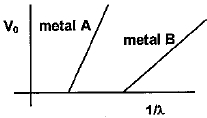
In an experiment on the photoelectric effect,a student plots the stopping potential $V_0$ against the reciprocal of the wavelength $1/\lambda$ of the incident light for two different metals $A$ and $B$. These are shown in the figure. Looking at the graphs,you can most appropriately say that:
A
Work function of metal $B$ is greater than that of metal $A$.
B
For light of a certain wavelength falling on both metals,the maximum kinetic energy of electrons emitted from $A$ will be greater than those emitted from $B$.
C
Work function of metal $A$ is greater than that of metal $B$.
D
Student's data is not correct.
Solution
(A) According to Einstein's photoelectric equation: $eV_0 = \frac{hc}{\lambda} - \phi$,where $\phi$ is the work function.
Rearranging this,we get: $V_0 = \frac{hc}{e} \left(\frac{1}{\lambda}\right) - \frac{\phi}{e}$.
This is the equation of a straight line $y = mx + c$,where the slope $m = \frac{hc}{e}$ is constant for both metals,and the x-intercept is $\frac{1}{\lambda_0} = \frac{\phi}{hc}$.
From the graph,the x-intercept for metal $A$ is smaller than the x-intercept for metal $B$. Since the x-intercept is proportional to the work function $\phi$ (i.e.,$\phi = hc \cdot (1/\lambda_0)$),a smaller x-intercept implies a smaller work function.
Therefore,$\phi_A < \phi_B$,which means the work function of metal $B$ is greater than that of metal $A$.
Rearranging this,we get: $V_0 = \frac{hc}{e} \left(\frac{1}{\lambda}\right) - \frac{\phi}{e}$.
This is the equation of a straight line $y = mx + c$,where the slope $m = \frac{hc}{e}$ is constant for both metals,and the x-intercept is $\frac{1}{\lambda_0} = \frac{\phi}{hc}$.
From the graph,the x-intercept for metal $A$ is smaller than the x-intercept for metal $B$. Since the x-intercept is proportional to the work function $\phi$ (i.e.,$\phi = hc \cdot (1/\lambda_0)$),a smaller x-intercept implies a smaller work function.
Therefore,$\phi_A < \phi_B$,which means the work function of metal $B$ is greater than that of metal $A$.
0 likes
View Solution324
DifficultMCQ
$A$ copper ball of radius $1\, cm$ and work function $4.47\, eV$ is irradiated with ultraviolet radiation of wavelength $2500\, \mathring{A}$. The effect of irradiation results in the emission of electrons from the ball. Further,the ball will acquire charge,and due to this,there will be a finite value of the potential on the ball. The charge acquired by the ball is:
A
$5.5 \times 10^{-13}\, C$
B
$7.5 \times 10^{-13}\, C$
C
$4.5 \times 10^{-12}\, C$
D
$2.5 \times 10^{-11}\, C$
Solution
(A) The energy of the incident photon is given by $E = \frac{hc}{\lambda} = \frac{12400}{\lambda(\text{in } \mathring{A})} \, eV$.
Substituting $\lambda = 2500\, \mathring{A}$,we get $E = \frac{12400}{2500} = 4.96\, eV$.
The maximum kinetic energy of the emitted electrons is $K_{max} = E - \Phi$,where $\Phi = 4.47\, eV$ is the work function.
$K_{max} = 4.96 - 4.47 = 0.49\, eV$.
As the ball emits electrons,it becomes positively charged,creating a potential $V$ that stops further emission. The stopping potential $V$ is equal to $K_{max}/e$,so $V = 0.49\, V$.
The potential of a charged sphere is $V = \frac{1}{4\pi\epsilon_0} \frac{Q}{r} = k \frac{Q}{r}$,where $k = 9 \times 10^9\, N\cdot m^2/C^2$ and $r = 0.01\, m$.
$0.49 = \frac{9 \times 10^9 \times Q}{0.01}$.
$Q = \frac{0.49 \times 0.01}{9 \times 10^9} = \frac{0.0049}{9 \times 10^9} \approx 5.44 \times 10^{-13}\, C$.
Rounding to the nearest option,$Q = 5.5 \times 10^{-13}\, C$.
Substituting $\lambda = 2500\, \mathring{A}$,we get $E = \frac{12400}{2500} = 4.96\, eV$.
The maximum kinetic energy of the emitted electrons is $K_{max} = E - \Phi$,where $\Phi = 4.47\, eV$ is the work function.
$K_{max} = 4.96 - 4.47 = 0.49\, eV$.
As the ball emits electrons,it becomes positively charged,creating a potential $V$ that stops further emission. The stopping potential $V$ is equal to $K_{max}/e$,so $V = 0.49\, V$.
The potential of a charged sphere is $V = \frac{1}{4\pi\epsilon_0} \frac{Q}{r} = k \frac{Q}{r}$,where $k = 9 \times 10^9\, N\cdot m^2/C^2$ and $r = 0.01\, m$.
$0.49 = \frac{9 \times 10^9 \times Q}{0.01}$.
$Q = \frac{0.49 \times 0.01}{9 \times 10^9} = \frac{0.0049}{9 \times 10^9} \approx 5.44 \times 10^{-13}\, C$.
Rounding to the nearest option,$Q = 5.5 \times 10^{-13}\, C$.
0 likes
View Solution325
MediumMCQ
This question has Statement $1$ and Statement $2.$ Of the four choices given after the Statements,choose the one that best describes the two Statements.
Statement $1:$ $A$ metallic surface is irradiated by a monochromatic light of frequency $v > v_0$ (the threshold frequency). If the incident frequency is now doubled,the photocurrent and the maximum kinetic energy are also doubled.
Statement $2:$ The maximum kinetic energy of photoelectrons emitted from a surface is linearly dependent on the frequency of the incident light. The photocurrent depends only on the intensity of the incident light.
Statement $1:$ $A$ metallic surface is irradiated by a monochromatic light of frequency $v > v_0$ (the threshold frequency). If the incident frequency is now doubled,the photocurrent and the maximum kinetic energy are also doubled.
Statement $2:$ The maximum kinetic energy of photoelectrons emitted from a surface is linearly dependent on the frequency of the incident light. The photocurrent depends only on the intensity of the incident light.
A
Statement $1$ is true,Statement $2$ is true,Statement $2$ is the correct explanation of Statement $1$.
B
Statement $1$ is false,Statement $2$ is true.
C
Statement $1$ is true,Statement $2$ is false.
D
Statement $1$ is true,Statement $2$ is true,Statement $2$ is not the correct explanation of Statement $1$.
Solution
(B) According to Einstein's photoelectric equation,the maximum kinetic energy $K_{max}$ is given by $K_{max} = hv - hv_0$,where $h$ is Planck's constant,$v$ is the frequency of incident light,and $v_0$ is the threshold frequency.
If the frequency $v$ is doubled to $2v$,the new kinetic energy $K'_{max} = h(2v) - hv_0 = 2hv - hv_0$. This is not equal to $2K_{max} = 2(hv - hv_0) = 2hv - 2hv_0$. Thus,the maximum kinetic energy does not double.
Furthermore,the photocurrent depends on the number of photons incident per unit time,which is proportional to the intensity of the light,not the frequency. Therefore,Statement $1$ is false.
Statement $2$ correctly states that $K_{max}$ depends linearly on frequency and photocurrent depends on intensity. Thus,Statement $2$ is true.
If the frequency $v$ is doubled to $2v$,the new kinetic energy $K'_{max} = h(2v) - hv_0 = 2hv - hv_0$. This is not equal to $2K_{max} = 2(hv - hv_0) = 2hv - 2hv_0$. Thus,the maximum kinetic energy does not double.
Furthermore,the photocurrent depends on the number of photons incident per unit time,which is proportional to the intensity of the light,not the frequency. Therefore,Statement $1$ is false.
Statement $2$ correctly states that $K_{max}$ depends linearly on frequency and photocurrent depends on intensity. Thus,Statement $2$ is true.
0 likes
View Solution326
MediumMCQ
Photoelectrons are ejected from a metal when light of frequency $v$ falls on it. Pick out the wrong statement from the following:
A
No electrons are emitted if $v$ is less than $W/h$,where $W$ is the work function of the metal.
B
The ejection of the photoelectrons is instantaneous.
C
The maximum energy of the photoelectrons is $hv$.
D
The maximum energy of the photoelectrons is independent of the intensity of the light.
Solution
(C) According to Einstein's photoelectric equation,the maximum kinetic energy $(K.E_{max})$ of the ejected photoelectrons is given by: $K.E_{max} = hv - W$,where $h$ is Planck's constant,$v$ is the frequency of incident light,and $W$ is the work function of the metal.
Option $A$ is correct because if $v < W/h$,then $hv < W$,meaning the incident energy is insufficient to overcome the work function.
Option $B$ is correct as the photoelectric effect is an instantaneous process.
Option $D$ is correct because $K.E_{max}$ depends only on the frequency of the incident light,not its intensity.
Option $C$ is incorrect because the maximum kinetic energy is $hv - W$,not $hv$.
Option $A$ is correct because if $v < W/h$,then $hv < W$,meaning the incident energy is insufficient to overcome the work function.
Option $B$ is correct as the photoelectric effect is an instantaneous process.
Option $D$ is correct because $K.E_{max}$ depends only on the frequency of the incident light,not its intensity.
Option $C$ is incorrect because the maximum kinetic energy is $hv - W$,not $hv$.
0 likes
View Solution327
DifficultMCQ
The surface of a certain metal is first illuminated with light of wavelength $\lambda_1 = 350 \ nm$ and then with light of wavelength $\lambda_2 = 540 \ nm$. It is found that the maximum speed of the photoelectrons in the two cases differs by a factor of $2$. The work function of the metal (in $eV$) is close to: (Energy of photon $= \frac{1240}{\lambda \text{ (in } nm)} \ eV$)
A
$1.8$
B
$2.5$
C
$5.6$
D
$1.4$
Solution
(A) Let the work function be $\phi$. The energy of the incident photons is given by $E = \frac{1240}{\lambda} \ eV$.
For $\lambda_1 = 350 \ nm$,$E_1 = \frac{1240}{350} \approx 3.543 \ eV$.
For $\lambda_2 = 540 \ nm$,$E_2 = \frac{1240}{540} \approx 2.296 \ eV$.
According to Einstein's photoelectric equation,$KE_{max} = E - \phi$.
Let $v_1$ and $v_2$ be the maximum speeds. Given $v_1 = 2v_2$,so $KE_1 = 4 KE_2$.
$3.543 - \phi = 4(2.296 - \phi)$.
$3.543 - \phi = 9.184 - 4\phi$.
$3\phi = 9.184 - 3.543 = 5.641$.
$\phi = \frac{5.641}{3} \approx 1.88 \ eV$.
The closest value is $1.8 \ eV$.
For $\lambda_1 = 350 \ nm$,$E_1 = \frac{1240}{350} \approx 3.543 \ eV$.
For $\lambda_2 = 540 \ nm$,$E_2 = \frac{1240}{540} \approx 2.296 \ eV$.
According to Einstein's photoelectric equation,$KE_{max} = E - \phi$.
Let $v_1$ and $v_2$ be the maximum speeds. Given $v_1 = 2v_2$,so $KE_1 = 4 KE_2$.
$3.543 - \phi = 4(2.296 - \phi)$.
$3.543 - \phi = 9.184 - 4\phi$.
$3\phi = 9.184 - 3.543 = 5.641$.
$\phi = \frac{5.641}{3} \approx 1.88 \ eV$.
The closest value is $1.8 \ eV$.
0 likes
View Solution328
DifficultMCQ
The magnetic field associated with a light wave is given,at the origin,by $B = B_0 [\sin(3.14 \times 10^7 ct) + \sin(6.28 \times 10^7 ct)]$. If this light falls on a silver plate having a work function of $4.7 \ eV$,what will be the maximum kinetic energy of the photoelectrons? (in $eV$)
A
$6.82$
B
$12.5$
C
$8.52$
D
$7.72$
Solution
(D) The magnetic field is given by $B = B_0 [\sin(\omega_1 t) + \sin(\omega_2 t)]$,where $\omega_1 = 3.14 \times 10^7 c$ and $\omega_2 = 6.28 \times 10^7 c$.
Since $\omega = 2\pi \nu$,the frequencies are $\nu_1 = \frac{3.14 \times 10^7 c}{2\pi} = 0.5 \times 10^7 c$ and $\nu_2 = \frac{6.28 \times 10^7 c}{2\pi} = 1.0 \times 10^7 c$.
The maximum frequency is $\nu_{\max} = 1.0 \times 10^7 \times (3 \times 10^8) = 3 \times 10^{15} \ Hz$.
The energy of the photon is $E = h\nu_{\max} = (6.63 \times 10^{-34} \ J\cdot s) \times (3 \times 10^{15} \ Hz) = 1.989 \times 10^{-18} \ J$.
Converting to $eV$: $E = \frac{1.989 \times 10^{-18}}{1.6 \times 10^{-19}} \approx 12.43 \ eV$.
The maximum kinetic energy is $KE_{\max} = E - \phi = 12.43 \ eV - 4.7 \ eV = 7.73 \ eV$. The closest option is $7.72 \ eV$.
Since $\omega = 2\pi \nu$,the frequencies are $\nu_1 = \frac{3.14 \times 10^7 c}{2\pi} = 0.5 \times 10^7 c$ and $\nu_2 = \frac{6.28 \times 10^7 c}{2\pi} = 1.0 \times 10^7 c$.
The maximum frequency is $\nu_{\max} = 1.0 \times 10^7 \times (3 \times 10^8) = 3 \times 10^{15} \ Hz$.
The energy of the photon is $E = h\nu_{\max} = (6.63 \times 10^{-34} \ J\cdot s) \times (3 \times 10^{15} \ Hz) = 1.989 \times 10^{-18} \ J$.
Converting to $eV$: $E = \frac{1.989 \times 10^{-18}}{1.6 \times 10^{-19}} \approx 12.43 \ eV$.
The maximum kinetic energy is $KE_{\max} = E - \phi = 12.43 \ eV - 4.7 \ eV = 7.73 \ eV$. The closest option is $7.72 \ eV$.
0 likes
View Solution329
DifficultMCQ
$A$ metal plate of area $1 \times 10^{-4} \, m^2$ is illuminated by radiation of intensity $16 \, mW/m^2$. The work function of the metal is $5 \, eV$. The energy of the incident photons is $10 \, eV$ and only $10\%$ of the incident photons produce photoelectrons. The number of emitted photoelectrons per second and their maximum kinetic energy, respectively, will be: $[1 \, eV = 1.6 \times 10^{-19} \, J]$
A
$10^{14}$ and $10 \, eV$
B
$10^{12}$ and $5 \, eV$
C
$10^{11}$ and $5 \, eV$
D
$10^{10}$ and $5 \, eV$
Solution
(C) $1$. Calculate the number of incident photons per second $(N_i)$:
Intensity $I = 16 \, mW/m^2 = 16 \times 10^{-3} \, W/m^2$.
Area $A = 1 \times 10^{-4} \, m^2$.
Energy of one photon $E = 10 \, eV = 10 \times 1.6 \times 10^{-19} \, J = 1.6 \times 10^{-18} \, J$.
Total power incident $P = I \times A = 16 \times 10^{-3} \times 10^{-4} = 16 \times 10^{-7} \, W$.
$N_i = P / E = (16 \times 10^{-7}) / (1.6 \times 10^{-18}) = 10^{12} \, \text{photons/second}$.
$2$. Calculate the number of emitted photoelectrons per second $(N_e)$:
$N_e = 10\% \text{ of } N_i = 0.1 \times 10^{12} = 10^{11} \, \text{electrons/second}$.
$3$. Calculate the maximum kinetic energy $(K_{\max})$:
Using Einstein's photoelectric equation: $K_{\max} = E - \phi = 10 \, eV - 5 \, eV = 5 \, eV$.
Intensity $I = 16 \, mW/m^2 = 16 \times 10^{-3} \, W/m^2$.
Area $A = 1 \times 10^{-4} \, m^2$.
Energy of one photon $E = 10 \, eV = 10 \times 1.6 \times 10^{-19} \, J = 1.6 \times 10^{-18} \, J$.
Total power incident $P = I \times A = 16 \times 10^{-3} \times 10^{-4} = 16 \times 10^{-7} \, W$.
$N_i = P / E = (16 \times 10^{-7}) / (1.6 \times 10^{-18}) = 10^{12} \, \text{photons/second}$.
$2$. Calculate the number of emitted photoelectrons per second $(N_e)$:
$N_e = 10\% \text{ of } N_i = 0.1 \times 10^{12} = 10^{11} \, \text{electrons/second}$.
$3$. Calculate the maximum kinetic energy $(K_{\max})$:
Using Einstein's photoelectric equation: $K_{\max} = E - \phi = 10 \, eV - 5 \, eV = 5 \, eV$.
0 likes
View Solution330
DifficultMCQ
In a photoelectric experiment,the wavelength of the light incident on a metal is changed from $300\, nm$ to $400\, nm$. The decrease in the stopping potential is close to ................ $V$ $\left( \frac{hc}{e} = 1240\, nm \cdot V \right)$
A
$0.5$
B
$1.5$
C
$1$
D
$2$
Solution
(C) According to Einstein's photoelectric equation:
$\frac{hc}{\lambda_{1}} = \phi + eV_{1}$ ...... $(i)$
$\frac{hc}{\lambda_{2}} = \phi + eV_{2}$ ...... $(ii)$
Subtracting equation $(ii)$ from $(i)$:
$\frac{hc}{\lambda_{1}} - \frac{hc}{\lambda_{2}} = e(V_{1} - V_{2})$
$hc \left( \frac{1}{\lambda_{1}} - \frac{1}{\lambda_{2}} \right) = e \Delta V$
$\Delta V = \frac{hc}{e} \left( \frac{\lambda_{2} - \lambda_{1}}{\lambda_{1} \lambda_{2}} \right)$
Given $\frac{hc}{e} = 1240\, nm \cdot V$,$\lambda_{1} = 300\, nm$,and $\lambda_{2} = 400\, nm$:
$\Delta V = 1240 \times \left( \frac{400 - 300}{300 \times 400} \right)$
$\Delta V = 1240 \times \left( \frac{100}{120000} \right)$
$\Delta V = \frac{1240}{1200} \approx 1.03\, V$
Thus,the decrease in stopping potential is close to $1\, V$.
$\frac{hc}{\lambda_{1}} = \phi + eV_{1}$ ...... $(i)$
$\frac{hc}{\lambda_{2}} = \phi + eV_{2}$ ...... $(ii)$
Subtracting equation $(ii)$ from $(i)$:
$\frac{hc}{\lambda_{1}} - \frac{hc}{\lambda_{2}} = e(V_{1} - V_{2})$
$hc \left( \frac{1}{\lambda_{1}} - \frac{1}{\lambda_{2}} \right) = e \Delta V$
$\Delta V = \frac{hc}{e} \left( \frac{\lambda_{2} - \lambda_{1}}{\lambda_{1} \lambda_{2}} \right)$
Given $\frac{hc}{e} = 1240\, nm \cdot V$,$\lambda_{1} = 300\, nm$,and $\lambda_{2} = 400\, nm$:
$\Delta V = 1240 \times \left( \frac{400 - 300}{300 \times 400} \right)$
$\Delta V = 1240 \times \left( \frac{100}{120000} \right)$
$\Delta V = \frac{1240}{1200} \approx 1.03\, V$
Thus,the decrease in stopping potential is close to $1\, V$.
0 likes
View Solution331
MediumMCQ
When a certain photosensitive surface is illuminated with monochromatic light of frequency $v$,the stopping potential for the photocurrent is $-V_0/2$. When the surface is illuminated by monochromatic light of frequency $v/2$,the stopping potential is $-V_0$. The threshold frequency for photoelectric emission is
A
$5v/3$
B
$4v/3$
C
$2v$
D
$3v/2$
Solution
(D) According to Einstein's photoelectric equation,the stopping potential $V_s$ is related to the frequency $v$ by the equation: $eV_s = hv - \phi$,where $\phi = hv_0$ is the work function and $v_0$ is the threshold frequency.
For the first case: $e(V_0/2) = hv - \phi$ ..... $(1)$
For the second case: $e(V_0) = h(v/2) - \phi$ ..... $(2)$
Note: The stopping potential is given as negative,which indicates the magnitude of the potential required to stop the electrons. Thus,$eV_s = h(v - v_0)$.
From $(1)$: $eV_0/2 = hv - hv_0 \Rightarrow eV_0 = 2hv - 2hv_0$
From $(2)$: $eV_0 = hv/2 - hv_0$
Equating the two expressions for $eV_0$:
$2hv - 2hv_0 = hv/2 - hv_0$
$2hv - hv/2 = 2hv_0 - hv_0$
$3hv/2 = hv_0$
$v_0 = 3v/2$.
For the first case: $e(V_0/2) = hv - \phi$ ..... $(1)$
For the second case: $e(V_0) = h(v/2) - \phi$ ..... $(2)$
Note: The stopping potential is given as negative,which indicates the magnitude of the potential required to stop the electrons. Thus,$eV_s = h(v - v_0)$.
From $(1)$: $eV_0/2 = hv - hv_0 \Rightarrow eV_0 = 2hv - 2hv_0$
From $(2)$: $eV_0 = hv/2 - hv_0$
Equating the two expressions for $eV_0$:
$2hv - 2hv_0 = hv/2 - hv_0$
$2hv - hv/2 = 2hv_0 - hv_0$
$3hv/2 = hv_0$
$v_0 = 3v/2$.
0 likes
View Solution332
DifficultMCQ
The electric field of a light wave is given as $\vec E = 10^{-3} \cos \left( \frac{2\pi x}{5 \times 10^{-7}} - 2\pi \times 6 \times 10^{14} t \right) \hat x \, N/C$. This light falls on a metal plate with a work function of $2 \, eV$. The stopping potential of the photoelectrons is ................ $V$.
A
$0.48$
B
$2.48$
C
$0.72$
D
$2$
Solution
(A) The given electric field equation is in the form $\vec E = E_0 \cos(kx - \omega t)$.
Comparing the given equation,the angular frequency is $\omega = 2\pi \times 6 \times 10^{14} \, rad/s$.
The frequency $f$ is given by $f = \frac{\omega}{2\pi} = 6 \times 10^{14} \, Hz$.
The energy of a photon is $E = hf = \frac{hc}{\lambda}$. Using $E(eV) \approx \frac{12400}{\lambda(\mathring{A})}$,we first find $\lambda = \frac{c}{f} = \frac{3 \times 10^8}{6 \times 10^{14}} = 5 \times 10^{-7} \, m = 5000 \, \mathring{A}$.
Thus,$E = \frac{12400}{5000} = 2.48 \, eV$.
Using Einstein's photoelectric equation: $K_{max} = E - \phi$,where $\phi = 2 \, eV$.
$eV_s = 2.48 - 2 = 0.48 \, eV$.
Therefore,the stopping potential $V_s = 0.48 \, V$.
Comparing the given equation,the angular frequency is $\omega = 2\pi \times 6 \times 10^{14} \, rad/s$.
The frequency $f$ is given by $f = \frac{\omega}{2\pi} = 6 \times 10^{14} \, Hz$.
The energy of a photon is $E = hf = \frac{hc}{\lambda}$. Using $E(eV) \approx \frac{12400}{\lambda(\mathring{A})}$,we first find $\lambda = \frac{c}{f} = \frac{3 \times 10^8}{6 \times 10^{14}} = 5 \times 10^{-7} \, m = 5000 \, \mathring{A}$.
Thus,$E = \frac{12400}{5000} = 2.48 \, eV$.
Using Einstein's photoelectric equation: $K_{max} = E - \phi$,where $\phi = 2 \, eV$.
$eV_s = 2.48 - 2 = 0.48 \, eV$.
Therefore,the stopping potential $V_s = 0.48 \, V$.
0 likes
View Solution333
MediumMCQ
In a photoelectric effect experiment,the threshold wavelength of incident light is $380 \, nm$. If the wavelength of the incident light is $260 \, nm$,the maximum kinetic energy of emitted electrons will be: .............. $eV$. Given $E \text{ (in } eV) = \frac{1237}{\lambda \text{ (in } nm)}$.
A
$15.1$
B
$1.5$
C
$4.5$
D
$3$
Solution
(B) According to Einstein's photoelectric equation,the maximum kinetic energy $K_{\max}$ is given by:
$K_{\max} = E - \phi$
where $E$ is the energy of the incident photon and $\phi$ is the work function.
Given $E = \frac{1237}{\lambda}$ and $\phi = \frac{1237}{\lambda_0}$,where $\lambda_0 = 380 \, nm$ and $\lambda = 260 \, nm$.
$K_{\max} = \frac{1237}{260} - \frac{1237}{380}$
$K_{\max} = 1237 \times \left( \frac{380 - 260}{380 \times 260} \right)$
$K_{\max} = 1237 \times \left( \frac{120}{98800} \right)$
$K_{\max} \approx 1.5 \, eV$.
$K_{\max} = E - \phi$
where $E$ is the energy of the incident photon and $\phi$ is the work function.
Given $E = \frac{1237}{\lambda}$ and $\phi = \frac{1237}{\lambda_0}$,where $\lambda_0 = 380 \, nm$ and $\lambda = 260 \, nm$.
$K_{\max} = \frac{1237}{260} - \frac{1237}{380}$
$K_{\max} = 1237 \times \left( \frac{380 - 260}{380 \times 260} \right)$
$K_{\max} = 1237 \times \left( \frac{120}{98800} \right)$
$K_{\max} \approx 1.5 \, eV$.
0 likes
View Solution334
MediumMCQ
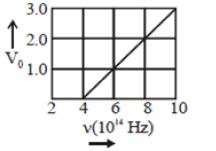
The stopping potential $V_0$ (in $volt$) as a function of frequency $(\nu)$ for a sodium emitter is shown in the figure. The work function of sodium,from the data plotted in the figure,will be: ................. $eV$
(Given: Planck's constant $(h) = 6.63 \times 10^{-34} \, Js$,electron charge $e = 1.6 \times 10^{-19} \, C$)
(Given: Planck's constant $(h) = 6.63 \times 10^{-34} \, Js$,electron charge $e = 1.6 \times 10^{-19} \, C$)
A
$1.82$
B
$1.66$
C
$2.12$
D
$1.95$
Solution
(B) According to Einstein's photoelectric equation:
$h\nu = \phi + eV_0$
Rearranging for the stopping potential $V_0$:
$V_0 = \frac{h\nu}{e} - \frac{\phi}{e}$
From the given graph,the threshold frequency $(\nu_0)$ is the frequency at which the stopping potential $V_0$ becomes zero. Looking at the graph,$V_0 = 0$ when $\nu = 4 \times 10^{14} \, Hz$.
At this point:
$0 = \frac{h\nu_0}{e} - \frac{\phi}{e}$
$\Rightarrow \phi = h\nu_0$
Substituting the values:
$\phi = (6.63 \times 10^{-34} \, Js) \times (4 \times 10^{14} \, Hz)$
$\phi = 26.52 \times 10^{-20} \, J$
To convert the work function into electron-volts $(eV)$:
$\phi (eV) = \frac{26.52 \times 10^{-20} \, J}{1.6 \times 10^{-19} \, C}$
$\phi = 1.6575 \, eV \approx 1.66 \, eV$
$h\nu = \phi + eV_0$
Rearranging for the stopping potential $V_0$:
$V_0 = \frac{h\nu}{e} - \frac{\phi}{e}$
From the given graph,the threshold frequency $(\nu_0)$ is the frequency at which the stopping potential $V_0$ becomes zero. Looking at the graph,$V_0 = 0$ when $\nu = 4 \times 10^{14} \, Hz$.
At this point:
$0 = \frac{h\nu_0}{e} - \frac{\phi}{e}$
$\Rightarrow \phi = h\nu_0$
Substituting the values:
$\phi = (6.63 \times 10^{-34} \, Js) \times (4 \times 10^{14} \, Hz)$
$\phi = 26.52 \times 10^{-20} \, J$
To convert the work function into electron-volts $(eV)$:
$\phi (eV) = \frac{26.52 \times 10^{-20} \, J}{1.6 \times 10^{-19} \, C}$
$\phi = 1.6575 \, eV \approx 1.66 \, eV$
0 likes
View Solution335
DifficultMCQ
In the experiment of $P.E.E.$,the $KE_{max}$ of an electron is $K_0$. If the frequency is increased by a factor of $n_1$,then the $KE_{max}$ becomes $n_2K_0$. Find the work function.
A
$\left( \frac{n_2 - n_1}{n_1 - 1} \right) K_0$
B
$\left( \frac{n_2 - n_1}{n_2 + n_1} \right) K_0$
C
$\left( \frac{n_2 + n_1}{n_2 - n_1} \right) K_0$
D
$\left( \frac{n_2 + n_1}{n_2 - 1} \right) K_0$
Solution
(A) According to Einstein's photoelectric equation,$hf = \phi_0 + KE_{max}$.
For the $1^{\text{st}}$ case: $hf = \phi_0 + K_0$ --- $(1)$
For the $2^{\text{nd}}$ case,the frequency is increased by a factor of $n_1$,so the new frequency is $n_1f$. The new $KE_{max}$ is $n_2K_0$:
$n_1hf = \phi_0 + n_2K_0$ --- $(2)$
Substitute $hf$ from equation $(1)$ into equation $(2)$:
$n_1(\phi_0 + K_0) = \phi_0 + n_2K_0$
Expand the equation:
$n_1\phi_0 + n_1K_0 = \phi_0 + n_2K_0$
Rearrange to solve for $\phi_0$:
$n_1\phi_0 - \phi_0 = n_2K_0 - n_1K_0$
$\phi_0(n_1 - 1) = K_0(n_2 - n_1)$
Therefore,the work function is:
$\phi_0 = \left( \frac{n_2 - n_1}{n_1 - 1} \right) K_0$
For the $1^{\text{st}}$ case: $hf = \phi_0 + K_0$ --- $(1)$
For the $2^{\text{nd}}$ case,the frequency is increased by a factor of $n_1$,so the new frequency is $n_1f$. The new $KE_{max}$ is $n_2K_0$:
$n_1hf = \phi_0 + n_2K_0$ --- $(2)$
Substitute $hf$ from equation $(1)$ into equation $(2)$:
$n_1(\phi_0 + K_0) = \phi_0 + n_2K_0$
Expand the equation:
$n_1\phi_0 + n_1K_0 = \phi_0 + n_2K_0$
Rearrange to solve for $\phi_0$:
$n_1\phi_0 - \phi_0 = n_2K_0 - n_1K_0$
$\phi_0(n_1 - 1) = K_0(n_2 - n_1)$
Therefore,the work function is:
$\phi_0 = \left( \frac{n_2 - n_1}{n_1 - 1} \right) K_0$
0 likes
View Solution336
DifficultMCQ
When a photon of energy $4.25 \, eV$ strikes the surface of a metal $A$,the ejected photoelectrons have a maximum kinetic energy $T_A \, eV$ and de-Broglie wavelength ${\lambda _A}$. The maximum kinetic energy of photoelectrons liberated from another metal $B$ by a photon of energy $4.70 \, eV$ is $T_B = (T_A - 1.50) \, eV$. If the de-Broglie wavelength of these photoelectrons is ${\lambda _B} = 2{\lambda _A}$,then:
A
The work function of $A$ is $2.75 \, eV$
B
The work function of $B$ is $4.20 \, eV$
C
$T_A = -2.25 \, eV$
D
$T_B = 2.75 \, eV$
Solution
(B) From Einstein's photoelectric equation:
$4.25 = \phi_{A} + T_{A}$ --- $(1)$
$4.70 = \phi_{B} + T_{B}$ --- $(2)$
Given: $T_{B} = T_{A} - 1.50 \, eV$
De-Broglie wavelength is given by $\lambda = \frac{h}{p} = \frac{h}{\sqrt{2mK}}$.
Thus,$\frac{\lambda_{A}}{\lambda_{B}} = \sqrt{\frac{T_{B}}{T_{A}}}$.
Given $\lambda_{B} = 2\lambda_{A}$,so $\frac{1}{2} = \sqrt{\frac{T_{B}}{T_{A}}} \Rightarrow \frac{1}{4} = \frac{T_{B}}{T_{A}} \Rightarrow T_{A} = 4T_{B}$.
Substituting $T_{A} = 4T_{B}$ into the given relation: $T_{B} = 4T_{B} - 1.50 \Rightarrow 3T_{B} = 1.50 \Rightarrow T_{B} = 0.50 \, eV$.
Then $T_{A} = 4 \times 0.50 = 2.0 \, eV$.
From $(1)$,$\phi_{A} = 4.25 - 2.0 = 2.25 \, eV$.
From $(2)$,$\phi_{B} = 4.70 - 0.50 = 4.20 \, eV$.
Therefore,the work function of $B$ is $4.20 \, eV$.
$4.25 = \phi_{A} + T_{A}$ --- $(1)$
$4.70 = \phi_{B} + T_{B}$ --- $(2)$
Given: $T_{B} = T_{A} - 1.50 \, eV$
De-Broglie wavelength is given by $\lambda = \frac{h}{p} = \frac{h}{\sqrt{2mK}}$.
Thus,$\frac{\lambda_{A}}{\lambda_{B}} = \sqrt{\frac{T_{B}}{T_{A}}}$.
Given $\lambda_{B} = 2\lambda_{A}$,so $\frac{1}{2} = \sqrt{\frac{T_{B}}{T_{A}}} \Rightarrow \frac{1}{4} = \frac{T_{B}}{T_{A}} \Rightarrow T_{A} = 4T_{B}$.
Substituting $T_{A} = 4T_{B}$ into the given relation: $T_{B} = 4T_{B} - 1.50 \Rightarrow 3T_{B} = 1.50 \Rightarrow T_{B} = 0.50 \, eV$.
Then $T_{A} = 4 \times 0.50 = 2.0 \, eV$.
From $(1)$,$\phi_{A} = 4.25 - 2.0 = 2.25 \, eV$.
From $(2)$,$\phi_{B} = 4.70 - 0.50 = 4.20 \, eV$.
Therefore,the work function of $B$ is $4.20 \, eV$.
0 likes
View Solution337
DifficultMCQ
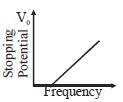
In the graph given below,if the slope is $4.12 \times 10^{-15} \, V-s$,then the value of $'h'$ should be:
A
$6.6 \times 10^{-31} \, J-s$
B
$6.6 \times 10^{-34} \, J-s$
C
$9.1 \times 10^{-31} \, J-s$
D
$6 \times 10^{-34} \, J-s$
Solution
(B) According to Einstein's photoelectric equation,the kinetic energy of emitted electrons is given by $K_{max} = h\nu - \phi$,where $h$ is Planck's constant,$\nu$ is the frequency of incident light,and $\phi$ is the work function.
Since $K_{max} = eV_s$,where $V_s$ is the stopping potential and $e$ is the charge of an electron,we can write:
$eV_s = h\nu - \phi$
$V_s = (\frac{h}{e})\nu - \frac{\phi}{e}$
Comparing this with the equation of a straight line $y = mx + c$,the slope $m$ is equal to $\frac{h}{e}$.
Given that the slope is $4.12 \times 10^{-15} \, V-s$ and the charge of an electron $e = 1.6 \times 10^{-19} \, C$,we have:
$\frac{h}{e} = 4.12 \times 10^{-15}$
$h = (4.12 \times 10^{-15}) \times (1.6 \times 10^{-19})$
$h \approx 6.592 \times 10^{-34} \, J-s \approx 6.6 \times 10^{-34} \, J-s$.
Since $K_{max} = eV_s$,where $V_s$ is the stopping potential and $e$ is the charge of an electron,we can write:
$eV_s = h\nu - \phi$
$V_s = (\frac{h}{e})\nu - \frac{\phi}{e}$
Comparing this with the equation of a straight line $y = mx + c$,the slope $m$ is equal to $\frac{h}{e}$.
Given that the slope is $4.12 \times 10^{-15} \, V-s$ and the charge of an electron $e = 1.6 \times 10^{-19} \, C$,we have:
$\frac{h}{e} = 4.12 \times 10^{-15}$
$h = (4.12 \times 10^{-15}) \times (1.6 \times 10^{-19})$
$h \approx 6.592 \times 10^{-34} \, J-s \approx 6.6 \times 10^{-34} \, J-s$.
0 likes
View Solution338
MediumMCQ
When green light is incident on the surface of a metal, it emits photo-electrons, but there is no such emission with yellow light. Which one of the following colours can produce emission of photo-electrons?
A
Orange
B
Red
C
Indigo
D
Orange + Red both
Solution
(C) The photoelectric effect occurs when the frequency of incident light is greater than the threshold frequency, or equivalently, when the wavelength is less than the threshold wavelength $ (\lambda < \lambda_{th}) $.
Given that green light causes emission but yellow light does not, the threshold wavelength $ (\lambda_{th}) $ lies between the wavelengths of green and yellow light.
In the visible spectrum, the order of wavelengths is: $ \lambda_{Red} > \lambda_{Orange} > \lambda_{Yellow} > \lambda_{Green} > \lambda_{Blue} > \lambda_{Indigo} > \lambda_{Violet} $.
Since the wavelength of indigo light is smaller than that of green light, it has a higher frequency and energy, thus it will cause the emission of photo-electrons.
Given that green light causes emission but yellow light does not, the threshold wavelength $ (\lambda_{th}) $ lies between the wavelengths of green and yellow light.
In the visible spectrum, the order of wavelengths is: $ \lambda_{Red} > \lambda_{Orange} > \lambda_{Yellow} > \lambda_{Green} > \lambda_{Blue} > \lambda_{Indigo} > \lambda_{Violet} $.
Since the wavelength of indigo light is smaller than that of green light, it has a higher frequency and energy, thus it will cause the emission of photo-electrons.
0 likes
View Solution339
DifficultMCQ
The work function of a metallic surface is $5.01 \, eV$. The photo-electrons are emitted when light of wavelength $2000 \, \mathring{A}$ falls on it. The potential difference applied to stop the fastest photo-electrons is ............... $volt$ $[h = 4.14 \times 10^{-15} \, eV \cdot s]$
A
$1.2$
B
$2.24$
C
$3.6$
D
$4.8$
Solution
(A) The energy of the incident photon is given by $E = \frac{hc}{\lambda}$.
Using $hc = 12420 \, eV \cdot \mathring{A}$ (or $12375 \, eV \cdot \mathring{A}$ as per given constants),we calculate $E = \frac{12375}{2000} \, eV = 6.1875 \, eV$.
According to Einstein's photoelectric equation,$E = W_0 + K_{\max}$,where $W_0$ is the work function and $K_{\max}$ is the maximum kinetic energy.
$K_{\max} = E - W_0 = 6.1875 \, eV - 5.01 \, eV = 1.1775 \, eV$.
The stopping potential $V_s$ is related to the maximum kinetic energy by $K_{\max} = e V_s$.
Therefore,$V_s = 1.1775 \, V$,which is approximately $1.2 \, V$.
Using $hc = 12420 \, eV \cdot \mathring{A}$ (or $12375 \, eV \cdot \mathring{A}$ as per given constants),we calculate $E = \frac{12375}{2000} \, eV = 6.1875 \, eV$.
According to Einstein's photoelectric equation,$E = W_0 + K_{\max}$,where $W_0$ is the work function and $K_{\max}$ is the maximum kinetic energy.
$K_{\max} = E - W_0 = 6.1875 \, eV - 5.01 \, eV = 1.1775 \, eV$.
The stopping potential $V_s$ is related to the maximum kinetic energy by $K_{\max} = e V_s$.
Therefore,$V_s = 1.1775 \, V$,which is approximately $1.2 \, V$.
0 likes
View Solution340
DifficultMCQ
If a metal sheet is irradiated with radiations of frequencies $v_1$ and $v_2$ and the kinetic energies of the emitted photoelectrons are in the ratio $1 : x$, then the threshold frequency of the metal is:
A
$\frac{v_2 - x v_1}{x - 1}$
B
$\frac{x v_1 - v_2}{x - 1}$
C
$\frac{v_2 - v_1}{x - 1}$
D
$\frac{v_1 - v_2}{x - 1}$
Solution
(B) According to Einstein's photoelectric equation, the maximum kinetic energy $K$ is given by $K = h v - \Phi$, where $\Phi = h v_0$ is the work function and $v_0$ is the threshold frequency.
For frequency $v_1$, $K_1 = h v_1 - h v_0 = h(v_1 - v_0)$.
For frequency $v_2$, $K_2 = h v_2 - h v_0 = h(v_2 - v_0)$.
Given the ratio of kinetic energies is $K_1 / K_2 = 1 / x$, we have $x K_1 = K_2$.
Substituting the expressions: $x h(v_1 - v_0) = h(v_2 - v_0)$.
$x v_1 - x v_0 = v_2 - v_0$.
$x v_1 - v_2 = x v_0 - v_0$.
$x v_1 - v_2 = v_0(x - 1)$.
Therefore, the threshold frequency $v_0 = \frac{x v_1 - v_2}{x - 1}$.
For frequency $v_1$, $K_1 = h v_1 - h v_0 = h(v_1 - v_0)$.
For frequency $v_2$, $K_2 = h v_2 - h v_0 = h(v_2 - v_0)$.
Given the ratio of kinetic energies is $K_1 / K_2 = 1 / x$, we have $x K_1 = K_2$.
Substituting the expressions: $x h(v_1 - v_0) = h(v_2 - v_0)$.
$x v_1 - x v_0 = v_2 - v_0$.
$x v_1 - v_2 = x v_0 - v_0$.
$x v_1 - v_2 = v_0(x - 1)$.
Therefore, the threshold frequency $v_0 = \frac{x v_1 - v_2}{x - 1}$.
0 likes
View Solution341
MediumMCQ
For intensity $I$ of a light of wavelength $5000 \, Å$, the photoelectron saturation current is $0.40 \, μA$ and the stopping potential is $1.36 \, V$. The work function of the metal is ........... $eV$.
A
$2.47$
B
$1.36$
C
$1.12$
D
$0.43$
Solution
(C) The energy of the incident photon is given by $E = \frac{12375}{\lambda (\text{in } Å)} \, eV$.
Substituting the given wavelength, $E = \frac{12375}{5000} = 2.475 \, eV$.
According to Einstein's photoelectric equation, $E = W_0 + K_{\max}$, where $W_0$ is the work function and $K_{\max}$ is the maximum kinetic energy of the photoelectrons.
The maximum kinetic energy is related to the stopping potential $V_0$ by $K_{\max} = eV_0$.
Given $V_0 = 1.36 \, V$, we have $K_{\max} = 1.36 \, eV$.
Substituting the values into the equation: $2.475 = W_0 + 1.36$.
Solving for $W_0$: $W_0 = 2.475 - 1.36 = 1.115 \, eV \approx 1.12 \, eV$.
Substituting the given wavelength, $E = \frac{12375}{5000} = 2.475 \, eV$.
According to Einstein's photoelectric equation, $E = W_0 + K_{\max}$, where $W_0$ is the work function and $K_{\max}$ is the maximum kinetic energy of the photoelectrons.
The maximum kinetic energy is related to the stopping potential $V_0$ by $K_{\max} = eV_0$.
Given $V_0 = 1.36 \, V$, we have $K_{\max} = 1.36 \, eV$.
Substituting the values into the equation: $2.475 = W_0 + 1.36$.
Solving for $W_0$: $W_0 = 2.475 - 1.36 = 1.115 \, eV \approx 1.12 \, eV$.
0 likes
View Solution342
MediumMCQ
The maximum velocity of an electron emitted by light of wavelength $\lambda$ incident on the surface of a metal of work function $\phi$ is (Where $h =$ Planck's constant,$m =$ mass of electron,and $c =$ speed of light).
A
$[\frac{2(hc + \lambda \phi)}{m \lambda}]^{1/2}$
B
$\frac{2(hc + \lambda \phi)}{m}$
C
$[\frac{2(hc - \lambda \phi)}{m \lambda}]^{1/2}$
D
$[\frac{2(h \lambda - \phi)}{m}]^{1/2}$
Solution
(C) According to Einstein's photoelectric equation,the energy of the incident photon is equal to the sum of the work function and the maximum kinetic energy of the emitted electron:
$E = \phi + K_{max}$
Substituting $E = \frac{hc}{\lambda}$ and $K_{max} = \frac{1}{2}mv^2$,we get:
$\frac{hc}{\lambda} = \phi + \frac{1}{2}mv^2$
Rearranging the terms to solve for $v$:
$\frac{1}{2}mv^2 = \frac{hc}{\lambda} - \phi$
$\frac{1}{2}mv^2 = \frac{hc - \lambda \phi}{\lambda}$
$v^2 = \frac{2(hc - \lambda \phi)}{m \lambda}$
$v = [\frac{2(hc - \lambda \phi)}{m \lambda}]^{1/2}$
$E = \phi + K_{max}$
Substituting $E = \frac{hc}{\lambda}$ and $K_{max} = \frac{1}{2}mv^2$,we get:
$\frac{hc}{\lambda} = \phi + \frac{1}{2}mv^2$
Rearranging the terms to solve for $v$:
$\frac{1}{2}mv^2 = \frac{hc}{\lambda} - \phi$
$\frac{1}{2}mv^2 = \frac{hc - \lambda \phi}{\lambda}$
$v^2 = \frac{2(hc - \lambda \phi)}{m \lambda}$
$v = [\frac{2(hc - \lambda \phi)}{m \lambda}]^{1/2}$
0 likes
View Solution343
EasyMCQ
The collector plate in an experiment on photoelectric effect is kept vertically above the emitter plate. $A$ light source is turned on and a saturation photocurrent is recorded. An electric field is then switched on which has a vertically downward direction.
A
The photocurrent will increase.
B
The kinetic energy of the electrons will increase.
C
The stopping potential will decrease.
D
The threshold wavelength will increase.
Solution
(B) In the photoelectric effect,electrons are emitted from the emitter plate and move towards the collector plate.
When an electric field is applied in the vertically downward direction,the electrons (being negatively charged) experience an electrostatic force in the upward direction (opposite to the electric field).
Since the collector plate is placed vertically above the emitter plate,this upward force acts in the direction of the motion of the electrons.
As a result,the electrons are accelerated,which increases their kinetic energy upon reaching the collector plate.
Because the kinetic energy of the emitted electrons increases,a higher retarding potential (stopping potential) is required to stop them.
Therefore,the stopping potential increases,while the saturation photocurrent and the threshold wavelength remain unchanged.
When an electric field is applied in the vertically downward direction,the electrons (being negatively charged) experience an electrostatic force in the upward direction (opposite to the electric field).
Since the collector plate is placed vertically above the emitter plate,this upward force acts in the direction of the motion of the electrons.
As a result,the electrons are accelerated,which increases their kinetic energy upon reaching the collector plate.
Because the kinetic energy of the emitted electrons increases,a higher retarding potential (stopping potential) is required to stop them.
Therefore,the stopping potential increases,while the saturation photocurrent and the threshold wavelength remain unchanged.
0 likes
View Solution344
MediumMCQ
The work function of caesium is $2.14\, eV$. Find the wavelength of the incident light if the photo current is brought to zero by a stopping potential of $0.60\, V$. (Result in $nm$)
A
$454$
B
$640$
C
$540$
D
None of these
Solution
(D) According to Einstein's photoelectric equation,the maximum kinetic energy of emitted photoelectrons is given by $K_{max} = e V_0$,where $V_0$ is the stopping potential.
Einstein's equation is $K_{max} = \frac{hc}{\lambda} - \phi$,where $\phi$ is the work function.
Given: $\phi = 2.14\, eV$,$V_0 = 0.60\, V$,so $K_{max} = 0.60\, eV$.
Substituting the values: $0.60\, eV = \frac{1240\, eV \cdot nm}{\lambda} - 2.14\, eV$.
$0.60 + 2.14 = \frac{1240}{\lambda}$.
$2.74 = \frac{1240}{\lambda}$.
$\lambda = \frac{1240}{2.74} \approx 452.55\, nm$.
Since $452.55\, nm$ is not among the options,the correct choice is $D$.
Einstein's equation is $K_{max} = \frac{hc}{\lambda} - \phi$,where $\phi$ is the work function.
Given: $\phi = 2.14\, eV$,$V_0 = 0.60\, V$,so $K_{max} = 0.60\, eV$.
Substituting the values: $0.60\, eV = \frac{1240\, eV \cdot nm}{\lambda} - 2.14\, eV$.
$0.60 + 2.14 = \frac{1240}{\lambda}$.
$2.74 = \frac{1240}{\lambda}$.
$\lambda = \frac{1240}{2.74} \approx 452.55\, nm$.
Since $452.55\, nm$ is not among the options,the correct choice is $D$.
0 likes
View Solution345
DifficultMCQ
In a photoelectric effect experiment,the maximum kinetic energy of emitted photoelectrons is $K_0$. If the frequency of the incident radiation is increased by a factor of $n_1$,the new maximum kinetic energy becomes $n_2K_0$. Find the work function of the metal.
A
$\left( \frac{n_2 - n_1}{n_1 - 1} \right) K_0$
B
$\left( \frac{n_2 - n_1}{n_2 + n_1} \right) K_0$
C
$\left( \frac{n_2 + n_1}{n_2 - n_1} \right) K_0$
D
$\left( \frac{n_2 + n_1}{n_1 - 1} \right) K_0$
Solution
(A) According to Einstein's photoelectric equation,the maximum kinetic energy $K_{max}$ is given by $K_{max} = h\nu - \Phi$,where $\nu$ is the frequency and $\Phi$ is the work function.
Initially,$K_0 = h\nu - \Phi$ --- $(1)$
When the frequency is increased by a factor of $n_1$,the new frequency is $\nu' = n_1\nu$. The new maximum kinetic energy is $n_2K_0$.
So,$n_2K_0 = h(n_1\nu) - \Phi$ --- $(2)$
From $(1)$,$h\nu = K_0 + \Phi$. Substituting this into $(2)$:
$n_2K_0 = n_1(K_0 + \Phi) - \Phi$
$n_2K_0 = n_1K_0 + n_1\Phi - \Phi$
$n_2K_0 - n_1K_0 = \Phi(n_1 - 1)$
$K_0(n_2 - n_1) = \Phi(n_1 - 1)$
$\Phi = \left( \frac{n_2 - n_1}{n_1 - 1} \right) K_0$
Thus,the correct option is $A$.
Initially,$K_0 = h\nu - \Phi$ --- $(1)$
When the frequency is increased by a factor of $n_1$,the new frequency is $\nu' = n_1\nu$. The new maximum kinetic energy is $n_2K_0$.
So,$n_2K_0 = h(n_1\nu) - \Phi$ --- $(2)$
From $(1)$,$h\nu = K_0 + \Phi$. Substituting this into $(2)$:
$n_2K_0 = n_1(K_0 + \Phi) - \Phi$
$n_2K_0 = n_1K_0 + n_1\Phi - \Phi$
$n_2K_0 - n_1K_0 = \Phi(n_1 - 1)$
$K_0(n_2 - n_1) = \Phi(n_1 - 1)$
$\Phi = \left( \frac{n_2 - n_1}{n_1 - 1} \right) K_0$
Thus,the correct option is $A$.
0 likes
View Solution346
MediumMCQ
Find the maximum magnitude of the linear momentum of a photoelectron emitted when light of wavelength $400 \, nm$ falls on a metal having a work function of $2.5 \, eV$.
A
$4 \times 10^{-25} \, kg \cdot m/s$
B
$8 \times 10^{-25} \, kg \cdot m/s$
C
$12 \times 10^{-25} \, kg \cdot m/s$
D
$16 \times 10^{-25} \, kg \cdot m/s$
Solution
(A) The energy of the incident photon is given by $E = \frac{hc}{\lambda} = \frac{1240 \, eV \cdot nm}{400 \, nm} = 3.1 \, eV$.
According to Einstein's photoelectric equation,the maximum kinetic energy $K_{max}$ is $K_{max} = E - \phi$,where $\phi = 2.5 \, eV$.
$K_{max} = 3.1 \, eV - 2.5 \, eV = 0.6 \, eV$.
Converting $K_{max}$ to Joules: $K_{max} = 0.6 \times 1.6 \times 10^{-19} \, J = 0.96 \times 10^{-19} \, J$.
The relationship between momentum $p$ and kinetic energy $K$ is $p = \sqrt{2mK}$.
$p = \sqrt{2 \times (9.1 \times 10^{-31} \, kg) \times (0.96 \times 10^{-19} \, J)}$.
$p = \sqrt{17.472 \times 10^{-50}} \approx 4.18 \times 10^{-25} \, kg \cdot m/s$.
Rounding to the nearest option,the value is approximately $4 \times 10^{-25} \, kg \cdot m/s$.
According to Einstein's photoelectric equation,the maximum kinetic energy $K_{max}$ is $K_{max} = E - \phi$,where $\phi = 2.5 \, eV$.
$K_{max} = 3.1 \, eV - 2.5 \, eV = 0.6 \, eV$.
Converting $K_{max}$ to Joules: $K_{max} = 0.6 \times 1.6 \times 10^{-19} \, J = 0.96 \times 10^{-19} \, J$.
The relationship between momentum $p$ and kinetic energy $K$ is $p = \sqrt{2mK}$.
$p = \sqrt{2 \times (9.1 \times 10^{-31} \, kg) \times (0.96 \times 10^{-19} \, J)}$.
$p = \sqrt{17.472 \times 10^{-50}} \approx 4.18 \times 10^{-25} \, kg \cdot m/s$.
Rounding to the nearest option,the value is approximately $4 \times 10^{-25} \, kg \cdot m/s$.
0 likes
View Solution347
MediumMCQ
Monochromatic light of frequency $f$ is incident on an emitter having threshold frequency $f_0$. The maximum kinetic energy of the ejected electron will be
A
$hf$
B
$h(f - f_0)$
C
$hf_0$
D
$h(f + f_0)$
Solution
(B) The energy of the incident photon is given by $E = hf$.
The work function of the emitter is given by $\phi = hf_0$,where $f_0$ is the threshold frequency.
According to Einstein's photoelectric equation,the energy of the incident photon is equal to the sum of the work function and the maximum kinetic energy $(K_{max})$ of the emitted electron:
$hf = \phi + K_{max}$
Substituting the value of the work function:
$hf = hf_0 + K_{max}$
Rearranging the equation to solve for $K_{max}$:
$K_{max} = hf - hf_0$
$K_{max} = h(f - f_0)$
The work function of the emitter is given by $\phi = hf_0$,where $f_0$ is the threshold frequency.
According to Einstein's photoelectric equation,the energy of the incident photon is equal to the sum of the work function and the maximum kinetic energy $(K_{max})$ of the emitted electron:
$hf = \phi + K_{max}$
Substituting the value of the work function:
$hf = hf_0 + K_{max}$
Rearranging the equation to solve for $K_{max}$:
$K_{max} = hf - hf_0$
$K_{max} = h(f - f_0)$
0 likes
View Solution348
DifficultMCQ
In the experiment of photoelectric effect, $K_{max}$ for a photoelectron is $K_0$. If the frequency of light is doubled, then $K_{max}$ is $3K_0$. What would be the value of $K_{max}$ if the frequency of light is tripled? (in terms of $K_0$)
A
$4$
B
$5$
C
$6$
D
$6.5$
Solution
(B) According to Einstein's photoelectric equation, $K_{max} = h\nu - \Phi$, where $\nu$ is the frequency of incident light and $\Phi$ is the work function of the metal.
Case $1$: $K_0 = h\nu - \Phi$ --- $(1)$
Case $2$: $3K_0 = h(2\nu) - \Phi = 2h\nu - \Phi$ --- $(2)$
Subtracting equation $(1)$ from $(2)$:
$(3K_0 - K_0) = (2h\nu - \Phi) - (h\nu - \Phi)$
$2K_0 = h\nu$
Substituting $h\nu = 2K_0$ into equation $(1)$:
$K_0 = 2K_0 - \Phi$ implies $\Phi = K_0$
Case $3$: If frequency is tripled, $\nu' = 3\nu$.
$K_{max}' = h(3\nu) - \Phi = 3(h\nu) - \Phi$
Substituting $h\nu = 2K_0$ and $\Phi = K_0$:
$K_{max}' = 3(2K_0) - K_0 = 6K_0 - K_0 = 5K_0$.
Therefore, the value is $5$.
Case $1$: $K_0 = h\nu - \Phi$ --- $(1)$
Case $2$: $3K_0 = h(2\nu) - \Phi = 2h\nu - \Phi$ --- $(2)$
Subtracting equation $(1)$ from $(2)$:
$(3K_0 - K_0) = (2h\nu - \Phi) - (h\nu - \Phi)$
$2K_0 = h\nu$
Substituting $h\nu = 2K_0$ into equation $(1)$:
$K_0 = 2K_0 - \Phi$ implies $\Phi = K_0$
Case $3$: If frequency is tripled, $\nu' = 3\nu$.
$K_{max}' = h(3\nu) - \Phi = 3(h\nu) - \Phi$
Substituting $h\nu = 2K_0$ and $\Phi = K_0$:
$K_{max}' = 3(2K_0) - K_0 = 6K_0 - K_0 = 5K_0$.
Therefore, the value is $5$.
0 likes
View Solution349
MediumMCQ
The photoelectric threshold frequency of a metal is $v$. When light of frequency $4v$ is incident on the metal,the maximum kinetic energy of the emitted photoelectrons is
A
$4hv$
B
$3hv$
C
$5hv$
D
$5hv/2$
Solution
(B) According to Einstein's photoelectric equation,the maximum kinetic energy $K_{\max}$ of the emitted photoelectrons is given by:
$K_{\max} = E - \phi_0$
where $E$ is the energy of the incident photon and $\phi_0$ is the work function of the metal.
Given that the threshold frequency is $v$,the work function is $\phi_0 = hv$.
The energy of the incident light with frequency $4v$ is $E = h(4v) = 4hv$.
Substituting these values into the equation:
$K_{\max} = 4hv - hv = 3hv$.
$K_{\max} = E - \phi_0$
where $E$ is the energy of the incident photon and $\phi_0$ is the work function of the metal.
Given that the threshold frequency is $v$,the work function is $\phi_0 = hv$.
The energy of the incident light with frequency $4v$ is $E = h(4v) = 4hv$.
Substituting these values into the equation:
$K_{\max} = 4hv - hv = 3hv$.
0 likes
View Solution350
MediumMCQ
Light of frequency $v$ falls on a material of threshold frequency $v_0$. Maximum kinetic energy of emitted electron is proportional to
A
$v-v_0$
B
$v$
C
$\sqrt{v-v_0}$
D
$v_0$
Solution
(A) According to Einstein's photoelectric equation,when a photon of frequency $v$ strikes a metal surface,the energy of the photon is used to overcome the work function $\phi$ and the remainder is given as the maximum kinetic energy $(KE)_{\max}$ to the emitted photoelectron.
The energy of the incident photon is given by $E = hv$,where $h$ is Planck's constant.
The work function of the metal is given by $\phi = hv_0$,where $v_0$ is the threshold frequency.
Applying the law of conservation of energy:
$hv = (KE)_{\max} + \phi$
Substituting the value of $\phi$:
$hv = (KE)_{\max} + hv_0$
Rearranging the equation for maximum kinetic energy:
$(KE)_{\max} = hv - hv_0$
$(KE)_{\max} = h(v - v_0)$
Since $h$ is a constant,the maximum kinetic energy is directly proportional to $(v - v_0)$.
The energy of the incident photon is given by $E = hv$,where $h$ is Planck's constant.
The work function of the metal is given by $\phi = hv_0$,where $v_0$ is the threshold frequency.
Applying the law of conservation of energy:
$hv = (KE)_{\max} + \phi$
Substituting the value of $\phi$:
$hv = (KE)_{\max} + hv_0$
Rearranging the equation for maximum kinetic energy:
$(KE)_{\max} = hv - hv_0$
$(KE)_{\max} = h(v - v_0)$
Since $h$ is a constant,the maximum kinetic energy is directly proportional to $(v - v_0)$.
0 likes
View SolutionDual Nature of Radiation and matter — Einstein's Photoelectric Equation and Energy Quantum of Radiation · Frequently Asked Questions
1Are these Dual Nature of Radiation and matter questions useful for JEE and NEET?
Yes. All questions in this section are mapped to JEE Main and NEET exam patterns. Previous year questions from JEE Main, NEET, GUJCET and state-level exams are included with full solutions.
2Can I switch to Hindi or Gujarati for these questions?
Yes. Use the language tabs in the hero section or the sidebar to view the same questions and solutions in English, Hindi or Gujarati.
3How do I generate a question paper from this subtopic?
Use the Vedclass Exam Paper Generator — select the chapter and subtopic, set difficulty, and generate Sets A, B, C, D automatically. First 3 chapters of every subject are free.
Vedclass Products
For Students
Vedclass Test Series
Mock tests in real JEE/NEET style with performance analysis. 5-day free trial.
Start Free TrialFor Teachers
Exam Paper Generator
Generate Set A/B/C/D papers from this chapter in 2 minutes. 3 chapters free.
Try FreeFor Institutes
Online Exam Module
Live online exams with unlimited students, 360° analytics & white-label branding.
See DemoFor Teachers & Institutes
Generate a Dual Nature of Radiation and matter Exam Paper in 2 Minutes
Select subtopic & difficulty — Sets A, B, C, D auto-generated with No Repeat logic.
First 3 chapters of every subject are free — no payment required.