
A English
Einstein's Photoelectric Equation and Energy Quantum of Radiation Questions in English
Class 12 Physics · Dual Nature of Radiation and matter · Einstein's Photoelectric Equation and Energy Quantum of Radiation
736+
Questions
English
Language
100%
With Solutions
Showing 50 of 736 questions in English
351
MediumMCQ
Five elements $A, B, C, D$ and $E$ have work functions $1.2 \, eV, 2.4 \, eV, 3.6 \, eV, 4.8 \, eV$ and $6 \, eV$ respectively. If light of wavelength $4000 \, Å$ is allowed to fall on these elements, then photoelectrons are emitted by:
A
$A, B$ and $C$
B
$A, B, C, D$ and $E$
C
$A$ and $B$
D
Only $E$
Solution
(C) The energy of an incident photon is given by the formula $E = \frac{hc}{\lambda}$.
Using $hc \approx 12400 \, eV \cdot Å$, we have $E = \frac{12400}{4000} \, eV = 3.1 \, eV$.
Photoelectrons are emitted if the energy of the incident light is greater than or equal to the work function $(\Phi)$ of the material.
Comparing $E = 3.1 \, eV$ with the given work functions:
For $A$: $1.2 \, eV < 3.1 \, eV$ (Emits)
For $B$: $2.4 \, eV < 3.1 \, eV$ (Emits)
For $C$: $3.6 \, eV > 3.1 \, eV$ (Does not emit)
For $D$: $4.8 \, eV > 3.1 \, eV$ (Does not emit)
For $E$: $6.0 \, eV > 3.1 \, eV$ (Does not emit)
Therefore, only elements $A$ and $B$ will emit photoelectrons.
Using $hc \approx 12400 \, eV \cdot Å$, we have $E = \frac{12400}{4000} \, eV = 3.1 \, eV$.
Photoelectrons are emitted if the energy of the incident light is greater than or equal to the work function $(\Phi)$ of the material.
Comparing $E = 3.1 \, eV$ with the given work functions:
For $A$: $1.2 \, eV < 3.1 \, eV$ (Emits)
For $B$: $2.4 \, eV < 3.1 \, eV$ (Emits)
For $C$: $3.6 \, eV > 3.1 \, eV$ (Does not emit)
For $D$: $4.8 \, eV > 3.1 \, eV$ (Does not emit)
For $E$: $6.0 \, eV > 3.1 \, eV$ (Does not emit)
Therefore, only elements $A$ and $B$ will emit photoelectrons.
0 likes
View Solution352
DifficultMCQ
$A$ photon of energy $8\,eV$ is incident on a metal surface of threshold frequency $1.6 \times 10^{15}\,Hz$. The maximum kinetic energy of photoelectrons emitted is .......... $eV$.
(Take $h = 6.6 \times 10^{-34}\,J\cdot s$; $1\,eV = 1.6 \times 10^{-19}\,J$)
(Take $h = 6.6 \times 10^{-34}\,J\cdot s$; $1\,eV = 1.6 \times 10^{-19}\,J$)
A
$1.4$
B
$0.8$
C
$4.2$
D
$2.8$
Solution
(A) Given:
Energy of incident photon,$E = 8\,eV$.
Threshold frequency,$\nu_0 = 1.6 \times 10^{15}\,Hz$.
Planck's constant,$h = 6.6 \times 10^{-34}\,J\cdot s$.
Conversion factor,$1\,eV = 1.6 \times 10^{-19}\,J$.
The work function $\Phi$ is given by $\Phi = h\nu_0$.
$\Phi = (6.6 \times 10^{-34}\,J\cdot s) \times (1.6 \times 10^{15}\,Hz) = 10.56 \times 10^{-19}\,J$.
Converting the work function into $eV$:
$\Phi = \frac{10.56 \times 10^{-19}\,J}{1.6 \times 10^{-19}\,J/eV} = 6.6\,eV$.
According to Einstein's photoelectric equation,the maximum kinetic energy $KE_{\max}$ is:
$KE_{\max} = E - \Phi$.
$KE_{\max} = 8\,eV - 6.6\,eV = 1.4\,eV$.
Energy of incident photon,$E = 8\,eV$.
Threshold frequency,$\nu_0 = 1.6 \times 10^{15}\,Hz$.
Planck's constant,$h = 6.6 \times 10^{-34}\,J\cdot s$.
Conversion factor,$1\,eV = 1.6 \times 10^{-19}\,J$.
The work function $\Phi$ is given by $\Phi = h\nu_0$.
$\Phi = (6.6 \times 10^{-34}\,J\cdot s) \times (1.6 \times 10^{15}\,Hz) = 10.56 \times 10^{-19}\,J$.
Converting the work function into $eV$:
$\Phi = \frac{10.56 \times 10^{-19}\,J}{1.6 \times 10^{-19}\,J/eV} = 6.6\,eV$.
According to Einstein's photoelectric equation,the maximum kinetic energy $KE_{\max}$ is:
$KE_{\max} = E - \Phi$.
$KE_{\max} = 8\,eV - 6.6\,eV = 1.4\,eV$.
0 likes
View Solution353
DifficultMCQ
If the surface of a metal is successively exposed to radiation of wavelengths $\lambda_1 = 350 \, nm$ and $\lambda_2 = 450 \, nm$,the maximum velocity of photoelectrons differs by a factor of $2$. The work function of this metal is:
A
$2.8 \times 10^{-20} \, J$
B
$6.1 \times 10^{-17} \, J$
C
$3.2 \times 10^{-18} \, J$
D
$4.0 \times 10^{-19} \, J$
Solution
(D) According to Einstein's photoelectric equation,$K_{max} = \frac{hc}{\lambda} - \phi_0$,where $K_{max} = \frac{1}{2}mv^2$.
Let $v_1$ and $v_2$ be the maximum velocities for $\lambda_1$ and $\lambda_2$ respectively. Given $v_1 = 2v_2$,so $K_1 = 4K_2$.
$E_1 = \frac{hc}{\lambda_1} = \frac{6.63 \times 10^{-34} \times 3 \times 10^8}{350 \times 10^{-9}} \approx 5.68 \times 10^{-19} \, J$.
$E_2 = \frac{hc}{\lambda_2} = \frac{6.63 \times 10^{-34} \times 3 \times 10^8}{450 \times 10^{-9}} \approx 4.42 \times 10^{-19} \, J$.
From the equations: $E_1 - \phi_0 = 4(E_2 - \phi_0)$.
$E_1 - \phi_0 = 4E_2 - 4\phi_0$.
$3\phi_0 = 4E_2 - E_1$.
$3\phi_0 = 4(4.42 \times 10^{-19}) - 5.68 \times 10^{-19} = 17.68 \times 10^{-19} - 5.68 \times 10^{-19} = 12.0 \times 10^{-19} \, J$.
$\phi_0 = 4.0 \times 10^{-19} \, J$.
Let $v_1$ and $v_2$ be the maximum velocities for $\lambda_1$ and $\lambda_2$ respectively. Given $v_1 = 2v_2$,so $K_1 = 4K_2$.
$E_1 = \frac{hc}{\lambda_1} = \frac{6.63 \times 10^{-34} \times 3 \times 10^8}{350 \times 10^{-9}} \approx 5.68 \times 10^{-19} \, J$.
$E_2 = \frac{hc}{\lambda_2} = \frac{6.63 \times 10^{-34} \times 3 \times 10^8}{450 \times 10^{-9}} \approx 4.42 \times 10^{-19} \, J$.
From the equations: $E_1 - \phi_0 = 4(E_2 - \phi_0)$.
$E_1 - \phi_0 = 4E_2 - 4\phi_0$.
$3\phi_0 = 4E_2 - E_1$.
$3\phi_0 = 4(4.42 \times 10^{-19}) - 5.68 \times 10^{-19} = 17.68 \times 10^{-19} - 5.68 \times 10^{-19} = 12.0 \times 10^{-19} \, J$.
$\phi_0 = 4.0 \times 10^{-19} \, J$.
0 likes
View Solution354
MediumMCQ
The work function of a metal is $2.3 \text{ eV}$ and the maximum kinetic energy of photoelectrons is $0.3 \text{ eV}$ when a photon is incident on it. Find the wavelength of the incident photon in $\mathring A$.
A
$4800$
B
$2400$
C
$1200$
D
$600$
Solution
(A) According to Einstein's photoelectric equation: $K_{\text{max}} = E - \phi_0$,where $E = \frac{hc}{\lambda}$.
Substituting the values: $0.3 \text{ eV} = \frac{hc}{\lambda} - 2.3 \text{ eV}$.
$\frac{hc}{\lambda} = 0.3 \text{ eV} + 2.3 \text{ eV} = 2.6 \text{ eV}$.
Using $hc \approx 12400 \text{ eV} \cdot \mathring A$,we get $\lambda = \frac{12400}{2.6} \mathring A$.
$\lambda \approx 4769.23 \mathring A$.
Rounding to the nearest given option,the wavelength is $4800 \mathring A$.
Substituting the values: $0.3 \text{ eV} = \frac{hc}{\lambda} - 2.3 \text{ eV}$.
$\frac{hc}{\lambda} = 0.3 \text{ eV} + 2.3 \text{ eV} = 2.6 \text{ eV}$.
Using $hc \approx 12400 \text{ eV} \cdot \mathring A$,we get $\lambda = \frac{12400}{2.6} \mathring A$.
$\lambda \approx 4769.23 \mathring A$.
Rounding to the nearest given option,the wavelength is $4800 \mathring A$.
0 likes
View Solution355
DifficultMCQ
The metallic surface is illuminated with monochromatic light of wavelength $\lambda$ and the stopping potential for the photoelectric current is $5V_0$. When the same metallic surface is illuminated with light of wavelength $2\lambda$,the stopping potential is $V_0$. What is the threshold wavelength for the surface?
A
$\frac{8}{3}\lambda$
B
$8\lambda$
C
$5\lambda$
D
$4\lambda$
Solution
(A) Einstein's photoelectric equation is given by $\frac{hc}{\lambda} = eV_s + W$,where $V_s$ is the stopping potential and $W$ is the work function.
For the first case: $\frac{hc}{\lambda} = e(5V_0) + W$ --- $(1)$
For the second case: $\frac{hc}{2\lambda} = eV_0 + W$ --- $(2)$
Multiply equation $(2)$ by $5$: $\frac{5hc}{2\lambda} = 5eV_0 + 5W$ --- $(3)$
Subtract equation $(1)$ from equation $(3)$:
$\frac{5hc}{2\lambda} - \frac{hc}{\lambda} = (5eV_0 + 5W) - (5eV_0 + W)$
$\frac{3hc}{2\lambda} = 4W$
$W = \frac{3hc}{8\lambda}$
Since the work function $W = \frac{hc}{\lambda_0}$,where $\lambda_0$ is the threshold wavelength:
$\frac{hc}{\lambda_0} = \frac{3hc}{8\lambda}$
$\lambda_0 = \frac{8}{3}\lambda$
For the first case: $\frac{hc}{\lambda} = e(5V_0) + W$ --- $(1)$
For the second case: $\frac{hc}{2\lambda} = eV_0 + W$ --- $(2)$
Multiply equation $(2)$ by $5$: $\frac{5hc}{2\lambda} = 5eV_0 + 5W$ --- $(3)$
Subtract equation $(1)$ from equation $(3)$:
$\frac{5hc}{2\lambda} - \frac{hc}{\lambda} = (5eV_0 + 5W) - (5eV_0 + W)$
$\frac{3hc}{2\lambda} = 4W$
$W = \frac{3hc}{8\lambda}$
Since the work function $W = \frac{hc}{\lambda_0}$,where $\lambda_0$ is the threshold wavelength:
$\frac{hc}{\lambda_0} = \frac{3hc}{8\lambda}$
$\lambda_0 = \frac{8}{3}\lambda$
0 likes
View Solution356
EasyMCQ
When light is incident on a surface,photoelectrons are emitted. For these photoelectrons:
A
The value of kinetic energy is the same for all.
B
Maximum kinetic energy does not depend on the wavelength of incident light.
C
The value of kinetic energy is equal to or less than a maximum kinetic energy.
D
None of the above.
Solution
(C) The kinetic energy $(KE)$ of a photoelectron is given by Einstein's photoelectric equation: $KE = h\nu - W = \frac{hc}{\lambda} - W$.
Here,$h$ is Planck's constant,$\nu$ is the frequency,$\lambda$ is the wavelength of incident light,and $W$ is the work function of the metal.
Photoelectrons are emitted from different depths within the metal. As they travel to the surface,they undergo multiple collisions with other electrons and atoms,losing some energy. Therefore,the kinetic energy of emitted photoelectrons varies from $0$ to a maximum value $(KE_{max} = h\nu - W)$.
Thus,the kinetic energy of any emitted photoelectron is always equal to or less than the maximum kinetic energy.
Here,$h$ is Planck's constant,$\nu$ is the frequency,$\lambda$ is the wavelength of incident light,and $W$ is the work function of the metal.
Photoelectrons are emitted from different depths within the metal. As they travel to the surface,they undergo multiple collisions with other electrons and atoms,losing some energy. Therefore,the kinetic energy of emitted photoelectrons varies from $0$ to a maximum value $(KE_{max} = h\nu - W)$.
Thus,the kinetic energy of any emitted photoelectron is always equal to or less than the maximum kinetic energy.
0 likes
View Solution357
DifficultMCQ
In the experiment of the photoelectric effect, if the frequency of incident light is $v_1$, the maximum kinetic energy $(K.E.)$ of photoelectrons is $K_0$. If the frequency of light is $v_2$, the maximum $K.E.$ of photoelectrons is $2K_0$. Which of the following relations is correct?
A
$v_2 = 2v_1$
B
$v_2 > 2v_1$
C
$v_2 < 2v_1$
D
$v_2 = v_1$
Solution
(C) According to Einstein's photoelectric equation, the maximum kinetic energy $(K_{max})$ is given by: $K_{max} = hv - \Phi$, where $h$ is Planck's constant, $v$ is the frequency of incident light, and $\Phi$ is the work function of the metal.
For the first case: $K_0 = hv_1 - \Phi$ --- (Equation $1$)
For the second case: $2K_0 = hv_2 - \Phi$ --- (Equation $2$)
From Equation $1$, we have $\Phi = hv_1 - K_0$. Substituting this into Equation $2$:
$2K_0 = hv_2 - (hv_1 - K_0)$
$2K_0 = hv_2 - hv_1 + K_0$
$K_0 = hv_2 - hv_1$
$hv_2 = hv_1 + K_0$
Since $K_0 = hv_1 - \Phi$, we substitute $K_0$ back:
$hv_2 = hv_1 + (hv_1 - \Phi)$
$hv_2 = 2hv_1 - \Phi$
$v_2 = 2v_1 - \frac{\Phi}{h}$
Since $\Phi > 0$, it follows that $v_2 < 2v_1$.
For the first case: $K_0 = hv_1 - \Phi$ --- (Equation $1$)
For the second case: $2K_0 = hv_2 - \Phi$ --- (Equation $2$)
From Equation $1$, we have $\Phi = hv_1 - K_0$. Substituting this into Equation $2$:
$2K_0 = hv_2 - (hv_1 - K_0)$
$2K_0 = hv_2 - hv_1 + K_0$
$K_0 = hv_2 - hv_1$
$hv_2 = hv_1 + K_0$
Since $K_0 = hv_1 - \Phi$, we substitute $K_0$ back:
$hv_2 = hv_1 + (hv_1 - \Phi)$
$hv_2 = 2hv_1 - \Phi$
$v_2 = 2v_1 - \frac{\Phi}{h}$
Since $\Phi > 0$, it follows that $v_2 < 2v_1$.
0 likes
View Solution358
DifficultMCQ
If the frequency of light in a photoelectric experiment is doubled,the stopping potential will
A
be doubled
B
be halved
C
become more than double
D
become less than double
Solution
(C) The maximum kinetic energy for the photoelectrons is given by Einstein's photoelectric equation:
$E_{\max} = h\nu - \phi$
where $\nu$ is the frequency of incident light and $\phi$ is the work function of the metal.
Since $E_{\max} = eV_0$,we have:
$eV_0 = h\nu - \phi$ ... $(1)$
where $V_0$ is the stopping potential.
When the frequency is doubled $(
u' = 2\nu)$,the new stopping potential $V_0'$ is:
$eV_0' = h(2\nu) - \phi = 2h\nu - \phi$
From equation $(1)$,we know $h\nu = eV_0 + \phi$. Substituting this into the expression for $eV_0'$:
$eV_0' = 2(eV_0 + \phi) - \phi$
$eV_0' = 2eV_0 + 2\phi - \phi$
$eV_0' = 2eV_0 + \phi$
Dividing by $e$:
$V_0' = 2V_0 + \frac{\phi}{e}$
Since $\phi > 0$,it is clear that $V_0' > 2V_0$. Therefore,the stopping potential becomes more than double.
$E_{\max} = h\nu - \phi$
where $\nu$ is the frequency of incident light and $\phi$ is the work function of the metal.
Since $E_{\max} = eV_0$,we have:
$eV_0 = h\nu - \phi$ ... $(1)$
where $V_0$ is the stopping potential.
When the frequency is doubled $(
u' = 2\nu)$,the new stopping potential $V_0'$ is:
$eV_0' = h(2\nu) - \phi = 2h\nu - \phi$
From equation $(1)$,we know $h\nu = eV_0 + \phi$. Substituting this into the expression for $eV_0'$:
$eV_0' = 2(eV_0 + \phi) - \phi$
$eV_0' = 2eV_0 + 2\phi - \phi$
$eV_0' = 2eV_0 + \phi$
Dividing by $e$:
$V_0' = 2V_0 + \frac{\phi}{e}$
Since $\phi > 0$,it is clear that $V_0' > 2V_0$. Therefore,the stopping potential becomes more than double.
0 likes
View Solution359
DifficultMCQ
The threshold wavelength of a metal surface is $5 \times 10^{-10} \, m$. When it is illuminated by light of wavelength $2 \times 10^{-10} \, m$,the stopping potential is $V_0$. What will be the stopping potential if the wavelength of the incident light is doubled?
A
$\frac{V_0}{2}$
B
$2V_0$
C
$> 0.5 V_0$
D
$< 0.5 V_0$
Solution
(D) According to Einstein's photoelectric equation: $eV_0 = \frac{hc}{\lambda} - \frac{hc}{\lambda_0}$,where $\lambda_0 = 5 \times 10^{-10} \, m$ is the threshold wavelength.
For the first case,$\lambda_1 = 2 \times 10^{-10} \, m$:
$eV_0 = hc \left( \frac{1}{2 \times 10^{-10}} - \frac{1}{5 \times 10^{-10}} \right) = hc \left( \frac{5-2}{10 \times 10^{-10}} \right) = \frac{3hc}{10 \times 10^{-10}}$.
For the second case,the wavelength is doubled: $\lambda_2 = 2 \times \lambda_1 = 4 \times 10^{-10} \, m$.
Let the new stopping potential be $V_0'$.
$eV_0' = hc \left( \frac{1}{4 \times 10^{-10}} - \frac{1}{5 \times 10^{-10}} \right) = hc \left( \frac{5-4}{20 \times 10^{-10}} \right) = \frac{hc}{20 \times 10^{-10}}$.
Comparing $eV_0'$ and $eV_0$:
$\frac{eV_0'}{eV_0} = \frac{hc / (20 \times 10^{-10})}{3hc / (10 \times 10^{-10})} = \frac{1}{20} \times \frac{10}{3} = \frac{1}{6}$.
Therefore,$V_0' = \frac{V_0}{6}$,which is clearly less than $0.5 V_0$.
For the first case,$\lambda_1 = 2 \times 10^{-10} \, m$:
$eV_0 = hc \left( \frac{1}{2 \times 10^{-10}} - \frac{1}{5 \times 10^{-10}} \right) = hc \left( \frac{5-2}{10 \times 10^{-10}} \right) = \frac{3hc}{10 \times 10^{-10}}$.
For the second case,the wavelength is doubled: $\lambda_2 = 2 \times \lambda_1 = 4 \times 10^{-10} \, m$.
Let the new stopping potential be $V_0'$.
$eV_0' = hc \left( \frac{1}{4 \times 10^{-10}} - \frac{1}{5 \times 10^{-10}} \right) = hc \left( \frac{5-4}{20 \times 10^{-10}} \right) = \frac{hc}{20 \times 10^{-10}}$.
Comparing $eV_0'$ and $eV_0$:
$\frac{eV_0'}{eV_0} = \frac{hc / (20 \times 10^{-10})}{3hc / (10 \times 10^{-10})} = \frac{1}{20} \times \frac{10}{3} = \frac{1}{6}$.
Therefore,$V_0' = \frac{V_0}{6}$,which is clearly less than $0.5 V_0$.
0 likes
View Solution360
EasyMCQ
$A$ photon of energy $hv$ is absorbed by a free electron of a metal having work function $\phi < hv$.
A
The electron is sure to come out.
B
The electron is sure to come out with a kinetic energy $hv - \phi$.
C
Either the electron doesn't come out or it comes out with a kinetic energy $hv - \phi$.
D
It may come out with kinetic energy less than $hv - \phi$.
Solution
(D) When a photon of energy $hv$ is absorbed by an electron inside a metal,the electron may lose some of its energy due to collisions with other atoms or electrons before reaching the surface.
If the electron is at the surface and absorbs the photon,it will be emitted with the maximum kinetic energy $K_{max} = hv - \phi$.
However,if the electron is located below the surface,it will lose some energy during its journey to the surface.
Therefore,the electron may either not come out at all (if it loses too much energy) or it may come out with a kinetic energy less than $hv - \phi$.
Thus,the correct statement is that it may come out with kinetic energy less than $hv - \phi$.
If the electron is at the surface and absorbs the photon,it will be emitted with the maximum kinetic energy $K_{max} = hv - \phi$.
However,if the electron is located below the surface,it will lose some energy during its journey to the surface.
Therefore,the electron may either not come out at all (if it loses too much energy) or it may come out with a kinetic energy less than $hv - \phi$.
Thus,the correct statement is that it may come out with kinetic energy less than $hv - \phi$.
0 likes
View Solution361
DifficultMCQ
The work function of caesium is $2.14 \ eV$. Find the wavelength of the incident light if the photocurrent is brought to zero by a stopping potential of $0.60 \ V$. (Answer in $nm$)
A
$454$
B
$640$
C
$540$
D
None of these
Solution
(D) According to Einstein's photoelectric equation: $K_{max} = e V_0 = \frac{hc}{\lambda} - \phi$.
Given: Work function $\phi = 2.14 \ eV$,Stopping potential $V_0 = 0.60 \ V$.
Substituting the values: $0.60 \ eV = \frac{1240 \ eV \cdot nm}{\lambda} - 2.14 \ eV$.
$\frac{1240}{\lambda} = 0.60 + 2.14 = 2.74 \ eV$.
$\lambda = \frac{1240}{2.74} \approx 452.55 \ nm$.
Rounding to the nearest integer,the wavelength is approximately $453 \ nm$. Since $453 \ nm$ is not among the options,the correct choice is $D$.
Given: Work function $\phi = 2.14 \ eV$,Stopping potential $V_0 = 0.60 \ V$.
Substituting the values: $0.60 \ eV = \frac{1240 \ eV \cdot nm}{\lambda} - 2.14 \ eV$.
$\frac{1240}{\lambda} = 0.60 + 2.14 = 2.74 \ eV$.
$\lambda = \frac{1240}{2.74} \approx 452.55 \ nm$.
Rounding to the nearest integer,the wavelength is approximately $453 \ nm$. Since $453 \ nm$ is not among the options,the correct choice is $D$.
0 likes
View Solution362
MediumMCQ
Maximum velocity of photoelectrons emitted by a metal surface is $1.2 \times 10^6\, m/s$. Assuming the specific charge of the electron to be $1.8 \times 10^{11}\, C/kg$,the value of the stopping potential in volt will be
A
$2$
B
$3$
C
$4$
D
$6$
Solution
(C) The kinetic energy of the fastest photoelectrons is given by the equation: $\frac{1}{2} mv_{\max}^{2} = eV_s$.
Here,$V_s$ is the stopping potential,$m$ is the mass of the electron,$e$ is the charge of the electron,and $v_{\max}$ is the maximum velocity.
Rearranging the formula for the stopping potential $V_s$:
$V_s = \frac{mv_{\max}^{2}}{2e} = \frac{v_{\max}^{2}}{2(e/m)}$.
Given that the specific charge $(e/m) = 1.8 \times 10^{11}\, C/kg$ and $v_{\max} = 1.2 \times 10^6\, m/s$:
$V_s = \frac{(1.2 \times 10^6)^2}{2 \times 1.8 \times 10^{11}}$.
$V_s = \frac{1.44 \times 10^{12}}{3.6 \times 10^{11}}$.
$V_s = \frac{14.4}{3.6} = 4\, V$.
Here,$V_s$ is the stopping potential,$m$ is the mass of the electron,$e$ is the charge of the electron,and $v_{\max}$ is the maximum velocity.
Rearranging the formula for the stopping potential $V_s$:
$V_s = \frac{mv_{\max}^{2}}{2e} = \frac{v_{\max}^{2}}{2(e/m)}$.
Given that the specific charge $(e/m) = 1.8 \times 10^{11}\, C/kg$ and $v_{\max} = 1.2 \times 10^6\, m/s$:
$V_s = \frac{(1.2 \times 10^6)^2}{2 \times 1.8 \times 10^{11}}$.
$V_s = \frac{1.44 \times 10^{12}}{3.6 \times 10^{11}}$.
$V_s = \frac{14.4}{3.6} = 4\, V$.
0 likes
View Solution363
AdvancedMCQ
In a photoemissive cell with exciting wavelength $\lambda$,the fastest electron has speed $v$. If the exciting wavelength is changed to $\frac{3\lambda}{4}$,the speed of the fastest emitted electron will be
A
$v (3/4)^{1/2}$
B
$v(4/3)^{1/2}$
C
less than $v(4/3)^{1/2}$
D
greater than $v(4/3)^{1/2}$
Solution
(D) According to Einstein's photoelectric equation,the maximum kinetic energy is given by $K_{\max} = \frac{hc}{\lambda} - \phi$,where $\phi = \frac{hc}{\lambda_0}$ is the work function.
Thus,$\frac{1}{2}mv^2 = \frac{hc}{\lambda} - \frac{hc}{\lambda_0} = hc \left( \frac{\lambda_0 - \lambda}{\lambda \lambda_0} \right)$.
So,$v = \sqrt{\frac{2hc}{m} \left( \frac{\lambda_0 - \lambda}{\lambda \lambda_0} \right)}$.
When the wavelength is changed to $\lambda' = \frac{3\lambda}{4}$,the new speed $v'$ is:
$v' = \sqrt{\frac{2hc}{m} \left( \frac{\lambda_0 - 3\lambda/4}{(3\lambda/4) \lambda_0} \right)}$.
Taking the ratio:
$\frac{v'}{v} = \sqrt{\frac{\lambda_0 - 3\lambda/4}{3\lambda/4 \lambda_0} \cdot \frac{\lambda \lambda_0}{\lambda_0 - \lambda}} = \sqrt{\frac{4}{3}} \sqrt{\frac{\lambda_0 - 3\lambda/4}{\lambda_0 - \lambda}}$.
Since $\lambda_0 > \lambda$,it follows that $\lambda_0 - 3\lambda/4 > \lambda_0 - \lambda$.
Therefore,$\sqrt{\frac{\lambda_0 - 3\lambda/4}{\lambda_0 - \lambda}} > 1$.
This implies $v' > \sqrt{\frac{4}{3}} v$.
Thus,$\frac{1}{2}mv^2 = \frac{hc}{\lambda} - \frac{hc}{\lambda_0} = hc \left( \frac{\lambda_0 - \lambda}{\lambda \lambda_0} \right)$.
So,$v = \sqrt{\frac{2hc}{m} \left( \frac{\lambda_0 - \lambda}{\lambda \lambda_0} \right)}$.
When the wavelength is changed to $\lambda' = \frac{3\lambda}{4}$,the new speed $v'$ is:
$v' = \sqrt{\frac{2hc}{m} \left( \frac{\lambda_0 - 3\lambda/4}{(3\lambda/4) \lambda_0} \right)}$.
Taking the ratio:
$\frac{v'}{v} = \sqrt{\frac{\lambda_0 - 3\lambda/4}{3\lambda/4 \lambda_0} \cdot \frac{\lambda \lambda_0}{\lambda_0 - \lambda}} = \sqrt{\frac{4}{3}} \sqrt{\frac{\lambda_0 - 3\lambda/4}{\lambda_0 - \lambda}}$.
Since $\lambda_0 > \lambda$,it follows that $\lambda_0 - 3\lambda/4 > \lambda_0 - \lambda$.
Therefore,$\sqrt{\frac{\lambda_0 - 3\lambda/4}{\lambda_0 - \lambda}} > 1$.
This implies $v' > \sqrt{\frac{4}{3}} v$.
0 likes
View Solution364
MediumMCQ
The stopping potential doubles when the frequency of the incident light changes from $v$ to $\frac{3v}{2}$. Then the work function of the metal must be
A
$\frac{hv}{2}$
B
$hv$
C
$2hv$
D
none of the above
Solution
(A) According to Einstein's photoelectric equation,the stopping potential $V_s$ is given by $eV_s = h\nu - \phi$,where $\phi$ is the work function.
For frequency $\nu$,the stopping potential is $V_s = \frac{h\nu - \phi}{e}$.
For frequency $\frac{3\nu}{2}$,the stopping potential is $2V_s = \frac{h(\frac{3\nu}{2}) - \phi}{e}$.
Substituting the first equation into the second: $2(\frac{h\nu - \phi}{e}) = \frac{1.5h\nu - \phi}{e}$.
Multiplying by $e$: $2h\nu - 2\phi = 1.5h\nu - \phi$.
Rearranging the terms: $2h\nu - 1.5h\nu = 2\phi - \phi$.
Therefore,$\phi = 0.5h\nu = \frac{h\nu}{2}$.
For frequency $\nu$,the stopping potential is $V_s = \frac{h\nu - \phi}{e}$.
For frequency $\frac{3\nu}{2}$,the stopping potential is $2V_s = \frac{h(\frac{3\nu}{2}) - \phi}{e}$.
Substituting the first equation into the second: $2(\frac{h\nu - \phi}{e}) = \frac{1.5h\nu - \phi}{e}$.
Multiplying by $e$: $2h\nu - 2\phi = 1.5h\nu - \phi$.
Rearranging the terms: $2h\nu - 1.5h\nu = 2\phi - \phi$.
Therefore,$\phi = 0.5h\nu = \frac{h\nu}{2}$.
0 likes
View Solution365
EasyMCQ
Assertion : Photosensitivity of a metal is high if its work function is small.
Reason : Work function $= hf_0$ where $f_0$ is the threshold frequency.
Reason : Work function $= hf_0$ where $f_0$ is the threshold frequency.
A
If both Assertion and Reason are correct and the Reason is a correct explanation of the Assertion.
B
If both Assertion and Reason are correct but Reason is not a correct explanation of the Assertion.
C
If the Assertion is correct but Reason is incorrect.
D
If both the Assertion and Reason are incorrect.
Solution
(A) The photosensitivity of a metal refers to its ability to emit photoelectrons when light of a suitable frequency is incident on it. A metal with a low work function $(\Phi_0)$ requires less energy to eject an electron, making it more photosensitive. Thus, the Assertion is correct.
The work function is defined as $\Phi_0 = hf_0$, where $h$ is Planck's constant and $f_0$ is the threshold frequency. This is a standard physical relationship for the photoelectric effect. Thus, the Reason is also correct.
Since the work function is defined by the threshold frequency $(f_0)$, and a smaller $f_0$ (and thus smaller $\Phi_0$) makes it easier to eject electrons, the Reason correctly explains why a small work function leads to high photosensitivity. Therefore, the correct option is $A$.
The work function is defined as $\Phi_0 = hf_0$, where $h$ is Planck's constant and $f_0$ is the threshold frequency. This is a standard physical relationship for the photoelectric effect. Thus, the Reason is also correct.
Since the work function is defined by the threshold frequency $(f_0)$, and a smaller $f_0$ (and thus smaller $\Phi_0$) makes it easier to eject electrons, the Reason correctly explains why a small work function leads to high photosensitivity. Therefore, the correct option is $A$.
0 likes
View Solution366
EasyMCQ
Assertion : When ultraviolet light is incident on a photocell,its stopping potential is $V_0$ and the maximum kinetic energy of the photoelectrons is $K_{max}$. When the ultraviolet light is replaced by $X-$ rays,both $V_0$ and $K_{max}$ increase.
Reason : Photoelectrons are emitted with speeds ranging from zero to a maximum value because of the range of frequencies present in the incident light.
Reason : Photoelectrons are emitted with speeds ranging from zero to a maximum value because of the range of frequencies present in the incident light.
A
If both Assertion and Reason are correct and the Reason is a correct explanation of the Assertion.
B
If both Assertion and Reason are correct but Reason is not a correct explanation of the Assertion.
C
If the Assertion is correct but Reason is incorrect.
D
If both the Assertion and Reason are incorrect.
Solution
(C) According to Einstein's photoelectric equation,$K_{max} = eV_0 = h\nu - \phi$,where $\nu$ is the frequency of incident light and $\phi$ is the work function of the metal.
Since the frequency of $X-$ rays is significantly higher than that of ultraviolet $(U.V.)$ light,the maximum kinetic energy $(K_{max})$ and the stopping potential $(V_0)$ will both increase when $X-$ rays are used.
Therefore,the Assertion is correct.
The Reason states that photoelectrons are emitted with a range of speeds due to a range of frequencies in the incident light. This is incorrect because photoelectric emission occurs even with monochromatic light (a single frequency),and the range of speeds arises due to energy losses of electrons within the metal before emission,not because of a range of incident frequencies.
Thus,the Assertion is correct but the Reason is incorrect.
Since the frequency of $X-$ rays is significantly higher than that of ultraviolet $(U.V.)$ light,the maximum kinetic energy $(K_{max})$ and the stopping potential $(V_0)$ will both increase when $X-$ rays are used.
Therefore,the Assertion is correct.
The Reason states that photoelectrons are emitted with a range of speeds due to a range of frequencies in the incident light. This is incorrect because photoelectric emission occurs even with monochromatic light (a single frequency),and the range of speeds arises due to energy losses of electrons within the metal before emission,not because of a range of incident frequencies.
Thus,the Assertion is correct but the Reason is incorrect.
0 likes
View Solution367
EasyMCQ
Assertion : In the process of photoelectric emission, all emitted electrons do not have the same kinetic energy.
Reason : If radiation falling on the photosensitive surface of a metal consists of different wavelengths, then the energy acquired by electrons absorbing photons of different wavelengths shall be different.
Reason : If radiation falling on the photosensitive surface of a metal consists of different wavelengths, then the energy acquired by electrons absorbing photons of different wavelengths shall be different.
A
If both Assertion and Reason are correct and the Reason is a correct explanation of the Assertion.
B
If both Assertion and Reason are correct but Reason is not a correct explanation of the Assertion.
C
If the Assertion is correct but Reason is incorrect.
D
If both the Assertion and Reason are incorrect.
Solution
(B) The Assertion is correct because even for a monochromatic source, electrons emitted from deeper layers of the metal lose energy due to collisions before escaping, resulting in a range of kinetic energies from $0$ to $K_{max}$.
The Reason is also correct because, according to Einstein's photoelectric equation $K_{max} = h\nu - \Phi$, if the incident radiation has different wavelengths (and thus different frequencies $\nu$), the energy acquired by the electrons will vary.
However, the Reason is not the correct explanation for the Assertion because the primary reason for the variation in kinetic energy (even for monochromatic light) is the energy loss during the escape of electrons from different depths within the metal.
The Reason is also correct because, according to Einstein's photoelectric equation $K_{max} = h\nu - \Phi$, if the incident radiation has different wavelengths (and thus different frequencies $\nu$), the energy acquired by the electrons will vary.
However, the Reason is not the correct explanation for the Assertion because the primary reason for the variation in kinetic energy (even for monochromatic light) is the energy loss during the escape of electrons from different depths within the metal.
0 likes
View Solution368
MediumMCQ
The work function of a photosensitive material is $4.0 \ eV$. The longest wavelength of light that can cause photon emission from the substance is approximately $...... \ nm$.
A
$3100$
B
$966$
C
$31$
D
$310$
Solution
(D) The work function $\phi$ is related to the threshold wavelength $\lambda_0$ by the equation $\phi = \frac{hc}{\lambda_0}$.
Given $\phi = 4.0 \ eV$ and using the approximation $hc \approx 1240 \ eV \cdot nm$:
$\lambda_0 = \frac{hc}{\phi} = \frac{1240 \ eV \cdot nm}{4.0 \ eV}$.
$\lambda_0 = 310 \ nm$.
Therefore,the longest wavelength of light that can cause photoemission is $310 \ nm$.
Given $\phi = 4.0 \ eV$ and using the approximation $hc \approx 1240 \ eV \cdot nm$:
$\lambda_0 = \frac{hc}{\phi} = \frac{1240 \ eV \cdot nm}{4.0 \ eV}$.
$\lambda_0 = 310 \ nm$.
Therefore,the longest wavelength of light that can cause photoemission is $310 \ nm$.
0 likes
View Solution369
DifficultMCQ
$A$ beam of electromagnetic radiation of intensity $6.4 \times 10^{-5} \; W/cm^{2}$ is comprised of wavelength $\lambda = 310 \; nm$. It falls normally on a metal surface (work function $\varphi = 2 \; eV$) of surface area $1 \; cm^{2}$. If one in $10^{3}$ photons ejects an electron, the total number of electrons ejected in $1 \; s$ is $10^{x}$. Then $x$ is: $(hc = 1240 \; eV \cdot nm, 1 \; eV = 1.6 \times 10^{-19} \; J)$
A
$5$
B
$8$
C
$11$
D
$13$
Solution
(C) The intensity of the radiation is $I = 6.4 \times 10^{-5} \; W/cm^{2}$ and the area is $A = 1 \; cm^{2}$.
The power incident on the surface is $P = I \times A = 6.4 \times 10^{-5} \; W$.
The energy of a single photon is $E_{ph} = \frac{hc}{\lambda} = \frac{1240 \; eV \cdot nm}{310 \; nm} = 4 \; eV$.
Converting this energy to Joules: $E_{ph} = 4 \times 1.6 \times 10^{-19} \; J = 6.4 \times 10^{-19} \; J$.
The number of photons incident per second $(n)$ is given by $n = \frac{P}{E_{ph}} = \frac{6.4 \times 10^{-5} \; J/s}{6.4 \times 10^{-19} \; J} = 10^{14} \; \text{photons/s}$.
Given that one in $10^{3}$ photons ejects an electron, the number of electrons emitted per second is $N_e = n \times 10^{-3} = 10^{14} \times 10^{-3} = 10^{11}$.
Comparing this with $10^{x}$, we get $x = 11$.
The power incident on the surface is $P = I \times A = 6.4 \times 10^{-5} \; W$.
The energy of a single photon is $E_{ph} = \frac{hc}{\lambda} = \frac{1240 \; eV \cdot nm}{310 \; nm} = 4 \; eV$.
Converting this energy to Joules: $E_{ph} = 4 \times 1.6 \times 10^{-19} \; J = 6.4 \times 10^{-19} \; J$.
The number of photons incident per second $(n)$ is given by $n = \frac{P}{E_{ph}} = \frac{6.4 \times 10^{-5} \; J/s}{6.4 \times 10^{-19} \; J} = 10^{14} \; \text{photons/s}$.
Given that one in $10^{3}$ photons ejects an electron, the number of electrons emitted per second is $N_e = n \times 10^{-3} = 10^{14} \times 10^{-3} = 10^{11}$.
Comparing this with $10^{x}$, we get $x = 11$.
0 likes
View Solution370
MediumMCQ
When a photon of energy $4.0 \; eV$ strikes the surface of a metal $A$,the ejected photoelectrons have maximum kinetic energy $T_{A} \; eV$ and de-Broglie wavelength $\lambda_{A}$. The maximum kinetic energy of photoelectrons liberated from another metal $B$ by a photon of energy $4.50 \; eV$ is $T_{B} = (T_{A} - 1.5) \; eV$. If the de-Broglie wavelength of these photoelectrons is $\lambda_{B} = 2 \lambda_{A}$,then the work function of metal $B$ is ............. $eV$.
A
$3$
B
$2$
C
$4$
D
$1.5$
Solution
(C) The de-Broglie wavelength is given by $\lambda = \frac{h}{p} = \frac{h}{\sqrt{2mK}}$,where $K$ is the kinetic energy.
Given $\lambda_{B} = 2 \lambda_{A}$,we have $\frac{h}{\sqrt{2m T_{B}}} = 2 \frac{h}{\sqrt{2m T_{A}}}$.
Squaring both sides,we get $\frac{1}{T_{B}} = \frac{4}{T_{A}}$,which implies $T_{A} = 4 T_{B}$.
We are given $T_{B} = T_{A} - 1.5$. Substituting $T_{A} = 4 T_{B}$,we get $T_{B} = 4 T_{B} - 1.5$.
This simplifies to $3 T_{B} = 1.5$,so $T_{B} = 0.5 \; eV$.
Using Einstein's photoelectric equation for metal $B$: $K_{max} = E - \phi_{B}$,where $E = 4.5 \; eV$.
$0.5 = 4.5 - \phi_{B}$.
Therefore,$\phi_{B} = 4.5 - 0.5 = 4.0 \; eV$.
Given $\lambda_{B} = 2 \lambda_{A}$,we have $\frac{h}{\sqrt{2m T_{B}}} = 2 \frac{h}{\sqrt{2m T_{A}}}$.
Squaring both sides,we get $\frac{1}{T_{B}} = \frac{4}{T_{A}}$,which implies $T_{A} = 4 T_{B}$.
We are given $T_{B} = T_{A} - 1.5$. Substituting $T_{A} = 4 T_{B}$,we get $T_{B} = 4 T_{B} - 1.5$.
This simplifies to $3 T_{B} = 1.5$,so $T_{B} = 0.5 \; eV$.
Using Einstein's photoelectric equation for metal $B$: $K_{max} = E - \phi_{B}$,where $E = 4.5 \; eV$.
$0.5 = 4.5 - \phi_{B}$.
Therefore,$\phi_{B} = 4.5 - 0.5 = 4.0 \; eV$.
0 likes
View Solution371
DifficultMCQ
Radiation $p$ with wavelength $6561 \; \mathring{A}$ falls on a metal surface to produce photoelectrons. The electrons are made to enter a uniform magnetic field of $3 \times 10^{-4} \; T$. If the radius of the largest circular path followed by the electrons is $10 \; mm$,the work function of the metal is close to ............... $eV$.
A
$1.8$
B
$0.8$
C
$1.1$
D
$1.6$
Solution
(A) Let the work function be $\phi$.
According to Einstein's photoelectric equation,the maximum kinetic energy $KE_{\max}$ is given by:
$KE_{\max} = \frac{hc}{\lambda} - \phi$.
When an electron with charge $q$ and mass $m$ enters a magnetic field $B$ perpendicular to its velocity,it follows a circular path of radius $R = \frac{\sqrt{2m KE_{\max}}}{qB}$.
Squaring both sides,we get $R^2 = \frac{2m KE_{\max}}{q^2 B^2}$,which implies $KE_{\max} = \frac{R^2 q^2 B^2}{2m}$.
Substituting the values: $h = 6.63 \times 10^{-34} \; J \cdot s$,$c = 3 \times 10^8 \; m/s$,$\lambda = 6561 \times 10^{-10} \; m$,$R = 10 \times 10^{-3} \; m$,$q = 1.6 \times 10^{-19} \; C$,$m = 9.1 \times 10^{-31} \; kg$,$B = 3 \times 10^{-4} \; T$.
Energy of incident photon $E = \frac{hc}{\lambda} = \frac{6.63 \times 10^{-34} \times 3 \times 10^8}{6561 \times 10^{-10}} \approx 3.03 \times 10^{-19} \; J = 1.89 \; eV$.
Kinetic energy $KE_{\max} = \frac{(10^{-2})^2 \times (1.6 \times 10^{-19})^2 \times (3 \times 10^{-4})^2}{2 \times 9.1 \times 10^{-31}} \approx 1.26 \times 10^{-20} \; J = 0.079 \; eV$.
Thus,$\phi = E - KE_{\max} = 1.89 \; eV - 0.079 \; eV \approx 1.81 \; eV$.
Wait,re-evaluating the calculation: $E = 1.89 \; eV$. $KE_{\max} = 0.079 \; eV$. $\phi = 1.81 \; eV$.
Given the options,$1.8 \; eV$ is the closest value.
According to Einstein's photoelectric equation,the maximum kinetic energy $KE_{\max}$ is given by:
$KE_{\max} = \frac{hc}{\lambda} - \phi$.
When an electron with charge $q$ and mass $m$ enters a magnetic field $B$ perpendicular to its velocity,it follows a circular path of radius $R = \frac{\sqrt{2m KE_{\max}}}{qB}$.
Squaring both sides,we get $R^2 = \frac{2m KE_{\max}}{q^2 B^2}$,which implies $KE_{\max} = \frac{R^2 q^2 B^2}{2m}$.
Substituting the values: $h = 6.63 \times 10^{-34} \; J \cdot s$,$c = 3 \times 10^8 \; m/s$,$\lambda = 6561 \times 10^{-10} \; m$,$R = 10 \times 10^{-3} \; m$,$q = 1.6 \times 10^{-19} \; C$,$m = 9.1 \times 10^{-31} \; kg$,$B = 3 \times 10^{-4} \; T$.
Energy of incident photon $E = \frac{hc}{\lambda} = \frac{6.63 \times 10^{-34} \times 3 \times 10^8}{6561 \times 10^{-10}} \approx 3.03 \times 10^{-19} \; J = 1.89 \; eV$.
Kinetic energy $KE_{\max} = \frac{(10^{-2})^2 \times (1.6 \times 10^{-19})^2 \times (3 \times 10^{-4})^2}{2 \times 9.1 \times 10^{-31}} \approx 1.26 \times 10^{-20} \; J = 0.079 \; eV$.
Thus,$\phi = E - KE_{\max} = 1.89 \; eV - 0.079 \; eV \approx 1.81 \; eV$.
Wait,re-evaluating the calculation: $E = 1.89 \; eV$. $KE_{\max} = 0.079 \; eV$. $\phi = 1.81 \; eV$.
Given the options,$1.8 \; eV$ is the closest value.
0 likes
View Solution372
Medium
The work function of caesium is $2.14 \ eV$. Find
$(a)$ the threshold frequency for caesium,and
$(b)$ the wavelength of the incident light if the photocurrent is brought to zero by a stopping potential of $0.60 \ V$.
$(a)$ the threshold frequency for caesium,and
$(b)$ the wavelength of the incident light if the photocurrent is brought to zero by a stopping potential of $0.60 \ V$.
Solution
(N/A) For the cut-off or threshold frequency,the energy $h \nu_{0}$ of the incident radiation must be equal to the work function $\phi_{0}$,so that
$\nu_{0} = \frac{\phi_{0}}{h} = \frac{2.14 \ eV}{6.63 \times 10^{-34} \ J \cdot s}$
$= \frac{2.14 \times 1.6 \times 10^{-19} \ J}{6.63 \times 10^{-34} \ J \cdot s} = 5.16 \times 10^{14} \ Hz$
Thus,for frequencies less than this threshold frequency,no photoelectrons are ejected.
$(b)$ Photocurrent reduces to zero when the maximum kinetic energy of the emitted photoelectrons equals the potential energy $e V_{0}$ provided by the retarding potential $V_{0}$. Einstein's photoelectric equation is
$e V_{0} = h \nu - \phi_{0} = \frac{h c}{\lambda} - \phi_{0}$
$\lambda = \frac{h c}{e V_{0} + \phi_{0}}$
$= \frac{(6.63 \times 10^{-34} \ J \cdot s) \times (3 \times 10^{8} \ m/s)}{(0.60 \ eV + 2.14 \ eV) \times 1.6 \times 10^{-19} \ J/eV}$
$= \frac{19.89 \times 10^{-26} \ J \cdot m}{4.384 \times 10^{-19} \ J} \approx 454 \ nm$
$\nu_{0} = \frac{\phi_{0}}{h} = \frac{2.14 \ eV}{6.63 \times 10^{-34} \ J \cdot s}$
$= \frac{2.14 \times 1.6 \times 10^{-19} \ J}{6.63 \times 10^{-34} \ J \cdot s} = 5.16 \times 10^{14} \ Hz$
Thus,for frequencies less than this threshold frequency,no photoelectrons are ejected.
$(b)$ Photocurrent reduces to zero when the maximum kinetic energy of the emitted photoelectrons equals the potential energy $e V_{0}$ provided by the retarding potential $V_{0}$. Einstein's photoelectric equation is
$e V_{0} = h \nu - \phi_{0} = \frac{h c}{\lambda} - \phi_{0}$
$\lambda = \frac{h c}{e V_{0} + \phi_{0}}$
$= \frac{(6.63 \times 10^{-34} \ J \cdot s) \times (3 \times 10^{8} \ m/s)}{(0.60 \ eV + 2.14 \ eV) \times 1.6 \times 10^{-19} \ J/eV}$
$= \frac{19.89 \times 10^{-26} \ J \cdot m}{4.384 \times 10^{-19} \ J} \approx 454 \ nm$
0 likes
View Solution373
Medium
The wavelength of light in the visible region is about $390\; nm$ for violet colour,about $550\; nm$ (average wavelength) for yellow-green colour and about $760\; nm$ for red colour.
$(a)$ What are the energies of photons in $(eV)$ at the $(i)$ violet end,$(ii)$ average wavelength (yellow-green colour),and $(iii)$ red end of the visible spectrum? (Take $h=6.63 \times 10^{-34} \;J s$ and $1 \;eV = 1.6 \times 10^{-19} \;J$)
$(b)$ From which of the photosensitive materials with work functions listed in the table,and using the results of $(i), (ii)$ and $(iii)$ of $(a)$,can you build a photoelectric device that operates with visible light?
$(a)$ What are the energies of photons in $(eV)$ at the $(i)$ violet end,$(ii)$ average wavelength (yellow-green colour),and $(iii)$ red end of the visible spectrum? (Take $h=6.63 \times 10^{-34} \;J s$ and $1 \;eV = 1.6 \times 10^{-19} \;J$)
$(b)$ From which of the photosensitive materials with work functions listed in the table,and using the results of $(i), (ii)$ and $(iii)$ of $(a)$,can you build a photoelectric device that operates with visible light?
| Metal | Work function $\phi_{0} (eV)$ | Metal | Work function $\phi_{0} (eV)$ |
| $Cs$ | $2.14$ | $Al$ | $4.28$ |
| $K$ | $2.30$ | $Hg$ | $4.49$ |
| $Na$ | $2.75$ | $Cu$ | $4.65$ |
| $Ca$ | $3.20$ | $Ag$ | $4.70$ |
| $Mo$ | $4.17$ | $N$ | $5.15$ |
| $Pb$ | $4.25$ | $Pt$ | $5.65$ |
Solution
(N/A) The energy of an incident photon is given by $E = h\nu = hc / \lambda$.
Using $h = 6.63 \times 10^{-34} \; J s$ and $c = 3 \times 10^8 \; m/s$,we get $hc = 1.989 \times 10^{-25} \; J m$.
$(i)$ For violet light,$\lambda_1 = 390 \; nm = 390 \times 10^{-9} \; m$:
$E_1 = (1.989 \times 10^{-25}) / (390 \times 10^{-9}) \approx 5.10 \times 10^{-19} \; J = 3.19 \; eV$.
$(ii)$ For yellow-green light,$\lambda_2 = 550 \; nm = 550 \times 10^{-9} \; m$:
$E_2 = (1.989 \times 10^{-25}) / (550 \times 10^{-9}) \approx 3.62 \times 10^{-19} \; J = 2.26 \; eV$.
$(iii)$ For red light,$\lambda_3 = 760 \; nm = 760 \times 10^{-9} \; m$:
$E_3 = (1.989 \times 10^{-25}) / (760 \times 10^{-9}) \approx 2.62 \times 10^{-19} \; J = 1.64 \; eV$.
$(b)$ $A$ photoelectric device operates if the incident photon energy $E \geq \phi_0$.
For violet light $(3.19 \; eV)$,it can operate with $Cs$ $(2.14 \; eV)$,$K$ $(2.30 \; eV)$,and $Na$ $(2.75 \; eV)$.
For yellow-green light $(2.26 \; eV)$,it can operate with $Cs$ $(2.14 \; eV)$.
For red light $(1.64 \; eV)$,no material listed has a work function low enough to operate.
Using $h = 6.63 \times 10^{-34} \; J s$ and $c = 3 \times 10^8 \; m/s$,we get $hc = 1.989 \times 10^{-25} \; J m$.
$(i)$ For violet light,$\lambda_1 = 390 \; nm = 390 \times 10^{-9} \; m$:
$E_1 = (1.989 \times 10^{-25}) / (390 \times 10^{-9}) \approx 5.10 \times 10^{-19} \; J = 3.19 \; eV$.
$(ii)$ For yellow-green light,$\lambda_2 = 550 \; nm = 550 \times 10^{-9} \; m$:
$E_2 = (1.989 \times 10^{-25}) / (550 \times 10^{-9}) \approx 3.62 \times 10^{-19} \; J = 2.26 \; eV$.
$(iii)$ For red light,$\lambda_3 = 760 \; nm = 760 \times 10^{-9} \; m$:
$E_3 = (1.989 \times 10^{-25}) / (760 \times 10^{-9}) \approx 2.62 \times 10^{-19} \; J = 1.64 \; eV$.
$(b)$ $A$ photoelectric device operates if the incident photon energy $E \geq \phi_0$.
For violet light $(3.19 \; eV)$,it can operate with $Cs$ $(2.14 \; eV)$,$K$ $(2.30 \; eV)$,and $Na$ $(2.75 \; eV)$.
For yellow-green light $(2.26 \; eV)$,it can operate with $Cs$ $(2.14 \; eV)$.
For red light $(1.64 \; eV)$,no material listed has a work function low enough to operate.
0 likes
View Solution374
Medium
The work function of caesium metal is $2.14 \; eV$. When light of frequency $6 \times 10^{14} \; Hz$ is incident on the metal surface,photoemission of electrons occurs. What is the
$(a)$ maximum kinetic energy of the emitted electrons,
$(b)$ stopping potential,and
$(c)$ maximum speed of the emitted photoelectrons?
$(a)$ maximum kinetic energy of the emitted electrons,
$(b)$ stopping potential,and
$(c)$ maximum speed of the emitted photoelectrons?
Solution
(N/A) Given: Work function $\phi_{0} = 2.14 \; eV = 2.14 \times 1.6 \times 10^{-19} \; J = 3.424 \times 10^{-19} \; J$. Frequency $\nu = 6 \times 10^{14} \; Hz$. Planck's constant $h = 6.63 \times 10^{-34} \; J \cdot s$. Mass of electron $m = 9.11 \times 10^{-31} \; kg$.
$(a)$ Using Einstein's photoelectric equation,$K_{\max} = h\nu - \phi_{0}$.
$h\nu = (6.63 \times 10^{-34}) \times (6 \times 10^{14}) = 3.978 \times 10^{-19} \; J$.
$K_{\max} = 3.978 \times 10^{-19} - 3.424 \times 10^{-19} = 0.554 \times 10^{-19} \; J$.
In $eV$,$K_{\max} = (0.554 \times 10^{-19}) / (1.6 \times 10^{-19}) \approx 0.346 \; eV$.
$(b)$ Stopping potential $V_{0}$ is given by $eV_{0} = K_{\max}$.
$V_{0} = (0.554 \times 10^{-19} \; J) / (1.6 \times 10^{-19} \; C) = 0.346 \; V$.
$(c)$ Maximum speed $v_{\max}$ is given by $K_{\max} = \frac{1}{2}mv_{\max}^{2}$.
$v_{\max} = \sqrt{\frac{2K_{\max}}{m}} = \sqrt{\frac{2 \times 0.554 \times 10^{-19}}{9.11 \times 10^{-31}}} = \sqrt{0.1216 \times 10^{12}} \approx 3.49 \times 10^{5} \; m/s = 349 \; km/s$.
$(a)$ Using Einstein's photoelectric equation,$K_{\max} = h\nu - \phi_{0}$.
$h\nu = (6.63 \times 10^{-34}) \times (6 \times 10^{14}) = 3.978 \times 10^{-19} \; J$.
$K_{\max} = 3.978 \times 10^{-19} - 3.424 \times 10^{-19} = 0.554 \times 10^{-19} \; J$.
In $eV$,$K_{\max} = (0.554 \times 10^{-19}) / (1.6 \times 10^{-19}) \approx 0.346 \; eV$.
$(b)$ Stopping potential $V_{0}$ is given by $eV_{0} = K_{\max}$.
$V_{0} = (0.554 \times 10^{-19} \; J) / (1.6 \times 10^{-19} \; C) = 0.346 \; V$.
$(c)$ Maximum speed $v_{\max}$ is given by $K_{\max} = \frac{1}{2}mv_{\max}^{2}$.
$v_{\max} = \sqrt{\frac{2K_{\max}}{m}} = \sqrt{\frac{2 \times 0.554 \times 10^{-19}}{9.11 \times 10^{-31}}} = \sqrt{0.1216 \times 10^{12}} \approx 3.49 \times 10^{5} \; m/s = 349 \; km/s$.
0 likes
View Solution375
EasyMCQ
The photoelectric cut-off voltage in a certain experiment is $1.5 \; V$. What is the maximum kinetic energy of photoelectrons emitted?
A
$1.1 \times 10^{-19} \; J$
B
$2.4 \times 10^{-19} \; J$
C
$1.1 \times 10^{19} \; J$
D
$4.8 \times 10^{-19} \; J$
Solution
(B) The maximum kinetic energy $(K_{max})$ of emitted photoelectrons is related to the cut-off voltage (stopping potential,$V_o$) by the equation:
$K_{max} = e V_o$
Given that the cut-off voltage $V_o = 1.5 \; V$ and the elementary charge $e = 1.6 \times 10^{-19} \; C$,we substitute these values:
$K_{max} = (1.6 \times 10^{-19} \; C) \times (1.5 \; V)$
$K_{max} = 2.4 \times 10^{-19} \; J$
Therefore,the maximum kinetic energy is $2.4 \times 10^{-19} \; J$.
$K_{max} = e V_o$
Given that the cut-off voltage $V_o = 1.5 \; V$ and the elementary charge $e = 1.6 \times 10^{-19} \; C$,we substitute these values:
$K_{max} = (1.6 \times 10^{-19} \; C) \times (1.5 \; V)$
$K_{max} = 2.4 \times 10^{-19} \; J$
Therefore,the maximum kinetic energy is $2.4 \times 10^{-19} \; J$.
0 likes
View Solution376
EasyMCQ
In an experiment on the photoelectric effect,the slope of the cut-off voltage versus frequency of incident light is found to be $4.12 \times 10^{-15} \; V \cdot s$. Calculate the value of Planck's constant.
A
$6.63 \times 10^{-34} \; J \cdot s$
B
$6.59 \times 10^{-34} \; J \cdot s$
C
$6.40 \times 10^{-34} \; J \cdot s$
D
$6.70 \times 10^{-34} \; J \cdot s$
Solution
(B) According to Einstein's photoelectric equation,the stopping potential $V_0$ is given by $V_0 = (h/e)\nu - \phi/e$.
Comparing this with the equation of a straight line $y = mx + c$,the slope $m = h/e$.
Given,slope $m = 4.12 \times 10^{-15} \; V \cdot s$.
We know the charge of an electron $e = 1.6 \times 10^{-19} \; C$.
Therefore,$h = m \times e = (4.12 \times 10^{-15}) \times (1.6 \times 10^{-19}) \; J \cdot s$.
$h = 6.592 \times 10^{-34} \; J \cdot s$.
Comparing this with the equation of a straight line $y = mx + c$,the slope $m = h/e$.
Given,slope $m = 4.12 \times 10^{-15} \; V \cdot s$.
We know the charge of an electron $e = 1.6 \times 10^{-19} \; C$.
Therefore,$h = m \times e = (4.12 \times 10^{-15}) \times (1.6 \times 10^{-19}) \; J \cdot s$.
$h = 6.592 \times 10^{-34} \; J \cdot s$.
0 likes
View Solution377
DifficultMCQ
The threshold frequency for a certain metal is $3.3 \times 10^{14} \;Hz$. If light of frequency $8.2 \times 10^{14} \;Hz$ is incident on the metal,predict the cutoff voltage (in $eV$) for the photoelectric emission.
A
$4.73$
B
$8.62$
C
$2.03$
D
$5.60$
Solution
(C) Given:
Threshold frequency $\nu_{0} = 3.3 \times 10^{14} \;Hz$
Incident frequency $\nu = 8.2 \times 10^{14} \;Hz$
According to Einstein's photoelectric equation,the maximum kinetic energy $K_{max}$ is given by $K_{max} = h(\nu - \nu_{0})$.
The cutoff voltage (stopping potential) $V_{0}$ in $eV$ is numerically equal to the maximum kinetic energy in $eV$,where $eV_{0} = h(\nu - \nu_{0})$.
Using Planck's constant $h \approx 4.135 \times 10^{-15} \;eV \cdot s$:
$V_{0} = \frac{h(\nu - \nu_{0})}{e} = 4.135 \times 10^{-15} \times (8.2 - 3.3) \times 10^{14}$
$V_{0} = 4.135 \times 10^{-15} \times 4.9 \times 10^{14}$
$V_{0} = 4.135 \times 0.49 \approx 2.026 \;V$.
Rounding to two decimal places,the cutoff voltage is $2.03 \;V$.
Threshold frequency $\nu_{0} = 3.3 \times 10^{14} \;Hz$
Incident frequency $\nu = 8.2 \times 10^{14} \;Hz$
According to Einstein's photoelectric equation,the maximum kinetic energy $K_{max}$ is given by $K_{max} = h(\nu - \nu_{0})$.
The cutoff voltage (stopping potential) $V_{0}$ in $eV$ is numerically equal to the maximum kinetic energy in $eV$,where $eV_{0} = h(\nu - \nu_{0})$.
Using Planck's constant $h \approx 4.135 \times 10^{-15} \;eV \cdot s$:
$V_{0} = \frac{h(\nu - \nu_{0})}{e} = 4.135 \times 10^{-15} \times (8.2 - 3.3) \times 10^{14}$
$V_{0} = 4.135 \times 10^{-15} \times 4.9 \times 10^{14}$
$V_{0} = 4.135 \times 0.49 \approx 2.026 \;V$.
Rounding to two decimal places,the cutoff voltage is $2.03 \;V$.
0 likes
View Solution378
Easy
The work function for a certain metal is $4.2 \; eV$. Will this metal give photoelectric emission for incident radiation of wavelength $330 \; nm$?
Solution
(NO) The work function $\phi_{0} = 4.2 \; eV$.
To find the threshold frequency $\nu_{0}$,we use $\phi_{0} = h\nu_{0}$,where $h = 6.63 \times 10^{-34} \; J \cdot s$.
$\nu_{0} = \frac{\phi_{0}}{h} = \frac{4.2 \times 1.6 \times 10^{-19} \; J}{6.63 \times 10^{-34} \; J \cdot s} \approx 1.01 \times 10^{15} \; Hz$.
The frequency of the incident radiation $\nu$ is given by $\nu = \frac{c}{\lambda}$.
$\nu = \frac{3 \times 10^{8} \; m/s}{330 \times 10^{-9} \; m} \approx 0.91 \times 10^{15} \; Hz$.
Since the incident frequency $\nu \approx 0.91 \times 10^{15} \; Hz$ is less than the threshold frequency $\nu_{0} \approx 1.01 \times 10^{15} \; Hz$,photoelectric emission will not occur.
To find the threshold frequency $\nu_{0}$,we use $\phi_{0} = h\nu_{0}$,where $h = 6.63 \times 10^{-34} \; J \cdot s$.
$\nu_{0} = \frac{\phi_{0}}{h} = \frac{4.2 \times 1.6 \times 10^{-19} \; J}{6.63 \times 10^{-34} \; J \cdot s} \approx 1.01 \times 10^{15} \; Hz$.
The frequency of the incident radiation $\nu$ is given by $\nu = \frac{c}{\lambda}$.
$\nu = \frac{3 \times 10^{8} \; m/s}{330 \times 10^{-9} \; m} \approx 0.91 \times 10^{15} \; Hz$.
Since the incident frequency $\nu \approx 0.91 \times 10^{15} \; Hz$ is less than the threshold frequency $\nu_{0} \approx 1.01 \times 10^{15} \; Hz$,photoelectric emission will not occur.
0 likes
View Solution379
EasyMCQ
Light of frequency $7.21 \times 10^{14} \; Hz$ is incident on a metal surface. Electrons with a maximum speed of $6.0 \times 10^{5} \; m/s$ are ejected from the surface. What is the threshold frequency for photoemission of electrons?
A
$4.73 \times 10^{14} \; Hz$
B
$9.15 \times 10^{14} \; Hz$
C
$1.83 \times 10^{15} \; Hz$
D
$3.36 \times 10^{13} \; Hz$
Solution
(A) Given: Frequency of incident light $\nu = 7.21 \times 10^{14} \; Hz$,maximum speed of electrons $v = 6.0 \times 10^{5} \; m/s$,mass of electron $m = 9.11 \times 10^{-31} \; kg$,and Planck's constant $h = 6.626 \times 10^{-34} \; J \cdot s$.
According to Einstein's photoelectric equation: $K_{max} = h\nu - h\nu_0$,where $K_{max} = \frac{1}{2}mv^2$.
Substituting the values: $\frac{1}{2} \times (9.11 \times 10^{-31}) \times (6.0 \times 10^5)^2 = (6.626 \times 10^{-34}) \times (7.21 \times 10^{14} - \nu_0)$.
$1.6398 \times 10^{-19} = (6.626 \times 10^{-34}) \times (7.21 \times 10^{14} - \nu_0)$.
$2.4748 \times 10^{14} = 7.21 \times 10^{14} - \nu_0$.
$\nu_0 = 7.21 \times 10^{14} - 2.4748 \times 10^{14} = 4.7352 \times 10^{14} \; Hz$.
Thus,the threshold frequency is approximately $4.73 \times 10^{14} \; Hz$.
According to Einstein's photoelectric equation: $K_{max} = h\nu - h\nu_0$,where $K_{max} = \frac{1}{2}mv^2$.
Substituting the values: $\frac{1}{2} \times (9.11 \times 10^{-31}) \times (6.0 \times 10^5)^2 = (6.626 \times 10^{-34}) \times (7.21 \times 10^{14} - \nu_0)$.
$1.6398 \times 10^{-19} = (6.626 \times 10^{-34}) \times (7.21 \times 10^{14} - \nu_0)$.
$2.4748 \times 10^{14} = 7.21 \times 10^{14} - \nu_0$.
$\nu_0 = 7.21 \times 10^{14} - 2.4748 \times 10^{14} = 4.7352 \times 10^{14} \; Hz$.
Thus,the threshold frequency is approximately $4.73 \times 10^{14} \; Hz$.
0 likes
View Solution380
MediumMCQ
Light of wavelength $488 \;nm$ is produced by an argon laser which is used in the photoelectric effect. When light from this spectral line is incident on the emitter, the stopping (cut-off) potential of photoelectrons is $0.38 \;V$. Find the work function (in $eV$) of the material from which the emitter is made.
A
$4.32$
B
$2.16$
C
$8.64$
D
$6.48$
Solution
(B) Given: Wavelength $\lambda = 488 \;nm = 488 \times 10^{-9} \;m$, Stopping potential $V_o = 0.38 \;V$.
The energy of the incident photon is given by $E = \frac{hc}{\lambda}$.
Using $h = 6.63 \times 10^{-34} \;J \cdot s$ and $c = 3 \times 10^8 \;m/s$:
$E = \frac{6.63 \times 10^{-34} \times 3 \times 10^8}{488 \times 10^{-9}} \approx 4.076 \times 10^{-19} \;J$.
Converting to $eV$: $E = \frac{4.076 \times 10^{-19}}{1.6 \times 10^{-19}} \approx 2.547 \;eV$.
According to Einstein's photoelectric equation: $K_{max} = E - \phi_o$, where $K_{max} = eV_o$.
Thus, $\phi_o = E - eV_o$.
$\phi_o = 2.547 \;eV - 0.38 \;eV = 2.167 \;eV$.
Rounding to the nearest option, the work function is $2.16 \;eV$.
The energy of the incident photon is given by $E = \frac{hc}{\lambda}$.
Using $h = 6.63 \times 10^{-34} \;J \cdot s$ and $c = 3 \times 10^8 \;m/s$:
$E = \frac{6.63 \times 10^{-34} \times 3 \times 10^8}{488 \times 10^{-9}} \approx 4.076 \times 10^{-19} \;J$.
Converting to $eV$: $E = \frac{4.076 \times 10^{-19}}{1.6 \times 10^{-19}} \approx 2.547 \;eV$.
According to Einstein's photoelectric equation: $K_{max} = E - \phi_o$, where $K_{max} = eV_o$.
Thus, $\phi_o = E - eV_o$.
$\phi_o = 2.547 \;eV - 0.38 \;eV = 2.167 \;eV$.
Rounding to the nearest option, the work function is $2.16 \;eV$.
0 likes
View Solution381
Medium
Ultraviolet light of wavelength $2271 \,\mathring{A}$ from a $100 \; W$ mercury source irradiates a photo-cell made of molybdenum metal. If the stopping potential is $-1.3 \; V$, estimate the work function of the metal. How would the photo-cell respond to a high-intensity $(10^{5} \; W \; m^{-2})$ red light of wavelength $6328 \,\mathring{A}$ produced by a $He-Ne$ laser?
Solution
(N/A) Given:
Wavelength of ultraviolet light, $\lambda = 2271 \,\mathring{A} = 2271 \times 10^{-10} \, m$
Stopping potential, $V_{0} = 1.3 \, V$
Planck's constant, $h = 6.63 \times 10^{-34} \, J \cdot s$
Speed of light, $c = 3 \times 10^{8} \, m/s$
Charge of an electron, $e = 1.6 \times 10^{-19} \, C$
Using Einstein's photoelectric equation: $\phi_{0} = \frac{hc}{\lambda} - eV_{0}$
$\phi_{0} = \frac{(6.63 \times 10^{-34}) \times (3 \times 10^{8})}{2271 \times 10^{-10}} - (1.6 \times 10^{-19} \times 1.3)$
$\phi_{0} = 8.758 \times 10^{-19} \, J - 2.08 \times 10^{-19} \, J = 6.678 \times 10^{-19} \, J$
In electron volts: $\phi_{0} = \frac{6.678 \times 10^{-19}}{1.6 \times 10^{-19}} \approx 4.17 \, eV$
For red light: $\lambda_{r} = 6328 \,\mathring{A} = 6328 \times 10^{-10} \, m$
Energy of red light photon, $E_{r} = \frac{hc}{\lambda_{r}} = \frac{1.989 \times 10^{-25}}{6328 \times 10^{-10}} \approx 3.14 \times 10^{-19} \, J \approx 1.96 \, eV$
Since $E_{r} < \phi_{0}$ $(1.96 \, eV < 4.17 \, eV)$, the red light will not cause photoelectric emission, regardless of its high intensity.
Wavelength of ultraviolet light, $\lambda = 2271 \,\mathring{A} = 2271 \times 10^{-10} \, m$
Stopping potential, $V_{0} = 1.3 \, V$
Planck's constant, $h = 6.63 \times 10^{-34} \, J \cdot s$
Speed of light, $c = 3 \times 10^{8} \, m/s$
Charge of an electron, $e = 1.6 \times 10^{-19} \, C$
Using Einstein's photoelectric equation: $\phi_{0} = \frac{hc}{\lambda} - eV_{0}$
$\phi_{0} = \frac{(6.63 \times 10^{-34}) \times (3 \times 10^{8})}{2271 \times 10^{-10}} - (1.6 \times 10^{-19} \times 1.3)$
$\phi_{0} = 8.758 \times 10^{-19} \, J - 2.08 \times 10^{-19} \, J = 6.678 \times 10^{-19} \, J$
In electron volts: $\phi_{0} = \frac{6.678 \times 10^{-19}}{1.6 \times 10^{-19}} \approx 4.17 \, eV$
For red light: $\lambda_{r} = 6328 \,\mathring{A} = 6328 \times 10^{-10} \, m$
Energy of red light photon, $E_{r} = \frac{hc}{\lambda_{r}} = \frac{1.989 \times 10^{-25}}{6328 \times 10^{-10}} \approx 3.14 \times 10^{-19} \, J \approx 1.96 \, eV$
Since $E_{r} < \phi_{0}$ $(1.96 \, eV < 4.17 \, eV)$, the red light will not cause photoelectric emission, regardless of its high intensity.
0 likes
View Solution382
MediumMCQ
Monochromatic radiation of wavelength $640.2 \;nm$ $(1 \;nm = 10^{-9} \;m)$ from a neon lamp irradiates a photosensitive material made of caesium on tungsten. The stopping voltage is measured to be $0.54 \;V$. The source is replaced by an iron source and its $427.2 \;nm$ line irradiates the same photo-cell. Predict the new stopping voltage (in $V$). (in $;V$)
A
$0.76$
B
$1.5$
C
$3.6$
D
$6.8$
Solution
(B) The energy of a photon is given by $E = \frac{hc}{\lambda}$.
Using the photoelectric equation: $eV_0 = \frac{hc}{\lambda} - \phi_0$,where $\phi_0$ is the work function.
For the neon lamp: $\lambda_1 = 640.2 \;nm$,$V_{01} = 0.54 \;V$.
$\phi_0 = \frac{hc}{\lambda_1} - eV_{01} = \frac{6.63 \times 10^{-34} \times 3 \times 10^8}{640.2 \times 10^{-9}} - 0.54 \;eV = 1.94 \;eV - 0.54 \;eV = 1.40 \;eV$.
For the iron source: $\lambda_2 = 427.2 \;nm$.
$eV_{02} = \frac{hc}{\lambda_2} - \phi_0 = \frac{6.63 \times 10^{-34} \times 3 \times 10^8}{427.2 \times 10^{-9}} - 1.40 \;eV$.
$eV_{02} = 2.90 \;eV - 1.40 \;eV = 1.50 \;eV$.
Thus,the new stopping voltage is $1.5 \;V$.
Using the photoelectric equation: $eV_0 = \frac{hc}{\lambda} - \phi_0$,where $\phi_0$ is the work function.
For the neon lamp: $\lambda_1 = 640.2 \;nm$,$V_{01} = 0.54 \;V$.
$\phi_0 = \frac{hc}{\lambda_1} - eV_{01} = \frac{6.63 \times 10^{-34} \times 3 \times 10^8}{640.2 \times 10^{-9}} - 0.54 \;eV = 1.94 \;eV - 0.54 \;eV = 1.40 \;eV$.
For the iron source: $\lambda_2 = 427.2 \;nm$.
$eV_{02} = \frac{hc}{\lambda_2} - \phi_0 = \frac{6.63 \times 10^{-34} \times 3 \times 10^8}{427.2 \times 10^{-9}} - 1.40 \;eV$.
$eV_{02} = 2.90 \;eV - 1.40 \;eV = 1.50 \;eV$.
Thus,the new stopping voltage is $1.5 \;V$.
0 likes
View Solution383
Medium
$A$ mercury lamp is a convenient source for studying the frequency dependence of photoelectric emission,as it provides a number of spectral lines ranging from the $UV$ to the red end of the visible spectrum. In our experiment with a rubidium photocell,the following lines from a mercury source were used:
$\lambda_1 = 3650 \,\mathring{A}, \lambda_2 = 4047 \,\mathring{A}, \lambda_3 = 4358 \,\mathring{A}, \lambda_4 = 5461 \,\mathring{A}, \lambda_5 = 6907 \,\mathring{A}$
The stopping voltages,respectively,were measured to be:
$V_{01} = 1.28 \,V, V_{02} = 0.95 \,V, V_{03} = 0.74 \,V, V_{04} = 0.16 \,V, V_{05} = 0 \,V$
Determine the value of Planck's constant $h$,the threshold frequency,and the work function for the material.
$\lambda_1 = 3650 \,\mathring{A}, \lambda_2 = 4047 \,\mathring{A}, \lambda_3 = 4358 \,\mathring{A}, \lambda_4 = 5461 \,\mathring{A}, \lambda_5 = 6907 \,\mathring{A}$
The stopping voltages,respectively,were measured to be:
$V_{01} = 1.28 \,V, V_{02} = 0.95 \,V, V_{03} = 0.74 \,V, V_{04} = 0.16 \,V, V_{05} = 0 \,V$
Determine the value of Planck's constant $h$,the threshold frequency,and the work function for the material.
Solution
(N/A) Einstein's photoelectric equation is given by:
$e V_0 = h \nu - \phi_0$
$V_0 = \frac{h}{e} \nu - \frac{\phi_0}{e} \dots (i)$
Where $V_0$ is the stopping potential,$h$ is Planck's constant,$e$ is the charge of an electron,$\nu$ is the frequency of radiation,and $\phi_0$ is the work function.
Using $\nu = \frac{c}{\lambda}$ (where $c = 3 \times 10^8 \,m/s$),we calculate the frequencies:
$\nu_1 = 8.219 \times 10^{14} \,Hz, \nu_2 = 7.412 \times 10^{14} \,Hz, \nu_3 = 6.884 \times 10^{14} \,Hz, \nu_4 = 5.493 \times 10^{14} \,Hz, \nu_5 = 4.343 \times 10^{14} \,Hz$
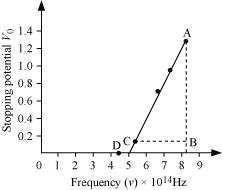
The graph of $V_0$ versus $\nu$ is a straight line. The threshold frequency $\nu_0$ is the intercept on the $\nu$-axis,which is $5 \times 10^{14} \,Hz$.
The slope of the line is $\frac{h}{e} = \frac{1.28 - 0.16}{(8.219 - 5.493) \times 10^{14}} = \frac{1.12}{2.726 \times 10^{14}} \approx 4.108 \times 10^{-15} \,V \cdot s$.
$h = (4.108 \times 10^{-15}) \times (1.6 \times 10^{-19}) \approx 6.573 \times 10^{-34} \,J \cdot s$.
Work function $\phi_0 = h \nu_0 = (6.573 \times 10^{-34}) \times (5 \times 10^{14}) = 3.286 \times 10^{-19} \,J = 2.054 \,eV$.
$e V_0 = h \nu - \phi_0$
$V_0 = \frac{h}{e} \nu - \frac{\phi_0}{e} \dots (i)$
Where $V_0$ is the stopping potential,$h$ is Planck's constant,$e$ is the charge of an electron,$\nu$ is the frequency of radiation,and $\phi_0$ is the work function.
Using $\nu = \frac{c}{\lambda}$ (where $c = 3 \times 10^8 \,m/s$),we calculate the frequencies:
$\nu_1 = 8.219 \times 10^{14} \,Hz, \nu_2 = 7.412 \times 10^{14} \,Hz, \nu_3 = 6.884 \times 10^{14} \,Hz, \nu_4 = 5.493 \times 10^{14} \,Hz, \nu_5 = 4.343 \times 10^{14} \,Hz$
| Frequency $(\times 10^{14} \,Hz)$ | $8.219$ | $7.412$ | $6.884$ | $5.493$ | $4.343$ |
| Stopping potential $V_0$ $(V)$ | $1.28$ | $0.95$ | $0.74$ | $0.16$ | $0$ |
The graph of $V_0$ versus $\nu$ is a straight line. The threshold frequency $\nu_0$ is the intercept on the $\nu$-axis,which is $5 \times 10^{14} \,Hz$.
The slope of the line is $\frac{h}{e} = \frac{1.28 - 0.16}{(8.219 - 5.493) \times 10^{14}} = \frac{1.12}{2.726 \times 10^{14}} \approx 4.108 \times 10^{-15} \,V \cdot s$.
$h = (4.108 \times 10^{-15}) \times (1.6 \times 10^{-19}) \approx 6.573 \times 10^{-34} \,J \cdot s$.
Work function $\phi_0 = h \nu_0 = (6.573 \times 10^{-34}) \times (5 \times 10^{14}) = 3.286 \times 10^{-19} \,J = 2.054 \,eV$.
0 likes
View Solution384
Medium
The work functions for the following metals are given:
$Na: 2.75\;eV; K: 2.30\;eV; Mo: 4.17\;eV; Ni: 5.15\;eV$. Which of these metals will not give photoelectric emission for a radiation of wavelength $3300\,\mathring{A}$ from a $He-Cd$ laser placed $1\;m$ away from the photocell? What happens if the laser is brought nearer and placed $50\;cm$ away?
$Na: 2.75\;eV; K: 2.30\;eV; Mo: 4.17\;eV; Ni: 5.15\;eV$. Which of these metals will not give photoelectric emission for a radiation of wavelength $3300\,\mathring{A}$ from a $He-Cd$ laser placed $1\;m$ away from the photocell? What happens if the laser is brought nearer and placed $50\;cm$ away?
Solution
(C) The energy of the incident photon is given by $E = \frac{hc}{\lambda}$.
Given $\lambda = 3300\,\mathring{A} = 3300 \times 10^{-10}\,m$,$h = 6.63 \times 10^{-34}\,Js$,and $c = 3 \times 10^8\,m/s$.
$E = \frac{6.63 \times 10^{-34} \times 3 \times 10^8}{3300 \times 10^{-10}}\,J = 6.027 \times 10^{-19}\,J$.
Converting to electron-volts: $E = \frac{6.027 \times 10^{-19}}{1.6 \times 10^{-19}}\,eV \approx 3.77\,eV$.
Photoelectric emission occurs only if the incident photon energy $E$ is greater than the work function $\Phi$ of the metal.
Here,$E = 3.77\,eV$. Comparing this with the given work functions:
$Na (2.75\,eV) < 3.77\,eV$ (Emission occurs)
$K (2.30\,eV) < 3.77\,eV$ (Emission occurs)
$Mo (4.17\,eV) > 3.77\,eV$ (No emission)
$Ni (5.15\,eV) > 3.77\,eV$ (No emission)
Thus,$Mo$ and $Ni$ will not show photoelectric emission.
If the laser is moved to $50\;cm$,the intensity of the radiation increases,but the energy of individual photons remains $3.77\,eV$. Since the energy is still less than the work functions of $Mo$ and $Ni$,there will still be no photoelectric emission for these metals.
Given $\lambda = 3300\,\mathring{A} = 3300 \times 10^{-10}\,m$,$h = 6.63 \times 10^{-34}\,Js$,and $c = 3 \times 10^8\,m/s$.
$E = \frac{6.63 \times 10^{-34} \times 3 \times 10^8}{3300 \times 10^{-10}}\,J = 6.027 \times 10^{-19}\,J$.
Converting to electron-volts: $E = \frac{6.027 \times 10^{-19}}{1.6 \times 10^{-19}}\,eV \approx 3.77\,eV$.
Photoelectric emission occurs only if the incident photon energy $E$ is greater than the work function $\Phi$ of the metal.
Here,$E = 3.77\,eV$. Comparing this with the given work functions:
$Na (2.75\,eV) < 3.77\,eV$ (Emission occurs)
$K (2.30\,eV) < 3.77\,eV$ (Emission occurs)
$Mo (4.17\,eV) > 3.77\,eV$ (No emission)
$Ni (5.15\,eV) > 3.77\,eV$ (No emission)
Thus,$Mo$ and $Ni$ will not show photoelectric emission.
If the laser is moved to $50\;cm$,the intensity of the radiation increases,but the energy of individual photons remains $3.77\,eV$. Since the energy is still less than the work functions of $Mo$ and $Ni$,there will still be no photoelectric emission for these metals.
0 likes
View Solution385
Medium
Explain: "For photoelectric emission, the frequency of incident radiation should be greater than the threshold frequency."
Solution
(N/A) The threshold frequency $(\nu_0)$ is the minimum frequency of incident radiation required to eject electrons from a metal surface.
Each metal has a unique work function $(\Phi = h\nu_0)$, which determines its specific threshold frequency.
If the frequency of incident radiation $(\nu)$ is less than the threshold frequency $(\nu < \nu_0)$, the energy of the incident photons is insufficient to overcome the work function of the metal, and no photoelectric emission occurs, regardless of the intensity of the light.
If $\nu > \nu_0$, the energy of the incident photons is greater than the work function, and photoelectric emission occurs instantaneously (within $10^{-9} \, s$ or less), even if the intensity of the radiation is very low.
Each metal has a unique work function $(\Phi = h\nu_0)$, which determines its specific threshold frequency.
If the frequency of incident radiation $(\nu)$ is less than the threshold frequency $(\nu < \nu_0)$, the energy of the incident photons is insufficient to overcome the work function of the metal, and no photoelectric emission occurs, regardless of the intensity of the light.
If $\nu > \nu_0$, the energy of the incident photons is greater than the work function, and photoelectric emission occurs instantaneously (within $10^{-9} \, s$ or less), even if the intensity of the radiation is very low.
0 likes
View Solution386
MediumMCQ
Energy of a photoelectron depends on which factors?
A
Intensity of incident light
B
Frequency of incident light
C
Material of the photosensitive surface
D
Both $(B)$ and $(C)$
Solution
(D) According to Einstein's photoelectric equation, $K_{max} = h\nu - \Phi_0$, where $K_{max}$ is the maximum kinetic energy of the photoelectron, $h$ is Planck's constant, $\nu$ is the frequency of incident light and $\Phi_0$ is the work function. The work function $\Phi_0$ depends on the type of metal surface. Therefore, the energy of the photoelectron depends on the frequency of incident light ($\nu$) and the type of metal surface ($\Phi_0$). Thus, the correct option is $(D)$.
0 likes
View Solution387
Medium
Why can wave theory not explain the change in the kinetic energy of an electron with a change in the frequency of incident light?
Solution
(N/A) According to the wave theory of light,the energy of a wave is proportional to the square of its amplitude (intensity) and is independent of its frequency.
$1$. Wave theory suggests that the energy delivered to the metal surface depends on the intensity of the light,not its frequency.
$2$. Therefore,if the intensity is kept constant,the wave theory predicts that the kinetic energy of the emitted electrons should remain constant regardless of the frequency of the incident light.
$3$. However,experimental observations show that the maximum kinetic energy of photoelectrons increases linearly with the frequency of incident light.
$4$. This discrepancy arises because light interacts with matter as discrete packets of energy called photons,where the energy of each photon is given by $E = h\nu$. Since the wave theory treats light as a continuous wave,it fails to account for this frequency-dependent energy transfer.
$1$. Wave theory suggests that the energy delivered to the metal surface depends on the intensity of the light,not its frequency.
$2$. Therefore,if the intensity is kept constant,the wave theory predicts that the kinetic energy of the emitted electrons should remain constant regardless of the frequency of the incident light.
$3$. However,experimental observations show that the maximum kinetic energy of photoelectrons increases linearly with the frequency of incident light.
$4$. This discrepancy arises because light interacts with matter as discrete packets of energy called photons,where the energy of each photon is given by $E = h\nu$. Since the wave theory treats light as a continuous wave,it fails to account for this frequency-dependent energy transfer.
0 likes
View Solution388
Medium
Explain Einstein's photoelectric effect and derive Einstein's photoelectric equation.
Solution
(N/A) In $1905$,Einstein proposed a new theory to explain the photoelectric effect.
According to this theory,the emission and absorption of energy (called a photon) take place in discrete units. These units are called quanta of energy of radiation.
Each quantum (photon) has energy $E = h\nu$,where $\nu$ is the frequency of radiation. An electron on the surface will absorb this energy $h\nu$.
If the energy absorbed by an electron on the surface is greater than the minimum energy required (work function $\phi_{0}$),then the electron will be emitted with maximum kinetic energy $K_{\max}$.
Let the energy of the incident radiation be $h\nu$,the maximum kinetic energy of the electron be $K_{\max}$,and the work function of the metal be $\phi_{0}$. Then,according to the law of conservation of energy:
$h\nu = K_{\max} + \phi_{0}$
Therefore,$K_{\max} = h\nu - \phi_{0} \quad \dots (1)$
More tightly bound electrons will emerge with kinetic energy less than the maximum value. With an increase in the intensity of light,the number of electrons emitted per second increases. However,the maximum kinetic energy of the emitted electron is determined solely by the energy of the photon.
In Einstein's equation,the maximum kinetic energy is $K_{\max} = e V_{0}$,where $V_{0}$ is the stopping potential. Substituting this into equation $(1)$:
$e V_{0} = h\nu - \phi_{0} \quad \dots (2)$
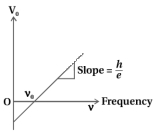
Rearranging this gives $V_{0} = \left(\frac{h}{e}\right)\nu - \frac{\phi_{0}}{e}$.
The graph of stopping potential $V_{0}$ versus frequency $\nu$ is a straight line. The slope of the $V_{0}-\nu$ graph is $\frac{h}{e}$,which is a universal constant and does not depend on the type of material used.
According to this theory,the emission and absorption of energy (called a photon) take place in discrete units. These units are called quanta of energy of radiation.
Each quantum (photon) has energy $E = h\nu$,where $\nu$ is the frequency of radiation. An electron on the surface will absorb this energy $h\nu$.
If the energy absorbed by an electron on the surface is greater than the minimum energy required (work function $\phi_{0}$),then the electron will be emitted with maximum kinetic energy $K_{\max}$.
Let the energy of the incident radiation be $h\nu$,the maximum kinetic energy of the electron be $K_{\max}$,and the work function of the metal be $\phi_{0}$. Then,according to the law of conservation of energy:
$h\nu = K_{\max} + \phi_{0}$
Therefore,$K_{\max} = h\nu - \phi_{0} \quad \dots (1)$
More tightly bound electrons will emerge with kinetic energy less than the maximum value. With an increase in the intensity of light,the number of electrons emitted per second increases. However,the maximum kinetic energy of the emitted electron is determined solely by the energy of the photon.
In Einstein's equation,the maximum kinetic energy is $K_{\max} = e V_{0}$,where $V_{0}$ is the stopping potential. Substituting this into equation $(1)$:
$e V_{0} = h\nu - \phi_{0} \quad \dots (2)$
Rearranging this gives $V_{0} = \left(\frac{h}{e}\right)\nu - \frac{\phi_{0}}{e}$.
The graph of stopping potential $V_{0}$ versus frequency $\nu$ is a straight line. The slope of the $V_{0}-\nu$ graph is $\frac{h}{e}$,which is a universal constant and does not depend on the type of material used.
0 likes
View Solution389
Difficult
In an experiment aimed to disprove Einstein's photoelectric equation,how did Millikan prove it?
Solution
(N/A) Einstein's photoelectric equation is given by:
$\frac{1}{2} m v_{\max }^{2} = h \nu - \phi_{0}$
Since the maximum kinetic energy is related to the stopping potential $V_{0}$ by the relation:
$\frac{1}{2} m v_{\max }^{2} = e V_{0}$
Substituting this into the photoelectric equation,we get:
$e V_{0} = h \nu - \phi_{0}$
Rearranging for $V_{0}$:
$V_{0} = \left( \frac{h}{e} \right) \nu - \frac{\phi_{0}}{e}$
This equation is of the form $y = mx + c$,representing a straight line where the slope is $\frac{h}{e}$.
Millikan performed a series of experiments measuring the stopping potential $V_{0}$ for different frequencies $\nu$ of incident radiation. He plotted a graph of $V_{0}$ versus $\nu$,which resulted in a straight line. The slope of this line was found to be $\frac{h}{e}$.
By using the known value of the elementary charge $e$,Millikan calculated the value of Planck's constant $h$ to be approximately $6.626 \times 10^{-34} \text{ Js}$,which matched the previously accepted value.
Thus,while Millikan initially intended to disprove Einstein's theory,his experimental results provided strong evidence for its validity,confirming the photoelectric equation with great precision across various alkali metals.
$\frac{1}{2} m v_{\max }^{2} = h \nu - \phi_{0}$
Since the maximum kinetic energy is related to the stopping potential $V_{0}$ by the relation:
$\frac{1}{2} m v_{\max }^{2} = e V_{0}$
Substituting this into the photoelectric equation,we get:
$e V_{0} = h \nu - \phi_{0}$
Rearranging for $V_{0}$:
$V_{0} = \left( \frac{h}{e} \right) \nu - \frac{\phi_{0}}{e}$
This equation is of the form $y = mx + c$,representing a straight line where the slope is $\frac{h}{e}$.
Millikan performed a series of experiments measuring the stopping potential $V_{0}$ for different frequencies $\nu$ of incident radiation. He plotted a graph of $V_{0}$ versus $\nu$,which resulted in a straight line. The slope of this line was found to be $\frac{h}{e}$.
By using the known value of the elementary charge $e$,Millikan calculated the value of Planck's constant $h$ to be approximately $6.626 \times 10^{-34} \text{ Js}$,which matched the previously accepted value.
Thus,while Millikan initially intended to disprove Einstein's theory,his experimental results provided strong evidence for its validity,confirming the photoelectric equation with great precision across various alkali metals.
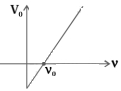
0 likes
View Solution390
MediumMCQ
How does the maximum kinetic energy of a photoelectron depend on the frequency of incident radiation? On which factors does it not depend?
A
It depends linearly on frequency; it does not depend on the intensity of incident light.
B
It depends quadratically on frequency; it does not depend on the work function of the metal.
C
It depends linearly on frequency; it does not depend on the frequency of incident light.
D
It depends inversely on frequency; it does not depend on the nature of the material.
Solution
(A) According to Einstein's photoelectric equation,the maximum kinetic energy $(K_{max})$ of a photoelectron is given by:
$K_{max} = h\nu - \Phi_0$
where $h$ is Planck's constant,$\nu$ is the frequency of incident radiation,and $\Phi_0$ is the work function of the metal.
$1$. Dependence on frequency: The equation shows that $K_{max}$ increases linearly with the frequency $(\nu)$ of the incident radiation.
$2$. Independence: $K_{max}$ does not depend on the intensity of the incident radiation,as intensity only affects the number of photoelectrons emitted per second,not their individual kinetic energies.
$K_{max} = h\nu - \Phi_0$
where $h$ is Planck's constant,$\nu$ is the frequency of incident radiation,and $\Phi_0$ is the work function of the metal.
$1$. Dependence on frequency: The equation shows that $K_{max}$ increases linearly with the frequency $(\nu)$ of the incident radiation.
$2$. Independence: $K_{max}$ does not depend on the intensity of the incident radiation,as intensity only affects the number of photoelectrons emitted per second,not their individual kinetic energies.
0 likes
View Solution391
Medium
Why maximum kinetic energy of a photoelectron cannot be negative?
Solution
(N/A) The kinetic energy $(K_{max})$ of a photoelectron is given by Einstein's photoelectric equation: $K_{max} = h\nu - \Phi_0$,where $h\nu$ is the energy of the incident photon and $\Phi_0$ is the work function of the metal surface.
$1$. By definition,kinetic energy is the energy possessed by an object due to its motion,which is given by the formula $K = \frac{1}{2}mv^2$. Since mass $(m)$ is always positive and the square of velocity $(v^2)$ is always non-negative,kinetic energy can never be negative.
$2$. Physically,if the incident photon energy $(h\nu)$ is less than the work function $(\Phi_0)$,the photon does not have enough energy to eject an electron from the metal surface at all. In this case,no photoelectric emission occurs,and the kinetic energy is not defined as negative; rather,the process simply does not take place.
$1$. By definition,kinetic energy is the energy possessed by an object due to its motion,which is given by the formula $K = \frac{1}{2}mv^2$. Since mass $(m)$ is always positive and the square of velocity $(v^2)$ is always non-negative,kinetic energy can never be negative.
$2$. Physically,if the incident photon energy $(h\nu)$ is less than the work function $(\Phi_0)$,the photon does not have enough energy to eject an electron from the metal surface at all. In this case,no photoelectric emission occurs,and the kinetic energy is not defined as negative; rather,the process simply does not take place.
0 likes
View Solution392
Medium
What is the slope of the $V_0 - \nu$ graph? Write its equation. Also,mention whether it depends on the type of material or not.
Solution
(N/A) The photoelectric equation is given by $h\nu = \phi_0 + eV_0$,where $h$ is Planck's constant,$\nu$ is the frequency of incident radiation,$\phi_0$ is the work function,and $V_0$ is the stopping potential.
Rearranging for $V_0$,we get $V_0 = (\frac{h}{e})\nu - \frac{\phi_0}{e}$.
Comparing this with the equation of a straight line $y = mx + c$,the slope $m$ is $\frac{h}{e}$.
The slope of the $V_0 - \nu$ graph is $\frac{h}{e}$,which is a universal constant.
Since $h$ (Planck's constant) and $e$ (charge of an electron) are universal constants,the slope does not depend on the type of material used for the photosensitive surface.
Rearranging for $V_0$,we get $V_0 = (\frac{h}{e})\nu - \frac{\phi_0}{e}$.
Comparing this with the equation of a straight line $y = mx + c$,the slope $m$ is $\frac{h}{e}$.
The slope of the $V_0 - \nu$ graph is $\frac{h}{e}$,which is a universal constant.
Since $h$ (Planck's constant) and $e$ (charge of an electron) are universal constants,the slope does not depend on the type of material used for the photosensitive surface.
0 likes
View Solution393
MediumMCQ
Write the slope of the $eV_0 - \nu$ graph.
A
h
B
h/e
C
e/h
D
h/m
Solution
(A) According to Einstein's photoelectric equation, the maximum kinetic energy $K_{max}$ of emitted photoelectrons is given by $K_{max} = h\nu - \Phi_0$, where $h$ is Planck's constant, $\nu$ is the frequency of incident radiation, and $\Phi_0$ is the work function.
Since $K_{max} = eV_0$, where $e$ is the charge of an electron and $V_0$ is the stopping potential, we can write the equation as $eV_0 = h\nu - \Phi_0$.
Rearranging this to the form $y = mx + c$, we get $V_0 = (h/e)\nu - (\Phi_0/e)$.
However, for the $eV_0 - \nu$ graph, the equation is $eV_0 = h\nu - \Phi_0$.
Comparing this with $y = mx + c$, where $y = eV_0$ and $x = \nu$, the slope $m$ is equal to $h$.
Since $K_{max} = eV_0$, where $e$ is the charge of an electron and $V_0$ is the stopping potential, we can write the equation as $eV_0 = h\nu - \Phi_0$.
Rearranging this to the form $y = mx + c$, we get $V_0 = (h/e)\nu - (\Phi_0/e)$.
However, for the $eV_0 - \nu$ graph, the equation is $eV_0 = h\nu - \Phi_0$.
Comparing this with $y = mx + c$, where $y = eV_0$ and $x = \nu$, the slope $m$ is equal to $h$.
0 likes
View Solution394
Medium
$(i)$ In the explanation of the photoelectric effect,we assume one photon of frequency $f$ collides with an electron and transfers its energy. This leads to the equation for the maximum kinetic energy $E_{max}$ of the emitted electron as $E_{max} = hf - \phi_0$ (where $\phi_0$ is the work function of the metal). If an electron absorbs $2$ photons (each of frequency $f$),what will be the maximum energy for the emitted electron?
$(ii)$ Why is this fact (two-photon absorption) not taken into consideration in our discussion of the stopping potential?
$(ii)$ Why is this fact (two-photon absorption) not taken into consideration in our discussion of the stopping potential?
Solution
(A) $(i)$ Suppose one electron absorbs two photons each having frequency $f$. Out of this total energy $2hf$,it spends $W$ amount of energy to overcome the work function for its emission,and the remaining amount $(2hf - W)$ is possessed by it in the form of kinetic energy after being emitted.
Hence,$K = 2hf - W$.
Therefore,$K_{max} = 2hf - W_{min}$.
Since $W_{min} = \phi_0$,we get $K_{max} = 2hf - \phi_0$.
$(ii)$ If the above assumption were true,then according to the work-energy theorem,taking $K_{max} = V_0 e$ (where $V_0$ is the stopping potential):
$2hf - \phi_0 = V_0 e$
$V_0 = (\frac{2h}{e})f - (\frac{\phi_0}{e})$
This equation represents a straight line $y = mx + c$. If we plot a graph of $V_0$ versus $f$ experimentally,the slope should be $(\frac{2h}{e})$. However,experimental results consistently show the slope to be $(\frac{h}{e})$. Thus,the assumption of two-photon absorption is incorrect,which is why it is not considered in the discussion of stopping potential.
Hence,$K = 2hf - W$.
Therefore,$K_{max} = 2hf - W_{min}$.
Since $W_{min} = \phi_0$,we get $K_{max} = 2hf - \phi_0$.
$(ii)$ If the above assumption were true,then according to the work-energy theorem,taking $K_{max} = V_0 e$ (where $V_0$ is the stopping potential):
$2hf - \phi_0 = V_0 e$
$V_0 = (\frac{2h}{e})f - (\frac{\phi_0}{e})$
This equation represents a straight line $y = mx + c$. If we plot a graph of $V_0$ versus $f$ experimentally,the slope should be $(\frac{2h}{e})$. However,experimental results consistently show the slope to be $(\frac{h}{e})$. Thus,the assumption of two-photon absorption is incorrect,which is why it is not considered in the discussion of stopping potential.
0 likes
View Solution395
MediumMCQ
Consider a metal exposed to light of wavelength $600 \, nm$. The maximum kinetic energy of the emitted electron doubles when light of wavelength $400 \, nm$ is used. Find the work function of the metal in $eV$. (in $, eV$)
A
$0.5$
B
$1.0$
C
$1.5$
D
$2.0$
Solution
(B) According to Einstein's photoelectric equation,the maximum kinetic energy $K$ is given by $K = \frac{hc}{\lambda} - \phi_0$,where $\phi_0$ is the work function.
For $\lambda_1 = 600 \, nm$,$K_1 = \frac{hc}{600} - \phi_0$ $(1)$
For $\lambda_2 = 400 \, nm$,$K_2 = \frac{hc}{400} - \phi_0$ $(2)$
Given $K_2 = 2K_1$,we substitute $(1)$ into $(2)$:
$\frac{hc}{400} - \phi_0 = 2 \left( \frac{hc}{600} - \phi_0 \right)$
$\frac{hc}{400} - \phi_0 = \frac{hc}{300} - 2\phi_0$
$\phi_0 = hc \left( \frac{1}{300} - \frac{1}{400} \right) \times 10^9$
Using $hc \approx 1240 \, eV \cdot nm$:
$\phi_0 = 1240 \left( \frac{4-3}{1200} \right) = \frac{1240}{1200} \approx 1.03 \, eV$.
Rounding to the nearest option,the work function is $1.0 \, eV$.
For $\lambda_1 = 600 \, nm$,$K_1 = \frac{hc}{600} - \phi_0$ $(1)$
For $\lambda_2 = 400 \, nm$,$K_2 = \frac{hc}{400} - \phi_0$ $(2)$
Given $K_2 = 2K_1$,we substitute $(1)$ into $(2)$:
$\frac{hc}{400} - \phi_0 = 2 \left( \frac{hc}{600} - \phi_0 \right)$
$\frac{hc}{400} - \phi_0 = \frac{hc}{300} - 2\phi_0$
$\phi_0 = hc \left( \frac{1}{300} - \frac{1}{400} \right) \times 10^9$
Using $hc \approx 1240 \, eV \cdot nm$:
$\phi_0 = 1240 \left( \frac{4-3}{1200} \right) = \frac{1240}{1200} \approx 1.03 \, eV$.
Rounding to the nearest option,the work function is $1.0 \, eV$.
0 likes
View Solution396
Difficult
What is zero-point energy or Fermi energy?
Solution
(N/A) Zero-point energy is the lowest possible energy that a quantum mechanical physical system may have. Unlike in classical mechanics,quantum systems fluctuate even in their ground state. For a gas of fermions,the energy of the highest occupied state at absolute zero temperature $(0 \ K)$ is called the Fermi energy $(E_F)$.
0 likes
View Solution397
MediumMCQ
When radiation of wavelength $\lambda$ is used to illuminate a metallic surface,the stopping potential is $V.$ When the same surface is illuminated with radiation of wavelength $3 \lambda,$ the stopping potential is $\frac{V}{4}.$ If the threshold wavelength for the metallic surface is $n \lambda,$ then the value of $n$ will be......
A
$9$
B
$3$
C
$11$
D
$16$
Solution
(A) According to Einstein's photoelectric equation: $K_{max} = \frac{hc}{\lambda} - \phi = eV,$ where $\phi = \frac{hc}{\lambda_0}$ is the work function.
For wavelength $\lambda$: $\frac{hc}{\lambda} = \frac{hc}{\lambda_0} + eV$ ... $(i)$
For wavelength $3\lambda$: $\frac{hc}{3\lambda} = \frac{hc}{\lambda_0} + \frac{eV}{4}$ ... (ii)
Multiply equation (ii) by $4$: $\frac{4hc}{3\lambda} = \frac{4hc}{\lambda_0} + eV$ ... (iii)
Equating the expressions for $eV$ from $(i)$ and (iii):
$\frac{hc}{\lambda} - \frac{hc}{\lambda_0} = \frac{4hc}{3\lambda} - \frac{4hc}{\lambda_0}$
Rearranging terms: $\frac{4hc}{\lambda_0} - \frac{hc}{\lambda_0} = \frac{4hc}{3\lambda} - \frac{hc}{\lambda}$
$\frac{3hc}{\lambda_0} = \frac{hc}{3\lambda}$
$\frac{3}{\lambda_0} = \frac{1}{3\lambda} \implies \lambda_0 = 9\lambda$
Given $\lambda_0 = n\lambda,$ therefore $n = 9.$
For wavelength $\lambda$: $\frac{hc}{\lambda} = \frac{hc}{\lambda_0} + eV$ ... $(i)$
For wavelength $3\lambda$: $\frac{hc}{3\lambda} = \frac{hc}{\lambda_0} + \frac{eV}{4}$ ... (ii)
Multiply equation (ii) by $4$: $\frac{4hc}{3\lambda} = \frac{4hc}{\lambda_0} + eV$ ... (iii)
Equating the expressions for $eV$ from $(i)$ and (iii):
$\frac{hc}{\lambda} - \frac{hc}{\lambda_0} = \frac{4hc}{3\lambda} - \frac{4hc}{\lambda_0}$
Rearranging terms: $\frac{4hc}{\lambda_0} - \frac{hc}{\lambda_0} = \frac{4hc}{3\lambda} - \frac{hc}{\lambda}$
$\frac{3hc}{\lambda_0} = \frac{hc}{3\lambda}$
$\frac{3}{\lambda_0} = \frac{1}{3\lambda} \implies \lambda_0 = 9\lambda$
Given $\lambda_0 = n\lambda,$ therefore $n = 9.$
0 likes
View Solution398
MediumMCQ
When the wavelength of radiation falling on a metal is changed from $500 \, nm$ to $200 \, nm$,the maximum kinetic energy of the photoelectrons becomes three times larger. The work function of the metal is close to $..... \, eV$.
A
$0.61$
B
$0.52$
C
$0.81$
D
$1.02$
Solution
(A) According to Einstein's photoelectric equation,the maximum kinetic energy $K_{max}$ is given by $K_{max} = \frac{hc}{\lambda} - \phi$,where $\phi$ is the work function.
Let $\lambda_1 = 500 \, nm$ and $\lambda_2 = 200 \, nm$.
Let $K_1$ and $K_2$ be the maximum kinetic energies corresponding to $\lambda_1$ and $\lambda_2$ respectively.
Given $K_2 = 3K_1$.
Using $hc = 1240 \, eV \cdot nm$:
$K_1 = \frac{1240}{500} - \phi = 2.48 - \phi$
$K_2 = \frac{1240}{200} - \phi = 6.2 - \phi$
Substituting into $K_2 = 3K_1$:
$6.2 - \phi = 3(2.48 - \phi)$
$6.2 - \phi = 7.44 - 3\phi$
$2\phi = 7.44 - 6.2$
$2\phi = 1.24$
$\phi = 0.62 \, eV$.
The closest value is $0.61 \, eV$.
Let $\lambda_1 = 500 \, nm$ and $\lambda_2 = 200 \, nm$.
Let $K_1$ and $K_2$ be the maximum kinetic energies corresponding to $\lambda_1$ and $\lambda_2$ respectively.
Given $K_2 = 3K_1$.
Using $hc = 1240 \, eV \cdot nm$:
$K_1 = \frac{1240}{500} - \phi = 2.48 - \phi$
$K_2 = \frac{1240}{200} - \phi = 6.2 - \phi$
Substituting into $K_2 = 3K_1$:
$6.2 - \phi = 3(2.48 - \phi)$
$6.2 - \phi = 7.44 - 3\phi$
$2\phi = 7.44 - 6.2$
$2\phi = 1.24$
$\phi = 0.62 \, eV$.
The closest value is $0.61 \, eV$.
0 likes
View Solution399
MediumMCQ
In a photoelectric effect experiment,the graph of stopping potential $V$ versus the reciprocal of wavelength $(1/\lambda)$ is shown in the figure. As the intensity of incident radiation is increased:
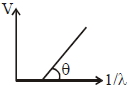
A
Slope of the straight line becomes steeper.
B
Straight line shifts to the left.
C
Graph does not change.
D
Straight line shifts to the right.
Solution
(C) According to Einstein's photoelectric equation,the stopping potential $V$ is given by:
$eV = \frac{hc}{\lambda} - \phi$
Rearranging this for $V$:
$V = \left(\frac{hc}{e}\right)\left(\frac{1}{\lambda}\right) - \frac{\phi}{e}$
Comparing this with the equation of a straight line $y = mx + c$,we have:
Slope $m = \frac{hc}{e}$ and intercept $c = -\frac{\phi}{e}$.
Here,$h$ is Planck's constant,$c$ is the speed of light,$e$ is the charge of an electron,and $\phi$ is the work function of the metal surface.
None of these parameters $(h, c, e, \phi)$ depend on the intensity of the incident radiation. The intensity of radiation only affects the number of photoelectrons emitted per unit time (photoelectric current),not their maximum kinetic energy or the stopping potential.
Therefore,changing the intensity of the incident radiation does not affect the slope or the intercept of the graph. Thus,the graph remains unchanged.
$eV = \frac{hc}{\lambda} - \phi$
Rearranging this for $V$:
$V = \left(\frac{hc}{e}\right)\left(\frac{1}{\lambda}\right) - \frac{\phi}{e}$
Comparing this with the equation of a straight line $y = mx + c$,we have:
Slope $m = \frac{hc}{e}$ and intercept $c = -\frac{\phi}{e}$.
Here,$h$ is Planck's constant,$c$ is the speed of light,$e$ is the charge of an electron,and $\phi$ is the work function of the metal surface.
None of these parameters $(h, c, e, \phi)$ depend on the intensity of the incident radiation. The intensity of radiation only affects the number of photoelectrons emitted per unit time (photoelectric current),not their maximum kinetic energy or the stopping potential.
Therefore,changing the intensity of the incident radiation does not affect the slope or the intercept of the graph. Thus,the graph remains unchanged.
0 likes
View Solution400
MediumMCQ
The given figure shows a few data points in a photoelectric effect experiment for a certain metal. The minimum energy for the ejection of an electron from its surface is $....... eV$. (Planck's constant $h = 6.62 \times 10^{-34} \, J \cdot s$)
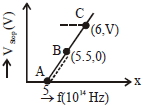
A
$2.27$
B
$2.59$
C
$1.93$
D
$2.10$
Solution
(D) The graph shows the variation of stopping potential $V_s$ with frequency $f$ of incident light.
According to Einstein's photoelectric equation: $hf = \phi + eV_s$,where $\phi$ is the work function.
At the threshold frequency $f_0$,the stopping potential $V_s = 0$.
From the graph,the intercept on the frequency axis (where $V_s = 0$) is $f_0 = 5 \times 10^{14} \, Hz$.
The work function $\phi$ is given by $\phi = hf_0$.
Substituting the values: $\phi = (6.62 \times 10^{-34} \, J \cdot s) \times (5 \times 10^{14} \, Hz) = 33.1 \times 10^{-20} \, J$.
To convert this energy into electron-volts $(eV)$,divide by the charge of an electron $(e = 1.6 \times 10^{-19} \, C)$:
$\phi = \frac{33.1 \times 10^{-20}}{1.6 \times 10^{-19}} \, eV = 2.06875 \, eV \approx 2.07 \, eV$.
Given the options,the closest value is $2.10 \, eV$.
According to Einstein's photoelectric equation: $hf = \phi + eV_s$,where $\phi$ is the work function.
At the threshold frequency $f_0$,the stopping potential $V_s = 0$.
From the graph,the intercept on the frequency axis (where $V_s = 0$) is $f_0 = 5 \times 10^{14} \, Hz$.
The work function $\phi$ is given by $\phi = hf_0$.
Substituting the values: $\phi = (6.62 \times 10^{-34} \, J \cdot s) \times (5 \times 10^{14} \, Hz) = 33.1 \times 10^{-20} \, J$.
To convert this energy into electron-volts $(eV)$,divide by the charge of an electron $(e = 1.6 \times 10^{-19} \, C)$:
$\phi = \frac{33.1 \times 10^{-20}}{1.6 \times 10^{-19}} \, eV = 2.06875 \, eV \approx 2.07 \, eV$.
Given the options,the closest value is $2.10 \, eV$.
0 likes
View SolutionDual Nature of Radiation and matter — Einstein's Photoelectric Equation and Energy Quantum of Radiation · Frequently Asked Questions
1Are these Dual Nature of Radiation and matter questions useful for JEE and NEET?
Yes. All questions in this section are mapped to JEE Main and NEET exam patterns. Previous year questions from JEE Main, NEET, GUJCET and state-level exams are included with full solutions.
2Can I switch to Hindi or Gujarati for these questions?
Yes. Use the language tabs in the hero section or the sidebar to view the same questions and solutions in English, Hindi or Gujarati.
3How do I generate a question paper from this subtopic?
Use the Vedclass Exam Paper Generator — select the chapter and subtopic, set difficulty, and generate Sets A, B, C, D automatically. First 3 chapters of every subject are free.
Vedclass Products
For Students
Vedclass Test Series
Mock tests in real JEE/NEET style with performance analysis. 5-day free trial.
Start Free TrialFor Teachers
Exam Paper Generator
Generate Set A/B/C/D papers from this chapter in 2 minutes. 3 chapters free.
Try FreeFor Institutes
Online Exam Module
Live online exams with unlimited students, 360° analytics & white-label branding.
See DemoFor Teachers & Institutes
Generate a Dual Nature of Radiation and matter Exam Paper in 2 Minutes
Select subtopic & difficulty — Sets A, B, C, D auto-generated with No Repeat logic.
First 3 chapters of every subject are free — no payment required.