
A English
Einstein's Photoelectric Equation and Energy Quantum of Radiation Questions in English
Class 12 Physics · Dual Nature of Radiation and matter · Einstein's Photoelectric Equation and Energy Quantum of Radiation
736+
Questions
English
Language
100%
With Solutions
Showing 50 of 736 questions in English
251
MediumMCQ
In an experiment of photoelectric effect,the stopping potential was measured to be $V_{1}$ and $V_{2}$ with incident light of wavelength $\lambda$ and $\frac{\lambda}{2}$ respectively. The relation between $V_{1}$ and $V_{2}$ is:
A
$V_2 < V_1$
B
$V_1 < V_2 < 2V_1$
C
$V_2 = 2V_1$
D
$V_2 > 2V_1$
Solution
(D) According to Einstein's photoelectric equation,the stopping potential $V_s$ is given by $eV_s = \frac{hc}{\lambda} - \phi$,where $\phi$ is the work function of the metal.
For wavelength $\lambda$,the stopping potential is $eV_1 = \frac{hc}{\lambda} - \phi$ --- $(1)$.
For wavelength $\frac{\lambda}{2}$,the stopping potential is $eV_2 = \frac{hc}{\lambda/2} - \phi = \frac{2hc}{\lambda} - \phi$ --- $(2)$.
From equation $(1)$,we have $\frac{hc}{\lambda} = eV_1 + \phi$.
Substituting this into equation $(2)$:
$eV_2 = 2(eV_1 + \phi) - \phi$
$eV_2 = 2eV_1 + 2\phi - \phi$
$eV_2 = 2eV_1 + \phi$
Since the work function $\phi > 0$,it follows that $eV_2 > 2eV_1$,which implies $V_2 > 2V_1$.
For wavelength $\lambda$,the stopping potential is $eV_1 = \frac{hc}{\lambda} - \phi$ --- $(1)$.
For wavelength $\frac{\lambda}{2}$,the stopping potential is $eV_2 = \frac{hc}{\lambda/2} - \phi = \frac{2hc}{\lambda} - \phi$ --- $(2)$.
From equation $(1)$,we have $\frac{hc}{\lambda} = eV_1 + \phi$.
Substituting this into equation $(2)$:
$eV_2 = 2(eV_1 + \phi) - \phi$
$eV_2 = 2eV_1 + 2\phi - \phi$
$eV_2 = 2eV_1 + \phi$
Since the work function $\phi > 0$,it follows that $eV_2 > 2eV_1$,which implies $V_2 > 2V_1$.
0 likes
View Solution252
MediumMCQ
The photoelectric threshold wavelength of silver is $3250 \times 10^{-10} \, m$. The velocity of the electron ejected from a silver surface by ultraviolet light of wavelength $2536 \times 10^{-10} \, m$ is (Given $h = 4.14 \times 10^{-15} \, eV \cdot s$ and $c = 3 \times 10^8 \, m/s$):
A
$6 \times 10^5 \, m/s$
B
$6 \times 10^3 \, m/s$
C
$3 \times 10^5 \, m/s$
D
$8 \times 10^5 \, m/s$
Solution
(A) The maximum kinetic energy is given by Einstein's photoelectric equation:
$K_{\max} = \frac{hc}{\lambda} - \frac{hc}{\lambda_0}$
where $\lambda_0 = 3250 \times 10^{-10} \, m$ is the threshold wavelength and $\lambda = 2536 \times 10^{-10} \, m$ is the incident wavelength.
Given $hc = (4.14 \times 10^{-15} \, eV \cdot s) \times (3 \times 10^8 \, m/s) = 12420 \, eV \cdot \mathring{A}$.
Converting wavelengths to $\mathring{A}$s: $\lambda_0 = 3250 \, \mathring{A}$ and $\lambda = 2536 \, \mathring{A}$.
$K_{\max} = 12420 \left( \frac{1}{2536} - \frac{1}{3250} \right) \, eV = 12420 \left( \frac{3250 - 2536}{2536 \times 3250} \right) \, eV \approx 1.076 \, eV$.
Converting $K_{\max}$ to Joules: $K_{\max} = 1.076 \times 1.6 \times 10^{-19} \, J \approx 1.72 \times 10^{-19} \, J$.
Using $K_{\max} = \frac{1}{2}mv^2$ with $m = 9.1 \times 10^{-31} \, kg$:
$v^2 = \frac{2 \times 1.72 \times 10^{-19}}{9.1 \times 10^{-31}} \approx 0.378 \times 10^{12} \, m^2/s^2$.
$v \approx 0.615 \times 10^6 \, m/s \approx 6 \times 10^5 \, m/s$.
$K_{\max} = \frac{hc}{\lambda} - \frac{hc}{\lambda_0}$
where $\lambda_0 = 3250 \times 10^{-10} \, m$ is the threshold wavelength and $\lambda = 2536 \times 10^{-10} \, m$ is the incident wavelength.
Given $hc = (4.14 \times 10^{-15} \, eV \cdot s) \times (3 \times 10^8 \, m/s) = 12420 \, eV \cdot \mathring{A}$.
Converting wavelengths to $\mathring{A}$s: $\lambda_0 = 3250 \, \mathring{A}$ and $\lambda = 2536 \, \mathring{A}$.
$K_{\max} = 12420 \left( \frac{1}{2536} - \frac{1}{3250} \right) \, eV = 12420 \left( \frac{3250 - 2536}{2536 \times 3250} \right) \, eV \approx 1.076 \, eV$.
Converting $K_{\max}$ to Joules: $K_{\max} = 1.076 \times 1.6 \times 10^{-19} \, J \approx 1.72 \times 10^{-19} \, J$.
Using $K_{\max} = \frac{1}{2}mv^2$ with $m = 9.1 \times 10^{-31} \, kg$:
$v^2 = \frac{2 \times 1.72 \times 10^{-19}}{9.1 \times 10^{-31}} \approx 0.378 \times 10^{12} \, m^2/s^2$.
$v \approx 0.615 \times 10^6 \, m/s \approx 6 \times 10^5 \, m/s$.
0 likes
View Solution253
MediumMCQ
When the light of frequency $2v_0$ (where $v_0$ is threshold frequency) is incident on a metal plate,the maximum velocity of electrons emitted is $v_1$. When the frequency of the incident radiation is increased to $5v_0$,the maximum velocity of electrons emitted from the same plate is $v_2$. The ratio of $v_1$ to $v_2$ is
A
$1:2$
B
$1:4$
C
$2:1$
D
$4:1$
Solution
(A) According to Einstein's photoelectric equation,$K_{max} = h\nu - W_0 = \frac{1}{2}mv^2$,where $W_0 = h\nu_0$.
For frequency $2\nu_0$:
$h(2\nu_0) = h\nu_0 + \frac{1}{2}mv_1^2$
$h\nu_0 = \frac{1}{2}mv_1^2$ ..... $(i)$
For frequency $5\nu_0$:
$h(5\nu_0) = h\nu_0 + \frac{1}{2}mv_2^2$
$4h\nu_0 = \frac{1}{2}mv_2^2$ ..... $(ii)$
Dividing equation $(i)$ by $(ii)$:
$\frac{h\nu_0}{4h\nu_0} = \frac{\frac{1}{2}mv_1^2}{\frac{1}{2}mv_2^2}$
$\frac{1}{4} = \frac{v_1^2}{v_2^2}$
Taking the square root on both sides:
$\frac{v_1}{v_2} = \frac{1}{2}$
Thus,the ratio is $1:2$.
For frequency $2\nu_0$:
$h(2\nu_0) = h\nu_0 + \frac{1}{2}mv_1^2$
$h\nu_0 = \frac{1}{2}mv_1^2$ ..... $(i)$
For frequency $5\nu_0$:
$h(5\nu_0) = h\nu_0 + \frac{1}{2}mv_2^2$
$4h\nu_0 = \frac{1}{2}mv_2^2$ ..... $(ii)$
Dividing equation $(i)$ by $(ii)$:
$\frac{h\nu_0}{4h\nu_0} = \frac{\frac{1}{2}mv_1^2}{\frac{1}{2}mv_2^2}$
$\frac{1}{4} = \frac{v_1^2}{v_2^2}$
Taking the square root on both sides:
$\frac{v_1}{v_2} = \frac{1}{2}$
Thus,the ratio is $1:2$.
0 likes
View Solution254
DifficultMCQ
An electron in the hydrogen atom jumps from excited state $n$ to the ground state. The wavelength so emitted illuminates a photosensitive material having work function $2.75 \ eV$. If the stopping potential of the photoelectron is $10 \ V$,then the value of $n$ is
A
$2$
B
$3$
C
$4$
D
$5$
Solution
(C) Given,stopping potential $V_{0} = 10 \ V$ and work function $W = 2.75 \ eV$.
According to Einstein's photoelectric equation,the energy of the incident photon is $E = h\nu = eV_{0} + W$.
Substituting the values,$E = 10 \ eV + 2.75 \ eV = 12.75 \ eV$ ..... $(i)$.
For a hydrogen atom,the energy of a photon emitted during a transition from state $n$ to the ground state $(n=1)$ is given by $h\nu = E_{n} - E_{1}$.
Since $E_{n} = -\frac{13.6}{n^{2}} \ eV$,we have $h\nu = -\frac{13.6}{n^{2}} - (-13.6) = 13.6 \left(1 - \frac{1}{n^{2}}\right) \ eV$.
Equating this to the energy from $(i)$,$13.6 \left(1 - \frac{1}{n^{2}}\right) = 12.75$.
$1 - \frac{1}{n^{2}} = \frac{12.75}{13.6} = 0.9375$.
$\frac{1}{n^{2}} = 1 - 0.9375 = 0.0625$.
$n^{2} = \frac{1}{0.0625} = 16$.
Therefore,$n = 4$.
According to Einstein's photoelectric equation,the energy of the incident photon is $E = h\nu = eV_{0} + W$.
Substituting the values,$E = 10 \ eV + 2.75 \ eV = 12.75 \ eV$ ..... $(i)$.
For a hydrogen atom,the energy of a photon emitted during a transition from state $n$ to the ground state $(n=1)$ is given by $h\nu = E_{n} - E_{1}$.
Since $E_{n} = -\frac{13.6}{n^{2}} \ eV$,we have $h\nu = -\frac{13.6}{n^{2}} - (-13.6) = 13.6 \left(1 - \frac{1}{n^{2}}\right) \ eV$.
Equating this to the energy from $(i)$,$13.6 \left(1 - \frac{1}{n^{2}}\right) = 12.75$.
$1 - \frac{1}{n^{2}} = \frac{12.75}{13.6} = 0.9375$.
$\frac{1}{n^{2}} = 1 - 0.9375 = 0.0625$.
$n^{2} = \frac{1}{0.0625} = 16$.
Therefore,$n = 4$.
0 likes
View Solution255
EasyMCQ
When green light is incident on the surface of a metal, it emits photo-electrons, but there is no such emission with yellow light. Which one of the following colors can produce the emission of photo-electrons?
A
Orange
B
Red
C
Indigo
D
None of the above
Solution
(C) The energy of a photon is given by $E = \frac{hc}{\lambda}$.
For photoelectric emission to occur, the energy of the incident photon must be greater than or equal to the work function of the metal $(E \ge \phi)$.
This implies that the wavelength of the incident light must be less than or equal to the threshold wavelength $(\lambda \le \lambda_0)$.
Given that green light causes emission but yellow light does not, the threshold wavelength $\lambda_0$ lies between the wavelengths of green and yellow light $(\lambda_{\text{green}} < \lambda_0 < \lambda_{\text{yellow}})$.
Since the wavelength of light increases in the order $V < I < B < G < Y < O < R$, any color with a wavelength shorter than green light will have higher energy and will cause photoelectric emission.
Among the given options, Indigo has a shorter wavelength than green light.
Therefore, Indigo can produce the emission of photo-electrons.
For photoelectric emission to occur, the energy of the incident photon must be greater than or equal to the work function of the metal $(E \ge \phi)$.
This implies that the wavelength of the incident light must be less than or equal to the threshold wavelength $(\lambda \le \lambda_0)$.
Given that green light causes emission but yellow light does not, the threshold wavelength $\lambda_0$ lies between the wavelengths of green and yellow light $(\lambda_{\text{green}} < \lambda_0 < \lambda_{\text{yellow}})$.
Since the wavelength of light increases in the order $V < I < B < G < Y < O < R$, any color with a wavelength shorter than green light will have higher energy and will cause photoelectric emission.
Among the given options, Indigo has a shorter wavelength than green light.
Therefore, Indigo can produce the emission of photo-electrons.
0 likes
View Solution256
MediumMCQ
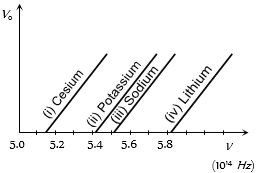
The figure shows different graphs between stopping potential $(V_0)$ and frequency $(\nu)$ for photosensitive surfaces of cesium,potassium,sodium,and lithium. The plots are parallel. The correct ranking of the targets according to their work function,with the greatest first,is:
A
$(i) > (ii) > (iii) > (iv)$
B
$(i) > (iii) > (ii) > (iv)$
C
$(iv) > (iii) > (ii) > (i)$
D
$(i) = (iii) > (ii) = (iv)$
Solution
(C) According to Einstein's photoelectric equation,the stopping potential $V_0$ is given by $eV_0 = h\nu - W_0$,where $W_0$ is the work function.
This can be rewritten as $V_0 = \frac{h}{e}\nu - \frac{W_0}{e}$.
The graph between $V_0$ and $\nu$ is a straight line with a slope of $\frac{h}{e}$.
The $x$-intercept of this graph is the threshold frequency $\nu_0$,where $V_0 = 0$,so $h\nu_0 = W_0$.
From the graph,the threshold frequencies are in the order: $(\nu_0)_{(iv)} > (\nu_0)_{(iii)} > (\nu_0)_{(ii)} > (\nu_0)_{(i)}$.
Since the work function $W_0 = h\nu_0$,the work functions follow the same order: $(W_0)_{(iv)} > (W_0)_{(iii)} > (W_0)_{(ii)} > (W_0)_{(i)}$.
Therefore,the correct ranking is $(iv) > (iii) > (ii) > (i)$.
This can be rewritten as $V_0 = \frac{h}{e}\nu - \frac{W_0}{e}$.
The graph between $V_0$ and $\nu$ is a straight line with a slope of $\frac{h}{e}$.
The $x$-intercept of this graph is the threshold frequency $\nu_0$,where $V_0 = 0$,so $h\nu_0 = W_0$.
From the graph,the threshold frequencies are in the order: $(\nu_0)_{(iv)} > (\nu_0)_{(iii)} > (\nu_0)_{(ii)} > (\nu_0)_{(i)}$.
Since the work function $W_0 = h\nu_0$,the work functions follow the same order: $(W_0)_{(iv)} > (W_0)_{(iii)} > (W_0)_{(ii)} > (W_0)_{(i)}$.
Therefore,the correct ranking is $(iv) > (iii) > (ii) > (i)$.
0 likes
View Solution257
MediumMCQ
If light of wavelength $\lambda_1$ is allowed to fall on a metal,then the kinetic energy of the photoelectrons emitted is $E_1$. If the wavelength of light changes to $\lambda_2$,then the kinetic energy of the electrons changes to $E_2$. Then the work function of the metal is:
A
$\frac{E_1 E_2 (\lambda_1 - \lambda_2)}{\lambda_1 \lambda_2}$
B
$\frac{E_1 \lambda_1 - E_2 \lambda_2}{(\lambda_1 - \lambda_2)}$
C
$\frac{E_1 \lambda_1 - E_2 \lambda_2}{(\lambda_2 - \lambda_1)}$
D
$\frac{\lambda_1 \lambda_2 E_1 E_2}{(\lambda_2 - \lambda_1)}$
Solution
(C) According to Einstein's photoelectric equation,the energy of the incident photon is equal to the sum of the work function $(W_0)$ and the maximum kinetic energy $(K_{max})$ of the emitted photoelectrons: $E = W_0 + K_{max}$.
For wavelength $\lambda_1$: $\frac{hc}{\lambda_1} = W_0 + E_1$ --- $(1)$
For wavelength $\lambda_2$: $\frac{hc}{\lambda_2} = W_0 + E_2$ --- $(2)$
From $(1)$,$hc = W_0 \lambda_1 + E_1 \lambda_1$. From $(2)$,$hc = W_0 \lambda_2 + E_2 \lambda_2$.
Equating the two expressions for $hc$: $W_0 \lambda_1 + E_1 \lambda_1 = W_0 \lambda_2 + E_2 \lambda_2$.
Rearranging to solve for $W_0$: $W_0 (\lambda_1 - \lambda_2) = E_2 \lambda_2 - E_1 \lambda_1$.
$W_0 = \frac{E_2 \lambda_2 - E_1 \lambda_1}{\lambda_1 - \lambda_2} = \frac{E_1 \lambda_1 - E_2 \lambda_2}{\lambda_2 - \lambda_1}$.
For wavelength $\lambda_1$: $\frac{hc}{\lambda_1} = W_0 + E_1$ --- $(1)$
For wavelength $\lambda_2$: $\frac{hc}{\lambda_2} = W_0 + E_2$ --- $(2)$
From $(1)$,$hc = W_0 \lambda_1 + E_1 \lambda_1$. From $(2)$,$hc = W_0 \lambda_2 + E_2 \lambda_2$.
Equating the two expressions for $hc$: $W_0 \lambda_1 + E_1 \lambda_1 = W_0 \lambda_2 + E_2 \lambda_2$.
Rearranging to solve for $W_0$: $W_0 (\lambda_1 - \lambda_2) = E_2 \lambda_2 - E_1 \lambda_1$.
$W_0 = \frac{E_2 \lambda_2 - E_1 \lambda_1}{\lambda_1 - \lambda_2} = \frac{E_1 \lambda_1 - E_2 \lambda_2}{\lambda_2 - \lambda_1}$.
0 likes
View Solution258
MediumMCQ
If the maximum velocity with which an electron can be emitted from a photocell is $4 \times 10^8 \, cm/s$,the stopping potential is ................ $V$ (mass of electron $= 9 \times 10^{-31} \, kg$).
A
$30$
B
$45$
C
$59$
D
Information is insufficient
Solution
(B) Given: Maximum velocity $v_{max} = 4 \times 10^8 \, cm/s = 4 \times 10^6 \, m/s$.
Mass of electron $m = 9 \times 10^{-31} \, kg$.
Charge of electron $e = 1.6 \times 10^{-19} \, C$.
The maximum kinetic energy is given by $K_{max} = \frac{1}{2} m v_{max}^2$.
$K_{max} = \frac{1}{2} \times (9 \times 10^{-31} \, kg) \times (4 \times 10^6 \, m/s)^2$.
$K_{max} = 0.5 \times 9 \times 10^{-31} \times 16 \times 10^{12} \, J$.
$K_{max} = 72 \times 10^{-19} \, J$.
To convert this into electron-volts $(eV)$,divide by $e = 1.6 \times 10^{-19} \, C$:
$K_{max} = \frac{72 \times 10^{-19}}{1.6 \times 10^{-19}} \, eV = 45 \, eV$.
The stopping potential $V_0$ is defined as $K_{max} = e V_0$,so $V_0 = 45 \, V$.
Mass of electron $m = 9 \times 10^{-31} \, kg$.
Charge of electron $e = 1.6 \times 10^{-19} \, C$.
The maximum kinetic energy is given by $K_{max} = \frac{1}{2} m v_{max}^2$.
$K_{max} = \frac{1}{2} \times (9 \times 10^{-31} \, kg) \times (4 \times 10^6 \, m/s)^2$.
$K_{max} = 0.5 \times 9 \times 10^{-31} \times 16 \times 10^{12} \, J$.
$K_{max} = 72 \times 10^{-19} \, J$.
To convert this into electron-volts $(eV)$,divide by $e = 1.6 \times 10^{-19} \, C$:
$K_{max} = \frac{72 \times 10^{-19}}{1.6 \times 10^{-19}} \, eV = 45 \, eV$.
The stopping potential $V_0$ is defined as $K_{max} = e V_0$,so $V_0 = 45 \, V$.
0 likes
View Solution259
MediumMCQ
The maximum velocity of electrons emitted from a metal surface is $V$,when the frequency of light falling on it is $f$. What is the maximum velocity when the frequency becomes $4f$?
A
$2V$
B
$> 2V$
C
$< 2V$
D
Between $2V$ and $4V$
Solution
(B) According to Einstein's photoelectric equation: $hf = W_0 + \frac{1}{2}mv_{\max}^2$,where $W_0$ is the work function of the metal.
Thus,$v_{\max} = \sqrt{\frac{2(hf - W_0)}{m}} = V$.
When the frequency becomes $4f$,the new maximum velocity $V'$ is given by:
$V' = \sqrt{\frac{2(h(4f) - W_0)}{m}}$.
We can rewrite this as: $V' = \sqrt{\frac{2(4hf - W_0)}{m}}$.
Since $4hf - W_0 > 4(hf - W_0)$,we have $V' > \sqrt{\frac{2(4(hf - W_0))}{m}} = 2\sqrt{\frac{2(hf - W_0)}{m}} = 2V$.
Therefore,$V' > 2V$.
Thus,$v_{\max} = \sqrt{\frac{2(hf - W_0)}{m}} = V$.
When the frequency becomes $4f$,the new maximum velocity $V'$ is given by:
$V' = \sqrt{\frac{2(h(4f) - W_0)}{m}}$.
We can rewrite this as: $V' = \sqrt{\frac{2(4hf - W_0)}{m}}$.
Since $4hf - W_0 > 4(hf - W_0)$,we have $V' > \sqrt{\frac{2(4(hf - W_0))}{m}} = 2\sqrt{\frac{2(hf - W_0)}{m}} = 2V$.
Therefore,$V' > 2V$.
0 likes
View Solution260
DifficultMCQ
In a photo-emissive cell,with exciting wavelength $\lambda$,the maximum kinetic energy of the electron is $K$. If the exciting wavelength is changed to $\frac{3\lambda}{4}$,the kinetic energy of the fastest emitted electron will be:
A
$3K/4$
B
$4K/3$
C
less than $4K/3$
D
greater than $4K/3$
Solution
(D) According to Einstein's photoelectric equation: $\frac{hc}{\lambda} = \phi + K$ $...(1)$
When the wavelength is changed to $\lambda' = \frac{3\lambda}{4}$,the new kinetic energy $K'$ is given by:
$\frac{hc}{3\lambda/4} = \phi + K'$ $...(2)$
$\frac{4hc}{3\lambda} = \phi + K'$ $...(2)$
From equation $(1)$,we have $\phi = \frac{hc}{\lambda} - K$. Substituting this into equation $(2)$:
$\frac{4}{3} \left( \frac{hc}{\lambda} \right) = \left( \frac{hc}{\lambda} - K \right) + K'$
$\frac{4}{3} \left( \frac{hc}{\lambda} \right) - \frac{hc}{\lambda} = K' - K$
$\frac{1}{3} \left( \frac{hc}{\lambda} \right) = K' - K$
Since $\frac{hc}{\lambda} = \phi + K$,we substitute this back:
$K' = K + \frac{1}{3} (\phi + K) = K + \frac{\phi}{3} + \frac{K}{3} = \frac{4K}{3} + \frac{\phi}{3}$
Since the work function $\phi > 0$,it follows that $K' > \frac{4K}{3}$.
When the wavelength is changed to $\lambda' = \frac{3\lambda}{4}$,the new kinetic energy $K'$ is given by:
$\frac{hc}{3\lambda/4} = \phi + K'$ $...(2)$
$\frac{4hc}{3\lambda} = \phi + K'$ $...(2)$
From equation $(1)$,we have $\phi = \frac{hc}{\lambda} - K$. Substituting this into equation $(2)$:
$\frac{4}{3} \left( \frac{hc}{\lambda} \right) = \left( \frac{hc}{\lambda} - K \right) + K'$
$\frac{4}{3} \left( \frac{hc}{\lambda} \right) - \frac{hc}{\lambda} = K' - K$
$\frac{1}{3} \left( \frac{hc}{\lambda} \right) = K' - K$
Since $\frac{hc}{\lambda} = \phi + K$,we substitute this back:
$K' = K + \frac{1}{3} (\phi + K) = K + \frac{\phi}{3} + \frac{K}{3} = \frac{4K}{3} + \frac{\phi}{3}$
Since the work function $\phi > 0$,it follows that $K' > \frac{4K}{3}$.
0 likes
View Solution261
MediumMCQ
If the frequency of light in a photoelectric experiment is doubled,the stopping potential will
A
be doubled
B
halved
C
become more than doubled
D
become less than double
Solution
(C) The maximum kinetic energy for the photoelectrons is given by Einstein's photoelectric equation: $K_{\max} = h\nu - \phi$,where $\nu$ is the frequency of incident light and $\phi$ is the work function of the metal.
Since $K_{\max} = eV_0$,we have $eV_0 = h\nu - \phi$ --- $(1)$
When the frequency is doubled $(\nu' = 2\nu)$,the new stopping potential $V_0'$ is given by:
$eV_0' = h(2\nu) - \phi = 2h\nu - \phi$
We can rewrite this as:
$eV_0' = 2(h\nu - \frac{\phi}{2})$ --- $(2)$
Comparing $(1)$ and $(2)$,since $h\nu - \frac{\phi}{2} > h\nu - \phi$,it follows that $eV_0' > 2eV_0$. Therefore,the stopping potential becomes more than double.
Since $K_{\max} = eV_0$,we have $eV_0 = h\nu - \phi$ --- $(1)$
When the frequency is doubled $(\nu' = 2\nu)$,the new stopping potential $V_0'$ is given by:
$eV_0' = h(2\nu) - \phi = 2h\nu - \phi$
We can rewrite this as:
$eV_0' = 2(h\nu - \frac{\phi}{2})$ --- $(2)$
Comparing $(1)$ and $(2)$,since $h\nu - \frac{\phi}{2} > h\nu - \phi$,it follows that $eV_0' > 2eV_0$. Therefore,the stopping potential becomes more than double.
0 likes
View Solution262
MediumMCQ
When a photon of light collides with a metal surface, the number of electrons (if any) coming out is:
A
only one
B
only two
C
infinite
D
depends upon factors
Solution
(A) According to the Einstein's photoelectric equation, the interaction between a photon and an electron is a one-to-one process.
When a single photon of energy $E = h\nu$ strikes a metal surface, it is completely absorbed by a single electron.
If the energy of the photon is greater than the work function $(\Phi)$ of the metal, this single electron gains enough kinetic energy to overcome the surface barrier and is emitted as a photoelectron.
Therefore, one photon can eject at most one electron. If the photon energy is less than the work function, no electron is emitted.
Thus, the number of electrons emitted depends on the number of incident photons and their energy relative to the work function.
When a single photon of energy $E = h\nu$ strikes a metal surface, it is completely absorbed by a single electron.
If the energy of the photon is greater than the work function $(\Phi)$ of the metal, this single electron gains enough kinetic energy to overcome the surface barrier and is emitted as a photoelectron.
Therefore, one photon can eject at most one electron. If the photon energy is less than the work function, no electron is emitted.
Thus, the number of electrons emitted depends on the number of incident photons and their energy relative to the work function.
0 likes
View Solution263
MediumMCQ
The frequency and the intensity of a beam of light falling on the surface of a photoelectric material are both increased by a factor of two. This will:
A
increase the maximum energy of the photoelectrons,as well as the photoelectric current by a factor of two.
B
increase the maximum kinetic energy of the photoelectrons and would increase the photoelectric current by a factor of two.
C
increase the maximum kinetic energy of the photoelectrons by a factor of greater than two and will have no effect on the magnitude of photoelectric current produced.
D
not produce any effect on the kinetic energy of the emitted electrons but will increase the photoelectric current by a factor of two.
Solution
(B) The maximum kinetic energy $(K_{max})$ of photoelectrons is given by Einstein's photoelectric equation: $K_{max} = h\nu - \phi$,where $h$ is Planck's constant,$\nu$ is the frequency of incident light,and $\phi$ is the work function of the material.
When the frequency $\nu$ is doubled,the term $h\nu$ increases,which leads to an increase in $K_{max}$. However,$K_{max}$ does not simply double because of the subtraction of the constant work function $\phi$.
The photoelectric current is directly proportional to the intensity of the incident light. When the intensity is doubled,the number of incident photons per unit time doubles,which in turn doubles the number of photoelectrons emitted per unit time,thereby doubling the photoelectric current.
Therefore,the correct description is that the kinetic energy increases (but not necessarily by a factor of two) and the photoelectric current increases by a factor of two. Among the given options,option $B$ is the most appropriate description of the physical phenomena.
When the frequency $\nu$ is doubled,the term $h\nu$ increases,which leads to an increase in $K_{max}$. However,$K_{max}$ does not simply double because of the subtraction of the constant work function $\phi$.
The photoelectric current is directly proportional to the intensity of the incident light. When the intensity is doubled,the number of incident photons per unit time doubles,which in turn doubles the number of photoelectrons emitted per unit time,thereby doubling the photoelectric current.
Therefore,the correct description is that the kinetic energy increases (but not necessarily by a factor of two) and the photoelectric current increases by a factor of two. Among the given options,option $B$ is the most appropriate description of the physical phenomena.
0 likes
View Solution264
MediumMCQ
Light coming from a discharge tube filled with hydrogen falls on the cathode of the photoelectric cell. The work function of the surface of the cathode is $4 \ eV$. Which one of the following values of the anode voltage (in Volts) with respect to the cathode will likely make the photocurrent zero?
A
$-4$
B
$-6$
C
$-8$
D
$-10$
Solution
(D) The work function of the cathode surface is $\phi = 4 \ eV$.
In a hydrogen discharge tube,the maximum energy of a photon emitted during the transition of an electron from higher energy levels to the ground state $(n=1)$ is given by the Rydberg formula,where the maximum energy corresponds to the transition from $n = \infty$ to $n = 1$,which is $13.6 \ eV$.
According to Einstein's photoelectric equation,the maximum kinetic energy $(K_{max})$ of the emitted photoelectrons is given by $K_{max} = E_{photon} - \phi$.
Substituting the maximum photon energy,$K_{max} = 13.6 \ eV - 4 \ eV = 9.6 \ eV$.
To make the photocurrent zero,the stopping potential $(V_s)$ must be applied such that $e|V_s| = K_{max}$.
Therefore,$|V_s| = 9.6 \ V$.
Since the stopping potential must be negative with respect to the cathode to stop the electrons,the anode voltage must be at least $-9.6 \ V$. Among the given options,$-10 \ V$ is the only value that is more negative than $-9.6 \ V$,which will effectively stop all photoelectrons.
In a hydrogen discharge tube,the maximum energy of a photon emitted during the transition of an electron from higher energy levels to the ground state $(n=1)$ is given by the Rydberg formula,where the maximum energy corresponds to the transition from $n = \infty$ to $n = 1$,which is $13.6 \ eV$.
According to Einstein's photoelectric equation,the maximum kinetic energy $(K_{max})$ of the emitted photoelectrons is given by $K_{max} = E_{photon} - \phi$.
Substituting the maximum photon energy,$K_{max} = 13.6 \ eV - 4 \ eV = 9.6 \ eV$.
To make the photocurrent zero,the stopping potential $(V_s)$ must be applied such that $e|V_s| = K_{max}$.
Therefore,$|V_s| = 9.6 \ V$.
Since the stopping potential must be negative with respect to the cathode to stop the electrons,the anode voltage must be at least $-9.6 \ V$. Among the given options,$-10 \ V$ is the only value that is more negative than $-9.6 \ V$,which will effectively stop all photoelectrons.
0 likes
View Solution265
EasyMCQ
$A$ point source of light is used in a photoelectric effect. If the source is moved farther from the emitting metal, the stopping potential:
A
will increase
B
will decrease
C
will remain constant
D
will either increase or decrease
Solution
(C) In the photoelectric effect, the stopping potential $(V_s)$ depends only on the frequency $(\nu)$ of the incident radiation and the work function $(\Phi)$ of the metal surface, according to Einstein's photoelectric equation: $eV_s = h\nu - \Phi$.
Moving the point source farther away decreases the intensity of the incident light, which reduces the number of photoelectrons emitted per unit time (photoelectric current).
However, the intensity does not affect the maximum kinetic energy of the emitted photoelectrons, as the frequency of the light remains unchanged.
Since the stopping potential is determined solely by the maximum kinetic energy, it remains constant regardless of the distance of the source.
Moving the point source farther away decreases the intensity of the incident light, which reduces the number of photoelectrons emitted per unit time (photoelectric current).
However, the intensity does not affect the maximum kinetic energy of the emitted photoelectrons, as the frequency of the light remains unchanged.
Since the stopping potential is determined solely by the maximum kinetic energy, it remains constant regardless of the distance of the source.
0 likes
View Solution266
DifficultMCQ
Let $K_1$ be the maximum kinetic energy of photoelectrons emitted by a light of wavelength $\lambda_1$ and $K_2$ corresponding to $\lambda_2$. If $\lambda_1 = 2\lambda_2$,then:
A
$2K_1 = K_2$
B
$K_1 = 2K_2$
C
$K_1 < \frac{K_2}{2}$
D
$K_1 > 2K_2$
Solution
(C) According to Einstein's photoelectric equation,the maximum kinetic energy $K$ is given by $K = \frac{hc}{\lambda} - W$,where $W$ is the work function of the metal.
For wavelength $\lambda_1$,$K_1 = \frac{hc}{\lambda_1} - W$ $(i)$
For wavelength $\lambda_2$,$K_2 = \frac{hc}{\lambda_2} - W$ $(ii)$
Given $\lambda_1 = 2\lambda_2$,substitute this into equation $(i)$:
$K_1 = \frac{hc}{2\lambda_2} - W$
$K_1 = \frac{1}{2} \left( \frac{hc}{\lambda_2} \right) - W$
From equation $(ii)$,we know $\frac{hc}{\lambda_2} = K_2 + W$.
Substituting this into the expression for $K_1$:
$K_1 = \frac{1}{2} (K_2 + W) - W$
$K_1 = \frac{K_2}{2} + \frac{W}{2} - W$
$K_1 = \frac{K_2}{2} - \frac{W}{2}$
Since $W > 0$,it follows that $K_1 < \frac{K_2}{2}$.
For wavelength $\lambda_1$,$K_1 = \frac{hc}{\lambda_1} - W$ $(i)$
For wavelength $\lambda_2$,$K_2 = \frac{hc}{\lambda_2} - W$ $(ii)$
Given $\lambda_1 = 2\lambda_2$,substitute this into equation $(i)$:
$K_1 = \frac{hc}{2\lambda_2} - W$
$K_1 = \frac{1}{2} \left( \frac{hc}{\lambda_2} \right) - W$
From equation $(ii)$,we know $\frac{hc}{\lambda_2} = K_2 + W$.
Substituting this into the expression for $K_1$:
$K_1 = \frac{1}{2} (K_2 + W) - W$
$K_1 = \frac{K_2}{2} + \frac{W}{2} - W$
$K_1 = \frac{K_2}{2} - \frac{W}{2}$
Since $W > 0$,it follows that $K_1 < \frac{K_2}{2}$.
0 likes
View Solution267
MediumMCQ
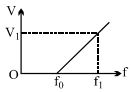
In a photoelectric experiment,the potential difference $V$ that must be maintained between the illuminated surface and the collector so as just to prevent any electron from reaching the collector is determined for different frequencies $f$ of the incident illumination. The graph obtained is shown. The maximum kinetic energy of the electrons emitted at frequency $f_1$ is
A
$hf_1$
B
$\frac{V_1}{(f_1 - f_0)}$
C
$h(f_1 - f_0)$
D
$eV_1(f_1 - f_0)$
Solution
(C) According to Einstein's photoelectric equation,the maximum kinetic energy $K_{max}$ of emitted photoelectrons is given by:
$K_{max} = hf - \phi$
where $h$ is Planck's constant,$f$ is the frequency of incident light,and $\phi$ is the work function of the metal.
In the photoelectric effect,the stopping potential $V$ is related to the maximum kinetic energy by the relation $K_{max} = eV$,where $e$ is the charge of an electron.
Thus,$eV = hf - \phi$,or $V = \frac{h}{e}f - \frac{\phi}{e}$.
From the graph,when $f = f_0$ (threshold frequency),the stopping potential $V = 0$. Therefore,$0 = \frac{h}{e}f_0 - \frac{\phi}{e}$,which implies $\phi = hf_0$.
Substituting this into the expression for $K_{max}$ at frequency $f_1$:
$K_{max} = hf_1 - hf_0 = h(f_1 - f_0)$.
Therefore,the correct option is $C$.
$K_{max} = hf - \phi$
where $h$ is Planck's constant,$f$ is the frequency of incident light,and $\phi$ is the work function of the metal.
In the photoelectric effect,the stopping potential $V$ is related to the maximum kinetic energy by the relation $K_{max} = eV$,where $e$ is the charge of an electron.
Thus,$eV = hf - \phi$,or $V = \frac{h}{e}f - \frac{\phi}{e}$.
From the graph,when $f = f_0$ (threshold frequency),the stopping potential $V = 0$. Therefore,$0 = \frac{h}{e}f_0 - \frac{\phi}{e}$,which implies $\phi = hf_0$.
Substituting this into the expression for $K_{max}$ at frequency $f_1$:
$K_{max} = hf_1 - hf_0 = h(f_1 - f_0)$.
Therefore,the correct option is $C$.
0 likes
View Solution268
MediumMCQ
Radiation of two photon energies,twice and five times the work function of a metal,are incident successively on the metal surface. The ratio of the maximum velocity of photoelectrons emitted in the two cases is:
A
$1 : 2$
B
$2 : 1$
C
$1 : 4$
D
$4 : 1$
Solution
(A) According to Einstein's photoelectric equation,the maximum kinetic energy $(K.E._{max})$ of emitted photoelectrons is given by:
$K.E._{max} = E - W$,where $E$ is the incident photon energy and $W$ is the work function.
For the first case,$E_1 = 2W$:
$\frac{1}{2} m v_1^2 = 2W - W = W$ --- $(1)$
For the second case,$E_2 = 5W$:
$\frac{1}{2} m v_2^2 = 5W - W = 4W$ --- $(2)$
Dividing equation $(1)$ by equation $(2)$:
$\frac{v_1^2}{v_2^2} = \frac{W}{4W} = \frac{1}{4}$
Taking the square root on both sides:
$\frac{v_1}{v_2} = \frac{1}{2}$
Thus,the ratio of the maximum velocities is $1 : 2$.
$K.E._{max} = E - W$,where $E$ is the incident photon energy and $W$ is the work function.
For the first case,$E_1 = 2W$:
$\frac{1}{2} m v_1^2 = 2W - W = W$ --- $(1)$
For the second case,$E_2 = 5W$:
$\frac{1}{2} m v_2^2 = 5W - W = 4W$ --- $(2)$
Dividing equation $(1)$ by equation $(2)$:
$\frac{v_1^2}{v_2^2} = \frac{W}{4W} = \frac{1}{4}$
Taking the square root on both sides:
$\frac{v_1}{v_2} = \frac{1}{2}$
Thus,the ratio of the maximum velocities is $1 : 2$.
0 likes
View Solution269
AdvancedMCQ
Cut-off potentials for a metal in the photoelectric effect for light of wavelengths $\lambda_1$,$\lambda_2$,and $\lambda_3$ are found to be $V_1$,$V_2$,and $V_3$ volts. If $V_1$,$V_2$,and $V_3$ are in Arithmetic Progression,then $\lambda_1$,$\lambda_2$,and $\lambda_3$ will be in:
A
Arithmetic Progression
B
Geometric Progression
C
Harmonic Progression
D
None
Solution
(C) According to Einstein's photoelectric equation,the stopping potential $V$ is given by: $eV = \frac{hc}{\lambda} - \phi$,where $\phi$ is the work function.
Rearranging for $V$,we get: $V = \frac{hc}{e\lambda} - \frac{\phi}{e}$.
Given that $V_1, V_2, V_3$ are in Arithmetic Progression ($A$.$P$.),we have $2V_2 = V_1 + V_3$.
Substituting the expression for $V$:
$2\left(\frac{hc}{e\lambda_2} - \frac{\phi}{e}\right) = \left(\frac{hc}{e\lambda_1} - \frac{\phi}{e}\right) + \left(\frac{hc}{e\lambda_3} - \frac{\phi}{e}\right)$.
Simplifying the equation:
$\frac{2hc}{e\lambda_2} - \frac{2\phi}{e} = \frac{hc}{e\lambda_1} + \frac{hc}{e\lambda_3} - \frac{2\phi}{e}$.
Canceling the common terms:
$\frac{2}{\lambda_2} = \frac{1}{\lambda_1} + \frac{1}{\lambda_3}$.
This condition implies that $\frac{1}{\lambda_1}, \frac{1}{\lambda_2}, \frac{1}{\lambda_3}$ are in $A$.$P$.,which means $\lambda_1, \lambda_2, \lambda_3$ are in Harmonic Progression ($H$.$P$.).
Rearranging for $V$,we get: $V = \frac{hc}{e\lambda} - \frac{\phi}{e}$.
Given that $V_1, V_2, V_3$ are in Arithmetic Progression ($A$.$P$.),we have $2V_2 = V_1 + V_3$.
Substituting the expression for $V$:
$2\left(\frac{hc}{e\lambda_2} - \frac{\phi}{e}\right) = \left(\frac{hc}{e\lambda_1} - \frac{\phi}{e}\right) + \left(\frac{hc}{e\lambda_3} - \frac{\phi}{e}\right)$.
Simplifying the equation:
$\frac{2hc}{e\lambda_2} - \frac{2\phi}{e} = \frac{hc}{e\lambda_1} + \frac{hc}{e\lambda_3} - \frac{2\phi}{e}$.
Canceling the common terms:
$\frac{2}{\lambda_2} = \frac{1}{\lambda_1} + \frac{1}{\lambda_3}$.
This condition implies that $\frac{1}{\lambda_1}, \frac{1}{\lambda_2}, \frac{1}{\lambda_3}$ are in $A$.$P$.,which means $\lambda_1, \lambda_2, \lambda_3$ are in Harmonic Progression ($H$.$P$.).
0 likes
View Solution270
MediumMCQ
Photons with energy $5\, eV$ are incident on a cathode $C$ of a photoelectric cell. The maximum kinetic energy of the emitted photoelectrons is $2\, eV$. When photons of energy $6\, eV$ are incident on $C$,no photoelectrons will reach the anode $A$ if the stopping potential of $A$ relative to $C$ is .............. $V$.
A
$3$
B
$-3$
C
$-1$
D
$4$
Solution
(B) According to Einstein's photoelectric equation,the maximum kinetic energy $K_{\max}$ is given by $K_{\max} = h\nu - \phi_0$,where $h\nu$ is the incident photon energy and $\phi_0$ is the work function.
For the first case: $2\, eV = 5\, eV - \phi_0$,which gives the work function $\phi_0 = 3\, eV$.
For the second case: The incident energy is $6\, eV$. The maximum kinetic energy of the emitted photoelectrons is $K_{\max}' = 6\, eV - 3\, eV = 3\, eV$.
To stop these photoelectrons from reaching the anode $A$,the potential of $A$ relative to $C$ $(V_{AC})$ must be negative and equal in magnitude to the maximum kinetic energy in electron volts. Thus,$V_{AC} = -3\, V$.
For the first case: $2\, eV = 5\, eV - \phi_0$,which gives the work function $\phi_0 = 3\, eV$.
For the second case: The incident energy is $6\, eV$. The maximum kinetic energy of the emitted photoelectrons is $K_{\max}' = 6\, eV - 3\, eV = 3\, eV$.
To stop these photoelectrons from reaching the anode $A$,the potential of $A$ relative to $C$ $(V_{AC})$ must be negative and equal in magnitude to the maximum kinetic energy in electron volts. Thus,$V_{AC} = -3\, V$.
0 likes
View Solution271
DifficultMCQ
In a photoelectric experiment,the collector plate is at $2.0\,V$ with respect to the emitter plate made of copper $(\phi = 4.5\,eV)$. The emitter is illuminated by a source of monochromatic light of wavelength $200\,nm$.
A
The minimum kinetic energy of the photoelectrons reaching the collector is $0$.
B
The maximum kinetic energy of the photoelectrons reaching the collector is $3.7\,eV$.
C
If the polarity of the battery is reversed,then the answer to part $A$ will be $0$.
D
If the polarity of the battery is reversed,then the answer to part $B$ will be $1.7\,eV$.
Solution
(B) Given: Work function $\phi = 4.5\,eV$,Wavelength $\lambda = 200\,nm$.
Energy of incident photon $E = \frac{hc}{\lambda} = \frac{1240\,eV\cdot nm}{200\,nm} = 6.2\,eV$.
Maximum kinetic energy of emitted photoelectrons $K_{max} = E - \phi = 6.2\,eV - 4.5\,eV = 1.7\,eV$.
The collector plate is at a potential of $+2.0\,V$ relative to the emitter,meaning it accelerates the electrons.
The minimum kinetic energy of electrons reaching the collector is $K_{min} = K_{initial} + qV = 0 + 2.0\,eV = 2.0\,eV$.
The maximum kinetic energy of electrons reaching the collector is $K_{max}' = K_{max} + qV = 1.7\,eV + 2.0\,eV = 3.7\,eV$.
Thus,option $B$ is correct.
Energy of incident photon $E = \frac{hc}{\lambda} = \frac{1240\,eV\cdot nm}{200\,nm} = 6.2\,eV$.
Maximum kinetic energy of emitted photoelectrons $K_{max} = E - \phi = 6.2\,eV - 4.5\,eV = 1.7\,eV$.
The collector plate is at a potential of $+2.0\,V$ relative to the emitter,meaning it accelerates the electrons.
The minimum kinetic energy of electrons reaching the collector is $K_{min} = K_{initial} + qV = 0 + 2.0\,eV = 2.0\,eV$.
The maximum kinetic energy of electrons reaching the collector is $K_{max}' = K_{max} + qV = 1.7\,eV + 2.0\,eV = 3.7\,eV$.
Thus,option $B$ is correct.
0 likes
View Solution272
MediumMCQ
In a photoelectric experiment,electrons are ejected from metals $X$ and $Y$ by light of intensity $I$ and frequency $f$. The potential difference $V$ required to stop the electrons is measured for various frequencies. If $Y$ has a greater work function than $X$,which one of the following graphs best illustrates the expected results?
A
B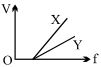
C
D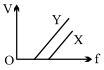
Solution
(A) According to Einstein's photoelectric equation,the stopping potential $V$ is given by $eV = hf - \Phi$,where $h$ is Planck's constant,$f$ is the frequency of incident light,and $\Phi$ is the work function of the metal.
This can be rewritten as $V = (h/e)f - (\Phi/e)$.
This is the equation of a straight line $y = mx + c$,where the slope $m = h/e$ is constant for all metals.
The y-intercept is $c = -\Phi/e$.
Since $Y$ has a greater work function than $X$ $(\Phi_Y > \Phi_X)$,the magnitude of the negative y-intercept for $Y$ will be greater than that for $X$.
This means the threshold frequency $f_0 = \Phi/h$ for $Y$ will be greater than that for $X$ $(f_{0,Y} > f_{0,X})$.
Therefore,the graph for $Y$ will be shifted to the right of the graph for $X$ on the frequency axis,while both lines remain parallel.
This corresponds to the graph where $X$ is on the left and $Y$ is on the right,as shown in option $A$.
This can be rewritten as $V = (h/e)f - (\Phi/e)$.
This is the equation of a straight line $y = mx + c$,where the slope $m = h/e$ is constant for all metals.
The y-intercept is $c = -\Phi/e$.
Since $Y$ has a greater work function than $X$ $(\Phi_Y > \Phi_X)$,the magnitude of the negative y-intercept for $Y$ will be greater than that for $X$.
This means the threshold frequency $f_0 = \Phi/h$ for $Y$ will be greater than that for $X$ $(f_{0,Y} > f_{0,X})$.
Therefore,the graph for $Y$ will be shifted to the right of the graph for $X$ on the frequency axis,while both lines remain parallel.
This corresponds to the graph where $X$ is on the left and $Y$ is on the right,as shown in option $A$.
0 likes
View Solution273
EasyMCQ
In the photoelectric effect, the stopping potential depends on:
A
frequency of the incident light
B
intensity of the incident light by varying source distance
C
emitter's properties (work function)
D
$(A)$ and $(C)$ both
Solution
(D) According to Einstein's photoelectric equation, the maximum kinetic energy $K_{max}$ of emitted photoelectrons is given by $K_{max} = h\nu - \Phi$, where $h$ is Planck's constant, $\nu$ is the frequency of incident light, and $\Phi$ is the work function of the emitter material.
Since the stopping potential $V_s$ is related to the maximum kinetic energy by $K_{max} = eV_s$, we have $eV_s = h\nu - \Phi$, which implies $V_s = \frac{h\nu}{e} - \frac{\Phi}{e}$.
From this equation, it is clear that the stopping potential $V_s$ depends on the frequency of the incident light $(\nu)$ and the work function $(\Phi)$, which is a property of the emitter material.
It does not depend on the intensity of the incident light.
Therefore, the correct answer is $(A)$ and $(C)$ both.
Since the stopping potential $V_s$ is related to the maximum kinetic energy by $K_{max} = eV_s$, we have $eV_s = h\nu - \Phi$, which implies $V_s = \frac{h\nu}{e} - \frac{\Phi}{e}$.
From this equation, it is clear that the stopping potential $V_s$ depends on the frequency of the incident light $(\nu)$ and the work function $(\Phi)$, which is a property of the emitter material.
It does not depend on the intensity of the incident light.
Therefore, the correct answer is $(A)$ and $(C)$ both.
0 likes
View Solution274
DifficultMCQ
The threshold frequency for a metallic surface corresponds to an energy of $6.2 \ eV$ and the stopping potential for a radiation incident on this surface is $5 \ V$. The incident radiation lies in:
A
infra-red region
B
$X$-ray region
C
ultra-violet region
D
visible region
Solution
(C) The work function $\phi$ is given as $6.2 \ eV$.
The stopping potential $V_0$ is $5 \ V$,so the maximum kinetic energy $K_{max} = eV_0 = 5 \ eV$.
Using Einstein's photoelectric equation: $E = \phi + K_{max}$.
$E = 6.2 \ eV + 5 \ eV = 11.2 \ eV$.
The energy of the incident photon is $E = \frac{hc}{\lambda}$.
Using $hc \approx 1240 \ eV \cdot nm$,we get $\lambda = \frac{1240 \ eV \cdot nm}{11.2 \ eV} \approx 110.7 \ nm$.
Since the wavelength range of the ultra-violet region is approximately $10 \ nm$ to $400 \ nm$,the incident radiation lies in the ultra-violet region.
The stopping potential $V_0$ is $5 \ V$,so the maximum kinetic energy $K_{max} = eV_0 = 5 \ eV$.
Using Einstein's photoelectric equation: $E = \phi + K_{max}$.
$E = 6.2 \ eV + 5 \ eV = 11.2 \ eV$.
The energy of the incident photon is $E = \frac{hc}{\lambda}$.
Using $hc \approx 1240 \ eV \cdot nm$,we get $\lambda = \frac{1240 \ eV \cdot nm}{11.2 \ eV} \approx 110.7 \ nm$.
Since the wavelength range of the ultra-violet region is approximately $10 \ nm$ to $400 \ nm$,the incident radiation lies in the ultra-violet region.
0 likes
View Solution275
MediumMCQ
The surface of a metal is illuminated with light of $400 \ nm$. The kinetic energy of the ejected photoelectrons was found to be $1.68 \ eV$. The work function of the metal is ............ $eV$ $(hc = 1240 \ eV \ nm)$.
A
$1.41$
B
$1.51$
C
$1.68$
D
$3.09$
Solution
(A) Given: Wavelength $\lambda = 400 \ nm$,Energy constant $hc = 1240 \ eV \ nm$,Kinetic energy $K.E. = 1.68 \ eV$.
According to Einstein's photoelectric equation: $E = W + K.E._{max}$,where $E = \frac{hc}{\lambda}$.
Substituting the values: $E = \frac{1240}{400} = 3.1 \ eV$.
Now,calculate the work function $W$: $W = E - K.E._{max} = 3.1 \ eV - 1.68 \ eV = 1.42 \ eV$.
Note: The closest option provided is $1.41 \ eV$ (Option $A$). Assuming a slight rounding in the question's provided options,$1.42 \ eV$ is the calculated result.
According to Einstein's photoelectric equation: $E = W + K.E._{max}$,where $E = \frac{hc}{\lambda}$.
Substituting the values: $E = \frac{1240}{400} = 3.1 \ eV$.
Now,calculate the work function $W$: $W = E - K.E._{max} = 3.1 \ eV - 1.68 \ eV = 1.42 \ eV$.
Note: The closest option provided is $1.41 \ eV$ (Option $A$). Assuming a slight rounding in the question's provided options,$1.42 \ eV$ is the calculated result.
0 likes
View Solution276
MediumMCQ
Statement $-1$: When ultraviolet light is incident on a photocell, its stopping potential is $V_0$ and the maximum kinetic energy of the photoelectrons is $K_{max}$. When the ultraviolet light is replaced by $X$-rays, both $V_0$ and $K_{max}$ increase.
Statement $-2$: Photoelectrons are emitted with speeds ranging from zero to a maximum value because of the range of frequencies present in the incident light.
Statement $-2$: Photoelectrons are emitted with speeds ranging from zero to a maximum value because of the range of frequencies present in the incident light.
A
Statement $-1$ is true, Statement $-2$ is false.
B
Statement $-1$ is true, Statement $-2$ is true; Statement $-2$ is the correct explanation of Statement $-1$.
C
Statement $-1$ is true, Statement $-2$ is true; Statement $-2$ is not the correct explanation of Statement $-1$.
D
Statement $-1$ is false, Statement $-2$ is true.
Solution
(A) According to Einstein's photoelectric equation, $eV_0 = K_{max} = h\nu - \phi$, where $\phi$ is the work function of the metal surface.
Since the frequency of $X$-rays $(\nu_X)$ is much higher than the frequency of ultraviolet light $(\nu_{UV})$, the maximum kinetic energy $K_{max} = h\nu - \phi$ increases when $X$-rays are used.
Consequently, the stopping potential $V_0 = K_{max}/e$ also increases. Thus, Statement $-1$ is true.
Statement $-2$ is false because photoelectrons are emitted with a range of speeds from zero to a maximum value due to the loss of energy during collisions of electrons within the metal before they are emitted, not because of a range of frequencies in the incident light (which is monochromatic).
Since the frequency of $X$-rays $(\nu_X)$ is much higher than the frequency of ultraviolet light $(\nu_{UV})$, the maximum kinetic energy $K_{max} = h\nu - \phi$ increases when $X$-rays are used.
Consequently, the stopping potential $V_0 = K_{max}/e$ also increases. Thus, Statement $-1$ is true.
Statement $-2$ is false because photoelectrons are emitted with a range of speeds from zero to a maximum value due to the loss of energy during collisions of electrons within the metal before they are emitted, not because of a range of frequencies in the incident light (which is monochromatic).
0 likes
View Solution277
MediumMCQ
This question has Statement-$1$ and Statement-$2$. Of the four choices given after the statements,choose the one that best describes the two statements.
Statement-$1$: $A$ metallic surface is irradiated by a monochromatic light of frequency $v > v_0$ (the threshold frequency). The maximum kinetic energy and the stopping potential are $K_{max}$ and $V_0$ respectively. If the frequency incident on the surface is doubled,both the $K_{max}$ and $V_0$ are also doubled.
Statement-$2$: The maximum kinetic energy and the stopping potential of photoelectrons emitted from a surface are linearly dependent on the frequency of incident light.
Statement-$1$: $A$ metallic surface is irradiated by a monochromatic light of frequency $v > v_0$ (the threshold frequency). The maximum kinetic energy and the stopping potential are $K_{max}$ and $V_0$ respectively. If the frequency incident on the surface is doubled,both the $K_{max}$ and $V_0$ are also doubled.
Statement-$2$: The maximum kinetic energy and the stopping potential of photoelectrons emitted from a surface are linearly dependent on the frequency of incident light.
A
Statement-$1$ is true,Statement-$2$ is true; Statement-$2$ is the correct explanation of Statement-$1$.
B
Statement-$1$ is true,Statement-$2$ is true; Statement-$2$ is not the correct explanation of Statement-$1$.
C
Statement-$1$ is false,Statement-$2$ is true.
D
Statement-$1$ is true,Statement-$2$ is false.
Solution
(C) According to Einstein's photoelectric equation,the maximum kinetic energy $K_{max}$ and stopping potential $V_0$ are given by: $K_{max} = eV_0 = hv - hv_0$.
Here,$h$ is Planck's constant,$v$ is the frequency of incident light,and $v_0$ is the threshold frequency.
From the equation,$K_{max} = hv - hv_0$. If the frequency $v$ is doubled to $2v$,the new maximum kinetic energy $K'_{max} = h(2v) - hv_0 = 2hv - hv_0$.
Since $2hv - hv_0$ is not equal to $2(hv - hv_0)$,the maximum kinetic energy does not double. Consequently,the stopping potential $V_0$ also does not double. Thus,Statement-$1$ is false.
Statement-$2$ is true because $K_{max}$ and $V_0$ are linear functions of frequency $v$ (i.e.,$y = mx + c$ form).
Here,$h$ is Planck's constant,$v$ is the frequency of incident light,and $v_0$ is the threshold frequency.
From the equation,$K_{max} = hv - hv_0$. If the frequency $v$ is doubled to $2v$,the new maximum kinetic energy $K'_{max} = h(2v) - hv_0 = 2hv - hv_0$.
Since $2hv - hv_0$ is not equal to $2(hv - hv_0)$,the maximum kinetic energy does not double. Consequently,the stopping potential $V_0$ also does not double. Thus,Statement-$1$ is false.
Statement-$2$ is true because $K_{max}$ and $V_0$ are linear functions of frequency $v$ (i.e.,$y = mx + c$ form).
0 likes
View Solution278
DifficultMCQ
Radiation of wavelength $\lambda$ is incident on a photocell. The fastest emitted electron has speed $v$. If the wavelength is changed to $\frac{3\lambda}{4}$,the speed of the fastest emitted electron will be:
A
$> v \left( \frac{4}{3} \right)^{1/2}$
B
$= v \left( \frac{3}{4} \right)^{1/2}$
C
$< v \left( \frac{4}{3} \right)^{1/2}$
D
$= v \left( \frac{4}{3} \right)^{1/2}$
Solution
(A) According to Einstein's photoelectric equation: $\frac{hc}{\lambda} = \phi + \frac{1}{2}mv^2$,where $\phi$ is the work function.
For wavelength $\lambda$: $\frac{hc}{\lambda} = \phi + \frac{1}{2}mv^2$ --- $(1)$
For wavelength $\lambda' = \frac{3\lambda}{4}$: $\frac{hc}{\lambda'} = \frac{4hc}{3\lambda} = \phi + \frac{1}{2}mv'^2$ --- $(2)$
From $(1)$,$\frac{hc}{\lambda} = \phi + K$,where $K = \frac{1}{2}mv^2$. Thus,$\frac{hc}{3\lambda} = \frac{\phi + K}{3}$.
Substituting into $(2)$: $\frac{4}{3}(\phi + K) = \phi + \frac{1}{2}mv'^2$.
$\frac{1}{2}mv'^2 = \frac{4}{3}\phi + \frac{4}{3}K - \phi = \frac{1}{3}\phi + \frac{4}{3}K$.
Since $\phi > 0$,$\frac{1}{2}mv'^2 > \frac{4}{3}K$.
$\frac{1}{2}mv'^2 > \frac{4}{3} \left( \frac{1}{2}mv^2 \right) \implies v'^2 > \frac{4}{3}v^2$.
Therefore,$v' > v \left( \frac{4}{3} \right)^{1/2}$.
For wavelength $\lambda$: $\frac{hc}{\lambda} = \phi + \frac{1}{2}mv^2$ --- $(1)$
For wavelength $\lambda' = \frac{3\lambda}{4}$: $\frac{hc}{\lambda'} = \frac{4hc}{3\lambda} = \phi + \frac{1}{2}mv'^2$ --- $(2)$
From $(1)$,$\frac{hc}{\lambda} = \phi + K$,where $K = \frac{1}{2}mv^2$. Thus,$\frac{hc}{3\lambda} = \frac{\phi + K}{3}$.
Substituting into $(2)$: $\frac{4}{3}(\phi + K) = \phi + \frac{1}{2}mv'^2$.
$\frac{1}{2}mv'^2 = \frac{4}{3}\phi + \frac{4}{3}K - \phi = \frac{1}{3}\phi + \frac{4}{3}K$.
Since $\phi > 0$,$\frac{1}{2}mv'^2 > \frac{4}{3}K$.
$\frac{1}{2}mv'^2 > \frac{4}{3} \left( \frac{1}{2}mv^2 \right) \implies v'^2 > \frac{4}{3}v^2$.
Therefore,$v' > v \left( \frac{4}{3} \right)^{1/2}$.
0 likes
View Solution279
MediumMCQ
When a metallic surface is illuminated with monochromatic light of wavelength $\lambda$,the stopping potential is $5V_0$. When the same surface is illuminated with light of wavelength $3\lambda$,the stopping potential is $V_0$. Then the work function of the metallic surface is:
A
$\frac{hc}{6\lambda}$
B
$\frac{hc}{5\lambda}$
C
$\frac{hc}{4\lambda}$
D
$\frac{2hc}{4\lambda}$
Solution
(A) According to Einstein's photoelectric equation: $K_{max} = \frac{hc}{\lambda} - \phi$,where $K_{max} = eV_s$ ($V_s$ is the stopping potential).
For the first case: $\frac{hc}{\lambda} = 5eV_0 + \phi$ --- $(1)$
For the second case: $\frac{hc}{3\lambda} = eV_0 + \phi$ --- $(2)$
Multiply equation $(2)$ by $5$: $\frac{5hc}{3\lambda} = 5eV_0 + 5\phi$ --- $(3)$
Subtract equation $(1)$ from equation $(3)$:
$\frac{5hc}{3\lambda} - \frac{hc}{\lambda} = (5eV_0 + 5\phi) - (5eV_0 + \phi)$
$\frac{5hc - 3hc}{3\lambda} = 4\phi$
$\frac{2hc}{3\lambda} = 4\phi$
$\phi = \frac{2hc}{12\lambda} = \frac{hc}{6\lambda}$
For the first case: $\frac{hc}{\lambda} = 5eV_0 + \phi$ --- $(1)$
For the second case: $\frac{hc}{3\lambda} = eV_0 + \phi$ --- $(2)$
Multiply equation $(2)$ by $5$: $\frac{5hc}{3\lambda} = 5eV_0 + 5\phi$ --- $(3)$
Subtract equation $(1)$ from equation $(3)$:
$\frac{5hc}{3\lambda} - \frac{hc}{\lambda} = (5eV_0 + 5\phi) - (5eV_0 + \phi)$
$\frac{5hc - 3hc}{3\lambda} = 4\phi$
$\frac{2hc}{3\lambda} = 4\phi$
$\phi = \frac{2hc}{12\lambda} = \frac{hc}{6\lambda}$
0 likes
View Solution280
MediumMCQ
Radiation of monochromatic waves with a wavelength of $400 \ nm$ is incident on the surfaces of $Zn$,$Fe$,and $Ni$ metals,which have work functions of $3.4 \ eV$,$4.8 \ eV$,and $5.9 \ eV$ respectively. (Take $hc = 1242 \ eV \ nm$)
$(a)$ The maximum $KE$ of photoelectrons emitted from any metal surface is $0.3 \ eV$.
$(b)$ No photoelectrons are emitted from the surface of $Ni$.
$(c)$ If the frequency of the radiation source is doubled,the $KE$ of the photoelectrons also doubles.
$(d)$ If the wavelength of the incident radiation is less than $200 \ nm$,photoelectrons will be emitted from the surfaces of all three metals.
The correct statements are:
$(a)$ The maximum $KE$ of photoelectrons emitted from any metal surface is $0.3 \ eV$.
$(b)$ No photoelectrons are emitted from the surface of $Ni$.
$(c)$ If the frequency of the radiation source is doubled,the $KE$ of the photoelectrons also doubles.
$(d)$ If the wavelength of the incident radiation is less than $200 \ nm$,photoelectrons will be emitted from the surfaces of all three metals.
The correct statements are:
A
$c, d$
B
$b, d$
C
$b, c, d$
D
$a, c, d$
Solution
(B) The energy of the incident photon is $E = \frac{hc}{\lambda} = \frac{1242 \ eV \ nm}{400 \ nm} = 3.105 \ eV$.
$(a)$ For the photoelectric effect to occur,the energy of the incident photon must be greater than the work function $(\phi)$. Here,$E = 3.105 \ eV$,which is less than the work functions of $Zn$ $(3.4 \ eV)$,$Fe$ $(4.8 \ eV)$,and $Ni$ $(5.9 \ eV)$. Therefore,no photoelectrons will be emitted from any metal. Statement $(a)$ is incorrect.
$(b)$ Since $E < \phi$ for all metals,no photoelectrons will be emitted from $Ni$. Statement $(b)$ is correct.
$(c)$ According to Einstein's photoelectric equation,$KE_{max} = E - \phi = h\nu - \phi$. If the frequency $\nu$ is doubled,$KE_{max}' = 2h\nu - \phi$. This is not equal to $2(h\nu - \phi)$. Statement $(c)$ is incorrect.
$(d)$ If $\lambda < 200 \ nm$,then $E = \frac{1242}{\lambda} > \frac{1242}{200} = 6.21 \ eV$. Since $6.21 \ eV$ is greater than the work functions of all three metals $(3.4 \ eV, 4.8 \ eV, 5.9 \ eV)$,photoelectrons will be emitted from all three metals. Statement $(d)$ is correct.
Thus,the correct statements are $(b)$ and $(d)$.
$(a)$ For the photoelectric effect to occur,the energy of the incident photon must be greater than the work function $(\phi)$. Here,$E = 3.105 \ eV$,which is less than the work functions of $Zn$ $(3.4 \ eV)$,$Fe$ $(4.8 \ eV)$,and $Ni$ $(5.9 \ eV)$. Therefore,no photoelectrons will be emitted from any metal. Statement $(a)$ is incorrect.
$(b)$ Since $E < \phi$ for all metals,no photoelectrons will be emitted from $Ni$. Statement $(b)$ is correct.
$(c)$ According to Einstein's photoelectric equation,$KE_{max} = E - \phi = h\nu - \phi$. If the frequency $\nu$ is doubled,$KE_{max}' = 2h\nu - \phi$. This is not equal to $2(h\nu - \phi)$. Statement $(c)$ is incorrect.
$(d)$ If $\lambda < 200 \ nm$,then $E = \frac{1242}{\lambda} > \frac{1242}{200} = 6.21 \ eV$. Since $6.21 \ eV$ is greater than the work functions of all three metals $(3.4 \ eV, 4.8 \ eV, 5.9 \ eV)$,photoelectrons will be emitted from all three metals. Statement $(d)$ is correct.
Thus,the correct statements are $(b)$ and $(d)$.
0 likes
View Solution281
DifficultMCQ
The work function of a metallic surface is $5.01\ eV$. Photoelectrons are emitted when light of wavelength $2000\ \mathring{A}$ falls on it. The minimum potential difference required to stop the fastest photoelectrons is ................. $V$.
A
$1.2$
B
$2.4$
C
$3.6$
D
$4.8$
Solution
(A) According to Einstein's photoelectric equation,the maximum kinetic energy $K_{max}$ of the emitted photoelectrons is given by $K_{max} = E - \phi$,where $E$ is the energy of the incident photon and $\phi$ is the work function of the metal surface.
The energy of the incident photon $E$ is calculated as $E = \frac{12400}{\lambda(\text{in } \mathring{A})} \ eV$.
Given $\lambda = 2000\ \mathring{A}$,we have $E = \frac{12400}{2000} = 6.2\ eV$.
The work function $\phi = 5.01\ eV$.
Therefore,$K_{max} = 6.2\ eV - 5.01\ eV = 1.19\ eV \approx 1.2\ eV$.
The stopping potential $V_S$ is related to the maximum kinetic energy by $K_{max} = eV_S$.
Thus,$eV_S = 1.2\ eV$,which implies $V_S = 1.2\ V$.
The energy of the incident photon $E$ is calculated as $E = \frac{12400}{\lambda(\text{in } \mathring{A})} \ eV$.
Given $\lambda = 2000\ \mathring{A}$,we have $E = \frac{12400}{2000} = 6.2\ eV$.
The work function $\phi = 5.01\ eV$.
Therefore,$K_{max} = 6.2\ eV - 5.01\ eV = 1.19\ eV \approx 1.2\ eV$.
The stopping potential $V_S$ is related to the maximum kinetic energy by $K_{max} = eV_S$.
Thus,$eV_S = 1.2\ eV$,which implies $V_S = 1.2\ V$.
0 likes
View Solution282
MediumMCQ
$A$ silver ball is suspended by a string in a vacuum chamber and ultraviolet light of wavelength $200 \ nm$ is incident on it. The maximum potential acquired by the ball,if the work function of silver is $4.7 \ eV$,will be .............. $V$.
A
$6.2$
B
$4.7$
C
$1.5$
D
$57.3$
Solution
(C) The energy of the incident photon is given by $E = \frac{hc}{\lambda}$.
Using $hc \approx 1240 \ eV \cdot nm$,we have $E = \frac{1240 \ eV \cdot nm}{200 \ nm} = 6.2 \ eV$.
The maximum kinetic energy $(K_{\max})$ of the emitted photoelectrons is given by Einstein's photoelectric equation: $K_{\max} = E - \phi$,where $\phi$ is the work function.
$K_{\max} = 6.2 \ eV - 4.7 \ eV = 1.5 \ eV$.
The maximum potential $(V_{\max})$ acquired by the ball is equal to the stopping potential,which is $V_{\max} = \frac{K_{\max}}{e} = 1.5 \ V$.
Using $hc \approx 1240 \ eV \cdot nm$,we have $E = \frac{1240 \ eV \cdot nm}{200 \ nm} = 6.2 \ eV$.
The maximum kinetic energy $(K_{\max})$ of the emitted photoelectrons is given by Einstein's photoelectric equation: $K_{\max} = E - \phi$,where $\phi$ is the work function.
$K_{\max} = 6.2 \ eV - 4.7 \ eV = 1.5 \ eV$.
The maximum potential $(V_{\max})$ acquired by the ball is equal to the stopping potential,which is $V_{\max} = \frac{K_{\max}}{e} = 1.5 \ V$.
0 likes
View Solution283
DifficultMCQ
When a photosensitive surface is illuminated with light of wavelength $\lambda$,the stopping potential is $V$. When the same surface is illuminated by light of wavelength $2\lambda$,the stopping potential is $V/3$. The threshold wavelength for the surface is:
A
$3\lambda/2$
B
$3\lambda$
C
$5\lambda/2$
D
$4\lambda$
Solution
(D) According to Einstein's photoelectric equation: $eV = \frac{hc}{\lambda} - \phi$,where $\phi = \frac{hc}{\lambda_0}$ is the work function.
Case $I$: $eV = \frac{hc}{\lambda} - \phi$ --- $(i)$
Case $II$: $e(V/3) = \frac{hc}{2\lambda} - \phi$ --- $(ii)$
Multiply equation $(ii)$ by $3$: $eV = \frac{3hc}{2\lambda} - 3\phi$ --- $(iii)$
Equating $(i)$ and $(iii)$: $\frac{hc}{\lambda} - \phi = \frac{3hc}{2\lambda} - 3\phi$
$2\phi = \frac{3hc}{2\lambda} - \frac{hc}{\lambda} = \frac{hc}{2\lambda}$
$\phi = \frac{hc}{4\lambda}$
Since $\phi = \frac{hc}{\lambda_0}$,we get $\lambda_0 = 4\lambda$.
Case $I$: $eV = \frac{hc}{\lambda} - \phi$ --- $(i)$
Case $II$: $e(V/3) = \frac{hc}{2\lambda} - \phi$ --- $(ii)$
Multiply equation $(ii)$ by $3$: $eV = \frac{3hc}{2\lambda} - 3\phi$ --- $(iii)$
Equating $(i)$ and $(iii)$: $\frac{hc}{\lambda} - \phi = \frac{3hc}{2\lambda} - 3\phi$
$2\phi = \frac{3hc}{2\lambda} - \frac{hc}{\lambda} = \frac{hc}{2\lambda}$
$\phi = \frac{hc}{4\lambda}$
Since $\phi = \frac{hc}{\lambda_0}$,we get $\lambda_0 = 4\lambda$.
0 likes
View Solution284
MediumMCQ
The threshold wavelength for photoelectric emission in tungsten is $400 \ nm$. The wavelength of light that must be used in order to eject electrons with a maximum kinetic energy of $0.9 \ eV$ is .............. $nm$.
A
$120$
B
$310$
C
$380$
D
$400$
Solution
(B) The photoelectric equation is given by $K_{max} = \frac{hc}{\lambda} - \phi$,where $\phi = \frac{hc}{\lambda_0}$.
Given: $\lambda_0 = 400 \ nm = 4000 \ \mathring{A}$,$K_{max} = 0.9 \ eV$.
Using the relation $E (\text{in } eV) = \frac{12400}{\lambda (\text{in } \mathring{A})}$,the work function $\phi = \frac{12400}{4000} = 3.1 \ eV$.
Substituting the values into the photoelectric equation:
$0.9 = \frac{12400}{\lambda} - 3.1$
$0.9 + 3.1 = \frac{12400}{\lambda}$
$4.0 = \frac{12400}{\lambda}$
$\lambda = \frac{12400}{4} = 3100 \ \mathring{A} = 310 \ nm$.
Given: $\lambda_0 = 400 \ nm = 4000 \ \mathring{A}$,$K_{max} = 0.9 \ eV$.
Using the relation $E (\text{in } eV) = \frac{12400}{\lambda (\text{in } \mathring{A})}$,the work function $\phi = \frac{12400}{4000} = 3.1 \ eV$.
Substituting the values into the photoelectric equation:
$0.9 = \frac{12400}{\lambda} - 3.1$
$0.9 + 3.1 = \frac{12400}{\lambda}$
$4.0 = \frac{12400}{\lambda}$
$\lambda = \frac{12400}{4} = 3100 \ \mathring{A} = 310 \ nm$.
0 likes
View Solution285
DifficultMCQ
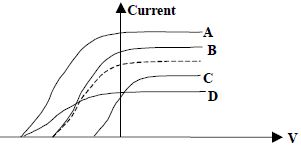
$A$ photoelectric cell is connected to a source of variable potential difference. The photoelectric current is plotted against the applied potential difference. The graph with the broken line represents the current for a given frequency and intensity of the incident radiation. If the frequency is increased and the intensity is reduced, which curve now represents the situation?
A
$A$
B
$B$
C
$C$
D
$D$
Solution
(D) According to Einstein's photoelectric equation, $K_{max} = h\nu - \phi$, where $K_{max}$ is the maximum kinetic energy of emitted photoelectrons, $h$ is Planck's constant, $\nu$ is the frequency of incident radiation, and $\phi$ is the work function of the metal.
Increasing the frequency $(\nu)$ of the incident radiation increases the maximum kinetic energy $(K_{max})$ of the emitted photoelectrons. Consequently, the stopping potential $(V_s)$, which is defined as $V_s = K_{max}/e$, becomes more negative (shifts to the left on the potential axis).
Intensity of incident radiation is directly proportional to the number of photons striking the surface per unit time, which in turn determines the saturation photocurrent. Reducing the intensity decreases the number of photoelectrons emitted per unit time, thereby reducing the saturation photocurrent.
Comparing the given curves with the broken line curve: Curve $D$ shows a more negative stopping potential (due to increased frequency) and a lower saturation current (due to decreased intensity). Therefore, curve $D$ represents the new situation.
Increasing the frequency $(\nu)$ of the incident radiation increases the maximum kinetic energy $(K_{max})$ of the emitted photoelectrons. Consequently, the stopping potential $(V_s)$, which is defined as $V_s = K_{max}/e$, becomes more negative (shifts to the left on the potential axis).
Intensity of incident radiation is directly proportional to the number of photons striking the surface per unit time, which in turn determines the saturation photocurrent. Reducing the intensity decreases the number of photoelectrons emitted per unit time, thereby reducing the saturation photocurrent.
Comparing the given curves with the broken line curve: Curve $D$ shows a more negative stopping potential (due to increased frequency) and a lower saturation current (due to decreased intensity). Therefore, curve $D$ represents the new situation.
0 likes
View Solution286
EasyMCQ
The stopping potential for a source of wavelength $4000\, \mathring{A}$,when kept at a distance of $10\, \text{cm}$,is $1.5\, \text{V}$. If now the distance of the source is increased to $20\, \text{cm}$,then the stopping potential will be ............... $\text{V}$.
A
$0.75$
B
$1.5$
C
$3$
D
$0.37$
Solution
(B) The stopping potential $(V_s)$ depends only on the frequency (or wavelength) of the incident light and the work function of the metal surface,as given by Einstein's photoelectric equation: $eV_s = h\nu - \phi$.
It does not depend on the intensity of the incident light.
When the distance of the source is increased from $10\, \text{cm}$ to $20\, \text{cm}$,the intensity of the light incident on the surface decreases due to the inverse square law.
However,the wavelength $(\lambda)$ and the frequency $(\nu)$ of the incident photons remain unchanged.
Since the stopping potential is independent of the intensity,it will remain the same.
Therefore,the stopping potential remains $1.5\, \text{V}$.
It does not depend on the intensity of the incident light.
When the distance of the source is increased from $10\, \text{cm}$ to $20\, \text{cm}$,the intensity of the light incident on the surface decreases due to the inverse square law.
However,the wavelength $(\lambda)$ and the frequency $(\nu)$ of the incident photons remain unchanged.
Since the stopping potential is independent of the intensity,it will remain the same.
Therefore,the stopping potential remains $1.5\, \text{V}$.
0 likes
View Solution287
AdvancedMCQ
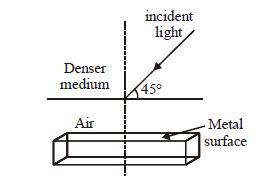
Light comprising three wavelengths $310 \ nm$,$455 \ nm$,and $620 \ nm$ is incident on a surface separating two media at an angle of $45^o$. The refractive index for the $455 \ nm$ light is $\sqrt{2}$. If a metal plate with a work function of $1.2 \ eV$ is placed in the second medium,what is the maximum kinetic energy of the electrons emitted from the metallic plate in $eV$?
A
$0.8$
B
$2.8$
C
$1.8$
D
$1.5$
Solution
(B) The energy of a photon is given by $E = \frac{hc}{\lambda}$. Using $hc \approx 1240 \ eV \cdot nm$:
For $\lambda_1 = 310 \ nm$,$E_1 = \frac{1240}{310} = 4.0 \ eV$.
For $\lambda_2 = 455 \ nm$,$E_2 = \frac{1240}{455} \approx 2.72 \ eV$.
For $\lambda_3 = 620 \ nm$,$E_3 = \frac{1240}{620} = 2.0 \ eV$.
According to Einstein's photoelectric equation,$K_{max} = E - \Phi$,where $\Phi = 1.2 \ eV$.
For $\lambda_1 = 310 \ nm$,$K_{max} = 4.0 - 1.2 = 2.8 \ eV$.
For $\lambda_2 = 455 \ nm$,$K_{max} = 2.72 - 1.2 = 1.52 \ eV$.
For $\lambda_3 = 620 \ nm$,$K_{max} = 2.0 - 1.2 = 0.8 \ eV$.
The maximum kinetic energy is the highest value among these,which is $2.8 \ eV$.
For $\lambda_1 = 310 \ nm$,$E_1 = \frac{1240}{310} = 4.0 \ eV$.
For $\lambda_2 = 455 \ nm$,$E_2 = \frac{1240}{455} \approx 2.72 \ eV$.
For $\lambda_3 = 620 \ nm$,$E_3 = \frac{1240}{620} = 2.0 \ eV$.
According to Einstein's photoelectric equation,$K_{max} = E - \Phi$,where $\Phi = 1.2 \ eV$.
For $\lambda_1 = 310 \ nm$,$K_{max} = 4.0 - 1.2 = 2.8 \ eV$.
For $\lambda_2 = 455 \ nm$,$K_{max} = 2.72 - 1.2 = 1.52 \ eV$.
For $\lambda_3 = 620 \ nm$,$K_{max} = 2.0 - 1.2 = 0.8 \ eV$.
The maximum kinetic energy is the highest value among these,which is $2.8 \ eV$.
0 likes
View Solution288
MediumMCQ
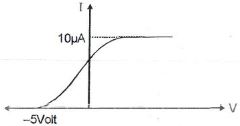
In the photoelectric experiment,if we use a monochromatic light,the $I - V$ curve is as shown. If the work function of the metal is $2 \, eV$,estimate the power of light used in $W$.
(Assume efficiency of photoemission $= 10^{-3} \%$,i.e.,the number of photoelectrons emitted is $10^{-3} \%$ of the number of photons incident on the metal.)
(Assume efficiency of photoemission $= 10^{-3} \%$,i.e.,the number of photoelectrons emitted is $10^{-3} \%$ of the number of photons incident on the metal.)
A
$2$
B
$5$
C
$7$
D
$10$
Solution
(C) From the given $I - V$ curve,the stopping potential $V_s = 5 \, V$ and the saturation current $I_s = 10 \, \mu A = 10^{-5} \, A$.
The energy of incident photons is given by Einstein's photoelectric equation:
$E = h\nu = eV_s + \phi_0$
$E = 5 \, eV + 2 \, eV = 7 \, eV$.
The saturation current is related to the power $P$ of the incident light by:
$I_s = \eta \times \left( \frac{P}{E} \right) \times e$
where $\eta$ is the efficiency of photoemission $= 10^{-3} \% = 10^{-5}$.
Substituting the values:
$10^{-5} = 10^{-5} \times \left( \frac{P}{7 \, eV} \right) \times e$
$1 = \frac{P}{7 \, eV} \times e$
$1 = \frac{P}{7}$
$P = 7 \, W$.
The energy of incident photons is given by Einstein's photoelectric equation:
$E = h\nu = eV_s + \phi_0$
$E = 5 \, eV + 2 \, eV = 7 \, eV$.
The saturation current is related to the power $P$ of the incident light by:
$I_s = \eta \times \left( \frac{P}{E} \right) \times e$
where $\eta$ is the efficiency of photoemission $= 10^{-3} \% = 10^{-5}$.
Substituting the values:
$10^{-5} = 10^{-5} \times \left( \frac{P}{7 \, eV} \right) \times e$
$1 = \frac{P}{7 \, eV} \times e$
$1 = \frac{P}{7}$
$P = 7 \, W$.
0 likes
View Solution289
DifficultMCQ
When a metal surface is illuminated with light of wavelength $\lambda$,the stopping potential is $V$. When the same surface is illuminated by light of wavelength $2\lambda$,the stopping potential is $V/3$. The threshold wavelength for the surface is:
A
$\frac{4\lambda}{3}$
B
$4\lambda$
C
$6\lambda$
D
$\frac{8\lambda}{3}$
Solution
(B) According to Einstein's photoelectric equation: $K_{max} = \frac{hc}{\lambda} - \phi = eV$.
For the first case: $\frac{hc}{\lambda} = \phi + eV$ .......$(1)$
For the second case: $\frac{hc}{2\lambda} = \phi + \frac{eV}{3}$ .......$(2)$
Multiply equation $(2)$ by $3$: $\frac{3hc}{2\lambda} = 3\phi + eV$ .......$(3)$
Subtract equation $(1)$ from equation $(3)$: $(\frac{3}{2} - 1) \frac{hc}{\lambda} = (3\phi - \phi) + (eV - eV)$.
$\frac{1}{2} \frac{hc}{\lambda} = 2\phi$.
$\phi = \frac{hc}{4\lambda}$.
Since $\phi = \frac{hc}{\lambda_{th}}$,we get $\lambda_{th} = 4\lambda$.
For the first case: $\frac{hc}{\lambda} = \phi + eV$ .......$(1)$
For the second case: $\frac{hc}{2\lambda} = \phi + \frac{eV}{3}$ .......$(2)$
Multiply equation $(2)$ by $3$: $\frac{3hc}{2\lambda} = 3\phi + eV$ .......$(3)$
Subtract equation $(1)$ from equation $(3)$: $(\frac{3}{2} - 1) \frac{hc}{\lambda} = (3\phi - \phi) + (eV - eV)$.
$\frac{1}{2} \frac{hc}{\lambda} = 2\phi$.
$\phi = \frac{hc}{4\lambda}$.
Since $\phi = \frac{hc}{\lambda_{th}}$,we get $\lambda_{th} = 4\lambda$.
0 likes
View Solution290
MediumMCQ
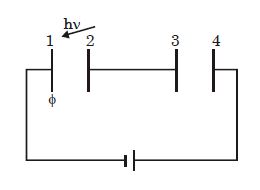
Two identical capacitors are arranged as shown. The work function of plate $1$ is $\phi \ eV$. The $emf$ of the battery is $\frac{\phi}{e}$. If the energy of the incident photon is $hv$,then what is the maximum kinetic energy of the $e^-$ reaching plate $2$?
A
$hv - \phi/2$
B
$hv - \phi$
C
$hv - 2\phi$
D
$hv$
Solution
(D) According to Einstein's photoelectric equation,the maximum kinetic energy of an electron emitted from plate $1$ is $K_{max} = hv - \phi$.
When the electron moves from plate $1$ to plate $2$,it is accelerated by the potential difference between the plates.
The battery is connected such that plate $1$ is at a lower potential than plate $2$ (or the circuit configuration provides an accelerating potential). The potential difference $V$ across the capacitor is equal to the $emf$ of the battery,which is $V = \frac{\phi}{e}$.
The work done by the electric field on the electron is $W = eV = e \cdot \frac{\phi}{e} = \phi$.
The maximum kinetic energy of the electron reaching plate $2$ is the sum of its initial maximum kinetic energy and the work done by the electric field:
$K_{final} = K_{max} + W = (hv - \phi) + \phi = hv$.
Therefore,the correct option is $D$.
When the electron moves from plate $1$ to plate $2$,it is accelerated by the potential difference between the plates.
The battery is connected such that plate $1$ is at a lower potential than plate $2$ (or the circuit configuration provides an accelerating potential). The potential difference $V$ across the capacitor is equal to the $emf$ of the battery,which is $V = \frac{\phi}{e}$.
The work done by the electric field on the electron is $W = eV = e \cdot \frac{\phi}{e} = \phi$.
The maximum kinetic energy of the electron reaching plate $2$ is the sum of its initial maximum kinetic energy and the work done by the electric field:
$K_{final} = K_{max} + W = (hv - \phi) + \phi = hv$.
Therefore,the correct option is $D$.
0 likes
View Solution291
DifficultMCQ
When a metal is irradiated by light having wavelength $\lambda$ $(\lambda < \lambda_0)$,all the photoelectrons emitted are bent in a circle of radius $r$ by a magnetic field of flux density $B_0$. Find $\frac{1}{\lambda_0}$,where $\lambda_0$ is the threshold wavelength.
A
$\frac{1}{\lambda_0} = \frac{1}{\lambda} - \frac{B_0^2 e^2 r^2}{2mhc}$
B
$\frac{1}{\lambda_0} = \frac{1}{\lambda} + \frac{B_0^2 e^2 r^2}{2mhc}$
C
$\frac{1}{\lambda_0} = \frac{1}{\lambda} - \frac{B_0^2 e^2 r^2}{mhc}$
D
None of these
Solution
(A) According to Einstein's photoelectric equation,the maximum kinetic energy $K_{max}$ of the emitted photoelectrons is given by:
$K_{max} = \frac{hc}{\lambda} - \frac{hc}{\lambda_0}$
When a charged particle moves in a magnetic field $B_0$ in a circular path of radius $r$,the magnetic force provides the centripetal force:
$evB_0 = \frac{mv^2}{r} \implies v = \frac{eB_0r}{m}$
The kinetic energy can be expressed as:
$K_{max} = \frac{1}{2}mv^2 = \frac{1}{2}m \left( \frac{eB_0r}{m} \right)^2 = \frac{e^2 B_0^2 r^2}{2m}$
Equating the two expressions for $K_{max}$:
$\frac{e^2 B_0^2 r^2}{2m} = \frac{hc}{\lambda} - \frac{hc}{\lambda_0}$
Rearranging to solve for $\frac{1}{\lambda_0}$:
$\frac{hc}{\lambda_0} = \frac{hc}{\lambda} - \frac{e^2 B_0^2 r^2}{2m}$
Dividing both sides by $hc$:
$\frac{1}{\lambda_0} = \frac{1}{\lambda} - \frac{e^2 B_0^2 r^2}{2mhc}$
$K_{max} = \frac{hc}{\lambda} - \frac{hc}{\lambda_0}$
When a charged particle moves in a magnetic field $B_0$ in a circular path of radius $r$,the magnetic force provides the centripetal force:
$evB_0 = \frac{mv^2}{r} \implies v = \frac{eB_0r}{m}$
The kinetic energy can be expressed as:
$K_{max} = \frac{1}{2}mv^2 = \frac{1}{2}m \left( \frac{eB_0r}{m} \right)^2 = \frac{e^2 B_0^2 r^2}{2m}$
Equating the two expressions for $K_{max}$:
$\frac{e^2 B_0^2 r^2}{2m} = \frac{hc}{\lambda} - \frac{hc}{\lambda_0}$
Rearranging to solve for $\frac{1}{\lambda_0}$:
$\frac{hc}{\lambda_0} = \frac{hc}{\lambda} - \frac{e^2 B_0^2 r^2}{2m}$
Dividing both sides by $hc$:
$\frac{1}{\lambda_0} = \frac{1}{\lambda} - \frac{e^2 B_0^2 r^2}{2mhc}$
0 likes
View Solution292
MediumMCQ
Photons of energy $6\, eV$ are incident on a metal surface whose work function is $4\, eV$. The minimum kinetic energy of the emitted photo-electrons will be :-
A
$0$
B
$1$
C
$2$
D
$10$
Solution
(A) According to Einstein's photoelectric equation,the maximum kinetic energy $(KE_{\max})$ of emitted photo-electrons is given by:
$KE_{\max} = E - \phi$
where $E$ is the energy of the incident photon and $\phi$ is the work function of the metal.
Given: $E = 6\, eV$ and $\phi = 4\, eV$.
$KE_{\max} = 6\, eV - 4\, eV = 2\, eV$.
The kinetic energy of emitted photo-electrons ranges from $0$ to $KE_{\max}$.
Therefore,the minimum kinetic energy $(KE_{\min})$ of the emitted photo-electrons is $0\, eV$.
$KE_{\max} = E - \phi$
where $E$ is the energy of the incident photon and $\phi$ is the work function of the metal.
Given: $E = 6\, eV$ and $\phi = 4\, eV$.
$KE_{\max} = 6\, eV - 4\, eV = 2\, eV$.
The kinetic energy of emitted photo-electrons ranges from $0$ to $KE_{\max}$.
Therefore,the minimum kinetic energy $(KE_{\min})$ of the emitted photo-electrons is $0\, eV$.
0 likes
View Solution293
MediumMCQ
Light of wavelength $\lambda$ strikes a photoelectric surface and electrons are ejected with kinetic energy $K$. If $K$ is to be increased to twice its original value,the wavelength must be changed to $\lambda'$ such that :-
A
$\lambda' < \lambda/2$
B
$\lambda' > \lambda/2$
C
$\lambda > \lambda' > \lambda/2$
D
$\lambda' = \lambda/2$
Solution
(C) According to Einstein's photoelectric equation,the kinetic energy $K$ is given by: $K = \frac{hc}{\lambda} - \phi$,where $\phi$ is the work function.
For the initial state: $K = \frac{hc}{\lambda} - \phi$ --- $(1)$
For the final state,where kinetic energy is $2K$: $2K = \frac{hc}{\lambda'} - \phi$ --- $(2)$
From $(1)$,we have $\frac{hc}{\lambda} = K + \phi$. Since $K > 0$,it follows that $\frac{hc}{\lambda} > \phi$.
From $(2)$,$\frac{hc}{\lambda'} = 2K + \phi$. Since $K > 0$,it follows that $\frac{hc}{\lambda'} > \phi$.
Dividing $(1)$ by $(2)$: $\frac{\lambda'}{\lambda} = \frac{K + \phi}{2K + \phi}$.
Since $K + \phi < 2K + \phi$,the ratio $\frac{\lambda'}{\lambda} < 1$,which implies $\lambda' < \lambda$.
Also,$\frac{\lambda'}{\lambda} = \frac{K + \phi}{2K + \phi} = \frac{1}{2} \left( \frac{2K + 2\phi}{2K + \phi} \right) = \frac{1}{2} \left( \frac{2K + \phi + \phi}{2K + \phi} \right) = \frac{1}{2} \left( 1 + \frac{\phi}{2K + \phi} \right)$.
Since $\frac{\phi}{2K + \phi} > 0$,the term in the parenthesis is greater than $1$. Therefore,$\frac{\lambda'}{\lambda} > \frac{1}{2}$,which implies $\lambda' > \lambda/2$.
Combining these,we get $\lambda > \lambda' > \lambda/2$.
For the initial state: $K = \frac{hc}{\lambda} - \phi$ --- $(1)$
For the final state,where kinetic energy is $2K$: $2K = \frac{hc}{\lambda'} - \phi$ --- $(2)$
From $(1)$,we have $\frac{hc}{\lambda} = K + \phi$. Since $K > 0$,it follows that $\frac{hc}{\lambda} > \phi$.
From $(2)$,$\frac{hc}{\lambda'} = 2K + \phi$. Since $K > 0$,it follows that $\frac{hc}{\lambda'} > \phi$.
Dividing $(1)$ by $(2)$: $\frac{\lambda'}{\lambda} = \frac{K + \phi}{2K + \phi}$.
Since $K + \phi < 2K + \phi$,the ratio $\frac{\lambda'}{\lambda} < 1$,which implies $\lambda' < \lambda$.
Also,$\frac{\lambda'}{\lambda} = \frac{K + \phi}{2K + \phi} = \frac{1}{2} \left( \frac{2K + 2\phi}{2K + \phi} \right) = \frac{1}{2} \left( \frac{2K + \phi + \phi}{2K + \phi} \right) = \frac{1}{2} \left( 1 + \frac{\phi}{2K + \phi} \right)$.
Since $\frac{\phi}{2K + \phi} > 0$,the term in the parenthesis is greater than $1$. Therefore,$\frac{\lambda'}{\lambda} > \frac{1}{2}$,which implies $\lambda' > \lambda/2$.
Combining these,we get $\lambda > \lambda' > \lambda/2$.
0 likes
View Solution294
DifficultMCQ
Light described at a place by the equation $\varepsilon = (100 \text{ V/m}) [\sin(5 \times 10^{15} \text{ s}^{-1})t + \sin(8 \times 10^{15} \text{ s}^{-1})t]$ falls on a metal surface having a work function of $2 \text{ eV}$. Calculate the maximum kinetic energy of the photoelectrons in $\text{eV}$.
A
$5.27$
B
$1.71$
C
$3.27$
D
$0.854$
Solution
(C) The given electric field equation is $\varepsilon = (100 \text{ V/m}) [\sin(\omega_1 t) + \sin(\omega_2 t)]$, where $\omega_1 = 5 \times 10^{15} \text{ rad/s}$ and $\omega_2 = 8 \times 10^{15} \text{ rad/s}$.
To find the maximum kinetic energy, we must consider the photon with the highest frequency, as $K.E._{\max} = h\nu - \phi$.
The frequency $\nu$ is given by $\nu = \frac{\omega}{2\pi}$. For the higher frequency component, $\nu = \frac{8 \times 10^{15}}{2\pi} \text{ Hz}$.
The energy of the photon $E = h\nu = \frac{6.626 \times 10^{-34} \times 8 \times 10^{15}}{2 \times 3.1416} \text{ Joules}$.
Converting this to $\text{eV}$ by dividing by $1.6 \times 10^{-19} \text{ C}$:
$E = \frac{6.626 \times 10^{-34} \times 8 \times 10^{15}}{2 \times 3.1416 \times 1.6 \times 10^{-19}} \approx 5.27 \text{ eV}$.
The maximum kinetic energy is $K.E._{\max} = E - \phi = 5.27 \text{ eV} - 2 \text{ eV} = 3.27 \text{ eV}$.
To find the maximum kinetic energy, we must consider the photon with the highest frequency, as $K.E._{\max} = h\nu - \phi$.
The frequency $\nu$ is given by $\nu = \frac{\omega}{2\pi}$. For the higher frequency component, $\nu = \frac{8 \times 10^{15}}{2\pi} \text{ Hz}$.
The energy of the photon $E = h\nu = \frac{6.626 \times 10^{-34} \times 8 \times 10^{15}}{2 \times 3.1416} \text{ Joules}$.
Converting this to $\text{eV}$ by dividing by $1.6 \times 10^{-19} \text{ C}$:
$E = \frac{6.626 \times 10^{-34} \times 8 \times 10^{15}}{2 \times 3.1416 \times 1.6 \times 10^{-19}} \approx 5.27 \text{ eV}$.
The maximum kinetic energy is $K.E._{\max} = E - \phi = 5.27 \text{ eV} - 2 \text{ eV} = 3.27 \text{ eV}$.
0 likes
View Solution295
DifficultMCQ
Two identical photocathodes receive light of frequencies $v_1$ and $v_2$. If the velocities of the photoelectrons (of mass $m$) coming out are $v_1$ and $v_2$ respectively,then:
A
$v_1 - v_2 = \left[ \frac{2h}{m}(v_1 - v_2) \right]^{\frac{1}{2}}$
B
$v_1^2 - v_2^2 = \frac{2h}{m}(v_1 - v_2)$
C
$v_1 + v_2 = \left[ \frac{2h}{m}(v_1 - v_2) \right]^{\frac{1}{2}}$
D
$v_1^2 + v_2^2 = \frac{2h}{m}(v_1 - v_2)$
Solution
(B) According to Einstein's photoelectric equation:
$hv_1 = hv_0 + \frac{1}{2}mv_1^2$ --- $(1)$
$hv_2 = hv_0 + \frac{1}{2}mv_2^2$ --- $(2)$
Subtracting equation $(2)$ from $(1)$:
$h(v_1 - v_2) = \frac{1}{2}m(v_1^2 - v_2^2)$
Rearranging the terms to solve for the velocity difference:
$v_1^2 - v_2^2 = \frac{2h}{m}(v_1 - v_2)$
Thus,option $B$ is correct.
$hv_1 = hv_0 + \frac{1}{2}mv_1^2$ --- $(1)$
$hv_2 = hv_0 + \frac{1}{2}mv_2^2$ --- $(2)$
Subtracting equation $(2)$ from $(1)$:
$h(v_1 - v_2) = \frac{1}{2}m(v_1^2 - v_2^2)$
Rearranging the terms to solve for the velocity difference:
$v_1^2 - v_2^2 = \frac{2h}{m}(v_1 - v_2)$
Thus,option $B$ is correct.
0 likes
View Solution296
MediumMCQ
If the energy of a photon is $25\, eV$ and the work function of the material is $7\, eV$,then the value of the stopping potential is :-................. $V$
A
$3$
B
$9$
C
$18$
D
$27$
Solution
(C) According to Einstein's photoelectric equation,the maximum kinetic energy $(K_{max})$ of the emitted photoelectrons is given by:
$K_{max} = E - \Phi$
Where $E$ is the energy of the incident photon and $\Phi$ is the work function of the material.
Given: $E = 25\, eV$ and $\Phi = 7\, eV$.
$K_{max} = 25\, eV - 7\, eV = 18\, eV$.
The stopping potential $(V_0)$ is related to the maximum kinetic energy by the equation $K_{max} = eV_0$.
Therefore,$eV_0 = 18\, eV$,which implies $V_0 = 18\, V$.
$K_{max} = E - \Phi$
Where $E$ is the energy of the incident photon and $\Phi$ is the work function of the material.
Given: $E = 25\, eV$ and $\Phi = 7\, eV$.
$K_{max} = 25\, eV - 7\, eV = 18\, eV$.
The stopping potential $(V_0)$ is related to the maximum kinetic energy by the equation $K_{max} = eV_0$.
Therefore,$eV_0 = 18\, eV$,which implies $V_0 = 18\, V$.
0 likes
View Solution297
AdvancedMCQ
Assuming photoemission takes place,the factor by which the maximum velocity of the emitted photoelectrons changes when the wavelength of the incident radiation is increased four times,is
A
$4$
B
$\frac{1}{4}$
C
$> \frac{1}{2}$
D
$< \frac{1}{2}$
Solution
(D) According to Einstein's photoelectric equation: $\frac{hc}{\lambda} = W_0 + \frac{1}{2}mv_{\max}^2$.
Let the initial wavelength be $\lambda_1 = \lambda$ and the final wavelength be $\lambda_2 = 4\lambda$.
The maximum kinetic energy is given by $K_{\max} = \frac{hc}{\lambda} - W_0$.
Since $K_{\max} = \frac{1}{2}mv_{\max}^2$,we have $v_{\max} = \sqrt{\frac{2}{m} (\frac{hc}{\lambda} - W_0)}$.
When $\lambda$ increases to $4\lambda$,the energy of the incident photon $\frac{hc}{4\lambda}$ decreases.
Since $K_{\max}$ decreases,$v_{\max}$ also decreases.
Let the new velocity be $v'$. Then $v' = \sqrt{\frac{2}{m} (\frac{hc}{4\lambda} - W_0)}$.
Comparing $v'$ with $v_{\max}$: $v' = \sqrt{\frac{1}{4} \frac{2hc}{\lambda} - \frac{2W_0}{m}} = \sqrt{\frac{1}{4} v_{\max}^2 - \frac{3W_0}{2m}}$.
Since $\frac{1}{4} v_{\max}^2 - \frac{3W_0}{2m} < \frac{1}{4} v_{\max}^2$,it follows that $v' < \frac{1}{2} v_{\max}$.
Thus,the factor by which the velocity changes is less than $\frac{1}{2}$.
Let the initial wavelength be $\lambda_1 = \lambda$ and the final wavelength be $\lambda_2 = 4\lambda$.
The maximum kinetic energy is given by $K_{\max} = \frac{hc}{\lambda} - W_0$.
Since $K_{\max} = \frac{1}{2}mv_{\max}^2$,we have $v_{\max} = \sqrt{\frac{2}{m} (\frac{hc}{\lambda} - W_0)}$.
When $\lambda$ increases to $4\lambda$,the energy of the incident photon $\frac{hc}{4\lambda}$ decreases.
Since $K_{\max}$ decreases,$v_{\max}$ also decreases.
Let the new velocity be $v'$. Then $v' = \sqrt{\frac{2}{m} (\frac{hc}{4\lambda} - W_0)}$.
Comparing $v'$ with $v_{\max}$: $v' = \sqrt{\frac{1}{4} \frac{2hc}{\lambda} - \frac{2W_0}{m}} = \sqrt{\frac{1}{4} v_{\max}^2 - \frac{3W_0}{2m}}$.
Since $\frac{1}{4} v_{\max}^2 - \frac{3W_0}{2m} < \frac{1}{4} v_{\max}^2$,it follows that $v' < \frac{1}{2} v_{\max}$.
Thus,the factor by which the velocity changes is less than $\frac{1}{2}$.
0 likes
View Solution298
MediumMCQ
The work function of caesium is $2.14 \ eV$. Find the wavelength of the incident light if the photocurrent is brought to zero by a stopping potential of $0.60 \ V$.
A
$454$
B
$640$
C
$540$
D
None of these
Solution
(A) According to Einstein's photoelectric equation, the maximum kinetic energy of the emitted photoelectrons is given by $K_{max} = eV_0$, where $V_0$ is the stopping potential.
Einstein's equation is $K_{max} = \frac{hc}{\lambda} - \phi$.
Substituting $K_{max} = eV_0$, we get $eV_0 = \frac{hc}{\lambda} - \phi$.
Given: Work function $\phi = 2.14 \ eV$, Stopping potential $V_0 = 0.60 \ V$.
Using the relation $\frac{hc}{\lambda} \approx \frac{12400 \ eV \cdot \mathring{A}}{\lambda}$, we have $0.60 \ eV = \frac{12400 \ eV \cdot \mathring{A}}{\lambda} - 2.14 \ eV$.
$0.60 + 2.14 = \frac{12400}{\lambda}$.
$2.74 = \frac{12400}{\lambda}$.
$\lambda = \frac{12400}{2.74} \approx 4525.5 \ \mathring{A}$.
Converting to nanometers, $\lambda \approx 452.55 \ nm$, which is approximately $454 \ nm$ when using $hc = 1242 \ eV \cdot nm$ or similar constants.
Einstein's equation is $K_{max} = \frac{hc}{\lambda} - \phi$.
Substituting $K_{max} = eV_0$, we get $eV_0 = \frac{hc}{\lambda} - \phi$.
Given: Work function $\phi = 2.14 \ eV$, Stopping potential $V_0 = 0.60 \ V$.
Using the relation $\frac{hc}{\lambda} \approx \frac{12400 \ eV \cdot \mathring{A}}{\lambda}$, we have $0.60 \ eV = \frac{12400 \ eV \cdot \mathring{A}}{\lambda} - 2.14 \ eV$.
$0.60 + 2.14 = \frac{12400}{\lambda}$.
$2.74 = \frac{12400}{\lambda}$.
$\lambda = \frac{12400}{2.74} \approx 4525.5 \ \mathring{A}$.
Converting to nanometers, $\lambda \approx 452.55 \ nm$, which is approximately $454 \ nm$ when using $hc = 1242 \ eV \cdot nm$ or similar constants.
0 likes
View Solution299
MediumMCQ
The figure represents the graph of photocurrent $I$ versus applied voltage $(V)$. The maximum kinetic energy of the emitted photoelectrons is:
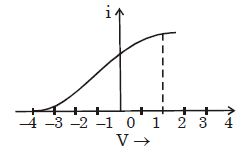
A
$2\,eV$
B
$4\,eV$
C
$0\,eV$
D
$4\,J$
Solution
(B) From the given graph, the stopping potential $V_{0}$ is the negative voltage at which the photocurrent becomes zero.
Looking at the graph, the curve intersects the voltage axis at $V = -4\,V$.
Therefore, the magnitude of the stopping potential is $|V_{0}| = 4\,V$.
The maximum kinetic energy $K_{\max}$ of the emitted photoelectrons is given by the formula $K_{\max} = e|V_{0}|$.
Substituting the value of $|V_{0}|$, we get $K_{\max} = e \times 4\,V = 4\,eV$.
Looking at the graph, the curve intersects the voltage axis at $V = -4\,V$.
Therefore, the magnitude of the stopping potential is $|V_{0}| = 4\,V$.
The maximum kinetic energy $K_{\max}$ of the emitted photoelectrons is given by the formula $K_{\max} = e|V_{0}|$.
Substituting the value of $|V_{0}|$, we get $K_{\max} = e \times 4\,V = 4\,eV$.
0 likes
View Solution300
MediumMCQ
$A$ monochromatic light source of intensity $5 \, mW$ emits $8 \times 10^{15}$ photons per second. This light ejects photoelectrons from a metal surface. The stopping potential for this setup is $2.0 \, V$. The work function of the metal will be ............ $eV$. (in $.9$)
A
$3$
B
$7$
C
$1$
D
$5$
Solution
(C) The power of the light source is $P = 5 \times 10^{-3} \, W$ and the number of photons emitted per second is $n = 8 \times 10^{15} \, s^{-1}$.
The energy of a single photon $E$ is given by $E = \frac{P}{n}$.
$E = \frac{5 \times 10^{-3}}{8 \times 10^{15}} \, J = 6.25 \times 10^{-19} \, J$.
To convert this energy into electron-volts $(eV)$,divide by the charge of an electron $e = 1.6 \times 10^{-19} \, C$:
$E = \frac{6.25 \times 10^{-19}}{1.6 \times 10^{-19}} \, eV = 3.90625 \, eV \approx 3.9 \, eV$.
According to Einstein's photoelectric equation,the maximum kinetic energy $(K.E)_{\max}$ is related to the stopping potential $V_s$ as $(K.E)_{\max} = e V_s = 2.0 \, eV$.
The photoelectric equation is $E = \phi + (K.E)_{\max}$,where $\phi$ is the work function.
$\phi = E - (K.E)_{\max} = 3.9 \, eV - 2.0 \, eV = 1.9 \, eV$.
Therefore,the work function of the metal is $1.9 \, eV$.
The energy of a single photon $E$ is given by $E = \frac{P}{n}$.
$E = \frac{5 \times 10^{-3}}{8 \times 10^{15}} \, J = 6.25 \times 10^{-19} \, J$.
To convert this energy into electron-volts $(eV)$,divide by the charge of an electron $e = 1.6 \times 10^{-19} \, C$:
$E = \frac{6.25 \times 10^{-19}}{1.6 \times 10^{-19}} \, eV = 3.90625 \, eV \approx 3.9 \, eV$.
According to Einstein's photoelectric equation,the maximum kinetic energy $(K.E)_{\max}$ is related to the stopping potential $V_s$ as $(K.E)_{\max} = e V_s = 2.0 \, eV$.
The photoelectric equation is $E = \phi + (K.E)_{\max}$,where $\phi$ is the work function.
$\phi = E - (K.E)_{\max} = 3.9 \, eV - 2.0 \, eV = 1.9 \, eV$.
Therefore,the work function of the metal is $1.9 \, eV$.
0 likes
View SolutionDual Nature of Radiation and matter — Einstein's Photoelectric Equation and Energy Quantum of Radiation · Frequently Asked Questions
1Are these Dual Nature of Radiation and matter questions useful for JEE and NEET?
Yes. All questions in this section are mapped to JEE Main and NEET exam patterns. Previous year questions from JEE Main, NEET, GUJCET and state-level exams are included with full solutions.
2Can I switch to Hindi or Gujarati for these questions?
Yes. Use the language tabs in the hero section or the sidebar to view the same questions and solutions in English, Hindi or Gujarati.
3How do I generate a question paper from this subtopic?
Use the Vedclass Exam Paper Generator — select the chapter and subtopic, set difficulty, and generate Sets A, B, C, D automatically. First 3 chapters of every subject are free.
Vedclass Products
For Students
Vedclass Test Series
Mock tests in real JEE/NEET style with performance analysis. 5-day free trial.
Start Free TrialFor Teachers
Exam Paper Generator
Generate Set A/B/C/D papers from this chapter in 2 minutes. 3 chapters free.
Try FreeFor Institutes
Online Exam Module
Live online exams with unlimited students, 360° analytics & white-label branding.
See DemoFor Teachers & Institutes
Generate a Dual Nature of Radiation and matter Exam Paper in 2 Minutes
Select subtopic & difficulty — Sets A, B, C, D auto-generated with No Repeat logic.
First 3 chapters of every subject are free — no payment required.