
A English
Einstein's Photoelectric Equation and Energy Quantum of Radiation Questions in English
Class 12 Physics · Dual Nature of Radiation and matter · Einstein's Photoelectric Equation and Energy Quantum of Radiation
736+
Questions
English
Language
100%
With Solutions
Showing 50 of 736 questions in English
151
MediumMCQ
Photoelectrons are emitted from a metal surface for frequencies $\nu_1$ and $\nu_2$. If the ratio of the maximum kinetic energy of the emitted photoelectrons is $1 : k$,then the threshold frequency of the metal surface is:
A
$\frac{\nu_1 - \nu_2}{k - 1}$
B
$\frac{k\nu_1 - \nu_2}{k - 1}$
C
$\frac{k\nu_2 - \nu_1}{k - 1}$
D
$\frac{\nu_2 - \nu_1}{k}$
Solution
(B) According to Einstein's photoelectric equation,the maximum kinetic energy $K_{\max}$ is given by $K_{\max} = h\nu - h\nu_0$,where $\nu_0$ is the threshold frequency.
For frequency $\nu_1$,$K_1 = h(\nu_1 - \nu_0) \dots (i)$
For frequency $\nu_2$,$K_2 = h(\nu_2 - \nu_0) \dots (ii)$
Given the ratio $\frac{K_1}{K_2} = \frac{1}{k}$,we have:
$\frac{h(\nu_1 - \nu_0)}{h(\nu_2 - \nu_0)} = \frac{1}{k}$
$k(\nu_1 - \nu_0) = \nu_2 - \nu_0$
$k\nu_1 - k\nu_0 = \nu_2 - \nu_0$
$k\nu_1 - \nu_2 = k\nu_0 - \nu_0$
$k\nu_1 - \nu_2 = \nu_0(k - 1)$
$\nu_0 = \frac{k\nu_1 - \nu_2}{k - 1}$
For frequency $\nu_1$,$K_1 = h(\nu_1 - \nu_0) \dots (i)$
For frequency $\nu_2$,$K_2 = h(\nu_2 - \nu_0) \dots (ii)$
Given the ratio $\frac{K_1}{K_2} = \frac{1}{k}$,we have:
$\frac{h(\nu_1 - \nu_0)}{h(\nu_2 - \nu_0)} = \frac{1}{k}$
$k(\nu_1 - \nu_0) = \nu_2 - \nu_0$
$k\nu_1 - k\nu_0 = \nu_2 - \nu_0$
$k\nu_1 - \nu_2 = k\nu_0 - \nu_0$
$k\nu_1 - \nu_2 = \nu_0(k - 1)$
$\nu_0 = \frac{k\nu_1 - \nu_2}{k - 1}$
0 likes
View Solution152
MediumMCQ
The maximum velocity of photoelectrons emitted from a metal surface is $1.2 \times 10^6 \ m/s$. If the specific charge of the electron is $1.8 \times 10^{11} \ C/kg$,then the value of the stopping potential in volts is:
A
$2$
B
$3$
C
$4$
D
$6$
Solution
(C) The kinetic energy of the fastest photoelectron is equal to the work done by the stopping potential $V_s$:
$\frac{1}{2} m v_{\max}^2 = e V_s$
Rearranging for the stopping potential $V_s$:
$V_s = \frac{m v_{\max}^2}{2e} = \frac{v_{\max}^2}{2(e/m)}$
Given $v_{\max} = 1.2 \times 10^6 \ m/s$ and specific charge $(e/m) = 1.8 \times 10^{11} \ C/kg$:
$V_s = \frac{(1.2 \times 10^6)^2}{2 \times 1.8 \times 10^{11}}$
$V_s = \frac{1.44 \times 10^{12}}{3.6 \times 10^{11}}$
$V_s = \frac{14.4}{3.6} = 4 \ V$
$\frac{1}{2} m v_{\max}^2 = e V_s$
Rearranging for the stopping potential $V_s$:
$V_s = \frac{m v_{\max}^2}{2e} = \frac{v_{\max}^2}{2(e/m)}$
Given $v_{\max} = 1.2 \times 10^6 \ m/s$ and specific charge $(e/m) = 1.8 \times 10^{11} \ C/kg$:
$V_s = \frac{(1.2 \times 10^6)^2}{2 \times 1.8 \times 10^{11}}$
$V_s = \frac{1.44 \times 10^{12}}{3.6 \times 10^{11}}$
$V_s = \frac{14.4}{3.6} = 4 \ V$
0 likes
View Solution153
DifficultMCQ
The photoelectric work function of a metal is $1 \ eV$. Light of wavelength $\lambda = 3000 \ \mathring{A}$ is incident on it. What will be the velocity of the emitted photoelectrons?
A
$10 \ m/s$
B
$10^2 \ m/s$
C
$10^4 \ m/s$
D
$10^6 \ m/s$
Solution
(D) Given: Work function $\Phi = 1 \ eV$,wavelength $\lambda = 3000 \ \mathring{A}$,and specific charge of electron $\frac{e}{m} = 1.76 \times 10^{11} \ C/kg$.
Using Einstein's photoelectric equation: $K_{max} = \frac{hc}{\lambda} - \Phi$.
Energy of incident photon $E = \frac{12400}{\lambda(\text{in } \mathring{A})} \ eV \approx \frac{12300}{3000} \ eV = 4.1 \ eV$.
Maximum kinetic energy $K_{max} = 4.1 \ eV - 1 \ eV = 3.1 \ eV$.
Converting to Joules: $K_{max} = 3.1 \times 1.6 \times 10^{-19} \ J$.
Using $K_{max} = \frac{1}{2}mv^2$,we get $v = \sqrt{\frac{2 K_{max}}{m}} = \sqrt{2 \times K_{max} \times \frac{e}{m} \times \frac{1}{e}}$.
$v = \sqrt{2 \times 3.1 \times 1.76 \times 10^{11}} = \sqrt{10.912 \times 10^{11}} \approx \sqrt{1.0912} \times 10^6 \ m/s \approx 1.04 \times 10^6 \ m/s$.
The closest option is $10^6 \ m/s$.
Using Einstein's photoelectric equation: $K_{max} = \frac{hc}{\lambda} - \Phi$.
Energy of incident photon $E = \frac{12400}{\lambda(\text{in } \mathring{A})} \ eV \approx \frac{12300}{3000} \ eV = 4.1 \ eV$.
Maximum kinetic energy $K_{max} = 4.1 \ eV - 1 \ eV = 3.1 \ eV$.
Converting to Joules: $K_{max} = 3.1 \times 1.6 \times 10^{-19} \ J$.
Using $K_{max} = \frac{1}{2}mv^2$,we get $v = \sqrt{\frac{2 K_{max}}{m}} = \sqrt{2 \times K_{max} \times \frac{e}{m} \times \frac{1}{e}}$.
$v = \sqrt{2 \times 3.1 \times 1.76 \times 10^{11}} = \sqrt{10.912 \times 10^{11}} \approx \sqrt{1.0912} \times 10^6 \ m/s \approx 1.04 \times 10^6 \ m/s$.
The closest option is $10^6 \ m/s$.
0 likes
View Solution154
DifficultMCQ
Given that a photon of light of wavelength $10,000\;\mathring A$ has an energy equal to $1.23\; eV$. When light of wavelength $5000\;\mathring A$ and intensity $I_0$ falls on a photoelectric cell,the saturation current is $0.40 \times 10^{-6}\; A$ and the stopping potential is $1.36\; V$; then the work function is ..... $eV$.
A
$0.43$
B
$1.10$
C
$1.36$
D
$2.47$
Solution
(B) The energy of a photon is given by $E = \frac{hc}{\lambda}$.
Given for $\lambda_1 = 10,000\;\mathring A$,$E_1 = 1.23\; eV$.
For $\lambda_2 = 5000\;\mathring A$,the energy $E_2$ is:
$E_2 = E_1 \times \frac{\lambda_1}{\lambda_2} = 1.23 \times \frac{10,000}{5,000} = 1.23 \times 2 = 2.46\; eV$.
According to Einstein's photoelectric equation,the maximum kinetic energy $K_{max} = eV_s = E_2 - \phi$,where $\phi$ is the work function.
Given stopping potential $V_s = 1.36\; V$,so $K_{max} = 1.36\; eV$.
Substituting the values: $1.36 = 2.46 - \phi$.
Therefore,$\phi = 2.46 - 1.36 = 1.10\; eV$.
Given for $\lambda_1 = 10,000\;\mathring A$,$E_1 = 1.23\; eV$.
For $\lambda_2 = 5000\;\mathring A$,the energy $E_2$ is:
$E_2 = E_1 \times \frac{\lambda_1}{\lambda_2} = 1.23 \times \frac{10,000}{5,000} = 1.23 \times 2 = 2.46\; eV$.
According to Einstein's photoelectric equation,the maximum kinetic energy $K_{max} = eV_s = E_2 - \phi$,where $\phi$ is the work function.
Given stopping potential $V_s = 1.36\; V$,so $K_{max} = 1.36\; eV$.
Substituting the values: $1.36 = 2.46 - \phi$.
Therefore,$\phi = 2.46 - 1.36 = 1.10\; eV$.
0 likes
View Solution155
DifficultMCQ
Photoelectric effect is observed on a surface for frequencies $5.5 \times 10^8 \text{ MHz}$ and $4.5 \times 10^8 \text{ MHz}$. If the ratio of the maximum kinetic energy of the emitted photoelectrons is $1:5$,then the threshold frequency for the metal surface is:
A
$7.55 \times 10^8 \text{ MHz}$
B
$4.57 \text{ MHz}$
C
$9.35 \text{ MHz}$
D
$5.75 \times 10^8 \text{ MHz}$
Solution
(D) According to Einstein's photoelectric equation,the maximum kinetic energy $K_{max}$ is given by $K_{max} = hf - hf_0 = h(f - f_0)$.
Given frequencies are $f_1 = 5.5 \times 10^8 \text{ MHz}$ and $f_2 = 4.5 \times 10^8 \text{ MHz}$.
The ratio of maximum kinetic energies is $\frac{K_1}{K_2} = \frac{1}{5}$.
Substituting the values: $\frac{K_1}{K_2} = \frac{h(f_1 - f_0)}{h(f_2 - f_0)} = \frac{f_1 - f_0}{f_2 - f_0} = \frac{1}{5}$.
$\frac{5.5 \times 10^8 - f_0}{4.5 \times 10^8 - f_0} = \frac{1}{5}$.
$5(5.5 \times 10^8 - f_0) = 4.5 \times 10^8 - f_0$.
$27.5 \times 10^8 - 5f_0 = 4.5 \times 10^8 - f_0$.
$4f_0 = 23.0 \times 10^8$.
$f_0 = 5.75 \times 10^8 \text{ MHz}$.
Given frequencies are $f_1 = 5.5 \times 10^8 \text{ MHz}$ and $f_2 = 4.5 \times 10^8 \text{ MHz}$.
The ratio of maximum kinetic energies is $\frac{K_1}{K_2} = \frac{1}{5}$.
Substituting the values: $\frac{K_1}{K_2} = \frac{h(f_1 - f_0)}{h(f_2 - f_0)} = \frac{f_1 - f_0}{f_2 - f_0} = \frac{1}{5}$.
$\frac{5.5 \times 10^8 - f_0}{4.5 \times 10^8 - f_0} = \frac{1}{5}$.
$5(5.5 \times 10^8 - f_0) = 4.5 \times 10^8 - f_0$.
$27.5 \times 10^8 - 5f_0 = 4.5 \times 10^8 - f_0$.
$4f_0 = 23.0 \times 10^8$.
$f_0 = 5.75 \times 10^8 \text{ MHz}$.
0 likes
View Solution156
EasyMCQ
When light of frequency $v$ is incident on a metal,photoelectrons are emitted. This is because...
A
The maximum energy of photoelectrons depends on the intensity of light.
B
The maximum energy of photoelectrons is constant.
C
If $v$ is less than $W/h$,no electrons are emitted,where $W$ is the work function of the metal.
D
The emission of photoelectrons is instantaneous.
Solution
(C) According to Einstein's photoelectric equation,the maximum kinetic energy of an emitted photoelectron is given by $K_{max} = hv - W$,where $h$ is Planck's constant,$v$ is the frequency of incident light,and $W$ is the work function of the metal.
For photoemission to occur,the incident photon energy $hv$ must be greater than or equal to the work function $W$ $(hv \ge W)$.
If the frequency $v$ of the incident light is less than the threshold frequency $v_0 = W/h$,then $hv < W$,and no photoelectrons will be emitted from the metal surface.
Therefore,the condition for the emission of photoelectrons is that the frequency $v$ must be at least $W/h$.
For photoemission to occur,the incident photon energy $hv$ must be greater than or equal to the work function $W$ $(hv \ge W)$.
If the frequency $v$ of the incident light is less than the threshold frequency $v_0 = W/h$,then $hv < W$,and no photoelectrons will be emitted from the metal surface.
Therefore,the condition for the emission of photoelectrons is that the frequency $v$ must be at least $W/h$.
0 likes
View Solution157
EasyMCQ
When a photon of energy $hv$ is incident on an aluminum plate (work function $E_0$),photoelectrons with maximum kinetic energy $K$ are emitted. What will be the maximum kinetic energy of the emitted photoelectrons when a photon of energy $2hv$ is incident on the same aluminum plate?
A
$2K$
B
$K$
C
$K + hv$
D
$K + E_0$
Solution
(C) According to Einstein's photoelectric equation,the maximum kinetic energy $K$ of emitted photoelectrons is given by $K = hv - E_0$,where $hv$ is the energy of the incident photon and $E_0$ is the work function of the metal.
For the first case: $K = hv - E_0$ --- $(1)$
For the second case,the incident energy is $2hv$. Let the new maximum kinetic energy be $K'$.
$K' = 2hv - E_0$ --- $(2)$
From equation $(1)$,we have $E_0 = hv - K$.
Substituting this value of $E_0$ into equation $(2)$:
$K' = 2hv - (hv - K)$
$K' = 2hv - hv + K$
$K' = hv + K$
For the first case: $K = hv - E_0$ --- $(1)$
For the second case,the incident energy is $2hv$. Let the new maximum kinetic energy be $K'$.
$K' = 2hv - E_0$ --- $(2)$
From equation $(1)$,we have $E_0 = hv - K$.
Substituting this value of $E_0$ into equation $(2)$:
$K' = 2hv - (hv - K)$
$K' = 2hv - hv + K$
$K' = hv + K$
0 likes
View Solution158
MediumMCQ
The work function of a material is $4.0 \ eV$. The longest wavelength of light that can cause the emission of photoelectrons from this material is approximately ............ $nm$.
A
$540$
B
$400$
C
$310$
D
$220$
Solution
(C) The work function $\Phi_0$ is given as $4.0 \ eV$.
For photoelectric emission,the energy of the incident photon $E$ must be at least equal to the work function $\Phi_0$.
$E = \frac{hc}{\lambda} \geq \Phi_0$.
To find the longest wavelength $\lambda_{\max}$,we set $E = \Phi_0$.
Using the relation $\lambda (nm) = \frac{1240}{\Phi_0 (eV)}$:
$\lambda_{\max} = \frac{1240}{4.0} \ nm$.
$\lambda_{\max} = 310 \ nm$.
For photoelectric emission,the energy of the incident photon $E$ must be at least equal to the work function $\Phi_0$.
$E = \frac{hc}{\lambda} \geq \Phi_0$.
To find the longest wavelength $\lambda_{\max}$,we set $E = \Phi_0$.
Using the relation $\lambda (nm) = \frac{1240}{\Phi_0 (eV)}$:
$\lambda_{\max} = \frac{1240}{4.0} \ nm$.
$\lambda_{\max} = 310 \ nm$.
0 likes
View Solution159
EasyMCQ
Light of wavelength $3500 \ \mathring A$ is incident on two metals $A$ and $B$. If their work functions are $4.2 \ eV$ and $1.9 \ eV$ respectively,which metal will emit photoelectrons?
A
Metal $A$
B
Metal $B$
C
Both metals $A$ and $B$
D
None of these
Solution
(B) The energy of the incident photon is given by $E = \frac{hc}{\lambda}$.
Substituting the values: $E = \frac{6.626 \times 10^{-34} \times 3 \times 10^8}{3500 \times 10^{-10}} \ J$.
Converting to electron-volts $(eV)$: $E = \frac{12400 \ \mathring A \cdot eV}{3500 \ \mathring A} \approx 3.54 \ eV$.
Photoelectric emission occurs if the incident energy $E$ is greater than the work function $\phi$ of the metal $(E > \phi)$.
For metal $A$: $\phi_A = 4.2 \ eV$. Since $3.54 \ eV < 4.2 \ eV$,metal $A$ will not emit photoelectrons.
For metal $B$: $\phi_B = 1.9 \ eV$. Since $3.54 \ eV > 1.9 \ eV$,metal $B$ will emit photoelectrons.
Therefore,only metal $B$ will emit photoelectrons.
Substituting the values: $E = \frac{6.626 \times 10^{-34} \times 3 \times 10^8}{3500 \times 10^{-10}} \ J$.
Converting to electron-volts $(eV)$: $E = \frac{12400 \ \mathring A \cdot eV}{3500 \ \mathring A} \approx 3.54 \ eV$.
Photoelectric emission occurs if the incident energy $E$ is greater than the work function $\phi$ of the metal $(E > \phi)$.
For metal $A$: $\phi_A = 4.2 \ eV$. Since $3.54 \ eV < 4.2 \ eV$,metal $A$ will not emit photoelectrons.
For metal $B$: $\phi_B = 1.9 \ eV$. Since $3.54 \ eV > 1.9 \ eV$,metal $B$ will emit photoelectrons.
Therefore,only metal $B$ will emit photoelectrons.
0 likes
View Solution160
EasyMCQ
When light is incident on a photosensitive surface,electrons are emitted from the surface. The kinetic energy of these electrons does not depend on:
A
Wavelength of light
B
Frequency of light
C
Nature of the material used for the surface
D
Intensity of light
Solution
(D) According to Einstein's photoelectric equation,the maximum kinetic energy of emitted photoelectrons is given by $K.E._{max} = h\nu - \phi$,where $h$ is Planck's constant,$\nu$ is the frequency of incident light,and $\phi$ is the work function of the material.
$1$. The kinetic energy depends on the frequency of incident light $(\nu)$ or its wavelength $(\lambda = c/\nu)$.
$2$. The kinetic energy depends on the work function $(\phi)$,which is determined by the nature of the material.
$3$. The kinetic energy does not depend on the intensity of the incident light. The intensity only affects the number of photoelectrons emitted per unit time.
$1$. The kinetic energy depends on the frequency of incident light $(\nu)$ or its wavelength $(\lambda = c/\nu)$.
$2$. The kinetic energy depends on the work function $(\phi)$,which is determined by the nature of the material.
$3$. The kinetic energy does not depend on the intensity of the incident light. The intensity only affects the number of photoelectrons emitted per unit time.
0 likes
View Solution161
EasyMCQ
In a photoelectric experiment,if the wavelength of incident radiation is reduced from $6000 \ \mathring{A}$ to $4000 \ \mathring{A}$ while keeping the intensity of radiation constant,then:
A
The stopping potential remains constant.
B
The stopping potential increases.
C
The photoelectric current increases.
D
The stopping potential decreases.
Solution
(B) According to Einstein's photoelectric equation,the maximum kinetic energy of emitted photoelectrons is given by $K_{max} = h\nu - \Phi$,where $\Phi$ is the work function of the metal.
Since $\nu = c / \lambda$,reducing the wavelength $\lambda$ increases the frequency $\nu$ of the incident radiation.
An increase in frequency $\nu$ leads to an increase in the maximum kinetic energy $K_{max}$ of the photoelectrons.
Since the stopping potential $V_s$ is related to the maximum kinetic energy by $K_{max} = eV_s$,an increase in $K_{max}$ results in an increase in the stopping potential $V_s$.
Therefore,the stopping potential increases.
Since $\nu = c / \lambda$,reducing the wavelength $\lambda$ increases the frequency $\nu$ of the incident radiation.
An increase in frequency $\nu$ leads to an increase in the maximum kinetic energy $K_{max}$ of the photoelectrons.
Since the stopping potential $V_s$ is related to the maximum kinetic energy by $K_{max} = eV_s$,an increase in $K_{max}$ results in an increase in the stopping potential $V_s$.
Therefore,the stopping potential increases.
0 likes
View Solution162
EasyMCQ
In the photoelectric effect,the threshold wavelength of sodium is $5000 \ \mathring A$. Find its work function in $eV$. $(h = 6.6 \times 10^{-34} \ J \cdot s, c = 3 \times 10^8 \ m/s, 1 \ eV = 1.6 \times 10^{-19} \ J)$
A
$5$
B
$10$
C
$2.5$
D
$7.5$
Solution
(C) The work function $\phi_0$ is given by the formula: $\phi_0 = h \nu_0 = \frac{hc}{\lambda_0}$.
Given: $h = 6.6 \times 10^{-34} \ J \cdot s$,$c = 3 \times 10^8 \ m/s$,and $\lambda_0 = 5000 \ \mathring A = 5000 \times 10^{-10} \ m = 5 \times 10^{-7} \ m$.
Substituting the values:
$\phi_0 = \frac{(6.6 \times 10^{-34}) \times (3 \times 10^8)}{5 \times 10^{-7}} \ J$.
$\phi_0 = \frac{19.8 \times 10^{-26}}{5 \times 10^{-7}} \ J = 3.96 \times 10^{-19} \ J$.
To convert this into $eV$,divide by $1.6 \times 10^{-19} \ J/eV$:
$\phi_0 = \frac{3.96 \times 10^{-19}}{1.6 \times 10^{-19}} \ eV = 2.475 \ eV$.
Rounding to the nearest value,we get $\phi_0 \approx 2.5 \ eV$.
Given: $h = 6.6 \times 10^{-34} \ J \cdot s$,$c = 3 \times 10^8 \ m/s$,and $\lambda_0 = 5000 \ \mathring A = 5000 \times 10^{-10} \ m = 5 \times 10^{-7} \ m$.
Substituting the values:
$\phi_0 = \frac{(6.6 \times 10^{-34}) \times (3 \times 10^8)}{5 \times 10^{-7}} \ J$.
$\phi_0 = \frac{19.8 \times 10^{-26}}{5 \times 10^{-7}} \ J = 3.96 \times 10^{-19} \ J$.
To convert this into $eV$,divide by $1.6 \times 10^{-19} \ J/eV$:
$\phi_0 = \frac{3.96 \times 10^{-19}}{1.6 \times 10^{-19}} \ eV = 2.475 \ eV$.
Rounding to the nearest value,we get $\phi_0 \approx 2.5 \ eV$.
0 likes
View Solution163
EasyMCQ
The maximum velocity of emitted photoelectrons is $4.8 \ m/s$. If the $e/m$ ratio of an electron is $1.76 \times 10^{11} \ C/kg$,then the stopping potential is ......
A
$5 \times 10^{-10} \ V$
B
$3 \times 10^{-7} \ V$
C
$7 \times 10^{-11} \ V$
D
$5 \times 10^{2} \ V$
Solution
(C) Given: Maximum velocity $v_{max} = 4.8 \ m/s$,specific charge $e/m = 1.76 \times 10^{11} \ C/kg$.
The stopping potential $V_s$ is related to the maximum kinetic energy by the equation: $eV_s = \frac{1}{2}mv_{max}^2$.
Rearranging for $V_s$,we get: $V_s = \frac{1}{2} \left(\frac{m}{e}\right) v_{max}^2$.
Substituting the values: $V_s = \frac{1}{2} \times \left(\frac{1}{1.76 \times 10^{11}}\right) \times (4.8)^2$.
$V_s = \frac{23.04}{3.52 \times 10^{11}} \approx 6.54 \times 10^{-11} \ V$.
Rounding to the nearest significant value provided in the options,we get $V_s \approx 7 \times 10^{-11} \ V$.
The stopping potential $V_s$ is related to the maximum kinetic energy by the equation: $eV_s = \frac{1}{2}mv_{max}^2$.
Rearranging for $V_s$,we get: $V_s = \frac{1}{2} \left(\frac{m}{e}\right) v_{max}^2$.
Substituting the values: $V_s = \frac{1}{2} \times \left(\frac{1}{1.76 \times 10^{11}}\right) \times (4.8)^2$.
$V_s = \frac{23.04}{3.52 \times 10^{11}} \approx 6.54 \times 10^{-11} \ V$.
Rounding to the nearest significant value provided in the options,we get $V_s \approx 7 \times 10^{-11} \ V$.
0 likes
View Solution164
EasyMCQ
Statement $1$: When ultraviolet light is incident on a photocell, its stopping potential is $V_0$ and the maximum kinetic energy of photoelectrons is $K_{max}$. When $X$-rays are used instead of ultraviolet light, both $V_0$ and $K_{max}$ increase.
Statement $2$: Photoelectrons are emitted with a range of speeds from $0$ to a maximum value because the incident light contains a range of frequencies.
Statement $2$: Photoelectrons are emitted with a range of speeds from $0$ to a maximum value because the incident light contains a range of frequencies.
A
Statement-$1$ is true, Statement-$2$ is false.
B
Statement-$1$ is true, Statement-$2$ is true, Statement-$2$ is the correct explanation of Statement-$1$.
C
Statement-$1$ is true, Statement-$2$ is true, Statement-$2$ is not the correct explanation of Statement-$1$.
D
Statement-$1$ is false, Statement-$2$ is true.
Solution
(A) According to Einstein's photoelectric equation, $K_{max} = h\nu - \phi$, where $\phi$ is the work function. Since the frequency of $X$-rays is much higher than that of ultraviolet light, $K_{max}$ increases. Since $K_{max} = eV_0$, the stopping potential $V_0$ also increases. Thus, Statement-$1$ is true.
Statement-$2$ is false because photoelectrons are emitted with a range of speeds not because of a range of incident frequencies, but because electrons are emitted from different depths within the metal, losing varying amounts of energy due to collisions before escaping the surface. Even with monochromatic light, a range of speeds is observed.
Statement-$2$ is false because photoelectrons are emitted with a range of speeds not because of a range of incident frequencies, but because electrons are emitted from different depths within the metal, losing varying amounts of energy due to collisions before escaping the surface. Even with monochromatic light, a range of speeds is observed.
0 likes
View Solution165
EasyMCQ
If light of wavelength $6600 \ \mathring A$ is incident on a metal surface with a work function of $2 \ eV$,what will be the maximum kinetic energy of the emitted photoelectrons?
A
$2 \ eV$
B
$1 \ eV$
C
$0.5 \ eV$
D
No photoelectrons are emitted.
Solution
(D) The energy of the incident photon is given by $E = \frac{hc}{\lambda}$.
Using $hc \approx 12400 \ eV \cdot \mathring A$,we get $E = \frac{12400}{6600} \ eV \approx 1.88 \ eV$.
The work function of the metal is $\Phi_0 = 2 \ eV$.
According to Einstein's photoelectric equation,$K_{max} = E - \Phi_0$.
Since the energy of the incident photon $(1.88 \ eV)$ is less than the work function $(2 \ eV)$,the incident light does not have enough energy to eject photoelectrons from the metal surface.
Therefore,no photoelectrons are emitted.
Using $hc \approx 12400 \ eV \cdot \mathring A$,we get $E = \frac{12400}{6600} \ eV \approx 1.88 \ eV$.
The work function of the metal is $\Phi_0 = 2 \ eV$.
According to Einstein's photoelectric equation,$K_{max} = E - \Phi_0$.
Since the energy of the incident photon $(1.88 \ eV)$ is less than the work function $(2 \ eV)$,the incident light does not have enough energy to eject photoelectrons from the metal surface.
Therefore,no photoelectrons are emitted.
0 likes
View Solution166
MediumMCQ
$A$ material $A$ exhibits the photoelectric effect. Its work function is $2.5 \ eV$ and the threshold wavelength is $\lambda$. Another material $B$ has a work function of $5 \ eV$. Find the threshold wavelength required to produce the photoelectric effect in $B$.
A
$\lambda / 2$
B
$2\lambda$
C
$\lambda$
D
$3\lambda$
Solution
(A) The work function $\Phi$ is related to the threshold wavelength $\lambda_0$ by the formula $\Phi = \frac{hc}{\lambda_0}$.
For material $A$,$\Phi_A = 2.5 \ eV = \frac{hc}{\lambda}$.
For material $B$,$\Phi_B = 5 \ eV = \frac{hc}{\lambda_B}$.
Dividing the two equations: $\frac{\Phi_A}{\Phi_B} = \frac{hc/\lambda}{hc/\lambda_B} = \frac{\lambda_B}{\lambda}$.
Substituting the values: $\frac{2.5}{5} = \frac{\lambda_B}{\lambda}$.
$0.5 = \frac{\lambda_B}{\lambda} \Rightarrow \lambda_B = \frac{\lambda}{2}$.
For material $A$,$\Phi_A = 2.5 \ eV = \frac{hc}{\lambda}$.
For material $B$,$\Phi_B = 5 \ eV = \frac{hc}{\lambda_B}$.
Dividing the two equations: $\frac{\Phi_A}{\Phi_B} = \frac{hc/\lambda}{hc/\lambda_B} = \frac{\lambda_B}{\lambda}$.
Substituting the values: $\frac{2.5}{5} = \frac{\lambda_B}{\lambda}$.
$0.5 = \frac{\lambda_B}{\lambda} \Rightarrow \lambda_B = \frac{\lambda}{2}$.
0 likes
View Solution167
MediumMCQ
The slope of the graph between stopping potential and the frequency of incident radiation for the photoelectric effect is . . . . . . .
A
$h/e$
B
$he$
C
$e/h$
D
None of these.
Solution
(A) According to Einstein's photoelectric equation: $K_{max} = hf - \phi_0$.
Since $K_{max} = eV_0$, we have $eV_0 = hf - \phi_0$.
Dividing by $e$, we get $V_0 = (h/e)f - (\phi_0/e)$.
Comparing this with the equation of a straight line $y = mx + c$, where $y = V_0$ and $x = f$, the slope $m$ is equal to $h/e$.
Since $K_{max} = eV_0$, we have $eV_0 = hf - \phi_0$.
Dividing by $e$, we get $V_0 = (h/e)f - (\phi_0/e)$.
Comparing this with the equation of a straight line $y = mx + c$, where $y = V_0$ and $x = f$, the slope $m$ is equal to $h/e$.
0 likes
View Solution168
MediumMCQ
When radiation of wavelength $400 \ nm$ is incident on a metal surface,the kinetic energy of the emitted photoelectrons is $1.68 \ eV$. The work function of the metal is .......... $eV$.
A
$3.09$
B
$1.42$
C
$1.51$
D
$1.68$
Solution
(B) According to Einstein's photoelectric equation,the maximum kinetic energy $K_{max}$ is given by:
$K_{max} = \frac{hc}{\lambda} - \phi_0$
Where $h$ is Planck's constant,$c$ is the speed of light,$\lambda$ is the wavelength,and $\phi_0$ is the work function.
Given $\lambda = 400 \ nm$ and $K_{max} = 1.68 \ eV$.
Using the relation $hc \approx 1240 \ eV \cdot nm$:
Energy of incident photon $E = \frac{1240 \ eV \cdot nm}{400 \ nm} = 3.10 \ eV$.
Now,substituting the values into the equation:
$\phi_0 = E - K_{max}$
$\phi_0 = 3.10 \ eV - 1.68 \ eV = 1.42 \ eV$.
Therefore,the work function of the metal is $1.42 \ eV$.
$K_{max} = \frac{hc}{\lambda} - \phi_0$
Where $h$ is Planck's constant,$c$ is the speed of light,$\lambda$ is the wavelength,and $\phi_0$ is the work function.
Given $\lambda = 400 \ nm$ and $K_{max} = 1.68 \ eV$.
Using the relation $hc \approx 1240 \ eV \cdot nm$:
Energy of incident photon $E = \frac{1240 \ eV \cdot nm}{400 \ nm} = 3.10 \ eV$.
Now,substituting the values into the equation:
$\phi_0 = E - K_{max}$
$\phi_0 = 3.10 \ eV - 1.68 \ eV = 1.42 \ eV$.
Therefore,the work function of the metal is $1.42 \ eV$.
0 likes
View Solution169
EasyMCQ
The frequency of monochromatic light incident on an emitting surface is $f$. If the threshold frequency for the surface is $f_0$,then the maximum kinetic energy of the emitted photoelectrons is .......
A
$hf$
B
$h(f - f_0)$
C
$hf_0$
D
$h(f + f_0)$
Solution
(B) According to Einstein's photoelectric equation,the maximum kinetic energy $(K_{\max})$ of emitted photoelectrons is given by:
$K_{\max} = E - \phi_0$
Where $E = hf$ is the energy of the incident photon and $\phi_0 = hf_0$ is the work function of the surface.
Substituting these values:
$K_{\max} = hf - hf_0$
$K_{\max} = h(f - f_0)$
$K_{\max} = E - \phi_0$
Where $E = hf$ is the energy of the incident photon and $\phi_0 = hf_0$ is the work function of the surface.
Substituting these values:
$K_{\max} = hf - hf_0$
$K_{\max} = h(f - f_0)$
0 likes
View Solution170
EasyMCQ
The graph of stopping potential $(V_0)$ versus the frequency $(f)$ of incident radiation for the photoelectric effect is ..........
A
$A$ straight line
B
$A$ circle
C
$A$ parabola
D
$A$ hyperbola
Solution
(A) According to Einstein's photoelectric equation,the stopping potential $(V_0)$ is given by the relation:
$V_0 = (\frac{h}{e})f - (\frac{h}{e})f_0$
where $h$ is Planck's constant,$e$ is the charge of an electron,$f$ is the frequency of incident radiation,and $f_0$ is the threshold frequency.
This equation is of the form $y = mx + c$,which represents a straight line.
Therefore,the graph of $V_0$ versus $f$ is a straight line.
$V_0 = (\frac{h}{e})f - (\frac{h}{e})f_0$
where $h$ is Planck's constant,$e$ is the charge of an electron,$f$ is the frequency of incident radiation,and $f_0$ is the threshold frequency.
This equation is of the form $y = mx + c$,which represents a straight line.
Therefore,the graph of $V_0$ versus $f$ is a straight line.
0 likes
View Solution171
MediumMCQ
Ultraviolet light of wavelength $200 \ nm$ is incident on a freshly polished surface of iron. The work function of the surface is $4.71 \ eV$. What will be the stopping potential in $eV$? $(h = 6.626 \times 10^{-34} \ Js, 1 \ eV = 1.6 \times 10^{-19} \ J, c = 3 \times 10^8 \ m/s)$
A
$1.5$
B
$0.5$
C
$2.5$
D
None of these
Solution
(A) According to Einstein's photoelectric equation,the maximum kinetic energy $K_{max}$ is given by $K_{max} = \frac{hc}{\lambda} - \phi_0$.
Since $K_{max} = eV_0$,where $V_0$ is the stopping potential,we have $eV_0 = \frac{hc}{\lambda} - \phi_0$.
First,calculate the energy of the incident photon in $eV$:
$E = \frac{hc}{\lambda} = \frac{6.626 \times 10^{-34} \times 3 \times 10^8}{200 \times 10^{-9} \times 1.6 \times 10^{-19}} \ eV$.
$E = \frac{19.878 \times 10^{-26}}{320 \times 10^{-28}} \ eV = \frac{19.878}{3.2} \ eV \approx 6.21 \ eV$.
Now,calculate the stopping potential:
$eV_0 = 6.21 \ eV - 4.71 \ eV = 1.50 \ eV$.
Therefore,the stopping potential $V_0 = 1.50 \ V$,which corresponds to $1.5 \ eV$ in terms of energy units.
Since $K_{max} = eV_0$,where $V_0$ is the stopping potential,we have $eV_0 = \frac{hc}{\lambda} - \phi_0$.
First,calculate the energy of the incident photon in $eV$:
$E = \frac{hc}{\lambda} = \frac{6.626 \times 10^{-34} \times 3 \times 10^8}{200 \times 10^{-9} \times 1.6 \times 10^{-19}} \ eV$.
$E = \frac{19.878 \times 10^{-26}}{320 \times 10^{-28}} \ eV = \frac{19.878}{3.2} \ eV \approx 6.21 \ eV$.
Now,calculate the stopping potential:
$eV_0 = 6.21 \ eV - 4.71 \ eV = 1.50 \ eV$.
Therefore,the stopping potential $V_0 = 1.50 \ V$,which corresponds to $1.5 \ eV$ in terms of energy units.
0 likes
View Solution172
MediumMCQ
The work function of a photosensitive metal surface is $hv_0$. If a photon of energy $2hv_0$ is incident on this surface,electrons are emitted with a maximum velocity of $4 \times 10^6 \, m/s$. What will be the maximum velocity of the photoelectrons when the energy of the incident photon is increased to $5hv_0$?
A
$2 \times 10^6 \, m/s$
B
$2 \times 10^7 \, m/s$
C
$8 \times 10^5 \, m/s$
D
$8 \times 10^6 \, m/s$
Solution
(D) According to Einstein's photoelectric equation,the maximum kinetic energy $K_{max}$ is given by $K_{max} = E - \Phi$,where $E$ is the energy of the incident photon and $\Phi$ is the work function.
Case $1$: $E_1 = 2hv_0$ and $\Phi = hv_0$.
$K_{max1} = 2hv_0 - hv_0 = hv_0 = \frac{1}{2}mv_1^2$,where $v_1 = 4 \times 10^6 \, m/s$.
Case $2$: $E_2 = 5hv_0$ and $\Phi = hv_0$.
$K_{max2} = 5hv_0 - hv_0 = 4hv_0 = \frac{1}{2}mv_2^2$.
Dividing the two equations:
$\frac{\frac{1}{2}mv_2^2}{\frac{1}{2}mv_1^2} = \frac{4hv_0}{hv_0} = 4$.
$\frac{v_2^2}{v_1^2} = 4 \Rightarrow \frac{v_2}{v_1} = 2$.
$v_2 = 2v_1 = 2 \times (4 \times 10^6 \, m/s) = 8 \times 10^6 \, m/s$.
Case $1$: $E_1 = 2hv_0$ and $\Phi = hv_0$.
$K_{max1} = 2hv_0 - hv_0 = hv_0 = \frac{1}{2}mv_1^2$,where $v_1 = 4 \times 10^6 \, m/s$.
Case $2$: $E_2 = 5hv_0$ and $\Phi = hv_0$.
$K_{max2} = 5hv_0 - hv_0 = 4hv_0 = \frac{1}{2}mv_2^2$.
Dividing the two equations:
$\frac{\frac{1}{2}mv_2^2}{\frac{1}{2}mv_1^2} = \frac{4hv_0}{hv_0} = 4$.
$\frac{v_2^2}{v_1^2} = 4 \Rightarrow \frac{v_2}{v_1} = 2$.
$v_2 = 2v_1 = 2 \times (4 \times 10^6 \, m/s) = 8 \times 10^6 \, m/s$.
0 likes
View Solution173
EasyMCQ
Which theory of light can explain the photoelectric effect?
A
As transverse waves
B
As longitudinal waves
C
Can be polarized
D
As quantum theory
Solution
(D) The photoelectric effect cannot be explained by the classical wave theory of light. It can only be explained by the quantum theory of light,which states that light consists of discrete packets of energy called photons. When a photon of sufficient energy strikes a metal surface,it transfers its energy to an electron,causing it to be emitted.
0 likes
View Solution174
MediumMCQ
When a photon of energy $6 \, eV$ is incident on a metal surface,the maximum kinetic energy of the emitted photoelectrons is $4 \, eV$. The value of the stopping potential is .......... $V$.
A
$2$
B
$4$
C
$6$
D
$10$
Solution
(B) According to Einstein's photoelectric equation,the maximum kinetic energy $(K_{\max})$ of emitted photoelectrons is related to the stopping potential $(V_0)$ by the equation:
$K_{\max} = e V_0$
Given that the maximum kinetic energy $K_{\max} = 4 \, eV$.
Substituting the values:
$4 \, eV = e V_0$
$V_0 = 4 \, V$
Therefore,the stopping potential is $4 \, V$.
$K_{\max} = e V_0$
Given that the maximum kinetic energy $K_{\max} = 4 \, eV$.
Substituting the values:
$4 \, eV = e V_0$
$V_0 = 4 \, V$
Therefore,the stopping potential is $4 \, V$.
0 likes
View Solution175
MediumMCQ
The ratio of work functions of two metals $A$ and $B$ is $1:2$. If radiations of frequencies $f$ and $2f$ are incident on the surfaces of $A$ and $B$ respectively,the ratio of the maximum kinetic energies of the emitted photoelectrons will be: (Given $f >$ threshold frequency of $A$ and $2f >$ threshold frequency of $B$)
A
$1:1$
B
$1:2$
C
$1:3$
D
$1:4$
Solution
(B) Let the work functions of metals $A$ and $B$ be $\phi_A$ and $\phi_B$ respectively. Given $\frac{\phi_A}{\phi_B} = \frac{1}{2}$,so $\phi_B = 2\phi_A$.
According to Einstein's photoelectric equation,the maximum kinetic energy $K$ is given by $K = h\nu - \phi$.
For metal $A$: $K_A = hf - \phi_A$ ---$(1)$
For metal $B$: $K_B = h(2f) - \phi_B = 2hf - 2\phi_A$ ---$(2)$
From equation $(2)$,we can factor out $2$: $K_B = 2(hf - \phi_A)$.
Substituting equation $(1)$ into this,we get $K_B = 2K_A$.
Therefore,the ratio $\frac{K_A}{K_B} = \frac{1}{2}$.
According to Einstein's photoelectric equation,the maximum kinetic energy $K$ is given by $K = h\nu - \phi$.
For metal $A$: $K_A = hf - \phi_A$ ---$(1)$
For metal $B$: $K_B = h(2f) - \phi_B = 2hf - 2\phi_A$ ---$(2)$
From equation $(2)$,we can factor out $2$: $K_B = 2(hf - \phi_A)$.
Substituting equation $(1)$ into this,we get $K_B = 2K_A$.
Therefore,the ratio $\frac{K_A}{K_B} = \frac{1}{2}$.
0 likes
View Solution176
MediumMCQ
Light of two different frequencies with photon energies of $1 \ eV$ and $2.5 \ eV$ are incident one after another on a metal surface having a work function of $0.5 \ eV$. The ratio of the maximum kinetic energy of the emitted photoelectrons will be:
A
$1:4$
B
$4:1$
C
$1:2$
D
$2:1$
Solution
(A) According to Einstein's photoelectric equation,the maximum kinetic energy $K_{\max}$ is given by $K_{\max} = E - \Phi$,where $E$ is the incident photon energy and $\Phi$ is the work function.
Given: $E_1 = 1 \ eV$,$E_2 = 2.5 \ eV$,and $\Phi = 0.5 \ eV$.
For the first photon: $K_{\max 1} = E_1 - \Phi = 1 \ eV - 0.5 \ eV = 0.5 \ eV$.
For the second photon: $K_{\max 2} = E_2 - \Phi = 2.5 \ eV - 0.5 \ eV = 2.0 \ eV$.
The ratio of the maximum kinetic energies is $\frac{K_{\max 1}}{K_{\max 2}} = \frac{0.5}{2.0} = \frac{1}{4}$.
Thus,the ratio is $1:4$.
Given: $E_1 = 1 \ eV$,$E_2 = 2.5 \ eV$,and $\Phi = 0.5 \ eV$.
For the first photon: $K_{\max 1} = E_1 - \Phi = 1 \ eV - 0.5 \ eV = 0.5 \ eV$.
For the second photon: $K_{\max 2} = E_2 - \Phi = 2.5 \ eV - 0.5 \ eV = 2.0 \ eV$.
The ratio of the maximum kinetic energies is $\frac{K_{\max 1}}{K_{\max 2}} = \frac{0.5}{2.0} = \frac{1}{4}$.
Thus,the ratio is $1:4$.
0 likes
View Solution177
MediumMCQ
The work functions of metals are given as $Na = 1.92 \, eV$,$K = 2.15 \, eV$,$Mo = 4.17 \, eV$,and $Ni = 5.0 \, eV$. Which of these metals will not show photoelectric emission for radiation of wavelength $3300 \, \mathring{A}$ from a $He-Cd$ laser?
A
$Mo$ and $Ni$
B
$Na$ and $K$
C
$Na$ and $Ni$
D
$Mo$ and $K$
Solution
(A) The energy of the incident photon is given by $E = \frac{hc}{\lambda}$. Using $hc \approx 12400 \, eV \cdot \mathring{A}$,we have $E = \frac{12400}{3300} \approx 3.76 \, eV$.
Photoelectric emission occurs if the incident photon energy $E$ is greater than the work function $\phi$ of the metal $(E > \phi)$.
Alternatively,the threshold wavelength is $\lambda_0 = \frac{hc}{\phi}$. Emission occurs if $\lambda < \lambda_0$.
Calculating $\lambda_0$ for each metal:
For $Na$: $\lambda_0 = \frac{12400}{1.92} \approx 6458 \, \mathring{A}$. Since $3300 < 6458$,emission occurs.
For $K$: $\lambda_0 = \frac{12400}{2.15} \approx 5767 \, \mathring{A}$. Since $3300 < 5767$,emission occurs.
For $Mo$: $\lambda_0 = \frac{12400}{4.17} \approx 2973 \, \mathring{A}$. Since $3300 > 2973$,no emission occurs.
For $Ni$: $\lambda_0 = \frac{12400}{5.0} = 2480 \, \mathring{A}$. Since $3300 > 2480$,no emission occurs.
Thus,$Mo$ and $Ni$ will not show photoelectric emission.
Photoelectric emission occurs if the incident photon energy $E$ is greater than the work function $\phi$ of the metal $(E > \phi)$.
Alternatively,the threshold wavelength is $\lambda_0 = \frac{hc}{\phi}$. Emission occurs if $\lambda < \lambda_0$.
Calculating $\lambda_0$ for each metal:
For $Na$: $\lambda_0 = \frac{12400}{1.92} \approx 6458 \, \mathring{A}$. Since $3300 < 6458$,emission occurs.
For $K$: $\lambda_0 = \frac{12400}{2.15} \approx 5767 \, \mathring{A}$. Since $3300 < 5767$,emission occurs.
For $Mo$: $\lambda_0 = \frac{12400}{4.17} \approx 2973 \, \mathring{A}$. Since $3300 > 2973$,no emission occurs.
For $Ni$: $\lambda_0 = \frac{12400}{5.0} = 2480 \, \mathring{A}$. Since $3300 > 2480$,no emission occurs.
Thus,$Mo$ and $Ni$ will not show photoelectric emission.
0 likes
View Solution178
MediumMCQ
Ultraviolet light of wavelength $300 \ nm$ and intensity $1.0 \ W/m^2$ is incident on a photosensitive surface. If only $1 \%$ of the incident photons emit photoelectrons,calculate the number of photoelectrons emitted per second from a surface area of $1 \ cm^2$.
A
$9.61 \times 10^{14} \ s^{-1}$
B
$4.12 \times 10^{13} \ s^{-1}$
C
$1.51 \times 10^{12} \ s^{-1}$
D
$2.13 \times 10^{11} \ s^{-1}$
Solution
(C) The intensity of incident light is given by $I = \frac{E}{At} = \frac{nhc}{At\lambda}$,where $n$ is the number of photons incident per second.
The number of photons incident per second is $n = \frac{IA\lambda}{hc}$.
Given that $1 \%$ of incident photons emit photoelectrons,the number of photoelectrons emitted per second $N$ is:
$N = \frac{1}{100} \times n = \frac{1}{100} \times \frac{IA\lambda}{hc}$.
Substituting the given values:
$I = 1.0 \ W/m^2$,$A = 1 \ cm^2 = 10^{-4} \ m^2$,$\lambda = 300 \ nm = 300 \times 10^{-9} \ m$,$h = 6.63 \times 10^{-34} \ J \cdot s$,$c = 3 \times 10^8 \ m/s$.
$N = \frac{1}{100} \times \frac{1.0 \times 10^{-4} \times 300 \times 10^{-9}}{6.63 \times 10^{-34} \times 3 \times 10^8}$.
$N = \frac{3 \times 10^{-11}}{100 \times 19.89 \times 10^{-26}} \approx 1.51 \times 10^{12} \ s^{-1}$.
The number of photons incident per second is $n = \frac{IA\lambda}{hc}$.
Given that $1 \%$ of incident photons emit photoelectrons,the number of photoelectrons emitted per second $N$ is:
$N = \frac{1}{100} \times n = \frac{1}{100} \times \frac{IA\lambda}{hc}$.
Substituting the given values:
$I = 1.0 \ W/m^2$,$A = 1 \ cm^2 = 10^{-4} \ m^2$,$\lambda = 300 \ nm = 300 \times 10^{-9} \ m$,$h = 6.63 \times 10^{-34} \ J \cdot s$,$c = 3 \times 10^8 \ m/s$.
$N = \frac{1}{100} \times \frac{1.0 \times 10^{-4} \times 300 \times 10^{-9}}{6.63 \times 10^{-34} \times 3 \times 10^8}$.
$N = \frac{3 \times 10^{-11}}{100 \times 19.89 \times 10^{-26}} \approx 1.51 \times 10^{12} \ s^{-1}$.
0 likes
View Solution179
MediumMCQ
Two identical photo-cathodes receive light of frequencies $f_1$ and $f_2$. If the velocities of the photo-electrons (of mass $m$) coming out are $v_1$ and $v_2$ respectively,then:
A
$v_1^2 - v_2^2 = \frac{2h}{m}(f_1 - f_2)$
B
$v_1 + v_2 = \left[ \frac{2h}{m}(f_1 + f_2) \right]^{1/2}$
C
$v_1^2 + v_2^2 = \frac{2h}{m}(f_1 + f_2)$
D
$v_1 + v_2 = \frac{2h}{m} \left[ \frac{2h}{m}(f_1 - f_2) \right]^{-1/2}$
Solution
(A) According to Einstein's photoelectric equation,the maximum kinetic energy of emitted photo-electrons is given by $K_{max} = hf - \phi$,where $\phi = hf_0$ is the work function.
For the first photo-cathode: $\frac{1}{2}mv_1^2 = hf_1 - hf_0$ (Equation $1$)
For the second photo-cathode: $\frac{1}{2}mv_2^2 = hf_2 - hf_0$ (Equation $2$)
Subtracting Equation $2$ from Equation $1$:
$\frac{1}{2}mv_1^2 - \frac{1}{2}mv_2^2 = (hf_1 - hf_0) - (hf_2 - hf_0)$
$\frac{1}{2}m(v_1^2 - v_2^2) = h(f_1 - f_2)$
$v_1^2 - v_2^2 = \frac{2h}{m}(f_1 - f_2)$
For the first photo-cathode: $\frac{1}{2}mv_1^2 = hf_1 - hf_0$ (Equation $1$)
For the second photo-cathode: $\frac{1}{2}mv_2^2 = hf_2 - hf_0$ (Equation $2$)
Subtracting Equation $2$ from Equation $1$:
$\frac{1}{2}mv_1^2 - \frac{1}{2}mv_2^2 = (hf_1 - hf_0) - (hf_2 - hf_0)$
$\frac{1}{2}m(v_1^2 - v_2^2) = h(f_1 - f_2)$
$v_1^2 - v_2^2 = \frac{2h}{m}(f_1 - f_2)$
1 likes
View Solution180
MediumMCQ
Statement $1$: $A$ metal surface is irradiated by monochromatic light of frequency $v > v_0$. The maximum kinetic energy and stopping potential are $K_{max}$ and $V_0$ respectively. If the frequency of the incident light is doubled, then $K_{max}$ and $V_0$ will also be doubled. Statement $2$: The stopping potential and maximum kinetic energy of photoelectrons emitted from a surface depend linearly on the frequency of the incident light.
A
Statement $1$ is true, Statement $2$ is true, Statement $2$ is not the correct explanation of Statement $1$.
B
Statement $1$ is false, Statement $2$ is true.
C
Statement $1$ is false, Statement $2$ is false.
D
Statement $1$ is true, Statement $2$ is true, Statement $2$ is the correct explanation of Statement $1$.
Solution
(B) According to Einstein's photoelectric equation: $K_{max} = hv - \phi_0$, where $\phi_0 = hv_0$ is the work function.
Also, $K_{max} = eV_0$, so $eV_0 = hv - hv_0$.
This implies $V_0 = \frac{h}{e}v - \frac{hv_0}{e}$.
Statement $2$ is correct because $K_{max}$ and $V_0$ vary linearly with frequency $v$.
For Statement $1$, if frequency $v$ is doubled to $2v$, the new kinetic energy is $K'_{max} = h(2v) - hv_0 = 2hv - hv_0$.
Since $2hv - hv_0 \neq 2(hv - hv_0)$, $K_{max}$ does not double. Similarly, $V_0$ does not double.
Thus, Statement $1$ is false.
Also, $K_{max} = eV_0$, so $eV_0 = hv - hv_0$.
This implies $V_0 = \frac{h}{e}v - \frac{hv_0}{e}$.
Statement $2$ is correct because $K_{max}$ and $V_0$ vary linearly with frequency $v$.
For Statement $1$, if frequency $v$ is doubled to $2v$, the new kinetic energy is $K'_{max} = h(2v) - hv_0 = 2hv - hv_0$.
Since $2hv - hv_0 \neq 2(hv - hv_0)$, $K_{max}$ does not double. Similarly, $V_0$ does not double.
Thus, Statement $1$ is false.
0 likes
View Solution181
EasyMCQ
For zero photoelectric current,the stopping potential is:
A
Directly proportional to the wavelength of incident light.
B
Increases with an increase in the wavelength of incident light.
C
Directly proportional to the frequency of incident light.
D
Increases with an increase in the frequency of incident light.
Solution
(D) According to Einstein's photoelectric equation,the maximum kinetic energy $K_{max}$ of emitted photoelectrons is given by $K_{max} = h\nu - \Phi_0$,where $h$ is Planck's constant,$\nu$ is the frequency of incident light,and $\Phi_0$ is the work function of the metal.
Stopping potential $V_s$ is related to maximum kinetic energy by $K_{max} = eV_s$.
Therefore,$eV_s = h\nu - \Phi_0$,which implies $V_s = \frac{h}{e}\nu - \frac{\Phi_0}{e}$.
This equation shows that the stopping potential $V_s$ is a linear function of the frequency $\nu$ of the incident light.
As the frequency $\nu$ of the incident light increases,the stopping potential $V_s$ also increases.
Stopping potential $V_s$ is related to maximum kinetic energy by $K_{max} = eV_s$.
Therefore,$eV_s = h\nu - \Phi_0$,which implies $V_s = \frac{h}{e}\nu - \frac{\Phi_0}{e}$.
This equation shows that the stopping potential $V_s$ is a linear function of the frequency $\nu$ of the incident light.
As the frequency $\nu$ of the incident light increases,the stopping potential $V_s$ also increases.
0 likes
View Solution182
EasyMCQ
$A$ photon of energy $3.4 \ eV$ is incident on a metal surface with a work function of $2 \ eV$. The maximum kinetic energy of the emitted photoelectrons is .......... $eV$.
A
$1.4$
B
$1.7$
C
$5.4$
D
$6.8$
Solution
(A) According to Einstein's photoelectric equation,the maximum kinetic energy $(K_{\max})$ of the emitted photoelectrons is given by:
$K_{\max} = E - W_0$
Where:
$E$ is the energy of the incident photon = $3.4 \ eV$
$W_0$ is the work function of the metal = $2 \ eV$
Substituting the values:
$K_{\max} = 3.4 \ eV - 2 \ eV = 1.4 \ eV$
Therefore,the maximum kinetic energy of the photoelectrons is $1.4 \ eV$.
$K_{\max} = E - W_0$
Where:
$E$ is the energy of the incident photon = $3.4 \ eV$
$W_0$ is the work function of the metal = $2 \ eV$
Substituting the values:
$K_{\max} = 3.4 \ eV - 2 \ eV = 1.4 \ eV$
Therefore,the maximum kinetic energy of the photoelectrons is $1.4 \ eV$.
0 likes
View Solution183
EasyMCQ
When light is incident on a surface,photoelectrons are emitted. For these photoelectrons,which of the following is true?
A
The kinetic energy is the same for all.
B
The maximum kinetic energy does not depend on the wavelength of the incident light.
C
The kinetic energy is less than or equal to the maximum kinetic energy.
D
None of these.
Solution
(C) According to Einstein's photoelectric equation,the maximum kinetic energy of emitted photoelectrons is given by $K_{max} = h\nu - \phi$,where $h\nu$ is the energy of the incident photon and $\phi$ is the work function of the metal.
Since some electrons lose energy due to collisions before escaping the surface,the actual kinetic energy $K$ of the emitted photoelectrons ranges from $0$ to $K_{max}$.
Therefore,the kinetic energy of any emitted photoelectron is always less than or equal to the maximum kinetic energy $(K \le K_{max})$.
Since some electrons lose energy due to collisions before escaping the surface,the actual kinetic energy $K$ of the emitted photoelectrons ranges from $0$ to $K_{max}$.
Therefore,the kinetic energy of any emitted photoelectron is always less than or equal to the maximum kinetic energy $(K \le K_{max})$.
0 likes
View Solution184
MediumMCQ
The threshold wavelength for photoelectric effect from a metal is $200 \ nm$. The maximum kinetic energy of the emitted photoelectrons when radiation of wavelength $100 \ nm$ is incident on the metal is .......... $eV$.
A
$124$
B
$62$
C
$100$
D
$200$
Solution
(B) The threshold wavelength is given as $\lambda_{th} = 200 \ nm$.
The energy of the incident photon is $E = \frac{hc}{\lambda}$,where $\lambda = 100 \ nm$.
Using the formula for maximum kinetic energy $K_{max} = \frac{hc}{\lambda} - \frac{hc}{\lambda_{th}}$.
Using the constant $hc \approx 12400 \ eV \cdot nm$:
$K_{max} = \frac{12400}{100} - \frac{12400}{200} \ eV$.
$K_{max} = 124 - 62 = 62 \ eV$.
The energy of the incident photon is $E = \frac{hc}{\lambda}$,where $\lambda = 100 \ nm$.
Using the formula for maximum kinetic energy $K_{max} = \frac{hc}{\lambda} - \frac{hc}{\lambda_{th}}$.
Using the constant $hc \approx 12400 \ eV \cdot nm$:
$K_{max} = \frac{12400}{100} - \frac{12400}{200} \ eV$.
$K_{max} = 124 - 62 = 62 \ eV$.
0 likes
View Solution185
DifficultMCQ
When light of intensity $1 \ W/m^2$ and wavelength $5 \times 10^{-7} \ m$ is incident on a surface, it is completely absorbed. If $100$ photons emit one electron and the surface area is $1 \ cm^2$, what is the photoelectric current?
A
$2 \ mA$
B
$0.4 \ \mu A$
C
$4.0 \ mA$
D
$4 \ \mu A$
Solution
(B) Given: Intensity $I = 1 \ W/m^2$, Wavelength $\lambda = 5 \times 10^{-7} \ m$, Area $A = 1 \ cm^2 = 10^{-4} \ m^2$.
Power $P = I \times A = 1 \times 10^{-4} \ W = 10^{-4} \ W$.
Energy of one photon $E = \frac{hc}{\lambda} = \frac{6.63 \times 10^{-34} \times 3 \times 10^8}{5 \times 10^{-7}} \approx 3.978 \times 10^{-19} \ J$.
Number of photons incident per second $n_p = \frac{P}{E} = \frac{10^{-4}}{3.978 \times 10^{-19}} \approx 2.51 \times 10^{14} \ s^{-1}$.
Since $100$ photons emit $1$ electron, the number of electrons emitted per second $n_e = \frac{n_p}{100} = 2.51 \times 10^{12} \ s^{-1}$.
Photoelectric current $I_p = n_e \times e = 2.51 \times 10^{12} \times 1.6 \times 10^{-19} \ C/s \approx 4.0 \times 10^{-7} \ A = 0.4 \ \mu A$.
Power $P = I \times A = 1 \times 10^{-4} \ W = 10^{-4} \ W$.
Energy of one photon $E = \frac{hc}{\lambda} = \frac{6.63 \times 10^{-34} \times 3 \times 10^8}{5 \times 10^{-7}} \approx 3.978 \times 10^{-19} \ J$.
Number of photons incident per second $n_p = \frac{P}{E} = \frac{10^{-4}}{3.978 \times 10^{-19}} \approx 2.51 \times 10^{14} \ s^{-1}$.
Since $100$ photons emit $1$ electron, the number of electrons emitted per second $n_e = \frac{n_p}{100} = 2.51 \times 10^{12} \ s^{-1}$.
Photoelectric current $I_p = n_e \times e = 2.51 \times 10^{12} \times 1.6 \times 10^{-19} \ C/s \approx 4.0 \times 10^{-7} \ A = 0.4 \ \mu A$.
0 likes
View Solution186
EasyMCQ
If the work function of $Na$ metal is $2.3 \ eV$,in which of the following regions of the $EM$ spectrum does the threshold wavelength lie?
A
Ultraviolet
B
$X$-ray
C
Violet
D
Yellow
Solution
(D) The work function $\Phi_0$ is given as $2.3 \ eV$.
The threshold wavelength $\lambda_0$ is related to the work function by the formula $\Phi_0 = \frac{hc}{\lambda_0}$.
Using the approximation $hc \approx 1240 \ eV \cdot nm$,we have:
$\lambda_0 = \frac{1240 \ eV \cdot nm}{2.3 \ eV} \approx 539.13 \ nm$.
This value of approximately $540 \ nm$ falls within the visible spectrum,specifically in the yellow region ($570 \ nm - 590 \ nm$ is typically yellow,but $540 \ nm$ is often categorized as green-yellow or yellow-green; among the given options,yellow is the most appropriate choice).
The threshold wavelength $\lambda_0$ is related to the work function by the formula $\Phi_0 = \frac{hc}{\lambda_0}$.
Using the approximation $hc \approx 1240 \ eV \cdot nm$,we have:
$\lambda_0 = \frac{1240 \ eV \cdot nm}{2.3 \ eV} \approx 539.13 \ nm$.
This value of approximately $540 \ nm$ falls within the visible spectrum,specifically in the yellow region ($570 \ nm - 590 \ nm$ is typically yellow,but $540 \ nm$ is often categorized as green-yellow or yellow-green; among the given options,yellow is the most appropriate choice).
0 likes
View Solution187
DifficultMCQ
When a point source of monochromatic light is at a distance of $0.2 \ m$ from a photoelectric cell,the stopping potential and saturation photocurrent are $0.6 \ V$ and $18 \ mA$ respectively. If the same source is placed $0.6 \ m$ away from the photoelectric cell,then:
A
The stopping potential will be $0.2 \ V$.
B
The stopping potential will remain $0.6 \ V$.
C
The saturation current will be $2 \ mA$.
D
The saturation current will remain $18 \ mA$.
Solution
(B, C) The stopping potential depends only on the frequency of the incident light,not on its intensity. Since the source remains the same (monochromatic),the frequency is constant. Therefore,the stopping potential remains $0.6 \ V$.
The saturation photocurrent $(I_s)$ is directly proportional to the intensity of the incident light. The intensity $(I)$ of a point source follows the inverse square law,$I \propto 1/d^2$.
Given the initial distance $d_1 = 0.2 \ m$ and the final distance $d_2 = 0.6 \ m$,the ratio of the distances is $d_2/d_1 = 0.6/0.2 = 3$.
Thus,the new intensity $I_2 = I_1 / (3^2) = I_1 / 9$.
Since $I_s \propto I$,the new saturation current $I_{s2} = I_{s1} / 9 = 18 \ mA / 9 = 2 \ mA$.
The saturation photocurrent $(I_s)$ is directly proportional to the intensity of the incident light. The intensity $(I)$ of a point source follows the inverse square law,$I \propto 1/d^2$.
Given the initial distance $d_1 = 0.2 \ m$ and the final distance $d_2 = 0.6 \ m$,the ratio of the distances is $d_2/d_1 = 0.6/0.2 = 3$.
Thus,the new intensity $I_2 = I_1 / (3^2) = I_1 / 9$.
Since $I_s \propto I$,the new saturation current $I_{s2} = I_{s1} / 9 = 18 \ mA / 9 = 2 \ mA$.
0 likes
View Solution188
EasyMCQ
The work functions for metals $A, B$,and $C$ are $1.92 \ eV, 2.0 \ eV$,and $5 \ eV$ respectively. According to Einstein's photoelectric equation,which metal$(s)$ will emit photoelectrons when irradiated with light of wavelength $4100 \ \mathring A$?
A
None
B
Only $A$
C
Only $A$ and $B$
D
All three metals
Solution
(C) The energy of the incident photon is given by $E = \frac{hc}{\lambda}$.
Using the approximation $E \approx \frac{12400 \ \text{eV} \cdot \mathring A}{\lambda (\mathring A)}$,we get:
$E = \frac{12400}{4100} \approx 3.02 \ eV$.
Photoelectric emission occurs if the energy of the incident photon is greater than the work function $(\Phi)$ of the metal.
For metal $A$: $\Phi_A = 1.92 \ eV < 3.02 \ eV$ (Emission occurs).
For metal $B$: $\Phi_B = 2.0 \ eV < 3.02 \ eV$ (Emission occurs).
For metal $C$: $\Phi_C = 5.0 \ eV > 3.02 \ eV$ (No emission).
Therefore,photoelectrons will be emitted from metals $A$ and $B$ only.
Using the approximation $E \approx \frac{12400 \ \text{eV} \cdot \mathring A}{\lambda (\mathring A)}$,we get:
$E = \frac{12400}{4100} \approx 3.02 \ eV$.
Photoelectric emission occurs if the energy of the incident photon is greater than the work function $(\Phi)$ of the metal.
For metal $A$: $\Phi_A = 1.92 \ eV < 3.02 \ eV$ (Emission occurs).
For metal $B$: $\Phi_B = 2.0 \ eV < 3.02 \ eV$ (Emission occurs).
For metal $C$: $\Phi_C = 5.0 \ eV > 3.02 \ eV$ (No emission).
Therefore,photoelectrons will be emitted from metals $A$ and $B$ only.
1 likes
View Solution189
EasyMCQ
The threshold frequency of potassium is $3 \times 10^{14} \ Hz$. The work function is ...... .
A
$1.0 \times 10^{-19} \ J$
B
$2.0 \times 10^{-19} \ J$
C
$4.0 \times 10^{-19} \ J$
D
$0.5 \times 10^{-19} \ J$
Solution
(B) The work function $\Phi_0$ is given by the formula $\Phi_0 = h \nu_0$,where $h$ is Planck's constant and $\nu_0$ is the threshold frequency.
Given: $\nu_0 = 3 \times 10^{14} \ Hz$ and $h \approx 6.63 \times 10^{-34} \ J \cdot s$.
Calculating the work function:
$\Phi_0 = (6.63 \times 10^{-34} \ J \cdot s) \times (3 \times 10^{14} \ Hz)$
$\Phi_0 = 19.89 \times 10^{-20} \ J$
$\Phi_0 \approx 2.0 \times 10^{-19} \ J$.
Thus,the correct option is $B$.
Given: $\nu_0 = 3 \times 10^{14} \ Hz$ and $h \approx 6.63 \times 10^{-34} \ J \cdot s$.
Calculating the work function:
$\Phi_0 = (6.63 \times 10^{-34} \ J \cdot s) \times (3 \times 10^{14} \ Hz)$
$\Phi_0 = 19.89 \times 10^{-20} \ J$
$\Phi_0 \approx 2.0 \times 10^{-19} \ J$.
Thus,the correct option is $B$.
0 likes
View Solution190
MediumMCQ
The threshold wavelength for photoelectric emission from a metal surface is $5200 \ \mathring A$. Which of the following sources will cause photoelectric emission from this surface?
A
$1 \ W$ $IR$ lamp
B
$50 \ W$ $UV$ lamp
C
$50 \ W$ $IR$ lamp
D
$10 \ W$ $IR$ lamp
Solution
(B) The condition for photoelectric emission is that the incident light must have a wavelength $\lambda$ less than or equal to the threshold wavelength $\lambda_{Th}$.
Given: $\lambda_{Th} = 5200 \ \mathring A = 520 \ nm$.
$IR$ (Infrared) radiation typically has wavelengths greater than $700 \ nm$,which is much larger than $520 \ nm$.
$UV$ (Ultraviolet) radiation typically has wavelengths in the range of $100 \ nm$ to $400 \ nm$.
Since the $UV$ lamp provides radiation with $\lambda < 520 \ nm$,it satisfies the condition for photoelectric emission.
Therefore,the $50 \ W$ $UV$ lamp will cause photoelectric emission.
Given: $\lambda_{Th} = 5200 \ \mathring A = 520 \ nm$.
$IR$ (Infrared) radiation typically has wavelengths greater than $700 \ nm$,which is much larger than $520 \ nm$.
$UV$ (Ultraviolet) radiation typically has wavelengths in the range of $100 \ nm$ to $400 \ nm$.
Since the $UV$ lamp provides radiation with $\lambda < 520 \ nm$,it satisfies the condition for photoelectric emission.
Therefore,the $50 \ W$ $UV$ lamp will cause photoelectric emission.
0 likes
View Solution191
MediumMCQ
When a photon of energy $hv$ is incident on an aluminum plate with a work function $E_0$,the maximum kinetic energy of the emitted photoelectrons is $K$. If the frequency of the incident radiation is doubled,the maximum kinetic energy of the emitted photoelectrons will be .......
A
$K$
B
$K + hv$
C
$K + E_0$
D
$2K$
Solution
(B) According to Einstein's photoelectric equation,the maximum kinetic energy $K$ is given by:
$K = hv - E_0$
where $h$ is Planck's constant,$v$ is the frequency of incident radiation,and $E_0$ is the work function.
When the frequency of incident radiation is doubled,the new frequency becomes $v' = 2v$.
The new maximum kinetic energy $K'$ is:
$K' = h(2v) - E_0$
$K' = 2hv - E_0$
We can rewrite this expression by adding and subtracting $hv$:
$K' = hv + hv - E_0$
Since $K = hv - E_0$,we substitute this into the equation:
$K' = hv + K$
Therefore,the new maximum kinetic energy is $K + hv$.
$K = hv - E_0$
where $h$ is Planck's constant,$v$ is the frequency of incident radiation,and $E_0$ is the work function.
When the frequency of incident radiation is doubled,the new frequency becomes $v' = 2v$.
The new maximum kinetic energy $K'$ is:
$K' = h(2v) - E_0$
$K' = 2hv - E_0$
We can rewrite this expression by adding and subtracting $hv$:
$K' = hv + hv - E_0$
Since $K = hv - E_0$,we substitute this into the equation:
$K' = hv + K$
Therefore,the new maximum kinetic energy is $K + hv$.
0 likes
View Solution192
MediumMCQ
When electromagnetic radiation is incident on a metallic surface,the maximum kinetic energy of the photoelectrons depends on .......
A
Frequency of the radiation
B
Intensity of the radiation
C
Both frequency and intensity
D
Polarization of the radiation
Solution
(A) According to Einstein's photoelectric equation,the maximum kinetic energy $(K_{max})$ of emitted photoelectrons is given by:
$K_{max} = h\nu - \phi_0$,where $h$ is Planck's constant,$\nu$ is the frequency of incident radiation,and $\phi_0$ is the work function of the metal.
Since $\phi_0$ is a constant for a given metal,$K_{max}$ depends only on the frequency $(\nu)$ of the incident radiation.
It does not depend on the intensity of the radiation.
$K_{max} = h\nu - \phi_0$,where $h$ is Planck's constant,$\nu$ is the frequency of incident radiation,and $\phi_0$ is the work function of the metal.
Since $\phi_0$ is a constant for a given metal,$K_{max}$ depends only on the frequency $(\nu)$ of the incident radiation.
It does not depend on the intensity of the radiation.
0 likes
View Solution193
EasyMCQ
In the graph of maximum kinetic energy of photoelectrons emitted from a metal surface versus the frequency of incident radiation based on Einstein's photoelectric equation,the slope is .......
A
the same for all metals and independent of the intensity of radiation.
B
dependent on the intensity of incident radiation.
C
dependent on the intensity of incident radiation and the metal.
D
dependent on the nature of the metal.
Solution
(A) Comparing Einstein's photoelectric equation $\frac{1}{2}mv_{\max}^2 = hf - \phi_0$ with the linear equation $y = mx + c$,
where $y = \frac{1}{2}mv_{\max}^2$,$x = f$,$m = h$,and $c = -\phi_0$.
The slope of the graph is Planck's constant $h$,which is a universal constant and is independent of the nature of the metal or the intensity of the incident radiation.
where $y = \frac{1}{2}mv_{\max}^2$,$x = f$,$m = h$,and $c = -\phi_0$.
The slope of the graph is Planck's constant $h$,which is a universal constant and is independent of the nature of the metal or the intensity of the incident radiation.
0 likes
View Solution194
MediumMCQ
The threshold wavelength of a metal is $400 \ nm$. The maximum kinetic energy of the emitted photoelectrons is $1.5 \ eV$. Find the wavelength of the incident photon in $\mathring{A}$.
A
$2700$
B
$3000$
C
$3200$
D
$2300$
Solution
(A) Given: Threshold wavelength $\lambda_0 = 400 \ nm = 4000 \ \mathring{A}$.
Maximum kinetic energy $K.E._{\max} = 1.5 \ eV$.
Using Einstein's photoelectric equation: $K.E._{\max} = \frac{12400 \ eV \cdot \mathring{A}}{\lambda} - \frac{12400 \ eV \cdot \mathring{A}}{\lambda_0}$.
Substituting the values: $1.5 \ eV = \frac{12400 \ eV \cdot \mathring{A}}{\lambda} - \frac{12400 \ eV \cdot \mathring{A}}{4000 \ \mathring{A}}$.
$1.5 \ eV = \frac{12400 \ eV \cdot \mathring{A}}{\lambda} - 3.1 \ eV$.
$1.5 \ eV + 3.1 \ eV = \frac{12400 \ eV \cdot \mathring{A}}{\lambda}$.
$4.6 \ eV = \frac{12400 \ eV \cdot \mathring{A}}{\lambda}$.
$\lambda = \frac{12400}{4.6} \ \mathring{A} \approx 2695.65 \ \mathring{A} \approx 2700 \ \mathring{A}$.
Maximum kinetic energy $K.E._{\max} = 1.5 \ eV$.
Using Einstein's photoelectric equation: $K.E._{\max} = \frac{12400 \ eV \cdot \mathring{A}}{\lambda} - \frac{12400 \ eV \cdot \mathring{A}}{\lambda_0}$.
Substituting the values: $1.5 \ eV = \frac{12400 \ eV \cdot \mathring{A}}{\lambda} - \frac{12400 \ eV \cdot \mathring{A}}{4000 \ \mathring{A}}$.
$1.5 \ eV = \frac{12400 \ eV \cdot \mathring{A}}{\lambda} - 3.1 \ eV$.
$1.5 \ eV + 3.1 \ eV = \frac{12400 \ eV \cdot \mathring{A}}{\lambda}$.
$4.6 \ eV = \frac{12400 \ eV \cdot \mathring{A}}{\lambda}$.
$\lambda = \frac{12400}{4.6} \ \mathring{A} \approx 2695.65 \ \mathring{A} \approx 2700 \ \mathring{A}$.
0 likes
View Solution195
MediumMCQ
When a metal plate is illuminated with light of wavelengths $400 \ nm$ and $250 \ nm$,the maximum velocities of the emitted photoelectrons are $v$ and $2v$,respectively. The work function of the metal is ($h$ = Planck's constant; $c$ = speed of light in vacuum):
A
$2 hc \times 10^6 \ J$
B
$1.5 hc \times 10^6 \ J$
C
$hc \times 10^6 \ J$
D
$0.5 hc \times 10^6 \ J$
Solution
(A) According to Einstein's photoelectric equation: $\frac{hc}{\lambda} = W_0 + K_{max}$,where $K_{max} = \frac{1}{2}mv^2$.
For $\lambda_1 = 400 \ nm = 400 \times 10^{-9} \ m$ and velocity $v_1 = v$:
$\frac{hc}{400 \times 10^{-9}} = W_0 + \frac{1}{2}mv^2 \quad \dots(i)$
For $\lambda_2 = 250 \ nm = 250 \times 10^{-9} \ m$ and velocity $v_2 = 2v$:
$\frac{hc}{250 \times 10^{-9}} = W_0 + \frac{1}{2}m(2v)^2 = W_0 + 2mv^2 \quad \dots(ii)$
From $(i)$,$\frac{1}{2}mv^2 = \frac{hc}{400 \times 10^{-9}} - W_0$. Substituting this into $(ii)$:
$\frac{hc}{250 \times 10^{-9}} = W_0 + 4 \left( \frac{hc}{400 \times 10^{-9}} - W_0 \right)$
$\frac{hc}{250 \times 10^{-9}} = W_0 + \frac{hc}{100 \times 10^{-9}} - 4W_0$
$3W_0 = hc \left( \frac{1}{100 \times 10^{-9}} - \frac{1}{250 \times 10^{-9}} \right)$
$3W_0 = hc \left( \frac{2.5 - 1}{250 \times 10^{-9}} \right) = hc \left( \frac{1.5}{250 \times 10^{-9}} \right) = hc \left( \frac{15}{2500 \times 10^{-9}} \right) = hc \left( \frac{3}{500 \times 10^{-9}} \right)$
$W_0 = \frac{hc}{500 \times 10^{-9}} = 0.2 \times 10^7 \ hc = 2 \times 10^6 \ hc \ J$.
For $\lambda_1 = 400 \ nm = 400 \times 10^{-9} \ m$ and velocity $v_1 = v$:
$\frac{hc}{400 \times 10^{-9}} = W_0 + \frac{1}{2}mv^2 \quad \dots(i)$
For $\lambda_2 = 250 \ nm = 250 \times 10^{-9} \ m$ and velocity $v_2 = 2v$:
$\frac{hc}{250 \times 10^{-9}} = W_0 + \frac{1}{2}m(2v)^2 = W_0 + 2mv^2 \quad \dots(ii)$
From $(i)$,$\frac{1}{2}mv^2 = \frac{hc}{400 \times 10^{-9}} - W_0$. Substituting this into $(ii)$:
$\frac{hc}{250 \times 10^{-9}} = W_0 + 4 \left( \frac{hc}{400 \times 10^{-9}} - W_0 \right)$
$\frac{hc}{250 \times 10^{-9}} = W_0 + \frac{hc}{100 \times 10^{-9}} - 4W_0$
$3W_0 = hc \left( \frac{1}{100 \times 10^{-9}} - \frac{1}{250 \times 10^{-9}} \right)$
$3W_0 = hc \left( \frac{2.5 - 1}{250 \times 10^{-9}} \right) = hc \left( \frac{1.5}{250 \times 10^{-9}} \right) = hc \left( \frac{15}{2500 \times 10^{-9}} \right) = hc \left( \frac{3}{500 \times 10^{-9}} \right)$
$W_0 = \frac{hc}{500 \times 10^{-9}} = 0.2 \times 10^7 \ hc = 2 \times 10^6 \ hc \ J$.
0 likes
View Solution196
EasyMCQ
$A$ metal surface is illuminated by light of a given intensity and frequency, causing photoelectric emission. If the intensity of the incident light is reduced to $1/4$ of its original value, what will be the kinetic energy of the emitted photoelectrons?
A
Remains constant
B
Reduced to $1/16$ of its original value
C
Doubled
D
Quadrupled
Solution
(A) According to Einstein's photoelectric equation, the maximum kinetic energy of emitted photoelectrons is given by $K_{max} = h\nu - \Phi$, where $h$ is Planck's constant, $\nu$ is the frequency of incident light, and $\Phi$ is the work function of the metal.
The maximum kinetic energy $(K_{max})$ depends only on the frequency of the incident light and the work function of the metal surface.
It does not depend on the intensity of the incident light.
Therefore, if the intensity is reduced to $1/4$ of its original value, the maximum kinetic energy of the emitted photoelectrons remains constant.
The maximum kinetic energy $(K_{max})$ depends only on the frequency of the incident light and the work function of the metal surface.
It does not depend on the intensity of the incident light.
Therefore, if the intensity is reduced to $1/4$ of its original value, the maximum kinetic energy of the emitted photoelectrons remains constant.
0 likes
View Solution197
DifficultMCQ
Two light beams of different frequencies,having energies $1 \ eV$ and $2.5 \ eV$ respectively,are incident on a metal surface with a work function of $0.5 \ eV$. The ratio of the maximum kinetic energies of the emitted photoelectrons is:
A
$1 : 5$
B
$1 : 4$
C
$1 : 2$
D
$1 : 1$
Solution
(B) According to Einstein's photoelectric equation,the maximum kinetic energy $K_{\max}$ is given by $K_{\max} = E - W_0$,where $E$ is the energy of the incident photon and $W_0$ is the work function of the metal.
For the first beam: $E_1 = 1 \ eV$,$W_0 = 0.5 \ eV$.
$K_1 = E_1 - W_0 = 1 \ eV - 0.5 \ eV = 0.5 \ eV$.
For the second beam: $E_2 = 2.5 \ eV$,$W_0 = 0.5 \ eV$.
$K_2 = E_2 - W_0 = 2.5 \ eV - 0.5 \ eV = 2.0 \ eV$.
The ratio of the maximum kinetic energies is $\frac{K_1}{K_2} = \frac{0.5 \ eV}{2.0 \ eV} = \frac{1}{4}$.
Thus,the ratio is $1 : 4$.
For the first beam: $E_1 = 1 \ eV$,$W_0 = 0.5 \ eV$.
$K_1 = E_1 - W_0 = 1 \ eV - 0.5 \ eV = 0.5 \ eV$.
For the second beam: $E_2 = 2.5 \ eV$,$W_0 = 0.5 \ eV$.
$K_2 = E_2 - W_0 = 2.5 \ eV - 0.5 \ eV = 2.0 \ eV$.
The ratio of the maximum kinetic energies is $\frac{K_1}{K_2} = \frac{0.5 \ eV}{2.0 \ eV} = \frac{1}{4}$.
Thus,the ratio is $1 : 4$.
0 likes
View Solution198
DifficultMCQ
In a photocell,the incident wavelength is $\lambda$. The maximum speed of the emitted photoelectrons is $u$. If the incident wavelength is changed to $3\lambda / 4$,then the maximum speed of the emitted photoelectrons will be:
A
$(3/4)^{1/2} u$
B
$(4/3)^{1/2} u$
C
less than $(4/3)^{1/2} u$
D
greater than $(4/3)^{1/2} u$
Solution
(D) According to Einstein's photoelectric equation:
$K_{max} = \frac{1}{2} m u^2 = \frac{hc}{\lambda} - \phi$,where $\phi = \frac{hc}{\lambda_0}$ is the work function.
For wavelength $\lambda$: $\frac{1}{2} m u^2 = \frac{hc}{\lambda} - \phi$ ---$(1)$
For wavelength $\lambda' = \frac{3\lambda}{4}$: $\frac{1}{2} m u_1^2 = \frac{hc}{\lambda'} - \phi = \frac{4hc}{3\lambda} - \phi$ ---$(2)$
From $(1)$,$\frac{hc}{\lambda} = \frac{1}{2} m u^2 + \phi$.
Substitute this into $(2)$:
$\frac{1}{2} m u_1^2 = \frac{4}{3} (\frac{1}{2} m u^2 + \phi) - \phi$
$\frac{1}{2} m u_1^2 = \frac{4}{3} (\frac{1}{2} m u^2) + \frac{4}{3} \phi - \phi$
$\frac{1}{2} m u_1^2 = \frac{4}{3} (\frac{1}{2} m u^2) + \frac{1}{3} \phi$
Since $\phi > 0$,it follows that $\frac{1}{2} m u_1^2 > \frac{4}{3} (\frac{1}{2} m u^2)$.
$u_1^2 > \frac{4}{3} u^2 \Rightarrow u_1 > \sqrt{\frac{4}{3}} u$.
$K_{max} = \frac{1}{2} m u^2 = \frac{hc}{\lambda} - \phi$,where $\phi = \frac{hc}{\lambda_0}$ is the work function.
For wavelength $\lambda$: $\frac{1}{2} m u^2 = \frac{hc}{\lambda} - \phi$ ---$(1)$
For wavelength $\lambda' = \frac{3\lambda}{4}$: $\frac{1}{2} m u_1^2 = \frac{hc}{\lambda'} - \phi = \frac{4hc}{3\lambda} - \phi$ ---$(2)$
From $(1)$,$\frac{hc}{\lambda} = \frac{1}{2} m u^2 + \phi$.
Substitute this into $(2)$:
$\frac{1}{2} m u_1^2 = \frac{4}{3} (\frac{1}{2} m u^2 + \phi) - \phi$
$\frac{1}{2} m u_1^2 = \frac{4}{3} (\frac{1}{2} m u^2) + \frac{4}{3} \phi - \phi$
$\frac{1}{2} m u_1^2 = \frac{4}{3} (\frac{1}{2} m u^2) + \frac{1}{3} \phi$
Since $\phi > 0$,it follows that $\frac{1}{2} m u_1^2 > \frac{4}{3} (\frac{1}{2} m u^2)$.
$u_1^2 > \frac{4}{3} u^2 \Rightarrow u_1 > \sqrt{\frac{4}{3}} u$.
0 likes
View Solution199
EasyMCQ
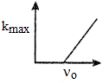
According to Einstein's photoelectric equation,the graph between the kinetic energy of emitted photoelectrons and the frequency of incident radiation is:
A
B
C
D
Solution
(C) Einstein's photoelectric equation is given by $K_{max} = h\nu - \phi_0$,where $K_{max}$ is the maximum kinetic energy,$h$ is Planck's constant,$\nu$ is the frequency of incident radiation,and $\phi_0 = h\nu_0$ is the work function of the metal.
This equation is of the form $y = mx + c$,where $y = K_{max}$,$x = \nu$,$m = h$ (slope),and $c = -\phi_0$ (y-intercept).
Since the y-intercept is negative $(-\phi_0)$,the graph starts from the x-axis at a frequency $\nu = \nu_0$ (threshold frequency) and increases linearly with a positive slope $h$. Thus,the graph has a positive x-intercept at $\nu_0$.
This equation is of the form $y = mx + c$,where $y = K_{max}$,$x = \nu$,$m = h$ (slope),and $c = -\phi_0$ (y-intercept).
Since the y-intercept is negative $(-\phi_0)$,the graph starts from the x-axis at a frequency $\nu = \nu_0$ (threshold frequency) and increases linearly with a positive slope $h$. Thus,the graph has a positive x-intercept at $\nu_0$.
0 likes
View Solution200
EasyMCQ
Light of frequency $4\nu_0$ is incident on a metal surface with threshold frequency $\nu_0$. The maximum kinetic energy of the emitted photoelectrons is:
A
$3h\nu_0$
B
$2h\nu_0$
C
$3/2h\nu_0$
D
$1/2h\nu_0$
Solution
(A) According to Einstein's photoelectric equation,the energy of the incident photon is given by $E = h\nu$.
The photoelectric equation is $E = \phi_0 + K_{\max}$,where $\phi_0 = h\nu_0$ is the work function and $K_{\max}$ is the maximum kinetic energy.
Given the incident frequency $\nu = 4\nu_0$,the energy of the incident photon is $E = h(4\nu_0) = 4h\nu_0$.
Substituting these values into the equation:
$4h\nu_0 = h\nu_0 + K_{\max}$
Solving for $K_{\max}$:
$K_{\max} = 4h\nu_0 - h\nu_0 = 3h\nu_0$.
The photoelectric equation is $E = \phi_0 + K_{\max}$,where $\phi_0 = h\nu_0$ is the work function and $K_{\max}$ is the maximum kinetic energy.
Given the incident frequency $\nu = 4\nu_0$,the energy of the incident photon is $E = h(4\nu_0) = 4h\nu_0$.
Substituting these values into the equation:
$4h\nu_0 = h\nu_0 + K_{\max}$
Solving for $K_{\max}$:
$K_{\max} = 4h\nu_0 - h\nu_0 = 3h\nu_0$.
0 likes
View SolutionDual Nature of Radiation and matter — Einstein's Photoelectric Equation and Energy Quantum of Radiation · Frequently Asked Questions
1Are these Dual Nature of Radiation and matter questions useful for JEE and NEET?
Yes. All questions in this section are mapped to JEE Main and NEET exam patterns. Previous year questions from JEE Main, NEET, GUJCET and state-level exams are included with full solutions.
2Can I switch to Hindi or Gujarati for these questions?
Yes. Use the language tabs in the hero section or the sidebar to view the same questions and solutions in English, Hindi or Gujarati.
3How do I generate a question paper from this subtopic?
Use the Vedclass Exam Paper Generator — select the chapter and subtopic, set difficulty, and generate Sets A, B, C, D automatically. First 3 chapters of every subject are free.
Vedclass Products
For Students
Vedclass Test Series
Mock tests in real JEE/NEET style with performance analysis. 5-day free trial.
Start Free TrialFor Teachers
Exam Paper Generator
Generate Set A/B/C/D papers from this chapter in 2 minutes. 3 chapters free.
Try FreeFor Institutes
Online Exam Module
Live online exams with unlimited students, 360° analytics & white-label branding.
See DemoFor Teachers & Institutes
Generate a Dual Nature of Radiation and matter Exam Paper in 2 Minutes
Select subtopic & difficulty — Sets A, B, C, D auto-generated with No Repeat logic.
First 3 chapters of every subject are free — no payment required.