
A English
Einstein's Photoelectric Equation and Energy Quantum of Radiation Questions in English
Class 12 Physics · Dual Nature of Radiation and matter · Einstein's Photoelectric Equation and Energy Quantum of Radiation
736+
Questions
English
Language
100%
With Solutions
Showing 42 of 736 questions in English
51
EasyMCQ
If the threshold wavelength for sodium is $6800 \mathring{A}$,then the work function will be ............. $eV$.
A
$1.8$
B
$2.5$
C
$2.1$
D
$1.4$
Solution
(A) The work function $W_0$ is given by the formula $W_0 = \frac{hc}{\lambda_0}$.
Using the approximation $hc \approx 12375 \, eV \cdot \mathring{A}$,we have:
$W_0 = \frac{12375}{6800} \, eV$.
$W_0 \approx 1.82 \, eV$.
Rounding to the nearest given option,the work function is $1.8 \, eV$.
Using the approximation $hc \approx 12375 \, eV \cdot \mathring{A}$,we have:
$W_0 = \frac{12375}{6800} \, eV$.
$W_0 \approx 1.82 \, eV$.
Rounding to the nearest given option,the work function is $1.8 \, eV$.
0 likes
View Solution52
MediumMCQ
Light of frequency $8 \times 10^{15} \ Hz$ is incident on a substance of photoelectric work function $6.125 \ eV$. The maximum kinetic energy of the emitted photoelectrons is ........... $eV$.
A
$17$
B
$22$
C
$27$
D
$37$
Solution
(C) The energy of the incident photon is given by $E = h\nu$.
Given $h = 6.626 \times 10^{-34} \ J \cdot s$ and $\nu = 8 \times 10^{15} \ Hz$.
$E = 6.626 \times 10^{-34} \times 8 \times 10^{15} \approx 5.3 \times 10^{-18} \ J$.
To convert this energy into electron-volts $(eV)$,divide by $1.6 \times 10^{-19} \ J/eV$:
$E = \frac{5.3 \times 10^{-18}}{1.6 \times 10^{-19}} \approx 33.125 \ eV$.
Using Einstein's photoelectric equation: $K_{\max} = E - W_0$.
Given work function $W_0 = 6.125 \ eV$.
$K_{\max} = 33.125 \ eV - 6.125 \ eV = 27 \ eV$.
Given $h = 6.626 \times 10^{-34} \ J \cdot s$ and $\nu = 8 \times 10^{15} \ Hz$.
$E = 6.626 \times 10^{-34} \times 8 \times 10^{15} \approx 5.3 \times 10^{-18} \ J$.
To convert this energy into electron-volts $(eV)$,divide by $1.6 \times 10^{-19} \ J/eV$:
$E = \frac{5.3 \times 10^{-18}}{1.6 \times 10^{-19}} \approx 33.125 \ eV$.
Using Einstein's photoelectric equation: $K_{\max} = E - W_0$.
Given work function $W_0 = 6.125 \ eV$.
$K_{\max} = 33.125 \ eV - 6.125 \ eV = 27 \ eV$.
0 likes
View Solution53
EasyMCQ
The photoelectric threshold wavelength for potassium (work function being $2 \ eV$) is ........... $nm$.
A
$310$
B
$620$
C
$1200$
D
$2100$
Solution
(B) The threshold wavelength $\lambda_0$ is given by the formula $\lambda_0 = \frac{hc}{W_0}$.
Given the work function $W_0 = 2 \ eV$.
Using the relation $\lambda_0 (\text{in } \mathring{A}) \approx \frac{12400}{W_0 (\text{in } eV)}$.
$\lambda_0 = \frac{12400}{2} = 6200 \ \mathring{A}$.
Since $1 \ nm = 10 \ \mathring{A}$,we have $\lambda_0 = 620 \ nm$.
Therefore,the correct option is $B$.
Given the work function $W_0 = 2 \ eV$.
Using the relation $\lambda_0 (\text{in } \mathring{A}) \approx \frac{12400}{W_0 (\text{in } eV)}$.
$\lambda_0 = \frac{12400}{2} = 6200 \ \mathring{A}$.
Since $1 \ nm = 10 \ \mathring{A}$,we have $\lambda_0 = 620 \ nm$.
Therefore,the correct option is $B$.
0 likes
View Solution54
EasyMCQ
Photons of energy $6 eV$ are incident on a metal surface whose work function is $4 eV$. The minimum kinetic energy of the emitted photo-electrons will be ........... $eV$.
A
$0$
B
$1$
C
$2$
D
$10$
Solution
(A) According to Einstein's photoelectric equation, the maximum kinetic energy $(K_{max})$ of emitted photo-electrons is given by $K_{max} = h\nu - \Phi$, where $h\nu$ is the energy of the incident photon and $\Phi$ is the work function of the metal.
Given: $h\nu = 6 eV$ and $\Phi = 4 eV$.
$K_{max} = 6 eV - 4 eV = 2 eV$.
The photo-electrons are emitted with a range of kinetic energies starting from $0$ up to the maximum kinetic energy $K_{max}$.
Therefore, the minimum kinetic energy of the emitted photo-electrons is $0 eV$.
Given: $h\nu = 6 eV$ and $\Phi = 4 eV$.
$K_{max} = 6 eV - 4 eV = 2 eV$.
The photo-electrons are emitted with a range of kinetic energies starting from $0$ up to the maximum kinetic energy $K_{max}$.
Therefore, the minimum kinetic energy of the emitted photo-electrons is $0 eV$.
0 likes
View Solution55
EasyMCQ
The lowest frequency of light that will cause the emission of photoelectrons from the surface of a metal (for which work function is $1.65 \ eV$) will be
A
$4 \times 10^{10} \ Hz$
B
$4 \times 10^{11} \ Hz$
C
$4 \times 10^{14} \ Hz$
D
$4 \times 10^{-10} \ Hz$
Solution
(C) The minimum frequency required for photoelectric emission is called the threshold frequency $(\nu_0)$.
It is related to the work function $(W_0)$ by the equation: $W_0 = h\nu_0$.
Given: $W_0 = 1.65 \ eV = 1.65 \times 1.6 \times 10^{-19} \ J$ and Planck's constant $h = 6.6 \times 10^{-34} \ J \cdot s$.
Substituting these values into the equation:
$\nu_0 = \frac{W_0}{h} = \frac{1.65 \times 1.6 \times 10^{-19}}{6.6 \times 10^{-34}}$
$\nu_0 = \frac{2.64 \times 10^{-19}}{6.6 \times 10^{-34}} = 0.4 \times 10^{15} \ Hz = 4 \times 10^{14} \ Hz$.
Therefore,the correct option is $C$.
It is related to the work function $(W_0)$ by the equation: $W_0 = h\nu_0$.
Given: $W_0 = 1.65 \ eV = 1.65 \times 1.6 \times 10^{-19} \ J$ and Planck's constant $h = 6.6 \times 10^{-34} \ J \cdot s$.
Substituting these values into the equation:
$\nu_0 = \frac{W_0}{h} = \frac{1.65 \times 1.6 \times 10^{-19}}{6.6 \times 10^{-34}}$
$\nu_0 = \frac{2.64 \times 10^{-19}}{6.6 \times 10^{-34}} = 0.4 \times 10^{15} \ Hz = 4 \times 10^{14} \ Hz$.
Therefore,the correct option is $C$.
0 likes
View Solution56
DifficultMCQ
Light of two different frequencies whose photons have energies $1 \text{ eV}$ and $2.5 \text{ eV}$ respectively,successively illuminates a metal of work function $0.5 \text{ eV}$. The ratio of the maximum kinetic energies of the emitted electrons will be:
A
$1 : 5$
B
$1 : 4$
C
$1 : 2$
D
$1 : 1$
Solution
(B) According to Einstein's photoelectric equation,the maximum kinetic energy $K_{\max}$ is given by $K_{\max} = E - W_0$,where $E$ is the energy of the incident photon and $W_0$ is the work function of the metal.
For the first photon with energy $E_1 = 1 \text{ eV}$:
$K_1 = E_1 - W_0 = 1 \text{ eV} - 0.5 \text{ eV} = 0.5 \text{ eV}$.
For the second photon with energy $E_2 = 2.5 \text{ eV}$:
$K_2 = E_2 - W_0 = 2.5 \text{ eV} - 0.5 \text{ eV} = 2.0 \text{ eV}$.
The ratio of the maximum kinetic energies is:
$\frac{K_1}{K_2} = \frac{0.5}{2.0} = \frac{1}{4}$.
Thus,the ratio is $1 : 4$.
For the first photon with energy $E_1 = 1 \text{ eV}$:
$K_1 = E_1 - W_0 = 1 \text{ eV} - 0.5 \text{ eV} = 0.5 \text{ eV}$.
For the second photon with energy $E_2 = 2.5 \text{ eV}$:
$K_2 = E_2 - W_0 = 2.5 \text{ eV} - 0.5 \text{ eV} = 2.0 \text{ eV}$.
The ratio of the maximum kinetic energies is:
$\frac{K_1}{K_2} = \frac{0.5}{2.0} = \frac{1}{4}$.
Thus,the ratio is $1 : 4$.
0 likes
View Solution57
EasyMCQ
Sodium and copper have work functions $2.3 \ eV$ and $4.5 \ eV$ respectively. Then the ratio of their threshold wavelengths is nearest to
A
$1:2$
B
$4:1$
C
$2:1$
D
$1:4$
Solution
(C) The work function $W_0$ is related to the threshold wavelength $\lambda_0$ by the formula $W_0 = \frac{hc}{\lambda_0}$.
From this,we can see that $W_0 \propto \frac{1}{\lambda_0}$,which implies $\lambda_0 \propto \frac{1}{W_0}$.
Given the work functions for sodium $(W_1 = 2.3 \ eV)$ and copper $(W_2 = 4.5 \ eV)$,the ratio of their threshold wavelengths is:
$\frac{\lambda_1}{\lambda_2} = \frac{W_2}{W_1} = \frac{4.5 \ eV}{2.3 \ eV} \approx \frac{4.6}{2.3} = 2$.
Thus,the ratio is $2:1$.
From this,we can see that $W_0 \propto \frac{1}{\lambda_0}$,which implies $\lambda_0 \propto \frac{1}{W_0}$.
Given the work functions for sodium $(W_1 = 2.3 \ eV)$ and copper $(W_2 = 4.5 \ eV)$,the ratio of their threshold wavelengths is:
$\frac{\lambda_1}{\lambda_2} = \frac{W_2}{W_1} = \frac{4.5 \ eV}{2.3 \ eV} \approx \frac{4.6}{2.3} = 2$.
Thus,the ratio is $2:1$.
0 likes
View Solution58
EasyMCQ
$A$ photon of $5.5 \ eV$ energy falls on the surface of a metal,emitting photoelectrons with a maximum kinetic energy of $4.0 \ eV$. The stopping voltage required for these electrons is .......... $V$.
A
$5.5$
B
$1.5$
C
$9.5$
D
$4.0$
Solution
(D) The relationship between the maximum kinetic energy $(K_{\max})$ of photoelectrons and the stopping potential $(V_0)$ is given by the equation: $K_{\max} = eV_0$.
Given that the maximum kinetic energy $K_{\max} = 4.0 \ eV$.
Substituting this into the equation: $4.0 \ eV = eV_0$.
Therefore,the stopping potential $V_0 = 4.0 \ V$.
Given that the maximum kinetic energy $K_{\max} = 4.0 \ eV$.
Substituting this into the equation: $4.0 \ eV = eV_0$.
Therefore,the stopping potential $V_0 = 4.0 \ V$.
0 likes
View Solution59
MediumMCQ
When radiation is incident on a photoelectron emitter,the stopping potential is found to be $9 \ V$. If $e/m$ for the electron is $1.8 \times 10^{11} \ C \ kg^{-1}$,the maximum velocity of the ejected electrons is:
A
$6 \times 10^5 \ m \ s^{-1}$
B
$8 \times 10^5 \ m \ s^{-1}$
C
$1.8 \times 10^6 \ m \ s^{-1}$
D
$1.8 \times 10^5 \ m \ s^{-1}$
Solution
(C) The maximum kinetic energy of the ejected photoelectrons is related to the stopping potential $V_0$ by the equation: $K_{\max} = \frac{1}{2}mv_{\max}^2 = eV_0$.
Rearranging this equation to solve for the maximum velocity $v_{\max}$,we get: $v_{\max} = \sqrt{2(\frac{e}{m})V_0}$.
Given values: $V_0 = 9 \ V$ and $\frac{e}{m} = 1.8 \times 10^{11} \ C \ kg^{-1}$.
Substituting these values into the formula: $v_{\max} = \sqrt{2 \times (1.8 \times 10^{11}) \times 9}$.
$v_{\max} = \sqrt{32.4 \times 10^{11}} = \sqrt{3.24 \times 10^{12}} = 1.8 \times 10^6 \ m \ s^{-1}$.
Rearranging this equation to solve for the maximum velocity $v_{\max}$,we get: $v_{\max} = \sqrt{2(\frac{e}{m})V_0}$.
Given values: $V_0 = 9 \ V$ and $\frac{e}{m} = 1.8 \times 10^{11} \ C \ kg^{-1}$.
Substituting these values into the formula: $v_{\max} = \sqrt{2 \times (1.8 \times 10^{11}) \times 9}$.
$v_{\max} = \sqrt{32.4 \times 10^{11}} = \sqrt{3.24 \times 10^{12}} = 1.8 \times 10^6 \ m \ s^{-1}$.
0 likes
View Solution60
DifficultMCQ
Two identical metal plates show the photoelectric effect. Light of wavelength ${\lambda _A}$ falls on plate $A$ and light of wavelength ${\lambda _B}$ falls on plate $B$,where ${\lambda _A} = 2{\lambda _B}$. The maximum kinetic energy is:
A
$2{K_A} = {K_B}$
B
${K_A} < {K_B}/2$
C
${K_A} = 2{K_B}$
D
${K_A} = {K_B}/2$
Solution
(B) According to Einstein's photoelectric equation: $\frac{hc}{\lambda} = W_0 + K_{\max}$.
For plate $A$: $\frac{hc}{\lambda_A} = W_0 + K_A$ ... $(i)$
For plate $B$: $\frac{hc}{\lambda_B} = W_0 + K_B$ ... $(ii)$
Given ${\lambda _A} = 2{\lambda _B}$,substitute this into $(i)$:
$\frac{hc}{2\lambda_B} = W_0 + K_A$ ... $(iii)$
From $(ii)$,we have $W_0 = \frac{hc}{\lambda_B} - K_B$. Substitute this into $(iii)$:
$\frac{hc}{2\lambda_B} = (\frac{hc}{\lambda_B} - K_B) + K_A$
Rearranging the terms:
$K_A = K_B - \frac{hc}{2\lambda_B}$
Since $\frac{hc}{\lambda_B} = W_0 + K_B$,then $\frac{hc}{2\lambda_B} = \frac{W_0 + K_B}{2}$.
Substituting this back:
$K_A = K_B - \frac{W_0 + K_B}{2} = \frac{2K_B - W_0 - K_B}{2} = \frac{K_B - W_0}{2} = \frac{K_B}{2} - \frac{W_0}{2}$.
Since $W_0 > 0$,it follows that $K_A < \frac{K_B}{2}$.
For plate $A$: $\frac{hc}{\lambda_A} = W_0 + K_A$ ... $(i)$
For plate $B$: $\frac{hc}{\lambda_B} = W_0 + K_B$ ... $(ii)$
Given ${\lambda _A} = 2{\lambda _B}$,substitute this into $(i)$:
$\frac{hc}{2\lambda_B} = W_0 + K_A$ ... $(iii)$
From $(ii)$,we have $W_0 = \frac{hc}{\lambda_B} - K_B$. Substitute this into $(iii)$:
$\frac{hc}{2\lambda_B} = (\frac{hc}{\lambda_B} - K_B) + K_A$
Rearranging the terms:
$K_A = K_B - \frac{hc}{2\lambda_B}$
Since $\frac{hc}{\lambda_B} = W_0 + K_B$,then $\frac{hc}{2\lambda_B} = \frac{W_0 + K_B}{2}$.
Substituting this back:
$K_A = K_B - \frac{W_0 + K_B}{2} = \frac{2K_B - W_0 - K_B}{2} = \frac{K_B - W_0}{2} = \frac{K_B}{2} - \frac{W_0}{2}$.
Since $W_0 > 0$,it follows that $K_A < \frac{K_B}{2}$.
0 likes
View Solution61
EasyMCQ
The threshold wavelength for the photoelectric effect of a metal is $6500 \mathring{A}$. The work function of the metal is approximately .......... $eV$.
A
$2$
B
$1$
C
$0.1$
D
$3$
Solution
(A) The work function $\Phi_0$ is given by the formula $\Phi_0 = \frac{hc}{\lambda_0}$.
Using the shortcut formula $\Phi_0 \approx \frac{12400}{\lambda_0 (\text{in } \mathring{A})} \text{ eV}$.
Substituting the given threshold wavelength $\lambda_0 = 6500 \mathring{A}$:
$\Phi_0 = \frac{12400}{6500} \text{ eV}$.
$\Phi_0 \approx 1.907 \text{ eV}$.
Rounding to the nearest integer,we get $\Phi_0 \approx 2 \text{ eV}$.
Using the shortcut formula $\Phi_0 \approx \frac{12400}{\lambda_0 (\text{in } \mathring{A})} \text{ eV}$.
Substituting the given threshold wavelength $\lambda_0 = 6500 \mathring{A}$:
$\Phi_0 = \frac{12400}{6500} \text{ eV}$.
$\Phi_0 \approx 1.907 \text{ eV}$.
Rounding to the nearest integer,we get $\Phi_0 \approx 2 \text{ eV}$.
0 likes
View Solution62
EasyMCQ
When ultraviolet rays are incident on a metal plate, the photoelectric effect does not occur. It occurs by the incidence of:
A
$X$-rays
B
Radio waves
C
Infrared rays
D
Greenhouse effect
Solution
(A) The photoelectric effect occurs when the incident radiation has a frequency greater than the threshold frequency of the metal, or equivalently, a wavelength shorter than the threshold wavelength.
Since ultraviolet $(UV)$ rays do not cause the photoelectric effect, the incident radiation must have a higher energy (shorter wavelength) than $UV$ rays.
Among the given options, $X$-rays have a shorter wavelength $(\lambda_{X-ray} < \lambda_{UV-ray})$ and thus higher energy than $UV$ rays.
Therefore, $X$-rays will cause the photoelectric effect.
Since ultraviolet $(UV)$ rays do not cause the photoelectric effect, the incident radiation must have a higher energy (shorter wavelength) than $UV$ rays.
Among the given options, $X$-rays have a shorter wavelength $(\lambda_{X-ray} < \lambda_{UV-ray})$ and thus higher energy than $UV$ rays.
Therefore, $X$-rays will cause the photoelectric effect.
0 likes
View Solution63
EasyMCQ
Light of frequency $4\nu_0$ is incident on a metal surface with a threshold frequency $\nu_0$. The maximum kinetic energy of the emitted photoelectrons is:
A
$3\,h\nu_0$
B
$2\,h\nu_0$
C
$\frac{3}{2}\,h\nu_0$
D
$\frac{1}{2}\,h\nu_0$
Solution
(A) According to Einstein's photoelectric equation,the energy of the incident photon is equal to the sum of the work function and the maximum kinetic energy of the emitted photoelectrons.
$E = \Phi + K_{\max}$
Here,$E = h\nu = h(4\nu_0)$ and the work function $\Phi = h\nu_0$.
Substituting these values into the equation:
$h(4\nu_0) = h\nu_0 + K_{\max}$
$K_{\max} = 4h\nu_0 - h\nu_0$
$K_{\max} = 3h\nu_0$.
$E = \Phi + K_{\max}$
Here,$E = h\nu = h(4\nu_0)$ and the work function $\Phi = h\nu_0$.
Substituting these values into the equation:
$h(4\nu_0) = h\nu_0 + K_{\max}$
$K_{\max} = 4h\nu_0 - h\nu_0$
$K_{\max} = 3h\nu_0$.
0 likes
View Solution64
EasyMCQ
By the photoelectric effect,Einstein proved:
A
$E = h\nu$
B
$K.E. = \frac{1}{2}mv^2$
C
$E = mc^2$
D
$E = \frac{-Rhc^2}{n^2}$
Solution
(A) Einstein explained the photoelectric effect by proposing that light consists of discrete packets of energy called photons. The energy of each photon is given by the equation $E = h\nu$,where $h$ is Planck's constant and $\nu$ is the frequency of the radiation. This equation forms the basis of Einstein's photoelectric equation,$K_{max} = h\nu - \Phi_0$. Therefore,the correct option is $A$.
0 likes
View Solution65
EasyMCQ
The work function of sodium is $2.3 eV$. The threshold wavelength of sodium will be ........... $\mathring A $
A
$2900$
B
$2500$
C
$5380$
D
$2000$
Solution
(C) The work function $W_0$ is given by the relation $W_0 = \frac{hc}{\lambda_0}$,where $\lambda_0$ is the threshold wavelength.
Using the approximation $hc \approx 12375 \ eV \cdot \mathring A$,we have:
$\lambda_0 = \frac{12375}{W_0} \mathring A$
Substituting $W_0 = 2.3 \ eV$:
$\lambda_0 = \frac{12375}{2.3} \approx 5380.43 \mathring A$
Rounding to the nearest given option,we get $5380 \mathring A$.
Using the approximation $hc \approx 12375 \ eV \cdot \mathring A$,we have:
$\lambda_0 = \frac{12375}{W_0} \mathring A$
Substituting $W_0 = 2.3 \ eV$:
$\lambda_0 = \frac{12375}{2.3} \approx 5380.43 \mathring A$
Rounding to the nearest given option,we get $5380 \mathring A$.
0 likes
View Solution66
MediumMCQ
Two identical photo-cathodes receive light of frequencies $f_1$ and $f_2$. If the velocities of the photoelectrons (of mass $m$) coming out are respectively $v_1$ and $v_2$,then:
A
$v_1 - v_2 = [\frac{2h}{m}(f_1 - f_2)]^{1/2}$
B
$v_1^2 - v_2^2 = \frac{2h}{m}(f_1 - f_2)$
C
$v_1 + v_2 = [\frac{2h}{m}(f_1 + f_2)]^{1/2}$
D
$v_1^2 + v_2^2 = \frac{2h}{m}(f_1 + f_2)$
Solution
(B) According to Einstein's photoelectric equation,the maximum kinetic energy is given by $K_{\max} = hf - W_0$,where $W_0$ is the work function.
For the first photo-cathode: $hf_1 = W_0 + \frac{1}{2}mv_1^2$ ... $(i)$
For the second photo-cathode: $hf_2 = W_0 + \frac{1}{2}mv_2^2$ ... $(ii)$
Subtracting equation $(ii)$ from equation $(i)$:
$h(f_1 - f_2) = \frac{1}{2}m(v_1^2 - v_2^2)$
Rearranging the terms to solve for the velocity difference:
$v_1^2 - v_2^2 = \frac{2h}{m}(f_1 - f_2)$
For the first photo-cathode: $hf_1 = W_0 + \frac{1}{2}mv_1^2$ ... $(i)$
For the second photo-cathode: $hf_2 = W_0 + \frac{1}{2}mv_2^2$ ... $(ii)$
Subtracting equation $(ii)$ from equation $(i)$:
$h(f_1 - f_2) = \frac{1}{2}m(v_1^2 - v_2^2)$
Rearranging the terms to solve for the velocity difference:
$v_1^2 - v_2^2 = \frac{2h}{m}(f_1 - f_2)$
0 likes
View Solution67
DifficultMCQ
When radiation of wavelength $\lambda$ is incident on a metallic surface,the stopping potential is $4.8 \ V$. If the same surface is illuminated with radiation of double the wavelength,then the stopping potential becomes $1.6 \ V$. Then the threshold wavelength for the surface is
A
$2\lambda$
B
$4\lambda$
C
$6\lambda$
D
$8\lambda$
Solution
(B) According to Einstein's photoelectric equation,the stopping potential $V_0$ is given by:
$\frac{hc}{e} \left( \frac{1}{\lambda} - \frac{1}{\lambda_0} \right) = V_0$
For the first case:
$\frac{hc}{e} \left( \frac{1}{\lambda} - \frac{1}{\lambda_0} \right) = 4.8 \quad ...(i)$
For the second case,where wavelength is $2\lambda$:
$\frac{hc}{e} \left( \frac{1}{2\lambda} - \frac{1}{\lambda_0} \right) = 1.6 \quad ...(ii)$
Dividing equation $(i)$ by $(ii)$:
$\frac{\frac{1}{\lambda} - \frac{1}{\lambda_0}}{\frac{1}{2\lambda} - \frac{1}{\lambda_0}} = \frac{4.8}{1.6} = 3$
$\frac{1}{\lambda} - \frac{1}{\lambda_0} = 3 \left( \frac{1}{2\lambda} - \frac{1}{\lambda_0} \right)$
$\frac{1}{\lambda} - \frac{1}{\lambda_0} = \frac{3}{2\lambda} - \frac{3}{\lambda_0}$
$\frac{3}{\lambda_0} - \frac{1}{\lambda_0} = \frac{3}{2\lambda} - \frac{1}{\lambda} = \frac{1}{2\lambda}$
$\frac{2}{\lambda_0} = \frac{1}{2\lambda}$
$\lambda_0 = 4\lambda$
$\frac{hc}{e} \left( \frac{1}{\lambda} - \frac{1}{\lambda_0} \right) = V_0$
For the first case:
$\frac{hc}{e} \left( \frac{1}{\lambda} - \frac{1}{\lambda_0} \right) = 4.8 \quad ...(i)$
For the second case,where wavelength is $2\lambda$:
$\frac{hc}{e} \left( \frac{1}{2\lambda} - \frac{1}{\lambda_0} \right) = 1.6 \quad ...(ii)$
Dividing equation $(i)$ by $(ii)$:
$\frac{\frac{1}{\lambda} - \frac{1}{\lambda_0}}{\frac{1}{2\lambda} - \frac{1}{\lambda_0}} = \frac{4.8}{1.6} = 3$
$\frac{1}{\lambda} - \frac{1}{\lambda_0} = 3 \left( \frac{1}{2\lambda} - \frac{1}{\lambda_0} \right)$
$\frac{1}{\lambda} - \frac{1}{\lambda_0} = \frac{3}{2\lambda} - \frac{3}{\lambda_0}$
$\frac{3}{\lambda_0} - \frac{1}{\lambda_0} = \frac{3}{2\lambda} - \frac{1}{\lambda} = \frac{1}{2\lambda}$
$\frac{2}{\lambda_0} = \frac{1}{2\lambda}$
$\lambda_0 = 4\lambda$
0 likes
View Solution68
EasyMCQ
The frequency and work function of an incident photon are $\nu$ and $\phi_0$. If $\nu_0$ is the threshold frequency,then the necessary condition for the emission of photoelectrons is:
A
$\nu < \nu_0$
B
$\nu = \frac{\nu_0}{2}$
C
$\nu \ge \nu_0$
D
None of these
Solution
(C) The photoelectric effect occurs only when the energy of the incident photon is greater than or equal to the work function of the metal.
The energy of an incident photon is given by $E = h\nu$,where $h$ is Planck's constant and $\nu$ is the frequency.
The work function $\phi_0$ is related to the threshold frequency $\nu_0$ by the equation $\phi_0 = h\nu_0$.
For the emission of photoelectrons,the condition is $E \ge \phi_0$.
Substituting the values,we get $h\nu \ge h\nu_0$,which simplifies to $\nu \ge \nu_0$.
Therefore,the necessary condition for the emission of photoelectrons is $\nu \ge \nu_0$.
The energy of an incident photon is given by $E = h\nu$,where $h$ is Planck's constant and $\nu$ is the frequency.
The work function $\phi_0$ is related to the threshold frequency $\nu_0$ by the equation $\phi_0 = h\nu_0$.
For the emission of photoelectrons,the condition is $E \ge \phi_0$.
Substituting the values,we get $h\nu \ge h\nu_0$,which simplifies to $\nu \ge \nu_0$.
Therefore,the necessary condition for the emission of photoelectrons is $\nu \ge \nu_0$.
0 likes
View Solution69
MediumMCQ
Light of wavelength $1824 \mathring A$,incident on the surface of a metal,produces photo-electrons with maximum energy $5.3 \ eV$. When light of wavelength $1216 \mathring A$ is used,the maximum energy of photoelectrons is $8.7 \ eV$. The work function of the metal surface is .............. $eV$.
A
$3.5$
B
$13.6$
C
$6.8$
D
$1.5$
Solution
(D) According to Einstein's photoelectric equation,$E = W_0 + K_{\max}$,where $E = \frac{hc}{\lambda}$ is the energy of the incident photon,$W_0$ is the work function,and $K_{\max}$ is the maximum kinetic energy.
Using the relation $E \approx \frac{12400}{\lambda (\text{in } \mathring A)} \ eV$:
For $\lambda_1 = 1824 \ \mathring A$,$E_1 = \frac{12400}{1824} \approx 6.797 \ eV \approx 6.8 \ eV$.
Given $K_{\max, 1} = 5.3 \ eV$,then $W_0 = E_1 - K_{\max, 1} = 6.8 - 5.3 = 1.5 \ eV$.
For $\lambda_2 = 1216 \ \mathring A$,$E_2 = \frac{12400}{1216} \approx 10.197 \ eV \approx 10.2 \ eV$.
Given $K_{\max, 2} = 8.7 \ eV$,then $W_0 = E_2 - K_{\max, 2} = 10.2 - 8.7 = 1.5 \ eV$.
Thus,the work function of the metal surface is $1.5 \ eV$.
Using the relation $E \approx \frac{12400}{\lambda (\text{in } \mathring A)} \ eV$:
For $\lambda_1 = 1824 \ \mathring A$,$E_1 = \frac{12400}{1824} \approx 6.797 \ eV \approx 6.8 \ eV$.
Given $K_{\max, 1} = 5.3 \ eV$,then $W_0 = E_1 - K_{\max, 1} = 6.8 - 5.3 = 1.5 \ eV$.
For $\lambda_2 = 1216 \ \mathring A$,$E_2 = \frac{12400}{1216} \approx 10.197 \ eV \approx 10.2 \ eV$.
Given $K_{\max, 2} = 8.7 \ eV$,then $W_0 = E_2 - K_{\max, 2} = 10.2 - 8.7 = 1.5 \ eV$.
Thus,the work function of the metal surface is $1.5 \ eV$.
0 likes
View Solution70
EasyMCQ
If the work function of a photometal is $6.825 \; eV$,its threshold wavelength will be ............. $\mathring A$ $(c = 3 \times 10^8 \; m/s)$.
A
$1200$
B
$1800$
C
$2400$
D
$3600$
Solution
(B) The work function $\Phi_0$ is given by $\Phi_0 = \frac{hc}{\lambda_0}$.
Here,$\Phi_0 = 6.825 \; eV$.
Using the relation $\lambda_0 (\text{in } \mathring A) = \frac{12400}{\Phi_0 (\text{in } eV)}$ or the more precise constant $\lambda_0 = \frac{12375}{\Phi_0}$.
$\lambda_0 = \frac{12375}{6.825} \approx 1813 \; \mathring A$.
Rounding to the nearest given option,we get $1800 \; \mathring A$.
Here,$\Phi_0 = 6.825 \; eV$.
Using the relation $\lambda_0 (\text{in } \mathring A) = \frac{12400}{\Phi_0 (\text{in } eV)}$ or the more precise constant $\lambda_0 = \frac{12375}{\Phi_0}$.
$\lambda_0 = \frac{12375}{6.825} \approx 1813 \; \mathring A$.
Rounding to the nearest given option,we get $1800 \; \mathring A$.
0 likes
View Solution71
MediumMCQ
$A$ photon of energy $8 eV$ is incident on a metal surface of threshold frequency $1.6 \times 10^{15} Hz$. The maximum kinetic energy of the emitted photoelectrons is ............... $eV$ (Given $h = 6.6 \times 10^{-34} Js$).
A
$4.8$
B
$2.4$
C
$1.4$
D
$0.8$
Solution
(C) The work function $W_0$ is given by $W_0 = h\nu_0$.
Given $h = 6.6 \times 10^{-34} Js$ and $\nu_0 = 1.6 \times 10^{15} Hz$.
$W_0 = (6.6 \times 10^{-34}) \times (1.6 \times 10^{15}) = 10.56 \times 10^{-19} J$.
To convert this into $eV$,divide by the charge of an electron $(1.6 \times 10^{-19} C)$:
$W_0 = \frac{10.56 \times 10^{-19}}{1.6 \times 10^{-19}} eV = 6.6 eV$.
According to Einstein's photoelectric equation,$K_{max} = E - W_0$.
Given incident energy $E = 8 eV$.
$K_{max} = 8 eV - 6.6 eV = 1.4 eV$.
Given $h = 6.6 \times 10^{-34} Js$ and $\nu_0 = 1.6 \times 10^{15} Hz$.
$W_0 = (6.6 \times 10^{-34}) \times (1.6 \times 10^{15}) = 10.56 \times 10^{-19} J$.
To convert this into $eV$,divide by the charge of an electron $(1.6 \times 10^{-19} C)$:
$W_0 = \frac{10.56 \times 10^{-19}}{1.6 \times 10^{-19}} eV = 6.6 eV$.
According to Einstein's photoelectric equation,$K_{max} = E - W_0$.
Given incident energy $E = 8 eV$.
$K_{max} = 8 eV - 6.6 eV = 1.4 eV$.
0 likes
View Solution72
EasyMCQ
Photoelectric effect can be explained by
A
Corpuscular theory of light
B
Wave nature of light
C
Bohr's theory
D
Quantum theory of light
Solution
(D) The photoelectric effect is explained by the $Quantum$ theory of light.
According to this theory,light consists of discrete packets of energy called photons.
When a photon with energy $E = h\nu$ is incident on a metal surface,it transfers its energy to an electron.
If the energy of the incident photon is greater than the work function $(\Phi)$ of the metal,the electron overcomes the binding force and is emitted from the surface.
This phenomenon cannot be explained by the wave theory of light because the wave theory predicts that the emission of electrons should depend on the intensity of light,whereas the photoelectric effect depends on the frequency of the incident light.
According to this theory,light consists of discrete packets of energy called photons.
When a photon with energy $E = h\nu$ is incident on a metal surface,it transfers its energy to an electron.
If the energy of the incident photon is greater than the work function $(\Phi)$ of the metal,the electron overcomes the binding force and is emitted from the surface.
This phenomenon cannot be explained by the wave theory of light because the wave theory predicts that the emission of electrons should depend on the intensity of light,whereas the photoelectric effect depends on the frequency of the incident light.
0 likes
View Solution73
EasyMCQ
In the photoelectric effect,the kinetic energy $(K.E.)$ of electrons emitted from the metal surface depends upon:
A
Intensity of light
B
Frequency of incident light
C
Velocity of incident light
D
Both intensity and velocity of light
Solution
(B) According to Einstein's photoelectric equation,$K.E._{max} = h\nu - \Phi$,where $h$ is Planck's constant,$\nu$ is the frequency of incident light,and $\Phi$ is the work function of the metal.
Since $\Phi$ is a constant for a given metal,the maximum kinetic energy of the emitted photoelectrons depends directly on the frequency of the incident light $(\nu)$.
Increasing the intensity of light increases the number of photoelectrons emitted per second,but it does not affect the kinetic energy of individual electrons.
Therefore,the correct option is $(B)$.
Since $\Phi$ is a constant for a given metal,the maximum kinetic energy of the emitted photoelectrons depends directly on the frequency of the incident light $(\nu)$.
Increasing the intensity of light increases the number of photoelectrons emitted per second,but it does not affect the kinetic energy of individual electrons.
Therefore,the correct option is $(B)$.
0 likes
View Solution74
EasyMCQ
If the threshold wavelength for sodium is $5420 \mathring{A}$,then the work function of sodium is ............ $eV$.
A
$4.58$
B
$2.28$
C
$1.14$
D
$0.23$
Solution
(B) The work function $W_0$ is related to the threshold wavelength $\lambda_0$ by the formula $W_0 = \frac{hc}{\lambda_0}$.
Using the approximation $hc \approx 12375 \, eV \cdot \mathring{A}$,we have:
$W_0 = \frac{12375}{\lambda_0} \, eV$.
Given $\lambda_0 = 5420 \, \mathring{A}$,
$W_0 = \frac{12375}{5420} \approx 2.28 \, eV$.
Therefore,the correct option is $B$.
Using the approximation $hc \approx 12375 \, eV \cdot \mathring{A}$,we have:
$W_0 = \frac{12375}{\lambda_0} \, eV$.
Given $\lambda_0 = 5420 \, \mathring{A}$,
$W_0 = \frac{12375}{5420} \approx 2.28 \, eV$.
Therefore,the correct option is $B$.
0 likes
View Solution75
EasyMCQ
The work functions for metals $A, B$ and $C$ are $1.92 eV, 2.0 eV$ and $5 eV$ respectively. According to Einstein's photoelectric equation,which of these metals will emit photoelectrons for an incident radiation of wavelength $4100 \mathring{A}$?
A
None of these
B
$A$ only
C
$A$ and $B$ only
D
All the three metals
Solution
(C) The energy $E$ of the incident photon is given by the formula $E = \frac{hc}{\lambda}$.
Using the approximation $hc \approx 12400 \text{ eV} \cdot \mathring{A}$,we calculate the energy as:
$E = \frac{12400}{4100} \approx 3.02 \text{ eV}$.
Photoelectric emission occurs if the energy of the incident photon is greater than the work function $(\Phi)$ of the metal.
For metal $A$: $\Phi_A = 1.92 \text{ eV} < 3.02 \text{ eV}$ (Emission occurs).
For metal $B$: $\Phi_B = 2.0 \text{ eV} < 3.02 \text{ eV}$ (Emission occurs).
For metal $C$: $\Phi_C = 5.0 \text{ eV} > 3.02 \text{ eV}$ (No emission).
Therefore,only metals $A$ and $B$ will emit photoelectrons.
Using the approximation $hc \approx 12400 \text{ eV} \cdot \mathring{A}$,we calculate the energy as:
$E = \frac{12400}{4100} \approx 3.02 \text{ eV}$.
Photoelectric emission occurs if the energy of the incident photon is greater than the work function $(\Phi)$ of the metal.
For metal $A$: $\Phi_A = 1.92 \text{ eV} < 3.02 \text{ eV}$ (Emission occurs).
For metal $B$: $\Phi_B = 2.0 \text{ eV} < 3.02 \text{ eV}$ (Emission occurs).
For metal $C$: $\Phi_C = 5.0 \text{ eV} > 3.02 \text{ eV}$ (No emission).
Therefore,only metals $A$ and $B$ will emit photoelectrons.
0 likes
View Solution76
MediumMCQ
$A$ photosensitive metallic surface has a work function $h\nu_0$. If photons of energy $2h\nu_0$ fall on this surface,the electrons are emitted with a maximum velocity of $4 \times 10^6 \, m/s$. When the photon energy is increased to $5h\nu_0$,the maximum velocity of the photoelectrons will be:
A
$2 \times 10^6 \, m/s$
B
$2 \times 10^7 \, m/s$
C
$8 \times 10^5 \, m/s$
D
$8 \times 10^6 \, m/s$
Solution
(D) According to Einstein's photoelectric equation,the maximum kinetic energy is given by $K_{\max} = E - W_0$,where $E$ is the energy of the incident photon and $W_0$ is the work function.
For the first case: $E_1 = 2h\nu_0$ and $W_0 = h\nu_0$.
$\frac{1}{2}mv_1^2 = 2h\nu_0 - h\nu_0 = h\nu_0$ ... $(i)$
For the second case: $E_2 = 5h\nu_0$ and $W_0 = h\nu_0$.
$\frac{1}{2}mv_2^2 = 5h\nu_0 - h\nu_0 = 4h\nu_0$ ... $(ii)$
Dividing equation $(ii)$ by $(i)$:
$\frac{\frac{1}{2}mv_2^2}{\frac{1}{2}mv_1^2} = \frac{4h\nu_0}{h\nu_0}$
$\left(\frac{v_2}{v_1}\right)^2 = 4$
$\frac{v_2}{v_1} = 2$
Given $v_1 = 4 \times 10^6 \, m/s$,we find:
$v_2 = 2 \times v_1 = 2 \times (4 \times 10^6 \, m/s) = 8 \times 10^6 \, m/s$.
For the first case: $E_1 = 2h\nu_0$ and $W_0 = h\nu_0$.
$\frac{1}{2}mv_1^2 = 2h\nu_0 - h\nu_0 = h\nu_0$ ... $(i)$
For the second case: $E_2 = 5h\nu_0$ and $W_0 = h\nu_0$.
$\frac{1}{2}mv_2^2 = 5h\nu_0 - h\nu_0 = 4h\nu_0$ ... $(ii)$
Dividing equation $(ii)$ by $(i)$:
$\frac{\frac{1}{2}mv_2^2}{\frac{1}{2}mv_1^2} = \frac{4h\nu_0}{h\nu_0}$
$\left(\frac{v_2}{v_1}\right)^2 = 4$
$\frac{v_2}{v_1} = 2$
Given $v_1 = 4 \times 10^6 \, m/s$,we find:
$v_2 = 2 \times v_1 = 2 \times (4 \times 10^6 \, m/s) = 8 \times 10^6 \, m/s$.
0 likes
View Solution77
EasyMCQ
Light rays consisting of photons with energy $1.8 \ eV$ are incident on a metal surface with a work function of $1.2 \ eV$. What is the stopping potential required to stop the emitted electrons in $eV$?
A
$3$
B
$1.2$
C
$0.6$
D
$1.4$
Solution
(C) According to Einstein's photoelectric equation,the maximum kinetic energy $(K_{max})$ of the emitted photoelectrons is given by:
$K_{max} = E - \Phi$
Where $E$ is the energy of the incident photon and $\Phi$ is the work function of the metal.
Given: $E = 1.8 \ eV$ and $\Phi = 1.2 \ eV$.
$K_{max} = 1.8 \ eV - 1.2 \ eV = 0.6 \ eV$.
The stopping potential $(V_s)$ is related to the maximum kinetic energy by the relation $K_{max} = e V_s$.
Therefore,the stopping potential is $0.6 \ V$,which corresponds to a value of $0.6 \ eV$ in terms of energy units.
$K_{max} = E - \Phi$
Where $E$ is the energy of the incident photon and $\Phi$ is the work function of the metal.
Given: $E = 1.8 \ eV$ and $\Phi = 1.2 \ eV$.
$K_{max} = 1.8 \ eV - 1.2 \ eV = 0.6 \ eV$.
The stopping potential $(V_s)$ is related to the maximum kinetic energy by the relation $K_{max} = e V_s$.
Therefore,the stopping potential is $0.6 \ V$,which corresponds to a value of $0.6 \ eV$ in terms of energy units.
0 likes
View Solution78
EasyMCQ
What happens to the incident photon involved in the photoelectric effect experiment?
A
It completely disappears.
B
It comes out with an increased frequency.
C
It comes out with a decreased frequency.
D
It comes out without any change in frequency.
Solution
(A) The behavior of an incident photon in the photoelectric effect depends on the frequency of the incident light relative to the threshold frequency of the metal surface.
Case $I$: If the frequency of the incident light is less than the threshold frequency $(\nu < \nu_0)$, no photoelectric emission occurs. In this case, the photon is scattered or reflected by the surface, and it comes out without any change in its frequency.
Case $II$: If the frequency of the incident light is greater than or equal to the threshold frequency $(\nu \geq \nu_0)$, the photon is absorbed by an electron. The energy of the photon $(E = h\nu)$ is used to overcome the work function $(\Phi)$ of the metal and provide kinetic energy to the emitted electron. Consequently, the photon completely disappears.
Case $I$: If the frequency of the incident light is less than the threshold frequency $(\nu < \nu_0)$, no photoelectric emission occurs. In this case, the photon is scattered or reflected by the surface, and it comes out without any change in its frequency.
Case $II$: If the frequency of the incident light is greater than or equal to the threshold frequency $(\nu \geq \nu_0)$, the photon is absorbed by an electron. The energy of the photon $(E = h\nu)$ is used to overcome the work function $(\Phi)$ of the metal and provide kinetic energy to the emitted electron. Consequently, the photon completely disappears.
0 likes
View Solution79
DifficultMCQ
$A$ photon of energy $8 \ eV$ is incident on a metal surface of threshold frequency $1.6 \times 10^{15} \ Hz$. The maximum kinetic energy of the photoelectrons emitted (in $eV$) is: (Take $h = 6 \times 10^{-34} \ J \cdot s$ and $1 \ eV = 1.6 \times 10^{-19} \ J$)
A
$2$
B
$6$
C
$1.6$
D
$1.2$
Solution
(A) The maximum kinetic energy $(K_{max})$ of emitted photoelectrons is given by Einstein's photoelectric equation:
$K_{max} = E - \Phi$
where $E$ is the energy of the incident photon and $\Phi$ is the work function of the metal.
The work function $\Phi$ is given by $\Phi = h\nu_0$,where $\nu_0$ is the threshold frequency.
Given $h = 6 \times 10^{-34} \ J \cdot s$ and $\nu_0 = 1.6 \times 10^{15} \ Hz$:
$\Phi = (6 \times 10^{-34} \ J \cdot s) \times (1.6 \times 10^{15} \ Hz) = 9.6 \times 10^{-19} \ J$.
To convert the work function into $eV$,divide by $1.6 \times 10^{-19} \ J/eV$:
$\Phi = \frac{9.6 \times 10^{-19}}{1.6 \times 10^{-19}} \ eV = 6 \ eV$.
Now,calculate the maximum kinetic energy:
$K_{max} = 8 \ eV - 6 \ eV = 2 \ eV$.
$K_{max} = E - \Phi$
where $E$ is the energy of the incident photon and $\Phi$ is the work function of the metal.
The work function $\Phi$ is given by $\Phi = h\nu_0$,where $\nu_0$ is the threshold frequency.
Given $h = 6 \times 10^{-34} \ J \cdot s$ and $\nu_0 = 1.6 \times 10^{15} \ Hz$:
$\Phi = (6 \times 10^{-34} \ J \cdot s) \times (1.6 \times 10^{15} \ Hz) = 9.6 \times 10^{-19} \ J$.
To convert the work function into $eV$,divide by $1.6 \times 10^{-19} \ J/eV$:
$\Phi = \frac{9.6 \times 10^{-19}}{1.6 \times 10^{-19}} \ eV = 6 \ eV$.
Now,calculate the maximum kinetic energy:
$K_{max} = 8 \ eV - 6 \ eV = 2 \ eV$.
0 likes
View Solution80
DifficultMCQ
When a photon of energy $4.25\, eV$ strikes the surface of a metal $A$,the ejected photoelectrons have a maximum kinetic energy $T_A\, eV$ and de-Broglie wavelength ${\lambda _A}$. The maximum kinetic energy of photoelectrons liberated from another metal $B$ by a photon of energy $4.70\, eV$ is ${T_B} = ({T_A} - 1.50)\, eV$. If the de-Broglie wavelength of these photoelectrons is ${\lambda _B} = 2{\lambda _A}$,then:
A
The work function of $A$ is $2.25\, eV$
B
The work function of $B$ is $4.20\, eV$
C
${T_A} = 2.00\, eV$
D
All of the above
Solution
(D) Using Einstein's photoelectric equation: $K_{max} = E - \Phi$,where $\Phi$ is the work function.
For metal $A$: $T_A = 4.25 - \Phi_A$ ... $(i)$
For metal $B$: $T_B = T_A - 1.50 = 4.70 - \Phi_B$ ... (ii)
From $(i)$,$\Phi_A = 4.25 - T_A$. From (ii),$\Phi_B = 4.70 - (T_A - 1.50) = 6.20 - T_A$.
The de-Broglie wavelength is given by $\lambda = \frac{h}{\sqrt{2mK}}$,so $\lambda \propto \frac{1}{\sqrt{K}}$.
Given $\lambda_B = 2\lambda_A$,we have $\frac{\lambda_B}{\lambda_A} = \sqrt{\frac{T_A}{T_B}} = 2$.
Squaring both sides: $\frac{T_A}{T_A - 1.50} = 4$.
$T_A = 4T_A - 6.00 \Rightarrow 3T_A = 6.00 \Rightarrow T_A = 2.00\, eV$.
Substituting $T_A = 2.00\, eV$ into $(i)$: $\Phi_A = 4.25 - 2.00 = 2.25\, eV$.
Substituting $T_A = 2.00\, eV$ into (ii): $T_B = 2.00 - 1.50 = 0.50\, eV$. Then $\Phi_B = 4.70 - 0.50 = 4.20\, eV$.
Thus,all statements are correct.
For metal $A$: $T_A = 4.25 - \Phi_A$ ... $(i)$
For metal $B$: $T_B = T_A - 1.50 = 4.70 - \Phi_B$ ... (ii)
From $(i)$,$\Phi_A = 4.25 - T_A$. From (ii),$\Phi_B = 4.70 - (T_A - 1.50) = 6.20 - T_A$.
The de-Broglie wavelength is given by $\lambda = \frac{h}{\sqrt{2mK}}$,so $\lambda \propto \frac{1}{\sqrt{K}}$.
Given $\lambda_B = 2\lambda_A$,we have $\frac{\lambda_B}{\lambda_A} = \sqrt{\frac{T_A}{T_B}} = 2$.
Squaring both sides: $\frac{T_A}{T_A - 1.50} = 4$.
$T_A = 4T_A - 6.00 \Rightarrow 3T_A = 6.00 \Rightarrow T_A = 2.00\, eV$.
Substituting $T_A = 2.00\, eV$ into $(i)$: $\Phi_A = 4.25 - 2.00 = 2.25\, eV$.
Substituting $T_A = 2.00\, eV$ into (ii): $T_B = 2.00 - 1.50 = 0.50\, eV$. Then $\Phi_B = 4.70 - 0.50 = 4.20\, eV$.
Thus,all statements are correct.
0 likes
View Solution81
EasyMCQ
An image of the sun is formed by a lens of focal length $30 \ cm$ on the metal surface of a photoelectric cell and a photoelectric current $I$ is produced. The lens forming the image is then replaced by another of the same diameter but of focal length $15 \ cm$. The photoelectric current in this case is
A
$I/2$
B
$I$
C
$2I$
D
$4I$
Solution
(D) The intensity of the image formed by a lens is proportional to the power collected by the lens and inversely proportional to the area of the image.
The power collected by the lens is proportional to the area of the lens aperture,which remains constant since the diameter is the same.
The area of the image $A$ is proportional to the square of the focal length $(A \propto f^2)$.
Therefore,the intensity $E$ is proportional to $1/f^2$.
Initially,$I \propto 1/f_1^2 = 1/(30)^2$.
Finally,$I' \propto 1/f_2^2 = 1/(15)^2$.
Taking the ratio: $I'/I = (f_1/f_2)^2 = (30/15)^2 = 2^2 = 4$.
Thus,the new photoelectric current is $I' = 4I$.
The power collected by the lens is proportional to the area of the lens aperture,which remains constant since the diameter is the same.
The area of the image $A$ is proportional to the square of the focal length $(A \propto f^2)$.
Therefore,the intensity $E$ is proportional to $1/f^2$.
Initially,$I \propto 1/f_1^2 = 1/(30)^2$.
Finally,$I' \propto 1/f_2^2 = 1/(15)^2$.
Taking the ratio: $I'/I = (f_1/f_2)^2 = (30/15)^2 = 2^2 = 4$.
Thus,the new photoelectric current is $I' = 4I$.
0 likes
View Solution82
MediumMCQ
The maximum velocity of an electron emitted by light of wavelength $\lambda$ incident on the surface of a metal of work function $\phi$ is:
Where $h =$ Planck's constant, $m =$ mass of electron, and $c =$ speed of light.
Where $h =$ Planck's constant, $m =$ mass of electron, and $c =$ speed of light.
A
$[\frac{2(hc + \lambda \phi)}{m \lambda}]^{1/2}$
B
$\frac{2(hc - \lambda \phi)}{m}$
C
$[\frac{2(hc - \lambda \phi)}{m \lambda}]^{1/2}$
D
$[\frac{2(h \lambda - \phi)}{m}]^{1/2}$
Solution
(C) According to Einstein's photoelectric equation:
$E = \phi + K_{max}$
$\frac{hc}{\lambda} = \phi + \frac{1}{2}mv^2$
Rearranging for $v$:
$\frac{1}{2}mv^2 = \frac{hc}{\lambda} - \phi$
$\frac{1}{2}mv^2 = \frac{hc - \lambda \phi}{\lambda}$
$v^2 = \frac{2(hc - \lambda \phi)}{m \lambda}$
$v = [\frac{2(hc - \lambda \phi)}{m \lambda}]^{1/2}$
$E = \phi + K_{max}$
$\frac{hc}{\lambda} = \phi + \frac{1}{2}mv^2$
Rearranging for $v$:
$\frac{1}{2}mv^2 = \frac{hc}{\lambda} - \phi$
$\frac{1}{2}mv^2 = \frac{hc - \lambda \phi}{\lambda}$
$v^2 = \frac{2(hc - \lambda \phi)}{m \lambda}$
$v = [\frac{2(hc - \lambda \phi)}{m \lambda}]^{1/2}$
0 likes
View Solution83
MediumMCQ
When a point source of monochromatic light is at a distance of $0.2 \ m$ from a photoelectric cell,the cut-off voltage and the saturation current are $0.6 \ V$ and $18 \ mA$ respectively. If the same source is placed $0.6 \ m$ away from the photoelectric cell,then:
A
The stopping potential will be $0.2 \ V$
B
The stopping potential will be $0.6 \ V$
C
The saturation current will be $6 \ mA$
D
The saturation current will be $18 \ mA$
Solution
(B) The cut-off voltage (stopping potential) depends only on the frequency of the incident light,not on its intensity. Therefore,it remains $0.6 \ V$.
The intensity of light from a point source follows the inverse square law,$I \propto \frac{1}{d^2}$.
When the distance increases from $0.2 \ m$ to $0.6 \ m$,the distance becomes $3$ times $(d' = 3d)$.
Thus,the intensity becomes $I' = \frac{I}{3^2} = \frac{I}{9}$.
Since the saturation current is directly proportional to the intensity of incident light,the new saturation current will be $I'_{sat} = \frac{18 \ mA}{9} = 2 \ mA$.
Comparing this with the given options,option $(b)$ is correct regarding the stopping potential.
The intensity of light from a point source follows the inverse square law,$I \propto \frac{1}{d^2}$.
When the distance increases from $0.2 \ m$ to $0.6 \ m$,the distance becomes $3$ times $(d' = 3d)$.
Thus,the intensity becomes $I' = \frac{I}{3^2} = \frac{I}{9}$.
Since the saturation current is directly proportional to the intensity of incident light,the new saturation current will be $I'_{sat} = \frac{18 \ mA}{9} = 2 \ mA$.
Comparing this with the given options,option $(b)$ is correct regarding the stopping potential.
0 likes
View Solution84
DifficultMCQ
In a photoemissive cell with exciting wavelength $\lambda$,the fastest electron has speed $v$. If the exciting wavelength is changed to $\frac{3\lambda}{4}$,the speed of the fastest emitted electron will be
A
$v(3/4)^{1/2}$
B
$v(4/3)^{1/2}$
C
$< v(4/3)^{1/2}$
D
$> v(4/3)^{1/2}$
Solution
(D) According to Einstein's photoelectric equation: $K_{\max} = \frac{hc}{\lambda} - W_0 = \frac{1}{2}mv^2$,where $W_0 = \frac{hc}{\lambda_0}$ is the work function.
Thus,$v = \sqrt{\frac{2hc}{m} \left( \frac{1}{\lambda} - \frac{1}{\lambda_0} \right)} = \sqrt{\frac{2hc}{m} \left( \frac{\lambda_0 - \lambda}{\lambda \lambda_0} \right)} \dots (i)$
When the wavelength is changed to $\lambda' = \frac{3\lambda}{4}$,the new velocity $v'$ is:
$v' = \sqrt{\frac{2hc}{m} \left( \frac{1}{3\lambda/4} - \frac{1}{\lambda_0} \right)} = \sqrt{\frac{2hc}{m} \left( \frac{4\lambda_0 - 3\lambda}{3\lambda \lambda_0} \right)} \dots (ii)$
Dividing $(ii)$ by $(i)$:
$\frac{v'}{v} = \sqrt{\frac{4\lambda_0 - 3\lambda}{3\lambda \lambda_0} \cdot \frac{\lambda \lambda_0}{\lambda_0 - \lambda}} = \sqrt{\frac{4}{3} \cdot \frac{\lambda_0 - 0.75\lambda}{\lambda_0 - \lambda}}$
Since $\lambda_0 > \lambda$,it follows that $(\lambda_0 - 0.75\lambda) > (\lambda_0 - \lambda)$.
Therefore,$\frac{\lambda_0 - 0.75\lambda}{\lambda_0 - \lambda} > 1$.
This implies $\frac{v'}{v} > \sqrt{\frac{4}{3}}$,or $v' > v(4/3)^{1/2}$.
Thus,$v = \sqrt{\frac{2hc}{m} \left( \frac{1}{\lambda} - \frac{1}{\lambda_0} \right)} = \sqrt{\frac{2hc}{m} \left( \frac{\lambda_0 - \lambda}{\lambda \lambda_0} \right)} \dots (i)$
When the wavelength is changed to $\lambda' = \frac{3\lambda}{4}$,the new velocity $v'$ is:
$v' = \sqrt{\frac{2hc}{m} \left( \frac{1}{3\lambda/4} - \frac{1}{\lambda_0} \right)} = \sqrt{\frac{2hc}{m} \left( \frac{4\lambda_0 - 3\lambda}{3\lambda \lambda_0} \right)} \dots (ii)$
Dividing $(ii)$ by $(i)$:
$\frac{v'}{v} = \sqrt{\frac{4\lambda_0 - 3\lambda}{3\lambda \lambda_0} \cdot \frac{\lambda \lambda_0}{\lambda_0 - \lambda}} = \sqrt{\frac{4}{3} \cdot \frac{\lambda_0 - 0.75\lambda}{\lambda_0 - \lambda}}$
Since $\lambda_0 > \lambda$,it follows that $(\lambda_0 - 0.75\lambda) > (\lambda_0 - \lambda)$.
Therefore,$\frac{\lambda_0 - 0.75\lambda}{\lambda_0 - \lambda} > 1$.
This implies $\frac{v'}{v} > \sqrt{\frac{4}{3}}$,or $v' > v(4/3)^{1/2}$.
0 likes
View Solution85
MediumMCQ
Ultraviolet light of wavelength $300 \ nm$ and intensity $1.0 \ W/m^2$ falls on the surface of a photosensitive material. If $1\%$ of the incident photons produce photoelectrons,then the number of photoelectrons emitted from an area of $1.0 \ cm^2$ of the surface is nearly
A
$9.61 \times 10^{14} \text{ per sec}$
B
$4.12 \times 10^{13} \text{ per sec}$
C
$1.51 \times 10^{12} \text{ per sec}$
D
$2.13 \times 10^{11} \text{ per sec}$
Solution
(C) The intensity of light $I$ is given by $I = \frac{n E}{A t}$,where $n$ is the number of photons,$E = \frac{hc}{\lambda}$ is the energy of one photon,$A$ is the area,and $t$ is time.
The number of incident photons per second is $N = \frac{I A}{E} = \frac{I A \lambda}{hc}$.
Given:
$I = 1.0 \ W/m^2$
$A = 1.0 \ cm^2 = 1.0 \times 10^{-4} \ m^2$
$\lambda = 300 \ nm = 300 \times 10^{-9} \ m$
$h = 6.63 \times 10^{-34} \ J \cdot s$
$c = 3 \times 10^8 \ m/s$
$N = \frac{1.0 \times 10^{-4} \times 300 \times 10^{-9}}{6.63 \times 10^{-34} \times 3 \times 10^8} = \frac{3 \times 10^{-11}}{19.89 \times 10^{-26}} \approx 1.508 \times 10^{14} \text{ photons/sec}$.
Since $1\%$ of the incident photons produce photoelectrons,the number of photoelectrons emitted per second is:
$N_e = 0.01 \times N = 0.01 \times 1.508 \times 10^{14} = 1.508 \times 10^{12} \text{ per sec}$.
Thus,the correct option is $C$.
The number of incident photons per second is $N = \frac{I A}{E} = \frac{I A \lambda}{hc}$.
Given:
$I = 1.0 \ W/m^2$
$A = 1.0 \ cm^2 = 1.0 \times 10^{-4} \ m^2$
$\lambda = 300 \ nm = 300 \times 10^{-9} \ m$
$h = 6.63 \times 10^{-34} \ J \cdot s$
$c = 3 \times 10^8 \ m/s$
$N = \frac{1.0 \times 10^{-4} \times 300 \times 10^{-9}}{6.63 \times 10^{-34} \times 3 \times 10^8} = \frac{3 \times 10^{-11}}{19.89 \times 10^{-26}} \approx 1.508 \times 10^{14} \text{ photons/sec}$.
Since $1\%$ of the incident photons produce photoelectrons,the number of photoelectrons emitted per second is:
$N_e = 0.01 \times N = 0.01 \times 1.508 \times 10^{14} = 1.508 \times 10^{12} \text{ per sec}$.
Thus,the correct option is $C$.
0 likes
View Solution86
MediumMCQ
Photoelectric emission is observed from a metallic surface for frequencies ${\nu _1}$ and ${\nu _2}$ of the incident light rays $({\nu _1} > {\nu _2})$. If the maximum values of kinetic energy of the photoelectrons emitted in the two cases are in the ratio of $1:k$,then the threshold frequency of the metallic surface is
A
$\frac{{\nu _1 - \nu _2}}{{k - 1}}$
B
$\frac{{k\nu _1 - \nu _2}}{{k - 1}}$
C
$\frac{{k\nu _2 - \nu _1}}{{k - 1}}$
D
$\frac{{\nu _2 - \nu _1}}{k}$
Solution
(B) According to Einstein's photoelectric equation,the maximum kinetic energy ${K_{\max }}$ is given by ${K_{\max }} = h\nu - h{\nu _0}$,where ${\nu _0}$ is the threshold frequency.
For frequency ${\nu _1}$,${K_1} = h({\nu _1} - {\nu _0})$.
For frequency ${\nu _2}$,${K_2} = h({\nu _2} - {\nu _0})$.
Given the ratio of maximum kinetic energies is ${K_1}:{K_2} = 1:k$,we have $\frac{{{K_1}}}{{{K_2}}} = \frac{1}{k}$.
Substituting the expressions,we get $\frac{{h({\nu _1} - {\nu _0})}}{{h({\nu _2} - {\nu _0})}} = \frac{1}{k}$.
$k({\nu _1} - {\nu _0}) = {\nu _2} - {\nu _0}$.
$k{\nu _1} - k{\nu _0} = {\nu _2} - {\nu _0}$.
$k{\nu _1} - {\nu _2} = k{\nu _0} - {\nu _0} = {\nu _0}(k - 1)$.
Therefore,the threshold frequency is ${\nu _0} = \frac{{k{\nu _1} - {\nu _2}}}{{k - 1}}$.
For frequency ${\nu _1}$,${K_1} = h({\nu _1} - {\nu _0})$.
For frequency ${\nu _2}$,${K_2} = h({\nu _2} - {\nu _0})$.
Given the ratio of maximum kinetic energies is ${K_1}:{K_2} = 1:k$,we have $\frac{{{K_1}}}{{{K_2}}} = \frac{1}{k}$.
Substituting the expressions,we get $\frac{{h({\nu _1} - {\nu _0})}}{{h({\nu _2} - {\nu _0})}} = \frac{1}{k}$.
$k({\nu _1} - {\nu _0}) = {\nu _2} - {\nu _0}$.
$k{\nu _1} - k{\nu _0} = {\nu _2} - {\nu _0}$.
$k{\nu _1} - {\nu _2} = k{\nu _0} - {\nu _0} = {\nu _0}(k - 1)$.
Therefore,the threshold frequency is ${\nu _0} = \frac{{k{\nu _1} - {\nu _2}}}{{k - 1}}$.
0 likes
View Solution87
MediumMCQ
Light from a hydrogen discharge tube is incident on the cathode of a photoelectric cell. The work function of the cathode surface is $4.2 \ eV$. In order to reduce the photo-current to zero,the voltage of the anode relative to the cathode must be made ........... $V$.
A
$-4.2$
B
$-9.4$
C
$-17.8$
D
$+9.4$
Solution
(B) The energy of the emitted photons from a hydrogen discharge tube corresponds to the ionization energy of hydrogen,which is $E = 13.6 \ eV$.
According to Einstein's photoelectric equation,$E = W_0 + K_{max}$,where $K_{max} = e|V_0|$ and $V_0$ is the stopping potential.
Substituting the given values: $13.6 \ eV = 4.2 \ eV + e|V_0|$.
$e|V_0| = 13.6 \ eV - 4.2 \ eV = 9.4 \ eV$.
Therefore,the magnitude of the stopping potential is $|V_0| = 9.4 \ V$.
To reduce the photo-current to zero,the anode must be at a negative potential relative to the cathode.
Thus,the required voltage is $-9.4 \ V$.
According to Einstein's photoelectric equation,$E = W_0 + K_{max}$,where $K_{max} = e|V_0|$ and $V_0$ is the stopping potential.
Substituting the given values: $13.6 \ eV = 4.2 \ eV + e|V_0|$.
$e|V_0| = 13.6 \ eV - 4.2 \ eV = 9.4 \ eV$.
Therefore,the magnitude of the stopping potential is $|V_0| = 9.4 \ V$.
To reduce the photo-current to zero,the anode must be at a negative potential relative to the cathode.
Thus,the required voltage is $-9.4 \ V$.
0 likes
View Solution88
MediumMCQ
Work function of lithium and copper are respectively $2.3 \ eV$ and $4.0 \ eV$. Which one of the metal will be useful for the photoelectric cell working with visible light? $(h = 6.6 \times 10^{-34} \ J \cdot s, c = 3 \times 10^8 \ m/s)$
A
Lithium
B
Copper
C
Both
D
None of these
Solution
(A) The threshold wavelength $\lambda_0$ is given by the formula $\lambda_0 = \frac{hc}{W_0}$.
Using the approximation $\lambda_0 (\text{in } \mathring{A}) \approx \frac{12400}{W_0 (\text{in } eV)}$,we calculate the threshold wavelength for both metals.
For Lithium $(Li)$: $(\lambda_0)_{Li} = \frac{12400}{2.3} \approx 5391 \ \mathring{A}$.
For Copper $(Cu)$: $(\lambda_0)_{Cu} = \frac{12400}{4.0} = 3100 \ \mathring{A}$.
The visible light spectrum ranges approximately from $3800 \ \mathring{A}$ to $7500 \ \mathring{A}$.
Since $(\lambda_0)_{Li} = 5391 \ \mathring{A}$ falls within the visible region,Lithium can emit photoelectrons when exposed to visible light.
Since $(\lambda_0)_{Cu} = 3100 \ \mathring{A}$ falls in the ultraviolet region,Copper cannot emit photoelectrons with visible light.
Therefore,Lithium is the correct metal for a photoelectric cell working with visible light.
Using the approximation $\lambda_0 (\text{in } \mathring{A}) \approx \frac{12400}{W_0 (\text{in } eV)}$,we calculate the threshold wavelength for both metals.
For Lithium $(Li)$: $(\lambda_0)_{Li} = \frac{12400}{2.3} \approx 5391 \ \mathring{A}$.
For Copper $(Cu)$: $(\lambda_0)_{Cu} = \frac{12400}{4.0} = 3100 \ \mathring{A}$.
The visible light spectrum ranges approximately from $3800 \ \mathring{A}$ to $7500 \ \mathring{A}$.
Since $(\lambda_0)_{Li} = 5391 \ \mathring{A}$ falls within the visible region,Lithium can emit photoelectrons when exposed to visible light.
Since $(\lambda_0)_{Cu} = 3100 \ \mathring{A}$ falls in the ultraviolet region,Copper cannot emit photoelectrons with visible light.
Therefore,Lithium is the correct metal for a photoelectric cell working with visible light.
0 likes
View Solution89
DifficultMCQ
$A$ silver ball of radius $4.8 \ cm$ is suspended by a thread in a vacuum chamber. $UV$ light of wavelength $200 \ nm$ is incident on the ball for some time,during which a total energy of $1 \times 10^{-7} \ J$ falls on the surface. Assuming that on average one out of $10^3$ incident photons is able to eject an electron,the potential on the sphere will be ............ $V$.
A
$1$
B
$2$
C
$3$
D
$0$
Solution
(C) $1$. Calculate the total number of incident photons $(n)$:
$n = \frac{E \lambda}{hc} = \frac{1 \times 10^{-7} \times 200 \times 10^{-9}}{6.63 \times 10^{-34} \times 3 \times 10^8} \approx 1.005 \times 10^{11} \approx 10^{11}$ photons.
$2$. Calculate the number of ejected electrons $(N_e)$:
Given that $1$ out of $10^3$ photons ejects an electron,$N_e = \frac{n}{10^3} = \frac{10^{11}}{10^3} = 10^8$ electrons.
$3$. Calculate the total charge $(q)$ on the sphere:
$q = N_e \times e = 10^8 \times 1.6 \times 10^{-19} \ C = 1.6 \times 10^{-11} \ C$.
$4$. Calculate the potential $(V)$ on the sphere:
$V = \frac{1}{4\pi \epsilon_0} \frac{q}{r} = (9 \times 10^9) \times \frac{1.6 \times 10^{-11}}{4.8 \times 10^{-2}} = \frac{14.4 \times 10^{-2}}{4.8 \times 10^{-2}} = 3 \ V$.
$n = \frac{E \lambda}{hc} = \frac{1 \times 10^{-7} \times 200 \times 10^{-9}}{6.63 \times 10^{-34} \times 3 \times 10^8} \approx 1.005 \times 10^{11} \approx 10^{11}$ photons.
$2$. Calculate the number of ejected electrons $(N_e)$:
Given that $1$ out of $10^3$ photons ejects an electron,$N_e = \frac{n}{10^3} = \frac{10^{11}}{10^3} = 10^8$ electrons.
$3$. Calculate the total charge $(q)$ on the sphere:
$q = N_e \times e = 10^8 \times 1.6 \times 10^{-19} \ C = 1.6 \times 10^{-11} \ C$.
$4$. Calculate the potential $(V)$ on the sphere:
$V = \frac{1}{4\pi \epsilon_0} \frac{q}{r} = (9 \times 10^9) \times \frac{1.6 \times 10^{-11}}{4.8 \times 10^{-2}} = \frac{14.4 \times 10^{-2}}{4.8 \times 10^{-2}} = 3 \ V$.
0 likes
View Solution90
EasyMCQ
According to Einstein's photoelectric equation,the graph between the kinetic energy of photoelectrons ejected and the frequency of incident radiation is
A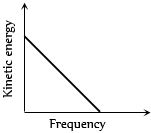
B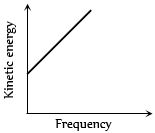
C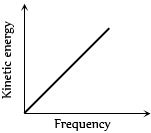
D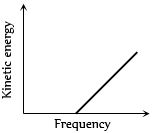
Solution
(D) According to Einstein's photoelectric equation:
$K_{\max} = h\nu - \phi_0$
where $K_{\max}$ is the maximum kinetic energy of the ejected photoelectrons,$h$ is Planck's constant,$\nu$ is the frequency of incident radiation,and $\phi_0 = h\nu_0$ is the work function of the metal.
Comparing this with the equation of a straight line $y = mx + c$:
Here,$y = K_{\max}$,$x = \nu$,$m = h$ (slope),and $c = -\phi_0$ (y-intercept).
Since the slope $h$ is positive and the intercept $-\phi_0$ is negative,the graph is a straight line that starts from a threshold frequency $\nu_0$ on the x-axis and has a positive slope. This corresponds to the graph where the line intersects the x-axis at $\nu_0$ and increases linearly for $\nu > \nu_0$.
$K_{\max} = h\nu - \phi_0$
where $K_{\max}$ is the maximum kinetic energy of the ejected photoelectrons,$h$ is Planck's constant,$\nu$ is the frequency of incident radiation,and $\phi_0 = h\nu_0$ is the work function of the metal.
Comparing this with the equation of a straight line $y = mx + c$:
Here,$y = K_{\max}$,$x = \nu$,$m = h$ (slope),and $c = -\phi_0$ (y-intercept).
Since the slope $h$ is positive and the intercept $-\phi_0$ is negative,the graph is a straight line that starts from a threshold frequency $\nu_0$ on the x-axis and has a positive slope. This corresponds to the graph where the line intersects the x-axis at $\nu_0$ and increases linearly for $\nu > \nu_0$.
0 likes
View Solution91
EasyMCQ
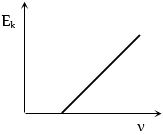
For the photoelectric effect,the maximum kinetic energy $E_k$ of the emitted photoelectrons is plotted against the frequency $\nu$ of the incident photons as shown in the figure. The slope of the curve gives
A
Charge of the electron
B
Work function of the metal
C
Planck's constant
D
Ratio of the Planck's constant to electronic charge
Solution
(C) According to Einstein's photoelectric equation,the maximum kinetic energy $E_k$ of the emitted photoelectrons is given by:
$E_k = h\nu - \Phi$
where $h$ is Planck's constant,$\nu$ is the frequency of incident photons,and $\Phi$ is the work function of the metal.
Comparing this equation with the equation of a straight line $y = mx + c$,where $y = E_k$,$x = \nu$,$m$ is the slope,and $c$ is the y-intercept:
$E_k = h\nu + (-\Phi)$
Here,the slope $m = h$.
Therefore,the slope of the curve represents Planck's constant.
$E_k = h\nu - \Phi$
where $h$ is Planck's constant,$\nu$ is the frequency of incident photons,and $\Phi$ is the work function of the metal.
Comparing this equation with the equation of a straight line $y = mx + c$,where $y = E_k$,$x = \nu$,$m$ is the slope,and $c$ is the y-intercept:
$E_k = h\nu + (-\Phi)$
Here,the slope $m = h$.
Therefore,the slope of the curve represents Planck's constant.
0 likes
View Solution92
MediumMCQ
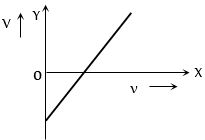
The stopping potential $V_0$ for photoelectric emission from a metal surface is plotted along the $Y-$ axis and the frequency $\nu$ of incident light along the $X-$ axis. $A$ straight line is obtained as shown. Planck's constant $h$ is given by:
A
Slope of the line
B
Product of the slope of the line and the charge on the electron
C
Product of the intercept along the $Y-$ axis and the mass of the electron
D
Product of the slope and the mass of the electron
Solution
(B) According to Einstein's photoelectric equation:
$K_{\max} = h\nu - h\nu_0$
Since $K_{\max} = eV_0$,where $V_0$ is the stopping potential and $e$ is the charge of an electron:
$eV_0 = h\nu - h\nu_0$
Dividing by $e$:
$V_0 = (\frac{h}{e})\nu - (\frac{h\nu_0}{e})$
Comparing this with the equation of a straight line $y = mx + c$,where $y = V_0$ and $x = \nu$:
The slope $m = \frac{h}{e}$.
Therefore,Planck's constant $h = m \times e$,which is the product of the slope of the line and the charge on the electron.
$K_{\max} = h\nu - h\nu_0$
Since $K_{\max} = eV_0$,where $V_0$ is the stopping potential and $e$ is the charge of an electron:
$eV_0 = h\nu - h\nu_0$
Dividing by $e$:
$V_0 = (\frac{h}{e})\nu - (\frac{h\nu_0}{e})$
Comparing this with the equation of a straight line $y = mx + c$,where $y = V_0$ and $x = \nu$:
The slope $m = \frac{h}{e}$.
Therefore,Planck's constant $h = m \times e$,which is the product of the slope of the line and the charge on the electron.
0 likes
View SolutionDual Nature of Radiation and matter — Einstein's Photoelectric Equation and Energy Quantum of Radiation · Frequently Asked Questions
1Are these Dual Nature of Radiation and matter questions useful for JEE and NEET?
Yes. All questions in this section are mapped to JEE Main and NEET exam patterns. Previous year questions from JEE Main, NEET, GUJCET and state-level exams are included with full solutions.
2Can I switch to Hindi or Gujarati for these questions?
Yes. Use the language tabs in the hero section or the sidebar to view the same questions and solutions in English, Hindi or Gujarati.
3How do I generate a question paper from this subtopic?
Use the Vedclass Exam Paper Generator — select the chapter and subtopic, set difficulty, and generate Sets A, B, C, D automatically. First 3 chapters of every subject are free.
Vedclass Products
For Students
Vedclass Test Series
Mock tests in real JEE/NEET style with performance analysis. 5-day free trial.
Start Free TrialFor Teachers
Exam Paper Generator
Generate Set A/B/C/D papers from this chapter in 2 minutes. 3 chapters free.
Try FreeFor Institutes
Online Exam Module
Live online exams with unlimited students, 360° analytics & white-label branding.
See DemoFor Teachers & Institutes
Generate a Dual Nature of Radiation and matter Exam Paper in 2 Minutes
Select subtopic & difficulty — Sets A, B, C, D auto-generated with No Repeat logic.
First 3 chapters of every subject are free — no payment required.