
A English
Einstein's Photoelectric Equation and Energy Quantum of Radiation Questions in English
Class 12 Physics · Dual Nature of Radiation and matter · Einstein's Photoelectric Equation and Energy Quantum of Radiation
736+
Questions
English
Language
100%
With Solutions
Showing 50 of 736 questions in English
101
EasyMCQ
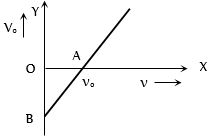
In an experiment on the photoelectric effect,the frequency $\nu$ of the incident light is plotted against the stopping potential $V_0$. The work function of the photoelectric surface is given by ($e$ is the electronic charge):
A
$OB \times e$ in $eV$
B
$OB$ in volt
C
$OA$ in $eV$
D
The slope of the line $AB$
Solution
(A) According to Einstein's photoelectric equation:
$K_{max} = h\nu - W_0$
Since $K_{max} = eV_0$,we have:
$eV_0 = h\nu - W_0$
$V_0 = \left( \frac{h}{e} \right) \nu - \frac{W_0}{e}$
Comparing this with the equation of a straight line $y = mx + c$,where $y = V_0$,$x = \nu$,$m = \frac{h}{e}$,and $c = -\frac{W_0}{e}$.
The intercept on the negative $V_0$ axis is $OB = \frac{W_0}{e}$.
Therefore,the work function $W_0 = OB \times e$.
$K_{max} = h\nu - W_0$
Since $K_{max} = eV_0$,we have:
$eV_0 = h\nu - W_0$
$V_0 = \left( \frac{h}{e} \right) \nu - \frac{W_0}{e}$
Comparing this with the equation of a straight line $y = mx + c$,where $y = V_0$,$x = \nu$,$m = \frac{h}{e}$,and $c = -\frac{W_0}{e}$.
The intercept on the negative $V_0$ axis is $OB = \frac{W_0}{e}$.
Therefore,the work function $W_0 = OB \times e$.
0 likes
View Solution102
EasyMCQ
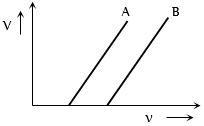
The stopping potential $(V_s)$ as a function of the frequency $(\nu)$ of the incident radiation is plotted for two different photoelectric surfaces $A$ and $B$. The graphs show that the work function of $A$ is
A
Greater than that of $B$
B
Smaller than that of $B$
C
Equal to that of $B$
D
No inference can be drawn about their work functions from the given graphs
Solution
(B) According to Einstein's photoelectric equation,the stopping potential $V_s$ is given by $eV_s = h\nu - \Phi_0$,where $\Phi_0$ is the work function.
This can be rewritten as $V_s = (h/e)\nu - (\Phi_0/e)$.
Comparing this to the equation of a straight line $y = mx + c$,the intercept on the negative $V_s$ axis is $\Phi_0/e$.
The threshold frequency $\nu_0$ is the frequency at which the stopping potential is zero,given by $\nu_0 = \Phi_0/h$.
From the graph,the threshold frequency for surface $A$ is smaller than that for surface $B$ (i.e.,$\nu_{0A} < \nu_{0B}$).
Since $\Phi_0 = h\nu_0$,a smaller threshold frequency implies a smaller work function.
Therefore,the work function of $A$ is smaller than that of $B$.
This can be rewritten as $V_s = (h/e)\nu - (\Phi_0/e)$.
Comparing this to the equation of a straight line $y = mx + c$,the intercept on the negative $V_s$ axis is $\Phi_0/e$.
The threshold frequency $\nu_0$ is the frequency at which the stopping potential is zero,given by $\nu_0 = \Phi_0/h$.
From the graph,the threshold frequency for surface $A$ is smaller than that for surface $B$ (i.e.,$\nu_{0A} < \nu_{0B}$).
Since $\Phi_0 = h\nu_0$,a smaller threshold frequency implies a smaller work function.
Therefore,the work function of $A$ is smaller than that of $B$.
0 likes
View Solution103
EasyMCQ
For a photoelectric cell,the graph showing the variation of stopping potential $(V_o)$ with frequency $(\nu)$ of incident light is best represented by:
A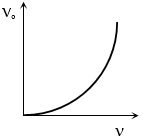
B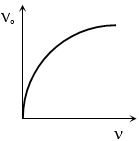
C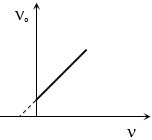
D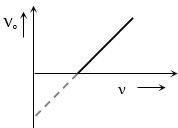
Solution
(D) According to Einstein's photoelectric equation:
$h\nu = W_0 + K_{max}$
Since $K_{max} = eV_o$,where $V_o$ is the stopping potential:
$h\nu = W_0 + eV_o$
Rearranging for $V_o$:
$V_o = (\frac{h}{e})\nu - \frac{W_0}{e}$
This is an equation of a straight line of the form $y = mx + c$,where:
Slope $m = \frac{h}{e}$ (which is positive)
Intercept $c = -\frac{W_0}{e}$ (which is negative)
Therefore,the graph is a straight line with a positive slope and a negative intercept on the $V_o$ axis. This corresponds to the graph shown in option $D$.
$h\nu = W_0 + K_{max}$
Since $K_{max} = eV_o$,where $V_o$ is the stopping potential:
$h\nu = W_0 + eV_o$
Rearranging for $V_o$:
$V_o = (\frac{h}{e})\nu - \frac{W_0}{e}$
This is an equation of a straight line of the form $y = mx + c$,where:
Slope $m = \frac{h}{e}$ (which is positive)
Intercept $c = -\frac{W_0}{e}$ (which is negative)
Therefore,the graph is a straight line with a positive slope and a negative intercept on the $V_o$ axis. This corresponds to the graph shown in option $D$.
0 likes
View Solution104
MediumMCQ
In the following diagram,if $V_2 > V_1$,then:
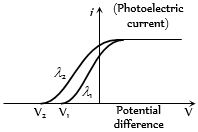
A
$\lambda _1 = \sqrt {\lambda _2}$
B
$\lambda _1 < \lambda _2$
C
$\lambda _1 = \lambda _2$
D
$\lambda _1 > \lambda _2$
Solution
(D) The stopping potential $V_0$ is related to the frequency $\nu$ of incident radiation by Einstein's photoelectric equation: $e V_0 = h\nu - W_0$,which can be written as $V_0 = \frac{h}{e}\nu - \frac{W_0}{e}$.
From the given graph,the stopping potential for the curve corresponding to $\lambda_2$ is $V_2$ and for $\lambda_1$ is $V_1$. Since $V_2 > V_1$ (in magnitude,as they are negative potentials),the stopping potential for $\lambda_2$ is greater than for $\lambda_1$.
This implies that the frequency of radiation $\nu_2$ is greater than $\nu_1$ $(
u_2 > \nu_1)$.
Since the wavelength $\lambda$ is inversely proportional to frequency $(\lambda = \frac{c}{\nu})$,a higher frequency corresponds to a shorter wavelength.
Therefore,$\nu_2 > \nu_1$ implies $\lambda_1 > \lambda_2$.
From the given graph,the stopping potential for the curve corresponding to $\lambda_2$ is $V_2$ and for $\lambda_1$ is $V_1$. Since $V_2 > V_1$ (in magnitude,as they are negative potentials),the stopping potential for $\lambda_2$ is greater than for $\lambda_1$.
This implies that the frequency of radiation $\nu_2$ is greater than $\nu_1$ $(
u_2 > \nu_1)$.
Since the wavelength $\lambda$ is inversely proportional to frequency $(\lambda = \frac{c}{\nu})$,a higher frequency corresponds to a shorter wavelength.
Therefore,$\nu_2 > \nu_1$ implies $\lambda_1 > \lambda_2$.
0 likes
View Solution105
EasyMCQ
According to Einstein's photoelectric equation,the plot of the maximum kinetic energy of the emitted photoelectrons from a metal versus the frequency of the incident radiation gives a straight line whose slope:
A
Is the same for all metals and independent of the intensity of the radiation
B
Depends on the intensity of the radiation
C
Depends both on the intensity of the radiation and the metal used
D
Depends on the nature of the metals used
Solution
(A) Einstein's photoelectric equation is given by: $K{E_{\max }} = h\nu - \Phi$,where $\Phi = h{\nu _0}$ is the work function of the metal.
Comparing this with the equation of a straight line $y = mx + c$,where $y = K{E_{\max }}$ and $x = \nu$ (frequency):
$K{E_{\max }} = h\nu - h{\nu _0}$
The slope $m$ of this line is equal to $h$ (Planck's constant).
Since $h$ is a universal constant,the slope is the same for all metals and is independent of the intensity of the incident radiation.
Comparing this with the equation of a straight line $y = mx + c$,where $y = K{E_{\max }}$ and $x = \nu$ (frequency):
$K{E_{\max }} = h\nu - h{\nu _0}$
The slope $m$ of this line is equal to $h$ (Planck's constant).
Since $h$ is a universal constant,the slope is the same for all metals and is independent of the intensity of the incident radiation.
0 likes
View Solution106
MediumMCQ
The stopping potential $(V_0)$ versus frequency $(\nu)$ plot of a substance is shown in the figure. The threshold wavelength is:
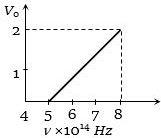
A
$5 \times 10^{14} \ m$
B
$6000 \ \mathring{A}$
C
$5000 \ \mathring{A}$
D
Cannot be estimated from given data
Solution
(B) From the graph, the threshold frequency $(\nu_0)$ is the frequency at which the stopping potential $(V_0)$ is zero.
Looking at the x-axis, the graph intersects the axis at $\nu_0 = 5 \times 10^{14} \ Hz$.
The threshold wavelength $(\lambda_0)$ is related to the threshold frequency by the formula $\lambda_0 = \frac{c}{\nu_0}$, where $c = 3 \times 10^8 \ m/s$ is the speed of light.
Substituting the values: $\lambda_0 = \frac{3 \times 10^8}{5 \times 10^{14}} = 0.6 \times 10^{-6} \ m = 6 \times 10^{-7} \ m$.
Converting to $\mathring{A}$: $\lambda_0 = 6 \times 10^{-7} \times 10^{10} \ \mathring{A} = 6000 \ \mathring{A}$.
Looking at the x-axis, the graph intersects the axis at $\nu_0 = 5 \times 10^{14} \ Hz$.
The threshold wavelength $(\lambda_0)$ is related to the threshold frequency by the formula $\lambda_0 = \frac{c}{\nu_0}$, where $c = 3 \times 10^8 \ m/s$ is the speed of light.
Substituting the values: $\lambda_0 = \frac{3 \times 10^8}{5 \times 10^{14}} = 0.6 \times 10^{-6} \ m = 6 \times 10^{-7} \ m$.
Converting to $\mathring{A}$: $\lambda_0 = 6 \times 10^{-7} \times 10^{10} \ \mathring{A} = 6000 \ \mathring{A}$.
0 likes
View Solution107
EasyMCQ
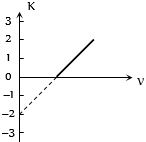
The figure represents a graph of the maximum kinetic energy $(K)$ of photoelectrons (in $eV$) versus the frequency $(\nu)$ of incident radiation for a metal used as a cathode in a photoelectric experiment. The work function of the metal is ............. $eV$.
A
$1$
B
$1.5$
C
$2$
D
$3$
Solution
(C) According to Einstein's photoelectric equation,the maximum kinetic energy $(K)$ of photoelectrons is given by $K = h\nu - \Phi$,where $h$ is Planck's constant,$\nu$ is the frequency of incident light,and $\Phi$ is the work function of the metal.
This equation follows the linear form $y = mx + c$,where $y = K$,$x = \nu$,$m = h$ (slope),and $c = -\Phi$ (y-intercept).
From the given graph,the line intersects the y-axis (the $K$ axis) at $-2 \ eV$.
Therefore,the y-intercept $c = -\Phi = -2 \ eV$.
This implies that the work function $\Phi = 2 \ eV$.
This equation follows the linear form $y = mx + c$,where $y = K$,$x = \nu$,$m = h$ (slope),and $c = -\Phi$ (y-intercept).
From the given graph,the line intersects the y-axis (the $K$ axis) at $-2 \ eV$.
Therefore,the y-intercept $c = -\Phi = -2 \ eV$.
This implies that the work function $\Phi = 2 \ eV$.
0 likes
View Solution108
EasyMCQ
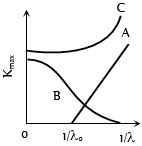
The correct graph between the maximum kinetic energy $(K_{\max})$ of a photoelectron and the inverse of the wavelength $(1/\lambda)$ of the incident radiation is given by the curve:
A
$A$
B
$B$
C
$C$
D
None of the above
Solution
(A) According to Einstein's photoelectric equation,the maximum kinetic energy $(K_{\max})$ of a photoelectron is given by:
$K_{\max} = h\nu - \Phi_0$
Since $\nu = c/\lambda$,we can write:
$K_{\max} = \frac{hc}{\lambda} - \Phi_0$
Where $h$ is Planck's constant,$c$ is the speed of light,$\lambda$ is the wavelength of incident radiation,and $\Phi_0$ is the work function of the metal.
This equation is of the form $y = mx + c$,where $y = K_{\max}$,$x = 1/\lambda$,$m = hc$ (slope),and $c = -\Phi_0$ (y-intercept).
This represents a straight line with a positive slope that starts from the x-axis at $1/\lambda = 1/\lambda_0$ (where $\lambda_0$ is the threshold wavelength) and has a negative intercept on the y-axis.
Looking at the provided graph,curve $A$ represents this linear relationship.
Therefore,the correct option is $A$.
$K_{\max} = h\nu - \Phi_0$
Since $\nu = c/\lambda$,we can write:
$K_{\max} = \frac{hc}{\lambda} - \Phi_0$
Where $h$ is Planck's constant,$c$ is the speed of light,$\lambda$ is the wavelength of incident radiation,and $\Phi_0$ is the work function of the metal.
This equation is of the form $y = mx + c$,where $y = K_{\max}$,$x = 1/\lambda$,$m = hc$ (slope),and $c = -\Phi_0$ (y-intercept).
This represents a straight line with a positive slope that starts from the x-axis at $1/\lambda = 1/\lambda_0$ (where $\lambda_0$ is the threshold wavelength) and has a negative intercept on the y-axis.
Looking at the provided graph,curve $A$ represents this linear relationship.
Therefore,the correct option is $A$.
0 likes
View Solution109
EasyMCQ
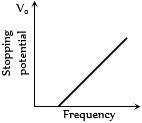
In the graph given below,if the slope is $4.12 \times 10^{-15} \ V-sec$,then the value of $h$ should be:
A
$6.6 \times 10^{-31} \ J-sec$
B
$6.6 \times 10^{-34} \ J-sec$
C
$9.1 \times 10^{-31} \ J-sec$
D
None of these
Solution
(B) The slope of the stopping potential $(V_0)$ versus frequency $(\nu)$ graph is given by the relation: $\text{Slope} = \frac{h}{e}$.
Given that the slope is $4.12 \times 10^{-15} \ V-sec$ and the charge of an electron $e = 1.6 \times 10^{-19} \ C$.
Therefore,$h = \text{Slope} \times e$.
$h = (4.12 \times 10^{-15}) \times (1.6 \times 10^{-19}) \ J-sec$.
$h \approx 6.592 \times 10^{-34} \ J-sec \approx 6.6 \times 10^{-34} \ J-sec$.
Thus,the correct option is $(b)$.
Given that the slope is $4.12 \times 10^{-15} \ V-sec$ and the charge of an electron $e = 1.6 \times 10^{-19} \ C$.
Therefore,$h = \text{Slope} \times e$.
$h = (4.12 \times 10^{-15}) \times (1.6 \times 10^{-19}) \ J-sec$.
$h \approx 6.592 \times 10^{-34} \ J-sec \approx 6.6 \times 10^{-34} \ J-sec$.
Thus,the correct option is $(b)$.
0 likes
View Solution110
MediumMCQ
The figure showing the correct relationship between the stopping potential $V_0$ and the frequency $\nu$ of light for potassium and tungsten is
A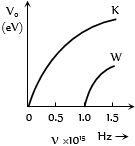
B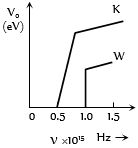
C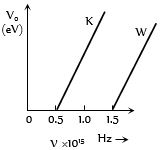
D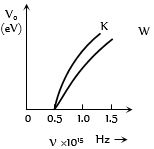
Solution
(C) According to Einstein's photoelectric equation,the stopping potential $V_0$ is related to the frequency $\nu$ of incident light by the equation: $eV_0 = h\nu - \phi$,where $h$ is Planck's constant,$e$ is the charge of an electron,and $\phi$ is the work function of the metal.
This can be rewritten as: $V_0 = \left( \frac{h}{e} \right) \nu - \frac{\phi}{e}$.
This equation represents a straight line of the form $y = mx + c$,where the slope $m = \frac{h}{e}$.
Since the slope $\frac{h}{e}$ is a universal constant,the graphs of $V_0$ versus $\nu$ for different metals must be parallel straight lines.
The x-intercept of these lines is the threshold frequency $\nu_0 = \frac{\phi}{h}$,which depends on the work function $\phi$ of the specific metal.
Therefore,the correct representation is a set of parallel straight lines with different x-intercepts,as shown in option $C$.
This can be rewritten as: $V_0 = \left( \frac{h}{e} \right) \nu - \frac{\phi}{e}$.
This equation represents a straight line of the form $y = mx + c$,where the slope $m = \frac{h}{e}$.
Since the slope $\frac{h}{e}$ is a universal constant,the graphs of $V_0$ versus $\nu$ for different metals must be parallel straight lines.
The x-intercept of these lines is the threshold frequency $\nu_0 = \frac{\phi}{h}$,which depends on the work function $\phi$ of the specific metal.
Therefore,the correct representation is a set of parallel straight lines with different x-intercepts,as shown in option $C$.
0 likes
View Solution111
MediumMCQ
The slope of the graph between the frequency of incident light and the stopping potential for a given surface is:
A
$h$
B
$h/e$
C
$eh$
D
$e$
Solution
(B) According to Einstein's photoelectric equation,the kinetic energy of emitted photoelectrons is given by $K_{max} = h\nu - \phi_0$,where $\phi_0$ is the work function.
Since $K_{max} = eV_0$,where $V_0$ is the stopping potential,we can write $eV_0 = h\nu - \phi_0$.
Rearranging this for the stopping potential,we get $V_0 = \frac{h}{e}\nu - \frac{\phi_0}{e}$.
This equation is in the form of a straight line $y = mx + c$,where $y = V_0$,$x = \nu$,and the slope $m = \frac{h}{e}$.
Therefore,the slope of the graph between the stopping potential $(V_0)$ and the frequency of incident light $(\nu)$ is $h/e$.
Since $K_{max} = eV_0$,where $V_0$ is the stopping potential,we can write $eV_0 = h\nu - \phi_0$.
Rearranging this for the stopping potential,we get $V_0 = \frac{h}{e}\nu - \frac{\phi_0}{e}$.
This equation is in the form of a straight line $y = mx + c$,where $y = V_0$,$x = \nu$,and the slope $m = \frac{h}{e}$.
Therefore,the slope of the graph between the stopping potential $(V_0)$ and the frequency of incident light $(\nu)$ is $h/e$.
0 likes
View Solution112
MediumMCQ
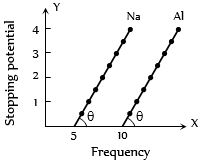
From the figure describing the photoelectric effect,we may infer correctly that:
A
$Na$ and $Al$ both have the same threshold frequency.
B
Maximum kinetic energy for both the metals depends linearly on the frequency.
C
The stopping potentials are different for $Na$ and $Al$ for the same change in frequency.
D
$Al$ is a better photosensitive material than $Na$.
Solution
(B) According to Einstein's photoelectric equation,the maximum kinetic energy $K_{max}$ of emitted photoelectrons is given by $K_{max} = h\nu - \Phi_0$,where $h$ is Planck's constant,$\nu$ is the frequency of incident light,and $\Phi_0$ is the work function of the metal.
Since the stopping potential $V_s$ is related to the maximum kinetic energy by $eV_s = K_{max}$,we have $V_s = \frac{h}{e}\nu - \frac{\Phi_0}{e}$.
This equation represents a straight line with a slope of $\frac{h}{e}$.
In the given graph,the stopping potential $V_s$ is plotted against frequency $\nu$ for two metals,$Na$ and $Al$.
Since both lines are straight and parallel (having the same angle $\theta$),it confirms that the maximum kinetic energy for both metals depends linearly on the frequency of the incident radiation.
Since the stopping potential $V_s$ is related to the maximum kinetic energy by $eV_s = K_{max}$,we have $V_s = \frac{h}{e}\nu - \frac{\Phi_0}{e}$.
This equation represents a straight line with a slope of $\frac{h}{e}$.
In the given graph,the stopping potential $V_s$ is plotted against frequency $\nu$ for two metals,$Na$ and $Al$.
Since both lines are straight and parallel (having the same angle $\theta$),it confirms that the maximum kinetic energy for both metals depends linearly on the frequency of the incident radiation.
0 likes
View Solution113
MediumMCQ
The work function of a metal is $2.3 \ eV$ and the wavelength of the incident photon is $4.84 \times 10^{-7} \ m$. What is the maximum kinetic energy of the photoelectrons in $eV$?
A
$2.1$
B
$1.4$
C
$0.9$
D
$0.3$
Solution
(D) Given: Work function $\phi = 2.3 \ eV$,Wavelength $\lambda = 4.84 \times 10^{-7} \ m = 4840 \ \mathring{A}$.
Using Einstein's photoelectric equation: $K.E._{max} = \frac{hc}{\lambda} - \phi$.
We know that $hc \approx 12400 \ eV \cdot \mathring{A}$.
$K.E._{max} = \frac{12400 \ eV \cdot \mathring{A}}{4840 \ \mathring{A}} - 2.3 \ eV$.
$K.E._{max} \approx 2.56 \ eV - 2.3 \ eV$.
$K.E._{max} \approx 0.26 \ eV \approx 0.3 \ eV$ (rounding to the nearest option).
Using Einstein's photoelectric equation: $K.E._{max} = \frac{hc}{\lambda} - \phi$.
We know that $hc \approx 12400 \ eV \cdot \mathring{A}$.
$K.E._{max} = \frac{12400 \ eV \cdot \mathring{A}}{4840 \ \mathring{A}} - 2.3 \ eV$.
$K.E._{max} \approx 2.56 \ eV - 2.3 \ eV$.
$K.E._{max} \approx 0.26 \ eV \approx 0.3 \ eV$ (rounding to the nearest option).
0 likes
View Solution114
MediumMCQ
When a certain metallic surface is illuminated with monochromatic light of wavelength $\lambda$,the stopping potential for photoelectric current is $6V_0$. When the same surface is illuminated with light of wavelength $2\lambda$,the stopping potential is $2V_0$. The threshold wavelength for the photoelectric effect for this surface is:
A
$6\lambda$
B
$4\lambda / 3$
C
$4\lambda$
D
$8\lambda$
Solution
(C) According to Einstein's photoelectric equation: $eV_s = \frac{hc}{\lambda} - \phi$,where $\phi = \frac{hc}{\lambda_0}$ is the work function and $\lambda_0$ is the threshold wavelength.
For the first case: $6eV_0 = \frac{hc}{\lambda} - \frac{hc}{\lambda_0} \quad ...(1)$
For the second case: $2eV_0 = \frac{hc}{2\lambda} - \frac{hc}{\lambda_0} \quad ...(2)$
Subtracting equation $(2)$ from equation $(1)$:
$(6eV_0 - 2eV_0) = (\frac{hc}{\lambda} - \frac{hc}{2\lambda}) - (\frac{hc}{\lambda_0} - \frac{hc}{\lambda_0})$
$4eV_0 = \frac{hc}{2\lambda} \implies eV_0 = \frac{hc}{8\lambda}$
Substitute $eV_0$ into equation $(2)$:
$2(\frac{hc}{8\lambda}) = \frac{hc}{2\lambda} - \frac{hc}{\lambda_0}$
$\frac{hc}{4\lambda} = \frac{hc}{2\lambda} - \frac{hc}{\lambda_0}$
$\frac{hc}{\lambda_0} = \frac{hc}{2\lambda} - \frac{hc}{4\lambda} = \frac{hc}{4\lambda}$
Therefore,$\lambda_0 = 4\lambda$.
For the first case: $6eV_0 = \frac{hc}{\lambda} - \frac{hc}{\lambda_0} \quad ...(1)$
For the second case: $2eV_0 = \frac{hc}{2\lambda} - \frac{hc}{\lambda_0} \quad ...(2)$
Subtracting equation $(2)$ from equation $(1)$:
$(6eV_0 - 2eV_0) = (\frac{hc}{\lambda} - \frac{hc}{2\lambda}) - (\frac{hc}{\lambda_0} - \frac{hc}{\lambda_0})$
$4eV_0 = \frac{hc}{2\lambda} \implies eV_0 = \frac{hc}{8\lambda}$
Substitute $eV_0$ into equation $(2)$:
$2(\frac{hc}{8\lambda}) = \frac{hc}{2\lambda} - \frac{hc}{\lambda_0}$
$\frac{hc}{4\lambda} = \frac{hc}{2\lambda} - \frac{hc}{\lambda_0}$
$\frac{hc}{\lambda_0} = \frac{hc}{2\lambda} - \frac{hc}{4\lambda} = \frac{hc}{4\lambda}$
Therefore,$\lambda_0 = 4\lambda$.
0 likes
View Solution115
DifficultMCQ
When light of frequency $8 \times 10^{14} \ Hz$ is incident on a surface,photoelectrons are emitted with a maximum speed of $7 \times 10^5 \ m/s$. The threshold frequency for this surface is ..........
A
$2.32 \times 10^{14} \ Hz$
B
$4.64 \times 10^{14} \ Hz$
C
$4.64 \times 10^{16} \ Hz$
D
$4.64 \times 10^{18} \ Hz$
Solution
(B) Given: Frequency of incident light $\nu = 8 \times 10^{14} \ Hz$,Maximum speed $v_{max} = 7 \times 10^5 \ m/s$.
The maximum kinetic energy of the emitted photoelectrons is given by $K_{max} = \frac{1}{2} m v_{max}^2$.
Substituting the mass of an electron $m = 9.1 \times 10^{-31} \ kg$:
$K_{max} = \frac{1}{2} \times (9.1 \times 10^{-31}) \times (7 \times 10^5)^2 = 0.5 \times 9.1 \times 10^{-31} \times 49 \times 10^{10} = 222.95 \times 10^{-21} \ J \approx 2.23 \times 10^{-19} \ J$.
Using Einstein's photoelectric equation: $K_{max} = h\nu - h\nu_0$,where $\nu_0$ is the threshold frequency.
$h\nu_0 = h\nu - K_{max}$.
$h\nu = (6.63 \times 10^{-34}) \times (8 \times 10^{14}) = 53.04 \times 10^{-20} \ J = 5.304 \times 10^{-19} \ J$.
$h\nu_0 = 5.304 \times 10^{-19} - 2.23 \times 10^{-19} = 3.074 \times 10^{-19} \ J$.
Now,$\nu_0 = \frac{3.074 \times 10^{-19}}{6.63 \times 10^{-34}} \approx 0.4636 \times 10^{15} \ Hz = 4.64 \times 10^{14} \ Hz$.
The maximum kinetic energy of the emitted photoelectrons is given by $K_{max} = \frac{1}{2} m v_{max}^2$.
Substituting the mass of an electron $m = 9.1 \times 10^{-31} \ kg$:
$K_{max} = \frac{1}{2} \times (9.1 \times 10^{-31}) \times (7 \times 10^5)^2 = 0.5 \times 9.1 \times 10^{-31} \times 49 \times 10^{10} = 222.95 \times 10^{-21} \ J \approx 2.23 \times 10^{-19} \ J$.
Using Einstein's photoelectric equation: $K_{max} = h\nu - h\nu_0$,where $\nu_0$ is the threshold frequency.
$h\nu_0 = h\nu - K_{max}$.
$h\nu = (6.63 \times 10^{-34}) \times (8 \times 10^{14}) = 53.04 \times 10^{-20} \ J = 5.304 \times 10^{-19} \ J$.
$h\nu_0 = 5.304 \times 10^{-19} - 2.23 \times 10^{-19} = 3.074 \times 10^{-19} \ J$.
Now,$\nu_0 = \frac{3.074 \times 10^{-19}}{6.63 \times 10^{-34}} \approx 0.4636 \times 10^{15} \ Hz = 4.64 \times 10^{14} \ Hz$.
0 likes
View Solution116
MediumMCQ
When the wavelength of incident radiation is changed from $400 \ nm$ to $310 \ nm$,the maximum kinetic energy of the emitted photoelectrons is doubled. The work function of the metal is ........ $eV$.
A
$0.9$
B
$1.7$
C
$2.2$
D
$3.1$
Solution
(C) According to Einstein's photoelectric equation,$K_{max} = \frac{hc}{\lambda} - \phi$,where $\phi$ is the work function.
For $\lambda_1 = 400 \ nm$,$K_1 = \frac{1240}{400} - \phi = 3.1 - \phi$.
For $\lambda_2 = 310 \ nm$,$K_2 = \frac{1240}{310} - \phi = 4.0 - \phi$.
Given that the maximum kinetic energy is doubled,$K_2 = 2K_1$.
Substituting the values: $4.0 - \phi = 2(3.1 - \phi)$.
$4.0 - \phi = 6.2 - 2\phi$.
$2\phi - \phi = 6.2 - 4.0$.
$\phi = 2.2 \ eV$.
For $\lambda_1 = 400 \ nm$,$K_1 = \frac{1240}{400} - \phi = 3.1 - \phi$.
For $\lambda_2 = 310 \ nm$,$K_2 = \frac{1240}{310} - \phi = 4.0 - \phi$.
Given that the maximum kinetic energy is doubled,$K_2 = 2K_1$.
Substituting the values: $4.0 - \phi = 2(3.1 - \phi)$.
$4.0 - \phi = 6.2 - 2\phi$.
$2\phi - \phi = 6.2 - 4.0$.
$\phi = 2.2 \ eV$.
0 likes
View Solution117
MediumMCQ
Monochromatic radiation emitted when an electron in a hydrogen atom jumps from the first excited state to the ground state irradiates a photosensitive material. The stopping potential is measured to be $3.57 \; V$. The threshold frequency of the material is ......... $\times 10^{15} \; Hz$.
A
$2.5$
B
$1.6$
C
$4$
D
$5$
Solution
(B) The energy of the photon emitted when an electron jumps from the first excited state $(n=2)$ to the ground state $(n=1)$ in a hydrogen atom is given by:
$E = E_2 - E_1 = -3.4 \; eV - (-13.6 \; eV) = 10.2 \; eV$.
According to Einstein's photoelectric equation:
$E = \phi + K_{max}$
where $\phi$ is the work function and $K_{max} = eV_s$ is the maximum kinetic energy.
Given $V_s = 3.57 \; V$,so $K_{max} = 3.57 \; eV$.
Substituting the values:
$10.2 \; eV = \phi + 3.57 \; eV$
$\phi = 10.2 - 3.57 = 6.63 \; eV$.
The work function is also given by $\phi = h \nu_0$,where $h \approx 4.136 \times 10^{-15} \; eV \cdot s$.
$\nu_0 = \frac{\phi}{h} = \frac{6.63 \; eV}{4.136 \times 10^{-15} \; eV \cdot s} \approx 1.6 \times 10^{15} \; Hz$.
$E = E_2 - E_1 = -3.4 \; eV - (-13.6 \; eV) = 10.2 \; eV$.
According to Einstein's photoelectric equation:
$E = \phi + K_{max}$
where $\phi$ is the work function and $K_{max} = eV_s$ is the maximum kinetic energy.
Given $V_s = 3.57 \; V$,so $K_{max} = 3.57 \; eV$.
Substituting the values:
$10.2 \; eV = \phi + 3.57 \; eV$
$\phi = 10.2 - 3.57 = 6.63 \; eV$.
The work function is also given by $\phi = h \nu_0$,where $h \approx 4.136 \times 10^{-15} \; eV \cdot s$.
$\nu_0 = \frac{\phi}{h} = \frac{6.63 \; eV}{4.136 \times 10^{-15} \; eV \cdot s} \approx 1.6 \times 10^{15} \; Hz$.
0 likes
View Solution118
EasyMCQ
Two photons, each having an energy of $2.5 \ eV$, are incident on a metal surface with a work function of $4.5 \ eV$. Then . . . . . . .
A
The kinetic energy of the emitted electron is $0.5 \ eV$.
B
The kinetic energy of the emitted electron is $2 \ eV$.
C
The kinetic energy of the emitted electron ranges from $0$ to $0.5 \ eV$.
D
Emission of electrons is not possible.
Solution
(D) Given: Energy of each photon $E = 2.5 \ eV$, Work function $\Phi_0 = 4.5 \ eV$.
According to Einstein's photoelectric equation, the photoelectric effect occurs only if the energy of the incident photon is greater than or equal to the work function of the metal $(E \ge \Phi_0)$.
Here, $E = 2.5 \ eV$ and $\Phi_0 = 4.5 \ eV$.
Since $E < \Phi_0$, the energy of a single photon is insufficient to overcome the work function of the metal.
Therefore, no photoelectric emission takes place, regardless of the number of photons incident.
According to Einstein's photoelectric equation, the photoelectric effect occurs only if the energy of the incident photon is greater than or equal to the work function of the metal $(E \ge \Phi_0)$.
Here, $E = 2.5 \ eV$ and $\Phi_0 = 4.5 \ eV$.
Since $E < \Phi_0$, the energy of a single photon is insufficient to overcome the work function of the metal.
Therefore, no photoelectric emission takes place, regardless of the number of photons incident.
0 likes
View Solution119
DifficultMCQ
When radiation of wavelength $\lambda$ is incident on a photoelectric cell,the maximum velocity of the emitted photoelectrons is $\upsilon$. If the wavelength of the incident radiation is changed to $3\lambda / 4$,the maximum velocity of the emitted photoelectrons will be ..........
A
$\upsilon {\left( {\frac{3}{4}} \right)^{\frac{1}{2}}}$
B
$\upsilon {\left( {\frac{4}{3}} \right)^{\frac{1}{2}}}$
C
$ < \,\,\upsilon \,{\left( {\frac{4}{3}} \right)^{\frac{1}{2}}}$
D
$ > \,\,\upsilon \,{\left( {\frac{4}{3}} \right)^{\frac{1}{2}}}$
Solution
(D) According to Einstein's photoelectric equation: $\frac{1}{2}m\upsilon^2 = \frac{hc}{\lambda} - \phi$,where $\phi = \frac{hc}{\lambda_0}$ is the work function.
Thus,$\upsilon = \sqrt{\frac{2hc}{m} \left( \frac{1}{\lambda} - \frac{1}{\lambda_0} \right)} = \sqrt{\frac{2hc}{m} \left( \frac{\lambda_0 - \lambda}{\lambda \lambda_0} \right)} \dots (1)$
When the wavelength is changed to $\lambda' = \frac{3\lambda}{4}$,the new velocity $\upsilon'$ is:
$\upsilon' = \sqrt{\frac{2hc}{m} \left( \frac{\lambda_0 - 3\lambda/4}{(3\lambda/4) \lambda_0} \right)} \dots (2)$
Dividing equation $(2)$ by $(1)$:
$\frac{\upsilon'}{\upsilon} = \sqrt{\frac{\lambda_0 - 3\lambda/4}{3\lambda/4 \lambda_0} \times \frac{\lambda \lambda_0}{\lambda_0 - \lambda}} = \sqrt{\frac{4}{3} \left( \frac{\lambda_0 - 3\lambda/4}{\lambda_0 - \lambda} \right)}$
Since $\lambda_0 - 3\lambda/4 > \lambda_0 - \lambda$,the term $\frac{\lambda_0 - 3\lambda/4}{\lambda_0 - \lambda} > 1$.
Therefore,$\upsilon' > \upsilon \left( \frac{4}{3} \right)^{1/2}$.
Thus,$\upsilon = \sqrt{\frac{2hc}{m} \left( \frac{1}{\lambda} - \frac{1}{\lambda_0} \right)} = \sqrt{\frac{2hc}{m} \left( \frac{\lambda_0 - \lambda}{\lambda \lambda_0} \right)} \dots (1)$
When the wavelength is changed to $\lambda' = \frac{3\lambda}{4}$,the new velocity $\upsilon'$ is:
$\upsilon' = \sqrt{\frac{2hc}{m} \left( \frac{\lambda_0 - 3\lambda/4}{(3\lambda/4) \lambda_0} \right)} \dots (2)$
Dividing equation $(2)$ by $(1)$:
$\frac{\upsilon'}{\upsilon} = \sqrt{\frac{\lambda_0 - 3\lambda/4}{3\lambda/4 \lambda_0} \times \frac{\lambda \lambda_0}{\lambda_0 - \lambda}} = \sqrt{\frac{4}{3} \left( \frac{\lambda_0 - 3\lambda/4}{\lambda_0 - \lambda} \right)}$
Since $\lambda_0 - 3\lambda/4 > \lambda_0 - \lambda$,the term $\frac{\lambda_0 - 3\lambda/4}{\lambda_0 - \lambda} > 1$.
Therefore,$\upsilon' > \upsilon \left( \frac{4}{3} \right)^{1/2}$.
0 likes
View Solution120
EasyMCQ
According to Einstein's photoelectric equation,the graph of the kinetic energy of photoelectrons emitted from a metal versus the frequency of incident radiation is a straight line whose slope:
A
Depends on the type of metal used.
B
Depends on the intensity of radiation.
C
Depends on both the intensity of radiation and the metal used.
D
Is the same for all metals and is independent of the intensity of radiation.
Solution
(D) Einstein's photoelectric equation is given by: $K_{\max} = hf - \phi$,where $K_{\max}$ is the maximum kinetic energy,$h$ is Planck's constant,$f$ is the frequency,and $\phi$ is the work function.
Comparing this with the equation of a straight line $y = mx + c$,where $y = K_{\max}$ and $x = f$,we get the slope $m = h$.
Since $h$ (Planck's constant) is a universal constant,the slope of the graph is the same for all metals and is independent of the intensity of the incident radiation.
Comparing this with the equation of a straight line $y = mx + c$,where $y = K_{\max}$ and $x = f$,we get the slope $m = h$.
Since $h$ (Planck's constant) is a universal constant,the slope of the graph is the same for all metals and is independent of the intensity of the incident radiation.
0 likes
View Solution121
DifficultMCQ
$A$ photosensitive surface made of cesium on tungsten is irradiated by monochromatic radiation of wavelength $640.2 \ nm$ $(1 \ nm = 10^{-9} \ m)$ from a neon bulb. The measured stopping potential is $0.54 \ V$. If the source is replaced by another source and the same photocell is irradiated by a line of $427.2 \ nm$,what will be the new stopping potential in $V$?
A
$2.10$
B
$0.90$
C
$1.80$
D
$1.51$
Solution
(D) According to Einstein's photoelectric equation: $h\nu = e V_0 + \phi$,where $\phi$ is the work function.
This can be written as: $\frac{hc}{\lambda} = e V_0 + \phi$ --- $(i)$
For the second source: $\frac{hc}{\lambda'} = e V'_0 + \phi$ --- (ii)
Subtracting equation $(i)$ from (ii):
$e(V'_0 - V_0) = hc \left( \frac{1}{\lambda'} - \frac{1}{\lambda} \right)$
Using $hc \approx 12400 \ eV \cdot \mathring{A}$:
$V'_0 - V_0 = \frac{12400}{4272} - \frac{12400}{6402} \approx 2.902 - 1.937 = 0.965 \ V$
$V'_0 = 0.965 + 0.54 = 1.505 \ V \approx 1.51 \ V$.
This can be written as: $\frac{hc}{\lambda} = e V_0 + \phi$ --- $(i)$
For the second source: $\frac{hc}{\lambda'} = e V'_0 + \phi$ --- (ii)
Subtracting equation $(i)$ from (ii):
$e(V'_0 - V_0) = hc \left( \frac{1}{\lambda'} - \frac{1}{\lambda} \right)$
Using $hc \approx 12400 \ eV \cdot \mathring{A}$:
$V'_0 - V_0 = \frac{12400}{4272} - \frac{12400}{6402} \approx 2.902 - 1.937 = 0.965 \ V$
$V'_0 = 0.965 + 0.54 = 1.505 \ V \approx 1.51 \ V$.
0 likes
View Solution122
DifficultMCQ
The work function of a metal surface is $1.6 \times 10^{-19} \text{ J}$. When light of wavelength $6400 \ \mathring{A}$ is incident on this surface,the maximum kinetic energy of the emitted photoelectrons is ....... $\text{J}$.
A
$1.4 \times 10^{-19}$
B
$2.8 \times 10^{-19}$
C
$0.14 \times 10^{-19}$
D
$1.5 \times 10^{-19}$
Solution
(D) Given: Work function $\Phi_0 = 1.6 \times 10^{-19} \text{ J}$,Wavelength $\lambda = 6400 \ \mathring{A} = 6400 \times 10^{-10} \text{ m}$.
According to Einstein's photoelectric equation: $K_{max} = E - \Phi_0 = \frac{hc}{\lambda} - \Phi_0$.
Using $h = 6.63 \times 10^{-34} \text{ J s}$ and $c = 3 \times 10^8 \text{ m/s}$:
$E = \frac{6.63 \times 10^{-34} \times 3 \times 10^8}{6400 \times 10^{-10}} \text{ J} = \frac{19.89 \times 10^{-26}}{6.4 \times 10^{-7}} \text{ J} \approx 3.107 \times 10^{-19} \text{ J}$.
$K_{max} = 3.107 \times 10^{-19} - 1.6 \times 10^{-19} \text{ J} = 1.507 \times 10^{-19} \text{ J}$.
Rounding to the nearest option,$K_{max} \approx 1.5 \times 10^{-19} \text{ J}$.
According to Einstein's photoelectric equation: $K_{max} = E - \Phi_0 = \frac{hc}{\lambda} - \Phi_0$.
Using $h = 6.63 \times 10^{-34} \text{ J s}$ and $c = 3 \times 10^8 \text{ m/s}$:
$E = \frac{6.63 \times 10^{-34} \times 3 \times 10^8}{6400 \times 10^{-10}} \text{ J} = \frac{19.89 \times 10^{-26}}{6.4 \times 10^{-7}} \text{ J} \approx 3.107 \times 10^{-19} \text{ J}$.
$K_{max} = 3.107 \times 10^{-19} - 1.6 \times 10^{-19} \text{ J} = 1.507 \times 10^{-19} \text{ J}$.
Rounding to the nearest option,$K_{max} \approx 1.5 \times 10^{-19} \text{ J}$.
0 likes
View Solution123
MediumMCQ
The threshold wavelength of tungsten is $2300 \, \mathring{A}$. If ultraviolet light of wavelength $1800 \, \mathring{A}$ is incident on it,then the maximum kinetic energy of photoelectrons would be about ............ $eV$.
A
$1.5$
B
$2.2$
C
$3$
D
$5$
Solution
(A) Given:
Threshold wavelength,$\lambda_0 = 2300 \, \mathring{A}$
Incident wavelength,$\lambda = 1800 \, \mathring{A}$
The maximum kinetic energy $(K_{\max})$ is given by Einstein's photoelectric equation:
$K_{\max} = \frac{hc}{\lambda} - \frac{hc}{\lambda_0}$
Using the approximation $hc \approx 12400 \, eV \cdot \mathring{A}$:
$K_{\max} = 12400 \left( \frac{1}{1800} - \frac{1}{2300} \right) \, eV$
$K_{\max} = 12400 \left( \frac{2300 - 1800}{1800 \times 2300} \right) \, eV$
$K_{\max} = 12400 \left( \frac{500}{1800 \times 2300} \right) \, eV$
$K_{\max} = \frac{124 \times 5}{18 \times 23} \, eV$
$K_{\max} = \frac{620}{414} \, eV \approx 1.497 \, eV$
Thus,the maximum kinetic energy is approximately $1.5 \, eV$.
Threshold wavelength,$\lambda_0 = 2300 \, \mathring{A}$
Incident wavelength,$\lambda = 1800 \, \mathring{A}$
The maximum kinetic energy $(K_{\max})$ is given by Einstein's photoelectric equation:
$K_{\max} = \frac{hc}{\lambda} - \frac{hc}{\lambda_0}$
Using the approximation $hc \approx 12400 \, eV \cdot \mathring{A}$:
$K_{\max} = 12400 \left( \frac{1}{1800} - \frac{1}{2300} \right) \, eV$
$K_{\max} = 12400 \left( \frac{2300 - 1800}{1800 \times 2300} \right) \, eV$
$K_{\max} = 12400 \left( \frac{500}{1800 \times 2300} \right) \, eV$
$K_{\max} = \frac{124 \times 5}{18 \times 23} \, eV$
$K_{\max} = \frac{620}{414} \, eV \approx 1.497 \, eV$
Thus,the maximum kinetic energy is approximately $1.5 \, eV$.
0 likes
View Solution124
MediumMCQ
If the wavelength of incident light is decreased from $4000 \ \mathring{A}$ to $3600 \ \mathring{A}$,then the change in stopping potential will be ............. $V$.
A
$+ 0.34$
B
$- 0.34$
C
$+ 0.40$
D
$- 0.40$
Solution
(A) According to Einstein's photoelectric equation: $eV_S = \frac{hc}{\lambda} - \phi$,where $\phi$ is the work function.
For two different wavelengths $\lambda_1 = 4000 \ \mathring{A}$ and $\lambda_2 = 3600 \ \mathring{A}$,the stopping potentials are $V_{S1}$ and $V_{S2}$ respectively.
$eV_{S1} = \frac{hc}{\lambda_1} - \phi$ and $eV_{S2} = \frac{hc}{\lambda_2} - \phi$.
Subtracting the two equations: $e(V_{S2} - V_{S1}) = hc \left( \frac{1}{\lambda_2} - \frac{1}{\lambda_1} \right)$.
$\Delta V_S = \frac{hc}{e} \left( \frac{1}{\lambda_2} - \frac{1}{\lambda_1} \right)$.
Using $hc = 12400 \ \text{eV} \cdot \mathring{A}$:
$\Delta V_S = 12400 \left( \frac{1}{3600} - \frac{1}{4000} \right) = 12400 \left( \frac{4000 - 3600}{3600 \times 4000} \right)$.
$\Delta V_S = 12400 \left( \frac{400}{14400000} \right) = \frac{12400}{36000} = \frac{124}{360} \approx 0.344 \ \text{V}$.
Since the wavelength decreases,the energy of incident photons increases,leading to an increase in stopping potential. Thus,the change is $+0.34 \ \text{V}$.
For two different wavelengths $\lambda_1 = 4000 \ \mathring{A}$ and $\lambda_2 = 3600 \ \mathring{A}$,the stopping potentials are $V_{S1}$ and $V_{S2}$ respectively.
$eV_{S1} = \frac{hc}{\lambda_1} - \phi$ and $eV_{S2} = \frac{hc}{\lambda_2} - \phi$.
Subtracting the two equations: $e(V_{S2} - V_{S1}) = hc \left( \frac{1}{\lambda_2} - \frac{1}{\lambda_1} \right)$.
$\Delta V_S = \frac{hc}{e} \left( \frac{1}{\lambda_2} - \frac{1}{\lambda_1} \right)$.
Using $hc = 12400 \ \text{eV} \cdot \mathring{A}$:
$\Delta V_S = 12400 \left( \frac{1}{3600} - \frac{1}{4000} \right) = 12400 \left( \frac{4000 - 3600}{3600 \times 4000} \right)$.
$\Delta V_S = 12400 \left( \frac{400}{14400000} \right) = \frac{12400}{36000} = \frac{124}{360} \approx 0.344 \ \text{V}$.
Since the wavelength decreases,the energy of incident photons increases,leading to an increase in stopping potential. Thus,the change is $+0.34 \ \text{V}$.
0 likes
View Solution125
DifficultMCQ
When a photon of wavelength $3000 \ \mathring{A}$ is incident on a metal surface,the energy of the emitted electron is $0.5 \ eV$. If a photon of wavelength $2000 \ \mathring{A}$ is incident on the same metal surface,the energy of the emitted electron will be:
A
$0.5 \ eV$
B
greater than $0.5 \ eV$
C
less than $0.5 \ eV$
D
none of the above
Solution
(B) According to Einstein's photoelectric equation: $E_k = \frac{hc}{\lambda} - \phi$,where $\phi$ is the work function.
For $\lambda_1 = 3000 \ \mathring{A}$,$E_{k1} = 0.5 \ eV$.
Using $hc \approx 12400 \ eV \cdot \mathring{A}$:
$0.5 = \frac{12400}{3000} - \phi$
$0.5 = 4.13 - \phi \implies \phi = 3.63 \ eV$.
Now,for $\lambda_2 = 2000 \ \mathring{A}$:
$E_{k2} = \frac{12400}{2000} - 3.63$
$E_{k2} = 6.2 - 3.63 = 2.57 \ eV$.
Since $2.57 \ eV > 0.5 \ eV$,the energy of the emitted electron is greater than $0.5 \ eV$.
For $\lambda_1 = 3000 \ \mathring{A}$,$E_{k1} = 0.5 \ eV$.
Using $hc \approx 12400 \ eV \cdot \mathring{A}$:
$0.5 = \frac{12400}{3000} - \phi$
$0.5 = 4.13 - \phi \implies \phi = 3.63 \ eV$.
Now,for $\lambda_2 = 2000 \ \mathring{A}$:
$E_{k2} = \frac{12400}{2000} - 3.63$
$E_{k2} = 6.2 - 3.63 = 2.57 \ eV$.
Since $2.57 \ eV > 0.5 \ eV$,the energy of the emitted electron is greater than $0.5 \ eV$.
0 likes
View Solution126
EasyMCQ
The maximum kinetic energy of photoelectrons emitted from a photocell is independent of:
A
Frequency of incident light
B
Intensity of incident light
C
Nature of the cathode surface
D
None of the above
Solution
(B) According to Einstein's photoelectric equation,the maximum kinetic energy $(K_{max})$ of emitted photoelectrons is given by:
$K_{max} = h\nu - \phi_0$
where $h$ is Planck's constant,$\nu$ is the frequency of incident light,and $\phi_0$ is the work function of the cathode surface.
Since $\phi_0$ depends on the nature of the material and $\nu$ is the frequency of incident light,$K_{max}$ depends on both the frequency and the material.
However,$K_{max}$ is independent of the intensity of the incident light.
$K_{max} = h\nu - \phi_0$
where $h$ is Planck's constant,$\nu$ is the frequency of incident light,and $\phi_0$ is the work function of the cathode surface.
Since $\phi_0$ depends on the nature of the material and $\nu$ is the frequency of incident light,$K_{max}$ depends on both the frequency and the material.
However,$K_{max}$ is independent of the intensity of the incident light.
0 likes
View Solution127
EasyMCQ
The stopping potential required to reduce the photoelectric current to zero is . . . . . .
A
proportional to the wavelength of the incident light.
B
increases linearly with the wavelength of the incident light.
C
proportional to the frequency of the incident light.
D
increases linearly with the frequency of the incident light.
Solution
(D) According to Einstein's photoelectric equation,the maximum kinetic energy $(K_{max})$ of emitted photoelectrons is given by: $K_{max} = h\nu - \Phi$,where $h$ is Planck's constant,$\nu$ is the frequency of incident light,and $\Phi$ is the work function of the metal.
Since the stopping potential $(V_s)$ is related to the maximum kinetic energy by $K_{max} = eV_s$,we have: $eV_s = h\nu - \Phi$.
Rearranging for $V_s$,we get: $V_s = (h/e)\nu - (\Phi/e)$.
This equation represents a linear relationship between the stopping potential $(V_s)$ and the frequency $(\nu)$ of the incident light,where the slope is $(h/e)$ and the intercept is $-(\Phi/e)$.
Therefore,the stopping potential increases linearly with the frequency of the incident light.
Since the stopping potential $(V_s)$ is related to the maximum kinetic energy by $K_{max} = eV_s$,we have: $eV_s = h\nu - \Phi$.
Rearranging for $V_s$,we get: $V_s = (h/e)\nu - (\Phi/e)$.
This equation represents a linear relationship between the stopping potential $(V_s)$ and the frequency $(\nu)$ of the incident light,where the slope is $(h/e)$ and the intercept is $-(\Phi/e)$.
Therefore,the stopping potential increases linearly with the frequency of the incident light.
0 likes
View Solution128
MediumMCQ
$A$ photon of energy $6 \ eV$ is incident on a metal surface. The work function of the metal is $2 \ eV$. The minimum reverse potential required to stop the emission of electrons is ........ $V$.
A
$2$
B
$4$
C
$6$
D
$8$
Solution
(B) According to Einstein's photoelectric equation,the maximum kinetic energy $(K_{max})$ of the emitted photoelectrons is given by:
$K_{max} = E - \Phi$
Where $E$ is the energy of the incident photon and $\Phi$ is the work function of the metal.
Given: $E = 6 \ eV$ and $\Phi = 2 \ eV$.
Substituting the values:
$K_{max} = 6 \ eV - 2 \ eV = 4 \ eV$.
The stopping potential $(V_0)$ is the minimum reverse potential required to stop the most energetic electrons,defined by the relation:
$K_{max} = e V_0$
Since $K_{max} = 4 \ eV$,we have:
$e V_0 = 4 \ eV$
$V_0 = 4 \ V$.
Therefore,the minimum reverse potential required is $4 \ V$.
$K_{max} = E - \Phi$
Where $E$ is the energy of the incident photon and $\Phi$ is the work function of the metal.
Given: $E = 6 \ eV$ and $\Phi = 2 \ eV$.
Substituting the values:
$K_{max} = 6 \ eV - 2 \ eV = 4 \ eV$.
The stopping potential $(V_0)$ is the minimum reverse potential required to stop the most energetic electrons,defined by the relation:
$K_{max} = e V_0$
Since $K_{max} = 4 \ eV$,we have:
$e V_0 = 4 \ eV$
$V_0 = 4 \ V$.
Therefore,the minimum reverse potential required is $4 \ V$.
0 likes
View Solution129
EasyMCQ
When light of wavelength $300 \ nm$ is incident on a photoelectric emitter,photoelectrons are emitted. For another emitter,light of wavelength $600 \ nm$ is sufficient for photoemission. What is the ratio of the work functions of the two emitters?
A
$1 : 2$
B
$2 : 1$
C
$4 : 1$
D
$1 : 4$
Solution
(B) The work function $\Phi$ of a material is given by $\Phi = \frac{hc}{\lambda_0}$,where $\lambda_0$ is the threshold wavelength.
For the first emitter,$\Phi_1 = \frac{hc}{\lambda_1} = \frac{hc}{300 \ nm}$.
For the second emitter,$\Phi_2 = \frac{hc}{\lambda_2} = \frac{hc}{600 \ nm}$.
The ratio of the work functions is $\frac{\Phi_1}{\Phi_2} = \frac{hc / 300}{hc / 600} = \frac{600}{300} = \frac{2}{1}$.
Thus,the ratio is $2 : 1$.
For the first emitter,$\Phi_1 = \frac{hc}{\lambda_1} = \frac{hc}{300 \ nm}$.
For the second emitter,$\Phi_2 = \frac{hc}{\lambda_2} = \frac{hc}{600 \ nm}$.
The ratio of the work functions is $\frac{\Phi_1}{\Phi_2} = \frac{hc / 300}{hc / 600} = \frac{600}{300} = \frac{2}{1}$.
Thus,the ratio is $2 : 1$.
0 likes
View Solution130
MediumMCQ
The energy of a photon with wavelength $\lambda$ is $2 \ eV$. When it strikes a metal surface,the maximum velocity of the emitted photoelectrons is $v$. If the value of $\lambda$ is decreased by $25\%$ and the maximum velocity is doubled,the work function of the metal becomes ...... $eV$.
A
$1.2$
B
$1.5$
C
$1.6$
D
$1.8$
Solution
(D) According to Einstein's photoelectric equation: $\frac{1}{2}mv^2 = \frac{hc}{\lambda} - \phi$.
Given $\frac{hc}{\lambda} = 2 \ eV$,so $\frac{1}{2}mv^2 = 2 - \phi$ ---$(1)$
When $\lambda' = \lambda - 0.25\lambda = 0.75\lambda = \frac{3}{4}\lambda$ and $v' = 2v$,the new equation is:
$\frac{1}{2}m(2v)^2 = \frac{hc}{0.75\lambda} - \phi$
$4(\frac{1}{2}mv^2) = \frac{4}{3}(\frac{hc}{\lambda}) - \phi$
Substituting $\frac{1}{2}mv^2 = 2 - \phi$ and $\frac{hc}{\lambda} = 2$:
$4(2 - \phi) = \frac{4}{3}(2) - \phi$
$8 - 4\phi = \frac{8}{3} - \phi$
$8 - \frac{8}{3} = 3\phi$
$\frac{24 - 8}{3} = 3\phi$
$\frac{16}{3} = 3\phi$
$\phi = \frac{16}{9} \approx 1.777 \ eV \approx 1.8 \ eV$.
Given $\frac{hc}{\lambda} = 2 \ eV$,so $\frac{1}{2}mv^2 = 2 - \phi$ ---$(1)$
When $\lambda' = \lambda - 0.25\lambda = 0.75\lambda = \frac{3}{4}\lambda$ and $v' = 2v$,the new equation is:
$\frac{1}{2}m(2v)^2 = \frac{hc}{0.75\lambda} - \phi$
$4(\frac{1}{2}mv^2) = \frac{4}{3}(\frac{hc}{\lambda}) - \phi$
Substituting $\frac{1}{2}mv^2 = 2 - \phi$ and $\frac{hc}{\lambda} = 2$:
$4(2 - \phi) = \frac{4}{3}(2) - \phi$
$8 - 4\phi = \frac{8}{3} - \phi$
$8 - \frac{8}{3} = 3\phi$
$\frac{24 - 8}{3} = 3\phi$
$\frac{16}{3} = 3\phi$
$\phi = \frac{16}{9} \approx 1.777 \ eV \approx 1.8 \ eV$.
0 likes
View Solution131
DifficultMCQ
The work function of a metal is $1 \ eV$. If light of wavelength $3000 \ \mathring{A}$ is incident on the surface of this metal, the maximum velocity of the emitted photoelectrons is ........
A
$10 \ m/s$
B
$1 \times 10^3 \ m/s$
C
$1 \times 10^4 \ m/s$
D
$1 \times 10^6 \ m/s$
Solution
(D) According to Einstein's photoelectric equation: $K_{\max} = \frac{hc}{\lambda} - \phi_0$
Given: $\phi_0 = 1 \ eV$, $\lambda = 3000 \ \mathring{A} = 3 \times 10^{-7} \ m$.
The energy of the incident photon is $E = \frac{hc}{\lambda} = \frac{6.63 \times 10^{-34} \times 3 \times 10^8}{3 \times 10^{-7}} \ J = 6.63 \times 10^{-19} \ J$.
Converting to $eV$: $E = \frac{6.63 \times 10^{-19}}{1.6 \times 10^{-19}} \ eV \approx 4.14 \ eV$.
$K_{\max} = 4.14 \ eV - 1 \ eV = 3.14 \ eV = 3.14 \times 1.6 \times 10^{-19} \ J = 5.024 \times 10^{-19} \ J$.
Using $K_{\max} = \frac{1}{2} m v_{\max}^2$, where $m = 9.1 \times 10^{-31} \ kg$:
$v_{\max} = \sqrt{\frac{2 K_{\max}}{m}} = \sqrt{\frac{2 \times 5.024 \times 10^{-19}}{9.1 \times 10^{-31}}} \approx \sqrt{1.104 \times 10^{12}} \approx 1.05 \times 10^6 \ m/s$.
Thus, the closest option is $1 \times 10^6 \ m/s$.
Given: $\phi_0 = 1 \ eV$, $\lambda = 3000 \ \mathring{A} = 3 \times 10^{-7} \ m$.
The energy of the incident photon is $E = \frac{hc}{\lambda} = \frac{6.63 \times 10^{-34} \times 3 \times 10^8}{3 \times 10^{-7}} \ J = 6.63 \times 10^{-19} \ J$.
Converting to $eV$: $E = \frac{6.63 \times 10^{-19}}{1.6 \times 10^{-19}} \ eV \approx 4.14 \ eV$.
$K_{\max} = 4.14 \ eV - 1 \ eV = 3.14 \ eV = 3.14 \times 1.6 \times 10^{-19} \ J = 5.024 \times 10^{-19} \ J$.
Using $K_{\max} = \frac{1}{2} m v_{\max}^2$, where $m = 9.1 \times 10^{-31} \ kg$:
$v_{\max} = \sqrt{\frac{2 K_{\max}}{m}} = \sqrt{\frac{2 \times 5.024 \times 10^{-19}}{9.1 \times 10^{-31}}} \approx \sqrt{1.104 \times 10^{12}} \approx 1.05 \times 10^6 \ m/s$.
Thus, the closest option is $1 \times 10^6 \ m/s$.
0 likes
View Solution132
MediumMCQ
Two photons with energies three times and nine times the work function of a metal surface are incident on it. What is the ratio of the maximum velocities of the photoelectrons emitted in the two cases?
A
$1:1$
B
$1:2$
C
$1:3$
D
$1:4$
Solution
(B) Let the work function of the metal be $\Phi = h\nu_0$.
Given energies of incident photons are $E_1 = 3\Phi$ and $E_2 = 9\Phi$.
According to Einstein's photoelectric equation,the maximum kinetic energy is $K_{\max} = E - \Phi$.
For the first case: $K_{\max, 1} = \frac{1}{2}mv_1^2 = 3\Phi - \Phi = 2\Phi$.
For the second case: $K_{\max, 2} = \frac{1}{2}mv_2^2 = 9\Phi - \Phi = 8\Phi$.
Taking the ratio of the two equations: $\frac{\frac{1}{2}mv_1^2}{\frac{1}{2}mv_2^2} = \frac{2\Phi}{8\Phi}$.
$\frac{v_1^2}{v_2^2} = \frac{1}{4}$.
Taking the square root on both sides,we get $\frac{v_1}{v_2} = \frac{1}{2}$.
Given energies of incident photons are $E_1 = 3\Phi$ and $E_2 = 9\Phi$.
According to Einstein's photoelectric equation,the maximum kinetic energy is $K_{\max} = E - \Phi$.
For the first case: $K_{\max, 1} = \frac{1}{2}mv_1^2 = 3\Phi - \Phi = 2\Phi$.
For the second case: $K_{\max, 2} = \frac{1}{2}mv_2^2 = 9\Phi - \Phi = 8\Phi$.
Taking the ratio of the two equations: $\frac{\frac{1}{2}mv_1^2}{\frac{1}{2}mv_2^2} = \frac{2\Phi}{8\Phi}$.
$\frac{v_1^2}{v_2^2} = \frac{1}{4}$.
Taking the square root on both sides,we get $\frac{v_1}{v_2} = \frac{1}{2}$.
0 likes
View Solution133
EasyMCQ
$A$ photon of energy $5.5 \ eV$ strikes a surface that emits photoelectrons with a maximum kinetic energy of $4.0 \ eV$. The stopping potential for these electrons is ............ $V$.
A
$5.5$
B
$1.5$
C
$9.5$
D
$4.0$
Solution
(D) The relationship between the maximum kinetic energy $(K_{\max})$ of emitted photoelectrons and the stopping potential $(V_0)$ is given by the equation:
$K_{\max} = e V_0$
Given that the maximum kinetic energy $K_{\max} = 4.0 \ eV$.
Substituting the value into the equation:
$4.0 \ eV = e V_0$
$4.0 \ eV = e \times V_0$
Therefore,$V_0 = 4.0 \ V$.
$K_{\max} = e V_0$
Given that the maximum kinetic energy $K_{\max} = 4.0 \ eV$.
Substituting the value into the equation:
$4.0 \ eV = e V_0$
$4.0 \ eV = e \times V_0$
Therefore,$V_0 = 4.0 \ V$.
0 likes
View Solution134
MediumMCQ
The work function of a metal surface is $6.2 \ eV$. If the stopping potential for radiation incident on this surface is $5 \ V$,then the incident radiation will be in the ...... region.
A
Ultraviolet
B
Infrared
C
Visible light
D
$X$-ray
Solution
(A) Given: Work function $\phi = 6.2 \ eV$,Stopping potential $V_S = 5 \ V$.
According to Einstein's photoelectric equation: $K_{max} = eV_S = h\nu - \phi$.
Therefore,the energy of the incident photon is $E = h\nu = \phi + eV_S$.
$E = 6.2 \ eV + 5 \ eV = 11.2 \ eV$.
The wavelength $\lambda$ is given by $\lambda = \frac{12400 \ \text{eV} \cdot \mathring{A}}{E \text{ (in eV)}}$.
$\lambda = \frac{12400}{11.2} \approx 1107 \ \mathring{A} = 110.7 \ nm$.
Since the wavelength is approximately $110 \ nm$,which lies in the range of $10 \ nm$ to $400 \ nm$,the radiation belongs to the Ultraviolet region.
According to Einstein's photoelectric equation: $K_{max} = eV_S = h\nu - \phi$.
Therefore,the energy of the incident photon is $E = h\nu = \phi + eV_S$.
$E = 6.2 \ eV + 5 \ eV = 11.2 \ eV$.
The wavelength $\lambda$ is given by $\lambda = \frac{12400 \ \text{eV} \cdot \mathring{A}}{E \text{ (in eV)}}$.
$\lambda = \frac{12400}{11.2} \approx 1107 \ \mathring{A} = 110.7 \ nm$.
Since the wavelength is approximately $110 \ nm$,which lies in the range of $10 \ nm$ to $400 \ nm$,the radiation belongs to the Ultraviolet region.
0 likes
View Solution135
MediumMCQ
When a photon of energy $8 \ eV$ is incident on a metal surface with a threshold frequency of $1.6 \times 10^{15} \ Hz$,the maximum kinetic energy of the emitted photoelectrons is .......... $eV$. (Given: $h = 6.6 \times 10^{-34} \ Js, 1 \ eV = 1.6 \times 10^{-19} \ J$)
A
$0.8$
B
$1.4$
C
$2.8$
D
$4.2$
Solution
(B) According to Einstein's photoelectric equation,the maximum kinetic energy $K_{\max}$ is given by:
$K_{\max} = E - \phi_0$
Where $E$ is the energy of the incident photon and $\phi_0$ is the work function.
Given $E = 8 \ eV$.
The work function $\phi_0 = h f_0$,where $f_0 = 1.6 \times 10^{15} \ Hz$.
Converting $\phi_0$ to $eV$:
$\phi_0 = \frac{6.6 \times 10^{-34} \times 1.6 \times 10^{15}}{1.6 \times 10^{-19}} \ eV$
$\phi_0 = 6.6 \times 10^{-34+15+19} \ eV = 6.6 \times 10^0 \ eV = 6.6 \ eV$.
Now,$K_{\max} = 8 \ eV - 6.6 \ eV = 1.4 \ eV$.
$K_{\max} = E - \phi_0$
Where $E$ is the energy of the incident photon and $\phi_0$ is the work function.
Given $E = 8 \ eV$.
The work function $\phi_0 = h f_0$,where $f_0 = 1.6 \times 10^{15} \ Hz$.
Converting $\phi_0$ to $eV$:
$\phi_0 = \frac{6.6 \times 10^{-34} \times 1.6 \times 10^{15}}{1.6 \times 10^{-19}} \ eV$
$\phi_0 = 6.6 \times 10^{-34+15+19} \ eV = 6.6 \times 10^0 \ eV = 6.6 \ eV$.
Now,$K_{\max} = 8 \ eV - 6.6 \ eV = 1.4 \ eV$.
0 likes
View Solution136
MediumMCQ
Einstein's photoelectric equation is $E_k = hf - \phi_0$. In this equation,$E_k$ represents ...........
A
Kinetic energy of all emitted electrons
B
Average kinetic energy of all emitted electrons
C
Maximum kinetic energy of emitted electrons
D
Minimum kinetic energy of emitted electrons
Solution
(C) Einstein's photoelectric equation is given by $E_k = hf - \phi_0$,where $hf$ is the energy of the incident photon and $\phi_0$ is the work function of the metal surface.
In this equation,$E_k$ represents the maximum kinetic energy of the emitted photoelectrons.
This is because the work function $\phi_0$ is defined as the minimum energy required to remove an electron from the metal surface.
Electrons emitted from deeper within the metal lose some energy due to collisions before escaping,resulting in kinetic energies less than $E_k$.
Therefore,$E_k$ corresponds to the electrons emitted from the surface with no additional energy loss.
In this equation,$E_k$ represents the maximum kinetic energy of the emitted photoelectrons.
This is because the work function $\phi_0$ is defined as the minimum energy required to remove an electron from the metal surface.
Electrons emitted from deeper within the metal lose some energy due to collisions before escaping,resulting in kinetic energies less than $E_k$.
Therefore,$E_k$ corresponds to the electrons emitted from the surface with no additional energy loss.
0 likes
View Solution137
EasyMCQ
According to Einstein's photoelectric equation,the graph of the maximum kinetic energy of emitted photoelectrons versus the frequency of incident radiation is a straight line. Its slope . . . . . .
A
depends on the type of metal used.
B
depends on the intensity of radiation.
C
depends on both the metal used and the intensity of radiation.
D
is the same for all metals and is independent of the intensity of radiation.
Solution
(D) Einstein's photoelectric equation is given by $K_{max} = h\nu - \phi_0$,where $K_{max}$ is the maximum kinetic energy,$h$ is Planck's constant,$\nu$ is the frequency of incident radiation,and $\phi_0$ is the work function of the metal.
Comparing this with the equation of a straight line $y = mx + c$,we get $K_{max} = h\nu - \phi_0$.
Here,the slope $m = h$ (Planck's constant).
Since Planck's constant $h$ is a universal constant,the slope of the graph is the same for all metals.
Furthermore,the slope is independent of the intensity of the incident radiation.
Comparing this with the equation of a straight line $y = mx + c$,we get $K_{max} = h\nu - \phi_0$.
Here,the slope $m = h$ (Planck's constant).
Since Planck's constant $h$ is a universal constant,the slope of the graph is the same for all metals.
Furthermore,the slope is independent of the intensity of the incident radiation.
0 likes
View Solution138
DifficultMCQ
Light of wavelength $5000 \ \mathring A$ and intensity $4.68 \ mW/cm^2$ is incident on a photosensitive surface. If only $5\%$ of the incident photons produce photoelectrons,what is the number of photoelectrons emitted per unit area per unit time?
A
$52 \times 10^7$
B
$62 \times 10^6$
C
$50 \times 10^{19}$
D
$59 \times 10^{17}$
Solution
(D) Energy of a single photon $E = \frac{hc}{\lambda} = \frac{6.63 \times 10^{-34} \times 3 \times 10^8}{5000 \times 10^{-10}} = 3.978 \times 10^{-19} \ J$.
Intensity $I = 4.68 \ mW/cm^2 = 4.68 \times 10^{-3} \ W / (10^{-4} \ m^2) = 46.8 \ W/m^2$.
Number of incident photons per unit area per unit time $n_p = \frac{I}{E} = \frac{46.8}{3.978 \times 10^{-19}} \approx 1.176 \times 10^{20} \text{ photons}/(m^2 \cdot s)$.
Number of photoelectrons emitted per unit area per unit time $n_e = n_p \times \text{efficiency} = 1.176 \times 10^{20} \times 0.05 = 5.88 \times 10^{18} \text{ electrons}/(m^2 \cdot s)$.
Adjusting for the provided options,the closest value is $59 \times 10^{17}$.
Intensity $I = 4.68 \ mW/cm^2 = 4.68 \times 10^{-3} \ W / (10^{-4} \ m^2) = 46.8 \ W/m^2$.
Number of incident photons per unit area per unit time $n_p = \frac{I}{E} = \frac{46.8}{3.978 \times 10^{-19}} \approx 1.176 \times 10^{20} \text{ photons}/(m^2 \cdot s)$.
Number of photoelectrons emitted per unit area per unit time $n_e = n_p \times \text{efficiency} = 1.176 \times 10^{20} \times 0.05 = 5.88 \times 10^{18} \text{ electrons}/(m^2 \cdot s)$.
Adjusting for the provided options,the closest value is $59 \times 10^{17}$.
0 likes
View Solution139
MediumMCQ
The work functions of metals $A, B$,and $C$ are $1.92 \ eV, 2.0 \ eV$,and $5 \ eV$ respectively. According to Einstein's photoelectric equation,which metal$(s)$ will emit photoelectrons when illuminated by light of wavelength $4100 \ \mathring{A}$?
A
$C$
B
$A$
C
$A$ and $B$
D
All
Solution
(C) The energy of the incident photon is given by $E = \frac{hc}{\lambda}$.
Substituting the values: $E = \frac{6.62 \times 10^{-34} \times 3 \times 10^8}{4100 \times 10^{-10} \times 1.6 \times 10^{-19}} \ eV \approx 3.01 \ eV$.
Photoelectric emission occurs if the incident energy $E$ is greater than the work function $\phi$ of the metal $(E > \phi)$.
Comparing the energy $E = 3.01 \ eV$ with the work functions:
For metal $A$: $3.01 \ eV > 1.92 \ eV$ (Emission occurs).
For metal $B$: $3.01 \ eV > 2.0 \ eV$ (Emission occurs).
For metal $C$: $3.01 \ eV < 5 \ eV$ (No emission).
Therefore,metals $A$ and $B$ will emit photoelectrons.
Substituting the values: $E = \frac{6.62 \times 10^{-34} \times 3 \times 10^8}{4100 \times 10^{-10} \times 1.6 \times 10^{-19}} \ eV \approx 3.01 \ eV$.
Photoelectric emission occurs if the incident energy $E$ is greater than the work function $\phi$ of the metal $(E > \phi)$.
Comparing the energy $E = 3.01 \ eV$ with the work functions:
For metal $A$: $3.01 \ eV > 1.92 \ eV$ (Emission occurs).
For metal $B$: $3.01 \ eV > 2.0 \ eV$ (Emission occurs).
For metal $C$: $3.01 \ eV < 5 \ eV$ (No emission).
Therefore,metals $A$ and $B$ will emit photoelectrons.
0 likes
View Solution140
MediumMCQ
Light of wavelength $4000 \ \mathring A$ is incident on a photosensitive surface. If a potential of $-2 \ V$ is required to stop the emitted electrons,the work function of the material is: $(h = 6.6 \times 10^{-34} \ J \cdot s, e = 1.6 \times 10^{-19} \ C, c = 3 \times 10^8 \ m/s)$ (in $eV$)
A
$1.1$
B
$2.0$
C
$2.2$
D
$3.1$
Solution
(A) The energy of the incident photon is given by $E = \frac{hc}{\lambda}$.
Substituting the values: $E = \frac{6.6 \times 10^{-34} \times 3 \times 10^8}{4000 \times 10^{-10}} \ J$.
Converting to $eV$: $E = \frac{6.6 \times 10^{-34} \times 3 \times 10^8}{4000 \times 10^{-10} \times 1.6 \times 10^{-19}} \ eV \approx 3.09 \ eV$.
According to Einstein's photoelectric equation: $E = W_0 + K_{max}$.
Given the stopping potential $V_s = 2 \ V$,the maximum kinetic energy is $K_{max} = e \cdot V_s = 2 \ eV$.
Therefore,the work function $W_0 = E - K_{max} = 3.09 \ eV - 2 \ eV = 1.09 \ eV$.
Rounding to the nearest option,$W_0 \approx 1.1 \ eV$.
Substituting the values: $E = \frac{6.6 \times 10^{-34} \times 3 \times 10^8}{4000 \times 10^{-10}} \ J$.
Converting to $eV$: $E = \frac{6.6 \times 10^{-34} \times 3 \times 10^8}{4000 \times 10^{-10} \times 1.6 \times 10^{-19}} \ eV \approx 3.09 \ eV$.
According to Einstein's photoelectric equation: $E = W_0 + K_{max}$.
Given the stopping potential $V_s = 2 \ V$,the maximum kinetic energy is $K_{max} = e \cdot V_s = 2 \ eV$.
Therefore,the work function $W_0 = E - K_{max} = 3.09 \ eV - 2 \ eV = 1.09 \ eV$.
Rounding to the nearest option,$W_0 \approx 1.1 \ eV$.
0 likes
View Solution141
DifficultMCQ
$A$ metal surface is illuminated by light of wavelength $400 \ nm$. The kinetic energy of the emitted photoelectrons is found to be $1.68 \ eV$. The work function of the metal is ......... $eV$. $(hc = 1240 \ eV \cdot nm)$
A
$1.51$
B
$1.68$
C
$3.09$
D
$1.41$
Solution
(D) The energy of the incident photon is given by $E = \frac{hc}{\lambda}$.
Given $hc = 1240 \ eV \cdot nm$ and $\lambda = 400 \ nm$.
$E = \frac{1240}{400} \ eV = 3.1 \ eV$.
According to Einstein's photoelectric equation,$E = \phi + K_{max}$,where $\phi$ is the work function and $K_{max}$ is the maximum kinetic energy.
Given $K_{max} = 1.68 \ eV$.
Substituting the values: $3.1 \ eV = \phi + 1.68 \ eV$.
Therefore,$\phi = 3.1 \ eV - 1.68 \ eV = 1.42 \ eV$.
Rounding to the nearest provided option,the work function is $1.41 \ eV$.
Given $hc = 1240 \ eV \cdot nm$ and $\lambda = 400 \ nm$.
$E = \frac{1240}{400} \ eV = 3.1 \ eV$.
According to Einstein's photoelectric equation,$E = \phi + K_{max}$,where $\phi$ is the work function and $K_{max}$ is the maximum kinetic energy.
Given $K_{max} = 1.68 \ eV$.
Substituting the values: $3.1 \ eV = \phi + 1.68 \ eV$.
Therefore,$\phi = 3.1 \ eV - 1.68 \ eV = 1.42 \ eV$.
Rounding to the nearest provided option,the work function is $1.41 \ eV$.
0 likes
View Solution142
MediumMCQ
The work function of a photosensitive metal surface is $\phi$. When a photon of energy $3\phi$ is incident on the surface,a photoelectron with a maximum velocity of $6.6 \times 10^6 \ m/s$ is emitted. If the energy of the incident photon is increased to $9\phi$,the maximum velocity of the emitted photoelectron will be ..........
A
$12 \times 10^6 \ m/s$
B
$6 \times 10^6 \ m/s$
C
$3 \times 10^6 \ m/s$
D
$24 \times 10^6 \ m/s$
Solution
(A) According to Einstein's photoelectric equation,the maximum kinetic energy $K_{max}$ is given by $K_{max} = E - \phi$,where $E$ is the incident photon energy and $\phi$ is the work function.
For the first case: $K_1 = 3\phi - \phi = 2\phi$. Thus,$\frac{1}{2}mv_1^2 = 2\phi$.
For the second case: $K_2 = 9\phi - \phi = 8\phi$. Thus,$\frac{1}{2}mv_2^2 = 8\phi$.
Taking the ratio of the two equations: $\frac{\frac{1}{2}mv_2^2}{\frac{1}{2}mv_1^2} = \frac{8\phi}{2\phi} = 4$.
Therefore,$\frac{v_2^2}{v_1^2} = 4$,which implies $\frac{v_2}{v_1} = 2$.
Given $v_1 = 6.6 \times 10^6 \ m/s$,we have $v_2 = 2 \times v_1 = 2 \times 6.6 \times 10^6 \ m/s = 13.2 \times 10^6 \ m/s$.
Note: Based on the provided options,the intended calculation likely assumes $v_1 = 6 \times 10^6 \ m/s$ to match option $A$ $(12 \times 10^6 \ m/s)$. Using $v_1 = 6 \times 10^6 \ m/s$,$v_2 = 2 \times 6 \times 10^6 = 12 \times 10^6 \ m/s$.
For the first case: $K_1 = 3\phi - \phi = 2\phi$. Thus,$\frac{1}{2}mv_1^2 = 2\phi$.
For the second case: $K_2 = 9\phi - \phi = 8\phi$. Thus,$\frac{1}{2}mv_2^2 = 8\phi$.
Taking the ratio of the two equations: $\frac{\frac{1}{2}mv_2^2}{\frac{1}{2}mv_1^2} = \frac{8\phi}{2\phi} = 4$.
Therefore,$\frac{v_2^2}{v_1^2} = 4$,which implies $\frac{v_2}{v_1} = 2$.
Given $v_1 = 6.6 \times 10^6 \ m/s$,we have $v_2 = 2 \times v_1 = 2 \times 6.6 \times 10^6 \ m/s = 13.2 \times 10^6 \ m/s$.
Note: Based on the provided options,the intended calculation likely assumes $v_1 = 6 \times 10^6 \ m/s$ to match option $A$ $(12 \times 10^6 \ m/s)$. Using $v_1 = 6 \times 10^6 \ m/s$,$v_2 = 2 \times 6 \times 10^6 = 12 \times 10^6 \ m/s$.
0 likes
View Solution143
MediumMCQ
Sodium and copper have work functions of $2.3 \ eV$ and $4.5 \ eV$ respectively. The ratio of their threshold wavelengths is approximately .......
A
$1 : 2$
B
$4 : 1$
C
$2 : 1$
D
$1 : 4$
Solution
(C) The work function $\Phi$ is related to the threshold wavelength $\lambda_0$ by the formula $\Phi = \frac{hc}{\lambda_0}$.
Since $h$ and $c$ are constants,the work function is inversely proportional to the threshold wavelength: $\Phi \propto \frac{1}{\lambda_0}$.
Given $\Phi_1 = 2.3 \ eV$ (for Sodium) and $\Phi_2 = 4.5 \ eV$ (for Copper).
The ratio of the threshold wavelengths is $\frac{\lambda_1}{\lambda_2} = \frac{\Phi_2}{\Phi_1}$.
Substituting the values: $\frac{\lambda_1}{\lambda_2} = \frac{4.5}{2.3} \approx 1.956 \approx 2$.
Therefore,the ratio is approximately $2 : 1$.
Since $h$ and $c$ are constants,the work function is inversely proportional to the threshold wavelength: $\Phi \propto \frac{1}{\lambda_0}$.
Given $\Phi_1 = 2.3 \ eV$ (for Sodium) and $\Phi_2 = 4.5 \ eV$ (for Copper).
The ratio of the threshold wavelengths is $\frac{\lambda_1}{\lambda_2} = \frac{\Phi_2}{\Phi_1}$.
Substituting the values: $\frac{\lambda_1}{\lambda_2} = \frac{4.5}{2.3} \approx 1.956 \approx 2$.
Therefore,the ratio is approximately $2 : 1$.
0 likes
View Solution144
MediumMCQ
Yellow light of wavelength $557 \ nm$ is incident on a cesium surface. When the cathode-anode voltage drops below $0.25 \ V$,no photoelectrons flow in the circuit. What is the threshold wavelength of the cesium surface in $nm$?
A
$577$
B
$626$
C
$734$
D
$191$
Solution
(B) Given: Wavelength of incident light $\lambda = 557 \ nm$,Stopping potential $V_S = 0.25 \ V$.
According to Einstein's photoelectric equation: $K_{max} = \frac{hc}{\lambda} - \phi_0 = eV_S$.
Here,$\phi_0 = \frac{hc}{\lambda_0}$,where $\lambda_0$ is the threshold wavelength.
So,$\frac{hc}{\lambda_0} = \frac{hc}{\lambda} - eV_S$.
Using $hc \approx 1240 \ eV \cdot nm$:
$\frac{1240}{\lambda_0} = \frac{1240}{557} - 0.25$.
$\frac{1240}{\lambda_0} = 2.226 - 0.25 = 1.976 \ eV$.
$\lambda_0 = \frac{1240}{1.976} \approx 627.5 \ nm$.
Rounding to the nearest provided option,the correct value is $626 \ nm$.
According to Einstein's photoelectric equation: $K_{max} = \frac{hc}{\lambda} - \phi_0 = eV_S$.
Here,$\phi_0 = \frac{hc}{\lambda_0}$,where $\lambda_0$ is the threshold wavelength.
So,$\frac{hc}{\lambda_0} = \frac{hc}{\lambda} - eV_S$.
Using $hc \approx 1240 \ eV \cdot nm$:
$\frac{1240}{\lambda_0} = \frac{1240}{557} - 0.25$.
$\frac{1240}{\lambda_0} = 2.226 - 0.25 = 1.976 \ eV$.
$\lambda_0 = \frac{1240}{1.976} \approx 627.5 \ nm$.
Rounding to the nearest provided option,the correct value is $626 \ nm$.
0 likes
View Solution145
MediumMCQ
Ultraviolet light of wavelength $300 \ nm$ and intensity $1.0 \ W/m^2$ is incident on the surface of a photosensitive material. If $1\%$ of the incident photons produce photoelectrons,the number of photoelectrons emitted from an area of $1.0 \ cm^2$ of the surface is:
A
$9.61 \times 10^{14} \ s^{-1}$
B
$4.12 \times 10^{13} \ s^{-1}$
C
$1.51 \times 10^{12} \ s^{-1}$
D
$2.13 \times 10^{11} \ s^{-1}$
Solution
(C) Given: Wavelength $\lambda = 300 \ nm = 300 \times 10^{-9} \ m$,Intensity $I = 1.0 \ W/m^2$,Area $A = 1.0 \ cm^2 = 1.0 \times 10^{-4} \ m^2$,Efficiency $\eta = 1\% = 0.01$.
The power incident on the surface is $P = I \times A = 1.0 \times 1.0 \times 10^{-4} = 1.0 \times 10^{-4} \ W$.
The energy of a single photon is $E = \frac{hc}{\lambda} = \frac{6.63 \times 10^{-34} \times 3 \times 10^8}{300 \times 10^{-9}} = 6.63 \times 10^{-19} \ J$.
The number of incident photons per second is $N_{ph} = \frac{P}{E} = \frac{1.0 \times 10^{-4}}{6.63 \times 10^{-19}} \approx 1.508 \times 10^{14} \ s^{-1}$.
The number of photoelectrons emitted per second is $N_e = N_{ph} \times \eta = 1.508 \times 10^{14} \times 0.01 = 1.508 \times 10^{12} \ s^{-1}$.
Thus,the number of photoelectrons emitted is approximately $1.51 \times 10^{12} \ s^{-1}$.
The power incident on the surface is $P = I \times A = 1.0 \times 1.0 \times 10^{-4} = 1.0 \times 10^{-4} \ W$.
The energy of a single photon is $E = \frac{hc}{\lambda} = \frac{6.63 \times 10^{-34} \times 3 \times 10^8}{300 \times 10^{-9}} = 6.63 \times 10^{-19} \ J$.
The number of incident photons per second is $N_{ph} = \frac{P}{E} = \frac{1.0 \times 10^{-4}}{6.63 \times 10^{-19}} \approx 1.508 \times 10^{14} \ s^{-1}$.
The number of photoelectrons emitted per second is $N_e = N_{ph} \times \eta = 1.508 \times 10^{14} \times 0.01 = 1.508 \times 10^{12} \ s^{-1}$.
Thus,the number of photoelectrons emitted is approximately $1.51 \times 10^{12} \ s^{-1}$.
0 likes
View Solution146
MediumMCQ
$A$ light source is placed at a distance of $20 \ cm$ from a photocell,and the measured stopping potential is $0.6 \ V$. If the distance of the source is changed to $40 \ cm$,what will be the stopping potential in $V$?
A
$0.3$
B
$0.6$
C
$1.2$
D
$2.4$
Solution
(B) The stopping potential $(V_s)$ depends on the frequency of the incident light,not on the intensity of the light.
Changing the distance of the light source changes the intensity of the light incident on the photocell,but it does not change the frequency of the photons.
According to Einstein's photoelectric equation: $eV_s = h\nu - \phi$,where $\nu$ is the frequency of incident light and $\phi$ is the work function.
Since the frequency $\nu$ remains constant when the distance is changed,the stopping potential $V_s$ remains unchanged.
Therefore,the stopping potential remains $0.6 \ V$.
Changing the distance of the light source changes the intensity of the light incident on the photocell,but it does not change the frequency of the photons.
According to Einstein's photoelectric equation: $eV_s = h\nu - \phi$,where $\nu$ is the frequency of incident light and $\phi$ is the work function.
Since the frequency $\nu$ remains constant when the distance is changed,the stopping potential $V_s$ remains unchanged.
Therefore,the stopping potential remains $0.6 \ V$.
0 likes
View Solution147
MediumMCQ
The figure shows the plot of stopping potential $(V_0)$ versus $(1/\lambda)$ for three different metals. If $\phi$ is the work function,then which of the following is correct?
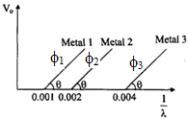
A
$\phi_1 : \phi_2 : \phi_3 = 1 : 2 : 4$
B
$\phi_1 : \phi_2 : \phi_3 = 4 : 2 : 1$
C
$\tan \theta = hc/e$,where $\tan \theta$ is the slope.
D
Only metal $2$ and metal $3$ can emit photoelectrons when irradiated with ultraviolet light.
Solution
(A) From Einstein's photoelectric equation,$eV_0 = \frac{hc}{\lambda} - \phi$,which can be rewritten as $V_0 = \frac{hc}{e}(\frac{1}{\lambda}) - \frac{\phi}{e}$.
Comparing this with the equation of a straight line $y = mx + c$,the slope is $m = \frac{hc}{e}$,which is constant for all metals,and the x-intercept is $\frac{1}{\lambda_0} = \frac{\phi}{hc}$.
From the graph,the threshold values for $(1/\lambda)$ are $(1/\lambda)_1 = 0.001$,$(1/\lambda)_2 = 0.002$,and $(1/\lambda)_3 = 0.004$.
Since $\phi = hc(1/\lambda_0)$,we have $\phi_1 : \phi_2 : \phi_3 = (1/\lambda_0)_1 : (1/\lambda_0)_2 : (1/\lambda_0)_3 = 0.001 : 0.002 : 0.004 = 1 : 2 : 4$.
Thus,option $A$ is correct.
Comparing this with the equation of a straight line $y = mx + c$,the slope is $m = \frac{hc}{e}$,which is constant for all metals,and the x-intercept is $\frac{1}{\lambda_0} = \frac{\phi}{hc}$.
From the graph,the threshold values for $(1/\lambda)$ are $(1/\lambda)_1 = 0.001$,$(1/\lambda)_2 = 0.002$,and $(1/\lambda)_3 = 0.004$.
Since $\phi = hc(1/\lambda_0)$,we have $\phi_1 : \phi_2 : \phi_3 = (1/\lambda_0)_1 : (1/\lambda_0)_2 : (1/\lambda_0)_3 = 0.001 : 0.002 : 0.004 = 1 : 2 : 4$.
Thus,option $A$ is correct.
0 likes
View Solution148
DifficultMCQ
When a photon with energy $8\ eV$ is incident on a metal surface having a threshold frequency of $1.6 \times 10^{15}\ Hz$,the maximum kinetic energy of the emitted photoelectrons is ............ $eV$. (Given: $h = 6.6 \times 10^{-34}\ J\cdot s$,$1\ eV = 1.6 \times 10^{-19}\ J$)
A
$4.2$
B
$2.8$
C
$1.4$
D
$0.8$
Solution
(C) The energy of the incident photon is $E = 8\ eV$.
The threshold frequency is $f_0 = 1.6 \times 10^{15}\ Hz$.
The work function $\Phi$ of the metal is given by $\Phi = hf_0$.
Substituting the values: $\Phi = (6.6 \times 10^{-34}\ J\cdot s) \times (1.6 \times 10^{15}\ Hz) = 10.56 \times 10^{-19}\ J$.
To convert the work function into $eV$,divide by $1.6 \times 10^{-19}\ J/eV$:
$\Phi = \frac{10.56 \times 10^{-19}}{1.6 \times 10^{-19}}\ eV = 6.6\ eV$.
According to Einstein's photoelectric equation,the maximum kinetic energy $K_{\max}$ is given by $K_{\max} = E - \Phi$.
$K_{\max} = 8\ eV - 6.6\ eV = 1.4\ eV$.
The threshold frequency is $f_0 = 1.6 \times 10^{15}\ Hz$.
The work function $\Phi$ of the metal is given by $\Phi = hf_0$.
Substituting the values: $\Phi = (6.6 \times 10^{-34}\ J\cdot s) \times (1.6 \times 10^{15}\ Hz) = 10.56 \times 10^{-19}\ J$.
To convert the work function into $eV$,divide by $1.6 \times 10^{-19}\ J/eV$:
$\Phi = \frac{10.56 \times 10^{-19}}{1.6 \times 10^{-19}}\ eV = 6.6\ eV$.
According to Einstein's photoelectric equation,the maximum kinetic energy $K_{\max}$ is given by $K_{\max} = E - \Phi$.
$K_{\max} = 8\ eV - 6.6\ eV = 1.4\ eV$.
0 likes
View Solution149
MediumMCQ
When radiation of frequency $6 \times 10^{14} \ Hz$ is incident on a metal surface with a work function of $2 \ eV$,the maximum kinetic energy of the emitted photoelectrons is ........ $eV$ (Given: $h = 6.63 \times 10^{-34} \ J \cdot s$,$1 \ eV = 1.6 \times 10^{-19} \ J$). (in $.49$)
A
$2$
B
$4$
C
$0$
D
$5$
Solution
(C) According to Einstein's photoelectric equation,the maximum kinetic energy $K_{\max}$ is given by:
$K_{\max} = hf - \phi_0$
Where $h$ is Planck's constant,$f$ is the frequency of incident radiation,and $\phi_0$ is the work function.
First,calculate the energy of the incident photon in Joules:
$E = hf = (6.63 \times 10^{-34} \ J \cdot s) \times (6 \times 10^{14} \ Hz) = 39.78 \times 10^{-20} \ J$
Convert this energy into electron-volts $(eV)$:
$E_{eV} = \frac{39.78 \times 10^{-20} \ J}{1.6 \times 10^{-19} \ J/eV} = 24.8625 \times 10^{-1} \ eV = 2.48625 \ eV \approx 2.49 \ eV$
Now,calculate the maximum kinetic energy:
$K_{\max} = 2.49 \ eV - 2 \ eV = 0.49 \ eV$.
$K_{\max} = hf - \phi_0$
Where $h$ is Planck's constant,$f$ is the frequency of incident radiation,and $\phi_0$ is the work function.
First,calculate the energy of the incident photon in Joules:
$E = hf = (6.63 \times 10^{-34} \ J \cdot s) \times (6 \times 10^{14} \ Hz) = 39.78 \times 10^{-20} \ J$
Convert this energy into electron-volts $(eV)$:
$E_{eV} = \frac{39.78 \times 10^{-20} \ J}{1.6 \times 10^{-19} \ J/eV} = 24.8625 \times 10^{-1} \ eV = 2.48625 \ eV \approx 2.49 \ eV$
Now,calculate the maximum kinetic energy:
$K_{\max} = 2.49 \ eV - 2 \ eV = 0.49 \ eV$.
0 likes
View Solution150
EasyMCQ
The work function of a metal is $1.6 \ eV$. What is the maximum wavelength of light in $\mathring{A}$ that can cause photoelectric emission from this metal? $(h = 6.6 \times 10^{-34} \ J \cdot s, c = 3 \times 10^8 \ m/s, 1 \ eV = 1.6 \times 10^{-19} \ J)$
A
$5800$
B
$3867$
C
$29000$
D
$7734$
Solution
(D) The threshold wavelength $\lambda_0$ is the maximum wavelength of light required to cause photoelectric emission,given by the formula: $\lambda_0 = \frac{hc}{\phi_0}$.
Here,$h = 6.6 \times 10^{-34} \ J \cdot s$,$c = 3 \times 10^8 \ m/s$,and $\phi_0 = 1.6 \ eV = 1.6 \times 1.6 \times 10^{-19} \ J$.
Substituting the values into the equation:
$\lambda_0 = \frac{6.6 \times 10^{-34} \times 3 \times 10^8}{1.6 \times 1.6 \times 10^{-19}}$
$\lambda_0 = \frac{19.8 \times 10^{-26}}{2.56 \times 10^{-19}}$
$\lambda_0 \approx 7.734 \times 10^{-7} \ m$.
Converting the wavelength to $\mathring{A}$ where $1 \ m = 10^{10} \ \mathring{A}$:
$\lambda_0 = 7.734 \times 10^{-7} \times 10^{10} \ \mathring{A} = 7734 \ \mathring{A}$.
Here,$h = 6.6 \times 10^{-34} \ J \cdot s$,$c = 3 \times 10^8 \ m/s$,and $\phi_0 = 1.6 \ eV = 1.6 \times 1.6 \times 10^{-19} \ J$.
Substituting the values into the equation:
$\lambda_0 = \frac{6.6 \times 10^{-34} \times 3 \times 10^8}{1.6 \times 1.6 \times 10^{-19}}$
$\lambda_0 = \frac{19.8 \times 10^{-26}}{2.56 \times 10^{-19}}$
$\lambda_0 \approx 7.734 \times 10^{-7} \ m$.
Converting the wavelength to $\mathring{A}$ where $1 \ m = 10^{10} \ \mathring{A}$:
$\lambda_0 = 7.734 \times 10^{-7} \times 10^{10} \ \mathring{A} = 7734 \ \mathring{A}$.
0 likes
View SolutionDual Nature of Radiation and matter — Einstein's Photoelectric Equation and Energy Quantum of Radiation · Frequently Asked Questions
1Are these Dual Nature of Radiation and matter questions useful for JEE and NEET?
Yes. All questions in this section are mapped to JEE Main and NEET exam patterns. Previous year questions from JEE Main, NEET, GUJCET and state-level exams are included with full solutions.
2Can I switch to Hindi or Gujarati for these questions?
Yes. Use the language tabs in the hero section or the sidebar to view the same questions and solutions in English, Hindi or Gujarati.
3How do I generate a question paper from this subtopic?
Use the Vedclass Exam Paper Generator — select the chapter and subtopic, set difficulty, and generate Sets A, B, C, D automatically. First 3 chapters of every subject are free.
Vedclass Products
For Students
Vedclass Test Series
Mock tests in real JEE/NEET style with performance analysis. 5-day free trial.
Start Free TrialFor Teachers
Exam Paper Generator
Generate Set A/B/C/D papers from this chapter in 2 minutes. 3 chapters free.
Try FreeFor Institutes
Online Exam Module
Live online exams with unlimited students, 360° analytics & white-label branding.
See DemoFor Teachers & Institutes
Generate a Dual Nature of Radiation and matter Exam Paper in 2 Minutes
Select subtopic & difficulty — Sets A, B, C, D auto-generated with No Repeat logic.
First 3 chapters of every subject are free — no payment required.