
A English
Resistance of wire, Resistivity and Conductivity Questions in English
Class 12 Physics · Current Electricity · Resistance of wire, Resistivity and Conductivity
308+
Questions
English
Language
100%
With Solutions
Showing 50 of 308 questions in English
201
MediumMCQ
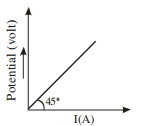
The variation of applied potential and current flowing through a given wire is shown in the figure. The length of the wire is $31.4 \, cm$. The diameter of the wire is measured as $2.4 \, cm$. The resistivity of the given wire is measured as $x \times 10^{-3} \, \Omega \cdot cm$. The value of $x$ is . . . . . . [Take $\pi = 3.14$]
A
$134$
B
$143$
C
$150$
D
$144$
Solution
(D) From the given $V-I$ graph,the slope represents the resistance $R$ of the wire.
$R = \tan(45^{\circ}) = 1 \, \Omega$.
We know that resistance $R = \rho \frac{\ell}{A}$,where $\ell$ is the length and $A$ is the cross-sectional area.
The area $A = \pi r^2 = \pi \left(\frac{d}{2}\right)^2 = \frac{\pi d^2}{4}$.
Given $\ell = 31.4 \, cm$ and $d = 2.4 \, cm$.
Substituting the values: $1 = \rho \frac{31.4}{\frac{\pi \times (2.4)^2}{4}}$.
Using $\pi = 3.14$: $1 = \rho \frac{31.4}{\frac{3.14 \times 5.76}{4}}$.
$1 = \rho \frac{31.4}{0.785 \times 5.76} = \rho \frac{31.4}{4.5216}$.
Alternatively,$1 = \rho \frac{31.4 \times 4}{3.14 \times 5.76} = \rho \frac{10 \times 4}{5.76} = \rho \frac{40}{5.76}$.
$\rho = \frac{5.76}{40} = 0.144 \, \Omega \cdot cm$.
Expressing this as $x \times 10^{-3} \, \Omega \cdot cm$,we get $\rho = 144 \times 10^{-3} \, \Omega \cdot cm$.
Therefore,$x = 144$.
$R = \tan(45^{\circ}) = 1 \, \Omega$.
We know that resistance $R = \rho \frac{\ell}{A}$,where $\ell$ is the length and $A$ is the cross-sectional area.
The area $A = \pi r^2 = \pi \left(\frac{d}{2}\right)^2 = \frac{\pi d^2}{4}$.
Given $\ell = 31.4 \, cm$ and $d = 2.4 \, cm$.
Substituting the values: $1 = \rho \frac{31.4}{\frac{\pi \times (2.4)^2}{4}}$.
Using $\pi = 3.14$: $1 = \rho \frac{31.4}{\frac{3.14 \times 5.76}{4}}$.
$1 = \rho \frac{31.4}{0.785 \times 5.76} = \rho \frac{31.4}{4.5216}$.
Alternatively,$1 = \rho \frac{31.4 \times 4}{3.14 \times 5.76} = \rho \frac{10 \times 4}{5.76} = \rho \frac{40}{5.76}$.
$\rho = \frac{5.76}{40} = 0.144 \, \Omega \cdot cm$.
Expressing this as $x \times 10^{-3} \, \Omega \cdot cm$,we get $\rho = 144 \times 10^{-3} \, \Omega \cdot cm$.
Therefore,$x = 144$.
0 likes
View Solution202
EasyMCQ
$A$ wire of resistance $R_{1}$ is drawn out so that its length is increased by twice of its original length. The ratio of the new resistance to the original resistance is:
A
$9: 1$
B
$1: 9$
C
$4: 1$
D
$3: 1$
Solution
(A) Let the original length be $L_{1}$ and the original area be $A_{1}$. The original resistance is $R_{1} = \rho \frac{L_{1}}{A_{1}}$.
When the length is increased by twice its original length,the new length $L_{2} = L_{1} + 2L_{1} = 3L_{1}$.
Since the volume of the wire remains constant,$A_{1}L_{1} = A_{2}L_{2}$.
Thus,$A_{2} = A_{1} \frac{L_{1}}{L_{2}} = A_{1} \frac{L_{1}}{3L_{1}} = \frac{A_{1}}{3}$.
The new resistance is $R_{2} = \rho \frac{L_{2}}{A_{2}} = \rho \frac{3L_{1}}{A_{1}/3} = 9 \rho \frac{L_{1}}{A_{1}}$.
Therefore,the ratio $\frac{R_{2}}{R_{1}} = \frac{9 \rho (L_{1}/A_{1})}{\rho (L_{1}/A_{1})} = 9:1$.
When the length is increased by twice its original length,the new length $L_{2} = L_{1} + 2L_{1} = 3L_{1}$.
Since the volume of the wire remains constant,$A_{1}L_{1} = A_{2}L_{2}$.
Thus,$A_{2} = A_{1} \frac{L_{1}}{L_{2}} = A_{1} \frac{L_{1}}{3L_{1}} = \frac{A_{1}}{3}$.
The new resistance is $R_{2} = \rho \frac{L_{2}}{A_{2}} = \rho \frac{3L_{1}}{A_{1}/3} = 9 \rho \frac{L_{1}}{A_{1}}$.
Therefore,the ratio $\frac{R_{2}}{R_{1}} = \frac{9 \rho (L_{1}/A_{1})}{\rho (L_{1}/A_{1})} = 9:1$.
0 likes
View Solution203
MediumMCQ
Given below are two statements: one is labelled as Assertion $A$ and the other is labelled as Reason $R$.
Assertion $A:$ Alloys such as constantan and manganin are used in making standard resistance coils.
Reason $R:$ Constantan and manganin have a very small value of temperature coefficient of resistance.
In the light of the above statements, choose the correct answer from the options given below.
Assertion $A:$ Alloys such as constantan and manganin are used in making standard resistance coils.
Reason $R:$ Constantan and manganin have a very small value of temperature coefficient of resistance.
In the light of the above statements, choose the correct answer from the options given below.
A
Both $A$ and $R$ are true and $R$ is the correct explanation of $A$.
B
Both $A$ and $R$ are true but $R$ is $NOT$ the correct explanation of $A$.
C
$A$ is true but $R$ is false.
D
$A$ is false but $R$ is true.
Solution
$(A)$ Standard resistance coils require a resistance value that remains stable despite changes in ambient temperature.
The temperature coefficient of resistance $(\alpha)$ determines how much the resistance changes with temperature according to the formula $R_t = R_0(1 + \alpha \Delta T)$.
Alloys like constantan and manganin are specifically chosen because they possess a very low temperature coefficient of resistance.
This property ensures that the resistance of the coils remains nearly constant even if the temperature fluctuates.
Therefore, Assertion $A$ is true, Reason $R$ is true, and $R$ is the correct explanation of $A$.
The temperature coefficient of resistance $(\alpha)$ determines how much the resistance changes with temperature according to the formula $R_t = R_0(1 + \alpha \Delta T)$.
Alloys like constantan and manganin are specifically chosen because they possess a very low temperature coefficient of resistance.
This property ensures that the resistance of the coils remains nearly constant even if the temperature fluctuates.
Therefore, Assertion $A$ is true, Reason $R$ is true, and $R$ is the correct explanation of $A$.
0 likes
View Solution204
MediumMCQ
$A$ $1\,m$ long wire is broken into two unequal parts $X$ and $Y$. The $X$ part of the wire is stretched into another wire $W$. The length of $W$ is twice the length of $X$ and the resistance of $W$ is twice that of $Y$. Find the ratio of the length of $X$ to the length of $Y$.
A
$1: 4$
B
$1: 2$
C
$4: 1$
D
$2: 1$
Solution
(B) Let the total length of the wire be $L = 1\,m$. Let the length of part $X$ be $\ell_X$ and the length of part $Y$ be $\ell_Y$. Thus,$\ell_X + \ell_Y = 1$.
The resistance of a wire is given by $R = \rho \frac{\ell}{A}$.
For part $X$,$R_X = \rho \frac{\ell_X}{A_X}$. For part $Y$,$R_Y = \rho \frac{\ell_Y}{A_Y}$.
When wire $X$ is stretched to length $\ell_W = 2\ell_X$,its volume remains constant $(A_X \ell_X = A_W \ell_W)$.
Since $\ell_W = 2\ell_X$,we have $A_W = \frac{A_X}{2}$.
The resistance of wire $W$ is $R_W = \rho \frac{\ell_W}{A_W} = \rho \frac{2\ell_X}{A_X/2} = 4 \left( \rho \frac{\ell_X}{A_X} \right) = 4R_X$.
Given that $R_W = 2R_Y$,we substitute $R_W = 4R_X$ to get $4R_X = 2R_Y$,which implies $R_Y = 2R_X$.
Since both parts $X$ and $Y$ were cut from the same original wire,they have the same cross-sectional area $A$ and resistivity $\rho$. Thus,$R \propto \ell$.
Therefore,$\frac{R_X}{R_Y} = \frac{\ell_X}{\ell_Y}$.
Substituting $R_Y = 2R_X$,we get $\frac{R_X}{2R_X} = \frac{\ell_X}{\ell_Y} = \frac{1}{2}$.
The resistance of a wire is given by $R = \rho \frac{\ell}{A}$.
For part $X$,$R_X = \rho \frac{\ell_X}{A_X}$. For part $Y$,$R_Y = \rho \frac{\ell_Y}{A_Y}$.
When wire $X$ is stretched to length $\ell_W = 2\ell_X$,its volume remains constant $(A_X \ell_X = A_W \ell_W)$.
Since $\ell_W = 2\ell_X$,we have $A_W = \frac{A_X}{2}$.
The resistance of wire $W$ is $R_W = \rho \frac{\ell_W}{A_W} = \rho \frac{2\ell_X}{A_X/2} = 4 \left( \rho \frac{\ell_X}{A_X} \right) = 4R_X$.
Given that $R_W = 2R_Y$,we substitute $R_W = 4R_X$ to get $4R_X = 2R_Y$,which implies $R_Y = 2R_X$.
Since both parts $X$ and $Y$ were cut from the same original wire,they have the same cross-sectional area $A$ and resistivity $\rho$. Thus,$R \propto \ell$.
Therefore,$\frac{R_X}{R_Y} = \frac{\ell_X}{\ell_Y}$.
Substituting $R_Y = 2R_X$,we get $\frac{R_X}{2R_X} = \frac{\ell_X}{\ell_Y} = \frac{1}{2}$.
0 likes
View Solution205
DifficultMCQ
Two metallic wires of identical dimensions are connected in series. If $\sigma_{1}$ and $\sigma_{2}$ are the conductivities of these wires respectively,the effective conductivity of the combination is:
A
$\frac{\sigma_{1} \sigma_{2}}{\sigma_{1}+\sigma_{2}}$
B
$\frac{2 \sigma_{1} \sigma_{2}}{\sigma_{1}+\sigma_{2}}$
C
$\frac{\sigma_{1}+\sigma_{2}}{2 \sigma_{1} \sigma_{2}}$
D
$\frac{\sigma_{1}+\sigma_{2}}{\sigma_{1} \sigma_{2}}$
Solution
(B) Let the length of each wire be $\ell$ and the cross-sectional area be $A$.
For the equivalent wire,the total length is $2\ell$ and the cross-sectional area is $A$.
The resistance of a wire is given by $R = \frac{\ell}{\sigma A}$,where $\sigma$ is the conductivity.
Since the wires are connected in series,the equivalent resistance $R_{eq}$ is the sum of individual resistances:
$R_{eq} = R_{1} + R_{2}$
Substituting the formula for resistance:
$\frac{2\ell}{\sigma_{eq} A} = \frac{\ell}{\sigma_{1} A} + \frac{\ell}{\sigma_{2} A}$
Dividing both sides by $\frac{\ell}{A}$:
$\frac{2}{\sigma_{eq}} = \frac{1}{\sigma_{1}} + \frac{1}{\sigma_{2}}$
$\frac{2}{\sigma_{eq}} = \frac{\sigma_{1} + \sigma_{2}}{\sigma_{1} \sigma_{2}}$
Therefore,the effective conductivity is $\sigma_{eq} = \frac{2 \sigma_{1} \sigma_{2}}{\sigma_{1} + \sigma_{2}}$.
For the equivalent wire,the total length is $2\ell$ and the cross-sectional area is $A$.
The resistance of a wire is given by $R = \frac{\ell}{\sigma A}$,where $\sigma$ is the conductivity.
Since the wires are connected in series,the equivalent resistance $R_{eq}$ is the sum of individual resistances:
$R_{eq} = R_{1} + R_{2}$
Substituting the formula for resistance:
$\frac{2\ell}{\sigma_{eq} A} = \frac{\ell}{\sigma_{1} A} + \frac{\ell}{\sigma_{2} A}$
Dividing both sides by $\frac{\ell}{A}$:
$\frac{2}{\sigma_{eq}} = \frac{1}{\sigma_{1}} + \frac{1}{\sigma_{2}}$
$\frac{2}{\sigma_{eq}} = \frac{\sigma_{1} + \sigma_{2}}{\sigma_{1} \sigma_{2}}$
Therefore,the effective conductivity is $\sigma_{eq} = \frac{2 \sigma_{1} \sigma_{2}}{\sigma_{1} + \sigma_{2}}$.

0 likes
View Solution206
AdvancedMCQ
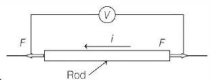
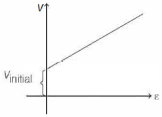
As shown in the schematic below,a rod of uniform cross-sectional area $A$ and length $l$ is carrying a constant current $i$ through it and the voltage across the rod is measured using an ideal voltmeter. The rod is stretched by the application of a force $F$. Which of the following graphs would show the variation in the voltage across the rod as a function of the strain $\varepsilon$ when the strain is small? Neglect Joule heating.
A
B
C
D
Solution
(A) The resistance of the rod is given by $R = \frac{\rho l}{A}$. Since the volume $V_{vol} = Al$ remains constant,we can write $R = \frac{\rho l^2}{V_{vol}}$.
When the rod is stretched by a small amount $\Delta l$,the change in length is $l' = l + \Delta l$. The new resistance is $R' = \frac{\rho (l + \Delta l)^2}{V_{vol}} \approx \frac{\rho (l^2 + 2l \Delta l)}{V_{vol}} = R + \frac{2 \rho l \Delta l}{V_{vol}}$.
The change in resistance is $\Delta R = R' - R = \frac{2 \rho l \Delta l}{V_{vol}} = \frac{2 \rho l^2}{V_{vol}} \cdot \frac{\Delta l}{l} = 2R \varepsilon$,where $\varepsilon = \frac{\Delta l}{l}$ is the strain.
The voltage across the rod is $V = iR$. The change in voltage is $\Delta V = i \Delta R = i(2R \varepsilon) = (2iR) \varepsilon$.
Since $i$ and $R$ are constants,$\Delta V$ is directly proportional to the strain $\varepsilon$ $(\Delta V \propto \varepsilon)$.
Therefore,the total voltage $V_{total} = V_{initial} + \Delta V = V_{initial} + (2iR) \varepsilon$. This represents a linear relationship with a positive slope,starting from the initial voltage $V_{initial}$.
When the rod is stretched by a small amount $\Delta l$,the change in length is $l' = l + \Delta l$. The new resistance is $R' = \frac{\rho (l + \Delta l)^2}{V_{vol}} \approx \frac{\rho (l^2 + 2l \Delta l)}{V_{vol}} = R + \frac{2 \rho l \Delta l}{V_{vol}}$.
The change in resistance is $\Delta R = R' - R = \frac{2 \rho l \Delta l}{V_{vol}} = \frac{2 \rho l^2}{V_{vol}} \cdot \frac{\Delta l}{l} = 2R \varepsilon$,where $\varepsilon = \frac{\Delta l}{l}$ is the strain.
The voltage across the rod is $V = iR$. The change in voltage is $\Delta V = i \Delta R = i(2R \varepsilon) = (2iR) \varepsilon$.
Since $i$ and $R$ are constants,$\Delta V$ is directly proportional to the strain $\varepsilon$ $(\Delta V \propto \varepsilon)$.
Therefore,the total voltage $V_{total} = V_{initial} + \Delta V = V_{initial} + (2iR) \varepsilon$. This represents a linear relationship with a positive slope,starting from the initial voltage $V_{initial}$.
0 likes
View Solution207
MediumMCQ
$A$ cylindrical copper rod has length $L$ and resistance $R$. If it is melted and formed into another rod of length $2 L$,then the resistance will be ....... $R$.
A
$1$
B
$2$
C
$4$
D
$8$
Solution
(C) The material of the rod remains the same,so the resistivity $\rho$ is constant for both rods.
Since the volume of the material remains constant during melting and reshaping,we have:
$V_1 = V_2$
$A_1 L_1 = A_2 L_2$
Given $L_1 = L$ and $L_2 = 2L$,we get:
$A_1 L = A_2 (2L) \Rightarrow A_2 = \frac{A_1}{2}$
Now,using the resistance formula $R = \rho \frac{l}{A}$,the new resistance $R_2$ is:
$R_2 = \rho \frac{L_2}{A_2} = \rho \frac{2L}{A_1 / 2} = 4 \left( \frac{\rho L}{A_1} \right)$
Since $R = \rho \frac{L}{A_1}$,we find:
$R_2 = 4R$
Since the volume of the material remains constant during melting and reshaping,we have:
$V_1 = V_2$
$A_1 L_1 = A_2 L_2$
Given $L_1 = L$ and $L_2 = 2L$,we get:
$A_1 L = A_2 (2L) \Rightarrow A_2 = \frac{A_1}{2}$
Now,using the resistance formula $R = \rho \frac{l}{A}$,the new resistance $R_2$ is:
$R_2 = \rho \frac{L_2}{A_2} = \rho \frac{2L}{A_1 / 2} = 4 \left( \frac{\rho L}{A_1} \right)$
Since $R = \rho \frac{L}{A_1}$,we find:
$R_2 = 4R$
0 likes
View Solution208
EasyMCQ
If $n, e, \tau$ and $m$ represent electron density,charge,relaxation time,and mass of an electron respectively,then the resistance of a wire of length $l$ and cross-sectional area $A$ is given by:
A
$\frac{m l}{n e^2 \tau A}$
B
$\frac{m \tau A}{n e^2 l}$
C
$\frac{n e^2 \tau A}{m l}$
D
$\frac{n e^2 A}{m \tau l}$
Solution
(A) The resistance $R$ of a conductor is given by the formula $R = \rho \frac{l}{A}$,where $\rho$ is the resistivity of the material.
The resistivity $\rho$ in terms of microscopic parameters is given by $\rho = \frac{m}{n e^2 \tau}$,where $m$ is the mass of the electron,$n$ is the electron density,$e$ is the charge of an electron,and $\tau$ is the relaxation time.
Substituting the expression for $\rho$ into the resistance formula:
$R = \left( \frac{m}{n e^2 \tau} \right) \frac{l}{A} = \frac{m l}{n e^2 \tau A}$.
Therefore,the correct option is $A$.
The resistivity $\rho$ in terms of microscopic parameters is given by $\rho = \frac{m}{n e^2 \tau}$,where $m$ is the mass of the electron,$n$ is the electron density,$e$ is the charge of an electron,and $\tau$ is the relaxation time.
Substituting the expression for $\rho$ into the resistance formula:
$R = \left( \frac{m}{n e^2 \tau} \right) \frac{l}{A} = \frac{m l}{n e^2 \tau A}$.
Therefore,the correct option is $A$.
0 likes
View Solution209
EasyMCQ
The resistance of a rectangular block of copper of dimensions $2 \,mm \times 2 \,mm \times 5 \,m$ between two square faces is $0.02 \,\Omega$. What is the resistivity of copper?
A
$1.6 \times 10^{-8} \,\Omega \cdot m$
B
$1.6 \times 10^{-6} \,\Omega \cdot m$
C
$1.6 \times 10^{-8} \,\Omega \cdot m$
D
$0 \,\Omega \cdot m$
Solution
(C) The resistance $R$ of a conductor is given by the formula $R = \rho \frac{l}{A}$,where $\rho$ is the resistivity,$l$ is the length,and $A$ is the cross-sectional area.
Given dimensions are $2 \,mm \times 2 \,mm \times 5 \,m$. The current flows between the two square faces,so the length $l = 5 \,m$.
The cross-sectional area $A = 2 \,mm \times 2 \,mm = 4 \,mm^2 = 4 \times 10^{-6} \,m^2$.
The resistance $R = 0.02 \,\Omega$.
Substituting these values into the formula:
$0.02 = \rho \frac{5}{4 \times 10^{-6}}$
$\rho = \frac{0.02 \times 4 \times 10^{-6}}{5}$
$\rho = \frac{0.08 \times 10^{-6}}{5}$
$\rho = 0.016 \times 10^{-6} \,\Omega \cdot m = 1.6 \times 10^{-8} \,\Omega \cdot m$.
Given dimensions are $2 \,mm \times 2 \,mm \times 5 \,m$. The current flows between the two square faces,so the length $l = 5 \,m$.
The cross-sectional area $A = 2 \,mm \times 2 \,mm = 4 \,mm^2 = 4 \times 10^{-6} \,m^2$.
The resistance $R = 0.02 \,\Omega$.
Substituting these values into the formula:
$0.02 = \rho \frac{5}{4 \times 10^{-6}}$
$\rho = \frac{0.02 \times 4 \times 10^{-6}}{5}$
$\rho = \frac{0.08 \times 10^{-6}}{5}$
$\rho = 0.016 \times 10^{-6} \,\Omega \cdot m = 1.6 \times 10^{-8} \,\Omega \cdot m$.
0 likes
View Solution210
EasyMCQ
$A$ wire of resistance $x \ \Omega$ is drawn out,so that its length is increased to twice its original length,and its new resistance becomes $20 \ \Omega$. Then $x$ will be ........ $\Omega$.
A
$5$
B
$10$
C
$15$
D
$20$
Solution
(A) The resistance of a wire is given by $R = \rho \frac{l}{A}$.
When a wire is stretched,its volume $V = A \times l$ remains constant.
Let the original length be $l$ and area be $A$. The new length is $l' = 2l$.
Since volume is constant,$A \times l = A' \times l' \implies A \times l = A' \times (2l) \implies A' = \frac{A}{2}$.
The new resistance $R'$ is given by $R' = \rho \frac{l'}{A'} = \rho \frac{2l}{A/2} = 4 \left( \rho \frac{l}{A} \right) = 4R$.
Given $R' = 20 \ \Omega$ and $R = x$,we have $20 = 4x$.
Therefore,$x = \frac{20}{4} = 5 \ \Omega$.
When a wire is stretched,its volume $V = A \times l$ remains constant.
Let the original length be $l$ and area be $A$. The new length is $l' = 2l$.
Since volume is constant,$A \times l = A' \times l' \implies A \times l = A' \times (2l) \implies A' = \frac{A}{2}$.
The new resistance $R'$ is given by $R' = \rho \frac{l'}{A'} = \rho \frac{2l}{A/2} = 4 \left( \rho \frac{l}{A} \right) = 4R$.
Given $R' = 20 \ \Omega$ and $R = x$,we have $20 = 4x$.
Therefore,$x = \frac{20}{4} = 5 \ \Omega$.
0 likes
View Solution211
DifficultMCQ
The coefficient of linear expansion of the material of a resistor is $\alpha$. Its temperature coefficient of resistivity and resistance are $\alpha_\rho$ and $\alpha_R$ respectively. Then the correct relation is:
A
$\alpha_R = \alpha_\rho - \alpha$
B
$\alpha_R = \alpha_\rho + \alpha$
C
$\alpha_R = \alpha_\rho + 3\alpha$
D
$\alpha_R = \alpha_\rho - 3\alpha$
Solution
(A) The resistance of a conductor is given by $R = \frac{\rho L}{A}$.
Given,linear expansion coefficient is $\alpha$. Thus,length $L = L_0(1 + \alpha \Delta T)$ and area $A = A_0(1 + 2\alpha \Delta T)$.
Resistivity varies as $\rho = \rho_0(1 + \alpha_\rho \Delta T)$.
Substituting these into the resistance formula:
$R = \frac{\rho_0(1 + \alpha_\rho \Delta T) L_0(1 + \alpha \Delta T)}{A_0(1 + 2\alpha \Delta T)}$
$R = R_0(1 + \alpha_\rho \Delta T)(1 + \alpha \Delta T)(1 + 2\alpha \Delta T)^{-1}$
Using binomial approximation $(1+x)^n \approx 1+nx$ for small $\Delta T$:
$R \approx R_0(1 + \alpha_\rho \Delta T)(1 + \alpha \Delta T)(1 - 2\alpha \Delta T)$
Neglecting higher-order terms of $\Delta T$:
$R \approx R_0(1 + \alpha_\rho \Delta T + \alpha \Delta T - 2\alpha \Delta T)$
$R \approx R_0(1 + (\alpha_\rho - \alpha) \Delta T)$
Comparing this with $R = R_0(1 + \alpha_R \Delta T)$,we get $\alpha_R = \alpha_\rho - \alpha$.
Given,linear expansion coefficient is $\alpha$. Thus,length $L = L_0(1 + \alpha \Delta T)$ and area $A = A_0(1 + 2\alpha \Delta T)$.
Resistivity varies as $\rho = \rho_0(1 + \alpha_\rho \Delta T)$.
Substituting these into the resistance formula:
$R = \frac{\rho_0(1 + \alpha_\rho \Delta T) L_0(1 + \alpha \Delta T)}{A_0(1 + 2\alpha \Delta T)}$
$R = R_0(1 + \alpha_\rho \Delta T)(1 + \alpha \Delta T)(1 + 2\alpha \Delta T)^{-1}$
Using binomial approximation $(1+x)^n \approx 1+nx$ for small $\Delta T$:
$R \approx R_0(1 + \alpha_\rho \Delta T)(1 + \alpha \Delta T)(1 - 2\alpha \Delta T)$
Neglecting higher-order terms of $\Delta T$:
$R \approx R_0(1 + \alpha_\rho \Delta T + \alpha \Delta T - 2\alpha \Delta T)$
$R \approx R_0(1 + (\alpha_\rho - \alpha) \Delta T)$
Comparing this with $R = R_0(1 + \alpha_R \Delta T)$,we get $\alpha_R = \alpha_\rho - \alpha$.
0 likes
View Solution212
MediumMCQ
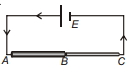
In the following diagram,the lengths of wires $AB$ and $BC$ are equal,but the radius of wire $AB$ is double that of $BC$. The ratio of the potential gradient on wires $AB$ and $BC$ will be (wires are made of the same material):
A
$4: 1$
B
$1: 4$
C
$2: 1$
D
$1: 1$
Solution
(B) Let the length of both wires be $l$. Let the radius of wire $BC$ be $r$,so the radius of wire $AB$ is $2r$.
The resistance of a wire is given by $R = \rho \frac{l}{A} = \rho \frac{l}{\pi r^2}$.
For wire $BC$,$R_{BC} = \rho \frac{l}{\pi r^2} = R$ (let).
For wire $AB$,$R_{AB} = \rho \frac{l}{\pi (2r)^2} = \rho \frac{l}{4\pi r^2} = \frac{R}{4}$.
Since the wires are in series,the same current $I$ flows through both.
The potential gradient $x$ is given by $x = \frac{V}{l} = \frac{IR}{l}$.
Since $I$ and $l$ are the same for both wires,the potential gradient is proportional to the resistance: $x \propto R$.
Therefore,the ratio of potential gradients is $\frac{x_{AB}}{x_{BC}} = \frac{R_{AB}}{R_{BC}} = \frac{R/4}{R} = \frac{1}{4}$.
Thus,the ratio is $1: 4$.
The resistance of a wire is given by $R = \rho \frac{l}{A} = \rho \frac{l}{\pi r^2}$.
For wire $BC$,$R_{BC} = \rho \frac{l}{\pi r^2} = R$ (let).
For wire $AB$,$R_{AB} = \rho \frac{l}{\pi (2r)^2} = \rho \frac{l}{4\pi r^2} = \frac{R}{4}$.
Since the wires are in series,the same current $I$ flows through both.
The potential gradient $x$ is given by $x = \frac{V}{l} = \frac{IR}{l}$.
Since $I$ and $l$ are the same for both wires,the potential gradient is proportional to the resistance: $x \propto R$.
Therefore,the ratio of potential gradients is $\frac{x_{AB}}{x_{BC}} = \frac{R_{AB}}{R_{BC}} = \frac{R/4}{R} = \frac{1}{4}$.
Thus,the ratio is $1: 4$.
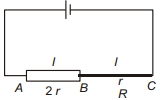
0 likes
View Solution213
MediumMCQ
$A$ hollow cylindrical conductor has a length of $3.14 \, m$, while its inner and outer diameters are $4 \, mm$ and $8 \, mm$ respectively. The resistance of the conductor is $n \times 10^{-3} \, \Omega$. If the resistivity of the material is $2.4 \times 10^{-8} \, \Omega \, m$, the value of $n$ is $..........$
A
$2$
B
$4$
C
$6$
D
$8$
Solution
(A) The resistance $R$ of a conductor is given by the formula $R = \rho \frac{\ell}{A}$, where $\rho$ is the resistivity, $\ell$ is the length, and $A$ is the cross-sectional area.
For a hollow cylinder, the cross-sectional area $A = \pi(R_{outer}^2 - R_{inner}^2)$.
Given: $\ell = 3.14 \, m$, $\rho = 2.4 \times 10^{-8} \, \Omega \, m$, outer diameter $D_{out} = 8 \, mm \implies R_{outer} = 4 \times 10^{-3} \, m$, and inner diameter $D_{in} = 4 \, mm \implies R_{inner} = 2 \times 10^{-3} \, m$.
Calculating the area $A = \pi((4 \times 10^{-3})^2 - (2 \times 10^{-3})^2) = \pi(16 - 4) \times 10^{-6} = 12\pi \times 10^{-6} \, m^2$.
Substituting the values into the resistance formula:
$R = \frac{2.4 \times 10^{-8} \times 3.14}{12 \times 3.14 \times 10^{-6}}$
$R = \frac{2.4}{12} \times 10^{-2} = 0.2 \times 10^{-2} = 2 \times 10^{-3} \, \Omega$.
Comparing this with $n \times 10^{-3} \, \Omega$, we get $n = 2$.
For a hollow cylinder, the cross-sectional area $A = \pi(R_{outer}^2 - R_{inner}^2)$.
Given: $\ell = 3.14 \, m$, $\rho = 2.4 \times 10^{-8} \, \Omega \, m$, outer diameter $D_{out} = 8 \, mm \implies R_{outer} = 4 \times 10^{-3} \, m$, and inner diameter $D_{in} = 4 \, mm \implies R_{inner} = 2 \times 10^{-3} \, m$.
Calculating the area $A = \pi((4 \times 10^{-3})^2 - (2 \times 10^{-3})^2) = \pi(16 - 4) \times 10^{-6} = 12\pi \times 10^{-6} \, m^2$.
Substituting the values into the resistance formula:
$R = \frac{2.4 \times 10^{-8} \times 3.14}{12 \times 3.14 \times 10^{-6}}$
$R = \frac{2.4}{12} \times 10^{-2} = 0.2 \times 10^{-2} = 2 \times 10^{-3} \, \Omega$.
Comparing this with $n \times 10^{-3} \, \Omega$, we get $n = 2$.
0 likes
View Solution214
MediumMCQ
If a copper wire is stretched to increase its length by $20 \% $,the percentage increase in resistance of the wire is $..........\%$.
A
$40$
B
$41$
C
$44$
D
$43$
Solution
(C) The resistance $R$ of a wire is given by $R = \rho \frac{L}{A}$.
Since the volume $V = A \times L$ remains constant when the wire is stretched,we have $A = \frac{V}{L}$.
Substituting this into the resistance formula,we get $R = \rho \frac{L^2}{V}$.
Since $\rho$ and $V$ are constants,$R \propto L^2$.
If the length increases by $20 \%$,the new length $L' = L + 0.20L = 1.2L$.
The new resistance $R' \propto (1.2L)^2 = 1.44L^2$.
Therefore,$R' = 1.44R$.
The percentage increase in resistance is $\frac{R' - R}{R} \times 100 = \frac{1.44R - R}{R} \times 100 = 0.44 \times 100 = 44 \%$.
Since the volume $V = A \times L$ remains constant when the wire is stretched,we have $A = \frac{V}{L}$.
Substituting this into the resistance formula,we get $R = \rho \frac{L^2}{V}$.
Since $\rho$ and $V$ are constants,$R \propto L^2$.
If the length increases by $20 \%$,the new length $L' = L + 0.20L = 1.2L$.
The new resistance $R' \propto (1.2L)^2 = 1.44L^2$.
Therefore,$R' = 1.44R$.
The percentage increase in resistance is $\frac{R' - R}{R} \times 100 = \frac{1.44R - R}{R} \times 100 = 0.44 \times 100 = 44 \%$.
0 likes
View Solution215
MediumMCQ
The resistance of a wire is $5 \Omega$. Its new resistance in ohm,if stretched to $5$ times of its original length,will be:
A
$625$
B
$5$
C
$125$
D
$25$
Solution
(C) The initial resistance is given by $R_{\text{initial}} = \frac{\rho \ell}{A} = 5 \Omega$.
Since the volume of the wire remains constant during stretching:
$V_i = V_f$
$A_i \ell_i = A_f \ell_f$
Given $\ell_f = 5 \ell_i$,we have $A_i \ell_i = A_f (5 \ell_i)$,which implies $A_f = \frac{A_i}{5}$.
The new resistance $R_f$ is:
$R_f = \frac{\rho \ell_f}{A_f} = \frac{\rho (5 \ell_i)}{\left(\frac{A_i}{5}\right)}$
$R_f = 25 \left(\frac{\rho \ell_i}{A_i}\right)$
$R_f = 25 \times 5 = 125 \Omega$.
Since the volume of the wire remains constant during stretching:
$V_i = V_f$
$A_i \ell_i = A_f \ell_f$
Given $\ell_f = 5 \ell_i$,we have $A_i \ell_i = A_f (5 \ell_i)$,which implies $A_f = \frac{A_i}{5}$.
The new resistance $R_f$ is:
$R_f = \frac{\rho \ell_f}{A_f} = \frac{\rho (5 \ell_i)}{\left(\frac{A_i}{5}\right)}$
$R_f = 25 \left(\frac{\rho \ell_i}{A_i}\right)$
$R_f = 25 \times 5 = 125 \Omega$.
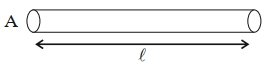
0 likes
View Solution216
EasyMCQ
The reciprocal of resistance is
A
reactance
B
mobility
C
conductivity
D
conductance
Solution
(D) The reciprocal of resistance is defined as conductance.
Mathematically, $\text{Conductance} = \frac{1}{\text{Resistance}}$.
The $SI$ unit of conductance is Siemens $(S)$ or $\Omega^{-1}$.
Mathematically, $\text{Conductance} = \frac{1}{\text{Resistance}}$.
The $SI$ unit of conductance is Siemens $(S)$ or $\Omega^{-1}$.
0 likes
View Solution217
MediumMCQ
The length of a metallic wire is increased by $20 \%$ and its area of cross-section is reduced by $4 \%$. The percentage change in resistance of the metallic wire is $.......$ (in $\%$)
A
$24$
B
$23$
C
$22$
D
$25$
Solution
(D) The initial resistance of the wire is given by $R = \rho \frac{\ell}{A}$,where $\rho$ is the resistivity,$\ell$ is the length,and $A$ is the area of cross-section.
When the length is increased by $20 \%$,the new length $\ell' = \ell + 0.20\ell = 1.2\ell$.
When the area of cross-section is reduced by $4 \%$,the new area $A' = A - 0.04A = 0.96A$.
The new resistance $R'$ is given by $R' = \rho \frac{\ell'}{A'} = \rho \frac{1.2\ell}{0.96A}$.
Simplifying the expression: $R' = \left( \frac{1.2}{0.96} \right) \rho \frac{\ell}{A} = 1.25 R$.
The percentage change in resistance is calculated as $\frac{R' - R}{R} \times 100$.
Percentage change $= \frac{1.25R - R}{R} \times 100 = 0.25 \times 100 = 25 \%$.
When the length is increased by $20 \%$,the new length $\ell' = \ell + 0.20\ell = 1.2\ell$.
When the area of cross-section is reduced by $4 \%$,the new area $A' = A - 0.04A = 0.96A$.
The new resistance $R'$ is given by $R' = \rho \frac{\ell'}{A'} = \rho \frac{1.2\ell}{0.96A}$.
Simplifying the expression: $R' = \left( \frac{1.2}{0.96} \right) \rho \frac{\ell}{A} = 1.25 R$.
The percentage change in resistance is calculated as $\frac{R' - R}{R} \times 100$.
Percentage change $= \frac{1.25R - R}{R} \times 100 = 0.25 \times 100 = 25 \%$.
0 likes
View Solution218
EasyMCQ
$A$ rectangular parallelopiped is measured as $1\,cm \times 1\,cm \times 100\,cm$. If its specific resistance is $3 \times 10^{-7}\,\Omega\,m$,then the resistance between its two opposite rectangular faces (as shown in the figure) will be $.......... \times 10^{-7} \Omega$.
A
$2$
B
$1$
C
$3$
D
$4$
Solution
(C) The dimensions of the rectangular parallelopiped are $1\,cm \times 1\,cm \times 100\,cm$. The current flows between the two opposite rectangular faces of size $1\,cm \times 100\,cm$.
Thus,the length of the path of the current is $\ell = 1\,cm = 10^{-2}\,m$.
The area of the cross-section through which the current flows is $A = 1\,cm \times 100\,cm = 10^{-2}\,m \times 1\,m = 10^{-2}\,m^2$.
The specific resistance (resistivity) is $\rho = 3 \times 10^{-7}\,\Omega\,m$.
The resistance $R$ is given by the formula $R = \rho \frac{\ell}{A}$.
Substituting the values: $R = (3 \times 10^{-7}) \times \frac{10^{-2}}{10^{-2}} = 3 \times 10^{-7}\,\Omega$.
Therefore,the resistance is $3 \times 10^{-7}\,\Omega$.
Thus,the length of the path of the current is $\ell = 1\,cm = 10^{-2}\,m$.
The area of the cross-section through which the current flows is $A = 1\,cm \times 100\,cm = 10^{-2}\,m \times 1\,m = 10^{-2}\,m^2$.
The specific resistance (resistivity) is $\rho = 3 \times 10^{-7}\,\Omega\,m$.
The resistance $R$ is given by the formula $R = \rho \frac{\ell}{A}$.
Substituting the values: $R = (3 \times 10^{-7}) \times \frac{10^{-2}}{10^{-2}} = 3 \times 10^{-7}\,\Omega$.
Therefore,the resistance is $3 \times 10^{-7}\,\Omega$.
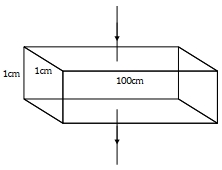
0 likes
View Solution219
DifficultMCQ
$A$ wire of resistance $160\,\Omega$ is melted and drawn into a wire of one-fourth of its original length. The new resistance of the wire will be $......\Omega$.
A
$10$
B
$640$
C
$40$
D
$16$
Solution
(A) The volume of the wire remains constant during the process of melting and redrawing.
$V_1 = V_2 \implies A_1 L_1 = A_2 L_2$
Given $L_2 = \frac{L_1}{4}$,we have $A_1 L_1 = A_2 (\frac{L_1}{4})$,which simplifies to $A_2 = 4 A_1$.
The resistance of a wire is given by $R = \rho \frac{L}{A}$.
Thus,the ratio of the new resistance $R_2$ to the original resistance $R_1$ is:
$\frac{R_2}{R_1} = \frac{\rho L_2 / A_2}{\rho L_1 / A_1} = \frac{L_2}{L_1} \times \frac{A_1}{A_2}$
Substituting the values: $\frac{R_2}{R_1} = (\frac{1}{4}) \times (\frac{A_1}{4 A_1}) = \frac{1}{16}$.
Therefore,$R_2 = \frac{R_1}{16} = \frac{160}{16} = 10\,\Omega$.
$V_1 = V_2 \implies A_1 L_1 = A_2 L_2$
Given $L_2 = \frac{L_1}{4}$,we have $A_1 L_1 = A_2 (\frac{L_1}{4})$,which simplifies to $A_2 = 4 A_1$.
The resistance of a wire is given by $R = \rho \frac{L}{A}$.
Thus,the ratio of the new resistance $R_2$ to the original resistance $R_1$ is:
$\frac{R_2}{R_1} = \frac{\rho L_2 / A_2}{\rho L_1 / A_1} = \frac{L_2}{L_1} \times \frac{A_1}{A_2}$
Substituting the values: $\frac{R_2}{R_1} = (\frac{1}{4}) \times (\frac{A_1}{4 A_1}) = \frac{1}{16}$.
Therefore,$R_2 = \frac{R_1}{16} = \frac{160}{16} = 10\,\Omega$.
0 likes
View Solution220
DifficultMCQ
The current flowing through a conductor connected across a source is $2\,A$ and $1.2\,A$ at $0^{\circ}C$ and $100^{\circ}C$ respectively. The current flowing through the conductor at $50^{\circ}C$ will be $......\times 10^2\,mA$.
A
$14$
B
$13$
C
$12$
D
$15$
Solution
(D) Since the conductor is connected across the same source,the voltage $V$ remains constant. Thus,$V = i_0 R_0 = i_{100} R_{100} = i_{50} R_{50}$.
Given $i_0 = 2\,A$ and $i_{100} = 1.2\,A$.
Using the resistance-temperature relation $R_t = R_0(1 + \alpha t)$:
$2 R_0 = 1.2 R_0(1 + 100 \alpha)$
$1 + 100 \alpha = \frac{2}{1.2} = \frac{20}{12} = \frac{5}{3}$
$100 \alpha = \frac{5}{3} - 1 = \frac{2}{3} \Rightarrow 50 \alpha = \frac{1}{3}$.
Now,for $t = 50^{\circ}C$:
$i_{50} = \frac{V}{R_{50}} = \frac{i_0 R_0}{R_0(1 + 50 \alpha)} = \frac{2}{1 + \frac{1}{3}} = \frac{2}{4/3} = \frac{6}{4} = 1.5\,A$.
Converting to $mA$: $1.5\,A = 1500\,mA = 15 \times 10^2\,mA$.
Given $i_0 = 2\,A$ and $i_{100} = 1.2\,A$.
Using the resistance-temperature relation $R_t = R_0(1 + \alpha t)$:
$2 R_0 = 1.2 R_0(1 + 100 \alpha)$
$1 + 100 \alpha = \frac{2}{1.2} = \frac{20}{12} = \frac{5}{3}$
$100 \alpha = \frac{5}{3} - 1 = \frac{2}{3} \Rightarrow 50 \alpha = \frac{1}{3}$.
Now,for $t = 50^{\circ}C$:
$i_{50} = \frac{V}{R_{50}} = \frac{i_0 R_0}{R_0(1 + 50 \alpha)} = \frac{2}{1 + \frac{1}{3}} = \frac{2}{4/3} = \frac{6}{4} = 1.5\,A$.
Converting to $mA$: $1.5\,A = 1500\,mA = 15 \times 10^2\,mA$.
0 likes
View Solution221
MediumMCQ
The resistance of a platinum wire at $0^{\circ}C$ is $2\,\Omega$ and $6.8\,\Omega$ at $80^{\circ}C$. The temperature coefficient of resistance of the wire is:
A
$3 \times 10^{-1} \,^{\circ}C^{-1}$
B
$3 \times 10^{-4} \,^{\circ}C^{-1}$
C
$3 \times 10^{-3} \,^{\circ}C^{-1}$
D
$3 \times 10^{-2} \,^{\circ}C^{-1}$
Solution
(D) The resistance of a conductor at temperature $T$ is given by the formula: $R_T = R_0[1 + \alpha(T - T_0)]$,where $R_T$ is the resistance at temperature $T$,$R_0$ is the resistance at reference temperature $T_0$,and $\alpha$ is the temperature coefficient of resistance.
Given: $R_0 = 2\,\Omega$ at $T_0 = 0^{\circ}C$,and $R_T = 6.8\,\Omega$ at $T = 80^{\circ}C$.
Substituting the values into the formula:
$6.8 = 2[1 + \alpha(80 - 0)]$
$6.8 = 2 + 160\alpha$
$4.8 = 160\alpha$
$\alpha = \frac{4.8}{160} = \frac{48}{1600} = \frac{3}{100} = 0.03\,^{\circ}C^{-1}$.
Thus,$\alpha = 3 \times 10^{-2}\,^{\circ}C^{-1}$.
Given: $R_0 = 2\,\Omega$ at $T_0 = 0^{\circ}C$,and $R_T = 6.8\,\Omega$ at $T = 80^{\circ}C$.
Substituting the values into the formula:
$6.8 = 2[1 + \alpha(80 - 0)]$
$6.8 = 2 + 160\alpha$
$4.8 = 160\alpha$
$\alpha = \frac{4.8}{160} = \frac{48}{1600} = \frac{3}{100} = 0.03\,^{\circ}C^{-1}$.
Thus,$\alpha = 3 \times 10^{-2}\,^{\circ}C^{-1}$.
0 likes
View Solution222
DifficultMCQ
An electric toaster has a resistance of $60 \ \Omega$ at room temperature $\left(27^{\circ} C\right)$. The toaster is connected to a $220 \ V$ supply. If the current flowing through it reaches $2.75 \ A$,the temperature attained by the toaster is around: (given $\alpha = 2 \times 10^{-4} /{ }^{\circ} C$) (in $^{\circ} C$)
A
$694$
B
$1235$
C
$1694$
D
$1667$
Solution
(C) Given: Resistance at room temperature $R_0 = 60 \ \Omega$ at $T_0 = 27^{\circ} C$.
Voltage $V = 220 \ V$ and current $I = 2.75 \ A$.
The resistance at the final temperature $T$ is given by $R_T = \frac{V}{I} = \frac{220}{2.75} = 80 \ \Omega$.
The temperature dependence of resistance is given by $R_T = R_0(1 + \alpha \Delta T)$,where $\Delta T = T - T_0$.
Substituting the values: $80 = 60[1 + 2 \times 10^{-4}(T - 27)]$.
$80/60 = 1 + 2 \times 10^{-4}(T - 27)$.
$1.333 - 1 = 2 \times 10^{-4}(T - 27)$.
$0.333 = 2 \times 10^{-4}(T - 27)$.
$T - 27 = \frac{0.333}{2 \times 10^{-4}} = 1665$.
$T = 1665 + 27 = 1692^{\circ} C$.
Rounding to the nearest option,the temperature is approximately $1694^{\circ} C$.
Voltage $V = 220 \ V$ and current $I = 2.75 \ A$.
The resistance at the final temperature $T$ is given by $R_T = \frac{V}{I} = \frac{220}{2.75} = 80 \ \Omega$.
The temperature dependence of resistance is given by $R_T = R_0(1 + \alpha \Delta T)$,where $\Delta T = T - T_0$.
Substituting the values: $80 = 60[1 + 2 \times 10^{-4}(T - 27)]$.
$80/60 = 1 + 2 \times 10^{-4}(T - 27)$.
$1.333 - 1 = 2 \times 10^{-4}(T - 27)$.
$0.333 = 2 \times 10^{-4}(T - 27)$.
$T - 27 = \frac{0.333}{2 \times 10^{-4}} = 1665$.
$T = 1665 + 27 = 1692^{\circ} C$.
Rounding to the nearest option,the temperature is approximately $1694^{\circ} C$.
0 likes
View Solution223
DifficultMCQ
Two conductors have the same resistances at $0^{\circ} C$ but their temperature coefficients of resistance are $\alpha_1$ and $\alpha_2$. The respective temperature coefficients for their series and parallel combinations are :
A
$\alpha_1+\alpha_2, \frac{\alpha_1+\alpha_2}{2}$
B
$\frac{\alpha_1+\alpha_2}{2}, \frac{\alpha_1+\alpha_2}{2}$
C
$\alpha_1+\alpha_2, \frac{\alpha_1 \alpha_2}{\alpha_1+\alpha_2}$
D
$\frac{\alpha_1+\alpha_2}{2}, \alpha_1+\alpha_2$
Solution
(B) Let the resistance of each conductor at $0^{\circ} C$ be $R$.
For series combination:
$R_{eq} = R_1 + R_2$
$2R(1 + \alpha_{eq} \Delta \theta) = R(1 + \alpha_1 \Delta \theta) + R(1 + \alpha_2 \Delta \theta)$
$2 + 2\alpha_{eq} \Delta \theta = 2 + (\alpha_1 + \alpha_2) \Delta \theta$
$\alpha_{eq} = \frac{\alpha_1 + \alpha_2}{2}$
For parallel combination:
$\frac{1}{R_{eq}} = \frac{1}{R_1} + \frac{1}{R_2}$
$\frac{1}{\frac{R}{2}(1 + \alpha_{eq} \Delta \theta)} = \frac{1}{R(1 + \alpha_1 \Delta \theta)} + \frac{1}{R(1 + \alpha_2 \Delta \theta)}$
$\frac{2}{1 + \alpha_{eq} \Delta \theta} = \frac{1}{1 + \alpha_1 \Delta \theta} + \frac{1}{1 + \alpha_2 \Delta \theta}$
Using the binomial approximation $(1+x)^{-1} \approx 1-x$ for small $\Delta \theta$:
$2(1 - \alpha_{eq} \Delta \theta) = (1 - \alpha_1 \Delta \theta) + (1 - \alpha_2 \Delta \theta)$
$2 - 2\alpha_{eq} \Delta \theta = 2 - (\alpha_1 + \alpha_2) \Delta \theta$
$\alpha_{eq} = \frac{\alpha_1 + \alpha_2}{2}$
For series combination:
$R_{eq} = R_1 + R_2$
$2R(1 + \alpha_{eq} \Delta \theta) = R(1 + \alpha_1 \Delta \theta) + R(1 + \alpha_2 \Delta \theta)$
$2 + 2\alpha_{eq} \Delta \theta = 2 + (\alpha_1 + \alpha_2) \Delta \theta$
$\alpha_{eq} = \frac{\alpha_1 + \alpha_2}{2}$
For parallel combination:
$\frac{1}{R_{eq}} = \frac{1}{R_1} + \frac{1}{R_2}$
$\frac{1}{\frac{R}{2}(1 + \alpha_{eq} \Delta \theta)} = \frac{1}{R(1 + \alpha_1 \Delta \theta)} + \frac{1}{R(1 + \alpha_2 \Delta \theta)}$
$\frac{2}{1 + \alpha_{eq} \Delta \theta} = \frac{1}{1 + \alpha_1 \Delta \theta} + \frac{1}{1 + \alpha_2 \Delta \theta}$
Using the binomial approximation $(1+x)^{-1} \approx 1-x$ for small $\Delta \theta$:
$2(1 - \alpha_{eq} \Delta \theta) = (1 - \alpha_1 \Delta \theta) + (1 - \alpha_2 \Delta \theta)$
$2 - 2\alpha_{eq} \Delta \theta = 2 - (\alpha_1 + \alpha_2) \Delta \theta$
$\alpha_{eq} = \frac{\alpha_1 + \alpha_2}{2}$
0 likes
View Solution224
DifficultMCQ
Two wires $A$ and $B$ are made up of the same material and have the same mass. Wire $A$ has a radius of $2.0 \ mm$ and wire $B$ has a radius of $4.0 \ mm$. The resistance of wire $B$ is $2 \ \Omega$. The resistance of wire $A$ is . . . . . . $\Omega$.
A
$29$
B
$30$
C
$31$
D
$32$
Solution
(D) The resistance of a wire is given by $R = \frac{\rho \ell}{A}$.
Since the mass $m = \text{density} \times \text{volume} = \rho_d \times A \times \ell$ is constant,and the material is the same (same density $\rho_d$),the volume $V = A \ell$ is constant.
Thus,$\ell = \frac{V}{A}$.
Substituting this into the resistance formula: $R = \frac{\rho V}{A^2}$.
Since $\rho$ and $V$ are constant,$R \propto \frac{1}{A^2}$.
Since $A = \pi r^2$,we have $R \propto \frac{1}{r^4}$.
Therefore,$\frac{R_A}{R_B} = \left( \frac{r_B}{r_A} \right)^4$.
Given $r_A = 2.0 \ mm$,$r_B = 4.0 \ mm$,and $R_B = 2 \ \Omega$:
$\frac{R_A}{2} = \left( \frac{4.0}{2.0} \right)^4 = (2)^4 = 16$.
$R_A = 16 \times 2 = 32 \ \Omega$.
Since the mass $m = \text{density} \times \text{volume} = \rho_d \times A \times \ell$ is constant,and the material is the same (same density $\rho_d$),the volume $V = A \ell$ is constant.
Thus,$\ell = \frac{V}{A}$.
Substituting this into the resistance formula: $R = \frac{\rho V}{A^2}$.
Since $\rho$ and $V$ are constant,$R \propto \frac{1}{A^2}$.
Since $A = \pi r^2$,we have $R \propto \frac{1}{r^4}$.
Therefore,$\frac{R_A}{R_B} = \left( \frac{r_B}{r_A} \right)^4$.
Given $r_A = 2.0 \ mm$,$r_B = 4.0 \ mm$,and $R_B = 2 \ \Omega$:
$\frac{R_A}{2} = \left( \frac{4.0}{2.0} \right)^4 = (2)^4 = 16$.
$R_A = 16 \times 2 = 32 \ \Omega$.
1 likes
View Solution225
DifficultMCQ
$A$ wire of resistance $R$ and radius $r$ is stretched until its radius becomes $r / 2$. If the new resistance of the stretched wire is $x R$,then the value of $x$ is $\qquad$
A
$15$
B
$16$
C
$17$
D
$18$
Solution
(B) The resistance of a wire is given by $R = \rho \frac{l}{A} = \rho \frac{l}{\pi r^2}$,which implies $R \propto \frac{l}{r^2}$.
Since the volume of the wire remains constant during stretching,$V = A \cdot l = \pi r^2 l = \text{constant}$.
Let the initial radius be $r$ and length be $l$. After stretching,the new radius is $r' = r/2$ and the new length is $l'$.
Equating the volumes: $\pi r^2 l = \pi (r/2)^2 l'$.
$\pi r^2 l = \pi (r^2/4) l' \implies l' = 4l$.
The new resistance $R'$ is given by $R' = \rho \frac{l'}{\pi (r')^2} = \rho \frac{4l}{\pi (r/2)^2} = \rho \frac{4l}{\pi r^2 / 4} = 16 \left( \rho \frac{l}{\pi r^2} \right) = 16R$.
Given $R' = xR$,we find $x = 16$.
Since the volume of the wire remains constant during stretching,$V = A \cdot l = \pi r^2 l = \text{constant}$.
Let the initial radius be $r$ and length be $l$. After stretching,the new radius is $r' = r/2$ and the new length is $l'$.
Equating the volumes: $\pi r^2 l = \pi (r/2)^2 l'$.
$\pi r^2 l = \pi (r^2/4) l' \implies l' = 4l$.
The new resistance $R'$ is given by $R' = \rho \frac{l'}{\pi (r')^2} = \rho \frac{4l}{\pi (r/2)^2} = \rho \frac{4l}{\pi r^2 / 4} = 16 \left( \rho \frac{l}{\pi r^2} \right) = 16R$.
Given $R' = xR$,we find $x = 16$.
0 likes
View Solution226
DifficultMCQ
Resistance of a wire at $0^{\circ} C, 100^{\circ} C$ and $t^{\circ} C$ is found to be $10 \Omega, 10.2 \Omega$ and $10.95 \Omega$ respectively. The temperature $t$ in Kelvin scale is $\qquad$
A
$735$
B
$738$
C
$740$
D
$748$
Solution
(D) The resistance of a conductor at temperature $T$ is given by $R = R_0(1 + \alpha \Delta T)$,where $R_0$ is the resistance at $0^{\circ} C$ and $\alpha$ is the temperature coefficient of resistance.
For the first case,at $100^{\circ} C$:
$10.2 = 10(1 + \alpha(100 - 0))$
$10.2 = 10 + 1000\alpha$
$0.2 = 1000\alpha \Rightarrow \alpha = \frac{0.2}{1000} = 2 \times 10^{-4} /^{\circ} C$.
For the second case,at $t^{\circ} C$:
$10.95 = 10(1 + \alpha(t - 0))$
$10.95 = 10 + 10\alpha t$
$0.95 = 10 \times (2 \times 10^{-4}) \times t$
$0.95 = 2 \times 10^{-3} \times t$
$t = \frac{0.95}{0.002} = 475^{\circ} C$.
To convert the temperature to the Kelvin scale:
$T(K) = t(^{\circ} C) + 273$
$T(K) = 475 + 273 = 748 \ K$.
For the first case,at $100^{\circ} C$:
$10.2 = 10(1 + \alpha(100 - 0))$
$10.2 = 10 + 1000\alpha$
$0.2 = 1000\alpha \Rightarrow \alpha = \frac{0.2}{1000} = 2 \times 10^{-4} /^{\circ} C$.
For the second case,at $t^{\circ} C$:
$10.95 = 10(1 + \alpha(t - 0))$
$10.95 = 10 + 10\alpha t$
$0.95 = 10 \times (2 \times 10^{-4}) \times t$
$0.95 = 2 \times 10^{-3} \times t$
$t = \frac{0.95}{0.002} = 475^{\circ} C$.
To convert the temperature to the Kelvin scale:
$T(K) = t(^{\circ} C) + 273$
$T(K) = 475 + 273 = 748 \ K$.
0 likes
View Solution227
DifficultMCQ
At room temperature $(27^{\circ} C)$,the resistance of a heating element is $50 \Omega$. The temperature coefficient of the material is $2.4 \times 10^{-4} { }^{\circ} C^{-1}$. The temperature of the element,when its resistance is $62 \Omega$,is $\qquad$ ${ }^{\circ} C$.
A
$1026$
B
$1027$
C
$1028$
D
$1029$
Solution
(B) The resistance of a conductor at a temperature $T$ is given by the formula: $R = R_0(1 + \alpha \Delta T)$.
Here,$R_0 = 50 \Omega$ at $T_0 = 27^{\circ} C$,$R = 62 \Omega$,and $\alpha = 2.4 \times 10^{-4} { }^{\circ} C^{-1}$.
Substituting the values into the equation:
$62 = 50(1 + 2.4 \times 10^{-4} \Delta T)$
$1.24 = 1 + 2.4 \times 10^{-4} \Delta T$
$0.24 = 2.4 \times 10^{-4} \Delta T$
$\Delta T = \frac{0.24}{2.4 \times 10^{-4}} = 1000^{\circ} C$.
Since $\Delta T = T - T_0$,we have $T = T_0 + \Delta T = 27^{\circ} C + 1000^{\circ} C = 1027^{\circ} C$.
Here,$R_0 = 50 \Omega$ at $T_0 = 27^{\circ} C$,$R = 62 \Omega$,and $\alpha = 2.4 \times 10^{-4} { }^{\circ} C^{-1}$.
Substituting the values into the equation:
$62 = 50(1 + 2.4 \times 10^{-4} \Delta T)$
$1.24 = 1 + 2.4 \times 10^{-4} \Delta T$
$0.24 = 2.4 \times 10^{-4} \Delta T$
$\Delta T = \frac{0.24}{2.4 \times 10^{-4}} = 1000^{\circ} C$.
Since $\Delta T = T - T_0$,we have $T = T_0 + \Delta T = 27^{\circ} C + 1000^{\circ} C = 1027^{\circ} C$.
0 likes
View Solution228
MediumMCQ
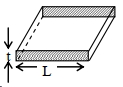
Consider a thin square sheet of side $L$ and thickness $t$,made of a material of resistivity $\rho$. The resistance between two opposite faces,shown by the shaded areas in the figure is
A
directly proportional to $L$
B
directly proportional to $t$
C
independent of $L$
D
independent of $t$
Solution
(C) The resistance $R$ of a conductor is given by the formula $R = \rho \frac{l}{A}$,where $\rho$ is the resistivity,$l$ is the length of the conductor in the direction of current flow,and $A$ is the cross-sectional area perpendicular to the current flow.
In this case,the current flows between the two opposite shaded faces.
The distance between these two faces is the side length $L$,so $l = L$.
The area of each shaded face is $A = L \times t$.
Substituting these values into the resistance formula,we get:
$R = \rho \frac{L}{L \times t} = \frac{\rho}{t}$.
Since the expression for resistance $R = \frac{\rho}{t}$ does not contain $L$,the resistance is independent of $L$.
In this case,the current flows between the two opposite shaded faces.
The distance between these two faces is the side length $L$,so $l = L$.
The area of each shaded face is $A = L \times t$.
Substituting these values into the resistance formula,we get:
$R = \rho \frac{L}{L \times t} = \frac{\rho}{t}$.
Since the expression for resistance $R = \frac{\rho}{t}$ does not contain $L$,the resistance is independent of $L$.
0 likes
View Solution229
MediumMCQ
Which of the following resistivity ( $\rho$ ) $v/s$ temperature $( T )$ curves is most suitable to be used in wire-bound standard resistors?
A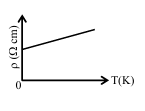
B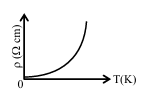
C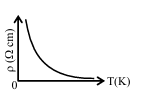
D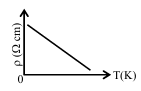
Solution
(A) Standard resistors are typically made from alloys like Manganin, Constantan, or Nichrome.
These materials are chosen because they have a very low temperature coefficient of resistivity, meaning their resistivity $(\rho)$ remains nearly constant over a wide range of temperatures.
Among the given options, the graph that represents a nearly constant resistivity with respect to temperature is the one where the line is almost horizontal (or has a very small slope).
However, in the context of standard textbook questions, the curve representing a very weak dependence of resistivity on temperature is the one that is nearly flat.
Looking at the provided options, none of the graphs show a perfectly constant line, but in standard physics curricula, the material used for standard resistors (like Manganin) is characterized by a very small, almost negligible change in resistivity with temperature.
Therefore, the graph that shows the least variation (the most horizontal line) is the most suitable representation.
These materials are chosen because they have a very low temperature coefficient of resistivity, meaning their resistivity $(\rho)$ remains nearly constant over a wide range of temperatures.
Among the given options, the graph that represents a nearly constant resistivity with respect to temperature is the one where the line is almost horizontal (or has a very small slope).
However, in the context of standard textbook questions, the curve representing a very weak dependence of resistivity on temperature is the one that is nearly flat.
Looking at the provided options, none of the graphs show a perfectly constant line, but in standard physics curricula, the material used for standard resistors (like Manganin) is characterized by a very small, almost negligible change in resistivity with temperature.
Therefore, the graph that shows the least variation (the most horizontal line) is the most suitable representation.
0 likes
View Solution230
MediumMCQ
The dimension of $\sqrt{\frac{\mu_0}{\epsilon_0}}$ is equal to that of (where $\mu_0 = \text{vacuum permeability}$ and $\epsilon_0 = \text{vacuum permittivity}$)
A
Voltage
B
Capacitance
C
Inductance
D
Resistance
Solution
(D) The speed of light in vacuum is given by $c = \frac{1}{\sqrt{\mu_0 \epsilon_0}}$.
Also,the characteristic impedance of free space is given by $Z_0 = \sqrt{\frac{\mu_0}{\epsilon_0}}$.
The unit of impedance is $\text{ohm} (\Omega)$,which is the same as the unit of resistance.
Therefore,the dimension of $\sqrt{\frac{\mu_0}{\epsilon_0}}$ is the same as the dimension of resistance.
Also,the characteristic impedance of free space is given by $Z_0 = \sqrt{\frac{\mu_0}{\epsilon_0}}$.
The unit of impedance is $\text{ohm} (\Omega)$,which is the same as the unit of resistance.
Therefore,the dimension of $\sqrt{\frac{\mu_0}{\epsilon_0}}$ is the same as the dimension of resistance.
0 likes
View Solution231
EasyMCQ
Arrange the following materials in increasing order of their resistivity: Nichrome,Copper,Germanium,Silicon.
A
Copper $ < $ Nichrome $ < $ Germanium $ < $ Silicon
B
Germanium $ < $ Copper $ < $ Nichrome $ < $ Silicon
C
Nichrome $ < $ Copper $ < $ Germanium $ < $ Silicon
D
Silicon $ < $ Nichrome $ < $ Germanium $ < $ Copper
Solution
(A) The resistivity $(\rho)$ of materials at room temperature is as follows:
$1$. Copper $(Cu)$ (Conductor): $\approx 1.7 \times 10^{-8} \ \Omega \cdot m$
$2$. Nichrome (Alloy): $\approx 1.0 \times 10^{-6} \ \Omega \cdot m$ (or $100 \times 10^{-8} \ \Omega \cdot m$)
$3$. Germanium (Semiconductor): $\approx 0.46 \ \Omega \cdot m$
$4$. Silicon (Semiconductor): $\approx 2300 \ \Omega \cdot m$
Comparing these values,the increasing order of resistivity is: Copper < Nichrome < Germanium < Silicon.
Therefore,the correct option is $A$.
$1$. Copper $(Cu)$ (Conductor): $\approx 1.7 \times 10^{-8} \ \Omega \cdot m$
$2$. Nichrome (Alloy): $\approx 1.0 \times 10^{-6} \ \Omega \cdot m$ (or $100 \times 10^{-8} \ \Omega \cdot m$)
$3$. Germanium (Semiconductor): $\approx 0.46 \ \Omega \cdot m$
$4$. Silicon (Semiconductor): $\approx 2300 \ \Omega \cdot m$
Comparing these values,the increasing order of resistivity is: Copper < Nichrome < Germanium < Silicon.
Therefore,the correct option is $A$.
0 likes
View Solution232
EasyMCQ
By increasing the temperature,the specific resistance of a conductor and a semiconductor respectively
A
increases,increases.
B
decreases,decreases.
C
increases,decreases.
D
decreases,increases.
Solution
(C) For a conductor,as the temperature increases,the thermal vibrations of the lattice ions increase,which leads to more frequent collisions of free electrons. This results in an increase in the resistivity (specific resistance) of the conductor.
For a semiconductor,as the temperature increases,more charge carriers (electrons and holes) are generated due to the breaking of covalent bonds. This increase in the number density of charge carriers significantly reduces the resistivity (specific resistance) of the semiconductor.
Therefore,the specific resistance of a conductor increases and that of a semiconductor decreases.
For a semiconductor,as the temperature increases,more charge carriers (electrons and holes) are generated due to the breaking of covalent bonds. This increase in the number density of charge carriers significantly reduces the resistivity (specific resistance) of the semiconductor.
Therefore,the specific resistance of a conductor increases and that of a semiconductor decreases.
0 likes
View Solution233
EasyMCQ
For a metallic wire,the ratio of voltage to corresponding current is
A
independent of temperature
B
increases with rise in temperature
C
increases or decreases with rise in temperature depending upon the nature of the metal
D
decreases with rise in temperature
Solution
(B) According to Ohm's Law,the ratio of voltage $(V)$ to current $(i)$ is equal to the resistance $(R)$: $\frac{V}{i} = R$.
For a metallic wire,the resistance depends on temperature according to the relation: $R = R_0(1 + \alpha \Delta T)$,where $\alpha$ is the temperature coefficient of resistance.
For metals,$\alpha$ is positive.
Therefore,as the temperature increases,the resistance $(R)$ of the metallic wire increases.
Since $\frac{V}{i} = R$,the ratio of voltage to current also increases with a rise in temperature.
For a metallic wire,the resistance depends on temperature according to the relation: $R = R_0(1 + \alpha \Delta T)$,where $\alpha$ is the temperature coefficient of resistance.
For metals,$\alpha$ is positive.
Therefore,as the temperature increases,the resistance $(R)$ of the metallic wire increases.
Since $\frac{V}{i} = R$,the ratio of voltage to current also increases with a rise in temperature.
0 likes
View Solution234
MediumMCQ
$A$ conducting wire has length $L_1$ and diameter $d_1$. After stretching,the same wire's length becomes $L_2$ and diameter $d_2$. The ratio of resistance before and after stretching is:
A
$d_2^4: d_1^4$
B
$d_1^4: d_2^4$
C
$d_2^2: d_1^2$
D
$d_1^2: d_2^2$
Solution
(A) The resistance of a wire is given by $R = \rho \frac{L}{A}$,where $A = \frac{\pi d^2}{4}$.
Since the volume of the wire remains constant during stretching,$V = A_1 L_1 = A_2 L_2$,which implies $L_1 d_1^2 = L_2 d_2^2$,or $\frac{L_1}{L_2} = \frac{d_2^2}{d_1^2}$.
The ratio of resistances is $\frac{R_1}{R_2} = \frac{L_1}{L_2} \times \frac{A_2}{A_1} = \frac{L_1}{L_2} \times \frac{d_2^2}{d_1^2}$.
Substituting $\frac{L_1}{L_2} = \frac{d_2^2}{d_1^2}$ into the equation,we get $\frac{R_1}{R_2} = \left(\frac{d_2^2}{d_1^2}\right) \times \left(\frac{d_2^2}{d_1^2}\right) = \frac{d_2^4}{d_1^4}$.
Since the volume of the wire remains constant during stretching,$V = A_1 L_1 = A_2 L_2$,which implies $L_1 d_1^2 = L_2 d_2^2$,or $\frac{L_1}{L_2} = \frac{d_2^2}{d_1^2}$.
The ratio of resistances is $\frac{R_1}{R_2} = \frac{L_1}{L_2} \times \frac{A_2}{A_1} = \frac{L_1}{L_2} \times \frac{d_2^2}{d_1^2}$.
Substituting $\frac{L_1}{L_2} = \frac{d_2^2}{d_1^2}$ into the equation,we get $\frac{R_1}{R_2} = \left(\frac{d_2^2}{d_1^2}\right) \times \left(\frac{d_2^2}{d_1^2}\right) = \frac{d_2^4}{d_1^4}$.
0 likes
View Solution235
EasyMCQ
$A$ copper wire of length $L$ and diameter $D$ is to be reshaped into another wire so as to have minimum resistance. For this,we should:
A
increase $L$ and decrease $D$.
B
decrease $L$ and increase $D$.
C
decrease both $L$ and $D$.
D
increase both $L$ and $D$.
Solution
(B) The resistance $R$ of a wire is given by the formula $R = \rho \frac{L}{A}$,where $\rho$ is the resistivity,$L$ is the length,and $A$ is the cross-sectional area.
Since the wire is reshaped,its volume $V = A \times L$ remains constant.
We can express the area $A$ in terms of diameter $D$ as $A = \pi \left(\frac{D}{2}\right)^2 = \frac{\pi D^2}{4}$.
Substituting $A$ into the resistance formula: $R = \rho \frac{L}{\pi D^2 / 4} = \frac{4 \rho L}{\pi D^2}$.
Since the volume $V = A \times L = \frac{\pi D^2 L}{4}$ is constant,we have $L = \frac{4V}{\pi D^2}$.
Substituting this into the resistance formula: $R = \frac{4 \rho}{\pi D^2} \times \left(\frac{4V}{\pi D^2}\right) = \frac{16 \rho V}{\pi^2 D^4}$.
To minimize $R$,we need to maximize $D$. Since volume is constant,increasing $D$ will result in a decrease in $L$. Therefore,we should decrease $L$ and increase $D$.
Since the wire is reshaped,its volume $V = A \times L$ remains constant.
We can express the area $A$ in terms of diameter $D$ as $A = \pi \left(\frac{D}{2}\right)^2 = \frac{\pi D^2}{4}$.
Substituting $A$ into the resistance formula: $R = \rho \frac{L}{\pi D^2 / 4} = \frac{4 \rho L}{\pi D^2}$.
Since the volume $V = A \times L = \frac{\pi D^2 L}{4}$ is constant,we have $L = \frac{4V}{\pi D^2}$.
Substituting this into the resistance formula: $R = \frac{4 \rho}{\pi D^2} \times \left(\frac{4V}{\pi D^2}\right) = \frac{16 \rho V}{\pi^2 D^4}$.
To minimize $R$,we need to maximize $D$. Since volume is constant,increasing $D$ will result in a decrease in $L$. Therefore,we should decrease $L$ and increase $D$.
0 likes
View Solution236
EasyMCQ
Silicon and copper are cooled from $300 \ K$ to $100 \ K$. What happens to their specific resistance (resistivity)?
A
Increase in both copper and silicon
B
Decrease in both copper and silicon
C
Decrease in copper and increase in silicon
D
Increase in copper but decrease in silicon
Solution
(C) The resistivity of a conductor (like copper) is directly proportional to temperature. As the temperature decreases,the resistivity of copper decreases.
Conversely,the resistivity of a semiconductor (like silicon) is inversely related to temperature because the number of charge carriers increases with temperature. As the temperature decreases,the number of free charge carriers decreases,causing the resistivity of silicon to increase.
Therefore,when cooled from $300 \ K$ to $100 \ K$,the resistivity of copper decreases and the resistivity of silicon increases.
Conversely,the resistivity of a semiconductor (like silicon) is inversely related to temperature because the number of charge carriers increases with temperature. As the temperature decreases,the number of free charge carriers decreases,causing the resistivity of silicon to increase.
Therefore,when cooled from $300 \ K$ to $100 \ K$,the resistivity of copper decreases and the resistivity of silicon increases.
0 likes
View Solution237
EasyMCQ
$A$ silver wire has a resistance of $2.1 \Omega$ at $27.5^{\circ} C$ and a resistance of $2.7 \Omega$ at $100^{\circ} C$. Then the temperature coefficient of the resistivity of silver will be . . . . . . .
A
$3.9 \times 10^{-3} {}^{\circ} C^{-1}$
B
$3.9 \times 10^{3} {}^{\circ} C^{-1}$
C
$3.9 \times 10^{-3} {}^{\circ} C$
D
$3.9 \times 10^{3} {}^{\circ} C$
Solution
(A) Given:
Resistance at $T_0 = 27.5^{\circ} C$ is $R_0 = 2.1 \Omega$.
Resistance at $T = 100^{\circ} C$ is $R = 2.7 \Omega$.
The formula for temperature dependence of resistance is $R = R_0[1 + \alpha(T - T_0)]$.
Substituting the values:
$2.7 = 2.1[1 + \alpha(100 - 27.5)]$
$2.7 = 2.1[1 + \alpha(72.5)]$
$\frac{2.7}{2.1} = 1 + \alpha(72.5)$
$\frac{9}{7} = 1 + \alpha(72.5)$
$\frac{9}{7} - 1 = \alpha(72.5)$
$\frac{2}{7} = \alpha(72.5)$
$\alpha = \frac{2}{7 \times 72.5} = \frac{2}{507.5} \approx 0.00394 \approx 3.9 \times 10^{-3} {}^{\circ} C^{-1}$.
Thus,the correct option is $A$.
Resistance at $T_0 = 27.5^{\circ} C$ is $R_0 = 2.1 \Omega$.
Resistance at $T = 100^{\circ} C$ is $R = 2.7 \Omega$.
The formula for temperature dependence of resistance is $R = R_0[1 + \alpha(T - T_0)]$.
Substituting the values:
$2.7 = 2.1[1 + \alpha(100 - 27.5)]$
$2.7 = 2.1[1 + \alpha(72.5)]$
$\frac{2.7}{2.1} = 1 + \alpha(72.5)$
$\frac{9}{7} = 1 + \alpha(72.5)$
$\frac{9}{7} - 1 = \alpha(72.5)$
$\frac{2}{7} = \alpha(72.5)$
$\alpha = \frac{2}{7 \times 72.5} = \frac{2}{507.5} \approx 0.00394 \approx 3.9 \times 10^{-3} {}^{\circ} C^{-1}$.
Thus,the correct option is $A$.
0 likes
View Solution238
EasyMCQ
$A$ metal rod of length $10 \ cm$ and a rectangular cross-section of $1 \ cm \times 0.5 \ cm$ is connected to a battery across opposite faces. The resistance will be . . . . . . .
A
Maximum when the battery is connected across $10 \ cm \times 1 \ cm$ faces.
B
Maximum when the battery is connected across $1 \ cm \times 0.5 \ cm$ faces.
C
Maximum when the battery is connected across $10 \ cm \times 0.5 \ cm$ faces.
D
Same irrespective of the faces connected.
Solution
(B) The resistance $R$ of a conductor is given by the formula $R = \rho \frac{l}{A}$,where $\rho$ is the resistivity,$l$ is the length of the conductor in the direction of current flow,and $A$ is the cross-sectional area perpendicular to the current flow.
To maximize the resistance $R$,we need to maximize the ratio $\frac{l}{A}$. This means we need the largest possible length $l$ and the smallest possible cross-sectional area $A$.
The dimensions of the rod are $10 \ cm$,$1 \ cm$,and $0.5 \ cm$.
If the battery is connected across the $1 \ cm \times 0.5 \ cm$ faces,the current flows through the length $l = 10 \ cm$. The area of cross-section is $A = 1 \ cm \times 0.5 \ cm = 0.5 \ cm^2$.
In this case,the ratio $\frac{l}{A} = \frac{10}{0.5} = 20 \ cm^{-1}$.
Comparing this with other configurations,this configuration yields the maximum value for the ratio $\frac{l}{A}$,hence the resistance is maximum.
To maximize the resistance $R$,we need to maximize the ratio $\frac{l}{A}$. This means we need the largest possible length $l$ and the smallest possible cross-sectional area $A$.
The dimensions of the rod are $10 \ cm$,$1 \ cm$,and $0.5 \ cm$.
If the battery is connected across the $1 \ cm \times 0.5 \ cm$ faces,the current flows through the length $l = 10 \ cm$. The area of cross-section is $A = 1 \ cm \times 0.5 \ cm = 0.5 \ cm^2$.
In this case,the ratio $\frac{l}{A} = \frac{10}{0.5} = 20 \ cm^{-1}$.
Comparing this with other configurations,this configuration yields the maximum value for the ratio $\frac{l}{A}$,hence the resistance is maximum.
0 likes
View Solution239
EasyMCQ
At room temperature $(27^\circ \text{C})$ the resistance of a heating element is $100 \ \Omega$. What is the temperature of the element if the resistance is found to be $137 \ \Omega$,given that the temperature coefficient of the material of the resistor is $1.35 \times 10^{-4} \ ^\circ \text{C}^{-1}$ (in $^\circ \text{C}$)?
A
$2767$
B
$1227$
C
$1027$
D
$2327$
Solution
(A) The relationship between resistance and temperature is given by the formula: $R_\theta = R_0 [1 + \alpha (\theta - \theta_0)]$
Given values are: $R_0 = 100 \ \Omega$,$\theta_0 = 27^\circ \text{C}$,$R_\theta = 137 \ \Omega$,and $\alpha = 1.35 \times 10^{-4} \ ^\circ \text{C}^{-1}$.
Substituting these values into the equation:
$137 = 100 [1 + 1.35 \times 10^{-4} (\theta - 27)]$
$1.37 = 1 + 1.35 \times 10^{-4} (\theta - 27)$
$0.37 = 1.35 \times 10^{-4} (\theta - 27)$
$\theta - 27 = \frac{0.37}{1.35 \times 10^{-4}}$
$\theta - 27 \approx 2740.74$
$\theta \approx 2740.74 + 27 = 2767.74^\circ \text{C}$
Rounding to the nearest integer,we get $\theta \approx 2767^\circ \text{C}$.
Given values are: $R_0 = 100 \ \Omega$,$\theta_0 = 27^\circ \text{C}$,$R_\theta = 137 \ \Omega$,and $\alpha = 1.35 \times 10^{-4} \ ^\circ \text{C}^{-1}$.
Substituting these values into the equation:
$137 = 100 [1 + 1.35 \times 10^{-4} (\theta - 27)]$
$1.37 = 1 + 1.35 \times 10^{-4} (\theta - 27)$
$0.37 = 1.35 \times 10^{-4} (\theta - 27)$
$\theta - 27 = \frac{0.37}{1.35 \times 10^{-4}}$
$\theta - 27 \approx 2740.74$
$\theta \approx 2740.74 + 27 = 2767.74^\circ \text{C}$
Rounding to the nearest integer,we get $\theta \approx 2767^\circ \text{C}$.
0 likes
View Solution240
EasyMCQ
When the temperature of a conductor increases, the ratio of conductivity and resistivity . . . . . . .
A
decreases
B
increases
C
remains constant
D
increases or decreases
Solution
(A) The ratio of conductivity $(\sigma)$ to resistivity $(\rho)$ is given by $\frac{\sigma}{\rho}$.
Since $\sigma = \frac{1}{\rho}$, we can write the ratio as $\frac{1/\rho}{\rho} = \frac{1}{\rho^2}$.
For a conductor, as the temperature increases, the resistivity $(\rho)$ increases due to increased collisions of electrons with the lattice ions.
Since $\rho$ is in the denominator and is squared, as $\rho$ increases, the value of $\frac{1}{\rho^2}$ decreases.
Therefore, the ratio of conductivity to resistivity decreases.
Since $\sigma = \frac{1}{\rho}$, we can write the ratio as $\frac{1/\rho}{\rho} = \frac{1}{\rho^2}$.
For a conductor, as the temperature increases, the resistivity $(\rho)$ increases due to increased collisions of electrons with the lattice ions.
Since $\rho$ is in the denominator and is squared, as $\rho$ increases, the value of $\frac{1}{\rho^2}$ decreases.
Therefore, the ratio of conductivity to resistivity decreases.
0 likes
View Solution241
EasyMCQ
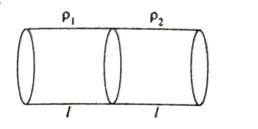
Two wires of equal length and equal diameter and having resistivities $\rho_1$ and $\rho_2$ are connected in series. The equivalent resistivity of the combination is . . . . . . .
A
$\rho_1+\rho_2$
B
$\frac{\rho_1+\rho_2}{2}$
C
$\frac{\rho_1 \rho_2}{\rho_1+\rho_2}$
D
$\sqrt{\rho_1 \rho_2}$
Solution
(B) When two wires are connected in series,the total resistance $R$ is the sum of individual resistances $R_1$ and $R_2$.
$R = R_1 + R_2$
Using the formula $R = \frac{\rho L}{A}$,where $\rho$ is resistivity,$L$ is length,and $A$ is the cross-sectional area:
$\frac{\rho(2l)}{A} = \frac{\rho_1 l}{A} + \frac{\rho_2 l}{A}$
Dividing both sides by $\frac{l}{A}$:
$2\rho = \rho_1 + \rho_2$
$\therefore \rho = \frac{\rho_1 + \rho_2}{2}$
$R = R_1 + R_2$
Using the formula $R = \frac{\rho L}{A}$,where $\rho$ is resistivity,$L$ is length,and $A$ is the cross-sectional area:
$\frac{\rho(2l)}{A} = \frac{\rho_1 l}{A} + \frac{\rho_2 l}{A}$
Dividing both sides by $\frac{l}{A}$:
$2\rho = \rho_1 + \rho_2$
$\therefore \rho = \frac{\rho_1 + \rho_2}{2}$
0 likes
View Solution242
EasyMCQ
Masses of three wires of copper are in the ratio of $1 : 3 : 5$ and their lengths are in the ratio of $5 : 3 : 1$. The ratio of their electrical resistance is . . . . . . .
A
$5: 3: 1$
B
$\sqrt{125}: 15: 1$
C
$1: 15: 125$
D
$1: 3: 5$
Solution
(B) The resistance $R$ of a wire is given by $R = \frac{\rho l}{A}$.
Since volume $V = A \times l$,we can write $A = \frac{V}{l}$.
Substituting this into the resistance formula,we get $R = \frac{\rho l^2}{V}$.
Since density $d = \frac{m}{V}$,we have $V = \frac{m}{d}$.
Thus,$R = \frac{\rho l^2 d}{m}$.
For wires of the same material,$\rho$ and $d$ are constant,so $R \propto \frac{l^2}{m}$.
Given the ratios $m_1:m_2:m_3 = 1:3:5$ and $l_1:l_2:l_3 = 5:3:1$,the ratio of resistances is:
$R_1: R_2: R_3 = \frac{l_1^2}{m_1} : \frac{l_2^2}{m_2} : \frac{l_3^2}{m_3}$
$R_1: R_2: R_3 = \frac{5^2}{1} : \frac{3^2}{3} : \frac{1^2}{5}$
$R_1: R_2: R_3 = 25 : 3 : 0.2$
Multiplying by $5$ to clear the fraction:
$R_1: R_2: R_3 = 125 : 15 : 1$.
Since volume $V = A \times l$,we can write $A = \frac{V}{l}$.
Substituting this into the resistance formula,we get $R = \frac{\rho l^2}{V}$.
Since density $d = \frac{m}{V}$,we have $V = \frac{m}{d}$.
Thus,$R = \frac{\rho l^2 d}{m}$.
For wires of the same material,$\rho$ and $d$ are constant,so $R \propto \frac{l^2}{m}$.
Given the ratios $m_1:m_2:m_3 = 1:3:5$ and $l_1:l_2:l_3 = 5:3:1$,the ratio of resistances is:
$R_1: R_2: R_3 = \frac{l_1^2}{m_1} : \frac{l_2^2}{m_2} : \frac{l_3^2}{m_3}$
$R_1: R_2: R_3 = \frac{5^2}{1} : \frac{3^2}{3} : \frac{1^2}{5}$
$R_1: R_2: R_3 = 25 : 3 : 0.2$
Multiplying by $5$ to clear the fraction:
$R_1: R_2: R_3 = 125 : 15 : 1$.
0 likes
View Solution243
EasyMCQ
$A$ wire is stretched to increase its length by $2\%$,then the percentage change in its resistance is . . . . . . . (in $\%$)
A
$8$
B
$1$
C
$3$
D
$4$
Solution
(D) The resistance of a wire is given by $R = \frac{\rho l}{A}$.
Since volume $V = A \times l$ remains constant during stretching,we can write $A = \frac{V}{l}$.
Substituting this into the resistance formula: $R = \frac{\rho l^2}{V}$.
Since $\rho$ and $V$ are constant,$R \propto l^2$.
Given the change in length $\frac{\Delta l}{l} = 2\% = 0.02$.
Using the differential method for small changes: $\frac{\Delta R}{R} = 2 \frac{\Delta l}{l}$.
$\frac{\Delta R}{R} = 2 \times 2\% = 4\%$.
Alternatively,using the ratio method:
$R_1 \propto l^2$ and $R_2 \propto (1.02l)^2 = 1.0404l^2$.
$\frac{R_2 - R_1}{R_1} \times 100\% = (1.0404 - 1) \times 100\% = 4.04\% \approx 4\%$.
Since volume $V = A \times l$ remains constant during stretching,we can write $A = \frac{V}{l}$.
Substituting this into the resistance formula: $R = \frac{\rho l^2}{V}$.
Since $\rho$ and $V$ are constant,$R \propto l^2$.
Given the change in length $\frac{\Delta l}{l} = 2\% = 0.02$.
Using the differential method for small changes: $\frac{\Delta R}{R} = 2 \frac{\Delta l}{l}$.
$\frac{\Delta R}{R} = 2 \times 2\% = 4\%$.
Alternatively,using the ratio method:
$R_1 \propto l^2$ and $R_2 \propto (1.02l)^2 = 1.0404l^2$.
$\frac{R_2 - R_1}{R_1} \times 100\% = (1.0404 - 1) \times 100\% = 4.04\% \approx 4\%$.
0 likes
View Solution244
EasyMCQ
$A$ negligibly small current is passed through a wire of length $15 \ m$ and uniform cross-section $6 \times 10^{-7} \ m^2$,and its resistance is measured to be $5 \ \Omega$. The resistivity of the material at the temperature of the experiment is . . . . . . $\Omega \ m$.
A
$2 \times 10^7$
B
$3 \times 10^{-7}$
C
$2 \times 10^{-7}$
D
$3 \times 10^{+7}$
Solution
(C) The resistance $R$ of a wire is given by the formula: $R = \frac{\rho l}{A}$,where $\rho$ is the resistivity,$l$ is the length,and $A$ is the cross-sectional area.
Rearranging the formula to solve for resistivity $\rho$: $\rho = \frac{RA}{l}$.
Given values: $R = 5 \ \Omega$,$l = 15 \ m$,and $A = 6 \times 10^{-7} \ m^2$.
Substituting these values into the equation:
$\rho = \frac{5 \times 6 \times 10^{-7}}{15}$
$\rho = \frac{30 \times 10^{-7}}{15}$
$\rho = 2 \times 10^{-7} \ \Omega \ m$.
Rearranging the formula to solve for resistivity $\rho$: $\rho = \frac{RA}{l}$.
Given values: $R = 5 \ \Omega$,$l = 15 \ m$,and $A = 6 \times 10^{-7} \ m^2$.
Substituting these values into the equation:
$\rho = \frac{5 \times 6 \times 10^{-7}}{15}$
$\rho = \frac{30 \times 10^{-7}}{15}$
$\rho = 2 \times 10^{-7} \ \Omega \ m$.
0 likes
View Solution245
EasyMCQ
Resistivity of which of the following substances decreases on increasing the temperature?
A
Copper
B
Aluminium
C
Silicon
D
Nichrome
Solution
(C) The correct option is $C$.
Silicon is a semiconductor.
In semiconductors,the number density of charge carriers (electrons and holes) increases exponentially with an increase in temperature.
Although the relaxation time decreases with temperature,the increase in the number density of charge carriers dominates,leading to a decrease in resistivity as temperature increases.
In contrast,metals like Copper,Aluminium,and alloys like Nichrome show an increase in resistivity with an increase in temperature.
Silicon is a semiconductor.
In semiconductors,the number density of charge carriers (electrons and holes) increases exponentially with an increase in temperature.
Although the relaxation time decreases with temperature,the increase in the number density of charge carriers dominates,leading to a decrease in resistivity as temperature increases.
In contrast,metals like Copper,Aluminium,and alloys like Nichrome show an increase in resistivity with an increase in temperature.
0 likes
View Solution246
EasyMCQ
If a conducting wire of length $L$ is uniformly stretched to double its length, then its conductivity becomes . . . . . . .
A
double
B
halved
C
$4$ times
D
remain same
Solution
(D) The correct option is $D$.
Conductivity $(\sigma)$ is an intrinsic property of a material.
It depends only on the nature of the material, its temperature, and pressure.
It does not depend on the physical dimensions of the conductor, such as its length $(L)$ or cross-sectional area $(A)$.
Therefore, when the wire is stretched, its resistance changes, but its conductivity remains the same.
Conductivity $(\sigma)$ is an intrinsic property of a material.
It depends only on the nature of the material, its temperature, and pressure.
It does not depend on the physical dimensions of the conductor, such as its length $(L)$ or cross-sectional area $(A)$.
Therefore, when the wire is stretched, its resistance changes, but its conductivity remains the same.
0 likes
View Solution247
EasyMCQ
The resistance of the bulb filament is $100 \ \Omega$ at a temperature of $100^{\circ} C$. If its temperature coefficient of resistance is $0.005 \ ^{\circ} C^{-1}$,at what temperature will its resistance become $200 \ \Omega$ (in $^{\circ} C$)?
A
$300$
B
$400$
C
$500$
D
$200$
Solution
(A) Given: Initial temperature $T_{1} = 100^{\circ} C$,initial resistance $R_{1} = 100 \ \Omega$,final resistance $R_{2} = 200 \ \Omega$,and temperature coefficient $\alpha = 0.005 \ ^{\circ} C^{-1}$.
Using the formula for temperature dependence of resistance: $R_{2} = R_{1}[1 + \alpha(T_{2} - T_{1})]$.
Rearranging for $T_{2}$: $T_{2} - T_{1} = \frac{R_{2} - R_{1}}{\alpha R_{1}}$.
Substituting the values: $T_{2} - 100 = \frac{200 - 100}{0.005 \times 100}$.
$T_{2} - 100 = \frac{100}{0.5} = 200$.
$T_{2} = 200 + 100 = 300^{\circ} C$.
Using the formula for temperature dependence of resistance: $R_{2} = R_{1}[1 + \alpha(T_{2} - T_{1})]$.
Rearranging for $T_{2}$: $T_{2} - T_{1} = \frac{R_{2} - R_{1}}{\alpha R_{1}}$.
Substituting the values: $T_{2} - 100 = \frac{200 - 100}{0.005 \times 100}$.
$T_{2} - 100 = \frac{100}{0.5} = 200$.
$T_{2} = 200 + 100 = 300^{\circ} C$.
0 likes
View Solution248
DifficultMCQ
$A$ metal rod of length $10 \text{ cm}$ and a rectangular cross-section of $1 \text{ cm} \times 0.5 \text{ cm}$ is connected to a battery across opposite faces. The resistance will be
A
maximum when the battery is connected across $1 \text{ cm} \times 0.5 \text{ cm}$ faces
B
maximum when the battery is connected across $10 \text{ cm} \times 0.5 \text{ cm}$ faces
C
maximum when the battery is connected across $10 \text{ cm} \times 1 \text{ cm}$ faces
D
same irrespective of the three faces
Solution
(A) The resistance $R$ of a conductor is given by the formula $R = \rho \frac{L}{A}$,where $\rho$ is the resistivity,$L$ is the length of the conductor in the direction of current flow,and $A$ is the cross-sectional area perpendicular to the current flow.
From the relation $R \propto \frac{L}{A}$,we see that for a fixed volume of the material,the resistance is proportional to the square of the length $(L^2)$ or inversely proportional to the square of the area $(A^2)$.
Alternatively,for a fixed rod,the resistance is maximum when the current flows through the smallest cross-sectional area $A$,which results in the longest effective length $L$.
The three possible cross-sectional areas are:
$1$. $A_1 = 10 \text{ cm} \times 1 \text{ cm} = 10 \text{ cm}^2$
$2$. $A_2 = 10 \text{ cm} \times 0.5 \text{ cm} = 5 \text{ cm}^2$
$3$. $A_3 = 1 \text{ cm} \times 0.5 \text{ cm} = 0.5 \text{ cm}^2$
The resistance is maximum when the cross-sectional area $A$ is minimum. The minimum area is $0.5 \text{ cm}^2$,which corresponds to the faces of dimensions $1 \text{ cm} \times 0.5 \text{ cm}$.
From the relation $R \propto \frac{L}{A}$,we see that for a fixed volume of the material,the resistance is proportional to the square of the length $(L^2)$ or inversely proportional to the square of the area $(A^2)$.
Alternatively,for a fixed rod,the resistance is maximum when the current flows through the smallest cross-sectional area $A$,which results in the longest effective length $L$.
The three possible cross-sectional areas are:
$1$. $A_1 = 10 \text{ cm} \times 1 \text{ cm} = 10 \text{ cm}^2$
$2$. $A_2 = 10 \text{ cm} \times 0.5 \text{ cm} = 5 \text{ cm}^2$
$3$. $A_3 = 1 \text{ cm} \times 0.5 \text{ cm} = 0.5 \text{ cm}^2$
The resistance is maximum when the cross-sectional area $A$ is minimum. The minimum area is $0.5 \text{ cm}^2$,which corresponds to the faces of dimensions $1 \text{ cm} \times 0.5 \text{ cm}$.
0 likes
View Solution249
MediumMCQ
The variations of resistivity $\rho$ with absolute temperature $T$ for three different materials $X, Y$ and $Z$ are shown in the graph below. Identify the materials $X, Y$ and $Z$.
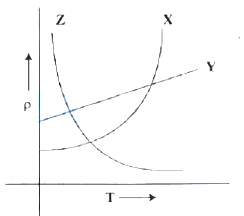
A
$X$ - copper,$Y$ - nichrome,$Z$ - semiconductor
B
$X$ - semiconductor,$Y$ - nichrome,$Z$ - copper
C
$X$ - nichrome,$Y$ - copper,$Z$ - semiconductor
D
$X$ - copper,$Y$ - semiconductor,$Z$ - nichrome
Solution
(A) In the given graph:
$1$. For material $Z$,resistivity $\rho$ decreases exponentially with an increase in temperature $T$. This is a characteristic property of semiconductors.
$2$. For material $Y$,resistivity $\rho$ increases linearly with temperature $T$. This is a characteristic property of alloys like nichrome,which have a very small temperature coefficient of resistance.
$3$. For material $X$,resistivity $\rho$ increases non-linearly with temperature $T$. This is a characteristic property of metals like copper.
Therefore,$X$ is copper,$Y$ is nichrome,and $Z$ is a semiconductor.
$1$. For material $Z$,resistivity $\rho$ decreases exponentially with an increase in temperature $T$. This is a characteristic property of semiconductors.
$2$. For material $Y$,resistivity $\rho$ increases linearly with temperature $T$. This is a characteristic property of alloys like nichrome,which have a very small temperature coefficient of resistance.
$3$. For material $X$,resistivity $\rho$ increases non-linearly with temperature $T$. This is a characteristic property of metals like copper.
Therefore,$X$ is copper,$Y$ is nichrome,and $Z$ is a semiconductor.
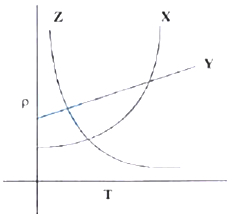
0 likes
View Solution250
EasyMCQ
The graph showing the variation of resistance $(R)$ of a metal wire as a function of its diameter $(D)$,while keeping other parameters like length and temperature constant,is:
A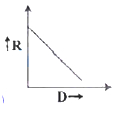
B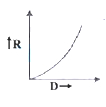
C
D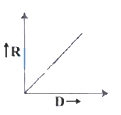
Solution
(C) The resistance $(R)$ of a wire is given by the formula: $R = \frac{\rho \ell}{A}$,where $\rho$ is resistivity,$\ell$ is length,and $A$ is the cross-sectional area.
Since the wire is cylindrical,the cross-sectional area $A = \pi r^2 = \pi (D/2)^2 = \frac{\pi D^2}{4}$.
Substituting this into the resistance formula,we get: $R = \frac{\rho \ell}{\pi D^2 / 4} = \frac{4 \rho \ell}{\pi D^2}$.
Since $\rho$,$\ell$,and $\pi$ are constants,we have $R \propto \frac{1}{D^2}$.
This relationship represents an inverse square law,which corresponds to a curve that decreases as $D$ increases. Among the given options,Graph $C$ represents this behavior.
Since the wire is cylindrical,the cross-sectional area $A = \pi r^2 = \pi (D/2)^2 = \frac{\pi D^2}{4}$.
Substituting this into the resistance formula,we get: $R = \frac{\rho \ell}{\pi D^2 / 4} = \frac{4 \rho \ell}{\pi D^2}$.
Since $\rho$,$\ell$,and $\pi$ are constants,we have $R \propto \frac{1}{D^2}$.
This relationship represents an inverse square law,which corresponds to a curve that decreases as $D$ increases. Among the given options,Graph $C$ represents this behavior.
0 likes
View SolutionCurrent Electricity — Resistance of wire, Resistivity and Conductivity · Frequently Asked Questions
1Are these Current Electricity questions useful for JEE and NEET?
Yes. All questions in this section are mapped to JEE Main and NEET exam patterns. Previous year questions from JEE Main, NEET, GUJCET and state-level exams are included with full solutions.
2Can I switch to Hindi or Gujarati for these questions?
Yes. Use the language tabs in the hero section or the sidebar to view the same questions and solutions in English, Hindi or Gujarati.
3How do I generate a question paper from this subtopic?
Use the Vedclass Exam Paper Generator — select the chapter and subtopic, set difficulty, and generate Sets A, B, C, D automatically. First 3 chapters of every subject are free.
Vedclass Products
For Students
Vedclass Test Series
Mock tests in real JEE/NEET style with performance analysis. 5-day free trial.
Start Free TrialFor Teachers
Exam Paper Generator
Generate Set A/B/C/D papers from this chapter in 2 minutes. 3 chapters free.
Try FreeFor Institutes
Online Exam Module
Live online exams with unlimited students, 360° analytics & white-label branding.
See DemoFor Teachers & Institutes
Generate a Current Electricity Exam Paper in 2 Minutes
Select subtopic & difficulty — Sets A, B, C, D auto-generated with No Repeat logic.
First 3 chapters of every subject are free — no payment required.