
A English
Resistance of wire, Resistivity and Conductivity Questions in English
Class 12 Physics · Current Electricity · Resistance of wire, Resistivity and Conductivity
308+
Questions
English
Language
100%
With Solutions
Showing 49 of 308 questions in English
151
MediumMCQ
$A$ copper wire is stretched to make it $0.5\%$ longer. The percentage change in its electric resistance if its volume remains unchanged is ................ $\%$
A
$2$
B
$2.5$
C
$1$
D
$0.5$
Solution
(C) The resistance $R$ of a wire is given by $R = \frac{\rho \ell}{A}$.
Since the volume $V = A \ell$ remains constant,we can write $A = \frac{V}{\ell}$.
Substituting this into the resistance formula: $R = \frac{\rho \ell^2}{V}$.
Since $\rho$ and $V$ are constant,$R \propto \ell^2$.
Taking the logarithmic derivative,we get $\frac{\Delta R}{R} = 2 \frac{\Delta \ell}{\ell}$.
Given the percentage change in length $\frac{\Delta \ell}{\ell} \times 100 = 0.5\%$.
Therefore,the percentage change in resistance is $\frac{\Delta R}{R} \times 100 = 2 \times 0.5\% = 1\%$.
Since the volume $V = A \ell$ remains constant,we can write $A = \frac{V}{\ell}$.
Substituting this into the resistance formula: $R = \frac{\rho \ell^2}{V}$.
Since $\rho$ and $V$ are constant,$R \propto \ell^2$.
Taking the logarithmic derivative,we get $\frac{\Delta R}{R} = 2 \frac{\Delta \ell}{\ell}$.
Given the percentage change in length $\frac{\Delta \ell}{\ell} \times 100 = 0.5\%$.
Therefore,the percentage change in resistance is $\frac{\Delta R}{R} \times 100 = 2 \times 0.5\% = 1\%$.
0 likes
View Solution152
DifficultMCQ
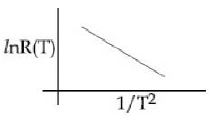
In an experiment,the resistance of a material is plotted as a function of temperature. As shown in the figure,the plot of $\ln R(T)$ versus $1/T^2$ is a straight line. One may conclude that:
A
$R(T) = R_0 e^{T^2/T_0^2}$
B
$R(T) = R_0 / T^2$
C
$R(T) = R_0 e^{-T^2/T_0^2}$
D
$R(T) = R_0 e^{T_0^2/T^2}$
Solution
(D) The graph shows a straight line between $\ln R(T)$ and $1/T^2$ with a negative slope. The equation of a straight line is $y = mx + c$.
Here,$y = \ln R(T)$ and $x = 1/T^2$.
So,$\ln R(T) = m(1/T^2) + c$,where $m$ is the negative slope and $c$ is the intercept.
Let the intercept be $\ln R_0$ at $1/T^2 = 0$. Then $\ln R(T) = -k(1/T^2) + \ln R_0$,where $k$ is a positive constant.
This can be written as $\ln R(T) = \ln R_0 - k/T^2$.
Taking the exponential of both sides,we get $R(T) = R_0 e^{-k/T^2}$.
Comparing this with the given options,if we set $k = T_0^2$,we get $R(T) = R_0 e^{-T_0^2/T^2}$.
However,looking at the options provided,there seems to be a mismatch in the exponent sign or variable definition. Re-evaluating the slope: if the line passes through $(1/T_0^2, 0)$ and $(0, \ln R_0)$,the equation is $\frac{\ln R(T)}{\ln R_0} + \frac{1/T^2}{1/T_0^2} = 1$.
$\ln R(T) = \ln R_0 (1 - T_0^2/T^2) = \ln R_0 - \ln R_0 (T_0^2/T^2)$.
This implies $R(T) = R_0 e^{-\ln R_0 (T_0^2/T^2)}$.
Given the standard form of such problems,the correct relation is $R(T) = R_0 e^{T_0^2/T^2}$ if the slope is positive,or $R(T) = R_0 e^{-T_0^2/T^2}$ if negative. Based on the provided options and the negative slope,option $D$ is the closest mathematical form if $T_0^2$ is defined appropriately.
Here,$y = \ln R(T)$ and $x = 1/T^2$.
So,$\ln R(T) = m(1/T^2) + c$,where $m$ is the negative slope and $c$ is the intercept.
Let the intercept be $\ln R_0$ at $1/T^2 = 0$. Then $\ln R(T) = -k(1/T^2) + \ln R_0$,where $k$ is a positive constant.
This can be written as $\ln R(T) = \ln R_0 - k/T^2$.
Taking the exponential of both sides,we get $R(T) = R_0 e^{-k/T^2}$.
Comparing this with the given options,if we set $k = T_0^2$,we get $R(T) = R_0 e^{-T_0^2/T^2}$.
However,looking at the options provided,there seems to be a mismatch in the exponent sign or variable definition. Re-evaluating the slope: if the line passes through $(1/T_0^2, 0)$ and $(0, \ln R_0)$,the equation is $\frac{\ln R(T)}{\ln R_0} + \frac{1/T^2}{1/T_0^2} = 1$.
$\ln R(T) = \ln R_0 (1 - T_0^2/T^2) = \ln R_0 - \ln R_0 (T_0^2/T^2)$.
This implies $R(T) = R_0 e^{-\ln R_0 (T_0^2/T^2)}$.
Given the standard form of such problems,the correct relation is $R(T) = R_0 e^{T_0^2/T^2}$ if the slope is positive,or $R(T) = R_0 e^{-T_0^2/T^2}$ if negative. Based on the provided options and the negative slope,option $D$ is the closest mathematical form if $T_0^2$ is defined appropriately.
0 likes
View Solution153
DifficultMCQ
Space between two concentric conducting spheres of radii $a$ and $b$ $(b > a)$ is filled with a medium of resistivity $\rho$. The resistance between the two spheres will be
A
$\frac{\rho}{2\pi} \left( \frac{1}{a} + \frac{1}{b} \right)$
B
$\frac{\rho}{2\pi} \left( \frac{1}{a} - \frac{1}{b} \right)$
C
$\frac{\rho}{4\pi} \left( \frac{1}{a} + \frac{1}{b} \right)$
D
$\frac{\rho}{4\pi} \left( \frac{1}{a} - \frac{1}{b} \right)$
Solution
(D) Consider a spherical shell of radius $x$ and thickness $dx$ between the two spheres.
The area of this shell is $A = 4\pi x^2$.
The resistance $dR$ of this thin shell is given by $dR = \rho \frac{dx}{A} = \rho \frac{dx}{4\pi x^2}$.
To find the total resistance $R$ between the spheres,we integrate from $r = a$ to $r = b$:
$R = \int_a^b \frac{\rho}{4\pi x^2} dx$.
$R = \frac{\rho}{4\pi} \int_a^b x^{-2} dx$.
$R = \frac{\rho}{4\pi} \left[ -\frac{1}{x} \right]_a^b$.
$R = \frac{\rho}{4\pi} \left( -\frac{1}{b} - (-\frac{1}{a}) \right) = \frac{\rho}{4\pi} \left( \frac{1}{a} - \frac{1}{b} \right)$.
The area of this shell is $A = 4\pi x^2$.
The resistance $dR$ of this thin shell is given by $dR = \rho \frac{dx}{A} = \rho \frac{dx}{4\pi x^2}$.
To find the total resistance $R$ between the spheres,we integrate from $r = a$ to $r = b$:
$R = \int_a^b \frac{\rho}{4\pi x^2} dx$.
$R = \frac{\rho}{4\pi} \int_a^b x^{-2} dx$.
$R = \frac{\rho}{4\pi} \left[ -\frac{1}{x} \right]_a^b$.
$R = \frac{\rho}{4\pi} \left( -\frac{1}{b} - (-\frac{1}{a}) \right) = \frac{\rho}{4\pi} \left( \frac{1}{a} - \frac{1}{b} \right)$.
0 likes
View Solution154
DifficultMCQ
The masses of three wires of copper are in the ratio of $1 : 3 : 5$ and their lengths are in the ratio $5 : 3 : 1.$ The ratio of their electrical resistances is
A
$1 : 3 : 5$
B
$5 : 3 : 1$
C
$1 : 15 : 125$
D
$125 : 15 : 1$
Solution
(D) The resistance of a wire is given by $R = \rho \frac{l}{A}$.
Since the mass $m = A \cdot l \cdot d$ (where $d$ is density),we have $A = \frac{m}{l \cdot d}$.
Substituting $A$ into the resistance formula: $R = \rho \frac{l^2 \cdot d}{m}$.
Since $\rho$ and $d$ are constant for copper,$R \propto \frac{l^2}{m}$.
Given the ratios $m_1 : m_2 : m_3 = 1 : 3 : 5$ and $l_1 : l_2 : l_3 = 5 : 3 : 1$,we calculate the ratio of resistances:
$R_1 : R_2 : R_3 = \frac{5^2}{1} : \frac{3^2}{3} : \frac{1^2}{5} = 25 : 3 : 0.2$.
To express this in integers,multiply by $5$:
$R_1 : R_2 : R_3 = 125 : 15 : 1$.
Since the mass $m = A \cdot l \cdot d$ (where $d$ is density),we have $A = \frac{m}{l \cdot d}$.
Substituting $A$ into the resistance formula: $R = \rho \frac{l^2 \cdot d}{m}$.
Since $\rho$ and $d$ are constant for copper,$R \propto \frac{l^2}{m}$.
Given the ratios $m_1 : m_2 : m_3 = 1 : 3 : 5$ and $l_1 : l_2 : l_3 = 5 : 3 : 1$,we calculate the ratio of resistances:
$R_1 : R_2 : R_3 = \frac{5^2}{1} : \frac{3^2}{3} : \frac{1^2}{5} = 25 : 3 : 0.2$.
To express this in integers,multiply by $5$:
$R_1 : R_2 : R_3 = 125 : 15 : 1$.
0 likes
View Solution155
MediumMCQ
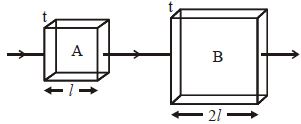
Two square metal plates $A$ and $B$ are of the same thickness and material. The side of $B$ is twice that of $A$. These are connected as shown in series. If the resistances of $A$ and $B$ are denoted by $R_A$ and $R_B,$ then $(R_A/R_B)$ is
A
$1/2$
B
$2/1$
C
$1/1$
D
$4/1$
Solution
(C) The resistance of a conductor is given by $R = \rho \frac{L}{A_{cross}}$,where $\rho$ is the resistivity,$L$ is the length in the direction of current flow,and $A_{cross}$ is the cross-sectional area perpendicular to the current flow.
For plate $A$,the length $L_A = \ell$,and the cross-sectional area $A_A = \ell \times t$. Thus,$R_A = \rho \frac{\ell}{\ell \times t} = \frac{\rho}{t}$.
For plate $B$,the length $L_B = 2\ell$,and the cross-sectional area $A_B = 2\ell \times t$. Thus,$R_B = \rho \frac{2\ell}{2\ell \times t} = \frac{\rho}{t}$.
Comparing the two,we get $R_A = R_B$.
Therefore,the ratio $(R_A/R_B) = 1/1$.
For plate $A$,the length $L_A = \ell$,and the cross-sectional area $A_A = \ell \times t$. Thus,$R_A = \rho \frac{\ell}{\ell \times t} = \frac{\rho}{t}$.
For plate $B$,the length $L_B = 2\ell$,and the cross-sectional area $A_B = 2\ell \times t$. Thus,$R_B = \rho \frac{2\ell}{2\ell \times t} = \frac{\rho}{t}$.
Comparing the two,we get $R_A = R_B$.
Therefore,the ratio $(R_A/R_B) = 1/1$.
0 likes
View Solution156
MediumMCQ
Two different conductors have the same resistance at $0\,^{\circ}C.$ It is found that the resistance of the first conductor at $t_1\,^{\circ}C$ is equal to the resistance of the second conductor at $t_2\,^{\circ}C.$ The ratio of the temperature coefficients of resistance of the conductors,$\frac{\alpha_1}{\alpha_2}$ is
A
$\frac{t_1}{t_2}$
B
$\frac{t_2 - t_1}{t_2}$
C
$\frac{t_2 - t_1}{t_1}$
D
$\frac{t_2}{t_1}$
Solution
(D) Let $R_0$ be the resistance of both conductors at $0\,^{\circ}C.$
The resistance of the first conductor at $t_1\,^{\circ}C$ is given by $R_1 = R_0(1 + \alpha_1 t_1).$
The resistance of the second conductor at $t_2\,^{\circ}C$ is given by $R_2 = R_0(1 + \alpha_2 t_2).$
Given that $R_1 = R_2,$ we have:
$R_0(1 + \alpha_1 t_1) = R_0(1 + \alpha_2 t_2)$
Dividing both sides by $R_0$:
$1 + \alpha_1 t_1 = 1 + \alpha_2 t_2$
Subtracting $1$ from both sides:
$\alpha_1 t_1 = \alpha_2 t_2$
Therefore,the ratio of the temperature coefficients is:
$\frac{\alpha_1}{\alpha_2} = \frac{t_2}{t_1}$
The resistance of the first conductor at $t_1\,^{\circ}C$ is given by $R_1 = R_0(1 + \alpha_1 t_1).$
The resistance of the second conductor at $t_2\,^{\circ}C$ is given by $R_2 = R_0(1 + \alpha_2 t_2).$
Given that $R_1 = R_2,$ we have:
$R_0(1 + \alpha_1 t_1) = R_0(1 + \alpha_2 t_2)$
Dividing both sides by $R_0$:
$1 + \alpha_1 t_1 = 1 + \alpha_2 t_2$
Subtracting $1$ from both sides:
$\alpha_1 t_1 = \alpha_2 t_2$
Therefore,the ratio of the temperature coefficients is:
$\frac{\alpha_1}{\alpha_2} = \frac{t_2}{t_1}$
0 likes
View Solution157
MediumMCQ
The temperature coefficient of resistance at $0\,^{\circ}\text{C}$ is $\alpha = 0.00125\,^{\circ}\text{C}^{-1}$. At a temperature of $25\,^{\circ}\text{C}$,the resistance of a conductor is $1\,\Omega$. Find the temperature at which the resistance becomes $1.2\,\Omega$.
A
$1225\,^{\circ}\text{C}$
B
$190\,^{\circ}\text{C}$
C
$260\,^{\circ}\text{C}$
D
$185\,^{\circ}\text{C}$
Solution
(B) The resistance of a conductor at temperature $T$ is given by $R_T = R_0(1 + \alpha T)$,where $R_0$ is the resistance at $0\,^{\circ}\text{C}$.
Given $\alpha = 0.00125\,^{\circ}\text{C}^{-1}$.
At $T_1 = 25\,^{\circ}\text{C}$,$R_1 = 1\,\Omega$. So,$1 = R_0(1 + 0.00125 \times 25) = R_0(1 + 0.03125) = R_0(1.03125)$.
Thus,$R_0 = \frac{1}{1.03125} \approx 0.9697\,\Omega$.
We want to find $T_2$ such that $R_2 = 1.2\,\Omega$.
Using $R_2 = R_0(1 + \alpha T_2)$,we have $1.2 = R_0(1 + 0.00125 T_2)$.
Substituting $R_0$: $1.2 = \frac{1}{1.03125} (1 + 0.00125 T_2)$.
$1.2 \times 1.03125 = 1 + 0.00125 T_2$.
$1.2375 = 1 + 0.00125 T_2$.
$0.2375 = 0.00125 T_2$.
$T_2 = \frac{0.2375}{0.00125} = 190\,^{\circ}\text{C}$.
Given $\alpha = 0.00125\,^{\circ}\text{C}^{-1}$.
At $T_1 = 25\,^{\circ}\text{C}$,$R_1 = 1\,\Omega$. So,$1 = R_0(1 + 0.00125 \times 25) = R_0(1 + 0.03125) = R_0(1.03125)$.
Thus,$R_0 = \frac{1}{1.03125} \approx 0.9697\,\Omega$.
We want to find $T_2$ such that $R_2 = 1.2\,\Omega$.
Using $R_2 = R_0(1 + \alpha T_2)$,we have $1.2 = R_0(1 + 0.00125 T_2)$.
Substituting $R_0$: $1.2 = \frac{1}{1.03125} (1 + 0.00125 T_2)$.
$1.2 \times 1.03125 = 1 + 0.00125 T_2$.
$1.2375 = 1 + 0.00125 T_2$.
$0.2375 = 0.00125 T_2$.
$T_2 = \frac{0.2375}{0.00125} = 190\,^{\circ}\text{C}$.
0 likes
View Solution158
DifficultMCQ
If the length of a wire is increased by $10\%$ by stretching it,the percentage increase in its resistance is ..............$\%$
A
$10$
B
$20$
C
$21$
D
$44$
Solution
(C) The resistance of a wire is given by $R = \rho \frac{\ell}{A}$.
Since the volume $V = A \ell$ remains constant when the wire is stretched,$A = \frac{V}{\ell}$.
Substituting this into the resistance formula,we get $R = \rho \frac{\ell^2}{V}$,which implies $R \propto \ell^2$.
Given that the length increases by $10\%$,the new length $\ell_2 = 1.1 \ell_1$.
Therefore,the ratio of the new resistance to the original resistance is $\frac{R_2}{R_1} = \left(\frac{\ell_2}{\ell_1}\right)^2 = (1.1)^2 = 1.21$.
This means $R_2 = 1.21 R_1$.
The percentage increase in resistance is $\Delta R \% = \frac{R_2 - R_1}{R_1} \times 100\% = (1.21 - 1) \times 100\% = 21\%$.
Since the volume $V = A \ell$ remains constant when the wire is stretched,$A = \frac{V}{\ell}$.
Substituting this into the resistance formula,we get $R = \rho \frac{\ell^2}{V}$,which implies $R \propto \ell^2$.
Given that the length increases by $10\%$,the new length $\ell_2 = 1.1 \ell_1$.
Therefore,the ratio of the new resistance to the original resistance is $\frac{R_2}{R_1} = \left(\frac{\ell_2}{\ell_1}\right)^2 = (1.1)^2 = 1.21$.
This means $R_2 = 1.21 R_1$.
The percentage increase in resistance is $\Delta R \% = \frac{R_2 - R_1}{R_1} \times 100\% = (1.21 - 1) \times 100\% = 21\%$.
0 likes
View Solution159
EasyMCQ
Three copper wires of lengths and cross-sectional areas are $(l, A)$,$(2l, A/2)$,and $(l/2, 2A)$. Resistance is minimum in
A
wire of cross-sectional area $A/2$
B
wire of cross-sectional area $A$
C
wire of cross-sectional area $2A$
D
same in all the three cases
Solution
(C) The resistance $R$ of a wire is given by the formula $R = \rho \frac{l}{A}$,where $\rho$ is the resistivity,$l$ is the length,and $A$ is the cross-sectional area.
For the three wires,the resistances are:
$R_1 = \rho \frac{l}{A}$
$R_2 = \rho \frac{2l}{A/2} = 4 \rho \frac{l}{A} = 4R_1$
$R_3 = \rho \frac{l/2}{2A} = \frac{1}{4} \rho \frac{l}{A} = 0.25R_1$
Comparing the resistances,$R_3 < R_1 < R_2$.
Therefore,the resistance is minimum for the wire with length $l/2$ and cross-sectional area $2A$.
For the three wires,the resistances are:
$R_1 = \rho \frac{l}{A}$
$R_2 = \rho \frac{2l}{A/2} = 4 \rho \frac{l}{A} = 4R_1$
$R_3 = \rho \frac{l/2}{2A} = \frac{1}{4} \rho \frac{l}{A} = 0.25R_1$
Comparing the resistances,$R_3 < R_1 < R_2$.
Therefore,the resistance is minimum for the wire with length $l/2$ and cross-sectional area $2A$.
1 likes
View Solution160
EasyMCQ
Assertion: Bending a wire does not affect electrical resistance.
Reason: Resistance of a wire is proportional to the resistivity of the material.
Reason: Resistance of a wire is proportional to the resistivity of the material.
A
If both Assertion and Reason are correct and Reason is the correct explanation of Assertion.
B
If both Assertion and Reason are correct,but Reason is not the correct explanation of Assertion.
C
If Assertion is correct but Reason is incorrect.
D
If both the Assertion and Reason are incorrect.
Solution
(B) The resistance of a wire is given by the formula $R = \rho \frac{L}{A}$,where $\rho$ is the resistivity of the material,$L$ is the length,and $A$ is the cross-sectional area.
Resistivity $\rho$ is an intrinsic property of the material and does not depend on the geometry or shape of the wire.
When a wire is bent,its length $L$,cross-sectional area $A$,and resistivity $\rho$ remain unchanged.
Therefore,the electrical resistance $R$ remains constant.
While the Reason statement is a true physical fact (resistance is proportional to resistivity),it does not explain why bending the wire does not change the resistance (which is due to the geometry remaining constant). Thus,both are correct,but the Reason is not the correct explanation of the Assertion.
Resistivity $\rho$ is an intrinsic property of the material and does not depend on the geometry or shape of the wire.
When a wire is bent,its length $L$,cross-sectional area $A$,and resistivity $\rho$ remain unchanged.
Therefore,the electrical resistance $R$ remains constant.
While the Reason statement is a true physical fact (resistance is proportional to resistivity),it does not explain why bending the wire does not change the resistance (which is due to the geometry remaining constant). Thus,both are correct,but the Reason is not the correct explanation of the Assertion.
0 likes
View Solution161
MediumMCQ
At room temperature $(27.0^{\circ} C)$,the resistance of a heating element is $100\; \Omega$. What is the temperature (in $^{\circ} C$) of the element if the resistance is found to be $117\; \Omega$,given that the temperature coefficient of the material of the resistor is $1.70 \times 10^{-4}\; ^{\circ} C^{-1}$?
A
$1327$
B
$827$
C
$1027$
D
$1300$
Solution
(C) Given:
Room temperature,$T = 27.0^{\circ} C$
Resistance at room temperature,$R = 100\; \Omega$
Final resistance,$R_1 = 117\; \Omega$
Temperature coefficient,$\alpha = 1.70 \times 10^{-4}\; ^{\circ} C^{-1}$
The formula for temperature dependence of resistance is:
$R_1 = R[1 + \alpha(T_1 - T)]$
Rearranging for the final temperature $T_1$:
$T_1 - T = \frac{R_1 - R}{R \alpha}$
Substituting the values:
$T_1 - 27 = \frac{117 - 100}{100 \times 1.70 \times 10^{-4}}$
$T_1 - 27 = \frac{17}{1.70 \times 10^{-2}}$
$T_1 - 27 = \frac{17}{0.017} = 1000$
$T_1 = 1000 + 27 = 1027^{\circ} C$
Thus,the temperature of the element is $1027^{\circ} C$.
Room temperature,$T = 27.0^{\circ} C$
Resistance at room temperature,$R = 100\; \Omega$
Final resistance,$R_1 = 117\; \Omega$
Temperature coefficient,$\alpha = 1.70 \times 10^{-4}\; ^{\circ} C^{-1}$
The formula for temperature dependence of resistance is:
$R_1 = R[1 + \alpha(T_1 - T)]$
Rearranging for the final temperature $T_1$:
$T_1 - T = \frac{R_1 - R}{R \alpha}$
Substituting the values:
$T_1 - 27 = \frac{117 - 100}{100 \times 1.70 \times 10^{-4}}$
$T_1 - 27 = \frac{17}{1.70 \times 10^{-2}}$
$T_1 - 27 = \frac{17}{0.017} = 1000$
$T_1 = 1000 + 27 = 1027^{\circ} C$
Thus,the temperature of the element is $1027^{\circ} C$.
0 likes
View Solution162
MediumMCQ
$A$ negligibly small current is passed through a wire of length $15 \; m$ and uniform cross-section $6.0 \times 10^{-7} \; m^{2},$ and its resistance is measured to be $5.0 \; \Omega .$ What is the resistivity of the material at the temperature of the experiment?
A
$7 \times 10^{-6} \; \Omega \, m$
B
$6 \times 10^{-7} \; \Omega \, m$
C
$8 \times 10^{-7} \; \Omega \, m$
D
$2 \times 10^{-7} \; \Omega \, m$
Solution
(D) Given:
Length of the wire,$l = 15 \; m$
Area of cross-section of the wire,$A = 6.0 \times 10^{-7} \; m^{2}$
Resistance of the wire,$R = 5.0 \; \Omega$
The formula for resistance is $R = \rho \frac{l}{A}$,where $\rho$ is the resistivity.
Rearranging for resistivity: $\rho = \frac{R \times A}{l}$
Substituting the values: $\rho = \frac{5.0 \times 6.0 \times 10^{-7}}{15}$
$\rho = \frac{30 \times 10^{-7}}{15} = 2 \times 10^{-7} \; \Omega \, m$
Thus,the resistivity of the material is $2 \times 10^{-7} \; \Omega \, m$.
Length of the wire,$l = 15 \; m$
Area of cross-section of the wire,$A = 6.0 \times 10^{-7} \; m^{2}$
Resistance of the wire,$R = 5.0 \; \Omega$
The formula for resistance is $R = \rho \frac{l}{A}$,where $\rho$ is the resistivity.
Rearranging for resistivity: $\rho = \frac{R \times A}{l}$
Substituting the values: $\rho = \frac{5.0 \times 6.0 \times 10^{-7}}{15}$
$\rho = \frac{30 \times 10^{-7}}{15} = 2 \times 10^{-7} \; \Omega \, m$
Thus,the resistivity of the material is $2 \times 10^{-7} \; \Omega \, m$.
0 likes
View Solution163
MediumMCQ
$A$ silver wire has a resistance of $2.1\; \Omega$ at $27.5^{\circ} C$ and a resistance of $2.7\; \Omega$ at $100^{\circ} C$. Determine the temperature coefficient of resistivity of silver.
A
$0.0039^{\circ} C^{-1}$
B
$0.0081^{\circ} C^{-1}$
C
$0.041^{\circ} C^{-1}$
D
$0.00073^{\circ} C^{-1}$
Solution
(A) Given:
Initial temperature,$T_{1} = 27.5^{\circ} C$
Resistance at $T_{1}$,$R_{1} = 2.1\; \Omega$
Final temperature,$T_{2} = 100^{\circ} C$
Resistance at $T_{2}$,$R_{2} = 2.7\; \Omega$
The temperature coefficient of resistivity $\alpha$ is given by the formula:
$\alpha = \frac{R_{2} - R_{1}}{R_{1}(T_{2} - T_{1})}$
Substituting the values:
$\alpha = \frac{2.7 - 2.1}{2.1(100 - 27.5)}$
$\alpha = \frac{0.6}{2.1 \times 72.5}$
$\alpha = \frac{0.6}{152.25}$
$\alpha \approx 0.0039^{\circ} C^{-1}$
Initial temperature,$T_{1} = 27.5^{\circ} C$
Resistance at $T_{1}$,$R_{1} = 2.1\; \Omega$
Final temperature,$T_{2} = 100^{\circ} C$
Resistance at $T_{2}$,$R_{2} = 2.7\; \Omega$
The temperature coefficient of resistivity $\alpha$ is given by the formula:
$\alpha = \frac{R_{2} - R_{1}}{R_{1}(T_{2} - T_{1})}$
Substituting the values:
$\alpha = \frac{2.7 - 2.1}{2.1(100 - 27.5)}$
$\alpha = \frac{0.6}{2.1 \times 72.5}$
$\alpha = \frac{0.6}{152.25}$
$\alpha \approx 0.0039^{\circ} C^{-1}$
0 likes
View Solution164
MediumMCQ
$A$ heating element using nichrome connected to a $230 \;V$ supply draws an initial current of $3.2 \;A$ which settles after a few seconds to a steady value of $2.8 \;A$. What is the steady temperature of the heating element if the room temperature is $27.0^{\circ} C$ (in $^{\circ} C$)? The temperature coefficient of resistance of nichrome averaged over the temperature range involved is $1.70 \times 10^{-4} \;^{\circ} C^{-1}$.
A
$627.5$
B
$867.5$
C
$562$
D
$1032$
Solution
(B) Supply voltage,$V = 230 \; V$.
Initial current,$I_1 = 3.2 \; A$.
Initial resistance $R_1 = \frac{V}{I_1} = \frac{230}{3.2} = 71.875 \; \Omega$.
Steady state current,$I_2 = 2.8 \; A$.
Steady state resistance $R_2 = \frac{V}{I_2} = \frac{230}{2.8} \approx 82.143 \; \Omega$.
Temperature coefficient of resistance,$\alpha = 1.70 \times 10^{-4} \; ^{\circ}C^{-1}$.
Initial temperature,$T_1 = 27.0^{\circ} C$.
Using the formula $R_2 = R_1[1 + \alpha(T_2 - T_1)]$,we get:
$T_2 - T_1 = \frac{R_2 - R_1}{\alpha R_1}$.
$T_2 - 27 = \frac{82.143 - 71.875}{1.70 \times 10^{-4} \times 71.875}$.
$T_2 - 27 = \frac{10.268}{0.01221875} \approx 840.35$.
$T_2 = 840.35 + 27 = 867.35^{\circ} C \approx 867.5^{\circ} C$ (rounding to match options).
Initial current,$I_1 = 3.2 \; A$.
Initial resistance $R_1 = \frac{V}{I_1} = \frac{230}{3.2} = 71.875 \; \Omega$.
Steady state current,$I_2 = 2.8 \; A$.
Steady state resistance $R_2 = \frac{V}{I_2} = \frac{230}{2.8} \approx 82.143 \; \Omega$.
Temperature coefficient of resistance,$\alpha = 1.70 \times 10^{-4} \; ^{\circ}C^{-1}$.
Initial temperature,$T_1 = 27.0^{\circ} C$.
Using the formula $R_2 = R_1[1 + \alpha(T_2 - T_1)]$,we get:
$T_2 - T_1 = \frac{R_2 - R_1}{\alpha R_1}$.
$T_2 - 27 = \frac{82.143 - 71.875}{1.70 \times 10^{-4} \times 71.875}$.
$T_2 - 27 = \frac{10.268}{0.01221875} \approx 840.35$.
$T_2 = 840.35 + 27 = 867.35^{\circ} C \approx 867.5^{\circ} C$ (rounding to match options).
0 likes
View Solution165
Medium
Two wires of equal length,one of aluminium and the other of copper,have the same resistance. Which of the two wires is lighter? Hence,explain why aluminium wires are preferred for overhead power cables. $(\rho_{Al} = 2.63 \times 10^{-8} \; \Omega m, \rho_{Cu} = 1.72 \times 10^{-8} \; \Omega m, \text{Relative density of } Al = 2.7, \text{of } Cu = 8.9.)$
Solution
(A) Let the resistivity,length,area of cross-section,density,and mass of the aluminium wire be $\rho_1, l_1, A_1, d_1, m_1$ and for the copper wire be $\rho_2, l_2, A_2, d_2, m_2$ respectively.
Given: $l_1 = l_2 = l$ and $R_1 = R_2 = R$.
Since $R = \rho \frac{l}{A}$,we have $\rho_1 \frac{l}{A_1} = \rho_2 \frac{l}{A_2}$,which implies $\frac{A_1}{A_2} = \frac{\rho_1}{\rho_2} = \frac{2.63 \times 10^{-8}}{1.72 \times 10^{-8}} \approx 1.529$.
The mass of a wire is given by $m = \text{Volume} \times \text{Density} = A \cdot l \cdot d$.
Taking the ratio of masses: $\frac{m_1}{m_2} = \frac{A_1 l d_1}{A_2 l d_2} = \left( \frac{A_1}{A_2} \right) \left( \frac{d_1}{d_2} \right)$.
Substituting the values: $\frac{m_1}{m_2} = \left( \frac{2.63}{1.72} \right) \times \left( \frac{2.7}{8.9} \right) \approx 1.529 \times 0.303 \approx 0.463$.
Since $\frac{m_1}{m_2} < 1$,$m_1 < m_2$,meaning the aluminium wire is lighter.
Aluminium is preferred for overhead power cables because it is much lighter than copper for the same resistance,reducing the mechanical stress on the supporting towers.
Given: $l_1 = l_2 = l$ and $R_1 = R_2 = R$.
Since $R = \rho \frac{l}{A}$,we have $\rho_1 \frac{l}{A_1} = \rho_2 \frac{l}{A_2}$,which implies $\frac{A_1}{A_2} = \frac{\rho_1}{\rho_2} = \frac{2.63 \times 10^{-8}}{1.72 \times 10^{-8}} \approx 1.529$.
The mass of a wire is given by $m = \text{Volume} \times \text{Density} = A \cdot l \cdot d$.
Taking the ratio of masses: $\frac{m_1}{m_2} = \frac{A_1 l d_1}{A_2 l d_2} = \left( \frac{A_1}{A_2} \right) \left( \frac{d_1}{d_2} \right)$.
Substituting the values: $\frac{m_1}{m_2} = \left( \frac{2.63}{1.72} \right) \times \left( \frac{2.7}{8.9} \right) \approx 1.529 \times 0.303 \approx 0.463$.
Since $\frac{m_1}{m_2} < 1$,$m_1 < m_2$,meaning the aluminium wire is lighter.
Aluminium is preferred for overhead power cables because it is much lighter than copper for the same resistance,reducing the mechanical stress on the supporting towers.
0 likes
View Solution166
Medium
Choose the correct alternative:
$(a)$ Alloys of metals usually have (greater/less) resistivity than that of their constituent metals.
$(b)$ Alloys usually have much (lower/higher) temperature coefficients of resistance than pure metals.
$(c)$ The resistivity of the alloy manganin is nearly independent of/ increases rapidly with increase of temperature.
$(d)$ The resistivity of a typical insulator (e.g.,amber) is greater than that of a metal by a factor of the order of $(10^{22}/10^{23}).$
$(a)$ Alloys of metals usually have (greater/less) resistivity than that of their constituent metals.
$(b)$ Alloys usually have much (lower/higher) temperature coefficients of resistance than pure metals.
$(c)$ The resistivity of the alloy manganin is nearly independent of/ increases rapidly with increase of temperature.
$(d)$ The resistivity of a typical insulator (e.g.,amber) is greater than that of a metal by a factor of the order of $(10^{22}/10^{23}).$
Solution
(A) Alloys of metals usually have greater resistivity than that of their constituent metals because the disordered structure of the alloy increases electron scattering.
$(b)$ Alloys usually have much lower temperature coefficients of resistance than pure metals,making them useful for standard resistors.
$(c)$ The resistivity of the alloy manganin is nearly independent of increase of temperature,which is why it is used to make standard resistors.
$(d)$ The resistivity of a typical insulator is greater than that of a metal by a factor of the order of $10^{22}$.
$(b)$ Alloys usually have much lower temperature coefficients of resistance than pure metals,making them useful for standard resistors.
$(c)$ The resistivity of the alloy manganin is nearly independent of increase of temperature,which is why it is used to make standard resistors.
$(d)$ The resistivity of a typical insulator is greater than that of a metal by a factor of the order of $10^{22}$.
0 likes
View Solution167
Difficult
What is electrical resistance $(R)$? On which factors does the resistance value depend?
Solution
(N/A) Electrical resistance is the property of a conductor to oppose the flow of electric charge through it.
From Ohm's law,$R = \frac{V}{I}$. Its $SI$ unit is $\frac{\text{Volt}}{\text{Ampere}} = \text{ohm} (\Omega)$. Its dimensional formula is $[M^1 L^2 T^{-3} A^{-2}]$.
Resistance depends on the following factors:
$1$. Length of the conductor $(l)$: $R \propto l$
$2$. Cross-sectional area of the conductor $(A)$: $R \propto \frac{1}{A}$
$3$. Nature of the material (resistivity,$\rho$)
$4$. Temperature of the conductor
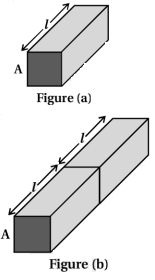
Consider a conductor with length $l$ and area $A$ as shown in Figure $(a)$.
Two such similar rectangular blocks are shown in Figure $(b)$. Here,the total length of the combination is $2l$.
The current flowing through the combination of blocks is equal to the current flowing through each individual block. Hence,the potential difference across each block is $V$. Therefore,the total potential difference across the combination is $2V$. Let the resistance of the combination be $R_C$. By Ohm's law:
$R_C = \frac{2V}{I} = 2R$
Since $\frac{V}{I} = R$ is the resistance of each block,we see that the resistance of the conductor is proportional to its length $(R \propto l)$.
From Ohm's law,$R = \frac{V}{I}$. Its $SI$ unit is $\frac{\text{Volt}}{\text{Ampere}} = \text{ohm} (\Omega)$. Its dimensional formula is $[M^1 L^2 T^{-3} A^{-2}]$.
Resistance depends on the following factors:
$1$. Length of the conductor $(l)$: $R \propto l$
$2$. Cross-sectional area of the conductor $(A)$: $R \propto \frac{1}{A}$
$3$. Nature of the material (resistivity,$\rho$)
$4$. Temperature of the conductor
Consider a conductor with length $l$ and area $A$ as shown in Figure $(a)$.
Two such similar rectangular blocks are shown in Figure $(b)$. Here,the total length of the combination is $2l$.
The current flowing through the combination of blocks is equal to the current flowing through each individual block. Hence,the potential difference across each block is $V$. Therefore,the total potential difference across the combination is $2V$. Let the resistance of the combination be $R_C$. By Ohm's law:
$R_C = \frac{2V}{I} = 2R$
Since $\frac{V}{I} = R$ is the resistance of each block,we see that the resistance of the conductor is proportional to its length $(R \propto l)$.
0 likes
View Solution168
Medium
Explain how the resistance of a conductor depends on its dimensions.
Solution
(N/A) The resistance $R$ of a conductor is given by the formula $R = \rho \frac{L}{A}$,where $\rho$ is the resistivity of the material,$L$ is the length of the conductor,and $A$ is the cross-sectional area.
$1$. Dependence on Length $(L)$: The resistance $R$ is directly proportional to the length $L$ of the conductor $(R \propto L)$. This means that if the length of the conductor is increased while keeping the cross-sectional area constant,the resistance increases.
$2$. Dependence on Area $(A)$: The resistance $R$ is inversely proportional to the cross-sectional area $A$ of the conductor $(R \propto \frac{1}{A})$. This means that if the cross-sectional area is increased (e.g.,by increasing the thickness of the wire),the resistance decreases.
$1$. Dependence on Length $(L)$: The resistance $R$ is directly proportional to the length $L$ of the conductor $(R \propto L)$. This means that if the length of the conductor is increased while keeping the cross-sectional area constant,the resistance increases.
$2$. Dependence on Area $(A)$: The resistance $R$ is inversely proportional to the cross-sectional area $A$ of the conductor $(R \propto \frac{1}{A})$. This means that if the cross-sectional area is increased (e.g.,by increasing the thickness of the wire),the resistance decreases.
0 likes
View Solution169
Medium
What is conductance? Write its unit.
Solution
(N/A) Conductance is defined as the reciprocal of the electrical resistance of a conductor. It represents the ease with which electric current flows through a material.
Mathematically,it is given by: $G = \frac{1}{R}$
where $G$ is the conductance and $R$ is the resistance.
The $SI$ unit of conductance is the siemens $(S)$,which is also equivalent to $\Omega^{-1}$ (ohm inverse) or mho.
Mathematically,it is given by: $G = \frac{1}{R}$
where $G$ is the conductance and $R$ is the resistance.
The $SI$ unit of conductance is the siemens $(S)$,which is also equivalent to $\Omega^{-1}$ (ohm inverse) or mho.
0 likes
View Solution170
Medium
What is resistivity? Write its unit. On what factors does resistivity depend?
Solution
(N/A) At a given temperature,the resistance $R$ of a material is given by:
$R = \rho \frac{l}{A}$
Therefore,the resistivity $\rho$ is defined as:
$\rho = \frac{RA}{l}$
Definition: The resistance of a conductor having unit length and unit cross-sectional area is called resistivity or specific resistance.
Factors affecting resistivity: The value of resistivity depends on the type of material of the conductor,temperature,and pressure.
Note: It does not depend on the dimensions (length or area) of the conductor.
Unit: The $SI$ unit is $\Omega \cdot m$ (Ohm-meter).
Dimensional formula: $[M^{1} L^{3} T^{-3} A^{-2}]$.
$R = \rho \frac{l}{A}$
Therefore,the resistivity $\rho$ is defined as:
$\rho = \frac{RA}{l}$
Definition: The resistance of a conductor having unit length and unit cross-sectional area is called resistivity or specific resistance.
Factors affecting resistivity: The value of resistivity depends on the type of material of the conductor,temperature,and pressure.
Note: It does not depend on the dimensions (length or area) of the conductor.
Unit: The $SI$ unit is $\Omega \cdot m$ (Ohm-meter).
Dimensional formula: $[M^{1} L^{3} T^{-3} A^{-2}]$.
0 likes
View Solution171
Difficult
What is conductivity? On which factors does its value depend? Write its unit and dimension.
Solution
(N/A) Conductivity is defined as the reciprocal of resistivity. It is denoted by the symbol $\sigma$.
$\sigma = \frac{1}{\rho} = \frac{l}{RA}$
The $SI$ unit of conductivity is $\Omega^{-1} m^{-1}$ or $S m^{-1}$ (Siemens per meter).
The dimensional formula of conductivity is $[M^{-1} L^{-3} T^{3} A^{2}]$.
The value of conductivity depends on the nature of the material,temperature,and pressure.
It does not depend on the physical dimensions (length or cross-sectional area) of the conductor.
$\sigma = \frac{1}{\rho} = \frac{l}{RA}$
The $SI$ unit of conductivity is $\Omega^{-1} m^{-1}$ or $S m^{-1}$ (Siemens per meter).
The dimensional formula of conductivity is $[M^{-1} L^{-3} T^{3} A^{2}]$.
The value of conductivity depends on the nature of the material,temperature,and pressure.
It does not depend on the physical dimensions (length or cross-sectional area) of the conductor.
0 likes
View Solution172
Easy
What is electrical resistance? Its value depends on which factors?
Solution
(N/A) Electrical resistance is the property of a conductor by virtue of which it opposes the flow of electric current through it. It is defined as the ratio of the potential difference $(V)$ applied across the conductor to the current $(I)$ flowing through it, given by $R = V/I$. The $SI$ unit of resistance is the ohm $(\Omega)$.
The resistance of a conductor depends on the following factors:
$1$. Length of the conductor $(l)$: Resistance is directly proportional to the length $(R \propto l)$.
$2$. Area of cross-section $(A)$: Resistance is inversely proportional to the area of cross-section $(R \propto 1/A)$.
$3$. Nature of the material: Resistance depends on the resistivity $(\rho)$ of the material.
$4$. Temperature: For most conductors, resistance increases with an increase in temperature.
The resistance of a conductor depends on the following factors:
$1$. Length of the conductor $(l)$: Resistance is directly proportional to the length $(R \propto l)$.
$2$. Area of cross-section $(A)$: Resistance is inversely proportional to the area of cross-section $(R \propto 1/A)$.
$3$. Nature of the material: Resistance depends on the resistivity $(\rho)$ of the material.
$4$. Temperature: For most conductors, resistance increases with an increase in temperature.
0 likes
View Solution173
Easy
Why does the resistivity of a metal increase with an increase in temperature,or why does its conductivity decrease with an increase in temperature?
Solution
(N/A) The conductivity of metals is given by the formula: $\sigma = \frac{n e^{2} \tau}{m}$.
Here,$n$ (charge carrier density),$e$ (charge of an electron),and $m$ (mass of an electron) are constants for a given metal.
Therefore,$\sigma \propto \tau$,where $\tau$ is the relaxation time.
With an increase in temperature,the thermal vibrations of the lattice ions increase,which leads to more frequent collisions of electrons with the ions. This causes the relaxation time $(\tau)$ to decrease.
Since $\sigma \propto \tau$,a decrease in $\tau$ leads to a decrease in conductivity $(\sigma)$.
Resistivity is defined as $\rho = \frac{1}{\sigma}$. Since $\rho \propto \frac{1}{\tau}$,as the temperature increases and $\tau$ decreases,the resistivity $(\rho)$ of the metal increases.
Here,$n$ (charge carrier density),$e$ (charge of an electron),and $m$ (mass of an electron) are constants for a given metal.
Therefore,$\sigma \propto \tau$,where $\tau$ is the relaxation time.
With an increase in temperature,the thermal vibrations of the lattice ions increase,which leads to more frequent collisions of electrons with the ions. This causes the relaxation time $(\tau)$ to decrease.
Since $\sigma \propto \tau$,a decrease in $\tau$ leads to a decrease in conductivity $(\sigma)$.
Resistivity is defined as $\rho = \frac{1}{\sigma}$. Since $\rho \propto \frac{1}{\tau}$,as the temperature increases and $\tau$ decreases,the resistivity $(\rho)$ of the metal increases.
0 likes
View Solution174
MediumMCQ
What is the resistivity of a perfect conductor?
A
Zero
B
Infinity
C
Very high
D
Depends on the material
Solution
(A) perfect conductor is defined as a material that allows electric current to flow through it without any resistance.
Since resistance $R$ is related to resistivity $\rho$ by the formula $R = \rho \frac{L}{A}$,where $L$ is the length and $A$ is the cross-sectional area.
For a perfect conductor,the resistance $R = 0$.
Therefore,the resistivity $\rho$ must be $0$ for any finite length and area.
Since resistance $R$ is related to resistivity $\rho$ by the formula $R = \rho \frac{L}{A}$,where $L$ is the length and $A$ is the cross-sectional area.
For a perfect conductor,the resistance $R = 0$.
Therefore,the resistivity $\rho$ must be $0$ for any finite length and area.
0 likes
View Solution175
MediumMCQ
For which material does resistivity decrease with an increase in temperature?
A
Conductors
B
Semiconductors
C
Insulators
D
Superconductors
Solution
(B) The resistivity of a material depends on temperature.
For conductors,resistivity increases with an increase in temperature due to increased electron-phonon scattering.
For semiconductors and insulators,the number of charge carriers (electrons and holes) increases exponentially with temperature,which outweighs the effect of increased scattering.
Therefore,the resistivity of semiconductors and insulators decreases as the temperature increases.
For conductors,resistivity increases with an increase in temperature due to increased electron-phonon scattering.
For semiconductors and insulators,the number of charge carriers (electrons and holes) increases exponentially with temperature,which outweighs the effect of increased scattering.
Therefore,the resistivity of semiconductors and insulators decreases as the temperature increases.
0 likes
View Solution176
Medium
How does the resistivity of a material depend on temperature? Write the empirical formula.
Solution
(N/A) The resistivity of a material depends on its temperature. Different materials exhibit different temperature dependencies.
For metals,the resistivity increases with an increase in temperature.
For semiconductors,the resistivity decreases with an increase in temperature.
Over a limited range of temperature that is not too large,the resistivity of a metallic conductor is approximately given by the empirical formula:
$\rho_{T} = \rho_{0} [1 + \alpha (T - T_{0})]$
Where:
$\rho_{T}$ = resistivity at temperature $T$
$\rho_{0}$ = resistivity at reference temperature $T_{0}$
$\alpha$ = temperature coefficient of resistivity
The unit of $\alpha$ is $(^{\circ}C)^{-1}$ or $(K)^{-1}$.
For metals,the value of $\alpha$ is positive,whereas for semiconductors,$\alpha$ is negative.
For metals,the resistivity increases with an increase in temperature.
For semiconductors,the resistivity decreases with an increase in temperature.
Over a limited range of temperature that is not too large,the resistivity of a metallic conductor is approximately given by the empirical formula:
$\rho_{T} = \rho_{0} [1 + \alpha (T - T_{0})]$
Where:
$\rho_{T}$ = resistivity at temperature $T$
$\rho_{0}$ = resistivity at reference temperature $T_{0}$
$\alpha$ = temperature coefficient of resistivity
The unit of $\alpha$ is $(^{\circ}C)^{-1}$ or $(K)^{-1}$.
For metals,the value of $\alpha$ is positive,whereas for semiconductors,$\alpha$ is negative.
0 likes
View Solution177
Medium
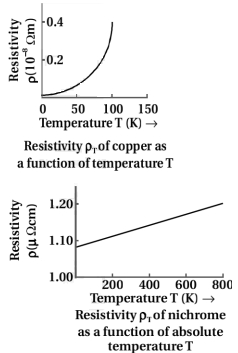
Draw the resistivity versus temperature $(\rho \to T)$ graph for metals, alloys, and semiconductors.
Solution
(N/A) $1$. For metals: The resistivity $\rho_T$ at temperature $T$ is given by $\rho_T = \rho_0 [1 + \alpha(T - T_0)]$. For a limited range of temperatures, this graph is a straight line. At very low temperatures, the graph deviates from linearity and shows a non-linear behavior as shown in the provided figure for copper.
$2$. For alloys: Alloys like nichrome, manganin, and constantan have a very high resistivity compared to pure metals. Their resistivity shows a very weak dependence on temperature, resulting in a nearly flat, slightly increasing straight-line graph.
$3$. For semiconductors: The resistivity of semiconductors decreases exponentially with an increase in temperature. The relation is given by $\rho_T = \rho_0 e^{E_g / k_B T}$, where $E_g$ is the band gap energy. The graph is a downward-sloping curve.
$2$. For alloys: Alloys like nichrome, manganin, and constantan have a very high resistivity compared to pure metals. Their resistivity shows a very weak dependence on temperature, resulting in a nearly flat, slightly increasing straight-line graph.
$3$. For semiconductors: The resistivity of semiconductors decreases exponentially with an increase in temperature. The relation is given by $\rho_T = \rho_0 e^{E_g / k_B T}$, where $E_g$ is the band gap energy. The graph is a downward-sloping curve.
0 likes
View Solution178
Easy
Explain the qualitative dependence of resistivity on temperature.
Solution
(N/A) The conductivity of a material is given by $\sigma = \frac{n e^{2} \tau}{m}$.
Resistivity $\rho$ is the reciprocal of conductivity,so $\rho = \frac{1}{\sigma} = \frac{m}{n e^{2} \tau}$.
Since $m$ (mass of electron) and $e$ (charge of electron) are constants,$\rho \propto \frac{1}{n}$ and $\rho \propto \frac{1}{\tau}$.
Thus,resistivity is inversely proportional to the number density $(n)$ and the relaxation time $(\tau)$.
In metals,as temperature increases,the average speed of electrons increases,which leads to more frequent collisions,causing the relaxation time $(\tau)$ to decrease. Since $n$ is nearly independent of temperature in metals,the decrease in $\tau$ causes the resistivity $(\rho)$ to increase.
In semiconductors and insulators,the number density $(n)$ increases significantly with temperature due to the thermal excitation of charge carriers. This increase in $n$ dominates over the change in $\tau$,causing the resistivity $(\rho)$ to decrease as temperature increases.
Resistivity $\rho$ is the reciprocal of conductivity,so $\rho = \frac{1}{\sigma} = \frac{m}{n e^{2} \tau}$.
Since $m$ (mass of electron) and $e$ (charge of electron) are constants,$\rho \propto \frac{1}{n}$ and $\rho \propto \frac{1}{\tau}$.
Thus,resistivity is inversely proportional to the number density $(n)$ and the relaxation time $(\tau)$.
In metals,as temperature increases,the average speed of electrons increases,which leads to more frequent collisions,causing the relaxation time $(\tau)$ to decrease. Since $n$ is nearly independent of temperature in metals,the decrease in $\tau$ causes the resistivity $(\rho)$ to increase.
In semiconductors and insulators,the number density $(n)$ increases significantly with temperature due to the thermal excitation of charge carriers. This increase in $n$ dominates over the change in $\tau$,causing the resistivity $(\rho)$ to decrease as temperature increases.
0 likes
View Solution179
Medium
Describe the effect of temperature on the electrical resistance of metals and semiconductors.
Solution
(N/A) For metals,as temperature increases,the thermal vibrations of the lattice ions increase. This leads to more frequent collisions between free electrons and ions,thereby increasing the resistance. The relationship is given by $R_T = R_0(1 + \alpha \Delta T)$,where $\alpha$ is positive.
For semiconductors,as temperature increases,more charge carriers (electrons and holes) are thermally excited from the valence band to the conduction band. This increase in the number of charge carriers dominates over the effect of increased scattering,leading to a decrease in resistance. Thus,semiconductors have a negative temperature coefficient of resistance.
For semiconductors,as temperature increases,more charge carriers (electrons and holes) are thermally excited from the valence band to the conduction band. This increase in the number of charge carriers dominates over the effect of increased scattering,leading to a decrease in resistance. Thus,semiconductors have a negative temperature coefficient of resistance.
0 likes
View Solution180
Easy
Write the equation representing the relation between resistivity and temperature.
Solution
(N/A) The resistivity $\rho$ of a metallic conductor at a temperature $T$ is related to its resistivity $\rho_0$ at a reference temperature $T_0$ by the following linear equation:
$\rho_T = \rho_0 [1 + \alpha(T - T_0)]$
Where:
- $\rho_T$ is the resistivity at temperature $T$.
- $\rho_0$ is the resistivity at reference temperature $T_0$.
- $\alpha$ is the temperature coefficient of resistivity.
- $(T - T_0)$ is the change in temperature.
$\rho_T = \rho_0 [1 + \alpha(T - T_0)]$
Where:
- $\rho_T$ is the resistivity at temperature $T$.
- $\rho_0$ is the resistivity at reference temperature $T_0$.
- $\alpha$ is the temperature coefficient of resistivity.
- $(T - T_0)$ is the change in temperature.
0 likes
View Solution181
EasyMCQ
For metals,is the temperature coefficient of resistivity positive or negative?
A
Positive
B
Negative
C
Zero
D
Infinite
Solution
(A) The resistivity of a metal is given by the relation $\rho_T = \rho_0 [1 + \alpha(T - T_0)]$,where $\rho_T$ is the resistivity at temperature $T$,$\rho_0$ is the resistivity at reference temperature $T_0$,and $\alpha$ is the temperature coefficient of resistivity.
In metals,as the temperature increases,the thermal vibrations of the lattice ions increase,which leads to more frequent collisions of electrons with the ions.
This results in an increase in the resistance and resistivity of the metal with an increase in temperature.
Since $\rho_T > \rho_0$ for $T > T_0$,the value of $\alpha$ must be positive.
Therefore,for metals,the temperature coefficient of resistivity is positive.
In metals,as the temperature increases,the thermal vibrations of the lattice ions increase,which leads to more frequent collisions of electrons with the ions.
This results in an increase in the resistance and resistivity of the metal with an increase in temperature.
Since $\rho_T > \rho_0$ for $T > T_0$,the value of $\alpha$ must be positive.
Therefore,for metals,the temperature coefficient of resistivity is positive.
0 likes
View Solution182
Medium
Why does the resistivity of metals increase with an increase in temperature?
Solution
(N/A) The resistivity of a metal is given by the formula $\rho = \frac{m}{ne^2\tau}$,where $m$ is the mass of the electron,$n$ is the number density of free electrons,$e$ is the charge of the electron,and $\tau$ is the average relaxation time.
In metals,the number density of free electrons $(n)$ is independent of temperature.
When the temperature of a metal increases,the thermal vibrations of the positive ions in the lattice increase.
Due to these increased vibrations,the frequency of collisions between the free electrons and the positive ions increases.
This leads to a decrease in the average relaxation time $(\tau)$.
Since $\rho \propto \frac{1}{\tau}$,a decrease in $\tau$ results in an increase in the resistivity $(\rho)$ of the metal.
In metals,the number density of free electrons $(n)$ is independent of temperature.
When the temperature of a metal increases,the thermal vibrations of the positive ions in the lattice increase.
Due to these increased vibrations,the frequency of collisions between the free electrons and the positive ions increases.
This leads to a decrease in the average relaxation time $(\tau)$.
Since $\rho \propto \frac{1}{\tau}$,a decrease in $\tau$ results in an increase in the resistivity $(\rho)$ of the metal.
0 likes
View Solution183
Medium
For wiring in the home,one uses $Cu$ wires or $Al$ wires. What considerations are involved in this?
Solution
(N/A) In household wiring,$Cu$ (copper) or $Al$ (aluminium) wires are used based on the criteria of cost,conductivity,and weight.
$1$. Cost: Copper is significantly more expensive than aluminium.
$2$. Conductivity: Both are excellent conductors of electricity,though copper has slightly higher conductivity.
$3$. Weight: For a given length and resistance,aluminium wire is much lighter than copper wire.
$4$. Practicality: While silver is a better conductor,it is prohibitively expensive. Iron is cheaper but prone to rusting and has higher resistance,making it unsuitable for long-term household use.
Therefore,aluminium is often preferred for its balance of cost-effectiveness and conductivity.
$1$. Cost: Copper is significantly more expensive than aluminium.
$2$. Conductivity: Both are excellent conductors of electricity,though copper has slightly higher conductivity.
$3$. Weight: For a given length and resistance,aluminium wire is much lighter than copper wire.
$4$. Practicality: While silver is a better conductor,it is prohibitively expensive. Iron is cheaper but prone to rusting and has higher resistance,making it unsuitable for long-term household use.
Therefore,aluminium is often preferred for its balance of cost-effectiveness and conductivity.
0 likes
View Solution184
Easy
Why are alloys used for making standard resistance coils?
Solution
(N/A) Alloys like Manganin or Constantan are used for making standard resistance coils because they possess a very low temperature coefficient of resistivity.
This means that the electrical resistivity of these alloys changes very little with variations in temperature.
Since the resistance $R$ of a conductor is given by $R = \rho \frac{l}{A}$,where $\rho$ is the resistivity,$l$ is the length,and $A$ is the cross-sectional area,a nearly constant $\rho$ ensures that the resistance $R$ remains stable even if the ambient temperature fluctuates.
Therefore,they are ideal for maintaining precise resistance values in standard resistors.
This means that the electrical resistivity of these alloys changes very little with variations in temperature.
Since the resistance $R$ of a conductor is given by $R = \rho \frac{l}{A}$,where $\rho$ is the resistivity,$l$ is the length,and $A$ is the cross-sectional area,a nearly constant $\rho$ ensures that the resistance $R$ remains stable even if the ambient temperature fluctuates.
Therefore,they are ideal for maintaining precise resistance values in standard resistors.
0 likes
View Solution185
Medium
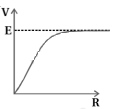
$A$ cell of $emf$ $E$ and internal resistance $r$ is connected across an external resistance $R$. Plot a graph showing the variation of potential difference $(V)$ across $R$ versus $R$.
Solution
(N/A) The potential difference $(V)$ across an external resistance $R$ connected to a cell of $emf$ $E$ and internal resistance $r$ is given by the formula:
$V = I R = \left( \frac{E}{R + r} \right) R = \frac{E}{1 + \frac{r}{R}}$
Analysis of the relation:
$1$. When $R = 0$,$V = 0$.
$2$. As $R$ increases,$V$ increases.
$3$. As $R \to \infty$,$V \to E$.
The graph shows $V$ on the $y$-axis and $R$ on the $x$-axis. The curve starts from the origin $(0,0)$ and asymptotically approaches the value $E$ as $R$ increases.
$V = I R = \left( \frac{E}{R + r} \right) R = \frac{E}{1 + \frac{r}{R}}$
Analysis of the relation:
$1$. When $R = 0$,$V = 0$.
$2$. As $R$ increases,$V$ increases.
$3$. As $R \to \infty$,$V \to E$.
The graph shows $V$ on the $y$-axis and $R$ on the $x$-axis. The curve starts from the origin $(0,0)$ and asymptotically approaches the value $E$ as $R$ increases.
0 likes
View Solution186
MediumMCQ
Two conductors are made of the same material and have the same length. Conductor $A$ is a solid wire of diameter $1 \ mm$. Conductor $B$ is a hollow tube of outer diameter $2 \ mm$ and inner diameter $1 \ mm$. Find the ratio of resistance $R_A$ to $R_B$.
A
$1:3$
B
$2:1$
C
$3:1$
D
$1:1$
Solution
(C) Resistance of a conductor is given by $R = \frac{\rho l}{A}$,where $\rho$ is resistivity,$l$ is length,and $A$ is the cross-sectional area.
For conductor $A$ (solid wire of diameter $d_A = 1 \ mm$):
Radius $r_A = 0.5 \ mm = 0.5 \times 10^{-3} \ m$.
Area $A_A = \pi r_A^2 = \pi (0.5 \times 10^{-3})^2 = 0.25 \pi \times 10^{-6} \ m^2$.
$R_A = \frac{\rho l}{0.25 \pi \times 10^{-6}} = \frac{4 \rho l}{\pi \times 10^{-6}}$....$(1)$
For conductor $B$ (hollow tube of outer diameter $D_B = 2 \ mm$ and inner diameter $d_B = 1 \ mm$):
Outer radius $R_{out} = 1 \ mm = 10^{-3} \ m$,inner radius $r_{in} = 0.5 \ mm = 0.5 \times 10^{-3} \ m$.
Area $A_B = \pi (R_{out}^2 - r_{in}^2) = \pi ((10^{-3})^2 - (0.5 \times 10^{-3})^2) = \pi (1 - 0.25) \times 10^{-6} = 0.75 \pi \times 10^{-6} \ m^2$.
$R_B = \frac{\rho l}{0.75 \pi \times 10^{-6}} = \frac{4 \rho l}{3 \pi \times 10^{-6}}$....$(2)$
Taking the ratio $\frac{R_A}{R_B}$:
$\frac{R_A}{R_B} = \frac{4 \rho l}{\pi \times 10^{-6}} \times \frac{3 \pi \times 10^{-6}}{4 \rho l} = \frac{3}{1}$.
Thus,$R_A : R_B = 3 : 1$.
For conductor $A$ (solid wire of diameter $d_A = 1 \ mm$):
Radius $r_A = 0.5 \ mm = 0.5 \times 10^{-3} \ m$.
Area $A_A = \pi r_A^2 = \pi (0.5 \times 10^{-3})^2 = 0.25 \pi \times 10^{-6} \ m^2$.
$R_A = \frac{\rho l}{0.25 \pi \times 10^{-6}} = \frac{4 \rho l}{\pi \times 10^{-6}}$....$(1)$
For conductor $B$ (hollow tube of outer diameter $D_B = 2 \ mm$ and inner diameter $d_B = 1 \ mm$):
Outer radius $R_{out} = 1 \ mm = 10^{-3} \ m$,inner radius $r_{in} = 0.5 \ mm = 0.5 \times 10^{-3} \ m$.
Area $A_B = \pi (R_{out}^2 - r_{in}^2) = \pi ((10^{-3})^2 - (0.5 \times 10^{-3})^2) = \pi (1 - 0.25) \times 10^{-6} = 0.75 \pi \times 10^{-6} \ m^2$.
$R_B = \frac{\rho l}{0.75 \pi \times 10^{-6}} = \frac{4 \rho l}{3 \pi \times 10^{-6}}$....$(2)$
Taking the ratio $\frac{R_A}{R_B}$:
$\frac{R_A}{R_B} = \frac{4 \rho l}{\pi \times 10^{-6}} \times \frac{3 \pi \times 10^{-6}}{4 \rho l} = \frac{3}{1}$.
Thus,$R_A : R_B = 3 : 1$.
0 likes
View Solution187
EasyMCQ
Consider four conducting materials: copper,tungsten,mercury,and aluminium with resistivity $\rho_{C}, \rho_{T}, \rho_{M}$,and $\rho_{A}$ respectively. Then:
A
$\rho_{A} > \rho_{T} > \rho_{C}$
B
$\rho_{C} > \rho_{A} > \rho_{T}$
C
$\rho_{A} > \rho_{M} > \rho_{C}$
D
$\rho_{M} > \rho_{A} > \rho_{C}$
Solution
(D) The resistivity values at room temperature $(20^{\circ}C)$ for the given materials are approximately:
Copper $(\rho_{C})$: $1.72 \times 10^{-8} \ \Omega \cdot m$
Aluminium $(\rho_{A})$: $2.82 \times 10^{-8} \ \Omega \cdot m$
Tungsten $(\rho_{T})$: $5.60 \times 10^{-8} \ \Omega \cdot m$
Mercury $(\rho_{M})$: $98.0 \times 10^{-8} \ \Omega \cdot m$
Comparing these values,we get $\rho_{M} > \rho_{T} > \rho_{A} > \rho_{C}$.
Among the given options,the correct relationship is $\rho_{M} > \rho_{A} > \rho_{C}$.
Copper $(\rho_{C})$: $1.72 \times 10^{-8} \ \Omega \cdot m$
Aluminium $(\rho_{A})$: $2.82 \times 10^{-8} \ \Omega \cdot m$
Tungsten $(\rho_{T})$: $5.60 \times 10^{-8} \ \Omega \cdot m$
Mercury $(\rho_{M})$: $98.0 \times 10^{-8} \ \Omega \cdot m$
Comparing these values,we get $\rho_{M} > \rho_{T} > \rho_{A} > \rho_{C}$.
Among the given options,the correct relationship is $\rho_{M} > \rho_{A} > \rho_{C}$.
0 likes
View Solution188
EasyMCQ
The solids which have the negative temperature coefficient of resistance are:
A
Insulators and semiconductors
B
Metals
C
Insulators only
D
Semiconductors only
Solution
(A) The temperature coefficient of resistance $(\alpha)$ is defined by the relation $R_t = R_0(1 + \alpha \Delta T)$.
For metals, resistance increases with temperature, so $\alpha$ is positive.
For insulators and semiconductors, the number of charge carriers increases significantly with an increase in temperature, which leads to a decrease in resistance.
Therefore, insulators and semiconductors exhibit a negative temperature coefficient of resistance.
For metals, resistance increases with temperature, so $\alpha$ is positive.
For insulators and semiconductors, the number of charge carriers increases significantly with an increase in temperature, which leads to a decrease in resistance.
Therefore, insulators and semiconductors exhibit a negative temperature coefficient of resistance.
0 likes
View Solution189
MediumMCQ
Which of the following graphs represents the variation of resistivity ( $\rho$ ) with temperature $(T)$ for copper?
A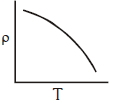
B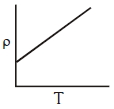
C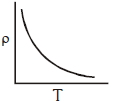
D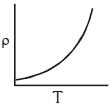
Solution
(D) For metals like copper,the resistivity ( $\rho$ ) increases with an increase in temperature $(T)$.
According to the relation $\rho_T = \rho_0 [1 + \alpha(T - T_0)]$,the resistivity increases linearly with temperature for a wide range of temperatures.
At very low temperatures,the curve becomes non-linear and approaches a finite value as $T$ approaches $0 \ K$.
Among the given options,graph $D$ correctly represents this characteristic behavior of resistivity versus temperature for a metal like copper.
According to the relation $\rho_T = \rho_0 [1 + \alpha(T - T_0)]$,the resistivity increases linearly with temperature for a wide range of temperatures.
At very low temperatures,the curve becomes non-linear and approaches a finite value as $T$ approaches $0 \ K$.
Among the given options,graph $D$ correctly represents this characteristic behavior of resistivity versus temperature for a metal like copper.
0 likes
View Solution190
EasyMCQ
Two solid conductors are made of the same material,have the same length,and have the same resistance. One of them has a circular cross-section of area $A_{1}$ and the other has a square cross-section of area $A_{2}$. The ratio $\frac{A_{1}}{A_{2}}$ is
A
$2$
B
$1.5$
C
$1$
D
$0.8$
Solution
(C) The resistance $R$ of a conductor is given by the formula:
$R = \rho \frac{l}{A}$
where $\rho$ is the resistivity,$l$ is the length,and $A$ is the cross-sectional area.
Given that both conductors are made of the same material,their resistivities are equal: $\rho_{1} = \rho_{2} = \rho$.
Given that they have the same length: $l_{1} = l_{2} = l$.
Given that they have the same resistance: $R_{1} = R_{2} = R$.
From the formula,we can express the area as $A = \frac{\rho l}{R}$.
Since $\rho$,$l$,and $R$ are identical for both conductors,the cross-sectional areas must also be equal:
$A_{1} = \frac{\rho l}{R}$ and $A_{2} = \frac{\rho l}{R}$
Therefore,$\frac{A_{1}}{A_{2}} = 1$.
$R = \rho \frac{l}{A}$
where $\rho$ is the resistivity,$l$ is the length,and $A$ is the cross-sectional area.
Given that both conductors are made of the same material,their resistivities are equal: $\rho_{1} = \rho_{2} = \rho$.
Given that they have the same length: $l_{1} = l_{2} = l$.
Given that they have the same resistance: $R_{1} = R_{2} = R$.
From the formula,we can express the area as $A = \frac{\rho l}{R}$.
Since $\rho$,$l$,and $R$ are identical for both conductors,the cross-sectional areas must also be equal:
$A_{1} = \frac{\rho l}{R}$ and $A_{2} = \frac{\rho l}{R}$
Therefore,$\frac{A_{1}}{A_{2}} = 1$.
0 likes
View Solution191
MediumMCQ
$A$ metal wire has a resistance of $35 \,\Omega$. If its length is increased to double by drawing it,then its new resistance will be (in $\Omega$)
A
$70$
B
$140$
C
$105$
D
$35$
Solution
(B) Given,initial resistance $R_{1} = 35 \,\Omega$ and final length $l_{2} = 2l_{1}$.
Since the volume of the wire remains constant during stretching,$V_{1} = V_{2}$.
$A_{1}l_{1} = A_{2}l_{2} \implies A_{2} = A_{1} \left(\frac{l_{1}}{l_{2}}\right) = A_{1} \left(\frac{l_{1}}{2l_{1}}\right) = \frac{A_{1}}{2}$.
The resistance of a wire is given by $R = \rho \frac{l}{A}$.
Therefore,the new resistance $R_{2} = \rho \frac{l_{2}}{A_{2}} = \rho \frac{2l_{1}}{A_{1}/2} = 4 \left(\rho \frac{l_{1}}{A_{1}}\right) = 4R_{1}$.
Substituting the value of $R_{1}$,we get $R_{2} = 4 \times 35 = 140 \,\Omega$.
Since the volume of the wire remains constant during stretching,$V_{1} = V_{2}$.
$A_{1}l_{1} = A_{2}l_{2} \implies A_{2} = A_{1} \left(\frac{l_{1}}{l_{2}}\right) = A_{1} \left(\frac{l_{1}}{2l_{1}}\right) = \frac{A_{1}}{2}$.
The resistance of a wire is given by $R = \rho \frac{l}{A}$.
Therefore,the new resistance $R_{2} = \rho \frac{l_{2}}{A_{2}} = \rho \frac{2l_{1}}{A_{1}/2} = 4 \left(\rho \frac{l_{1}}{A_{1}}\right) = 4R_{1}$.
Substituting the value of $R_{1}$,we get $R_{2} = 4 \times 35 = 140 \,\Omega$.
0 likes
View Solution192
MediumMCQ
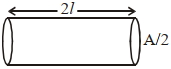
$A$ conducting wire of length $l$,area of cross-section $A$,and electric resistivity $\rho$ is connected between the terminals of a battery. $A$ potential difference $V$ is developed between its ends,causing an electric current. If the length of the wire of the same material is doubled and the area of cross-section is halved,the resultant current would be:
A
$\frac{1}{4} \frac{VA}{\rho l}$
B
$\frac{3}{4} \frac{VA}{\rho l}$
C
$\frac{1}{4} \frac{\rho l}{VA}$
D
$4 \frac{VA}{\rho l}$
Solution
(A) The initial resistance of the wire is $R = \frac{\rho l}{A}$.
According to the question,the new length $l' = 2l$ and the new area of cross-section $A' = \frac{A}{2}$.
The new resistance $R'$ is given by:
$R' = \rho \frac{l'}{A'} = \rho \frac{2l}{A/2} = \frac{4 \rho l}{A} = 4R$.
The new current $I'$ is given by Ohm's law:
$I' = \frac{V}{R'} = \frac{V}{4R} = \frac{V}{4(\rho l / A)} = \frac{1}{4} \frac{VA}{\rho l}$.
According to the question,the new length $l' = 2l$ and the new area of cross-section $A' = \frac{A}{2}$.
The new resistance $R'$ is given by:
$R' = \rho \frac{l'}{A'} = \rho \frac{2l}{A/2} = \frac{4 \rho l}{A} = 4R$.
The new current $I'$ is given by Ohm's law:
$I' = \frac{V}{R'} = \frac{V}{4R} = \frac{V}{4(\rho l / A)} = \frac{1}{4} \frac{VA}{\rho l}$.
0 likes
View Solution193
MediumMCQ
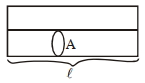
Two wires of same length and thickness having specific resistances $6 \, \Omega \, cm$ and $3 \, \Omega \, cm$ respectively are connected in parallel. The effective resistivity is $\rho \, \Omega \, cm$. The value of $\rho$ to the nearest integer is ..... .
A
$2$
B
$8$
C
$6$
D
$4$
Solution
(D) Let the length of each wire be $\ell$ and the cross-sectional area be $A$. The resistance of a wire is given by $R = \rho_{res} \frac{\ell}{A}$, where $\rho_{res}$ is the resistivity.
For the two wires connected in parallel, the individual resistances are $R_1 = \rho_1 \frac{\ell}{A} = 6 \frac{\ell}{A}$ and $R_2 = \rho_2 \frac{\ell}{A} = 3 \frac{\ell}{A}$.
The equivalent resistance $R_{net}$ for two resistors in parallel is given by $\frac{1}{R_{net}} = \frac{1}{R_1} + \frac{1}{R_2}$, or $R_{net} = \frac{R_1 R_2}{R_1 + R_2}$.
The combined cross-sectional area of the two wires in parallel is $2A$, and the length remains $\ell$. Thus, $R_{net} = \rho \frac{\ell}{2A}$.
Substituting the expressions:
$\rho \frac{\ell}{2A} = \frac{(6 \frac{\ell}{A}) (3 \frac{\ell}{A})}{6 \frac{\ell}{A} + 3 \frac{\ell}{A}}$
$\frac{\rho}{2} = \frac{6 \times 3}{6 + 3} = \frac{18}{9} = 2$
$\rho = 4 \, \Omega \, cm$.
For the two wires connected in parallel, the individual resistances are $R_1 = \rho_1 \frac{\ell}{A} = 6 \frac{\ell}{A}$ and $R_2 = \rho_2 \frac{\ell}{A} = 3 \frac{\ell}{A}$.
The equivalent resistance $R_{net}$ for two resistors in parallel is given by $\frac{1}{R_{net}} = \frac{1}{R_1} + \frac{1}{R_2}$, or $R_{net} = \frac{R_1 R_2}{R_1 + R_2}$.
The combined cross-sectional area of the two wires in parallel is $2A$, and the length remains $\ell$. Thus, $R_{net} = \rho \frac{\ell}{2A}$.
Substituting the expressions:
$\rho \frac{\ell}{2A} = \frac{(6 \frac{\ell}{A}) (3 \frac{\ell}{A})}{6 \frac{\ell}{A} + 3 \frac{\ell}{A}}$
$\frac{\rho}{2} = \frac{6 \times 3}{6 + 3} = \frac{18}{9} = 2$
$\rho = 4 \, \Omega \, cm$.
0 likes
View Solution194
DifficultMCQ
$A$ wire of $1 \,\Omega$ has a length of $1\, m$. It is stretched until its length increases by $25\, \%$. The percentage change in resistance to the nearest integer is .....$\%$
A
$56$
B
$25$
C
$12.5$
D
$76$
Solution
(A) Initial resistance $R_{0} = 1\, \Omega$ and initial length $\ell_{0} = 1\, m$.
When the wire is stretched,its volume remains constant. Let the new length be $\ell_{1}$.
Given that the length increases by $25\, \%$,so $\ell_{1} = \ell_{0} + 0.25\ell_{0} = 1.25\ell_{0} = 1.25\, m$.
Since volume $V = A \ell$ is constant,$A_{0}\ell_{0} = A_{1}\ell_{1}$,which implies $A_{1} = A_{0}(\ell_{0} / \ell_{1})$.
The resistance $R$ is given by $R = \rho \frac{\ell}{A}$.
Therefore,the new resistance $R_{1} = \rho \frac{\ell_{1}}{A_{1}} = \rho \frac{\ell_{1}}{A_{0}(\ell_{0} / \ell_{1})} = \rho \frac{\ell_{1}^{2}}{A_{0}\ell_{0}} = R_{0} \left( \frac{\ell_{1}}{\ell_{0}} \right)^{2}$.
Substituting the values: $R_{1} = 1 \times (1.25)^{2} = 1.5625\, \Omega$.
The percentage change in resistance is $\frac{R_{1} - R_{0}}{R_{0}} \times 100\, \% = \frac{1.5625 - 1}{1} \times 100\, \% = 56.25\, \%$.
Rounding to the nearest integer,the percentage change is $56\, \%$.
When the wire is stretched,its volume remains constant. Let the new length be $\ell_{1}$.
Given that the length increases by $25\, \%$,so $\ell_{1} = \ell_{0} + 0.25\ell_{0} = 1.25\ell_{0} = 1.25\, m$.
Since volume $V = A \ell$ is constant,$A_{0}\ell_{0} = A_{1}\ell_{1}$,which implies $A_{1} = A_{0}(\ell_{0} / \ell_{1})$.
The resistance $R$ is given by $R = \rho \frac{\ell}{A}$.
Therefore,the new resistance $R_{1} = \rho \frac{\ell_{1}}{A_{1}} = \rho \frac{\ell_{1}}{A_{0}(\ell_{0} / \ell_{1})} = \rho \frac{\ell_{1}^{2}}{A_{0}\ell_{0}} = R_{0} \left( \frac{\ell_{1}}{\ell_{0}} \right)^{2}$.
Substituting the values: $R_{1} = 1 \times (1.25)^{2} = 1.5625\, \Omega$.
The percentage change in resistance is $\frac{R_{1} - R_{0}}{R_{0}} \times 100\, \% = \frac{1.5625 - 1}{1} \times 100\, \% = 56.25\, \%$.
Rounding to the nearest integer,the percentage change is $56\, \%$.
0 likes
View Solution195
MediumMCQ
The resistance of a conductor at $15^{\circ}C$ is $16\, \Omega$ and at $100^{\circ}C$ is $20\, \Omega$. What will be the temperature coefficient of resistance of the conductor?
A
$0.033\, ^{\circ}C^{-1}$
B
$0.010\, ^{\circ}C^{-1}$
C
$0.042\, ^{\circ}C^{-1}$
D
$0.003\, ^{\circ}C^{-1}$
Solution
(D) The resistance of a conductor at temperature $T$ is given by the formula: $R_T = R_0(1 + \alpha \Delta T)$,where $R_0$ is the resistance at $0^{\circ}C$,$\alpha$ is the temperature coefficient of resistance,and $\Delta T$ is the change in temperature.
Given:
$R_1 = 16\, \Omega$ at $T_1 = 15^{\circ}C$
$R_2 = 20\, \Omega$ at $T_2 = 100^{\circ}C$
Using the relation $R_T = R_0(1 + \alpha T)$:
$16 = R_0(1 + 15\alpha)$ --- (Equation $1$)
$20 = R_0(1 + 100\alpha)$ --- (Equation $2$)
Dividing Equation $2$ by Equation $1$:
$\frac{20}{16} = \frac{1 + 100\alpha}{1 + 15\alpha}$
$1.25(1 + 15\alpha) = 1 + 100\alpha$
$1.25 + 18.75\alpha = 1 + 100\alpha$
$0.25 = 81.25\alpha$
$\alpha = \frac{0.25}{81.25} \approx 0.00307\, ^{\circ}C^{-1}$
Rounding to the nearest value,we get $\alpha \approx 0.003\, ^{\circ}C^{-1}$.
Given:
$R_1 = 16\, \Omega$ at $T_1 = 15^{\circ}C$
$R_2 = 20\, \Omega$ at $T_2 = 100^{\circ}C$
Using the relation $R_T = R_0(1 + \alpha T)$:
$16 = R_0(1 + 15\alpha)$ --- (Equation $1$)
$20 = R_0(1 + 100\alpha)$ --- (Equation $2$)
Dividing Equation $2$ by Equation $1$:
$\frac{20}{16} = \frac{1 + 100\alpha}{1 + 15\alpha}$
$1.25(1 + 15\alpha) = 1 + 100\alpha$
$1.25 + 18.75\alpha = 1 + 100\alpha$
$0.25 = 81.25\alpha$
$\alpha = \frac{0.25}{81.25} \approx 0.00307\, ^{\circ}C^{-1}$
Rounding to the nearest value,we get $\alpha \approx 0.003\, ^{\circ}C^{-1}$.
0 likes
View Solution196
EasyMCQ
As the temperature increases,the electrical resistance:
A
decreases for both conductors and semiconductors
B
increases for conductors but decreases for semiconductors
C
decreases for conductors but increases for semiconductors
D
increases for both conductors and semiconductors
Solution
(B) For conductors,the temperature coefficient of resistance $\alpha$ is positive,meaning resistance increases with temperature.
For semiconductors,the temperature coefficient of resistance $\alpha$ is negative,meaning resistance decreases as temperature increases due to the increase in the number of charge carriers.
For semiconductors,the temperature coefficient of resistance $\alpha$ is negative,meaning resistance decreases as temperature increases due to the increase in the number of charge carriers.
0 likes
View Solution197
MediumMCQ
The length of a given cylindrical wire is increased to double of its original length. The percentage increase in the resistance of the wire will be..... $\%$.
A
$390$
B
$300$
C
$370$
D
$399$
Solution
(B) Since the volume $V$ of the wire remains constant during stretching,we have $V = A \ell = A^{\prime} \ell^{\prime}$.
Given that the new length $\ell^{\prime} = 2\ell$,we substitute this into the volume equation: $A \ell = A^{\prime} (2\ell)$,which gives $A^{\prime} = \frac{A}{2}$.
The initial resistance is $R = \rho \frac{\ell}{A}$.
The new resistance is $R^{\prime} = \rho \frac{\ell^{\prime}}{A^{\prime}} = \rho \frac{2\ell}{A/2} = 4 \rho \frac{\ell}{A} = 4R$.
The percentage increase in resistance is given by $\frac{R^{\prime} - R}{R} \times 100\%$.
Substituting $R^{\prime} = 4R$,we get $\frac{4R - R}{R} \times 100\% = 3 \times 100\% = 300\%$.
Given that the new length $\ell^{\prime} = 2\ell$,we substitute this into the volume equation: $A \ell = A^{\prime} (2\ell)$,which gives $A^{\prime} = \frac{A}{2}$.
The initial resistance is $R = \rho \frac{\ell}{A}$.
The new resistance is $R^{\prime} = \rho \frac{\ell^{\prime}}{A^{\prime}} = \rho \frac{2\ell}{A/2} = 4 \rho \frac{\ell}{A} = 4R$.
The percentage increase in resistance is given by $\frac{R^{\prime} - R}{R} \times 100\%$.
Substituting $R^{\prime} = 4R$,we get $\frac{4R - R}{R} \times 100\% = 3 \times 100\% = 300\%$.
0 likes
View Solution198
MediumMCQ
An aluminium wire is stretched to make its length $0.4 \%$ larger. Then the percentage change in resistance is $.....\,\%$.
A
$0.4$
B
$0.2$
C
$0.8$
D
$0.6$
Solution
(C) The resistance of a wire is given by $R = \frac{\rho \ell}{A}$.
Since the volume $V = \ell A$ remains constant during stretching,we have $A = \frac{V}{\ell}$.
Substituting this into the resistance formula,we get $R = \frac{\rho \ell^2}{V}$.
For small changes,the relative change in resistance is given by $\frac{\Delta R}{R} = 2 \frac{\Delta \ell}{\ell}$.
Given that the percentage change in length is $\frac{\Delta \ell}{\ell} \times 100 = 0.4 \%$.
Therefore,the percentage change in resistance is $\frac{\Delta R}{R} \times 100 = 2 \times 0.4 \% = 0.8 \%$.
Since the volume $V = \ell A$ remains constant during stretching,we have $A = \frac{V}{\ell}$.
Substituting this into the resistance formula,we get $R = \frac{\rho \ell^2}{V}$.
For small changes,the relative change in resistance is given by $\frac{\Delta R}{R} = 2 \frac{\Delta \ell}{\ell}$.
Given that the percentage change in length is $\frac{\Delta \ell}{\ell} \times 100 = 0.4 \%$.
Therefore,the percentage change in resistance is $\frac{\Delta R}{R} \times 100 = 2 \times 0.4 \% = 0.8 \%$.
0 likes
View Solution199
MediumMCQ
Resistance of the wire is measured as $2\,\Omega$ and $3\,\Omega$ at $10^{\circ}C$ and $30^{\circ}C$ respectively. The temperature coefficient of resistance of the material of the wire is............$^{\circ}C^{-1}$.
A
$0.033$
B
$-0.033$
C
$0.011$
D
$0.055$
Solution
(A) The resistance $R$ at temperature $T$ is given by the formula $R = R_{T_0}[1 + \alpha(T - T_0)]$,where $R_{T_0}$ is the resistance at reference temperature $T_0$ and $\alpha$ is the temperature coefficient of resistance.
Given:
$R_1 = 2\,\Omega$ at $T_1 = 10^{\circ}C$
$R_2 = 3\,\Omega$ at $T_2 = 30^{\circ}C$
Using the relation $R_T = R_0(1 + \alpha T)$,we have:
$2 = R_0(1 + 10\alpha)$ --- (Equation $1$)
$3 = R_0(1 + 30\alpha)$ --- (Equation $2$)
Dividing Equation $2$ by Equation $1$:
$\frac{3}{2} = \frac{1 + 30\alpha}{1 + 10\alpha}$
Cross-multiplying:
$3(1 + 10\alpha) = 2(1 + 30\alpha)$
$3 + 30\alpha = 2 + 60\alpha$
$3 - 2 = 60\alpha - 30\alpha$
$1 = 30\alpha$
$\alpha = \frac{1}{30} \approx 0.033\,^{\circ}C^{-1}$.
Given:
$R_1 = 2\,\Omega$ at $T_1 = 10^{\circ}C$
$R_2 = 3\,\Omega$ at $T_2 = 30^{\circ}C$
Using the relation $R_T = R_0(1 + \alpha T)$,we have:
$2 = R_0(1 + 10\alpha)$ --- (Equation $1$)
$3 = R_0(1 + 30\alpha)$ --- (Equation $2$)
Dividing Equation $2$ by Equation $1$:
$\frac{3}{2} = \frac{1 + 30\alpha}{1 + 10\alpha}$
Cross-multiplying:
$3(1 + 10\alpha) = 2(1 + 30\alpha)$
$3 + 30\alpha = 2 + 60\alpha$
$3 - 2 = 60\alpha - 30\alpha$
$1 = 30\alpha$
$\alpha = \frac{1}{30} \approx 0.033\,^{\circ}C^{-1}$.
0 likes
View SolutionCurrent Electricity — Resistance of wire, Resistivity and Conductivity · Frequently Asked Questions
1Are these Current Electricity questions useful for JEE and NEET?
Yes. All questions in this section are mapped to JEE Main and NEET exam patterns. Previous year questions from JEE Main, NEET, GUJCET and state-level exams are included with full solutions.
2Can I switch to Hindi or Gujarati for these questions?
Yes. Use the language tabs in the hero section or the sidebar to view the same questions and solutions in English, Hindi or Gujarati.
3How do I generate a question paper from this subtopic?
Use the Vedclass Exam Paper Generator — select the chapter and subtopic, set difficulty, and generate Sets A, B, C, D automatically. First 3 chapters of every subject are free.
Vedclass Products
For Students
Vedclass Test Series
Mock tests in real JEE/NEET style with performance analysis. 5-day free trial.
Start Free TrialFor Teachers
Exam Paper Generator
Generate Set A/B/C/D papers from this chapter in 2 minutes. 3 chapters free.
Try FreeFor Institutes
Online Exam Module
Live online exams with unlimited students, 360° analytics & white-label branding.
See DemoFor Teachers & Institutes
Generate a Current Electricity Exam Paper in 2 Minutes
Select subtopic & difficulty — Sets A, B, C, D auto-generated with No Repeat logic.
First 3 chapters of every subject are free — no payment required.