
A English
Resistance of wire, Resistivity and Conductivity Questions in English
Class 12 Physics · Current Electricity · Resistance of wire, Resistivity and Conductivity
308+
Questions
English
Language
100%
With Solutions
Showing 48 of 308 questions in English
101
MediumMCQ
$A$ wire has a resistance of $10\, \Omega$. If its length is increased by $10\%$ by stretching,what will be the new resistance of the wire in $\Omega$?
A
$12$
B
$1.2$
C
$13$
D
$11$
Solution
(A) The resistance $R$ of a wire is given by $R = \rho \frac{l}{A}$. Since the volume $V = l \times A$ remains constant during stretching,$A = \frac{V}{l}$.
Substituting this,we get $R = \rho \frac{l^2}{V}$,which implies $R \propto l^2$.
If the length increases by $10\%$,the new length $l' = l + 0.1l = 1.1l$.
The new resistance $R'$ is given by $R' = R \times (\frac{l'}{l})^2$.
$R' = 10 \times (1.1)^2 = 10 \times 1.21 = 12.1\, \Omega$.
Note: For small changes,the approximation $\Delta R/R \approx 2 \Delta l/l$ gives a $20\%$ increase,but the exact calculation yields $12.1\, \Omega$.
Substituting this,we get $R = \rho \frac{l^2}{V}$,which implies $R \propto l^2$.
If the length increases by $10\%$,the new length $l' = l + 0.1l = 1.1l$.
The new resistance $R'$ is given by $R' = R \times (\frac{l'}{l})^2$.
$R' = 10 \times (1.1)^2 = 10 \times 1.21 = 12.1\, \Omega$.
Note: For small changes,the approximation $\Delta R/R \approx 2 \Delta l/l$ gives a $20\%$ increase,but the exact calculation yields $12.1\, \Omega$.
0 likes
View Solution102
EasyMCQ
Two copper wires $A$ and $B$ have the same diameter and lengths of $3 \ cm$ and $5 \ cm$ respectively. If their resistances are $R_A$ and $R_B$ and their resistivities are $\rho_A$ and $\rho_B$,then which of the following is correct?
A
$R_A > R_B$,where $\rho_A > \rho_B$
B
$R_A > R_B$,where $\rho_A < \rho_B$
C
$R_A > R_B$,where $\rho_A = \rho_B$
D
$R_A < R_B$,where $\rho_A = \rho_B$
Solution
(D) Since both wires are made of copper,their resistivities are equal,i.e.,$\rho_A = \rho_B = \rho$.
The resistance of a wire is given by the formula $R = \rho \frac{l}{A}$,where $l$ is the length and $A$ is the cross-sectional area.
For wire $A$: $R_A = \rho \frac{3}{A}$.
For wire $B$: $R_B = \rho \frac{5}{A}$.
Comparing the two,since $3 < 5$ and the material and diameter (and thus area $A$) are the same,it follows that $R_A < R_B$.
Therefore,the correct relation is $R_A < R_B$ with $\rho_A = \rho_B$.
The resistance of a wire is given by the formula $R = \rho \frac{l}{A}$,where $l$ is the length and $A$ is the cross-sectional area.
For wire $A$: $R_A = \rho \frac{3}{A}$.
For wire $B$: $R_B = \rho \frac{5}{A}$.
Comparing the two,since $3 < 5$ and the material and diameter (and thus area $A$) are the same,it follows that $R_A < R_B$.
Therefore,the correct relation is $R_A < R_B$ with $\rho_A = \rho_B$.
0 likes
View Solution103
DifficultMCQ
At what temperature $(^oC)$ will the resistance of a copper wire become three times its value at $0^oC$? (Given: Temperature coefficient of resistance of copper at $0^oC$ is $\alpha = 4 \times 10^{-3} / ^oC$)
A
$400$
B
$450$
C
$500$
D
$550$
Solution
(C) The formula for the resistance of a conductor at temperature $T$ is given by $R_T = R_0 (1 + \alpha \Delta T)$.
Here,$R_T = 3R_0$,$\alpha = 4 \times 10^{-3} / ^oC$,and $\Delta T = T - 0 = T$.
Substituting the values: $3R_0 = R_0 (1 + 4 \times 10^{-3} \times T)$.
Dividing both sides by $R_0$: $3 = 1 + 0.004T$.
$2 = 0.004T$.
$T = 2 / 0.004 = 2000 / 4 = 500 ^oC$.
Therefore,the temperature is $500 ^oC$.
Here,$R_T = 3R_0$,$\alpha = 4 \times 10^{-3} / ^oC$,and $\Delta T = T - 0 = T$.
Substituting the values: $3R_0 = R_0 (1 + 4 \times 10^{-3} \times T)$.
Dividing both sides by $R_0$: $3 = 1 + 0.004T$.
$2 = 0.004T$.
$T = 2 / 0.004 = 2000 / 4 = 500 ^oC$.
Therefore,the temperature is $500 ^oC$.
0 likes
View Solution104
MediumMCQ
The resistance of a wire at $50^{\circ}C$ is $5\, \Omega$ and at $100^{\circ}C$ is $6\, \Omega$. The resistance of the wire at $0^{\circ}C$ is ............... $\Omega$.
A
$2$
B
$1$
C
$4$
D
$3$
Solution
(C) The resistance of a conductor at temperature $t$ is given by $R_t = R_0(1 + \alpha t)$, where $R_0$ is the resistance at $0^{\circ}C$ and $\alpha$ is the temperature coefficient of resistance.
For $t = 50^{\circ}C$, $R_{50} = R_0(1 + 50\alpha) = 5$ --- $(1)$
For $t = 100^{\circ}C$, $R_{100} = R_0(1 + 100\alpha) = 6$ --- $(2)$
Dividing equation $(2)$ by equation $(1)$:
$\frac{R_0(1 + 100\alpha)}{R_0(1 + 50\alpha)} = \frac{6}{5}$
$5(1 + 100\alpha) = 6(1 + 50\alpha)$
$5 + 500\alpha = 6 + 300\alpha$
$200\alpha = 1$
$\alpha = \frac{1}{200} = 0.005^{\circ}C^{-1}$
Substituting $\alpha$ into equation $(1)$:
$5 = R_0(1 + 50 \times 0.005)$
$5 = R_0(1 + 0.25)$
$5 = R_0(1.25)$
$R_0 = \frac{5}{1.25} = 4\, \Omega$.
For $t = 50^{\circ}C$, $R_{50} = R_0(1 + 50\alpha) = 5$ --- $(1)$
For $t = 100^{\circ}C$, $R_{100} = R_0(1 + 100\alpha) = 6$ --- $(2)$
Dividing equation $(2)$ by equation $(1)$:
$\frac{R_0(1 + 100\alpha)}{R_0(1 + 50\alpha)} = \frac{6}{5}$
$5(1 + 100\alpha) = 6(1 + 50\alpha)$
$5 + 500\alpha = 6 + 300\alpha$
$200\alpha = 1$
$\alpha = \frac{1}{200} = 0.005^{\circ}C^{-1}$
Substituting $\alpha$ into equation $(1)$:
$5 = R_0(1 + 50 \times 0.005)$
$5 = R_0(1 + 0.25)$
$5 = R_0(1.25)$
$R_0 = \frac{5}{1.25} = 4\, \Omega$.
0 likes
View Solution105
MediumMCQ
The specific resistance (resistivity) of material $B$ is twice that of material $A$. Two wires are prepared from these materials having the same resistance. If the diameter of wire $B$ is twice the diameter of wire $A$,then the ratio of the lengths of the two wires $l_B / l_A$ is equal to ......
A
$1$
B
$1/2$
C
$1/4$
D
$2$
Solution
(D) Given that the resistances are equal,$R_A = R_B$.
Using the formula for resistance $R = \rho \frac{l}{A} = \rho \frac{l}{\pi r^2}$,we have:
$\rho_A \frac{l_A}{\pi r_A^2} = \rho_B \frac{l_B}{\pi r_B^2}$
Given $\rho_B = 2\rho_A$ and $d_B = 2d_A$ (which implies $r_B = 2r_A$):
$\rho_A \frac{l_A}{r_A^2} = (2\rho_A) \frac{l_B}{(2r_A)^2}$
$\rho_A \frac{l_A}{r_A^2} = 2\rho_A \frac{l_B}{4r_A^2}$
$l_A = \frac{1}{2} l_B$
Therefore,$\frac{l_B}{l_A} = 2$.
Using the formula for resistance $R = \rho \frac{l}{A} = \rho \frac{l}{\pi r^2}$,we have:
$\rho_A \frac{l_A}{\pi r_A^2} = \rho_B \frac{l_B}{\pi r_B^2}$
Given $\rho_B = 2\rho_A$ and $d_B = 2d_A$ (which implies $r_B = 2r_A$):
$\rho_A \frac{l_A}{r_A^2} = (2\rho_A) \frac{l_B}{(2r_A)^2}$
$\rho_A \frac{l_A}{r_A^2} = 2\rho_A \frac{l_B}{4r_A^2}$
$l_A = \frac{1}{2} l_B$
Therefore,$\frac{l_B}{l_A} = 2$.
0 likes
View Solution106
MediumMCQ
Two different conductors have the same resistance at $0\,^{\circ}C$. The resistance of the first conductor at $t_1\,^{\circ}C$ is equal to the resistance of the second conductor at $t_2\,^{\circ}C$. What is the ratio of their temperature coefficients of resistance $\alpha_1 / \alpha_2$?
A
$t_1 / t_2$
B
$(t_2 - t_1) / t_2$
C
$(t_2 - t_1) / t_1$
D
$t_2 / t_1$
Solution
(D) Let $R_0$ be the resistance of both conductors at $0\,^{\circ}C$.
For the first conductor at $t_1\,^{\circ}C$,the resistance is $R_1 = R_0(1 + \alpha_1 t_1)$.
For the second conductor at $t_2\,^{\circ}C$,the resistance is $R_2 = R_0(1 + \alpha_2 t_2)$.
Given that $R_1 = R_2$,we have:
$R_0(1 + \alpha_1 t_1) = R_0(1 + \alpha_2 t_2)$
$1 + \alpha_1 t_1 = 1 + \alpha_2 t_2$
$\alpha_1 t_1 = \alpha_2 t_2$
Therefore,the ratio $\alpha_1 / \alpha_2 = t_2 / t_1$.
For the first conductor at $t_1\,^{\circ}C$,the resistance is $R_1 = R_0(1 + \alpha_1 t_1)$.
For the second conductor at $t_2\,^{\circ}C$,the resistance is $R_2 = R_0(1 + \alpha_2 t_2)$.
Given that $R_1 = R_2$,we have:
$R_0(1 + \alpha_1 t_1) = R_0(1 + \alpha_2 t_2)$
$1 + \alpha_1 t_1 = 1 + \alpha_2 t_2$
$\alpha_1 t_1 = \alpha_2 t_2$
Therefore,the ratio $\alpha_1 / \alpha_2 = t_2 / t_1$.
0 likes
View Solution107
MediumMCQ
The resistance of the filament of an 'incandescent' bulb increases with an increase in temperature. If $R_{100}$,$R_{60}$,and $R_{40}$ are the resistances of $100 \ W$,$60 \ W$,and $40 \ W$ bulbs at room temperature,respectively,then:
A
$\frac{1}{R_{100}} = \frac{1}{R_{40}} + \frac{1}{R_{60}}$
B
$R_{100} = R_{40} + R_{60}$
C
$R_{100} > R_{60} > R_{40}$
D
$\frac{1}{R_{100}} > \frac{1}{R_{60}} > \frac{1}{R_{40}}$
Solution
(D) The power rating of a bulb is given by $P = \frac{V^2}{R}$,where $V$ is the rated voltage and $R$ is the resistance at operating temperature.
Since the resistance increases with temperature,the resistance at room temperature follows the same trend as the resistance at operating temperature.
For a fixed voltage $V$,$R = \frac{V^2}{P}$.
Thus,$R_{100} = \frac{V^2}{100}$,$R_{60} = \frac{V^2}{60}$,and $R_{40} = \frac{V^2}{40}$.
Comparing these values,we get $R_{40} > R_{60} > R_{100}$.
Taking the reciprocal,we get $\frac{1}{R_{100}} > \frac{1}{R_{60}} > \frac{1}{R_{40}}$.
Since the resistance increases with temperature,the resistance at room temperature follows the same trend as the resistance at operating temperature.
For a fixed voltage $V$,$R = \frac{V^2}{P}$.
Thus,$R_{100} = \frac{V^2}{100}$,$R_{60} = \frac{V^2}{60}$,and $R_{40} = \frac{V^2}{40}$.
Comparing these values,we get $R_{40} > R_{60} > R_{100}$.
Taking the reciprocal,we get $\frac{1}{R_{100}} > \frac{1}{R_{60}} > \frac{1}{R_{40}}$.
0 likes
View Solution108
DifficultMCQ
The temperature coefficient of resistance of a resistor wire is $0.00125\,^{\circ}C^{-1}$. At $300\,K$,its resistance is $1\,\Omega$. At what temperature in $K$ will its resistance be $2\,\Omega$?
A
$1154$
B
$1100$
C
$1400$
D
$1127$
Solution
(B) The formula for resistance at temperature $T$ is $R_T = R_0[1 + \alpha(T - T_0)]$.
Given: $\alpha = 0.00125\,^{\circ}C^{-1}$,$R_1 = 1\,\Omega$ at $T_1 = 300\,K$ $(27\,^{\circ}C)$,and $R_2 = 2\,\Omega$ at $T_2 = ?$.
Using the relation $R_2 = R_1[1 + \alpha(t_2 - t_1)]$,where $t_1 = 27\,^{\circ}C$:
$2 = 1[1 + 0.00125(t_2 - 27)]$
$2 - 1 = 0.00125(t_2 - 27)$
$1 = 0.00125(t_2 - 27)$
$t_2 - 27 = \frac{1}{0.00125} = 800$
$t_2 = 800 + 27 = 827\,^{\circ}C$.
Converting to Kelvin: $T_2 = 827 + 273 = 1100\,K$.
Given: $\alpha = 0.00125\,^{\circ}C^{-1}$,$R_1 = 1\,\Omega$ at $T_1 = 300\,K$ $(27\,^{\circ}C)$,and $R_2 = 2\,\Omega$ at $T_2 = ?$.
Using the relation $R_2 = R_1[1 + \alpha(t_2 - t_1)]$,where $t_1 = 27\,^{\circ}C$:
$2 = 1[1 + 0.00125(t_2 - 27)]$
$2 - 1 = 0.00125(t_2 - 27)$
$1 = 0.00125(t_2 - 27)$
$t_2 - 27 = \frac{1}{0.00125} = 800$
$t_2 = 800 + 27 = 827\,^{\circ}C$.
Converting to Kelvin: $T_2 = 827 + 273 = 1100\,K$.
0 likes
View Solution109
MediumMCQ
The resistance of a platinum resistance thermometer at $0\,^oC$ is $5\,\Omega$ and at $100\,^oC$ is $5.75\,\Omega$. When the resistance is $5.15\,\Omega$,the unknown temperature is ............ $^oC$.
A
$40$
B
$10$
C
$15$
D
$20$
Solution
(D) The resistance $R$ at temperature $\theta$ is given by the formula: $R = R_0(1 + \alpha \theta)$.
Given:
$R_0 = 5\,\Omega$ (at $0\,^oC$)
$R_{100} = 5.75\,\Omega$ (at $100\,^oC$)
$R_{\theta} = 5.15\,\Omega$ (at unknown temperature $\theta$)
First,calculate the temperature coefficient of resistance $\alpha$:
$R_{100} = R_0(1 + \alpha \times 100)$
$5.75 = 5(1 + 100\alpha)$
$1.15 = 1 + 100\alpha$
$0.15 = 100\alpha$
$\alpha = 0.0015\,\,^oC^{-1} = 1.5 \times 10^{-3}\,\,^oC^{-1}$.
Now,find the unknown temperature $\theta$ for $R_{\theta} = 5.15\,\Omega$:
$R_{\theta} = R_0(1 + \alpha \theta)$
$5.15 = 5(1 + 0.0015 \times \theta)$
$1.03 = 1 + 0.0015 \times \theta$
$0.03 = 0.0015 \times \theta$
$\theta = \frac{0.03}{0.0015} = 20\,^oC$.
Given:
$R_0 = 5\,\Omega$ (at $0\,^oC$)
$R_{100} = 5.75\,\Omega$ (at $100\,^oC$)
$R_{\theta} = 5.15\,\Omega$ (at unknown temperature $\theta$)
First,calculate the temperature coefficient of resistance $\alpha$:
$R_{100} = R_0(1 + \alpha \times 100)$
$5.75 = 5(1 + 100\alpha)$
$1.15 = 1 + 100\alpha$
$0.15 = 100\alpha$
$\alpha = 0.0015\,\,^oC^{-1} = 1.5 \times 10^{-3}\,\,^oC^{-1}$.
Now,find the unknown temperature $\theta$ for $R_{\theta} = 5.15\,\Omega$:
$R_{\theta} = R_0(1 + \alpha \theta)$
$5.15 = 5(1 + 0.0015 \times \theta)$
$1.03 = 1 + 0.0015 \times \theta$
$0.03 = 0.0015 \times \theta$
$\theta = \frac{0.03}{0.0015} = 20\,^oC$.
0 likes
View Solution110
DifficultMCQ
The resistance of a wire at $30^{\circ}C$ is $10\, \Omega$. To increase the resistance of the wire by $10\%$,the temperature should be .......... $^{\circ}C$. The temperature coefficient of resistance of the material of the wire is $0.002\, ^{\circ}C^{-1}$.
A
$36$
B
$83$
C
$63$
D
$33$
Solution
(B) Given: Initial temperature $T_1 = 30^{\circ}C$,Initial resistance $R_1 = 10\, \Omega$,Temperature coefficient $\alpha = 0.002\, ^{\circ}C^{-1}$.
We want to increase the resistance by $10\%$,so the new resistance $R_2 = R_1 + 0.10 R_1 = 1.10 R_1 = 11\, \Omega$.
The formula for resistance at temperature $T$ is $R = R_0(1 + \alpha T)$.
For $T_1 = 30^{\circ}C$: $R_1 = R_0(1 + 30\alpha) = 10\, \Omega$.
For $T_2$: $R_2 = R_0(1 + \alpha T_2) = 11\, \Omega$.
Dividing the two equations: $\frac{R_2}{R_1} = \frac{1 + \alpha T_2}{1 + 30\alpha} = \frac{11}{10} = 1.1$.
$1 + \alpha T_2 = 1.1(1 + 30\alpha) = 1.1 + 33\alpha$.
$\alpha T_2 = 0.1 + 33\alpha$.
$T_2 = \frac{0.1}{\alpha} + 33$.
Substituting $\alpha = 0.002$: $T_2 = \frac{0.1}{0.002} + 33 = 50 + 33 = 83^{\circ}C$.
We want to increase the resistance by $10\%$,so the new resistance $R_2 = R_1 + 0.10 R_1 = 1.10 R_1 = 11\, \Omega$.
The formula for resistance at temperature $T$ is $R = R_0(1 + \alpha T)$.
For $T_1 = 30^{\circ}C$: $R_1 = R_0(1 + 30\alpha) = 10\, \Omega$.
For $T_2$: $R_2 = R_0(1 + \alpha T_2) = 11\, \Omega$.
Dividing the two equations: $\frac{R_2}{R_1} = \frac{1 + \alpha T_2}{1 + 30\alpha} = \frac{11}{10} = 1.1$.
$1 + \alpha T_2 = 1.1(1 + 30\alpha) = 1.1 + 33\alpha$.
$\alpha T_2 = 0.1 + 33\alpha$.
$T_2 = \frac{0.1}{\alpha} + 33$.
Substituting $\alpha = 0.002$: $T_2 = \frac{0.1}{0.002} + 33 = 50 + 33 = 83^{\circ}C$.
0 likes
View Solution111
MediumMCQ
The resistance of a resistance wire is $5\,\Omega$ at $50\,^{\circ}\text{C}$ and $6\,\Omega$ at $100\,^{\circ}\text{C}$. The resistance at $0\,^{\circ}\text{C}$ will be ............. $\Omega$.
A
$1$
B
$2$
C
$3$
D
$4$
Solution
(D) The resistance at temperature $\theta$ is given by $R_{\theta} = R_0(1 + \alpha\theta)$,where $R_0$ is the resistance at $0\,^{\circ}\text{C}$.
At $50\,^{\circ}\text{C}$,$5 = R_0(1 + 50\alpha)$ ... $(1)$
At $100\,^{\circ}\text{C}$,$6 = R_0(1 + 100\alpha)$ ... $(2)$
Dividing equation $(1)$ by equation $(2)$:
$\frac{5}{6} = \frac{1 + 50\alpha}{1 + 100\alpha}$
$5(1 + 100\alpha) = 6(1 + 50\alpha)$
$5 + 500\alpha = 6 + 300\alpha$
$200\alpha = 1 \implies \alpha = \frac{1}{200}$
Substituting $\alpha$ in equation $(1)$:
$5 = R_0(1 + 50 \times \frac{1}{200})$
$5 = R_0(1 + \frac{1}{4})$
$5 = R_0(\frac{5}{4})$
$R_0 = 4\,\Omega$.
At $50\,^{\circ}\text{C}$,$5 = R_0(1 + 50\alpha)$ ... $(1)$
At $100\,^{\circ}\text{C}$,$6 = R_0(1 + 100\alpha)$ ... $(2)$
Dividing equation $(1)$ by equation $(2)$:
$\frac{5}{6} = \frac{1 + 50\alpha}{1 + 100\alpha}$
$5(1 + 100\alpha) = 6(1 + 50\alpha)$
$5 + 500\alpha = 6 + 300\alpha$
$200\alpha = 1 \implies \alpha = \frac{1}{200}$
Substituting $\alpha$ in equation $(1)$:
$5 = R_0(1 + 50 \times \frac{1}{200})$
$5 = R_0(1 + \frac{1}{4})$
$5 = R_0(\frac{5}{4})$
$R_0 = 4\,\Omega$.
0 likes
View Solution112
MediumMCQ
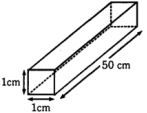
$A$ rectangular carbon block has dimensions $1.0 \ cm \times 1.0 \ cm \times 50 \ cm$. The resistance is to be measured first between the two square ends and then between the two rectangular ends. If the resistivity of carbon is $3.5 \times 10^{-5} \ \Omega \cdot m$,find the values of the resistances in both cases respectively.
A
$17.5 \times 10^{-2} \ \Omega, 7 \times 10^{-6} \ \Omega$
B
$7.5 \times 10^{-5} \ \Omega, 7.5 \times 10^{-2} \ \Omega$
C
$17.5 \times 10^{-4} \ \Omega, 7 \times 10^{-7} \ \Omega$
D
$7.5 \ \Omega, 7 \times 10^{-2} \ \Omega$
Solution
(A) Given: Dimensions $l_1 = 50 \ cm = 0.5 \ m$,$A_1 = 1 \ cm \times 1 \ cm = 10^{-4} \ m^2$. Resistivity $\rho = 3.5 \times 10^{-5} \ \Omega \cdot m$.
Case $1$: Resistance between square ends $(l = 0.5 \ m, A = 10^{-4} \ m^2)$:
$R_1 = \rho \frac{l}{A} = 3.5 \times 10^{-5} \times \frac{0.5}{10^{-4}} = 3.5 \times 0.5 \times 10^{-1} = 1.75 \times 10^{-1} = 17.5 \times 10^{-2} \ \Omega$.
Case $2$: Resistance between rectangular ends $(l = 1 \ cm = 0.01 \ m, A = 1 \ cm \times 50 \ cm = 50 \ cm^2 = 50 \times 10^{-4} \ m^2)$:
$R_2 = \rho \frac{l}{A} = 3.5 \times 10^{-5} \times \frac{0.01}{50 \times 10^{-4}} = 3.5 \times 10^{-5} \times \frac{10^{-2}}{50 \times 10^{-4}} = 3.5 \times 10^{-5} \times \frac{1}{50} \times 10^2 = 0.07 \times 10^{-4} = 7 \times 10^{-6} \ \Omega$.
Case $1$: Resistance between square ends $(l = 0.5 \ m, A = 10^{-4} \ m^2)$:
$R_1 = \rho \frac{l}{A} = 3.5 \times 10^{-5} \times \frac{0.5}{10^{-4}} = 3.5 \times 0.5 \times 10^{-1} = 1.75 \times 10^{-1} = 17.5 \times 10^{-2} \ \Omega$.
Case $2$: Resistance between rectangular ends $(l = 1 \ cm = 0.01 \ m, A = 1 \ cm \times 50 \ cm = 50 \ cm^2 = 50 \times 10^{-4} \ m^2)$:
$R_2 = \rho \frac{l}{A} = 3.5 \times 10^{-5} \times \frac{0.01}{50 \times 10^{-4}} = 3.5 \times 10^{-5} \times \frac{10^{-2}}{50 \times 10^{-4}} = 3.5 \times 10^{-5} \times \frac{1}{50} \times 10^2 = 0.07 \times 10^{-4} = 7 \times 10^{-6} \ \Omega$.
0 likes
View Solution113
DifficultMCQ
The resistance of a resistor wire is $5 \, \Omega$ at $50^{\circ}C$ and $6 \, \Omega$ at $100^{\circ}C$. What is its resistance at $0^{\circ}C$ in $\Omega$?
A
$2$
B
$1$
C
$4$
D
$3$
Solution
(C) The resistance at temperature $t$ is given by $R_t = R_0 [1 + \alpha t]$,where $R_0$ is the resistance at $0^{\circ}C$ and $\alpha$ is the temperature coefficient of resistance.
For $t = 50^{\circ}C$,$R_{50} = R_0 [1 + 50\alpha] = 5 \quad \dots(1)$
For $t = 100^{\circ}C$,$R_{100} = R_0 [1 + 100\alpha] = 6 \quad \dots(2)$
Dividing equation $(1)$ by $(2)$:
$\frac{5}{6} = \frac{1 + 50\alpha}{1 + 100\alpha}$
$5(1 + 100\alpha) = 6(1 + 50\alpha)$
$5 + 500\alpha = 6 + 300\alpha$
$200\alpha = 1 \implies \alpha = \frac{1}{200} \, ^{\circ}C^{-1}$
Substituting $\alpha$ into equation $(1)$:
$5 = R_0 [1 + 50 \times \frac{1}{200}]$
$5 = R_0 [1 + \frac{1}{4}]$
$5 = R_0 [\frac{5}{4}]$
$R_0 = 4 \, \Omega$
For $t = 50^{\circ}C$,$R_{50} = R_0 [1 + 50\alpha] = 5 \quad \dots(1)$
For $t = 100^{\circ}C$,$R_{100} = R_0 [1 + 100\alpha] = 6 \quad \dots(2)$
Dividing equation $(1)$ by $(2)$:
$\frac{5}{6} = \frac{1 + 50\alpha}{1 + 100\alpha}$
$5(1 + 100\alpha) = 6(1 + 50\alpha)$
$5 + 500\alpha = 6 + 300\alpha$
$200\alpha = 1 \implies \alpha = \frac{1}{200} \, ^{\circ}C^{-1}$
Substituting $\alpha$ into equation $(1)$:
$5 = R_0 [1 + 50 \times \frac{1}{200}]$
$5 = R_0 [1 + \frac{1}{4}]$
$5 = R_0 [\frac{5}{4}]$
$R_0 = 4 \, \Omega$
0 likes
View Solution114
DifficultMCQ
$A$ wire of resistance $R$ is stretched until its radius is halved. What will be the new resistance (in $, R$)?
A
$5$
B
$8$
C
$4$
D
$16$
Solution
(D) The resistance of a wire is given by $R = \rho \frac{L}{A} = \rho \frac{L}{\pi r^2}$.
Since the volume of the wire remains constant during stretching,$V = A_1 L_1 = A_2 L_2$.
Therefore,$L_1 \pi r_1^2 = L_2 \pi r_2^2$,which implies $\frac{L_2}{L_1} = \left( \frac{r_1}{r_2} \right)^2$.
The ratio of resistances is $\frac{R_2}{R_1} = \frac{L_2}{L_1} \cdot \left( \frac{r_1}{r_2} \right)^2 = \left( \frac{r_1}{r_2} \right)^2 \cdot \left( \frac{r_1}{r_2} \right)^2 = \left( \frac{r_1}{r_2} \right)^4$.
Given $r_2 = \frac{r_1}{2}$,we have $\frac{r_1}{r_2} = 2$.
Substituting this into the ratio,$\frac{R_2}{R} = (2)^4 = 16$.
Thus,the new resistance is $R' = 16\, R$.
Since the volume of the wire remains constant during stretching,$V = A_1 L_1 = A_2 L_2$.
Therefore,$L_1 \pi r_1^2 = L_2 \pi r_2^2$,which implies $\frac{L_2}{L_1} = \left( \frac{r_1}{r_2} \right)^2$.
The ratio of resistances is $\frac{R_2}{R_1} = \frac{L_2}{L_1} \cdot \left( \frac{r_1}{r_2} \right)^2 = \left( \frac{r_1}{r_2} \right)^2 \cdot \left( \frac{r_1}{r_2} \right)^2 = \left( \frac{r_1}{r_2} \right)^4$.
Given $r_2 = \frac{r_1}{2}$,we have $\frac{r_1}{r_2} = 2$.
Substituting this into the ratio,$\frac{R_2}{R} = (2)^4 = 16$.
Thus,the new resistance is $R' = 16\, R$.
0 likes
View Solution115
MediumMCQ
The resistance of a conductor at $20\,^{\circ}C$ and $500\,^{\circ}C$ is $20\,\Omega$ and $60\,\Omega$ respectively. At what temperature will the resistance be $25\,\Omega$?
A
$50$
B
$60$
C
$70$
D
$80$
Solution
(D) The resistance of a conductor at temperature $t$ is given by $R_t = R_0(1 + \alpha t)$.
Given $R_1 = 20\,\Omega$ at $t_1 = 20\,^{\circ}C$ and $R_2 = 60\,\Omega$ at $t_2 = 500\,^{\circ}C$.
Using the ratio: $\frac{R_1}{R_2} = \frac{1 + \alpha t_1}{1 + \alpha t_2} \Rightarrow \frac{20}{60} = \frac{1 + 20\alpha}{1 + 500\alpha}$.
Solving for $\alpha$: $\frac{1}{3} = \frac{1 + 20\alpha}{1 + 500\alpha} \Rightarrow 1 + 500\alpha = 3 + 60\alpha \Rightarrow 440\alpha = 2 \Rightarrow \alpha = \frac{1}{220}\,^{\circ}C^{-1}$.
Now,to find the temperature $t$ where $R = 25\,\Omega$,we use: $\frac{R_1}{R} = \frac{1 + \alpha t_1}{1 + \alpha t}$.
$\frac{20}{25} = \frac{1 + 20(1/220)}{1 + t(1/220)} \Rightarrow 0.8 = \frac{1 + 1/11}{1 + t/220} \Rightarrow 0.8 = \frac{12/11}{1 + t/220}$.
$1 + \frac{t}{220} = \frac{12}{11 \times 0.8} = \frac{12}{8.8} = \frac{120}{88} = \frac{15}{11}$.
$\frac{t}{220} = \frac{15}{11} - 1 = \frac{4}{11} \Rightarrow t = \frac{4}{11} \times 220 = 80\,^{\circ}C$.
Given $R_1 = 20\,\Omega$ at $t_1 = 20\,^{\circ}C$ and $R_2 = 60\,\Omega$ at $t_2 = 500\,^{\circ}C$.
Using the ratio: $\frac{R_1}{R_2} = \frac{1 + \alpha t_1}{1 + \alpha t_2} \Rightarrow \frac{20}{60} = \frac{1 + 20\alpha}{1 + 500\alpha}$.
Solving for $\alpha$: $\frac{1}{3} = \frac{1 + 20\alpha}{1 + 500\alpha} \Rightarrow 1 + 500\alpha = 3 + 60\alpha \Rightarrow 440\alpha = 2 \Rightarrow \alpha = \frac{1}{220}\,^{\circ}C^{-1}$.
Now,to find the temperature $t$ where $R = 25\,\Omega$,we use: $\frac{R_1}{R} = \frac{1 + \alpha t_1}{1 + \alpha t}$.
$\frac{20}{25} = \frac{1 + 20(1/220)}{1 + t(1/220)} \Rightarrow 0.8 = \frac{1 + 1/11}{1 + t/220} \Rightarrow 0.8 = \frac{12/11}{1 + t/220}$.
$1 + \frac{t}{220} = \frac{12}{11 \times 0.8} = \frac{12}{8.8} = \frac{120}{88} = \frac{15}{11}$.
$\frac{t}{220} = \frac{15}{11} - 1 = \frac{4}{11} \Rightarrow t = \frac{4}{11} \times 220 = 80\,^{\circ}C$.
0 likes
View Solution116
EasyMCQ
What is the resistance of a cubic block of length $50 \, cm$ having a resistivity of $50 \times 10^{-8} \, \Omega m$?
A
$10^{-6} \, \Omega$
B
$2.5 \times 10^{-5} \, \Omega$
C
$10^{-8} \, \Omega$
D
$5 \times 10^{-4} \, \Omega$
Solution
(A) The formula for resistance is $R = \rho \frac{l}{A}$.
Given: Resistivity $\rho = 50 \times 10^{-8} \, \Omega m$,length $l = 50 \, cm = 0.5 \, m$.
For a cube,the area of cross-section $A = l^2 = (0.5 \, m)^2 = 0.25 \, m^2$.
Substituting the values into the formula:
$R = (50 \times 10^{-8}) \times \frac{0.5}{0.25} = (50 \times 10^{-8}) \times 2 = 100 \times 10^{-8} \, \Omega = 10^{-6} \, \Omega$.
Given: Resistivity $\rho = 50 \times 10^{-8} \, \Omega m$,length $l = 50 \, cm = 0.5 \, m$.
For a cube,the area of cross-section $A = l^2 = (0.5 \, m)^2 = 0.25 \, m^2$.
Substituting the values into the formula:
$R = (50 \times 10^{-8}) \times \frac{0.5}{0.25} = (50 \times 10^{-8}) \times 2 = 100 \times 10^{-8} \, \Omega = 10^{-6} \, \Omega$.
0 likes
View Solution117
MediumMCQ
$A$ wire of length $1.0\, m$ and diameter $0.6\, cm$ has a resistance of $3.0 \times 10^{-3}\, \Omega$. What will be the resistance between the faces of a disc made of the same material with diameter $2.0\, cm$ and thickness $1.0\, mm$?
A
$1.35 \times 10^{-6}\, \Omega$
B
$2.7 \times 10^{-7}\, \Omega$
C
$4.05 \times 10^{-6}\, \Omega$
D
$8.1 \times 10^{-6}\, \Omega$
Solution
(B) The resistance of a conductor is given by $R = \rho \frac{l}{A}$.
For the wire: $l_1 = 1.0\, m$,$d_1 = 0.6\, cm = 0.6 \times 10^{-2}\, m$,$r_1 = 0.3 \times 10^{-2}\, m$,$R_1 = 3.0 \times 10^{-3}\, \Omega$.
$R_1 = \rho \frac{l_1}{\pi r_1^2} \Rightarrow \rho = \frac{R_1 \pi r_1^2}{l_1}$.
For the disc: $l_2 = 1.0\, mm = 1.0 \times 10^{-3}\, m$,$d_2 = 2.0\, cm = 2.0 \times 10^{-2}\, m$,$r_2 = 1.0 \times 10^{-2}\, m$.
$R_2 = \rho \frac{l_2}{\pi r_2^2} = \left( \frac{R_1 \pi r_1^2}{l_1} \right) \frac{l_2}{\pi r_2^2} = R_1 \left( \frac{l_2}{l_1} \right) \left( \frac{r_1}{r_2} \right)^2$.
Substituting the values: $R_2 = (3.0 \times 10^{-3}) \times \left( \frac{1.0 \times 10^{-3}}{1.0} \right) \times \left( \frac{0.3 \times 10^{-2}}{1.0 \times 10^{-2}} \right)^2$.
$R_2 = (3.0 \times 10^{-6}) \times (0.3)^2 = (3.0 \times 10^{-6}) \times 0.09 = 0.27 \times 10^{-6} = 2.7 \times 10^{-7}\, \Omega$.
For the wire: $l_1 = 1.0\, m$,$d_1 = 0.6\, cm = 0.6 \times 10^{-2}\, m$,$r_1 = 0.3 \times 10^{-2}\, m$,$R_1 = 3.0 \times 10^{-3}\, \Omega$.
$R_1 = \rho \frac{l_1}{\pi r_1^2} \Rightarrow \rho = \frac{R_1 \pi r_1^2}{l_1}$.
For the disc: $l_2 = 1.0\, mm = 1.0 \times 10^{-3}\, m$,$d_2 = 2.0\, cm = 2.0 \times 10^{-2}\, m$,$r_2 = 1.0 \times 10^{-2}\, m$.
$R_2 = \rho \frac{l_2}{\pi r_2^2} = \left( \frac{R_1 \pi r_1^2}{l_1} \right) \frac{l_2}{\pi r_2^2} = R_1 \left( \frac{l_2}{l_1} \right) \left( \frac{r_1}{r_2} \right)^2$.
Substituting the values: $R_2 = (3.0 \times 10^{-3}) \times \left( \frac{1.0 \times 10^{-3}}{1.0} \right) \times \left( \frac{0.3 \times 10^{-2}}{1.0 \times 10^{-2}} \right)^2$.
$R_2 = (3.0 \times 10^{-6}) \times (0.3)^2 = (3.0 \times 10^{-6}) \times 0.09 = 0.27 \times 10^{-6} = 2.7 \times 10^{-7}\, \Omega$.
0 likes
View Solution118
DifficultMCQ
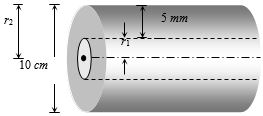
What is the resistance of a wire of length $5 \, m$ and resistivity $1.7 \times 10^{-8} \, \Omega \cdot m$,given the cross-sectional area is a hollow cylinder with outer radius $r_2 = 10 \, cm$ and thickness $5 \, mm$?
A
$5.6 \times 10^{-5} \, \Omega$
B
$2 \times 10^{-5} \, \Omega$
C
$4 \times 10^{-5} \, \Omega$
D
None of these
Solution
(D) The resistance $R$ of a conductor is given by $R = \rho \frac{l}{A}$.
Here,the cross-sectional area $A$ is the area of the hollow part: $A = \pi (r_2^2 - r_1^2)$.
Given: $r_2 = 10 \, cm = 0.1 \, m$,thickness $t = 5 \, mm = 0.005 \, m$.
So,inner radius $r_1 = r_2 - t = 10 \, cm - 0.5 \, cm = 9.5 \, cm = 0.095 \, m$.
$A = \pi [(0.1)^2 - (0.095)^2] = \pi [0.01 - 0.009025] = \pi [0.000975] \, m^2$.
Now,$R = (1.7 \times 10^{-8}) \times \frac{5}{\pi \times 0.000975} \approx 2.77 \times 10^{-5} \, \Omega$.
Here,the cross-sectional area $A$ is the area of the hollow part: $A = \pi (r_2^2 - r_1^2)$.
Given: $r_2 = 10 \, cm = 0.1 \, m$,thickness $t = 5 \, mm = 0.005 \, m$.
So,inner radius $r_1 = r_2 - t = 10 \, cm - 0.5 \, cm = 9.5 \, cm = 0.095 \, m$.
$A = \pi [(0.1)^2 - (0.095)^2] = \pi [0.01 - 0.009025] = \pi [0.000975] \, m^2$.
Now,$R = (1.7 \times 10^{-8}) \times \frac{5}{\pi \times 0.000975} \approx 2.77 \times 10^{-5} \, \Omega$.
0 likes
View Solution119
MediumMCQ
If the length of a wire is increased by $0.1\%$,what is the percentage increase in its resistance (in $\%$)?
A
$0.2$
B
$2$
C
$1$
D
$0.1$
Solution
(A) The resistance of a wire is given by $R = \rho \frac{l}{A}$.
Since the volume $V = A \times l$ remains constant,we have $A = \frac{V}{l}$.
Substituting this into the resistance formula,we get $R = \rho \frac{l^2}{V}$.
Since $\rho$ and $V$ are constant,$R \propto l^2$.
Taking the derivative,we get $\frac{\Delta R}{R} = 2 \frac{\Delta l}{l}$.
Given $\frac{\Delta l}{l} = 0.1\%$,the percentage change in resistance is $\frac{\Delta R}{R} \times 100 = 2 \times 0.1\% = 0.2\%$.
Since the volume $V = A \times l$ remains constant,we have $A = \frac{V}{l}$.
Substituting this into the resistance formula,we get $R = \rho \frac{l^2}{V}$.
Since $\rho$ and $V$ are constant,$R \propto l^2$.
Taking the derivative,we get $\frac{\Delta R}{R} = 2 \frac{\Delta l}{l}$.
Given $\frac{\Delta l}{l} = 0.1\%$,the percentage change in resistance is $\frac{\Delta R}{R} \times 100 = 2 \times 0.1\% = 0.2\%$.
0 likes
View Solution120
DifficultMCQ
If the ratio of the masses of wires of the same material is $1 : 3 : 5$ and the ratio of their lengths is $5 : 3 : 1$,what is the ratio of their resistances?
A
$1 : 3 : 5$
B
$5 : 3 : 1$
C
$1 : 15 : 125$
D
$125 : 15 : 1$
Solution
(D) The resistance $R$ of a wire is given by $R = \rho \frac{l}{A}$.
Since the volume $V = A \times l$ and density $\sigma = \frac{m}{V}$,we have $A = \frac{m}{\sigma l}$.
Substituting this into the resistance formula: $R = \rho \frac{l^2 \sigma}{m}$.
Since the material is the same,$\rho$ and $\sigma$ are constant. Thus,$R \propto \frac{l^2}{m}$.
Given the ratios $m_1 : m_2 : m_3 = 1 : 3 : 5$ and $l_1 : l_2 : l_3 = 5 : 3 : 1$,the ratio of resistances is:
$R_1 : R_2 : R_3 = \frac{l_1^2}{m_1} : \frac{l_2^2}{m_2} : \frac{l_3^2}{m_3}$
$R_1 : R_2 : R_3 = \frac{5^2}{1} : \frac{3^2}{3} : \frac{1^2}{5}$
$R_1 : R_2 : R_3 = 25 : 3 : 0.2$
Multiplying by $5$ to clear the fraction: $125 : 15 : 1$.
Since the volume $V = A \times l$ and density $\sigma = \frac{m}{V}$,we have $A = \frac{m}{\sigma l}$.
Substituting this into the resistance formula: $R = \rho \frac{l^2 \sigma}{m}$.
Since the material is the same,$\rho$ and $\sigma$ are constant. Thus,$R \propto \frac{l^2}{m}$.
Given the ratios $m_1 : m_2 : m_3 = 1 : 3 : 5$ and $l_1 : l_2 : l_3 = 5 : 3 : 1$,the ratio of resistances is:
$R_1 : R_2 : R_3 = \frac{l_1^2}{m_1} : \frac{l_2^2}{m_2} : \frac{l_3^2}{m_3}$
$R_1 : R_2 : R_3 = \frac{5^2}{1} : \frac{3^2}{3} : \frac{1^2}{5}$
$R_1 : R_2 : R_3 = 25 : 3 : 0.2$
Multiplying by $5$ to clear the fraction: $125 : 15 : 1$.
0 likes
View Solution121
MediumMCQ
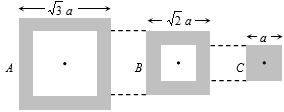
The cross-sections of wires made of the same material and having the same length are shown in the figure. What can be said about their resistances?
A
$R_A = R_B = R_C$
B
$R_A > R_B > R_C$
C
$R_A < R_B < R_C$
D
None of these
Solution
(A) The resistance of a wire is given by $R = \rho \frac{l}{A}$,where $\rho$ is the resistivity,$l$ is the length,and $A$ is the cross-sectional area.
Since all wires are made of the same material ($\rho$ is constant) and have the same length ($l$ is constant),the resistance depends only on the cross-sectional area $A$.
For wire $A$: The cross-section is a square frame with outer side $\sqrt{3}a$ and inner side $\sqrt{2}a$. Area $A_A = (\sqrt{3}a)^2 - (\sqrt{2}a)^2 = 3a^2 - 2a^2 = a^2$.
For wire $B$: The cross-section is a square frame with outer side $\sqrt{2}a$ and inner side $a$. Area $A_B = (\sqrt{2}a)^2 - (a)^2 = 2a^2 - a^2 = a^2$.
For wire $C$: The cross-section is a solid square with side $a$. Area $A_C = a^2$.
Since $A_A = A_B = A_C = a^2$,it follows that $R_A = R_B = R_C$.
Since all wires are made of the same material ($\rho$ is constant) and have the same length ($l$ is constant),the resistance depends only on the cross-sectional area $A$.
For wire $A$: The cross-section is a square frame with outer side $\sqrt{3}a$ and inner side $\sqrt{2}a$. Area $A_A = (\sqrt{3}a)^2 - (\sqrt{2}a)^2 = 3a^2 - 2a^2 = a^2$.
For wire $B$: The cross-section is a square frame with outer side $\sqrt{2}a$ and inner side $a$. Area $A_B = (\sqrt{2}a)^2 - (a)^2 = 2a^2 - a^2 = a^2$.
For wire $C$: The cross-section is a solid square with side $a$. Area $A_C = a^2$.
Since $A_A = A_B = A_C = a^2$,it follows that $R_A = R_B = R_C$.
0 likes
View Solution122
MediumMCQ
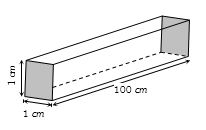
What is the resistance between the rectangular faces of a block with resistivity $3 \times 10^{-7} \, \Omega \cdot m$ and dimensions $1 \, cm \times 1 \, cm \times 100 \, cm$?
A
$3 \times 10^{-9} \, \Omega$
B
$3 \times 10^{-7} \, \Omega$
C
$3 \times 10^{-5} \, \Omega$
D
$3 \times 10^{-3} \, \Omega$
Solution
(B) Given: Resistivity $\rho = 3 \times 10^{-7} \, \Omega \cdot m$.
Dimensions of the block are $1 \, cm \times 1 \, cm \times 100 \, cm$.
For the resistance between the rectangular faces (the $1 \, cm \times 100 \, cm$ faces),the length $l$ of the current path is the remaining dimension,$l = 1 \, cm = 10^{-2} \, m$.
The area of cross-section $A$ is $1 \, cm \times 100 \, cm = 100 \, cm^2 = 100 \times 10^{-4} \, m^2 = 10^{-2} \, m^2$.
The formula for resistance is $R = \rho \frac{l}{A}$.
Substituting the values: $R = (3 \times 10^{-7} \, \Omega \cdot m) \times \frac{10^{-2} \, m}{10^{-2} \, m^2}$.
$R = 3 \times 10^{-7} \, \Omega$.
Dimensions of the block are $1 \, cm \times 1 \, cm \times 100 \, cm$.
For the resistance between the rectangular faces (the $1 \, cm \times 100 \, cm$ faces),the length $l$ of the current path is the remaining dimension,$l = 1 \, cm = 10^{-2} \, m$.
The area of cross-section $A$ is $1 \, cm \times 100 \, cm = 100 \, cm^2 = 100 \times 10^{-4} \, m^2 = 10^{-2} \, m^2$.
The formula for resistance is $R = \rho \frac{l}{A}$.
Substituting the values: $R = (3 \times 10^{-7} \, \Omega \cdot m) \times \frac{10^{-2} \, m}{10^{-2} \, m^2}$.
$R = 3 \times 10^{-7} \, \Omega$.
0 likes
View Solution123
MediumMCQ
In the given circuit,the lengths of $AB$ and $BC$ are equal. The radius of $AB$ is three times that of $BC$. What is the ratio of the potential difference across $AB$ to that across $BC$?
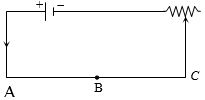
A
$1 : 9$
B
$9 : 1$
C
$3 : 1$
D
$1 : 3$
Solution
(A) The resistance of a wire is given by $R = \rho \frac{L}{A} = \rho \frac{L}{\pi r^2}$.
Since the lengths $L$ and resistivity $\rho$ are the same for both segments,the resistance $R$ is inversely proportional to the square of the radius: $R \propto \frac{1}{r^2}$.
Let $r_{AB} = 3r$ and $r_{BC} = r$. Then the ratio of resistances is $\frac{R_{AB}}{R_{BC}} = \frac{r_{BC}^2}{r_{AB}^2} = \frac{r^2}{(3r)^2} = \frac{1}{9}$.
Since the segments $AB$ and $BC$ are in series,the same current $I$ flows through both.
According to Ohm's Law,the potential difference $V = IR$.
Therefore,the ratio of potential differences is $\frac{V_{AB}}{V_{BC}} = \frac{I R_{AB}}{I R_{BC}} = \frac{R_{AB}}{R_{BC}} = \frac{1}{9}$.
Since the lengths $L$ and resistivity $\rho$ are the same for both segments,the resistance $R$ is inversely proportional to the square of the radius: $R \propto \frac{1}{r^2}$.
Let $r_{AB} = 3r$ and $r_{BC} = r$. Then the ratio of resistances is $\frac{R_{AB}}{R_{BC}} = \frac{r_{BC}^2}{r_{AB}^2} = \frac{r^2}{(3r)^2} = \frac{1}{9}$.
Since the segments $AB$ and $BC$ are in series,the same current $I$ flows through both.
According to Ohm's Law,the potential difference $V = IR$.
Therefore,the ratio of potential differences is $\frac{V_{AB}}{V_{BC}} = \frac{I R_{AB}}{I R_{BC}} = \frac{R_{AB}}{R_{BC}} = \frac{1}{9}$.
0 likes
View Solution124
MediumMCQ
$A$ wire of a certain material is stretched slowly by $10\%$. Its new resistance and specific resistance become respectively:
A
both remain the same
B
$1.1$ times,$1.1$ times
C
$1.21$ times,same
D
$1.21$ times,$1.21$ times
Solution
(C) Let the initial length be $l$ and area be $A$. The initial resistance is $R = \rho \frac{l}{A}$.
When the wire is stretched by $10\%$,the new length $l' = l + 0.1l = 1.1l$.
Since the volume $V = Al$ remains constant,$A'l' = Al \Rightarrow A' = \frac{Al}{1.1l} = \frac{A}{1.1}$.
The new resistance $R' = \rho \frac{l'}{A'} = \rho \frac{1.1l}{A/1.1} = (1.1)^2 \rho \frac{l}{A} = 1.21 R$.
Specific resistance (resistivity) $\rho$ is a property of the material and depends only on the temperature,not on the dimensions of the wire.
Therefore,the new resistance becomes $1.21$ times the original,and the specific resistance remains the same.
When the wire is stretched by $10\%$,the new length $l' = l + 0.1l = 1.1l$.
Since the volume $V = Al$ remains constant,$A'l' = Al \Rightarrow A' = \frac{Al}{1.1l} = \frac{A}{1.1}$.
The new resistance $R' = \rho \frac{l'}{A'} = \rho \frac{1.1l}{A/1.1} = (1.1)^2 \rho \frac{l}{A} = 1.21 R$.
Specific resistance (resistivity) $\rho$ is a property of the material and depends only on the temperature,not on the dimensions of the wire.
Therefore,the new resistance becomes $1.21$ times the original,and the specific resistance remains the same.
0 likes
View Solution125
MediumMCQ
$A$ wire of resistance $4 \,\Omega$ is stretched to twice its original length. The resistance of the stretched wire would be ........... $\Omega$.
A
$4$
B
$8$
C
$16$
D
$2$
Solution
(C) The resistance of a wire is given by $R = \rho \frac{l}{A} = 4 \,\Omega$ .... $(i)$
When the wire is stretched to twice its original length,the new length $l^{\prime} = 2l$.
Since the volume of the wire remains constant during stretching,$V = lA = l^{\prime}A^{\prime}$.
Substituting $l^{\prime} = 2l$,we get $lA = (2l)A^{\prime}$,which implies $A^{\prime} = \frac{A}{2}$.
The new resistance $R^{\prime}$ is given by $R^{\prime} = \rho \frac{l^{\prime}}{A^{\prime}}$.
Substituting the values,$R^{\prime} = \rho \frac{2l}{A/2} = 4 \left( \rho \frac{l}{A} \right)$.
Using equation $(i)$,$R^{\prime} = 4 \times 4 \,\Omega = 16 \,\Omega$.
When the wire is stretched to twice its original length,the new length $l^{\prime} = 2l$.
Since the volume of the wire remains constant during stretching,$V = lA = l^{\prime}A^{\prime}$.
Substituting $l^{\prime} = 2l$,we get $lA = (2l)A^{\prime}$,which implies $A^{\prime} = \frac{A}{2}$.
The new resistance $R^{\prime}$ is given by $R^{\prime} = \rho \frac{l^{\prime}}{A^{\prime}}$.
Substituting the values,$R^{\prime} = \rho \frac{2l}{A/2} = 4 \left( \rho \frac{l}{A} \right)$.
Using equation $(i)$,$R^{\prime} = 4 \times 4 \,\Omega = 16 \,\Omega$.
0 likes
View Solution126
MediumMCQ
Two metal wires of identical dimensions are connected in series. If $\sigma_1$ and $\sigma_2$ are the conductivities of the metal wires respectively,the effective conductivity of the combination is
A
$\frac{{\sigma_1}{\sigma_2}}{{\sigma_1} + {\sigma_2}}$
B
$\frac{2{\sigma_1}{\sigma_2}}{{\sigma_1} + {\sigma_2}}$
C
$\frac{{\sigma_1} + {\sigma_2}}{2{\sigma_1}{\sigma_2}}$
D
$\frac{{\sigma_1} + {\sigma_2}}{{\sigma_1}{\sigma_2}}$
Solution
(B) Since both metal wires are of identical dimensions,their length and area of cross-section are the same. Let them be $l$ and $A$ respectively.
The resistance of the first wire is $R_1 = \frac{l}{\sigma_1 A}$ ...$(i)$
The resistance of the second wire is $R_2 = \frac{l}{\sigma_2 A}$ ...$(ii)$
Since they are connected in series,their effective resistance is $R_s = R_1 + R_2$.
$R_s = \frac{l}{\sigma_1 A} + \frac{l}{\sigma_2 A} = \frac{l}{A} \left( \frac{1}{\sigma_1} + \frac{1}{\sigma_2} \right)$ ...$(iii)$
If $\sigma_{eff}$ is the effective conductivity of the combination,then the total length is $2l$ and the total resistance is $R_s = \frac{2l}{\sigma_{eff} A}$ ...$(iv)$
Equating equations $(iii)$ and $(iv)$,we get:
$\frac{2l}{\sigma_{eff} A} = \frac{l}{A} \left( \frac{\sigma_1 + \sigma_2}{\sigma_1 \sigma_2} \right)$
$\frac{2}{\sigma_{eff}} = \frac{\sigma_1 + \sigma_2}{\sigma_1 \sigma_2}$
$\sigma_{eff} = \frac{2 \sigma_1 \sigma_2}{\sigma_1 + \sigma_2}$
The resistance of the first wire is $R_1 = \frac{l}{\sigma_1 A}$ ...$(i)$
The resistance of the second wire is $R_2 = \frac{l}{\sigma_2 A}$ ...$(ii)$
Since they are connected in series,their effective resistance is $R_s = R_1 + R_2$.
$R_s = \frac{l}{\sigma_1 A} + \frac{l}{\sigma_2 A} = \frac{l}{A} \left( \frac{1}{\sigma_1} + \frac{1}{\sigma_2} \right)$ ...$(iii)$
If $\sigma_{eff}$ is the effective conductivity of the combination,then the total length is $2l$ and the total resistance is $R_s = \frac{2l}{\sigma_{eff} A}$ ...$(iv)$
Equating equations $(iii)$ and $(iv)$,we get:
$\frac{2l}{\sigma_{eff} A} = \frac{l}{A} \left( \frac{\sigma_1 + \sigma_2}{\sigma_1 \sigma_2} \right)$
$\frac{2}{\sigma_{eff}} = \frac{\sigma_1 + \sigma_2}{\sigma_1 \sigma_2}$
$\sigma_{eff} = \frac{2 \sigma_1 \sigma_2}{\sigma_1 + \sigma_2}$

0 likes
View Solution127
MediumMCQ
The resistance of a wire is $R \; \Omega$. If it is melted and stretched to $n$ times its original length,its new resistance will be
A
$R/n$
B
$n^2R$
C
$R/n^2$
D
$nR$
Solution
(B) The resistance of a wire of length $l$,cross-sectional area $A$,and resistivity $\rho$ is given by $R = \rho \frac{l}{A}$.
When the wire is stretched to $n$ times its original length,the new length becomes $l' = nl$.
Since the volume of the wire remains constant during the process,$V = A \cdot l = A' \cdot l'$.
Substituting $l' = nl$,we get $A' = \frac{A \cdot l}{nl} = \frac{A}{n}$.
The new resistance $R'$ is given by $R' = \rho \frac{l'}{A'}$.
Substituting the values of $l'$ and $A'$,we get $R' = \rho \frac{nl}{A/n} = n^2 \left( \rho \frac{l}{A} \right) = n^2 R$.
When the wire is stretched to $n$ times its original length,the new length becomes $l' = nl$.
Since the volume of the wire remains constant during the process,$V = A \cdot l = A' \cdot l'$.
Substituting $l' = nl$,we get $A' = \frac{A \cdot l}{nl} = \frac{A}{n}$.
The new resistance $R'$ is given by $R' = \rho \frac{l'}{A'}$.
Substituting the values of $l'$ and $A'$,we get $R' = \rho \frac{nl}{A/n} = n^2 \left( \rho \frac{l}{A} \right) = n^2 R$.
0 likes
View Solution128
MediumMCQ
The figure shows a rectangular block with dimensions $x, 2x$ and $4x$. Electrical contacts can be made to the block between opposite pairs of faces (for example,between the faces labelled $A-A, B-B$ and $C-C$). Between which two faces would the maximum electrical resistance be obtained? ($A-A$: Top and bottom faces,$B-B$: Left and right faces,$C-C$: Front and rear faces)
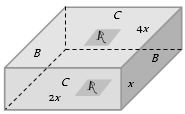
A
$A-A$
B
$B-B$
C
$C-C$
D
Same for all three pairs
Solution
(C) Let $\rho$ be the resistivity of the material.
The resistance $R$ of a conductor is given by $R = \rho \frac{L}{A}$,where $L$ is the length of the conductor in the direction of current flow and $A$ is the cross-sectional area perpendicular to the current flow.
$1$. For contact $A-A$ (Top and bottom faces):
The length $L = x$ and the area $A = 2x \times 4x = 8x^2$.
$R_{AA} = \rho \frac{x}{8x^2} = \frac{\rho}{8x}$.
$2$. For contact $B-B$ (Left and right faces):
The length $L = 2x$ and the area $A = x \times 4x = 4x^2$.
$R_{BB} = \rho \frac{2x}{4x^2} = \frac{\rho}{2x} = \frac{4\rho}{8x}$.
$3$. For contact $C-C$ (Front and rear faces):
The length $L = 4x$ and the area $A = x \times 2x = 2x^2$.
$R_{CC} = \rho \frac{4x}{2x^2} = \frac{2\rho}{x} = \frac{16\rho}{8x}$.
Comparing the resistances,$R_{CC} > R_{BB} > R_{AA}$.
Thus,the maximum electrical resistance is obtained for contact $C-C$.
The resistance $R$ of a conductor is given by $R = \rho \frac{L}{A}$,where $L$ is the length of the conductor in the direction of current flow and $A$ is the cross-sectional area perpendicular to the current flow.
$1$. For contact $A-A$ (Top and bottom faces):
The length $L = x$ and the area $A = 2x \times 4x = 8x^2$.
$R_{AA} = \rho \frac{x}{8x^2} = \frac{\rho}{8x}$.
$2$. For contact $B-B$ (Left and right faces):
The length $L = 2x$ and the area $A = x \times 4x = 4x^2$.
$R_{BB} = \rho \frac{2x}{4x^2} = \frac{\rho}{2x} = \frac{4\rho}{8x}$.
$3$. For contact $C-C$ (Front and rear faces):
The length $L = 4x$ and the area $A = x \times 2x = 2x^2$.
$R_{CC} = \rho \frac{4x}{2x^2} = \frac{2\rho}{x} = \frac{16\rho}{8x}$.
Comparing the resistances,$R_{CC} > R_{BB} > R_{AA}$.
Thus,the maximum electrical resistance is obtained for contact $C-C$.
0 likes
View Solution129
MediumMCQ
$A$ cylindrical metal wire of length $l$ and cross-sectional area $S$ has resistance $R$,conductance $G$,conductivity $\sigma$,and resistivity $\rho$. Which one of the following expressions for $\sigma$ is valid?
A
$\frac{GR}{\rho}$
B
$\frac{\rho R}{G}$
C
$\frac{GS}{l}$
D
$\frac{Rl}{S}$
Solution
(A) We know that resistance $R$ is given by $R = \rho \frac{l}{S}$.
Conductivity $\sigma$ is the reciprocal of resistivity $\rho$,so $\sigma = \frac{1}{\rho}$.
Conductance $G$ is the reciprocal of resistance $R$,so $G = \frac{1}{R}$,which implies $R = \frac{1}{G}$.
Substituting $R = \frac{1}{G}$ into the resistance formula: $\frac{1}{G} = \rho \frac{l}{S}$.
Rearranging for $\rho$: $\rho = \frac{S}{Gl}$.
Since $\sigma = \frac{1}{\rho}$,we have $\sigma = \frac{Gl}{S}$.
Alternatively,using the given options,we check the expression $\sigma = \frac{Gl}{S}$.
Wait,let us re-evaluate the expression $\sigma = \frac{1}{\rho}$.
From $R = \rho \frac{l}{S}$,we have $\rho = \frac{RS}{l}$.
Thus,$\sigma = \frac{1}{\rho} = \frac{l}{RS}$.
Since $G = \frac{1}{R}$,we can write $\sigma = \frac{Gl}{S}$.
Looking at the options provided,if we consider $\sigma = \frac{1}{\rho}$ and $G = \frac{1}{R}$,then $GR = 1$. Therefore,$\sigma = \frac{GR}{\rho}$ is mathematically consistent as $\sigma = \frac{1}{\rho} \times 1 = \frac{1}{\rho} \times (GR) = \frac{GR}{\rho}$.
Conductivity $\sigma$ is the reciprocal of resistivity $\rho$,so $\sigma = \frac{1}{\rho}$.
Conductance $G$ is the reciprocal of resistance $R$,so $G = \frac{1}{R}$,which implies $R = \frac{1}{G}$.
Substituting $R = \frac{1}{G}$ into the resistance formula: $\frac{1}{G} = \rho \frac{l}{S}$.
Rearranging for $\rho$: $\rho = \frac{S}{Gl}$.
Since $\sigma = \frac{1}{\rho}$,we have $\sigma = \frac{Gl}{S}$.
Alternatively,using the given options,we check the expression $\sigma = \frac{Gl}{S}$.
Wait,let us re-evaluate the expression $\sigma = \frac{1}{\rho}$.
From $R = \rho \frac{l}{S}$,we have $\rho = \frac{RS}{l}$.
Thus,$\sigma = \frac{1}{\rho} = \frac{l}{RS}$.
Since $G = \frac{1}{R}$,we can write $\sigma = \frac{Gl}{S}$.
Looking at the options provided,if we consider $\sigma = \frac{1}{\rho}$ and $G = \frac{1}{R}$,then $GR = 1$. Therefore,$\sigma = \frac{GR}{\rho}$ is mathematically consistent as $\sigma = \frac{1}{\rho} \times 1 = \frac{1}{\rho} \times (GR) = \frac{GR}{\rho}$.
0 likes
View Solution130
MediumMCQ
$A$ and $B$ are two square plates of the same metal and same thickness,but the length of $B$ is twice that of $A$. The ratio of the resistances of $A$ and $B$ is
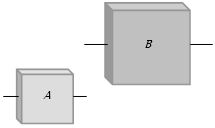
A
$4 : 1$
B
$1 : 4$
C
$1 : 1$
D
$1 : 2$
Solution
(C) The resistance $R$ of a conductor is given by the formula $R = \rho \frac{l}{A_{cs}}$,where $\rho$ is the resistivity,$l$ is the length,and $A_{cs}$ is the cross-sectional area.
For a square plate of side length $l$ and thickness $t$,the cross-sectional area through which current flows is $A_{cs} = l \times t$.
Thus,the resistance is $R = \rho \frac{l}{l \times t} = \frac{\rho}{t}$.
Since both plates $A$ and $B$ are made of the same metal (same $\rho$) and have the same thickness $(t)$,the resistance of each plate is independent of its side length.
Therefore,$R_A = \frac{\rho}{t}$ and $R_B = \frac{\rho}{t}$.
The ratio of the resistances is $\frac{R_A}{R_B} = \frac{\rho/t}{\rho/t} = 1:1$.
For a square plate of side length $l$ and thickness $t$,the cross-sectional area through which current flows is $A_{cs} = l \times t$.
Thus,the resistance is $R = \rho \frac{l}{l \times t} = \frac{\rho}{t}$.
Since both plates $A$ and $B$ are made of the same metal (same $\rho$) and have the same thickness $(t)$,the resistance of each plate is independent of its side length.
Therefore,$R_A = \frac{\rho}{t}$ and $R_B = \frac{\rho}{t}$.
The ratio of the resistances is $\frac{R_A}{R_B} = \frac{\rho/t}{\rho/t} = 1:1$.
0 likes
View Solution131
MediumMCQ
Two conductors are made of the same material and have the same length. Conductor $A$ is a solid wire of diameter $1.0 \, mm$. Conductor $B$ is a hollow tube of outside diameter $2.0 \, mm$ and inside diameter $1.0 \, mm$. The resistance ratio $R_A/R_B$ will be
A
$1$
B
$2$
C
$3$
D
$4$
Solution
(C) The resistance $R$ of a conductor is given by $R = \frac{\rho l}{A}$, where $\rho$ is the resistivity, $l$ is the length, and $A$ is the cross-sectional area.
For conductor $A$ (solid wire), the radius $r_A = 0.5 \, mm$. The cross-sectional area is $A_A = \pi r_A^2$.
Thus, $R_A = \frac{\rho l}{\pi r_A^2}$.
For conductor $B$ (hollow tube), the outside radius $r_{out} = 1.0 \, mm$ and the inside radius $r_{in} = 0.5 \, mm$. The cross-sectional area is $A_B = \pi (r_{out}^2 - r_{in}^2) = \pi (1.0^2 - 0.5^2) = \pi (1 - 0.25) = 0.75 \pi \, mm^2$.
Comparing the areas, $A_B = \pi (1.0^2 - 0.5^2) = 3 \pi (0.5^2) = 3 A_A$.
Since $R \propto \frac{1}{A}$, we have $\frac{R_A}{R_B} = \frac{A_B}{A_A} = \frac{3 A_A}{A_A} = 3$.
For conductor $A$ (solid wire), the radius $r_A = 0.5 \, mm$. The cross-sectional area is $A_A = \pi r_A^2$.
Thus, $R_A = \frac{\rho l}{\pi r_A^2}$.
For conductor $B$ (hollow tube), the outside radius $r_{out} = 1.0 \, mm$ and the inside radius $r_{in} = 0.5 \, mm$. The cross-sectional area is $A_B = \pi (r_{out}^2 - r_{in}^2) = \pi (1.0^2 - 0.5^2) = \pi (1 - 0.25) = 0.75 \pi \, mm^2$.
Comparing the areas, $A_B = \pi (1.0^2 - 0.5^2) = 3 \pi (0.5^2) = 3 A_A$.
Since $R \propto \frac{1}{A}$, we have $\frac{R_A}{R_B} = \frac{A_B}{A_A} = \frac{3 A_A}{A_A} = 3$.
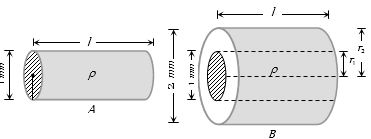
0 likes
View Solution132
AdvancedMCQ
In order to increase the resistance of a given wire of uniform cross-section to four times its value,a fraction of its length is stretched uniformly until the full length of the wire becomes $\frac{3}{2}$ times the original length. What is the value of this fraction?
A
$\frac{1}{4}$
B
$\frac{1}{8}$
C
$\frac{1}{16}$
D
$\frac{1}{6}$
Solution
(B) Let the original length of the wire be $l$ and its original resistance be $R = \frac{\rho l}{A}$.
Let the fraction of the length stretched be $a$. The length of the part to be stretched is $al$,and the remaining part is $l(1-a)$.
The resistance of the unstretched part is $R_1 = \frac{\rho l(1-a)}{A} = R(1-a)$.
When the part of length $al$ is stretched to a new length $l'$,the total length becomes $l' + l(1-a) = \frac{3}{2}l$,so $l' = \frac{3}{2}l - l + al = l(\frac{1}{2} + a)$.
Since the volume of the stretched part remains constant,$A'l' = A(al)$,so $A' = \frac{A(al)}{l'} = \frac{A(al)}{l(\frac{1}{2} + a)} = \frac{Aa}{\frac{1}{2} + a}$.
The resistance of the stretched part is $R' = \frac{\rho l'}{A'} = \frac{\rho l(\frac{1}{2} + a)}{\frac{Aa}{\frac{1}{2} + a}} = R \frac{(\frac{1}{2} + a)^2}{a}$.
The total resistance is $R_1 + R' = 4R$.
$R(1-a) + R \frac{(\frac{1}{2} + a)^2}{a} = 4R$.
$(1-a) + \frac{\frac{1}{4} + a + a^2}{a} = 4$.
$a - a^2 + \frac{1}{4} + a + a^2 = 4a$.
$2a + \frac{1}{4} = 4a$.
$2a = \frac{1}{4} \Rightarrow a = \frac{1}{8}$.
Let the fraction of the length stretched be $a$. The length of the part to be stretched is $al$,and the remaining part is $l(1-a)$.
The resistance of the unstretched part is $R_1 = \frac{\rho l(1-a)}{A} = R(1-a)$.
When the part of length $al$ is stretched to a new length $l'$,the total length becomes $l' + l(1-a) = \frac{3}{2}l$,so $l' = \frac{3}{2}l - l + al = l(\frac{1}{2} + a)$.
Since the volume of the stretched part remains constant,$A'l' = A(al)$,so $A' = \frac{A(al)}{l'} = \frac{A(al)}{l(\frac{1}{2} + a)} = \frac{Aa}{\frac{1}{2} + a}$.
The resistance of the stretched part is $R' = \frac{\rho l'}{A'} = \frac{\rho l(\frac{1}{2} + a)}{\frac{Aa}{\frac{1}{2} + a}} = R \frac{(\frac{1}{2} + a)^2}{a}$.
The total resistance is $R_1 + R' = 4R$.
$R(1-a) + R \frac{(\frac{1}{2} + a)^2}{a} = 4R$.
$(1-a) + \frac{\frac{1}{4} + a + a^2}{a} = 4$.
$a - a^2 + \frac{1}{4} + a + a^2 = 4a$.
$2a + \frac{1}{4} = 4a$.
$2a = \frac{1}{4} \Rightarrow a = \frac{1}{8}$.
0 likes
View Solution133
MediumMCQ
As the temperature of a conductor increases,its resistivity and conductivity change. The ratio of resistivity to conductivity
A
increases
B
decreases
C
remains constant
D
may increase or decrease depending on the actual temperature.
Solution
(A) The resistivity of a conductor is given by $\rho = \frac{m}{n e^{2} \tau}$,where $m$ is the mass of an electron,$e$ is the charge on an electron,$n$ is the number of free electrons per unit volume,and $\tau$ is the relaxation time.
From this,we see that $\rho \propto \frac{1}{\tau}$.
Also,the conductivity $\sigma$ is the reciprocal of resistivity,so $\sigma = \frac{1}{\rho}$.
Therefore,$\sigma \propto \tau$.
The ratio of resistivity to conductivity is $\frac{\rho}{\sigma} = \frac{\rho}{1/\rho} = \rho^{2}$.
Since $\rho \propto \frac{1}{\tau}$,we have $\frac{\rho}{\sigma} \propto \frac{1}{\tau^{2}}$.
When the temperature of a conductor increases,the thermal velocity of electrons increases,which leads to more frequent collisions. Consequently,the relaxation time $\tau$ decreases.
Since $\frac{\rho}{\sigma} \propto \frac{1}{\tau^{2}}$,as $\tau$ decreases,the ratio $\frac{\rho}{\sigma}$ increases.
From this,we see that $\rho \propto \frac{1}{\tau}$.
Also,the conductivity $\sigma$ is the reciprocal of resistivity,so $\sigma = \frac{1}{\rho}$.
Therefore,$\sigma \propto \tau$.
The ratio of resistivity to conductivity is $\frac{\rho}{\sigma} = \frac{\rho}{1/\rho} = \rho^{2}$.
Since $\rho \propto \frac{1}{\tau}$,we have $\frac{\rho}{\sigma} \propto \frac{1}{\tau^{2}}$.
When the temperature of a conductor increases,the thermal velocity of electrons increases,which leads to more frequent collisions. Consequently,the relaxation time $\tau$ decreases.
Since $\frac{\rho}{\sigma} \propto \frac{1}{\tau^{2}}$,as $\tau$ decreases,the ratio $\frac{\rho}{\sigma}$ increases.
0 likes
View Solution134
MediumMCQ
The resistance of a bulb filament is $100\,\Omega$ at a temperature of $100\,^{\circ}C$. If its temperature coefficient of resistance is $0.005\,^{\circ}C^{-1}$,at what temperature will its resistance become $200\,\Omega$?
A
$200$
B
$300$
C
$400$
D
$500$
Solution
(C) The resistance at temperature $T$ is given by $R_T = R_0(1 + \alpha \Delta T)$,where $R_0$ is the resistance at $0\,^{\circ}C$.
Given:
$R_1 = 100\,\Omega$ at $T_1 = 100\,^{\circ}C$
$R_2 = 200\,\Omega$ at $T_2 = T$
$\alpha = 0.005\,^{\circ}C^{-1}$
Using the formula $R = R_0(1 + \alpha T)$:
$100 = R_0(1 + 0.005 \times 100) = R_0(1 + 0.5) = 1.5 R_0$
$R_0 = \frac{100}{1.5} = \frac{200}{3}\,\Omega$
Now,for $R_2 = 200\,\Omega$:
$200 = R_0(1 + 0.005 \times T)$
$200 = \frac{200}{3}(1 + 0.005 T)$
$3 = 1 + 0.005 T$
$2 = 0.005 T$
$T = \frac{2}{0.005} = 400\,^{\circ}C$.
Given:
$R_1 = 100\,\Omega$ at $T_1 = 100\,^{\circ}C$
$R_2 = 200\,\Omega$ at $T_2 = T$
$\alpha = 0.005\,^{\circ}C^{-1}$
Using the formula $R = R_0(1 + \alpha T)$:
$100 = R_0(1 + 0.005 \times 100) = R_0(1 + 0.5) = 1.5 R_0$
$R_0 = \frac{100}{1.5} = \frac{200}{3}\,\Omega$
Now,for $R_2 = 200\,\Omega$:
$200 = R_0(1 + 0.005 \times T)$
$200 = \frac{200}{3}(1 + 0.005 T)$
$3 = 1 + 0.005 T$
$2 = 0.005 T$
$T = \frac{2}{0.005} = 400\,^{\circ}C$.
0 likes
View Solution135
MediumMCQ
$A$ material '$B$' has twice the specific resistance of '$A$'. $A$ circular wire made of '$B$' has twice the diameter of a wire made of '$A$'. Then,for the two wires to have the same resistance,the ratio $\frac{l_B}{l_A}$ of their respective lengths must be
A
$2$
B
$1$
C
$\frac{1}{2}$
D
$\frac{1}{4}$
Solution
(A) Given: $\rho_B = 2\rho_A$ and $d_B = 2d_A$.
Since the wires are circular,the area of cross-section is $A = \pi r^2 = \pi (d/2)^2 = \frac{\pi d^2}{4}$.
For the resistances to be equal,$R_B = R_A$.
Using the formula $R = \frac{\rho l}{A}$,we have $\frac{\rho_B l_B}{A_B} = \frac{\rho_A l_A}{A_A}$.
Substituting the values: $\frac{2\rho_A l_B}{\frac{\pi (2d_A)^2}{4}} = \frac{\rho_A l_A}{\frac{\pi d_A^2}{4}}$.
Simplifying the equation: $\frac{2\rho_A l_B}{4 A_A} = \frac{\rho_A l_A}{A_A} \Rightarrow \frac{2 l_B}{4} = l_A$.
Therefore,$\frac{l_B}{l_A} = \frac{4}{2} = 2$.
Since the wires are circular,the area of cross-section is $A = \pi r^2 = \pi (d/2)^2 = \frac{\pi d^2}{4}$.
For the resistances to be equal,$R_B = R_A$.
Using the formula $R = \frac{\rho l}{A}$,we have $\frac{\rho_B l_B}{A_B} = \frac{\rho_A l_A}{A_A}$.
Substituting the values: $\frac{2\rho_A l_B}{\frac{\pi (2d_A)^2}{4}} = \frac{\rho_A l_A}{\frac{\pi d_A^2}{4}}$.
Simplifying the equation: $\frac{2\rho_A l_B}{4 A_A} = \frac{\rho_A l_A}{A_A} \Rightarrow \frac{2 l_B}{4} = l_A$.
Therefore,$\frac{l_B}{l_A} = \frac{4}{2} = 2$.
0 likes
View Solution136
MediumMCQ
The resistance of a wire is $5\, \Omega$ at $50\, ^\circ C$ and $6\, \Omega$ at $100\, ^\circ C$. The resistance of the wire at $0\, ^\circ C$ will be .............. $\Omega$.
A
$3$
B
$2$
C
$1$
D
$4$
Solution
(D) We know that the resistance at temperature $t$ is given by the formula:
$R_{t} = R_{0}(1 + \alpha t)$
where $R_{t}$ is the resistance at $t\, ^\circ C$,$R_{0}$ is the resistance at $0\, ^\circ C$,and $\alpha$ is the temperature coefficient of resistance.
For $t = 50\, ^\circ C$:
$5 = R_{0}(1 + 50\alpha)$ ......$(i)$
For $t = 100\, ^\circ C$:
$6 = R_{0}(1 + 100\alpha)$ ......$(ii)$
Dividing equation $(i)$ by equation $(ii)$:
$\frac{5}{6} = \frac{R_{0}(1 + 50\alpha)}{R_{0}(1 + 100\alpha)}$
$\frac{5}{6} = \frac{1 + 50\alpha}{1 + 100\alpha}$
Cross-multiplying:
$5(1 + 100\alpha) = 6(1 + 50\alpha)$
$5 + 500\alpha = 6 + 300\alpha$
$200\alpha = 1$
$\alpha = \frac{1}{200} = 0.005\, ^\circ C^{-1}$
Now,substitute $\alpha$ back into equation $(i)$ to find $R_{0}$:
$5 = R_{0}(1 + 50 \times 0.005)$
$5 = R_{0}(1 + 0.25)$
$5 = R_{0}(1.25)$
$R_{0} = \frac{5}{1.25} = 4\, \Omega$
Thus,the resistance at $0\, ^\circ C$ is $4\, \Omega$.
$R_{t} = R_{0}(1 + \alpha t)$
where $R_{t}$ is the resistance at $t\, ^\circ C$,$R_{0}$ is the resistance at $0\, ^\circ C$,and $\alpha$ is the temperature coefficient of resistance.
For $t = 50\, ^\circ C$:
$5 = R_{0}(1 + 50\alpha)$ ......$(i)$
For $t = 100\, ^\circ C$:
$6 = R_{0}(1 + 100\alpha)$ ......$(ii)$
Dividing equation $(i)$ by equation $(ii)$:
$\frac{5}{6} = \frac{R_{0}(1 + 50\alpha)}{R_{0}(1 + 100\alpha)}$
$\frac{5}{6} = \frac{1 + 50\alpha}{1 + 100\alpha}$
Cross-multiplying:
$5(1 + 100\alpha) = 6(1 + 50\alpha)$
$5 + 500\alpha = 6 + 300\alpha$
$200\alpha = 1$
$\alpha = \frac{1}{200} = 0.005\, ^\circ C^{-1}$
Now,substitute $\alpha$ back into equation $(i)$ to find $R_{0}$:
$5 = R_{0}(1 + 50 \times 0.005)$
$5 = R_{0}(1 + 0.25)$
$5 = R_{0}(1.25)$
$R_{0} = \frac{5}{1.25} = 4\, \Omega$
Thus,the resistance at $0\, ^\circ C$ is $4\, \Omega$.
0 likes
View Solution137
DifficultMCQ
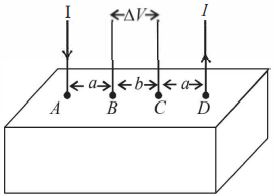
Consider a block of conducting material of resistivity $\rho$ shown in the figure. Current $I$ enters at $A$ and leaves from $D$. We apply the superposition principle to find the voltage $\Delta V$ developed between $B$ and $C$. The calculation is done in the following steps:
$(i)$ Take current $I$ entering from $A$ and assume it to spread over a hemispherical surface in the block.
$(ii)$ Calculate field $E(r)$ at distance $r$ from $A$ by using Ohm's law $E = \rho j$,where $j$ is the current per unit area at $r$.
$(iii)$ From the $r$ dependence of $E(r)$,obtain the potential $V(r)$ at $r$.
$(iv)$ Repeat $(i)$,$(ii)$ and $(iii)$ for current $I$ leaving $D$ and superpose results for $A$ and $D$.
For current entering at $A$,the electric field at a distance $r$ from $A$ is
$(i)$ Take current $I$ entering from $A$ and assume it to spread over a hemispherical surface in the block.
$(ii)$ Calculate field $E(r)$ at distance $r$ from $A$ by using Ohm's law $E = \rho j$,where $j$ is the current per unit area at $r$.
$(iii)$ From the $r$ dependence of $E(r)$,obtain the potential $V(r)$ at $r$.
$(iv)$ Repeat $(i)$,$(ii)$ and $(iii)$ for current $I$ leaving $D$ and superpose results for $A$ and $D$.
For current entering at $A$,the electric field at a distance $r$ from $A$ is
A
$\frac{\rho I}{4 \pi r^2}$
B
$\frac{\rho I}{8 \pi r^2}$
C
$\frac{\rho I}{r^2}$
D
$\frac{\rho I}{2 \pi r^2}$
Solution
(D) Let $j$ be the current density.
Since the current $I$ spreads over a hemispherical surface of area $2 \pi r^2$,the current density is $j = \frac{I}{2 \pi r^2}$.
Using Ohm's law in the form $E = \rho j$,we get:
$E = \rho \left( \frac{I}{2 \pi r^2} \right) = \frac{\rho I}{2 \pi r^2}$.
Since the current $I$ spreads over a hemispherical surface of area $2 \pi r^2$,the current density is $j = \frac{I}{2 \pi r^2}$.
Using Ohm's law in the form $E = \rho j$,we get:
$E = \rho \left( \frac{I}{2 \pi r^2} \right) = \frac{\rho I}{2 \pi r^2}$.
0 likes
View Solution138
EasyMCQ
If a wire is stretched to make it $0.1 \%$ longer,its resistance will
A
increase by $0.05 \%$
B
increase by $0.2 \%$
C
decrease by $0.2 \%$
D
decrease by $0.05 \%$
Solution
(B) The resistance of a wire is given by $R = \frac{\rho l}{A}$.
Since the volume $V = A \times l$ remains constant when the wire is stretched,we can write $A = \frac{V}{l}$.
Substituting this into the resistance formula,we get $R = \frac{\rho l^2}{V}$.
Since $\rho$ and $V$ are constants,$R \propto l^2$.
Taking the derivative or using the approximation for small changes,the fractional change in resistance is given by $\frac{\Delta R}{R} = 2 \frac{\Delta l}{l}$.
Given that the wire is stretched by $0.1 \%$,we have $\frac{\Delta l}{l} = 0.1 \% = 0.001$.
Therefore,$\frac{\Delta R}{R} = 2 \times 0.1 \% = 0.2 \%$.
Since the change is positive,the resistance will increase by $0.2 \%$.
Since the volume $V = A \times l$ remains constant when the wire is stretched,we can write $A = \frac{V}{l}$.
Substituting this into the resistance formula,we get $R = \frac{\rho l^2}{V}$.
Since $\rho$ and $V$ are constants,$R \propto l^2$.
Taking the derivative or using the approximation for small changes,the fractional change in resistance is given by $\frac{\Delta R}{R} = 2 \frac{\Delta l}{l}$.
Given that the wire is stretched by $0.1 \%$,we have $\frac{\Delta l}{l} = 0.1 \% = 0.001$.
Therefore,$\frac{\Delta R}{R} = 2 \times 0.1 \% = 0.2 \%$.
Since the change is positive,the resistance will increase by $0.2 \%$.
0 likes
View Solution139
DifficultMCQ
The resistance of a metallic wire becomes $8$ times when :
A
length is doubled
B
length is tripled
C
length is doubled and radius is halved
D
length is halved and radius is doubled
Solution
(C) The resistance $R$ of a metallic wire is given by the formula $R = \rho \frac{\ell}{A} = \rho \frac{\ell}{\pi r^2}$,where $\rho$ is resistivity,$\ell$ is length,and $r$ is the radius.
From this,we see that $R \propto \frac{\ell}{r^2}$.
Let the initial resistance be $R = k \frac{\ell}{r^2}$.
For option $C$,the new length $\ell' = 2\ell$ and the new radius $r' = \frac{r}{2}$.
The new resistance $R'$ is given by $R' = k \frac{\ell'}{(r')^2} = k \frac{2\ell}{(r/2)^2} = k \frac{2\ell}{r^2/4} = 8 \times k \frac{\ell}{r^2} = 8R$.
Therefore,the resistance becomes $8$ times when the length is doubled and the radius is halved.
From this,we see that $R \propto \frac{\ell}{r^2}$.
Let the initial resistance be $R = k \frac{\ell}{r^2}$.
For option $C$,the new length $\ell' = 2\ell$ and the new radius $r' = \frac{r}{2}$.
The new resistance $R'$ is given by $R' = k \frac{\ell'}{(r')^2} = k \frac{2\ell}{(r/2)^2} = k \frac{2\ell}{r^2/4} = 8 \times k \frac{\ell}{r^2} = 8R$.
Therefore,the resistance becomes $8$ times when the length is doubled and the radius is halved.
0 likes
View Solution140
MediumMCQ
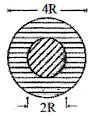
$A$ wire of circular cross-section has an inner portion of radius $R$ made of a material of resistivity $\rho$ and is surrounded by an outer portion of thickness $R$ made of a material of double resistivity. Find the resistance of a length $l$ of such a wire.
A
$\frac{5\rho l}{3\pi R^2}$
B
$\frac{5}{12}\frac{\rho l}{\pi R^2}$
C
$\frac{3}{2}\frac{\rho l}{\pi R^2}$
D
$\frac{2}{5}\frac{\rho l}{\pi R^2}$
Solution
(D) The wire consists of two parallel conductors: the inner core and the outer shell.
$1$. Resistance of the inner core $(R_1)$: The radius is $R$,resistivity is $\rho$,and length is $l$. Thus,$R_1 = \frac{\rho l}{\pi R^2}$.
$2$. Resistance of the outer shell $(R_2)$: The inner radius is $R$ and the outer radius is $2R$ (since thickness is $R$). The area of cross-section is $A_2 = \pi((2R)^2 - R^2) = 3\pi R^2$. The resistivity is $2\rho$. Thus,$R_2 = \frac{2\rho l}{3\pi R^2}$.
$3$. Equivalent resistance $(R_{eq})$: Since they are in parallel,$\frac{1}{R_{eq}} = \frac{1}{R_1} + \frac{1}{R_2} = \frac{\pi R^2}{\rho l} + \frac{3\pi R^2}{2\rho l} = \frac{\pi R^2}{\rho l} (1 + 1.5) = \frac{2.5 \pi R^2}{\rho l} = \frac{5 \pi R^2}{2 \rho l}$.
Therefore,$R_{eq} = \frac{2 \rho l}{5 \pi R^2}$.
$1$. Resistance of the inner core $(R_1)$: The radius is $R$,resistivity is $\rho$,and length is $l$. Thus,$R_1 = \frac{\rho l}{\pi R^2}$.
$2$. Resistance of the outer shell $(R_2)$: The inner radius is $R$ and the outer radius is $2R$ (since thickness is $R$). The area of cross-section is $A_2 = \pi((2R)^2 - R^2) = 3\pi R^2$. The resistivity is $2\rho$. Thus,$R_2 = \frac{2\rho l}{3\pi R^2}$.
$3$. Equivalent resistance $(R_{eq})$: Since they are in parallel,$\frac{1}{R_{eq}} = \frac{1}{R_1} + \frac{1}{R_2} = \frac{\pi R^2}{\rho l} + \frac{3\pi R^2}{2\rho l} = \frac{\pi R^2}{\rho l} (1 + 1.5) = \frac{2.5 \pi R^2}{\rho l} = \frac{5 \pi R^2}{2 \rho l}$.
Therefore,$R_{eq} = \frac{2 \rho l}{5 \pi R^2}$.
0 likes
View Solution141
MediumMCQ
Wires $P$ and $Q$ have the same resistance at room temperature. When heated,the resistance of $P$ increases and that of $Q$ decreases. We conclude that:
A
$P$ and $Q$ are conductors of different materials
B
$P$ is $N$-type semiconductor and $Q$ is $P$-type semiconductor
C
$P$ is a conductor and $Q$ is a semiconductor
D
$P$ is a semiconductor and $Q$ is a conductor
Solution
(C) The resistance of a conductor increases with an increase in temperature because the collision frequency of electrons increases,leading to a positive temperature coefficient of resistance.
Conversely,the resistance of a semiconductor decreases with an increase in temperature because more charge carriers (electrons and holes) are generated due to thermal excitation,leading to a negative temperature coefficient of resistance.
Since the resistance of $P$ increases with temperature,$P$ is a conductor.
Since the resistance of $Q$ decreases with temperature,$Q$ is a semiconductor.
Therefore,the correct conclusion is that $P$ is a conductor and $Q$ is a semiconductor.
Conversely,the resistance of a semiconductor decreases with an increase in temperature because more charge carriers (electrons and holes) are generated due to thermal excitation,leading to a negative temperature coefficient of resistance.
Since the resistance of $P$ increases with temperature,$P$ is a conductor.
Since the resistance of $Q$ decreases with temperature,$Q$ is a semiconductor.
Therefore,the correct conclusion is that $P$ is a conductor and $Q$ is a semiconductor.
0 likes
View Solution142
DifficultMCQ
$A$ given piece of wire of length $l$ and radius $r$ and resistance $R$ is stretched uniformly to a wire of radius $\frac{r}{2}$. Its new resistance is .................. $R$.
A
$4$
B
$8$
C
$16$
D
$32$
Solution
(C) The volume of the wire remains constant during stretching. Therefore,$V = A_1 l_1 = A_2 l_2$.
Since $A = \pi r^2$,we have $\pi r^2 l_1 = \pi (r/2)^2 l_2$.
This simplifies to $r^2 l_1 = \frac{r^2}{4} l_2$,which gives $l_2 = 4 l_1$.
The resistance of a wire is given by $R = \rho \frac{l}{A} = \rho \frac{l}{\pi r^2}$.
Thus,$R \propto \frac{l}{r^2}$.
Let $R_1 = R$ and $R_2$ be the new resistance.
$\frac{R_2}{R_1} = \frac{l_2}{l_1} \times (\frac{r_1}{r_2})^2$.
Substituting the values: $\frac{R_2}{R} = (4) \times (\frac{r}{r/2})^2 = 4 \times 2^2 = 4 \times 4 = 16$.
Therefore,the new resistance is $16R$.
Since $A = \pi r^2$,we have $\pi r^2 l_1 = \pi (r/2)^2 l_2$.
This simplifies to $r^2 l_1 = \frac{r^2}{4} l_2$,which gives $l_2 = 4 l_1$.
The resistance of a wire is given by $R = \rho \frac{l}{A} = \rho \frac{l}{\pi r^2}$.
Thus,$R \propto \frac{l}{r^2}$.
Let $R_1 = R$ and $R_2$ be the new resistance.
$\frac{R_2}{R_1} = \frac{l_2}{l_1} \times (\frac{r_1}{r_2})^2$.
Substituting the values: $\frac{R_2}{R} = (4) \times (\frac{r}{r/2})^2 = 4 \times 2^2 = 4 \times 4 = 16$.
Therefore,the new resistance is $16R$.
0 likes
View Solution143
EasyMCQ
There are two wires of the same length and of the same material and radii $r$ and $2r$. The ratio of their specific resistance is
A
$1 : 2$
B
$1 : 1$
C
$1 : 4$
D
$4 : 1$
Solution
(B) The resistivity or specific resistance of a material is an intrinsic property of the material.
It depends only on the nature of the material and the temperature.
It does not depend on the physical dimensions of the conductor,such as its length,radius,or cross-sectional area.
Since both wires are made of the same material,their specific resistance (resistivity) will be the same.
Therefore,the ratio of their specific resistance is $1 : 1$.
Hence,option $B$ is correct.
It depends only on the nature of the material and the temperature.
It does not depend on the physical dimensions of the conductor,such as its length,radius,or cross-sectional area.
Since both wires are made of the same material,their specific resistance (resistivity) will be the same.
Therefore,the ratio of their specific resistance is $1 : 1$.
Hence,option $B$ is correct.
0 likes
View Solution144
MediumMCQ
If a copper wire is stretched to make its radius decrease by $0.1\%$,then the percentage increase in resistance is approximately .......... $\%$
A
$0.1$
B
$0.2$
C
$0.4$
D
$0.8$
Solution
(C) The volume $V$ of the wire is given by $V = \pi r^2 l$,where $r$ is the radius and $l$ is the length.
Since the volume remains constant during stretching,$\frac{\Delta V}{V} = 2\frac{\Delta r}{r} + \frac{\Delta l}{l} = 0$.
This implies $\frac{\Delta l}{l} = -2\frac{\Delta r}{r} \dots (1)$.
The resistance $R$ is given by $R = \frac{\rho l}{\pi r^2}$.
Taking the relative error,we get $\frac{\Delta R}{R} = \frac{\Delta l}{l} - 2\frac{\Delta r}{r}$.
Substituting equation $(1)$ into this expression:
$\frac{\Delta R}{R} = (-2\frac{\Delta r}{r}) - 2\frac{\Delta r}{r} = -4\frac{\Delta r}{r}$.
Given the radius decreases by $0.1\%$,we have $\frac{\Delta r}{r} = -0.1\%$.
Therefore,the percentage increase in resistance is $\frac{\Delta R}{R} = -4 \times (-0.1\%) = 0.4\%$.
Since the volume remains constant during stretching,$\frac{\Delta V}{V} = 2\frac{\Delta r}{r} + \frac{\Delta l}{l} = 0$.
This implies $\frac{\Delta l}{l} = -2\frac{\Delta r}{r} \dots (1)$.
The resistance $R$ is given by $R = \frac{\rho l}{\pi r^2}$.
Taking the relative error,we get $\frac{\Delta R}{R} = \frac{\Delta l}{l} - 2\frac{\Delta r}{r}$.
Substituting equation $(1)$ into this expression:
$\frac{\Delta R}{R} = (-2\frac{\Delta r}{r}) - 2\frac{\Delta r}{r} = -4\frac{\Delta r}{r}$.
Given the radius decreases by $0.1\%$,we have $\frac{\Delta r}{r} = -0.1\%$.
Therefore,the percentage increase in resistance is $\frac{\Delta R}{R} = -4 \times (-0.1\%) = 0.4\%$.
0 likes
View Solution145
DifficultMCQ
$A$ heating element has a resistance of $100\,\Omega$ at room temperature. When it is connected to a supply of $220\,V$,a steady current of $2\,A$ passes through it and the temperature is $500\,^{\circ}C$ higher than room temperature. What is the temperature coefficient of resistance of the heating element?
A
$1 \times 10^{-4}\,^{\circ}C^{-1}$
B
$5 \times 10^{-4}\,^{\circ}C^{-1}$
C
$2 \times 10^{-4}\,^{\circ}C^{-1}$
D
$0.5 \times 10^{-4}\,^{\circ}C^{-1}$
Solution
(C) Given: Initial resistance $R_0 = 100\,\Omega$,Voltage $V = 220\,V$,Current $I = 2\,A$,and temperature change $\Delta t = 500\,^{\circ}C$.
First,calculate the resistance $R_t$ at the higher temperature using Ohm's Law: $R_t = \frac{V}{I} = \frac{220}{2} = 110\,\Omega$.
The formula for temperature dependence of resistance is $R_t = R_0(1 + \alpha \Delta t)$.
Substituting the values: $110 = 100(1 + \alpha \times 500)$.
$1.1 = 1 + 500\alpha$.
$0.1 = 500\alpha$.
$\alpha = \frac{0.1}{500} = \frac{1}{5000} = 0.0002\,^{\circ}C^{-1}$.
Therefore,$\alpha = 2 \times 10^{-4}\,^{\circ}C^{-1}$.
First,calculate the resistance $R_t$ at the higher temperature using Ohm's Law: $R_t = \frac{V}{I} = \frac{220}{2} = 110\,\Omega$.
The formula for temperature dependence of resistance is $R_t = R_0(1 + \alpha \Delta t)$.
Substituting the values: $110 = 100(1 + \alpha \times 500)$.
$1.1 = 1 + 500\alpha$.
$0.1 = 500\alpha$.
$\alpha = \frac{0.1}{500} = \frac{1}{5000} = 0.0002\,^{\circ}C^{-1}$.
Therefore,$\alpha = 2 \times 10^{-4}\,^{\circ}C^{-1}$.
0 likes
View Solution146
DifficultMCQ
$A$ uniform wire of length $l$ and radius $r$ has a resistance of $100\, \Omega$. It is recast into a wire of radius $\frac{r}{2}$. The resistance of the new wire will be ............... $\Omega$.
A
$1600$
B
$400$
C
$200$
D
$100$
Solution
(A) Given: Initial resistance $R_1 = 100\, \Omega$,initial radius $r_1 = r$,final radius $r_2 = r/2$.
The resistance of a wire is given by $R = \frac{\rho l}{A}$.
Since the volume $V$ of the wire remains constant during recasting,$V = A \cdot l = \text{constant}$.
Substituting $l = V/A$ into the resistance formula,we get $R = \frac{\rho V}{A^2}$.
Since $\rho$ and $V$ are constant,$R \propto \frac{1}{A^2}$.
Given $A = \pi r^2$,we have $R \propto \frac{1}{(\pi r^2)^2} \propto \frac{1}{r^4}$.
Therefore,$\frac{R_2}{R_1} = \left( \frac{r_1}{r_2} \right)^4$.
Substituting the values: $\frac{R_2}{100} = \left( \frac{r}{r/2} \right)^4 = (2)^4 = 16$.
$R_2 = 16 \times 100 = 1600\, \Omega$.
The resistance of a wire is given by $R = \frac{\rho l}{A}$.
Since the volume $V$ of the wire remains constant during recasting,$V = A \cdot l = \text{constant}$.
Substituting $l = V/A$ into the resistance formula,we get $R = \frac{\rho V}{A^2}$.
Since $\rho$ and $V$ are constant,$R \propto \frac{1}{A^2}$.
Given $A = \pi r^2$,we have $R \propto \frac{1}{(\pi r^2)^2} \propto \frac{1}{r^4}$.
Therefore,$\frac{R_2}{R_1} = \left( \frac{r_1}{r_2} \right)^4$.
Substituting the values: $\frac{R_2}{100} = \left( \frac{r}{r/2} \right)^4 = (2)^4 = 16$.
$R_2 = 16 \times 100 = 1600\, \Omega$.
0 likes
View Solution147
MediumMCQ
In the following,$I$ refers to current and other symbols have their usual meaning. Choose the option that corresponds to the dimensions of electrical conductivity.
A
$M^{-1} L^{-3} T^3 I$
B
$M^{-1} L^{-3} T^3 I^2$
C
$M^{-1} L^3 T^3 I$
D
$M L^{-3} T^{-3} I^2$
Solution
(B) We know that resistivity is given by $\rho = \frac{R A}{\ell}$.
Conductivity $\sigma = \frac{1}{\rho} = \frac{\ell}{R A}$.
Since $V = I R$,we have $R = \frac{V}{I}$. Substituting this,$\sigma = \frac{\ell I}{V A}$.
The dimensions are:
$[\ell] = [L]$
$[I] = [I]$
$[A] = [L^2]$
$[V] = [M L^2 T^{-3} I^{-1}]$
Substituting these into the formula:
$\sigma = \frac{[L][I]}{[M L^2 T^{-3} I^{-1}] [L^2]} = \frac{[L][I]}{[M L^3 T^{-3} I^{-1}]}$
$\sigma = [M^{-1} L^{-3} T^3 I^2]$.
Conductivity $\sigma = \frac{1}{\rho} = \frac{\ell}{R A}$.
Since $V = I R$,we have $R = \frac{V}{I}$. Substituting this,$\sigma = \frac{\ell I}{V A}$.
The dimensions are:
$[\ell] = [L]$
$[I] = [I]$
$[A] = [L^2]$
$[V] = [M L^2 T^{-3} I^{-1}]$
Substituting these into the formula:
$\sigma = \frac{[L][I]}{[M L^2 T^{-3} I^{-1}] [L^2]} = \frac{[L][I]}{[M L^3 T^{-3} I^{-1}]}$
$\sigma = [M^{-1} L^{-3} T^3 I^2]$.
0 likes
View Solution148
MediumMCQ
The resistance of a wire is $R$. It is bent at the middle by $180^o$ and both the ends are twisted together to make a shorter wire. The resistance of the new wire is
A
$2\, R$
B
$R/2$
C
$R/4$
D
$R/8$
Solution
(C) The initial resistance of the wire is given by $R = \rho \frac{l}{A}$,where $l$ is the length and $A$ is the cross-sectional area.
When the wire is bent at the middle by $180^o$ and the ends are twisted,the new length becomes $l' = \frac{l}{2}$ and the new cross-sectional area becomes $A' = 2A$.
The new resistance $R'$ is given by $R' = \rho \frac{l'}{A'}$.
Substituting the new values: $R' = \rho \frac{l/2}{2A} = \frac{1}{4} \left( \rho \frac{l}{A} \right) = \frac{R}{4}$.
When the wire is bent at the middle by $180^o$ and the ends are twisted,the new length becomes $l' = \frac{l}{2}$ and the new cross-sectional area becomes $A' = 2A$.
The new resistance $R'$ is given by $R' = \rho \frac{l'}{A'}$.
Substituting the new values: $R' = \rho \frac{l/2}{2A} = \frac{1}{4} \left( \rho \frac{l}{A} \right) = \frac{R}{4}$.
0 likes
View SolutionCurrent Electricity — Resistance of wire, Resistivity and Conductivity · Frequently Asked Questions
1Are these Current Electricity questions useful for JEE and NEET?
Yes. All questions in this section are mapped to JEE Main and NEET exam patterns. Previous year questions from JEE Main, NEET, GUJCET and state-level exams are included with full solutions.
2Can I switch to Hindi or Gujarati for these questions?
Yes. Use the language tabs in the hero section or the sidebar to view the same questions and solutions in English, Hindi or Gujarati.
3How do I generate a question paper from this subtopic?
Use the Vedclass Exam Paper Generator — select the chapter and subtopic, set difficulty, and generate Sets A, B, C, D automatically. First 3 chapters of every subject are free.
Vedclass Products
For Students
Vedclass Test Series
Mock tests in real JEE/NEET style with performance analysis. 5-day free trial.
Start Free TrialFor Teachers
Exam Paper Generator
Generate Set A/B/C/D papers from this chapter in 2 minutes. 3 chapters free.
Try FreeFor Institutes
Online Exam Module
Live online exams with unlimited students, 360° analytics & white-label branding.
See DemoFor Teachers & Institutes
Generate a Current Electricity Exam Paper in 2 Minutes
Select subtopic & difficulty — Sets A, B, C, D auto-generated with No Repeat logic.
First 3 chapters of every subject are free — no payment required.