
A English
Potentiometer Questions in English
Class 12 Physics · Current Electricity · Potentiometer
245+
Questions
English
Language
100%
With Solutions
Showing 50 of 245 questions in English
101
MediumMCQ
The length of a potentiometer wire is $\ell$. $A$ cell of emf $E$ is balanced at a length $\ell/3$ from the positive end of the wire. If the length of the wire is increased by $\ell/2$,at what distance will the same cell give a balanced point?
A
$\frac{2\ell}{3}$
B
$\frac{\ell}{2}$
C
$\frac{\ell}{6}$
D
$\frac{4\ell}{3}$
Solution
(B) Let $V$ be the potential difference across the potentiometer wire.
The potential gradient initially is $k_1 = \frac{V}{\ell}$.
The balancing length for emf $E$ is $\ell_1 = \frac{\ell}{3}$,so $E = k_1 \ell_1 = \frac{V}{\ell} \cdot \frac{\ell}{3} = \frac{V}{3}$.
When the length of the wire is increased by $\ell/2$,the new length is $\ell' = \ell + \frac{\ell}{2} = \frac{3\ell}{2}$.
The new potential gradient is $k_2 = \frac{V}{\ell'} = \frac{V}{3\ell/2} = \frac{2V}{3\ell}$.
For the same cell $E$,the new balancing length $\ell_2$ satisfies $E = k_2 \ell_2$.
Substituting the values: $\frac{V}{3} = \left( \frac{2V}{3\ell} \right) \ell_2$.
Solving for $\ell_2$: $\ell_2 = \frac{V}{3} \cdot \frac{3\ell}{2V} = \frac{\ell}{2}$.
The potential gradient initially is $k_1 = \frac{V}{\ell}$.
The balancing length for emf $E$ is $\ell_1 = \frac{\ell}{3}$,so $E = k_1 \ell_1 = \frac{V}{\ell} \cdot \frac{\ell}{3} = \frac{V}{3}$.
When the length of the wire is increased by $\ell/2$,the new length is $\ell' = \ell + \frac{\ell}{2} = \frac{3\ell}{2}$.
The new potential gradient is $k_2 = \frac{V}{\ell'} = \frac{V}{3\ell/2} = \frac{2V}{3\ell}$.
For the same cell $E$,the new balancing length $\ell_2$ satisfies $E = k_2 \ell_2$.
Substituting the values: $\frac{V}{3} = \left( \frac{2V}{3\ell} \right) \ell_2$.
Solving for $\ell_2$: $\ell_2 = \frac{V}{3} \cdot \frac{3\ell}{2V} = \frac{\ell}{2}$.
0 likes
View Solution102
MediumMCQ
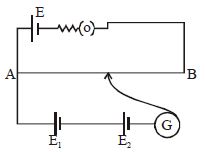
In the given arrangement,$E_1 = 5 \, V$ and $E_2 = 7 \, V$. The balancing length is $6 \, m$. If the terminals of $E_2$ are reversed,then the new balancing length will be:
A
$1 \, m$
B
$3 \, m$
C
$6 \, m$
D
Cannot be obtained
Solution
(A) In the initial arrangement,the cells $E_1$ and $E_2$ are connected in series such that their effective $EMF$ is $E_{eff} = E_1 + E_2 = 5 \, V + 7 \, V = 12 \, V$.
Given that the balancing length $l_1 = 6 \, m$,we have $E_{eff} = k \cdot l_1$,where $k$ is the potential gradient.
So,$12 = k \cdot 6 \implies k = 2 \, V/m$.
When the terminals of $E_2$ are reversed,the effective $EMF$ becomes $E'_{eff} = |E_1 - E_2| = |5 \, V - 7 \, V| = 2 \, V$.
Let the new balancing length be $l_2$. Then $E'_{eff} = k \cdot l_2$.
$2 = 2 \cdot l_2 \implies l_2 = 1 \, m$.
Given that the balancing length $l_1 = 6 \, m$,we have $E_{eff} = k \cdot l_1$,where $k$ is the potential gradient.
So,$12 = k \cdot 6 \implies k = 2 \, V/m$.
When the terminals of $E_2$ are reversed,the effective $EMF$ becomes $E'_{eff} = |E_1 - E_2| = |5 \, V - 7 \, V| = 2 \, V$.
Let the new balancing length be $l_2$. Then $E'_{eff} = k \cdot l_2$.
$2 = 2 \cdot l_2 \implies l_2 = 1 \, m$.
0 likes
View Solution103
MediumMCQ
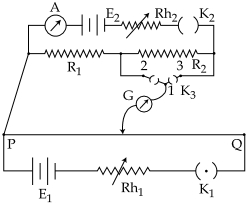
$A$ potentiometer $PQ$ is set up to compare two resistances as shown in the figure. The ammeter $A$ in the circuit reads $1.0\, A$ when the two-way key $K_3$ is open. The balance point is at a length $l_1\, cm$ from $P$ when the two-way key $K_3$ is plugged in between $2$ and $1$,while the balance point is at a length $l_2\, cm$ from $P$ when key $K_3$ is plugged in between $3$ and $1$. The ratio of two resistances $\frac{R_1}{R_2}$ is found to be
A
$\frac{l_1}{l_1 + l_2}$
B
$\frac{l_2}{l_2 - l_1}$
C
$\frac{l_1}{l_1 - l_2}$
D
$\frac{l_1}{l_2 - l_1}$
Solution
(D) Let $x$ be the potential gradient of the potentiometer wire $PQ$.
When the key $K_3$ is plugged in between $2$ and $1$,the potential difference across $R_1$ is balanced:
$V_1 = I R_1 = x l_1$
When the key $K_3$ is plugged in between $3$ and $1$,the potential difference across the series combination of $R_1$ and $R_2$ is balanced:
$V_2 = I (R_1 + R_2) = x l_2$
Dividing the two equations:
$\frac{I R_1}{I (R_1 + R_2)} = \frac{x l_1}{x l_2}$
$\frac{R_1}{R_1 + R_2} = \frac{l_1}{l_2}$
Inverting both sides:
$\frac{R_1 + R_2}{R_1} = \frac{l_2}{l_1}$
$1 + \frac{R_2}{R_1} = \frac{l_2}{l_1}$
$\frac{R_2}{R_1} = \frac{l_2}{l_1} - 1 = \frac{l_2 - l_1}{l_1}$
Therefore,the ratio $\frac{R_1}{R_2} = \frac{l_1}{l_2 - l_1}$.
When the key $K_3$ is plugged in between $2$ and $1$,the potential difference across $R_1$ is balanced:
$V_1 = I R_1 = x l_1$
When the key $K_3$ is plugged in between $3$ and $1$,the potential difference across the series combination of $R_1$ and $R_2$ is balanced:
$V_2 = I (R_1 + R_2) = x l_2$
Dividing the two equations:
$\frac{I R_1}{I (R_1 + R_2)} = \frac{x l_1}{x l_2}$
$\frac{R_1}{R_1 + R_2} = \frac{l_1}{l_2}$
Inverting both sides:
$\frac{R_1 + R_2}{R_1} = \frac{l_2}{l_1}$
$1 + \frac{R_2}{R_1} = \frac{l_2}{l_1}$
$\frac{R_2}{R_1} = \frac{l_2}{l_1} - 1 = \frac{l_2 - l_1}{l_1}$
Therefore,the ratio $\frac{R_1}{R_2} = \frac{l_1}{l_2 - l_1}$.
0 likes
View Solution104
DifficultMCQ
In the experiment of calibration of a voltmeter,a standard cell of $e.m.f. = 1.1 \text{ V}$ is balanced against $440 \text{ cm}$ of a potentiometer wire. The potential difference across a resistance is found to balance against $220 \text{ cm}$ of the wire. The corresponding reading of the voltmeter is $0.5 \text{ V}$. The error in the reading of the voltmeter will be ................. $V$.
A
$-0.15$
B
$0.15$
C
$0.5$
D
$-0.05$
Solution
(D) In a potentiometer experiment,the potential difference $V$ is directly proportional to the balancing length $l$,i.e.,$V = kl$,where $k$ is the potential gradient.
Given,for the standard cell,$E = 1.1 \text{ V}$ balances at $l_1 = 440 \text{ cm}$.
Thus,$1.1 = k \times 440 \implies k = \frac{1.1}{440} \text{ V/cm}$.
The actual potential difference $V_{actual}$ across the resistance,which balances at $l_2 = 220 \text{ cm}$,is:
$V_{actual} = k \times l_2 = \left( \frac{1.1}{440} \right) \times 220 = \frac{1.1}{2} = 0.55 \text{ V}$.
The voltmeter reading is given as $V_{reading} = 0.5 \text{ V}$.
The error in the reading is defined as $\text{Error} = V_{reading} - V_{actual}$.
$\text{Error} = 0.5 - 0.55 = -0.05 \text{ V}$.
Given,for the standard cell,$E = 1.1 \text{ V}$ balances at $l_1 = 440 \text{ cm}$.
Thus,$1.1 = k \times 440 \implies k = \frac{1.1}{440} \text{ V/cm}$.
The actual potential difference $V_{actual}$ across the resistance,which balances at $l_2 = 220 \text{ cm}$,is:
$V_{actual} = k \times l_2 = \left( \frac{1.1}{440} \right) \times 220 = \frac{1.1}{2} = 0.55 \text{ V}$.
The voltmeter reading is given as $V_{reading} = 0.5 \text{ V}$.
The error in the reading is defined as $\text{Error} = V_{reading} - V_{actual}$.
$\text{Error} = 0.5 - 0.55 = -0.05 \text{ V}$.
0 likes
View Solution105
DifficultMCQ
It is preferable to measure the $e.m.f.$ of a cell by a potentiometer rather than by a voltmeter because of the following possible reasons.
$(i)$ In the case of a potentiometer,no current flows through the cell.
$(ii)$ The length of the potentiometer wire allows for greater precision.
$(iii)$ Measurement by the potentiometer is quicker.
$(iv)$ The sensitivity of the galvanometer,when using a potentiometer,is not relevant.
Which of these reasons are correct?
$(i)$ In the case of a potentiometer,no current flows through the cell.
$(ii)$ The length of the potentiometer wire allows for greater precision.
$(iii)$ Measurement by the potentiometer is quicker.
$(iv)$ The sensitivity of the galvanometer,when using a potentiometer,is not relevant.
Which of these reasons are correct?
A
$(i), (iii), (iv)$
B
$(i), (ii), (iii)$
C
$(i), (ii)$
D
$(i), (ii), (iii), (iv)$
Solution
(C) potentiometer is preferred over a voltmeter for measuring the $e.m.f.$ of a cell for the following reasons:
$(i)$ When the potentiometer is in the balanced state,no current is drawn from the cell. Thus,the potential difference measured is equal to the actual $e.m.f.$ of the cell.
$(ii)$ The potentiometer wire can be made very long,which increases the potential gradient $(V/L)$,allowing for much greater precision in measurement compared to a standard voltmeter.
Therefore,statements $(i)$ and $(ii)$ are correct.
$(i)$ When the potentiometer is in the balanced state,no current is drawn from the cell. Thus,the potential difference measured is equal to the actual $e.m.f.$ of the cell.
$(ii)$ The potentiometer wire can be made very long,which increases the potential gradient $(V/L)$,allowing for much greater precision in measurement compared to a standard voltmeter.
Therefore,statements $(i)$ and $(ii)$ are correct.
0 likes
View Solution106
MediumMCQ
In an experiment of a potentiometer for measuring the internal resistance of a primary cell,a balancing length $\ell$ is obtained on the potentiometer wire when the cell is in an open circuit. Now,the cell is short-circuited by a resistance $R$. If $R$ is equal to the internal resistance of the cell,the balancing length on the potentiometer wire will be:
A
$\ell$
B
$2\ell$
C
$\ell/2$
D
$\ell/4$
Solution
(C) When the cell is in an open circuit,the balancing length $\ell$ corresponds to the electromotive force $(E)$ of the cell.
$E = K\ell$,where $K$ is the potential gradient.
When the cell is connected to an external resistance $R$,the terminal voltage $V$ is measured.
$V = K\ell'$,where $\ell'$ is the new balancing length.
The internal resistance $r$ is given by the formula: $r = \left(\frac{E - V}{V}\right)R$.
Given that $R = r$,we substitute this into the equation:
$r = \left(\frac{E - V}{V}\right)r$
$1 = \frac{E - V}{V}$
$V = E - V$
$2V = E$
Substituting $E = K\ell$ and $V = K\ell'$:
$2(K\ell') = K\ell$
$\ell' = \ell/2$.
$E = K\ell$,where $K$ is the potential gradient.
When the cell is connected to an external resistance $R$,the terminal voltage $V$ is measured.
$V = K\ell'$,where $\ell'$ is the new balancing length.
The internal resistance $r$ is given by the formula: $r = \left(\frac{E - V}{V}\right)R$.
Given that $R = r$,we substitute this into the equation:
$r = \left(\frac{E - V}{V}\right)r$
$1 = \frac{E - V}{V}$
$V = E - V$
$2V = E$
Substituting $E = K\ell$ and $V = K\ell'$:
$2(K\ell') = K\ell$
$\ell' = \ell/2$.
0 likes
View Solution107
MediumMCQ
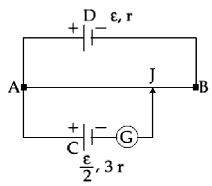
$A$ potentiometer wire $AB$ having length $L$ and resistance $12r$ is joined to a cell $D$ of $emf$ $\varepsilon$ and internal resistance $r$. $A$ cell $C$ having $emf$ $\varepsilon/2$ and internal resistance $3r$ is connected as shown in the figure. The length $AJ$ at which the galvanometer shows no deflection is
A
$\frac{11}{12}L$
B
$\frac{11}{24}L$
C
$\frac{13}{24}L$
D
$\frac{5}{12}L$
Solution
(C) The current $I$ flowing through the potentiometer wire $AB$ is given by $I = \frac{\varepsilon}{R_{AB} + r} = \frac{\varepsilon}{12r + r} = \frac{\varepsilon}{13r}$.
The potential drop across the length $AJ$ (where $AJ = x$) is $V_{AJ} = I \times R_{AJ}$.
Since the resistance of the wire is proportional to its length,$R_{AJ} = \frac{x}{L} \times 12r$.
Thus,$V_{AJ} = \left(\frac{\varepsilon}{13r}\right) \times \left(\frac{x}{L} \times 12r\right) = \frac{12\varepsilon x}{13L}$.
For the galvanometer to show no deflection,the potential drop across $AJ$ must equal the $emf$ of cell $C$,which is $\varepsilon/2$.
So,$\frac{12\varepsilon x}{13L} = \frac{\varepsilon}{2}$.
Solving for $x$:
$\frac{12x}{13L} = \frac{1}{2}$
$24x = 13L$
$x = \frac{13}{24}L$.
The potential drop across the length $AJ$ (where $AJ = x$) is $V_{AJ} = I \times R_{AJ}$.
Since the resistance of the wire is proportional to its length,$R_{AJ} = \frac{x}{L} \times 12r$.
Thus,$V_{AJ} = \left(\frac{\varepsilon}{13r}\right) \times \left(\frac{x}{L} \times 12r\right) = \frac{12\varepsilon x}{13L}$.
For the galvanometer to show no deflection,the potential drop across $AJ$ must equal the $emf$ of cell $C$,which is $\varepsilon/2$.
So,$\frac{12\varepsilon x}{13L} = \frac{\varepsilon}{2}$.
Solving for $x$:
$\frac{12x}{13L} = \frac{1}{2}$
$24x = 13L$
$x = \frac{13}{24}L$.
0 likes
View Solution108
MediumMCQ
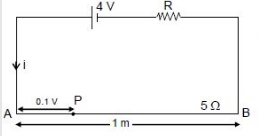
An ideal battery of $4\, V$ and resistance $R$ are connected in series in the primary circuit of a potentiometer of length $1\, m$ and resistance $5\,\Omega$. The value of $R$,to give a potential difference of $5\, mV$ across $10\, cm$ of potentiometer wire,is: ................ $\Omega$
A
$490$
B
$480$
C
$395$
D
$495$
Solution
(C) The current $i$ in the primary circuit is given by $i = \frac{4}{5 + R}$.
The potential difference across the entire potentiometer wire $AB$ is $V_{AB} = i \times 5 = \frac{20}{5 + R}$.
The potential gradient along the wire is $k = \frac{V_{AB}}{L} = \frac{20}{5 + R} \times \frac{1}{1} = \frac{20}{5 + R} \, V/m$.
The potential difference across a length of $10\, cm$ $(0.1\, m)$ is $V_{AP} = k \times 0.1 = \frac{20}{5 + R} \times 0.1 = \frac{2}{5 + R}$.
Given that $V_{AP} = 5\, mV = 5 \times 10^{-3} \, V$,we have:
$\frac{2}{5 + R} = 5 \times 10^{-3}$
$5 + R = \frac{2}{5 \times 10^{-3}} = \frac{2000}{5} = 400$
$R = 400 - 5 = 395\, \Omega$.
The potential difference across the entire potentiometer wire $AB$ is $V_{AB} = i \times 5 = \frac{20}{5 + R}$.
The potential gradient along the wire is $k = \frac{V_{AB}}{L} = \frac{20}{5 + R} \times \frac{1}{1} = \frac{20}{5 + R} \, V/m$.
The potential difference across a length of $10\, cm$ $(0.1\, m)$ is $V_{AP} = k \times 0.1 = \frac{20}{5 + R} \times 0.1 = \frac{2}{5 + R}$.
Given that $V_{AP} = 5\, mV = 5 \times 10^{-3} \, V$,we have:
$\frac{2}{5 + R} = 5 \times 10^{-3}$
$5 + R = \frac{2}{5 \times 10^{-3}} = \frac{2000}{5} = 400$
$R = 400 - 5 = 395\, \Omega$.
0 likes
View Solution109
MediumMCQ
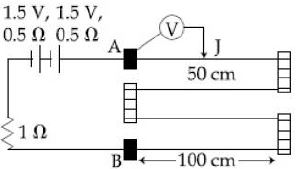
In the circuit shown, a four-wire potentiometer is made of a $400\, cm$ long wire, which extends between $A$ and $B$. The resistance per unit length of the potentiometer wire is $r = 0.01\, \Omega /cm$. If an ideal voltmeter is connected as shown with jockey $J$ at $50\, cm$ from end $A$, the expected reading of the voltmeter will be: ............... $V$
A
$0.75$
B
$0.20$
C
$0.25$
D
$0.50$
Solution
(C) The total $EMF$ of the two cells in series is $E_{eq} = 1.5\, V + 1.5\, V = 3.0\, V$.
The total internal resistance of the two cells is $r_{int} = 0.5\, \Omega + 0.5\, \Omega = 1.0\, \Omega$.
The total resistance of the circuit is $R_{total} = R_{ext} + r_{int} + R_{wire} = 1.0\, \Omega + 1.0\, \Omega + (400\, cm \times 0.01\, \Omega/cm) = 2.0\, \Omega + 4.0\, \Omega = 6.0\, \Omega$.
The current in the circuit is $i = \frac{E_{eq}}{R_{total}} = \frac{3.0\, V}{6.0\, \Omega} = 0.5\, A$.
The voltmeter measures the potential difference across the $50\, cm$ length of the wire.
The resistance of this $50\, cm$ segment is $R_{50} = 50\, cm \times 0.01\, \Omega/cm = 0.5\, \Omega$.
Therefore, the voltmeter reading is $V = i \times R_{50} = 0.5\, A \times 0.5\, \Omega = 0.25\, V$.
The total internal resistance of the two cells is $r_{int} = 0.5\, \Omega + 0.5\, \Omega = 1.0\, \Omega$.
The total resistance of the circuit is $R_{total} = R_{ext} + r_{int} + R_{wire} = 1.0\, \Omega + 1.0\, \Omega + (400\, cm \times 0.01\, \Omega/cm) = 2.0\, \Omega + 4.0\, \Omega = 6.0\, \Omega$.
The current in the circuit is $i = \frac{E_{eq}}{R_{total}} = \frac{3.0\, V}{6.0\, \Omega} = 0.5\, A$.
The voltmeter measures the potential difference across the $50\, cm$ length of the wire.
The resistance of this $50\, cm$ segment is $R_{50} = 50\, cm \times 0.01\, \Omega/cm = 0.5\, \Omega$.
Therefore, the voltmeter reading is $V = i \times R_{50} = 0.5\, A \times 0.5\, \Omega = 0.25\, V$.
0 likes
View Solution110
DifficultMCQ
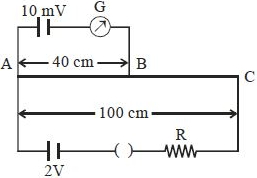
$A$ potentiometer wire of length $100 \, cm$ has a resistance of $10 \, \Omega$. It is connected in series with a resistance $R$ and a cell of $emf$ $2 \, V$ and of negligible internal resistance. $A$ source of $emf$ $10 \, mV$ is balanced against a length of $40 \, cm$ of the potentiometer wire. What is the value of external resistance $R$?
A
$790 \, \Omega$
B
$890 \, \Omega$
C
$990 \, \Omega$
D
$1090 \, \Omega$
Solution
(A) The current $I$ in the potentiometer wire $AC$ is given by:
$I = \frac{E}{R_{total}} = \frac{2}{10 + R}$
The potential difference $V_{AC}$ across the entire potentiometer wire is:
$V_{AC} = I \times R_{wire} = \left( \frac{2}{10 + R} \right) \times 10$
The potential gradient $k$ along the wire of length $L = 100 \, cm$ is:
$k = \frac{V_{AC}}{L} = \left( \frac{2}{10 + R} \right) \times \frac{10}{100} = \frac{2}{10(10 + R)}$
The source of $emf$ $E' = 10 \, mV = 10 \times 10^{-3} \, V$ is balanced against a length $l = 40 \, cm$. The balancing condition is:
$E' = k \times l$
$10 \times 10^{-3} = \left( \frac{2}{10(10 + R)} \right) \times 40$
$10^{-2} = \frac{8}{10 + R}$
$10 + R = \frac{8}{10^{-2}} = 800$
$R = 800 - 10 = 790 \, \Omega$.
$I = \frac{E}{R_{total}} = \frac{2}{10 + R}$
The potential difference $V_{AC}$ across the entire potentiometer wire is:
$V_{AC} = I \times R_{wire} = \left( \frac{2}{10 + R} \right) \times 10$
The potential gradient $k$ along the wire of length $L = 100 \, cm$ is:
$k = \frac{V_{AC}}{L} = \left( \frac{2}{10 + R} \right) \times \frac{10}{100} = \frac{2}{10(10 + R)}$
The source of $emf$ $E' = 10 \, mV = 10 \times 10^{-3} \, V$ is balanced against a length $l = 40 \, cm$. The balancing condition is:
$E' = k \times l$
$10 \times 10^{-3} = \left( \frac{2}{10(10 + R)} \right) \times 40$
$10^{-2} = \frac{8}{10 + R}$
$10 + R = \frac{8}{10^{-2}} = 800$
$R = 800 - 10 = 790 \, \Omega$.
0 likes
View Solution111
MediumMCQ
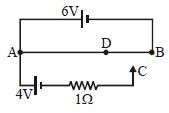
$A$ $6\,V$ battery of negligible internal resistance is connected across a uniform wire $AB$ of length $100\,cm$. The positive terminal of another battery of $emf$ $4\,V$ and internal resistance $1\,\Omega$ is joined to the point $A$ as shown in the figure. Take the potential at $B$ to be zero. At which point $D$ of the wire $AB$,measured from $A$,is the potential equal to the potential at $C$? ...................... $cm$ (approximately)
A
$33$
B
$67$
C
$50$
D
$75$
Solution
(B) Let the potential at $B$ be $V_B = 0\,V$. Since the $6\,V$ battery is connected across $AB$,the potential at $A$ is $V_A = 6\,V$.
The potential at any point $x$ (in $cm$) from $A$ on the wire $AB$ is given by $V(x) = V_A - (V_A - V_B) \cdot \frac{x}{L} = 6 - 6 \cdot \frac{x}{100} = 6(1 - 0.01x)$.
The potential at point $C$ is determined by the $4\,V$ battery. Since no current flows through the branch containing the $4\,V$ battery and the $1\,\Omega$ resistor (as it is an open circuit at $C$),the potential at $C$ is equal to the potential of the positive terminal of the $4\,V$ battery relative to $A$.
Specifically,$V_C = V_A - 4\,V = 6\,V - 4\,V = 2\,V$.
We want to find the point $D$ at distance $x$ from $A$ such that $V(D) = V_C = 2\,V$.
Setting $6(1 - 0.01x) = 2$,we get $1 - 0.01x = \frac{2}{6} = \frac{1}{3}$.
$0.01x = 1 - \frac{1}{3} = \frac{2}{3}$.
$x = \frac{2}{3} \cdot 100 = 66.67\,cm$.
Rounding to the nearest integer,we get $x \approx 67\,cm$.
The potential at any point $x$ (in $cm$) from $A$ on the wire $AB$ is given by $V(x) = V_A - (V_A - V_B) \cdot \frac{x}{L} = 6 - 6 \cdot \frac{x}{100} = 6(1 - 0.01x)$.
The potential at point $C$ is determined by the $4\,V$ battery. Since no current flows through the branch containing the $4\,V$ battery and the $1\,\Omega$ resistor (as it is an open circuit at $C$),the potential at $C$ is equal to the potential of the positive terminal of the $4\,V$ battery relative to $A$.
Specifically,$V_C = V_A - 4\,V = 6\,V - 4\,V = 2\,V$.
We want to find the point $D$ at distance $x$ from $A$ such that $V(D) = V_C = 2\,V$.
Setting $6(1 - 0.01x) = 2$,we get $1 - 0.01x = \frac{2}{6} = \frac{1}{3}$.
$0.01x = 1 - \frac{1}{3} = \frac{2}{3}$.
$x = \frac{2}{3} \cdot 100 = 66.67\,cm$.
Rounding to the nearest integer,we get $x \approx 67\,cm$.
0 likes
View Solution112
MediumMCQ
In a potentiometer arrangement,a cell of $emf$ $1.25\,V$ gives a balance point at $35.0\,cm$ length of the wire. If the cell is replaced by another cell and the balance point shifts to $63.0\,cm,$ the $emf$ of the second cell is ............... $V$.
A
$2.0$
B
$2.25$
C
$1.75$
D
$2.5$
Solution
(B) In a potentiometer,the $emf$ $(E)$ of a cell is directly proportional to the balancing length $(l)$ of the wire,i.e.,$E \propto l$.
Given:
$E_1 = 1.25\,V$
$l_1 = 35.0\,cm$
$l_2 = 63.0\,cm$
Using the relation $\frac{E_1}{E_2} = \frac{l_1}{l_2}$,we get:
$E_2 = E_1 \times \frac{l_2}{l_1}$
$E_2 = 1.25 \times \frac{63.0}{35.0}$
$E_2 = 1.25 \times 1.8$
$E_2 = 2.25\,V$
Therefore,the $emf$ of the second cell is $2.25\,V$.
Given:
$E_1 = 1.25\,V$
$l_1 = 35.0\,cm$
$l_2 = 63.0\,cm$
Using the relation $\frac{E_1}{E_2} = \frac{l_1}{l_2}$,we get:
$E_2 = E_1 \times \frac{l_2}{l_1}$
$E_2 = 1.25 \times \frac{63.0}{35.0}$
$E_2 = 1.25 \times 1.8$
$E_2 = 2.25\,V$
Therefore,the $emf$ of the second cell is $2.25\,V$.
0 likes
View Solution113
MediumMCQ
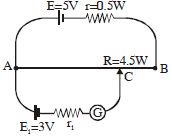
In the given potentiometer circuit,the length of the wire $AB$ is $3 \, m$ and its resistance is $R = 4.5 \, \Omega$. The length $AC$ for no deflection in the galvanometer is ............... $m$.
A
$2$
B
$1.8$
C
dependent on $r_1$
D
None of these
Solution
(A) The primary circuit consists of a battery of $E = 5 \, V$ and internal resistance $r = 0.5 \, \Omega$ connected in series with the potentiometer wire $AB$ of resistance $R = 4.5 \, \Omega$.
The total resistance of the primary circuit is $R_{total} = R + r = 4.5 \, \Omega + 0.5 \, \Omega = 5.0 \, \Omega$.
The current flowing through the potentiometer wire $AB$ is $I = \frac{E}{R_{total}} = \frac{5 \, V}{5 \, \Omega} = 1 \, A$.
The potential difference across the wire $AB$ is $V_{AB} = I \times R = 1 \, A \times 4.5 \, \Omega = 4.5 \, V$.
The potential gradient along the wire is $k = \frac{V_{AB}}{L_{AB}} = \frac{4.5 \, V}{3 \, m} = 1.5 \, V/m$.
For no deflection in the galvanometer,the potential difference across the length $AC$ (let it be $\ell$) must be equal to the $EMF$ of the secondary cell $E_1 = 3 \, V$.
Therefore,$V_{AC} = k \times \ell = 3 \, V$.
$1.5 \, V/m \times \ell = 3 \, V$.
$\ell = \frac{3}{1.5} = 2 \, m$.
The total resistance of the primary circuit is $R_{total} = R + r = 4.5 \, \Omega + 0.5 \, \Omega = 5.0 \, \Omega$.
The current flowing through the potentiometer wire $AB$ is $I = \frac{E}{R_{total}} = \frac{5 \, V}{5 \, \Omega} = 1 \, A$.
The potential difference across the wire $AB$ is $V_{AB} = I \times R = 1 \, A \times 4.5 \, \Omega = 4.5 \, V$.
The potential gradient along the wire is $k = \frac{V_{AB}}{L_{AB}} = \frac{4.5 \, V}{3 \, m} = 1.5 \, V/m$.
For no deflection in the galvanometer,the potential difference across the length $AC$ (let it be $\ell$) must be equal to the $EMF$ of the secondary cell $E_1 = 3 \, V$.
Therefore,$V_{AC} = k \times \ell = 3 \, V$.
$1.5 \, V/m \times \ell = 3 \, V$.
$\ell = \frac{3}{1.5} = 2 \, m$.
0 likes
View Solution114
MediumMCQ
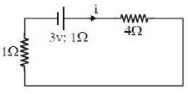
$A$ battery of internal resistance $1 \, \Omega$ and $emf$ $3 \, V$ sends a current through $1 \, m$ of uniform wire of resistance $5 \, \Omega$. The poles of a cell of $emf$ $1.4 \, V$ are connected to two points on the wire such that no current passes through this cell. The potential gradient of the wire is:
A
$2.5 \, V$
B
$2.5 \, V/m$
C
$3 \, V/m$
D
$1.5 \, V/m$
Solution
(B) The current $I$ flowing through the wire of resistance $R = 5 \, \Omega$ is given by the formula $I = \frac{E}{r + R}$, where $E = 3 \, V$ is the $emf$ of the battery and $r = 1 \, \Omega$ is its internal resistance.
Substituting the values: $I = \frac{3}{1 + 5} = \frac{3}{6} = 0.5 \, A$.
The potential difference $V_{wire}$ across the entire length of the wire is $V_{wire} = I \times R = 0.5 \times 5 = 2.5 \, V$.
The length of the wire is $L = 1 \, m$.
The potential gradient $k$ is defined as the potential drop per unit length: $k = \frac{V_{wire}}{L} = \frac{2.5 \, V}{1 \, m} = 2.5 \, V/m$.
Substituting the values: $I = \frac{3}{1 + 5} = \frac{3}{6} = 0.5 \, A$.
The potential difference $V_{wire}$ across the entire length of the wire is $V_{wire} = I \times R = 0.5 \times 5 = 2.5 \, V$.
The length of the wire is $L = 1 \, m$.
The potential gradient $k$ is defined as the potential drop per unit length: $k = \frac{V_{wire}}{L} = \frac{2.5 \, V}{1 \, m} = 2.5 \, V/m$.
0 likes
View Solution115
MediumMCQ
$A$ wire of length $100\, cm$ is connected to a cell of emf $2\, V$ and negligible internal resistance. The resistance of the wire is $3\, \Omega$. The additional resistance required to produce a potential difference of $1\, mV/cm$ is ............. $\Omega$.
A
$47$
B
$57$
C
$60$
D
$55$
Solution
(B) Let the additional resistance be $R$.
The total resistance of the circuit is $R_{total} = R + R_{wire} = R + 3\, \Omega$.
The current flowing through the circuit is $I = \frac{E}{R_{total}} = \frac{2}{R + 3}$.
The potential gradient $\phi$ is given as $1\, mV/cm = 10^{-3}\, V/cm = 0.1\, V/m$. Since the wire length is $100\, cm = 1\, m$,the total potential drop across the wire is $V_{wire} = \phi \times L = 10^{-3}\, V/cm \times 100\, cm = 0.1\, V$.
Also,$V_{wire} = I \times R_{wire} = \left( \frac{2}{R + 3} \right) \times 3$.
Equating the two expressions for $V_{wire}$:
$0.1 = \frac{6}{R + 3}$.
$R + 3 = \frac{6}{0.1} = 60$.
$R = 60 - 3 = 57\, \Omega$.
The total resistance of the circuit is $R_{total} = R + R_{wire} = R + 3\, \Omega$.
The current flowing through the circuit is $I = \frac{E}{R_{total}} = \frac{2}{R + 3}$.
The potential gradient $\phi$ is given as $1\, mV/cm = 10^{-3}\, V/cm = 0.1\, V/m$. Since the wire length is $100\, cm = 1\, m$,the total potential drop across the wire is $V_{wire} = \phi \times L = 10^{-3}\, V/cm \times 100\, cm = 0.1\, V$.
Also,$V_{wire} = I \times R_{wire} = \left( \frac{2}{R + 3} \right) \times 3$.
Equating the two expressions for $V_{wire}$:
$0.1 = \frac{6}{R + 3}$.
$R + 3 = \frac{6}{0.1} = 60$.
$R = 60 - 3 = 57\, \Omega$.
0 likes
View Solution116
MediumMCQ
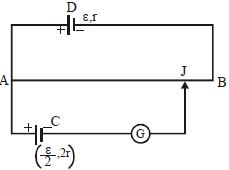
In the figure,the potentiometer wire $AB$ of length $L$ and resistance $9r$ is joined to the cell $D$ of $emf$ $\varepsilon$ and internal resistance $r$. The cell $C$'s $emf$ is $\frac{\varepsilon}{2}$ and its internal resistance is $2r$. The galvanometer $G$ will show no deflection when the length $AJ$ is
A
$\frac{4L}{9}$
B
$\frac{5L}{9}$
C
$\frac{7L}{18}$
D
$\frac{11L}{18}$
Solution
(B) The current $I$ flowing through the potentiometer wire $AB$ is given by $I = \frac{\varepsilon}{R_{wire} + r} = \frac{\varepsilon}{9r + r} = \frac{\varepsilon}{10r}$.
The potential difference across the wire $AB$ is $V_{AB} = I \times R_{wire} = \frac{\varepsilon}{10r} \times 9r = \frac{9\varepsilon}{10}$.
The potential gradient $x$ along the wire $AB$ is $x = \frac{V_{AB}}{L} = \frac{9\varepsilon}{10L}$.
For the galvanometer $G$ to show no deflection,the potential difference across the length $AJ$ must be equal to the $emf$ of cell $C$. Let the length $AJ = \ell$.
Thus,$x \times \ell = \frac{\varepsilon}{2}$.
Substituting the value of $x$,we get $\frac{9\varepsilon}{10L} \times \ell = \frac{\varepsilon}{2}$.
Solving for $\ell$,we get $\ell = \frac{\varepsilon}{2} \times \frac{10L}{9\varepsilon} = \frac{5L}{9}$.
The potential difference across the wire $AB$ is $V_{AB} = I \times R_{wire} = \frac{\varepsilon}{10r} \times 9r = \frac{9\varepsilon}{10}$.
The potential gradient $x$ along the wire $AB$ is $x = \frac{V_{AB}}{L} = \frac{9\varepsilon}{10L}$.
For the galvanometer $G$ to show no deflection,the potential difference across the length $AJ$ must be equal to the $emf$ of cell $C$. Let the length $AJ = \ell$.
Thus,$x \times \ell = \frac{\varepsilon}{2}$.
Substituting the value of $x$,we get $\frac{9\varepsilon}{10L} \times \ell = \frac{\varepsilon}{2}$.
Solving for $\ell$,we get $\ell = \frac{\varepsilon}{2} \times \frac{10L}{9\varepsilon} = \frac{5L}{9}$.
0 likes
View Solution117
MediumMCQ
$A$ $10\,m$ long potentiometer wire has a potential gradient of $0.0025\,V/cm$. Calculate the distance of the null point when the wire is connected to a $1.025\,V$ standard cell.
A
$4.1$
B
$0.25$
C
$1$
D
$2$
Solution
(A) The potential gradient $x$ is given as $0.0025\,V/cm$.
To convert this into $SI$ units $(V/m)$,we multiply by $100$:
$x = 0.0025 \times 100\,V/m = 0.25\,V/m$.
The potential difference $V$ across a length $\ell$ of the wire is given by $V = x\ell$.
Given the standard cell voltage $V = 1.025\,V$,we need to find the null point distance $\ell$:
$\ell = \frac{V}{x} = \frac{1.025}{0.25}$.
$\ell = 4.1\,m$.
To convert this into $SI$ units $(V/m)$,we multiply by $100$:
$x = 0.0025 \times 100\,V/m = 0.25\,V/m$.
The potential difference $V$ across a length $\ell$ of the wire is given by $V = x\ell$.
Given the standard cell voltage $V = 1.025\,V$,we need to find the null point distance $\ell$:
$\ell = \frac{V}{x} = \frac{1.025}{0.25}$.
$\ell = 4.1\,m$.
0 likes
View Solution118
MediumMCQ
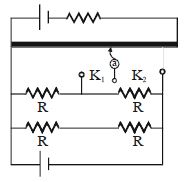
In a potentiometer experiment,when key $K_1$ is closed,the balance length is $100 \, cm$. What will be the balancing length when key $K_2$ is closed? ................ $cm$
A
$100$
B
$50$
C
$25$
D
$200$
Solution
(D) Let the potential gradient of the potentiometer wire be $x$.
When key $K_1$ is closed,the potential difference across the resistor $R$ is balanced. The current through this resistor is $I = \frac{E}{2R}$,so the potential difference is $V_1 = I \cdot R = \frac{E}{2R} \cdot R = \frac{E}{2}$.
Thus,$\frac{E}{2} = x \cdot 100 \implies E = 200x$.
When key $K_2$ is closed,the potential difference across the series combination of two resistors $R$ and $R$ is balanced. The current through this combination is $I' = \frac{E}{R+R} = \frac{E}{2R}$.
The potential difference across the combination is $V_2 = I' \cdot (R+R) = \frac{E}{2R} \cdot 2R = E$.
Thus,$E = x \cdot \ell'$,where $\ell'$ is the new balancing length.
Substituting $E = 200x$,we get $200x = x \cdot \ell'$,which gives $\ell' = 200 \, cm$.
When key $K_1$ is closed,the potential difference across the resistor $R$ is balanced. The current through this resistor is $I = \frac{E}{2R}$,so the potential difference is $V_1 = I \cdot R = \frac{E}{2R} \cdot R = \frac{E}{2}$.
Thus,$\frac{E}{2} = x \cdot 100 \implies E = 200x$.
When key $K_2$ is closed,the potential difference across the series combination of two resistors $R$ and $R$ is balanced. The current through this combination is $I' = \frac{E}{R+R} = \frac{E}{2R}$.
The potential difference across the combination is $V_2 = I' \cdot (R+R) = \frac{E}{2R} \cdot 2R = E$.
Thus,$E = x \cdot \ell'$,where $\ell'$ is the new balancing length.
Substituting $E = 200x$,we get $200x = x \cdot \ell'$,which gives $\ell' = 200 \, cm$.
0 likes
View Solution119
MediumMCQ
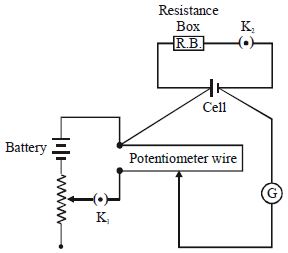
The adjoining figure shows the connections of a potentiometer experiment to determine the internal resistance of a Leclanché cell. When the cell is on open circuit,the balancing length of the potentiometer wire is $3.4 \, m$,and on closing the key $K_2$,the balancing length becomes $1.7 \, m$. If the resistance $R$ through which current is drawn is $10 \, \Omega$,then the internal resistance of the cell is .............. $\Omega$.
A
$0.1$
B
$1$
C
$10$
D
$1.1$
Solution
(C) The formula for the internal resistance $r$ of a cell using a potentiometer is given by:
$r = R \left( \frac{l_1}{l_2} - 1 \right)$
where $l_1$ is the balancing length in the open circuit and $l_2$ is the balancing length when the resistance $R$ is connected.
Given:
$l_1 = 3.4 \, m$
$l_2 = 1.7 \, m$
$R = 10 \, \Omega$
Substituting the values into the formula:
$r = 10 \left( \frac{3.4}{1.7} - 1 \right)$
$r = 10 (2 - 1)$
$r = 10 \times 1 = 10 \, \Omega$
Therefore,the internal resistance of the cell is $10 \, \Omega$.
$r = R \left( \frac{l_1}{l_2} - 1 \right)$
where $l_1$ is the balancing length in the open circuit and $l_2$ is the balancing length when the resistance $R$ is connected.
Given:
$l_1 = 3.4 \, m$
$l_2 = 1.7 \, m$
$R = 10 \, \Omega$
Substituting the values into the formula:
$r = 10 \left( \frac{3.4}{1.7} - 1 \right)$
$r = 10 (2 - 1)$
$r = 10 \times 1 = 10 \, \Omega$
Therefore,the internal resistance of the cell is $10 \, \Omega$.
0 likes
View Solution120
MediumMCQ
$A$ potentiometer is connected between $A$ and $B$ and the balance point is obtained at $203.6 \, cm$. When the end of the potentiometer connected to $B$ is shifted to $C$,then the balance point is obtained at $24.6 \, cm$. If now the potentiometer be connected between $B$ and $C$,the balance point will be at ................. $cm$.

A
$179$
B
$197.2$
C
$212$
D
$228$
Solution
(A) Let $V_{AB}$ be the potential difference between $A$ and $B$ and $V_{BC}$ be the potential difference between $B$ and $C$. Let $k$ be the potential gradient of the potentiometer wire.
When connected between $A$ and $B$,the balance length $l_1 = 203.6 \, cm$. Thus,$V_{AB} = k \cdot l_1 = k \cdot 203.6 \, cm$.
When the end is shifted to $C$,the total potential difference is $V_{AC} = V_{AB} + V_{BC}$. The balance length is $l_2 = 24.6 \, cm$. However,since $V_{AC} > V_{AB}$,the balance length should increase. The problem implies the polarity is reversed or the connection is $V_{AB} - V_{BC}$. Given the balance point is $24.6 \, cm$,we have $V_{AB} - V_{BC} = k \cdot 24.6 \, cm$.
Subtracting the two equations:
$V_{AB} = k \cdot 203.6 \, cm$
$V_{AB} - V_{BC} = k \cdot 24.6 \, cm$
$V_{BC} = k \cdot (203.6 - 24.6) = k \cdot 179.0 \, cm$.
Thus,the balance point for $B$ and $C$ is $179.0 \, cm$.
When connected between $A$ and $B$,the balance length $l_1 = 203.6 \, cm$. Thus,$V_{AB} = k \cdot l_1 = k \cdot 203.6 \, cm$.
When the end is shifted to $C$,the total potential difference is $V_{AC} = V_{AB} + V_{BC}$. The balance length is $l_2 = 24.6 \, cm$. However,since $V_{AC} > V_{AB}$,the balance length should increase. The problem implies the polarity is reversed or the connection is $V_{AB} - V_{BC}$. Given the balance point is $24.6 \, cm$,we have $V_{AB} - V_{BC} = k \cdot 24.6 \, cm$.
Subtracting the two equations:
$V_{AB} = k \cdot 203.6 \, cm$
$V_{AB} - V_{BC} = k \cdot 24.6 \, cm$
$V_{BC} = k \cdot (203.6 - 24.6) = k \cdot 179.0 \, cm$.
Thus,the balance point for $B$ and $C$ is $179.0 \, cm$.
0 likes
View Solution121
MediumMCQ
$A$ potentiometer wire,$10 \, m$ long,has a resistance of $40 \, \Omega$. It is connected in series with a resistance box and a $2 \, V$ storage cell. If the potential gradient along the wire is $0.1 \, mV/cm$,the resistance unplugged in the box is .............. $\Omega$.
A
$260$
B
$760$
C
$960$
D
$1060$
Solution
(B) The potential gradient $x$ is given as $0.1 \, mV/cm = 0.1 \times 10^{-3} \, V / (10^{-2} \, m) = 0.01 \, V/m$.
Total potential difference across the $10 \, m$ wire is $V_{wire} = x \times L = 0.01 \, V/m \times 10 \, m = 0.1 \, V$.
The current $I$ flowing through the potentiometer wire is $I = V_{wire} / R_{wire} = 0.1 \, V / 40 \, \Omega = 0.0025 \, A = 1/400 \, A$.
The circuit consists of a $2 \, V$ cell,a resistance box $R$,and the wire resistance $40 \, \Omega$ in series.
Using Ohm's law for the whole circuit: $I = E / (R + R_{wire}) \implies 1/400 = 2 / (R + 40)$.
$R + 40 = 800 \implies R = 760 \, \Omega$.
Total potential difference across the $10 \, m$ wire is $V_{wire} = x \times L = 0.01 \, V/m \times 10 \, m = 0.1 \, V$.
The current $I$ flowing through the potentiometer wire is $I = V_{wire} / R_{wire} = 0.1 \, V / 40 \, \Omega = 0.0025 \, A = 1/400 \, A$.
The circuit consists of a $2 \, V$ cell,a resistance box $R$,and the wire resistance $40 \, \Omega$ in series.
Using Ohm's law for the whole circuit: $I = E / (R + R_{wire}) \implies 1/400 = 2 / (R + 40)$.
$R + 40 = 800 \implies R = 760 \, \Omega$.
0 likes
View Solution122
MediumMCQ
The balancing length for a cell is $560 \; cm$ in a potentiometer experiment. When an external resistance of $10 \; \Omega$ is connected in parallel to the cell,the balancing length changes by $60 \; cm$. If the internal resistance of the cell is $\frac{N}{10} \; \Omega$,where $N$ is an integer,then the value of $N$ is:
A
$12$
B
$10$
C
$8$
D
$14$
Solution
(A) In a potentiometer experiment,the balancing length $l_1$ corresponds to the $EMF$ of the cell,$E = k l_1$,where $k$ is the potential gradient.
When an external resistance $R$ is connected in parallel,the terminal voltage $V$ is given by $V = E - Ir = E - \frac{E}{R+r} r = E \left( \frac{R}{R+r} \right) = k l_2$.
Thus,$\frac{E}{V} = \frac{l_1}{l_2} = \frac{R+r}{R} = 1 + \frac{r}{R}$.
Given $l_1 = 560 \; cm$ and the change in length is $60 \; cm$,the new balancing length $l_2 = 560 - 60 = 500 \; cm$.
Substituting the values: $\frac{560}{500} = 1 + \frac{r}{10}$.
$1.12 = 1 + \frac{r}{10} \implies 0.12 = \frac{r}{10} \implies r = 1.2 \; \Omega$.
Since $r = \frac{N}{10} \; \Omega$,we have $\frac{N}{10} = 1.2$,which gives $N = 12$.
When an external resistance $R$ is connected in parallel,the terminal voltage $V$ is given by $V = E - Ir = E - \frac{E}{R+r} r = E \left( \frac{R}{R+r} \right) = k l_2$.
Thus,$\frac{E}{V} = \frac{l_1}{l_2} = \frac{R+r}{R} = 1 + \frac{r}{R}$.
Given $l_1 = 560 \; cm$ and the change in length is $60 \; cm$,the new balancing length $l_2 = 560 - 60 = 500 \; cm$.
Substituting the values: $\frac{560}{500} = 1 + \frac{r}{10}$.
$1.12 = 1 + \frac{r}{10} \implies 0.12 = \frac{r}{10} \implies r = 1.2 \; \Omega$.
Since $r = \frac{N}{10} \; \Omega$,we have $\frac{N}{10} = 1.2$,which gives $N = 12$.
0 likes
View Solution123
MediumMCQ
The length of a potentiometer wire is $1200 \; cm$ and it carries a current of $60 \; mA$. For a cell of $emf \; 5 \; V$ and internal resistance of $20 \; \Omega$,the null point on it is found to be at $1000 \; cm$. The resistance of the whole wire is .............. $\Omega$.
A
$120$
B
$60$
C
$80$
D
$100$
Solution
(D) Let $L = 1200 \; cm = 12 \; m$ be the total length of the potentiometer wire.
Let $I = 60 \; mA = 0.06 \; A$ be the current flowing through the wire.
Let $R$ be the total resistance of the wire.
The potential drop across the entire wire is $V_{wire} = I \times R = 0.06 \times R$.
The potential gradient $\lambda$ is given by $\lambda = \frac{V_{wire}}{L} = \frac{0.06 \times R}{12} = 0.005 \times R \; V/cm$.
For a cell of $emf \; E = 5 \; V$,the null point is at $\ell = 1000 \; cm$.
The balance condition is $E = \lambda \times \ell$.
Substituting the values: $5 = (0.005 \times R) \times 1000$.
$5 = 5 \times R$.
Therefore,$R = 1 \; \Omega$ is incorrect based on the calculation; let's re-evaluate: $5 = \frac{0.06 \times R}{1200} \times 1000$.
$5 = \frac{0.06 \times R}{1.2} = 0.05 \times R$.
$R = \frac{5}{0.05} = 100 \; \Omega$.
Let $I = 60 \; mA = 0.06 \; A$ be the current flowing through the wire.
Let $R$ be the total resistance of the wire.
The potential drop across the entire wire is $V_{wire} = I \times R = 0.06 \times R$.
The potential gradient $\lambda$ is given by $\lambda = \frac{V_{wire}}{L} = \frac{0.06 \times R}{12} = 0.005 \times R \; V/cm$.
For a cell of $emf \; E = 5 \; V$,the null point is at $\ell = 1000 \; cm$.
The balance condition is $E = \lambda \times \ell$.
Substituting the values: $5 = (0.005 \times R) \times 1000$.
$5 = 5 \times R$.
Therefore,$R = 1 \; \Omega$ is incorrect based on the calculation; let's re-evaluate: $5 = \frac{0.06 \times R}{1200} \times 1000$.
$5 = \frac{0.06 \times R}{1.2} = 0.05 \times R$.
$R = \frac{5}{0.05} = 100 \; \Omega$.
0 likes
View Solution124
Medium
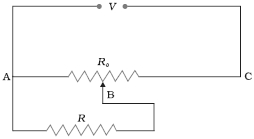
$A$ resistance of $R \; \Omega$ draws current from a potentiometer. The potentiometer has a total resistance $R_{0} \; \Omega$ (Figure). $A$ voltage $V$ is supplied to the potentiometer. Derive an expression for the voltage across $R$ when the sliding contact is in the middle of the potentiometer.
Solution
(N/A) When the sliding contact $B$ is in the middle of the potentiometer,the resistance $R_{0}$ is divided into two equal parts,each of $R_{0}/2$. The resistance $R$ is connected in parallel with the lower half of the potentiometer (between points $A$ and $B$).
The equivalent resistance $R_{1}$ between points $A$ and $B$ is given by:
$\frac{1}{R_{1}} = \frac{1}{R} + \frac{1}{R_{0}/2} = \frac{1}{R} + \frac{2}{R_{0}} = \frac{R_{0} + 2R}{R \cdot R_{0}}$
$R_{1} = \frac{R \cdot R_{0}}{R_{0} + 2R}$
The total resistance of the circuit between points $A$ and $C$ is the sum of the equivalent resistance $R_{1}$ and the remaining part of the potentiometer resistance $(R_{0}/2)$:
$R_{total} = R_{1} + \frac{R_{0}}{2}$
The total current $I$ flowing from the source $V$ is:
$I = \frac{V}{R_{total}} = \frac{V}{R_{1} + R_{0}/2} = \frac{2V}{2R_{1} + R_{0}}$
The voltage $V_{1}$ across the resistance $R$ is the same as the voltage across the parallel combination $R_{1}$:
$V_{1} = I \cdot R_{1} = \left( \frac{2V}{2R_{1} + R_{0}} \right) \cdot R_{1}$
Substituting $R_{1} = \frac{R \cdot R_{0}}{R_{0} + 2R}$ into the expression for $V_{1}$:
$V_{1} = \frac{2V \cdot \left( \frac{R \cdot R_{0}}{R_{0} + 2R} \right)}{2 \left( \frac{R \cdot R_{0}}{R_{0} + 2R} \right) + R_{0}} = \frac{2V \cdot R \cdot R_{0}}{2R \cdot R_{0} + R_{0}(R_{0} + 2R)} = \frac{2V \cdot R \cdot R_{0}}{2R \cdot R_{0} + R_{0}^{2} + 2R \cdot R_{0}} = \frac{2V \cdot R \cdot R_{0}}{R_{0}^{2} + 4R \cdot R_{0}}$
Dividing numerator and denominator by $R_{0}$:
$V_{1} = \frac{2VR}{R_{0} + 4R}$
The equivalent resistance $R_{1}$ between points $A$ and $B$ is given by:
$\frac{1}{R_{1}} = \frac{1}{R} + \frac{1}{R_{0}/2} = \frac{1}{R} + \frac{2}{R_{0}} = \frac{R_{0} + 2R}{R \cdot R_{0}}$
$R_{1} = \frac{R \cdot R_{0}}{R_{0} + 2R}$
The total resistance of the circuit between points $A$ and $C$ is the sum of the equivalent resistance $R_{1}$ and the remaining part of the potentiometer resistance $(R_{0}/2)$:
$R_{total} = R_{1} + \frac{R_{0}}{2}$
The total current $I$ flowing from the source $V$ is:
$I = \frac{V}{R_{total}} = \frac{V}{R_{1} + R_{0}/2} = \frac{2V}{2R_{1} + R_{0}}$
The voltage $V_{1}$ across the resistance $R$ is the same as the voltage across the parallel combination $R_{1}$:
$V_{1} = I \cdot R_{1} = \left( \frac{2V}{2R_{1} + R_{0}} \right) \cdot R_{1}$
Substituting $R_{1} = \frac{R \cdot R_{0}}{R_{0} + 2R}$ into the expression for $V_{1}$:
$V_{1} = \frac{2V \cdot \left( \frac{R \cdot R_{0}}{R_{0} + 2R} \right)}{2 \left( \frac{R \cdot R_{0}}{R_{0} + 2R} \right) + R_{0}} = \frac{2V \cdot R \cdot R_{0}}{2R \cdot R_{0} + R_{0}(R_{0} + 2R)} = \frac{2V \cdot R \cdot R_{0}}{2R \cdot R_{0} + R_{0}^{2} + 2R \cdot R_{0}} = \frac{2V \cdot R \cdot R_{0}}{R_{0}^{2} + 4R \cdot R_{0}}$
Dividing numerator and denominator by $R_{0}$:
$V_{1} = \frac{2VR}{R_{0} + 4R}$
0 likes
View Solution125
MediumMCQ
In a potentiometer arrangement,a cell of $emf$ $1.25\; V$ gives a balance point at $35.0\; cm$ length of the wire. If the cell is replaced by another cell and the balance point shifts to $63.0\; cm ,$ what is the $emf$ of the second cell in $V$?
A
$4.65$
B
$2.25$
C
$8.64$
D
$10.52$
Solution
(B) $Emf$ of the first cell,$E_{1} = 1.25\; V$.
Balance point of the potentiometer,$l_{1} = 35.0\; cm$.
The cell is replaced by another cell of $emf$ $E_{2}$.
New balance point of the potentiometer,$l_{2} = 63.0\; cm$.
The balance condition for a potentiometer is given by the relation:
$\frac{E_{1}}{E_{2}} = \frac{l_{1}}{l_{2}}$
Rearranging for $E_{2}$:
$E_{2} = E_{1} \times \frac{l_{2}}{l_{1}}$
Substituting the given values:
$E_{2} = 1.25 \times \frac{63.0}{35.0} = 1.25 \times 1.8 = 2.25\; V$.
Therefore,the $emf$ of the second cell is $2.25\; V$.
Balance point of the potentiometer,$l_{1} = 35.0\; cm$.
The cell is replaced by another cell of $emf$ $E_{2}$.
New balance point of the potentiometer,$l_{2} = 63.0\; cm$.
The balance condition for a potentiometer is given by the relation:
$\frac{E_{1}}{E_{2}} = \frac{l_{1}}{l_{2}}$
Rearranging for $E_{2}$:
$E_{2} = E_{1} \times \frac{l_{2}}{l_{1}}$
Substituting the given values:
$E_{2} = 1.25 \times \frac{63.0}{35.0} = 1.25 \times 1.8 = 2.25\; V$.
Therefore,the $emf$ of the second cell is $2.25\; V$.
0 likes
View Solution126
Difficult
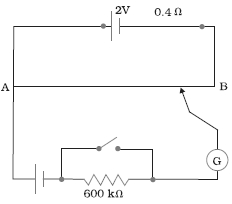
The figure shows a potentiometer with a cell of $2.0 \; V$ and internal resistance $0.40 \; \Omega$ maintaining a potential drop across the resistor wire $AB$. $A$ standard cell which maintains a constant $emf$ of $1.02 \; V$ (for very moderate currents up to a few $mA$) gives a balance point at $67.3 \; cm$ length of the wire. To ensure very low currents are drawn from the standard cell,a very high resistance of $600 \; k \Omega$ is put in series with it,which is shorted close to the balance point. The standard cell is then replaced by a cell of unknown $emf$ $\varepsilon$ and the balance point found similarly,turns out to be at $82.3 \; cm$ length of the wire.
$(a)$ What is the value of $\varepsilon ?$
$(b)$ What purpose does the high resistance of $600 \; k \Omega$ have?
$(c)$ Is the balance point affected by this high resistance?
$(d)$ Would the method work in the above situation if the driver cell of the potentiometer had an $emf$ of $1.0 \; V$ instead of $2.0 \; V ?$
$(e)$ Would the circuit work well for determining an extremely small $emf$,say of the order of a few $mV$ (such as the typical $emf$ of a thermocouple)? If not,how will you modify the circuit?
$(a)$ What is the value of $\varepsilon ?$
$(b)$ What purpose does the high resistance of $600 \; k \Omega$ have?
$(c)$ Is the balance point affected by this high resistance?
$(d)$ Would the method work in the above situation if the driver cell of the potentiometer had an $emf$ of $1.0 \; V$ instead of $2.0 \; V ?$
$(e)$ Would the circuit work well for determining an extremely small $emf$,say of the order of a few $mV$ (such as the typical $emf$ of a thermocouple)? If not,how will you modify the circuit?
Solution
(A-D) The constant $emf$ of the given standard cell is $E_1 = 1.02 \; V$.
The balance point on the wire is $l_1 = 67.3 \; cm$.
When a cell of unknown $emf$ $\varepsilon$ replaces the standard cell,the new balance point on the wire is $l = 82.3 \; cm$.
The relation connecting $emf$ and balance point is $\frac{E_1}{l_1} = \frac{\varepsilon}{l}$.
Therefore,$\varepsilon = \frac{l}{l_1} \times E_1 = \frac{82.3}{67.3} \times 1.02 \approx 1.247 \; V$.
The value of the unknown $emf$ is $1.247 \; V$.
$(b)$ The purpose of using the high resistance of $600 \; k \Omega$ is to protect the galvanometer from high currents when the movable contact is far from the balance point.
$(c)$ No,the balance point is not affected by the presence of this high resistance because at the balance point,the current through the galvanometer is zero,so there is no potential drop across the high resistance.
$(d)$ The method would not work if the driver cell had an $emf$ of $1.0 \; V$ because the $emf$ of the cell to be measured ($1.02 \; V$ or $1.247 \; V$) would be greater than the potential drop across the potentiometer wire,making it impossible to find a balance point.
$(e)$ The circuit would not work well for determining an extremely small $emf$ because the balance point would be very close to end $A$,leading to a large percentage error. To modify the circuit,a series resistor should be connected with the potentiometer wire $AB$ to reduce the potential drop across $AB$ so that it is only slightly greater than the $emf$ being measured.
The balance point on the wire is $l_1 = 67.3 \; cm$.
When a cell of unknown $emf$ $\varepsilon$ replaces the standard cell,the new balance point on the wire is $l = 82.3 \; cm$.
The relation connecting $emf$ and balance point is $\frac{E_1}{l_1} = \frac{\varepsilon}{l}$.
Therefore,$\varepsilon = \frac{l}{l_1} \times E_1 = \frac{82.3}{67.3} \times 1.02 \approx 1.247 \; V$.
The value of the unknown $emf$ is $1.247 \; V$.
$(b)$ The purpose of using the high resistance of $600 \; k \Omega$ is to protect the galvanometer from high currents when the movable contact is far from the balance point.
$(c)$ No,the balance point is not affected by the presence of this high resistance because at the balance point,the current through the galvanometer is zero,so there is no potential drop across the high resistance.
$(d)$ The method would not work if the driver cell had an $emf$ of $1.0 \; V$ because the $emf$ of the cell to be measured ($1.02 \; V$ or $1.247 \; V$) would be greater than the potential drop across the potentiometer wire,making it impossible to find a balance point.
$(e)$ The circuit would not work well for determining an extremely small $emf$ because the balance point would be very close to end $A$,leading to a large percentage error. To modify the circuit,a series resistor should be connected with the potentiometer wire $AB$ to reduce the potential drop across $AB$ so that it is only slightly greater than the $emf$ being measured.
0 likes
View Solution127
MediumMCQ
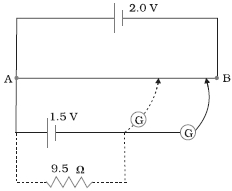
The figure shows a $2.0 \; V$ potentiometer used for the determination of internal resistance of a $1.5 \; V$ cell. The balance point of the cell in open circuit is $76.3 \; cm$. When a resistor of $9.5 \; \Omega$ is used in the external circuit of the cell,the balance point shifts to $64.8 \; cm$ length of the potentiometer wire. Determine the internal resistance (in $\Omega$) of the cell.
A
$1.68$
B
$6.32$
C
$8.24$
D
$5.62$
Solution
(A) Let the internal resistance of the cell be $r$.
The balance point of the cell in an open circuit is given by $l_1 = 76.3 \; cm$.
When an external resistance $R = 9.5 \; \Omega$ is connected in parallel to the cell,the new balance point is $l_2 = 64.8 \; cm$.
The formula for the internal resistance $r$ of a cell using a potentiometer is given by:
$r = \left( \frac{l_1 - l_2}{l_2} \right) R$
Substituting the given values:
$r = \left( \frac{76.3 - 64.8}{64.8} \right) \times 9.5$
$r = \left( \frac{11.5}{64.8} \right) \times 9.5$
$r \approx 0.17747 \times 9.5 \approx 1.686 \; \Omega$.
Rounding to two decimal places,the internal resistance of the cell is $1.68 \; \Omega$.
The balance point of the cell in an open circuit is given by $l_1 = 76.3 \; cm$.
When an external resistance $R = 9.5 \; \Omega$ is connected in parallel to the cell,the new balance point is $l_2 = 64.8 \; cm$.
The formula for the internal resistance $r$ of a cell using a potentiometer is given by:
$r = \left( \frac{l_1 - l_2}{l_2} \right) R$
Substituting the given values:
$r = \left( \frac{76.3 - 64.8}{64.8} \right) \times 9.5$
$r = \left( \frac{11.5}{64.8} \right) \times 9.5$
$r \approx 0.17747 \times 9.5 \approx 1.686 \; \Omega$.
Rounding to two decimal places,the internal resistance of the cell is $1.68 \; \Omega$.
0 likes
View Solution128
Difficult
What is a potentiometer? Explain the principle of a potentiometer.
Solution
(N/A) potentiometer is a device used to measure potential difference or to compare electromotive forces $(EMF)$ of cells. It is also used to measure internal resistance of a cell.
Principle:
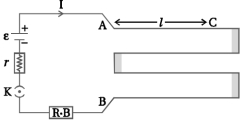
As shown in the figure,a battery with $EMF$ $\varepsilon$ and internal resistance $r$ is connected in series with a resistance box $R$ and a uniform wire $AB$ of length $L$ and resistance per unit length $\rho$.
The total resistance of the circuit is $R_{total} = R + L\rho + r$.
The current flowing through the wire $AB$ is $I = \frac{\varepsilon}{R + L\rho + r}$.
If the length of a segment $AC$ of the wire is $l$,then the resistance of segment $AC$ is $R_{AC} = \rho l$.
The potential difference $V$ across the segment $AC$ is given by:
$V = I \cdot R_{AC} = I \rho l$
Substituting the value of $I$:
$V = \left( \frac{\varepsilon \rho}{R + L\rho + r} \right) l$
Since $\varepsilon, \rho, R, L,$ and $r$ are constants for a given setup,we can write $V = \phi l$,where $\phi = \frac{\varepsilon \rho}{R + L\rho + r}$ is known as the potential gradient.
Principle Statement: The potential difference across any segment of a uniform wire carrying a constant current is directly proportional to the length of that segment.
The unit of potential gradient is $V \cdot m^{-1}$ and its dimensional formula is $[M^1 L^1 T^{-3} A^{-1}]$.
Principle:
As shown in the figure,a battery with $EMF$ $\varepsilon$ and internal resistance $r$ is connected in series with a resistance box $R$ and a uniform wire $AB$ of length $L$ and resistance per unit length $\rho$.
The total resistance of the circuit is $R_{total} = R + L\rho + r$.
The current flowing through the wire $AB$ is $I = \frac{\varepsilon}{R + L\rho + r}$.
If the length of a segment $AC$ of the wire is $l$,then the resistance of segment $AC$ is $R_{AC} = \rho l$.
The potential difference $V$ across the segment $AC$ is given by:
$V = I \cdot R_{AC} = I \rho l$
Substituting the value of $I$:
$V = \left( \frac{\varepsilon \rho}{R + L\rho + r} \right) l$
Since $\varepsilon, \rho, R, L,$ and $r$ are constants for a given setup,we can write $V = \phi l$,where $\phi = \frac{\varepsilon \rho}{R + L\rho + r}$ is known as the potential gradient.
Principle Statement: The potential difference across any segment of a uniform wire carrying a constant current is directly proportional to the length of that segment.
The unit of potential gradient is $V \cdot m^{-1}$ and its dimensional formula is $[M^1 L^1 T^{-3} A^{-1}]$.
0 likes
View Solution129
Medium
Explain the comparison of the electromotive force (emf) of two cells using a potentiometer with a necessary diagram.
Solution
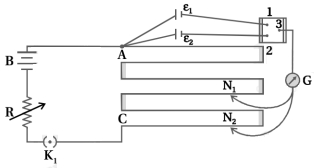
(A) As shown in the figure,a battery having emf $\varepsilon$ and internal resistance $r$,a variable resistance $R$,and a switch $K_{1}$ are connected between the two ends $A$ and $B$ of the potentiometer wire.
To compare the emf of two cells $\varepsilon_{1}$ and $\varepsilon_{2}$,the positive terminals of both cells are connected to point $A$. The negative terminals of the cells are connected to points $1$ and $2$ of a two-way switch. Terminal $3$ of the switch is connected to a galvanometer $(G)$ and a jockey in series. The jockey can be moved along the potentiometer wire.
First,points $1$ and $3$ of the switch are connected,placing cell $\varepsilon_{1}$ in the circuit. By sliding the jockey along the wire,a balance point $N_{1}$ is obtained such that the galvanometer shows zero deflection. Let $AN_{1} = l_{1}$.
By applying Kirchhoff's second law for the loop $AN_{1}G31A$:
$\phi l_{1} - \varepsilon_{1} = 0$
$\therefore \varepsilon_{1} = \phi l_{1} \quad .....(1)$
where $\phi$ is the potential gradient of the wire.
Next,points $2$ and $3$ of the switch are connected,placing cell $\varepsilon_{2}$ in the circuit. By sliding the jockey,a balance point $N_{2}$ is obtained such that the galvanometer shows zero deflection. Let $AN_{2} = l_{2}$.
By applying Kirchhoff's second law for the loop $AN_{2}G32A$:
$\phi l_{2} - \varepsilon_{2} = 0$
$\therefore \varepsilon_{2} = \phi l_{2} \quad .....(2)$
Dividing equation $(1)$ by $(2)$:
$\frac{\varepsilon_{1}}{\varepsilon_{2}} = \frac{\phi l_{1}}{\phi l_{2}} = \frac{l_{1}}{l_{2}}$
Thus,the ratio of the emfs of the two cells is equal to the ratio of their respective balancing lengths.
To compare the emf of two cells $\varepsilon_{1}$ and $\varepsilon_{2}$,the positive terminals of both cells are connected to point $A$. The negative terminals of the cells are connected to points $1$ and $2$ of a two-way switch. Terminal $3$ of the switch is connected to a galvanometer $(G)$ and a jockey in series. The jockey can be moved along the potentiometer wire.
First,points $1$ and $3$ of the switch are connected,placing cell $\varepsilon_{1}$ in the circuit. By sliding the jockey along the wire,a balance point $N_{1}$ is obtained such that the galvanometer shows zero deflection. Let $AN_{1} = l_{1}$.
By applying Kirchhoff's second law for the loop $AN_{1}G31A$:
$\phi l_{1} - \varepsilon_{1} = 0$
$\therefore \varepsilon_{1} = \phi l_{1} \quad .....(1)$
where $\phi$ is the potential gradient of the wire.
Next,points $2$ and $3$ of the switch are connected,placing cell $\varepsilon_{2}$ in the circuit. By sliding the jockey,a balance point $N_{2}$ is obtained such that the galvanometer shows zero deflection. Let $AN_{2} = l_{2}$.
By applying Kirchhoff's second law for the loop $AN_{2}G32A$:
$\phi l_{2} - \varepsilon_{2} = 0$
$\therefore \varepsilon_{2} = \phi l_{2} \quad .....(2)$
Dividing equation $(1)$ by $(2)$:
$\frac{\varepsilon_{1}}{\varepsilon_{2}} = \frac{\phi l_{1}}{\phi l_{2}} = \frac{l_{1}}{l_{2}}$
Thus,the ratio of the emfs of the two cells is equal to the ratio of their respective balancing lengths.
0 likes
View Solution130
Medium
Explain the method to measure the internal resistance of a cell using a potentiometer.
Solution
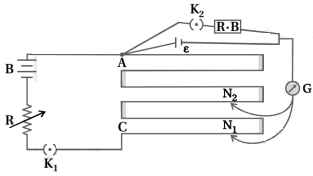
(N/A) To measure the internal resistance $(r)$ of a cell $(\varepsilon)$,a potentiometer circuit is set up as shown in the figure.
The primary circuit consists of a battery $(B)$,a variable resistor $(R)$,and a key $(K_1)$ connected in series with the potentiometer wire $AC$.
The cell $(\varepsilon)$ whose internal resistance $(r)$ is to be measured is connected in parallel with a resistance box $(R_{ext})$ and a key $(K_2)$. The positive terminal of the cell is connected to point $A$,and the negative terminal is connected to a galvanometer $(G)$,which is then connected to a jockey.
$1$. With key $K_2$ open,the cell $(\varepsilon)$ is in an open circuit. The null point $N_1$ is found on the wire $AC$ such that the galvanometer shows zero deflection. Let the balancing length be $AN_1 = l_1$. Since the cell is in an open circuit,the potential difference across it is equal to its $EMF$ $(\varepsilon)$.
$\varepsilon = \phi l_1$ ... $(1)$,where $\phi$ is the potential gradient along the wire.
$2$. Now,close the key $K_2$ so that a current flows through the resistance box $(R_{ext})$ and the cell. The null point $N_2$ is found on the wire $AC$. Let the balancing length be $AN_2 = l_2$. In this condition,the potential difference across the cell is equal to its terminal voltage $(V)$.
$V = \phi l_2$ ... $(2)$.
Dividing equation $(1)$ by $(2)$,we get:
$\frac{\varepsilon}{V} = \frac{l_1}{l_2}$
We know that for a cell,$\varepsilon = I(R_{ext} + r)$ and $V = IR_{ext}$,so $\frac{\varepsilon}{V} = \frac{R_{ext} + r}{R_{ext}} = 1 + \frac{r}{R_{ext}}$.
Equating the two expressions for $\frac{\varepsilon}{V}$:
$1 + \frac{r}{R_{ext}} = \frac{l_1}{l_2}$
$\frac{r}{R_{ext}} = \frac{l_1}{l_2} - 1 = \frac{l_1 - l_2}{l_2}$
$r = R_{ext} \left( \frac{l_1 - l_2}{l_2} \right)$
The primary circuit consists of a battery $(B)$,a variable resistor $(R)$,and a key $(K_1)$ connected in series with the potentiometer wire $AC$.
The cell $(\varepsilon)$ whose internal resistance $(r)$ is to be measured is connected in parallel with a resistance box $(R_{ext})$ and a key $(K_2)$. The positive terminal of the cell is connected to point $A$,and the negative terminal is connected to a galvanometer $(G)$,which is then connected to a jockey.
$1$. With key $K_2$ open,the cell $(\varepsilon)$ is in an open circuit. The null point $N_1$ is found on the wire $AC$ such that the galvanometer shows zero deflection. Let the balancing length be $AN_1 = l_1$. Since the cell is in an open circuit,the potential difference across it is equal to its $EMF$ $(\varepsilon)$.
$\varepsilon = \phi l_1$ ... $(1)$,where $\phi$ is the potential gradient along the wire.
$2$. Now,close the key $K_2$ so that a current flows through the resistance box $(R_{ext})$ and the cell. The null point $N_2$ is found on the wire $AC$. Let the balancing length be $AN_2 = l_2$. In this condition,the potential difference across the cell is equal to its terminal voltage $(V)$.
$V = \phi l_2$ ... $(2)$.
Dividing equation $(1)$ by $(2)$,we get:
$\frac{\varepsilon}{V} = \frac{l_1}{l_2}$
We know that for a cell,$\varepsilon = I(R_{ext} + r)$ and $V = IR_{ext}$,so $\frac{\varepsilon}{V} = \frac{R_{ext} + r}{R_{ext}} = 1 + \frac{r}{R_{ext}}$.
Equating the two expressions for $\frac{\varepsilon}{V}$:
$1 + \frac{r}{R_{ext}} = \frac{l_1}{l_2}$
$\frac{r}{R_{ext}} = \frac{l_1}{l_2} - 1 = \frac{l_1 - l_2}{l_2}$
$r = R_{ext} \left( \frac{l_1 - l_2}{l_2} \right)$
0 likes
View Solution131
Easy
Define potential gradient and write its $SI$ unit.
Solution
(N/A) The potential gradient is defined as the fall of potential per unit length along the current-carrying wire.
Mathematically,it is given by $k = \frac{V}{L}$,where $V$ is the potential difference across the wire and $L$ is the length of the wire.
The $SI$ unit of potential gradient is $\text{volt per meter}$ $(V/m)$.
Mathematically,it is given by $k = \frac{V}{L}$,where $V$ is the potential difference across the wire and $L$ is the length of the wire.
The $SI$ unit of potential gradient is $\text{volt per meter}$ $(V/m)$.
0 likes
View Solution132
Medium
Write the advantages of a potentiometer.
Solution
(N/A) potentiometer is a versatile instrument used for measuring potential differences and internal resistance. Its main advantages are:
$1$. It works on the principle of null deflection,meaning no current is drawn from the source of $EMF$ being measured. Therefore,it measures the true $EMF$ of the cell.
$2$. It does not affect the circuit conditions because it does not draw any current from the circuit under test.
$3$. It is highly sensitive and can be used to measure very small potential differences.
$4$. It can be used to compare the EMFs of two cells and to determine the internal resistance of a cell.
$1$. It works on the principle of null deflection,meaning no current is drawn from the source of $EMF$ being measured. Therefore,it measures the true $EMF$ of the cell.
$2$. It does not affect the circuit conditions because it does not draw any current from the circuit under test.
$3$. It is highly sensitive and can be used to measure very small potential differences.
$4$. It can be used to compare the EMFs of two cells and to determine the internal resistance of a cell.
0 likes
View Solution133
MediumMCQ
What is the advantage of using thick metallic strips to join wires in a potentiometer?
A
To increase the total resistance of the circuit.
B
To provide mechanical strength to the potentiometer.
C
To minimize the resistance of the connections and ensure negligible voltage drop across the joints.
D
To make the potentiometer look more compact.
Solution
(C) In a potentiometer, instead of using a single very long wire, multiple wires of $1 \,m$ length are connected in series using thick metallic strips.
These thick metallic strips have a very low cross-sectional resistance compared to the potentiometer wire.
By using thick strips, the resistance of the joints becomes negligible, ensuring that the potential drop occurs only across the potentiometer wire itself.
This design allows for a compact arrangement while maintaining the accuracy of the potential gradient along the wire.
These thick metallic strips have a very low cross-sectional resistance compared to the potentiometer wire.
By using thick strips, the resistance of the joints becomes negligible, ensuring that the potential drop occurs only across the potentiometer wire itself.
This design allows for a compact arrangement while maintaining the accuracy of the potential gradient along the wire.
0 likes
View Solution134
MediumMCQ
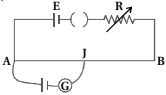
$AB$ is a potentiometer wire as shown in the figure. If the value of $R$ is increased,in which direction will the balance point $J$ shift?
A
Towards $A$
B
Towards $B$
C
Remains unchanged
D
First towards $A$ then towards $B$
Solution
(B) In a potentiometer circuit,the potential difference across the wire $AB$ is given by $V_{AB} = I \cdot R_{AB}$,where $I$ is the current in the primary circuit and $R_{AB}$ is the resistance of the wire $AB$.
The current $I$ in the primary circuit is given by $I = \frac{E}{R + R_{AB}}$,where $E$ is the $EMF$ of the primary cell and $R$ is the external resistance.
When the value of $R$ is increased,the total resistance of the primary circuit increases,which causes the current $I$ to decrease.
Since $V_{AB} = I \cdot R_{AB}$,a decrease in $I$ leads to a decrease in the potential difference $V_{AB}$ across the wire $AB$.
The potential gradient $k$ is defined as $k = \frac{V_{AB}}{L}$,where $L$ is the length of the wire $AB$. Thus,the potential gradient $k$ decreases.
The balance point $J$ is obtained when the $EMF$ of the secondary cell $\varepsilon$ equals the potential drop across the length $AJ$,i.e.,$\varepsilon = k \cdot AJ$.
Therefore,$AJ = \frac{\varepsilon}{k}$. Since $k$ decreases,the length $AJ$ must increase to maintain the balance condition.
As the length $AJ$ increases,the balance point $J$ shifts towards $B$.
The current $I$ in the primary circuit is given by $I = \frac{E}{R + R_{AB}}$,where $E$ is the $EMF$ of the primary cell and $R$ is the external resistance.
When the value of $R$ is increased,the total resistance of the primary circuit increases,which causes the current $I$ to decrease.
Since $V_{AB} = I \cdot R_{AB}$,a decrease in $I$ leads to a decrease in the potential difference $V_{AB}$ across the wire $AB$.
The potential gradient $k$ is defined as $k = \frac{V_{AB}}{L}$,where $L$ is the length of the wire $AB$. Thus,the potential gradient $k$ decreases.
The balance point $J$ is obtained when the $EMF$ of the secondary cell $\varepsilon$ equals the potential drop across the length $AJ$,i.e.,$\varepsilon = k \cdot AJ$.
Therefore,$AJ = \frac{\varepsilon}{k}$. Since $k$ decreases,the length $AJ$ must increase to maintain the balance condition.
As the length $AJ$ increases,the balance point $J$ shifts towards $B$.
0 likes
View Solution135
Medium
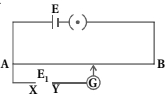
While doing an experiment with a potentiometer as shown in the figure,it was found that the deflection is one-sided and $(i)$ the deflection decreased while moving the jockey from one end $A$ of the wire to the end $B$; $(ii)$ the deflection increased while the jockey was moved towards the end $B$.
$(i)$ Which terminal ($+$ or $-ve$) of the cell $E_1$ is connected at $X$ in case $(i)$ and how is $E_1$ related to $E$?
$(ii)$ Which terminal of the cell $E_1$ is connected at $X$ in case $(ii)$?
$(i)$ Which terminal ($+$ or $-ve$) of the cell $E_1$ is connected at $X$ in case $(i)$ and how is $E_1$ related to $E$?
$(ii)$ Which terminal of the cell $E_1$ is connected at $X$ in case $(ii)$?
Solution
(N/A) $(i)$ When the jockey is moved from $A$ to $B$,if the galvanometer deflection decreases,it implies that the potential difference across the galvanometer circuit is decreasing. This happens because the potential drop across the length of the potentiometer wire $A$-jockey opposes the $EMF$ $E_1$. For the deflection to decrease as the jockey moves towards $B$ (where potential increases),the terminal of $E_1$ connected to $X$ must be the positive terminal,and $E_1 > E$ must hold true so that the net current is in a direction that opposes the initial deflection.
$(ii)$ When the jockey is moved from $A$ to $B$,if the deflection increases,it implies that the potential difference across the galvanometer circuit is increasing. This occurs when the terminal of $E_1$ connected to $X$ is the negative terminal,causing the $EMF$ $E_1$ to add to the potential drop across the wire segment,thereby increasing the current through the galvanometer.
$(ii)$ When the jockey is moved from $A$ to $B$,if the deflection increases,it implies that the potential difference across the galvanometer circuit is increasing. This occurs when the terminal of $E_1$ connected to $X$ is the negative terminal,causing the $EMF$ $E_1$ to add to the potential drop across the wire segment,thereby increasing the current through the galvanometer.
0 likes
View Solution136
Difficult
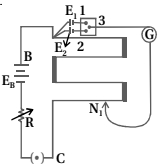
In an experiment with a potentiometer,$V_B = 10 \, V$ and the variable resistance is adjusted to $R = 50 \, \Omega$ (figure). $A$ student wanting to measure the voltage $E_1$ of a battery (approx. $8 \, V$) finds no null point. He then diminishes $R$ to $10 \, \Omega$ and is able to locate the null point on the last $(4^{th})$ segment of the potentiometer wire. Find the resistance of the potentiometer wire and the potential drop per unit length.
Solution
(D) Let the resistance of the potentiometer wire be $R'$ and its total length be $L = 4 \, m$ (assuming $4$ segments of $1 \, m$ each).
$1$. When $R = 50 \, \Omega$,the potential drop across the wire is $V_{wire} = \frac{10 \times R'}{50 + R'}$. Since no null point is found for $E_1 \approx 8 \, V$,the potential drop across the entire wire must be less than $E_1$.
$\frac{10 R'}{50 + R'} < 8 \Rightarrow 10 R' < 400 + 8 R' \Rightarrow 2 R' < 400 \Rightarrow R' < 200 \, \Omega$.
$2$. When $R = 10 \, \Omega$,the null point is on the $4^{th}$ segment,meaning the balance length $l$ is between $3 \, m$ and $4 \, m$. The potential drop across the wire is $V'_{wire} = \frac{10 \times R'}{10 + R'}$.
The condition for the null point to be on the $4^{th}$ segment is that the potential drop across $3 \, m$ is less than $8 \, V$ and the potential drop across $4 \, m$ is greater than $8 \, V$.
$\frac{3}{4} V'_{wire} < 8 < V'_{wire} \Rightarrow \frac{3}{4} \left( \frac{10 R'}{10 + R'} \right) < 8 < \frac{10 R'}{10 + R'}$.
From $8 < \frac{10 R'}{10 + R'}$,we get $80 + 8 R' < 10 R' \Rightarrow 2 R' > 80 \Rightarrow R' > 40 \, \Omega$.
From $\frac{7.5 R'}{10 + R'} < 8$,we get $7.5 R' < 80 + 8 R' \Rightarrow -0.5 R' < 80$ (always true for positive $R'$).
Combining with the first condition $R' < 200 \, \Omega$,the resistance $R'$ is in the range $40 \, \Omega < R' < 200 \, \Omega$.
The potential gradient $\phi = \frac{V'_{wire}}{4} = \frac{10 R'}{4(10 + R')} \, V/m$.
$1$. When $R = 50 \, \Omega$,the potential drop across the wire is $V_{wire} = \frac{10 \times R'}{50 + R'}$. Since no null point is found for $E_1 \approx 8 \, V$,the potential drop across the entire wire must be less than $E_1$.
$\frac{10 R'}{50 + R'} < 8 \Rightarrow 10 R' < 400 + 8 R' \Rightarrow 2 R' < 400 \Rightarrow R' < 200 \, \Omega$.
$2$. When $R = 10 \, \Omega$,the null point is on the $4^{th}$ segment,meaning the balance length $l$ is between $3 \, m$ and $4 \, m$. The potential drop across the wire is $V'_{wire} = \frac{10 \times R'}{10 + R'}$.
The condition for the null point to be on the $4^{th}$ segment is that the potential drop across $3 \, m$ is less than $8 \, V$ and the potential drop across $4 \, m$ is greater than $8 \, V$.
$\frac{3}{4} V'_{wire} < 8 < V'_{wire} \Rightarrow \frac{3}{4} \left( \frac{10 R'}{10 + R'} \right) < 8 < \frac{10 R'}{10 + R'}$.
From $8 < \frac{10 R'}{10 + R'}$,we get $80 + 8 R' < 10 R' \Rightarrow 2 R' > 80 \Rightarrow R' > 40 \, \Omega$.
From $\frac{7.5 R'}{10 + R'} < 8$,we get $7.5 R' < 80 + 8 R' \Rightarrow -0.5 R' < 80$ (always true for positive $R'$).
Combining with the first condition $R' < 200 \, \Omega$,the resistance $R'$ is in the range $40 \, \Omega < R' < 200 \, \Omega$.
The potential gradient $\phi = \frac{V'_{wire}}{4} = \frac{10 R'}{4(10 + R')} \, V/m$.
0 likes
View Solution137
MediumMCQ
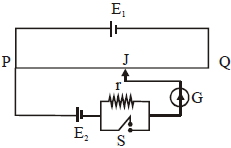
$A$ potentiometer wire $PQ$ of $1\,m$ length is connected to a standard cell $E_{1}$. Another cell $E_{2}$ of emf $1.02\,V$ is connected with a resistance $r$ and switch $S$ (as shown in figure). With switch $S$ open,the null position is obtained at a distance of $49\,cm$ from $Q$. The potential gradient in the potentiometer wire is.......$V/cm$.
A
$0.02$
B
$0.04$
C
$0.01$
D
$0.03$
Solution
(A) In a potentiometer,the balancing length $l$ is always measured from the high potential end $P$.
Given the total length of the wire $PQ = 100\,cm$.
The null point is obtained at $49\,cm$ from $Q$.
Therefore,the balancing length from $P$ is $l = 100\,cm - 49\,cm = 51\,cm$.
The emf of the cell $E_{2}$ is balanced by the potential drop across the length $l$ of the potentiometer wire.
The formula for the emf is $E_{2} = \phi \times l$,where $\phi$ is the potential gradient.
Substituting the given values: $1.02\,V = \phi \times 51\,cm$.
Solving for $\phi$: $\phi = \frac{1.02}{51}\,V/cm = 0.02\,V/cm$.
Thus,the potential gradient in the potentiometer wire is $0.02\,V/cm$.
Given the total length of the wire $PQ = 100\,cm$.
The null point is obtained at $49\,cm$ from $Q$.
Therefore,the balancing length from $P$ is $l = 100\,cm - 49\,cm = 51\,cm$.
The emf of the cell $E_{2}$ is balanced by the potential drop across the length $l$ of the potentiometer wire.
The formula for the emf is $E_{2} = \phi \times l$,where $\phi$ is the potential gradient.
Substituting the given values: $1.02\,V = \phi \times 51\,cm$.
Solving for $\phi$: $\phi = \frac{1.02}{51}\,V/cm = 0.02\,V/cm$.
Thus,the potential gradient in the potentiometer wire is $0.02\,V/cm$.
0 likes
View Solution138
MediumMCQ
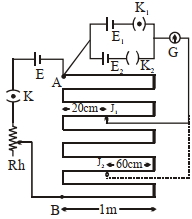
In the given circuit of a potentiometer,the potential difference $E$ across $AB$ ($10\, m$ length) is larger than $E_{1}$ and $E_{2}$ as well. For key $K_{1}$ (closed),the jockey is adjusted to touch the wire at point $J_{1}$ so that there is no deflection in the galvanometer. Now,the first battery $(E_{1})$ is replaced by the second battery $(E_{2})$ for working by making $K_{1}$ open and $K_{2}$ closed. The galvanometer then gives null deflection at $J_{2}$. The value of $\frac{E_{1}}{E_{2}}$ is $\frac{a}{b}$,where $a = \dots$ (Refer to the image for balancing lengths $l_{1}$ and $l_{2}$ from point $A$).
A
$1$
B
$2$
C
$3$
D
$4$
Solution
(C) The potential drop per unit length of the potentiometer wire is $k = \frac{V_{AB}}{L}$,where $L = 10\, m = 1000\, cm$.
For the first battery $E_{1}$,the balancing length $l_{1}$ is measured from point $A$. The wire consists of $10$ segments of $1\, m$ each. $J_{1}$ is at $20\, cm$ on the second segment,so $l_{1} = 100 + 20 = 120\, cm$.
For the second battery $E_{2}$,the balancing length $l_{2}$ is measured from point $A$. $J_{2}$ is at $60\, cm$ on the eighth segment,so $l_{2} = 700 + 60 = 760\, cm$.
Using the principle of the potentiometer,$E_{1} = k l_{1}$ and $E_{2} = k l_{2}$.
Therefore,$\frac{E_{1}}{E_{2}} = \frac{l_{1}}{l_{2}} = \frac{120}{760} = \frac{12}{76} = \frac{3}{19}$.
Given $\frac{E_{1}}{E_{2}} = \frac{a}{b}$,we have $a = 3$ and $b = 19$.
For the first battery $E_{1}$,the balancing length $l_{1}$ is measured from point $A$. The wire consists of $10$ segments of $1\, m$ each. $J_{1}$ is at $20\, cm$ on the second segment,so $l_{1} = 100 + 20 = 120\, cm$.
For the second battery $E_{2}$,the balancing length $l_{2}$ is measured from point $A$. $J_{2}$ is at $60\, cm$ on the eighth segment,so $l_{2} = 700 + 60 = 760\, cm$.
Using the principle of the potentiometer,$E_{1} = k l_{1}$ and $E_{2} = k l_{2}$.
Therefore,$\frac{E_{1}}{E_{2}} = \frac{l_{1}}{l_{2}} = \frac{120}{760} = \frac{12}{76} = \frac{3}{19}$.
Given $\frac{E_{1}}{E_{2}} = \frac{a}{b}$,we have $a = 3$ and $b = 19$.
0 likes
View Solution139
MediumMCQ
In a potentiometer circuit, a cell of $EMF$ $1.5\, V$ gives a balance point at $36\, cm$ length of wire. If another cell of $EMF$ $2.5\, V$ replaces the first cell, then at what length of the wire will the balance point occur? (in $cm$)
A
$60$
B
$21.6$
C
$64$
D
$62$
Solution
(A) In a potentiometer, the potential drop per unit length $(\phi)$ is constant.
The balance length $(l)$ is directly proportional to the $EMF$ $(E)$ of the cell, i.e., $E = \phi l$.
Therefore, the ratio is given by: $\frac{E_1}{E_2} = \frac{l_1}{l_2}$.
Given: $E_1 = 1.5\, V$, $l_1 = 36\, cm$, $E_2 = 2.5\, V$.
Substituting the values: $\frac{1.5}{2.5} = \frac{36}{l_2}$.
Simplifying the ratio: $\frac{3}{5} = \frac{36}{l_2}$.
Solving for $l_2$: $l_2 = \frac{36 \times 5}{3} = 12 \times 5 = 60\, cm$.
The balance length $(l)$ is directly proportional to the $EMF$ $(E)$ of the cell, i.e., $E = \phi l$.
Therefore, the ratio is given by: $\frac{E_1}{E_2} = \frac{l_1}{l_2}$.
Given: $E_1 = 1.5\, V$, $l_1 = 36\, cm$, $E_2 = 2.5\, V$.
Substituting the values: $\frac{1.5}{2.5} = \frac{36}{l_2}$.
Simplifying the ratio: $\frac{3}{5} = \frac{36}{l_2}$.
Solving for $l_2$: $l_2 = \frac{36 \times 5}{3} = 12 \times 5 = 60\, cm$.
0 likes
View Solution140
MediumMCQ
In the given figure,there is a circuit of a potentiometer of length $AB = 10 \, m$. The resistance per unit length is $0.1 \, \Omega/cm$. $A$ battery of $6 \, V$ and an internal resistance of $20 \, \Omega$ is connected across $AB$. The maximum value of emf that can be measured by this potentiometer is (in $V$):
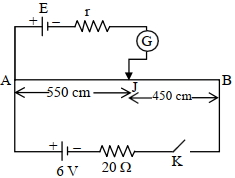
A
$6$
B
$2.25$
C
$5$
D
$2.75$
Solution
(C) The maximum voltage that can be measured by a potentiometer is equal to the potential drop across the entire length of the potentiometer wire $AB$.
First,calculate the total resistance of the wire $AB$:
Length of wire $AB = 10 \, m = 1000 \, cm$.
Resistance per unit length = $0.1 \, \Omega/cm$.
Total resistance $R_{AB} = 1000 \, cm \times 0.1 \, \Omega/cm = 100 \, \Omega$.
Now,calculate the potential drop across $AB$ using the voltage divider rule:
The circuit consists of a $6 \, V$ battery,an internal resistance of $20 \, \Omega$,and the potentiometer wire resistance $R_{AB} = 100 \, \Omega$ in series.
The current in the primary circuit is $I = \frac{V}{R_{total}} = \frac{6 \, V}{20 \, \Omega + 100 \, \Omega} = \frac{6}{120} \, A = 0.05 \, A$.
The potential drop across $AB$ is $V_{AB} = I \times R_{AB} = 0.05 \, A \times 100 \, \Omega = 5 \, V$.
Thus,the maximum emf that can be measured is $5 \, V$.
First,calculate the total resistance of the wire $AB$:
Length of wire $AB = 10 \, m = 1000 \, cm$.
Resistance per unit length = $0.1 \, \Omega/cm$.
Total resistance $R_{AB} = 1000 \, cm \times 0.1 \, \Omega/cm = 100 \, \Omega$.
Now,calculate the potential drop across $AB$ using the voltage divider rule:
The circuit consists of a $6 \, V$ battery,an internal resistance of $20 \, \Omega$,and the potentiometer wire resistance $R_{AB} = 100 \, \Omega$ in series.
The current in the primary circuit is $I = \frac{V}{R_{total}} = \frac{6 \, V}{20 \, \Omega + 100 \, \Omega} = \frac{6}{120} \, A = 0.05 \, A$.
The potential drop across $AB$ is $V_{AB} = I \times R_{AB} = 0.05 \, A \times 100 \, \Omega = 5 \, V$.
Thus,the maximum emf that can be measured is $5 \, V$.
0 likes
View Solution141
DifficultMCQ
The given potentiometer has its wire of resistance $10\, \Omega$. When the sliding contact is in the middle of the potentiometer wire,the potential drop across the $2\, \Omega$ resistor is -
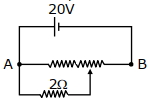
A
$\frac{40}{11}\, \text{V}$
B
$10\, \text{V}$
C
$\frac{40}{9}\, \text{V}$
D
$5\, \text{V}$
Solution
(C) The total resistance of the potentiometer wire is $10\, \Omega$. When the sliding contact is in the middle,the wire is divided into two parts of $5\, \Omega$ each.
Let the potential at the node where the $2\, \Omega$ resistor and the potentiometer wire meet be $V_0$. The potential at the start of the wire is $20\, \text{V}$ and at the end is $0\, \text{V}$.
Applying Kirchhoff's Current Law $(KCL)$ at node $V_0$:
$\frac{V_0 - 20}{5} + \frac{V_0 - 0}{5} + \frac{V_0 - 20}{2} = 0$
Multiply by $10$ to simplify:
$2(V_0 - 20) + 2(V_0) + 5(V_0 - 20) = 0$
$2V_0 - 40 + 2V_0 + 5V_0 - 100 = 0$
$9V_0 = 140$
$V_0 = \frac{140}{9}\, \text{V}$
The potential drop across the $2\, \Omega$ resistor is the difference between the potential at the start $(20\, \text{V})$ and the node $V_0$:
$\Delta V = 20 - V_0 = 20 - \frac{140}{9} = \frac{180 - 140}{9} = \frac{40}{9}\, \text{V}$
Let the potential at the node where the $2\, \Omega$ resistor and the potentiometer wire meet be $V_0$. The potential at the start of the wire is $20\, \text{V}$ and at the end is $0\, \text{V}$.
Applying Kirchhoff's Current Law $(KCL)$ at node $V_0$:
$\frac{V_0 - 20}{5} + \frac{V_0 - 0}{5} + \frac{V_0 - 20}{2} = 0$
Multiply by $10$ to simplify:
$2(V_0 - 20) + 2(V_0) + 5(V_0 - 20) = 0$
$2V_0 - 40 + 2V_0 + 5V_0 - 100 = 0$
$9V_0 = 140$
$V_0 = \frac{140}{9}\, \text{V}$
The potential drop across the $2\, \Omega$ resistor is the difference between the potential at the start $(20\, \text{V})$ and the node $V_0$:
$\Delta V = 20 - V_0 = 20 - \frac{140}{9} = \frac{180 - 140}{9} = \frac{40}{9}\, \text{V}$
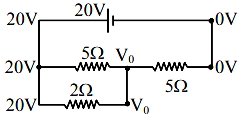
0 likes
View Solution142
DifficultMCQ
In the given potentiometer circuit arrangement,the balancing length $AC$ is measured to be $250 \, cm$. When the galvanometer connection is shifted from point $(1)$ to point $(2)$ in the given diagram,the balancing length becomes $400 \, cm$. The ratio of the emf of two cells,$\frac{\varepsilon_{1}}{\varepsilon_{2}}$ is -
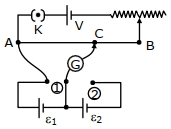
A
$\frac{4}{3}$
B
$\frac{3}{2}$
C
$\frac{5}{3}$
D
$\frac{8}{5}$
Solution
(C) In a potentiometer,the balancing length $l$ is directly proportional to the emf $\varepsilon$ of the cell,i.e.,$\varepsilon = kl$,where $k$ is the potential gradient.
When the galvanometer is connected to point $(1)$,only cell $\varepsilon_{1}$ is in the circuit:
$\varepsilon_{1} = k l_{1} = k(250) \ldots (i)$
When the galvanometer is connected to point $(2)$,both cells $\varepsilon_{1}$ and $\varepsilon_{2}$ are in the circuit in series:
$\varepsilon_{1} + \varepsilon_{2} = k l_{2} = k(400) \ldots (ii)$
Dividing equation $(i)$ by equation $(ii)$:
$\frac{\varepsilon_{1}}{\varepsilon_{1} + \varepsilon_{2}} = \frac{250}{400} = \frac{5}{8}$
Cross-multiplying gives:
$8 \varepsilon_{1} = 5 \varepsilon_{1} + 5 \varepsilon_{2}$
$3 \varepsilon_{1} = 5 \varepsilon_{2}$
Therefore,the ratio is:
$\frac{\varepsilon_{1}}{\varepsilon_{2}} = \frac{5}{3}$
When the galvanometer is connected to point $(1)$,only cell $\varepsilon_{1}$ is in the circuit:
$\varepsilon_{1} = k l_{1} = k(250) \ldots (i)$
When the galvanometer is connected to point $(2)$,both cells $\varepsilon_{1}$ and $\varepsilon_{2}$ are in the circuit in series:
$\varepsilon_{1} + \varepsilon_{2} = k l_{2} = k(400) \ldots (ii)$
Dividing equation $(i)$ by equation $(ii)$:
$\frac{\varepsilon_{1}}{\varepsilon_{1} + \varepsilon_{2}} = \frac{250}{400} = \frac{5}{8}$
Cross-multiplying gives:
$8 \varepsilon_{1} = 5 \varepsilon_{1} + 5 \varepsilon_{2}$
$3 \varepsilon_{1} = 5 \varepsilon_{2}$
Therefore,the ratio is:
$\frac{\varepsilon_{1}}{\varepsilon_{2}} = \frac{5}{3}$
0 likes
View Solution143
MediumMCQ
$A$ potentiometer wire of length $10 \,m$ and resistance $20 \,\Omega$ is connected in series with a $25 \,V$ battery and an external resistance $30 \,\Omega$. $A$ cell of emf $E$ in the secondary circuit is balanced by a $250 \,cm$ long potentiometer wire. The value of $E$ (in volt) is $\frac{x}{10}$. The value of $x$ is.......
A
$56$
B
$85$
C
$25$
D
$55$
Solution
(C) The total resistance of the primary circuit is $R_{total} = R_{wire} + R_{external} = 20 \,\Omega + 30 \,\Omega = 50 \,\Omega$.
The current in the primary circuit is $I = \frac{V}{R_{total}} = \frac{25 \,V}{50 \,\Omega} = 0.5 \,A$.
The potential drop across the entire potentiometer wire is $V_{wire} = I \times R_{wire} = 0.5 \,A \times 20 \,\Omega = 10 \,V$.
The potential gradient along the wire is $k = \frac{V_{wire}}{L} = \frac{10 \,V}{10 \,m} = 1 \,V/m$.
The balancing length is $l = 250 \,cm = 2.5 \,m$.
The emf of the cell is $E = k \times l = 1 \,V/m \times 2.5 \,m = 2.5 \,V$.
Given $E = \frac{x}{10}$,we have $2.5 = \frac{x}{10}$,which implies $x = 25$.
The current in the primary circuit is $I = \frac{V}{R_{total}} = \frac{25 \,V}{50 \,\Omega} = 0.5 \,A$.
The potential drop across the entire potentiometer wire is $V_{wire} = I \times R_{wire} = 0.5 \,A \times 20 \,\Omega = 10 \,V$.
The potential gradient along the wire is $k = \frac{V_{wire}}{L} = \frac{10 \,V}{10 \,m} = 1 \,V/m$.
The balancing length is $l = 250 \,cm = 2.5 \,m$.
The emf of the cell is $E = k \times l = 1 \,V/m \times 2.5 \,m = 2.5 \,V$.
Given $E = \frac{x}{10}$,we have $2.5 = \frac{x}{10}$,which implies $x = 25$.
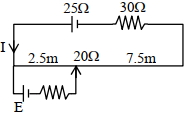
0 likes
View Solution144
MediumMCQ
In a potentiometer arrangement,a cell gives a balancing point at $75 \, cm$ length of wire. This cell is now replaced by another cell of unknown emf. If the ratio of the emf's of two cells respectively is $3:2$,the difference in the balancing length of the potentiometer wire in above two cases will be ......... $cm$.
A
$25$
B
$255$
C
$95$
D
$27$
Solution
(A) In a potentiometer,the balancing length $\ell$ is directly proportional to the emf $\varepsilon$ of the cell,given by $\varepsilon \propto \ell$ or $\frac{\varepsilon_1}{\varepsilon_2} = \frac{\ell_1}{\ell_2}$.
Given $\varepsilon_1 : \varepsilon_2 = 3 : 2$ and $\ell_1 = 75 \, cm$.
Substituting the values: $\frac{3}{2} = \frac{75}{\ell_2}$.
Solving for $\ell_2$: $\ell_2 = \frac{75 \times 2}{3} = 50 \, cm$.
The difference in the balancing lengths is $\Delta \ell = |\ell_1 - \ell_2| = |75 - 50| = 25 \, cm$.
Given $\varepsilon_1 : \varepsilon_2 = 3 : 2$ and $\ell_1 = 75 \, cm$.
Substituting the values: $\frac{3}{2} = \frac{75}{\ell_2}$.
Solving for $\ell_2$: $\ell_2 = \frac{75 \times 2}{3} = 50 \, cm$.
The difference in the balancing lengths is $\Delta \ell = |\ell_1 - \ell_2| = |75 - 50| = 25 \, cm$.
0 likes
View Solution145
MediumMCQ
$A$ cell,shunted by an $8 \; \Omega$ resistance,is balanced across a potentiometer wire of length $3 \; m$. The balancing length is $2 \; m$ when the cell is shunted by a $4 \; \Omega$ resistance. The value of internal resistance of the cell will be $\dots \; \Omega$.
A
$7$
B
$8$
C
$9$
D
$10$
Solution
(B) Let $E$ be the $EMF$ of the cell and $r$ be its internal resistance. The terminal potential difference $V$ across the cell when shunted by a resistance $R$ is given by $V = E \left( \frac{R}{R+r} \right)$.
Since the balancing length $l$ is directly proportional to the terminal potential difference $V$,we have $V \propto l$.
For the first case: $V_1 \propto l_1 = 3 \; m$ with $R_1 = 8 \; \Omega$. Thus,$V_1 = k \cdot 3 = E \left( \frac{8}{8+r} \right)$.
For the second case: $V_2 \propto l_2 = 2 \; m$ with $R_2 = 4 \; \Omega$. Thus,$V_2 = k \cdot 2 = E \left( \frac{4}{4+r} \right)$.
Dividing the two equations: $\frac{3}{2} = \frac{E \left( \frac{8}{8+r} \right)}{E \left( \frac{4}{4+r} \right)} = \frac{8}{8+r} \times \frac{4+r}{4} = \frac{2(4+r)}{8+r}$.
Solving for $r$: $3(8+r) = 4(4+r) \implies 24 + 3r = 16 + 4r \implies r = 8 \; \Omega$.
Since the balancing length $l$ is directly proportional to the terminal potential difference $V$,we have $V \propto l$.
For the first case: $V_1 \propto l_1 = 3 \; m$ with $R_1 = 8 \; \Omega$. Thus,$V_1 = k \cdot 3 = E \left( \frac{8}{8+r} \right)$.
For the second case: $V_2 \propto l_2 = 2 \; m$ with $R_2 = 4 \; \Omega$. Thus,$V_2 = k \cdot 2 = E \left( \frac{4}{4+r} \right)$.
Dividing the two equations: $\frac{3}{2} = \frac{E \left( \frac{8}{8+r} \right)}{E \left( \frac{4}{4+r} \right)} = \frac{8}{8+r} \times \frac{4+r}{4} = \frac{2(4+r)}{8+r}$.
Solving for $r$: $3(8+r) = 4(4+r) \implies 24 + 3r = 16 + 4r \implies r = 8 \; \Omega$.
0 likes
View Solution146
DifficultMCQ
In a potentiometer arrangement,a cell of emf $1.20\, V$ gives a balance point at $36\, cm$ length of wire. This cell is now replaced by another cell of emf $1.80\, V$. The difference in balancing length of potentiometer wire in above conditions will be $....cm$.
A
$17$
B
$18$
C
$16$
D
$12$
Solution
(B) Let the potential gradient of the potentiometer wire be $k$.
For the first cell,the balance point is at $l_1 = 36\, cm$ for emf $E_1 = 1.20\, V$.
$E_1 = k \cdot l_1 \implies 1.20 = k \times 36 \implies k = \frac{1.20}{36} = \frac{1}{30}\, V/cm$.
For the second cell,the balance point is at $l_2$ for emf $E_2 = 1.80\, V$.
$E_2 = k \cdot l_2 \implies 1.80 = \frac{1}{30} \times l_2$.
$l_2 = 1.80 \times 30 = 54\, cm$.
The difference in balancing lengths is $\Delta l = l_2 - l_1 = 54 - 36 = 18\, cm$.
For the first cell,the balance point is at $l_1 = 36\, cm$ for emf $E_1 = 1.20\, V$.
$E_1 = k \cdot l_1 \implies 1.20 = k \times 36 \implies k = \frac{1.20}{36} = \frac{1}{30}\, V/cm$.
For the second cell,the balance point is at $l_2$ for emf $E_2 = 1.80\, V$.
$E_2 = k \cdot l_2 \implies 1.80 = \frac{1}{30} \times l_2$.
$l_2 = 1.80 \times 30 = 54\, cm$.
The difference in balancing lengths is $\Delta l = l_2 - l_1 = 54 - 36 = 18\, cm$.
0 likes
View Solution147
DifficultMCQ
$A$ potentiometer wire of length $300\,cm$ is connected in series with a resistance $780\,\Omega$ and a standard cell of emf $4\,V$. $A$ constant current flows through the potentiometer wire. The length of the null point for a cell of emf $20\,mV$ is found to be $60\,cm$. The resistance of the potentiometer wire is ... $\Omega$.
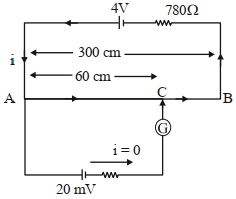
A
$78$
B
$200$
C
$2$
D
$20$
Solution
(D) Let the resistance of the potentiometer wire be $R$.
The current $i$ flowing through the potentiometer wire is given by $i = \frac{4}{R + 780}$.
The potential difference across the entire potentiometer wire $AB$ is $V_{AB} = iR = \frac{4R}{R + 780}$.
The potential gradient along the wire is $k = \frac{V_{AB}}{L} = \frac{4R}{(R + 780) \times 300}$.
The null point is obtained at a length $l = 60\,cm$ for a cell of emf $E = 20\,mV = 20 \times 10^{-3}\,V$.
At the null point,the potential difference across the length $l$ is equal to the emf of the cell:
$E = k \times l$
$20 \times 10^{-3} = \left( \frac{4R}{(R + 780) \times 300} \right) \times 60$
Simplifying the equation:
$20 \times 10^{-3} = \frac{4R \times 60}{(R + 780) \times 300}$
$0.02 = \frac{4R}{5(R + 780)}$
$0.1(R + 780) = 4R$
$0.1R + 78 = 4R$
$3.9R = 78$
$R = \frac{78}{3.9} = 20\,\Omega$.
The current $i$ flowing through the potentiometer wire is given by $i = \frac{4}{R + 780}$.
The potential difference across the entire potentiometer wire $AB$ is $V_{AB} = iR = \frac{4R}{R + 780}$.
The potential gradient along the wire is $k = \frac{V_{AB}}{L} = \frac{4R}{(R + 780) \times 300}$.
The null point is obtained at a length $l = 60\,cm$ for a cell of emf $E = 20\,mV = 20 \times 10^{-3}\,V$.
At the null point,the potential difference across the length $l$ is equal to the emf of the cell:
$E = k \times l$
$20 \times 10^{-3} = \left( \frac{4R}{(R + 780) \times 300} \right) \times 60$
Simplifying the equation:
$20 \times 10^{-3} = \frac{4R \times 60}{(R + 780) \times 300}$
$0.02 = \frac{4R}{5(R + 780)}$
$0.1(R + 780) = 4R$
$0.1R + 78 = 4R$
$3.9R = 78$
$R = \frac{78}{3.9} = 20\,\Omega$.
0 likes
View Solution148
MediumMCQ
As shown in the figure,a potentiometer wire of resistance $20\,\Omega$ and length $300\,cm$ is connected with a resistance box ($R$.$B$.) and a standard cell of emf $4\,V$. For a resistance '$R$' of the resistance box introduced into the circuit,the null point for a cell of $20\,mV$ is found to be $60\,cm$. The value of '$R$' is $.....\Omega$
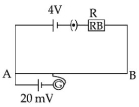
A
$780$
B
$78$
C
$870$
D
$654$
Solution
(A) The potential difference across the potentiometer wire $AB$ is given by $V_{AB} = I \times R_{AB}$,where $I$ is the current in the primary circuit.
The current $I$ is given by $I = \frac{E}{R + R_{AB}}$,where $E = 4\,V$ and $R_{AB} = 20\,\Omega$.
So,$V_{AB} = \left( \frac{4}{R + 20} \right) \times 20 = \frac{80}{R + 20}$.
The potential gradient along the wire is $k = \frac{V_{AB}}{L}$,where $L = 300\,cm$.
The emf of the secondary cell is $E' = 20\,mV = 20 \times 10^{-3}\,V$,and the null point length is $l = 60\,cm$.
At the null point,$E' = k \times l = \left( \frac{V_{AB}}{L} \right) \times l$.
Substituting the values: $20 \times 10^{-3} = \left( \frac{80}{R + 20} \right) \times \left( \frac{60}{300} \right)$.
$20 \times 10^{-3} = \left( \frac{80}{R + 20} \right) \times \left( \frac{1}{5} \right)$.
$20 \times 10^{-3} = \frac{16}{R + 20}$.
$R + 20 = \frac{16}{20 \times 10^{-3}} = \frac{16}{0.02} = 800$.
$R = 800 - 20 = 780\,\Omega$.
The current $I$ is given by $I = \frac{E}{R + R_{AB}}$,where $E = 4\,V$ and $R_{AB} = 20\,\Omega$.
So,$V_{AB} = \left( \frac{4}{R + 20} \right) \times 20 = \frac{80}{R + 20}$.
The potential gradient along the wire is $k = \frac{V_{AB}}{L}$,where $L = 300\,cm$.
The emf of the secondary cell is $E' = 20\,mV = 20 \times 10^{-3}\,V$,and the null point length is $l = 60\,cm$.
At the null point,$E' = k \times l = \left( \frac{V_{AB}}{L} \right) \times l$.
Substituting the values: $20 \times 10^{-3} = \left( \frac{80}{R + 20} \right) \times \left( \frac{60}{300} \right)$.
$20 \times 10^{-3} = \left( \frac{80}{R + 20} \right) \times \left( \frac{1}{5} \right)$.
$20 \times 10^{-3} = \frac{16}{R + 20}$.
$R + 20 = \frac{16}{20 \times 10^{-3}} = \frac{16}{0.02} = 800$.
$R = 800 - 20 = 780\,\Omega$.
0 likes
View Solution149
MediumMCQ
Two cells of $e.m.f.$ $E_1$ and $E_2$ are joined in series and the balancing length of the potentiometer wire is $625 \, cm$. If the terminals of $E_1$ are reversed,the balancing length obtained is $125 \, cm$. Given $E_2 > E_1$,the ratio $E_1 : E_2$ will be
A
$2 : 3$
B
$5 : 1$
C
$3 : 2$
D
$1 : 5$
Solution
(A) In a potentiometer,the balancing length $l$ is directly proportional to the $e.m.f.$ of the cell,i.e.,$E \propto l$ or $E = kl$,where $k$ is the potential gradient.
When the cells are connected in series with the same polarity,the total $e.m.f.$ is $E_1 + E_2$. Thus,$E_1 + E_2 = k(625)$.
When the terminals of $E_1$ are reversed,the effective $e.m.f.$ becomes $E_2 - E_1$ (since $E_2 > E_1$). Thus,$E_2 - E_1 = k(125)$.
Dividing the two equations: $\frac{E_1 + E_2}{E_2 - E_1} = \frac{625}{125} = 5$.
$E_1 + E_2 = 5(E_2 - E_1) = 5E_2 - 5E_1$.
$6E_1 = 4E_2$.
$\frac{E_1}{E_2} = \frac{4}{6} = \frac{2}{3}$.
Therefore,the ratio $E_1 : E_2$ is $2 : 3$.
When the cells are connected in series with the same polarity,the total $e.m.f.$ is $E_1 + E_2$. Thus,$E_1 + E_2 = k(625)$.
When the terminals of $E_1$ are reversed,the effective $e.m.f.$ becomes $E_2 - E_1$ (since $E_2 > E_1$). Thus,$E_2 - E_1 = k(125)$.
Dividing the two equations: $\frac{E_1 + E_2}{E_2 - E_1} = \frac{625}{125} = 5$.
$E_1 + E_2 = 5(E_2 - E_1) = 5E_2 - 5E_1$.
$6E_1 = 4E_2$.
$\frac{E_1}{E_2} = \frac{4}{6} = \frac{2}{3}$.
Therefore,the ratio $E_1 : E_2$ is $2 : 3$.
0 likes
View Solution150
EasyMCQ
$A$ $10 \,m$ long potentiometer wire is connected to a battery having a steady voltage. $A$ Leclanche cell is balanced at $4 \,m$ length of the wire. If the length is kept the same,but its cross-section is doubled,the null point will be obtained at ........... $m$.
A
$8$
B
$4$
C
$2$
D
None of these
Solution
(B) The potential gradient $k$ of a potentiometer wire is given by $k = \frac{V}{L} = \frac{I \cdot R}{L} = \frac{I \cdot \rho \cdot L}{A \cdot L} = \frac{I \cdot \rho}{A}$,where $I$ is the current,$\rho$ is the resistivity,$L$ is the length,and $A$ is the cross-sectional area.
However,in a standard potentiometer circuit,the potential drop across the wire is $V_{wire} = I \cdot R_{wire} = I \cdot \frac{\rho \cdot L}{A}$.
When the cell is balanced,the emf of the cell $E = k \cdot l$,where $l$ is the balancing length.
If the length $L$ of the potentiometer wire is kept constant and the cross-section $A$ is doubled,the resistance of the wire $R = \rho \frac{L}{A}$ becomes half.
Since the battery voltage is steady,the current $I$ through the wire increases,but the potential drop across the wire remains equal to the battery voltage.
Thus,the potential gradient $k = \frac{V_{battery}}{L}$ remains unchanged because both $V_{battery}$ and $L$ are constant.
Since $E = k \cdot l$ and both $E$ and $k$ are constant,the balancing length $l$ remains $4 \,m$.
However,in a standard potentiometer circuit,the potential drop across the wire is $V_{wire} = I \cdot R_{wire} = I \cdot \frac{\rho \cdot L}{A}$.
When the cell is balanced,the emf of the cell $E = k \cdot l$,where $l$ is the balancing length.
If the length $L$ of the potentiometer wire is kept constant and the cross-section $A$ is doubled,the resistance of the wire $R = \rho \frac{L}{A}$ becomes half.
Since the battery voltage is steady,the current $I$ through the wire increases,but the potential drop across the wire remains equal to the battery voltage.
Thus,the potential gradient $k = \frac{V_{battery}}{L}$ remains unchanged because both $V_{battery}$ and $L$ are constant.
Since $E = k \cdot l$ and both $E$ and $k$ are constant,the balancing length $l$ remains $4 \,m$.
0 likes
View SolutionCurrent Electricity — Potentiometer · Frequently Asked Questions
1Are these Current Electricity questions useful for JEE and NEET?
Yes. All questions in this section are mapped to JEE Main and NEET exam patterns. Previous year questions from JEE Main, NEET, GUJCET and state-level exams are included with full solutions.
2Can I switch to Hindi or Gujarati for these questions?
Yes. Use the language tabs in the hero section or the sidebar to view the same questions and solutions in English, Hindi or Gujarati.
3How do I generate a question paper from this subtopic?
Use the Vedclass Exam Paper Generator — select the chapter and subtopic, set difficulty, and generate Sets A, B, C, D automatically. First 3 chapters of every subject are free.
Vedclass Products
For Students
Vedclass Test Series
Mock tests in real JEE/NEET style with performance analysis. 5-day free trial.
Start Free TrialFor Teachers
Exam Paper Generator
Generate Set A/B/C/D papers from this chapter in 2 minutes. 3 chapters free.
Try FreeFor Institutes
Online Exam Module
Live online exams with unlimited students, 360° analytics & white-label branding.
See DemoFor Teachers & Institutes
Generate a Current Electricity Exam Paper in 2 Minutes
Select subtopic & difficulty — Sets A, B, C, D auto-generated with No Repeat logic.
First 3 chapters of every subject are free — no payment required.