
A English
Potentiometer Questions in English
Class 12 Physics · Current Electricity · Potentiometer
245+
Questions
English
Language
100%
With Solutions
Showing 49 of 245 questions in English
1
EasyMCQ
$A$ cell of internal resistance $1.5\,\Omega$ and of $e.m.f.$ $1.5\,V$ balances at $500\,cm$ on a potentiometer wire. If a wire of $15\,\Omega$ is connected between the balance point and the cell,then the balance point will shift:
A
To zero
B
By $500\,cm$
C
By $750\,cm$
D
None of the above
Solution
(D) In a potentiometer circuit,the balance point is obtained when the potential difference across the portion of the potentiometer wire equals the $e.m.f.$ of the cell being measured.
At the balance point,no current flows through the galvanometer connected to the cell.
Since no current flows through the cell circuit at the balance point,the internal resistance of the cell and any external resistance connected in series with the cell do not affect the potential difference across the cell terminals.
Therefore,the balance point remains unchanged regardless of the resistance connected in series with the cell.
At the balance point,no current flows through the galvanometer connected to the cell.
Since no current flows through the cell circuit at the balance point,the internal resistance of the cell and any external resistance connected in series with the cell do not affect the potential difference across the cell terminals.
Therefore,the balance point remains unchanged regardless of the resistance connected in series with the cell.
0 likes
View Solution2
MediumMCQ
$A$ $2\,V$ battery,a $15\,\Omega$ resistor,and a potentiometer of $100\,cm$ length are all connected in series. If the resistance of the potentiometer wire is $5\,\Omega$,then the potential gradient of the potentiometer wire is ............... $V/cm$.
A
$0.005$
B
$0.05$
C
$0.02$
D
$0.2$
Solution
(A) The total resistance of the circuit is $R_{total} = R_{resistor} + R_{potentiometer} = 15\,\Omega + 5\,\Omega = 20\,\Omega$.
The current flowing through the circuit is $I = \frac{V}{R_{total}} = \frac{2\,V}{20\,\Omega} = 0.1\,A$.
The potential drop across the potentiometer wire is $V_{wire} = I \times R_{potentiometer} = 0.1\,A \times 5\,\Omega = 0.5\,V$.
The potential gradient $k$ is defined as the potential drop per unit length: $k = \frac{V_{wire}}{L} = \frac{0.5\,V}{100\,cm} = 0.005\,V/cm$.
The current flowing through the circuit is $I = \frac{V}{R_{total}} = \frac{2\,V}{20\,\Omega} = 0.1\,A$.
The potential drop across the potentiometer wire is $V_{wire} = I \times R_{potentiometer} = 0.1\,A \times 5\,\Omega = 0.5\,V$.
The potential gradient $k$ is defined as the potential drop per unit length: $k = \frac{V_{wire}}{L} = \frac{0.5\,V}{100\,cm} = 0.005\,V/cm$.
0 likes
View Solution3
EasyMCQ
For the measurement of potential difference,a potentiometer is preferred in comparison to a voltmeter because:
A
Potentiometer is more sensitive than a voltmeter.
B
The resistance of a potentiometer is less than a voltmeter.
C
Potentiometer is cheaper than a voltmeter.
D
Potentiometer does not draw any current from the circuit.
Solution
(D) The correct answer is $(D)$. $A$ potentiometer is preferred because it works on the null deflection method. In the balanced condition,no current flows through the galvanometer branch,meaning the potentiometer does not draw any current from the source circuit being measured. Consequently,it measures the true potential difference without causing a voltage drop due to internal resistance,unlike a voltmeter which requires some current to operate.
0 likes
View Solution4
MediumMCQ
The potential gradient along the length of a uniform wire is $10\,V/m$. $B$ and $C$ are two points at $30\,cm$ and $60\,cm$ on a meter scale fitted along the wire. The potential difference between $B$ and $C$ will be ............. $V$.
A
$3$
B
$0.4$
C
$7$
D
$4$
Solution
(A) The potential gradient $(k)$ is defined as the potential drop per unit length of the wire.
Given: $k = 10\,V/m$.
The distance between points $B$ and $C$ is $\Delta l = 60\,cm - 30\,cm = 30\,cm$.
Converting the distance to meters: $\Delta l = 30\,cm = 0.3\,m$.
The potential difference $(V_{BC})$ is given by the formula: $V_{BC} = k \times \Delta l$.
Substituting the values: $V_{BC} = 10\,V/m \times 0.3\,m = 3\,V$.
Therefore,the potential difference between $B$ and $C$ is $3\,V$.
Given: $k = 10\,V/m$.
The distance between points $B$ and $C$ is $\Delta l = 60\,cm - 30\,cm = 30\,cm$.
Converting the distance to meters: $\Delta l = 30\,cm = 0.3\,m$.
The potential difference $(V_{BC})$ is given by the formula: $V_{BC} = k \times \Delta l$.
Substituting the values: $V_{BC} = 10\,V/m \times 0.3\,m = 3\,V$.
Therefore,the potential difference between $B$ and $C$ is $3\,V$.
0 likes
View Solution5
EasyMCQ
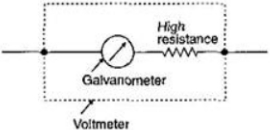
$A$ galvanometer can be used as a voltmeter by connecting a
A
High resistance in series
B
Low resistance in series
C
High resistance in parallel
D
Low resistance in parallel
Solution
(A) galvanometer has a low internal resistance,but a voltmeter must have a very high resistance to ensure it draws minimal current from the circuit it is measuring.
To convert a galvanometer into a voltmeter,we need to increase its effective resistance. This is achieved by connecting a high resistance in series with the galvanometer coil.
As shown in the diagram,the combination of the galvanometer and the series resistor acts as a voltmeter.
Note: The resistance of an ideal voltmeter should be infinite.
To convert a galvanometer into a voltmeter,we need to increase its effective resistance. This is achieved by connecting a high resistance in series with the galvanometer coil.
As shown in the diagram,the combination of the galvanometer and the series resistor acts as a voltmeter.
Note: The resistance of an ideal voltmeter should be infinite.
0 likes
View Solution6
MediumMCQ
$A$ Daniel cell is balanced on $125\,cm$ length of a potentiometer wire. Now the cell is short-circuited by a resistance $2\,\Omega$ and the balance is obtained at $100\,cm$. The internal resistance of the Daniel cell is .............. $\Omega$.
A
$0.5$
B
$1.5$
C
$1.25$
D
$0.8$
Solution
(A) The formula for the internal resistance $r$ of a cell using a potentiometer is given by $r = R \left( \frac{l_1}{l_2} - 1 \right)$,where $R$ is the external resistance,$l_1$ is the balancing length without the external resistance,and $l_2$ is the balancing length with the external resistance.
Given:
$l_1 = 125\,cm$
$l_2 = 100\,cm$
$R = 2\,\Omega$
Substituting the values into the formula:
$r = 2 \left( \frac{125}{100} - 1 \right)$
$r = 2 \left( 1.25 - 1 \right)$
$r = 2 \times 0.25 = 0.5\,\Omega$.
Therefore,the internal resistance of the Daniel cell is $0.5\,\Omega$.
Given:
$l_1 = 125\,cm$
$l_2 = 100\,cm$
$R = 2\,\Omega$
Substituting the values into the formula:
$r = 2 \left( \frac{125}{100} - 1 \right)$
$r = 2 \left( 1.25 - 1 \right)$
$r = 2 \times 0.25 = 0.5\,\Omega$.
Therefore,the internal resistance of the Daniel cell is $0.5\,\Omega$.
0 likes
View Solution7
EasyMCQ
Sensitivity of a potentiometer can be increased by:
A
Increasing the $e.m.f.$ of the cell
B
Increasing the length of the potentiometer wire
C
Decreasing the length of the potentiometer wire
D
None of the above
Solution
(B) The sensitivity of a potentiometer is inversely proportional to the potential gradient $(P.G.)$.
$P.G. = \frac{V}{L}$,where $V$ is the potential difference across the wire and $L$ is the length of the wire.
To increase sensitivity,we need to decrease the potential gradient.
Since $P.G. \propto \frac{1}{L}$,increasing the length of the potentiometer wire decreases the potential gradient,thereby increasing the sensitivity of the instrument.
Therefore,the correct option is $(b)$.
$P.G. = \frac{V}{L}$,where $V$ is the potential difference across the wire and $L$ is the length of the wire.
To increase sensitivity,we need to decrease the potential gradient.
Since $P.G. \propto \frac{1}{L}$,increasing the length of the potentiometer wire decreases the potential gradient,thereby increasing the sensitivity of the instrument.
Therefore,the correct option is $(b)$.
0 likes
View Solution8
EasyMCQ
$A$ potentiometer is an ideal device for measuring potential difference because
A
It uses a sensitive galvanometer
B
It does not disturb the potential difference it measures
C
It is an elaborate arrangement
D
It has a long wire hence heat developed is quickly radiated
Solution
(B) potentiometer is considered an ideal device for measuring potential difference because,at the balance condition (null point),it does not draw any current from the source being measured.
Since no current is drawn,there is no voltage drop across the internal resistance of the source,and the potential difference measured is equal to the actual electromotive force $(EMF)$ of the source.
Therefore,it does not disturb the potential difference it measures.
Since no current is drawn,there is no voltage drop across the internal resistance of the source,and the potential difference measured is equal to the actual electromotive force $(EMF)$ of the source.
Therefore,it does not disturb the potential difference it measures.
0 likes
View Solution9
EasyMCQ
$A$ battery of $6\,V$ is connected to the terminals of a $3\,m$ long wire of uniform thickness and resistance of the order of $100\,\Omega$. The difference of potential between two points separated by $50\,cm$ on the wire will be .......... $V$.
A
$1$
B
$1.5$
C
$2$
D
$3$
Solution
(A) The potential drop across a uniform wire is directly proportional to its length,as $V = IR$ and $R = \rho \frac{l}{A}$.
Since the current $I$ and the resistance per unit length are constant,we have $V \propto l$.
Given: Total length $L = 3\,m = 300\,cm$,Total potential $V_{total} = 6\,V$,and the length segment $l = 50\,cm$.
Using the ratio: $\frac{V_{segment}}{V_{total}} = \frac{l}{L}$.
Substituting the values: $\frac{V_{segment}}{6} = \frac{50}{300}$.
$\frac{V_{segment}}{6} = \frac{1}{6}$.
Therefore,$V_{segment} = 1\,V$.
Since the current $I$ and the resistance per unit length are constant,we have $V \propto l$.
Given: Total length $L = 3\,m = 300\,cm$,Total potential $V_{total} = 6\,V$,and the length segment $l = 50\,cm$.
Using the ratio: $\frac{V_{segment}}{V_{total}} = \frac{l}{L}$.
Substituting the values: $\frac{V_{segment}}{6} = \frac{50}{300}$.
$\frac{V_{segment}}{6} = \frac{1}{6}$.
Therefore,$V_{segment} = 1\,V$.
0 likes
View Solution10
EasyMCQ
$A$ potentiometer is used for the comparison of $e.m.f.$ of two cells $E_1$ and $E_2$. For cell $E_1$,the null point is obtained at $20 \ cm$ and for $E_2$,the null point is obtained at $30 \ cm$. The ratio of their $e.m.f.$s will be:
A
$2/3$
B
$1/2$
C
$1$
D
$2$
Solution
(A) In a potentiometer,the $e.m.f.$ of a cell is directly proportional to the balancing length $(l)$ at which the null point is obtained,i.e.,$E \propto l$.
Therefore,for two cells with $e.m.f.$s $E_1$ and $E_2$ and balancing lengths $l_1$ and $l_2$,the ratio is given by $\frac{E_1}{E_2} = \frac{l_1}{l_2}$.
Given $l_1 = 20 \ cm$ and $l_2 = 30 \ cm$.
Substituting the values: $\frac{E_1}{E_2} = \frac{20}{30} = \frac{2}{3}$.
Thus,the ratio of their $e.m.f.$s is $2/3$.
Therefore,for two cells with $e.m.f.$s $E_1$ and $E_2$ and balancing lengths $l_1$ and $l_2$,the ratio is given by $\frac{E_1}{E_2} = \frac{l_1}{l_2}$.
Given $l_1 = 20 \ cm$ and $l_2 = 30 \ cm$.
Substituting the values: $\frac{E_1}{E_2} = \frac{20}{30} = \frac{2}{3}$.
Thus,the ratio of their $e.m.f.$s is $2/3$.
0 likes
View Solution11
EasyMCQ
If the length of a potentiometer wire is increased,then the length of the previously obtained balance point will
A
Increase
B
Decrease
C
Remain unchanged
D
Become two times
Solution
(A) The potential gradient $k$ of a potentiometer wire is given by $k = V/L$,where $V$ is the potential difference across the wire and $L$ is the length of the wire.
When the length $L$ of the potentiometer wire is increased,the potential gradient $k$ decreases.
The balance point length $l$ is given by the relation $E = kl$,where $E$ is the $EMF$ of the cell being measured.
Since $E$ remains constant and $k$ decreases,the balance point length $l = E/k$ must increase.
When the length $L$ of the potentiometer wire is increased,the potential gradient $k$ decreases.
The balance point length $l$ is given by the relation $E = kl$,where $E$ is the $EMF$ of the cell being measured.
Since $E$ remains constant and $k$ decreases,the balance point length $l = E/k$ must increase.
0 likes
View Solution12
EasyMCQ
In a potentiometer,a balance point is obtained when:
A
The $e.m.f.$ of the battery becomes equal to the $e.m.f.$ of the experimental cell.
B
The $p.d.$ of the wire between the $+ve$ end and the jockey becomes equal to the $e.m.f.$ of the experimental cell.
C
The $p.d.$ of the wire between the $+ve$ point and the jockey becomes equal to the $e.m.f.$ of the battery.
D
The $p.d.$ across the potentiometer wire becomes equal to the $e.m.f.$ of the battery.
Solution
(B) In a potentiometer,the balance point is reached when the potential difference $(p.d.)$ across the portion of the potentiometer wire between the positive terminal and the jockey is exactly equal to the $e.m.f.$ of the experimental cell being measured.
At this point,the potential difference across the galvanometer becomes zero,resulting in no current flowing through the galvanometer branch,which is indicated by a null deflection.
At this point,the potential difference across the galvanometer becomes zero,resulting in no current flowing through the galvanometer branch,which is indicated by a null deflection.
0 likes
View Solution13
EasyMCQ
In the experiment of a potentiometer,at balance,there is no current in the
A
Main circuit
B
Galvanometer circuit
C
Potentiometer circuit
D
Both main and galvanometer circuits
Solution
(B) In a potentiometer experiment,the balance point is reached when the potential difference across the segment of the potentiometer wire is exactly equal to the electromotive force $(EMF)$ of the cell in the secondary circuit.
Since these two potentials are equal and connected in opposition,the net potential difference across the galvanometer branch becomes zero.
Consequently,no current flows through the galvanometer circuit,and the galvanometer shows a null deflection.
Since these two potentials are equal and connected in opposition,the net potential difference across the galvanometer branch becomes zero.
Consequently,no current flows through the galvanometer circuit,and the galvanometer shows a null deflection.
0 likes
View Solution14
MediumMCQ
Two cells,when connected in series,are balanced on $8 \; m$ on a potentiometer. If the cells are connected such that the polarity of one of the cells is reversed,they balance on $2 \; m$. The ratio of the $e.m.f.$'s of the two cells is:
A
$3:5$
B
$5:3$
C
$3:4$
D
$4:3$
Solution
(B) Let the $e.m.f.$'s of the two cells be $E_1$ and $E_2$.
When connected in series with the same polarity,the total $e.m.f.$ is $E_1 + E_2$. The balancing length is $l_1 = 8 \; m$. Thus,$E_1 + E_2 = k l_1 = 8k$,where $k$ is the potential gradient of the potentiometer wire.
When the polarity of one cell is reversed,the total $e.m.f.$ is $E_1 - E_2$ (assuming $E_1 > E_2$). The balancing length is $l_2 = 2 \; m$. Thus,$E_1 - E_2 = k l_2 = 2k$.
Dividing the two equations: $\frac{E_1 + E_2}{E_1 - E_2} = \frac{8k}{2k} = 4$.
Applying componendo and dividendo: $\frac{(E_1 + E_2) + (E_1 - E_2)}{(E_1 + E_2) - (E_1 - E_2)} = \frac{4 + 1}{4 - 1}$.
This simplifies to $\frac{2E_1}{2E_2} = \frac{5}{3}$,so $\frac{E_1}{E_2} = \frac{5}{3}$.
When connected in series with the same polarity,the total $e.m.f.$ is $E_1 + E_2$. The balancing length is $l_1 = 8 \; m$. Thus,$E_1 + E_2 = k l_1 = 8k$,where $k$ is the potential gradient of the potentiometer wire.
When the polarity of one cell is reversed,the total $e.m.f.$ is $E_1 - E_2$ (assuming $E_1 > E_2$). The balancing length is $l_2 = 2 \; m$. Thus,$E_1 - E_2 = k l_2 = 2k$.
Dividing the two equations: $\frac{E_1 + E_2}{E_1 - E_2} = \frac{8k}{2k} = 4$.
Applying componendo and dividendo: $\frac{(E_1 + E_2) + (E_1 - E_2)}{(E_1 + E_2) - (E_1 - E_2)} = \frac{4 + 1}{4 - 1}$.
This simplifies to $\frac{2E_1}{2E_2} = \frac{5}{3}$,so $\frac{E_1}{E_2} = \frac{5}{3}$.
0 likes
View Solution15
MediumMCQ
In a potentiometer circuit, there is a cell of $e.m.f.$ $2\, V$, a resistance of $5\, \Omega$ and a wire of uniform thickness of length $1000\, cm$ and resistance $15\, \Omega$. The potential gradient in the wire is:
A
$\frac{1}{500}\, V/cm$
B
$\frac{3}{2000}\, V/cm$
C
$\frac{3}{5000}\, V/cm$
D
$\frac{1}{1000}\, V/cm$
Solution
(B) The total resistance of the circuit is $R_{total} = R_{wire} + R_{external} = 15\, \Omega + 5\, \Omega = 20\, \Omega$.
The current flowing through the potentiometer wire is $I = \frac{E}{R_{total}} = \frac{2\, V}{20\, \Omega} = 0.1\, A$.
The potential drop across the potentiometer wire is $V_{wire} = I \times R_{wire} = 0.1\, A \times 15\, \Omega = 1.5\, V$.
The potential gradient $x$ is defined as the potential drop per unit length of the wire: $x = \frac{V_{wire}}{L} = \frac{1.5\, V}{1000\, cm} = \frac{1.5}{1000}\, V/cm = \frac{3}{2000}\, V/cm$.
The current flowing through the potentiometer wire is $I = \frac{E}{R_{total}} = \frac{2\, V}{20\, \Omega} = 0.1\, A$.
The potential drop across the potentiometer wire is $V_{wire} = I \times R_{wire} = 0.1\, A \times 15\, \Omega = 1.5\, V$.
The potential gradient $x$ is defined as the potential drop per unit length of the wire: $x = \frac{V_{wire}}{L} = \frac{1.5\, V}{1000\, cm} = \frac{1.5}{1000}\, V/cm = \frac{3}{2000}\, V/cm$.
0 likes
View Solution16
EasyMCQ
For comparing the $e.m.f.$'s of two cells with a potentiometer,a standard cell is used to develop a potential gradient along the wires. Which of the following possibilities would make the experiment unsuccessful?
A
The $e.m.f.$ of the standard cell is larger than the $e.m.f.$'s of the two cells.
B
The diameter of the wires is the same and uniform throughout.
C
The number of wires is ten.
D
The $e.m.f.$ of the standard cell is smaller than the $e.m.f.$'s of the two cells.
Solution
(D) In a potentiometer circuit,the potential drop across the potentiometer wire must be greater than the $e.m.f.$ of the cells being compared.
If the $e.m.f.$ of the standard cell (which determines the potential gradient) is smaller than the $e.m.f.$ of the experimental cells,the potential drop across the wire will be insufficient to balance the $e.m.f.$ of the test cells.
Consequently,no balance point (null point) will be obtained on the potentiometer wire,making the experiment unsuccessful.
Therefore,option $D$ is the correct answer.
If the $e.m.f.$ of the standard cell (which determines the potential gradient) is smaller than the $e.m.f.$ of the experimental cells,the potential drop across the wire will be insufficient to balance the $e.m.f.$ of the test cells.
Consequently,no balance point (null point) will be obtained on the potentiometer wire,making the experiment unsuccessful.
Therefore,option $D$ is the correct answer.
0 likes
View Solution17
EasyMCQ
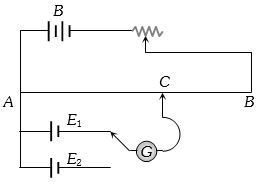
The circuit shown here is used to compare the $e.m.f.$ of two cells ${E_1}$ and ${E_2}$ $(E_1 > E_2)$. The null point is at $C$ when the galvanometer is connected to ${E_1}$. When the galvanometer is connected to ${E_2}$,the null point will be
A
To the left of $C$
B
To the right of $C$
C
At $C$ itself
D
Nowhere on $AB$
Solution
(A) In a potentiometer,the potential drop across a length $l$ of the wire is given by $V = kl$,where $k$ is the potential gradient.
At the null point,the $e.m.f.$ of the cell is balanced by the potential drop across the balancing length $l$,so $E = kl$.
Since $E_1 > E_2$,the balancing length $l_1$ for $E_1$ will be greater than the balancing length $l_2$ for $E_2$ $(l_1 > l_2)$.
Since the null point $C$ corresponds to $l_1$,and $l_2 < l_1$,the new null point for $E_2$ will be at a shorter distance from $A$ than $C$.
Therefore,the null point will shift to the left of $C$.
At the null point,the $e.m.f.$ of the cell is balanced by the potential drop across the balancing length $l$,so $E = kl$.
Since $E_1 > E_2$,the balancing length $l_1$ for $E_1$ will be greater than the balancing length $l_2$ for $E_2$ $(l_1 > l_2)$.
Since the null point $C$ corresponds to $l_1$,and $l_2 < l_1$,the new null point for $E_2$ will be at a shorter distance from $A$ than $C$.
Therefore,the null point will shift to the left of $C$.
0 likes
View Solution18
MediumMCQ
In an experiment to measure the internal resistance of a cell by a potentiometer,it is found that the balance point is at a length of $2\,m$ when the cell is shunted by a $5\,\Omega$ resistance; and is at a length of $3\,m$ when the cell is shunted by a $10\,\Omega$ resistance. The internal resistance of the cell is,then ................ $\Omega$.
A
$1.5$
B
$10$
C
$15$
D
$1$
Solution
(B) The formula for the internal resistance $r$ of a cell using a potentiometer is given by $r = R \left( \frac{l_1}{l_2} - 1 \right)$,where $l_1$ is the balancing length without shunt and $l_2$ is the balancing length with shunt $R$.
Given:
Case $1$: $R_1 = 5\,\Omega$,$l_1 = 2\,m$
Case $2$: $R_2 = 10\,\Omega$,$l_2 = 3\,m$
Let $L$ be the balancing length of the cell without any shunt.
For the first case: $r = 5 \left( \frac{L}{2} - 1 \right) = 2.5L - 5$ ... $(i)$
For the second case: $r = 10 \left( \frac{L}{3} - 1 \right) = \frac{10}{3}L - 10$ ... $(ii)$
Equating $(i)$ and $(ii)$:
$2.5L - 5 = \frac{10}{3}L - 10$
$5 = \frac{10}{3}L - 2.5L$
$5 = \frac{10L - 7.5L}{3} = \frac{2.5L}{3}$
$15 = 2.5L \implies L = 6\,m$
Substituting $L = 6$ into equation $(i)$:
$r = 5 \left( \frac{6}{2} - 1 \right) = 5(3 - 1) = 5 \times 2 = 10\,\Omega$.
Given:
Case $1$: $R_1 = 5\,\Omega$,$l_1 = 2\,m$
Case $2$: $R_2 = 10\,\Omega$,$l_2 = 3\,m$
Let $L$ be the balancing length of the cell without any shunt.
For the first case: $r = 5 \left( \frac{L}{2} - 1 \right) = 2.5L - 5$ ... $(i)$
For the second case: $r = 10 \left( \frac{L}{3} - 1 \right) = \frac{10}{3}L - 10$ ... $(ii)$
Equating $(i)$ and $(ii)$:
$2.5L - 5 = \frac{10}{3}L - 10$
$5 = \frac{10}{3}L - 2.5L$
$5 = \frac{10L - 7.5L}{3} = \frac{2.5L}{3}$
$15 = 2.5L \implies L = 6\,m$
Substituting $L = 6$ into equation $(i)$:
$r = 5 \left( \frac{6}{2} - 1 \right) = 5(3 - 1) = 5 \times 2 = 10\,\Omega$.
0 likes
View Solution19
EasyMCQ
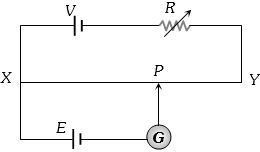
$A$ potentiometer circuit shown in the figure is set up to measure the $e.m.f.$ of a cell $E$. As the point $P$ moves from $X$ to $Y$, the galvanometer $G$ shows deflection always in one direction, but the deflection decreases continuously until $Y$ is reached. In order to obtain a balance point between $X$ and $Y$, it is necessary to
A
Decrease the resistance $R$
B
Increase the resistance $R$
C
Reverse the terminals of battery $V$
D
Reverse the terminals of cell $E$
Solution
(A) In a potentiometer, the potential drop across the length $XP$ is given by $V_{XP} = I \cdot R_{XP}$, where $I$ is the current in the potentiometer wire $XY$.
For a balance point to exist, the potential drop across $XP$ must be equal to the $e.m.f.$ of the cell $E$ $(V_{XP} = E)$.
Since the galvanometer deflection decreases as $P$ moves towards $Y$, it implies that the potential drop across $XP$ is still less than $E$ even at the end $Y$ $(V_{XY} < E)$.
To obtain a balance point between $X$ and $Y$, we need to increase the potential gradient along the wire $XY$.
This can be achieved by increasing the current $I$ in the wire $XY$.
Since $I = V / (R_{wire} + R)$, decreasing the external resistance $R$ will increase the current $I$, thereby increasing the potential drop across any segment $XP$ for a given position of $P$.
Thus, decreasing $R$ allows the balance point to be reached within the length $XY$.
For a balance point to exist, the potential drop across $XP$ must be equal to the $e.m.f.$ of the cell $E$ $(V_{XP} = E)$.
Since the galvanometer deflection decreases as $P$ moves towards $Y$, it implies that the potential drop across $XP$ is still less than $E$ even at the end $Y$ $(V_{XY} < E)$.
To obtain a balance point between $X$ and $Y$, we need to increase the potential gradient along the wire $XY$.
This can be achieved by increasing the current $I$ in the wire $XY$.
Since $I = V / (R_{wire} + R)$, decreasing the external resistance $R$ will increase the current $I$, thereby increasing the potential drop across any segment $XP$ for a given position of $P$.
Thus, decreasing $R$ allows the balance point to be reached within the length $XY$.
0 likes
View Solution20
MediumMCQ
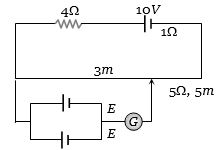
$A$ resistance of $4\,\Omega$ and a wire of length $5\,m$ and resistance $5\,\Omega$ are joined in series and connected to a cell of $e.m.f.$ $10\,V$ and internal resistance $1\,\Omega$. $A$ parallel combination of two identical cells is balanced across $300\,cm$ of the wire. The $e.m.f.$ $E$ of each cell is ........... $V$.
A
$1.5$
B
$3$
C
$0.67$
D
$1.33$
Solution
(B) $1$. Calculate the current $I$ in the primary circuit:
$I = \frac{V_{total}}{R_{total}} = \frac{10\,V}{4\,\Omega + 5\,\Omega + 1\,\Omega} = \frac{10}{10} = 1\,A$.
$2$. Calculate the potential drop across the potentiometer wire:
The potential difference across the $5\,m$ wire is $V_{wire} = I \times R_{wire} = 1\,A \times 5\,\Omega = 5\,V$.
$3$. Calculate the potential gradient $x$:
$x = \frac{V_{wire}}{L} = \frac{5\,V}{5\,m} = 1\,V/m$.
$4$. The balancing length is $l = 300\,cm = 3\,m$.
The potential difference across the balancing length is $V_{bal} = x \times l = 1\,V/m \times 3\,m = 3\,V$.
$5$. Since the two identical cells of $e.m.f.$ $E$ are connected in parallel,their equivalent $e.m.f.$ is $E_{eq} = E$.
Therefore,$E = 3\,V$.
$I = \frac{V_{total}}{R_{total}} = \frac{10\,V}{4\,\Omega + 5\,\Omega + 1\,\Omega} = \frac{10}{10} = 1\,A$.
$2$. Calculate the potential drop across the potentiometer wire:
The potential difference across the $5\,m$ wire is $V_{wire} = I \times R_{wire} = 1\,A \times 5\,\Omega = 5\,V$.
$3$. Calculate the potential gradient $x$:
$x = \frac{V_{wire}}{L} = \frac{5\,V}{5\,m} = 1\,V/m$.
$4$. The balancing length is $l = 300\,cm = 3\,m$.
The potential difference across the balancing length is $V_{bal} = x \times l = 1\,V/m \times 3\,m = 3\,V$.
$5$. Since the two identical cells of $e.m.f.$ $E$ are connected in parallel,their equivalent $e.m.f.$ is $E_{eq} = E$.
Therefore,$E = 3\,V$.
0 likes
View Solution21
MediumMCQ
The resistivity of a potentiometer wire is $40 \times 10^{-8} \, \Omega \cdot m$ and its area of cross-section is $8 \times 10^{-6} \, m^2$. If $0.2 \, A$ current is flowing through the wire,the potential gradient will be:
A
$10^{-2} \, V/m$
B
$10^{-1} \, V/m$
C
$3.2 \times 10^{-2} \, V/m$
D
$1 \, V/m$
Solution
(A) The potential gradient $x$ is defined as the potential drop per unit length of the wire,given by $x = \frac{V}{L}$.
Since $V = iR$ and resistance $R = \rho \frac{L}{A}$,we can substitute these into the expression:
$x = \frac{iR}{L} = \frac{i (\rho L / A)}{L} = \frac{i \rho}{A}$.
Given:
$i = 0.2 \, A$
$\rho = 40 \times 10^{-8} \, \Omega \cdot m$
$A = 8 \times 10^{-6} \, m^2$
Substituting the values:
$x = \frac{0.2 \times 40 \times 10^{-8}}{8 \times 10^{-6}}$
$x = \frac{8 \times 10^{-8}}{8 \times 10^{-6}} = 1 \times 10^{-2} \, V/m = 10^{-2} \, V/m$.
Since $V = iR$ and resistance $R = \rho \frac{L}{A}$,we can substitute these into the expression:
$x = \frac{iR}{L} = \frac{i (\rho L / A)}{L} = \frac{i \rho}{A}$.
Given:
$i = 0.2 \, A$
$\rho = 40 \times 10^{-8} \, \Omega \cdot m$
$A = 8 \times 10^{-6} \, m^2$
Substituting the values:
$x = \frac{0.2 \times 40 \times 10^{-8}}{8 \times 10^{-6}}$
$x = \frac{8 \times 10^{-8}}{8 \times 10^{-6}} = 1 \times 10^{-2} \, V/m = 10^{-2} \, V/m$.
0 likes
View Solution22
EasyMCQ
$A$ potentiometer consists of a wire of length $4\, m$ and resistance $10\,\Omega$. It is connected to a cell of $e.m.f.$ $2\, V$. The potential difference per unit length of the wire will be ............. $V/m$.
A
$0.5$
B
$2$
C
$5$
D
$10$
Solution
(A) The potential difference across the entire length of the potentiometer wire is equal to the $e.m.f.$ of the connected cell,which is $2\, V$.
The potential gradient (potential difference per unit length) is given by the formula:
Potential gradient $= \frac{V}{L}$
Where $V = 2\, V$ and $L = 4\, m$.
Therefore,the potential difference per unit length $= \frac{2\, V}{4\, m} = 0.5\, V/m$.
The potential gradient (potential difference per unit length) is given by the formula:
Potential gradient $= \frac{V}{L}$
Where $V = 2\, V$ and $L = 4\, m$.
Therefore,the potential difference per unit length $= \frac{2\, V}{4\, m} = 0.5\, V/m$.
0 likes
View Solution23
MediumMCQ
$A$ potentiometer wire has length $10\, m$ and resistance $20\,\Omega$. $A$ $2.5\, V$ battery of negligible internal resistance is connected across the wire with an $80\,\Omega$ series resistance. The potential gradient on the wire will be
A
$5 \times 10^{-5}\,V/mm$
B
$2.5 \times 10^{-4}\,V/cm$
C
$0.62 \times 10^{-4}\,V/mm$
D
$1 \times 10^{-5}\,V/mm$
Solution
(A) The potential gradient $x$ is defined as the potential drop per unit length of the wire.
First,calculate the total current $I$ flowing through the circuit:
$I = \frac{V}{R_{total}} = \frac{2.5\,V}{20\,\Omega + 80\,\Omega} = \frac{2.5}{100} = 0.025\,A$.
The potential drop across the potentiometer wire of resistance $R = 20\,\Omega$ is:
$V_{wire} = I \times R = 0.025\,A \times 20\,\Omega = 0.5\,V$.
The potential gradient $x$ is given by:
$x = \frac{V_{wire}}{L} = \frac{0.5\,V}{10\,m} = 0.05\,V/m$.
To convert this to $V/mm$,we know $1\,m = 1000\,mm$:
$x = \frac{0.05\,V}{1000\,mm} = 5 \times 10^{-5}\,V/mm$.
First,calculate the total current $I$ flowing through the circuit:
$I = \frac{V}{R_{total}} = \frac{2.5\,V}{20\,\Omega + 80\,\Omega} = \frac{2.5}{100} = 0.025\,A$.
The potential drop across the potentiometer wire of resistance $R = 20\,\Omega$ is:
$V_{wire} = I \times R = 0.025\,A \times 20\,\Omega = 0.5\,V$.
The potential gradient $x$ is given by:
$x = \frac{V_{wire}}{L} = \frac{0.5\,V}{10\,m} = 0.05\,V/m$.
To convert this to $V/mm$,we know $1\,m = 1000\,mm$:
$x = \frac{0.05\,V}{1000\,mm} = 5 \times 10^{-5}\,V/mm$.
0 likes
View Solution24
MediumMCQ
In a potentiometer experiment,the galvanometer shows no deflection when a cell is connected across $60 \ cm$ of the potentiometer wire. If the cell is shunted by a resistance of $6 \ \Omega$,the balance is obtained across $50 \ cm$ of the wire. The internal resistance of the cell is .............. $\Omega$.
A
$0.5$
B
$0.6$
C
$1.2$
D
$1.5$
Solution
(C) Let $E$ be the $EMF$ of the cell and $r$ be its internal resistance. The balance length $l_1 = 60 \ cm$ corresponds to the $EMF$ of the cell: $E = k l_1$,where $k$ is the potential gradient.
When the cell is shunted by a resistance $R' = 6 \ \Omega$,the terminal potential difference $V$ is given by $V = E - Ir = E - \frac{E}{R' + r} r = E \left( \frac{R'}{R' + r} \right)$.
The new balance length $l_2 = 50 \ cm$ corresponds to this terminal potential difference: $V = k l_2$.
Dividing the two equations: $\frac{E}{V} = \frac{l_1}{l_2} = \frac{R' + r}{R'}$.
Substituting the values: $\frac{60}{50} = \frac{6 + r}{6}$.
$1.2 = 1 + \frac{r}{6} \implies 0.2 = \frac{r}{6}$.
$r = 0.2 \times 6 = 1.2 \ \Omega$.
When the cell is shunted by a resistance $R' = 6 \ \Omega$,the terminal potential difference $V$ is given by $V = E - Ir = E - \frac{E}{R' + r} r = E \left( \frac{R'}{R' + r} \right)$.
The new balance length $l_2 = 50 \ cm$ corresponds to this terminal potential difference: $V = k l_2$.
Dividing the two equations: $\frac{E}{V} = \frac{l_1}{l_2} = \frac{R' + r}{R'}$.
Substituting the values: $\frac{60}{50} = \frac{6 + r}{6}$.
$1.2 = 1 + \frac{r}{6} \implies 0.2 = \frac{r}{6}$.
$r = 0.2 \times 6 = 1.2 \ \Omega$.
0 likes
View Solution25
MediumMCQ
The resistance of $10\, m$ long potentiometer wire is $1\,\Omega/m$. $A$ cell of $e.m.f.$ $2.2\, V$ and a high resistance box are connected in series to this wire. The value of resistance taken from the resistance box for getting a potential gradient of $2.2\, mV/m$ will be ............... $\Omega$.
A
$790$
B
$810$
C
$990$
D
$1000$
Solution
(C) The potential gradient $x$ is defined as the potential drop per unit length of the wire,given by $x = \frac{V_{wire}}{L}$.
Given: Length of wire $L = 10\, m$,Resistance per unit length $\lambda = 1\,\Omega/m$,so total resistance of wire $R = 10\,\Omega$.
$e.m.f.$ of the cell $E = 2.2\, V$.
Let the resistance taken from the resistance box be $R_h$.
The current $I$ in the circuit is $I = \frac{E}{R + R_h} = \frac{2.2}{10 + R_h}$.
The potential drop across the wire is $V_{wire} = I \times R = \frac{2.2 \times 10}{10 + R_h}$.
The potential gradient $x = \frac{V_{wire}}{L} = \frac{2.2 \times 10}{(10 + R_h) \times 10} = \frac{2.2}{10 + R_h}$.
We are given $x = 2.2\, mV/m = 2.2 \times 10^{-3}\, V/m$.
Equating the two: $2.2 \times 10^{-3} = \frac{2.2}{10 + R_h}$.
$10 + R_h = \frac{2.2}{2.2 \times 10^{-3}} = 10^3 = 1000$.
$R_h = 1000 - 10 = 990\,\Omega$.
Given: Length of wire $L = 10\, m$,Resistance per unit length $\lambda = 1\,\Omega/m$,so total resistance of wire $R = 10\,\Omega$.
$e.m.f.$ of the cell $E = 2.2\, V$.
Let the resistance taken from the resistance box be $R_h$.
The current $I$ in the circuit is $I = \frac{E}{R + R_h} = \frac{2.2}{10 + R_h}$.
The potential drop across the wire is $V_{wire} = I \times R = \frac{2.2 \times 10}{10 + R_h}$.
The potential gradient $x = \frac{V_{wire}}{L} = \frac{2.2 \times 10}{(10 + R_h) \times 10} = \frac{2.2}{10 + R_h}$.
We are given $x = 2.2\, mV/m = 2.2 \times 10^{-3}\, V/m$.
Equating the two: $2.2 \times 10^{-3} = \frac{2.2}{10 + R_h}$.
$10 + R_h = \frac{2.2}{2.2 \times 10^{-3}} = 10^3 = 1000$.
$R_h = 1000 - 10 = 990\,\Omega$.
0 likes
View Solution26
EasyMCQ
If the resistivity of a potentiometer wire is $\rho$ and the area of cross-section is $A$,then what will be the potential gradient along the wire,given that a current $I$ flows through it?
A
$\frac{I\rho}{A}$
B
$\frac{I}{A\rho}$
C
$\frac{IA}{\rho}$
D
$IA\rho$
Solution
(A) The potential gradient $x$ is defined as the potential drop per unit length of the wire,given by $x = \frac{V}{L}$.
From Ohm's law,the potential drop $V$ across a wire of length $L$ is $V = IR$,where $R$ is the resistance of the wire.
The resistance $R$ is given by the formula $R = \frac{\rho L}{A}$,where $\rho$ is the resistivity and $A$ is the area of cross-section.
Substituting the expression for $R$ into the potential drop equation: $V = I \left( \frac{\rho L}{A} \right)$.
Now,substituting $V$ into the potential gradient formula: $x = \frac{I \left( \frac{\rho L}{A} \right)}{L}$.
Simplifying the expression,we get $x = \frac{I\rho}{A}$.
From Ohm's law,the potential drop $V$ across a wire of length $L$ is $V = IR$,where $R$ is the resistance of the wire.
The resistance $R$ is given by the formula $R = \frac{\rho L}{A}$,where $\rho$ is the resistivity and $A$ is the area of cross-section.
Substituting the expression for $R$ into the potential drop equation: $V = I \left( \frac{\rho L}{A} \right)$.
Now,substituting $V$ into the potential gradient formula: $x = \frac{I \left( \frac{\rho L}{A} \right)}{L}$.
Simplifying the expression,we get $x = \frac{I\rho}{A}$.
0 likes
View Solution27
EasyMCQ
For a cell of $e.m.f.$ $2\,V$,a balance is obtained for $50\, cm$ of the potentiometer wire. If the cell is shunted by a $2\,\Omega$ resistor and the balance is obtained across $40\, cm$ of the wire,then the internal resistance of the cell is ............. $\Omega$.
A
$0.25$
B
$0.50$
C
$0.80$
D
$1$
Solution
(B) The $e.m.f.$ of the cell is $E = k l_1$,where $k$ is the potential gradient and $l_1 = 50\, cm$.
When the cell is shunted by a resistor $R = 2\,\Omega$,the terminal potential difference $V$ is given by $V = k l_2$,where $l_2 = 40\, cm$.
We know that $V = E - Ir$ and $I = \frac{E}{R+r}$,so $V = E \left( \frac{R}{R+r} \right)$.
Substituting the expressions for $E$ and $V$,we get $k l_2 = k l_1 \left( \frac{R}{R+r} \right)$.
This simplifies to $\frac{l_2}{l_1} = \frac{R}{R+r}$,which gives $r = R \left( \frac{l_1}{l_2} - 1 \right)$.
Substituting the given values: $r = 2 \left( \frac{50}{40} - 1 \right) = 2 \left( 1.25 - 1 \right) = 2 \times 0.25 = 0.5\,\Omega$.
When the cell is shunted by a resistor $R = 2\,\Omega$,the terminal potential difference $V$ is given by $V = k l_2$,where $l_2 = 40\, cm$.
We know that $V = E - Ir$ and $I = \frac{E}{R+r}$,so $V = E \left( \frac{R}{R+r} \right)$.
Substituting the expressions for $E$ and $V$,we get $k l_2 = k l_1 \left( \frac{R}{R+r} \right)$.
This simplifies to $\frac{l_2}{l_1} = \frac{R}{R+r}$,which gives $r = R \left( \frac{l_1}{l_2} - 1 \right)$.
Substituting the given values: $r = 2 \left( \frac{50}{40} - 1 \right) = 2 \left( 1.25 - 1 \right) = 2 \times 0.25 = 0.5\,\Omega$.
0 likes
View Solution28
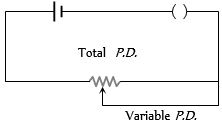
EasyMCQ
The arrangement as shown in the figure is called:
A
Potential divider
B
Potential adder
C
Potential subtracter
D
Potential multiplier
Solution
(A) The circuit shown in the figure consists of a voltage source connected across a fixed resistor. $A$ sliding contact (wiper) is used to tap a portion of the total potential difference across the resistor. By moving the sliding contact,the output voltage (Variable $P.D.$) can be adjusted from $0$ to the total voltage (Total $P.D.$) across the resistor. This specific arrangement is known as a Potential divider.
0 likes
View Solution29
MediumMCQ
$A$ potentiometer wire of length $1\,m$ and resistance $10\,\Omega$ is connected in series with a cell of $emf$ $2\,V$ with internal resistance $1\,\Omega$ and a resistance box including a resistance $R$. If the potential difference between the ends of the wire is $1\,mV$,the value of $R$ is ............. $\Omega$.
A
$20000$
B
$19989$
C
$10000$
D
$9989$
Solution
(B) The total resistance of the circuit is $R_{total} = R + R_{wire} + r = R + 10 + 1 = R + 11\,\Omega$.
The current $I$ flowing through the circuit is given by $I = \frac{E}{R_{total}} = \frac{2}{R + 11}$.
The potential difference $V$ across the potentiometer wire is $V = I \times R_{wire}$.
Given $V = 1\,mV = 10^{-3}\,V$ and $R_{wire} = 10\,\Omega$.
Substituting the values: $10^{-3} = \left( \frac{2}{R + 11} \right) \times 10$.
$10^{-3} = \frac{20}{R + 11}$.
$R + 11 = \frac{20}{10^{-3}} = 20 \times 10^3 = 20000$.
$R = 20000 - 11 = 19989\,\Omega$.
The current $I$ flowing through the circuit is given by $I = \frac{E}{R_{total}} = \frac{2}{R + 11}$.
The potential difference $V$ across the potentiometer wire is $V = I \times R_{wire}$.
Given $V = 1\,mV = 10^{-3}\,V$ and $R_{wire} = 10\,\Omega$.
Substituting the values: $10^{-3} = \left( \frac{2}{R + 11} \right) \times 10$.
$10^{-3} = \frac{20}{R + 11}$.
$R + 11 = \frac{20}{10^{-3}} = 20 \times 10^3 = 20000$.
$R = 20000 - 11 = 19989\,\Omega$.
0 likes
View Solution30
MediumMCQ
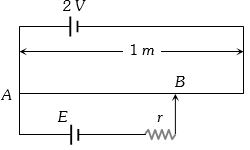
In the given figure,a battery $E$ is balanced on $55 \, cm$ length of a potentiometer wire. When a resistance of $10 \, \Omega$ is connected in parallel with the battery,it balances on $50 \, cm$ length of the potentiometer wire. The internal resistance $r$ of the battery is ............. $\Omega$.
A
$1$
B
$3$
C
$10$
D
$5$
Solution
(A) Let $V$ be the potential difference across the potentiometer wire per unit length (potential gradient).
When the battery $E$ is balanced,its $EMF$ is given by $E = k \cdot l_1$,where $l_1 = 55 \, cm$.
When a resistance $R = 10 \, \Omega$ is connected in parallel with the battery,the terminal voltage $V'$ is balanced,so $V' = k \cdot l_2$,where $l_2 = 50 \, cm$.
The terminal voltage is given by $V' = E \left( \frac{R}{R + r} \right)$.
Dividing the two equations: $\frac{E}{V'} = \frac{l_1}{l_2} = \frac{R + r}{R}$.
Substituting the values: $\frac{55}{50} = \frac{10 + r}{10}$.
$1.1 = 1 + \frac{r}{10} \Rightarrow 0.1 = \frac{r}{10} \Rightarrow r = 1 \, \Omega$.
When the battery $E$ is balanced,its $EMF$ is given by $E = k \cdot l_1$,where $l_1 = 55 \, cm$.
When a resistance $R = 10 \, \Omega$ is connected in parallel with the battery,the terminal voltage $V'$ is balanced,so $V' = k \cdot l_2$,where $l_2 = 50 \, cm$.
The terminal voltage is given by $V' = E \left( \frac{R}{R + r} \right)$.
Dividing the two equations: $\frac{E}{V'} = \frac{l_1}{l_2} = \frac{R + r}{R}$.
Substituting the values: $\frac{55}{50} = \frac{10 + r}{10}$.
$1.1 = 1 + \frac{r}{10} \Rightarrow 0.1 = \frac{r}{10} \Rightarrow r = 1 \, \Omega$.
0 likes
View Solution31
MediumMCQ
$A$ potentiometer having a potential gradient of $2\, mV/cm$ is used to measure the potential difference across a resistance of $10\, \Omega$. If a length of $50\, cm$ of the potentiometer wire is required to obtain the null point,the current passing through the $10\, \Omega$ resistor is (in $mA$):
A
$1$
B
$2$
C
$5$
D
$10$
Solution
(D) The potential difference $V$ across the resistor is given by the product of the potential gradient $x$ and the balancing length $l$.
$V = x \times l$
Given,potential gradient $x = 2\, mV/cm = 2 \times 10^{-3}\, V/cm$.
Balancing length $l = 50\, cm$.
Therefore,$V = (2 \times 10^{-3}\, V/cm) \times (50\, cm) = 100 \times 10^{-3}\, V = 0.1\, V$.
Since $V = iR$,where $R = 10\, \Omega$ is the resistance:
$i = V / R = 0.1\, V / 10\, \Omega = 0.01\, A$.
Converting to $mA$,$i = 0.01 \times 1000\, mA = 10\, mA$.
$V = x \times l$
Given,potential gradient $x = 2\, mV/cm = 2 \times 10^{-3}\, V/cm$.
Balancing length $l = 50\, cm$.
Therefore,$V = (2 \times 10^{-3}\, V/cm) \times (50\, cm) = 100 \times 10^{-3}\, V = 0.1\, V$.
Since $V = iR$,where $R = 10\, \Omega$ is the resistance:
$i = V / R = 0.1\, V / 10\, \Omega = 0.01\, A$.
Converting to $mA$,$i = 0.01 \times 1000\, mA = 10\, mA$.
0 likes
View Solution32
MediumMCQ
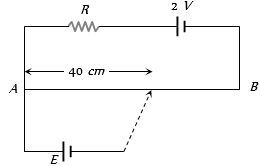
$AB$ is a potentiometer wire of length $100\, cm$ and its resistance is $10\,\Omega$. It is connected in series with a resistance $R = 40\,\Omega$ and a battery of $e.m.f.$ $2\,V$ and negligible internal resistance. If a source of unknown $e.m.f.$ $E$ is balanced by $40\, cm$ length of the potentiometer wire,the value of $E$ is ................. $V$. (in $,V$)
A
$0.8$
B
$1.6$
C
$0.08$
D
$0.16$
Solution
(D) $1$. First,calculate the current $I$ flowing through the potentiometer wire $AB$. The total resistance of the circuit is $R_{total} = R_{wire} + R_{series} = 10\,\Omega + 40\,\Omega = 50\,\Omega$.
$2$. The current $I$ in the circuit is given by $I = \frac{V}{R_{total}} = \frac{2\,V}{50\,\Omega} = 0.04\,A$.
$3$. The potential drop across the potentiometer wire $AB$ is $V_{AB} = I \times R_{wire} = 0.04\,A \times 10\,\Omega = 0.4\,V$.
$4$. The potential gradient $k$ (potential drop per unit length) is $k = \frac{V_{AB}}{L} = \frac{0.4\,V}{100\,cm} = 0.004\,V/cm$.
$5$. The unknown $e.m.f.$ $E$ is balanced by a length $l = 40\,cm$. Therefore,$E = k \times l = 0.004\,V/cm \times 40\,cm = 0.16\,V$.
$2$. The current $I$ in the circuit is given by $I = \frac{V}{R_{total}} = \frac{2\,V}{50\,\Omega} = 0.04\,A$.
$3$. The potential drop across the potentiometer wire $AB$ is $V_{AB} = I \times R_{wire} = 0.04\,A \times 10\,\Omega = 0.4\,V$.
$4$. The potential gradient $k$ (potential drop per unit length) is $k = \frac{V_{AB}}{L} = \frac{0.4\,V}{100\,cm} = 0.004\,V/cm$.
$5$. The unknown $e.m.f.$ $E$ is balanced by a length $l = 40\,cm$. Therefore,$E = k \times l = 0.004\,V/cm \times 40\,cm = 0.16\,V$.
0 likes
View Solution33
MediumMCQ
In a potentiometer experiment,two cells of $e.m.f.$ $E_1$ and $E_2$ are used in series and in conjunction,and the balancing length is found to be $58 \ cm$ of the wire. If the polarity of $E_2$ is reversed,the balancing length becomes $29 \ cm$. The ratio $\frac{E_1}{E_2}$ of the $e.m.f.$ of the two cells is: (in $:1$)
A
$1$
B
$2$
C
$3$
D
$4$
Solution
(C) Let $k$ be the potential gradient of the potentiometer wire.
When the cells are in series and in conjunction,the total $e.m.f.$ is $(E_1 + E_2)$. The balancing length is $l_1 = 58 \ cm$.
So,$(E_1 + E_2) = k \cdot l_1 = 58k$ --- $(1)$
When the polarity of $E_2$ is reversed,the total $e.m.f.$ is $(E_1 - E_2)$. The balancing length is $l_2 = 29 \ cm$.
So,$(E_1 - E_2) = k \cdot l_2 = 29k$ --- $(2)$
Dividing equation $(1)$ by equation $(2)$:
$\frac{E_1 + E_2}{E_1 - E_2} = \frac{58k}{29k} = 2$
$E_1 + E_2 = 2(E_1 - E_2)$
$E_1 + E_2 = 2E_1 - 2E_2$
$3E_2 = E_1$
Therefore,$\frac{E_1}{E_2} = \frac{3}{1}$.
When the cells are in series and in conjunction,the total $e.m.f.$ is $(E_1 + E_2)$. The balancing length is $l_1 = 58 \ cm$.
So,$(E_1 + E_2) = k \cdot l_1 = 58k$ --- $(1)$
When the polarity of $E_2$ is reversed,the total $e.m.f.$ is $(E_1 - E_2)$. The balancing length is $l_2 = 29 \ cm$.
So,$(E_1 - E_2) = k \cdot l_2 = 29k$ --- $(2)$
Dividing equation $(1)$ by equation $(2)$:
$\frac{E_1 + E_2}{E_1 - E_2} = \frac{58k}{29k} = 2$
$E_1 + E_2 = 2(E_1 - E_2)$
$E_1 + E_2 = 2E_1 - 2E_2$
$3E_2 = E_1$
Therefore,$\frac{E_1}{E_2} = \frac{3}{1}$.
0 likes
View Solution34
EasyMCQ
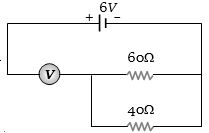
The reading of the voltmeter in the following circuit is ................ $V$.
A
$2.4$
B
$3.4$
C
$4.0$
D
$6.0$
Solution
(D) An ideal voltmeter has infinite resistance.
In the given circuit,the voltmeter is connected in series with the parallel combination of the $6\,\Omega$ and $4\,\Omega$ resistors.
Because the voltmeter has infinite resistance,no current flows through the circuit $(I = 0)$.
Therefore,there is no potential drop across the resistors.
The reading of an ideal voltmeter connected across a source in an open circuit is equal to the electromotive force $(e.m.f.)$ of the cell.
Thus,the voltmeter reading is $6\,V$.
In the given circuit,the voltmeter is connected in series with the parallel combination of the $6\,\Omega$ and $4\,\Omega$ resistors.
Because the voltmeter has infinite resistance,no current flows through the circuit $(I = 0)$.
Therefore,there is no potential drop across the resistors.
The reading of an ideal voltmeter connected across a source in an open circuit is equal to the electromotive force $(e.m.f.)$ of the cell.
Thus,the voltmeter reading is $6\,V$.
0 likes
View Solution35
MediumMCQ
$A$ wire of length $100\, cm$ is connected to a cell of $emf$ $2\, V$ and negligible internal resistance. The resistance of the wire is $3\, \Omega$. The additional resistance required to produce a potential drop of $1\, mV/cm$ is ............... $\Omega$.
A
$60$
B
$47$
C
$57$
D
$35$
Solution
(C) The potential gradient $x$ is defined as the potential drop per unit length of the wire.
Given,$x = 1\, mV/cm = 10^{-3}\, V/cm = 0.1\, V/m$.
Total length of the wire $L = 100\, cm = 1\, m$.
The potential drop across the wire is $V_{wire} = x \times L = 0.1\, V/m \times 1\, m = 0.1\, V$.
Let the additional resistance be $R_h$. The total resistance in the circuit is $R_{total} = R + R_h = 3 + R_h$.
Using Ohm's law,the current in the circuit is $I = \frac{E}{R_{total}} = \frac{2}{3 + R_h}$.
The potential drop across the wire is also given by $V_{wire} = I \times R$.
Substituting the values: $0.1 = \left( \frac{2}{3 + R_h} \right) \times 3$.
$0.1(3 + R_h) = 6$.
$3 + R_h = 60$.
$R_h = 57\, \Omega$.
Given,$x = 1\, mV/cm = 10^{-3}\, V/cm = 0.1\, V/m$.
Total length of the wire $L = 100\, cm = 1\, m$.
The potential drop across the wire is $V_{wire} = x \times L = 0.1\, V/m \times 1\, m = 0.1\, V$.
Let the additional resistance be $R_h$. The total resistance in the circuit is $R_{total} = R + R_h = 3 + R_h$.
Using Ohm's law,the current in the circuit is $I = \frac{E}{R_{total}} = \frac{2}{3 + R_h}$.
The potential drop across the wire is also given by $V_{wire} = I \times R$.
Substituting the values: $0.1 = \left( \frac{2}{3 + R_h} \right) \times 3$.
$0.1(3 + R_h) = 6$.
$3 + R_h = 60$.
$R_h = 57\, \Omega$.
0 likes
View Solution36
MediumMCQ
$A$ $10 \, m$ long wire of $20 \, \Omega$ resistance is connected with a battery of $3 \, V$ $e.m.f.$ (negligible internal resistance) and a $10 \, \Omega$ resistance is joined to it in series. The potential gradient along the wire in $V/m$ is:
A
$0.02$
B
$0.3$
C
$0.2$
D
$1.3$
Solution
(C) The potential gradient $x$ is defined as the potential drop per unit length of the wire,given by $x = \frac{V_{wire}}{L}$.
First,calculate the total resistance of the circuit: $R_{total} = R_{wire} + R_{series} + r = 20 \, \Omega + 10 \, \Omega + 0 \, \Omega = 30 \, \Omega$.
The current $I$ flowing through the circuit is $I = \frac{E}{R_{total}} = \frac{3 \, V}{30 \, \Omega} = 0.1 \, A$.
The potential drop across the wire is $V_{wire} = I \times R_{wire} = 0.1 \, A \times 20 \, \Omega = 2 \, V$.
The potential gradient $x = \frac{V_{wire}}{L} = \frac{2 \, V}{10 \, m} = 0.2 \, V/m$.
First,calculate the total resistance of the circuit: $R_{total} = R_{wire} + R_{series} + r = 20 \, \Omega + 10 \, \Omega + 0 \, \Omega = 30 \, \Omega$.
The current $I$ flowing through the circuit is $I = \frac{E}{R_{total}} = \frac{3 \, V}{30 \, \Omega} = 0.1 \, A$.
The potential drop across the wire is $V_{wire} = I \times R_{wire} = 0.1 \, A \times 20 \, \Omega = 2 \, V$.
The potential gradient $x = \frac{V_{wire}}{L} = \frac{2 \, V}{10 \, m} = 0.2 \, V/m$.
0 likes
View Solution37
MediumMCQ
$A$ potentiometer has a uniform potential gradient across it. Two cells connected in series $(i)$ to support each other and $(ii)$ to oppose each other are balanced over $6 \ m$ and $2 \ m$ respectively on the potentiometer wire. The ratio of the $e.m.f.$s of the cells is:
A
$1:2$
B
$1:1$
C
$3:1$
D
$2:1$
Solution
(D) Let $E_1$ and $E_2$ be the $e.m.f.$s of the two cells,and $x$ be the potential gradient of the potentiometer wire.
When the cells support each other,the total $e.m.f.$ is $(E_1 + E_2) = x \cdot l_1$,where $l_1 = 6 \ m$.
When the cells oppose each other,the total $e.m.f.$ is $(E_1 - E_2) = x \cdot l_2$,where $l_2 = 2 \ m$.
Dividing the two equations: $\frac{E_1 + E_2}{E_1 - E_2} = \frac{6}{2} = 3$.
Applying componendo and dividendo: $\frac{(E_1 + E_2) + (E_1 - E_2)}{(E_1 + E_2) - (E_1 - E_2)} = \frac{3 + 1}{3 - 1}$.
This simplifies to: $\frac{2E_1}{2E_2} = \frac{4}{2} = 2$.
Therefore,the ratio $\frac{E_1}{E_2} = 2:1$.
When the cells support each other,the total $e.m.f.$ is $(E_1 + E_2) = x \cdot l_1$,where $l_1 = 6 \ m$.
When the cells oppose each other,the total $e.m.f.$ is $(E_1 - E_2) = x \cdot l_2$,where $l_2 = 2 \ m$.
Dividing the two equations: $\frac{E_1 + E_2}{E_1 - E_2} = \frac{6}{2} = 3$.
Applying componendo and dividendo: $\frac{(E_1 + E_2) + (E_1 - E_2)}{(E_1 + E_2) - (E_1 - E_2)} = \frac{3 + 1}{3 - 1}$.
This simplifies to: $\frac{2E_1}{2E_2} = \frac{4}{2} = 2$.
Therefore,the ratio $\frac{E_1}{E_2} = 2:1$.
0 likes
View Solution38
EasyMCQ
The material of the wire of a potentiometer is
A
Copper
B
Steel
C
Manganin
D
Aluminium
Solution
(C) The wire of a potentiometer is typically made of alloys like $Manganin$ or $Constantan$.
These materials are chosen because they have a high resistivity and a very low temperature coefficient of resistance.
This ensures that the resistance of the wire remains practically constant even if the temperature changes slightly during the experiment,providing accurate measurements.
These materials are chosen because they have a high resistivity and a very low temperature coefficient of resistance.
This ensures that the resistance of the wire remains practically constant even if the temperature changes slightly during the experiment,providing accurate measurements.
0 likes
View Solution39
MediumMCQ
$A$ cell of internal resistance $3 \, \Omega$ and $emf$ $10 \, V$ is connected to a uniform wire of length $500 \, cm$ and resistance $3 \, \Omega$. The potential gradient in the wire is .............. $mV/cm$.
A
$30$
B
$10$
C
$20$
D
$4$
Solution
(B) The potential difference $V$ across the wire is given by the voltage divider rule: $V = E \times \frac{R}{R + r}$, where $E = 10 \, V$, $R = 3 \, \Omega$, and $r = 3 \, \Omega$.
$V = 10 \times \frac{3}{3 + 3} = 10 \times \frac{3}{6} = 5 \, V$.
The potential gradient $k$ is defined as the potential drop per unit length: $k = \frac{V}{L}$.
Given $L = 500 \, cm = 5 \, m$.
$k = \frac{5 \, V}{500 \, cm} = 0.01 \, V/cm$.
Converting to $mV/cm$: $0.01 \times 1000 = 10 \, mV/cm$.
$V = 10 \times \frac{3}{3 + 3} = 10 \times \frac{3}{6} = 5 \, V$.
The potential gradient $k$ is defined as the potential drop per unit length: $k = \frac{V}{L}$.
Given $L = 500 \, cm = 5 \, m$.
$k = \frac{5 \, V}{500 \, cm} = 0.01 \, V/cm$.
Converting to $mV/cm$: $0.01 \times 1000 = 10 \, mV/cm$.
0 likes
View Solution40
MediumMCQ
$A$ potentiometer has a uniform potential gradient. The specific resistance (resistivity) of the material of the potentiometer wire is $10^{-7} \, \Omega \cdot m$, the current passing through it is $0.1 \, A$, and the cross-sectional area of the wire is $10^{-6} \, m^2$. The potential gradient along the potentiometer wire is:
A
$10^{-4} \, V/m$
B
$10^{-6} \, V/m$
C
$10^{-2} \, V/m$
D
$10^{-8} \, V/m$
Solution
(C) The potential gradient $(x)$ is defined as the potential drop per unit length of the wire, given by $x = \frac{V}{L}$.
Since $V = IR$ and $R = \frac{\rho L}{A}$, we can substitute these into the expression for the potential gradient:
$x = \frac{I \cdot (\rho L / A)}{L} = \frac{I \rho}{A}$.
Given values are:
Current $(I) = 0.1 \, A$,
Resistivity $(\rho) = 10^{-7} \, \Omega \cdot m$,
Area $(A) = 10^{-6} \, m^2$.
Substituting these values into the formula:
$x = \frac{0.1 \times 10^{-7}}{10^{-6}} = \frac{10^{-1} \times 10^{-7}}{10^{-6}} = \frac{10^{-8}}{10^{-6}} = 10^{-2} \, V/m$.
Since $V = IR$ and $R = \frac{\rho L}{A}$, we can substitute these into the expression for the potential gradient:
$x = \frac{I \cdot (\rho L / A)}{L} = \frac{I \rho}{A}$.
Given values are:
Current $(I) = 0.1 \, A$,
Resistivity $(\rho) = 10^{-7} \, \Omega \cdot m$,
Area $(A) = 10^{-6} \, m^2$.
Substituting these values into the formula:
$x = \frac{0.1 \times 10^{-7}}{10^{-6}} = \frac{10^{-1} \times 10^{-7}}{10^{-6}} = \frac{10^{-8}}{10^{-6}} = 10^{-2} \, V/m$.
0 likes
View Solution41
MediumMCQ
The length of a wire of a potentiometer is $100 \, cm$,and the $emf$ of its standard cell is $E \, volt$. It is employed to measure the $emf$ of a battery whose internal resistance is $0.5 \, \Omega$. If the balance point is obtained at $l = 30 \, cm$ from the positive end,the $emf$ of the battery is (where $i$ is the current in the potentiometer wire).
A
$\frac{30E}{100}$
B
$\frac{30E}{100.5}$
C
$\frac{30E}{100 - 0.5}$
D
$\frac{30(E - 0.5i)}{100}$
Solution
(A) The principle of a potentiometer states that the potential drop across a length $l$ of the wire is directly proportional to the length,provided the current $i$ in the potentiometer wire remains constant.
$V = kl$,where $k$ is the potential gradient $(k = \frac{E}{L})$.
Given: $L = 100 \, cm$,$E = emf$ of the standard cell,$l = 30 \, cm$.
The $emf$ of the battery being measured is $V = \frac{E}{L} \times l$.
Substituting the values: $V = \frac{E}{100} \times 30 = \frac{30E}{100}$.
Note: At the balance point,no current flows through the battery being measured,so its internal resistance does not affect the reading.
$V = kl$,where $k$ is the potential gradient $(k = \frac{E}{L})$.
Given: $L = 100 \, cm$,$E = emf$ of the standard cell,$l = 30 \, cm$.
The $emf$ of the battery being measured is $V = \frac{E}{L} \times l$.
Substituting the values: $V = \frac{E}{100} \times 30 = \frac{30E}{100}$.
Note: At the balance point,no current flows through the battery being measured,so its internal resistance does not affect the reading.
0 likes
View Solution42
MediumMCQ
Resistance of $100 \, cm$ long potentiometer wire is $10 \, \Omega$. It is connected to a battery of $2 \, V$ and a resistance $R$ in series. $A$ source of $10 \, mV$ gives a null point at $40 \, cm$ length. The value of external resistance $R$ is ........... $\Omega$.
A
$490$
B
$790$
C
$590$
D
$990$
Solution
(B) Let the resistance of the potentiometer wire be $R_w = 10 \, \Omega$ and its length be $L = 100 \, cm = 1 \, m$.
The total resistance in the primary circuit is $R_{total} = R + R_w = R + 10$.
The current in the primary circuit is $I = \frac{V}{R + R_w} = \frac{2}{R + 10}$.
The potential drop across the potentiometer wire is $V_w = I \times R_w = \frac{2 \times 10}{R + 10} = \frac{20}{R + 10}$.
The potential gradient $k$ is given by $k = \frac{V_w}{L} = \frac{20}{R + 10} \times \frac{1}{100} = \frac{0.2}{R + 10} \, V/cm$.
The null point is obtained at $l = 40 \, cm$ for a source of $E = 10 \, mV = 10 \times 10^{-3} \, V$.
Using the principle of the potentiometer,$E = k \times l$.
$10 \times 10^{-3} = \left( \frac{0.2}{R + 10} \right) \times 40$.
$0.01 = \frac{8}{R + 10}$.
$R + 10 = \frac{8}{0.01} = 800$.
$R = 800 - 10 = 790 \, \Omega$.
The total resistance in the primary circuit is $R_{total} = R + R_w = R + 10$.
The current in the primary circuit is $I = \frac{V}{R + R_w} = \frac{2}{R + 10}$.
The potential drop across the potentiometer wire is $V_w = I \times R_w = \frac{2 \times 10}{R + 10} = \frac{20}{R + 10}$.
The potential gradient $k$ is given by $k = \frac{V_w}{L} = \frac{20}{R + 10} \times \frac{1}{100} = \frac{0.2}{R + 10} \, V/cm$.
The null point is obtained at $l = 40 \, cm$ for a source of $E = 10 \, mV = 10 \times 10^{-3} \, V$.
Using the principle of the potentiometer,$E = k \times l$.
$10 \times 10^{-3} = \left( \frac{0.2}{R + 10} \right) \times 40$.
$0.01 = \frac{8}{R + 10}$.
$R + 10 = \frac{8}{0.01} = 800$.
$R = 800 - 10 = 790 \, \Omega$.
0 likes
View Solution43
EasyMCQ
The $e.m.f.$ of a standard cell balances across $150 \ cm$ length of a potentiometer wire. When a resistance of $2 \ \Omega$ is connected as a shunt across the cell,the balance point is obtained at $100 \ cm$. The internal resistance of the cell is .............. $\Omega$.
A
$0.1$
B
$1$
C
$2$
D
$0.5$
Solution
(B) The formula for the internal resistance $r$ of a cell using a potentiometer is given by $r = R \left( \frac{l_1}{l_2} - 1 \right)$,where $R$ is the external shunt resistance,$l_1$ is the balancing length without shunt,and $l_2$ is the balancing length with shunt.
Given:
$l_1 = 150 \ cm$
$l_2 = 100 \ cm$
$R = 2 \ \Omega$
Substituting these values into the formula:
$r = 2 \left( \frac{150}{100} - 1 \right)$
$r = 2 \left( 1.5 - 1 \right)$
$r = 2 \times 0.5 = 1 \ \Omega$.
Therefore,the internal resistance of the cell is $1 \ \Omega$.
Given:
$l_1 = 150 \ cm$
$l_2 = 100 \ cm$
$R = 2 \ \Omega$
Substituting these values into the formula:
$r = 2 \left( \frac{150}{100} - 1 \right)$
$r = 2 \left( 1.5 - 1 \right)$
$r = 2 \times 0.5 = 1 \ \Omega$.
Therefore,the internal resistance of the cell is $1 \ \Omega$.
0 likes
View Solution44
MediumMCQ
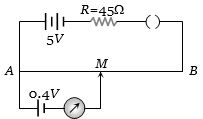
In the given figure,the potentiometer wire $AB$ has a resistance of $5 \, \Omega$ and a length of $10 \, m$. The balancing length $AM$ for the $emf$ of $0.4 \, V$ is ............... $m$.
A
$0.4$
B
$4$
C
$0.8$
D
$8$
Solution
(D) The current $I$ flowing through the potentiometer wire $AB$ is given by $I = \frac{V_{source}}{R_{total}} = \frac{5 \, V}{R_{AB} + R_{series}} = \frac{5}{5 + 45} = \frac{5}{50} = 0.1 \, A$.
The potential drop across the wire $AB$ is $V_{AB} = I \times R_{AB} = 0.1 \times 5 = 0.5 \, V$.
The potential gradient $k$ along the wire is $k = \frac{V_{AB}}{L} = \frac{0.5 \, V}{10 \, m} = 0.05 \, V/m$.
For the balancing length $l$ corresponding to an $emf$ of $E = 0.4 \, V$,we have $E = k \times l$.
$0.4 = 0.05 \times l$.
$l = \frac{0.4}{0.05} = 8 \, m$.
The potential drop across the wire $AB$ is $V_{AB} = I \times R_{AB} = 0.1 \times 5 = 0.5 \, V$.
The potential gradient $k$ along the wire is $k = \frac{V_{AB}}{L} = \frac{0.5 \, V}{10 \, m} = 0.05 \, V/m$.
For the balancing length $l$ corresponding to an $emf$ of $E = 0.4 \, V$,we have $E = k \times l$.
$0.4 = 0.05 \times l$.
$l = \frac{0.4}{0.05} = 8 \, m$.
1 likes
View Solution45
MediumMCQ
In a potentiometer experiment,the balancing length with a cell is $240 \ cm$. On shunting the cell with a resistance of $2 \ \Omega$,the balancing length becomes $120 \ cm$. The internal resistance of the cell is ................. $\Omega$.
A
$4$
B
$2$
C
$1$
D
$0.5$
Solution
(B) The balancing length $l_1$ is proportional to the electromotive force $(E)$ of the cell: $E \propto l_1 = 240 \ cm$.
When the cell is shunted with an external resistance $R = 2 \ \Omega$,the terminal potential difference $V$ is balanced at length $l_2 = 120 \ cm$,so $V \propto l_2$.
The formula for internal resistance $r$ of a cell is given by $r = R \left( \frac{E}{V} - 1 \right)$.
Since $E/V = l_1/l_2$,we substitute the values:
$r = R \left( \frac{l_1}{l_2} - 1 \right)$
$r = 2 \left( \frac{240}{120} - 1 \right)$
$r = 2 \left( 2 - 1 \right)$
$r = 2 \ \Omega$.
Therefore,the internal resistance of the cell is $2 \ \Omega$.
When the cell is shunted with an external resistance $R = 2 \ \Omega$,the terminal potential difference $V$ is balanced at length $l_2 = 120 \ cm$,so $V \propto l_2$.
The formula for internal resistance $r$ of a cell is given by $r = R \left( \frac{E}{V} - 1 \right)$.
Since $E/V = l_1/l_2$,we substitute the values:
$r = R \left( \frac{l_1}{l_2} - 1 \right)$
$r = 2 \left( \frac{240}{120} - 1 \right)$
$r = 2 \left( 2 - 1 \right)$
$r = 2 \ \Omega$.
Therefore,the internal resistance of the cell is $2 \ \Omega$.
0 likes
View Solution46
MediumMCQ
With a potentiometer,null points were obtained at $140 \, cm$ and $180 \, cm$ with cells of $emf$ $1.1 \, V$ and one unknown $X \, V$. The unknown $emf$ is .............. $V$.
A
$1.1$
B
$1.8$
C
$2.4$
D
$1.41$
Solution
(D) The potential gradient $k$ of a potentiometer is defined as $k = \frac{E}{l}$,where $E$ is the $emf$ and $l$ is the balancing length.
Since the potential gradient remains constant for a given circuit,we have $\frac{E_1}{l_1} = \frac{E_2}{l_2}$.
Given $E_1 = 1.1 \, V$,$l_1 = 140 \, cm$,and $l_2 = 180 \, cm$.
Substituting the values: $\frac{1.1}{140} = \frac{E_2}{180}$.
Solving for $E_2$: $E_2 = \frac{1.1 \times 180}{140}$.
$E_2 = \frac{198}{140} \approx 1.41 \, V$.
Since the potential gradient remains constant for a given circuit,we have $\frac{E_1}{l_1} = \frac{E_2}{l_2}$.
Given $E_1 = 1.1 \, V$,$l_1 = 140 \, cm$,and $l_2 = 180 \, cm$.
Substituting the values: $\frac{1.1}{140} = \frac{E_2}{180}$.
Solving for $E_2$: $E_2 = \frac{1.1 \times 180}{140}$.
$E_2 = \frac{198}{140} \approx 1.41 \, V$.
0 likes
View Solution47
MediumMCQ
$A$ potentiometer wire of length $1 \, m$ is connected in series with a $490 \, \Omega$ resistance and a $2 \, V$ battery. If the potential gradient is $0.2 \, mV/cm$,then the resistance of the potentiometer wire is ................ $\Omega$. (in $.9$)
A
$4$
B
$7$
C
$5$
D
$6$
Solution
(A) The potential gradient $x$ is given by the formula: $x = \frac{V_{wire}}{L} = \frac{I \cdot R}{L}$,where $I = \frac{E}{R + R_{ext}}$.
Given: $L = 1 \, m = 100 \, cm$,$E = 2 \, V$,$R_{ext} = 490 \, \Omega$,and $x = 0.2 \, mV/cm = 0.2 \times 10^{-3} \, V/cm = 0.02 \, V/m$.
The potential drop across the wire is $V_{wire} = x \cdot L = 0.02 \, V/m \times 1 \, m = 0.02 \, V$.
The current in the circuit is $I = \frac{V_{wire}}{R} = \frac{0.02}{R}$.
Also,$I = \frac{E}{R + R_{ext}} = \frac{2}{R + 490}$.
Equating the two expressions for $I$: $\frac{0.02}{R} = \frac{2}{R + 490}$.
$0.02(R + 490) = 2R$.
$0.02R + 9.8 = 2R$.
$1.98R = 9.8$.
$R = \frac{9.8}{1.98} \approx 4.95 \, \Omega$. Given the options,the closest value is $4.9 \, \Omega$.
Given: $L = 1 \, m = 100 \, cm$,$E = 2 \, V$,$R_{ext} = 490 \, \Omega$,and $x = 0.2 \, mV/cm = 0.2 \times 10^{-3} \, V/cm = 0.02 \, V/m$.
The potential drop across the wire is $V_{wire} = x \cdot L = 0.02 \, V/m \times 1 \, m = 0.02 \, V$.
The current in the circuit is $I = \frac{V_{wire}}{R} = \frac{0.02}{R}$.
Also,$I = \frac{E}{R + R_{ext}} = \frac{2}{R + 490}$.
Equating the two expressions for $I$: $\frac{0.02}{R} = \frac{2}{R + 490}$.
$0.02(R + 490) = 2R$.
$0.02R + 9.8 = 2R$.
$1.98R = 9.8$.
$R = \frac{9.8}{1.98} \approx 4.95 \, \Omega$. Given the options,the closest value is $4.9 \, \Omega$.
0 likes
View Solution48
DifficultMCQ
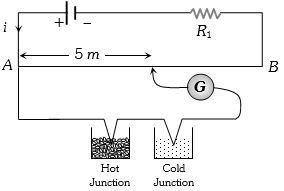
In the following circuit, a $10 \, m$ long potentiometer wire with resistance $1.2 \, \Omega/m$, a resistance $R_1$, and an accumulator of $emf$ $2 \, V$ are connected in series. When the $emf$ of the thermocouple is $2.4 \, mV$, the deflection in the galvanometer is zero at a balancing length of $5 \, m$. The current supplied by the accumulator is:
A
$4 \times 10^{-4} \, A$
B
$8 \times 10^{-4} \, A$
C
$4 \times 10^{-3} \, A$
D
$8 \times 10^{-3} \, A$
Solution
(A) The potential difference across the balancing length $l$ of the potentiometer wire is equal to the $emf$ of the thermocouple $(E_{th})$.
Given: Balancing length $l = 5 \, m$, resistance per unit length $\rho = 1.2 \, \Omega/m$, and $E_{th} = 2.4 \, mV = 2.4 \times 10^{-3} \, V$.
The potential drop across the balancing length is $V = i \times R_{wire} = i \times (\rho \times l)$.
Since the galvanometer deflection is zero, $V = E_{th}$.
Therefore, $i \times (1.2 \, \Omega/m \times 5 \, m) = 2.4 \times 10^{-3} \, V$.
$i \times 6 \, \Omega = 2.4 \times 10^{-3} \, V$.
$i = \frac{2.4 \times 10^{-3}}{6} \, A = 0.4 \times 10^{-3} \, A = 4 \times 10^{-4} \, A$.
Given: Balancing length $l = 5 \, m$, resistance per unit length $\rho = 1.2 \, \Omega/m$, and $E_{th} = 2.4 \, mV = 2.4 \times 10^{-3} \, V$.
The potential drop across the balancing length is $V = i \times R_{wire} = i \times (\rho \times l)$.
Since the galvanometer deflection is zero, $V = E_{th}$.
Therefore, $i \times (1.2 \, \Omega/m \times 5 \, m) = 2.4 \times 10^{-3} \, V$.
$i \times 6 \, \Omega = 2.4 \times 10^{-3} \, V$.
$i = \frac{2.4 \times 10^{-3}}{6} \, A = 0.4 \times 10^{-3} \, A = 4 \times 10^{-4} \, A$.
0 likes
View Solution49
MediumMCQ
$A$ thermocouple of negligible resistance produces an $e.m.f.$ of $40\,\mu V/^{\circ}C$ in the linear range of temperature. $A$ galvanometer of resistance $10\,\Omega$ whose sensitivity is $1\,\mu A/\text{div}$ is employed with the thermocouple. The smallest value of temperature difference that can be detected by the system will be (in $^{\circ}C$)
A
$0.1$
B
$0.5$
C
$0.25$
D
$1$
Solution
(C) The sensitivity of the galvanometer is $1\,\mu A/\text{div}$. To detect the smallest temperature difference,we need a minimum deflection of $1\,\text{div}$.
Therefore,the minimum current required is $I = 1\,\mu A$.
The resistance of the galvanometer is $R = 10\,\Omega$.
The voltage (e.m.f.) required to produce this current is $V = I \times R = 1\,\mu A \times 10\,\Omega = 10\,\mu V$.
Given that the thermocouple produces an $e.m.f.$ of $40\,\mu V/^{\circ}C$,the temperature difference $\Delta T$ corresponding to $10\,\mu V$ is calculated as:
$\Delta T = \frac{V}{\text{sensitivity of thermocouple}} = \frac{10\,\mu V}{40\,\mu V/^{\circ}C} = 0.25^{\circ}C$.
Thus,the smallest temperature difference that can be detected is $0.25^{\circ}C$.
Therefore,the minimum current required is $I = 1\,\mu A$.
The resistance of the galvanometer is $R = 10\,\Omega$.
The voltage (e.m.f.) required to produce this current is $V = I \times R = 1\,\mu A \times 10\,\Omega = 10\,\mu V$.
Given that the thermocouple produces an $e.m.f.$ of $40\,\mu V/^{\circ}C$,the temperature difference $\Delta T$ corresponding to $10\,\mu V$ is calculated as:
$\Delta T = \frac{V}{\text{sensitivity of thermocouple}} = \frac{10\,\mu V}{40\,\mu V/^{\circ}C} = 0.25^{\circ}C$.
Thus,the smallest temperature difference that can be detected is $0.25^{\circ}C$.
0 likes
View SolutionCurrent Electricity — Potentiometer · Frequently Asked Questions
1Are these Current Electricity questions useful for JEE and NEET?
Yes. All questions in this section are mapped to JEE Main and NEET exam patterns. Previous year questions from JEE Main, NEET, GUJCET and state-level exams are included with full solutions.
2Can I switch to Hindi or Gujarati for these questions?
Yes. Use the language tabs in the hero section or the sidebar to view the same questions and solutions in English, Hindi or Gujarati.
3How do I generate a question paper from this subtopic?
Use the Vedclass Exam Paper Generator — select the chapter and subtopic, set difficulty, and generate Sets A, B, C, D automatically. First 3 chapters of every subject are free.
Vedclass Products
For Students
Vedclass Test Series
Mock tests in real JEE/NEET style with performance analysis. 5-day free trial.
Start Free TrialFor Teachers
Exam Paper Generator
Generate Set A/B/C/D papers from this chapter in 2 minutes. 3 chapters free.
Try FreeFor Institutes
Online Exam Module
Live online exams with unlimited students, 360° analytics & white-label branding.
See DemoFor Teachers & Institutes
Generate a Current Electricity Exam Paper in 2 Minutes
Select subtopic & difficulty — Sets A, B, C, D auto-generated with No Repeat logic.
First 3 chapters of every subject are free — no payment required.