
A English
Electric Cells and Combination of cells in Series and Parallel Questions in English
Class 12 Physics · Current Electricity · Electric Cells and Combination of cells in Series and Parallel
187+
Questions
English
Language
100%
With Solutions
Showing 35 of 187 questions in English
151
EasyMCQ
If there are $3$ parallelly connected cells of emf $\varepsilon_1 = 1.2 \ V, \varepsilon_2 = 1.4 \ V$ and $\varepsilon_3 = 1.5 \ V$ and of internal resistances $r_1 = 0.1 \ \Omega, r_2 = 0.2 \ \Omega$ and $r_3 = 0.3 \ \Omega$,then find $\frac{\varepsilon_{eq}}{r_{eq}} = $ . . . . . . $V \Omega^{-1}$.
A
$34$
B
$3.4$
C
$2.4$
D
$24$
Solution
(D) For cells connected in parallel,the equivalent emf $\varepsilon_{eq}$ and equivalent internal resistance $r_{eq}$ are given by the formula:
$\frac{\varepsilon_{eq}}{r_{eq}} = \sum \frac{\varepsilon_i}{r_i} = \frac{\varepsilon_1}{r_1} + \frac{\varepsilon_2}{r_2} + \frac{\varepsilon_3}{r_3}$
Substituting the given values:
$\frac{\varepsilon_{eq}}{r_{eq}} = \frac{1.2}{0.1} + \frac{1.4}{0.2} + \frac{1.5}{0.3}$
$\frac{\varepsilon_{eq}}{r_{eq}} = 12 + 7 + 5$
$\frac{\varepsilon_{eq}}{r_{eq}} = 24 \ V \Omega^{-1}$
Thus,the correct option is $D$.
$\frac{\varepsilon_{eq}}{r_{eq}} = \sum \frac{\varepsilon_i}{r_i} = \frac{\varepsilon_1}{r_1} + \frac{\varepsilon_2}{r_2} + \frac{\varepsilon_3}{r_3}$
Substituting the given values:
$\frac{\varepsilon_{eq}}{r_{eq}} = \frac{1.2}{0.1} + \frac{1.4}{0.2} + \frac{1.5}{0.3}$
$\frac{\varepsilon_{eq}}{r_{eq}} = 12 + 7 + 5$
$\frac{\varepsilon_{eq}}{r_{eq}} = 24 \ V \Omega^{-1}$
Thus,the correct option is $D$.
0 likes
View Solution152
EasyMCQ
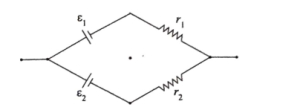
Two batteries of emf $\varepsilon_1$ and $\varepsilon_2$ (where $\varepsilon_2 > \varepsilon_1$) and internal resistances $r_1$ and $r_2$ respectively are connected in parallel as shown.
A
$\varepsilon_{eq}$ is independent of internal resistances $r_1$ and $r_2$.
B
The equivalent emf $\varepsilon_{eq}$ is smaller than $\varepsilon_1$.
C
The equivalent emf is given by $\varepsilon_{eq} = \varepsilon_1 + \varepsilon_2$.
D
The equivalent emf $\varepsilon_{eq}$ of the two cells is between $\varepsilon_1$ and $\varepsilon_2$,i.e.,$\varepsilon_1 < \varepsilon_{eq} < \varepsilon_2$.
Solution
(D) For two batteries connected in parallel,the equivalent emf $\varepsilon_{eq}$ and equivalent internal resistance $r_{eq}$ are given by the formulas:
$\frac{\varepsilon_{eq}}{r_{eq}} = \frac{\varepsilon_1}{r_1} + \frac{\varepsilon_2}{r_2} = \frac{\varepsilon_1 r_2 + \varepsilon_2 r_1}{r_1 r_2}$
and
$\frac{1}{r_{eq}} = \frac{1}{r_1} + \frac{1}{r_2} \implies r_{eq} = \frac{r_1 r_2}{r_1 + r_2}$
Substituting $r_{eq}$ into the first equation:
$\varepsilon_{eq} = \left( \frac{\varepsilon_1 r_2 + \varepsilon_2 r_1}{r_1 r_2} \right) \times \left( \frac{r_1 r_2}{r_1 + r_2} \right)$
$\varepsilon_{eq} = \frac{\varepsilon_1 r_2 + \varepsilon_2 r_1}{r_1 + r_2}$
Since $\varepsilon_2 > \varepsilon_1$,the equivalent emf $\varepsilon_{eq}$ is a weighted average of $\varepsilon_1$ and $\varepsilon_2$,which implies that $\varepsilon_1 < \varepsilon_{eq} < \varepsilon_2$.
$\frac{\varepsilon_{eq}}{r_{eq}} = \frac{\varepsilon_1}{r_1} + \frac{\varepsilon_2}{r_2} = \frac{\varepsilon_1 r_2 + \varepsilon_2 r_1}{r_1 r_2}$
and
$\frac{1}{r_{eq}} = \frac{1}{r_1} + \frac{1}{r_2} \implies r_{eq} = \frac{r_1 r_2}{r_1 + r_2}$
Substituting $r_{eq}$ into the first equation:
$\varepsilon_{eq} = \left( \frac{\varepsilon_1 r_2 + \varepsilon_2 r_1}{r_1 r_2} \right) \times \left( \frac{r_1 r_2}{r_1 + r_2} \right)$
$\varepsilon_{eq} = \frac{\varepsilon_1 r_2 + \varepsilon_2 r_1}{r_1 + r_2}$
Since $\varepsilon_2 > \varepsilon_1$,the equivalent emf $\varepsilon_{eq}$ is a weighted average of $\varepsilon_1$ and $\varepsilon_2$,which implies that $\varepsilon_1 < \varepsilon_{eq} < \varepsilon_2$.
0 likes
View Solution153
MediumMCQ
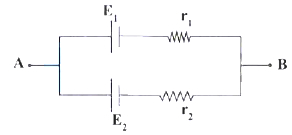
Two cells of emfs $E_1$ and $E_2$ and internal resistances $r_1$ and $r_2$ ($E_2 > E_1$ and $r_2 > r_1$) respectively,are connected in parallel as shown in the figure. The equivalent emf of the combination is $E_{eq}$. Then
A
$E_1 < E_{eq} < E_2$ and $E_{eq}$ is nearer $E_2$
B
$E_{eq} > E_2$
C
$E_{eq} < E_1$
D
$E_1 < E_{eq} < E_2$ and $E_{eq}$ is nearer $E_1$
Solution
(D) The equivalent emf of two cells connected in parallel is given by the formula:
$E_{eq} = \frac{\frac{E_1}{r_1} + \frac{E_2}{r_2}}{\frac{1}{r_1} + \frac{1}{r_2}} = \frac{E_1 r_2 + E_2 r_1}{r_1 + r_2}$
This can be rewritten as:
$E_{eq} = \frac{E_1 r_2 + E_2 r_1}{r_1 + r_2} = \frac{E_1 r_2 + E_1 r_1 - E_1 r_1 + E_2 r_1}{r_1 + r_2} = \frac{E_1(r_1 + r_2) + r_1(E_2 - E_1)}{r_1 + r_2} = E_1 + \frac{r_1}{r_1 + r_2}(E_2 - E_1)$
Since $E_2 > E_1$ and $r_1, r_2 > 0$,it is clear that $E_{eq} > E_1$.
Similarly,$E_{eq} = E_2 - \frac{r_2}{r_1 + r_2}(E_2 - E_1)$. Since $E_2 > E_1$ and $r_1, r_2 > 0$,it is clear that $E_{eq} < E_2$.
Thus,$E_1 < E_{eq} < E_2$.
Given $r_2 > r_1$,the term $\frac{r_1}{r_1 + r_2} < \frac{1}{2}$.
Therefore,$E_{eq}$ is closer to $E_1$ than to $E_2$.
$E_{eq} = \frac{\frac{E_1}{r_1} + \frac{E_2}{r_2}}{\frac{1}{r_1} + \frac{1}{r_2}} = \frac{E_1 r_2 + E_2 r_1}{r_1 + r_2}$
This can be rewritten as:
$E_{eq} = \frac{E_1 r_2 + E_2 r_1}{r_1 + r_2} = \frac{E_1 r_2 + E_1 r_1 - E_1 r_1 + E_2 r_1}{r_1 + r_2} = \frac{E_1(r_1 + r_2) + r_1(E_2 - E_1)}{r_1 + r_2} = E_1 + \frac{r_1}{r_1 + r_2}(E_2 - E_1)$
Since $E_2 > E_1$ and $r_1, r_2 > 0$,it is clear that $E_{eq} > E_1$.
Similarly,$E_{eq} = E_2 - \frac{r_2}{r_1 + r_2}(E_2 - E_1)$. Since $E_2 > E_1$ and $r_1, r_2 > 0$,it is clear that $E_{eq} < E_2$.
Thus,$E_1 < E_{eq} < E_2$.
Given $r_2 > r_1$,the term $\frac{r_1}{r_1 + r_2} < \frac{1}{2}$.
Therefore,$E_{eq}$ is closer to $E_1$ than to $E_2$.
0 likes
View Solution154
MediumMCQ
Ten identical cells each emf $2 \, V$ and internal resistance $1 \, \Omega$ are connected in series with two cells wrongly connected. $A$ resistor of $10 \, \Omega$ is connected to the combination. What is the current through the resistor (in $ \, A$)?
A
$1.8$
B
$2.4$
C
$0.6$
D
$1.2$
Solution
(C) Total number of cells $n = 10$. Each cell has emf $E = 2 \, V$ and internal resistance $r = 1 \, \Omega$.
When two cells are connected in reverse, they cancel the emf of two other cells. Thus, the effective number of cells contributing to the net emf is $n - 2m$, where $m$ is the number of wrongly connected cells.
Here, $m = 2$, so effective cells = $10 - 2(2) = 6$ cells.
Net emf $E_{\text{net}} = (10 - 2 \times 2) \times E = 6 \times 2 = 12 \, V$.
The total internal resistance remains the sum of all cells: $R_{\text{int}} = 10 \times r = 10 \times 1 = 10 \, \Omega$.
The external resistance $R = 10 \, \Omega$.
Total resistance $R_{\text{total}} = R_{\text{int}} + R = 10 + 10 = 20 \, \Omega$.
Using Ohm's law, the current $I = \frac{E_{\text{net}}}{R_{\text{total}}} = \frac{12}{20} = 0.6 \, A$.
When two cells are connected in reverse, they cancel the emf of two other cells. Thus, the effective number of cells contributing to the net emf is $n - 2m$, where $m$ is the number of wrongly connected cells.
Here, $m = 2$, so effective cells = $10 - 2(2) = 6$ cells.
Net emf $E_{\text{net}} = (10 - 2 \times 2) \times E = 6 \times 2 = 12 \, V$.
The total internal resistance remains the sum of all cells: $R_{\text{int}} = 10 \times r = 10 \times 1 = 10 \, \Omega$.
The external resistance $R = 10 \, \Omega$.
Total resistance $R_{\text{total}} = R_{\text{int}} + R = 10 + 10 = 20 \, \Omega$.
Using Ohm's law, the current $I = \frac{E_{\text{net}}}{R_{\text{total}}} = \frac{12}{20} = 0.6 \, A$.
0 likes
View Solution155
EasyMCQ
$10$ identical cells,each of potential $E$ and internal resistance $r$,are connected in series to form a closed circuit. What is the potential difference across any $3$ cells (in $E$)?
A
$3$
B
$13$
C
$7$
D
$10$
Solution
(A) Given that there are $10$ identical cells connected in series,each with electromotive force $E$ and internal resistance $r$.
Total electromotive force of the circuit $= 10 E$.
Total internal resistance of the circuit $= 10 r$.
Using Ohm's law,the current $I$ flowing through the circuit is given by $I = \frac{\text{Total EMF}}{\text{Total Resistance}} = \frac{10 E}{10 r} = \frac{E}{r}$.
The potential difference $V$ across $3$ cells is the sum of the potential drops across them.
For $3$ cells in series,the total internal resistance is $3 r$.
The potential difference across these $3$ cells is $V = I \times (3 r)$.
Substituting the value of $I$,we get $V = \frac{E}{r} \times 3 r = 3 E$.
Total electromotive force of the circuit $= 10 E$.
Total internal resistance of the circuit $= 10 r$.
Using Ohm's law,the current $I$ flowing through the circuit is given by $I = \frac{\text{Total EMF}}{\text{Total Resistance}} = \frac{10 E}{10 r} = \frac{E}{r}$.
The potential difference $V$ across $3$ cells is the sum of the potential drops across them.
For $3$ cells in series,the total internal resistance is $3 r$.
The potential difference across these $3$ cells is $V = I \times (3 r)$.
Substituting the value of $I$,we get $V = \frac{E}{r} \times 3 r = 3 E$.
0 likes
View Solution156
EasyMCQ
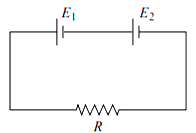
Two cells of internal resistance $r_{1}$ and $r_{2}$ and of the same emf are connected in series across a resistor of resistance $R$. If the terminal potential difference across the cell of internal resistance $r_{1}$ is zero,then the value of $R$ is
A
$R=2r_{1}+r_{2}$
B
$R=r_{2}-r_{1}$
C
$R=r_{1}-r_{2}$
D
$R=2r_{1}-r_{2}$
Solution
(C) Since the two cells are connected in series,the total emf is $E_{total} = E + E = 2E$,where $E$ is the emf of each cell.
The total resistance of the circuit is $R_{total} = R + r_{1} + r_{2}$.
The current $I$ flowing through the circuit is given by $I = \frac{2E}{R + r_{1} + r_{2}}$.
The terminal potential difference $V_{1}$ across the cell with internal resistance $r_{1}$ is given by $V_{1} = E - Ir_{1}$.
Given that $V_{1} = 0$,we have $E - Ir_{1} = 0$,which implies $E = Ir_{1}$.
Substituting the value of $I$,we get $E = \left( \frac{2E}{R + r_{1} + r_{2}} \right) r_{1}$.
Dividing both sides by $E$,we get $1 = \frac{2r_{1}}{R + r_{1} + r_{2}}$.
Rearranging the terms,$R + r_{1} + r_{2} = 2r_{1}$.
Therefore,$R = 2r_{1} - r_{1} - r_{2} = r_{1} - r_{2}$.
The total resistance of the circuit is $R_{total} = R + r_{1} + r_{2}$.
The current $I$ flowing through the circuit is given by $I = \frac{2E}{R + r_{1} + r_{2}}$.
The terminal potential difference $V_{1}$ across the cell with internal resistance $r_{1}$ is given by $V_{1} = E - Ir_{1}$.
Given that $V_{1} = 0$,we have $E - Ir_{1} = 0$,which implies $E = Ir_{1}$.
Substituting the value of $I$,we get $E = \left( \frac{2E}{R + r_{1} + r_{2}} \right) r_{1}$.
Dividing both sides by $E$,we get $1 = \frac{2r_{1}}{R + r_{1} + r_{2}}$.
Rearranging the terms,$R + r_{1} + r_{2} = 2r_{1}$.
Therefore,$R = 2r_{1} - r_{1} - r_{2} = r_{1} - r_{2}$.
0 likes
View Solution157
EasyMCQ
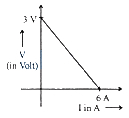
The variation of terminal potential difference $(V)$ with current $(I)$ flowing through a cell is as shown in the graph. The $EMF$ $(E)$ and internal resistance $(r)$ of the cell are:
A
$6 \text{ V}, 2 \ \Omega$
B
$3 \text{ V}, 2 \ \Omega$
C
$6 \text{ V}, 0.5 \ \Omega$
D
$3 \text{ V}, 0.5 \ \Omega$
Solution
(D) The terminal potential difference $V$ of a cell is given by the equation: $V = E - Ir$,where $E$ is the $EMF$ and $r$ is the internal resistance.
This equation is in the form of a straight line $y = mx + c$,where $V$ is on the y-axis and $I$ is on the x-axis.
$1$. When the current $I = 0$,the terminal potential difference $V = E$. From the graph,at $I = 0$,$V = 3 \text{ V}$. Therefore,$E = 3 \text{ V}$.
$2$. When the terminal potential difference $V = 0$,the current is $I = 6 \text{ A}$. Substituting these values into the equation: $0 = E - Ir \implies 0 = 3 - (6)r$.
$3$. Solving for $r$: $6r = 3 \implies r = \frac{3}{6} = 0.5 \ \Omega$.
Thus,the $EMF$ is $3 \text{ V}$ and the internal resistance is $0.5 \ \Omega$.
This equation is in the form of a straight line $y = mx + c$,where $V$ is on the y-axis and $I$ is on the x-axis.
$1$. When the current $I = 0$,the terminal potential difference $V = E$. From the graph,at $I = 0$,$V = 3 \text{ V}$. Therefore,$E = 3 \text{ V}$.
$2$. When the terminal potential difference $V = 0$,the current is $I = 6 \text{ A}$. Substituting these values into the equation: $0 = E - Ir \implies 0 = 3 - (6)r$.
$3$. Solving for $r$: $6r = 3 \implies r = \frac{3}{6} = 0.5 \ \Omega$.
Thus,the $EMF$ is $3 \text{ V}$ and the internal resistance is $0.5 \ \Omega$.
0 likes
View Solution158
DifficultMCQ
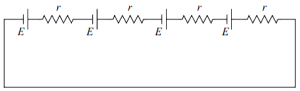
Four identical cells of emf $E$ and internal resistance $r$ are to be connected in series. If one of the cells is connected wrongly,the equivalent emf and effective internal resistance of the combination are
A
$4 E$ and $4 r$
B
$4 E$ and $2 r$
C
$2 E$ and $4 r$
D
$2 E$ and $2 r$
Solution
(C) When $n$ identical cells,each of emf $E$ and internal resistance $r$,are connected in series,the total emf is $nE$ and the total internal resistance is $nr$.
If $m$ cells are connected with reversed polarity,the effective emf $E'$ is given by the formula:
$E' = (n - 2m)E$
Here,the total number of cells $n = 4$ and the number of wrongly connected cells $m = 1$.
Substituting these values:
$E' = (4 - 2 \times 1)E = (4 - 2)E = 2E$
The internal resistance of cells in series is additive regardless of their polarity. Therefore,the effective internal resistance $r_{eq}$ remains:
$r_{eq} = n \times r = 4r$
Thus,the equivalent emf is $2E$ and the effective internal resistance is $4r$.
If $m$ cells are connected with reversed polarity,the effective emf $E'$ is given by the formula:
$E' = (n - 2m)E$
Here,the total number of cells $n = 4$ and the number of wrongly connected cells $m = 1$.
Substituting these values:
$E' = (4 - 2 \times 1)E = (4 - 2)E = 2E$
The internal resistance of cells in series is additive regardless of their polarity. Therefore,the effective internal resistance $r_{eq}$ remains:
$r_{eq} = n \times r = 4r$
Thus,the equivalent emf is $2E$ and the effective internal resistance is $4r$.
0 likes
View Solution159
DifficultMCQ
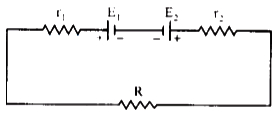
Two cells of emf $E_{1}$ and $E_{2}$ are joined in opposition (such that $E_{1} > E_{2}$). If $r_{1}$ and $r_{2}$ are the internal resistances and $R$ is the external resistance,then the terminal potential difference across the external resistance $R$ is:
A
$ \frac{E_{1}+E_{2}}{r_{1}+r_{2}} \times R $
B
$ \frac{E_{1}+E_{2}}{r_{1}+r_{2}+R} \times R $
C
$ \frac{E_{1}-E_{2}}{r_{1}+r_{2}} \times R $
D
$ \frac{E_{1}-E_{2}}{r_{1}+r_{2}+R} \times R $
Solution
(D) The two cells are connected in opposition,so the net electromotive force (emf) of the circuit is $E_{net} = E_{1} - E_{2}$.
The total resistance of the circuit is the sum of the internal resistances and the external resistance,which is $R_{total} = r_{1} + r_{2} + R$.
According to Ohm's law,the current $I$ flowing through the circuit is given by $I = \frac{E_{net}}{R_{total}} = \frac{E_{1} - E_{2}}{r_{1} + r_{2} + R}$.
The terminal potential difference $V$ across the external resistance $R$ is given by $V = I \times R$.
Substituting the value of $I$,we get $V = \frac{E_{1} - E_{2}}{r_{1} + r_{2} + R} \times R$.
The total resistance of the circuit is the sum of the internal resistances and the external resistance,which is $R_{total} = r_{1} + r_{2} + R$.
According to Ohm's law,the current $I$ flowing through the circuit is given by $I = \frac{E_{net}}{R_{total}} = \frac{E_{1} - E_{2}}{r_{1} + r_{2} + R}$.
The terminal potential difference $V$ across the external resistance $R$ is given by $V = I \times R$.
Substituting the value of $I$,we get $V = \frac{E_{1} - E_{2}}{r_{1} + r_{2} + R} \times R$.
0 likes
View Solution160
MediumMCQ
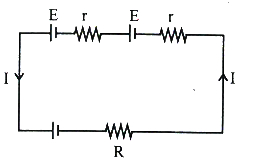
Two identical cells give the same current through an external resistance of $2 \Omega$ regardless of whether the cells are connected in series or in parallel. The internal resistance of each cell is: (in $Omega$)
A
$1$
B
$0.5$
C
$1.5$
D
$2.0$
Solution
(D) Let $E$ be the $EMF$ and $r$ be the internal resistance of each cell. The external resistance is $R = 2 \Omega$.
Case $1$: Cells in series.
The total $EMF$ is $2E$ and the total internal resistance is $2r$. The current $I$ is given by:
$I = \frac{2E}{R + 2r}$ ... $(i)$
Case $2$: Cells in parallel.
The total $EMF$ is $E$ and the total internal resistance is $\frac{r}{2}$. The current $I$ is given by:
$I = \frac{E}{R + \frac{r}{2}} = \frac{2E}{2R + r}$ ... (ii)
Since the current $I$ is the same in both cases,we equate $(i)$ and (ii):
$\frac{2E}{R + 2r} = \frac{2E}{2R + r}$
$R + 2r = 2R + r$
$r = R$
Given $R = 2 \Omega$,therefore $r = 2 \Omega$.
Case $1$: Cells in series.
The total $EMF$ is $2E$ and the total internal resistance is $2r$. The current $I$ is given by:
$I = \frac{2E}{R + 2r}$ ... $(i)$
Case $2$: Cells in parallel.
The total $EMF$ is $E$ and the total internal resistance is $\frac{r}{2}$. The current $I$ is given by:
$I = \frac{E}{R + \frac{r}{2}} = \frac{2E}{2R + r}$ ... (ii)
Since the current $I$ is the same in both cases,we equate $(i)$ and (ii):
$\frac{2E}{R + 2r} = \frac{2E}{2R + r}$
$R + 2r = 2R + r$
$r = R$
Given $R = 2 \Omega$,therefore $r = 2 \Omega$.
0 likes
View Solution161
MediumMCQ
When two identical batteries of internal resistance $1 \Omega$ each are connected in series across a resistor $R$,the rate of heat produced in $R$ is $P_1$. When the same batteries are connected in parallel across $R$,the rate of heat produced is $P_2$. If $P_1 = 2.25 P_2$,then the value of $R$ is (in $Omega$)
A
$2$
B
$4$
C
$10$
D
$12$
Solution
(B) Let the $EMF$ of each battery be $E$ and internal resistance be $r = 1 \Omega$.
In series connection,total $EMF$ $= 2E$ and total internal resistance $= 2r = 2 \Omega$.
The current $I_s = \frac{2E}{R + 2}$.
The power $P_1 = I_s^2 R = \left(\frac{2E}{R + 2}\right)^2 R$.
In parallel connection,total $EMF$ $= E$ and total internal resistance $= \frac{r}{2} = 0.5 \Omega$.
The current $I_p = \frac{E}{R + 0.5}$.
The power $P_2 = I_p^2 R = \left(\frac{E}{R + 0.5}\right)^2 R$.
Given $P_1 = 2.25 P_2$,so $\left(\frac{2E}{R + 2}\right)^2 R = 2.25 \left(\frac{E}{R + 0.5}\right)^2 R$.
Dividing both sides by $E^2 R$,we get $\frac{4}{(R + 2)^2} = 2.25 \frac{1}{(R + 0.5)^2}$.
Taking square root on both sides: $\frac{2}{R + 2} = \frac{1.5}{R + 0.5}$.
$2(R + 0.5) = 1.5(R + 2) \implies 2R + 1 = 1.5R + 3$.
$0.5R = 2 \implies R = 4 \Omega$.
In series connection,total $EMF$ $= 2E$ and total internal resistance $= 2r = 2 \Omega$.
The current $I_s = \frac{2E}{R + 2}$.
The power $P_1 = I_s^2 R = \left(\frac{2E}{R + 2}\right)^2 R$.
In parallel connection,total $EMF$ $= E$ and total internal resistance $= \frac{r}{2} = 0.5 \Omega$.
The current $I_p = \frac{E}{R + 0.5}$.
The power $P_2 = I_p^2 R = \left(\frac{E}{R + 0.5}\right)^2 R$.
Given $P_1 = 2.25 P_2$,so $\left(\frac{2E}{R + 2}\right)^2 R = 2.25 \left(\frac{E}{R + 0.5}\right)^2 R$.
Dividing both sides by $E^2 R$,we get $\frac{4}{(R + 2)^2} = 2.25 \frac{1}{(R + 0.5)^2}$.
Taking square root on both sides: $\frac{2}{R + 2} = \frac{1.5}{R + 0.5}$.
$2(R + 0.5) = 1.5(R + 2) \implies 2R + 1 = 1.5R + 3$.
$0.5R = 2 \implies R = 4 \Omega$.
0 likes
View Solution162
EasyMCQ
$A$ cell of emf $1.2 \ V$ and internal resistance $2 \ \Omega$ is connected in parallel to another cell of emf $1.5 \ V$ and internal resistance $1 \ \Omega$. If the like poles of the cells are connected together,the emf of the combination of the two cells is (in $V$)
A
$0.8$
B
$3.9$
C
$2.7$
D
$1.4$
Solution
(D) Given: $E_1 = 1.2 \ V$,$r_1 = 2 \ \Omega$,$E_2 = 1.5 \ V$,$r_2 = 1 \ \Omega$.
When two cells are connected in parallel with like poles together,the equivalent emf $E_{\text{eq}}$ is given by the formula:
$E_{\text{eq}} = \frac{\frac{E_1}{r_1} + \frac{E_2}{r_2}}{\frac{1}{r_1} + \frac{1}{r_2}}$
Substituting the values:
$E_{\text{eq}} = \frac{\frac{1.2}{2} + \frac{1.5}{1}}{\frac{1}{2} + \frac{1}{1}} = \frac{0.6 + 1.5}{0.5 + 1} = \frac{2.1}{1.5} = 1.4 \ V$.
When two cells are connected in parallel with like poles together,the equivalent emf $E_{\text{eq}}$ is given by the formula:
$E_{\text{eq}} = \frac{\frac{E_1}{r_1} + \frac{E_2}{r_2}}{\frac{1}{r_1} + \frac{1}{r_2}}$
Substituting the values:
$E_{\text{eq}} = \frac{\frac{1.2}{2} + \frac{1.5}{1}}{\frac{1}{2} + \frac{1}{1}} = \frac{0.6 + 1.5}{0.5 + 1} = \frac{2.1}{1.5} = 1.4 \ V$.
0 likes
View Solution163
EasyMCQ
$A$ cell can supply currents of $1 \ A$ and $0.5 \ A$ via resistances of $2.5 \ \Omega$ and $10 \ \Omega$ respectively. The internal resistance of the cell is (in $Omega$)
A
$2$
B
$3$
C
$4$
D
$5$
Solution
(D) Let the electromotive force $(EMF)$ of the cell be $E$ and its internal resistance be $r$.
According to Ohm's law,the current $I$ in a circuit with external resistance $R$ is given by $I = \frac{E}{R + r}$.
For the first case: $1 = \frac{E}{2.5 + r} \implies E = 2.5 + r$ (Equation $1$).
For the second case: $0.5 = \frac{E}{10 + r} \implies E = 0.5(10 + r) = 5 + 0.5r$ (Equation $2$).
Equating the two expressions for $E$:
$2.5 + r = 5 + 0.5r$
$r - 0.5r = 5 - 2.5$
$0.5r = 2.5$
$r = \frac{2.5}{0.5} = 5 \ \Omega$.
Therefore,the internal resistance of the cell is $5 \ \Omega$.
According to Ohm's law,the current $I$ in a circuit with external resistance $R$ is given by $I = \frac{E}{R + r}$.
For the first case: $1 = \frac{E}{2.5 + r} \implies E = 2.5 + r$ (Equation $1$).
For the second case: $0.5 = \frac{E}{10 + r} \implies E = 0.5(10 + r) = 5 + 0.5r$ (Equation $2$).
Equating the two expressions for $E$:
$2.5 + r = 5 + 0.5r$
$r - 0.5r = 5 - 2.5$
$0.5r = 2.5$
$r = \frac{2.5}{0.5} = 5 \ \Omega$.
Therefore,the internal resistance of the cell is $5 \ \Omega$.
0 likes
View Solution164
EasyMCQ
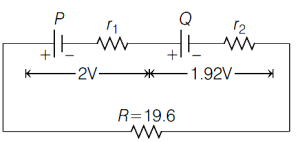
Two cells $P$ and $Q$ each of emf $2.16 \text{ V}$ are connected in series with a resistor of $19.6 \text{ } \Omega$. An ideal voltmeter reads $2 \text{ V}$ when connected across the cell $P$ and $1.92 \text{ V}$ when connected across the cell $Q$. The ratio of the internal resistances of the cell $P$ and $Q$ is
A
$1$ : $2$
B
$2$ : $3$
C
$3$ : $4$
D
$1$ : $3$
Solution
(B) Let $E = 2.16 \text{ V}$ be the emf of each cell and $r_1, r_2$ be their internal resistances. The external resistance is $R = 19.6 \text{ } \Omega$.
The current $I$ in the series circuit is given by $I = \frac{E + E}{r_1 + r_2 + R} = \frac{4.32}{r_1 + r_2 + 19.6}$.
For cell $P$,the terminal voltage is $V_P = E - I r_1$. Given $V_P = 2 \text{ V}$,we have $2 = 2.16 - I r_1$,so $I r_1 = 0.16$.
For cell $Q$,the terminal voltage is $V_Q = E - I r_2$. Given $V_Q = 1.92 \text{ V}$,we have $1.92 = 2.16 - I r_2$,so $I r_2 = 0.24$.
Taking the ratio of these two equations:
$\frac{I r_1}{I r_2} = \frac{0.16}{0.24} = \frac{16}{24} = \frac{2}{3}$.
Thus,the ratio of internal resistances is $r_1 : r_2 = 2 : 3$.
The current $I$ in the series circuit is given by $I = \frac{E + E}{r_1 + r_2 + R} = \frac{4.32}{r_1 + r_2 + 19.6}$.
For cell $P$,the terminal voltage is $V_P = E - I r_1$. Given $V_P = 2 \text{ V}$,we have $2 = 2.16 - I r_1$,so $I r_1 = 0.16$.
For cell $Q$,the terminal voltage is $V_Q = E - I r_2$. Given $V_Q = 1.92 \text{ V}$,we have $1.92 = 2.16 - I r_2$,so $I r_2 = 0.24$.
Taking the ratio of these two equations:
$\frac{I r_1}{I r_2} = \frac{0.16}{0.24} = \frac{16}{24} = \frac{2}{3}$.
Thus,the ratio of internal resistances is $r_1 : r_2 = 2 : 3$.
0 likes
View Solution165
EasyMCQ
When two cells of emfs $E_1$ and $E_2$ and different internal resistances $r_1$ and $r_2$ are connected in series with an external load resistor $R$,the current through the load is $5 \ A$. If the polarity of the cell of emf $E_2$ is reversed,then the current through the load is $2 \ A$. Then $\frac{E_1}{E_2} = $
A
$\frac{5}{2}$
B
$\frac{2}{5}$
C
$\frac{7}{3}$
D
$\frac{3}{7}$
Solution
(C) Let the total internal resistance be $r = r_1 + r_2$.
When the cells are in series with the same polarity,the total emf is $E_1 + E_2$. The current $I_1$ is given by $I_1 = \frac{E_1 + E_2}{R + r} = 5 \ A$.
So,$E_1 + E_2 = 5(R + r) \quad (1)$.
When the polarity of $E_2$ is reversed,the total emf becomes $E_1 - E_2$ (assuming $E_1 > E_2$). The current $I_2$ is given by $I_2 = \frac{E_1 - E_2}{R + r} = 2 \ A$.
So,$E_1 - E_2 = 2(R + r) \quad (2)$.
Dividing equation $(1)$ by equation $(2)$,we get:
$\frac{E_1 + E_2}{E_1 - E_2} = \frac{5}{2}$.
Applying componendo and dividendo:
$\frac{(E_1 + E_2) + (E_1 - E_2)}{(E_1 + E_2) - (E_1 - E_2)} = \frac{5 + 2}{5 - 2}$.
$\frac{2E_1}{2E_2} = \frac{7}{3}$.
Therefore,$\frac{E_1}{E_2} = \frac{7}{3}$.
When the cells are in series with the same polarity,the total emf is $E_1 + E_2$. The current $I_1$ is given by $I_1 = \frac{E_1 + E_2}{R + r} = 5 \ A$.
So,$E_1 + E_2 = 5(R + r) \quad (1)$.
When the polarity of $E_2$ is reversed,the total emf becomes $E_1 - E_2$ (assuming $E_1 > E_2$). The current $I_2$ is given by $I_2 = \frac{E_1 - E_2}{R + r} = 2 \ A$.
So,$E_1 - E_2 = 2(R + r) \quad (2)$.
Dividing equation $(1)$ by equation $(2)$,we get:
$\frac{E_1 + E_2}{E_1 - E_2} = \frac{5}{2}$.
Applying componendo and dividendo:
$\frac{(E_1 + E_2) + (E_1 - E_2)}{(E_1 + E_2) - (E_1 - E_2)} = \frac{5 + 2}{5 - 2}$.
$\frac{2E_1}{2E_2} = \frac{7}{3}$.
Therefore,$\frac{E_1}{E_2} = \frac{7}{3}$.
0 likes
View Solution166
EasyMCQ
$A$ resistance $R$ is connected to $n$ identical cells. If the current in the resistance is the same whether the cells are connected in series or in parallel,then the internal resistance $r$ of each cell is:
A
$r = R/n$
B
$r = nR$
C
$r = R$
D
$r = 1/R$
Solution
(C) Let $E$ be the $EMF$ of each cell and $r$ be the internal resistance of each cell.
For $n$ cells in series,the total $EMF$ is $nE$ and the total internal resistance is $nr$. The current $I_s$ is given by $I_s = \frac{nE}{R + nr}$.
For $n$ cells in parallel,the total $EMF$ is $E$ and the total internal resistance is $r/n$. The current $I_p$ is given by $I_p = \frac{E}{R + r/n} = \frac{nE}{nR + r}$.
Given that $I_s = I_p$,we have $\frac{nE}{R + nr} = \frac{nE}{nR + r}$.
This implies $R + nr = nR + r$.
Rearranging the terms,we get $nr - r = nR - R$,which simplifies to $r(n - 1) = R(n - 1)$.
Assuming $n \neq 1$,we divide both sides by $(n - 1)$ to get $r = R$.
For $n$ cells in series,the total $EMF$ is $nE$ and the total internal resistance is $nr$. The current $I_s$ is given by $I_s = \frac{nE}{R + nr}$.
For $n$ cells in parallel,the total $EMF$ is $E$ and the total internal resistance is $r/n$. The current $I_p$ is given by $I_p = \frac{E}{R + r/n} = \frac{nE}{nR + r}$.
Given that $I_s = I_p$,we have $\frac{nE}{R + nr} = \frac{nE}{nR + r}$.
This implies $R + nr = nR + r$.
Rearranging the terms,we get $nr - r = nR - R$,which simplifies to $r(n - 1) = R(n - 1)$.
Assuming $n \neq 1$,we divide both sides by $(n - 1)$ to get $r = R$.
0 likes
View Solution167
EasyMCQ
Each cell has emf $1.5 \ V$ and internal resistance $1 \ \Omega$. The minimum number of such cells required to produce a maximum current of $1.5 \ A$ in an external load resistance of $30 \ \Omega$ is
A
$30$
B
$120$
C
$40$
D
$60$
Solution
(B) Let $n$ be the number of cells connected in series and $m$ be the number of parallel rows,each containing $n$ cells. The total number of cells is $N = nm$.
The total emf of the combination is $E_{eq} = nE = n(1.5)$.
The total internal resistance is $r_{eq} = \frac{nr}{m} = \frac{n(1)}{m} = \frac{n}{m}$.
The current $I$ in the external resistance $R = 30 \ \Omega$ is given by $I = \frac{nE}{R + \frac{nr}{m}}$.
Given $I = 1.5 \ A$,$E = 1.5 \ V$,$R = 30 \ \Omega$,and $r = 1 \ \Omega$:
$1.5 = \frac{n(1.5)}{30 + \frac{n}{m}} \implies 30 + \frac{n}{m} = n \implies 30 = n(1 - \frac{1}{m}) = n(\frac{m-1}{m})$.
Since $N = nm$,we have $n = \frac{N}{m}$. Substituting this: $30 = \frac{N}{m} \cdot \frac{m-1}{m} = N \frac{m-1}{m^2}$.
To minimize $N$,we need to maximize the function $f(m) = \frac{m-1}{m^2}$. Setting $f'(m) = 0$ gives $m=2$.
For $m=2$,$30 = N \frac{2-1}{2^2} = N \frac{1}{4} \implies N = 120$.
The total emf of the combination is $E_{eq} = nE = n(1.5)$.
The total internal resistance is $r_{eq} = \frac{nr}{m} = \frac{n(1)}{m} = \frac{n}{m}$.
The current $I$ in the external resistance $R = 30 \ \Omega$ is given by $I = \frac{nE}{R + \frac{nr}{m}}$.
Given $I = 1.5 \ A$,$E = 1.5 \ V$,$R = 30 \ \Omega$,and $r = 1 \ \Omega$:
$1.5 = \frac{n(1.5)}{30 + \frac{n}{m}} \implies 30 + \frac{n}{m} = n \implies 30 = n(1 - \frac{1}{m}) = n(\frac{m-1}{m})$.
Since $N = nm$,we have $n = \frac{N}{m}$. Substituting this: $30 = \frac{N}{m} \cdot \frac{m-1}{m} = N \frac{m-1}{m^2}$.
To minimize $N$,we need to maximize the function $f(m) = \frac{m-1}{m^2}$. Setting $f'(m) = 0$ gives $m=2$.
For $m=2$,$30 = N \frac{2-1}{2^2} = N \frac{1}{4} \implies N = 120$.
0 likes
View Solution168
MediumMCQ
$n$ identical cells,each of emf $E$ and internal resistance $r$,are joined in series to form a row. $m$ such rows are joined in parallel across a load resistance $R$. The current in each cell is:
A
$\frac{nE}{nr + mR}$
B
$\frac{mE}{nr + mR}$
C
$\frac{E}{r + \frac{mR}{n}}$
D
$\frac{E}{r + \frac{R}{n}}$
Solution
(A) $1$. In one row,there are $n$ cells in series. The total emf of one row is $nE$ and the total internal resistance of one row is $nr$.
$2$. There are $m$ such rows connected in parallel. The total emf of the parallel combination remains $nE$ because all rows are identical and connected in parallel.
$3$. The equivalent internal resistance $r_{eq}$ of $m$ rows in parallel,where each row has resistance $nr$,is given by $\frac{1}{r_{eq}} = \frac{1}{nr} + \frac{1}{nr} + ... (m \text{ times}) = \frac{m}{nr}$. Thus,$r_{eq} = \frac{nr}{m}$.
$4$. The total current $I$ flowing through the external load resistance $R$ is $I = \frac{nE}{R + r_{eq}} = \frac{nE}{R + \frac{nr}{m}} = \frac{mnE}{mR + nr}$.
$5$. Since there are $m$ identical rows in parallel,the total current $I$ is divided equally among the $m$ rows. Therefore,the current in each row (and thus in each cell of that row) is $I_{cell} = \frac{I}{m} = \frac{1}{m} \times \frac{mnE}{mR + nr} = \frac{nE}{nr + mR}$.
$2$. There are $m$ such rows connected in parallel. The total emf of the parallel combination remains $nE$ because all rows are identical and connected in parallel.
$3$. The equivalent internal resistance $r_{eq}$ of $m$ rows in parallel,where each row has resistance $nr$,is given by $\frac{1}{r_{eq}} = \frac{1}{nr} + \frac{1}{nr} + ... (m \text{ times}) = \frac{m}{nr}$. Thus,$r_{eq} = \frac{nr}{m}$.
$4$. The total current $I$ flowing through the external load resistance $R$ is $I = \frac{nE}{R + r_{eq}} = \frac{nE}{R + \frac{nr}{m}} = \frac{mnE}{mR + nr}$.
$5$. Since there are $m$ identical rows in parallel,the total current $I$ is divided equally among the $m$ rows. Therefore,the current in each row (and thus in each cell of that row) is $I_{cell} = \frac{I}{m} = \frac{1}{m} \times \frac{mnE}{mR + nr} = \frac{nE}{nr + mR}$.
0 likes
View Solution169
EasyMCQ
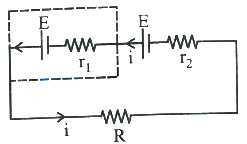
Two cells with same emf $E$ but different internal resistances,$r_1$ and $r_2$,are connected in series to an external resistance $R$. If the potential difference across the first cell is zero,then the value of $R$ is
A
$\frac{r_1-r_2}{2}$
B
$\frac{r_1+r_2}{2}$
C
$r_1-r_2$
D
$(r_1+r_2)$
Solution
(C) Equivalent emf,$E_{eq} = E + E = 2E$
Equivalent resistance,$R_{eq} = r_1 + r_2 + R$
Current flowing through the circuit,$i = \frac{2E}{r_1 + r_2 + R}$
Potential difference across the first cell is given by $V_1 = E - ir_1$.
Given that $V_1 = 0$,we have:
$0 = E - ir_1$
$E = ir_1$
Substituting the value of $i$:
$E = \left( \frac{2E}{r_1 + r_2 + R} \right) r_1$
$1 = \frac{2r_1}{r_1 + r_2 + R}$
$r_1 + r_2 + R = 2r_1$
$R = 2r_1 - r_1 - r_2$
$R = r_1 - r_2$
Equivalent resistance,$R_{eq} = r_1 + r_2 + R$
Current flowing through the circuit,$i = \frac{2E}{r_1 + r_2 + R}$
Potential difference across the first cell is given by $V_1 = E - ir_1$.
Given that $V_1 = 0$,we have:
$0 = E - ir_1$
$E = ir_1$
Substituting the value of $i$:
$E = \left( \frac{2E}{r_1 + r_2 + R} \right) r_1$
$1 = \frac{2r_1}{r_1 + r_2 + R}$
$r_1 + r_2 + R = 2r_1$
$R = 2r_1 - r_1 - r_2$
$R = r_1 - r_2$
0 likes
View Solution170
MediumMCQ
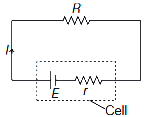
$A$ resistor of resistance $R$ is connected between the terminals of a cell of $\operatorname{emf} E$ and internal resistance $r$. If $I$ is the current through the circuit,the terminal potential difference of the cell is given by:
A
$I R$
B
$E - I r$
C
$\frac{E R}{R + r}$
D
$\frac{E - R}{r}$
Solution
(B) When a cell of $\operatorname{emf} E$ and internal resistance $r$ is connected to an external resistor of resistance $R$,the circuit forms a closed loop.
According to Ohm's law for the entire circuit,the current $I$ is given by $I = \frac{E}{R + r}$.
The terminal potential difference $V$ across the cell is the potential difference across the external resistor $R$,which is $V = I R$.
Alternatively,considering the internal drop,the terminal potential difference is the $\operatorname{emf}$ minus the potential drop across the internal resistance: $V = E - I r$.
Both expressions represent the terminal potential difference of the cell.
According to Ohm's law for the entire circuit,the current $I$ is given by $I = \frac{E}{R + r}$.
The terminal potential difference $V$ across the cell is the potential difference across the external resistor $R$,which is $V = I R$.
Alternatively,considering the internal drop,the terminal potential difference is the $\operatorname{emf}$ minus the potential drop across the internal resistance: $V = E - I r$.
Both expressions represent the terminal potential difference of the cell.
0 likes
View Solution171
DifficultMCQ
When a battery is connected across a resistor of $16 \Omega$,the voltage across the resistor is $12 \ V$. When the same battery is connected across a resistor of $10 \Omega$,the voltage across it is $11 \ V$. The internal resistance of the battery in ohm is
A
$\frac{10}{7}$
B
$\frac{20}{7}$
C
$\frac{25}{7}$
D
$\frac{30}{7}$
Solution
(B) Let $E$ be the electromotive force $(EMF)$ of the battery and $r$ be its internal resistance.
The terminal voltage $V$ across a resistor $R$ is given by $V = I R$,where $I = \frac{E}{R+r}$.
Thus,$V = E \left( \frac{R}{R+r} \right)$,which can be rewritten as $E = V + I r = V + \left( \frac{V}{R} \right) r$.
For the first case: $R_1 = 16 \ \Omega$,$V_1 = 12 \ V$.
$E = 12 + \left( \frac{12}{16} \right) r = 12 + 0.75 r$ --- $(i)$
For the second case: $R_2 = 10 \ \Omega$,$V_2 = 11 \ V$.
$E = 11 + \left( \frac{11}{10} \right) r = 11 + 1.1 r$ --- (ii)
Equating $(i)$ and (ii):
$12 + 0.75 r = 11 + 1.1 r$
$12 - 11 = 1.1 r - 0.75 r$
$1 = 0.35 r$
$r = \frac{1}{0.35} = \frac{100}{35} = \frac{20}{7} \ \Omega$.
The terminal voltage $V$ across a resistor $R$ is given by $V = I R$,where $I = \frac{E}{R+r}$.
Thus,$V = E \left( \frac{R}{R+r} \right)$,which can be rewritten as $E = V + I r = V + \left( \frac{V}{R} \right) r$.
For the first case: $R_1 = 16 \ \Omega$,$V_1 = 12 \ V$.
$E = 12 + \left( \frac{12}{16} \right) r = 12 + 0.75 r$ --- $(i)$
For the second case: $R_2 = 10 \ \Omega$,$V_2 = 11 \ V$.
$E = 11 + \left( \frac{11}{10} \right) r = 11 + 1.1 r$ --- (ii)
Equating $(i)$ and (ii):
$12 + 0.75 r = 11 + 1.1 r$
$12 - 11 = 1.1 r - 0.75 r$
$1 = 0.35 r$
$r = \frac{1}{0.35} = \frac{100}{35} = \frac{20}{7} \ \Omega$.
0 likes
View Solution172
MediumMCQ
The potential difference between the terminals of a cell is $20 \ V$ when a current of $2 \ A$ flows through the circuit. When the direction of current in the circuit is reversed,the potential difference between the terminals of the cell is $30 \ V$. The internal resistance of the cell is (in $Omega$)
A
$1$
B
$1.5$
C
$2$
D
$2.5$
Solution
(D) Let the electromotive force of the cell be $E$ and its internal resistance be $r$. The current flowing through the circuit is $I = 2 \ A$.
When the current flows in the normal direction,the terminal potential difference is given by $V_1 = E - Ir$.
Substituting the given values: $20 = E - 2r$ --- (Equation $1$).
When the direction of the current is reversed,the cell is being charged,so the terminal potential difference is given by $V_2 = E + Ir$.
Substituting the given values: $30 = E + 2r$ --- (Equation $2$).
Subtracting Equation $1$ from Equation $2$: $(E + 2r) - (E - 2r) = 30 - 20$.
$4r = 10$.
$r = 2.5 \ \Omega$.
Thus,the internal resistance of the cell is $2.5 \ \Omega$.
When the current flows in the normal direction,the terminal potential difference is given by $V_1 = E - Ir$.
Substituting the given values: $20 = E - 2r$ --- (Equation $1$).
When the direction of the current is reversed,the cell is being charged,so the terminal potential difference is given by $V_2 = E + Ir$.
Substituting the given values: $30 = E + 2r$ --- (Equation $2$).
Subtracting Equation $1$ from Equation $2$: $(E + 2r) - (E - 2r) = 30 - 20$.
$4r = 10$.
$r = 2.5 \ \Omega$.
Thus,the internal resistance of the cell is $2.5 \ \Omega$.
0 likes
View Solution173
MediumMCQ
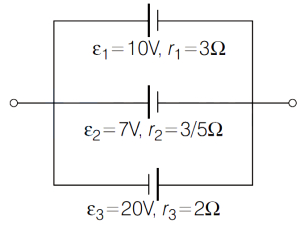
$A$ cell of emf $10 \text{ V}$ and internal resistance $3 \Omega$ is connected in parallel with another cell of emf $7 \text{ V}$ and internal resistance $\frac{3}{5} \Omega$,such that their positive terminals are joined together and their negative terminals are joined together. Their combined positive terminal is joined with the negative terminal,and their combined negative terminal is joined with the positive terminal of a third cell of emf $20 \text{ V}$ with internal resistance $2 \Omega$. The combination can be replaced by a battery of emf $E$ and internal resistance $r$. The values of $E$ and $r$ are respectively:
A
$E=2 \text{ V}, r=2.5 \Omega$
B
$E=2 \text{ V}, r=0.4 \Omega$
C
$E=5 \text{ V}, r=0.4 \Omega$
D
$E=5 \text{ V}, r=2.5 \Omega$
Solution
(B) The circuit consists of three cells connected in parallel. Let the emfs be $\varepsilon_1 = 10 \text{ V}$,$\varepsilon_2 = 7 \text{ V}$,and $\varepsilon_3 = 20 \text{ V}$,with internal resistances $r_1 = 3 \Omega$,$r_2 = 0.6 \Omega$,and $r_3 = 2 \Omega$.
Since the third cell is connected with reversed polarity relative to the first two,the equivalent emf $E_{\text{eq}}$ and equivalent internal resistance $r_{\text{eq}}$ are given by:
$\frac{E_{\text{eq}}}{r_{\text{eq}}} = \frac{\varepsilon_1}{r_1} + \frac{\varepsilon_2}{r_2} - \frac{\varepsilon_3}{r_3}$
$\frac{E_{\text{eq}}}{r_{\text{eq}}} = \frac{10}{3} + \frac{7}{0.6} - \frac{20}{2} = \frac{10}{3} + \frac{35}{3} - 10 = \frac{45}{3} - 10 = 15 - 10 = 5 \text{ A}$
For parallel combination,the equivalent internal resistance is:
$\frac{1}{r_{\text{eq}}} = \frac{1}{r_1} + \frac{1}{r_2} + \frac{1}{r_3} = \frac{1}{3} + \frac{1}{0.6} + \frac{1}{2} = \frac{1}{3} + \frac{5}{3} + \frac{1}{2} = 2 + 0.5 = 2.5 \text{ S}$
$r_{\text{eq}} = \frac{1}{2.5} = 0.4 \Omega$
Now,$E_{\text{eq}} = \left(\frac{E_{\text{eq}}}{r_{\text{eq}}}\right) \times r_{\text{eq}} = 5 \times 0.4 = 2 \text{ V}$
Thus,$E = 2 \text{ V}$ and $r = 0.4 \Omega$.
Since the third cell is connected with reversed polarity relative to the first two,the equivalent emf $E_{\text{eq}}$ and equivalent internal resistance $r_{\text{eq}}$ are given by:
$\frac{E_{\text{eq}}}{r_{\text{eq}}} = \frac{\varepsilon_1}{r_1} + \frac{\varepsilon_2}{r_2} - \frac{\varepsilon_3}{r_3}$
$\frac{E_{\text{eq}}}{r_{\text{eq}}} = \frac{10}{3} + \frac{7}{0.6} - \frac{20}{2} = \frac{10}{3} + \frac{35}{3} - 10 = \frac{45}{3} - 10 = 15 - 10 = 5 \text{ A}$
For parallel combination,the equivalent internal resistance is:
$\frac{1}{r_{\text{eq}}} = \frac{1}{r_1} + \frac{1}{r_2} + \frac{1}{r_3} = \frac{1}{3} + \frac{1}{0.6} + \frac{1}{2} = \frac{1}{3} + \frac{5}{3} + \frac{1}{2} = 2 + 0.5 = 2.5 \text{ S}$
$r_{\text{eq}} = \frac{1}{2.5} = 0.4 \Omega$
Now,$E_{\text{eq}} = \left(\frac{E_{\text{eq}}}{r_{\text{eq}}}\right) \times r_{\text{eq}} = 5 \times 0.4 = 2 \text{ V}$
Thus,$E = 2 \text{ V}$ and $r = 0.4 \Omega$.
0 likes
View Solution174
MediumMCQ
The emfs of three cells connected in parallel are $E_1=5 \ V, E_2=8 \ V$ and $E_3=10 \ V$ and their internal resistances are $r_1=1 \ \Omega, r_2=2 \ \Omega$ and $r_3=3 \ \Omega$,respectively. By changing $E_3$ to $E_{3N}$,the equivalent emf is doubled. Then $E_{3N}$ in $V$ is:
A
$12$
B
$34$
C
$47$
D
$82$
Solution
(C) For cells connected in parallel,the equivalent emf $E_{\text{eq}}$ and equivalent internal resistance $r_{\text{eq}}$ are given by the formula: $\frac{E_{\text{eq}}}{r_{\text{eq}}} = \sum \frac{E_i}{r_i}$ and $\frac{1}{r_{\text{eq}}} = \sum \frac{1}{r_i}$.
First,calculate the initial value of $\frac{E_{\text{eq}}}{r_{\text{eq}}}$:
$\frac{E_{\text{eq}}}{r_{\text{eq}}} = \frac{5}{1} + \frac{8}{2} + \frac{10}{3} = 5 + 4 + 3.33 = \frac{37}{3} \ \text{A}$.
When $E_3$ is changed to $E_{3N}$,the equivalent emf becomes $2E_{\text{eq}}$. The new equivalent internal resistance $r_{\text{eq}}$ remains the same as it depends only on the internal resistances.
Thus,the new equation is: $\frac{2E_{\text{eq}}}{r_{\text{eq}}} = \frac{5}{1} + \frac{8}{2} + \frac{E_{3N}}{3} = 9 + \frac{E_{3N}}{3} = \frac{27 + E_{3N}}{3}$.
Since $\frac{E_{\text{eq}}}{r_{\text{eq}}} = \frac{37}{3}$,we have $\frac{2E_{\text{eq}}}{r_{\text{eq}}} = \frac{74}{3}$.
Equating the two expressions: $\frac{27 + E_{3N}}{3} = \frac{74}{3}$.
$27 + E_{3N} = 74$.
$E_{3N} = 74 - 27 = 47 \ V$.
First,calculate the initial value of $\frac{E_{\text{eq}}}{r_{\text{eq}}}$:
$\frac{E_{\text{eq}}}{r_{\text{eq}}} = \frac{5}{1} + \frac{8}{2} + \frac{10}{3} = 5 + 4 + 3.33 = \frac{37}{3} \ \text{A}$.
When $E_3$ is changed to $E_{3N}$,the equivalent emf becomes $2E_{\text{eq}}$. The new equivalent internal resistance $r_{\text{eq}}$ remains the same as it depends only on the internal resistances.
Thus,the new equation is: $\frac{2E_{\text{eq}}}{r_{\text{eq}}} = \frac{5}{1} + \frac{8}{2} + \frac{E_{3N}}{3} = 9 + \frac{E_{3N}}{3} = \frac{27 + E_{3N}}{3}$.
Since $\frac{E_{\text{eq}}}{r_{\text{eq}}} = \frac{37}{3}$,we have $\frac{2E_{\text{eq}}}{r_{\text{eq}}} = \frac{74}{3}$.
Equating the two expressions: $\frac{27 + E_{3N}}{3} = \frac{74}{3}$.
$27 + E_{3N} = 74$.
$E_{3N} = 74 - 27 = 47 \ V$.
0 likes
View Solution175
MediumMCQ
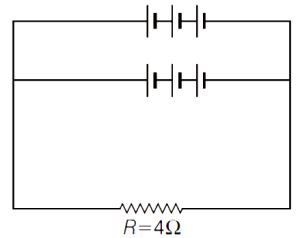
Each of the six ideal batteries of emf $20 \, V$ is connected to an external resistance of $4 \, \Omega$ as shown in the figure. The current through the resistance is (in $ \, A$)
A
$6$
B
$3$
C
$4$
D
$15$
Solution
(D) The circuit consists of two parallel branches, each containing three ideal batteries in series.
Each branch has an equivalent emf of $E_{eq} = 3 \times 20 \, V = 60 \, V$.
Since the two branches are connected in parallel, the total equivalent emf of the battery combination remains $E_{total} = 60 \, V$.
As the batteries are ideal, they have no internal resistance.
Therefore, the current $i$ flowing through the external resistance $R = 4 \, \Omega$ is given by Ohm's law:
$i = \frac{E_{total}}{R} = \frac{60 \, V}{4 \, \Omega} = 15 \, A$.
Each branch has an equivalent emf of $E_{eq} = 3 \times 20 \, V = 60 \, V$.
Since the two branches are connected in parallel, the total equivalent emf of the battery combination remains $E_{total} = 60 \, V$.
As the batteries are ideal, they have no internal resistance.
Therefore, the current $i$ flowing through the external resistance $R = 4 \, \Omega$ is given by Ohm's law:
$i = \frac{E_{total}}{R} = \frac{60 \, V}{4 \, \Omega} = 15 \, A$.
0 likes
View Solution176
MediumMCQ
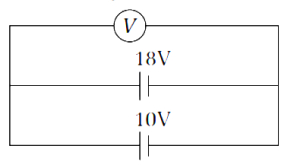
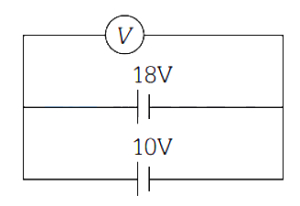
$A$ battery of emf $18 \, V$ and internal resistance $3 \, \Omega$ and another battery of emf $10 \, V$ and internal resistance $1 \, \Omega$ are connected in parallel as shown in the figure. The voltmeter reading is: (in $ \, V$)
A
$10$
B
$12$
C
$16$
D
$8$
Solution
(B) The equivalent emf $(E_{eq})$ of two batteries in parallel is given by $E_{eq} = \frac{E_1/r_1 + E_2/r_2}{1/r_1 + 1/r_2}$.
Here, $E_1 = 18 \, V$, $r_1 = 3 \, \Omega$, $E_2 = 10 \, V$, and $r_2 = 1 \, \Omega$.
Since the batteries are connected with opposite polarities (as seen in the figure), we take $E_2 = -10 \, V$.
$E_{eq} = \frac{18/3 + (-10)/1}{1/3 + 1/1} = \frac{6 - 10}{4/3} = \frac{-4}{4/3} = -3 \, V$.
The equivalent internal resistance is $r_{eq} = \frac{r_1 r_2}{r_1 + r_2} = \frac{3 \times 1}{3 + 1} = 0.75 \, \Omega$.
The potential difference across the parallel combination is the terminal voltage $V = |E_{eq}| = 3 \, V$. However, looking at the circuit as a loop, the current $i$ flows from the $18 \, V$ battery to the $10 \, V$ battery: $i = \frac{18 - 10}{3 + 1} = \frac{8}{4} = 2 \, A$.
The potential difference across the $18 \, V$ battery is $V = E_1 - i r_1 = 18 - (2 \times 3) = 18 - 6 = 12 \, V$.
The potential difference across the $10 \, V$ battery is $V = E_2 + i r_2 = 10 + (2 \times 1) = 12 \, V$.
Thus, the voltmeter reading is $12 \, V$.
Here, $E_1 = 18 \, V$, $r_1 = 3 \, \Omega$, $E_2 = 10 \, V$, and $r_2 = 1 \, \Omega$.
Since the batteries are connected with opposite polarities (as seen in the figure), we take $E_2 = -10 \, V$.
$E_{eq} = \frac{18/3 + (-10)/1}{1/3 + 1/1} = \frac{6 - 10}{4/3} = \frac{-4}{4/3} = -3 \, V$.
The equivalent internal resistance is $r_{eq} = \frac{r_1 r_2}{r_1 + r_2} = \frac{3 \times 1}{3 + 1} = 0.75 \, \Omega$.
The potential difference across the parallel combination is the terminal voltage $V = |E_{eq}| = 3 \, V$. However, looking at the circuit as a loop, the current $i$ flows from the $18 \, V$ battery to the $10 \, V$ battery: $i = \frac{18 - 10}{3 + 1} = \frac{8}{4} = 2 \, A$.
The potential difference across the $18 \, V$ battery is $V = E_1 - i r_1 = 18 - (2 \times 3) = 18 - 6 = 12 \, V$.
The potential difference across the $10 \, V$ battery is $V = E_2 + i r_2 = 10 + (2 \times 1) = 12 \, V$.
Thus, the voltmeter reading is $12 \, V$.
0 likes
View Solution177
DifficultMCQ
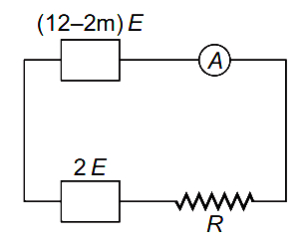
Twelve cells,each having emf $E$ volts,are connected in series and are kept in a closed box. Some of these cells are wrongly connected with positive and negative terminals reversed. This $12$-cell battery is connected in series with an ammeter,an external resistance $R$ ohms,and a two-cell battery (two cells of the same type used earlier,connected perfectly in series). The current in the circuit when the $12$-cell battery and $2$-cell battery aid each other is $3 \text{ A}$,and it is $2 \text{ A}$ when they oppose each other. Then,the number of cells in the $12$-cell battery that are connected wrongly is:
A
$4$
B
$3$
C
$2$
D
$1$
Solution
(D) Let the number of wrongly connected cells in the $12$-cell battery be $m$.
Each wrongly connected cell cancels the emf of one correctly connected cell.
Thus,the effective emf of the $12$-cell battery is $E_{12} = (12 - m)E - mE = (12 - 2m)E$.
When the $12$-cell battery and the $2$-cell battery (emf $2E$) aid each other,the total emf is $E_{total} = (12 - 2m)E + 2E = (14 - 2m)E$.
The current is $i_1 = \frac{(14 - 2m)E}{R} = 3 \text{ A}$ ...$(i)$
When they oppose each other,the total emf is $E_{total} = (12 - 2m)E - 2E = (10 - 2m)E$.
The current is $i_2 = \frac{(10 - 2m)E}{R} = 2 \text{ A}$ ...(ii)
Dividing equation $(i)$ by (ii):
$\frac{3}{2} = \frac{14 - 2m}{10 - 2m}$
$3(10 - 2m) = 2(14 - 2m)$
$30 - 6m = 28 - 4m$
$2 = 2m$
$m = 1$.
Therefore,the number of wrongly connected cells is $1$.
Each wrongly connected cell cancels the emf of one correctly connected cell.
Thus,the effective emf of the $12$-cell battery is $E_{12} = (12 - m)E - mE = (12 - 2m)E$.
When the $12$-cell battery and the $2$-cell battery (emf $2E$) aid each other,the total emf is $E_{total} = (12 - 2m)E + 2E = (14 - 2m)E$.
The current is $i_1 = \frac{(14 - 2m)E}{R} = 3 \text{ A}$ ...$(i)$
When they oppose each other,the total emf is $E_{total} = (12 - 2m)E - 2E = (10 - 2m)E$.
The current is $i_2 = \frac{(10 - 2m)E}{R} = 2 \text{ A}$ ...(ii)
Dividing equation $(i)$ by (ii):
$\frac{3}{2} = \frac{14 - 2m}{10 - 2m}$
$3(10 - 2m) = 2(14 - 2m)$
$30 - 6m = 28 - 4m$
$2 = 2m$
$m = 1$.
Therefore,the number of wrongly connected cells is $1$.
0 likes
View Solution178
EasyMCQ
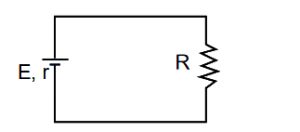
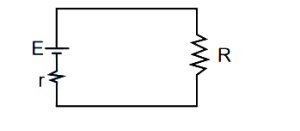
$A$ battery of emf $E$ and internal resistance $r$ is connected with an external resistance $R$ as shown in the figure. The battery will act as a constant voltage source if
A
$r << R$
B
$r >> R$
C
$r = R$
D
It will never act as a constant voltage source
Solution
(A) The terminal voltage $V_R$ across the external resistance $R$ is given by the formula:
$V_R = \frac{E}{(R + r)} \times R$
Dividing the numerator and denominator by $R$,we get:
$V_R = \frac{E}{(1 + r/R)}$
For the battery to act as a constant voltage source,the terminal voltage $V_R$ should be approximately equal to the emf $E$,regardless of the variations in the external load $R$.
This condition is satisfied when $r/R$ is very small,which implies $r << R$.
$V_R = \frac{E}{(R + r)} \times R$
Dividing the numerator and denominator by $R$,we get:
$V_R = \frac{E}{(1 + r/R)}$
For the battery to act as a constant voltage source,the terminal voltage $V_R$ should be approximately equal to the emf $E$,regardless of the variations in the external load $R$.
This condition is satisfied when $r/R$ is very small,which implies $r << R$.
0 likes
View Solution179
MediumMCQ
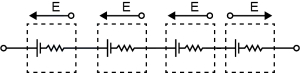
Four cells,each of emf $E$ and internal resistance $r$,are connected in series across an external resistance $R$. By mistake,one of the cells is connected in reverse. Then the current in the external circuit is
A
$\frac{2 E}{4 r+R}$
B
$\frac{3 E}{4 r+R}$
C
$\frac{3 E}{3 r+R}$
D
$\frac{2 E}{3 r+R}$
Solution
(A) When four cells of emf $E$ are connected in series,the total emf is $4E$.
If one cell is connected in reverse,its emf opposes the others.
Therefore,the effective emf of the circuit is $E_{eff} = E + E + E - E = 2E$.
The total internal resistance of the four cells in series is $r_{total} = r + r + r + r = 4r$.
The total resistance of the circuit is $R_{total} = 4r + R$.
Using Ohm's law,the current $I$ in the external circuit is given by $I = \frac{E_{eff}}{R_{total}} = \frac{2E}{4r + R}$.
If one cell is connected in reverse,its emf opposes the others.
Therefore,the effective emf of the circuit is $E_{eff} = E + E + E - E = 2E$.
The total internal resistance of the four cells in series is $r_{total} = r + r + r + r = 4r$.
The total resistance of the circuit is $R_{total} = 4r + R$.
Using Ohm's law,the current $I$ in the external circuit is given by $I = \frac{E_{eff}}{R_{total}} = \frac{2E}{4r + R}$.
0 likes
View Solution180
MediumMCQ
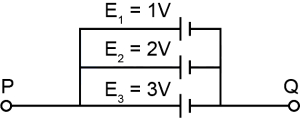
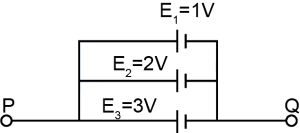
A circuit consists of three batteries of emf $E_{1} = 1 \text{ V}$, $E_{2} = 2 \text{ V}$, and $E_{3} = 3 \text{ V}$ and internal resistances $1 \Omega$, $2 \Omega$, and $1 \Omega$ respectively, which are connected in parallel as shown in the figure. The potential difference between points $P$ and $Q$ is: (in $\text{ V}$)
A
$1.0$
B
$2.0$
C
$2.2$
D
$3.0$
Solution
(B) The batteries are connected in parallel. The equivalent emf $E_{eq}$ and equivalent internal resistance $r_{eq}$ of the combination are given by:
$E_{eq} = \frac{\frac{E_{1}}{r_{1}} + \frac{E_{2}}{r_{2}} + \frac{E_{3}}{r_{3}}}{\frac{1}{r_{1}} + \frac{1}{r_{2}} + \frac{1}{r_{3}}}$
$\frac{1}{r_{eq}} = \frac{1}{r_{1}} + \frac{1}{r_{2}} + \frac{1}{r_{3}}$
Given $E_{1} = 1 \text{ V}, r_{1} = 1 \Omega$; $E_{2} = 2 \text{ V}, r_{2} = 2 \Omega$; $E_{3} = 3 \text{ V}, r_{3} = 1 \Omega$.
First, calculate the equivalent internal resistance:
$\frac{1}{r_{eq}} = \frac{1}{1} + \frac{1}{2} + \frac{1}{1} = 1 + 0.5 + 1 = 2.5 \Omega^{-1} = \frac{5}{2} \Omega^{-1}$
$r_{eq} = \frac{2}{5} \Omega = 0.4 \Omega$
Now, calculate the equivalent emf:
$E_{eq} = r_{eq} \times \left( \frac{E_{1}}{r_{1}} + \frac{E_{2}}{r_{2}} + \frac{E_{3}}{r_{3}} \right)$
$E_{eq} = 0.4 \times \left( \frac{1}{1} + \frac{2}{2} + \frac{3}{1} \right) = 0.4 \times (1 + 1 + 3) = 0.4 \times 5 = 2.0 \text{ V}$
Thus, the potential difference between points $P$ and $Q$ is $2.0 \text{ V}$.
$E_{eq} = \frac{\frac{E_{1}}{r_{1}} + \frac{E_{2}}{r_{2}} + \frac{E_{3}}{r_{3}}}{\frac{1}{r_{1}} + \frac{1}{r_{2}} + \frac{1}{r_{3}}}$
$\frac{1}{r_{eq}} = \frac{1}{r_{1}} + \frac{1}{r_{2}} + \frac{1}{r_{3}}$
Given $E_{1} = 1 \text{ V}, r_{1} = 1 \Omega$; $E_{2} = 2 \text{ V}, r_{2} = 2 \Omega$; $E_{3} = 3 \text{ V}, r_{3} = 1 \Omega$.
First, calculate the equivalent internal resistance:
$\frac{1}{r_{eq}} = \frac{1}{1} + \frac{1}{2} + \frac{1}{1} = 1 + 0.5 + 1 = 2.5 \Omega^{-1} = \frac{5}{2} \Omega^{-1}$
$r_{eq} = \frac{2}{5} \Omega = 0.4 \Omega$
Now, calculate the equivalent emf:
$E_{eq} = r_{eq} \times \left( \frac{E_{1}}{r_{1}} + \frac{E_{2}}{r_{2}} + \frac{E_{3}}{r_{3}} \right)$
$E_{eq} = 0.4 \times \left( \frac{1}{1} + \frac{2}{2} + \frac{3}{1} \right) = 0.4 \times (1 + 1 + 3) = 0.4 \times 5 = 2.0 \text{ V}$
Thus, the potential difference between points $P$ and $Q$ is $2.0 \text{ V}$.
0 likes
View Solution181
MediumMCQ
Two identical cells each of emf $E$ and internal resistance $r$ are connected in parallel with an external resistance $R$. To get maximum power developed across $R$,the value of $R$ is
A
$R = r / 2$
B
$R = r$
C
$R = r / 3$
D
$R = 2r$
Solution
(A) For two identical cells of emf $E$ and internal resistance $r$ connected in parallel,the equivalent emf $E_{eq} = E$ and the equivalent internal resistance $r_{eq} = r / 2$.
The current $I$ flowing through the external resistance $R$ is given by $I = \frac{E}{R + r_{eq}} = \frac{E}{R + r/2} = \frac{2E}{2R + r}$.
The power $P$ developed across the external resistance $R$ is $P = I^2 R = \left( \frac{2E}{2R + r} \right)^2 R$.
To maximize power,we set $\frac{dP}{dR} = 0$,which leads to the condition $R = r_{eq}$.
Substituting $r_{eq} = r / 2$,we get $R = r / 2$.
The current $I$ flowing through the external resistance $R$ is given by $I = \frac{E}{R + r_{eq}} = \frac{E}{R + r/2} = \frac{2E}{2R + r}$.
The power $P$ developed across the external resistance $R$ is $P = I^2 R = \left( \frac{2E}{2R + r} \right)^2 R$.
To maximize power,we set $\frac{dP}{dR} = 0$,which leads to the condition $R = r_{eq}$.
Substituting $r_{eq} = r / 2$,we get $R = r / 2$.
0 likes
View Solution182
MediumMCQ
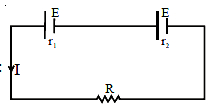
Two cells with the same e.m.f. $E$ and different internal resistances $r_1$ and $r_2$ are connected in series to an external resistance $R$. The value of $R$ so that the potential difference across the first cell is zero is
A
$\sqrt{r_1 r_2}$
B
$r_1+r_2$
C
$r_1-r_2$
D
$\frac{r_1+r_2}{2}$
Solution
(C) The total e.m.f. of the two cells connected in series is $E + E = 2E$.
The total resistance of the circuit is $R + r_1 + r_2$.
The current $I$ flowing through the circuit is given by $I = \frac{2E}{R + r_1 + r_2}$.
The potential difference $V$ across the first cell (with internal resistance $r_1$) is given by $V = E - Ir_1$.
We are given that the potential difference across the first cell is zero,so $E - Ir_1 = 0$,which implies $E = Ir_1$.
Substituting the value of $I$ into this equation:
$E = \left( \frac{2E}{R + r_1 + r_2} \right) r_1$
$1 = \frac{2r_1}{R + r_1 + r_2}$
$R + r_1 + r_2 = 2r_1$
$R = 2r_1 - r_1 - r_2$
$R = r_1 - r_2$
The total resistance of the circuit is $R + r_1 + r_2$.
The current $I$ flowing through the circuit is given by $I = \frac{2E}{R + r_1 + r_2}$.
The potential difference $V$ across the first cell (with internal resistance $r_1$) is given by $V = E - Ir_1$.
We are given that the potential difference across the first cell is zero,so $E - Ir_1 = 0$,which implies $E = Ir_1$.
Substituting the value of $I$ into this equation:
$E = \left( \frac{2E}{R + r_1 + r_2} \right) r_1$
$1 = \frac{2r_1}{R + r_1 + r_2}$
$R + r_1 + r_2 = 2r_1$
$R = 2r_1 - r_1 - r_2$
$R = r_1 - r_2$
0 likes
View Solution183
DifficultMCQ
For two cells having the same $EMF$ $E$ and internal resistance $r$,the current passing through an external resistor of $6 \ \Omega$ is the same when both cells are connected either in parallel or in series. The value of internal resistance $r$ is . . . . . . $ \ \Omega$.
A
$3$
B
$4$
C
$9$
D
$6$
Solution
(D) When the two cells are connected in series,the total $EMF$ is $2E$ and the total internal resistance is $2r$. The current $i_{1}$ through the external resistor $R = 6 \ \Omega$ is given by: $i_{1} = \frac{2E}{R + 2r} = \frac{2E}{6 + 2r}$.
When the two cells are connected in parallel,the total $EMF$ remains $E$ and the total internal resistance is $\frac{r}{2}$. The current $i_{2}$ through the external resistor $R = 6 \ \Omega$ is given by: $i_{2} = \frac{E}{R + \frac{r}{2}} = \frac{E}{6 + \frac{r}{2}}$.
Given that $i_{1} = i_{2}$,we equate the expressions: $\frac{2E}{6 + 2r} = \frac{E}{6 + \frac{r}{2}}$.
Dividing both sides by $E$ and simplifying: $\frac{2}{6 + 2r} = \frac{1}{6 + \frac{r}{2}}$.
Cross-multiplying: $2(6 + \frac{r}{2}) = 6 + 2r$.
$12 + r = 6 + 2r$.
Solving for $r$: $r = 12 - 6 = 6 \ \Omega$.
When the two cells are connected in parallel,the total $EMF$ remains $E$ and the total internal resistance is $\frac{r}{2}$. The current $i_{2}$ through the external resistor $R = 6 \ \Omega$ is given by: $i_{2} = \frac{E}{R + \frac{r}{2}} = \frac{E}{6 + \frac{r}{2}}$.
Given that $i_{1} = i_{2}$,we equate the expressions: $\frac{2E}{6 + 2r} = \frac{E}{6 + \frac{r}{2}}$.
Dividing both sides by $E$ and simplifying: $\frac{2}{6 + 2r} = \frac{1}{6 + \frac{r}{2}}$.
Cross-multiplying: $2(6 + \frac{r}{2}) = 6 + 2r$.
$12 + r = 6 + 2r$.
Solving for $r$: $r = 12 - 6 = 6 \ \Omega$.
0 likes
View Solution184
DifficultMCQ
When an external resistance of $5\text{ }\Omega$ is connected across the terminals of a cell,a current of $0.25\text{ A}$ flows through it. When the $5\text{ }\Omega$ resistor is replaced by a $2\text{ }\Omega$ resistor,a current of $0.5\text{ A}$ flows through it. The internal resistance of the cell is . . . . . . $\Omega$.
A
$1$
B
$2$
C
$3$
D
$4$
Solution
(A) Let $E$ be the electromotive force (emf) and $r$ be the internal resistance of the cell.
According to Ohm's law for a complete circuit,$E = I(R + r)$.
For the first case: $E = 0.25(5 + r)$.
For the second case: $E = 0.5(2 + r)$.
Since the emf $E$ is constant,we equate the two expressions:
$0.25(5 + r) = 0.5(2 + r)$
Dividing both sides by $0.25$:
$5 + r = 2(2 + r)$
$5 + r = 4 + 2r$
$r = 5 - 4 = 1\text{ }\Omega$.
Therefore,the internal resistance of the cell is $1\text{ }\Omega$.
According to Ohm's law for a complete circuit,$E = I(R + r)$.
For the first case: $E = 0.25(5 + r)$.
For the second case: $E = 0.5(2 + r)$.
Since the emf $E$ is constant,we equate the two expressions:
$0.25(5 + r) = 0.5(2 + r)$
Dividing both sides by $0.25$:
$5 + r = 2(2 + r)$
$5 + r = 4 + 2r$
$r = 5 - 4 = 1\text{ }\Omega$.
Therefore,the internal resistance of the cell is $1\text{ }\Omega$.
0 likes
View Solution185
DifficultMCQ
Two cells of emfs $1$ $V$ and $2$ $V$ and internal resistances $2 \Omega$ and $1 \Omega$ respectively are connected in parallel and provide a current of $1$ $A$ through an external resistance. If the polarity of one cell is reversed,the current through the external resistance becomes $\frac{\alpha}{5}$ $A$. The value of $\alpha$ is . . . . . . .
A
$1$
B
$2$
C
$3$
D
$4$
Solution
(C) For cells in parallel,the equivalent emf $E_{eq}$ and equivalent internal resistance $r_{eq}$ are given by:
$E_{eq} = \frac{E_1/r_1 + E_2/r_2}{1/r_1 + 1/r_2}$ and $r_{eq} = \frac{r_1 r_2}{r_1 + r_2}$.
Given $E_1 = 1$ $V$,$r_1 = 2 \Omega$,$E_2 = 2$ $V$,$r_2 = 1 \Omega$.
$E_{eq} = \frac{1/2 + 2/1}{1/2 + 1/1} = \frac{2.5}{1.5} = \frac{5}{3}$ $V$.
$r_{eq} = \frac{2 \times 1}{2 + 1} = \frac{2}{3} \Omega$.
Given current $I = 1$ $A$ through external resistance $R$,$I = \frac{E_{eq}}{R + r_{eq}} \Rightarrow 1 = \frac{5/3}{R + 2/3}$.
$R + 2/3 = 5/3 \Rightarrow R = 1 \Omega$.
If the polarity of one cell is reversed,the new equivalent emf $E'_{eq} = \frac{E_1/r_1 - E_2/r_2}{1/r_1 + 1/r_2} = \frac{0.5 - 2}{1.5} = \frac{-1.5}{1.5} = -1$ $V$.
The magnitude of the new current $I' = \frac{|E'_{eq}|}{R + r_{eq}} = \frac{1}{1 + 2/3} = \frac{1}{5/3} = \frac{3}{5}$ $A$.
Comparing $I' = \frac{3}{5}$ $A$ with $\frac{\alpha}{5}$ $A$,we get $\alpha = 3$.
$E_{eq} = \frac{E_1/r_1 + E_2/r_2}{1/r_1 + 1/r_2}$ and $r_{eq} = \frac{r_1 r_2}{r_1 + r_2}$.
Given $E_1 = 1$ $V$,$r_1 = 2 \Omega$,$E_2 = 2$ $V$,$r_2 = 1 \Omega$.
$E_{eq} = \frac{1/2 + 2/1}{1/2 + 1/1} = \frac{2.5}{1.5} = \frac{5}{3}$ $V$.
$r_{eq} = \frac{2 \times 1}{2 + 1} = \frac{2}{3} \Omega$.
Given current $I = 1$ $A$ through external resistance $R$,$I = \frac{E_{eq}}{R + r_{eq}} \Rightarrow 1 = \frac{5/3}{R + 2/3}$.
$R + 2/3 = 5/3 \Rightarrow R = 1 \Omega$.
If the polarity of one cell is reversed,the new equivalent emf $E'_{eq} = \frac{E_1/r_1 - E_2/r_2}{1/r_1 + 1/r_2} = \frac{0.5 - 2}{1.5} = \frac{-1.5}{1.5} = -1$ $V$.
The magnitude of the new current $I' = \frac{|E'_{eq}|}{R + r_{eq}} = \frac{1}{1 + 2/3} = \frac{1}{5/3} = \frac{3}{5}$ $A$.
Comparing $I' = \frac{3}{5}$ $A$ with $\frac{\alpha}{5}$ $A$,we get $\alpha = 3$.
0 likes
View SolutionCurrent Electricity — Electric Cells and Combination of cells in Series and Parallel · Frequently Asked Questions
1Are these Current Electricity questions useful for JEE and NEET?
Yes. All questions in this section are mapped to JEE Main and NEET exam patterns. Previous year questions from JEE Main, NEET, GUJCET and state-level exams are included with full solutions.
2Can I switch to Hindi or Gujarati for these questions?
Yes. Use the language tabs in the hero section or the sidebar to view the same questions and solutions in English, Hindi or Gujarati.
3How do I generate a question paper from this subtopic?
Use the Vedclass Exam Paper Generator — select the chapter and subtopic, set difficulty, and generate Sets A, B, C, D automatically. First 3 chapters of every subject are free.
Vedclass Products
For Students
Vedclass Test Series
Mock tests in real JEE/NEET style with performance analysis. 5-day free trial.
Start Free TrialFor Teachers
Exam Paper Generator
Generate Set A/B/C/D papers from this chapter in 2 minutes. 3 chapters free.
Try FreeFor Institutes
Online Exam Module
Live online exams with unlimited students, 360° analytics & white-label branding.
See DemoFor Teachers & Institutes
Generate a Current Electricity Exam Paper in 2 Minutes
Select subtopic & difficulty — Sets A, B, C, D auto-generated with No Repeat logic.
First 3 chapters of every subject are free — no payment required.