
A English
Current Density, Drift Velocity and Mobility Questions in English
Class 12 Physics · Current Electricity · Current Density, Drift Velocity and Mobility
187+
Questions
English
Language
100%
With Solutions
Showing 36 of 187 questions in English
151
MediumMCQ
$A$ metal wire is subjected to a constant potential difference. When the temperature of the metal wire increases,the drift velocity of the electron in it
A
increases,thermal velocity of the electron decreases
B
decreases,thermal velocity of the electron decreases
C
increases,thermal velocity of the electron increases
D
decreases,thermal velocity of the electron increases
Solution
(D) The drift velocity $v_d$ is given by the formula $v_d = \frac{eE\tau}{m}$,where $e$ is the charge of the electron,$E$ is the electric field,$\tau$ is the relaxation time,and $m$ is the mass of the electron.
When the temperature of the metal wire increases,the atoms in the metal lattice vibrate with greater amplitude.
This leads to more frequent collisions between the electrons and the lattice ions,which decreases the relaxation time $\tau$.
Since $v_d \propto \tau$,the drift velocity $v_d$ decreases.
Additionally,the thermal velocity of the electrons is proportional to the square root of the absolute temperature $(v_{th} \propto \sqrt{T})$,so as the temperature increases,the thermal velocity of the electrons increases.
When the temperature of the metal wire increases,the atoms in the metal lattice vibrate with greater amplitude.
This leads to more frequent collisions between the electrons and the lattice ions,which decreases the relaxation time $\tau$.
Since $v_d \propto \tau$,the drift velocity $v_d$ decreases.
Additionally,the thermal velocity of the electrons is proportional to the square root of the absolute temperature $(v_{th} \propto \sqrt{T})$,so as the temperature increases,the thermal velocity of the electrons increases.
0 likes
View Solution152
EasyMCQ
$A$ current of $5 \,A$ is passing through a metallic wire of cross-sectional area $4 \times 10^{-6} \,m^{2}$. If the density of charge carriers of the wire is $5 \times 10^{26} \,m^{-3}$, the drift velocity of the electrons will be:
A
$1 \times 10^{2} \,ms^{-1}$
B
$1.56 \times 10^{-2} \,ms^{-1}$
C
$1.56 \times 10^{-3} \,ms^{-1}$
D
$1 \times 10^{-2} \,ms^{-1}$
Solution
(B) The formula for drift velocity is given by $v_{d} = \frac{I}{n e A}$.
Here, $I = 5 \,A$, $n = 5 \times 10^{26} \,m^{-3}$, $e = 1.6 \times 10^{-19} \,C$, and $A = 4 \times 10^{-6} \,m^{2}$.
Substituting the values:
$v_{d} = \frac{5}{(5 \times 10^{26}) \times (1.6 \times 10^{-19}) \times (4 \times 10^{-6})}$
$v_{d} = \frac{5}{5 \times 1.6 \times 4 \times 10^{26-19-6}}$
$v_{d} = \frac{1}{6.4 \times 10^{1}}$
$v_{d} = \frac{1}{64} = 0.015625 \,ms^{-1} = 1.56 \times 10^{-2} \,ms^{-1}$.
Here, $I = 5 \,A$, $n = 5 \times 10^{26} \,m^{-3}$, $e = 1.6 \times 10^{-19} \,C$, and $A = 4 \times 10^{-6} \,m^{2}$.
Substituting the values:
$v_{d} = \frac{5}{(5 \times 10^{26}) \times (1.6 \times 10^{-19}) \times (4 \times 10^{-6})}$
$v_{d} = \frac{5}{5 \times 1.6 \times 4 \times 10^{26-19-6}}$
$v_{d} = \frac{1}{6.4 \times 10^{1}}$
$v_{d} = \frac{1}{64} = 0.015625 \,ms^{-1} = 1.56 \times 10^{-2} \,ms^{-1}$.
0 likes
View Solution153
DifficultMCQ
$A$ cylindrical conductor of diameter $0.1 \text{ mm}$ carries a current of $90 \text{ mA}$. The current density (in $\text{Am}^{-2}$) is (take $\pi \simeq 3$):
A
$1.2 \times 10^{7}$
B
$2.4 \times 10^{7}$
C
$3 \times 10^{6}$
D
$6 \times 10^{6}$
Solution
(A) The diameter of the conductor is $d = 0.1 \text{ mm} = 10^{-4} \text{ m}$.
The cross-sectional area $A$ of the cylindrical conductor is given by $A = \frac{\pi d^2}{4}$.
Using $\pi \simeq 3$,we get $A = \frac{3 \times (10^{-4})^2}{4} = \frac{3 \times 10^{-8}}{4} = 0.75 \times 10^{-8} \text{ m}^2$.
The current flowing through the conductor is $I = 90 \text{ mA} = 90 \times 10^{-3} \text{ A}$.
The current density $J$ is defined as $J = \frac{I}{A}$.
Substituting the values,$J = \frac{90 \times 10^{-3}}{0.75 \times 10^{-8}} = \frac{90}{0.75} \times 10^{5} = 120 \times 10^{5} = 1.2 \times 10^{7} \text{ Am}^{-2}$.
The cross-sectional area $A$ of the cylindrical conductor is given by $A = \frac{\pi d^2}{4}$.
Using $\pi \simeq 3$,we get $A = \frac{3 \times (10^{-4})^2}{4} = \frac{3 \times 10^{-8}}{4} = 0.75 \times 10^{-8} \text{ m}^2$.
The current flowing through the conductor is $I = 90 \text{ mA} = 90 \times 10^{-3} \text{ A}$.
The current density $J$ is defined as $J = \frac{I}{A}$.
Substituting the values,$J = \frac{90 \times 10^{-3}}{0.75 \times 10^{-8}} = \frac{90}{0.75} \times 10^{5} = 120 \times 10^{5} = 1.2 \times 10^{7} \text{ Am}^{-2}$.
0 likes
View Solution154
MediumMCQ
If a current of $80 \ A$ is passing through a straight conductor of length $10 \ m$,then the total momentum of electrons in the conductor is (mass of electron $= 9.1 \times 10^{-31} \ kg$ and charge of electron $= 1.6 \times 10^{-19} \ C$).
A
$910 \times 10^{-9} \ Ns$
B
$910 \times 10^{-11} \ Ns$
C
$455 \times 10^{-9} \ Ns$
D
$455 \times 10^{-11} \ Ns$
Solution
(D) The current $I$ is given by $I = nAev_d$,where $n$ is the number density,$A$ is the cross-sectional area,$e$ is the charge of an electron,and $v_d$ is the drift velocity.
The total number of electrons $N$ in a conductor of length $L$ and volume $V = AL$ is $N = nAL$.
From the current formula,$nA = I / (ev_d)$.
Substituting this into the expression for $N$,we get $N = (I / (ev_d)) \times L = IL / (ev_d)$.
The total momentum $P$ of the electrons is $P = N \times m_e \times v_d$,where $m_e$ is the mass of an electron.
Substituting $N$ into the momentum equation: $P = (IL / (ev_d)) \times m_e \times v_d = (I \times L \times m_e) / e$.
Given $I = 80 \ A$,$L = 10 \ m$,$m_e = 9.1 \times 10^{-31} \ kg$,and $e = 1.6 \times 10^{-19} \ C$.
$P = (80 \times 10 \times 9.1 \times 10^{-31}) / (1.6 \times 10^{-19})$.
$P = (728 \times 10^{-30}) / (1.6 \times 10^{-19}) = 455 \times 10^{-11} \ Ns$.
The total number of electrons $N$ in a conductor of length $L$ and volume $V = AL$ is $N = nAL$.
From the current formula,$nA = I / (ev_d)$.
Substituting this into the expression for $N$,we get $N = (I / (ev_d)) \times L = IL / (ev_d)$.
The total momentum $P$ of the electrons is $P = N \times m_e \times v_d$,where $m_e$ is the mass of an electron.
Substituting $N$ into the momentum equation: $P = (IL / (ev_d)) \times m_e \times v_d = (I \times L \times m_e) / e$.
Given $I = 80 \ A$,$L = 10 \ m$,$m_e = 9.1 \times 10^{-31} \ kg$,and $e = 1.6 \times 10^{-19} \ C$.
$P = (80 \times 10 \times 9.1 \times 10^{-31}) / (1.6 \times 10^{-19})$.
$P = (728 \times 10^{-30}) / (1.6 \times 10^{-19}) = 455 \times 10^{-11} \ Ns$.
0 likes
View Solution155
MediumMCQ
In a metal, the charge carrier density is $9.1 \times 10^{28} \,m^{-3}$ and its electrical conductivity is $6.4 \times 10^7 \,S \,m^{-1}$. When an electric field of $10 \,N C^{-1}$ is applied to the metal, then the average time between two successive collisions of electrons in the metal is (Mass of electron $= 9.1 \times 10^{-31} \,kg$; charge of electron $= 1.6 \times 10^{-19} \,C$)
A
$4.6 \times 10^{-14} \,s$
B
$2.5 \times 10^{-13} \,s$
C
$4.6 \times 10^{-13} \,s$
D
$2.5 \times 10^{-14} \,s$
Solution
(D) The electrical conductivity $\sigma$ is given by the formula $\sigma = \frac{ne^2\tau}{m}$, where $n$ is the charge carrier density, $e$ is the charge of an electron, $\tau$ is the relaxation time (average time between collisions), and $m$ is the mass of an electron.
Rearranging the formula to solve for $\tau$, we get $\tau = \frac{\sigma m}{ne^2}$.
Given values: $n = 9.1 \times 10^{28} \,m^{-3}$, $\sigma = 6.4 \times 10^7 \,S \,m^{-1}$, $m = 9.1 \times 10^{-31} \,kg$, and $e = 1.6 \times 10^{-19} \,C$.
Substituting these values into the equation:
$\tau = \frac{(6.4 \times 10^7) \times (9.1 \times 10^{-31})}{(9.1 \times 10^{28}) \times (1.6 \times 10^{-19})^2}$
$\tau = \frac{6.4 \times 10^7 \times 9.1 \times 10^{-31}}{9.1 \times 10^{28} \times 2.56 \times 10^{-38}}$
$\tau = \frac{6.4 \times 10^{-24}}{2.56 \times 10^{-10}}$
$\tau = 2.5 \times 10^{-14} \,s$.
Thus, the average time between two successive collisions is $2.5 \times 10^{-14} \,s$.
Rearranging the formula to solve for $\tau$, we get $\tau = \frac{\sigma m}{ne^2}$.
Given values: $n = 9.1 \times 10^{28} \,m^{-3}$, $\sigma = 6.4 \times 10^7 \,S \,m^{-1}$, $m = 9.1 \times 10^{-31} \,kg$, and $e = 1.6 \times 10^{-19} \,C$.
Substituting these values into the equation:
$\tau = \frac{(6.4 \times 10^7) \times (9.1 \times 10^{-31})}{(9.1 \times 10^{28}) \times (1.6 \times 10^{-19})^2}$
$\tau = \frac{6.4 \times 10^7 \times 9.1 \times 10^{-31}}{9.1 \times 10^{28} \times 2.56 \times 10^{-38}}$
$\tau = \frac{6.4 \times 10^{-24}}{2.56 \times 10^{-10}}$
$\tau = 2.5 \times 10^{-14} \,s$.
Thus, the average time between two successive collisions is $2.5 \times 10^{-14} \,s$.
0 likes
View Solution156
MediumMCQ
The potential difference across a conducting wire of length $20 \ cm$ is $30 \ V$. If the electron mobility is $2 \times 10^{-6} \ m^2 \ V^{-1} \ s^{-1}$,then the drift velocity of the electrons is
A
$3 \times 10^{-3} \ ms^{-1}$
B
$1.5 \times 10^{-3} \ ms^{-1}$
C
$1.5 \times 10^{-4} \ ms^{-1}$
D
$3 \times 10^{-4} \ ms^{-1}$
Solution
(D) The mobility $\mu$ of an electron is defined as the ratio of drift velocity $v_d$ to the electric field $E$: $\mu = \frac{v_d}{E}$.
Given:
Length $l = 20 \ cm = 0.2 \ m$.
Potential difference $V = 30 \ V$.
Mobility $\mu = 2 \times 10^{-6} \ m^2 \ V^{-1} \ s^{-1}$.
The electric field $E$ is given by $E = \frac{V}{l} = \frac{30}{0.2} = 150 \ V/m$.
Now,the drift velocity $v_d = \mu E$.
$v_d = (2 \times 10^{-6} \ m^2 \ V^{-1} \ s^{-1}) \times (150 \ V/m) = 300 \times 10^{-6} \ ms^{-1} = 3 \times 10^{-4} \ ms^{-1}$.
Thus,the correct option is $D$.
Given:
Length $l = 20 \ cm = 0.2 \ m$.
Potential difference $V = 30 \ V$.
Mobility $\mu = 2 \times 10^{-6} \ m^2 \ V^{-1} \ s^{-1}$.
The electric field $E$ is given by $E = \frac{V}{l} = \frac{30}{0.2} = 150 \ V/m$.
Now,the drift velocity $v_d = \mu E$.
$v_d = (2 \times 10^{-6} \ m^2 \ V^{-1} \ s^{-1}) \times (150 \ V/m) = 300 \times 10^{-6} \ ms^{-1} = 3 \times 10^{-4} \ ms^{-1}$.
Thus,the correct option is $D$.
0 likes
View Solution157
MediumMCQ
The area of cross-section of a copper wire is $4 \times 10^{-7} \,m^2$ and the number of free electrons per cubic metre in copper is $8 \times 10^{28}$. If the wire carries a current of $6.4 \,A$,then the drift velocity of the electrons (in $10^{-3} \,m \,s^{-1}$) is:
A
$0.25$
B
$2.5$
C
$0.125$
D
$1.25$
Solution
(D) The relationship between current $I$ and drift velocity $v_d$ is given by the formula: $I = n A e v_d$,where $n$ is the number density of electrons,$A$ is the cross-sectional area,and $e$ is the elementary charge $(1.6 \times 10^{-19} \,C)$.
Given:
$I = 6.4 \,A$
$A = 4 \times 10^{-7} \,m^2$
$n = 8 \times 10^{28} \,m^{-3}$
$e = 1.6 \times 10^{-19} \,C$
Rearranging the formula to solve for $v_d$:
$v_d = \frac{I}{n A e}$
Substituting the values:
$v_d = \frac{6.4}{(8 \times 10^{28}) \times (4 \times 10^{-7}) \times (1.6 \times 10^{-19})}$
$v_d = \frac{6.4}{32 \times 10^{21} \times 1.6 \times 10^{-19}}$
$v_d = \frac{6.4}{51.2 \times 10^2} = \frac{6.4}{5120} = 0.00125 \,m/s$
Expressing this in terms of $10^{-3} \,m/s$:
$v_d = 1.25 \times 10^{-3} \,m/s$.
Thus,the drift velocity is $1.25$.
Given:
$I = 6.4 \,A$
$A = 4 \times 10^{-7} \,m^2$
$n = 8 \times 10^{28} \,m^{-3}$
$e = 1.6 \times 10^{-19} \,C$
Rearranging the formula to solve for $v_d$:
$v_d = \frac{I}{n A e}$
Substituting the values:
$v_d = \frac{6.4}{(8 \times 10^{28}) \times (4 \times 10^{-7}) \times (1.6 \times 10^{-19})}$
$v_d = \frac{6.4}{32 \times 10^{21} \times 1.6 \times 10^{-19}}$
$v_d = \frac{6.4}{51.2 \times 10^2} = \frac{6.4}{5120} = 0.00125 \,m/s$
Expressing this in terms of $10^{-3} \,m/s$:
$v_d = 1.25 \times 10^{-3} \,m/s$.
Thus,the drift velocity is $1.25$.
0 likes
View Solution158
MediumMCQ
Drift speed $(v_d)$ varies with the intensity of the electric field $(E)$ as per the relation:
A
$v_d \propto E$
B
$v_d \propto \frac{1}{E}$
C
$v_d \propto E^2$
D
$v_d \propto E^{-2}$
Solution
(A) The drift velocity $(v_d)$ of electrons in a conductor is given by the formula:
$v_d = \frac{eE\tau}{m}$
where:
$e$ is the charge of an electron,
$E$ is the electric field intensity,
$\tau$ is the relaxation time,
$m$ is the mass of an electron.
Since $e$,$\tau$,and $m$ are constants for a given conductor at a constant temperature,the drift velocity is directly proportional to the electric field intensity.
Therefore,$v_d \propto E$.
$v_d = \frac{eE\tau}{m}$
where:
$e$ is the charge of an electron,
$E$ is the electric field intensity,
$\tau$ is the relaxation time,
$m$ is the mass of an electron.
Since $e$,$\tau$,and $m$ are constants for a given conductor at a constant temperature,the drift velocity is directly proportional to the electric field intensity.
Therefore,$v_d \propto E$.
0 likes
View Solution159
MediumMCQ
Charge passing through a conductor of cross-section $0.3 \, m^2$ is given by $q = (3t^2 + 5t + 2) \, C$ where '$t$' is in seconds. The drift velocity at $t = 2 \, s$ is (Concentration of electrons in the conductor $= 2 \times 10^{25} \, m^{-3}$)
A
$0.77 \times 10^{-5} \, ms^{-1}$
B
$0.93 \times 10^{-5} \, ms^{-1}$
C
$1.77 \times 10^{-5} \, ms^{-1}$
D
$2.08 \times 10^{-5} \, ms^{-1}$
Solution
(C) Given: Area of cross-section $A = 0.3 \, m^2$, electron concentration $n = 2 \times 10^{25} \, m^{-3}$, charge $q = (3t^2 + 5t + 2) \, C$, and time $t = 2 \, s$.
We know that current $i = \frac{dq}{dt}$.
$i = \frac{d}{dt}(3t^2 + 5t + 2) = 6t + 5$.
At $t = 2 \, s$, $i = 6(2) + 5 = 17 \, A$.
The formula for drift velocity is $V_d = \frac{i}{neA}$.
Substituting the values: $V_d = \frac{17}{2 \times 10^{25} \times 1.6 \times 10^{-19} \times 0.3}$.
$V_d = \frac{17}{0.96 \times 10^6} = 17.708 \times 10^{-6} \, m/s = 1.77 \times 10^{-5} \, m/s$.
We know that current $i = \frac{dq}{dt}$.
$i = \frac{d}{dt}(3t^2 + 5t + 2) = 6t + 5$.
At $t = 2 \, s$, $i = 6(2) + 5 = 17 \, A$.
The formula for drift velocity is $V_d = \frac{i}{neA}$.
Substituting the values: $V_d = \frac{17}{2 \times 10^{25} \times 1.6 \times 10^{-19} \times 0.3}$.
$V_d = \frac{17}{0.96 \times 10^6} = 17.708 \times 10^{-6} \, m/s = 1.77 \times 10^{-5} \, m/s$.
0 likes
View Solution160
EasyMCQ
The drift velocity of electrons in a conducting wire connected to a cell is $V_{d}$. If the length of the wire is doubled and the area of cross-section is halved,then the drift velocity of electrons becomes:
A
$V_{d}$
B
$\frac{V_d}{2}$
C
$2 V_{d}$
D
$4 V_d$
Solution
(B) The drift velocity $v_{d}$ is given by the formula $v_{d} = \frac{I}{neA}$.
Since $I = \frac{V}{R}$ and $R = \frac{\rho \ell}{A}$,we substitute these into the equation:
$v_{d} = \frac{V}{neAR} = \frac{V}{neA (\frac{\rho \ell}{A})} = \frac{V}{ne \rho \ell}$.
Here,$V$ is the potential difference,$n$ is the electron density,$e$ is the charge of an electron,$\rho$ is the resistivity,and $\ell$ is the length of the wire.
From the formula,we see that $v_{d} \propto \frac{1}{\ell}$.
If the length $\ell$ is doubled $(\ell' = 2\ell)$,the new drift velocity $v_{d}'$ becomes:
$v_{d}' = \frac{V}{ne \rho (2\ell)} = \frac{1}{2} \left( \frac{V}{ne \rho \ell} \right) = \frac{V_{d}}{2}$.
Note that the area of cross-section $A$ cancels out in the expression for drift velocity when the potential difference $V$ is kept constant.
Since $I = \frac{V}{R}$ and $R = \frac{\rho \ell}{A}$,we substitute these into the equation:
$v_{d} = \frac{V}{neAR} = \frac{V}{neA (\frac{\rho \ell}{A})} = \frac{V}{ne \rho \ell}$.
Here,$V$ is the potential difference,$n$ is the electron density,$e$ is the charge of an electron,$\rho$ is the resistivity,and $\ell$ is the length of the wire.
From the formula,we see that $v_{d} \propto \frac{1}{\ell}$.
If the length $\ell$ is doubled $(\ell' = 2\ell)$,the new drift velocity $v_{d}'$ becomes:
$v_{d}' = \frac{V}{ne \rho (2\ell)} = \frac{1}{2} \left( \frac{V}{ne \rho \ell} \right) = \frac{V_{d}}{2}$.
Note that the area of cross-section $A$ cancels out in the expression for drift velocity when the potential difference $V$ is kept constant.
0 likes
View Solution161
EasyMCQ
Choose the correct option with respect to the statements $A$ and $B$:
$(A)$: When no electric field is applied across a conductor,the path of free electrons between two successive collisions in it is straight.
$(B)$: When an electric field is applied across a conductor,the drift velocity of electrons is independent of time.
$(A)$: When no electric field is applied across a conductor,the path of free electrons between two successive collisions in it is straight.
$(B)$: When an electric field is applied across a conductor,the drift velocity of electrons is independent of time.
A
$A$ and $B$ are true
B
$A$ is true and $B$ is false
C
$A$ is false and $B$ is true
D
$A$ and $B$ are false
Solution
(A) Statement $(A)$ is true: In the absence of an external electric field,free electrons move randomly in all directions due to thermal energy. Between two successive collisions,there is no external force acting on the electron,so it moves in a straight line at a constant velocity.
Statement $(B)$ is true: When an electric field $E$ is applied,the electrons experience a force $F = -eE$. This force causes a constant average acceleration $a = -eE/m$. The drift velocity is defined as $v_d = a\tau$,where $\tau$ is the average relaxation time. Since $a$ and $\tau$ are constant for a given conductor and temperature,the drift velocity $v_d$ is independent of time.
Statement $(B)$ is true: When an electric field $E$ is applied,the electrons experience a force $F = -eE$. This force causes a constant average acceleration $a = -eE/m$. The drift velocity is defined as $v_d = a\tau$,where $\tau$ is the average relaxation time. Since $a$ and $\tau$ are constant for a given conductor and temperature,the drift velocity $v_d$ is independent of time.
0 likes
View Solution162
DifficultMCQ
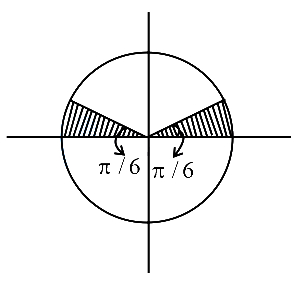
Current density in a cylindrical wire of radius $R$ varies with radial distance as $J(r) = \beta(r + r_0)^2$. The current through the shaded section of the wire shown in the figure is:
A
$\pi \beta \left[ \frac{R^4}{12} + \frac{r_0^2 R^2}{6} + \frac{2 r_0 R^3}{9} \right]$
B
$\pi \beta \left[ \frac{R^4}{6} + \frac{r_0^2 R^2}{12} + \frac{r_0 R^3}{9} \right]$
C
$\pi \beta \left[ \frac{R^4}{12} + \frac{r_0^2 R^2}{12} + \frac{r_0 R^3}{9} \right]$
D
$\pi \beta \left[ \frac{R^4}{12} + \frac{r_0^2 R^2}{6} + \frac{2 r_0 R^3}{9} \right]$
Solution
(A) The current density $J$ is given as $J(r) = \beta(r + r_0)^2$.
Consider a small elemental area $dA$ at a radial distance $r$ with thickness $dr$ and angular width $d\theta$. The area element is $dA = r dr d\theta$.
The current $di$ through this element is $di = J(r) dA = \beta(r + r_0)^2 r dr d\theta$.
The shaded region consists of two sectors,each with an angular width of $\pi/6$. The total angular width is $\Delta \theta = \pi/6 + \pi/6 = \pi/3$.
The total current $I$ through the shaded region is obtained by integrating $di$ over $r$ from $0$ to $R$ and $\theta$ over the total angular width $\Delta \theta$:
$I = \int_0^{\pi/3} d\theta \int_0^R \beta(r^2 + 2rr_0 + r_0^2) r dr$
$I = \frac{\pi}{3} \beta \int_0^R (r^3 + 2r_0r^2 + r_0^2r) dr$
$I = \frac{\pi \beta}{3} \left[ \frac{r^4}{4} + \frac{2r_0r^3}{3} + \frac{r_0^2r^2}{2} \right]_0^R$
$I = \frac{\pi \beta}{3} \left[ \frac{R^4}{4} + \frac{2r_0R^3}{3} + \frac{r_0^2R^2}{2} \right]$
$I = \pi \beta \left[ \frac{R^4}{12} + \frac{2r_0R^3}{9} + \frac{r_0^2R^2}{6} \right]$
Consider a small elemental area $dA$ at a radial distance $r$ with thickness $dr$ and angular width $d\theta$. The area element is $dA = r dr d\theta$.
The current $di$ through this element is $di = J(r) dA = \beta(r + r_0)^2 r dr d\theta$.
The shaded region consists of two sectors,each with an angular width of $\pi/6$. The total angular width is $\Delta \theta = \pi/6 + \pi/6 = \pi/3$.
The total current $I$ through the shaded region is obtained by integrating $di$ over $r$ from $0$ to $R$ and $\theta$ over the total angular width $\Delta \theta$:
$I = \int_0^{\pi/3} d\theta \int_0^R \beta(r^2 + 2rr_0 + r_0^2) r dr$
$I = \frac{\pi}{3} \beta \int_0^R (r^3 + 2r_0r^2 + r_0^2r) dr$
$I = \frac{\pi \beta}{3} \left[ \frac{r^4}{4} + \frac{2r_0r^3}{3} + \frac{r_0^2r^2}{2} \right]_0^R$
$I = \frac{\pi \beta}{3} \left[ \frac{R^4}{4} + \frac{2r_0R^3}{3} + \frac{r_0^2R^2}{2} \right]$
$I = \pi \beta \left[ \frac{R^4}{12} + \frac{2r_0R^3}{9} + \frac{r_0^2R^2}{6} \right]$
0 likes
View Solution163
EasyMCQ
An electron takes $40 \times 10^3 \ s$ to drift from one end of a metal wire of length $2 \ m$ to its other end. The area of cross-section of the wire is $4 \ mm^2$ and it is carrying a current of $1.6 \ A$. The number density of free electrons in the metal wire is
A
$8 \times 10^{28} \ m^{-3}$
B
$6 \times 10^{28} \ m^{-3}$
C
$4 \times 10^{28} \ m^{-3}$
D
$5 \times 10^{28} \ m^{-3}$
Solution
(D) The drift velocity $v_d$ is given by the ratio of length $L$ to the time $t$ taken to drift across the wire:
$v_d = \frac{L}{t} = \frac{2 \ m}{40 \times 10^3 \ s} = 0.5 \times 10^{-4} \ m/s = 5 \times 10^{-5} \ m/s$.
The current $I$ in a conductor is related to the number density $n$ of free electrons by the formula:
$I = n e A v_d$
where $e = 1.6 \times 10^{-19} \ C$ is the charge of an electron and $A$ is the cross-sectional area.
Given $A = 4 \ mm^2 = 4 \times 10^{-6} \ m^2$ and $I = 1.6 \ A$,we rearrange for $n$:
$n = \frac{I}{e A v_d}$
$n = \frac{1.6}{(1.6 \times 10^{-19}) \times (4 \times 10^{-6}) \times (5 \times 10^{-5})}$
$n = \frac{1.6}{1.6 \times 10^{-19} \times 20 \times 10^{-11}}$
$n = \frac{1}{20 \times 10^{-30}} = \frac{1}{2} \times 10^{29} = 5 \times 10^{28} \ m^{-3}$.
$v_d = \frac{L}{t} = \frac{2 \ m}{40 \times 10^3 \ s} = 0.5 \times 10^{-4} \ m/s = 5 \times 10^{-5} \ m/s$.
The current $I$ in a conductor is related to the number density $n$ of free electrons by the formula:
$I = n e A v_d$
where $e = 1.6 \times 10^{-19} \ C$ is the charge of an electron and $A$ is the cross-sectional area.
Given $A = 4 \ mm^2 = 4 \times 10^{-6} \ m^2$ and $I = 1.6 \ A$,we rearrange for $n$:
$n = \frac{I}{e A v_d}$
$n = \frac{1.6}{(1.6 \times 10^{-19}) \times (4 \times 10^{-6}) \times (5 \times 10^{-5})}$
$n = \frac{1.6}{1.6 \times 10^{-19} \times 20 \times 10^{-11}}$
$n = \frac{1}{20 \times 10^{-30}} = \frac{1}{2} \times 10^{29} = 5 \times 10^{28} \ m^{-3}$.
0 likes
View Solution164
MediumMCQ
$A$ silver wire of length $3 \,m$ and of cross-sectional area $6.14 \times 10^{-6} \,m^2$ carries a current of $6 \,A$. The atomic weight and density of silver are $108 \,g/mol$ and $10500 \,kg/m^3$,respectively. $A$ silver atom contributes one free electron for conduction. The Avogadro number is $6.023 \times 10^{23} /mol$. The drift velocity of electrons in silver is close to:
A
$10^{-2} \,m/s$
B
$10^{-4} \,m/s$
C
$0.1 \,m/s$
D
$1 \,m/s$
Solution
(B) Given: Length of wire $l = 3 \,m$,Cross-sectional area $A = 6.14 \times 10^{-6} \,m^2$,Current $I = 6 \,A$,Atomic weight $M = 108 \,g/mol = 0.108 \,kg/mol$,Density $\rho = 10500 \,kg/m^3$,Avogadro number $N_A = 6.023 \times 10^{23} /mol$,Charge of electron $e = 1.6 \times 10^{-19} \,C$.
The number of atoms per unit volume $n$ is given by $n = \frac{\rho N_A}{M}$.
Since each atom contributes one electron,the number of free electrons per unit volume is $n = \frac{10500 \times 6.023 \times 10^{23}}{0.108} \approx 5.86 \times 10^{28} \,m^{-3}$.
The drift velocity $v_d$ is given by the formula $I = n e A v_d$.
Rearranging for $v_d$: $v_d = \frac{I}{n e A}$.
Substituting the values: $v_d = \frac{6}{(5.86 \times 10^{28}) \times (1.6 \times 10^{-19}) \times (6.14 \times 10^{-6})}$.
$v_d = \frac{6}{5.86 \times 1.6 \times 6.14 \times 10^{3}} \approx \frac{6}{57.56 \times 10^3} \approx 1.04 \times 10^{-4} \,m/s$.
Thus,the drift velocity is close to $10^{-4} \,m/s$.
The number of atoms per unit volume $n$ is given by $n = \frac{\rho N_A}{M}$.
Since each atom contributes one electron,the number of free electrons per unit volume is $n = \frac{10500 \times 6.023 \times 10^{23}}{0.108} \approx 5.86 \times 10^{28} \,m^{-3}$.
The drift velocity $v_d$ is given by the formula $I = n e A v_d$.
Rearranging for $v_d$: $v_d = \frac{I}{n e A}$.
Substituting the values: $v_d = \frac{6}{(5.86 \times 10^{28}) \times (1.6 \times 10^{-19}) \times (6.14 \times 10^{-6})}$.
$v_d = \frac{6}{5.86 \times 1.6 \times 6.14 \times 10^{3}} \approx \frac{6}{57.56 \times 10^3} \approx 1.04 \times 10^{-4} \,m/s$.
Thus,the drift velocity is close to $10^{-4} \,m/s$.
0 likes
View Solution165
EasyMCQ
$A$ straight conductor of uniform area of cross-section carries a current $I$. If $s$ is the specific charge (charge-to-mass ratio) of the electron,what is the total momentum of all the electrons per unit length of the conductor due to their drift velocity?
A
$I/s$
B
$I/s^2$
C
$Is$
D
$I/\sqrt{s}$
Solution
(A) The current $I$ in a conductor is given by $I = nAev_d$,where $n$ is the number density of electrons,$A$ is the cross-sectional area,$e$ is the charge of an electron,and $v_d$ is the drift velocity.
The total number of electrons in a length $l$ of the conductor is $N = nAl$.
The total momentum $P$ of these electrons is $P = Nmv_d = (nAl)mv_d$,where $m$ is the mass of an electron.
We can rewrite the expression for current as $v_d = I / (nAe)$.
Substituting $v_d$ into the momentum equation: $P = nAlm \times (I / (nAe)) = (lmI) / e$.
The specific charge $s$ is defined as $s = e/m$,which implies $m/e = 1/s$.
Therefore,the momentum per unit length is $P/l = (mI) / e = I / s$.
The total number of electrons in a length $l$ of the conductor is $N = nAl$.
The total momentum $P$ of these electrons is $P = Nmv_d = (nAl)mv_d$,where $m$ is the mass of an electron.
We can rewrite the expression for current as $v_d = I / (nAe)$.
Substituting $v_d$ into the momentum equation: $P = nAlm \times (I / (nAe)) = (lmI) / e$.
The specific charge $s$ is defined as $s = e/m$,which implies $m/e = 1/s$.
Therefore,the momentum per unit length is $P/l = (mI) / e = I / s$.
0 likes
View Solution166
EasyMCQ
When a long straight uniform rod is connected across an ideal cell, the drift velocity of electrons in it is $v$. If a uniform hole is made along the axis of the rod and the same battery is used, then the drift velocity of electrons becomes
A
$v$
B
$ > v$
C
$ < v$
D
$zero$
Solution
(A) The drift velocity $v_d$ is given by the formula $v_d = \frac{I}{neA}$.
Since the current $I = \frac{V}{R}$ and the resistance $R = \rho \frac{l}{A}$, we can substitute these into the expression:
$v_d = \frac{V/R}{neA} = \frac{V}{(\rho l/A)neA} = \frac{V}{\rho l ne}$.
Here, $V$ is the potential difference of the cell, $\rho$ is the resistivity of the material, $l$ is the length of the rod, $n$ is the free electron density, and $e$ is the charge of an electron.
As seen from the final expression, $v_d$ is independent of the cross-sectional area $A$.
Therefore, when a hole is made along the axis, the cross-sectional area changes, but the drift velocity remains unchanged.
Since the current $I = \frac{V}{R}$ and the resistance $R = \rho \frac{l}{A}$, we can substitute these into the expression:
$v_d = \frac{V/R}{neA} = \frac{V}{(\rho l/A)neA} = \frac{V}{\rho l ne}$.
Here, $V$ is the potential difference of the cell, $\rho$ is the resistivity of the material, $l$ is the length of the rod, $n$ is the free electron density, and $e$ is the charge of an electron.
As seen from the final expression, $v_d$ is independent of the cross-sectional area $A$.
Therefore, when a hole is made along the axis, the cross-sectional area changes, but the drift velocity remains unchanged.
0 likes
View Solution167
MediumMCQ
$A$ constant potential difference is applied between the ends of a wire. If the length of the wire is elongated to $4$ times its original length,then the drift velocity of electrons will be:
A
increases $4$ times
B
decreases $4$ times
C
increases $2$ times
D
decreases $2$ times
Solution
(B) The drift velocity $v_d$ is given by the formula $v_d = \frac{eE\tau}{m}$,where $E = \frac{V}{l}$.
Substituting $E$,we get $v_d = \frac{eV\tau}{ml}$.
Since the potential difference $V$ is constant,$v_d \propto \frac{1}{l}$.
If the length $l$ is increased to $4l$,the new drift velocity $v_{d'}$ becomes $v_{d'} = \frac{eV\tau}{m(4l)} = \frac{v_d}{4}$.
Therefore,the drift velocity decreases by $4$ times.
Substituting $E$,we get $v_d = \frac{eV\tau}{ml}$.
Since the potential difference $V$ is constant,$v_d \propto \frac{1}{l}$.
If the length $l$ is increased to $4l$,the new drift velocity $v_{d'}$ becomes $v_{d'} = \frac{eV\tau}{m(4l)} = \frac{v_d}{4}$.
Therefore,the drift velocity decreases by $4$ times.
0 likes
View Solution168
EasyMCQ
The quantities that do not change when a resistor connected to a battery is heated due to the current are:
$(A)$ drift speed
$(B)$ resistivity
$(C)$ resistance
$(D)$ number of free electrons
$(A)$ drift speed
$(B)$ resistivity
$(C)$ resistance
$(D)$ number of free electrons

A
$B$ and $C$
B
$D$
C
$A$
D
$A$ and $D$
Solution
(B) When a resistor is heated due to the flow of current,its temperature increases.
$1$. Drift speed $(v_d)$ is given by $v_d = \frac{eE\tau}{m}$. As temperature increases,the relaxation time $(\tau)$ decreases,so the drift speed changes.
$2$. Resistivity $(\rho)$ of a conductor is given by $\rho = \frac{m}{ne^2\tau}$. As temperature increases,$\tau$ decreases,so resistivity increases.
$3$. Resistance $(R)$ is given by $R = \rho \frac{l}{A}$. Since resistivity changes with temperature,resistance also changes.
$4$. The number of free electrons $(n)$ per unit volume is a property of the material and remains invariant with temperature changes.
Therefore,only the number of free electrons $(D)$ remains unchanged.
$1$. Drift speed $(v_d)$ is given by $v_d = \frac{eE\tau}{m}$. As temperature increases,the relaxation time $(\tau)$ decreases,so the drift speed changes.
$2$. Resistivity $(\rho)$ of a conductor is given by $\rho = \frac{m}{ne^2\tau}$. As temperature increases,$\tau$ decreases,so resistivity increases.
$3$. Resistance $(R)$ is given by $R = \rho \frac{l}{A}$. Since resistivity changes with temperature,resistance also changes.
$4$. The number of free electrons $(n)$ per unit volume is a property of the material and remains invariant with temperature changes.
Therefore,only the number of free electrons $(D)$ remains unchanged.
0 likes
View Solution169
EasyMCQ
Two wires $A$ and $B$ of the same material have lengths $L_A, L_B$ and radii $R_A, R_B$ and drift velocities $v_A, v_B$ respectively. Both wires carry the same current. If $L_A = L_B$ and $R_A = 2R_B$,then the value of $\left(\frac{v_A}{v_B}\right)$ is:
A
$0.25$
B
$0.5$
C
$2.0$
D
$1.0$
Solution
(A) The current $I$ flowing through a conductor is given by the formula: $I = n e v_d A = n e v_d \pi R^2$.
Here,$n$ is the number density of free charge carriers,$e$ is the elementary charge,$v_d$ is the drift velocity,and $R$ is the radius of the wire.
Since both wires are made of the same material,the number density $n$ is the same for both.
Given that the current $I$ is the same for both wires $(I_A = I_B)$,we can write:
$n e v_A \pi R_A^2 = n e v_B \pi R_B^2$
Dividing both sides by $n e \pi$,we get:
$v_A R_A^2 = v_B R_B^2$
Rearranging to find the ratio $\frac{v_A}{v_B}$:
$\frac{v_A}{v_B} = \left(\frac{R_B}{R_A}\right)^2$
Given $R_A = 2R_B$,substitute this into the equation:
$\frac{v_A}{v_B} = \left(\frac{R_B}{2R_B}\right)^2 = \left(\frac{1}{2}\right)^2 = \frac{1}{4} = 0.25$.
Here,$n$ is the number density of free charge carriers,$e$ is the elementary charge,$v_d$ is the drift velocity,and $R$ is the radius of the wire.
Since both wires are made of the same material,the number density $n$ is the same for both.
Given that the current $I$ is the same for both wires $(I_A = I_B)$,we can write:
$n e v_A \pi R_A^2 = n e v_B \pi R_B^2$
Dividing both sides by $n e \pi$,we get:
$v_A R_A^2 = v_B R_B^2$
Rearranging to find the ratio $\frac{v_A}{v_B}$:
$\frac{v_A}{v_B} = \left(\frac{R_B}{R_A}\right)^2$
Given $R_A = 2R_B$,substitute this into the equation:
$\frac{v_A}{v_B} = \left(\frac{R_B}{2R_B}\right)^2 = \left(\frac{1}{2}\right)^2 = \frac{1}{4} = 0.25$.
0 likes
View Solution170
EasyMCQ
The drift speed of electrons in a material is found to be $0.3 \ m s^{-1}$ when an electric field of $2 \ V m^{-1}$ is applied across it. The electron mobility (in $m^2 \ V^{-1} \ s^{-1}$) in the material is
A
$0.15$
B
$0.6$
C
$0.135$
D
$0.54$
Solution
(A) The mobility $\mu$ of charge carriers is defined as the ratio of drift velocity $v_d$ to the applied electric field $E$.
Formula: $\mu = \frac{v_d}{E}$
Given:
Drift velocity $v_d = 0.3 \ m s^{-1}$
Electric field $E = 2 \ V m^{-1}$
Calculation:
$\mu = \frac{0.3}{2} = 0.15 \ m^2 V^{-1} s^{-1}$
Therefore,the correct option is $A$.
Formula: $\mu = \frac{v_d}{E}$
Given:
Drift velocity $v_d = 0.3 \ m s^{-1}$
Electric field $E = 2 \ V m^{-1}$
Calculation:
$\mu = \frac{0.3}{2} = 0.15 \ m^2 V^{-1} s^{-1}$
Therefore,the correct option is $A$.
0 likes
View Solution171
MediumMCQ
The lengths of two wires made of the same material are in the ratio $2:3$ and their radii are in the ratio $1:2$. If the two wires are connected in parallel to a battery,then the ratio of the drift velocities of free electrons in the two wires is
A
$2:1$
B
$3:1$
C
$3:2$
D
$3:4$
Solution
(C) The drift velocity $v_d$ is given by the formula $v_d = \frac{I}{neA}$,where $I$ is the current,$n$ is the electron density,$e$ is the charge of an electron,and $A$ is the cross-sectional area.
Since the wires are connected in parallel to the same battery,the potential difference $V$ across both wires is the same.
Using Ohm's law,$I = \frac{V}{R}$,where $R = \rho \frac{L}{A}$. Thus,$I = \frac{VA}{\rho L}$.
Substituting this into the drift velocity formula: $v_d = \frac{VA}{neA\rho L} = \frac{V}{ne\rho L}$.
Since both wires are made of the same material,$n$,$e$,and $\rho$ are constant. Also,$V$ is constant.
Therefore,$v_d \propto \frac{1}{L}$.
The ratio of lengths is $L_1 : L_2 = 2 : 3$.
Thus,the ratio of drift velocities is $\frac{v_{d1}}{v_{d2}} = \frac{L_2}{L_1} = \frac{3}{2}$.
Since the wires are connected in parallel to the same battery,the potential difference $V$ across both wires is the same.
Using Ohm's law,$I = \frac{V}{R}$,where $R = \rho \frac{L}{A}$. Thus,$I = \frac{VA}{\rho L}$.
Substituting this into the drift velocity formula: $v_d = \frac{VA}{neA\rho L} = \frac{V}{ne\rho L}$.
Since both wires are made of the same material,$n$,$e$,and $\rho$ are constant. Also,$V$ is constant.
Therefore,$v_d \propto \frac{1}{L}$.
The ratio of lengths is $L_1 : L_2 = 2 : 3$.
Thus,the ratio of drift velocities is $\frac{v_{d1}}{v_{d2}} = \frac{L_2}{L_1} = \frac{3}{2}$.
0 likes
View Solution172
EasyMCQ
The potential difference between the ends of a straight conductor of length $20 \ cm$ is $16 \ V$. If the drift speed of the electrons is $2.4 \times 10^{-4} \ ms^{-1}$,the electron mobility in $m^2 \ V^{-1} \ s^{-1}$ is
A
$3.6 \times 10^{-6}$
B
$2.4 \times 10^{-6}$
C
$2 \times 10^{-6}$
D
$3 \times 10^{-6}$
Solution
(D) Given:
Length of conductor,$\ell = 20 \ cm = 0.2 \ m$
Potential difference,$V = 16 \ V$
Drift speed,$V_d = 2.4 \times 10^{-4} \ ms^{-1}$
Electric field,$E = \frac{V}{\ell} = \frac{16}{0.2} = 80 \ V/m$
Mobility of electron is defined as $\mu = \frac{V_d}{E}$
Substituting the values:
$\mu = \frac{2.4 \times 10^{-4}}{80}$
$\mu = \frac{2.4}{80} \times 10^{-4} = 0.03 \times 10^{-4} = 3 \times 10^{-6} \ m^2 \ V^{-1} \ s^{-1}$
Length of conductor,$\ell = 20 \ cm = 0.2 \ m$
Potential difference,$V = 16 \ V$
Drift speed,$V_d = 2.4 \times 10^{-4} \ ms^{-1}$
Electric field,$E = \frac{V}{\ell} = \frac{16}{0.2} = 80 \ V/m$
Mobility of electron is defined as $\mu = \frac{V_d}{E}$
Substituting the values:
$\mu = \frac{2.4 \times 10^{-4}}{80}$
$\mu = \frac{2.4}{80} \times 10^{-4} = 0.03 \times 10^{-4} = 3 \times 10^{-6} \ m^2 \ V^{-1} \ s^{-1}$
0 likes
View Solution173
MediumMCQ
$A$ conductor of length $1.5 \ m$ and area of cross-section $3 \times 10^{-5} \ m^2$ has an electrical resistance of $15 \ \Omega$. The current density in the conductor for an electric field of $21 \ Vm^{-1}$ is
A
$0.7 \times 10^6 \ Am^{-2}$
B
$0.7 \times 10^{-6} \ Am^{-2}$
C
$0.7 \times 10^{-5} \ Am^{-2}$
D
$0.7 \times 10^5 \ Am^{-2}$
Solution
(D) Given: Length $l = 1.5 \ m$,Area $A = 3 \times 10^{-5} \ m^2$,Resistance $R = 15 \ \Omega$,Electric field $E = 21 \ Vm^{-1}$.
We know that current density $J = \sigma E$.
Since conductivity $\sigma = \frac{l}{RA}$,we substitute this into the equation:
$J = \left( \frac{l}{RA} \right) E$
$J = \frac{1.5 \times 21}{15 \times 3 \times 10^{-5}}$
$J = \frac{31.5}{45 \times 10^{-5}}$
$J = 0.7 \times 10^5 \ Am^{-2}$.
We know that current density $J = \sigma E$.
Since conductivity $\sigma = \frac{l}{RA}$,we substitute this into the equation:
$J = \left( \frac{l}{RA} \right) E$
$J = \frac{1.5 \times 21}{15 \times 3 \times 10^{-5}}$
$J = \frac{31.5}{45 \times 10^{-5}}$
$J = 0.7 \times 10^5 \ Am^{-2}$.
0 likes
View Solution174
EasyMCQ
The resistivity of a metal is $1 \times 10^{-8} \Omega \cdot m$. If it contains $9 \times 10^{28}$ electrons per $m^3$, then the relaxation time of electrons inside the metal is nearly (electron mass $= 9 \times 10^{-31} \ kg$).
A
$4 \times 10^{-14} \ s$
B
$7 \times 10^{-14} \ s$
C
$1.0 \times 10^{-14} \ s$
D
$9 \times 10^{-14} \ s$
Solution
(A) The expression for electrical resistivity $\rho$ is given by $\rho = \frac{m}{ne^2 \tau}$.
Rearranging the formula to solve for the relaxation time $\tau$:
$\tau = \frac{m}{ne^2 \rho}$
Given values:
$m = 9 \times 10^{-31} \ kg$
$n = 9 \times 10^{28} \ m^{-3}$
$e = 1.6 \times 10^{-19} \ C$
$\rho = 1 \times 10^{-8} \ \Omega \cdot m$
Substituting these values into the equation:
$\tau = \frac{9 \times 10^{-31}}{(9 \times 10^{28}) \times (1.6 \times 10^{-19})^2 \times (1 \times 10^{-8})}$
$\tau = \frac{9 \times 10^{-31}}{9 \times 10^{28} \times 2.56 \times 10^{-38} \times 10^{-8}}$
$\tau = \frac{9 \times 10^{-31}}{23.04 \times 10^{-18}}$
$\tau \approx 0.39 \times 10^{-13} \ s = 3.9 \times 10^{-14} \ s$
Rounding to the nearest value, we get $\tau \approx 4 \times 10^{-14} \ s$.
Rearranging the formula to solve for the relaxation time $\tau$:
$\tau = \frac{m}{ne^2 \rho}$
Given values:
$m = 9 \times 10^{-31} \ kg$
$n = 9 \times 10^{28} \ m^{-3}$
$e = 1.6 \times 10^{-19} \ C$
$\rho = 1 \times 10^{-8} \ \Omega \cdot m$
Substituting these values into the equation:
$\tau = \frac{9 \times 10^{-31}}{(9 \times 10^{28}) \times (1.6 \times 10^{-19})^2 \times (1 \times 10^{-8})}$
$\tau = \frac{9 \times 10^{-31}}{9 \times 10^{28} \times 2.56 \times 10^{-38} \times 10^{-8}}$
$\tau = \frac{9 \times 10^{-31}}{23.04 \times 10^{-18}}$
$\tau \approx 0.39 \times 10^{-13} \ s = 3.9 \times 10^{-14} \ s$
Rounding to the nearest value, we get $\tau \approx 4 \times 10^{-14} \ s$.
0 likes
View Solution175
MediumMCQ
$A$ cylindrical resistor of radius $7.0 \, mm$ and length $4.0 \, cm$ is made of a material that has a resistivity of $10^{-6} \, \Omega \cdot m$. If the energy is dissipated at a rate of $1.54 \, W$ in the resistor, then the current density is:
A
$\frac{10^6}{\sqrt{\pi}} \, A/m^2$
B
$5 \times 10^5 \, A/m^2$
C
$\sqrt{\pi} \times 10^5 \, A/m^2$
D
$8.5 \times 10^4 \, A/m^2$
Solution
(B) The power dissipated in a resistor is given by $P = I^2 R$, where $I$ is the current and $R$ is the resistance.
Resistance $R$ is given by $R = \rho \frac{l}{A}$, where $\rho = 10^{-6} \, \Omega \cdot m$, $l = 0.04 \, m$, and $A = \pi r^2 = \pi (7 \times 10^{-3})^2 \, m^2$.
Substituting $R$ in the power equation: $P = I^2 \left( \frac{\rho l}{A} \right) \Rightarrow I = \sqrt{\frac{P A}{\rho l}}$.
Current density $J$ is defined as $J = \frac{I}{A}$.
Substituting $I$: $J = \frac{1}{A} \sqrt{\frac{P A}{\rho l}} = \sqrt{\frac{P}{\rho l A}}$.
Substituting the values: $J = \sqrt{\frac{1.54}{10^{-6} \times 0.04 \times \pi \times (7 \times 10^{-3})^2}}$.
$J = \sqrt{\frac{1.54}{10^{-6} \times 0.04 \times \pi \times 49 \times 10^{-6}}} = \sqrt{\frac{1.54}{1.96 \times 10^{-9} \times \pi}} \approx 5 \times 10^5 \, A/m^2$.
Resistance $R$ is given by $R = \rho \frac{l}{A}$, where $\rho = 10^{-6} \, \Omega \cdot m$, $l = 0.04 \, m$, and $A = \pi r^2 = \pi (7 \times 10^{-3})^2 \, m^2$.
Substituting $R$ in the power equation: $P = I^2 \left( \frac{\rho l}{A} \right) \Rightarrow I = \sqrt{\frac{P A}{\rho l}}$.
Current density $J$ is defined as $J = \frac{I}{A}$.
Substituting $I$: $J = \frac{1}{A} \sqrt{\frac{P A}{\rho l}} = \sqrt{\frac{P}{\rho l A}}$.
Substituting the values: $J = \sqrt{\frac{1.54}{10^{-6} \times 0.04 \times \pi \times (7 \times 10^{-3})^2}}$.
$J = \sqrt{\frac{1.54}{10^{-6} \times 0.04 \times \pi \times 49 \times 10^{-6}}} = \sqrt{\frac{1.54}{1.96 \times 10^{-9} \times \pi}} \approx 5 \times 10^5 \, A/m^2$.
0 likes
View Solution176
MediumMCQ
Find the mobility of an electron in a wire if its average collision time is $9.1 \times 10^{-15} \,s$. (Charge of electron $= 1.6 \times 10^{-19} \,C$ and mass of electron $= 9.1 \times 10^{-31} \,kg$)
A
$9.1 \times 10^{-3} \,m^2/V \cdot s$
B
$1.6 \times 10^{-3} \,m^2/V \cdot s$
C
$1.75 \times 10^{-3} \,m^2/V \cdot s$
D
$1 \times 10^{-3} \,m^2/V \cdot s$
Solution
(B) The mobility $\mu$ of an electron is defined as the ratio of drift velocity $V_d$ to the electric field $E$,given by the formula: $\mu = \frac{V_d}{E} = \frac{e \tau}{m}$.
Given values are:
Charge of electron $e = 1.6 \times 10^{-19} \,C$
Mass of electron $m = 9.1 \times 10^{-31} \,kg$
Average collision time (relaxation time) $\tau = 9.1 \times 10^{-15} \,s$.
Substituting these values into the formula:
$\mu = \frac{(1.6 \times 10^{-19} \,C) \times (9.1 \times 10^{-15} \,s)}{9.1 \times 10^{-31} \,kg}$
$\mu = \frac{1.6 \times 10^{-19} \times 9.1 \times 10^{-15}}{9.1 \times 10^{-31}}$
$\mu = 1.6 \times 10^{-19 - 15 + 31} \,m^2/V \cdot s$
$\mu = 1.6 \times 10^{-3} \,m^2/V \cdot s$.
Given values are:
Charge of electron $e = 1.6 \times 10^{-19} \,C$
Mass of electron $m = 9.1 \times 10^{-31} \,kg$
Average collision time (relaxation time) $\tau = 9.1 \times 10^{-15} \,s$.
Substituting these values into the formula:
$\mu = \frac{(1.6 \times 10^{-19} \,C) \times (9.1 \times 10^{-15} \,s)}{9.1 \times 10^{-31} \,kg}$
$\mu = \frac{1.6 \times 10^{-19} \times 9.1 \times 10^{-15}}{9.1 \times 10^{-31}}$
$\mu = 1.6 \times 10^{-19 - 15 + 31} \,m^2/V \cdot s$
$\mu = 1.6 \times 10^{-3} \,m^2/V \cdot s$.
0 likes
View Solution177
MediumMCQ
$A$ conductor of length $100 \, cm$ and area of cross-section $1 \, mm^2$ carries a current of $5 \, A$. If the resistivity of the material of the conductor is $3.0 \times 10^{-8} \, \Omega \cdot m$, then the electric field across the conductor is (in $ \, V/m$)
A
$0.15$
B
$0.015$
C
$1.5$
D
$0.0015$
Solution
(A) The current density $J$ is related to the electric field $E$ by the relation $J = \frac{E}{\rho}$, where $\rho$ is the resistivity of the material.
We know that current density $J = \frac{I}{A}$.
Therefore, $E = J \cdot \rho = \frac{I \cdot \rho}{A}$.
Given values are $I = 5 \, A$, $A = 1 \, mm^2 = 1 \times 10^{-6} \, m^2$, and $\rho = 3.0 \times 10^{-8} \, \Omega \cdot m$.
Substituting these values into the formula:
$E = \frac{5 \times 3.0 \times 10^{-8}}{1 \times 10^{-6}} = 15 \times 10^{-2} = 0.15 \, V/m$.
We know that current density $J = \frac{I}{A}$.
Therefore, $E = J \cdot \rho = \frac{I \cdot \rho}{A}$.
Given values are $I = 5 \, A$, $A = 1 \, mm^2 = 1 \times 10^{-6} \, m^2$, and $\rho = 3.0 \times 10^{-8} \, \Omega \cdot m$.
Substituting these values into the formula:
$E = \frac{5 \times 3.0 \times 10^{-8}}{1 \times 10^{-6}} = 15 \times 10^{-2} = 0.15 \, V/m$.
0 likes
View Solution178
EasyMCQ
$A$ conducting wire of cross-sectional area $1 \,cm^2$ has $3 \times 10^{23}$ charge carriers per $m^3$. If the wire carries a current of $24 \,mA$, then the drift velocity of the carriers is:
A
$5 \times 10^{-2} \,m/s$
B
$0.5 \,m/s$
C
$5 \times 10^{-3} \,m/s$
D
$5 \times 10^{-6} \,m/s$
Solution
(C) Given, cross-sectional area, $A = 1 \,cm^2 = 10^{-4} \,m^2$.
Charge density, $n = 3 \times 10^{23} \,m^{-3}$.
Current through wire, $I = 24 \,mA = 24 \times 10^{-3} \,A$.
We know that for conductors, the relation between current and drift velocity is $I = n A e v_d$, where $e = 1.6 \times 10^{-19} \,C$.
Rearranging for drift velocity, $v_d = \frac{I}{n A e}$.
Substituting the values: $v_d = \frac{24 \times 10^{-3}}{3 \times 10^{23} \times 10^{-4} \times 1.6 \times 10^{-19}}$.
$v_d = \frac{24 \times 10^{-3}}{4.8 \times 10^{0}} = \frac{24}{4.8} \times 10^{-3} = 5 \times 10^{-3} \,m/s$.
Charge density, $n = 3 \times 10^{23} \,m^{-3}$.
Current through wire, $I = 24 \,mA = 24 \times 10^{-3} \,A$.
We know that for conductors, the relation between current and drift velocity is $I = n A e v_d$, where $e = 1.6 \times 10^{-19} \,C$.
Rearranging for drift velocity, $v_d = \frac{I}{n A e}$.
Substituting the values: $v_d = \frac{24 \times 10^{-3}}{3 \times 10^{23} \times 10^{-4} \times 1.6 \times 10^{-19}}$.
$v_d = \frac{24 \times 10^{-3}}{4.8 \times 10^{0}} = \frac{24}{4.8} \times 10^{-3} = 5 \times 10^{-3} \,m/s$.
0 likes
View Solution179
DifficultMCQ
Charge passing through a conductor of cross-section area $A=0.3 \,m^2$ is given by $q=3 t^2+5 t+2$ in coulomb,where $t$ is in second. What is the value of drift velocity at $t=2 \,s$ ? (Given,$n=2 \times 10^{25} / m^3$ )
A
$0.77 \times 10^{-5} \,m / s$
B
$1.77 \times 10^{-5} \,m / s$
C
$2.08 \times 10^{-5} \,m / s$
D
$0.57 \times 10^{-5} \,m / s$
Solution
(B) Given: Area $A = 0.3 \,m^2$,charge density $n = 2 \times 10^{25} / m^3$,and charge $q = 3t^2 + 5t + 2$.
First,calculate the current $i$ at $t = 2 \,s$ using $i = \frac{dq}{dt}$.
$i = \frac{d}{dt}(3t^2 + 5t + 2) = 6t + 5$.
At $t = 2 \,s$,$i = 6(2) + 5 = 17 \,A$.
The relationship between current and drift velocity $v_d$ is $i = n e A v_d$,where $e = 1.6 \times 10^{-19} \,C$.
Rearranging for $v_d$: $v_d = \frac{i}{n e A}$.
Substituting the values: $v_d = \frac{17}{2 \times 10^{25} \times 1.6 \times 10^{-19} \times 0.3}$.
$v_d = \frac{17}{0.96 \times 10^6} = 17.708 \times 10^{-6} \,m/s = 1.77 \times 10^{-5} \,m/s$.
First,calculate the current $i$ at $t = 2 \,s$ using $i = \frac{dq}{dt}$.
$i = \frac{d}{dt}(3t^2 + 5t + 2) = 6t + 5$.
At $t = 2 \,s$,$i = 6(2) + 5 = 17 \,A$.
The relationship between current and drift velocity $v_d$ is $i = n e A v_d$,where $e = 1.6 \times 10^{-19} \,C$.
Rearranging for $v_d$: $v_d = \frac{i}{n e A}$.
Substituting the values: $v_d = \frac{17}{2 \times 10^{25} \times 1.6 \times 10^{-19} \times 0.3}$.
$v_d = \frac{17}{0.96 \times 10^6} = 17.708 \times 10^{-6} \,m/s = 1.77 \times 10^{-5} \,m/s$.
0 likes
View Solution180
EasyMCQ
Statement $(I)$: Specific resistance depends on the nature of the material and is independent of the temperature of the material.
Statement $(II)$: $A$ wire of resistance $6 \ \Omega$ is drawn out so that its new length is four times its original length. The resistance of the new wire is $48 \ \Omega$.
Statement $(III)$: Drift velocity is the average constant velocity acquired by free electrons inside a metal by the application of an electric field,which results in current.
Which of the following is correct?
Statement $(II)$: $A$ wire of resistance $6 \ \Omega$ is drawn out so that its new length is four times its original length. The resistance of the new wire is $48 \ \Omega$.
Statement $(III)$: Drift velocity is the average constant velocity acquired by free electrons inside a metal by the application of an electric field,which results in current.
Which of the following is correct?
A
Statements $I, II$ and $III$ are true
B
Statement $I$ is true,but statements $II, III$ are false
C
Statement $III$ is true,but statements $I, II$ are false
D
Statements $II, III$ are true,but statement $I$ is false
Solution
(C) Specific resistance (resistivity) depends on both the temperature and the nature of the material. Therefore,Statement $(I)$ is incorrect.
When a wire is stretched to $n$ times its original length,its new resistance $R'$ becomes $n^2 R$. Here,$n = 4$ and $R = 6 \ \Omega$,so $R' = 4^2 \times 6 = 16 \times 6 = 96 \ \Omega$. Therefore,Statement $(II)$ is incorrect.
Drift velocity is defined as the average velocity with which free electrons get drifted in the direction opposite to the applied electric field. Therefore,Statement $(III)$ is correct.
Thus,only Statement $(III)$ is true.
When a wire is stretched to $n$ times its original length,its new resistance $R'$ becomes $n^2 R$. Here,$n = 4$ and $R = 6 \ \Omega$,so $R' = 4^2 \times 6 = 16 \times 6 = 96 \ \Omega$. Therefore,Statement $(II)$ is incorrect.
Drift velocity is defined as the average velocity with which free electrons get drifted in the direction opposite to the applied electric field. Therefore,Statement $(III)$ is correct.
Thus,only Statement $(III)$ is true.
0 likes
View Solution181
DifficultMCQ
$A$ metal has $9 \times 10^{28}$ conduction electrons per $m^3$ and its resistivity is $1 \times 10^{-8} \Omega \cdot m$. If the drift speed of an electron in the metal is $1.6 \times 10^6 \ m/s$,then its mean free path is (mass of electron $= 9 \times 10^{-31} \ kg$ and charge of electron $= 1.6 \times 10^{-19} \ C$). (in $nm$)
A
$55.5$
B
$78.0$
C
$40.0$
D
$62.5$
Solution
(D) The resistivity $\rho$ is given by $\rho = \frac{m}{ne^2\tau}$,where $\tau$ is the relaxation time.
Also,the mean free path $\lambda$ is given by $\lambda = v_d \tau$,where $v_d$ is the drift speed.
From the resistivity formula,$\tau = \frac{m}{ne^2\rho}$.
Substituting this into the mean free path formula:
$\lambda = v_d \left( \frac{m}{ne^2\rho} \right) = \frac{m v_d}{ne^2\rho}$.
Given: $m = 9 \times 10^{-31} \ kg$,$v_d = 1.6 \times 10^6 \ m/s$,$n = 9 \times 10^{28} \ m^{-3}$,$e = 1.6 \times 10^{-19} \ C$,and $\rho = 1 \times 10^{-8} \ \Omega \cdot m$.
$\lambda = \frac{(9 \times 10^{-31}) \times (1.6 \times 10^6)}{(9 \times 10^{28}) \times (1.6 \times 10^{-19})^2 \times (1 \times 10^{-8})}$.
$\lambda = \frac{14.4 \times 10^{-25}}{9 \times 10^{28} \times 2.56 \times 10^{-38} \times 10^{-8}} = \frac{14.4 \times 10^{-25}}{23.04 \times 10^{-18}} = 0.625 \times 10^{-7} \ m = 62.5 \ nm$.
Also,the mean free path $\lambda$ is given by $\lambda = v_d \tau$,where $v_d$ is the drift speed.
From the resistivity formula,$\tau = \frac{m}{ne^2\rho}$.
Substituting this into the mean free path formula:
$\lambda = v_d \left( \frac{m}{ne^2\rho} \right) = \frac{m v_d}{ne^2\rho}$.
Given: $m = 9 \times 10^{-31} \ kg$,$v_d = 1.6 \times 10^6 \ m/s$,$n = 9 \times 10^{28} \ m^{-3}$,$e = 1.6 \times 10^{-19} \ C$,and $\rho = 1 \times 10^{-8} \ \Omega \cdot m$.
$\lambda = \frac{(9 \times 10^{-31}) \times (1.6 \times 10^6)}{(9 \times 10^{28}) \times (1.6 \times 10^{-19})^2 \times (1 \times 10^{-8})}$.
$\lambda = \frac{14.4 \times 10^{-25}}{9 \times 10^{28} \times 2.56 \times 10^{-38} \times 10^{-8}} = \frac{14.4 \times 10^{-25}}{23.04 \times 10^{-18}} = 0.625 \times 10^{-7} \ m = 62.5 \ nm$.
0 likes
View Solution182
EasyMCQ
The dominant force experienced by an electron moving in a wire is
A
gravitational
B
electromagnetic
C
strong nuclear
D
weak nuclear
Solution
(B) The motion of an electron in a wire is governed by the electric field (due to potential difference) and the magnetic field (if applicable). These forces are categorized under the electromagnetic force. Gravitational force is negligible at the atomic scale,while strong and weak nuclear forces act only within the nucleus. Therefore,the dominant force is the electromagnetic force.
0 likes
View Solution183
EasyMCQ
Which of the following is the unit of mobility of an electron in a conductor?
A
$kg^{-1} \,s^2 \,A^{-1}$
B
$kg^{-1} \,s^2 \,A$
C
$kg^{-1} \,m \,s^2 \,A^{-1}$
D
$kg \,m \,s^{-1} \,A^{-1}$
Solution
(B) Mobility $\mu$ is defined as the ratio of drift velocity $v_d$ to the applied electric field $E$, given by the formula $\mu = \frac{e \tau}{m}$.
Here, $e$ is the charge (unit: $A \cdot s$), $\tau$ is the relaxation time (unit: $s$), and $m$ is the mass (unit: $kg$).
Substituting these units into the formula: $\text{Unit of } \mu = \frac{(A \cdot s) \cdot s}{kg} = \frac{A \cdot s^2}{kg}$.
This can be written as $kg^{-1} \,s^2 \,A$.
Here, $e$ is the charge (unit: $A \cdot s$), $\tau$ is the relaxation time (unit: $s$), and $m$ is the mass (unit: $kg$).
Substituting these units into the formula: $\text{Unit of } \mu = \frac{(A \cdot s) \cdot s}{kg} = \frac{A \cdot s^2}{kg}$.
This can be written as $kg^{-1} \,s^2 \,A$.
0 likes
View Solution184
EasyMCQ
An electric cell of emf $E$ is connected across a copper wire of diameter $d$ and length $l$. The drift velocity of electrons in the wire is $v_{d}$. If the length of the wire is changed to $2l$,the new drift velocity of electrons in the copper wire will be
A
$v_{d}$
B
$2v_{d}$
C
$v_{d}/2$
D
$v_{d}/4$
Solution
(C) The drift velocity $v_{d}$ is given by the formula $v_{d} = \frac{I}{neA}$,where $I$ is the current,$n$ is the electron density,$e$ is the charge of an electron,and $A$ is the cross-sectional area.
Since $I = \frac{E}{R}$ and $R = \rho \frac{l}{A}$,we have $I = \frac{E A}{\rho l}$.
Substituting this into the drift velocity formula:
$v_{d} = \frac{E A}{\rho l n e A} = \frac{E}{\rho l n e}$.
From this expression,we see that $v_{d} \propto \frac{1}{l}$.
If the length is changed to $l' = 2l$,the new drift velocity $v_{d}'$ is:
$v_{d}' = \frac{E}{\rho (2l) n e} = \frac{1}{2} \left( \frac{E}{\rho l n e} \right) = \frac{v_{d}}{2}$.
Since $I = \frac{E}{R}$ and $R = \rho \frac{l}{A}$,we have $I = \frac{E A}{\rho l}$.
Substituting this into the drift velocity formula:
$v_{d} = \frac{E A}{\rho l n e A} = \frac{E}{\rho l n e}$.
From this expression,we see that $v_{d} \propto \frac{1}{l}$.
If the length is changed to $l' = 2l$,the new drift velocity $v_{d}'$ is:
$v_{d}' = \frac{E}{\rho (2l) n e} = \frac{1}{2} \left( \frac{E}{\rho l n e} \right) = \frac{v_{d}}{2}$.
0 likes
View Solution185
MediumMCQ
$A$ cylindrical conductor of length $2 \ m$ and area of cross-section $0.2 \ mm^{2}$ carries an electric current of $1.6 \ A$ when its ends are connected to a $2 \ V$ battery. Mobility of electrons in the conductor is $\alpha \times 10^{-3} \ m^{2}/V \cdot s$. The value of $\alpha$ is: (electron concentration $n = 5 \times 10^{28} \ m^{-3}$ and electron charge $e = 1.6 \times 10^{-19} \ C$)
A
$1$
B
$2$
C
$0.5$
D
$4$
Solution
(A) Given: Length $l = 2 \ m$,Area $A = 0.2 \ mm^{2} = 0.2 \times 10^{-6} \ m^{2}$,Current $I = 1.6 \ A$,Voltage $V = 2 \ V$,Concentration $n = 5 \times 10^{28} \ m^{-3}$,Charge $e = 1.6 \times 10^{-19} \ C$.
The drift velocity $V_{d}$ is given by $V_{d} = \frac{I}{neA}$.
The mobility $\mu$ is defined as $\mu = \frac{V_{d}}{E}$,where $E = \frac{V}{l}$ is the electric field.
Substituting $V_{d}$ and $E$,we get $\mu = \frac{I}{neA} \times \frac{l}{V}$.
Substituting the values: $\mu = \frac{1.6 \times 2}{5 \times 10^{28} \times 1.6 \times 10^{-19} \times 0.2 \times 10^{-6} \times 2}$.
$\mu = \frac{3.2}{5 \times 10^{28} \times 1.6 \times 10^{-19} \times 0.2 \times 10^{-6} \times 2} = \frac{3.2}{3.2 \times 10^{3}} = 1 \times 10^{-3} \ m^{2}/V \cdot s$.
Comparing with $\alpha \times 10^{-3} \ m^{2}/V \cdot s$,we get $\alpha = 1$.
The drift velocity $V_{d}$ is given by $V_{d} = \frac{I}{neA}$.
The mobility $\mu$ is defined as $\mu = \frac{V_{d}}{E}$,where $E = \frac{V}{l}$ is the electric field.
Substituting $V_{d}$ and $E$,we get $\mu = \frac{I}{neA} \times \frac{l}{V}$.
Substituting the values: $\mu = \frac{1.6 \times 2}{5 \times 10^{28} \times 1.6 \times 10^{-19} \times 0.2 \times 10^{-6} \times 2}$.
$\mu = \frac{3.2}{5 \times 10^{28} \times 1.6 \times 10^{-19} \times 0.2 \times 10^{-6} \times 2} = \frac{3.2}{3.2 \times 10^{3}} = 1 \times 10^{-3} \ m^{2}/V \cdot s$.
Comparing with $\alpha \times 10^{-3} \ m^{2}/V \cdot s$,we get $\alpha = 1$.
0 likes
View Solution186
MediumMCQ
The drift velocity of an electron is $v_d$ in a conductor of area of cross-section $A$ and carries a current $I$. Now,the area of cross-section and current flowing through the conductor are doubled,then the new drift velocity of the electron is . . . . . . .
A
$\frac{v_d}{2}$
B
$\frac{v_d}{4}$
C
$4v_d$
D
$v_d$
Solution
(D) The relation between current $I$ and drift velocity $v_d$ is given by the formula $I = n e A v_d$,where $n$ is the electron density and $e$ is the charge of an electron.
From this,the drift velocity is expressed as $v_d = \frac{I}{neA}$.
Given that the new current $I' = 2I$ and the new area of cross-section $A' = 2A$,the new drift velocity $v'_d$ is calculated as:
$v'_d = \frac{I'}{neA'} = \frac{2I}{ne(2A)} = \frac{I}{neA} = v_d$.
Therefore,the drift velocity remains unchanged. Option $(D)$ is correct.
From this,the drift velocity is expressed as $v_d = \frac{I}{neA}$.
Given that the new current $I' = 2I$ and the new area of cross-section $A' = 2A$,the new drift velocity $v'_d$ is calculated as:
$v'_d = \frac{I'}{neA'} = \frac{2I}{ne(2A)} = \frac{I}{neA} = v_d$.
Therefore,the drift velocity remains unchanged. Option $(D)$ is correct.
0 likes
View SolutionCurrent Electricity — Current Density, Drift Velocity and Mobility · Frequently Asked Questions
1Are these Current Electricity questions useful for JEE and NEET?
Yes. All questions in this section are mapped to JEE Main and NEET exam patterns. Previous year questions from JEE Main, NEET, GUJCET and state-level exams are included with full solutions.
2Can I switch to Hindi or Gujarati for these questions?
Yes. Use the language tabs in the hero section or the sidebar to view the same questions and solutions in English, Hindi or Gujarati.
3How do I generate a question paper from this subtopic?
Use the Vedclass Exam Paper Generator — select the chapter and subtopic, set difficulty, and generate Sets A, B, C, D automatically. First 3 chapters of every subject are free.
Vedclass Products
For Students
Vedclass Test Series
Mock tests in real JEE/NEET style with performance analysis. 5-day free trial.
Start Free TrialFor Teachers
Exam Paper Generator
Generate Set A/B/C/D papers from this chapter in 2 minutes. 3 chapters free.
Try FreeFor Institutes
Online Exam Module
Live online exams with unlimited students, 360° analytics & white-label branding.
See DemoFor Teachers & Institutes
Generate a Current Electricity Exam Paper in 2 Minutes
Select subtopic & difficulty — Sets A, B, C, D auto-generated with No Repeat logic.
First 3 chapters of every subject are free — no payment required.