
A English
Circuit Solving for current and Voltage Questions in English
Class 12 Physics · Current Electricity · Circuit Solving for current and Voltage
684+
Questions
English
Language
100%
With Solutions
Showing 50 of 684 questions in English
151
MediumMCQ
What is immaterial for an electric fuse wire?
A
Specific resistance of the wire
B
Radius of the wire
C
Length of the wire
D
Current flowing through the wire
Solution
(C) The heating effect in a fuse wire is governed by Joule's law of heating,given by $H = I^2 R t$,where $R = \rho \frac{l}{A} = \rho \frac{l}{\pi r^2}$.
For a fuse to melt at a specific current $I$,the heat generated must be sufficient to raise the temperature to the melting point.
Since the heat generated depends on the resistance $R$,which is proportional to the resistivity $\rho$ and inversely proportional to the square of the radius $r$,these factors are critical.
The current $I$ is the threshold value the fuse is designed for.
The length $l$ of the wire does not affect the current-carrying capacity or the melting point of the fuse wire,as the heat generated per unit length is what matters for the fuse's operation. Thus,the length is immaterial.
For a fuse to melt at a specific current $I$,the heat generated must be sufficient to raise the temperature to the melting point.
Since the heat generated depends on the resistance $R$,which is proportional to the resistivity $\rho$ and inversely proportional to the square of the radius $r$,these factors are critical.
The current $I$ is the threshold value the fuse is designed for.
The length $l$ of the wire does not affect the current-carrying capacity or the melting point of the fuse wire,as the heat generated per unit length is what matters for the fuse's operation. Thus,the length is immaterial.
0 likes
View Solution152
EasyMCQ
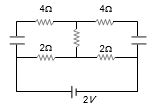
Find the power of the circuit in $W$.
A
$1.5$
B
$2$
C
$1$
D
None of these
Solution
(C) In a steady state,the branches containing capacitors act as open circuits and can be neglected.
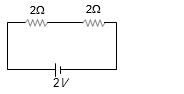
Thus,the current flows only through the resistors in the bottom and middle branches.
The equivalent resistance of the circuit is $R_{eq} = 2\,\Omega + 2\,\Omega = 4\,\Omega$.
The power consumed by the circuit is given by $P = \frac{V^2}{R_{eq}}$.
Substituting the values,$P = \frac{(2)^2}{4} = \frac{4}{4} = 1\,W$.
Thus,the current flows only through the resistors in the bottom and middle branches.
The equivalent resistance of the circuit is $R_{eq} = 2\,\Omega + 2\,\Omega = 4\,\Omega$.
The power consumed by the circuit is given by $P = \frac{V^2}{R_{eq}}$.
Substituting the values,$P = \frac{(2)^2}{4} = \frac{4}{4} = 1\,W$.
0 likes
View Solution153
MediumMCQ
Two resistors whose values are in the ratio $2 : 1$ are connected in parallel with one cell. The ratio of power dissipated is:
A
$2:1$
B
$4:1$
C
$1:2$
D
$1:1$
Solution
(C) When resistors are connected in parallel,the potential difference $(V)$ across each resistor is the same.
The power dissipated $(P)$ in a resistor is given by the formula $P = \frac{V^2}{R}$.
Since $V$ is constant,the power dissipated is inversely proportional to the resistance: $P \propto \frac{1}{R}$.
Given the ratio of resistances is $\frac{R_1}{R_2} = \frac{2}{1}$.
Therefore,the ratio of power dissipated is $\frac{P_1}{P_2} = \frac{R_2}{R_1} = \frac{1}{2}$.
The power dissipated $(P)$ in a resistor is given by the formula $P = \frac{V^2}{R}$.
Since $V$ is constant,the power dissipated is inversely proportional to the resistance: $P \propto \frac{1}{R}$.
Given the ratio of resistances is $\frac{R_1}{R_2} = \frac{2}{1}$.
Therefore,the ratio of power dissipated is $\frac{P_1}{P_2} = \frac{R_2}{R_1} = \frac{1}{2}$.
0 likes
View Solution154
MediumMCQ
The resistance of a hot tungsten filament is about $10$ times its cold resistance. What will be the resistance of a $100\, W$ and $200\, V$ lamp when not in use? (in $\Omega$)
A
$400$
B
$200$
C
$40$
D
$20$
Solution
(C) The resistance of the lamp when it is hot (at rated power) is given by the formula $R_{Hot} = \frac{V^2}{P}$.
Substituting the given values: $R_{Hot} = \frac{200 \times 200}{100} = 400\,\Omega$.
It is given that the hot resistance is $10$ times the cold resistance: $R_{Hot} = 10 \times R_{Cold}$.
Therefore,the cold resistance (resistance when not in use) is $R_{Cold} = \frac{R_{Hot}}{10}$.
$R_{Cold} = \frac{400}{10} = 40\,\Omega$.
Substituting the given values: $R_{Hot} = \frac{200 \times 200}{100} = 400\,\Omega$.
It is given that the hot resistance is $10$ times the cold resistance: $R_{Hot} = 10 \times R_{Cold}$.
Therefore,the cold resistance (resistance when not in use) is $R_{Cold} = \frac{R_{Hot}}{10}$.
$R_{Cold} = \frac{400}{10} = 40\,\Omega$.
0 likes
View Solution155
MediumMCQ
$A$ battery of $e.m.f.$ $3\, V$ and internal resistance $1.0\, \Omega$ is connected in series with a copper voltameter. The current flowing in the circuit is $1.5\, A$. The resistance of the voltameter will be ........... $\Omega$.
A
$0$
B
$1$
C
$1.5$
D
$2$
Solution
(B) Given:
$e.m.f.$ of the battery $(E)$ = $3\, V$
Internal resistance $(r_{int})$ = $1.0\, \Omega$
Current in the circuit $(I)$ = $1.5\, A$
Let the resistance of the voltameter be $R$.
According to Ohm's law for a complete circuit:
$E = I(R + r_{int})$
Substituting the given values:
$3 = 1.5(R + 1.0)$
$R + 1.0 = \frac{3}{1.5}$
$R + 1.0 = 2$
$R = 2 - 1.0 = 1\, \Omega$
Therefore,the resistance of the voltameter is $1\, \Omega$.
$e.m.f.$ of the battery $(E)$ = $3\, V$
Internal resistance $(r_{int})$ = $1.0\, \Omega$
Current in the circuit $(I)$ = $1.5\, A$
Let the resistance of the voltameter be $R$.
According to Ohm's law for a complete circuit:
$E = I(R + r_{int})$
Substituting the given values:
$3 = 1.5(R + 1.0)$
$R + 1.0 = \frac{3}{1.5}$
$R + 1.0 = 2$
$R = 2 - 1.0 = 1\, \Omega$
Therefore,the resistance of the voltameter is $1\, \Omega$.
0 likes
View Solution156
MediumMCQ
The current inside a copper voltameter:
A
Is half the outside value
B
Is the same as the outside value
C
Is twice the outside value
D
Depends on the concentration of $CuSO_4$
Solution
(B) The current flowing through a voltameter is determined by the external circuit connected to it. According to the principle of continuity in a series circuit,the current entering the voltameter must be equal to the current leaving it. Therefore,the current inside the copper voltameter is the same as the current drawn from the battery in the external circuit.
0 likes
View Solution157
MediumMCQ
The electrochemical equivalent of a material in an electrolyte depends on
A
The nature of the material
B
The current through the electrolyte
C
The amount of charge passed through electrolyte
D
The amount of material present in electrolyte
Solution
(A) The electrochemical equivalent $(Z)$ of a substance is defined by the formula $Z = \frac{M}{nF}$,where $M$ is the molar mass of the substance,$n$ is the valency (number of electrons transferred),and $F$ is Faraday's constant.
Since $M$,$n$,and $F$ are properties intrinsic to the material and the chemical reaction,the electrochemical equivalent depends solely on the nature of the material.
Therefore,the correct option is $A$.
Since $M$,$n$,and $F$ are properties intrinsic to the material and the chemical reaction,the electrochemical equivalent depends solely on the nature of the material.
Therefore,the correct option is $A$.
0 likes
View Solution158
DifficultMCQ
Two voltameters,one of copper and another of silver,are joined in parallel. When a total charge $q$ flows through the voltameters,equal amounts of metals are deposited. If the electrochemical equivalents of copper and silver are $z_1$ and $z_2$ respectively,the charge which flows through the silver voltameter is
A
$q\frac{z_1}{z_2}$
B
$q\frac{z_2}{z_1}$
C
$\frac{q}{1 + \frac{z_1}{z_2}}$
D
$\frac{q}{1 + \frac{z_2}{z_1}}$
Solution
(D) According to Faraday's law of electrolysis,the mass $m$ deposited is given by $m = zq$,where $z$ is the electrochemical equivalent and $q$ is the charge.
Since the masses deposited are equal,we have $m_1 = m_2$,which implies $z_1 q_1 = z_2 q_2$.
From this,the ratio of charges is $\frac{q_1}{q_2} = \frac{z_2}{z_1}$.
We know that the total charge $q = q_1 + q_2$.
We want to find the charge $q_2$ flowing through the silver voltameter.
From the ratio,$q_1 = q_2 \frac{z_2}{z_1}$.
Substituting this into the total charge equation: $q = q_2 \frac{z_2}{z_1} + q_2 = q_2 (1 + \frac{z_2}{z_1})$.
Solving for $q_2$,we get $q_2 = \frac{q}{1 + \frac{z_2}{z_1}}$.
Since the masses deposited are equal,we have $m_1 = m_2$,which implies $z_1 q_1 = z_2 q_2$.
From this,the ratio of charges is $\frac{q_1}{q_2} = \frac{z_2}{z_1}$.
We know that the total charge $q = q_1 + q_2$.
We want to find the charge $q_2$ flowing through the silver voltameter.
From the ratio,$q_1 = q_2 \frac{z_2}{z_1}$.
Substituting this into the total charge equation: $q = q_2 \frac{z_2}{z_1} + q_2 = q_2 (1 + \frac{z_2}{z_1})$.
Solving for $q_2$,we get $q_2 = \frac{q}{1 + \frac{z_2}{z_1}}$.
0 likes
View Solution159
MediumMCQ
The neutral temperature of a thermocouple is defined as the temperature at which:
A
The thermo $e.m.f.$ changes sign
B
The thermo $e.m.f.$ is maximum
C
The thermo $e.m.f.$ is minimum
D
The thermo $e.m.f.$ is zero
Solution
(B) The thermo $e.m.f.$ $(E)$ in a thermocouple as a function of temperature $(T)$ is given by the relation: $E = aT + \frac{1}{2}bT^2$.
To find the temperature at which the $e.m.f.$ is maximum,we differentiate $E$ with respect to $T$ and set it to zero:
$\frac{dE}{dT} = a + bT = 0$.
Solving for $T$,we get $T = -\frac{a}{b}$. This temperature is defined as the neutral temperature $(T_n)$.
At the neutral temperature,the thermo $e.m.f.$ reaches its maximum value.
To find the temperature at which the $e.m.f.$ is maximum,we differentiate $E$ with respect to $T$ and set it to zero:
$\frac{dE}{dT} = a + bT = 0$.
Solving for $T$,we get $T = -\frac{a}{b}$. This temperature is defined as the neutral temperature $(T_n)$.
At the neutral temperature,the thermo $e.m.f.$ reaches its maximum value.
0 likes
View Solution160
MediumMCQ
When two ends of a conductor are at different temperatures,the electromotive force generated between the two ends is known as:
A
Seebeck electromotive force $(e.m.f.)$
B
Peltier electromotive force $(e.m.f.)$
C
Thomson electromotive force $(e.m.f.)$
D
None of these
Solution
(C) The Thomson effect describes the phenomenon where an electromotive force is generated in a single homogeneous conductor when a temperature gradient exists between its two ends.
This potential difference arises due to the redistribution of charge carriers caused by the temperature difference.
Therefore,the electromotive force generated between the two ends of a single conductor at different temperatures is known as the Thomson electromotive force.
This potential difference arises due to the redistribution of charge carriers caused by the temperature difference.
Therefore,the electromotive force generated between the two ends of a single conductor at different temperatures is known as the Thomson electromotive force.
0 likes
View Solution161
DifficultMCQ
The smallest temperature difference that can be measured with a combination of a thermocouple of thermo $e.m.f.$ $30\,\mu V$ per degree and a galvanometer of $50\,\Omega$ resistance,capable of measuring a minimum current of $3 \times 10^{-7} \, A$ is ............... $^\circ C$.
A
$0.5$
B
$1.0$
C
$1.5$
D
$2.0$
Solution
(A) The thermo $e.m.f.$ produced by a thermocouple is given by $e = S \times \theta$,where $S$ is the sensitivity $(30 \,\mu V/^\circ C)$ and $\theta$ is the temperature difference.
Given,the minimum current $i = 3 \times 10^{-7} \, A$ and resistance $R = 50 \,\Omega$.
Using Ohm's law,$i = \frac{e}{R}$,we have $i = \frac{S \times \theta}{R}$.
Substituting the values: $3 \times 10^{-7} = \frac{(30 \times 10^{-6}) \times \theta}{50}$.
Solving for $\theta$: $\theta = \frac{3 \times 10^{-7} \times 50}{30 \times 10^{-6}}$.
$\theta = \frac{150 \times 10^{-7}}{30 \times 10^{-6}} = 5 \times 10^{-1} = 0.5^\circ C$.
Given,the minimum current $i = 3 \times 10^{-7} \, A$ and resistance $R = 50 \,\Omega$.
Using Ohm's law,$i = \frac{e}{R}$,we have $i = \frac{S \times \theta}{R}$.
Substituting the values: $3 \times 10^{-7} = \frac{(30 \times 10^{-6}) \times \theta}{50}$.
Solving for $\theta$: $\theta = \frac{3 \times 10^{-7} \times 50}{30 \times 10^{-6}}$.
$\theta = \frac{150 \times 10^{-7}}{30 \times 10^{-6}} = 5 \times 10^{-1} = 0.5^\circ C$.
0 likes
View Solution162
DifficultMCQ
The resistance of the filament of an electric bulb changes with temperature. If an electric bulb rated $220\,V$ and $100\,W$ is connected to a $(220 \times 0.8)\,V$ source,then the actual power consumed would be:
A
$100 \times 0.8\,W$
B
$100 \times (0.8)^2\,W$
C
Between $100 \times 0.8\,W$ and $100\,W$
D
Between $100 \times (0.8)^2\,W$ and $100 \times 0.8\,W$
Solution
(D) The rated power is $P_1 = 100\,W$ at $V_1 = 220\,V$. The resistance at this temperature is $R_1 = \frac{V_1^2}{P_1}$.
When connected to $V_2 = 220 \times 0.8\,V$,the new power is $P_2 = \frac{V_2^2}{R_2}$.
Taking the ratio: $\frac{P_2}{P_1} = \frac{V_2^2}{V_1^2} \times \frac{R_1}{R_2} = (0.8)^2 \times \frac{R_1}{R_2}$.
Since the voltage decreases,the temperature of the filament decreases,which causes the resistance to decrease $(R_2 < R_1)$. Therefore,$\frac{R_1}{R_2} > 1$.
This implies $P_2 > (0.8)^2 \times P_1 = 100 \times (0.8)^2\,W$.
Also,since $P = VI$,and both $V$ and $I$ decrease compared to the rated values,the power $P_2$ must be less than the power calculated if resistance remained constant at $R_1$ (which would be $100 \times 0.8\,W$).
Thus,the actual power $P_2$ lies between $100 \times (0.8)^2\,W$ and $100 \times 0.8\,W$.
When connected to $V_2 = 220 \times 0.8\,V$,the new power is $P_2 = \frac{V_2^2}{R_2}$.
Taking the ratio: $\frac{P_2}{P_1} = \frac{V_2^2}{V_1^2} \times \frac{R_1}{R_2} = (0.8)^2 \times \frac{R_1}{R_2}$.
Since the voltage decreases,the temperature of the filament decreases,which causes the resistance to decrease $(R_2 < R_1)$. Therefore,$\frac{R_1}{R_2} > 1$.
This implies $P_2 > (0.8)^2 \times P_1 = 100 \times (0.8)^2\,W$.
Also,since $P = VI$,and both $V$ and $I$ decrease compared to the rated values,the power $P_2$ must be less than the power calculated if resistance remained constant at $R_1$ (which would be $100 \times 0.8\,W$).
Thus,the actual power $P_2$ lies between $100 \times (0.8)^2\,W$ and $100 \times 0.8\,W$.
0 likes
View Solution163
MediumMCQ
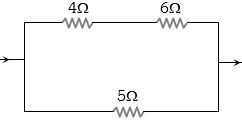
In the circuit shown in the figure, the heat produced in the $5\, \Omega$ resistance is $10\, \text{cal/sec}$. The heat produced in the $4\, \Omega$ resistance is ................ $\text{cal/sec}$.
A
$1$
B
$2$
C
$3$
D
$4$
Solution
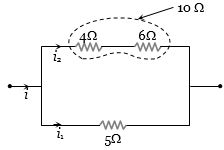
(B) The circuit consists of two parallel branches. The upper branch has a total resistance of $R_2 = 4\, \Omega + 6\, \Omega = 10\, \Omega$. The lower branch has a resistance of $R_1 = 5\, \Omega$.
Since the branches are in parallel, the potential difference $V$ across both branches is the same.
The current in the branches is inversely proportional to their resistance: $\frac{i_1}{i_2} = \frac{R_2}{R_1} = \frac{10}{5} = \frac{2}{1}$.
The heat produced per second (power) is given by $P = i^2 R$.
For the $5\, \Omega$ resistor, $P_5 = i_1^2 \times 5 = 10\, \text{cal/s}$.
For the $4\, \Omega$ resistor, the current is $i_2$. The power dissipated in the upper branch is $P_{\text{upper}} = i_2^2 \times R_2 = i_2^2 \times 10$.
Using the ratio $\frac{i_1}{i_2} = 2$, we have $i_1 = 2i_2$. Substituting this into the power equation for the $5\, \Omega$ resistor: $(2i_2)^2 \times 5 = 10 \Rightarrow 20i_2^2 = 10 \Rightarrow i_2^2 = 0.5$.
The power dissipated in the $4\, \Omega$ resistor is $P_4 = i_2^2 \times 4 = 0.5 \times 4 = 2\, \text{cal/s}$.
Since the branches are in parallel, the potential difference $V$ across both branches is the same.
The current in the branches is inversely proportional to their resistance: $\frac{i_1}{i_2} = \frac{R_2}{R_1} = \frac{10}{5} = \frac{2}{1}$.
The heat produced per second (power) is given by $P = i^2 R$.
For the $5\, \Omega$ resistor, $P_5 = i_1^2 \times 5 = 10\, \text{cal/s}$.
For the $4\, \Omega$ resistor, the current is $i_2$. The power dissipated in the upper branch is $P_{\text{upper}} = i_2^2 \times R_2 = i_2^2 \times 10$.
Using the ratio $\frac{i_1}{i_2} = 2$, we have $i_1 = 2i_2$. Substituting this into the power equation for the $5\, \Omega$ resistor: $(2i_2)^2 \times 5 = 10 \Rightarrow 20i_2^2 = 10 \Rightarrow i_2^2 = 0.5$.
The power dissipated in the $4\, \Omega$ resistor is $P_4 = i_2^2 \times 4 = 0.5 \times 4 = 2\, \text{cal/s}$.
0 likes
View Solution164
DifficultMCQ
Water boils in an electric kettle in $15\,\text{min}$ after switching on. If the length of the heating wire is decreased to $2/3$ of its initial value,then the same amount of water will boil with the same supply voltage in ............. $\text{min}$.
A
$15$
B
$12$
C
$10$
D
$8$
Solution
(C) The heat required to boil the water is given by $H = \frac{V^2}{R} t$,where $V$ is the supply voltage,$R$ is the resistance of the heating wire,and $t$ is the time taken.
Since the supply voltage $V$ and the amount of heat $H$ required are the same in both cases,we have $H = \frac{V^2}{R_1} t_1 = \frac{V^2}{R_2} t_2$.
This implies $\frac{t_1}{R_1} = \frac{t_2}{R_2}$,or $\frac{t_2}{t_1} = \frac{R_2}{R_1}$ ..... $(i)$
We know that the resistance of a wire is proportional to its length,$R \propto l$,so $\frac{R_2}{R_1} = \frac{l_2}{l_1}$ ..... $(ii)$
Substituting $(ii)$ into $(i)$,we get $\frac{t_2}{t_1} = \frac{l_2}{l_1}$.
Given that the new length $l_2 = \frac{2}{3} l_1$,we have $\frac{l_2}{l_1} = \frac{2}{3}$.
Substituting the values,$\frac{t_2}{15} = \frac{2}{3}$,which gives $t_2 = 15 \times \frac{2}{3} = 10\,\text{min}$.
Since the supply voltage $V$ and the amount of heat $H$ required are the same in both cases,we have $H = \frac{V^2}{R_1} t_1 = \frac{V^2}{R_2} t_2$.
This implies $\frac{t_1}{R_1} = \frac{t_2}{R_2}$,or $\frac{t_2}{t_1} = \frac{R_2}{R_1}$ ..... $(i)$
We know that the resistance of a wire is proportional to its length,$R \propto l$,so $\frac{R_2}{R_1} = \frac{l_2}{l_1}$ ..... $(ii)$
Substituting $(ii)$ into $(i)$,we get $\frac{t_2}{t_1} = \frac{l_2}{l_1}$.
Given that the new length $l_2 = \frac{2}{3} l_1$,we have $\frac{l_2}{l_1} = \frac{2}{3}$.
Substituting the values,$\frac{t_2}{15} = \frac{2}{3}$,which gives $t_2 = 15 \times \frac{2}{3} = 10\,\text{min}$.
0 likes
View Solution165
MediumMCQ
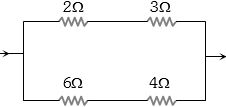
In the circuit as shown in the figure, the heat produced by $6\,\Omega$ resistance due to current flowing in it is $60$ calorie per second. The heat generated across $3\,\Omega$ resistance per second will be ................. $calorie$.
A
$30$
B
$60$
C
$100$
D
$120$
Solution
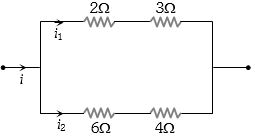
(D) The circuit consists of two parallel branches connected across the same potential difference $V$.
Resistance of the upper branch, $R_1 = 2\,\Omega + 3\,\Omega = 5\,\Omega$.
Resistance of the lower branch, $R_2 = 6\,\Omega + 4\,\Omega = 10\,\Omega$.
Since the branches are in parallel, the potential difference $V$ across both is the same.
Let $i_1$ be the current in the upper branch and $i_2$ be the current in the lower branch.
$V = i_1 R_1 = i_2 R_2 \implies i_1(5) = i_2(10) \implies i_1 = 2i_2$.
The heat generated per second (power) in a resistor is given by $P = i^2 R$.
Given, heat generated in $6\,\Omega$ resistor is $P_2 = i_2^2 \times 6 = 60\, \text{cal/s}$.
Thus, $i_2^2 = 10$.
We need to find the heat generated in the $3\,\Omega$ resistor, $P_1 = i_1^2 \times 3$.
Substituting $i_1 = 2i_2$, we get $P_1 = (2i_2)^2 \times 3 = 4i_2^2 \times 3 = 12i_2^2$.
Substituting $i_2^2 = 10$, we get $P_1 = 12 \times 10 = 120\, \text{cal/s}$.
Resistance of the upper branch, $R_1 = 2\,\Omega + 3\,\Omega = 5\,\Omega$.
Resistance of the lower branch, $R_2 = 6\,\Omega + 4\,\Omega = 10\,\Omega$.
Since the branches are in parallel, the potential difference $V$ across both is the same.
Let $i_1$ be the current in the upper branch and $i_2$ be the current in the lower branch.
$V = i_1 R_1 = i_2 R_2 \implies i_1(5) = i_2(10) \implies i_1 = 2i_2$.
The heat generated per second (power) in a resistor is given by $P = i^2 R$.
Given, heat generated in $6\,\Omega$ resistor is $P_2 = i_2^2 \times 6 = 60\, \text{cal/s}$.
Thus, $i_2^2 = 10$.
We need to find the heat generated in the $3\,\Omega$ resistor, $P_1 = i_1^2 \times 3$.
Substituting $i_1 = 2i_2$, we get $P_1 = (2i_2)^2 \times 3 = 4i_2^2 \times 3 = 12i_2^2$.
Substituting $i_2^2 = 10$, we get $P_1 = 12 \times 10 = 120\, \text{cal/s}$.
0 likes
View Solution166
DifficultMCQ
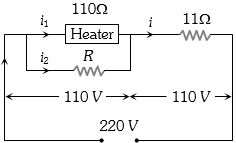
The resistance of a heater coil is $110\, \Omega$. $A$ resistance $R$ is connected in parallel with it,and the combination is joined in series with a resistance of $11\, \Omega$ to a $220\, V$ main line. The heater operates with a power of $110\, W$. The value of $R$ in $\Omega$ is
A
$12.22$
B
$24.42$
C
Negative
D
The given values are not correct
Solution
(A) $1$. The power consumed by the heater is $P = 110\, W$ and its resistance is $R_h = 110\, \Omega$. Using the formula $P = \frac{V_h^2}{R_h}$,we find the voltage across the heater:
$110 = \frac{V_h^2}{110} \Rightarrow V_h^2 = 12100 \Rightarrow V_h = 110\, V$.
$2$. The current through the heater is $i_1 = \frac{V_h}{R_h} = \frac{110}{110} = 1\, A$.
$3$. The total voltage is $220\, V$. Since the heater combination is in series with an $11\, \Omega$ resistor,the voltage across the $11\, \Omega$ resistor is $V_s = 220 - 110 = 110\, V$.
$4$. The total current $i$ flowing through the $11\, \Omega$ resistor is $i = \frac{V_s}{11} = \frac{110}{11} = 10\, A$.
$5$. By Kirchhoff's Current Law,the current through $R$ is $i_2 = i - i_1 = 10 - 1 = 9\, A$.
$6$. Since $R$ is in parallel with the heater,the voltage across $R$ is also $110\, V$. Thus,$R = \frac{V_h}{i_2} = \frac{110}{9} \approx 12.22\, \Omega$.
$110 = \frac{V_h^2}{110} \Rightarrow V_h^2 = 12100 \Rightarrow V_h = 110\, V$.
$2$. The current through the heater is $i_1 = \frac{V_h}{R_h} = \frac{110}{110} = 1\, A$.
$3$. The total voltage is $220\, V$. Since the heater combination is in series with an $11\, \Omega$ resistor,the voltage across the $11\, \Omega$ resistor is $V_s = 220 - 110 = 110\, V$.
$4$. The total current $i$ flowing through the $11\, \Omega$ resistor is $i = \frac{V_s}{11} = \frac{110}{11} = 10\, A$.
$5$. By Kirchhoff's Current Law,the current through $R$ is $i_2 = i - i_1 = 10 - 1 = 9\, A$.
$6$. Since $R$ is in parallel with the heater,the voltage across $R$ is also $110\, V$. Thus,$R = \frac{V_h}{i_2} = \frac{110}{9} \approx 12.22\, \Omega$.
0 likes
View Solution167
MediumMCQ
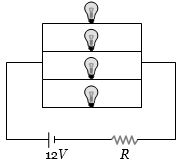
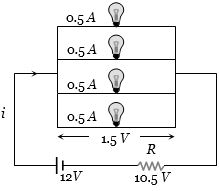
Four identical electrical lamps are labelled $1.5\,V$,$0.5\,A$,which describes the condition necessary for them to operate at normal brightness. $A$ $12\,V$ battery of negligible internal resistance is connected to the lamps as shown. Then:
A
The value of $R$ for normal brightness of each lamp is $(3/4)\,\Omega$.
B
The value of $R$ for normal brightness of each lamp is $(21/4)\,\Omega$.
C
Total power dissipated in the circuit when all lamps are normally bright is $24\,W$.
D
Power dissipated in $R$ is $21\,W$ when all lamps are normally bright.
Solution
(B) For normal brightness of each bulb,the voltage across each bulb must be $1.5\,V$ and the current through each bulb must be $0.5\,A$.
Since the four bulbs are connected in parallel,the total current $i$ flowing through the circuit is the sum of the currents through each bulb: $i = 0.5\,A + 0.5\,A + 0.5\,A + 0.5\,A = 2\,A$.
The voltage across the parallel combination of bulbs is $1.5\,V$.
Since the battery voltage is $12\,V$,the voltage across the resistor $R$ is $V_R = 12\,V - 1.5\,V = 10.5\,V$.
Using Ohm's law for the resistor $R$,$V_R = i \times R$,we get $10.5\,V = 2\,A \times R$.
Therefore,$R = 10.5 / 2 = 21/4\,\Omega$.
Since the four bulbs are connected in parallel,the total current $i$ flowing through the circuit is the sum of the currents through each bulb: $i = 0.5\,A + 0.5\,A + 0.5\,A + 0.5\,A = 2\,A$.
The voltage across the parallel combination of bulbs is $1.5\,V$.
Since the battery voltage is $12\,V$,the voltage across the resistor $R$ is $V_R = 12\,V - 1.5\,V = 10.5\,V$.
Using Ohm's law for the resistor $R$,$V_R = i \times R$,we get $10.5\,V = 2\,A \times R$.
Therefore,$R = 10.5 / 2 = 21/4\,\Omega$.
0 likes
View Solution168
MediumMCQ
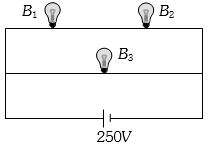
$A$ $100\, W$ bulb $B_1$,and two $60\, W$ bulbs $B_2$ and $B_3$,are connected to a $250\, V$ source,as shown in the figure. Now $W_1, W_2$ and $W_3$ are the output powers of the bulbs $B_1, B_2$ and $B_3$,respectively. Then
A
$W_1 > W_2 = W_3$
B
$W_1 > W_2 > W_3$
C
$W_1 < W_2 = W_3$
D
$W_1 < W_2 < W_3$
Solution
(D) The resistance of a bulb is given by $R = \frac{V^2}{P}$.
For bulb $B_1$ $(100\, W)$,$R_1 = \frac{V^2}{100}$.
For bulbs $B_2$ and $B_3$ $(60\, W)$,$R_2 = R_3 = \frac{V^2}{60}$.
Bulbs $B_1$ and $B_2$ are in series,and this combination is in parallel with bulb $B_3$ across the $250\, V$ source.
The power dissipated in $B_3$ is $W_3 = \frac{(250)^2}{R_3} = \frac{(250)^2}{V^2/60} = 60 \times \frac{(250)^2}{V^2}$.
The current through the series branch ($B_1$ and $B_2$) is $I = \frac{250}{R_1 + R_2} = \frac{250}{\frac{V^2}{100} + \frac{V^2}{60}} = \frac{250}{V^2(\frac{3+5}{300})} = \frac{250 \times 300}{8V^2} = \frac{75000}{8V^2} = \frac{9375}{V^2}$.
The power in $B_1$ is $W_1 = I^2 R_1 = (\frac{9375}{V^2})^2 \times \frac{V^2}{100} = \frac{9375^2}{100 V^2}$.
The power in $B_2$ is $W_2 = I^2 R_2 = (\frac{9375}{V^2})^2 \times \frac{V^2}{60} = \frac{9375^2}{60 V^2}$.
Comparing $W_1$ and $W_2$,since $R_1 < R_2$,$W_1 < W_2$. Since $B_3$ is connected directly across the source,it operates at its rated voltage,while $B_1$ and $B_2$ operate at lower voltages,thus $W_2 < W_3$. Therefore,$W_1 < W_2 < W_3$.
For bulb $B_1$ $(100\, W)$,$R_1 = \frac{V^2}{100}$.
For bulbs $B_2$ and $B_3$ $(60\, W)$,$R_2 = R_3 = \frac{V^2}{60}$.
Bulbs $B_1$ and $B_2$ are in series,and this combination is in parallel with bulb $B_3$ across the $250\, V$ source.
The power dissipated in $B_3$ is $W_3 = \frac{(250)^2}{R_3} = \frac{(250)^2}{V^2/60} = 60 \times \frac{(250)^2}{V^2}$.
The current through the series branch ($B_1$ and $B_2$) is $I = \frac{250}{R_1 + R_2} = \frac{250}{\frac{V^2}{100} + \frac{V^2}{60}} = \frac{250}{V^2(\frac{3+5}{300})} = \frac{250 \times 300}{8V^2} = \frac{75000}{8V^2} = \frac{9375}{V^2}$.
The power in $B_1$ is $W_1 = I^2 R_1 = (\frac{9375}{V^2})^2 \times \frac{V^2}{100} = \frac{9375^2}{100 V^2}$.
The power in $B_2$ is $W_2 = I^2 R_2 = (\frac{9375}{V^2})^2 \times \frac{V^2}{60} = \frac{9375^2}{60 V^2}$.
Comparing $W_1$ and $W_2$,since $R_1 < R_2$,$W_1 < W_2$. Since $B_3$ is connected directly across the source,it operates at its rated voltage,while $B_1$ and $B_2$ operate at lower voltages,thus $W_2 < W_3$. Therefore,$W_1 < W_2 < W_3$.
0 likes
View Solution169
DifficultMCQ
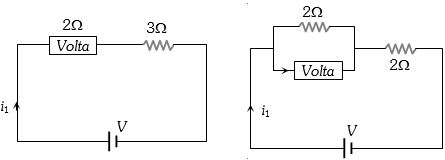
$A$ silver voltameter of resistance $2\, \Omega$ and a $3\, \Omega$ resistor are connected in series across a cell. If a resistance of $2\, \Omega$ is connected in parallel with the voltameter, then the rate of deposition of silver
A
Decreases by $25\, \%$
B
Increases by $25\, \%$
C
Increases by $37.5\, \%$
D
Decreases by $37.5\, \%$
Solution
(D) Initially, the total resistance of the circuit is $R_1 = 2\, \Omega + 3\, \Omega = 5\, \Omega$. The current through the voltameter is $i_1 = \frac{V}{5}$.
When a $2\, \Omega$ resistor is connected in parallel with the $2\, \Omega$ voltameter, the equivalent resistance of this parallel combination is $R_p = \frac{2 \times 2}{2 + 2} = 1\, \Omega$.
The new total resistance of the circuit is $R_2 = 1\, \Omega + 3\, \Omega = 4\, \Omega$. The main current in the circuit is $i = \frac{V}{4}$.
Since the parallel resistors are equal ($2\, \Omega$ each), the current $i$ splits equally. Thus, the current through the voltameter is $i_2 = \frac{i}{2} = \frac{V}{8}$.
The rate of deposition of silver is proportional to the current, $R \propto i$. The percentage change in the rate is $\frac{i_2 - i_1}{i_1} \times 100$.
Percentage change $= \frac{\frac{V}{8} - \frac{V}{5}}{\frac{V}{5}} \times 100 = \frac{\frac{5V - 8V}{40}}{\frac{V}{5}} \times 100 = \frac{-3V}{40} \times \frac{5}{V} \times 100 = -37.5\, \%$.
Therefore, the rate of deposition decreases by $37.5\, \%$.
When a $2\, \Omega$ resistor is connected in parallel with the $2\, \Omega$ voltameter, the equivalent resistance of this parallel combination is $R_p = \frac{2 \times 2}{2 + 2} = 1\, \Omega$.
The new total resistance of the circuit is $R_2 = 1\, \Omega + 3\, \Omega = 4\, \Omega$. The main current in the circuit is $i = \frac{V}{4}$.
Since the parallel resistors are equal ($2\, \Omega$ each), the current $i$ splits equally. Thus, the current through the voltameter is $i_2 = \frac{i}{2} = \frac{V}{8}$.
The rate of deposition of silver is proportional to the current, $R \propto i$. The percentage change in the rate is $\frac{i_2 - i_1}{i_1} \times 100$.
Percentage change $= \frac{\frac{V}{8} - \frac{V}{5}}{\frac{V}{5}} \times 100 = \frac{\frac{5V - 8V}{40}}{\frac{V}{5}} \times 100 = \frac{-3V}{40} \times \frac{5}{V} \times 100 = -37.5\, \%$.
Therefore, the rate of deposition decreases by $37.5\, \%$.
0 likes
View Solution170
MediumMCQ
The thermo $e.m.f.$ of a thermocouple is $25\,\mu V/^{\circ}C$ at room temperature. $A$ galvanometer of $40\,\Omega$ resistance, capable of detecting current as low as $10^{-5}\,A$, is connected with the thermocouple. The smallest temperature difference that can be detected by this system is ................ $^{\circ}C$.
A
$20$
B
$16$
C
$12$
D
$8$
Solution
(B) The thermo $e.m.f.$ $(e)$ produced by the thermocouple is given by the product of the thermo $e.m.f.$ coefficient $(\alpha)$ and the temperature difference $(\Delta \theta)$: $e = \alpha \Delta \theta$.
According to Ohm's law, the $e.m.f.$ is also equal to the product of the current $(i)$ and the resistance $(R)$: $e = iR$.
Equating the two expressions: $\alpha \Delta \theta = iR$.
Given: $\alpha = 25\,\mu V/^{\circ}C = 25 \times 10^{-6}\,V/^{\circ}C$, $i = 10^{-5}\,A$, and $R = 40\,\Omega$.
Substituting the values: $(25 \times 10^{-6}) \times \Delta \theta = 10^{-5} \times 40$.
$\Delta \theta = \frac{40 \times 10^{-5}}{25 \times 10^{-6}} = \frac{400}{25} = 16\,^{\circ}C$.
Therefore, the smallest temperature difference that can be detected is $16\,^{\circ}C$.
According to Ohm's law, the $e.m.f.$ is also equal to the product of the current $(i)$ and the resistance $(R)$: $e = iR$.
Equating the two expressions: $\alpha \Delta \theta = iR$.
Given: $\alpha = 25\,\mu V/^{\circ}C = 25 \times 10^{-6}\,V/^{\circ}C$, $i = 10^{-5}\,A$, and $R = 40\,\Omega$.
Substituting the values: $(25 \times 10^{-6}) \times \Delta \theta = 10^{-5} \times 40$.
$\Delta \theta = \frac{40 \times 10^{-5}}{25 \times 10^{-6}} = \frac{400}{25} = 16\,^{\circ}C$.
Therefore, the smallest temperature difference that can be detected is $16\,^{\circ}C$.
0 likes
View Solution171
MediumMCQ
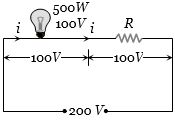
An electric bulb rated for $500\, W$ at $100\, V$ is used in a circuit having a $200\, V$ supply. The resistance $R$ that must be put in series with the bulb,so that the bulb draws $500\, W$,is ................. $\Omega$.
A
$10$
B
$20$
C
$50$
D
$100$
Solution
(B) The rated power of the bulb is $P = 500\, W$ and the rated voltage is $V_{rated} = 100\, V$.
The current $i$ flowing through the bulb when it operates at its rated power is given by $i = \frac{P}{V_{rated}} = \frac{500}{100} = 5\, A$.
Since the bulb is connected in series with a resistor $R$ to a $200\, V$ supply,the total voltage is divided between the bulb and the resistor.
The voltage across the bulb is $100\, V$,so the voltage across the resistor $R$ must be $V_R = 200\, V - 100\, V = 100\, V$.
Using Ohm's law for the resistor $R$,we have $V_R = i \times R$.
Substituting the values,$100 = 5 \times R$.
Therefore,$R = \frac{100}{5} = 20\, \Omega$.
The current $i$ flowing through the bulb when it operates at its rated power is given by $i = \frac{P}{V_{rated}} = \frac{500}{100} = 5\, A$.
Since the bulb is connected in series with a resistor $R$ to a $200\, V$ supply,the total voltage is divided between the bulb and the resistor.
The voltage across the bulb is $100\, V$,so the voltage across the resistor $R$ must be $V_R = 200\, V - 100\, V = 100\, V$.
Using Ohm's law for the resistor $R$,we have $V_R = i \times R$.
Substituting the values,$100 = 5 \times R$.
Therefore,$R = \frac{100}{5} = 20\, \Omega$.
0 likes
View Solution172
DifficultMCQ
$A$ thermocouple is formed by two metals $X$ and $Y$. Metal $X$ comes earlier than $Y$ in the Seebeck series. If the temperature of the hot junction increases beyond the temperature of inversion,then the direction of the current in the thermocouple will be:
A
$X$ to $Y$ through the cold junction
B
$X$ to $Y$ through the hot junction
C
$Y$ to $X$ through the cold junction
D
Both $(b)$ and $(c)$
Solution
(D) In a thermocouple,the thermoelectric $EMF$ $(E)$ is given by $E = \alpha \theta + \frac{1}{2} \beta \theta^2$,where $\theta$ is the temperature difference between the junctions.
Under normal conditions (temperature below the inversion temperature),the current flows from metal $X$ to metal $Y$ through the cold junction.
When the temperature of the hot junction exceeds the temperature of inversion,the direction of the thermoelectric $EMF$ reverses.
Consequently,the current direction reverses,flowing from $X$ to $Y$ through the hot junction,which is equivalent to flowing from $Y$ to $X$ through the cold junction.
Therefore,both options $(b)$ and $(c)$ describe the same physical state.
Under normal conditions (temperature below the inversion temperature),the current flows from metal $X$ to metal $Y$ through the cold junction.
When the temperature of the hot junction exceeds the temperature of inversion,the direction of the thermoelectric $EMF$ reverses.
Consequently,the current direction reverses,flowing from $X$ to $Y$ through the hot junction,which is equivalent to flowing from $Y$ to $X$ through the cold junction.
Therefore,both options $(b)$ and $(c)$ describe the same physical state.
0 likes
View Solution173
DifficultMCQ
The resistance of a voltameter is $2\,\Omega$. It is connected in series to a battery of $10\,V$ through a resistance of $3\,\Omega$. In a certain time,the mass deposited on the cathode is $1\,g$. Now,the voltameter and the $3\,\Omega$ resistance are connected in parallel with the battery. The increase in the deposited mass on the cathode in the same time will be .............. $g$.
A
$0$
B
$1.5$
C
$2.5$
D
$2$
Solution
(B) According to Faraday's laws of electrolysis,the mass $m$ deposited on the cathode is given by $m = Zit$,where $Z$ is the electrochemical equivalent,$i$ is the current through the voltameter,and $t$ is the time.
Case $1$: Series connection.
The total resistance is $R_s = 2\,\Omega + 3\,\Omega = 5\,\Omega$.
The current through the voltameter is $i_1 = \frac{V}{R_s} = \frac{10\,V}{5\,\Omega} = 2\,A$.
The mass deposited is $m_1 = Z i_1 t = 1\,g$.
Case $2$: Parallel connection.
The voltameter is connected directly across the $10\,V$ battery.
The current through the voltameter is $i_2 = \frac{V}{R_v} = \frac{10\,V}{2\,\Omega} = 5\,A$.
The mass deposited is $m_2 = Z i_2 t$.
Taking the ratio: $\frac{m_2}{m_1} = \frac{i_2}{i_1} = \frac{5\,A}{2\,A} = 2.5$.
Since $m_1 = 1\,g$,we have $m_2 = 2.5\,g$.
The increase in the deposited mass is $\Delta m = m_2 - m_1 = 2.5\,g - 1\,g = 1.5\,g$.
Case $1$: Series connection.
The total resistance is $R_s = 2\,\Omega + 3\,\Omega = 5\,\Omega$.
The current through the voltameter is $i_1 = \frac{V}{R_s} = \frac{10\,V}{5\,\Omega} = 2\,A$.
The mass deposited is $m_1 = Z i_1 t = 1\,g$.
Case $2$: Parallel connection.
The voltameter is connected directly across the $10\,V$ battery.
The current through the voltameter is $i_2 = \frac{V}{R_v} = \frac{10\,V}{2\,\Omega} = 5\,A$.
The mass deposited is $m_2 = Z i_2 t$.
Taking the ratio: $\frac{m_2}{m_1} = \frac{i_2}{i_1} = \frac{5\,A}{2\,A} = 2.5$.
Since $m_1 = 1\,g$,we have $m_2 = 2.5\,g$.
The increase in the deposited mass is $\Delta m = m_2 - m_1 = 2.5\,g - 1\,g = 1.5\,g$.
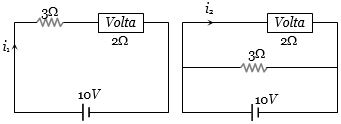
0 likes
View Solution174
DifficultMCQ
$A$ current of $1.5\, A$ flows through a copper voltameter. The thickness of copper deposited on the electrode surface of area $50\, cm^2$ in $20\, min$ will be (Density of copper $= 9000\, kg/m^3$ and $E.C.E.$ of copper $= 0.00033\, g/C$).
A
$2.6 \times 10^{-5}\, m$
B
$2.6 \times 10^{-4}\, m$
C
$1.3 \times 10^{-5}\, m$
D
$1.3 \times 10^{-4}\, m$
Solution
(C) The mass of copper deposited is given by Faraday's law of electrolysis: $m = Z i t$.
Also,mass can be expressed as $m = \text{Density} (\rho) \times \text{Volume} (V) = \rho \times A \times x$,where $A$ is the area and $x$ is the thickness.
Equating the two expressions: $\rho A x = Z i t$.
Therefore,the thickness $x = \frac{Z i t}{A \rho}$.
Given values:
$Z = 0.00033\, g/C = 0.00033 \times 10^{-3}\, kg/C = 3.3 \times 10^{-7}\, kg/C$
$i = 1.5\, A$
$t = 20\, min = 20 \times 60 = 1200\, s$
$A = 50\, cm^2 = 50 \times 10^{-4}\, m^2$
$\rho = 9000\, kg/m^3$
Substituting the values:
$x = \frac{0.00033 \times 10^{-3} \times 1.5 \times 1200}{50 \times 10^{-4} \times 9000}$
$x = \frac{0.00033 \times 1.5 \times 1.2}{50 \times 9} = \frac{0.000594}{450} = 1.32 \times 10^{-6}\, m$ (Wait,re-calculating: $x = \frac{3.3 \times 10^{-7} \times 1.5 \times 1200}{50 \times 10^{-4} \times 9000} = \frac{5.94 \times 10^{-4}}{45} = 1.32 \times 10^{-5}\, m$).
Thus,the thickness is approximately $1.3 \times 10^{-5}\, m$.
Also,mass can be expressed as $m = \text{Density} (\rho) \times \text{Volume} (V) = \rho \times A \times x$,where $A$ is the area and $x$ is the thickness.
Equating the two expressions: $\rho A x = Z i t$.
Therefore,the thickness $x = \frac{Z i t}{A \rho}$.
Given values:
$Z = 0.00033\, g/C = 0.00033 \times 10^{-3}\, kg/C = 3.3 \times 10^{-7}\, kg/C$
$i = 1.5\, A$
$t = 20\, min = 20 \times 60 = 1200\, s$
$A = 50\, cm^2 = 50 \times 10^{-4}\, m^2$
$\rho = 9000\, kg/m^3$
Substituting the values:
$x = \frac{0.00033 \times 10^{-3} \times 1.5 \times 1200}{50 \times 10^{-4} \times 9000}$
$x = \frac{0.00033 \times 1.5 \times 1.2}{50 \times 9} = \frac{0.000594}{450} = 1.32 \times 10^{-6}\, m$ (Wait,re-calculating: $x = \frac{3.3 \times 10^{-7} \times 1.5 \times 1200}{50 \times 10^{-4} \times 9000} = \frac{5.94 \times 10^{-4}}{45} = 1.32 \times 10^{-5}\, m$).
Thus,the thickness is approximately $1.3 \times 10^{-5}\, m$.
0 likes
View Solution175
DifficultMCQ
$A$ thermocouple of resistance $1.6\,\Omega$ is connected in series with a galvanometer of $8\,\Omega$ resistance. The thermocouple develops an e.m.f. of $10\,\mu V$ per degree temperature difference between two junctions. When one junction is kept at $0\,^{\circ}C$ and the other in a molten metal,the galvanometer reads $8\,mV$. The temperature of the molten metal,when e.m.f. varies linearly with temperature difference,will be ............ $^{\circ}C$.
A
$960$
B
$1050$
C
$1275$
D
$1545$
Solution
(A) Let the temperature of the molten metal be $t\,^{\circ}C$.
The thermo-emf generated is $e = 10 \times 10^{-6} \times t\,\text{V} = 10^{-5}t\,\text{V}$.
The total resistance of the circuit is $R_{total} = R_{thermocouple} + R_{galvanometer} = 1.6\,\Omega + 8\,\Omega = 9.6\,\Omega$.
The current in the circuit is $i = \frac{e}{R_{total}} = \frac{10^{-5}t}{9.6}\,\text{A}$.
The galvanometer reads the potential difference across its own resistance,which is $V_G = 8\,\text{mV} = 8 \times 10^{-3}\,\text{V}$.
The current through the galvanometer is also $i = \frac{V_G}{R_G} = \frac{8 \times 10^{-3}}{8} = 10^{-3}\,\text{A}$.
Equating the two expressions for current: $\frac{10^{-5}t}{9.6} = 10^{-3}$.
Solving for $t$: $t = \frac{10^{-3} \times 9.6}{10^{-5}} = 9.6 \times 10^2 = 960\,^{\circ}C$.
The thermo-emf generated is $e = 10 \times 10^{-6} \times t\,\text{V} = 10^{-5}t\,\text{V}$.
The total resistance of the circuit is $R_{total} = R_{thermocouple} + R_{galvanometer} = 1.6\,\Omega + 8\,\Omega = 9.6\,\Omega$.
The current in the circuit is $i = \frac{e}{R_{total}} = \frac{10^{-5}t}{9.6}\,\text{A}$.
The galvanometer reads the potential difference across its own resistance,which is $V_G = 8\,\text{mV} = 8 \times 10^{-3}\,\text{V}$.
The current through the galvanometer is also $i = \frac{V_G}{R_G} = \frac{8 \times 10^{-3}}{8} = 10^{-3}\,\text{A}$.
Equating the two expressions for current: $\frac{10^{-5}t}{9.6} = 10^{-3}$.
Solving for $t$: $t = \frac{10^{-3} \times 9.6}{10^{-5}} = 9.6 \times 10^2 = 960\,^{\circ}C$.
0 likes
View Solution176
DifficultMCQ
The emf of a thermocouple,one junction of which is kept at $0\,^{\circ}C$,is given by $e = at + bt^2$. The Peltier coefficient will be
A
$(t + 273)(a + 2bt)$
B
$(t + 273)(a - 2bt)$
C
$(t - 273)(a + 2bt)$
D
$(t - 273)(a - 2bt)$
Solution
(A) The Peltier coefficient $\pi$ is given by the relation $\pi = T \frac{de}{dT}$,where $T$ is the absolute temperature in Kelvin.
Given that one junction is at $0\,^{\circ}C$,the absolute temperature $T$ is related to the Celsius temperature $t$ by $T = t + 273$.
Substituting $t = T - 273$ into the given emf equation $e = at + bt^2$:
$e = a(T - 273) + b(T - 273)^2$.
Differentiating with respect to $T$:
$\frac{de}{dT} = a + 2b(T - 273)$.
Since $T - 273 = t$,we have $\frac{de}{dT} = a + 2bt$.
Now,calculating the Peltier coefficient:
$\pi = T \frac{de}{dT} = (t + 273)(a + 2bt)$.
Given that one junction is at $0\,^{\circ}C$,the absolute temperature $T$ is related to the Celsius temperature $t$ by $T = t + 273$.
Substituting $t = T - 273$ into the given emf equation $e = at + bt^2$:
$e = a(T - 273) + b(T - 273)^2$.
Differentiating with respect to $T$:
$\frac{de}{dT} = a + 2b(T - 273)$.
Since $T - 273 = t$,we have $\frac{de}{dT} = a + 2bt$.
Now,calculating the Peltier coefficient:
$\pi = T \frac{de}{dT} = (t + 273)(a + 2bt)$.
0 likes
View Solution177
DifficultMCQ
The wiring of a house has a resistance of $6\,\Omega$. $A$ $100\,W$ bulb is glowing. If a geyser of $1000\,W$ is switched on,the change in potential drop across the bulb is nearly .................. $V$.
A
Nil
B
$23$
C
$32$
D
$12$
Solution
(B) The rated voltage for both appliances is assumed to be $220\,V$.
Resistance of the bulb,$R_{Bulb} = \frac{V^2}{P} = \frac{220^2}{100} = 484\,\Omega$.
Resistance of the geyser,$R_{Geyser} = \frac{V^2}{P} = \frac{220^2}{1000} = 48.4\,\Omega$.
$(i)$ When only the bulb is $ON$,the circuit consists of the wiring resistance $(6\,\Omega)$ in series with the bulb $(484\,\Omega)$.
The potential drop across the bulb is $V_{Bulb1} = 220 \times \frac{484}{484 + 6} = 220 \times \frac{484}{490} \approx 217.3\,V$.
$(ii)$ When the geyser is also switched $ON$,the bulb and geyser are in parallel. Their equivalent resistance is $R_p = \frac{484 \times 48.4}{484 + 48.4} = \frac{23425.6}{532.4} = 44\,\Omega$.
The circuit now consists of the wiring resistance $(6\,\Omega)$ in series with the parallel combination $(44\,\Omega)$.
The potential drop across the parallel combination (and thus the bulb) is $V_{Bulb2} = 220 \times \frac{44}{44 + 6} = 220 \times \frac{44}{50} = 193.6\,V$.
The change in potential drop is $\Delta V = V_{Bulb1} - V_{Bulb2} = 217.3 - 193.6 = 23.7\,V$.
This is nearly $23\,V$.
Resistance of the bulb,$R_{Bulb} = \frac{V^2}{P} = \frac{220^2}{100} = 484\,\Omega$.
Resistance of the geyser,$R_{Geyser} = \frac{V^2}{P} = \frac{220^2}{1000} = 48.4\,\Omega$.
$(i)$ When only the bulb is $ON$,the circuit consists of the wiring resistance $(6\,\Omega)$ in series with the bulb $(484\,\Omega)$.
The potential drop across the bulb is $V_{Bulb1} = 220 \times \frac{484}{484 + 6} = 220 \times \frac{484}{490} \approx 217.3\,V$.
$(ii)$ When the geyser is also switched $ON$,the bulb and geyser are in parallel. Their equivalent resistance is $R_p = \frac{484 \times 48.4}{484 + 48.4} = \frac{23425.6}{532.4} = 44\,\Omega$.
The circuit now consists of the wiring resistance $(6\,\Omega)$ in series with the parallel combination $(44\,\Omega)$.
The potential drop across the parallel combination (and thus the bulb) is $V_{Bulb2} = 220 \times \frac{44}{44 + 6} = 220 \times \frac{44}{50} = 193.6\,V$.
The change in potential drop is $\Delta V = V_{Bulb1} - V_{Bulb2} = 217.3 - 193.6 = 23.7\,V$.
This is nearly $23\,V$.
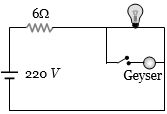
0 likes
View Solution178
DifficultMCQ
$A$ $12\, V$ lead accumulator is being charged using a $24\, V$ supply with an external resistance of $2\,\Omega$. The internal resistance of the accumulator is $1\,\Omega$. Find the time in which it will store $360\, Wh$ of energy.
A
$1$
B
$7.5$
C
$10$
D
None of these
Solution
(B) The charging current $i$ is given by the formula $i = \frac{V_{supply} - V_{battery}}{R_{ext} + r_{int}}$.
Substituting the given values: $i = \frac{24 - 12}{2 + 1} = \frac{12}{3} = 4\, A$.
The energy stored in the battery is given by $E = V_{battery} \times i \times t$.
Given $E = 360\, Wh$, $V_{battery} = 12\, V$, and $i = 4\, A$.
$360 = 12 \times 4 \times t$.
$360 = 48 \times t$.
$t = \frac{360}{48} = 7.5\, hours$.
Substituting the given values: $i = \frac{24 - 12}{2 + 1} = \frac{12}{3} = 4\, A$.
The energy stored in the battery is given by $E = V_{battery} \times i \times t$.
Given $E = 360\, Wh$, $V_{battery} = 12\, V$, and $i = 4\, A$.
$360 = 12 \times 4 \times t$.
$360 = 48 \times t$.
$t = \frac{360}{48} = 7.5\, hours$.
0 likes
View Solution179
DifficultMCQ
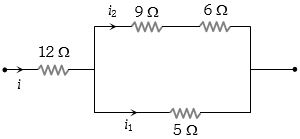
In the following circuit,the $5 \, \Omega$ resistor develops $45 \, J/s$ due to the current flowing through it. The power developed per second across the $12 \, \Omega$ resistor is ............. $W$.
A
$16$
B
$192$
C
$36$
D
$64$
Solution
(B) The circuit consists of a $12 \, \Omega$ resistor in series with a parallel combination of two branches. One branch contains a $5 \, \Omega$ resistor,and the other branch contains resistors of $9 \, \Omega$ and $6 \, \Omega$ in series (total $15 \, \Omega$).
Let $i_1$ be the current through the $5 \, \Omega$ resistor and $i_2$ be the current through the $9 \, \Omega$ and $6 \, \Omega$ branch.
Since the branches are in parallel,the potential difference across them is equal: $i_1 \times 5 = i_2 \times (9 + 6) = i_2 \times 15$.
Therefore,$\frac{i_1}{i_2} = \frac{15}{5} = 3$,which means $i_1 = 3i_2$.
The power developed in the $5 \, \Omega$ resistor is $P_5 = i_1^2 \times 5 = 45 \, W$.
$i_1^2 = \frac{45}{5} = 9 \Rightarrow i_1 = 3 \, A$.
Since $i_1 = 3i_2$,we have $3 = 3i_2$,so $i_2 = 1 \, A$.
The total current $i$ flowing through the $12 \, \Omega$ resistor is $i = i_1 + i_2 = 3 + 1 = 4 \, A$.
The power developed in the $12 \, \Omega$ resistor is $P_{12} = i^2 \times 12 = (4)^2 \times 12 = 16 \times 12 = 192 \, W$.
Let $i_1$ be the current through the $5 \, \Omega$ resistor and $i_2$ be the current through the $9 \, \Omega$ and $6 \, \Omega$ branch.
Since the branches are in parallel,the potential difference across them is equal: $i_1 \times 5 = i_2 \times (9 + 6) = i_2 \times 15$.
Therefore,$\frac{i_1}{i_2} = \frac{15}{5} = 3$,which means $i_1 = 3i_2$.
The power developed in the $5 \, \Omega$ resistor is $P_5 = i_1^2 \times 5 = 45 \, W$.
$i_1^2 = \frac{45}{5} = 9 \Rightarrow i_1 = 3 \, A$.
Since $i_1 = 3i_2$,we have $3 = 3i_2$,so $i_2 = 1 \, A$.
The total current $i$ flowing through the $12 \, \Omega$ resistor is $i = i_1 + i_2 = 3 + 1 = 4 \, A$.
The power developed in the $12 \, \Omega$ resistor is $P_{12} = i^2 \times 12 = (4)^2 \times 12 = 16 \times 12 = 192 \, W$.
0 likes
View Solution180
DifficultMCQ
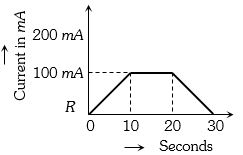
In a copper voltameter,the mass deposited in $30\, \text{s}$ is $m\, \text{g}$. If the current-time graph is as shown in the figure,the Electrochemical Equivalent $(ECE)$ of copper is:
A
$m/2$
B
$m/1.5$
C
$m/3$
D
$m/4$
Solution
(A) The total charge $q$ passed through the voltameter is equal to the area under the current-time graph.
Area $= \text{Area of trapezium} = \frac{1}{2} \times (\text{sum of parallel sides}) \times \text{height}$
Area $= \frac{1}{2} \times (10 + 30) \times 100 \times 10^{-3} \, \text{A} = \frac{1}{2} \times 40 \times 0.1 = 2 \, \text{C}$.
According to Faraday's law of electrolysis,$m = z q$,where $z$ is the $ECE$ of copper.
Given that the mass deposited is $m$ for a charge $q = 2 \, \text{C}$,we have:
$m = z \times 2$
$z = \frac{m}{2}$.
Area $= \text{Area of trapezium} = \frac{1}{2} \times (\text{sum of parallel sides}) \times \text{height}$
Area $= \frac{1}{2} \times (10 + 30) \times 100 \times 10^{-3} \, \text{A} = \frac{1}{2} \times 40 \times 0.1 = 2 \, \text{C}$.
According to Faraday's law of electrolysis,$m = z q$,where $z$ is the $ECE$ of copper.
Given that the mass deposited is $m$ for a charge $q = 2 \, \text{C}$,we have:
$m = z \times 2$
$z = \frac{m}{2}$.
0 likes
View Solution181
MediumMCQ
For the previous objective,which of the following graphs is correct?
A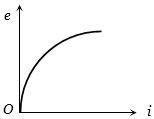
B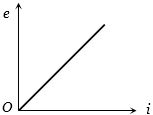
C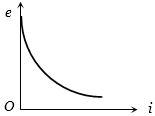
D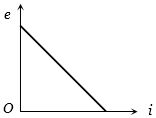
Solution
(D) If at any instant,the current through the circuit is $i$,then applying Kirchhoff's voltage law to the circuit (assuming a source with $EMF$ $E$ and internal resistance $R$):
$iR + e = E$
Rearranging the equation,we get:
$e = E - iR$
This equation is of the form $y = mx + c$,where $y = e$,$x = i$,$m = -R$ (slope),and $c = E$ (intercept).
Since the slope is negative $(-R)$ and the intercept is positive $(E)$,the graph between $e$ and $i$ will be a straight line with a negative slope and a positive intercept on the $e$-axis.
Therefore,the correct graph is represented by option $D$.
$iR + e = E$
Rearranging the equation,we get:
$e = E - iR$
This equation is of the form $y = mx + c$,where $y = e$,$x = i$,$m = -R$ (slope),and $c = E$ (intercept).
Since the slope is negative $(-R)$ and the intercept is positive $(E)$,the graph between $e$ and $i$ will be a straight line with a negative slope and a positive intercept on the $e$-axis.
Therefore,the correct graph is represented by option $D$.
0 likes
View Solution182
EasyMCQ
When a constant voltage is applied across the ends of a metallic wire,the heat produced in the wire will be doubled if:
A
Both the length and radius of the wire are halved.
B
Both the length and radius of the wire are doubled.
C
The radius of the wire is doubled.
D
The length of the wire is doubled.
Solution
(B) The heat produced $H$ in a wire with resistance $R$ under constant voltage $V$ is given by $H = \frac{V^2}{R} t$. For a fixed time $t$,$H \propto \frac{1}{R}$.
To double the heat $(H' = 2H)$,the resistance must be halved $(R' = R/2)$.
The resistance of a wire is given by $R = \rho \frac{l}{A} = \rho \frac{l}{\pi r^2}$.
If the length $l$ is halved $(l' = l/2)$ and the radius $r$ is kept constant,$R' = \rho \frac{l/2}{\pi r^2} = R/2$. This satisfies the condition.
However,checking the options provided: If the length $l$ is halved $(l' = l/2)$ and radius $r$ is halved $(r' = r/2)$,then $R' = \rho \frac{l/2}{\pi (r/2)^2} = \rho \frac{l/2}{\pi r^2 / 4} = 2R$. This does not work.
If the length $l$ is doubled $(l' = 2l)$ and radius $r$ is doubled $(r' = 2r)$,then $R' = \rho \frac{2l}{\pi (2r)^2} = \rho \frac{2l}{4\pi r^2} = R/2$. This satisfies the condition.
Therefore,the correct option is $B$.
To double the heat $(H' = 2H)$,the resistance must be halved $(R' = R/2)$.
The resistance of a wire is given by $R = \rho \frac{l}{A} = \rho \frac{l}{\pi r^2}$.
If the length $l$ is halved $(l' = l/2)$ and the radius $r$ is kept constant,$R' = \rho \frac{l/2}{\pi r^2} = R/2$. This satisfies the condition.
However,checking the options provided: If the length $l$ is halved $(l' = l/2)$ and radius $r$ is halved $(r' = r/2)$,then $R' = \rho \frac{l/2}{\pi (r/2)^2} = \rho \frac{l/2}{\pi r^2 / 4} = 2R$. This does not work.
If the length $l$ is doubled $(l' = 2l)$ and radius $r$ is doubled $(r' = 2r)$,then $R' = \rho \frac{2l}{\pi (2r)^2} = \rho \frac{2l}{4\pi r^2} = R/2$. This satisfies the condition.
Therefore,the correct option is $B$.
0 likes
View Solution183
DifficultMCQ
For the network of resistors shown in the figure,choose the correct option.
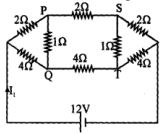
A
The current flowing through $PQ$ is zero.
B
$I_1 = 3A$
C
The potential at $S$ is less than the potential at $Q$.
D
All of the above.
Solution
(B) Let the left junction be $A$ and the right junction be $B$. The circuit is a bridge. The left part consists of two parallel branches: one with $2\Omega$ and $1\Omega$ in series (total $3\Omega$) and another with $4\Omega$ in series with the $PQ$ branch. However,looking at the bridge structure,the left side has two parallel branches connected to $P$ and $Q$: one branch has $2\Omega$ and $4\Omega$ resistors. The potential at $P$ and $Q$ can be calculated. The equivalent resistance of the left part is $R_L = (2 || 4) = 8/6 = 4/3 \Omega$. The equivalent resistance of the right part is $R_R = (2 || 4) = 4/3 \Omega$. The central part has $1\Omega$ (between $P$ and $S$) and $1\Omega$ (between $Q$ and $T$) and $4\Omega$ (between $Q$ and $T$). Actually,the bridge is balanced if the ratio of resistances is equal. The left side has $2\Omega$ and $4\Omega$ connected to the source. The potential at $P$ is $V_P = 12 \times (4/(2+4)) = 8V$ and $V_Q = 12 \times (2/(2+4)) = 4V$. The right side is symmetric,so $V_S = 4V$ and $V_T = 8V$. Since $V_P = 8V$ and $V_S = 4V$,current flows from $P$ to $S$. The branch $PQ$ has a $1\Omega$ resistor. Since $V_P=8V$ and $V_Q=4V$,current flows through $PQ$. Thus,option $A$ is incorrect. Calculating $I_1$: The total resistance is $R_{eq} = 4\Omega$. $I_1 = V/R_{eq} = 12/4 = 3A$. Option $B$ is correct. Since $V_S = 4V$ and $V_Q = 4V$,the potential at $S$ is equal to the potential at $Q$. Thus,$C$ is incorrect. Therefore,the correct option is $B$.
0 likes
View Solution184
EasyMCQ
Two electric bulbs with ratings $25\, W - 220\, V$ and $100\, W - 220\, V$ are connected in series to a $440\, V$ supply. Which bulb will fuse?
A
$100\, W$
B
$25\, W$
C
Both
D
None
Solution
(B) First,calculate the resistance of each bulb using $R = V^2 / P$.
For the first bulb $(P_1 = 25\, W, V = 220\, V)$: $R_1 = (220)^2 / 25 = 48400 / 25 = 1936\, \Omega$.
For the second bulb $(P_2 = 100\, W, V = 220\, V)$: $R_2 = (220)^2 / 100 = 48400 / 100 = 484\, \Omega$.
When connected in series to a $440\, V$ supply,the total resistance is $R_{eq} = R_1 + R_2 = 1936 + 484 = 2420\, \Omega$.
The current in the series circuit is $I = V / R_{eq} = 440 / 2420 = 44 / 242 = 2 / 11\, A$.
The voltage drop across the first bulb is $V_1 = I \times R_1 = (2 / 11) \times 1936 = 2 \times 176 = 352\, V$.
The voltage drop across the second bulb is $V_2 = I \times R_2 = (2 / 11) \times 484 = 2 \times 44 = 88\, V$.
Since the voltage drop across the $25\, W$ bulb $(352\, V)$ exceeds its rated voltage $(220\, V)$,it will fuse.
For the first bulb $(P_1 = 25\, W, V = 220\, V)$: $R_1 = (220)^2 / 25 = 48400 / 25 = 1936\, \Omega$.
For the second bulb $(P_2 = 100\, W, V = 220\, V)$: $R_2 = (220)^2 / 100 = 48400 / 100 = 484\, \Omega$.
When connected in series to a $440\, V$ supply,the total resistance is $R_{eq} = R_1 + R_2 = 1936 + 484 = 2420\, \Omega$.
The current in the series circuit is $I = V / R_{eq} = 440 / 2420 = 44 / 242 = 2 / 11\, A$.
The voltage drop across the first bulb is $V_1 = I \times R_1 = (2 / 11) \times 1936 = 2 \times 176 = 352\, V$.
The voltage drop across the second bulb is $V_2 = I \times R_2 = (2 / 11) \times 484 = 2 \times 44 = 88\, V$.
Since the voltage drop across the $25\, W$ bulb $(352\, V)$ exceeds its rated voltage $(220\, V)$,it will fuse.
0 likes
View Solution185
EasyMCQ
As shown in the figure,the power dissipated in the $6\,\Omega$ resistor is $6\,W$. The power dissipated in the $4\,\Omega$ resistor will be: (in $,W$)
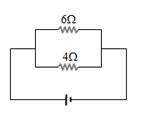
A
$16$
B
$9$
C
$6$
D
$4$
Solution
(B) In a parallel circuit,the potential difference $V$ across each resistor is the same.
The power dissipated in a resistor is given by $P = \frac{V^2}{R}$.
Since $V$ is constant,$P \propto \frac{1}{R}$.
Therefore,$\frac{P_1}{P_2} = \frac{R_2}{R_1}$.
Given $P_1 = 6\,W$ for $R_1 = 6\,\Omega$,and we need to find $P_2$ for $R_2 = 4\,\Omega$.
Substituting the values: $\frac{6}{P_2} = \frac{4}{6}$.
$\frac{6}{P_2} = \frac{2}{3}$.
$P_2 = \frac{6 \times 3}{2} = 9\,W$.
The power dissipated in a resistor is given by $P = \frac{V^2}{R}$.
Since $V$ is constant,$P \propto \frac{1}{R}$.
Therefore,$\frac{P_1}{P_2} = \frac{R_2}{R_1}$.
Given $P_1 = 6\,W$ for $R_1 = 6\,\Omega$,and we need to find $P_2$ for $R_2 = 4\,\Omega$.
Substituting the values: $\frac{6}{P_2} = \frac{4}{6}$.
$\frac{6}{P_2} = \frac{2}{3}$.
$P_2 = \frac{6 \times 3}{2} = 9\,W$.
0 likes
View Solution186
DifficultMCQ
If $96500 \ C$ of charge deposits $1 \ g$ of a substance,how much time will it take to deposit $20 \ mg$ of copper from a copper sulfate solution using a current of $0.15 \ A$?
A
$5 \ min \ 20 \ s$
B
$6 \ min \ 42 \ s$
C
$4 \ min \ 40 \ s$
D
$5 \ min \ 50 \ s$
Solution
(B) The mass deposited is given by Faraday's law: $m = Z \cdot i \cdot t$,where $Z$ is the electrochemical equivalent.
Given that $96500 \ C$ deposits $1 \ g$,the electrochemical equivalent $Z$ for the substance is $Z = \frac{1 \ g}{96500 \ C} = \frac{1}{96500} \ g/C$.
For copper $(Cu^{2+})$,the molar mass is approximately $63.5 \ g/mol$ and valency $n=2$,so the equivalent mass is $31.75 \ g/mol$. However,using the provided context where $1 \ g$ is deposited by $96500 \ C$,we use $Z = \frac{32}{96500} \ g/C$ (based on the provided solution logic).
Given $m = 20 \ mg = 20 \times 10^{-3} \ g$,$i = 0.15 \ A$.
Substituting the values: $20 \times 10^{-3} = \left( \frac{32}{96500} \right) \times 0.15 \times t$.
$t = \frac{20 \times 10^{-3} \times 96500}{32 \times 0.15} = \frac{1930}{4.8} \approx 402.08 \ s$.
$402.08 \ s = 6 \ min \ 42 \ s$.
Given that $96500 \ C$ deposits $1 \ g$,the electrochemical equivalent $Z$ for the substance is $Z = \frac{1 \ g}{96500 \ C} = \frac{1}{96500} \ g/C$.
For copper $(Cu^{2+})$,the molar mass is approximately $63.5 \ g/mol$ and valency $n=2$,so the equivalent mass is $31.75 \ g/mol$. However,using the provided context where $1 \ g$ is deposited by $96500 \ C$,we use $Z = \frac{32}{96500} \ g/C$ (based on the provided solution logic).
Given $m = 20 \ mg = 20 \times 10^{-3} \ g$,$i = 0.15 \ A$.
Substituting the values: $20 \times 10^{-3} = \left( \frac{32}{96500} \right) \times 0.15 \times t$.
$t = \frac{20 \times 10^{-3} \times 96500}{32 \times 0.15} = \frac{1930}{4.8} \approx 402.08 \ s$.
$402.08 \ s = 6 \ min \ 42 \ s$.
0 likes
View Solution187
DifficultMCQ
The electrochemical equivalents of $Cu$ and $Ag$ are $7 \times 10^{-6}$ and $1.2 \times 10^{-6}$ respectively. If a certain current deposits $14 \ g$ of $Cu$,then the amount of $Ag$ deposited is .......... $g$.
A
$1.2$
B
$1.6$
C
$2.4$
D
$1.8$
Solution
(C) According to Faraday's laws of electrolysis,the mass $m$ of a substance deposited is given by $m = ZIt$,where $Z$ is the electrochemical equivalent,$I$ is the current,and $t$ is the time.
For two different substances deposited by the same current for the same time,the ratio of their masses is equal to the ratio of their electrochemical equivalents:
$\frac{m_{Cu}}{m_{Ag}} = \frac{Z_{Cu}}{Z_{Ag}}$
Given: $m_{Cu} = 14 \ g$,$Z_{Cu} = 7 \times 10^{-6}$,$Z_{Ag} = 1.2 \times 10^{-6}$.
Substituting the values:
$\frac{14}{m_{Ag}} = \frac{7 \times 10^{-6}}{1.2 \times 10^{-6}}$
$m_{Ag} = \frac{14 \times 1.2}{7} = 2 \times 1.2 = 2.4 \ g$.
For two different substances deposited by the same current for the same time,the ratio of their masses is equal to the ratio of their electrochemical equivalents:
$\frac{m_{Cu}}{m_{Ag}} = \frac{Z_{Cu}}{Z_{Ag}}$
Given: $m_{Cu} = 14 \ g$,$Z_{Cu} = 7 \times 10^{-6}$,$Z_{Ag} = 1.2 \times 10^{-6}$.
Substituting the values:
$\frac{14}{m_{Ag}} = \frac{7 \times 10^{-6}}{1.2 \times 10^{-6}}$
$m_{Ag} = \frac{14 \times 1.2}{7} = 2 \times 1.2 = 2.4 \ g$.
0 likes
View Solution188
EasyMCQ
When a current of $2 \ A$ flows through a conductor,$80 \ J$ of heat is produced in $10 \ s$. The resistance of the conductor is ........... $\Omega$.
A
$0.5$
B
$2$
C
$4$
D
$20$
Solution
(B) The heat produced in a conductor is given by Joule's law of heating: $H = i^2 Rt$.
Given values are: Current $i = 2 \ A$,Heat $H = 80 \ J$,and Time $t = 10 \ s$.
Rearranging the formula to solve for resistance $R$: $R = \frac{H}{i^2 t}$.
Substituting the values: $R = \frac{80}{(2)^2 \times 10} = \frac{80}{4 \times 10} = \frac{80}{40} = 2 \ \Omega$.
Therefore,the resistance of the conductor is $2 \ \Omega$.
Given values are: Current $i = 2 \ A$,Heat $H = 80 \ J$,and Time $t = 10 \ s$.
Rearranging the formula to solve for resistance $R$: $R = \frac{H}{i^2 t}$.
Substituting the values: $R = \frac{80}{(2)^2 \times 10} = \frac{80}{4 \times 10} = \frac{80}{40} = 2 \ \Omega$.
Therefore,the resistance of the conductor is $2 \ \Omega$.
0 likes
View Solution189
EasyMCQ
$A$ voltmeter connected across the terminals of a battery reads $5\,V$. When an ammeter is connected across the same terminals,it reads $10\,A$. If a resistor of $2\,\Omega$ is connected across the terminals of this battery,the current flowing through it will be ...........$A$.
A
$2.5$
B
$2$
C
$5$
D
$7.5$
Solution
(B) The reading of the voltmeter when no current is drawn gives the electromotive force $(EMF)$ of the battery,so $E = 5\,V$.
When the ammeter is connected,it measures the short-circuit current,which is given by $I_{sc} = E/r$,where $r$ is the internal resistance.
Thus,$10 = 5/r$,which gives $r = 5/10 = 0.5\,\Omega$.
When a resistor $R = 2\,\Omega$ is connected across the battery,the total resistance in the circuit is $R_{total} = R + r = 2 + 0.5 = 2.5\,\Omega$.
The current $I$ flowing through the resistor is given by Ohm's law: $I = E / R_{total} = 5 / 2.5 = 2\,A$.
When the ammeter is connected,it measures the short-circuit current,which is given by $I_{sc} = E/r$,where $r$ is the internal resistance.
Thus,$10 = 5/r$,which gives $r = 5/10 = 0.5\,\Omega$.
When a resistor $R = 2\,\Omega$ is connected across the battery,the total resistance in the circuit is $R_{total} = R + r = 2 + 0.5 = 2.5\,\Omega$.
The current $I$ flowing through the resistor is given by Ohm's law: $I = E / R_{total} = 5 / 2.5 = 2\,A$.
0 likes
View Solution190
DifficultMCQ
In the given circuit diagram,the galvanometer reading is zero. If the internal resistance of the cell is neglected,then the value of $X$ is ......... $\Omega$.
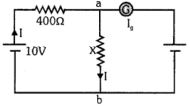
A
$100$
B
$70$
C
$170$
D
$120$
Solution
(A) Given that the galvanometer reading is zero,$I_g = 0$.
This implies that the current $I$ flowing through the $400 \ \Omega$ resistor and the resistor $X$ is the same.
The total resistance of the circuit loop is $R_{total} = 400 + X$.
Using Ohm's law,the current $I$ is given by $I = \frac{10}{400 + X}$.
The potential difference across the resistor $X$ is equal to the $EMF$ of the second cell,which is $2 \ V$.
Therefore,$I \cdot X = 2$.
Substituting the expression for $I$: $\frac{10 \cdot X}{400 + X} = 2$.
$10X = 2(400 + X)$.
$10X = 800 + 2X$.
$8X = 800$.
$X = 100 \ \Omega$.
This implies that the current $I$ flowing through the $400 \ \Omega$ resistor and the resistor $X$ is the same.
The total resistance of the circuit loop is $R_{total} = 400 + X$.
Using Ohm's law,the current $I$ is given by $I = \frac{10}{400 + X}$.
The potential difference across the resistor $X$ is equal to the $EMF$ of the second cell,which is $2 \ V$.
Therefore,$I \cdot X = 2$.
Substituting the expression for $I$: $\frac{10 \cdot X}{400 + X} = 2$.
$10X = 2(400 + X)$.
$10X = 800 + 2X$.
$8X = 800$.
$X = 100 \ \Omega$.
0 likes
View Solution191
DifficultMCQ
The current flowing through the circuit shown in the figure is ........... $A$.
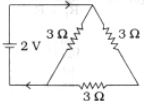
A
$1$
B
$2/9$
C
$2/3$
D
None of these.
Solution
(A) In the given circuit,the battery of $2 \ V$ is connected to a triangular network of three resistors,each of $3 \ \Omega$.
Looking at the circuit,the current from the battery splits at the top node. One path goes through one $3 \ \Omega$ resistor,and the other path goes through two $3 \ \Omega$ resistors connected in series.
Thus,the resistance of the first branch is $R_1 = 3 \ \Omega$.
The resistance of the second branch is $R_2 = 3 \ \Omega + 3 \ \Omega = 6 \ \Omega$.
These two branches are in parallel with each other across the $2 \ V$ battery.
The equivalent resistance $R_{eq}$ is given by:
$\frac{1}{R_{eq}} = \frac{1}{R_1} + \frac{1}{R_2} = \frac{1}{3} + \frac{1}{6} = \frac{2+1}{6} = \frac{3}{6} = \frac{1}{2} \ \Omega^{-1}$.
Therefore,$R_{eq} = 2 \ \Omega$.
The total current $I$ flowing from the battery is:
$I = \frac{V}{R_{eq}} = \frac{2 \ V}{2 \ \Omega} = 1 \ A$.
Looking at the circuit,the current from the battery splits at the top node. One path goes through one $3 \ \Omega$ resistor,and the other path goes through two $3 \ \Omega$ resistors connected in series.
Thus,the resistance of the first branch is $R_1 = 3 \ \Omega$.
The resistance of the second branch is $R_2 = 3 \ \Omega + 3 \ \Omega = 6 \ \Omega$.
These two branches are in parallel with each other across the $2 \ V$ battery.
The equivalent resistance $R_{eq}$ is given by:
$\frac{1}{R_{eq}} = \frac{1}{R_1} + \frac{1}{R_2} = \frac{1}{3} + \frac{1}{6} = \frac{2+1}{6} = \frac{3}{6} = \frac{1}{2} \ \Omega^{-1}$.
Therefore,$R_{eq} = 2 \ \Omega$.
The total current $I$ flowing from the battery is:
$I = \frac{V}{R_{eq}} = \frac{2 \ V}{2 \ \Omega} = 1 \ A$.
0 likes
View Solution192
DifficultMCQ
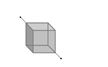
Twelve wires of equal length and equal cross-sectional area form a cube. If the resistance of each wire is $R$,then the effective resistance between the two ends of a diagonal is:
A
$2\,R$
B
$12\,R$
C
$5/6\,R$
D
$6/5\,R$
Solution
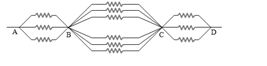
(C) cube has $12$ edges. Let the resistance of each edge be $R$. When we calculate the equivalent resistance between two diagonally opposite corners,the current splits into three paths at the first corner.
These three resistors are in parallel,each having resistance $R$,so their equivalent resistance is $R/3$.
Then,the current flows through six resistors in parallel,each having resistance $R$,so their equivalent resistance is $R/6$.
Finally,the current flows through three resistors in parallel,each having resistance $R$,so their equivalent resistance is $R/3$.
The total equivalent resistance $R_{eq}$ is the sum of these series combinations:
$R_{eq} = R/3 + R/6 + R/3 = (2R + R + 2R) / 6 = 5R/6$.
These three resistors are in parallel,each having resistance $R$,so their equivalent resistance is $R/3$.
Then,the current flows through six resistors in parallel,each having resistance $R$,so their equivalent resistance is $R/6$.
Finally,the current flows through three resistors in parallel,each having resistance $R$,so their equivalent resistance is $R/3$.
The total equivalent resistance $R_{eq}$ is the sum of these series combinations:
$R_{eq} = R/3 + R/6 + R/3 = (2R + R + 2R) / 6 = 5R/6$.
0 likes
View Solution193
DifficultMCQ
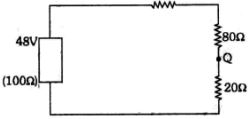
In the given electric circuit, the potential difference across $PQ$ is approximately ...... volts.
A
$9.6$
B
$6.6$
C
$4.8$
D
$3.2$
Solution
(D) The total resistance of the circuit is $R_{total} = 100 \, \Omega + 100 \, \Omega + 80 \, \Omega + 20 \, \Omega = 300 \, \Omega$.
The current flowing through the circuit is $I = \frac{V}{R_{total}} = \frac{48 \, V}{300 \, \Omega} = 0.16 \, A$.
The potential difference across $PQ$ (which corresponds to the $20 \, \Omega$ resistor) is $V_{PQ} = I \times R = 0.16 \, A \times 20 \, \Omega = 3.2 \, V$.
The current flowing through the circuit is $I = \frac{V}{R_{total}} = \frac{48 \, V}{300 \, \Omega} = 0.16 \, A$.
The potential difference across $PQ$ (which corresponds to the $20 \, \Omega$ resistor) is $V_{PQ} = I \times R = 0.16 \, A \times 20 \, \Omega = 3.2 \, V$.
0 likes
View Solution194
DifficultMCQ
When a battery sends an electric current through a resistor $R_1$ for time $t$,the heat produced in the resistor is $Q$. When the same battery sends an electric current through a resistor $R_2$ for the same time $t$,the heat produced in the resistor $R_2$ is also $Q$. Determine the internal resistance $r$ of the battery.
A
$\sqrt {{R_1}^2 {R_2}}$
B
$\sqrt {{R_1} {R_2}^2}$
C
$\sqrt {{R_1} {R_2}}$
D
$\sqrt {{R_1}^2 {R_2}^2}$
Solution
(C) The heat produced in a resistor is given by $Q = I^2 R t$. Since the battery has an electromotive force $E$ and internal resistance $r$,the current $I$ is given by $I = \frac{E}{R+r}$.
Given that the heat $Q$ produced is the same for both resistors in the same time $t$,we have:
$Q = \left( \frac{E}{R_1 + r} \right)^2 R_1 t = \left( \frac{E}{R_2 + r} \right)^2 R_2 t$
Canceling $E^2$ and $t$ from both sides:
$\frac{R_1}{(R_1 + r)^2} = \frac{R_2}{(R_2 + r)^2}$
Taking the square root of both sides:
$\frac{\sqrt{R_1}}{R_1 + r} = \frac{\sqrt{R_2}}{R_2 + r}$
$\sqrt{R_1}(R_2 + r) = \sqrt{R_2}(R_1 + r)$
$\sqrt{R_1} R_2 + r\sqrt{R_1} = \sqrt{R_2} R_1 + r\sqrt{R_2}$
$r(\sqrt{R_1} - \sqrt{R_2}) = \sqrt{R_2} R_1 - \sqrt{R_1} R_2$
$r(\sqrt{R_1} - \sqrt{R_2}) = \sqrt{R_1 R_2}(\sqrt{R_1} - \sqrt{R_2})$
$r = \sqrt{R_1 R_2}$
Given that the heat $Q$ produced is the same for both resistors in the same time $t$,we have:
$Q = \left( \frac{E}{R_1 + r} \right)^2 R_1 t = \left( \frac{E}{R_2 + r} \right)^2 R_2 t$
Canceling $E^2$ and $t$ from both sides:
$\frac{R_1}{(R_1 + r)^2} = \frac{R_2}{(R_2 + r)^2}$
Taking the square root of both sides:
$\frac{\sqrt{R_1}}{R_1 + r} = \frac{\sqrt{R_2}}{R_2 + r}$
$\sqrt{R_1}(R_2 + r) = \sqrt{R_2}(R_1 + r)$
$\sqrt{R_1} R_2 + r\sqrt{R_1} = \sqrt{R_2} R_1 + r\sqrt{R_2}$
$r(\sqrt{R_1} - \sqrt{R_2}) = \sqrt{R_2} R_1 - \sqrt{R_1} R_2$
$r(\sqrt{R_1} - \sqrt{R_2}) = \sqrt{R_1 R_2}(\sqrt{R_1} - \sqrt{R_2})$
$r = \sqrt{R_1 R_2}$
0 likes
View Solution195
MediumMCQ
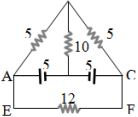
In the given circuit,the current passing through the $12\, \Omega$ resistor is............ $A$.
A
$1$
B
$1/5$
C
$2/5$
D
$0$
Solution
(D) Let the potential at point $A$ be $V_A = 0 \, V$. Then the potential at point $C$ is $V_C = 0 \, V$ because the circuit is symmetric and the two batteries of $5 \, V$ are connected in opposition relative to the central node.
Since the potential at point $A$ is $0 \, V$ and the potential at point $C$ is $0 \, V$,the potential difference across the $12 \, \Omega$ resistor connected between $E$ and $F$ (which are connected to $A$ and $C$ respectively) is $V_E - V_F = 0 \, V - 0 \, V = 0 \, V$.
According to Ohm's law,$I = V/R = 0 \, V / 12 \, \Omega = 0 \, A$.
Thus,the current passing through the $12 \, \Omega$ resistor is $0 \, A$.
Since the potential at point $A$ is $0 \, V$ and the potential at point $C$ is $0 \, V$,the potential difference across the $12 \, \Omega$ resistor connected between $E$ and $F$ (which are connected to $A$ and $C$ respectively) is $V_E - V_F = 0 \, V - 0 \, V = 0 \, V$.
According to Ohm's law,$I = V/R = 0 \, V / 12 \, \Omega = 0 \, A$.
Thus,the current passing through the $12 \, \Omega$ resistor is $0 \, A$.
0 likes
View Solution196
MediumMCQ
$A$ battery has an $e.m.f.$ of $4 \ V$ and an internal resistance of $r$. When the battery is connected to an external resistance of $2 \ \Omega$,a current of $1 \ A$ flows through the circuit. If the terminals of the battery are short-circuited (connected directly),what will be the current in $A$ flowing through it?
A
$1$
B
$2$
C
$4$
D
Infinite
Solution
(B) The formula for current in a circuit is $I = \frac{E}{R + r}$.
Given $E = 4 \ V$,$R = 2 \ \Omega$,and $I = 1 \ A$.
Substituting the values: $1 = \frac{4}{2 + r}$.
Solving for $r$: $2 + r = 4$,which gives $r = 2 \ \Omega$.
When the terminals are short-circuited,the external resistance $R = 0$.
The short-circuit current is $I_{sc} = \frac{E}{r} = \frac{4 \ V}{2 \ \Omega} = 2 \ A$.
Given $E = 4 \ V$,$R = 2 \ \Omega$,and $I = 1 \ A$.
Substituting the values: $1 = \frac{4}{2 + r}$.
Solving for $r$: $2 + r = 4$,which gives $r = 2 \ \Omega$.
When the terminals are short-circuited,the external resistance $R = 0$.
The short-circuit current is $I_{sc} = \frac{E}{r} = \frac{4 \ V}{2 \ \Omega} = 2 \ A$.
0 likes
View Solution197
DifficultMCQ
In the given circuit,the current flowing between points $A$ and $B$ and through the battery $E_2$ is:
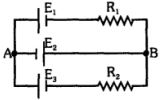
A
Zero
B
$2 \, A$ from $A$ to $B$
C
$2 \, A$ from $B$ to $A$
D
None of the above
Solution
(B) The circuit consists of three parallel branches connected between points $A$ and $B$.
However,the provided solution image shows a simplified loop where the potential difference between $A$ and $B$ is determined by the branches.
Based on the provided solution image,the effective electromotive force $(emf)$ is $2 \, V + 2 \, V = 4 \, V$ and the total resistance is $2 \, \Omega$.
Using Ohm's law,$I = \frac{V}{R} = \frac{4 \, V}{2 \, \Omega} = 2 \, A$.
Since the current flows from the positive terminal of the batteries towards $B$,the current through the branch containing $E_2$ (or the equivalent path) is $2 \, A$ from $A$ to $B$.
However,the provided solution image shows a simplified loop where the potential difference between $A$ and $B$ is determined by the branches.
Based on the provided solution image,the effective electromotive force $(emf)$ is $2 \, V + 2 \, V = 4 \, V$ and the total resistance is $2 \, \Omega$.
Using Ohm's law,$I = \frac{V}{R} = \frac{4 \, V}{2 \, \Omega} = 2 \, A$.
Since the current flows from the positive terminal of the batteries towards $B$,the current through the branch containing $E_2$ (or the equivalent path) is $2 \, A$ from $A$ to $B$.
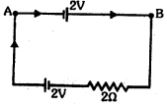
0 likes
View Solution198
DifficultMCQ
$A$ voltameter has a resistance of $2\,\Omega$. It is connected in series with a $10\,V$ battery and a $3\,\Omega$ resistor. The mass deposited at the cathode in a certain time is $1\,g$. Now,the voltameter and the $3\,\Omega$ resistor are connected in parallel with the battery. The increase in the mass of the metal deposited in the same time will be $...\,g$.
A
$0$
B
$1.5$
C
$2.5$
D
$2$
Solution
(B) The mass $m$ deposited at the cathode is given by Faraday's law: $m = ZIt$,where $Z$ is the electrochemical equivalent,$I$ is the current through the voltameter,and $t$ is time.
Case $1$ (Series): The total resistance is $R_s = 2\,\Omega + 3\,\Omega = 5\,\Omega$. The current through the voltameter is $I_s = V / R_s = 10\,V / 5\,\Omega = 2\,A$. Given $m_s = 1\,g$.
Case $2$ (Parallel): The voltameter $(2\,\Omega)$ and the resistor $(3\,\Omega)$ are connected in parallel across the $10\,V$ battery. The current through the voltameter is $I_p = V / R_v = 10\,V / 2\,\Omega = 5\,A$.
Since $m \propto I$ for the same time $t$,we have $m_p / m_s = I_p / I_s$.
$m_p = (5\,A / 2\,A) \times 1\,g = 2.5\,g$.
The increase in mass is $\Delta m = m_p - m_s = 2.5\,g - 1\,g = 1.5\,g$.
Case $1$ (Series): The total resistance is $R_s = 2\,\Omega + 3\,\Omega = 5\,\Omega$. The current through the voltameter is $I_s = V / R_s = 10\,V / 5\,\Omega = 2\,A$. Given $m_s = 1\,g$.
Case $2$ (Parallel): The voltameter $(2\,\Omega)$ and the resistor $(3\,\Omega)$ are connected in parallel across the $10\,V$ battery. The current through the voltameter is $I_p = V / R_v = 10\,V / 2\,\Omega = 5\,A$.
Since $m \propto I$ for the same time $t$,we have $m_p / m_s = I_p / I_s$.
$m_p = (5\,A / 2\,A) \times 1\,g = 2.5\,g$.
The increase in mass is $\Delta m = m_p - m_s = 2.5\,g - 1\,g = 1.5\,g$.
0 likes
View Solution199
MediumMCQ
Find the potential of $J$ with respect to $G$ in $V$.
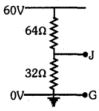
A
$40$
B
$60$
C
$20$
D
$30$
Solution
(C) The circuit consists of two resistors of $64 \, \Omega$ and $32 \, \Omega$ connected in series across a potential difference of $60 \, V$.
Using the voltage divider rule,the potential difference across the $32 \, \Omega$ resistor is given by:
$V_J - V_G = \left( \frac{R_2}{R_1 + R_2} \right) \times V_{total}$
$V_J - V_G = \left( \frac{32}{64 + 32} \right) \times 60 \, V$
$V_J - V_G = \left( \frac{32}{96} \right) \times 60 \, V$
$V_J - V_G = \left( \frac{1}{3} \right) \times 60 \, V = 20 \, V$
Since the potential at $G$ is $V_G = 0 \, V$,the potential at $J$ is $V_J = 20 \, V$.
Using the voltage divider rule,the potential difference across the $32 \, \Omega$ resistor is given by:
$V_J - V_G = \left( \frac{R_2}{R_1 + R_2} \right) \times V_{total}$
$V_J - V_G = \left( \frac{32}{64 + 32} \right) \times 60 \, V$
$V_J - V_G = \left( \frac{32}{96} \right) \times 60 \, V$
$V_J - V_G = \left( \frac{1}{3} \right) \times 60 \, V = 20 \, V$
Since the potential at $G$ is $V_G = 0 \, V$,the potential at $J$ is $V_J = 20 \, V$.
0 likes
View Solution200
MediumMCQ
In the circuit shown,the capacitance of the capacitor is $2\,\mu F$. Find the current flowing through the $2\,\Omega$ resistor in $A$.
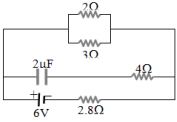
A
$9$
B
$0.9$
C
$1/9$
D
$1/0.9$
Solution
(B) In the steady state,the capacitor acts as an open circuit,so no current flows through the branch containing the capacitor.
The circuit simplifies to a $6\,V$ battery connected in series with a $2.8\,\Omega$ resistor and a parallel combination of $2\,\Omega$ and $3\,\Omega$ resistors.
The equivalent resistance of the parallel part is $R_p = \frac{2 \times 3}{2 + 3} = \frac{6}{5} = 1.2\,\Omega$.
The total resistance of the circuit is $R_{eq} = 2.8\,\Omega + 1.2\,\Omega = 4.0\,\Omega$.
The total current supplied by the battery is $I = \frac{V}{R_{eq}} = \frac{6\,V}{4\,\Omega} = 1.5\,A$.
Using the current divider rule,the current through the $2\,\Omega$ resistor is $I_2 = I \times \frac{3}{2 + 3} = 1.5 \times \frac{3}{5} = 1.5 \times 0.6 = 0.9\,A$.
The circuit simplifies to a $6\,V$ battery connected in series with a $2.8\,\Omega$ resistor and a parallel combination of $2\,\Omega$ and $3\,\Omega$ resistors.
The equivalent resistance of the parallel part is $R_p = \frac{2 \times 3}{2 + 3} = \frac{6}{5} = 1.2\,\Omega$.
The total resistance of the circuit is $R_{eq} = 2.8\,\Omega + 1.2\,\Omega = 4.0\,\Omega$.
The total current supplied by the battery is $I = \frac{V}{R_{eq}} = \frac{6\,V}{4\,\Omega} = 1.5\,A$.
Using the current divider rule,the current through the $2\,\Omega$ resistor is $I_2 = I \times \frac{3}{2 + 3} = 1.5 \times \frac{3}{5} = 1.5 \times 0.6 = 0.9\,A$.
0 likes
View SolutionCurrent Electricity — Circuit Solving for current and Voltage · Frequently Asked Questions
1Are these Current Electricity questions useful for JEE and NEET?
Yes. All questions in this section are mapped to JEE Main and NEET exam patterns. Previous year questions from JEE Main, NEET, GUJCET and state-level exams are included with full solutions.
2Can I switch to Hindi or Gujarati for these questions?
Yes. Use the language tabs in the hero section or the sidebar to view the same questions and solutions in English, Hindi or Gujarati.
3How do I generate a question paper from this subtopic?
Use the Vedclass Exam Paper Generator — select the chapter and subtopic, set difficulty, and generate Sets A, B, C, D automatically. First 3 chapters of every subject are free.
Vedclass Products
For Students
Vedclass Test Series
Mock tests in real JEE/NEET style with performance analysis. 5-day free trial.
Start Free TrialFor Teachers
Exam Paper Generator
Generate Set A/B/C/D papers from this chapter in 2 minutes. 3 chapters free.
Try FreeFor Institutes
Online Exam Module
Live online exams with unlimited students, 360° analytics & white-label branding.
See DemoFor Teachers & Institutes
Generate a Current Electricity Exam Paper in 2 Minutes
Select subtopic & difficulty — Sets A, B, C, D auto-generated with No Repeat logic.
First 3 chapters of every subject are free — no payment required.