
A English
Communication Questions in English
Class 12 Physics · Communication · Communication
453+
Questions
English
Language
100%
With Solutions
Showing 47 of 453 questions in English
401
EasyMCQ
The frequency suitable for beyond-the-horizon communication using sky waves is
A
$10^{12} \ Hz$
B
$10^9 \ Hz$
C
$10^7 \ Hz$
D
$10^4 \ Hz$
Solution
(C) Sky wave propagation is a mode of radio wave propagation that uses the ionosphere to reflect radio waves back towards the Earth.
This mode is typically used for long-distance communication beyond the horizon.
The frequency range suitable for sky wave propagation is generally between $3 \ MHz$ and $30 \ MHz$.
Among the given options,$10^7 \ Hz$ (which is $10 \ MHz$) falls within this range.
Therefore,the correct option is $C$.
This mode is typically used for long-distance communication beyond the horizon.
The frequency range suitable for sky wave propagation is generally between $3 \ MHz$ and $30 \ MHz$.
Among the given options,$10^7 \ Hz$ (which is $10 \ MHz$) falls within this range.
Therefore,the correct option is $C$.
0 likes
View Solution402
EasyMCQ
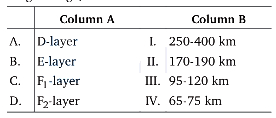
Match Column $A$ (layers in the ionosphere for skywave propagation) with Column $B$ (their height range).
| Column $A$ | Column $B$ |
| $A$. $D$-layer | $I$. $250-400 \ km$ |
| $B$. $E$-layer | $II$. $170-190 \ km$ |
| $C$. $F_1$-layer | $III$. $95-120 \ km$ |
| $D$. $F_2$-layer | $IV$. $65-75 \ km$ |
A
$A-IV, B-III, C-II, D-I$
B
$A-IV, B-III, C-I, D-II$
C
$A-IV, B-II, C-III, D-I$
D
$A-III, B-IV, C-I, D-II$
Solution
(A) The ionosphere is divided into different layers based on their altitude ranges:
$1$. $D$-layer: $65-75 \ km$ (Matches $IV$)
$2$. $E$-layer: $95-120 \ km$ (Matches $III$)
$3$. $F_1$-layer: $170-190 \ km$ (Matches $II$)
$4$. $F_2$-layer: $250-400 \ km$ (Matches $I$)
Therefore,the correct matching is $A-IV, B-III, C-II, D-I$.
$1$. $D$-layer: $65-75 \ km$ (Matches $IV$)
$2$. $E$-layer: $95-120 \ km$ (Matches $III$)
$3$. $F_1$-layer: $170-190 \ km$ (Matches $II$)
$4$. $F_2$-layer: $250-400 \ km$ (Matches $I$)
Therefore,the correct matching is $A-IV, B-III, C-II, D-I$.
0 likes
View Solution403
EasyMCQ
For commercial telephonic communication,the frequency range adequate for speech signals is
A
$20 \ Hz - 20 \ kHz$
B
$300 \ Hz - 3100 \ Hz$
C
$200 \ MHz - 600 \ MHz$
D
$300 \ kHz - 8000 \ kHz$
Solution
(B) Speech signals are human voice signals which typically have a frequency range from $20 \ Hz$ to $20 \ kHz$. However,for commercial telephonic communication,it is not necessary to transmit the entire audible range. To ensure clarity and efficiency in transmission,the frequency range is restricted. The standard frequency range adequate for speech signals in commercial telephony is $300 \ Hz$ to $3100 \ Hz$.
0 likes
View Solution404
EasyMCQ
Coaxial cable,a widely used wire medium,offers an approximate frequency bandwidth of:
A
$750 \text{ GHz}$
B
$750 \text{ Hz}$
C
$750 \text{ MHz}$
D
$750 \text{ kHz}$
Solution
(C) coaxial cable is a type of transmission line that consists of an inner conductor surrounded by a tubular insulating layer,surrounded by a tubular conducting shield.
It is widely used for cable television,broadband internet,and other high-frequency signal transmissions.
The frequency bandwidth of a coaxial cable is typically in the range of up to $750 \text{ MHz}$.
Therefore,the correct option is $C$.
It is widely used for cable television,broadband internet,and other high-frequency signal transmissions.
The frequency bandwidth of a coaxial cable is typically in the range of up to $750 \text{ MHz}$.
Therefore,the correct option is $C$.
0 likes
View Solution405
EasyMCQ
The process of the loss of strength of a signal while propagating through a medium is known as:
A
damping
B
attenuation
C
amplification
D
modulation
Solution
(B) The process of the loss of strength of a signal while propagating through a medium is called attenuation. As a signal travels through a communication channel,its energy is absorbed by the medium,leading to a decrease in its amplitude and power,which is referred to as attenuation.
0 likes
View Solution406
EasyMCQ
The loss of strength of a signal while propagating through a medium is known as
A
Modulation
B
Demodulation
C
Attenuation
D
Noise
Solution
(C) Attenuation is the gradual loss of intensity or strength of a signal as it travels through a transmission medium. It occurs in all types of signals,whether digital or analog,due to factors like absorption,reflection,and scattering.
0 likes
View Solution407
MediumMCQ
$A$ telephonic communication service is working at a carrier frequency of $20 GHz$. Only $20 \%$ of it is utilized for transmission. If each channel requires a bandwidth of $5 kHz$,then the number of telephonic channels that can be transmitted simultaneously are
A
$6 \times 10^5$
B
$2 \times 10^5$
C
$8 \times 10^5$
D
$4 \times 10^5$
Solution
(C) Carrier frequency $= 20 GHz = 20 \times 10^9 Hz$.
Bandwidth available for transmission $= 20 \% \text{ of } 20 GHz = 0.20 \times 20 \times 10^9 Hz = 4 \times 10^9 Hz$.
Bandwidth required per channel $= 5 kHz = 5 \times 10^3 Hz$.
Number of channels $= \frac{\text{Total bandwidth available}}{\text{Bandwidth per channel}} = \frac{4 \times 10^9}{5 \times 10^3} = 0.8 \times 10^6 = 8 \times 10^5$.
Bandwidth available for transmission $= 20 \% \text{ of } 20 GHz = 0.20 \times 20 \times 10^9 Hz = 4 \times 10^9 Hz$.
Bandwidth required per channel $= 5 kHz = 5 \times 10^3 Hz$.
Number of channels $= \frac{\text{Total bandwidth available}}{\text{Bandwidth per channel}} = \frac{4 \times 10^9}{5 \times 10^3} = 0.8 \times 10^6 = 8 \times 10^5$.
0 likes
View Solution408
EasyMCQ
$A$ message signal of frequency $15 kHz$ is used to modulate a carrier of frequency $v_c$. If the side bands produced are $1515 kHz$ and $1485 kHz$,then $v_c$ is (in $MHz$)
A
$2.0$
B
$1.5$
C
$2.5$
D
$3.0$
Solution
(B) The frequencies of the side bands in amplitude modulation are given by the carrier frequency $\nu_c$ plus and minus the message signal frequency $f_m$.
Given: $f_m = 15 kHz$,Upper Side Band $(USB)$ $= 1515 kHz$,Lower Side Band $(LSB)$ $= 1485 kHz$.
The side bands are $\nu_c + f_m$ and $\nu_c - f_m$.
Therefore,$\nu_c + 15 kHz = 1515 kHz$ or $\nu_c - 15 kHz = 1485 kHz$.
Solving for $\nu_c$: $\nu_c = 1515 kHz - 15 kHz = 1500 kHz$.
Converting to $MHz$: $1500 kHz = 1.5 MHz$.
Given: $f_m = 15 kHz$,Upper Side Band $(USB)$ $= 1515 kHz$,Lower Side Band $(LSB)$ $= 1485 kHz$.
The side bands are $\nu_c + f_m$ and $\nu_c - f_m$.
Therefore,$\nu_c + 15 kHz = 1515 kHz$ or $\nu_c - 15 kHz = 1485 kHz$.
Solving for $\nu_c$: $\nu_c = 1515 kHz - 15 kHz = 1500 kHz$.
Converting to $MHz$: $1500 kHz = 1.5 MHz$.
0 likes
View Solution409
EasyMCQ
The range of frequency bands used for standard $AM$ broadcast is
A
$540 – 1600 \text{ kHz}$
B
$88 – 108 \text{ MHz}$
C
$800 – 900 \text{ MHz}$
D
$3.7 – 4.2 \text{ GHz}$
Solution
(A) Standard $AM$ (Amplitude Modulation) broadcast radio operates in the Medium Frequency $(MF)$ band.
The frequency range allocated for standard $AM$ broadcasting is $540 \text{ kHz}$ to $1600 \text{ kHz}$.
Therefore,the correct option is $A$.
The frequency range allocated for standard $AM$ broadcasting is $540 \text{ kHz}$ to $1600 \text{ kHz}$.
Therefore,the correct option is $A$.
0 likes
View Solution410
MediumMCQ
$A$ signal of $20 kHz$ is being carried on a carrier wave of $3 MHz$. What are the side-band frequencies?
A
$3050 kHz \& 2950 kHz$
B
$3020 kHz \& 2970 kHz$
C
$3050 kHz \& 2980 kHz$
D
$3020 kHz \& 2980 kHz$
Solution
(D) In radio communications,a side-band is a band of frequencies higher than or lower than the carrier frequency,which are the result of the modulation process.
The side-bands carry the information transmitted by the radio signal.
The message signal is superimposed on the carrier wave.
Thus,the side-bands produced have frequencies given by: $\text{Side-band frequencies} = \text{Carrier frequency} \pm \text{Message frequency}$.
Given: $\text{Carrier frequency} = 3 MHz = 3000 kHz$ and $\text{Message frequency} = 20 kHz$.
Therefore,the side-band frequencies are: $3000 kHz + 20 kHz = 3020 kHz$ and $3000 kHz - 20 kHz = 2980 kHz$.
The side-bands carry the information transmitted by the radio signal.
The message signal is superimposed on the carrier wave.
Thus,the side-bands produced have frequencies given by: $\text{Side-band frequencies} = \text{Carrier frequency} \pm \text{Message frequency}$.
Given: $\text{Carrier frequency} = 3 MHz = 3000 kHz$ and $\text{Message frequency} = 20 kHz$.
Therefore,the side-band frequencies are: $3000 kHz + 20 kHz = 3020 kHz$ and $3000 kHz - 20 kHz = 2980 kHz$.
0 likes
View Solution411
EasyMCQ
Assertion $(A)$: Television signals are received through sky-wave propagation.
Reason $(R)$: The ionosphere reflects electromagnetic waves of frequencies in the range $(3-30)$ $MHz$.
Choose the correct option.
Reason $(R)$: The ionosphere reflects electromagnetic waves of frequencies in the range $(3-30)$ $MHz$.
Choose the correct option.
A
$A$ is true,$R$ is true and $R$ is the correct explanation for $A$.
B
$A$ is true,$R$ is true but $R$ is not the correct explanation for $A$.
C
$A$ is true but $R$ is false.
D
$A$ is false but $R$ is true.
Solution
(D) Television signals typically operate in the frequency range of $40 MHz$ to $900 MHz$.
Sky-wave propagation relies on the reflection of electromagnetic waves by the ionosphere,which is only effective for frequencies in the range of $3 MHz$ to $30 MHz$.
Since television signal frequencies are much higher than $30 MHz$,they penetrate the ionosphere and are not reflected back to Earth.
Therefore,television signals cannot be received through sky-wave propagation; they require line-of-sight communication or satellite communication.
Thus,the Assertion $(A)$ is false,while the Reason $(R)$ is a true statement regarding the ionospheric reflection range.
Sky-wave propagation relies on the reflection of electromagnetic waves by the ionosphere,which is only effective for frequencies in the range of $3 MHz$ to $30 MHz$.
Since television signal frequencies are much higher than $30 MHz$,they penetrate the ionosphere and are not reflected back to Earth.
Therefore,television signals cannot be received through sky-wave propagation; they require line-of-sight communication or satellite communication.
Thus,the Assertion $(A)$ is false,while the Reason $(R)$ is a true statement regarding the ionospheric reflection range.
0 likes
View Solution412
EasyMCQ
Carrier waves are used for communicating signals over long distances because:
A
carrier waves can be generated very easily.
B
low frequencies cannot be easily modulated by the carrier waves.
C
low frequencies can be transmitted over long distances.
D
carrier waves generated at higher frequencies can be transmitted over long distances.
Solution
(D) Low frequency signals possess very low energy; hence,they cannot be transmitted over long distances without modulation.
In modulation,the characteristics of a carrier wave are varied according to the amplitude of the low-frequency (message) signal.
Carrier waves are high-frequency signals that are used to transmit low-frequency signals over long distances through the process of modulation.
In modulation,the characteristics of a carrier wave are varied according to the amplitude of the low-frequency (message) signal.
Carrier waves are high-frequency signals that are used to transmit low-frequency signals over long distances through the process of modulation.
0 likes
View Solution413
MediumMCQ
For a television network,$5 \times 10^5$ channels are granted. If the central frequency of the microwave link is $25 \text{ GHz}$ and the allotted bandwidth for each channel is $2 \text{ kHz}$,then what percentage of the link is used for the network (in $\%$)?
A
$4$
B
$10$
C
$25$
D
$5$
Solution
(A) Given:
Number of channels $(N)$ = $5 \times 10^5$
Central frequency $(f_c)$ = $25 \text{ GHz} = 25 \times 10^9 \text{ Hz}$
Bandwidth per channel $(\Delta f)$ = $2 \text{ kHz} = 2 \times 10^3 \text{ Hz}$
The total bandwidth required for the network is $N \times \Delta f = (5 \times 10^5) \times (2 \times 10^3) = 10 \times 10^8 = 10^9 \text{ Hz}$.
The percentage of the link used is given by the ratio of the total bandwidth required to the central frequency (total available bandwidth capacity):
Percentage = $\frac{\text{Total Bandwidth Required}}{\text{Central Frequency}} \times 100$
Percentage = $\frac{10^9 \text{ Hz}}{25 \times 10^9 \text{ Hz}} \times 100$
Percentage = $\frac{1}{25} \times 100 = 4 \%$.
Therefore,$4 \%$ of the link is used for the network.
Number of channels $(N)$ = $5 \times 10^5$
Central frequency $(f_c)$ = $25 \text{ GHz} = 25 \times 10^9 \text{ Hz}$
Bandwidth per channel $(\Delta f)$ = $2 \text{ kHz} = 2 \times 10^3 \text{ Hz}$
The total bandwidth required for the network is $N \times \Delta f = (5 \times 10^5) \times (2 \times 10^3) = 10 \times 10^8 = 10^9 \text{ Hz}$.
The percentage of the link used is given by the ratio of the total bandwidth required to the central frequency (total available bandwidth capacity):
Percentage = $\frac{\text{Total Bandwidth Required}}{\text{Central Frequency}} \times 100$
Percentage = $\frac{10^9 \text{ Hz}}{25 \times 10^9 \text{ Hz}} \times 100$
Percentage = $\frac{1}{25} \times 100 = 4 \%$.
Therefore,$4 \%$ of the link is used for the network.
0 likes
View Solution414
EasyMCQ
If the frequencies of the carrier wave and message signal are $1 \text{ MHz}$ and $28 \text{ kHz}$ respectively,then the frequencies of the side bands are
A
$1028 \text{ kHz}, 972 \text{ kHz}$
B
$1014 \text{ kHz}, 986 \text{ kHz}$
C
$29 \text{ kHz}, 27 \text{ kHz}$
D
$514 \text{ kHz}, 486 \text{ kHz}$
Solution
(A) The frequency of the carrier wave is $f_c = 1 \text{ MHz} = 1000 \text{ kHz}$.
The frequency of the message signal is $f_m = 28 \text{ kHz}$.
The frequencies of the side bands are given by the upper side band $(USB)$ and lower side band $(LSB)$ formulas:
$USB = f_c + f_m = 1000 \text{ kHz} + 28 \text{ kHz} = 1028 \text{ kHz}$.
$LSB = f_c - f_m = 1000 \text{ kHz} - 28 \text{ kHz} = 972 \text{ kHz}$.
Therefore,the side band frequencies are $1028 \text{ kHz}$ and $972 \text{ kHz}$.
The frequency of the message signal is $f_m = 28 \text{ kHz}$.
The frequencies of the side bands are given by the upper side band $(USB)$ and lower side band $(LSB)$ formulas:
$USB = f_c + f_m = 1000 \text{ kHz} + 28 \text{ kHz} = 1028 \text{ kHz}$.
$LSB = f_c - f_m = 1000 \text{ kHz} - 28 \text{ kHz} = 972 \text{ kHz}$.
Therefore,the side band frequencies are $1028 \text{ kHz}$ and $972 \text{ kHz}$.
0 likes
View Solution415
EasyMCQ
The heights of the transmitting and receiving antennas are $33.8 \ m$ and $64.8 \ m$ respectively. The maximum distance between the antennas for satisfactory communication in a line of sight mode is (Radius of the earth $= 6400 \ km$) (in $km$)
A
$20.8$
B
$28.8$
C
$49.6$
D
$57.6$
Solution
(C) The maximum line-of-sight distance $d$ between a transmitting antenna of height $h_T$ and a receiving antenna of height $h_R$ is given by the formula: $d = \sqrt{2 R h_T} + \sqrt{2 R h_R}$.
Given: $h_T = 33.8 \ m = 33.8 \times 10^{-3} \ km$,$h_R = 64.8 \ m = 64.8 \times 10^{-3} \ km$,and $R = 6400 \ km$.
Substituting the values:
$d = \sqrt{2 \times 6400 \times 33.8 \times 10^{-3}} + \sqrt{2 \times 6400 \times 64.8 \times 10^{-3}}$
$d = \sqrt{12800 \times 0.0338} + \sqrt{12800 \times 0.0648}$
$d = \sqrt{432.64} + \sqrt{829.44}$
$d = 20.8 \ km + 28.8 \ km = 49.6 \ km$.
Given: $h_T = 33.8 \ m = 33.8 \times 10^{-3} \ km$,$h_R = 64.8 \ m = 64.8 \times 10^{-3} \ km$,and $R = 6400 \ km$.
Substituting the values:
$d = \sqrt{2 \times 6400 \times 33.8 \times 10^{-3}} + \sqrt{2 \times 6400 \times 64.8 \times 10^{-3}}$
$d = \sqrt{12800 \times 0.0338} + \sqrt{12800 \times 0.0648}$
$d = \sqrt{432.64} + \sqrt{829.44}$
$d = 20.8 \ km + 28.8 \ km = 49.6 \ km$.
0 likes
View Solution416
EasyMCQ
$A$ message signal of peak voltage $12 \ V$ is used to amplitude modulate a carrier signal of frequency $1.2 \ MHz$. The amplitude of the side bands is (in $V$)
A
$12$
B
$3$
C
$6$
D
$8$
Solution
(C) In amplitude modulation,the amplitude of the side bands is given by the formula:
$A_{SB} = \frac{\mu A_c}{2}$
Where $\mu$ is the modulation index and $A_c$ is the carrier amplitude.
However,in the context of a standard signal where the modulation index $\mu$ is assumed to be $1$ (maximum efficiency) and the message signal amplitude $A_m$ is equal to the product $\mu A_c$,the amplitude of each side band is:
$A_{SB} = \frac{A_m}{2}$
Given the peak voltage of the message signal $A_m = 12 \ V$:
$A_{SB} = \frac{12 \ V}{2} = 6 \ V$
Thus,the amplitude of each side band is $6 \ V$.
$A_{SB} = \frac{\mu A_c}{2}$
Where $\mu$ is the modulation index and $A_c$ is the carrier amplitude.
However,in the context of a standard signal where the modulation index $\mu$ is assumed to be $1$ (maximum efficiency) and the message signal amplitude $A_m$ is equal to the product $\mu A_c$,the amplitude of each side band is:
$A_{SB} = \frac{A_m}{2}$
Given the peak voltage of the message signal $A_m = 12 \ V$:
$A_{SB} = \frac{12 \ V}{2} = 6 \ V$
Thus,the amplitude of each side band is $6 \ V$.
0 likes
View Solution417
EasyMCQ
For an amplitude modulated wave,the maximum and minimum amplitudes are found to be $10 \ V$ and $2 \ V$ respectively. Then the modulation index is
A
$\frac{1}{3}$
B
$\frac{3}{4}$
C
$\frac{1}{5}$
D
$\frac{2}{3}$
Solution
(D) For an amplitude modulated wave,the maximum amplitude $A_{\max} = 10 \ V$ and the minimum amplitude $A_{\min} = 2 \ V$.
The modulation index $\mu$ is defined by the formula:
$\mu = \frac{A_{\max} - A_{\min}}{A_{\max} + A_{\min}}$
Substituting the given values:
$\mu = \frac{10 - 2}{10 + 2} = \frac{8}{12}$
Simplifying the fraction:
$\mu = \frac{2}{3}$
The modulation index $\mu$ is defined by the formula:
$\mu = \frac{A_{\max} - A_{\min}}{A_{\max} + A_{\min}}$
Substituting the given values:
$\mu = \frac{10 - 2}{10 + 2} = \frac{8}{12}$
Simplifying the fraction:
$\mu = \frac{2}{3}$
0 likes
View Solution418
MediumMCQ
$A$ message signal of frequency $10 kHz$ is used to modulate a carrier wave of frequency $6 MHz$. The sideband frequencies are:
A
$6090 kHz, 610 kHz$
B
$5990 kHz, 6010 kHz$
C
$6000 kHz, 1000 kHz$
D
$6000 kHz, 6100 kHz$
Solution
(B) Given: Message signal frequency,$f_m = 10 kHz = 0.01 MHz$.
Carrier wave frequency,$f_c = 6 MHz = 6000 kHz$.
The sideband frequencies are given by $(f_c + f_m)$ and $(f_c - f_m)$.
Upper sideband frequency $(f_{USB}) = f_c + f_m = 6000 kHz + 10 kHz = 6010 kHz$.
Lower sideband frequency $(f_{LSB}) = f_c - f_m = 6000 kHz - 10 kHz = 5990 kHz$.
Therefore,the sideband frequencies are $5990 kHz$ and $6010 kHz$.
Carrier wave frequency,$f_c = 6 MHz = 6000 kHz$.
The sideband frequencies are given by $(f_c + f_m)$ and $(f_c - f_m)$.
Upper sideband frequency $(f_{USB}) = f_c + f_m = 6000 kHz + 10 kHz = 6010 kHz$.
Lower sideband frequency $(f_{LSB}) = f_c - f_m = 6000 kHz - 10 kHz = 5990 kHz$.
Therefore,the sideband frequencies are $5990 kHz$ and $6010 kHz$.
0 likes
View Solution419
EasyMCQ
The need for modulation is
A
to increase the intensity of audio signal
B
to decrease the intensity of audio signal
C
to transmit audio signal to large distances
D
to increase the frequency of audio signal
Solution
(C) Modulation is the process of superimposing a low-frequency baseband signal onto a high-frequency carrier wave.
This process is essential because low-frequency signals cannot be transmitted efficiently over long distances due to the requirement of impractically large antenna sizes and high signal attenuation.
By modulating the signal,it can be transmitted over large distances with minimal loss and smaller antenna requirements.
Therefore,the correct option is $C$.
This process is essential because low-frequency signals cannot be transmitted efficiently over long distances due to the requirement of impractically large antenna sizes and high signal attenuation.
By modulating the signal,it can be transmitted over large distances with minimal loss and smaller antenna requirements.
Therefore,the correct option is $C$.
0 likes
View Solution420
MediumMCQ
An amplitude modulated wave is represented by $c_m(t)= 10[1+0.6 \sin (1250 t)] \sin (10^8 t)$. Then the modulation index is
A
$10$
B
$1250$
C
$10^8$
D
$0.6$
Solution
(D) The standard equation for an amplitude modulated wave is given by $c_m(t) = A_c [1 + \mu \sin(\omega_m t)] \sin(\omega_c t)$.
Comparing the given equation $c_m(t) = 10[1 + 0.6 \sin(1250 t)] \sin(10^8 t)$ with the standard equation:
Here,$A_c = 10$,$\mu = 0.6$,$\omega_m = 1250 \text{ rad/s}$,and $\omega_c = 10^8 \text{ rad/s}$.
Thus,the modulation index $\mu$ is $0.6$.
Comparing the given equation $c_m(t) = 10[1 + 0.6 \sin(1250 t)] \sin(10^8 t)$ with the standard equation:
Here,$A_c = 10$,$\mu = 0.6$,$\omega_m = 1250 \text{ rad/s}$,and $\omega_c = 10^8 \text{ rad/s}$.
Thus,the modulation index $\mu$ is $0.6$.
0 likes
View Solution421
MediumMCQ
Which of the following statements is $NOT$ true?
A
Power radiated from a linear antenna is directly proportional to the square of antenna length.
B
Power radiated decreases with increasing frequency.
C
Antenna should have a size comparable to the wavelength of the signal.
D
Effective power radiated by a long wavelength baseband signal is small.
Solution
(B) The power $P$ radiated by a linear antenna is given by the relation $P \propto \frac{l^2}{\lambda^2}$,where $l$ is the length of the antenna and $\lambda$ is the wavelength.
Since $P \propto l^2$,statement $A$ is true.
Since $\lambda = \frac{c}{f}$,we have $P \propto \frac{l^2}{(c/f)^2} \propto f^2$. This means power radiated increases with the square of the frequency.
Therefore,statement $B$ is false because it claims power decreases with increasing frequency.
For efficient radiation,the antenna size $l$ must be comparable to the wavelength $\lambda$ (typically $l \geq \frac{\lambda}{4}$),so statement $C$ is true.
Since long wavelength signals correspond to low frequencies,the radiated power $P \propto f^2$ is very small,making statement $D$ true.
Since $P \propto l^2$,statement $A$ is true.
Since $\lambda = \frac{c}{f}$,we have $P \propto \frac{l^2}{(c/f)^2} \propto f^2$. This means power radiated increases with the square of the frequency.
Therefore,statement $B$ is false because it claims power decreases with increasing frequency.
For efficient radiation,the antenna size $l$ must be comparable to the wavelength $\lambda$ (typically $l \geq \frac{\lambda}{4}$),so statement $C$ is true.
Since long wavelength signals correspond to low frequencies,the radiated power $P \propto f^2$ is very small,making statement $D$ true.
0 likes
View Solution422
EasyMCQ
$A$ carrier wave of peak voltage $10 \,V$ is used to transmit a message signal. What should be the peak voltage of the modulating signal in order to have a modulation index of $80 \%$ (in $\,V$)?
A
$8$
B
$8.8$
C
$5$
D
$12.5$
Solution
(A) The modulation index $m$ is defined as the ratio of the peak voltage of the modulating signal $(A_m)$ to the peak voltage of the carrier wave $(A_c)$.
Given:
Carrier wave peak voltage,$A_c = 10 \,V$
Modulation index,$m = 80 \% = 0.8$
Formula:
$m = \frac{A_m}{A_c}$
Substituting the values:
$0.8 = \frac{A_m}{10 \,V}$
$A_m = 0.8 \times 10 \,V = 8 \,V$
Therefore,the peak voltage of the modulating signal should be $8 \,V$.
Given:
Carrier wave peak voltage,$A_c = 10 \,V$
Modulation index,$m = 80 \% = 0.8$
Formula:
$m = \frac{A_m}{A_c}$
Substituting the values:
$0.8 = \frac{A_m}{10 \,V}$
$A_m = 0.8 \times 10 \,V = 8 \,V$
Therefore,the peak voltage of the modulating signal should be $8 \,V$.
0 likes
View Solution423
EasyMCQ
For an amplitude modulated wave,the modulation index is found to be $0.5$. If the maximum amplitude is found to be $10.0 \ V$,then the minimum amplitude is: (in $V$)
A
$5.0$
B
$3.33$
C
$2.5$
D
$6.66$
Solution
(B) The modulation index $m$ for an amplitude modulated wave is given by the formula:
$m = \frac{A_{\max} - A_{\min}}{A_{\max} + A_{\min}}$
Given $m = 0.5$ and $A_{\max} = 10.0 \ V$.
Substituting the values into the formula:
$0.5 = \frac{10 - A_{\min}}{10 + A_{\min}}$
$0.5(10 + A_{\min}) = 10 - A_{\min}$
$5 + 0.5 A_{\min} = 10 - A_{\min}$
$1.5 A_{\min} = 5$
$A_{\min} = \frac{5}{1.5} = \frac{50}{15} = 3.33 \ V$.
$m = \frac{A_{\max} - A_{\min}}{A_{\max} + A_{\min}}$
Given $m = 0.5$ and $A_{\max} = 10.0 \ V$.
Substituting the values into the formula:
$0.5 = \frac{10 - A_{\min}}{10 + A_{\min}}$
$0.5(10 + A_{\min}) = 10 - A_{\min}$
$5 + 0.5 A_{\min} = 10 - A_{\min}$
$1.5 A_{\min} = 5$
$A_{\min} = \frac{5}{1.5} = \frac{50}{15} = 3.33 \ V$.
0 likes
View Solution424
EasyMCQ
For an amplitude modulated wave,the maximum amplitude is found to be $10 \,V$ while the minimum amplitude is found to be $4 \,V$. The modulation index is
A
$\frac{2}{5}$
B
$\frac{2}{3}$
C
$\frac{3}{7}$
D
$\frac{4}{7}$
Solution
(C) Given that,maximum amplitude,$A_{\max} = 10 \,V$.
Minimum amplitude,$A_{\min} = 4 \,V$.
The modulation index $\mu$ is defined as the ratio of the difference of maximum and minimum amplitudes to the sum of maximum and minimum amplitudes.
$\mu = \frac{A_{\max} - A_{\min}}{A_{\max} + A_{\min}}$.
Substituting the given values:
$\mu = \frac{10 - 4}{10 + 4} = \frac{6}{14} = \frac{3}{7}$.
Minimum amplitude,$A_{\min} = 4 \,V$.
The modulation index $\mu$ is defined as the ratio of the difference of maximum and minimum amplitudes to the sum of maximum and minimum amplitudes.
$\mu = \frac{A_{\max} - A_{\min}}{A_{\max} + A_{\min}}$.
Substituting the given values:
$\mu = \frac{10 - 4}{10 + 4} = \frac{6}{14} = \frac{3}{7}$.
0 likes
View Solution425
EasyMCQ
The modulation index used in amplitude modulation of a message signal of peak voltage $10 \,V$ is $0.5$. By how much should the peak voltage of the carrier signal be changed, so as to obtain the modulation index of $0.8$, keeping the peak voltage of the message signal the same as before?
A
Increased by $7.5 \,V$
B
Reduced by $7.5 \,V$
C
Increased by $12.5 \,V$
D
Reduced by $12.5 \,V$
Solution
(B) Initially, the modulation index $\mu_1 = 0.5$ and the message signal amplitude $A_m = 10 \,V$.
Using the formula for modulation index, $\mu = \frac{A_m}{A_c}$, we find the initial carrier amplitude $A_{c_1} = \frac{A_m}{\mu_1} = \frac{10}{0.5} = 20 \,V$.
When the modulation index is changed to $\mu_2 = 0.8$ while keeping $A_m = 10 \,V$ constant, the new carrier amplitude is $A_{c_2} = \frac{A_m}{\mu_2} = \frac{10}{0.8} = 12.5 \,V$.
The change in carrier amplitude is $\Delta A_c = A_{c_1} - A_{c_2} = 20 \,V - 12.5 \,V = 7.5 \,V$.
Since the carrier amplitude decreased from $20 \,V$ to $12.5 \,V$, the peak voltage of the carrier signal must be reduced by $7.5 \,V$.
Using the formula for modulation index, $\mu = \frac{A_m}{A_c}$, we find the initial carrier amplitude $A_{c_1} = \frac{A_m}{\mu_1} = \frac{10}{0.5} = 20 \,V$.
When the modulation index is changed to $\mu_2 = 0.8$ while keeping $A_m = 10 \,V$ constant, the new carrier amplitude is $A_{c_2} = \frac{A_m}{\mu_2} = \frac{10}{0.8} = 12.5 \,V$.
The change in carrier amplitude is $\Delta A_c = A_{c_1} - A_{c_2} = 20 \,V - 12.5 \,V = 7.5 \,V$.
Since the carrier amplitude decreased from $20 \,V$ to $12.5 \,V$, the peak voltage of the carrier signal must be reduced by $7.5 \,V$.
0 likes
View Solution426
EasyMCQ
$A$ message signal of frequency $10 kHz$ and peak voltage of $15 V$ is used to modulate a carrier frequency of $1 MHz$ and peak voltage of $30 V$. Determine the modulation index.
A
$0.5$
B
$0.6$
C
$0.7$
D
$0.8$
Solution
(A) The modulation index $\mu$ is defined as the ratio of the amplitude of the message signal $(A_m)$ to the amplitude of the carrier wave $(A_c)$.
Given:
Amplitude of message signal,$A_m = 15 V$
Amplitude of carrier wave,$A_c = 30 V$
Formula:
$\mu = \frac{A_m}{A_c}$
Calculation:
$\mu = \frac{15 V}{30 V} = 0.5$
Therefore,the modulation index is $0.5$.
Given:
Amplitude of message signal,$A_m = 15 V$
Amplitude of carrier wave,$A_c = 30 V$
Formula:
$\mu = \frac{A_m}{A_c}$
Calculation:
$\mu = \frac{15 V}{30 V} = 0.5$
Therefore,the modulation index is $0.5$.
0 likes
View Solution427
MediumMCQ
$A$ message signal is super-imposed with a carrier signal. The resulting modulating signal $C_m(t)$ is given by $C_m(t)=A_1 \sin \left(\omega_1 t\right)+A_2 \sin \left(\omega_2 t\right)-A_2 \sin \left(\omega_3 t\right)$,where $\omega_2 < \omega_1 < \omega_3$. The modulation index and the angular frequency of the message signal respectively,are
A
$\frac{A_2}{A_1}, \frac{\omega_3-\omega_2}{2}$
B
$\frac{2 A_2}{A_1}, \omega_3-\omega_2$
C
$\frac{A_1}{2 A_2}, \frac{\omega_3-\omega_2}{2}$
D
$\frac{2 A_2}{A_1}, \frac{\omega_3-\omega_2}{2}$
Solution
(D) The standard form of an amplitude-modulated signal is given by:
$C_m(t) = A_c \sin(\omega_c t) + \frac{\mu A_c}{2} \sin((\omega_c + \omega_m)t) - \frac{\mu A_c}{2} \sin((\omega_c - \omega_m)t)$.
Comparing this with the given equation $C_m(t) = A_1 \sin(\omega_1 t) + A_2 \sin(\omega_2 t) - A_2 \sin(\omega_3 t)$:
We identify the carrier amplitude $A_c = A_1$ and carrier frequency $\omega_c = \omega_1$.
The sideband frequencies are $\omega_c + \omega_m = \omega_3$ and $\omega_c - \omega_m = \omega_2$.
Subtracting these two equations: $(\omega_c + \omega_m) - (\omega_c - \omega_m) = \omega_3 - \omega_2$,which gives $2\omega_m = \omega_3 - \omega_2$,so $\omega_m = \frac{\omega_3 - \omega_2}{2}$.
Comparing the amplitudes of the sidebands: $\frac{\mu A_c}{2} = A_2$.
Substituting $A_c = A_1$,we get $\frac{\mu A_1}{2} = A_2$,which implies $\mu = \frac{2 A_2}{A_1}$.
Thus,the modulation index is $\frac{2 A_2}{A_1}$ and the angular frequency of the message signal is $\frac{\omega_3 - \omega_2}{2}$.
$C_m(t) = A_c \sin(\omega_c t) + \frac{\mu A_c}{2} \sin((\omega_c + \omega_m)t) - \frac{\mu A_c}{2} \sin((\omega_c - \omega_m)t)$.
Comparing this with the given equation $C_m(t) = A_1 \sin(\omega_1 t) + A_2 \sin(\omega_2 t) - A_2 \sin(\omega_3 t)$:
We identify the carrier amplitude $A_c = A_1$ and carrier frequency $\omega_c = \omega_1$.
The sideband frequencies are $\omega_c + \omega_m = \omega_3$ and $\omega_c - \omega_m = \omega_2$.
Subtracting these two equations: $(\omega_c + \omega_m) - (\omega_c - \omega_m) = \omega_3 - \omega_2$,which gives $2\omega_m = \omega_3 - \omega_2$,so $\omega_m = \frac{\omega_3 - \omega_2}{2}$.
Comparing the amplitudes of the sidebands: $\frac{\mu A_c}{2} = A_2$.
Substituting $A_c = A_1$,we get $\frac{\mu A_1}{2} = A_2$,which implies $\mu = \frac{2 A_2}{A_1}$.
Thus,the modulation index is $\frac{2 A_2}{A_1}$ and the angular frequency of the message signal is $\frac{\omega_3 - \omega_2}{2}$.
0 likes
View Solution428
EasyMCQ
The function of a detector is to demodulate the modulated carrier wave and the steps for this process are
A
demodulation and filtering
B
demodulation and rectification
C
rectification and filtering
D
regeneration and filtering
Solution
(C) In the demodulation process,the detector performs the following functions:
$(a)$ Rectification: This process converts all negative-going peaks into positive-going peaks,effectively allowing the envelope of the modulated wave to be extracted.
$(b)$ Filtering: This step involves the separation of the high-frequency carrier components from the low-frequency message signal using a low-pass filter,leaving only the original information signal.
$(a)$ Rectification: This process converts all negative-going peaks into positive-going peaks,effectively allowing the envelope of the modulated wave to be extracted.
$(b)$ Filtering: This step involves the separation of the high-frequency carrier components from the low-frequency message signal using a low-pass filter,leaving only the original information signal.
0 likes
View Solution429
MediumMCQ
$A$ transmitting antenna has a height of $20 \,m$. What will be the height of the receiving antenna if the maximum distance between them for satisfactory communication in line-of-sight $(LOS)$ mode is $40 \,km$ (in $\,m$)? (The radius of the Earth is $6400 \,km$.)
A
$25$
B
$30$
C
$60$
D
$45$
Solution
(D) The formula for the maximum line-of-sight $(LOS)$ distance $d_m$ between a transmitting antenna of height $h_T$ and a receiving antenna of height $h_R$ is given by $d_m = \sqrt{2Rh_T} + \sqrt{2Rh_R}$, where $R$ is the radius of the Earth.
Given: $h_T = 20 \,m$, $d_m = 40 \,km = 40,000 \,m$, and $R = 6400 \,km = 6.4 \times 10^6 \,m$.
Substituting the values:
$40,000 = \sqrt{2 \times 6.4 \times 10^6 \times 20} + \sqrt{2 \times 6.4 \times 10^6 \times h_R}$
$40,000 = \sqrt{256 \times 10^6} + \sqrt{12.8 \times 10^6 \times h_R}$
$40,000 = 16,000 + \sqrt{12.8 \times 10^6 \times h_R}$
$24,000 = \sqrt{12.8 \times 10^6 \times h_R}$
Squaring both sides:
$(24,000)^2 = 12.8 \times 10^6 \times h_R$
$576,000,000 = 12,800,000 \times h_R$
$h_R = \frac{576,000,000}{12,800,000} = 45 \,m$.
Thus, the height of the receiving antenna is $45 \,m$.
Given: $h_T = 20 \,m$, $d_m = 40 \,km = 40,000 \,m$, and $R = 6400 \,km = 6.4 \times 10^6 \,m$.
Substituting the values:
$40,000 = \sqrt{2 \times 6.4 \times 10^6 \times 20} + \sqrt{2 \times 6.4 \times 10^6 \times h_R}$
$40,000 = \sqrt{256 \times 10^6} + \sqrt{12.8 \times 10^6 \times h_R}$
$40,000 = 16,000 + \sqrt{12.8 \times 10^6 \times h_R}$
$24,000 = \sqrt{12.8 \times 10^6 \times h_R}$
Squaring both sides:
$(24,000)^2 = 12.8 \times 10^6 \times h_R$
$576,000,000 = 12,800,000 \times h_R$
$h_R = \frac{576,000,000}{12,800,000} = 45 \,m$.
Thus, the height of the receiving antenna is $45 \,m$.
0 likes
View Solution430
EasyMCQ
$A$ message signal is used to modulate a carrier signal of frequency $5 MHz$ and peak voltage of $40 V$. In the process,two side-bands are produced separated by $40 kHz$. If the modulation index is $0.75$,then the peak voltage and frequency of the message signal,respectively,are:
A
$60 V ; 10 kHz$
B
$60 V ; 20 kHz$
C
$30 V ; 10 kHz$
D
$30 V ; 20 kHz$
Solution
(D) Given: Carrier frequency $f_c = 5 MHz$,carrier peak voltage $V_c = 40 V$,modulation index $\mu = 0.75$.
$1$. Calculation of message signal peak voltage $(V_m)$:
The modulation index is defined as $\mu = \frac{V_m}{V_c}$.
Substituting the values: $0.75 = \frac{V_m}{40 V}$.
$V_m = 40 V \times 0.75 = 30 V$.
$2$. Calculation of message signal frequency $(f_m)$:
The frequency separation between the two side-bands (upper side-band and lower side-band) is equal to the bandwidth,which is $2 f_m$.
Given: $2 f_m = 40 kHz$.
$f_m = \frac{40 kHz}{2} = 20 kHz$.
Therefore,the peak voltage and frequency of the message signal are $30 V$ and $20 kHz$ respectively.
$1$. Calculation of message signal peak voltage $(V_m)$:
The modulation index is defined as $\mu = \frac{V_m}{V_c}$.
Substituting the values: $0.75 = \frac{V_m}{40 V}$.
$V_m = 40 V \times 0.75 = 30 V$.
$2$. Calculation of message signal frequency $(f_m)$:
The frequency separation between the two side-bands (upper side-band and lower side-band) is equal to the bandwidth,which is $2 f_m$.
Given: $2 f_m = 40 kHz$.
$f_m = \frac{40 kHz}{2} = 20 kHz$.
Therefore,the peak voltage and frequency of the message signal are $30 V$ and $20 kHz$ respectively.
0 likes
View Solution431
EasyMCQ
$A$ person tries to broadcast with the same antenna both the signals at $10^7 \,Hz$ and $10^6 \,Hz$. If the receiver at some distance has to receive an equal strength for both the frequencies, then the broadcaster has to approximately increase the signal strength at $10^6 \,Hz$ to $10^7 \,Hz$ by
A
$1/10$ times
B
$10$ times
C
$100$ times
D
$1/100$ times
Solution
$(C)$ The power $P$ of a signal radiated by an antenna is proportional to the square of the frequency $v$, i.e., $P \propto v^2$.
Given frequencies are $v_1 = 10^7 \,Hz$ and $v_2 = 10^6 \,Hz$.
The ratio of powers is $\frac{P_1}{P_2} = \left(\frac{v_1}{v_2}\right)^2$.
Substituting the values, we get $\frac{P_1}{P_2} = \left(\frac{10^7}{10^6}\right)^2 = (10)^2 = 100$.
This implies $P_1 = 100 P_2$.
Since the power radiated at $10^7 \,Hz$ is $100$ times the power radiated at $10^6 \,Hz$ for the same input signal strength, the broadcaster must increase the signal strength at $10^6 \,Hz$ by $100$ times to achieve equal strength at the receiver.
Given frequencies are $v_1 = 10^7 \,Hz$ and $v_2 = 10^6 \,Hz$.
The ratio of powers is $\frac{P_1}{P_2} = \left(\frac{v_1}{v_2}\right)^2$.
Substituting the values, we get $\frac{P_1}{P_2} = \left(\frac{10^7}{10^6}\right)^2 = (10)^2 = 100$.
This implies $P_1 = 100 P_2$.
Since the power radiated at $10^7 \,Hz$ is $100$ times the power radiated at $10^6 \,Hz$ for the same input signal strength, the broadcaster must increase the signal strength at $10^6 \,Hz$ by $100$ times to achieve equal strength at the receiver.
0 likes
View Solution432
EasyMCQ
The height of a transmission antenna is $49 \,m$ and that of the receiving antenna is $64 \,m$. What should be the maximum distance between them for line of sight transmission (in $\,km$)?
A
$50.1$
B
$53.6$
C
$43.6$
D
$65.2$
Solution
(B) The maximum line-of-sight distance $d_{\max}$ between a transmitting antenna of height $h_T$ and a receiving antenna of height $h_R$ is given by the formula:
$d_{\max} = \sqrt{2Rh_T} + \sqrt{2Rh_R}$
where $R$ is the radius of the Earth,approximately $6400 \,km = 6.4 \times 10^6 \,m$.
Given: $h_T = 49 \,m$,$h_R = 64 \,m$,$R = 6.4 \times 10^6 \,m$.
Substituting the values:
$d_{\max} = \sqrt{2 \times 6.4 \times 10^6 \times 49} + \sqrt{2 \times 6.4 \times 10^6 \times 64}$
$d_{\max} = \sqrt{12.8 \times 10^6 \times 49} + \sqrt{12.8 \times 10^6 \times 64}$
$d_{\max} = 10^3 \times \sqrt{12.8} \times (7 + 8)$
$d_{\max} = 10^3 \times 3.577 \times 15$
$d_{\max} \approx 53660 \,m = 53.66 \,km$.
Thus,the maximum distance is approximately $53.6 \,km$.
$d_{\max} = \sqrt{2Rh_T} + \sqrt{2Rh_R}$
where $R$ is the radius of the Earth,approximately $6400 \,km = 6.4 \times 10^6 \,m$.
Given: $h_T = 49 \,m$,$h_R = 64 \,m$,$R = 6.4 \times 10^6 \,m$.
Substituting the values:
$d_{\max} = \sqrt{2 \times 6.4 \times 10^6 \times 49} + \sqrt{2 \times 6.4 \times 10^6 \times 64}$
$d_{\max} = \sqrt{12.8 \times 10^6 \times 49} + \sqrt{12.8 \times 10^6 \times 64}$
$d_{\max} = 10^3 \times \sqrt{12.8} \times (7 + 8)$
$d_{\max} = 10^3 \times 3.577 \times 15$
$d_{\max} \approx 53660 \,m = 53.66 \,km$.
Thus,the maximum distance is approximately $53.6 \,km$.
0 likes
View Solution433
DifficultMCQ
An amplitude modulated signal consists of a message signal of frequency $1 \text{ kHz}$ and peak voltage of $5 \text{ V}$,modulating a carrier frequency of $1 \text{ MHz}$ and peak voltage of $15 \text{ V}$. The correct description of this signal is
A
$5[1+3 \sin (2 \pi 10^6 t)] \sin (2 \pi 10^3 t)$
B
$15[1+\frac{1}{3} \sin (2 \pi 10^3 t)] \sin (2 \pi 10^6 t)$
C
$[5+15 \sin (2 \pi 10^3 t)] \sin (2 \pi 10^6 t)$
D
$[15+5 \sin (2 \pi 10^6 t)] \sin (2 \pi 10^3 t)$
Solution
(B) Given:
Frequency of message signal $(f_m) = 1 \text{ kHz} = 1 \times 10^3 \text{ Hz}$.
Peak voltage of message signal $(E_m) = 5 \text{ V}$.
Carrier frequency $(f_c) = 1 \text{ MHz} = 1 \times 10^6 \text{ Hz}$.
Peak voltage of carrier $(E_c) = 15 \text{ V}$.
The equation of an amplitude modulated wave is given by:
$e(t) = E_c [1 + \mu \sin(\omega_m t)] \sin(\omega_c t)$
where $\mu = \frac{E_m}{E_c}$ is the modulation index.
$\mu = \frac{5}{15} = \frac{1}{3}$.
Substituting the values:
$e(t) = 15 [1 + \frac{1}{3} \sin(2 \pi f_m t)] \sin(2 \pi f_c t)$
$e(t) = 15 [1 + \frac{1}{3} \sin(2 \pi \times 10^3 t)] \sin(2 \pi \times 10^6 t)$.
Frequency of message signal $(f_m) = 1 \text{ kHz} = 1 \times 10^3 \text{ Hz}$.
Peak voltage of message signal $(E_m) = 5 \text{ V}$.
Carrier frequency $(f_c) = 1 \text{ MHz} = 1 \times 10^6 \text{ Hz}$.
Peak voltage of carrier $(E_c) = 15 \text{ V}$.
The equation of an amplitude modulated wave is given by:
$e(t) = E_c [1 + \mu \sin(\omega_m t)] \sin(\omega_c t)$
where $\mu = \frac{E_m}{E_c}$ is the modulation index.
$\mu = \frac{5}{15} = \frac{1}{3}$.
Substituting the values:
$e(t) = 15 [1 + \frac{1}{3} \sin(2 \pi f_m t)] \sin(2 \pi f_c t)$
$e(t) = 15 [1 + \frac{1}{3} \sin(2 \pi \times 10^3 t)] \sin(2 \pi \times 10^6 t)$.
0 likes
View Solution434
EasyMCQ
$A$ message signal of $12 kHz$ and peak voltage $20 V$ is used to modulate a carrier wave of frequency $12 MHz$ and peak voltage $30 V$. Then,the modulation index is
A
$0.32$
B
$6.7$
C
$0.67$
D
$67$
Solution
(C) The modulation index $m_a$ is defined as the ratio of the peak voltage of the message signal $(E_m)$ to the peak voltage of the carrier wave $(E_c)$.
Given:
Peak voltage of message signal,$E_m = 20 V$
Peak voltage of carrier wave,$E_c = 30 V$
Using the formula:
$m_a = \frac{E_m}{E_c}$
$m_a = \frac{20}{30} = \frac{2}{3} \approx 0.67$
Therefore,the modulation index is $0.67$.
Given:
Peak voltage of message signal,$E_m = 20 V$
Peak voltage of carrier wave,$E_c = 30 V$
Using the formula:
$m_a = \frac{E_m}{E_c}$
$m_a = \frac{20}{30} = \frac{2}{3} \approx 0.67$
Therefore,the modulation index is $0.67$.
0 likes
View Solution435
EasyMCQ
$A$ carrier wave of peak voltage $12 \,V$ is used to transmit a signal. If the modulation index is $75 \%$, the peak voltage of the modulating signal is (in $\,V$)
A
$18$
B
$22$
C
$9$
D
$28$
Solution
(C) The modulation index $\mu$ is defined as the ratio of the peak voltage of the modulating signal $(E_m)$ to the peak voltage of the carrier wave $(E_c)$.
$\mu = \frac{E_m}{E_c}$
Given:
Carrier wave peak voltage $E_c = 12 \,V$
Modulation index $\mu = 75 \% = 0.75 = \frac{3}{4}$
Substituting the values into the formula:
$0.75 = \frac{E_m}{12}$
$E_m = 0.75 \times 12$
$E_m = 9 \,V$
Therefore, the peak voltage of the modulating signal is $9 \,V$.
$\mu = \frac{E_m}{E_c}$
Given:
Carrier wave peak voltage $E_c = 12 \,V$
Modulation index $\mu = 75 \% = 0.75 = \frac{3}{4}$
Substituting the values into the formula:
$0.75 = \frac{E_m}{12}$
$E_m = 0.75 \times 12$
$E_m = 9 \,V$
Therefore, the peak voltage of the modulating signal is $9 \,V$.
0 likes
View Solution436
DifficultMCQ
$A$ $TV$ transmitting antenna is $128 \ m$ tall. If the receiving antenna is at the ground level,the maximum distance between them for satisfactory communication in line-of-sight mode is (radius of the earth $R_e = 6.4 \times 10^6 \ m$):
A
$64 \times \sqrt{10} \ km$
B
$\frac{128}{\sqrt{10}} \ km$
C
$128 \times \sqrt{10} \ km$
D
$\frac{64}{\sqrt{10}} \ km$
Solution
(B) The maximum line-of-sight distance $d$ for a transmitting antenna of height $h_T$ and a receiving antenna at ground level is given by the formula: $d = \sqrt{2 R_e h_T}$.
Given:
$R_e = 6.4 \times 10^6 \ m$
$h_T = 128 \ m$
Substituting the values:
$d = \sqrt{2 \times (6.4 \times 10^6) \times 128}$
$d = \sqrt{12.8 \times 10^6 \times 128}$
$d = \sqrt{128 \times 10^5 \times 128}$
$d = 128 \times \sqrt{10^5} \ m$
$d = 128 \times \sqrt{10 \times 10^4} \ m$
$d = 128 \times 100 \sqrt{10} \ m$
$d = 12800 \sqrt{10} \ m$
Converting to kilometers $(1 \ km = 1000 \ m)$:
$d = \frac{12800 \sqrt{10}}{1000} \ km = 12.8 \sqrt{10} \ km$
Wait,checking the calculation again:
$d = \sqrt{2 \times 6.4 \times 10^6 \times 128} = \sqrt{12.8 \times 10^6 \times 128} = \sqrt{1638.4 \times 10^6} = \sqrt{16.384 \times 10^8} = 40477 \ m \approx 40.5 \ km$.
Re-evaluating the provided options: $128/\sqrt{10} \approx 128/3.16 \approx 40.5 \ km$. Thus,option $B$ is correct.
Given:
$R_e = 6.4 \times 10^6 \ m$
$h_T = 128 \ m$
Substituting the values:
$d = \sqrt{2 \times (6.4 \times 10^6) \times 128}$
$d = \sqrt{12.8 \times 10^6 \times 128}$
$d = \sqrt{128 \times 10^5 \times 128}$
$d = 128 \times \sqrt{10^5} \ m$
$d = 128 \times \sqrt{10 \times 10^4} \ m$
$d = 128 \times 100 \sqrt{10} \ m$
$d = 12800 \sqrt{10} \ m$
Converting to kilometers $(1 \ km = 1000 \ m)$:
$d = \frac{12800 \sqrt{10}}{1000} \ km = 12.8 \sqrt{10} \ km$
Wait,checking the calculation again:
$d = \sqrt{2 \times 6.4 \times 10^6 \times 128} = \sqrt{12.8 \times 10^6 \times 128} = \sqrt{1638.4 \times 10^6} = \sqrt{16.384 \times 10^8} = 40477 \ m \approx 40.5 \ km$.
Re-evaluating the provided options: $128/\sqrt{10} \approx 128/3.16 \approx 40.5 \ km$. Thus,option $B$ is correct.
0 likes
View Solution437
MediumMCQ
When the receiving antenna is on the ground,the range of a transmitting antenna of height $980 \ m$ is (Radius of the earth $= 6400 \ km$) (in $km$)
A
$56$
B
$112$
C
$72.4$
D
$224$
Solution
(B) The range $d$ of a transmitting antenna of height $h$ is given by the formula $d = \sqrt{2Rh}$,where $R$ is the radius of the Earth.
Given: $h = 980 \ m = 0.98 \ km$ and $R = 6400 \ km$.
Substituting the values into the formula:
$d = \sqrt{2 \times 6400 \times 0.98}$
$d = \sqrt{12800 \times 0.98}$
$d = \sqrt{12544}$
$d = 112 \ km$.
Therefore,the range of the transmitting antenna is $112 \ km$.
Given: $h = 980 \ m = 0.98 \ km$ and $R = 6400 \ km$.
Substituting the values into the formula:
$d = \sqrt{2 \times 6400 \times 0.98}$
$d = \sqrt{12800 \times 0.98}$
$d = \sqrt{12544}$
$d = 112 \ km$.
Therefore,the range of the transmitting antenna is $112 \ km$.
0 likes
View Solution438
EasyMCQ
The layer of the atmosphere which efficiently reflects high frequency waves particularly at night is
A
Troposphere
B
Stratosphere
C
Mesosphere
D
Thermosphere
Solution
(D) The layer of the atmosphere that reflects radio waves,including high-frequency waves,is the ionosphere,which is a part of the thermosphere.
During the night,the ionosphere becomes more stable and effective at reflecting these waves,allowing for long-distance communication.
Therefore,the correct layer is the thermosphere.
During the night,the ionosphere becomes more stable and effective at reflecting these waves,allowing for long-distance communication.
Therefore,the correct layer is the thermosphere.
0 likes
View Solution439
MediumMCQ
The radio horizon of a transmitting antenna of height $39.2 \ m$ is (Radius of the earth $= 6400 \ km$) (in $km$)
A
$44.8$
B
$19.6$
C
$22.4$
D
$78.4$
Solution
(C) The radio horizon distance $d$ for a transmitting antenna of height $h$ is given by the formula $d = \sqrt{2Rh}$,where $R$ is the radius of the Earth.
Given: $h = 39.2 \ m = 39.2 \times 10^{-3} \ km$ and $R = 6400 \ km$.
Substituting the values into the formula:
$d = \sqrt{2 \times 6400 \times 39.2 \times 10^{-3}}$
$d = \sqrt{12800 \times 0.0392}$
$d = \sqrt{501.76}$
$d = 22.4 \ km$.
Therefore,the correct option is $C$.
Given: $h = 39.2 \ m = 39.2 \times 10^{-3} \ km$ and $R = 6400 \ km$.
Substituting the values into the formula:
$d = \sqrt{2 \times 6400 \times 39.2 \times 10^{-3}}$
$d = \sqrt{12800 \times 0.0392}$
$d = \sqrt{501.76}$
$d = 22.4 \ km$.
Therefore,the correct option is $C$.
0 likes
View Solution440
EasyMCQ
The process of the loss of strength of a signal while propagating through a medium is
A
damping
B
attenuation
C
amplification
D
modulation
Solution
(B) The process of the loss of strength of a signal while propagating through a medium is known as attenuation.
As a signal travels through a medium,its energy is absorbed or scattered,leading to a decrease in its amplitude or intensity,which is termed attenuation.
As a signal travels through a medium,its energy is absorbed or scattered,leading to a decrease in its amplitude or intensity,which is termed attenuation.
0 likes
View Solution441
MediumMCQ
$A$ $TV$ transmission antenna is $40 \ m$ tall. How much service area can it cover if the receiving antenna is at the ground level? (Radius of the Earth $= 6400 \ km$)
A
$640 \pi \times 10^6 \ m^2$
B
$512 \pi \times 10^6 \ m^2$
C
$480 \pi \times 10^6 \ m^2$
D
$440 \pi \times 10^6 \ m^2$
Solution
(B) The range $(d)$ of a $TV$ transmission antenna of height $h$ is given by the formula: $d = \sqrt{2hR}$,where $R$ is the radius of the Earth.
Given: $h = 40 \ m$ and $R = 6400 \ km = 6400 \times 10^3 \ m$.
The service area covered by the antenna is the area of a circle with radius $d$,given by: $Area = \pi d^2$.
Substituting the value of $d^2 = 2hR$ into the area formula:
$Area = \pi (2hR)$
$Area = \pi \times 2 \times 40 \times (6400 \times 10^3)$
$Area = \pi \times 80 \times 6400 \times 10^3$
$Area = 512000 \times 10^3 \pi \ m^2$
$Area = 512 \times 10^6 \pi \ m^2$.
Given: $h = 40 \ m$ and $R = 6400 \ km = 6400 \times 10^3 \ m$.
The service area covered by the antenna is the area of a circle with radius $d$,given by: $Area = \pi d^2$.
Substituting the value of $d^2 = 2hR$ into the area formula:
$Area = \pi (2hR)$
$Area = \pi \times 2 \times 40 \times (6400 \times 10^3)$
$Area = \pi \times 80 \times 6400 \times 10^3$
$Area = 512000 \times 10^3 \pi \ m^2$
$Area = 512 \times 10^6 \pi \ m^2$.
0 likes
View Solution442
EasyMCQ
$A$ $TV$ transmission tower of height $h$ covers a range of distance $d$. By how much will the range change if the height is increased to $3/2 h$?
A
$\sqrt{3/2} d$
B
$(\sqrt{3/2}-1) d$
C
$(\sqrt{3/2}+1) d$
D
$d$
Solution
(B) The range $d$ of a $TV$ transmission tower of height $h$ is given by the formula $d = \sqrt{2hR}$,where $R$ is the radius of the Earth.
Initially,$d = \sqrt{2hR}$.
When the height is increased to $h' = 3/2 h$,the new range $d'$ becomes:
$d' = \sqrt{2h'R} = \sqrt{2(3/2 h)R} = \sqrt{3/2} \sqrt{2hR} = \sqrt{3/2} d$.
The change in range is $\Delta d = d' - d$.
Substituting the values,we get $\Delta d = \sqrt{3/2} d - d = (\sqrt{3/2} - 1) d$.
Initially,$d = \sqrt{2hR}$.
When the height is increased to $h' = 3/2 h$,the new range $d'$ becomes:
$d' = \sqrt{2h'R} = \sqrt{2(3/2 h)R} = \sqrt{3/2} \sqrt{2hR} = \sqrt{3/2} d$.
The change in range is $\Delta d = d' - d$.
Substituting the values,we get $\Delta d = \sqrt{3/2} d - d = (\sqrt{3/2} - 1) d$.
0 likes
View Solution443
MediumMCQ
$A$ transmitting and receiving antenna have a height of $d$ meters each. The maximum distance between them for satisfactory communication in Line-of-Sight $(LOS)$ mode is $2d$ kilometers. If the radius of the Earth is $6400 \text{ km}$, then the value of $d$ is: (in $\text{ m}$)
A
$3.2$
B
$6.4$
C
$12.8$
D
$16.0$
Solution
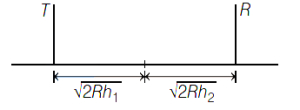
(C) For satisfactory communication in Line-of-Sight $(LOS)$ mode, the maximum distance $d_{\text{max}}$ between a transmitting antenna of height $h_1$ and a receiving antenna of height $h_2$ is given by:
$d_{\text{max}} = \sqrt{2Rh_1} + \sqrt{2Rh_2}$
Given that $h_1 = h_2 = d \text{ meters}$ and $d_{\text{max}} = 2d \text{ kilometers} = 2d \times 1000 \text{ meters}$.
Substituting these values into the formula:
$2d \times 1000 = \sqrt{2Rd} + \sqrt{2Rd}$
$2000d = 2\sqrt{2Rd}$
$1000d = \sqrt{2Rd}$
Squaring both sides:
$(1000d)^2 = 2Rd$
$1,000,000 d^2 = 2 \times 6400 \times 1000 \times d$
Dividing both sides by $d$ (assuming $d \neq 0$):
$1,000,000 d = 2 \times 6400 \times 1000$
$1000 d = 2 \times 6400$
$d = \frac{12800}{1000} = 12.8 \text{ m}$
$d_{\text{max}} = \sqrt{2Rh_1} + \sqrt{2Rh_2}$
Given that $h_1 = h_2 = d \text{ meters}$ and $d_{\text{max}} = 2d \text{ kilometers} = 2d \times 1000 \text{ meters}$.
Substituting these values into the formula:
$2d \times 1000 = \sqrt{2Rd} + \sqrt{2Rd}$
$2000d = 2\sqrt{2Rd}$
$1000d = \sqrt{2Rd}$
Squaring both sides:
$(1000d)^2 = 2Rd$
$1,000,000 d^2 = 2 \times 6400 \times 1000 \times d$
Dividing both sides by $d$ (assuming $d \neq 0$):
$1,000,000 d = 2 \times 6400 \times 1000$
$1000 d = 2 \times 6400$
$d = \frac{12800}{1000} = 12.8 \text{ m}$
0 likes
View Solution444
MediumMCQ
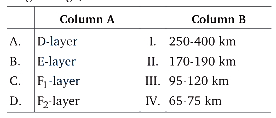
Match Column $A$ (layers in the ionosphere for skywave propagation) with Column $B$ (their height range).
| Column $A$ | Column $B$ |
| $A$. $D$-layer | $I$. $250-400 \ km$ |
| $B$. $E$-layer | $II$. $170-190 \ km$ |
| $C$. $F_1$-layer | $III$. $95-120 \ km$ |
| $D$. $F_2$-layer | $IV$. $65-75 \ km$ |
A
$A-IV, B-III, C-II, D-I$
B
$A-I, B-II, C-III, D-IV$
C
$A-IV, B-III, C-I, D-II$
D
$A-III, B-IV, C-I, D-II$
Solution
(A) The ionosphere is divided into several layers based on their altitude ranges:
$D$-layer: $65-75 \ km$
$E$-layer: $95-120 \ km$
$F_1$-layer: $170-190 \ km$
$F_2$-layer: $250-400 \ km$
Comparing these with the given table:
$A$ ($D$-layer) matches with $IV$ $(65-75 \ km)$
$B$ ($E$-layer) matches with $III$ $(95-120 \ km)$
$C$ ($F_1$-layer) matches with $II$ $(170-190 \ km)$
$D$ ($F_2$-layer) matches with $I$ $(250-400 \ km)$
Therefore,the correct matching is $A-IV, B-III, C-II, D-I$.
$D$-layer: $65-75 \ km$
$E$-layer: $95-120 \ km$
$F_1$-layer: $170-190 \ km$
$F_2$-layer: $250-400 \ km$
Comparing these with the given table:
$A$ ($D$-layer) matches with $IV$ $(65-75 \ km)$
$B$ ($E$-layer) matches with $III$ $(95-120 \ km)$
$C$ ($F_1$-layer) matches with $II$ $(170-190 \ km)$
$D$ ($F_2$-layer) matches with $I$ $(250-400 \ km)$
Therefore,the correct matching is $A-IV, B-III, C-II, D-I$.
0 likes
View Solution445
EasyMCQ
The transmitting antenna placed at the top of a tower has a height of $45 \ m$ from the ground. The distance between receiving and transmitting antennas is $40 \ km$ and the radius of earth is $6400 \ km$. The minimum height (in $m$) at which the receiving antenna is to be placed for satisfactory communication in $LOS$ mode,is
A
$5$
B
$15$
C
$20$
D
$25$
Solution
(C) The formula for the maximum line-of-sight distance $d$ between a transmitting antenna of height $h_T$ and a receiving antenna of height $h_R$ is given by $d = \sqrt{2Rh_T} + \sqrt{2Rh_R}$,where $R$ is the radius of the Earth.
Given: $h_T = 45 \ m = 0.045 \ km$,$d = 40 \ km$,and $R = 6400 \ km$.
Substituting the values into the formula:
$40 = \sqrt{2 \times 6400 \times 0.045} + \sqrt{2 \times 6400 \times h_R}$
$40 = \sqrt{12800 \times 0.045} + \sqrt{12800 \times h_R}$
$40 = \sqrt{576} + \sqrt{12800 \times h_R}$
$40 = 24 + \sqrt{12800 \times h_R}$
$16 = \sqrt{12800 \times h_R}$
Squaring both sides:
$256 = 12800 \times h_R$
$h_R = \frac{256}{12800} \ km = 0.02 \ km$
Converting to meters: $h_R = 0.02 \times 1000 \ m = 20 \ m$.
Given: $h_T = 45 \ m = 0.045 \ km$,$d = 40 \ km$,and $R = 6400 \ km$.
Substituting the values into the formula:
$40 = \sqrt{2 \times 6400 \times 0.045} + \sqrt{2 \times 6400 \times h_R}$
$40 = \sqrt{12800 \times 0.045} + \sqrt{12800 \times h_R}$
$40 = \sqrt{576} + \sqrt{12800 \times h_R}$
$40 = 24 + \sqrt{12800 \times h_R}$
$16 = \sqrt{12800 \times h_R}$
Squaring both sides:
$256 = 12800 \times h_R$
$h_R = \frac{256}{12800} \ km = 0.02 \ km$
Converting to meters: $h_R = 0.02 \times 1000 \ m = 20 \ m$.
0 likes
View Solution446
EasyMCQ
$A$ carrier wave of peak voltage $20 V$ is used to transmit a message signal. For getting a modulation index of $60 \%$,the peak voltage of the modulating signal is (in $V$)
A
$6$
B
$8$
C
$12$
D
$33.3$
Solution
(C) The modulation index $\mu$ is defined as the ratio of the peak voltage of the modulating signal $(A_m)$ to the peak voltage of the carrier wave $(A_c)$.
$\mu = \frac{A_m}{A_c}$
Given,modulation index $\mu = 60 \% = 0.6$ and carrier peak voltage $A_c = 20 V$.
Substituting the values in the formula:
$0.6 = \frac{A_m}{20}$
$A_m = 0.6 \times 20 = 12 V$
Therefore,the peak voltage of the modulating signal is $12 V$.
$\mu = \frac{A_m}{A_c}$
Given,modulation index $\mu = 60 \% = 0.6$ and carrier peak voltage $A_c = 20 V$.
Substituting the values in the formula:
$0.6 = \frac{A_m}{20}$
$A_m = 0.6 \times 20 = 12 V$
Therefore,the peak voltage of the modulating signal is $12 V$.
0 likes
View Solution447
MediumMCQ
$A$ message signal of frequency $f_m$ is used to modulate a carrier of frequency $f_c$. If the sidebands are $f_1$ and $f_2$,then the ratio $\frac{f_c}{f_m}$ is:
A
$\left|\frac{f_1+f_2}{f_2-f_1}\right|$
B
$\frac{(f_1+f_2)^2}{f_1 f_2}$
C
$\left|\frac{f_1-f_2}{f_2+f_1}\right|$
D
$\frac{f_1 f_2}{(f_1+f_2)^2}$
Solution
(A) In amplitude modulation,the sideband frequencies are given by $f_1 = f_c - f_m$ and $f_2 = f_c + f_m$.
Adding these two equations: $f_1 + f_2 = (f_c - f_m) + (f_c + f_m) = 2f_c$,which implies $f_c = \frac{f_1 + f_2}{2}$.
Subtracting the first from the second: $f_2 - f_1 = (f_c + f_m) - (f_c - f_m) = 2f_m$,which implies $f_m = \frac{f_2 - f_1}{2}$.
Therefore,the ratio $\frac{f_c}{f_m} = \frac{(f_1 + f_2)/2}{(f_2 - f_1)/2} = \frac{f_1 + f_2}{f_2 - f_1}$.
Taking the absolute value to ensure a positive ratio,we get $\left|\frac{f_1+f_2}{f_2-f_1}\right|$.
Adding these two equations: $f_1 + f_2 = (f_c - f_m) + (f_c + f_m) = 2f_c$,which implies $f_c = \frac{f_1 + f_2}{2}$.
Subtracting the first from the second: $f_2 - f_1 = (f_c + f_m) - (f_c - f_m) = 2f_m$,which implies $f_m = \frac{f_2 - f_1}{2}$.
Therefore,the ratio $\frac{f_c}{f_m} = \frac{(f_1 + f_2)/2}{(f_2 - f_1)/2} = \frac{f_1 + f_2}{f_2 - f_1}$.
Taking the absolute value to ensure a positive ratio,we get $\left|\frac{f_1+f_2}{f_2-f_1}\right|$.
0 likes
View SolutionCommunication — Communication · Frequently Asked Questions
1Are these Communication questions useful for JEE and NEET?
Yes. All questions in this section are mapped to JEE Main and NEET exam patterns. Previous year questions from JEE Main, NEET, GUJCET and state-level exams are included with full solutions.
2Can I switch to Hindi or Gujarati for these questions?
Yes. Use the language tabs in the hero section or the sidebar to view the same questions and solutions in English, Hindi or Gujarati.
3How do I generate a question paper from this subtopic?
Use the Vedclass Exam Paper Generator — select the chapter and subtopic, set difficulty, and generate Sets A, B, C, D automatically. First 3 chapters of every subject are free.
Vedclass Products
For Students
Vedclass Test Series
Mock tests in real JEE/NEET style with performance analysis. 5-day free trial.
Start Free TrialFor Teachers
Exam Paper Generator
Generate Set A/B/C/D papers from this chapter in 2 minutes. 3 chapters free.
Try FreeFor Institutes
Online Exam Module
Live online exams with unlimited students, 360° analytics & white-label branding.
See DemoFor Teachers & Institutes
Generate a Communication Exam Paper in 2 Minutes
Select subtopic & difficulty — Sets A, B, C, D auto-generated with No Repeat logic.
First 3 chapters of every subject are free — no payment required.