
A English
Communication Questions in English
Class 12 Physics · Communication · Communication
453+
Questions
English
Language
100%
With Solutions
Showing 50 of 453 questions in English
301
EasyMCQ
The modulation index for an $A.M.$ wave having maximum and minimum peak-to-peak voltages of $14\,mV$ and $6\,mV$ respectively is:
A
$1.4$
B
$0.4$
C
$0.2$
D
$0.6$
Solution
(B) The modulation index $\mu$ is given by the formula:
$\mu = \frac{V_{\max} - V_{\min}}{V_{\max} + V_{\min}}$
Given,$V_{\max} = 14\,mV$ and $V_{\min} = 6\,mV$.
Substituting the values into the formula:
$\mu = \frac{14 - 6}{14 + 6}$
$\mu = \frac{8}{20}$
$\mu = 0.4$
Therefore,the modulation index is $0.4$.
$\mu = \frac{V_{\max} - V_{\min}}{V_{\max} + V_{\min}}$
Given,$V_{\max} = 14\,mV$ and $V_{\min} = 6\,mV$.
Substituting the values into the formula:
$\mu = \frac{14 - 6}{14 + 6}$
$\mu = \frac{8}{20}$
$\mu = 0.4$
Therefore,the modulation index is $0.4$.
0 likes
View Solution302
MediumMCQ
$A$ sinusoidal carrier voltage is amplitude modulated. The resultant amplitude modulated wave has maximum and minimum amplitude of $120 \, V$ and $80 \, V$ respectively. The amplitude of each sideband is $.......... \, V$.
A
$15$
B
$10$
C
$20$
D
$5$
Solution
(B) Given,maximum amplitude $A_{max} = A_c + A_m = 120 \, V$ and minimum amplitude $A_{min} = A_c - A_m = 80 \, V$.
Adding these two equations: $2A_c = 200 \, V \implies A_c = 100 \, V$.
Subtracting these two equations: $2A_m = 40 \, V \implies A_m = 20 \, V$.
The modulation index $\mu = \frac{A_m}{A_c} = \frac{20}{100} = 0.2$.
The amplitude of each sideband is given by $\frac{\mu A_c}{2}$.
Substituting the values: $\text{Amplitude} = \frac{0.2 \times 100}{2} = \frac{20}{2} = 10 \, V$.
Adding these two equations: $2A_c = 200 \, V \implies A_c = 100 \, V$.
Subtracting these two equations: $2A_m = 40 \, V \implies A_m = 20 \, V$.
The modulation index $\mu = \frac{A_m}{A_c} = \frac{20}{100} = 0.2$.
The amplitude of each sideband is given by $\frac{\mu A_c}{2}$.
Substituting the values: $\text{Amplitude} = \frac{0.2 \times 100}{2} = \frac{20}{2} = 10 \, V$.
0 likes
View Solution303
MediumMCQ
Match List $I$ with List $II$ :
Choose the correct answer from the options given below:
| List $I$ | List $II$ |
| $A$. Attenuation | $I$. Combination of a receiver and transmitter. |
| $B$. Transducer | $II$. Process of retrieval of information from the carrier wave at receiver. |
| $C$. Demodulation | $III$. Converts one form of energy into another. |
| $D$. Repeater | $IV$. Loss of strength of a signal while propagating through a medium. |
Choose the correct answer from the options given below:
A
$A-I, B-II, C-III, D-IV$
B
$A-II, B-III, C-IV, D-I$
C
$A-IV, B-III, C-I, D-II$
D
$A-IV, B-III, C-II, D-I$
Solution
(D) $1$. Attenuation $(A)$ is the loss of strength of a signal while propagating through a medium,so $A-IV$.
$2$. Transducer $(B)$ is a device that converts one form of energy into another,so $B-III$.
$3$. Demodulation $(C)$ is the process of retrieval of information from the carrier wave at the receiver,so $C-II$.
$4$. Repeater $(D)$ is a combination of a receiver and a transmitter,which picks up the signal from the transmitter,amplifies it,and retransmits it to the receiver,so $D-I$.
Thus,the correct matching is $A-IV, B-III, C-II, D-I$.
$2$. Transducer $(B)$ is a device that converts one form of energy into another,so $B-III$.
$3$. Demodulation $(C)$ is the process of retrieval of information from the carrier wave at the receiver,so $C-II$.
$4$. Repeater $(D)$ is a combination of a receiver and a transmitter,which picks up the signal from the transmitter,amplifies it,and retransmits it to the receiver,so $D-I$.
Thus,the correct matching is $A-IV, B-III, C-II, D-I$.
0 likes
View Solution304
MediumMCQ
The amplitude of $15 \sin (1000 \pi t)$ is modulated by $10 \sin (4 \pi t)$ signal. The amplitude modulated signal contains frequency(ies) of
$A) 500 \text{ Hz}$
$B) 2 \text{ Hz}$
$C) 250 \text{ Hz}$
$D) 498 \text{ Hz}$
$E) 502 \text{ Hz}$
Choose the correct answer from the options given below:
$A) 500 \text{ Hz}$
$B) 2 \text{ Hz}$
$C) 250 \text{ Hz}$
$D) 498 \text{ Hz}$
$E) 502 \text{ Hz}$
Choose the correct answer from the options given below:
A
$A$ only
B
$A, D$ and $E$ only
C
$B$ only
D
$A$ and $B$ only
Solution
(B) The carrier wave is given by $V_c(t) = 15 \sin(1000 \pi t)$.
Comparing this with $V_c(t) = A_c \sin(2 \pi f_c t)$,we get $2 \pi f_c = 1000 \pi$,so $f_c = 500 \text{ Hz}$.
The modulating signal is given by $V_m(t) = 10 \sin(4 \pi t)$.
Comparing this with $V_m(t) = A_m \sin(2 \pi f_m t)$,we get $2 \pi f_m = 4 \pi$,so $f_m = 2 \text{ Hz}$.
An amplitude modulated signal consists of the carrier frequency $f_c$ and two sideband frequencies $(f_c - f_m)$ and $(f_c + f_m)$.
Sideband frequencies are:
Lower sideband: $f_c - f_m = 500 - 2 = 498 \text{ Hz}$.
Upper sideband: $f_c + f_m = 500 + 2 = 502 \text{ Hz}$.
Thus,the frequencies present are $500 \text{ Hz}$,$498 \text{ Hz}$,and $502 \text{ Hz}$,which correspond to options $A, D,$ and $E$.
Comparing this with $V_c(t) = A_c \sin(2 \pi f_c t)$,we get $2 \pi f_c = 1000 \pi$,so $f_c = 500 \text{ Hz}$.
The modulating signal is given by $V_m(t) = 10 \sin(4 \pi t)$.
Comparing this with $V_m(t) = A_m \sin(2 \pi f_m t)$,we get $2 \pi f_m = 4 \pi$,so $f_m = 2 \text{ Hz}$.
An amplitude modulated signal consists of the carrier frequency $f_c$ and two sideband frequencies $(f_c - f_m)$ and $(f_c + f_m)$.
Sideband frequencies are:
Lower sideband: $f_c - f_m = 500 - 2 = 498 \text{ Hz}$.
Upper sideband: $f_c + f_m = 500 + 2 = 502 \text{ Hz}$.
Thus,the frequencies present are $500 \text{ Hz}$,$498 \text{ Hz}$,and $502 \text{ Hz}$,which correspond to options $A, D,$ and $E$.
0 likes
View Solution305
MediumMCQ
Given below are two statements
Statement $I:$ For transmitting a signal,the size of the antenna $(l)$ should be comparable to the wavelength of the signal (at least $l = \frac{\lambda}{4}$ in dimension).
Statement $II:$ In amplitude modulation,the amplitude of the carrier wave remains constant (unchanged).
In the light of the above statements,choose the most appropriate answer from the options given below.
Statement $I:$ For transmitting a signal,the size of the antenna $(l)$ should be comparable to the wavelength of the signal (at least $l = \frac{\lambda}{4}$ in dimension).
Statement $II:$ In amplitude modulation,the amplitude of the carrier wave remains constant (unchanged).
In the light of the above statements,choose the most appropriate answer from the options given below.
A
Both Statement $I$ and Statement $II$ are correct.
B
Both Statement $I$ and Statement $II$ are incorrect.
C
Statement $I$ is incorrect but Statement $II$ is correct.
D
Statement $I$ is correct but Statement $II$ is incorrect.
Solution
(D) Statement $I$ is correct: For efficient transmission and reception of electromagnetic waves,the antenna length must be comparable to the wavelength of the signal,typically $l = \frac{\lambda}{4}$.
Statement $II$ is incorrect: In amplitude modulation $(AM)$,the amplitude of the carrier wave is varied in accordance with the instantaneous amplitude of the modulating signal (information signal). Therefore,the amplitude of the carrier wave does not remain constant.
Statement $II$ is incorrect: In amplitude modulation $(AM)$,the amplitude of the carrier wave is varied in accordance with the instantaneous amplitude of the modulating signal (information signal). Therefore,the amplitude of the carrier wave does not remain constant.
0 likes
View Solution306
EasyMCQ
Which of the following frequencies does not belong to the $FM$ broadcast band (in $,MHz$)?
A
$106$
B
$64$
C
$99$
D
$89$
Solution
(B) The standard frequency range for $FM$ (Frequency Modulation) radio broadcasting is $88\,MHz$ to $108\,MHz$.
Comparing the given options:
$A) 106\,MHz$ is within the range.
$B) 64\,MHz$ is outside the range.
$C) 99\,MHz$ is within the range.
$D) 89\,MHz$ is within the range.
Therefore,$64\,MHz$ does not belong to the $FM$ broadcast band.
Comparing the given options:
$A) 106\,MHz$ is within the range.
$B) 64\,MHz$ is outside the range.
$C) 99\,MHz$ is within the range.
$D) 89\,MHz$ is within the range.
Therefore,$64\,MHz$ does not belong to the $FM$ broadcast band.
0 likes
View Solution307
MediumMCQ
In an amplitude modulation,a modulating signal having amplitude of $X$ Volt is superimposed with a carrier signal of amplitude $Y$ Volt in the first case. In the second case,the same modulating signal is superimposed with a different carrier signal of amplitude $2Y$ Volt. The ratio of the modulation index in the two cases respectively will be:
A
$1:2$
B
$1:1$
C
$2:1$
D
$4:1$
Solution
(C) The modulation index $\mu$ is defined as the ratio of the amplitude of the modulating signal $(A_m)$ to the amplitude of the carrier signal $(A_c)$: $\mu = \frac{A_m}{A_c}$.
In the first case,the modulating signal amplitude is $A_m = X$ and the carrier signal amplitude is $A_c = Y$. Thus,$\mu_1 = \frac{X}{Y}$.
In the second case,the modulating signal amplitude is $A_m = X$ and the carrier signal amplitude is $A_c = 2Y$. Thus,$\mu_2 = \frac{X}{2Y}$.
The ratio of the modulation indices is $\frac{\mu_1}{\mu_2} = \frac{X/Y}{X/2Y} = \frac{2}{1}$.
Therefore,the ratio is $2:1$.
In the first case,the modulating signal amplitude is $A_m = X$ and the carrier signal amplitude is $A_c = Y$. Thus,$\mu_1 = \frac{X}{Y}$.
In the second case,the modulating signal amplitude is $A_m = X$ and the carrier signal amplitude is $A_c = 2Y$. Thus,$\mu_2 = \frac{X}{2Y}$.
The ratio of the modulation indices is $\frac{\mu_1}{\mu_2} = \frac{X/Y}{X/2Y} = \frac{2}{1}$.
Therefore,the ratio is $2:1$.
0 likes
View Solution308
MediumMCQ
By what percentage will the transmission range of a $TV$ tower be affected when the height of the tower is increased by $21 \%$ (in $\%$)?
A
$14$
B
$12$
C
$10$
D
$15$
Solution
(C) The transmission range $d$ of a $TV$ tower of height $h$ is given by the formula $d = \sqrt{2Rh}$,where $R$ is the radius of the Earth.
Let the initial height be $h_1$ and the initial range be $d_1 = \sqrt{2Rh_1}$.
The new height $h_2$ is increased by $21 \%$,so $h_2 = h_1 + 0.21h_1 = 1.21h_1$.
The new range $d_2$ is given by $d_2 = \sqrt{2Rh_2} = \sqrt{2R(1.21h_1)} = \sqrt{1.21} \times \sqrt{2Rh_1} = 1.1 \times d_1$.
The percentage increase in the range is given by $\frac{d_2 - d_1}{d_1} \times 100 \%$.
Substituting the values: $\frac{1.1d_1 - d_1}{d_1} \times 100 \% = (1.1 - 1) \times 100 \% = 0.1 \times 100 \% = 10 \%$.
Let the initial height be $h_1$ and the initial range be $d_1 = \sqrt{2Rh_1}$.
The new height $h_2$ is increased by $21 \%$,so $h_2 = h_1 + 0.21h_1 = 1.21h_1$.
The new range $d_2$ is given by $d_2 = \sqrt{2Rh_2} = \sqrt{2R(1.21h_1)} = \sqrt{1.21} \times \sqrt{2Rh_1} = 1.1 \times d_1$.
The percentage increase in the range is given by $\frac{d_2 - d_1}{d_1} \times 100 \%$.
Substituting the values: $\frac{1.1d_1 - d_1}{d_1} \times 100 \% = (1.1 - 1) \times 100 \% = 0.1 \times 100 \% = 10 \%$.
0 likes
View Solution309
MediumMCQ
$A$ $TV$ transmitting antenna is $98\,m$ high and the receiving antenna is at the ground level. If the radius of the earth is $6400\,km$,the surface area covered by the transmitting antenna is approximately $.........\,km^2$
A
$1240$
B
$3942$
C
$4868$
D
$1549$
Solution
(B) Given: Height of transmitting antenna $h_T = 98\,m = 0.098\,km$. Height of receiving antenna $h_R = 0\,m$. Radius of the earth $R = 6400\,km$.
The maximum line-of-sight distance $d$ is given by the formula $d = \sqrt{2 R h_T} + \sqrt{2 R h_R}$.
Since $h_R = 0$,the formula simplifies to $d = \sqrt{2 R h_T}$.
Substituting the values: $d = \sqrt{2 \times 6400 \times 0.098} = \sqrt{12800 \times 0.098} = \sqrt{1254.4} \approx 35.417\,km$.
The surface area $A$ covered by the antenna is given by $A = \pi d^2$.
$A = 3.14159 \times (35.417)^2 \approx 3.14159 \times 1254.4 \approx 3941.07\,km^2$.
Rounding to the nearest integer,the area is approximately $3942\,km^2$.
The maximum line-of-sight distance $d$ is given by the formula $d = \sqrt{2 R h_T} + \sqrt{2 R h_R}$.
Since $h_R = 0$,the formula simplifies to $d = \sqrt{2 R h_T}$.
Substituting the values: $d = \sqrt{2 \times 6400 \times 0.098} = \sqrt{12800 \times 0.098} = \sqrt{1254.4} \approx 35.417\,km$.
The surface area $A$ covered by the antenna is given by $A = \pi d^2$.
$A = 3.14159 \times (35.417)^2 \approx 3.14159 \times 1254.4 \approx 3941.07\,km^2$.
Rounding to the nearest integer,the area is approximately $3942\,km^2$.
0 likes
View Solution310
MediumMCQ
$A$ carrier wave of amplitude $15\,V$ is modulated by a sinusoidal baseband signal of amplitude $3\,V$. The ratio of maximum amplitude to minimum amplitude in an amplitude modulated wave is:
A
$2$
B
$\frac{3}{2}$
C
$5$
D
$1$
Solution
(B) Given,carrier wave amplitude $A_c = 15\,V$.
Baseband signal amplitude $A_m = 3\,V$.
The maximum amplitude of the amplitude modulated wave is given by $A_{\max} = A_c + A_m = 15 + 3 = 18\,V$.
The minimum amplitude of the amplitude modulated wave is given by $A_{\min} = A_c - A_m = 15 - 3 = 12\,V$.
The ratio of maximum amplitude to minimum amplitude is $\frac{A_{\max}}{A_{\min}} = \frac{18}{12} = \frac{3}{2}$.
Baseband signal amplitude $A_m = 3\,V$.
The maximum amplitude of the amplitude modulated wave is given by $A_{\max} = A_c + A_m = 15 + 3 = 18\,V$.
The minimum amplitude of the amplitude modulated wave is given by $A_{\min} = A_c - A_m = 15 - 3 = 12\,V$.
The ratio of maximum amplitude to minimum amplitude is $\frac{A_{\max}}{A_{\min}} = \frac{18}{12} = \frac{3}{2}$.
0 likes
View Solution311
EasyMCQ
$A$ message signal of frequency $3\,kHz$ is used to modulate a carrier signal of frequency $1.5\,MHz$. The bandwidth of the amplitude modulated wave is
A
$3\,kHz$
B
$6\,MHz$
C
$3\,MHz$
D
$6\,kHz$
Solution
(D) The bandwidth of an amplitude modulated $(AM)$ wave is given by the formula:
Bandwidth $= 2 f_{m}$
where $f_{m}$ is the frequency of the message signal.
Given,$f_{m} = 3\,kHz$.
Therefore,Bandwidth $= 2 \times 3\,kHz = 6\,kHz$.
Bandwidth $= 2 f_{m}$
where $f_{m}$ is the frequency of the message signal.
Given,$f_{m} = 3\,kHz$.
Therefore,Bandwidth $= 2 \times 3\,kHz = 6\,kHz$.
0 likes
View Solution312
MediumMCQ
$A$ transmitting antenna is kept on the surface of the earth. The minimum height of the receiving antenna required to receive the signal in line-of-sight at $4\,km$ distance from it is $x \times 10^{-2}\,m$. The value of $x$ is (Let radius of earth $R = 6400\,km$).
A
$125$
B
$12.5$
C
$1.25$
D
$1250$
Solution
(A) The distance $d$ for line-of-sight communication between a transmitting antenna of height $h_T$ and a receiving antenna of height $h_R$ is given by $d = \sqrt{2 R h_T} + \sqrt{2 R h_R}$.
Given that the transmitting antenna is on the surface of the earth,$h_T = 0$.
Therefore,the formula simplifies to $d = \sqrt{2 R h_R}$.
Squaring both sides,we get $d^2 = 2 R h_R$.
Solving for $h_R$,we get $h_R = \frac{d^2}{2 R}$.
Given $d = 4\,km = 4000\,m$ and $R = 6400\,km = 6400000\,m$.
Substituting the values: $h_R = \frac{(4000)^2}{2 \times 6400000} = \frac{16000000}{12800000} = \frac{160}{128} = 1.25\,m$.
We are given $h_R = x \times 10^{-2}\,m$.
So,$1.25 = x \times 10^{-2} \implies x = 1.25 \times 10^2 = 125$.
Given that the transmitting antenna is on the surface of the earth,$h_T = 0$.
Therefore,the formula simplifies to $d = \sqrt{2 R h_R}$.
Squaring both sides,we get $d^2 = 2 R h_R$.
Solving for $h_R$,we get $h_R = \frac{d^2}{2 R}$.
Given $d = 4\,km = 4000\,m$ and $R = 6400\,km = 6400000\,m$.
Substituting the values: $h_R = \frac{(4000)^2}{2 \times 6400000} = \frac{16000000}{12800000} = \frac{160}{128} = 1.25\,m$.
We are given $h_R = x \times 10^{-2}\,m$.
So,$1.25 = x \times 10^{-2} \implies x = 1.25 \times 10^2 = 125$.
0 likes
View Solution313
EasyMCQ
In satellite communication,the uplink frequency band used is
A
$3.7-4.2\,GHz$
B
$5.925-6.425\,GHz$
C
$76-88\,MHz$
D
$420-890\,MHz$
Solution
(B) In satellite communication,the frequency band used for the uplink (transmission from Earth station to satellite) is typically in the $C$-band range of $5.925-6.425\,GHz$.
Conversely,the downlink frequency band (transmission from satellite to Earth station) is $3.7-4.2\,GHz$.
Therefore,the correct option is $B$.
Conversely,the downlink frequency band (transmission from satellite to Earth station) is $3.7-4.2\,GHz$.
Therefore,the correct option is $B$.
0 likes
View Solution314
MediumMCQ
The amplitude of $15 \sin (1000 \pi t)$ is modulated by $10 \sin (4 \pi t)$ signal. The amplitude modulated signal contains frequencies of
$1. 500\,Hz$
$2. 2\,Hz$
$3. 250\,Hz$
$4. 498\,Hz$
$5. 502\,Hz$
Choose the correct answer from the options given below:
$1. 500\,Hz$
$2. 2\,Hz$
$3. 250\,Hz$
$4. 498\,Hz$
$5. 502\,Hz$
Choose the correct answer from the options given below:
A
$(1)$ and $(3)$ only
B
$(1)$ and $(4)$ only
C
$(1)$ and $(2)$ only
D
$(1), (4)$ and $(5)$ only
Solution
(D) The carrier wave is given by $c(t) = 15 \sin(1000 \pi t)$.
The carrier frequency $f_c$ is calculated as $f_c = \frac{\omega_c}{2\pi} = \frac{1000\pi}{2\pi} = 500\,Hz$.
The modulating signal is given by $m(t) = 10 \sin(4 \pi t)$.
The modulating frequency $f_m$ is calculated as $f_m = \frac{\omega_m}{2\pi} = \frac{4\pi}{2\pi} = 2\,Hz$.
An amplitude modulated $(AM)$ wave contains the carrier frequency and two sideband frequencies: $(f_c - f_m)$ and $(f_c + f_m)$.
Sideband frequencies are $(500 - 2)\,Hz = 498\,Hz$ and $(500 + 2)\,Hz = 502\,Hz$.
Therefore,the frequencies present in the $AM$ signal are $500\,Hz, 498\,Hz,$ and $502\,Hz$,which correspond to items $(1), (4),$ and $(5)$.
The carrier frequency $f_c$ is calculated as $f_c = \frac{\omega_c}{2\pi} = \frac{1000\pi}{2\pi} = 500\,Hz$.
The modulating signal is given by $m(t) = 10 \sin(4 \pi t)$.
The modulating frequency $f_m$ is calculated as $f_m = \frac{\omega_m}{2\pi} = \frac{4\pi}{2\pi} = 2\,Hz$.
An amplitude modulated $(AM)$ wave contains the carrier frequency and two sideband frequencies: $(f_c - f_m)$ and $(f_c + f_m)$.
Sideband frequencies are $(500 - 2)\,Hz = 498\,Hz$ and $(500 + 2)\,Hz = 502\,Hz$.
Therefore,the frequencies present in the $AM$ signal are $500\,Hz, 498\,Hz,$ and $502\,Hz$,which correspond to items $(1), (4),$ and $(5)$.
0 likes
View Solution315
MediumMCQ
Match List-$I$ with List-$II$:
Choose the correct answer from the options given below:
| List-$I$ (Layer of atmosphere) | List-$II$ (Approximate height over earth's surface) |
|---|---|
| $(A)$ $F_1$-Layer | $(I)$ $10\,km$ |
| $(B)$ $D$-Layer | $(II)$ $170-190\,km$ |
| $(C)$ Troposphere | $(III)$ $100\,km$ |
| $(D)$ $E$-Layer | $(IV)$ $65-75\,km$ |
Choose the correct answer from the options given below:
A
$(A)-(II), (B)-(IV), (C)-(I), (D)-(III)$
B
$(A)-(II), (B)-(IV), (C)-(III), (D)-(I)$
C
$(A)-(II), (B)-(I), (C)-(IV), (D)-(III)$
D
$(A)-(III), (B)-(IV), (C)-(I), (D)-(II)$
Solution
(A) The atmospheric layers and their approximate heights are as follows:
$1$. The $F_1$-layer of the ionosphere is located at an approximate height of $170-190\,km$.
$2$. The $D$-layer of the ionosphere is located at an approximate height of $65-75\,km$.
$3$. The Troposphere is the lowest layer of the atmosphere,extending up to approximately $10\,km$ from the Earth's surface.
$4$. The $E$-layer of the ionosphere is located at an approximate height of $100\,km$.
Matching these values:
$(A) \rightarrow (II)$
$(B) \rightarrow (IV)$
$(C) \rightarrow (I)$
$(D) \rightarrow (III)$
Therefore,the correct sequence is $(A)-(II), (B)-(IV), (C)-(I), (D)-(III)$.
$1$. The $F_1$-layer of the ionosphere is located at an approximate height of $170-190\,km$.
$2$. The $D$-layer of the ionosphere is located at an approximate height of $65-75\,km$.
$3$. The Troposphere is the lowest layer of the atmosphere,extending up to approximately $10\,km$ from the Earth's surface.
$4$. The $E$-layer of the ionosphere is located at an approximate height of $100\,km$.
Matching these values:
$(A) \rightarrow (II)$
$(B) \rightarrow (IV)$
$(C) \rightarrow (I)$
$(D) \rightarrow (III)$
Therefore,the correct sequence is $(A)-(II), (B)-(IV), (C)-(I), (D)-(III)$.
0 likes
View Solution316
MediumMCQ
The height of the transmitting antenna is $180\,m$ and the height of the receiving antenna is $245\,m$. The maximum distance between them for satisfactory communication in line of sight will be .......... $km$ (given $R = 6400\,km$).
A
$48$
B
$56$
C
$96$
D
$104$
Solution
(D) The maximum line-of-sight distance $d_{\max}$ between a transmitting antenna of height $h_t$ and a receiving antenna of height $h_r$ is given by the formula:
$d_{\max} = \sqrt{2Rh_t} + \sqrt{2Rh_r}$
Given:
$R = 6400\,km = 64 \times 10^5\,m$
$h_t = 180\,m$
$h_r = 245\,m$
Substituting the values:
$d_{\max} = \sqrt{2 \times 64 \times 10^5 \times 180} + \sqrt{2 \times 64 \times 10^5 \times 245}$
$d_{\max} = \sqrt{128 \times 180 \times 10^5} + \sqrt{128 \times 245 \times 10^5}$
$d_{\max} = \sqrt{23040 \times 10^5} + \sqrt{31360 \times 10^5}$
$d_{\max} = \sqrt{2304 \times 10^6} + \sqrt{3136 \times 10^6}$
$d_{\max} = (48 \times 10^3) + (56 \times 10^3)\,m$
$d_{\max} = 48\,km + 56\,km = 104\,km$.
$d_{\max} = \sqrt{2Rh_t} + \sqrt{2Rh_r}$
Given:
$R = 6400\,km = 64 \times 10^5\,m$
$h_t = 180\,m$
$h_r = 245\,m$
Substituting the values:
$d_{\max} = \sqrt{2 \times 64 \times 10^5 \times 180} + \sqrt{2 \times 64 \times 10^5 \times 245}$
$d_{\max} = \sqrt{128 \times 180 \times 10^5} + \sqrt{128 \times 245 \times 10^5}$
$d_{\max} = \sqrt{23040 \times 10^5} + \sqrt{31360 \times 10^5}$
$d_{\max} = \sqrt{2304 \times 10^6} + \sqrt{3136 \times 10^6}$
$d_{\max} = (48 \times 10^3) + (56 \times 10^3)\,m$
$d_{\max} = 48\,km + 56\,km = 104\,km$.
0 likes
View Solution317
EasyMCQ
In a communication system,what is used to extend the range of a communication?
A
Transducer
B
Attenuation
C
Repeater
D
Modulation
Solution
(C) repeater is a combination of a receiver and a transmitter.
It receives the signal from the transmitter,amplifies it,and retransmits it to the destination.
This process compensates for the signal loss (attenuation) that occurs over long distances,thereby extending the range of the communication system.
It receives the signal from the transmitter,amplifies it,and retransmits it to the destination.
This process compensates for the signal loss (attenuation) that occurs over long distances,thereby extending the range of the communication system.
0 likes
View Solution318
EasyMCQ
The digital signals are used for transmission in communication systems. They are
A
only of discrete stepwise values.
B
sound and picture signals in television.
C
continuous variations of current or voltage.
D
fundamental sine waves.
Solution
(A) Digital signals are signals that represent data as a sequence of discrete values at any given time. Unlike analog signals,which are continuous,digital signals consist of discrete stepwise values,typically represented by binary digits ($0$ and $1$). Therefore,they are characterized by discrete stepwise values.
0 likes
View Solution319
EasyMCQ
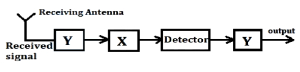
In a communication system,for the given block diagram of a receiver,the boxes '$X$' and '$Y$' respectively represent:
A
Detector and amplifier
B
$IF$ stage and amplifier
C
$IF$ stage and detector
D
Amplifier and $IF$ stage
Solution
(B) In a standard superheterodyne receiver block diagram,the signal from the receiving antenna first passes through an amplifier (often an $RF$ amplifier) to boost the weak signal.
Then,it goes to the Intermediate Frequency $(IF)$ stage,where the frequency is converted to a lower,fixed intermediate frequency.
After the $IF$ stage,the signal passes through a detector (demodulator) to extract the original message signal.
Finally,the signal is passed through an audio amplifier to increase its power for the output device.
Looking at the provided diagram:
- The first box '$Y$' represents an amplifier ($RF$ amplifier).
- The second box '$X$' represents the $IF$ stage.
- The third box is the detector.
- The fourth box '$Y$' represents an amplifier (audio amplifier).
Therefore,'$X$' represents the $IF$ stage and '$Y$' represents an amplifier.
Then,it goes to the Intermediate Frequency $(IF)$ stage,where the frequency is converted to a lower,fixed intermediate frequency.
After the $IF$ stage,the signal passes through a detector (demodulator) to extract the original message signal.
Finally,the signal is passed through an audio amplifier to increase its power for the output device.
Looking at the provided diagram:
- The first box '$Y$' represents an amplifier ($RF$ amplifier).
- The second box '$X$' represents the $IF$ stage.
- The third box is the detector.
- The fourth box '$Y$' represents an amplifier (audio amplifier).
Therefore,'$X$' represents the $IF$ stage and '$Y$' represents an amplifier.
0 likes
View Solution320
EasyMCQ
In a communication system,a repeater is used to extend the range of transmission. It is a combination of:
A
modulator and power amplifier.
B
receiver and transmitter.
C
$IF$ stage and amplifier.
D
rectifier and detector.
Solution
(B) repeater is a device that receives a signal,amplifies it,and then retransmits it to extend the range of communication. Therefore,it essentially consists of a receiver to pick up the signal and a transmitter to send it further. Thus,it is a combination of a receiver and a transmitter.
0 likes
View Solution321
EasyMCQ
In a frequency modulated wave:
A
Frequency varies with time
B
Both frequency and amplitude vary with time
C
Amplitude varies with time
D
Both frequency and amplitude are constant
Solution
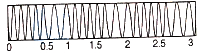
(A) In a frequency modulated wave,only the frequency of the carrier wave varies with time in accordance with the instantaneous amplitude of the modulating signal,while the amplitude of the carrier wave remains constant.
This wave is represented by the provided image.
Frequency modulation is widely used in $FM$ broadcasting,telemetry,and $RADAR$ systems.
This wave is represented by the provided image.
Frequency modulation is widely used in $FM$ broadcasting,telemetry,and $RADAR$ systems.
0 likes
View Solution322
EasyMCQ
$A$ layer of the atmosphere that reflects medium-frequency radio waves and is ineffective during the night is
A
$F$ layer
B
$E$ layer
C
Stratosphere
D
Thermosphere
Solution
(B) The ionosphere consists of different layers $(D, E, F_1, F_2)$.
The $E$ layer of the ionosphere is responsible for reflecting medium-frequency radio waves.
This layer is formed due to the ionization caused by solar radiation during the daytime.
At night,the source of ionization (solar radiation) is absent,causing the $E$ layer to disappear or become ineffective.
Therefore,the $E$ layer is the correct answer.
The $E$ layer of the ionosphere is responsible for reflecting medium-frequency radio waves.
This layer is formed due to the ionization caused by solar radiation during the daytime.
At night,the source of ionization (solar radiation) is absent,causing the $E$ layer to disappear or become ineffective.
Therefore,the $E$ layer is the correct answer.
0 likes
View Solution323
EasyMCQ
In a communication system,the process of superimposing a low-frequency signal on a high-frequency wave is known as:
A
Repeater
B
Attenuation
C
Modulation
D
Demodulation
Solution
(C) The process of superimposing a low-frequency message signal (baseband signal) onto a high-frequency carrier wave is called $Modulation$. This is necessary because low-frequency signals cannot travel long distances efficiently,and high-frequency waves act as carriers to transmit information over large distances.
0 likes
View Solution324
EasyMCQ
The maximum frequency of transmitted radio waves above which the radio waves are no longer reflected back by the ionosphere is . . . . . . ($N=$ maximum electron density of the ionosphere, $g=$ acceleration due to gravity).
A
$9 \sqrt{N}$
B
$9 N^2$
C
$9 \sqrt{N}$
D
$9^2 N^2$
Solution
(C) The critical frequency $(f_c)$ of the ionosphere is the maximum frequency of radio waves that can be reflected back to the Earth by the ionospheric layers.
It is given by the formula $f_c = 9 \sqrt{N_{max}}$, where $N_{max}$ is the maximum electron density of the ionosphere in electrons per cubic meter $(m^{-3})$.
In this context, the constant $9$ is derived from physical constants, and the expression is $9 \sqrt{N}$.
It is given by the formula $f_c = 9 \sqrt{N_{max}}$, where $N_{max}$ is the maximum electron density of the ionosphere in electrons per cubic meter $(m^{-3})$.
In this context, the constant $9$ is derived from physical constants, and the expression is $9 \sqrt{N}$.
0 likes
View Solution325
EasyMCQ
Which of the following is the communication channel in case of radio communication?
A
Free space
B
Reception lines
C
Transmission lines
D
None of the above
Solution
(A) In radio communication,the signal is transmitted in the form of electromagnetic waves.
These electromagnetic waves propagate through the atmosphere or vacuum without the need for any physical medium like wires or cables.
Therefore,the medium through which these waves travel is known as free space.
Thus,free space acts as the communication channel for radio communication.
These electromagnetic waves propagate through the atmosphere or vacuum without the need for any physical medium like wires or cables.
Therefore,the medium through which these waves travel is known as free space.
Thus,free space acts as the communication channel for radio communication.
0 likes
View Solution326
EasyMCQ
$A$ signal of frequency $3 \text{ kHz}$ is amplitude modulated on a carrier wave of frequency $2.5 \text{ MHz}$. The upper and lower sideband frequencies in the resultant signal are
A
$2500 \text{ kHz}, 2503 \text{ kHz}$
B
$2503 \text{ kHz}, 2497 \text{ kHz}$
C
$2.5 \text{ MHz}, 3 \text{ kHz}$
D
$5.5 \text{ MHz}, 0.5 \text{ MHz}$
Solution
(B) Given:
Frequency of the modulating signal,$f_m = 3 \text{ kHz} = 0.003 \text{ MHz}$.
Frequency of the carrier wave,$f_c = 2.5 \text{ MHz} = 2500 \text{ kHz}$.
The upper sideband frequency $(f_{USB})$ is given by $f_c + f_m = 2500 \text{ kHz} + 3 \text{ kHz} = 2503 \text{ kHz}$.
The lower sideband frequency $(f_{LSB})$ is given by $f_c - f_m = 2500 \text{ kHz} - 3 \text{ kHz} = 2497 \text{ kHz}$.
Thus,the sideband frequencies are $2503 \text{ kHz}$ and $2497 \text{ kHz}$.
Frequency of the modulating signal,$f_m = 3 \text{ kHz} = 0.003 \text{ MHz}$.
Frequency of the carrier wave,$f_c = 2.5 \text{ MHz} = 2500 \text{ kHz}$.
The upper sideband frequency $(f_{USB})$ is given by $f_c + f_m = 2500 \text{ kHz} + 3 \text{ kHz} = 2503 \text{ kHz}$.
The lower sideband frequency $(f_{LSB})$ is given by $f_c - f_m = 2500 \text{ kHz} - 3 \text{ kHz} = 2497 \text{ kHz}$.
Thus,the sideband frequencies are $2503 \text{ kHz}$ and $2497 \text{ kHz}$.
0 likes
View Solution327
EasyMCQ
In a communication system,the range for line-of-sight propagation on Earth is $d$ for an antenna height of $h$. If $h$ is doubled,then the new range is:
A
$\frac{d}{\sqrt{2}}$
B
$\frac{\sqrt{2}}{d}$
C
$\frac{d}{2}$
D
$\sqrt{2} d$
Solution
(D) The range $d$ for line-of-sight propagation is given by the formula $d = \sqrt{2Rh}$,where $R$ is the radius of the Earth and $h$ is the height of the antenna.
From this formula,we can see that $d \propto \sqrt{h}$.
Let the initial range be $d_1 = \sqrt{2Rh}$ and the initial height be $h_1 = h$.
Let the new height be $h_2 = 2h$.
The new range $d_2$ is given by $d_2 = \sqrt{2Rh_2} = \sqrt{2R(2h)}$.
$d_2 = \sqrt{2} \times \sqrt{2Rh} = \sqrt{2} d_1$.
Therefore,if the height is doubled,the new range becomes $\sqrt{2} d$.
From this formula,we can see that $d \propto \sqrt{h}$.
Let the initial range be $d_1 = \sqrt{2Rh}$ and the initial height be $h_1 = h$.
Let the new height be $h_2 = 2h$.
The new range $d_2$ is given by $d_2 = \sqrt{2Rh_2} = \sqrt{2R(2h)}$.
$d_2 = \sqrt{2} \times \sqrt{2Rh} = \sqrt{2} d_1$.
Therefore,if the height is doubled,the new range becomes $\sqrt{2} d$.
0 likes
View Solution328
EasyMCQ
In amplitude modulation,
A
both amplitude and frequency do not change according to information signal.
B
amplitude remains constant but frequency changes according to information signal.
C
both amplitude and frequency change according to information signal.
D
amplitude of carrier wave changes according to information signal.
Solution
(D) In amplitude modulation,the amplitude of the carrier wave is varied in accordance with the instantaneous value of the modulating signal (information signal),while the frequency and phase of the carrier wave remain constant.
0 likes
View Solution329
EasyMCQ
$A$ carrier wave of peak voltage $16 \text{ V}$ is used to transmit a signal. If the modulation index is $75 \%$, the peak voltage of the modulating signal is (in $\text{ V}$)
A
$6$
B
$24$
C
$18$
D
$12$
Solution
(D) The modulation index $(m_a)$ is defined as the ratio of the peak voltage of the modulating signal $(V_m)$ to the peak voltage of the carrier wave $(V_c)$.
Formula: $m_a = \frac{V_m}{V_c}$
Given:
Peak voltage of carrier wave $(V_c)$ = $16 \text{ V}$
Modulation index $(m_a)$ = $75 \% = 0.75$
Calculation:
$V_m = m_a \times V_c$
$V_m = 0.75 \times 16 \text{ V}$
$V_m = 12 \text{ V}$
Therefore, the peak voltage of the modulating signal is $12 \text{ V}$.
Formula: $m_a = \frac{V_m}{V_c}$
Given:
Peak voltage of carrier wave $(V_c)$ = $16 \text{ V}$
Modulation index $(m_a)$ = $75 \% = 0.75$
Calculation:
$V_m = m_a \times V_c$
$V_m = 0.75 \times 16 \text{ V}$
$V_m = 12 \text{ V}$
Therefore, the peak voltage of the modulating signal is $12 \text{ V}$.
0 likes
View Solution330
EasyMCQ
Modulation is a process of superposing
A
low frequency radio signal on low frequency audio waves.
B
high frequency audio signal on low frequency radio waves.
C
low frequency audio signal on high frequency radio waves.
D
high frequency radio signal on low frequency audio signal.
Solution
(C) Low frequency audio signals cannot be transmitted directly over long distances because they require antennas of impractical size and suffer from high attenuation. To overcome this,the low frequency audio signal (baseband signal) is superposed on a high frequency wave,known as the carrier wave. This process is called modulation.
0 likes
View Solution331
EasyMCQ
Identify the '$INCORRECT$' statement from the following.
A
Modulation index $\mu$ is kept greater than one to avoid distortion.
B
The receiving antenna is followed by an amplifier,an intermediate frequency $(IF)$ stage,and a detector.
C
$AM$ detection is carried out using a rectifier and an envelope detector.
D
The modulated signal is followed by a power amplifier and then fed to an antenna.
Solution
(A) In amplitude modulation,the modulation index $\mu$ is defined as the ratio of the amplitude of the modulating signal to the amplitude of the carrier wave. If $\mu > 1$,it leads to over-modulation,which causes severe distortion in the signal. Therefore,to avoid distortion,the modulation index $\mu$ is always kept less than or equal to $1$ (i.e.,$\mu \le 1$). Thus,the statement that $\mu$ is kept greater than one is incorrect.
0 likes
View Solution332
EasyMCQ
In amplitude modulation,the amplitude of the carrier wave is $A_c$ and that of the modulating signal is $A_m$. In practice,the ratio of $A_m$ to $A_c$ is kept less than or equal to $1$ to avoid:
A
Distortion
B
Attenuation
C
Fading
D
Noise
Solution
(A) In amplitude modulation,the modulation index is defined as $\mu = \frac{A_m}{A_c}$.
If $\mu > 1$,the amplitude of the modulating signal exceeds the amplitude of the carrier wave,which leads to over-modulation.
Over-modulation causes the envelope of the carrier wave to become distorted,resulting in the loss of information.
Therefore,to avoid distortion,the ratio $\frac{A_m}{A_c}$ (modulation index) is kept less than or equal to $1$.
If $\mu > 1$,the amplitude of the modulating signal exceeds the amplitude of the carrier wave,which leads to over-modulation.
Over-modulation causes the envelope of the carrier wave to become distorted,resulting in the loss of information.
Therefore,to avoid distortion,the ratio $\frac{A_m}{A_c}$ (modulation index) is kept less than or equal to $1$.
0 likes
View Solution333
EasyMCQ
In amplitude modulation:
A
Amplitude remains constant but frequency changes.
B
Both amplitude and frequency do not change.
C
Both amplitude and frequency change.
D
Amplitude of the carrier wave changes according to the information signal.
Solution
(D) In amplitude modulation,the amplitude of the high-frequency carrier wave is varied in accordance with the instantaneous amplitude of the modulating (information) signal,while the frequency and phase of the carrier wave remain constant.
0 likes
View Solution334
EasyMCQ
In the process of space communication,the use of a modem is necessary. In which one of the following modes does a modem act as a modulator and a demodulator respectively?
A
Transmitting and receiving.
B
Both receiving.
C
Both transmitting.
D
Receiving and transmitting.
Solution
(A) modem stands for Modulator-Demodulator.
In the process of space communication,at the transmitting end,the modem acts as a modulator to convert digital signals into analog signals for transmission.
At the receiving end,the modem acts as a demodulator to convert the received analog signals back into digital signals.
Therefore,the modem acts as a modulator during transmission and as a demodulator during reception.
In the process of space communication,at the transmitting end,the modem acts as a modulator to convert digital signals into analog signals for transmission.
At the receiving end,the modem acts as a demodulator to convert the received analog signals back into digital signals.
Therefore,the modem acts as a modulator during transmission and as a demodulator during reception.
0 likes
View Solution335
MediumMCQ
The waves which are reflected back to the earth by the ionosphere are:
A
ground wave
B
sky wave
C
space wave
D
All of them
Solution
(B) The ionosphere acts as a reflecting medium for electromagnetic waves in the frequency range of $3 \ MHz$ to $30 \ MHz$. These waves are known as sky waves. When these waves are transmitted towards the sky,they are reflected back to the earth by the ionospheric layers,enabling long-distance communication.
0 likes
View Solution336
EasyMCQ
The advantage of an optical fibre is:
A
high bandwidth and $EM$ interference
B
low bandwidth and $EM$ interference
C
high bandwidth,low transmission capacity,and no $EM$ interference
D
high bandwidth,high data transmission capacity,and no $EM$ interference
Solution
(D) The primary advantages of optical fibres include:
$1$. They possess a very high bandwidth,allowing for the transmission of a large amount of data.
$2$. They have a high data transmission capacity,significantly exceeding that of copper wires or radio waves.
$3$. They are practically free from electromagnetic $(EM)$ interference and crosstalk,which are common issues in ordinary cables and microwave links.
$1$. They possess a very high bandwidth,allowing for the transmission of a large amount of data.
$2$. They have a high data transmission capacity,significantly exceeding that of copper wires or radio waves.
$3$. They are practically free from electromagnetic $(EM)$ interference and crosstalk,which are common issues in ordinary cables and microwave links.
0 likes
View Solution337
DifficultMCQ
The waves used for line-of-sight $(LOS)$ communication are
A
ground waves
B
space waves
C
sound waves
D
sky waves
Solution
(B) Space waves are used for line-of-sight $(LOS)$ communication.
Line-of-sight is a type of communication that can transmit and receive data only when transmitter and receiver stations are in view of each other with no obstacle between them.
This mode of propagation is typically used for high-frequency signals like $VHF$,$UHF$,and microwave signals.
Line-of-sight is a type of communication that can transmit and receive data only when transmitter and receiver stations are in view of each other with no obstacle between them.
This mode of propagation is typically used for high-frequency signals like $VHF$,$UHF$,and microwave signals.
0 likes
View Solution338
EasyMCQ
An antenna uses electromagnetic waves of frequency $5 \text{ MHz}$. For proper working,the size of the antenna should be:
A
$15 \text{ km}$
B
$15 \text{ m}$
C
$3 \text{ km}$
D
$300 \text{ m}$
Solution
(B) The wavelength $\lambda$ of the electromagnetic wave is given by the formula $\lambda = \frac{c}{f}$,where $c$ is the speed of light $(3 \times 10^8 \text{ m/s})$ and $f$ is the frequency $(5 \times 10^6 \text{ Hz})$.
Substituting the values: $\lambda = \frac{3 \times 10^8}{5 \times 10^6} = 0.6 \times 10^2 = 60 \text{ m}$.
For an antenna to work efficiently,its length should be at least $\frac{\lambda}{4}$.
Therefore,the required size of the antenna is $\frac{60}{4} = 15 \text{ m}$.
Substituting the values: $\lambda = \frac{3 \times 10^8}{5 \times 10^6} = 0.6 \times 10^2 = 60 \text{ m}$.
For an antenna to work efficiently,its length should be at least $\frac{\lambda}{4}$.
Therefore,the required size of the antenna is $\frac{60}{4} = 15 \text{ m}$.
0 likes
View Solution339
EasyMCQ
The radius of the Earth is $6400 \text{ km}$. If the height of the antenna is $500 \text{ m}$, then its range is: (in $\text{ km}$)
A
$800$
B
$100$
C
$80$
D
$10$
Solution
(C) Given: Radius of the Earth, $R = 6400 \text{ km} = 6400 \times 10^3 \text{ m}$.
Height of the antenna, $h = 500 \text{ m} = 0.5 \text{ km}$.
The formula for the range $(d)$ of an antenna is given by $d = \sqrt{2Rh}$.
Substituting the values:
$d = \sqrt{2 \times 6400 \text{ km} \times 0.5 \text{ km}}$
$d = \sqrt{6400 \times 1} \text{ km}$
$d = \sqrt{6400} \text{ km} = 80 \text{ km}$.
Thus, the range of the antenna is $80 \text{ km}$.
Height of the antenna, $h = 500 \text{ m} = 0.5 \text{ km}$.
The formula for the range $(d)$ of an antenna is given by $d = \sqrt{2Rh}$.
Substituting the values:
$d = \sqrt{2 \times 6400 \text{ km} \times 0.5 \text{ km}}$
$d = \sqrt{6400 \times 1} \text{ km}$
$d = \sqrt{6400} \text{ km} = 80 \text{ km}$.
Thus, the range of the antenna is $80 \text{ km}$.
0 likes
View Solution340
EasyMCQ
The process of superimposing a message signal on a high-frequency carrier wave is called:
A
Amplification
B
Demodulation
C
Transmission
D
Modulation
Solution
(D) The process of superimposing a message signal on a high-frequency carrier wave is called modulation.
It is usually applied to electromagnetic signals.
Common modulation methods are amplitude modulation,frequency modulation,and phase modulation.
It is usually applied to electromagnetic signals.
Common modulation methods are amplitude modulation,frequency modulation,and phase modulation.
0 likes
View Solution341
MediumMCQ
$A$ basic communication system consists of:
$(a)$ Transmitter
$(b)$ Information source
$(c)$ User of information
$(d)$ Channel
$(e)$ Receiver
The correct sequence of the arrangement is:
$(a)$ Transmitter
$(b)$ Information source
$(c)$ User of information
$(d)$ Channel
$(e)$ Receiver
The correct sequence of the arrangement is:
A
$(b)$ $\rightarrow$ $(a)$ $\rightarrow$ $(d)$ $\rightarrow$ $(e)$ $\rightarrow$ $(c)$
B
$(b)$ $\rightarrow$ $(a)$ $\rightarrow$ $(e)$ $\rightarrow$ $(d)$ $\rightarrow$ $(c)$
C
$(a)$ $\rightarrow$ $(b)$ $\rightarrow$ $(d)$ $\rightarrow$ $(e)$ $\rightarrow$ $(c)$
D
$(b)$ $\rightarrow$ $(d)$ $\rightarrow$ $(a)$ $\rightarrow$ $(e)$ $\rightarrow$ $(c)$
Solution
(A) basic communication system is designed to transfer information from one point to another.
The process follows a specific sequence:
$1$. Information source: The origin of the message.
$2$. Transmitter: Converts the information into a signal suitable for transmission.
$3$. Channel: The medium through which the signal travels.
$4$. Receiver: Extracts the original signal from the channel.
$5$. User of information: The final destination or recipient of the message.
Therefore,the correct sequence is: Information source $\rightarrow$ Transmitter $\rightarrow$ Channel $\rightarrow$ Receiver $\rightarrow$ User of information,which corresponds to $(b)$ $\rightarrow$ $(a)$ $\rightarrow$ $(d)$ $\rightarrow$ $(e)$ $\rightarrow$ $(c)$.
The process follows a specific sequence:
$1$. Information source: The origin of the message.
$2$. Transmitter: Converts the information into a signal suitable for transmission.
$3$. Channel: The medium through which the signal travels.
$4$. Receiver: Extracts the original signal from the channel.
$5$. User of information: The final destination or recipient of the message.
Therefore,the correct sequence is: Information source $\rightarrow$ Transmitter $\rightarrow$ Channel $\rightarrow$ Receiver $\rightarrow$ User of information,which corresponds to $(b)$ $\rightarrow$ $(a)$ $\rightarrow$ $(d)$ $\rightarrow$ $(e)$ $\rightarrow$ $(c)$.
0 likes
View Solution342
EasyMCQ
Amplitude modulation has
A
one carrier with two side band frequencies
B
one carrier
C
one carrier with infinite frequencies
D
one carrier with high frequency
Solution
(A) In amplitude modulation,the amplitude of the carrier wave is varied in accordance with the instantaneous value of the modulating signal.
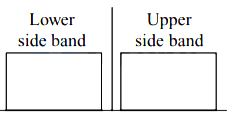
Mathematically,the modulated wave consists of the carrier frequency $(f_c)$ and two sideband frequencies: the upper sideband $(f_c + f_m)$ and the lower sideband $(f_c - f_m)$,where $f_m$ is the frequency of the modulating signal.
Therefore,amplitude modulation consists of one carrier frequency and two sideband frequencies.
Mathematically,the modulated wave consists of the carrier frequency $(f_c)$ and two sideband frequencies: the upper sideband $(f_c + f_m)$ and the lower sideband $(f_c - f_m)$,where $f_m$ is the frequency of the modulating signal.
Therefore,amplitude modulation consists of one carrier frequency and two sideband frequencies.
0 likes
View Solution343
EasyMCQ
The maximum distance between the transmitting and receiving antennas for satisfactory communication in line of sight mode is $57.6 \ km$. If the height of the receiving antenna is $80 \ m$,the height of the transmitting antenna is (Radius of earth $= 6.4 \times 10^6 \ m$) (in $m$)
A
$28.8$
B
$51.2$
C
$25.6$
D
$14.4$
Solution
(B) The maximum range $d$ for line-of-sight communication is given by the formula: $d = \sqrt{2Rh_t} + \sqrt{2Rh_r}$,where $R$ is the radius of the Earth,$h_t$ is the height of the transmitting antenna,and $h_r$ is the height of the receiving antenna.
Given: $d = 57.6 \ km = 57.6 \times 10^3 \ m$,$h_r = 80 \ m$,$R = 6.4 \times 10^6 \ m$.
Substituting the values:
$57.6 \times 10^3 = \sqrt{2 \times 6.4 \times 10^6 \times h_t} + \sqrt{2 \times 6.4 \times 10^6 \times 80}$
$57.6 \times 10^3 = \sqrt{12.8 \times 10^6 \times h_t} + \sqrt{1024 \times 10^6}$
$57.6 \times 10^3 = \sqrt{12.8 \times 10^6 \times h_t} + 32000$
$57.6 \times 10^3 - 32 \times 10^3 = \sqrt{12.8 \times 10^6 \times h_t}$
$25.6 \times 10^3 = \sqrt{12.8 \times 10^6 \times h_t}$
Squaring both sides:
$(25.6 \times 10^3)^2 = 12.8 \times 10^6 \times h_t$
$655.36 \times 10^6 = 12.8 \times 10^6 \times h_t$
$h_t = \frac{655.36}{12.8} = 51.2 \ m$.
Given: $d = 57.6 \ km = 57.6 \times 10^3 \ m$,$h_r = 80 \ m$,$R = 6.4 \times 10^6 \ m$.
Substituting the values:
$57.6 \times 10^3 = \sqrt{2 \times 6.4 \times 10^6 \times h_t} + \sqrt{2 \times 6.4 \times 10^6 \times 80}$
$57.6 \times 10^3 = \sqrt{12.8 \times 10^6 \times h_t} + \sqrt{1024 \times 10^6}$
$57.6 \times 10^3 = \sqrt{12.8 \times 10^6 \times h_t} + 32000$
$57.6 \times 10^3 - 32 \times 10^3 = \sqrt{12.8 \times 10^6 \times h_t}$
$25.6 \times 10^3 = \sqrt{12.8 \times 10^6 \times h_t}$
Squaring both sides:
$(25.6 \times 10^3)^2 = 12.8 \times 10^6 \times h_t$
$655.36 \times 10^6 = 12.8 \times 10^6 \times h_t$
$h_t = \frac{655.36}{12.8} = 51.2 \ m$.
0 likes
View Solution344
EasyMCQ
The bandwidth of an optical fiber is
A
more than $100 GHz$
B
less than $1 MHz$
C
less than $1 GHz$
D
less than $100 kHz$
Solution
(A) Optical fibers use light waves for communication,which have very high frequencies (in the range of $THz$). Due to this high carrier frequency,the bandwidth available for signal transmission is extremely large,typically exceeding $100 GHz$. This allows for the transmission of a massive amount of data compared to traditional copper wires.
0 likes
View Solution345
EasyMCQ
Digital signal
A
is represented by a sine wave
B
utilizes binary code system
C
is represented by a cosine wave
D
utilizes a hexadecimal code
Solution
(B) digital signal represents data as a sequence of discrete values,typically $0$ and $1$,which correspond to the binary code system. Unlike analog signals that are continuous (like sine or cosine waves),digital signals are discontinuous and rely on binary logic.
0 likes
View Solution346
MediumMCQ
The maximum number of $TV$ signals that can be transmitted along a coaxial cable is
A
$100$
B
$125$
C
$140$
D
$90$
Solution
(B) coaxial cable,also known as $TV$ aerial cable or coax,is primarily used to carry video and data signals from an antenna to a device such as a satellite dish or television.
This is due to the well-insulated conductor wire,which prevents frequency interference.
Coaxial cables can transmit a high range of frequencies due to low power losses.
The maximum number of $TV$ signals that can be transmitted simultaneously along a single coaxial cable is $125$.
This is due to the well-insulated conductor wire,which prevents frequency interference.
Coaxial cables can transmit a high range of frequencies due to low power losses.
The maximum number of $TV$ signals that can be transmitted simultaneously along a single coaxial cable is $125$.
0 likes
View Solution347
EasyMCQ
Frequencies in the $UHF$ range normally propagate by means of:
A
Space waves
B
Surface waves
C
Ground waves
D
Sky waves
Solution
(A) The $UHF$ (Ultra High Frequency) range typically spans from $300 \ MHz$ to $3000 \ MHz$.
Due to their high frequency,these waves cannot be reflected by the ionosphere (sky waves) and are heavily attenuated by the ground (ground waves).
Therefore,they propagate primarily through line-of-sight communication,which is achieved by means of space waves.
Due to their high frequency,these waves cannot be reflected by the ionosphere (sky waves) and are heavily attenuated by the ground (ground waves).
Therefore,they propagate primarily through line-of-sight communication,which is achieved by means of space waves.
0 likes
View Solution348
EasyMCQ
The frequency band for uplink satellite communication is
A
$5.9-6.4 \text{ GHz}$
B
$54-72 \text{ MHz}$
C
$88-108 \text{ MHz}$
D
$540-1600 \text{ kHz}$
Solution
(A) In satellite communication,the uplink frequency is the frequency at which the ground station transmits signals to the satellite.
This frequency is kept high (in the microwave range) to ensure that the signals can penetrate the ionosphere without being reflected back to Earth.
The standard frequency band used for uplink satellite communication is $5.9-6.4 \text{ GHz}$.
This frequency is kept high (in the microwave range) to ensure that the signals can penetrate the ionosphere without being reflected back to Earth.
The standard frequency band used for uplink satellite communication is $5.9-6.4 \text{ GHz}$.
0 likes
View Solution349
MediumMCQ
If the highest modulating frequency of the wave is $5 kHz$,then the number of stations that can be accommodated in a $150 kHz$ bandwidth is
A
$20$
B
$15$
C
$10$
D
$5$
Solution
(B) Given,the highest modulating frequency,$f_m = 5 kHz = 5 \times 10^3 Hz$.
For an amplitude-modulated wave,the bandwidth required for one station is $BW = 2 f_m$.
Therefore,$BW = 2 \times 5 kHz = 10 kHz = 10^4 Hz$.
The total available bandwidth is $f = 150 kHz = 150 \times 10^3 Hz$.
The number of stations that can be accommodated is given by the ratio of the total bandwidth to the bandwidth per station.
Number of stations $= \frac{f}{BW} = \frac{150 kHz}{10 kHz} = 15$.
For an amplitude-modulated wave,the bandwidth required for one station is $BW = 2 f_m$.
Therefore,$BW = 2 \times 5 kHz = 10 kHz = 10^4 Hz$.
The total available bandwidth is $f = 150 kHz = 150 \times 10^3 Hz$.
The number of stations that can be accommodated is given by the ratio of the total bandwidth to the bandwidth per station.
Number of stations $= \frac{f}{BW} = \frac{150 kHz}{10 kHz} = 15$.
0 likes
View Solution350
MediumMCQ
In a communication system operating at a wavelength of $800 \,nm$, only $1 \%$ of the source frequency is available as signal bandwidth. The number of channels accommodated for transmitting $TV$ signals of bandwidth $6 \,MHz$ is
A
$\frac{1}{25} \times 10^7$
B
$\frac{1}{21} \times 10^7$
C
$\frac{1}{16} \times 10^7$
D
$\frac{1}{12} \times 10^7$
Solution
(C) Given: Wavelength $\lambda = 800 \,nm = 800 \times 10^{-9} \,m$. Speed of light $c = 3 \times 10^8 \,m/s$.
Frequency of the source $f = c / \lambda = (3 \times 10^8) / (800 \times 10^{-9}) = 3.75 \times 10^{14} \,Hz$.
Available signal bandwidth is $1 \%$ of the source frequency:
Bandwidth $= 0.01 \times 3.75 \times 10^{14} = 3.75 \times 10^{12} \,Hz$.
Bandwidth required for one $TV$ channel $= 6 \,MHz = 6 \times 10^6 \,Hz$.
Number of channels $= \text{Total bandwidth} / \text{Bandwidth per channel} = (3.75 \times 10^{12}) / (6 \times 10^6) = 0.625 \times 10^6 = 6.25 \times 10^5$.
Expressing this in the form of the options: $6.25 \times 10^5 = (1/16) \times 10^7 = 0.0625 \times 10^7$.
Frequency of the source $f = c / \lambda = (3 \times 10^8) / (800 \times 10^{-9}) = 3.75 \times 10^{14} \,Hz$.
Available signal bandwidth is $1 \%$ of the source frequency:
Bandwidth $= 0.01 \times 3.75 \times 10^{14} = 3.75 \times 10^{12} \,Hz$.
Bandwidth required for one $TV$ channel $= 6 \,MHz = 6 \times 10^6 \,Hz$.
Number of channels $= \text{Total bandwidth} / \text{Bandwidth per channel} = (3.75 \times 10^{12}) / (6 \times 10^6) = 0.625 \times 10^6 = 6.25 \times 10^5$.
Expressing this in the form of the options: $6.25 \times 10^5 = (1/16) \times 10^7 = 0.0625 \times 10^7$.
0 likes
View SolutionCommunication — Communication · Frequently Asked Questions
1Are these Communication questions useful for JEE and NEET?
Yes. All questions in this section are mapped to JEE Main and NEET exam patterns. Previous year questions from JEE Main, NEET, GUJCET and state-level exams are included with full solutions.
2Can I switch to Hindi or Gujarati for these questions?
Yes. Use the language tabs in the hero section or the sidebar to view the same questions and solutions in English, Hindi or Gujarati.
3How do I generate a question paper from this subtopic?
Use the Vedclass Exam Paper Generator — select the chapter and subtopic, set difficulty, and generate Sets A, B, C, D automatically. First 3 chapters of every subject are free.
Vedclass Products
For Students
Vedclass Test Series
Mock tests in real JEE/NEET style with performance analysis. 5-day free trial.
Start Free TrialFor Teachers
Exam Paper Generator
Generate Set A/B/C/D papers from this chapter in 2 minutes. 3 chapters free.
Try FreeFor Institutes
Online Exam Module
Live online exams with unlimited students, 360° analytics & white-label branding.
See DemoFor Teachers & Institutes
Generate a Communication Exam Paper in 2 Minutes
Select subtopic & difficulty — Sets A, B, C, D auto-generated with No Repeat logic.
First 3 chapters of every subject are free — no payment required.