
A English
Communication Questions in English
Class 12 Physics · Communication · Communication
453+
Questions
English
Language
100%
With Solutions
Showing 50 of 453 questions in English
251
Easy
What is an analog signal?
Solution
(N/A) An analog signal is a continuous signal that represents physical measurements. It varies smoothly with time and can take any value within a given range. Examples include sound waves,light intensity,and temperature variations. Unlike digital signals,which are discrete and represented by binary values ($0$ and $1$),analog signals are continuous in both time and amplitude.
0 likes
View Solution252
MediumMCQ
An amplitude modulated wave is represented by the expression $v_{m}=5(1+0.6 \cos 6280 t) \sin (211 \times 10^{4} t) \; V$. The minimum and maximum amplitudes of the amplitude modulated wave are,respectively:
A
$2 \; V, 8 \; V$
B
$1.5 \; V, 5 \; V$
C
$2.5 \; V, 8 \; V$
D
$3 \; V, 5 \; V$
Solution
(A) The standard expression for an amplitude modulated wave is given by $v(t) = A_c(1 + \mu \cos \omega_m t) \sin \omega_c t$,where $A_c$ is the carrier amplitude and $\mu$ is the modulation index.
Comparing this with the given expression $v_m = 5(1 + 0.6 \cos 6280 t) \sin (211 \times 10^4 t)$:
Carrier amplitude $A_c = 5 \; V$.
Modulation index $\mu = 0.6$.
The amplitude of the modulated wave varies between $A_{max} = A_c(1 + \mu)$ and $A_{min} = A_c(1 - \mu)$.
$A_{max} = 5(1 + 0.6) = 5(1.6) = 8 \; V$.
$A_{min} = 5(1 - 0.6) = 5(0.4) = 2 \; V$.
Thus,the minimum and maximum amplitudes are $2 \; V$ and $8 \; V$ respectively.
Comparing this with the given expression $v_m = 5(1 + 0.6 \cos 6280 t) \sin (211 \times 10^4 t)$:
Carrier amplitude $A_c = 5 \; V$.
Modulation index $\mu = 0.6$.
The amplitude of the modulated wave varies between $A_{max} = A_c(1 + \mu)$ and $A_{min} = A_c(1 - \mu)$.
$A_{max} = 5(1 + 0.6) = 5(1.6) = 8 \; V$.
$A_{min} = 5(1 - 0.6) = 5(0.4) = 2 \; V$.
Thus,the minimum and maximum amplitudes are $2 \; V$ and $8 \; V$ respectively.
1 likes
View Solution253
MediumMCQ
If modulation index $\mu = \frac{1}{2}$ and $V_{m} = 2$,then $V_{c} = \, ?$
A
$4$
B
$2$
C
$6$
D
$8$
Solution
(A) The modulation index $\mu$ is defined as the ratio of the amplitude of the modulating signal $(V_{m})$ to the amplitude of the carrier wave $(V_{c})$:
$\mu = \frac{V_{m}}{V_{c}}$
Given that $\mu = \frac{1}{2}$ and $V_{m} = 2$,we substitute these values into the formula:
$\frac{1}{2} = \frac{2}{V_{c}}$
By cross-multiplying,we get:
$V_{c} = 2 \times 2$
$V_{c} = 4$
$\mu = \frac{V_{m}}{V_{c}}$
Given that $\mu = \frac{1}{2}$ and $V_{m} = 2$,we substitute these values into the formula:
$\frac{1}{2} = \frac{2}{V_{c}}$
By cross-multiplying,we get:
$V_{c} = 2 \times 2$
$V_{c} = 4$
0 likes
View Solution254
MediumMCQ
$A$ $25\, m$ long antenna is mounted on an antenna tower. The height of the antenna tower is $75\, m$. The wavelength (in meter) of the signal transmitted by this antenna would be
A
$300$
B
$400$
C
$200$
D
$100$
Solution
(D) For an antenna to be effective,its length $L$ should be a fraction of the wavelength $\lambda$ of the signal it transmits.
Typically,the minimum length of an antenna is given by $L = \frac{\lambda}{4}$.
Given the length of the antenna $L = 25\, m$.
Substituting the value into the formula: $25 = \frac{\lambda}{4}$.
Solving for $\lambda$: $\lambda = 25 \times 4 = 100\, m$.
Thus,the wavelength of the signal is $100\, m$.
Typically,the minimum length of an antenna is given by $L = \frac{\lambda}{4}$.
Given the length of the antenna $L = 25\, m$.
Substituting the value into the formula: $25 = \frac{\lambda}{4}$.
Solving for $\lambda$: $\lambda = 25 \times 4 = 100\, m$.
Thus,the wavelength of the signal is $100\, m$.
0 likes
View Solution255
MediumMCQ
For $VHF$ signal broadcasting,what is the maximum service area in $km^{2}$ that will be covered by an antenna tower of height $30\, m$,if the receiving antenna is placed at the ground? Let the radius of the earth be $6400\, km$. (Round off to the nearest integer) (Take $\pi$ as $3.14$)
A
$1206$
B
$2412$
C
$603$
D
$1152$
Solution
(A) The distance to the horizon $d$ for an antenna of height $h$ is given by the formula $d = \sqrt{2Rh}$,where $R$ is the radius of the earth.
The service area $A$ covered by the antenna is the area of a circle with radius $d$,given by $A = \pi d^{2}$.
Substituting the expression for $d$,we get $A = \pi (\sqrt{2Rh})^{2} = 2\pi Rh$.
Given $R = 6400\, km = 6400 \times 10^{3}\, m$ and $h = 30\, m$.
Converting $R$ to $km$ to match the required unit for area: $R = 6400\, km$ and $h = 30\, m = 0.03\, km$.
$A = 3.14 \times 2 \times 6400 \times 0.03$.
$A = 3.14 \times 384 = 1205.76\, km^{2}$.
Rounding off to the nearest integer,we get $A \simeq 1206\, km^{2}$.
The service area $A$ covered by the antenna is the area of a circle with radius $d$,given by $A = \pi d^{2}$.
Substituting the expression for $d$,we get $A = \pi (\sqrt{2Rh})^{2} = 2\pi Rh$.
Given $R = 6400\, km = 6400 \times 10^{3}\, m$ and $h = 30\, m$.
Converting $R$ to $km$ to match the required unit for area: $R = 6400\, km$ and $h = 30\, m = 0.03\, km$.
$A = 3.14 \times 2 \times 6400 \times 0.03$.
$A = 3.14 \times 384 = 1205.76\, km^{2}$.
Rounding off to the nearest integer,we get $A \simeq 1206\, km^{2}$.
0 likes
View Solution256
MediumMCQ
Two identical antennas mounted on identical towers are separated from each other by a distance of $45 \, km$. What should be the minimum height of the receiving antenna to receive the signals in line of sight? (Assume radius of earth is $6400 \, km$)
A
$19.77$
B
$39.55$
C
$79.1$
D
$158.2$
Solution
(B) For line-of-sight communication between two antennas of height $h$,the maximum distance $D$ is given by the formula $D = \sqrt{2Rh_t} + \sqrt{2Rh_r}$.
Since the towers are identical,$h_t = h_r = h$,so $D = 2\sqrt{2Rh}$.
Given $D = 45 \, km$ and $R = 6400 \, km$.
Squaring both sides,we get $D^2 = 4(2Rh) = 8Rh$.
Therefore,$h = \frac{D^2}{8R}$.
Substituting the values: $h = \frac{45^2}{8 \times 6400} \, km = \frac{2025}{51200} \, km$.
$h \approx 0.03955 \, km = 39.55 \, m$.
Since the towers are identical,$h_t = h_r = h$,so $D = 2\sqrt{2Rh}$.
Given $D = 45 \, km$ and $R = 6400 \, km$.
Squaring both sides,we get $D^2 = 4(2Rh) = 8Rh$.
Therefore,$h = \frac{D^2}{8R}$.
Substituting the values: $h = \frac{45^2}{8 \times 6400} \, km = \frac{2025}{51200} \, km$.
$h \approx 0.03955 \, km = 39.55 \, m$.
0 likes
View Solution257
MediumMCQ
$A$ carrier signal $C(t)=25 \sin(2.512 \times 10^{10} t)$ is amplitude modulated by a message signal $m(t)=5 \sin(1.57 \times 10^{8} t)$ and transmitted through an antenna. What will be the bandwidth of the modulated signal?
A
$8 \text{ GHz}$
B
$2.01 \text{ GHz}$
C
$1987.5 \text{ MHz}$
D
$50 \text{ MHz}$
Solution
(D) The bandwidth of an amplitude modulated signal is given by $BW = 2f_m$,where $f_m$ is the frequency of the message signal.
Given the message signal $m(t) = 5 \sin(1.57 \times 10^8 t)$,the angular frequency is $\omega_m = 1.57 \times 10^8 \text{ rad/s}$.
Since $\omega_m = 2\pi f_m$,we have $f_m = \frac{\omega_m}{2\pi}$.
Substituting the values,$f_m = \frac{1.57 \times 10^8}{2 \times 3.14} = \frac{1.57 \times 10^8}{6.28} = 0.25 \times 10^8 \text{ Hz} = 25 \times 10^6 \text{ Hz} = 25 \text{ MHz}$.
Therefore,the bandwidth $BW = 2f_m = 2 \times 25 \text{ MHz} = 50 \text{ MHz}$.
Given the message signal $m(t) = 5 \sin(1.57 \times 10^8 t)$,the angular frequency is $\omega_m = 1.57 \times 10^8 \text{ rad/s}$.
Since $\omega_m = 2\pi f_m$,we have $f_m = \frac{\omega_m}{2\pi}$.
Substituting the values,$f_m = \frac{1.57 \times 10^8}{2 \times 3.14} = \frac{1.57 \times 10^8}{6.28} = 0.25 \times 10^8 \text{ Hz} = 25 \times 10^6 \text{ Hz} = 25 \text{ MHz}$.
Therefore,the bandwidth $BW = 2f_m = 2 \times 25 \text{ MHz} = 50 \text{ MHz}$.
0 likes
View Solution258
MediumMCQ
$A$ $TV$ transmission tower antenna is at a height of $20\, m$. Suppose that the receiving antenna is at:
$(i)$ ground level
$(ii)$ a height of $5\, m$.
The increase in antenna range in case $(ii)$ relative to case $(i)$ is $n\%$.
The value of $n$,to the nearest integer,is .....$\%$
$(i)$ ground level
$(ii)$ a height of $5\, m$.
The increase in antenna range in case $(ii)$ relative to case $(i)$ is $n\%$.
The value of $n$,to the nearest integer,is .....$\%$
A
$60$
B
$50$
C
$69$
D
$44$
Solution
(B) The range of a $TV$ transmission tower is given by $d = \sqrt{2Rh}$,where $R$ is the radius of the Earth and $h$ is the height of the antenna.
Case $(i)$: When the receiving antenna is at ground level,the range is $d_1 = \sqrt{2Rh}$,where $h = 20\, m$.
Case $(ii)$: When the receiving antenna is at a height $h' = 5\, m$,the total range is $d_2 = \sqrt{2Rh} + \sqrt{2Rh'}$.
The increase in range is $\Delta d = d_2 - d_1 = \sqrt{2Rh'}$.
The percentage increase $n\%$ is given by $\frac{\Delta d}{d_1} \times 100\%$.
$n = \frac{\sqrt{2Rh'}}{\sqrt{2Rh}} \times 100 = \sqrt{\frac{h'}{h}} \times 100$.
Substituting the values $h = 20\, m$ and $h' = 5\, m$:
$n = \sqrt{\frac{5}{20}} \times 100 = \sqrt{\frac{1}{4}} \times 100 = 0.5 \times 100 = 50\%$.
Therefore,the value of $n$ is $50$.
Case $(i)$: When the receiving antenna is at ground level,the range is $d_1 = \sqrt{2Rh}$,where $h = 20\, m$.
Case $(ii)$: When the receiving antenna is at a height $h' = 5\, m$,the total range is $d_2 = \sqrt{2Rh} + \sqrt{2Rh'}$.
The increase in range is $\Delta d = d_2 - d_1 = \sqrt{2Rh'}$.
The percentage increase $n\%$ is given by $\frac{\Delta d}{d_1} \times 100\%$.
$n = \frac{\sqrt{2Rh'}}{\sqrt{2Rh}} \times 100 = \sqrt{\frac{h'}{h}} \times 100$.
Substituting the values $h = 20\, m$ and $h' = 5\, m$:
$n = \sqrt{\frac{5}{20}} \times 100 = \sqrt{\frac{1}{4}} \times 100 = 0.5 \times 100 = 50\%$.
Therefore,the value of $n$ is $50$.
0 likes
View Solution259
MediumMCQ
An audio signal $v_{m} = 20 \sin(2 \pi \times 1500 t)$ amplitude modulates a carrier $v_{c} = 80 \sin(2 \pi \times 100,000 t)$. The value of percent modulation is..........
A
$12$
B
$30$
C
$15$
D
$25$
Solution
(D) The modulation index $\mu$ is defined as the ratio of the amplitude of the modulating signal $(A_{m})$ to the amplitude of the carrier signal $(A_{c})$.
Given,$A_{m} = 20 \text{ V}$ and $A_{c} = 80 \text{ V}$.
$\mu = \frac{A_{m}}{A_{c}} = \frac{20}{80} = 0.25$.
Percent modulation is given by $\mu \times 100$.
Percent modulation $= 0.25 \times 100 = 25 \%$.
Given,$A_{m} = 20 \text{ V}$ and $A_{c} = 80 \text{ V}$.
$\mu = \frac{A_{m}}{A_{c}} = \frac{20}{80} = 0.25$.
Percent modulation is given by $\mu \times 100$.
Percent modulation $= 0.25 \times 100 = 25 \%$.
0 likes
View Solution260
MediumMCQ
Given below are two statements:
Statement-$I$: $A$ speech signal of $2 \, kHz$ is used to modulate a carrier signal of $1 \, MHz$. The bandwidth requirement for the signal is $4 \, kHz$.
Statement-$II$: The sideband frequencies are $1002 \, kHz$ and $998 \, kHz$.
In the light of the above statements,choose the correct answer from the options given below:
Statement-$I$: $A$ speech signal of $2 \, kHz$ is used to modulate a carrier signal of $1 \, MHz$. The bandwidth requirement for the signal is $4 \, kHz$.
Statement-$II$: The sideband frequencies are $1002 \, kHz$ and $998 \, kHz$.
In the light of the above statements,choose the correct answer from the options given below:
A
Statement-$I$ is true but Statement-$II$ is false.
B
Statement-$I$ is false but Statement-$II$ is true.
C
Both Statement-$I$ and Statement-$II$ are true.
D
Both Statement-$I$ and Statement-$II$ are false.
Solution
(C) Given:
Modulating frequency $f_m = 2 \, kHz$.
Carrier frequency $f_c = 1 \, MHz = 1000 \, kHz$.
For Amplitude Modulation $(AM)$,the bandwidth is given by $BW = 2f_m$.
$BW = 2 \times 2 \, kHz = 4 \, kHz$.
Thus,Statement-$I$ is true.
The sideband frequencies are given by $f_c + f_m$ and $f_c - f_m$.
Upper Sideband $(USB)$ $= 1000 \, kHz + 2 \, kHz = 1002 \, kHz$.
Lower Sideband $(LSB)$ $= 1000 \, kHz - 2 \, kHz = 998 \, kHz$.
Thus,Statement-$II$ is true.
Therefore,both statements are correct.
Modulating frequency $f_m = 2 \, kHz$.
Carrier frequency $f_c = 1 \, MHz = 1000 \, kHz$.
For Amplitude Modulation $(AM)$,the bandwidth is given by $BW = 2f_m$.
$BW = 2 \times 2 \, kHz = 4 \, kHz$.
Thus,Statement-$I$ is true.
The sideband frequencies are given by $f_c + f_m$ and $f_c - f_m$.
Upper Sideband $(USB)$ $= 1000 \, kHz + 2 \, kHz = 1002 \, kHz$.
Lower Sideband $(LSB)$ $= 1000 \, kHz - 2 \, kHz = 998 \, kHz$.
Thus,Statement-$II$ is true.
Therefore,both statements are correct.
0 likes
View Solution261
DifficultMCQ
$A$ signal of $0.1 \, kW$ is transmitted in a cable. The attenuation of the cable is $-5 \, dB$ per $km$ and the cable length is $20 \, km$. The power received at the receiver is $10^{-x} \, W$. The value of $x$ is ....... .
$[\text{Gain in } dB = 10 \log_{10}(\frac{P_0}{P_i})]$
$[\text{Gain in } dB = 10 \log_{10}(\frac{P_0}{P_i})]$
A
$4$
B
$12$
C
$16$
D
$8$
Solution
(D) The total attenuation in the cable is given by: $\text{Total Attenuation} = (\text{Attenuation per km}) \times (\text{Length}) = -5 \, dB/km \times 20 \, km = -100 \, dB$.
The formula for gain in $dB$ is: $\text{Gain} = 10 \log_{10}(\frac{P_0}{P_i})$.
Here,$\text{Gain} = -100 \, dB$,$P_i = 0.1 \, kW = 100 \, W = 10^2 \, W$.
Substituting the values: $-100 = 10 \log_{10}(\frac{P_0}{10^2})$.
$-10 = \log_{10}(\frac{P_0}{10^2})$.
$10^{-10} = \frac{P_0}{10^2}$.
$P_0 = 10^{-10} \times 10^2 = 10^{-8} \, W$.
Comparing $P_0 = 10^{-8} \, W$ with $10^{-x} \, W$,we get $x = 8$.
The formula for gain in $dB$ is: $\text{Gain} = 10 \log_{10}(\frac{P_0}{P_i})$.
Here,$\text{Gain} = -100 \, dB$,$P_i = 0.1 \, kW = 100 \, W = 10^2 \, W$.
Substituting the values: $-100 = 10 \log_{10}(\frac{P_0}{10^2})$.
$-10 = \log_{10}(\frac{P_0}{10^2})$.
$10^{-10} = \frac{P_0}{10^2}$.
$P_0 = 10^{-10} \times 10^2 = 10^{-8} \, W$.
Comparing $P_0 = 10^{-8} \, W$ with $10^{-x} \, W$,we get $x = 8$.
0 likes
View Solution262
MediumMCQ
If a message signal of frequency $f_{m}$ is amplitude modulated with a carrier signal of frequency $f_{c}$ and radiated through an antenna,the wavelength of the corresponding signal in air is ....... .
A
$\frac{c}{f_{c}-f_{m}}$
B
$\frac{c}{f_{m}}$
C
$\frac{c}{f_{c}+f_{m}}$
D
$\frac{c}{f_{c}}$
Solution
(D) When a message signal is amplitude modulated with a carrier signal,the resulting modulated wave contains the carrier frequency $f_{c}$ and the sideband frequencies $(f_{c} + f_{m})$ and $(f_{c} - f_{m})$.
However,the carrier signal is the primary component that is radiated through the antenna to carry the information.
The wavelength $\lambda$ of the radiated signal is determined by the carrier frequency $f_{c}$ as $\lambda = \frac{c}{f_{c}}$,where $c$ is the speed of light in air.
However,the carrier signal is the primary component that is radiated through the antenna to carry the information.
The wavelength $\lambda$ of the radiated signal is determined by the carrier frequency $f_{c}$ as $\lambda = \frac{c}{f_{c}}$,where $c$ is the speed of light in air.
0 likes
View Solution263
MediumMCQ
If the highest frequency modulating a carrier is $5\, kHz$,then the number of $AM$ broadcast stations accommodated in a $90\, kHz$ bandwidth are ....... .
A
$18$
B
$9$
C
$6$
D
$3$
Solution
(B) The bandwidth required for a single $AM$ broadcast station is given by twice the maximum modulating frequency.
Bandwidth per station $= 2 \times f_m = 2 \times 5\, kHz = 10\, kHz$.
To find the number of stations that can be accommodated in a total bandwidth of $90\, kHz$,we divide the total bandwidth by the bandwidth per station.
Number of stations $= \frac{\text{Total Bandwidth}}{\text{Bandwidth per station}} = \frac{90\, kHz}{10\, kHz} = 9$.
Therefore,$9$ stations can be accommodated.
Bandwidth per station $= 2 \times f_m = 2 \times 5\, kHz = 10\, kHz$.
To find the number of stations that can be accommodated in a total bandwidth of $90\, kHz$,we divide the total bandwidth by the bandwidth per station.
Number of stations $= \frac{\text{Total Bandwidth}}{\text{Bandwidth per station}} = \frac{90\, kHz}{10\, kHz} = 9$.
Therefore,$9$ stations can be accommodated.
0 likes
View Solution264
MediumMCQ
An amplitude modulated wave is represented by $C_{m}(t)=10(1+0.2 \cos 12560 t) \sin (111 \times 10^{4} t)$ volts. The modulating frequency in $kHz$ will be ........... .
A
$8$
B
$2$
C
$6$
D
$4$
Solution
(B) The standard equation for an amplitude modulated wave is given by $C_{m}(t) = A_{c}(1 + \mu \cos \omega_{m} t) \sin \omega_{c} t$.
Comparing this with the given equation $C_{m}(t) = 10(1 + 0.2 \cos 12560 t) \sin (111 \times 10^{4} t)$, we identify the angular modulating frequency $\omega_{m} = 12560 \ rad/s$.
We know that $\omega_{m} = 2 \pi f_{m}$, where $f_{m}$ is the modulating frequency.
Therefore, $f_{m} = \frac{\omega_{m}}{2 \pi} = \frac{12560}{2 \times 3.14} = \frac{12560}{6.28} = 2000 \ Hz$.
Converting this to $kHz$, we get $f_{m} = 2 \ kHz$.
Comparing this with the given equation $C_{m}(t) = 10(1 + 0.2 \cos 12560 t) \sin (111 \times 10^{4} t)$, we identify the angular modulating frequency $\omega_{m} = 12560 \ rad/s$.
We know that $\omega_{m} = 2 \pi f_{m}$, where $f_{m}$ is the modulating frequency.
Therefore, $f_{m} = \frac{\omega_{m}}{2 \pi} = \frac{12560}{2 \times 3.14} = \frac{12560}{6.28} = 2000 \ Hz$.
Converting this to $kHz$, we get $f_{m} = 2 \ kHz$.
0 likes
View Solution265
MediumMCQ
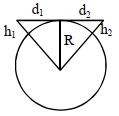
$A$ transmitting antenna at the top of a tower has a height of $50\, m$ and the height of the receiving antenna is $80\, m$. What is the range of communication for Line of Sight (LoS) mode? (In $km$)
[Use radius of earth $R = 6400\, km$]
[Use radius of earth $R = 6400\, km$]
A
$45.5$
B
$80.2$
C
$144.1$
D
$57.28$
Solution
(D) The maximum line-of-sight distance $d$ between a transmitting antenna of height $h_1$ and a receiving antenna of height $h_2$ is given by the formula:
$d = \sqrt{2Rh_1} + \sqrt{2Rh_2}$
Given:
$h_1 = 50\, m = 50 \times 10^{-3}\, km$
$h_2 = 80\, m = 80 \times 10^{-3}\, km$
$R = 6400\, km$
Substituting the values:
$d = \sqrt{2 \times 6400 \times 50 \times 10^{-3}} + \sqrt{2 \times 6400 \times 80 \times 10^{-3}}$
$d = \sqrt{640000 \times 10^{-3}} + \sqrt{1024000 \times 10^{-3}}$
$d = \sqrt{640} + \sqrt{1024}$
$d = 25.30 + 32 = 57.30\, km$
Rounding to the nearest provided option,the range is $57.28\, km$.
$d = \sqrt{2Rh_1} + \sqrt{2Rh_2}$
Given:
$h_1 = 50\, m = 50 \times 10^{-3}\, km$
$h_2 = 80\, m = 80 \times 10^{-3}\, km$
$R = 6400\, km$
Substituting the values:
$d = \sqrt{2 \times 6400 \times 50 \times 10^{-3}} + \sqrt{2 \times 6400 \times 80 \times 10^{-3}}$
$d = \sqrt{640000 \times 10^{-3}} + \sqrt{1024000 \times 10^{-3}}$
$d = \sqrt{640} + \sqrt{1024}$
$d = 25.30 + 32 = 57.30\, km$
Rounding to the nearest provided option,the range is $57.28\, km$.
0 likes
View Solution266
MediumMCQ
$A$ transmitting antenna has a height of $320\, m$ and that of the receiving antenna is $2000\, m$. The maximum distance between them for satisfactory communication in line-of-sight mode is $d$. The value of $d$ is $\ldots \ldots \, km$.
A
$224$
B
$286$
C
$194$
D
$264$
Solution
(A) The maximum distance $d$ for line-of-sight communication is given by the formula: $d = \sqrt{2Rh_T} + \sqrt{2Rh_R}$.
Here,$R$ is the radius of the Earth $\approx 6400\, km = 6.4 \times 10^6\, m$.
$h_T = 320\, m$ and $h_R = 2000\, m$.
Substituting the values:
$d = \sqrt{2 \times 6.4 \times 10^6 \times 320} + \sqrt{2 \times 6.4 \times 10^6 \times 2000}$
$d = \sqrt{4096 \times 10^6} + \sqrt{25600 \times 10^6}$
$d = 64000 + 160000 = 224000\, m$.
Converting to kilometers: $d = 224\, km$.
Here,$R$ is the radius of the Earth $\approx 6400\, km = 6.4 \times 10^6\, m$.
$h_T = 320\, m$ and $h_R = 2000\, m$.
Substituting the values:
$d = \sqrt{2 \times 6.4 \times 10^6 \times 320} + \sqrt{2 \times 6.4 \times 10^6 \times 2000}$
$d = \sqrt{4096 \times 10^6} + \sqrt{25600 \times 10^6}$
$d = 64000 + 160000 = 224000\, m$.
Converting to kilometers: $d = 224\, km$.
0 likes
View Solution267
MediumMCQ
An antenna is mounted on a $400 \; m$ tall building. What will be the wavelength of the signal that can be radiated effectively by the transmission tower up to a range of $44 \; km$? (In $m$)
A
$37.8$
B
$605$
C
$75.6$
D
$302$
Solution
(B) For an antenna to radiate signals effectively,the height of the antenna $h$ must be comparable to the wavelength $\lambda$ of the signal.
Typically,for effective radiation,the antenna height $h$ is related to the wavelength by $h \approx \lambda / 4$.
Given the height of the antenna $h = 400 \; m$.
Using the relation $h = \lambda / 4$,we get $\lambda = 4h$.
$\lambda = 4 \times 400 \; m = 1600 \; m$.
However,in the context of effective transmission range $d = \sqrt{2Rh}$,where $R$ is the radius of the Earth $(6400 \; km)$,the range is given as $44 \; km$.
$44 \times 10^3 = \sqrt{2 \times 6.4 \times 10^6 \times 400}$.
$44 \times 10^3 = \sqrt{5120 \times 10^6} \approx 71.5 \times 10^3 \; m = 71.5 \; km$.
Since the question asks for the wavelength that can be radiated effectively,and considering the standard condition for antenna design where $\lambda$ should be of the order of the antenna dimensions,the most appropriate value provided in the options that satisfies the physical constraint $\lambda > h$ is $605 \; m$ (as it is the only value significantly larger than $400 \; m$).
Typically,for effective radiation,the antenna height $h$ is related to the wavelength by $h \approx \lambda / 4$.
Given the height of the antenna $h = 400 \; m$.
Using the relation $h = \lambda / 4$,we get $\lambda = 4h$.
$\lambda = 4 \times 400 \; m = 1600 \; m$.
However,in the context of effective transmission range $d = \sqrt{2Rh}$,where $R$ is the radius of the Earth $(6400 \; km)$,the range is given as $44 \; km$.
$44 \times 10^3 = \sqrt{2 \times 6.4 \times 10^6 \times 400}$.
$44 \times 10^3 = \sqrt{5120 \times 10^6} \approx 71.5 \times 10^3 \; m = 71.5 \; km$.
Since the question asks for the wavelength that can be radiated effectively,and considering the standard condition for antenna design where $\lambda$ should be of the order of the antenna dimensions,the most appropriate value provided in the options that satisfies the physical constraint $\lambda > h$ is $605 \; m$ (as it is the only value significantly larger than $400 \; m$).
0 likes
View Solution268
DifficultMCQ
If the sum of the heights of transmitting and receiving antennas in the line of sight $(LOS)$ communication is fixed at $160 \, m$,then the maximum range of $LOS$ communication is $.... \, km$. (Take radius of Earth $R = 6400 \, km$)
A
$22$
B
$84$
C
$64$
D
$32$
Solution
(C) The range of $LOS$ communication is given by $d = \sqrt{2Rh_T} + \sqrt{2Rh_R}$,where $h_T$ and $h_R$ are the heights of the transmitting and receiving antennas respectively.
Given $h_T + h_R = 160 \, m$. Let $h_T = x$,then $h_R = 160 - x$.
$d = \sqrt{2R}(\sqrt{h_T} + \sqrt{h_R}) = \sqrt{2R}(\sqrt{x} + \sqrt{160 - x})$.
To maximize $d$,we differentiate with respect to $x$ and set it to zero: $\frac{d}{dx}(\sqrt{x} + \sqrt{160 - x}) = 0$.
$\frac{1}{2\sqrt{x}} - \frac{1}{2\sqrt{160 - x}} = 0 \implies \sqrt{x} = \sqrt{160 - x} \implies x = 80 \, m$.
Thus,$h_T = 80 \, m$ and $h_R = 80 \, m$.
Converting heights to km: $h_T = h_R = 0.08 \, km$.
$d_{max} = \sqrt{2 \times 6400 \times 0.08} + \sqrt{2 \times 6400 \times 0.08} = 2 \times \sqrt{12800 \times 0.08} = 2 \times \sqrt{1024} = 2 \times 32 = 64 \, km$.
Given $h_T + h_R = 160 \, m$. Let $h_T = x$,then $h_R = 160 - x$.
$d = \sqrt{2R}(\sqrt{h_T} + \sqrt{h_R}) = \sqrt{2R}(\sqrt{x} + \sqrt{160 - x})$.
To maximize $d$,we differentiate with respect to $x$ and set it to zero: $\frac{d}{dx}(\sqrt{x} + \sqrt{160 - x}) = 0$.
$\frac{1}{2\sqrt{x}} - \frac{1}{2\sqrt{160 - x}} = 0 \implies \sqrt{x} = \sqrt{160 - x} \implies x = 80 \, m$.
Thus,$h_T = 80 \, m$ and $h_R = 80 \, m$.
Converting heights to km: $h_T = h_R = 0.08 \, km$.
$d_{max} = \sqrt{2 \times 6400 \times 0.08} + \sqrt{2 \times 6400 \times 0.08} = 2 \times \sqrt{12800 \times 0.08} = 2 \times \sqrt{1024} = 2 \times 32 = 64 \, km$.
0 likes
View Solution269
MediumMCQ
$A$ bandwidth of $6 \, \text{MHz}$ is available for $A.M.$ transmission. If the maximum audio signal frequency used for modulating the carrier wave is not to exceed $6 \, \text{kHz}$,the number of stations that can be broadcasted within this band simultaneously without interfering with each other will be ..... .
A
$126$
B
$40$
C
$1500$
D
$500$
Solution
(D) The bandwidth required for a single $A.M.$ station is twice the maximum frequency of the modulating audio signal.
$\text{Bandwidth per station} = 2 \times f_m = 2 \times 6 \, \text{kHz} = 12 \, \text{kHz}$.
The total available bandwidth is $6 \, \text{MHz} = 6000 \, \text{kHz}$.
The number of stations $N$ that can be broadcasted simultaneously is given by the ratio of the total bandwidth to the bandwidth per station:
$N = \frac{\text{Total Bandwidth}}{\text{Bandwidth per station}} = \frac{6000 \, \text{kHz}}{12 \, \text{kHz}} = 500$.
Therefore,$500$ stations can be broadcasted simultaneously.
$\text{Bandwidth per station} = 2 \times f_m = 2 \times 6 \, \text{kHz} = 12 \, \text{kHz}$.
The total available bandwidth is $6 \, \text{MHz} = 6000 \, \text{kHz}$.
The number of stations $N$ that can be broadcasted simultaneously is given by the ratio of the total bandwidth to the bandwidth per station:
$N = \frac{\text{Total Bandwidth}}{\text{Bandwidth per station}} = \frac{6000 \, \text{kHz}}{12 \, \text{kHz}} = 500$.
Therefore,$500$ stations can be broadcasted simultaneously.
0 likes
View Solution270
MediumMCQ
$A$ carrier wave $v_{c}(t) = 160 \sin(2 \pi \times 10^{6} t) \text{ V}$ is made to vary between $V_{\max} = 200 \text{ V}$ and $V_{\min} = 120 \text{ V}$ by a message signal $v_{m}(t) = A_{m} \sin(2 \pi \times 10^{3} t) \text{ V}$. The peak voltage $A_{m}$ of the modulating signal is ..... .
A
$400$
B
$160$
C
$40$
D
$200$
Solution
(C) The maximum voltage of an amplitude-modulated wave is given by $V_{\max} = A_{c} + A_{m}$,where $A_{c}$ is the amplitude of the carrier wave and $A_{m}$ is the peak voltage of the modulating signal.
Given,$A_{c} = 160 \text{ V}$ and $V_{\max} = 200 \text{ V}$.
Substituting these values into the equation:
$200 = 160 + A_{m}$
$A_{m} = 200 - 160$
$A_{m} = 40 \text{ V}$.
Alternatively,using the minimum voltage formula: $V_{\min} = A_{c} - A_{m}$.
$120 = 160 - A_{m}$
$A_{m} = 160 - 120 = 40 \text{ V}$.
Thus,the peak voltage of the modulating signal is $40 \text{ V}$.
Given,$A_{c} = 160 \text{ V}$ and $V_{\max} = 200 \text{ V}$.
Substituting these values into the equation:
$200 = 160 + A_{m}$
$A_{m} = 200 - 160$
$A_{m} = 40 \text{ V}$.
Alternatively,using the minimum voltage formula: $V_{\min} = A_{c} - A_{m}$.
$120 = 160 - A_{m}$
$A_{m} = 160 - 120 = 40 \text{ V}$.
Thus,the peak voltage of the modulating signal is $40 \text{ V}$.
0 likes
View Solution271
MediumMCQ
What should be the height of the transmitting antenna and the population covered if the television telecast is to cover a radius of $150 \, km$? The average population density around the tower is $2000 \, / km^2$ and the value of $R_e = 6.5 \times 10^6 \, m$.
A
Height $= 1731 \, m$,Population Covered $= 1413 \times 10^5$
B
Height $= 1241 \, m$,Population Covered $= 7 \times 10^5$
C
Height $= 1600 \, m$,Population Covered $= 2 \times 10^5$
D
Height $= 1800 \, m$,Population Covered $= 1413 \times 10^8$
Solution
(A) The radius covered by the antenna is given by $r = \sqrt{2 R_e H_T}$.
Given $r = 150 \, km = 1.5 \times 10^5 \, m$ and $R_e = 6.5 \times 10^6 \, m$.
Squaring both sides: $r^2 = 2 R_e H_T$.
$H_T = \frac{r^2}{2 R_e} = \frac{(1.5 \times 10^5)^2}{2 \times 6.5 \times 10^6} = \frac{2.25 \times 10^{10}}{13 \times 10^6} \approx 1730.76 \, m \approx 1731 \, m$.
The population covered is the area covered multiplied by the population density.
Area $= \pi r^2 = 3.14 \times (150 \, km)^2 = 3.14 \times 22500 \, km^2 = 70650 \, km^2$.
Population $= \text{Area} \times \text{Density} = 70650 \, km^2 \times 2000 \, / km^2 = 141300000 = 1413 \times 10^5$.
Given $r = 150 \, km = 1.5 \times 10^5 \, m$ and $R_e = 6.5 \times 10^6 \, m$.
Squaring both sides: $r^2 = 2 R_e H_T$.
$H_T = \frac{r^2}{2 R_e} = \frac{(1.5 \times 10^5)^2}{2 \times 6.5 \times 10^6} = \frac{2.25 \times 10^{10}}{13 \times 10^6} \approx 1730.76 \, m \approx 1731 \, m$.
The population covered is the area covered multiplied by the population density.
Area $= \pi r^2 = 3.14 \times (150 \, km)^2 = 3.14 \times 22500 \, km^2 = 70650 \, km^2$.
Population $= \text{Area} \times \text{Density} = 70650 \, km^2 \times 2000 \, / km^2 = 141300000 = 1413 \times 10^5$.
0 likes
View Solution272
MediumMCQ
$A$ message signal of frequency $20 \, kHz$ and peak voltage of $20 \, V$ is used to modulate a carrier wave of frequency $1 \, MHz$ and peak voltage of $20 \, V$. The modulation index will be ..... .
A
$1$
B
$10$
C
$100$
D
$0.1$
Solution
(A) The modulation index $\mu$ is defined as the ratio of the peak voltage of the message signal $(A_m)$ to the peak voltage of the carrier wave $(A_c)$.
Given:
$A_m = 20 \, V$
$A_c = 20 \, V$
Using the formula:
$\mu = \frac{A_m}{A_c} = \frac{20}{20} = 1$
Therefore,the modulation index is $1$.
Given:
$A_m = 20 \, V$
$A_c = 20 \, V$
Using the formula:
$\mu = \frac{A_m}{A_c} = \frac{20}{20} = 1$
Therefore,the modulation index is $1$.
0 likes
View Solution273
DifficultMCQ
The amplitude of the upper and lower sidebands of an $A.M.$ wave,where a carrier signal with frequency $11.21 \, MHz$ and peak voltage $15 \, V$ is amplitude modulated by a $7.7 \, kHz$ sine wave of $5 \, V$ amplitude,are $\frac{a}{10} \, V$ and $\frac{b}{10} \, V$ respectively. Then the value of $\frac{a}{b}$ is $....$
A
$5$
B
$1$
C
$15$
D
$20$
Solution
(B) Given: Carrier amplitude $A_C = 15 \, V$,Modulating signal amplitude $A_m = 5 \, V$.
The modulation index $\mu$ is defined as $\mu = \frac{A_m}{A_C} = \frac{5}{15} = \frac{1}{3}$.
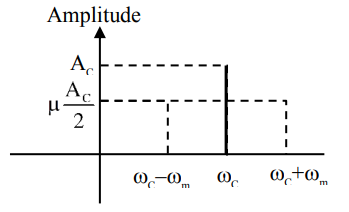
The amplitude of both the upper sideband $(USB)$ and lower sideband $(LSB)$ in an $A.M.$ wave is given by $\frac{\mu A_C}{2}$.
Amplitude of $USB$ = $\frac{\mu A_C}{2} = \frac{(1/3) \times 15}{2} = \frac{5}{2} = 2.5 \, V$.
Amplitude of $LSB$ = $\frac{\mu A_C}{2} = \frac{(1/3) \times 15}{2} = \frac{5}{2} = 2.5 \, V$.
According to the problem,the amplitudes are $\frac{a}{10} \, V$ and $\frac{b}{10} \, V$.
So,$\frac{a}{10} = 2.5 \Rightarrow a = 25$ and $\frac{b}{10} = 2.5 \Rightarrow b = 25$.
Therefore,the value of $\frac{a}{b} = \frac{25}{25} = 1$.
The modulation index $\mu$ is defined as $\mu = \frac{A_m}{A_C} = \frac{5}{15} = \frac{1}{3}$.
The amplitude of both the upper sideband $(USB)$ and lower sideband $(LSB)$ in an $A.M.$ wave is given by $\frac{\mu A_C}{2}$.
Amplitude of $USB$ = $\frac{\mu A_C}{2} = \frac{(1/3) \times 15}{2} = \frac{5}{2} = 2.5 \, V$.
Amplitude of $LSB$ = $\frac{\mu A_C}{2} = \frac{(1/3) \times 15}{2} = \frac{5}{2} = 2.5 \, V$.
According to the problem,the amplitudes are $\frac{a}{10} \, V$ and $\frac{b}{10} \, V$.
So,$\frac{a}{10} = 2.5 \Rightarrow a = 25$ and $\frac{b}{10} = 2.5 \Rightarrow b = 25$.
Therefore,the value of $\frac{a}{b} = \frac{25}{25} = 1$.
0 likes
View Solution274
DifficultMCQ
The maximum amplitude for an amplitude modulated wave is found to be $12\, V$ while the minimum amplitude is found to be $3\, V$. The modulation index is $0.6\, x$ where $x$ is $....$
A
$2$
B
$1$
C
$3$
D
$4$
Solution
(B) The maximum amplitude of an amplitude modulated wave is given by $A_{\max} = A_c + A_m = 12\, V$.
The minimum amplitude of an amplitude modulated wave is given by $A_{\min} = A_c - A_m = 3\, V$.
Adding these two equations: $2A_c = 15 \Rightarrow A_c = 7.5\, V$.
Subtracting the second from the first: $2A_m = 9 \Rightarrow A_m = 4.5\, V$.
The modulation index $\mu$ is defined as $\mu = \frac{A_m}{A_c} = \frac{4.5}{7.5} = 0.6$.
Given that the modulation index is $0.6\, x$,we have $0.6 = 0.6\, x$,which implies $x = 1$.
The minimum amplitude of an amplitude modulated wave is given by $A_{\min} = A_c - A_m = 3\, V$.
Adding these two equations: $2A_c = 15 \Rightarrow A_c = 7.5\, V$.
Subtracting the second from the first: $2A_m = 9 \Rightarrow A_m = 4.5\, V$.
The modulation index $\mu$ is defined as $\mu = \frac{A_m}{A_c} = \frac{4.5}{7.5} = 0.6$.
Given that the modulation index is $0.6\, x$,we have $0.6 = 0.6\, x$,which implies $x = 1$.
0 likes
View Solution275
MediumMCQ
An antenna is placed in a dielectric medium of dielectric constant $6.25$. If the maximum size of the antenna is $5.0 \, mm$,what is the minimum frequency of the signal it can radiate in $GHz$? (Given $\mu_{r} = 1$ for the dielectric medium)
A
$60$
B
$6$
C
$9$
D
$3$
Solution
(B) The speed of light in a dielectric medium is given by $v = \frac{c}{\sqrt{\mu_{r} \varepsilon_{r}}}$.
Given $\mu_{r} = 1$ and $\varepsilon_{r} = 6.25$,the speed $v = \frac{3 \times 10^{8}}{\sqrt{6.25}} = \frac{3 \times 10^{8}}{2.5} = 1.2 \times 10^{8} \, m/s$.
For an antenna to radiate effectively,its length $L$ should be at least $\frac{\lambda}{4}$.
Thus,$\lambda = 4L = 4 \times 5.0 \times 10^{-3} \, m = 20 \times 10^{-3} \, m = 0.02 \, m$.
The frequency $f$ is given by $f = \frac{v}{\lambda} = \frac{1.2 \times 10^{8}}{0.02} = 60 \times 10^{8} \, Hz = 6 \, GHz$.
Given $\mu_{r} = 1$ and $\varepsilon_{r} = 6.25$,the speed $v = \frac{3 \times 10^{8}}{\sqrt{6.25}} = \frac{3 \times 10^{8}}{2.5} = 1.2 \times 10^{8} \, m/s$.
For an antenna to radiate effectively,its length $L$ should be at least $\frac{\lambda}{4}$.
Thus,$\lambda = 4L = 4 \times 5.0 \times 10^{-3} \, m = 20 \times 10^{-3} \, m = 0.02 \, m$.
The frequency $f$ is given by $f = \frac{v}{\lambda} = \frac{1.2 \times 10^{8}}{0.02} = 60 \times 10^{8} \, Hz = 6 \, GHz$.
0 likes
View Solution276
DifficultMCQ
$A$ baseband signal of $3.5\, MHz$ frequency is modulated with a carrier signal of $3.5\, GHz$ frequency using amplitude modulation. What should be the minimum size of antenna required to transmit the modulated signal?
A
$42.8\, m$
B
$42.8\, mm$
C
$21.4\, mm$
D
$21.4\, m$
Solution
(C) The carrier frequency is $f_{c} = 3.5\, GHz = 3.5 \times 10^{9}\, Hz$.
The wavelength $\lambda$ of the carrier signal is given by $\lambda = \frac{c}{f_{c}}$,where $c = 3 \times 10^{8}\, m/s$ is the speed of light.
$\lambda = \frac{3 \times 10^{8}}{3.5 \times 10^{9}} = \frac{3}{35}\, m \approx 0.0857\, m = 85.7\, mm$.
The minimum length of the antenna required for efficient transmission is $\frac{\lambda}{4}$.
Minimum length $= \frac{85.7\, mm}{4} = 21.425\, mm \approx 21.4\, mm$.
The wavelength $\lambda$ of the carrier signal is given by $\lambda = \frac{c}{f_{c}}$,where $c = 3 \times 10^{8}\, m/s$ is the speed of light.
$\lambda = \frac{3 \times 10^{8}}{3.5 \times 10^{9}} = \frac{3}{35}\, m \approx 0.0857\, m = 85.7\, mm$.
The minimum length of the antenna required for efficient transmission is $\frac{\lambda}{4}$.
Minimum length $= \frac{85.7\, mm}{4} = 21.425\, mm \approx 21.4\, mm$.
0 likes
View Solution277
MediumMCQ
| $List-I$ | $List-II$ |
| $A.$ Facsimile | $I.$ Static Document Image |
| $B.$ Guided media Channel | $II.$ Local Broadcast Radio |
| $C.$ Frequency Modulation | $III.$ Rectangular wave |
| $D.$ Digital Signal | $IV.$ Optical Fiber |
A
$A-IV, B-III, C-II, D-I$
B
$A-I, B-IV, C-II, D-III$
C
$A-IV, B-II, C-III, D-I$
D
$A-I, B-II, C-III, D-IV$
Solution
(B) The correct matching is as follows:
$A.$ Facsimile is a method used to transmit a $Static\, Document\, Image$.
$B.$ Guided media channel refers to physical paths like $Optical\, Fiber$ through which signals are transmitted.
$C.$ Frequency Modulation is commonly used in $Local\, Broadcast\, Radio$.
$D.$ Digital Signal is represented by a $Rectangular\, wave$.
Therefore,the correct sequence is $A-I, B-IV, C-II, D-III$.
$A.$ Facsimile is a method used to transmit a $Static\, Document\, Image$.
$B.$ Guided media channel refers to physical paths like $Optical\, Fiber$ through which signals are transmitted.
$C.$ Frequency Modulation is commonly used in $Local\, Broadcast\, Radio$.
$D.$ Digital Signal is represented by a $Rectangular\, wave$.
Therefore,the correct sequence is $A-I, B-IV, C-II, D-III$.
0 likes
View Solution278
EasyMCQ
$A$ signal of $100 \,THz$ frequency can be transmitted with maximum efficiency by
A
Coaxial cable
B
Optical fibre
C
Twisted pair of copper wires
D
Water
Solution
(B) The frequency range of optical fibre communication is approximately $1 \,THz$ to $1000 \,THz$. Since $100 \,THz$ falls within this range,optical fibre is the most efficient medium for transmitting such high-frequency signals. Other options like coaxial cables and twisted pairs are limited to much lower frequencies (typically in the $MHz$ to $GHz$ range).
0 likes
View Solution279
DifficultMCQ
$A$ sinusoidal wave $y(t) = 40 \sin(10 \times 10^6 \pi t)$ is amplitude modulated by another sinusoidal wave $x(t) = 20 \sin(1000 \pi t)$. The amplitude of the minimum frequency component of the modulated signal is ...........
A
$0.5$
B
$0.25$
C
$20$
D
$10$
Solution
(D) Given carrier wave: $y(t) = 40 \sin(10^7 \pi t)$,so $A_c = 40$ and $\omega_c = 10^7 \pi$.
Given modulating wave: $x(t) = 20 \sin(1000 \pi t)$,so $A_m = 20$ and $\omega_m = 10^3 \pi$.
The modulated wave equation is given by $E = A_c(1 + \mu \sin \omega_m t) \sin \omega_c t$,where $\mu = \frac{A_m}{A_c} = \frac{20}{40} = 0.5$.
Expanding the equation: $E = A_c \sin \omega_c t + \frac{\mu A_c}{2} \cos(\omega_c - \omega_m)t - \frac{\mu A_c}{2} \cos(\omega_c + \omega_m)t$.
The frequency components are $\omega_c$,$(\omega_c - \omega_m)$,and $(\omega_c + \omega_m)$.
The minimum frequency component is $(\omega_c - \omega_m)$.
The amplitude of this component is $\frac{\mu A_c}{2} = \frac{A_m}{2} = \frac{20}{2} = 10$.
Given modulating wave: $x(t) = 20 \sin(1000 \pi t)$,so $A_m = 20$ and $\omega_m = 10^3 \pi$.
The modulated wave equation is given by $E = A_c(1 + \mu \sin \omega_m t) \sin \omega_c t$,where $\mu = \frac{A_m}{A_c} = \frac{20}{40} = 0.5$.
Expanding the equation: $E = A_c \sin \omega_c t + \frac{\mu A_c}{2} \cos(\omega_c - \omega_m)t - \frac{\mu A_c}{2} \cos(\omega_c + \omega_m)t$.
The frequency components are $\omega_c$,$(\omega_c - \omega_m)$,and $(\omega_c + \omega_m)$.
The minimum frequency component is $(\omega_c - \omega_m)$.
The amplitude of this component is $\frac{\mu A_c}{2} = \frac{A_m}{2} = \frac{20}{2} = 10$.
0 likes
View Solution280
MediumMCQ
Choose the correct statement for amplitude modulation.
A
Amplitude of modulating is varied in accordance with the information signal.
B
Amplitude of modulated is varied in accordance with the information signal.
C
Amplitude of carrier signal is varied in accordance with the information signal.
D
Amplitude of modulated is varied in accordance with the modulating signal.
Solution
(C) In amplitude modulation,the amplitude of a high-frequency carrier wave is varied in accordance with the instantaneous amplitude of the message signal (also known as the information signal).
0 likes
View Solution281
MediumMCQ
The height of a transmitting antenna at the top of a tower is $25 \; m$ and that of the receiving antenna is $49 \; m$. The maximum distance between them for satisfactory communication in $LOS$ (Line of Sight) is $K \sqrt{5} \times 10^{2} \; m$. The value of $K$ is $\dots$ [Assume radius of Earth is $64 \times 10^{5} \; m$] (Calculate up to the nearest integer value).
A
$162$
B
$172$
C
$182$
D
$192$
Solution
(D) The maximum line-of-sight distance $d$ between a transmitting antenna of height $h_T$ and a receiving antenna of height $h_R$ is given by the formula:
$d = \sqrt{2 R h_T} + \sqrt{2 R h_R}$
Given:
$h_T = 25 \; m$
$h_R = 49 \; m$
$R = 64 \times 10^{5} \; m$
Substituting the values:
$d = \sqrt{2 \times 64 \times 10^{5} \times 25} + \sqrt{2 \times 64 \times 10^{5} \times 49}$
$d = \sqrt{2 \times 64 \times 10^{5}} \times (\sqrt{25} + \sqrt{49})$
$d = \sqrt{128 \times 10^{5}} \times (5 + 7)$
$d = \sqrt{1280 \times 10^{4}} \times 12$
$d = \sqrt{256 \times 5 \times 10^{4}} \times 12$
$d = (16 \times 10^{2} \sqrt{5}) \times 12$
$d = 192 \sqrt{5} \times 10^{2} \; m$
Comparing this with $K \sqrt{5} \times 10^{2} \; m$,we get $K = 192$.
$d = \sqrt{2 R h_T} + \sqrt{2 R h_R}$
Given:
$h_T = 25 \; m$
$h_R = 49 \; m$
$R = 64 \times 10^{5} \; m$
Substituting the values:
$d = \sqrt{2 \times 64 \times 10^{5} \times 25} + \sqrt{2 \times 64 \times 10^{5} \times 49}$
$d = \sqrt{2 \times 64 \times 10^{5}} \times (\sqrt{25} + \sqrt{49})$
$d = \sqrt{128 \times 10^{5}} \times (5 + 7)$
$d = \sqrt{1280 \times 10^{4}} \times 12$
$d = \sqrt{256 \times 5 \times 10^{4}} \times 12$
$d = (16 \times 10^{2} \sqrt{5}) \times 12$
$d = 192 \sqrt{5} \times 10^{2} \; m$
Comparing this with $K \sqrt{5} \times 10^{2} \; m$,we get $K = 192$.
0 likes
View Solution282
MediumMCQ
We do not transmit low frequency signals to long distances because:
$(a)$ The size of the antenna should be comparable to signal wavelength,which is impractical for a signal of longer wavelength.
$(b)$ Effective power radiated by a long wavelength baseband signal would be high.
$(c)$ We want to avoid mixing up signals transmitted by different transmitters simultaneously.
$(d)$ Low frequency signals can be sent to long distances by superimposing them with a high frequency wave.
Therefore,the most suitable options are:
$(a)$ The size of the antenna should be comparable to signal wavelength,which is impractical for a signal of longer wavelength.
$(b)$ Effective power radiated by a long wavelength baseband signal would be high.
$(c)$ We want to avoid mixing up signals transmitted by different transmitters simultaneously.
$(d)$ Low frequency signals can be sent to long distances by superimposing them with a high frequency wave.
Therefore,the most suitable options are:
A
All statements are true
B
$(a), (b)$ and $(c)$ are true only
C
$(a), (c)$ and $(d)$ are true only
D
$(b), (c)$ and $(d)$ are true only
Solution
(C) Statement $(a)$ is true: The antenna size must be at least $\lambda/4$ to radiate efficiently. For low frequencies,$\lambda = c/f$ is very large,making the antenna size impractical.
Statement $(b)$ is false: The power radiated by an antenna of length $l$ is proportional to $(l/\lambda)^2$. For low frequencies (large $\lambda$),the radiated power is extremely low.
Statement $(c)$ is true: Multiplexing is necessary to distinguish signals from different sources.
Statement $(d)$ is true: Modulation (superimposing low frequency signals onto high frequency carrier waves) allows for efficient transmission over long distances.
Thus,statements $(a), (c),$ and $(d)$ are correct.
Statement $(b)$ is false: The power radiated by an antenna of length $l$ is proportional to $(l/\lambda)^2$. For low frequencies (large $\lambda$),the radiated power is extremely low.
Statement $(c)$ is true: Multiplexing is necessary to distinguish signals from different sources.
Statement $(d)$ is true: Modulation (superimposing low frequency signals onto high frequency carrier waves) allows for efficient transmission over long distances.
Thus,statements $(a), (c),$ and $(d)$ are correct.
0 likes
View Solution283
MediumMCQ
An amplitude modulated wave is represented by $V_{AM} = 10[1 + 0.4 \cos(2 \pi \times 10^4 t)] \cos(2 \pi \times 10^7 t) \text{ V}$. The total bandwidth of the amplitude modulated wave is:
A
$10 \text{ kHz}$
B
$20 \text{ MHz}$
C
$20 \text{ kHz}$
D
$10 \text{ MHz}$
Solution
(C) The standard equation for an amplitude modulated wave is $V_{AM} = A_c [1 + \mu \cos(\omega_m t)] \cos(\omega_c t)$.
Comparing this with the given equation $V_{AM} = 10[1 + 0.4 \cos(2 \pi \times 10^4 t)] \cos(2 \pi \times 10^7 t)$,we identify the modulating frequency $f_m$.
The term inside the cosine function for the modulating signal is $2 \pi f_m t = 2 \pi \times 10^4 t$,which gives $f_m = 10^4 \text{ Hz} = 10 \text{ kHz}$.
The bandwidth of an amplitude modulated wave is given by $BW = 2 f_m$.
Therefore,$BW = 2 \times 10 \text{ kHz} = 20 \text{ kHz}$.
Comparing this with the given equation $V_{AM} = 10[1 + 0.4 \cos(2 \pi \times 10^4 t)] \cos(2 \pi \times 10^7 t)$,we identify the modulating frequency $f_m$.
The term inside the cosine function for the modulating signal is $2 \pi f_m t = 2 \pi \times 10^4 t$,which gives $f_m = 10^4 \text{ Hz} = 10 \text{ kHz}$.
The bandwidth of an amplitude modulated wave is given by $BW = 2 f_m$.
Therefore,$BW = 2 \times 10 \text{ kHz} = 20 \text{ kHz}$.
0 likes
View Solution284
MediumMCQ
Match List-$I$ with List-$II$:
Choose the correct answer from the options given below:
| List-$I$ | List-$II$ |
|---|---|
| $A$. Television signal | $I$. $03\,KHz$ |
| $B$. Radio signal | $II$. $20\,KHz$ |
| $C$. High Quality Music | $III$. $02\,MHz$ |
| $D$. Human speech | $IV$. $06\,MHz$ |
Choose the correct answer from the options given below:
A
$A-I, B-II, C-III, D-IV$
B
$A-IV, B-III, C-I, D-II$
C
$A-IV, B-III, C-II, D-I$
D
$A-I, B-II, C-IV, D-III$
Solution
(C) The frequency ranges for various signals are as follows:
$1$. Television signals require a bandwidth of approximately $6\,MHz$ for transmission.
$2$. Radio signals (specifically $AM$ broadcast) typically use a bandwidth of $02\,MHz$ (or $200\,KHz$ per channel,but in this context,$02\,MHz$ is the standard match).
$3$. High-quality music requires a wider frequency range,typically up to $20\,KHz$.
$4$. Human speech is generally transmitted within a frequency range of $03\,KHz$.
Matching these:
$A$ (Television signal) $\rightarrow$ $IV$ $(06\,MHz)$
$B$ (Radio signal) $\rightarrow$ $III$ $(02\,MHz)$
$C$ (High Quality Music) $\rightarrow$ $II$ $(20\,KHz)$
$D$ (Human speech) $\rightarrow$ $I$ $(03\,KHz)$
Therefore,the correct matching is $A-IV, B-III, C-II, D-I$.
$1$. Television signals require a bandwidth of approximately $6\,MHz$ for transmission.
$2$. Radio signals (specifically $AM$ broadcast) typically use a bandwidth of $02\,MHz$ (or $200\,KHz$ per channel,but in this context,$02\,MHz$ is the standard match).
$3$. High-quality music requires a wider frequency range,typically up to $20\,KHz$.
$4$. Human speech is generally transmitted within a frequency range of $03\,KHz$.
Matching these:
$A$ (Television signal) $\rightarrow$ $IV$ $(06\,MHz)$
$B$ (Radio signal) $\rightarrow$ $III$ $(02\,MHz)$
$C$ (High Quality Music) $\rightarrow$ $II$ $(20\,KHz)$
$D$ (Human speech) $\rightarrow$ $I$ $(03\,KHz)$
Therefore,the correct matching is $A-IV, B-III, C-II, D-I$.
0 likes
View Solution285
MediumMCQ
The $TV$ transmission tower at a particular station has a height of $125\, m$. For doubling the coverage range,the height of the tower should be increased by .............$m$.
A
$125$
B
$250$
C
$375$
D
$500$
Solution
(C) The range $d$ of a $TV$ transmission tower of height $h$ is given by the formula $d = \sqrt{2Rh}$,where $R$ is the radius of the Earth.
Let the initial height be $h_1 = 125\, m$ and the initial range be $d_1 = \sqrt{2Rh_1}$.
We want to double the range,so the new range $d_2 = 2d_1$.
Substituting the formula,we get $\sqrt{2Rh_2} = 2\sqrt{2Rh_1}$.
Squaring both sides,we get $2Rh_2 = 4(2Rh_1)$,which simplifies to $h_2 = 4h_1$.
Substituting the value of $h_1$,we get $h_2 = 4 \times 125\, m = 500\, m$.
The increase in height required is $\Delta h = h_2 - h_1 = 500\, m - 125\, m = 375\, m$.
Let the initial height be $h_1 = 125\, m$ and the initial range be $d_1 = \sqrt{2Rh_1}$.
We want to double the range,so the new range $d_2 = 2d_1$.
Substituting the formula,we get $\sqrt{2Rh_2} = 2\sqrt{2Rh_1}$.
Squaring both sides,we get $2Rh_2 = 4(2Rh_1)$,which simplifies to $h_2 = 4h_1$.
Substituting the value of $h_1$,we get $h_2 = 4 \times 125\, m = 500\, m$.
The increase in height required is $\Delta h = h_2 - h_1 = 500\, m - 125\, m = 375\, m$.
0 likes
View Solution286
MediumMCQ
Only $2 \%$ of the optical source frequency is the available channel bandwidth for an optical communication system operating at $1000 \,nm$. If an audio signal requires a bandwidth of $8 \,kHz$,how many channels can be accommodated for transmission?
A
$375 \times 10^{7}$
B
$75 \times 10^{7}$
C
$375 \times 10^{8}$
D
$75 \times 10^{9}$
Solution
(B) The frequency of the optical source is given by $f = \frac{c}{\lambda} = \frac{3 \times 10^{8} \,m/s}{1000 \times 10^{-9} \,m} = 3 \times 10^{14} \,Hz$.
The available channel bandwidth is $2 \%$ of this frequency: $\text{Bandwidth} = \frac{2}{100} \times 3 \times 10^{14} \,Hz = 6 \times 10^{12} \,Hz$.
The bandwidth required for one audio signal channel is $8 \,kHz = 8 \times 10^{3} \,Hz$.
The number of channels that can be accommodated is given by the ratio of the total available bandwidth to the bandwidth per channel:
$\text{Number of channels} = \frac{6 \times 10^{12} \,Hz}{8 \times 10^{3} \,Hz} = 0.75 \times 10^{9} = 75 \times 10^{7}$.
The available channel bandwidth is $2 \%$ of this frequency: $\text{Bandwidth} = \frac{2}{100} \times 3 \times 10^{14} \,Hz = 6 \times 10^{12} \,Hz$.
The bandwidth required for one audio signal channel is $8 \,kHz = 8 \times 10^{3} \,Hz$.
The number of channels that can be accommodated is given by the ratio of the total available bandwidth to the bandwidth per channel:
$\text{Number of channels} = \frac{6 \times 10^{12} \,Hz}{8 \times 10^{3} \,Hz} = 0.75 \times 10^{9} = 75 \times 10^{7}$.
0 likes
View Solution287
MediumMCQ
In $AM$ modulation,a signal is modulated on a carrier wave such that maximum and minimum amplitude are found to be $6\,V$ and $2\,V$ respectively. The modulation index is $\dots \%$.
A
$100$
B
$80$
C
$60$
D
$50$
Solution
(D) The modulation index $\mu$ is defined as the ratio of the difference of maximum and minimum amplitudes to the sum of maximum and minimum amplitudes.
$\mu = \frac{V_{\max} - V_{\min}}{V_{\max} + V_{\min}}$
Given $V_{\max} = 6\,V$ and $V_{\min} = 2\,V$.
Substituting the values:
$\mu = \frac{6 - 2}{6 + 2} = \frac{4}{8} = 0.5$
To express this as a percentage:
$\text{Modulation index} = 0.5 \times 100\% = 50\%$.
$\mu = \frac{V_{\max} - V_{\min}}{V_{\max} + V_{\min}}$
Given $V_{\max} = 6\,V$ and $V_{\min} = 2\,V$.
Substituting the values:
$\mu = \frac{6 - 2}{6 + 2} = \frac{4}{8} = 0.5$
To express this as a percentage:
$\text{Modulation index} = 0.5 \times 100\% = 50\%$.
0 likes
View Solution288
MediumMCQ
The required height of a $TV$ tower which can cover the population of $6.03$ lakh is $h$. If the average population density is $100$ per square $km$ and the radius of the Earth is $6400 \, km$,then the value of $h$ will be $... \, m$.
A
$150$
B
$151$
C
$146$
D
$155$
Solution
(A) The coverage distance $d$ of a $TV$ tower of height $h$ is given by $d = \sqrt{2Rh}$.
Given the radius of the Earth $R = 6400 \, km$.
The area covered by the tower is $A = \pi d^2 = \pi (2Rh)$.
Given the population $P = 6.03 \times 10^5$ and population density $\rho = 100 \, \text{people/km}^2$.
The area $A$ is also given by $A = \frac{P}{\rho} = \frac{6.03 \times 10^5}{100} = 6030 \, \text{km}^2$.
Equating the two expressions for area: $6030 = \pi \times 2 \times 6400 \times h$ (where $h$ is in $km$).
$h = \frac{6030}{2 \times \pi \times 6400} \, km$.
$h = \frac{6030}{40212} \approx 0.150 \, km$.
Converting to meters: $h = 0.150 \times 1000 = 150 \, m$.
Given the radius of the Earth $R = 6400 \, km$.
The area covered by the tower is $A = \pi d^2 = \pi (2Rh)$.
Given the population $P = 6.03 \times 10^5$ and population density $\rho = 100 \, \text{people/km}^2$.
The area $A$ is also given by $A = \frac{P}{\rho} = \frac{6.03 \times 10^5}{100} = 6030 \, \text{km}^2$.
Equating the two expressions for area: $6030 = \pi \times 2 \times 6400 \times h$ (where $h$ is in $km$).
$h = \frac{6030}{2 \times \pi \times 6400} \, km$.
$h = \frac{6030}{40212} \approx 0.150 \, km$.
Converting to meters: $h = 0.150 \times 1000 = 150 \, m$.
0 likes
View Solution289
MediumMCQ
The maximum and minimum voltage of an amplitude modulated signal are $60\,V$ and $20\,V$ respectively. The percentage modulation index will be $....\%$
A
$0.5$
B
$50$
C
$2$
D
$30$
Solution
(B) Given:
$V_{\max} = 60\,V$
$V_{\min} = 20\,V$
The modulation index $\mu$ is given by the formula:
$\mu = \frac{V_{\max} - V_{\min}}{V_{\max} + V_{\min}}$
Substituting the values:
$\mu = \frac{60 - 20}{60 + 20} = \frac{40}{80} = 0.5$
The percentage modulation index is $\mu \times 100\% = 0.5 \times 100\% = 50\%$.
$V_{\max} = 60\,V$
$V_{\min} = 20\,V$
The modulation index $\mu$ is given by the formula:
$\mu = \frac{V_{\max} - V_{\min}}{V_{\max} + V_{\min}}$
Substituting the values:
$\mu = \frac{60 - 20}{60 + 20} = \frac{40}{80} = 0.5$
The percentage modulation index is $\mu \times 100\% = 0.5 \times 100\% = 50\%$.
0 likes
View Solution290
MediumMCQ
$A$ radio can tune to any station in the $6\,MHz$ to $10\,MHz$ band. The value of the corresponding wavelength bandwidth will be $....\,m$.
A
$4$
B
$20$
C
$30$
D
$50$
Solution
(B) Given: Frequency $f_{1} = 6\,MHz = 6 \times 10^{6}\,Hz$ and $f_{2} = 10\,MHz = 10 \times 10^{6}\,Hz$.
Speed of light $c = 3 \times 10^{8}\,m/s$.
The wavelength $\lambda$ is given by $\lambda = \frac{c}{f}$.
For $f_{1} = 6 \times 10^{6}\,Hz$,$\lambda_{1} = \frac{3 \times 10^{8}}{6 \times 10^{6}} = 50\,m$.
For $f_{2} = 10 \times 10^{6}\,Hz$,$\lambda_{2} = \frac{3 \times 10^{8}}{10 \times 10^{6}} = 30\,m$.
The wavelength bandwidth is the difference between the two wavelengths: $\Delta\lambda = \lambda_{1} - \lambda_{2} = 50\,m - 30\,m = 20\,m$.
Speed of light $c = 3 \times 10^{8}\,m/s$.
The wavelength $\lambda$ is given by $\lambda = \frac{c}{f}$.
For $f_{1} = 6 \times 10^{6}\,Hz$,$\lambda_{1} = \frac{3 \times 10^{8}}{6 \times 10^{6}} = 50\,m$.
For $f_{2} = 10 \times 10^{6}\,Hz$,$\lambda_{2} = \frac{3 \times 10^{8}}{10 \times 10^{6}} = 30\,m$.
The wavelength bandwidth is the difference between the two wavelengths: $\Delta\lambda = \lambda_{1} - \lambda_{2} = 50\,m - 30\,m = 20\,m$.
0 likes
View Solution291
MediumMCQ
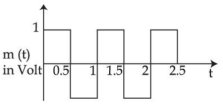
$A$ square wave of the modulating signal is shown in the figure. The carrier wave is given by $C(t) = 5 \sin(8\pi t) \text{ V}$. The modulation index is:
A
$0.2$
B
$0.1$
C
$0.3$
D
$0.4$
Solution
(A) From the given figure,the amplitude of the modulating signal $A_m$ is the peak value of the square wave,which is $1 \text{ V}$.
The carrier wave is given by $C(t) = 5 \sin(8\pi t) \text{ V}$. Comparing this with the standard carrier wave equation $C(t) = A_C \sin(\omega_c t)$,we get the amplitude of the carrier wave $A_C = 5 \text{ V}$.
The modulation index $\mu$ is defined as the ratio of the amplitude of the modulating signal to the amplitude of the carrier wave:
$\mu = \frac{A_m}{A_C}$
Substituting the values:
$\mu = \frac{1}{5} = 0.2$
Thus,the modulation index is $0.2$.
The carrier wave is given by $C(t) = 5 \sin(8\pi t) \text{ V}$. Comparing this with the standard carrier wave equation $C(t) = A_C \sin(\omega_c t)$,we get the amplitude of the carrier wave $A_C = 5 \text{ V}$.
The modulation index $\mu$ is defined as the ratio of the amplitude of the modulating signal to the amplitude of the carrier wave:
$\mu = \frac{A_m}{A_C}$
Substituting the values:
$\mu = \frac{1}{5} = 0.2$
Thus,the modulation index is $0.2$.
0 likes
View Solution292
MediumMCQ
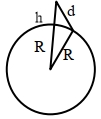
At a particular station,the $TV$ transmission tower has a height of $100\,m$. To triple its coverage range,the height of the tower should be increased to ......$m$.
A
$200$
B
$300$
C
$600$
D
$900$
Solution
(D) Let $d$ be the coverage range of the tower of height $h$.
The range $d$ is given by the formula $d = \sqrt{2Rh}$,where $R$ is the radius of the Earth.
Thus,$d \propto \sqrt{h}$.
Let the initial height be $h_1 = 100\,m$ and the initial range be $d_1$.
Let the new height be $h_2$ and the new range be $d_2 = 3d_1$.
Since $d \propto \sqrt{h}$,we have:
$\frac{d_2}{d_1} = \sqrt{\frac{h_2}{h_1}}$
Substituting the values:
$3 = \sqrt{\frac{h_2}{100}}$
Squaring both sides:
$9 = \frac{h_2}{100}$
$h_2 = 900\,m$.
Therefore,the height of the tower should be increased to $900\,m$.
The range $d$ is given by the formula $d = \sqrt{2Rh}$,where $R$ is the radius of the Earth.
Thus,$d \propto \sqrt{h}$.
Let the initial height be $h_1 = 100\,m$ and the initial range be $d_1$.
Let the new height be $h_2$ and the new range be $d_2 = 3d_1$.
Since $d \propto \sqrt{h}$,we have:
$\frac{d_2}{d_1} = \sqrt{\frac{h_2}{h_1}}$
Substituting the values:
$3 = \sqrt{\frac{h_2}{100}}$
Squaring both sides:
$9 = \frac{h_2}{100}$
$h_2 = 900\,m$.
Therefore,the height of the tower should be increased to $900\,m$.
0 likes
View Solution293
MediumMCQ
An $FM$ broadcast transmitter,using a modulating signal of frequency $20\,kHz$,has a deviation ratio of $10$. The bandwidth required for transmission is $.......kHz$.
A
$220$
B
$180$
C
$360$
D
$440$
Solution
(D) Given:
Modulating frequency $f_m = 20\,kHz$.
Deviation ratio $\beta = 10$.
The deviation ratio is defined as $\beta = \frac{\Delta f}{f_m}$,where $\Delta f$ is the frequency deviation.
Therefore,$\Delta f = \beta \times f_m = 10 \times 20\,kHz = 200\,kHz$.
According to Carson's rule,the bandwidth $BW$ required for an $FM$ signal is given by:
$BW = 2(\Delta f + f_m)$
$BW = 2(200\,kHz + 20\,kHz)$
$BW = 2(220\,kHz) = 440\,kHz$.
Modulating frequency $f_m = 20\,kHz$.
Deviation ratio $\beta = 10$.
The deviation ratio is defined as $\beta = \frac{\Delta f}{f_m}$,where $\Delta f$ is the frequency deviation.
Therefore,$\Delta f = \beta \times f_m = 10 \times 20\,kHz = 200\,kHz$.
According to Carson's rule,the bandwidth $BW$ required for an $FM$ signal is given by:
$BW = 2(\Delta f + f_m)$
$BW = 2(200\,kHz + 20\,kHz)$
$BW = 2(220\,kHz) = 440\,kHz$.
0 likes
View Solution294
MediumMCQ
In the case of amplitude modulation,to avoid distortion,the modulation index $(\mu)$ should be:
A
$\mu \leq 1$
B
$\mu \geq 1$
C
$\mu = 2$
D
$\mu = 0$
Solution
(A) The modulation index is defined as $\mu = \frac{A_m}{A_c}$,where $A_m$ is the amplitude of the message signal and $A_c$ is the amplitude of the carrier wave.
To avoid distortion in the amplitude modulated wave,the modulation index must satisfy the condition $\mu \leq 1$.
If $\mu > 1$,over-modulation occurs,which leads to the distortion of the signal and interference between the carrier frequency and the message frequency.
To avoid distortion in the amplitude modulated wave,the modulation index must satisfy the condition $\mu \leq 1$.
If $\mu > 1$,over-modulation occurs,which leads to the distortion of the signal and interference between the carrier frequency and the message frequency.
0 likes
View Solution295
MediumMCQ
Find the modulation index of an $AM$ wave having $8\,V$ variation where maximum amplitude of the $AM$ wave is $9\,V$.
A
$0.8$
B
$0.5$
C
$0.2$
D
$0.1$
Solution
(A) The modulation index $m$ is defined as $m = \frac{A_m}{A_c}$,where $A_m$ is the amplitude of the modulating signal and $A_c$ is the amplitude of the carrier wave.
Given the variation in amplitude is $2A_m = 8\,V$,we find $A_m = 4\,V$.
The maximum amplitude of the $AM$ wave is given by $A_{max} = A_c + A_m = 9\,V$.
Substituting $A_m = 4\,V$,we get $A_c + 4 = 9$,which implies $A_c = 5\,V$.
Therefore,the modulation index is $m = \frac{4}{5} = 0.8$.
Given the variation in amplitude is $2A_m = 8\,V$,we find $A_m = 4\,V$.
The maximum amplitude of the $AM$ wave is given by $A_{max} = A_c + A_m = 9\,V$.
Substituting $A_m = 4\,V$,we get $A_c + 4 = 9$,which implies $A_c = 5\,V$.
Therefore,the modulation index is $m = \frac{4}{5} = 0.8$.
0 likes
View Solution296
MediumMCQ
$A$ modulating signal is a square wave,as shown in the figure. If the carrier wave is given as $c(t) = 2 \sin(8 \pi t)$ volts,the modulation index is:
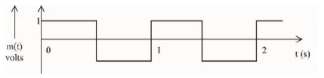
A
$0.25$
B
$1$
C
$0.75$
D
$0.5$
Solution
(D) The modulation index $\mu$ is defined as the ratio of the amplitude of the modulating signal $(A_m)$ to the amplitude of the carrier wave $(A_c)$.
From the given figure,the amplitude of the modulating square wave signal is $A_m = 1 \text{ V}$.
The carrier wave is given by $c(t) = 2 \sin(8 \pi t)$,which is in the form $c(t) = A_c \sin(\omega_c t)$. Thus,the amplitude of the carrier wave is $A_c = 2 \text{ V}$.
The modulation index is calculated as:
$\mu = \frac{A_m}{A_c} = \frac{1}{2} = 0.5$.
From the given figure,the amplitude of the modulating square wave signal is $A_m = 1 \text{ V}$.
The carrier wave is given by $c(t) = 2 \sin(8 \pi t)$,which is in the form $c(t) = A_c \sin(\omega_c t)$. Thus,the amplitude of the carrier wave is $A_c = 2 \text{ V}$.
The modulation index is calculated as:
$\mu = \frac{A_m}{A_c} = \frac{1}{2} = 0.5$.
0 likes
View Solution297
MediumMCQ
Match List-$I$ with List-$II$:
Choose the correct answer from the options given below:
| List-$I$ | List-$II$ |
|---|---|
| $A$. $AM$ Broadcast | $I$. $88-108\,MHz$ |
| $B$. $FM$ Broadcast | $II$. $540-1600\,kHz$ |
| $C$. Television | $III$. $3.7-4.2\,GHz$ |
| $D$. Satellite Communication | $IV$. $54-890\,MHz$ |
Choose the correct answer from the options given below:
A
$A-II, B-I, C-IV, D-III$
B
$A-IV, B-III, C-I, D-II$
C
$A-II, B-III, C-I, D-IV$
D
$A-I, B-III, C-II, D-IV$
Solution
(A) The standard frequency ranges for communication systems are as follows:
$1$. $AM$ Broadcast: $540-1600\,kHz$
$2$. $FM$ Broadcast: $88-108\,MHz$
$3$. Television: $54-890\,MHz$
$4$. Satellite Communication: $3.7-4.2\,GHz$
Matching these with the given lists:
$A$ ($AM$ Broadcast) matches with $II$ $(540-1600\,kHz)$.
$B$ ($FM$ Broadcast) matches with $I$ $(88-108\,MHz)$.
$C$ (Television) matches with $IV$ $(54-890\,MHz)$.
$D$ (Satellite Communication) matches with $III$ $(3.7-4.2\,GHz)$.
Therefore,the correct matching is $A-II, B-I, C-IV, D-III$.
$1$. $AM$ Broadcast: $540-1600\,kHz$
$2$. $FM$ Broadcast: $88-108\,MHz$
$3$. Television: $54-890\,MHz$
$4$. Satellite Communication: $3.7-4.2\,GHz$
Matching these with the given lists:
$A$ ($AM$ Broadcast) matches with $II$ $(540-1600\,kHz)$.
$B$ ($FM$ Broadcast) matches with $I$ $(88-108\,MHz)$.
$C$ (Television) matches with $IV$ $(54-890\,MHz)$.
$D$ (Satellite Communication) matches with $III$ $(3.7-4.2\,GHz)$.
Therefore,the correct matching is $A-II, B-I, C-IV, D-III$.
0 likes
View Solution298
MediumMCQ
$A$ message signal of frequency $5\,kHz$ is used to modulate a carrier signal of frequency $2\,MHz$. The bandwidth for amplitude modulation is $..........\,kHz$.
A
$5$
B
$20$
C
$10$
D
$2.5$
Solution
(C) Given:
Message signal frequency $f_m = 5\,kHz$.
Carrier wave frequency $f_c = 2\,MHz = 2000\,kHz$.
In amplitude modulation,the bandwidth is defined as the difference between the upper sideband frequency and the lower sideband frequency.
Bandwidth $= (f_c + f_m) - (f_c - f_m) = 2f_m$.
Substituting the values:
Bandwidth $= 2 \times 5\,kHz = 10\,kHz$.
Message signal frequency $f_m = 5\,kHz$.
Carrier wave frequency $f_c = 2\,MHz = 2000\,kHz$.
In amplitude modulation,the bandwidth is defined as the difference between the upper sideband frequency and the lower sideband frequency.
Bandwidth $= (f_c + f_m) - (f_c - f_m) = 2f_m$.
Substituting the values:
Bandwidth $= 2 \times 5\,kHz = 10\,kHz$.
0 likes
View Solution299
MediumMCQ
Match List-$I$ with List-$II$:
Choose the correct answer from the options given below:
| List-$I$ | List-$II$ |
|---|---|
| $A$. Troposphere | $I$. Approximate $65-75 \ km$ over Earth's surface |
| $B$. $E$-Part of Ionosphere | $II$. Approximate $300 \ km$ over Earth's surface |
| $C$. $F_2$-Part of Ionosphere | $III$. Approximate $10 \ km$ over Earth's surface |
| $D$. $D$-Part of Ionosphere | $IV$. Approximate $100 \ km$ over Earth's surface |
Choose the correct answer from the options given below:
A
$A-III, B-IV, C-II, D-I$
B
$A-I, B-II, C-IV, D-III$
C
$A-I, B-IV, C-III, D-II$
D
$A-III, B-II, C-I, D-IV$
Solution
(A) The atmospheric layers and their approximate altitudes are as follows:
$1$. Troposphere: Extends up to approximately $10 \ km$ from the Earth's surface $(A-III)$.
$2$. $D$-Part of Ionosphere: Located at approximately $65-75 \ km$ altitude $(D-I)$.
$3$. $E$-Part of Ionosphere: Located at approximately $100 \ km$ altitude $(B-IV)$.
$4$. $F_2$-Part of Ionosphere: Located at approximately $300 \ km$ altitude $(C-II)$.
Thus,the correct matching is $A-III, B-IV, C-II, D-I$.
$1$. Troposphere: Extends up to approximately $10 \ km$ from the Earth's surface $(A-III)$.
$2$. $D$-Part of Ionosphere: Located at approximately $65-75 \ km$ altitude $(D-I)$.
$3$. $E$-Part of Ionosphere: Located at approximately $100 \ km$ altitude $(B-IV)$.
$4$. $F_2$-Part of Ionosphere: Located at approximately $300 \ km$ altitude $(C-II)$.
Thus,the correct matching is $A-III, B-IV, C-II, D-I$.
0 likes
View Solution300
MediumMCQ
If the height of transmitting and receiving antennas are $80\,m$ each,the maximum line of sight distance will be $..............\,km$. Given: Earth's radius $= 6.4 \times 10^6\,m$.
A
$32$
B
$28$
C
$36$
D
$64$
Solution
(D) The maximum line of sight distance $(d_M)$ between a transmitting antenna of height $h_T$ and a receiving antenna of height $h_R$ is given by the formula: $d_M = \sqrt{2Rh_T} + \sqrt{2Rh_R}$.
Given: $h_T = 80\,m$,$h_R = 80\,m$,and $R = 6.4 \times 10^6\,m$.
Substituting the values: $d_M = \sqrt{2 \times 6.4 \times 10^6 \times 80} + \sqrt{2 \times 6.4 \times 10^6 \times 80}$.
$d_M = 2 \times \sqrt{2 \times 6.4 \times 10^6 \times 80} = 2 \times \sqrt{1024 \times 10^6} = 2 \times 32 \times 10^3\,m$.
$d_M = 64 \times 10^3\,m = 64\,km$.
Given: $h_T = 80\,m$,$h_R = 80\,m$,and $R = 6.4 \times 10^6\,m$.
Substituting the values: $d_M = \sqrt{2 \times 6.4 \times 10^6 \times 80} + \sqrt{2 \times 6.4 \times 10^6 \times 80}$.
$d_M = 2 \times \sqrt{2 \times 6.4 \times 10^6 \times 80} = 2 \times \sqrt{1024 \times 10^6} = 2 \times 32 \times 10^3\,m$.
$d_M = 64 \times 10^3\,m = 64\,km$.
0 likes
View SolutionCommunication — Communication · Frequently Asked Questions
1Are these Communication questions useful for JEE and NEET?
Yes. All questions in this section are mapped to JEE Main and NEET exam patterns. Previous year questions from JEE Main, NEET, GUJCET and state-level exams are included with full solutions.
2Can I switch to Hindi or Gujarati for these questions?
Yes. Use the language tabs in the hero section or the sidebar to view the same questions and solutions in English, Hindi or Gujarati.
3How do I generate a question paper from this subtopic?
Use the Vedclass Exam Paper Generator — select the chapter and subtopic, set difficulty, and generate Sets A, B, C, D automatically. First 3 chapters of every subject are free.
Vedclass Products
For Students
Vedclass Test Series
Mock tests in real JEE/NEET style with performance analysis. 5-day free trial.
Start Free TrialFor Teachers
Exam Paper Generator
Generate Set A/B/C/D papers from this chapter in 2 minutes. 3 chapters free.
Try FreeFor Institutes
Online Exam Module
Live online exams with unlimited students, 360° analytics & white-label branding.
See DemoFor Teachers & Institutes
Generate a Communication Exam Paper in 2 Minutes
Select subtopic & difficulty — Sets A, B, C, D auto-generated with No Repeat logic.
First 3 chapters of every subject are free — no payment required.