
A English
Communication Questions in English
Class 12 Physics · Communication · Communication
453+
Questions
English
Language
100%
With Solutions
Showing 50 of 453 questions in English
201
MediumMCQ
If the maximum and minimum voltage of an amplitude modulated wave are $V_{max}$ and $V_{min}$ respectively,then the modulation factor is:
A
$m = \frac{V_{max}}{V_{max} + V_{min}}$
B
$m = \frac{V_{min}}{V_{max} + V_{min}}$
C
$m = \frac{V_{max} + V_{min}}{V_{max} - V_{min}}$
D
$m = \frac{V_{max} - V_{min}}{V_{max} + V_{min}}$
Solution
(D) For an amplitude modulated wave,the maximum voltage is given by $V_{max} = A_c + A_m$ and the minimum voltage is given by $V_{min} = A_c - A_m$,where $A_c$ is the carrier amplitude and $A_m$ is the message signal amplitude.
Adding these two equations: $V_{max} + V_{min} = 2A_c \implies A_c = \frac{V_{max} + V_{min}}{2}$.
Subtracting these two equations: $V_{max} - V_{min} = 2A_m \implies A_m = \frac{V_{max} - V_{min}}{2}$.
The modulation factor $m$ is defined as the ratio of the message amplitude to the carrier amplitude: $m = \frac{A_m}{A_c}$.
Substituting the values: $m = \frac{(V_{max} - V_{min})/2}{(V_{max} + V_{min})/2} = \frac{V_{max} - V_{min}}{V_{max} + V_{min}}$.
Adding these two equations: $V_{max} + V_{min} = 2A_c \implies A_c = \frac{V_{max} + V_{min}}{2}$.
Subtracting these two equations: $V_{max} - V_{min} = 2A_m \implies A_m = \frac{V_{max} - V_{min}}{2}$.
The modulation factor $m$ is defined as the ratio of the message amplitude to the carrier amplitude: $m = \frac{A_m}{A_c}$.
Substituting the values: $m = \frac{(V_{max} - V_{min})/2}{(V_{max} + V_{min})/2} = \frac{V_{max} - V_{min}}{V_{max} + V_{min}}$.
0 likes
View Solution202
MediumMCQ
Consider telecommunication through optical fibres. Which of the following statements is $NOT$ true?
A
Optical fibres can be of graded refractive index
B
Optical fibres are subjected to electromagnetic interference from outside
C
Optical fibres have extremely low transmission loss
D
Optical fibres may have homogeneous core with a suitable cladding
Solution
(B) The characteristics of an optical fibre are as follows:
$(i)$ It works on the principle of total internal reflection.
$(ii)$ It consists of a core made of glass, silica, or plastic with a refractive index $n_1$, surrounded by a cladding with a refractive index $n_2$, where $n_1 > n_2$. The refractive index of the core can be uniform (step-index) or vary gradually (graded-index).
$(iii)$ Optical fibres exhibit extremely low transmission loss.
$(iv)$ Optical fibres are immune to electromagnetic interference from external electric and magnetic fields because they transmit light signals rather than electrical signals.
Therefore, the statement that optical fibres are subjected to electromagnetic interference is $NOT$ true.
$(i)$ It works on the principle of total internal reflection.
$(ii)$ It consists of a core made of glass, silica, or plastic with a refractive index $n_1$, surrounded by a cladding with a refractive index $n_2$, where $n_1 > n_2$. The refractive index of the core can be uniform (step-index) or vary gradually (graded-index).
$(iii)$ Optical fibres exhibit extremely low transmission loss.
$(iv)$ Optical fibres are immune to electromagnetic interference from external electric and magnetic fields because they transmit light signals rather than electrical signals.
Therefore, the statement that optical fibres are subjected to electromagnetic interference is $NOT$ true.
0 likes
View Solution203
MediumMCQ
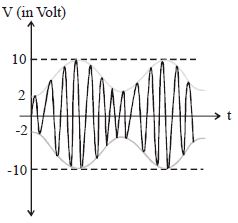
The figure shows the waveform of an amplitude modulated wave. Its modulation factor is
A
$\frac{1}{5}$
B
$\frac{3}{4}$
C
$\frac{2}{3}$
D
$\frac{2}{5}$
Solution
(C) From the given waveform,the maximum voltage $V_{\max} = 10 \ V$ and the minimum voltage $V_{\min} = 2 \ V$.
The modulation index (or modulation factor) $\mu$ is given by the formula:
$\mu = \frac{V_{\max} - V_{\min}}{V_{\max} + V_{\min}}$
Substituting the values:
$\mu = \frac{10 - 2}{10 + 2} = \frac{8}{12} = \frac{2}{3}$
Thus,the modulation factor is $\frac{2}{3}$.
The modulation index (or modulation factor) $\mu$ is given by the formula:
$\mu = \frac{V_{\max} - V_{\min}}{V_{\max} + V_{\min}}$
Substituting the values:
$\mu = \frac{10 - 2}{10 + 2} = \frac{8}{12} = \frac{2}{3}$
Thus,the modulation factor is $\frac{2}{3}$.
0 likes
View Solution204
MediumMCQ
If the maximum and minimum voltage of an $AM$ wave are $V_{max}$ and $V_{min}$,then the modulation index is given by:
A
$\frac{V_{max}}{V_{min}}$
B
$\frac{V_{max} - V_{min}}{V_{max} + V_{min}}$
C
$\frac{V_{max} + V_{min}}{V_{max} - V_{min}}$
D
$\frac{V_{max}^2}{V_{max}^2 - V_{min}^2}$
Solution
(B) For an $AM$ wave,the maximum voltage is given by $V_{max} = V_c + V_m$,where $V_c$ is the carrier amplitude and $V_m$ is the message signal amplitude.
The minimum voltage is given by $V_{min} = V_c - V_m$.
Adding these two equations: $V_{max} + V_{min} = 2V_c \implies V_c = \frac{V_{max} + V_{min}}{2}$.
Subtracting these two equations: $V_{max} - V_{min} = 2V_m \implies V_m = \frac{V_{max} - V_{min}}{2}$.
The modulation index $\mu$ is defined as $\mu = \frac{V_m}{V_c}$.
Substituting the values: $\mu = \frac{(V_{max} - V_{min})/2}{(V_{max} + V_{min})/2} = \frac{V_{max} - V_{min}}{V_{max} + V_{min}}$.
The minimum voltage is given by $V_{min} = V_c - V_m$.
Adding these two equations: $V_{max} + V_{min} = 2V_c \implies V_c = \frac{V_{max} + V_{min}}{2}$.
Subtracting these two equations: $V_{max} - V_{min} = 2V_m \implies V_m = \frac{V_{max} - V_{min}}{2}$.
The modulation index $\mu$ is defined as $\mu = \frac{V_m}{V_c}$.
Substituting the values: $\mu = \frac{(V_{max} - V_{min})/2}{(V_{max} + V_{min})/2} = \frac{V_{max} - V_{min}}{V_{max} + V_{min}}$.
0 likes
View Solution205
MediumMCQ
Which one of the following statements is $WRONG$?
A
Radio waves in the frequency range $10 \ MHz$ to $20 \ MHz$ are called sky waves.
B
Radio horizon of the transmitting antenna for space wave is $d_T = \sqrt{2Rh_T}$ ($R =$ radius of earth, $h_T =$ height of transmitting antenna).
C
Fiber optical communication is almost free from electrical disturbances.
D
The principle of fibre optical communication is total internal reflection.
Solution
(B) The radio horizon distance $d_T$ for a transmitting antenna of height $h_T$ is given by the formula $d_T = \sqrt{2Rh_T}$, where $R$ is the radius of the Earth. Option $B$ states $d_T = \sqrt{Rh_T}$, which is incorrect because the factor of $2$ is missing. Therefore, statement $B$ is the $WRONG$ statement.
0 likes
View Solution206
AdvancedMCQ
The intensity of a light pulse travelling along a communication channel decreases exponentially with distance $x$ according to the relation $I = I_0 e^{-\alpha x}$,where $I_0$ is the intensity at $x = 0$ and $\alpha$ is the attenuation constant. The attenuation in $dB/km$ for an optical fibre in which the intensity falls by $50$ percent over a distance of $50 \ km$ is
A
$0.3010$
B
$0.0602$
C
$0.1505$
D
$0.1204$
Solution
(B) The attenuation in decibels $(dB)$ is given by the formula: $10 \log_{10} (I/I_0) = -\alpha_{dB} x$,where $\alpha_{dB}$ is the attenuation constant in $dB/km$.
Given that the intensity falls by $50$ percent,the final intensity $I = 0.5 I_0$,which means $I/I_0 = 1/2$.
The distance $x = 50 \ km$.
Substituting these values into the formula:
$10 \log_{10} (1/2) = -\alpha_{dB} \times 50$
$10 (\log_{10} 1 - \log_{10} 2) = -50 \alpha_{dB}$
Since $\log_{10} 1 = 0$ and $\log_{10} 2 \approx 0.3010$:
$10 (0 - 0.3010) = -50 \alpha_{dB}$
$-3.010 = -50 \alpha_{dB}$
$\alpha_{dB} = 3.010 / 50 = 0.0602 \ dB/km$.
Given that the intensity falls by $50$ percent,the final intensity $I = 0.5 I_0$,which means $I/I_0 = 1/2$.
The distance $x = 50 \ km$.
Substituting these values into the formula:
$10 \log_{10} (1/2) = -\alpha_{dB} \times 50$
$10 (\log_{10} 1 - \log_{10} 2) = -50 \alpha_{dB}$
Since $\log_{10} 1 = 0$ and $\log_{10} 2 \approx 0.3010$:
$10 (0 - 0.3010) = -50 \alpha_{dB}$
$-3.010 = -50 \alpha_{dB}$
$\alpha_{dB} = 3.010 / 50 = 0.0602 \ dB/km$.
0 likes
View Solution207
MediumMCQ
$A$ carrier wave of peak voltage $12 \, V$ is used to transmit a message signal. What should be the peak voltage of the modulating signal in order to have a modulation index of $75 \%$? ...... $V$
A
$18$
B
$9$
C
$3$
D
$27$
Solution
(B) The modulation index $\mu$ is defined as the ratio of the peak voltage of the modulating signal $(A_m)$ to the peak voltage of the carrier wave $(A_c)$.
$\mu = \frac{A_m}{A_c}$
Given,$\mu = 75 \% = 0.75$ and $A_c = 12 \, V$.
Substituting these values into the formula:
$0.75 = \frac{A_m}{12}$
$A_m = 0.75 \times 12$
$A_m = 9 \, V$.
Therefore,the peak voltage of the modulating signal should be $9 \, V$.
$\mu = \frac{A_m}{A_c}$
Given,$\mu = 75 \% = 0.75$ and $A_c = 12 \, V$.
Substituting these values into the formula:
$0.75 = \frac{A_m}{12}$
$A_m = 0.75 \times 12$
$A_m = 9 \, V$.
Therefore,the peak voltage of the modulating signal should be $9 \, V$.
0 likes
View Solution208
MediumMCQ
$A$ sinusoidal carrier voltage of frequency $1.5 \, MHz$ and amplitude $50 \, V$ is amplitude modulated by a sinusoidal voltage of frequency $10 \, kHz$ producing $50 \%$ modulation. The lower and upper side-band frequencies in $kHz$ are:
A
$1490, 1510$
B
$1510, 1490$
C
$\frac{1}{1490}, \frac{1}{1510}$
D
$\frac{1}{1510}, \frac{1}{1490}$
Solution
(A) Given:
Carrier frequency $f_{c} = 1.5 \, MHz = 1500 \, kHz$
Modulating frequency $f_{m} = 10 \, kHz$
The lower side-band $(LSB)$ frequency is given by:
$f_{LSB} = f_{c} - f_{m} = 1500 \, kHz - 10 \, kHz = 1490 \, kHz$
The upper side-band $(USB)$ frequency is given by:
$f_{USB} = f_{c} + f_{m} = 1500 \, kHz + 10 \, kHz = 1510 \, kHz$
Thus,the lower and upper side-band frequencies are $1490 \, kHz$ and $1510 \, kHz$ respectively.
Carrier frequency $f_{c} = 1.5 \, MHz = 1500 \, kHz$
Modulating frequency $f_{m} = 10 \, kHz$
The lower side-band $(LSB)$ frequency is given by:
$f_{LSB} = f_{c} - f_{m} = 1500 \, kHz - 10 \, kHz = 1490 \, kHz$
The upper side-band $(USB)$ frequency is given by:
$f_{USB} = f_{c} + f_{m} = 1500 \, kHz + 10 \, kHz = 1510 \, kHz$
Thus,the lower and upper side-band frequencies are $1490 \, kHz$ and $1510 \, kHz$ respectively.
0 likes
View Solution209
MediumMCQ
$A$ carrier signal $60 \sin(2\pi \times 10^6 t)$ is used to modulate an audio signal $15 \sin(300 \pi t)$. The depth of modulation is .......... $\%$.
A
$50$
B
$40$
C
$25$
D
$15$
Solution
(C) The modulation index $(m_a)$ is defined as the ratio of the amplitude of the modulating signal $(E_m)$ to the amplitude of the carrier signal $(E_c)$.
Given:
Amplitude of modulating signal,$E_m = 15 \text{ V}$.
Amplitude of carrier signal,$E_c = 60 \text{ V}$.
The depth of modulation in percentage is given by:
$\text{Depth of modulation} = \frac{E_m}{E_c} \times 100$
$= \frac{15}{60} \times 100$
$= \frac{1}{4} \times 100 = 25\%$.
Given:
Amplitude of modulating signal,$E_m = 15 \text{ V}$.
Amplitude of carrier signal,$E_c = 60 \text{ V}$.
The depth of modulation in percentage is given by:
$\text{Depth of modulation} = \frac{E_m}{E_c} \times 100$
$= \frac{15}{60} \times 100$
$= \frac{1}{4} \times 100 = 25\%$.
0 likes
View Solution210
MediumMCQ
This question has Statement-$1$ and Statement-$2$. Of the four choices given after the statements, choose the one that best describes the two statements.
Statement-$1$: Sky wave signals are used for long-distance radio communication. These signals are, in general, less stable than ground wave signals.
Statement-$2$: The state of the ionosphere varies from hour to hour, day to day, and season to season.
Statement-$1$: Sky wave signals are used for long-distance radio communication. These signals are, in general, less stable than ground wave signals.
Statement-$2$: The state of the ionosphere varies from hour to hour, day to day, and season to season.
A
Statement-$1$ is true, Statement-$2$ is true, and Statement-$2$ is not the correct explanation of Statement-$1$.
B
Statement-$1$ is false, Statement-$2$ is true.
C
Statement-$1$ is true, Statement-$2$ is false.
D
Statement-$1$ is true, Statement-$2$ is true, and Statement-$2$ is the correct explanation of Statement-$1$.
Solution
(D) Statement-$1$ is true: Sky waves (frequencies between $2 \text{ MHz}$ to $30 \text{ MHz}$) are used for long-distance radio communication by reflecting off the ionosphere. They are less stable than ground waves because they depend on the fluctuating properties of the ionosphere.
Statement-$2$ is true: The ionosphere is a region of the upper atmosphere containing ions and free electrons. Its density and height vary significantly due to solar radiation, changing from hour to hour, day to day, and season to season.
Conclusion: Since the stability of sky waves depends directly on the properties of the ionosphere, Statement-$2$ provides the correct explanation for why sky waves are less stable (as mentioned in Statement-$1$). Therefore, both statements are true and Statement-$2$ is the correct explanation of Statement-$1$.
Statement-$2$ is true: The ionosphere is a region of the upper atmosphere containing ions and free electrons. Its density and height vary significantly due to solar radiation, changing from hour to hour, day to day, and season to season.
Conclusion: Since the stability of sky waves depends directly on the properties of the ionosphere, Statement-$2$ provides the correct explanation for why sky waves are less stable (as mentioned in Statement-$1$). Therefore, both statements are true and Statement-$2$ is the correct explanation of Statement-$1$.
0 likes
View Solution211
MediumMCQ
In an $AM$ wave,the carrier power is given by:
A
$P_c = \frac{2E_c^2}{R}$
B
$P_c = \frac{E_c^2}{R}$
C
$P_c = \frac{E_c^2}{2R}$
D
$P_c = \frac{E_c^2}{\sqrt{2}R}$
Solution
(C) The carrier wave is represented as $e_c(t) = E_c \sin(\omega_c t)$,where $E_c$ is the peak amplitude of the carrier wave.
Power is defined as the mean square voltage divided by resistance: $P_c = \frac{V_{rms}^2}{R}$.
Since the root mean square $(RMS)$ value of a sinusoidal wave is $E_{rms} = \frac{E_c}{\sqrt{2}}$,the power is calculated as:
$P_c = \frac{(E_c / \sqrt{2})^2}{R} = \frac{E_c^2}{2R}$.
Power is defined as the mean square voltage divided by resistance: $P_c = \frac{V_{rms}^2}{R}$.
Since the root mean square $(RMS)$ value of a sinusoidal wave is $E_{rms} = \frac{E_c}{\sqrt{2}}$,the power is calculated as:
$P_c = \frac{(E_c / \sqrt{2})^2}{R} = \frac{E_c^2}{2R}$.
0 likes
View Solution212
DifficultMCQ
The number of amplitude modulated broadcast stations that can be accommodated in a $300\, kHz$ bandwidth for the highest modulating frequency of $15\, kHz$ is:
A
$20$
B
$10$
C
$8$
D
$15$
Solution
(B) The bandwidth required for a single amplitude modulated $(AM)$ station is twice the highest modulating frequency $(f_m)$.
Given,$f_m = 15\, kHz$.
Therefore,the bandwidth per channel = $2 \times f_m = 2 \times 15\, kHz = 30\, kHz$.
The total available bandwidth is $300\, kHz$.
The number of stations that can be accommodated = $\frac{\text{Total Bandwidth}}{\text{Bandwidth per channel}} = \frac{300\, kHz}{30\, kHz} = 10$.
Given,$f_m = 15\, kHz$.
Therefore,the bandwidth per channel = $2 \times f_m = 2 \times 15\, kHz = 30\, kHz$.
The total available bandwidth is $300\, kHz$.
The number of stations that can be accommodated = $\frac{\text{Total Bandwidth}}{\text{Bandwidth per channel}} = \frac{300\, kHz}{30\, kHz} = 10$.
0 likes
View Solution213
DifficultMCQ
The carrier frequency of a transmitter is provided by a tank circuit of a coil of inductance $49\,\mu H$ and a capacitance of $2.5\,nF$. It is modulated by an audio signal of $12\,kHz$. The frequency range occupied by the side bands is
A
$18\,kHz - 30\,kHz$
B
$63\,kHz - 75\,kHz$
C
$442\,kHz - 466\,kHz$
D
$13482\,kHz - 13494\,kHz$
Solution
(C) The resonant frequency of the tank circuit is given by $f_c = \frac{1}{2\pi\sqrt{LC}}$.
Given: $L = 49 \times 10^{-6}\,H$ and $C = 2.5 \times 10^{-9}\,F$.
$f_c = \frac{1}{2\pi\sqrt{49 \times 10^{-6} \times 2.5 \times 10^{-9}}} = \frac{1}{2\pi\sqrt{122.5 \times 10^{-15}}} = \frac{1}{2\pi\sqrt{1.225 \times 10^{-13}}} \approx \frac{1}{2\pi \times 3.5 \times 10^{-7}} = \frac{10^7}{7\pi} \approx 454.7\,kHz$.
For an audio signal frequency $f_m = 12\,kHz$,the sideband frequencies are $f_c - f_m$ and $f_c + f_m$.
Lower sideband $= 454.7 - 12 = 442.7\,kHz$.
Upper sideband $= 454.7 + 12 = 466.7\,kHz$.
The range is approximately $442\,kHz - 466\,kHz$.
Given: $L = 49 \times 10^{-6}\,H$ and $C = 2.5 \times 10^{-9}\,F$.
$f_c = \frac{1}{2\pi\sqrt{49 \times 10^{-6} \times 2.5 \times 10^{-9}}} = \frac{1}{2\pi\sqrt{122.5 \times 10^{-15}}} = \frac{1}{2\pi\sqrt{1.225 \times 10^{-13}}} \approx \frac{1}{2\pi \times 3.5 \times 10^{-7}} = \frac{10^7}{7\pi} \approx 454.7\,kHz$.
For an audio signal frequency $f_m = 12\,kHz$,the sideband frequencies are $f_c - f_m$ and $f_c + f_m$.
Lower sideband $= 454.7 - 12 = 442.7\,kHz$.
Upper sideband $= 454.7 + 12 = 466.7\,kHz$.
The range is approximately $442\,kHz - 466\,kHz$.
0 likes
View Solution214
DifficultMCQ
$A$ carrier wave of peak voltage $14\,V$ is used for transmitting a message signal. The peak voltage of the modulating signal required to achieve a modulation index of $80\%$ will be.......$V$
A
$11.2$
B
$7$
C
$22.4$
D
$28$
Solution
(A) Given: Modulation index $m = 80\% = 0.8$.
Carrier wave peak voltage $E_c = 14\,V$.
We know that the modulation index $m$ is defined as the ratio of the peak voltage of the modulating signal $(E_m)$ to the peak voltage of the carrier wave $(E_c)$.
Formula: $m = \frac{E_m}{E_c}$.
Rearranging the formula to find $E_m$: $E_m = m \times E_c$.
Substituting the values: $E_m = 0.8 \times 14\,V = 11.2\,V$.
Therefore,the peak voltage of the modulating signal is $11.2\,V$.
Carrier wave peak voltage $E_c = 14\,V$.
We know that the modulation index $m$ is defined as the ratio of the peak voltage of the modulating signal $(E_m)$ to the peak voltage of the carrier wave $(E_c)$.
Formula: $m = \frac{E_m}{E_c}$.
Rearranging the formula to find $E_m$: $E_m = m \times E_c$.
Substituting the values: $E_m = 0.8 \times 14\,V = 11.2\,V$.
Therefore,the peak voltage of the modulating signal is $11.2\,V$.
0 likes
View Solution215
DifficultMCQ
$A$ signal of frequency $20 \, kHz$ and peak voltage $5 \, V$ is used to modulate a carrier wave of frequency $1.2 \, MHz$ and peak voltage $25 \, V$. Choose the correct statement.
A
Modulation index $= 5$,side frequency bands are at $1400 \, kHz$ and $1000 \, kHz$
B
Modulation index $= 5$,side frequency bands are at $21.2 \, kHz$ and $18.8 \, kHz$
C
Modulation index $= 0.8$,side frequency bands are at $1180 \, kHz$ and $1220 \, kHz$
D
Modulation index $= 0.2$,side frequency bands are at $1220 \, kHz$ and $1180 \, kHz$
Solution
(D) The modulation index $m$ is given by the ratio of the peak voltage of the modulating signal $V_m$ to the peak voltage of the carrier wave $V_c$.
$m = \frac{V_m}{V_c} = \frac{5 \, V}{25 \, V} = 0.2$.
Given,the frequency of the carrier wave $f_c = 1.2 \, MHz = 1200 \, kHz$.
The frequency of the modulating signal $f_m = 20 \, kHz$.
The sideband frequencies are given by $f_c \pm f_m$.
Lower sideband frequency $= f_c - f_m = 1200 \, kHz - 20 \, kHz = 1180 \, kHz$.
Upper sideband frequency $= f_c + f_m = 1200 \, kHz + 20 \, kHz = 1220 \, kHz$.
Thus,the modulation index is $0.2$ and the sidebands are at $1180 \, kHz$ and $1220 \, kHz$.
$m = \frac{V_m}{V_c} = \frac{5 \, V}{25 \, V} = 0.2$.
Given,the frequency of the carrier wave $f_c = 1.2 \, MHz = 1200 \, kHz$.
The frequency of the modulating signal $f_m = 20 \, kHz$.
The sideband frequencies are given by $f_c \pm f_m$.
Lower sideband frequency $= f_c - f_m = 1200 \, kHz - 20 \, kHz = 1180 \, kHz$.
Upper sideband frequency $= f_c + f_m = 1200 \, kHz + 20 \, kHz = 1220 \, kHz$.
Thus,the modulation index is $0.2$ and the sidebands are at $1180 \, kHz$ and $1220 \, kHz$.
0 likes
View Solution216
DifficultMCQ
$A$ signal is to be transmitted through a wave of wavelength $\lambda$,using a linear antenna. The length $l$ of the antenna and effective power radiated $P_{eff}$ will be given respectively as: ($K$ is a constant of proportionality)
A
$\lambda, P_{eff} = K\left(\frac{1}{\lambda}\right)^2$
B
$\frac{\lambda}{8}, P_{eff} = K\left(\frac{1}{\lambda}\right)$
C
$\frac{\lambda}{16}, P_{eff} = K\left(\frac{1}{\lambda}\right)^3$
D
$\frac{\lambda}{5}, P_{eff} = K\left(\frac{1}{\lambda}\right)^{\frac{1}{2}}$
Solution
(A) For efficient transmission and reception of signals,the length $l$ of a linear antenna should be comparable to the wavelength $\lambda$ of the signal. Typically,$l = \frac{\lambda}{4}$ or $l = \frac{\lambda}{2}$ are standard lengths. Among the given options,the length must be a fraction of $\lambda$.
The power radiated $P_{eff}$ by a linear antenna is proportional to the square of the ratio of the antenna length to the wavelength. Specifically,$P_{eff} \propto \left(\frac{l}{\lambda}\right)^2$. Since $l$ is proportional to $\lambda$,we have $P_{eff} \propto \left(\frac{\lambda}{\lambda}\right)^2$ is not the case here; rather,for a fixed antenna length,the power radiated is inversely proportional to the square of the wavelength,i.e.,$P_{eff} \propto \frac{1}{\lambda^2}$.
Thus,$P_{eff} = K \left(\frac{1}{\lambda}\right)^2$. Comparing this with the options,option $A$ provides the correct relationship for power,and the length $\lambda$ is a standard order of magnitude for antenna design.
The power radiated $P_{eff}$ by a linear antenna is proportional to the square of the ratio of the antenna length to the wavelength. Specifically,$P_{eff} \propto \left(\frac{l}{\lambda}\right)^2$. Since $l$ is proportional to $\lambda$,we have $P_{eff} \propto \left(\frac{\lambda}{\lambda}\right)^2$ is not the case here; rather,for a fixed antenna length,the power radiated is inversely proportional to the square of the wavelength,i.e.,$P_{eff} \propto \frac{1}{\lambda^2}$.
Thus,$P_{eff} = K \left(\frac{1}{\lambda}\right)^2$. Comparing this with the options,option $A$ provides the correct relationship for power,and the length $\lambda$ is a standard order of magnitude for antenna design.
0 likes
View Solution217
DifficultMCQ
An audio signal consists of two distinct sounds: one is a human speech signal in the frequency band of $200\,Hz$ to $2700\,Hz,$ while the other is a high-frequency music signal in the frequency band of $10200\,Hz$ to $15200\,Hz.$ The ratio of the $AM$ signal bandwidth required to send both the signals together to the $AM$ signal bandwidth required to send just the human speech is
A
$2$
B
$5$
C
$6$
D
$3$
Solution
(C) The bandwidth of an $AM$ signal is defined as the difference between the maximum and minimum frequencies in the signal.
For the human speech signal,the frequency range is $200\,Hz$ to $2700\,Hz.$ The bandwidth is $BW_1 = 2700\,Hz - 200\,Hz = 2500\,Hz.$
When both signals are sent together,the total frequency range spans from the lowest frequency of the speech signal $(200\,Hz)$ to the highest frequency of the music signal $(15200\,Hz.)$ The total bandwidth is $BW_{total} = 15200\,Hz - 200\,Hz = 15000\,Hz.$
The ratio of the total bandwidth to the speech signal bandwidth is $\frac{BW_{total}}{BW_1} = \frac{15000\,Hz}{2500\,Hz} = 6.$
For the human speech signal,the frequency range is $200\,Hz$ to $2700\,Hz.$ The bandwidth is $BW_1 = 2700\,Hz - 200\,Hz = 2500\,Hz.$
When both signals are sent together,the total frequency range spans from the lowest frequency of the speech signal $(200\,Hz)$ to the highest frequency of the music signal $(15200\,Hz.)$ The total bandwidth is $BW_{total} = 15200\,Hz - 200\,Hz = 15000\,Hz.$
The ratio of the total bandwidth to the speech signal bandwidth is $\frac{BW_{total}}{BW_1} = \frac{15000\,Hz}{2500\,Hz} = 6.$
0 likes
View Solution218
DifficultMCQ
$A$ modulated signal $C_m(t)$ has the form $C_m(t) = 30 \sin(300\pi t) + 10 \cos(200\pi t) - 10 \cos(400\pi t)$. The carrier frequency $f_c$,the modulating frequency $f_m$,and the modulation index $\mu$ are respectively given by:
A
$f_c = 200 \text{ Hz}, f_m = 50 \text{ Hz}, \mu = 1/2$
B
$f_c = 150 \text{ Hz}, f_m = 50 \text{ Hz}, \mu = 2/3$
C
$f_c = 150 \text{ Hz}, f_m = 30 \text{ Hz}, \mu = 1/3$
D
$f_c = 200 \text{ Hz}, f_m = 30 \text{ Hz}, \mu = 1/2$
Solution
(B) The standard equation for an $AM$ wave is $C_m(t) = A_c \sin(\omega_c t) + \frac{\mu A_c}{2} \cos((\omega_c - \omega_m)t) - \frac{\mu A_c}{2} \cos((\omega_c + \omega_m)t)$.
Comparing this with the given equation $C_m(t) = 30 \sin(300\pi t) + 10 \cos(200\pi t) - 10 \cos(400\pi t)$:
$1$. Carrier frequency: $\omega_c = 300\pi \Rightarrow 2\pi f_c = 300\pi \Rightarrow f_c = 150 \text{ Hz}$.
$2$. Sideband frequencies: $\omega_c - \omega_m = 200\pi$ and $\omega_c + \omega_m = 400\pi$.
Subtracting the two: $2\omega_m = 200\pi \Rightarrow \omega_m = 100\pi \Rightarrow 2\pi f_m = 100\pi \Rightarrow f_m = 50 \text{ Hz}$.
$3$. Modulation index: $\frac{\mu A_c}{2} = 10$. Since $A_c = 30$,we have $\frac{\mu(30)}{2} = 10 \Rightarrow 15\mu = 10 \Rightarrow \mu = 10/15 = 2/3$.
Comparing this with the given equation $C_m(t) = 30 \sin(300\pi t) + 10 \cos(200\pi t) - 10 \cos(400\pi t)$:
$1$. Carrier frequency: $\omega_c = 300\pi \Rightarrow 2\pi f_c = 300\pi \Rightarrow f_c = 150 \text{ Hz}$.
$2$. Sideband frequencies: $\omega_c - \omega_m = 200\pi$ and $\omega_c + \omega_m = 400\pi$.
Subtracting the two: $2\omega_m = 200\pi \Rightarrow \omega_m = 100\pi \Rightarrow 2\pi f_m = 100\pi \Rightarrow f_m = 50 \text{ Hz}$.
$3$. Modulation index: $\frac{\mu A_c}{2} = 10$. Since $A_c = 30$,we have $\frac{\mu(30)}{2} = 10 \Rightarrow 15\mu = 10 \Rightarrow \mu = 10/15 = 2/3$.
0 likes
View Solution219
DifficultMCQ
$A$ transmitting antenna at the top of a tower has height $32\, m$ and the height of the receiving antenna is $50\, m$. What is the maximum distance between them for satisfactory communication in line of sight $(LOS)$ mode? ........$km$
A
$55.4$
B
$45.5$
C
$54.5$
D
$455$
Solution
(B) Given: Height of transmitting antenna $h_T = 50\, m$ and height of receiving antenna $h_R = 32\, m$.
Radius of the Earth $R \approx 6.4 \times 10^6\, m$.
The maximum line-of-sight distance $d_M$ is given by the formula: $d_M = \sqrt{2Rh_T} + \sqrt{2Rh_R}$.
Substituting the values:
$d_M = \sqrt{2 \times 6.4 \times 10^6 \times 50} + \sqrt{2 \times 6.4 \times 10^6 \times 32}$.
$d_M = \sqrt{640 \times 10^6} + \sqrt{409.6 \times 10^6}$.
$d_M = (25.298 \times 10^3) + (20.238 \times 10^3) = 45.536 \times 10^3\, m$.
Converting to kilometers: $d_M \approx 45.5\, km$.
Radius of the Earth $R \approx 6.4 \times 10^6\, m$.
The maximum line-of-sight distance $d_M$ is given by the formula: $d_M = \sqrt{2Rh_T} + \sqrt{2Rh_R}$.
Substituting the values:
$d_M = \sqrt{2 \times 6.4 \times 10^6 \times 50} + \sqrt{2 \times 6.4 \times 10^6 \times 32}$.
$d_M = \sqrt{640 \times 10^6} + \sqrt{409.6 \times 10^6}$.
$d_M = (25.298 \times 10^3) + (20.238 \times 10^3) = 45.536 \times 10^3\, m$.
Converting to kilometers: $d_M \approx 45.5\, km$.
0 likes
View Solution220
DifficultMCQ
For sky wave propagation,the radio waves must have a frequency range in between
A
$1\,MHz$ to $2\,MHz$
B
$5\,MHz$ to $25\,MHz$
C
$35\,MHz$ to $40\,MHz$
D
$45\,MHz$ to $50\,MHz$
Solution
(B) Sky wave propagation utilizes the ionosphere to reflect radio waves back to Earth. This mode of propagation is effective for frequencies in the range of $5\,MHz$ to $25\,MHz$. Frequencies lower than this are absorbed by the ionosphere,while frequencies higher than this penetrate the ionosphere and escape into space.
0 likes
View Solution221
DifficultMCQ
Long range radio transmission is possible when the radio waves are reflected from the ionosphere. For this to happen,the frequency of the radio waves must be in the range:
A
$80 - 150\, MHz$
B
$8 - 25\, MHz$
C
$1 - 3\, MHz$
D
$150 - 1500\, kHz$
Solution
(B) Sky wave propagation is a mode of radio wave propagation in which radio waves are reflected or refracted back to the Earth from the ionosphere.
This phenomenon is primarily used for long-distance communication.
The ionosphere acts as a reflecting medium for radio waves within a specific frequency range.
According to standard communication physics,the frequency range suitable for sky wave propagation is typically between $2\, MHz$ and $30\, MHz$.
Comparing this with the given options,the range $8 - 25\, MHz$ falls within this specified limit.
Therefore,option $B$ is the correct answer.
This phenomenon is primarily used for long-distance communication.
The ionosphere acts as a reflecting medium for radio waves within a specific frequency range.
According to standard communication physics,the frequency range suitable for sky wave propagation is typically between $2\, MHz$ and $30\, MHz$.
Comparing this with the given options,the range $8 - 25\, MHz$ falls within this specified limit.
Therefore,option $B$ is the correct answer.
0 likes
View Solution222
DifficultMCQ
If a carrier wave $C(t) = A \sin \omega_c t$ is amplitude modulated by a modulating signal $m(t) = A \sin \omega_m t$,then the equation of the modulated signal $[C_m(t)]$ and its modulation index are respectively:
A
$C_m(t) = A(1 + \sin \omega_m t) \sin \omega_c t$ and $2$
B
$C_m(t) = A(1 + \sin \omega_m t) \sin \omega_m t$ and $1$
C
$C_m(t) = A(1 + \sin \omega_m t) \sin \omega_c t$ and $1$
D
$C_m(t) = A(1 + \sin \omega_c t) \sin \omega_m t$ and $2$
Solution
(C) The standard equation for an amplitude modulated wave is given by $C_m(t) = A_c(1 + \mu \sin \omega_m t) \sin \omega_c t$,where $\mu$ is the modulation index.
Given the carrier wave $C(t) = A \sin \omega_c t$ and the modulating signal $m(t) = A \sin \omega_m t$,the amplitude of the carrier is $A_c = A$ and the amplitude of the modulating signal is $A_m = A$.
The modulation index $\mu$ is defined as $\mu = \frac{A_m}{A_c} = \frac{A}{A} = 1$.
Substituting $\mu = 1$ and $A_c = A$ into the general equation,we get $C_m(t) = A(1 + 1 \cdot \sin \omega_m t) \sin \omega_c t = A(1 + \sin \omega_m t) \sin \omega_c t$.
Thus,the modulated signal is $C_m(t) = A(1 + \sin \omega_m t) \sin \omega_c t$ and the modulation index is $1$.
Given the carrier wave $C(t) = A \sin \omega_c t$ and the modulating signal $m(t) = A \sin \omega_m t$,the amplitude of the carrier is $A_c = A$ and the amplitude of the modulating signal is $A_m = A$.
The modulation index $\mu$ is defined as $\mu = \frac{A_m}{A_c} = \frac{A}{A} = 1$.
Substituting $\mu = 1$ and $A_c = A$ into the general equation,we get $C_m(t) = A(1 + 1 \cdot \sin \omega_m t) \sin \omega_c t = A(1 + \sin \omega_m t) \sin \omega_c t$.
Thus,the modulated signal is $C_m(t) = A(1 + \sin \omega_m t) \sin \omega_c t$ and the modulation index is $1$.
0 likes
View Solution223
DifficultMCQ
Which of the following statements is $NOT$ correct?
A
Ground wave signals are more stable than sky wave signals.
B
The critical frequency of an ionospheric layer is the highest frequency that will be reflected back by the layer when it is incident vertically.
C
Electromagnetic waves of frequencies higher than about $30 \, MHz$ cannot penetrate the ionosphere.
D
Sky wave signals in the broadcast frequency range are stronger at night than in the daytime.
Solution
(C) The critical frequency $(f_c)$ is defined as the highest frequency that is reflected back by the ionosphere when incident vertically. Waves with frequencies higher than the critical frequency penetrate the ionosphere and are not reflected. Statement $C$ claims that waves with frequencies higher than $30 \, MHz$ cannot penetrate the ionosphere, which is incorrect because frequencies above the critical frequency (typically $3-30 \, MHz$ for the ionosphere) easily penetrate it.
0 likes
View Solution224
DifficultMCQ
Which of the following modulated signals has the best noise tolerance?
A
Long-wave
B
Short-wave
C
Medium-wave
D
Amplitude-modulated
Solution
(B) In communication systems,noise primarily affects the amplitude of the signal. Frequency Modulation $(FM)$ is generally more noise-tolerant than Amplitude Modulation $(AM)$. Among the given options,$Short-wave$ signals (often associated with specific propagation characteristics and modulation techniques) are historically recognized for better performance in long-distance communication compared to $Long-wave$ or $Medium-wave$ signals,which are more susceptible to atmospheric noise and interference.
0 likes
View Solution225
DifficultMCQ
Broadcasting antennas are generally
A
vertical type
B
both vertical and horizontal type
C
omni directional type
D
horizontal type
Solution
(A) Broadcasting antennas are generally designed to be vertical type. This is because vertical antennas radiate electromagnetic waves uniformly in all directions in the horizontal plane,which is ideal for broadcasting to a wide area.
0 likes
View Solution226
DifficultMCQ
Given the electric field of a complete amplitude modulated wave as $\vec E = \hat i E_c (1 + \frac{E_m}{E_c} \cos \omega_m t) \cos \omega_c t$,where the subscript $c$ stands for the carrier wave and $m$ for the modulating signal. The frequencies present in the modulated wave are:
A
$\omega_c$ and $\sqrt{\omega_c^2 + \omega_m^2}$
B
$\omega_c, \omega_c + \omega_m$ and $\omega_c - \omega_m$
C
$\omega_c$ and $\omega_m$
D
$\omega_c$ and $\sqrt{\omega_c \omega_m}$
Solution
(B) The given expression for the amplitude modulated wave is $\vec E = \hat i E_c (1 + \frac{E_m}{E_c} \cos \omega_m t) \cos \omega_c t$.
Expanding this expression,we get $\vec E = \hat i [E_c \cos \omega_c t + E_m \cos \omega_m t \cos \omega_c t]$.
Using the trigonometric identity $2 \cos A \cos B = \cos(A+B) + \cos(A-B)$,we can write:
$\vec E = \hat i [E_c \cos \omega_c t + \frac{E_m}{2} (\cos(\omega_c + \omega_m)t + \cos(\omega_c - \omega_m)t)]$.
This expression shows that the modulated wave consists of three distinct frequency components:
$1$. The carrier frequency: $\omega_c$
$2$. The upper sideband frequency: $\omega_c + \omega_m$
$3$. The lower sideband frequency: $\omega_c - \omega_m$
Therefore,the frequencies present are $\omega_c, \omega_c + \omega_m$,and $\omega_c - \omega_m$.
Expanding this expression,we get $\vec E = \hat i [E_c \cos \omega_c t + E_m \cos \omega_m t \cos \omega_c t]$.
Using the trigonometric identity $2 \cos A \cos B = \cos(A+B) + \cos(A-B)$,we can write:
$\vec E = \hat i [E_c \cos \omega_c t + \frac{E_m}{2} (\cos(\omega_c + \omega_m)t + \cos(\omega_c - \omega_m)t)]$.
This expression shows that the modulated wave consists of three distinct frequency components:
$1$. The carrier frequency: $\omega_c$
$2$. The upper sideband frequency: $\omega_c + \omega_m$
$3$. The lower sideband frequency: $\omega_c - \omega_m$
Therefore,the frequencies present are $\omega_c, \omega_c + \omega_m$,and $\omega_c - \omega_m$.
0 likes
View Solution227
DifficultMCQ
In a communication system operating at a wavelength of $800\,nm,$ only one percent of the source frequency is available as signal bandwidth. The number of channels accommodated for transmitting $TV$ signals of bandwidth $6\,MHz$ is (Take velocity of light $c = 3 \times 10^8\,m/s$)
A
$3.75 \times 10^6$
B
$3.86 \times 10^6$
C
$6.25 \times 10^5$
D
$4.87 \times 10^5$
Solution
(C) The frequency of the source is given by $f = \frac{c}{\lambda}$.
Substituting the values,$f = \frac{3 \times 10^8\,m/s}{800 \times 10^{-9}\,m} = \frac{3 \times 10^8}{8 \times 10^{-7}} = 0.375 \times 10^{15}\,Hz = 3.75 \times 10^{14}\,Hz$.
The available signal bandwidth is $1\%$ of the source frequency,so $\text{Bandwidth} = 0.01 \times f = 0.01 \times 3.75 \times 10^{14}\,Hz = 3.75 \times 10^{12}\,Hz$.
The number of channels $n$ that can be accommodated for $TV$ signals of bandwidth $6\,MHz$ $(6 \times 10^6\,Hz)$ is given by $n = \frac{\text{Total Bandwidth}}{\text{Bandwidth per channel}}$.
$n = \frac{3.75 \times 10^{12}}{6 \times 10^6} = 0.625 \times 10^6 = 6.25 \times 10^5$.
Substituting the values,$f = \frac{3 \times 10^8\,m/s}{800 \times 10^{-9}\,m} = \frac{3 \times 10^8}{8 \times 10^{-7}} = 0.375 \times 10^{15}\,Hz = 3.75 \times 10^{14}\,Hz$.
The available signal bandwidth is $1\%$ of the source frequency,so $\text{Bandwidth} = 0.01 \times f = 0.01 \times 3.75 \times 10^{14}\,Hz = 3.75 \times 10^{12}\,Hz$.
The number of channels $n$ that can be accommodated for $TV$ signals of bandwidth $6\,MHz$ $(6 \times 10^6\,Hz)$ is given by $n = \frac{\text{Total Bandwidth}}{\text{Bandwidth per channel}}$.
$n = \frac{3.75 \times 10^{12}}{6 \times 10^6} = 0.625 \times 10^6 = 6.25 \times 10^5$.
0 likes
View Solution228
DifficultMCQ
$A$ $TV$ transmission tower has a height of $140\, m$ and the height of the receiving antenna is $40\, m$. What is the maximum distance up to which signals can be broadcasted from this tower in $LOS$ (Line of Sight) mode? (Given: radius of earth $R = 6.4 \times 10^6\, m$)
A
$65$
B
$48$
C
$80$
D
$40$
Solution
(A) The maximum distance $d$ for $LOS$ communication is given by the formula: $d = \sqrt{2R h_T} + \sqrt{2R h_R}$.
Given:
Height of transmitter tower $h_T = 140\, m$
Height of receiving antenna $h_R = 40\, m$
Radius of Earth $R = 6.4 \times 10^6\, m$
Substituting the values:
$d = \sqrt{2 \times 6.4 \times 10^6 \times 140} + \sqrt{2 \times 6.4 \times 10^6 \times 40}$
$d = \sqrt{1792 \times 10^6} + \sqrt{512 \times 10^6}$
$d = (42.33 \times 10^3) + (22.63 \times 10^3)$
$d = 64.96 \times 10^3\, m \approx 65\, km$.
Given:
Height of transmitter tower $h_T = 140\, m$
Height of receiving antenna $h_R = 40\, m$
Radius of Earth $R = 6.4 \times 10^6\, m$
Substituting the values:
$d = \sqrt{2 \times 6.4 \times 10^6 \times 140} + \sqrt{2 \times 6.4 \times 10^6 \times 40}$
$d = \sqrt{1792 \times 10^6} + \sqrt{512 \times 10^6}$
$d = (42.33 \times 10^3) + (22.63 \times 10^3)$
$d = 64.96 \times 10^3\, m \approx 65\, km$.
0 likes
View Solution229
DifficultMCQ
The modulation frequency of an $AM$ radio station is $250\, kHz$,which is $10\%$ of the carrier wave. If another $AM$ station approaches you for license,what broadcast frequency will you allot? (Note: The interval between two carrier frequencies should be at least two times the modulation frequency to avoid interference.)
A
$2750$
B
$2900$
C
$2250$
D
$2000$
Solution
(D) Given,modulation frequency $(f_m)$ = $250\, kHz$.
It is given that $f_m$ is $10\%$ of the carrier frequency $(f_c)$.
So,$250\, kHz = 0.10 \times f_c$.
Therefore,$f_c = 2500\, kHz$.
To avoid interference,the minimum frequency separation between two $AM$ stations must be $2 \times f_m = 2 \times 250\, kHz = 500\, kHz$.
Thus,the next available broadcast frequency should be $f_c + 500\, kHz = 2500\, kHz + 500\, kHz = 3000\, kHz$ or $f_c - 500\, kHz = 2000\, kHz$.
Comparing with the given options,$2000\, kHz$ is the correct choice.
It is given that $f_m$ is $10\%$ of the carrier frequency $(f_c)$.
So,$250\, kHz = 0.10 \times f_c$.
Therefore,$f_c = 2500\, kHz$.
To avoid interference,the minimum frequency separation between two $AM$ stations must be $2 \times f_m = 2 \times 250\, kHz = 500\, kHz$.
Thus,the next available broadcast frequency should be $f_c + 500\, kHz = 2500\, kHz + 500\, kHz = 3000\, kHz$ or $f_c - 500\, kHz = 2000\, kHz$.
Comparing with the given options,$2000\, kHz$ is the correct choice.
0 likes
View Solution230
DifficultMCQ
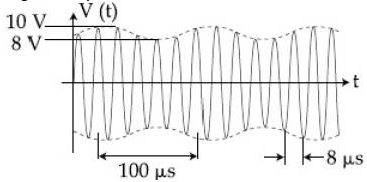
An amplitude modulated signal is plotted below. Which one of the following best describes the above signal?
A
$(9 + \sin(2.5\pi \times 10^5 t)) \sin(2\pi \times 10^4 t) \, V$
B
$(1 + 9\sin(2\pi \times 10^4 t)) \sin(2.5\pi \times 10^5 t) \, V$
C
$(9 + \sin(2\pi \times 10^4 t)) \sin(2.5\pi \times 10^5 t) \, V$
D
$(9 + \sin(4\pi \times 10^4 t)) \sin(5\pi \times 10^5 t) \, V$
Solution
(C) $1$. From the graph,the amplitude of the signal varies between $8 \, V$ and $10 \, V$. This can be expressed as $A(t) = 9 + 1 \sin(\omega_m t) \, V$.
$2$. The time period of the modulating signal (envelope) is $T_m = 100 \, \mu s = 100 \times 10^{-6} \, s = 10^{-4} \, s$. The angular frequency is $\omega_m = \frac{2\pi}{T_m} = \frac{2\pi}{10^{-4}} = 2\pi \times 10^4 \, rad/s$.
$3$. The time period of the carrier wave is $T_c = 8 \, \mu s = 8 \times 10^{-6} \, s$. The angular frequency is $\omega_c = \frac{2\pi}{T_c} = \frac{2\pi}{8 \times 10^{-6}} = 0.25 \times 10^6 \pi = 2.5\pi \times 10^5 \, rad/s$.
$4$. The general form of an amplitude modulated signal is $V(t) = (A_c + A_m \sin(\omega_m t)) \sin(\omega_c t)$.
$5$. Substituting the values,we get $V(t) = (9 + 1 \sin(2\pi \times 10^4 t)) \sin(2.5\pi \times 10^5 t) \, V$.
$2$. The time period of the modulating signal (envelope) is $T_m = 100 \, \mu s = 100 \times 10^{-6} \, s = 10^{-4} \, s$. The angular frequency is $\omega_m = \frac{2\pi}{T_m} = \frac{2\pi}{10^{-4}} = 2\pi \times 10^4 \, rad/s$.
$3$. The time period of the carrier wave is $T_c = 8 \, \mu s = 8 \times 10^{-6} \, s$. The angular frequency is $\omega_c = \frac{2\pi}{T_c} = \frac{2\pi}{8 \times 10^{-6}} = 0.25 \times 10^6 \pi = 2.5\pi \times 10^5 \, rad/s$.
$4$. The general form of an amplitude modulated signal is $V(t) = (A_c + A_m \sin(\omega_m t)) \sin(\omega_c t)$.
$5$. Substituting the values,we get $V(t) = (9 + 1 \sin(2\pi \times 10^4 t)) \sin(2.5\pi \times 10^5 t) \, V$.
0 likes
View Solution231
DifficultMCQ
$A$ $100\, V$ carrier wave is made to vary between $160\, V$ and $40\, V$ by a modulating signal. What is the modulation index?
A
$0.3$
B
$0.5$
C
$0.6$
D
$0.4$
Solution
(C) The maximum amplitude of the modulated wave is given by $A_{max} = A_c + A_m = 160\, V$.
The minimum amplitude of the modulated wave is given by $A_{min} = A_c - A_m = 40\, V$.
Adding these two equations: $(A_c + A_m) + (A_c - A_m) = 160 + 40$,which gives $2A_c = 200$,so $A_c = 100\, V$.
Subtracting the second equation from the first: $(A_c + A_m) - (A_c - A_m) = 160 - 40$,which gives $2A_m = 120$,so $A_m = 60\, V$.
The modulation index $\mu$ is defined as the ratio of the amplitude of the modulating signal to the amplitude of the carrier wave:
$\mu = \frac{A_m}{A_c} = \frac{60}{100} = 0.6$.
The minimum amplitude of the modulated wave is given by $A_{min} = A_c - A_m = 40\, V$.
Adding these two equations: $(A_c + A_m) + (A_c - A_m) = 160 + 40$,which gives $2A_c = 200$,so $A_c = 100\, V$.
Subtracting the second equation from the first: $(A_c + A_m) - (A_c - A_m) = 160 - 40$,which gives $2A_m = 120$,so $A_m = 60\, V$.
The modulation index $\mu$ is defined as the ratio of the amplitude of the modulating signal to the amplitude of the carrier wave:
$\mu = \frac{A_m}{A_c} = \frac{60}{100} = 0.6$.
0 likes
View Solution232
DifficultMCQ
To double the covering range of a $TV$ transmission tower,its height should be multiplied by
A
$1/\sqrt{2}$
B
$2$
C
$4$
D
$\sqrt{2}$
Solution
(C) The covering range $d$ of a $TV$ transmission tower of height $h$ is given by the formula $d = \sqrt{2hR}$,where $R$ is the radius of the Earth.
From this relation,we can see that $d \propto \sqrt{h}$.
Let the initial range be $d_1 = \sqrt{2h_1R}$ and the new range be $d_2 = \sqrt{2h_2R}$.
We want the new range to be double the initial range,so $d_2 = 2d_1$.
Substituting the expressions,we get $\sqrt{2h_2R} = 2 \sqrt{2h_1R}$.
Squaring both sides,we get $2h_2R = 4(2h_1R)$.
This simplifies to $h_2 = 4h_1$.
Therefore,the height of the tower must be multiplied by $4$ to double the covering range.
From this relation,we can see that $d \propto \sqrt{h}$.
Let the initial range be $d_1 = \sqrt{2h_1R}$ and the new range be $d_2 = \sqrt{2h_2R}$.
We want the new range to be double the initial range,so $d_2 = 2d_1$.
Substituting the expressions,we get $\sqrt{2h_2R} = 2 \sqrt{2h_1R}$.
Squaring both sides,we get $2h_2R = 4(2h_1R)$.
This simplifies to $h_2 = 4h_1$.
Therefore,the height of the tower must be multiplied by $4$ to double the covering range.
0 likes
View Solution233
DifficultMCQ
The wavelength of the carrier waves in a modern optical fiber communication network is close to ........ $nm$.
A
$1500$
B
$600$
C
$2400$
D
$900$
Solution
(A) In modern optical fiber communication systems,the signal attenuation is minimized at specific infrared wavelengths.
Specifically,the wavelength of carrier waves used in these networks is typically close to $1500 \, nm$ to ensure low loss and high efficiency during transmission.
Specifically,the wavelength of carrier waves used in these networks is typically close to $1500 \, nm$ to ensure low loss and high efficiency during transmission.
0 likes
View Solution234
DifficultMCQ
In a line of sight radio communication,a distance of about $50\, km$ is kept between the transmitting and receiving antennas. If the height of the receiving antenna is $70\, m$,then the minimum height of the transmitting antenna should be........$m$ (Radius of the Earth $= 6.4 \times 10^6\, m$)
A
$32$
B
$40$
C
$51$
D
$20$
Solution
(A) The range $d$ for line of sight communication is given by the formula: $d = \sqrt{2Rh_T} + \sqrt{2Rh_R}$.
Given: $d = 50 \times 10^3\, m$,$R = 6.4 \times 10^6\, m$,$h_R = 70\, m$.
Substituting the values:
$50 \times 10^3 = \sqrt{2 \times 6.4 \times 10^6 \times h_T} + \sqrt{2 \times 6.4 \times 10^6 \times 70}$.
$50000 = \sqrt{12.8 \times 10^6 \times h_T} + \sqrt{896 \times 10^6}$.
$50000 = \sqrt{12.8 \times 10^6} \times \sqrt{h_T} + 29933$.
$50000 - 29933 = 3577.7 \times \sqrt{h_T}$.
$20067 = 3577.7 \times \sqrt{h_T}$.
$\sqrt{h_T} \approx 5.61$.
$h_T \approx 31.47\, m \approx 32\, m$.
Given: $d = 50 \times 10^3\, m$,$R = 6.4 \times 10^6\, m$,$h_R = 70\, m$.
Substituting the values:
$50 \times 10^3 = \sqrt{2 \times 6.4 \times 10^6 \times h_T} + \sqrt{2 \times 6.4 \times 10^6 \times 70}$.
$50000 = \sqrt{12.8 \times 10^6 \times h_T} + \sqrt{896 \times 10^6}$.
$50000 = \sqrt{12.8 \times 10^6} \times \sqrt{h_T} + 29933$.
$50000 - 29933 = 3577.7 \times \sqrt{h_T}$.
$20067 = 3577.7 \times \sqrt{h_T}$.
$\sqrt{h_T} \approx 5.61$.
$h_T \approx 31.47\, m \approx 32\, m$.
0 likes
View Solution235
DifficultMCQ
$A$ signal $A \cos \omega t$ is transmitted using $v_0 \sin \omega_0 t$ as a carrier wave. The correct amplitude modulated $(AM)$ signal is:
A
$v_0 \sin [\omega_0 (1 + 0.01 A \sin \omega t)t]$
B
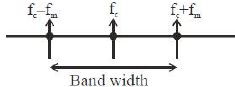
$v_0 \sin \omega_0 t + \frac{A}{2} \sin (\omega_0 - \omega)t + \frac{A}{2} \sin (\omega_0 + \omega)t$
C
$v_0 \sin \omega_0 t + A \cos \omega t$
D
$(v_0 + A) \cos \omega t \sin \omega_0 t$
Solution
(B) The standard expression for an amplitude modulated $(AM)$ wave is given by:
$v_{AM} = (v_0 + A_m \sin \omega_m t) \sin \omega_c t$
Given the message signal is $A \cos \omega t$ and the carrier wave is $v_0 \sin \omega_0 t$,the modulated signal is:
$v_{AM} = (v_0 + A \cos \omega t) \sin \omega_0 t$
$v_{AM} = v_0 \sin \omega_0 t + A \cos \omega t \sin \omega_0 t$
Using the trigonometric identity $2 \sin A \cos B = \sin(A + B) + \sin(A - B)$,we can write:
$A \cos \omega t \sin \omega_0 t = \frac{A}{2} [2 \sin \omega_0 t \cos \omega t] = \frac{A}{2} [\sin(\omega_0 + \omega)t + \sin(\omega_0 - \omega)t]$
Substituting this back into the equation:
$v_{AM} = v_0 \sin \omega_0 t + \frac{A}{2} \sin(\omega_0 + \omega)t + \frac{A}{2} \sin(\omega_0 - \omega)t$
This matches option $B$.
$v_{AM} = (v_0 + A_m \sin \omega_m t) \sin \omega_c t$
Given the message signal is $A \cos \omega t$ and the carrier wave is $v_0 \sin \omega_0 t$,the modulated signal is:
$v_{AM} = (v_0 + A \cos \omega t) \sin \omega_0 t$
$v_{AM} = v_0 \sin \omega_0 t + A \cos \omega t \sin \omega_0 t$
Using the trigonometric identity $2 \sin A \cos B = \sin(A + B) + \sin(A - B)$,we can write:
$A \cos \omega t \sin \omega_0 t = \frac{A}{2} [2 \sin \omega_0 t \cos \omega t] = \frac{A}{2} [\sin(\omega_0 + \omega)t + \sin(\omega_0 - \omega)t]$
Substituting this back into the equation:
$v_{AM} = v_0 \sin \omega_0 t + \frac{A}{2} \sin(\omega_0 + \omega)t + \frac{A}{2} \sin(\omega_0 - \omega)t$
This matches option $B$.
0 likes
View Solution236
DifficultMCQ
The physical sizes of the transmitter and receiver antenna in a communication system are
A
Proportional to carrier frequency
B
Inversely proportional to modulation frequency
C
Inversely proportional to carrier frequency
D
Independent of both carrier and modulation frequency
Solution
(C) The physical size of an antenna,such as a dipole antenna,is typically related to the wavelength $\lambda$ of the signal being transmitted or received.
Since the wavelength $\lambda$ is given by $\lambda = c/f$,where $c$ is the speed of light and $f$ is the carrier frequency,the length of the antenna $L$ is proportional to $\lambda$ (e.g.,$L = \lambda/2$ or $L = \lambda/4$).
Therefore,$L \propto 1/f$.
This implies that the physical size of the transmitter and receiver antenna is inversely proportional to the carrier frequency.
Since the wavelength $\lambda$ is given by $\lambda = c/f$,where $c$ is the speed of light and $f$ is the carrier frequency,the length of the antenna $L$ is proportional to $\lambda$ (e.g.,$L = \lambda/2$ or $L = \lambda/4$).
Therefore,$L \propto 1/f$.
This implies that the physical size of the transmitter and receiver antenna is inversely proportional to the carrier frequency.
0 likes
View Solution237
MediumMCQ
Given below in the left column are different modes of communication using the kinds of waves given in the right column.
From the options given below, find the most appropriate match between entries in the left and the right column.
| $A$. Optical Fiber Communication | $P$. Ultrasound |
| $B$. Radar | $Q$. Infrared Light |
| $C$. Sonar | $R$. Microwaves |
| $D$. Mobile Phones | $S$. Radio Waves |
From the options given below, find the most appropriate match between entries in the left and the right column.
A
$A-S, B-Q, C-R, D-P$
B
$A-Q, B-S, C-P, D-R$
C
$A-R, B-P, C-S, D-Q$
D
$A-Q, B-S, C-R, D-P$
Solution
(B) $1$. $Optical\, Fiber\, Communication - Infrared\, light$: Optical fiber communication uses light signals, typically in the infrared region $(850\, nm, 1300\, nm, 1550\, nm)$, to minimize attenuation and scattering in glass fibers.
$2$. $Radar - Radio\, waves$: Radar (Radio Detection and Ranging) systems use radio waves to detect the position, velocity, and other characteristics of remote objects.
$3$. $Sonar - Ultrasound$: Sonar (Sound Navigation and Ranging) uses ultrasonic sound waves to detect objects underwater or in robotics, as these waves can propagate through media effectively.
$4$. $Mobile\, Phones - Microwaves$: Mobile phones operate using microwave frequencies (typically in the $GHz$ range) for wireless communication between the handset and the base station.
Therefore, the correct matching is $A-Q, B-S, C-P, D-R$.
$2$. $Radar - Radio\, waves$: Radar (Radio Detection and Ranging) systems use radio waves to detect the position, velocity, and other characteristics of remote objects.
$3$. $Sonar - Ultrasound$: Sonar (Sound Navigation and Ranging) uses ultrasonic sound waves to detect objects underwater or in robotics, as these waves can propagate through media effectively.
$4$. $Mobile\, Phones - Microwaves$: Mobile phones operate using microwave frequencies (typically in the $GHz$ range) for wireless communication between the handset and the base station.
Therefore, the correct matching is $A-Q, B-S, C-P, D-R$.
0 likes
View Solution238
DifficultMCQ
In an amplitude modulator circuit,the carrier wave is given by $C(t) = 4 \sin(20000 \pi t)$ and the modulating signal is given by $m(t) = 2 \sin(2000 \pi t)$. The values of the modulation index and the lower sideband frequency are:
A
$0.5$ and $9 \text{ kHz}$
B
$0.3$ and $9 \text{ kHz}$
C
$0.5$ and $10 \text{ kHz}$
D
$0.4$ and $10 \text{ kHz}$
Solution
(A) The modulation index $\mu$ is defined as the ratio of the amplitude of the modulating signal $(A_m)$ to the amplitude of the carrier wave $(A_c)$:
$\mu = \frac{A_m}{A_c} = \frac{2}{4} = 0.5$.
The carrier frequency $f_c$ is obtained from $2 \pi f_c = 20000 \pi$,which gives $f_c = 10000 \text{ Hz} = 10 \text{ kHz}$.
The modulating frequency $f_m$ is obtained from $2 \pi f_m = 2000 \pi$,which gives $f_m = 1000 \text{ Hz} = 1 \text{ kHz}$.
The lower sideband frequency $(LSB)$ is given by $f_c - f_m = 10 \text{ kHz} - 1 \text{ kHz} = 9 \text{ kHz}$.
Therefore,the modulation index is $0.5$ and the lower sideband frequency is $9 \text{ kHz}$.
$\mu = \frac{A_m}{A_c} = \frac{2}{4} = 0.5$.
The carrier frequency $f_c$ is obtained from $2 \pi f_c = 20000 \pi$,which gives $f_c = 10000 \text{ Hz} = 10 \text{ kHz}$.
The modulating frequency $f_m$ is obtained from $2 \pi f_m = 2000 \pi$,which gives $f_m = 1000 \text{ Hz} = 1 \text{ kHz}$.
The lower sideband frequency $(LSB)$ is given by $f_c - f_m = 10 \text{ kHz} - 1 \text{ kHz} = 9 \text{ kHz}$.
Therefore,the modulation index is $0.5$ and the lower sideband frequency is $9 \text{ kHz}$.
0 likes
View Solution239
EasyMCQ
Ultra high frequency $(UHF)$ band stands for
A
$0-300 \, kHz$
B
$0-30 \, MHz$
C
$300-3000 \, kHz$
D
$300-3000 \, MHz$
Solution
(D) The electromagnetic spectrum is divided into various frequency bands for communication purposes.
$UHF$ stands for Ultra High Frequency.
The frequency range for the $UHF$ band is defined as $300 \, MHz$ to $3000 \, MHz$ (or $0.3 \, GHz$ to $3 \, GHz$).
Therefore,the correct option is $D$.
$UHF$ stands for Ultra High Frequency.
The frequency range for the $UHF$ band is defined as $300 \, MHz$ to $3000 \, MHz$ (or $0.3 \, GHz$ to $3 \, GHz$).
Therefore,the correct option is $D$.
0 likes
View Solution240
MediumMCQ
$A$ wave is represented as $e = 10\,(1 + 6\, \sin(50t)) \sin(10^8t)$. The modulation index is:
A
$10$
B
$1250$
C
$10^8$
D
$6$
Solution
(D) The standard equation for an amplitude-modulated wave is given by $e = A_c(1 + \mu \sin(\omega_m t)) \sin(\omega_c t)$, where $\mu$ is the modulation index.
Comparing the given equation $e = 10(1 + 6 \sin(50t)) \sin(10^8t)$ with the standard form:
$A_c = 10$
$\mu = 6$
$\omega_m = 50 \text{ rad/s}$
$\omega_c = 10^8 \text{ rad/s}$
Thus, the modulation index $\mu$ is $6$.
Comparing the given equation $e = 10(1 + 6 \sin(50t)) \sin(10^8t)$ with the standard form:
$A_c = 10$
$\mu = 6$
$\omega_m = 50 \text{ rad/s}$
$\omega_c = 10^8 \text{ rad/s}$
Thus, the modulation index $\mu$ is $6$.
0 likes
View Solution241
MediumMCQ
$A$ $100\,m$ long antenna is mounted on a $500\,m$ tall building. The complex can become a transmission tower for waves with $\lambda$ (approx) ........ $m$.
A
$400$
B
$25$
C
$150$
D
$2400$
Solution
(A) For an antenna to be efficient for transmission,its length $L$ should be related to the wavelength $\lambda$ of the signal. The most common condition for a resonant antenna is that its length should be a quarter of the wavelength,i.e.,$L = \frac{\lambda}{4}$.
Given the antenna length $L = 100\,m$.
Substituting the value: $100 = \frac{\lambda}{4}$.
Therefore,$\lambda = 100 \times 4 = 400\,m$.
Given the antenna length $L = 100\,m$.
Substituting the value: $100 = \frac{\lambda}{4}$.
Therefore,$\lambda = 100 \times 4 = 400\,m$.
0 likes
View Solution242
MediumMCQ
$A$ basic communication system consists of:
$(A)$ Transmitter $(B)$ Information source $(C)$ User of information $(D)$ Channel $(E)$ Receiver
Choose the correct sequence in which these are arranged in a basic communication system.
$(A)$ Transmitter $(B)$ Information source $(C)$ User of information $(D)$ Channel $(E)$ Receiver
Choose the correct sequence in which these are arranged in a basic communication system.
A
$ABCDE$
B
$BADEC$
C
$BDACE$
D
$BEADC$
Solution
(B) basic communication system follows this logical flow:
$1$. Information source: The origin of the message.
$2$. Transmitter: Converts the information into a signal suitable for transmission.
$3$. Channel: The medium through which the signal travels.
$4$. Receiver: Extracts the signal from the channel.
$5$. User of information: The final destination or recipient of the message.
Therefore, the sequence is $(B) \to (A) \to (D) \to (E) \to (C)$, which corresponds to $BADEC$.
$1$. Information source: The origin of the message.
$2$. Transmitter: Converts the information into a signal suitable for transmission.
$3$. Channel: The medium through which the signal travels.
$4$. Receiver: Extracts the signal from the channel.
$5$. User of information: The final destination or recipient of the message.
Therefore, the sequence is $(B) \to (A) \to (D) \to (E) \to (C)$, which corresponds to $BADEC$.
0 likes
View Solution243
MediumMCQ
If the highest modulating frequency of the wave is $5\, kHz$,the number of stations that can be accommodated in a $150\, kHz$ bandwidth are
A
$15$
B
$10$
C
$5$
D
none of these
Solution
(A) For an amplitude-modulated wave,the bandwidth required for one channel is twice the maximum frequency of the modulating signal.
Bandwidth $(BW)$ per channel $= 2 \times f_{max} = 2 \times 5\, kHz = 10\, kHz$.
The total available bandwidth is $150\, kHz$.
The number of stations that can be accommodated is given by the ratio of the total bandwidth to the bandwidth per channel.
Number of stations $= \frac{\text{Total Bandwidth}}{\text{Bandwidth per channel}} = \frac{150\, kHz}{10\, kHz} = 15$.
Bandwidth $(BW)$ per channel $= 2 \times f_{max} = 2 \times 5\, kHz = 10\, kHz$.
The total available bandwidth is $150\, kHz$.
The number of stations that can be accommodated is given by the ratio of the total bandwidth to the bandwidth per channel.
Number of stations $= \frac{\text{Total Bandwidth}}{\text{Bandwidth per channel}} = \frac{150\, kHz}{10\, kHz} = 15$.
0 likes
View Solution244
MediumMCQ
In communication with the help of an antenna,if the height is doubled,then the range covered,which was initially $r$,would become:
A
$\sqrt{2} r$
B
$3r$
C
$4r$
D
$5r$
Solution
(A) The range $r$ of an antenna is given by the formula $r = \sqrt{2hR}$,where $h$ is the height of the antenna and $R$ is the radius of the Earth.
Initially,the range is $r = \sqrt{2hR}$.
If the height is doubled,the new height becomes $h' = 2h$.
The new range $r'$ is given by $r' = \sqrt{2h'R}$.
Substituting $h' = 2h$ into the equation,we get $r' = \sqrt{2(2h)R} = \sqrt{2} \cdot \sqrt{2hR}$.
Since $r = \sqrt{2hR}$,we have $r' = \sqrt{2} r$.
Initially,the range is $r = \sqrt{2hR}$.
If the height is doubled,the new height becomes $h' = 2h$.
The new range $r'$ is given by $r' = \sqrt{2h'R}$.
Substituting $h' = 2h$ into the equation,we get $r' = \sqrt{2(2h)R} = \sqrt{2} \cdot \sqrt{2hR}$.
Since $r = \sqrt{2hR}$,we have $r' = \sqrt{2} r$.
0 likes
View Solution245
MediumMCQ
Communication on ground is through electromagnetic waves of wavelength
A
larger than $600\, m$
B
between $200\, m$ and $600\, m$
C
between $1\, m$ and $5\, m$
D
between $10^{-3}\, m$ and $0.1\, m$
Solution
(D) Ground wave propagation is a method of radio wave propagation that uses the area between the surface of the Earth and the ionosphere for waveguide.
Ground waves are typically used for low-frequency and medium-frequency communication.
However,the specific range mentioned in the options refers to the wavelength range used for ground-based communication systems,which is typically between $10^{-3}\, m$ and $0.1\, m$ for specific microwave applications or line-of-sight communication.
Ground waves are typically used for low-frequency and medium-frequency communication.
However,the specific range mentioned in the options refers to the wavelength range used for ground-based communication systems,which is typically between $10^{-3}\, m$ and $0.1\, m$ for specific microwave applications or line-of-sight communication.
0 likes
View Solution246
MediumMCQ
For $100\%$ modulation $(AM)$,the useful part of the total power radiated is
A
$1/2$ of the total power
B
$1/3$ of the total power
C
$1/4$ of the total power
D
$2/3$ of the total power
Solution
(B) For $100\%$ modulation,the modulation index $m_a = 1$.
The total power radiated in an $AM$ wave is given by $P_t = P_c (1 + \frac{m_a^2}{2})$,where $P_c$ is the carrier power.
The useful power is the power contained in the sidebands,given by $P_{sb} = P_c \frac{m_a^2}{2}$.
The ratio of useful power to total power is $\frac{P_{sb}}{P_t} = \frac{P_c \frac{m_a^2}{2}}{P_c (1 + \frac{m_a^2}{2})} = \frac{m_a^2}{2 + m_a^2}$.
Substituting $m_a = 1$:
$\frac{P_{sb}}{P_t} = \frac{1^2}{2 + 1^2} = \frac{1}{3}$.
Thus,the useful part of the total power radiated is $1/3$ of the total power.
The total power radiated in an $AM$ wave is given by $P_t = P_c (1 + \frac{m_a^2}{2})$,where $P_c$ is the carrier power.
The useful power is the power contained in the sidebands,given by $P_{sb} = P_c \frac{m_a^2}{2}$.
The ratio of useful power to total power is $\frac{P_{sb}}{P_t} = \frac{P_c \frac{m_a^2}{2}}{P_c (1 + \frac{m_a^2}{2})} = \frac{m_a^2}{2 + m_a^2}$.
Substituting $m_a = 1$:
$\frac{P_{sb}}{P_t} = \frac{1^2}{2 + 1^2} = \frac{1}{3}$.
Thus,the useful part of the total power radiated is $1/3$ of the total power.
0 likes
View Solution247
EasyMCQ
Sky wave propagation is not possible for frequencies
A
equal to $30\, MHz$
B
less than $30\, MHz$
C
greater than $30\, MHz$
D
None of these
Solution
(C) Sky wave propagation relies on the reflection of radio waves by the ionosphere. The ionosphere can only reflect electromagnetic waves with frequencies up to approximately $30\, MHz$. For frequencies greater than $30\, MHz$,the waves penetrate the ionosphere and escape into space instead of being reflected back to Earth. Therefore,sky wave propagation is not possible for frequencies greater than $30\, MHz$.
0 likes
View Solution248
EasyMCQ
For transmission of e.m. wave of audible frequency,these waves are superimposed with waves of
A
frequency less than $20\, Hz$
B
frequency between $20\, Hz$ and $10\, kHz$
C
frequency in the audible range
D
radio-frequency
Solution
(D) Audible frequency waves have very low frequencies and cannot be transmitted over long distances directly because they require antennas of impractical sizes and suffer from high attenuation.
To transmit these signals,they are superimposed (modulated) onto high-frequency carrier waves.
Radio-frequency waves are ideal for this purpose because they have short wavelengths (on the order of $100\, m$) and high energy,allowing them to travel long distances through space.
Therefore,e.m. waves of audible frequency are superimposed with radio-frequency waves.
To transmit these signals,they are superimposed (modulated) onto high-frequency carrier waves.
Radio-frequency waves are ideal for this purpose because they have short wavelengths (on the order of $100\, m$) and high energy,allowing them to travel long distances through space.
Therefore,e.m. waves of audible frequency are superimposed with radio-frequency waves.
0 likes
View Solution249
Medium
Define the following terms:
$(a)$ Ground waves
$(b)$ Trade winds
$(a)$ Ground waves
$(b)$ Trade winds
Solution
(N/A) Ground waves: These are radio waves that travel along the surface of the Earth. They are typically used for low-frequency and medium-frequency communication. Because they follow the curvature of the Earth,they can travel beyond the horizon,but they are heavily attenuated by the Earth's surface.
$(b)$ Trade winds: These are prevailing patterns of easterly surface winds found in the tropics,within the lower portion of the Earth's atmosphere,in the lower section of the troposphere near the Earth's equator. They blow from the subtropical high-pressure belts towards the equatorial low-pressure belt.
$(b)$ Trade winds: These are prevailing patterns of easterly surface winds found in the tropics,within the lower portion of the Earth's atmosphere,in the lower section of the troposphere near the Earth's equator. They blow from the subtropical high-pressure belts towards the equatorial low-pressure belt.
0 likes
View Solution250
MediumMCQ
What is a transducer?
A
$A$ device that converts electrical energy into mechanical energy.
B
$A$ device that converts one form of energy into another.
C
$A$ device that amplifies a signal.
D
$A$ device that transmits radio waves.
Solution
(B) transducer is an electronic device that converts one form of energy into another.
Common examples include microphones (which convert sound energy into electrical energy) and loudspeakers (which convert electrical energy into sound energy).
They are essential components in communication systems and sensors.
Common examples include microphones (which convert sound energy into electrical energy) and loudspeakers (which convert electrical energy into sound energy).
They are essential components in communication systems and sensors.
0 likes
View SolutionCommunication — Communication · Frequently Asked Questions
1Are these Communication questions useful for JEE and NEET?
Yes. All questions in this section are mapped to JEE Main and NEET exam patterns. Previous year questions from JEE Main, NEET, GUJCET and state-level exams are included with full solutions.
2Can I switch to Hindi or Gujarati for these questions?
Yes. Use the language tabs in the hero section or the sidebar to view the same questions and solutions in English, Hindi or Gujarati.
3How do I generate a question paper from this subtopic?
Use the Vedclass Exam Paper Generator — select the chapter and subtopic, set difficulty, and generate Sets A, B, C, D automatically. First 3 chapters of every subject are free.
Vedclass Products
For Students
Vedclass Test Series
Mock tests in real JEE/NEET style with performance analysis. 5-day free trial.
Start Free TrialFor Teachers
Exam Paper Generator
Generate Set A/B/C/D papers from this chapter in 2 minutes. 3 chapters free.
Try FreeFor Institutes
Online Exam Module
Live online exams with unlimited students, 360° analytics & white-label branding.
See DemoFor Teachers & Institutes
Generate a Communication Exam Paper in 2 Minutes
Select subtopic & difficulty — Sets A, B, C, D auto-generated with No Repeat logic.
First 3 chapters of every subject are free — no payment required.