
A English
Atomic Models and Scattering of Alpha particle Questions in English
Class 12 Physics · Atoms · Atomic Models and Scattering of Alpha particle
111+
Questions
English
Language
100%
With Solutions
Showing 50 of 111 questions in English
51
Medium
State the limitations of the plum pudding model of the atom.
Solution
(N/A) The plum pudding model,proposed by $J.J. Thomson$,has several significant limitations:
$1$. According to the laws of electrostatics,a stable distribution of stationary charges is not possible. The electrons within the atom experience a $Coulomb$ force due to the positive charge distribution. Consequently,they cannot remain stationary and would move with acceleration,making the atom unstable.
$2$. The model fails to explain the origin of atomic spectra. Every condensed matter at any temperature emits electromagnetic radiation with a continuous distribution of wavelengths. In contrast,rarefied gases heated in a flame emit light with only discrete wavelengths,appearing as a series of bright lines.
$3$. In such gases,the average spacing between atoms is large,implying that the radiation is emitted by individual atoms rather than through interactions between them. This suggests an intimate relationship between the internal structure of an atom and its radiation spectrum,which the plum pudding model could not account for.
$1$. According to the laws of electrostatics,a stable distribution of stationary charges is not possible. The electrons within the atom experience a $Coulomb$ force due to the positive charge distribution. Consequently,they cannot remain stationary and would move with acceleration,making the atom unstable.
$2$. The model fails to explain the origin of atomic spectra. Every condensed matter at any temperature emits electromagnetic radiation with a continuous distribution of wavelengths. In contrast,rarefied gases heated in a flame emit light with only discrete wavelengths,appearing as a series of bright lines.
$3$. In such gases,the average spacing between atoms is large,implying that the radiation is emitted by individual atoms rather than through interactions between them. This suggests an intimate relationship between the internal structure of an atom and its radiation spectrum,which the plum pudding model could not account for.
0 likes
View Solution52
DifficultMCQ
Based on which experiment did the Rutherford nuclear model come from?
A
Thomson's plum pudding model
B
Alpha-particle scattering experiment
C
Photoelectric effect
D
Cathode ray experiment
Solution
(B) The Rutherford nuclear model was derived from the $\alpha$-particle scattering experiment (also known as the Geiger-Marsden experiment).
In this experiment,a beam of $\alpha$-particles was directed at a thin gold foil. Most particles passed through,but some were deflected at large angles,and a few bounced back.
This led Rutherford to conclude that the entire positive charge and most of the mass of the atom are concentrated in a very small volume called the nucleus,with electrons revolving around it like planets around the Sun.
In this experiment,a beam of $\alpha$-particles was directed at a thin gold foil. Most particles passed through,but some were deflected at large angles,and a few bounced back.
This led Rutherford to conclude that the entire positive charge and most of the mass of the atom are concentrated in a very small volume called the nucleus,with electrons revolving around it like planets around the Sun.
0 likes
View Solution53
EasyMCQ
Why are atoms electrically neutral?
A
They contain no charged particles.
B
The number of protons equals the number of electrons.
C
The number of neutrons equals the number of protons.
D
Electrons are located outside the nucleus.
Solution
(B) An atom consists of a central nucleus containing positively charged protons and neutral neutrons,surrounded by negatively charged electrons orbiting in shells.
In a neutral atom,the number of positively charged protons in the nucleus is exactly equal to the number of negatively charged electrons orbiting the nucleus.
Since the magnitude of the positive charge of a proton is equal to the magnitude of the negative charge of an electron,the total positive charge cancels out the total negative charge,resulting in a net charge of $0$ for the atom.
In a neutral atom,the number of positively charged protons in the nucleus is exactly equal to the number of negatively charged electrons orbiting the nucleus.
Since the magnitude of the positive charge of a proton is equal to the magnitude of the negative charge of an electron,the total positive charge cancels out the total negative charge,resulting in a net charge of $0$ for the atom.
0 likes
View Solution54
EasyMCQ
What is the plum pudding model of the atom?
A
An atom consists of a positive sphere with electrons embedded in it.
B
An atom consists of a dense nucleus surrounded by orbiting electrons.
C
An atom consists of a cloud of electrons with a positive charge at the center.
D
An atom is a solid sphere of negative charge with positive charges scattered throughout.
Solution
(A) The plum pudding model was proposed by $J.J. Thomson$ in $1904$ before the discovery of the atomic nucleus.
According to this model,an atom is considered to be a sphere of uniform positive charge with electrons embedded in it like plums in a pudding.
The total positive charge is equal to the total negative charge of the electrons,making the atom electrically neutral.
This model is also known as the 'watermelon model' because the positive charge is spread like the red edible part of a watermelon,and the electrons are embedded like seeds.
According to this model,an atom is considered to be a sphere of uniform positive charge with electrons embedded in it like plums in a pudding.
The total positive charge is equal to the total negative charge of the electrons,making the atom electrically neutral.
This model is also known as the 'watermelon model' because the positive charge is spread like the red edible part of a watermelon,and the electrons are embedded like seeds.
0 likes
View Solution55
EasyMCQ
Which scientist proposed the plum pudding model of the atom?
A
$J$.$J$. Thomson
B
Ernest Rutherford
C
Niels Bohr
D
John Dalton
Solution
(A) The plum pudding model of the atom was proposed by $J.J. Thomson$ in $1904$. According to this model,the atom is composed of electrons surrounded by a soup of positive charge to balance the electrons' negative charges,like negatively charged 'plums' embedded in a positively charged 'pudding'.
0 likes
View Solution56
EasyMCQ
According to the nuclear model of an atom,where is the whole mass of the atom located?
A
In the nucleus
B
In the electrons
C
In the orbits
D
Distributed uniformly throughout the atom
Solution
(A) According to the Rutherford nuclear model of an atom,the entire positive charge and almost the entire mass of the atom are concentrated in a very small region at the center of the atom,which is called the nucleus. The electrons revolve around this nucleus in circular orbits.
0 likes
View Solution57
Medium
Describe the Geiger-Marsden scattering experiment.
Solution
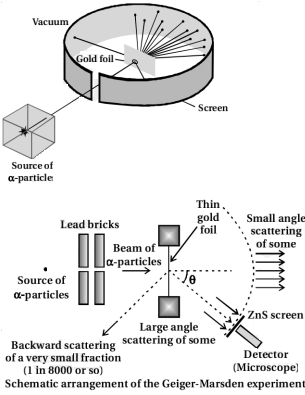
(N/A) In the Geiger-Marsden experiment,a beam of $5.5 \text{ MeV}$ $\alpha$-particles emitted from a ${ }_{83}^{214} \text{Bi}$ radioactive source is directed at a thin gold foil.
The $\alpha$-particles are collimated into a narrow beam by passing them through lead bricks.
This beam is allowed to strike a thin gold foil of thickness $2.1 \times 10^{-7} \text{ m}$.
The scattered $\alpha$-particles strike a fluorescent screen (typically $\text{ZnS}$),producing brief light flashes known as scintillations.
These scintillations are observed through a rotatable microscope,allowing the study of the number of scattered particles as a function of the scattering angle $\theta$.
The $\alpha$-particles are collimated into a narrow beam by passing them through lead bricks.
This beam is allowed to strike a thin gold foil of thickness $2.1 \times 10^{-7} \text{ m}$.
The scattered $\alpha$-particles strike a fluorescent screen (typically $\text{ZnS}$),producing brief light flashes known as scintillations.
These scintillations are observed through a rotatable microscope,allowing the study of the number of scattered particles as a function of the scattering angle $\theta$.
0 likes
View Solution58
Difficult
Discuss the experimental results of Geiger-Marsden's $\alpha$-particle scattering.
Solution
(N/A) The experimental results of the Geiger-Marsden $\alpha$-particle scattering experiment are summarized as follows:
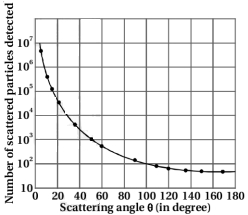
$1$. $A$ typical graph of the total number of $\alpha$-particles scattered at different angles in a given interval of time is shown in the figure. The dots represent the experimental data points,and the solid curve is the theoretical prediction based on the assumption that the atom has a positively charged nucleus.
$2$. Most of the $\alpha$-particles pass through the gold foil without any significant deviation. This indicates that they do not suffer any collisions,implying that most of the space inside an atom is empty.
$3$. Only about $0.14 \%$ of the incident $\alpha$-particles scatter by more than $1^{\circ}$.
$4$. About $1$ in $8000$ $\alpha$-particles deflect by more than $90^{\circ}$,which suggests the presence of a small,dense,and positively charged nucleus at the center of the atom.
$1$. $A$ typical graph of the total number of $\alpha$-particles scattered at different angles in a given interval of time is shown in the figure. The dots represent the experimental data points,and the solid curve is the theoretical prediction based on the assumption that the atom has a positively charged nucleus.
$2$. Most of the $\alpha$-particles pass through the gold foil without any significant deviation. This indicates that they do not suffer any collisions,implying that most of the space inside an atom is empty.
$3$. Only about $0.14 \%$ of the incident $\alpha$-particles scatter by more than $1^{\circ}$.
$4$. About $1$ in $8000$ $\alpha$-particles deflect by more than $90^{\circ}$,which suggests the presence of a small,dense,and positively charged nucleus at the center of the atom.
0 likes
View Solution59
Medium
Explain Rutherford's argument for scattered $\alpha$-particles.
Solution
(N/A) Rutherford argued that since a large number of $\alpha$-particles are scattered at very small angles,atoms must be largely hollow.
If a large part of the mass of an atom is tightly concentrated at its centre and it has a positive charge,then a Coulomb repulsive force may act between this positive charge and the positive charges of the $\alpha$-particles.
If so,then the incoming $\alpha$-particle could get very close to the positive charge without penetrating it and it will be deflected.
This argument supported the hypothesis of the nuclear atom. This is why Rutherford is credited with the discovery of the nucleus.
He argued that the electron is at a short distance from the nucleus. Just as the planets orbit the Sun,the electrons will orbit around the nucleus in a fixed orbit.
Rutherford's experiments suggested the size of the nucleus to be about $10^{-15} \ m$ to $10^{-14} \ m$. From kinetic theory,the size of an atom was known to be $10^{-10} \ m$,which is about $10,000$ to $100,000$ times larger than the size of the nucleus.
If a large part of the mass of an atom is tightly concentrated at its centre and it has a positive charge,then a Coulomb repulsive force may act between this positive charge and the positive charges of the $\alpha$-particles.
If so,then the incoming $\alpha$-particle could get very close to the positive charge without penetrating it and it will be deflected.
This argument supported the hypothesis of the nuclear atom. This is why Rutherford is credited with the discovery of the nucleus.
He argued that the electron is at a short distance from the nucleus. Just as the planets orbit the Sun,the electrons will orbit around the nucleus in a fixed orbit.
Rutherford's experiments suggested the size of the nucleus to be about $10^{-15} \ m$ to $10^{-14} \ m$. From kinetic theory,the size of an atom was known to be $10^{-10} \ m$,which is about $10,000$ to $100,000$ times larger than the size of the nucleus.
0 likes
View Solution60
Medium
Explain Rutherford's explanation for scattered $\alpha$-particles.
Solution
(N/A) Rutherford suggested that since a large number of $\alpha$-particles are scattered at very small angles,atoms must be largely hollow.
Since the gold foil is very thin,it can be assumed that $\alpha$-particles will suffer not more than one scattering during their passage through it.
$\alpha$-particles are nuclei of helium atoms and carry a charge of $+2e$ and have the mass of the helium atom.
For gold $Z=79$,the nucleus of gold is about $50$ times heavier than an $\alpha$-particle,so it is assumed to be stationary throughout the scattering process.
Under these assumptions,the trajectory of an $\alpha$-particle can be computed using Newton's second law of motion and Coulomb's law for the force of repulsion between the $\alpha$-particle and the positively charged nucleus.
The magnitude of Coulomb's repulsive force is given by:
$F = \frac{1}{4 \pi \epsilon_{0}} \cdot \frac{(Ze)(2e)}{r^{2}}$
where $r$ is the distance between the $\alpha$-particle and the nucleus,and $\epsilon_{0}$ is the permittivity of vacuum.
The force is directed along the line joining the $\alpha$-particle and the nucleus and varies continuously with the displacement of the $\alpha$-particle.
Since the gold foil is very thin,it can be assumed that $\alpha$-particles will suffer not more than one scattering during their passage through it.
$\alpha$-particles are nuclei of helium atoms and carry a charge of $+2e$ and have the mass of the helium atom.
For gold $Z=79$,the nucleus of gold is about $50$ times heavier than an $\alpha$-particle,so it is assumed to be stationary throughout the scattering process.
Under these assumptions,the trajectory of an $\alpha$-particle can be computed using Newton's second law of motion and Coulomb's law for the force of repulsion between the $\alpha$-particle and the positively charged nucleus.
The magnitude of Coulomb's repulsive force is given by:
$F = \frac{1}{4 \pi \epsilon_{0}} \cdot \frac{(Ze)(2e)}{r^{2}}$
where $r$ is the distance between the $\alpha$-particle and the nucleus,and $\epsilon_{0}$ is the permittivity of vacuum.
The force is directed along the line joining the $\alpha$-particle and the nucleus and varies continuously with the displacement of the $\alpha$-particle.
0 likes
View Solution61
Difficult
Show the trajectory of $\alpha$-particle for different impact parameters and explain how Rutherford used this to determine the upper limit of the nuclear size.
Solution
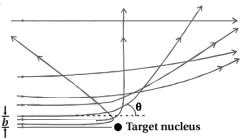
(N/A) The impact parameter $b$ is the perpendicular distance of the initial velocity vector of the $\alpha$-particle from the center of the nucleus. The trajectory of the $\alpha$-particle depends on this impact parameter $b$.
$A$ given beam of $\alpha$-particles has a distribution of impact parameters $b$,causing the beam to scatter in various directions with different probabilities. In a beam,all particles have nearly the same kinetic energy.
The smaller the impact parameter $b$ of the $\alpha$-particle,the closer it passes to the nucleus,resulting in a larger scattering angle $\theta$.
In the case of a head-on collision,the impact parameter is minimum $(b=0)$ and the $\alpha$-particle rebounds back $(\theta \cong \pi)$.
As the impact parameter $b$ increases,the scattering angle $\theta$ decreases. For very large impact parameters,the $\alpha$-particle continues on its original trajectory without significant scattering $(\theta \cong 0^{\circ})$.
Since only a small fraction of incident particles rebound back,it indicates that the number of $\alpha$-particles undergoing head-on collisions is very small. This implies that the mass and positive charge of the atom are concentrated in a very small volume. Therefore,Rutherford scattering is a powerful method to determine an upper limit to the size of the nucleus.
From this experiment,Rutherford estimated the dimension of the nucleus to be in the range of $10^{-15} \ m$ to $10^{-14} \ m$.
$A$ given beam of $\alpha$-particles has a distribution of impact parameters $b$,causing the beam to scatter in various directions with different probabilities. In a beam,all particles have nearly the same kinetic energy.
The smaller the impact parameter $b$ of the $\alpha$-particle,the closer it passes to the nucleus,resulting in a larger scattering angle $\theta$.
In the case of a head-on collision,the impact parameter is minimum $(b=0)$ and the $\alpha$-particle rebounds back $(\theta \cong \pi)$.
As the impact parameter $b$ increases,the scattering angle $\theta$ decreases. For very large impact parameters,the $\alpha$-particle continues on its original trajectory without significant scattering $(\theta \cong 0^{\circ})$.
Since only a small fraction of incident particles rebound back,it indicates that the number of $\alpha$-particles undergoing head-on collisions is very small. This implies that the mass and positive charge of the atom are concentrated in a very small volume. Therefore,Rutherford scattering is a powerful method to determine an upper limit to the size of the nucleus.
From this experiment,Rutherford estimated the dimension of the nucleus to be in the range of $10^{-15} \ m$ to $10^{-14} \ m$.
0 likes
View Solution62
EasyMCQ
What radioactive source did Geiger and Marsden use in the scattering experiment?
A
Radium
B
Polonium
C
Uranium
D
Thorium
Solution
(B) In the famous alpha-particle scattering experiment conducted by Geiger and Marsden under the supervision of Ernest Rutherford,they used a radioactive source that emitted alpha particles. The specific radioactive source used was $Polonium$ $(^{214}Po)$. This source provided a high-energy beam of alpha particles directed at a thin gold foil to observe the scattering patterns.
0 likes
View Solution63
MediumMCQ
What was the thickness of the gold foil used in the Geiger-Marsden scattering experiment?
A
$10^{-6} \ m$
B
$2.1 \times 10^{-7} \ m$
C
$10^{-8} \ m$
D
$5 \times 10^{-9} \ m$
Solution
(B) In the Geiger-Marsden experiment,also known as the Rutherford alpha-particle scattering experiment,a thin gold foil was used to study the scattering of alpha particles.
The thickness of this gold foil was approximately $2.1 \times 10^{-7} \ m$ (or $2.1 \times 10^{-5} \ cm$).
This extremely thin foil was chosen to ensure that the alpha particles would undergo only a single scattering event as they passed through the gold atoms,allowing for an accurate analysis of the atomic structure.
The thickness of this gold foil was approximately $2.1 \times 10^{-7} \ m$ (or $2.1 \times 10^{-5} \ cm$).
This extremely thin foil was chosen to ensure that the alpha particles would undergo only a single scattering event as they passed through the gold atoms,allowing for an accurate analysis of the atomic structure.
0 likes
View Solution64
MediumMCQ
What does it mean if the $\alpha$-particle passes through the gold foil without any deviation?
A
The atom is mostly empty space.
B
The atom has a dense positive nucleus.
C
The atom is a solid sphere.
D
The atom has electrons distributed throughout.
Solution
(A) In the Rutherford $\alpha$-particle scattering experiment,most of the $\alpha$-particles passed through the gold foil without any deviation. This observation leads to the conclusion that most of the space inside an atom is empty. Since the $\alpha$-particles are positively charged and relatively massive,their passage without deflection indicates that they did not encounter any significant electrostatic force or physical obstruction,confirming the existence of a large empty volume within the atomic structure.
0 likes
View Solution65
MediumMCQ
What is the percentage of $\alpha$-particles that have more than $1^o$ scattering in the Geiger-Marsden experiment (in $\%$)?
A
$0.125$
B
$0.5$
C
$1$
D
$0.01$
Solution
(A) In the Geiger-Marsden experiment,the number of $\alpha$-particles scattered at an angle $\theta$ is given by the relation $N(\theta) \propto \frac{1}{\sin^4(\theta/2)}$.
Experimental observations show that for a thin gold foil,the fraction of $\alpha$-particles scattered by an angle greater than $1^o$ is approximately $0.125\%$ or $1$ in $8000$ particles.
Therefore,the correct option is $A$.
Experimental observations show that for a thin gold foil,the fraction of $\alpha$-particles scattered by an angle greater than $1^o$ is approximately $0.125\%$ or $1$ in $8000$ particles.
Therefore,the correct option is $A$.
0 likes
View Solution66
EasyMCQ
In the Geiger-Marsden experiment,which of the following is used to calculate the trajectory of the $\alpha$-particle?
A
Coulomb's law
B
Newton's law of gravitation
C
Bohr's postulate
D
Faraday's law
Solution
(A) The Geiger-Marsden experiment involves the scattering of $\alpha$-particles by a gold nucleus.
Since the $\alpha$-particle and the gold nucleus are both charged particles,they experience an electrostatic force of repulsion.
The trajectory of the $\alpha$-particle is determined by the Coulomb force acting between the positively charged $\alpha$-particle and the positively charged nucleus.
Therefore,the trajectory is calculated using Coulomb's law,which describes the electrostatic interaction between point charges.
Since the $\alpha$-particle and the gold nucleus are both charged particles,they experience an electrostatic force of repulsion.
The trajectory of the $\alpha$-particle is determined by the Coulomb force acting between the positively charged $\alpha$-particle and the positively charged nucleus.
Therefore,the trajectory is calculated using Coulomb's law,which describes the electrostatic interaction between point charges.
0 likes
View Solution67
EasyMCQ
What is the impact parameter?
A
The perpendicular distance of the initial velocity vector of the alpha particle from the center of the nucleus.
B
The distance of closest approach of the alpha particle to the nucleus.
C
The angle at which the alpha particle is scattered.
D
The total energy of the alpha particle.
Solution
(A) The impact parameter $(b)$ is defined as the perpendicular distance of the initial velocity vector of the alpha particle from the center of the nucleus when it is far away from the nucleus.
It is a measure of how close an alpha particle will pass to the nucleus.
Mathematically,it is given by the formula: $b = \frac{1}{4\pi\epsilon_0} \cdot \frac{Ze^2 \cot(\theta/2)}{K}$,where $Z$ is the atomic number,$e$ is the elementary charge,$\theta$ is the scattering angle,and $K$ is the kinetic energy of the alpha particle.
It is a measure of how close an alpha particle will pass to the nucleus.
Mathematically,it is given by the formula: $b = \frac{1}{4\pi\epsilon_0} \cdot \frac{Ze^2 \cot(\theta/2)}{K}$,where $Z$ is the atomic number,$e$ is the elementary charge,$\theta$ is the scattering angle,and $K$ is the kinetic energy of the alpha particle.
0 likes
View Solution68
Medium
What is a head-on collision? For that,state the impact parameter.
Solution
(N/A) head-on collision occurs when an alpha particle is directed straight towards the center of the nucleus of an atom. In this case,the alpha particle approaches the nucleus,comes to a momentary rest at the distance of closest approach,and then reverses its path back along the same line.
The impact parameter $(b)$ is defined as the perpendicular distance of the initial velocity vector of the alpha particle from the center of the nucleus.
For a head-on collision,the alpha particle is aimed directly at the center of the nucleus,meaning the perpendicular distance between the path of the alpha particle and the center of the nucleus is zero. Therefore,the impact parameter $(b)$ for a head-on collision is $0$.
The impact parameter $(b)$ is defined as the perpendicular distance of the initial velocity vector of the alpha particle from the center of the nucleus.
For a head-on collision,the alpha particle is aimed directly at the center of the nucleus,meaning the perpendicular distance between the path of the alpha particle and the center of the nucleus is zero. Therefore,the impact parameter $(b)$ for a head-on collision is $0$.
0 likes
View Solution69
Easy
Give the relationship between impact parameter and scattering angle.
Solution
(N/A) The impact parameter $b$ is defined as the perpendicular distance of the initial velocity vector of the alpha particle from the center of the nucleus. The relationship between the impact parameter $b$ and the scattering angle $\theta$ is given by the formula:
$b = \frac{1}{4\pi\epsilon_0} \cdot \frac{Ze^2 \cot(\theta/2)}{K}$
where:
$Z$ is the atomic number of the target nucleus,
$e$ is the elementary charge,
$K$ is the kinetic energy of the incident alpha particle,
$\theta$ is the scattering angle,
$\epsilon_0$ is the permittivity of free space.
$b = \frac{1}{4\pi\epsilon_0} \cdot \frac{Ze^2 \cot(\theta/2)}{K}$
where:
$Z$ is the atomic number of the target nucleus,
$e$ is the elementary charge,
$K$ is the kinetic energy of the incident alpha particle,
$\theta$ is the scattering angle,
$\epsilon_0$ is the permittivity of free space.
0 likes
View Solution70
Difficult
How is an atom represented? Why?
Solution
(N/A) An atom is represented by the notation $^A_Z X$,where $X$ is the chemical symbol of the element,$Z$ is the atomic number (number of protons),and $A$ is the mass number (total number of protons and neutrons).
The positive charge in the nucleus is due to the protons. $A$ proton carries one unit of fundamental charge and is stable.
All the electrons of an atom are outside the nucleus and revolve around it in circular orbits due to the electrostatic Coulomb force.
The number of electrons in a neutral atom is equal to the atomic number $Z$. Hence,the total charge of the electrons is $(-Ze)$.
Since the atom is electrically neutral,the total positive charge of the nucleus must be $(+Ze)$. Therefore,the number of protons in the nucleus is equal to the atomic number $Z$.
The positive charge in the nucleus is due to the protons. $A$ proton carries one unit of fundamental charge and is stable.
All the electrons of an atom are outside the nucleus and revolve around it in circular orbits due to the electrostatic Coulomb force.
The number of electrons in a neutral atom is equal to the atomic number $Z$. Hence,the total charge of the electrons is $(-Ze)$.
Since the atom is electrically neutral,the total positive charge of the nucleus must be $(+Ze)$. Therefore,the number of protons in the nucleus is equal to the atomic number $Z$.
0 likes
View Solution71
Medium
Are atoms divisible or indivisible? Explain.
Solution
(N/A) Historically,the term 'atom' was derived from the Greek word 'atomos',meaning 'indivisible'. According to Dalton's atomic theory,atoms were considered the smallest,indivisible particles of matter.
However,in modern physics,it is established that atoms are divisible. Atoms consist of a central nucleus surrounded by electrons.
The nucleus itself is composed of protons and neutrons.
Furthermore,protons and neutrons are composed of even smaller fundamental particles known as quarks. Therefore,atoms are divisible into subatomic particles.
However,in modern physics,it is established that atoms are divisible. Atoms consist of a central nucleus surrounded by electrons.
The nucleus itself is composed of protons and neutrons.
Furthermore,protons and neutrons are composed of even smaller fundamental particles known as quarks. Therefore,atoms are divisible into subatomic particles.
0 likes
View Solution72
Medium
Write the name of the scientist who suggested that matter is made up of atoms.
Solution
(N/A) The concept that matter is composed of tiny, indivisible particles called atoms was first proposed by the ancient Indian philosopher $Maharishi$ $Kanad$ (around $600$ $BCE$) and independently by the ancient Greek philosopher $Democritus$ (around $460-370$ $BCE$). In the context of modern science, $John$ $Dalton$ is credited with proposing the first scientific atomic theory in $1803$.
0 likes
View Solution73
Easy
State the atomic hypothesis regarding the structure of matter.
Solution
(N/A) The atomic hypothesis states that all matter is composed of tiny,indivisible particles called atoms.
Key postulates of the atomic hypothesis include:
$1$. Matter is not continuous but consists of discrete particles called atoms.
$2$. Atoms of the same element are identical in mass and properties,while atoms of different elements differ.
$3$. Atoms are the smallest units that participate in chemical reactions.
$4$. Atoms are in constant motion,and their arrangement determines the state of matter (solid,liquid,or gas).
Key postulates of the atomic hypothesis include:
$1$. Matter is not continuous but consists of discrete particles called atoms.
$2$. Atoms of the same element are identical in mass and properties,while atoms of different elements differ.
$3$. Atoms are the smallest units that participate in chemical reactions.
$4$. Atoms are in constant motion,and their arrangement determines the state of matter (solid,liquid,or gas).
0 likes
View Solution74
Medium
State the postulates of Dalton's atomic theory.
Solution
(N/A) Dalton's atomic theory,proposed in $1803$,consists of the following postulates:
$1$. All matter is made of atoms,which are indivisible and indestructible particles.
$2$. All atoms of a given element are identical in mass and properties.
$3$. Compounds are formed by a combination of two or more different kinds of atoms.
$4$. $A$ chemical reaction is a rearrangement of atoms.
$5$. Atoms cannot be created or destroyed in a chemical reaction.
$1$. All matter is made of atoms,which are indivisible and indestructible particles.
$2$. All atoms of a given element are identical in mass and properties.
$3$. Compounds are formed by a combination of two or more different kinds of atoms.
$4$. $A$ chemical reaction is a rearrangement of atoms.
$5$. Atoms cannot be created or destroyed in a chemical reaction.
0 likes
View Solution75
Medium
What are the main postulates (suggestions) of Dalton's atomic theory?
Solution
(N/A) Dalton's atomic theory,proposed in $1808$,suggests the following:
$1$. All matter is made of indivisible particles called atoms.
$2$. Atoms of a given element are identical in mass and properties.
$3$. Atoms of different elements have different masses and properties.
$4$. Atoms combine in fixed ratios of small whole numbers to form compounds.
$5$. Atoms can neither be created nor destroyed in a chemical reaction.
$1$. All matter is made of indivisible particles called atoms.
$2$. Atoms of a given element are identical in mass and properties.
$3$. Atoms of different elements have different masses and properties.
$4$. Atoms combine in fixed ratios of small whole numbers to form compounds.
$5$. Atoms can neither be created nor destroyed in a chemical reaction.
0 likes
View Solution76
MediumMCQ
What is the dimension of an atom?
A
$10^{-10} \, m$
B
$10^{-15} \, m$
C
$10^{-6} \, m$
D
$10^{-2} \, m$
Solution
(A) The size of an atom is typically on the order of $1 \, \mathring{A}$ $(1 \, \mathring{A})$.
Since $1 \, \mathring{A} = 10^{-10} \, \text{m}$, the dimension of an atom is approximately $10^{-10} \, \text{m}$.
Therefore, the correct option is $A$.
Since $1 \, \mathring{A} = 10^{-10} \, \text{m}$, the dimension of an atom is approximately $10^{-10} \, \text{m}$.
Therefore, the correct option is $A$.
0 likes
View Solution77
EasyMCQ
Find the number of atoms in $39.4 \ g$ of gold. The molar mass of gold is $197 \ g \ mol^{-1}$.
A
$1.2 \times 10^{23}$
B
$2.4 \times 10^{23}$
C
$3.6 \times 10^{23}$
D
$4.8 \times 10^{23}$
Solution
(A) The number of moles $n$ is given by the formula $n = \frac{\text{mass}}{\text{molar mass}}$.
Given mass $= 39.4 \ g$ and molar mass $= 197 \ g \ mol^{-1}$.
$n = \frac{39.4}{197} = 0.2 \ mol$.
The number of atoms $N$ is given by $N = n \times N_A$,where $N_A$ is Avogadro's number $(6.023 \times 10^{23} \ mol^{-1})$.
$N = 0.2 \times 6.023 \times 10^{23} = 1.2046 \times 10^{23}$.
Rounding to significant figures,the number of atoms is $1.2 \times 10^{23}$.
Given mass $= 39.4 \ g$ and molar mass $= 197 \ g \ mol^{-1}$.
$n = \frac{39.4}{197} = 0.2 \ mol$.
The number of atoms $N$ is given by $N = n \times N_A$,where $N_A$ is Avogadro's number $(6.023 \times 10^{23} \ mol^{-1})$.
$N = 0.2 \times 6.023 \times 10^{23} = 1.2046 \times 10^{23}$.
Rounding to significant figures,the number of atoms is $1.2 \times 10^{23}$.
0 likes
View Solution78
Difficult
Explain the Rutherford atomic model and its limitations.
Solution
(N/A) Rutherford's atomic model proposed that an atom consists of a small,positively charged nucleus at the center,with electrons revolving around it in circular orbits,similar to how planets revolve around the Sun.
The fundamental difference between the two systems is that planets are held in orbit by gravitational force,whereas electrons are held by the electrostatic force of attraction as described by Coulomb's law.
Limitations of the Rutherford atomic model:
$1$. According to classical physics,there is no constraint on the radius of the electron's orbit.
$2$. An electron moving in a circular orbit undergoes centripetal acceleration.
$3$. According to classical electromagnetic theory,an accelerated charged particle must radiate energy in the form of electromagnetic waves. Consequently,the electron should lose energy continuously.
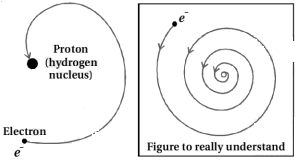
$4$. As the electron loses energy,its orbit would shrink,and it would follow a spiral path,eventually falling into the nucleus. This implies that the atom would be unstable,which contradicts the observed stability of matter.
$5$. Furthermore,as the electron spirals inwards,its angular velocity and frequency would change continuously. This would result in the emission of a continuous spectrum of light,which contradicts the observed discrete line spectra of atoms.
The fundamental difference between the two systems is that planets are held in orbit by gravitational force,whereas electrons are held by the electrostatic force of attraction as described by Coulomb's law.
Limitations of the Rutherford atomic model:
$1$. According to classical physics,there is no constraint on the radius of the electron's orbit.
$2$. An electron moving in a circular orbit undergoes centripetal acceleration.
$3$. According to classical electromagnetic theory,an accelerated charged particle must radiate energy in the form of electromagnetic waves. Consequently,the electron should lose energy continuously.
$4$. As the electron loses energy,its orbit would shrink,and it would follow a spiral path,eventually falling into the nucleus. This implies that the atom would be unstable,which contradicts the observed stability of matter.
$5$. Furthermore,as the electron spirals inwards,its angular velocity and frequency would change continuously. This would result in the emission of a continuous spectrum of light,which contradicts the observed discrete line spectra of atoms.
0 likes
View Solution79
DifficultMCQ
Calculate the number of atoms in $39.4$ $g$ of gold. The molar mass of gold is $197$ $g$ $mol^{-1}$.
A
$1.2046 \times 10^{23}$
B
$2.4092 \times 10^{23}$
C
$0.6023 \times 10^{23}$
D
$3.0115 \times 10^{23}$
Solution
(A) The number of moles $n$ is given by the formula $n = \frac{\text{mass}}{\text{molar mass}}$.
Given mass $= 39.4$ $g$ and molar mass $= 197$ $g$ $mol^{-1}$.
$n = \frac{39.4}{197} = 0.2$ $mol$.
The number of atoms $N$ is calculated by multiplying the number of moles by Avogadro's number $N_A = 6.023 \times 10^{23}$ $mol^{-1}$.
$N = n \times N_A = 0.2 \times 6.023 \times 10^{23} = 1.2046 \times 10^{23}$ atoms.
Given mass $= 39.4$ $g$ and molar mass $= 197$ $g$ $mol^{-1}$.
$n = \frac{39.4}{197} = 0.2$ $mol$.
The number of atoms $N$ is calculated by multiplying the number of moles by Avogadro's number $N_A = 6.023 \times 10^{23}$ $mol^{-1}$.
$N = n \times N_A = 0.2 \times 6.023 \times 10^{23} = 1.2046 \times 10^{23}$ atoms.
0 likes
View Solution80
MediumMCQ
Choose the correct option from the following options given below.
A
In the ground state of Rutherford's model,electrons are in stable equilibrium,while in Thomson's model,electrons always experience a net force.
B
An atom has a nearly continuous mass distribution in a Rutherford's model but has a highly non-uniform mass distribution in Thomson's model.
C
$A$ classical atom based on Rutherford's model is doomed to collapse.
D
The positively charged part of the atom possesses most of the mass in Rutherford's model but not in Thomson's model.
Solution
(C) According to Rutherford's model,the electron revolves around the nucleus in a circular orbit.
Since the electron is moving in a circular path,it undergoes centripetal acceleration.
According to classical electromagnetic theory,an accelerating charged particle must emit electromagnetic $(EM)$ radiation.
As the electron loses energy through radiation,its orbital radius decreases,and it should eventually spiral into the nucleus.
Therefore,a classical atom based on Rutherford's model is unstable and is doomed to collapse.
Since the electron is moving in a circular path,it undergoes centripetal acceleration.
According to classical electromagnetic theory,an accelerating charged particle must emit electromagnetic $(EM)$ radiation.
As the electron loses energy through radiation,its orbital radius decreases,and it should eventually spiral into the nucleus.
Therefore,a classical atom based on Rutherford's model is unstable and is doomed to collapse.
0 likes
View Solution81
MediumMCQ
$\sqrt{d_{1}}$ and $\sqrt{d_{2}}$ are the impact parameters corresponding to scattering angles $60^{\circ}$ and $90^{\circ}$ respectively,when an $\alpha$-particle is approaching a gold nucleus. For $d_{1} = x d_{2}$,the value of $x$ will be . . . . . .
A
$3$
B
$4$
C
$5$
D
$7$
Solution
(A) The impact parameter $b$ is related to the scattering angle $\theta$ by the formula: $b = \frac{1}{4\pi\epsilon_0} \frac{Ze^2 \cot(\theta/2)}{K}$,where $K$ is the kinetic energy.
This implies $b \propto \cot(\theta/2)$.
Given $\sqrt{d_1}$ and $\sqrt{d_2}$ are the impact parameters for angles $\theta_1 = 60^{\circ}$ and $\theta_2 = 90^{\circ}$ respectively,we have:
$\sqrt{d_1} \propto \cot(60^{\circ}/2) = \cot(30^{\circ}) = \sqrt{3}$.
$\sqrt{d_2} \propto \cot(90^{\circ}/2) = \cot(45^{\circ}) = 1$.
Squaring both sides,we get $d_1 \propto 3$ and $d_2 \propto 1$.
Thus,$d_1 = 3 d_2$.
Comparing this with $d_1 = x d_2$,we find $x = 3$.
This implies $b \propto \cot(\theta/2)$.
Given $\sqrt{d_1}$ and $\sqrt{d_2}$ are the impact parameters for angles $\theta_1 = 60^{\circ}$ and $\theta_2 = 90^{\circ}$ respectively,we have:
$\sqrt{d_1} \propto \cot(60^{\circ}/2) = \cot(30^{\circ}) = \sqrt{3}$.
$\sqrt{d_2} \propto \cot(90^{\circ}/2) = \cot(45^{\circ}) = 1$.
Squaring both sides,we get $d_1 \propto 3$ and $d_2 \propto 1$.
Thus,$d_1 = 3 d_2$.
Comparing this with $d_1 = x d_2$,we find $x = 3$.
0 likes
View Solution82
MediumMCQ
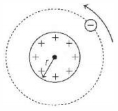
We consider the Thomson model of the hydrogen atom in which the proton charge is distributed uniformly over a spherical volume of radius $R = 0.25 \,\mathring A$. Applying the Bohr quantization condition in this model,the ground state energy (in $eV$) of the electron will be close to:
A
$-13.6 / 4$
B
$-13.6$
C
$-13.6 / 2$
D
$-2 \times 13.6$
Solution
(B) In the Thomson model,the positive charge is uniformly distributed in a sphere of radius $R$. For an electron at a distance $r > R$,the electric field is the same as that of a point charge $e$ at the center. The potential energy is $U(r) = -e^2 / (4 \pi \epsilon_0 r)$.
Applying the Bohr quantization condition $mvr = n\hbar$ for $n=1$,we have $mvr = \hbar$. The centripetal force is provided by the electrostatic force: $mv^2 / r = e^2 / (4 \pi \epsilon_0 r^2)$,which gives $mv^2 = e^2 / (4 \pi \epsilon_0 r)$.
Substituting $v = \hbar / (mr)$ into the force equation: $m(\hbar / mr)^2 = e^2 / (4 \pi \epsilon_0 r) \implies \hbar^2 / (mr^2) = e^2 / (4 \pi \epsilon_0 r) \implies r = 4 \pi \epsilon_0 \hbar^2 / (me^2) = a_0$,where $a_0$ is the Bohr radius $(0.53 \,\mathring A)$.
Since the calculated radius $r = a_0 = 0.53 \,\mathring A$ is greater than the radius of the sphere $R = 0.25 \,\mathring A$,the electron orbits outside the sphere. In this region,the potential is equivalent to that of a point charge. Thus,the energy levels are the same as the standard Bohr model,and the ground state energy is $-13.6 \, eV$.
Applying the Bohr quantization condition $mvr = n\hbar$ for $n=1$,we have $mvr = \hbar$. The centripetal force is provided by the electrostatic force: $mv^2 / r = e^2 / (4 \pi \epsilon_0 r^2)$,which gives $mv^2 = e^2 / (4 \pi \epsilon_0 r)$.
Substituting $v = \hbar / (mr)$ into the force equation: $m(\hbar / mr)^2 = e^2 / (4 \pi \epsilon_0 r) \implies \hbar^2 / (mr^2) = e^2 / (4 \pi \epsilon_0 r) \implies r = 4 \pi \epsilon_0 \hbar^2 / (me^2) = a_0$,where $a_0$ is the Bohr radius $(0.53 \,\mathring A)$.
Since the calculated radius $r = a_0 = 0.53 \,\mathring A$ is greater than the radius of the sphere $R = 0.25 \,\mathring A$,the electron orbits outside the sphere. In this region,the potential is equivalent to that of a point charge. Thus,the energy levels are the same as the standard Bohr model,and the ground state energy is $-13.6 \, eV$.
0 likes
View Solution83
MediumMCQ
Particles used in the Rutherford's scattering experiment to deduce the structure of atoms:
A
had atomic number $2$ and were fully ionised
B
had atomic number $2$ and were neutral
C
had atomic number $4$ and were fully ionised
D
had atomic number $4$ and were neutral
Solution
(A) The particles used in Rutherford's scattering experiment (also known as the Geiger-Marsden experiment) are $\alpha$-particles.
An $\alpha$-particle is a helium nucleus,represented as ${ }_2^4 He$.
It consists of $2$ protons and $2$ neutrons,meaning its atomic number is $2$ and its mass number is $4$.
Since it is a nucleus,it is fully ionised (it has no electrons),resulting in a net positive charge of $+2e$.
Therefore,the correct option is $A$.
An $\alpha$-particle is a helium nucleus,represented as ${ }_2^4 He$.
It consists of $2$ protons and $2$ neutrons,meaning its atomic number is $2$ and its mass number is $4$.
Since it is a nucleus,it is fully ionised (it has no electrons),resulting in a net positive charge of $+2e$.
Therefore,the correct option is $A$.
0 likes
View Solution84
DifficultMCQ
In $1911$,the physicist Ernest Rutherford discovered that atoms have a tiny,dense nucleus by shooting positively charged particles at a very thin gold foil. $A$ key physical property which led Rutherford to use gold was that it was
A
electrically conducting
B
highly malleable
C
shiny
D
non-reactive
Solution
(B) The correct answer is $B$.
In the Geiger-Marsden experiment,the objective is to target $\alpha$-particles towards an atom to observe their scattering.
This experiment requires a target that is extremely thin,ideally only a few atoms thick,to ensure that the $\alpha$-particles undergo minimal scattering events.
Gold is known for being highly malleable,which allows it to be beaten into an extremely thin foil (a few micrometers thick). This physical property made it the ideal material for Rutherford's experiment.
In the Geiger-Marsden experiment,the objective is to target $\alpha$-particles towards an atom to observe their scattering.
This experiment requires a target that is extremely thin,ideally only a few atoms thick,to ensure that the $\alpha$-particles undergo minimal scattering events.
Gold is known for being highly malleable,which allows it to be beaten into an extremely thin foil (a few micrometers thick). This physical property made it the ideal material for Rutherford's experiment.
0 likes
View Solution85
MediumMCQ
Which statement about the Rutherford model of the atom is not true?
A
There is a positively charged centre in an atom called the nucleus
B
Nearly all the mass of an atom resides in the nucleus
C
Size of the nucleus is comparable to the atom
D
Electrons occupy the space surrounding the nucleus
Solution
(C) The correct answer is $(c)$.
According to the Rutherford model of the atom:
$1$. The entire positive charge and nearly all the mass of the atom are concentrated in a very small region at the center called the nucleus.
$2$. The size of the nucleus $(10^{-15} \ m)$ is extremely small compared to the size of the atom $(10^{-10} \ m)$.
$3$. Electrons revolve around the nucleus in circular orbits.
Since the size of the nucleus is much smaller than the size of the atom,the statement that the size of the nucleus is comparable to the atom is incorrect.
According to the Rutherford model of the atom:
$1$. The entire positive charge and nearly all the mass of the atom are concentrated in a very small region at the center called the nucleus.
$2$. The size of the nucleus $(10^{-15} \ m)$ is extremely small compared to the size of the atom $(10^{-10} \ m)$.
$3$. Electrons revolve around the nucleus in circular orbits.
Since the size of the nucleus is much smaller than the size of the atom,the statement that the size of the nucleus is comparable to the atom is incorrect.
0 likes
View Solution86
EasyMCQ
An alpha particle colliding with one of the electrons in a gold atom loses
A
Most of its momentum
B
About $1/3$ rd of its momentum
C
Little of its energy
D
Most of its energy
Solution
(C) The mass of an alpha particle $(m_{\alpha} \approx 6.64 \times 10^{-27} \ kg)$ is approximately $7300$ times larger than the mass of an electron $(m_e \approx 9.11 \times 10^{-31} \ kg)$.
According to the laws of conservation of momentum and energy,when a very heavy particle collides with a very light particle,the energy transferred to the light particle is negligible.
Therefore,the alpha particle loses only a very small fraction of its kinetic energy during the collision with an electron.
Thus,the correct option is $C$.
According to the laws of conservation of momentum and energy,when a very heavy particle collides with a very light particle,the energy transferred to the light particle is negligible.
Therefore,the alpha particle loses only a very small fraction of its kinetic energy during the collision with an electron.
Thus,the correct option is $C$.
0 likes
View Solution87
EasyMCQ
According to classical theory,the Rutherford atom was:
A
Electrostatically stable
B
Electrodynamically unstable
C
Semi-stable
D
Stable
Solution
(B) According to classical electromagnetic theory,an accelerating charged particle (like an electron revolving around a nucleus) must continuously emit electromagnetic radiation.
This loss of energy would cause the electron to spiral into the nucleus,making the Rutherford model electrodynamically unstable.
However,Rutherford's initial model was based on electrostatic forces (Coulomb's law) to explain the stability of the atom's structure in terms of force balance,even though it failed to explain the dynamic stability.
Given the context of the question regarding the classical theoretical framework,the Rutherford atom is considered electrodynamically unstable.
This loss of energy would cause the electron to spiral into the nucleus,making the Rutherford model electrodynamically unstable.
However,Rutherford's initial model was based on electrostatic forces (Coulomb's law) to explain the stability of the atom's structure in terms of force balance,even though it failed to explain the dynamic stability.
Given the context of the question regarding the classical theoretical framework,the Rutherford atom is considered electrodynamically unstable.
0 likes
View Solution88
MediumMCQ
In Rutherford's experiment,the number of particles scattered at a $90^{\circ}$ angle is $x$ per second. The number of particles scattered per second at an angle of $60^{\circ}$ is:
A
$x$
B
$4 x$
C
$8 x$
D
$16 x$
Solution
(B) The number of alpha particles $N(\theta)$ scattered at an angle $\theta$ is given by the relation:
$N(\theta) \propto \frac{1}{\sin^4(\theta/2)}$
Given:
$N(90^{\circ}) = x$
We need to find $N(60^{\circ})$:
$\frac{N(60^{\circ})}{N(90^{\circ})} = \frac{\sin^4(90^{\circ}/2)}{\sin^4(60^{\circ}/2)}$
$\frac{N(60^{\circ})}{x} = \frac{\sin^4(45^{\circ})}{\sin^4(30^{\circ})}$
Since $\sin(45^{\circ}) = \frac{1}{\sqrt{2}}$ and $\sin(30^{\circ}) = \frac{1}{2}$:
$\frac{N(60^{\circ})}{x} = \frac{(1/\sqrt{2})^4}{(1/2)^4} = \frac{1/4}{1/16} = \frac{16}{4} = 4$
Therefore,$N(60^{\circ}) = 4x$.
$N(\theta) \propto \frac{1}{\sin^4(\theta/2)}$
Given:
$N(90^{\circ}) = x$
We need to find $N(60^{\circ})$:
$\frac{N(60^{\circ})}{N(90^{\circ})} = \frac{\sin^4(90^{\circ}/2)}{\sin^4(60^{\circ}/2)}$
$\frac{N(60^{\circ})}{x} = \frac{\sin^4(45^{\circ})}{\sin^4(30^{\circ})}$
Since $\sin(45^{\circ}) = \frac{1}{\sqrt{2}}$ and $\sin(30^{\circ}) = \frac{1}{2}$:
$\frac{N(60^{\circ})}{x} = \frac{(1/\sqrt{2})^4}{(1/2)^4} = \frac{1/4}{1/16} = \frac{16}{4} = 4$
Therefore,$N(60^{\circ}) = 4x$.
0 likes
View Solution89
DifficultMCQ
Given below are two statements:
$Statement$ $I$: Most of the mass of the atom and all its positive charge are concentrated in a tiny nucleus and the electrons revolve around it,is Rutherford's model.
$Statement$ $II$: An atom is a spherical cloud of positive charges with electrons embedded in it,is a special case of Rutherford's model.
In the light of the above statements,choose the most appropriate from the options given below.
$Statement$ $I$: Most of the mass of the atom and all its positive charge are concentrated in a tiny nucleus and the electrons revolve around it,is Rutherford's model.
$Statement$ $II$: An atom is a spherical cloud of positive charges with electrons embedded in it,is a special case of Rutherford's model.
In the light of the above statements,choose the most appropriate from the options given below.
A
Both statement $I$ and statement $II$ are false.
B
Statement $I$ is false but statement $II$ is true.
C
Statement $I$ is true but statement $II$ is false.
D
Both statement $I$ and statement $II$ are true.
Solution
(C) According to Rutherford's atomic model,most of the mass of the atom and all its positive charge are concentrated in a tiny nucleus,and the electrons revolve around it. This confirms that $Statement$ $I$ is true.
According to Thomson's atomic model (often called the plum pudding model),an atom is a spherical cloud of positive charge with electrons embedded in it. This is not a special case of Rutherford's model; rather,it is a completely different model that was superseded by Rutherford's model. Therefore,$Statement$ $II$ is false.
Hence,$Statement$ $I$ is true but $Statement$ $II$ is false.
According to Thomson's atomic model (often called the plum pudding model),an atom is a spherical cloud of positive charge with electrons embedded in it. This is not a special case of Rutherford's model; rather,it is a completely different model that was superseded by Rutherford's model. Therefore,$Statement$ $II$ is false.
Hence,$Statement$ $I$ is true but $Statement$ $II$ is false.
0 likes
View Solution90
DifficultMCQ
In an alpha particle scattering experiment,the distance of closest approach for the $\alpha$-particle is $4.5 \times 10^{-14} \ m$. If the target nucleus has an atomic number $Z = 80$,then the maximum velocity of the $\alpha$-particle is approximately $... \times 10^5 \ m/s$.
$\left(\frac{1}{4 \pi \epsilon_0} = 9 \times 10^9 \ SI \ unit, \text{mass of } \alpha \text{-particle } m = 6.72 \times 10^{-27} \ kg, e = 1.6 \times 10^{-19} \ C\right)$
$\left(\frac{1}{4 \pi \epsilon_0} = 9 \times 10^9 \ SI \ unit, \text{mass of } \alpha \text{-particle } m = 6.72 \times 10^{-27} \ kg, e = 1.6 \times 10^{-19} \ C\right)$
A
$155$
B
$156$
C
$157$
D
$158$
Solution
(B) At the distance of closest approach $(r_{\min})$,the entire initial kinetic energy of the $\alpha$-particle is converted into electrostatic potential energy.
$\frac{1}{2}mv^2 = \frac{1}{4 \pi \epsilon_0} \frac{(Ze)(2e)}{r_{\min}}$
$v^2 = \frac{4 \times (9 \times 10^9) \times 80 \times 2 \times (1.6 \times 10^{-19})^2}{6.72 \times 10^{-27} \times 4.5 \times 10^{-14}}$
$v^2 = \frac{720 \times 10^9 \times 2 \times 2.56 \times 10^{-38}}{30.24 \times 10^{-41}}$
$v^2 = \frac{3686.4 \times 10^{-29}}{30.24 \times 10^{-41}} \approx 121.9 \times 10^{12} \ m^2/s^2$
$v \approx 11.04 \times 10^6 \ m/s = 110.4 \times 10^5 \ m/s$.
Re-evaluating the calculation based on standard textbook constants: $v = \sqrt{\frac{2 \times 9 \times 10^9 \times 80 \times 2 \times (1.6 \times 10^{-19})^2}{6.72 \times 10^{-27} \times 4.5 \times 10^{-14}}} \approx 1.56 \times 10^7 \ m/s = 156 \times 10^5 \ m/s$.
$\frac{1}{2}mv^2 = \frac{1}{4 \pi \epsilon_0} \frac{(Ze)(2e)}{r_{\min}}$
$v^2 = \frac{4 \times (9 \times 10^9) \times 80 \times 2 \times (1.6 \times 10^{-19})^2}{6.72 \times 10^{-27} \times 4.5 \times 10^{-14}}$
$v^2 = \frac{720 \times 10^9 \times 2 \times 2.56 \times 10^{-38}}{30.24 \times 10^{-41}}$
$v^2 = \frac{3686.4 \times 10^{-29}}{30.24 \times 10^{-41}} \approx 121.9 \times 10^{12} \ m^2/s^2$
$v \approx 11.04 \times 10^6 \ m/s = 110.4 \times 10^5 \ m/s$.
Re-evaluating the calculation based on standard textbook constants: $v = \sqrt{\frac{2 \times 9 \times 10^9 \times 80 \times 2 \times (1.6 \times 10^{-19})^2}{6.72 \times 10^{-27} \times 4.5 \times 10^{-14}}} \approx 1.56 \times 10^7 \ m/s = 156 \times 10^5 \ m/s$.
0 likes
View Solution91
AdvancedMCQ
$A$ proton is fired from very far away towards a nucleus with charge $Q=120 \ e$,where $e$ is the electronic charge. It makes a closest approach of $10 \ fm$ to the nucleus. The de Broglie wavelength (in units of $fm$) of the proton at its start is: (take the proton mass,$m_0 = (5/3) \times 10^{-27} \ kg$,$h/e = 4.2 \times 10^{-15} \ J \cdot s/C$,$\frac{1}{4 \pi \varepsilon_0} = 9 \times 10^9 \ N \cdot m^2/C^2$,$1 \ fm = 10^{-15} \ m$)
A
$7$
B
$8$
C
$9$
D
$1$
Solution
(A) At the point of closest approach,the initial kinetic energy $K$ of the proton is entirely converted into electrostatic potential energy $U$.
$K = U = \frac{1}{4 \pi \varepsilon_0} \frac{Q \cdot e}{r_0}$
Given $Q = 120 \ e$ and $r_0 = 10 \ fm = 10 \times 10^{-15} \ m$.
$K = \frac{(9 \times 10^9) \times (120 \ e) \times e}{10 \times 10^{-15}} = \frac{p^2}{2m_0}$
$p^2 = 2 m_0 \times \frac{9 \times 10^9 \times 120 \ e^2}{10 \times 10^{-15}} = 2 \times \left(\frac{5}{3} \times 10^{-27}\right) \times 9 \times 10^9 \times 120 \times 10^{15} \times e^2$
$p^2 = 2 \times \frac{5}{3} \times 9 \times 120 \times 10^{-27+9+15} \times e^2 = 3600 \times 10^{-3} \times e^2 = 3.6 \times e^2$
Since $\lambda = \frac{h}{p}$,we have $p = \frac{h}{\lambda}$,so $p^2 = \frac{h^2}{\lambda^2}$.
$\frac{h^2}{\lambda^2} = 3.6 \times e^2 \implies \lambda^2 = \frac{h^2}{3.6 \times e^2} = \frac{(h/e)^2}{3.6}$
Given $h/e = 4.2 \times 10^{-15} \ J \cdot s/C$.
$\lambda^2 = \frac{(4.2 \times 10^{-15})^2}{3.6} = \frac{17.64 \times 10^{-30}}{3.6} = 4.9 \times 10^{-30} \ m^2$
$\lambda = \sqrt{49 \times 10^{-31}} \approx 7 \times 10^{-15} \ m = 7 \ fm$.
$K = U = \frac{1}{4 \pi \varepsilon_0} \frac{Q \cdot e}{r_0}$
Given $Q = 120 \ e$ and $r_0 = 10 \ fm = 10 \times 10^{-15} \ m$.
$K = \frac{(9 \times 10^9) \times (120 \ e) \times e}{10 \times 10^{-15}} = \frac{p^2}{2m_0}$
$p^2 = 2 m_0 \times \frac{9 \times 10^9 \times 120 \ e^2}{10 \times 10^{-15}} = 2 \times \left(\frac{5}{3} \times 10^{-27}\right) \times 9 \times 10^9 \times 120 \times 10^{15} \times e^2$
$p^2 = 2 \times \frac{5}{3} \times 9 \times 120 \times 10^{-27+9+15} \times e^2 = 3600 \times 10^{-3} \times e^2 = 3.6 \times e^2$
Since $\lambda = \frac{h}{p}$,we have $p = \frac{h}{\lambda}$,so $p^2 = \frac{h^2}{\lambda^2}$.
$\frac{h^2}{\lambda^2} = 3.6 \times e^2 \implies \lambda^2 = \frac{h^2}{3.6 \times e^2} = \frac{(h/e)^2}{3.6}$
Given $h/e = 4.2 \times 10^{-15} \ J \cdot s/C$.
$\lambda^2 = \frac{(4.2 \times 10^{-15})^2}{3.6} = \frac{17.64 \times 10^{-30}}{3.6} = 4.9 \times 10^{-30} \ m^2$
$\lambda = \sqrt{49 \times 10^{-31}} \approx 7 \times 10^{-15} \ m = 7 \ fm$.

0 likes
View Solution92
EasyMCQ
In the Geiger-Marsden scattering experiment,the thickness of the thin gold foil is . . . . . . m.
A
$5.5 \times 10^{-7}$
B
$4.2 \times 10^{-7}$
C
$2.1 \times 10^{-7}$
D
$6.2 \times 10^{-7}$
Solution
(C) In the classic Geiger-Marsden experiment (also known as the Rutherford gold foil experiment),Hans Geiger and Ernest Marsden used a very thin gold foil to observe the scattering of alpha particles.
The thickness of the gold foil used in this experiment was approximately $2.1 \times 10^{-7} \ m$ (or $2.1 \times 10^{-5} \ cm$).
Therefore,the correct option is $C$.
The thickness of the gold foil used in this experiment was approximately $2.1 \times 10^{-7} \ m$ (or $2.1 \times 10^{-5} \ cm$).
Therefore,the correct option is $C$.
0 likes
View Solution93
EasyMCQ
An $\alpha$-particle of energy $5 \text{ MeV}$ is moving forward for a head-on collision. The distance of closest approach from the nucleus of atomic number $Z=50$ is . . . . . . $\times 10^{-14} \text{ m}$.
$(k=9 \times 10^{9} \text{ SI}, e=1.6 \times 10^{-19} \text{ C}, 1 \text{ eV}=1.6 \times 10^{-19} \text{ J})$
$(k=9 \times 10^{9} \text{ SI}, e=1.6 \times 10^{-19} \text{ C}, 1 \text{ eV}=1.6 \times 10^{-19} \text{ J})$
A
$0.72$
B
$2.88$
C
$1.44$
D
$5.76$
Solution
(B) The distance of closest approach $r_0$ is the point where the initial kinetic energy of the $\alpha$-particle is completely converted into electrostatic potential energy.
$r_0 = \frac{k q_1 q_2}{K}$
Here,$q_1 = 2e$ (charge of $\alpha$-particle),$q_2 = Ze$ (charge of nucleus),and $K = 5 \text{ MeV} = 5 \times 10^6 \times 1.6 \times 10^{-19} \text{ J}$.
$r_0 = \frac{9 \times 10^9 \times (2e) \times (Ze)}{K} = \frac{9 \times 10^9 \times 2 \times 50 \times e^2}{5 \times 10^6 \times 1.6 \times 10^{-19}}$
$r_0 = \frac{9 \times 10^9 \times 100 \times (1.6 \times 10^{-19})^2}{5 \times 10^6 \times 1.6 \times 10^{-19}}$
$r_0 = \frac{9 \times 10^9 \times 100 \times 1.6 \times 10^{-19}}{5 \times 10^6} = \frac{1440 \times 10^{-10}}{5 \times 10^6} = 288 \times 10^{-16} \text{ m} = 2.88 \times 10^{-14} \text{ m}$.
Thus,the distance is $2.88 \times 10^{-14} \text{ m}$.
$r_0 = \frac{k q_1 q_2}{K}$
Here,$q_1 = 2e$ (charge of $\alpha$-particle),$q_2 = Ze$ (charge of nucleus),and $K = 5 \text{ MeV} = 5 \times 10^6 \times 1.6 \times 10^{-19} \text{ J}$.
$r_0 = \frac{9 \times 10^9 \times (2e) \times (Ze)}{K} = \frac{9 \times 10^9 \times 2 \times 50 \times e^2}{5 \times 10^6 \times 1.6 \times 10^{-19}}$
$r_0 = \frac{9 \times 10^9 \times 100 \times (1.6 \times 10^{-19})^2}{5 \times 10^6 \times 1.6 \times 10^{-19}}$
$r_0 = \frac{9 \times 10^9 \times 100 \times 1.6 \times 10^{-19}}{5 \times 10^6} = \frac{1440 \times 10^{-10}}{5 \times 10^6} = 288 \times 10^{-16} \text{ m} = 2.88 \times 10^{-14} \text{ m}$.
Thus,the distance is $2.88 \times 10^{-14} \text{ m}$.
0 likes
View Solution94
EasyMCQ
The distance of the closest approach of an alpha particle fired at a nucleus with kinetic energy $K$ is $r_{0}$. The distance of the closest approach when the $\alpha$-particle is fired at the same nucleus with kinetic energy $2K$ will be . . . . . . .
A
$4 r_{0}$
B
$\frac{r_{0}}{2}$
C
$\frac{r_{0}}{4}$
D
$2 r_{0}$
Solution
(B) The distance of the closest approach $r_{0}$ for an alpha particle of kinetic energy $K$ is given by the formula:
$r_{0} = \frac{1}{4 \pi \varepsilon_{0}} \cdot \frac{2Ze^{2}}{K}$
From this expression,we can see that the distance of the closest approach is inversely proportional to the kinetic energy:
$r_{0} \propto \frac{1}{K}$
Let $r_{01} = r_{0}$ when kinetic energy $K_{1} = K$.
When the kinetic energy is increased to $K_{2} = 2K$,let the new distance be $r_{02}$.
Using the proportionality $r_{01} K_{1} = r_{02} K_{2}$,we get:
$r_{0} \cdot K = r_{02} \cdot (2K)$
$r_{02} = \frac{r_{0} \cdot K}{2K} = \frac{r_{0}}{2}$
Therefore,the new distance of the closest approach is $\frac{r_{0}}{2}$.
$r_{0} = \frac{1}{4 \pi \varepsilon_{0}} \cdot \frac{2Ze^{2}}{K}$
From this expression,we can see that the distance of the closest approach is inversely proportional to the kinetic energy:
$r_{0} \propto \frac{1}{K}$
Let $r_{01} = r_{0}$ when kinetic energy $K_{1} = K$.
When the kinetic energy is increased to $K_{2} = 2K$,let the new distance be $r_{02}$.
Using the proportionality $r_{01} K_{1} = r_{02} K_{2}$,we get:
$r_{0} \cdot K = r_{02} \cdot (2K)$
$r_{02} = \frac{r_{0} \cdot K}{2K} = \frac{r_{0}}{2}$
Therefore,the new distance of the closest approach is $\frac{r_{0}}{2}$.
0 likes
View Solution95
EasyMCQ
The size of an atom in Thomson's model is . . . . . . the size in Rutherford's model.
A
much greater than
B
much less than
C
not different from
D
double
Solution
(C) In both Thomson's model and Rutherford's model, the atom is considered to be a sphere of radius approximately $10^{-10} \, m$ (or $1 \, \text{Å}$). Therefore, the size of the atom is the same in both models. The difference between the models lies in the distribution of positive and negative charges, not in the overall size of the atom. Thus, the correct option is $C$.
0 likes
View Solution96
EasyMCQ
Atoms of the same element with different mass numbers are known as $\qquad$ .
A
isotones
B
isobars
C
isomers
D
isotopes
Solution
(D) Atoms of the same element have the same atomic number $(Z)$ but different mass numbers $(A)$. These atoms are defined as isotopes. For example,hydrogen has three naturally occurring isotopes: protium $(^1H_1)$,deuterium $(^2H_1)$,and tritium $(^3H_1)$.
0 likes
View Solution97
MediumMCQ
In the alpha particle scattering experiment,if $v$ is the initial velocity of the particle,then the distance of closest approach is $d$. If the velocity is doubled,then the distance of closest approach changes to:
A
$4 d$
B
$2 d$
C
$\frac{d}{2}$
D
$\frac{d}{4}$
Solution
(D) The distance of closest approach $r_0$ is determined by equating the initial kinetic energy of the alpha particle to the electrostatic potential energy at the point of closest approach:
$\frac{1}{2} m v^2 = \frac{1}{4 \pi \varepsilon_0} \cdot \frac{(Ze)(2e)}{r_0}$
From this equation,we can see that $v^2 \propto \frac{1}{r_0}$,which implies $r_0 \propto \frac{1}{v^2}$.
Given that the initial distance of closest approach is $d$ for velocity $v$,let the new distance be $d'$ for velocity $2v$.
$\frac{d'}{d} = \frac{v^2}{(2v)^2} = \frac{v^2}{4v^2} = \frac{1}{4}$
Therefore,$d' = \frac{d}{4}$.
$\frac{1}{2} m v^2 = \frac{1}{4 \pi \varepsilon_0} \cdot \frac{(Ze)(2e)}{r_0}$
From this equation,we can see that $v^2 \propto \frac{1}{r_0}$,which implies $r_0 \propto \frac{1}{v^2}$.
Given that the initial distance of closest approach is $d$ for velocity $v$,let the new distance be $d'$ for velocity $2v$.
$\frac{d'}{d} = \frac{v^2}{(2v)^2} = \frac{v^2}{4v^2} = \frac{1}{4}$
Therefore,$d' = \frac{d}{4}$.
0 likes
View Solution98
EasyMCQ
In Rutherford's alpha scattering experiment,as the impact parameter increases,the scattering angle of the alpha particle:
A
remains the same
B
is always $90^{\circ}$
C
decreases
D
increases
Solution
(C) In Rutherford's $\alpha$-scattering experiment,the impact parameter $(b)$ and the scattering angle $(\theta)$ are related by the formula:
$b = \frac{1}{4 \pi \varepsilon_0} \cdot \frac{Z e^2 \cot(\theta/2)}{K}$,where $K$ is the kinetic energy of the $\alpha$-particle.
From this relation,we observe that $b \propto \cot(\theta/2)$.
As the impact parameter $(b)$ increases,the value of $\cot(\theta/2)$ must increase.
Since the cotangent function is a decreasing function for angles between $0$ and $\pi$,an increase in $\cot(\theta/2)$ implies that the angle $(\theta/2)$ must decrease.
Therefore,the scattering angle $(\theta)$ decreases as the impact parameter $(b)$ increases.
$b = \frac{1}{4 \pi \varepsilon_0} \cdot \frac{Z e^2 \cot(\theta/2)}{K}$,where $K$ is the kinetic energy of the $\alpha$-particle.
From this relation,we observe that $b \propto \cot(\theta/2)$.
As the impact parameter $(b)$ increases,the value of $\cot(\theta/2)$ must increase.
Since the cotangent function is a decreasing function for angles between $0$ and $\pi$,an increase in $\cot(\theta/2)$ implies that the angle $(\theta/2)$ must decrease.
Therefore,the scattering angle $(\theta)$ decreases as the impact parameter $(b)$ increases.
0 likes
View Solution99
MediumMCQ
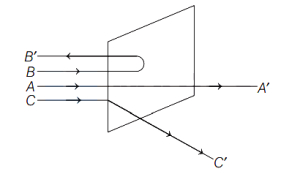
$A$ beam of fast-moving alpha particles was directed towards a thin gold foil. The parts $A, B$,and $C$ of the incident beam and their corresponding transmitted or reflected parts $A^{\prime}, B^{\prime}$,and $C^{\prime}$ are shown in the adjoining diagram. The number of alpha particles in:
A
$B^{\prime}$ will be minimum and in $C^{\prime}$ maximum
B
$A^{\prime}$ will be maximum and in $B^{\prime}$ minimum
C
$A^{\prime}$ will be minimum and in $B^{\prime}$ maximum
D
$C^{\prime}$ will be minimum and in $B^{\prime}$ maximum
Solution
(B) According to Rutherford's $\alpha$-particle scattering experiment,the following observations were made:
$(i)$ Most of the $\alpha$-particles passed through the gold foil undeflected,corresponding to path $A-A^{\prime}$.
(ii) $A$ small fraction of $\alpha$-particles were scattered by small angles,corresponding to path $C-C^{\prime}$.
(iii) $A$ very small fraction of $\alpha$-particles were scattered by large angles (or reflected back),corresponding to path $B-B^{\prime}$.
Since the number of particles scattered decreases as the scattering angle increases,the number of particles $n$ follows the order $n_{A^{\prime}} > n_{C^{\prime}} > n_{B^{\prime}}$.
Therefore,the number of $\alpha$-particles is maximum in $A^{\prime}$ and minimum in $B^{\prime}$.
$(i)$ Most of the $\alpha$-particles passed through the gold foil undeflected,corresponding to path $A-A^{\prime}$.
(ii) $A$ small fraction of $\alpha$-particles were scattered by small angles,corresponding to path $C-C^{\prime}$.
(iii) $A$ very small fraction of $\alpha$-particles were scattered by large angles (or reflected back),corresponding to path $B-B^{\prime}$.
Since the number of particles scattered decreases as the scattering angle increases,the number of particles $n$ follows the order $n_{A^{\prime}} > n_{C^{\prime}} > n_{B^{\prime}}$.
Therefore,the number of $\alpha$-particles is maximum in $A^{\prime}$ and minimum in $B^{\prime}$.
0 likes
View Solution100
DifficultMCQ
In the Rutherford experiment,for a head-on collision of $\alpha$-particles with a gold nucleus,the impact parameter is:
A
of the order of $10^{-10} \ m$
B
zero
C
of the order of $10^{-6} \ m$
D
of the order of $10^{-14} \ m$
Solution
(B) The impact parameter $b$ is defined as the perpendicular distance of the initial velocity vector of the $\alpha$-particle from the center of the nucleus.
For a head-on collision,the $\alpha$-particle travels directly towards the center of the nucleus and retraces its path after the collision.
In this case,the perpendicular distance between the path of the $\alpha$-particle and the center of the nucleus is zero.
Therefore,the impact parameter for a head-on collision is $0$.
For a head-on collision,the $\alpha$-particle travels directly towards the center of the nucleus and retraces its path after the collision.
In this case,the perpendicular distance between the path of the $\alpha$-particle and the center of the nucleus is zero.
Therefore,the impact parameter for a head-on collision is $0$.
0 likes
View SolutionAtoms — Atomic Models and Scattering of Alpha particle · Frequently Asked Questions
1Are these Atoms questions useful for JEE and NEET?
Yes. All questions in this section are mapped to JEE Main and NEET exam patterns. Previous year questions from JEE Main, NEET, GUJCET and state-level exams are included with full solutions.
2Can I switch to Hindi or Gujarati for these questions?
Yes. Use the language tabs in the hero section or the sidebar to view the same questions and solutions in English, Hindi or Gujarati.
3How do I generate a question paper from this subtopic?
Use the Vedclass Exam Paper Generator — select the chapter and subtopic, set difficulty, and generate Sets A, B, C, D automatically. First 3 chapters of every subject are free.
Vedclass Products
For Students
Vedclass Test Series
Mock tests in real JEE/NEET style with performance analysis. 5-day free trial.
Start Free TrialFor Teachers
Exam Paper Generator
Generate Set A/B/C/D papers from this chapter in 2 minutes. 3 chapters free.
Try FreeFor Institutes
Online Exam Module
Live online exams with unlimited students, 360° analytics & white-label branding.
See DemoFor Teachers & Institutes
Generate a Atoms Exam Paper in 2 Minutes
Select subtopic & difficulty — Sets A, B, C, D auto-generated with No Repeat logic.
First 3 chapters of every subject are free — no payment required.