
A English
Atomic Models and Scattering of Alpha particle Questions in English
Class 12 Physics · Atoms · Atomic Models and Scattering of Alpha particle
111+
Questions
English
Language
100%
With Solutions
Showing 11 of 111 questions in English
101
EasyMCQ
Rutherford's atomic model could account for
A
stability of atoms
B
origin of spectra
C
the positively charged central core of an atom
D
concept of stationary orbits
Solution
(C) Rutherford's alpha-particle scattering experiment led to the discovery of the nucleus. His atomic model proposed that the entire positive charge and most of the mass of an atom are concentrated in a very small central region called the nucleus. Therefore,it could successfully account for the positively charged central core of an atom. It failed to explain the stability of atoms and the origin of line spectra,which were later addressed by Bohr's model.
0 likes
View Solution102
EasyMCQ
An $\alpha$-particle of energy $5 \text{ MeV}$ is scattered through $180^{\circ}$ by a gold nucleus. The distance of closest approach is of the order of:
A
$10^{-10} \text{ cm}$
B
$10^{-12} \text{ cm}$
C
$10^{-14} \text{ cm}$
D
$10^{-16} \text{ cm}$
Solution
(B) The distance of closest approach $(d)$ is the distance at which the kinetic energy of the $\alpha$-particle is completely converted into electrostatic potential energy.
$d = \frac{1}{4 \pi \varepsilon_{0}} \frac{(Z_1 e)(Z_2 e)}{K}$
Here,$Z_1 = 2$ (for $\alpha$-particle),$Z_2 = 79$ (for gold nucleus),and $K = 5 \text{ MeV} = 5 \times 10^6 \times 1.6 \times 10^{-19} \text{ J} = 8 \times 10^{-13} \text{ J}$.
Substituting the values:
$d = (9 \times 10^9) \times \frac{(2 \times 1.6 \times 10^{-19}) \times (79 \times 1.6 \times 10^{-19})}{8 \times 10^{-13}}$
$d = \frac{9 \times 10^9 \times 2 \times 79 \times 2.56 \times 10^{-38}}{8 \times 10^{-13}}$
$d \approx 4.55 \times 10^{-14} \text{ m} = 4.55 \times 10^{-12} \text{ cm}$.
Thus,the order of magnitude is $10^{-12} \text{ cm}$.
$d = \frac{1}{4 \pi \varepsilon_{0}} \frac{(Z_1 e)(Z_2 e)}{K}$
Here,$Z_1 = 2$ (for $\alpha$-particle),$Z_2 = 79$ (for gold nucleus),and $K = 5 \text{ MeV} = 5 \times 10^6 \times 1.6 \times 10^{-19} \text{ J} = 8 \times 10^{-13} \text{ J}$.
Substituting the values:
$d = (9 \times 10^9) \times \frac{(2 \times 1.6 \times 10^{-19}) \times (79 \times 1.6 \times 10^{-19})}{8 \times 10^{-13}}$
$d = \frac{9 \times 10^9 \times 2 \times 79 \times 2.56 \times 10^{-38}}{8 \times 10^{-13}}$
$d \approx 4.55 \times 10^{-14} \text{ m} = 4.55 \times 10^{-12} \text{ cm}$.
Thus,the order of magnitude is $10^{-12} \text{ cm}$.
0 likes
View Solution103
EasyMCQ
The scientist who is credited with the discovery of the 'nucleus' in an atom is
A
$J$.$J$. Thomson
B
Rutherford
C
Niels Bohr
D
Balmer
Solution
(B) Ernest Rutherford is the scientist credited with the discovery of the atomic nucleus.
In $1911$,he conducted the famous alpha-particle scattering experiment (Gold Foil Experiment).
He observed that a small fraction of alpha particles were deflected by large angles,which led him to conclude that the positive charge and most of the mass of the atom are concentrated in a very small central region called the nucleus.
In $1911$,he conducted the famous alpha-particle scattering experiment (Gold Foil Experiment).
He observed that a small fraction of alpha particles were deflected by large angles,which led him to conclude that the positive charge and most of the mass of the atom are concentrated in a very small central region called the nucleus.
0 likes
View Solution104
DifficultMCQ
The distance of closest approach of an alpha particle to a nucleus when the alpha particle moves towards the nucleus with linear momentum $P$ is $d$. What is the distance of closest approach of the alpha particle to the nucleus if the linear momentum of the alpha particle is $1.5 P$?
A
$\frac{2 d}{3}$
B
$\frac{3 d}{2}$
C
$\frac{4 d}{9}$
D
$\frac{9 d}{4}$
Solution
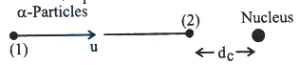
(C) At a sufficient distance,the electric potential energy is zero. So,$U_1 = 0$.
At position $(1)$,the kinetic energy is $K_1 = \frac{1}{2} mv^2 = \frac{P^2}{2m}$.
At the distance of closest approach $(2)$,the kinetic energy is $K_2 = 0$.
The electric potential energy at distance $d_c$ is $U_2 = \frac{1}{4 \pi \epsilon_0} \frac{q_\alpha q_n}{d_c}$.
By the law of conservation of energy:
$U_1 + K_1 = U_2 + K_2$
$0 + \frac{P^2}{2m} = \frac{1}{4 \pi \epsilon_0} \frac{q_\alpha q_n}{d_c} + 0$
From this,we see that the distance of closest approach $d_c \propto \frac{1}{P^2}$.
Therefore,$\frac{d_2}{d_1} = \frac{P_1^2}{P_2^2}$.
Given $d_1 = d$,$P_1 = P$,and $P_2 = 1.5 P = \frac{3}{2} P$:
$d_2 = d \times \frac{P^2}{(1.5 P)^2} = d \times \frac{P^2}{2.25 P^2} = d \times \frac{1}{2.25} = d \times \frac{4}{9} = \frac{4d}{9}$.
At position $(1)$,the kinetic energy is $K_1 = \frac{1}{2} mv^2 = \frac{P^2}{2m}$.
At the distance of closest approach $(2)$,the kinetic energy is $K_2 = 0$.
The electric potential energy at distance $d_c$ is $U_2 = \frac{1}{4 \pi \epsilon_0} \frac{q_\alpha q_n}{d_c}$.
By the law of conservation of energy:
$U_1 + K_1 = U_2 + K_2$
$0 + \frac{P^2}{2m} = \frac{1}{4 \pi \epsilon_0} \frac{q_\alpha q_n}{d_c} + 0$
From this,we see that the distance of closest approach $d_c \propto \frac{1}{P^2}$.
Therefore,$\frac{d_2}{d_1} = \frac{P_1^2}{P_2^2}$.
Given $d_1 = d$,$P_1 = P$,and $P_2 = 1.5 P = \frac{3}{2} P$:
$d_2 = d \times \frac{P^2}{(1.5 P)^2} = d \times \frac{P^2}{2.25 P^2} = d \times \frac{1}{2.25} = d \times \frac{4}{9} = \frac{4d}{9}$.
0 likes
View Solution105
DifficultMCQ
An alpha particle of energy $K \text{ MeV}$ is moving towards a nucleus of atomic number $Z$. The distance of closest approach of the alpha particle to the nucleus in metres is
A
$7.2 \times 10^{-16} \frac{Z}{K}$
B
$3.84 \times 10^{-16} \frac{Z}{K}$
C
$14.4 \times 10^{-16} \frac{Z}{K}$
D
$28.8 \times 10^{-16} \frac{Z}{K}$
Solution
(D) At the distance of closest approach,the entire kinetic energy of the alpha particle is converted into electrostatic potential energy.
$K.E. = U$
$K \times 10^6 \times 1.6 \times 10^{-19} \text{ J} = \frac{1}{4 \pi \epsilon_0} \frac{(2e)(Ze)}{r}$
Substituting the value of $\frac{1}{4 \pi \epsilon_0} = 9 \times 10^9 \text{ N m}^2/\text{C}^2$ and $e = 1.6 \times 10^{-19} \text{ C}$:
$r = \frac{2 \times 9 \times 10^9 \times Z \times (1.6 \times 10^{-19})^2}{K \times 10^6 \times 1.6 \times 10^{-19}}$
$r = \frac{18 \times 10^9 \times 1.6 \times 10^{-19} \times Z}{K \times 10^6}$
$r = \frac{28.8 \times 10^{-10}}{K \times 10^6} Z$
$r = 28.8 \times 10^{-16} \frac{Z}{K} \text{ m}$
$K.E. = U$
$K \times 10^6 \times 1.6 \times 10^{-19} \text{ J} = \frac{1}{4 \pi \epsilon_0} \frac{(2e)(Ze)}{r}$
Substituting the value of $\frac{1}{4 \pi \epsilon_0} = 9 \times 10^9 \text{ N m}^2/\text{C}^2$ and $e = 1.6 \times 10^{-19} \text{ C}$:
$r = \frac{2 \times 9 \times 10^9 \times Z \times (1.6 \times 10^{-19})^2}{K \times 10^6 \times 1.6 \times 10^{-19}}$
$r = \frac{18 \times 10^9 \times 1.6 \times 10^{-19} \times Z}{K \times 10^6}$
$r = \frac{28.8 \times 10^{-10}}{K \times 10^6} Z$
$r = 28.8 \times 10^{-16} \frac{Z}{K} \text{ m}$
0 likes
View Solution106
MediumMCQ
Assertion $(A)$: The impact parameter for $\alpha$-particles scattered by $180^{\circ}$ is zero.
Reason $(R)$: Zero impact parameter means that the $\alpha$-particles tend to hit the centre of the nucleus.
Reason $(R)$: Zero impact parameter means that the $\alpha$-particles tend to hit the centre of the nucleus.
A
Both $A$ and $R$ are true and $R$ is a correct explanation for $A$.
B
Both $A$ and $R$ are true but $R$ is not a correct explanation for $A$.
C
$A$ is true but $R$ is false.
D
$A$ is false but $R$ is true.
Solution
(A) The impact parameter $b$ is given by the formula: $b = \frac{Z e^2 \cot(\theta/2)}{4 \pi \varepsilon_0 (\frac{1}{2} m v^2)}$.
For scattering at an angle $\theta = 180^{\circ}$,we have $\cot(180^{\circ}/2) = \cot(90^{\circ}) = 0$.
Substituting this into the formula,we get $b = 0$.
$A$ zero impact parameter implies that the $\alpha$-particle is directed straight towards the centre of the nucleus,leading to a head-on collision and backscattering at $180^{\circ}$.
Therefore,both $A$ and $R$ are true and $R$ is the correct explanation for $A$.
For scattering at an angle $\theta = 180^{\circ}$,we have $\cot(180^{\circ}/2) = \cot(90^{\circ}) = 0$.
Substituting this into the formula,we get $b = 0$.
$A$ zero impact parameter implies that the $\alpha$-particle is directed straight towards the centre of the nucleus,leading to a head-on collision and backscattering at $180^{\circ}$.
Therefore,both $A$ and $R$ are true and $R$ is the correct explanation for $A$.
0 likes
View Solution107
EasyMCQ
The Franck-Hertz experiment proves that
A
light moves in the form of waves as well as particles
B
the electron does not radiate energy while moving in an orbit
C
the energy states of an atom are quantised
D
the whole of the positive charge of the atom is concentrated in the nucleus
Solution
(C) The Franck-Hertz experiment demonstrated the existence of discrete energy levels in atoms by bombarding mercury vapor with electrons. When the kinetic energy of the electrons reached a specific threshold,they lost energy to the mercury atoms,causing them to transition to higher energy states. This confirms the prediction of quantum theory that the energy states of an atom are quantised.
0 likes
View Solution108
DifficultMCQ
Statement $(A)$: As one considers orbits with higher values of $n$ in a hydrogen atom,the electric potential energy of the atom increases.
Statement $(B)$: In Thomson's model,an atom is a spherical cloud of positive charges with electrons embedded in it.
Statement $(C)$: The orbital picture in Bohr's model of the hydrogen atom was consistent with the uncertainty principle.
Statement $(B)$: In Thomson's model,an atom is a spherical cloud of positive charges with electrons embedded in it.
Statement $(C)$: The orbital picture in Bohr's model of the hydrogen atom was consistent with the uncertainty principle.
A
$A, B$ and $C$ are true
B
$A, B$ true,but $C$ false
C
$B, C$ true,but $A$ false
D
$A, C$ true but $B$ false
Solution
(B) In a hydrogen atom,the potential energy $(PE)$ of an electron in the $n$th orbit is given by $PE = -\frac{kZe^2}{r}$.
For higher values of $n$,the radius $r$ increases because $r \propto n^2$.
As $r$ increases,the magnitude of the negative potential energy decreases,meaning the value of the potential energy increases (becomes less negative).
Thus,statement $(A)$ is correct.
In Thomson's model,an atom is described as a spherical cloud of positive charge with electrons embedded within it,similar to a plum pudding. Thus,statement $(B)$ is correct.
According to Bohr's model,an electron in an atom is located at a definite distance from the nucleus and revolves with a definite velocity. However,Heisenberg's uncertainty principle states that it is impossible to determine the exact position and momentum of a moving electron simultaneously.
Therefore,Bohr's model contradicts the uncertainty principle,making statement $(C)$ incorrect.
Hence,option $(b)$ is the correct answer.
For higher values of $n$,the radius $r$ increases because $r \propto n^2$.
As $r$ increases,the magnitude of the negative potential energy decreases,meaning the value of the potential energy increases (becomes less negative).
Thus,statement $(A)$ is correct.
In Thomson's model,an atom is described as a spherical cloud of positive charge with electrons embedded within it,similar to a plum pudding. Thus,statement $(B)$ is correct.
According to Bohr's model,an electron in an atom is located at a definite distance from the nucleus and revolves with a definite velocity. However,Heisenberg's uncertainty principle states that it is impossible to determine the exact position and momentum of a moving electron simultaneously.
Therefore,Bohr's model contradicts the uncertainty principle,making statement $(C)$ incorrect.
Hence,option $(b)$ is the correct answer.
0 likes
View Solution109
DifficultMCQ
$A$ $7.9 \text{ MeV}$ $\alpha$-particle scatters from a target material of atomic number $Z = 79$. From the given data,the estimated diameter of the nucleus of the target material is (approximately) . . . . . . $\text{m}$.
$\left[\frac{1}{4 \pi \epsilon_0} = 9 \times 10^9 \text{ Nm}^2/\text{C}^2\right.$ and electron charge $\left.e = 1.6 \times 10^{-19} \text{ C}\right]$
$\left[\frac{1}{4 \pi \epsilon_0} = 9 \times 10^9 \text{ Nm}^2/\text{C}^2\right.$ and electron charge $\left.e = 1.6 \times 10^{-19} \text{ C}\right]$
A
$5.76 \times 10^{-14}$
B
$1.44 \times 10^{-13}$
C
$2.88 \times 10^{-14}$
D
$1.69 \times 10^{-12}$
Solution
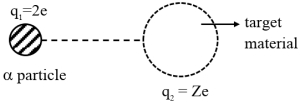
(A) At the distance of closest approach $(r)$,the entire kinetic energy of the $\alpha$-particle is converted into electrostatic potential energy.
By the principle of conservation of mechanical energy:
$K.E._i + P.E._i = K.E._f + P.E._f$
Given $K.E._i = 7.9 \text{ MeV} = 7.9 \times 10^6 \times 1.6 \times 10^{-19} \text{ J}$,$P.E._i = 0$,$K.E._f = 0$,and $P.E._f = \frac{1}{4 \pi \epsilon_0} \frac{(2e)(Ze)}{r}$.
$7.9 \times 10^6 \times 1.6 \times 10^{-19} = \frac{9 \times 10^9 \times 2 \times 79 \times (1.6 \times 10^{-19})^2}{r}$
Solving for $r$:
$r = \frac{9 \times 10^9 \times 2 \times 79 \times 1.6 \times 10^{-19}}{7.9 \times 10^6} = 2.88 \times 10^{-14} \text{ m}$
The diameter of the nucleus is $D = 2r = 2 \times 2.88 \times 10^{-14} = 5.76 \times 10^{-14} \text{ m}$.
By the principle of conservation of mechanical energy:
$K.E._i + P.E._i = K.E._f + P.E._f$
Given $K.E._i = 7.9 \text{ MeV} = 7.9 \times 10^6 \times 1.6 \times 10^{-19} \text{ J}$,$P.E._i = 0$,$K.E._f = 0$,and $P.E._f = \frac{1}{4 \pi \epsilon_0} \frac{(2e)(Ze)}{r}$.
$7.9 \times 10^6 \times 1.6 \times 10^{-19} = \frac{9 \times 10^9 \times 2 \times 79 \times (1.6 \times 10^{-19})^2}{r}$
Solving for $r$:
$r = \frac{9 \times 10^9 \times 2 \times 79 \times 1.6 \times 10^{-19}}{7.9 \times 10^6} = 2.88 \times 10^{-14} \text{ m}$
The diameter of the nucleus is $D = 2r = 2 \times 2.88 \times 10^{-14} = 5.76 \times 10^{-14} \text{ m}$.
0 likes
View Solution110
MediumMCQ
If an alpha particle with energy $7.7 \text{ MeV}$ is bombarded on a thin gold foil,the closest distance from the nucleus it can reach is . . . . . . $\text{m}$. (Atomic number of gold $= 79$ and $\frac{1}{4 \pi \epsilon_0} = 9 \times 10^9$ in $SI$ units)
A
$2.95 \times 10^{-14}$
B
$2.95 \times 10^{-16}$
C
$3.85 \times 10^{-16}$
D
$3.85 \times 10^{-14}$
Solution
(A) The distance of closest approach $r_0$ is the distance where the kinetic energy of the alpha particle is completely converted into electrostatic potential energy.
Using the principle of conservation of energy:
$K_i + U_i = K_f + U_f$
At the distance of closest approach,final kinetic energy $K_f = 0$.
$K_i = \frac{1}{4 \pi \epsilon_0} \cdot \frac{(Ze)(2e)}{r_0}$
Given:
$K_i = 7.7 \text{ MeV} = 7.7 \times 10^6 \times 1.6 \times 10^{-19} \text{ J}$
$Z = 79$ (for gold)
$e = 1.6 \times 10^{-19} \text{ C}$
$\frac{1}{4 \pi \epsilon_0} = 9 \times 10^9 \text{ N m}^2/\text{C}^2$
Substituting the values:
$7.7 \times 10^6 \times 1.6 \times 10^{-19} = \frac{9 \times 10^9 \times (79 \times 1.6 \times 10^{-19}) \times (2 \times 1.6 \times 10^{-19})}{r_0}$
$r_0 = \frac{9 \times 10^9 \times 79 \times 2 \times 1.6 \times 10^{-19}}{7.7 \times 10^6}$
$r_0 \approx 2.95 \times 10^{-14} \text{ m}$
Using the principle of conservation of energy:
$K_i + U_i = K_f + U_f$
At the distance of closest approach,final kinetic energy $K_f = 0$.
$K_i = \frac{1}{4 \pi \epsilon_0} \cdot \frac{(Ze)(2e)}{r_0}$
Given:
$K_i = 7.7 \text{ MeV} = 7.7 \times 10^6 \times 1.6 \times 10^{-19} \text{ J}$
$Z = 79$ (for gold)
$e = 1.6 \times 10^{-19} \text{ C}$
$\frac{1}{4 \pi \epsilon_0} = 9 \times 10^9 \text{ N m}^2/\text{C}^2$
Substituting the values:
$7.7 \times 10^6 \times 1.6 \times 10^{-19} = \frac{9 \times 10^9 \times (79 \times 1.6 \times 10^{-19}) \times (2 \times 1.6 \times 10^{-19})}{r_0}$
$r_0 = \frac{9 \times 10^9 \times 79 \times 2 \times 1.6 \times 10^{-19}}{7.7 \times 10^6}$
$r_0 \approx 2.95 \times 10^{-14} \text{ m}$
0 likes
View Solution111
MediumMCQ
In Rutherford's alpha-particle scattering experiment,only a few alpha particles rebound back because:
A
The size of the gold nucleus is very small compared to the size of the gold atom.
B
Alpha particles and the gold nucleus have equal charge.
C
The impact parameter is minimum for a few alpha particles.
D
$A$ few alpha particles undergo head-on collision with the nuclei.
Solution
(D) In Rutherford's alpha-particle scattering experiment,alpha particles are positively charged and experience a strong electrostatic repulsive force when they approach the gold nucleus.
Most of the atom is empty space,allowing the majority of alpha particles to pass through undeflected.
$A$ small fraction of alpha particles rebound because they undergo a near head-on collision with the dense,positively charged nucleus.
Since the nucleus occupies a very small volume compared to the total volume of the atom,the probability of such a collision is extremely low.
Thus,the rebounding is primarily due to the head-on collision with the tiny,massive nucleus.
Most of the atom is empty space,allowing the majority of alpha particles to pass through undeflected.
$A$ small fraction of alpha particles rebound because they undergo a near head-on collision with the dense,positively charged nucleus.
Since the nucleus occupies a very small volume compared to the total volume of the atom,the probability of such a collision is extremely low.
Thus,the rebounding is primarily due to the head-on collision with the tiny,massive nucleus.
0 likes
View SolutionAtoms — Atomic Models and Scattering of Alpha particle · Frequently Asked Questions
1Are these Atoms questions useful for JEE and NEET?
Yes. All questions in this section are mapped to JEE Main and NEET exam patterns. Previous year questions from JEE Main, NEET, GUJCET and state-level exams are included with full solutions.
2Can I switch to Hindi or Gujarati for these questions?
Yes. Use the language tabs in the hero section or the sidebar to view the same questions and solutions in English, Hindi or Gujarati.
3How do I generate a question paper from this subtopic?
Use the Vedclass Exam Paper Generator — select the chapter and subtopic, set difficulty, and generate Sets A, B, C, D automatically. First 3 chapters of every subject are free.
Vedclass Products
For Students
Vedclass Test Series
Mock tests in real JEE/NEET style with performance analysis. 5-day free trial.
Start Free TrialFor Teachers
Exam Paper Generator
Generate Set A/B/C/D papers from this chapter in 2 minutes. 3 chapters free.
Try FreeFor Institutes
Online Exam Module
Live online exams with unlimited students, 360° analytics & white-label branding.
See DemoFor Teachers & Institutes
Generate a Atoms Exam Paper in 2 Minutes
Select subtopic & difficulty — Sets A, B, C, D auto-generated with No Repeat logic.
First 3 chapters of every subject are free — no payment required.